Anmelden
Competing Statuses
05. April 2026 um 20:10
Will you take control of a country — or dominate the neighborhood?

Will you take control of a country — or dominate the neighborhood?
This is a board game blog. Board games are a medium which can help us understand – for example, they can provide a uniquely active perspective on history. Yet which other medium can provide a fresh perspective on board games? – This is where novels come in handy. Today, we’re going to look at The Third Reich (Roberto Bolaño), a study in obsession as well as gaming and history.
Spain in the 1980s. Udo Berger, a young German, has just arrived in a small seaside town for a vacation with his girlfriend Ingeborg. Yet Udo’s mind is not on the beach. He has just won the national championship at the wargame The Third Reich (clearly based on Rise and Decline of the Third Reich (Don Greenwood/John Prados, Avalon Hill)) and plans to use his vacation to write an article on his new strategy for the Axis. Ingeborg, however, has more traditional vacation activities in mind, and so they spend some of their swimming, tanning, and partying, through which they befriend another German couple, some locals, and the enigmatic paddleboat renter who is only known as El Quemado (The Burned One) for the burn marks which cover his body. When the vacation comes to an end, Udo remains in Spain, supposedly to help in the case of an acquaintance lost at sea windsurfing… yet the real reason is the game of Third Reich which he plays against El Quemado.

Chilean novelist Roberto Bolaño wrote the novel in 1989. Since he turned his hand-written first draft into a typoscript (and later typed the first 20% into his first computer), it is assumed that he wanted to eventually publish it, but he didn’t do so before his death in 2003. When the novel was found among his papers, it was posthumously published in 2010. In addition to the original Spanish (El Tercer Reich), the book has been widely translated. I read the German translation.
Warning: Spoilers for the plot of The Third Reich ahead – but frankly, this is not a book you read for plot, you read it for the vibes.
Udo Berger is wargame-obsessed, but the book is not a study of how an outsider has outsider fixations. On the one hand, Berger’s obsession with conquest and domination sets him by no means apart from his peers – just that they usually direct their respective urges to amorous exploits. On the other, our protagonist does not only want to conquer in the game either. In addition to his girlfriend, he also pursues the hotel manager Frau Else (who has been his crush when he was vacationing in Spain as a teen), and the underage chambermaid Clarita. And maybe most of all, Berger is fixated on being respected by his wargame peers, which he can only imagine obtaining by finding strategies (and publishing articles about them) which will obliterate all conventional wisdoms about the game.
As Berger is acutely aware of his lack of linguistic sophistication, he decides to practice by writing a diary during his vacation (which is what we read in the novel). The development of this diary reflects the changes in the writer: Originally, his daily entries are very structured (one per day, headlined by the date), and mostly concerned with banal reports on what he did, what he ate, and what he has in mind for the game/article). As Berger is drawn more and more into his duel with El Quemado, the diary gets more confused: He jumps from one level of narration to another within the same paragraph, extensive passages are solely dedicated to what’s happening in the game (down to which counters are placed on which individual hex numbers on the board), and the chapters are not only named after the dates, but also entitled “With El Lobo and El Cordero [his Spanish acquaintances]”, “Spring 1942” or “My Favorite Generals”.
Berger’s inability to focus also dooms his conquests (ludic and erotic): He sets out to prove that opening a second front early is not a liability, but an asset, and enthusiastically reports early in the game to a friend at home that it’s “Blitzkrieg on all fronts”. Yet as he conducts an amphibious assault of Britain at the same time as he invades the Soviet Union, his forces are overstretched and his Axis collapses before the historical date. And broadcasting his erotic attention over Ingeborg, Frau Else, and Clarita, does not further his relationship with either of them.
As things slide out of his grip, his attitude to control changes: Initially, Berger is fixated on the superior strategy. He notes down the exact moves – which corps need to occupy which hex in which turn to win. This chess-like approach collapses after the turning point of the game: Once El Quemado begins his counter-attack, Berger mentions for the first times that there are die rolls in the game (and how they favor his opponent) – not unlike many board gamers I have seen.
Besides the main theme of obsession, the novel also offers many glimpses on gaming, history, and the relation between the two.
Berger arrives in Spain with his life compartmentalized between the gaming and the “normal” part – his girlfriend and the office job. This compartmentalization is already eroding with his plan to write the strategy article (which immediately chafes against the confines of a conventional vacation – the hotel employees are bewildered by his request for a large table to be set up in his room, and Ingeborg demands he come to the beach) and fully collapses over the course of the book, when he even unilaterally extends his vacation to play the game (and gets fired for it).
The shadow of history hangs over Berger. Our protagonist does not only play games about World War II, he also reads “patriotic” literature of the era, knows about the lives and deeds of the German generals (especially those of the SS), and the only of his wargamer friends for whom he has a certain reverence is a veteran of World War II. Despite this clear fascination for the history of Nazi Germany, Berger twice disavows being a Nazi himself (having been asked by El Quemado and Clarita). Once he even calls himself an “opponent of the Nazis”, but does not expound on it. His personal politics do not factor into the novel – Berger, having been born around 1960 in democratic, liberal, prosperous post-war Germany enjoys the luxury of only engaging with history at his leisure. He thus remains at the surface of it…
…unlike his gaming opponent. El Quemado comes from South America, and it is rumored among his Spanish acquaintances that the scars he bears are the result of torture (by one of the many right-wing regimes which took power in the 1970s). History has thus seeped into his body and gives him the strength to withstand the ludic assault of the experienced player Berger.
Bolaño himself was arrested after the 1973 coup in Chile and, to his own wonder, was released after eight days without having been tortured (he ascribed it to two of the detectives having attended school with him). He then emigrated to Spain where he worked odd jobs in the tourism industry like El Quemado.
Another allusion to Chile is made in a much-misunderstood scene: On September 11, everyone is out at the beach to celebrate the Catalan national holiday. Yet when a plane flies overhead, an eerie sense of dread overcomes the spectators. Many reviewers see this as a revision which Bolaño must have made after the September 11, 2001 terrorist attacks (or, as an odd coincidence) – but I think the likeliest reason for the scene is that the coup in Chile began on September 11, 1973 with the rebelling air force bombarding the presidential palace in Santiago.
Roberto Bolaño’s The Third Reich starts with the innocent concept of a beach vacation. As it grows darker, the novel develops a hypnotic pull. The author’s own deep knowledge of wargames allows him to paint a vivid picture of the game itself – and of the hold it can have over its players.

From the rulebook: “Shadera is no ordinary world. A great cataclysm has shattered the world of the fairy creatures. Where once there were no borders, an impenetrable veil now divides the home of the gnomes, wolper-squirrels and mermaids into many different Shard Worlds. In order to be able to continue to exchange raw materials, make trade agreements, and visit old friends, the Portal Guild was created — an association of all those magicians who can use their magic to open portals between the worlds.
You are part of this guild: adepts who, after long and thorough training, have come together today to prove their skills. Your master has decided that you will compete against each other in a duel to show that you can gather enough energy to open portals through the veil to the Shard Worlds. The first person to complete 20 tasks will be awarded Shadera’s highest honor, the title of Portal Guard.”
If, having just read all that, you’re crossing your eyes trying to make sense of it, you’re not alone. The story is nonsensical. Somehow, though, it seems appropriate because Portals is a game that defies easy explanation, especially if you try to attach a story to it.
Published in 2024, Uwe Rosenberg’s Portals puts the players in the roles of Portal…
The post Ave Uwe: Portals Game Review appeared first on Meeple Mountain.
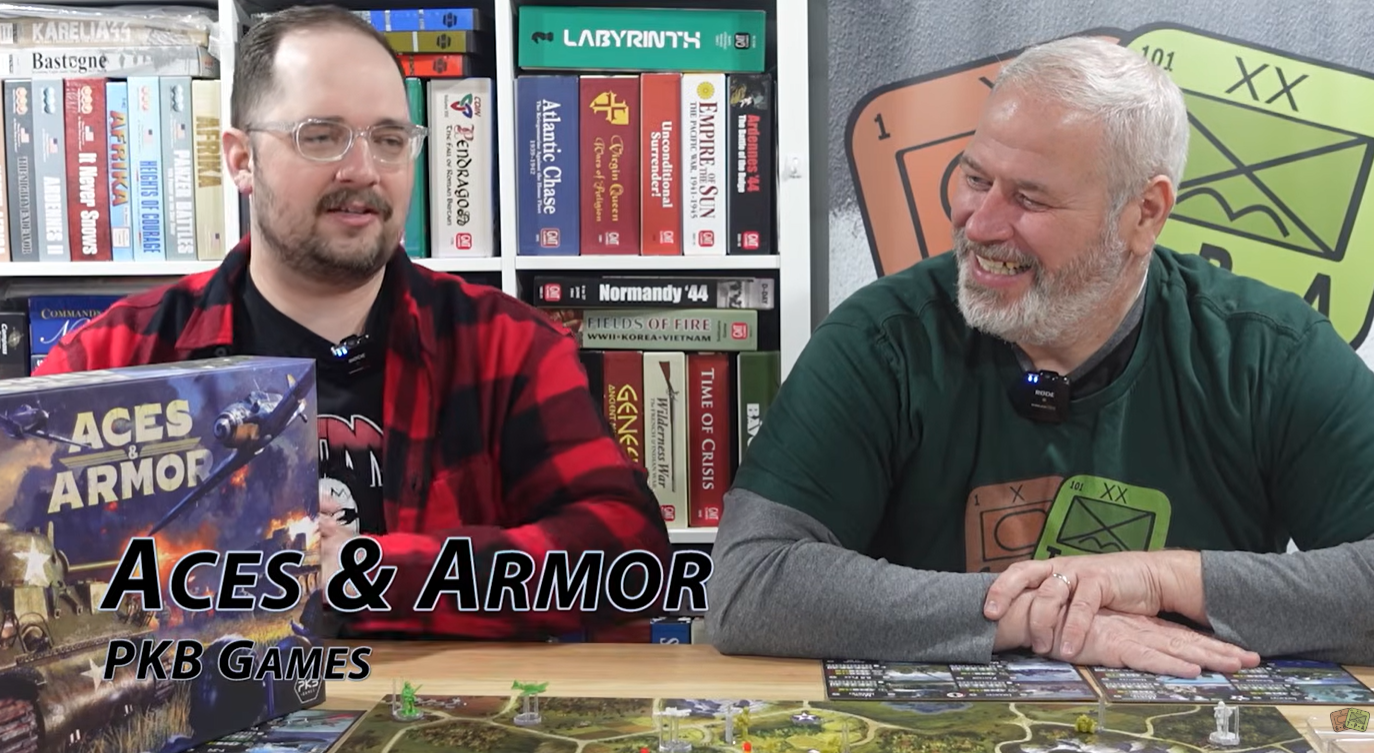
In Aces & Armor from PKB Games players take the role of a general (United States, Russia or Germany) in this complex (but easy to learn) strategy game. In addition to attack strength and armor of your troops, their tactical setup, combat experience, damage and terrain have a decisive influence on the outcome of the battle. Since each unit brings its own strengths, you must cleverly assemble your army to win the victory over your opponents. The game can be played either cooperatively or competitively and has a dedicated solitaire mode. The game uses detailed miniatures with many different unit types and has a high re-playability due to the variable start setup. The combat system is involved and a bit complex and depends on type of unit, combat damage, experience, strategic formation, terrain and armor (known from highly rated game Trench Club).
-Grant
There was a point after my first lap around the South Africa track, one of the two new tracks in Heat: Rocky Roads, when I realized that it might be my favorite track in all of Heat. Nothing else in the extended Heataverse feels quite as rewarding of great play. South Africa isn’t as punishing of poor play or bad luck as España, nor is it a source of the same adrenalized fun that comes with ripping down the straightaways in Italia or Nederlands, but a skilled player in South Africa can do some incredible things. And for the record, I came to this realization while I was getting absolutely walloped.
What is it that makes the track so good? It isn’t the gimmick. The only special rule is that any player who finishes their move on a gravel space has to pay a heat if they have one. If you’re on gravel and you don’t have any heat, it don’t hurt you none. This is a perfectly fine addition to the game, one that will occasionally make you second-guess taking advantage of an opportunity to slipstream, but it doesn’t add so much to the game that it would change the feel of an entire track.
It’s the corners. South Africa is jam-packed with delicious, surprisingly slow corners, and…
The post Heat: Rocky Roads Expansion Review appeared first on Meeple Mountain.
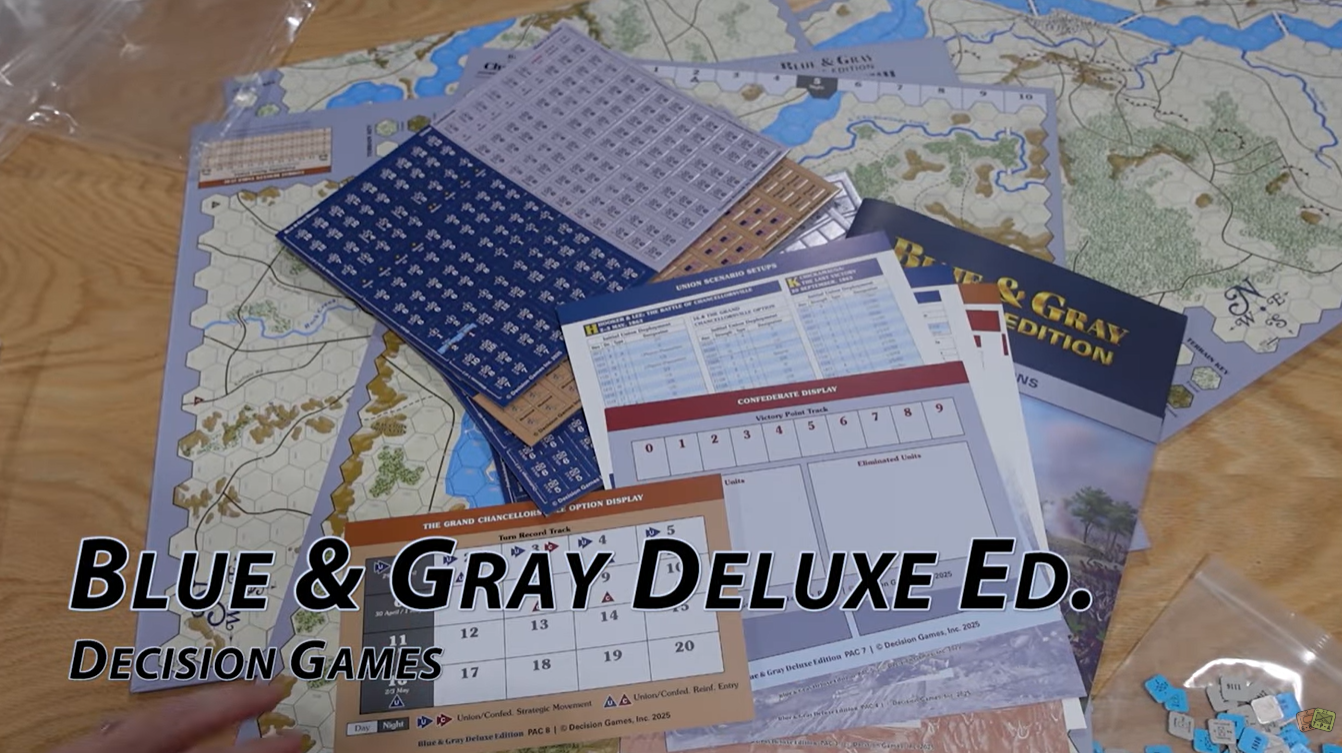
The American Civil War was the bloodiest conflict and a defining event in the history of the United States. The tragedy of the conflict was amplified by the fact the battles were brutally fought with Napoleonic tactics while using new and more lethal weaponry. As a result, over the course of nearly four full years of war, roughly 700,000 Americans were wounded or killed in battle along with another 400,000 soldiers dying from disease.
Blue & Gray Deluxe Edition consists of the original eight games from the SPI Blue & Gray I & II Quadrigames. The battles depicted are among the most important of the American Civil War: Shiloh, Antietam, Fredericksburg, Chancellorsville (Hooker & Lee), Gettysburg (Cemetery Hill), Chickamauga, Chattanooga, and The Battle of the Wilderness.
The game mechanics used in this series are based on the well-received Borodino/Napoleon at Waterloo system. Terrain is a significant factor, with everything from rolling farmland to untracked wilderness represented. Battles will often see a back-and-forth struggle for control of critical terrain. Rules for night turns are also provided. A standard set of rules are used, common to all eight games, while each game also has its own set of exclusive rules, historical set-ups, and player and design notes—all from the original SPI games.
Blue & Gray Deluxe Edition features new artwork, double-sided mounted game boards, enlarged counters, player aid cards, numerous optional rules gleaned from other game editions, and new variant counters and markers for use with several variants from Moves and Strategy & Tactics magazines. Reintroduce yourself to these classic games from SPI’s golden era and refight some of the best-known battles of the American Civil War which decided the fate of a nation at war with itself.
-Grant
The inner courtyard goes completely quiet as dusk falls. Lantern light flickers softly against white walls and dark timbers. Servants move soundlessly like a gentle breeze, tending to gravel paths and manicured trees. Deeper inside the fortress, careful whispers of politics and ambition drift through the great halls. Everything feels deliberate, and every offering is carefully chosen to seek favour in a world where position is everything. Beneath that calm surface lies quiet competition, subtle manoeuvring, and the constant need to prove one's own worth within The White Castle by Isra C.and Shei S. from Devir with art by Joan Guardiet.
The post The White Castle (Digital Eyes) appeared first on Tabletop Games Blog.
In S. J. Simon’s book, “Why you lose at Bridge” he invents a character “Futile Willy.” Futile Willy isn’t bad (per se) but his defining feature is making bidding decisions that have limited rewards, but huge risks. Playing in a two session event with Roxie, our opponents are mostly what I deem “experienced novices” (playing for years, know a bit of bidding, but have not progressed far) mixed with intermediates. Perhaps two pairs are of similar caliber.
There are many ways to judge experience; one is knowing when to compete. And when not to compete.
Experts love …. LOVE … to get in the bidding, but also know when to shut up.
Example #1
I pick up something like xx AJxx Kxx JTxx and it goes 1D by Partner and 1S on my right.
I make a (negative) double, LHO passes, Partner bids 2C and RHO rebids two spades.
My negative double only guaranteed hearts, not clubs (I have five hearts with a hand too weak to bid); I actually have four clubs. So (despite having no extra values) a raise is reasonable because a) you never want to let them play at the two level unless they are in a misfit1 and b) my hand is mostly “working”. The King of diamonds is probably golden given that partner has 8 or more minor cards, aces are always nice. (If I had points in spades, I’d be much more content to defend).
LHO hems and haws and then bids 3 Spades. Roxie and I are done, and I am happy to have an easy safe lead of the jack of clubs. (I could lead a diamond, to be sure, but it’s matchpoints).
The final auction
LHO CHO RHO Me 1D 1S X P 2C 2S 3C 3S All Pass
Dummy is a massive surprise. Sure she has two spades, but also five clubs (Q9xxx)! Passing gets her an above average board, doubling gets a likely top and her actual bid gives her a terrible board. Afterwards neither partner and I could believe it.
Example #2
Later on I pick up a regular 1NT opening with something like S: Qx H: KJx D: KJxx C: AJxx.
Roxie responds 2 Hearts (a Jacoby Transfer, indicating spades) but before I bid RHO doubles (showing good hearts).
Roxie and I haven’t discussed it (at least — I’m not sure we have) but typically I play that accepting the transfer over a double confirms three (or more) in that suit. With only two spades I can pass, and partner can redouble to “re-transfer” or bid spades herself. (It probably doesn’t matter on this hand, but if she had the king of hearts instead of me…).
So I pass. Roxie then bids …. 4NT.
This is a quantitative slam try. I am at a minimum, so normally I’d pass … but my hearts are well placed. If RHO has AQxxx of hearts, I have two heart tricks, so my KJx of hearts is worth closer to six or seven points instead of four2. Therefore, I bid six NT.
I get a surprise when Roxie shows up with Ax of Hearts. Was RHO doubling on Queen – sixth? Nope, just Qxxxx.
But in any case there is nothing to the play3 because LHO did not find the killing lead and instead led the suit partner had asked him to lead. Doubling on AQxxx and out is reasonable … you tell your partner what to lead. There’s a risk of getting redoubled (with KJTx or so behind you). but its an acceptable risk.
But with just a queen empty suit, the odds of a redouble (or other “bad luck” as in this hand) are high and do you really want partner to go out of his way to lead a heart?
Example #3
The most egregious example.
I pick up a strong NT, but I’m third to bid. Partner opens one club.
My hand is flat (4324) so the only issues are: A) do we have a major fit and B), does partner have extras.
I bid 1 Spade and partner rebids 1 NT. So the answers are A) No and B) No, therefore I’m bidding 3NT.
Except my RHO (who couldn’t bid over 1 Club) has doubled. They are vulnerable, we are not. 3NT is probably +400 to +460. We can get much, much more by defending. So, redouble.
Despite a slip up on our part, we get +500 easily for what should be a top (except that someone bid a hopeless slam and was allowed to make it). Without the slipup we easily beat the mere +990 for the non-vulnerable slam. What was RHO’s double? A semi-balanced ten count, after opener had fully described her hand. It would be one thing to double if I passed 1NT … then there would be an expectation points were (roughly) evenly divided.
In this case the double did nothing but offer me a fielder’s choice.
With us encountering three Futile Willys (or Wilhelminas), our mistakes merely turn tops into “almost tops”, so it’s a highly successful day.
︎︎︎
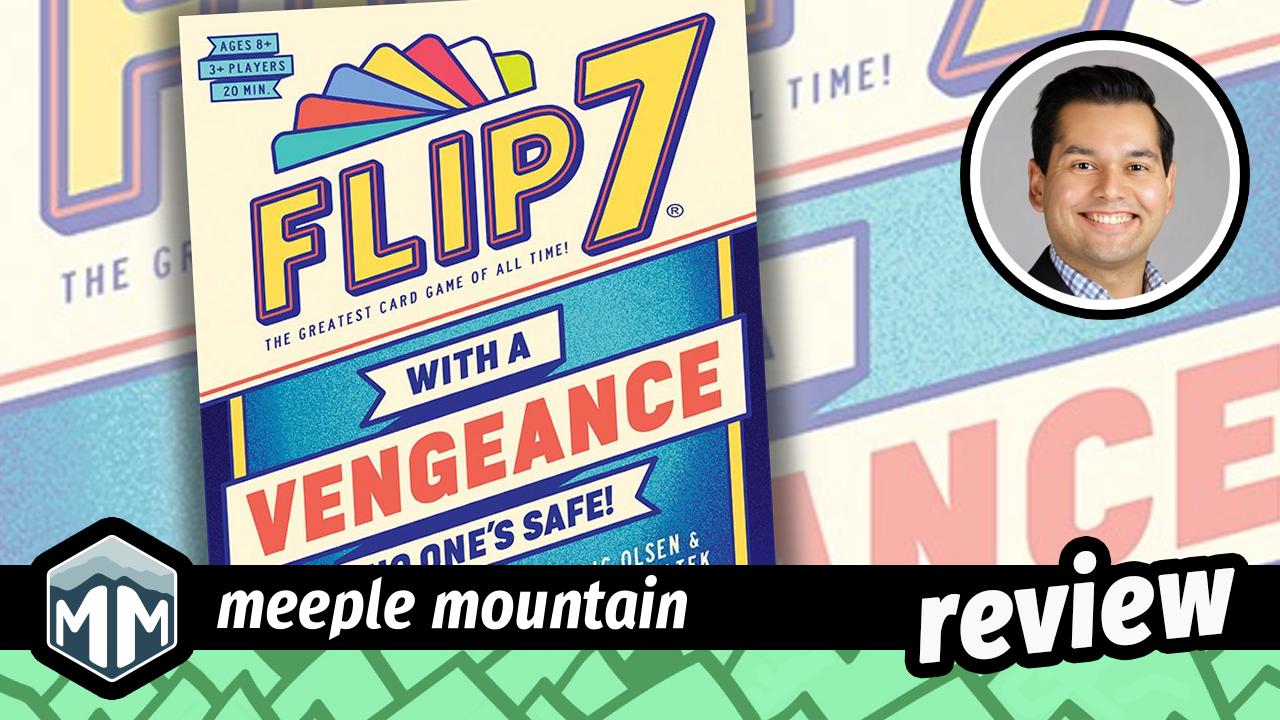
Flip 7 took the world by storm in 2023, touting itself as the “World’s Greatest Card Game.” It backed up that claim in 2024, taking home a slew of awards, including Origins Best Party Game, Golden Geek Best Party Game, and even a nomination for the 2025 Spiel des Jahres award.
It’s also gaining recognition outside the gaming bubble. I recently had an interaction with coworkers in my office who wanted to play Uno, and I asked if they’d heard of Flip 7. To my surprise, more than one of them said yes with immediate excitement. Whether you love it or hate it, Flip 7 is almost a household name now.
It’s only natural that a game in this format would spawn variations to keep the cash coming. Last year, we saw the Dr. Seuss’s Grinch variant, and I have an inside scoop that more reskins are on the way.
Following on the heels of the Uno: No Mercy madness from a few years back, Flip 7 now has its own “mean” version, packed with ruthless cards and more stabbing. But how does it hold up against the original? Let’s flip the next card and find out.
…
The post Flip 7: With a Vengeance Game Review appeared first on Meeple Mountain.


Indie Board & Card Games took their foot off the gas just a little with The New Age, by which I mean it isn’t nearly as punishing as War Eternal. The New Age introduced Aeon’s End’s campaign system, which would become de rigueur for their future releases, and those of us who’ve played Aeon’s End before will know that that’s a mixed blessing. The constant injection of new cards and powers is great, but the writing…well. Nobody plays Aeon’s End for the quality of the writing. You win some and you lose some. If you play Aeon’s End enough, you’ll lose quite a bit, in fact.
Ease of entry?
★★★★☆ - The odd bump or two
Would I play it again?
★★★★☆ - Would like to play it again
Read more articles from Andrew Lynch.
Kraken Skulls! puts 2–5 players at the helm of a pirate ship, chasing the most fame to become the king (or queen!) of the pirates.
Players bounce between a random selection of dice mini-games (via cards) laid out in a circle, mixed with open-water cards that house the dreadful…
The post Quick Peaks – Aeon’s End: The New Age, Kraken Skulls!, War of the Ring: The Card Game – Fire and Swords, Lords of Vegas, The Guest appeared first on Meeple Mountain.
Continuing along in this series devoted to the best looking boards found in the wargaming world where I will highlight the art and layout of a different board in a wargame that we have played to show you the various talents of the artists and graphic designers involved. In my humble opinion, a well designed and attractive board can make all the difference in the world to me enjoying a wargame. Don’t get me wrong, the game has to be good, but if it’s also good looking it always is a better experience. A board can draw me in. Can make me feel that I’m there. Can set the stage for the thematic immersion that we all crave. And I have found many of these type of boards and I want to make sure that I share them with you.
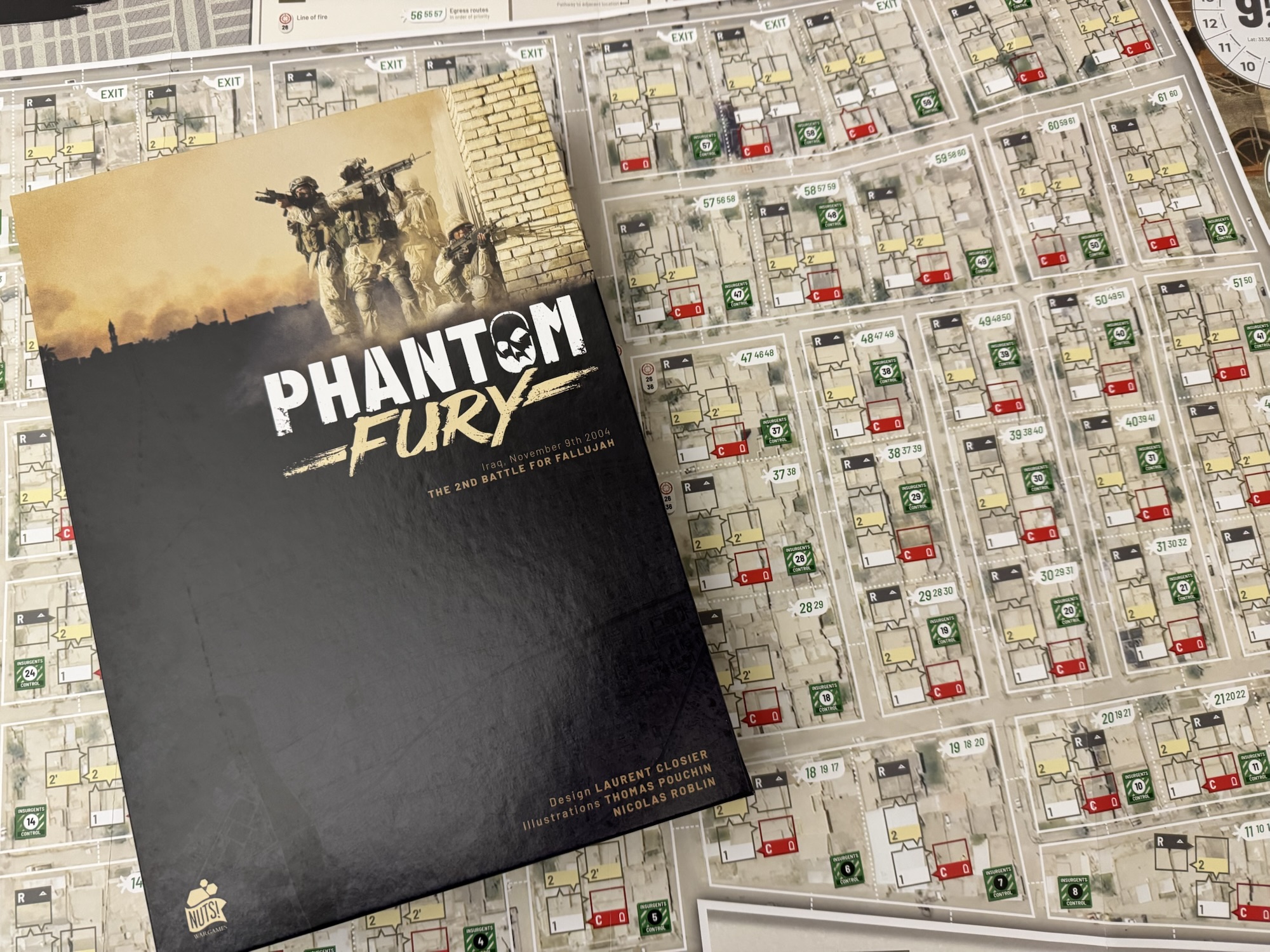
In this entry in the series, we will be taking a look at the fantastic looking board for Phantom Fury: Iraq, November 9, 2004 The Second Battle for Fallujah 2nd Edition from Nuts! Publishing. Now you might be looking at the board and thinking that is is just a jumbled mess of various colored squares and blocks but there is some hidden and obscured beauty in these squares but also a lot of great photo realistic depictions of city blocks, streets and dark alleys that were present in the city of Fallujah during this pivotal battle of the Iraq War in 2004. Nicolas Roblin is an emerging artist who has five or six game boards to his credit to date and we have played and really enjoyed then including This War Without an Enemy (2020) from Nuts! Publishing, 300: Earth and Water from Nuts! Publishing (2018), Saladin (2022) from Shakos and Border States (2022) from Shakos. But he also is starting to branch out more and has done the board for the very interesting solitaire wargame called Phantom Fury: Iraq, November 9, 2004 The Second Battle for Fallujah 2nd Edition. I would say that he has a very easy style that is focused on showing key locations in a light that emphasizes their importance to the historical story that the game designer is attempting to tell. What I mean by that will be evident as we take a look at the board for Phantom Fury, but one thing I would point out is the focus on the boundaries of the various districts inside the city. He gives these areas a very interesting treatment as well as a focus on the aesthetic elements of the setting. When you look at the board, you get the feeling that you are inside the city itself with a look at small buildings, walls, streets and even key locations such as the mosque.
Phantom Fury 2nd Edition is a solitaire wargame that simulates at a tactical level the operations carried out by United States Marines (USMC) to secure the town of Fallujah, Iraq in November 2004 and to attempt to suppress all armed resistance by the insurgents. The game focuses specifically on the fighting carried out by the 3rd Battalion, 1st Marines on the morning of the 9th of November 2004, in the district of Jolan in the north-west portion of the town. The player will control the USMC forces and the game system manages the actions of the insurgents. The Marines will have to move block by block and house by house clearing out resistance all while trying to minimize casualties and trying not to allow insurgents to infiltrate their lines and reappear in the rear to wreak havoc. This is very much easier said than done though as the first priority is to identify suspected insurgents as the Marines enter new areas that are enemy controlled.
The board for the game measures 22″ x 34″ and represents a part of the Jolan District of the city of Fallujah, divided into 61 Zones of about 50 x 50 meters and into Street Sections of equivalent size. The Zones are marked on the map by dotted lines or continuous lines and are identified by a number in a black or white circle in the Control Box. A target symbol in a Zone indicates that there is a Line of Fire between that Zone and the Zones whose numbers are printed below the symbol. The Target Zones are considered to be Neighboring a particular Zone for the purpose of Fire Combat only.
As you look at the Zones shown below from the upper left hand corner of the board, you will see that various boxes are printed in each of these Zones. These represent buildings and these buildings are multi-storied so they start at the bottom with the red entry areas, that have a nice little door shaped icon in the bottom right hand corner of the box, and then you see stylistic arrows that point up and down at the bottom of each of the above stories. There are also arrows that go to the right and left which mean they enter an adjacent building. At the top of the Zones you will see a black box, that has a neat little roof peak symbol in the upper right hand corner of the box, that represents the roof of the building. These are areas of entry from one building to the next and if used by the Marines or the Insurgents, will grant them a bonus DRM in combat. I remember when I first set eyes on the board, I was a bit discombobulated and confused but once I get into the rules I quickly realized that this graphical depiction of the stories and the means of ingress/egress was a stroke of genius and worked really well to quickly be able to identify what you are entering.
Certain Zones are considered to be Fortified and this means that they are tougher to break into. Some of the zones, such as Zone 26 (Mosque) identified by a red box around the area is a Fortified Zone by default. No unit may carry out movement called Flooding in a Fortified Zone. The Mosque area is a really interesting graphical representation as the background, as is the case with all of the areas, has the overhead satellite images of the Mosque shown on the board. In the game, this area cannot be entered by Marines but can be searched and entered by Iraqi Intervention Force (IIF) troops. I think that the red box really highlights this entry prohibition and is a key reminder to the player of the need for them to bring on the IIF troops although they might want to get more Marines on the board.
Each Zone on the board consists of several Locations in the form of boxes, which are used mostly to regulate movement. There are 5 types of Locations identified on the board including Open Ground, Courtyard, 1st Story with one of 3 notations including either l, 1′ or 1″), 2nd Story (2 and 2′) and Rooftop. Each Location is marked with one of these letters including OG, C, 1 or 2 and is a really well done part of the board which clearly identifies the type of Location. Locations are used for the placement of Suspect markers and certain Zones may have several Locations of the same type or no Locations at all of a particular type. Upon first glance, you might think that the color of the Suspect Markers, which are all tan with various shaded areas of brown and white, is a wrong choice and doesn’t necessarily work well visually with the sandy, tan colored board. But, because the Suspect Markers cover up the small boxes when placed, they still retain the thick brown outline on the outer edge of the board and these act as a visual highlighting of the unit. To me, this is a fantastic graphical design choice to highlight these important boxes and Zones as all of the action and most of the player’s focus will be on these areas as they move around the board block by block.
As in the case of these games, the on-board player aids and tracks need to be large, clear and have the pertinent information that the player will need to play the game. This is very well done on the board as they have created a circular Turn Track and Victory Point Track that are large and in the upper right hand corner of the board. This positioning really keeps the time deadline at the forefront of the players mind as they have to clear and control all 61 Zones for a victory. I say control but players must also eliminate resistance there as well and prevent the Suspect Markers from popping up in areas where they are adjacent to that have already been cleared and controlled.
One of the other really interesting parts of the game that causes a lot of tough decisions is the use of the military assets located on the bottom left hand side of the board. Here are tracked the player’s available Hornet Strikes, Super Cobra Support and UAV’s. All of these provide various benefits including DRM’s and direct attacks against fortified blocks to try to eliminate Suspect Markers without Marines having to put their life on the line in those areas.
I think that the graphic design for this board is truly excellent. I am not sure that it is beautiful but how it was done and how it works together is a stroke of genius and really took some thought and understanding of the game and its systems to be able to put together. These choices were reinforced with the color accents, use of lines and borders as well as with color choices for the most important Zones. Just a very well done and aesthetically pleasing package put together by Nicolas Roblin.
This game is just so very good and I love the decisions that the player has to make about how they go about clearing the areas with limited resources and under a time limit. Just a very good game design that shows how difficult this task was that was asked of the Marines.
If you are interested, I shot a short RAW video on the game during my first play and you can watch that at the following link:
We also did an unboxing video showing off the components and you can watch at the following:
If you are interested in Phantom Fury: Iraq, November 9, 2004 The Second Battle for Fallujah 2nd Edition, you can order a copy for 50.00 € ($58.37 in US Dollars) from the Nuts! Publishing website at the following link: https://www.nutspublishing.com/eshop/our-games/phantom-fury-v2-en
The next board that we will take a look at in the series is Almost a Miracle!: The Revolutionary War in the North in Against the Odds Magazine #51 from LPS, Inc.
Here are links to the previous entries in the series:
Kekionga!: A Dark and Bloody Battleground, 1790 from High Flying Dice Games
Campaigns of 1777 in Strategy & Tactics Magazine #316 from Decision Games
Battle Hymn Volume 1: Gettysburg and Pea Ridge from Compass Games
From Salerno to Rome: World War II – The Italian Campaign, 1943-1944 from Dissimula Edizioni
This War Without an Enemy: The English Civil War 1642-1646 from Nuts! Publishing
Holland ‘44: Operation Market-Garden, September 1944 from GMT Games
Maori Wars: The New Zealand Land Wars, 1845-1872 from Legion Wargames
Imperial Struggle: The Global Rivalry – Britain & France 1697-1789 from GMT Games
Stilicho: Last of the Romans from Hollandspiele
Nevsky: Teutons and Rus in Collision, 1240-1242 from GMT Games
A Most Fearful Sacrifice: The Three Days of Gettysburg from Flying Pig Games
Donnerschlag: Escape from Stalingrad from VUCA Simulations
Keep Up the Fire!: The Boxer Rebellion Deluxe Edition from Worthington Publishing
Liberty or Death: The American Insurrection from GMT Games
Lanzerath Ridge: Battle of the Bulge from Dan Verssen Games
Salerno ’43: The Allied Invasion of Italy, September 1943 from GMT Games
Bayonets & Tomahawks: The French and Indian War from GMT Games
Undaunted: Normandy from Osprey Games
Traces of War from VUCA Simulations
SCS Ardennes II from Multi-Man Publishing
Almoravid: Reconquista and Riposte in Spain, 1085-1086 from GMT Games
Walking a Bloody Path: The Battle of Fallen Timbers, August 20, 1794 from High Flying Dice Games
All Bridges Burning: Red Revolt and White Guard in Finland, 1917-1918 from GMT Games
Storm Over Jerusalem: The Roman Siege from Multi-Man Publishing
Iron, Blood, Snow & Mud from PHALANX
North Africa ’41: The Western Desert, March to December, 1941 from GMT Games
Battles of the American Revolution Volume II: Brandywine from GMT Games
Ardennes ’44: The Battle of the Bulge from GMT Games
Gandhi: The Decolonization of British India, 1917-1947 from GMT Games
Battles of Napoleon: Volume I – Eylau 1807 from Sound of Drums
Tattered Flags No. 01 – Into the Whirlpool from Blue Panther
Alliance: Multiplayer Napoleonic Wargame from Columbia Games
-Grant
Welcome to our 13th annual Board Game Quest Board Game Awards. Each year, we take some time to honor the best and most creative new tabletop games from the previous year. For those wondering, why we wait until the following year to announce our winners, it’s to give us a chance to check out the […]

When I play Inkwell, I think about other games. That isn’t a slight on Inkwell’s quality, necessarily, nor a reflection on my fidelity to whichever title happens to be on the table at the moment. It’s just the sort of game that sets the mind to wandering. I have yet to play it without somebody mentioning Azul, for instance, and Sagrada isn’t a distant touchstone either.
The big one, though, is Alf Seegert’s Illumination, an overlooked quip from five years back that also dressed up its players as monks illuminating manuscripts under the stern eye of a passing abbot. And while it might seem like the parallel is entirely in the setting, it’s really the gentleness that does it, the warmth, the do-no-harm-ness of the whole thing. As a game, Inkwell isn’t only about monks; it’s downright monkish.
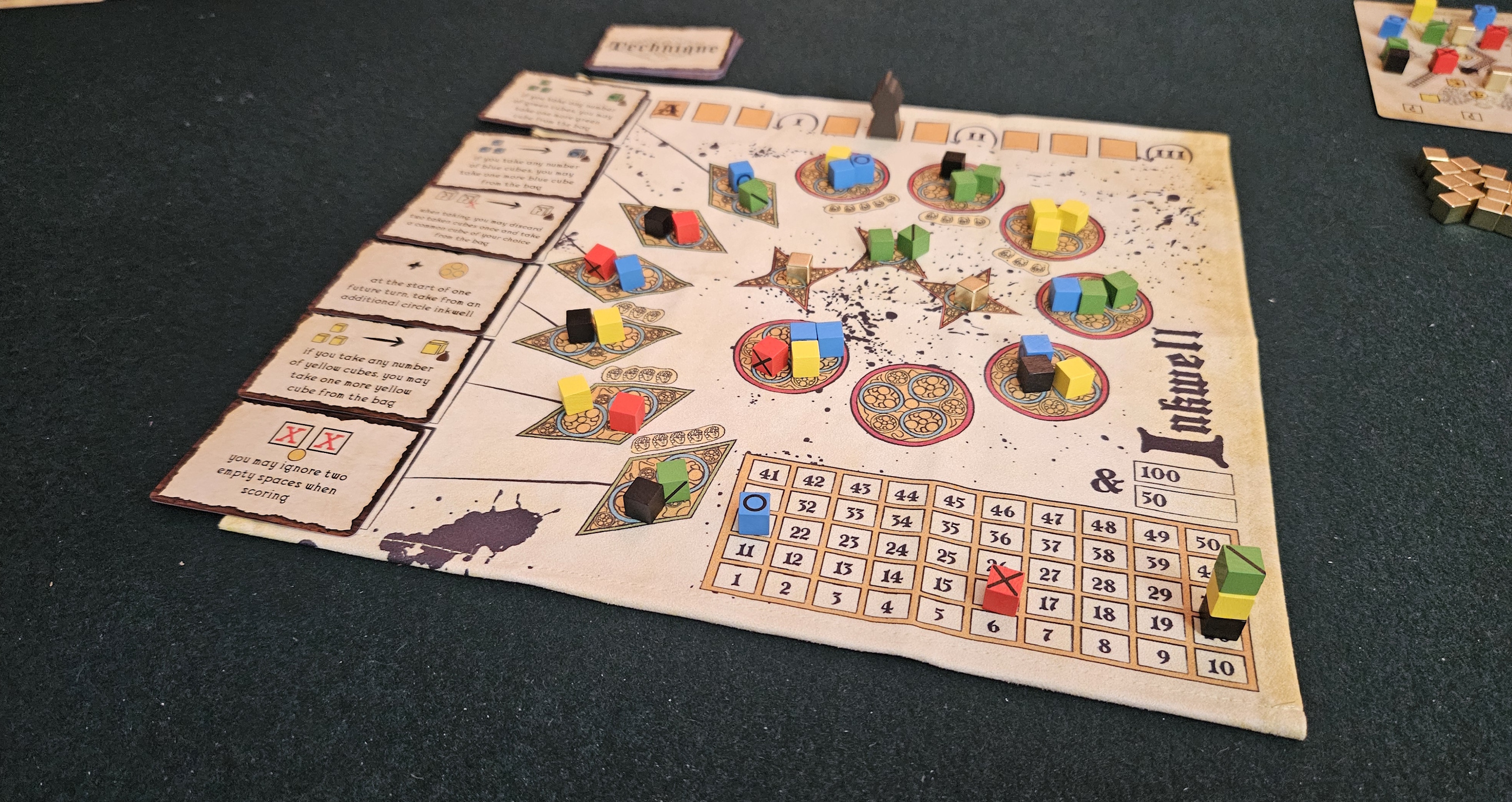
Ah, many pots of pigment. A monk’s dream.
It begins with a page. Not quite a blank page, although one imagines the parchment fresh. For the sake of gameplay, the page is scrawled with the outlines of what will soon become vibrant illustrations: saints and angels, wreaths and knots, lions penned by someone who has clearly never seen a lion, scenes of Eden, holy babes that appear twice of age of the Lord at his crucifixion. Touching these illustrations are squares, each the size of a small wooden cube. Sometimes these squares appear in other spots, too, free of any illustration, but still ready to accept daubs and brush-strokes.
Your goal is to fill that page with color. Reds, blues, yellows, greens, deep charcoal blacks. Maybe some gold leaf. Gold is wild, capable of making up a shortfall elsewhere — because it’s gold, obviously — but it’s also sometimes required in special circumstances. Some spaces are blank, beckoning for leftovers. That or scoring multipliers.
These cubes must be drafted from the central mat, itself represented as a swirl of ink-pots. There are three types to draw from. Circular pots hold the most ink, three cubes at the beginning. Star spaces hold gold, but usually only a single cube’s worth, marking them as a tradeoff between quality and quantity. Diamonds are the most interesting, offering a meager two cubes, but also technique cards, special abilities that gradually hone your monk’s abilities.
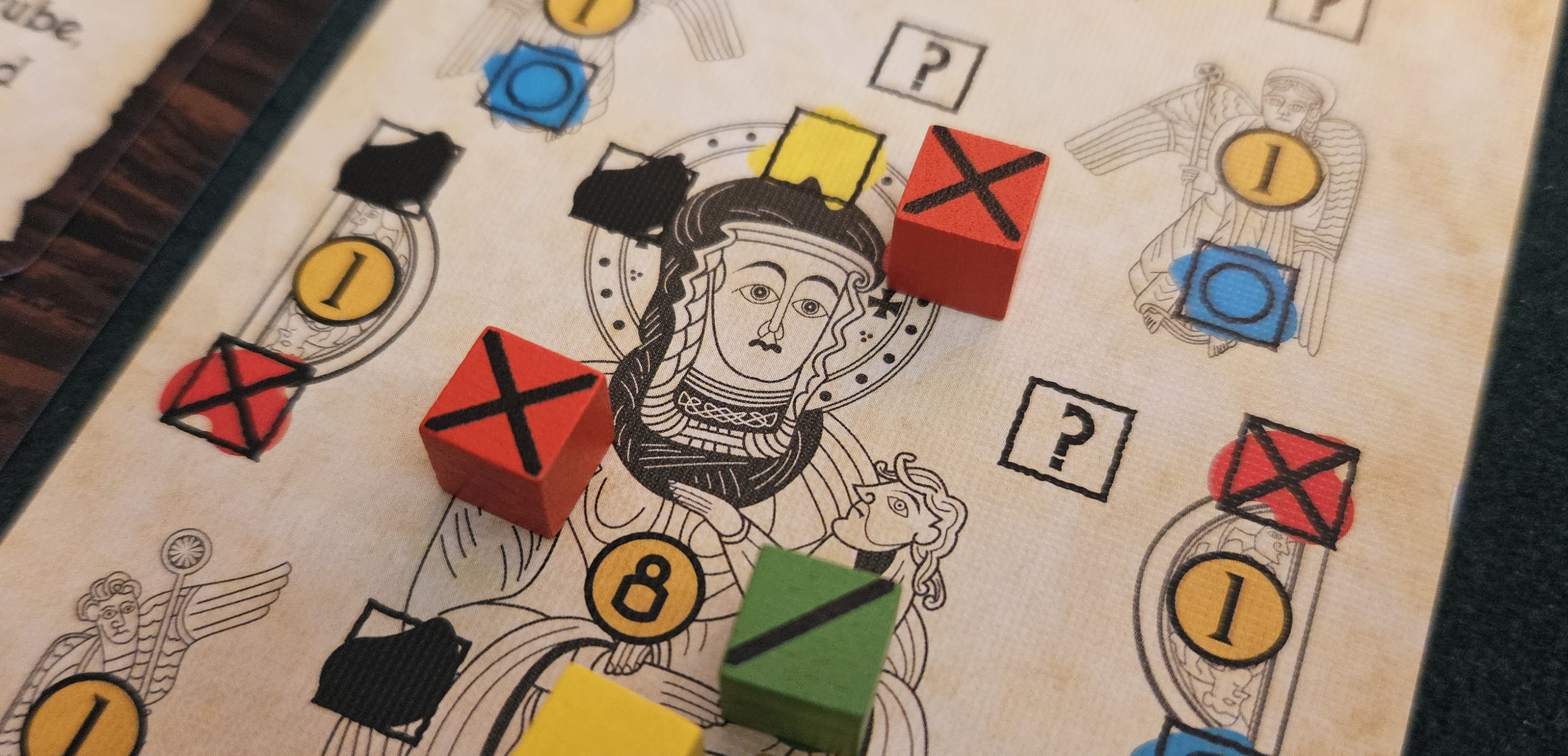
Creepy adult baby Jesus and all.
One turn at a time, players go around and select which inkwells to draw from. There’s some potential for blocking, but it’s a relatively remote concept here, especially in the page’s early moments when any color will serve. The effect is trancelike, meditative, as close to multiplayer solitaire as design collective Jasper Beatrix has gotten thus far. The most burdensome restriction is that you aren’t permitted to draw from an inkwell unless you can actually use every last drop and employ every technique card. This makes blocking even less likely, instead reinforcing the game’s gentle proceedings. It’s possible to grab as many cubes as possible, but that might make the page difficult to fill. Better to proceed steadily, like the proverbial tortoise.
There is some pressure, however light. Whenever one of those varieties of inkwell is depleted — circle, star, or diamond — the abbot marches one step across the mat. He’s here to oversee your work, and at various points he may force the table to turn the page. This scores all those illustrations and color cubes, potentially leaving some work undone. It’s better to turn the page of your own volition, at the time of your choosing, but it’s hard to say exactly when the abbot will peek into the scriptorium to ensure the commissions are being fulfilled.
Over time, your accumulated techniques produce little engines, to use a game-word that would have meant something very different to our monks. But there’s some spark of the Latin gignere to these flashes of talent, reflected in the way they speak to an artistry now long displaced. Some techniques bestow extra cubes, perhaps when a specific color is drawn or the abbot marches down the hall, evoking the scribe, bent over his masterwork and taskmaster at once, carefully measuring every drop to its uttermost potential. Others let you claim cubes as a one- or two-time bonus, the medieval equivalent of double-dipping. Others still let you store a few cubes to the side, or rearrange them on the page, saving your palimpsest scrapings for reuse elsewhere.
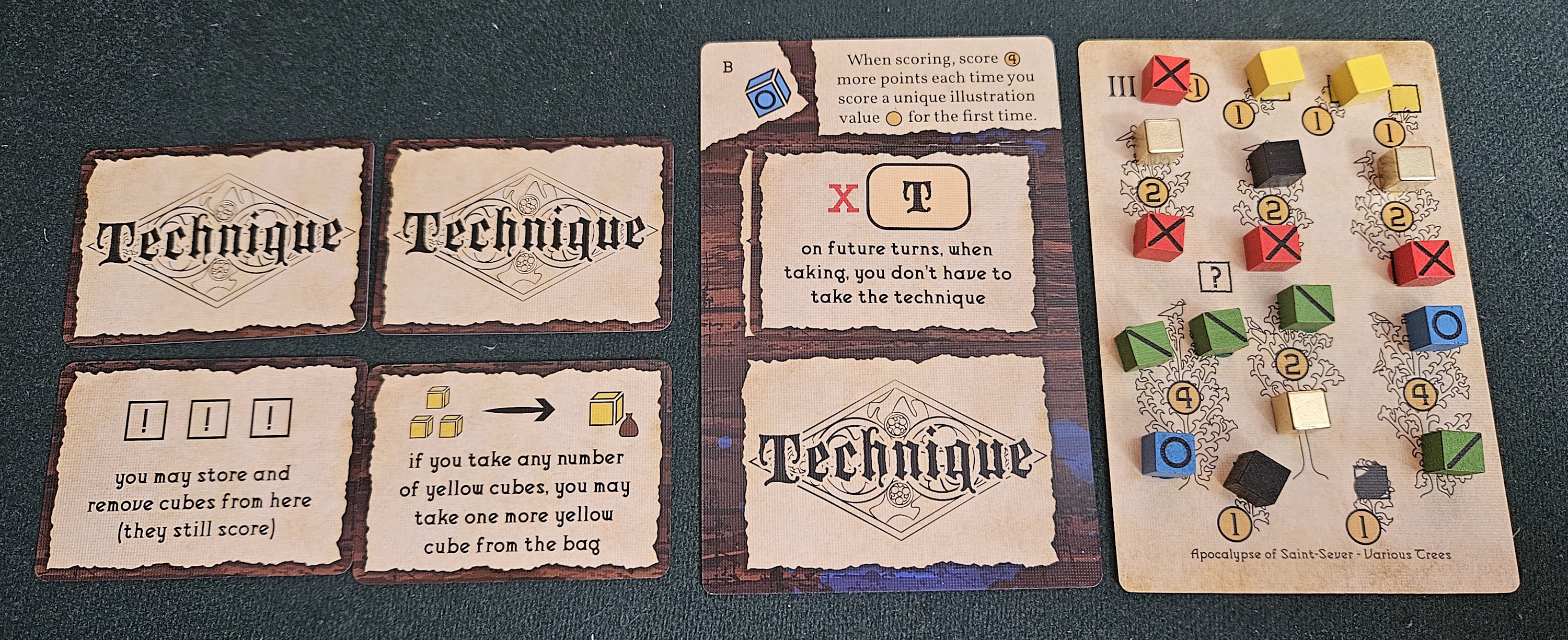
With the right techniques, the third page can be a breeze.
In some ways, Inkwell is also itself a palimpsest. There are traces of other games here, possibly better or more interesting games. The most pronounced is Azul; it’s impossible to look at the circular inkwells and not see that game’s rounded factories and Starburst-sized ceramics. There are other traces, too, impressions on the parchment that can still be made out despite the game’s clean presentation. Playing Inkwell, it’s hard to escape the feeling that we’ve gone through these motions before.
Of course we have, if only because nothing under the sun is new. None these actions are wholly novel. But Inkwell feels a little closer to its peers than some games. Especially Jasper Beatrix games, with their penchant for novelty and mechanical introspection. Inkwell is no Pacts, with its dissection of I-split-you-choose gameplay, no Here Lies with its decoupling of detective games from rigid logic, no Signal and communication, no Scream Park and tableau-building.
But for all its similarity to other games, there are still reasons to recommend it. For example, I appreciate the open-ended nature of its conundrum, one where each selection feels like another window into a broad decision-space, rather than a binary best or worst pick. It’s rare that a single inkwell feels like the answer to a puzzle so much as one more question. Another brushstroke, perhaps, another inlay of gold. Those other games use artistry as their backdrop; Inkwell, by contrast, feels like artistry. More specifically, it feels like that slender space between commercial reality — deadlines and managers, limited resources, coworkers who sometimes take the pigments you need without meaning any harm — and the aspiration to fashion something that will endure the centuries.
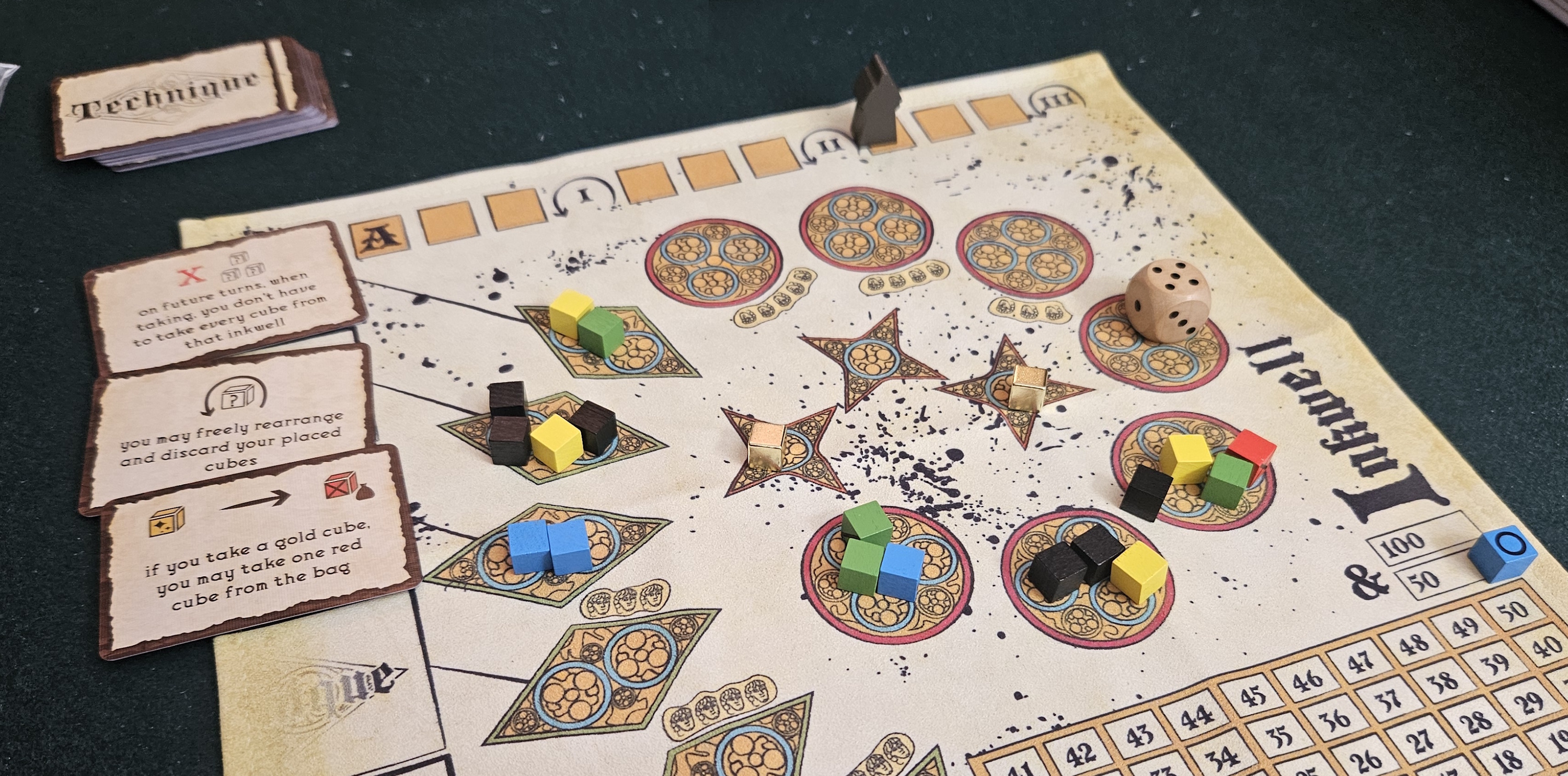
The foolish monk Dicelius, also known as SOLOBOT, offers a nice diversion.
Where does that put Inkwell, in the end? It’s hard to say. As a game, it occupies a peculiar middle ground. It lacks the brain-tickling nature of its heavier inspirations, the emphasis on puzzling and position, but ventures a little closer to its source material than those games have ever managed.
More than that, Inkwell is reassuring. It feels like a weighted blanket, the game equivalent of a movie like The Taste of Things, all soft sensation and creamy sunlight and lulled senses. The outcome is neither the strongest nor the weakest of Jasper Beatrix’s collective output, but offers a lovely and gentle visit to a faraway time and place nonetheless.
A complimentary copy of Inkwell was provided by the publisher.
(If what I’m doing at Space-Biff! is valuable to you in some way, please consider dropping by my Patreon campaign or Ko-fi. Right now, supporters can read about which films I watched in 2025, including some brief thoughts on each. That’s 44 movies! That’s a lot, unless you see, like, 45 or more movies in a year!)
Peter and Will play Epic Warpath over some really incredible Gale Force Nine terrain!
My mini-season of battle reports from Will’s recent visit continues, and this time it’s an incredible game on probably the most spectacular tabletop of terrain I’ve ever had the good fortune to play on. That’s mostly thanks to Gale Force Nine, who sent me several boxes of their amazing pre-painted Gothic Sector epic scale terrain. You can see my unboxing of it all in this video.
The game is Epic Warpath by Mantic Games, and I’ve got to say I’m really impressed with this pretty streamlined, easy-to-use, and fun system for epic-scale scifi wargaming. I’m looking forward to getting my hands on some different factions and painting them up too! While panting epic armies can be a bit of a chore, the results, as you can see, are undeniably stunning, and the scale makes for big, beautiful games. So enjoy this session, where we show off Epic Warpath at its absolute best, and have a lot of laughs at the same time!

/pic9137990.png)
/pic9464506.png)