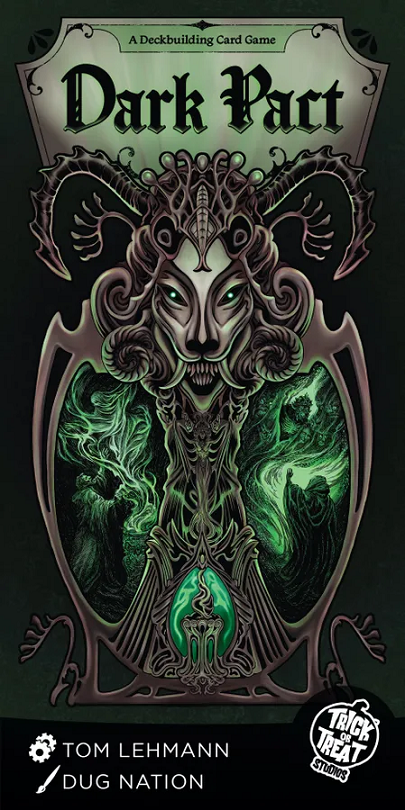
A friend recently mentioned a statistic (that I’ve since verified according to multiple studies) that most people–over 80%–who have purchased a bottle of wine have made their decision largely based on the label. Not taste or research, just a label that spoke to them.
Have you ever purchased something based on its packaging? I absolutely have. Wine, games, books, chocolate, coffee, disc golf discs…sometimes the packaging draws me in and inspires me to learn more, but sometimes it’s almost the entire decision (i.e., I want this because of how it looks).
I mentioned this topic on a recent livecast, and viewers had even more examples: beer, hot sauce, restaurants, cereal boxes, and more. It also came up on a recent podcast episode of Unit Economics about how Byte’m brownies focused their packaging on a delicious-looking brownie instead of on their high-quality ingredients.
In the tabletop game space, box covers have a huge impact. It isn’t just about their marketing appeal; publishers try to make boxes that people are proud to display, that are compelling both at a game store and in an online thumbnail, and that function from different angles.
For all those reasons, at Stonemaier Games we pay far more for the box illustration than any other individual piece of art in the game (only a detailed game board comes close). I often look to other games for inspiration (thank you, BoardGameGeek!), and I always like to get at least 3 concept sketches from the artist before pursuing one of them in detail.
Then there’s another set of decisions to make about the labeling on the box: The size and position of the game name, the names of the designer(s) and artist(s), and the inclusion of key information like player count and playing time on all 6 sides.
There’s also the presentation on the back of the box, where we’ve traditionally placed a 3D setup image. We’re starting to pair that with 1/2/3-style explanation speech bubbles so a potential customer can quickly grasp what the game is about.
It’s always a work in progress, and I’m always learning from other publishers–it feels like every week there’s a new game announced with a truly stunning, evocative box. Whenever I go to a local game store, I try to pay close attention to which boxes grab my attention; I also recently went to Barnes & Noble for this specific purpose.
Have you ever bought a product based on its box, label, or cover? What would you like game publishers to learn from your experience?
The German branch of high IQ society Mensa has unveiled its full slate of nominees for this year’s MinD Spielepreis.
Mensa in Deutschland has run the awards contest since 2009, and has operated a ‘shorter games’ category for more than a decade and lighter two-player games prize since 2019.
This year’s ‘shorter games’ category will be fought over by titles including 2025 Spiel des Jahres nominee Krakel Orakel, as well as Grégory Grard and Mathieu Roussel’s design Zenith and Take Time from Alexi Piovesan and Julien Prothière.
Word chaining game Next by Verena Wiechens and Lukas Setzke is also up for the shorter game prize – which focuses on titles that play in well under an hour – as is Maldón’s design El Camarero (published in Germany as Chaosteria), and Wilmot’s Warehouse from David King, Ricky Haggett and Richard Hogg.
In the two-player games category, Bruno Cathala’s design Kamon is up against Niwashi, from Gautier de Cottreau and Baptiste Laurent, Junghee Choi’s Orapa and Tobias Tesar’s Perfect Murder.
Playball, designed by David Florsch, will also compete in that category, as will Strategeti by Ignasi Ferré and Suna Valo, designed by Andreas Odendahl (who goes by ode.).
Jochen Tierbach, who has been organising the MinD Game Award for 16 years, said at the time, “There are already various awards and prizes for family and connoisseur games.
“But for expert games, the really tough ones, there is no such thing in Germany yet. And we feel that the industry wants it.”
The long list of more than 20 expert-level titles was whittled down to six challengers for the complex games award this year: Galactic Cruise, Luthier, Shackleton Base, Speakeasy, Thebai and Thesauros, all of which have been released in Germany since Spiel Essen last October.
Last year’s MinD award for complex games saw Tomáš Holek’s space exploration eurogame SETI add to its array of prizes, while Simone Luciani and Dávid Turczi’s Nucleum triumphed in 2024.
Welcome to this week’s batch of crowdfunding campaigns. We have a variety of offerings here, so we hope you will find something that catches your eye. Also, if you want to chat with the BGQ team, join our Discord Server where we talk about games, movies, sports, and other fun stuff. Or, if Facebook is […]
If you're a Gamemaster running Starfinder Second Edition, the Starfinder Alien Core is your de facto manual of monsters. It promises pages upon pages of strange creatures that would feel at home in any sci-fi world. Some are geared more towards horror, others are more techy, and some are there as classics to hit you with a nostalgia bomb. Let's take some time to run through the highlights of the book.
Starfinder Alien Core
Right off the jump you are greeted with the full alphabetized table of contents for every creature featured in Starfinder Alien Core, including visual breaks for each set of letters to prevent the usual wall-of-text layout. Directly afterward is a brief section that describes the different aspects of a creature's statblock, how to play creatures, and making adjustments. I was quite surprised looking back at the Starfinder GM Core that this information was never included. There is more in-depth guidance into custom creature creation, but nothing that lays out the aspects of the statblock as succinctly as this.
Then it's time to dive right into the 200 pages of creatures, typically featuring one on each page. The general flow of information starts with a brief snippet of lore about the creature to set the scene, followed by the creature's statblock. The sidebar also always features…
A few years ago, I came across a new designer named Wolfgang Klein (no relation to Alexander Klein) and his new company Assault Games. They create fantastic tactical level wargames and we have played several fo them and also got a chance to meet both Wolfgang and his friend and partner Erich Rankl. They are currently working on a new edition of their first game called Assault – Red Horizon ’41: Revised Edition and they readying it for a Gamefound campaign yet this spring. I reached out to Wolfgang to get some information about the revisions and changes to the game and he was more than willing to provide a lot of great information.
Wolfgang: Over the past 5 years, Red Horizon ’41 has evolved significantly through continuous development, community feedback, and extensive gameplay experience. What began with Rulebook 1.0 has gradually been refined into a much more mature and developed system. The new revised edition incorporates years of player feedback, integrates content from various expansions, and improves clarity, balance, and presentation across the entire game.
Over the past 5 years, RH41 has developed considerably, both in terms of the Assault System rules and its graphical presentation. In particular, with Sicily ’43 – Gela Beachhead (Rulebook version 2.0) and its expansion Primosole Bridge, we feel that we gained valuable experience that directly influenced the design of this revised edition and that will assist us in future volumes as well to improve the player experience and simulation value of the game.
Most of all, however, we are grateful for the intensive exchange we have had with our Assault fans over many years. We have remained very active in our forums on BoardGameGeek, and it is there that we have gathered, discussed, and evaluated a huge amount of positive and constructive feedback. With all the great ideas and contributions from our players, we have continued refining the rules step by step.
As far as version 2.5 is concerned, the door for feedback will remain open until the end of the upcoming Gamefound campaign.
In concrete terms, rules have been refined, adjusted, expanded, or removed. All texts have been revised to make them easier and more efficient to read. We have also made a clear step forward in wording and terminology. However, we have not changed the core gameplay mechanics. So players familiar with version 1.0 should still find it easy to get back into the system.
Wolfgang: The upcoming version is referred to as a Revised Edition of Assault: Red Horizon ’41. It is not simply a reprint, but a comprehensive refinement of the system.
Major changes to the game and the Assault System include the following:
A box inlay designed for the safe storage of all game components
Overall, the revised edition reflects everything we have learned about the system from our players and through continual play on our end since the original release. I do believe that the system will continue to evolve as other rule clarifications or needed changes come to light.
Wolfgang: After the original edition sold out, interest in the game continued to grow. At the same time, years of development, playtesting, and community feedback had accumulated.
In addition, RH41 is something like the core game for the Eastern Front within the Assault System. Our plan is to design an entire series of modules focused on the Eastern Front, and Red Horizon ’41 is the natural foundation for that planned series.
This created the perfect opportunity to bring the game back in a fully refined and improved edition rather than simply reprinting the original version.
Wolfgang: I would describe it as a very special journey. We have now been working in cooperation with Sound of Drums for 3 years.
What makes this collaboration different from the traditional designer–publisher model is that we at Assault Games work with Sound of Drums on equal footing while maintaining our own independence.
The goal of this cooperation was to free ourselves from the typical publishing tasks such as production, logistics, and distribution, so that we could focus more fully on developing the Assault System and expanding into future opportunites. In many respects, this has worked very well. In other areas, there are still things that can be improved.
Sound of Drums, and Uwe Walentin in particular, has worked very hard to keep our backs free for designing by carrying the responsibility for taking care of the worldwide distribution network, logistics, and shipping. From my point of view, that works very well. Uwe is also a highly knowledgeable and perceptive figure when it comes to wargame design, and he has become an important advisor for us. His experience in the games industry helps us do things the right way — and focus on the right things.
One area of the cooperation where we have made major progress is in the structuring and preparation of our print files. I would especially like to thank Marc von Martial (Art Director at Sound of Drums) on this point. Thanks to his templates, we are now able to turn our designs into print-ready files in a much shorter time. That has been a tremendous help for Sicily 43, Primosole Bridge, and now also RH41 Revised Edition.
In the end, I would say that our journey is not over yet. Sound of Drums, like us, is still a young company, so there are new challenges every day. But as the saying goes: “Everything will be fine at the end of the road. If it is not fine yet, then the road is not over.”
Wolfgang: We started the Assault System a long time ago as a new tactical game system, and from the very beginning it was clear that both the rules and the content would continue to evolve over time. Other systems refer to their rulebooks as “Living Rules,” and that is very much how we see the Assault System rules and the game as a whole.
At the same time, it is important to us that we do not do this alone. We want to actively involve our player base in the further development of the system so that it can become the best game system possible. Standing still is simply not an option for us.
Many of the changes were driven by years of gameplay feedback from the community and by our own experience with the system. Over time, we identified:
areas where rules could be streamlined
components that could be improved or added
visual elements that could be made clearer
The goal was always to improve clarity, usability, and gameplay flow without changing the core identity of the system.
Wolfgang: The most visible aspect of the game’s development is undoubtedly the graphical redesign and the addition of new visual features. Michael Grillenberger, supported by Marc from Martial, once again did outstanding work, just as they did on Sicily ’43 and Primosole Bridge. I would like to thank them both once again for that work.
The map artwork in particular will immediately catch the eye. We have raised it to the same high standard seen in Sicily ’43 and Primosole Bridge, which creates an even greater sense of immersion.
Overall, the graphic design has been significantly refined compared to the first edition. Maps, symbols, counters, and other visual elements have been redesigned to improve readability and consistency. Vehicle artwork has also been updated, and the game’s entire visual language has been unified to create a stronger overall identity.
Wolfgang: The visual style supports the core philosophy of the system: clarity, immersion, and functionality.
The artwork strikes a balance between historical authenticity and tabletop readability, which is essential in a tactical wargame where players need to process information quickly. In that sense, the artwork helps reduce the players’ workload so they can focus fully on the game and on the tactical situation on the battlefield.
Wolfgang: One major improvement is the integration of visual symbols directly onto the maps. Last year, we conducted a survey among our players because it was important for us to understand what they thought about the idea of including symbols on the map boards. The result was extremely close.
Many players were concerned that such symbols might reduce immersion. Because we take those concerns seriously, we decided on a more subtle compromise. Elevation levels and some terrain rules are now represented with discreet graphical indicators, allowing players to understand the battlefield layout more quickly without constantly consulting the rulebook.
That, in turn, makes things much easier for the players.
Wolfgang: Quite simply, these changes make the Assault System much more accessible and easier to play. The need to search for information is reduced, and the overall handling of the game becomes smoother.
In particular, readability, gameplay flow, and ease of learning have all improved. Players can now interpret terrain and elevation at a glance, which speeds up play and reduces rule lookups.
Wolfgang: The vehicle illustrations have been updated and refined, providing clearer identification and a more consistent visual style across all units. I think Michael also worked on them simply because he really enjoyed doing so.
These changes enhance both the historical feel and the table presence of the game.
Wolfgang: The revised edition introduces several new terrain types:
Wheat and crop fields
Steep slopes
Covered trails
These elements are closely tied to the historical landscape of the Eastern Front, particularly the region around Białystok in the summer of 1941. Large expanses of wheat and crop fields dominated the countryside and often influenced visibility and movement for advancing troops. During the opening phase of Operation Barbarossa, German and Soviet forces frequently fought across agricultural land where tall grain could provide concealment but also limit observation.
Steep slopes and covered trails reflect the natural terrain features of the area, which included rolling ground, wooded ridges, and narrow rural tracks. Such features often shaped the movement of infantry and vehicles, creating opportunities for ambushes or concealed manoeuvres.
Including these terrain types allows the game to better represent the tactical realities soldiers faced during the early battles around Białystok, while also expanding the range of strategic options available to players.
Wolfgang: The system now includes additional fortifications and obstacle elements, allowing players to represent defensive battlefield preparations more realistically. These counters reflect the kinds of improvised and field-built defenses commonly used by Soviet forces in the border regions during the first days of Operation Barbarossa.
In June 1941, Soviet units attempted to delay the rapid German advance by establishing temporary defensive lines, often using field entrenchments, tank barricades, and hastily constructed obstacles. Barricaded roads and reinforced firing positions were typical features in defensive positions around key crossroads and villages. Although many of these defences were incomplete because of the speed of the German attack, they nevertheless influenced the course of local engagements.
By incorporating such fortifications and obstacles, the game is able to reflect the defensive measures historically present on the battlefield. These new counters expand the tactical possibilities in scenarios and campaigns, while also helping to recreate the atmosphere of the chaotic and desperate fighting that characterised the opening days of the campaign around Białystok.
Wolfgang: The revised edition features an improved box design, including:
A box inlay designed for sleeved cards
A transparent lid for better organisation and visibility of components
These changes were made to improve both storage and usability for players. Many players prefer to sleeve their cards to protect them during repeated play, particularly in games with frequent handling such as card-driven tactical systems. The redesigned inlay ensures that sleeved cards fit comfortably inside the box without bending or compressing them, allowing players to keep their components protected while still maintaining a compact storage solution.
The transparent lid also helps players organise and identify the different components more easily. Counters, cards, and markers can be seen at a glance, which speeds up setup and makes it easier to keep the game organised during play. For a system that may include multiple scenarios and campaign elements, quick access to components is especially useful.
Overall, the improved box design reflects feedback from players of the original edition. By making the storage solution more practical and user-friendly, the new edition aims to make preparation, transport, and long-term storage of the game more convenient.
Wolfgang: The rules have evolved from Rulebook 1.0 to version 2.5, and possibly eventually to 3.0.
Key changes include:
Integrated expansion content
Clarified rules
Streamlined mechanics
Improved structure and organisation
Since the release of the original rulebook, the system has gradually developed through playtesting, player feedback, and the addition of expansion material. Earlier supplements introduced new mechanics and scenario elements that are now fully integrated into the core rules, allowing players to access the complete system without needing to consult multiple documents.
Another important goal of the revision was to clarify rules that had previously caused questions during play. Certain mechanics have been rewritten with clearer wording and additional examples, making it easier for players to understand how the system works in practice. This also reduces ambiguity during gameplay and allows players to focus more on tactical decision-making rather than rule interpretation.
The revised rulebook also streamlines several mechanics. While the core gameplay remains unchanged, some procedures have been simplified to maintain the fast-paced flow of the system. The intention was not to make the game less detailed, but rather to ensure that its mechanics remain intuitive and efficient during play.
Finally, the overall structure of the rulebook has been improved. Sections are now organized more logically, making it easier to locate specific rules during a game. Together, these changes reflect the natural evolution of the system and aim to provide both new and experienced players with a clearer and more accessible ruleset.
Over the years, extensive playtesting and feedback from players helped identify areas where the original rules could be improved. Ambiguities in certain mechanics were clarified, and procedures that occasionally slowed down gameplay were simplified. As a result, the revised rulebook presents the system in a more accessible and consistent way, allowing new players to learn the game more quickly while still preserving the depth that experienced players expect.
The streamlined mechanics also improve the overall flow of play. Turns progress more smoothly, and players can focus more on tactical decisions rather than consulting the rulebook. This is particularly important in a fast-moving tactical system set during the opening stages of Operation Barbarossa, where battlefield situations changed rapidly and decisions had to be made under pressure.
In addition, the revisions helped refine the balance of the system. Through years of scenario testing and community feedback, certain interactions between units, terrain, and combat mechanics were adjusted to ensure that engagements feel both challenging and historically plausible. Together, these improvements create a more polished and engaging gameplay experience while remaining faithful to the original design of the system.
As mentioned before, feedback on Rulebook version 2.5 will remain open until the end of that campaign.
Our goal is to use this period to gather final community input, complete the last refinements, and move the project into production in the best possible shape. A more precise release timeline will be shared as soon as the campaign and production planning are finalised.
Wolfgang: Well, I think Assault Games might become a never-ending story. We will keep working on it as long as we continue to enjoy it—and that could still take a very long time.
Joking aside, we are very active when it comes to new ideas. I actually talked about some of this in our most recent SITREP (a bit of self-promotion here):
We have started publishing a development roadmap so that everyone can see what we are currently working on and what might be coming in the future. Of course, the roadmap only shows the official topics we want to share publicly—and yes, there are also a few unofficial ideas we are exploring behind the scenes.
To give you a small glimpse of what might be ahead, you can already see a draft cover for our upcoming Normandy journey. And that’s not all—there are several other things in development.
Thank you so much for your time in answering our questions Wolfgang and I look forward to future games from Assault Games and Sound of Drums.
New-to-me games played recently include … DEWAN (2025): Rank 2780, Rating 7.4 A classic Euro feel. Collect terrain cards from the draft and then spend them to branch out from your start camp to build camps on terrain … Continue reading →
The ongoing “is it AI art or not?” conversations in tabletop are important...and, exhausting. It feels like every day, there’s a fresh round of discussion that I have to work through online, as supersleuths real and imagined attempt to navigate whether an upcoming game’s illustrations were drawn by hand, built by a mix of human and artificial means, or generated purely through AI tools. I get why it's a thing...and it's also why I'm excited to focus on a different lane.
I’m a fan of so many incredible artists in this space, so I thought now would be the right time to interview some of the industry contacts I’ve made over the years to learn more about their process, by highlighting some of the images that will be included in an upcoming or recently-released title. I will ask these individuals a series of questions in an offline interview to demonstrate how they create an image or a series of images from scratch.
What are their inspirations? When are they involved in the game’s lifecycle? What changes from the time an artist begins composing an image to the time a game arrives on my doorstep? As a massive fan of the storyboarding process used in the film business, I’m always fascinated by an artist’s original ideas and what changes are implemented during a game’s development process.
In that spirit, welcome to our “Illustrator Avenue” series, focused on an individual's body of work (separate from our Artist Diary series, which focuses on one specific game). My hope is that, at least once a quarter, I’ll bring forward an interview and the associated progression of images from a person whose work I enjoy, a name that you might know but that I think everyone should know eventually. (In that vein, with no disrespect to “household” tabletop artist names such as Ian O’Toole, Beth Sobel, or The Mico, I’ll try my best to shine a light on some lesser-known stars whose work I’ve obsessed over recently.)
For this edition of Illustrator Avenue, I spoke with David Sitbon, the in-house illustrator at Sorry We Are French (SWAF), the publisher of titles such as Shackleton Base: A Journey to the Moon, IKI, and Kingdom Crossing. David and I recently had an offline back-and-forth. (My broken French and David’s excellent French meant that Google Translate was very much our friend during this exchange!)
Justin Bell (JB): David! Thanks for taking the time to “speak” with me. I’ve got to know: how did you hook up with the team at Sorry We Are French to become their lead in-house illustrator? What were you doing prior to your time in the tabletop industry?
David Sitbon (DS): To answer that, I need to start with the second question—which means going back more than nine years! Before joining the SWAF team, I had studied with the goal of working in the video game industry. Unfortunately, breaking into that field was much more difficult—even back then. I eventually bounced between various creative jobs for two years, none of which held much personal interest for me. During that time, I discovered board games; I would visit a local shop every now and then and strike up friendships with the people I met there. Then, in the course of a casual conversation, a friend from the shop showed me a job posting for a studio looking to hire an in-house illustrator for board games (spoiler alert: it was SWAF).
I laid my cards on the table and poured everything I had—every skill I’d acquired—into my application, telling myself that this was my one and only chance to work in an environment where I could finally find artistic fulfillment. After several days of intense effort, I landed the permanent position—and here I am, still with them to this day. No matter what difficulties life throws our way, we must keep fighting for the things we hold dear.
JB: My first experience with your work came during plays of the medium-weight Euro title Galileo Project. I loved your style from the jump, be it the distinct nature of the humans drawn on the game’s box cover to the illustrations on the tech and robot cards. What was the first game you worked on for SWAF?
DS: When I arrived, the studio was truly in its foundational stages. There were two projects underway: Ganymede and Immortal 8. Ganymede was entrusted to the talented Oliver Mootoo—a project for which I created the HUD elements for the cards and game boards.
It was on Immortal 8 that I produced my very first illustrations, as well as the game's graphic design. In fact, one of the characters (EZ) had served as one of my job application tests for SWAF.
JB: One of my favorite ironies of the board game industry is that many of my contacts don’t play board games at all. How about you? Do you consider yourself a player?
DS: Yes! In fact, it was even a prerequisite for working at SWAF—especially since working in-house allows me to go beyond just illustration and graphic design to participate in development, playtesting, brainstorming, and so on. This has greatly enriched my knowledge of board games. And I still play constantly, whether internally or in my spare time. This background proves invaluable whenever I have to illustrate or design game components.
JB: Working in-house probably makes it easier to have visibility on SWAF’s upcoming pipeline; you already work together with the same teams, but each title is designed by a different set of authors. When do you typically get involved? And how many projects are you juggling at any one time?
DS: As I mentioned earlier, I am fortunate enough to be able to observe—and even participate in—the game development process. It is usually around this stage that I begin to visualize the project. Being able to play the game and witness the prototype’s evolution allows me to anticipate and fully grasp the ins and outs of the game before I start illustrating it. Generally, I work on one or two projects simultaneously (very rarely three). It all depends on the complexity of the game I’m working on. An expert-level game is far more demanding than a family game—haha!
JB: I’m a huge fan of Shackleton Base, so I’m really curious about the art that is featured in the new expansion, Shackleton Base: Below. Within. Above. Can you tell us about one of the images (the cover, the project cards, etc.) that will be included in the game, and give us more detail on the journey of that image?
DS: As a brief aside regarding the game’s cover art: it serves as a mirror image of the original game’s cover. Through the visor, one can observe just how much the development of the lunar base has evolved since the core game. It also features various visual nods to the different corporations introduced in this expansion.
As for the cards, co-designer Fabio Lopiano provided a wealth of ideas—drawing upon existing concepts as well as projections of realistic hardware within this futuristic setting. From there, I would begin researching appropriate visual references.
The Shackleton Base expansion introduces three new corporations; Undermoon, in particular, specializes in drilling the lunar surface to facilitate resource extraction. For the illustration of one of the Undermoon cards, I needed to depict a machine excavating a crater. My mind immediately went to a drill—specifically, its tapered, streamlined shape. I wanted to combine this with a piece of heavy construction machinery capable of effectively "breaking through" the lunar surface. The caterpillar tracks—clearly visible in the initial sketch (and subtly suggested in the final version by the tracks left on the ground)—reinforce this dynamic of a powerful, heavy-duty vehicle. The figures surrounding the drill serve to emphasize its colossal scale.
My creative process always follows the same routine: research and reference gathering, sketching, inking (using a light table), and finally, coloring. From the very outset of the process, I make sure to account for the fact that the illustration will ultimately be integrated into a HUD (complete with various banners and information panels); this ensures that all visual elements are positioned optimally within the final artwork.
***
A big thanks to David for spending some time answering my questions for this interview. Also, a big thanks to Pauline Lebel and the team at Sorry We Are French for collaborating on our inaugural Illustrator Avenue article. You can check out the complete SWAF catalog at https://sorryweare.fr/en/.
***
Are you an illustrator and/or graphic designer involved in the creation of images and iconography for the tabletop space? Please reach out! I’m building up a repository of people interested in contributing to this series. Just message me here on BGG and we’ll get to work. Thanks for reading!
This is a board game blog. Board games are a medium which can help us understand – for example, they can provide a uniquely active perspective on history. Yet which other medium can provide a fresh perspective on board games? – This is where novels come in handy. Today, we’re going to look at The Third Reich (Roberto Bolaño), a study in obsession as well as gaming and history.
Spain in the 1980s. Udo Berger, a young German, has just arrived in a small seaside town for a vacation with his girlfriend Ingeborg. Yet Udo’s mind is not on the beach. He has just won the national championship at the wargame The Third Reich (clearly based on Rise and Decline of the Third Reich (Don Greenwood/John Prados, Avalon Hill)) and plans to use his vacation to write an article on his new strategy for the Axis. Ingeborg, however, has more traditional vacation activities in mind, and so they spend some of their swimming, tanning, and partying, through which they befriend another German couple, some locals, and the enigmatic paddleboat renter who is only known as El Quemado (The Burned One) for the burn marks which cover his body. When the vacation comes to an end, Udo remains in Spain, supposedly to help in the case of an acquaintance lost at sea windsurfing… yet the real reason is the game of Third Reich which he plays against El Quemado.
Chilean novelist Roberto Bolaño wrote the novel in 1989. Since he turned his hand-written first draft into a typoscript (and later typed the first 20% into his first computer), it is assumed that he wanted to eventually publish it, but he didn’t do so before his death in 2003. When the novel was found among his papers, it was posthumously published in 2010. In addition to the original Spanish (El Tercer Reich), the book has been widely translated. I read the German translation.
Warning: Spoilers for the plot of The Third Reich ahead – but frankly, this is not a book you read for plot, you read it for the vibes.
Obsession: Conquest, Validation, Control
Udo Berger is wargame-obsessed, but the book is not a study of how an outsider has outsider fixations. On the one hand, Berger’s obsession with conquest and domination sets him by no means apart from his peers – just that they usually direct their respective urges to amorous exploits. On the other, our protagonist does not only want to conquer in the game either. In addition to his girlfriend, he also pursues the hotel manager Frau Else (who has been his crush when he was vacationing in Spain as a teen), and the underage chambermaid Clarita. And maybe most of all, Berger is fixated on being respected by his wargame peers, which he can only imagine obtaining by finding strategies (and publishing articles about them) which will obliterate all conventional wisdoms about the game.
As Berger is acutely aware of his lack of linguistic sophistication, he decides to practice by writing a diary during his vacation (which is what we read in the novel). The development of this diary reflects the changes in the writer: Originally, his daily entries are very structured (one per day, headlined by the date), and mostly concerned with banal reports on what he did, what he ate, and what he has in mind for the game/article). As Berger is drawn more and more into his duel with El Quemado, the diary gets more confused: He jumps from one level of narration to another within the same paragraph, extensive passages are solely dedicated to what’s happening in the game (down to which counters are placed on which individual hex numbers on the board), and the chapters are not only named after the dates, but also entitled “With El Lobo and El Cordero [his Spanish acquaintances]”, “Spring 1942” or “My Favorite Generals”.
Berger’s inability to focus also dooms his conquests (ludic and erotic): He sets out to prove that opening a second front early is not a liability, but an asset, and enthusiastically reports early in the game to a friend at home that it’s “Blitzkrieg on all fronts”. Yet as he conducts an amphibious assault of Britain at the same time as he invades the Soviet Union, his forces are overstretched and his Axis collapses before the historical date. And broadcasting his erotic attention over Ingeborg, Frau Else, and Clarita, does not further his relationship with either of them.
As things slide out of his grip, his attitude to control changes: Initially, Berger is fixated on the superior strategy. He notes down the exact moves – which corps need to occupy which hex in which turn to win. This chess-like approach collapses after the turning point of the game: Once El Quemado begins his counter-attack, Berger mentions for the first times that there are die rolls in the game (and how they favor his opponent) – not unlike many board gamers I have seen.
Gaming and History
Besides the main theme of obsession, the novel also offers many glimpses on gaming, history, and the relation between the two.
Berger arrives in Spain with his life compartmentalized between the gaming and the “normal” part – his girlfriend and the office job. This compartmentalization is already eroding with his plan to write the strategy article (which immediately chafes against the confines of a conventional vacation – the hotel employees are bewildered by his request for a large table to be set up in his room, and Ingeborg demands he come to the beach) and fully collapses over the course of the book, when he even unilaterally extends his vacation to play the game (and gets fired for it).
The shadow of history hangs over Berger. Our protagonist does not only play games about World War II, he also reads “patriotic” literature of the era, knows about the lives and deeds of the German generals (especially those of the SS), and the only of his wargamer friends for whom he has a certain reverence is a veteran of World War II. Despite this clear fascination for the history of Nazi Germany, Berger twice disavows being a Nazi himself (having been asked by El Quemado and Clarita). Once he even calls himself an “opponent of the Nazis”, but does not expound on it. His personal politics do not factor into the novel – Berger, having been born around 1960 in democratic, liberal, prosperous post-war Germany enjoys the luxury of only engaging with history at his leisure. He thus remains at the surface of it…
…unlike his gaming opponent. El Quemado comes from South America, and it is rumored among his Spanish acquaintances that the scars he bears are the result of torture (by one of the many right-wing regimes which took power in the 1970s). History has thus seeped into his body and gives him the strength to withstand the ludic assault of the experienced player Berger.
Bolaño himself was arrested after the 1973 coup in Chile and, to his own wonder, was released after eight days without having been tortured (he ascribed it to two of the detectives having attended school with him). He then emigrated to Spain where he worked odd jobs in the tourism industry like El Quemado.
Another allusion to Chile is made in a much-misunderstood scene: On September 11, everyone is out at the beach to celebrate the Catalan national holiday. Yet when a plane flies overhead, an eerie sense of dread overcomes the spectators. Many reviewers see this as a revision which Bolaño must have made after the September 11, 2001 terrorist attacks (or, as an odd coincidence) – but I think the likeliest reason for the scene is that the coup in Chile began on September 11, 1973 with the rebelling air force bombarding the presidential palace in Santiago.
Verdict
Roberto Bolaño’s The Third Reich starts with the innocent concept of a beach vacation. As it grows darker, the novel develops a hypnotic pull. The author’s own deep knowledge of wargames allows him to paint a vivid picture of the game itself – and of the hold it can have over its players.
In Baseball Card GM, players use the baseball cards they already own to simulate a real game. They draft their team from real baseball cards in their collections, use the stats on the back of the cards (batter and pitcher) to weigh the odds of each 2d6 roll, and play out each plate appearance over a 9-inning game. The “GM” stands for “General Manager” - in real baseball that is the person who picks the players that make up the team - which here indicates the real “game” is in how well you build/draft your team around those stats/probabilities of each player.
Below is a designer diary for this game, however it is not mine - I did not invent BCGM, my 8yr old son Garrett did and I am just the publisher.
IDENTIFYING A PAIN POINT The story goes that Richard Garfield had several ideas for games, but it was not until Wizards of the Coast CEO Peter Adkison mentioned what people needed was a quick portable D&D themed game, which could be played during their downtime between longer role-playing sessions, that Magic: the Gathering was born. What they had identified, so coined in the startup space (usually in tech), was a “pain point” - ie an underlying problem/behavior people need solving that they otherwise fix in unsatisfactory ways.
Garrett not only identified our first target pain point, he felt it himself - he could not actually PLAY with his baseball cards. He was constantly sorting and resorting his cards into various teams and lineups, but there was no way to test out how that roster might actually perform. This was not just HIS behavior either - we knew so many kids who did this, and frankly as a kid I did it too!
“How can I actually play with my baseball cards?” was his question. The problem was that nothing existed - and we looked all throughout the spring of 2024 for anything that did it. In fact that is how we even learned about Board Game Geek in the first place, searching for games that use your real baseball cards, and do it in the way Garrett knew each stat SHOULD be used: players with more homeruns or doubles or walks ON-CARD should get more homeruns or doubles or walks IN-GAME (and in roughly the same proportion). It seemed so obvious, how could it not exist?
In the summer of 2024, Garrett decided he would make one himself.
JUST A DINING-ROOM TABLE PROJECT So Baseball Card GM started with a designer with no design experience (Garrett), a publisher with no deep game knowledge (me), a play-tester who was just learning to read (Garrett’s 5yr old brother Simon) and none of us intending to actually create a game to sell. It was just supposed to be something to do at our dining-room table with the baseball cards Garrett had collected from what I had bought him at Philadelphia Phillies games and card shops and my old collection from the 80’s and 90’s (called the “junk wax” era because of their over-production and under-value) which I was slowly parceling out to him.
If we were going to use cards that already existed, we first needed to figure out what stats are on as many brands and years of cards as possible. The more all-inclusive of cards that can be used the more joy! Baseball cards have been around for over 100 years, but they are far from consistent. In fact we discovered it was in 1981, through a Topps vs Fleer lawsuit that broke the monopoly with MLB, that the stats became standard on all Topps and Fleer (shortly followed by Donruss, Upper Deck, Leaf, Bowman, etc.) cards: the SEVEN key stats for batters being HR, 3B, 2B, Avg, Hits, BB, and RBI. Though of course you can use other or older cards for BCGM, just occasionally you need to look up a stat or two.
We then needed the nature of the dice roll mechanic, for which he chose the simplest - a 2d6 of the same color because it results in 21-unique combinations. As we had seven stats, each stat could be a column in a 3x7 grid (though the number of rows would eventually change, more on that below). While those were the inputs at our disposal, we needed to match them to every possible output of a plate appearance. The initial thinking was that a higher number in each stat would lead to a better outcome (homerun, triple, double, single, walk) whereas a lower number would generally lead to a worse one (strikeout, ground-out, pop-out, and fly-out).
That grid was essentially the entire game for six months - and it went through 15-18 different iterations as we play-tested ideas out. Garrett and I and Simon would try out an idea, I would amend the grid, print out the new version, and try it again.
Some cases were obvious (HR stats dictate homeruns, 3B dictate triples, 2B dictate doubles, BB dictate walks) whereas others were not (ex there are no singles stats on cards, strikeouts stopped being a stat on cards in 2014, and you cannot roll an RBI you need to do some other outcome to cause a score). So Garrett fiddled to come up with some clever narratives to pair the stats and outcomes - ex walks and pop-outs are paired implying batters don’t walk because they swing at pitches outside of the zone which results in pop-ups, or to make RBIs important he made them a proxy for hitting fly-outs (which over time will result in sac flies that bring in runners whereas a ground-out may lead to an inning ending double play and no RBI). Rolling for batting average is not an outcome either, so we linked it to singles that would in fact increase your batting average IN-GAME, and as there are no strikeouts on all cards we paired them as the negative of fewer hits, and eventually as the negative against triples as well because as strikeouts in MLB have increased in the last 45yrs triples have greatly decreased.
PLAY-TESTING UNTIL THE BOX SCORES LOOKED RIGHT When inventing a new game with entirely new rules, it is (I imagine) tough to know if the end-result is coming out “right” - but we had it easy because we already knew if the game mechanic was working properly it would result in a typical box score for a real baseball game. Garrett would often go to his room and play out a game while keeping the entire score card for both sides, come back and show that there were say too many runs being scored or too many strikeouts happening or too many triples, etc.
That led to our big breakthrough, that admittedly even a novice tabletop sports simulator player would recognize right away, that the odds inherent in the 21-dice combos actually mattered. Each dice roll was a plate appearance, and ON-CARD a full season (which you would want to have the best chance to max out on the stats) was say 630-720 plate appearances. So each instance of that 2d6 was really 18-20 (1/36 with a double roll) or 35-40 (1/18 if a non-double roll) of each stat happening IN-GAME over a like season of rolls. If we wanted realistic results, we needed to reweigh the grid to match those - home runs could only appear in two cells as historically 60 would be the most we might ever have to meet, whereas triples could only appear in one cell, doubles in two, walks in just four (as 120 walks is historically very tops), singles in six cells, etc.
So our grid would not be a 3x7 rectangle at all, rather something with the same seven columns but different numbers of rows in each. And as we set the cut-offs right… eureka! By November 2024 the box scores Garrett was keeping for his solo-games started to look very real!
The other additions to the MVP (“minimum viable product” – the essentials to make it playable and testable) were also discovered by Garrett while play-testing:
(1) The cards ARE the pieces - As the cards were moving around the bases, we needed to codify what happens to those runners in certain instances of hits or ground-balls or fly-outs or pop-ups. Turns out we only needed three rules to ensure all situations were covered (Garrett was on his local Little Leagues 8u travel team at that point and things like running on contact with two outs to score from second on a single were exactly what was already being drilled into him).
(2) The pitchers needed to matter too - This was also just Garrett being a baseball nerd. He had seen enough baseball in his life to know the lefty-lefty or righty-righty match-ups are worse for the batter, so he decided to build that into the game. If we were using an above-below stat check to determine a plate appearance outcome, then it was logical for the tougher pitcher match-ups to move that stat line up (ie make it harder for some batters to meet the threshold). And if you have pitchers matter, well how much they can pitch in the game matters too, so we limited them to their actual innings pitched on their card.
All these nuances, along with stealing bases and the ever-changing main mechanic, became part of a new hand-drawn board Garrett drew to contain the game and the two line-ups (along with benches and bull-pens). We had our first working proto-type of BCGM by December 2024.
WAIT, DID WE ACCIDENTALLY MAKE SOMETHING KINDA GOOD? When you invite friends and family to play your game, you expect praise. They are going to be polite and uncritical, probably not the best play-testers. At the time we did not have access to, nor would we have even known to seek, genuine board game enthusiast play-testers that we have now learned can be found in clubs just about anywhere. And yet, even with that caveat, as Garrett’s school friends or baseball teammates tried the game (and their parents watched on), even on our rapidly deteriorating paper prototype, we started to think we had something here.
There was enough positivity at least for me (dad, now publisher) to step back in and get a graphic designer who I have worked with for years to put together all the pieces into a visually simple product. And of course give it a name. By January we had a design of newly minted Baseball Card GM to print out at our local print shop.
It looked great, but immediately Garrett knew CARDBOARD was not what his game wanted to be - though he did not play Pokemon, his friends did and they had a playmat for their cards. The cards would not slide, the surface made it easier to pick them up, and most importantly a playmat went where the cards went (in a backpack, folded into a binder, etc.). In feel, BCGM wanted to be more like a TCG and that meant a NEOPRENE surface. It also meant we could avoid many of the things I (as a parent, not yet a board game publisher) really struggled with for games in our home - bulky boxes that take up room and get destroyed, excessive pieces that get lost, instructions that get torn or frankly largely ignored. OUR USE CASE was keep everything (ie all mechanics, all rules, etc.) on one playmat so that it could go to a school, youth baseball tournament, friend’s house, or restaurant/bar with no box/pieces/instructions needed.
By February 2025 we had our first neoprene prototype and March-April our first true samples from the eventual manufacturer overseas.
THEN THE SECOND GUESSING KICKS IN I was always prepared to order at least 50, just to give away to friends and family and schoolmates and teammates, but if we were going to take this further (and order an additional 500 say, enough to get a good sample set of users to validate our assumptions that anyone would like this idea other than us) I started to bring up to Garrett the OTHER things we could be doing with it. There were MANY ways to add to the “baseball-ness of the game” or “game-ness of the baseball,” and as we had time and all could be easily done to a neoprene design all options came up.
Ultimately, though never written down explicitly, we had an agreed upon criteria for addressing new ideas for the game:
(1) Does it relate to a specific stat on a card? There were many fielding components that are fun, like errors or wild pitches or plays at the plate, but those are not stats on cards. (2) Does it involve an actual baseball type action? There were ways to disrupt an opponent’s turn by forcing re-rolls or changing their roll, and those are a board game mechanic but not a justified baseball one. (3) Does it have potential for overuse that slows down gameplay? There were ways to make more pitcher’s stats impactful and more often, but those would take constant checking against cards and make games take far longer. (4) Does it “blow-up” the board with too much text or new pieces? Many new ideas involved longer explanations or additional cards, but those did not “fit” in our playmat only mission and “the cards are the only pieces” focus.
As a side note, what I have really come to appreciate about the BGG community is that many have taken it upon themselves to add these nuances to satisfy what more they want from the game: new rules suggested in forums, additional cards designed and left in files, etc. Garrett loves hearing the new ways people play and we both welcome and celebrate them all – the fact that BCGM can be so modular is a plus in our minds!
The big internal debate was deciding between laying out the dice combos SEQUENTIALLY across that dice grid (starts 1&1, 1&2, going across to 5&6, 6&6) or placing the doubles (1&1, 6&6, etc.) in more particular spots that breaks that flow but hits the necessary cells correctly. You will see right now some hitting outcomes are statistically overrepresented (in the 630-720 plate appearance rule-of-thumb) compared to historic outcomes because when in order a few of the rolls land on the wrong stat cells.
But this was a publisher’s worry - designer Garrett decided that fast and easy play was more important, so chose the speed of finding your roll in the grid (which is a bottleneck) over the stat "precision" because he was still got very normal "baseball looking" box scores in his solo-play. Besides, we had created a system even a 5yr old (Simon) could follow so why break it?
With that decided, I pulled the trigger on the additional 500 units - it of course took MONTHS of painful waiting for them to arrive from overseas, so it was not until October/November 2025 that we could really introduce it to the world. We had always driven by PAXU every year (the Philadelphia Convention Center was on Garrett’s way to school) but never knew what it was. I signed us up for UnPub and we did play-testing with folks we could arrange through BGG - the response was largely “I can’t believe no one has ever thought of this before!”
DESIGN IS MORE THAN JUST THE PRODUCT, IT IS POSITIONING Coming from the outside of the gaming world, we were new to all the terminology and categories (“What is a meeple? What is a heavy Euro?”). But I knew that if this game was going to be a thing, it had to pass the smell test of the most discerning noses. We would take our lumps on BGG and with reviewers, learn what the game is, and what it isn’t, and really lean into the parts that are unique and special.
Baseball Card GM will never be Strat-o-Matic Baseball or APBA Pro Baseball to true tabletop simulator fanatics. But that is ok, some very respected people in that space called it a “gateway-simulator” that can get kids introduced to that hobby. Baseball Card GM will never be as delightfully gamified as Baseball Highlight: 2045 for true board game aficionados. But that is fine, as it was Dan King (The [user=dkingnu]Game Boy Geek[/user]) who first gave BCGM a label of “deck-construction auto-battler” (not terms we knew) and really placed it in context: the GAME is in knowing the cards and building the rosters, while playing it out is thus a quick - and to be often re-iterated - process. And isn’t that exactly the itch that Garrett was trying to scratch in the first place?
It was also Dan King who showed us that HOW you teach someone the game ends up influencing WHAT they ultimately appreciate about it. Our rules sheet taught the main mechanic, the rest was just baseball, but by including a short sheet walking players through steps to learn over a few games - progressively more complicated stats picking, progressively more strategic drafting methods, and progressively more complex gameplay - we could help accelerate the realization of what is so fun about BCGM.
IN CONCLUSION: “INNOVATION ALWAYS LOOKS OBVIOUS IN HINDSIGHT”
At least that is how the saying goes. Replicating the game of baseball is by no means innovative, but using already existing and traditionally non-gaming items which many already own and treasure may just be exactly BECAUSE it looks so obvious a solution when you actually see the end product done. And yes, it took the mind of 8yr old Garrett to ask the question “How can I actually play with my baseball cards?” and the persistence to not take “You cannot” for an answer.
Our vision for the future is to impact the sports card space more than the gaming one – with wide ranging value propositions. For baseball fans like Garrett, they get to play with their cards like they always wanted to. For adults who used to be collectors, they get to experience the nostalgia of their youth by re-engaging with their old cards. And for the industry in general, it is creating NEW value from the bulk common cards that are otherwise monetarily worthless (this is a TCG “democratized” as the best cards in the game are in fact NOT the most rare or expensive at all, often just the opposite).
Sports cards and Pokemon/MTG are so often sold in the same places, with the sports folks in the front never understanding the TCG folks in the back (and vice-versa). Wouldn’t it be cool if those two worlds could find more common ground in your LGS/LCS?
From the rulebook: “Shadera is no ordinary world. A great cataclysm has shattered the world of the fairy creatures. Where once there were no borders, an impenetrable veil now divides the home of the gnomes, wolper-squirrels and mermaids into many different Shard Worlds. In order to be able to continue to exchange raw materials, make trade agreements, and visit old friends, the Portal Guild was created — an association of all those magicians who can use their magic to open portals between the worlds.
You are part of this guild: adepts who, after long and thorough training, have come together today to prove their skills. Your master has decided that you will compete against each other in a duel to show that you can gather enough energy to open portals through the veil to the Shard Worlds. The first person to complete 20 tasks will be awarded Shadera’s highest honor, the title of Portal Guard.”
If, having just read all that, you’re crossing your eyes trying to make sense of it, you’re not alone. The story is nonsensical. Somehow, though, it seems appropriate because Portals is a game that defies easy explanation, especially if you try to attach a story to it.
How It Works
Published in 2024, Uwe Rosenberg’s Portals puts the players in the roles of Portal…
In Aces & Armor from PKB Games players take the role of a general (United States, Russia or Germany) in this complex (but easy to learn) strategy game. In addition to attack strength and armor of your troops, their tactical setup, combat experience, damage and terrain have a decisive influence on the outcome of the battle. Since each unit brings its own strengths, you must cleverly assemble your army to win the victory over your opponents. The game can be played either cooperatively or competitively and has a dedicated solitaire mode. The game uses detailed miniatures with many different unit types and has a high re-playability due to the variable start setup. The combat system is involved and a bit complex and depends on type of unit, combat damage, experience, strategic formation, terrain and armor (known from highly rated game Trench Club).
EGO (Extraterrestrial Greeting Organization) Designer: Reiner Knizia Publisher: Bitewing Games Players: 2-5 Age: 14+ Time: 40-80 minutes Amazon affiliate link: https://amzn.to/4nnnGgn Played with review copy provided by publisher We are not alone! It is the 23rd century, and … Continue reading →
Hi everyone! How’s it going? Nico here, co-creator of Guanteo along with Flor.
The starting point for Guanteo was: “I want a board where the cards fight each other.” Initially, they were going to be Yokais with superpowers, but as much as I love them, Japanese narratives are quite common. Since I train boxing, at some point, the planets just aligned in my head. (I’m not ruling out future games with Japanese narratives, though!)
The boxing theme allowed us to unify everything we had in mind: a board made of cards (our ring) and the presence of players on that ring, each with a deck of their own color. We had a ring and we were standing on equal ground, with 8 cards each—just like the minutes before a fight begins.
The Cognitive Challenge: Thinking Under Pressure Just like when you're in the ring, where "thinking" is hard because everything happens fast, in real-time, and you have to be able to respond. That’s how the idea of face-down cards came about—both yours and your opponent's. If you don’t remember them, if you’re not fully engaged in the match, your mistakes will most likely have consequences.
In the first prototypes, the activation mechanic was "Oxygen." The game asked you to discard an amount of oxygen from your hand equal to what the board card required to execute a punch—like saying, "you need air to keep fighting." Later, we changed this to Power, as it was more intuitive iconographically and rationally. Thinking about oxygen makes sense, but it’s less adaptable to a game than thinking, "I'm hitting you with power." So, the activation cost shifted to Power while keeping the same logic.
The Dance of Boxing and the Science of Memory There was some back-and-forth in early playtesting to make it work. As we balanced the idea, extra elements emerged, like moving your own cards or your rival's. While this costs a turn (and consequently some board control), it allows for different positioning. The "dance of boxing" appeared with these movements; it wasn’t just about punching anymore—it was about moving and distributing ourselves differently across the space.
Memory is a key point: to win, you must dominate 12 of the 16 ring cards with your own cards. This means you’ll have at least 10 cards on the board before the final blow. In terms of memory, that’s a lot.
Without boring you with technicalities, Working Memory has a limited retention capacity. For many years, it was set at the "Magic Number" of 7 ± 2 chunks of information. However, more recent studies indicate this was overestimated and the real number is closer to 4 ± 1. This is why the probable number of cards to remember in the game ranges between 5 and 9; you will always be forgetting one, and it’s up to your strategy to plan around that lack of information.
Rewards vs. Frustration After several tests—and I must confess many losses to Flor—it became necessary to incorporate a way to recover information. We didn't want an extremely frustrating experience; we wanted something that required focus but remained achievable. This is how Rewards were born. By successfully hitting your opponent, you not only eliminate their card and take that space, but the game rewards you by letting you check a number of your face-down cards again. This gives the Working Memory the "nudge" it needs to retain the info. We also added card drawing to rewards; the one who hits takes the advantage—just like in boxing.
What Happens When Memory Fails? When we accidentally execute a hit against ourselves, our own card is eliminated, and we hand that board space to the opponent, losing out on rewards. This is the penalty for not remembering our cards. Because of this, this isn't a game to play at a crowded event while chatting; it requires focus, memory, and strategic planning.
Aesthetics and the K.O. Octopus The game's aesthetic is simple; we focused on card values so players don't have to spend too many cognitive resources understanding them. To activate a card, you discard the same value from your hand—which is the most eye-catching part—and we used real boxing punch names to go with it.
The K.O. card features an octopus. Why an octopus? I don't know, really; I just imagined that an angry octopus with boxing gloves would be quite a hostile sight. A kangaroo just didn't have that charm—it's been done before.
We tried to take care of every detail, both in the cards and the box. We know perfection is impossible—my apologies for that—but please know we truly tried. In this regard, Lu from Macuco.art gave us a hand, as always, and her eye as an artist and designer helped everything look a bit better—thanks, Lu!
The Journey This is our first game. Every step we took had its bumps, and we navigated them while learning. As I write this, we are about to publish our second one, and the progress is noticeable. We don’t necessarily know much more than before, but we’ve stopped making the same mistakes. Since this is our first, I have to say that, personally, it has been a beautiful journey. Being able to think, have things not work, rethink, test, play, break everything with new ideas, and then break it all again—it's incredibly fun. I insist on this a lot—you might read it elsewhere too—but in this digital age, where everything is immediate and being bored means scrolling through short videos on a platform, allowing ourselves to get bored and get creative is the best medicine.
Not to mention the satisfaction of bringing a game we invented and worked so hard on to a community that gives us great feedback and appreciates it. It is heartening to find people on the other side who enjoy sitting at a table, sharing a moment, and hitting "pause" on the noise we live in.
These are just some personal reflections. My outlook on everything I do is the same: to share, to play, to bring people closer, to become better friends, and, above all, to generate a positive impact on others. I found this in the world of board games; I am quite new to it and have a lot to learn, but it is definitely a world I want to stay in.
Anyway, if you want to know more about Guanteo, you can visit our website, check out the manual there, and find it in shops across Argentina (hopefully the world some day!).
Flor and I hope you liked it and enjoy it. We wish you many great matches and, above all, keep playing—it makes us better.
Thanks for reading! We really appreciate your time and would love to hear your thoughts
There was a point after my first lap around the South Africa track, one of the two new tracks in Heat: Rocky Roads, when I realized that it might be my favorite track in all of Heat. Nothing else in the extended Heataverse feels quite as rewarding of great play. South Africa isn’t as punishing of poor play or bad luck as España, nor is it a source of the same adrenalized fun that comes with ripping down the straightaways in Italia or Nederlands, but a skilled player in South Africa can do some incredible things. And for the record, I came to this realization while I was getting absolutely walloped.
What is it that makes the track so good? It isn’t the gimmick. The only special rule is that any player who finishes their move on a gravel space has to pay a heat if they have one. If you’re on gravel and you don’t have any heat, it don’t hurt you none. This is a perfectly fine addition to the game, one that will occasionally make you second-guess taking advantage of an opportunity to slipstream, but it doesn’t add so much to the game that it would change the feel of an entire track.
It’s the corners. South Africa is jam-packed with delicious, surprisingly slow corners, and…
The American Civil War was the bloodiest conflict and a defining event in the history of the United States. The tragedy of the conflict was amplified by the fact the battles were brutally fought with Napoleonic tactics while using new and more lethal weaponry. As a result, over the course of nearly four full years of war, roughly 700,000 Americans were wounded or killed in battle along with another 400,000 soldiers dying from disease.
Blue & Gray Deluxe Edition consists of the original eight games from the SPI Blue & Gray I & II Quadrigames. The battles depicted are among the most important of the American Civil War: Shiloh, Antietam, Fredericksburg, Chancellorsville (Hooker & Lee), Gettysburg (Cemetery Hill), Chickamauga, Chattanooga, and The Battle of the Wilderness.
The game mechanics used in this series are based on the well-received Borodino/Napoleon at Waterloo system. Terrain is a significant factor, with everything from rolling farmland to untracked wilderness represented. Battles will often see a back-and-forth struggle for control of critical terrain. Rules for night turns are also provided. A standard set of rules are used, common to all eight games, while each game also has its own set of exclusive rules, historical set-ups, and player and design notes—all from the original SPI games.
Blue & Gray Deluxe Edition features new artwork, double-sided mounted game boards, enlarged counters, player aid cards, numerous optional rules gleaned from other game editions, and new variant counters and markers for use with several variants from Moves and Strategy & Tactics magazines. Reintroduce yourself to these classic games from SPI’s golden era and refight some of the best-known battles of the American Civil War which decided the fate of a nation at war with itself.
The inner courtyard goes completely quiet as dusk falls. Lantern light flickers softly against white walls and dark timbers. Servants move soundlessly like a gentle breeze, tending to gravel paths and manicured trees. Deeper inside the fortress, careful whispers of politics and ambition drift through the great halls. Everything feels deliberate, and every offering is carefully chosen to seek favour in a world where position is everything. Beneath that calm surface lies quiet competition, subtle manoeuvring, and the constant need to prove one's own worth within The White Castle by Isra C.and Shei S. from Devir with art by Joan Guardiet.
Level 10 Designer: Hisashi Hayashi Publisher: Grail Games Players: 1-5 Ages: 14+ Time: 15-30 minutes (box says 16-32) Times played: 4, with review copy provided by Matagot/Grail In the co-operative card game Level 10 — which was … Continue reading →
Skara Brae brings us to the Orkney Islands in prehistoric
Scotland. You manage a growing settlement. As more and more people flock to
your settlement, you need to make sure you gather enough resources, build
shelter, and cook enough food to feed everyone. At the same time you need to
manage the waste generated by the settlement. There is a message about
sustainability here