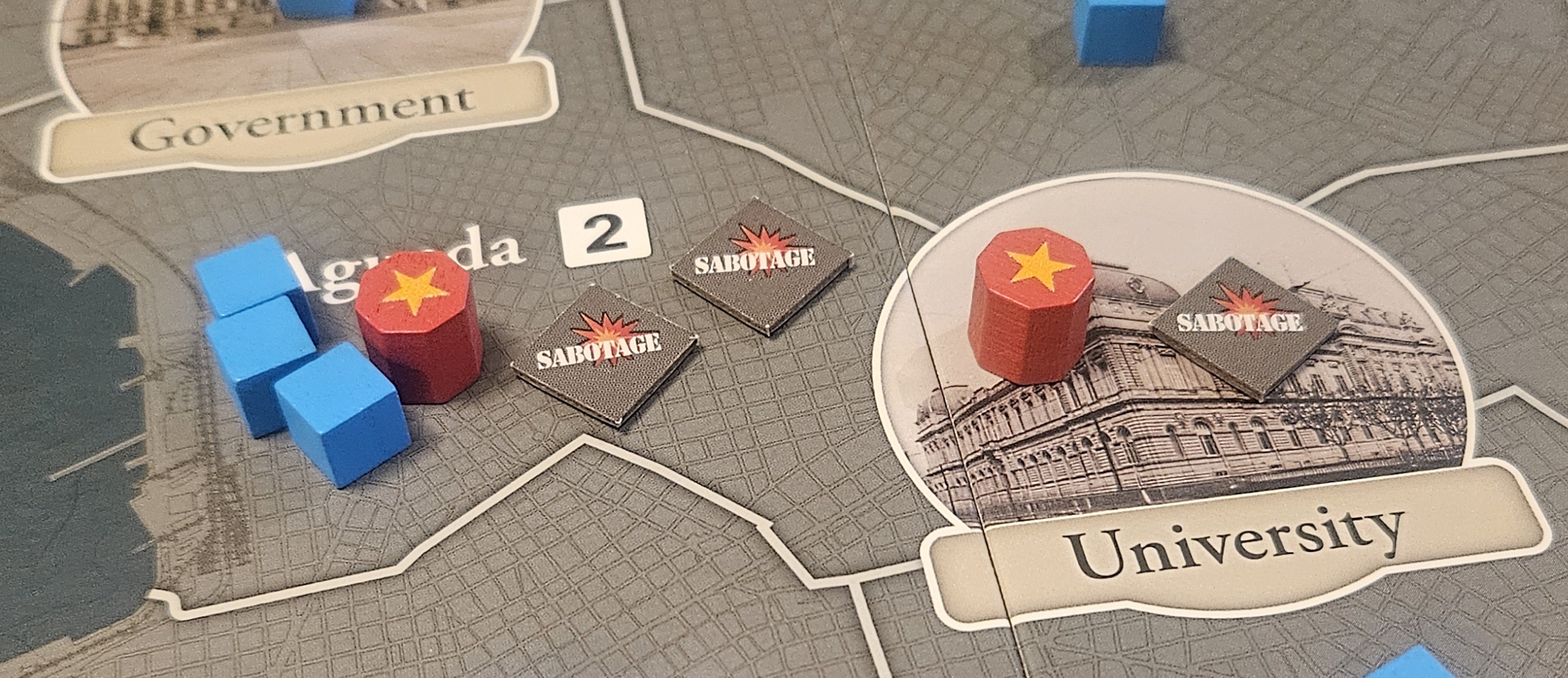
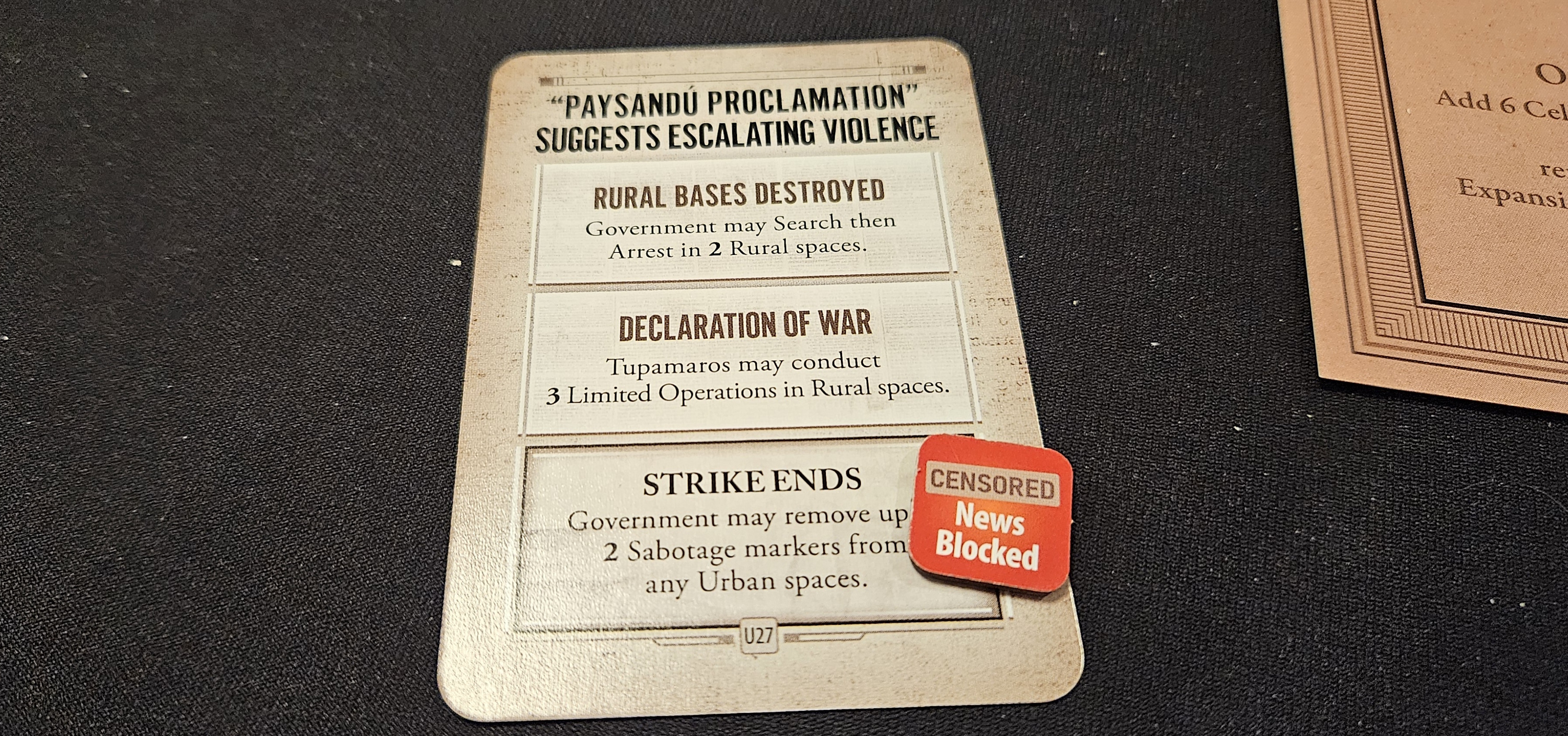
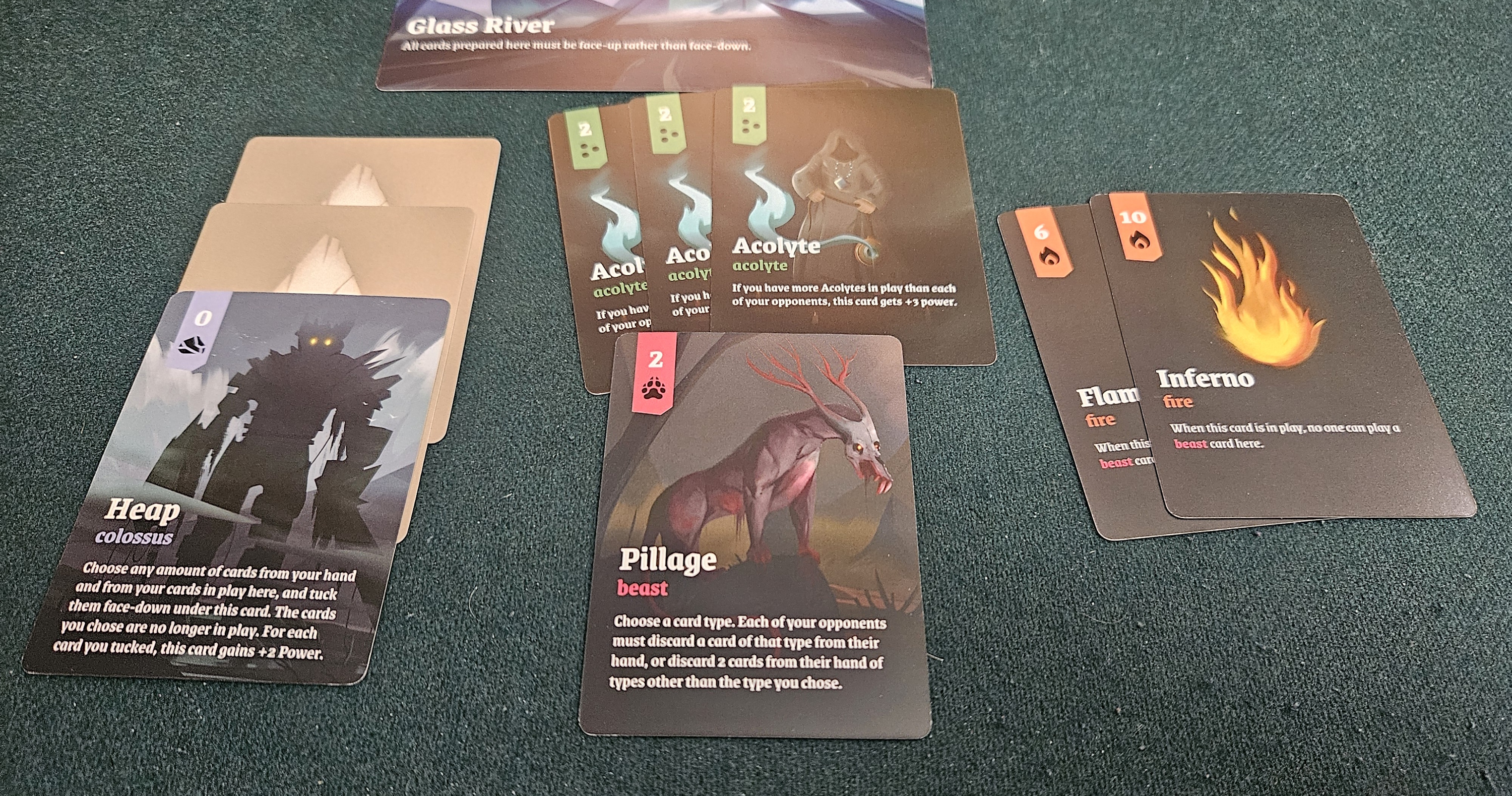
When last we visited Stephen Rangazas’s The Guerrilla Generation, we looked at a localized urban insurgency in Uruguay, one that failed to bring about a socialist revolution, but eventually, after a period of military rule, saw former revolutionaries elevated to government positions, including the presidency itself.
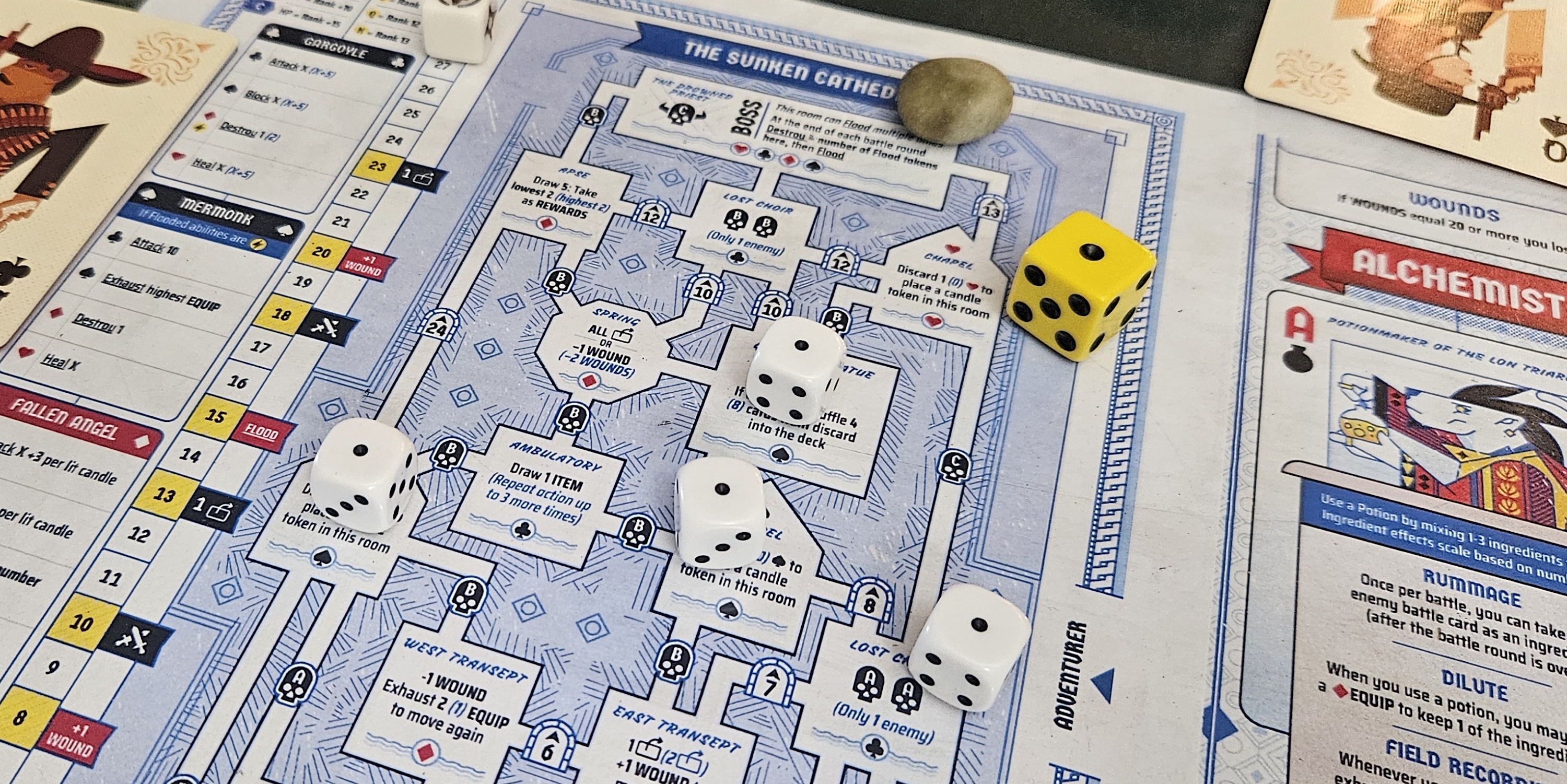
Today’s scenario casts a wider net, not to mention a more tangled one. When the scenario opens in 1980, Peru has only recently emerged from its own period of ideologically complicated military dictatorship. Riven by debt and poverty, Peru now has a freshly elected civilian government that’s reluctant to give the military too much latitude, while a philosophy professor named Abimael Guzmán has just launched one of the most vicious insurgencies in Latin American history: the Shining Path.
Welcome back to the countryside, comrade.
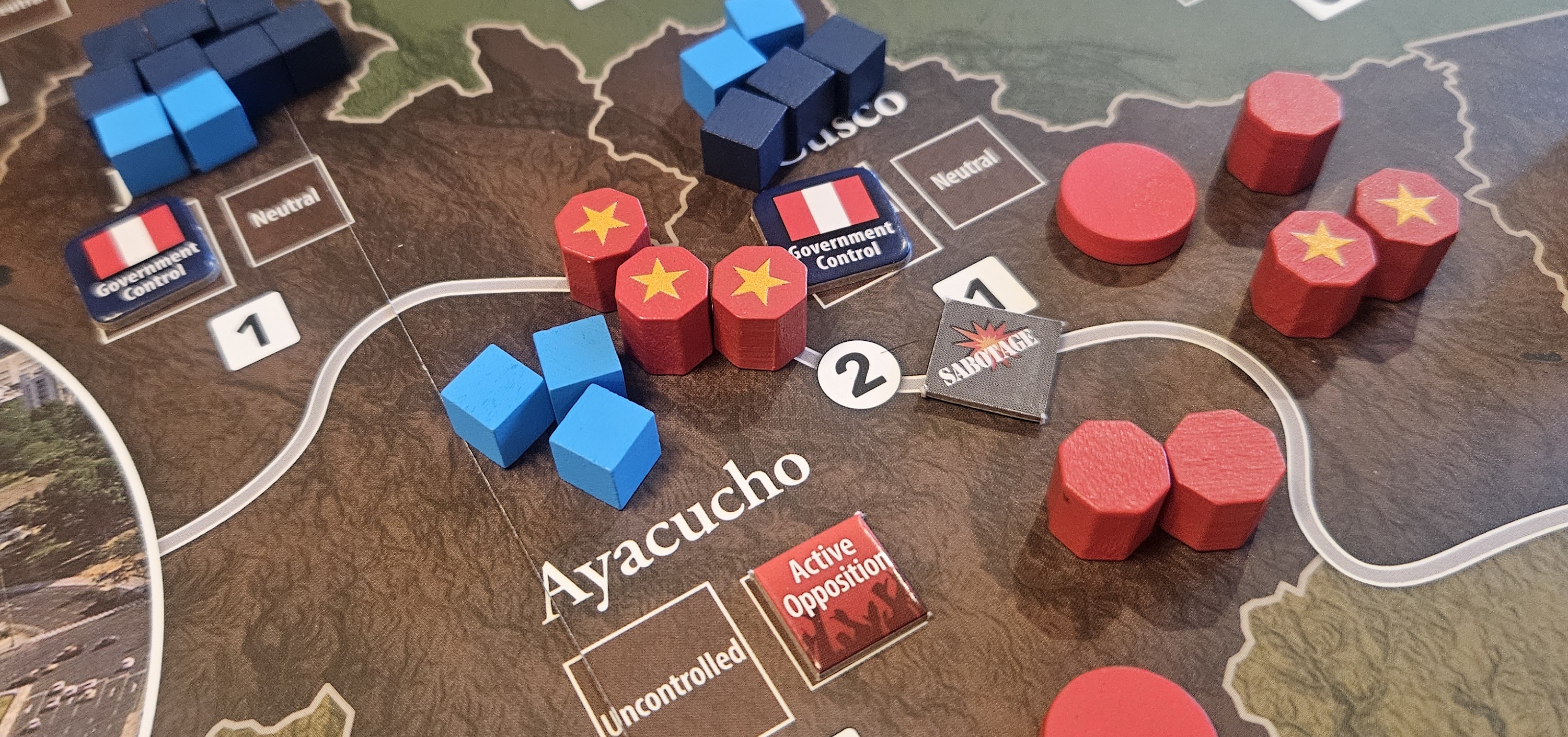
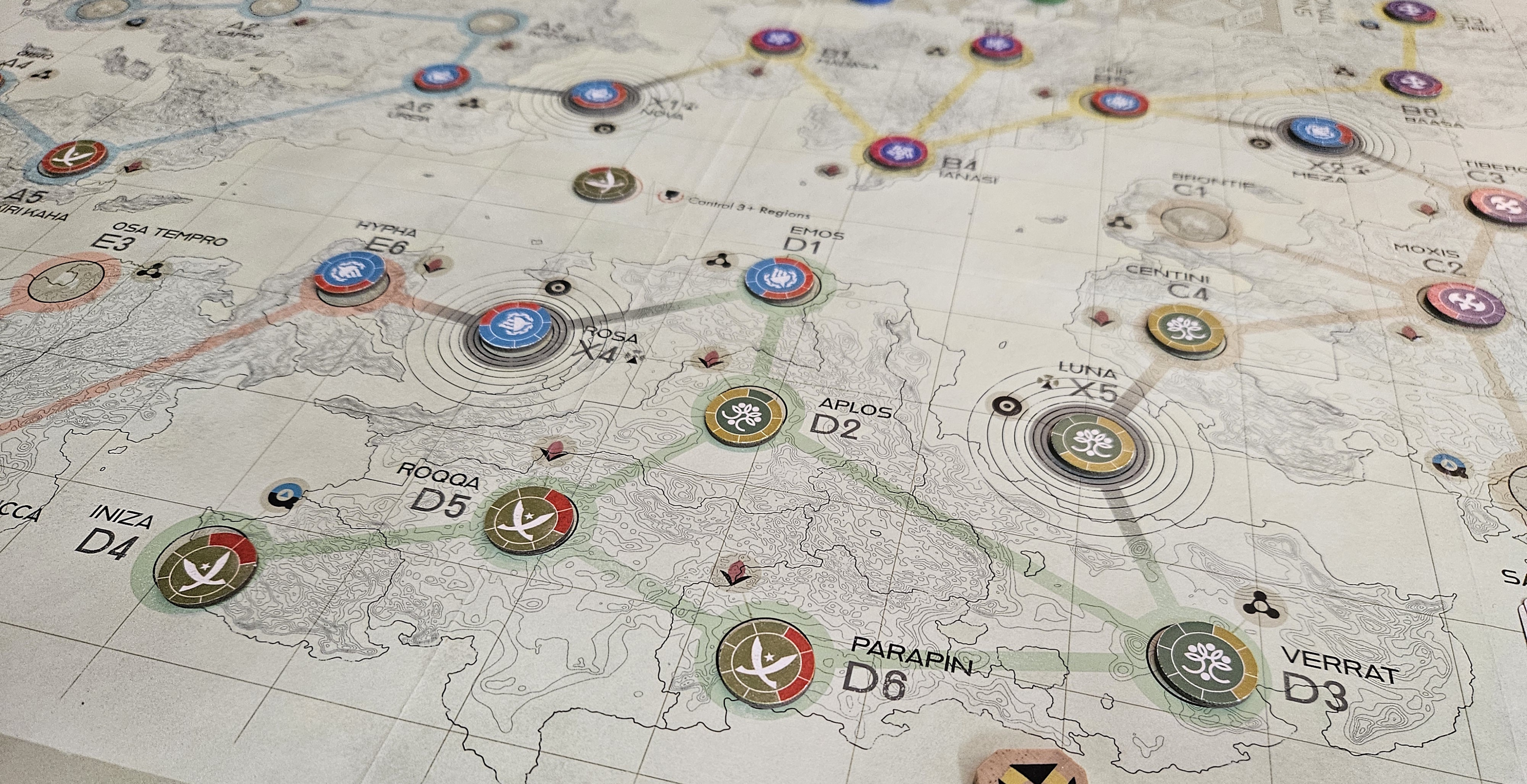
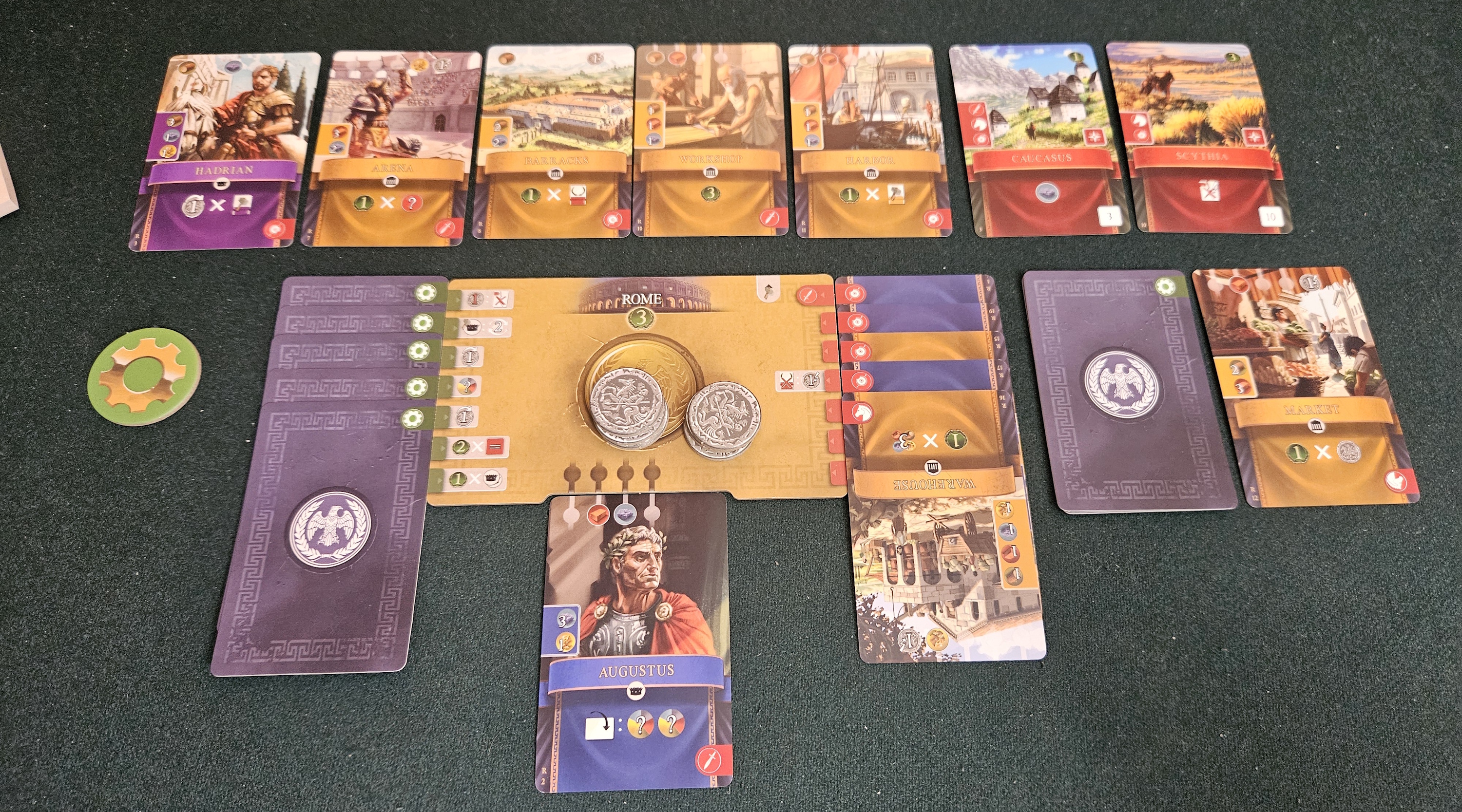
For long-time enthusiasts of the COIN Series, Peru finds itself on something closer to home turf than the Uruguay scenario. Unlike that country’s Tupamaros, the Shining Path has adopted the lessons of Che Guevara’s successful revolution in Cuba rather than merely his ideology. We’re back to observing the foco theory, in other words. This is a rural insurgency, with cells operating in far-flung locales where the government struggles to project force, pressuring the capital of Lima from the outside rather than from within.
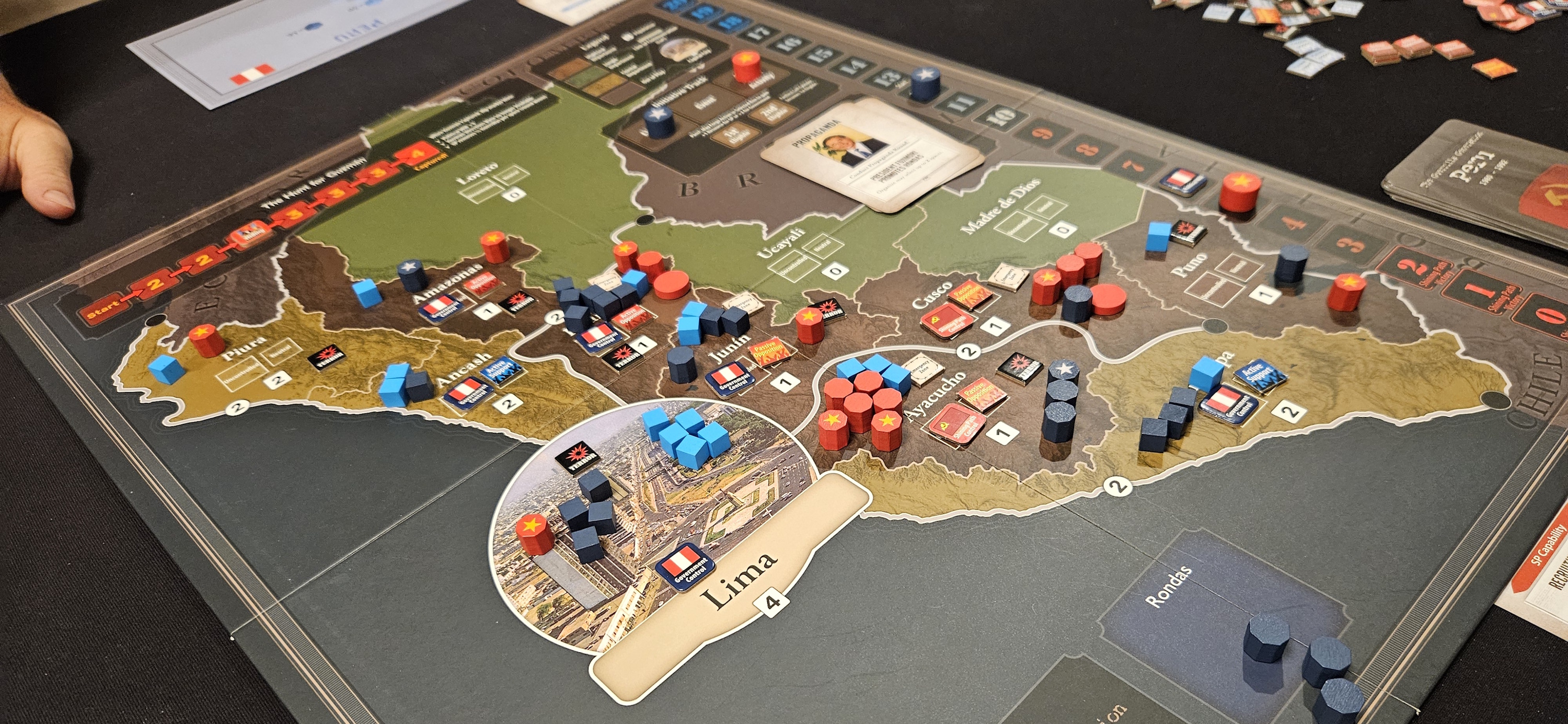
As such, many of the series’ hallmarks are back in full force. Lima is but one theater of many, its highways radiating like tender arteries for any revolutionary to squeeze or sever. The countryside itself is broad, with rich but heavily policed coastal provinces, rocky highlands where even professional soldiers struggle to root out dissidents, and swaths of jungle that, let’s face it, nobody cares much about. This, in turn, necessitates a degree of bookkeeping. Control between the Government and the Shining Path must be constantly adjusted, while the relative support and/or opposition of the local population for the current regime in Lima is always under negotiation.
In other words, Peru looks a whole lot like COIN.
For the most part, it plays a lot like COIN as well, both procedurally and ideologically. Both sides receive more or less the same operations that Volko Ruhnke enshrined way back in Andean Abyss. The Government divides its time between protecting its vulnerable underbelly — mostly meaning its coastal provinces, highways, and Lima — and mounting sweep-and-assault operations meant to identify and then eradicate guerrilla forces. The Shining Path, meanwhile, tries to shore up its influence in its natural home territories in the highlands, and then infiltrate into those vulnerable territories to launch terror campaigns. Both sides are concerned about funding, both in securing their own and choking off any for their opponent.
Waiting for Guzmán.
Where the scenario takes a more interesting turn is in the specifics of how it models this particular conflict, a strength that Rangazas has demonstrated previously in The British Way.
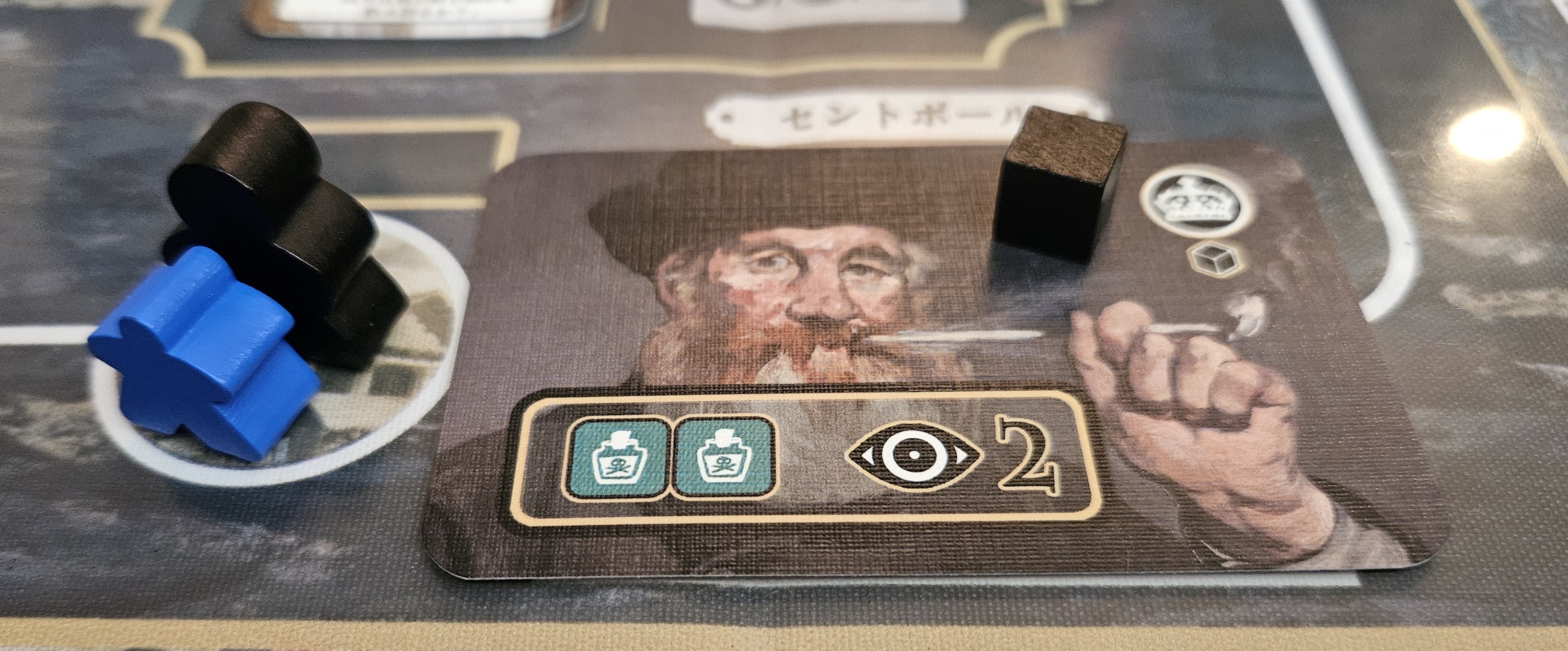
Let’s start with the Government. Like their peers in Uruguay, there’s some reluctance to let the military off the leash, although here there are plenty of troops on the map from the very beginning. In this case, certain military activities can only be taken in emergency zones, special designations limited to highland regions under threat from the Shining Path. Normal protections don’t apply in these zones, allowing the military to conduct reprisals against civilians, but also to form rondas campesinas, peasant patrols, which act with training, arms, and above all official recognition. These rondas begin “underground,” much like the series’ portrayal of insurgent cells, but can eventually flip to their active side to assist the Government in various ways. These two options, reprisals and rondas — stick and carrot — form the backbone of the Government’s strategy in the Shining Path’s staging grounds, but carry their own limitations. Namely, rondas take a long time to set up, while reprisals risk turning those armed peasants against their benefactors. All the while, Peru is deeply impoverished, risking total bankruptcy if the Government isn’t choosy about which battles it fights.
The Shining Path, on the other hand, finds itself in a testy situation where every action risks backfiring against its long-term goals. To fund their activities, they must implement local councils, but these disrupt village traditions and generate support for the Government. To foster opposition, then, the Shining Path must conduct terror campaigns, but these encourage the locals to form rondas. This produces a vicious cycle, with communist councils necessitating terror necessitating additional councils. Each solution begets new problems, round and around, threatening the insurgency with a death spiral if they don’t keep on top of it.
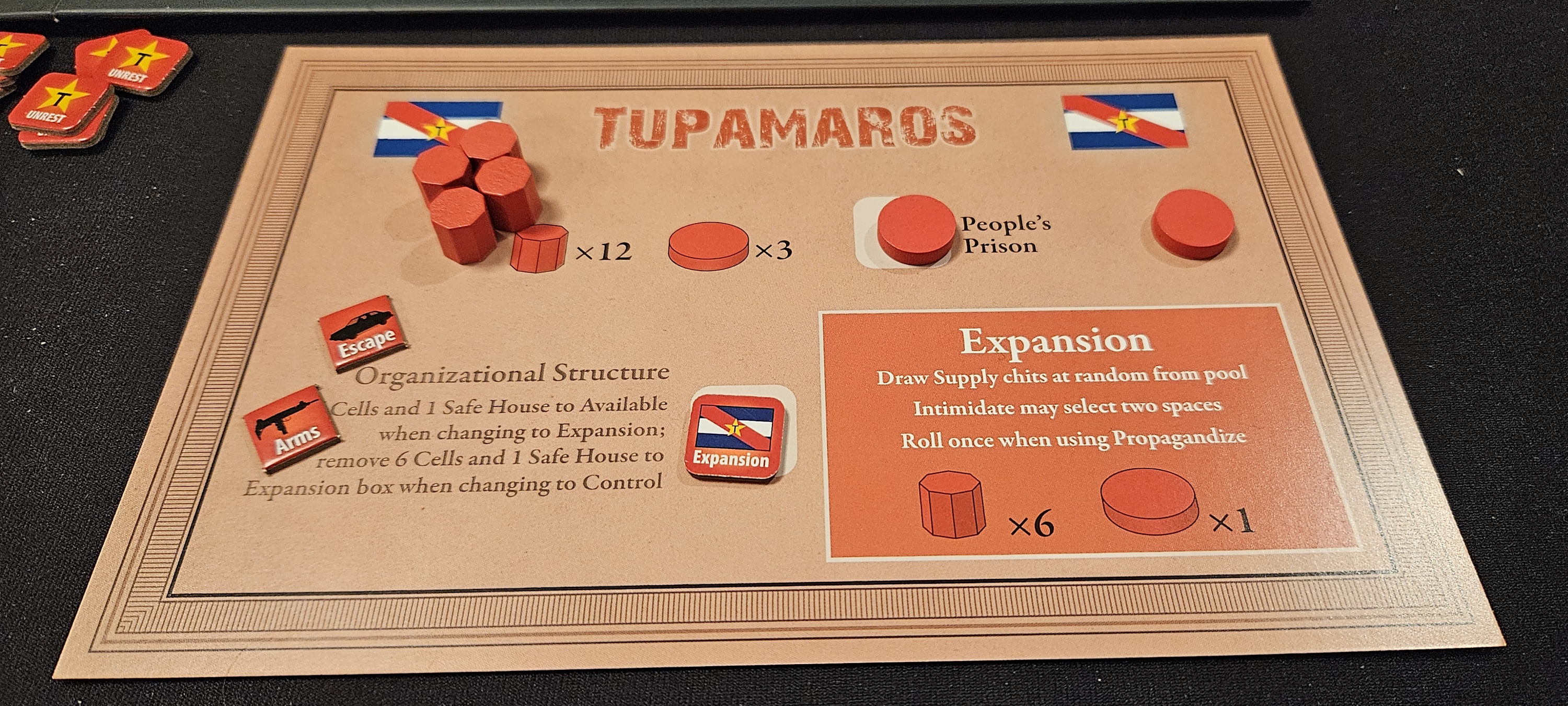
Compounding this problem, the Shining Path is far more centralized than most of the insurgencies examined by the COIN Series. This provides both advantages and downsides. Importing the double-sided People’s Prison disc from the previous scenario, a single Shining Path base is secretly Abimael Guzmán’s center of operations. If this base survives the current campaign, the Shining Path receives some free actions, a last-minute boon that can swing the tide in their favor right before the game checks for victory.
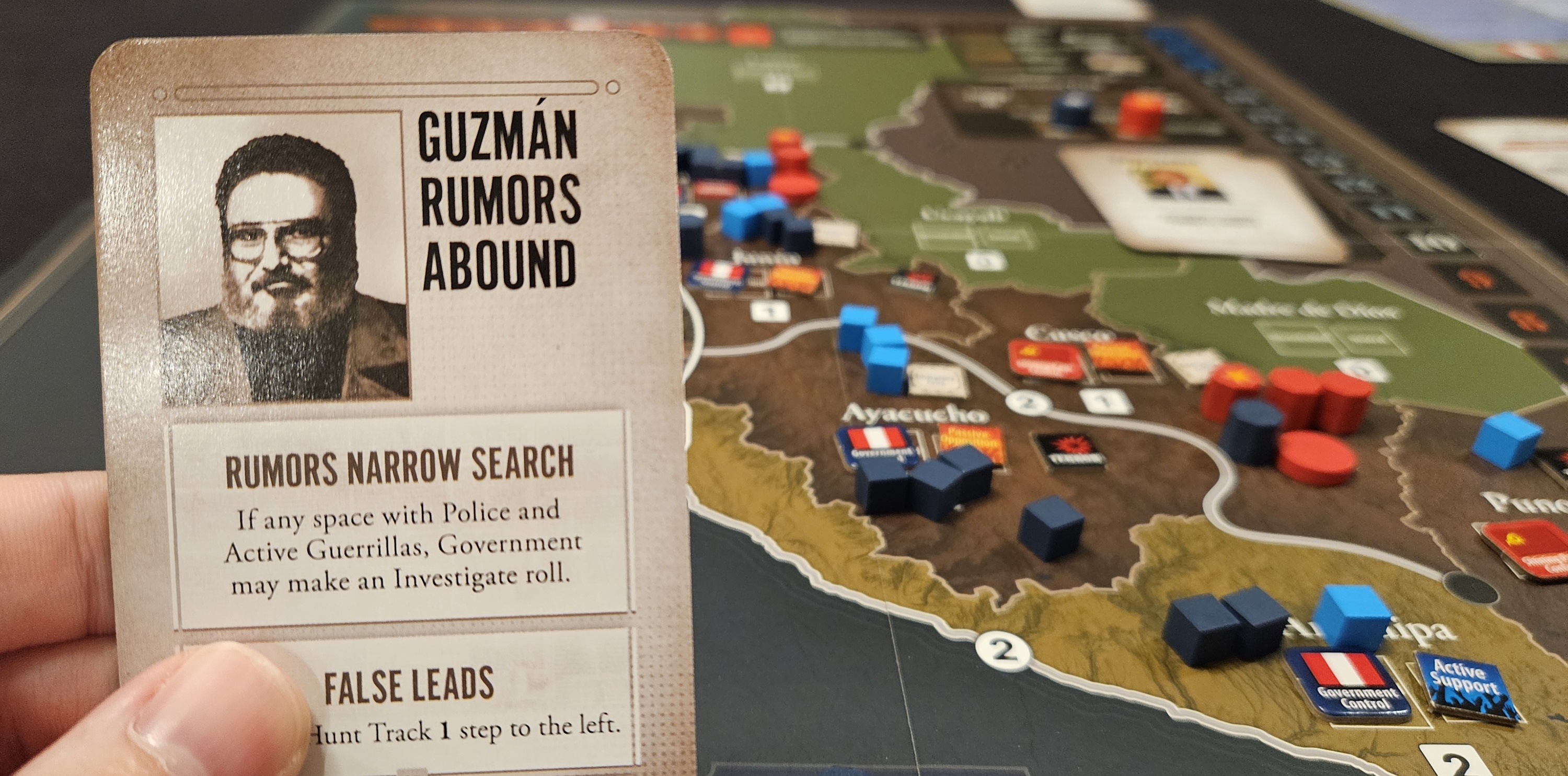
At the same time, their centralized leadership means the Shining Path must play more defensively than usual. There’s always the threat that the Government will capture Guzmán, a process of gradual investigation hastened by uncovering the location of Guzmán’s base. Capturing Guzmán doesn’t end the scenario outright, but it deals a serious blow to the Shining Path and bolsters the Government’s legitimacy on the scoring track, mirroring the historical outcome.
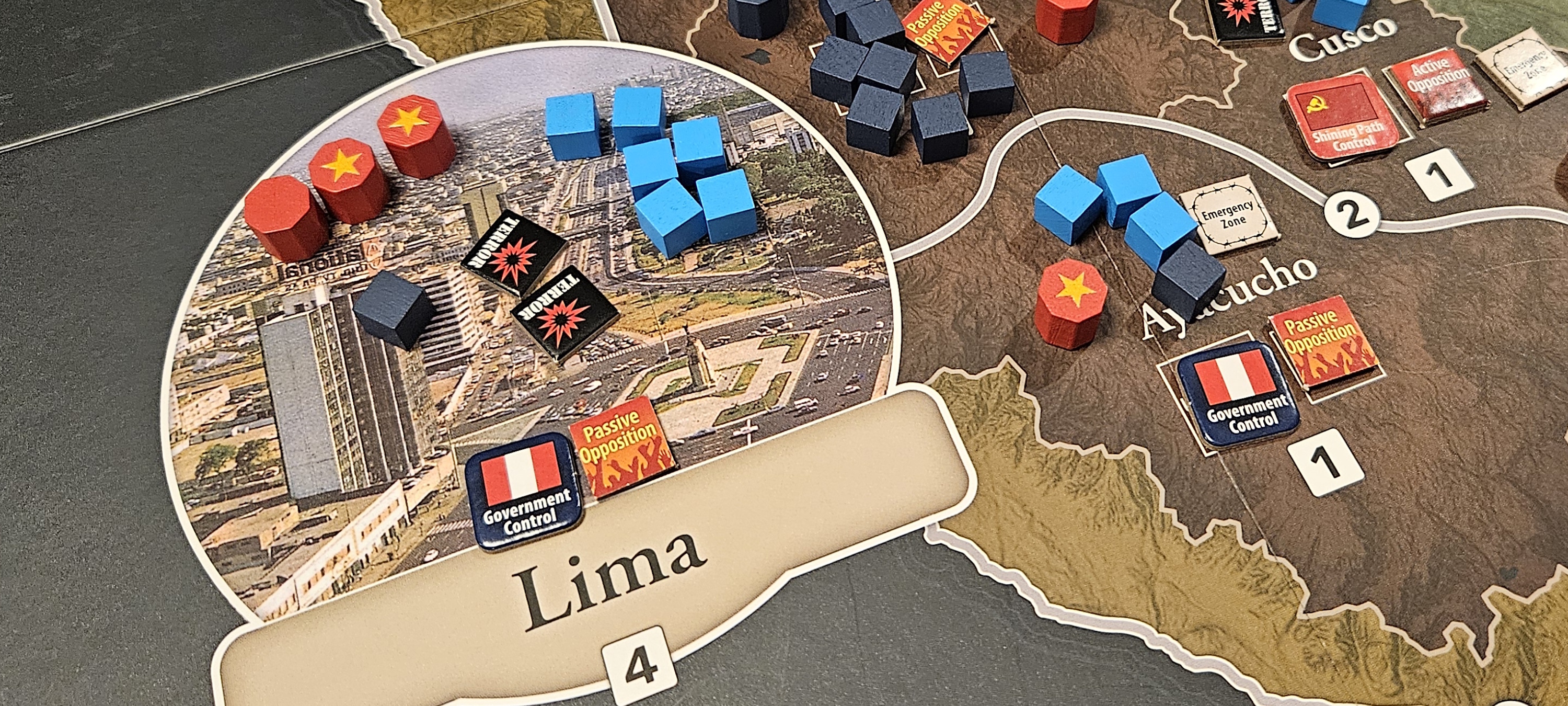
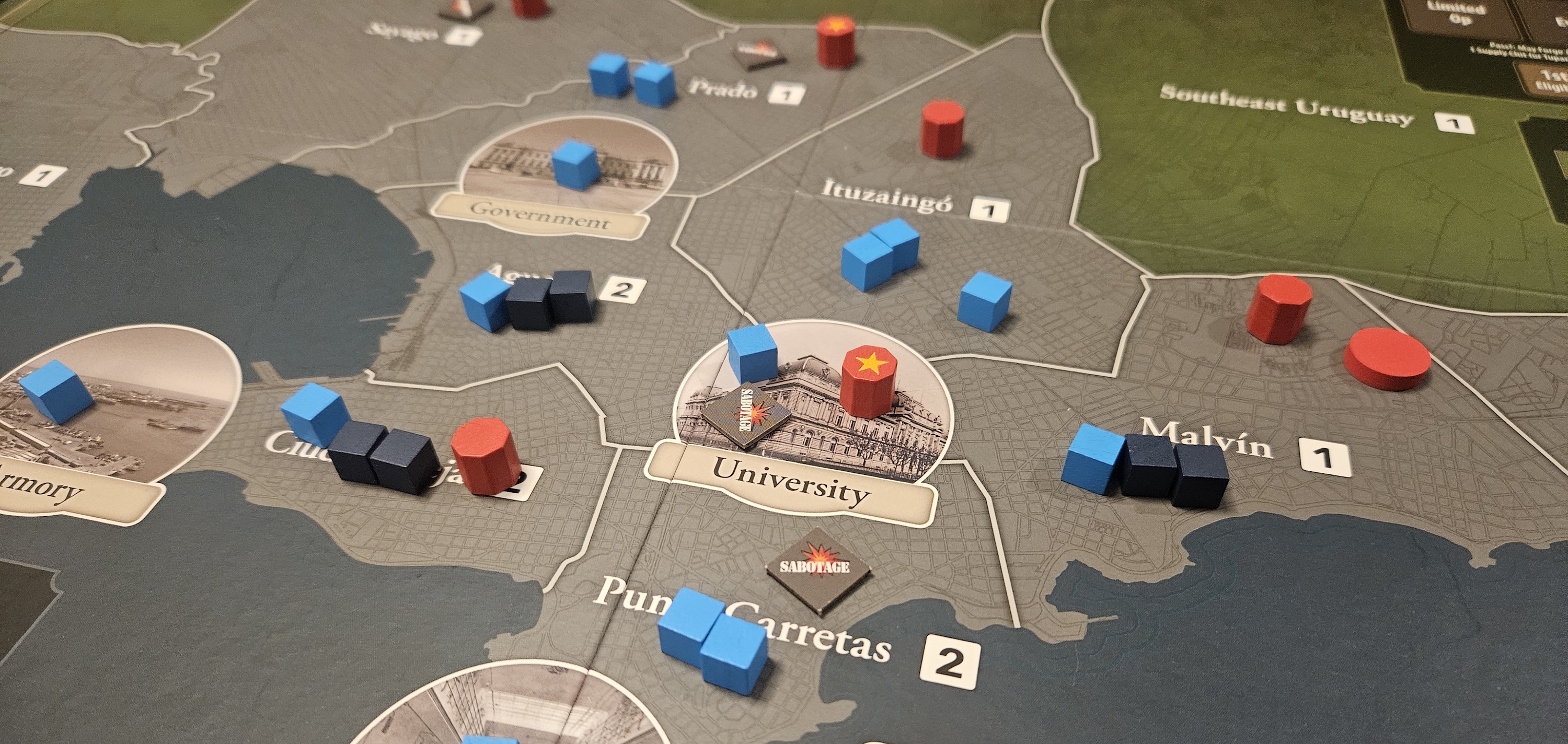
The contrast between urban and rural environments is again emphasized.
This entire armory of double-edged swords provides Peru with quite the volatile mix, one where even stable situations aren’t wont to survive for very long under rival scrutiny — or even one’s own attempts to remain in power. As with the other scenarios designed by Rangazas, both in The Guerrilla Generation and The British Way, the main question on my mind is how closely this represents the situation that developed historically, not only in terms of events that actually occurred, but also as a possibility-space for investigating the reasons why these insurgencies and government policies succeeded or failed.
Peru, it should be noted, is a tricky case. Much of the Government’s material support against the Shining Path came not from the United States, but the Soviet Union; its earlier military dictatorship was both nationalist and left-leaning before a successive coup shifted its comportment rightward; and then there’s the eventual self-coup by President Alberto Fujimori, a political earthquake that only receives a cursory mention on an event card. The limited scope of its portrayal in The Guerrilla Generation elides many of those complexities.
To be clear, I’m not pining for some wishy-washy bothsidesism. At times, the Peruvian Government was brutal. So was the Shining Path, uncommonly so, departing from every other Latin American insurgency by exceeding government casualties over the course of the conflict. Personally, the most interesting figures in the conflict are the rondas campesinas, who often struggled to chart a course that would assure them the greatest independence not only from insurgents but also from government oversight. The scenario limits them to markers of expanded Government combat efficiency in the highlands, which short-sells the difficult position they found themselves in. It would have been nice to see their struggle represented more thoroughly.
Then again, none of this is anything new. Wargames have long struggled with the question of how to portray atrocity. More often than not, designers opt to omit them altogether. With the COIN System, Rangazas inherits a model that was crafted to demonstrate approaches to counterinsurgency, only to later deepen its ideological ambitions. For the most part, Rangazas has proven himself capable of overcoming the system’s limitations to reveal the particulars of a wide range of conflicts. But with Peru, the cracks are showing, and they’re ideological more than procedural. Its version of the Shining Path is so inherently corrupt that its essential activities are attended by considerable downsides, while the Government may elect to curb its more vicious impulses and instead focus on civilian outreach. One side has very little agency; the other, an improbable amount.
In this alternate history, the Shining Path has dominated the entire country.
What emerges, then, is more descriptive than exploratory. As a scenario, it demonstrates how the Shining Path raised funds through drug trafficking and rural councils, how the country’s impoverished state made it possible for them to squeeze the government toward bankruptcy, how it struggled to spread the revolution into population centers, and how its centralized command was both a source of strength and its ultimate downfall. As for the Government’s reflexive atrocities against indigenous populations, its political infighting, and its vacillating support for the rondas… well, that stuff is mentioned on event cards, if not quite as explicitly modeled.
On the whole, what emerges is a sound, if incomplete, sky-high snapshot of an insurgency that is still technically operative today, if dramatically reduced in strength and territory. And next time, we’ll see the script flipped as a revolutionary government faces an anti-communist insurgency with considerable foreign backing.
A complimentary copy of The Guerrilla Generation was provided by the publisher.
(If what I’m doing at Space-Biff! is valuable to you in some way, please consider dropping by my Patreon campaign or Ko-fi. Right now, supporters can read the next installment in my series Talking About Games, this time tackling the topic of what makes a good list! Naturally, the piece includes a list.)
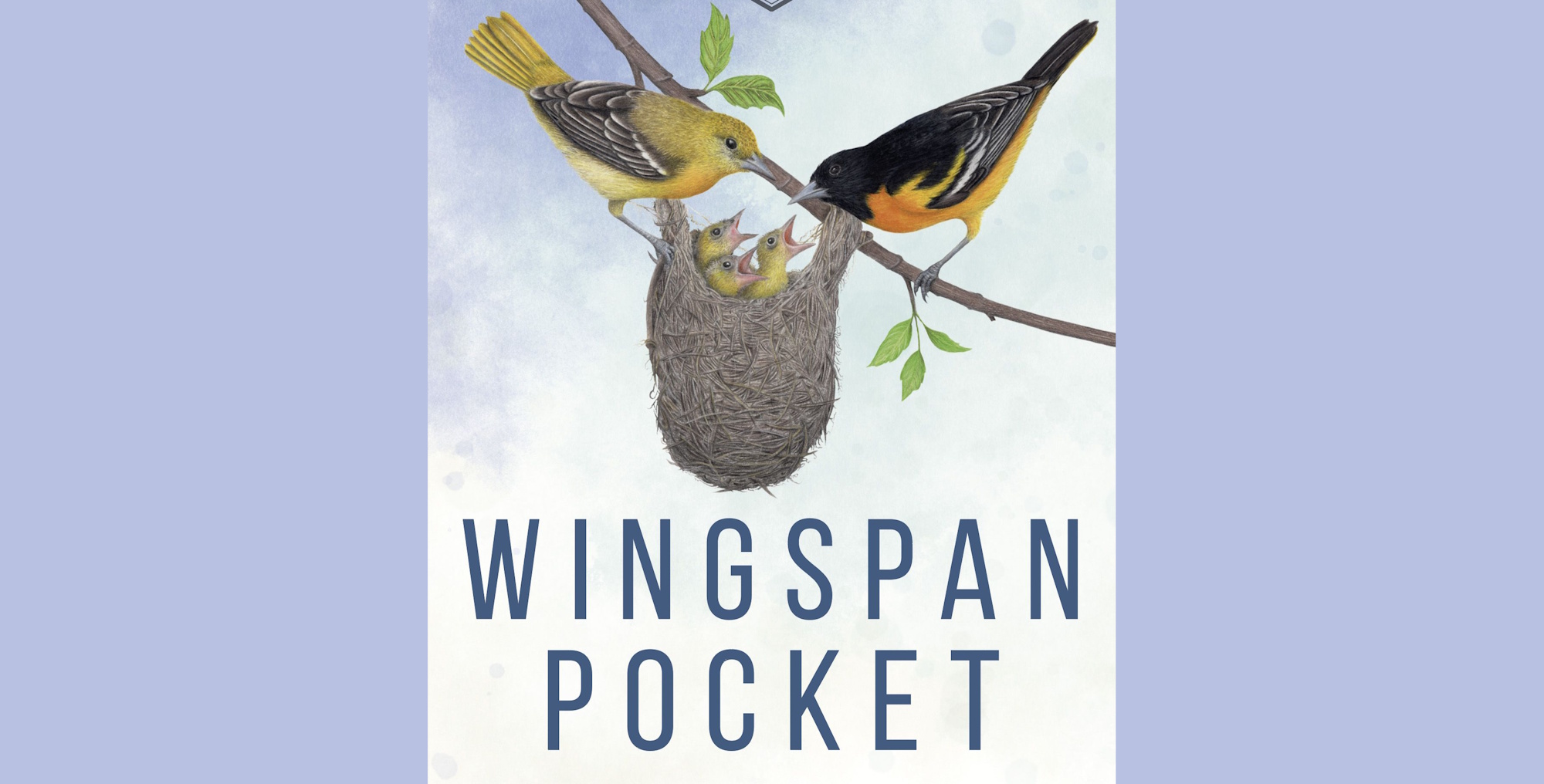
“Wingspan but smaller, simpler, and shorter” isn’t half-bad as pitches go. That’s precisely the niche Wingspan Pocket carves out for itself. In every way that matters, this is Wingspan, Elizabeth Hargrave’s 2.6 million bestseller, all birds and combos and speckled eggs, but slimmed down to a blue-footed booby’s webbed footprint.
I’m convinced that it might even be better than the original. For the doubters, it’s certainly shorter.
A compact, single-tiered tableau of birds.
Like the best exercises in compressing a game to a more portable version, Wingspan Pocket captures the appeal of the original while also nipping and tucking the experience down to its most essential components. Gone, for example, are the player boards. Gone is the dice tower; it would look silly without any dice. Gone are the resource tokens, traded for the reverse side of each card, adding decisions to the market by way of shuffled grains, worms, fish, and berries.
The remainder represents Wingspan at its most essential. The cards, of course, as those are the main feature. You can’t have Wingspan without the wingspans. The speckled eggs have also returned, occupying as much box space as the cards themselves. Where would Wingspan be without the eggs? According to Wingspan Pocket, nowhere anybody wants to be.
Between the cards and eggs, Hargrave recreates the magic of the original game at a fraction of the size. It’s an impressive exercise in minimalism. Where the original game could occupy upward of an hour to play — maybe longer with the wrong player count and indecisive players — this one hovers closer to thirty or forty minutes. The slimmer card pool doesn’t even feel like a limitation thanks to how the cards regularly randomize between their resource and bird sides.
That same trimness goes for the rules as well. Wingspan could occupy quite a bit of tabletop real estate. The biggest difference with the pocket version is that the original game’s three tiers have been reduced to a single row. Thanks to the market, it isn’t quite small enough to squeeze onto your average in-flight tray table, at least not without some overlap, but it could fit comfortably atop a hotel desk or picnic table.
The market offers cards as both birds and food sources.
One’s collection of birds, meanwhile, is handled with tremendous ease. If anything, it now feels closer to the exploration from Connie Vogelmann’s spinoff title, Wyrmspan. Using a wooden feather to mark your place, you walk from left to right, triggering each bird in turn. The first card is always your nest. This allows you to either play a new bird, lay a few eggs, or draw a pair of cards from the market.
From there, each bird gets its moment with the feather, and this is where the game shines brightest. The cards have been streamlined from Wingspan’s previous incarnations, pruned of end-game scoring abilities and rulebook-flipping outliers. Instead, there are two mainstays: activation abilities, which trigger when you land on them with your feather, and ongoing abilities, usually in the form of discounts.
In both cases, their effects are crisp and legible. Of course, this forthrightness serves a greater purpose, encouraging everyone to build a strong tableau. While Wingspan Pocket is more easygoing than its parent, it’s no slouch as a race to wring as many points as possible from a maximum of six birds. There are micro-economies to manage, usually revolving around eggs, a healthy hand, and maybe some tucked cards. Certain actions, like laying eggs or picking up some meager offerings from the market, feel like miniature defeats when the right birds might allow you to get them for free. I was also pleased to see that predators had returned, letting players hunt cards from the market based on their relative wingspans. It’s notably simpler, but there’s still room to tinker. Or to glare jealously at what your rivals have built to work with.
Optional objectives further shake up the formula.
For some, this streamlining may prove overly enthusiastic, and I doubt it will do anything to persuade the doubters. The closest analogue is a single round of Wingspan. There are optional goals, but these are triggered once rather than swapped out across the game. That single tableau of six birds is slender, theoretically capable of bringing the game to an end within a half-dozen rounds. At times, I was surprised at how quickly a session concluded.
But I take this as a good sign. At no point did Wingspan Pocket overstay its welcome. It was akin to a friend dropping by to return a tupperware from the other night, chatting for a few minutes on the doorstep, and then leaving before the conversation had a chance to grow stale.
To be clear, I’m not trying to damn Wingspan Pocket with faint praise. It isn’t good only because it only inflicts itself for a few minutes. It would be good at twice the duration. It would be good if it were three times this size. It would be good if it were Wingspan.
Far more than that, however, it’s good for the way it preserves its core experience for a new audience. My seven-year-old is smitten with Wyrmspan for its dragons, but our draconic sessions require me to two-hand the whole thing while she breaks ties between the decisions I’ve presented to her. Wingspan Pocket, by contrast, is fully within her control. There are elements she’s grappling to fully understand; for all their simplicity, these birds still require some degree of skill to combine. But she can trace her row from side to side. She can translate the icons into a functional language. She can identify which birds are affordable or beyond her immediate reach. She’s playing the game on her own, rather than half-spectating.
My seven-year-old loves it.
That’s no small thing. As someone who has loved Wingspan and its offshoots since its release seven years ago, that’s the kernel of this game’s appeal. It cuts across boundaries. It’s slight enough that it doesn’t take major headspace to play, but offers just enough density that someone can dig in and build something truly monstrous. It’s gentle and affirming, yet carries sharp enough talons to let a raptor rip into a sparrow.
Wingspan Pocket preserves that. In many ways, it does something better. Where the original game required upkeeps and phases and a rulebook that traumatized a famous actor, this is Wingspan as a bird gliding motionless in the sky, elegant and at ease. We don’t see the work that went into its effortless glide. We don’t see the long evolution of pneumatized bones. We don’t see the rapid flapping that lets it take flight. Nor do we see the hardscrabble hunt for calories.
That, to me, is what Wingspan Pocket represents. This is a mercilessly developed and hawkishly fine-tuned experience. It works as a race between falcons or as a lazy Sunday activity with downy fledglings. I think I prefer it to the original. Now do the dragons, please.
A complimentary copy of Wingspan Pocket was provided by the publisher.
(If what I’m doing at Space-Biff! is valuable to you in some way, please consider dropping by my Patreon campaign or Ko-fi. Right now, supporters can read the next installment in my series Talking About Games, this time tackling the topic of what makes a good list! Naturally, the piece includes a list.)
I’m not the biggest fan of trivia games. Especially those that require players to know a specific answer, and a hundred times those that sporadically stuff me into a locker with an unexpected sports question. “Who soiled his pants while stealing two consecutive homers during the 1914 Cinnamon Bakeaway summer camp?” the question will ask. “Nobody could possibly know that,” I begin, only for my father to scream “Mickey ‘The Dugout Dog’ O’Queefe!” for ten thousand points.
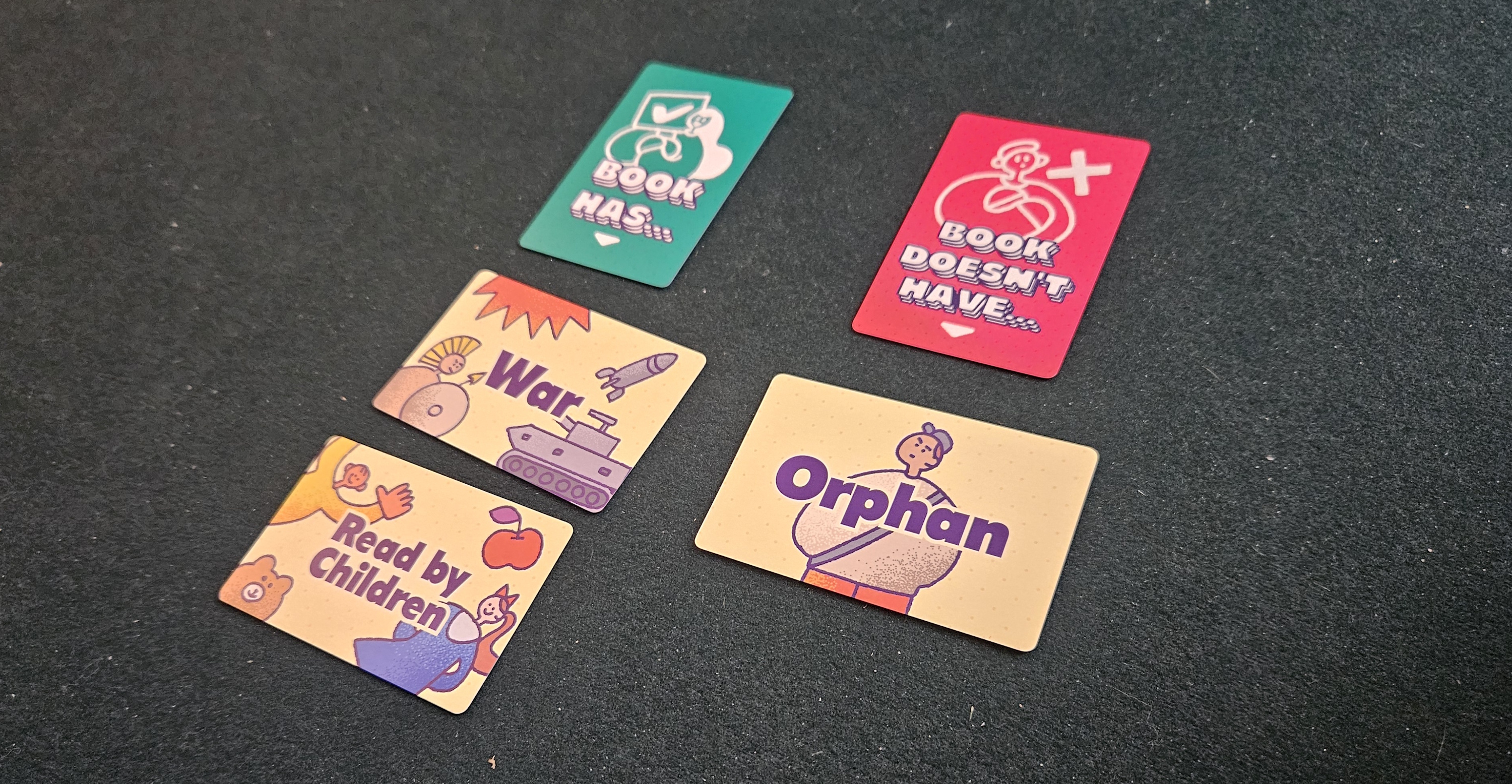
Book Club and Movie Night are teensy-tiny trivia games by Peter Hayward. Each session lasts five minutes, sometimes a run of cards will produce an impossible question, and they’re titles that will prompt the most obnoxious person in your gaming group to insist they’re activities rather than games. For all that, they’re the rarest of beasts: trivia games that put creativity and lateral thinking on the same footing as raw factoid retrieval.
Name a book!
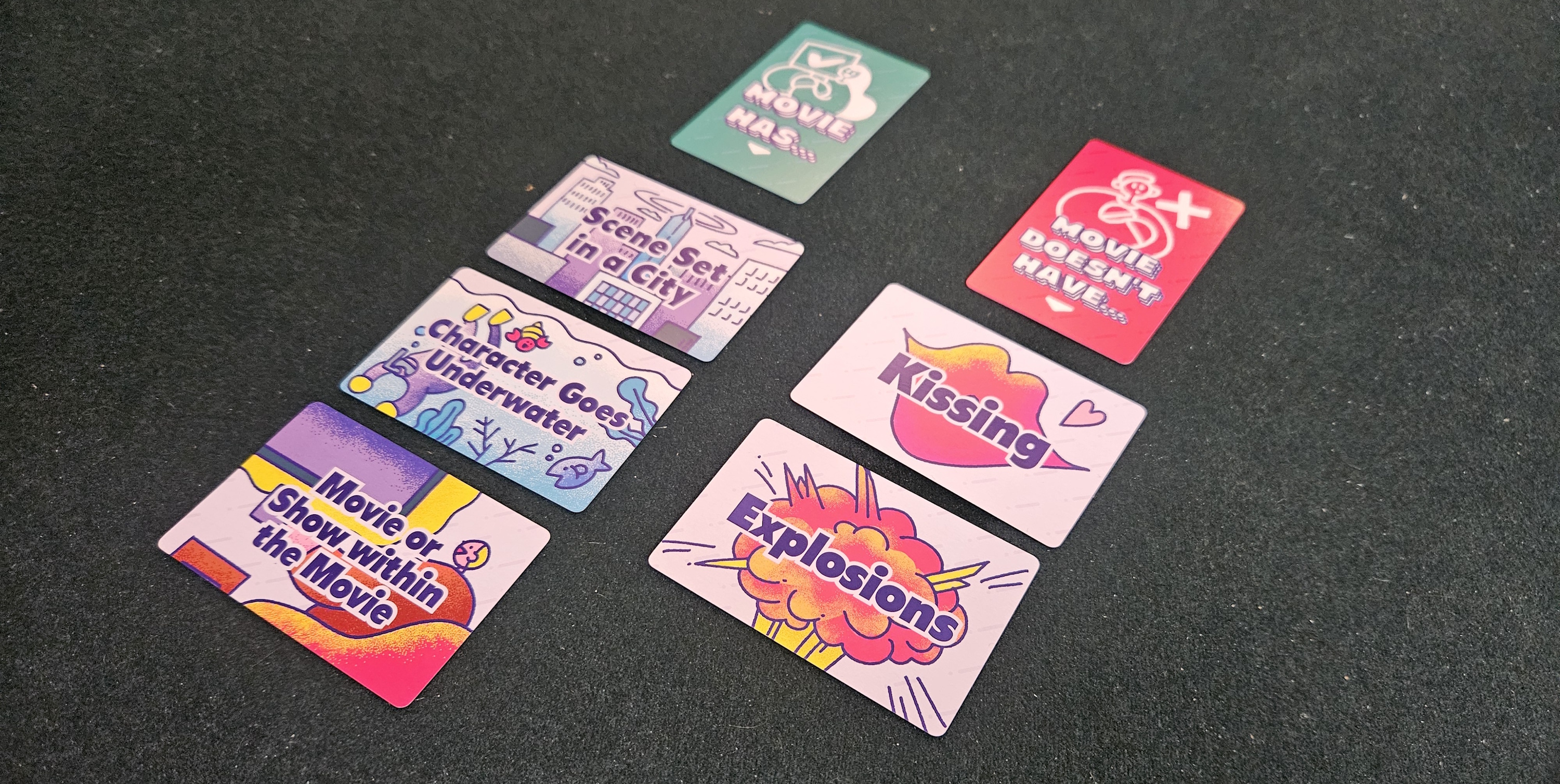
Rather than walk through the rules, let’s open with a demonstration. Movies. We’re guessing movies. So we draw a card. It says “punching.” What’s a movie that includes punching?
Rocky. Sure. Plenty of punching.
Now we draw another card. “Scene set in a city,” it reads.
At this point, we need to take stock. Does Rocky have a scene set in a city? Well, yeah. The whole thing. Philadelphia. There’s a statue. The city even renamed the steps.
So we take that card, “Scene set in a city,” and we move it into the “Movie Doesn’t Have” column. Now we need to come up with a movie that does have punching but doesn’t have any scenes in a city.
“Knockaround Guys!” shouts my friend who always remembers weird movies like Knockaround Guys. That sounds about right. We spend a minute debating whether there’s a city scene near the beginning, but none of us can remember because Knockaround Guys came out in 2001 and it wasn’t a good movie to begin with, apart from that one scene where Vin Diesel really works over that redneck. Eventually we decide that, fine, Knockaround Guys works.
Another card. “Character goes underwater.” Uh oh. Pretty sure nobody goes underwater in Knockaround Guys. (Although maybe. We can’t remember. Knockaround Guys came out in 2001 and none of us saw it more than once. Nobody did.)
So what’s a rural punching movie where somebody goes underwater? Sinners. Of course. Props to Geoff with the contemporary cut.
Fourth card. “Celebration or holiday.” Now the group starts to fracture. Because while Sinners isn’t a holiday movie, it can be argued that the juke joint is a celebration of freedom, and that one scene is a celebration of African heritage, and now we’re debating what “celebration” means in the context of “celebration or holiday.” It matters. Because if we decide that Sinners includes a celebration, our next movie can’t have a celebration, which is a lot easier than naming a rural punching underwater holiday movie.
Phantom Menace, somebody offers, making assumptions about how we’ll rule on the celebration thing, only to be roundly denounced by all the other nerds.
Uncut Gems, my pedantic friend says, which is always a treat. He says it counts for “underwater character” because Adam Sandler is underwater to loan sharks, which is pretty funny and we’re considering it, but then we remember that the whole thing is obviously set in a city. We’d kinda forgotten about that card.
Finding Dory, says the person with kids. Apparently the octopus punches something, and while the movie is basically set in Monterey, there’s some wiggle room whether the fictional version of the Monterey Bay Aquarium should be considered a city or a greater unincorporated beachfront region. Also, since we still haven’t settled the “celebration” issue, this would retroactively put that card in the negative column.
The timer goes off. That’s five minutes.
Name a movie!
Hopefully this demonstration has been helpful. Here are my takeaways.
Perhaps foremost, this is a pedantic sort of game, one where every definition means what it means right until the moment when it behooves someone to argue that it doesn’t. “One-word title.” Hyphenated or not? “Adaptation.” Isn’t almost everything in Hollywood an adaptation? “Break-up.” Does that include friendships? “Snow.” You know somebody’s going to insist that cocaine counts. Personally, I think we all know what “snow” means. But then I propose a movie in Antarctica and now we’re debating whether pack ice really qualifies as snow. Fair enough. The good news is that it’s cooperative, so players don’t often come to loggerheads. You draw a card, squabble over its meaning a bit, and then move onto the next thing.
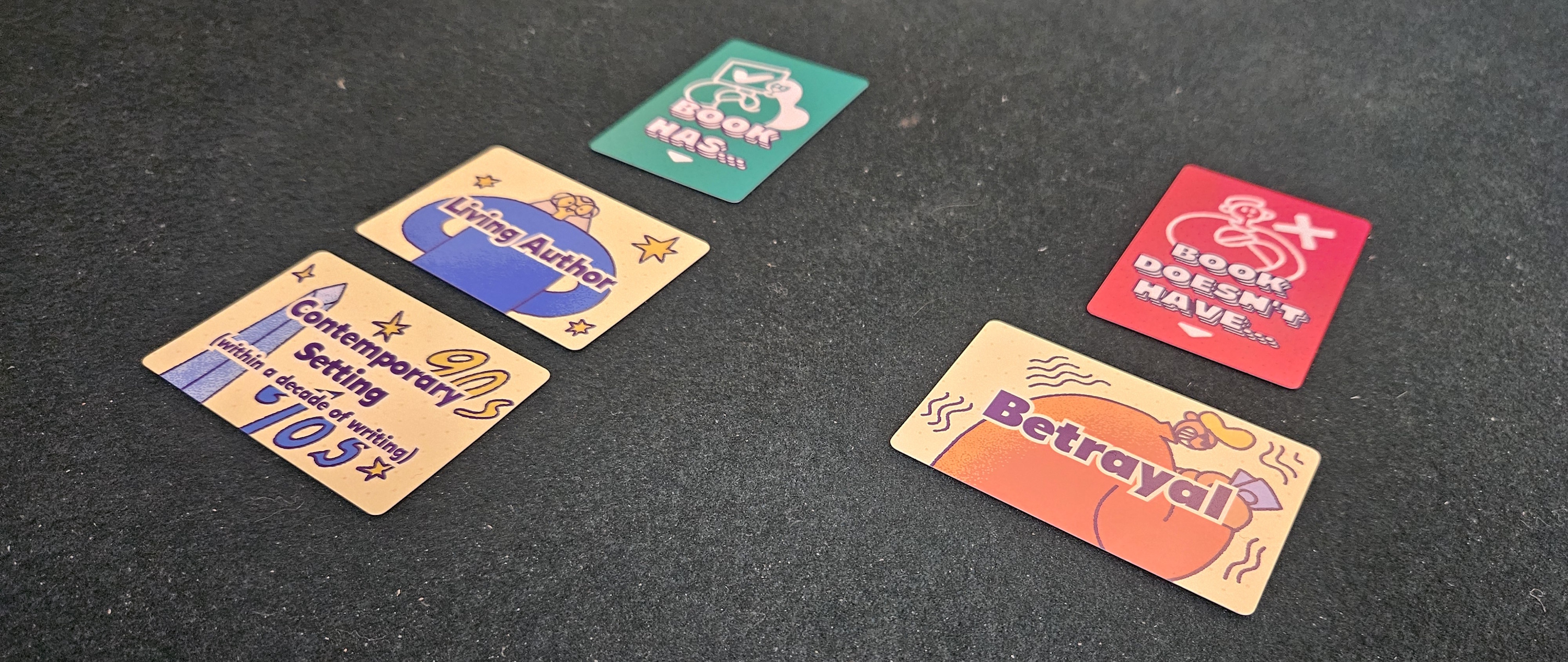
For all that, the experience it offers is often rather uneven. Sometimes you’ll hit upon a run of cards that’s too easy, and by extension too boring. In the next session you’ll be asked to only name movies with a stand-up comedian in a lead role. Or a book in epistolary form. Or to exclude media with “and” or “the” in the title. My least favorite? Only picking books whose author has an initial in their name. Hope you want to hear a lot of Christian fantasy author suggestions.
Books are harder than movies. Not only because it’s easier to watch a movie than read a book, so most people’s pool of options will be substantially deeper, but also thank the visual nature of the medium. Whether a movie includes a cat is easy enough to answer, even if it strains our gray matter. Recalling whether a book refers to a named character’s death is… well, it’s harder to conjure. At least for me.
For the most part, these textures are compelling, but it would be inaccurate to pretend they don’t sometimes lead to frustration. Riffing on movies is a delight. The same goes for books. But suddenly stretching to recall books-within-books when you’re four cards deep… well, it depends. Everything in Movie Night / Book Club depends.
There’s also a part of me that balks at the games’ size. These are slight things, roughly the size of a deck of playing cards, but at 40 and 34 cards for books and movies respectively, their variety is thinner than I would have preferred. And, look, their real value is in how those cards combine with one another. Even with the same three or four cards, their order can matter, and the appearance of even one other card can make a huge difference. But it’s disappointing all the same to draw a duplicate after only a few sessions.
Name a book!
All told, then, Movie Night and Book Club are mixed bags. They’re snack-sized games, good for filling a few minutes, nice as stocking stuffers, but also not especially ambitious or groundbreaking. I hate to say it, but just this once: the absence of a “sports” card from Movie Night might be one of the most telling indications that this party game isn’t quite up to snuff.
Complimentary copies of Book Club and Movie Night were provided by the publisher.
(If what I’m doing at Space-Biff! is valuable to you in some way, please consider dropping by my Patreon campaign or Ko-fi. Right now, supporters can read the next installment in my series Talking About Games, this time tackling the topic of what makes a good list! Naturally, the piece includes a list.)
The first time I opened up to a medical professional about some childhood trauma, it was like surgically excising a living thing from behind my breastbone. That experience — the galloping pulse, the ventricle-deep ache, the sensation that something alive and malicious was digging in its claws to stay rooted — made it easy to see how one might disavow ownership of those emotions and assign them to supernatural entities. Demons rather than one’s own untilled memories.
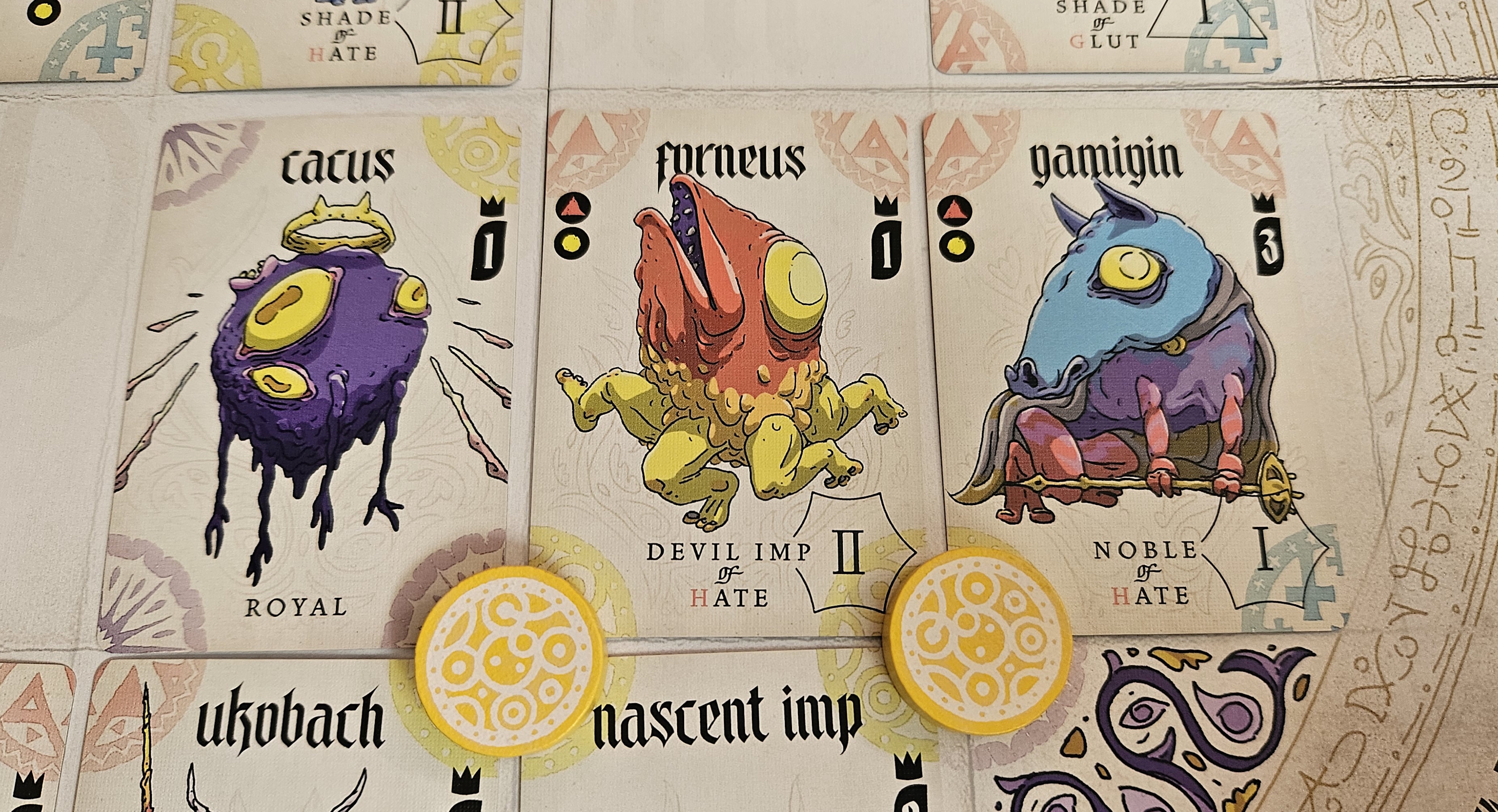
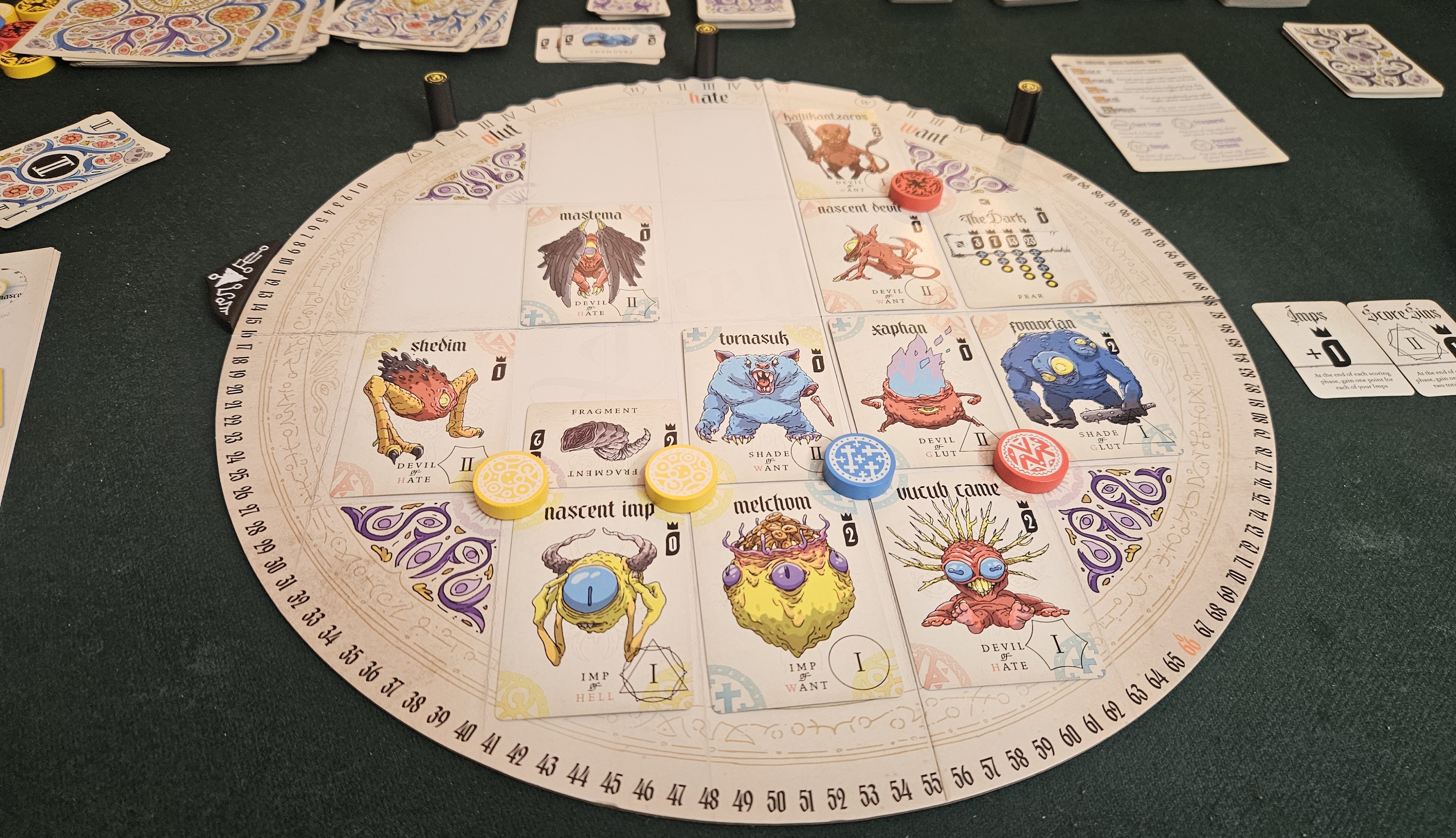
That, it seems, is the connection being made by Judson Cowan as well. Personal Demons is Cowan’s chaser to the successful Deep Regrets. Where that game used fishing for eldritch horrors as a stand-in for, well, deep regrets, Personal Demons is about calling demons to your own private summoning circle in order to dispel them. Or to confront them? To host a tea party for them? Look, it may be an apt metaphor, but it isn’t always a perfect one.
Check out the squishy li’l guys responsible for my bad behavior.
Here’s how to summon a personal demon.
Pick a card. This is a drafting game, so a fresh hand of cards will always be there to offer its selection of underworld beasties. Take care to pick the right one. Some require a certain number of seals, little colored tokens that sit within your circle, before they can be birthed into our world. All confer their sin of choice, hate or want or glut, so be sure to select the one you’re currently attempting to sin-max.
Once picked, you need to decide where in the circle to summon it. The main concern here is the demon’s corners. There are three colors to consider — four with the wild color that can match with anything — each mapping to liminal, infernal, and abyssal seals. If the corners of four cards line up, you stamp a seal on it. This is useful for summoning tougher demons, but also for scoring every adjacent demon. Which means it’s your main objective. Seals beget points and then are broken, flipping to their cracked side rather than remaining pristine and white. Fortunately, even cracked seals can be used for summoning further demons.
Right away, though, Judson pulls a few tricks that make Personal Demons a little more interesting than it would have been otherwise. After putting a demon on your board, you’re also allowed to take an action. These cost some amount of sin, hence the gluttony and hatred, but allow you to place other cards. The smallest are fragments. These cost only a few morsels of sin and confer a tiny card that occupies only half of a slot, hopefully pairing with demons like partners at a dance. For a greater fee, royals appear, usually offering a bunch of wild-color seal matches.
And then, for the greatest fee of all, you can summon a huge demon. Maybe even a colossal demon. But we aren’t ready for that yet.
Confidence cards provide a range of abilities.
After the success of Deep Regrets, it seems like Cowan has gotten this stuff down to a science. Much like how that game found its audience partially by leaning into its fish-oil aesthetic, Personal Demons is full of the squicky and squamous. The same goes for the game’s underlying metaphor. Deep Regrets was a bit hand-wavy about the relationship between the sea, chthonic aberrations, and one’s leaden heartaches, but it worked thanks to a certain earnestness, not to mention the fact that it wasn’t especially judgemental. Maybe it helped that winning was often reliant on having as many regrets as possible, not keeping them under control.
Here, the tools of your infernal therapy are plain enough, but drawn with enough gusto (and gothic lettering) that it sells the idea without banging it into a migraine.
First, everyone begins with a fear on their board, an obnoxious card that takes up space, awards very few points, and only has seal markers on two of its four corners. You can confront this fear at any point, but doing so once you’ve filled your summoning circle with enough of the right seals awards a heap of points. So whatever your fear, whether existential (death, irrelevance) or faintly silly (clowns, bees), it tends to stick around. Digging its claws into your soft tissues until the right time.
Is there a right time? Should that fear be confronted now? Or can it wait a while, hanging around until you’re ready? I wish I knew. Maybe there isn’t a single correct answer. That’s the game, man.
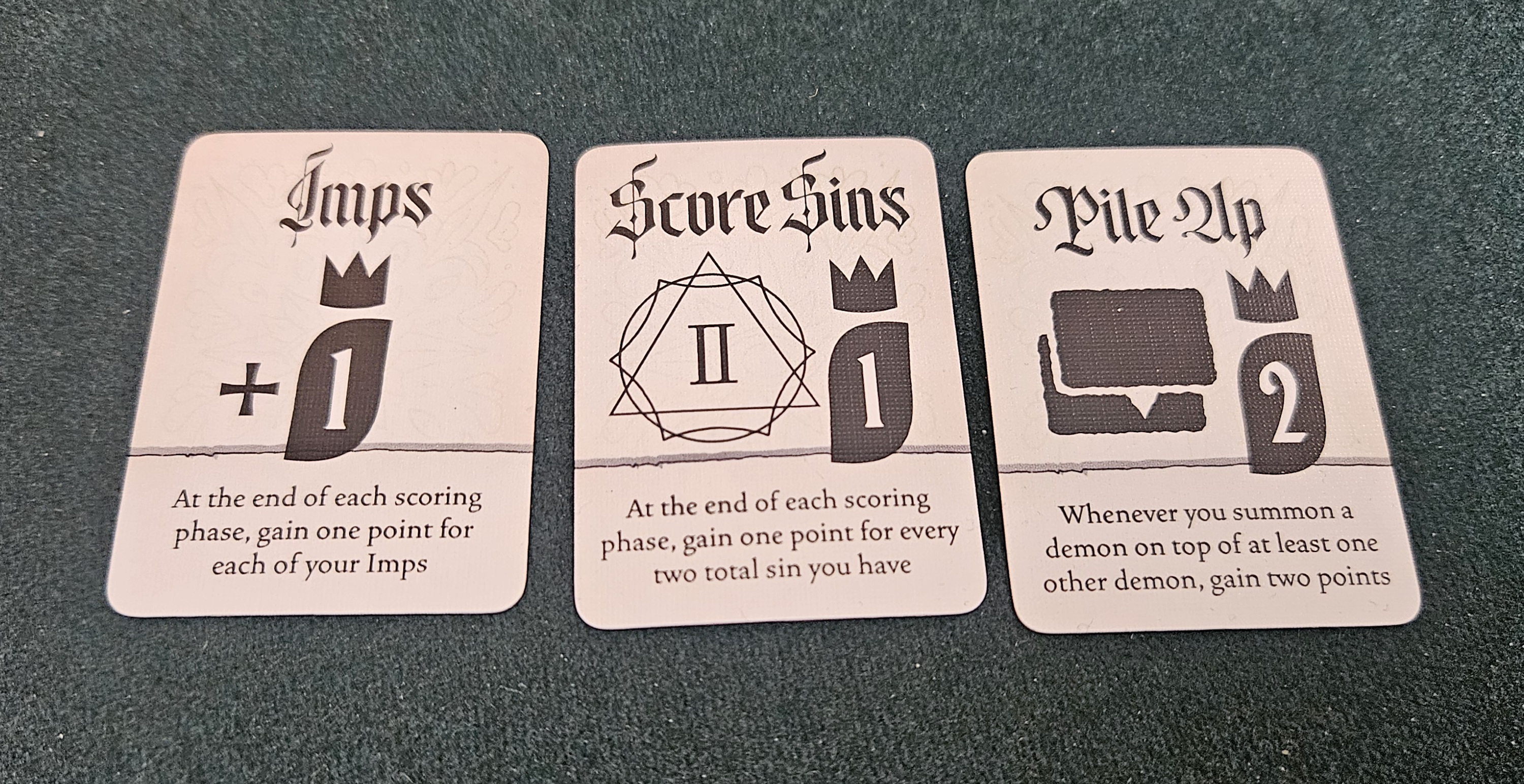
Meanwhile, players also draw special cards that offer new abilities. These are called courage cards — a bit cloying, in my opinion — and they appear at regular intervals, such as at the conclusion of the round or whenever somebody confronts a larger demon. There are scoring perks in there, and freebie seals, and some let you rotate certain demons upside-down to better match their seals.
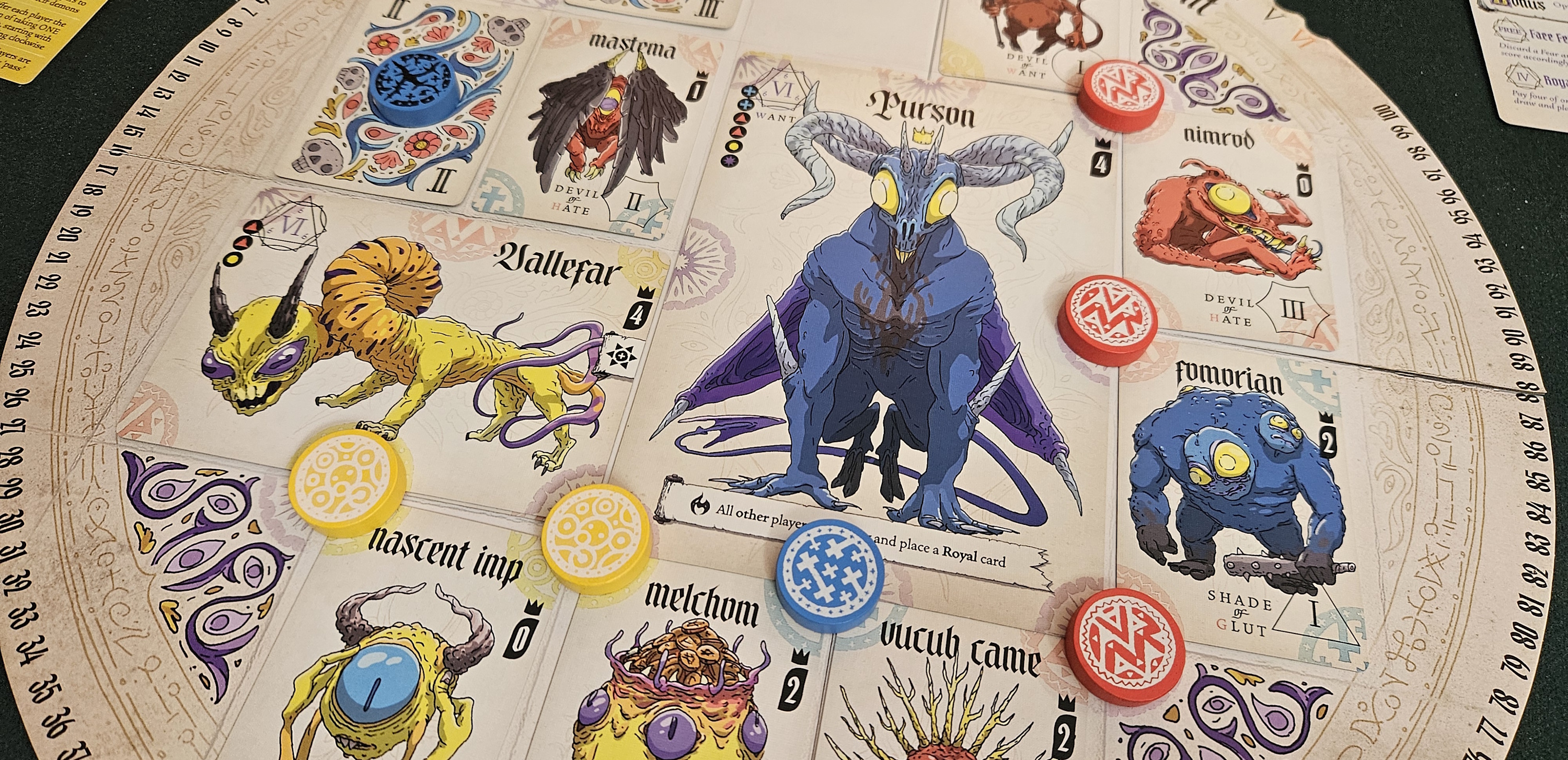
Larger demons must be placed over ordinary demons.
The game’s biggest moments, of course, are when those larger demons plop onto the field. They’re expensive, both in terms of seals and expended sin, and can only be placed atop a foundation of other demons. There’s probably some metaphor at work, about how the work of facing down one’s demons is done bit by bit, rather than all at once. Then again, I’ve been accused of reading too deeply into these things, so don’t mind my speculations. Sometimes a demon is a demon. (More often, it’s epilepsy.)
It’s an interesting game. At every level, really. The card-placing puzzle is solidly done, and it captures the joy of amassing a menagerie of ugly fellas. Every placement is accompanied by real tradeoffs, especially when it comes time to burn off some sins. For all that, I wonder how quickly it will wear out its welcome. It doesn’t have infinite depth, and it isn’t long before its demons are reduced to the backdrop for its seals and sins. My first play was enthralling. My third, which saw me filling out a “perfect board” with every single seal placed, was markedly less so.
What interests me more, I suppose, are the simple processes it produces. Personal Demons is methodical. Repetitive. Every round assigns somebody to act as the group leader. They walk the table through the steps. Choosing a card. Placing it. Flipping it face-up, naming its sins, stamping it with a seal. I’ve sat in therapy circles, both as a participant and as a volunteer, and there are connections to the summoning circles of old. The words we say. The mantras. The prayers. The dark things that are brought up out of the soil. The purifying fire, hot enough to burn. The glimpses into the abyss. None deeper or blacker than the hole within the self.
I’ve been told the final boards won’t be quite so bump-prone.
Does Personal Demons bottle that magic? I think so. A little bit. In its rhythms. In its good-natured acknowledgement that this stuff is painful, but that it can be darkly funny, too. We’d rather imagine a teeming world under our feet than recognize our own face in the puddle. What’s that old joke? A man would rather write the Démonomanie than go to therapy. Personal Demons tells us we can do both. Jean Bodin would have thrown a fit.
Or maybe it’s just a pretty good card-drafter and symbol-matcher. That’s fine. In such a case, I’ll always have the butt-demon. His lemony backside roundly scandalized my daughters. Now I’ll put the box back on the table and tilt it so they’ll catch sight of his dimples in the morning. When they’re older, I’ll repay my mischief by funding their therapy.
A prototype copy of Personal Demons was temporarily provided by the designer/publisher.
(If what I’m doing at Space-Biff! is valuable to you in some way, please consider dropping by my Patreon campaign or Ko-fi. Right now, supporters can read my first-quarter update of 2026: the best board games, movies, books, and more!)
Every so often, a game system not only gets a second try, but entirely wallops its original incarnation. That’s the case with Quinn Brander’s Rebuilding Chicago, which remakes Rebuilding Seattle with such aplomb that I called it “pretty much perfect.” (I called it that to myself, right now, so I could quote it.) For today’s Space-Cast!, we’re joined by Quinn to discuss how he improved a game that’s still on store shelves, what some folks might prefer about the original, and the little touches that go into making a successful sequel.
Listen here or download here. Timestamps can be found after the jump.
TIMESTAMPS
3:45 — introducing Rebuilding Seattle and Rebuilding Chicago
7:11 — the origins of a hybrid city-builder and polyomino game
10:15 — a dual-layer polyomino puzzle
16:45 — modeling happiness and amenities
19:27 — balancing an in-game market
22:53 — using events to manage tempo
34:43 — why decide to revisit a game system?
45:37 — Gone to Gaia
(If what I’m doing at Space-Biff! is valuable to you in some way, please consider dropping by my Patreon campaign or Ko-fi. Right now, supporters can read my first-quarter update of 2026: the best board games, movies, books, and more!)
Politik is one of those games I wish were more fantastical, which isn’t a ding on the game but rather a reflection of the slow-motion dystopia we have come to inhabit. Designed over the course of more than a decade by Jonathan Klabunde and Lukas Peregrine, Politik is the story of nation-states that use ideologies as cudgels, wage shadow wars over the airwaves, and spend lives like discontinued currencies. When its pretentious old men play at running the world, we are the counters they shove around the board. And they aren’t even bothering to hide it anymore.
Perhaps more relevantly, it’s also a mashup of new and old ideas, a flawed but enthralling piece that’s tough to learn but rewarding once the work has been put in.
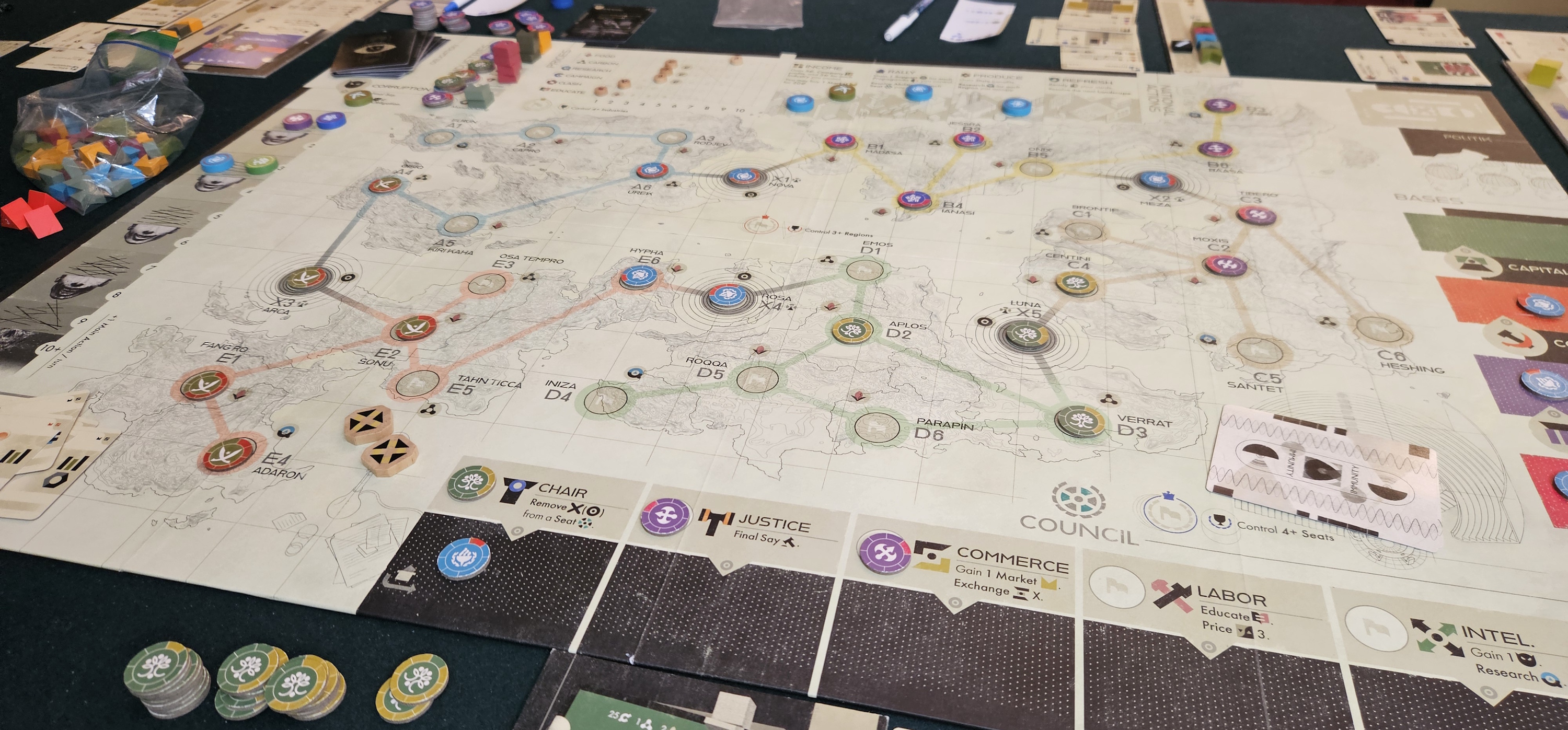
Our influence spreads across the globe.
Set in a world not unlike ours, Politik begins sometime after a collapse — capitalized, articled, and adjectived as The Great Collapse — has riven the political scene into a near-total vacuum of little states with hardly any defensive capabilities, a fragmented global economy ready to be pieced together by vulture corporations, and a handful of ascendant nations hungry to gulp down the whole bowl of noodles.
Right away, Klabunde and Peregrine put their best foot forward by asking players to select which of those nations they will command. Politik isn’t a narrative game, but it excels at weaving together little strands of story, and the first filaments of those yarns are the nations themselves. These introduce the basics, drawing everybody in with those first snippets of ideology. There’s Libris, marked with the gyroscope and the torch, indicating itself as a state that tries to walk the line between radical education and propagandistic unity. If that sounds too care-bear, there’s Gran Santi, all intimidation tactics and steely wit, or Indoverra, its honor culture clashing with an oath of poverty.
More than colorful nouns, these statements bear in-game import, providing a single starting propaganda card that dictates the nation’s opening ability and ideological tendencies. Indoverra’s honor culture, for example, means that conflict is the principal driver of their national research, not to mention that they’ll be shoring up their support of fascism as political ethos. If instead they select that oath of poverty, they become communists who can use their surplus goods to manipulate the markets. Libris, when leaning into their more humanistic impulses, closely links education and research. When they focus on unity, they earn icons for each of the game’s ideologies — capitalist, statist, communist, and fascist — marking themselves as hopeless centrists, but also effective at parlaying popular support by speaking out of both sides of their mouth.
Nation selected, everybody now gets down to the serious business of cobbling together a functional global power.
The art style is brutal and chilly, which is exactly right for this project.
This is much easier said than done. For one thing, everybody at the table is a hurdle on everyone else’s road to global domination. For another, Politik is about building a powerful tableau where the central components of that tableau aren’t especially amenable to being hammered into a self-sustaining engine.
Drawn at random, there are 450 cards in the deck, only a fraction of which will be seen in any given session. For all their variety — and it’s impressive how many concepts the game covers — Klabunde and Peregrine throw us a few bones. First, there’s the art. Evoking the Bauhaus, every card is hand-drawn with shapes and splashes of color that speak to its ideological function. Companies, the game’s primary method for securing resources and bullying markets, are sprawling brutalist edifices. The assets that transform them into even greater consumptive engines are more abstract, showing blueprints or term sheets or inventions. Propaganda cards are suitably ideological and colored according to their tendencies. Events, the game’s fire-and-forget attacks, might as well be printed on a poster and wheat-pasted to a concrete wall.
As with the nations, these cards are dense with iconography. Those icons come fast and heavy, and it takes a good few minutes to learn their exact phraseology. At that point, however, they become the game’s beating lifeblood, an expressive language that allows for impressive depth.
Companies are an essential tool for any horrible nation.
Take companies, for example. Most players will begin by founding their first firm, a process that requires a sideboard for tracking that company’s profit margin and market shares. What makes these companies interesting to handle is not only their newfound ability, but also their inborn limitations. I might set up Drundlworks, a company that can simultaneously conduct research (translation: draw cards) and improve its own margin (translation: get stronger). But Drundlworks is starkly limited to manufacturing, which means all its expansion will be wasted if I can’t diversify into other markets.
Okay, so I need to add an asset. I’m holding two. The first, Private Security, will expand Drundlworks into the humanities sphere. That’s great! Now Drundlworks can enter a new market, and it gains the ability to use its personal army to bolster our strength on the map. The hangup is that Private Security requires a certain degree of corruption to attach to a company, the cost of deploying this world’s equivalent of Pinkertons to police our states. Since I’m inadequately corrupt, I might settle for Joint Ventures. This expands our company into the financial market, which is good, although unfortunately the financial market is currently dominated by a rival. But at least our Joint Ventures will give Drundlworks some money-making potential, not to mention a negotiation icon, good for breaking ties in our favor.
By now a few things should be apparent. First, Politik is a densely knotted game. Every element touches every other element. It isn’t enough to stare at your own tableau. Success requires knowing who owns what.
And furthermore, knowing how those things can be broken or pillaged. There’s a mercantilist core to the way Politik’s scales are balanced to zero. In the game’s early stages, this is most apparent on the map, where states threaten to change hands early and often. I invade, you counter-attack. That’s the nature of the beast. It isn’t even necessary, in this age of hybrid warfare and jet aircraft, for our nations to be neighbors. Crud, I don’t even need to invade with actual forces. The right burst of noise from a broadcast station might be enough to fatally undermine a space on the map.
Broadcast stations, propaganda, and multinational corporations are the tools of your trade.
The game’s other domains are similarly imperiled. Companies can raid one another, their respective margins becoming an analog for military might and their market tokens traded in place of geography. There’s nothing quite like a late-game swing when one of the session’s oldest companies suddenly loses their market dominance to some upstart.
The same goes for council seats, the game’s representation of political might. Earlier I mentioned ideology tokens. These eventually come to represent support for seats on the global council, each of which provides its own benefit. Chairing the council lets you veto someone’s position; the board of commerce can secure the best market shares for their own nation; the defense seat grants immunity to those pesky propaganda broadcasts. And so forth, each conferring its own advantage. But these positions are shaky. All it takes is a well-timed clash, a few solid cards tossed out for their political modifier, and suddenly the player who was sitting pretty on the board of justice is out in the cold.
Despite their similarities, these domains — the territorial, corporate, and political — are distinct enough that they warrant their own approaches. Conquest on land is piecemeal, but can be bolstered or undermined by propaganda. Market shifts are as seismic as the markets. Political strength takes a long time to build but can be altered in an instant.
In each of these cases, players are encouraged to expand, but always to think through the repercussions of their newfound girth. This is probably my favorite element of the design. Expanding your territory means stretching your forces thin. That’s normal enough. But expanding in the corporate world means temporarily bottoming out a company’s margin, leaving it open to attack. Expanding on the council means there’s more room for somebody to swoop in and claim what you’ve so carefully built.
This isn’t to say you won’t expand. Indeed, there’s no winning without expansion. Victory in Politik is a tense thing, contingent on claiming enough “power grabs” in the game’s three domains. Each power grab requires a majority, whether on land, the corporate world, or on the political council. This initially seems impossible, especially in sessions with three or four other players. In practice, it’s a deft little piece of design, one that puts players within reach of an objective, only to snatch it away.
Some actions are more involved than others.
Even more cleverly, the way power grabs are handled makes them more viable once somebody has already secured one. There’s a limit, you see. If I obtain a power grab via conquest, I’m done, I hold that objective, there’s no longer a reason for me to keep all that territory. I mean, sure, there’s a reason. Raw resources, all that. But the victory condition has been wrapped on my end. My focus will now shift to the markets or the council. I might put up a token defense of my empire, but it won’t be as diligent as it might have been otherwise.
To some degree, this can result in a sticky status quo. If everyone is firing on all cylinders, it’s possible for the game’s length to grow indeterminate. Politik is only short when played inattentively, and since victory is tied to outright (if temporary) dominance, collaborating players can pull a leader back from the brink. Not always, and not reliably, but the threat is there. The game contains no version of the deeds from Inis, those little tokens that gradually deteriorate the game state away from its center to ensure that somebody eventually succeeds. It’s all or nothing, and there are plenty of ways to wrench a would-be dictator down from the throne.
Fortunately, the threat of stagnation has thus far remained theoretical. In my experience, the game’s innate swings have been enough to keep it moving toward a conclusion. It isn’t uncommon to suffer setbacks, and the clarity of the game state makes it easy to point out when somebody is getting a little too big for their britches. But my sessions have hovered at the three and a half hour mark, long enough to be satisfyingly fatiguing but not so long that anybody started into cussing. Cussing in earnest, anyway. Cussing is mandatory in such a game, but there’s cussing and then there’s cussing.
Corruption is powerful but also dangerous.
There are other little touches I can’t help but appreciate.
Like how your resources are tallied on paper rather than with tokens. At first this throwback seemed musty. Eventually it won me over, if only because it’s possible to leverage a company into some truly impressive profits, and I’d much rather just write “89” on a piece of paper than manhandle another stack of tokens into its proper change the way Hegemony inflicted on me again and again.
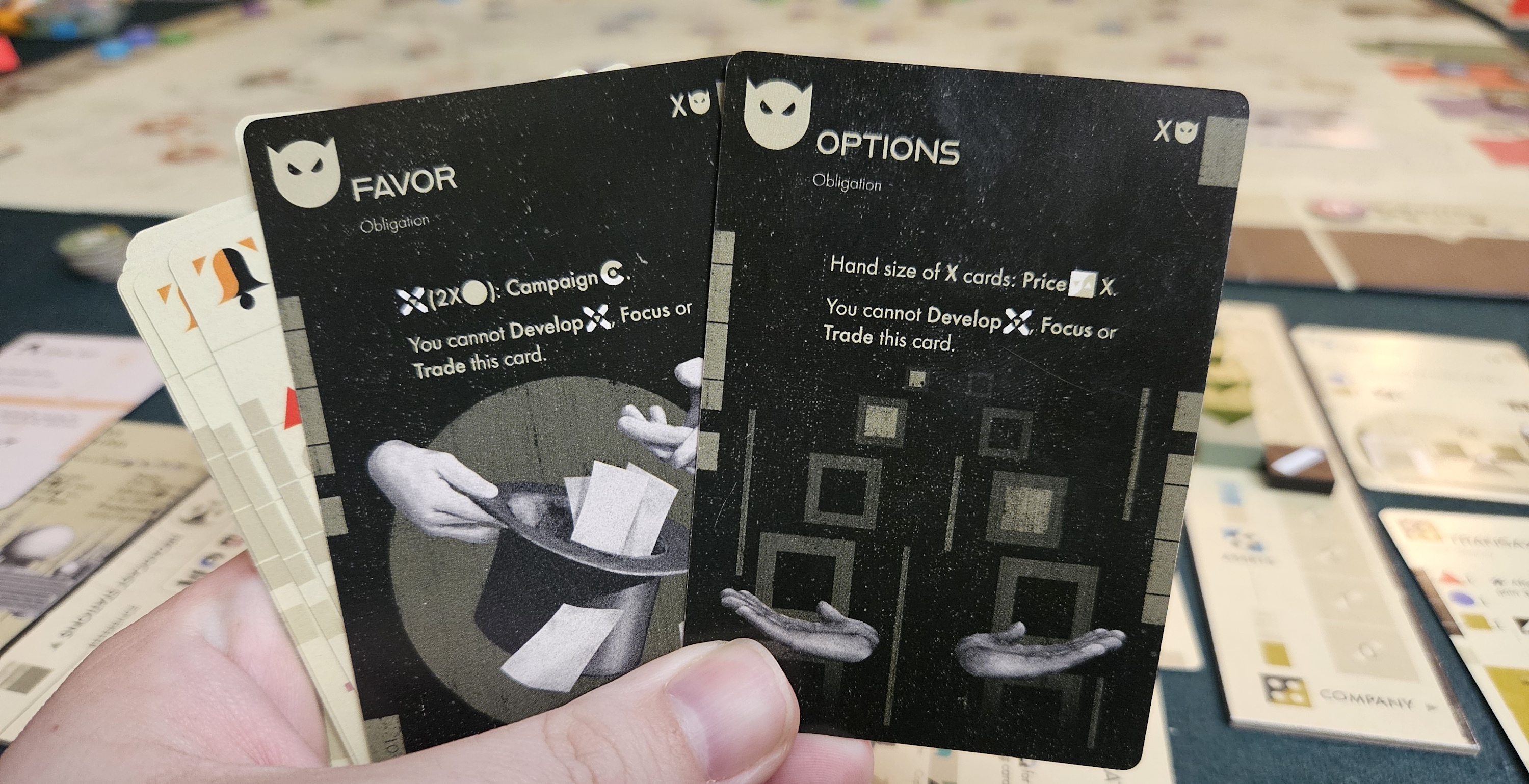
Or there’s the corruption system. Certain cards increases your corruption level; others require a degree of corruption before they become playable. But rather than leaving this as a mere threshold, Klabunde and Peregrine tack on another system that’s perfectly evocative of the way elites trade patronage only to entrap themselves in weird cabals. The gist is that each step on the corruption track forces you to draw an obligation card. When deployed at the right moment, obligations produce tremendous rewards. Then again, you don’t know what you’re about to draw. Some are harder than others to play, resulting in a black mark hogging up precious space in your hand. You thought you might owe some cash, only now you’re listening to Peter Thiel bray on about how high-visibility vests for warehouse workers are the antichrist.
Or there’s the way Politik takes place in an alt-history that has somehow produced the best and worst of our own recent past. This is a dark game, packed with ideologies of convenience and wars of plausible deniability and a global council whose flag is probably a giant hand choking the entire planet. Far from portraying itself as lurid — or worse, as aspirational — Politik adopts a tone of warning. Every so often, a card will reveal some effect that brushes up against our lived reality. A think-tank. Drone strikes. Data vaults, industrial farming, international monetary funds. The many little tools that make a state, that make surveillance, that can be bent toward absolute control. Just as they combine and slot together in Politik, so do they combine and slot together in our world. It might seem a bridge too far to call the game thought-provoking, but there are enough ideas floating around here — and time enough to fill between turns — that I found myself provoked anyway.
Sending out our tunes on the airwaves.
Ultimately, Politik is a peculiar beast. Its rules are convoluted. Its iconography takes some deciphering. It can run long. When somebody achieves their final power grab, it isn’t uncommon to hear someone breathe an unquiet “Thank goodness.” And not necessarily the winner.
But it’s also interesting and abrasive and spiky in exactly the way that most modern board games are not. It calls to mind some of my favorite games, but never too proximately. It reminds me of the Pax series in its broad noosphere, the sheer breath of what it invokes, with a directness that those games lack. It recalls Inis in its inter-player squabbles and collaborations, The King Is Dead in its oppressive tie-breaker considerations, but with harsher bristles and more granularity than either of those titles. Any number of tableau-builders, but with hostile cards that buck at being hammered into easy shapes.
Mostly, it makes me want to keep trying to rule the world. Not the real world. Only the loveless want that. But this shadow version of our world. It makes me want to be the horrid bottomless wretch determined to possess more than I already have, to spend a few hours in the company of these broken cards that can accomplish so much, to glare at the ruins of my plans and plots, to grasp and fail, and to be all the bitterer and emptier for the attempt. And then to step back, free of the circle, and laugh about how so-and-so pillaged my company for the privatized remains of the university system. Now that’s a game.
Politik is on Gamefound right this instant. A prototype copy was temporarily provided by the designers/publisher.
(If what I’m doing at Space-Biff! is valuable to you in some way, please consider dropping by my Patreon campaign or Ko-fi. Right now, supporters can read my first-quarter update of 2026: the best board games, movies, books, and more!)
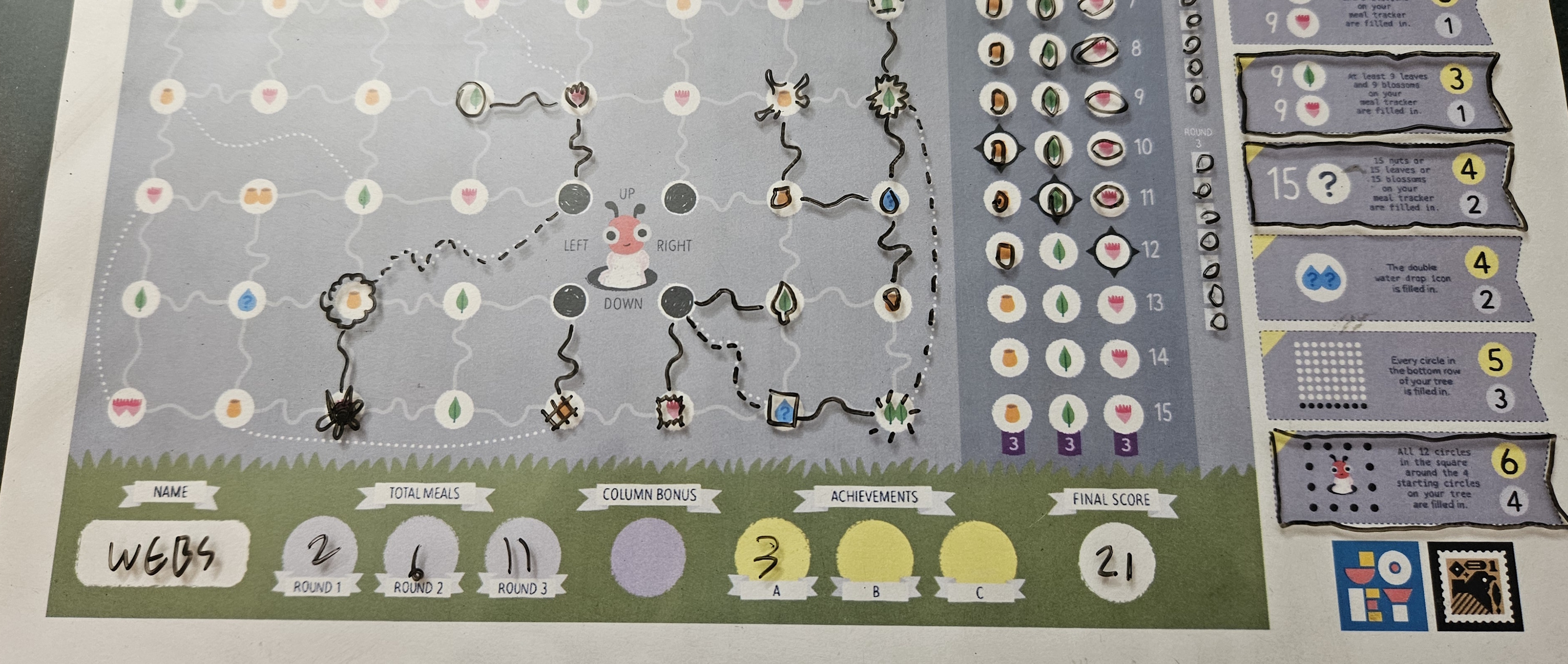
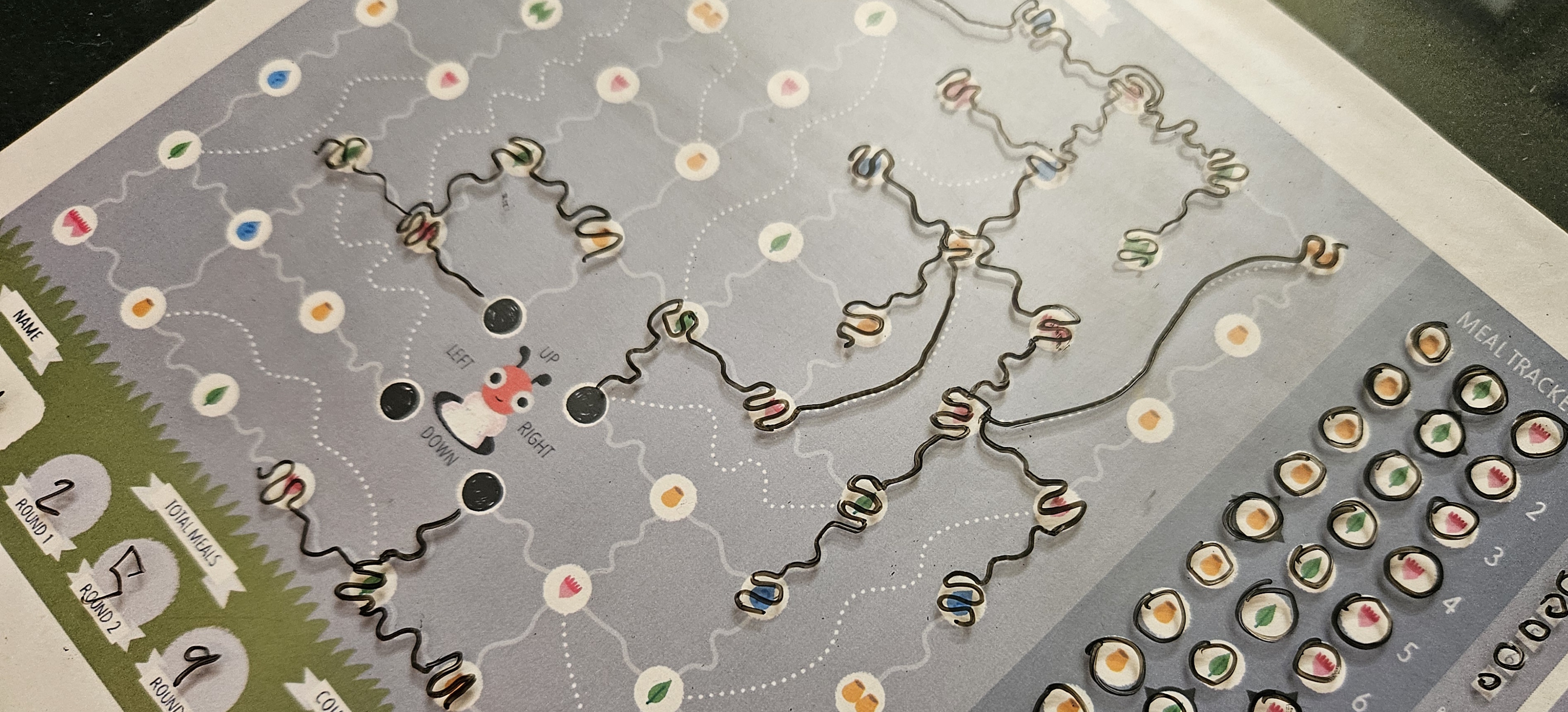
Thus it came to pass that Postmark Games graduated from dice to cards. After some of the finest print-and-plays in recent memory — after Voyages, Aquamarine, Waypoints, and Scribbly Gum — I suppose we were overdue for a title where the input isn’t limited to six sides.
How about fifty-two random numbers instead? Using nothing but an ordinary deck of cards, which surely you have lying around the house somewhere, 52 Realms: Adventures generates an entire dungeon dive. In a vacuum, it’s quite the accomplishment. If only vacuums weren’t so chilly.
That pebble is me. It is I.
It begins with a dungeon. Or maybe it begins with a menu of items. On the surface, 52 Realms: Adventures is about exploring a dungeon. Ostensibly, your objective is to reach the final chamber and slay the boss monster therein. Really, though, it’s to reach the highest score possible, accumulated one loot card at a time.
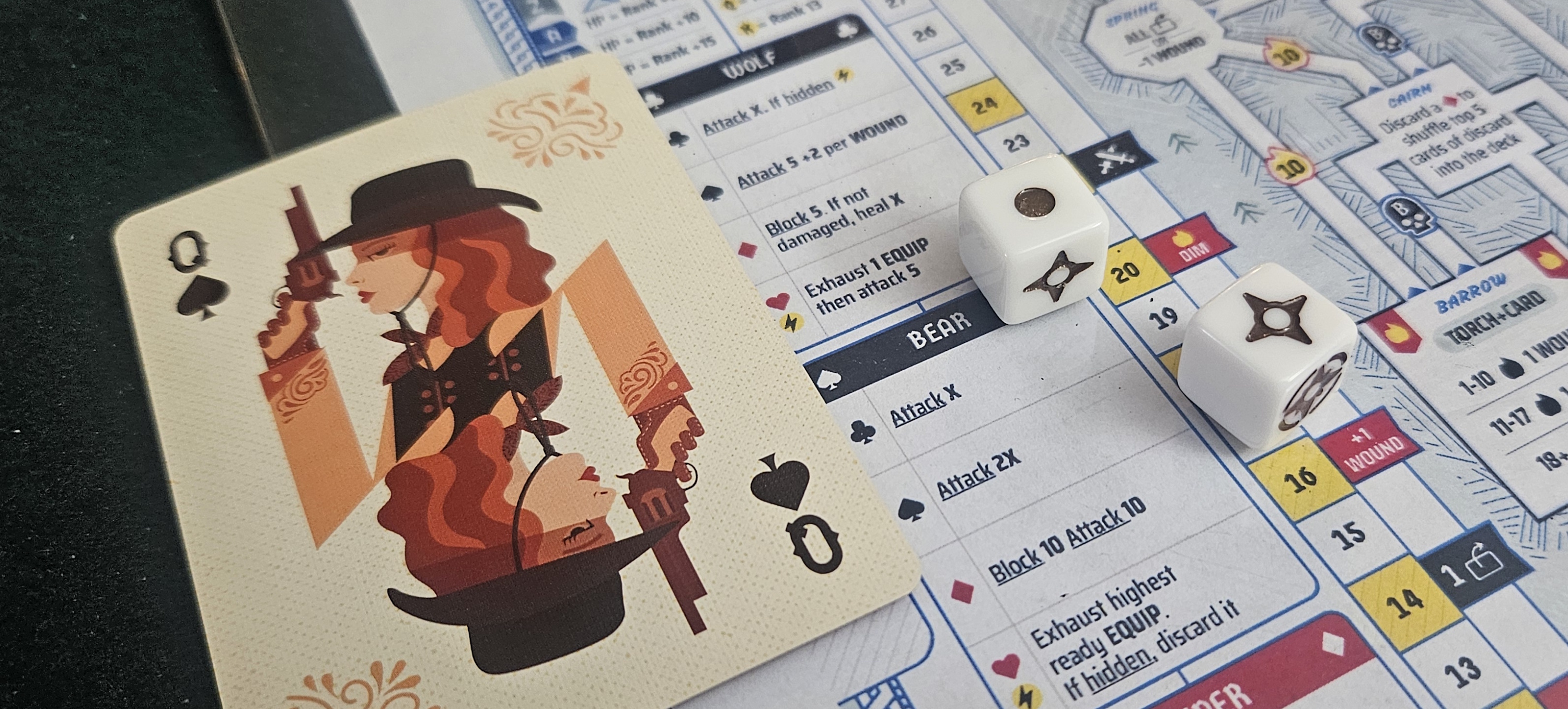
As with their previous titles, designers Matthew Dunstan and Rory Muldoon plumb their system to its maximum depth. It’s truly impressive how much mileage they cover with just a single deck of cards. The deck, you see, governs everything. A single card might indicate the monster you face when stepping into another room, tallying their health pool and type. As battle unfolds, additional cards become instructions for said monster: how hard it hits, whether it slinks away to heal, the amount your attacks are reduced by when it raises its limbs in defense.
Those same cards also become the tools your hero utilizes to overcome the dungeon. When placed to the side of your character sheet, a card’s suit indicates an item, whether a generic potion for the basic starting heroes, a vial of dragon blood for someone more masochistic like the Fell Knight, or ingredients in an Alchemist’s pouch. Beneath the sheet, the cards are instead transformed into “equipment,” a catch-all term for what are really your action cards and the closest thing the game has to experience points or leveling up.
The function of cards isn’t limited to enemies and equipment. It’s also the game timer, ticking away one card at a time, punishing your hero for every enemy they spend too many rounds grappling with and every detour on the path to the boss chamber. Aces become events, nasty surprises that exhaust your equipment or inflict wounds.
And, of course, there’s loot. Loot is dull on its own, a face-down pool that determines the lion’s share of your score. In a game that packs its corners with interesting tidbits, a scoring pile is almost surprising in its deficit of pizazz. Call it a necessary evil.
There are plenty of heroes to use.
For the most part, Dunstan and Muldoon pitch their delves as miniature races. Your goal is to slay the boss while amassing a minor fortune, but the constant depletion of the deck means there isn’t time to dally. It isn’t actually that difficult to conclude a scenario, provided you beeline for the exit. But anyone who’s played even one video game can tell you that heading straight for the final room is a surefire way to miss out on all the stuff that makes these things worth experiencing. Hence the game’s core tension. Sure, it’s possible to race to the end and secure a safe but measly score. But it’s more rewarding by far to push yourself to the absolute limits, spending resources like crazy and never pausing for breath, only to watch in despair as your efforts are rewarded with the boss peeling a few too many cards off the deck.
Glancing at the ratings for 52 Realms: Adventures, one of the more common complaints is the system’s chanciness. To be sure, those fifty-two cards produce quite a range of outcomes. Unlike the and-then nature of Dunstan and Muldoon’s roll-and-move titles, where a flub means a lower score rather than a premature game over, it isn’t uncommon for a delve to terminate thanks to a few too many injuries. Which reminds me: Cards also represent damage values. Absorb too many hits and you die.
Personally, the game’s long odds aren’t one of its problems. If anything, the possibility of an early grave is a suitable nod to the game’s roguelike roots. Sometimes the first three monsters you meet are face cards. Sometimes the rewards they offer are barely worth collecting. Sometimes you draw two aces in a row. That’s the nature of the beast. It helps that a full session only lasts twenty minutes. That includes a stretch break. I can handle a loss that comes three minutes into a session.
Enemies are randomly generated.
What I miss, though, are those earlier games’ shared nature. Don’t get me wrong, I enjoy solitaire games. But while Voyages, Aquamarine, and Waypoints included solo modes, they shone in multiplayer, everyone at the table utilizing those shared inputs to see where their private adventures took them. By its nature, 52 Realms: Adventures is solitaire-only. I’m sure someone could bash this thing into a shared mode, but it would be a wonky solution. There are simply too many card-flips, too many cases where a theoretical extra player would desynchronize with their partner.
Without that partner, 52 Realms: Adventures is nice for a visit, but doesn’t really compel me to return over and over again to maximize my score. The problem lies in the dungeons themselves. There are four in all, but the way they function lends them to feeling like two separate games that use a single system. The first two are linear with branching paths, your hero marching relentlessly toward the boss chamber, backtracking forbidden. This gives those dungeons a choose-your-own-adventure feel, choose A or B, left or right.
The latter two are more interesting, in no small part because they widen the one-way lanes to proper two-way corridors. One, a clockwork labyrinth, allows your adventurer to approach the central chamber only to boot them back out to the periphery. The other, a watery cathedral, is slowly flooding, its rising waters granting advantages but also empowering the local beasties. In both cases, the player is given more freedom, with little side objectives that might pad their score or beef up their hero for the final encounter.
Two of the dungeons are especially interesting.
Even so, 52 Realms: Adventures never quite feels as elegant or freeform as those earlier Postmark titles. The game’s innate chanciness means that one score is hard to differentiate from another. Sadly, the game declines to provide a target. Is 48 a good score? How about 67? It probably depends on the map, or maybe the hero. But where Dunstan and Muldoon’s earlier efforts allowed players to compare their outcomes, here I’m tabulating a number that exists only in that aforementioned vacuum. Barring many repeat plays, that is. And the core gameplay loop isn’t strong enough to bring me back for more than two or three wins per map.
This squeezes the game into an unfortunate corner. It’s interesting to look at, and I’m duly impressed by the system. But I also wish it had been a little more ambitious, whether by letting multiple players share a challenge or by producing a fuller-fledged adventure. Good for a delve or two, but for now I’ll keep my feet warm by the fire.
Access to the files to print 52 Realms: Adventures was provided by the publisher.
(If what I’m doing at Space-Biff! is valuable to you in some way, please consider dropping by my Patreon campaign or Ko-fi. Right now, supporters can read my first-quarter update of 2026: the best board games, movies, books, and more!)
Literal minutes before I sat down to write this review, my daughters ran into the room to ask where their rubber snake had gone. When I professed ignorance, they scrambled from the room while hissing loudly, “Mommy must have hidden it!”
That would make my wife the Night Terror from Playthings, the latest board game by design collective Jasper Beatrix. Like the rest of the collective’s catalog, Playthings sits somewhere on a sliding scale between imaginative play and fuzzy rules. When I first tried it with adults, I wasn’t sure it worked. Later, with kids aged twelve and six, it became as magical as leaving a booby trap for Santa Claus, equal parts childlike wonder and childlike mischief.
Setting traps for Santa Claus the Night Terror.
At heart, Playthings is about becoming a child again. You live in a big house, as large as you remember it from childhood, with ceilings that seem impossibly tall and dark corners that are inky enough to conceal living shadows. One of those shadows is the Night Terror, a meddlesome spirit that hides toys.
So, naturally, you do what any clever child would do. You set traps for the Night Terror. Maybe, if you can get away with it, you even stay up late to catch the shadow red-handed.
I’ve always had a soft spot for games that literalize their actions, that ask players to physically conduct whatever activities their tabletop avatars are supposedly undertaking in the moment. One of my favorite gaming moments of all time happened when a friend tossed a flashbang through a doorway at some unsuspecting terrorists, only for it to ping off the doorframe to blind and deafen our entire squad, not to mention raise the terrorists’ suspicions. Because the game in question was SEAL Team Flix, the unforced error had not come courtesy of a die roll or card flip, but because of a friend’s crooked finger pelting a disc directly into a centimeter-tall cardboard wall.
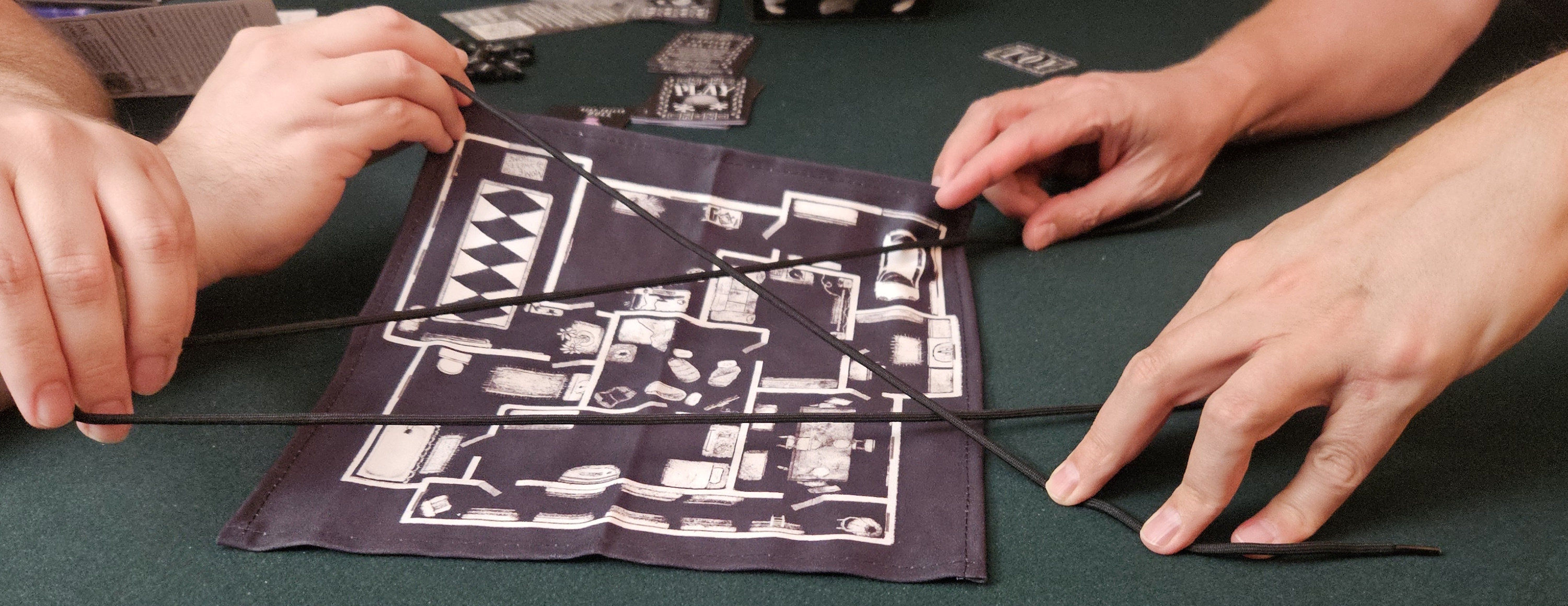
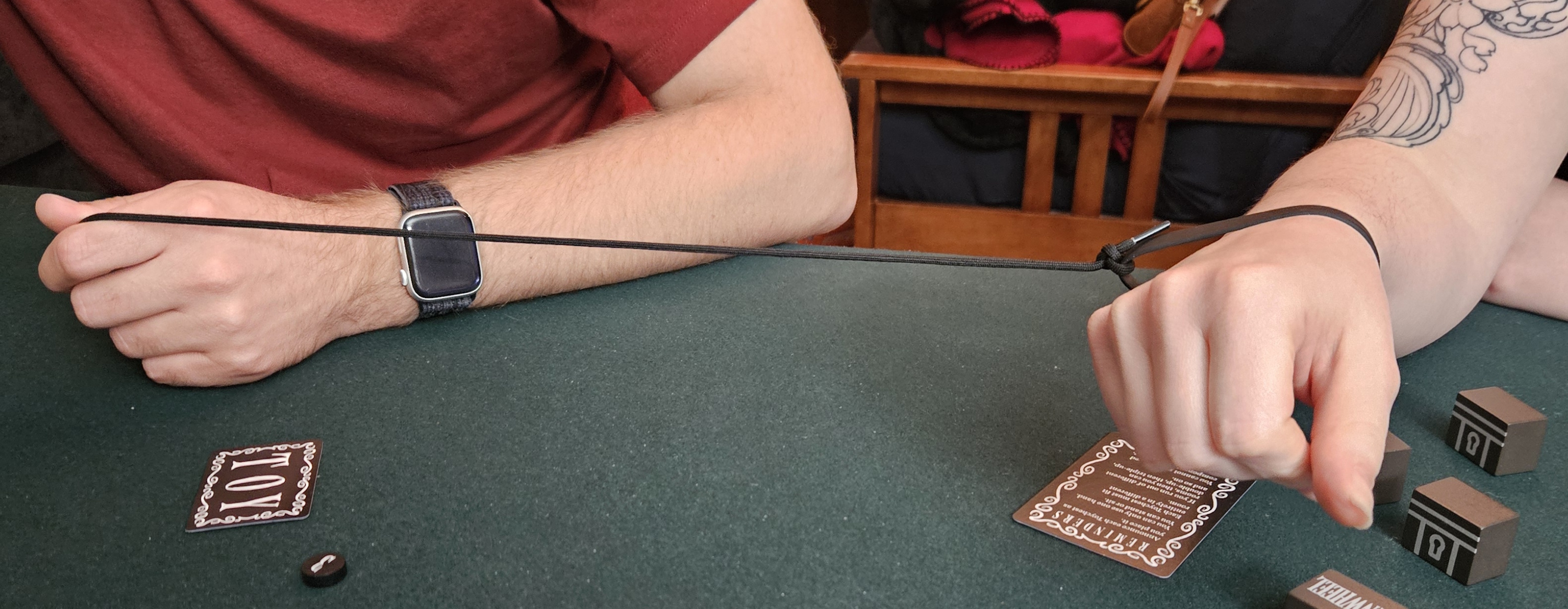
Everything in Playthings is thus literalized. Laying a trap consists of… well, take your pick. Stringing triplines across the board. Scattering jingle bells across the floor. Sliding a finger under the cloth mat to feel the reverberations of the Night Terror’s pitter-patter. You’re Kevin McCallister, hellbent on catching the Easter Bunny.
Where is your toy?
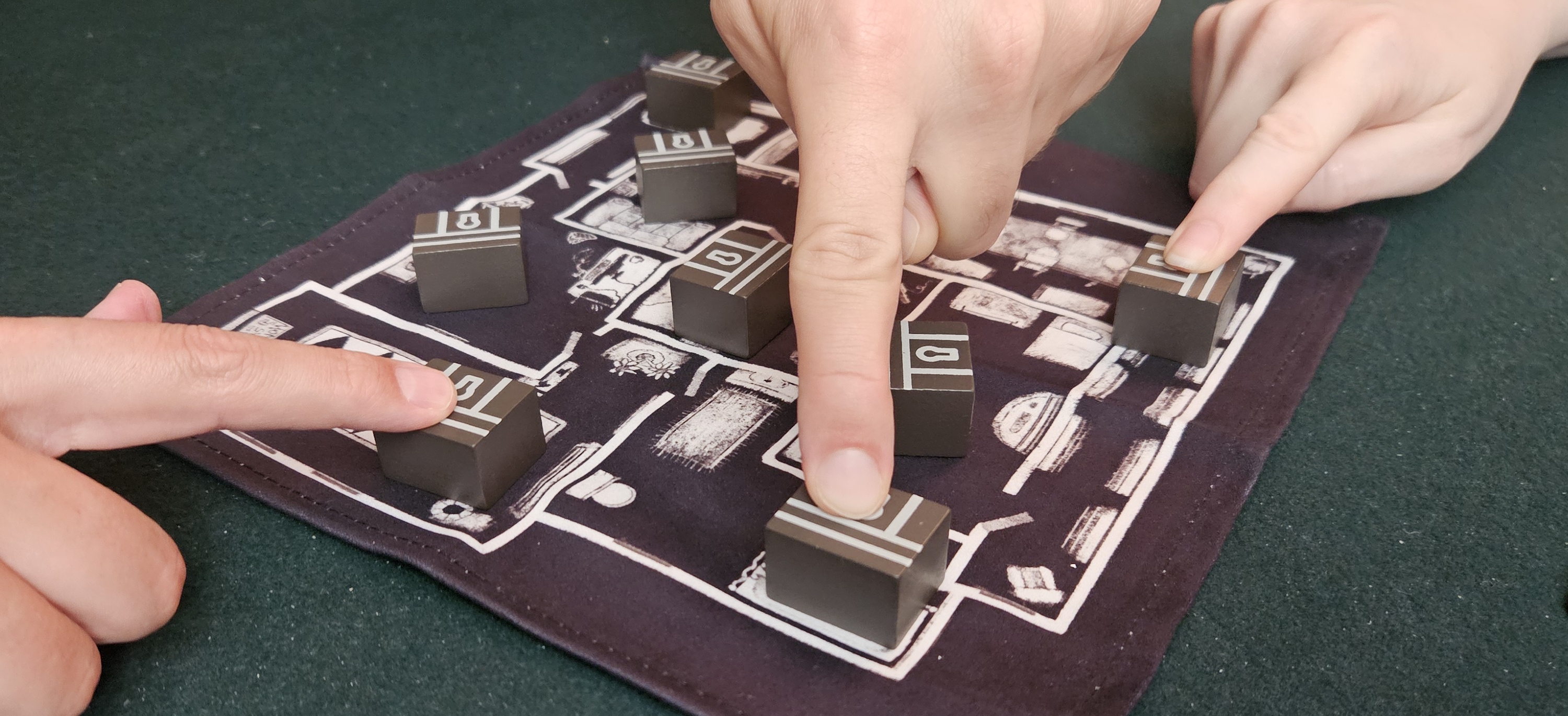
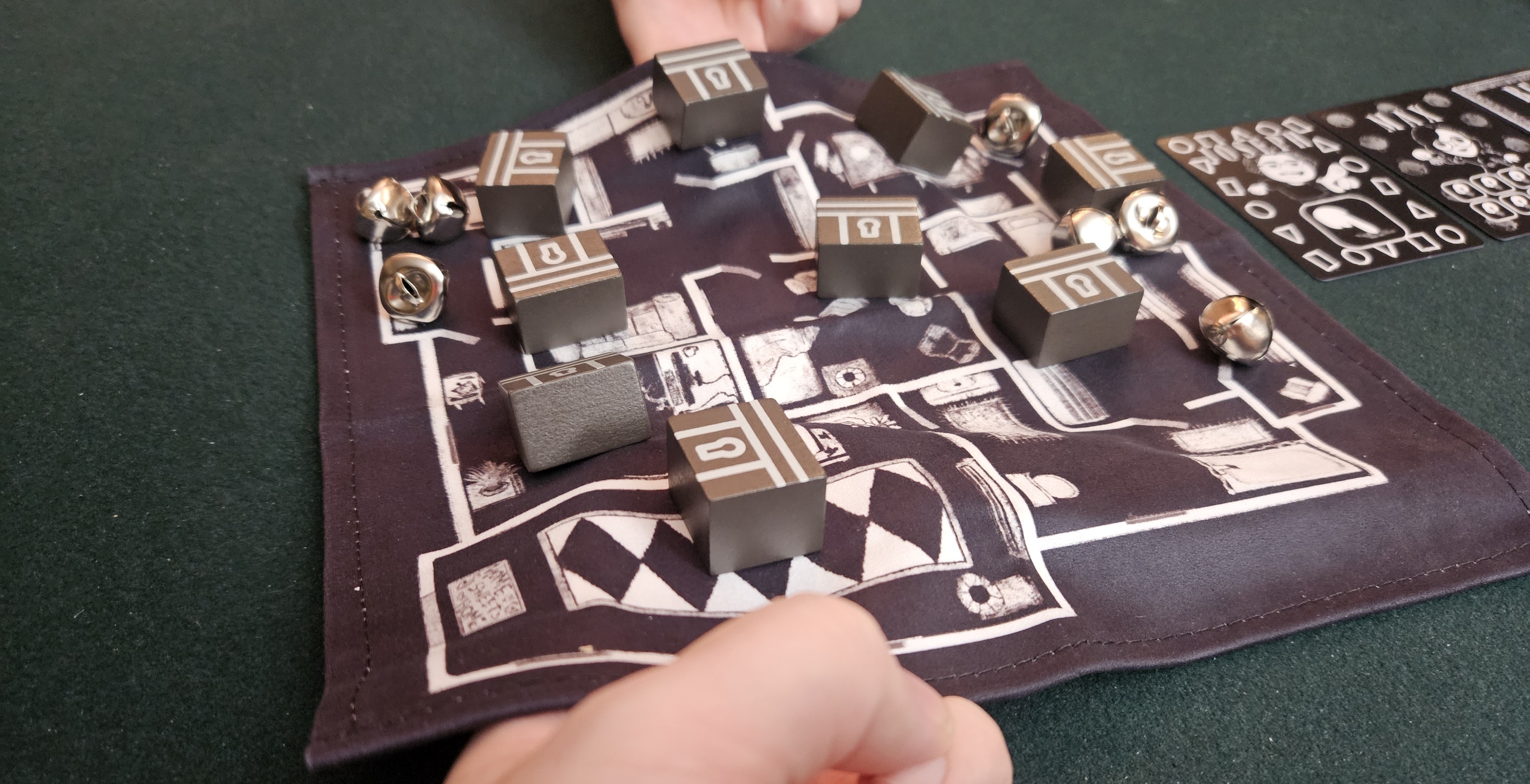
The Night Terror, then, places the toy chests while the kids close their eyes. There are nine in total, and while there are a few general rules to abide by, as with all Jasper Beatrix games the margins between those rules are sometimes runny and gray.
An example. The rules state that the Night Terror needs to state the current toy while placing it. “Bouncy ball,” they might say. But at what point do they say it? When they pick up the chest? Right as they place it? Somewhere in between? Is there a time limit to how long they can hold onto the block, or can they let the seconds stretch into discomfort? Can they tap it against the mat, against somebody’s hand, against the box that somebody has used to block off half the house, and then move it to another locale? Can they intrusively slide their finger up and down mine, the way Geoff did, the pervert finally given free reign?
This might seem like a weakness in the rules. To some degree, it is. I didn’t appreciate having my fingers fondled, and even non-pest rules lawyers will find plenty of wiggle room for interpretation and debate.
But this doesn’t have to be a problem. It’s just that Playthings is a little more reliant on making sure everybody is on the same page. It has that in common with plenty of TTRPGs. Not only in its regard for consent and setting topical boundaries, but in establishing who you’re playing with. How your group views the magic circle. Whether it’s okay to “play along” with a game, or demand that its every ruling and clause are ironbound.
Assistance comes in many forms.
Because let me tell you, Playthings is a big damn hoot with the right people.
Let’s rewind. So the kids lay their traps. Then the Night Terror scatters their toys around the house.
And then there’s the hunt. The kids search for their toys. Much as with the booby traps, which are drawn from a deck, there are little aids to this process. You get your first guess for free, working with your fellow children to uncover the most toys. This is desirable not only when “playing along,” but because the entire group earns bonus points for every toy they discover together. So you say, “Hey, I think your doll might be over here,” or “I heard a bell over there when the Night Terror put down your train.” And then everybody places a finger on the chest they think holds their toy. If they’re right, they earn a couple points.
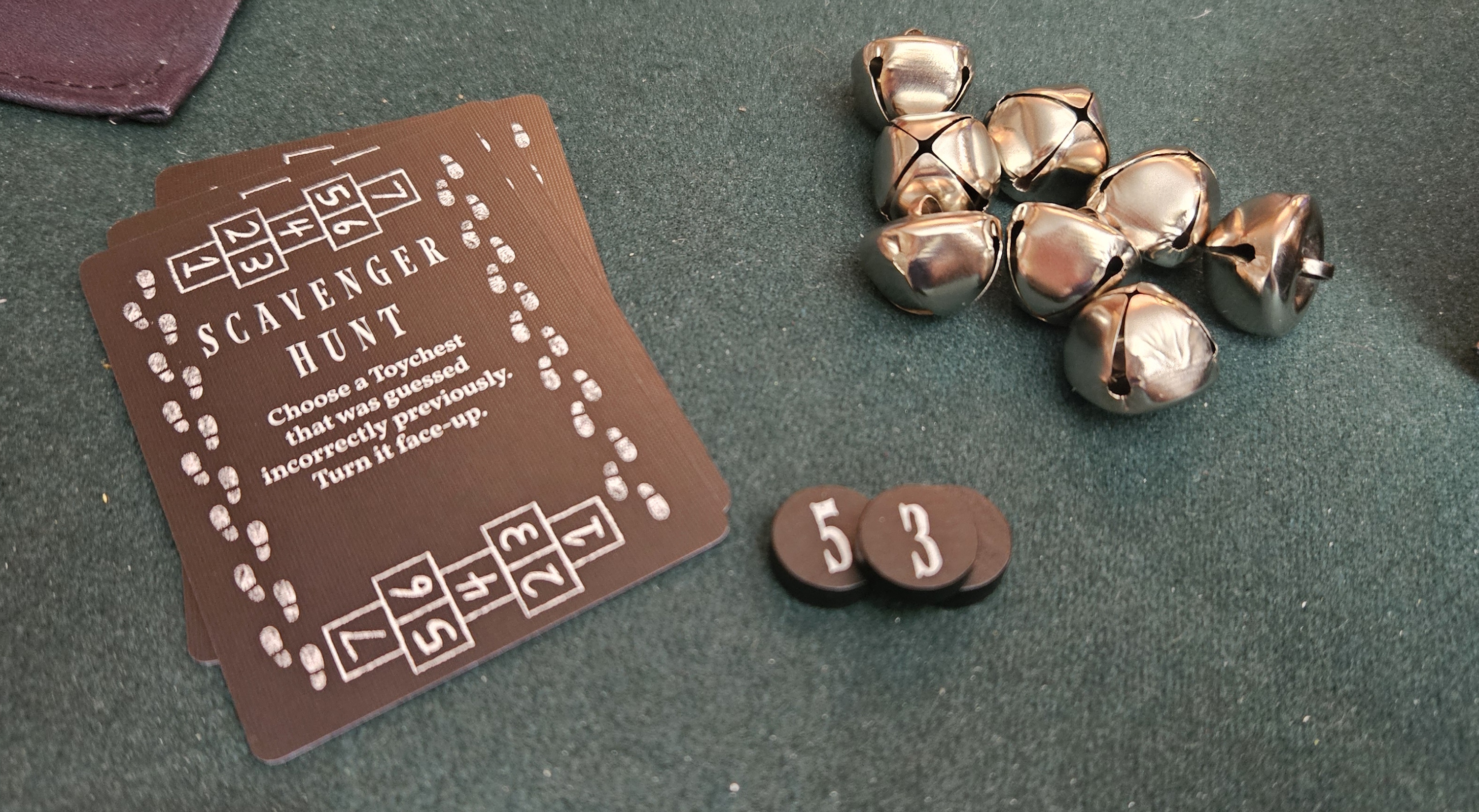
After that, the leftover children get an extra nudge in the form of another card. Maybe a scavenger hunt flips a single chest face-up. Or hopscotch has you toss some tokens onto the mat, hold a string between them, and reveal every chest it touches. Or hide and seek lets you shove your hand under the mat and wriggle it around until a single chest spills its contents.
Whatever the specifics, these little games are a delight. They recall childhood not only in their descriptions, but via their half-logic, the way a young child might strike upon a peculiar solution to an imagined problem. It isn’t enough to make the toy hunt easy, not by any means, but it’s one more data point among many. Hopefully enough to find your toy.
Or you could just peek.
Leashed!
That’s right. Peeking is allowed. When the Night Terror announces your teddy bear, you can peer through your fingers or squeeze a glimpse through your eyelids. It’s entirely possible to see exactly where your toy is placed, like a kid who’s successfully powered through to midnight. Oh. So that’s the mystery. Santa Claus is [redacted].
But there are downsides. After the toy hunt has wrapped up, the Night Terror begins a guessing game. One by one, they guess whether each child peeked or not. If the Night Terror is correct, they earn some points. Better yet, if they catch a peeker, they steal those points directly from that player. It’s only after they’ve visited each player or made a wrong guess that they stop.
This, after everything else, the booby traps and little games, the guesswork and teamwork and maybe even confidence work plied against your fellow players, is the core experience that draws Playthings together. Like those other elements, this is another literalized expression of the game’s internal sense of play. Because it’s so hard to not peek. When the Night Terror announces your toy, it takes real willpower to not sneak the smallest look. For a kid, it’s almost impossible, like setting out a birthday present in one of those tissue-stuffed bags and leaving the room unattended.
Playthings permits the transgression. Encourages it, even. Because the available tools are imperfect. The traps can be circumvented or triggered prematurely. The schoolyard games only reveal tidbits. So the best solution, always, is to witness the terror with your own eyes. To uncover the identity of the monster. To pin that elf to his shelf and escape his tyranny once and for all. Just make sure you don’t get caught in the process.
And then the round is over. You continue with a new Night Terror. Once everybody has had a chance as the monster, points are tallied. That’s the game.
Some traps are better than others.
What a weird, wonderful, childlike, fuzzy-around-the-edges oddity this is. It isn’t my favorite Jasper Beatrix title, but depending on the group, scratch that, it actually might be. When I played with adults, they wheedled with the rules and asked too many questions and one of them got inappropriately handsy with my index finger. But when I played it with my kiddos, they howled with laughter. They learned shrewd new tricks. They demanded that they wanted to be the next monster. Now I have been informed by two very excited children that we are going to play it again tonight with the Night Terror herself.
Er. Mommy. I mean Mommy. We’re going to play it again tonight with Mommy. I hope she sees the beauty of this thing. The simple joy of how freely it plays.
A complimentary copy of Playthings was provided by the designer/publisher.
(If what I’m doing at Space-Biff! is valuable to you in some way, please consider dropping by my Patreon campaign or Ko-fi. Right now, supporters can read the next installment in my series Talking About Games, this time tackling the topic of what makes a good list! Naturally, the piece includes a list.)
The Tokyo Game Market has long been a hotbed of innovation, especially where trick-takers are concerned. Sometimes the games don’t work entirely as intended, but, hey, that’s what it takes to transform the world one small iteration at a time. The bricks of the forum weren’t laid in a day.
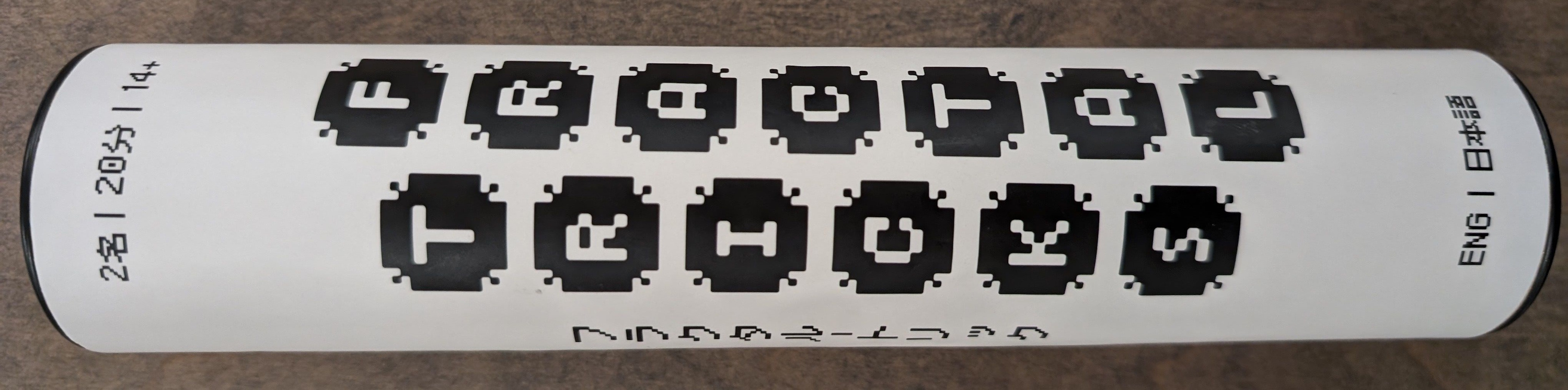
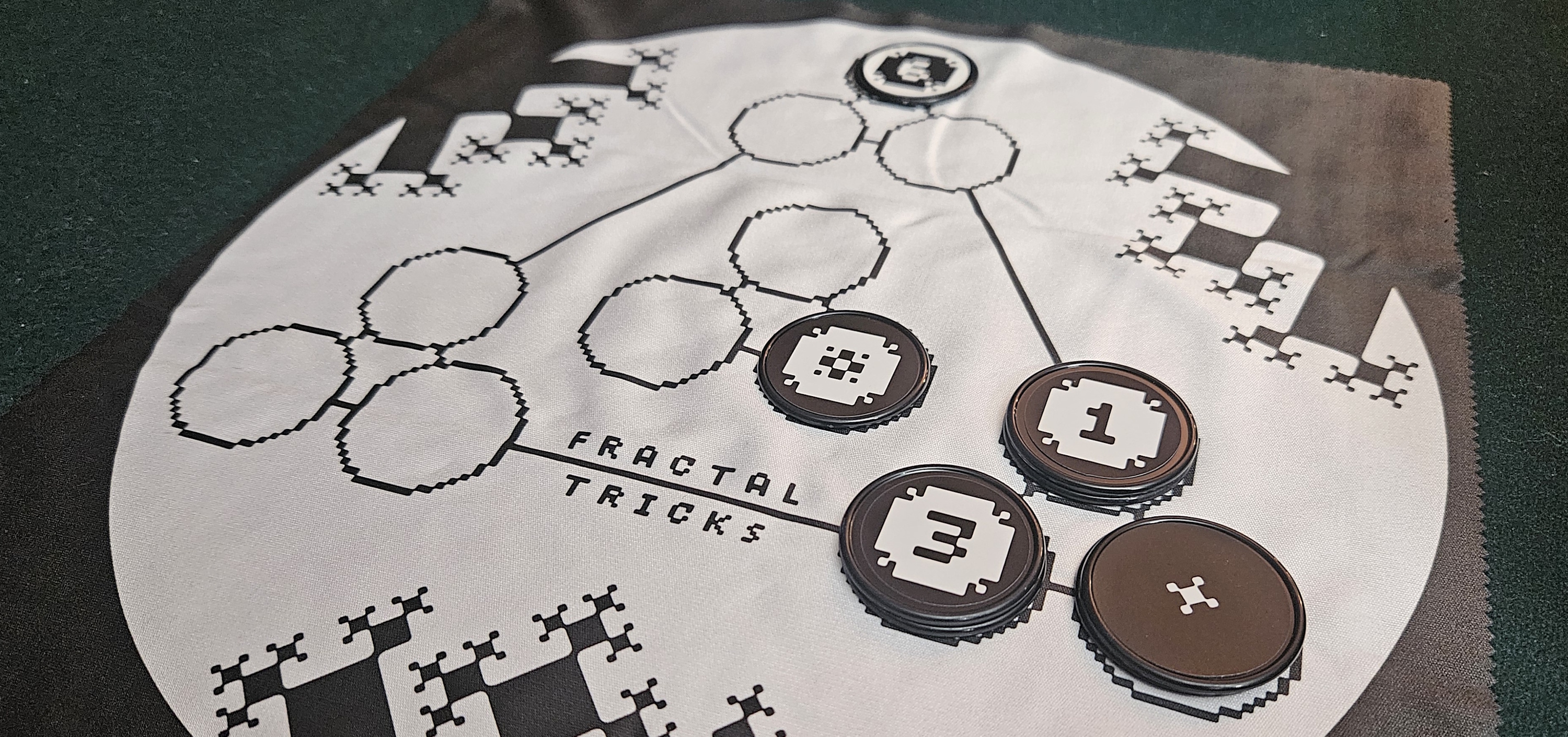
Case in point: Fractal Tricks, the hybrid trick-taker by Jason Lee, doesn’t always function to specifications. Oh, sometimes it does, and in those moments it’s one of the tightest two-player trickers I’ve seen. But even at its worst, when one participant is rumbling the other — or more often, when both players are still fumbling through the implications of their moves — it’s still an engrossing look at how much remains to be discovered in this eldest of genres.
From this simple set of rules, infinite complexity shall be born…
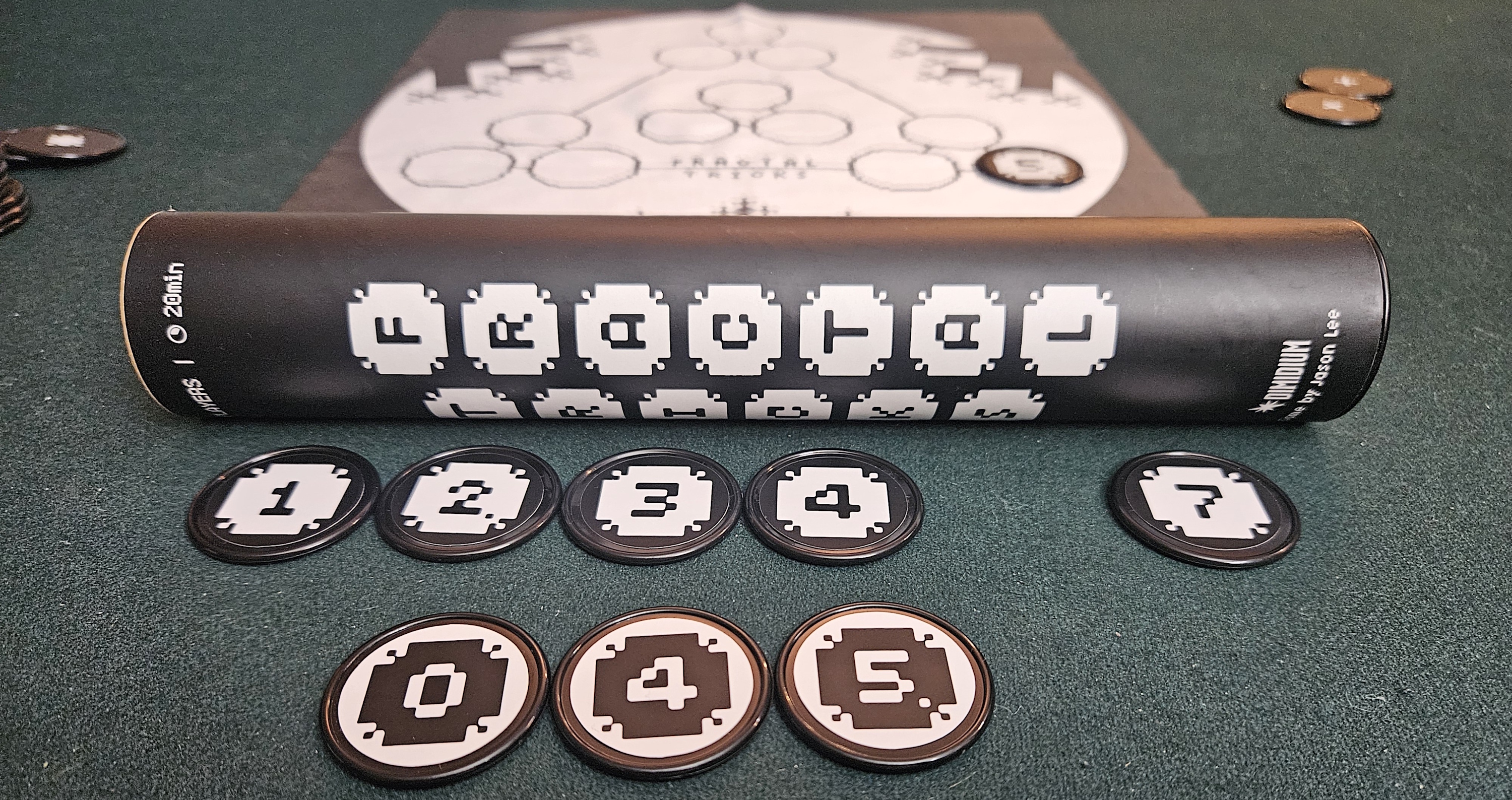
It begins with some simple rules. There are only two suits. Black on white, white on black. Technically black on white on black and white on black on white, but let’s not get carried away. There’s also a mat. Three connected segments, each comprising three spaces, plus another segment in the middle.
As I’ve noted, this is a trick-taking game. For the most part, the rules are familiar. One player places a chip. Their opponent then responds with a chip of their own, sticking to the same suit if possible. High rank wins.
Except there are… adjustments that must be made. First of all, not all tricks are equal. Normally the high rank wins, but if the two chips have different suits, then the low rank takes it. Oh, and there are one or two exceptions to the must-follow rule. For example, if both chips sum to a total of nine, you can use the opposite suit, unexpectedly changing the calculus from high to low.
Secondly, the import of these tricks is hard to understand right at first. The participants in Fractal Tricks are no ordinary players. They’re cosmic forces. One of them, Cosmos — who I usually just call Order — indicates their wins on the mat by keeping the chips face-up. The other, Chaos, flips them face-down.
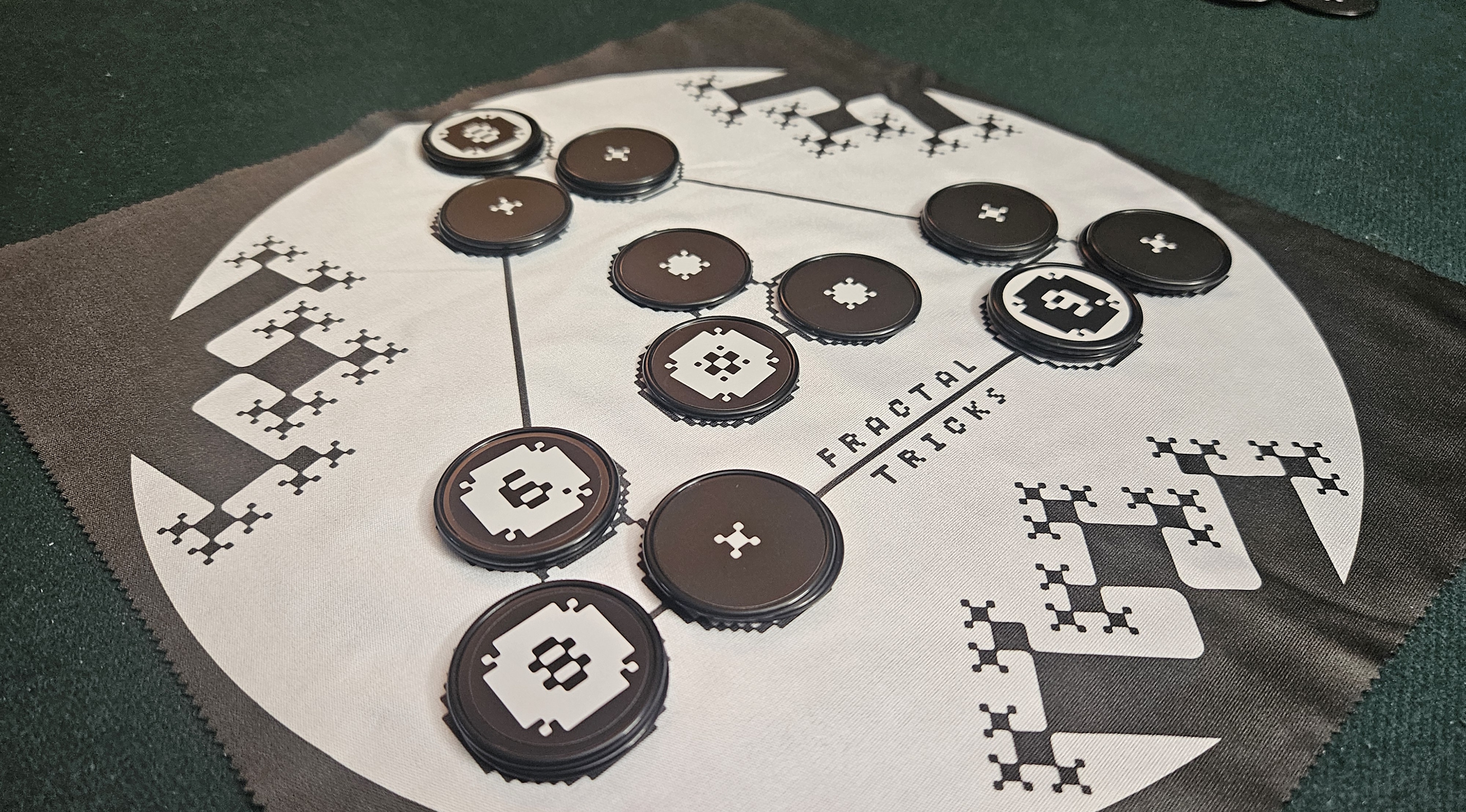
As soon as one of those little triangles has been filled in, the winner of the set places a corresponding victory chip in the middle of the board. To give a concrete example, if I’m Cosmos and I win two of those three tricks, the corresponding chip will therefore be white-on-black. If you win, now it’s a darker hue. Around we go, filling in all three sets of three tricks, nine in total, until the entire board is filled.
But flipping as many tricks as possible to our side isn’t our ultimate objective. Our real goal depends on our side of this entropic conflict. Cosmos wants to match a pattern on the edges with the one in the middle. Chaos wants to prevent that. Whichever side accomplishes their goal then claims the victory chips in the middle — but only the ones that correspond to their color.
Hiding my chips from my opponent.
It’s a bit of a mind-burn, not to mention difficult to describe in text. Here’s the gist: one side wants to create a pattern, the other wants to prevent it.
Which very quickly sets the tone for the entire game. Early on, it’s tempting to win every trick. But as any seasoned tricker can tell you, trick-taking is often about the tricks you decline to take just as much as it’s about those you claim. That’s never been truer than in Fractal Tricks. The battleground is created on the fly according to your successes and failures, thrusts and feints. Often, winning a trick is the worst possible thing you can do, smothering a potential pattern in the cradle. Or, sure, breathing life into its lungs if you happen to be on the side of entropy. And the stakes only grow higher as new patterns form at the edges, gradually informing the one at the mat’s center.
To be clear, this is one of those titles that really demands repeat play. Its first session is a curiosity. Its second sees the rules begin to click. But it’s only on the third, fifth, tenth that its tactical breadth becomes apparent. With only those two suits and twenty chips, the game’s “card”-counting is as easy as it gets, paving the way for cautious play and bitter moments of zugzwang. But from that simple ruleset arises unexpected and emergent outcomes, especially as hands are increasingly depleted. There’s nothing quite like deliberately losing a battle so you can win the war.
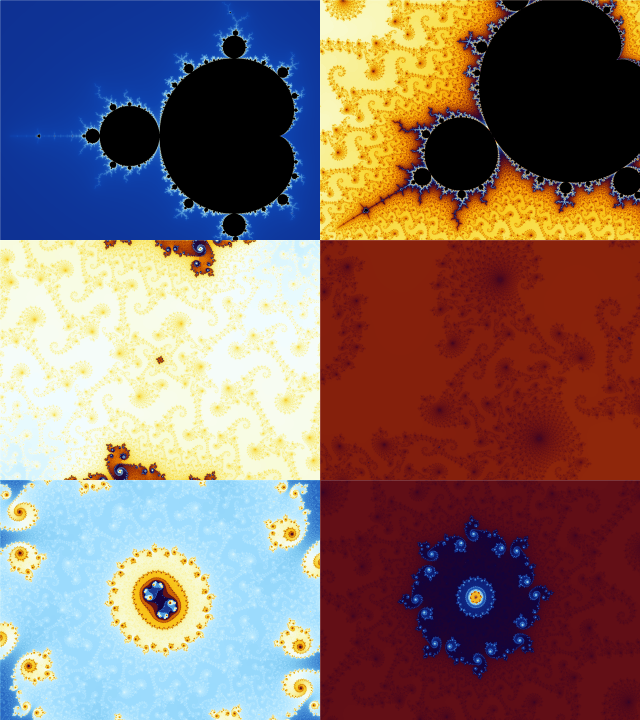
Simple rules begetting boundless emergence — it tickles me to see a game embody its central conceit so fully. Focused on only those nine input cells, Fractal Tricks swoops in like it’s examining the Mandelbrot Set. Here those rules can be manipulated, but never quite broken. Which makes for a tense standoff indeed.
Pop quiz: Who scores? And how many points?
Like I mentioned at the beginning, Fractal Tricks doesn’t always work as intended. This is entirely a user error, a failure to really grasp both the game’s possibilities and its boundaries. But it’s a common error, a forgivable one, one that bears making and remaking.
I wouldn’t have it any other way. Even in the middle of a flubbed session that concludes after two brief rounds when one player bodies the other, Fractal Tricks is fascinating to handle. With some experience, it opens up. Or perhaps it undergoes magnification. Whatever the specific operation, the result is a game that’s simple on the surface, roiling in the depths, and eager to lure its participants ever deeper.
A complimentary copy of Fractal Tricks was provided by the designer/publisher and carried across the ocean by a different designer/publisher.
(If what I’m doing at Space-Biff! is valuable to you in some way, please consider dropping by my Patreon campaign or Ko-fi. Right now, supporters can read the next installment in my series Talking About Games, this time tackling the topic of what makes a good list! Naturally, the piece includes a list.)
Ready for a confession? I didn’t love Balatro, the roguelike poker deck-building game from a couple years back. Don’t get me wrong, the number-go-up part of my brain adored Balatro. But the rest, the foam of consciousness so certain it’s in control of the mammalian beast, the me suspicious of anything hypnotic, found the whole process incredibly off-putting. Which, of course, is why I played it for (oh no) 76.9 hours, about which I cannot tell you a single anecdote. Which, incidentally, is also why I hate it.
Rolling Deep is the forthcoming solitaire board game by Peter C. Hayward. Given his explicit efforts to emulate Balatro, which he’s detailed at length in a series of design diaries, one might suppose that Rolling Deep is not my jam. The Anti-Dan, as it were. But having played it a handful of times, I’ve come away with the opposite impression. Yes, this is more or less Balatro: The Board Game. But it’s so much more than that.
It’s better than Balatro, for one thing.
Gosh, I love being able to change a die’s faces.
What so many people in this medium call “theme” is a funny old thing. Rolling Deep is the sort of game with a “theme,” in the sense of being this discrete veil divorced from and layered atop the game’s mechanisms. What is that theme? It doesn’t matter. I mean, it matters in the sense that it provides some context for the game’s actions, looks pleasant with its Cuphead-esque homage to early Disney and Fleischer Studios animation, and justifies a portion of the game’s budget. But it simultaneously doesn’t matter to the story being told by the artwork or the proper nouns in the rulebook. At no point did I flip a card and say, “Oh no! An evil mushroom!” Instead, the story is wholly mechanistic. At the card’s turn, I would say, “Oh no! How am I going to deal with this new probabilistic conundrum?”
That might sound like a bad thing, especially given my usual emphasis on the stories that arise when we play games. But, to be clear, this is a story. It just doesn’t happen to be a story about how three dice-headed adventurers reached the center of the Earth.
Instead, Rolling Deep is the story of how I transformed three meager dice into powerhouses that rolled seventy-nine in a single go. This moment was a triumph of careful resource management, broken combo-building, sly damage mitigation, and no small amount of luck. It was exciting, tangible, and, in the game’s sharpest departure from its inspiration, memorable.
Each boss sets the tone for the round.
Every round in Rolling Deep goes like this. You’re facing a challenge that happens to be a number. Say, twenty-three. Last round, the number was lower. Twenty. Next round, it will be higher. Twenty-seven. Steadily it climbs, round by round, increasing the pressure at a steady pace, like a numerical hyperbaric chamber.
You have three rolls, all summed together, to meet that number.
But there’s a problem. At the game’s outset, reaching those later targets is impossible. These dice, you see, have rather low digits. At best, you can roll a 2. More likely, you’ll roll a 1 or even a 0, albeit perhaps a 1 or 0 that also grants you a coin or a reroll potion. Over three rolls, that means you can maybe hit a target of eighteen. And that’s with some pretty extreme luck.
Fortunately, there are two solutions to this problem.
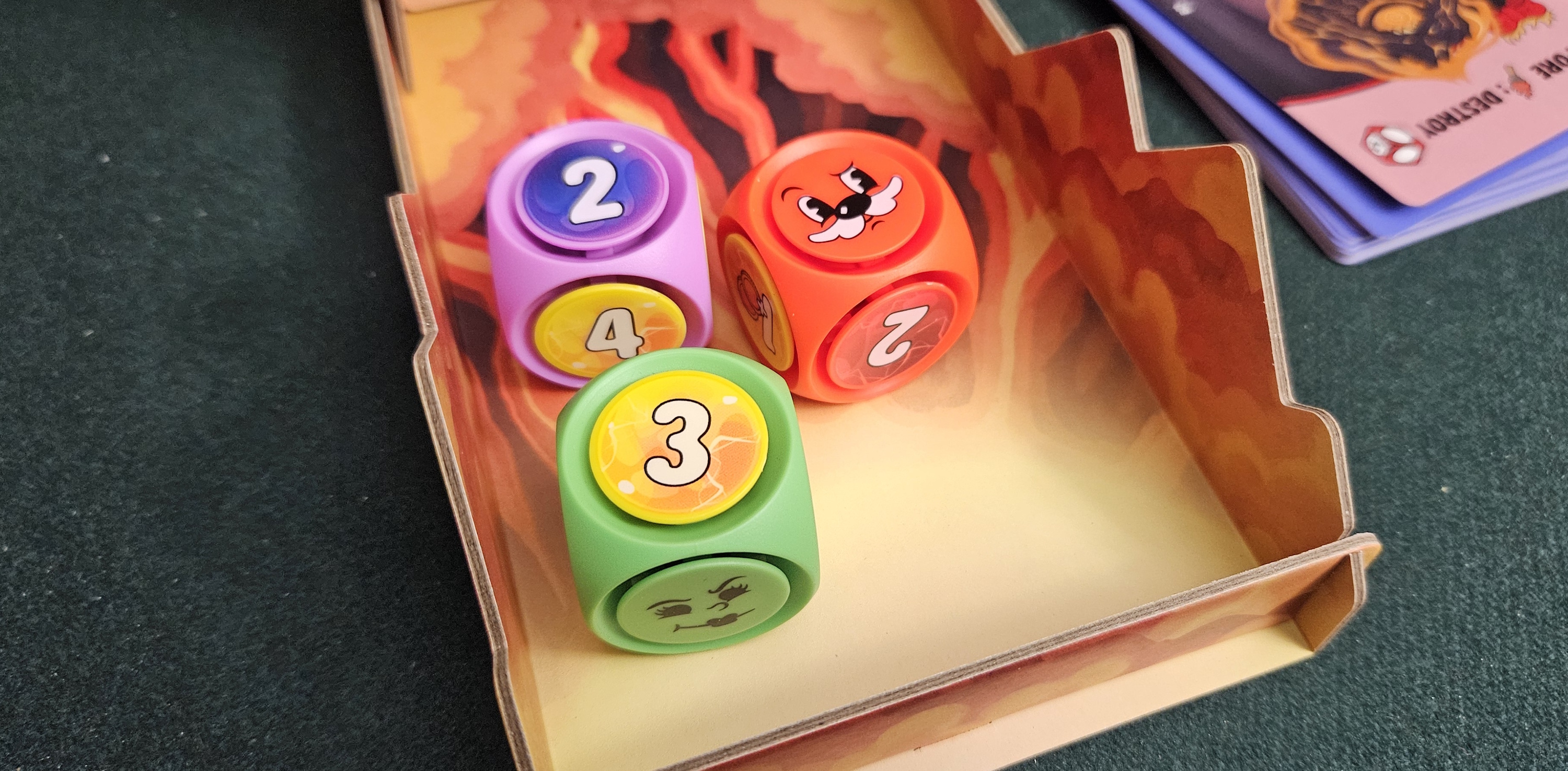
First, the faces of your dice have custom faces that can be swapped out. Picture the dice from Tom Lehmann’s Dice Realms, but way easier to handle, without the weird LEGO-breaker tool for prying faces away from the frame. Here everything clicks into and out of place with a breezy snap. Out with the 0, in with a 2 plus a potion. Click. Sayonara 1 with a pity coin, hello whopping 5. Click. Oops, now you’re rolling too high — yes, that might be a thing — so let’s turn that 5 into a 3 with a coin. Click.
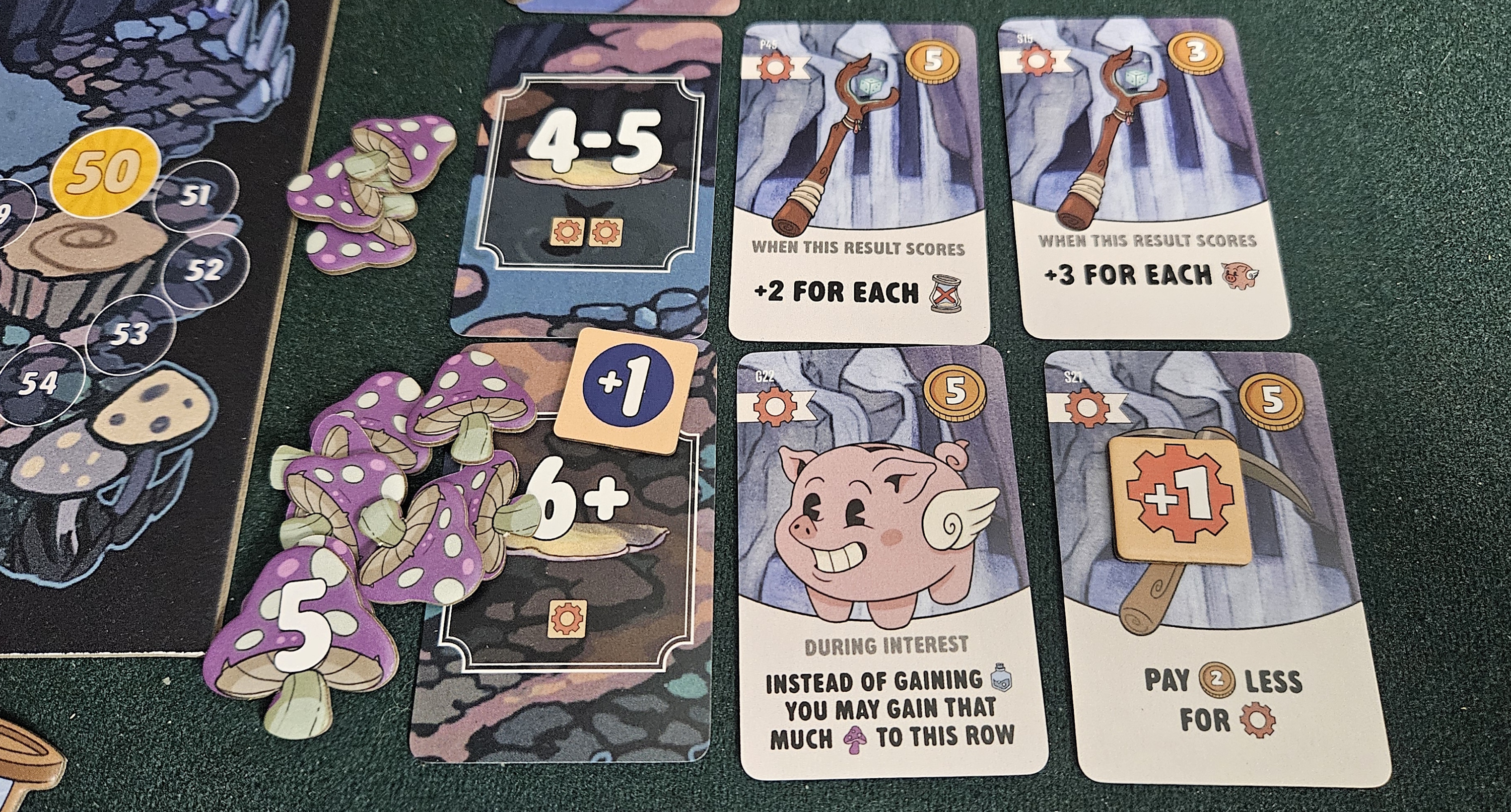
Second, the way you purchase these new faces also offers a way to improve your performance by other means. By a lot of means. You could purchase an upgrade that gives a permanent +2 to every roll. That’s the easy stuff. You might also earn a wand that only triggers with a natural roll of 4-5, and awards +3 for every piggy bank ability. Now you have a synergy going. That wand, plus as many piggy banks you can afford from the market.
Little by little, your cards produce an engine. (Hopefully.)
Thus the game’s irresistible tempo. You roll, perhaps spend potions or use your upgrades to massage the numbers, and add that total to your sum. If you reach the target number after three tries, you gain a prize, earn interest on any leftover cash and potions, reveal and purchase upgrades from the market, and then do it all over again with a higher target number.
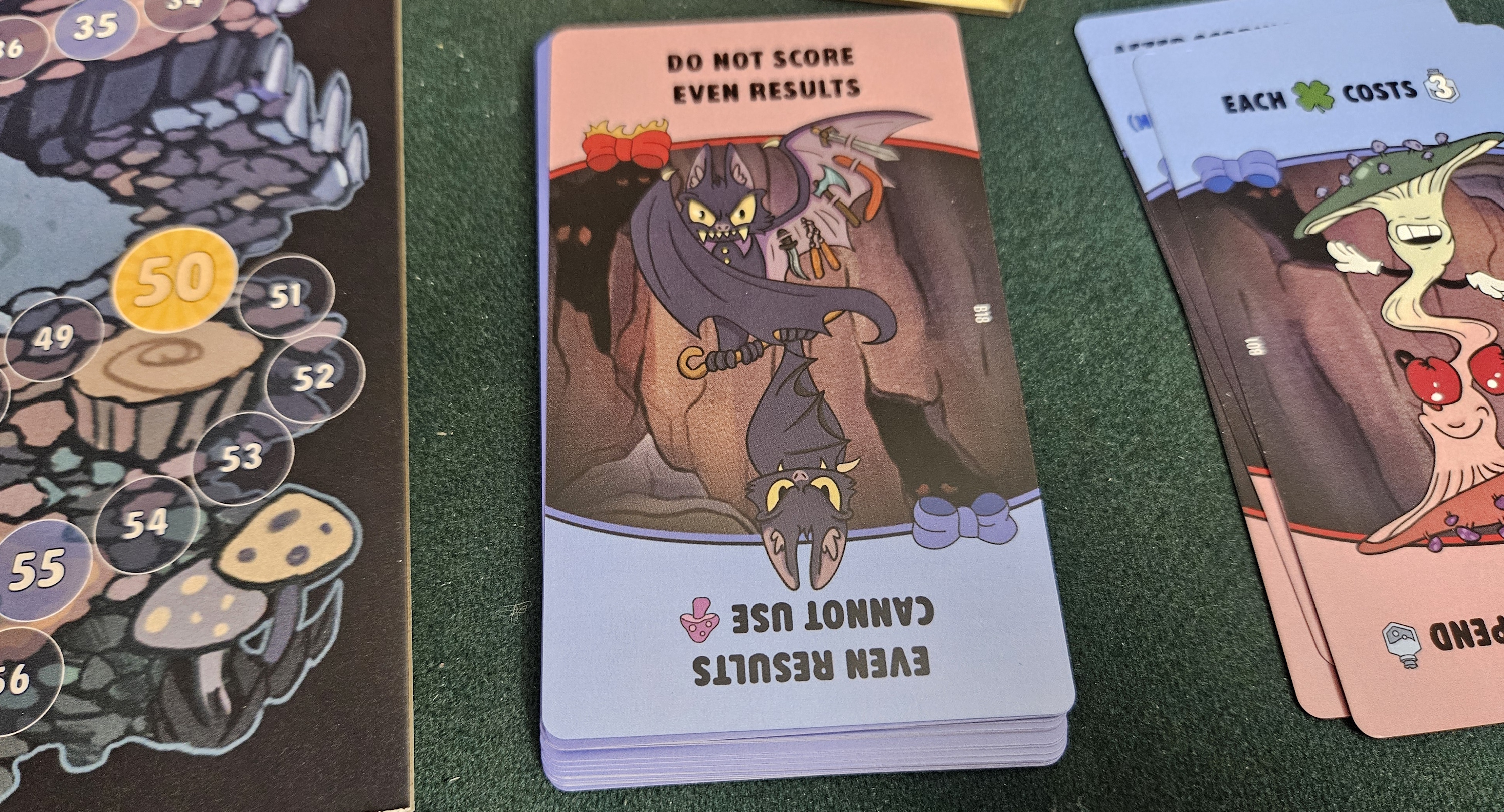
Every third round, you face a boss with an obnoxious special ability. Like, for example, a cartoon bat who prevents you from scoring results that are even. Or a cartoon mushroom that makes it harder to spend potions for crucial rerolls. Or a different cartoon mushroom that destroys some of your upgrades. Nasty stuff, but nasty stuff you see coming for a couple rounds before it hits you. Nasty stuff you can prepare for.
If this sounds like Balatro — well, look, Hayward isn’t concealing Rolling Deep’s influences. The dice faces are your poker deck. The upgrades are jesters. The mushrooms that boost your sum before withering are… I guess multipliers? There aren’t actual multipliers in Rolling Deep, probably because the game’s numerical targets increase linearly rather than exponentially. The possibility of expanding how many upgrades you can hold are akin to Balatro’s spectral cards. It’s all familiar. It even has achievements and unlocks. Beat the game on easy mode, you earn access to tougher delves. Break the game in one way, you gain tools that are a little weirder than the starting kit. I won’t spoil the wilder unlocks, but they’re in there for the sickos.
But if this is all so familiar, why do I say it’s better than Balatro? I knew you’d ask.
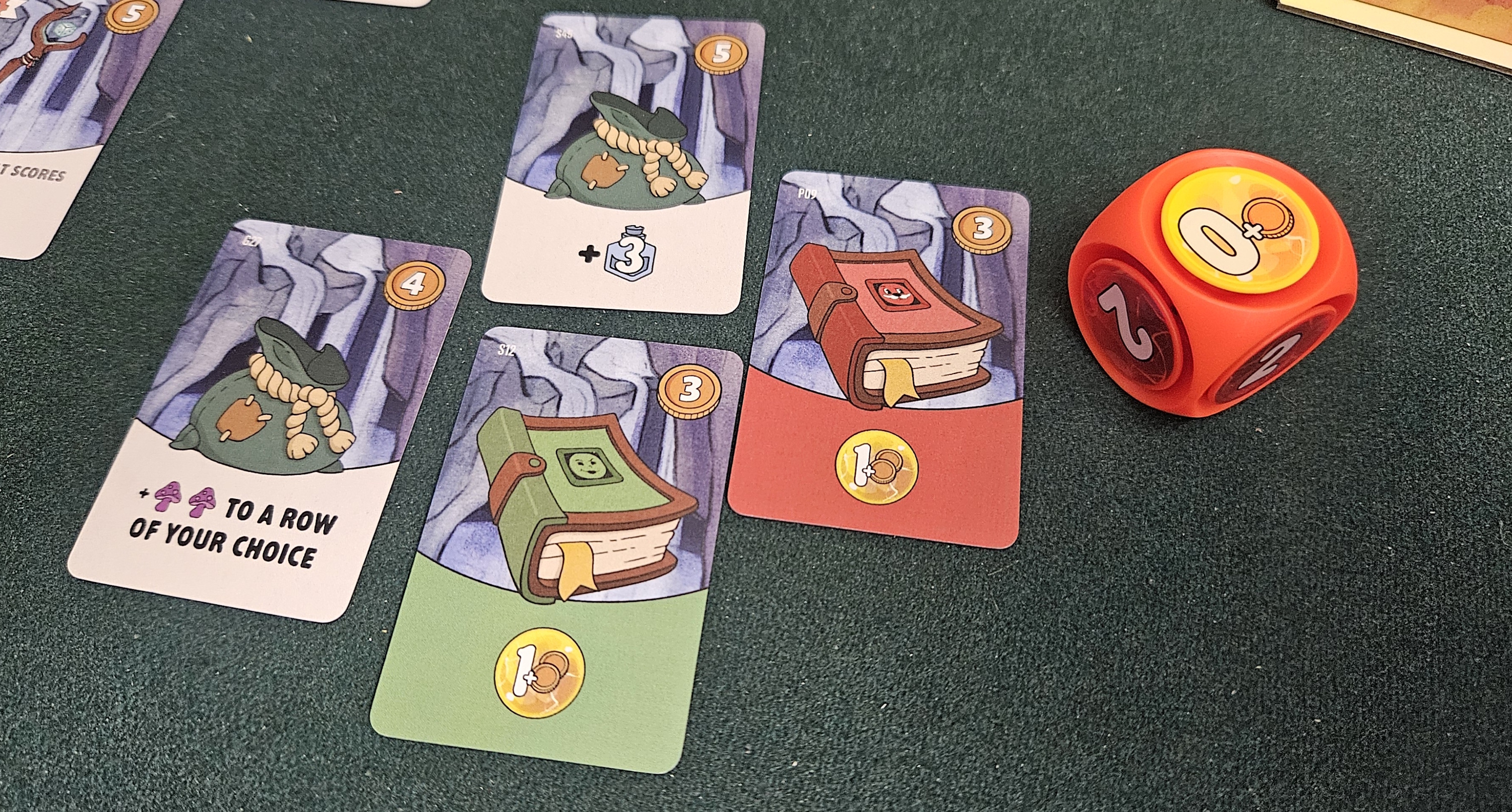
Buying new options at the market.
For one thing, the medium itself demands a very different sort of attention from a digital game. Where Balatro hypnotizes, Rolling Deep focuses. Sure, I suppose I could zone out. But as soon as I’m asked to shift my tally along the target track, flip some upgrade cards, or shift resource tokens from one place to another, my feet are given purchase on solid ground again. If that doesn’t do it, sure as shooting the alteration of a die face will. Click.
This breeds an entirely different headspace. At no point did I awaken from a three-hour binge. Instead, the processes — the ones that are concealed behind the dazzling lights of Balatro — are entirely my responsibility. I must count the numbers or nothing happens. I must pay attention to my bonuses lest I lose them. There’s no option to glaze over and make number go up. Every upgrade must be considered, weighed against my tableau’s current strengths and gaps, and ultimately purchased or discarded. Very quickly, the physical actions that are automated in a video game become loci of concentration and even pleasure. It helps that Hayward has developed this game until it’s smooth as cream. But the remaining points of friction, some of them inherent to the medium, give me purchase in the real world.
And that extends to the gameplay itself. Because Rolling Deep is more grounded in the real, its challenges are presented as tangible, applied things, rather than wholly abstract. It’s the difference between being told some measurements and shown them against the wall or along the motor’s belt. When I assess my odds, I physically heft one of those chunky plastic dice and turn it around in my fingers. When determining where to slot an upgrade, I slot the card into a physical representation of where my rolls have aggregated. The medium becomes the gameplay and vice versa.
It helps, too, that Rolling Deep’s limited format gives it a more intimate edge. It never disappears into n-space, its numbers beyond intuitive human comprehension. My dumb animal brain grasps the gap between 23 and 41 better than that of 23,749,011 out of 41,000,000, even though they’re fundamentally similar. By scrapping the sky-high escalations of Balatro, Hayward turns Rolling Deep into a puzzle that doesn’t slide off the brain like so much oil.
For such a wild game, Rolling Deep never spirals into too much complexity.
And it is memorable. I mean that. Not as much as a story, not as much as something with characters or relatable confrontations. But thinking back on my sessions with Rolling Deep, I can remember specific problems and the solutions I forged to face them. I could never tell you what had happened in any given session of Balatro even a few minutes after it ended. Something about a banana? Getting a shiny joker? Opening a few card packs?
Rolling Deep is excellent. It’s a very particular kind of excellent, to be sure, a mathematical solitaire game that’s long on odds and probabilities and sums rather than story beats. But within that window, it not only matches the ambition of its inspirations, but exceeds them. Balatro who? This is Rolling Deep, baby.
A prototype copy of Rolling Deep was temporarily provided by the publisher.
(If what I’m doing at Space-Biff! is valuable to you in some way, please consider dropping by my Patreon campaign or Ko-fi. Right now, supporters can read the next installment in my series Talking About Games, this time tackling the topic of what makes a good list! Naturally, the piece includes a list.)
Zenith isn’t an easy game to classify. Part set collection, part lane-battler, even part paxgame, it’s full of tight contests and nasty tug-of-wars. (Tugs-of-war?) Really, though, it’s more than the sum of its parts, a strange but wonderful artifact by Grégory Grard and Mathieu Roussel that doesn’t play quite like anything else.
The presence of lanes does not imply a lane-battler. But this might be a lane-battler.
Let me introduce you to the solar system. In the far future, humankind has spread into its… well, not its farthest reaches, but pretty far. All of the inner planets are settled, and Jupiter as well. I would’ve thought we’d beeline to Saturn’s largest moon for all those juicy hydrocarbons, but hey, clearly this isn’t my roadshow.
For one thing, humanity has split into three distinct species. There are humans (filthy baselines), robots (job-stealing clankers), and animods (uplifted animals, the cool kids of the bunch). Furthermore, those three types are spread across five color-coded factions that correspond to the settled planets.
Both type and color matter. Type, because humans, robots, and animals can be spent for different bonuses, and color because while this duel is a knock-down drag-out affair, nobody is willing to leave their favored planet.
Every turn sees you spending a card. Usually one, sometimes more, but never zero. That card can be used in three ways. One, it can be recruited to its home planet as an agent. This is the most common action by far, and it’s one we’ll return to momentarily. Two, it can be discarded to gain a small bonus — some credits, some zenithium (this universe’s unobtainium), or a couple of freebie cards. Three, it can tick your faction along one of three tech trees. Yes, there’s one for animods, one for humans, one for you get the gist.
Cards become cheaper thanks to the presence of other cards.
Each of these possibilities is considerably more interesting than they initially sound.
Take, for example, those tech trees. Early on, the perks offered here are fairly minor. Two credits for animod research? That’s downright unethical! But each step along a tech tree awards not only its current bonus, but every single bonus you’ve already gained. The second level, then, influences two planets and gives you that pair of credits. Level three does the same, plus steals a trio of cards. Level four does everything plus shifts even more planets. Benefits scale in such a way that those meager early offerings suddenly look like smart investments.
Or there’s the whole “discard a card for some resources” option. This is the dump action, right? What you do when you don’t have anything better going? And, sure, it is that. But it’s also a chance to claim the badge. And the badge is a big deal because it’s the one thing in the game that will increase your hand size. Normally, upon completing your turn, you draw to four cards. With the badge, you draw to five. If you claim the badge while already holding the badge, you flip it to its upgraded size. Now you draw to six cards. In a game where mining the shared deck for powerful agents is a significant part of the strategy, that’s a potentially game-swinging advantage. Suddenly, the dump action is considerable. Even necessary.
Then there’s the big one. Playing a card to the main board. This always pulls the corresponding planet toward you, engaging in the tug-of-war that is Zenith’s principal contest. Your overall goal is to secure a certain number of planets. The exact quantity is variable. Three of the same planet, four different planets, or five mixed planets. That’s a win. There’s no escaping the need to play agents to the middle section, then. The more the better.
But even this action is smarter than it first appears. For one thing, cards are expensive. Not all of them, obviously. There are a few that cost only one or two credits. But some cost, say, ten credits. That’s a lot of scratch. But every agent costs one fewer credit for every card already in its planet slot. This means there’s a sharp ramp in what players can afford. Early on, there’s nothing stopping you from playing a powerful card. It’s just that it might wipe out your finances. With a few cards in that slot, however, things get affordable fast. It isn’t long before the big guys come out swinging, and often.
The tech tree is… fine.
The protein in this particular salad is that everything in Zenith is something of a Shepard tone, always ascending, always jangling both players’ nerves. To put it more blandly, this is about as good as multi-use cards get. Even a crummy draw can provide an advantage somewhere, if only because anything can be thrown away for a few resources and access to the game’s principal means of drawing more and better cards.
Its sense of escalation is truly something to behold, especially once the contest really gets going. I mentioned that Zenith bears some resemblance to paxgames, and that’s true whether or not Grard and Roussel have ever played one. That’s entirely thanks to the way cards are allowed to flex their powers. There are some wild abilities hidden in the deck, game-hinging swings and economic powerhouses and free techs and everything else, although the strongest require some preparation before they’re affordable. Not only in terms of cash, though, sure, there’s always cash. But also in the sense that some require you to be holding the badge, or to shift planets according to certain limitations, or yield a crucial resource to your opponent before triggering that card’s most potent ability.
This is what makes Zenith special. Or at least it’s one more brick in the powerhouse of its specialness. As a game, it’s full of genuinely hard decisions. How to spend cards. When to spend them. Where to spend them. Whether to be proactive or reactive. How to best undermine the engine your rival is assembling piston by piston.
Just a few of the game’s many cards.
If I went dredging for downsides, I suppose I would say that this openness means it’s easy to get lost a bit. More than once, I’ve watched somebody — usually myself — flub a session because they were so focused on getting more resources or moving up the tech tree that they lost sight of the ground war. Similarly, I don’t much care for the tech tree. Its look, more than its actual utility. Zenith is a handsome game, but its appeal lies in its color palette and illustrations rather than its minimalist board, and the three-pronged tech tree, which is pronged for a reason, since you can flip any of its tracks to their opposite side for some variety, still comes across as a bit chintzy.
Really, though, this is about as close to my jam as a game can get without breaking the mold. I’ve always had a preference for “falling with style” games, those that hand me a mismatched bag of tools and then ask me to make do with what I’ve got. Construct a biplane with this old rotor, a busted gas-guzzler from an old Ford, and a hyperbaric chamber? You got it, boss.
Zenith excels in this theater. I’m sure some will consider it an issue. There’s no marketplace. Everything is drawn blindly from the deck. This produces a degree of chanciness that can indeed make or break the game, although there are sufficient mitigating tools that I’d be surprised if that happened more than once in a dozen sessions. There’s always some way to get ahead. Stealing cards from your opponent. Shifting up the tech tree. Crud, just grabbing the badge and drawing more cards is a good choice when falling behind. If Zenith weren’t so tight, I’d venture to call it something of a sandbox game. It isn’t quite that, but it carries similar helices in its genetic code.
Ah. Lanes. My first love.
Taken as a whole, Zenith feels like a gift from an alternate timeline, one where lane-battlers look very different from ours and multi-use cards are radical innovations rather than perfunctory inclusions. I love this game’s textures, its swings, its vibrant colors, the clarity of its objectives and the ease with which they get lost against the backdrop of the game’s smaller struggles.
Zenith, indeed.
(If what I’m doing at Space-Biff! is valuable to you in some way, please consider dropping by my Patreon campaign or Ko-fi. Right now, supporters can read the next installment in my series Talking About Games, this time tackling the topic of what makes a good list! Naturally, the piece includes a list.)
At this point, the civilization genre needs an intervention. We could all sit in a circle on folding chairs we borrowed from the local church. Set out a little tray of cheeses and olives. Have plenty of tissues on hand for everyone. Speak in that voice we reserve for serious moments. “Hey,” someone would say, breaking the ice. “I’ve noticed you’ve been in a rut lately.”
Rising Cultures, designed by Aske Christiansen and Francesco Testini, almost begs to be described entirely via comparisons. It’s a lower-fidelity Imperium, a blown-out Ancient Realm. Clash of Cultures in how closely it sticks to an inherited form, as far as possible from Arcs on the personal-to-longue-durée matrix. Not as good as any of the bests, but neither so bad that it’s worth observing for its missteps.
What have the Romans done for this tableau?
No sooner is its lid cracked than Rising Cultures reveals a few inborn limitations. There are four civilizations to helm, three of which are Egypt, Rome, and Persia, those old standbys that aren’t exactly going to blow anybody’s hair back. The experience is two-player-only. No solitaire, although what follows will be mostly solitary in nature, nor welcoming of a third or fourth player, although it feels like the designers could have pushed it to those heights had they really wanted to.
Also, there are heaps of icons. So many icons, in fact, that each civilization comes with its own fold-out crib sheet that translates every single line of the boards and every single card. Oh, and sometimes explains concepts in eight-point font that must be scraped from the surrounding info-spatter. Transcribing these details calls to mind City of Six Moons, another civilization game Rising Cultures is very much unlike.
From there, the gameplay grumbles into action. And it’s good action. Each round sees players figuring the best use for the four cards they’ve drawn from their hand. Scratch that; three of them will be used, the fourth will return to the top of the deck to reappear on the next go. The action economy is thus strictly limited. Three cards per round. Seven rounds per game. Nominally, that’s twenty-one actions in total.
Of course, there are plenty of ways to break this rubric, although Rising Cultures isn’t quite as combo-tastic as some of its peers. At any given time, there are four main uses for each card. First — and flimsiest — you can discard it to pick up two coins. This always feels like a defeat. Second, you can slot it into your empire as resources, the bricks and stone and so forth necessary to, third, build cards into your tableau. This is the most durable option, permanently earning access to that card’s best benefits, whether scoring abilities or ongoing perks. Fourth, any card can enter your military. More on that in a moment.
Each turn revolves around a few cards.
As processes go, this is good stuff. Interesting stuff. Compelling stuff. Cards aren’t quite multi-use, in the sense that they might tempt players to wander distinct avenues. If possible, you’d probably want all of them in your main tableau. But that isn’t possible, and anyway there’s a clever tradeoff whenever you build a card. Basically, you’re given the option of flipping the bottommost resource onto your civilization board, unlocking further abilities but decreasing your overall wealth. It’s a smart move, one that goes a long way toward preventing players from falling into a formula where they spend their first few cards on resources and then keep building everything afterward.
Little by little, your civilization takes shape. That shape, naturally, is largely predetermined by whichever faction you’re playing at the moment. The Romans go to war a lot. The Egyptians must manage the ebb and flow of the Nile. The whole thing feels a lot like Imperium, except you’re going through a deck once rather than cycling through and improving it over multiple stages.
At points, players are invited to glance at one another across the table. Usually this happens when gearing up for the fight that caps each round, when some province will be awarded to only one side depending on whichever civilization has assembled the most suitable army. In rare cases — okay, one case — a civilization offers bonus actions to its rival. Beyond that, this is a heads-down affair.
Which is fine. I’m not slamming multiplayer solitaire. But I am left wondering where Rising Cultures’ identity might be found. Its four civilizations each play like their own puzzle. With their cards jumbled together, all those natural synergies out of order, can you assemble them into a points engine that outpaces your opponent’s? Maybe. It depends. On the shuffle, sure, but also on whichever faction sits before you. Some are more complicated than others. Egypt has that shared Nile row going both for and against it. The Abbasid Caliphate requires some strict sequencing in order to usher in its era of science, which is notably tougher than the slapdash approaches available to Rome and Persia.
The Egyptians are in the Nile about this game.
What it never manages, unfortunately, is to stand apart. At its best, it feels like a microgame that got too big for 18 cards, or like a less generous and less flexible version of Imperium with half as many civilizations and a stricter play count. It isn’t weird or experimental, but neither is it especially standard, in the sense that it might appeal to someone who’s looking for an unvarnished civgame. The result is a middle-of-the-road title that says and accomplishes little. I don’t expect it to survive the test of time.
A complimentary copy of Rising Cultures was provided by the publisher.
(If what I’m doing at Space-Biff! is valuable to you in some way, please consider dropping by my Patreon campaign or Ko-fi. Right now, supporters can read the next installment in my series Talking About Games, this time tackling the topic of what makes a good list! Naturally, the piece includes a list.)
Remember those bad years when every other board game was a deck-builder? Solar Titans reminds me of that.
It’s not that Solar Titans is bad. Just that it’s perfunctory. This is a deck-builder the same way everything back then was a deck-builder. Its identity as a deck-builder makes zero sense. Its deck-builder systems run contrary to its fiction. It even commits the capital sin of deck-builders by letting each hand’s composition matter so much that everything else becomes secondary.
But let’s back up. Solar Titans. What’s it about, eh?
That’s a solar titan there. Yep.
On paper, Solar Titans ought to be my jam. My site is called Space-Biff!, for heaven’s sake, named for gigantic spaceships lasering and rocketing and otherwise exposing one another’s pressurized interiors to the hard vacuum beyond their eggshell hulls. So when Solar Titans claims to be about building and then ripping apart spaceships, I’m down to wrassle in the mud.
When the game opens, there’s nothing amiss. Players begin with a basic ship that includes the bare minimum systems to keep flying. There’s your command deck; sacrifice that and it’s curtains for your entire vessel. Crew Quarters, mostly there to keep your hand at a healthy size. The Targeting Bay, a really bad thing to lose if you want to continue pelting any enemy ship(s). One Alpha Laser, a basic weapon that will soon be more useful as armor. Finally, a few segments of light plating, the thin line between your squishy interior and the instant death beyond.
Cue the actual space-biffing. Procedurally, Solar Titans has a comfortable familiarity to it. Turns consist of playing cards. Early on, this takes two main forms. Arming Crew heats up your weapons, thus discharging your vessel’s arsenal at the opposing ship and flipping some portion of it face-down. Cargo Crew give you cash. Cash that you then spend on a variety of other ship components.
Those components make up the bulk of your decision space, and the marketplace that sells them is really two slightly separate offerings. The first is a static pool of reliable standbys, mercenaries for firing your lasers more often and better crewmembers that wield greater purchasing power. The second is more dynamic, a river of ever-changing cannons and armors that can be bolted onto your ship to improve its abilities mid-battle. By attaching the best katana beams, jammer plates, salvage crews, and other greebles to your ship, the odds that you’ll emerge victorious grow steadily greater.
This is an unusually exciting hand for Solar Titans.
As a game, Solar Titans works well enough. The deck-building and -cycling are functional, if not inspiring. There are no big ruptures in its fuel lines. But it still carries layered issues that prevent it from making that crucial jump to light speed.
Perhaps most superficially, I prefer to know what we’re doing in a game, to see the ways the actions on the player aids are reflected in the fiction and vice versa. So when our ships sprout entire missile pods mid-duel, there’s a part of me that recoils. It isn’t as though the HMS Surprise sprouted a fresh deck of cannons right before a broadside at the Acheron. Then again, this is the future. Maybe it’s nano-something. Quantum-whatever. Fine. I can live with that.
But making peace with the game’s fictive tempo doesn’t alleviate its drumbeat on the table. Buying a card means adding it to your discard pile. Only then will it eventually cycle through your deck to your hand, at which point it may bud onto your vessel like a spring blossom. This is the norm for almost everything in Solar Titans, but when it comes to ship components, it transfers the sum of your player agency to the whims of the deck. Will your phase cannon come online in time? Can you armor that essential section before it crumbles under enemy fire? Will your crew aim your whatever-beam before the enemy’s such-and-such plate grows to block the shot you’ve lined up? These are questions of which side draws the proper card in time.
Which might be palatable if only the game bothered to provide interesting verbs. Here, though, those verbs are limited to shooting and buying. Sure, there are varieties of cannons. Some smack the enemy vessel head-on. Others snake in from the side. Some are delayed. Others unleash pronged attacks that hit two sections of armor at the same time. But for the most part, damage is damage is damage. There’s none of the cleverness that marks space combat in fiction or other games. You’ll never reposition your ship. You’ll never set life support aflame. You’ll never deplete a vessel’s reactor. There are cards that gesture at such occurrences. Boarding pods. Energy beams. Nano-whatevers. But their results are damage, countered with repairs, back and forth until one side or the other chances upon the right combination of market cards and deck draws to carry the day.
Two solar titans really pounding each other.
It’s a shame. There’s a great deal of creativity on display here, including different play modes that see partnerships ganging up on mega-vessels. But it’s all funneled through such a filter that the result is an evolutionary dead end. This is no space-biff. Maybe a space-paff. And nobody’s going to name their website Space-Paff.
A complimentary copy of Solar Titans was provided by the designer/publisher.
(If what I’m doing at Space-Biff! is valuable to you in some way, please consider dropping by my Patreon campaign or Ko-fi. Right now, supporters can read the next installment in my series Talking About Games, this time tackling the topic of what makes a good list! Naturally, the piece includes a list.)
I wouldn’t go as far as to say that G.K. Chesterton’s The Man Who Was Thursday saved my life. Probably it would be more accurate to say it built my life. The novel arrived at a pivotal moment in my adolescence. I was seventeen. Dumb with hormones, dumb with culture, just plain dumb. Still deciding who I was. Who I was going to be. I found it through the unlikeliest of sources, snippets of text in the video game Deus Ex, and felt like an investigative researcher when I obtained a copy from the bookstore I haunted like a ghost that summer.
The Man Who Was Thursday is also a board game. A very unlikely board game. Created by a designer from South Korea who goes by the nom de ludens Reader on Jupiter, it arrives folded within twin DVD cases. Arrived. Past tense. It’s profoundly out of print, although its author claims there will be another use for the system sometime in the future.
Honestly, it isn’t the system I’m interested in. It’s the adaptation. This is the board game version of a book that was one of the cornerstones in building who I am today. I cannot see it impartially. Only intimately, like an old friend straining to express something important. Straining to express a revelation.
The perilous streets of Europe.
It begins with the conspiracy.
Written in 1908, when Chesterton was yet a Protestant, and in the period when anarchists and nationalists alike flung bombs at monarchs, a vocation that would soon spark the War to Begin All Wars, The Man Who Was Thursday opens with an undercover policeman, Gabriel Syme, on a quest to stop a council of bomb-throwers from completing their most daring, most damaging undertaking yet.
He is elected to the position of Thursday. That is, one of seven members of the anarchist committee. The committee is headed by Sunday, a monstrous, massive presence who seems unbeatable at every turn. Syme is initially shown as dashing and clever, worming his way into the anarchist committee through poetic debates, mistimed oaths of secrecy, and inflamed speeches. Seated before Sunday, he is transformed into a sweating plaything, certain that the anarchist of anarchists sees straight through him.
It’s a tale of isolation, at least in part. Thursday is one of those stories that reflects the eye of the reader. Some have argued that it’s the antecedent for the coming storm of espionage thrillers. The critic Adam Gopnik argued that it was the turning point between the earlier nonsense fantasies of Lewis Carroll and Edwin Lear and the latter horror fantasies of Franz Kafka and Jorge Luis Borges, the moment when the fever dream grew truly nightmarish. More than one theological treatise has argued that it’s a retelling of the Book of Job, with its senseless morality. It’s easy to see why. The world of Thursday is broken, pessimistic, heavy with suffering.
And at its heart is a man who doesn’t see a path through to the end. Or, in my case, its heart is a teenager on the verge of adulthood, flirtatious with fascism but honestly too sensitive for jackboots, with an ear for the numinous but too questing to be considered faithful, and only barely smart enough to know he doesn’t know a single damn thing worth knowing.
For the good of humankind, we’re gonna poison this guy.
Adaptation is one the most difficult arts of all. Partly because, when done well, it will be invisible.
Thursday the board game adapts Thursday the novel by thrusting players into a tangle that they can only vaguely see the outlines of. Everyone is a member of the Council of Days with a double identity. The first of those identities is visible, an objective to fill the spaces of the board with some number or color of cubes. Perhaps you’ll be tasked with placing a bunch of anarchist cubes, or entrusted to make sure there are more police cubes than anarchists in as many spaces as possible, or even instructed to sow chaos by commingling white and black across the entire board.
Your second identity, however, is concealed. This is your position on the Council of Days. Perhaps you’ll be purple, Saturday, or red, Monday. The only options barred to you are Sunday, the avatar of anarchy, and Thursday, representing the police.
These dual identities are never far from mind, tied as they are to the game’s victory conditions. Your first goal is accomplished by undertaking missions that add cubes to the board. But your second, that of your hidden identity, requires you to steer clear of those same missions lest you fall under suspicion. This functions as a tiebreaker, but ties are common enough that your relative standing can never be neglected, causing players to go out of their way to keep their player token clear of any major plots.
This is made doubly challenging by the fact that you never command your avatar directly. Instead, your current token is determined by a calendar that shifts forward in response to everybody’s moves. You’re Monday, but today is Wednesday, so rather than moving your red piece, you’re given control of green. Along the way, you pick up Friday (blue) to fling a bomb at some minister, causing green and blue to gain suspicion, but also leading everybody at the table to suspect that your real identity is tied to neither of those colors. The calendar ticks forward three days because you moved three spaces. The next player glares at you because it seems like they’re always moving Saturday.
The timekeeping calendar is lovely.
Out of the corner of my eye, I can regard the game with some sliver of critical impartiality. There are flaws here. Missions are accomplished through a combination of dice faces and token colors. Theoretically, this forces players to make do with what they’re given, some combination of whichever color the calendar has assigned them this turn, the colleague they pick up en route to their mission, and any dice results and/or bonuses they have handy. But missions are too easy to complete, rendering entire portions of the design vestigial. There’s an option, for instance, to lay low rather than to complete a mission, cooling off some suspicion or tweaking the position of previously placed cubes. But this is rare, an outside exception, especially the first few times the game hits the table.
Similarly, the objectives struggle to find their balance. Some, like the one that sees you filling spaces with the maximum three cubes, are far easier than those that pit anarchy and the police against one another. With some experience, the gameplay opens up. You learn how to speed up the calendar when you’re ahead, or use the bigger Sunday and Thursday tokens to alter the outcome of a mission, or take advantage of the game’s many special abilities to alter the game from its icon-matching core into more of an area control contest. The Man Who Was Thursday can be played well, can overcome certain of its limitations. But even at its best, it remains a flawed system.
As an adaptation, it fares better. There’s still an incompleteness to the presentation here, as one might expect of a board game, which by its nature presents a snapshot rather than a definite narrative arc. This is, in a sense, the middle act of Thursday, the conspiracy of isolated individuals, after Syme’s infiltration but before the absurdities begin to overwhelm the tale. I’m reluctant to spoil any details, itself something of an absurdity for a novel that’s nearly 120 years old, but… well, that’s on you. Sorry. You’ve had your entire life to read it.
The question of your identity is always under investigation.
The novel gradually transforms, shedding its guise as a political spy thriller. For a time it becomes a meditation on isolation and the power of companionship, with Syme discovering that the various members of the Council of Days are all undercover policemen like himself who have been set against one another. In its final chapters, it shifts into the cosmic realm of Job’s behemoth and whirlwind, Sunday fleeing atop an elephant, then via hot air balloon. When the conspirators at last corner the anarchist of anarchists — a state of affairs that sees him at the height of his power, not laid low as one might presume — they grill him. Why have they suffered so much? Why must everything on earth contend against every other thing? Why does even God hide His face?
This is when Syme, at the moment of theophany, understands. The suffering is also the justification for its own existence. If only the wicked suffered, then their complaint against God would be correct in labeling Him a tyrant. It’s only in the wildness of suffering, in its untamed nature, in the way the lion might gaze lazily at you or consume you, in how every living thing is pressed into service as an anarchist, that true goodness becomes possible.
Do I buy it? Eh. About as much as I buy any explanation for why we suffer. Okay, that isn’t true. I buy it more than any prosperity gospel. But I bought it as a teenager. I bought it, and decided that we were indeed heroes disguised as anarchists, everyone alone, everybody hurting, and that, as Chesterton wrote, the best we could do was to try to find the people who were hidden like us and make allies of them. In his words, “There are no words to express the abyss between isolation and having one ally. It may be conceded to the mathematician that four is twice two. But two is not twice one; two is two thousand times one.”
What a strange, wonderful artifact this is.
This version of Thursday doesn’t arrive at that final confrontation. It remains quagmired in the issue of concealed identity. It’s entirely possible, even likely, that players won’t know one another’s color until they arrive at the game’s conclusion.
But it succeeds in its own confrontation, that moment when everyone’s identity is revealed and any ties are broken. This parting of the curtain is a delight, all the preceding machinations suddenly laid bare. And, by extension, it succeeds in the small moments of relief it provides. When someone at the table eases the suspicion cast on your pawn. When a fellow trailing player collaborates to break someone’s winning state. When at last the game is tallied and packed away and we return again to the table, free of the magic circle, no longer strangers, once again friends.
A complimentary copy of The Man Who Was Thursday was provided by the designer/publisher.
(If what I’m doing at Space-Biff! is valuable to you in some way, please consider dropping by my Patreon campaign or Ko-fi. Right now, supporters can read the next installment in my series Talking About Games, this time tackling the topic of what makes a good list! Naturally, the piece includes a list.)
Every so often, I’ll write something that receives a weird amount of hostility. The most emblematic example is Foucault in the Woodland, my series examining Cole Wehrle’s Root through the lens of Michel Foucault. This is especially weird because Wehrle has been rather open with his design intentions there, including his desire to wrap some philosophical talking points in the garb of fable. In other words, some of the points I’ve written about Root aren’t even subtext; they’re explicit rhetoric spelled out by the game’s author.
But this raises a tangential (and frankly more interesting) question than whether I’m stretching when I insert theories about biopower, state surveillance, and sexual deviancy into the factions of Root. How much should it matter whether Wehrle has left his imprimatur on Root as a game that could be read through a Foucauldian perspective? Thanks the Death of the Author, shouldn’t we be free to talk about any game through any lens that occurs to us, as readers and/or players of that game? Or, as Roland Barthes might put it, as conversants in the same language the designer used to create it in the first place? In playing these things, aren’t we creating their meaning as resolutely as their designers did in the first place?
Today I want to talk about the Death of the Author, Roland Barthes, and the tension that exists between two halves of the way I evaluate games. But in order to do that, first we need to talk about the Bible. That’s right, the Holy one. I’m so sorry.
This one. And no other.
I. Originalism and Reception
As some of my long-time readers may know, I have a background in Bible. My education is primarily in Christian history, which necessarily touches on a pretty wide range of topics, if only because Christianity has been with us for a couple thousand years now. There’s the usual stuff, patristics and theology and orthodoxy and schisms and bad popes and whatnot. But there’s also the stuff that students are surprised to discover. Like the changing Christian treatment of women over the centuries, or the involvement of priests in both colonialism and revolution alike, or how certain brands of literary theory simply wouldn’t exist without bored dudes (they’re almost always dudes) sitting around and thinking about how to critically read a text.
The dominant strain of critical reading is what we call originalism. This is the study of what meaning an author intended to convey when they first (originally) jotted down their words and thoughts and sermons and prayers and personal correspondences. It probably won’t surprise you to discover that this more or less grows out of Bible studies, specifically when it comes to figures like Jesus or Paul.
Especially Paul! Because that dude was all over the map. He’s the one who says that women shouldn’t lead in church, that they should cover their heads, that they’re meant to submit to their husbands, all those zingers. But he’s also the one who praises women as leaders and missionaries and, in one glaring case that was gendered out of the New Testament for a long time, as an apostle.
A few hundred years back, a few of those bored dudes recognized that some of what Paul was laying down didn’t line up with itself. So they began asking questions and coming up with different theories to square the circle that was Paul. This resulted in a range of answers. Some bored dudes decided that maybe Paul was calling on women to thread a particular needle; that they needed to be leaders and submissive and missionaries and that’s a lot of work for women, but tough. Other bored dudes recognized that sometimes Paul’s language changed, so maybe some of his statements on women had been inserted into the original text to alter its meaning (fancy word: interpolated), or maybe even entire epistles were forged by later authors (fancy word: pseudepigrapha). Cluttering this even further, other bored dudes decided to lean into Paul’s most hostile utterances about women, while women scholars rehabilitated Paul as a proto-feminist who was working within the rather strict gender format of Ancient Roman times. Sometimes multiple of these theories coexisted within the same headspace.
In each of these cases, however our bored dudes (and eventually bored women) were deciding to interpret Paul, their intent was generally to arrive at what this ancient Christian originally meant to say. This tendency to assess the Bible as a bundle of original meanings that could be deciphered eventually noodled its way from the religion department to the literature department, where classicists and historians and theater nerds started to subject their own subject matter to the same treatment. The rest is history, right up to our current predicament where Dan McClellan and TikTok theobros spend their every waking moment debunking each other.
Dan McClellan in an earlier incarnation. Ha ha, it’s actually Paul via Rembrandt.
Only there was a problem. A big one. A lead stinker of a problem. And it went like this:
So what?
Why should we care what Paul said about women? He lived in olden times. They argued about dietary restrictions and whether Jesus was an alien hologram. They also cooked everything over open fires and died young when their teeth wore out. Maybe, these new bored dudes (and bored women) argued, maybe we should care less about what people like Paul originally said and more about what religion can do for us right now.
To be clear, not all of these statements were wholly conscious. Most of the people making these arguments were believers themselves, so they weren’t trying to throw out the entire Bible. It’s just that original meaning isn’t the only meaning. Maybe Jesus and Paul and all these other Bible authors were pointing toward a deeper truth.
Here’s one place where the issue came to a head: slavery. Paul talked about slavery. There’s an entire epistle (his shortest) devoted to the issue. But that text, a letter to the master of an escaped slave, isn’t really about slavery so much as it is about Christian fellowship. Basically, Paul asks Philemon, the master, to accept Onesimus, his escaped slave, back into his household, but to treat him as a brother. It’s a beautiful piece of work, expressing Paul’s hope that Christian identity will override any other.
The problem, though, is that Paul doesn’t exactly liberate Onesimus. He’s still sending the guy back to his master. So we get these bored dudes debating the meaning of this epistle. Is Paul saying that slavery ought to be ended? Or is Paul saying that slavery is good, but that slaves should be treated well? And what exactly does “treated well” mean? Like a brother? Like a pet? Like a child who doesn’t know what’s best for them?
Or is it possible that abolition isn’t something that could occur to a first-century thinker in the first place?
Catholic Mass during the American Civil War.
So our bored dudes started debating what Paul means by this epistle. And their underlying disagreement wasn’t solely over what he originally meant. It was over the meaning behind the meaning. Paul never saw the cotton gin. He never saw industrial slavery. He never saw slave ships packed with human meat. This isn’t to say that Roman slavery was super fun. It sucked. But it was the background noise of Paul’s day. Maybe, if this long-dead authority figure could be whisked into an 18th-century context, he would see the factories and the cane fields and free-market capitalism and agree that slavery had run its course and ought to be done away with. Maybe he’d become a Marxist. Maybe he’d die of future shock. It all depends on who you ask.
(Meanwhile, of course, a few people were beginning to point out that maybe we shouldn’t rely on long-dead authority figures. But that’s a tangent we shan’t explore today.)
This is where we get a very different strand of understanding texts. These people start to realize that some things, including a lot of things that a lot of Christians care a lot about, aren’t a function of those original meanings. They’re new. And these new things are maybe just as important as the original stuff.
Like, for example, abolition. Or the creole blending of Christianity with native faiths. Or how women might participate in a modern church. Or how to handle texts that clash with archaeological discoveries and scientific theories. Or the role of priests in resisting authoritarian governments. Or the role of priests in supporting authoritarian governments — because, look, these innovations weren’t always positive.
The need to adapt to changing circumstances prompts a very different method for reading texts. This is called reception. The idea is that the reader’s context is every bit as important as the original context. Maybe even more so. After all, Paul has been dead for a while. Let the dead bury the dead, someone once said.
Like originalism, this new idea of reception trickled from the religion department over to its neighbors, spurring disagreement even between critical theorists. The question looks like this:
Which matters more: the original meaning or the new meaning?
Roland Barthes, looking very sexable today.
II. The Life-Death of the Author
According to French philosopher, critic, and semiotician Roland Barthes, the thing that matters most is the new meaning. The reception of the work by its readers, not the original meaning intended by the author. Although in his case, he would probably label it the old meaning.
Ask your average lit-kid to sum up Barthes’ seminal essay “The Death of the Author” in one sentence and, first of all, they’ll insist it can’t be done in fewer than a few paragraphs. But stand firm and you’ll probably get something like this: “The author’s intentions and biography aren’t what matters when it comes to interpreting a work of art.” Easy, right?
Not quite. For one thing, it’s useful to actually read the essay in question. I know, it’s super long. 2200 words! That’s a little bit longer than this piece up to this point!
But the Barthes who argues for the death of the author is speaking in stronger terms still. To him, the author is a new concept entirely. “The author is a modern figure,” he writes, “no doubt produced by our society as it emerged from the Middle Ages, inflected by English empiricism, French rationalism, and the personal faith of the Reformation, thereby discovering the prestige of the individual, or, to put it more nobly, of the ‘human person.’ Hence it is logical that in literary matters it should be positivism, that crown and conclusion of capitalist ideology, which has accorded the greatest importance to the author’s ‘person.’”
Now, you might note an irony here. When Barthes attributes the birth of the author in part to the “personal faith of the Reformation,” isn’t he talking about the same bored dudes who developed the idea that reception matters more than originalism? The answer is… kinda-sorta. Remember, our bored dudes were so bored that they spent all their mental energy arguing with other bored dudes. Pinning them down to a single consistent perspective is tough. Even more importantly, we’re entering a dissimilar realm of thought. Barthes is not a historian. He’s a philosopher. And while there’s quite a bit of overlap between our history and philosophy departments, they’re different enough that the rubric that applies to one might not easily fit into the other.
For one thing, Barthes seems blind to at least two possibilities. First, that it isn’t only the Author who has been created by modern society, but Readers as well. And two, that our art has always been subject to some degree of authorial shenaniganry. In Barthes’ quasi-historical telling, art was previously relayed by mediators — shamans, orators, village elders — who were effectively putting on performances rather than functioning as a tale’s sole arbiter of meaning. But it doesn’t take much effort to observe that there have been plenty of shamans, orators, and polemicists throughout history who have gladly declared what any given work of art really means. And this isn’t limited to tradency, in the sense that orators will sometimes leave their own stamp on a story. Biblical authors and editors went of their way to establish their biographies or clarify a text’s original intentions, sometimes overwriting poetry or inserting themselves under someone else’s name. (Remember our fancy words from earlier!) It’s as natural as storytelling to re-imprint oneself on the text. To edit or translate, even to relay, is to author.
Which, it should be noted, draws these two disparate threads closer to fashioning an actual knot. Because if editing, translating, and relaying make authors of readers, then so too does the mere act of reading. When you read a text, you mediate its meaning by reinterpreting it within your own context. This transforms you into an author. A very different type of author from the Author that Barthes intends to throw down from his pillar. But an author all the same.
Oh! This jacket designer thought Barthes meant it literally.
Okay, we’re all authors, lower-case rather than capital-letter god figures. Great. We get it. But what’s so bad about the original Author’s intentions and context anyway?
To understand that, we need to investigate the context that Barthes was operating in. Which is at least ironic, maybe even something of a trap, since we’re now trying to strike at the man’s original meaning as opposed to its received understanding. And, oh, I ought to note that some literary theorists have indeed argued that Barthes was imposing an irony-trap by crafting a theory that would force its adherents to strive to understand his original meaning and thus paradox themselves to death. This strikes me as the sort of prank Jacques Derrida was more prone to, but consider yourself informed. Let’s spring the trap, if only to investigate its hinges and springs.
To begin with, Barthes argues that the Author isn’t quite as much of an author as they would like to think. He writes, “We know now that a text consists not of a line of words, releasing a single ‘theological’ meaning — the message of the Author-God — but rather a multidimensional space in which several meanings are married and contested, none of which is original. The text is a fabric of quotations, resulting from a thousand sources of culture.”
Whoa, cool it, Roland! In simpler terms, language and culture are so potent that the Author is passing along meaning more than they are inventing it. While the Author might want to claim ownership of their ideas, they’re merely handling it. They’re closer to those shamans and orators, tradents of ideas rather than originators of them.
Even Barthes was swimming in his own culture. As plenty of commentators have pointed out, other critics were beginning to argue something similar to what Barthes argued in “The Death of the Author.” Short version, nobody is as original as they would prefer to think.
But there’s another element of culture at play, one that goes a long way toward explaining the strength of Barthes’ language. The dominant strain of literary criticism of his day was downright obsessed with originalism. According to prevailing wisdom, critics were intended to decipher art’s original meaning, usually by studying an author’s biography or, when possible, by simply having the author clarify a work’s intended meaning. It’s time to drop an over-long quote on you, but I’ll put it in a breakout box to add some visual flair:
The author still reigns in manuals of literary history, in biographies of writers, magazine interviews, and in the very consciousness of litterateurs eager to unite, by means of private journals, their person and their work. The image of literature found in contemporary culture is tyrannically centered on the author, his person, his history, his tastes, his passions. Criticism still largely consists in saying that Baudelaire’s oeuvre is the failure of the man Baudelaire, Van Gogh’s his madness, Tchaikovsky’s his vice. Explanation of the work is still sought in the person of its producer, as if, through the more or less transparent allegory of fiction, it was always, ultimately, the voice of one and the same person, the author, which was transmitting his confidences.
An author being kill’t.
Whoa, cool it, Roland! What’s the problem, anyway? To Barthes, a man who cares very much about art and about the meanings it transmits, the problem is that it makes art perishable. It puts a period on a single examination of the work. The task of criticism becomes that of a codebreaker. You look at art and you say, “What is the one singular meaning that this work of art must have?”
Once that has been done, any other meaning is rendered meaningless. Barthes is offering a critique of his day’s critical apparatus. And in suitable unoriginal fashion (which, remember, Barthes is defending!), his critique stems from the Marxist argument that capital has transformed art into one more product to be extracted and expended. There’s no reason to dwell on a painting for one’s entire life. Once the painting has been understood, it can be fed to the bonfire so you can purchase another. There’s no need to reread a book at different stages of your life to witness how its meaning transforms because you have transformed. The only meaning that matters is the one passed down by the Author. There’s no need for a song to blossom from springtime excitement to nostalgia. There are other albums for that.
By killing the Author, by permitting every reader to be as much an author as those who put pen to paper, Barthes argues that art becomes freer, greater, more open to all. “To assign an Author to a text is to impose a brake on it, to furnish it with a final signification, to close the writing,” he notes. “Once the Author is distanced, the claim to ‘decipher’ a text becomes entirely futile.”
It’s revolutionary. In the literal, rhetorical sense. Barthes isn’t just declaring that the Author is dead. He’s rolling the guillotine over to traditional literary criticism and laying out the head-basket.
Vive la revolution.
Review this soap, if you would.
III. Shrödinger’s Historio-Critic
But there’s a quandary to be had, because in contravention to how the Death of the Author has been received by some adherents, Barthes isn’t arguing for the death of context. The death of the Author as tyrant, yes. The death of art as a perishable grocery, yes. The death of context, research, or external meaning, not so much.
Here’s some context of our own. In the 1950s, Barthes made an early name for himself by writing essays for Les Lettres Nouvelles that assessed objects of popular culture — wine, professional wrestling, soap detergent, Einstein’s brain, Charlie Chaplin — as modern mythmaking. Eventually compiled into a single book, Mythologies, these essays were short, fewer than a thousand words a pop, but they sought to cut to the heart of the ways even seemingly innocuous cultural productions like advertisements were in fact engaged in cultural storytelling. (Usually, it turns out, bourgeoisie storytelling.) This requires a great deal of context on Barthes’ part. When he examines how the Romans are depicted in film, it requires him to stay grounded in contemporary cinema to note how every Roman’s hair is fringed, but also to venture into actual Ancient Roman imagery, where plenty of people were bald. He sidesteps any reliance on authorial authority — yes, those words have the same root, the Latin auctor for “originator” — but spends quite a number of his limited word count on contextualizing the meaning of these new myths.
In one essay, he also derides critics who “proclaim their helplessness” when it comes to understanding meaning. “Critics often use two rather singular arguments,” he writes. “The first consists in deciding that the true subject of criticism is ineffable, and that criticism, as a consequence, is unnecessary. The other, which also appears periodically, consists in confessing that one is too stupid, too unenlightened, to understand a book reputedly philosophical.” He mock-quotes such a perspective with a poisoned barb: “I don’t understand, therefore you are idiots.”
What does this have to do with authorship? First of all, if I had a nickel for every time somebody told me that their perspective is as good as any other because the Author is Dead, I would have at least three dollars. Such a degree of solipsism is very much in line with the “blind and dumb criticism” that Barthes cannot stand. He asks of the critic, “To understand, to enlighten, that is your profession, isn’t it?” Not every meaning is equivalent. There are better and worse interpretations, low-effort and try-hard interpretations, and everything in between. The Death of the Author isn’t raw solipsism. It still demands context. It’s just that it wants that context to be far-ranging, not limited to the author’s interpretation.
Onesimus, a slave, and in some traditions the Bishop of Byzantium.
If that isn’t enough, we can ask the more probing question. This is, incidentally, the same question raised by the bored dudes who questioned their predecessors’ assumptions:
So what?
So what if Barthes prefers that I don’t pay any mind to the author? I’m a critic, sure, but I’m also a historian. While the former role does well to disentangle itself from total authorial control over a text, the latter is still interested in documentation, attribution, and preservation.
One component of that preservation is the utterances of the designer. Most board games throughout the centuries have been anonymously designed. But it’s a very silly perspective indeed to think of this as a positive state of affairs. We may not know who first pushed cowrie shells around in the sand, but it enriches our understanding of mancala to learn that its popularity can be mapped to the bellies of slave ships and displaced populations, that one of its most crucial components is its absence of formal components. We may not be speaking about a singular author, but this is still a question of authorship-as-transmission. Of course, this isn’t to say that every design that uses mancala as an underlying system needs to pay homage to that. But as critics, the more context we glean, the better our understanding and therefore the better our critique. Because, as with those Bible scholars and the many victims of Barthes’ Mythologies, many of these stories are passed along through the cultural subconscious rather than stated outright. When a designer engages with a tradition, they may pass along fragments of that tradition if only by accident or assumption. They are authors, but lower-case authors, an authority on their work, if never its final authority.
Which is to say, there’s a very real tension in my work between Critic and Historian. Navigating that tension isn’t always easy. At any given time, I’m trying to assess board games as artifacts that exist independently of their creators, while also trying to preserve their authorial voices. There isn’t a single easy solution to that tension.
Oh, Roland. I asked you to stop making bedroom eyes at me.
But I do think it’s possible for these errant stands to be drawn into a knot. In his time, Barthes offered the Death of the Author as a corrective to an overly straitjacketed and commercial critical apparatus. In the decades since, the Death of the Author has become an axiom in its own right — a terrible irony, but not one that’s surprising to any student of history. Today’s heterodoxy becomes tomorrow’s orthodoxy. So it goes.
The irony brings along a great opportunity for the ride. This is the great but under-served task of modern criticism. Not merely to say “Here is my interpretation of this game, and it is as good and precious as any other.” That way lies a new incarnation of Barthes’ “blind and dumb” criticism.
Rather, the task is to develop an individual perspective that’s literate in where our tabletop games come from, which wider conversations they engage with, what their authors intended and how they succeed or fail, and where they engage with the wider culture at play. Criticism begins as a buyer’s guide, transforms into personal expression, but may, with practice and a radical engagement in the medium, transform yet again into true cultural critique, one that is simultaneously subjective and universal, that speaks about truth without surrendering to the notion that there can only be One True Thing. Such a process is fraught, but I believe it’s the next essential step in realizing a medium that has only recently stepped out of its infancy.
Vive la revolution, baby. Sorry. Vive la revolution, adolescent.
(If what I’m doing at Space-Biff! is valuable to you in some way, please consider dropping by my Patreon campaign or Ko-fi. Right now, supporters can read the next installment in my series Talking About Games, this time tackling the topic of what makes a good list! Naturally, the piece includes a list.)
It’s safe to say that The Guerrilla Generation is the wargame I’ve been looking forward to the most since its announcement on the heels of The British Way. Like that title, this is a multipack by Stephen Rangazas, once again using Volko Ruhnke’s COIN System to examine four different conflicts over the course of the 20th century. This time, our destination is Latin America.
And it all begins with a comparatively small urban insurgency in Uruguay.
Ah, my favorite bastion of Marxist corruption.
If you’ve played even one COIN game before, the basic arrangement of their maps have probably solidified themselves in your mind. There are typically three types of spaces: rural zones, drawn in green or brown depending on the terrain being represented; urban centers, portrayed as gray bubbles where the country’s population is most concentrated; and lines of communication, the highway or rail networks that string everything together.
What sets the Uruguay scenario apart from every other map is that it all takes place within one of those concrete-hued bubbles. Unlike most of the insurgencies depicted by the series, this game’s revolutionaries, the Tupamaros, have confined most of their activities to Montevideo. Right away, this presents both advantages and disadvantages. In the former column, there’s no denying that it’s much easier to traverse a single city than an entire country. Acts of sabotage and intimidation take place where their impact will be greatest. The state’s juiciest targets — the armory, the prison, the university — are all right there. It helps, too, that it’s easy to blend in among the million-plus population.
But there are some stark disadvantages as well, and it’s here that Rangazas pulls the system in two contrasting directions. As with The British Way’s anti-colonial movements, The Guerrilla Generation examines how its four insurgencies differed in operation, ideology, and outcome. For their part, the Tupamaros are relatively restrained. This isn’t to say they’re nonviolent, like some Latin American analogue of the Indian National Congress from Gandhi. Installations will still be sabotaged. Key figures will still be kidnapped and held hostage in a roving prison. Soldiers and policemen will still be assassinated. But limiting the insurgency’s activities to Montevideo means there’s less opportunity for the revolutionary fires to fan out of control.
Indeed, that’s one of the core questions asked of the Tupamaros player. Founded in the wake of Fidel Castro’s successful takeover of Cuba — as presented in the second COIN volume, Cuba Libre — the urban nature of the Tupamaros reflected the ideals of their core membership. This was a middle- and upper-class movement, staffed principally with students and tradesmen rather than farmers and day laborers. At the outset, it’s impossible to overlook the lone insurgent cell situated comfortably within the university.
Thus, a tension is presented. Should the Tupamaros confine their activities to their original vision or expand their base? Neither option is perfect. Keeping the message focused restricts the manpower the Tupamaros can bring to bear, a problem that only grows more pressing as increasing numbers of revolutionaries are imprisoned. But the instant the organization expands its recruitment pool, rogue cells might spark violent actions that disgust Montevideo’s populace and sway their sympathies toward the regime. It’s a familiar conundrum for students of revolutionary history, but to my recollection it’s the first time we’ve seen it presented so clearly in the COIN Series.
Events pull triple duty this time around.
This is only the first of the small touches that Rangazas deploys to great effect in the Uruguay scenario. The Tupamaros — who, it must be said, receive the module’s most interesting toys — are also the recipients of two other tweaks that speak to their urban nature.
First, supplies. At various points, the Tupamaros draw chits that represent the tools of their trade. Rather than being presented as generic “supplies,” here they’re delineated into distinct types that influence how the Tupamaros operate. Arms, for example, double how many sabotage markers their attacks place on the map, while escape vehicles make it easier to disappear after an operation. These chits are interesting, not to mention a great deal of fun to handle during gameplay, but their real advantage is that they imbue the Tupamaros with a certain materiality that has sometimes gotten lost in the COIN System’s sky-high perspective. Not to go all Marxist on anybody, but the organization’s material conditions inform its practice. (Or “praxis,” if we really want to lean into the forthcoming accusations.) Basically, you’re more likely to jump in guns blazing if you have guns. Or expand your organization if you have a bunch of order chits for bullying around your new recruits. Or lean into hostage-taking if the People’s Prison already has a few high-profile captives under lock and key.
While this gives the Tupamaros an ideological edge that’s missing from many of the more counter-insurgent-focused volumes of the COIN Series, an alteration to the function of the game’s event cards solves a very different issue. At the end of each turn, after both sides have had their chance to act, an event takes place. Not the usual event, the one that might be capitalized upon by either faction, but an unconnected occurrence in the third box at the foot of each card. This represents something happening beyond the reach of either the Tupamaros or the Government. An escape from a women’s prison, perhaps, or a worker’s strike somewhere in the city. (Or, in a subtle piece of humor, the United States Senate might denounce torture in Uruguay after sending advisors to teach proper torture techniques. The outcome of this denunciation: “No effect.”)
This makes the Uruguay scenario the most event-heavy of the COIN titles thus far, but also resolves one of the series’ underlying tensions — namely, the false perception that these particular actors would be all-powerful were it not for their rivals’ meddling. Here, it’s possible for things to occur that are simply beyond your control. Perhaps a new poll will show that the military has high approval ratings. Is that good or bad? Hard to say. It might be rather impactful indeed. Or it might not matter in the slightest. But it’s something that happens without the participation of the game’s factions. They can suppress the news, whether through propaganda or censorship, but either way they are thrust into a world in which they are major actors, but not the only actors.
Guns, cars, hostages… the Tupamaros get all the fun stuff.
For the most part, the Uruguay scenario’s increased resolution suits both the history and the gameplay. The Tupamaros in particular are presented as a lively bunch, if also ill-equipped to effect sweeping change.
But this tighter focus also shows a COIN System straining at its limits. Peculiarities gnaw at the foundations, concessions to balance that are probably necessary to make the game function as intended, but present as artificial constraints on the pieces sitting on the map. Insurgent cells spring across the city at will, while Government police cubes trundle from one district to another. Intel chits pad the Government’s actions, doled out as a result of interrogated prisoners, but the system feels ancillary at worst, and a less enthusiastic version of the Tupamaros’ supply chits at best. I don’t have any strong feelings on the game’s balance, as I’ve seen both factions emerge victorious, but the Government is a drag to play compared to their more freewheeling countrymen.
Fortunately, these quibbles fade alongside the scenario’s grander accomplishments. Historically, the Tupamaros lost the war but won the long-term moral conflict. The Government, pressed to their limit, eventually called in the military to subdue the insurgency. The operation was successful, shattering the organization and holding its ringleaders hostage in squalid conditions for twelve years.
The Guerrilla Generation portrays this turn of events as well. On their own, the Government is unlikely to quell the uprising, especially if the Tupamaros player cleverly manages their supplies and balances their organization’s expansion and control. The Government is therefore presented with the option to call in the military. This bolsters their numbers dramatically, adding darker-hued cubes to the map that are immune to the petty intimidation tactics that have been the insurgents’ stock in trade. Once deployed, it’s almost guaranteed that the military will crush the revolution.
But this sets off a different victory tally. Now the Government is faced with the prospect of a fatal coup d’état. If their legitimacy drops below that of the military, they lose the game outright. In theory, in the moment, this also looks like a Tupamaros failure. Thanks to hindsight, Rangazas presents it as a victory for the underdogs. Yes, the coming years will see civic governance gradually phased out in favor of military rule. Yes, Tupamaros leadership will languish in prison. But eventually military overreach will pave the way for democratic reform and amnesty for the captives. Presumably, such an outcome places the game’s conclusion not in 1973 with the military coup, but in 2010 with the Tupamaro and twelve-year captive José Mujica being sworn in as the country’s 40th constitutional president.
Deploying the military is likely the death knell of the Uruguayan regime.
There’s a certain reading of this outcome that might regard it as rose-tinted, perhaps even accelerationist in nature. Positioning a victory for the Tupamaros as more or less identical to their abject failure is a stark authorial choice. By no means was the civic-military dictatorship of Uruguay guaranteed to conclude in democratic reform.
Then again, I’d be more sympathetic to such a perspective if events had not, in fact, shaken out that way. All wargames are built on hindsight, through necessity if nothing else, and this is probably as close to true success as the Tupamaros were likely to get.
Either way, Uruguay provides a sterling entry point to The Guerrilla Generation. Its insurgency is a far cry from what we’ve seen from the series thus far, an urban uprising that struggled to obtain broad appeal, but made enough of a nuisance of itself to incite the suicide of the regime it opposed. We’ll see if the next three insurgencies are able to ride the tide of historical chance to similar highs. Spoiler: Don’t get your hopes up.
A complimentary copy of The Guerrilla Generation was provided by the publisher.
(If what I’m doing at Space-Biff! is valuable to you in some way, please consider dropping by my Patreon campaign or Ko-fi. Right now, supporters can read my first-quarter update of 2026: the best board games, movies, books, and more!)
For the most part, that’s fine by me. Sometimes, too much of a good thing makes for a real tummy ache, and while it’s a rare week that doesn’t see me tackling at least one of the hobby’s elder statesmen, nothing makes a board game quite like a board. I will admit, though, there’s always the siren call of the latest pure tricker. “Come back to the table,” it sings, except in, I dunno, Greek. Calling me. Haunting me.
Dead Channels, for example. This is the latest title by Daniel Newman, whose designs we’ve tussled with once or twice.
Test signals.
In the fashion of elder trick-takers — modern ones still do this, but older ones too — this is one of those trickers where the designer mines untapped veins from the minutest of changes. The idea is that every card shows two states. One of those states is colorful, like the tuning image you’d get on an old television. The other is fuzzed gray with static. As you play, these states flip back and forth, informing everything about how the hand is played.
This isn’t the first time we’ve seen a trick-taker alternate hand functions. But what sets apart Dead Channels is the way your cards flip from one state to the other. When the channel is tuning, this is an ordinary must-follow trick-taker. If I play red, you have to play red if at all possible. The highest card in the led suit wins. Normal stuff.
But when someone plays off-suit, the game changes. Now everybody splays their cards the other direction and begins playing a must-not-follow game. If I play red, you better not touch the stuff. Only the high card among those that are eligible — as in, non-following — are permitted to win.
Of course, this might also become impossible before too long, forcing us to flip the channel back to tuning, then back to static, and so on until the hand concludes. Flip. Flip. Flip.
Like some of Newman’s games, Dead Channels feels haunted.
That’s simple enough, but what makes Dead Channels fascinating is that you’re always wrestling against your hand. It would have been easy to overclutter this one, but instead Newman sticks to a simple rubric. You want two tricks. That’s it. Two per player. Naturally, more tricks than that will be awarded, making this a razor-edged proposition. But that’s the idea. If you earn two tricks, you net zero points. For every trick you’re off, whether up or down, you earn a point. Points are bad.
What’s noteworthy about Dead Channels is the way this produces such a well-rounded experience with very little in the way of overhead. I’ll be the first to tell you that trick-takers are a fraught proposition. Between the card counting, goofball terminology (sloughing? really?), and the damoclean threat of contract bidding, this has always been a dense genre, one that’s simple enough on the surface but sharp with gravel once you go more than two inches deep. Dead Channels relies on a little bit of foreknowledge. Like plenty of other trickers, you can explain the rules to veterans with a flurry of jargon. But for the most part it’s as accessible as these things get, devoid of the extra bells and whistles that have been normalized in past years.
Is it the next great thing? The next Schadenfreude? I doubt it has such pretensions. But it’s nice to come back now and then, to see how clever designers are still adjusting the format in small ways that only seem obvious in retrospect. By embracing both must-follow and must-not-follow, Dead Channels effectively becomes two trick-takers in one — although, of course, the challenge lies in how you navigate that liminal space between them, flipping between one mode and the other.
Static still corresponds to suits. Don’t you see the fuzz lines?
I don’t play nothing but trick-takers these days. But like I say, it’s nice to circle back for a visit. In that sense, Dead Channels feels like coming home for a reunion only to make a new pal instead. Could have gone worse.
A complimentary copy of Dead Channels was provided by the designer/publisher.
(If what I’m doing at Space-Biff! is valuable to you in some way, please consider dropping by my Patreon campaign or Ko-fi. Right now, supporters can read my first-quarter update of 2026: the best board games, movies, books, and more!)
Despite being the creation of John Rudolph Drexler, Colossi reminds me of an early John Clowdus design. At really every point, come to think of it. There’s the shape of the thing: a lane-battler packed with powerful abilities that constantly reform its contests into new shapes. Or its illustrations, here produced by Sean Thurlow, but not all that distant from the brushstrokes that fill Omen: A Reign of War. The form factor is also approximate; the box isn’t tiny, but it isn’t much larger than Omen’s second edition. Even the game’s willingness to surprise feels redolent of one of our hobby’s under-celebrated innovators.
If I wasn’t sufficiently clear, this should be taken as an enormous compliment. Colossi has a few shortcomings — another parallel with certain Clowdus titles — but it’s such a gust of fresh air that I dearly hope Drexler has a few more in the chamber.
Three lanes.
As mentioned, Colossi is a lane-battler. Through blurred eyes, it might even seem overly familiar. Players are presented with three lanes at any given time, each host to an existential battle. Yawn, am I right?
Except it takes all of five seconds before Colossi drops its own beat. The first riff is that it handles up to four players, and every count is as smooth as the others. The second is that each lane is strikingly different from those to its right or left. This is thanks to the way Drexler builds out each one via a combination of an environment and up to three items.
The former, environments, are the game’s main objective. Win three of them and you’re declared the victor. In addition to that, each one is entirely unique. Some are simple enough, like the Desert, which prohibits water cards from being played into its lane. Others are more transformative, like the Impulse Isle, which turns the usual phased play — one card per player at a time, around and around until everybody passes — into massive plays that have each player deploy every card and ability at once before passing to their neighbor. Or the Chaos Fissure, where everybody is required to prepare an equal number of cards, shuffle them together, and then deal them at random to all participants. Or the Magnetic Maar, a zone where preparing cards is strictly forbidden, forcing players to get creative in order to secure it.
Those last two environments won’t make sense without some explanation. Cardplay in Colossi is broken into two separate but interconnected phases. First, players prepare cards by seeding them face-down into those three lanes. Once an environment meets a threshold of cards, somebody is allowed to trigger a battle there. The game then shifts into its second phase. Everybody adds the cards they’ve prepped in that lane to their hand and then duke it out for control of that single environment. Once that battle is dusted, a new environment is added to the gap and the game returns to the preparation phase.
Back and forth it goes. Preparation, preparation, preparation, preparation, HUGE BATTLE, preparation, preparation, HUGE BATTLE, preparation, preparation…
Each lane features both an environment and one to three items.
Along the way, Drexler shows off a number of small touches that elevate Colossi from a good idea to an impressive execution. I mentioned items. Each environment hosts one to three of the things, depending on how far the game has progressed. Rather than deploying a card into a battle, you’re allowed to discard something from your hand to claim these babies. Like the larger environments, they’re transformative in their own right, adding perks or adjusting the parameters of the current fight.
Of course, none of this would spark to life without the right selection of powers. Here Colossi flexes a more familiar muscle to fans of the genre, starting everyone off with an identical deck of twenty-four cards that deforms as the session progresses. First-timers may find the selection intimidating at first, especially since the myriad types cancel or boost one another like a seven-pronged Roshambo. Divine Gifts add more cards to your hand. Electricity makes Divine Gifts more expensive to play and is empowered by Water. Fire is powerful and blocks Beasts, but gets nerfed by Water. Beasts mess with rival hands, while Colossi do… all sorts of things. Acolytes grow stronger in bulk.
Your cards, meanwhile, aren’t necessarily going to stay your cards for very long. One of the Colossi, the Curse, wanders over to the opposing side of battle to decrease their strength. Then, like a kid deciding it prefers its neighbor’s house, it sticks around afterward, filling up their deck with a card they probably don’t want. One of the Beasts abducts a rival card into your deck, potentially stealing their best cards outright.
Over the course of a half-dozen or so battles, this gives each deck its own topography. One player becomes weak with Fire, and therefore vulnerable to Beasts, but finds a way to use their multiple Colossi to swing fights their way. Another gains so many Acolytes that their hand becomes a cultist’s paradise, winning through sheer manpower. A third starts lighting everything on Fire and hoping nobody has the necessary bulk of Water cards to douse the flames.
The result is as subtle as it is brash, especially once the table remembers that the battles are just, well, battles. The bigger picture, the war, is what matters here. It’s easy to lose sight of that, especially in the midst of a drawn-out fight. Often, it’s smarter to bait an opponent into using too many cards, then withdraw to other environments for a jump start on the fight that will soon engulf them as well. But why play it smart when you have a one-in-ten chance to draw exactly the card you need in order to swing this thing?
Battles can turn into real pile-ups.
Sure, I have quibbles. Some battles get too summy for their own good, especially once Water starts fudging the value of Fire and Electricity. Certain environments have obnoxious or burdensome effects. Similarly, some of the powers are touch-and-go, especially those that allow someone to draw extra cards in the middle of a fight. Then again, the little imbalances between suits are also what make the game formidable. When somebody drops their Inferno card, everybody notices.
On the whole, Colossi is a superb debut. It’s hard-hitting, vicious, subtle, and so much cleverer than it seems at first glance. More than that, it produces a heretofore unseen take on the lane-battler, one that goes beyond the usual trappings to prove itself a new creature indeed. No — a new colossus.
A complimentary copy of Colossi was provided by the designer/publisher.
(If what I’m doing at Space-Biff! is valuable to you in some way, please consider dropping by my Patreon campaign or Ko-fi. Right now, supporters can read my first-quarter update of 2026: the best board games, movies, books, and more!)
My odyssey through Postmark’s catalog of single-sheet print-and-play games continues. This week’s titles are none other than Scribbly Gum and Koala Rescue Club, both designed and illustrated by Phil and Meredith Walker-Harding.
You can tell we’ve reached the really good games when I’m covering them two at a time. Although this makes for a good twist, because one of them is pretty dang solid. For babies. I mean that in a good way.
Scribbles!
Scribbly Gum
For those of us who slept through botany class — huh? this school offers botany? — Scribbly Gum refers to the Eucalyptus haemastoma tree, whose colloquial name is derived from the lovely “scribbles” left behind by the chewing of the Ogmograptis moth in its larval stage. In this one, you’re chewing this way and that through the tree’s soft bark to secure meals that will permit you to grow from non-lepidopterophobia-triggering larvae into the Ogmograptis‘s hideous adult form.
The concept couldn’t be simpler. You roll two dice, then choose one of the results to permit movement. The rubric is straightforward. A roll of one lets you move up, two moves you down. Three and four correspond to left and right. Five, meanwhile, lets you follow a rare dotted line, usually forging a shortcut. Sixes are dead rolls, but don’t worry about rolling two of the things, because any double is a wild move that lets you go anywhere.
Turns, then, consist of rolling dice, choosing a direction to move, and securing the nut, blossom, leaf, or water in the space you just reached. Little by little, you spread across the page, leaving behind cutesy scribbles.
There’s a little more to it than that, but not by much. Certain spaces on the food track permit extra moves, and there are optional scoring bonuses for meeting little thresholds. These vary by map, but they usually conform to “eat a certain number of blossoms” or “chew up every space on the left side of the sheet.” It’s simple stuff. Baby’s first roll-and-write.
Even more scribbles!
That might sound like faint praise, but when I used Scribbly Gum in its intended fashion by plopping it in front of my twelve-year-old, she was so charmed that we played all four maps in a single sitting.
Now, she isn’t quite a baby, and this isn’t her first time around the block. She’s played a few games of this ilk before. Paper Dungeons is a favorite, and her official review of Flip Pick Towers was “It’s like Paper Dungeons but not as good.” Reasonable marks coming from her.
But Scribbly Gum caught on because its rules are so darn simple that they get out of the way almost immediately. Which in my daughter’s case, meant she could get down to the serious business of triggering free actions with alarming frequency. Oh, and making her scribbles nice and cute.
This is a minor offering from Postmark, especially compared to its opening trio by Rory Muldoon and Matthew Dunstan. But it’s a pleasant minor offering, a gentle experience that doesn’t burn brains or exclude the little ones. While I’d rather tackle the seas, whether above or below, or a scenic hike, it wasn’t as though I begrudged my time in the presence of these squirmy art-bugs.
Those koalas, on the other hand…
Saving some horrible koalas.
Koala Rescue Club
Koalas are horrible creatures, their natural cuteness belying some truly awful biological processes that I shan’t elaborate here. Koala Rescue Club dresses you into the high-visibility vest of a volunteer planting eucalyptus trees and rehoming the little guys, which would be a wonderful objective if the game weren’t so dull.
This is, once again, a game that opens each turn with a rolled die, although here that roll signifies which shape you can place on your sheet. It’s polyomino placement, in a sense, with the caveat that you’re really placing each shape twice. Once for the trees, another time for the koalas who will dozily munch their leaves. This results in tidy rows of circles: a big one for the tree itself, a smaller one within the tree for the koala.
As with Scribbly Gum, there are bonuses to be chased. Filling a column or row with koalas awards a perk. Extra trees and koalas are the norm, useful for filling in spaces earlier left blank. Volunteers allow you to adjust the value of the roll. Skybridges travel across the road to neighboring eucalyptus groves. And koala hospitals earn points. Or in the later maps, trigger bonuses of their own. Optional merit badges offer a few extra points for, say, planting all the trees in Grove C or building all the skybridges.
Like all of Postmark’s productions, it does look nice.
Koala Rescue Club is suitably cute, but the problem is that it isn’t very interesting. In the opening turns, before you have volunteers for adjusting rolls or extra groves for placing any larger shapes that won’t fit among your starting trees, you’re more or less beholden to the roll of a single die. This makes the early stages listless, like one of those games where everybody takes a matching move in the opening turn or two.
Affairs improve as more options are unlocked, but not so much that it often feels like you’re being confronted with hard tradeoffs. The shapes are so simple that matching them into a space is generally a trivial task. The merit badges are unexciting and nearly always repeat themselves. Even the possibility that this might be used as an educational game is somewhat let down by the two-layered shape placement. Where Scribbly Gum could pass for baby’s first roll-and-write, I harbor doubts about Koala Rescue Club.
The upside, I suppose, is that in solitaire it’s a nice enough way to kill a few minutes. Unlike most of the Postmark catalog, where the solitaire mode comes across as an afterthought, here it seems like the right way to play. Maybe that’s because my twelve-year-old declared it boring after one play and insisted we tackle Scribbly Gum again. Still, my few solitaire sessions were markedly more enjoyable than watching her put her head down on ink-marked plexiglass.
In other words, Koala Rescue Club needed rescuing. But who rescues the koala rescuers? I dunno. I just needed an outro.
Access to the files to print Scribbly Gum and Koala Rescue Club was provided by the publisher.
(If what I’m doing at Space-Biff! is valuable to you in some way, please consider dropping by my Patreon campaign or Ko-fi. Right now, supporters can read my first-quarter update of 2026: the best board games, movies, books, and more!)
I wouldn’t wish to inflict board game drama on anybody who wasn’t already saturated in the stuff, so I’ll keep the details sparse, but the past couple of weeks saw a minor authority figure on BoardGameGeek sharing his views on demonic possession with a potential customer. I try to stay away from such dust-ups, but I found myself compelled to weigh in. My resultant post discussed the textual development of an adversarial spirit in Judaism and Christianity and made an impassioned plea to anyone basing their decisions on the existence of otherworldly beings.
Over the coming days, I heard from a number of people. Some had been touched by what I’d written. Others were just glad to have encountered something informative on the internet. One or two were offended.
But what stood out to me the most were those who had, like me, encountered “demonic possession” in the wild. Not the real thing. Not actual demons clawing their way through the cracks in the world. I’m talking about the excuses, usually offered by pastors, who couldn’t explain some phenomenon, but who needed to be the authority figure on everything. The undiagnosed illnesses. The non-mainstream gender orientations. The people who wanted nothing to do with the good news.
Playing Martha McGill’s Witch Hunt 1649, it was impossible to not mull over those thoughts all over again. It was impossible not to think back on the time I met a witch.
Living my worst life.
Statistically, you’ve already assumed that I’m talking about a woman.
Witch Hunt 1649 isn’t about the witch hunts that dominated my schooling. Those were New World witches, the result of mistrustful Puritans living on the edge of a world that seemed immune to their understanding. McGill’s telling predates Salem by half a century and takes place far across the sea. In the same year that Charles I lost his head and Oliver Cromwell prepared the New Model Army to march northward, villages in Scotland reacted to their uncertainty the same way that countless communities had done before: by blaming the women they didn’t like very much.
There were men witches, too. Not many. Just enough to ensure that nobody was above suspicion. Of the 3,800 Scots accused of witchcraft, eighty-nine percent were women.
In the game, the figure is similarly skewed. At the start, everybody receives a character to embody. These cards offer only a few tidbits. A name. A woodcut illustration. A once-per-game special ability. And a small blurb that explains why these people are subject to suspicion. There’s Elspeth, who once nicked some nice linens. Agnes, who knows which herbs might ease a fever. Bessie, whose primary sin is that she’s a bit lazy. Janet, isolated after cutting the sheep-stealing cousins out of her family. William, who loves a ribald joke. Helen, over-eager to share her conversion experience with her neighbors.
Ordinary people, in other words. To most of us, it would be their neighbors who seemed too buttoned-up. Too prying. Too obsessive about the minutiae of everyone’s lives. Too willing to fling an accusation that might get one of their neighbors strangled with a cord and their stake-bound body charred to ashes.
Of the fifteen character cards, eleven are women. Seventy-three percent. If anything, Witch Hunt 1649 short-sells the divide.
Fate cards present ethical conundrums between suffering and suffering a different way.
As a game, Witch Hunt 1649 is a simple thing. That’s to be expected. Published by Central Michigan University Press, this is closer to an educational tool than a hobbyist product. Like Greg Loring-Albright’s Keep the Faith from the same imprint, there’s an element of role-play, with most turns consisting of a single card-flip. This card presents some stroke of ill fortune that has befallen your character. Chronic headaches. Extra tithes. A cousin’s hasty marriage. The rumor that you’re a closet Catholic. You’re allowed to choose how to respond to these misfortunes, but there’s no such thing as coming away richer. Every choice is a Sophie’s choice. Waning physical welfare, waning standing in the community, or waning material goods. After a while, you begin to wonder why anybody bothers trying to be good.
The one respite is that you’re still here, still alive, still capable of improving your situation. You take the card fate has dealt you and acquire something from the market. Like everything else in Witch Hunt 1649, these are meager possessions. Your goal, apart from survival, is to accrue enough to place yourself in high society. Higher society. One sickle and pair of shears at a time, one cow-shed and kiln, you construct a life.
As often as not, those possessions become anchors. That Bible improves your standing in town, but you might have to part with it to support the local poor. The local poorer. That basket helps you carry more fish from the stream, but it hurts all the worse to lose it. Other items, like creepy rams, are liable to trick some farmer into thinking they’re striking a pact with the devil. When the trial begins, everything becomes potential evidence.
The witch-trial is the centerpiece of the game. As soon as you have three black marks, you’re dragged before a council of fifteen propertied men and put to the test. Black marks, it must be noted, have nothing to do with your choices; either you gain them or you don’t, entirely irrespective of your decisions. They’re also drawn face-down. When the trial begins, you have no idea of the substance of the accusations against you. At times, they’re as harmless as a rumor. Other times, they’re as damning as a rumor.
To secure an acquittal, you spend your meager health, your meager reputation, your meager possessions. You try to persuade your friends and family to stand by you. You’re well aware that these are hard requests. If you’re found guilty, your relations will also stand trial. It isn’t until the accusations are revealed, flipped one by one, that your fate becomes clear. Even then, survival is only momentary. There’s nothing preventing you from being dragged before the council at a later date, no matter how much of your property you’ve parted with, no matter how many teeth you’ve lost to the stress.
Accrue three black marks and it’s time for a trial.
For the first few years after I came home, it wasn’t uncommon for someone to ask if I’d seen any demonic possessions out there. Possessions or skinwalkers or witches, anything like that. I’d served a portion of my two years as a Mormon missionary among the Crow Nation, and people were always quick to note how “Those folks are more spiritual than we are.”
In this case, “more spiritual” meant more susceptible to the beings that dwelled on the other side of the crack in the world. Spirits, demons, angels. Beings we never saw as white folk. Beings that only seemed to gather around those with brown skin, on land they’d been planted on by the government, or else in faraway places where people still practiced cannibalism and wife-burning and whatever else.
Whenever anybody asked the question, I thought about the witch.
I first heard about the witch from a guy in Hardin, the half-white, half-native port town on the edge of the reservation. We were set to baptize a man. Crow. Maybe already a member of the church, but records were spotty. On the scheduled day, he didn’t show up. “He was probably called away by that witch,” the guy said. I laughed, but he insisted that, no, he was being serious. “He’s taken up with a witch,” he said. “Those folks are more spiritual than we are. We can’t hear their call because we aren’t as spiritual,” he said. “We,” he said, meaning white folk. I asked if we should go find him. Find him and help him. If he was under thrall to a witch, surely that meant he needed us more than ever. Needed Jesus. Needed baptism. Needed something. “No, there’s nothing for it,” he said.
A mile or so outside Hardin.
I returned to the Crow Nation many months later, after many people had asked me about the spiritual folk out there, about whether I’d seen any possessions or skinwalkers or witches. It took some phone calls, but we found the witch’s address. We hopped in the truck and took off, the missionaries who now lived on the rez seated in front, talking excitedly about how they’d exorcise the witch’s demon or dust off their feet against her house.
When I met the witch, I was surprised. Not because she was a woman. (Eighty-nine percent of witches are women.) It was how ordinary she seemed. Her trailer looked like the other trailers that dotted the rez. Her dogs barked like the other dogs that barked on the rez. Her wind-chimes chimed like every other set that chimed on the rez. I asked if she’d seen our man. The one who’d skipped out on his baptism.
“Sure,” she said. “He comes around when he’s trying to get off the meth. He stays a few days, sweats it off, then he goes home again.”
Oh. Well. It wasn’t true, then, what I’d heard. Someone had told me she was a witch. Ha ha, what a mix-up.
“Sure,” she said, laughing brightly and rubbing at the sunspots on her forearm. “I’m a witch. I’m a witch at helping people get off the meth.” Then she told me about her degree in nursing, how the learning had come naturally. How she’d worked for years in addiction recovery. How she was, indeed, an actual witch, with a power for curing people of their killing habits.
On the drive back, as we talked about our encounter with the witch, two of the other missionaries bubbled first with excitement, then with righteous upset. We hadn’t done anything. No denunciations had been leveled. No demons had been cast out of their hosts. One told a story about how a devil had once held together a person’s broken leg, then the prophet had cast the devil out. This caused the leg to break again, because evil magic sometimes imitates good things. “We should go back,” he said. “No way,” his companion shot back. “What if she uses Satan’s priesthood on us? You know they’re more spiritual than us.”
I didn’t say much. Between this and my previous visit to the reservation, I was starting to harbor some serious doubts about the shape of the world. There was a crack in it, all right. A crack that ran right through it. But the crack wasn’t what I’d been told. It wasn’t us on the one side and evil spirits on the other. It seemed to me there were good people all over, lots of them, some with addictions or problems or sicknesses, and some who wanted to help. And then there was us. The people in the white shirts and ties. Telling stories about everyone else. Trying to square them so they looked the way we wanted. And then, when they wouldn’t be squared, pretending they must have widened the crack to the other side and beckoned something ugly into themselves.
I do want a nice box bed.
I no longer believe in witches any more than I believe in teenage boys being sent by Jesus to proclaim the restoration of an everlasting gospel that keeps changing on itself. But I do believe there are demons out there. There’s nothing supernatural about these demons. They look like us and dress like us. They eat our favorite foods and watch our favorite reality shows on television. They do pretty much whatever they want to do, and then they come up with compelling reasons why they were in the right to do it. Those are normal enough behaviors, but the way to tell a regular person from demon, I suspect, is that a regular person might come up with a reason why they were a good fit for nursing school. A demon, on the other hand, explains why they’re the chosen one who’s been endowed to save the world from itself. Whether anybody wants it or not. Whether they have to bind a person to a stake and flick a torch into the straw.
Witch Hunt 1649 pulls a lot of weight for such a small game. It shows how insular communities can curl in on themselves until they sour and curdle. It examines how people on the margins, women especially, become scapegoats for no greater sin than being marginal. It preserves the memory of the crimes against those people rather than letting us forget the cruelties we can unleash on our neighbors.
But for me, mostly, it gets me hoping that the only witch I’ve ever met has helped a bunch of people with their methamphetamine addictions.
A complimentary copy of Witch Hunt 1649 was provided by the publisher.
(If what I’m doing at Space-Biff! is valuable to you in some way, please consider dropping by my Patreon campaign or Ko-fi. Right now, supporters can read my first-quarter update of 2026: the best board games, movies, books, and more!)

 Anmelden