❌

Normale Ansicht

History Behind the Cards – A Look at Checkpoint Charlie from GMT Games – Card #9: Daily Military Train

Von: Grant
22. Oktober 2026 um 14:00

I love a different style and focus of wargame. A game that takes a look at an important but somewhat obscure or rarely addressed historical topic, such as espionage or intelligence, and creates a gaming experience tailored around the events to highlight and evoke the difficulties and tension that would have been present. In January 2026, GMT Games announced such a game in Checkpoint Charlie, which is a solo or cooperative game focused on SIS espionage missions in Berlin in the 1960’s designed by Russell Brown. We have posted an interview with Russel and it was very well received and he has now agreed to create a series of History Behind the Cards to highlight the events of the 1960’s Cold War struggle in West Germany but also to share aspects about the game play and how it models the history.

*Note: The cards highlighted in this series and their event text, as well as any pictures used showing any of the various components, are still in the design and development process and as such event effects and text might still change prior to final development and publication. Also the art and layout of the cards are only for playtest purposes at this point and the game will enter the art department as it nears publication.

History Behind the Cards – Checkpoint Charlie from GMT Games – Card #9 Daily Military Train

This is one of the cards I added to Checkpoint Charlie based on conversations with my local coffee shop spy, John (see Card #7). I had assumed most significant traffic from West Germany to Berlin used the autobahn corridor from Checkpoint Alpha at Helmstedt, across East Germany, to Checkpoint Bravo in Berlin. However, the military trains, of which there were three – American, French and British – ran every day, back and forth along roughly the same corridor as the automobile traffic. The US Military Duty Train, which my friend John rode, let out at the station in Charlottenburg and is the basis for this Event Card. It was primarily used by US military personnel, but other people associated with the military could get permission to ride.

Cars full of East German police, or vopos, kept vigilant watch over the autobahn access route, but it was more difficult to keep track of the train and whether western passengers were jumping off illegally somewhere in East Germany, or East German citizens were boarding the train as it slowed for one of its scheduled stops along the way, getting free passage into West Berlin. To solve this problem, all doors on the train were chained and padlocked for the duration of the four-hour journey across East Germany. In Checkpoint Charlie, the Daily Military Train Event assumes that the KGB has been tipped off to the arrival of some interesting person or item on the next train and move to intercept. Charlottenburg Safehouse is placed under surveillance and the Nugget Marker, already detected, is placed there. This can be a useful diversion for your assets, or it can draw KGB agents right into the center of your mission.

The Berlin Military Train operated by the Royal Corps of Transport.

In the next article in this series, we will take a look at Moscow Rules.

In my opinion, this game looks extremely interesting and I am very much excited to learn more about it. I am appreciative to Russell and his efforts to bring us these cards and to write these entries to share with our readers. I am also very glad that this topic is being covered in a game and look forward to playing this one day soon.

We published an interview with the designer Russell Brown on the blog and you can read that at the following link: https://theplayersaid.com/2026/02/23/interview-with-russell-brown-designer-of-checkpoint-charlie-from-gmt-games/

You can catch up on the posts in this series to date by following the below links:

Card #1: Cousins Operation

Card #2: Cuban Missile Crisis

Card #3: Demonstrations

Card #4: Faceoff with the Soviets

Card #5: Berlin Film Festival

Card #6: General Clay Steps In

Card #7: Ich Bin Ein Berliner

Card #8: Loudspeaker Wars

If you are interested in Checkpoint Charlie, you can pre-order a copy for $48.00 from the GMT Games website at the following link: https://www.gmtgames.com/p-1211-checkpoint-charlie.aspx

-Grant
History Behind the Cards – A Look at Checkpoint Charlie from GMT Games – Card #8: Loudspeaker Wars

Von: Grant
08. Oktober 2026 um 14:00

I love a different style and focus of wargame. A game that takes a look at an important but somewhat obscure or rarely addressed historical topic, such as espionage or intelligence, and creates a gaming experience tailored around the events to highlight and evoke the difficulties and tension that would have been present. In January 2026, GMT Games announced such a game in Checkpoint Charlie, which is a solo or cooperative game focused on SIS espionage missions in Berlin in the 1960’s designed by Russell Brown. We have posted an interview with Russel and it was very well received and he has now agreed to create a series of History Behind the Cards to highlight the events of the 1960’s Cold War struggle in West Germany but also to share aspects about the game play and how it models the history.

*Note: The cards highlighted in this series and their event text, as well as any pictures used showing any of the various components, are still in the design and development process and as such event effects and text might still change prior to final development and publication. Also the art and layout of the cards are only for playtest purposes at this point and the game will enter the art department as it nears publication.

History Behind the Cards – Checkpoint Charlie from GMT Games – Card #8: Loudspeaker Wars

The Berlin Wall in the 1960’s was an interesting place. When approaching from the west (actually the south if you were at Checkpoint Charlie), you could walk right up to the wall and peer over. There are stories of East Berliners parking their cars against the wall because a small strip on the western side was actually still in Soviet Territory, and the West Berlin police couldn’t give them a parking ticket. If you were an East Berliner, approaching within fifty meters of the wall would probably get you shot. In either case, if you were close enough to the wall to see over it, you were likely to see propaganda from the other side. Most of this was billboards and banners on the eastern side, but the west had its fair share of slogans supporting democracy and the allies.

The Loudspeaker Wars card commemorates the times when this war of propaganda became audible as well as visual. An ongoing battle between vans equipped with high-powered speakers began when East Germany rolled them up to the wall and began blasting propaganda at deafening volumes. When formal complaints failed, the west responded with their own loudspeakers at the wall, making it almost impossible to carry on a conversation anywhere near them. This became known as the “Noise Offensive,” or the “Loudspeaker Wars.” It continued, on and off, for years.

In Checkpoint Charlie, this card makes intelligence operations at the wall very difficult (removing all Intel Cubes there) and also attracts a crowd of gawkers in the form of a Demonstrations Marker. In addition, if Mayor Brandt is active in the mission, he immediately moves to the wall to take part in the back and forth.

In the next article in this series, we will take a look at Daily Military Train.

In my opinion, this game looks extremely interesting and I am very much excited to learn more about it. I am appreciative to Russell and his efforts to bring us these cards and to write these entries to share with our readers. I am also very glad that this topic is being covered in a game and look forward to playing this one day soon.

We published an interview with the designer Russell Brown on the blog and you can read that at the following link: https://theplayersaid.com/2026/02/23/interview-with-russell-brown-designer-of-checkpoint-charlie-from-gmt-games/

You can catch up on the posts in this series to date by following the below links:

Card #1: Cousins Operation

Card #2: Cuban Missile Crisis

Card #3: Demonstrations

Card #4: Faceoff with the Soviets

Card #5: Berlin Film Festival

Card #6: General Clay Steps In

Card #7: Ich Bin Ein Berliner

If you are interested in Checkpoint Charlie, you can pre-order a copy for $48.00 from the GMT Games website at the following link: https://www.gmtgames.com/p-1211-checkpoint-charlie.aspx

-Grant

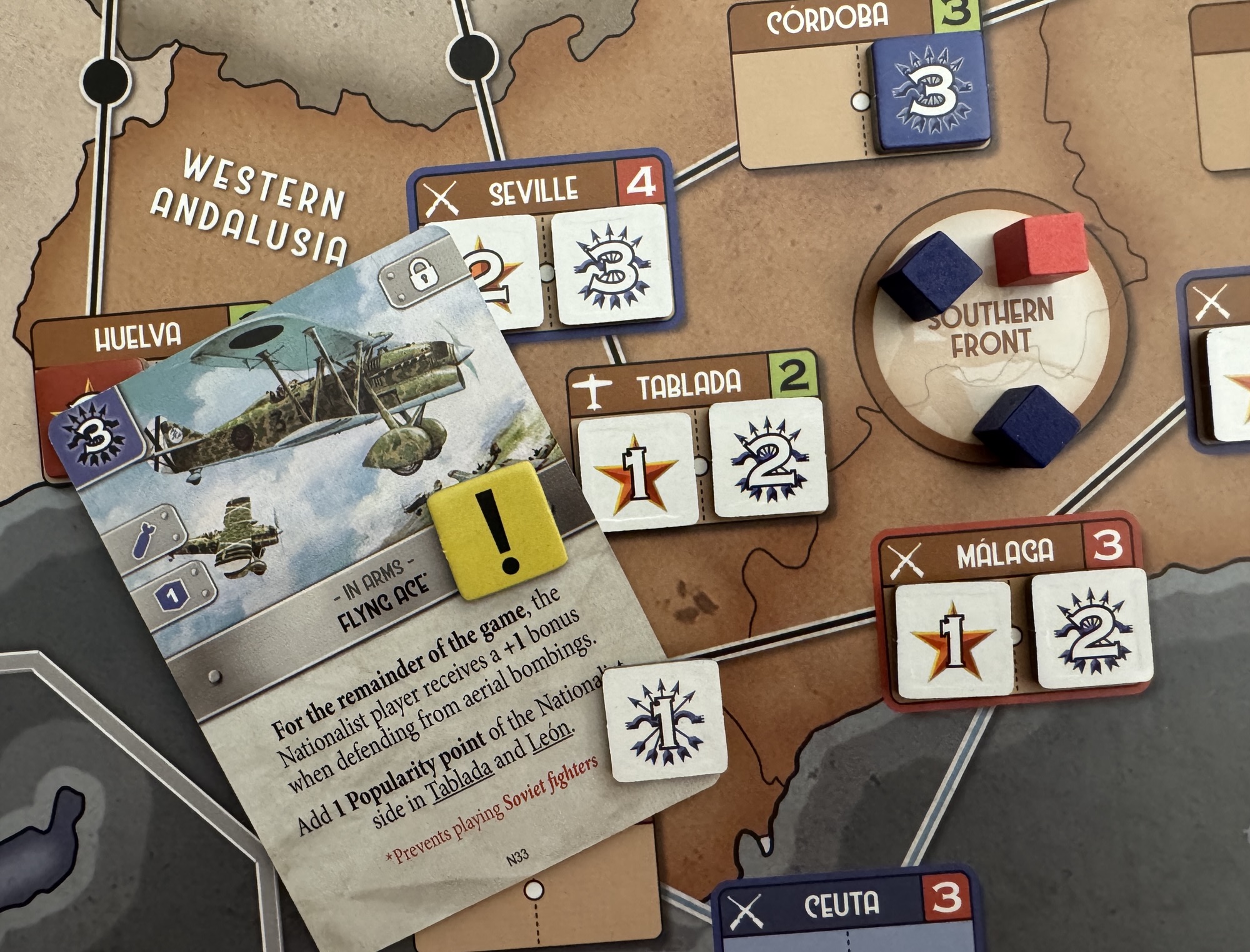
My Favorite Wargame Cards – A Look at Individual Cards from My Favorite Games – Card #95: Flying Ace from The Republic’s Struggle: Battle for the Republic, Spain 1931-1939 from NAC Wargames

Von: Grant
22. September 2026 um 14:00

With this My Favorite Wargame Cards Series, I hope to take a look at a specific card from the various wargames that I have played and share how it is used in the game. I am not a strategist and frankly I am not that good at games but I do understand how things should work and be used in games. With that being said, here is the next entry in this series.

#95: Flying Ace from The Republic’s Struggle: Battle for the Republic, Spain 1931-1939 from NAC Wargames

The Republic’s Struggle is a thematic Card Driven Game that tells the story of the historical events that took place in Spain after the resignation to the throne of King Alfonso XIII, and the proclamation of the II Spanish Republic in 1931. With the creation of the new regime, the struggle for power between the different social, political and ideological sectors increased, which gave rise to continuous changes of political power, alterations of public order, armed uprisings and violent acts, carried out by the numerous ideological factions of the moment; which culminated in 1936, in a failed military uprising. The failure of this coup d’état was the origin for the Spanish Civil War.

The Republic’s Struggle is based on Twilight Struggle from GMT Games and uses the same concepts of area control while adding in some actual combat with units represented on the board. During the game, the Republican player and the National player, will be able to recreate events of the period to increase their popularity in the localities by carrying out political propaganda, recruiting troops or militias, generating revolts or assaults, establishing diplomatic relations or carrying out bombardments. All this will be done by playing their hand of cards in an alternative way, either by using the events or by playing the action points or icons to perform any of the other actions available to the players.

As you probably know, the Spanish Civil War was a bloody and vicious affair. With the advent of air planes and advancement of other weapons technology there was no army that couldn’t be touched. In The Republic’s Struggle players can use their cards and Operation Points to perform an aerial bombing on enemy units that are found on the various fronts. The Bombardment Process is executed by spending the Operation Points (OP’s) of a card, provided the card features a special bomb icon in the upper left hand corner near the Op Points. If a card displays both a bomb icon and a combatant cube icon, you may only choose to execute one of the options and not both. These Bombings target combatants located in specific Fronts, which are represented by circular spaces where army cubes may be placed through card play. In order to perform an aerial bombing, the player must have control of n Air Base Location on the Front that they wish to attack. The attacking player will add the Operation Points of the card played and adds a D6 while the defender will also roll a D6 but will add in the Defense Value that was determined at the outset of the turn by the play of a card and +1 for each of their cubes in the Front. If they have played a card such as Flying Ace, they will get to add a +1 to this total and then results are compared and a winner is determined and losses are the difference between the Attack and Defense Value.

That is the real power in the Flying Ace card as this +1 can be a huge boon in these aerial bombings and allow them to put up a stiffer defense and hold onto more of their units on these Fronts. The game instructs players to utilize the Exclamation Point markers to remind themselves of these type of benefits as the player should place the played card in front of them with the marker to be able to remember the benefit later in that turn.

But the Flying Ace Card provides another smaller but important benefit as it allows the Nationalist player to place 1 Popularity Point in Tablada and León to continue to build their influence and control of these key regions for scoring purposes. And finally, another benefit is that the play of the Flying Ace Card will prevent the Republican player from being able to play their Soviet Fighters Card which has a similar benefit. The thinking here is that the first player to get this card out controls the skies and has air superiority.

Aerial bombing during the Spanish Civil War marked a dark turning point in military history, serving as a lethal testing ground for the aerial terror tactics later unleashed in World War II. An estimated 15,000 people died from air raids during the conflict, with the vast majority of victims being civilians targeted by Nationalist forces backed by Nazi Germany and Fascist Italy. One of these horrific events was that of the Bombing of Guernica on April 26, 1937. Carried out by Nazi Germany’s Condor Legion and Fascist Italy’s Aviazione Legionaria, this raid destroyed a massive portion of the Basque town and killed hundreds of civilians. It became the ultimate global symbol of the brutality of war, immortalized by Pablo Picasso’s famous painting Guernica.

In the next entry in this series, we will take a look at Henry Knox Continental Artillery Commander from Washington’s War from GMT Games.

-Grant

History Behind the Cards – A Look at Checkpoint Charlie from GMT Games – Card #7: Ich Bin Ein Berliner

Von: Grant
17. September 2026 um 14:00

I love a different style and focus of wargame. A game that takes a look at an important but somewhat obscure or rarely addressed historical topic, such as espionage or intelligence, and creates a gaming experience tailored around the events to highlight and evoke the difficulties and tension that would have been present. In January 2026, GMT Games announced such a game in Checkpoint Charlie, which is a solo or cooperative game focused on SIS espionage missions in Berlin in the 1960’s designed by Russell Brown. We have posted an interview with Russel and it was very well received and he has now agreed to create a series of History Behind the Cards to highlight the events of the 1960’s Cold War struggle in West Germany but also to share aspects about the game play and how it models the history.

*Note: The cards highlighted in this series and their event text, as well as any pictures used showing any of the various components, are still in the design and development process and as such event effects and text might still change prior to final development and publication. Also the art and layout of the cards are only for playtest purposes at this point and the game will enter the art department as it nears publication.

History Behind the Cards – Checkpoint Charlie from GMT Games – Card #7: Ich Bin Ein Berliner

In the summer of 1963, the Berlin Wall had been in place for almost two years, the reality of a city split between east and west, between Soviet and Western influence, was impossible to deny. Politicians, military leaders, and the people living day-to-day in Berlin continued to argue about the lack of forceful response from the west, particularly the Americans, when the wall went up. Other than a modest buildup of US forces within and around the city, there had been precious little action to re-assure the people of Berlin that the west hadn’t abandoned them.

In June of that year, President Kennedy hoped to change that perception by personally visiting this western city in the center of Soviet-controlled East Germany. He received the reception and the reaction he was hoping for, driving through the city to crowds of cheering West Berliners, and giving his famous speech on the steps of the Rathhaus Shöneberg to a gathered crowd of over one hundred thousand. In a calculated risk, he referred to the city as West Berlin, officially acknowledging the split created by the wall. He introduced his “Fellow Americans” and at the mention of General Clay (Card #6), the crowd interrupted the speech for some heartfelt cheering for the man that saved their city during the Berlin Airlift. Kennedy’s famous line of solidarity, “Ich bin ein Berliner,” — I am a Berliner — came at the end of the speech and may have been a bit off-script.

So how would Kennedy’s speech affect a mission in Checkpoint Charlie? I’m going to answer that with a story.

I spend a lot of time at a wonderful coffee shop near my home, so much time that my iPhone has labeled the location as my “work.” The baristas there know me, and one day one of them asked me what I was working on. “Right now,” I said, I’m working on a board game about spies in Berlin in the 60’s.”

He laughed. “Have you met John?” He pointed to an older customer at one of the tables. “He was a spy in Berlin in the 60’s.”  It was true.

Since then, I’ve had many conversations with John about his time in Berlin. He was Army Intelligence, keeping track of what was going on in the city. He was there when the wall went up. He interviewed the refugees that, for a time, still managed to find a way into West Berlin. And he was there during Kennedy’s speech.

I asked him about the speech and said that in the game it resulted in crowds (a Demonstrations marker) near Tempelhof. He shook his head. “Everywhere. Crowds everywhere. All over the city.”

I’m sorry to report that I’ve restrained the effects of this card and the speech for gameplay reasons, but I haven’t ignored John in every case. The Daily Military Train event (Card #9) exists solely because of his stories, and after removing the Refugees event (Card #13) from the game because I assumed the flow of refugees disappeared after the wall went up, I put it back in because John assured me that they were still coming – he had met and interviewed hundreds of them.

In the next article in this series, we will take a look at the ongoing propaganda efforts from both sides of the Berlin Wall with Loudspeaker Wars.

In my opinion, this game looks extremely interesting and I am very much excited to learn more about it. I am appreciative to Russell and his efforts to bring us these cards and to write these entries to share with our readers. I am also very glad that this topic is being covered in a game and look forward to playing this one day soon.

We published an interview with the designer Russell Brown on the blog and you can read that at the following link: https://theplayersaid.com/2026/02/23/interview-with-russell-brown-designer-of-checkpoint-charlie-from-gmt-games/

You can catch up on the posts in this series to date by following the below links:

Card #1: Cousins Operation

Card #2: Cuban Missile Crisis

Card #3: Demonstrations

Card #4: Faceoff with the Soviets

Card #5: Berlin Film Festival

Card #6: General Clay Steps In

If you are interested in Checkpoint Charlie, you can pre-order a copy for $48.00 from the GMT Games website at the following link: https://www.gmtgames.com/p-1211-checkpoint-charlie.aspx

-Grant

History Behind the Cards – A Look at Checkpoint Charlie from GMT Games – Card #6: General Clay Steps In

Von: Grant
03. September 2026 um 14:00

I love a different style and focus of wargame. A game that takes a look at an important but somewhat obscure or rarely addressed historical topic, such as espionage or intelligence, and creates a gaming experience tailored around the events to highlight and evoke the difficulties and tension that would have been present. In January 2026, GMT Games announced such a game in Checkpoint Charlie, which is a solo or cooperative game focused on SIS espionage missions in Berlin in the 1960’s designed by Russell Brown. We have posted an interview with Russel and it was very well received and he has now agreed to create a series of History Behind the Cards to highlight the events of the 1960’s Cold War struggle in West Germany but also to share aspects about the game play and how it models the history.

*Note: The cards highlighted in this series and their event text, as well as any pictures used showing any of the various components, are still in the design and development process and as such event effects and text might still change prior to final development and publication. Also the art and layout of the cards are only for playtest purposes at this point and the game will enter the art department as it nears publication.

History Behind the Cards – Checkpoint Charlie from GMT Games – Card #6: General Clay Steps In

US General Lucious D. Clay was appointed as military governor of the United States zone of Berlin from 1945 until 1949. He was best known, especially to the people of Berlin, as the person responsible for the Berlin Airlift, which fed and supplied the people of Berlin from the air when the Soviets cut off all access to the city for eleven months, from June 1948 to May 1949. Without the airlift, the west would have been left with two terrible options – allow West Berlin to be starved into submission and annexation, or invade East Germany to open a supply corridor, almost certainly starting an all-out war with the Soviets.

In the early 1960’s, US President Kennedy turned to the now retired General Clay and called on him to deal with serious issues that arose in Berlin, like the faceoff between tanks at Checkpoint Charlie (card #4). Clay understood Berlin and had the respect of its people, so Kennedy brought him along on his famous visit to the city, during which the president gave his “Ich bin ein Berliner” speech (card #7).

The General Clay Steps In card in Checkpoint Charlie represents the retired general being sent by Kennedy to resolve issues in West Berlin. Playing the card removes an event marker from the city and is the only way many of the event markers can be removed during a mission. It is especially useful for removing the Faceoff marker or a troublesome Stasi Stakeout.

In the next article in this series, we will take a look at Ich bin ein Berliner Speech by President John F. Kennedy.

In my opinion, this game looks extremely interesting and I am very much excited to learn more about it. I am appreciative to Russell and his efforts to bring us these cards and to write these entries to share with our readers. I am also very glad that this topic is being covered in a game and look forward to playing this one day soon.

We published an interview with the designer Russell Brown on the blog and you can read that at the following link: https://theplayersaid.com/2026/02/23/interview-with-russell-brown-designer-of-checkpoint-charlie-from-gmt-games/

You can catch up on the posts in this series to date by following the below links:

Card #1: Cousins Operation

Card #2: Cuban Missile Crisis

Card #3: Demonstrations

Card #4: Faceoff with the Soviets

Card #5: Berlin Film Festival

If you are interested in Checkpoint Charlie, you can pre-order a copy for $48.00 from the GMT Games website at the following link: https://www.gmtgames.com/p-1211-checkpoint-charlie.aspx

-Grant

History Behind the Cards – A Look at Checkpoint Charlie from GMT Games – Card #5: Berlin Film Festival

Von: Grant
20. August 2026 um 14:00

I love a different style and focus of wargame. A game that takes a look at an important but somewhat obscure or rarely addressed historical topic, such as espionage or intelligence, and creates a gaming experience tailored around the events to highlight and evoke the difficulties and tension that would have been present. In January 2026, GMT Games announced such a game in Checkpoint Charlie, which is a solo or cooperative game focused on SIS espionage missions in Berlin in the 1960’s designed by Russell Brown. We have posted an interview with Russel and it was very well received and he has now agreed to create a series of History Behind the Cards to highlight the events of the 1960’s Cold War struggle in West Germany but also to share aspects about the game play and how it models the history.

*Note: The cards highlighted in this series and their event text, as well as any pictures used showing any of the various components, are still in the design and development process and as such event effects and text might still change prior to final development and publication. Also the art and layout of the cards are only for playtest purposes at this point and the game will enter the art department as it nears publication.

History Behind the Cards – Checkpoint Charlie from GMT Games – Card #5: Berlin Film Festival

Every summer since 1951, Berlin had hosted the international Berlin Film Festival (the Berlinale) and awarded the Golden Bear to the best film in each of five categories. Venues in both East and West Berlin were used for screening of films. As summer approached in 1962, Berlin found itself cut in two by the Berlin Wall amid growing tensions between East and West. It seemed there were any number of events that could trigger a war over the city. And yet, the Film Festival was held, entirely in West Berlin this time. The festival drew thousands of visitors to the city, including Hollywood stars like Jimmy Stewart and Tony Curtis. Screenings took place in venues throughout the city and, we can assume, brought a much-needed sense of normalcy and continuity to the residents of West Berlin and perhaps a sense of what was lost to those in the east.

The festival took place every year throughout the Cold War, and after reunification it once again began film screenings in the former East Berlin. The festival continues and this year the Golden Bear award for best film went to “Yellow Letters.”

The Berlin Film Festival card in Checkpoint Charlie assumes the Berlin Hilton is full up with visitors and cannot function as a Honey Trap. The card also assumes that the extra traffic in the city, including thousands of additional pedestrians trying to get a glimpse of celebrities, negates any Ongoing Card Effects that allow additional movement during the Movement step.

In the next article in this series, we will take a look General Clay Steps In as he is appointed by President Kennedy to resolve issues in West Berlin.

In my opinion, this game looks extremely interesting and I am very much excited to learn more about it. I am appreciative to Russell and his efforts to bring us these cards and to write these entries to share with our readers. I am also very glad that this topic is being covered in a game and look forward to playing this one day soon.

We published an interview with the designer Russell Brown on the blog and you can read that at the following link: https://theplayersaid.com/2026/02/23/interview-with-russell-brown-designer-of-checkpoint-charlie-from-gmt-games/

You can catch up on the posts in this series to date by following the below links:

Card #1: Cousins Operation

Card #2: Cuban Missile Crisis

Card #3: Demonstrations

Card #4: Faceoff with the Soviets

If you are interested in Checkpoint Charlie, you can pre-order a copy for $48.00 from the GMT Games website at the following link: https://www.gmtgames.com/p-1211-checkpoint-charlie.aspx

-Grant

History Behind the Cards – A Look at Checkpoint Charlie from GMT Games – Card #4: Faceoff with the Soviets

Von: Grant
06. August 2026 um 14:00

I love a different style and focus of wargame. A game that takes a look at an important but somewhat obscure or rarely addressed historical topic, such as espionage or intelligence, and creates a gaming experience tailored around the events to highlight and evoke the difficulties and tension that would have been present. In January 2026, GMT Games announced such a game in Checkpoint Charlie, which is a solo or cooperative game focused on SIS espionage missions in Berlin in the 1960’s designed by Russell Brown. We have posted an interview with Russel and it was very well received and he has now agreed to create a series of History Behind the Cards to highlight the events of the 1960’s Cold War struggle in West Germany but also to share aspects about the game play and how it models the history.

*Note: The cards highlighted in this series and their event text, as well as any pictures used showing any of the various components, are still in the design and development process and as such event effects and text might still change prior to final development and publication. Also the art and layout of the cards are only for playtest purposes at this point and the game will enter the art department as it nears publication.

History Behind the Cards – Checkpoint Charlie from GMT Games – Card #4: Faceoff with the Soviets

On August 13th, 1961, in a dramatic move to stop the flow of millions of East Germans defecting to the West, East German police placed miles of barbed wire overnight, cutting off access between East and West Berlin and catching the western powers by surprise. It wasn’t clear what the response of the west would be, and whether it would ultimately lead to the war with the Soviets that many people felt was inevitable.

For days there seemed to be no reaction. West Berlin and Mayor Willie Brandt looked to U.S. President Kennedy to respond quickly and forcefully to the wall, but U.S. troops in Berlin made no move to intervene. Instead, on August 16th, Kennedy sent Vice President, Lyndon Johnson, and General Lucious Clay (more about him on card #6) to deal with the situation. At the same time, he ordered the U.S. 18th Infantry regiment in West Germany to cross East Germany on the autobahn to Berlin, along the access corridor established by the Potsdam Conference. The troops came equipped for battle and paraded through the streets of West Berlin with Johnson and General Clay. This showed U.S. support for Berlin, but did nothing to remove the wall, which quickly turned from barbed wire to concrete.

Over the next two months, disputes arose over the rights of French, British and U.S. troops to travel in the Soviet sector of Berlin, which were also established by the Potsdam Agreement. Tensions came to a head when a U.S. diplomat was stopped at Checkpoint Charlie while crossing into East Berlin. On October 27th, after heated exchanges, mostly between the Soviet Commandant and General Clay, Clay attempted to send another diplomatic mission through Checkpoint Charlie, this time accompanied by ten jeeps full of American soldiers, with ten U.S. tanks in reserve back in West Berlin. The crossing succeeded, but the Soviets responded by sending ten of their own tanks right up to the Checkpoint Charlie crossing. The U.S. tanks moved up to face them.

The standoff lasted nearly a full day, with the tanks and soldiers facing each other, ready for battle. Kennedy and Khrushchev managed to negotiate a resolution and the Soviet tanks pulled back slightly first (presumably because they had moved up to the border first), then the U.S. tanks pulled back. This gradual retreat alternated until the faceoff was at an end and traffic through the checkpoint resumed.

The Faceoff with the Soviets card in Checkpoint Charlie places a Faceoff marker in the Checkpoint Charlie location, which prevents any assets and KGB agents from entering this location during the Movement step of the turn (though some played card effects still allow this). This marker can only be removed by the General Clay Steps In event (card #6).

In the next article in this series, we will take a look at Berlin Film Festival and how its effect caused some issues with various locations operating as Honey Traps about the city.

In my opinion, this game looks extremely interesting and I am very much excited to learn more about it. I am appreciative to Russell and his efforts to bring us these cards and to write these entries to share with our readers. I am also very glad that this topic is being covered in a game and look forward to playing this one day soon.

We published an interview with the designer Russell Brown on the blog and you can read that at the following link: https://theplayersaid.com/2026/02/23/interview-with-russell-brown-designer-of-checkpoint-charlie-from-gmt-games/

You can catch up on the posts in this series to date by following the below links:

Card #1: Cousins Operation

Card #2: Cuban Missile Crisis

Card #3: Demonstrations

If you are interested in Checkpoint Charlie, you can pre-order a copy for $48.00 from the GMT Games website at the following link: https://www.gmtgames.com/p-1211-checkpoint-charlie.aspx

-Grant

❌