❌

Normale Ansicht

Game Store Day gets more time, more publishers – and bigger ambitions – for year two

01. Oktober 2026 um 16:09

Editor’s note: GAMA is a BoardGameWire sponsor, and has advertised Game Store Day on the site – but this article is not a paid placement, I just think it’s interesting enough to cover editorially!

Game Store Day, GAMA‘s annual initiative aimed at getting more people into local game stores to play, shop and take part in events, is growing for its second year after retailers and publishers were given substantially more time to prepare than for its debut.

Almost 300 retailers are currently signed up for this year’s Game Store Day on November 7, while nearly 60 tabletop publishers have committed games to a new promotional box, as GAMA looks to establish the event as a long-term fixture on the tabletop industry calendar.

GAMA board member and Red Raccoon Games owner Jamie Mathy told BoardGameWire that rising retailer participation was the clearest measure of success for Game Store Day at this stage, with this year’s 297 sign-ups already ahead of last year’s total with over a month to go.

But he believes there is scope for the event to grow significantly bigger in future years – and said GAMA had already learned lessons from 2025’s relatively short-notice launch.

He said, “Last year, Game Store Day was something [GAMA’s] Team Retail had been advocating for, and then suddenly it was announced and launched with less than eight weeks to prepare. That wasn’t enough time for a lot of retailers to really build it into their calendars or plan meaningful events around it.

Game Store Day 2025 at Games Unlimited in Pittsburgh

“This year stores have had roughly four months to prepare, and we’ve had substantially more time to bring publishers into the program. The Publisher’s Box and other publisher initiatives give retailers additional reasons and tools to build something around the day.

“I think we’ll learn from this year as well. Ideally, I’d like stores and publishers to have even more lead time in future years.”

He added, “There are estimates of roughly 5,000 hobby game stores across North America. If we could eventually get 500 stores participating, that’s approximately 10% penetration and I would consider that a tremendous accomplishment. Getting to 1,000 stores – roughly 20% – would be amazing, even if that’s an ambitious long-term goal.

“More importantly, numbers like that would demonstrate to publishers and retailers that Game Store Day isn’t a one-time novelty. It’s something that has become part of the industry’s calendar.

“There’s a comparison to Free RPG Day here. It started relatively small, retailers can purchase a box of promotional products if they want those materials for their customers, and over time it has become something stores and consumers recognize.

“But ultimately, the part that excites me isn’t the box or even a particular participation number. It’s seeing hundreds of independent stores across the country celebrating our industry on the same day and giving people a reason to come together and play games.”

The short notice for last year’s launch left no time to run a Publisher’s Box – but 59 publishers including Leder Games, CGE, Blue Orange, Capstone Games and Bezier Games have agreed to contribute this year, with another four waiting to take part and others having approached GAMA after submissions had closed.

Publishers contributing to this year’s Publisher’s Box for Game Store Day

The $179 box will contain games, demos, promotional items and other material for participating stores – and Mathy said physical weight and shipping limits had now become the main constraint on adding more publishers.

“Probably, and that’s a wonderful problem to have,” Mathy said when asked whether GAMA would eventually need to rethink how publishers participate if interest continues to grow.

“This is only year two and the first year we’ve even offered a Publisher’s Box. Let’s learn from what works and what doesn’t this year.

“But if publisher interest continues growing, we’ll obviously need to think creatively about how publishers participate rather than assuming everything always has to fit into one physical box.”

Publishers are also beginning to build their own initiatives around the event aside from the promotional box.

Allplay is making 4,900 copies of new game Woo available exclusively to retailers participating in Game Store Day, with COO Joe Wiggins saying, “Allplay has been looking for new ways to work closer with our brick and mortar partners. When GAMA announced Game Store Day, we knew this would be an amazing opportunity. Allplay is all in.”

Mathy told BoardGameWire he believed part of the publisher interest was the difficulty some have in reaching hobby game retailers.

He said, “Game stores are incredibly diverse. We have different ownership styles, different product mixes, different customer bases and very different areas of specialization.

“Red Raccoon, for example, goes much deeper into board games and RPGs than many stores do, and that’s part of what has made us a regional destination. Another successful game store may have a completely different mix.

“That fragmentation makes it difficult for publishers to know where to spend their marketing dollars if they’re trying to get a product in front of retailers.

“Game Store Day gives them a self-selecting group of engaged retailers. A store willing to spend $179 on a box without knowing exactly what will be in it, because they believe in the idea and intend to build an event around it, is probably a pretty attractive audience for a publisher trying to get its products noticed.”

The increased publisher involvement brings Game Store Day closer to events such as Record Store Day – which GAMA has cited as an inspiration – where exclusive products, offers and other incentives have become part of the draw for customers.

But Mathy said, “I don’t personally think Game Store Day needs to become Record Store Day for games. The Publisher’s Box is a great addition, but to me it’s a bonus rather than the purpose of the event.

“I participated last year with essentially an idea, a logo and a store-locator website, and we had 35 people come specifically for our Game Store Day events.

“At its core, I think this should be a day when we celebrate local game stores, bring people together and play games. Publisher exclusives and promotional items can absolutely help stores make the day special, but they aren’t the reason Game Store Day exists.”

That vision has been taken up by participating stores including Oddwillow’s Game Haven in Wisconsin, which is partnering with its local library for activities including button-making, storytimes, miniature painting and game demos.

Gamers taking part in Game Store Day 2025 at Oddwillow’s Game Haven in Wisconsin

Pennsylvania’s Lookin’ For Games, meanwhile, is combining its first Game Store Day with game demos and a special Blood on the Clocktower event with a 24-hour gaming fundraiser for Extra Life benefiting Children’s Hospital of Philadelphia.

Neil Goldberg, the owner of the New York-based Main St Board Game Cafe, said the event was a chance to focus customers on the experience offered by their local game store while also encouraging people to think of board games as gifts ahead of the holiday season.

Mathy said, “GAMA provides the umbrella, publishers can provide additional support, but individual stores make Game Store Day their own and use it to celebrate the communities they’ve built around games.”

The post Game Store Day gets more time, more publishers – and bigger ambitions – for year two first appeared on .

My Favorite Wargame Cards – A Look at Individual Cards from My Favorite Games – Card #92: Castelnau and Voie Sacrée from Verdun 1916: Steel Inferno from Fellowship of Simulations

Von: Grant
02. September 2026 um 14:00

With this My Favorite Wargame Cards Series, I hope to take a look at a specific card from the various wargames that I have played and share how it is used in the game. I am not a strategist and frankly I am not that good at games but I do understand how things should work and be used in games. With that being said, here is the next entry in this series.

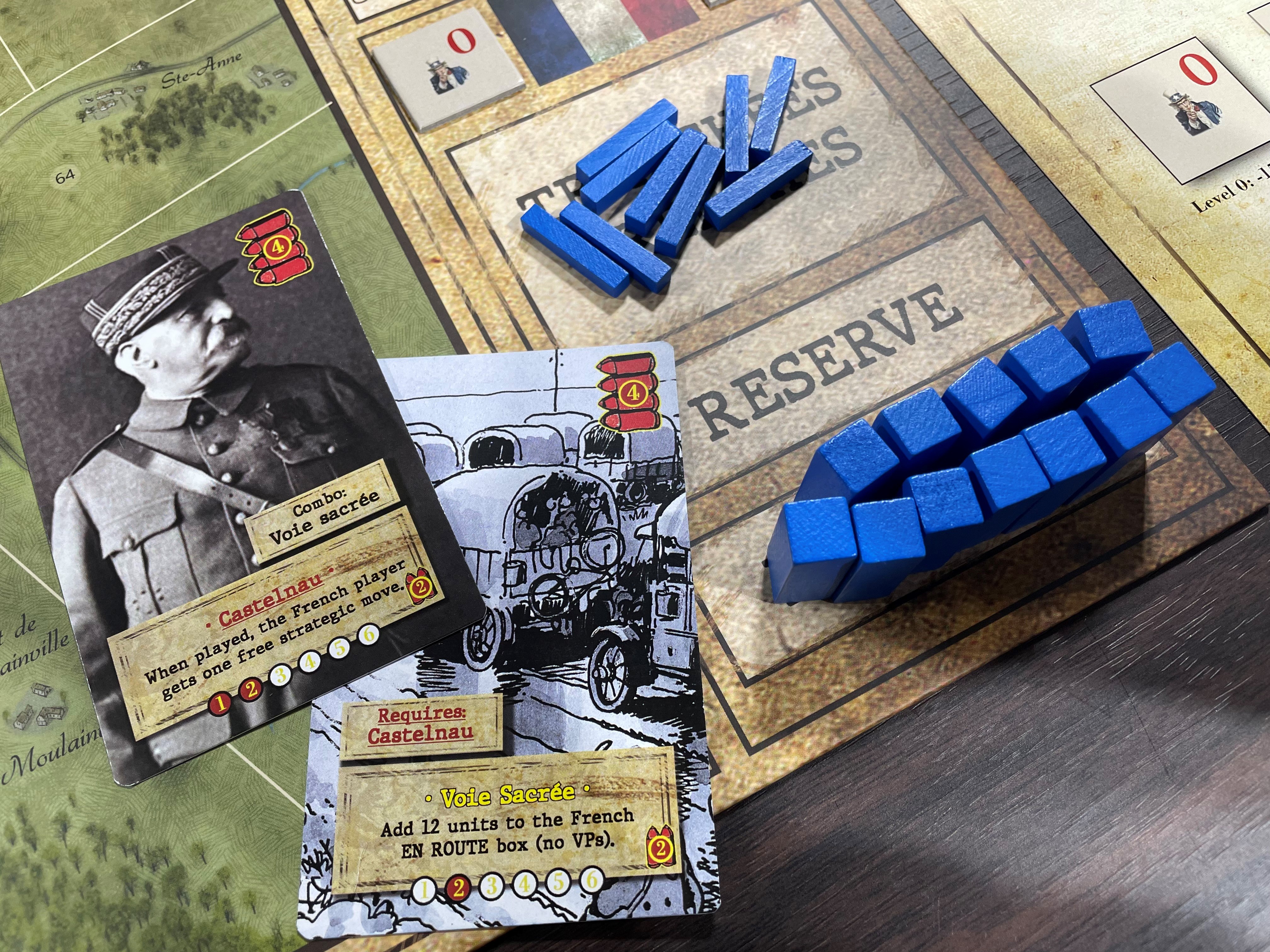
#92: Castelnau and Voie Sacrée from Verdun 1916: Steel Inferno from Fellowship of Simulations

Over the past several years, we have played quite a few World War I games with our focus on the Guns of August events every summer. We have really played some fantastic games including some of the true classics on the genre such as Paths of Glory from GMT Games and The Lamps are Going Out from Compass Games but also some real hidden gems like At All Costs from Hollandspiele, Devil Dogs from Worthington Publishing and Decisive Victory 1918: Soissons from Legion Wargames. A game that we very much liked was Verdun 1916: Steel Inferno from Fellowship of Simulations. The game is a Card Driven Game that uses cards with events and operation points to tell the grim story of the year long fighting around the French city of Verdun. The game uses a bucket of dice approach to the initial bombardments in a battle and then players choose whether to follow that with an infantry assault that doesn’t use any dice to determine hits. The game is very much a wargame but I think the cover highlights a key fact about the game by calling it a “Strategy Game” namely that it is a game as there are wildly powerful events based in history, with lots of dependence on dice not just for bombardments but also for playing certain offensives Event Cards where Victory Points are earned based on the higher numbers rolled. The game is very well done, is truly interesting and surprisingly deep with its tactical choices and decisions. 

Some cards cannot be played as an Event until a specific named card has been played by the player. This is indicated on the card with a small “requires” box above the title of the card which shows the card that must already be in play as a Permanent Event to allow the new event to be triggered. Also, these Required Cards also have a small “combo” box above the title of the card to remind players which card they will allow to be played as a Permanent Event. Sometimes this concept of Combos must be planned for and may take a few rounds to get lined up to be able to play.

A perfect example of this is the Castelnau/Voie Sacrée Combo. Castelnau is an Event Card that must be played down on the table as a Permanent Event and is available during Turns 1 and 2. Once it is played, then that unlocks the play of Voie Sacrée and allows a very powerful Combo to go into effect by allowing the French player to place 12 units into the En Route Box on the board meaning they will be available for placement during the next Turn. This is so very powerful as in order to get that many units to use, the French player has to sacrifice a total of 12 VP (1 VP per unit added as Reinforcements). With this Combo, you sacrifice no VP’s and get 12 units to place on the board to plug the inevitable holes that will be created by the powerful German Barrages and assaults. There are other Combos as well including several specified Offensives (Russian Offensives and the Somme Offensive) that take several Turns to accomplish with multiple cards to get an opportunity to roll dice to gain VP’s. This was a very novel idea for the CDG mechanic and really worked well to create some portion of the game that required planning and an investment.

The Voie Sacrée, which is French for Sacred Way or Sacred Road, is a road that connects Bar-le-Duc to Verdun, France. It was given its name because of the vital role it played during the Battle of Verdun in World War I. After March 1916, along the 45 miles of the Voie Sacrée, transport vehicles were on the move day and night, ferrying troops, armaments, and supplies to the Verdun battlefield. During the initial crisis of February 21st through March 22nd, 600 trucks per day had already delivered 48,000 tons of ammunition, 6,400 tons of other materiel and 263,000 men to the battlefield. Beginning on February 21st, all horse-drawn traffic and troop movements on foot had been ordered off the road, leaving it open for truck and motorcar traffic only. After March 1916, one truck passed every 14 seconds, submitting the road to considerable wear and tear. Quarries had to be opened nearby to supply the road with crushed stone. Over the course of ten months, 16 labour battalions worked to keep the road in good shape and order. The road had been recognised since 1915 as the only reliable vehicular road that remained in existence to supply Verdun safely. All the standard-gauge railway lines that could reach Verdun had already been interrupted by German forces in late 1914. To compensate for this precarious situation, the road had been widened to 23 ft during 1915, so it could accommodate the continuous up and down flow of two lines of truck traffic. This preemptive roadway improvement in 1915, plus success in organizing the transport system on the road (a mission supervised by Colonel Maurice de Barescut, the Chief of Staff of the French Second Army), is what ultimately saved Verdun in 1916.

The Voie Sacrée still exists, but it has been paved over and is now an active secondary road. In 2006, the route was renumbered RD1916, a reference to the road’s most critical year. From 1923, the Voie Sacrée was marked by a borne every kilometer along the route. Each borne is topped with a sculpture of an Adrian helmet, the helmet worn by French soldiers during the Battle of Verdun.

The town hall in the village of Souilly, on the Voie Sacrée, served as headquarters to Generals Philippe Pétain and Robert Nivelle during the Battle of Verdun. A large, well-preserved, two-story stone building fronting on the Voie Sacrée, the Souilly town hall is still in official use today. Several plaques on its facade remind the visitor of the historic role it played in 1916 during the Battle of Verdun and, later in 1918, during the Meuse–Argonne offensive.

In the next entry in this series, we will take a look at the German Home Card Otto von Bismarck from Imperial Elegy: The Road to the Great War 1850-1920 from VUCA Simulations.

-Grant

The Board Game Soapbox: House Rules? We Can Fix It!

What is the problem?

I love games. That statement should be an obvious truth, given that I regularly write for Meeple Mountain. Some of the games that I love have, over time, lost their luster. It is not that my tastes have shifted, or that I have joined the cult of the new. It is that, to some degree, the game has been solved, in the sense that they have a single dominant or obviously correct strategy.

If you were around in the first couple of months after Machi Koro came out, there were several people on the innerwebs (especially on BoardGameGeek) discussing the order in which you should purchase the properties. A couple of games after reading those articles and it was rather obvious they were right. Machi Koro has had some expansions over the years and managed some attempts to fix the issue (such as no longer showing all cards in the market). This created a slew of other issues. To their credit, Machi Koro 2 did move forward some.

If you enjoy the game Gizmos and you spend any time on Board Game Arena playing the people who are rated with a 300+ ELO, you will quickly find that there exists one and only one strategy employed by high-rated players. If you aren’t constantly focusing…

The post The Board Game Soapbox: House Rules? We Can Fix It! appeared first on Meeple Mountain.

Vantage Review – Wonderful wanderlust?

Von: Adam
20. Juli 2026 um 16:48

A review copy of Vantage was kindly provided by Stonemaier Games. Thoughts & opinions are my own. Vantage landed last year with a lot of hype behind it. Jamey Stegmaier’s baby, years in incubation, landed on tables with a heavy thump as grateful storks departed. The premise is huge. Vast even. Remarkably, Vantage manages to deliver on many of its lofty goals, but I think there’s a lot of…

Source

❌