Normale Ansicht

The Old King’s Annulment

03. März 2026 um 20:10

Want to dump your bride but don't want to ask the Pope? Annulet!

No need to bury the lede: as of this morning, The Old King’s Crown is now in funding for its second printing. If you haven’t read my review, the short version is that Pablo Clark’s debut design was a stunning achievement on every level.

Except, ambush!, there’s a second game afoot, and that’s the real target of my interest today. Included as an option for the crowdfunding campaign, Annulet is a card game that ostensibly exists within the broken realm of The Old King’s Crown. What is an annulet, you might ask? Short of being a legal way to divorce one’s spouse without God getting frumpy about it, an annulet is a little ring one might stick on a coat of arms or a pinkie toe. Exactly the sort of paraphernalia you might expect from the well-garbed folk of Clark’s faraway kingdom.

But is Annulet the sort of card game those selfsame weary warmongers would actually splay atop a knife-scored tavern slab? That’s the pressing question.

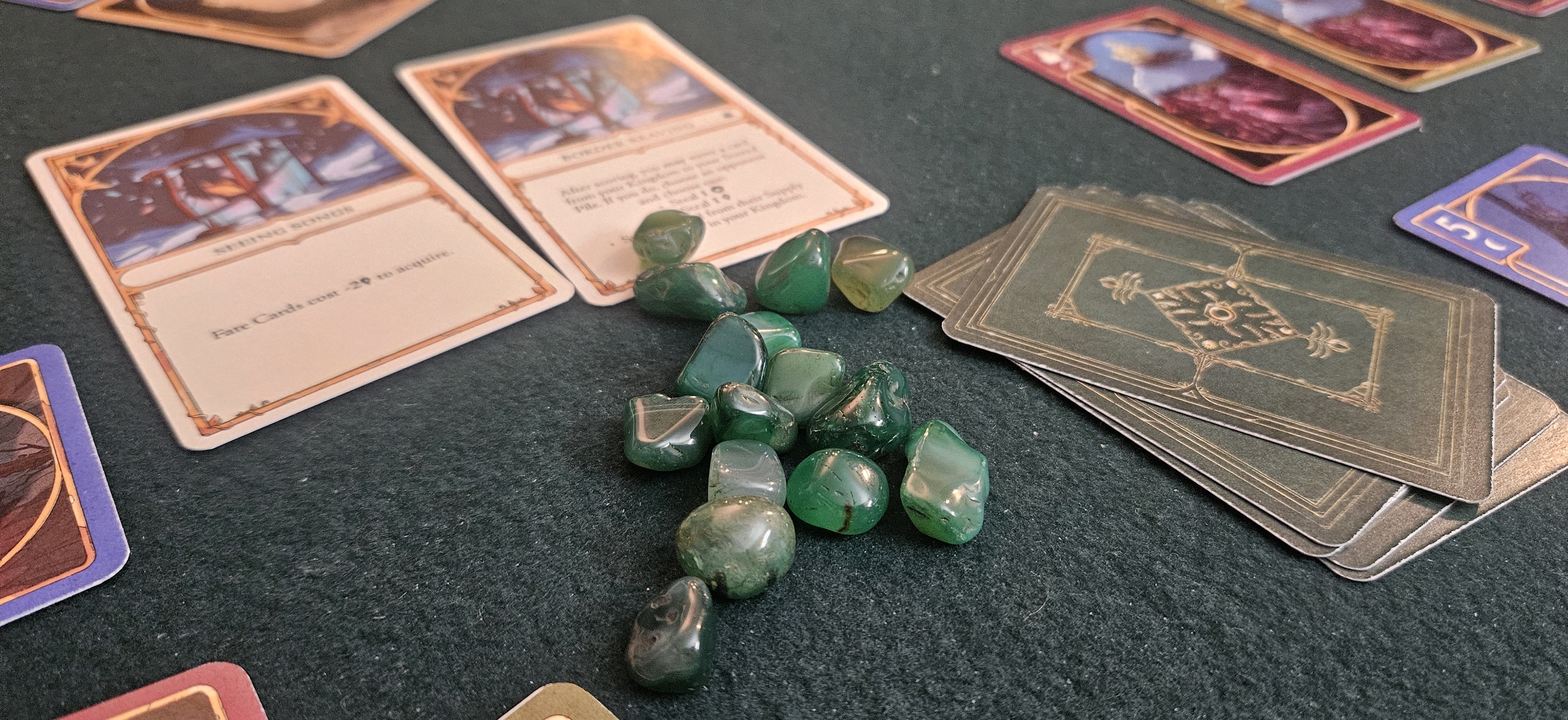
My kingdom is full of ghost animals.

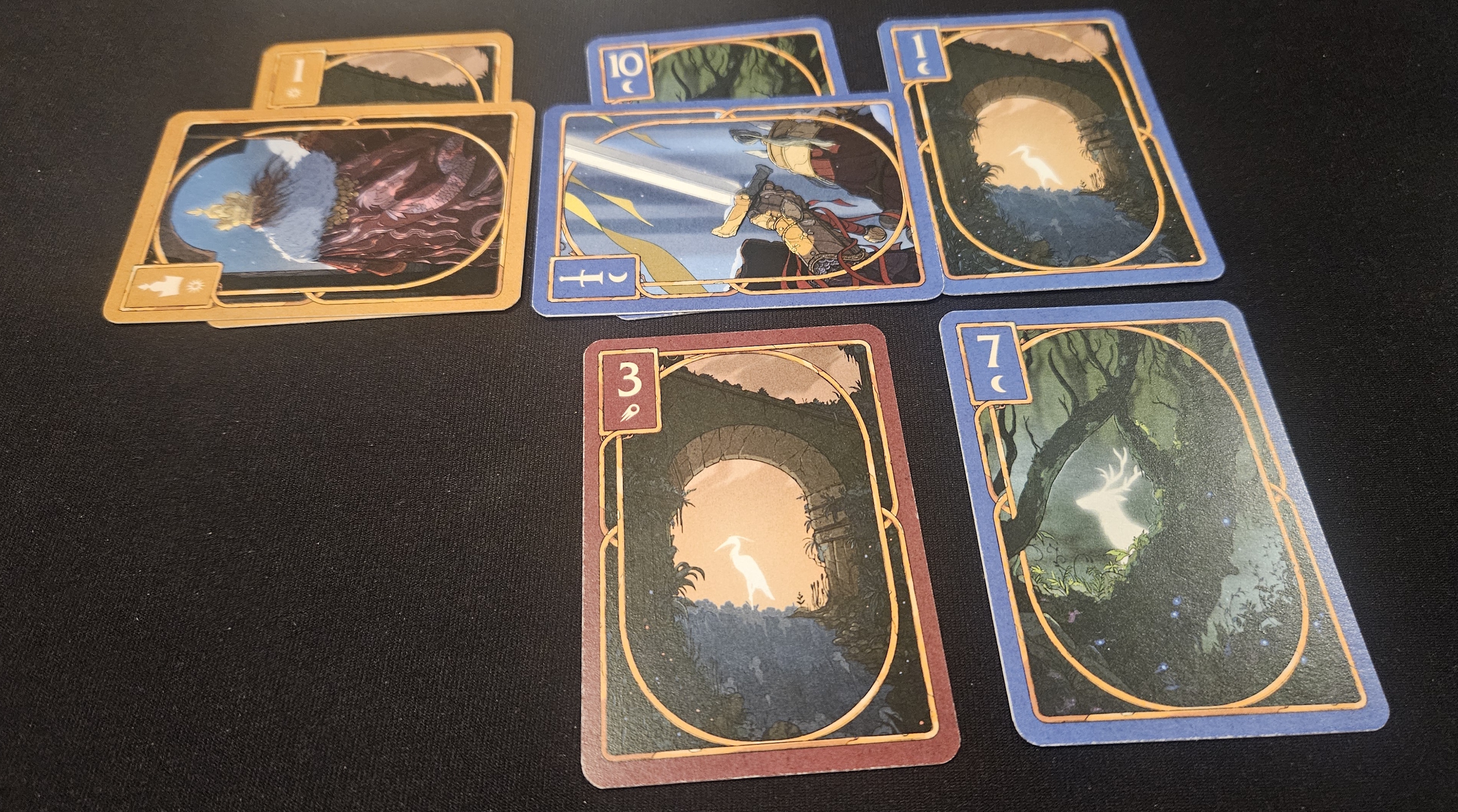
Cards are arranged on a three-by-three grid; score whenever you like!

At a glance, Annulet, like everything else in the world of The Old King’s Crown, is downright gorgeous. Also illustrated by Pablo Clark, even the prototype calls to mind a plate from a favorite childhood book of myths and tall tales, all enigmatic figures and crumbling aqueducts and mossy forests. Sure, it takes all of ten seconds to realize the game must have been designed with a regular deck of playing cards, given its four suits and face cards. So what? I can buy the notion that everything in Clark’s universe is just like ours but better illustrated.

To Clark’s credit, Annulet doesn’t play quite like anything else out there. At core it’s a market selection game. Every round begins with a few cards on offer, from which the players will draft some number into their supply.

How many cards? That’s surprisingly hard to answer thanks to the way Annulet morphs according to player count. While the rules don’t undergo any substantive changes when swapping from two players to three or four, its underlying ethos is so transformed that it becomes something fundamentally different. We’ll circle back around to this question. For now, the answer is “two cards with two players, but only one with three or four players.”

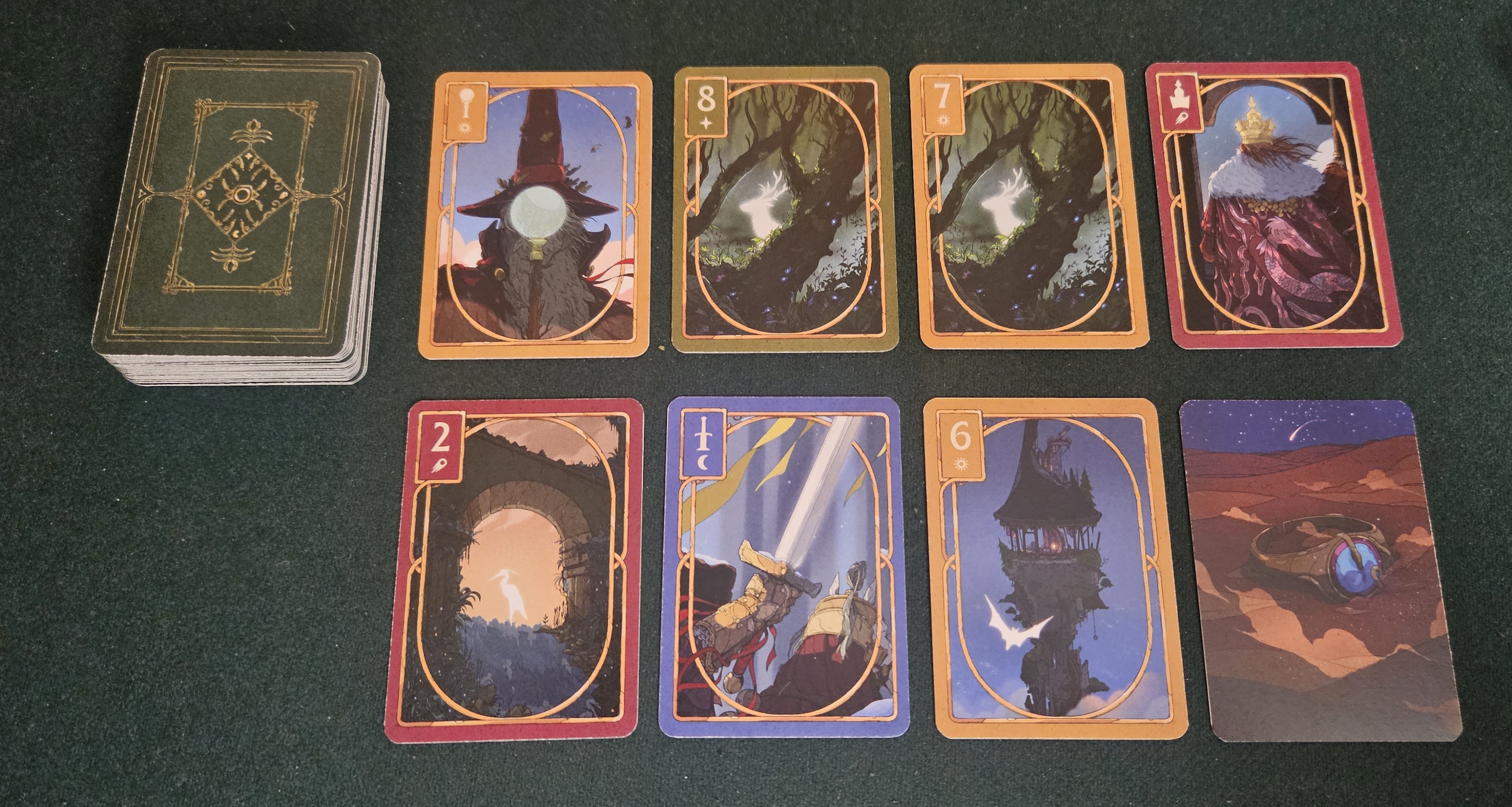
All right. So you take either one or two cards. These are added to your supply. From there, cards can be installed in your kingdom, which swiftly shapes into a three-by-three grid of lands and characters. In the short-term, cards in your kingdom are secure. Unlike those still in your supply, they cannot be stolen by upstart rivals. Thinking ahead a bit, your kingdom is also the basis of your scoring. At some future moment of your choosing, every row, column, and diagonal may form points-earning sets. The rarer the better.

Secret Insider Info: originally the game was called Signet. I'm not sure if I'm allowed to say more than that.

The market shows which cards are available now and later.

As befits Annulet’s heritage, it manages to feel simultaneously old and new. Old because it doesn’t stray far from any number of card-gathering and set-forming games of yore. There’s a comforting familiarity to its percentages, that instinctual understanding that a straight flush is rarer and therefore deserves more coins than three-of-a-kind. Unlike The Old King’s Crown, which was sometimes burdened by keywords and concepts and special abilities, Annulet holds its cards closer to our shared cultural vest.

But it feels new, too, thanks to more modern flourishes that make its cardplay more dynamic and open-ended than most tavern games. There’s the game’s currency, river stones that must be spent and even exchanged between players in order to install additional cards into one’s kingdom or swipe juicy offerings from a rival’s supply. There’s the way face cards are arranged atop lands to alter their values. In the case of magicians and knights, this means adjusting their host land’s suit or rank. Monarchs are even more potent, increasing the scoring value of any set they’re part of, and all the better if you can score them in multiple directions at once. At absolute best, a single monarch in the middlemost space of a kingdom can score four times. That’s rare, but it’s hardly impossible.

Crucially, these flourishes tell something of a story, or at least they gesture at the outlines of Clark’s fantasy world. Just as different trick-takers might speak to the sensibilities of those who played them historically, whether as domestic parlor games or the pastimes of naval officers padding their peacetime income, Annulet speaks to a kingdom that’s always reshaping itself. Monarchs come and go. Treasures are gathered and plundered. Violence is so matter-of-course that the apex of a kingdom is also its dissolution.

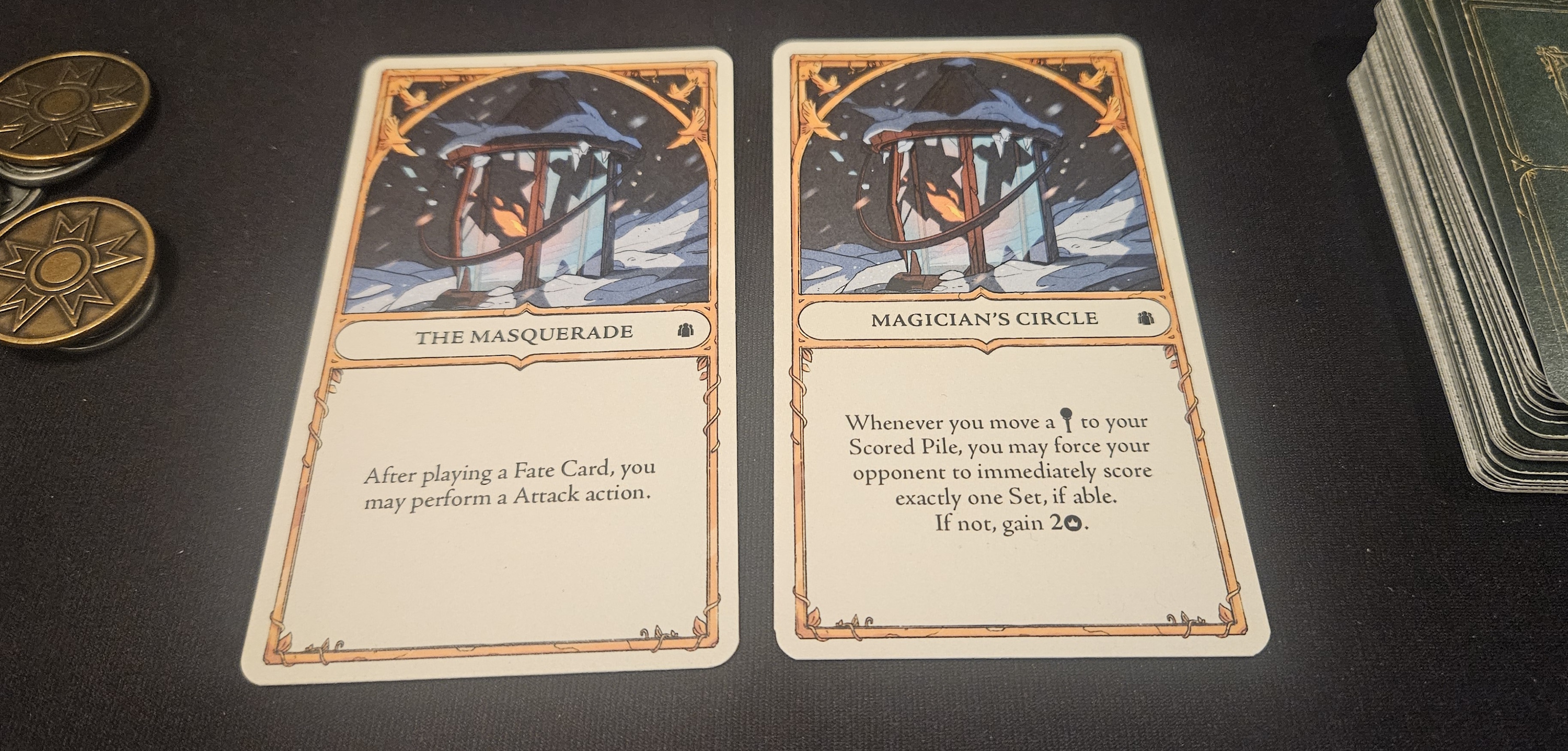
The smartest of Clark’s inclusions are the tale cards. Each session opens with players selecting a pair, whether by choice or at random. At a gameplay level, these are modifiers. Textually, they’re regional variations. One session might feature “the People’s Game,” scoring extra points for sets that sum to a small number, while the next revolves around “Border Reaving” that adds junk cards to opposing kingdoms. The effect isn’t dissimilar from the many small variations in trick-taking or shedding games, leaving the core rules intact but tweaking the game’s breadth. The result is a title that feels as large as the world Clark penned to contain it.

Will these all have original illustrations? That depends on how badly Pablo Clark wants to ruin his next few months.

Regional variations keep each session fresh.

This isn’t to say that Annulet escapes wholly unscathed, either as a plaything or within its internal fiction, and those scathings are largely interrelated. The short version is that the game is simply too permissive — in one sense, too modern — to pass muster as something that might appear in a military camp or dimly lit roadhouse.

First of all, the scoring is tremendously intrusive, often requiring an extended pause to sum up every one of a kingdom’s angles. On its own, this isn’t such a bad thing; we share a reality with Germans who play Schafkopf, so it isn’t as though real-world tavern games haven’t ever belabored their scoring to the point of madness. But where Annulet slips is through the inclusion of special cards called fates. Everybody begins with a few of these and can purchase more for a heap of river stones. From there, fates pull multiple duty. They potentially add to one’s score at the conclusion of the game, and can be spent to place trash into a rival’s kingdom, seize the all-important initiative marker for yourself, or enter your own kingdom as a wildcard.

It’s this latter function that gives Annulet its bagginess. A fate can function as anything: any card, whether land or nobility. But in scoring, it must adopt a single posture — not always the easiest thing to visualize when there are a full eight sets that might be assessed at any given moment — and the problem only compounds in kingdoms with multiple fate cards fulfilling many roles. Too often, Annulet hinges more on how permissively one employs their fates than how sharply they draft their kingdom.

This is a small complaint, but it’s small the way a pebble is small when caught inside one’s shoe. Annulet is too broad, failing to quite capture the sensation of playing and mastering a truly great tavern game, one defined as much by chance and limitation as by the range of things a player might accomplish on their turn. It’s like playing a trick-taker with a bunch of wilds; thrilling the first time you steal a trick, obnoxious when everybody’s doing it all the time.

Perhaps more pronounced, the game is a different beast depending on player count. It will probably surprise nobody to hear that it’s strongest at two players, which affords greater numbers of drafted cards and a tighter focus all around. Higher counts clutter the decision space a bit, especially where initiative and drafting are concerned, but three-player is charming in its own way. Annulet is at its strongest when it presents that razor-wire choice of which cards to draft and how to use them. With each additional player, that sharpness is blunted.

I once owned a very nice river stone. True story.

I’m a sucker for river stones. (Disclaimer: not real river stones.)

Apart from that, however, Annulet is quite the production. Even at its flimsiest, it’s lively and exciting. More importantly, as a diegetic artifact it speaks to the breadth of this place Pablo Clark has envisioned, something Baron Cuttlefish might splay atop the camp-table on the eve of crushing the Speakers of the Wood. With one finger he traces the rim of his goblet, heedless that the Vial Sect has already dusted the brass with their bitterest toxin. By the time the Ornithopter Club swoops down from the hills, his pulse will have already stilled.

Ahem. Look, it’s good stuff, even when it doesn’t hang together quite as tightly as I had hoped. For a follow-up to what was perhaps last year’s most exciting debut title, that’s no small thing. The result is an imperfect game, but a lovely and evocative experience nevertheless.


A prototype copy of Annulet was provided by the publisher.

(If what I’m doing at Space-Biff! is valuable to you in some way, please consider dropping by my Patreon campaign or Ko-fi. Right now, supporters can read about which films I watched in 2025, including some brief thoughts on each. That’s 44 movies! That’s a lot, unless you see, like, 45 or more movies in a year!)

High Frontier 4 All

03. März 2026 um 15:00

I’ve now played High Frontier, 3rd Edition, High Frontier 4 All and I owned Rocket Flight (aka Lords of the High Frontier). I’ve never played 2nd Edition, but as far as I know, there was no second edition, but I’m sure a comment will correct me. I’ve gone from “indifferent” to “suggest” back to “indifferent” and I’m back to “suggest.”

Not a blanket suggest …. I see a yearly game that involves all of the expansions1 and that 10 hour behemoth is not for me. High Frontier has a snowball growth. The first exo-factories give you better patents (hopefully) which means your second rocket has first opportunity to explore and exploit key sites.

This may not be true of the most experienced players (several of which are in that yearly game). but it’s certainly true at my level and in one of my three games so far this year I busted site after site in my first hour, squandering my early launch advantage. If I had rolled well, though, I would have snowballed in a positive way. Like many of Phil Eklund games, HF is more simulation than game, with scoring tacked on. That sounds too harsh — the scoring scheme is actually reasonable. Quite often the ‘winner’ is the person that objective observers would say “Yeah, that space agency did the best.” But me personally, when I’m getting snowballed, it’s can be a bit of a drag. Three hours is often enough to determine that.

There is also the brain-burn factor. High Frontier isn’t as complex as Magic Realm, although the fact that its in the same conversation is telling. No, High Frontier’s brain burn is the paradox of choice. In the Realm, you start of with a world where you are going to wander around for a bit … the great treasures could be anywhere. Sure if you are hunting dragons you will have some preferred destinations, but the early game is exploration. In space, we’ve got decades of exploration done before the first mission launches. The map is known, and cosmically complex.

Even ignoring anything past the asteroid belt2, your first mission has plenty of options limited by hydration, distance in burns and/or time, landing thrust …. and also preferences relating to spectral type and risk management. Then you have to calculate fuel, and High Frontier’s ingenious implementation of Tsiolkovsky’s rocket equation take some time to think about. Even initiates with a few games under their belt (such as myself) have to ponder mission planning.

After about three hours, I’m tired.

That being said, I’d like to learn the Bernal and TW thruster rules (some modules in HF4), so I watched the heavy cardboard rules video (and am watching the playthrough) and I’ve set up a solo game (of HF3) which I might play off and on. A solo game has the “I can get up and come back to it tomorrow” advantage.

So, High Frontier is back into the suggest rating. I’ve re-caught that particular bug.

  1. Possibly including expansions still under development ↩
  2. Possibly a mistake, and I also typically ignore Mercury and Venus (a definite mistake) ↩

ChatGPT as a board game designer? (Topic Discussion)

03. März 2026 um 12:43

Ryan Dancey was, until last Wednesday, the Chief Operating Officer at Alderac Entertainment Group (AEG). On LinkedIn, the self-help site for managers who want to tell each other how great they are and how little their subordinates/customers appreciate them, Dancey published a post (link to a photo of the post, because I do not link to LinkedIn) in which he explained that he is firmly convinced that AI (or rather the LLMs that are usually labelled as AIs) will, in just a few years, be as useful as any employee.

The post ChatGPT as a board game designer? (Topic Discussion) appeared first on Tabletop Games Blog.

Designer Diary: Knitting Circle

by Emily Vincent


I designed Knitting Circle during my first year as a game designer. I set the goal of designing as many games as possible so that I could build up my design skills quickly. I wanted to work on a lot of different types of games and mechanics, so I would give myself design briefs based on games that I liked, podcasts I was listening to, or random ideas that I had. Knitting Circle was born from a design brief that I gave myself. I’ve tried to capture that journey here for all of you, gamers and designers. I hope you enjoy this peek behind the scenes!

Knitting Circle Overview: How Does the Game Work
In order to understand the journey, I thought it might be useful to know the destination. Knitting Circle is played over 6 rounds, each of which has two primary phases: the drafting and the crafting phases. During the drafting phase each player takes turns moving their kitty pawn 1 or 2 spaces clockwise around the rondel, jumping over empty or occupied spaces. They then take one of the two tiles in the space and place it on their player mat, keeping it on the face that it was drafted (knit or purl). This continues until all players have drafted 4 tiles.

Then players enter the crafting phase. During this simultaneous phase, all players can place yarn tiles in sequence (starting top to bottom) onto their garment cards, purchase new garment cards with their yarn tiles, complete garments and place any corresponding buttons, pay to flip one of their yarn tiles, or use a grabby paw to take a tile of their choice from the bag. Players are trying to maximize their score across multiple dimensions: length of garment (longer garments score more), garment bonuses (end game conditions on each garment card), and their button objectives (using certain colors, making certain garments, or making certain patterns). The garment bonuses allow players to engage in a little bit of engine building as their early garments may set the path they take in their later garments.

Getting Started
I got the idea for Knitting Circle while listening to an episode of the Building the Game podcast about cozy games. I was driving to work and I paused the podcast to ask myself the question, “If I was going to design a cozy game, what would it be?” My first thought was of knitting, because winter hats and scarves are the coziest things I could think of.

Because I have dabbled in knitting, I was able to quickly come up with the thematic ideas that became the heart of the game. In knitting, there are two basic stitches, knit and purl. The cool thing about these two stitches is that they are essentially two sides of a single stitch - if you do a knit stitch, the back side of it is purl. If you do a purl, the back is a knit. So I knew I wanted tiles that were knit on one side and purl on the other. Building off of this idea, knitting patterns are specified by some number of alternating knit and purl stitches. By the time I had arrived at work, I had mentally sketched out the core concept of the game - to build color sequences that required certain patterns of knit and purl.

Inspiration
When I designed this game, I was inspired by the idea that cozy games leave you feeling proud of what you built even if you don’t win. So in a game like Creature Comforts (Roberta Taylor, Kids Table Board Games), you might feel happy with all of the cozy things you built into your tableau, such as a lovely bookshelf and rocking chair. I was also inspired by the puzzle games that I love playing, specifically Sagrada, Azul, and Calico. I wanted to create a game that lived in the same part of your game shelf as these amazing games.

Initial Prototype & Testing: The Good and the (Mostly) Bad
The very first prototype was made using index cards and resin gems. Because the gems didn’t have sides, I came up with a graphic design for the garment cards with two columns, one for knit and one for purl. This separation of yarn tiles ended up living far too long in the design, all based on the fact that my first prototype components couldn’t be sided. I thought the physical separation was helping players but this didn’t end up being the case. In retrospect, it was probably hurting most players more than it was helping.


First prototype with gems instead of yarn tiles

The primary goal of the game was to create different color patterns on your garments, specifically solids, stripes, symmetrical, colorblocks, rainbows, and abstract. The puzzle was to create those color patterns while alternating yarn from the knit and purl sides of the player’s board. This initial prototype allowed me to gain confidence that the knitting puzzle was actually fun.


I then made a set of circle tiles with knit on one side and purl on the other. This is when I discovered that the difference between the knit and purl stitch was difficult for a lot of people to see. Because of this, I continued to try to use columns on the player board and the garments as a second way to distinguish the knit and purl. I also just kind of liked the zigzag pattern that was created by the two columns.


Part of these early iterations included a passed draft that required players to take tiles in a knit/purl sequence determined by drawing a knitting pattern card. These knitting pattern cards had different lengths, up to five sequences of knit and purl. At the beginning of the round, five tiles were put into the four different bowls for the passed draft. When a bowl of tiles was passed to you, you had to take a tile from the bowl and flip it to the side designated by the current position in the sequence. So if the sequence was knit-knit-purl-purl-knit, you would take tiles on the knit side from the first, second, and fifth bowl you received but would take tiles on the purl side for the 3rd and 4th bowls. To help you keep track of them, you’d place the knit tiles into the basket on the left side of your player board and the purl tiles into the basket on the right side. You could only flip a tile if you discarded another tile to pay for the flip.

As I started playtesting publicly, I observed players struggling with the core puzzle, specifically with alternating the knit and purl sides of the tiles. They lost track of the requirement to play in sequence and they would also absent-mindedly flip tiles over. Since alternating between knit and purl was the heart of the puzzle, it was pretty disheartening to watch it be the biggest struggle for playtesters. I began to wonder if the puzzle might be too hard for many players.

The Eureka Moment
There were two breakthroughs that really turned the corner for this design: the yarn tile design and the simplified draft. One night in February 2023, I had an absolutely disastrous playtest. My players just could NOT keep track of which tiles were knit and purl. They kept placing them on the wrong side of their player board and using them in the wrong spots on the garments. I was so frustrated because it seemed very straightforward to me. But I came out of the playtest with a fire under me to make it so that they COULD NOT play their tiles in the wrong order.

That night after my playtest, I designed a custom tile shape that would only fit if played in an alternating knit/purl sequence. They were keyed with a positive and negative side. Before I went to bed, I sent a file to print 5 of these new tiles on my 3D printer while I slept. The next morning, the tiles worked exactly as I’d hoped. I immediately set out to print 8 different colors of tiles and redesigned all of my garments to fit the zigzag shape that these tiles created.


This was a huge turning point for the game. The bright colors, toyetic pieces, and intuitive puzzle were an instant hit when I debuted them at Unpub 2023. People immediately understood what they were trying to do and the common mistakes players had been making disappeared. Also, the table presence was AWESOME. It drew people in; they wanted to know what the game was and how to play.


Knitting Circle prototype at Unpub 2023


The other big breakthrough happened at Unpub. In the first playthrough, my friends Ashwin and David suggested that the knitting pattern cards were making the draft too hard. We immediately tried playing again with a much simpler approach - each player chose which side they wanted the tiles in their bowl to be and flipped them all to that side. When a bowl was passed to you, you had to take a tile on whatever side it was already flipped to.

With the change in the draft and the new tiles, the feel of the game changed completely. Suddenly people were talking and laughing around the table instead of quietly focusing on their own puzzle and/or frustration.

The follow-up from Unpub was exciting and a little surreal. Randy Flynn (designer of Cascadia) played the game and tweeted about it. Elizabeth Hargrave (designer of Wingspan) also tweeted about it, saying she’d heard about it at the show. A number of other designers at the show also posted about it on social media and suddenly the game had buzz. It was such an incredible act of generosity, seeing people in the industry using their platform to shine the spotlight on someone new. I’m so incredibly grateful to everyone who talked about the game and spread the word. As a result of this buzz, I ended up pitching the game to 16 publishers over the next few months and got connected to Flatout Games.

Feedback from Publishers
A lot of the feedback from publishers was that the game had a solid core but was in an “in between” place, where development could take it in a lot of different directions. It was a fun puzzle and the gameplay was fairly light. Some publishers wanted the game to be simpler, so that it was even lighter and more approachable. They saw a very toyetic form factor and wanted the gameplay to match that. Others thought the game needed to be a little bit more complex, to increase replayability and continue to challenge players as they increased their skills. It really helped me understand how much a game could change based on which publisher signed it and what their vision is.

The Development Process: Continuing the Journey with Flatout Games
Working with Flatout Games was an amazing experience. It was awesome to see how they approached development and I’m so glad I got to work closely with them. The high level goal of our development effort was always to develop Knitting Circle so that it felt like a Flatout Games’ game, especially Calico. The changes we made to achieve this goal really transformed the game.

The team wanted to add multiple paths to victory and increase the replayability of the puzzle. Multiple paths to victory is a hallmark of their games and particularly of Calico. In Calico, if you’re having trouble achieving your quilt goals, you can focus on scoring points with cats or with buttons. There’s always something to work on while you’re playing. Knitting Circle didn’t have those different paths to victory. It had two types of scoring, for garment length and also for patterns, but the pattern scoring wasn’t working well.

The first step was to separate the garments out into different cards. The version that had been signed had the player boards with one of each garment type on it, but this meant that the puzzle was basically the same every game. We worried that people would quickly “solve” the puzzle and wouldn’t want to play again. Separating the garments onto their own cards meant that the number and type of garment that you made each game was variable. This shift to cards immediately helped the replayability.

Another idea that Shawn Stankewich brought to the development early on was adding a deck of dual use cards that could be exchanged for additional tiles OR tucked under garments for end game scoring. This achieved two things. It increased the tile economy and provided another vector of scoring. Both parts of the card were working well, but the new deck of cards increased our component count and gave players another hand of components to manage. After much playtesting, we decided we needed to figure out how to keep the effects (bonus yarn tiles and end game scoring conditions) from the card but without actually adding new cards. We eventually moved these elements to the garment cards. We gave players bonus yarn tiles when they covered certain spaces on their garments and we put the end game bonuses on the bottom of each garment. While we lost a little bit of variability we simplified the gameplay and streamlined the components.


We ended up cutting two of the color patterns - rainbow and abstract. We found that the rainbow pattern was hard for many players to understand and the abstract pattern was too easy. We also cut the number of colors in the game from eight to six. This made it a little easier to get duplicate colors. This was important because all of the remaining color patterns required duplicate colors. Cutting to only six colors also enabled us to use the same six colors in Calico.

As our third vector of scoring, Joseph Z. Chen figured out that we could use buttons as mini-objectives that players can achieve throughout the game. Buttons also mirrored a scoring vector in Calico, which made Knitting Circle feel more like a Calico game. Once we had the length, button, and end-game scoring, we felt confident that the game really felt like a Flatout Games game. On top of that we added the advanced scoring objectives, another hallmark of Flatout Games games to enable variable setup, which in turn increased replayability.


As a team, we also had our eye on the passed draft - it just felt like we could come up with something more interesting. Shawn proposed the rondel concept when he was working on the solo mode and we quickly realized that it would work at all player counts. Prior to the use of the rondel, there was basically no player interaction in the game. The rondel added the opportunity to block other players from getting the tiles they wanted and leap over other players to move further around the basket to the tiles you might want to draft. It was an immediate winner. Later in the process, Molly Johnson wondered if the rondel draft could be used as a mini-expansion in Calico - to provide a tile-drafting variant! This was another step in bringing Knitting Circle into the Calico universe.


Lastly, my favorite development task was to add cats! If this was going to be a Calico game, it definitely needed cats. We hadn’t managed to add them while we were working on the scoring vectors but serendipity struck while I was at Unpub in 2024. I was testing the new rondel but had forgotten to bring any meeples with me. I did have cat pawns though, from another game I was working on. Players were delighted to imagine frisky kitties tumbling over each other in the yarn basket and retrieving yarn for their humans. I immediately messaged the team and we loved the idea of having kitty helpers. It was also a ton of fun to write the little cat backstories on all of the player mats. If you read those, you’ll see how all four of the kitties in the game live in the broader Flatout universe. We also decided that a couple of other mechanics could be themed as cats as well, specifically the cat grabby paws that let you take a tile of your choice from the bag and the “ugly sweater” button became the “angry cat” token.


Knitting Circle at Unpub 2024, with the garment cards, rondel, and buttons.


Final Thoughts
Overall, it has been an incredible experience to go from a cozy idea to a game on tables around the world. I'm so grateful to Flatout Games for taking the game on and for involving me in the development process. It was both fun and educational to be a part of the Knitting Circle development team. For designers who are interested in seeing how a game goes from signed prototype to finished product, I'd recommend participating in a development effort.

And the best part is that I think we created a pretty cool game! The sequencing puzzle based on color and tile side is fairly unique. I also think the close thematic connection to knitting helps the game shine - players who knit say that they can see that someone who has knit was involved in the design. Lastly, it really hits the highlights of games that I love. There is fun player interaction around the rondel, where I can lightly interfere with other players while setting up for my puzzle. And then there is my personal tableau where I can challenge myself against the puzzle without worrying about disruption from other players. At the end of the day, I think we delivered on the vision of a cozy and puzzley game night.

2025 Behind-the-Scenes Stakeholder Report for Stonemaier Games

02. März 2026 um 14:59

With our 2025 tax calculations now complete, it’s time for me to share the annual Stonemaier Games stakeholder report.

A “stakeholder” in Stonemaier Games is anyone who has an impact on our company and a stake in our story, whether it’s my coworkers, contractors, customers, Champions, Ambassadors, retailers, distributors, localization partners, artists, designers, readers, etc. So if you’re reading this, the transparency in this post is out of respect and appreciation for you.

Joy is always our goal–we don’t measure success by money, units sold, rankings, followers, or awards. Those are just metrics. So all of the data aside, I truly hope we were able to create some joy for you in the last year, and I’m grateful for your connection to Stonemaier Games.

2025 Revenue and Personnel

We use the accrual method for accounting (expenses and revenue count in the year when we ship the products to the customer). Our total revenue for 2025 was $25.1 million. The sources were distribution (34%), Stonemaier webstore (21%), localization (19%), direct hobby retailers (9%), Amazon FBA (13%), and digital game royalties (4%).

For comparison, revenue was $23.7 million in 2024 (actual profit is a much lower number on any given year; we consistently reprint almost all of our games, so the majority of our profits are reinvested into manufacturing, freight shipping, and personnel). Please note that comparing annual revenue isn’t particularly relevant, as changing the timing of a large first printing or restock by even just a month can shift millions from one year to the next. 2025 was also a particularly release-heavy year, and Vantage is among our more expensive games. Even with the increased expense of tariff taxes, we did not increase our prices.

We have no debt, nor did we take any loans in 2025. As usual, cash flow was tight at certain times of the year due to the gap between when we need to pay Panda (our manufacturer) and when distributors pay us, but we make it work. (I mention this to dispel the notion that profitable companies are always flush with cash.)

  • Full-time employees: 7 (Jamey, Joe, Alex, Dave D, Susannah, Erica, Christine)
  • Part-time employees: 1 (Alan)
  • Every day contractors/partners: 4 (Morten, David, Dave H, Shannon, and Karel)
  • Number of cats: 6
  • Number of dogs: 3
  • Independent contractors: 100+
  • New games (including re-releases): 7
  • New expansions: 2
  • New accessories: 5
  • Crowdfunding campaigns: 0
  • Shareholders: 30 (including all 8 Stonemaier employees)

Here’s a longer list of everyone who has an impact on Stonemaier Games, including demographics (photos of many of them are here).

We warehouse and ship our games from Miniature Market for our products in the US, from Asmodee Canada for our products in Canada, from Spiral Galaxy in the UK to serve Europe, and from Let’s Play Games in Australia for Oceania/Asia. My coworkers and I work from home.

Games in Print

The quantities below are the lifetime units in circulation for each game (just the game, not expansions, accessories, or promos) in all languages released in 2025 or before, and the BGG rankings are as of today. If you haven’t rated our games, you can do so here!

  • Viticulture: 273,584 units (BGG rank: 44)
  • Euphoria: 44,000 units (BGG rank: 678)
  • Between Two Cities: 56,900 units (BGG rank: 889)
  • Scythe: 601,102 units (BGG rank: 26)
  • Charterstone: 97,500 units (BGG rank: 625)
  • My Little Scythe: 68,500 units (BGG rank: 837)
  • Between Two Castles: 58,000 units (BGG rank: 771)
  • Wingspan & Wingspan Asia: 2,639,429 units (BGG ranks: 38 and 89)
  • Tapestry: 91,650 units (BGG rank: 293)
  • Pendulum: 49,200 units (BGG rank: 3786)
  • Red Rising: 154,800 units (BGG rank: 1055)
  • Rolling Realms & Rolling Realms Redux: 62,000 units (BGG rank: 1124)
  • Libertalia: 62,584 units (BGG rank: 516)
  • Smitten & Smitten 2: 38,000 units (BGG rank: 6155)
  • Expeditions: 77,500 units (BGG rank: 386)
  • Apiary: 55,004 units (BGG rank: 314)
  • Wyrmspan: 451,994 units (BGG rank: 125)
  • Stamp Swap: 34,000 units (BGG rank: 3175)
  • Finspan: 233,584 units (BGG rank: 489)
  • Tokaido: 29,500 units (BGG rank: 835)
  • Vantage: 64,000 units (BGG rank: 225)
  • Origin Story: 33,500 units (BGG rank: 2314)
  • Tokaido Duo: 27,834 units (BGG rank: 1800)

The products we introduced in 2025 were Finspan, Between Two Castles Essential Edition, Tokaido, Vantage, Tokaido Duo, Smitten 2, Origin Story, Wyrmspan: Dragon Academy, Tokaido: Crossroads & Matsuri, a variety of promos for Rolling Realms, and the Wingspan bird promo packs. As usual, we’ve tried to keep our release schedule streamlined and focused so we can shine a big spotlight on everything we make; with the addition of the Tokaido brand, we didn’t accomplish that goal particularly well in 2025.

Social Media, Contacts, and Other Metrics

This data is as of March 1, 2026.

With Joe as our Director of Communications, Alex as our COO, Susannah as our Sales Relationship Manager, Dave as our Customer Outreach Manager, Christine as our Director of Visual Design, Erica as our Ecommerce Brand Manager, Alan as our Director of Special Projects, and Jamey (me) handling lead design, development, marketing, content creation, project management, and direct-to-consumer sales, we have people specializing in different interactions on various platforms in service of you. This is reflected by our org chart:

New in 2025

Our other new endeavors and experiments in 2025 are as follows:

Looking Ahead to 2026

At the beginning of 2026, I previewed our releases for the year as follows:

  • Q1: Wingspan expansion (based on the birds of Central and South America and the Caribbean; vision friendly cards are available as an add-on) and a Viticulture expansion (a new 4-season board with the original board on the back)
  • Q2: Euphoria Essential (combines the expansion with the core game and offers a new board layout with some rules tweaks; the board and rules will be available separately for those who already have Euphoria) and the first Finspan expansion (I previewed a shark card and a colorful fish)
  • Q3: Scythe vs Expeditions 2-player dueling game (this content expands Scythe and Expeditions, and all Scythe factions/player mats and Expeditions mechs/characters are compatible with the dueling game; there will be add-on packs containing metal versions of the mechs and a plastic airship [which isn’t used in the dueling game]), a small-box, lighter Wingspan bird experience playable in around 3o minutes, and a mini-expansion to Origin Story (many more superheroes)
  • Q4: The first Smoking Bones game from artist and worldbuilder Andrew Bosley and a debut designer (see some info about the world here) and our version of Namiji (combines the core game and the expansion in a normal box size with accessibility updates)
  • reprints for the Rolling Realm promos (other reprints for out-of-stock products are dependent on demand as indicated by back-in-stock requests on our webstore)

You can sign up for our monthly e-newsletter to receive notifications about these announcements.

In 2026, my goals are to welcome both new and experienced gamers into the gaming community and bring joy to their tabletops, to support my amazing coworkers, and to lead with kindness, compassion, and empathy.

***

Thanks for joining Stonemaier Games on this journey, and if there’s anything we can do to add joy to your tabletop experiences, please let us know.

Do you have any thoughts, observations, or questions about this report? I want to continue to learn from mistakes and successes, experiment, and listen to our stakeholders in 2026.

Also read:

If you gain value from the 100 articles Jamey publishes on this blog each year, please consider championing this content! You can also listen to posts like this in the audio version of the blog.

The Cult of the New-ish

by Justin Bell

One of the best things about being a media member, content creator, and/or influencer in the tabletop space right now is that we get the chance to play lots of new and often unreleased games before the masses. It’s a blast to be able to influence the messaging for an upcoming title.

Like many of you, I love trying out new games. Some of the games I’ve had the pleasure of trying out early over the last couple years, it was very cool having the chance to play a pre-production copy (or “PPC”, for short) of Vital Lacerda’s strategy title Speakeasy, about a year before it hit the market. Shackleton Base: A Journey to the Moon, Hegemony: Lead Your Class to Victory, and the Andromeda’s Edge expansion Genesis were some of the other strategy games I’ve had the chance to influence early, so getting those chances is always a joy.

My latest obsession is something I call “the cult of the new-ish.” It’s something that I’m also pushing with publishers when I reach out for review copies. While I am interested in covering brand-new titles, there are dozens of games I want to cover that were released in the last 2-3 years that are a mix of popular, well-regarded titles and gems that didn’t catch on with a larger audience.

Often, these are games that previously sat on BGG’s The Hotness charts, which track the top 50 games trending here on the site each day. Some were on The Hotness for weeks, while others were a relative flash in the pan before vanishing from view.

Thousands of games hit the market every year now, and none of us can cover every new game—even the brilliant [user=boardgamersteph]Steph Hodge[/user], a fellow member of the news desk who gets a couple thousand plays in every year. I’ve begun to intentionally slow my pace, going back a year or two to catch up on the games that I missed.

With that as our frame, here’s a short list of titles I’m hoping to try this year:

Age of Innovation: I’m sort of shocked that I still haven’t caught up with this one. Like other games on the list below, I wasn’t able to procure a review copy of Age of Innovation when it hit, and I missed the game nights when friends put their own copy of Age of Innovation on the table when it was initially released. Like other “Cult of the New” games in my circles, Age of Innovation was hot for a month or so…then other games took its place, so I missed out. But I love Terra Mystica and like Gaia Project, so I know I’ll like Age of Innovation.

Wilmot’s Warehouse: many of my peers in the media space swore Wilmot’s Warehouse was one of their favorite games of 2024. When pressured by these individuals at conventions—”what did you think about Wilmot’s Warehouse?”—I lowered my head and admitted I had not tried it yet. No more excuses, friends…I’m trying Wilmot’s Warehouse at some point in 2026. I mean it this time!

Bomb Busters: I actually got a review copy of Bomb Busters from the team at Pegasus Spiele at Gen Con 2024, but was overloaded with other titles I needed to review that fall. I decided to hand my copy to another writer on our team at Meeple Mountain. Big mistake. I still haven’t played Bomb Busters and the game has gone on to win a ton of awards, in addition to the hearts and minds of thousands of players around the globe. (Bomb Busters has become the Star Wars of my gaming groups; players look visibly shocked when they learn that I haven’t played Bomb Busters, as if I’ve never seen the movie Star Wars. You know what I’m talking about!!) I’ll snatch a copy of Bomb Busters from a friend to find out for myself why everyone loves this now-classic deduction game.

Stationfall: here’s the blurb from the BGG snapshot: “A game of blackmail and betrayal, murder and mayhem, danger and destruction.” In a board game setting, I love all those things! It’s got a funny image of an “astrochimp” on the cover! It plays up to like ten players! Why have I not played this game???

Scarface 1920: my buddy Johnny keeps asking me to play this game, in part because he loves it but more so because he knows I would love it. I love mob themes, so games like Speakeasy and The Godfather: Corleone’s Empire always land for me. It’s got a sweet-looking set of illustrations. I can attack my neighbors. This one seems right up my alley, but I didn’t back the game and never got my hands on a copy. I need to make this one happen!

Things in Rings: maybe I need to go to more parties. Or, maybe I need to go to more parties where people are playing party games. Either way, I still haven’t been to a game night where someone broke out Things in Rings and I’m starting to wonder if I need to make new friends. Things in Rings hit the market in 2024 and I still haven’t found a way to put said things in rings…and it’s starting to make me angry. Somebody, please, invite me to a party where things and rings meet up!

Rise & Fall: I’ve got nowhere to run with this title. Everything about it sounds like my kind of game, right down to a playtime that lands in the 90-minute range. A couple friends have copies, people who I trust love it, and it looks like the kind of board state that develops into something that looks cool by the end of each play. This will be an easy one to table because others in my network love it.

Last Light: I did a demo of the Last Light prototype at Dice Tower West in the spring of 2022. I know the demo took place at that show, because I only have one DTW t-shirt, and it was from the 2022 event. After finishing an eight-player game of Last Light in just over an hour with the designer, Roy Cannaday, I wanted to play it again when the production copy reached the market. And here we are, three years after the game hit, and I still haven’t played it again. I’ll shallowly try to blame my network for this, but the reality is I need to work harder to get a copy and get this one on the table to see if my initial excitement will be realized once again.

And these games are only the tip of the iceberg. A river of games hits every year, but there are so many good ones from just a few years ago that I need to catch. Looks like I have to go out and play more games!

BGG Top 100

I thought it would be an interesting exercise to look at the current Top 100 games on www.BoardGameGeek.com and see how well I'm doing in playing them all. I realise I have never done this before in 19 years of blogging about boardgames. Certainly the Top 100 looks very different from 19 years ago. No more Tigris & Euphrates today. I don't actually browse the Top 100 list often

2025 Year In Review

02. März 2026 um 04:01

(I forgot to publish this earlier).

Games Played

Quarters Bridge (60+ sessions)

Dimes 1846 (2x), Chu Han (2x), The Gang, Pagan: Fate of Roanoke

Nickels Air Baron, Jump Drive, 1862, Fishing, Glory to Rome, LotR: FotR Trick Taking Game, Race for the Galaxy, Shards of Infinity

A fair chunk of gaming was with the TaoLing1. All of Pagan, Air Baron, Jump Drive & Shards were with him (and most of my ’62 and Chu Han). Now that he is no longer a student, I expect a much lower count next year …

I think I played ~90 unique titles, which is honestly fairly high. Full List on BGG

New to Me Games

As is always the case, most new games are firmly in indifferent category, but maybe with a novelty bonus. I think my Game of the Year is likely Chu Han, but even that is somewhat disappointing, because for games by Tom Lehmann, I’m hoping for 100+ plays, Chu Han petered out just north of 20. It’s a disappointment that most designers would kill for, but still.

And that was kinda it. Nothing set my world on fire. A mediocre year, in my book. Other new games of note were Dragon’s Down (my thoughts on DD vs Magic Realm), the new Caylus 1303

I’m also saddened that I only got in 3 games of Stationfall and Pastiche. Those need more plays.

Trends and Notes

My Weds night group has pivoted into 18xx for a large percentage of the sessions which accounts for most of my ’46 plays (20+) as well as Shikoku 1889, 18 India, 1822PNW, 1822MX, 1848 Australia. I got in a game of 1833NE, and am looking forward to its GMT release. (I also play some 18xx online on 18xx.games)

I’ve also been writing most weeks at the 20th Century Project.

  1. When he was home for a few months before relocating for a job, or back for the holidays. ↩

Designer Diary: Flippers

01. März 2026 um 08:00

by Mike Peacock


"On your turn, activate all of your faceup card powers"

That's the hook of Flippers, a hook that causes penguin chaos with every card. In this diary, I’d like to waddle through the challenging path that led me to one simple hook.

It started with two targets: 1) High player interactivity, and 2) cool card powers.

To achieve the first target, I immediately went for a central play area, something that all players can contribute to building and influence - a good start. Using an empty play area, players would add cards and arrange them in a line. Cards at the start of the line are worth a larger amount of points than at the end. A nice and easy concept.

Perhaps the cards are people queuing for fast food or a roller coaster, and you can play your card powers to cut in, distract or move up along the queue.

It was a concept which I really enjoyed, but playtesting brought up some replayability flaws also, as British as it is, queueing isn't fun. Being able to either cut in or move up and down the line with your cards brought an interesting constraint and an enjoyable challenge, but I couldn’t help feel that there was more potential in there somewhere. So I swapped out the queue and tested out a grid. Now here's where the game started to find its happy feet.

Bring On The Grid
Having players place cards into a grid allowed for a lot of freedom, yet placing a card along the edge of another card, with no start or end, what are players competing for? Perhaps hit points or a ‘castle defence’ style game? I tested out something that I could get my head around and measure, so each card had a point value. A card with a strong power has a greater influence on the grid but will be worth few points, and vice versa. Whoever has their cards within the goal area of the grid at the end of the game earns that many points from their cards. Cards would push, pull and swap others, as if it were like a 12-player wrestling match!

Testing proved that the goal area didn't feel right, but a larger issue was that no one wanted to start! If players want to use card powers and have cards in the scoring zone at the end, no one wants to go first on an empty grid! It seemed like a wasted turn. So I introduced a points chest, something that is movable and claimable by the end of the game. This was a big turning point in the game design, so much so that I scrapped the goal zone and worked further on the points chest and how card powers can manipulate it.


Blueprints of player powers and card abilities

Feel The Power, Kronk!
Ideally, every card has a power, and depending on when and where it is placed, it will change the grid of cards in some way. Each card will also have an arrow, clearly showing which card is being affected by the card’s power. As players pick and play cards, columns and rows started to form. Powers could alter the point value on other cards and even flip them over or remove them from the game. When the game is over, add up the faceup points to see who wins! This part was the most fun to test out, creating new card combos and even messing about with player powers for some spicy asymmetry. The game was fun and brought players into a nice decision space, but I stumbled across a player power that changed everything.

Activate all of your faceup cards on every turn.

This brought a challenge of its own: how can I get my cards into the right position to attack my opponent but make sure that I don't mess up my next turn? I had so much fun with this player power that I thought - this is a game all in itself!


The first prototype cards of Flippers

Tear It Down, Build It Again
With this ‘Activate All’ concept, I found that not only was it a fun challenge to use as a player, but designing card powers that work within it was genuinely exciting and joyful. The card powers should be simple to understand and easy to use; that was a must. Originally, the powers were a bit word-heavy, describing what to do to a neighbouring card's value at the end of the game. It also led to a big discussion over calculating each player's total score, which just felt too clunky. So I decided to scrap the whole ‘card point value’ aspect. I admit, I was nervous at this point, so much had changed from what I originally had in mind, but I plodded on.

To replace these card values, I added ‘Player Hit Points’. This way, any plus or minus effects can take place immediately rather than at the end of the game. Instead of the cards themselves being the points, players start with points and can gain more from the points chest. This felt like a win; what a relief. It took quite a lot of time balancing the powers, but a summary of the final card powers included in the game are listed below.

Captain - Earn 1 Bonus point from the Point Chest
Flip - Flip over a card
Turn - Turn a card 90 degrees clockwise
Replace - Take the position of the targeted card
Switch - Change the position of the two adjacent cards.
Bump - Move all cards in one direction by one space
Block - Prevent a card from performing its power
+ 1 Point - Add 1 point to the targeted player
- 2 Points - Remove 2 points from the targeted player


Final cards with wooden fish tokens for point markers!

Controlling The Chaos
On a player's turn, they will play one card from their hand and then activate that power. On the next turn, do the same but then activate the card powers played from the previous rounds. This builds up a chain of events, a knock-on effect that all players can read and map out as the game continues. When there is more than one card power to activate, the player has full choice of which card to activate in whatever order they wish, but they must activate all of their cards.

The grid provides players with full control of where they wish to play their cards. The power activation allows players to make tactical decisions on how to manipulate the grid to maximise points. However, card powers will affect all cards, even your own. A master plan on one turn can backfire as an opponent changes the grid of cards, causing you flip, block or even force your own team to lose 2 points!

This is where the game really started to shine. Once players understood the card powers and the golden ‘Activate All’ rule, they seemed to embrace the chaotic turns as they played. Seeing players plan, shout and laugh at the continuous card play felt like the game didn’t need much more adding to it.

After a successful pitch to Molinarius Games Ltd, we brought in a team variant, allowing players to buddy up and added multiple ‘points chests’ to add variety between games. We discussed themes ranging from wrestlers, pirates, beavers, kings vs queens, cats vs dogs and landed on penguins vs seals.

Flippers was born, and after a successful Kickstarter, the game launched fully at the UK Games Expo 2025 and has been causing chaos on ice ever since!

Jan-Feb ’26 Media

28. Februar 2026 um 16:00

Recommended

100 Meters — Not perfect, but one of the better things in recent memory. After Top Gun came out, one of my brother’s college friends made a parody “Top Thumb” about two guys trying to be the best grocery bagger in the world. (“Tom Thumb” being a local grocery chain). Neither of those is art1, and we’ve seen the genre plenty of times (particularly in sports/competition Anime, which has the protagonist trying to excel at something). This movie (not a series, that’s important!) questions what it means to dedicate your life to a pursuit (the 100M dash), and how your answer changes over time.

Not perfect, sometimes infuriating, but after it was over I kept thinking about it.

Good Luck, Have Fun, Don’t Die — I liked the ‘cafe clip‘ (which is just ~2 minutes of the opening scene) quite a bit. The movie doesn’t sustain that high (difficult to do for two hours) but is genuinely funny and yes, also talking about the present as much as the future. I suspect this will be a well regarded cult classic, but not a monster hit.

Merry Christmas, Mr. Lawrence — A strange movie, with much of the cast working in their second language. Not only featuring David Bowie, but also Takeshi Kitano’s first film and he’s just as magnetic. I also rewatched Moonage Daydream on Netflix, which I saw in theaters 3.5 years ago, and enjoyed it again.

The Muppet Special — OK, I haven’t actually watched it except the clips on Youtube, because I’m not going to subscribe to a new streaming service just for a 90 minute special, but it’s close. Seth Rogen understood the assignment … don’t change a damn thing.

Sandy Skoglund Exhibit — The local museum has an installation of Sandy Skoglund’s work. Exceptional. (Wikipedia page)

Maybe

The Closer — An OK police procedural, mostly. Formulaic, but sometimes strays from “Whodunnit?” to “Howcatchem?” (or “How to get them to confess.”) I’ve taken to fast-forwarding through her personal life. Update — The main character also has a level of hubris that would make Achilles and Homer shake their heads; and this also gets more annoying as the series progresses. But I did finish it.

Ford vs Ferrari — One of those biopics where the ending has you going “Nope. Too fanciful. Didn’t happen.” But it did. Wild. Solid movie, great cast.

Koshien: Japan’s Field of Dreams — A documentary covering two of the teams trying to make it to the 100th annual Koshien, Japan’s World Series of High School Baseball. Of interest if you like baseball and/or Japan.

My Dinner with Andre — I watched this after reading the New Yorker article on Wallace Shawn. Interesting enough to watch throughout in one sitting; but not interesting enough to keep me off my phone, scrolling Reddit. Ebert called it “a film that has no cliches,” (although it has become one). But (some of the) conversation struck me and stayed with me because the topics are still relevant2, and arguably more than in the 80s … I suppose that’s why Wallace Shawn & Andre Gregory were avante-garde … reality caught up with them. I suspect this is actually a “Recommend” assuming that the idea of a 2-man 2-hour play where nothing happens except two men discussing art, living and reality sounds interesting.

The Outfit — Kinda like a Mamet one-set play (really two sets, the front of the shop and the back) and dealing with crime and double crosses … except the dialog isn’t up to snuff and the ending is too pat. Still, not terrible.

Maybe Not / Turned Off

Nurse Jackie — After the first season I thought this would be a maybe but the second season focused too much on stalkers, bullies, etc that I simply never finished a (20 minute!) episode in one sitting. Finally turned it off for good.

  1. I never saw Top Thumb, but probably a safe guess. ↩
  2. In particular, the idea that media consumption degrades our intellect and autonomy, which hit pretty hard because I was … scrolling through reddit. ↩

Tricky Landing (Saturday Review)

28. Februar 2026 um 12:43

Cards were wildly flying through the air. People were taking turns aiming their cards at the target in the middle of the table. It all looked frightfully confusing, but everyone was happy. Choosing the best card was hard enough as it was, but flicking it correctly seemed impossible. For the cards, it was certainly a Tricky Landing by Mike Petchey from Huff No More with illustrations by Edie Petchey.

The post Tricky Landing (Saturday Review) appeared first on Tabletop Games Blog.

Designer Diary: Sanibel

28. Februar 2026 um 08:00

by Elizabeth Hargrave


My game Sanibel is a love letter to my dad and to Sanibel Island. I'd like to tell you a little more about how it came to be.

The Beginning

My dad got a job at the University of Florida in the mid-1980s, and declared he would never shovel snow again. We were 90 minutes from the closest beach, and it was another hour to where my grandparents wintered in Venice, Florida.


My dad, brother, and grandparents at the beach in the 1980s

Containers around our house slowly started to fill with fossilized sharks teeth and miscellaneous shells. Mostly teeth: they're especially abundant in Venice. My dad's beach mode was walking for miles with a sandwich bag tucked into his shorts, looking among the light-colored shells for the little bits of black.


Fast forward 40 years to late 2022, and my family is still gathering at what is now my aunt's place in Venice. My brother and I have moved away, but we come back to Florida almost every Christmas, and we often spend a few days at the beach. Meanwhile, I have become a full-time board game designer. So, while we're having lunch after a morning of shelling on Caspersen Beach, my dad suggests: you should make a game about this.

I frequently brush people off when they have a game idea for me. I have way more ideas than I have time to design. But on this one I did a double-take. Why isn't there a game about collecting seashells? It's universally appealing. It's got an obvious tie to set collection. Even better: you could mimic walking down the beach using one of my favorite mechanisms, a movement track with last-player-goes-next turn order (which many people know from Tokaido or Patchwork). And shells are something I love, which goes a long way when a game design often requires months or years of iteration.

So I dove in and made a first draft. It was only cards. The beach was made up of the card backs, and they flipped over like a crashing wave to reveal shells. Different shells had different rules for scoring, like Sushi Go. But it just wasn't that interesting. I shelved it to work on Undergrove and the next Wingspan expansion.


Design Phase 2: This Shouldn't Be a Card Game

Fast forward almost another year. Unpub (a big playtesting convention in Baltimore) is coming and I've been too busy working on secret Wingspan things to have a game to test in public. I pull Sanibel off the shelf and there are no notes in the box. The first page of my design notebook starts: "I made this prototype months ago, and I don't think I made any notes! How should it play?"

Designers: don't do this.


After messing around with it a bit, I had a realization: this shouldn't be a card game. It needs to be on tiles. Within a week, I had made a new tile-based version, just in time to take it to Unpub.


My card based design had included cards with two small shells instead of one larger one. I leaned into this and made two sizes of tiles: hexagons, and diamonds that are a third of a hexagon. This was perhaps inspired by the fact that Facebook likes to show me posts from the Mathematical Tiling and Tesselation group. (I also briefly toyed with the Cairo tile pattern, but decided that asymmetrical pentagons are just too fiddly to place.)


Even in the early stages, it was clear this was the right direction. Adding a spatial element to the set collection gave you more to think about, and it just looked great on the table. A lot of my notes from Unpub are about muddling through tile placement rules:


I still hadn't totally worked out the numbers of shells to pick up on the different spaces, or how many should be on the beach -- but I knew that would be the next piece to really make each turn an interesting decision about how far to move and what to take.


Connecting with Avalon Hill

A few weeks after Unpub, I headed up to the Gathering of Friends. My friend Tanya Thompson was there, and asked if I had anything to pitch to her as the inventor relations person for Hasbro. I said no, but told her she could playtest the still-rough game I was working on if she was curious.

Tanya played Sanibel once and asked me to option it. Even in its rough form, I think Tanya could feel the same excitement I did about how it would eventually come together.

On my side, I was super curious about Hasbro's new effort to establish a line of gateway-level boardgames that merges the skill and gravitas of Avalon Hillwith the global reach of Hasbro. As I've talked a lot about diversity in gaming over the last several years, a concept I keep coming back to is that games that are broadly appealing, accessible to play, and distributed to a wide audience have the best chance to diversify the pool of people who play them. I thought Sanibel could work toward that goal as part of this new line.

I asked for a little time to work out some more details before sending Avalon Hill a prototype.

Design Phase 3: The Final Framework

Most of my playtesting notes from that time have to do with the trial-and-error of working out the fundamental structure of the movement on the beach and the way new tiles came out. In May, my playtesting buddy Matthew O'Malley and I spent a morning hammering out what became the final structure of the footprint spaces -- he deserves a lot of credit there, as he had recently finished working on the fantastic game First in Flight, which uses a similar mechanism for turn order. There are two giant stars next to the note in my notebook:


The trick was finding a structure that makes it enticing to push ahead to get more, while also making it viable to sometimes hang back and take less in order to have first pick of new shells later, especially when more tiles are about to come out. I love the push-pull feeling of tracks like this when they work well, and once we tried this structure it was obviously the one.

The mechanic for putting new shells out on the beach was also key. From the first card version of this game, I knew I wanted the feeling of waves revealing new shells. It's not just thematic -- the timed release of new tiles also allows you to narrow the number of tiles that players need to examine at any given time, while keeping things going long enough to have a game. But having refills at the end of each turn or even once around the table was too fiddly. When I realized I could add the wave almost as another player to trigger refills, I knew I had it -- though there was math to be done later to make a good number of shells come out at each player count. There is always a spreadsheet.


In breaks between working on the mechanics, I was also locking in the species to include in the game. This involved poring through iNaturalist for Sanibel Island, looking at shelling blogs, and even finding a couple of scientific papers with surveys of shells on the west coast of Florida. Some designers switch between games when they get stuck; I like to just switch to completely different tasks.


Design Phase 4: The Details

By July, I had a signed contract and had a kickoff meeting with a whole team of people at Avalon Hill who would work on the game. This was a new experience, as most of the companies I have worked with have tiny staffs -- when I signed Wingspan, Jamey Stegmaier was the only full-time employee of Stonemaier Games!

Once I started working with my developer, Doug Hopkins, most of the work that remained was refining how the shells score. Most of the scoring conditions started with how I think about collecting the different types of shells. I'll post a separate blog on that, as an excuse to show off some of my personal shell collection!

Doug and I bounced back and forth between mathing out expected values, and playtesting to see what people actually did in practice. I always love seeing how different companies do this: we were able to send the game to some families and watch them play on a video.

Other key players on the Avalon Hill team were Tess Hogan and Samy Ventura. Tess is the one who researched and wrote all the shell facts at the end of the rulebook, and made the rest of it flow so nicely. And Samy is responsible for most of how the game looks, including finding Dahl Taylor to do the art, directing the graphic design process, and designing the delightful folding player aids.

It was great to see it all come together!

Taking Sanibel back to Sanibel Island

At that point, the design work was done. But it's worth telling the story of how I've circled back multiple times to take Sanibel to Sanibel Island.

As you can see on the first notes pictured above, I was calling this game "Sanibel" from the very beginning, even though my family spent more time shelling in Venice. For one thing, "Venice" has obvious problems as a name for a game about shells and not gondolas. But also, if there's one place I think of for shells, it really is Sanibel Island. Its weirdly perpendicular orientation as a barrier island catches more shells than anywhere I've ever been. We'd drive the extra distance to Sanibel for special occasions as a family.

Somehow, I was still surprised when I first took the game to Unpub by how many people saw the name and immediately went, "oh my gosh, I love it there!". It has continued everywhere I've taken the game since. Even in Essen, where I had a German woman excitedly come up and tell me that she had just gotten back from Sanibel Island! It's a place that really sticks with you once you've been: not just the beautiful beaches, but the emphasis on local businesses (chains aren't allowed, with a few grandfathered exceptions), the lack of highrises, and the large nature preserves.


Completely separate from the fact that I was working on this game, my mom wanted to go to Sanibel Island for our family Christmas in 2024. Category 4 Hurricane Ian had done serious damage to the island in September 2022, including taking out the bridge to the island, part of the iconic lighthouse, and damaging a lot of the housing. We wanted to visit because we love the island, but also to help support the recovering businesses there.

As the date approached, however, multiple wrenches were thrown in this plan. Hurricanes Milton and Helene hit the island in September and October 2024. Around the same time, my father was diagnosed with pancreatic cancer. Eventually, the plan came back together: we got the go-ahead from his doctor that he should be fine for a week, and from our lodging that we'd have a place to stay. (The water damage to the elevator was not repaired yet when we arrived, though, turning our vacation condo into a third-floor walkup!)

Dad wasn't taking his normal miles-long walks, but we definitely found some good shells on that trip -- including my spouse finding an incredibly rare Junonia. I have just a brief note in my playtesting journal that my parents, husband, and brother played Sanibel on the day after Christmas. I didn't manage to take any pictures. But I definitely remember that my brother and my dad were in a fierce competition for the most shark teeth -- and that my dad had the most by the end of the game. It is a memory I will treasure, because he was gone just 6 weeks later.


I got to go back to Sanibel Island two more times in 2025. In March, we filmed a fun https://i.ytimg.com/vi/w3WMqEiuP1E/default.jpg' alt='video'>for the game. And then in December, Hasbro worked with the Chamber of Commerce on Sanibel to come do an event for the business owners on the island, who have been through so much. It has been heartwarming to see people be so touched to have a game named after their little island -- and to have them tell me I got it right. It was also an amazing opportunity to support the island directly: Avalon Hill contributed $10,000 to the Sanibel-Captiva Conservation Foundation.


While we were there, the Chamber of Commerce also asked me to put a copy of the game in a time capsule they were putting together for the town's 50th anniversary. (Is it cheating to share a picture?)


As much as my games have all been about the real world, this is my first game that has such a connection to a particular place. I'm so glad I picked this place. I hope you feel a little bit of the love I have for Sanibel Island and for my dad when you play this game.

Dionysia

Dionysia is a microgame from Buttonshy Games. So you know what to expect. A game with exactly 18 cards which comes in a wallet that fits comfortably in your shirt pocket.  Dionysia is a two player game in which you draft cards to make a play. Cards represent scenes. Your play has three acts, and each act must have three scenes. You take turns drafting a card from a market of

Designer Diary: The Ground Between

27. Februar 2026 um 08:00

by Felix Sonne


I have been hearing that wargamers are getting “extinct” because nobody has the time to spend half a day playing games anymore and no one wants to play on a sad looking paper map. The thing is, it does not need to be that way. Wargames can be engaging, deep, fun, and yet modern-looking and quick. So I took it as my mission to make a free PnP hex-and-counter wargame that looks decent enough for non-wargamers to try, and simple enough for them to craft and try out.

This undertaking brought us into The Ground Between. It is a free, low complexity, Print and Play (PnP) wargame on the Western Front of World War 1 (WW1). Now that it is done, I can share that it was harder than I expect it to be. It is a whole circus act. I am juggling between fun factor, aesthetics, and educational value, while balancing on simplification and realism.


Cut, Cut, Cut Until There Is No Fat In the Meat
It is easy to do more: do more work, spend more money, use more components, create more rules. But I disagree with this approach because it creates bloat. My principle in design (and perhaps in life) is “to do more in less,” by cutting unnecessary parts and emphasizing what is really important.

1) PnP? Make it easy to craft. I learned this from the Designer Diary of David Thompson (Tactic Skirmish Apocalypse, Warchest, Undaunted). PnP games should be easy to craft ideally, and it has stuck in my head ever since when I designed games intended for PnP. I have crafted a PnP wargame from other designers that has a hundred small size, two-sided counters. I enjoy half of process, but the other half of it just feels like chores, and I do not want to impose this to players. While the game is designed with WW1 theme top-down, it is also designed bottoms-up from component consideration. Since D1 it has been set that the game shall only have large, 15 counters per faction, which can fit in one sheet of paper (actually half).


2) Cards? KISS it! You may have heard of it, it stands for “Keep it Simple and Short.” I had a tendency to make my initial design with a deck of 54 cards, since it fits nicely with a deck of playing cards, it seems to be the “industry standard”, and it takes exactly 6 sheets of paper to make. During the development I managed to halve it, with one sheet of paper per faction (which includes Tactic Cards for Advanced Mode and Solo Mode as well). I tried to eliminate the Command Cards completely, but I ended up keeping it because it gives a better reflection of the battle where each side is trying to maintain a balance between firing and maneuvering.

3) Where are the war machines? Not here! WW1 was the advent for Tanks and Aircraft, they are game changing (pun intended) and may seem like a “must have” in a WW1-themed game. However, sticking to the original intention of making a low complexity introductory WW1 wargame, it is refocused to the 1914-1915 period, where the tanks were still on drawing board, and planes were still mainly used for reconnaissance (machine guns were only equipped into airplanes on the later part of the war). So no killing machines, just good old shooting and hand-to-hand combat, which delivers the extra grit as intended.

Reduce, Reduce, Reduce Until It Is Streamlined
Streamlining is slightly different from cutting. It is about reducing exceptions, steps, and variants with the intention to make the game “flows” better and faster. There is no sane reason to move 20 different pieces 10 times (move active player marker, move turn tracker, play a card, move a piece, spend resources, flip a piece, tap a card, etc.) if we can get the same enjoyment by moving two pieces one time.

1) Secret Deployment. Realistically, on a battlefield you would not be able to tell exactly what Unit your opponent has 5 miles behind the bush. In the original Advanced Mode, Units were supposed to be deployed secretly face down. As much as it raises the excitement and realism, it also raises the fiddliness. So in one stroke to maintain the fidelity to simplicity and suppress the fiddlyness, the secret deployment is secretly deployed to the bin.


2) Blocks variant. As you can guess from the previous point, my absolute favorite games are block wargames where you can keep some fog of war without the fiddliness. Naturally I tried to make an option to play the game with blocks. In such case, it is inevitable to have exceptions and variants, which adds to one page in the rule, which may intimidate some people. So there goes the block rules to the chopping block.

3) Morale Checksss. For those who are unfamiliar, ‘morale check’ is a mechanic to determine the effectiveness of a Unit in some conditions (e.g. retreating, being barraged, etc.). I actually like the concept because it adds realism to the game, but some popular games take morale checks for a lot of things. I shall not name the game, but IFKYK. I adopted the same morale check system, but after a series of playtesting with non-wargamers, the morale checks are reduced to only when you are taking casualty. Works like magic.

True To the Theme
1) Translation. To facilitate immersion, originally the Units are named according to their native names. There were Mortier, Médical, Flammernwerfer, and so on. This looks and feels nice, but apparently it confuses some playtesters and it creates distance to players who do not speak the language. As such, I scaled back the local names only for the Advanced Units and Tactic Cards where they are unique to the country, whereas everything else is reset to English for functionality consideration. Worked like a charm.

2) (Mostly) Symmetrical. Some gamers are obsessed with symmetry, emphasizing for equal chance of winning, and some others are asymmetric who want something uniquely theirs or have different ways to play. This is not the the time to talk about it, but if you look at all the conflicts in the world, you would see that none of them are symmetrical. If everything is in perfect symmetry, there is no reason to start a conflict.

3) Variable Player (Country) Power. The majority of conflicts are won before it started, and in an armed conflict, arms race hold a pivotal role. Before the USA and USSR started their nuclear race, the arms race in WW1 was about machine guns (before tanks and airplanes). This is reflected in the game with a token difference between the German Machine Gunner Unit. The French had a lead in the machine guns race, which ironically causes the German to work harder and surpass the French machine gun development both in quantity and quality. Again, to keep things streamlined, the variable power of Flamethrower and Mortar is cancelled. For those who likes unique units, there are unique Units in Advanced Mode, just like in reality. The Germans were experimenting with Shock Troops, while the French is bringing their Foreign Legion to make up for numerical advantage.


Ready, Cut, Shoot!
New to wargames? You could try this. Just one hour to craft the component, 4 paper for maps, 2 paper for cards, card stock for counter, 2 dice and some tokens from your existing games.

The latest version (v1.2) is just uploaded recently in its BGG file page.

Designer Diary: Hnefatafl: Valhalla

27. Februar 2026 um 08:00

by Roman Zadorozhnyy


Some games begin with mechanics.
Some begin with prototypes.
And some begin with a place.
For Hnefatafl: Valhalla, everything started with a journey.

Norway, Gods, and a Feeling That Never Left

A few years ago, my wife and I traveled to Norway. Like many people, I had always loved Viking stories: the gods, the sagas, the ships, the battles. But reading about a culture and experiencing it are two very different things. We spent a wonderful week in Oslo. We walked the city, visited the Viking Ship Museum, took a water trip on an old ship, and simply absorbed the atmosphere. Everything felt heavy with history—but alive at the same time.

Yet the moment that truly changed something inside me was our visit to Oslo City Hall. If you’ve ever been there, you know what I mean. The walls, the sculptures, the murals—so many of them depicting Nordic gods and mythological scenes, carved and painted in a way that feels ancient, powerful, and deeply human. Standing there, surrounded by these images, I felt something click. Not excitement. Not inspiration in the usual sense. Something deeper. I bought Viking-themed souvenirs, books, and small artifacts. During the long flight back to the U.S., I couldn’t stop thinking. About Vikings. About gods. About games. And then, somewhere above the Atlantic, I had a clear Eureka moment. I didn’t want to create a new Viking game. I wanted to add new meaning to an old one.

Why Hnefatafl?
Hnefatafl is one of those games that feels eternal. Simple rules. Deep strategy. Easy to learn, hard to master. An abstract game that survived centuries. And that’s exactly why it felt right. The question wasn’t “How do I redesign it?” The question was “How do I respect it and still add something new?”

Exploring the Paths Forward
At first, I explored several possible directions. One idea was to create a solo mode, similar to scenarios in chess puzzle books where players solve positions with specific goals. Interesting? Yes. Exciting? I wasn’t sure. Another idea was to introduce clans, each with special rules or capture conditions. But that approach felt… limiting. Too rigid. Too mechanical. Then I realized something important.

I didn’t want factions. I wanted blessings. Not gods fighting instead of Vikings. But gods guiding, influencing, and rewarding them. And suddenly everything aligned.

Valhalla as a Mechanic
I dove deep into Norse mythology: stories, legends, and symbolism. And that’s when Valhalla revealed itself not just as a theme, but as a mechanic. Valhalla is the place where fallen warriors go after dying in battle: to feast, to celebrate, to stand among the gods. And that solved the entire design puzzle. What if fallen pieces weren’t just removed from the board? What if they became a resource? Captured warriors could now grant blessings from the gods. Loss became opportunity. Sacrifice became strategy. Suddenly, the abstract battlefield gained emotional and tactical depth without breaking its core identity.

Designing the Blessings
I experimented a lot. Hidden cards? One-card-per-turn effects? Triggered abilities when the King moves? I created dozens of effects and began playtesting relentlessly. Some were too strong. Some felt thematic but broke balance. Others were clever but unnecessary. And then another realization hit me. This expansion must stay small. Not a massive deck. Not a bloated system. But something elegant. Minimal. Almost invisible until you feel it. That’s when I decided these should be promo-style cards rather than a huge expansion box.


Small Changes. Big Impact.
A year on the shelf… Until IGNM
The expansion was finished. Balanced. Tested. And then… it waited. Like many prototypes, Hnefatafl: Valhalla spent nearly a year quietly sitting on a shelf. Until this year when it was selected for Indie Game Night Market at PAX Unplugged. That opportunity changed everything. I realized that bringing only an expansion wouldn’t work. Most players wouldn’t already own Hnefatafl. So I made a bold decision: I created Canvas and Postcard editions of the base game, so anyone could jump in immediately. Now the expansion had a proper home.

Art, Collaboration, and Pride
While preparing for IGNM, I was also writing an article about ancient games for Casual Game Insider. I casually asked the team, “What if we also add an expansion for Hnefatafl?” Their response was immediate, “That would be awesome". That was the final push. I contacted my friends Max and Angelita, and they created stunning artwork for the gods. Art that felt ancient, powerful, and respectful — exactly what the game needed. Seeing the final product was one of those rare moments of pure pride.

An Old Game, A New Layer
What makes me happiest about Hnefatafl: Valhalla is not sales or attention. It’s the feeling that we added a new layer to a cultural artifact without damaging it. The rules remain simple. The strategy remains deep. But now, every capture carries weight. Every loss has meaning. It’s still Hnefatafl. Just… alive in a new way.

Maybe I’ll finally publish my book about ancient games. Maybe I’ll add new gods as promos. Maybe I’ll finish my long-planned chess expansion. Whatever comes next, one thing is certain: I want more people to discover how powerful, elegant, and relevant ancient games still are today. Because sometimes the best design work isn’t about inventing something new. It’s about listening to the past and continuing its story.

(C) Roman Zadorozhnyy

Designer Diary: The Four Doors

26. Februar 2026 um 20:36

by Matt Leacock


Matt Leacock: The design of The Four Doors followed a long, meandering route. It was the result of four different designers working alongside four different publishers to produce no fewer than five different games. I thought it’d be fun and enlightening to show just how much time, energy, and iteration can go into what (on the surface) might look like a fairly straightforward card game.

Please welcome one of the game’s co-designers, Matt Riddle (Matt R). Matt R will join me as we describe these five games below. Each iteration had its own strengths and each successive game improved on the former, until we were able to pull everything together into the final product, The Four Doors.

Believe it or not, our story starts with Matt Riddle and Ben Pinchback’s The Goonies: Adventure Card Game (2016).

Matt Riddle: After we made The Goonies, things did not go as planned (more on this below). I remember saying to Ben, “Now, I understand everyone's stuff is emotional right now. But I've got a Three Point Plan that's going to fix EVERYTHING.

Step 1. We’ve got this guy, Matt Leacock.

Step 2. ???

Step 3. He is going to fix EVERYTHING.”

So really, more of a two-point plan… Goofy movie quotes and false humility aside, I reached out to Matt about the possibility of working together with no expectations. Ben and I aren’t nobody, but still, Matt could have completely ignored me, and I would not have thought any less of him. Turns out, he is actually super cool and was willing to take a look at our design idea that we wanted to squeeze into his world, more on that soon. I did not expect it to be the circuitous journey that it was, but I could not be happier with where it ended up. 

And so, it all started with…

The Goonies: Adventure Card Game

Key dates
• Design started: Early 2015
• Published: 2016

Matt R: Designing games on spec is HARD. “On spec” means that a publisher asked us to work on a game with a specific set of requirements, or to a specification. As engineers (Ben and I are both engineers IRL) we deal with specs all the time. I am pretty sure Ben’s real-life job is to take the spec from the customers and take them down to the engineers. He is a people person. Designing Goonies was hard and easy at the same time. Mechanically, we knew it had to be a co-op, and the spec said it had to be a card game. That was easy, let's just be inspired by the best co-op game on the planet, Pandemic! I mean this, this is not made up, we literally designed a card game based on Pandemic over 10 years ago and then tried to convince Matt L that it should indeed BE Pandemic: The Card Game later on. Life is crazy.

Matt asked me to explain how Goonies works, and I will, I promise. Eventually. We very quickly had the structure of moving between locations and clearing obstacles (cards) using cards from your hand while holding off the Fratellis (threat meter and events). That was the “easy” part. The hard part was making it a Goonies game. We learned a lot when we designed a Back to the Future game that was, well, a game. Again, a card game, mechanically solid, but it did not FEEL like Back to the Future. It didn't deliver the feeling of BTTF that people expected when playing. On Goonies, we worked really hard to remedy that through characters and shared team turns and a general sense of adventure. As much as we could with 100ish cards (again, that pesky spec).


The locations from The Goonies: Adventure Card Game

Fast forward a few years, and Goonies has sold pretty well, but we had yet to receive payment for said project. It happens more than you think. The publisher hit hard times, and the check was in the mail for YEARS. This is a hobby for Ben and me, so it was annoying, not harmful, but it still suuuucckkkeeddd. That all led to the above two to three point plan. I knew we would make DOZENS of dollars to split three ways with Matt L., and they might even put our names on the box under his… but prolly in MUCH smaller letters. 


Pandemic: The Card Game (Pitch)
Matt R & Ben’s Initial Submission

Key dates
• Matt Riddle first emailed Matt Leacock on: 9 November 2018
• Prototype Submitted: 22 January 2019

What elements did you change in The Goonies in order to make it feel more like Pandemic for your pitch?

Matt R: Most of the original Goonies core design elements – locations with accumulating threats that need to be kept under control, the team turn, the card management – made it into the Pandemic redo. 

We changed the way Fratellis (escalation events) worked as many of them made a lot less since in the context of Pandemic, mechanically and thematically. Our design efforts were more around tweaking balance and incorporating any consistent feedback that Goonies received, which we felt could help that game.


The four cards that made up the board in Matt R and Ben’s initial submission.


Matt L: I took their original submission apart, put it back together with input from them, and iterated on it for two years until it was…

Pandemic: The Card Game

Key dates
• First design journal entry: 8 March 2019
• Last design journal entry: 28 January 2020

What from the originally submitted prototype stayed the same?

Matt L: Many of the fundamentals of the original submission carried over into the final version of Pandemic: The Card Game. Players took actions using multifaceted cards to move, treat disease, and meld cards to cure diseases. The same deck of cards was used for both player actions and to track the disease as it spread in the world. Players each had a role-specific power. Disease accumulated in specific regions, and once they passed a threshold, an outbreak occurred. You won the game if you discovered four cures, and you lost the game if you had too many outbreaks.

What changed in the developed version?

Matt R: It was fun going back and forth with Matt and watching our game turn into Pandemic while still seeing the core parts of the Goonies design. I wanted to say one of the hardest things in game design is killing your darlings. You will see in the next section that Matt helped us do that when we moved from a single pawn and “group turn” to individual pawns and turns. While the former could accentuate the master gamer problem, we did our best to design around that. Also, don’t be that guy. All that said, the game was BETTER after the change, it just took some time to get there. No one has ever accused me of lacking confidence, and I do not suffer from imposter syndrome. Neither should you BTW, do that thing you have been thinking about, the world needs your voice too, I promise. BUT still, I couldn’t help but think, why does Matt need us on a Pandemic game? He could totally move on and do it himself, but he did not because he is a good guy. And also, we are pretty dang good at making card games, look ’em up. 

Matt L: In order to increase player agency, I gave each player their own pawn and turn (instead of having the players play collective turns with pooled actions). To simplify things, I also decoupled “Move the team and cure a patient” into two separate actions, Fly and Treat. Giving each player their own pawn also meant they could meet to share cards, leading to the introduction of the Share Knowledge action and the need to coordinate in order to discover cures.

Matt R and Ben had four cards that had “specialist” abilities on them that could be played for a special effect and then removed from the deck. These added a lot of strategic depth, so we developed them into a larger set of event cards. Because these cards were removed from the deck (and not discarded) when used, this opened up a new loss condition: if the draw and discard deck ever ran out when you needed a card, you lost the game.

I removed the Rest option – where you took fewer than the allocated actions in order to draw additional cards. This seemed to reward inaction which felt against the spirit of needing to take urgent action. Instead, I introduced the Research action which simply lets you draw 1 card for an action.

To increase tension, I introduced an infection rate. Each time you reshuffle the deck, you advance a token along a track. At certain thresholds, advancing this token increases the number of cards you need to draw during the Infect step. This led to the third loss condition: if the infection rate marker ever reaches the end of the track, you lose the game.


The four locations from the developed version of Pandemic: The Card Game.


Other Changes

• One of the earliest tasks was renaming most of the nouns and verbs in the game to be consistent with the Pandemic board game. Patients became disease, epidemics became outbreaks, curing became treating, escalate became infect, specialist became event and so on.

• I removed the requirement that forced you to treat all the disease in a given location before you could discover a cure since it felt grindy, didn’t fit the theme particularly well, and wasn’t how the board game worked.

• I removed the idea that when you tried to discover a cure, you’d have a 50% chance of success (a holdover from The Goonies) since that just felt random to me.

• I simplified the way treating became more effective once a cure was discovered.

• I changed discarding so it was carried out as part of each action that required it, rather than a discrete step in the order of play.

Abandoned Ideas

Matt, Ben, and I briefly explored a zombie theme and a realtime version of the game, but quickly abandoned both ideas. Pandemic has always been about “science not violence” so zombies were out and the real time version didn’t feel like a Pandemic game.


Why was the game abandoned?

Matt L: While Z-man was open to the idea of the game, I was really uncertain about how it’d fit into the product line. We already had Pandemic: The Cure (the dice version of the game) and Pandemic: Hot Zone – North America was already planned as a simpler, more portable, entry product. It wasn’t clear that there was enough room for another simplified Pandemic game. As such, we kept kicking it down the road when it came to planning a release.

Matt R: If the game had not ended up being as awesome as it became as The Four Doors, I think I would have flown to Matt’s house and pulled a Say Anything to try and change his mind and get Pandemic the card game in the hopper. Luckily, I didn’t resort to that, and it all worked out in the end. Though Matt and his family missed out on me scream singing IN YOUR EYES THE LIGHT AND THE HEAT. Their loss, really. 

Matt L: A real shame.

Instead of being serenaded, time passed, until one day, I had an idea. If there wasn’t much need for a simplified version of Pandemic anymore, perhaps a simplified version of a more complex game (such as Pandemic Legacy) would work. I pitched the idea to Rob Daviau and Z-Man and they were both excited about the potential and decided to come on board. This could open up a new category of game!

We tentatively called the resulting project…

The Clockwork Initiative
(a Pandemic Legacy Card Game)

Key dates
• First design journal entry: 21 January 2021
• Last design journal entry: 27 June 2022

What changed in this new version?

Matt L: We took Pandemic: The Card Game wholesale and developed a story and campaign to layer on top of it.

Matt R: I have never suffered from imposter syndrome a day in my life. My Midwest white guy confidence is off the charts, my parents did TOO good a job with my self-esteem. That said, I spent months on calls with Matt and Rob, barely contributing. Ben and I would test an iteration and give feedback here and here, but it was Matt’s show. Ben and I are slow, we meet once a week, generally and pick away. By the time Ben and I would test, Matt L likely had fixed anything we found AND made a new build. He was very gracious about that lol.

Matt L: We worked with Rob to craft a story of agents tracking down enemy threats, avoiding toxic vermin, as well as prying locals in a six-chapter genre thriller set in the ’70s. Players basically played Pandemic: The Card Game, but their abilities, equipment, and objectives changed from chapter-to-chapter as the story unfolded.

This led us to explore the design space even more, which increased the number of events in the game.


The Clockwork Initiative was set in a gritty 70s townscape.

Matt R: The Four Doors? More like the four designers, amirite? This part was really cool for me. We were already working with Matt L, and now Rob Daviau as well. Especially because I am not a storyteller. I like theme and I want it to make sense in games, but I don’t read flavor text. I don’t read the paragraph at the front of a rulebook telling me some lore about being a farmer, or ship’s captain, or monster hunter, or post-apocalyptic delivery driver. I want theme in as much as it does not get in the way of rules and my understanding of the game. So to watch Rob develop this whole story system and adjust mechanics and actions to account for that was really, really exciting as a game designer. 


Why was the game abandoned?

Matt L: The game was a lot of work… and we simply weren’t having much fun doing it. We took a hard look at the numbers. Since it was a card game, it would have a fairly low price point and we’d be splitting the design royalty four ways. It would be a really heavy lift for a fairly modest reward. Ultimately, we were happy to put our tools down and move on to other projects.

Rob D: Hi, just wandered in to note that I spent a year of my life on this and then Matt kicked me out of the band. “Creative differences” he said. “Going in a new direction,” he said. There was also murmuring of me “bringing everyone down to my level.”  If you know Matt, or Mr. Leacock as he demands I call him, you know he’s a cruel vindictive person full of spite and I should’ve seen this coming. (Actually, this was fun to work on for a bit, until it wasn’t. It was never going to be a great game in this iteration so I bowed out and wished everyone luck, including Mr. Leacock.)

Matt L: <coughs> The project then lay fallow for some time, until one of the good folks from Gamewright (who had tried the game out at a conference) wondered if it might make a good Forbidden card game.

I took a look. It would. The result became…

The Forbidden Island Card Game

Key dates
• First design journal entry: 15 February 2023
• Last design journal entry: 4 September 2023

What changed in this new version?


I made the game’s card square and arranged them into a 2x2 grid to form the island. Each location had two different “shores” that could be threatened.

Matt L: In order to make the “island” for the game, I removed one of the game’s locations (reducing the number of locations from 5 to 4), made the cards square, and arranged them into a 2x2 grid. Since it didn’t make a lot of sense to Fly around the island (the board was much more compact), I dropped the Fly action and let players simply move to adjacent locations for an action, like they could in the Forbidden Island board game.

Instead of having an improved Treat ability when each cure was discovered, players would find treasures that unlocked a new power for the adventurers who held them.

Matt R: You will notice less and less of my witty repartee in these sections, and that is because, as I mentioned before, Matt L could have dropped us at any time, and we wouldn’t have complained or thought less of him. Sure, the DNA of Goonies has survived and evolved and improved throughout this process, but Matt L’s effort had far outstripped ours at this point. If that game had suddenly been released as Forbidden Island: The Card Game I would not have blinked twice. (I know Matt L. never considered it; he is a man of integrity, honor, justice, and the like, but just saying.) 


Why Was The Game Abandoned?

Matt L: I developed the game fully to spec, turned it in, and eagerly looked forward to its production and release. Then, after reevaluating their plans, Gamewright decided to cancel the game. So it goes. (Remember fellow designers: always be sure you get an advance upfront.)

I put the game into File 13. Perhaps something would come of it someday.

The Four Doors

Key Dates
• First design diary entry: 3 September 2023
• Last design diary entry: 23 March 2025
• Published: August 2025 (Gen Con)

Matt L: I was fortunate that Jason Schneider of Happy Camper (who had originally commissioned the game when he was at Gamewright) remembered the game and asked what had become of it. I was happy to tell him that it was still available. We got to work!

What changed in this new version?

Matt L: Jason suggested a treatment early on: “In the clearing of an overgrown forest stand four mysterious doors. Behind each door lies fantastic treasure, but also imminent peril!”


This cover composition prompted The Four Doors’ setting, threats, and goals.

I ran with it. The shadowy threats could be dispelled by illuminating them. The doors could contain the treasures the adventures needed – but they could be closed off if the players weren't careful. I experimented with the door card layouts and came up with the idea of stacking them into a tower. That opened up the idea of a lighthouse with a magical beacon on top. This in turn led me to change the treasures into the relics needed to light the beacon to dispel the shadows forever.


I stacked the four doors to form a lighthouse. The beacon card (on top) came soon after.

Most of the work in this version was spent trying to make the game as accessible as possible. One of the biggest development tasks was making it abundantly clear where each card goes on the table, how to stack and overlap them, and how to understand them in each of these states. I also spent additional time on all the phrasing of the spell effects and adventurer powers.

Another task was refining the solitaire version. I found the recent work I did on the solo mode for The Lord of the Rings: Fate of the Fellowship rewarding and applied some of that same energy to The Four Doors. I wanted to make sure that the solo mode wasn’t just a patch or afterthought and worked to ensure that every card was usable and balanced when you played the game on your own.


At Last!

Matt L: The game premiered at Gen Con in 2025 and I couldn’t be happier with the final result. The mechanisms were refined over the five different incarnations and the product design really came together in this latest version. If you haven’t seen the shimmer on the lit beacon and the relic cards, you really should check them out – they’re nearly blinding!

So happy that Matt R and Ben patiently came along all the twists and turns. The game is better for it.


The published game, in progress. Photo courtesy of [user=kovray]Ilya Ushakov[/user].


Bonus Material

Some additional odds-and-ends that illustrate the game’s development.


Player card evolution. Left-to-right: The Goonies: Adventure Card Game, Ben and Matt’s initial submission, Pandemic: The Card Game,The Clockwork Initiative, Forbidden Island: The Card Game, The Four Doors , prototype and early proof.


Reference card evolution. Left-to-right: Ben and Matt R’s initial submission (typeset by me), Pandemic: The Card Game, The Clockwork Initiative, The Forbidden Island Card Game, The Four Doors


A relic card (left) and the final reference card (right) from the finished game. Image, courtesy of Board Gaming Crew


A big top with four doors. I briefly considered setting the game in some sort of a building or tent with a door in each corner.

❌