Normale Ansicht

5 Standout Business Insights from Dublin’s Guinness Storehouse

11. Mai 2026 um 19:32

On the final full day of our recent Ireland trip, we walked across Dublin to the Guinness Storehouse self-guided tour experience. You start at the base of a massive circular interior (it’s shaped like a pint of Guinness) and work your way up level by level, learning about Guinness–the beer, the company, and the brand–as you go. Here are a few standout business insights I learned along the way:

Quality Control (and the Veneer Thereof)

Before we even entered the building, we saw a van parked outside that read, “Guinness Quality Team: Dedicated to delivering beautiful Guinness everytime everywhere”. Right from the start, Guinness was communicating that they have a continual focus on providing the best version of their product. This is later reinforced during the tour when they talk about the “smellers” who ensure the barrels are working optimally.

This really got me thinking about more ways we can improve quality control at Stonemaier Games and how we can share the variety of systems we have already have in place, as I always want the first printing of any product to be perfect.

Branding Is Constantly Evolving

I associate Guinness with a specific can, so I was struck by the sheer variety of bottles displayed at the beginning of the tour. While the label has stayed mostly the same over the years, the size and shape of a Guinness bottle has vastly varied.

This made me think of game boxes. There really is no standard game box–modern manufacturers can make any size. While I understand the visual appeal of having games that align cleanly on a shelf, the box is ultimately a delivery vehicle for the contents within. I never want to limit what a game can be (or make a box that is much too big) based on box size consistency.

Longevity Is a Selling Point

The current Guinness label has “EST. 1759” on the iconic harp. It was interesting to see that most of the previous harps didn’t have that date, as it seems like a huge selling point to convey that the product is so good that it has lasted nearly 300 years.

Recently I’ve thought a lot about how longevity is such a great selling point for Magic the Gathering. It isn’t just about Magic lasting over 30 years; it’s also about how they tie old cards to new sets, adding depth and nostalgia to the world they’ve fostered for so long. I think there’s huge value in having a singular, long-lasting product that reminds people of its history.

It’s Okay to Revisit a Tried-and-True Formula

When I think of the Guinness beer, I think of a dark brew topped by thick foam. I assumed that was always the case, but that’s apparently not true: The “creamy white head” wasn’t introduced until 1959.

There’s constant innovation in nearly every industry and we’re always learning, so I don’t think there’s anything wrong with revisiting older games to apply those innovations and lessons learned over the years. That’s what I tried to do in the upcoming Euphoria Essential Edition.

The World Isn’t Stagnant, and Neither Are We

Prominently featured at the Guinness Storehouse is Guinness 0.0, an alcohol-free version of their beer that tastes remarkably similar. I asked a Guinness employee about this version of the beer, which was released around 3 years ago, and they said that it is already a success in reducing drunk driving in Ireland and beyond. It also has a positive impact on public health, as alcohol can lead directly to liver disease.

I think there’s something about human nature that can make us a bit stubborn about changing our worldview, but the world is always changing. I know so much more about accessibility and environmental sustainability than I did a few years ago, and while meaningful sustainable change takes time to implement, I believe it’s worth constantly pursuing.

Those are just a few takeaways from my experience at the Guinness Storehouse. I’d love to hear your thoughts about Guinness or similar behind-the-scenes tours. How do they apply to the tabletop game industry and community?

***

Read about my customer service experiences in Ireland.

If you gain value from the 100 articles Jamey publishes on this blog each year, please consider championing this content! You can also listen to posts like this in the audio version of the blog.

A chat with Julie Ahern – Cephalofair’s New COO

11. Mai 2026 um 18:53
Julie AhernAfter sixteen years in the industry, Julie Ahern has worn all the hats. From writing to project management to podcasting to marketing, she’s been part of every step of the game-making process and has helped create some new ones along the way. She’s worked for Greenbriar, Van Ryder Games, and starts her tenure as COO […]

Source

Crowdfunding Campaigns of the Week – 5/11/26

11. Mai 2026 um 18:52
Crowdfunding Campaigns of the WeekWelcome to this week’s batch of crowdfunding campaigns. We have a variety of offerings here, so we hope you will find something that catches your eye. Also, if you want to chat with the BGQ team, join our Discord Server where we talk about games, movies, sports, and other fun stuff. Check it out and […]

Source

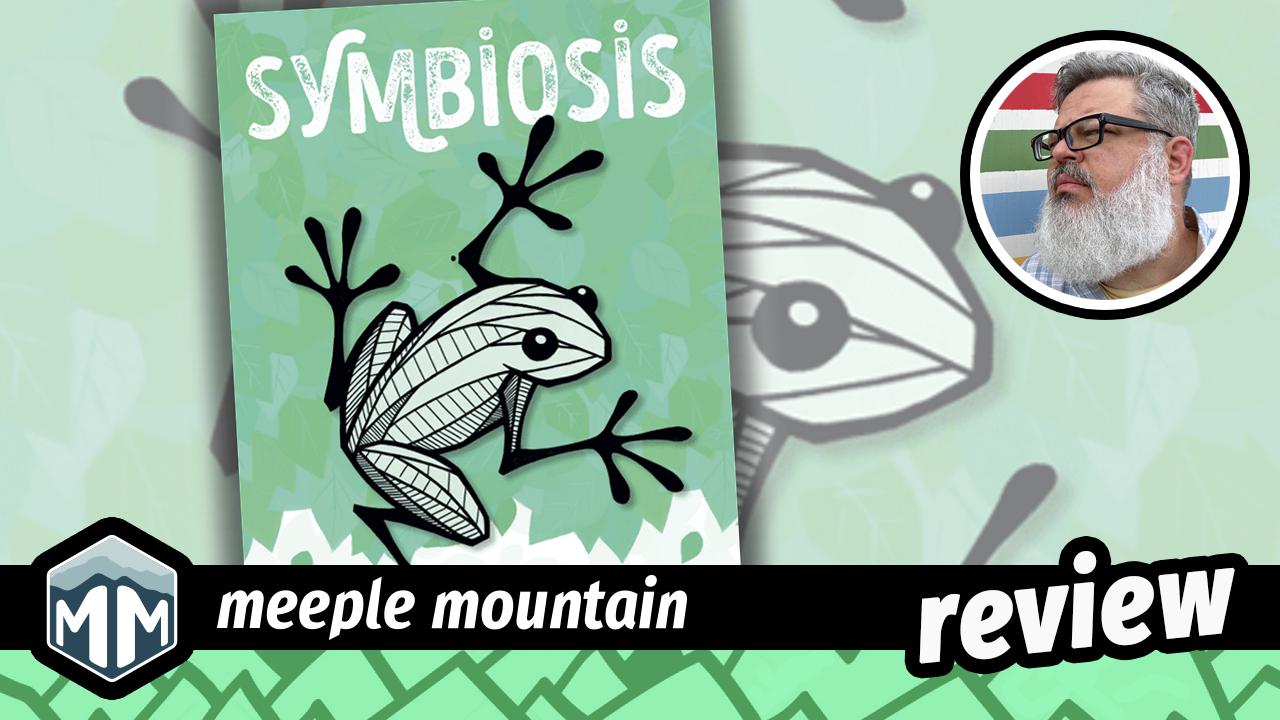
Symbiosis Game Review

At this year's GAMA Expo I had the opportunity to play Symbiosis with some industry folks. I was charmed by it's artwork and card size, and delighted by the simple decision space and speedy game play. I brought home a copy and reviewed it for you. Check it out!

What is Symbiosis?

In Symbiosis players are growing and improving their pond in an attempt to earn the most points. They start with a 4 x 2 grid of face down cards, 1 of which is turned over at the beginning of the game. An additional 4 cards are turned face up in the center of the table, and serve as the market.

On your turn you select a card from the market and do one of two things:

Replace one of your face down pond cards with the card you selected from the market. Your pond card is placed face up into the market and becomes available for other players to select.

Alternatively you can take one of your face up cards and swap it with a face up market card. If you do this, you must flip one of your remaining face down cards face up.

“Why”,…

The post Symbiosis Game Review appeared first on Meeple Mountain.

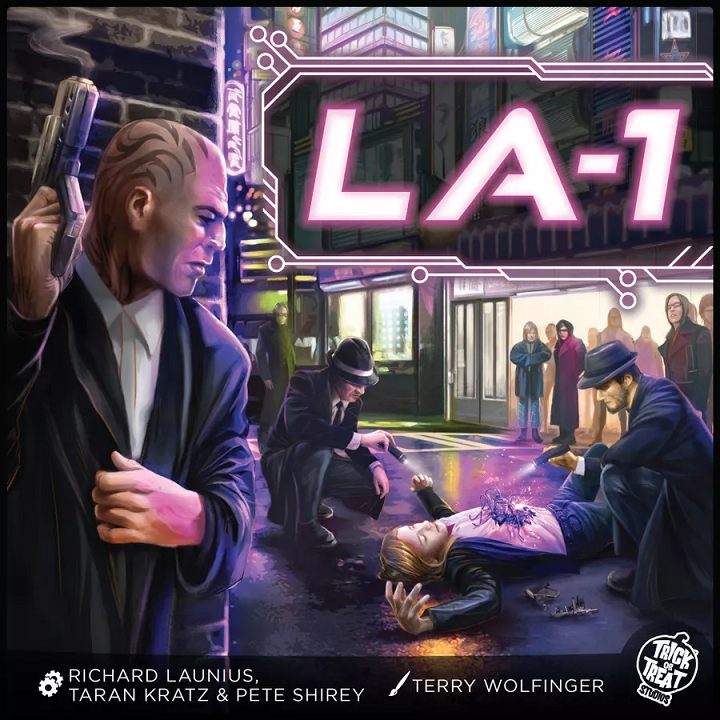
AH-4 – An LA-1 Review

11. Mai 2026 um 15:00
You’re stumbling through the labyrinthine streets of Old Angeles; your clothes soaked in rain and neon. The city is a mix of perpetual darkness and the unending belch of industrialization. But at least you’re not alone. Your private investigation firm is staffed by the other stiffs sitting around the table. All of you are working…

Read more →

Interview with José Luis Barca Designer of A Bridge Too Far from PHALANX

Von: Grant
11. Mai 2026 um 14:00

While attending SPIEL Essen last fall, we became aware of a new narrative driven book wargame coming from PHALANX and designer José Luis Barca. We were supposed to get together with José to discuss the game but due to changes in our schedule and another meeting we just couldn’t break away to get over there. I felt bad about that, and want to apologize to their Marketing and Crowdfunding Director Adrian Turzański, but we did get copies and Alexander has since played it several times. In place of the sit down discussion, I reached out to José to see if he wanted to answer some questions in a designer interview. He was willing and that has led us her to this post.

If you are interested in A Bridge Too Far, you can order a copy form the PHALANX website at the following link: https://phalanx.co.uk/games/a-bridge-too-far/#game-multimedia

Grant: José welcome to our blog. First off please tell us a little about yourself. What are your hobbies? What’s your day job? 

José: Thank you, it’s a pleasure to be here. Okay. So, I’m a big fan of wargames, role-playing games, and board games who, three years ago, left my regular job to work as a freelancer in translation, layout, and writing for board games, role-playing games, and wargames—making a dream come true: working in a field I’m passionate about.

Grant: What motivated you to break into game design? What have you enjoyed most about the experience thus far? 

José: Well, in addition to what I mentioned earlier, I’m a novelist. Right now I have three novels and two short story collections written. As part of my work, I translated gamebooks, so I wanted to try writing a different kind of “novel” that’s tied to the game. Also, on my Instagram, I interact with readers through “choose your own adventure”-style story games. All of this led me to the decision to write a gamebook in which the narrative aspect was the most important thing. From the very beginning, I really enjoyed the experience. Being able to give the main character choices was something that wasn’t possible in a normal novel, and I really enjoyed all the options, including killing him off in many different ways. It was something fresh for my writing.

Grant: What is your new game A Bridge Too Far about? 

José: A Bridge Too Far depicts the war as seen through the eyes of a private. The protagonist is a Polish soldier from the 1st Polish Independent Brigade who will try to survive in Driel and Oosterbeek. His decisions will shape his future in the Battle of Arnhem, which was a military failure for the Allies. Thus, the gamebook explores the harshness and cruelty of combat in one of the bloodiest battles of World War II.

Grant: It is described as a paragraph-based game. What does this mean?  

José: It’s another name for a gamebook, or, in this case, a wargamebook. The narrative unfolds through paragraphs that, depending on your choices regarding the options presented, lead you to other paragraphs. In this way, you aren’t reading a book in a linear fashion, as you would with a novel, but rather you have to follow the storyline through the paragraphs indicated by the game.

Grant: What is your design goal with the game?  

José: The goal was to immerse the reader in the combat, allowing them to witness a battle and its various stages firsthand. It was also to explore the character’s psychology—how their morale and willpower gradually break down. In short, the aim is to paint a realistic picture of combat, or as realistic as possible using nothing but the pages of a book—something no one would ever want to experience.

Grant: What research did you do to get the historical details correct? What one must-read source would you recommend?  

José: This was undoubtedly the hardest part. Most books today about the Battle of Arnhem cover the battle in general terms, without providing the level of detail needed for a novel or gamebook. Those of us who write historical fiction always face this problem. When we go into such detail in describing places, people, or objects, we run into a problem that no general overview can solve. For this book, I consulted the two most famous books: A Bridge Too Far by Cornelius Ryan and Arnhem, the Battle for the Bridges, 1944 by Antony Beevor. From the first, I drew some anecdotes about the fighting, and from the second, the general overview of the battle, but I needed something more to fully immerse myself in the epic story of the Poles. So I discovered The Pegasus Archive: The British Airborne Forces, 1940-1945, which contains the transcript of all the orders given by officers during the battle, hour by hour. This source was the definitive one for understanding what really happened to the Poles at Arnhem.

Grant: What role does the player take on in the game?   

José: The player is a rank-and-file soldier in an elite unit of the British Army, which is where the Polish Brigade was integrated. As I mentioned earlier, your goal is to survive, and how you do that is up to you: whether you make it to Nijmegen safe, desert and go into hiding, or end up as a prisoner. If you don’t survive, there are plenty more options, hahaha.

Grant: What role does the player play in the creation of the soldier?  

José: The character must be created at the beginning. You simply need to assign three numbers to its main attributes. The rest is set by default.

Grant: What are the three attributes focused on? What does each represent?  

José: The soldier has the following attributes: Body, which indicates stamina, strength, and hand-to-hand combat ability; Mind, which reflects intelligence, reasoning, and the ability to use weapons; and Will, which reflects morale, willpower, courage, and sanity.

Grant: What does the phrase “choice-driven, demanding gameplay” mean? 

José: Well, exactly what it says: every decision matters and could mean the difference between life and death.  The player is presented with various choices from time to time and the story will branch off from those choices into a new direction.

Grant: How did you go about creating a tense and decision filled experience?   

José: Well, that was my intention, but I’m not sure I pulled it off. It’s up to the readers to decide. But my writing style certainly helped. Many of my readers say I write as if I had a camera slung over my shoulder, and that my scenes are action-packed and very visual. You can easily picture the scene without needing lengthy descriptions. What some experts call “dynamic description.” My descriptions of the situation are woven into the dialogue or the character’s actions, as if the reader were watching a movie. These days, I think that’s the best way to write, since there are almost more viewers of movies and TV shows than readers of books.

Grant: How many different branching options are possible? 

José: The book has about 20 alternate endings

Grant: How long did it take to make sure these were all consistent and that there weren’t loops?  

José: That’s not enough. Let me explain. These days, there are tools available to help you with the process of checking for loops and errors when writing a gamebook. I used a program called “Librogame Creator,” where you type directly, just like in Word. The real benefit is that you can create the paragraphs within the program and link the choices to their respective paragraphs. In the end, you’re left with a paragraph map that makes it much easier to review and see if any are incomplete, if there are loops, and if any lead to a dead end. In any case, it’s not foolproof, and in a work of this type, errors are inevitable. I apologize in advance.

Grant: How are dice rolls handled for the game?   

José: The game tells you when to roll the dice. Basically, you roll a number of dice equal to the designated attribute, and you need to roll (in at least one dice, unless otherwise specified) a total greater than the difficulty level specified in the text. It’s very easy and requires almost no rules.

Grant: Where did you get this idea from? How do you think it works?  

José: The idea comes from another Spanish gamebook called Ulrica. I borrowed the core of the system with the authors’ permission and then had to adapt it from a fantasy setting to World War II.I think it’s a system simple enough to let the story take center stage. And that’s what convinced me to use it.

Grant: How does the player manage things like ammunition, morale and life points? 

José: You have a character sheet where you can track your remaining ammunition, morale, and health points. You won’t go through much ammunition unless you start missing your rolls, of course. In any case, you’ll find more ammunition during the game to add to your inventory. You might have a harder time finding it in the second part, in Oosterbeek, because that’s exactly what happened there. Health is something that’s bound to go down. There are first-aid kits in the game that let you boost that value, but the risk of dying is real and very easy to reach. Morale is something the game really puts pressure on. That was my intention from the start. The player will be tempted to use those points at every turn, but I suggest using them only in matters of life and death. Because morale points rarely go up during the game 

Grant: What is the layout of the character sheet at the back of the book?  

José: On one side, you’ll find the stats you’ll use during the game: attributes, morale, health, diary, etc., and on the other side, you’ll find your inventory, which will also change as you acquire new items and/or weapons or lose them. I suggest printing it out for a better experience.

Grant: How is victory determined?  

José: Victory points are determined by your diary entries. Depending on your actions in battle, you will be remembered and decorated—or you will end up as an anonymous soldier. Your final score depends on your decisions, not on how many fights you win or lose.

Grant: What do you feel the game models well?   

José: I think what the game captures best is the intensity and morale in combat. You’ll see soldiers breaking down mentally, civilians suffering the consequences, and your character experiencing combat stress. I think that’s well reflected in the book

Grant: What are you most pleased about with the design?  

José: The ammunition consumption system and large-scale combat are my favorite parts of what I’ve designed.

Grant: What other topics or engagements are you considering for use of this system?   

José: Any setting from World War I or World War II, as well as all modern wars, is suitable for this system.With a few adjustments, this system can be used for any military conflict in history.

Grant: What other designs are you contemplating or already working on?  

José: Right now I’m working on a different system. I call it a “bookgame,” the opposite of the current one. There are already games where the book itself serves as the game board, like Mike Lambo’s games, for example. Well, my next project will be in this format. I’ve created my own system with some familiar mechanics, which are integrated into the rules to add more gameplay to the narrative. Unlike Mike Lambo’s games, my new game will be much more narrative-driven, and its protagonist will be a historical warlord, I can’t say anything more, sorry. I want the historical aspect to be as accurate as it is in A Bridge Too Far. I hope to achieve that.

Thank you for your time in answering our questions José and we look forward to seeing more from you in the future.

If you are interested in A Bridge Too Far, you can order a copy form the PHALANX website at the following link: https://phalanx.co.uk/games/a-bridge-too-far/#game-multimedia

-Grant

Veteran board game writer Keith Law expresses shock as AV Club shutters tabletop section

Entertainment website The AV Club has shuttered its board game and video games segment, bringing to an end almost 13 years of tabletop coverage for veteran writer Keith Law across the site and its predecessors, Paste Games and Endless Mode.

Law wrote more than 300 pieces across those sites following his debut article in 2013, helping bring modern board gaming to a wider audience through his reviews, opinion pieces and highly regarded ‘games of the year’ lists.

Speaking to BoardGameWire, Law said the shuttering had come as a shock, adding that he would continue to write about board games on his personal blog.

He said, “It’s been an honor and a privilege to write about board games and the tabletop space for the last 12 years for Paste, Endless Mode, and AV Club.

“I worked with some great people, notably my longtime editor Garrett Martin, and feel incredibly lucky to have had the opportunity to write so much about one of my passions.”

The loss of Law’s writing from such a well-read entertainment site was bemoaned by Votes for Women designer Tory Brown, who cited his rave review of that title as “a high water mark in the effort to bring my game to the masses.”

She told BoardGameWire, “Keith Law is a treasure, the kind of smart and thoughtful writer whose approach to criticism makes us all smarter and more thoughtful.

“That a media outlet failed to recognize the value of his contribution says more about the lack of vision in American journalism than the board game audience or industry.”

Keith Law’s glowing review of Tory Brown’s design Votes for Women

The shuttering of the AV Club tabletop section marks the latest in a string of high-profile gaming and entertainment sites closing or shrinking their tabletop coverage in recent years.

They include major video games site Kotaku, which has not published an article to its tabletop section since veteran writer and editor Luke Plunkett left in 2023, and Polygon, which lost renowned, long-serving tabletop editor Charlie Hall as part of a downsizing 12 months ago.

While Polygon’s tabletop section still exists, the segment’s focus has shifted heavily towards coverage of trading card games such as Magic: The Gathering and Pokemon.

Of the 61 articles in tabletop section last month, just three were about board games – one a story highlighting that Star Wars: Outer Rim was being discounted at Amazon, and two about the Game Changer Kickstarter from comedy team Dropout.

Kevin Bertram, the founder of Votes for Women publisher Fort Circle Games, told BoardGameWire, “While I appreciate the contributions of many YouTube reviewers, video cannot fully replace the depth and clarity of written criticism.

“The loss of voices like Charlie Hall (of Polygon) and now Keith Law marks a deeply troubling turn for our industry.

“Board game journalism faces a structural challenge: establishing a sustainable business model that supports rigorous, long-form analysis. Perhaps that future lies with independent critics like Dan Thurot or collaborative models such as Rascal.

“Whatever forms emerge, their success will depend on active support from a community that values thoughtful, written criticism.”

AV Club editor-in-chief Danette Chavez provided a statement to BoardGameWire which said, “The AV Club made the difficult decision to eliminate three roles, which included two full-time staff who ran our video games coverage after joining us from Endless Mode in November 2025.

“This also includes changing the direction of our television coverage. Our hope is this will allow The AV Club to focus on our core strengths: incisive coverage of film and TV through reviews, features, and news. 

“We will continue to have some games coverage, but we cannot sustain a full-time staff covering it with our smaller team. All previously published games stories will remain available to read.” 

The post Veteran board game writer Keith Law expresses shock as AV Club shutters tabletop section first appeared on .

He Loved Being at the Table

by Justin Bell


“Call me as soon as you can man.”

My brother’s third text of the day chased back-to-back missed phone calls. When I’m not writing tabletop content, I work as a program manager for a consulting company. Thanks to a meeting with our company’s COO and Global People Officer, it had been a busy, stressful morning. My phone was on “do not disturb”, so when I flipped the phone over, my brother's communication thread made it clear that there was a real emergency.

Sadly, my fears were confirmed. After a series of alarming health changes over the past few months, our father had collapsed at his home in upstate New York. Even though CPR had been administered relatively quickly, my father’s pre-existing health issues and the morning collapse led to a visit to the emergency room, which quickly became a visit to the intensive care unit.

The situation quickly became tragic. Dad never regained consciousness, and he was placed on a ventilator. Suddenly, machines were the only thing keeping him alive. I booked a flight to Rochester and arrived about four hours before Dad was set to be taken off of life support.

You always think you will have more time.

“Immediate family only,” the signs outside the ICU said. That meant just five of us—stepmom, half-sisters, my brother, me—spent Dad’s final hours in a small hospital room, holding Dad’s hands and shedding plenty of tears. We also did what we loved to do any time the group was together: laugh about the memories that have lasted a lifetime.

A few of those memories were about games.

***

My father was never the person who suggested playing games; in fact, he never seemed to even enjoy playing them.

As a kid, we played a lot of the traditional “roll and move” games with Dad, like Monopoly and Parcheesi. From time to time, we tricked Dad into joining something like The Game of Life. UNO? Obviously. The Rummy family was always lurking nearby: Rummy, Rummy 500, Rummikub, Rummoli (the Poker/Rummy variant of Michigan Rummy that I grew up with).

It felt like Dad was always working late, so games were usually limited to weekends, and my time with him was further limited thanks to a divorce that changed our family dynamic when I was just a child. For my father, games clearly felt like work, so he was less inclined to playing games and more inclined to other leisure pursuits—long meals, action movies, road trips, televised golf tournaments (which mostly doubled as “dad naps”, a tradition we carry on in my home today).

Later in life, Dad could occasionally be tricked into playing games, but there was a limit to how many rules he would bother to learn before throwing up his hands. Like the relatives of many players in my network, Dad seemed to hate just about anything that was “too complicated.” (This is only funnier because my dad loved to play golf—itself a very complicated sport—and he worked in complex management roles throughout his career. I get it: everyone’s brain needs a break. But often, the “too complicated” label felt like lip service.)

Occasionally, the sibs and I pushed Dad to try something new. Seven or eight years ago, I brought a bunch of hobby games to a Thanksgiving family weekend, and forced my dad to play Luxor, the Rüdiger Dorn hand management game. (Although I love other Dorn designs, such as Istanbul and Goa, Luxor is still the Dorn title that hits the table the most.)

Luxor is a relatively rules-light experience that plays in about an hour. The main hook: players manage a hand of five movement cards and a small pool of adventurer tokens, tokens that must be moved forward on a track that ends with a treasure tomb in the middle of the board.

On a turn, players can only play either their left-most, or right-most, card from hand to move one of their tokens toward the tomb. (Cards in a player’s hand are never shuffled or moved, only played when they reach one side of their hand.) At the end of each turn, a player must add a new card to their hand from a draw pile, which must be inserted into the middle of their now-four-card hand to give them a new five-card hand for their next turn.

“This is ___ ridiculous!” Dad said, after hearing the hand management rule two minutes into the teach. (I’m leaving the profanity out, for the purposes of a family-friendly website.) “This game has too many rules.”

Still, Dad decided to play Luxor with my wife and stepmother…and almost won, coming in just a few points behind the eventual winner. At the end of the game, he begrudgingly admitted that he had fun thinking through the best ways to move his adventurer tokens around the map to pick up treasure tokens and sets of cards from the movement track. The best part? Dad didn’t really listen during the teach, so he only ever played his left-most card all game long, and only ever added new cards to the right side of his hand.

My father also hated the idea of cooperative games. “I want to have a chance to win,” he would say, because to Dad, winning meant “beating everyone else at the table.” So, whenever we floated co-op games by Dad (The Crew, anyone?), it was a hard pass.

Now, Dad WOULD play games with a team…as long as the goal was to beat the other team. The day we got Dad to play Codenames—a family favorite for everyone else in the household—is still one of the most shocking moments in Bell Family Vacay history. Codenames is always a riot with my family; when a team’s Spymaster goes on a one-word clue run that scores three or four cards on a single turn, that story becomes legend. (Naturally, when someone blows it and gives a clue that reveals the Assassin, that kind of story becomes legend, too!)

Most years, Dad would politely pass when given the chance to play Codenames. But when he finally did decide to join the family for a play, it was a moment. He didn’t want to play as a Spymaster that first time—let’s give the man a “try bite” first, right?—but simply being willing to join the whole family for once was such a thrill.

***

Ultimately, Dad’s favorite thing about games wasn’t playing games at all. It was grabbing a newspaper—or later, his iPad, since even my father had to come to grips with reading the news in the present—and being at the dining room table while others played games.

My dad loved being near the action. He was constantly looking up from his newspaper, smiling at his family, watching them enjoy themselves, laughing along with the group when something funny happened during a player’s turn.

I recently went to a friend’s game night…not to play, but to simply sit around. I’ve done that a few times over the years, and lately, my work schedule has been rough and I don’t always have the capacity to do much more than sit in the same space as my friends. (I am very good, however, at eating your snacks, drinking your bourbon…or, both.)

A friend was running a game of Blood on the Clocktower, and ten adults laughed their way through hours of fun as they ran two sessions back-to-back. The friends asked if I wanted to jump in, to take on a character role in-between rounds.

“Nah, I’m good,” I said. “I just love being here.” Watching innocent friends get eliminated by their peers was glorious. Standing in a corner of the room with two others as they plotted their way into the next night’s accusation was a blast, too. I didn’t think much of it at the time, but just being around others as they had fun on a game night made me think about how much Dad must have loved just being in the room with his kids.

***

The five of us at the hospital were rolling, laughing as we reminisced about so many great times with Dad. As a group, we laugh with and at each other all the time, and we laughed at some of the funny things Dad used to say, some of the bad fashion choices of the last 40 or 50 years we could remember, that time Dad claimed to be on a diet while pounding eight pieces of fried chicken at a local theme park, Dad’s everlasting appreciation for the musician Prince, and took a moment to appreciate the biggest laugh of anyone I have ever met.

And, the times when Dad would settle into his spot at the end of a large table, a glass of Cutty Sark and a plate of cheese and crackers nearby, watching everyone else having fun playing games.

Eventually, the harsh reality of the hospital situation returned. A nurse walked in; a doctor joined her. We had a few more minutes with Dad before…well, before.

I got in one more squeeze of Dad’s hand. Everyone gave him one more kiss on the forehead, then the doctors did what they could to offer him a peaceful passing.

I’ll miss you, Dad.

Designer Diary: Beastro

by Matteo Uguzzoni


Beastro is a team-based, trick-taking game with hidden roles where you have to figure out who is on your team, outsmart the other players, and collect as many tricks as possible for your team. You play as a mythical Beast Chef that is trying to open (or burn to the ground) a new pop-up restaurant.

We self-published the game in 2025 and released it during the Indie Games Night Market at Pax Unplugged in November 2025 (shot out to Daniel Newman from Newmill Industries for the great initiative!). In this designer diary we will talk about the ancestry of the game, our design journey, and a little about the self-publishing experience.

Enjoy the read!

Ancestry
Beastro is the nephew of an Italian traditional trick-taking game called Briscola Chiamata traditionally called Briscola. In my hometown it’s called Amico del Giaguaro, in English “Jaguar’s Friend”, and I’m sure there are as many names for it as there are bell towers in Italy.

Briscola, is the name for the family of card games that “Jaguar’s Friend” belongs to. It is one of the most popular, if not the most popular, may-follow trick-taking game in Italy (must-follow games are more rare, but if you’re interested I suggest you start with Tressette).


This person is not playing Briscola, but a solitaire version

The game is played with a Spanish suit deck, in the regional design variant that you find in your region (we play with the Piacentine design in Emilia Romagna, pictured above), with ten cards for each of the four suits: Coins, Cups, Wands and Spades.

Briscola is usually played in two teams of two players that have to score sixty-one (61) points to win. The Ace, the Three and the face cards count toward the scoring (awarding respectively 11, 10, 4, 3 and 2 points), while the trump suit is defined by flipping a card after giving the initial hand of three cards to each player. After you play into a trick, you draw a new card from the deck and refill your hand to three. Therefore, players have a very limited information at the beginning of the game.


The only cards that score in Briscola

Briscola Chiamata, the auntie of Beastro

Briscola Chiamata, the auntie of Beastro, is a five-player only game (2 vs 3) where the teams are defined by a wager phase. In “Jaguar’s Friend”, the variant we play in my area, every player declares how many points their team will score at the end of the round, starting from 61 and going up until the improbable 120 points, meaning all the points available in the deck. The winner of the wager becomes the Jaguar and they declare a card and a suit that they are looking for (for example the Ace of Wands), the player that has that card in their hand becomes the “Jaguar’s friend”. They are now a team - the Jaguar’s team - and their goal is to reach or pass the wager. The trump is defined by the Jaguar’s call, it’s the suit of the card they are looking for. Players that don’t have the called card are in the opposite team of three and their goal is to collective beat the Jaguar’s bet.

Briscola Chiamata is a may-follow through and through so not all tricks feel very meaningful. For example the initial tricks, although not very impactful toward the final score, become ways to gauge who is who. The game is very popular among young people (at least in my town) and while old folks rarely play this variant, I remember entire summers playing it. If I have to pick some reasons why Jaguar's Friend is so successful I will say it is social deduction aspect of it, the shifting alliances, and the wager are all unique features of the variant.


This is the way you play Briscola in Italy, shirtless and in the streets!

All right, if you read this far, you’re probably a trick-taking appassionat*, so it’s time to move on to our actual design!

A deck of cards crosses the Atlantic!


Unpub at Pax Unplugged, the best way to test your ideas

After my brother-in-law visited from Italy in September 2022, I was donated a traditional Briscola deck. I was very excited about it and I brought it to a game night with Jason Corace (designer of Lord and Ladies and Super Truffle Pig and half of Hello Mountain, our little publishing coop). The deck was so familiar to me. I vividly remember learning how to make sums playing games with Grandma, but this was alien to Jason. I was able to explain the Jaguar game to him with a traditional french poker deck and we started brainstorming on how to make a new game inspired by it.

We set up our design journey with few goals in mind. The first was a broader player count from five, which is the only number that Briscola Chiamata can allow, to the more traditional three-to-six players. The second goal was to make a must follow trick-taking (we were advised that may-follow are not loved in the US market). The third design goal was to keep the hidden roles without adding the classic social deduction parts. We were worried that adding that part will break the flow of the game and lose the straightforwardness that we like about trick-taking games.

We hosted our first playtest at Pax Unplugged that same winter in 2022. The game had a different theme back then, it was called Prestige and players were playing as Magicians setting up their magic show. We got a few so-and-so playtests - if you’re playtesting a trick-taking game and people have never played one, buckle up!. Then a family of five that used to play a lot of card games sat down and they had the best time! When the mom, always quiet, revealed that she was the Secret Assistant (a.k.a. Jaguar’s friend) the table almost exploded! She was able to trick everyone into thinking she was not.


Prestige's components ..magic tricks in a trick-taking game how original!

After PaxU, we pitched the title to many publishers and every time we got great feedback. The folks at Amigo and Pandasaurus were fantastic and the game improved from their generous feedback. In the end, everyone decided to pass on the design. We heard all the reasons (and if you are a designer you know what we mean): “it’s not different enough”, “it’s too niche”, “we already signed trick takers for the next three years”, “we are not publishing trick takers anymore” etc..

Prestige becomes Beastro
The following spring both Jason and I found ourselves surrounded by a lot of talented game designers, and with consistent playtesting we were able to bring the game to a completed state. Thank you Viditya, Marcy, Firex, Zach, Rook, Tori, Logan, Nat, George and everyone at the NYU Game Center, Pratt and Gumbo NYC. The game will not be where is it today if it wasn’t for the great discussions we had together.


External influences were important too. In that same period both Jason and I ended up being obsessed with the TV show The Bear, starring Jeremy Allen White and Ayo Edebiri, and so we decided to change the theme from magicians putting on their first show to a kitchen where players were up and coming chefs trying to sabotage the next hot restaurant in town for their own private interest or giant ego.

We needed a title for the game and Beastro came along and with it the idea that chefs and line cooks were mythical creatures (Beast) trying to open their own pop-up restaurant (a Beastro!). Everything fell into place when we decided to involve Jen Corace, an amazing illustrator from Providence, RI, that worked with Jason in his previous design Lords and Ladies. Jen happened to also be Jason’s sister so that helped the collaboration a lot and she happened to be incredibly talented and amazing. Even an onion is something that I will put on a poster if it's designed by Jen..look at this!


I want this on a t-shirt

What is unique in Jen’s style is that every illustration has a handpainted nature to it, and the reason is because every illustration is hand painted! So Beastro's deck is the work of a real artist that works with the non-digital medium at a mastery level.

Alright, enough of the history, below is a more in depth description of the design (thank you for reading this much!!). If you want to go deeper, here is the link to the ruleset and here’s a video of me pitching/explaining the game (Italian accent included).

P.S.: At the end there is also an appendix on how it was to sell the game during Pax Unplugged’ Indie Game Night Market and afterwards, if you are a designer that is just starting and is thinking about a first small self publishing experiment, maybe that part could be interesting for you!

BEASTRO the final design


The Wager
We simplified the wager vastly. Players get 13 cards at the beginning of the round and they pick one card from their hand that they sacrifice for the wager. Everyone reveals their card at the same time and whoever plays the highest card is the Head Chef and they immediately take the role deck. Starting from the lowest card, one player after the other flips over a Suit card, denying that suit to be trump for the round (a similar system is used in various designs, most notably Lunar by Masato Uesugi, Allplay, 2024). The suit that is left is the trump for the round. All the cards used in the wager are then discarded.

Team Formation
The Head Chef gives out the roles, picking their Secret Chef, and the only public role is the Head Chef.


Trick-Taking
We play a total of 12 tricks in a round. The Head Chef opens the round leading the first trick. The winner of the trick leads the next trick. It’s a traditional must-follow, so players are only allowed to play trump if they cannot follow suit, or if the trick was led with trump.

Special cards (exception to the must-follow rule)
There are two special cards that can be played at any time. The first is Secret Sauce, this card beats all the other cards, even trump. The only card that can beat a Secret Sauce is another Secret Sauce (there are two in the deck, or three in a six player game).


The second special card is Sabotage. This card is worth zero, so playing it means that you will not win the trick, but giving away Sabotage cards in other people’s tricks is good because the team with the most Sabotages at the end of the round will score negative points. Be careful not to give Sabotage to someone that will end up being on your team! Also the Sabotage card is the tie breaker in case the teams collect the same number of tricks (6 vs 6). The Sabotage card also does not follow the must-follow rule and can be played at any time.

Beast Chef Powers!
This is our latest addition to the design and we are very excited about it: every Beast Chef in the game has a special power action that can be used only once during the entire game. These are usually very powerful moves that can allow a last minute trick grabbing, but they are not enough to flip a game in your team’s direction (an inspiration for something similar is TRICKTAKERs Hiroken, Joyple Games, 2021).


Chupacabra helloooo?! Amazing illustrations by Jen Corace

Restaurants
Every round is played at a different pop-up restaurant that has two special scoring conditions that every player can score independently. This was Dan Thurot favorite features, read his review here.


Addendum - Self printing and selling Beastro!

We hope that this next section could be helpful for you. The reality is that every story of self-publishing is different but we learned a lot from this experience so why not share it?

The final product
While Beastro’s prototype had components, we decided that if we have to self-publish we should keep it simple. So we turned everything into a card, and our game is now a deck made of 86 cards: 62 playing cards, 12 restaurants cards, 6 Beast Chef cards and a role deck of 6 Cards.

The game was selected for the Indie Game Night Market in November 2025, and we got news of the selection in August so we sprinted into work! We started with the illustrations and in this section we were really lucky. We trusted Jen completely with her illustrations. She and Jason came up with the list of ingredients, Beast Chefs, and Restaurants, so she was able to complete her portion of the work in no time - I think it was less than two weeks.

After we got the illustrations we were ready to design the game's box. One insight I heard on a podcast from the folks at CMYK is that you should be able to understand how to play in three steps just by looking at the back of the box, so we tried that.


The three steps rule applied to Beastro

We decided to print in China, and in 2025, that was not a good idea. I mean, we were really happy with the result, but the tariffs, the rush fee, and the cost per unit turned out to be higher than we expected. Another mistake we made was not to print a demo copy before placing the full order. Even if it’s insanely expensive, it could save you money down the road if, for example, you have to re-print a card because of a typo or you forgot a card.


Someone ordered a Secrdt Sauce?


After Pax U
Selling Beastro at PaxU was incredibly rewarding. The evening was just a great experience of sharing our design, receiving compliments, and having a good time. We were sad that we were not able to go to other designers’ tables and learn more about their games, but we were able to connect the following days and on the festival’s discord.


Hello Mountain (us), selling Beastro. I'm beaten, Jason is rocking it

In the days afterwards we saw some reviews popping up. Some people shared that they got a copy and it felt very rewarding. With that momentum we decided to setup our website and try to sell copies online. The game was reviewed a couple of times more and with some social media activity we were able to sell a steady number of copies for the weeks preceding Christmas and some more in the new year. Some copies, together with the Italian ruleset, went to my hometown crew of “Jaguar’s friend” players in Italy, and some came with me to Tallahassee, Florida, where I relocated in the meantime.


A small selection of Beastro's enthusiasts - check out Courtyard Cafè and Games if you are in Tally

To conclude this designer diary: we would like to thank again everyone that helped us along the route and playtested the game - every playtest was incredibly helpful! To self-publish a design that is only cards is definitely something we will suggest if you trying to self-publish for the first time. It will lower the costs, simplify your work, and you will reach a level of quality that otherwise it will be very hard. We feel blessed to have such an active and open community of indie game designers that we can be part of and we hope to keep designing and bringing to life quirky, easy-to-play games in the next future.

Thanks for reading!
Matteo and Jason


Happy playing, courtesy Arianna Richeldi

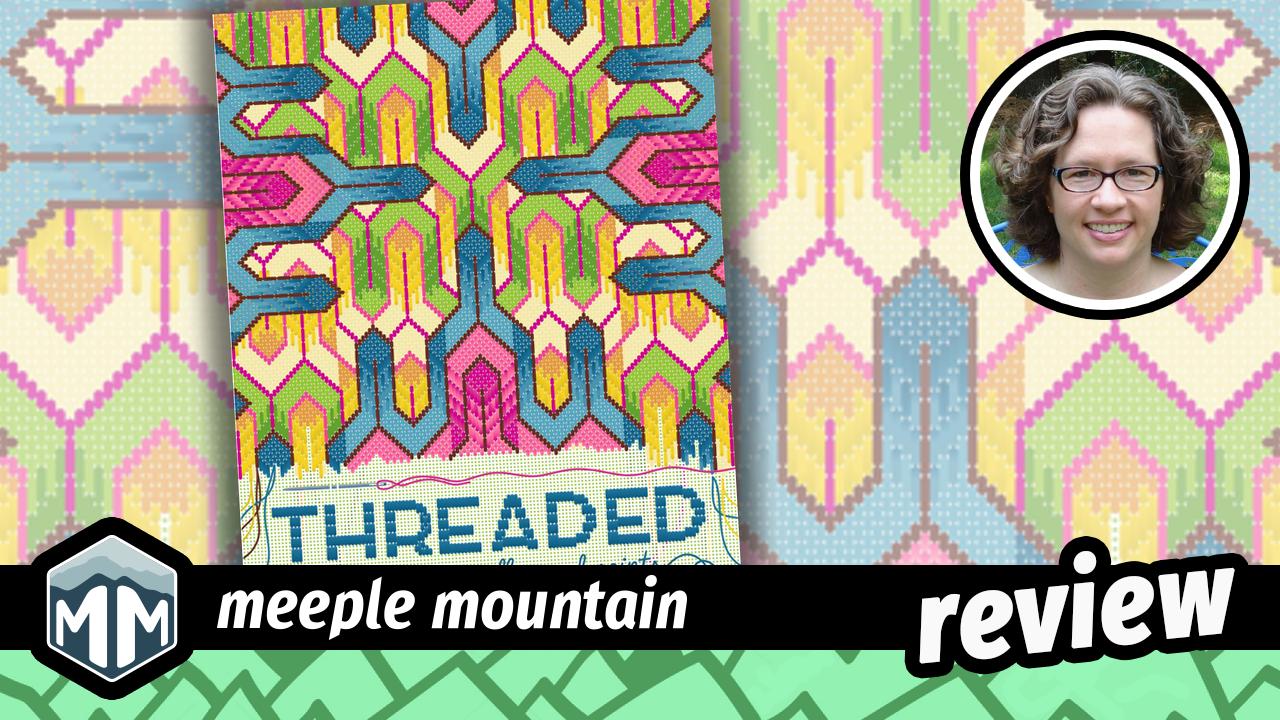
Threaded: A Game of Needles and Points Game Review

Threaded is a game about sewing Bargello-patterned tapestries. Well, sort of. You are using cubes as thread, after all. You may not come out of this game with a new afghan, but you will come out of it with your brain slightly aching from the puzzle you must solve. 

I grew up in the 1970's, seeing these groovy geometric patterns everywhere. My grandmother was a whiz with a needle and made all kinds of textiles featuring these stripy, blazing patterns, but I just figured it was a trend of the times. Little did I know that they were called Bargello, or that their origin dates back to the 17th century in the Bargello Palace in Florence, Italy. Right out of the gate, Threaded taught me something. 

[caption id="attachment_331060" align="aligncenter" width="1125"]Bargello Blanket My Bargello baby blanket, made by my grandmother[/caption]

Between having a strong nostalgic pull toward Bargello patterns and enjoying all kinds of needlecraft myself, it was a no-brainer for me to agree to review Threaded. It doesn't hurt that other needlecraft-themed games like Patchwork, Knitting Circle, and Calico have been big hits in my house. So does Threaded compete? Let's see. 

As I was reading the instructions, Threaded reminded me of Istanbul, and not in a…

The post Threaded: A Game of Needles and Points Game Review appeared first on Meeple Mountain.

Unboxing Video: Amateurs to Arms! from Clash of Arms Games

Von: Grant
10. Mai 2026 um 14:00

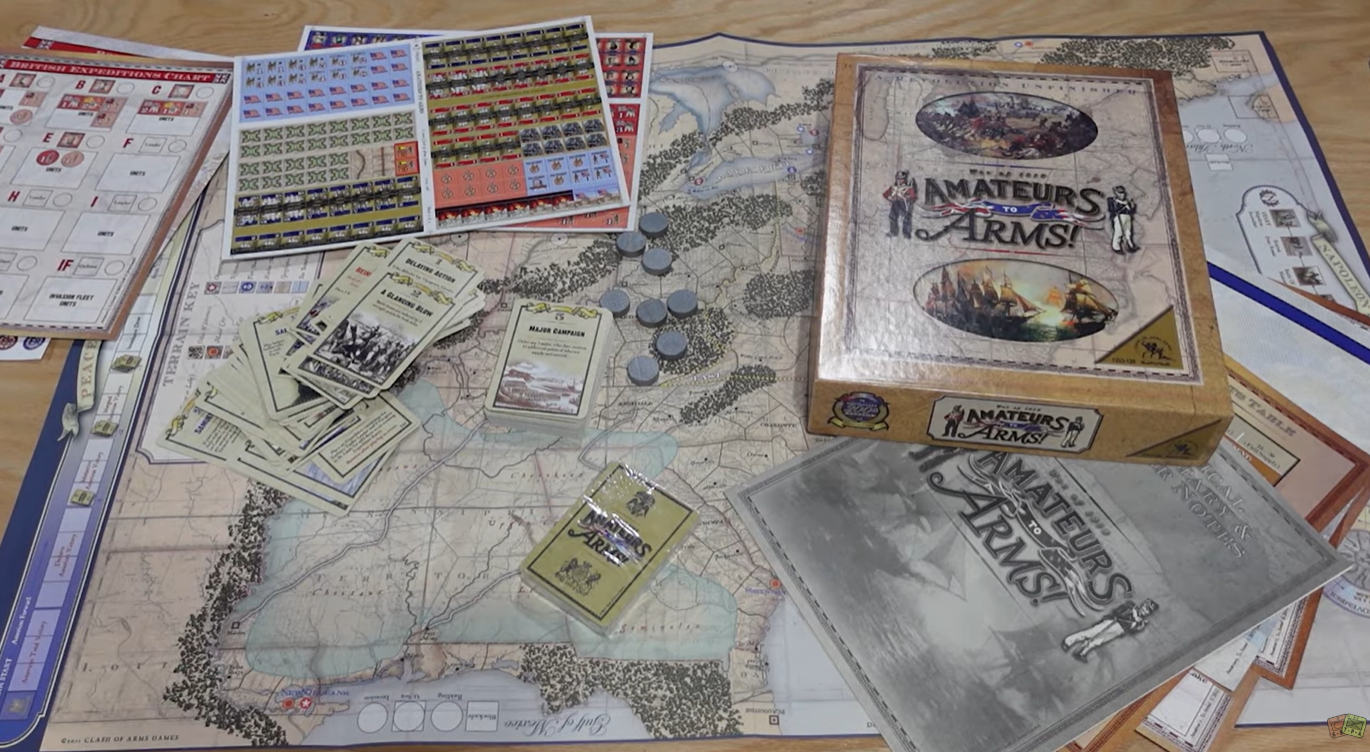
Amateurs to Arms! is a historical simulation game of the War of 1812. One player assumes the role of the British (including Canadian) forces, and the other plays the Americans. This often-overlooked conflict ended in a draw historically, but this was not the only possible outcome. The Americans clearly wished to annex Canada to their young nation, while the British wanted to teach their former colonies a lesson. The game includes all of the theaters of battle from the war: the US/ Canadian border and the Great Lakes (of course) but also the wilderness of the old Northwest, the Atlantic coast of the US, the Civilized Indians of the south, and the site of the final conflict at New Orleans.

Each turn represents a few months of time (depending on the season). A typical turn consists of dealing out to each player the number of cards indicated on the turn track. The winter and spring turns require a few special tasks. The Americans will have more resources to commit to the war- until Napoleon is defeated in Europe, and the English player can focus more resources on their efforts in North America. Each card can be played for the event described on the card, or for the card’s Operations Points, to move Expeditions, build ships and fortifications, or raise troops.

Events on the cards and on the map will cause the markers on the Peace Track to move forward. This represents the war weariness of each side’s people: bad events will cause your people to demand peace. Most events push inexorably towards peace; only a few rally your people for a longer war. When the two markers meet on the Peace Track, the game proceeds to the negotiations at Ghent, and the winner is determined. Oh yes, and then each player plays one more card, while news of the peace travels across the Atlantic!

-Grant

Designer Diary: VNTYPL8S

09. Mai 2026 um 16:00

by Clarence Simpson


1NSP1R3D

In a way, VNTYPL8S was born out of necessity.

VNTYPL8S exists, in no small part, due to the fact that I committed to playtest a game that didn’t exist yet.

The Unpub Festival in Baltimore is a great place to playtest your prototypes. It’s a long-running convention that’s focused exclusively on design and playtesting. Designers pay to reserve one of their dozens of rectangular playtest tables for a 4-hour block of time during the con. But for their 2023 event, they decided to try something different.

In October 2022, they opened up table reservations for Unpub 2023. But this time, it wasn’t just for rectangular tables. They offered shorter 2-hour blocks at big round tables that were separated from the main bulk of rectangular tables. They were intended to be used for playtesting shorter party-style games that needed less time but space for more players.


At the time, I had only designed one party game, and I was already pitching it around to publishers. So, it didn’t need any playtesting. I didn’t actually have a party game to playtest at Unpub, but I decided to register for a party game table anyway. It was a new way to utilize Unpub, and I wanted to give it a try. I liked the idea of being locked down to a table for a shorter amount of time, and getting large group tests, which are often hard to coordinate otherwise. I thought “Surely I can come up with a party game concept by the time March 2023 rolls around!”

Smash cut to mid-February 2023. I still don’t have a new party game, and haven’t even really thought about it at all. Unpub is now weeks away. I’m starting to feel the pressure, and there’s nothing like a good deadline to motivate me.

I start browsing back through my giant Google Doc of board game ideas. I’m sure there's a decent party game idea somewhere in there. I just need to find one and throw together something playable. As I scroll through dozens of pages of ideas, I spot a single sentence that says “A game about vanity license plates”.

I don’t remember when I wrote that in there. It was obviously just a passing thought since I had written no other details. But it got the gears turning, and I started considering if the idea was worth pursuing.


Examples of vanity plates in the US

In the US, at least, vanity plates are ubiquitous. Everyone has seen them on the road. And, at some time or another, everyone has probably spotted a vanity plate that they couldn’t quite decipher, leading to a few moments of brainstorming and guesses, hopefully leading to a moment of perfect clarity, when they finally fully understand what the characters on that plate are supposed to mean.

Thinking about that simple experience that happens organically on car rides, it had many of the hallmarks of an interesting game. People were presented with a puzzle, and after some debate, discussion, and often out-of-the-box thinking, you reach a conclusion. It also provided those eureka moments when you feel clever for finally making the connections that the car owner intended.

So, I decided to go for it and start my pre-design research phase.

R3S34RCH

Not everyone is like this, but for me, before I dump a lot of time into a new design idea, I really want to know what else already exists that is similar thematically or mechanically. And I was sure that a vanity plates board game must already exist. So I dove into research mode on BGG.


Some vanity plate cards from the 1988 game, Vanity Chase

I found surprisingly little in the way of games themed around vanity plates. I found some very old games that contained examples of vanity plates that were difficult to decipher. But they were only concerned with players deciphering plates, not creating them. That sort of game would have limited replayability once you’ve seen all the plates in the game, though. I wondered if I could create an experience that allowed players to both create plates and then decipher them.

Then, I found one fairly modern game about vanity plates that was about both creating and deciphering plates. At first glance, I thought I had missed my chance. Someone had already made the game I thought of. But looking closer, in that game’s plate creation phase, players were given specific random phrases that they then had to communicate in vanity plate form.

Accomplishing that generally just meant removing letters until the phrase fit on the plate. Which letters to remove (frequently vowels) often felt so obvious that I was sure many people who had the same prompt would create the same plate. In some ways, it felt like there was a “right” answer to each prompt card. So, although this game had both the creation and deciphering that I wanted to do, the creation seemed very unsatisfying to me, and didn’t really engage the creative part of the brain like I wanted it to.


Example of play from Less Is More where you earn points by giving clues with as few letters as possible

I was also curious if there were other party guessing games that might operate on a core system of restricting your clues to a finite number of letters, effectively doing what vanity plates do without the vanity plate thematic dressing. I found several that encouraged you to write clues in as few letters as possible, like Less Is More and Inklings, but none with a fixed character limit.

With that, I felt comfortable moving forward with designing the game. But I had to act fast because I also had a chance to do some playtesting at TantrumCon next week!

D3S1GN

The first thing that came to mind when I sat down to design the game was that people usually want to remember a license plate when they see someone commit a crime with a vehicle. So, I thought about players seeing a license plate at a crime scene and then trying to catch the criminal later. It was an interesting framing, but it really didn’t sound like it would be about creating or deciphering plates. So, I quickly trashed that idea.

Next I thought about communicating secret messages using the 8-character limit of most US vanity license plates. That sounded more like a party game. But I quickly realized that the best conceptual framing would probably be that each plate would be associated with a person with a specific job, sometimes realistic, sometimes wacky, like Author or Tooth Fairy. Players would be given a random job, create a vanity plate associated with that job, and then the other players would have to guess what the job was based on the plate. This was essentially what happens in real car rides every day and would provide players with an immediate hook.


Some Job cards from the first playable prototype of VNTYPLTS

But I knew the trick would be how to get players to create plates that were difficult to decipher. A plate like “ILUVCARS” leaves nothing to the imagination and nothing is up for debate. The best plates were the ones you had to work at a little before discovering their intended meaning.

So I started to think about what makes certain real world plates more difficult to decipher. Frequently, they had no vowels. Sometimes it was difficult to tell where one word started and another word ended. Some of them like “SP33D” would use substitute letters, presumably because someone else in their state already claimed “SPEED”.

These observations, coupled with real-world plate restrictions, led to my initial set of rules for plate creation. These rules remained constant from the very first prototype to the final product:

- Max 8 characters
- Only uppercase letters and numbers
- No vowels (though you could use other letters as substitutes)
- No punctuation or spaces

Now plate creation was starting to get interesting! But I felt like, even with those restrictions, the plates would still be too easy to guess. For the job Dentist, you could just say “T33TH” and it would be obvious that the plate went with a Dentist. And you could write the same plate every time the same job came up. There might be a “best” plate for each job. It still wasn’t difficult or interesting enough.

Just playing by these basic creation rules seemed like it would lead to predictable and boring experiences. But how do you incentivize players to create more difficult or more obscure plates? I often think of Dixit in these situations. The scoring in Dixit is cleverly structured such that it’s optimal for the clue-giver if only one other player can figure out their clue. That scoring naturally makes players want to create difficult clues. But I wasn’t sure if there was enough obvious direction on exactly how a player might make a plate concept more difficult to guess.


The original Restriction cards, giving players 1 pt per letter used

If you look at a lot of guessing party games, many of them ask players to communicate some concept to each other, but force them to do it in some very non-optimal way through various restrictions on their communication. So, I added a second layer of restrictions to VNTYPLTS. In addition to a random job, every player would be given a card with a set of three random characters on it. Players would earn points if they used those 3 characters in their plate and if they avoided using vowels. I structured the three characters on each card to always be a set of one common letter, one less common letter, and one number. I hoped these randomized restrictions would add just the right amount of confusion and chaos to the process.

Now I felt like I really had something. So, I cracked open NanDeck to create a small deck of Job cards and a small deck of Restriction cards. I combined that with the dry erase plates and markers from my copy of Just One, and I had myself a first playable prototype!

For game structure, I took inspiration from So Clover. Everyone writes simultaneously during the plate creation phase to minimize feelings of down time. Then, players take turns revealing their creation and letting the other players guess their job.

The last thing I needed was a name. And with a game about creating 8-letter vanity plates, I thought it would be pretty cool if the name of the game was also a valid 8-letter vanity plate. With that, VNTYPLTS was born.


The VNTYPLTS title banner, with tagline

It also struck me that if I overlay the title VNTYPLTS on an image of a blank license plate that the game is relatively self-explanatory just from that cover image. For most people in the US, seeing a cover image like that, they could immediately and instinctively know what kind of game they’re about to play. So, I added a tagline that I thought was pretty catchy - “If you can read the title, you’re already playing the game!” and I was off to TantrumCon for my first playtest!

PL4YT3ST

The very first playtest went surprisingly well. Sometimes players would guess a plate immediately. Sometimes they would give up and make a wild guess. But the best moments were when players would stare at a plate for about 10 seconds and then go “OHHH!” and guess correctly. I needed to make sure those moments happened as much as possible.

Originally, players wrote down their guesses for which Job they thought each plate belonged to. Everyone who guessed correctly scored points. It worked OK, but it was clunky. I also realized that a structure like that prevented players from celebrating their Eureka moment when they finally deciphered a tough plate. They would have to sit there until everyone else finished, and then the excitement would have faded away. So, I pivoted guessing to be a real-time race. Each player only gets one guess and the first player to guess correctly gets a point.

I also had people tallying their scores on the back of the Just One plates, and it quickly became obvious that scoring was overly complicated. Party games need just enough scoring to teach players how they’re supposed to have the most fun with your game, but no more. Once you start doing arithmetic or spending a significant portion of your playtime on scoring, you’re doing it wrong.


Some player-created plates from the first playtests at TantrumCon 2023
Can you guess which plates go with which jobs?

The problem was that I was giving people points for too many things. You earned points for not using vowels. You earned points for each of the 3 restriction letters that were used. And you earned points for guessing other people’s plates.

But also, when I watched the players who chose not to use the restriction letters, or to use vowels in their plate, I noticed that the plates became too easy again, and the game was much less fun. I needed to not give players the option to have less fun, and just force them to make their plates the hard way.

So, “no vowels” just became a rule of the game that you had to remember. If you used vowels you were cheating. Doing this was the secret sauce of the game early on. Making sure that vowels were never in plates instantly made the game better.

Forcing players to use the three restriction letters was a little more tricky. There wasn’t always an obvious way to use specific letters. But I tried still presenting it to players as a requirement. I was constantly amazed at the clever ways that players managed to use their three characters in their plate. Occasionally, someone would be paralyzed by the thought of how to use their three characters, but I would always tell them that if they couldn’t think of another way to do it, to just put them anywhere in their plate.


More player-created plates from TantrumCon 2023
Can you guess which plates go with which jobs?

Ideally, I wanted the three characters to have a “purpose” in order to count for scoring. I didn’t love that you could do “DRNKSTM7” as a plate for Bartender. Clearly it’s just “drinks” and then the three extra letters. That wasn’t quite playing in the spirit of the game and I instinctively wanted to stop it, but it was too hard to police through rules. I finally decided it was actually fine, because it does still provide some confusion regardless, which is important. But more importantly, it makes the game more accessible to players if they get really stuck on how to use those required characters.

These changes allowed for a new scoring system that was dead simple. Each turn, the first player who guessed correctly takes the Job card as a point. And if the clue was guessed correctly and the clue-giver used their three required characters, they take the Restriction card as a point. That made two points per turn and your score is just a pile of cards that you needed to get out of the way anyway. It was elegant and perfect for a party game.

When I ran the game, I was fairly loose about allowing players to draw a new Job or Restriction card if they were having difficulty. That would also often fix problems with feeling paralyzed, and kept the game moving.

Other than these tweaks, not much changed after those TantrumCon playtests. When I brought the game to Unpub not long after, it was still largely the same game I started with. And it was creating great moments for playtesters at those round party tables that I had no idea what to do with a few weeks earlier.

R34DY

Just after Unpub 2023 officially ended, some designers and publishers were sticking around to hang out Sunday night. So, I got the chance to playtest VNTYPLTS with a few more people including Elizabeth Hargrave and a game publisher, IV Studio.

[twitter=https://x.com/StoicHamster/status/1638029216108126209]

IV Studio said that they don’t publish party games, but if they did, they would definitely publish the game. Elizabeth loved the game so much that she tweeted about how it should be on the shelves of Target. After all the other positive feedback, this final playtest sealed it, and I knew it was ready to pitch to publishers.


Soon after Unpub, I picked out some mass market party game publishers to pitch it to. But it ended up being significantly tougher to find a publisher for the game than I initially thought.

Even with Codenames being such a juggernaut in the industry, some mass market publishers have a strict policy against doing games that ask players to be “creative” in any way. They said it made some players feel uncomfortable and inadequate, and they couldn’t afford to make anyone uncomfortable when trying to reach a mass audience.

I also found that some European publishers didn’t feel like they could connect with their audiences because vanity plates don’t exist in Europe in the same way they do in the US. In many of the most populated European countries, they don’t exist at all. And the few that do have vanity plates generally have strict limits on how much of the plate you can customize, often only a few specific characters. The freedom in plate design that we have in the US is actually fairly rare, across the world.

So, even with such a strong concept and the endorsement of an industry heavyweight, I went through 15 pitch rejections before I finally found it a home.

PVBL1SHD

I had known Chad at 25th Century Games for several years through various conventions, and I had been looking for a chance to work with him on something. So, in July 2023, I pitched VNTYPLTS to him over e-mail. He gave my PnP version a spin, and about a month later, he offered me the most designer-friendly contract I had ever seen. So, I signed the game and we were rolling!

One of the first things that came up after signing was the title. Someone asked me why it was VNTYPLTS instead of VNTYPL8S, and I was honestly embarrassed that I’d never thought of that. I loved that it showcased the creative way that numbers are intended to be used in the game. So, we immediately made that subtle, but important, name change.

Things started moving quickly after that. Within a week, we were talking about making more Job cards. I only had a small set of 54 Job cards in my original prototype. Chad wanted to get 220 total cards in the game. I had some work to do!

Originally, I had focused on professions, but with all the new cards needed, we decided to expand a bit and reframe Job cards as Owner cards. After all, there's lots of reasons people get vanity plates in real life - jobs, hobbies, fandoms, personalities, and other identities. In the end, I came up with a list of different categories that could help inspire new Owners: Normal Professions (like Accountant), Wacky Professions (like Necromancer), Creatures (like Dragon), Hobbies (like Homebrewer), Fandoms (like Horror Fan), Personalities (like Night Owl), and Pop Culture (like Godzilla).


Some 0WN3R (Owner) cards from the finished product

I had mostly avoided pop culture references in my original prototype, partially because I wasn’t completely sure about the legal implications of using them. But also, I was worried about how those references might shackle a game to a certain time period and make the game look dated in the future. I wanted it to have a shot at being timeless. But the two references I put in my prototype Owner cards, Ghostbuster and Jedi Knight, were also always a lot of fun to play with.

I went back and looked at Just One for comparison, and I was shocked at how many pop culture references they used. But I noticed that they were very carefully curated. Some were single words with multiple meanings in addition to the pop culture reference, like Rocky, Dune, and Matrix. And the only other references were so well-known that it would be very unlikely for players to have not heard of them, like “Batman”, “Pikachu”, and “Nintendo”. So, we decided to carefully move forward with adding some pop culture references.


A portion of the Google Sheet containing all the 0WN3R card data

After making the complete list of Owners, Chad handed all the card content over to Nathan Thornton, of Green Team Wins fame. Nathan came up with all the hilarious descriptions for each Owner card, which really gave the game a nice layer of polish.

The descriptions may seem like fluff, but I believe they’re actually a critical part of the game. They allowed us to use obscure jobs like Herpetologist without making players feel stupid for not knowing what it is. The descriptions also serve as sparks of creativity. They contain words associated with the Owner, so they can be used as the starting point for a plate. Nathan also added dates/locations to each Owner card, which are often little Easter Eggs, like the Time Traveler being listed as from Hill Valley, CA, the fictional town in Back to the Future.


A dry erase plate board from the finished product

While all this was going on, Chad had also kicked off graphic design on the game. The game didn’t need a lot of graphic design work and it was knocked out pretty quickly. The last few UI tweaks we made were adding the plate creation rules to the dry erase boards as well as eight blank spaces to write letters into. This helped players play the game more easily without ever referencing the rulebook.

By the end of 2023, the game files were effectively finished and we had a factory-printed prototype in hand. But for various reasons, actually printing the game was on hold for an excruciating (to me) amount of time.


VNTYPL8S set up for demo at the Diana Jones Award Emerging Designer Program table at Gen Con 2024

In July 2024, VNTYPL8S was officially announced. I was able to attend Gen Con 2024 thanks to a generous prize package when I was selected for the 2024 Diana Jones Award Emerging Designer Program. And there I ran the first public demos of VNTYPL8S.

At Gen Con 2025, VNTYPL8S had a limited con-exclusive release while waiting on the full print run. And now, finally, after a few more delays due to fixing a printing error, VNTYPL8S is having a proper retail release.


The final production version of VNTYPL8S

VNTYPL8S has yet to get that placement on the shelves of Target that Elizabeth thought it deserved. But now that we’re finally getting copies out to the gaming public, who knows what will happen!

I’m really looking forward to more people getting their hands on the game and seeing the creative plates that people come up with. Thanks for reading about its journey and I can’t wait to see it on your tables!

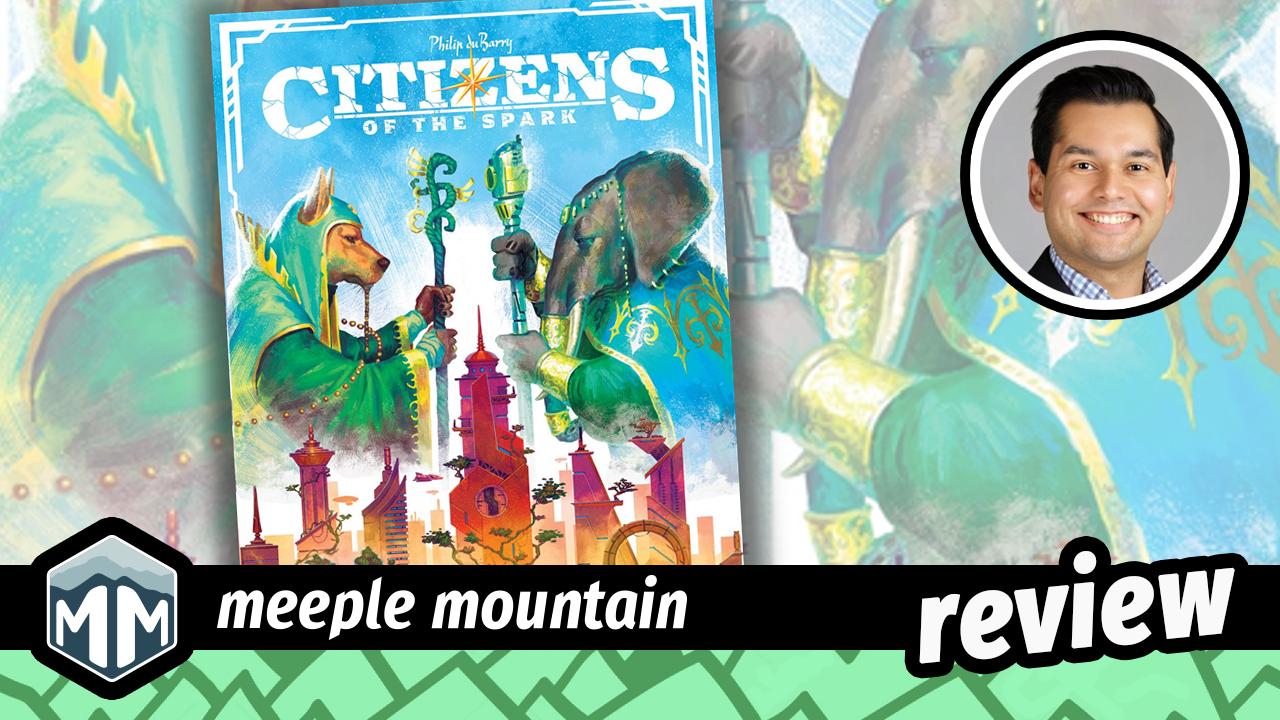
Citizens of the Spark Game Review

Tabling Tableaus

I once asked W. Eric Martin at GAMA Expo, “What’s your favorite game?” He replied instantly: Innovation. I hadn’t heard of it at the time, but I quickly tracked down a copy and have since played that wild tableau-building civilization card game many, many times. It has shot up to become one of my favorite games, so keep an eye out for my review of Innovation Ultimate in the near future.

But this isn’t Innovation—though it’s close in some very interesting ways. I was handed this review copy by fellow mountaineer Justin Bell at Gen Con last year, and I went in with absolutely no context for what to expect.

To my surprise, there’s a lot here that feels reminiscent of Innovation (and even Dominion), but with enough twists to make Citizens of the Spark one of my favorite new-to-me games of 2026.

Regular readers may know that tableau building is one of my favorite mechanisms, so when a game is built around that idea, I’m already interested.

Spark Plugs

Citizens of the Spark includes 30 different citizen sets, with 7 to 10 used in a given game depending on player count. Players collect sparks, which serve as points, and the game…

The post Citizens of the Spark Game Review appeared first on Meeple Mountain.

Unboxing Video: The Battle for Normandy Deluxe Edition from GMT Games

Von: Grant
09. Mai 2026 um 14:00

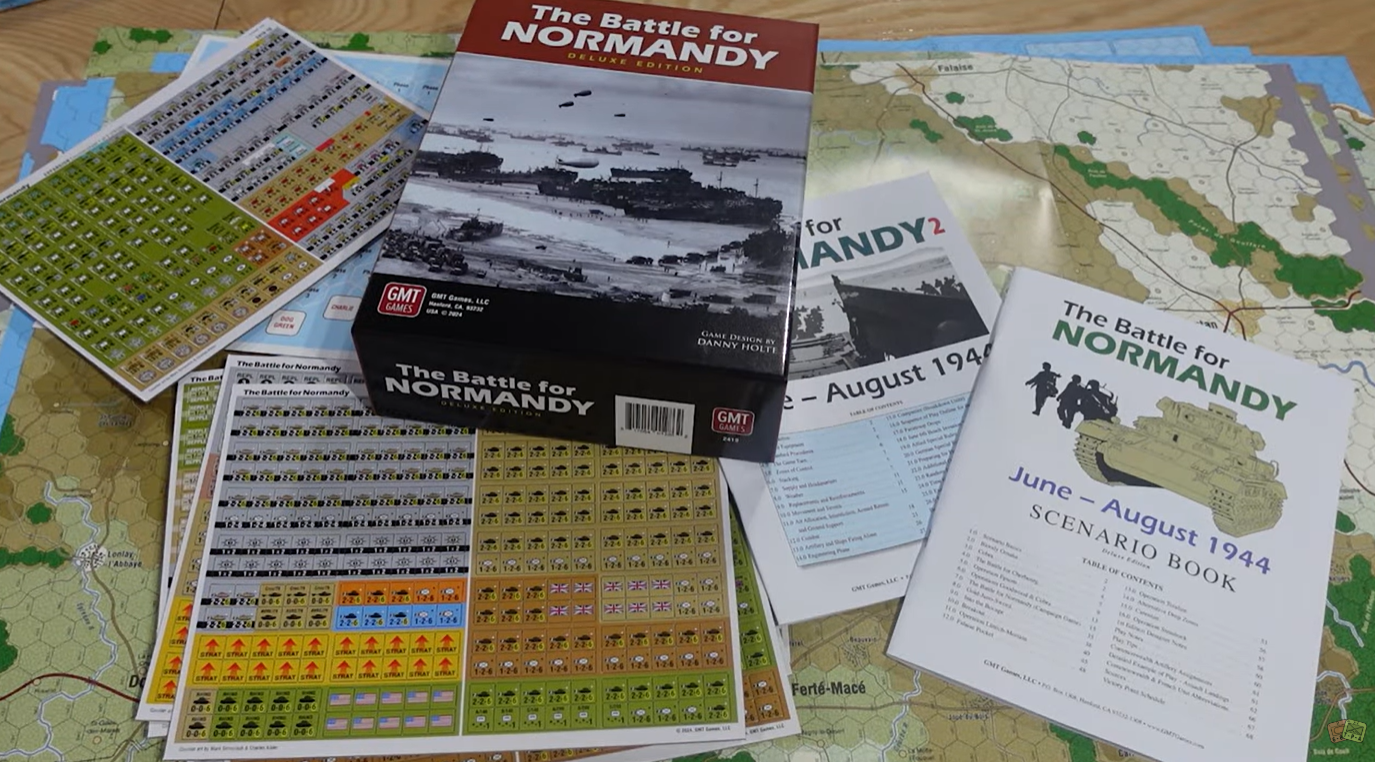
It has been about twelve years since The Battle for Normandy was originally released. Since that time, new research has been made available, and the game has been played countless times by many players around the world who have provided a wealth of feedback. The game system remains basically the same, allowing players to focus on planning and strategy and not an overbearing rules system. Based on that new research and feedback, many units have been adjusted, all of the maps have minor changes, and some whole rules sections have been revamped to better represent the historical reality, while minimizing further complexity. The original expansion is included in this Deluxe Edition (while remaining optional), and there are also new scenarios.

The Battle for Normandy Deluxe Edition Components
(basically the original game and expansion combined with a few new components):

  • 11 Countersheets (9 original, 2 from expansion; some of those dropped; the 70 errata counters are now incorporated into originals, plus some breakdowns dropped making room for the new counters) Many updates but the same graphics.
  • 7 Mapsheets  22 x 34” (5 orig, 2 expansion) Many updates but same basic maps.
  • Rulebook 44 Pages
  • Scenario Book 68 pages
  • 1 non-perm marker
  • 3 D6 and 1 D10
  • 2 Beach Landing aid cards 8-1/2 x 11
  • 2 Terrain Effects Cards 8-1/2 x 11
  • 2 CRT/Replacement tables  8-1/2 x 11
  • 1 Allied Air Allocation log (laminated) 8-1/2 x 11
  • 1 German Air Allocation log (laminated) 8-1/2 x 11
  • 1 Turn Record Track 8-1/2 x 11
  • 1 Utah Beach area map, cardstock (from original expansion) 8-1/2 x 11

New Components:

  • 1 Random Events Table (8-1/2 x 11”) card stock
  • 12 Interdiction level cards (2×3”, or regular card size)

The Battle for Normandy is a game that represents the climactic campaign in Normandy from D-Day, 6 June 1944 to the first week of August 1944 at primarily battalion level. Numerous scenarios are included to play out various smaller battles in Normandy. It is intended for 2 players or player teams.

-Grant

❌