Anmelden
Osprey Games Will Ditch Board and Card Games
14. Mai 2026 um 18:00
In the future, the UK publisher will focus on wargames and roleplaying games

In the future, the UK publisher will focus on wargames and roleplaying games
Asmodee USA adds more companies to its distribution services



Asmodee has revealed the first slate of partner companies it has picked to make Lord of the Rings-themed board games and accessories, six months after becoming the steward of the hugely lucrative Middle-earth licence for the tabletop.
Endeavor: Deep Sea co-publisher Grand Gamers Guild, Ascension publisher Stone Blade Entertainment, and Play to Z, the board game publisher created by Z-Man Games founder Zev Schlasinger, have all been selected by Asmodee to produce new Lord of the Rings titles.
They are joined by dice and tabletop accessories maker Sirius Dice, and Game Toppers, which announced separately that it will be creating Lord of the Rings-themed gaming tables, mats and other accessories.
Individual projects from most of those publishers are still under wraps, although last month Stone Blade announced it would be bringing a Lord of the Rings-themed version of its Ascension deckbuilding game to Gamefound.
Asmodee has had an impressive run of success with Lord of the Rings-themed releases in the last couple of years, with games including 7 Wonders Duel-reworking Duel for Middle Earth, The Fellowship of the Ring – Trick-Taking Game, and Matt Leacock’s pandemic-inspired Fate of the Fellowship all picking up both critical acclaim and a string of awards.
The board game giant was previously the sister company of Middle-earth Enterprises when both businesses were owned by video games major Embracer Group, before Asmodee was spun off as an independent operation early last year.
When Asmodee was given power over the tabletop licence by Middle-earth Enterprises last October, the initial reaction from some publishers was that they would struggle to get a look in, with Asmodee likely to reserve the best opportunities for Lord of the Rings releases for itself.
Speaking to BoardGameWire a couple of weeks after Asmodee became manager of the licence for tabletop, however, Luke Peterschmidt – the tabletop veteran tasked with running the Middle-earth operation at the company – was at pains to quash that line of thinking.
He said at the time, “Our job is to make the right number of Middle-earth games at the right pace, so that every game has space to breathe, and there is a Middle-earth game or gaming accessory for every type of game.
“That’s the mission, and no part of that mission says, ‘and Asmodee makes all the games’.”
He added, “It is absolutely fair to have that thought in your head, and it’s our job to prove that thought wrong. And, I mean, literally nothing I say, I think, could convince anybody other than action. So yeah, it’s got to be the action, we’ve got to follow it up.”
In a statement announcing the first slate of partner companies, Peterschmidt said, “There may be The One Ring to rule them all, but it takes many publishers to satisfy the gaming needs of The Lord of the Rings fans and I’m sure each of our partners are going to do their part in that quest.”
Asmodee’s own Lord of the Rings-themed releases this year are currently set to include The Lord of the Rings: The King’s Gambit, which its studio Space Cowboys is developing in partnership with Restoration Games.
That title is a reimagining of turn-of-the-millennium Avalon Hill release Star Wars: The Queen’s Gambit, which is based around four battles that take place during the events of Star Wars film The Phantom Menace.
Publishers interested in pitching a Middle-earth game to Asmodee can do so by emailing METTGlicensing@asmodee.com.
The post Asmodee unveils first slate of publishers picked to make new Lord of the Rings games first appeared on .
When my 4 children were younger I played games with them all the time, easily several times a week, and sometimes every day. In addition to time together, it was a chance for me to instill important values like fair play, good sportsmanship, and how to win (and lose) gracefully. Early on I came across a game called Zombie Kidz, a small box cooperative game about preventing zombies from escaping a cemetery. It featured cartoony artwork and a simple game loop: roll a die, put a zombie out on one of the corresponding 9 spaces on the board. Then, you could move your character to a nearby space and potentially eliminate a zombie there. The goal was to put locks on all 4 corners of the board and win the game. My kids loved it, and it gave me a chance to teach them about teamwork and the consequences of choice. Eventually, they grew out of the game, and we stopped playing it.
That is until I heard that the publisher was releasing a sequel called Zombie Kidz Evolution, targeted at a slightly older audience, exactly where my kids were at the…
The post Gaming Memories: Volume 02 appeared first on Meeple Mountain.
I feel like I learn something every day from another game publisher, whether it’s game design, operations, product design, marketing, etc. Today I thought I’d highlight some of the things our panelists love about other publishers–the types of things they want to see more publishers emulate.
Also, before we hear from our panelists, we just launched two major products on the Stonemaier Games webstore! Finspan: Sharks & Reefs and Euphoria Essential Edition (or the update pack if you already have the game and expansion) are ready to ship to you now: https://store.stonemaiergames.com/collections/latest
***
Plaid Hat Games (Dillon’s pick): I like how Plaid Hat’s games often have either a subscription or continual, mostly optional content, for their game systems. It’s basically just a living card game model, but it keeps me engaged with the games. In terms of what I’d like to see others emulate, it doesn’t necessarily need to be constant new content, but in the hobby, it can often feel like we’re constantly hurrying to check out what’s new. So something to keep a game feeling alive is valuable. As a side example, I think Stonemaier does this in a different way by representing their games as different “Worlds” and by keeping their amount of releases fairly lean. [JAMEY: I previously highlighted some things related to this that Plaid Hat is doing with print on demand.]
Restoration Games (Garrett’s pick): While our hobby is often fixated on the new, I’d love to see more publishers emulate Restoration Games’ mission of breathing new life into forgotten or underrated classics. It’s incredibly refreshing to see a company look backward to ensure great legacy designs get their well-deserved flowers, combining modern production quality and mechanical updates with genuine reverence for the past. Even though this is Restoration’s core business model, seeing other publishers take a stab at this could increase the output of lovingly remastered titles that honor our hobby’s history. [JAMEY: I also think 25th Century Games does this well.]
Stonemaier Games (Aryn’s pick): I went back and forth on this a lot. But, ultimately, I’d be picking nits if I chose another thing a publisher does that I wanted other publishers to take note. So here I am writing to other publishers, take note of what Stonemaier Games is doing. Hire a team to craft a solo mode for your games. I understand not all games can have a solo mode. It’s hard to have a party game for one, for instance. I also understand this costs money, but please consider it. Stonemaier Games’ relationship with The Automa Factory is why I got into Stonemaier Games. I can play all these wonderful games that Stonemaier puts out without having to worry about another person’s availability. I can dive into the design of a game more in depth when I am able to get it to the table more often. Am I about to teach a game? I play the solo mode to further enforce the rules before I teach the game to others. [JAMEY: I am truly grateful for Automa Factory’s involvement over the years.]
Kaitlyn also chimed in with a general comment that she attributed to Stonemaier Games, but honestly I see other publishers doing this better. Check out Endeavor Deep Sea by Burnt Island Games for a great example of how you can achieve high quality with fully sustainable components. Kaitlyn says: I love seeing publishers use eco-friendly packaging. I think Stonemaier does their best; I first noticed it with Wingspan, but I think most, if not all, Stonemaier games are packaged in an eco-friendly way.
We’ll close with Skiler, who mentions several publishers and examples.
I love consistent components throughout many of a publisher’s games. For example, I believe Garphill Games offers custom metal coins designed specifically for the North Sea, West Kingdom, and South Tigris trilogies. Instead of unique currency for every game, the coins are compatible across every title in a series. I would love to see this with resources and other components in more games. They also often have consistency with their iconography across their games which makes learning new games by them way simpler. I really appreciate this!
I love the trend of missions in games, that are not legacy, but have optional progression. For example, Deep Sea Endeavor (Burnt Island Games): I absolutely love that we can play through different missions, but not feel constrained by the parameters that a legacy game inherently comes with. This isn’t necessarily new, but it feels more common and I welcome it!
I love the trend of cozy games with great art. The gameplay still very much matters, but a cozy theme with great art will get me every time. More please! (Examples of this would be Harmonies by Libellud or Creature Comforts by Kids Table Board Games.)
I love that learn-as-you-play tutorials are becoming more common. (An example of this would be Stonemaier’s Quick Start cards in Wyrmspan.)
***
Huge thanks to Dillon, Garrett, Kaitlyn, Aryn, and Skiler for sharing these things they love about a variety of publishers. One thing I’ll add to the list is that I have a continued and growing appreciation for publishers who focus on one game at most every year or so. That level of focus and time spent getting it right is a luxury that not everyone has, but I admire those who are able to do it.
What’s something a publisher is doing that you love (and would like to see others emulate)?
***
If you gain value from the 100 articles Jamey publishes on this blog each year, please consider championing this content! You can also listen to posts like this in the audio version of the blog.
The March 2026 Monthly Debrief Video, which is the 3rd episode in Season 6 of this series, saw us discussing the games of David Thompson. David Thompson burst onto the board game design scene with his 1st game released in 2018 called War Chest, followed closely by the release of Pavlov’s House. His actual first game designed was For What Remains, which is a tactical skirmish game set in a futuristic post-apocalyptic wasteland where factions fight each other for supremacy, but it was not released until 2020 after a successful Kickstarter. Pavlov’s House was his first foray into the historical board game genre and its success has spawned several follow-up games in the Valiant Defense Series. David is a very conscientious designer and wants to put the time in to make sure his games are not only realistic in their play but representative of the time period covered. David also established Digital Capricorn Studios to support his board game design habit and on that website you can learn more about his design philosophy and check out his numerous games.
Also, as usual, we covered the games we played in March, which included the 14 games we played at Buckeye Game Fest.
We will remind you here that we are fortunate to be continuing our relationship with Noble Knight Games as the sponsor for our Monthly Debrief Video series. In case you don’t know, Noble Knight Games specializes in hard to find games but also carry all the new releases. But what makes them truly unique is that you can find some of the rarest games, long out of print games, hand made games, imported games from overseas, etc. Thanks to them for their sponsorship and we hope that you will consider them first when looking for the games we cover.
-Grant
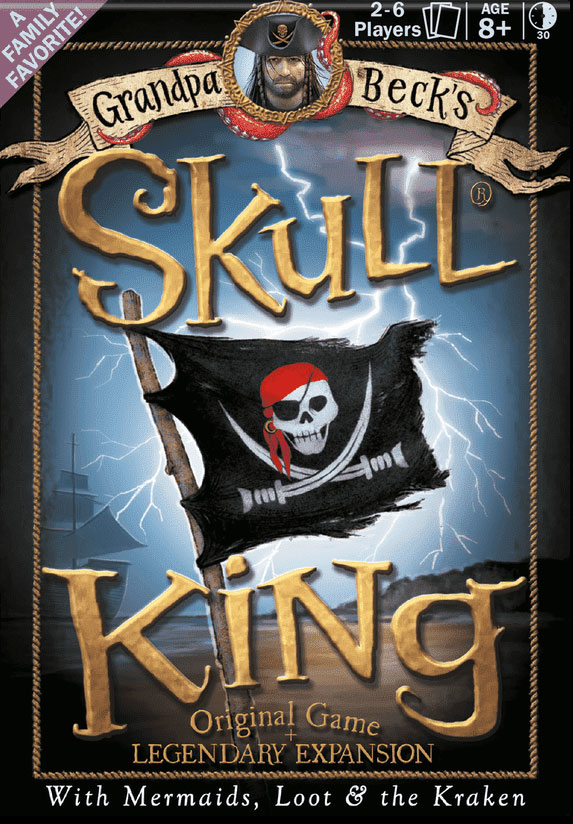
To create balance and ensure that no one class, move, or play dominates a table, the gaming community has adopted several eternal triangles: Scissors beats paper beats rock beats scissors Fighter bests ranger bests mages bests fighter Pirate King defeats pirate defeats mermaid defeats Pirate King. You haven’t heard of the last one? Allow me […]
Other stories include the Golden Geek Awards, Hasbro's Q1 2026 revenue and how to create licensed board games
Citizens of the Spark feels like it was custom-made with me in mind. It’s a tableau-builder (yes) designed by Philip duBarry and illustrated by Diego Sá (yes) seeded with a small selection from a huge pool of cards (yeeesss) that happens to be populated with anthropomorphic animals (eh, fine). Those animals, it turns out, are not your usual medieval-ish fare, but scientists, scholars, performers, and everything else, jumbled together to form a polis of intersecting interests and vocations.
Which is to say, it brought me around in the end.
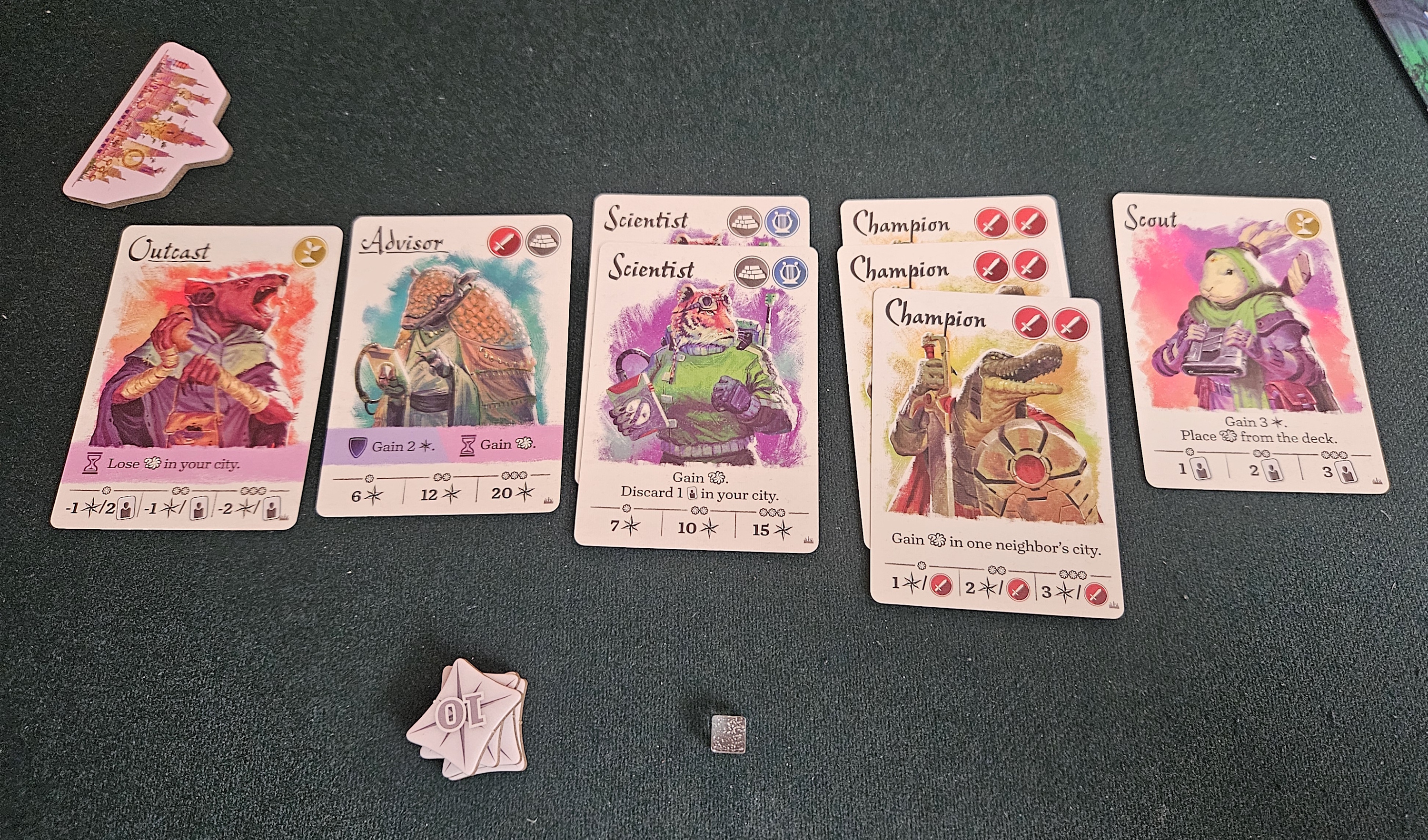
Ah, my pleasant animal polis.
It begins with a shuffle. Such a big shuffle, in fact, that my relatively broad hands ache at the strain of holding so many cards. There are thirty flavors of citizen in the box, a generous spread. Depending on your player count, you’ll take seven to ten of those sets, each set ten cards in size, and riffle them together until your knuckles crack.
And then you try to get them to work together.
Even in its earliest moments, there’s a tinge of something primal to Citizens of the Spark. Not primal in the sense of cavemen striving against the mammoth. Primal in the way the game asks you to create a society from these dissimilar peoples. This is the question that hovers over all of civilization. Can people who don’t see eye to eye live beside one another and strive toward a shared goal? It’s visible in Sá’s artwork. The Judge is a chicken. Not in the sense that she’s a coward hiding behind the bench and his robes. She’s literally a chicken. A hen. A producer of eggs. Tasty in peanut oil. She might share a city with one of her natural predators. An Agitator who happens to be a fanged reptile. A Soldier who is a bear. The tiger Scientist. To thrive, one presumes the city is governed by détente. No eating the judges.
As lovely as those illustrations are, duBarry encodes these dissimilarities into the cards themselves. In any given session, you might be presented with a society of Tyrants and Executioners. Yikes! But those dangerous creatures may soon prove paper tigers in the face of Traders and Politicians. Your task is to take these cards, measure their worth, and try to piece together something functional. There are natural imbalances, of course, but nearly any combination is playable, with the sole exception that you shouldn’t use more than a few underlined citizen sets at once. It’s impressive, both conceptually and as a way to ensure that every session presents a fresh conundrum for players to puzzle over.
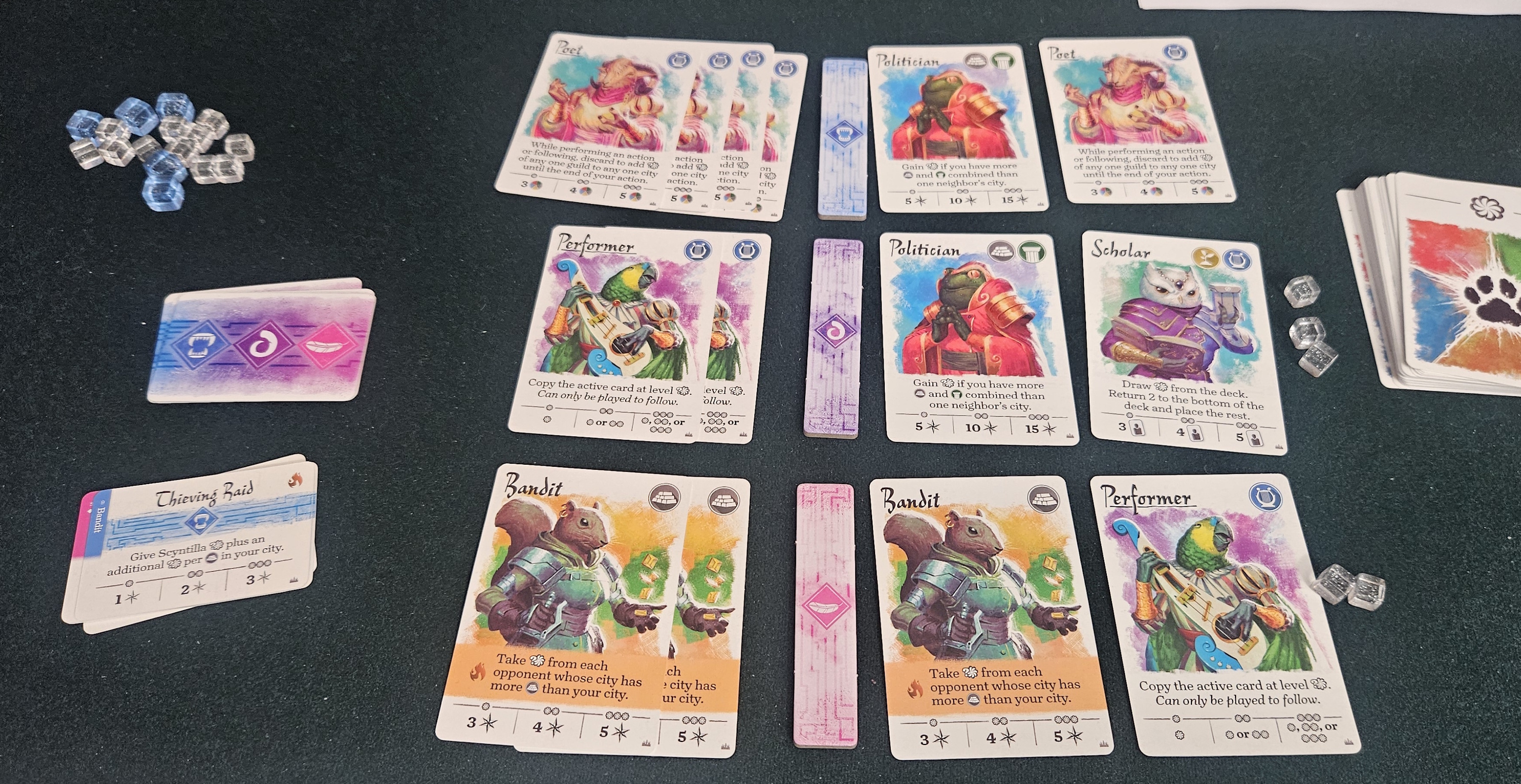
Cards are drafted from rows that gain more sparks as their denizens are neglected.
For all that, the actual gameplay is snappy and rules-light. First you choose a few creatures to add to your incipient polis. These are offered three rows at a time, each containing two or three cards, again depending on player count. As rows go unclaimed, perhaps because they include cards that don’t boast the same natural synergies as their peers, they accumulate sparks, the game’s currency of victory points. After a while, even outcasts accrue enough value to make them tempting.
As your city swells with citizens, you might want to trigger their actions. There are quite a few of these, attacks and defenses and trades and swaps and conversions, but their one commonality is that every action grows more potent with larger numbers of citizens. Here’s a simple example. If you have a Merchant, you can trigger its action to gain sparks for every brick icon in your city. With only one Merchant, that’s one spark per brick. With the maximum of three Merchants, that’s three sparks.
The limitation, though, is twofold. First, that citizen will depart your city forever. So there’s an element of press-your-luck to the whole thing, a barrage of micro-decisions over whether to activate your citizens right now, or wait until you have a bunch of them to trigger their more powerful effects.
Second, everybody else at the table also gets the chance to activate that citizen type. Sure, maybe we’ve tapped out the supply of Merchants, so I’m eager to earn a few points. But if your city is housing three times as many of the guys, or more of the icons they score with, then it’s entirely possible I’ve just handed you a powerful opportunity on your off-turn. Tradeoffs, tradeoffs.
Cluttering this headspace even further is the fact that the Merchant is about as simple as citizens get. The Scientist functions similarly, earning increasing points with more duplicates. But they also force another citizen to abandon your city entirely. Controversial research, perhaps. The Warrior earns points, but only if your city has greater military strength than a neighbor. The Bandit steals points, but you need to have fewer bricks than your victim; as a complicating factor they also provide the very same brick icon they’re trying to have fewer of.
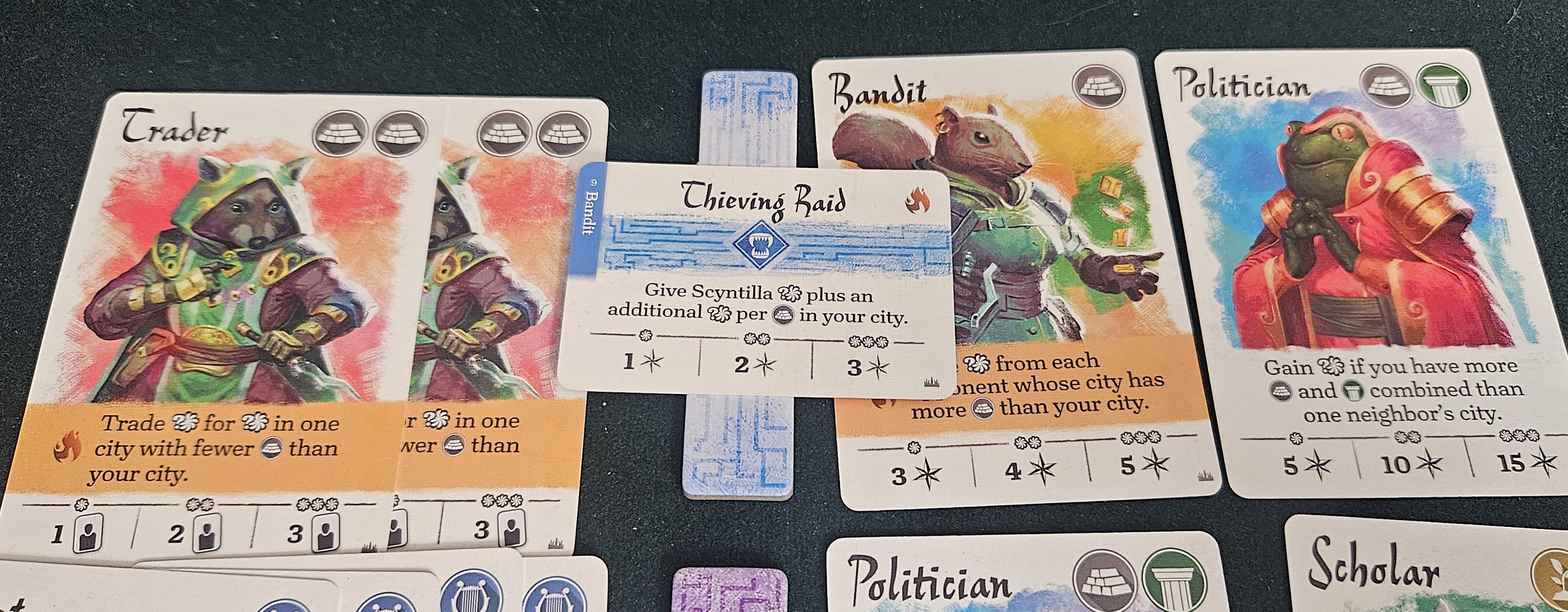
The solitaire mode is bastard-hard.
Put together, Citizens of the Spark is the sort of game that’s rife with imbalances, but those imbalances are the very thing that make it so riveting to explore. It’s almost unthinkable that any assemblage of citizens won’t come with at least one or two stinkers. Philosophers who don’t have anyone to philosophize to. Defensive Advisors and Diviners when there are hardly any attacks to defend from. Poets and Outcasts, the gummy citizens that steadfastly refuse to be put to productive use.
But that’s precisely when the game becomes interesting. Maybe everybody will squabble over the most valuable citizens, thus spreading them between too many cities to be valuable. Or maybe a few cards will sit in the offer so long that they become worth quite a bit more than their printed value. I’m already on the record as believing that “balance” is perhaps the most oversung element of board game design. In duBarry’s hands, the imbalances between citizens become the game’s most essential texture.
To be clear, Citizens of the Spark is a subtle game. It isn’t flashy. There are big swings, but they’re swings of points, a card moving from there to here, more points. There are plenty of turns that consist of grabbing cards, glancing at your tableau, and deciding that, y’know what, there aren’t any actions you want to take right now. Similarly, it’s a rather chancy game. Get ready to listen to that guy complain that no good cards are ever available on his turn.
Still, I can’t help but appreciate this one. I like its gentle ebbs and flows. I like how it feels warm despite its cutthroat tendencies. I like how it can wipe out a player’s city in the early stages, then still, more often than not, pave the way for a comeback with some grit and maybe some whining. I even like the solitaire mode, with its card-shifting and ability-triggering meanie of a bot.
Most of all, I like these dang cards. Their imbalances and chanciness, the way they reward focus and diversification at the same time. The fiction of them. They call to mind any number of successful cultures, from Persia to Star Trek to the Panspecificity, that fashioned functional states despite the vast differences between their subjects. Or maybe the most successful city on the table will be a government of predators. That’s how it goes sometimes. I like that, too.
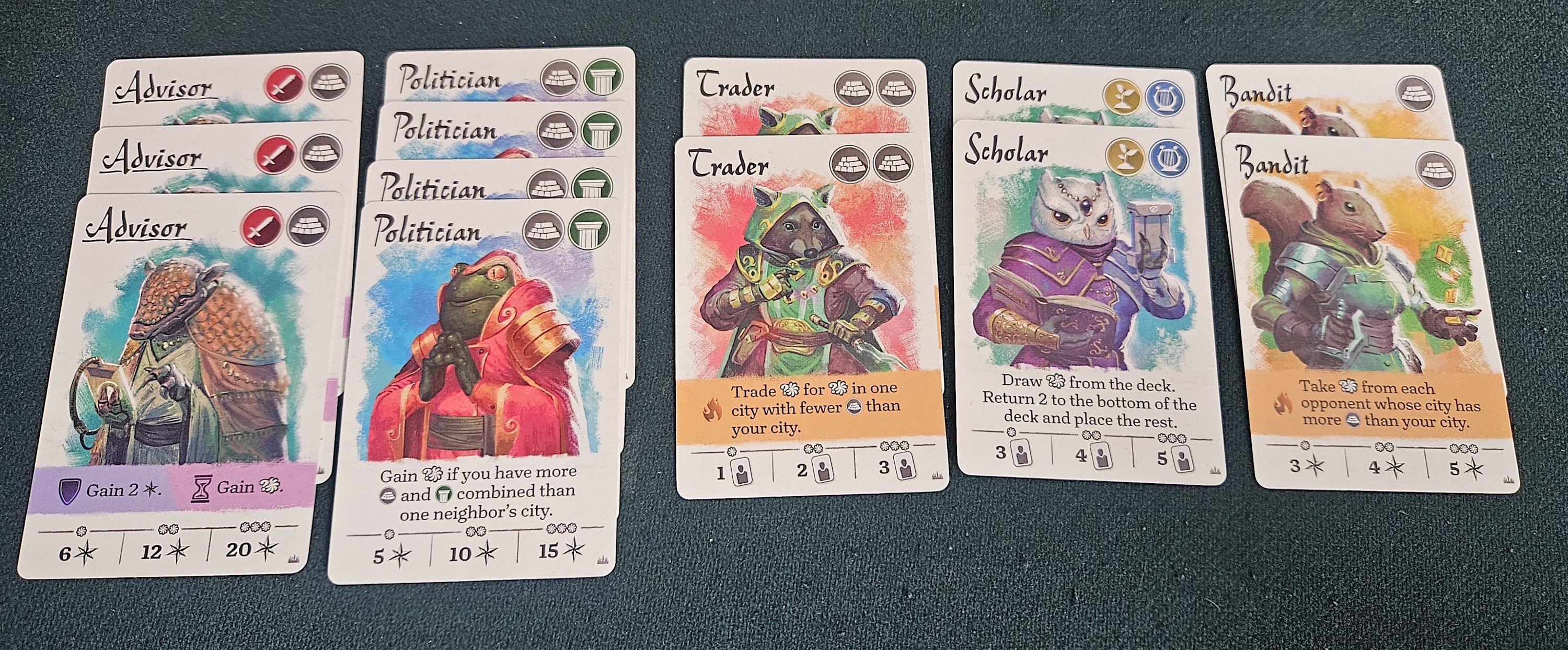
It’s a while before repeat combos show up.
Ultimately, Citizens of the Spark is a pleasant little thing, not groundbreaking or liable to show up in every game store, but still a quiet and compelling artifact of play that grows deeper and cleverer with each session. It’s the sort of game that feels like the beginning of something. More citizens? New modes? Another game inspired by this one’s muted success? Who knows. For now, it’s a game I’ll break out when I want to show somebody what can be accomplished with unassuming systems and some imagination.
A complimentary copy of Citizens of the Spark was provided by the publisher.
(If what I’m doing at Space-Biff! is valuable to you in some way, please consider dropping by my Patreon campaign or Ko-fi. Right now, supporters can read my first-quarter update of 2026: the best board games, movies, books, and more!)