❌

Lese-Ansicht

Call for Playtesters: Rubicon and Basileus Designed by Douglas Walker

From time to time, we assist designers with getting the word out for them as they are looking for playtesters for upcoming designs. Recently, I was contacted by Douglas Walker who is working on 2 designs, one named Rubicon and the other Basileus, and was in need of assistance. He has created a Discord server for potential playtesters called “Doug Walker Playtest Server.” Here is the invite, which won’t expire: https://discord.gg/gSsQRWjPWp.

Doug has provided the following descriptions of the games:

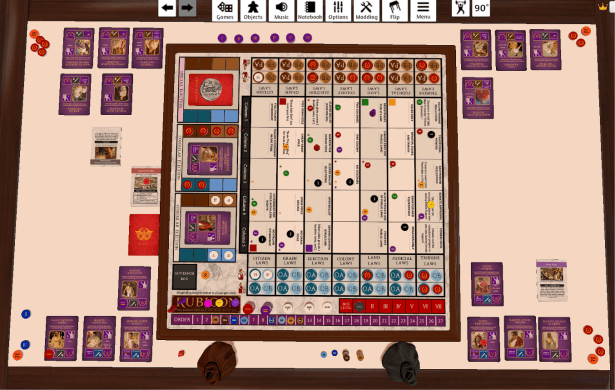
Rubicon is a strategy game about political competition in the late Roman Republic. It is 133 B.C. The Republic of Rome overshadows the Mediterranean world, but internal discord threatens to derail its growing empire. Two political factions vie for dominance—the aristocratic and conservative “Optimates” and the populist and revolutionary “Populares.” The fragile consensus holding together Rome’s elites erodes as conflict grows ever more violent.
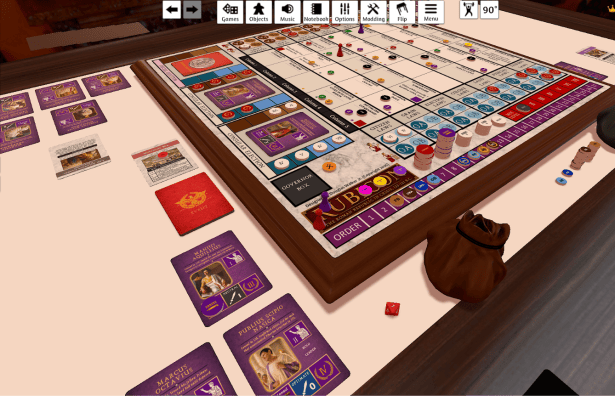
In Rubicon, players control a faction of Roman senators belonging to either the Optimate or Popularis faction. More than one player belongs to each faction—but only one player may win the game. Players use their political influence to win elections, gain glory in war, and shape the laws of the Republic to suit their ideology and interests. Rubicon involves simultaneous blind bidding, negotiation and hand management. A thematic push-your-luck mechanic involves violating the unwritten customs of the Republic to unlock powerful actions, at the risk of provoking a deadly pushback. Winning requires carefully balancing cooperating with one’s faction partners to advance shared objectives, such as passing laws, while simultaneously competing with them to advance the glory and reputation of one’s own characters.
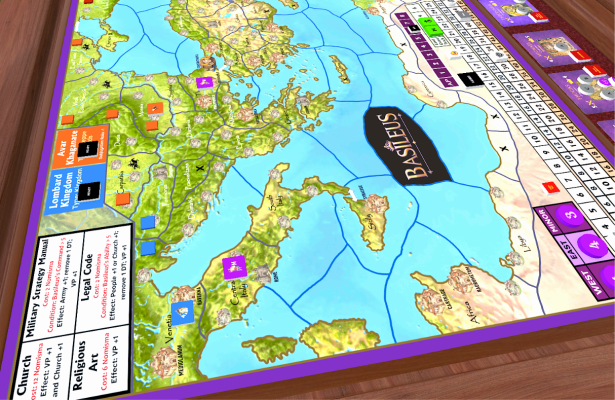
It is A.D. 568, and you live in the East Roman Empire (also known as the Byzantine Empire.) Three years ago, the great emperor Justinian died and was succeeded by his nephew. As the heirs of Caesar Augustus and Constantine the Great, the emperor—or “Basileus”—enjoys total control of the Byzantine state. Yet it is clear that Justinian’s repeated attempt to reconquer lost territory in the west has overextended the empire. He succeeded in re-taking North Africa, Sicily, and Italy—but at an enormous expense in both money and soldiers. Wealthy landowners and small farmers alike are burdened by taxes. The “powerful ones” or “magnates”—men who are educated, own land, and serve the government as high-ranking officials or generals—are unhappy. Justinian’s prestige made him untouchable while alive, but his successor enjoys no such immunity.
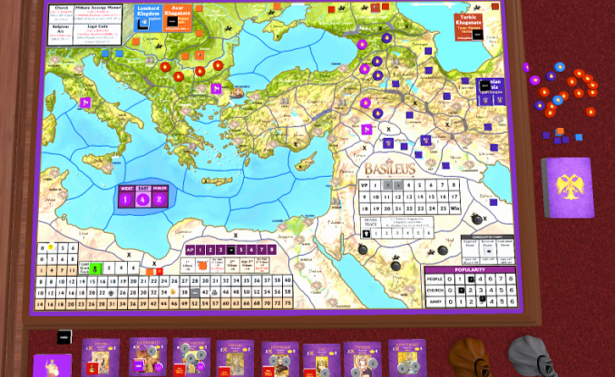
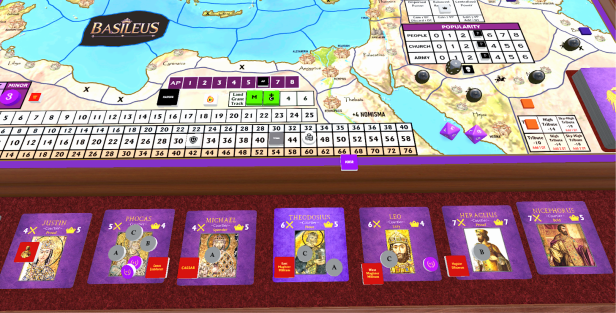
Basileus is a card-driven strategy game for three players that simulates politics, war and diplomacy in the East Roman Empire in the 500’s AD. Players take one of two roles: one player—the “Ruler”—controls the emperor (Basileus), while the other two players—the “Magnates”—control both the wealthy and powerful Roman courtiers and non-Roman nations. Players take two actions per turn. There are a certain number of actions available every turn, while strategy cards give extra event and action possibilities to the Magnates. Action cards are chosen simultaneously and resolved in a semi-random order, making gameplay quick and unpredictable. Victory points are awarded for winning battles, conquering territory, and completing literary or artistic achievements. But there’s a catch: the Basileus-Player automatically gains a certain number of victory points each turn. The Magnates must try to make life difficult for the Ruler by lowering the Basileus’s popularity, devastating the Roman economy, leading foreign nations to victory over Roman armies, and building up disloyal characters. If they get lucky, they can initiate a rebellion against the Basileus, depose him, switch roles with the Ruler to become the new Ruler. The Ruler player must try to ensure that the Basileus remains popular with the Romans and successfully defends against foreign threats. But in a world where any failure can be interpreted as divine punishment, the margin for error is razor-thin. Basileus is a tense game where success can be fleeting and danger lurks just around the corner.
Feel free to explore these games and sign up for testing at the following link: https://discord.gg/gSsQRWjPWp

We wish Doug well with these projects and hope that both of these games make it to market in the future as I always love a good game on Rome.

-Grant

  •  

Solitaire Playthrough Video: HISPANIA from Draco Ideas

HISPANIA from Draco Ideas is a slick little small box game with a big punch that sees the player controlling the Roman Empire and attempting to subjugate and put down resistance in the provinces of Hispania from 198 to 18BC. The game is extremely flexible and may be played cooperatively by 2-3 players, competitively with 4 players or as a solo game. The game is somewhat of a resource management game as the players must use their limited funds in the form of Denarii wisely to attack and put down revolts springing up around the country as local armies rally support for the resistance to Roman rule.

We published an interview with the designer Miguel Marqués and you can read that at the following link: https://theplayersaid.com/2024/04/12/interview-with-miguel-marques-designer-of-hispania-from-draco-ideas-coming-to-gamefound-soon/

I also wrote a series of Action Point posts on the game and you can read those at the following links:

Action Point 1 – Overview of the Board

Action Point 2 – Overview of the Roman Phase and the various actions available including Move, Garrison, Besiege and Attack

Action Point 3 – Overview of the Hispanic Phase and how the locals spread Revolt and move Armies around the Board

-Grant

  •  

My Favorite Wargame Cards – A Look at Individual Cards from My Favorite Games – Card #90: Mob from Time of Crisis: The Roman Empire in Turmoil, 235-284 AD from GMT Games

With this My Favorite Wargame Cards Series, I hope to take a look at a specific card from the various wargames that I have played and share how it is used in the game. I am not a strategist and frankly I am not that good at games but I do understand how things should work and be used in games. With that being said, here is the next entry in this series.

#90: Mob from Time of Crisis: The Roman Empire in Turmoil, 235-284 AD from GMT Games

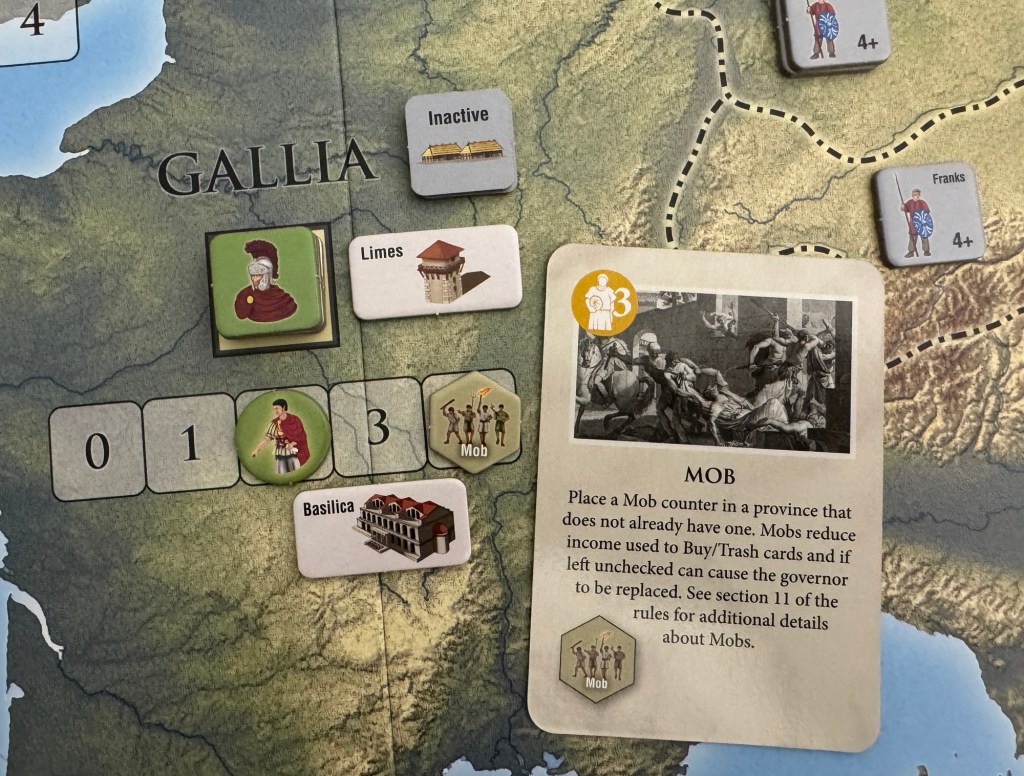
I really love Time of Crisis from GMT Games. This is a very light, introductory wargame that is just plain fun to play. I have been playing it a ton on the Rally the Troops! online platform and really enjoy it no matter what the outcome of those games are. One card that I enjoy using is called Mob, which is a 3 value Populace Card that really can be a devious way to usurp your enemies. Populace cards are intended to be used to increase the support level for your reign in various local senates, recruit militias to assist in the defense of the local populace, to remove Mob counters through the process of holding games and to build various improvements that provide various benefits such as a Basilica, Amphitheater or Limes. You will be unable to control your local provinces without the support of the people and the Populace cards will help you to build that support. But with the Mob card, this is an offensive focused Populace card that can be used to begin undermining your opponents hold on provinces.

When played, the card allows you to place a Mob counter in a province on the board that doesn’t currently have a Mob counter. Mob counters represent rioting and instability in the provincial capital of a province. The Mob in the province will reduce its income generation by the number of Mob counters in the province but also will grow if not dealt with. During the Support Check Phase, if the number of Mob counters in a province equals or exceeds the province’s support level the Governor is replaced with a Neutral Governor with a support level of 1. During the End of Turn Phase, one Mob counter is added to each governed provinces that already has a Mob counter and no Amphitheater. The presence of an Amphitheater doesn’t stop Mob counters from being added from the play of the Mob card but will stop them from growing. Remember, one of the maxims of Ancient Rome was bread and circuses, which is panem et circenses in Latin. It was coined around 100 AD by the Roman poet Juvenal in his Satires. The phrase criticizes how the Roman public traded their political freedom and civic duties for free grain and massive public spectacles.

The Mob card can be quite effective as it reduces the income of your opponents which is used to to purchase additional and more powerful cards but also forces them to spend their card values on suppressing the mobs, through military force with the Suppress Mob action or through placation with the Hold Games action. Both will be a thorn in the side of your opponents and will cause them to have to change their plans temporarily to deal with the issues you have caused them. A fun and delightful “take that” type of card.

Mobs in ancient Rome were powerful, volatile groups of urban plebeians, freedmen and workers who heavily influenced politics, food supplies and public safety. Driven by economic hardship, political gangs, and grain shortages, these crowds routinely rioted, burned government buildings and forced emperors or senators to heed their demands. Ancient Roman writers, politicians, and historians viewed the urban mob (plebs) with a mixture of fear, contempt and fascination, often describing crowds as volatile, lawless and easily swayed by demagogues. One of the more well known quotes from history comes to us by way of Titus Livy when he said, “Indeed, that is the nature of crowds: the mob is either a humble slave or a cruel master.” Livy also wrote: “As for the middle way of liberty, the mob can neither take it nor keep it with any respect for moderation or law.”

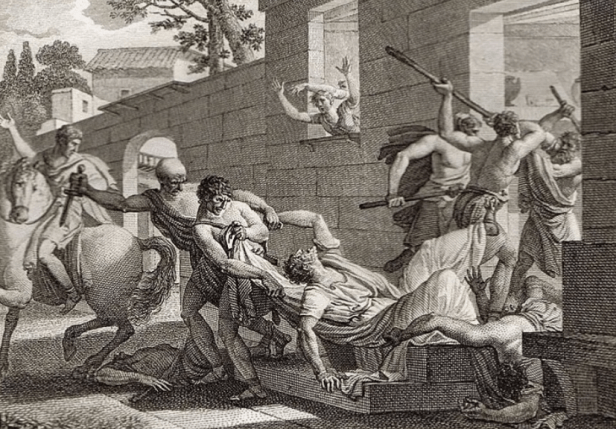
1799/1810 copperplate engraving titled The Death of Clodius (or Clodius killed by Milo’s mob) was drawn by the Polish-born French artist Silvestre David Mirys (1750–1810) as part of his series Figures de l’histoire de la république romaine.

If you are interested, I wrote a full review for Time of Crisis and you can read that at the following link: https://theplayersaid.com/2017/09/04/the-most-recent-fruits-of-wargame-hybridization-a-review-of-time-of-crisis-the-roman-empire-in-turmoil-235-284-ad-from-gmt-games/

We also posted a full review video and you can watch that at the following link:

In the next entry in this series, we will take a look at DoD Contractors from Andean Abyss: Insurgency and Counterinsurgency in Colombia from GMT Games.

-Grant

  •  

June 2026 Monthly Debrief Video – Nostalgia

The June 2026 Monthly Debrief Video, which is the 6th episode in Season 6 of this series, saw us discussing Nostalgia and its effects on the wargaming hobby. I think that nostalgia is generally a good thing but it definitely can be something that holds the hobby back. Too much nostalgia tends to keep us away from new and emerging games and systems and in general can be a suppressor of innovation and progression.

Also, as usual, we covered the games we played in June as well as the games we plan to play in July.

We will remind you here that we are fortunate to be continuing our relationship with Noble Knight Games as the sponsor for our Monthly Debrief Video series. In case you don’t know, Noble Knight Games specializes in hard to find games but also carry all the new releases. But what makes them truly unique is that you can find some of the rarest games, long out of print games, hand made games, imported games from overseas, etc. Thanks to them for their sponsorship and we hope that you will consider them first when looking for the games we cover.

-Grant

  •  

Unboxing Video: SPQR: The Battle of Alesia 52 BC from Art of Wargames

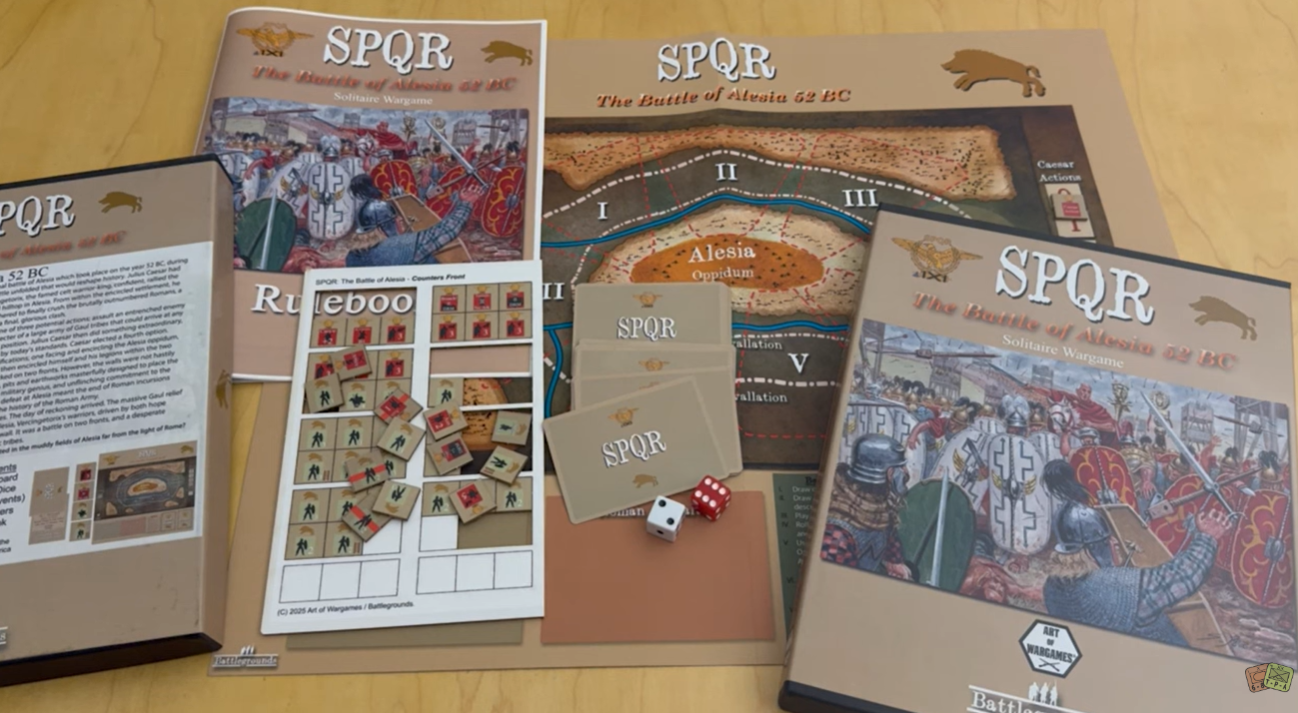
In SPQR: The Battle of Alesia 52 BC, you recreate the historical final battle of Alesia which took place in the year 52 B.C., during Caesar’s Conquest of Gaul. In the heart of the Gaul region, a battle unfolded that would reshape history. Julius Caesar had been carving a bloody path through the Gaul lands.

Vercingetorix, the famed and confident Celtic warrior-king, rallied the scattered tribes of Gaul into a desperate stand on a fortified hilltop in Alesia. From within the encircled settlement, he watched as a vast Gaul relief army of some 250,000 men gathered to finally crush the brutally outnumbered Romans, a storm cloud promising a final, glorious clash.

Will you lead the Roman Legions to glorious victory? Or will you face annihilation in the muddy fields of Alesia? The choice is yours…

-Grant

  •  
❌