It’s a designer spotlight, which means we’re turning the focus away from us, and putting it on some prestigious designers instead! This week it’s Inka and Markus Brand, whose story apparently has a whole enemies to lovers angle I did not see coming. Before we power duet, we talk about Party House: The Deckbuilding Game, Land and Freedom: The Spanish Revolution and Civil War, and Baba Is You: The Board Game.
If you don’t want to miss an episode, please subscribe on Apple Podcasts/Google Podcasts/Stitcher/Spotify, or add our RSS feed to your favourite app. Reviews and subscriptions really help us and would be greatly appreciated! To download the episode directly, click here.
If you’d like to discuss anything in the episode, please do so in the comments below, visit our BoardGameGeek guild, join our Discord, or Facebook Group! Any feedback is also always helpful. If you’d like to show your support for the show, we also have a Patreon with some fun rewards, and a merch store!
Timecodes:
01:50 – Party House: The Deckbuilding Game 06:35 – Land and Freedom: The Spanish Revolution and Civil War 13:03 – Baba Is You: The Board Game 28:53 – Designer spotlight: Inka & Markus Brand 32:10 – Catan 36:58 – The Great Dinosaur Game 37:40 – Village 40:56 – The Enchanted Tower 41:52 – Exit: The Game 46:22 – La Boca
Thank you to Heart Society for generously letting us use What’s On Your Mind, Kid? from their album Wake the Queens.
BABA IS YOU is one of the most mind-bending puzzle video games of recent memory. Now, thanks to Peter C. Hayward, it’s also a board game. On today’s Space-Cast!, we discuss the peculiar adaptation of Arvi Teikari’s video game, from its inception in That Time You Killed Me and sickbed time-wasting to its gradual development and Hayward’s long-term plans to become a screenwriter.
Listen here or download here. Timestamps can be found after the jump.
TIMESTAMPS
00:15 — obligatory compliments
17:11 — Peter’s artistic journey
40:40 — from That Time You Killed Me to Baba Is You
45:54 — Baba Is You (the video game)
54:00 — making the board game
1:04:50 — the shape of Baba Is You (the board game)
(If what I’m doing at Space-Biff! is valuable to you in some way, please consider dropping by my Patreon campaign or Ko-fi. Right now, supporters can read the next installment in my series Talking About Games, this time tackling the topic of what makes a good list! Naturally, the piece includes a list.)
If you haven’t heard of Baba Is You, grab hold of the nearest guardrail, because you’re about to be hit by a wrecking ball of descriptors. Here goes: released in 2019, Baba Is You was a mind-bending box-pushing syntax-making meta-puzzle video game by Arvi Teikari. It was hard. Famously so. Especially if you’re anything like me and not really into Sokoban-style box-pushers.
Baba Is You is now also a board game, albeit one whose pedigree doesn’t only belong to Teikari. The analog adaptation was done by Peter C. Hayward, and in many ways it feels like a riff on his abstract comedy game That Time You Killed Me. Although somehow, improbably, it’s even better — provided you have the right mind for it.
Baba Is Sometimes Confounding. In a good way.
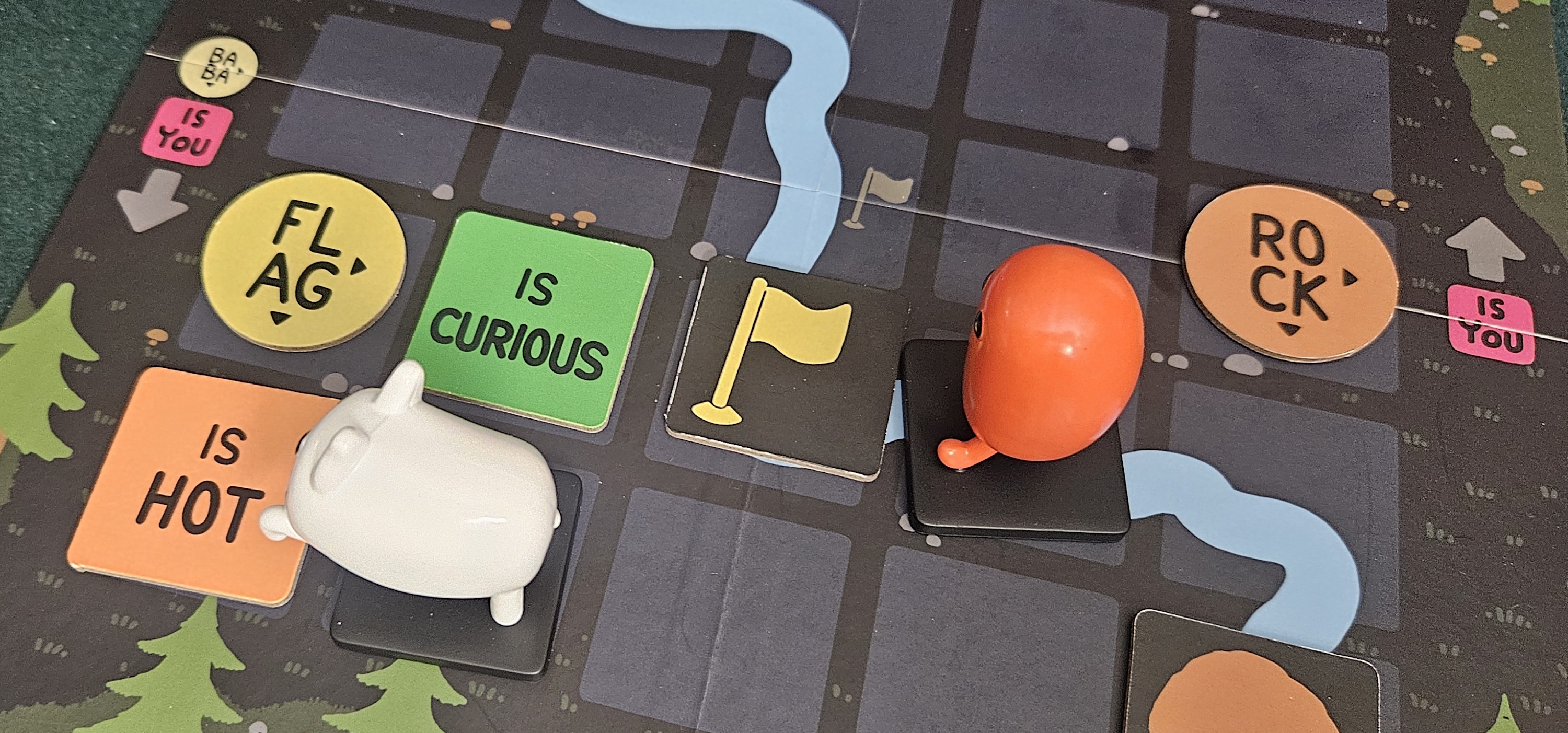
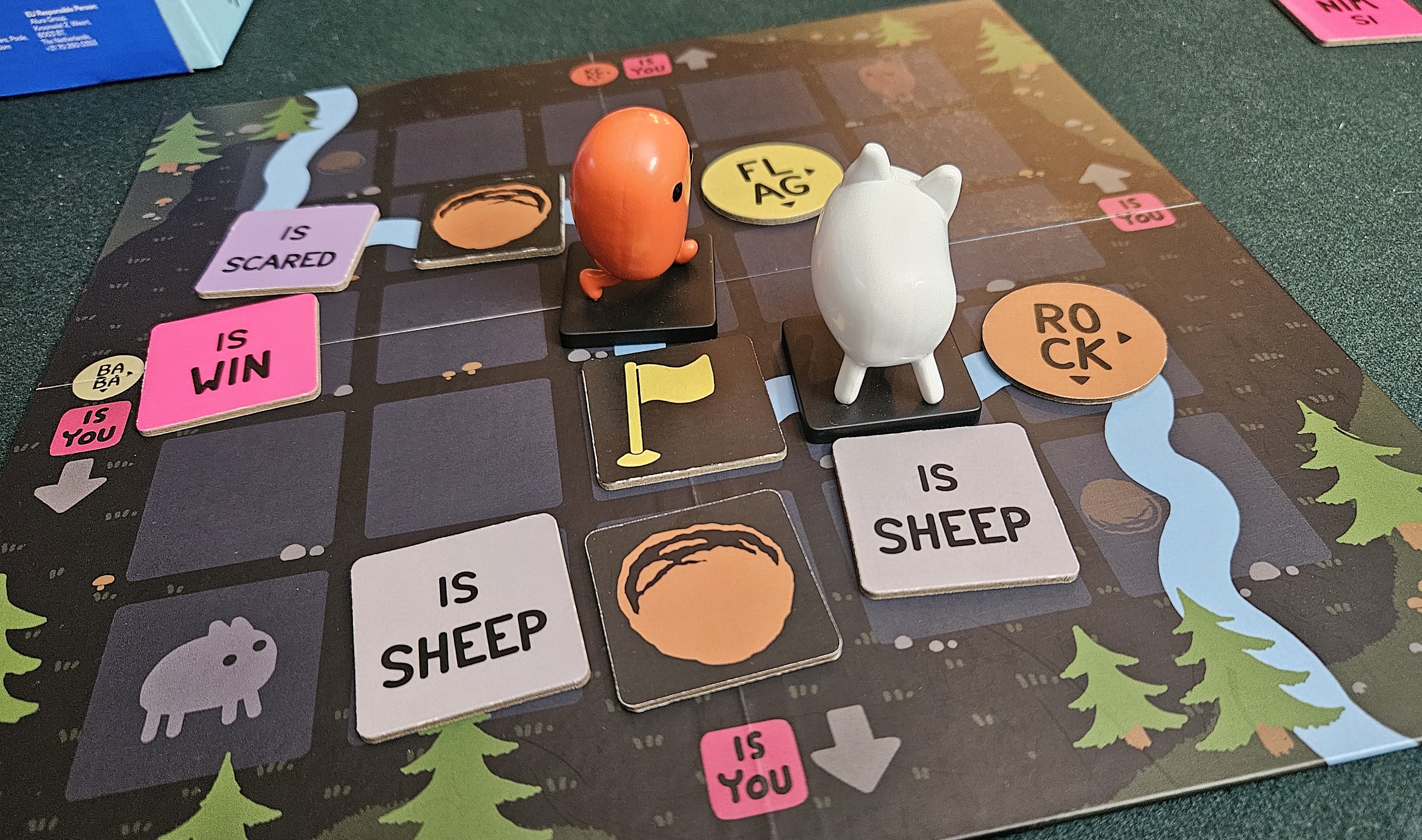
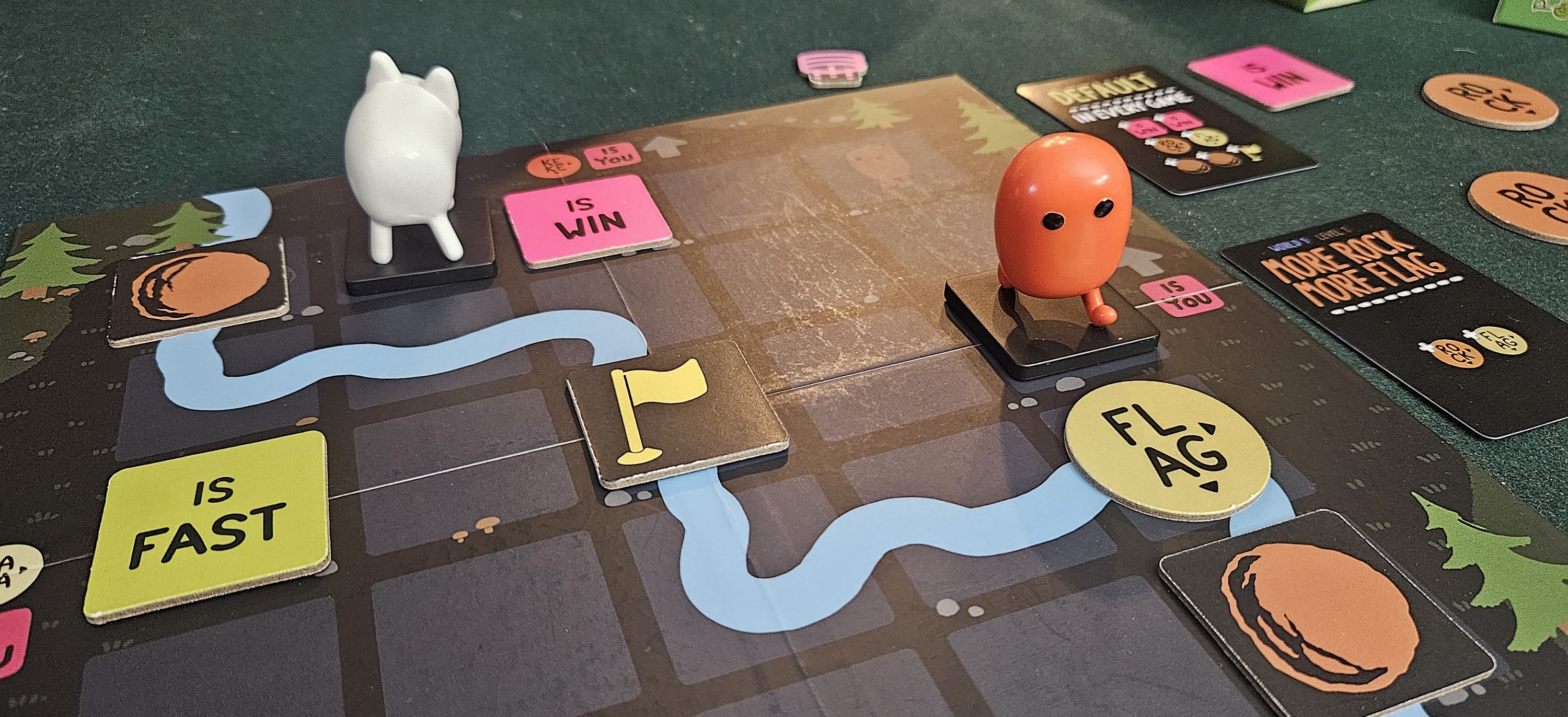
You are Baba. Baba is a dog… sheep… cat thing. Baba likes to push boxes around a ten-by-ten grid. Baba can also pull boxes, one of the board game’s main concessions to its non-digital format. Mostly, this is to prevent everything from piling up on the edges and corners until the board has screwed inward like an ingrown toenail. Boxes can also be placed next to Baba, brought from off-map to alter the game’s progress.
You are also Keke. Or, well, your opponent is Keke. Because unlike the video game, Baba Is You: The Board Game is not a solitaire affair. This is a duel, alternating players and pairs of actions. I take two actions, split as I choose between moving Baba and placing boxes. Then you take two actions, moving Keke this time and maybe also placing boxes.
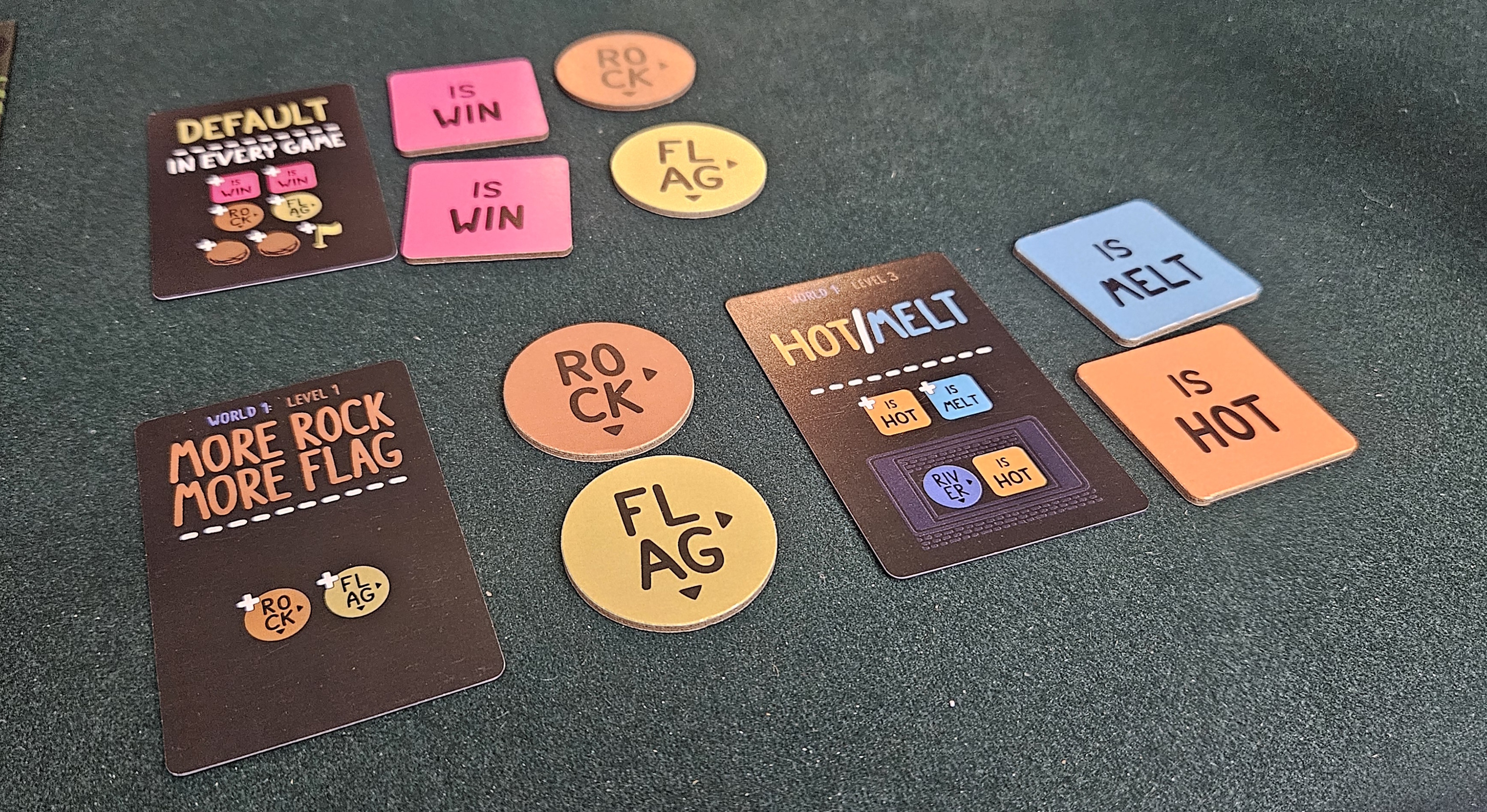
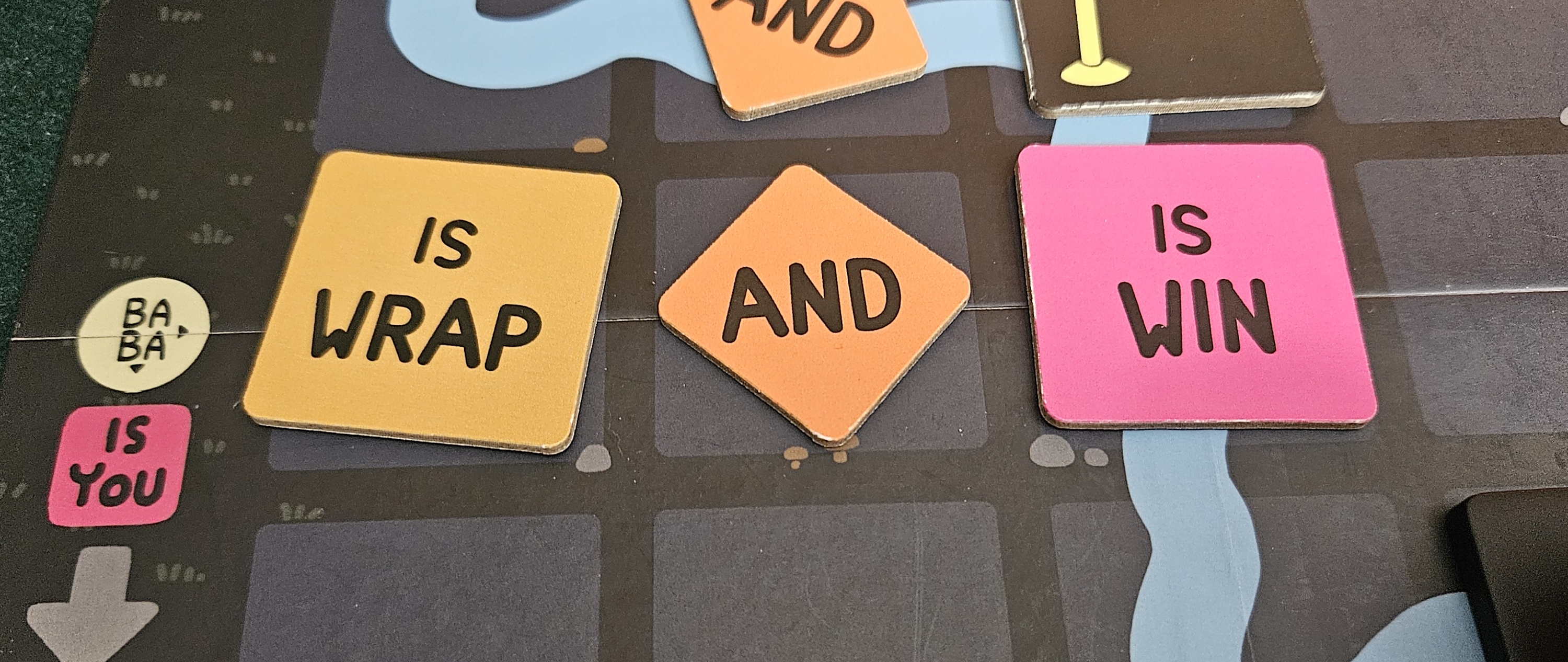
What sets this apart from any number of other games is that there is no win condition. Not right away. Your goal is “to win.” I mean, obviously. That’s why we’re playing games, isn’t it? To win? But in order to win, you must construct a way for that win to occur. For example, by placing and pushing boxes. “Rock.” That’s one such box you can place on the map. “Is Win.” That’s another. Put them next to one another and you spell out the phrase “Rock Is Win.” Now if somebody steps onto a rock, they win.
Baba Has Lots of Options. But not too many at any given time.
It doesn’t take long for this rubric to turn pretzels and loop-de-loops and barrel rolls on itself.
For one thing, there’s a lot you can do with a few basic phrases. Put “Rock” next to “Is You” and suddenly “Rock Is You.” Now instead of only moving Keke, you can also move any rock as though you were the rock. Spell out “Rock Is You” and “Rock Is Win” at the same time and you might be able to win by stepping one rock onto another rock — because you’re a rock and also rock is win. Or you could do things more simply by just spelling “Rock Is Win” and having Keke, who is you, step onto the rock. Fewer steps that way.
At the same time, fewer steps isn’t always better, because both you and your opponent are messing with the integrity of these phrases. Usually by pushing and pulling, but other tricks eventually reveal themselves as well. As a rock, maybe you push apart the phrase “Flag Is Win.” Now the flag isn’t win, so your opponent, Baba, who was one turn away from stepping on the flag, cannot win. At least not without somehow putting that phrase back together or creating another. Or by layering the game’s syntax and box-pushing puzzles over the top of each other so that your rival is checkmated into permitting your win.
Also, there are heaps of these phrases, all capable of jumbling together to create dynamic new rulesets. For example, maybe something on the board becomes “Curious.” This means that anything that moves into its row or column will cause that thing to come wandering over to see what’s snuffling about. Or perhaps Baba becomes “Thirsty,” inclined to scoot over to the river spaces at the end of each turn. Or the river decides to begin to flow downhill, potentially whisking items off the board altogether.
Sometimes these rules can have unintended consequences. Such as when a “Hot” item comes in contact with a “Melt” item, which destroys the latter. It’s possible that you will even be destroyed. You as in Baba, or you as in Keke, depending on which side you’re playing as right now. If you are something else on the board — a rock, a flag, an errant piece of syntax uplifted to temporary sentience — then you can continue to function, maybe even calling your destroyed body back onto the board, until such time as the rule is broken into pieces.
Baba Took A Wide Angle Shot.
There are three main things I would impress upon you about Baba Is You: The Board Game.
The first is that it’s incredibly funny. I mentioned that Baba recalls Hayward’s earlier effort, That Time You Killed Me, another notably funny game. Their commonalities are many. Both are short abstract games with ever-shifting rules. Both are tight two-player duels on claustrophobic boards. Both allow precisely two actions per turn, which is just enough to get something done but not enough to accomplish everything you need. Also, if played in an obnoxious manner, both can result in little I-step, you-step conundrums that aren’t especially interesting to resolve.
But where Baba Is You differs from That Time You Killed Me is crucial. These are dramatically different games in scope and process. Moves are harder to undo than those in That Time You Killed Me, with boxes usually sticking around for the duration of the match. Also, the comedy doesn’t arise from the prose. There’s none to speak of anyway. Here, Baba and Keke’s misadventures are pure slapstick. It’s the joy of assembling a mousetrap only to trigger it in your own face.
Which is also to say, the game is hard. At least it’s hard for me and the people I’ve played it with. I came into the game forearmed, having played Teikari’s original video game. But when introduced to newcomers, I found it often perplexed them. Four different opponents bounced off its systems. The combination of box-arranging and word-making is no easy thing to get a handle on.
Baba Wishes To Understand Grammar.
Then my seven-year-old requested a try. She’d watched me try it with her older sister and Summer. I figured there was no harm. She plays all sorts of games that are beyond her level, so she’s a good sport whenever something doesn’t match her expectations.
Except she took to it immediately. To her, the syntax puzzles were a joy, a constant wellspring of experimentation. The box-pushing was tougher, especially when she developed some creative interpretations of which boxes could be pulled. But making innovative new phrases became her favorite thing. She began to request it every day before school, insisting on new chapters with their punch-boards of nouns and adjectives. When we would walk to class afterward, she would bounce along, singing about the different combinations of words she had made. “Daddy, I’m floating, like Baba! Daddy, watch out, I’m gonna melt you! Daddy, the hole in the grass over there is win!” Sharing the various ways she had discovered to upset reality.
Which is another way of saying that Baba Is You doesn’t fit every brain. But when it fits, it fits with a satisfying click.
To the designer’s credit, there’s some secret sauce in the recipe… and it’s basically mayonnaise. As in, not the most exciting to talk about, but an essential splash of flavor nevertheless. The way it works is that you play a match with only a couple of keywords. Then, when that’s over, you add a new keyword and the loser gets to decide which older word is removed. This keeps the game lively and defangs the threat of losing. Rather than wagering everything on a single session, Baba Is You is played as a flight of five, seven, or possibly more matches, each building on what came before. Little metagames develop, instances where both parties want to see a keyword used to greater effect, or perhaps someone gets fed up with a Fast Baba zipping around the board and deletes the “Fast” keyword from existence altogether. It’s a dang smart way to approach the game as a whole, encouraging experimentation and risk-taking instead of putting all that weight on a single bundle of moves.
Baba Is a Perfect Outro.
Put together, Baba Is You: The Board Game becomes more than the sum of its parts. It’s a comedy game that’s genuinely thinky, a thinky game that bounces off some brains but burrows into others, and a technical achievement that always feels one step ahead of both players. When it works — and for some, that won’t happen — it’s one of the funniest, most generous titles of the year, a constant reinvention of what it means to be Baba.
A prototype copy of Baba Is You was temporarily provided by the publisher.
(If what I’m doing at Space-Biff! is valuable to you in some way, please consider dropping by my Patreon campaign or Ko-fi. Right now, supporters can read the next installment in my series Talking About Games, this time tackling the topic of what makes a good list! Naturally, the piece includes a list.)
“Nobody, and I mean NOBODY, trusts two random dentists to make a fantastic board game.”
That was the problem facing Nick Murray and Kyle Spackman, two friends who fell down the board game rabbit hole while at dental school together, when they decided to launch publisher Bitewing Games in 2020.
Bitewing’s efforts to reach out to designers ultimately provided what might have seemed an ambitious solution to that credibility problem: work with one of the biggest names in board games, prolific German designer Reiner Knizia.
Knizia and his team presented the fledgling publisher with seven prototypes to choose from, three of which became its first publishing project: the Criminal Capers Collection.
It proved the start of a defining relationship. Bitewing has since published 16 Knizia games across more than five years, building a particular reputation for digging through the legendary German designer’s enormous back catalogue for overlooked titles it believes can be successfully reworked for today’s market.
Those successes have included Zoo Vadis, Cascadero, Cascadito, Iliad, Ichor, Silos, Ego and Orbit – with Bitewing’s campaigns featuring Knizia titles among games from other designers having raised more than $2.2m between them.
But after a run of six Knizia releases last year, Murray believes Bitewing has now found “most, if not all” of the hidden gems that suit the company’s catalogue – and is increasingly looking towards video games as another route to finding potentially long-lasting hits.
Bitewing Games co-founder Nick Murray
He told BoardGameWire, “There was a period of time where Bitewing was finding some phenomenal hidden gems in Knizia’s catalogue and inspiration struck for how to evolve them, and we were fortunate that Reiner was up for revisiting them with our development goals in mind. That all culminated in a truly wild run of 2024 and 2025 Knizia releases… an explosion that I don’t expect we’ll ever see again.
“Of course we are still finding a few here and there like Gold Country, Eureka, and Escar-GO, but after playing over 200 different Knizia games (and researching hundreds more) I’ve increasingly felt that we’ve found most (if not all) of the hidden gems that are a great fit for Bitewing.
“The other thing worth noting about re-implementing older games is that you are immediately fighting an uphill battle. You see it from gamers, critics, localization partners, and retailers, especially those who have been in the industry for enough years – if a game is perceived as “old”, even it is entirely new to them and dramatically updated, they lose interest.
“Even when we go to great lengths to show how the original designer has improved the gameplay and the art team has enhanced the presentation, helping a game evolve into something even more special and exciting (at least in my opinion), it’s sometimes not enough for certain folks.
“Entirely new games have a huge psychological advantage over reprints, rethemes, and reimplementations – unless that old game is considered a major classic like Ra or Cyclades.”
The publisher is now pushing further into video games with adaptations of two established indie releases – most notably acclaimed 2019 puzzle game Baba Is You, which picked up a string of major industry awards on its release and has sold hundreds of thousands of copies through digital PC distribution platform Steam alone.
Launching alongside it is Party House, one of the breakout games from highly regarded 2024 retro videogame collection UFO 50. Its creator Jon Perry is also designing Bitewing’s tabletop adaptation, adding to a board game CV that already includes Air, Land & Sea, Spots and multipleaward–winning 2025 release Hot Streak – Murray’s favourite board game of last year.
The shift forms part of a significant new phase for Bitewing, which also saw Murray step away from dentistry this year to work on the publisher full-time – making the commercial success and longevity of the games it chooses increasingly important.
Murray told BoardGameWire, “The most deliberate change we are making is shifting our focus from many small passion projects to more carefully selected heavy hitters. Especially now that I’ve stepped away from dentistry this year to go full-time on Bitewing, I want to make games that have the best potential to last more than one or two print runs.
“My family’s livelihood depends on me making smart decisions with the projects we take on. So we’re not only trying to reach new audiences (like the solo gaming community with our Table For One Series, Rolling Deep and Eureka), but we’re also trying to find and create the very best experiences in each genre.”
Murray told BoardGameWire that despite his long interest in video games – he says he has owned every major Nintendo console and handheld since the NES was released in the mid-1980s – making board game adaptations of digital titles “wasn’t really something we were actively seeking”.
He said, “Obtaining licensing rights for established IPs is a rather intimidating challenge. Plus that’s only half the battle – having a great IP to slap onto a game box doesn’t automatically make it a great board game. But we were lucky enough to have a huge opportunity land in our laps, and we’ve fully embraced it.
“The two projects that have really blown the doors open for us have been Rolling Deep and Baba Is You: The Board Game, which are both designed by Peter C Hayward. So if anyone deserves the credit for being a catalyst to Bitewing’s strategic evolution, it’s Peter.
“As a huge fan of Balatro and Baba Is You, and a very capable board game designer, Peter set out to pay homage to Balatro with a dice-crafting roguelike adventure and adapt Baba Is You to a 2-player strategy game, in collaboration with the developer of Baba Is You. When Peter pitched these designs to us, I was hooked. I’m already a huge fan of Balatro and Baba Is You, so those were an easy sell for me.
“With Rolling Deep, I realized that this was also a perfect opportunity to use a watercolor rubber hose animation style for the game – reinvigorated by Cuphead, which I’m also a huge fan of. So the first artist I reached out to was Caitlin Russell [the background artist of Cuphead], and we were extremely fortunate to have her join the project.
“From my perspective, we’re simply doing what we’ve always done… which is pouring all of our passion and excitement as fans of these types of games into the biggest opportunities we can find.
“Of course, despite Reiner Knizia being perhaps the world’s biggest board game designer, even he is eclipsed by so much of the video game industry. So I’m not blind to the fact that titles like Rolling Deep, Baba Is You, and Party House have a much bigger reach straight from day one.
“The longer I’m in the board games industry, the more I realize just how important it is to stand out. With over 5,000 new games releasing each year, it’s no wonder that so many great games are easily overlooked or quickly forgotten.
“While many publishers like Bitewing are fortunate to be sustained by an amazing fanbase, we’re all hunting for that next huge hit. Having one or more ‘evergreen’ titles in your catalogue allows for so much more security and growth.”
Finding Hits
Murray added that Rolling Deep’s success especially had affected how he thinks about selecting future releases.
He told BoardGameWire, “Rolling Deep has proven to me that for designers and publishers, you are much better off starting with something that is popular or widely loved and building a game or product on that.
“That doesn’t necessarily mean that it has to be an established IP or a direct homage to a specific game (like Balatro). Many huge hits have taken one or more popular ingredients and presented them in a thrilling new way: Dune Imperium combines deck building with worker placement (two very popular mechanisms). Magical Athlete takes wacky player asymmetry (another popular board game mechanism) and maximizes it in a highly approachable racing game. Wingspan takes bird watching (an immensely popular hobby) and turns it into the ultimate game for bird fans.
“In the case of Rolling Deep, the concept was ridiculously easy to get folks excited about with just one sentence: A Balatro-style roguelike solo adventure featuring dice crafting and artwork inspired by Cuphead.
“To me, Rolling Deep and other hits like the ones mentioned above have become the gold standard for how marketable we want all of our games to be.”
He told BoardGameWire at the end of August that pre-launch follower numbers were tracking alongside Rolling Deep, while trailers for the two games had generated unusually high viewing figures.
The Baba Is You board game trailer alone has generated more than 240,000 combined views across Bitewing Games’ and Baba Is You video game creator Hempuli’s YouTube channels – far more than any of the publisher’s previous game trailers or videos.
That contrasts with Murray’s experience of the games’ reveal at Gen Con, where he said few of the board game media attending had played either original video game.
He told BoardGameWire, “My expectation is that we’ll see a huge percentage of our backers for this project be from the video game community rather than the board game community. And I’ll be thrilled if our adaptations help any of those people fall in love with board games.
“I firmly believe that board games are for everyone! Anyone who says otherwise just hasn’t found the right game for them (yet).”
But Murray added that attracting an audience from outside the traditional board game market also puts greater importance on getting the adaptations themselves right – preserving what people like about the original games without attempting to reproduce them wholesale on the tabletop.
He said, “I think a lot of adaptations make the mistake of trying to perfectly simulate or mimic the experience of the IP they are based on.
“Instead of embracing the strengths and mitigating the weaknesses of our tabletop medium, they try to cram a square peg into a round hole. Or they take the opposite approach and merely slap a popular brand on a board or card game without much meaningful connection between the two.
“With anything IP related, my goal is to wow both the fans and the creators of that IP. The adaptation should preserve the spirit of that IP, but it should also fully embrace and respect its form as a tabletop game.
“And it should stand on its own as an incredible board game experience, even for people who have zero familiarity with the IP.”
Murray added that he hopes Baba Is You, Party House, and Rolling Deep are enough to “get the ball rolling” for other video game adaptations.
The push into videogames does not mean Bitewing is moving away from Knizia, however, with Murray saying its long partnership with the designer “will continue” – adding that the company’s wider slate is also expanding through work with designers including David Thompson, Trevor Benjamin, Brett J. Gilbert, Kasper Lapp and Perry.
Murray said, “Folks will always regard Bitewing and Knizia as close partners, and we’re proud of it! But I’m always seeking opportunities to work with my favorite creators.”

 Anmelden