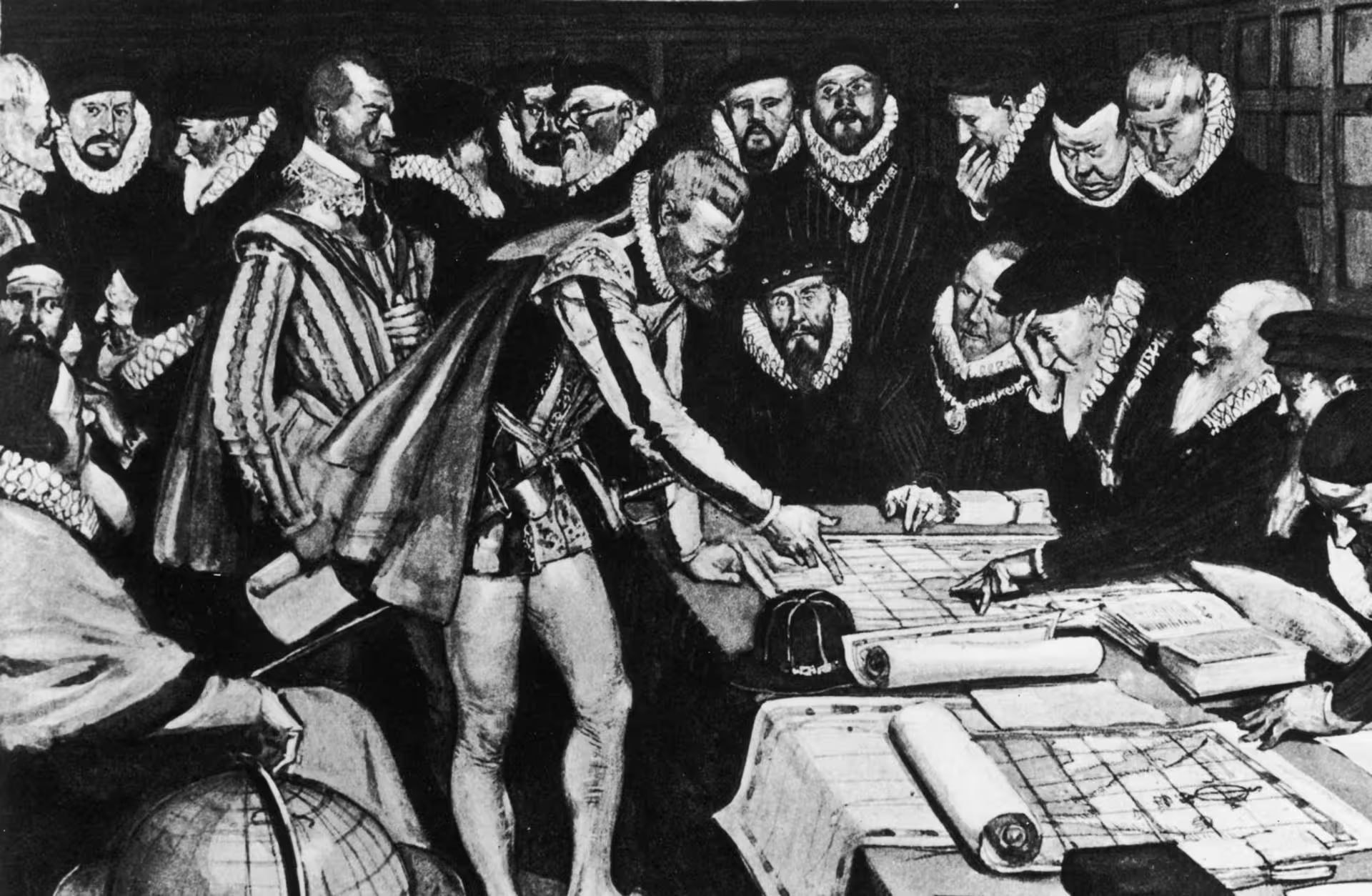
It’s 1710 and the world is in turmoil. Maybe. I’m not sure, as the Company and the state of its affairs are sprawled out on a massive table on one end of the room, and I’m at the other surrounded by my peers. My family. Good Hastings men and women. It’s loud and chaotic. I…
As we have seen in the last post, Wallenstein had contrived to make many enemies. His only supporter, Emperor Ferdinand, feared to be upstaged by the seemingly all-powerful general. The news in late 1633 – Wallenstein treating with the Swedes, Wallenstein letting Thurn go free, Wallenstein not defending Regensburg and Bavaria, Wallenstein refusing to support the Spanish mission to the Netherlands – mixed with their tendentious interpretations by the Bavarian and Spanish parties at court convinced the emperor that Wallenstein planned betrayal. To forestall this, the Imperial War Council secretly decided to relieve Wallenstein of his command on December 31, 1633.
Wallenstein and his intimates did not know about the dismissal, but they sensed the shifting wind. His brother-in-law Adam Erdmann, Count Trčka, and his marshal Christian von Ilow had Wallenstein’s officers sign a statement of loyalty to their commander in his winter quarters at Plzeň on January 12. They hoped that this show of unity in the army would remind the emperor that he needed his general. The opposite was the case: Ferdinand took it as another sign of treason.
When Wallenstein had been dismissed in 1630, it had caused both the emperor and the electors immense anxiety about his possible reaction. He had taken it meekly then, but what would he do now? As the emperor and his advisors had resolved that Wallenstein was a traitor, they expected the worst – insubordination, rebellion, joining his army with the Swedes. That needed to be forestalled. A secret court found Wallenstein guilty of treason on January 24, 1634. The court reached out to three of Wallenstein’s officers which they deemed reliable – Wallenstein’s second-in-command, Matthias Gallas, the commander of the embattled left wing at Lützen, Ottavio Piccolomini, and the tenacious defender of Dessau Bridge, Johann von Aldringen. To them, they gave the delicate task of delivering Wallenstein to Vienna – dead or alive.
The three executors of the imperial sentence faced a daunting task. Wallenstein was popular with the common soldiers whose pay was guaranteed by their general, not by the emperor whose coffers were notoriously empty and whose will to pay the army notoriously limited. The officers seemed more promising, as they were honor-bound to the emperor, but they had also sworn loyalty to their commander. Gallas got in touch with those they deemed reliable and instructed them not to follow any orders from Wallenstein, Trčka, or Ilow.
By that time, Wallenstein’s health had deteriorated even more. He was barely able to leave his bed and sometimes could not even sign documents. All the while, he waited for a reply from Hans Georg von Arnim on the potential peace with the electors of Saxony and Brandenburg.
Trčka acted on Wallenstein’s behalf in the day-to-day affairs, confident in his command over the soldiers. Only deep into February did it dawn on him and Wallenstein’s other intimates that imperial agents were prising the army away from them – officer by officer, regiment by regiment.
Wallenstein in his winter quarters at Pilsen (the German spelling of Plzeň) with the three executors of the imperial will dancing around him. Cheb, to the northwest of Plzeň/Pilsen would have given Wallenstein an easy exit west in direction of the Swedish-German forces under Bernard of Weimar or north to the Elector of Saxony. From the Vassal module of Thirty Years War: Europe in Agony, 1618-1648 (David A. Fox/Michael Welker, GMT Games).
Nothing was left to Wallenstein but flight. On February 23, he and those faithful to him made away to Cheb, accompanied by a few regiments of loyal troops. They had been joined by the regiment of Colonel Walter Butler on the way and counted on the garrison of Cheb under the command of John Gordon. Both Butler and Gordon had been contacted by the three conspirators who urged them not to obey Wallenstein. For the time being, Butler and Gordon prevaricated.
As Cheb is in the northwestern corner of Bohemia, Wallenstein could easily leave Bohemia for Saxony or be joined by Swedish forces. That put time pressure on Butler and Gordon. If Wallenstein fled, they would be held responsible. If they arrested him, he would be freed again if the Swedish arrived. Thus, they resolved to murder him and his associates.
Gordon invited Trčka, Ilow, and a few more Wallenstein intimates for dinner up in Cheb’s castle on February 25th – together with Wallenstein, who declined on grounds of his constant bad health. Gordon and Butler, both present at dinner, had a group of soldiers commanded by captain Walter Devereux come in, declare for the emperor, and murder Wallenstein’s associates. With all of them dead, Devereux took his small group down to Wallenstein’s residence in the town. They found Wallenstein in bed already. As he got up, Devereux stabbed him to death.
Wallenstein’s leader counter in Cuius Regio.
Wallenstein’s death is handled in a rather detached manner in Cuius Regio (Francisco Gradaille, GMT Games, forthcoming): Like every other leader, Wallenstein has an initial and a last year of service (1625 and 1634, in his case). In the leader deployment phase before the campaigns of 1635, the player will have to remove Wallenstein. Death – be that from plague, battle, or murder – is inevitable and pre-ordained.
The Catholic player in Thirty Years War: Europe in Agony, 1618—1648 has more freedom. As we have discussed in the last two instalments of the series, Wallenstein can be dismissed and recalled in the game. And if he proves to be too influential (and comes close to the threshold at which his influence would give the Protestants a Major Victory), he can also be assassinated (and thus be removed from the game permanently). There is, however, no inevitability of Wallenstein’s death: As his influence is only raised from recruiting troops, taking cities, and successfully attacking with him, the Catholic player can just forgo those, not use Wallenstein anymore and let him live out his old age in peace. Somehow, this never occurred to the historical Ferdinand II. Implicitly, the game’s treatment of Wallenstein’s assassination posits that the active threat which Wallenstein posed in Ferdinand’s view was nothing but a fabrication of the emperor’s paranoia, and that the emperor remained firmly in command at all times.
Twilight of the Thirty Years’ War
Wallenstein had grown rich on land which had been taken from those the emperor had declared rebels. He ended up on the other side of this bargain. His estates in Bohemia and Silesia were seized (Mecklenburg was lost to the Swedes anyway). A good deal went as spoils to all the officers involved in the conspiracy against him. Gallas, Piccolomini, and Aldringen became great magnates, and those on the lower rungs of the plot did not go unrewarded either, down to an additional month’s pay for all the soldiers in the garrison of Cheb whose only contribution had been to stand by idly while Wallenstein was murdered. The rest of Wallenstein’s estates were sold by the emperor to fix some of his short-term financial problems. Wallenstein’s widow Isabelle kept nothing. Only when she pleaded mercy (instead of justice) from the emperor did she receive a small estate to live on.
Wallenstein had died when the war had already been raging for sixteen years. It would last another fourteen before peace was finally made in 1648. Any time Emperor Ferdinand II had been in a position of strength, he had not made concessions to form a lasting peace, but instead increased his demands, prompting the interventions of first Denmark, then Sweden, and finally France (shortly after Wallenstein’s death).
Ferdinand II died in 1637. At the time of peace, the new emperor Ferdinand III was mostly ruined. Protestantism survived, protected by German princes and foreign powers. Sweden controlled the Baltic Sea. Any hopes of imperial hegemony in the empire or of Habsburg hegemony in Europe were dashed. After Spain had conceded Dutch independence, it fought on against France, and lost that war, too, along with its European primacy.
Afterlife
Wallenstein remained fascinating to his contemporaries after his death, and would continue for centuries. Assessments close to his own time hewed closely to the religious beliefs of the writer: Catholics tended to see Wallenstein as a traitor (following the official account of the emperor), Protestants made him into a Machiavellian mercenary leader, often contrasted with the heroic “Lion from the North” Gustavus Adolphus.
Later treatments focused on individual aspects such as Wallenstein’s purported dependence on astrology. You will have noticed that this is the first time since our first post that astrology is mentioned – because there is no evidence that Wallenstein was more interested in it than his contemporaries, let alone that he made decisions based on horoscopes. The speculations on this issue are based in the accounts of those who bore witness against Wallenstein shortly before and after his death, taking pains to stress anything which might indicate that Wallenstein was anything but a devout Catholic. The idea of Wallenstein, the Star-Seeker, is particularly prevalent in the German mind, as playwright Friedrich Schiller dedicated a trilogy of plays to Wallenstein’s last weeks – and presents the general as an indecisive fatalist, done in by his own passivity as well as the cabals of those around him. That’s (masterful) fiction – but it hews close enough to history (Schiller had taught history at the University of Jena and even written a major book on the Thirty Years’ War) to influence anyone whose first contact with Wallenstein was through Schiller’s plays.
By the time document-based historiography had been firmly established in the 19th century, pre-established views on Wallenstein had become so solidified that historians still argued within their confines – mostly on the matter if Wallenstein had, in fact, betrayed the emperor. Slowly, the view that he had not gained ground.
Interpretations of Wallenstein in the 19th and 20th century often were inspired by current politics: Catholic German nationalists hailed Wallenstein as a proto-Greater German unifier. Czech historians like Josef Pekař adopted their compatriot as a proto-nationalist transcending the multi-national Habsburg Empire. Hellmut Diwald saw in Wallenstein the necessary authoritarian answer to overcome foreign domination of Germany (and subsequently plunged himself into New Right revisionism).
When stories of “Great Men” had decidedly fallen out of favor in academic history, Golo Mann revived the genre with his biography of Wallenstein, testing the limits of academic writing with his literary ambitions. His book dispelled some of the myths around Wallenstein and retained others.
Currently, Wallenstein’s heritage as a Bohemian, a nobleman, a (converted) Catholic, and a magnate have received more attention. History is never completed, but only enriched with more perspectives. Wallenstein’s life and its subsequent interpretations are thus also lessons in historiography.
A recent biography which succeeds at dispelling the Wallenstein myth is Mortimer, Geoff: Wallenstein. The Enigma of the Thirty Years’ War, Palgrave Macmillan, London 2010.
For an older, more encompassing biography with literary aspirations, see Mann, Golo: Wallenstein. His Life Narrated, Holt, Rinehart, and Winston, New York City, NY 1976.
On the reception of Wallenstein and his changing image from his contemporaries all the way through the 20th century, see Bahlcke, Joachim/Kampmann, Christoph: Wallensteinbilder im Widerstreit: Eine historische Symbolfigur in Geschichtsschreibung und Literatur vom 17. bis zum 20. Jahrhundert [Conflicting Conceptions of Wallenstein: A Symbolic Figure from History in Historiography and Literature from the 17th to the 20th Century], Böhlau, Cologne/Weimar/Vienna 2011 [in German].
For a short introduction to the Thirty Years’ War, see Schmidt, Georg: Der Dreißigjährige Krieg [The Thirty Years’ War], C.H. Beck, Munich 2010 [in German].
A magisterial monography on the entire war is Wilson, Peter H.: Europe’s Tragedy. A New History of the Thirty Years’ War, Penguin, London 2009.
And, we’re back! Here with another edition of Off the Shelf, let’s look today at
image by BGG user Camdin
FUSE is a 2015 game designed by Kane Klenko and published by Renegade Games. It’s for 1-5 players, and is a real-time dice-rolling game where you are trying to defuse bombs in your spaceship within ten minutes. There are several games in the FUSE family now – along with the original, which got a new edition in 2019, there’s Flatline (2017 – this one is about saving patients injured in the original game’s attack) and FUSE Countdown (2023 – this one adds new stuff to the FUSE system, including multi-colored dice and roles).
At the start of the game, each player gets two cards (four in the solo game). You’ll then deal cards into a deck based on the number of players and desired level of difficulty, and shuffle them. Deal out five face-up cards, and then add six bomb cards to the deck.
collage of images by BGG user Scott Gaeta
There are no turns in this game. You start a ten minute timer (and Renegade has one on their app that will mock you throughout play) and start drawing dice – one per player in a 3-5 player game, four with two players, three in solo play. These are rolled, and each player will take one (two with two players, all in solo play). The chosen die (or dice) must be placed on a valid spot on a card. Most spots either have a specific number, a specific color, or both. Some have number or color of your choice, but these usually have to be identical (or not) to something else on the card. Sometimes you just need to place dice on the card, but other times you need to stack them into columns or a pyramid.
If you cannot place a die, you must roll it, then you must remove another placed die that matches the number or color of the rolled die. Once everyone is done, unused and discarded dice go back in the bag and you do it again.
When a card is completed, it is set aside into a score pile and you take a new one from the array in the center of the table. This card is immediately replaced with the top card of the deck. If it’s a bomb card, all players must discard a die that matches the number or color of the bomb card. The card then goes into the score pile and is replaced.
The game ends in two ways – either all cards are removed from the center of the table (deck is empty, all face-up cards are taken), or you run out of time and blow up. Either way, you score the points from your defused cards, two points per bomb card, ten points if you won, and one point per 10 seconds left on the clock. This is just for reference purposes to see how well you succeeded – you win if all bombs get defused.
image by BGG user LaborLawLarry
I got my copy in 2016, winning it in some Twitter contest that I don’t remember. According to my logs, I’ve played it 53 times since then, most of which were solo. In fact, I’ve only played a couple of times with multiple people, and neither of them were terribly successful. There were too many times when players started bickering over dice they needed when someone else also needed them, and that wasted too much time. That led me to the conclusion that I much prefer it as a solo game, where I get to make my own decisions and am not beholden to others. Though I would like to try two players sometime.
The game is played in real-time, which is a turnoff for some people. It is highly stressful, as you only have 10 minutes to complete your bombs. And if you’re not rolling well, it can be pretty frustrating. But that’s part of what I really like about it – I think the tension works really well, and it ends up feeling like a really quickly played puzzle.
I happen to really enjoy real-time games. But I know there are a lot of people who don’t – the tension of not being able to pause and think can be highly stressful. For me, it works well. I love thinky games where I need to consider my options and make a reasonably educated move. But I also like chaos, and nothing says chaos like “you only have ten minutes before your ship explodes.”
The cards are pretty well laid out. The patterns are pretty easy to identify, and the dice fit in all the squares on the page. I do really like the 3-dimensional patterns as well as the 2-dimensional ones, because you have to be thinking about what has to come first. The bomb cards add an extra wrinkle to the game, and while it’s a sigh of relief when one comes up and you have nothing that matches, it’s pretty frustrating to discard something when they do.
Overall, the game is pretty high on the luck factor. You have to draw the right dice, roll well, and complete whatever challenges the game throws at you. You can try to strategize what bombs you want in front of you, maybe having a mix of easier and more complex patterns, but if only one or the other is coming out, you’ve got to deal with it. I personally love the 6-point bombs, as they always stack and are just a lot of fun to complete overall.
So, yeah, this is a favorite game of mine to play solo. I’m doing it as part of my 10×10 this year (ten games ten times each in a year), and have been enjoying it. I’ve lost more than I’ve won, but I always have a good time. I’ve currently got it at #5 for my Off the Shelf rankings.
And, we’re back! Here with another edition of Off the Shelf, let’s look today at
image by BGG user Camdin
FUSE is a 2015 game designed by Kane Klenko and published by Renegade Games. It’s for 1-5 players, and is a real-time dice-rolling game where you are trying to defuse bombs in your spaceship within ten minutes. There are several games in the FUSE family now – along with the original, which got a new edition in 2019, there’s Flatline (2017 – this one is about saving patients injured in the original game’s attack) and FUSE Countdown (2023 – this one adds new stuff to the FUSE system, including multi-colored dice and roles).
At the start of the game, each player gets two cards (four in the solo game). You’ll then deal cards into a deck based on the number of players and desired level of difficulty, and shuffle them. Deal out five face-up cards, and then add six bomb cards to the deck.
collage of images by BGG user Scott Gaeta
There are no turns in this game. You start a ten minute timer (and Renegade has one on their app that will mock you throughout play) and start drawing dice – one per player in a 3-5 player game, four with two players, three in solo play. These are rolled, and each player will take one (two with two players, all in solo play). The chosen die (or dice) must be placed on a valid spot on a card. Most spots either have a specific number, a specific color, or both. Some have number or color of your choice, but these usually have to be identical (or not) to something else on the card. Sometimes you just need to place dice on the card, but other times you need to stack them into columns or a pyramid.
If you cannot place a die, you must roll it, then you must remove another placed die that matches the number or color of the rolled die. Once everyone is done, unused and discarded dice go back in the bag and you do it again.
When a card is completed, it is set aside into a score pile and you take a new one from the array in the center of the table. This card is immediately replaced with the top card of the deck. If it’s a bomb card, all players must discard a die that matches the number or color of the bomb card. The card then goes into the score pile and is replaced.
The game ends in two ways – either all cards are removed from the center of the table (deck is empty, all face-up cards are taken), or you run out of time and blow up. Either way, you score the points from your defused cards, two points per bomb card, ten points if you won, and one point per 10 seconds left on the clock. This is just for reference purposes to see how well you succeeded – you win if all bombs get defused.
image by BGG user LaborLawLarry
I got my copy in 2016, winning it in some Twitter contest that I don’t remember. According to my logs, I’ve played it 53 times since then, most of which were solo. In fact, I’ve only played a couple of times with multiple people, and neither of them were terribly successful. There were too many times when players started bickering over dice they needed when someone else also needed them, and that wasted too much time. That led me to the conclusion that I much prefer it as a solo game, where I get to make my own decisions and am not beholden to others. Though I would like to try two players sometime.
The game is played in real-time, which is a turnoff for some people. It is highly stressful, as you only have 10 minutes to complete your bombs. And if you’re not rolling well, it can be pretty frustrating. But that’s part of what I really like about it – I think the tension works really well, and it ends up feeling like a really quickly played puzzle.
I happen to really enjoy real-time games. But I know there are a lot of people who don’t – the tension of not being able to pause and think can be highly stressful. For me, it works well. I love thinky games where I need to consider my options and make a reasonably educated move. But I also like chaos, and nothing says chaos like “you only have ten minutes before your ship explodes.”
The cards are pretty well laid out. The patterns are pretty easy to identify, and the dice fit in all the squares on the page. I do really like the 3-dimensional patterns as well as the 2-dimensional ones, because you have to be thinking about what has to come first. The bomb cards add an extra wrinkle to the game, and while it’s a sigh of relief when one comes up and you have nothing that matches, it’s pretty frustrating to discard something when they do.
Overall, the game is pretty high on the luck factor. You have to draw the right dice, roll well, and complete whatever challenges the game throws at you. You can try to strategize what bombs you want in front of you, maybe having a mix of easier and more complex patterns, but if only one or the other is coming out, you’ve got to deal with it. I personally love the 6-point bombs, as they always stack and are just a lot of fun to complete overall.
So, yeah, this is a favorite game of mine to play solo. I’m doing it as part of my 10×10 this year (ten games ten times each in a year), and have been enjoying it. I’ve lost more than I’ve won, but I always have a good time. I’ve currently got it at #5 for my Off the Shelf rankings.
Yyou’ve watched the unboxing, you’ve followed the painting tutorial, you’ve downloaded the rules & reference, you’ve used the rules on your Tabletop Codex app – and finally it’s time for the full review! I cover the newest entry in the Nemesis space horror trilogy. Let’s rock!
Making high quality tabletop gaming content at the EOG takes time and money. Please consider becoming a Patreon supporter or making a donation so I can continue this work! Thankyou!
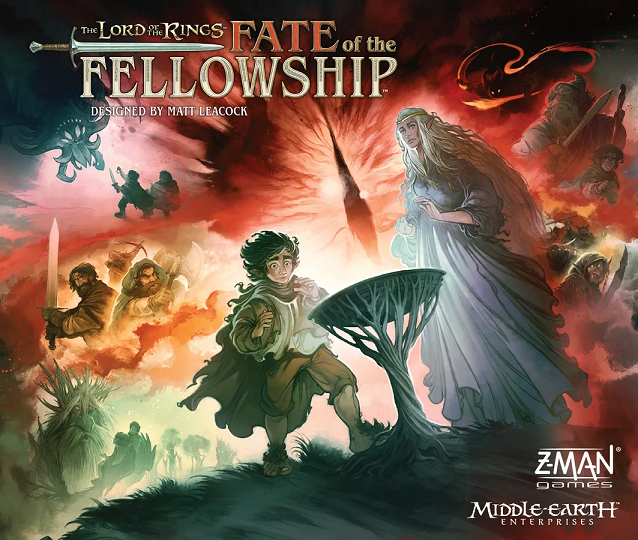
Somewhere, Matt Leacock is walking around, chained to a big goose as gold as the sun. For the love of God, someone let this man design something other than Pandemic. Not today. While not betrayed on the cover, The Lord of the Rings: Fate of the Fellowship is described as a Pandemic System game. And…
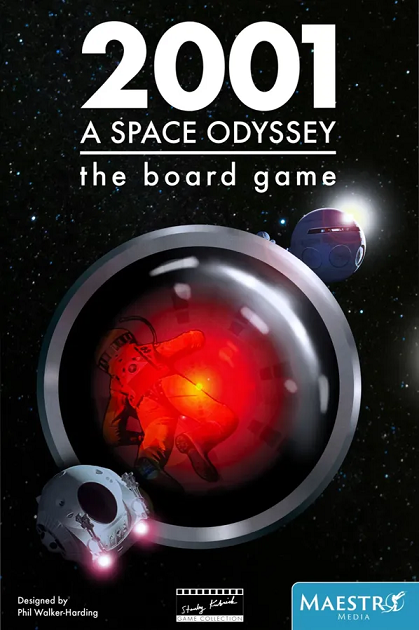
Prospero Hall is back. I’m sorry, that’s a lie. 2001: A Space Odyssey the Board Game is not a Prospero Hall title. It’s a Phil Walker-Harding design courtesy of Maestro Media. This fits right alongside quirky board game cuts like The Warriors, Fast & the Furious: Highway Heist, and Rear Window. I almost don’t trust…
First a bit of background on Black Panther, Shuri, she is a princess of Wakanda and was the young sister of T’challa. The Black Panther Name was carried by the Males of the family until the death of her Brother, when with reluctance she took it on. Shuri rediscovered the the plant that gave the user the powers of Black Panther and then took it. she gained more abilities including Super-Strength, Speed, and Agility which she combined with her amazing Scientific Mind and fighting abilities to become a mighty hero.She fought the loss of her Father her Brother and then her Mother to try and keep her anger in check and to stop her heroine self from becoming a monster. She has great leadership abilities, amazing science knowledge and is a mighty fighter.
So how does she play in the game? In her Alter-Ego form, Shuri can exhaust herself to search her deck or discard pile for any “Black Panther” or “Tech” upgrade and play it, reducing its cost by 2. Allowing her to quickly get her core upgrades into play, as well as any other valuable Tech cards in her Justice deck. While in her hero identity she has four “Black Panther” upgrades. These cards, such as Kimoyo Beads and Spider Bites, are a central part of her hero identity, which she can make use of after a basic power.
Her game is more about a consistent, tactical approach as opposed to her brother who in the core game is more about explosive, single-turn damage .
The Old King’s Crown is beautiful. It’s a lavishly illustrated craft with peerless style. This charisma reverberates in the game’s excellent writing, with passages leaping from the page in order to set the scene of a King Lear-like situation with a vacant throne. Expectedly, the gears of the work are likewise dashing, powering the entity…
Gustavus Adolphus, King of Sweden, had taken Germany by storm in 1631. He was allied with the heretofore neutral Protestant electors of Saxony and Brandenburg, had shattered the imperial army under Count Tilly at Breitenfeld, and was taking his winter quarters in Mainz, deep in the southwest of Germany. For 1632, he looked ready to advance along the Danube, first into Bavaria, the home of elector Maximilian, the most powerful Catholic prince in the empire (and Wallenstein’s chief rival), and then into the Habsburg core lands.
I recommend you blow up this image by clicking on it – not only to see the strategic situation in early 1632 with the main Swedish army in the electorate of Mainz in the northwest and an advance column in Franconia (northeast) and the Catholic League forces on both sides on the Danube which will flow further east into the Habsburg core lands, but also to enjoy the sheer beauty of this map! Taken from the Vassal module of Won by the Sword (Ben Hull, GMT Games).
Wallenstein had been the emperor’s man to solve his military problems for five years. It was thus an obvious choice to recall him as commander. Even Maximilian was in favor (hoping for Wallenstein to defend his electorate, which had heretofore been blissfully ignorant of war as a first-hand experience). Emperor Ferdinand II was practically begging. Wallenstein agreed – but only to reorganize the army, only for three months. The emperor went along, having no other choice. And, of course, when the three months were over, Wallenstein stayed on, having his supreme authority confirmed and expanded.
We have discussed the Wallenstein rule in Thirty Years War: Europe in Agony, 1618—1648 (David A. Fox/Michael Welker, GMT Games) as far as his dismissal was concerned – when Wallenstein’s influence becomes too high, the Catholic player can avoid losing by dismissing Wallenstein which will halve his influence. Having dismissed Wallenstein, the Catholic player can recall him again for a second bout in command – this time probably shorter, as Wallenstein will have some leftover influence and will thus be closer to the influence threshold that would mean Protestant victory!
Gustavus Adolphus had not been idle while Wallenstein re-organized the army. He had split his army in several parts, taking a good deal of Catholic Germany (and distributing ecclesiastical lands to his supporters), while his main force advanced towards Bavaria. The army of the Catholic League under Maximilian and Tilly attempted to make up for their numerical inferiority with a strong defensive position behind the river Lech. Gustavus Adolphus forced the Lech in April 1632 with the double measure of a crossing south of the Catholic army and the massed use of artillery. The League army was routed. Tilly died of the wounds he had suffered in the battle. One month later, Gustavus Adolphus lodged in the Bavarian capital Munich.
The Duel with Gustavus
Maximilian beseeched Wallenstein to march for Bavaria and meet the Swedes in open battle. Yet Wallenstein’s mission concerned the entire empire, not just a single electorate. And his caution – half natural, half learned in the campaign of 1626 – led him to pursue a different course. He marched for Franconia. From there, he threatened Gustavus’s supply lines which stretched all the way to the Baltic coast, and he could quickly march to Bavaria, strike at the Swedish king’s new Saxon allies, or retreat to Bohemia, as the situation required it. When he took camp near the city of Nuremberg, one of the greatest cities of the empire, he also evoked the Protestants’ fear of another Magdeburg – more atrocities visited on a large Protestant city. Gustavus Adolphus had to turn and face Wallenstein.
The Swedish king had a battle-hardened army with him, but the difficult supply situation and the vast area which he had conquered had forced him to detach large parts of his army. Even though reinforcements arrived for him in Nuremberg, his combined force was not bigger than Wallenstein’s (strengthened by some of the Bavarian troops) who had built a fortified camp at the Alte Veste outside of Nuremberg. Gustavus, eager to fight a decisive battle and resume his attack on the Habsburg core lands, attempted to breach the defenses for several days, but was bloodily repelled by Wallenstein’s forces. The king had to withdraw. He left a garrison behind to hold Nuremberg against Wallenstein’s siege. The Swedes were not defeated, but the myth of Gustavus’s invincibility was broken.
As the Protestant army had withdrawn southwest, Maximilian feared a new invasion of Bavaria. Once more, he demanded that Wallenstein follow Gustavus to protect Bavaria. And once more, Wallenstein refused. Protect Bavaria he would, though… not by marching south, but north.
Wallenstein’s march for Saxony followed his tried-and-tested strategy of combining pressure on the supply lines with political pressure: When Wallenstein’s army showed up in Saxony, the Saxons would understand how foolish they had been to declare against the emperor. Maybe their elector John George, an imperial loyalist by inclination, could be brought back into the imperial fold. Until then, Wallenstein’s army would winter in Saxony, consuming the food and fodder which Saxon peasants had grown and harvested.
As Wallenstein had foreseen, Gustavus Adolphus followed him to protect his supply lines and his Saxon allies, arriving in November 1632 in Saxony. In Wallenstein’s mind, the campaigning season was over, and he split his army into several winter quarters – a common necessity in Cuius Regio (Francisco Gradaille, GMT Games, forthcoming) as well, as smaller towns are often unable to supply large armies in winter. Yet Gustavus was not done campaigning, kept his force concentrated, and marched on the force under Wallenstein’s command stationed around the village of Lützen.
Wallenstein & Piccolomini! Best friends forever! From the Vassal module of Cuius Regio.
Wallenstein, caught unprepared, scrambled to get reinforcements for the battle that was now upon him. He hoped that at least the cavalry of his lieutenant Gottfried Heinrich, Count of Pappenheim would arrive in time, maybe even the infantry. Until then, he took defensive positions at Lützen, obscured by the morning mist and the smoke from having set the village on fire.
The ensuing Battle of Lützen, fought on November 16, 1632, was Wallenstein’s fiercest tactical challenge. The Protestant army had a slight numerical superiority, its core formed by veterans of many battles (usually on the winning side), and it was commanded by the greatest tactical commander of the time. The initial Swedish assault shattered Wallenstein’s left. The Swedes also gained Wallenstein’s artillery battery on the left wing. Yet when the battle seemed already lost, Pappenheim arrived with his cavalry regiments and turned the tide. Pappenheim, however, was severely wounded, and most of his cavalrymen fled. Colonel Ottavio Piccolomini took some regiments from the center, and, helped by the onset of more fog, could stabilize the front.
In the meantime, Wallenstein’s right had repelled the Protestant assault on their side and were now battering the Swedish-German troops under Prince Bernard of Saxony-Weimar. Bernard called for support, and the king himself answered with a group of select cavalrymen. Gustavus Adolphus was wounded, lost touch with his forces in the fog, and thus fell into the hands of imperial soldiers who killed him and plundered his corpse. News of the death of the king spread among the Protestant ranks. They responded quite differently to Pappenheim’s forces when faced with the loss of their commander: Gustavus Adolphus had been beloved, a hero, the savior of Protestantism. The Swedish-German troops battered Wallenstein’s right wing and took his second battery. Their strength, however, was insufficient to expel the imperial forces from their defensive positions. The fighting ended when night fell. Wallenstein withdrew his army in good order.
Lützen had been no victory for Wallenstein. He had given up the battlefield and his losses were heavier than those of the Protestants. Yet Wallenstein could retake the positions lost, and he could recruit new soldiers to take the places of the fallen. Gustavus Adolphus, on the other hand, could barely be replaced. The imperial side could be content with the campaigns of 1632.
The Search for Peace
After Wallenstein’s last great operational success, the campaign against Denmark in 1627 and 1628, he had made peace with his enemy from a position of strength. His inclination now was to do the same – only peace would confirm his large acquisitions in Bohemia, Silesia, and Mecklenburg, and as he grew older and sicker, frequently bed-ridden, he meant to enjoy them. As the Swedes were nowhere near as thoroughly beaten as Denmark had been, Wallenstein started smaller with attempts to prise their Saxon allies away from them with a mix of persuasion and force: While he treated with his former marshal Hans Georg von Arnim, who, as a devout Protestant, had left imperial service for reasons of conscience after the Edict of Restitution, and now served the Elector of Saxony, Wallenstein’s new lieutenant Heinrich von Holk (another Protestant, and the former commander of the forces resisting Wallenstein at the siege of Stralsund) marauded in Saxony.
Wallenstein’s goal: To return Saxony to the imperial camp. Alas, it was not so easy… as you can see, the conditions for the “Saxony Switches Sides” event are not met, and Saxony will continue to fight alongside the Swedes in this game of Thirty Years War: Europe in Agony, 1618-1648.
The emperor had good hopes that his Saxon vassal would return into the imperial fold and commended Wallenstein for his diplomatic efforts. In the meantime, Wallenstein (and his new second-in-command Matthias Gallas, promoted after Holk had died of the plague in September 1633) also treated with the Swedes (in the person of Gustavus Adolphus’s chancellor Axel of Oxenstierna who now directed Swedish politics), yet nothing would come of that: Both sides seem to have tried to stall the other’s war efforts with diplomacy and undermine the confidence of the allies of the other. For example, the Swedes offered Wallenstein to become King of Bohemia if he allied with them and fought against the emperor – an absurd notion, as Wallenstein’s confirmation by the Protestant estates of Bohemia would have been at odds with their expropriation in 1621 from which he had acquired his Bohemian holdings.
The Swedish advances were not acknowledged by Wallenstein himself. As his health deteriorated, however, others started speaking with his voice, chiefly his brother-in-law Adam Erdmann, Count Trčka, his marshal Christian von Ilow, and the Bohemian diplomat Vilém Kinský. They hoped to bring about an alliance between Wallenstein, the Bohemian emigrants, and the foreign powers supporting them against the Habsburgs – Sweden, and possibly even France.
Both sides used their tentative diplomatic efforts and the resulting operational lull in 1633 to consolidate their forces after the exertions of the previous year. By fall, though, they were ready to strike again. Wallenstein marched to Silesia to retake the last Habsburg dominion held by the Protestants. Their commander, the Bohemian Heinrich Matthias von Thurn, surrendered in exchange for his release after the capture. Emperor Ferdinand resented that this arch-rebel who had been in the Bohemian uprising from its beginning in 1618 went unpunished.
The Swedish main army, commanded by Bernard of Weimar, struck at Regensburg and invaded Bavaria again in November. Wallenstein sent some regiments under Johann von Aldringen to support the Catholic League army, but his own army remained in Bohemia on the principle that any threat to the Habsburg core lands could be blocked as long as imperial forces held the city of Passau on the Danube. Maximilian complained bitterly to the emperor about Wallenstein’s passivity.
Emperor Ferdinand II had always been the source of Wallenstein’s power, often against the advice of his allies. Maximilian had always been suspicious of Wallenstein. The Spanish Habsburgs had had a more ambivalent stance. They had respected Wallenstein as an effective commander who spread Habsburg influence in Germany, but had resented his refusal to support their wars in the Netherlands, and, in the late 1620s, against the French in Upper Italy. In December 1633, they found themselves in a pickle: The Habsburg governess of the Netherlands, Isabella Clara Eugenia, aunt to the King of Spain, had died. With Dutch naval supremacy, they could only bring a new governor in by land, along the Spanish Road linking Upper Italy and the Netherlands – whose middle part in Germany was now in the hands of the Swedes. The Spanish representatives in Vienna lobbied for Wallenstein to give the new governor, Cardinal-Infante Ferdinand, an armed escort of several regiments. Wallenstein refused. An army of a few thousand men with the Cardinal-Infante could not possibly withstand any Swedish attack on its way, he argued, while he could not spare thousands of men when the Habsburg core lands were under direct threat. Spain was snubbed. If the Spanish had ever supported Wallenstein, henceforth, they wouldn’t.
It doesn’t look so good anymore for our hero! In the next post, we will wrap up the story of Wallenstein. Watch this space!
A recent biography which succeeds at dispelling the Wallenstein myth is Mortimer, Geoff: Wallenstein. The Enigma of the Thirty Years’ War, Palgrave Macmillan, London 2010.
For an older, more encompassing biography with literary aspirations, see Mann, Golo: Wallenstein. His Life Narrated, Holt, Rinehart, and Winston, New York City, NY 1976.
On the reception of Wallenstein and his changing image from his contemporaries all the way through the 20th century, see Bahlcke, Joachim/Kampmann, Christoph: Wallensteinbilder im Widerstreit: Eine historische Symbolfigur in Geschichtsschreibung und Literatur vom 17. bis zum 20. Jahrhundert [Conflicting Conceptions of Wallenstein: A Symbolic Figure from History in Historiography and Literature from the 17th to the 20th Century], Böhlau, Cologne/Weimar/Vienna 2011 [in German].
For a short introduction to the Thirty Years’ War, see Schmidt, Georg: Der Dreißigjährige Krieg [The Thirty Years’ War], C.H. Beck, Munich 2010 [in German].
A magisterial monography on the entire war is Wilson, Peter H.: Europe’s Tragedy. A New History of the Thirty Years’ War, Penguin, London 2009.
In this new version of the app there are more Avatar options, more Avatar settings and more Avatars!
Changing multiple Avatars
You can now use Multiple Select to set Illustrations, Background colours and Shapes for multiple selected Players. This makes it even easier to visually create a group of Players!
Avatar Settings
It is now possible to:
Choose to set a random color for default Avatars: when no Avatar is assigned, the background colour of the default Avatar will be random.
Choose where you want to see Avatars: Overview, Plays list, Play overview and Edit Play screen.
Choose the default Avatar import settings: this will be used whenever you import Plays (can always be changed on the Import matching screen).
Read more about Avatars and all options here: Avatars
More Avatars
Illustrator Annika was so generous to create another illustration!
You can now use her chameleon to create even more Avatars.
Her range of pöppels is also expanded with 5 new colours!
There have been dozens of “Pikathulhu” mashups of much-beloved pocket monster Pikachu and much-terrifying Lovecraftian horror Cthulhu, but why stop there?
The Adventures of Conan expansions pack contains two expansions Queen of the Black Coast and Nemedian Chronicles
Queen of the Black Coast.
In this expansion there is so much added for your fun that will just lift your gaming experience hugely. In this expansion is added The Black Coast map for your game and five new realms, It also adds more allies, foes and another version of Conan to spice up your game even more. There is also added even more events, plots and scenarios.
This will open so much more to your gaming fun as you can now play as a new character while exploring new places and opening new plots and scenarios.
This expansion adds so much more playability for future games as well as so much more to do in the now.
Nemedian Chronicles
This expansion adds new scenarios with new ways to play, special encounter cards even more plots, you get Crom a new character this means he can take over and control Conan during the game, there is a set of characters put aside and if someone else takes over Conan that player must choose onr of the rogue characters and take that over with all the benefits that comes with that character. You also have new event cards that play slightly differently so that will also shake up your game a lot.
There is also now a bazar to buy special effects to add to your character and this will change how they interact with each other.
Another great expansion. At this moment both of these expansion are in one amazing box. A highly recommended expansion which will add so much to your game!

 Anmelden