Normale Ansicht

Designer Diary: Honeypot -- I stack, you choose

by Joseph Chen


A Different Approach to My Game Design

After a three-year hiatus in game design, I finally returned with a new project: Honeypot — and it’s very different from my previous game, Fantastic Factories! Fantastic Factories was a puzzly multiplayer solitaire style experience. While I love exploring game systems and min/maxing my turns I discovered that it was actually quite difficult to introduce Fantastic Factories to my friends and family and to get it to the table. Additionally, most of my gaming these days (aside from playtesting prototypes) happens at conventions, and when I’m at the table I want to be seeing, interacting, and bantering with players. I still feel Fantastic Factories is a great game, but its heads-down experience just wasn’t a joy I could easily share and create moments with.

So in contrast, I set a few design goals for my next design (which eventually led to Honeypot):

* It should be highly interactive between players.
* It should have some element of mind games to make the game replayable and a new experience with each different group of players.
* It should be easy enough to introduce and play with people who are not hobby gamers.


Evolution of what the cards looked like (early prototype on the left and final cards on the right)

I Stack You Choose

Immediately I had a game mechanic in mind. A few years ago I played a game that used the “I stack you choose” mechanic, which is a brilliant push your luck drafting mechanic where the draft piles were architected by the players themselves.

In each round, you are dealt three cards; you look at them, decide on the order in which to stack them, then pass that stack to another player. You’ll receive a stack in turn, which is in effect a “press your luck” deck created by an opponent. You look at the top card, then decide whether to keep it or discard it and draw the next card, which you can also discard in favor of the third card.

I thought this was a really fun way to gain cards. Are your opponents going to put the best card first or at the bottom? Or is the final card something you don’t want at all? There was a lot of opportunity for mind games and trickery.

However this mechanic was only a minor piece of that overall game. I wanted to design a game that promoted this mechanic from a supporting role to becoming the star of the show.

Every designer has a different approach to game design. For me, I hyperfocus on where I think the fun is, and I obsessively strip out anything that isn’t in service of that fun. I value simplicity and elegance above almost everything else.

At first I designed the game as a set collection game that used the exact same “I stack you choose” mechanic with just three cards. I asked: “What motivates you to pick one card over another?” The simplest answer is that some cards are worth more points than others. Set collection is one of the oldest mechanics in board games and is generally well understood, so I decided to go with that to validate the idea in the fastest way possible.

For my first playtest, I didn’t make ANY components at all. Instead, I used the cards from Sundae Split (designed by Nate Bivins) and simply dealt out three cards to each player to stack in a particular order. Of course there were some very rough edges, but it ended up being promising and the idea had legs. This led to me building the first prototype with the working title of “Stacked”.

Maximize the Drama

As with any good design, a game needs to have relevant, engaging, and interesting decisions. Additionally, I knew that with a mechanic like this, there was the opportunity to create some memorable moments when players pick either the correct or wrong cards to keep. So I came up with a few guiding principles for the card designs:

* Ideally all cards should be relevant to players at any point in the game. Depending on the circumstances, each card should at least have a chance to be highly desirable or undesirable.

* The value of each card should vary depending on what cards players already have in the tableau – and that information should be open to all other players.

* In order to create memorable moments, the cards should MAXIMIZE THE DRAMA — meaning the game should support big highs and lows as players reveal potentially very impactful cards.

With this in mind, I created a few types of cards:


* Stars — The more star cards you add to your tableau the more they increase in value until you get too many and they become worthless.

* Letters — You want to collect unique letters. A particular letter may be more valuable to a player depending on what letters they have already collected. This rewards players for paying attention to what others have in their tableaus and planning accordingly.

* Negative points — Many set collection games don’t have negative points because nobody would willingly pick them. But for a game where you can compel someone to commit to keeping cards without seeing them first, negative cards supported the design goal of maximizing the drama.

* Draw 2 — The majority of cards in the deck are positive so Draw 2 is often powerful. However there’s always a chance you might draw that final star or a negative card.

* Pears — If you only have a single pear it’s not worth anything. If you have two of them (get it? pairs?) they are worth a significant amount of points. This makes a single pear pretty underwhelming but getting a second one is very good.

There were other cards in this early prototype as well, but these were a few of the interesting ones.

There’s Always a Chance…

Now in a game with this much volatility and swing in scoring, it’s possible players may feel “out of the game” if they’ve had a couple bad turns and collected negative cards. It’s tricky because maximum drama and volatility go hand in hand, and this is the heart and soul of the game. However, I certainly wanted to avoid having a player feel like they’ve lost the chance to win, especially early in the game.

To mitigate this possibility and in adhering to the guiding principles of the design for this game I introduced the Discard 1 card (which later became Discard 1, Draw 1):


Discard a card

This card ended up having a very important function. For players who are ahead and don’t have any negative cards in their tableau, this is a bad card. For players who have negative cards (or perhaps that final star), they have a chance to get back into the game.

“Stacked” (now Honeypot) isn’t necessarily a game that needs a catch-up mechanic, but players need to feel like they can win throughout the game. And that’s largely a psychological thing. If players know they have a chance to get rid of a card that is completely sinking their score, they are more likely to stay engaged.

In addition to the new Discard card, the game design had a few things going for it to mitigate what effectively could feel like player elimination. Ultimately the game is short (20-30 minutes) and so this problem is lessened by knowing you can shuffle up and play again in just a short while. Also there are still opportunities for players to make clever plays and create dramatic moments where players fall into or avoid traps. Plus it’s fun to see others fall into traps even if it wasn’t one of your own making.

All in all, it’s been such a different experience designing a game like this compared to a eurogame, like Fantastic Factories, that is typically low conflict. It’s important to understand what your game is or isn’t. Rather than making sure each card was balanced, the drama is where the fun is, and I believe that you need to lean into the fun. It took some time to wrap my head around it, but that’s why early on it’s incredibly valuable to establish guiding design principals to adhere to.

Overcoming Some Challenges

After some playtesting I identified a few key problems with the design that I needed to fix:

* It was taking a long time for players to collect any meaningful number of cards. For a game where the scoring is based on set collection, only keeping 1 card per round made the pace of the game fairly slow.

* Sometimes there were no interesting ways to stack the cards. With 3 cards there are only 6 different ways of sequencing the cards and if they’re all good cards, it didn’t feel like you were making any meaningful decisions.

I experimented with a variety of solutions and in the end one adjustment stood out far beyond the rest. Rather than stacking 3 cards and revealing/keeping one card at a time, the groundbreaking change was to stack 6 cards and reveal/keep two cards at a time. This dramatically increased the number of possibilities from six to 90 different arrangements of the cards! This provided players with so much more agency. They could pair up good cards with bad cards to try to make the choices mediocre. Or they could go all in and put the best (or worst) cards all at the end. It also meant that as you took cards from stacks passed to you, you would take cards you may not have planned for, creating more possibility of interactions between cards. For example, if you are collecting Disguise cards you might take a pair of cards containing a Disguise that might also have a Berry. Now you find yourself collecting Berries as well and that information can be used to influence the stacking order in the future.


These are the backs of the cards for the prototype, which visually represent the stack of 6 cards grouped as 3 pairs of cards.

Suddenly the decisions within the game were so much more interesting and the pace of the game moved much quicker. Additionally, the overhead of stacking and revealing cards became much easier to justify when there was twice as much happening each round.

Once I had established the core principals and philosophies behind the game and then discovered the right mechanism to deliver on those promises, the rest was history. Balancing, iterating, and refining until it became what it is today – Honeypot, an “I stack you choose” game where you play as secret agent bears trying to set traps and avoid traps!

Qomet Game Review

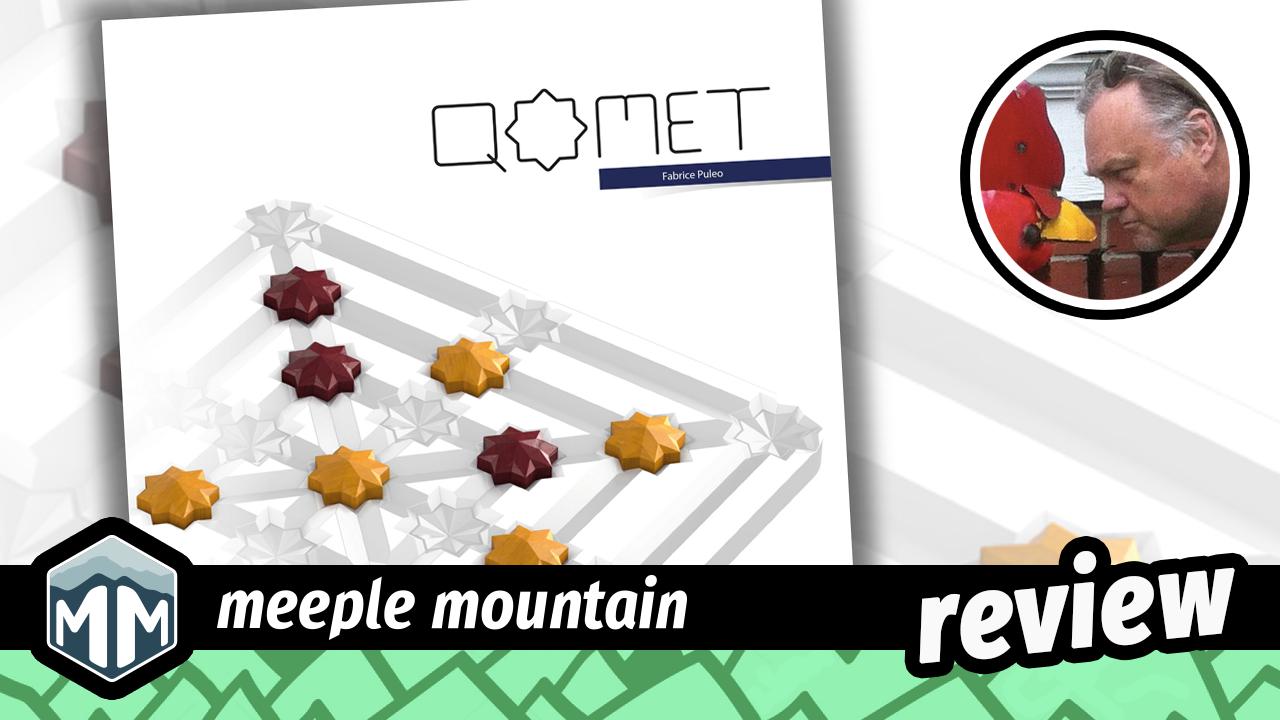
When I reviewed Nine Men’s Morris a few years ago, I noted it is one of the oldest recorded games, with boards having been found “etched into ancient roof tiles and still exists in a temple from the 9th-10th Century AD in Karnataka, India.” Since then, I’ve also learned that a blogger  had discovered the board scratched onto the side of Charlemagne’s throne in Aachen [and] at Canterbury Cathedral, Salisbury Cathedral, and Westminster Abbey in England.

Given the historical popularity of this three-in-a-row game, it’s not surprising that there have been many variations over the years—or that variations have continued into modern times. One such variation is Gigamic’s Qomet

The board is based on the Twelve Men’s Morris board, where the corners of the three squares are connected by a diagonal line. Designer Fabrice Puleo added a central space to give Qomet its unique design.

Next, he changed the number of pieces per player from 12 (or 9) to 7 and created a unique winning condition: the first player to form a square takes the game.

On your turn, you can either place one of your 7 wooden stars on any open space on the board or you can move one of your stars along the…

The post Qomet Game Review appeared first on Meeple Mountain.

World Boardgaming Championships 2026 Daily Debrief Series

Von: Grant
25. Juli 2026 um 14:00

Good morning faithful readers and wargaming enthusiasts! At the time this post uploads to the blog at 8:00am on Saturday morning, July 25th, I will already be on the way to the World Boardgaming Championships held at the beautiful Seven Springs Mountain Resort in Seven Springs, Pennsylvania. This year, unfortunately, Alexander will not be with me as he is visiting family in the south of France for a reunion. This is now the 2nd time in the past 3 years that I have flown solo to WBC but this time I am more prepared and more ready to take on the convention and its coverage. I will miss my friend and partner Alexander but will have a blast anyway. I am leaving earlier than I have ever left before for the convention and plan to make a pit stop in Pittsburgh, PA to pick up a friend Mike from the airport on Saturday afternoon to travel down together. We should arrive at WBC around 3:00pm on Saturday, July 25th and I plan to be at the convention for a total of 6 1/2 days leaving on Saturday, August 1st to come back home.

Only the essentials including games, diet Mountain Dew, victuals and of course something healthy in apples!

I already have a lot of plans laid out and will have 6 1/2 days filled with gaming, designer interviews, looks at new prototypes, visiting with friends, publishers and designers.

Here are my scheduled games as of today:

Sunday-Monday – Grand Tactical Series The Devil’s Cauldron: The Battles for Arnhem and Nijmegen and Where Eagles Dare: The Battle for Hell’s Highway from Multi-Man Publishing. I will be playing this one with Mike Heckman and a few others. I am very much looking forward to my first exposure to the Grand Tactical Series.

Monday – sit down with designer Gregory M. Smith and maybe a play of his Viking Dawn and a look at a new surprise Burning Banners offering (I won’t talk….yet!). But what I can say is that you will be able to play tactical battles in Kalar. We will also discuss his other in-process designs.

Tuesday – World Order from Hegemonic Games Project taught by our friend Tom and Coalitions: Realpolitik from PHALANX taught by Ric Manns from Southern Indiana.

Wednesday – The Emperor’s Choice and The Emperor’s Voice coming from Worthington Publishing designed by Wes Crawford and Maurice Suckling. I am very much excited about seeing these games and getting to play them.

Thursday – Imperial Elegy from VUCA Simulations. This will be my 3rd play and is sure to be epic!

Friday – Here I Stand from GMT Games. Our standard play of one of the best games in the hobby. Always look forward to this.

Plus I am trying to schedule a game of Small BoaR: The Battle of Cowpens from GMT Games with designer Bruno Sinigaglio, A Forlorn Hope from Wharf Rat Games, Above the Trenches: The Fokker Scourge 1915-1917 from Flying Pig Games with designer Bob Tkach and a sit down with Uwe Wallentin to get a look at Sound of Drums upcoming games. Already a full schedule and that isn’t even accounting for the opportunities that will present themselves. Should be an exhausting blast!

This year will be my 8th trip to WBC (2018, 2019, 2021, 2022, 2023, 2024 and 2025) and this is by far the best of all the different conventions that we attend! WBC is an event put on by the Boardgame Player’s Association (BPA), which is a non-profit corporation established to support the shared interests of board game players everywhere. This is a membership organization and I have been a member since 2019.

At the end of each day, I will be putting together a short summary of what I was able to do that day at the convention. I would like to keep this to just a few paragraphs with several pictures to give you an idea of the games I played that day, designers I was able to speak with and other activities I found my way to participate in. I am still planning on doing some videos that will be released on the YouTube Channel over the next few months but this written coverage will supplement the videos and be a real-time look at my time at the convention. This summary will most likely not be posted until after 11:30pm EST each night, if not a bit later, so you might be checking it out the next morning which is fine.

If you might be interested in attending WBC in the future, here is a look at their schedule for the next few years.

Finally, if you are at WBC please feel free to find me and say hello. I love to meet people, discuss gaming and catch up so don’t hesitate. I will also have plenty of TPA buttons and stickers to give away so just ask. I also would like to take a picture with you so I can document it in our writings. As is usual at our convention attendance, I will be looking to get in some bigger multi-player games so hit me up if you are interested. Thank you and here is to a successful trip to WBC!

-Grant

Take Cat (Saturday Review)

25. Juli 2026 um 12:43

You put down a bowl of soft food, and moments later, you hear the jingle of her collar. Here she comes! First, she pauses at the conservatory door and watches you for a while. You eagerly point at the wonderfully fresh food, enticing her to come in and eat. She turns away to look out into her domain, our back garden. Eventually, she strolls over - in her own time. Of course, whether she's ready for her lunch, when she eats, or indeed, where she eats, is all her own choice. As her pet dad, you just Take Cat by Gareth Edwards from Gibsons with art by Juliana Eigner.

The post Take Cat (Saturday Review) appeared first on Tabletop Games Blog.

Pilgrim Poker - almost here!

I am expecting my next game from Cili Padi Games, Pilgrim Poker, to be released at the Asian Board Games Festival in Penang, 7 - 9 Aug 2026. I am very excited about this project. This is the first time I am using a Chinese story as my theme.  This is the box cover. Certainly a bold concept from my artist Edwin. I did have some concerns when he first showed me the concept art. I was

Playing with Cellulose Fiber

24. Juli 2026 um 23:06

Uh oh, did I list these in increasing order of goodness? YES. YES I DID. FOR I AM THE DECIDER OF GAMES, AND ALL SHALL KNOW MY LOGIC.

Paper! Despite the meddling of the internet, it’s still everywhere. There’s a good chance you have some in your very own home. In fact, it’s probably within arm’s reach right now. Coming for you. Fluttering closer. Ready to give you a stingy cut on the fingertip.

But for all its sins, paper is good for a few things. Making board games happens to be one of them. And today, I’m going to talk about three paper games I’ve been playing this week.

they're called colts, but that's super weird

A crane chick.

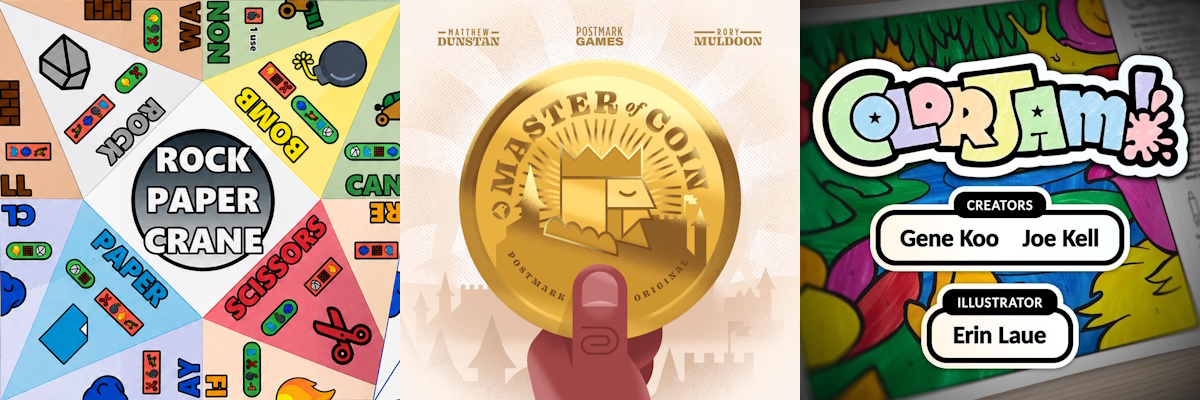
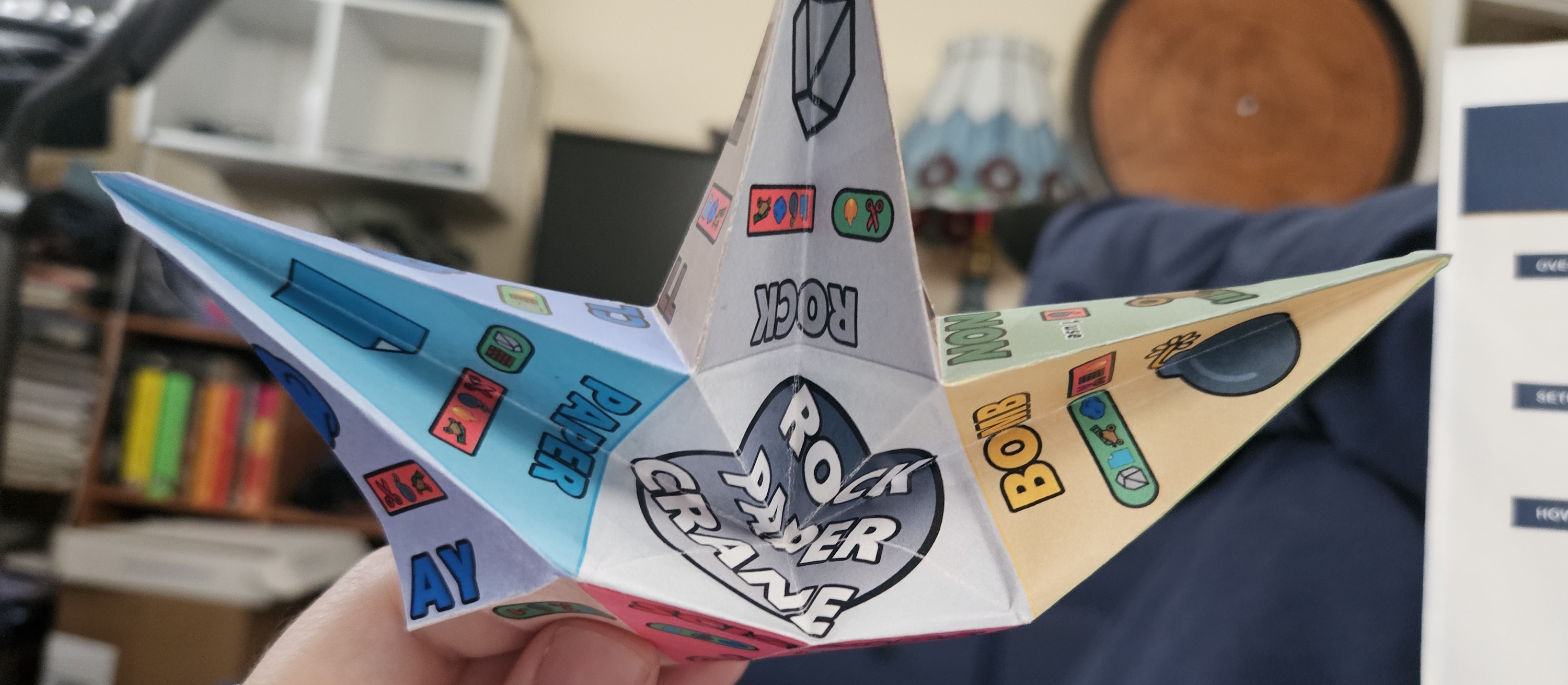
Rock Paper Crane

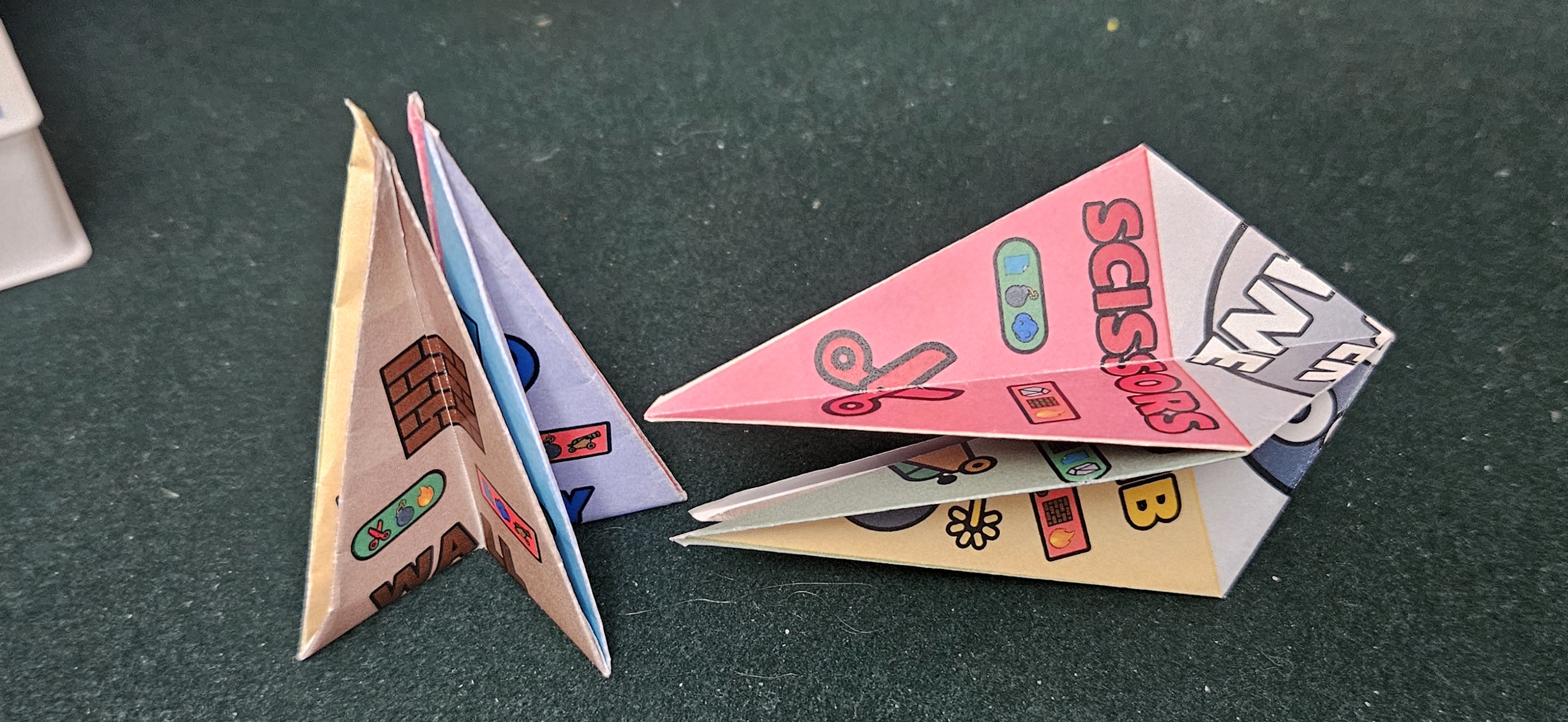
Rock Paper Crane bills itself as the world’s first-ever origami card game. True to its word, its construction requires you to craft the first couple of steps for making an origami crane.

Okay, so that’s the first problem. I dabbled in origami once. But I also happened to be six years old. Also, my little sister ruined my collection of nice origami papers, so I decided to spite her by never going back to the hobby or informing her or really imposing even the slightest imposition on her in any way. Which is to say, I finally fumbled together those first few steps. But the magic is in the fingers, not the voice, so as I labored to instruct my wife in how to shape her crane, I may have uttered the phrase, “You need to tuck in that piece, you’ve got it all popped out and flabby,” to which she replied, with a rather elevated voice, “You’re all popped out and flabby!”

So. Um. Be careful who you play Rock Paper Crane with.

I don't remember the next step. Nor will I ever.

Crane, interrupted.

Once assembled, Rock Paper Crane is Rock Paper Scissors with extra steps. For one thing, there’s an extra piece, the bomb. For another, winning a throw means you upgrade one of your sides. (Pause for origami.) Rock becomes wall. Paper becomes clay. Scissors become fire. That sort of thing.

Your objective, ultimately, is to win four throws, which will bring you one step closer to a finished crane. More importantly, you will have won the game. Or lost it, which is just as good, because, like I said, Rock Paper Crane is Rock Paper Scissors with extra steps.

Did I finish my crane? Nope. I couldn’t remember past those first two steps. Honestly, it’s pretty amazing that I got this far at all. Maybe I could have looked up the next instructions. But I swore an oath to never finish an origami ever again, and I’m true to my word. Take that, Mary.

Hm. Can I use this game to teach my children how to operate my kingdom long after I have departed this mortal realm?

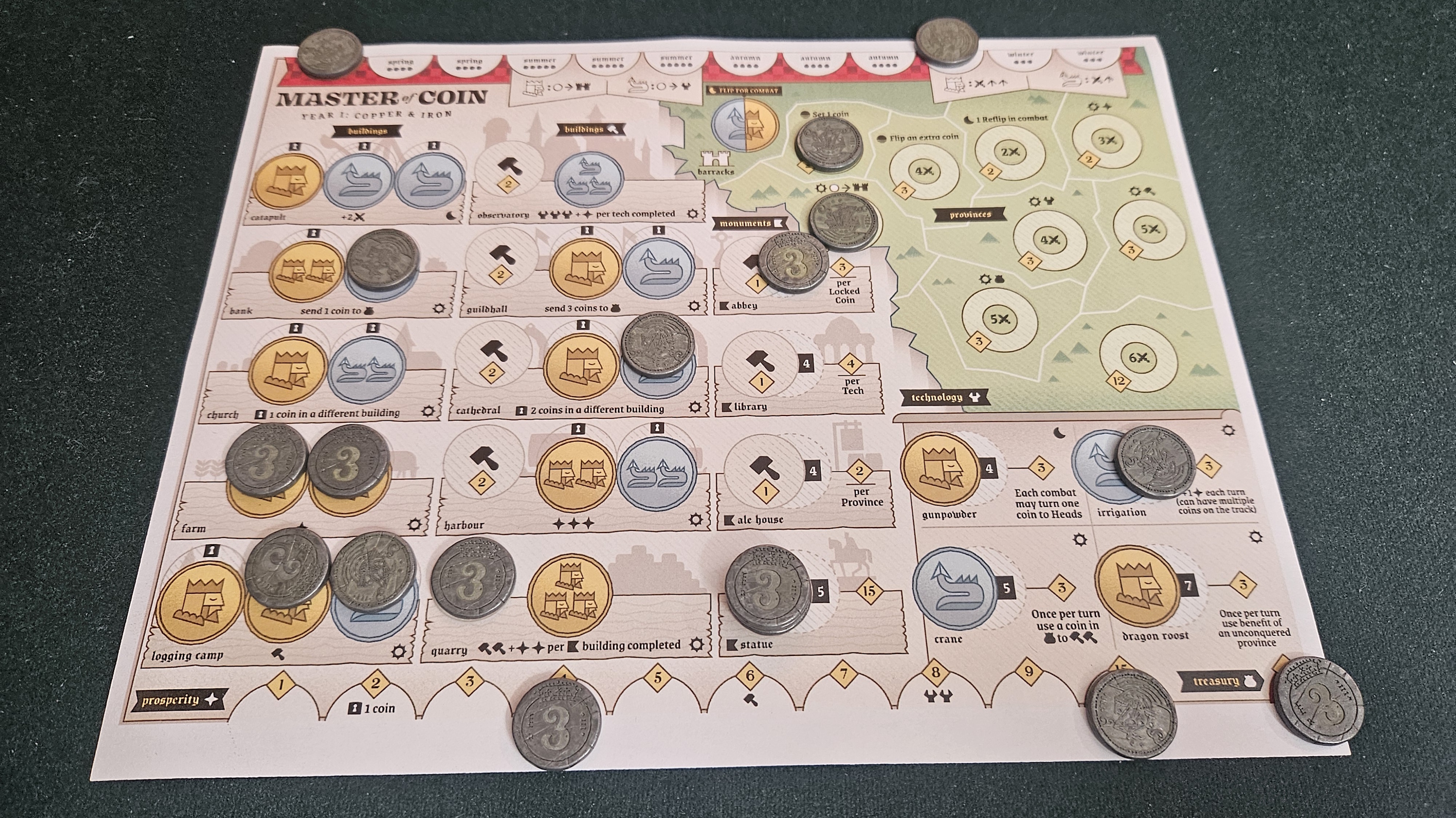
Putting coins on paper.

Master of Coin

Master of Coin is the eighth title from Postmark Games that I’ve played, and this time Rory Muldoon and Matthew Dunstan are ditching the dice and the cards. Their replacement? Coins, of course. It’s right there the title.

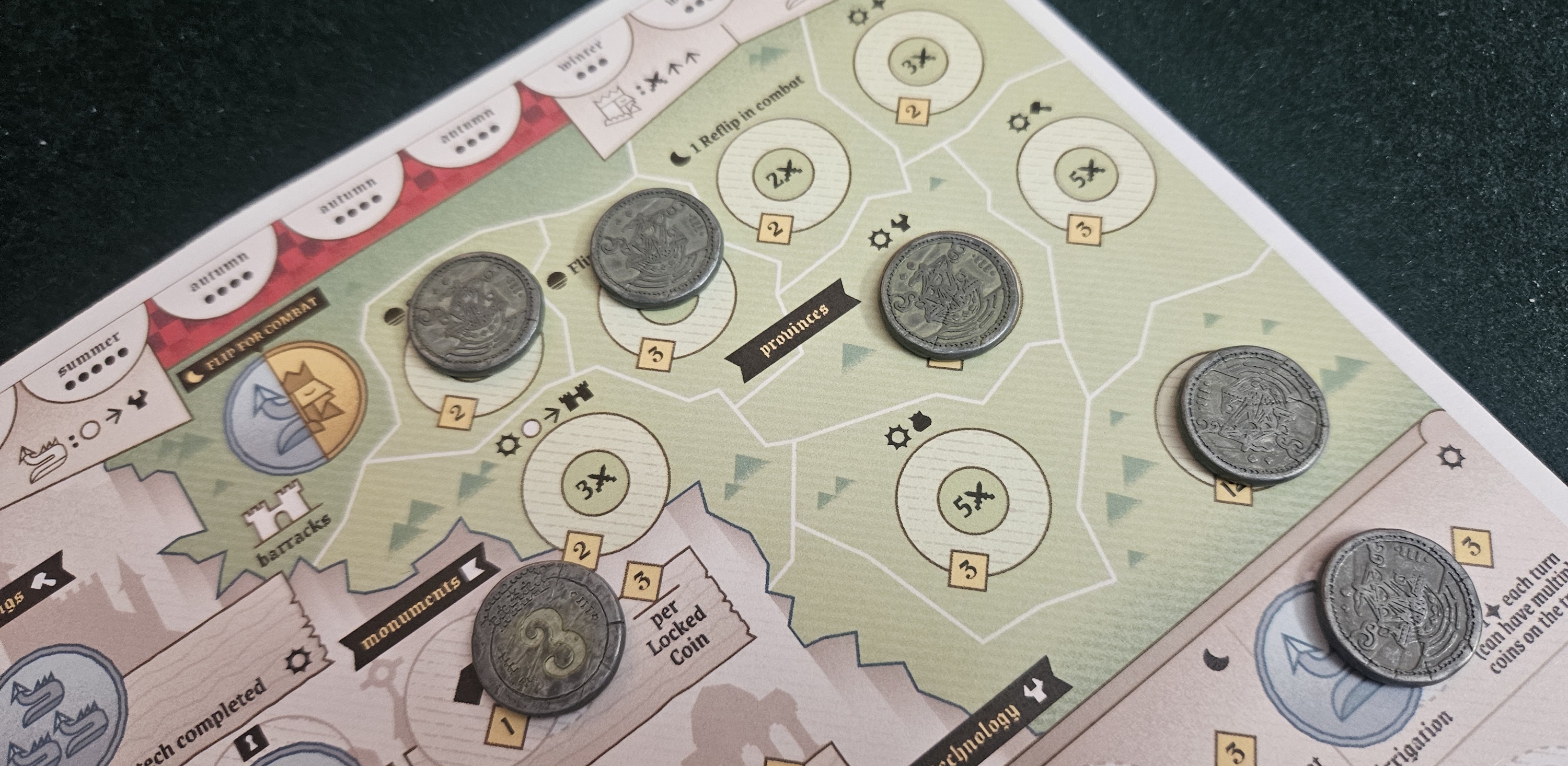
As you might expect, Master of Coin makes good on its conceit by requiring you to flip so many coins that your fingers will start to smell rather pockety indeed. Covering a single year in the history of a small kingdom, you begin each month by picking up some number of coins — the exact quantity varies by season — and flipping them to determine how many heads and tails you have to work with.

Early on, your options are finite. A few basic buildings, some technologies, and any leftover orphans packed off to the army. But it isn’t long before the gameplay begins to accelerate. Once completed, you can clear a building of its coins to activate its ability, whether to unlock better structures, develop your nation’s economic infrastructure, obtain perks in war and peace, or maybe construct monuments that unlock better scoring benefits. Crucially, some abilities let you “lock” coins, sliding them a few millimeters upward on your sheet. From that point on, when you clear the corresponding structure, any locked coins stay in place.

As a concept, Master of Coin is solid. Consider the army. When it’s time to march on neighboring provinces, you pick up all the coins in your army and give them a flip. Heads become indicators of conquest, while tails are failures. But there are so many ways to massage the odds. Certain buildings, like the catapult, can be cleared to produce guaranteed successes in battle. Or there are techs, like gunpowder, that let you shift a coin from tails to heads, saving you in the nick of time. All this is to say that there are ample ways to get ahead. Even if you, as happened to our group, happen to play a session with novelty coins that always flip heads.

aitg

Money is great for conquering distant nations.

Of course, there’s more to be seen. As with previous Postmark titles, Master of Coin isn’t limited to a single map. The game is on Kickstarter right now, and according to the campaign there will be five scenarios in all, each adding a year to the story of this wealthy kingdom and its unfortunate neighbors.

Unlike those previous Postmark titles, however, I’ve only tried the first scenario, so I’m unable to furnish a full review at this time. The good news is that what I’ve played has been exemplary. Very quickly, I was surprised that my kingdom’s main limitation didn’t lie with having too little money, but rather in keeping too many coins tied up in other projects. The kingdom only has access to twenty coins, you see, and two of those are reserved for tracking the month and any possible events. It isn’t long before you’ll need to make some tough decisions, forsaking certain appendages of your financial project altogether to double down on whatever has become most important.

Anyway. After not being all that enthralled with Postmark’s playing card games, Master of Coin feels like a return to form, capturing some of the tight but expressive playspace of titles like Voyages and Waypoints. I’m excited to see how this one develops.

With rice. Maybe butter. Kidding! I don't like rice.

I love little fingers.

Color Jam

When’s the last time you colored by numbers? Being a parent to a recent kindergartner means it hasn’t been as long as it might have been otherwise, but this still isn’t a regular occurrence of my daily life.

Until Color Jam. Designed by Gene Koo and Joe Kell, and illustrated by Erin Laue, Color Jam is about coloring by numbers. And contrary to my expectations going in, it’s wonderful.

But first, a note. Color Jam is being published by Lunarpunk Games, the indie imprint operated by Xoe Allred and Matthew Hocker. If you’re elbows-deep in the indie scene, this might already tell you something about the game. Foremost, Color Jam doesn’t have the usual victory conditions. Nor does it really have goals, at least not goals of the foreordained variety. You’re here to make your own fun, set your own benchmarks, and, hopefully, come away charmed.

This is the future liberals want.

I am inordinately proud of my art.

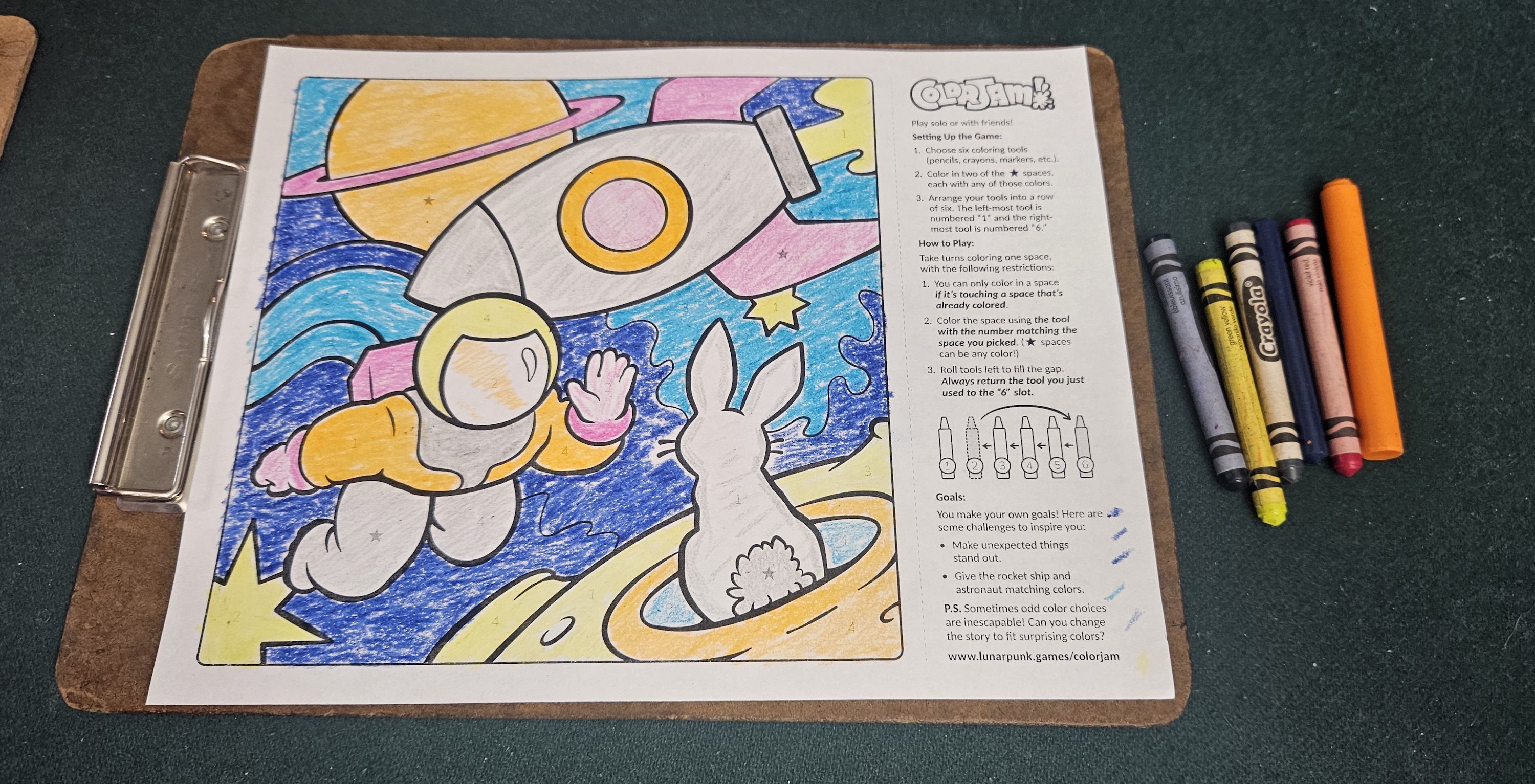
The basic idea is as simple as it gets. You take a picture and six crayons. Then you color in two of the spaces with stars in them. There are always four options, giving you some range to where you begin on the page.

From that humble beginning, you start to color in the entire thing. But there are limitations. Beautiful, expansive limitations. For one thing, you can only color a cell next to something you’ve already filled in. More importantly, those six crayons? You put them in order, numbered one to six. When you color a space, you use the corresponding crayon. Then — and this is where the game starts to breathe — you take that crayon and shift it to the last place.

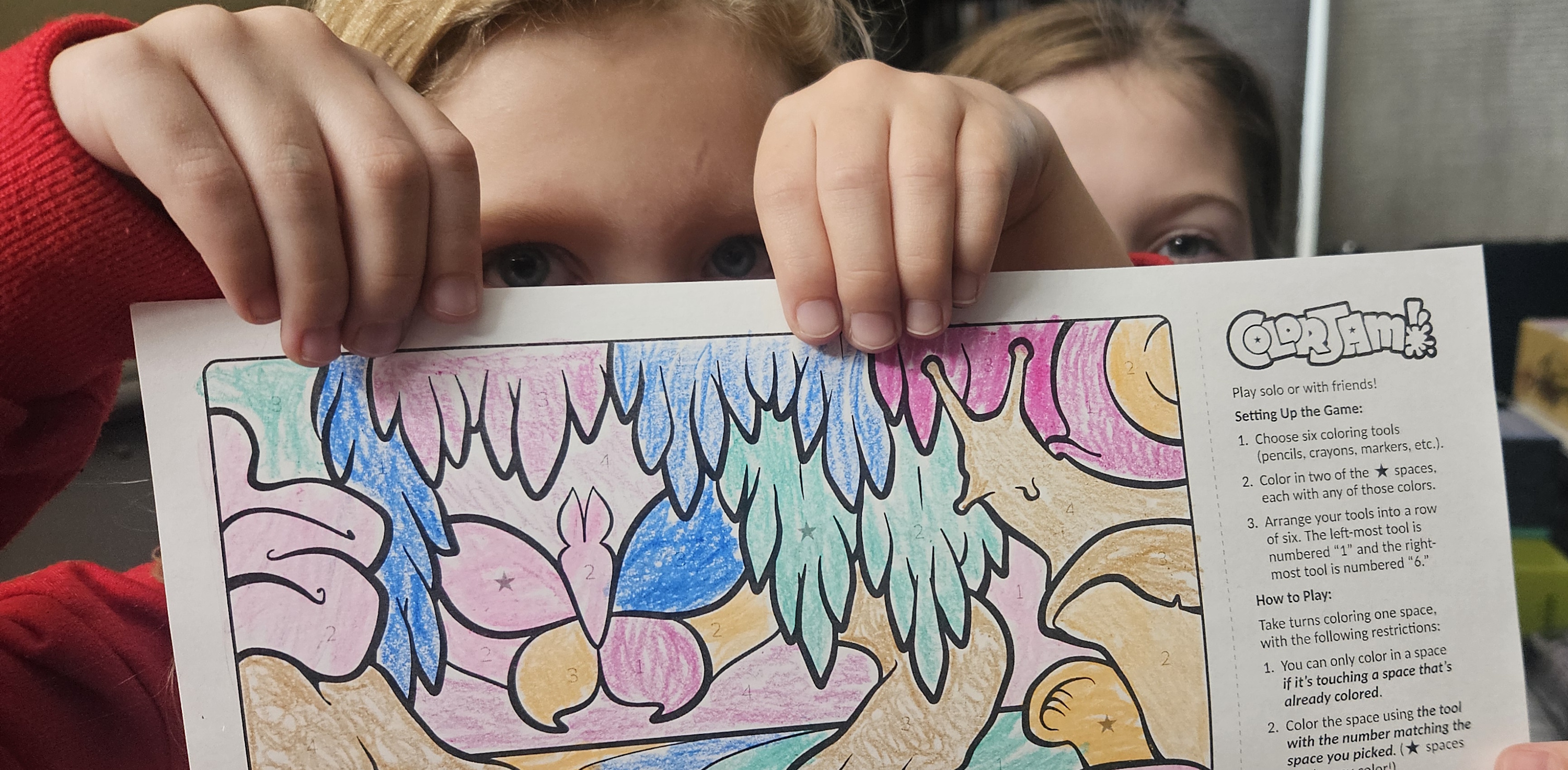
Now, this might not sound like much. But it transforms Color Jam from an elementary school project into something unexpected. You might want consistency. The wings of a butterfly to align, perhaps. But the right crayon might not be available. Or, when the right crayon comes up again, maybe you’ll want it for something else.

What do you do? Well, you get creative. Maybe this butterfly is prismatic, like a jeweled brooch, its colors vibrant but mismatched. The colors can become revelatory, streaks of the unexpected in what might have otherwise been an ordinary picture. Or maybe you start to plan ahead, counting the crayons down until the right one is ready for another scribble, transforming the page into a low-stakes logic puzzle. Or perhaps you get artistic. You can do a lot with shading, with the strokes of a crayon, with the application of a smudge or a smear. Two spaces that both use orange don’t need to look the same. This isn’t the paint bucket in an image editor. You can do whatever you like.

One day this picture will be worth no cents, because a robot will have ripped it off to make slop.

The artists.

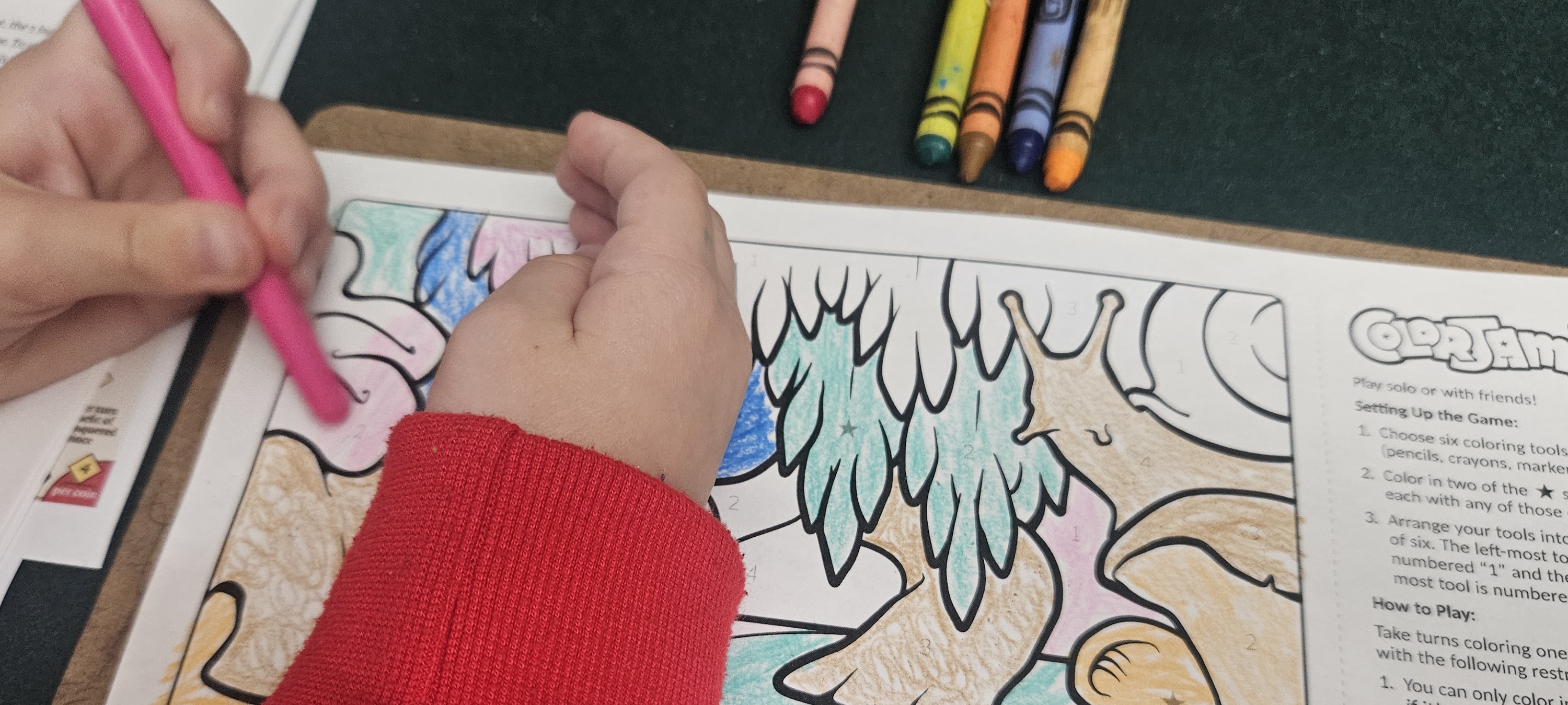
More than that, Color Jam is flexible. It’s possible to play solitaire, one person making every decision. But it’s also possible to play as a group. I played with both of my daughters, and everybody got a say in the creation of our picture. Over which crayons we pulled from the bucket. Over the turn order. Eventually, over how to account for colors that wouldn’t quite fit where we wanted them.

The most unsurprising thing about Color Jam, but which bears repeating, is that it’s simply delightful. It’s soothing to play, but thinkier than one might expect from a distance. We played together, and then we all played apart. And then Summer came home and wanted to play as well, so we did that, too. In each case, we came away having crafted something wonderful, whether in collaboration or on our own, whether according to strict logic and long-term thinking or creative storytelling, and felt all the richer for it.

Color Jam will be on Kickstarter sometime in the next month or so.


Access to the files and/or complimentary copies of Rock Paper Crane, Master of Coin, and Paper Jam were provided by the designers.

(If what I’m doing at Space-Biff! is valuable to you in some way, please consider dropping by my Patreon campaign or Ko-fi. Right now, supporters can read the next installment in my series Talking About Games, this time tackling the topic of what makes a good list! Naturally, the piece includes a list.)

Inkwell Review – For illustrative purposes only?

Von: Adam
24. Juli 2026 um 17:27

A review copy of Inkwell was kindly provided by Zatu Trade. Thoughts & opinions are my own. Inkwell is one of those games that makes you want to touch it. The soft closing of the magnetic clasp on the box. The cloth playmat. The satisfying heft of the little golden cubes. It’s a lovely thing. As far as draft and set-collection games go, it’s pretty decent. There’s a lot here to like…

Source

Top 10 Board Games I Thought I’d Love But Broke Up With

24. Juli 2026 um 15:06
Scythe ReviewWe’ve all been there. You see a game, love the art, hear the hype, and think: “This is the one. We are going to grow old together.” But then the cardboard hits the table, you play it, and the spark just isn’t there. Not because they’re bad games, but because they just weren’t the right […]

Source

Leviathan Wilds: Shattered Peak Expansion Review

Part of the fun of engaging with a system built around different characters, classes, species, or any other mode of substantive differentiation, is finding the build that’s right for you. Everyone who likes Root has a favorite faction, everyone who plays Magic has a favorite color, and the wonderful thing is that these preferences are almost always deeper than mechanics. If you’re lucky, if everything clicks, your chosen avatar feels ‌like an extension of yourself. There is something about playing as the Lizard Cult that elicits a deeper joy for me. Am I going to win? Probably not, but boy I’m going to have a great time. Blue may leave me with no friends, but I’m enjoying myself.

Leviathan Wilds has been my favorite cooperative game for a while now, and while I was equally fulsome in my praise of the first expansion, it is only now with second expansion Shattered Peak that I can say I have found the Class for me. The Geomancer, one of three new Classes that join three new Climbers and eleven new Leviathans in this box, feels like home. All the builds in Leviathan Wilds are about running around and smashing infectious crystals, but the Geomancer is the first to mess with those troublesome fungal blooms. He can manipulate their values…

The post Leviathan Wilds: Shattered Peak Expansion Review appeared first on Meeple Mountain.

Quick Peaks – Pirates of Maracaibo: Bermuda Triangle, Kittens in Space, Haunted Mouse, Trans-Siberian Railroad, Dirt & Dust

Pirates of Maracaibo: Bermuda Triangle - Justin Bell

I stand by my 2024 review of the Pirates of Maracaibo base game: I think it is designer Alexander Pfister’s best work, a co-design with Ralph Bienert and Ryan Hendrickson based on Pfister’s 2019 release Maracaibo that completely eliminated the older original from my collection. It’s a race that shears off all the loose ends of Maracaibo, with better card play (the entire map is actually a series of cards), simpler combat, a more comprehensive use of the Exploration board, and a shorter playtime. It was one of the top 10 games I played that year, and I’ve played it more than 15 times in person and more than 100 times on Board Game Arena.

Pirates of Maracaibo: Commanders has a “raison d’etre”: Euro players like to have their asymmetric powers, so Commanders very much as a reason to exist. Pirates of Maracaibo: Bermuda Triangle is the latest expansion, but it is very much a mini expansion. There is a small deck of cards that can be integrated into the decks of the base game, there’s a single solo card, and there’s a single location card (the Kraken) that may or may not add a little flair…

The post Quick Peaks – Pirates of Maracaibo: Bermuda Triangle, Kittens in Space, Haunted Mouse, Trans-Siberian Railroad, Dirt & Dust appeared first on Meeple Mountain.

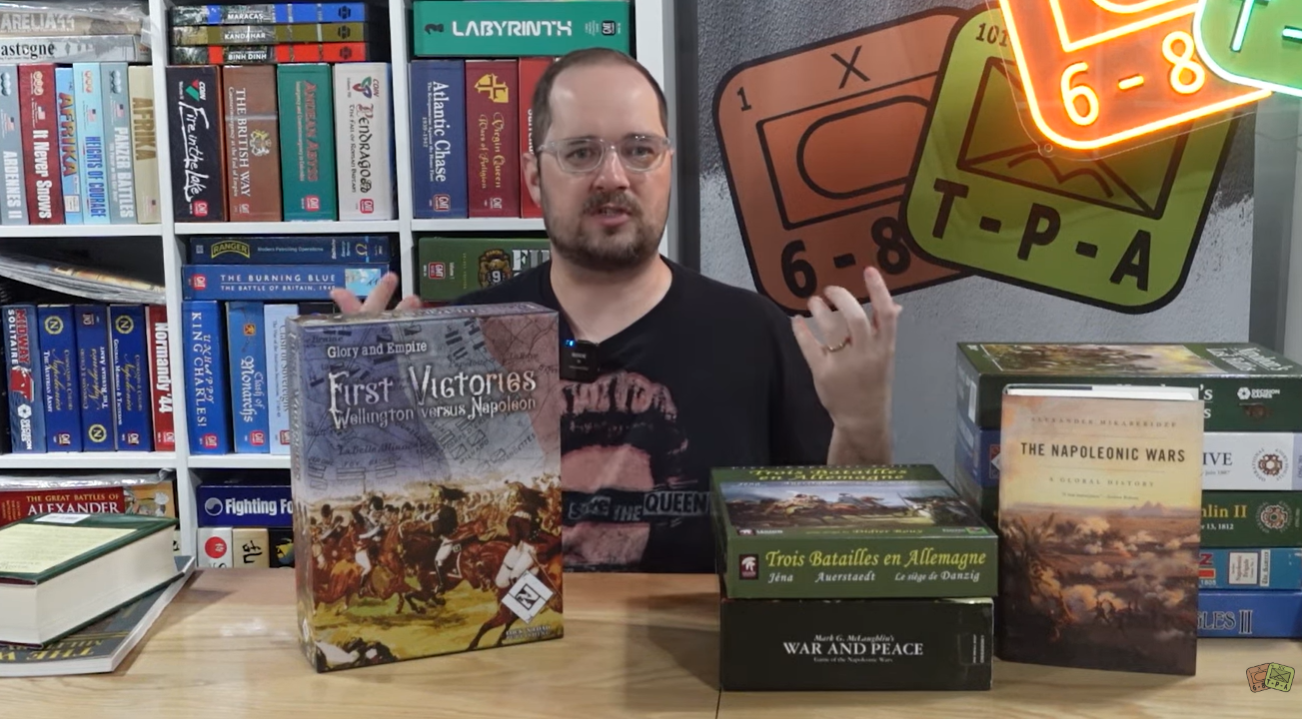
From Cover to Cover: The Napoleonic Wars: A Global History – Alexander Mikaberidze

Von: Grant
24. Juli 2026 um 14:25

We have an ongoing video series on our YouTube Channel called From Cover to Cover where we read a book on a subject and then pair that with a discussion of the book while covering a few games also on the subject. In this 14th entry in the series, Alexander takes a look at The Napoleonic Wars: A Global History by Alexander Mikaberidze. He then discusses a few games on the subject including Congress of Vienna from GMT Games, Imperial Struggle from GMT Games, Alliance from Columbia Games, Commands & Colors: Napoleonics from GMT Games and The Napoleonic Wars from GMT Games. amongst many others

-Grant

French board game distributor, publisher Atalia enters liquidation, blames market saturation and battle for bestsellers

24. Juli 2026 um 12:55

French board game distributor and publisher Atalia has entered compulsory liquidation, saying an increasingly saturated market, the limited capacity of retailers and the loss of distribution rights to bestselling titles left the business unable to remain viable.

A statement posted to Atalia’s Facebook page said the rapid expansion of the tabletop market since the company was founded in 2015 had created a tougher commercial environment for smaller distributors, despite the industry’s continued growth.

Atalia said that despite soaring numbers of players in that time, “so many new games are being released today that the market has become saturated. Shops no longer have the space, the time or the cash flow to stock all the games arriving each week”.

It added, “They therefore naturally turn to distributors with the biggest marketing budgets, some of whom invest sums each year that exceed Atalia’s annual turnover.

“This year, Atalia has lost the distribution rights for its latest bestsellers, as their publisher has chosen to entrust them to a distributor offering greater financial and marketing resources.

“We naturally respect these decisions, but we cannot hide our regret. Without these bestsellers, it has become increasingly difficult to finance new releases and ensure the company’s long-term viability.

French board game distribution is dominated by industry heavyweights Asmodee and Hachette, the latter via its Gigamic and Blackrock subsidiaries.

Atalia was founded in 2015 as a French board game distributor, before expanding into localisation and then publishing in 2021. It distributed games to hundreds of specialist retailers across France and neighbouring francophone territories.

The company says on its website that it deliberately maintained a relatively small catalogue, so individual games entrusted to it would not be “lost amongst an overwhelming number of titles”.

Earlier this year Atalia revealed it was halting its own distribution operations to focus on publishing and localisation, with its distribution being handled by MAD from May.

Atalia’s previously published releases include French localisations of games including Underwater Cities and Lorenzo il Magnifico, while recent titles published by the company include The Royal Society of Archeology and Hands Off!.

The company had also faced financial difficulties in 2019, despite a prior year in which it had generated revenues of more than €1.8m and continued profitability.

Atalia’s decision to double its headcount to six amid that success backfired when the publisher of Limite Limite, a French adaptation of Cards Against Humanity which accounted for about half Atalia’s revenue, switched to a new distributor in 2019 with no prior warning.

The company placed itself into receivership the same year, but emerged intact from that process in early 2020, citing strong sales of its bestsellers including Punto and Dreamscape, and receiving court-ordered compensation from the publisher of Limite Limite for the abrupt termination of its distribution deal.

Atalia founder Cesare Mainardi

The company’s liquidation announcement today came a month after Atalia founder and managing director Cesare Mainardi revealed it was “facing an extremely difficult period”, and cancelled its planned attendance at the Paris est Ludique festival, citing financial difficulties and organisational constraints.

Atalia officially entered compulsory liquidation on July 8 via Nanterre Commercial Court.

The company’s assets, including stock, brand and customer database, will now be offered for sale by the liquidator. Mainardi said interested parties should contact him via private message on Facebook.

He said in the Facebook post, “Today, we turn the page with our heads held high, feeling immense pride in everything we have built together.

“The people we’ve met, the games we’ve played and the memories created during this adventure will remain with us forever.”

The post French board game distributor, publisher Atalia enters liquidation, blames market saturation and battle for bestsellers first appeared on .

Dale Yu: Review of Splendor Duel and The Counterfeiters expansion

Von: Dale Yu
24. Juli 2026 um 10:24
    Splendor Duel and the Counterfeiters expansion  Designers: Marc Andre, Bruno Cathala  Publisher: Space Cowboys Players: 2 Age: 10+ Time: 30 minutes Amazon affiliate link: https://amzn.to/4aSuCOghttps://amzn.to/4fAEBdF Played with review copy provided by publisher Confront your rival guild … Continue reading

Bean to Bar

Bean to Bar is not your typical Japanese game. When I hear Japanese game, by default I imagine a short, minimalistic and clever card game with few components. Bean to Bar is a complex and heavy Euro style game with many more stuff than just cards. It is a game about making and selling chocolate. You build and run an artisan chocolate empire.  In the game you need to

Yawpz

24. Juli 2026 um 01:44

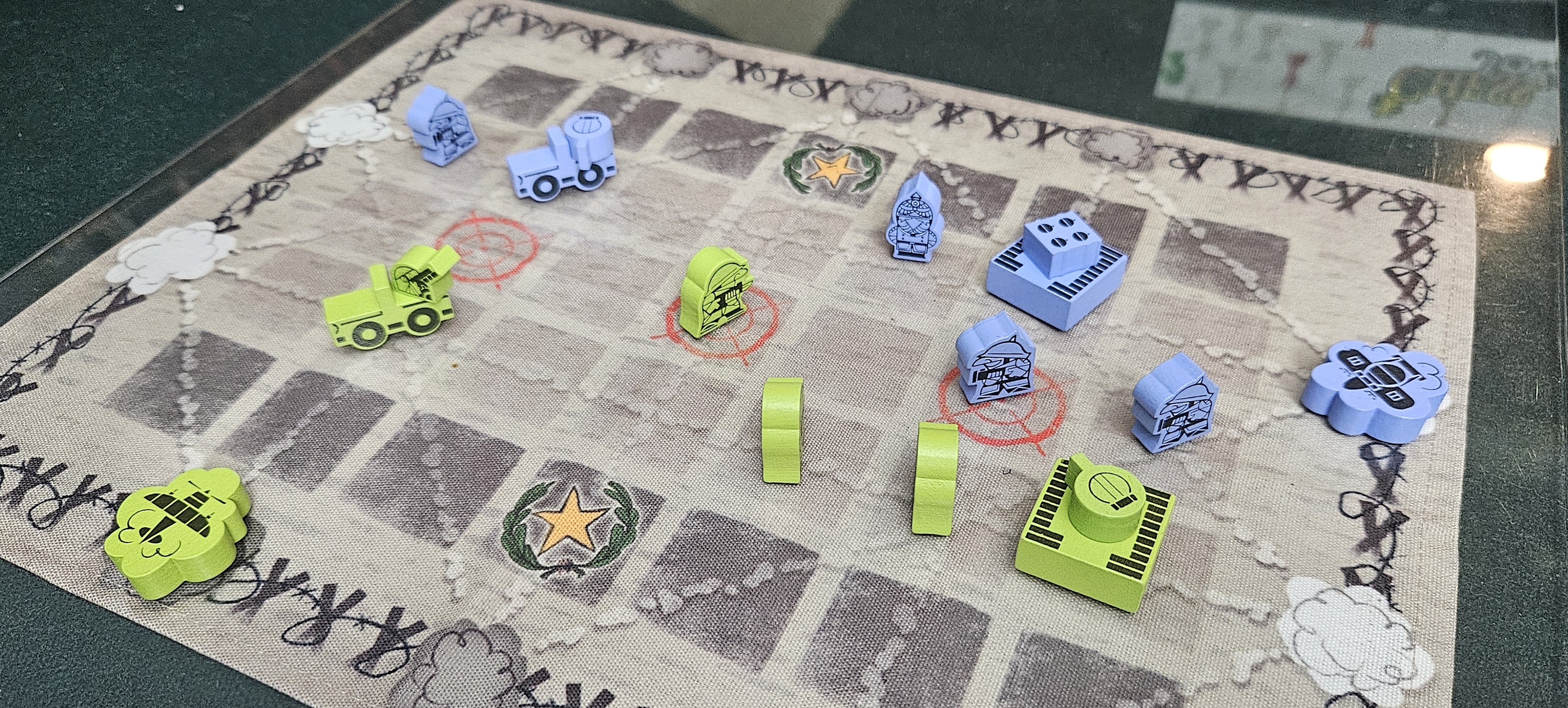
I'm the little kaiser-kisser on the right, sipping tea with my peers across the lines, oblivious to the carnage around me.

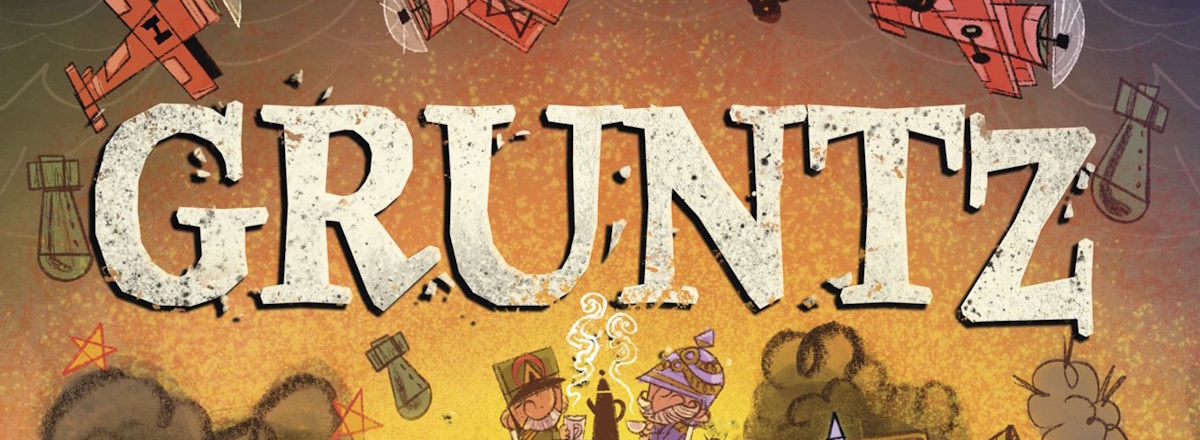
This might sound funny, but the game that kept springing to mind while playing Gruntz, the tiny-as-it-gets wargame by Carter Scott, was none other than Kurt Vonnegut’s GHQ. Like that ancient (but now resuscitated) title, Gruntz is about a pair of World War-era armies bashing it out on the field. They’re both highly attritional, encouraging a tit-for-tat gameplay that’s either enthralling or exhausting depending on your tolerance for swapping one piece for another.

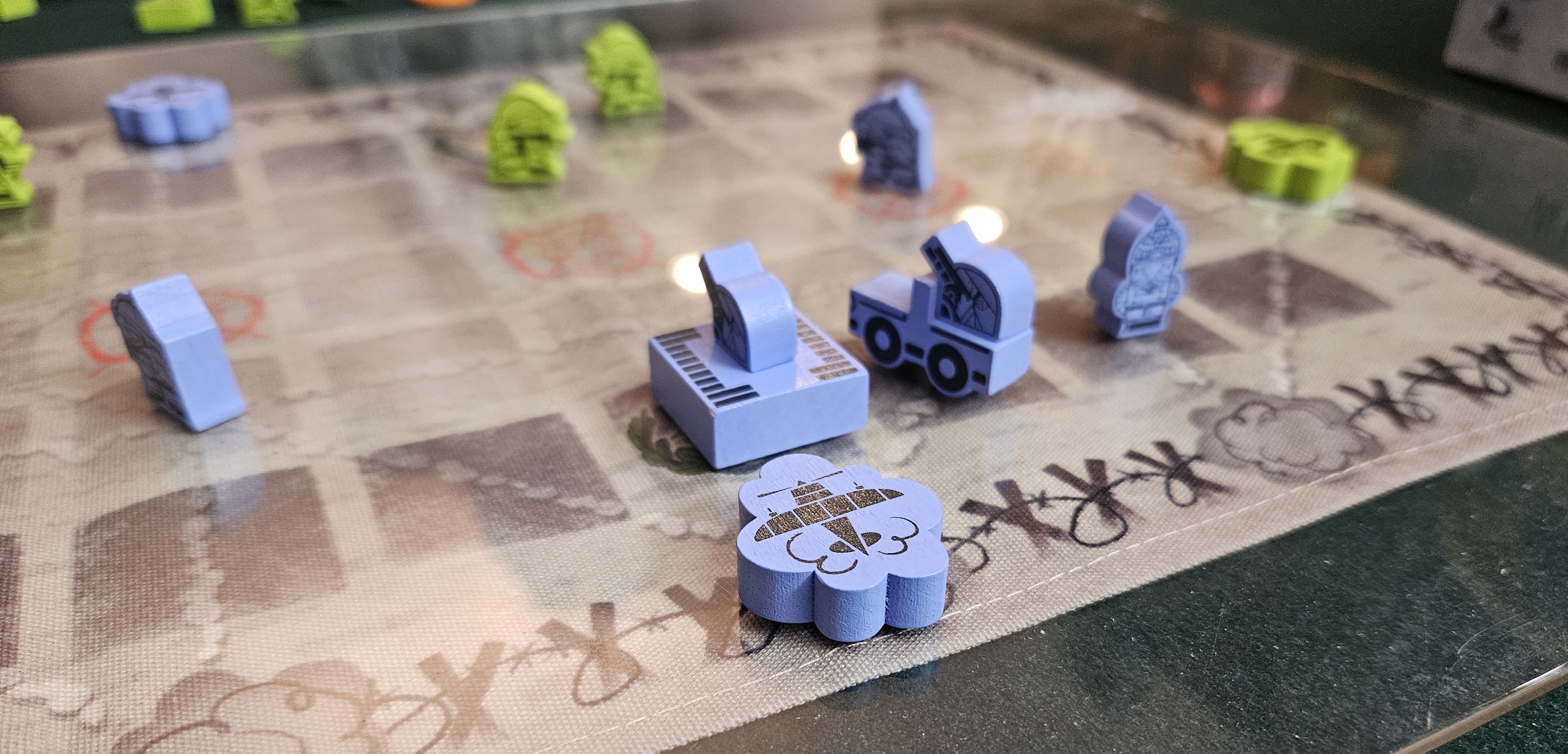
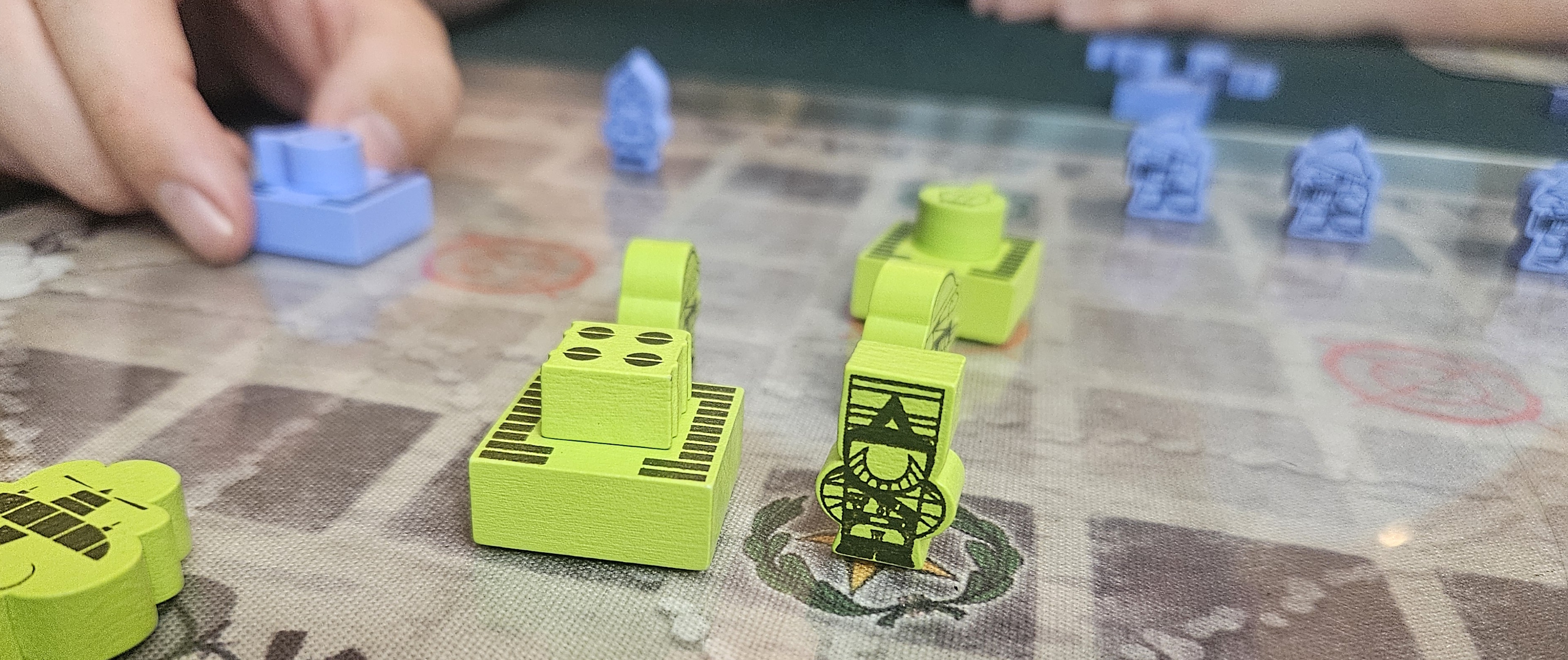
More than that, they’re both games about both movement and reinforcement. It isn’t enough to position your troops smartly. You also need to know when — and what — to call up from the rear. In the case of Gruntz, that sometimes means snapping a range of equipment onto a chassis to create a custom-built war machine.

This is never not cool. Because magnets, baby. I’m always in a mood for magnets.

This game would benefit from a soundboard of growly but cute tank, truck, and biplane noises.

Screening my fighter with plentiful anti-air.

The parallels don’t stop there, although I’m hell-bent on preventing this from becoming a comparison piece between two board games that are similarly under-known and probably wouldn’t appreciate the association anyway. Still, there’s something to be said about the way these titles portray their miniature battlefields. Where GHQ was a pale representation of Vonnegut’s WWII battlefields, dominated by artillery and armor, with infantry more or less serving as a screen for the good stuff, Gruntz is more timeless. Which is a polite way of saying that it isn’t quite as distinctive, history-wise, despite the visuals and hardware looking a little more Great War.

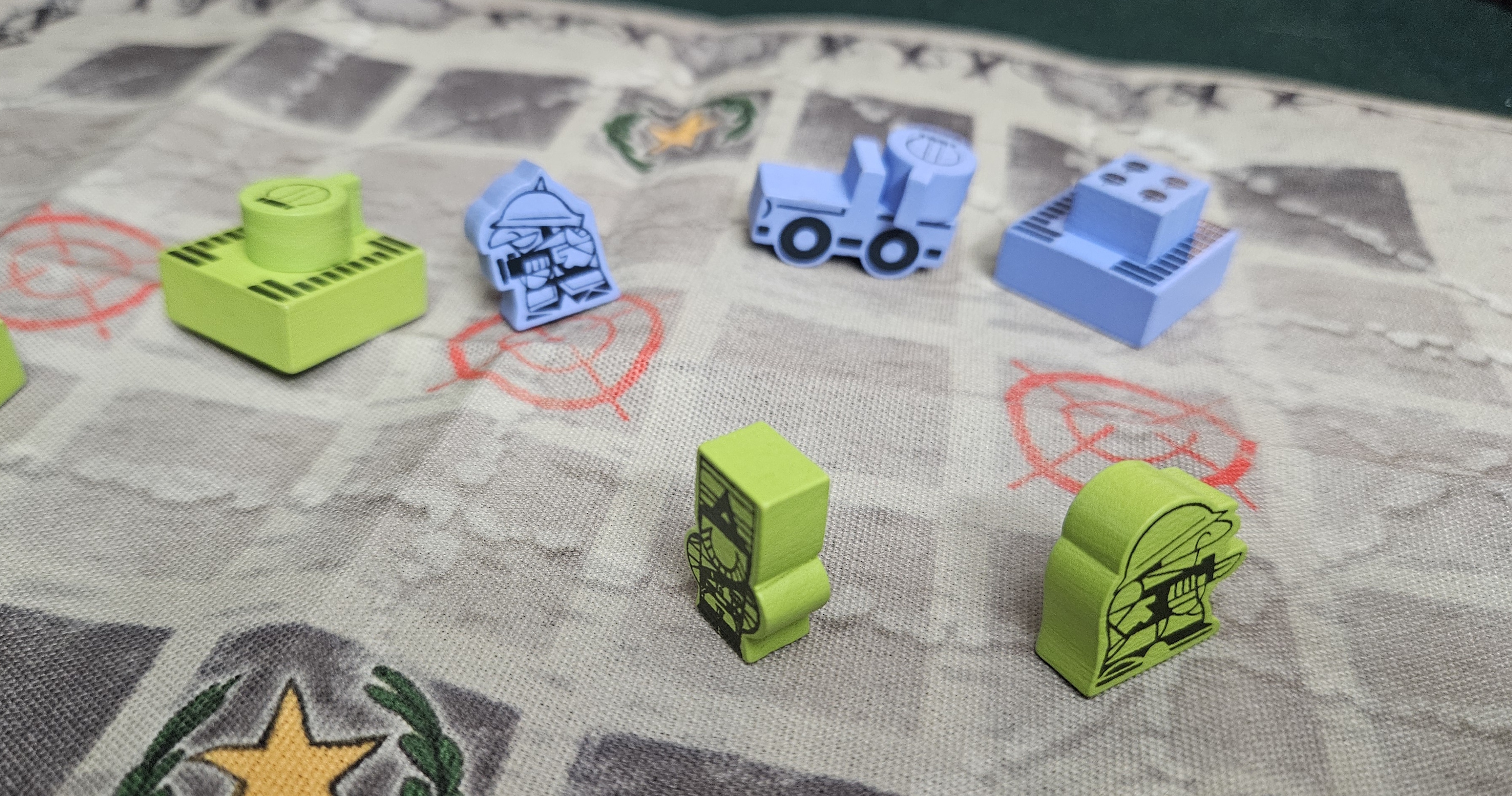
Perhaps the best place to start would be with the units. Infantry — the titular gruntz — represent a never-ending supply of bodies. Really, that’s their main trait: when killed, they bounce back into their general’s reserve rather than disappearing permanently from the table. They’re also useful for capturing control points, and can be moved en masse thanks to a captain who’s the spitting image of a gentleman officer in the midst of a war that’s very quickly eliminating the aristocracy at a pace that leaves every revolution red-faced with envy.

Those control points are the game’s biggest advantage over something like GHQ. Controlling two of the map’s three points at the end of a turn will award a star; controlling all three is worth two stars. Reaching three stars means victory, so there’s a strong incentive to usher your boys forward, even if it means they’ll get chewed up on the following turn.

To oblige said chewing, there are ample instruments. Both sides have access to quite the range of hardware. There are planes, both fighters and bombers, which tootle along wisps of contrail over the main battlefield, and are especially keen to obliterate anyone foolish enough to position their manpower in a straight line. These are matched on the ground by vehicles, which are built of two components, chassis and attachment. The chassis, whether armor or truck, either trundles or sprints across the battlefield, while providing more or less protection. The attachments, meanwhile, offer anti-air capabilities — more of an area denial strategy than an actual threat, it should be noted — a cannon for defeating anything in range, or a transport for depositing infantry closer to enemy lines.

By mixing and matching the best attachments, you can assemble the right tools for the current crisis. That’s the idea, anyway. Most of the time, armor gets the cannons and trucks become speedy transports. It’s a case of play mirroring life, a bit like how evolution tends to produce crabs because armor and pincers present obvious competitive benefits.

The ability to move a unit twice in a row is deadly. Maybe broken? Although I also feel that not being able to do it would make the game a little too considerate of relative ranges to be playable.

Tanks checking their ranges.

Very much unlike GHQ, which allowed its generals to divvy up their moves and reinforcements as they saw fit, Gruntz employs a stricter formula. Either you move twice and deploy once or move once and deploy twice. This ensures a steady stream of troops will enter the battlefield, and also that many of those troops will be demolished before the last clouds of smoke have blown clear.

Its most conspicuous absence is artillery. This is its biggest departure from something like GHQ, not to mention easy historical placement. Put simply, this is not simulationist fare. Units capture their peers in the manner of chess, by moving onto them, rather than pelting their targets from a quarter-mile out. The effect, then, is approximate to playing with little green army men, all bayonets and glory rather than ignoble death from afar.

To be clear, this isn’t a complaint so much as an errant thought. For all its symmetry, Vonnegut’s attempt reflected the unfairness of the war he took part in, the absence of rules, the capriciousness of the howitzer and the carpet bomb. Writing about the former war, Hemingway described modern combat as dying like a dog for no good reason.

In Gruntz, your gruntz die for good reason. The stakes are crystal clear. To defeat someone, you move into range of the counter-attack. This imbues the process with a necessary attrition. Of course, you try to avoid losing troops. A well-positioned flak cannon can stave off a bomber; a tank in the right spot can discourage an infantry push. But this isn’t a game about decapitating the serpent so much as trading bites with it, fang for fang and venom for venom, until one side is too exhausted to continue.

Then again, it does a better job of evoking a broken no man's land. Any time your grunt tips over, it's a leg sprain. Back to the hospital.

The fabric mat is a pain to deal with.

There are always back-of-mind benchmarks for combinatorial titles like this, and these exchanges make Gruntz feel more like Checkers than Chess, more about constant trades than graceful maneuvers. The one exception would be the aircraft, which glide over entire lanes and columns. A bomber is one of the few things that can ruin a tank’s day, which makes its appearance rather potent indeed. This can lead to interesting bottlenecks, anti-aircraft guns strangling any viable avenues of approach, only to grow obsolete the moment the threat has subsided.

The entire thing is full of misdemeanors like that. Obsolete units. A playmat that’s too creased to allow the gruntz to stay upright. The ease with which reinforcements appear, all but necessitating a protracted first act to clear out the chaff and force both sides to prioritize a few units. These are shortcomings, not outright game-breakers, but that only makes them more galling.

And then there’s the expansion. Allplay does this thing where they sell premium pieces separately from the main game. In most cases, it’s a positive practice. Those who want the metal bits can pay a few dollars more, while those of us who are fine with cardboard punch-outs can settle for the more affordable core box. It’s a smart middle ground.

Here, though, there’s an entire expansion that’s omitted from the main box despite only requiring a pair of reminder sheets and five cardboard tokens. Supplies, it’s called, and it adds — you guessed it — little supply markers. These can be spent to activate special abilities, like charging all your gruntz forward at once, making a crucial extra move with a vehicle, or swapping a now-obsolete AA gun for a big stonking cannon.

On its own, the Supplies expansion improves my opinion of the game considerably. It’s exactly what Gruntz needs to shine, adding a crucial but rules-light layer of resource management atop the game’s straightforward rules. Using a bomber to drop a bunch of paratroopers is incredibly cool, not to mention game-swinging; the limitation, naturally, is that your opponent also has access to their own cache of supplies. Without the expansion, Gruntz is handsome and interesting, but deeply flawed. With it, the flaws are still present, but dulled sufficiently that it becomes one of the more formidable precious-scale battlefield games out there.

Yes, you caught me, this is not from actual gameplay. But look in the plexiglass: CHESS JOKER looks on, smirking. "I am not the only mixed review this week," it says.

The view from on high.

All told, Gruntz is a strange offering, especially for Allplay’s small box line. Its direct conflict and zero-chance combat make it more confrontational than one might expect. This is no feel-good trick-taker or Peter Hayward deduction game. There will be blood. Or at least scrapings of green and blue crayon across the pavement.

Despite its shortcomings, however, I feel kindly toward Gruntz. It doesn’t have the pedigree of GHQ, and its diminutive scale may preclude it from broader adoption. But there’s something here, a certain sangfroid, some marginal strategy, that makes me want to get better at maneuvering its dweeby little guys and chonky tanks and turbulent aircraft. I want to stroll my captain into the enemy base for a more elegant win. I want to figure out how to keep its gun-trucks alive long enough to swing a battle. Is the depth there? I have my doubts. But it feels like something is lurking there, beneath the fabric.

Also… it has magnets. How do they even work? We may never know. Like I said, put magnets in your game and I’ll give it higher marks than otherwise. That’s a Space-Biff! promise.


A complimentary copy of Gruntz was provided by the publisher.

(If what I’m doing at Space-Biff! is valuable to you in some way, please consider dropping by my Patreon campaign or Ko-fi. Right now, supporters can read the next installment in my series Talking About Games, this time tackling the topic of what makes a good list! Naturally, the piece includes a list.)

CMON scraps $2.1m NFT game maker investment, three months after betting on deal to expand revenue, remain ‘relevant’

24. Juli 2026 um 00:35

Financially-troubled board game publisher CMON has terminated its planned $2.1m investment in NFT video game maker Blissful Link, three months after pinning its future on a push into digital game development and blockchain-based projects.

CMON’s board had planned to transition the company’s titles such as Massive Darkness and Super Fantasy Brawl Reborn into “high-quality digital assets” through the investment, saying the move was necessary for it to “continue to be relevant in the games industry and to expand the group’s revenue stream”.

But the board game publisher has now terminated the deal according to a new filing it submitted to the Hong Kong stock exchange, saying the conditions necessary to complete the investment had not been fulfilled.

CMON did not disclose which conditions had not been satisfied, nor whether it intends to pursue alternative investments as part of the announced digital strategy.

Super Fantasy Brawl Reborn || CMON crowdfunding image

The conditions of the deal included CMON being satisfied with the results of due diligence of Blissful Link’s finances, assets and legal structure – particularly around its Capverse game – approval of both parties, and warranties related to the agreement “remaining true and accurate and not misleading at completion”.

Capverse is a play-to-earn video game built on blockchain technology, in which players buy NFT ‘Sumer’ characters to battle with online.

The proposed investment would have valued Blissful Link at more than $95m. Blissful Link made a loss of about $197,000 in 2024, on revenues of just over $408,000, and had net liabilities of about $889,000, according to unaudited figures provided by CMON in April. It did not include finances for 2025.

CMON was mocked in multiple places online after it announced the NFT deal in April, with commentors largely expressing that they believed the deal was not financially sound, and questioning CMON’s decision to bank on NFT and web3 technology to fix its financial problems.

The veteran crowdfunding giant’s $23m losses across 2024 and 2025 were almost 5.5-times larger than its profits from the preceding nine years combined, and have pressed the company into a string of asset sales as it attempts to fulfill more than $14.3m of as-yet-undelivered crowdfunding campaigns.

Those IP sales included parting with its most famous and profitable title Zombicide – which has raised more than $40m on Kickstarter since its 2012 launch – to Asmodee, as well as Blood Rage, Rising Sun and Ankh to Tycoon Games.

It followed those by selling the IP for former Mythic Games titles Anastyr and Hel: The Last Saga to Don’t Panic Games in September, and parting with the lucrative Cthulhu: Death May Die IP to Asmodee a month later – the latter a series which has raised almost $10m from backers to date.

Earlier this year an independent auditor hired by the company questioned whether it CMON had the resources to stay in business for the foreseeable future, saying the publisher’s $19.9m annual loss, its net liabilities of more than $3.5m and contract liabilities of over $7.5m “indicate a material uncertainty which may cast significant doubt about the group’s ability to continue as a going concern.”

CMON’s directors had a different view, however, saying in the company’s 2025 financial report that it “should be able to continue as a going concern” thanks to a trio of factors.

They include financial support from some of the directors “sufficient to finance CMON’s working capital requirements”, the roughly $2.4m proceeds from selling its Singapore office that it received in January, and about $1.25m of gross proceeds from a successful share sale in February.

CMON’s hefty liabilities are largely due to its eight undelivered crowdfunding campaigns, which are not recognised as revenue on the company’s books until they are fulfilled to backers.

They include DC Super Heroes United, which raised more than $4.4m, and DCeased, which brought in over $2.5m. Both campaigns were initially due to be delivered last year, but are now expected to be delivered in Q4 of 2026, according to CMON’s latest estimates.

DCeased || CMON crowdfunding image

CMON also has several undelivered pre-order campaigns on its books, including Super Fantasy Brawl Reborn and the Assassin’s Creed Role Playing Game. The company is currently in the process of fulfilling a trio of other pre-orders including Dune Desert War, Cthulhu: Dark Providence and Marvel United: Witching Hour.

The company pulled the plug on crowdfunding launches and new game development in April 2025, citing the economic uncertainty created by US tariff hikes – which at the time had reached 145% for China, where the vast majority of hobby board games are manufactured.

But CMON announced in March this year that it plans to relaunch its halted crowdfunding operations later in 2026.

NFTs, which emerged out of cryptocurrency technology such as Bitcoin, exploded into the public eye in 2021 thanks to big-money speculative purchases – such as an NFT of Twitter founder Jack Dorsey’s first tweet selling for $2.9m.

That speculative bubble had already burst a year later, however with many of the digital assets involved losing more than 90% of their peak value. The Dorsey tweet NFT, for example, received a high bid of $6,800 when it was put back on the market in April 2022.

Other board games that have pushed into NFTs are few and far between, with one of the highest profile examples being SolForge Fusion, which allows players to mint decks as digital assets in addition to playing the game in physical form.

Two years ago CCG project Wonders of the First had to pull a $1.4m campaign from Kickstarter after falling foul of the crowdfunding platform’s ban on NFTs. The game went on to raise about $1.2m after relaunching without NFT content.

The post CMON scraps $2.1m NFT game maker investment, three months after betting on deal to expand revenue, remain ‘relevant’ first appeared on .

What Puts You Over the Edge to Buy/Back a Game?

23. Juli 2026 um 17:55

Have you ever been on the fence about buying or backing a game? You’re following along, you’ve watched some playthroughs and reviews, you have trust in the publisher, and you can afford the price. The game intrigues you, but you’re just not sure yet. What questions do you ask to put you over the edge?

For example:

  1. Who will play this game with me?
  2. Will I be able to learn, teach, and retain this? Does the setup look cumbersome?
  3. If the game costs more than $25, will I play it more than once?
  4. Will I actually enjoy playing this?
  5. Will this fill a desired niche in my collection?
  6. Am I missing out on the next big thing if I don’t buy this?
  7. Among my friends, am I the only person local to me who will have this?
  8. Am I excited to have this on my table, or could I just play it digitally or at a convention?

Recently I’ve faced this conundrum with a few games. Sometimes simply being on the fence is indicative to me that the game might not be the right fit. But there are plenty of games that I was hesitant to explore and ended up loving, so I try to keep an open mind.

This type of decision is highly subjective, but I’m curious if publishers can do certain things to help on the product page:

  1. Who will play this game with me? –Showcase photos of people playing the game, potentially in different situations if the game scales well to various player counts (or focus on the most common situation in which this game will be played).
  2. Will I be able to learn, teach, and retain this? Does the setup look cumbersome? –Use a 3-step infographic to convey the core steps of the game and mention rulebook length and setup time.
  3. If the game costs more than $25, will I play it more than once? –Mention the strongest asset for replayability without overwhelming the customer with too many modes or options.
  4. Will I actually enjoy playing this? –Share playthrough videos and offer demo versions online and even pre-production copies at local game stores (IV Studios does this well).
  5. Will this fill a desired niche in my collection? –Accentuate 3 truly unique elements about the game.
  6. Am I missing out on the next big thing if I don’t buy this? –Direct attention toward social proof (i.e., the number of backers, if it is high).
  7. Among my friends, am I the only person local to me who will have this? –I’m not sure a publisher can answer this question.
  8. Am I excited to have this on my table, or could I just play it digitally, at a convention, or at a local game cafe? –Highlight great art and the component hook(s), and don’t offer the full version digitally until well after the tabletop release.

I try to do a few of these things in our infographics (see below), but I’m realizing that there’s a lot of “over the edge” questions not answered in this format. What do you think about these questions and how publishers can help to answer them when you’re on the fence?


Also read: The 10 Reasons I’ll Back a Kickstarter Project

If you gain value from the 100 articles Jamey publishes on this blog each year, please consider championing this content! You can also listen to posts like this in the audio version of the blog.

Xeno Counterstrike

23. Juli 2026 um 16:08

Following up the earlier post, I’ve now played a twice (once just the Frontier game, once the full Counterstrike game).

The Frontier Game (aka “only the regular cards, mostly”)

  • “A little bit more race” — 15 tableau, 15 VP/player and the frontier worlds.

The Counter Strike Game (Fight the Aliens!):

  • A wild dancing bear Ginger Rogers, doing everything a normal dancing bear does but in heels and backwards. Frankenstein’s monster splitting a hookah hit with Flash Gordon, fighting crime with Snoop Dog, tastes great AND less filling. Yet more filling.
  • In all seriousness, this has flaws. Race is fast enough that snowballing happens and sometimes you just shrug, but this version is long enough that it’s a problem. In my first game I easily beat the other two players …. only counting my VP chips and awards. Not even counting my tableau of 20-ish cards.
  • I agree that you are heavily incentivized to go military (for your start world), but hey, it’s the military Arc.
  • But I would happily play, and if I get snowballed, so be it.

A group I know in Boston has already banned a card.

❌