 Anmelden
After Dinner, Reach for Ice Cream, Fruit Cocktail, and Moonshine
13. Juli 2026 um 23:31
Sample three quick games inspired by ice cream, fruit, and moonshine: Melted, Fruit Cocktail, and Moonshine.



Sample three quick games inspired by ice cream, fruit, and moonshine: Melted, Fruit Cocktail, and Moonshine.

Woo your spider lady loves with the perfect spidery dance moves in this unique card drafting game by Brexwerx Games.
Are you a robot who can hide your true identity from the humans? Or a human trying to hunt the robot? Maybe there is no robot and you’re just being paranoid about nothing!
Published by Hobby World, I’m Not a Robot is a 30-minute game designed for 3-8 players.
There are nine bags of role cards. Each bag will have human role cards that all show the same number, one blue answer card that will also show that number, and a robot card that has the same back as the human role cards.
Welcome to this week’s batch of crowdfunding campaigns. We have a variety of offerings here, so we hope you will find something that catches your eye. Also, if you want to chat with the BGQ team, join our Discord Server where we talk about games, movies, sports, and other fun stuff. Check it out and […]

Word association party game JinxO has been crowned the winner of this year’s hugely influential Spiel des Jahres award, on a night which also saw legendary game designer Reiner Knizia make history with his Kennerspiel award win.
Martin Ang’s design won over the judges ahead of Corey Konieczka’s Cozy Stickerville and Markus Slawitscheck’s Morty Sorty Magic Shop, becoming only the fourth word-focused game to win the 47-year-old prize after Barbarossa, Codenames and Just One.
JinxO’s win brings an end to a three-year run of cooperative games taking home the Spiel des Jahres prize, in the shape of Dorfromantik: The Board Game, Sky Team and Bomb Busters.
Indonesia-based Ang’s victory underscored the growing internationality of the venerable German award, which until last year’s triumph by Hisashi Hayashi’s Bomb Busters had never been won by an Asian designer.
The 2026 ceremony also delivered a historic first for veteran designer Reiner Knizia, whose tile-laying title Rebirth claimed the higher complexity Kennerspiel des Jahres prize.
That win made Knizia the first designer in history to complete the full set of Spiel des Jahres, Kinderspiel des Jahres and Kennerspiel des Jahres wins, having previously picked up awards for Keltis and the children-focused Whoowasit? in 2008.
Morty Sorty Magic Shop designer Markus Slawitscheck narrowly missed matching that feat this year after finishing runner up to JinxO, following his 2023 Kennerspiel victory with Challengers! and 2024 Kinderspiel win for Magic Keys.
Rebirth contended with Michael Palm and Lukas Zach design Boss Fighters QR and Donald X Vaccarino’s Moon Colony Bloodbath in the final for this year’s Kennerspiel.
The children-focused Kinderspiel award this year was won by Florian Sirieix’s Mooki Island, ahead of his co-design with Benoit Turpin, Boo Party, and Verflixt Verzaubert, a localisation of Thomas Dagenais-Lespérance’s Mimose & Sam et le Voleur de Fruits.
Winning the Spiel des Jahres can transform the fortunes of games, designers and publishers alike, with Pegasus Spiele co-founder Karsten Esser previously telling BoardGameWire the award can increase sales by 10 to 20 times in the months following the ceremony, thanks to huge exposure in Germany’s mainstream retail market ahead of Christmas.
Receiving his trophy at the ceremony in Berlin, Ang thanked Swiss publisher Game Factory “for really believing in Dito! [the German-language localisation of JinxO] and in us”.
He dedicated the victory to supporters across Asia, adding: “Thank you also to all the friends and publishers from Asia, especially from southeast Asia… finally we made it, and this is all for you also.”
Speaking separately during the ceremony, Ang said the game’s origins lay in Indonesia’s enthusiasm for social games.
“We made a party game because in Indonesia people really love to play party games,” he said. “It’s really famous in Indonesia right now and a lot of people like it, even the gamers also like it.”
Spiel des Jahres Association chairman Harald Schrapers said Ang’s success reflected the awards’ increasingly international reach.
He said, “We have had nominees from Japan and New Zealand in past years, but we always had a blind spot on the world map. We have never had a nominated author from the global south here on stage, and we are very proud of our Indonesian game author.
“Maybe there will also be a game from Africa or South America in the future. That is the great thing about playing – we play the same games here in Germany as they play in Indonesia.”
That geographic expansion has not been similarly reflected in the gender of nominated designers, however, with non-male designers once again heavily underrepresented.
The Spiel des Jahres jury looked at a record 571 games for this year’s awards – but just 2.3% of those games were from women designers, with male creators making up 94% of the cohort, and the rest being designed by mixed teams.
That figure has barely moved in recent years, having stood at 2% in 2025 and 2.6% in 2024 – an ongoing lack of diversity highlighted in great detail in this excellent feature by Wargamer’s Mollie Russell earlier this year.
The 440 titles reviewed across the Spiel and Kennerspiel categories was up 14% on last year, while the 92 games considered for the Kinderspiel marked a roughly 50% rise compared to the 61 from 2025. Another 39 titles were considered by judges across both the Spiel and Kinderspiel awards.
JinxO’s victory marked a milestone for Zurich-based publisher Game Factory, which claimed its first Spiel des Jahres 18 years after being founded.
Game Factory previously won the Kinderspiel category with Magic Keys in 2024, and was also shortlisted for this year’s Kinderspiel through Verflixt Verzaubert.
The publisher had picked up a nominated for the Kennerspiel last year with viking-themed resource gathering game Looot.
Reiner Knizia’s win with Rebirth provided Germany publisher Frosted Games back-to-back Kennerspiel victories, having triumphed last year with its localisation of Endeavor: Deep Sea.
Accepting the award, Knizia – dressed in a kilt and tartans to reflect the Scottish map in Rebirth – paid tribute to his wife Margaret, whom he described as “the love of my life” and thanked for “giving me the space to fill my life with games”, before highlighting the importance of playtesters in modern game development.
“Developing games, you cannot do alone,” he said. “You can’t develop games without playing them. No matter how much experience you have, you have to play, play, play.”
He added that his Munich testing group had made “a very significant contribution” to the game, saying playtesters should not be underestimated because “without them nothing is possible”.
Knizia also praised Rebirth’s graphic designers, who he said made a major contribution to designing the game – “it is about haptics, it is about the visuals” – and the game’s original, Malta-based publisher Mighty Boards.
He said, “We are not publishers, we create one handmade prototype, and then we need somebody who puts this into practice very professionally and who makes the game even better.
“And now you will ask me, ‘why do you then pick a publisher on Malta? What can they sell on Malta?’ Well, today things are different, today we have many localisation partners across the world – that said, it doesn’t really matter where the original publishing house is located.”
Knizia closed his long speech by urging players not to overlook the other nominees.
“In the end, it doesn’t matter who wins, because we carry the message about good games out to the people,” he said.
“There has to be one on top, but the top is amongst equals… Buy the other games, play them and honour the authors and all the contributors as much as the winners.”
The 2025 Spiel des Jahres Awards longlists:
WINNER: JinxO – designed by Martin Ang (Published by Game Factory / Tabletoys Games)
Nominated: Cozy Stickerville – Corey Konieczka (Unexpected Games)
Nominated: Morty Sorty Magic Shop – Markus Slawitscheck (Schmidt Spiele)
Recommended
Hot Streak by Jon Perry (Strohmann Games / CMYK)
Meister Makatsu by Reiner Knizia (Amigo)
Take Time by Alexi Piovesan and Julien Prothière (Libellud)
Toriki by Wojciech Grajkowski (Mirakulus / Lucky Duck Games)
Toy Battle by Paolo Mori and Alessandro Zucchini (Repos Production)
Wilmot’s Warehouse by David King, Ricky Haggett and Richard Hogg (CMYK)
WINNER: Rebirth – Reiner Knizia (Frosted Games / Mighty Boards)
Nominated: Boss Fighters QR – Michael Palm and Lukas Zach (Pegasus Spiele)
Nominated: Moon Colony Bloodbath – Donald X Vaccarino (Alea / Rio Grande Games)
Recommended
Artengarten (Sanctuary) by Mathias Wigge (Feuerland / Capstone Games)
Frosted Blooms by Bruno Cathala and Ludovic Maublanc (Elznir Games / Synapses Games)
Grundstein von Metropolis (Foundations of Metropolis) by Emerson Matsuuchi (Kobold Spieleverlag / Arcane Wonders)
Tag Team by Gricha German and Corentin Lebrat (Kosmos / Scorpion Masqué)
WINNER: Mooki Island – Florian Sirieix (Kosmos / Scorpion Masqué)
Nominated: BOO PARTY -Florian Sirieix and Benoit Turpin (Loki)
Nominated: Verflixt verzaubert – Thomas Dagenais-Lespérance (Game Factory / Locomuse)
Recommended
Kleiner Stinker (Little Stinker) by Elan Lee, Ken Gruhl and Quentin Weir (Kitten Games)
Magische Spiegel (Half-and-Seek) by Kseniya Kuznetsova (Ravensburger / Red Cat Games)
Paleolino by Marco Teubner and Peter Rustemeyer (Hans im Glück)
The post JinxO wins 2026 Spiel des Jahres, Rebirth secures historic triple for Reiner Knizia first appeared on .
A review copy was kindly provided by Zatu Distribution. Thoughts & opinions are my own. A Carnivore Did It! is best described as a box full of logic problems. If you grew up with the Labyrinth movie with its ‘guards on the door’ puzzle, or more recently the video game Blue Price with its chest-opening puzzles, then you know what to expect. A process of elimination, done against the clock.
Taking a note from Hollywood, the tabletop game industry has been enamored with sequels for the last decade. It makes sense: If people already like X game, a way to serve that audience is to make X2.
I’m specifically talking about sequels, not new editions, spinoffs, or duel versions. Different game with the same core mechanisms and core theme. There’s a blurry, debatable line between sequels and spinoffs, but here’s a potential guidepost: I consider Wingspan Pocket a sequel to Wingspan, but I consider Wyrmspan and Finspan to be spinoffs.
Here are a few well-known sequels:
I could go on and on. There are way more new games than sequels, but there are still plenty of sequel examples to draw from.
This leads me to two questions:
How does a publisher/designer know which games to select for sequels?
I think there are a few overlapping factors here. One is the customer response to the original game. If your game brings joy to thousands of tabletops and those customers are still asking for more, that’s a good sign. Of course, you still have a choice between a sequel, a spinoff, or an expansion.
That’s where the second factor enters play: What are you excited to make, if anything? If you’re completely done with a game after creating it, that’s perfectly fine. Or maybe you’re only excited to make an expansion. Or perhaps you want to explore the same world but with new mechanisms (e.g., Expeditions as a spinoff of Scythe). You are the driving force behind this creation, and I think it’s worth listening to what you’re excited to make.
What do people want from a sequel?
This is the question I’m puzzling over the most, and I’ll say this up front: I don’t have a clear answer other than “it depends on the game.” A big reason for this uncertainty is the impact of the original game’s popularity on the data available for the sequel. In fact, I’m not aware of any sequels that have higher ownership stats on BoardGameGeek than the original game. Higher ratings offer some guidance, but I’m unsure as to how much weight to put on them. I’m interested in what people are actually playing time after time.
Here’s my experience: I’ve found in most cases that the sequels I play that offer bigger gameplay end up getting to the table much less than the original game. Rather, it’s the sequels with similar or streamlined gameplay that I enjoy time after time (and that don’t replace the original game).
I think there might be a tendency for designers to think they need to go big if they make a sequel. Going back to the first question, if you have more fun designing a bigger game, go for it. But please don’t overlook the option to offer a sequel of similar weight (as that’s what people gravitated towards in the first place) or even a lighter weight sequel (since the original weight already exists).
I’d love to hear what you think. What are a few of your favorite sequels that you actually play more frequently than the original games? And what’s one game you love for which you really want a sequel (and what do you want from that sequel)?
Also read: The Precarious Balance Between Past Successes and Future Experiments and 10 Brand Extension Strategies for Tabletop Games
If you gain value from the 100 articles Jamey publishes on this blog each year, please consider championing this content! You can also listen to posts like this in the audio version of the blog.
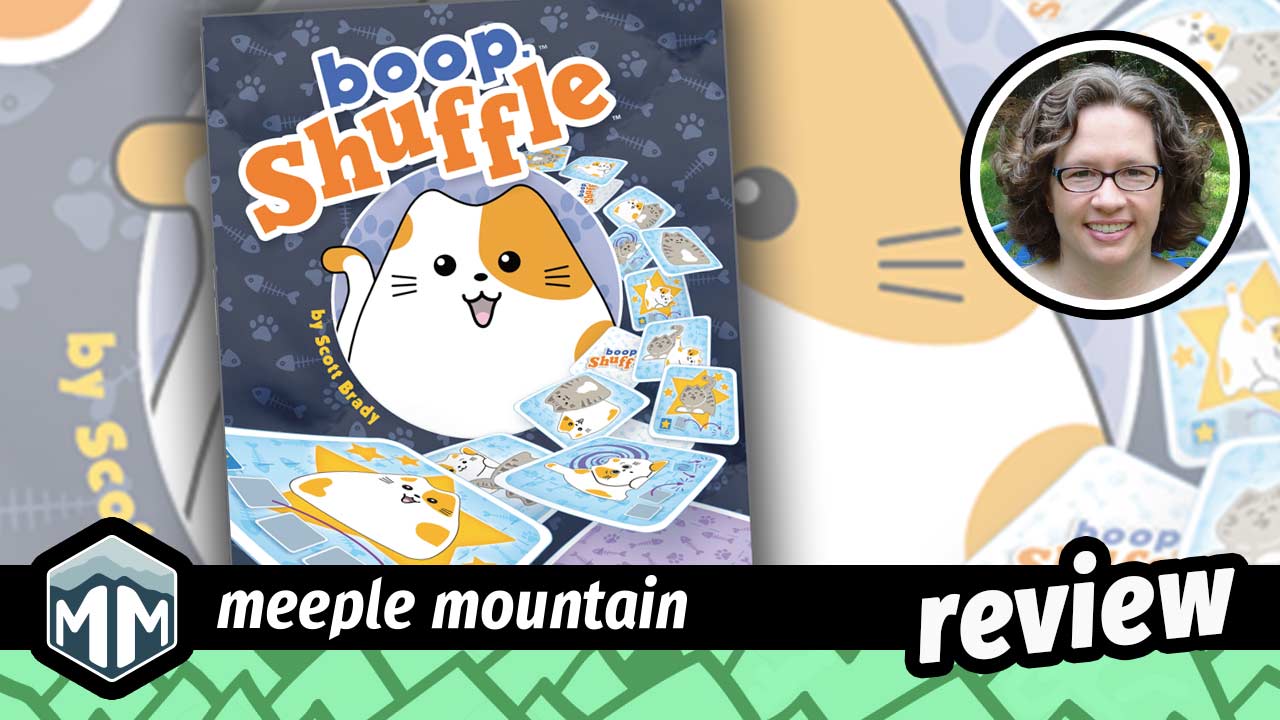
The basic idea of boop Shuffle is the same as the original boop. You're placing Kittens out on the board in hopes of getting three of your color in a row so that you can graduate them into the Cats necessary to win the game. However, as Cats and Kittens are being played onto the table, they boop the cards next to them into adjoining spaces, or possibly off the table altogether. In order to win, you must get three Cats of your color in a row, or have all eight of your Cats out on the board. These win conditions are the same for both versions. That’s where the similarities end.
boop Shuffle is a card game, with cards taking the place of the cat meeples in the original. Each turn you will draw a card from the deck and place it into the 6x6 grid on the table. The placed card will boop any adjacent cards away from itself according to the rule of the placed card. If you run out of cards, reshuffle the discards and begin drawing again.
[caption id="attachment_332475" align="aligncenter" width="1500"] Kitten cards and Blankie[/caption]
This isn’t simply a card game with the exact mechanisms of the original game, however.…
The post boop Shuffle Game Review appeared first on Meeple Mountain.

While attending Buckeye Game Fest in spring 2024, we met with a new designer named John Lapham. John had with him a new game called A More Perfect Union and we got a chance to play the game and chat about it with him. A More Perfect Union is a 2-player card driven game that simulates the public debate over the ratification of the Constitution that took place across the United States from 1787-1789. The game uses the same system as Twilight Struggle and 1960: The Making of the President but felt very fresh and unique to the situation. Catastrophe Games is planning a Kickstarter campaign in the near future and we reached out to John to see about getting some more insight into the design and he was more than willing to share.
If you are interested in A More Perfect Union: The Struggle to Ratify the Constitution, you can back the project on the Kickstarter page at the following link: https://www.kickstarter.com/projects/campaign-fall-blau/a-more-perfect-union-a-game-about-the-us-constitution?
Grant: John welcome to our blog. First off please tell us a little about yourself. What are your hobbies? What’s your day job?
John: Thanks so much for having me, Grant. My main hobbies will surprise no one – gaming and history. I also enjoy hiking, cooking, and theater. As for my day job, that is in the past. I’m retired now. Before that, I had jobs in both the legal and educational professions.
Grant: What motivated you to break into game design? What have you enjoyed most about the experience thus far?
John: I wanted a game on this topic and no one else seemed willing to oblige me—although Jason Matthews and Christian Leonhard came close with Founding Fathers. I enjoyed the beginning and end of the experience. I love historical research and pondering messy interpretive narratives and historical hypotheticals. So, I was not surprised by how much I enjoyed the front end of the design process. What surprised me was how much I enjoyed the collaboration that occurred near the end of the project, and the practical and artistic challenges of turning an idea into an actual, physical game. I had no experience with that process and enjoyed learning about it.
Grant: What is your upcoming game A More Perfect Union about?
John: A More Perfect Union is about the political struggle to ratify the U.S. Constitution in the thirteen states from 1787-1789. The game employs the popular card-driven mechanics of such well-known games as Twilight Struggle and 1960: The Making of the President.
Grant: Why was this a subject that drew your interest?
John: It was the subject of some of my earliest graduate school research in the late 1980’s (yeah, don’t ask, I’ve been around the block more than a few times). As a history educator, I was drawn to less well-known stories, involving people and events that popular and school histories have neglected. This is one such story, and it is an important one that has enduring relevance for understanding much of American history and our current turbulent moment.
Grant: What is your design goal with the game?
John: I had two main goals. I wanted the game to offer a window into the history of that moment and to spark interest in the topic. I also wanted it to be a fun, tense game that could be played in a couple hours but with enough complexity and variability to invite repeated plays.
Grant: What from the Constitutional Convention was most important to model?
John: Ok, that’s a hard one. I cannot give you just one. Several things were important to me.
First, I wanted the game to capture the intense war of words that occurred in the nationwide debate. America was on the leading edge of the first wave of mass media made possible by high literacy rates and the printing press. Americans of the period were highly literate, avid consumers of news, and intensely interested in politics. Ninety different newspapers and hundreds of presses across the country printed thousands of essays, letters, and pamphlets over the course of the debate.
Second, I wanted the game to capture the importance of political strategy in terms of grabbing and holding onto the initiative in the debate through the scheduling of the thirteen state conventions, as well as exploiting the momentum gained from successful outcomes in those conventions.
Third, I wanted to express the tension and uncertainty felt by the delegates during the actual conventions themselves. Delegates often went into these conventions uncertain of their outcomes.
Finally, and perhaps most importantly, I wanted players to come away with an understanding of the immense challenges faced by the new nation to come together and form a strong union that did not threaten the individual liberty that Americans prized at this time. It is in large part the work of the Anti-Federalists that delivered the country its Bill of Rights, a fact that is perhaps too often overlooked or forgotten by modern Americans.
Grant: What sources did you consult about the details of the history? What one must read source would you recommend?
John: Tremendous digital resources are available on the ratification debate thanks to the phenomenal work done by the Center for the Study of the American Constitution at the University of Wisconsin-Madison (https://csac.history.wisc.edu/). I encourage anyone interested in this topic to explore their website and the treasure trove of material available there.
For a more curated collection of primary source material, the Library of America has published an excellent two-volume collection of many of the most important essays, speeches, newspaper articles, pamphlets, and private letters, The Debate on the Constitution, which also includes a detailed chronology and biographical information on the participants in the debates.
For a single, narrative history of the entire series of events, the best choice is Pauline Maier’s Ratification: The People Debate the Constitution, 1787-1788, published in 2010. Reading that book was the last nudge that I needed to start designing the game.
Grant: What is the goal of the game? How do players go about trying to sway States to their way of thinking?
John: Fortunately for me as a designer, the main goal of the game was set out for me in the Constitution itself, which required nine states to ratify it to become binding on those states. Thus, the Federalists win the game immediately if nine states ratify the constitution without recommended amendments, and conversely the Anti-Federalists need five state conventions to reject the Constitution to win immediately. If enough states thread the needle of compromise and ratify the Constitution with recommended amendments, then victory is determined by the weight of the states on each side of the ledger.
The primary tools to convince voters in the states are direct campaign efforts, which involve the use of the campaign points in particular states, and the play of publication events. Publication events address one of three broad sets of issues that animated the debate – commerce, states rights, and individual rights. Each state in turn has a rating that reflects how important each of those sets of issues is to its voters. As a result, the effect of a publication will be more or less, depending on the state in which it appears.
Grant: What is the layout of the board?
John: The board includes several broad features – a map of the thirteen states with a state information and holding box for each state, turn and round tracks, a convention track, a state status track, and a table of information.
Grant: What information is contained in each State Box?
John: Each State Box has a number that reflects the maximum number of combined player cubes that can be present in the state, icons showing if either player starts with cubes in the state, numerical ratings for each of the publication issues, the convention value, and the momentum value of the state, and a spot for the state’s status marker, which shows if the state has scheduled or held its convention. Finally, the state boxes are color coded to show the section of the card deck in which the state’s convention card is seeded.
Grant: What are the 5 different words and corresponding values in these boxes mean? How are these elements connected to the cards?
John: The words “Commerce, States, and Individual” relate to the three publication issues and the numbers (0,1, or 2) next to them reflects the effect that a publication on that issue will have in the state – either adding or removing that number of player cubes in the state. The word “Convention” refers to the convention value of the state and the number next to that is the number of campaign points (CP) a player must expend either to call an early convention in the state or to attempt to take control of the State Status Marker through legislative maneuvering. The word “Momentum” refers to the campaign bonus a player will earn if they win the state’s convention.
The issues ratings connect directly to the publication event cards. The Convention ratings connect to the expenditure of CP gained from card play. The Momentum rating does not connect to the cards but instead relates to the outcome of the convention in the state.
Grant: What is the purpose of the State Factors Table and the State Issues Table?
John: This table summarizes in one place the information contained in the individual State Boxes, and it groups the states by their color codes to show players when they will draw the State Convention Cards over the course of the game.
Grant: What is the Back Room? What role does this play in the game?
John: Each player has a Back Room in which they can place a maximum of two cards. Cards in the Back Room are not part of a player’s hand, cannot be played during a player’s action round, and are not discarded at the end of the turn. Players can access the cards in their Back Room at three times – (1) during the card draw phase of each turn, when they can freely remove or add cards to the Back Room, (2) at the start of any convention, when they can remove, but not add, cards from their Back Room, and (3) during an action phase by playing a card for the sole purpose of adding or removing cards from their Back Room.
The Back Room plays two main roles in the game: (1) it provides a means by which players can hold onto powerful events that are not yet ripe to play – often convention events for conventions that will happen on a future turn, and (2) it provides a way to avoid playing a strong opponent’s event at an inopportune time.
Grant: How does the game use cards?
John: This a classic Card-Driven-Game. Each player is dealt a hand of cards each turn and plays one card each round either to spend the Campaign Points provided by the card or to implement an event described on the card.
Grant: What different types of cards are there? What is the purpose of these different types?
John: There are five different types of cards: State Convention Cards, Publication Events, Convention Events, Reaction Events, and General Events.
Each state in the game has a State Convention Card, which are mandatory events that must be played in the turn in which they are drawn. They grant the player cubes in the state and control of the State Legislature, and they schedule the state’s convention by placing the state’s status marker on the Convention Track.
Publication Events publish and distribute a publication addressing a particular issue in a particular state that and a few of its neighbors. Most of these events will specify the state in which they originate and the issue that they address. A few allow the player to pick the state and/or issue for the publication.
Convention Events can be played for their event only during a convention and will have some effect on the outcome of that convention.
Reaction Events are played in response to some other game effect.
General Events are a catch-all for any other type of event.
Grant: Can you share a few examples of cards and explain their use?
John: Sure, here is an example of a State Convention Card:
Each state has one of these cards and they all work the same way.
Here is an example of a Publication Event:
These are the most involved events in the game but like the State Convention Cards they all work the same way. So, once you’ve done it a few times, it becomes straightforward.
Grant: What happens if you play an opponent’s event? What type of thinking and strategy does this create?
John: Generally, the event triggers, although the player gets to decide whether the event happens before or after they use the card for campaign points. There are two ways to mitigate powerful opponent events. They can be played during the Initiative Phase of the turn to bid for initiative without triggering the event, although doing so often reduces the player’s chance of winning the initiative for the turn, which is costly in its own right. They can also be stored in the player’s Back Room for possible play on a future turn when the event might be less damaging. This too is costly as the Back Room can hold only two cards and those spaces can also be used to save your own events for a future turn when they will be more effective. Thematically, in both instances you are spending time and energy managing a potential problem rather than advancing your own agenda.
Grant: What is the general Sequence of Play?
John: Each turn has the following phases:
Card Draw – Slightly more involved than a standard CDG because each turn you can change the cards in your backroom, which is often a challenging decision.
Initiative Phase – This phase sets the initiative and the first player for the turn.
Action Phase – The heart of the game when players alternate playing cards from their hands.
Convention Phase – State Conventions are resolved or move closer to resolution.
Voter Apathy Phase – Some voters lose interest and players remove some cubes from the map.
Grant: What is a Convention and how does it work? What is the outcome of this process?
John: A Convention is when a state makes its final decision as to whether it will ratify the Constitution. Thematically, this is the moment that elected delegates meet, debate, and vote on the Constitution. To model the drama of these events, players have a final opportunity to play cards that can affect the outcome. After that, the player’s cube totals in the state are compared. If the Federalists have the most cubes, the state ratifies the Constitution. If the Antifederalists have the most, the state does not ratify. If the two factions have an equal number of cubes, the state ratifies with recommended amendments.
Grant: How does Campaigning work?
John: Each state has a set number of voters. This number puts a cap on the number of combined player cubes that may be placed in that state. Players can think of it this way: the voters in each state can have one of three states of mind – undecided, Federalist, or Antifederalist. At the start of the game, most voters are still undecided, which is reflected by the fact that only a few cubes are placed on the board during setup. Campaigning involves the expenditure of Campaign Points (CP) to persuade these votes to change their mind, represented by placing or removing cubes in the states. It costs 1 CP to place a cube in a state. It costs 2 CP to remove a cube from a state. If a state is already at its cube limit, the player will first have to spend points to remove an opponent’s cube before they can place their own cube. Thus, to replace an opponent’s cube with one of your own costs 3 CP. Cards range in CP from 1-4. So many cards will not grant the player enough CP to replace an opponent’s cube with one of their own.
Grant: How is victory achieved?
John: The Federalists gain an immediate victory if nine states ratify the Constitution without amendments. Conversely, the Antifederalists win if five states reject the Constitution. If neither player achieves these conditions before the end of the final turn of the game, at least one state has ratified the Constitution with recommended amendments. Victory at that point is determined by comparing the values of the states in each section of the State Status Track. Each state has a value that represents its political and economic importance – the larger the state the more it is worth. Each player gets full credit for each of the states in their column and the Antifederalists get partial credit (the Convention value) for each state that ratified with recommended amendments. Thematically, this represents a compromise situation, where the Constitution is ratified but with amendments. The stronger the opposition to the original Constitution, the more impactful those amendments will be. Strong amendments represent a partial victory for the Antifederalists. Historically, the Antifederalists efforts resulted in the adoption of the first ten amendments to the Constitution, including the Bill of Rights.
Grant: Which side has the tougher challenge to meet their goal?
John: The challenges faced by the two sides are different, but I hope they are roughly equal in difficulty.
Grant: What are some basic strategies the Federalist and the Anti-Federalist players?
John: The Federalists need to strive to win states quickly and build on that early momentum. They may need to consider making aggressive moves early in the game to take states off the board. They also must stay competitive is as many states as possible. They can only afford to lose four states, and the deck is stacked against them in two states – North Carolina and Rhode Island. The Antifederalist player has a wider range of strategic choices. They can focus on winning outright victory in one or two of the early states in an effort to reach the five states they need for an automatic victory, or they can build up their strength in several of the more valuable states that hold their conventions later in the game and improve their chances of winning the game on the basis of points at the end of the game. They cannot afford to compete with the Federalists in every state. They need to pick their battles carefully.
Grant: What type of an experience does the game create?
John: My hope is that it offers players challenging strategic and tactical decisions and creates dramatic moments of high tension where careful planning or bold action can alter the course of the game.
Grant: What are you most pleased about with the design?
John: Overall, I am pleased with the way it models the challenges and choices faced by the historical actors. With respect to the game play, I particularly like the Initiative, Back Room, and Convention mechanisms.
Grant: What other designs are you working on?
John: I’m working on a four-player game about the labor movement in Chicago, during the late 19th-century, and a solitaire game about the Civil War in which the player takes on the role of Lincoln and has to prosecute the war as commander-in-chief, while also navigating the challenges of domestic policy and political campaigning.
While attending Buckeye Game Fest in spring 2024, we met John Lapham and shot a video interview discussing the game and its mechanics:
If you are interested in A More Perfect Union: The Struggle to Ratify the Constitution, you can back the project on the Kickstarter page at the following link: https://www.kickstarter.com/projects/campaign-fall-blau/a-more-perfect-union-a-game-about-the-us-constitution?
-Grant
by Justin Bell



/pic9686515.jpg)