La Der des Ders – The War to End War from Hexasim is a 1-2 player slightly abstracted strategic level look at World War I. The game allows the players to relive the First World War at a strategic level, with each player controlling one of the 2 sides either the Entente, consisting of France, England, Russia, Serbia and other minor nations or the Central Powers including Germany, Austria-Hungary, the Ottoman Empire and a few minors. La Der des Ders can also be played solo, with a dedicated solitaire bot called “Athena” who utilizes special Cornflower Cards to make decisions about what technologies to invest in, where to undertake offensives and how to utilize limited resources and reinforcements. Each turn, players gain an amount of Resource Points dependent on what nations are in the war, which they can allocate to different areas to guide their overall strategy. Victory is achieved by launching offensives that drain the morale of enemy nations, forcing them out of the conflict through collapse.
In Action Point 1, we looked at the Game Board, discussing the Collapse Tracks, Trade Tracks, Russian Revolution Track and Naval Control Table and other various on-board tables and offensive spaces. In Action Point 2, we covered the Technology Phase and the Technology Tree and Technological Improvement Boards. In Action Point 3, we examined the Event Cards and how they inject the historical narrative into the gameplay and also alter the conditions of the game. In Action Point 4, we walked through an example of an Offensive and took a look at the combat procedure. In this Action Point, we will simply review the Victory Conditions.
Victory Conditions
In La Der des Ders, there are a few ways to trigger the concept of Sudden Death, which leads to the game concluding and a victor being declared, or to win the game through armistice being signed and then through the accumulation of Prestige Points. Let’s first take a look at what I think is the most common way for the game to come to an end, Sudden Death.
Sudden Death
The game will end immediately in the event of Sudden Death and this Sudden Death can be triggered in three ways. First, if France surrenders, the Central Powers will immediately win the game, second if Germany surrenders, the Entente will immediately win the game and finally if any one side achieves 6 Victory Points then that side immediately wins the game. Really pretty simple. If countries other than France or Germany surrender, such as Austria-Hungary, Russia or the Ottoman Empire, the game will continue although the Production Value of the surrendered country will no longer be included in the sides Resource Points.
Now there is a remote possibility that both sides could trigger Sudden Death at the same time through an attack. Remember, that if the attacker rolls a 1 on their Attack Dice, it will result a Counter Attack and 1 loss on their Collapse Track and if this would cause them to have to surrender as well as inflicting enough hits on their target to reach the end of their Collapse Track, both will Surrender and then neither side will win. But also, this could possibly occur with the play of the Spanish Flu Event, which causes losses to all powers. This is a rare possibility but it can happen.
One of the things that I very much like about this game is the concept of Collapse and the fatigue and weariness of war. World War I drug on for 4 long years and particularly on the Western Front very little ground was actually gained. During the early years of the war in 1915–1916, these advances were measured in mere feet, while later in the war during the campaigns of 1918, particularly in the case of the Hundred Days Offensive, which began on August 8, 1918, the Allies achieved deep, lasting breakthroughs, pushing the Germans back to their original 1914 lines. But the war was a meat grinder, plain and simple, and attacks were made sometimes to keep the war going because High Command demanded action and not necessarily to gain any ground or obtain any key objectives. Resources dwindled, troops dried up as men were shattered, maimed and demoralized to the point of being unable to stand a watch or fight, and nation’s desire for the war to continue faded. I think that at points, one breakthrough or catastrophic loss could have ended the war and this is very well reflected in La Der des Ders as if you are too low on your own Collapse Track and decide to attack because you believe you can finish your opponent you always have a chance of catastrophe and losses of your own while on the offensive.
Armistice
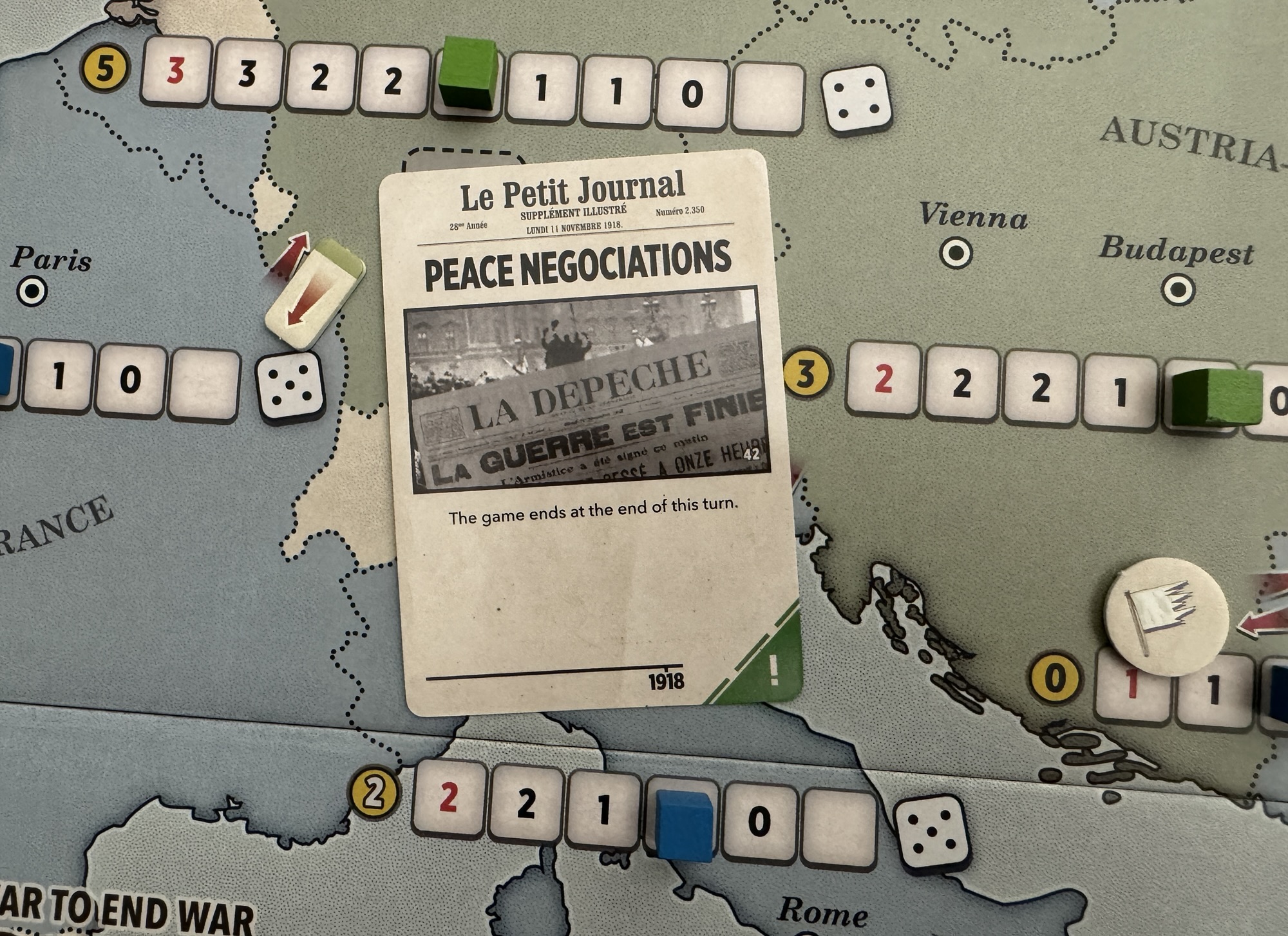
Aside from the Sudden Death ending, the game can end in 2 ways including at the end of the turn during which the Peace Negotiations card was drawn, or at the end of turn 14. In both of these cases, the side with the most Prestige Points is declared the winner. If there is a tie, the Central Powers will win the game.
So what are Prestige Points? Prestige Points are a concept that takes into account the standing of each of the combatant nations on both sides, using the location of the Sector cube on their Collapse Track as a base, and then uses a simple mathematical formula to determine the overall standing and condition of the nations morale, production and will to fight. One of the most important parts of this calculation though is that it only takes into account nations that have not collapsed and surrendered. If a nation has been forced to surrender because their Collapse Track reached the end, they will not count toward the Prestige Points of their allied side.
Each player will calculate their total Prestige Points very simply by paying attention to several numbers such as the Operational Value and Prestige Value. For each country still At War during the Armistice, the player multiplies the sector’s current Operational Value (OV), which is shown by the location of the Sector cube on the Collapse Track, by its Prestige Value (PV), which is the value printed on the left side of the Collapse Track. The various nations’ Prestige Values are Germany 5, France 4, Austria-Hungary 3, Ottoman Empire 3, Italy 3, Middle East 3 and all other Sectors 1.
Let’s take a look at a quick example of how to calculate Germany’s Prestige Points. If Germany is still At War and their Collapse Track is showing an Operational Value of 2, then we will multiply their Prestige Value shown on the far left of the Collapse Track of 5 x the Operational Value of 2 resulting in a total of 10 Prestige Points. The players then add the number of Victory Points (VP) indicated by the location of their marker on the Victory Point Track. You might be wondering Where do Victory Points come from? Victory Points are specifically earned from forcing countries to surrender and the side that caused the surrender will earn a number of Victory Points as shown in the rules. For the Entente, their values are Russia 3 VP, Italy, Middle East and Romania 2 VP and Serbia, Africa and Greece 1 VP. For the Central Powers, their values are Austria-Hungary 3 VP, the Ottoman Empire and Bulgaria 2 VP and the German Colonies 1 VP.
I very much like the concept of only calculating the value for those countries who have not Collapsed and who are still in the war. We all know that it is easier to negotiate a peace that is favorable to your side when you are still a threat and if too many nations of either side have collapsed then their Prestige Points will reflect this as those countries won’t contribute to the final value. And I also like the simplicity of the scoring system. If certain key countries like France and Germany surrender, then that equates to a victory for the side causing the surrender and if the game continues to grind on through the final turn, then there is this calculation that is really pretty simple and gives importance to each goal with a different value that can be earned. Just a solid method for determining victory that makes sense and fits with the historical aspect of the outcome of the Great War.
In Action Point 6, which is the conclusion to this series, we will give an overview of the “Athena” solitaire bot and show how it works for solitaire play.
April is one of my favorite months due to Easter and the warming of the weather. And this month we got a good amount of newly baked wargames, still warm some of them because they are so new, for you to choose from. This month for the Wargame Watch I was able to find 28 games (including the 7 games from our sponsor VUCA Simulations). Interestingly though this was a cooler month for crowdfunding as I only found 4 different campaigns, which did contain a total of 6 games as one was a triple feature, featured on Kickstarter or Gamefound.
This month again we have a sponsor for the Wargame Watch in VUCA Simulations. VUCA Simulations is a newer German publisher that is really crushing it with their graphics and production. Their games are also very good and we have really enjoyed several of their titles including Donnerschlag: Escape from Stalingrad, Traces of War and most recently New Cold War.
But I also want to point your attention to their In Development Section of their website to show you all of the great projects that they are currently working on. Here there are 7 different games listed with pictures of the beautiful covers and a description of the game itself. These titles include Thirty Years of Misery designed by Brian Asklev, Pacific Fleet designed Hiroyuki Inose, The Far Seas designed by Martin Anderson, In Fours to Heaven designed by Grzegorz Kuryłowicz, Gateway to Falaise designed by Andrew Glenn, 1916 – Prelude to Blitzkrieg designed by Paul Hederer and Saint-Lô – The Capital of Ruins designed by Clemm.
VUCA is really doing a great job with their games and we recently played one of their newest games in Imperial Elegy: The Road to the Great War 1850-1920 and it was a sublime experience. We only played 1 full hand with a full table of 6 players, but very much enjoyed what it was that we were trying to do and the production is just fantastic. Can’t wait to get this one back to the table soon!
But now onto the games for April!
Pre-Order
1. Company of Heroes – Desert Warfare Expansion + Reprint from Bad Crow Games Currently on Gamefound
Glitz. Bits. Content. Miniatures. If these things appeal to you and you like a tactical wargame experience then this is your chance. The well regarded Company of Heroes System has a Gamefound campaign for a new expansion called Company of Heroes – Desert Warfare Expansion and they are also offering the base game 2nd Edition as an add-on as you need it to play.
From the game page, we read the following:
The Company of Heroes – Desert Warfare Expansion + Reprint on Gamefound brings the Deutsches Afrika Corps (DAK) to the 2nd Edition board game, featuring high-mobility, mechanized, and elite units. This expansion enhances solo/co-op play with improved AI, offering a fast-paced, tactical tabletop experience with armored, hit-and-run tactics. The Deutsches Africa Corps adds specialized, agile desert combat forces with a focus on armored vehicles, Italian alliance units, and fast, bold maneuvers. The expansion includes a sophisticated AI for solo or cooperative play, featuring an AI commander, HQ board, action deck, and target selection priority cards. The AI is described as aggressive, frequently seizing objectives. The expansion includes new maps, units, and components to expand the core game experience. The campaign also offers a reprint of the 2nd Edition core box, required to play, featuring streamlined rules and high-quality components.
I am going to be honest here. I played the 2nd Edition. We enjoyed it but it wasn’t necessarily as amazing as I thought it would be. I mean the systems are interesting but it feels more Euro game like than wargame like and it is also extremely expensive. Now it is gorgeous and the miniatures, terrain and maps are very well done but I am not sure that this game lives up to the hype. Just my humble opinion.
As of April 1st, the Gamefound campaign has funded and raised $948,465 toward its $100,000 funding goal with 1,928 backers. The campaign will conclude on Thursday, April 16, 2026 at 12:00am EST.
2. T-34 Leader: The World War II Ground Combat Solitaire Strategy Board Game from Dan Verssen Games Currently on Kickstarter
A good solitaire game is always very much welcome on my table. I usually start these entries about solitaire gaming by saying I am not a solitaire gamer. Well, after playing the Leader Series from DVG for the first time about 8 years ago, that statement no longer applies. I used to really only play solitaire games when I had no other choice or available opponents. But, when I put these games on the table, my whole opinion has changed. The Leader Series is a solitaire gaming system that recreates modern combat, including ground combat, air warfare and even submarine warfare and sees the player creating, managing and outfitting a group of soldiers/boats/planes over the course of a variable length campaign. Some of the games offer individual combat systems that are included in the overall game and each handles their theater with specific rules and equipment used historically. Originally, all of the games were designed by Dan Verssen but more recently other designers have been taking up the reigns of the series. Such is the case with their newest offering in the series T-34 Leader designed by Vincent Cooper.
From the game page, we read the following:
You are the commander of a Soviet army combat group in World War II. You will take command in the hardest fought campaigns from Operation Barbarossa (1941) to the Battle of Berlin (1945).
Each of your Campaigns involve both operational and tactical decisions. At the start of a Campaign, you select the Units and Commanders to make up your force. During each Week of the Campaign, you decide which Enemy Battalions to attack, which of your forces to allocate, and then resolve each Battle using the Tactical Battlefield. Your Commanders gain Experience with every Battle, but they also suffer Stress. Each Week you must decide how hard to push your men to achieve Victory. T-34 Leader is a great game for both experienced strategy gamers, as well as new players. Each Campaign takes around 30 minutes to set-up, and each Battle can be resolved in 15 to 30 minutes.
T-34 Leader has been designed from the ground up as a Solitaire wargame. It is not an adaptation of a 2-player wargame and the rules have been specifically designed for the solo player. As a Solitaire wargame, you can play whenever you have time, at your own pace. T-34 Leader is the latest Tank Leader game from DVG, following Tiger Leader and Sherman Leader.
With that look, I will let you know that I very much love Sherman Leader and the ground combat for me is where it is at and I would think that T-34 Leader will be more of the same but on the East Front. I have played Sherman Leader the most in the series, using both short and long campaigns, and really enjoy its systems, the structure of the AI and the management of your units and Commanders. Really engaging and enjoyable experience of ground combat in World War II.
Here is a link to my video review for Sherman Leader that you can view at the following link:
As of April 1st, the Kickstarter campaign has funded and raised $38,484 toward its $30,000 funding goal with 148 backers. The campaign will conclude on Tuesday, April 7, 2026 at 3:02pm EDT.
3. Chalice of Poison: The Iran-Iraq War, 1980-1988 from GMT Games
We met Akar Bharadvaj while attending SDHistCon in 2023 and played his award winning design Tyranny of Blood: India’s Caste System Under British Colonialism, 1750-1947 and very much enjoyed the experience and talking with him about game design. Since that time, he has been working on another designer called Chalice of Poison: The Iran-Iraq War, 1980-1988 from GMT Games, which was recently announced on their P500. Chalice of Poison is the first volume in a new series that models complex conflicts not only as clashes between adversaries in the air, land, and sea, but also as political struggles within the regimes and military forces fighting it.
From the game page, we read the following:
In 1980, Saddam Hussein’s Iraq invaded Iran, hubristically expecting to achieve a quick victory in a few weeks. Instead, the war became a brutal slog that lasted eight years. During the war, both countries had to choose between political and military objectives, balancing between the power of their military forces and the stability of their regimes. In Chalice of Poison you will play as the heads of two very different authoritarian regimes that have structured their militaries to be excellent at forestalling internal threats…but less effective at fighting foreign adversaries. Can you reform your military so that it’s effective enough to win the war, without accidentally creating a force that threatens your power?
A unique game on the Iran-Iraq War, the longest conventional war of the 20th century, and a historically important conflict underexplored in tabletop gaming.
Designed by Zenobia Award-winning designer Akar Bharadvaj, and inspired by Dr. Caitlin Talmadge’s academic research on the fundamental weakness of so-called “strong-man” authoritarian regimes.
Simple mechanics create a tense, dynamic, and meaningful decision space with an exciting narrative, capturing the dilemmas faced by regimes faced with both internal and external threats.
A two-player game that also plays well with four players on competing teams.
Includes two solitaire modes: A simple-to-operate “Al-Jazari” bot that offers a challenging non-player opponent. A more complex “Kissinger mode”—inspired by Mark Herman’s Peloponnesian War—in which the solitaire player represents both sides in the conflict. This mode abstractly models the international community, which cynically supported both sides in the conflict, ensuring a lengthy war in which neither country could win a decisive victory.
“At its most interesting, Chalice of Poison simulates warfare as a social battle as much as one involving tanks and bullets…This might sound complicated, but Bharadvaj presents these fluctuating power levels with refreshing clarity…Even at this early stage it’s an impressive and ambitious plaything. And its critique is unexpectedly timely, highlighting how strongman governments weaken their nations in the name of strengthening their regimes.” ~ Dan “Space-Biff” Thurot
4. Pericles: The Peloponnesian Wars 460-400 BC 2nd Printing from GMT Games
We are admitted Mark Herman fanboys! I am not ashamed of that statement as he is a very good designer and such an interesting person. He has designed a series of games called The Great Statesman Series and there are such fantastic mechanics at play that create a very interesting non-traditional wargame feeling such as Churchill. The 2nd game in the series is called Pericles, unlike Churchill, pits 2 sides, the Athenians and the Spartans against one another. The real game-changer is that each side is made up of two factions. As such it plays best with 4 players, each working to not only have their side win, but to have their faction within that side end with the most honor, and thus be victorious overall. The good news for most of us, is that there’s bots for solitaire, or 3 player games and there’s a fascinating 2 player variant, where each player plays a faction on each side. GMT just put a 2nd Printing up on their P500 and I am so very glad that this game will get some more attention as it is a really great game.
From the game page, we read the following:
Pericles is a ‘sandbox’ (unscripted) wargame that covers the ENTIRE period of conflict described in Thucydides classic history on the Peloponnesian wars. Pericles is a 4-player game, where two teams of Athenian and Spartan factions fight for Hegemony in 5th Century Greece. Each team of two represents a faction vying for control of their City States, strategy, and honor. Athens sees the Aristocrats debate issues with their opposing Demagogues, while in Sparta House Agiad and House Eurypontid contend for royal dominance.
Pericles uses elements from the Golden Geek best Wargame of 2015, Churchill, to simulate war as the extension of politics by other means. In the War portion of the game, it is US versus THEM (Athens versus Sparta), where each team implements their collective strategy to dominate Theaters of War, build economic strength, and fight battles to win Honor. In the respective Political assemblies, it is ME versus YOU (faction versus faction), where the battle for government control has to be balanced by your common interests in a series of wars that must be won, or all is lost.
Pericles uses an Issue Queue preplanning mechanic that the play testers have described as ‘insanely fun’. After your Political assembly has debated and won issues, these issues (military, league, diplomatic, oracle) are secretly placed on the military map in one of the twenty Theaters of war. If you or your opponents place a second issue into a Theater, it creates a queue of issues. Once all issues are placed, they are revealed and resolved one at a time. The order of issues in the queues and the order in which they are resolved across all Theaters tells YOUR story of the Peloponnesian wars.
Strategy in Pericles unfolds in how you create combinations of issues to achieve the historical narrative. Do you want to conduct a Periclean raiding strategy? Then you would play two military issues into a Theater to first move forces into position, then raid. Do you want to build a base in the enemy homeland (historically Pylos or Decelea)? Then you would conduct a military expedition, followed by a league issue. Do you want to raise an opponent’s ally in rebellion? Then you would deploy a diplomatic mission, and sow treachery for immediate or future advantage. It is in the placement, order, and resolution of the issues that the game allows you to explore and experience the broad range of historical situations without a script.
What would a game of Hoplites and Triremes be without a battle mechanic? Battle in Pericles is based on armies and fleets being led by the classic generals of yore, represented as Strategos tokens. During the Political assembly, each faction uses historical personalities to acquire Strategos tokens. Use the Spartan general Brasidas and gain four Strategos tokens, while Epitadas only generates one. Strategos tokens can be thought of as military capital that is spent in the war to lead and move forces. If you send forces to a Theater with enemy forces, a land or naval battle will occur. All players then secretly commit Strategos to the battle. Then, the commanding general of the military expedition and their teammate reveal their Strategos commitment and move wooden land and naval units to the battle. Now the defensive commitment of Strategos is revealed, each side then reveals a random battle card value, and the winner is decided. The winner of the battle now has the option to fight a subsequent naval or land battle. The outcome of these tactical decisions determines if any fortified bases are destroyed by assault or siege. Then the next issue is resolved. Winning battles awards and reduces honor.
Here is a link to our video review that was created when we were younger, had more hair and were not very polished in any part of what we were doing:
5. Silver Bayonet: The First Team in Vietnam, 1965 – 25th Anniversary Edition 2nd Printing from GMT Games
We have had a great experience playing Silver Bayonet a few times over the years and I am glad that it is now getting a 2nd Printing of the 25th Anniversary Edition. Silver Bayonet: The First Team in Vietnam, 1965 – 25th Anniversary Edition is a revamping of their first ever game released all the way back in 1990.
From the game page, we read the following:
Silver Bayonet recreates the pivotal November 1965 battle between a full North Vietnamese Army Division and the US 1st Air Cavalry Division in the Ia Drang Valley. NVA expertise in lure and ambush tactics resulted in significant US casualties. US mobility and the ability to bring massive amounts of firepower to bear quickly virtually destroyed the attacking NVA division and forced a change in NVA tactics.
This re-issue of GMT Games’ 1990 CSR Award winning title that started it all keeps the original operational system, but streamlines to it to include innovative combat resolution integrating maneuver combat, close assault, artillery bombardment, and support from gunships and air sorties.
Increased accessibility to primary and secondary source material has made it possible to make changes to more accurately represent both sides’ unique capabilities without significantly altering or breaking the base game system. The major changes involve patrols, ambushes, landing zones, and the 1st Cav Brigade HQ, while minor changes tweak movement, combat, and coordination game mechanics to showcase radically different strengths and weaknesses the FWA and NVA force brought to the battles in the Ia Drang Valley.
6. I, Napoleon 2nd Edition Update Kit from GMT Games
As you probably know, normally Ted Raicer designs hard core hex and counter wargames such as The Dark Valley: East Front Campaign, 1941-45, The Dark Sands: War in North Africa, 1940-42 and The Dark Summer: Normandy, 1944. These games are fantastic experiences that are true wargames. But, he also has an eclectic side to him and has designed one of the classic card driven games on the subject of World War I in Paths of Glory. So when I heard that he had designed an interesting looking card based historical role-playing game the first thought that came to my mind was “How is he going to accomplish this feat?” Last year, I played I, Napoleon and did enjoy what it was doing even though it felt like it fell a bit short of its ultimate claim. But there is more of the game now and they are doing this Update Kit in case those who want to the updated cards don’t wish to order the Limits of Glory Expansion.
From the game page, we read the following:
For our customers who own the 1st Printing of I, Napoleon and want to upgrade to the 2nd Printing without purchasing the Limits of Glory Expansion, we’re providing an Update Kit.
This Kit includes:
60 Updated Cards
2 Divider Cards (1 New, 1 Adjusted)
Rulebook
Playbook
8.5″x11″ Player Aid
Sticker Sheet (4 stickers to update the Game Board)
NOTE: The Limits of Glory Expansion includes the updated Cards, Divider Cards and Sticker Sheet, as well as a Rulebook, Playbook and Player Aid that can be used with both the expansion and base game.
7. Paper Wars Magazine Issue #116: Roma Invicta: The Roman Republic 400-50BC from Compass Games
Wargame magazines can be a bit hit and miss with their games. But, Paper Wars seems to really pick some great topics and systems to highlight in their pack-in games and this month there is a new pre-order for a game called Roma Invicta: The Roman Republic, 400-50 BC designed by Paul Kallia who did Roma Victrix: Campaigns of the Roman World from Compass Games.
From the game page, we read the following:
Roma Invicta: The Roman Republic & the Western Mediterranean by Paul Kallio is a 2-player, scenario-based design depicting several historic conflicts that occurred in and around the Roman Republic between 400 and 50 BC. This is a systemic brother design to Paul Kallio’s Roma Victrix boxed game. Each game turn represents one year. Infantry unit types include legions, heavy infantry, auxiliaries, and barbarians, and represent about 5,000 men each.
BONUS GAME MATERIAL: This issue will include two new scenarios for play with WWII Campaigns: 1940, 1941, and 1942. For 1941, we have Festung Stalingrad. It covers the German counteroffensive to try to save the Sixth Army trapped in Stalingrad in December 1942. For 1940, we have the Operation Matador variant scenario by David Meyler.
Article highlights include previews of Rise to Glory and Iberian Tide, a work-in-progress report on Island Infernos, a Bitter Woods AAR, an alternate start scenario for Desert Tide, and a new optional fuel dump rule for The Last Gamble.
8. Limits of Glory: Campaigns VI & VII – Jersey New Jersey and A Strong War: The Conflict for North America 1755-60 from Form Square Games Coming to Gamefound April 7th
A few years ago, we became acquainted with Andrew Rourke through his Coalitions design from PHALANX that went on to a successful crowdfunding campaign and has recently been delivered. He has since been a busy guy with starting his own publishing company called Form Square Games and also publishing the first 5 designs in a new series called Limits of Glory that will take a look at the campaigns of Napoleon and other contemporary conflicts. In Campaign I, which is called Bonaparte’s Eastern Empire, the game is focused on the campaign of the French in Egypt between 1798 and 1801. Campaigns II, III and IV was Maida 1806 and Santa Maura & Capri. Campaign V was Donning the Sacred Heart which covers the Vendee Civil War and just recently fulfilled as I have my copy sitting on my gaming table awaiting and unboxing video.
And now, recently, he has announced came out about the next entry in the series which is a two-fer with Campaigns VI and VII called Jersey New Jersey and is set during the American Revolutionary War but also a 2nd game called A Strong War set during the French & Indian War. I think that these games are well timed with this year being the 250th Anniversary of the signing of the Declaration of Independence and I look forward to playing and exploring both of these games. I have also reached out to Andrew to see about him as well as the design duo of Mark Kwasny and John Kwasny for A Strong War doing another interview to give us a look inside the design and get more information for you to digest before the campaign kicks off on April 7th. But at this point the games look great and I love the art and the covers are very eye catching for sure!
From the game page, we read the following:
For the 2 games in the Limits of Glory Series:
Two exciting games in one box, Jersey covers the little known 1781 invasion by the French of the Island of Jersey as part of the American Revolutionary War. The game examines the impact of luck on events and challenges the skill of players to use their commanders to influence these events.
New Jersey covers the famous crossing of the Delaware and the battles of Trenton and Princeton using the same Limits of Glory System to test players ability to mitigate what luck throws at them by the skillful use of commanders and troop positioning.
Limits of Glory represents military campaigns at the highest command level, players take the role of theater commander and must manage their resources of men, material and skill to emerge victorious.
And for the other game in the offering called A Strong War: The Conflict for North America 1755-60:
The title, A Strong War, refers to the type of war the Abenaki Nation threatened to unleash on the land-grabbing British in 1753. The sparks of war, ignited in 1754 near Fort Duquesne by an obscure colonel of Virginia militia, George Washington, spread quickly; soon, flames engulfed the entire globe as England and France vied for control of empire. Over the next 5 years, Regular regiments from the French and British armies, American and French-Canadian provincial units, and Native warriors all fought in a chaotic and violent series of campaigns and frontier raids that culminated in the British conquest of French Canada and the defeat of the Native Nations (most of which had sided with the French).
A Strong War brings this war to life in a simple, fast-playing game. The map (covering the region stretching from Louisbourg to Alexandria, and from New York to Lake Erie) uses point-to-point connections to highlight the key locations that were targeted during the war. Using wooden cubes to represent the different types of forces used (French and British Regulars, British Colonials, French-Canadian Marines, French Bush Rangers, and Native American warriors), each player has only a few pieces (maximum 13 for the British and 10 for the French) to use each turn (one turn = one year, so there are 6 turns/years total).
The heart of the game is the unique combat system where players can deploy forces to a chosen battle and then commit them one by one; or they can call off the battle if it goes badly and save some of those forces for use later in the year. The types of forces committed also play a critical role in combat – the British want to mass their Regulars but the French want to bring in a mixed force to take advantage of the different skill sets each provides. Thus, tension is created in trying to decide if/when (or where) it is best to commit one’s forces: do you avoid combat completely; do you call off a combat that is going badly; or, do you go all in and commit your entire force? But if you lose a battle, initiative then swings to your opponent who may then launch an offensive. Each player has several paths to victory, leading to a “different” game each time, and forcing players to choose between different strategies each turn. Finally, it is a quick game, taking just a couple of minutes to set up, and usually taking less than an hour to play to completion. The game also plays well solitaire, though there is no dedicated solitaire system.
9. Campaign: Operation Bagration from Catastrophe Games Currently on Kickstarter
A few years ago, I played and very much enjoyed a cool little solitaire WWII card-driven game called Campaign: Fall Blau from Catastrophe Games and designer Martin Melbardis where the player attempted to breach the Soviet defenses on the East Front in the pivotal German summer campaign of 1942. The game system is very playable and simple, but has some strategic depth to it as the player has to make a lot of choices about what to go after, how to manage their scarce resources (fuel) and what generals to use to take advantage of their special abilities to amass enough VP to claim victory over the Soviet Union. They now have the counter punch of that game in a new entry in the series called Campaign: Operation Bagration and it is currently being offered on Kickstarter.
From the game page, we read the following:
Campaign: Operation Bagration is the follow-up to Campaign: Fall Blau, the acclaimed solo experience of trying to seize Stalingrad and the prized oil fields beyond. In this game the shoe is on the other foot, as you will be pushing the Red Army to retake the center of the occupied Soviet Union, setting up the capture of Berlin. Stalin is expecting fast results though, so once again you will be racing against the clock trying to achieve enough objectives before your supplies (and Stalin’s patience) runs out.
Campaign: Operation Bagration is a solitaire wargame that takes place during WWII and puts the player in charge of the Soviet summer offensive of 1944 against Army Group Center, code named operation Bagration. Pick your three generals and use your resources wisely in order to obtain your campaign’s objectives.
One month turns. Decide which card (objective) to go after, each with a unique set of Soviet defenses. Manage supplies required for each offensive, or choose to take an operational pause. Receive random event cards that are mostly beneficial but a few are Soviet counterattacks that can throw a serious monkey-wrench into your plans. Play continues until fall begins, and you must report to Stalin with your success or failure.
In order to meet Stalin’s expectations you need to be relentless, while carefully marshalling your troops and material. Drive too hard, and the Germans will crush one of your wings, and your push will stall out. But if you move too slow you know you will be summoned to a special meeting with Stalin, and that is a grim fate.
As of April 1st, the Kickstarter campaign has funded and raised $1,138 toward its $500 funding goal with 14 backers. The campaign will conclude on Monday, April 20, 2026 at 8:51pm EDT.
New Release
1. VaeVictis Magazine Issue #185 Game Edition: Storm on the Ménez Hom 1944 from VaeVictis
VaeVictis is a very fine wargame magazine and they always have very interesting looking pack-in games on various subjects. This month, they have featured a scenario involving the 1944 attack on the Ménez-Hom peak on the Crozon peninsula in a game called Storm on the Ménez Hom 1944. But there is more as the magazine features articles on various wargames including Hubris from GMT Games, La Der des Ders from Hexasim, Thunder on the Mississippi from Multi-Man Publishing, Italia 1917-1918 from Nuts! Publishing, New Cold War from VUCA Simulations, Werwolf from Legion Wargames and many more.
From the game page, we read the following:
During the siege of Brest, the coastal batteries on the Crozon peninsula, on the southern shore of the harbor, were hindering the advance of the US Army. It was therefore crucial to silence them. To achieve this, the barrier closing off the peninsula had to be breached: the Ménez-Hom peak, rising to 330 meters. This mission was entrusted to the FFI-FTP battalions of central Finistère. It took three weeks, from August 12th to September 1st, 1944, and the reinforcement of a US cavalry brigade to finally defeat the German, Russian, and Caucasian defenders.
2. The Coming Storm II: Quadrigames of the Fourth Coalition: October 1806-June 1807 from Operational Studies Group
Large Napoleonic wargames are always interesting. Operational Studies Group does some big games on the subject and their newest offering is called The Coming Storm II: Quadrigames of the Fourth Coalition: October 1806-June 1807 and deals with four different battles including Jena-Auerstadt, Pultusk/Golymin, Eylau and Friedland.
From the game page, we read the following:
These four games explore the major battles of 1806–07, where the French Army encountered two different opponents with different capabilities, from the leadership-challenged Prussians in Saxony to the chaotic battle conditions in winter against the Russians. Based on OSG’s Special Studies, which provide a turn-by-turn narrative of the four battles. Each game shows the approach to the battlefield on the day before battle. The Jena-Auerstadt game has both battlefields on one map and allows both sides to redeploy before battle.
We are offering a new edition, with new maps—not too much different in detail—but rendered in Charles Kibler’s naturalistic style. TCS2 will be updated to use the Universal Deck and latest series rules (deck not included). With few exceptions, the counters will be identical to the first edition.
This is a very popular series of games amongst Grognards and I have heard many people recommend these titles to both of us. We have yet to take the plunge and get one but one day we will…one day!
If you are interested in The Coming Storm II: Quadrigames of the Fourth Coalition: October 1806-June 1807, you can order a copy for $140.00 from the Operational Studies Group website at the following link: https://napoleongames.com/products/the-coming-storm-ii
3. The Maid Ascendant: The Siege of Orleans, October 1428-May 1429 from High Flying Dice Games
Paul Rohrbaugh and his company High Flying Dice Games is a designer I love to follow. He is always doing games on smaller or lesser known conflicts and I just find his work to be superb and really draws me in. Recently I saw where he was releasing a game on the Siege of Orleans and I do like siege games! The game is called The Maid Ascendant and really looks pretty interesting and is definitely a unique subject for a game.
From the game page, we read the following:
The Maid Ascendant is an introductory level wargame on the siege of Orleans. The siege marked the debut of Joan of Arc as a military commander, and a campaign that would see the English eventually evicted from France and the end of the Hundred Years War.
“Begone, or I will make you go!” – Jeanne d’Arc’s command to English and Burgundian troops besieging Orleans.
If you are interested in The Maid Ascendant: The Siege of Orleans, October 1428-May 1429, you can order a copy for $16.95 from the High Flying Dice Games website at the following link: https://www.hfdgames.com/maid.html
4. Mr. Lincoln’s War from Compass Games
You can’t have enough good American Civil War games and Compass Games has been working to bring out a new edition of a classic called Mr. Lincoln’s War designed by Mark McLaughlin.
From the game page, we read the following:
Mr. Lincoln’s War is a historical game which captures the epic struggle of the American Civil War. From their first major battle at Bull Run in 1861, through the campaigns of Vicksburg, Gettysburg and Atlanta and until the final days at Appomattox in 1865, the armies of the Union and the Confederacy raged across America wreaking havoc and bloodshed on a scale never before or since witnessed in the New World.
This box set is organized into two sub-games, “Army of the Tennessee,” which deals with the war in the western theater, and “Army of the Potomac,” which deals with the war in Virginia. Each has four short scenarios that recreate the maneuvers and battles of Shiloh, Gettysburg, Atlanta, and other monumental Civil War contests. Campaign games enabling the players to fight the war in the West or East are provided with each sub-game. They may be combined to play the Mr. Lincoln’s War grand campaign that simulates the entire Civil War, on both fronts.
5. Volume II Civil War Heritage Series Army of the Potomac: Campaigns of 1862 and 1864 from GMT Games
Several years ago, Mark Herman designed a very unique and simple American Civil War game called Gettysburg that appeared in C3i Magazine #32. That game became the basis for his Civil War Heritage Series with the first volume being Rebel Fury that focused on five battles from the Chancellorsville and Chickamauga Campaigns. He has long mentioned working on the follow-up to that game and we finally are getting it with Army of the Potomac.
From the game page, we read the following:
Army of the Potomac: Campaigns of 1862 and 1864 is the second volume in the Civil War HeritageSeries and the follow-up game to the innovative and acclaimed Rebel Fury. Army of the Potomac uses the same core rules as Rebel Fury, so players familiar with Rebel Fury will be able to jump right into the action. Each battle in Army of the Potomac is quick-set-up, quick-playing, and deeply interactive. The density of counters in each scenario is low, allowing you to see and experience the big picture of the battle.
Army of the Potomac covers the battles of Spotsylvania II, North Anna River, Cold Harbor, and the entire Seven Days battle (McClellan vs. Lee), including the prelude Seven Pines (McClellan vs. Johnson) when Johnson’s wounding brought Lee into the command of the Army of Northern Virginia. Each battle places you, the player, in the role of the Army Commander (Grant, McClellan, Lee, Johnson). You maneuver your army to find the enemy’s flanks, concentrate your forces for an attack, and determine where to commit your artillery assets.
I think that one of the most interesting parts is that this new game can be played with Rebel Fury as also included are two bonus scenarios to allow owners of Rebel Fury to fight Spotsylvania II and begin the Campaign scenario from Wilderness to Cold Harbor using their original Rebel Fury map.
Last summer, while attending WBC in late July, we sat down with Mark Herman and did an interview/overview of Army of the Potomac and you can watch that video at the following link:
6. Baltic Empires: The Northern Wars of 1558-1721 from GMT Games
This one is very much anticipated by me and I feel like I have been waiting in it forever since its announcement in 2022. Baltic Empires is a grand looking game that focuses on the conflicts between the states of the Baltic region during the early modern era. The wait is now over as they game is set to ship on April 17th.
From the game page, we read the following:
Baltic Empires is an approachable 2-5 player strategy game about conflicts between the states of the Baltic region during the early modern era, a transformative period of religious conflict, large scale warfare, and constant struggles for power. Players will have to develop their economy, strengthen their administration, secure trade hubs, and finally build armies to become the dominant power of the Baltics. Denmark-Norway, Sweden, Russia, Poland-Lithuania, and Prussia will fight for hegemony, using variable victory conditions that reflect their respective historical objectives.
During the 16th & 17th centuries, religious conflicts between Protestants and Catholics swept Europe, vast colonies were established by the maritime powers, and a series of wars were fought against Louis XIV’s Kingdom of France to maintain the balance of power, eventually culminating in the War of Spanish Succession. While this history might be familiar to many, the related conflicts around the Baltic Sea that took place during these centuries are less well-known.
Where did the French, English, and Dutch acquire the materials they needed to build and maintain their vast navies that won them their colonial empires? Where did they acquire the food they needed to feed their sailors and growing populations? Where did the Swedish juggernaut that suddenly emerged and changed the course of the Thirty Years War come from, and why didn’t its great power status last? How did the Russian and Prussian Empires that became so powerful in later periods first emerge on the European stage? The Baltic region was crucial to the history of Europe, and the conflict for influence over the Baltic Sea was closely intertwined with the balance of power in Western Europe. The outcome of the wars and societal transformation in the Baltic region, from the collapse of the Teutonic Order in Livonia in 1558 to the end of the Great Northern War in 1721, shaped European and world history up until the present day.
Baltic Empires presents these less well-known conflicts in a fun and accessible format, while also doing justice to the fascinating history of the Baltic Sea region during this period. The game features 5 asymmetric factions with different strengths, forces, and historical objectives, along with the capacity to develop their states by investing in economic infrastructure and recruiting key historical characters that offer unique game effects. The game also includes several scenarios for variable player counts and durations, offering additional flexibility and replayability.
7. Three Days of Gettysburg Deluxe Edition from GMT Games
A very popular series featuring one of the most gamed battles of the American Civil War! Quite the combination. And to add to that, a Deluxe Edition treatment with new counters, some new rules, new and updated maps and lots of scenarios. This is a great value for any gamer who wants to game one of the most iconic battles of the American Civil War.
From the game page, we read the following:
GMT Games and the GBACW design team are proud to announce Three Days of Gettysburg Deluxe Edition, the ultimate edition of the definitive game on the Battle of Gettysburg. First published in 1995, 3DoG has stood the test of time as one of the most popular games of the Great Battles of the American Civil WarSeries.
This series is one of the hobby’s longest-lived design concepts, springing from the legendary regimental level Gettysburg game—Terrible Swift Sword (SPI)—designed by Richard Berg in 1976. Under GMT, the rules system has remained stable but has shown remarkable flexibility to allow each game to smoothly incorporate additional rules to reflect the historical battles. The series relies on interactive chit-pull mechanics to simulate the often-chaotic nature of the 19th Century battlefield at the regimental level.
Three Days of Gettysburg Deluxe Edition will include ten plus scenarios. They range from small Skirmisher contests on half sized maps to the ultimate Gettysburg experience on four full full-sized maps depicting the entire battle, including the East Cavalry Battlefield! Other scenarios will depict both the first and second day of the struggle. Experienced players will be able to play many of the scenarios in one sitting. The 3DoG Deluxe Edition will include many exclusive rules to represent the special situations at Gettysburg, including new Skirmisher rules. However, many of the rules are optional, allowing players to decide for themselves what level of complexity they want.
New components and exclusive rules include new cavalry counters, CSA dismounted cavalry counters, corrected artillery types, two types of skirmisher units, artillery sections for some scenarios (Calef’s battery on the first day!), and artillery overshoot. The new maps continue to use Mark Simonitch’s beautiful artwork but include stonewalls, the Devil’s Den, and sloping hexes to better represent the unique terrain at Gettysburg. The large rock formations are represented differently from earlier editions, and artillery will find moving up the slopes of Little Round Top as difficult in the game as it was in the battle.
And just take a look at this big beautiful map of the game….by the talented Mark Simonitch!
8. Dreams of Empire Expansion Kit – Seeds of Empire: The Wars of South & Central India, 1730’s-1750’s from Red Sash Games
Red Sash Games have a reputation for very large, very long playing games that are focused on interesting historical events. This month, they announced their newest offering with their printing partner Blue Panther and it is an expansion to their Seeds of Empire game focused on the wars in South & Central India during the 1730’s through the 1750’s. The game is called Dreams of Empire Expansion Kit – Seeds of Empire: The Wars of South & Central India, 1730’s-1750’s and really looks to be pretty interesting.
From the game page, we read the following:
Seeds of Empire is the second in a series of operational war games covering conflict in India during the 18th Century, using Red Sash Games’ LaceWars rules. SOE extends the environment of Dreams of Empire to include the whole of Central India (the Deccan) and extends the timeline into the 1750s to cover the Second Carnatic War.
The expansion includes several new Powers, divides the Marathas into Clans, and adds Factions for the two — not one, but two — major succession crises simultaneously taking place in the Deccan and Carnatic. This is the period when John Company, the British East India Company, finally got involved in the geopolitics of the Subcontinent. It was the highwater mark of the French presence, and a watershed for the Maratha Confederacy, while for the Mughal Empire it was a period of steep decline.
Seeds of Empire offers eight unique scenarios:
The Second Carnatic War: this scenario uses only the original map set (most of the action took place in a very confined area). Featuring the return of Chanda Sahib and Governor Dupleix, with Bussy-Castelneau, Clive of India, Stringer Lawrence (Father of the Indian Army), and above all, Mohammad Ali Khan.
“Early Start”: An ‘early start’ variant of the same scenario in which Chanda Sahib has the opportunity to slay Anwar ud-Din (or vice versa). Historically the death of Anwar kicked off the Second Carnatic War.
“Capture of Devikotta”: An even earlier start that allows the players to simulate the EIC‘s capture of Devikotta from Tanjore under the guise of restoring the Raja.
“French in the Deccan”: A ‘French in the Deccan’ scenario using only the new maps, focusing on the war for control of the Viceroyalty of the Deccan and the activities of the various Maratha clans.
“Deccan + Dreams of Empire”: A 1740s Deccan sandbox scenario matching the timeline of the original DOE Campaign Game, showing what the Marathas were getting up to.
“Full Territory”: A Campaign Game for the Second Carnatic War that combines the maps.
“Both Carnatic Wars”: A Campaign Game for the 1740s combining the original DOE Campaign with the 1740s Deccan scenario. This scenario can be extended to create a Grand Campaign covering the period of both Carnatic Wars.
“Malabar War”: A small scenario set in Malabar, showcasing the continued expansion of Travancore against Cochin and its allies.
Like Dreams of Empire, Seeds of Empire assigns the various Powers to the players as and when they Activate. However, the Second Carnatic War also creates semi- permanent Alliances, with the French on one side and the British on the other, though only acting as ‘auxiliaries’ to the great Indian lords.
To help the players cope with the material, the original rules, scenarios, charts, and (some) displays have been duplicated, with the new material from Seeds of Empire inserted into the relevant places. The expansion also includes errata and small fixes to the game system.
This is not a complete game and will requires ownership of Dreams of Empire to play.
If you are interested in Dreams of Empire Expansion Kit – Seeds of Empire: The Wars of South & Central India, 1730’s-1750’s, you can order a copy for $240.00 from the Blue Panther website at the following link: https://www.bluepantherllc.com/products/seeds-of-empire
9. Ace of Aces: Powerhouse SeriesDeluxe Edition from Mr. B Games
A classic reborn is how I would classify the next offering on this list. With very unique mechanics trying to provide the experience of dueling it out with an enemy biplane over the fields of World War I, Ace of Aces is now making a comeback with the Powerhouse Series rebirth all the way from 1981.
From the game page, we read the following:
Ace of Aces: Powerhouse is an exciting game of World War 1 aerial dogfighting. Each player is the pilot of a fighter plane in the skies over France trying to shoot down their opponent. The players each have a book that shows the position of their opponent, and what maneuvers they can perform to line up their machine guns on their target. Through an innovative matrix system, the players can fly through the sky and attempt to drive away their enemy. Each game takes 15-20 minutes to complete!
The mechanic used in this series is a very cool little flip book called a Dogfighting Book that has various pictures representing the maneuvers of your plan and the enemies. These flip books are nicely crafted and there is one for both the German Fokker DVII and the British SPAD XIII.
10. Commander: Romans v Dacians – A Solitaire Wargame from Mike Lambo
Over the past several years, print and play solitaire wargames have gained a lot of traction in our hobby. A solitaire wargame that is very affordable at $10-$15 and can be purchased and downloaded online. What is not to like? And the name of Mike Lambo has been tied to a lot these games as he has designed 20+ of these titles and has built quite the rabid and loyal fanbase. His newest game is called Commander: Romans v Dacians – A Solitaire Wargame and can be downloaded from Wargame Vault.
From the game page, we read the following:
In the rugged hills and forests of ancient Dacia (today located in the European country of Romania) Rome fights a war unlike any it has faced before. The legions advance into a land of ridges, valleys and fierce tribal resistance, where every skirmish can turn the tide of battle. You command a small Roman force consisting of legionaries, praetorian guard, cavalry, archers, and spearmen, tasked with holding the line, breaking the enemy, or seizing vital ground before the Dacian horde overwhelms you. Opposing you are the warriors of King Decebalus – swift, unpredictable, ferocious and deadly. Cavalry smash into formations with startling power, warriors surge forward in wild charges, swordsmen hold the line with grim resolve, and archers and falxmen harass and surprise from the rear. Each battle unfolds differently as both armies are drawn at random, events disrupt your plans, and reinforcements arrive to mix things up.
This is a tense solo wargame of tactical decision making and battlefield chaos. Every turn demands adaptation and every clash counts. No two battles will ever play the same, and victory is never guaranteed until it is achieved.
In the game, the Player will be commanding the units of the Roman Empire as they battle a seemingly endless stream of fierce Dacian fighters.
This game is a solitaire wargame. You play the game, and the enemy is controlled by the game (or ‘AI’). You will need three standard six-sided dice to play. It is recommended that the counters provided on the final page of the game are used to play this game (especially for the units). Simply stick them to card and cut them out. A video demonstrating how generally to do this can be found on the Mike Lambo Games YouTube channel.
As usual, thanks so much for reading along and sticking with me this month as I navigated through the many websites and game pages looking for new and interesting games to share.
Finally, thanks once again to this month’s sponsor VUCA Simulations!
French board game publisher Don’t Panic Games has continued its expansion into the North American market, telling BoardGameWire the success of several recent titles had reinforced its confidence in the strategy.
The company has made a name for itself providing French localisations of games including Final Girl, Champions of Midgard and Fantasy Realms since it was co-founded by current director Cédric Littardi in 2013.
But Don’t Panic has also found success publishing its own titles such as Chess-like abstract game Above – and said the performance of that, and several other recent games, had persuaded it to bring more of its titles to North America.
Emma Recher, who will head up a three-person team at Don’t Panic’s new US office in California, told BoardGameWire, “Several recent titles have reinforced our confidence in expanding more directly into the US market.
“That is one of the reasons we are beginning this US expansion with titles such as Spyworld, Luminis, Above, and Maiko, which are also the titles highlighted in our North American launch announcement.
“We also have additional releases planned each quarter this year, including Don’t Drop the Soap! toward the end of the year.”
Above, designed by Yves Charamel-Lenain, from Don’t Panic Games
Don’t Panic said those licensed titles would continue to be distributed by Japanime, while the French company’s historical and war line, including Fighters of the Pacific and Fighters of Europe, will continue to be distributed by Ares Games in the US.
Recher said, “What the new US office changes is that Don’t Panic can now directly support additional English-language titles that were not previously represented in the market in the same way.
“For retailers, that means broader access to the catalog, closer communication, more direct follow-up, and stronger on-the-ground marketing support.”
Don’t Panic added that it would be supported in the US by Double Exposure, which will represent the company at both major and smaller conventions – adding that it had a “robust demo schedule” planned over the next few months.
When asked about Don’t Panic’s decision to expand further in the US despite ongoing uncertainty over the country’s tariffs policy – and its effect on board game publishers working in the country – Recher said, “Like many publishers in tabletop gaming, we are watching the tariff situation very carefully. It creates uncertainty across the supply chain, from manufacturing and freight planning to wholesale pricing and retailer margins.
“Our approach is to stay flexible: planning conservatively, reviewing sourcing and logistics options on an ongoing basis, and working closely with our partners to protect continuity of supply as much as possible.
“The current environment is challenging for everyone in the industry, but we believe the best response is to remain pragmatic, adaptable, and transparent with our partners.”
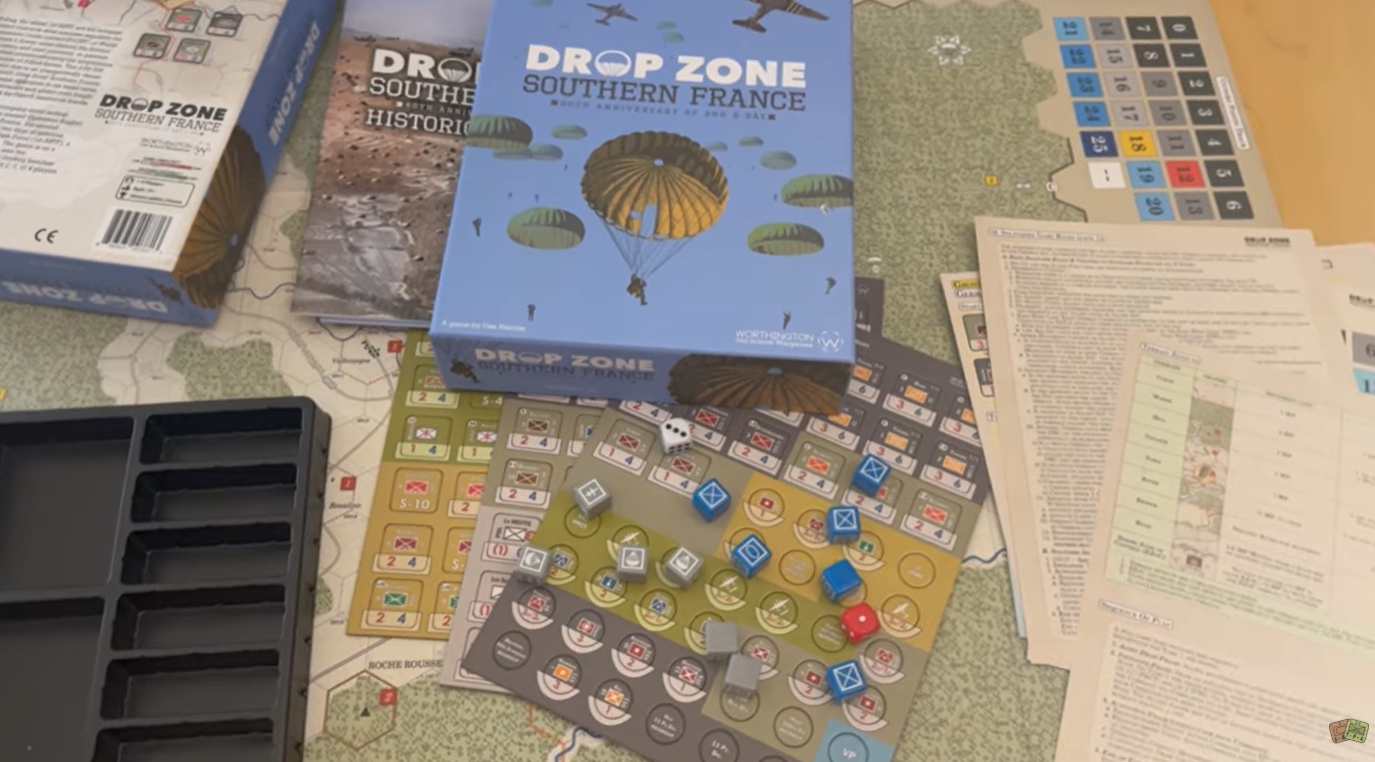
Drop Zone: Southern France is a company-level wargame covering the Allied airborne assault that spearheaded Operation Dragoon, which was the invasion of Southern France or the Second D-Day on August 15, 1944. The history behind this operation is really very interesting as early on the morning of D-Day, the allied First Airborne Task Force (1st ABTF) parachuted a dozen miles behind the Riviera landing beaches to seize key towns and road junctions, to prevent the German occupation forces from counter-attacking the amphibious landing, and to facilitate the advance of Allied forces. The 4:00 AM parachute drop was badly scattered due to an unexpected dense fog bank that blanketed the battlefield. Drop Zone: Southern France covers the first two days of this airborne operation in six game turns, when the American and British paratroopers and glider-men fought surrounded and alone, supported only by French resistance bands. This game is very good and is just a solid wargame.
La Der des Ders – The War to End War from Hexasim is a 1-2 player slightly abstracted strategic level look at World War I. The game allows the players to relive the First World War at a strategic level, with each player controlling one of the 2 sides either the Entente, consisting of France, England, Russia, Serbia and other minor nations or the Central Powers including Germany, Austria-Hungary, the Ottoman Empire and a few minors. La Der des Ders can also be played solo, with a dedicated solitaire bot called “Athena” who utilizes special Cornflower Cards to make decisions about what technologies to invest in, where to undertake offensives and how to utilize limited resources and reinforcements. Each turn, players gain an amount of Resource Points dependent on what nations are in the war, which they can allocate to different areas to guide their overall strategy. Victory is achieved by launching offensives that drain the morale of enemy nations, forcing them out of the conflict through collapse.
In Action Point 1, we looked at the Game Board, discussing the Collapse Tracks, Trade Tracks, Russian Revolution Track and Naval Control Table and other various on-board tables and offensive spaces. In Action Point 2, we covered the Technology Phase and the Technology Tree and Technological Improvement Boards. In Action Point 3, we examined the Event Cards and how they inject the historical narrative into the gameplay and also alter the conditions of the game. In this Action Point, we will walk through an example of an Offensive and take a look at the combat procedure.
Offensives
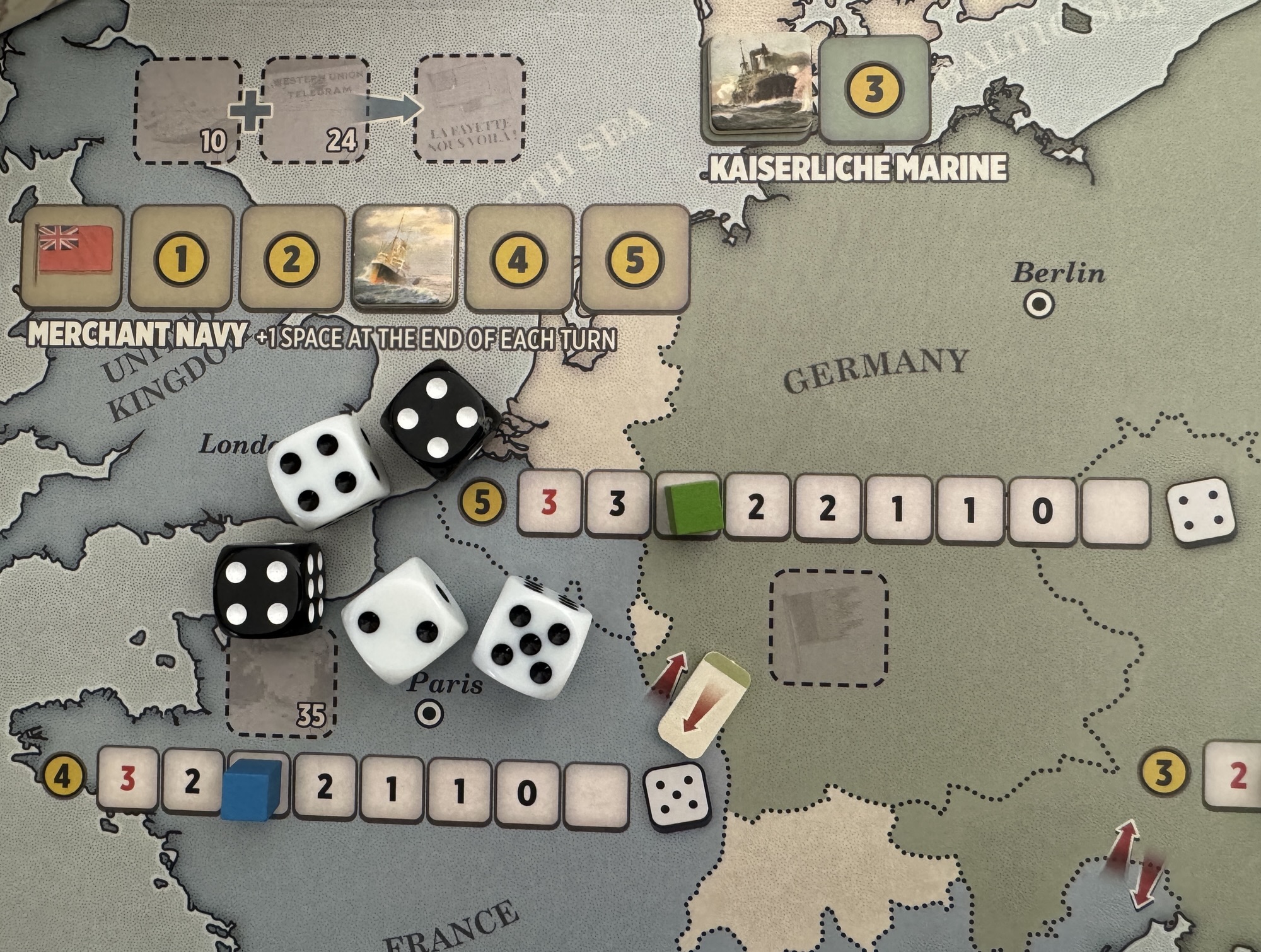
As we discussed in Action Point 1, shown on the board are the Offensive Arrows that will remind the players about what Offensives they can undertake, meaning what Sectors may be attacked, and what Sectors have already taken their one Offensive against that adjacent Sector per turn. These are identified by red arrows connecting adjacent Sectors and will be covered up by the appropriate Offensive Marker when undertaken. In the below picture, we will take a look at Serbia as an example. You can see that Serbia is surrounded by Central Power countries including Austria-Hungary and Bulgaria (Neutral at the start of the war). They also have a few of their Allied nations adjacent including Romania (Neutral at the start of the war) and Greece (Neutral at the start of the war). From each of the adjacent Sectors there are 2 Offensive Arrows represented meaning that this Sector can both be attacked and can attack the adjacent Sector.
The process of taking Offensives is really pretty simple as players take turns to activate one of their sectors that has not yet been activated this turn. The sector chosen will then be activated and must launch an Offensive against an adjacent enemy sector. There is a cost to the launching of Offensives though as the player will have to pay the appropriate cost by first choosing the size of their Offensive, which in game turns means the number of dice they will pay to roll in the Offensive. The size of the Offensive must be at least 1 and can be up to the current Operational Value of the attacking sector. The player launching the offensive then spends as many Resource Points as the size of the Offensive.
For example, The Entente player decides to attack Austria-Hungary from Russia. If Russia’s Operational Value is currently 2, the size of the Offensive must be between 1 and 2. If the Entente player chooses a size 2 Offensive they will have to spend 2 Resource Points. This would allow Russia to roll 2D6 along with any black dice for their Artillery Technology.
Once both of the players have activated a sector, each player may then continue with Offensives by choosing to activate a new sector until no new sectors can be activated. Each of the sectors can make but a single Offensive per turn. I really like this restriction as it reflects the logistical and material difficulties in planning, funding and executing these large Offensives. A player may always decide to pass rather than activate a sector but once you do pass the Resource Spending phase ends for them. The other player can continue to activate the sectors they want and are able to until they decide to pass on their turn or are no longer able to activate a sector.
Now let’s cover the mechanics of how the Offensive resolves with dice. The player will roll as many white dice as the size of the Offensive they funded. These dice are called Attack Dice and it is important to remember that some technologies allow modifiers to be added to Attack Dice or will grant additional dice to be rolled, usually in the form of Artillery Dice. Each level of Attack Technology implemented in the attacking sector grants a DRM (Die Roll Modifier) of +1 to each Attack Die roll. Each level of Defense Technology implemented in the targeted sector inflicts a Die Roll Modifier of -1 to each Attack Die roll. Each level of Artillery Technology implemented in the attacking sector allows the Attacker to roll 1 black Artillery Die. These dice are not subject to the bonuses/penalties conferred by either Attack or Defense Technologies. Also, keep in mind that the number of Artillery dice cannot exceed the size of the Offensive. This is a mistake that I have made many times in my plays of the game and wish there was a better way to remember this. In the case of Artillery Dice, if the player has developed the Aviation Technology, the attacker may re-roll as many Artillery Dice that failed to inflict a loss as the difference between their Aviation Level and the defender’s Aviation Level.
Each result greater than or equal to the attacking player’s Attack Value inflicts one loss on the defender. The Attack Value of a sector is represented by the die depicted at the end of the Collapse Track. Germany has the best value at a 4 while all other countries, with the exception of Greece who is a 6, have a 5. For each loss suffered in an Offensive, the defender moves the cube on the attacked sector’s Collapse Track by one space to the right. If a cube needs to be moved forward on the Collapse Track, but is already on the right-most space and can’t be moved forward, that country immediately surrenders. The Offensives process is really very simple, and it just fits with the chosen format and scale of the game. Nice and easy but fun with lots of dice rolling.
Counter Attacks
One more thing that I need to share about these Offensives is the concept of a Counter Attack. If at least one of the Attack Dice rolled comes up a natural 1, the attacker will suffer one loss and the cube in their own sector is moved forward one space on the Collapse Track. This is not one loss per 1 result but only 1 such loss with an Offensive. With my luck, I could lose my whole army and have to surrender! Also, remember that Artillery Dice are not affected by the Counter Attack rule.
The process of Offensives in La Der des Ders is very simple and straightforward but works very well in the framework of the game to create many tough choices about how to spend your limited Resource Points and who to attack and from where. As the Central Powers, attacking with Germany each turn makes the most sense as they have the best odds of scoring hits and causing losses to France and Russia but they will have to gauge where they stand and who else might be closer to Collapse and surrender. As the Entente, France and Russia should put a heavy focus on Germany and Austria-Hungary and force the Central Powers player to have to replace losses rather than spending on Technology upgrades and replacements. Continually attacking them will lead to results over the course of the game.
In Action Point 5, we will simply review the Victory Conditions.
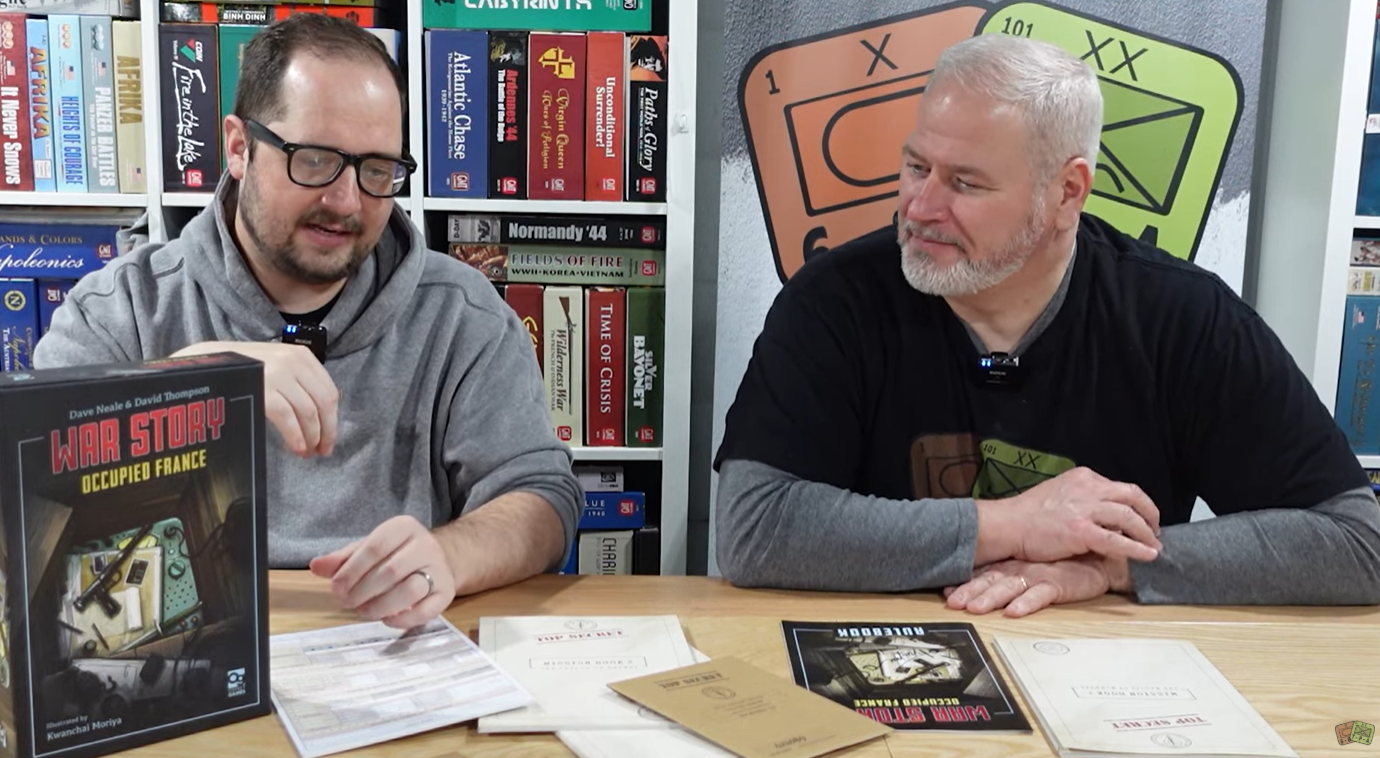
War Story: Occupied France is a co-operative narrative game for one to six players set in World War II occupied France that captures the stakes and tension of espionage and resistance warfare. Your team of covert operatives is all that stands between the infamous German officer Heidenreich and the systematic destruction of French Resistance forces in Morette.
Through three replayable story missions, you must exploit the specialties of your chosen agents to uncover information, enlist allies, and obtain weaponry. Engage occupying forces on tactical encounter maps where careless positioning could cost your agents’ lives. Remember, no plan survives contact with the enemy…and time is running out.
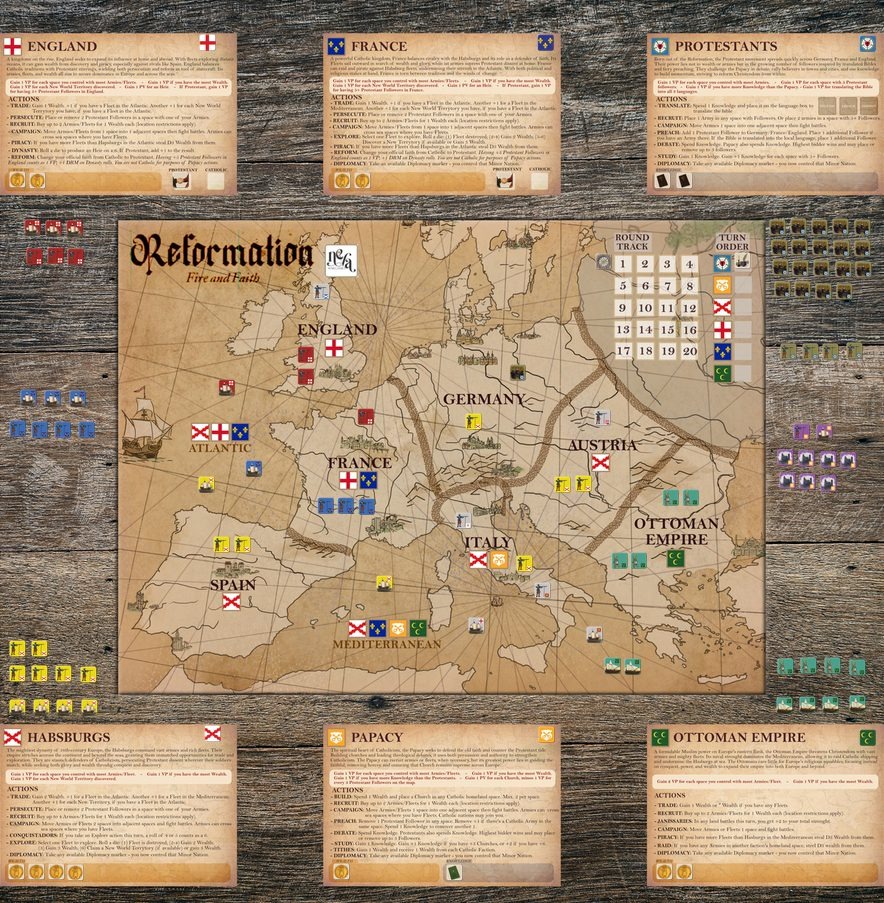
Neva Game Press is really exploring the space of wargame publishing and have games that are being worked on spanning all of history including modern and ancient. They also are looking at non-traditional topics to cover such as the Reformation. Their newest pre-order offering is called Reformation: Fire and Faith and is designed by Clint Warren-Davey. I am keenly interested in this one and have been working with Clint on this interview and maybe a series of other articles on strategies.
Grant: Welcome back to the blog Clint. With 4 published games to your credit what lessons have you learned about the design process and been able to put into practice?
Clint: Thanks for having me back guys! Yes I have learned a lot. Mainly, my iterative loop has become faster. I use mainly digital prototypes on PowerPoint and can get a prototype up and running pretty fast. This means I don’t need to print components and then reprint when things change. I also have a larger “toolbox” of ideas to draw from as I’ve played a wider variety of games. I still have a core design philosophy though – I want games that give players lots of meaningful decisions and a minimum of busywork, plus I generally prefer a high level of player interaction and interdependence.
Grant:How do you pitch games to publishers? What is your approach?
Clint: First I make sure the game is ready. I play-test the game myself a minimum of 20 times. Then I give it to external play-testers (basically my followers on Twitter/X). I keep refining it and make sure all the rules are nailed down. Once I have a fully functional and viable digital prototype, I send an email to a lot of different publishers to see who wants the game. So far, I’ve usually found at least one publisher who will accept each game.
Grant: What is your new game upcoming game Reformation: Fire and Faith about?
Clint: It’s about the wars and religious struggles that tore Europe apart during the Reformation, from 1517 (Martin Luther nailing the 95 Theses to the door of Wittenberg cathedral) to 1555 (the Peace of Augsburg). This is during the “pike and shot” era, which I love. It also includes a lot of political, religious and military conflict that is fascinating on multiple levels. It’s the perfect setting for an asymmetric wargame.
Grant: What image and feeling did you want to convey to players with the subtitle “Fire and Faith”?
Clint: Well this subtitle was decided by my publisher, Jose Neva of Neva Game Press. He wanted to convey both religious and military struggle in the title of the game, hence fire and faith. Before that the game title was undecided – it was either going to be just “Reformation” or “One Hour Reformation” – though upon further development it was clear this game doesn’t really fit with my other “One Hour” games.
Grant: Why was this a game you were inspired to design?
Clint: I am fascinated by the Reformation – both from a religious and a historical perspective. When I converted to Christianity about 10 years ago I had to choose which church to join, which forced me to read more on this time period, and read the arguments put forward by Protestant and Catholic apologists, then and now. I should state here that although I decided upon Catholicism, I hold no ill-feeling towards Protestantism and I understand the impetus behind it.
I was also drawn in by the fascinating geopolitics and tactical level military transformations of the time. The struggles between the French, Habsburgs, English, Ottomans, Venice, Scotland, Hungary, the Papacy and many other much smaller states were kaleidoscopic in their complexity but endlessly entertaining. To take one example of the political maneuvering of the time – the French lost the battle of Pavia to the Habsburgs, partially because 5,000 of their Swiss mercenaries just left and went home to defend their own cantons from rampaging German Landsknechts. Losing Pavia meant that King Francis I was captured. This in turn meant the English sensed weakness and struck in north-eastern France.
Seeking allies against this double threat, the French turned to the one great power that might help them – the Islamic Ottoman Empire! This outraged the Habsburg Emperor Charles V, who had his hands full containing the spread of Protestantism in Germany. The Saxons, Hessians and Brandenburgers following Luther’s lead would be much better used to help defend Vienna from the Turks, but instead both the Pope and the Emperor found themselves facing a full-scale religious revolt at the same time as renewed Ottoman offensives in the Balkans and the Mediterranean. This was all taking place against the backdrop of a military revolution in which pike and shot, and artillery, were replacing feudal levies of armoured knights.
Grant: What other Reformation games did you study for inspiration?
Clint: The complexity of this time period, and the sensitivity of religion as a topic, has meant that few game designers have been willing to tackle it. The exception is Here I Stand, the classic 6-player card-driven game by Ed Beach. This game is a well-renowned and even genre-defining title that managed to cram tons of inter-faction dynamics and historical chrome into the CDG system invented by Mark Herman (who made the first such CDG – We the People). It is absolutely brilliant in so many ways. Baroque, intricate, full of theme. It is almost like a historical equivalent of Twilight Imperium – one of my other favorite games.
The problem? It takes way too long to play for most gamers. Ever since playing Here I Stand many years ago, I had kept the idea of a simplified version at the back of my mind. Then, when I started teaching religious history at a Catholic school, I found myself teaching the Reformation. A classroom game on the topic would sure come in handy. So, in 2024 I made one. The images below give an idea of this, including my very basic graphics made in PowerPoint and Word. In 2025, I revisited the idea and thought it might be worth making into a serious game, still using the basic concepts and inter-faction dynamics borrowed from Here I Stand.
Early prototype version of the board.
Grant: What is your design goal with the game?
Clint: To make a game with 6 asymmetric factions that shows the inter-factional dynamics and key decisions of the period, all with mechanics that are simple enough to be used in a high school classroom AND simple enough for non-wargamers to pick up. Also, a game that players of Here I Stand would enjoy – especially when they are pressed for time. I believe I have succeeded in this goal but time will tell.
Grant: What main mechanics are used in the design?
Clint: The core gameplay loop is very simple. Each faction has a list of actions to choose from. Each turn, each faction will choose two actions. That’s it. But these vary greatly. They include everything from exploring the New World to translating the Bible to raising armies to piracy and everything in between.
All the factions have some actions in common – like Recruit (placing military units) and Campaign (moving and fighting). The two religious factions – the Protestants and the Papacy – are set apart from the others by having most of their actions focus on non-military functions.
Early prototype version of the Papacy Player Board.
The Protestants are trying to convert people to their new faith (or rather, in their terms, restore an older and more purified form of the Christian religion). As such, their overriding focus is placing Followers on the map. As a rough approximation, each Follower piece represents 5-10% of the population converting to Protestantism. What the Protestant faction is aiming for is gaining a majority, or a near-majority, in the countries of Europe. So, their main way of earning Victory Points is by having 5 or more Followers in as many spaces as possible. Now, the Reformation did not initially take hold everywhere. Geographically it was concentrated in Germany above all, then England, then in scattered pockets throughout France. In the game this is basically where the Protestants will be focusing all of their efforts. They start with only 1 Follower on the map in Germany – this represents Martin Luther and the nascent reform movement that started to gather around him in 1517. From this humble beginning, I wanted the Protestants to build up and expand, sometimes rapidly, across the map.
To speed up their placement of Followers, the Protestants can translate the Bible into local languages – German, English and French. This is an idea I took directly from Here I Stand and of course from the actual history of the Reformation. Having the Bible in the vernacular language, and spread by the printing press, was key to the spread of Luther’s ideas. Bible translation is a simple, two-step process in the game. First you need to accumulate “Knowledge” through the Study action and then use the Translate action to place Knowledge markers on the three Bible language spots on the Protestant faction sheet. Initially, this was the only purpose of Knowledge. But then I expanded it to other uses – especially the Debate action, which is a competitive bid against the Papacy that can score a valuable “Issue” token worth a precious VP. These Issue tokens represent the points of dispute in the Reformation, like the role of Scripture, Tradition and authority of the Magisterium. I liked the idea of carefully studying to build up knowledge in preparation for a debate – it’s a case of the game language matching the theme.
Near final look at the board and player boards.
The Papacy works in a similar way to the Protestants – but in reverse. The Pope is trying to remove Protestant Followers, through Preach and Debate actions. Every 3 Protestant Followers is minus 1 Victory Point for the Papacy, so they are incentivized to contain the spread of the Reformation. The Papacy also has ways of building up their own points, through Churches. This general term refers to all the infrastructure of the Catholic religion – not just beautiful cathedrals (like St. Peter’s, which was being built during the Reformation) but also schools, Jesuit universities, seminaries, monasteries, trained clergymen and church councils. I was originally going to have a track or chart on the Papacy faction sheet to measure this but later decided to have it as pieces on the map – the Churches you see in the game.
This was because I wanted the Papacy to have some of physical presence on the map like the other factions. This was loosely inspired by the building tokens in games like Root or the resources placed on the map in Scythe. It has the advantage of opening up the Papacy’s primary victory metric to attacks from the other factions. Just like Protestant Follower pieces, papal Church pieces can be attacked and removed. This represents iconoclasm and persecution of Catholic clergy, as well as periodic waves of destruction like the Sack of Rome in 1527. Unlike Protestant Followers, I had the Papacy’s Churches cost Wealth. This Wealth is gained entirely through the Tithe action – which takes money from any nations that are still Catholic. Early in the game this includes three out of the six factions: Habsburgs, England and France. But England and France might convert to Protestantism, and a greedy Pope constantly demanding their money might hasten this on!
Grant: What are the playable factions? How did you differentiate them?
Clint: There are 6 factions in the game: Protestants, Papacy, Habsburgs, England, France and Ottoman Empire. Each one has a faction sheet, like the one below, which summarizes their victory conditions and available actions.
The Protestants and Papacy are religious-focused factions. They do have military forces, but they are relatively few in number and are not the main priority. The Protestants are trying to build up their knowledge of the Bible and translate it into vernacular languages, preach to the masses and debate the Catholics to spread their ideas. Their main goal is getting their Followers on the map. The Papacy is trying to contain the spread of Protestant Followers and remove them from the map as much as possible, plus place their own Churches. Both Churches and Followers are immobile and do not count as military units. But they can be attacked and persecuted off the map.
The other factions – the Habsburgs, England, France and the Ottomans – function more like the nations in a wargame. Amassing armies and fleets, fighting battles, aiming for control of spaces on the map. There are plenty of differences though. The English, French and Habsburgs have the option of Explore action – sending their Atlantic Fleets to explore the New World, gaining varying amounts of Wealth or a valuable New World colony (at the risk of losing the Fleet). This provides a great way for factions to gamble early on in the game in a high-stakes race for colonies. Two tweaks were made to the Explore action during the design process. First, my co-designer Ed Farren suggested that New World colonies should provide extra income during the Trade action if the owner has a Fleet in the Atlantic.
I loved this idea and implemented it immediately. I later thought that the Habsburgs should have a distinct advantage in exploring the New World, what with Hernan Cortez and Francisco Pizarro active during this time. I gave the Habsburgs a way to boost their Explore action with “Conquistadors” – effectively tripling their chance of finding a colony at the cost of an additional action. This means the Habsburgs will be raking in more money. But there are a lot of ways for the other factions to steal it! The English, French and Ottomans can all use the Piracy action to get that Spanish silver, and the Ottomans can also Raid on land if their Armies make it through to Austria.
The relationship between the military/political factions and the religious factions is also fascinating. I kept the Habsburgs as a staunchly Catholic faction – they can’t change their allegiance and will act as the strong right arm of the Holy See throughout the game. But England and France are a different story. England needed a historically-rooted incentive to convert to Protestantism, and this was solved in two ways. First, if England officially converts, they will earn 1 VP if England itself contains at least 5 Protestant Followers. This also gives 1 VP to the Protestant player, so there would be strong reasons for both players to work together in the conversion for England. I also wanted some of the high drama of Henry VIII and his wives without an entire sub-system and chart like Here I Stand. This became the “Dynasty” action – a simple die roll to gain a VP by producing a viable heir to the throne.
If England is Catholic, they need a 6 for this. But converting to Protestantism offers success on a 5 or a 6, as Henry can start divorcing his infertile wives. England can therefore grab 2 VP quite easily by ushering in the Anglican faith, which is handy because their opportunities for expansion on the continent are quite limited. France can also earn VP by converting to Protestantism and having at least 5 Protestant Followers in France. For both England and France, converting to the new faith costs an action – which Ed quite appropriately labelled “Reform”. This could be a wasted action if Protestantism doesn’t end up spreading in that nation or if the Dynasty action still fails. But it’s a live issue. Among experienced players, I expect that the Papacy player and the Protestant player will spend a lot of their table talk trying to convince England and France to side with them in religious terms.
Grant: What is the layout of the board?
Clint: I made the map as simple as possible. There are 7 land spaces: Spain, France, Germany, England, Austria, Italy and the Ottoman Empire. There are 2 sea spaces: the Atlantic and the Mediterranean. And that’s it! But you will find that this still provides plenty of interesting strategic choices, as there are 6 factions crammed into these 9 spaces. So, like the proverbial “knife fight in a telephone booth,” players are stuck in fierce competition from the very beginning. For example, the Papacy, France and Habsburgs all have some presence in Italy in the game’s set up. Plus, there are pieces from neutral nations there – like Venice and Florence. So inevitably there be some conflict there!
Grant: Why did you feel area movement was the best approach? What strategic decisions are forced upon the players by the layout?
Clint: Honestly, I didn’t want this to be game about operational level maneuver, more about strategic level decisions and inter-faction dynamics. The map is very heavily abstracted. But you can see it this way. Every faction has a “homeland” space. The Habsburgs, being the hegemon of Europe, have two (Spain and Austria). Each faction will usually be aiming to keep its homeland secure while pushing into 1 or 2 other spaces. Taking control of a space is a big deal and will involve good timing, negotiation and applying just enough force. Some spaces – like Germany and Italy – will usually become battleground spaces with multiple factions vying for control.
Grant:What is the counter anatomy? What different units are included?
Clint: Like the map, the counter anatomy is as simple as possible. There is really no information on the counters other than their type. There are Armies and Fleets – which are the only military units in the game. There are also two religious “units” – Churches for the Papacy and Followers for the Protestants. These don’t fight and can’t move, but they are essential for the two religious factions to build up their influence and victory points. There are also counters for many other things – New World Territories, the Royal Heir for England, the Issues that can be won in a Debate, Knowledge, Wealth and a few other things.
Grant: What is the scale of the game?
Clint: There’s no specific ground or time scale as many things have been heavily abstracted. But very roughly you could say that each turn represents about 2-3 years and each army piece represents 5,000-10,000 men.
Grant: What actions do players have each turn?
Clint: Players can choose two actions per turn. As explained above, they are different for each faction. But there are some similarities. I will give a list of the actions for each faction.
Many of these are self-explanatory but I will explain some of my favourite ones. Diplomacy means getting a Minor Nation on your side, or pulling one away from an enemy. These Minor Nations include Venice, Florence, Genoa, Hungary and Scotland and they have their own Armies or Fleets or both.
Piracy means using your Fleets to steal money from the enemy. Explore means trying to find a valuable New World Territory – worth VP and more income during Trade actions if you have a Fleet in the Atlantic.
The Persecute action means placing or removing Protestant Followers. The Reform action – available only to England and France – means officially converting your nation to Protestantism.
Dynasty is unique to England and represents Henry VIII trying to get an Heir (worth a VP). It’s a dice roll, but it’s easier when you’re Protestant to represent Henry being able to divorce and try with a different woman.
Janissaries is unique to the Ottomans and gives them a valuable +2 bonus in battle that turn. Conquistadors is unique to the Habsburgs and gives them a bonus on their Explore rolls – making it more likely that they will grab a New World Territory.
Grant: How does combat work in the design?
Clint: Very simple – add up your Armies/Fleets, add a D3 roll, the highest score wins. If there were a total of 7 or more units in the battle, the winner suffers 1 loss and the loser suffers 2 losses. Otherwise, the loser suffers 1 loss.
Clint: How do players obtain victory?
Clint: Every faction can score Victory Points (VP) in multiple ways. The margins here are very tight – typically the winning faction will score 5 or 6 VP while second and third place will have 4-5. So, a single point really matters. Every faction can score VP for control of spaces – this is hard to pull off as you need more Armies or Fleets in the space than all other factions combined. So, you might retain control of your own homeland, but taking control of another space is hard. Aside from control, each faction has other ways of getting VP:
The Protestants earn 1 VP for translating the Bible into all 3 languages (French, English and German), 1 VP for each space on the map with 5 or more Followers, 1 VP for each Issue you win in a Debate and 1 VP for having more Knowledge than the Papacy. So the Protestants need to focus on their religious actions – studying, translating and preaching.
The Papacy earns 1 VP for each Church they have on the map MINUS 1 for every 3 Protestant Followers on the map. They also earn 1 VP for having more Knowledge than the Protestants, 1 VP for each Issue they win in a Debate and 1 VP for having more Wealth than any other faction. So, the Pope also needs to focus more on his religious goals – but can also use the Tithe action to build up Wealth (for building Churches) and maybe get a point for rolling in cash.
The Habsburgs earn VP for each New World Territory they discover – and they are better at it than other factions because of their Conquistadors. They also earn VP for having 2 or more Churches in their homelands (Spain and Austria) and can earn VP for having the most Wealth.
The English earn VP for New World Territories and for having the most Wealth. They can also earn 1 VP for producing an Heir with their Dynasty action. The Dynasty action represents Henry VIII’s efforts to produce a legitimate male heir for his throne, and is easier if England becomes Protestant. England earns 1 VP if it converts to Protestantism and has 5 or more Protestant Followers in England. If it stays Catholic, it earns 1 VP for having 2 Churches in England.
France is basically like England but doesn’t have the Dynasty action. They will focus on military action, exploration and building up Wealth. If they stay Catholic they will want the Pope to build up Churches in France, if they go Protestant they earn VP for having 5+ Protestant Followers in France.
The Ottomans are the most straightforward – they can earn 1 VP for having the most Wealth but mostly they just get VP for control of spaces – they earn 2 per space instead of 1. They are an expansionist juggernaut and don’t care about the religious squabbles in Europe.
Grant: What type of an experience does the game create?
Clint: I think it gives you an understanding of the key inter-factional dynamics of the Reformation era using mechanics that are simple to understand and easy to enact.
Grant: What are you most pleased about with the design?
Clint: The asymmetry, the simplicity and the interaction between the players. I’m also really happy with the “bot” rules which allow you to play at anything from 1 to 6 players, with non-player-controlled factions run by a simple dice-based action sheet.
Grant:What has been the response of playtesters?
Clint: Very positive. Every play-tester has said the game is really fun and easy to learn, their only suggestions have been refinements to improve the balance between the 6 factions. For example, one play-tester noticed that the Debate action was under-powered and that the Protestants and Papacy were scoring fewer VP than the other factions on average. Changing the Debate action to winning “Issue” markers (worth 1 VP each) solved both problems. This is why play-testers are so valuable!
Grant: What other designs are you working on?
Clint: A lot! I will share a few of them with you.
First, there is One Hour Napoleon and One Hour WW1, sequels to my game One Hour WW2. Napoleon should be out this year, WW1 next year.
Then there is Messiah – my “Jesus COIN game” which is set in 1st century Roman-occupied Israel and lets you play as the Christians, Zealots, Pharisees or Romans. Similarly, there is “Testament” – my card drafting game on the entire Old Testament, inspired by 7 Wonders. These are still in development but they have a publisher and will certainly be made.
Anyone interested in my designs should follow me on X at @Clint_Davey1 to keep up to date with all the new releases. Thanks for having me on again!
If you have followed us for a while now, you know how we feel about Here I Stand: Wars of the Reformation from GMT Games. And, you know that we enjoy multi-player wargames. So, this one really seems to b simple and take in the concepts of negotiation and the asymmetry of each of the factions. I think that this game will be a good quick playing substitute for the longer and more involved Here I Stand experience. I cannot wait to get this one hopefully this year.
Frederick the Great. A Military Life was published in 1985 by Routledge. It is a biography of Prussian king Frederick II (the Great, 1712—1786) dedicated to the military dimension of his life – not only his wars (on a tactical, operational, and strategic level), but also his activities as a military administrator and organizer.
Friedrich was published in 2004. Richard Sivél’s first published board game is a highly abstracted operational treatment of the Seven Years’ War in central Europe, focusing on Prussia’s desperate struggle for survival against the overwhelming odds of the Austrian-Russian-French alliance, personified by the eponymous king (Friedrich is the German form of Frederick). Five years later, a prequel on the War of the Austrian succession was published which uses the same basic system: Maria (Richard Sivél, Histogame).
Connections & Conclusions
My first contact with Duffy’s book was via Friedrich – it is one of the books referenced in the bibliography contained in the rulebook. A good choice, as it is the first treatment of the military dimension of Frederick’s life since imperial German times (and remains the definitive work on the subject until today).
Obviously, the book is more encompassing – after all, it treats not only the Seven Years’ War, but the entire 74-year life of Frederick. Yet the chapter on the Seven Years’ War makes up almost half of the book – testament to the importance of the war for Frederick (whom it turned from an energetic man in his prime into a hollowed out, aged king who had lost most of his pleasures along with many personal friends). The toll the war took on Frederick is showcased in many anecdotes both in the book and in the “small events” in the game.
Glum times for Frederick! Other event cards show him as energetic and decisive, but this one embodies his worst impulses.
Frederick represents a watershed in history. On the one hand, he expanded and modernized the Prussian bureaucracy which is so symbolic for the modern, often impersonal state. On the other, he was a roi-connétable, a king-warlord, one of the last monarchs to personally lead his troops into battle – those after him who did so had usually used their military success to also take political power which was then based on their continued martial prowess (like Napoleon). Yet in an age when the kings of Britain, France, or Russia remained at court and sent their generals to fight whichever war needed fighting, Frederick rode at the head of his main army, entrusting detachments to his generals only because he could not be everywhere at once.
And Frederick did his best to be everywhere. One of the most striking characteristics of Frederick’s campaigns is his masterful use of the interior lines, on which he performed sweeping forced marches from one theater of the war to another. The most impressive example is found late in the campaign of 1757: After Frederick’s offensive in Bohemia had failed, and France’s victory over the Hanoverian army in northwestern Germany opened the way for a French invasion of Prussia. Frederick marched his army to western Saxony, where he beat a combined French/Imperial army at Roßbach on November 5. The Austrians had used the opportunity to invade Silesia which had only been held by secondary Prussian detachments and were in the possession of almost the entire province… until Frederick’s army showed up, having marched 400 kilometers in a month, and expelled the Austrians from Silesia at Leuthen, the site of his greatest tactical victory.
Frederick’s forced march from Roßbach (battle on November 5, 1757) to Leuthen (December 5, 1757) on the Friedrich map.
These sweeping operational and tactical maneuvers are detailed by around 50 maps in Duffy’s book. Whoever is interested in the wars of Frederick will pore over them for a long time during the read and probably flick back and forth between the map section and the text to follow a battle description. While Friedrich prizes maneuver, it has to scale down the distances covered – the march from Roßbach to Leuthen would take five turns on the map (an entire game typically takes around 20 turns).
Operational map of the forced march from Roßbach to Leuthen (top) and tactical map of the battle of Roßbach (bottom right) in Frederick the Great. A Military Life. I’d love to say the book is in this slightly banged up condition because I read it so often, but the unromantic fact is that I bought it used at a library sale (at the bargain price of four bucks).
Thus, there is a certain disconnect between general Friedrich [the pieces are all named in the German fashion] moving on the map and the player role of Frederick: The general Friedrich is much less important than the historical Frederick-the-general. His piece starts in Saxony, which makes it likely that he will only ever do battle with Austria and their minor ally, the Imperial Army, but never venture far enough to fight against France or even Russia and its ally Sweden. If he remains in Saxony and Prussia elects to focus its defense against Austria in Silesia, Frederick might command only a small detachment, avoiding battle while pinning down Austrian forces and taking unglamorous retreats if he is engaged.
Friedrich (Frederick) is keeping Karl von Lothringen (Charles Alexander of Lorraine) busy in Saxony while the main forces of Prussia and Austria, stacked to impressive height, face off in Silesia.
The player role of Frederick, however, oversees the entirety of the Prussian war effort (as well as that of Prussia’s minor ally Hanover, ruled in personal union by the king of Britain). The player has control over the maneuver of their generals of which Frederick could only have dreamt: News of a victory or defeat in East Prussia would have reached his army camp in Bohemia only weeks after the event, whereas in Friedrich the player can position the general in charge of defending East Prussia exactly where they want and have him surrender, retreat, or fight for his life according to the overall strategic plan.
Maximilian Ulysses von Browne has moved boldly in the first turn… and might face Friedrich/Frederick’s wrath (and superior power) in the second.
Nonetheless, the game is very effective at conveying Friedrich’s psychological state: In the early game, the player might be elated by their power and success. As Frederick moves and draws cards first in the round, an aggressive player can attack their foes with overwhelming force – for example, a second-round attack on Austria means that Prussia has drawn its seven cards per round twice already (so, fourteen in total), whereas Austria has only drawn its five cards per turn once. This corresponds with the quality advantage of the Prussian troops early in the war which Duffy notes frequently. Yet Duffy also argues that this advantage was lost by the heavy casualties the Prussian army endured in 1757 and would never be regained. (Duffy contends that Frederick inherited the finest military force in Europe upon his accession to the throne, but left his own successor a mediocre army – this long-term criticism of Frederick is, of course, beyond the scope of the game.)
Correspondingly, the Frederick player will soon find that the time to play defense has come (if it hasn’t been from the beginning of the game). And as their once-impressive card hand dwindles under the repeated attacks from all foes, elation will give way to gloom. Whenever an anecdote is read as the end-of-round event, showing the historical Frederick at turns defiant, melancholy, or self-pitying, the Frederick player will be able to relate – as they will as Austria’s allies, one after another, falter and peace is made. Frederick might have won the game, but it will surely have taken a toll.
Prussia barely holds on to the last Austrian and Russian objectives… let’s hope for Frederick that the Tsarina dies soon!
In that sense, Frederick the Great. A Military Life and Friedrich are a perfect match – the analytic and the immersive, the intellectual and the emotional. Give both a try!
Frederick the Great. A Military Life was published in 1985 by Routledge. It is a biography of Prussian king Frederick II (the Great, 1712—1786) dedicated to the military dimension of his life – not only his wars (on a tactical, operational, and strategic level), but also his activities as a military administrator and organizer.
Friedrich was published in 2004. Richard Sivél’s first published board game is a highly abstracted operational treatment of the Seven Years’ War in central Europe, focusing on Prussia’s desperate struggle for survival against the overwhelming odds of the Austrian-Russian-French alliance, personified by the eponymous king (Friedrich is the German form of Frederick). Five years later, a prequel on the War of the Austrian succession was published which uses the same basic system: Maria (Richard Sivél, Histogame).
Connections & Conclusions
My first contact with Duffy’s book was via Friedrich – it is one of the books referenced in the bibliography contained in the rulebook. A good choice, as it is the first treatment of the military dimension of Frederick’s life since imperial German times (and remains the definitive work on the subject until today).
Obviously, the book is more encompassing – after all, it treats not only the Seven Years’ War, but the entire 74-year life of Frederick. Yet the chapter on the Seven Years’ War makes up almost half of the book – testament to the importance of the war for Frederick (whom it turned from an energetic man in his prime into a hollowed out, aged king who had lost most of his pleasures along with many personal friends). The toll the war took on Frederick is showcased in many anecdotes both in the book and in the “small events” in the game.
Glum times for Frederick! Other event cards show him as energetic and decisive, but this one embodies his worst impulses.
Frederick represents a watershed in history. On the one hand, he expanded and modernized the Prussian bureaucracy which is so symbolic for the modern, often impersonal state. On the other, he was a roi-connétable, a king-warlord, one of the last monarchs to personally lead his troops into battle – those after him who did so had usually used their military success to also take political power which was then based on their continued martial prowess (like Napoleon). Yet in an age when the kings of Britain, France, or Russia remained at court and sent their generals to fight whichever war needed fighting, Frederick rode at the head of his main army, entrusting detachments to his generals only because he could not be everywhere at once.
And Frederick did his best to be everywhere. One of the most striking characteristics of Frederick’s campaigns is his masterful use of the interior lines, on which he performed sweeping forced marches from one theater of the war to another. The most impressive example is found late in the campaign of 1757: After Frederick’s offensive in Bohemia had failed, and France’s victory over the Hanoverian army in northwestern Germany opened the way for a French invasion of Prussia. Frederick marched his army to western Saxony, where he beat a combined French/Imperial army at Roßbach on November 5. The Austrians had used the opportunity to invade Silesia which had only been held by secondary Prussian detachments and were in the possession of almost the entire province… until Frederick’s army showed up, having marched 400 kilometers in a month, and expelled the Austrians from Silesia at Leuthen, the site of his greatest tactical victory.
Frederick’s forced march from Roßbach (battle on November 5, 1757) to Leuthen (December 5, 1757) on the Friedrich map.
These sweeping operational and tactical maneuvers are detailed by around 50 maps in Duffy’s book. Whoever is interested in the wars of Frederick will pore over them for a long time during the read and probably flick back and forth between the map section and the text to follow a battle description. While Friedrich prizes maneuver, it has to scale down the distances covered – the march from Roßbach to Leuthen would take five turns on the map (an entire game typically takes around 20 turns).
Operational map of the forced march from Roßbach to Leuthen (top) and tactical map of the battle of Roßbach (bottom right) in Frederick the Great. A Military Life. I’d love to say the book is in this slightly banged up condition because I read it so often, but the unromantic fact is that I bought it used at a library sale (at the bargain price of four bucks).
Thus, there is a certain disconnect between general Friedrich [the pieces are all named in the German fashion] moving on the map and the player role of Frederick: The general Friedrich is much less important than the historical Frederick-the-general. His piece starts in Saxony, which makes it likely that he will only ever do battle with Austria and their minor ally, the Imperial Army, but never venture far enough to fight against France or even Russia and its ally Sweden. If he remains in Saxony and Prussia elects to focus its defense against Austria in Silesia, Frederick might command only a small detachment, avoiding battle while pinning down Austrian forces and taking unglamorous retreats if he is engaged.
Friedrich (Frederick) is keeping Karl von Lothringen (Charles Alexander of Lorraine) busy in Saxony while the main forces of Prussia and Austria, stacked to impressive height, face off in Silesia.
The player role of Frederick, however, oversees the entirety of the Prussian war effort (as well as that of Prussia’s minor ally Hanover, ruled in personal union by the king of Britain). The player has control over the maneuver of their generals of which Frederick could only have dreamt: News of a victory or defeat in East Prussia would have reached his army camp in Bohemia only weeks after the event, whereas in Friedrich the player can position the general in charge of defending East Prussia exactly where they want and have him surrender, retreat, or fight for his life according to the overall strategic plan.
Maximilian Ulysses von Browne has moved boldly in the first turn… and might face Friedrich/Frederick’s wrath (and superior power) in the second.
Nonetheless, the game is very effective at conveying Friedrich’s psychological state: In the early game, the player might be elated by their power and success. As Frederick moves and draws cards first in the round, an aggressive player can attack their foes with overwhelming force – for example, a second-round attack on Austria means that Prussia has drawn its seven cards per round twice already (so, fourteen in total), whereas Austria has only drawn its five cards per turn once. This corresponds with the quality advantage of the Prussian troops early in the war which Duffy notes frequently. Yet Duffy also argues that this advantage was lost by the heavy casualties the Prussian army endured in 1757 and would never be regained. (Duffy contends that Frederick inherited the finest military force in Europe upon his accession to the throne, but left his own successor a mediocre army – this long-term criticism of Frederick is, of course, beyond the scope of the game.)
Correspondingly, the Frederick player will soon find that the time to play defense has come (if it hasn’t been from the beginning of the game). And as their once-impressive card hand dwindles under the repeated attacks from all foes, elation will give way to gloom. Whenever an anecdote is read as the end-of-round event, showing the historical Frederick at turns defiant, melancholy, or self-pitying, the Frederick player will be able to relate – as they will as Austria’s allies, one after another, falter and peace is made. Frederick might have won the game, but it will surely have taken a toll.
Prussia barely holds on to the last Austrian and Russian objectives… let’s hope for Frederick that the Tsarina dies soon!
In that sense, Frederick the Great. A Military Life and Friedrich are a perfect match – the analytic and the immersive, the intellectual and the emotional. Give both a try!
Before the Treaty of Alliance and the French declaration of war on Britain, France had supported the American Patriots materially. Now that France was a full belligerent, fighting forces would follow – first, the French fleet.
Admiral d’Estaing’s event card in Liberty or Death (Harold Buchanan, GMT Games) emphasizes the difficulties and opportunities of coordinating far-reaching naval operations. From the Vassal module.
A naval force under Admiral Charles Henri Hector d’Estaing, carrying a few thousand French land forces, was dispatched to North America in summer 1778. They embarked on an ambitious combined-force scheme together with the Continental Army to take Newport from the British. American-French cooperation (as well as army-navy cooperation) proved difficult, and the operation had to be aborted. In one of the more dubious decisions of the war, the British abandoned Newport, one of the finest natural harbors in New England, voluntarily soon after.
As joint operations had not yielded success, the American and British forces would usually operate separately for the next two years. That meant that the Americans continued to bear the brunt of the struggle for North America. The French navy and army, however, were crucial in tying down British forces in the by now global struggle: British and French forces fought over the economically crucial “sugar islands” of the Caribbean. A French armada, strengthened by Spain which had recently entered the war, threatened to invade Britain itself in 1779. Even in far away India, British forces were challenged by the French and their local allies. Players of Imperial Struggle (Ananda Gupta/Jason Matthews, GMT Games) will recognize these as the four regions in which Britain and France fight for supremacy – with victory going to the player who can balance their interests in the four regions best, taking losses where they must while making bigger gains elsewhere.
The board of Imperial Struggle depicts a world full of opportunities for conquest, alliance, and trade in North America, Europe, the Caribbean, and India. In this particular game, the British have been expelled from North America, but done well in India.
The American Patriots had none of this strategic depth. If they were defeated North America, their cause would be lost. And even with French support, it did not seem like they could do more than brace themselves against the military and financial superiority of Britain… if so much. The harsh winter of 1779-80 decimated the Continental Army. Difficulties in paying the troops resulted in the mutiny of the Pennsylvania and New Jersey Line regiments. The situation seemed so dire that Benedict Arnold, one of the most distinguished American commanders, betrayed the American cause (but failed to deliver the fort of West Point to Britain), serving in the British army for the remainder of the war.
The Benedict Arnold event in Washington’s War (Mark Herman, GMT Games) does not only give a die roll modifier in a battle to Britain, but also removes the (American) leader Arnold from the board. Experienced American players know this, of course, and will not entrust Arnold with important missions… thus, his invasion of Canada is unlikely to happen in the game. An interesting meditation on how much historical hindsight influences gameplay.
The Southern Strategy
Part of the American woes was the new British focus. As New England was lost to Britain, and too full of rebels to be retaken, the British turned their attention to the southern colonies which the believed to be populated by many British loyalists.
First, they advanced from Florida (supported by sea) into Georgia and took Savannah on December 29, 1778. A combined American-French land-sea operation failed to retake the city in June 1779. After this second joint operations failure, the French fleet relocated to the Caribbean. British forces under Charles Cornwallis laid siege to Charleston, South Carolina, the following March.
Lincoln never stood a chance. From the Rally the Troops! implementation of Washington’s War.
Benjamin Lincoln, who had commanded the American troops in the unsuccessful counter-offensive at Savannah, was put under enormous political pressure not to let Charleston, one of the most important cities in the south, fall into British hands. Retreat was thus impossible. Yet the defense of the city against superior British forces was doomed. Lincoln surrendered in May 1780.
Cornwallis’s next victim. From the Rally the Troops! implementation of Washington’s War.
Cornwallis also beat the new American commander in the south, Horatio Gates, at Camden (and thus cut Gates, the hero of Saratoga, back to size again). As the British general was poised to invade North Carolina, Washington dispatched Nathanael Greene to take command in the south.
Greene’s approach aimed to elude a decisive engagement. Contrary to British assumptions, the south was not rife with British loyalists. The crown was only supported where Britain could enforce loyalty – on the coasts, and wherever Cornwallis’s army was at the moment. And Cornwallis could not be everywhere. Small American forces under guerilla leaders (like “The Gamecock” Thomas Sumter and Francis Marion, on whom the movie The Patriot is based) chipped away at British forces and support. While Cornwallis beat Greene at Guilford Court House and Eutaw Springs in early 1781, he could not reverse the south’s affiliation to the Patriot cause.
Yorktown
Cornwallis lost patience with the indecisive campaign against Greene’s Fabian strategy. In 1781, he boldly struck into Virginia. His supply was to come from sea via the port of Yorktown on Chesapeake Bay. If Virginia, the largest and most populous southern colony was taken and thus the south cut off from the north, Greene would have to surrender – or so Cornwallis thought. Cornwallis’s good strategy rating in Washington’s War makes it likely that the British player will let him pursue similarly active campaigns… and hopes not to get caught by superior force.
Cornwallis’s plan was risky. Virginia was much closer to the American and French main forces than the Carolinas. The French commander Jean-Baptiste Donatien de Vimeur, comte de Rochambeau, urged George Washington to confront Cornwallis. And thus a third joint operation began: Gilbert du Motier, Marquis de Lafayette, a French volunteer in the Continental army, marched American and French forces to Virginia.
Cornwallis responded in the typical British manner: He fortified Yorktown and confidently relied on British naval superiority to keep his options open. That confidence was shaken when the French instead of the British navy showed up in Chesapeake Bay. The British sent a fleet of their own, but the resulting naval battle of Chesapeake Bay failed to expel the French fleet (September 5, 1781).
Between a rock and a hard place: Cornwallis was trapped by the American-French army and the French navy. From the Rally the Troops! implementation of Washington’s War.
Washington and Rochambeau took command of the combined army and invested Yorktown. As Cornwallis had failed to tenaciously defend the outer defenses, assuming he would be evacuated by the Royal Navy, the sieging forces advanced quickly. Cut off from supplies and under bombardment from the allied artillery, Cornwallis surrendered on October 17, 1781. His entire force of almost 8,000 was captured (with another 156 dead). French and American total casualties (dead and wounded) were barely over 200.
Peace
The war in the colonies had been unpopular in Britain for some years. Parliament was unwilling to expend more money on it, and thus the British forces deployed had never again reached their peak strength from 1776. With one of the two main British forces in the colonies lost, so was the parliamentary base for the government. When the Whig opposition’s motion to end the war in North America carried a majority, Prime Minister Frederick North resigned in March 1782. “North’s Government Falls” is the end of a game of Washington’s War, and can happen anytime between 1779 and 1783 (provided the event is face-up in the respective year).
North’s successors had to make peace with four separate enemies – the United States, France, Spain, and the Netherlands. The American negotiators Benjamin Franklin and John Jay proved most skillful in this complicated multi-sided diplomacy. They secured diplomatic recognition for the United States as well as the western domain all the way to the Mississippi and important fishing rights in the Atlantic. The Peace of Paris was signed on September 3, 1783.
The king of France had little time to enjoy his triumph. The war expenses incurred in the American Revolutionary War contributed to the financial crisis which resulted in the French Revolution (whose protagonists were in turn inspired by the American ideas of liberalism and republicanism) just six years after the Peace of Paris.
Britain, on the other hand, bounced back from the setback in North America. The country’s naval, commercial, and financial strength was still intact. Britain would orchestrate the coalitions against revolutionary and Napoleonic France until the final victory at Waterloo in 1815, ushering in a century of British global dominance.
And the United States? They remained within their own hemisphere for the time being. Only occasionally drawn into conflict with their erstwhile French allies or old British enemies, the United States dealt with their westward expansion and economic development. Despite its unresolved conflict internal conflict about slavery, the American republic remained an inspiration to European liberals and democrats who strove to follow the example begun 250 years ago.
Allison, Robert J.: The American Revolution. A Very Short Introduction, Oxford University Press, New York City, NY 2015 is exactly what it says on the tin.
Higginbotham, Don: The War of American Independence. Military Policies, Attitudes, and Practice, 1763-1789, Indiana University Press, Bloomington, IN 1977 covers not only the campaigns, but also the political, social, and economic dimensions behind them.
You know the drill: We’re assessing a (democratic) leader, illustrated with a single board game! Today’s subject is another German chancellor – Konrad Adenauer, the first chancellor of the Federal Republic of Germany. And which game could be more appropriate for him than Wir sind das Volk! (Richard Sivél/Peer Sylvester, Histogame) plus the 2+2 expansion?
Some caveats ahead: The chancellors will be rated by the knowledge of their time. If they or their contemporaries could not have known about the effects of something, I will not use my hindsight to mark it as a mistake of theirs. The assessment is focused on their conduct as chancellor, but includes their life after holding the office (in which they will still be regarded in the public eye as (ex-)chancellors).
Now, to the system itself: There are three policy field categories (foreign, domestic, and economic policy) and three more general ones (vision, pragmatism, integrity). A chancellor can earn from one to five stars in each category (for a total sum of up to 30). In detail, the chancellor is assessed as follows:
Foreign policy: Did the chancellor increase German influence in the world and the security of Germans at home? Did the chancellor wield German power responsibly and with positive results for the regions affected (the latter counting for a greater deal in times of German power being great)?
Domestic policy: Did the chancellor increase the liberty of Germans to express themselves and to participate in the political process? Did the chancellor promote domestic security and shape the framework for fair justice dealing with offenses?
Economic policy: Did the chancellor facilitate the prosperity and economic security of Germans (including in the mid- and long-term)? Was the chancellor’s economic policy based on mutual benefit of those involved or did it unduly burden one side?
Vision: Did the chancellor have an idea of what Germany and Europe (the latter counting for more in times of German influence being great) should look like beyond the immediate future? Did the chancellor’s policies steer Germany (and, if applicable, Europe) in this direction?
Pragmatism: Did the chancellor succeed in seeing their policy through from inception to completion? How well did the chancellor manage the support from parliament, society, the administration, the media (the latter counting for more in more recent years)?
Integrity: Did the chancellor understand the office as a means to benefit themselves, special interest groups, the entire country, or another community? Did the chancellor respect the boundaries of the office?
Note: If you have read my UK prime minister or US president ratings, you will remember that I rated them on the global impacts of their vision as well. As the rating system is only really applicable to democratic leaders and no democratic German leader ever had the chance to conduct a truly global policy, I only assess their vision on national and European grounds.
Adenauer’s Life
Early Years
Konrad Adenauer was born on January 5, 1876, in a Rhenish bourgeois family. He and his brothers were the first in the family to attend a university. After a few years working in public service and at a law firm, Adenauer turned to local politics. As he had a foot in both confessional/political camps (his own family was devoutly Catholic, his wife came from one of the old liberal Protestant families), Adenauer secured a broad majority for his election as Deputy Mayor of Cologne in 1906.
Adenauer rose quickly in municipal administration, both by his diligent, energetic service and his family connections – his wife’s uncle Ludwig Wallraf had been elected Lord Mayor in 1907. When Wallraf was called to serve in the Reich administration in 1917, Adenauer was elected Lord Mayor of Cologne.
Lord Mayor of Cologne
His years at the helm of the city were turbulent. Just a year after his election, the double quake of Germany’s defeat in World War I and the German Revolution of 1918/19 sent shockwaves through the country. Adenauer himself put out tentative feelers to France, if the west of Germany could become an independent country (giving the French a buffer state to Germany). The Allies, however, forged a different agreement in their negotiations at Versailles. During the crisis year of 1923, Adenauer made another attempt at Rhenish separatism, which faltered as the crises were resolved by Gustav Stresemann’s government.
Adenauer was an energetic Lord Mayor whose legacy can still be seen and felt in Cologne – the “green belt” of parks around the city center (formerly a ring of fortifications), the university, and one of the bridges over the Rhine are his creations. He used a pragmatic government style, adding to his own power base of the Catholic Zentrum (Center) party whichever other factions would give him a majority for his projects – Liberals, Social Democrats, and in the case of the bridge even the Communists.
Adenauer’s many expensive projects put Cologne in a financial squeeze when the Great Depression reduced revenue and cut off access to international credit. He applied himself to bettering the city’s financial situation with mixed success.
When the Nazis took power in 1933, they removed him from his post. Adenauer, now aged 57, entered private life. For the next twelve years, he would distance himself both from the Nazis and the anti-Nazi resistance.
The Path to the Chancellorship
In 1945, the Allies had need of men like Adenauer – experienced in government, not a Nazi, and a reliable proponent of democracy and market economy. He was reinstated as Lord Mayor of Cologne. His tenure, however, was cut short, when the British authorities (in whose occupation zone Cologne lay) found out about his contacts with the French on the matter of – once more – establishing a separate Rhenish state.
Letting go of the mayorship was not too hard for Adenauer. It freed him up for the work of establishing a new party which was to shed the confessional limitations of the old Zentrum in favor of an all-Christian approach – the CDU (Christlich-Demokratische Union, Christian Democratic Union). Adenauer also was tapped to head the Parliamentary Council working on the Basic Law, a quasi-constitution for the new German state to be founded. Adenauer, never much of a conceptual thinker, was barely involved in the drafting, yet his political acumen was instrumental in forging the compromises behind the Basic Law.
When the Soviet Union lifted the Berlin Blockade in May 1949, the path for a German state made out of the three western occupation zones was free. The first free elections in the new Federal Republic of Germany gave no one a clear majority, but Adenauer’s CDU (plus its Bavarian allies, the CSU [Christlich-Soziale Union, Christian Social Union] came in first. In a tactically masterful campaign, Adenauer convinced his party (and then its partners) not to form a “grand coalition” with the Social Democrats, and instead govern with several smaller bourgeois parties (the liberal FDP [Freie Demokratische Partei, Free Democratic Party] as well as the nationalist DP [Deutsche Partei, German Party]). Adenauer himself was elected Chancellor on September 15, 1949.
Foreign Policy Successes
Adenauer’s first task as Chancellor was the re-integration of (West) Germany into the international community. As a first step, he negotiated the Petersberg Agreement (1949) with the Allied High Commissioners which granted the new West German state limited sovereignty. His further negotiations with the Allies were crowned by the General Treaty (1955) which made West Germany a sovereign country for most intents and purposes – special rights for the four Allied powers (Soviet Union, United States, United Kingdom, France) notwithstanding. Consequently, West Germany would have an army again, and become a member of NATO.
Adenauer’s approach of integration through giving up control did not only work for regaining sovereignty, but also in European affairs: France’s anxiety about the German heavy industry (and the French desire to gain access to more coal and steel) resulted in the formation of the European Coal and Steel Community which placed the heavy industry of the two countries (plus Italy and the Benelux countries) under supranational control – the first international agreement of that kind, and the first step toward the European Union.
While Adenauer used the opportunities presented to him, he also recognized the traps: Thus, when Stalin offered German reunification as a neutral country (with only the vaguest allusions to the nature of such a unified Germany) in 1952, Adenauer refused to take the bait and dismissed the note in concert with the Western Allies.
Wir sind das Volk! embraces ambiguity – many events can be beneficial to both sides, depending on how they are played. Yet the Stalin Note card is unambiguously a “red” event, from which only the USSR and East Germany benefit. If you are playing one of the Western powers, do it like Adenauer and play the event for the action points before the Eastern powers snatch it!
All this time, Adenauer had to contend with the opposition of the nationalist Germans and the SPD who felt that the Chancellor had become an instrument of the Western Allies, both of them grossly misjudging Germany’s negotiation position. Adenauer’s shrewd realism prevailed.
Adenauer was skilled at fusing values and interests in negotiations. While he was personally committed to German reparations to the newly-founded state of Israel for Nazi Germany’s persecution and murder of the European Jews, he did not just announce them. Instead, he had the negotiations on them run in parallel to those on Germany’s foreign debt (mostly from Marshall Plan loans, but also still from the reparations after World War I). The moral impetus of the negotiations with Israel carried over to the debt negotiations, as only an economically strong Germany could give meaningful support to the Jewish state, and so a large part of the debt repayments were postponed or cancelled altogether.
Stepping out of the shadow of the war was not only a question of reparations. Millions of Germans had been taken prisoner by the Allies. Most of them were released in the years immediately after the war, but the Soviet Union kept several thousand in camps until Adenauer negotiated their release in 1955. While he did not encounter much resistance from Soviet leader Khrushchev, the “Return of the Ten Thousand”, as the contemporary writers called it (borrowing from Xenophon) was often cited as Adenauer’s prime achievement by the Germans who lived through his administration – a symbolic end to the war.
An ambiguos event: The release of the German prisoners of war removes unrest in West Germany and increases West German prestige, but it also adds 1 to the budget of the USSR (due to the economic agreements made) and tilts the balance between the superpowers in favor of the USSR.
The Domestic Agenda
Millions of Germans had lost their homes and livelihoods in the war – be that by destruction or when they were expelled from the German East. If and how these losses should be compensated was the subject of intense public debate. Adenauer opted for a tax of fifty percent of the value of property of owners who had not suffered any losses, payable in instalments over thirty years (Lastenausgleich [Burden Equalization]). The funds raised were paid out in various programs to those who had suffered material losses. While there was intense resentment on the part of property owners from the relatively untouched German West, the scheme helped integrate the millions of refugees while preserving the pre-war social order.
In the meantime, the West German economy had taken off – fuelled by the European integration as well as the increased demand for German consumer goods as the outbreak of the Korean War oriented the American economy towards war materiel, but also because the economic course of Adenauer’s administration proved successful: A generally liberal market economy was tempered by sporadic government intervention (soziale Marktwirtschaft [social market economy]).
Adenauer’s second large social project concerned retirement pensions. Retirees, already not particularly well off on the whole, had not partaken in the dynamic wage growth of the 1950s. They remained poor in an ever-wealthier society. Adenauer (against the position of the cabinet majority) pushed for pensions to be paid out of the premiums of the currently-employed (instead of those the retirees had paid themselves). When the reform was implemented in 1957, pensions were significantly increased and old-age poverty all but eliminated.
The chancellor’s willingness to atone for the crimes of his country’s past in foreign policy contrasted with his selection of staff and ministers at home: Hans Globke, whose work at the Ministry of the Interior’s Office of Jewish Affairs during Nazi times had seen him actively involved in the legal discrimination and persecution of Jews, continued his career as Chief of Staff at Adenauer’s chancellery. Adenauer’s Minister for Displaced Persons, Refugees, and War Victims, Theodor Oberländer, had even participated in Hitler’s Beer Hall Putsch of 1923 and had later advocated for the ethnic cleansing of Poland. Both selections were controversial, but Adenauer kept faith with them – Oberländer had to resign under public pressure in 1960, Globke stayed on until Adenauer’s own resignation.
Adenauer masterfully parlayed his domestic and foreign policy successes into ever-larger electoral victories in 1953 (when CDU and CSU had the majority together with the DP, but joined with the FDP in addition as well) and 1957 (when CDU and CSU won a one-party majority for the first and only time in the history of German democracy). Both times, Adenauer’s skill and ruthlessness as a campaigner were instrumental in the victories.
The Decline
After 1957, Adenauer seemed to lose his touch. His negotiations ensuring German re-armament had been masterful, but there was a gaping hole between the ambitious plans for the German army and the haphazard way in which a much more modest force was established. At the same time, Adenauer kept calling for Germany’s nuclear armament, a demand which was sure to be rejected by the Western Allies and exploited by the Soviets as a sign of the return of aggressive German militarism. Adenauer’s casual, sometimes careless treatment of the subject (he referred to tactical nuclear weapons as nothing more than an “advancement in artillery”) also increased the fear of a new, even more devastating, war within the German population.
At the same time, Adenauer’s erstwhile foreign policy acumen – and willingness to confront the Soviets – seemed to have withered. When Khrushchev threatened West Berlin again from 1958, Adenauer was half disinterested, half willing to give in. Only French, and later American firmness on the matter prevented West Berlin being turned into a neutral “free city.” Adenauer’s detached behavior – most evident after the building of the Berlin Wall in 1961 – contrasted starkly with the principled stand of Willy Brandt, Mayor of West Berlin, and Adenauer’s Social Democratic challenger in the 1961 elections.
It was somewhat surprising that Adenauer even stood for reelection in 1961 – after all, he was alreadyy 85 at the time. Two years before, he had toyed with abandoning the chancellorship and succeeding Theodor Heuss as Federal President – an office which had been designed to be largely ceremonial in the constitution, but which Adenauer wanted to turn into the political center of gravity (following de Gaulle’s example) of Germany. After Adenauer’s ambitions had damaged the office of the president, the plan was dashed by his own party, which was increasingly less willing to put up with everything Adenauer decreed.
Once more, Adenauer’s CDU/CSU won the elections, but the significant losses at the ballot box meant Adenauer had to form a coalition with the FDP again – and to promise that he would step down during the term. Before that came to happen, Adenauer and the ebullient civil society of the German democracy had their starkest clash: When news magazine Der Spiegel (The Mirror) reported on the botched rearmament, Adenauer authorized his minister of defense Franz-Josef Strauß (CSU) to push for charges of treason against the editor and journalists of the magazine. The newsroom was searched for evidence and several journalists arrested – a gross violation of the freedom of the press. Unsurprisingly, the charges had to be dropped.
Adenauer’s last initiative was an improvement of the relationship with Germany’s western neighbor France. Since the founding of the German nation-state less than a century before, the two countries had fought three devastating wars (plus countless wars between France and the German principalities before Germany’s national unification). If there was someone to bridge this “inherited enmity”, it was Adenauer – after all, he had sounded out the French about founding a French-aligned separate Rhenish state no less than three times before he took over national office, and he had cultivated a good relationship with French president Charles de Gaulle since 1958 (based on both men’s instinctive feeling that they did not receive everything that was due to them from their Anglo-American allies). Adenauer and de Gaulle concluded the Élysée Treaty in January 1963, proclaiming the friendship between the two countries (which has since taken root in a plethora of local initiatives and city twinnings). De Gaulle’s and Adenauer’s goal to challenge Anglo-American leadership of the West with the Franco-German alliance, however, failed, as Adenauer’s party only accepted the treaty once it was couched in a preamble stressing the importance of the transatlantic relationship and support for the United Kingdom joining the budding integrated Europe.
At this point, Adenauer had lost his party. While he tried to maneuver for a succession to his liking, the party’s parliamentary group was not willing anymore to accept his authority. Of the four men considered chancellor material, they selected the one least to Adenauer’s liking – Minister of the Economy Ludwig Erhard. Adenauer resigned on October 15, 1963.
While retired from the chancellorship, he remained party chairman of the CDU. He spent his last years writing his memoirs and – behind the curtain as well as publicly – undermining his unloved successor, whose resignation in 1966 he still lived to see. Konrad Adenauer died on April 19, 1967, aged 91.
The Rating
Foreign policy
Foreign policy was always Adenauer’s focus – he even acted as his own Foreign Secretary from 1951 to 1955. The immense successes of the early years – Germany’s shedding of its pariah status, its firm integration into the West, and the foundations for European integration – are arguably the most impressive feat in the history of German foreign policy. Yet Adenauer’s later foreign policy seemed fickle and his resolve weakened. The chaotic nature of the rearmament process also wasted potential for increased security. Even his last success – the Élysée Treaty – was a mirage, as the personal (instead of institutional) framework of the agreement was quickly dashed by his successor.
Konrad Adenauer was the first chancellor of the newly democratic Germany. Yet his own position to democratic values was distanced, at times tactical. The reappearance of former Nazi officials in high government positions and his unwillingness to confront the Nazi crimes domestically meant that wrongs continued to go unchecked – for example in the law courts, which, supported by Adenauer’s government, quickly re-established their old personnel. Adenauer saw personal liberties as subject to the state’s (or the government’s interests) – most clearly evidenced in the Spiegel scandal. The societal climate of Adenauer’s Germany fell behind the more liberal Weimar Republic decades before.
Rating: 1 out of 5.
Economic policy
The best economic course was subject to intense debate in the mid-20th century: Adenauer’s own party adopted a platform of nationalizing banks and heavy industry in 1946; most of the cabinet members (including the pro-business FDP and Minister for the Economy Ludwig Erhard) favored a pure private-business market economy. Adenauer steered a middle course against tough opposition, establishing a dynamic market economy tempered by comprehensive social reforms. This admirably successful model has since shown weaknesses of its own (especially due to the demographic development), but none that could have been apparent at the time of its creation.
Rating: 5 out of 5.
Vision
Adenauer was a tactician rather than a strategist, seizing opportunities as they arose. Yet in 1949 he was the right man for the time whose unorthodox thinking was just right for the situation. Thus, he was able to establish many of the fundamental tenets of the new state which persist until today – from integration into the West and a particularly close relationship with France to the commitment to Israel. He also shaped the way in which politics are conducted in Germany – then as now focused on the chancellor.
When Adenauer’s name was mentioned as a potential first chancellor and his fellow CDU members wondered if he was not too old at 73, Adenauer told them that his doctor had assured him he would still be fit for office for “another two or three years”. In the end, he ruled Germany for 14. During that time, he dominated the political process in the country in an almost-continuous loop of parlaying political success into electoral victories and electoral victories into domination over issues and allies alike. Only in his very last years did his grip over party and electorate wane – as evidenced by his weaker electoral performance in 1961 and his party choosing the successor he liked the least.
Adenauer’s electoral success was not only due to his eager adoption of the new methods of polling and his deft use of electoral promises – he was not beneath regularly smearing his opponents, from personal attacks (like mentioning Willy Brandt’s birth out of wedlock) over absurd exaggerations (“All Paths of Marxism Lead to Moscow,” a dig at the (strictly anti-communist!) Social Democrats) to outright inventions (Adenauer was fond of alleging that SPD candidates had accepted bribes from East Germany). At the same time, he used the German intelligence service to spy on the SPD leadership. At one point, he even funneled government money into a campaign (at the referendum for the future of the Saar). Still, in the politically fluid years of the early Federal Republic of Germany he never attempted to outright undermine democracy.
Adenauer combines stunning successes with great political and personal flaws. If Adenauer had stepped down from the chancellorship in 1957, he would go down as one of the greatest democratic leaders in history. His lackluster last years in office tarnished the greatness exhibited before, and so he places slightly behind the very top.
How would you rate Adenauer? Let me know in the comments!
Further Reading
For short overview essays on all German chancellors from Bismarck on, see Sternburg, Wilhelm von: Die deutschen Kanzler. Von Bismarck bis Merkel[The German Chancellors. From Bismarck to Merkel], Aufbau-Verlag, Berlin 2006 (in German).
For a classic, albeit somewhat hagiographic biography, see Schwarz, Hans-Peter: Adenauer (two volumes), DVA, Stuttgart 1986/1991 (in German).
The combative counter-point to Schwarz, depicting Adenauer as a shrewd tactician rather than a visionary saint, is Köhler, Henning: Adenauer. Eine politische Biographie [Adenauer. A Political Biography], Propyläen, Frankfurt am Main/Berlin 1994 (in German).
For the context of Germany’s tumultuous history, see Herbert, Ulrich: A History of Twentieth-Century Germany, Oxford University Press, Oxford 2019.

 Anmelden