Anmelden
Coyote Review: Bluff, Peek, and Outsmart Your Friends
08. September 2025 um 23:44

The Coyote has invented a clever little bluffing game, in order to win his friends’ possessions. So prepare to use your wits to outsmart him!

The Coyote has invented a clever little bluffing game, in order to win his friends’ possessions. So prepare to use your wits to outsmart him!
To celebrate our Fall 2025 issue of Casual Game Insider, we're giving away amazing prizes worth over $1,000 to 41 lucky winners! Don’t miss your chance to win—enter today!
BGI 384 The One About De Minimus Becoming De Maximus
Board Games Insider – Join our Guild on Board Game Geek Guild | Like us on FB
Social media:
Ignacy Trzewiczek / Portal Games: website | FB | Twitter | Youtube
Corey Thompson / Above Board TV: website | Youtube
Stephen Buonocore / “The Podfather Of Gaming”: website | FB | Twitter | Youtube
Intro Music: Happy Rock – Bensound.com
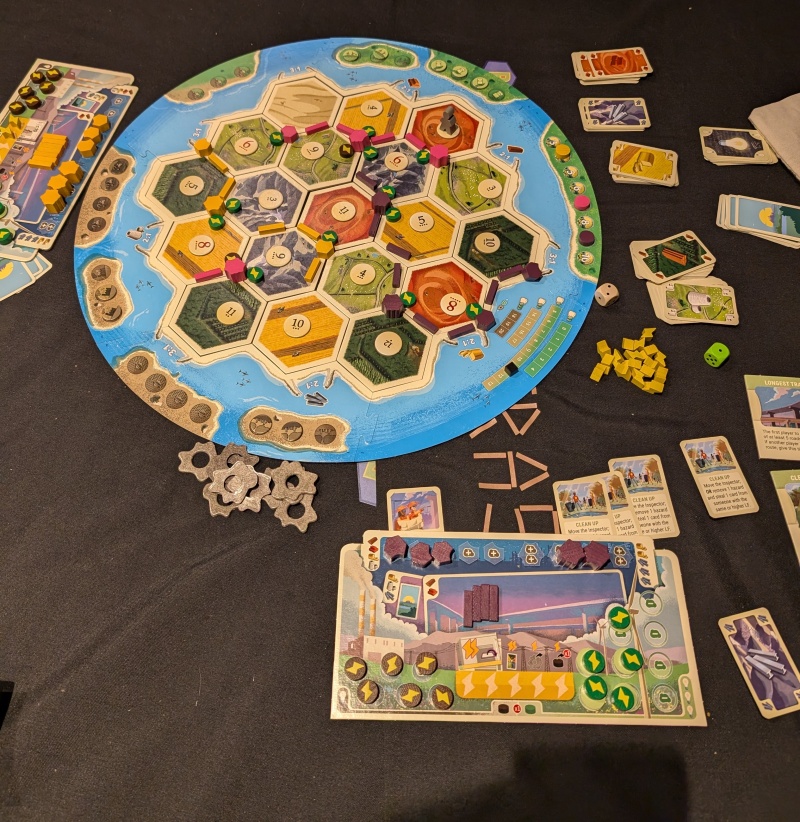
I am usually sceptical about new versions of classic board games – but I had to admit that Catan New Energies is a great version of the game. It has the basic game mechanics of gathering resources to build roads, cities and towns to get points to win the game. But there are enough added features to make it interesting and different.
Each player has their own box which contains their Towns (settlements), Cities and Roads, event discs, fossil power plants and renewable power plants. This does help speed up set up.
The game plays very much like the original with collecting resources to build more Towns & Cities. Even though some of the resources are called different things in this version – wood, brick, natural fibre (was sheep), food (was wheat) & steel (was ore), the colours and images are almost identical – so we just call them their old names. The extra resource of science does add a nice addition, and it allows you to buy the different power plants. (Science cards are collected when you collect resources from a city. So instead of getting 2 resources for the city, you get 1 and a science card.)
Unlike original Catan – you always start by pulling out a hazard token – once you have 3 of the same type you must instantly complete the consequence of that hazard. They are just a small hinderance or bonus (depending on your local footprint). The amount of hazard tokens pulled is determined by the global footprint: Every time you build a city or town or fossil plant – the global (and your local) footprint goes down. But each time you build a renewable plant – they both go up. The one thing we forgot on our first game was key – if there are no more tokens to pull from the bag – the game ends there and then. And points don’t matter – the winner is the person with the best local footprint. So, buying lots of fossil plants may be cheap – but they could cost you the game!
But – you do want to build plants though as they produce lighting/energy which do a few things. They are similar to the fishes in the Traders and Barbarians expansion – get enough and they are any resource you like or remove a hazard from one of your towns or cities. They can also increase the number of cards you can have in your hand before the robber takes them. This is a very handy bonus for when you just can’t get the cards you need.
All in all, I do think Catan New Energies is a good stand-alone version of Catan. It has all the basic elements to make it a Catan game, but enough added to make it while buying another version of the game. You can order this at: https://www.bgextras.co.uk/catan/other-catan-games/catan-new-energies
The post Catan New Energies first appeared on Board Game Extras.BGI 383 The One About a Shockingly High Valuation for a Publisher
Board Games Insider – Join our Guild on Board Game Geek Guild | Like us on FB
Social media:
Ignacy Trzewiczek / Portal Games: website | FB | Twitter | Youtube
Corey Thompson / Above Board TV: website | Youtube
Stephen Buonocore / “The Podfather Of Gaming”: website | FB | Twitter | Youtube
Intro Music: Happy Rock – Bensound.com
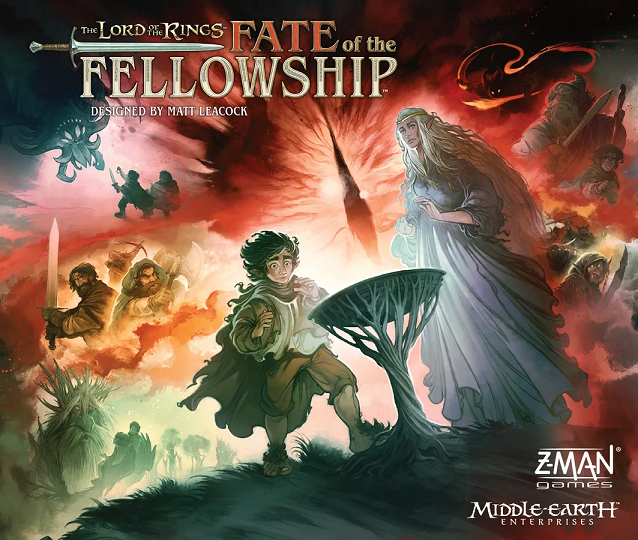
Peter unboxes The Lord of the Rings: Fate of the Fellowship by Z-Man Realms!
Pandemic is a game that doesn’t really excite me much anymore, and I’ve played the spin-off Clone Wars and been underwhelmed. But this new evolution of the system by Matt Leacock has received great reviews and I’m very much looking forward to trying it out. In the meantime, here’s an unboxing, partial graphic design critique, and at the end, a tip to make the spectacular dice tower look even better!
And, we’re back! Here with another edition of Off the Shelf, let’s look today at
FUSE is a 2015 game designed by Kane Klenko and published by Renegade Games. It’s for 1-5 players, and is a real-time dice-rolling game where you are trying to defuse bombs in your spaceship within ten minutes. There are several games in the FUSE family now – along with the original, which got a new edition in 2019, there’s Flatline (2017 – this one is about saving patients injured in the original game’s attack) and FUSE Countdown (2023 – this one adds new stuff to the FUSE system, including multi-colored dice and roles).
At the start of the game, each player gets two cards (four in the solo game). You’ll then deal cards into a deck based on the number of players and desired level of difficulty, and shuffle them. Deal out five face-up cards, and then add six bomb cards to the deck.
There are no turns in this game. You start a ten minute timer (and Renegade has one on their app that will mock you throughout play) and start drawing dice – one per player in a 3-5 player game, four with two players, three in solo play. These are rolled, and each player will take one (two with two players, all in solo play). The chosen die (or dice) must be placed on a valid spot on a card. Most spots either have a specific number, a specific color, or both. Some have number or color of your choice, but these usually have to be identical (or not) to something else on the card. Sometimes you just need to place dice on the card, but other times you need to stack them into columns or a pyramid.
If you cannot place a die, you must roll it, then you must remove another placed die that matches the number or color of the rolled die. Once everyone is done, unused and discarded dice go back in the bag and you do it again.
When a card is completed, it is set aside into a score pile and you take a new one from the array in the center of the table. This card is immediately replaced with the top card of the deck. If it’s a bomb card, all players must discard a die that matches the number or color of the bomb card. The card then goes into the score pile and is replaced.
The game ends in two ways – either all cards are removed from the center of the table (deck is empty, all face-up cards are taken), or you run out of time and blow up. Either way, you score the points from your defused cards, two points per bomb card, ten points if you won, and one point per 10 seconds left on the clock. This is just for reference purposes to see how well you succeeded – you win if all bombs get defused.
I got my copy in 2016, winning it in some Twitter contest that I don’t remember. According to my logs, I’ve played it 53 times since then, most of which were solo. In fact, I’ve only played a couple of times with multiple people, and neither of them were terribly successful. There were too many times when players started bickering over dice they needed when someone else also needed them, and that wasted too much time. That led me to the conclusion that I much prefer it as a solo game, where I get to make my own decisions and am not beholden to others. Though I would like to try two players sometime.
The game is played in real-time, which is a turnoff for some people. It is highly stressful, as you only have 10 minutes to complete your bombs. And if you’re not rolling well, it can be pretty frustrating. But that’s part of what I really like about it – I think the tension works really well, and it ends up feeling like a really quickly played puzzle.
I happen to really enjoy real-time games. But I know there are a lot of people who don’t – the tension of not being able to pause and think can be highly stressful. For me, it works well. I love thinky games where I need to consider my options and make a reasonably educated move. But I also like chaos, and nothing says chaos like “you only have ten minutes before your ship explodes.”
The cards are pretty well laid out. The patterns are pretty easy to identify, and the dice fit in all the squares on the page. I do really like the 3-dimensional patterns as well as the 2-dimensional ones, because you have to be thinking about what has to come first. The bomb cards add an extra wrinkle to the game, and while it’s a sigh of relief when one comes up and you have nothing that matches, it’s pretty frustrating to discard something when they do.
Overall, the game is pretty high on the luck factor. You have to draw the right dice, roll well, and complete whatever challenges the game throws at you. You can try to strategize what bombs you want in front of you, maybe having a mix of easier and more complex patterns, but if only one or the other is coming out, you’ve got to deal with it. I personally love the 6-point bombs, as they always stack and are just a lot of fun to complete overall.
So, yeah, this is a favorite game of mine to play solo. I’m doing it as part of my 10×10 this year (ten games ten times each in a year), and have been enjoying it. I’ve lost more than I’ve won, but I always have a good time. I’ve currently got it at #5 for my Off the Shelf rankings.
That’s it for today! Thanks for reading!
And, we’re back! Here with another edition of Off the Shelf, let’s look today at
FUSE is a 2015 game designed by Kane Klenko and published by Renegade Games. It’s for 1-5 players, and is a real-time dice-rolling game where you are trying to defuse bombs in your spaceship within ten minutes. There are several games in the FUSE family now – along with the original, which got a new edition in 2019, there’s Flatline (2017 – this one is about saving patients injured in the original game’s attack) and FUSE Countdown (2023 – this one adds new stuff to the FUSE system, including multi-colored dice and roles).
At the start of the game, each player gets two cards (four in the solo game). You’ll then deal cards into a deck based on the number of players and desired level of difficulty, and shuffle them. Deal out five face-up cards, and then add six bomb cards to the deck.
There are no turns in this game. You start a ten minute timer (and Renegade has one on their app that will mock you throughout play) and start drawing dice – one per player in a 3-5 player game, four with two players, three in solo play. These are rolled, and each player will take one (two with two players, all in solo play). The chosen die (or dice) must be placed on a valid spot on a card. Most spots either have a specific number, a specific color, or both. Some have number or color of your choice, but these usually have to be identical (or not) to something else on the card. Sometimes you just need to place dice on the card, but other times you need to stack them into columns or a pyramid.
If you cannot place a die, you must roll it, then you must remove another placed die that matches the number or color of the rolled die. Once everyone is done, unused and discarded dice go back in the bag and you do it again.
When a card is completed, it is set aside into a score pile and you take a new one from the array in the center of the table. This card is immediately replaced with the top card of the deck. If it’s a bomb card, all players must discard a die that matches the number or color of the bomb card. The card then goes into the score pile and is replaced.
The game ends in two ways – either all cards are removed from the center of the table (deck is empty, all face-up cards are taken), or you run out of time and blow up. Either way, you score the points from your defused cards, two points per bomb card, ten points if you won, and one point per 10 seconds left on the clock. This is just for reference purposes to see how well you succeeded – you win if all bombs get defused.
I got my copy in 2016, winning it in some Twitter contest that I don’t remember. According to my logs, I’ve played it 53 times since then, most of which were solo. In fact, I’ve only played a couple of times with multiple people, and neither of them were terribly successful. There were too many times when players started bickering over dice they needed when someone else also needed them, and that wasted too much time. That led me to the conclusion that I much prefer it as a solo game, where I get to make my own decisions and am not beholden to others. Though I would like to try two players sometime.
The game is played in real-time, which is a turnoff for some people. It is highly stressful, as you only have 10 minutes to complete your bombs. And if you’re not rolling well, it can be pretty frustrating. But that’s part of what I really like about it – I think the tension works really well, and it ends up feeling like a really quickly played puzzle.
I happen to really enjoy real-time games. But I know there are a lot of people who don’t – the tension of not being able to pause and think can be highly stressful. For me, it works well. I love thinky games where I need to consider my options and make a reasonably educated move. But I also like chaos, and nothing says chaos like “you only have ten minutes before your ship explodes.”
The cards are pretty well laid out. The patterns are pretty easy to identify, and the dice fit in all the squares on the page. I do really like the 3-dimensional patterns as well as the 2-dimensional ones, because you have to be thinking about what has to come first. The bomb cards add an extra wrinkle to the game, and while it’s a sigh of relief when one comes up and you have nothing that matches, it’s pretty frustrating to discard something when they do.
Overall, the game is pretty high on the luck factor. You have to draw the right dice, roll well, and complete whatever challenges the game throws at you. You can try to strategize what bombs you want in front of you, maybe having a mix of easier and more complex patterns, but if only one or the other is coming out, you’ve got to deal with it. I personally love the 6-point bombs, as they always stack and are just a lot of fun to complete overall.
So, yeah, this is a favorite game of mine to play solo. I’m doing it as part of my 10×10 this year (ten games ten times each in a year), and have been enjoying it. I’ve lost more than I’ve won, but I always have a good time. I’ve currently got it at #5 for my Off the Shelf rankings.
That’s it for today! Thanks for reading!
BGI 382 The One About The Good, The Bad & The Ugly
Board Games Insider – Join our Guild on Board Game Geek Guild | Like us on FB
Social media:
Ignacy Trzewiczek / Portal Games: website | FB | Twitter | Youtube
Corey Thompson / Above Board TV: website | Youtube
Stephen Buonocore / “The Podfather Of Gaming”: website | FB | Twitter | Youtube
Intro Music: Happy Rock – Bensound.com
Peter reviews Nemesis: Retaliation by Awaken Realms!
Yyou’ve watched the unboxing, you’ve followed the painting tutorial, you’ve downloaded the rules & reference, you’ve used the rules on your Tabletop Codex app – and finally it’s time for the full review! I cover the newest entry in the Nemesis space horror trilogy. Let’s rock!


Race for the flag or build up your strength, as you battle it out for command of the pirate fleet!
The post Paverson Games announces Ringyō appeared first on Graphic Policy.
Ringyō blends simultaneous worker placement, environmental management, and competitive strategy into an immersive experience
BGI 381 The One About Fun at Gen Con 2025
Board Games Insider – Join our Guild on Board Game Geek Guild | Like us on FB
Social media:
Ignacy Trzewiczek / Portal Games: website | FB | Twitter | Youtube
Corey Thompson / Above Board TV: website | Youtube
Stephen Buonocore / “The Podfather Of Gaming”: website | FB | Twitter | Youtube
Intro Music: Happy Rock – Bensound.com
First a bit of background on Black Panther, Shuri, she is a princess of Wakanda and was the young sister of T’challa. The Black Panther Name was carried by the Males of the family until the death of her Brother, when with reluctance she took it on. Shuri rediscovered the the plant that gave the user the powers of Black Panther and then took it. she gained more abilities including Super-Strength, Speed, and Agility which she combined with her amazing Scientific Mind and fighting abilities to become a mighty hero.She fought the loss of her Father her Brother and then her Mother to try and keep her anger in check and to stop her heroine self from becoming a monster. She has great leadership abilities, amazing science knowledge and is a mighty fighter.
So how does she play in the game? In her Alter-Ego form, Shuri can exhaust herself to search her deck or discard pile for any “Black Panther” or “Tech” upgrade and play it, reducing its cost by 2. Allowing her to quickly get her core upgrades into play, as well as any other valuable Tech cards in her Justice deck. While in her hero identity she has four “Black Panther” upgrades. These cards, such as Kimoyo Beads and Spider Bites, are a central part of her hero identity, which she can make use of after a basic power.
Her game is more about a consistent, tactical approach as opposed to her brother who in the core game is more about explosive, single-turn damage .
Her ability to trigger her upgrades often and her powerful Alter-Ego ability to find and play key cards make her a very fun and strategic hero to play, and you can order her at https://www.bgextras.co.uk/marvel-champions/marvel-champions-hero-wave-9-agents-of-shield/marvel-champions-the-card-game-black-panther-hero-pack
The post Marvel Champions Black Panther Hero Pack first appeared on Board Game Extras.
In this new version of the app there are more Avatar options, more Avatar settings and more Avatars!
You can now use Multiple Select to set Illustrations, Background colours and Shapes for multiple selected Players. This makes it even easier to visually create a group of Players!
It is now possible to:
Read more about Avatars and all options here: Avatars
Illustrator Annika was so generous to create another illustration!
You can now use her chameleon to create even more Avatars.
Her range of pöppels is also expanded with 5 new colours!