Thus it came to pass that Postmark Games graduated from dice to cards. After some of the finest print-and-plays in recent memory — after Voyages, Aquamarine, Waypoints, and Scribbly Gum — I suppose we were overdue for a title where the input isn’t limited to six sides.
How about fifty-two random numbers instead? Using nothing but an ordinary deck of cards, which surely you have lying around the house somewhere, 52 Realms: Adventures generates an entire dungeon dive. In a vacuum, it’s quite the accomplishment. If only vacuums weren’t so chilly.
That pebble is me. It is I.
It begins with a dungeon. Or maybe it begins with a menu of items. On the surface, 52 Realms: Adventures is about exploring a dungeon. Ostensibly, your objective is to reach the final chamber and slay the boss monster therein. Really, though, it’s to reach the highest score possible, accumulated one loot card at a time.
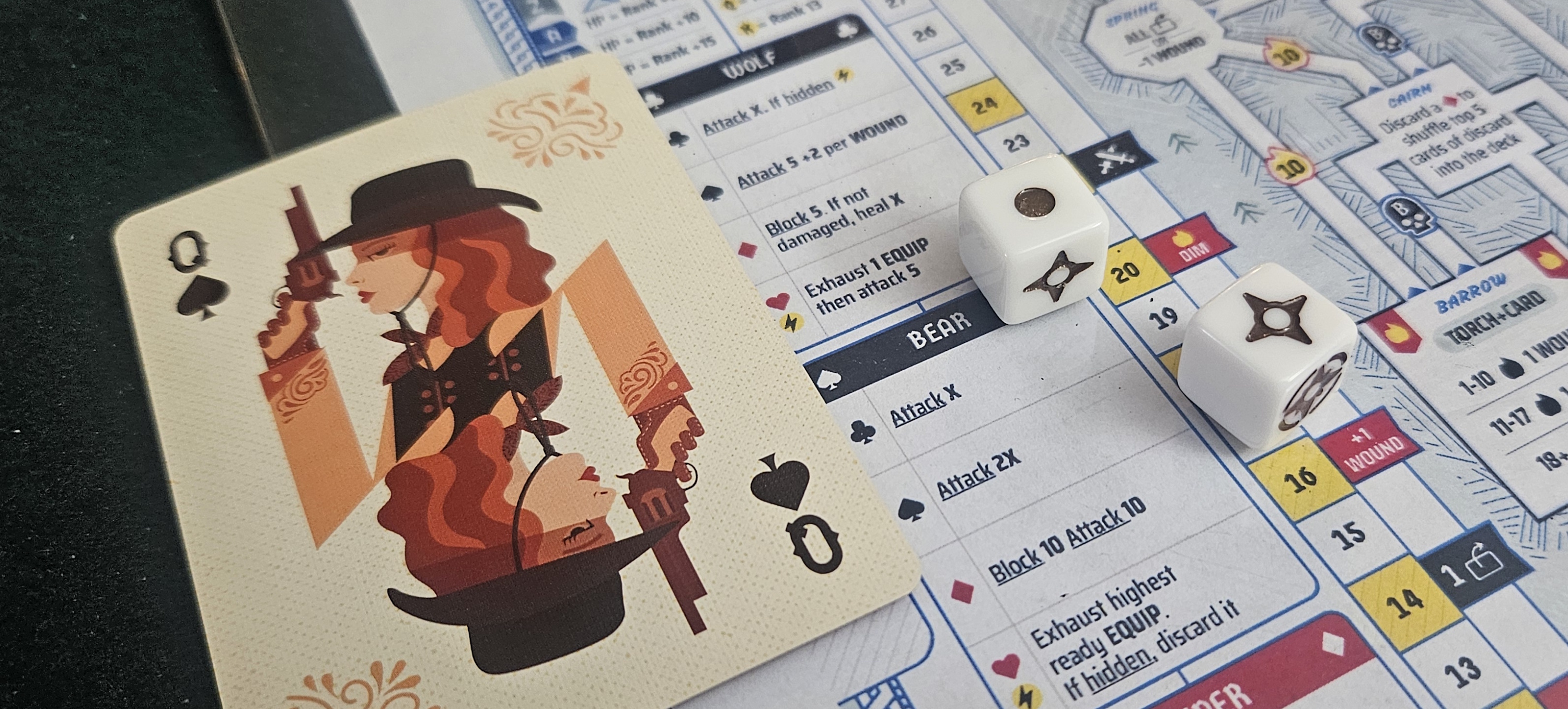
As with their previous titles, designers Matthew Dunstan and Rory Muldoon plumb their system to its maximum depth. It’s truly impressive how much mileage they cover with just a single deck of cards. The deck, you see, governs everything. A single card might indicate the monster you face when stepping into another room, tallying their health pool and type. As battle unfolds, additional cards become instructions for said monster: how hard it hits, whether it slinks away to heal, the amount your attacks are reduced by when it raises its limbs in defense.
Those same cards also become the tools your hero utilizes to overcome the dungeon. When placed to the side of your character sheet, a card’s suit indicates an item, whether a generic potion for the basic starting heroes, a vial of dragon blood for someone more masochistic like the Fell Knight, or ingredients in an Alchemist’s pouch. Beneath the sheet, the cards are instead transformed into “equipment,” a catch-all term for what are really your action cards and the closest thing the game has to experience points or leveling up.
The function of cards isn’t limited to enemies and equipment. It’s also the game timer, ticking away one card at a time, punishing your hero for every enemy they spend too many rounds grappling with and every detour on the path to the boss chamber. Aces become events, nasty surprises that exhaust your equipment or inflict wounds.
And, of course, there’s loot. Loot is dull on its own, a face-down pool that determines the lion’s share of your score. In a game that packs its corners with interesting tidbits, a scoring pile is almost surprising in its deficit of pizazz. Call it a necessary evil.
There are plenty of heroes to use.
For the most part, Dunstan and Muldoon pitch their delves as miniature races. Your goal is to slay the boss while amassing a minor fortune, but the constant depletion of the deck means there isn’t time to dally. It isn’t actually that difficult to conclude a scenario, provided you beeline for the exit. But anyone who’s played even one video game can tell you that heading straight for the final room is a surefire way to miss out on all the stuff that makes these things worth experiencing. Hence the game’s core tension. Sure, it’s possible to race to the end and secure a safe but measly score. But it’s more rewarding by far to push yourself to the absolute limits, spending resources like crazy and never pausing for breath, only to watch in despair as your efforts are rewarded with the boss peeling a few too many cards off the deck.
Glancing at the ratings for 52 Realms: Adventures, one of the more common complaints is the system’s chanciness. To be sure, those fifty-two cards produce quite a range of outcomes. Unlike the and-then nature of Dunstan and Muldoon’s roll-and-move titles, where a flub means a lower score rather than a premature game over, it isn’t uncommon for a delve to terminate thanks to a few too many injuries. Which reminds me: Cards also represent damage values. Absorb too many hits and you die.
Personally, the game’s long odds aren’t one of its problems. If anything, the possibility of an early grave is a suitable nod to the game’s roguelike roots. Sometimes the first three monsters you meet are face cards. Sometimes the rewards they offer are barely worth collecting. Sometimes you draw two aces in a row. That’s the nature of the beast. It helps that a full session only lasts twenty minutes. That includes a stretch break. I can handle a loss that comes three minutes into a session.
Enemies are randomly generated.
What I miss, though, are those earlier games’ shared nature. Don’t get me wrong, I enjoy solitaire games. But while Voyages, Aquamarine, and Waypoints included solo modes, they shone in multiplayer, everyone at the table utilizing those shared inputs to see where their private adventures took them. By its nature, 52 Realms: Adventures is solitaire-only. I’m sure someone could bash this thing into a shared mode, but it would be a wonky solution. There are simply too many card-flips, too many cases where a theoretical extra player would desynchronize with their partner.
Without that partner, 52 Realms: Adventures is nice for a visit, but doesn’t really compel me to return over and over again to maximize my score. The problem lies in the dungeons themselves. There are four in all, but the way they function lends them to feeling like two separate games that use a single system. The first two are linear with branching paths, your hero marching relentlessly toward the boss chamber, backtracking forbidden. This gives those dungeons a choose-your-own-adventure feel, choose A or B, left or right.
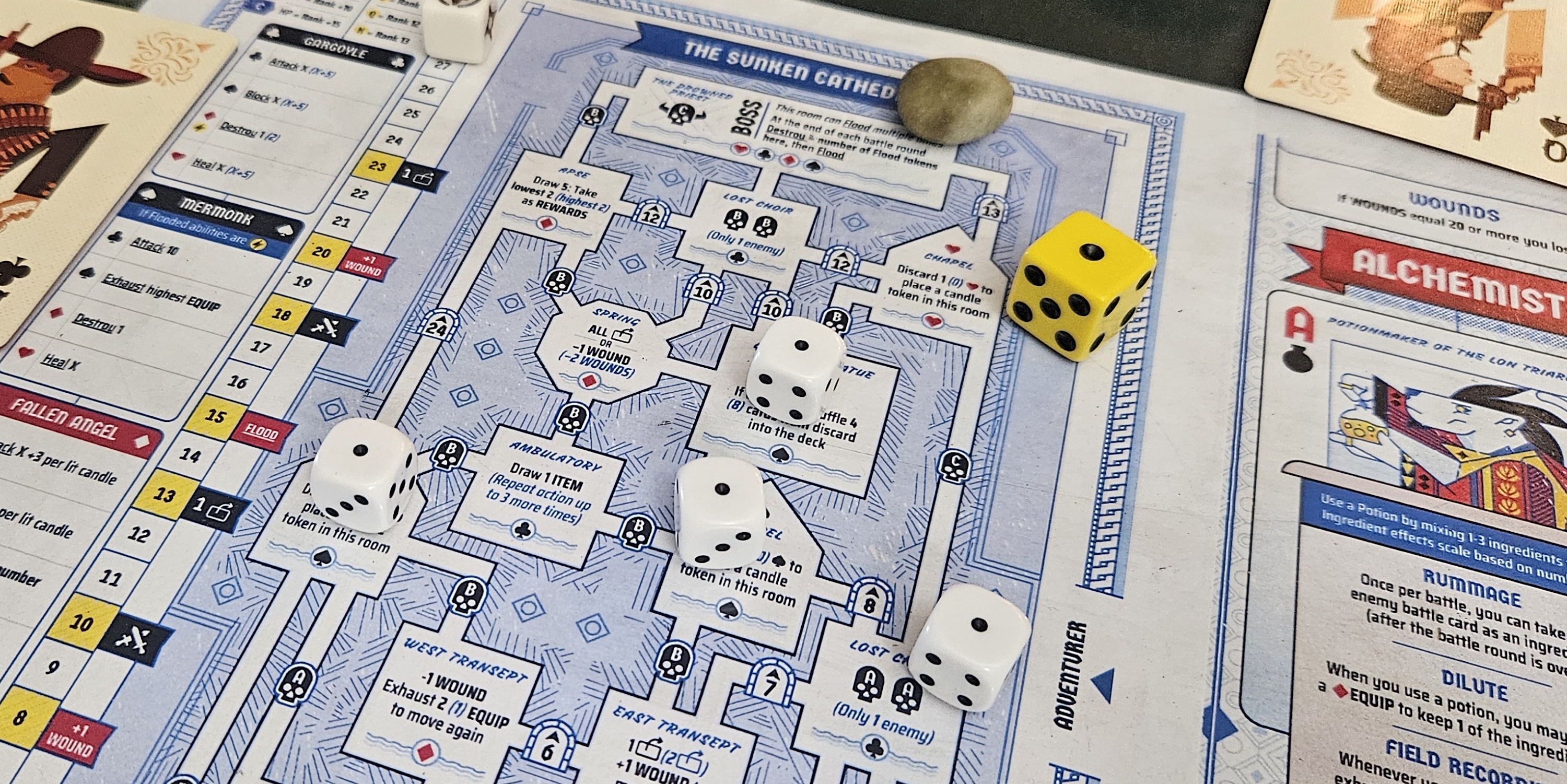
The latter two are more interesting, in no small part because they widen the one-way lanes to proper two-way corridors. One, a clockwork labyrinth, allows your adventurer to approach the central chamber only to boot them back out to the periphery. The other, a watery cathedral, is slowly flooding, its rising waters granting advantages but also empowering the local beasties. In both cases, the player is given more freedom, with little side objectives that might pad their score or beef up their hero for the final encounter.
Two of the dungeons are especially interesting.
Even so, 52 Realms: Adventures never quite feels as elegant or freeform as those earlier Postmark titles. The game’s innate chanciness means that one score is hard to differentiate from another. Sadly, the game declines to provide a target. Is 48 a good score? How about 67? It probably depends on the map, or maybe the hero. But where Dunstan and Muldoon’s earlier efforts allowed players to compare their outcomes, here I’m tabulating a number that exists only in that aforementioned vacuum. Barring many repeat plays, that is. And the core gameplay loop isn’t strong enough to bring me back for more than two or three wins per map.
This squeezes the game into an unfortunate corner. It’s interesting to look at, and I’m duly impressed by the system. But I also wish it had been a little more ambitious, whether by letting multiple players share a challenge or by producing a fuller-fledged adventure. Good for a delve or two, but for now I’ll keep my feet warm by the fire.
Access to the files to print 52 Realms: Adventures was provided by the publisher.
(If what I’m doing at Space-Biff! is valuable to you in some way, please consider dropping by my Patreon campaign or Ko-fi. Right now, supporters can read my first-quarter update of 2026: the best board games, movies, books, and more!)
A long time ago in a fulfillment center far, far away, Stonemaier Games offered a few ala carte options to webstore customers. Glass beads for Viticulture, plastic mechs for Scythe, metal coins for Charterstone…these were all included in their respective games, but sometimes people wanted more/extras.
Back in those days, we didn’t have many products, we only had one webstore, and we had lots of spare replacement parts. So we would have our replacement parts helper label a few cartons with a new SKU, and I would snap a few photos and add the ala carte item to our webstore. Typically we would also ship a few cartons from the US to our fulfillment centers in Canada, Europe, and Australia.
Now in 2026 we have over 250 SKUs, ranging from games to expansions to accessories, promos, and more. Not only have we grown, but so have our fulfillment partners: They employ dozens of people to service a number of companies. They process hundreds of orders every day using robust inventory management systems that require every item in an order to be scanned. These are massive warehouses filled with thousands of different products.
Every product needs to have a barcode (either integrated into the packaging or printed as a sticker and applied by the manufacturer). Every product also needs a production quantity, and then that production quantity is split between our 4 fulfillment centers and distribution/retail based on our best-guess forecasts. Every product needs a listing on our 4 Shopify webstores, and every product requires ongoing inventory and webstore management.
Basically, it’s a huge logistical challenge to produce and stock even just one product. Each additional SKU is exponentially more complicated, both up front and on an ongoing basis.
This is why games are sold as they are: One preset package, not a dozen different components that you can pick and choose from. Look at any game on your shelf, and there are probably a few components in it that you don’t use (maybe based on player count or modular preferences), but that’s okay. It’s much more optimized–and more cost-effective, which carries over to the price you paid–to combine those components into a cohesive product instead of selling everything ala carte.
Why is this on my mind today? Duel of Meloch, our new game (which is also an expansion for Scythe and Expeditions), has a lot of components. Scythe components, Expeditions components, overlapping components specific to the duel, etc. One of the most common questions I’ve heard so far is if someone can buy just some of those components but not others; as explained above, the answer is no.
The game also has two optional add-ons available for the July 15 webstore launch, despite the logistical complexity of extra SKUs. We split off the plastic airship miniature because it isn’t used in the duel format and would have increased the price (both for the component itself and the increased box size). There is also a metal mech pack (4 metal mechs for Scythe and 1 for Expeditions); due to the factors described in detail above, we can offer them combined at a better price than if there were two separate metal mech packs.
I mention all this because it’s an interesting area of customer service. On the surface, it might seem like we could best serve each customer by enabling them to buy only the precise components and elements they want. But in reality, ala carte makes it much harder to serve everyone, and it makes things more expensive for everyone.
Please note that I put ala carte in a completely different category than replacement parts. If any of your Stonemaier products have missing or broken components, it is our job to fix that problem. We consider our replacement parts system essential to serving customers despite it being a suboptimal, money-losing endeavor.
Also, just like most products, Duel of Meloch is more than just a sum of its parts. For example, you might buy it primarily as a Scythe expansion, but along the way you might discover that you love the duel mode (which can even be played Scythe vs Scythe if you already own Scythe or the Invaders from Afar expansion) or that you enjoy Expeditions.
Are there other industries where it’s common to request individual components instead the entire product?
Welcome to this week’s batch of crowdfunding campaigns. We have a variety of offerings here, so we hope you will find something that catches your eye. Also, if you want to chat with the BGQ team, join our Discord Server where we talk about games, movies, sports, and other fun stuff. Check it out and […]
Whenever I go on vacation or travel for any reason, I always pack a few board or card games. When we go out in our RV I can pack some full sized games (I tend to stick with the theme and pack games like Parks or Trekking the National Parks), but when we travel by plane, ship or car, you can be sure there are some card games or small board games crammed in the corners of my luggage. Even some big-box games get stripped down and their components stuffed in a makeup bag or small storage box. (And then I keep them there because oversized boxes are such a waste, but that's a topic for another article.)
People often ask me, "If you're going on vacation, why take games? You're going somewhere to do things you can't/don't do at home. Why not enjoy those things and save the gaming for when you're stuck at home?"
Here are six reasons why my games hit the road with me.
1. Meet new people
We started by playing games on camping trips as a way to unwind at the end of the day. We'd set up outside on the picnic table (by the campfire in season) and have…
Grant: Javier welcome back to the blog. What is your new game Battle of Pensacola 1781?
Javier: Thanks for having me again. Pensacola 1781 is a simulation of the American Revolution in the southeast region, stretching from the Mississippi River basin to the Floridas, from the Spanish entry in the war in 1779 to 1782. I must say that the title is a bit deceptive in its scope and included battles.
Grant: What was your inspiration for this game? Why did you feel drawn to the subject?
Javier: The Spanish participation in the American Revolution has recently attracted much interest in Spain. It was, so to speak, the swansong of the empire in the Americas. There aren’t any games that cover the entire campaign. There is only a wargame on the siege of Pensacola from GMT Games which is a part of their Battles of the American Revolution Series, which is a detailed and interesting situation. But I wanted an operational level game showing the big picture, from New Orleans to Mobile, Pensacola and St. Augustine. The game highlights the operations of Bernardo de Gálvez, who led one of the most brilliant campaigns in that theatre, clearing the Mississippi basin of English outposts as well as taking Mobile and Pensacola fighting against all odds. Against the advice of his subordinates, who deemed impossible defending Louisiana without reinforcements from Cuba, Gálvez declared that he preferred “having to answer charges of recklessness, than other type of charges” and took the offensive against the British in the lower Mississippi.
Grant: What was your design goal with the game?
Javier: My goal was to show a “multi domain” 18th century campaign, including amphibious operations, sieges, Indian warfare and diplomacy. The design puts the focus on leadership quality, Indian warfare and chaos. The campaign in Louisiana, modern day Alabama and the Floridas was a bit of a sideshow in a worldwide conflict fought from Canada to the Mediterranean, the 13 colonies, the British channel, Gibraltar or India. The design reflects this in several ways. In this game, reinforcements arrive at the beginning of each year and their arrival depend upon a number of factors, such as victories in earlier turns (thus gaining the favor of their respective courts in London and Madrid) as well as events elsewhere. Fleet squadrons come and go because this is an oceanic war being fought out across the seven seas, and the Caribbean was just only one more front.
Grant: What type of research did you do to get the details correct? What one must-read source wouldyou recommend?
Javier: There are plenty of Spanish sources on the campaigns of Bernardo de Gálvez in the Americas, many of them published in recent times. There are recent English language sources that recognize the major role of Spain in arming and supporting the American Revolution. For instance, the book by Larrie D. Ferreiro Brothers at Arms: American Independence and the Men of France and Spain Who Saved It. Another interesting source in English is the work by Joshua Provan Every Hazard and Fatigue: the Siege of Pensacola, 1781 published by Helion Books. This book provides solid evidence of “the true military consequences of the siege [of Pensacola] on the War of American Independence.”
Grant: What from the American Revolution in the Southeast was most important to model?
Javier: It was important to model that the Mississippi-Floridas campaign was one more theatre in a global war spanning from the Americas to Europe and India. Keeping open the Mississippi River basin to the arms and supplies shipments coming from Spain, France and other nations was a decisive factor in keeping alive the American Revolution. Being just one more theatre, the arrival of reinforcements depends on a number of a factors and events elsewhere. After the first successes of Gálvez, the Spanish decided to reinforce success and provide him with more ships, troops and resources.
Grant: What is the scale of the game? Force structure of units?
Javier: Units are basically regiments and Indian warbands, rated for Indian and Linear warfare. Using one or the other depends on a number of factors, namely leadership quality.
Grant: What area of the Southeast does the map cover?
Javier: The map covers a large area, from the lower Mississippi to Eastern Florida, with off map boxes for outposts in the upper Mississippi and Georgia.
Grant: What off map areas are represented and why are they important?
Javier: There are three: St. Joseph and St. Louis, which are important to keep the Mississippi supply route open, and Georgia, from where the Spanish/Patriot player can launch attacks against East Florida. The 1778 Patriot invasion of East Florida was defeated, but there was the possibility of new offensives in the following years. After the conquest of Pensacola the Allied forces (Spanish, French and Patriots) planned a joint operation against British forces in the Carolinas, but the end of the war cancelled it.
Grant: What key strategic points are contested in the area and what is the geographic goal of the combatants?
Javier: For the Spanish, the first objective is to defend the Mississippi Basin, although Havana is also included in the map so that the Spanish has to keep a sizeable defense there. Historically, the Spanish commander in chief in Havana was extremely reluctant to spare ships and troops for the Floridas. In the words of the chief of the Spanish navy in the island, “This [Cuba] is worth 50 Mobiles or Pensacolas…if the King was here, he would do the same”. The British capture of Havana in 1762 still loomed large.
For the British, the objective is to reach the Mississippi Basin, and, if not possible, to defend West and East Florida. With the arrival of Rodney’s fleet, he can also chance a surprise attack on New Orleans, or even Havana if the Spanish player doesn’t keep there a sizeable force.
Grant: What different unit types does each side have access to?
Javier: There are line infantry, militias, artillery, siege trains, supply trains, Indian warbands, fleets, transport ships, and leaders.
Grant: What is the anatomy of the counters?
Javier: Land units are rated for linear warfare (representing “proper” 18th century warfare) and Indian warfare (irregular tactics, hit and run, pillage, ambushes). Linear infantry and field artillery are better for the first, while militias and Indian warbands are better for the latter. Militias and Indian warbands are also very useful for finding out the makeup and location of the enemy or avoiding interception/ambushes by the enemy force. Leaders are rated for their tactical and diplomatic skills that add modifiers to initiative, combat, diplomacy and other actions. Supply trains are spent to avoid attrition, which can be heavy in the hostile wilderness.
Grant: What is the general Sequence of Play?
Javier: The sequence of play begins with the stratagem markers phase (both players pick at random stratagem markers), followed by reinforcements die rolls at the beginning of the campaign season. Then comes the Indian diplomacy phase, where both players use diplomacy stratagem markers to break or establish alliances with the various Indian tribes. After that both sides can try to recruit Indian warbands among neutral or allied Indian nations. Then comes the recruiting phase, where both sides use accumulated Treasury Points to rebuild destroyed units. Finally, the Spanish operates his naval and land forces in any order he sees fit, followed by the British operations phase. At the end of the turn, both sides roll for attrition, and for the possible withdrawal of Indian bands.
Grant: What type of experience did you want the Sequence of Play to invoke?
Javier: Players can activate their forces in any order they want, so that they can use any combination of land, amphibious and naval operations. The experience I wanted to invoke is that of uncertainty- this is the 18th century warfare in a remote colony. As in many other wars, both sides make plans, but there are many factors that can disrupt them, from hurricanes to unexpected arrival of enemy forces to events elsewhere. There are no communications other than messengers and courier ships, so the possibility of an enemy expedition arriving out of nowhere should make players to be cautious.
Grant: How do the different nations troops coordinate their maneuvers and attacks? What difficulty of command will players experience trying to coordinate French, Spanish and Patriot forces as well as British, Hessian and Loyalist forces?
Javier: In general the troops of different nations can operate together without problem. The Indian forces are a double edged weapon-very useful for reconnaissance and ambush (or to avoid enemy ambushes) but they can leave a force if they decided that they have to return or that they have captured enough loot and captives. Forces can operate any number of units of different nations.
Grant: What role do the Indians of the region play in the game?
Javier: In this game I wanted to emphasize the role of the various Indian nations. Indian warbands are useful for raiding and reconnaissance although they tended to return to their villages after a successful campaign. Historically, the British had a well developed network of Indian agents which gave them advantage in their Indian diplomacy. This is reflected in the “Indian agent” markers, that provide die roll modifiers to the British diplomacy attempts. Historian Josh Provan pointed out in his book on the Pensacola campaign that the Spanish victory was achieved with the assistance of Native American nations, “whom have routinely been dismissed outright for over two hundred years”.
Grant: What are Stratagem markers?
Javier: The Stratagem Marker is a mechanism that I use in many of my designs. These are very useful to simulate things that are beyond the control of players. Represent anything from tropical diseases, campaigns elsewhere in the Americas and in the World, to tactical events such as lucky hit, ambushes or military advantage. The marker “Surprise move” is particularly useful to simulate the uncertainties of 18th century in a remote wilderness such as the old Southeast. Given the right conditions, a surprise move may make a fleet appear out of nowhere and destroy an enemy force. This is the 18th century…there are no communications other than messengers and courier ships. Historically, upon learning about the presence in the Caribbean basin of the squadron of Admiral Rodney, the Spaniards feared that they could catch by surprise the forces besieging Pensacola. Stratagem Markers also simulate the spy networks of both sides. Before the war, Gálvez setup an extensive spy network that was very useful. For instance, his spies got hold of a copy of the secret orders sent to General Campbell at Pensacola, ordering him to organize, if possible, an attack on New Orleans with armed vessels from Jamaica and “as many faithful Indians and the Superintendent could supply”. Gálvez took the initiative and took the British outposts along the lower Mississippi before Campbell could arrange his own offensive.
Grant: What are Treasury Points? How are they gained and lost?
Javier: TP’s represent resources received from their respective metropolis, as well as local contributions used to recruit units. Treasury Points are received from their respective countries during reinforcement turns. Unlike other games, there are no treasury generating regions or cities-everything comes from Havana, Madrid or Britain. Treasury Points are used to rebuild destroyed units.
Grant: What role do Leaders play? What historic personalities are represented?
Javier: Leaders play a key role in diplomacy and combat. The better the leadership, the better chances of gaining initiative in combat, recruiting Indian allies, and so on. Among the historic personalities, the most notable is perhaps Bernardo de Gálvez, the most noted commander in that theatre. After fighting in Europe, North Africa and the Americas (against the Apaches), he was named governor of Louisiana in 1777. In May 1779, a month before Spain declared war on Britain, and three years after the Declaration of Independence, Gálvez assembled a small army with which he attacked the defensive posts the British held along the Mississippi. With a contingent that included free African Americans, Choctaw Indians, Canadians, and American volunteers, Gálvez captured forts such as Manchac, Baton Rouge, and Mobile, and expelled the British from the region. His greatest victory was the conquest of the port city of Pensacola, in northwest Florida in 1781. Galvez’ adversary at Pensacola, Major General John Campbell, a veteran of Culloden in 1746 and the siege of Havana in 1762, is an interesting figure as well.
Grant: How does combat work?
Javier: There are two odds-based Combat Tables-Indian and Linear. Indian represents Indian Warfare-emphasizing mobility, with night attacks, ambushes. Local militias and, of course, Indian warbands are better at them. The other CRT is linear warfare, representing “proper” 18th century linear warfare. In this, Line infantry are artillery are most useful. The choice of CRT is determined by an initiative die roll, modified by the leadership rating of any leaders in the forces, plus the play of Stratagem Markers such as military advantage or ambush.
Grant: What are Military Advantage and Ambush Markers used for?
Javier: They represent tactical opportunities and junior leadership and can be used to modify initiative, interception or operations points die rolls.
Grant: What is the makeup of the CRT?
Javier: As mentioned above, it is odds based. Units add their linear or Indian warfare factors-Linear units add 2 combat factors on the linear CRT, 1 on the Indian CRT. Artillery adds 2 combat factors on the linear CRT, 0 on the Indian CRT. So, a force containing mostly militias and Indian warriors against a force containing line infantry and artillery will chose the Indian CRT. Of course, the system rewards combined arms-it is advisable to combine all types of units in a single force. The Linear CRT is bloodier (more chances of completely destroying an enemy force) the Indian Warfare CRT is more indecisive.
Grant: How do Sieges work?
Javier: In the game there are Fortresses and forts. The first represent stone fortresses such as the ones in Mobile, St. Augustine and Pensacola, while forts represent minor positions made mostly of wood. Players can build siege works to approach the enemy defenses (representing parallel trenches, mining and so on). The force under siege may choose to launch a sortie to destroy the siege works. If the sortie fails, the siege works add a positive modifier to the assault operation against the fortress hex. The player then rolls on the siege table and apply results, which may include Bloody Repulse (Eliminate besieging units equivalent to the number of defending units), Honors of War (with Age of Enlightment chivalry), the defender is given the option to withdraw from the fort or fortress. The defenders are withdrawn and can enter as reinforcements during the next game turn) or Surrender: the fortress is conquered and all defenders are eliminated, including any naval units if it is a coastal fort or fortress.
Grant: How is victory achieved?
Javier: Victory is achieved by taking geographical objectives (Mobile, Pensacola, St. Augustine, New Orleans…) or by preventing the enemy from taking them. The British may win a sudden death victory if they manage to take Havana as in 1762.
Grant: What role do Naval Operations play? Why were they important to include?
Javier: Naval operations were very important because it was the only means to move sizeable forces in this theatre. Overland movement and supply was extremely slow, so the best way to move reinforcements, supplies and to take the fight to the enemy strongholds was by sea.
Grant: What optional rules are included?
Javier: There are four optional rules. In general, these add to the game narrative although it might make game turns somewhat longer. Optional rules are naval infantry. In this one, players can “land” marine infantry from naval ships, which can fight overland in a siege, for instance-if the naval ship is involved in naval combat, it has a negative modifier in combat, representing the missing crew and marines. The other optional rules are Indian supplies (players can purchase supplies to local Indian tribes, like Gálvez did, for instance, during the siege of Pensacola), destroyed forts (players have the option to burn forts, but not fortresses) and valley movement, where players follow river valleys to move faster across the wilderness territory.
Grant: What type of an experience does the game create?
Javier: It creates an experience of uncertainty, in particular with the unexpected arrival of enemy forces from out of nowhere. If this could happen at the tactical level, more so in a strategic game covering all of North America from the Mississippi river basin to Florida. Also, gamers must keep in mind the importance of the human geography-the Indian nations played key roles in the operations of the war, by supplying, providing information and combat troops to the empires at war. Elements such as the “Surprise move” markers, and the arrival of Rodney’s Fleet, provide the game with wild changes of initiative. The British, in particular in the early turns, can try to grab the initiative and attack towards the lower Mississippi or St. Louis.
Grant: What are you most pleased about with the design?
Javier: I think it makes a good work at simulating “multi domain” 18th warfare, covering many aspects, from conventional operations to irregular warfare to diplomacy with a relatively simple set of rules.
Grant: What other designs are you working on?
Javier: I am currently working on several games for SNAFU Design Team, Decision Games, VUCA, Bonsai Games and Compass Games/Paper Wars. S&T will publish in May-June 2026 another of my operational WW2 designs, Forgotten Front: Italy 1944-45. I just turned in to Decision Games the prototype for Ukraine Battles 2. This one covers the early, mobile campaign in Kharkiv in Eastern Ukraine in the spring and summer of 2022. It is an evolution of the system first used in Ukraine Battles 2014-15. Artillery plays a very important role in the system. It is precise and deadly, and can do a number of missions, from interdiction to destroying command posts to supply depots. Plus drones and long range fires, of course.
1942: Battle for the Mediterranean for VUCA Simulations, is, I hope, approaching completion. It is an old project that I first agreed to publish with the company of the late Jack Greene, Quarterdeck International, but later he suggested me to contact VUCA for publication since they did a great job with the new edition of his Bismarck design. 1942: Battle for the Mediterranean is what I would call an operational naval game, with turns representing one month of naval operations. Apart from supplying the war fronts and fighting the enemy at sea, players have to manage their assets and think in the long term. The campaign game covers 10 game turns, from January to October 1942. There are also shorter one turn scenarios simulating the major convoy battles of the 1942 campaign: Second Sirte, Harpoon/Vigorous (Battaglia di Mezzo Giugno, “Battle of Mid June” for the Italians), or Pedestal (Battaglia di Mezzo Agosto, “Battle of Mid August”).
Aragón 38 for SNAFU Team is also in development. Nils Johansson is working on the graphics aspect (map, counters, play aids and cover). It uses an evolution of the Santander ’37 System. While in the Santander campaign we have Brigade-sized units attacking across a mountain range, using speed, firepower and infiltration to overcome the Republican defenses, in Aragon we have a “push” of several Army Corps operating together, with front collapse followed by exploitation, consolidation and conquest of several bridgeheads as bases for future offensive operations. So we had to adapt the system to better simulate that campaign. Bonsai Games from Japan will publish my game Assault on Europe 1943, covering land operations in the Mediterranean Theatre in 1943, from Tunisia to Sicily and Southern Italy. The Allied player can decide whether to land in Corsica and Sardinia before Southern Italy. Rules simulate the painful US Army learning curve (from being called in Tunisia “our Italians” by the British, to a much better performance in Sicily and Southern Italy) and the surrender/collapse of the Italian army (operation Achse). After publishing Red Partisans for Paper Wars, I am working on a small unit game of the fight around Kyiv in February 2022. It is still in a very early design stage.
Thanks for your time Javier in answering our questions as I know you are a busy man and obviously have lots of interesting gaming subjects on your design table. I am very interested in this one, as the American Revolution is one of my favorite gaming topics.
Let’s talk about stuff for a moment, shall we? Because while we sometimes like to talk about how much we love playing games, today we’re going to remind ourselves why it is so much fun to just open the daggone box.
When a new game arrives—be it a deck of cards, or something bigger—I love to spend time absorbing the total package. That starts with all that stuff, a process that begins as soon as I rip off the shrink. In the case of a new game like Revenant, you sit back and really marvel at how far game production has come, especially when companies like Mindclash Games partner with Panda Game Manufacturing to get every single bit of the production and storage solution process just right.
Mindclash sent a review copy of the Admiral Edition of Revenant a couple weeks ago. I decided to set the game aside until I returned from a family vacation to spend an evening sifting through the goodies. I can see why so many BGG users are happy with their new toy based on the comments I see here on our site as well as other distant corners of the interwebs. It reminds me of the many reasons why I think tabletop production is at its peak. From a production perspective, there’s no better time than now to be a fan of these glorious, and admittedly somewhat overdone, packages.
My rule is simple: when it feels like everything in the box is one step too far, that means a company absolutely nailed it.
With Revenant, that starts with the box. It’s big, maybe even too big, with a sharp image of an endangered spaceship on the cover that can be seen from across the street. Revenant’s cover announces itself from across a large living room. It shouts “play me” from its position on a high shelf at your local board game cafe. The box is too big…and perfect for the purposes of this discussion.
Did I need both plastic Voidborn ship miniatures AND cardboard Voidborn tokens? Absolutely not…which also means I have just enough ships for the moment when my nine-year-old gets his hands on the Revenant box and decides to have a miniatures battle between the ships from the Voidfall Galactic Box and the ships from the Revenant box. It’s good to have options when your kids destroy your stuff.
(An aside: I know that some of you really do prefer the cardboard options in both Revenant and Voidfall over the plastic minis. Fine. Let’s just agree to disagree and move forward as friends.)
I don’t want a storage solution sheet or reboxing video. I want a full color, written guide that takes me through where each little bit, where each oblong cardboard bit, where each set of tarot-sized cards should go. Publishers can’t skimp on this. When I say deluxe, we mean deluxe. I want to feel like I just strolled onto the 18th green at Augusta National, living that country club life with all the fixins. I want to feel like a VIP, like the restaurant only exists to serve me. That “Employee of the Month” parking spot? It’s mine…all mine, every month, not just this one.
If I pony up Admiral, Deluxe, Ultimate, Kingpin, Anniversary, or Collector’s money, I want to see that money on my table and feel it in my soul. That means I need to know how to put away 400 components, from the people that built the storage solution, without the need to go online to watch my neighbor Stu doing it from his poorly-lit basement. (Stu’s a good guy. He just needs deluxe lighting to show us a deluxe unboxing, right?)
Oh, and that storage solution? I want it to look like the one I have in the Revenant Admiral Edition. Spaces for both the big stuff and things as small as a single token or a set of four small cards. Sections for each player’s bits. Pockets deep enough to comfortably fit cardboard components, both to place these tokens but also to easily get them out. Plastic covers that seal each layer real tight, because I am definitely taking this game to a friend’s house and need to ensure I can whip that thing out and get it set up quickly for the nerds in my life.
I’ll even take a little foamcore or sturdy cardboard to use around the edges, so that my rulebooks and my player mats and my common boards and my market boards and my solo boards and my player aids don’t move around when my car hits a speed bump at just the wrong speed. (I blame the bump, not my bad driving.) I’ll even accept a little “lid lift” as long as the bits don’t move around inside the box.
While I was arranging some of the Revenant cards, I found myself once again marveling at the graphic design from Ian O’Toole and the Mindclash team, some of which has carried over from the artist’s world-class work on Voidfall. (It’s shocking how well this works in Voidfall, isn’t it? For a game that has four rulebooks, I’m amazed to find that I never need to relearn the game thanks to the excellent iconography.)
Some of that marveling was also tied to the unnecessarily high quality of the card stock. I found myself sorting the Scanner and the Operations cards, flipping each one, making sure there were words or icons on the backs, as if the cards would have shown up accidentally blank or something. The cards look good in the light and feel great in the hands.
Should the unsleeved cards feel this good? No. That means the card stock is one step too far…which means it is just right.
All this deluxe toy business made me think back to some of my favorite all-in editions over the last couple years, ones I have bought, titles I have received as review copies, games I’ve been lucky enough to play thanks to the people in my network.
Nothing beats the moment a friend opened their Legendary Edition of Dwellings of Eldervale years ago. Things that we know to be standard now weren’t quite the standard five or six years ago, from a Game Trayz storage solution to a fancy rulebook to a box that, when thrown at just the right velocity, could take out an intruder thanks to the sheer weight of the thing.
But the Legendary Edition of Dwellings of Eldervale is legendary for another reason: miniature standee bases with sound effects built in. I don’t want to just see a large demon, troll or Kraken on the board…I want to hear it! Did these toys need sound effects? Of course not…which means we need to have them.
(Yes, I continue to remind the fine people at Cardboard Alchemy that Andromeda’s Edge—also known in my circles as “Dwellings, in space”—only missed on one part of their own gloriously massive All-In Deluxe edition: raiders like the Mortality Sphere need a base where I can hit a button and hear a sound effect. EVERYONE knows that this is a requirement. It is a requirement, because it is completely and totally unnecessary…meaning, you guessed it, that it is completely necessary for the needs of myself and every other self-respecting, dice-chucking fan of Andromeda’s Edge.)
I recently reviewed the Arkwright Anniversary Edition over at Meeple Mountain, and after finishing my review plays, I gave the game to a friend in my network. When this friend saw the rulebook, we both joked about the unbelievably massive size of the 50+ page manual. It feels like you are reading a copy of the 1982 Sears gift catalog (not Seers Catalog, but Sears, Roebuck & Co.!). The rulebook is so large and so readable and rich with so many pictured examples that I can’t think of another rulebook that went out of its way to be ridiculously, gloriously deluxe.
“That means the rulebook is just right,” I said to an empty room.
Sweet Lands. Oh my goodness, Sweet Lands! I still can’t believe how ridiculous the Sweet Lands components are, in part because the game’s components are the same in both the retail and the Deluxe version. (The Deluxe version has minor additions, such as card sleeves and different player tokens.) I’m not even sure I recommend playing Sweet Lands so much as I recommend seeing the production in person. The game looks fantastic, all the wooden bits look fantastic, and the cards are gorgeous, with illustrations that made me sit and stare for long stretches.
Everyone in my circles knows about titles like Galactic Cruise and Luthier, but I like that the publishers of those games (Kinson Key and Paverson, respectively) have branded themselves as newer publishers who care about both form and function in equal measure. That means everything about those productions feels over the top, in a way that makes those games easier to table. The games play well and they look sensational.
As I was putting the Admiral Edition of Revenant away, I snuck another look at the Tray Manual to make sure I had everything in its proper place. (Mindclash really does these Tray Manuals better than anyone; between Voidfall, Perseverance, and Revenant, putting the game away is almost as much fun as setting it up.) Signed, sealed, and delivered back to my review game stack, I admired the box one last time before making my way to bed.
Now the real fun begins: getting a game that looks great to the table, in the hopes that the game’s gameplay matches its stellar production.
Breaking out those shiny new toys is such a thrill. What’s your favorite deluxe version of a game? Share it in the comments…I’m excited to hear more about the toys you tabled this weekend!
I’ve said it before, I’ll say it again: Small local board game fairs and conventions are great. You get board gaming fun in a manageable dose of one day, without long trips and expensive accommodation. In many cases, they’re also not quite as full – which means no waiting times and instead just 100% of the good stuff. In that spirit, I attended Spiel doch! in Friedrichshafen (Germany). Here’s how it went.
If you want to read more convention reports like this, I strongly recommend you subscribe to the blog – all new posts in your inbox right when they go live!
Spiel doch! [Just play!/Why don’t you play?] is a new-ish affair: Its western German original was first held in 2015 in Duisburg (and has since moved to Dortmund). It has branched out to the south in 2023 (Friedrichshafen). The name of the fair also indicates who the target audience is – casual gamers who might not have sold their soul to board gaming entirely (yet). That means the focus is on playing – a good part of the fair grounds is dedicated to tables at which you can play ganes (either your purchases r copies from their ample library of games (which you get to check out for free).
Ever saw the Night Witches fight Louis XIV’s musketeers? – Now you can!
Of course, there are also opportunities for publishers and local board game stores to present their goods (and even some new designs). There’s a lot of variety between the sellers – some focus on the bestsellers, others have a more eclectic collection where you might find a rarer gem. For example, I got a copy of A Battle Through History (Erik Burigo/Pär Sundström/Marco Valtriani, Pegasus) as a gift for a friend who is a big Sabaton fan.
Dice, dice in all colors of the rainbow.
In addition to the games, you’ll also find a lot of board game accessories and other items of interest to the nerdy crowd drawn by a board game fair.
Some great pins to wear for game night!
As said, though, the heart of the fair is the big free play area. We had the chance to give Dungeon Legends (Przemek Wojtkowiak, Rebel Studio) a try: Our team of knight, scout, and smith cleared the underground of monsters, kept the castle safe, and eventually extinguished the fire which was the main challenge of our legend.
The bluish hue of the game mat makes the orange fires which we had to fight in our legend pop even more. Great visual design!
We enjoyed the straightforward deck building and the visual style of the game – but I must say that learning the rules was a bit of a challenge. Whose idea was it to list the actions you can take in the middle of the rule book and then describe how you perform them in an icon overview on the second-to-last-page of the scenario book?
The best thing about Spiel doch!, however, may be that it goes beyond buying and playing games, as two particular highlights for me attest: The booth of the European Society of Game Collectors presents rare games through the ages – this year, all of them aerospace-themed.
Some older aerospace-themed games. The one in the left foreground was co-funded by the German Research and Testing Agency for Flight and Space Flight.
When it comes to modern board gaming, there is no denying the impact that The Settlers of Catan (now just Catan)has had on the hobby, bringing the ideology of modern game design to players around the world in a format that’s approachable, digestible, and easy to learn. While not a perfect game by any means, it’s a game that’s launched an empire. And now, that empire is going portable.
Now, this isn’t Catan’s first foray into portability. 1996 saw the introduction of Catan: the Card Game, a small box, two-player version of the game. In 2002, the Catan: Portable Edition was released, a tiny plastic version of the base game. Then, in 2010, Rivals for Catan was released, another small box, two-player game based in the Catan universe. Each of these has its issues. Aside from the fact that the two-player games are only for two players, once the games are in progress, they turn into sprawling behemoths that take up almost as much (if not more) space than the board game they’re replacing. As for the Portable Edition, when I say it’s tiny, I’m not mincing words. The cards are miniature versions of the already small cards from the regular game. The plastic road pieces are about as long as the average thumbnail is wide.
Here's another teaser for my upcoming game Pilgrim Poker. These are the four main characters in the story of Journey to the West. Modern day Master Tang Sanzang sits on a gaming chair and plays a handheld gaming device. I like his intensity. I find it funny. Modern day eldest disciple Sun Wukong is a delivery boy. His Somersault Cloud is transformed into a motorbike. I think it's an
We, Christian Kudahl and Erik Andersson Sundén, started to explore joint designs less than four years ago. Erik had played Mindbug and loved it. Christian had heard of Erik from his adventures at Fastaval and Whirling Witchcraft and was curious. So we started to talk. Relatively soon we both agreed to try to make a game together.
We seem to thrive when we work intensely! So we tried a few ideas and shot them down after a few iterations. Especially Christian pushed the idea of abandoning things quickly if they didn’t show great promise already in the first test (as he can really be quite lazy). This can feel quite tough as you still may think “but I can fix it”, but exploring new ideas is just a lot more fun. We wanted a game that was immediately really fun, so that our job polishing the last few edges would be super easy.
And so one day we stumbled over the concept of Buttonville. We agreed to create the simplest of systems so the game rules were something like this: 1. Draw cards. 2. Play as many cards as you want from a set and trigger the ability of that set.
Each set has a cool ability which sometimes even gets more powerful the more cards you play. This was the core of the game and already from the first test, we saw something showing a ton of promise. We knew we had to continue down this rabbit hole to see what the game had to offer. It’s fun when you make games, you can yourself be surprised at the experiences they throw back at you. It is a bit like having a kid.
We saw that the system was simple enough to not get in the way, so the heart of the game was really the cards. Depending on what you put on those, the game could be a breezy experience playable with families or a brainburning puzzly hellhole that would make even heavy eurogamers quit in frustration. We aimed for a happy medium.
We made the game modular, so each game you select some number of stacks that are used in that game. (A stack consists of multiple copies of the same card). This gives a lot of variety between games and leaves new combinations to be discovered each play. This idea is certainly not new, and Dominionprovided some inspiration here. Not for the gameplay, as Glorious Guilds of Buttonville is not a deck builder, but for having a big box with stacks of cards, only some of which are used in every game. Other inspirations include Guildhall and Ethnos having abilities increasing in power based on the number of cards played.
And all of a sudden things exploded. We went into hyperspeed mode and more than 50 cards were created in less than a day. Erik loves to brainstorm ideas and just throw them out there, no thoughts of consequences and no sorting of good or bad effects. Page up and page down. Christian is great at finding the gold nuggets among those ideas and polishing them to crispy unique (and well-worded) effects. Christian even suggested that our rapid work pace made him think of us as he listened to MacGyver by They Might Be Giants.
Playtest at the lunch break of the division of applied nuclear physics at Uppsala University
After working on the game for what feels like only about a month, Erik proposed sending it to Thorsten Gimmler at Ravensburger. Usually it is a good idea to make your idea really refined before showing it to a publisher - if they don’t like it, they might not want to see a more polished version again later. On the other hand, we are both quite impatient (especially Erik), so we decided to send it away. And then we waited. What did we learn from the waiting? Erik is WAY less relaxed in a waiting state. He probably checked his mail every 5th minute. Christian was much more Zen.
Thorsten: ”From the very first test game, I was captivated by the game. Many games have extensive rules that ensure complexity and replayability. Buttonville, however, has such simple and few rules, yet the combinations of cards ensure that the game remains exciting. Since the games don't take long, I played three games in a row during my first test. Further tests quickly followed, especially since it was easy to find test players for the game, as everyone wanted to test it again and again. So it quickly became clear to us that we definitely wanted to make the game.”
An early playtest of the prototype at Ravensburger in June 2024
Thorsten came back to us and started by saying. “This game sure has a LOT of cards in it! I can’t believe that I spent so much time crafting this first prototype, but I’m glad I did! Because I REALLY like the game!” and a few months later a contract was signed.
We had a great development process with Ravensburger. Thorsten proposed that instead of picking the card sets completely random, we could group them into sets of similar effects, for example drawing, getting currency, spending currency etc. This was a great call and allowed us some freedom in designing cards. If a card for example rewards you for spending coins, you really need there to be another card giving you coins or that first card will just be a dead draw.
Erik and Christian (especially Erik) created well over 100 more card stacks. Some were super simple and some more advanced (Christian even used the expression “crazy mess” now and then). We playtested the cards and sorted them back and forth in good and bad, simple and hard. Together with our editorial team at Ravensburger, we decided to mostly focus on the simple and easy to understand card effects, and only one or two of the crazy messes snuck their way into the final game (You know who you are, Slimebob!).
Photo Credit: [user=W Eric Martin][/user]
Thorsten: “Working with Christian and Erik was really great and a lot of fun. We coordinated with each other regularly and discussed our test results in video calls. It was great that we always had the same vision for the game. It just worked really well. We made small improvements again and again, replacing some cards with new ones or simply improving and adjusting others slightly. We also made a big leap forward by designing the entire system to be modular. This allows everyone to freely assemble their own set. Of course, this also had the practical benefit of not having to test each set multiple times. ;-) But this means you are not limited to previously tested sets. You can keep putting together new sets and be sure that they will work!
The signing event at SPIEL 2025.
The game premiered at SPIEL Essen 2025. We were happy to be assigned a signing slot at the booth of Ravensburger. We had a decent number of visitors who wanted a signed copy, a fair amount were happy designer friends who congratulated us. We had a great time! And then! As the time was getting close to the end, something started to happen. A huge queue started to build up and we started to get excited. Did the hype spread to the entire convention already? Christian, the more observant of the two of us, noticed that every single one in the queue was also carrying a green box… hmm.. As we turn around Stefan Feld is standing behind us: “I will take over from here.” (Just kidding, Stefan was super friendly and congratulated us on our game.)
Almost a year has passed, and now it is time for the game to be presented at Gen Con! We look forward to its American reception!
From the left: Erik Andersson Sundén, Thorsten Gimmler, and Christian Kudahl
There's a short list of board game designers whose names alone will make me flip over a box. Joseph Z. Chen and Randy Flynn are firmly on it, largely on the strength of Fantastic Factories. It's that rare engine-builder I can hand to absolute beginners and watch them fall in love with, striking a perfect balance between easy-to-learn rules and deep strategic crunch.
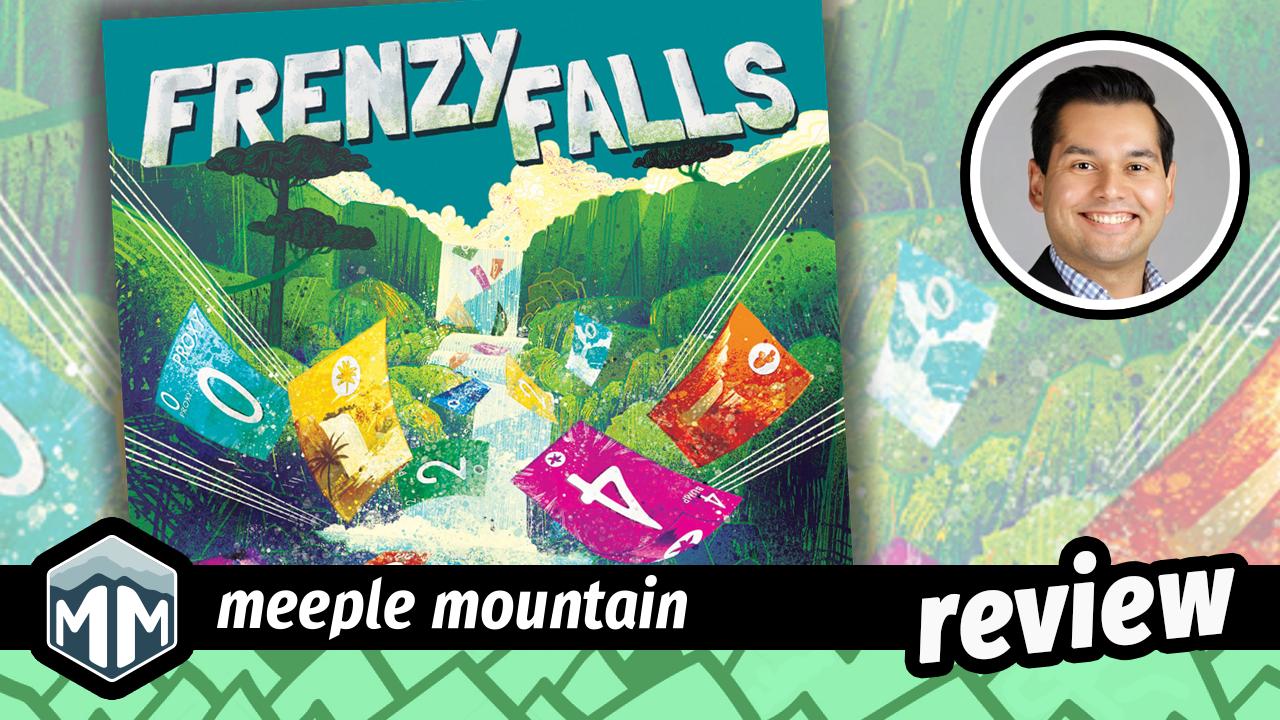
So when their names turned up on a game called Frenzy Falls, I was curious before I'd read a single rule. A card game about waterfalls, about pools filling up past where they're supposed to? Sure, why not. I've been talked into stranger premises than that.
[caption id="attachment_332196" align="aligncenter" width="1000"] Photo from USAopoly[/caption]
Slip-n-Slide
Published by The Op, Frenzy Falls seats two to six players around a row of Pools, each one anchored by a Score card showing a water value and a point value. On your turn, you slide a card face-down into whichever Pool you like, trying to control exactly when it tips over. Once a Pool's water total reaches ten, it spills. Whoever's stacked the most influence icons there takes the Score card, and whoever's holding the most points when the cards run out wins the game.
A little rabbit peeked cautiously over the edge of a vegetable patch, before it hopped inside and helped itself to a crunchy carrot. Soon, another rabbit joined in, nibbling happily on a radish, while a third disappeared behind broad broccoli leaves, and a fourth emerged triumphantly with an aubergine. Soon enough, mushrooms vanished as well, leaving only tiny paw prints behind. In less than a minute, the whole patch was filled with Rascally Rabbits by Ta-Te Wu from Sunrise Tornado Game Studio with art by TuziNeko.
Makoto Designer: Simon Weinberg Publisher: Mayfair Games / Huch! Players: 2-6 Age: 8+ Time: 20 minutes Amazon affiliate link: https://amzn.to/43Iz4el Played with review copy provided by publisher/designer Makoto, which means “sincerity” in Japanese, is a climbing card game … Continue reading →
I was back in my hometown of Kota Kinabalu (we call it KK) for the Sabah
National Tabletop Con over the weekend of 20-21 Jun 2026. This was my first
time exhibiting in my hometown, so it was a meaningful event. This same event
was held last year, but unfortunately I couldn't attend. This year it was held
at the Sabah Art Gallery. We had many exhibitors from Malaysia and Singapore,
Contrary to many in the boardgaming hobby, I do not bling out my games, in part because I am better able to rationalize my next, totally unnecessary, board game purchase if I know I passed on the metal coins for my last Gamefound pledge. Thus, I have monitored the recent trend of classic Eurogame deluxification—including […]
My colleague, Bob Pazehoski, wrote a review of Canvas back at the start of 2023. His assessment was that the game was midline: not bad, not great, just sort of there (3 stars). My friend Steve came up over a weekend and introduced it to my wife and I. We both thought it was gorgeous, fun, and engaging. If you want a good overview of the mechanics, please read Mr. Pazehoski’s review. But check it out for yourself!
The table presence of the updated board from one of the expansions is amazing (sorry, this was Steve’s copy and I do not know which expansion did what to this game). The added depth of the Signature Style cards (also added in an expansion) is amazing, while not increasing the game’s difficulty. And the mechanics of creating the perfect painting are exquisite.
In the games we played, all of us would spend time reminding ourselves that the paint swatches at the bottom of each card were the game element, not the beautiful painting elements. I had to force myself to put in a piece of art which scored more points, but which did not meet my own aesthetics a couple of times. In the end, all of my paintings,…
Spirit Island designer R Eric Reuss says he is in talks with a new publisher for the hit cooperative game after opting not to renew its publishing deal with Flat River Group.
Reuss said he expects to be able to license Spirit Island to a new publisher “within the next year or so” according to an update posted to BoardGameGeek and Reddit, adding that dozens of publishers had reached out to express interest in the title and that negotiations with one unnamed company were “going well”.
Flat River laid off almost all Greater than Games’ staff and suspended new projects in April 2025, blaming economic pressures stemming from the US tariff crisis.
Reuss has now confirmed he decided not to renew Spirit Island’s publishing agreement with Flat River in the wake of its decision to lay off staff at Greater than Games.
He said, “I originally signed Spirit Island with Greater Than Games, which was acquired by Flat River Group around 2021-2022.
“In April 2025, FRG laid off nearly all Greater Than Games staff – the folks I’d been working with – and announced the suspension of all new projects. I submitted my non-renewal thereafter.”
Reuss said his agreement specifies that once Flat River’s licence expires, the company can no longer use the Spirit Island trademark or sell new copies beyond existing inventory.
But he added that ownership of the game’s artwork and graphical assets was “less crystal-clear”, and that negotiations with Flat River to reach a deal over the artwork rights had come to nothing.
He said in the update, “I’d be happy to pay Flat River Group to settle this matter and use the existing art, but what they’re asking for is so much higher than what I’m willing to pay that I have to assume a settlement won’t happen.
He added that he would not consider running a crowdfund from fans to raise money for acquiring the art assets from Flat River, saying, “Given that I don’t feel OK paying that much money, I really don’t feel OK asking Spirit Island fans to pay that much money.”
Reuss said new non-Flat River Group versions of the game would retain the same gameplay, spirits, powers, adversaries and expansions, but with entirely new visual interpretations, promising “vibrant, colorful, representational art”.
Despite the extensive visual overhaul, Reuss stressed that no second edition was currently planned, with only minor rules clarifications and potential balance tweaks currently under consideration.
He said his design priority remains the long-awaited Dahan-focused expansion, although recommissioning Spirit Island’s artwork was likely to delay development of that project.
The designer also confirmed that he has no plans to use generative AI artwork in the project, primarily because he wanted to “collaborate with, support, and celebrate human artists”.
He added in the update, “Ssecondarily because (a) all image-creating GenAI I know of was trained unethically, and (b) while queries aren’t so environmentally terrible as is sometimes asserted, training new models is another story entirely (and using GenAI bolsters demand for training new models).”
He continued “I’m not dogmatically anti-GenAI – I’d love to see ethically trained, environmentally conscientious, explainable, non-toxic, reasonably-secure public-option GenAI. Though that doesn’t address the impact on illustrators and other jobs, so maybe also UBI or something? One can dream.”
Reuss said that although dozens of publishers had expressing interest in Spirit Island since April last year, he added that if negotiations ultimately failed he would self-publish the game himself.
He said, “Spirit Island will continue being published, and I’m going to keep working on making new stuff for it. It’s not going away.”
New-to-me games played recently include … A GENTLE RAIN (2021): Rank 1014, Rating 7.6 A fairly straightforward, effectively solo co-op of drawing and placing a tile (Carcassonne style) to the common display to either complete a 2×2 square of … Continue reading →

 Anmelden








/pic9661762.jpg)


/pic9098763.jpg)