Anmelden
DCeased Lives — and Will Be Released in September 2026
07. August 2026 um 23:12
Michael Shinall's long-delayed CMON design heads to stores

Michael Shinall's long-delayed CMON design heads to stores

As a natural melancholic, the idea of being drawn to the sea — to drown one’s regrets, whether figuratively or bodily — makes me glad there isn’t a significant body of water within six hundred miles. It isn’t that suicide holds appeal for its own sake. Rather, it’s a fire door in the back, rigged with an alarm but duly located in case of an emergency. Sometimes, when an elderly person goes missing in the mountains, I wonder if they disappeared because of forgetfulness, as the silver alerts would have us believe, or because they could no longer stop remembering.
Deep Regrets, like Judson Cowan’s forthcoming Personal Demons, wears its metaphor on its sleeve only to collar it in gameplay. Perhaps we went to the sea to forget, to scrape our hull free of the barnacles that have accreted there, only to find ourselves fouled with a fresh catch. To mount an escape is to be caught.
Okay, now I’m being melancholic. At least it’s a good fit for Cowan’s intended topic.
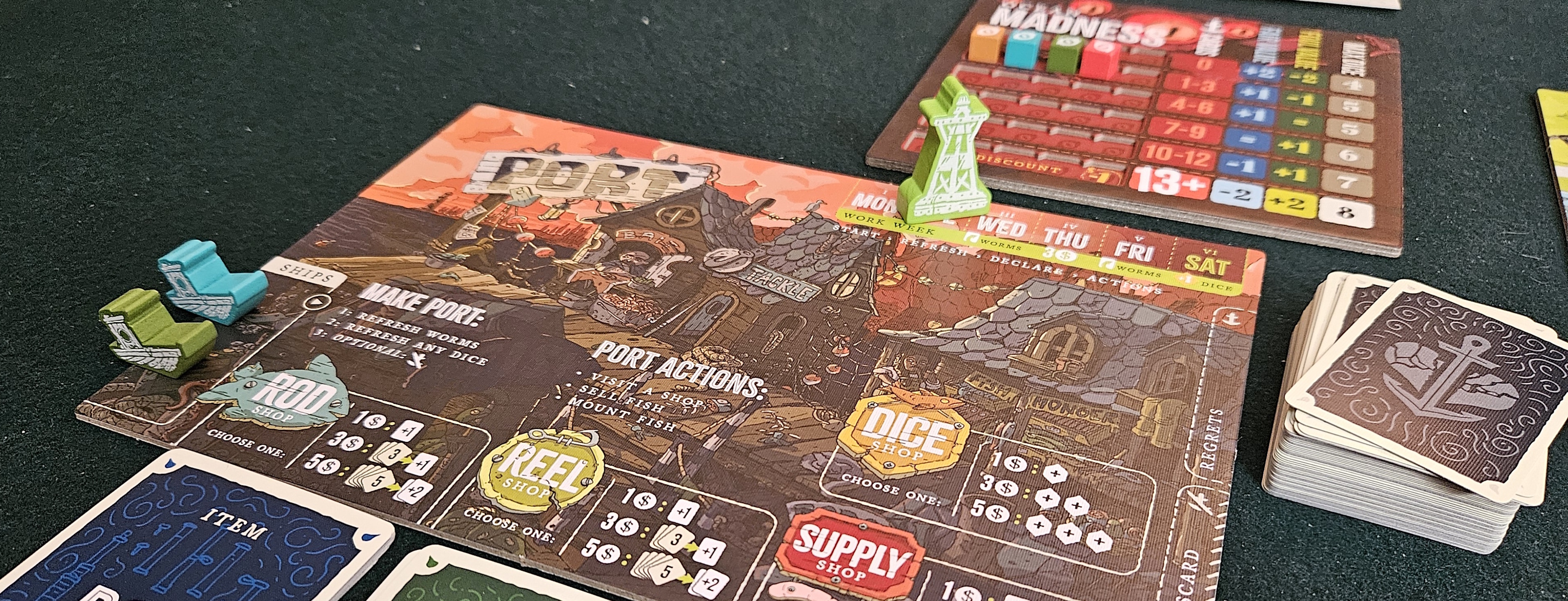
Hanging out in port.
“On the surface” is a loaded term for Deep Regrets. That’s because Deep Regrets is about surfaces and what lies beneath them. In terms of character, the surface reading is that you’re a fisherman. Not the catch-and-release kind, but rather the my-livelihood-is-disappearing-with-the-depleting-abyss kind.
Which is what drives your bayman to trawl ever deeper. As the shoals close to the surface grow thin, you seek more benthic prey. It’s a solitary practice, both thematically and at the table. Turns don’t exist in complete isolation from those of your peers; this isn’t a total multiplayer solitaire experience. But as we will see, there’s a lidless membrane between you and your peers that’s never quite breached.
For the most part — on the surface — Cowan plays it straight. The entire game could be described in that hobbyist shorthand that sounds alien to outsiders. Fishing is a press-your-luck minigame that expends dice and other resources to land the best fish. Every turn is framed around either a day at sea or one in harbor, trading your catch for equipment. There are subsystems aplenty: permanent and temporary dice, rods and reels with variable benefits, fish both great and small.
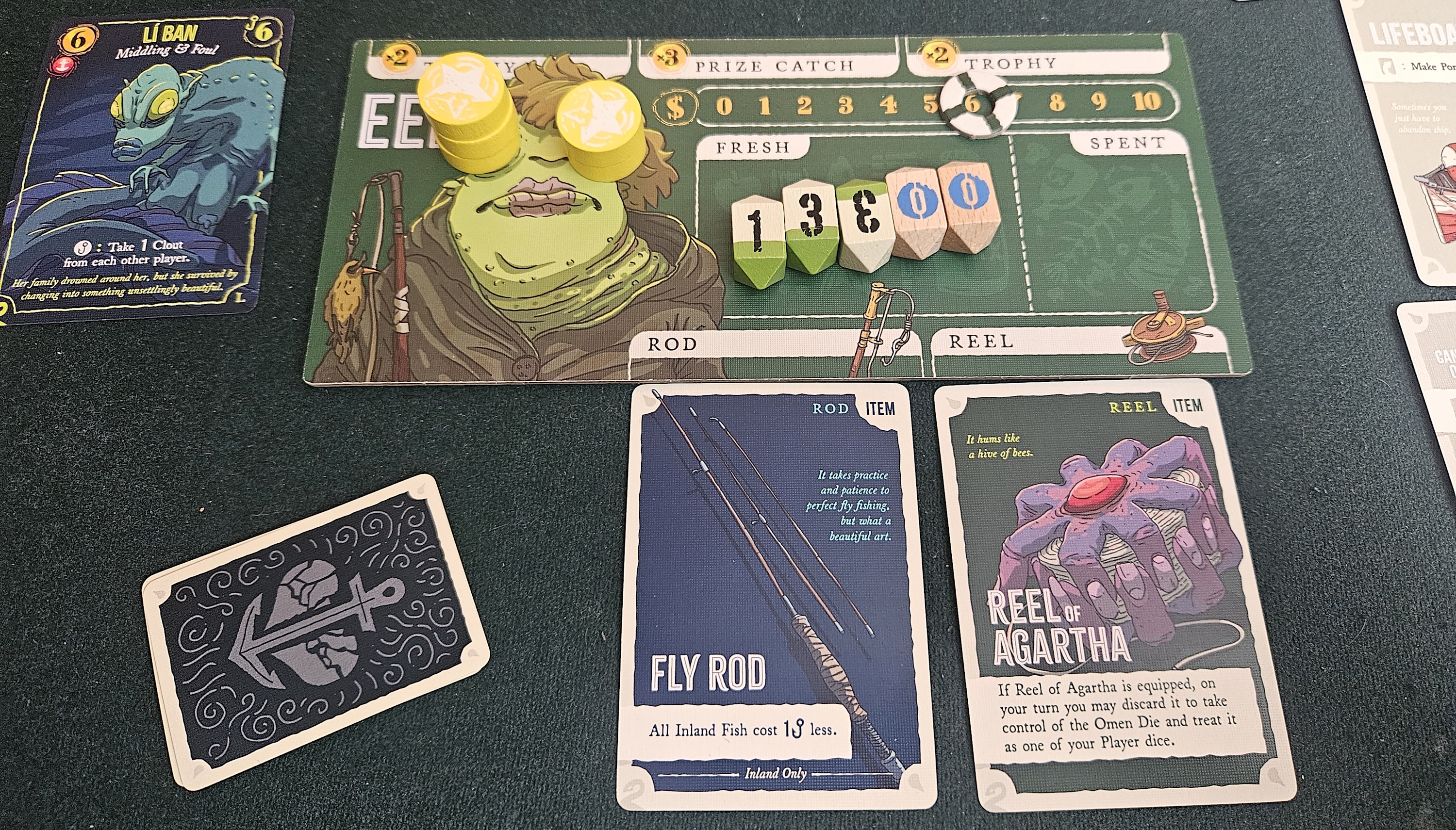
Check out my cool shades. They conceal my squamous nature.
What’s interesting about these systems, though, is what they communicate about both the gameplay and your character.
Starting with gameplay, Deep Regrets is — on the surface — an incredibly chancy plaything. Early on, there are clues one can follow: the shadow beneath the water reveals whether a catch is small, middling, or large, and various depths translate to creatures that are increasingly dangerous to land-based mammals. Your bayman also has access to a few starting tools, such as a can of worms for peeking at a shoal’s face-down card and a lifeboat for beating a hasty retreat to port if your odds at sea turn south.
It isn’t long before it becomes apparent that Deep Regrets isn’t as aleatory as all that. Oh, there’s always a sense of risk. It isn’t uncommon for a cocksure hand to take one risk too many and invite the wrath of something truly monstrous. There are cards in the deck, whether the base deck or one of its multiple expansions, that can very much ruin your day.
Still, there’s so much mitigation at play that it’s hard to regard Deep Regrets as quite as chancy as some have made it out to be. Failing to catch a fish results in grabbing a “dink” — fishing slang, not lifestyle slang — which offers some benefit of its own, whether better fishing or some cash value, to offset the sting of failure. Even a cursory glance at the equipment shop reveals tools that will offset any number of flubs or miscasts. It isn’t enough to strip the game of its uncertainty altogether, but these are hardly uninformed decisions.
This is all good stuff, and would provide plenty to mull over. But, once again, this only brushes the surface.

Not all catches are created equal.
It’s appropriate that where Deep Regrets expands its horizons is via the regret deck, a thick stack piled with all sorts of misgivings and heartbreaks. At regular intervals, your hapless fishers will land something special. A mermaid, perhaps, so shimmering with glory that it breaks your heart to haul her ashore. A leviathan, its mind linking to yours in its lashing final moments. Or maybe you’ll just sell something nasty at the fish market and feel bad about it. Regardless of the cause, these junctures see you drawing a regret.
Regrets matter in two senses. First, the number you hold in your hand determines your character’s current madness. The madder you become, the greater the risks you’ll take at sea and the weirder the creatures you’re willing to sell at market. Second, the sum of those cards determines which player is bitterest upon the game’s completion. This means tossing out your highest-scoring trophy.
What’s curious about regrets, though, is that they aren’t wholly undesirable. True enough, you would rather not have such terrible regrets that you fling your prize charybdis angrily into the sea. But a handful of regrets is… good, in fact. After a few days at sea, it won’t escape your notice that the deadlier deep shoals are packed with strange creatures. It also won’t escape your notice that these can be sold at higher prices and earn greater scores. But only if you’ve gone a little mad. Maybe even very mad. Not so mad that you ruin yourself. But mad enough to take the right risks and mount the right trophies.
Which is to say, Deep Regrets isn’t really about said regrets being bad, at least not always. In much the same way that Personal Demons doesn’t present fears as bad so much as things that need to be confronted, here one is invited to court regret, to dance with it, to dispel its worst excesses through clean living or self-medication or simple caution. Whatever works. But either way, a life without regrets hoists a lower ceiling, victory-wise.

Just some of the game’s many regrets.
Laid out like this, Deep Regrets’ messaging might come across as trite. Adolescent. As a species, we’ve told countless stories about how our regrets and failures are crucial stepping stones on the path to adulthood, from Picard being transformed into a timid science officer because he didn’t get shanked as a cocky ensign to the memory-erasing shenanigans of Eternal Sunshine of the Spotless Mind.
But Deep Regrets doesn’t come across as an adolescent musing. Its passage to success isn’t as straight as “regrets good.” Plenty of its regrets are well worth casting off. There’s a certain temporal wiggliness to the process; if you regret losing your arm or sacrificing your sister, I’m not wholly sure what it means when those regrets are discarded. Did we… forget? Get over it? Prevent its having happened through some demersal bargain? No idea. But the effect is one of curated regret, cautious regret, not wholesale acceptance or dismissal.
This makes Deep Regrets interesting rather than perfect. I wish the game had been pacier, but in some spots Cowan’s eagerness seems to have gotten the better of him. After the first few rounds, turns begin to bloat with extra dice, fish, equipment, and dinks. In the end, it isn’t the chanciness that’s the problem; it’s the replete tools for extending a turn and making outcomes more certain. As the game grows longer, its charms wear thin. Eventually, they rupture like aquatic flesh that’s gone too long without refrigeration.

Mounting my trophies, buoyed by regret.
Still, Deep Regrets is smarter than it looks. It’s a game that rewards peering beneath the surface, both in terms of gameplay and as a ludic examination of a life lived without too many guardrails. I can say this with complete certainty: I don’t regret the time I’ve spent with it. Not in the slightest.
Complimentary copies of Deep Regrets and its expansions were provided by the designer/publisher.
(If what I’m doing at Space-Biff! is valuable to you in some way, please consider dropping by my Patreon campaign or Ko-fi. Right now, supporters can read the next installment in my series Talking About Games, this time tackling the topic of what makes a good list! Naturally, the piece includes a list.)

Plus, more feline fun awaits in Good Kitties and Super Chonk


A trio of veteran board game industry professionals have launched a new tabletop gaming agency, with the aim of helping businesses within the hobby get their games developed and into the market.
Hues and Cues designer Scott Brady, Sagrada co-creator Daryl Andrews and Friendly Skeleton CEO Jacob Way said Best in Play will offer everything from interim executive leadership and designer representation to publisher submission management and crowdfunding strategy.
Brady said, “Best in Play was created to bring together people and opportunities that should already be working with one another.
“Great intellectual properties need the right designers and publishing partners, designers need better access to decision-makers, and companies sometimes need experienced leadership without the time or resources required to build an entire department.”
Best in Play says its five core service areas comprise IP matchmaking, crowdfunding consultation, interim replacement of key personnel, publisher-inventor relations and identifying publishers and licensing opportunities for individual games, multiple projects or designer catalogues.
The company announced at launch that it has already been hired as a consultant for an unspecified US-based “creator-brand merchandising and e-commerce company”, providing senior-level leadership and games-industry expertise while the client continues its search for a permanent head of games.
Best in Play said that project will run the gamut of product development, licensing, publishing, production, crowdfunding and portfolio strategy.
Andrews said of the assignment, “An important initiative should not lose six months of momentum because a key role is temporarily vacant.
“Our model gives clients access to an experienced team that can step in quickly, evaluate the situation and keep products, partnerships and internal teams moving forward.”
The company is also working on a tabletop project based on an unnamed “major video game intellectual property”, with a crowdfunding launch planned for early 2027.
Way said, “A recognizable property may attract attention, but a successful crowdfunding campaign still needs the right product, positioning, audience strategy and operational plan.
“Our goal is to build campaigns that respect the fans, communicate value clearly and create a foundation for success beyond the initial launch.”
As well as the founding trio of managing directors, the Best in Play team also includes strategic contributors David Gordon, the co-creator of Finspan, Eastar Game Manufacturing founder and CEO David Du, Legend of the Five Rings: The Card Game co-designer Erik Dahlman and Daniel Pesante.
The launch comes hot on the heels of Brady having unveiling his new publishing initiative Proof-of-Play late last month, which is designed to tackle one of the tabletop industry’s growing challenges: promising games sitting unpublished because publisher release schedules are already full.
Brady previously launched his development studio A Game Studio at the start of 2024, following the 2020 release of the big-selling Hues and Cues and the success of his cat-themed abstract strategy Boop in 2022.
He is also the co-founder of Play to Z, the publishing house led by former Z-Man Games founder Zev Shlasinger launched by a host of board game industry veterans in 2023.
Fellow Best in Play managing director Daryl Andrews is best known as the co-creator of award-winning tabletop game Sagrada, while his other co-designs include Batman: The Dark Knight Returns – The Game, Donald Duck in Happy Camper and Mistwind.
He previously spent two years as head of talent acquisition at Maestro Media, following several months working in investor relations, before leaving the company in early 2025.
Jacob Way, meanwhile, began his board game career as COO and co-founder of Deep Water Games, which for several years operated as a subsidiary of Ox Eye Media.
Deep Water, which is best known for sketching game MonsDRAWsity, spun out from Ox Eye as an independent business in 2022 under Way before rebranding as Friendly Skeleton.
The publisher is currently in the process of delivering the heavily delayed crowdfunding campaign for Monsdrawsity: Unusual Suspects, created in collaboration with renowned board game review site Shut Up and Sit Down, which was initially estimated to reach backers in May of 2022.
Anyone interested in getting in touch with the team can visit the Best in Play website or email info@thebestinplay.com.
The post Trio of board game industry veterans launch full-service agency Best in Play first appeared on .
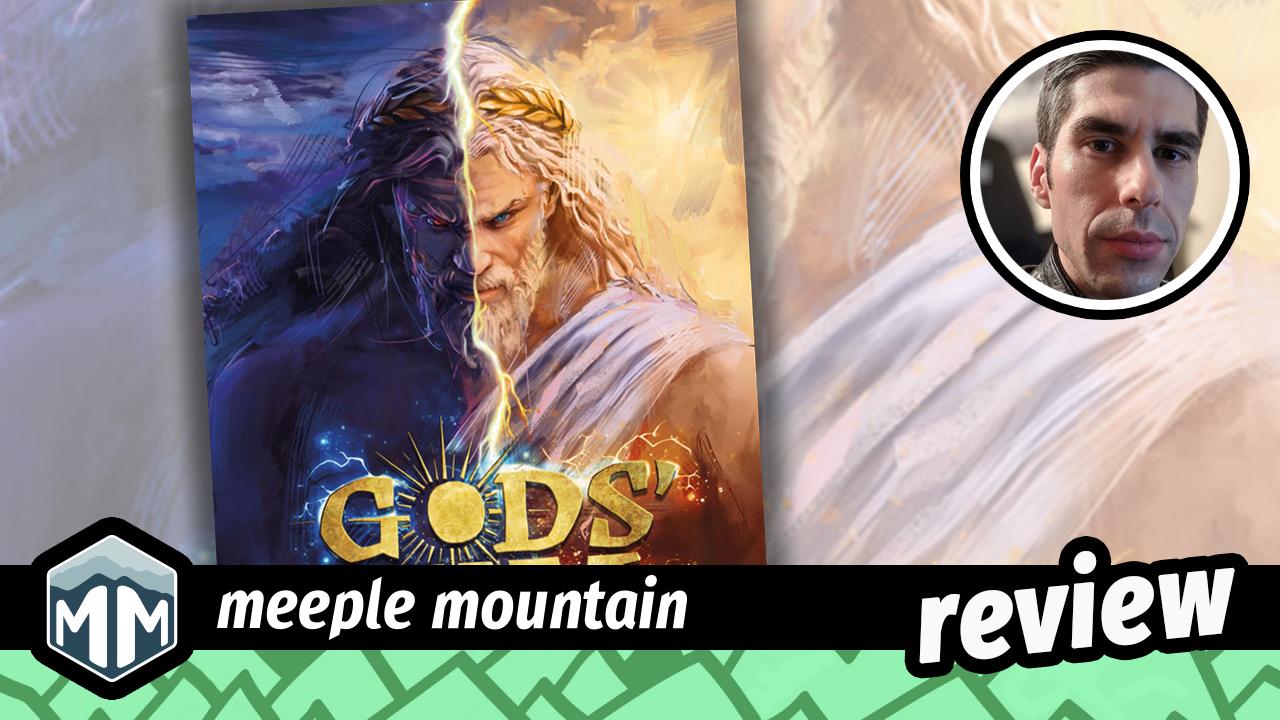
Gods' Will showed up in my social media feed, comparing itself to Resistance: Avalon like a new kid on the first day of school telling everyone he used to be popular somewhere else. I have heard this pitch. I have reviewed this pitch twice, from Witch Hunt and Human Punishment, two games that made the same promises and delivered the same disappointing results. So when Gods' Will came knocking with the same marketing aura, I had to open the door with at least one eyebrow raised. Maybe I’m just addicted to disappointment, who knows.
After half a dozen plays, I can say with a bit of confidence that Gods' Will is doing more right than wrong here. More importantly, it earns it by fixing the real problems with its predecessors rather than just the ones that look good in a Kickstarter pitch.
Like 90% of social deduction games that have ever existed, there are two teams: Light and Dark. There is also a loner faction, a third party whose goals shift depending on player count and whose presence ensures that the ride from start to finish won’t ever be a smooth one. Every player is a God with a public special ability…
The post Gods’ Will Game Review appeared first on Meeple Mountain.
I picked up a copy of Art Society based on my friend and colleague Justin Bell’s excellent review of the game. After weeks of heavier games, I thought my gaming group would like something lighter.
Art Society is a shape-laying game where you’re trying to cover all the spaces on your board. Unlike many current games, the shapes here are simple rectangles, and your board is square, making for easier planning. Players take turns being the Auctioneer, meaning they pick the paintings up for bid that round. Highest bidder takes first choice, then the second, third, etc. Your new painting gets placed on your board, touching at least one side of another painting, then the next player sets up the next auction.
Justin discussed what makes Art Society such a good light game, but I want to tell you about the production of the game. The paintings themselves are alternative takes on famous images, and come with half-circles around the edges that show how many spaces on the board it will cover. The board has slight round bulge that matches those half-circles so the paintings stay in place better. The bidding indicators are paper auction bidding paddles. Perhaps best of all is the box insert.…
The post Quick Peaks – Art Society, On Mars, Vampire: The Masquerade – Vendetta, Rock Hard 1977: Ear Candy, 7 Wonders Dice appeared first on Meeple Mountain.
My WBC 2026 is over and I’m sad about it! Well, it actually ended last Thursday evening after 5 1/2 days of gaming goodness, but I am now just putting together this wrap-up post. I had planned to stay until Saturday morning and then leave to come home to attend a concert with my wife for our 30th wedding anniversary (Darius Rucker) but I had some pretty severe back pain late Thursday evening that haunted me through the night only allowing to me to get a few hours of restful sleep and when I awoke on Friday for my last planned day my back was pretty stiff and I couldn’t see sitting around for 12 hours at a gaming table and then having to drive home on Saturday. So, I made the mature decision to pack up and leave Friday morning to avoid it getting worse and making the 6+ hour drive home more difficult. This caused me to miss a rousing multi-player game of Virgin Queen from GMT Games on Friday and I am very sad about that. But, I made the correct choice and am now home safe and sound and my back got a bit better overnight on Friday and has pretty much now totally recovered. On Saturday morning and into the early afternoon, I did spend some time organizing the games I played at the convention but didn’t put up neatly and also clipping the counters for a few new games to ready them for play.
This was an extremely productive trip this year and I had a blast. I wanted to simply give you a quick look at my time at WBC and share what I was able to accomplish by myself as once again Alexander was not with me and I was flying solo. If you are interested in more detail than is found here, you can visit my Daily Debrief posts at the following links:
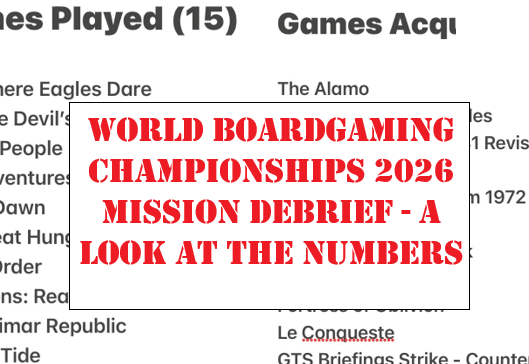
Here is a look at my overall statistics for what I accomplished in 5 1/2 days.
If you don’t know, I am infamous for my activity and schedule while attending these conventions. I just really love conventions and playing lots of multi-player wargames and also meeting great people. It is the fuel to my fire and I truly try to schedule my time while at the convention. I always play a ton of games but also try to get in many interviews with designers and publishers to share with you our readers. And this year, was extremely productive and I was asked several times how I have the energy to keep up such a torrid pace and I really don’t have an answer. But, you are the beneficiary of my pace and I am going to give you an overview.
I played a lot of games. That is what I do. I am a content creator who loves to game and I played 2-4 games per day over the 5 1/2 days there for a total of 15 games played. I always feel like I am running from one thing to the next but it works for me and allows me to be exposed to a lot of different games. These numbers are a bit skewed though as I played 2 games on Sunday all day pretty much in Grand Tactical Series (GTS) Where Eagles Dare and The Devil’s Cauldron and counted that as 2 separate games when in fact it was just one large combined game that I played bits and pieces of as I was assigned by the overall commanders when chits were drawn and those formations were activated. But as you can see from the list below, I got in some bangers. Classics. Games that I have always wanted to play but have never had a chance. New systems. New games and some games that are still in playtest and development.
Now you might be asking what games did I like out of that list and I would answer all of them, with the exception of The Adventures of Conan from Gale Force Nine. We bounced off this one hard. Poor rules, lack of structure and little clarity, which is a shame. The art is fantastic, great components with custom dice but I felt like we had no idea what we were doing or how we were supposed to reliably get things done. Standout games were Baltic Empires from GMT Games, Korean Tide from Compass Games, World Order from Hegemonic Project Games and Above the Trenches from Flying Pig Games. But the highlight for me was playing the Grand Tactical Series from MMP with a combined game of Where Eagles Dare and The Devil’s Cauldron. I liked that one so much that I purchased the GTS Briefings Magazine with the pack-in game Strike – Counter Strike and look forward to getting this one played.
As you know. one of things we do at these conventions is video interviews with designers and early looks at their upcoming games. This year was no exception as I was able to do a total of 7 video interviews. I am a bit worried about them though as I was having major technical difficulties with the camera and batteries holding charges and had multiple videos where the battery just up and died and the camera stopped working. I had to then change out the battery and try to start where I think it went off but I expect that some of the videos will have missing sections and I apologize for that. Below is the list of video interviews that I was able to accomplish.
Once Alexander gets back this week, and he has had a chance to download the videos, review them and try to stitch them together as best he can we will start putting them up on the YouTube Channel for your viewing pleasure. I would expect that to happen in the next 2 weeks. I still have to put together a debrief video as well and that one will probably lead the videos on the channel.
Now, WBC is not a buying convention but there is a small vendor area at the site with publishers the likes of Compass Games, GMT Games, Flying Pig Games. Blue Panther, MMP, Decision Games, Wharf Rat Games (new this year), Sound of Drums (new this year) and B2M Games (new this year). They are open for sales on Thursday, Friday, Saturday and Sunday and typically all of the vendors offer 10-20% off retail prices for attendees.
This year, I purchased or acquired 9 total games. Now I needed these 9 games like I needed a hole in my head but they were all nice looking games and several of them are solitaire offerings that I will play on my own time at my gaming table. Here is the list of games that I was able to acquire.
Most of these games are brand new 2026 offerings, with the exception of GTS Briefings Strike – Counter Strike, which I believe came out a few years ago. The others are all new games and we will add them to our list for 2026 and try our best to get them played so we can share our thoughts with you.
I love WBC. It is the highlight of my gaming year and I very much look forward to attending each and every year. There is something to be said for being locked into a building with 3,000 gamers who all love gaming! They are there to play, discuss, buy, sell, compete at, enjoy and examine wargames. There are people who come to this event every single year and plan the entire week out with monster wargames. Where else in the world can you do that? Well, there are a few other places but WBC is a brotherhood. I feel a true kinship with the people that we have met there and played with. I feel true friendship for people that I have had amazing conversations with like Mark Herman, Greg Smith, Mark Holt Walker, David Heath and others. I feel the kinship and the closeness and it is wargames that have brought us together. That and a healthy respect and interest in military history and those who have served our country to make our freedoms possible.
Wargaming is a hobby like no other. We are crusty older people (at least I am) who sit in the dark for hours upon end pushing around cardboard counters to replicate or do better than the historical result from many a by gone battle. This hobby is about connections. I talked to people who have played with the same person in their basement for decades. I have heard from some who look forward to WBC each year for the B-17 Queen of the Skies events because they have flown with the same bomber group for nearly 20 years. What does that tell you about our hobby? Connections. We do this because of the connections that we make. The friendships. The relationships. And I love it.
If you have never been to WBC, please consider attending next year. I promise you will not regret it. And I might just be able to make a few new friends if you show up.
Here’s to next year when the convention will run from Saturday, July 24th through Sunday, August 1st.
-Grant
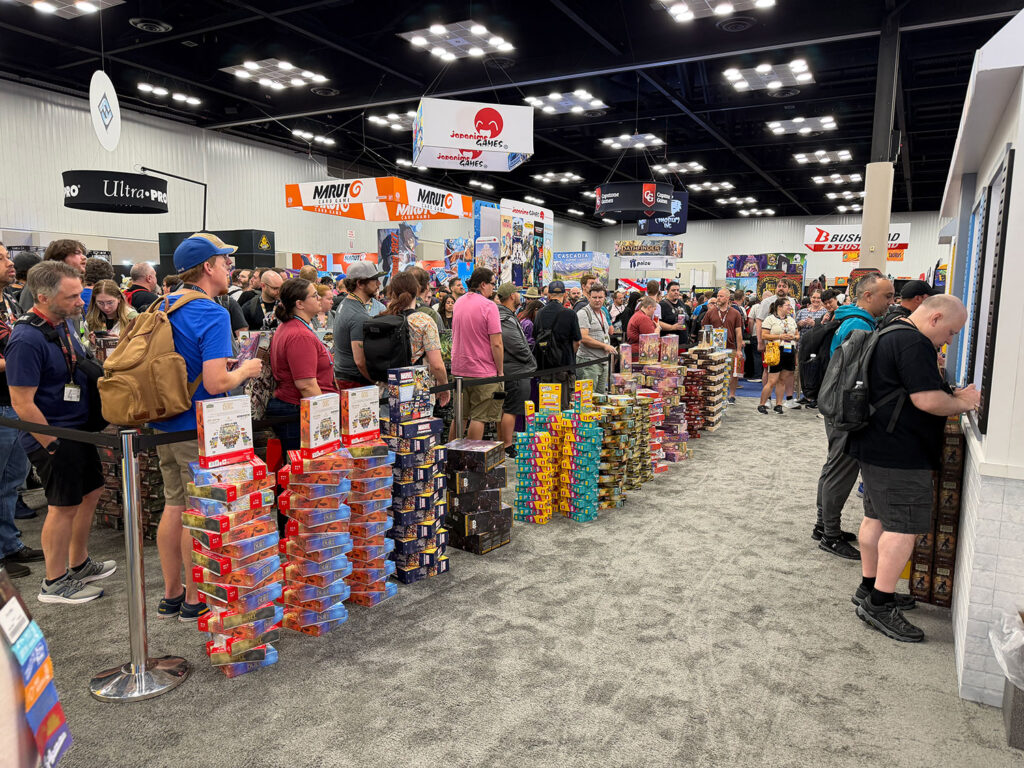
Seventy-four thousand people walk into a bar. That’s it. That’s Gen Con. BGQ was there, and we’ve got the recap to prove it. The Gen Con Experience Tony: Gen Con’s attendance this year came in at 74,000+, which was apparently a record. But it felt more crowded than ever to me. When the dealer hall […]
I follow Games Unlimited PGH (@gamesunlimitedpgh) on Instagram, and Kylie frequently offers really helpful retailer perspectives for publishers to consider.
One of his recent videos (actually a repost from a few years ago) was both surprising and insightful in a few different ways, as Kylie reveals that he–a very successful retailer–does not like promos.
Even as a publisher that doesn’t make promos (it was something we tried up through Scythe’s release in 2016 and then stopped pursuing), I was really curious to hear his reasons. Especially since a survey I ran of retailers in 2017 indicated that 79% of friendly local game store (FLGS) owners liked promos at the time.
Kylie’s reasons are:
A lot of publishers send promos to his store, but it takes a lot of work to match them with the game (stores juggle a lot of different games, and promos aren’t always labeled well).Kylie concludes by simply asking publishers to put promos inside the game box. This seems viable in most cases: Even if you make a special promo card for an existing game to offer at a convention, a content creator, or any circumstance, you can include it in future printings of the game.
I really like that Kylie ends with this: “We’ll do the work of selling your game because it’s awesome, not because we have some rare or exclusive promo.” That 100% echoes my beliefs about actively welcoming people into our games instead of using FOMO/exclusivity tactics.
What do you think about this opinion about promos?
Also read:
If you gain value from the 100 articles Jamey publishes on this blog each year, please consider championing this content! You can also listen to posts like this in the audio version of the blog.

Few people in the hobby game industry have seen as many sides of the business as Scott Morris – from leading global strategy at Lucky Duck Games, building publishing partnerships at GTS Distribution and running sales, marketing and social media at Arcane Wonders. Now Morris is applying that experience to his own venture as founder of Steelwing Games, whose debut title Rainbow Blvd. has been nearly a decade in the making. He spoke to BoardGameWire about deciding to launch as a publisher in a challenging market, why he believes a slower, more selective approach is the right fit, and the lessons he is bringing from his career at Lucky Duck Games and beyond.
BoardGameWire: How long has the idea of you launching your own publisher been rolling around your head? I think I remember you saying you registered Steelwing some years ago?
Steelwing originally began to take shape in 2016, after first playtesting Rainbow Blvd. (which was then called Leprechauntractors as a play on words with Leprechauns and Contractors). Like a lot of people who work in games, I’ve always had ideas about the kinds of projects I’d love to help bring to life if the timing, team, and titles were right.
The company itself was set up in 2021, and I’ve been very intentional about not rushing into publishing just for the sake of launching something. For me, it was important that Steelwing start with the right game, the right creative partners, and a clear sense of what we wanted the company to stand for.
What was it that finally got you to make the jump and launch?
It was really a combination of timing, people, and product. Rainbow Blvd. is the perfect first game, it always has been. It has a fun identity, a strong table presence, it is easy to teach, and has the type of meaningful gameplay that Steelwing is focused on.
I also reached a point in my career where my experience across multiple areas (sales, marketing, crowdfunding, distribution, licensing, production, and working with designers) has given me the confidence to give Steelwing a thoughtful and responsible start.
What does Steelwing represent or offer that perhaps hasn’t been possible for you in your other board game industry roles?
Steelwing gives me the chance to build something from the ground up with a clear creative point of view. The goal is to publish games that are welcoming, polished, distinct, and deliver a satisfying and rewarding experience for players.
The name reflects that mission. The “steel” represents the experience and discipline I’ve built in the industry, while the “wing” represents using that experience to help create opportunities for others and give talented people new pathways into board games when and where we can.
At its heart, Steelwing is about making games we would be thankful to have in our collection while trying to leave the industry a little better than we found it, along the way.
The industry has been facing higher manufacturing costs, tariffs, freight disruption and increasing competition for attention. Many people might see this as a difficult time to launch a publisher. What makes you optimistic?
It is absolutely a challenging time, that can’t be minimized in any way. Costs are high, attention is hard to earn, and publishers need to be more thoughtful than ever about what we make and how we make it.
What makes me optimistic is that players still respond to games that they can connect with, that have that special feel, and are well cared for. This is a time to be disciplined, focused, and clear about why a game deserves to exist. That is the mindset I am bringing to Steelwing.
Of course it will be challenging. There is never a perfect time to start a new business. One of the principles I try to live by is, “Be good today and be better tomorrow.” Staying humble, listening carefully, continuing to learn, and making games that bring people joy, will result in positive outcomes for Steelwing and more importantly, for the community.
Having worked in the industry for more than a decade, which experiences most shaped the way you’ll run Steelwing?
Not to date myself, but it’s closer to two decades, and actually my second stint in the industry. A long time ago, in a galaxy far, far away (known as Poughkeepsie, New York), I had my first opportunity in games as a retailer, managing a local store called Iron Vic’s.
The experiences that have helped shape me are the ones where I’ve been able to see the full path a game takes from idea to table. A great design is essential, but game development, product development, manufacturing, communication, and post-release support all shape the experience players ultimately have with a game.
One night, while developing Rainbow Blvd., we realized the rainbow borders on some cards felt slightly different. Opening the files in InDesign, we found that one border was 13 pixels from the cut line and another was 15. Those two pixels bothered me more than they probably should have, but I knew someone, somewhere, would have that same subtle feeling that something was off. So we spent several hours fixing it. Was it necessary? Maybe not to some, but for me, it was 100% necessary.
I’ve also been fortunate to learn from many generous and experienced people across the industry. Those relationships have shaped how I think about publishing, leadership, and the responsibility that comes with bringing a game to market.
My goal with Steelwing is not to assume we’ll get everything right. We won’t. But experience gives us a better chance to be thoughtful, avoid preventable mistakes, and build trust with the people who help bring our games to life and with the people who enjoy them.
Your recent newsletter makes clear Rainbow Blvd. has been in development for years, with prototypes dating back to 2016. What made you confident about launching a new publisher with this title?
Rainbow Blvd. has had a long and amazing road, and I’m looking forward to sharing more of that story through our updates and crowdfunding campaign. At times, it has felt as though it has a life of its own. The core idea has stayed strong through a slow-and-steady development process, while the game itself has become more focused, more accessible, and more visually distinct over time.
What stood out to me is that Rainbow Blvd. has immediate appeal, while also providing a very satisfying experience underneath the surface. People are drawn to the colorful 3D rainbows and cozy city-building theme, and then after they play a turn or two, they find meaningful decisions, shared incentives, and strategic choices that make the experience engaging for many different types of players.
That is exactly the space for Steelwing to live in; games that feel welcoming regardless of a player’s experience level, while being memorable and rewarding. Great games have “stand up moments” where players feel rewarded for their choices, and even greater games leave players with that “I can’t wait to play again” feeling. Rainbow Blvd delivers on those two things and [designer Adam Wyse] has done a tremendous job developing it into something approachable, clever, and special! I’m excited to help bring it to players around the world.
What kinds of games are you actively looking to sign? What does a Steelwing game look like?
A Steelwing game should be welcoming and engaging while delivering a memorable experience. The experience is everything. Positive, clever, engaging, intriguing, and above all else, fun.
We are actually not actively looking for games, as we have a publishing plan in place until 2029. If and when we open up for submissions, some key elements are games that are teachable, replayable, and have a clear reason to exist on the table. Strong table presence helps, a unique theme helps, and unique components turn simple into satisfying. That is where my strength as a publisher is; taking a good game design and helping turn it into a full product that delivers a positive experience.
Are there any particular themes, mechanisms or types of games you’re especially excited about right now? Or any genres or play experiences you think are currently underserved?
I believe there are still so many themes, mechanisms, and combinations in games that have not been fully explored yet. I’m especially interested in games that create positive interaction without relying only on direct conflict. I like games where players are paying attention to each other and the choices being made, where timing matters, and where the table feels alive, but not necessarily because players are attacking each other or tearing each other down.
Rainbow Blvd. is a good example of that. We’ve worked hard to make sure players stay engaged even when it is not their turn, because what other players choose can also create opportunities for others. That kind of shared excitement and mutual interest keeps the game active from turn to turn and feeling alive.
There is still a lot of room for beautiful, accessible strategy games, games that families, couples, casual players, and hobby gamers can all enjoy together for different reasons. As a wise person once said, “The people around the table are more important than the game on it.” I hope Steelwing games can help create many of those nights.
How many games are you realistically aiming to publish each year?
The plan is to stay steady, planned, and manageable. Realistically, the goal is not to publish a large number of games each year. I would rather do fewer games better than stretch the company too thin. Right now, we have Rainbow Blvd. crowdfunding this year on Kickstarter and delivering in 2027, plus an unannounced game to crowdfund in 2027 and deliver in 2028. Releasing games in a measured and manageable way is the pace to keep at the start and the primary focus.
Is the goal to remain deliberately boutique, or would you like Steelwing eventually to become more of a mid-sized publisher?
The goal is to grow responsibly. I’m not opposed to Steelwing becoming larger over time, but only if the growth supports the quality of the games and the experience for players. For now, I would describe the goal as focused. We want to be selective, build trust, and make each release feel intentional, delivering the best possible experiences to players.
Will you primarily publish original games, or are licensed titles also part of the long-term strategy?
Original games are the main focus, especially as we establish Steelwing’s identity. That said, I have a lot of respect for what a well-matched license can do when it genuinely supports the gameplay and audience. “Never say never” is the saying, but fit also matters. I am not looking to chase licenses for the sake of it, and our focus is on Rainbow Blvd and the next title, which is also an original, internal game. (Which, I can’t wait to talk more about, as it is also a very unique game like Rainbow Blvd. that gets me excited every time I play it.)
Are you actively accepting pitches? And if so, what kinds of games are you most hoping designers will bring to Steelwing? How should they contact you?
We’re not accepting unsolicited pitches right now. Steelwing already has a publishing plan in place for the coming years and I want to make sure we give those projects and relationships the attention they deserve. If and when we do open submissions, we’ll be looking for games that feel welcoming, replayable, visually engaging, and have a clear reason to exist on the table. However, I don’t want designers sending us projects before we have a proper process in place, especially if those games could be finding the right home elsewhere. We’ll share clear guidelines through SteelwingGames.com and our social channels.
Will every game crowdfund first, or do you plan to vary that from title to title?
Crowdfunding will be an important part of Steelwing’s strategy, especially early on, because it allows us to build community around each game and communicate directly with the players most excited about it. That said, I do not think every game has to follow the exact same path. The right approach depends on the game, the audience, the production needs, and the retail strategy.
Looking back over your career so far, what’s the biggest lesson you’re taking into Steelwing?
The biggest lesson I’m taking into Steelwing is that publishing is a long-term relationship business built on trust. A good game matters, of course, but so does how you communicate, how you treat people, how you handle problems, whether your decisions are sustainable, and how well you stand behind your product after it reaches the table.
I want Steelwing to be known not just for the games being made, but for being thoughtful, reliable, and committed to delivering exceptional experiences. Steelwing is intentionally lean right now, supported by a group of passionate and talented contractors, partners, and collaborators who believe in the goals and the games.
One of the things I love most about the board game industry is how accessible and personal it can still feel. I want to have direct relationships with our players. I want to hear their stories of fun, triumph, defeat, and laughter. And just as importantly, I want to hear where we can improve, because every release should help us get better at serving the people who choose to put our games on their table.
Are there any elements of being a publisher that you’ve experienced in your time in the industry that you’re deliberately trying not to do with Steelwing?
One of the most challenging things in this industry, and in life in general, is the art of saying “no” when it needs to be said. Every company has different pressures and constraints. For me, the goal is to avoid growing too fast, avoid overpromising, and avoid taking on games that cannot be given the attention they deserve. That means being honest about what can be done well, while being disciplined enough to say no when something is not the right fit.
You’re still part of Lucky Duck Games. How do you balance those responsibilities with running Steelwing?
The true answer is, “Very carefully”. My responsibilities with Lucky Duck Games remain my professional priority, and I take them seriously. I’m grateful for the opportunity I have here and for the talented people I continue to work with. Steelwing is a separate project, and I’m careful about keeping those responsibilities distinct. That means being thoughtful with my time, avoiding conflicts, and making sure Steelwing is built in a way that does not interfere with my daily obligations. Maintaining trust and professionalism matters a great deal to me.
If you were to look forward five years into the future of Steelwing, what do you hope you’ll see?
Five years from now, I hope I’ve grown to become a better publisher and I hope Steelwing has a meaningful catalog of games that people are excited to recommend to their friends and family. I would love for players to see the Steelwing name and feel like it stands for games made with intention, love, and care.
I do not think success has to mean being the biggest publisher. For me, success would be building something sustainable, respected, and joyful, both for the people who make the games and the people who play them.
Rainbow Blvd.’s Kickstarter pre-launch page can be visited here.
The post “This is a time to be disciplined, focused, and clear about why a game deserves to exist”: industry veteran Scott Morris on launching new publisher Steelwing Games first appeared on .
Arresting gameplay from Peer Sylvester, designer of The King Is Dead
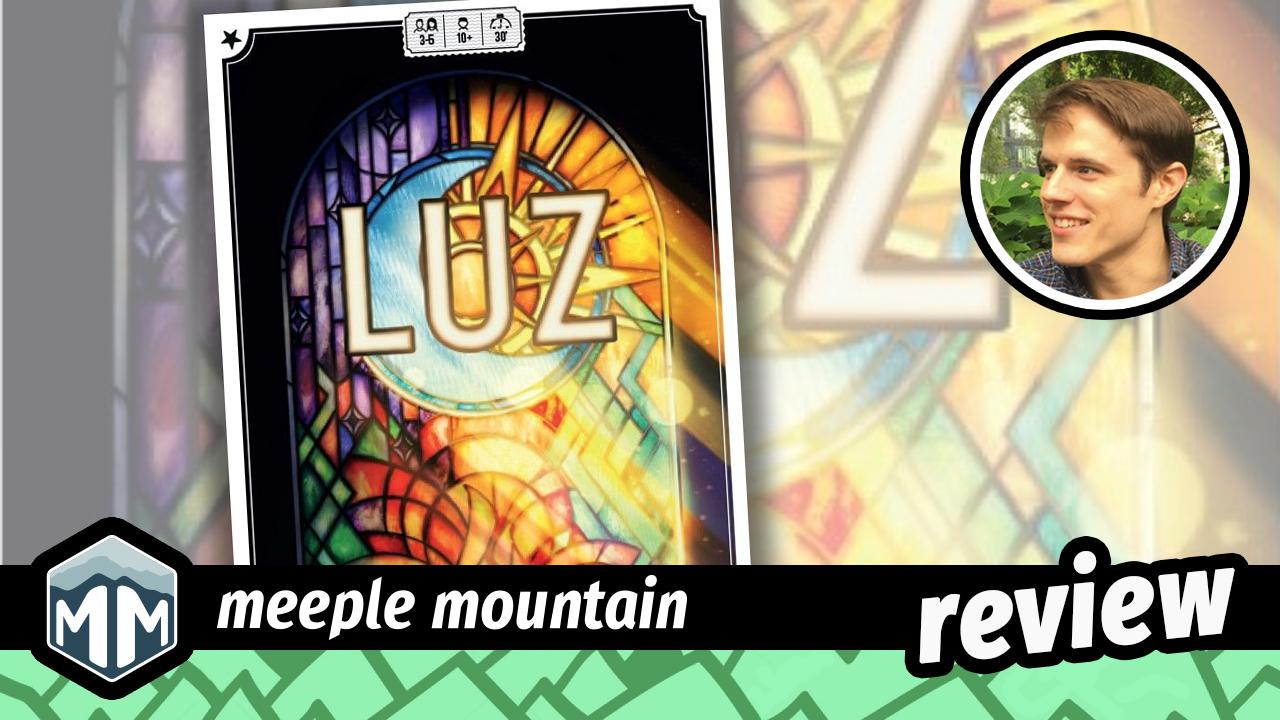
With a title like LUZ, Spanish and Portuguese for “light,” you’d expect this Taiki Shinzawa trick-taking game to have a bit more clarity. Silly you. Silly me! LUZ is a game of shadows and half-knowns, a trick-taker that casts a shadow of uncertainty.
Given that Shinzawa is responsible for the likes of Ghosts of Christmas, a trick-taker in which you play three or four must-follow tricks at the same time while the trump suit shifts with player behavior, I should clarify that LUZ isn’t that opaque. It’s all relative. If Ghosts of Christmas is a few standard deviations outside the mean, LUZ is safely within the bell part of the curve.
This is a must-follow trick-taking game where players bid before the hand begins. You have the choice of making an exact bid, which requires you to hit the nail squarely on the head in order to score, or a more forgiving bid that gives you one trick’s worth of wiggle room in exchange for scoring half the points. Higher risk, higher reward.
This doesn’t sound so different from whist, other than the room for some wiggle in your wager. The opacity comes from the last two rules: the back of each card indicates what suit that card belongs to, and you never know the values of your…
The post LUZ Game Review appeared first on Meeple Mountain.
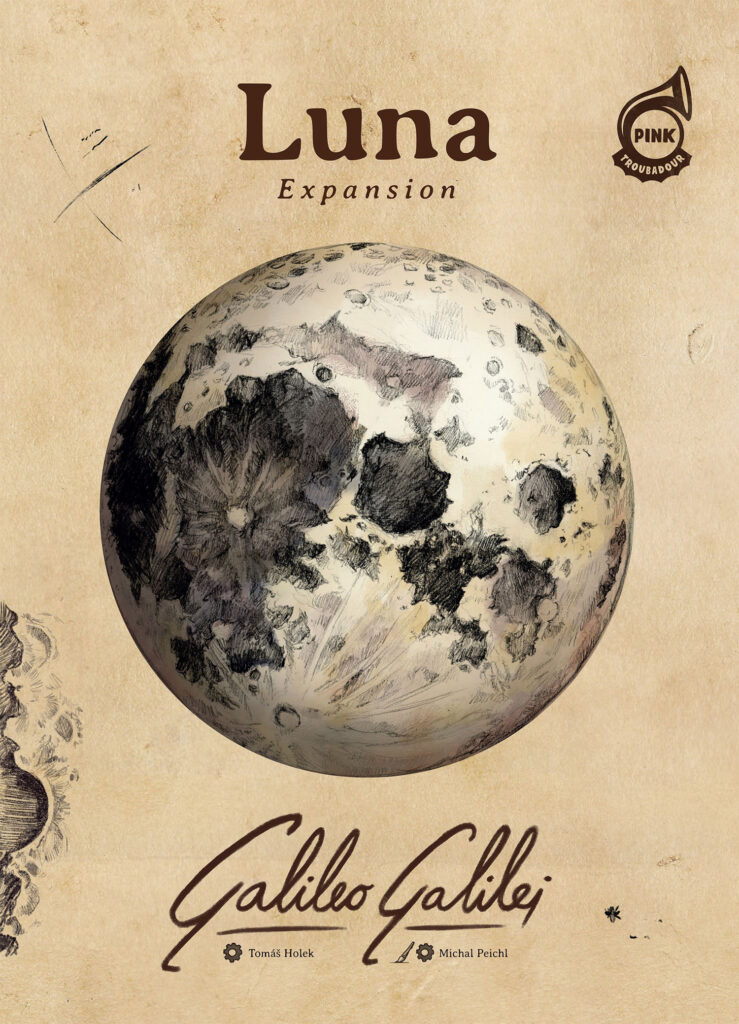
As I approached the BGQ Review Copy Altar (B.R.C.A, for short), a new in-shrink copy of the Galileo Galilei expansion, Luna, materialized in front of me. I looked around. “Hello?” No one responded. Tony is usually there for a snide comment, or Chris is hiding, waiting to snipe the copy right before you pick it […]

I love a different style and focus of wargame. A game that takes a look at an important but somewhat obscure or rarely addressed historical topic, such as espionage or intelligence, and creates a gaming experience tailored around the events to highlight and evoke the difficulties and tension that would have been present. In January 2026, GMT Games announced such a game in Checkpoint Charlie, which is a solo or cooperative game focused on SIS espionage missions in Berlin in the 1960’s designed by Russell Brown. We have posted an interview with Russel and it was very well received and he has now agreed to create a series of History Behind the Cards to highlight the events of the 1960’s Cold War struggle in West Germany but also to share aspects about the game play and how it models the history.
*Note: The cards highlighted in this series and their event text, as well as any pictures used showing any of the various components, are still in the design and development process and as such event effects and text might still change prior to final development and publication. Also the art and layout of the cards are only for playtest purposes at this point and the game will enter the art department as it nears publication.
On August 13th, 1961, in a dramatic move to stop the flow of millions of East Germans defecting to the West, East German police placed miles of barbed wire overnight, cutting off access between East and West Berlin and catching the western powers by surprise. It wasn’t clear what the response of the west would be, and whether it would ultimately lead to the war with the Soviets that many people felt was inevitable.
For days there seemed to be no reaction. West Berlin and Mayor Willie Brandt looked to U.S. President Kennedy to respond quickly and forcefully to the wall, but U.S. troops in Berlin made no move to intervene. Instead, on August 16th, Kennedy sent Vice President, Lyndon Johnson, and General Lucious Clay (more about him on card #6) to deal with the situation. At the same time, he ordered the U.S. 18th Infantry regiment in West Germany to cross East Germany on the autobahn to Berlin, along the access corridor established by the Potsdam Conference. The troops came equipped for battle and paraded through the streets of West Berlin with Johnson and General Clay. This showed U.S. support for Berlin, but did nothing to remove the wall, which quickly turned from barbed wire to concrete.
Over the next two months, disputes arose over the rights of French, British and U.S. troops to travel in the Soviet sector of Berlin, which were also established by the Potsdam Agreement. Tensions came to a head when a U.S. diplomat was stopped at Checkpoint Charlie while crossing into East Berlin. On October 27th, after heated exchanges, mostly between the Soviet Commandant and General Clay, Clay attempted to send another diplomatic mission through Checkpoint Charlie, this time accompanied by ten jeeps full of American soldiers, with ten U.S. tanks in reserve back in West Berlin. The crossing succeeded, but the Soviets responded by sending ten of their own tanks right up to the Checkpoint Charlie crossing. The U.S. tanks moved up to face them.
The standoff lasted nearly a full day, with the tanks and soldiers facing each other, ready for battle. Kennedy and Khrushchev managed to negotiate a resolution and the Soviet tanks pulled back slightly first (presumably because they had moved up to the border first), then the U.S. tanks pulled back. This gradual retreat alternated until the faceoff was at an end and traffic through the checkpoint resumed.
The Faceoff with the Soviets card in Checkpoint Charlie places a Faceoff marker in the Checkpoint Charlie location, which prevents any assets and KGB agents from entering this location during the Movement step of the turn (though some played card effects still allow this). This marker can only be removed by the General Clay Steps In event (card #6).
In the next article in this series, we will take a look at Berlin Film Festival and how its effect caused some issues with various locations operating as Honey Traps about the city.
In my opinion, this game looks extremely interesting and I am very much excited to learn more about it. I am appreciative to Russell and his efforts to bring us these cards and to write these entries to share with our readers. I am also very glad that this topic is being covered in a game and look forward to playing this one day soon.
We published an interview with the designer Russell Brown on the blog and you can read that at the following link: https://theplayersaid.com/2026/02/23/interview-with-russell-brown-designer-of-checkpoint-charlie-from-gmt-games/
You can catch up on the posts in this series to date by following the below links:
If you are interested in Checkpoint Charlie, you can pre-order a copy for $48.00 from the GMT Games website at the following link: https://www.gmtgames.com/p-1211-checkpoint-charlie.aspx
-Grant
New releases from UK publishers Osprey Games, Rebellion Unplugged, and Modiphius Entertainment

The first thing one notices about the third scenario in Stephen Rangazas’s The Guerrilla Generation is that the script has been flipped. Unlike both the Uruguay and Peru scenarios, which presented the COIN Series’s customary red insurgents facing off against government blues, here the entire color scheme has been inverted. Now the insurgent cylinders are the blue ones, while the government’s troops and police are red and pink. The effect is jarring. More than once, I found myself staring at the wrong side of the faction aid, trying in vain to make sense of the information before me. What do you mean the red side needs to deploy sweep-and-clear operations? Wait, the pinkos have air superiority? When has that ever been the case?
This is Nicaragua, baby. One short year after the socialist Sandinistas ended the Somoza family’s four-decade reign, inheriting an indebted and war-wracked country, the U.S.-backed Contras are pouring over the border from Honduras and Costa Rica. What follows is the most harrowing of the multipack’s scenarios thus far.
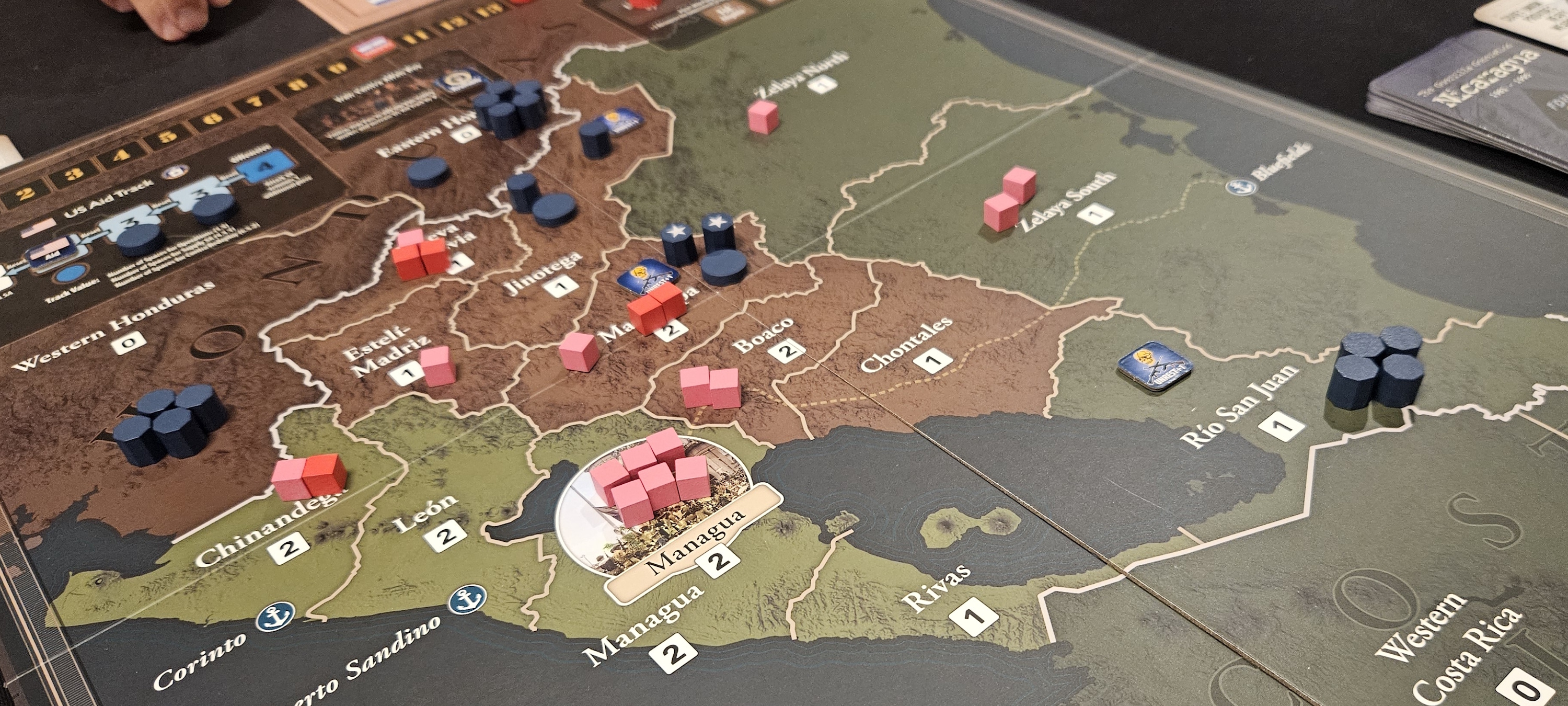
Nicaragua under siege.
As always, the first few turns in a new COIN scenario are testy. Both sides take longer turns than usual, acquainting themselves with the operations that will be their guiding star over the next few hours. (Or, in the case of Rangazas’s scenarios, the next hour to ninety minutes.) Everything is new. The contours of the geography, with its many tropical hiding places and mountainous hard points. The location of any urban centers and their lifelines through the countryside. Any neighboring countries to act as hiding places for roving insurgent forces.
And, in this case, the sudden realization that the Sandinistas are going to have to find a way to afford all this stuff, while the Contras are perpetually flush.
This isn’t the first time in the COIN Series a faction has wielded unlimited spending potential. That distinction traces all the way back to the bottomless pockets of the Coalition in Brian Train’s A Distant Plain. Even this multipack has already showcased a scenario that dispensed with funding altogether.
But what makes Nicaragua so dizzying is that here it’s the insurgents who can act with impunity, not the government. In the background, the Sandinistas are hurrying to repair the damage from the last bad decade of Somozan rule, including the earthquake that leveled much of Managua only for relief funds to quietly route into el presidente’s personal bank account. Now they’re making good on their promises: literacy campaigns, schools, hospitals. Also no small measure of native repression, in case you’re thinking everything is rosy. So when it comes to the CIA shenanigans in Honduras, the Contras with their limitless materiel, the commandos laying nautical mines in the harbors, the U.S. embargo squeezing the entire economy, there simply isn’t enough cash to go around.
It wouldn’t matter so much if everything weren’t so damned expensive. When the scenario opens, the Sandinistas are desperately undermanned. This makes sense in context. All those bright-red troops and hot-pink police have been hastily retrained from the previous conflict’s insurgent cylinders. This leaves much of the country unprotected, especially around the fringes. The only solution, especially early on, is to spend, spend, spend. Spend to train more police. Spend to garrison them in the countryside. Spend to sweep into insurgent hotbeds. Spend to send in the soldiers with the big guns. Even with the multipack’s briefer campaigns, hovering around only eight cards per propaganda round, it isn’t uncommon for a government player to find themselves skint with a good few turns before the next infusion of income.
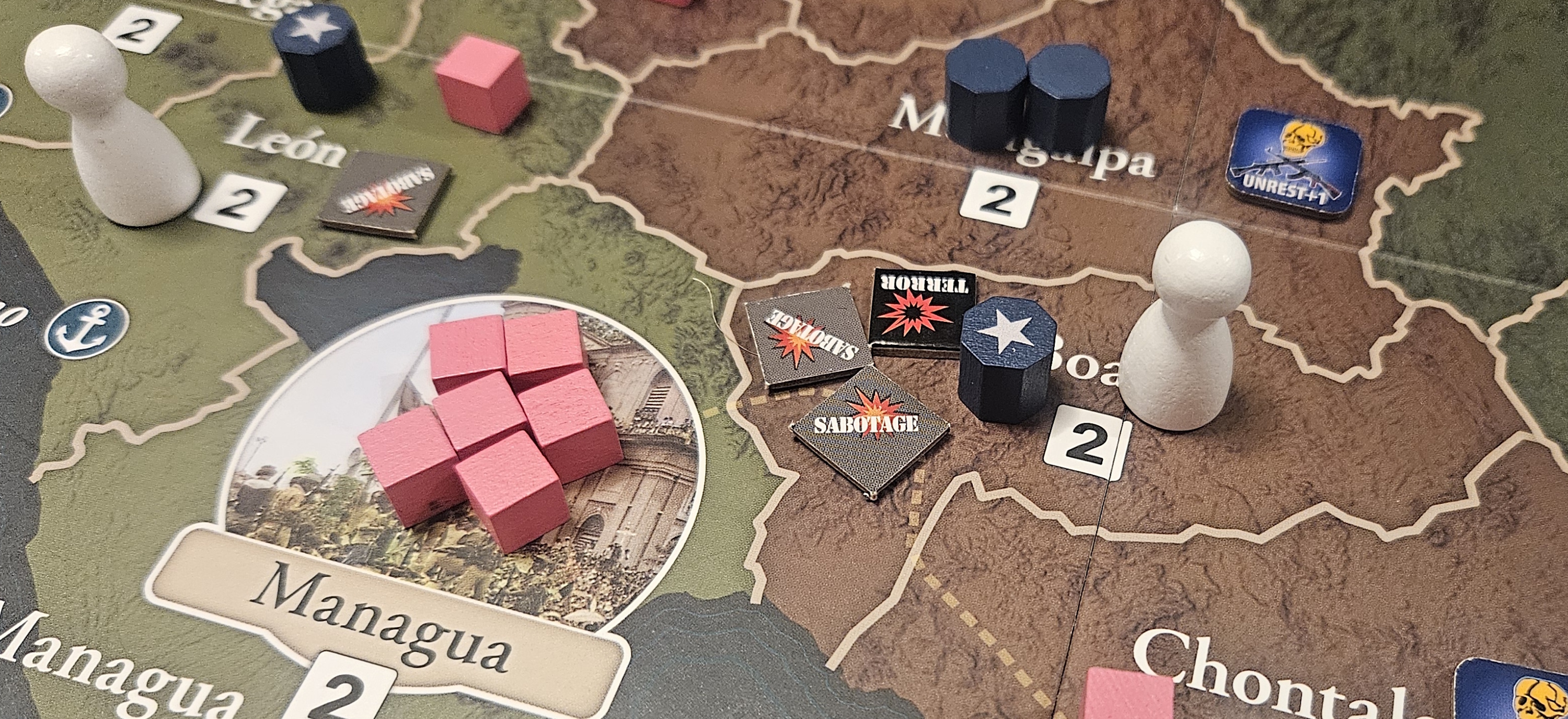
That’s a little too close to home for comfort.
The only reprieve comes from the Contras themselves. Once again, Rangazas uses the limited tools of Volko Ruhnke’s COIN System to carve out some impressive evocations of insurgent warfare. Unlike the other insurgents we’ve seen thus far, the Contras are not locals. Or, well, they’re locals, former members of Somoza’s national guard or disillusioned revolutionaries, but they aren’t locals the way the Tupamaros were locals to Montevideo or the Shining Path were locals to Ayacucho. The Contras are roving death squads. Their targets aren’t only military, but also the schools and hospitals and agricultural collectives currently being set up by the Sandinistas. Their targets are economic. And therefore civilian.
Which means the Contras don’t have roots in local communities. They can establish bases in Nicaragua, but these are closer to waystations than actual recruitment centers. All their actual recruitment occurs in neighboring countries, in the safe harbors of Honduras and Costa Rica. They aren’t wholly untouchable across these borders; the Sandinistas can lob artillery strikes into foreign territory, risking erosions to their legitimacy, and depending on the whims of the event deck might mount small incursions. But their foreign-backed status informs everything about how the Contras behave. They deploy in foreign territory, then infiltrate into Nicaragua via mountain passages and jungle paths. Once there, they mount attacks and sabotage infrastructure — the customary insurgent tactics — only to melt back across the border at regular intervals.
This produces a starkly different type of gameplay from the usual COIN fare. The Contras work according to their own circadian rhythm, there and back again, in offensives and dispersions, rather than claiming territory long-term. When a campaign ends, they can maintain a certain number of toeholds in-country, but not so many that they won’t have to yield something hard-fought.
More importantly, this gives the Sandinistas some breathing room. Border security is a priority, and not an impossible one. Urban centers have always been tough nuts to crack, but Managua’s central position makes it uniquely secure among COIN capitals. It isn’t unthinkable, for example, that the Sandinista player might opt to empty it of protection altogether. A risky proposition, but one that might put its manpower to better use in more vulnerable sectors.
Meanwhile, the geography takes on real significance. Given its operational focus, the COIN Series has always taken a satellite perspective of territory, more about regional tendencies than individual strongpoints. Here, one immediately grasps the various inroads the Contras might take toward destabilizing the socialist regime. Harbors on the coast are vulnerable, but are more readily policed. The mountains are good hiding spots for entrenched death squads, but access can be blocked with some well-placed army divisions. Perhaps the tenderest pressure point is the harbor on the country’s Atlantic coast, far from Managua and surrounded by jungle. But the Contras also struggle to project that far. It’s a pickle all around.
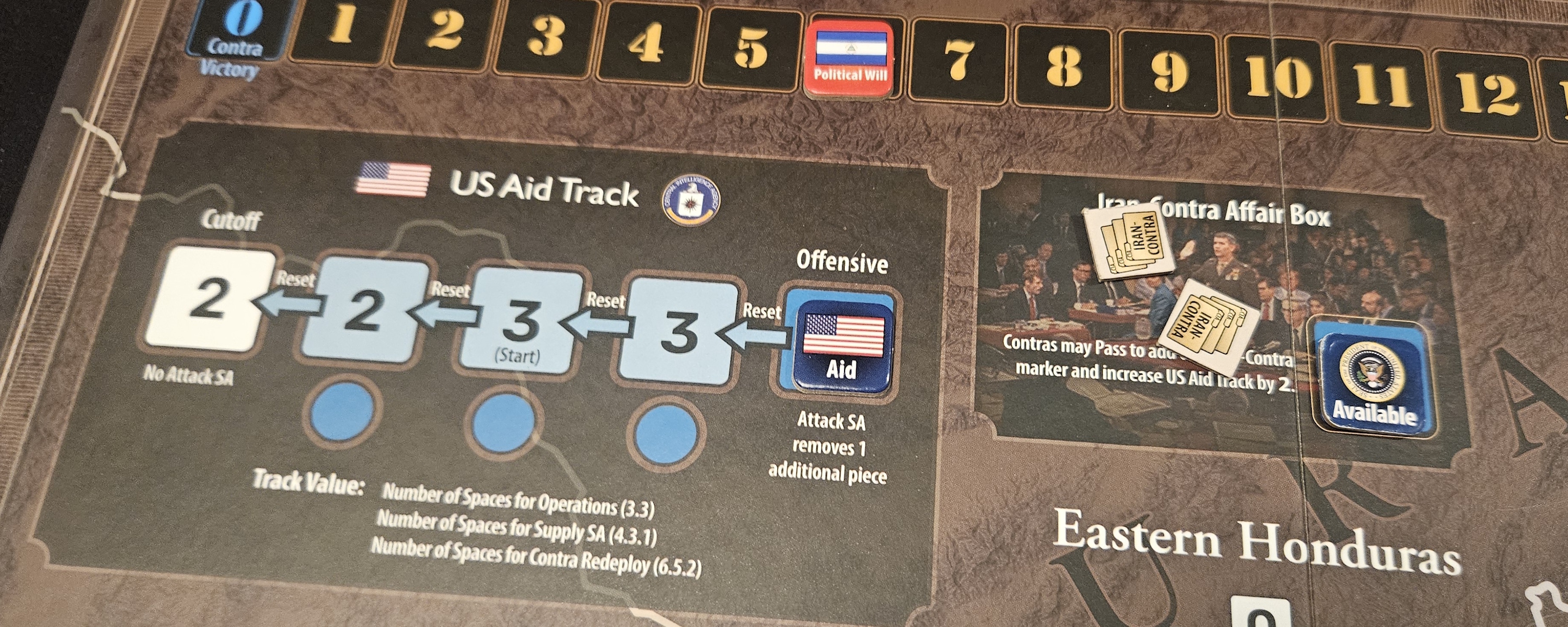
Come get your yankee dollars!
Of all its pickles, however, none are more vinegary than the looming gaze of the continental hegemon. The United States is never absent from either side’s thoughts. While the Contras don’t have to worry about actual resources, they are subject to American pocketbooks. Depending on the current status of U.S. aid, their operations can target between two to four regions at a time. This encourages the Contras to spend at least a portion of their attention attending to their paymasters, whether through the event deck or by occasionally passing to beg for more attention.
The Sandinistas, for their part, must also keep an eye on the Yankees. There’s no avenue for directly tanking funding to the Contras; the inner workings of a corrupt American presidency are far above the Sandinistas’ ability to influence. But there are ample cards in the deck for applying international pressure. This makes the Sandinista player somewhat reliant on the sequencing of the event deck, but it also prevents their operations from becoming rote. More than most of Rangazas’s scenarios across both The Guerrilla Generation and The British Way, and indeed more than most of the main COIN volumes, Government players must consider every possible avenue for undermining their opponent. Where these titles usually present their government factions as clear frontrunners in terms of wealth and manpower, here they feel fragile and outmanned. They’re the region’s big dog, but their hookworms are funded by the most powerful empire in human history.
Which makes the Iran–Contra Affair such a big deal. Whenever the Contras require extra help, they can pass to bump up the aid track. The price is an extra evidence token in the Iran–Contra box. This isn’t guaranteed to trigger; in fact, it’s even less likely than the People’s Prison being uncovered in Uruguay or Abimael Guzmán being captured in Peru. But if Reagan does happen to get caught funding a violent insurgency that wantonly targets civilians, the ramifications are considerable. With no further ability to increase their funding, there’s a very real chance the Contras will wither on the vine.
Where the previous two scenarios existed in isolation, this draws greater attention to the specter of American involvement in Latin American politics. There’s the wider situation to consider. For The British Way, Rangazas connected all four scenarios via a meta-campaign that traced the larger anti-colonial movement against the British Empire. The Guerrilla Generation includes a similar option, one that’s both more focused and more ambitious. This campaign, called Resisting Reagan, allows players to tackle both this scenario and the next one side by side. It’s a massive undertaking, requiring familiarity with both scenarios and an additional set of campaign rules.
Which is why it will have to wait for its own chapter in this series. Hey, I can only do so much at a time. Look at the bright side: bonus fifth part! Yay!
(Right? Yay?)
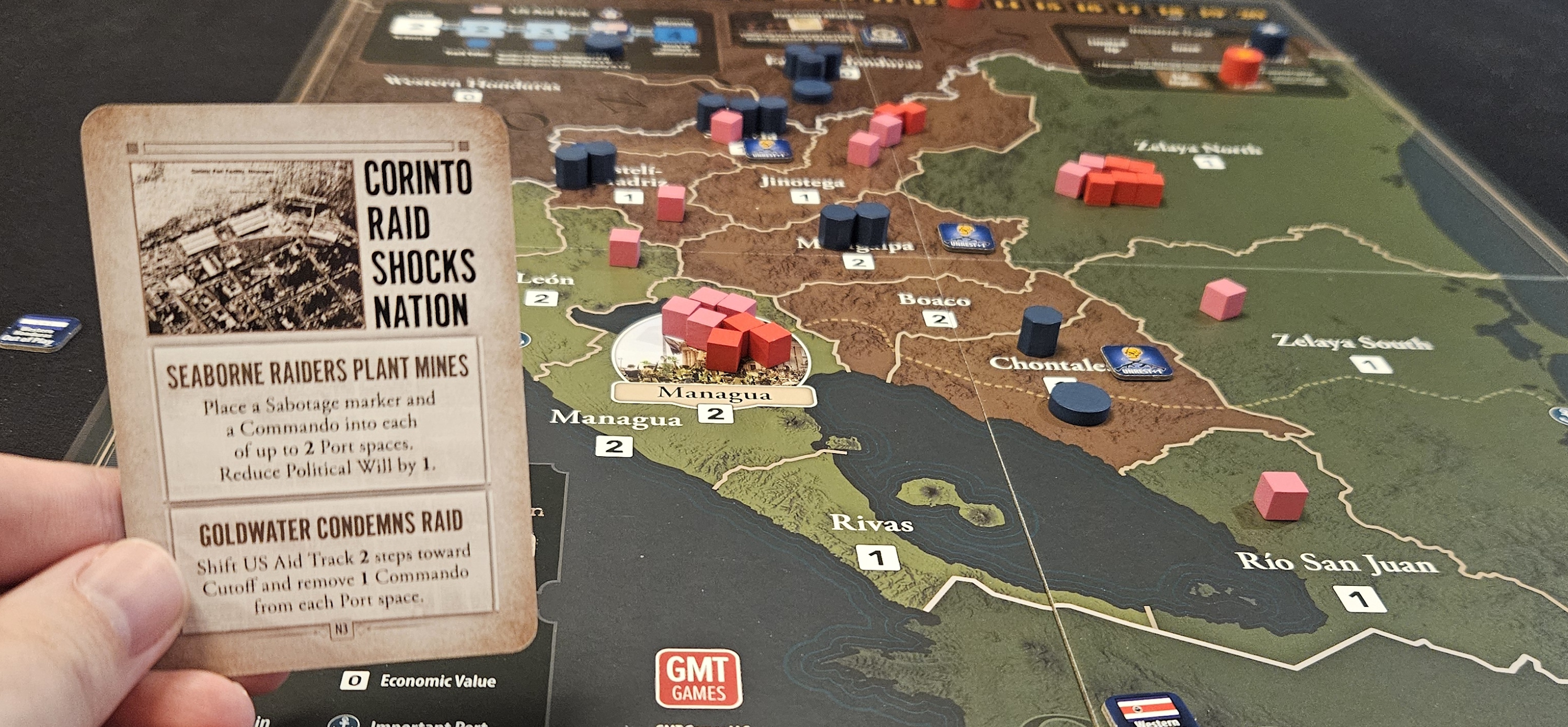
You’ve gotta be doing something wrong if Barry Goldwater denounces it.
All told, Nicaragua is not only the strongest of the three scenarios we’ve played in this multipack, and not only one of Rangazas’s best uses of this long-running system about counterinsurgencies, but one of the best expressions of the wider COIN Series, period. It draws clear delineations between its besieged (and increasingly problematic) revolutionary government and the foreign-backed commandos raising hell in the countryside, presents a novel gameplay scheme in the constant ebb and flow of its insurgents, and, perhaps most importantly, draws the player’s attention outward to the wider problems of American imperialism besetting the titular guerrilla generation on all sides. As my play partner put it, this might be the first COIN scenario that he would request we play again.
But another session in Nicaragua will have to wait for Resisting Reagan. First, we need to examine the multipack’s fourth and final scenario, and the one most personal to me: El Salvador.
A complimentary copy of The Guerrilla Generation was provided by the publisher.
(If what I’m doing at Space-Biff! is valuable to you in some way, please consider dropping by my Patreon campaign or Ko-fi. Right now, supporters can read the next installment in my series Talking About Games, this time tackling the topic of what makes a good list! Naturally, the piece includes a list.)