Normale Ansicht

Gen Con in Pictures and Interview with Felicia Day

08. August 2026 um 16:00

by Beth Heile

Instead of the usual lineup of game announcements and post-convention hauls, I wanted to write and photograph about the random tidbits that caught my attention at this year’s Gen Con, including a wonderful interview with Felicia Day (see below).


Full up before we even begin

Hot Weather, Hot Games

Let’s start with the main reason I was present at Gen Con - to help run the Hot Games Room. The BGG team arrived on Tuesday and all day Wednesday was spent collecting games for the Hot Game Room, our event space at the Hyatt Regency which allows attendees to try as many of the newly released games as they please. Typically this prep day is dominated by long hours, lots of heavy lifting, very hot temperatures, and dodging huge piles of carpet and boxes in the chaos of the exhibit hall before it opens. In the calm before the storm, we caught this fun photo over breakfast:


Some of the BGG Gen Con Crew

Once collected, we now had a pile of hundreds of new games that needed to be punched, prepped, and cataloged in our library system. Our Wednesday night is a multi-hour pizza punch party when we eat, chat, and punch out hundreds of games.


LEFT: Games before getting punched. RIGHT: HGR library ready to go, over 800 boxes catalogued in our library system

Over 43 ticketed sessions, we saw over 2,500 attendees check out over 3,300 games! Our top check outs were:
  
- Hell of a Deal
  
- Entropy
  
- Hanami
  
- Fliptoons: Season 2
  
- Night at the Zoo


A panorama image of the Hot Games Room on Friday evening

Goodbye Balloons, Hello Statues

A personal highlight for me is seeing the annual balloon sculpture in the main hallway of the convention hall. After two serious latex allergy incidents last year, Gen Con decided to discontinue the balloon sculptures for safety. So I will share this picture of my favorite display from 2023 in remembrance of the hard work and amazing skills of those artists:


2023’s balloon sculpture: a moon lander complete with space backdrop, lunar surface, and astronaut.

Instead I noticed an increase in large statues within the exhibit hall. Gen Con is known for its cosplay events, and I found these stationary versions to be an interesting counterpoint.


LEFT: No shade to Martin Freeman, but this is my favorite Bilbo. CENTER: Dungeon Crawler Carl was everywhere and this statue was impressively huge, RIGHT: Leonardo was life-sized and ready for battle

As always, Cardhalla is a glorious, chaotic whirlwind of construction, and this year did not disappoint. I took a photo of my favorite shape this year, a large shark (whale?) that eventually grew spikes from other builders as the days progressed:


LEFT: An overhead shot of Cardhalla in its final hours on Saturday. RIGHT: The shark / whale in early stages.

And to finish up this roundup of creative endeavors, I am more fascinated with the table setup for the miniature painting than the miniatures themselves.


I forgot to count exactly, but this table seated at least 20 painters

From Tokyo to Philadelphia to Indianapolis

For the first time, Gen Con featured Game Market Indianapolis, a showcase of designers demoing and selling their new, self-made creations on the spot. This event was modeled after the success of the Indie Games Night Market at PAXU, which in turn was modeled after Tokyo Game Market. Held in one of the hallway lobbies at the JW Marriott, this market featured 20ish different designers demoing about 24 new games. I’m partial to trick-tricking games and picked up two titles: Short Stacked and Laundry Day. Unlike the exhibit hall, there are no flashy banners or elaborate displays - just the designers with a table, a single display copy of their game, and a stack of copies for sale. Attendees could wander freely between tables, listening in to demos in progress, or asking the designer to start the explanation. I would estimate about 100 people were there at the start, although we left after 30 minutes or so.

I hope that small sales events like this continue to pick up speed in the US as it was fun to see designers at the beginning of the publishing journey. While many of the games used clipart and homemade cards, a good design will transcend the limits of its components. Hopefully some established publishers found a hidden gem and this event will be the launchpad for some first-time designers.


Two demo tables at the Game Market Indianapolis. For the racing game on the left, the metal cars were included with your purchase

A Few Game Announcements

While taking a water break on Wednesday, one of the reps from Restoration Games was setting up the display cabinet in the main convention hallway, and I was lucky to snap a picture when the cabinet door was open. Inside was the layout for the newly announced King’s Gambit, a reworking of the Star Wars: The Queen's Gambit from 2000 but rethemed to Tolkien’s Lord of the Rings. This display took two shelves in the display cabinet but is designed to stretch in one continuous line on a table - a photo I was unable to capture unfortunately.

Rob Daviau was one of the lead designers of Queen’s Gambit and returns again as one of the lead designers of King’s. Like the original, players will be juggling multiple battlefields at once, with players choosing to allocate their limited stock of cards and resources across those different locations. Unlike the original though, this Middle Earth version will support more than two players. A demo copy was available in the Restoration Games booth, with a projected retail date sometime in 2027.


LEFT: One end of the playing field featuring (presumably) Mt. Doom and Barad-dûr. RIGHT: Minas Tirith with a baby Citadel at the very top.

I haven’t done interviews for BGG since COVID, so it was fun to put those skills to the test again with a sit down with designer Sam Bailey and Kuba Polkowski from Chaosium. Sam is the designer of Forbidden Stars, a reimplementation of Starcraft: the Board Game. Like Queen’s Gambit, both Starcraft and Forbidden Stars will likely be out of print forever due to copyright and licensing issues. Fans of Forbidden Stars have been asking for a new version regularly (you can follow that conversation on this massive 79-page thread) and Sam was excited to give a reboot a try. He created a new implementation with a different publisher and that deal fell through from IP issues. He signed a deal with a second, different publisher…and it fell through a second time. Each time he put in significant time and effort to rework Forbidden Stars into something that was both familiar and yet new, only for that work to languish unused.

Finally, it seems there is success with Chaosium and Forbidden Stars is now reborn as Old Ones Origins, with the setting and theme moved from space-facing sci-fi to a battle of eldritch gods. Unlike many Cthuhlu-flavored games that use a 1920s setting, Old Ones is a battle of ancient powers vying for control at the dawn of time - humans are not part of this picture! Game length can be dialed from two hours to all day, depending on the selected factions and choosing the short game vs. the epic game. I was demoed some of the game play and its evolution from Forbidden Stars, and it was clear that Sam put in massive amounts of work to translate this version’s mechanics into something that clearly supports its new theme.

A Kickstarter campaign for Old Ones will begin in September 2026 with estimated delivery in Q4 2027 / Q1 2028.


Closeup of prototype minis and game board

Speaking of Reboots….

This Gen Con was dominated by events supporting three large fandoms: Dungeon Crawler Carl, Critical Role, and The Guild. Celebrating its 20th anniversary, The Guild is currently being rebooted into a movie after a successful run as an online video series from 2007-2013. Thanks to a BGG volunteer in Felicia Day’s Twitch chat (thanks Walt!), Felicia was put in contact with me and stopped by the Hot Games Room for a tour and an interview.

Aside from funding the movie, Felicia is also launching a TTRPG and a card game: Swords & Sweethearts. This card game is based on the combination of the music video “Do You Want To Date My Avatar?” combined with Felicia’s love of dating sim video games. Players collect items to increase their stats and then try to take a prospective match on a successful date. However, the suitor, location, and actions of the other players can all affect the outcome of your date, so romance is not guaranteed. Many celebrities have donated their likeness for cards in the game, so you could take Misha Collins, Alan Tudyk, Dungeon Crawler Carl, “Weird Al” Yankovic, or a sheep from Catan on a date.

Felicia announced that she and Wil Wheaton are launching a new board game show called Conludo. I also interviewed Wil Wheaton at Gen Con over ten years ago, when his Tabletop YouTube show was at its peak. In that conversation, we discussed that many gamers credit that show as their introduction into modem strategy board games, and I hope the same will be true for Conludo as well.

We also discussed The Guild’s TTPRG, written by castmates Vince Caso and Sandeep Parikh. Just as with Sword & Sweethearts, Felicia noted that humor was a critical piece of the RPG as well. That humor extends to an extensive line of merch, including a medieval popcorn bucket dubbed the “Poopcorn Bucket”.

The Guild’s Kickstarter runs through Aug 21, and you can view the entire interview (slightly edited) below:

Youtube Video

Very early Xeno Counterstrike Thoughts

08. August 2026 um 15:33

These are “super” early, just observations I’ve had that could easily be wrong.

We are in the early stages of discovery (at least I am) where it’s difficult to evaluate some cards because you need to see them interacting with other cards. In particular the Near/Far Frontier worlds have some big swings.

  • Taking a non-military start world is fine. If you have the lowest military for a few rounds, that’s OK and likely a bonus point or two.
    • But you’ll have to jump on the train, at least before wave starts.
  • But don’t forget that there’s an automatic settle on T1, so if you can call trade that might be right.
  • After a few games, I don’t think the Frontier Worlds are overly powerful, because even if you get something, it may not be something you want or that will synergize.
    • That being said, they are decently powerful and can provide a path to victory.
    • They are also more fun to explore, so the meta seems to be “Frontier Early, Frontier Often.”
    • Because of this, leeching those “Frontier Settle” calls will be important … more important than leeching Develop. This does benefit having at least a few points of military (to drop the 2 defense uplift worlds or a 1-2 defense world that boosts military) or having a small production world or two.
  • Similarly, temporary military is an OK defense early … but you’ll definitely want some for Fronter Conquest. Half those homeworlds say “Ignore your numbers1, you need X temporary military” (where X is 2/2/3/4/6).
    • There a several “Spend a rare for +2 military” cards, often on rare worlds. Those are nice, better than “discard this for +3” because you can re-use them.
    • The Far Frontier Run-Amok Robots damages a world for +6 Military. 2
  • Don’t under-rate Defense vs Xenos! Particularly by the time you’ve repulsed and are dealing with retribution you’ll want a few points (and more is better). (The first card that caught my attention was Frontier Isolationists, because it gave me +6 Defense vs Xenos!)
    • Almost half the retaliation cards are “your military + your Xeno military + #” You simply can’t be better, those cards cancel all your “regular” military, but a few points of Xeno Defense will go a long way.
  • Having a world (or two or three) you can afford to damage for little/no cost is fine. Sometimes you don’t want to spend cards/goods defending … taking the damage is fine and you save the goods for your Frontier Settle / Conquest.
  • A random consume power sometimes means getting a point (or card) or two and …. losing your temp military for defense or offense next round! That temp military (particularly on offense) can be worth 10+ points!
  • I’m not sure I’ve seen a winning strategy, but I do think “Big Military/Xeno Military” and “Frontier Settle/Conquest every other turn” without much card draw is a trap. An oh-so-tempting-trap … but even if you catch a world every turn, they tend to not build an economy.
  • Consume x2 still exists …. with worlds that consume 2 goods for 3 (or 4!) points. Getting up to 8+ points before doubling is much easier, also because there’s no 12 card limit to tableaus.
  • Because of this (OR conquering all the Xeno’s systems OR surpassing the Conquest Value) I suspect the game often ends with tableaus of ~16-183 cards. (That is likely very meta-dependent).
  • There is no also a “Produce every turn and ship the extra goods to the war effort” strategy. Particular in the early game when you aim for the 5 point award and also (perhaps) messing up opponent’s timing for when the game transitions4. You’ll want to earn a few cards while doing this and spend a turn here or there developing/frontier settling/consuming, but you get the idea. I don’t think this is dominant, but you can have implicit collusion tilt the balance.

Some Notes on the Frontier Decks

Note — Both decks are exactly half black (worlds you buy) and half red (worlds you conquer).

  • The Near Frontier Deck is 18 cards
    • For the black worlds, the costs are 1/1/1/2/3/3/4/4/5
    • If you have 3 Mil and 2 XenoMil then you can conquer any of the red worlds. If you have 2 Mil and 3 XenoMil, there is one you can’t (Pirate Lair)
    • If you can only handle half the cards (ie, you have 5 cards in hand but no military) your odds of drawing 3 unplayable worlds are about 10%
    • New Sparta could call Frontier Settle on T1 and get a playable world 19 times out of 205. Anyone else is about 17 times out of 20. And if anyone calls explore (and you get a card) the odds go up. Just FYI.
  • The Far Frontier deck is 28 cards
    • Black Worlds cost 5/5/5/5/6/6/6/6/7/7/7/7/8/9 … so if you can afford a 7 card world you have decent odds
    • Red Worlds defense are 6/6/6/6/7/7/7/7/8/8/8/9/9/10
    • Roughly half of each defense number has the Xeno keyword (so military vs Xeno applies)6.
  1. Although you still need a base of 9 military vs Xeno to try a conquest ↩
  2. Much like Malevolent Lifeforms in the base game, I love me some Run-Amok Robots. ↩
  3. Rules Note — You can start conquering the Xeno homeworlds once you have a Far Frontier world (and enough military) well before the 16+ card alternate requirement. ↩
  4. Having a good development in hand for the first turn of the second half is something to keep in eye on. ↩
  5. You can handle 8 of the cards assuming you are willing to dump your hand, and New Sparta can also hit the 3 cards that are “2 defense” ↩
  6. But not the 10 defense card, it’s Alien. ↩

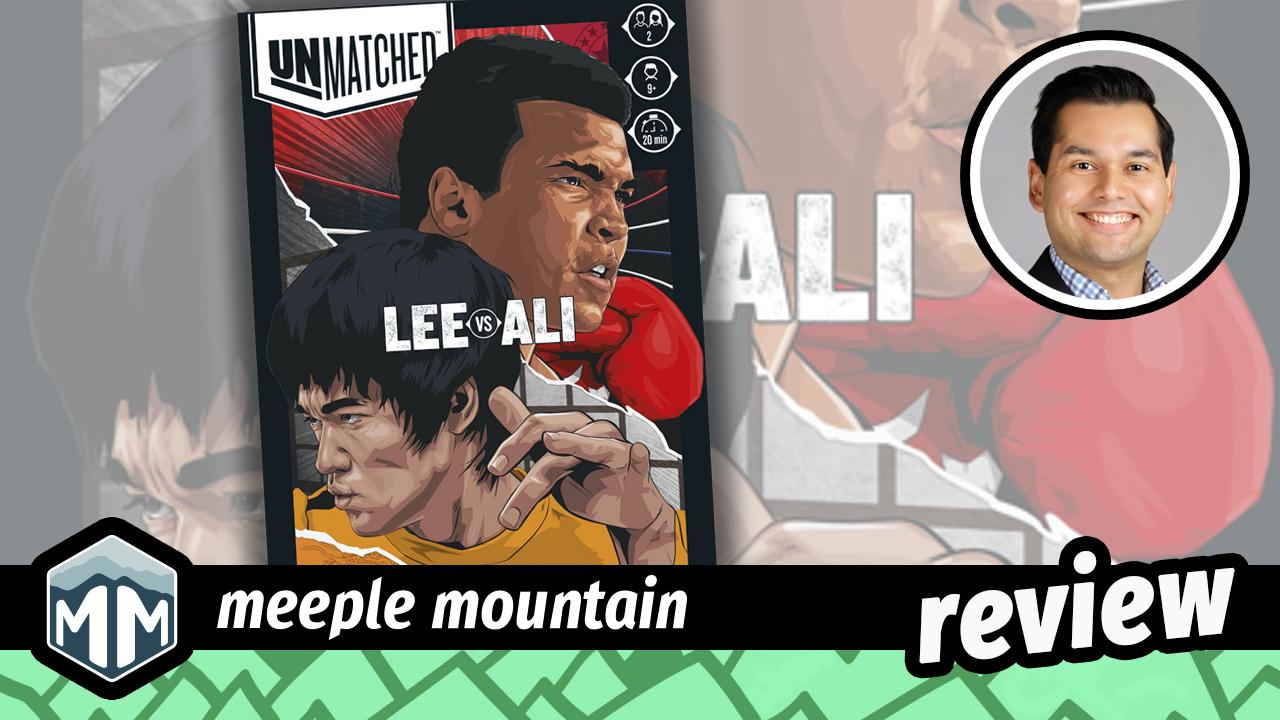
Unmatched: Lee vs. Ali Game Review

Thrilla in Manila

Fellow Meeple Mountaineer Andrew Holmes recently published a review covering Unmatched: The Witcher - Realms Fall and Steel & Silver, and his opening comment mentioned that we at Meeple Mountain differ on our opinions of the Unmatched franchise. But that makes sense as different reviewers covering differently themed sets are going to land differently on their thoughts.

(The correct opinion is that Unmatched is awesome)

However, Andrew is right that Unmatched is a great system because of its simplicity, quick pace, and heavily contrasting roster of fighters. And like him, I’m the ideal demographic, but for different reasons. The original game, Star Wars: Epic Duels, was played dozens upon dozens of times by my friends in middle school and me. We even found custom heroes online and printed them out, and though they were wildly unbalanced, it was a blast nonetheless.

Fans of Unmatched will recognize Bruce Lee as a highly sought-after expansion, being the first single-character pack and, at times, running upwards of $250 on the secondary market. Fortunately for those patient enough, Bruce Lee has returned in both an affordable and memorable set, going toe-to-toe with the famous boxer Muhammad Ali. I wasn’t alive during their height of fame, but their quotes, stories, and larger-than-life personas live on through pop…

The post Unmatched: Lee vs. Ali Game Review appeared first on Meeple Mountain.

Unboxing Video: Battles in the East Volume 2: Uman Pocket and Guderian’s Final Blitzkrieg from Decision Games

Von: Grant
08. August 2026 um 14:00

Battles in the East (BITE) is a series simulating World War II Eastern Front battles. The system rules are an evolution of the SPI classics Panzergruppe Guderian, Army Group South and Cobra. Unit integrity bonuses include Soviet Corps and vary to show the increasing Soviet cohesion and decreasing German cohesion as the war progresses. HQ units provide higher level combat support and supply advantages to corresponding units in range. BITE also incorporates standardized scales (unit size, distance, time) for easy comparisons. While the series rules allow players to play many games with the same core rules, the scenario rules add unique situational elements of each battle. Each volume includes two battles from one year with two copies of the charts and tables as well as scenario rules and set-up cards for easy reference. Battles in the East Volume 2 offers a strategic simulation of pivotal 1941 Eastern Front conflicts, including the fierce battles at Uman and Tula.

-Grant

Borealis: Arctic Expeditions (Saturday Review)

08. August 2026 um 12:43

Snow muffled every footstep until the only sounds were distant birds and the steady crunch beneath our boots. The silence stretched in every direction: left to right, ahead and behind, as well as all the way up into the thermosphere. We were far away from anywhere. Yet, we knew we were safe. As the darkness settled all around us, we could finally see it: the Borealis: Arctic Expeditions by Dariusz Mindur from Lucky Duck Games with art by Rodrigo Camilo Alves De Almeida, Kevin Sidharta, Inês Toczyska and Ariadna Żytniewska.

The post Borealis: Arctic Expeditions (Saturday Review) appeared first on Tabletop Games Blog.

Regicide Legacy review and photo book

I did a spoiler-free post about Regicide Legacy in April, giving a quick overview and showing the basic game components. This post continues from there. The first part of this post will contain no spoilers. If you have not played the game and you are thinking about it, it's safe to proceed.  I played the Regicide Legacy campaign with younger

No (Okay, Some) Ragrets

07. August 2026 um 21:24

hope you're into tentacles

As a natural melancholic, the idea of being drawn to the sea — to drown one’s regrets, whether figuratively or bodily — makes me glad there isn’t a significant body of water within six hundred miles. It isn’t that suicide holds appeal for its own sake. Rather, it’s a fire door in the back, rigged with an alarm but duly located in case of an emergency. Sometimes, when an elderly person goes missing in the mountains, I wonder if they disappeared because of forgetfulness, as the silver alerts would have us believe, or because they could no longer stop remembering.

Deep Regrets, like Judson Cowan’s forthcoming Personal Demons, wears its metaphor on its sleeve only to collar it in gameplay. Perhaps we went to the sea to forget, to scrape our hull free of the barnacles that have accreted there, only to find ourselves fouled with a fresh catch. To mount an escape is to be caught.

Okay, now I’m being melancholic. At least it’s a good fit for Cowan’s intended topic.

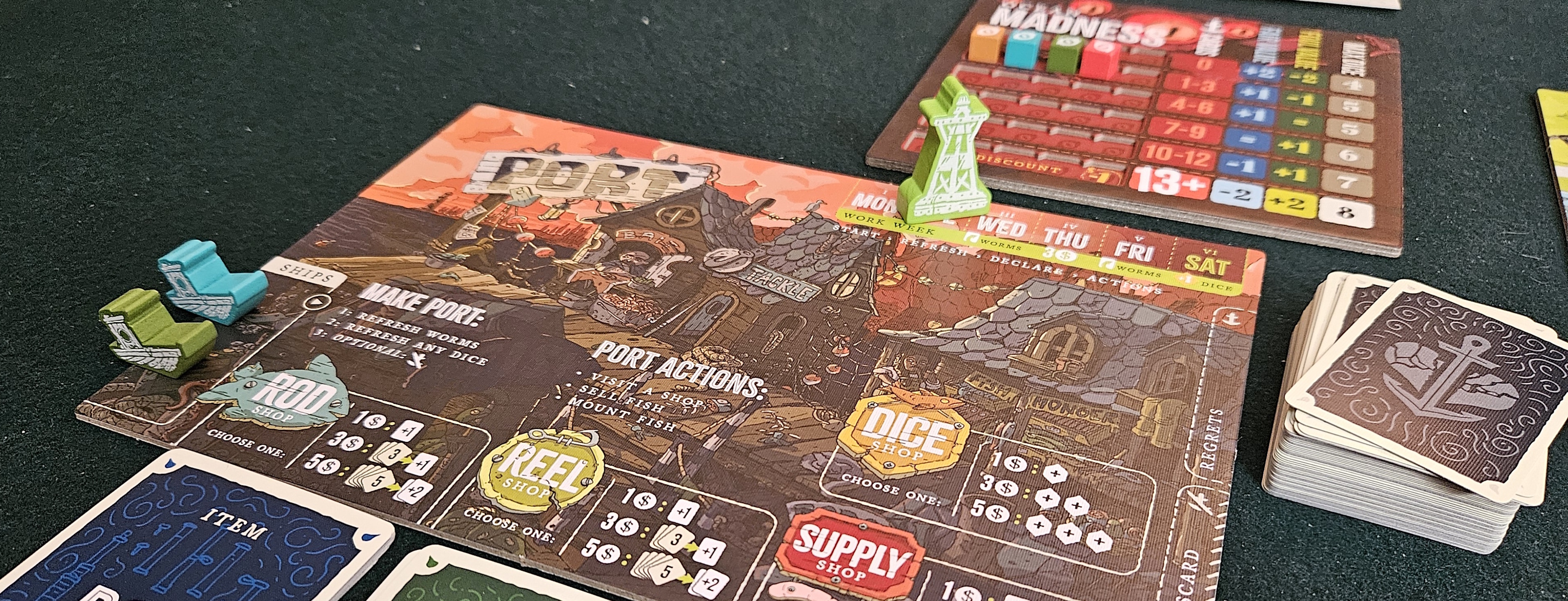
unfortunately, it isn't possible to win by hanging out in port all the time

Hanging out in port.

“On the surface” is a loaded term for Deep Regrets. That’s because Deep Regrets is about surfaces and what lies beneath them. In terms of character, the surface reading is that you’re a fisherman. Not the catch-and-release kind, but rather the my-livelihood-is-disappearing-with-the-depleting-abyss kind.

Which is what drives your bayman to trawl ever deeper. As the shoals close to the surface grow thin, you seek more benthic prey. It’s a solitary practice, both thematically and at the table. Turns don’t exist in complete isolation from those of your peers; this isn’t a total multiplayer solitaire experience. But as we will see, there’s a lidless membrane between you and your peers that’s never quite breached.

For the most part — on the surface — Cowan plays it straight. The entire game could be described in that hobbyist shorthand that sounds alien to outsiders. Fishing is a press-your-luck minigame that expends dice and other resources to land the best fish. Every turn is framed around either a day at sea or one in harbor, trading your catch for equipment. There are subsystems aplenty: permanent and temporary dice, rods and reels with variable benefits, fish both great and small.

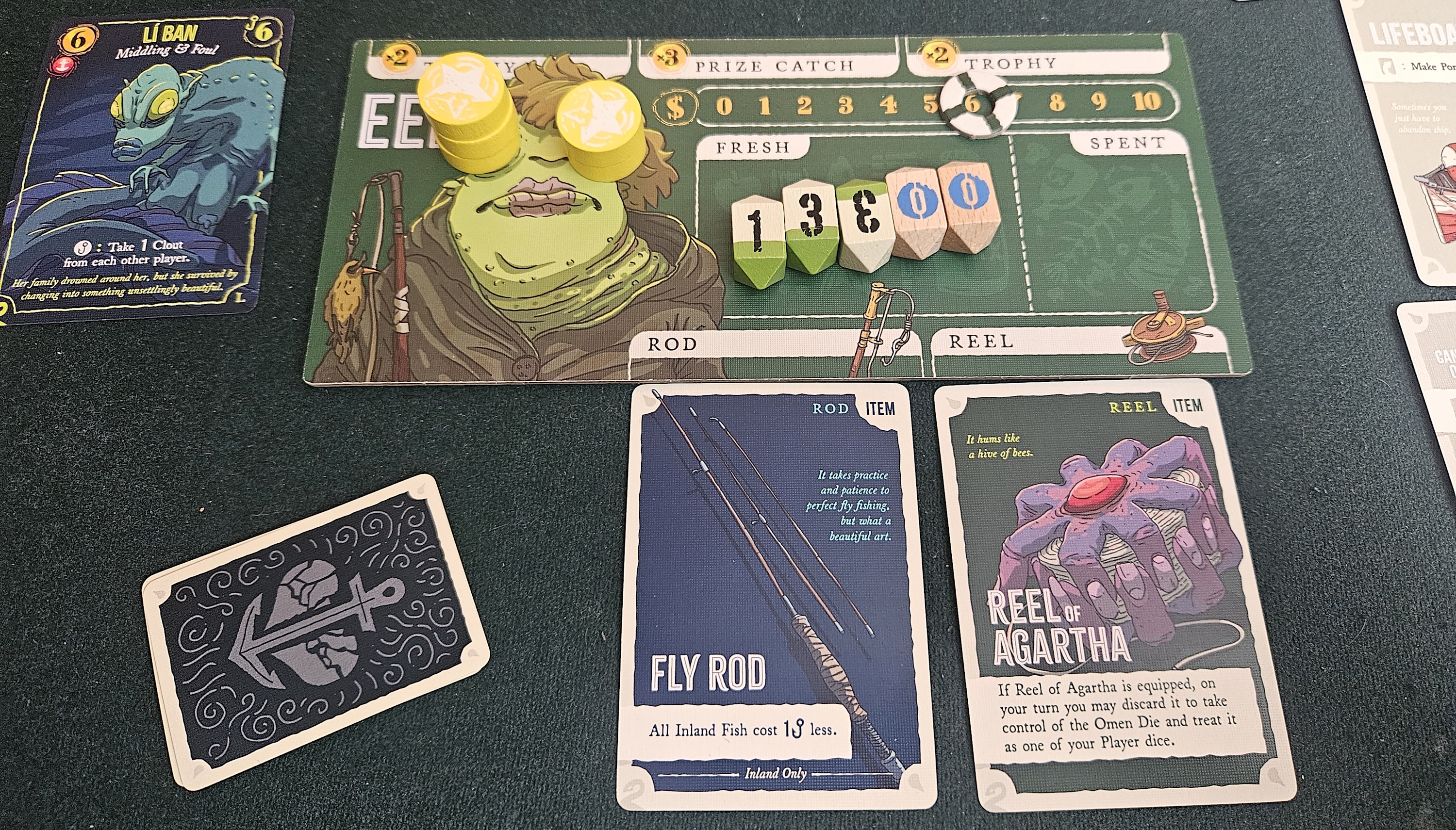
I'm a star

Check out my cool shades. They conceal my squamous nature.

What’s interesting about these systems, though, is what they communicate about both the gameplay and your character.

Starting with gameplay, Deep Regrets is — on the surface — an incredibly chancy plaything. Early on, there are clues one can follow: the shadow beneath the water reveals whether a catch is small, middling, or large, and various depths translate to creatures that are increasingly dangerous to land-based mammals. Your bayman also has access to a few starting tools, such as a can of worms for peeking at a shoal’s face-down card and a lifeboat for beating a hasty retreat to port if your odds at sea turn south.

It isn’t long before it becomes apparent that Deep Regrets isn’t as aleatory as all that. Oh, there’s always a sense of risk. It isn’t uncommon for a cocksure hand to take one risk too many and invite the wrath of something truly monstrous. There are cards in the deck, whether the base deck or one of its multiple expansions, that can very much ruin your day.

Still, there’s so much mitigation at play that it’s hard to regard Deep Regrets as quite as chancy as some have made it out to be. Failing to catch a fish results in grabbing a “dink” — fishing slang, not lifestyle slang — which offers some benefit of its own, whether better fishing or some cash value, to offset the sting of failure. Even a cursory glance at the equipment shop reveals tools that will offset any number of flubs or miscasts. It isn’t enough to strip the game of its uncertainty altogether, but these are hardly uninformed decisions.

This is all good stuff, and would provide plenty to mull over. But, once again, this only brushes the surface.

yum

Not all catches are created equal.

It’s appropriate that where Deep Regrets expands its horizons is via the regret deck, a thick stack piled with all sorts of misgivings and heartbreaks. At regular intervals, your hapless fishers will land something special. A mermaid, perhaps, so shimmering with glory that it breaks your heart to haul her ashore. A leviathan, its mind linking to yours in its lashing final moments. Or maybe you’ll just sell something nasty at the fish market and feel bad about it. Regardless of the cause, these junctures see you drawing a regret.

Regrets matter in two senses. First, the number you hold in your hand determines your character’s current madness. The madder you become, the greater the risks you’ll take at sea and the weirder the creatures you’re willing to sell at market. Second, the sum of those cards determines which player is bitterest upon the game’s completion. This means tossing out your highest-scoring trophy.

What’s curious about regrets, though, is that they aren’t wholly undesirable. True enough, you would rather not have such terrible regrets that you fling your prize charybdis angrily into the sea. But a handful of regrets is… good, in fact. After a few days at sea, it won’t escape your notice that the deadlier deep shoals are packed with strange creatures. It also won’t escape your notice that these can be sold at higher prices and earn greater scores. But only if you’ve gone a little mad. Maybe even very mad. Not so mad that you ruin yourself. But mad enough to take the right risks and mount the right trophies.

Which is to say, Deep Regrets isn’t really about said regrets being bad, at least not always. In much the same way that Personal Demons doesn’t present fears as bad so much as things that need to be confronted, here one is invited to court regret, to dance with it, to dispel its worst excesses through clean living or self-medication or simple caution. Whatever works. But either way, a life without regrets hoists a lower ceiling, victory-wise.

I watched that movie about sailors who ate each other and then lived with the regret their whole lives. Boring. Hannibal Lecter never bellyached and he ate way more people.

Just some of the game’s many regrets.

Laid out like this, Deep Regrets’ messaging might come across as trite. Adolescent. As a species, we’ve told countless stories about how our regrets and failures are crucial stepping stones on the path to adulthood, from Picard being transformed into a timid science officer because he didn’t get shanked as a cocky ensign to the memory-erasing shenanigans of Eternal Sunshine of the Spotless Mind.

But Deep Regrets doesn’t come across as an adolescent musing. Its passage to success isn’t as straight as “regrets good.” Plenty of its regrets are well worth casting off. There’s a certain temporal wiggliness to the process; if you regret losing your arm or sacrificing your sister, I’m not wholly sure what it means when those regrets are discarded. Did we… forget? Get over it? Prevent its having happened through some demersal bargain? No idea. But the effect is one of curated regret, cautious regret, not wholesale acceptance or dismissal.

This makes Deep Regrets interesting rather than perfect. I wish the game had been pacier, but in some spots Cowan’s eagerness seems to have gotten the better of him. After the first few rounds, turns begin to bloat with extra dice, fish, equipment, and dinks. In the end, it isn’t the chanciness that’s the problem; it’s the replete tools for extending a turn and making outcomes more certain. As the game grows longer, its charms wear thin. Eventually, they rupture like aquatic flesh that’s gone too long without refrigeration.

I like to make guests scream when they look at my tumor-wall

Mounting my trophies, buoyed by regret.

Still, Deep Regrets is smarter than it looks. It’s a game that rewards peering beneath the surface, both in terms of gameplay and as a ludic examination of a life lived without too many guardrails. I can say this with complete certainty: I don’t regret the time I’ve spent with it. Not in the slightest.


Complimentary copies of Deep Regrets and its expansions were provided by the designer/publisher.

(If what I’m doing at Space-Biff! is valuable to you in some way, please consider dropping by my Patreon campaign or Ko-fi. Right now, supporters can read the next installment in my series Talking About Games, this time tackling the topic of what makes a good list! Naturally, the piece includes a list.)

Trio of board game industry veterans launch full-service agency Best in Play

07. August 2026 um 15:32

A trio of veteran board game industry professionals have launched a new tabletop gaming agency, with the aim of helping businesses within the hobby get their games developed and into the market.

Hues and Cues designer Scott Brady, Sagrada co-creator Daryl Andrews and Friendly Skeleton CEO Jacob Way said Best in Play will offer everything from interim executive leadership and designer representation to publisher submission management and crowdfunding strategy.

Brady said, “Best in Play was created to bring together people and opportunities that should already be working with one another.

“Great intellectual properties need the right designers and publishing partners, designers need better access to decision-makers, and companies sometimes need experienced leadership without the time or resources required to build an entire department.”

Best in Play says its five core service areas comprise IP matchmaking, crowdfunding consultation, interim replacement of key personnel, publisher-inventor relations and identifying publishers and licensing opportunities for individual games, multiple projects or designer catalogues.

The company announced at launch that it has already been hired as a consultant for an unspecified US-based “creator-brand merchandising and e-commerce company”, providing senior-level leadership and games-industry expertise while the client continues its search for a permanent head of games.

Best in Play said that project will run the gamut of product development, licensing, publishing, production, crowdfunding and portfolio strategy.

Andrews said of the assignment, “An important initiative should not lose six months of momentum because a key role is temporarily vacant.

“Our model gives clients access to an experienced team that can step in quickly, evaluate the situation and keep products, partnerships and internal teams moving forward.”

The company is also working on a tabletop project based on an unnamed “major video game intellectual property”, with a crowdfunding launch planned for early 2027.

Way said, “A recognizable property may attract attention, but a successful crowdfunding campaign still needs the right product, positioning, audience strategy and operational plan.

“Our goal is to build campaigns that respect the fans, communicate value clearly and create a foundation for success beyond the initial launch.”

As well as the founding trio of managing directors, the Best in Play team also includes strategic contributors David Gordon, the co-creator of Finspan, Eastar Game Manufacturing founder and CEO David Du, Legend of the Five Rings: The Card Game co-designer Erik Dahlman and Daniel Pesante.

The launch comes hot on the heels of Brady having unveiling his new publishing initiative Proof-of-Play late last month, which is designed to tackle one of the tabletop industry’s growing challenges: promising games sitting unpublished because publisher release schedules are already full.

Brady previously launched his development studio A Game Studio at the start of 2024, following the 2020 release of the big-selling Hues and Cues and the success of his cat-themed abstract strategy Boop in 2022.

Scott Brady’s breakout design Hues and Cues

He is also the co-founder of Play to Z, the publishing house led by former Z-Man Games founder Zev Shlasinger launched by a host of board game industry veterans in 2023.

Fellow Best in Play managing director Daryl Andrews is best known as the co-creator of award-winning tabletop game Sagrada, while his other co-designs include Batman: The Dark Knight Returns – The Game, Donald Duck in Happy Camper and Mistwind.

He previously spent two years as head of talent acquisition at Maestro Media, following several months working in investor relations, before leaving the company in early 2025.

Jacob Way, meanwhile, began his board game career as COO and co-founder of Deep Water Games, which for several years operated as a subsidiary of Ox Eye Media.

Deep Water, which is best known for sketching game MonsDRAWsity, spun out from Ox Eye as an independent business in 2022 under Way before rebranding as Friendly Skeleton.

The publisher is currently in the process of delivering the heavily delayed crowdfunding campaign for Monsdrawsity: Unusual Suspects, created in collaboration with renowned board game review site Shut Up and Sit Down, which was initially estimated to reach backers in May of 2022.

Anyone interested in getting in touch with the team can visit the Best in Play website or email info@thebestinplay.com.

The post Trio of board game industry veterans launch full-service agency Best in Play first appeared on .

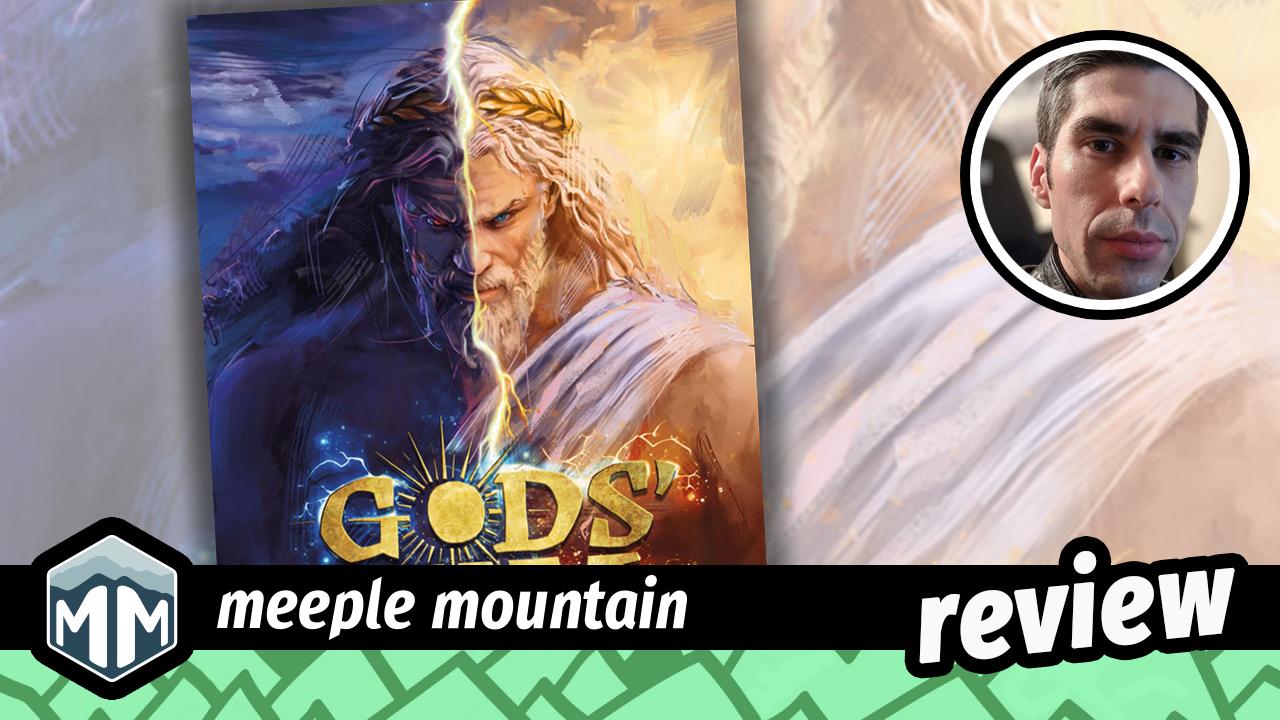
Gods’ Will Game Review

Gods' Will showed up in my social media feed, comparing itself to Resistance: Avalon like a new kid on the first day of school telling everyone he used to be popular somewhere else. I have heard this pitch. I have reviewed this pitch twice, from Witch Hunt and Human Punishment, two games that made the same promises and delivered the same disappointing results. So when Gods' Will came knocking with the same marketing aura, I had to open the door with at least one eyebrow raised. Maybe I’m just addicted to disappointment, who knows.

After half a dozen plays, I can say with a bit of confidence that Gods' Will is doing more right than wrong here. More importantly, it earns it by fixing the real problems with its predecessors rather than just the ones that look good in a Kickstarter pitch.

A Skeptic Walks Into a Kickstarter

Like 90% of social deduction games that have ever existed, there are two teams: Light and Dark. There is also a loner faction, a third party whose goals shift depending on player count and whose presence ensures that the ride from start to finish won’t ever be a smooth one. Every player is a God with a public special ability…

The post Gods’ Will Game Review appeared first on Meeple Mountain.

Quick Peaks – Art Society, On Mars, Vampire: The Masquerade – Vendetta, Rock Hard 1977: Ear Candy, 7 Wonders Dice

Art Society - Tom Franklin

I picked up a copy of Art Society based on my friend and colleague Justin Bell’s excellent review of the game. After weeks of heavier games, I thought my gaming group would like something lighter.

Art Society is a shape-laying game where you’re trying to cover all the spaces on your board. Unlike many current games, the shapes here are simple rectangles, and your board is square, making for easier planning. Players take turns being the Auctioneer, meaning they pick the paintings up for bid that round. Highest bidder takes first choice, then the second, third, etc. Your new painting gets placed on your board, touching at least one side of another painting, then the next player sets up the next auction.

Justin discussed what makes Art Society such a good light game, but I want to tell you about the production of the game. The paintings themselves are alternative takes on famous images, and come with half-circles around the edges that show how many spaces on the board it will cover. The board has slight round bulge that matches those half-circles so the paintings stay in place better. The bidding indicators are paper auction bidding paddles. Perhaps best of all is the box insert.…

The post Quick Peaks – Art Society, On Mars, Vampire: The Masquerade – Vendetta, Rock Hard 1977: Ear Candy, 7 Wonders Dice appeared first on Meeple Mountain.

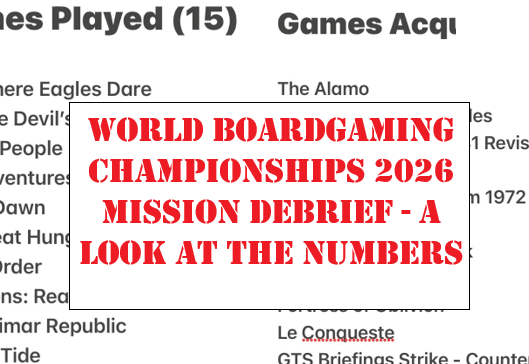
World Boardgaming Championships 2026 Mission Debrief – A Look at the Numbers

Von: Grant
07. August 2026 um 14:00

My WBC 2026 is over and I’m sad about it! Well, it actually ended last Thursday evening after 5 1/2 days of gaming goodness, but I am now just putting together this wrap-up post. I had planned to stay until Saturday morning and then leave to come home to attend a concert with my wife for our 30th wedding anniversary (Darius Rucker) but I had some pretty severe back pain late Thursday evening that haunted me through the night only allowing to me to get a few hours of restful sleep and when I awoke on Friday for my last planned day my back was pretty stiff and I couldn’t see sitting around for 12 hours at a gaming table and then having to drive home on Saturday. So, I made the mature decision to pack up and leave Friday morning to avoid it getting worse and making the 6+ hour drive home more difficult. This caused me to miss a rousing multi-player game of Virgin Queen from GMT Games on Friday and I am very sad about that. But, I made the correct choice and am now home safe and sound and my back got a bit better overnight on Friday and has pretty much now totally recovered. On Saturday morning and into the early afternoon, I did spend some time organizing the games I played at the convention but didn’t put up neatly and also clipping the counters for a few new games to ready them for play.

A look at the games that I was able to get played as well as some new acquisitions.

This was an extremely productive trip this year and I had a blast. I wanted to simply give you a quick look at my time at WBC and share what I was able to accomplish by myself as once again Alexander was not with me and I was flying solo. If you are interested in more detail than is found here, you can visit my Daily Debrief posts at the following links:

Daily Debrief Series – Day 1

Daily Debrief Series – Day 2

Daily Debrief Series – Day 3

Daily Debrief Series – Day 4

Daily Debrief Series – Day 5

Daily Debrief Series – Day 6

Here is a look at my overall statistics for what I accomplished in 5 1/2 days.

The Numbers

If you don’t know, I am infamous for my activity and schedule while attending these conventions. I just really love conventions and playing lots of multi-player wargames and also meeting great people. It is the fuel to my fire and I truly try to schedule my time while at the convention. I always play a ton of games but also try to get in many interviews with designers and publishers to share with you our readers. And this year, was extremely productive and I was asked several times how I have the energy to keep up such a torrid pace and I really don’t have an answer. But, you are the beneficiary of my pace and I am going to give you an overview.

Games Played

I played a lot of games. That is what I do. I am a content creator who loves to game and I played 2-4 games per day over the 5 1/2 days there for a total of 15 games played. I always feel like I am running from one thing to the next but it works for me and allows me to be exposed to a lot of different games. These numbers are a bit skewed though as I played 2 games on Sunday all day pretty much in Grand Tactical Series (GTS) Where Eagles Dare and The Devil’s Cauldron and counted that as 2 separate games when in fact it was just one large combined game that I played bits and pieces of as I was assigned by the overall commanders when chits were drawn and those formations were activated. But as you can see from the list below, I got in some bangers. Classics. Games that I have always wanted to play but have never had a chance. New systems. New games and some games that are still in playtest and development.

Now you might be asking what games did I like out of that list and I would answer all of them, with the exception of The Adventures of Conan from Gale Force Nine. We bounced off this one hard. Poor rules, lack of structure and little clarity, which is a shame. The art is fantastic, great components with custom dice but I felt like we had no idea what we were doing or how we were supposed to reliably get things done. Standout games were Baltic Empires from GMT Games, Korean Tide from Compass Games, World Order from Hegemonic Project Games and Above the Trenches from Flying Pig Games. But the highlight for me was playing the Grand Tactical Series from MMP with a combined game of Where Eagles Dare and The Devil’s Cauldron. I liked that one so much that I purchased the GTS Briefings Magazine with the pack-in game Strike – Counter Strike and look forward to getting this one played.

Interview Videos

As you know. one of things we do at these conventions is video interviews with designers and early looks at their upcoming games. This year was no exception as I was able to do a total of 7 video interviews. I am a bit worried about them though as I was having major technical difficulties with the camera and batteries holding charges and had multiple videos where the battery just up and died and the camera stopped working. I had to then change out the battery and try to start where I think it went off but I expect that some of the videos will have missing sections and I apologize for that. Below is the list of video interviews that I was able to accomplish.

Once Alexander gets back this week, and he has had a chance to download the videos, review them and try to stitch them together as best he can we will start putting them up on the YouTube Channel for your viewing pleasure. I would expect that to happen in the next 2 weeks. I still have to put together a debrief video as well and that one will probably lead the videos on the channel.

Games Acquired

Now, WBC is not a buying convention but there is a small vendor area at the site with publishers the likes of Compass Games, GMT Games, Flying Pig Games. Blue Panther, MMP, Decision Games, Wharf Rat Games (new this year), Sound of Drums (new this year) and B2M Games (new this year). They are open for sales on Thursday, Friday, Saturday and Sunday and typically all of the vendors offer 10-20% off retail prices for attendees.

This year, I purchased or acquired 9 total games. Now I needed these 9 games like I needed a hole in my head but they were all nice looking games and several of them are solitaire offerings that I will play on my own time at my gaming table. Here is the list of games that I was able to acquire.

Most of these games are brand new 2026 offerings, with the exception of GTS Briefings Strike – Counter Strike, which I believe came out a few years ago. The others are all new games and we will add them to our list for 2026 and try our best to get them played so we can share our thoughts with you.

I love WBC. It is the highlight of my gaming year and I very much look forward to attending each and every year. There is something to be said for being locked into a building with 3,000 gamers who all love gaming! They are there to play, discuss, buy, sell, compete at, enjoy and examine wargames. There are people who come to this event every single year and plan the entire week out with monster wargames. Where else in the world can you do that? Well, there are a few other places but WBC is a brotherhood. I feel a true kinship with the people that we have met there and played with. I feel true friendship for people that I have had amazing conversations with like Mark Herman, Greg Smith, Mark Holt Walker, David Heath and others. I feel the kinship and the closeness and it is wargames that have brought us together. That and a healthy respect and interest in military history and those who have served our country to make our freedoms possible.

Wargaming is a hobby like no other. We are crusty older people (at least I am) who sit in the dark for hours upon end pushing around cardboard counters to replicate or do better than the historical result from many a by gone battle. This hobby is about connections. I talked to people who have played with the same person in their basement for decades. I have heard from some who look forward to WBC each year for the B-17 Queen of the Skies events because they have flown with the same bomber group for nearly 20 years. What does that tell you about our hobby? Connections. We do this because of the connections that we make. The friendships. The relationships. And I love it.

If you have never been to WBC, please consider attending next year. I promise you will not regret it. And I might just be able to make a few new friends if you show up.

Here’s to next year when the convention will run from Saturday, July 24th through Sunday, August 1st.

-Grant

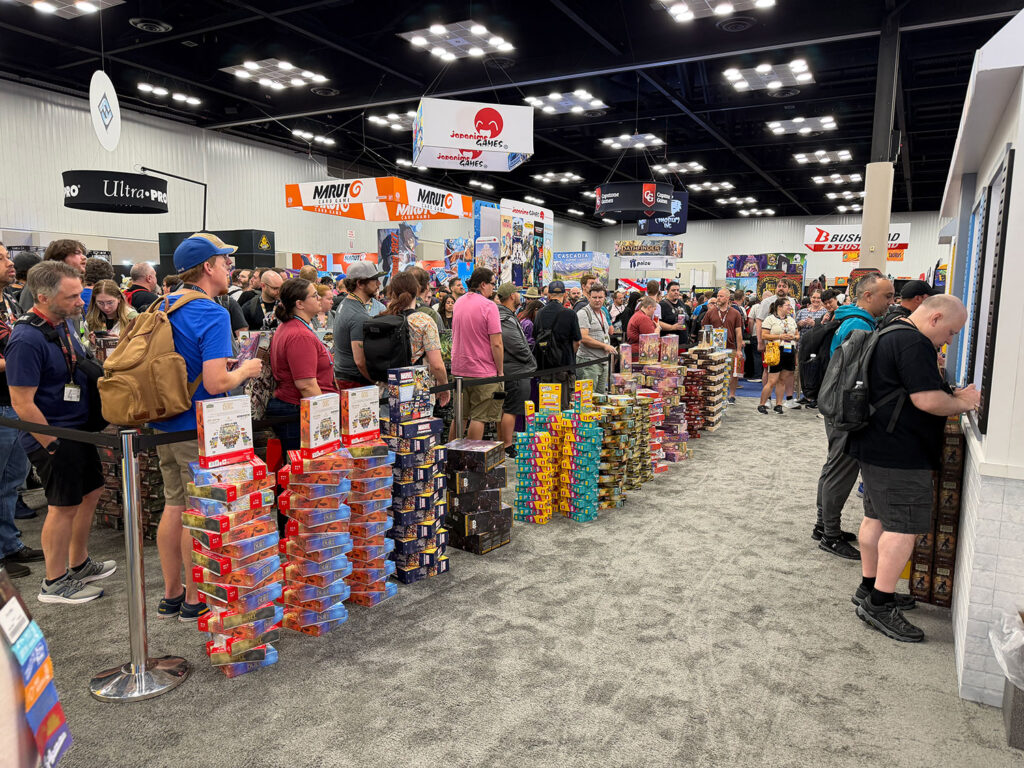
Gen Con 2026 Recap

07. August 2026 um 13:48
Gen Con RecapSeventy-four thousand people walk into a bar. That’s it. That’s Gen Con. BGQ was there, and we’ve got the recap to prove it. The Gen Con Experience Tony: Gen Con’s attendance this year came in at 74,000+, which was apparently a record. But it felt more crowded than ever to me. When the dealer hall […]

Source

Gambler x Gamble!!

  Gambler x Gamble!! (two exclamation marks) is a game from Japan released in 2024. It is a reimplementation of a 2016 game called Gambler x Gamble! (one exclamation mark), which won the Group SNE Contest in 2015. We all know what it will be named when it gets a third edition, don't we? When I read the rules, the first thing that comes to mind is this is Machi

A Surprising Opinion About Promos (and Game Store Customers)

06. August 2026 um 21:27

I follow Games Unlimited PGH (@gamesunlimitedpgh) on Instagram, and Kylie frequently offers really helpful retailer perspectives for publishers to consider.

One of his recent videos (actually a repost from a few years ago) was both surprising and insightful in a few different ways, as Kylie reveals that he–a very successful retailer–does not like promos.

Even as a publisher that doesn’t make promos (it was something we tried up through Scythe’s release in 2016 and then stopped pursuing), I was really curious to hear his reasons. Especially since a survey I ran of retailers in 2017 indicated that 79% of friendly local game store (FLGS) owners liked promos at the time.

Kylie’s reasons are:

  • A lot of publishers send promos to his store, but it takes a lot of work to match them with the game (stores juggle a lot of different games, and promos aren’t always labeled well).
  • Many promos just end up in a general bin, making them hard to find and difficult for store employees to remember to pair with a game.
  • “A large part of our customers are not actually gamers,” so the idea of a promo is confusing to them. (This revelation was particularly interesting to me. Who are the majority of people who shop at local game stores, if they’re not into games?)
  • Even a well-meaning, FLGS-focused publisher who tries to encourage customers to go to a game store using promos as an incentive can actually create an awkward situation if the retailer doesn’t have or can’t find the promo for the customers.

Kylie concludes by simply asking publishers to put promos inside the game box. This seems viable in most cases: Even if you make a special promo card for an existing game to offer at a convention, a content creator, or any circumstance, you can include it in future printings of the game.

I really like that Kylie ends with this: “We’ll do the work of selling your game because it’s awesome, not because we have some rare or exclusive promo.” That 100% echoes my beliefs about actively welcoming people into our games instead of using FOMO/exclusivity tactics.

What do you think about this opinion about promos?


Also read:

If you gain value from the 100 articles Jamey publishes on this blog each year, please consider championing this content! You can also listen to posts like this in the audio version of the blog

“This is a time to be disciplined, focused, and clear about why a game deserves to exist”: industry veteran Scott Morris on launching new publisher Steelwing Games

06. August 2026 um 20:02

Few people in the hobby game industry have seen as many sides of the business as Scott Morris – from leading global strategy at Lucky Duck Games, building publishing partnerships at GTS Distribution and running sales, marketing and social media at Arcane Wonders. Now Morris is applying that experience to his own venture as founder of Steelwing Games, whose debut title Rainbow Blvd. has been nearly a decade in the making. He spoke to BoardGameWire about deciding to launch as a publisher in a challenging market, why he believes a slower, more selective approach is the right fit, and the lessons he is bringing from his career at Lucky Duck Games and beyond.

BoardGameWire: How long has the idea of you launching your own publisher been rolling around your head? I think I remember you saying you registered Steelwing some years ago?

Steelwing originally began to take shape in 2016, after first playtesting Rainbow Blvd. (which was then called Leprechauntractors as a play on words with Leprechauns and Contractors). Like a lot of people who work in games, I’ve always had ideas about the kinds of projects I’d love to help bring to life if the timing, team, and titles were right.

The company itself was set up in 2021, and I’ve been very intentional about not rushing into publishing just for the sake of launching something. For me, it was important that Steelwing start with the right game, the right creative partners, and a clear sense of what we wanted the company to stand for.

What was it that finally got you to make the jump and launch?

It was really a combination of timing, people, and product. Rainbow Blvd. is the perfect first game, it always has been. It has a fun identity, a strong table presence, it is easy to teach, and has the type of meaningful gameplay that Steelwing is focused on.

I also reached a point in my career where my experience across multiple areas (sales, marketing, crowdfunding, distribution, licensing, production, and working with designers) has given me the confidence to give Steelwing a thoughtful and responsible start.

Rainbow Blvd., designer by Adam Wyse, will be Steelwing’s first published game

What does Steelwing represent or offer that perhaps hasn’t been possible for you in your other board game industry roles?

Steelwing gives me the chance to build something from the ground up with a clear creative point of view. The goal is to publish games that are welcoming, polished, distinct, and deliver a satisfying and rewarding experience for players.

The name reflects that mission. The “steel” represents the experience and discipline I’ve built in the industry, while the “wing” represents using that experience to help create opportunities for others and give talented people new pathways into board games when and where we can.

At its heart, Steelwing is about making games we would be thankful to have in our collection while trying to leave the industry a little better than we found it, along the way.

The industry has been facing higher manufacturing costs, tariffs, freight disruption and increasing competition for attention. Many people might see this as a difficult time to launch a publisher. What makes you optimistic?

It is absolutely a challenging time, that can’t be minimized in any way. Costs are high, attention is hard to earn, and publishers need to be more thoughtful than ever about what we make and how we make it.

What makes me optimistic is that players still respond to games that they can connect with, that have that special feel, and are well cared for. This is a time to be disciplined, focused, and clear about why a game deserves to exist. That is the mindset I am bringing to Steelwing.

Of course it will be challenging. There is never a perfect time to start a new business. One of the principles I try to live by is, “Be good today and be better tomorrow.” Staying humble, listening carefully, continuing to learn, and making games that bring people joy, will result in positive outcomes for Steelwing and more importantly, for the community.

Having worked in the industry for more than a decade, which experiences most shaped the way you’ll run Steelwing?

Not to date myself, but it’s closer to two decades, and actually my second stint in the industry. A long time ago, in a galaxy far, far away (known as Poughkeepsie, New York), I had my first opportunity in games as a retailer, managing a local store called Iron Vic’s.

The experiences that have helped shape me are the ones where I’ve been able to see the full path a game takes from idea to table. A great design is essential, but game development, product development, manufacturing, communication, and post-release support all shape the experience players ultimately have with a game.

One night, while developing Rainbow Blvd., we realized the rainbow borders on some cards felt slightly different. Opening the files in InDesign, we found that one border was 13 pixels from the cut line and another was 15. Those two pixels bothered me more than they probably should have, but I knew someone, somewhere, would have that same subtle feeling that something was off. So we spent several hours fixing it. Was it necessary? Maybe not to some, but for me, it was 100% necessary.

I’ve also been fortunate to learn from many generous and experienced people across the industry. Those relationships have shaped how I think about publishing, leadership, and the responsibility that comes with bringing a game to market.

My goal with Steelwing is not to assume we’ll get everything right. We won’t. But experience gives us a better chance to be thoughtful, avoid preventable mistakes, and build trust with the people who help bring our games to life and with the people who enjoy them.

Your recent newsletter makes clear Rainbow Blvd. has been in development for years, with prototypes dating back to 2016. What made you confident about launching a new publisher with this title?

Rainbow Blvd. has had a long and amazing road, and I’m looking forward to sharing more of that story through our updates and crowdfunding campaign. At times, it has felt as though it has a life of its own. The core idea has stayed strong through a slow-and-steady development process, while the game itself has become more focused, more accessible, and more visually distinct over time.

What stood out to me is that Rainbow Blvd. has immediate appeal, while also providing a very satisfying experience underneath the surface. People are drawn to the colorful 3D rainbows and cozy city-building theme, and then after they play a turn or two, they find meaningful decisions, shared incentives, and strategic choices that make the experience engaging for many different types of players.

That is exactly the space for Steelwing to live in; games that feel welcoming regardless of a player’s experience level, while being memorable and rewarding. Great games have “stand up moments” where players feel rewarded for their choices, and even greater games leave players with that “I can’t wait to play again” feeling. Rainbow Blvd delivers on those two things and [designer Adam Wyse] has done a tremendous job developing it into something approachable, clever, and special! I’m excited to help bring it to players around the world.

What kinds of games are you actively looking to sign? What does a Steelwing game look like?

A Steelwing game should be welcoming and engaging while delivering a memorable experience. The experience is everything. Positive, clever, engaging, intriguing, and above all else, fun.

We are actually not actively looking for games, as we have a publishing plan in place until 2029. If and when we open up for submissions, some key elements are games that are teachable, replayable, and have a clear reason to exist on the table. Strong table presence helps, a unique theme helps, and unique components turn simple into satisfying. That is where my strength as a publisher is; taking a good game design and helping turn it into a full product that delivers a positive experience.

Scott demoing Rainbow Blvd. at Origins 2026

Are there any particular themes, mechanisms or types of games you’re especially excited about right now? Or any genres or play experiences you think are currently underserved?

I believe there are still so many themes, mechanisms, and combinations in games that have not been fully explored yet. I’m especially interested in games that create positive interaction without relying only on direct conflict. I like games where players are paying attention to each other and the choices being made, where timing matters, and where the table feels alive, but not necessarily because players are attacking each other or tearing each other down.

Rainbow Blvd. is a good example of that. We’ve worked hard to make sure players stay engaged even when it is not their turn, because what other players choose can also create opportunities for others. That kind of shared excitement and mutual interest keeps the game active from turn to turn and feeling alive.

There is still a lot of room for beautiful, accessible strategy games, games that families, couples, casual players, and hobby gamers can all enjoy together for different reasons. As a wise person once said, “The people around the table are more important than the game on it.” I hope Steelwing games can help create many of those nights.

How many games are you realistically aiming to publish each year?

The plan is to stay steady, planned, and manageable. Realistically, the goal is not to publish a large number of games each year. I would rather do fewer games better than stretch the company too thin. Right now, we have Rainbow Blvd. crowdfunding this year on Kickstarter and delivering in 2027, plus an unannounced game to crowdfund in 2027 and deliver in 2028. Releasing games in a measured and manageable way is the pace to keep at the start and the primary focus.

The box cover for Rainbow Blvd.

Is the goal to remain deliberately boutique, or would you like Steelwing eventually to become more of a mid-sized publisher?

The goal is to grow responsibly. I’m not opposed to Steelwing becoming larger over time, but only if the growth supports the quality of the games and the experience for players. For now, I would describe the goal as focused. We want to be selective, build trust, and make each release feel intentional, delivering the best possible experiences to players.

Will you primarily publish original games, or are licensed titles also part of the long-term strategy?

Original games are the main focus, especially as we establish Steelwing’s identity. That said, I have a lot of respect for what a well-matched license can do when it genuinely supports the gameplay and audience. “Never say never” is the saying, but fit also matters. I am not looking to chase licenses for the sake of it, and our focus is on Rainbow Blvd and the next title, which is also an original, internal game. (Which, I can’t wait to talk more about, as it is also a very unique game like Rainbow Blvd. that gets me excited every time I play it.)

Are you actively accepting pitches? And if so, what kinds of games are you most hoping designers will bring to Steelwing? How should they contact you?

We’re not accepting unsolicited pitches right now. Steelwing already has a publishing plan in place for the coming years and I want to make sure we give those projects and relationships the attention they deserve. If and when we do open submissions, we’ll be looking for games that feel welcoming, replayable, visually engaging, and have a clear reason to exist on the table. However, I don’t want designers sending us projects before we have a proper process in place, especially if those games could be finding the right home elsewhere. We’ll share clear guidelines through SteelwingGames.com and our social channels.

Will every game crowdfund first, or do you plan to vary that from title to title?

Crowdfunding will be an important part of Steelwing’s strategy, especially early on, because it allows us to build community around each game and communicate directly with the players most excited about it. That said, I do not think every game has to follow the exact same path. The right approach depends on the game, the audience, the production needs, and the retail strategy.

Looking back over your career so far, what’s the biggest lesson you’re taking into Steelwing?

The biggest lesson I’m taking into Steelwing is that publishing is a long-term relationship business built on trust. A good game matters, of course, but so does how you communicate, how you treat people, how you handle problems, whether your decisions are sustainable, and how well you stand behind your product after it reaches the table.

I want Steelwing to be known not just for the games being made, but for being thoughtful, reliable, and committed to delivering exceptional experiences. Steelwing is intentionally lean right now, supported by a group of passionate and talented contractors, partners, and collaborators who believe in the goals and the games.

One of the things I love most about the board game industry is how accessible and personal it can still feel. I want to have direct relationships with our players. I want to hear their stories of fun, triumph, defeat, and laughter. And just as importantly, I want to hear where we can improve, because every release should help us get better at serving the people who choose to put our games on their table.

Are there any elements of being a publisher that you’ve experienced in your time in the industry that you’re deliberately trying not to do with Steelwing?

One of the most challenging things in this industry, and in life in general, is the art of saying “no” when it needs to be said. Every company has different pressures and constraints. For me, the goal is to avoid growing too fast, avoid overpromising, and avoid taking on games that cannot be given the attention they deserve. That means being honest about what can be done well, while being disciplined enough to say no when something is not the right fit.

You’re still part of Lucky Duck Games. How do you balance those responsibilities with running Steelwing?

The true answer is, “Very carefully”. My responsibilities with Lucky Duck Games remain my professional priority, and I take them seriously. I’m grateful for the opportunity I have here and for the talented people I continue to work with. Steelwing is a separate project, and I’m careful about keeping those responsibilities distinct. That means being thoughtful with my time, avoiding conflicts, and making sure Steelwing is built in a way that does not interfere with my daily obligations. Maintaining trust and professionalism matters a great deal to me.

If you were to look forward five years into the future of Steelwing, what do you hope you’ll see?

Five years from now, I hope I’ve grown to become a better publisher and I hope Steelwing has a meaningful catalog of games that people are excited to recommend to their friends and family. I would love for players to see the Steelwing name and feel like it stands for games made with intention, love, and care.

I do not think success has to mean being the biggest publisher. For me, success would be building something sustainable, respected, and joyful, both for the people who make the games and the people who play them.

Rainbow Blvd.’s Kickstarter pre-launch page can be visited here.

The post “This is a time to be disciplined, focused, and clear about why a game deserves to exist”: industry veteran Scott Morris on launching new publisher Steelwing Games first appeared on .

❌