Normale Ansicht

The Beautiful Boards of Wargaming! – Almost a Miracle!: The Revolutionary War in the North in Against the Odds Magazine #51 from LPS, Inc.

Von: Grant
20. Mai 2026 um 14:00

Continuing along in this series devoted to the best looking boards found in the wargaming world where I will highlight the art and layout of a different board in a wargame that we have played to show you the various talents of the artists and graphic designers involved. In my humble opinion, a well designed and attractive board can make all the difference in the world to me enjoying a wargame. Don’t get me wrong, the game has to be good, but if it’s also good looking it always is a better experience. A board can draw me in. Can make me feel that I’m there. Can set the stage for the thematic immersion that we all crave. And I have found many of these type of boards and I want to make sure that I share them with you.

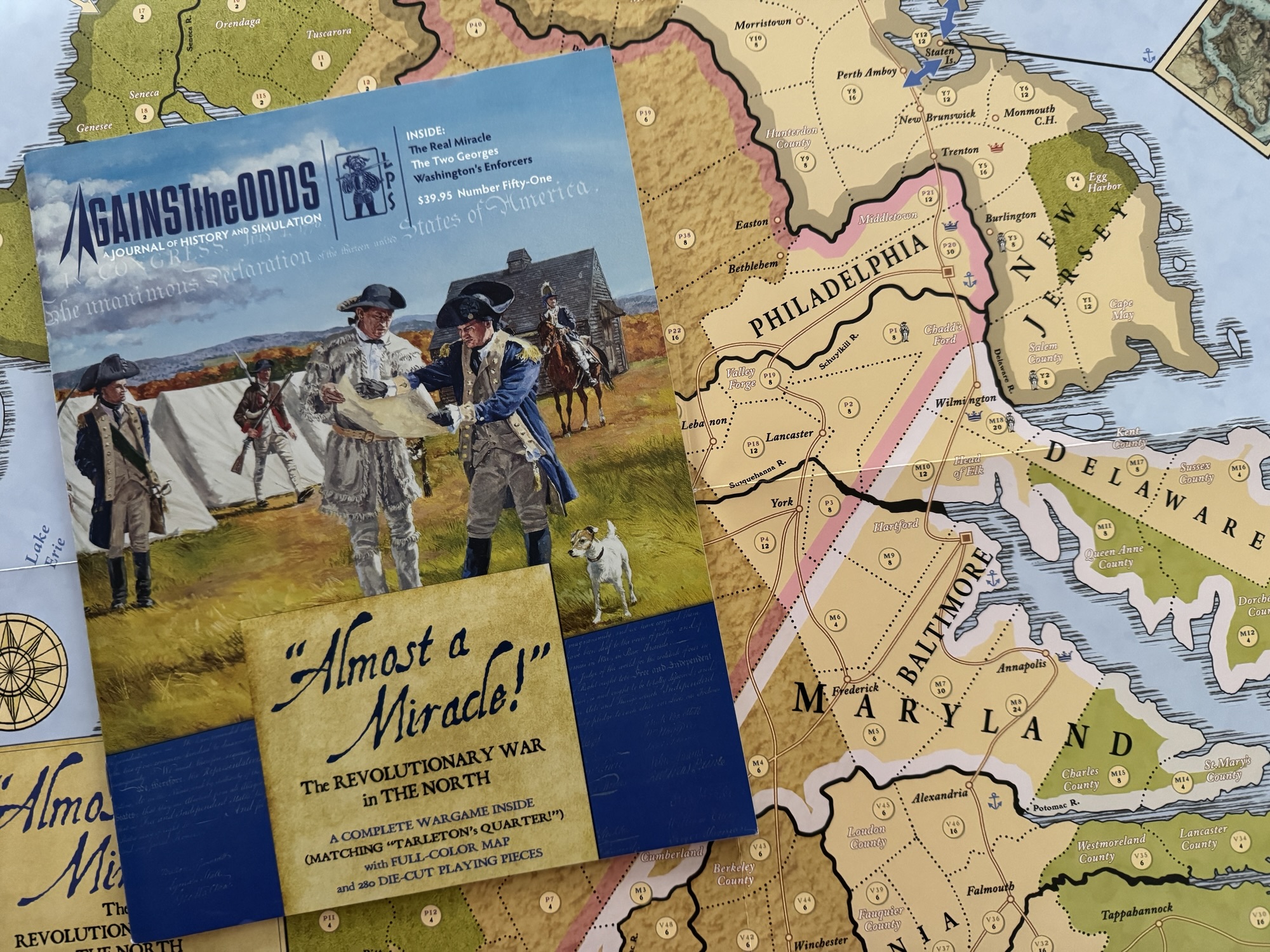
In this entry in the series, we will be taking a look at the fantastic looking board for Almost a Miracle!: The Revolutionary War in the North found in Against the Odds Magazine #51 from LPS, Inc. The board is illustrated by the very talented Mark Mahaffey whose board from Stilicho: Last of the Romans we have already covered in this series. Now typically, Magazine Wargames are nothing special. Both in their game play but also in their component quality and in the area of art and graphic design. But LPS takes great pride in the games found in their flagship magazine Against the Odds. And Almost a Miracle is such a beautiful example of great graphic design and art but also the board is absolutely a piece of art worthy of being framed and hung on a wall.

The board is illustrated by Mark Mahaffey who is a very accomplished full time artist who has done art for nearly 200 games including Celles: The Ardennes, December 23-27, 1944 (2012) from Revolution Games, The Dark Valley (2013) from GMT Games and Stilicho: Last of the Romans (2020) from Hollandspiele to name just a few. I think that Mark has a real talent for making a board coherent, easy to reference upon first glance and pleasing to look at during play, but I would not say that a lot of his boards are over the top beautiful but that is definitely the case with his effort for Almost a Miracle!.

The board represents mostly the Northern Theater of the American Revolutionary War but also includes Virginia and Maryland in addition to Pennsylvania, New Jersey, Delaware, New York and an area identified as New England which encompasses Massachusetts, New Hampshire and Connecticut. Canada is also represented at the top of the board. The map comes in 2 separate parts that join together in New England and that measures 22″ x 51″ total when combined. The interesting thing about these 2 maps is that one is significantly smaller than the other one. I would say about 75% of the playable board is found on the larger of the 2 sections with the northern tier only covering 25%.

My only real issue with the 2 parts of the board is that they join together fine but the way the map was folded created a really defined white seam in the board that really stands out. You can see it located to the right of the words New England and it runs from Penobscot to the top of the board ending in Canada around the top of Acadia. Not a huge issue but more of a distraction from the beauty that the board offers.

But the board is really quite beautiful and really provides a fantastic backdrop for the game itself. As you can see, the color palette chosen focuses on various shades of green and brown and they really give the game a natural and wild feel to it. With these American Revolutionary War games, I always keep in mind that the majority of the area of each colony, outside of a few larger population centers such as New York City, Baltimore and Philadelphia, are farmland and wilderness timber. Not a lot of development and definitely a land rich in natural resources in the form of wild game, furs, fish, lumber and ore. This “natural” color scheme of greens and browns really sets the tone of the period and provides a ready conduit into the theme and setting of the war.

Let’s focus on the southern portion of the board that includes Virginia, Maryland, Delaware, Pennsylvania and New Jersey. First off, I very much love the inclusion of the title box in the bottom left hand corner of the board with the game title and the various contributors including the designer David Jones and Mike Joslyn (who designed Tarleton’s Quarter which covers the Southern Theater) and the graphic design and art teams. These additions are always nice as they feel period to me and almost as if I am looking at a map of the region created at the time.

One thing that I want to point out is the use of lines to mark the various counties in each of the colonies. These lighter dotted lines are not as prominent as the other more important colony boundaries, roads and rivers. You will also notice that each of the colony boundaries are a different color because they touch and are easier to differentiate with the use of colors. Pennsylvania’s boundary is pink as it comes into contact with New York, New Jersey, Maryland and Virginia. Then the boundary of New Jersey is gray and New York is brown as they both touch Pennsylvania. This was a very nice touch and is important to understand the colony boundaries for recruitment and reinforcement purposes. This visually aids in distinguishing the various locations and to assist in grounding you in the geography.

Foraging is also a major part of the game and when troops are out campaigning they rely on baggage trains and supply depots for food and ammunition but also can forage the countryside which is hit or miss. These foraging results are found on a table and are influenced by the terrain type that the troops are located in. So knowing what the terrain in any given area is important and these colors quickly identify the type.

The other very nice feature on the board is the use of lines to mark the shorelines of the various bodies of water including lakes, bays and oceans. In the picture below, we get a look at the shoreline of New Jersey, Delaware, Maryland and Virginia and you can see the deft use of these horizontal dark lines to mark the water as it comes in contact with the shoreline. I also really like the small islands that are sprinkled in the midst of these lines and they add some real depth to the feature. You can also see in this picture the names of each of the counties in each of the colonies. You may also notice the nice use of the silhouettes of soldiers on the boards in some of these counties. These are the starting positions for your forces and I very much like the way they did this.

You may also notice the blue crown icons found on the board near major cities. In this picture you can see the blue crown icon at several places including: Wilmington in Delaware and Annapolis in Maryland. These blue crown icons denote the capitals of each of the colonies and some of the larger ones have multiple capitals. This has to do with victory at the end of the game for the British as if they control the colony capitals and there are no Colonial Regulars or Militia present in the colony they can then place the Colonial Governor and declare “the King’s Peace” in at least 2 colonies to end the campaign game.

As we move to the north of the map, and enter the less populated and definitely more wild areas of the colonies, including northern Massachusetts and the wilderness of Canada, the board changes quite a lot as there are less roads, less markings and frankly more green on the board. It still looks really good and the use of lines for water features is continued particularly in several of the larger lakes in the area.

In the picture above, you can see a good example of the Holding Boxes for troops in the larger metropolitan areas. Here we get a look at the Montreal Holding Box and I very much like the way that they have drawn the outline of the city itself with some of the streets, buildings and homes. This is a very nice touch to the board itself and there are several of these Holding Boxes found on the board including those shown in the picture below such as the Newport Holding Box, New York Holding Box and Staten Island Holding Box. These are very nice additions to the board itself and they look really good and add a layer of depth as well as playability to the game.

The game aids and tracks that are printed directly onto the board are very useful and well done. These use calligraphy like cursive writing that really feels period and adds to the thematic immersion of the player into the American Revolutionary War period. These boxes include the Continental Baggage Train Box and the British Baggage Train Box and shows the game’s focus on Supply. In these boxes, there is an available and an expended section that are used. There also is a Prisoners of War Track that is very period as well as these pitched battles were never fights to the death but represented the fighting style of the period which lead to many different forms of losses including deaths, injuries and prisoners taken.

Finally, there are Captured Boxes for Continental and British Leaders that aid the players in playing the game. These administrative aids are very well done from a graphics standpoint but I love that this game included them on the very large board as it eases play and cuts down on the need to continually refer back to the rules.

Almost a Miracle! was a game chosen for our Shelf of Shame Dust-Off Event in 2024 and we very much enjoyed the game and the history. The game is focused on the American Revolutionary War in the North and is named Almost a Miracle! because when asked about it years after the war ended, George Washington said that the American victory was “little short of a standing miracle.” Almost a Miracle! uses the Tarleton’s Quarter! System as a game engine starting point to bring the Northern “half” of the American Revolution into play.

I think that the best part of this game though is the board. It is just gorgeous and is an odd shape to take into account the entire northern colonies. I think that one of the strengths of this game is that it truly shows the difficulty of maneuvering armies around the colonies and the terrain as well as having to search for forage to feed those armies.

If you are interested, here is a link to our video review:

The next board that we will take a look at in the series is Great Campaigns of the American Civil War: Thunder On the Mississippi: Grant’s Vicksburg Campaign, April-July, 1863 from Multi-Man Publishing.

Here are links to the previous entries in the series:

Kekionga!: A Dark and Bloody Battleground, 1790 from High Flying Dice Games

Campaigns of 1777 in Strategy & Tactics Magazine #316 from Decision Games

Battle Hymn Volume 1: Gettysburg and Pea Ridge from Compass Games

From Salerno to Rome: World War II – The Italian Campaign, 1943-1944 from Dissimula Edizioni

This War Without an Enemy: The English Civil War 1642-1646 from Nuts! Publishing

Holland ‘44: Operation Market-Garden, September 1944 from GMT Games

Maori Wars: The New Zealand Land Wars, 1845-1872 from Legion Wargames

Imperial Struggle: The Global Rivalry – Britain & France 1697-1789 from GMT Games

Stilicho: Last of the Romans from Hollandspiele

Nevsky: Teutons and Rus in Collision, 1240-1242 from GMT Games

A Most Fearful Sacrifice: The Three Days of Gettysburg from Flying Pig Games

Donnerschlag: Escape from Stalingrad from VUCA Simulations

Keep Up the Fire!: The Boxer Rebellion Deluxe Edition from Worthington Publishing

Liberty or Death: The American Insurrection from GMT Games

Lanzerath Ridge: Battle of the Bulge from Dan Verssen Games

Salerno ’43: The Allied Invasion of Italy, September 1943 from GMT Games

Bayonets & Tomahawks: The French and Indian War from GMT Games

Undaunted: Normandy from Osprey Games

Traces of War from VUCA Simulations

SCS Ardennes II from Multi-Man Publishing

Almoravid: Reconquista and Riposte in Spain, 1085-1086 from GMT Games

Walking a Bloody Path: The Battle of Fallen Timbers, August 20, 1794 from High Flying Dice Games

All Bridges Burning: Red Revolt and White Guard in Finland, 1917-1918 from GMT Games

Storm Over Jerusalem: The Roman Siege from Multi-Man Publishing

Barbarians at the Gates, The Decline and Fall of the Western Roman Empire 337 – 476 from Compass Games

Iron, Blood, Snow & Mud from PHALANX

North Africa ’41: The Western Desert, March to December, 1941 from GMT Games

Battles of the American Revolution Volume II: Brandywine from GMT Games

Ardennes ’44: The Battle of the Bulge from GMT Games

Gandhi: The Decolonization of British India, 1917-1947 from GMT Games

Battles of Napoleon: Volume I – Eylau 1807 from Sound of Drums

Tattered Flags No. 01 – Into the Whirlpool from Blue Panther

Alliance: Multiplayer Napoleonic Wargame from Columbia Games

Phantom Fury: Iraq, November 9, 2004 The Second Battle for Fallujah 2nd Edition from Nuts! Publishing

-Grant

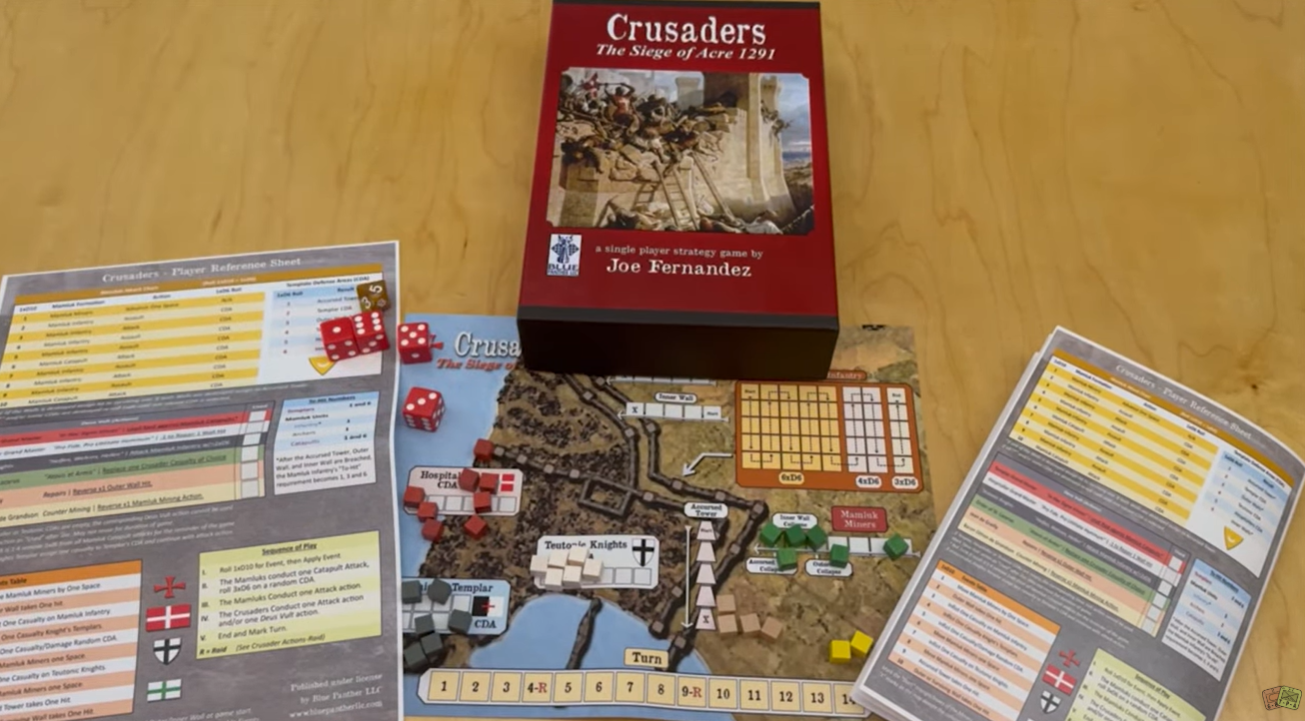
Unboxing Video: Crusaders: The Siege of Acre 1291 from Blue Panther

Von: Grant
16. Mai 2026 um 14:00

“In Signo Hoc Vinces”. Dive into history and heroism with Crusaders: The Siege of Acre 1291, a Tactical level Solitaire-Only board-wargame that immerses you and lets you experience the last stand of the Knights Templar and the Crusaders in the Holy Land. Relive the courageous stand of some 15,000 Crusader soldiers, Knights Templars, Teutonic Knights, and Hospitallers as they defend Acre, the critical port city in the Holy Land, against a massive Mamluk army of some 80,000 soldiers armed with siege engines and catapults during the Ninth Crusade.

Crusaders is a dice rolling, tower defense, solitaire game. Players take the role of Crusaders and try to defend Acre from the Mamluk attackers. Players win or lose depending on if the walls are breached and enough defenders survive.

-Grant

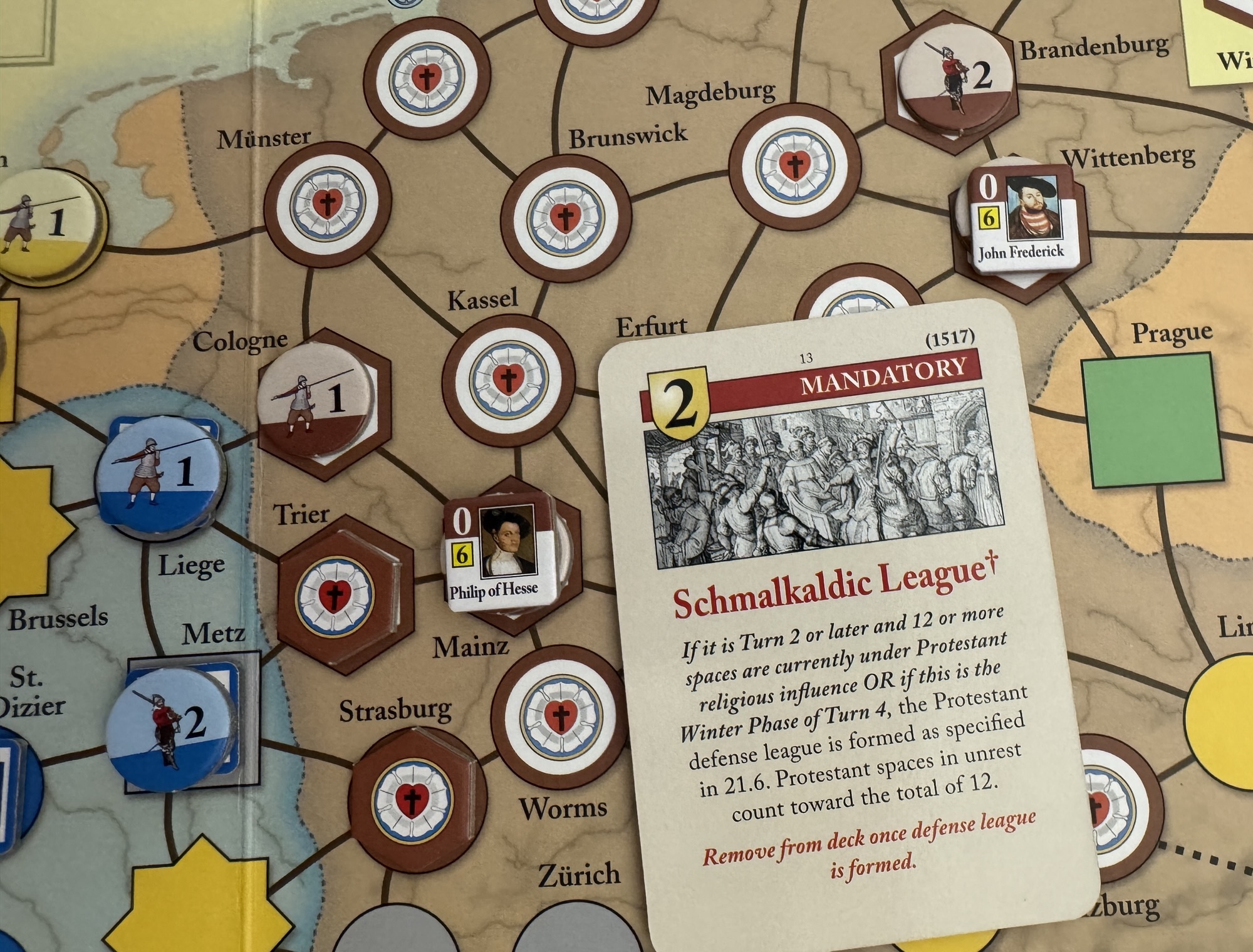
My Favorite Wargame Cards – A Look at Individual Cards from My Favorite Games – Card #77: Schmalkaldic League from Here I Stand: Wars of the Reformation, 1517-1555 from GMT Games

Von: Grant
12. Mai 2026 um 14:00

With this My Favorite Wargame Cards Series, I hope to take a look at a specific card from the various wargames that I have played and share how it is used in the game. I am not a strategist and frankly I am not that good at games but I do understand how things should work and be used in games. With that being said, here is the next entry in this series.

#77: Schmalkaldic League from Here I Stand: Wars of the Reformation, 1517-1555 from GMT Games

Here I Stand: Wars of the Reformation 1517-1555 is an experience packaged in a game that attempts to boldly cover the political and religious conflicts of early 16th Century Europe. The game focuses on the struggle of religious reformers such as Martin Luther, John Calvin and Ulrich Zwingli as they battle the Papacy for changes in their views of God and religion. But it is more than just the Holy War as it deals with the other European countries involved in the affairs of the time including France, England, the mighty Hapsburg Empire and the Ottoman Empire in the east. They all played a role in the process of the Reformation and the design brilliantly weaves this all together into an interesting and engaging experience. The game also covers other plot lines and events of the period, including wars, marriages and ascendancies to thrones, using a unique Card Driven Game (CDG) system that models both the political and religious conflicts of the period.

Today, I want to take a look at a very interesting Mandatory Event card that really shakes things up for the Protestant player in the Schmalkaldic League. This Mandatory Event basically transforms the Protestant player and changes their focus slightly as they now become somewhat of a military power. I use the term “military power” here lightly as they really are not that powerful and this event is really more of a wet blanket thrown onto their spiritual bonfire as they now will have to worry about gearing up for attacks from their neighbors to try and take away their victory points through wresting control of their Electorates from them, which grant extra Victory Points. The Schmalkaldic League Mandatory Event is only triggered when the Protestant has religious influence in 12+ spaces from Turn 2 on, or if not, then automatically by the end of Turn 4.

The Protestant player gaining the ability to create and command military units, including both regulars and mercenaries, is somewhat of a boon as you can now move your troops around the board gaining additional dice for Conversion attempts if those units are adjacent and also the electorates under Protestant religious control, specifically those marked as Protestant home spaces, instantly come under Protestant political control and grant 2 VP for each Electorate up to a maximum of 12 VP total if all 6 are under control. Talk about a turning point…albeit a turning point with some difficulties. The leaders granted to the Protestants are also not very good and do not gain extra dice during combat and frankly cannot command large armies. These leaders include John Frederick and Philip of Hesse.

John Frederick I of Saxony by Lucas Cranach the Younger.

Frankly, I try my best to hope and pray that the Schmalkaldic League card doesn’t come out during the first 4 turns and then will be triggered only during the Winter Phase of Turn 4. This gives the Protestant player some time to expand and attempt to get all of those important VP generating Electorates under their control to set themselves up nicely. But once it happens you will find that you are spending your scarce resources in the form of Command Points on things like recruiting units, moving those units and preparing for attacks. This takes away from your ability to focus solely on spreading the faith and can be a real drag on that effort. But, you take the good with the bad in this game and I have learned to deal with it over the years and turn it into something that benefits me.

The Schmalkaldic League was a military alliance of Lutheran principalities and cities within the Holy Roman Empire during the mid-16th century. It received its name from the German town of Schmalkalden, where the group was founded in 1531. Although created for religious motives soon after the start of the Reformation, its members later came to have the intention that the League would replace the Holy Roman Empire as their focus of political allegiance. While it was not the first alliance of its kind, unlike previous formations, such as the League of Torgau, the Schmalkaldic League had a substantial military to defend its political and religious interests.

The League’s members agreed to provide 10,000 infantry and 2,000 cavalry for their mutual protection. They rarely provoked the Holy Roman Emperor Charles V directly but confiscated church land, expelled bishops and Catholic princes and helped spread Lutheranism throughout northern Germany.

Martin Luther planned to present to the League the Smalcald Articles, a stricter Protestant confession, during a meeting in 1537. He attended the critical meeting in 1537 but spent most of his time suffering from kidney stones. The rulers and princes even met in the home at which Luther was staying. Though Luther was asked to prepare the articles of faith that came to be known as the Smalcald Articles, they were not formally adopted at the time of the meeting, but in 1580, they were included in the Book of Concord.

In the next entry in this series, we will take a look at Hamburger Hill from Fire in the Lake: Insurgency in Vietnam from GMT Games.

-Grant

Hasbro delays Q1 results after cyber attack, expects revenue rise from ongoing Magic strength

23. April 2026 um 14:32

Toy and game maker Hasbro has delayed its quarterly results by almost a month after suffering a cyber attack, but said it expects to post Q1 revenues of up to $985m thanks to continued strong performance of Magic: The Gathering.

Hasbro said it identified “unauthorized access” to the company’s network on March 28, but believes that access has been “contained” – adding that Magic’s shipments and release cadence had continued unaffected.

The company expects Q1 revenue to be between $970m and $985m, a rise of between 9% and 11% compared to the same period last year – while operating profit is expected to reach $235m to $245m, a 38% to 44% jump.

Those preliminary results are expected to be solidified when Hasbro eventually releases its full Q1 financial report, which is now scheduled for May 20.

Magic continues to underpin Hasbro’s fortunes, with the veteran trading card game’s revenue having soared 59% last year to mark its strongest annual performance yet.

Hasbro saw its wider 2025 revenue rise almost 14% to $4.7bn, driven by a record 45% growth in its Magic, D&D and digital gaming division Wizards of the Coast, the company revealed in February.

Magic’s record-breaking year was capped off by a storming fourth quarter, which saw revenues from the game up 141% compared to Q4 2024 on the strength of the Avatar: The Last Airbender and Final Fantasy releases.

That stellar performance of Wizards, and Magic in particular, was in stark contrast to Hasbro’s consumer products segment – which includes Nerf guns, Transformers and Peppa Pig toys.

That segment saw revenues drop 4% last year “amongst macro and retailer volatility brought on by tariff announcements in Q2″ – and unlike for Magic, Hasbro said that the cyber incident would likely impact second quarter revenues and operating profit in consumer products due to expected order processing, shipping and invoicing delays.

Hasbro added that it still expects full-year revenues to rise between 3% and 5% in 2026. Hasbro CFO and COO Gina Goetter said in February that the company expects Wizards of the Coast to deliver mid-single-digit revenue growth in 2026, “supported by a healthy release cadence and continued engagement across the Magic ecosystem”.

The post Hasbro delays Q1 results after cyber attack, expects revenue rise from ongoing Magic strength first appeared on .

Brass Pittsburgh – To buy or not to buy?

Von: natokh
08. April 2026 um 12:07

Aktuell läuft auf Gamefound die Kampagne zum neuen Brass Titel Brass: Pittsburgh by Roxley Games – Gamefound, noch bis zum 13.04.26.

Da Brass Birmingham eines meiner langjährigen Lieblingsspiele ist, war ich natürlich von Beginn an daran interessiert, aber auch durchaus skeptisch, was das Spiel betrifft. Aber auch Brass Birmingham (2018) war ja bereits eine Weiterentwicklung des Ur-Brass (2007), welches dann bei Roxley in einer optisch stark überarbeiteten Version als Brass Lancashire (2018) neu aufgelegt wurde.

Brass Pittsburgh ist damit übrigens das 4. Spiel der „Brass-Reihe“. Hier wird gerne das Spiel Age of Industry (2010) vergessen, welches die 1. Weiterentwicklung von Brass war. Age of Industry hatte die Besonderheit, dass es hierfür weitere Karten als Erweiterung gab. Das ursprüngliche Spiel spielt hier in Neu England und ist ein gestreamlintes Brass.

Die Entwicklung von Brass 2007 bis 2018

Aber nun zu Brass Pittsburgh. Ich habe mir in den letzten Wochen einige Videos von us-amerikanischen Youtube-Kanälen zu diesem Spiel angesehen, um mir eine Meinung dazu zu bilden. Vor allem das Let’s Play von Before you Play hat mit hier geholfen einen Überblick über die Änderungen zu den Vorgängern zu bekommen.

Brass: Pittsburgh – Teach & Playthrough (Befor you Play)

Und das sind doch einige. Es gibt in Pittsburgh keine Kanäle mehr, aber nach wie vor 2 Ären. Und auch hier werden die 1er Industrien und ein guter Teil der Transportmittel (welche hier ausschließlich Züge sind) abgeräumt. In dem Spiel gibt es jetzt leichte und schwere Züge. Beim Bau der leichten Züge benötigt man Kohle, beim Bau der schweren Züge Stahl, das zusammen mit Koks eine der neuen Ressourcen im Spiel ist. Die schweren Züge bleiben auch über das Ende von Ära 1 auf dem Spielplan, alle leichten Züge werden entfernt.

Auch hat man zu Beginn des Spieles nur 2 schwere Züge zur Verfügung, alle weiteren muss man sich erst freispielen, indem man Industrien baut oder mit Entwicklung von seinem Spielertableau entfernt.

Es gibt auch jede Menge neue Industrien, wie z. B. Kerosin, Stahlwerke, Koks, ein Generator, eine Ölstadt, Produktionsstätten für schwere Züge und Autos und außerdem noch Wolkenkratzer. Neu ist auch, dass man manche Industrien zwingend überbauen muss, um das nächste Level davon zu bauen. Auch werden wohl jetzt die Siegpunkte von Industrien gewertet, die man überbaut, was bei Birmingham und Lancashire nicht der Fall ist.

Neu sind auch die Ressourcen Stahl und Koks und die „dezentralen“ Ressourcenmärkte, die zudem unterschiedliche Preise für die Ressourcen. Da muss man auch immer aufpassen, von welchem Markt man kauft oder an welchen Markt man verkauft, wenn man mit mehreren davon verbunden ist. Zudem gibt es in Brass Pittsburgh die Möglichkeit Ressourcen von Cornelius Vanderbilt zu kaufen. Dazu muss man auch mit keinem Markt verbunden sein, man zahlt jedoch kräftige Aufschläge.

Statt Bier, wie in Birmingham, benötigt man in Pittsburgh jetzt Öl zum Verkaufen. Dazu muss man zuerst Pipelines zu Ölfeldern bauen. Wenn diese genutzt werden, erhält man zusätzlich einen Bonus (Geld, Einkommensschritte, Siegpunkte). Zu Spielbeginn hat man nur 1 dieser Pipelines, die man bauen kann, weitere muss man erst über sein Spielertableau und das Bauen von Industrien freischalten, genau wie die schweren Züge. Ein Ölfeld kann man immer über mindestens 2 Wege anbinden. Es gibt aber auch die Möglichkeit einen dieser Wege zu blockieren, damit die Mitspieler gezwungen sind über die eigene Pipeline auf das Öl zuzugreifen.

Neu sind auch die einmaligen Bauboni, die man durch das Bauen von Zugverbindungen und Pipelines erhält. Und last, but not least, gibt es in dem Spiel jetzt Whiskey. Diesen kann man Einsetzen, um eine seiner Orts- oder Industriekarten zu einer Jokerkarte zu machen. Eine weitere Option ist das Abgeben von Whisky, um die neuen Premium Aufträge (Quality Rewards) zu erfüllen. Für diese muss man Güter verkaufen, auf deren Industrieplättchen Sterne abgebildet sind. Für einen fehlenden Stern kann man 1 Flasche Whiskey abgeben. Die 3 Premium Aufträge können jeweils nur 1x in der Partie erfüllt werden und bringen Siegpunkte, Einkommenssschritte, Geld oder Whiskey.

Es gibt noch ein paar weitere Besonderheiten, wie z. B. Industrien, die man nicht verkauft sondern nur überbaut, oder die Wolkenkratzer, die sofort nach dem Errichten eine zusätzliche Verkaufsaktion bringen.

Vor Ende der Gamefound-Kampagne soll auch noch die Anleitung zur Verfügung gestellt werden (Stand 08.04.26 war diese leider noch nicht verfügbar). Auch soll noch ein Playthrough von Heavy Cardboard, mit dem aktuellsten Prototypen und dem letzten Stand der Anleitung kommen.

Heavy Cardboard hatte in den letzten Wochen bereits Playthroughs von den bisherigen Brass-Versionen, inklusive Age of Industry, gestreamt.

Nachtrag (08.04., 14:52 Uhr): Ich habe gerade gesehen, dass Heavy Cardboard sein 4 Spieler Playthrough jetzt leider erst für den 15.04. (also nach Ende der Gamefound-Kampagne) angekündigt hat: Brass: Pittsburgh – 4p Overview & Play-through by Heavy Cardboard

Es gab auch noch eine Abstimmung welches Cover die Collector’s Edition von Brass Pittsburgh erhalten soll. 3 Cover standen dabei zur Wahl. Gewonnen hat das Cover mit dem Stahlwerk (Auch mein persönlicher Favorit). Allerdings kann man in der Kampagne auch noch die beiden anderen Cover für die Collector’s Edition auswählen.

Fazit: Ich habe mich entschieden in die Kampagne einzusteigen und die Brass Pittsburgh Collector’s Edition zu unterstützen, auch weil ich natürlich nicht gefeit bin vor nettem Chichi, wie z. B. den Synth-Karten, den hölzernen Industrieplättchen, den metallenen Ölfässern oder den schicken Ressourcenwürfeln.

Das mit den Double Layer Spielertableaus ist insofern etwas doof, da man auch in Brass Pittsburgh Industrieplättchen übereinanderstapelt und diese in der Höhe dann über das Tableau hinausragen, auch wenn es nicht so viele sind wie bei Brass: Birmingham oder Lancashire. Auch den nicht spiegelnden Spielplan bräuchte ich persönlich nicht und statt der zugegebenermaßen schicken geprägten Blechdosen hätte ich viel lieber ein Insert, in welches ich die Industrieplättchen in der richtigen Reihenfolge einsortieren könnte.

Alles in allem haben mich die Playthrough Videos aber angefixt und ich würde das Spiel gerne spielen. Und wenn es dann am Ende doch nicht so oft auf den Tisch kommt, dann kann ich es bestimmt auch wieder zu einem vernünftigen Preis weiterverkaufen.

Es gibt aber auch 2 Punkte, die mich bei der neuen Brass-Version nicht überzeugen. Das sind die Bauboni, die man für manche (nicht alle) Zugstrecken oder Ölpipelines bekommt und das sind die 3 Quality Rewards, die jeweils nur 1 Spieler erlangen kann. Für mich passt das nicht so recht zum sonst sehr eleganten Brass Spielablauf. Es wirkt für mich eher so, als wollte man hier noch ein, zwei neue „Gimmicks“ einbauen. Es sind übrigens auch die einzigen Wege, außer dem Bau der Güter-Fabrikation Stufe IV, um an Whiskey zu kommen. Da hätte ich mir auch noch einen anderen Weg gewünscht.

Nur die neuen Metallmünzen kann sich Roxley wirklich behalten. Zum einen bin ich ein großer Fan von Pokerchips und zum anderen habe ich auch Bedenken hinsichtlich des Designs. Ich bin mir nämlich ziemlich sicher, dass sich in diesen „Münzen“ am Ende einiges an Dreck sammeln wird und das die dazu prädestiniert sind, den Spielplan zu verkratzen.

ERGÄNZUNG 11.04.26: Kurz vor Ende der Kampagne hat Roxley nun auch die Anleitung zu Brass Pittsburgh online gestellt (im Kampagnen-Update Nr. 28): Brass: Pittsburgh by Roxley Games – „Am I the Only One Around Here Who Gives a 😳 About the Rules?!“ – Gamefound Auf der letzten Seite der Anleitungen werden übrigens Brass Lancashire, Birmingham und Pittsburgh in einer Tabelle gegenübergestellt, was ich sehr hilfreich finde.

Brass: Pittsburgh auf BoardGameGeek

❌