❌

Lese-Ansicht

Gaming the American Revolution – Camden 250 Event Daily Debrief Series – Day 2

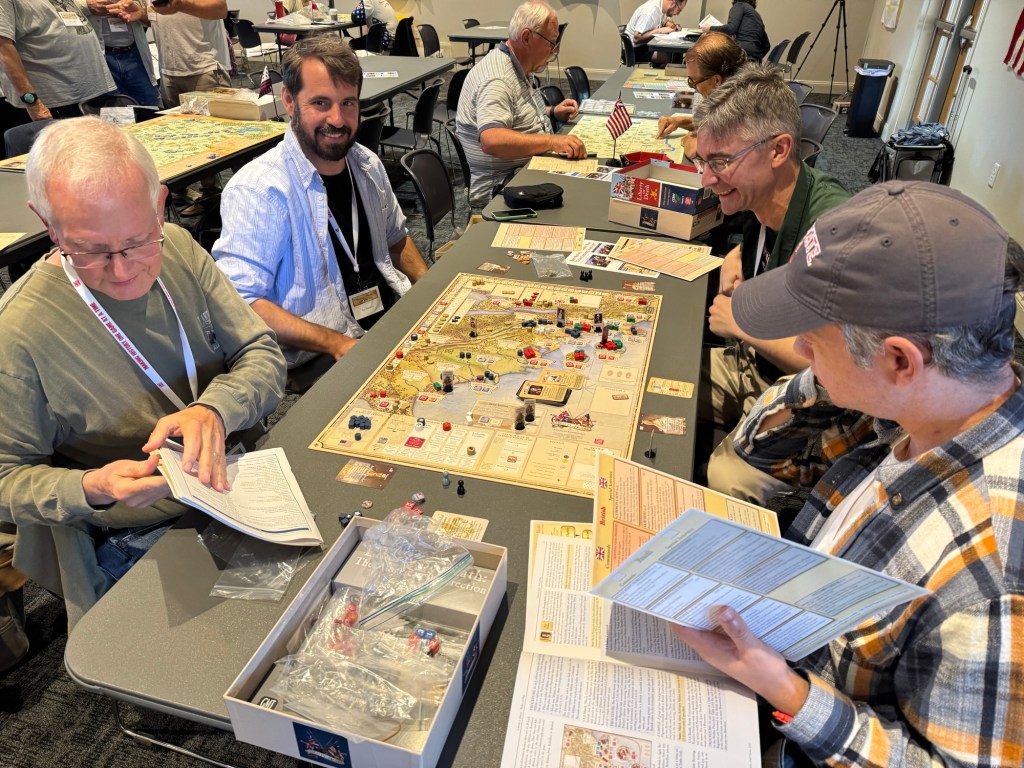
Day 2 dawned early with a morning gathering at the Camden Revolutionary War Visitor Center to receive instruction on the days events and schedule. As you can see in the picture below, there were about 50 gamers who showed up early to get a good start on the gaming.

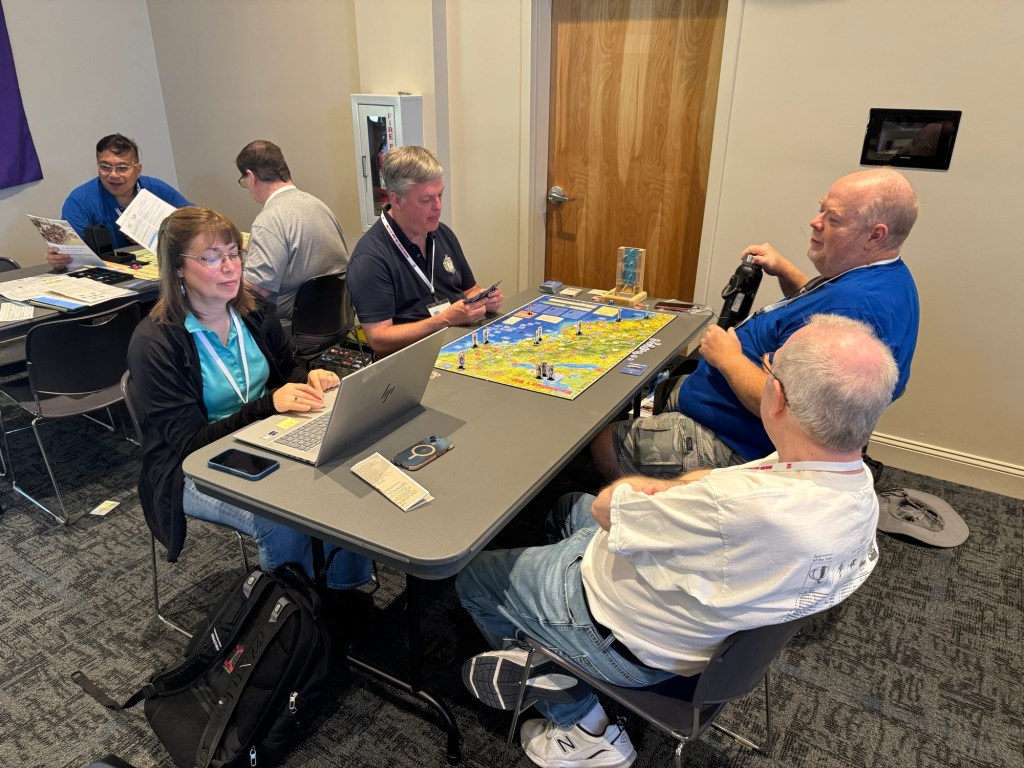
We entered the gaming hall and I was very surprised as it was very nice and cozy and felt roomy with lots of tables setup to choose from. We chose a corner in the back and began setting up to play Battles of the American Revolution Oriskany from the American Revolution Tri-Pack #2 from GMT Games.
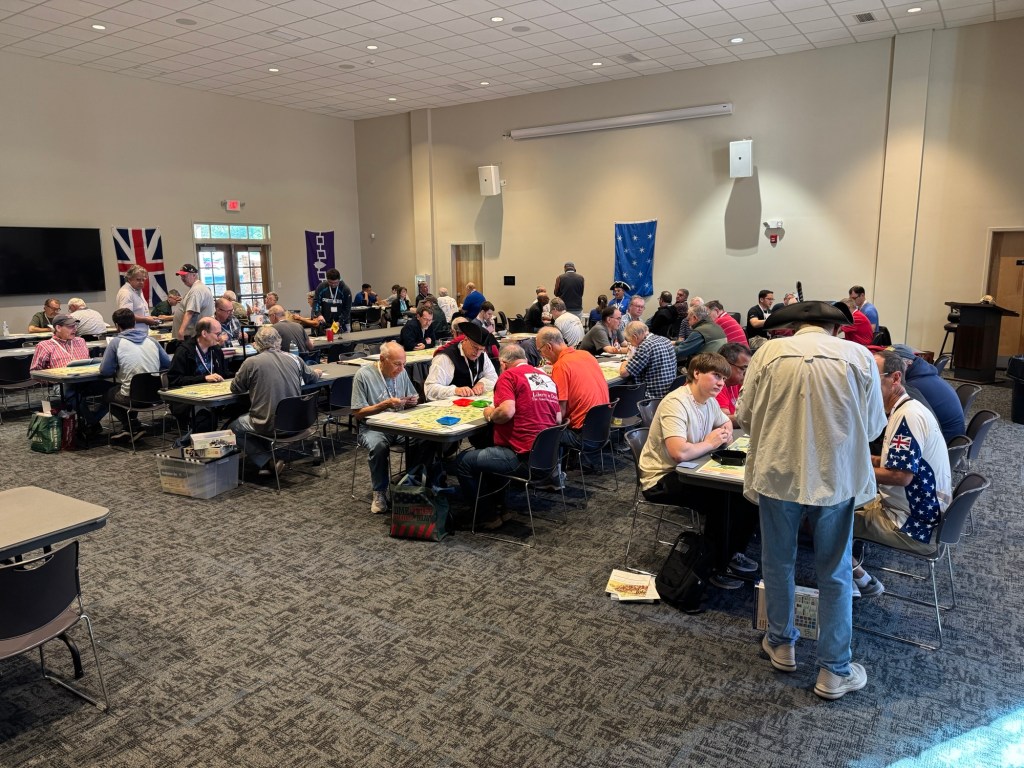
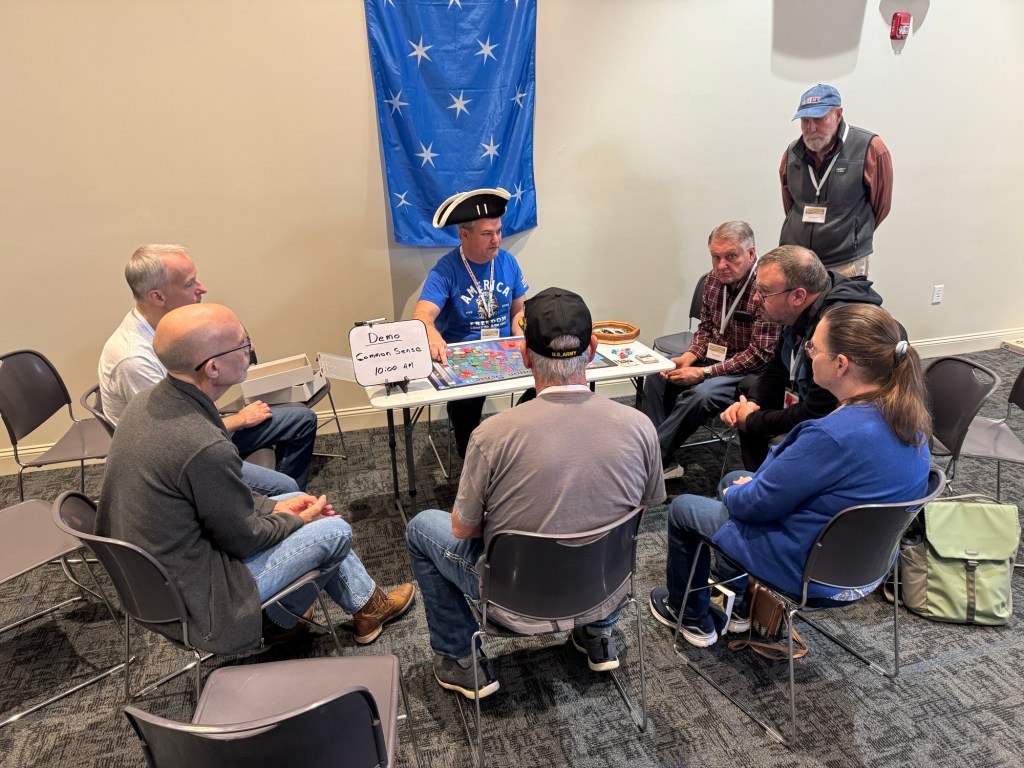
There were a lot of different games being played including BoAR, Washington’s War, Liberty or Death and Common Sense as well as a BoAR Eutaw Springs tournament going on.
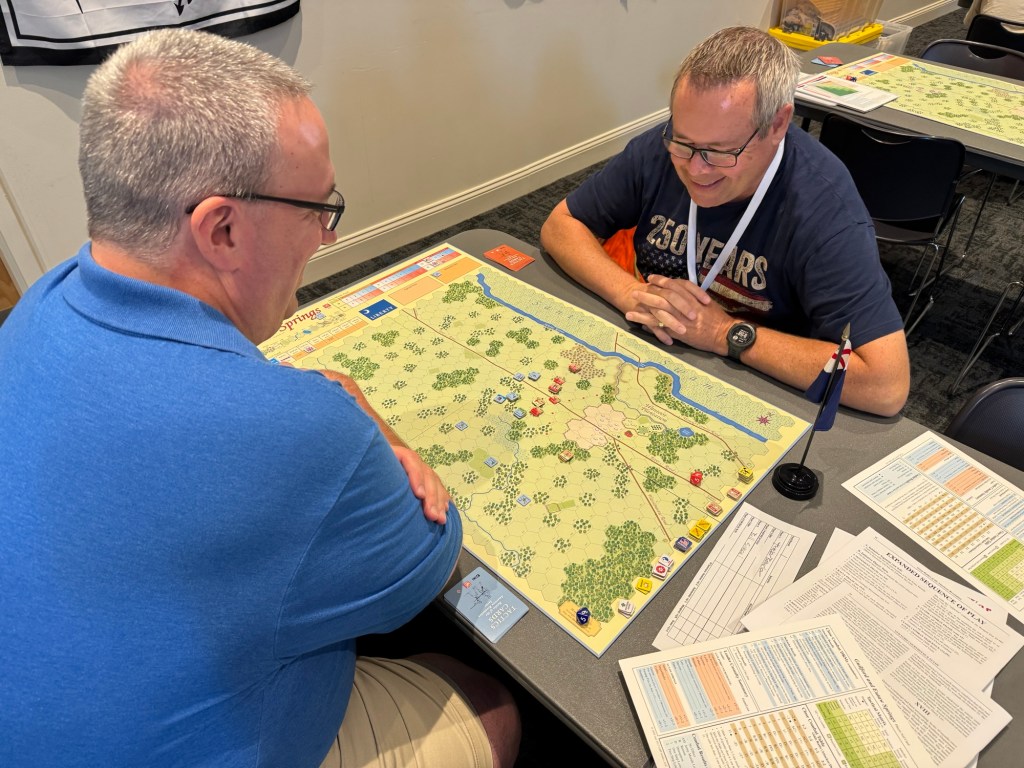
Bill Simoni and designer Trevor Bender playing in the Eutaw Springs tournament.
A demo of the upcoming Common Sense by designer Sam London.
Washington’s War.
Liberty or Death.

We decided to play the historical scenario for Oriskany which is a 6-turn game focusing on the August 6, 1777 ambush as General Nicholas Herkimer’s relief column is trying to make their way up the Military Road to Fort Stanwix.

The game starts with the British player having to set up their units in an ambush that has to be connecting contiguous units adjacent to the Patriots and they get an Ambush marker placed on them which will grant a 1 column shift to their attack if they can successfully make the ambush roll.
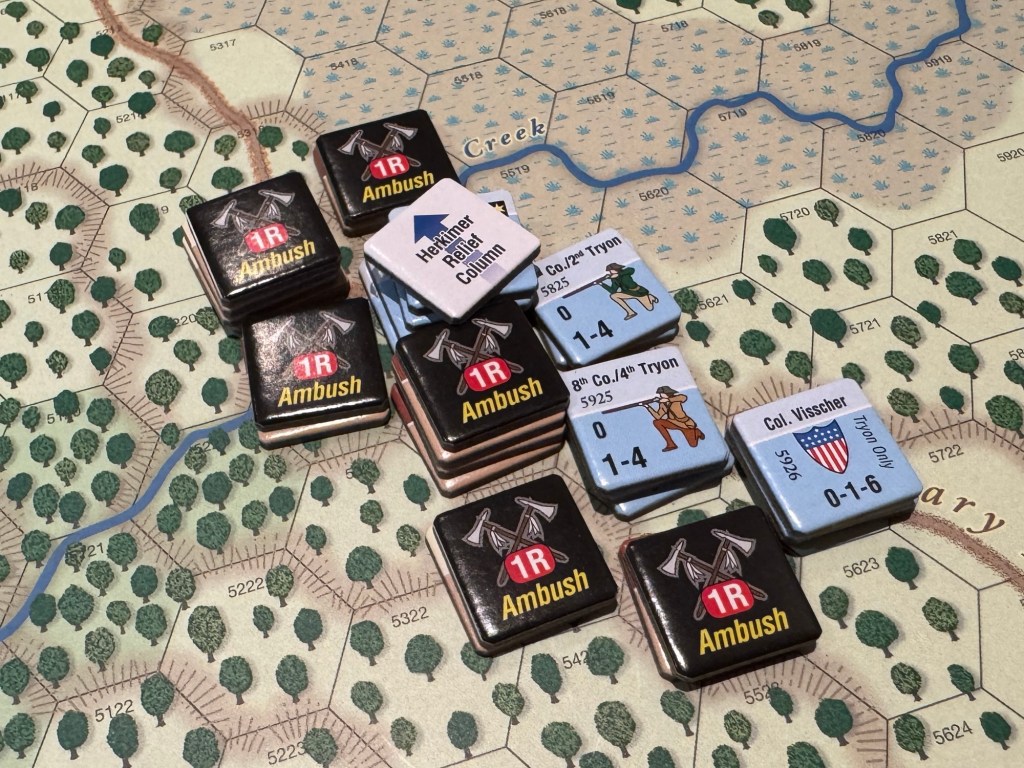
Alexander didn’t roll well so several of his units were detected and lost their element of surprise. You can see that 3 of his units lost their Ambush markers and this would prove to be a boon to the Patriots.
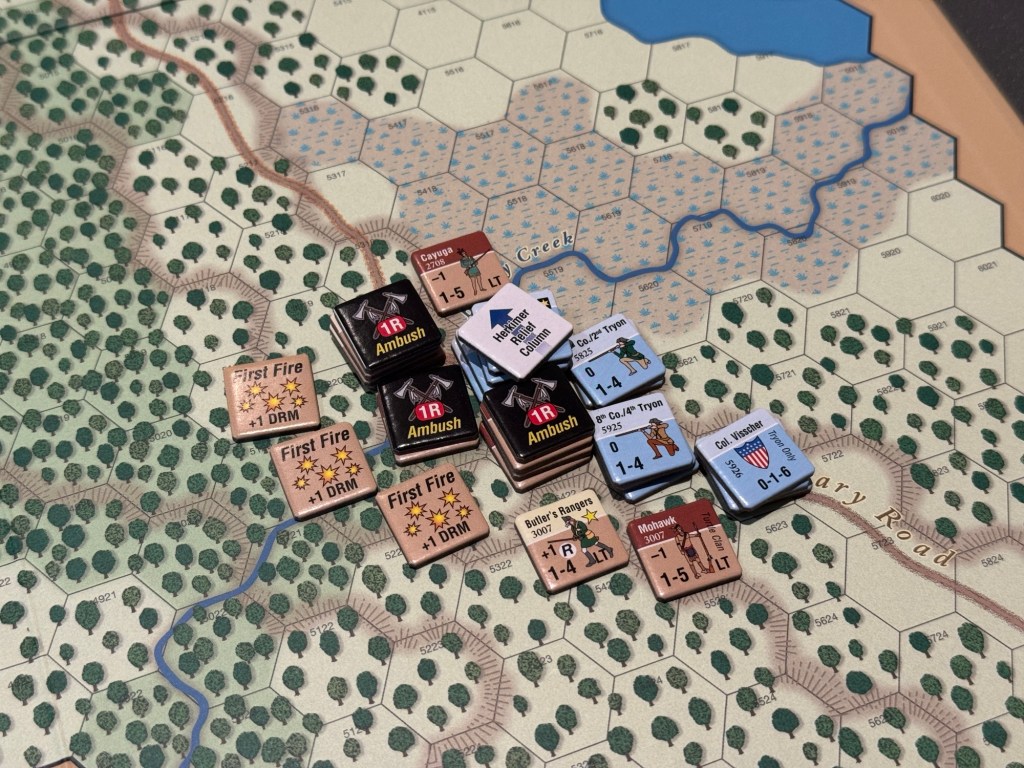
We spent the next 3-4 turns beating ourselves as our planned attacks were not working well and we basically rolled poorly and did damage to ourselves. Very odd but it was fun. But the best part of the system is the Tactics cards that create a bluff type of mind game.

The Tactics cards options are split into tiers with the 4 basic tactics always eligible to be chosen whereas advanced maneuvers require a commanding leader present and sometimes specific adjacent vacant hexes to execute. Common tactical choices include attacking in echelon, turning flanks, frontal assaults or attempting to withdraw. I very much enjoy this aspect because it adds a psychological tension that castes players to anticipate and bluff. Just a really neat addition to the game.
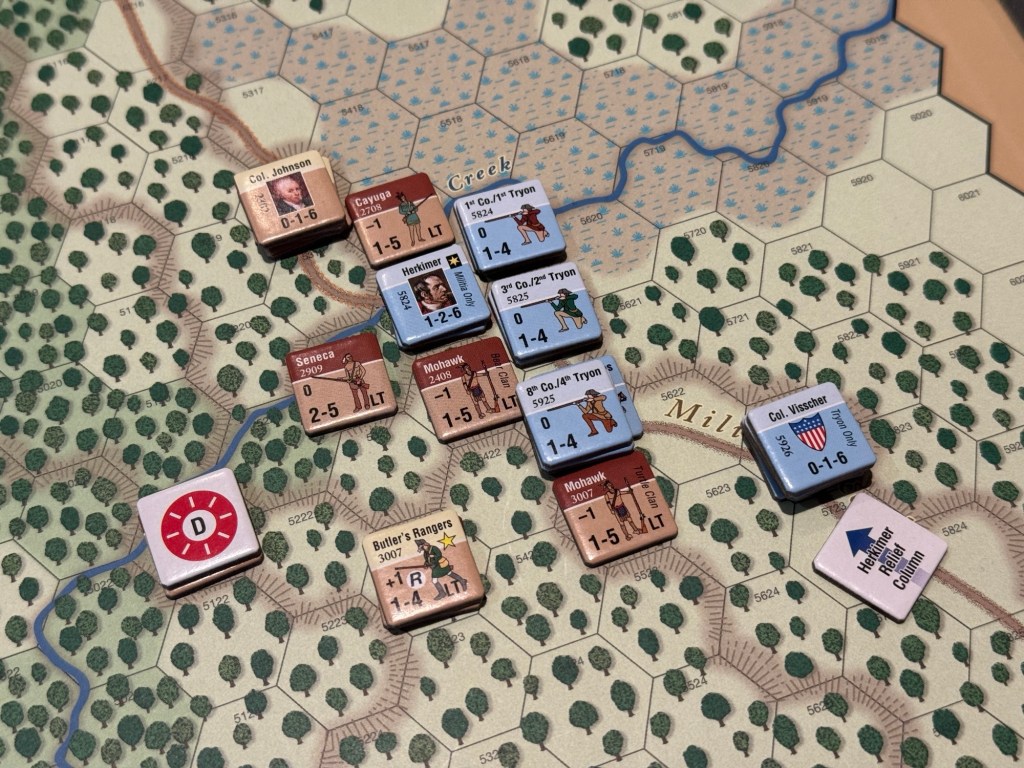
In the end, Alexander’s British and Indian allies ended up killing 2 of my leaders and also reduced 3 of my units and I was unable to advance the relief column to the point needed. He won the scenario with 4 VP to my zero. We had fun and I am glad we had a chance to play this one.
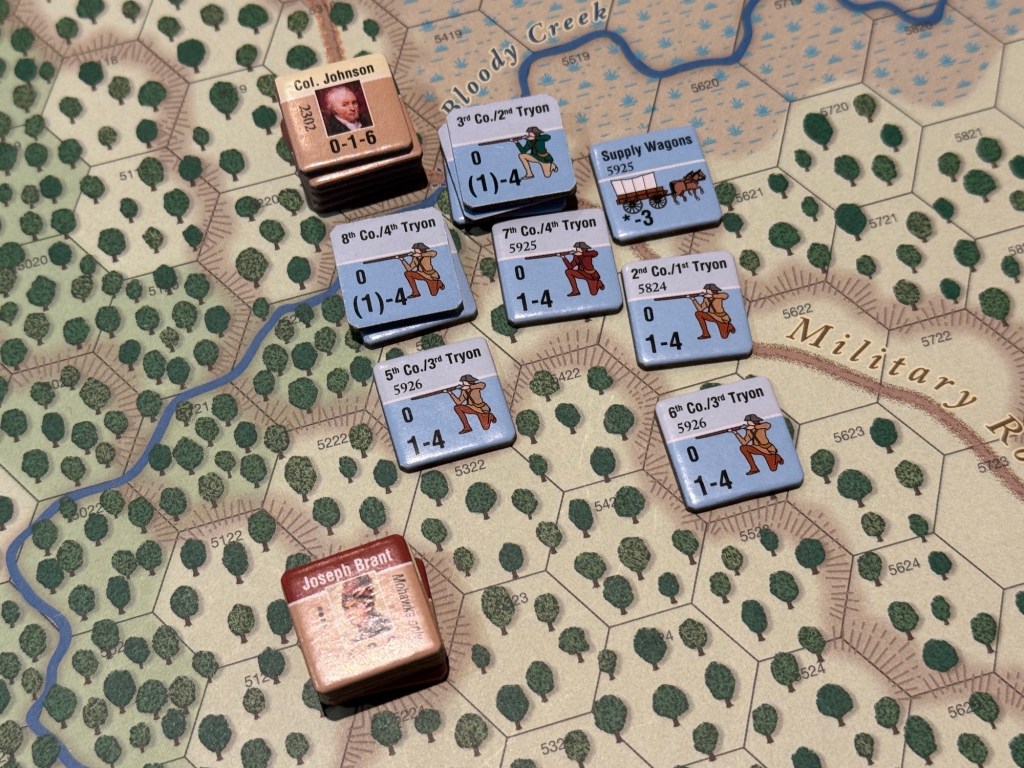
A leaderless rabble was defeated.

We then got in a game of Liberty or Death which is my 2nd favorite volume in the COIN Series.
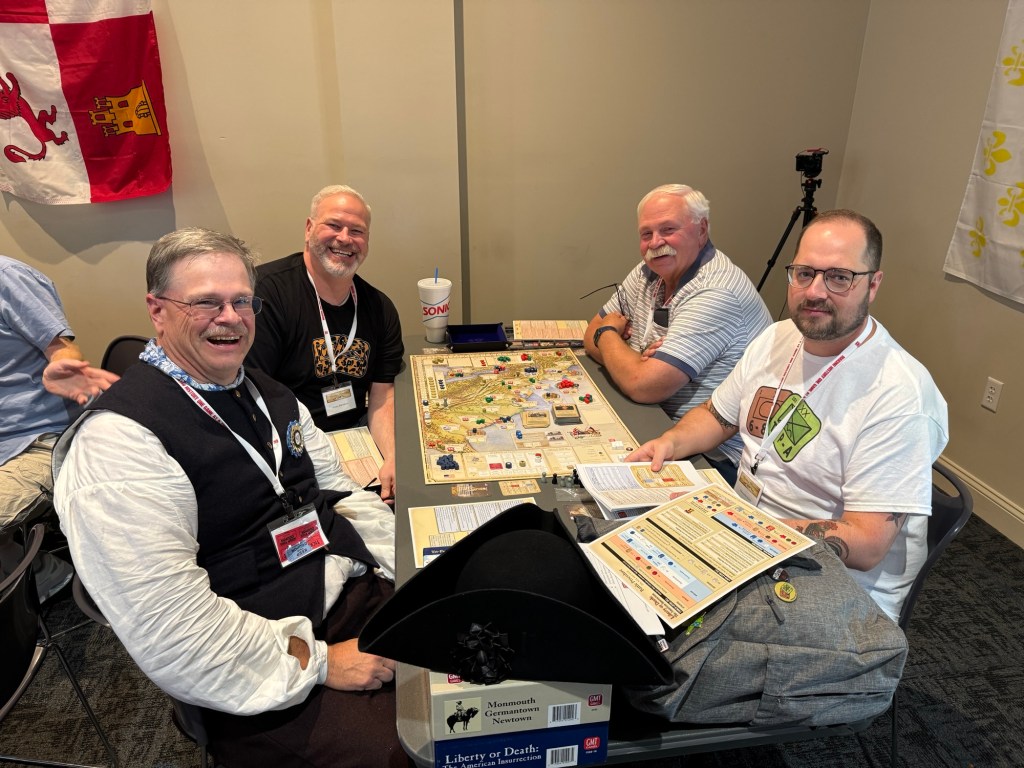
I played as the Indians and Alexander took the French. I worked on building Villages and then started Plundering the Patriots of their resources. Meanwhile the French did a great job of getting into the war early by the end of 1777 and then worked well with the Patriots to attack the British in New York and New York City driving them out of both. This put a great deal of pressure on the Indians as I had to continually Raid into these areas trying to keep their level of Opposition low.
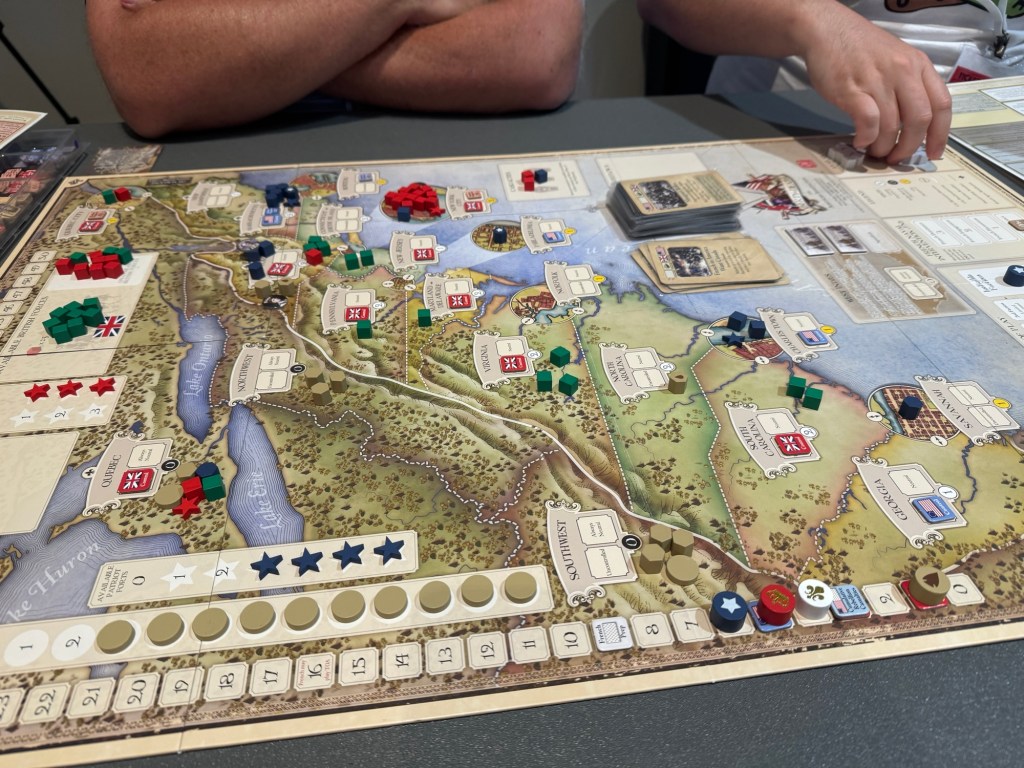
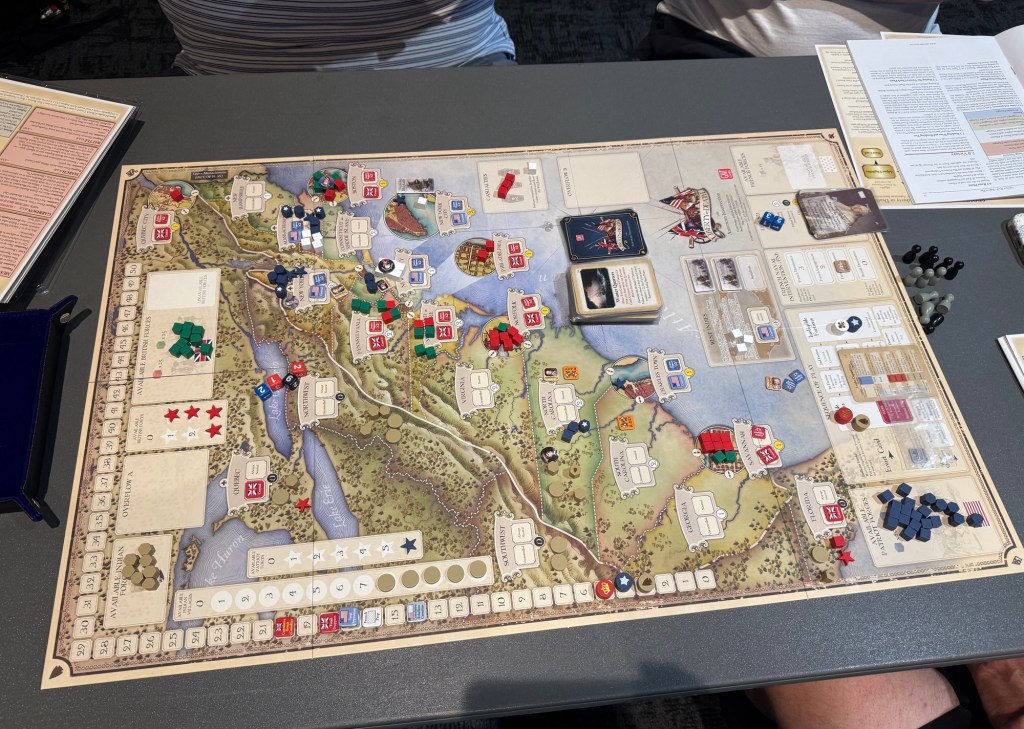
In the end, Alexander’s French earned victory at the end of 1779 (5th deck) with the finals scores being French -5, Indians (Grant) -10, Patriots (Shane) -10 and British (Mark) -15.

I saw something I have not seen before as my Indians got skipped multiple times on my turns due to Brilliant Stroke cards, Winter Quarters and some inopportune passing. Just weird that I lost 3-4 turns and also got into a cycle of only getting Limited Commands due to the eligibility on cards.
We next took a few minutes to walk around the grounds at the Camden site. My favorite part was the redoubt.

The British redoubt.

I was very interested in the ditch in front of the redoubt wall and its formidable defense as sharpened wooden stakes called fraises are placed horizontally projecting straight out from the earthen parapet. Their primary purpose was to prevent attacking infantry from climbing up the exterior wall.
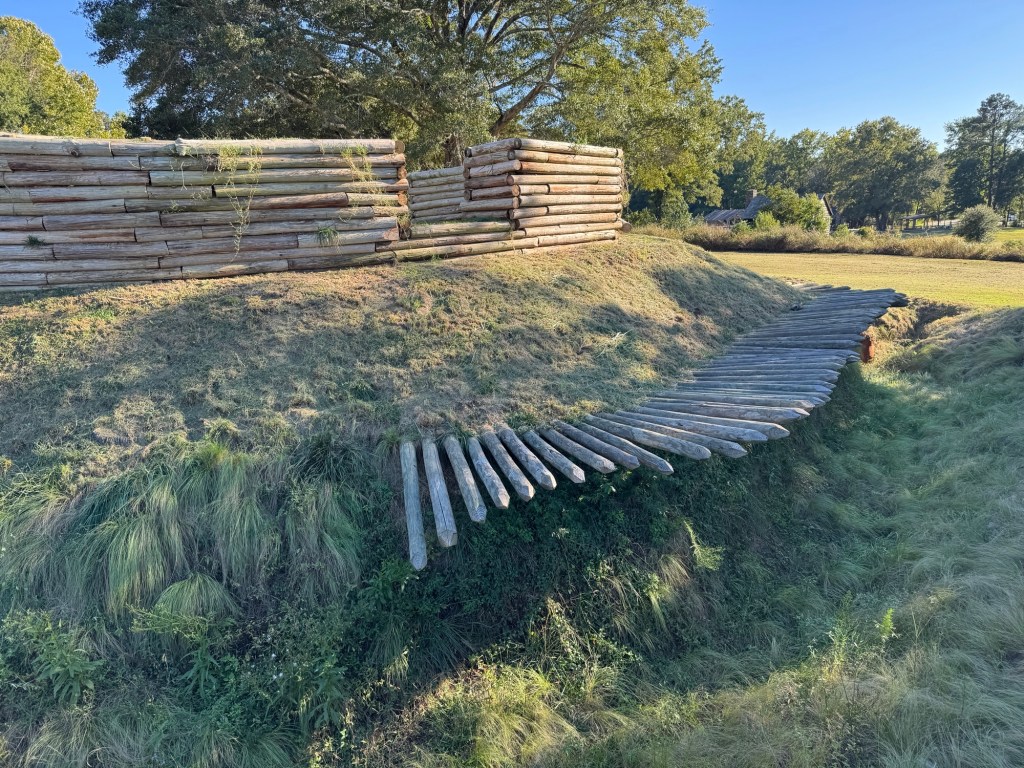
We had a long discussion about how effective these would have been as infantry would have to run this gauntlet to get at the defenders all the while taking rifle fire and cannon fire. Just diabolical really.
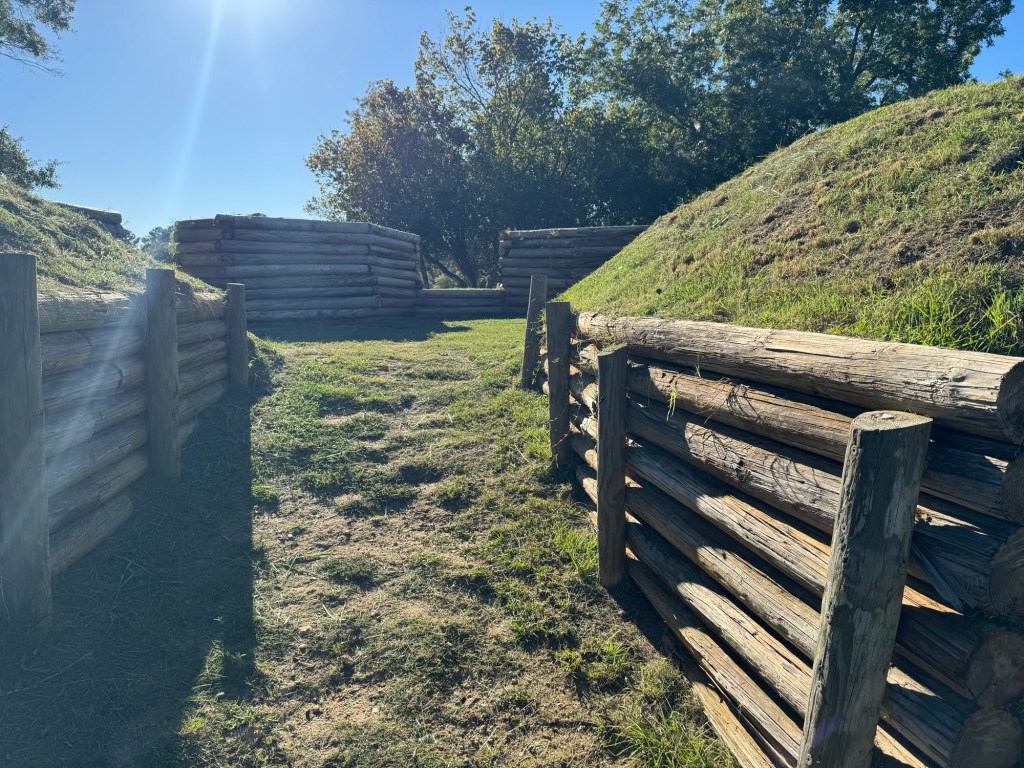
Once inside there are several protected covered areas for storage of arms and supplies as well as to offer some additional protection to defenders.

Just a really cool experience being able to get inside this fortification and experience the history.

We ended the night with a group dinner at a local brewery. We sat with our friend Bill Simoni and Mike from My Own Worst Enemy.

Tomorrow we are taking part in a 3+ hour guided tour of the Camden battlefield as well as nearby Hobkirk’s Hill. We are then going to play a few games including BoAR Newtown and possibly the new Small BoAR Cowpens.

-Grant

  •  

My Favorite Wargame Cards – A Look at Individual Cards from My Favorite Games – Card #91: DoD Contractors from Andean Abyss: Insurgency and Counterinsurgency in Colombia from GMT Games

With this My Favorite Wargame Cards Series, I hope to take a look at a specific card from the various wargames that I have played and share how it is used in the game. I am not a strategist and frankly I am not that good at games but I do understand how things should work and be used in games. With that being said, here is the next entry in this series.

#91: DoD Contractors from Andean Abyss: Insurgency and Counterinsurgency in Colombia from GMT Games

The first game in the COIN Series called Andean Abyss is a 1-4 player multifaction treatment of the campaign for control of Colombia with different factions such as the the Government, FARC (Fuerzas Armadas Revolucionarias de Colombia), AUC (Autodefensas Unidas de Colombia) and the Cartels. The game focuses on all of the facets of the conflict including guerrillas and police, kidnapping and the drug war, military sweeps and terror. The factions deploy distinct capabilities and tactics to influence Colombian affairs and achieve differing goals. Andean Abyss creates an opportunity to get a feel for this model of insurgency and counterinsurgency in Colombia.

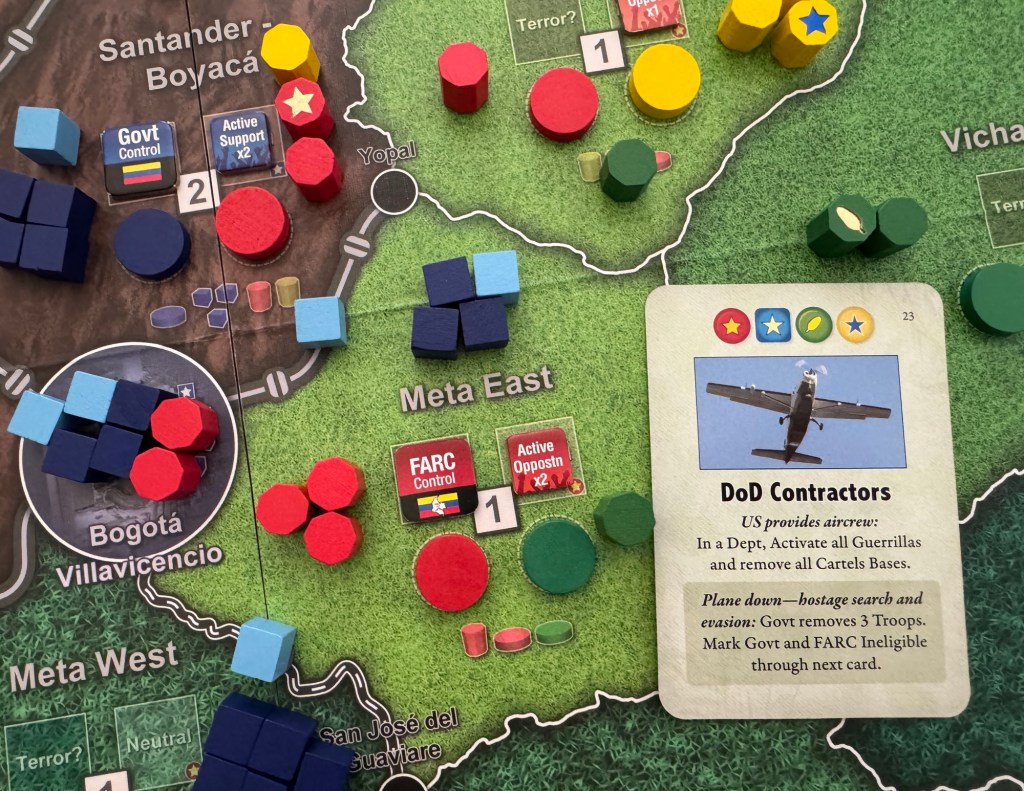
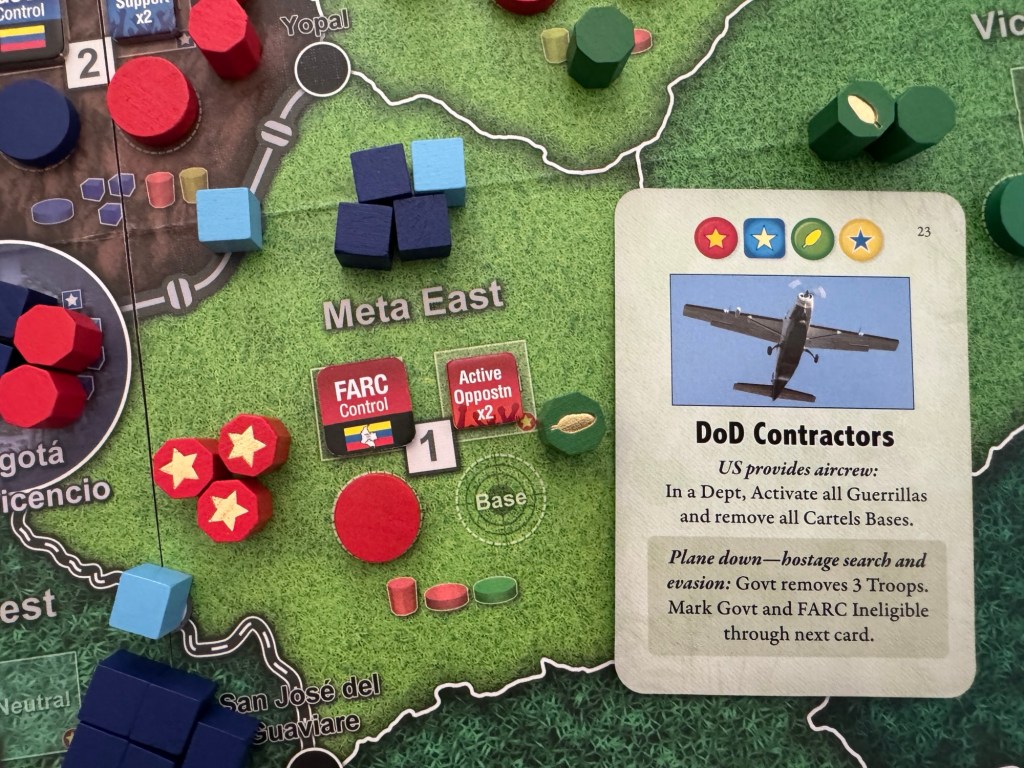
In this entry, we will take a look at the interesting and fairly powerful DoD Contractors. The card pays homage to the efforts by the Department of Defense to pay independent contractors to provide pilots for crop spraying over FARC-held territory and for reconnaissance flights to pinpoint the locations of guerrillas and their bases of operation. Patrolling FARC guerrillas in 2003 shot down one such flight along the western slopes of Caquetá and took three US personnel hostage, setting off a Colombian Army manhunt. The event gives the Government player the opportunity in a single Department to Activate all underground Guerillas and also to remove all Cartels Bases. Typically, to perform this type of action is a multi-turn investment with the Government having to mobilize and move Troops and Police into a Department and then perform a Sweep operation to uncover them. Then on a following turn, they can Assault and do things likes Air Strikes to attempt to eliminate these units. But this is very hard to do as the FARC and Cartel player can just use their next action to send their units back Underground or to Rally additional units in the space to safeguard their assets and Bases. On the other side, the Insurgents can use the event to remove up to 3 Government Troop Cubes and also mark both the Government and FARC ineligible through the next turn which means they will lose a turn. This effect is tied to the manhunt by the Government looking for the downed hostages as their resources and efforts are tied up preventing them from taking their normal actions. This can be really powerful and allow the insurgents to recover and get their units on the move or bring in more. Depending upon the time of the game that this is played, and around whatever circumstances are going on, this can really be a powerful card either way and I love how it reflects the US efforts to smoke out these drug lords in their war on drugs.

In 1978, Baton Rouge pilot Barry Seal, who flew commercial jets for TWA, is recruited by CIA case officer Monty Schafer. He asks Seal, who has been smuggling Cuban cigars into the country to make a little money, to fly reconnaissance missions over Central America using an Aerostar 600, outfitted with aerial surveillance cameras. Seal accepts the job, but hides it from his wife, Lucy.

In the 1980’s, Schafer asks Seal to act as a courier between the CIA and General Noriega in Panama. During a mission, the Medellín Cartel picks Seal up and asks him to fly cocaine on his return flights to the US. Seal accepts and flies the cartel’s cocaine to Louisiana, airdropping the drug in the countryside.

The CIA turns a blind eye to the drug smuggling, but the DEA tracks Seal down. To avoid the authorities, Seal and his family relocate to Mena, Arkansas and his wife comes to accept the wealth generated by his side job. The small town becomes wealthy as the hub of US cocaine trafficking.

Later, Schafer asks Seal to run guns to the Nicaraguan Contras in Honduras. Realizing the Contras are not serious about the war and just want to get rich, Seal starts trading the guns to the cartel. The CIA sets up a Contra training base in Mena and Seal flies the Contras in, but many of them escape as soon as they arrive.

Seal makes so much money he buries it in suitcases in the backyard. The FBI catches wind of the sudden exuberance on the streets of Mena. Eventually, the CIA shuts down the program and abandons Seal, who is arrested by the FBI, DEA, ATF and Arkansas State Police simultaneously.

Seal escapes prosecution by making a deal with the White House, which wants evidence of the Sandinistas being drug traffickers. They ask him to get photos that tie the Medellín Cartel to the Nicaraguan Sandinistas. Seal manages to get them, but the White House releases them as propaganda against the Sandinistas. Seal is prominently shown in the pictures, which leads to his indictment by the crusading state attorney general and the cartel plotting revenge.

Seal is convicted but sentenced to only 1,000 hours of community service. Moving from motel to motel making video recordings detailing his experiences, Seal expects an explosion any time he starts his car. As his community service is performed at the same Salvation Army building every night, Seal cannot hide from the cartel and is shot dead by an assassin. The CIA destroys all evidence connecting them to Seal and continues smuggling, instead using Iran to get guns to the Contras, as proposed by Schafer.

While this example is a bit more than crop dusting, the operation is part of the same deal and shows the US Government’s reliance on private commercial aircraft pilots during the war on drugs.

In the next entry in this series, we will take a look at Castelnau and Voie Sacrée from Verdun 1916: Steel Inferno from Fellowship of Simulations.

-Grant

  •  

Space-Cast! #58. Postmarks

Ah, thinks Wee Aquinas. Mammon.

For over five years (but fewer than seven), Postmark Games has published high-quality, low-cost print-and-play games. Oh, you need examples? How about roll-and-move titles like Voyages, Aquamarine, and Waypoints? Or ditties like Battle Card, Scribbly Gum and Koala Rescue Club? Or even 52 Realms: Adventures? Now the company is working on their first coin-flip title, Master of Coin. For today’s Space-Cast!, we’re joined by Rory Muldoon, half of the Postmark team, to discuss the beginnings, current status, and future of the company. How does one build a business on games that players print for themselves? Maybe we’ll find out!

Listen here or download here. Timestamps can be found after the jump.

TIMESTAMPS

2:06 — the origins of Postmark Games: when Rory met Matthew
11:33 — the first game
15:20 — roll-and-moves: Voyages, Aquamarine, and Waypoints
24:52 — licensed games: Battle Card, Scribbly Gum, and Koala Rescue Club
31:55 — Postmark’s compact form factor
40:19 — playing card games: 52 Realms: Adventures and 52 Duels
51:48 — from the customer’s perspective
58:28 — the current title: Master of Coin


(If what I’m doing at Space-Biff! is valuable to you in some way, please consider dropping by my Patreon campaign or Ko-fi. Right now, supporters can read the next installment in my series Talking About Games, this time tackling the topic of what makes a good list! Naturally, the piece includes a list.)

💾

  •  

Playing with Cellulose Fiber

Uh oh, did I list these in increasing order of goodness? YES. YES I DID. FOR I AM THE DECIDER OF GAMES, AND ALL SHALL KNOW MY LOGIC.

Paper! Despite the meddling of the internet, it’s still everywhere. There’s a good chance you have some in your very own home. In fact, it’s probably within arm’s reach right now. Coming for you. Fluttering closer. Ready to give you a stingy cut on the fingertip.

But for all its sins, paper is good for a few things. Making board games happens to be one of them. And today, I’m going to talk about three paper games I’ve been playing this week.

they're called colts, but that's super weird

A crane chick.

Rock Paper Crane

Rock Paper Crane bills itself as the world’s first-ever origami card game. True to its word, its construction requires you to craft the first couple of steps for making an origami crane.

Okay, so that’s the first problem. I dabbled in origami once. But I also happened to be six years old. Also, my little sister ruined my collection of nice origami papers, so I decided to spite her by never going back to the hobby or informing her or really imposing even the slightest imposition on her in any way. Which is to say, I finally fumbled together those first few steps. But the magic is in the fingers, not the voice, so as I labored to instruct my wife in how to shape her crane, I may have uttered the phrase, “You need to tuck in that piece, you’ve got it all popped out and flabby,” to which she replied, with a rather elevated voice, “You’re all popped out and flabby!”

So. Um. Be careful who you play Rock Paper Crane with.

I don't remember the next step. Nor will I ever.

Crane, interrupted.

Once assembled, Rock Paper Crane is Rock Paper Scissors with extra steps. For one thing, there’s an extra piece, the bomb. For another, winning a throw means you upgrade one of your sides. (Pause for origami.) Rock becomes wall. Paper becomes clay. Scissors become fire. That sort of thing.

Your objective, ultimately, is to win four throws, which will bring you one step closer to a finished crane. More importantly, you will have won the game. Or lost it, which is just as good, because, like I said, Rock Paper Crane is Rock Paper Scissors with extra steps.

Did I finish my crane? Nope. I couldn’t remember past those first two steps. Honestly, it’s pretty amazing that I got this far at all. Maybe I could have looked up the next instructions. But I swore an oath to never finish an origami ever again, and I’m true to my word. Take that, Mary.

Hm. Can I use this game to teach my children how to operate my kingdom long after I have departed this mortal realm?

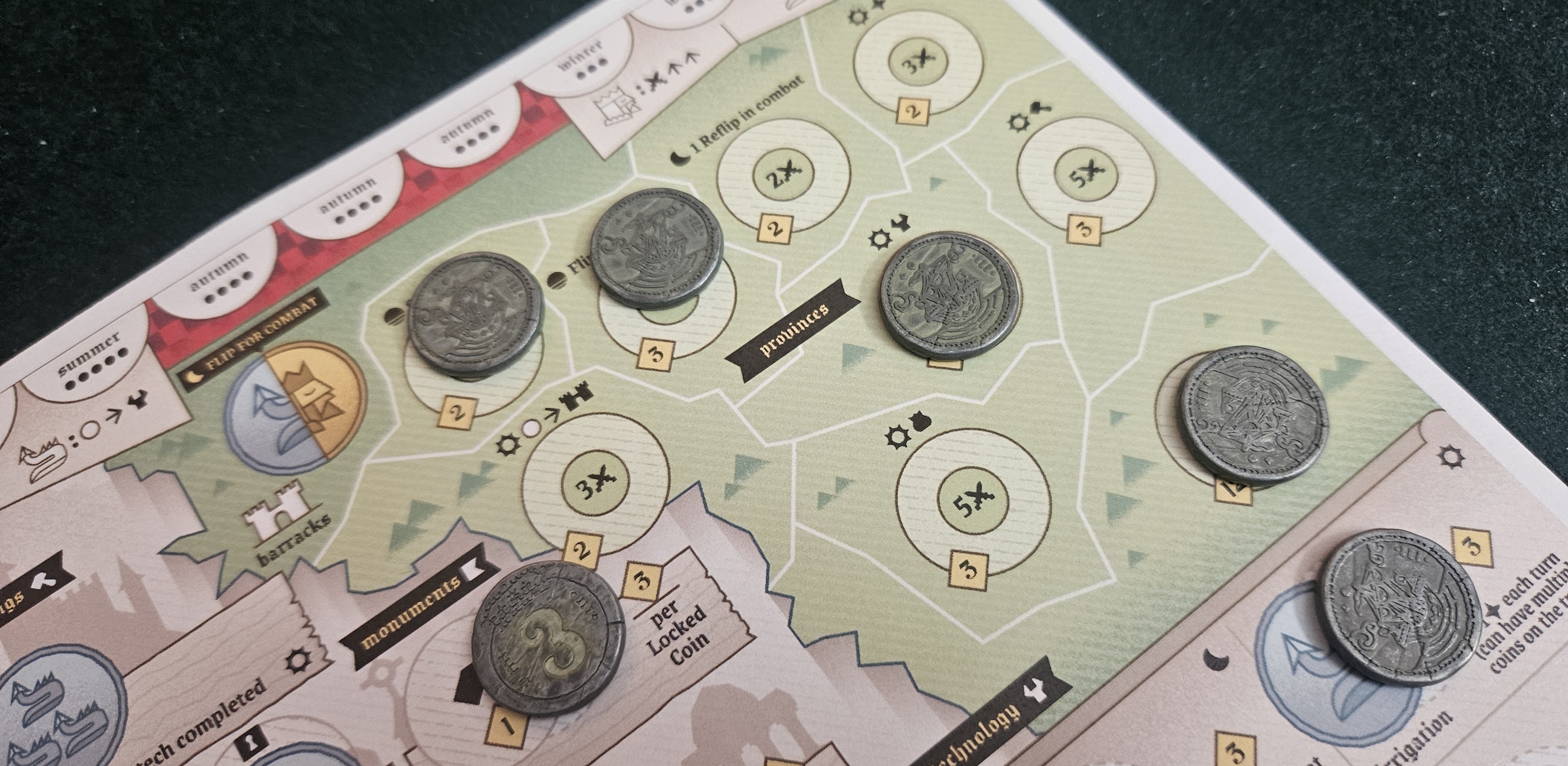
Putting coins on paper.

Master of Coin

Master of Coin is the eighth title from Postmark Games that I’ve played, and this time Rory Muldoon and Matthew Dunstan are ditching the dice and the cards. Their replacement? Coins, of course. It’s right there the title.

As you might expect, Master of Coin makes good on its conceit by requiring you to flip so many coins that your fingers will start to smell rather pockety indeed. Covering a single year in the history of a small kingdom, you begin each month by picking up some number of coins — the exact quantity varies by season — and flipping them to determine how many heads and tails you have to work with.

Early on, your options are finite. A few basic buildings, some technologies, and any leftover orphans packed off to the army. But it isn’t long before the gameplay begins to accelerate. Once completed, you can clear a building of its coins to activate its ability, whether to unlock better structures, develop your nation’s economic infrastructure, obtain perks in war and peace, or maybe construct monuments that unlock better scoring benefits. Crucially, some abilities let you “lock” coins, sliding them a few millimeters upward on your sheet. From that point on, when you clear the corresponding structure, any locked coins stay in place.

As a concept, Master of Coin is solid. Consider the army. When it’s time to march on neighboring provinces, you pick up all the coins in your army and give them a flip. Heads become indicators of conquest, while tails are failures. But there are so many ways to massage the odds. Certain buildings, like the catapult, can be cleared to produce guaranteed successes in battle. Or there are techs, like gunpowder, that let you shift a coin from tails to heads, saving you in the nick of time. All this is to say that there are ample ways to get ahead. Even if you, as happened to our group, happen to play a session with novelty coins that always flip heads.

aitg

Money is great for conquering distant nations.

Of course, there’s more to be seen. As with previous Postmark titles, Master of Coin isn’t limited to a single map. The game is on Kickstarter right now, and according to the campaign there will be five scenarios in all, each adding a year to the story of this wealthy kingdom and its unfortunate neighbors.

Unlike those previous Postmark titles, however, I’ve only tried the first scenario, so I’m unable to furnish a full review at this time. The good news is that what I’ve played has been exemplary. Very quickly, I was surprised that my kingdom’s main limitation didn’t lie with having too little money, but rather in keeping too many coins tied up in other projects. The kingdom only has access to twenty coins, you see, and two of those are reserved for tracking the month and any possible events. It isn’t long before you’ll need to make some tough decisions, forsaking certain appendages of your financial project altogether to double down on whatever has become most important.

Anyway. After not being all that enthralled with Postmark’s playing card games, Master of Coin feels like a return to form, capturing some of the tight but expressive playspace of titles like Voyages and Waypoints. I’m excited to see how this one develops.

With rice. Maybe butter. Kidding! I don't like rice.

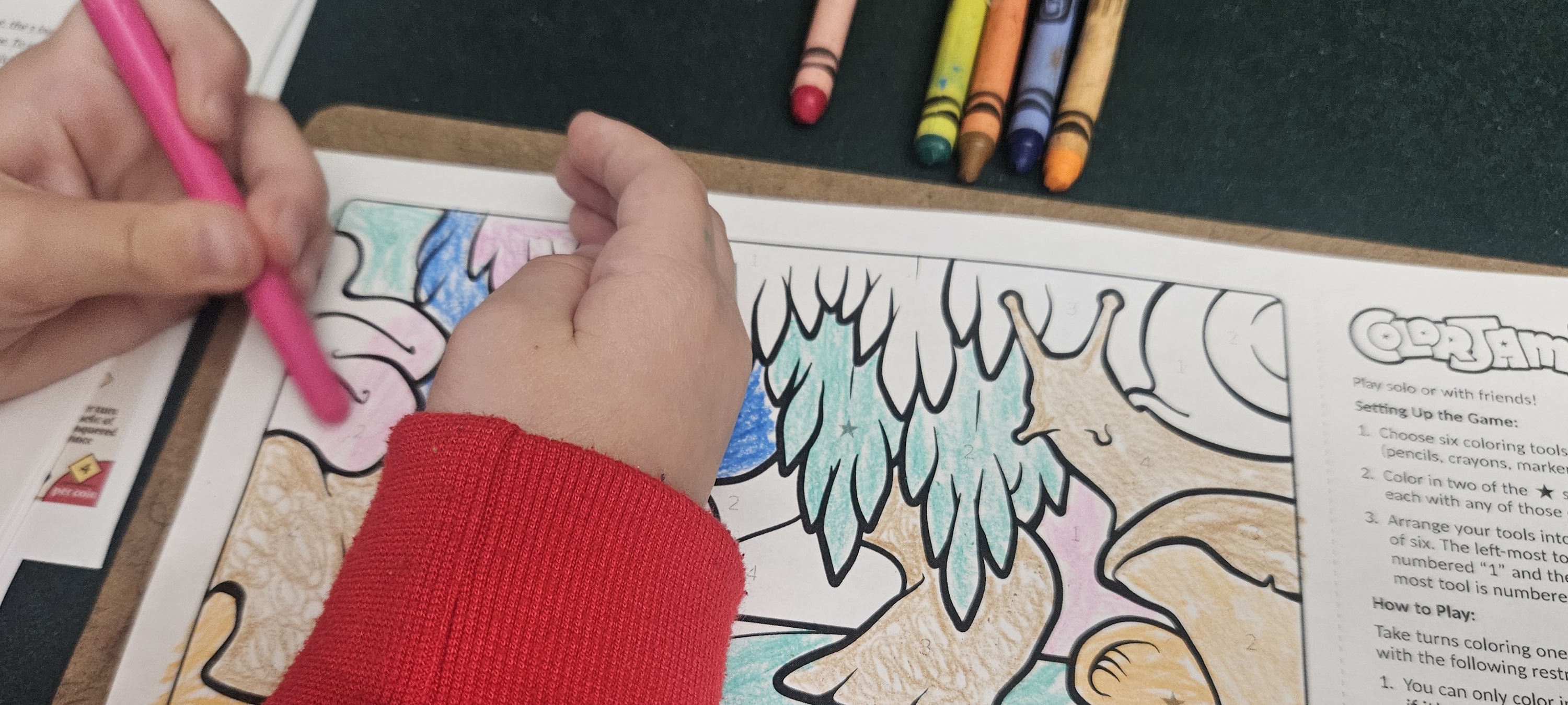
I love little fingers.

Color Jam

When’s the last time you colored by numbers? Being a parent to a recent kindergartner means it hasn’t been as long as it might have been otherwise, but this still isn’t a regular occurrence of my daily life.

Until Color Jam. Designed by Gene Koo and Joe Kell, and illustrated by Erin Laue, Color Jam is about coloring by numbers. And contrary to my expectations going in, it’s wonderful.

But first, a note. Color Jam is being published by Lunarpunk Games, the indie imprint operated by Xoe Allred and Matthew Hocker. If you’re elbows-deep in the indie scene, this might already tell you something about the game. Foremost, Color Jam doesn’t have the usual victory conditions. Nor does it really have goals, at least not goals of the foreordained variety. You’re here to make your own fun, set your own benchmarks, and, hopefully, come away charmed.

This is the future liberals want.

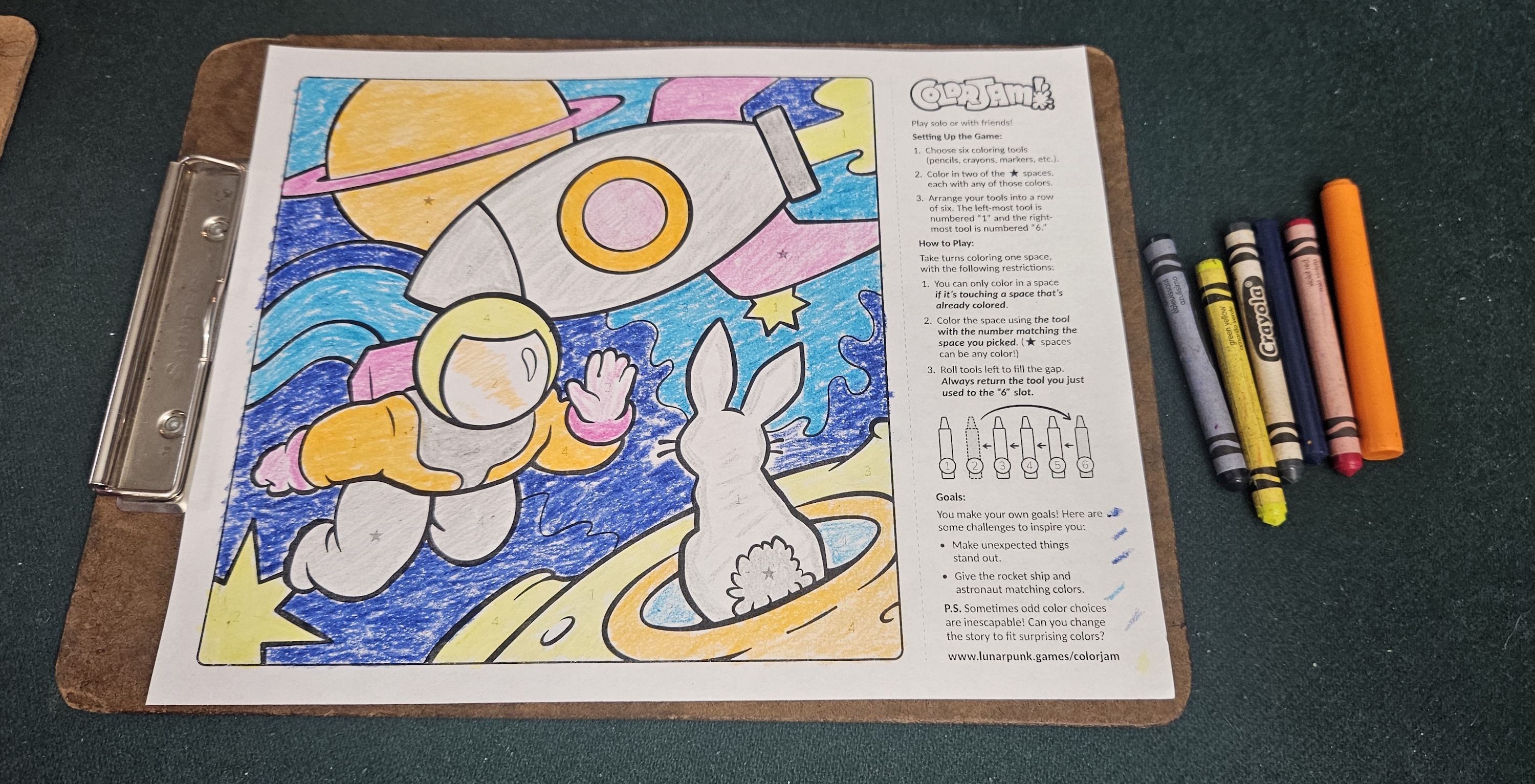
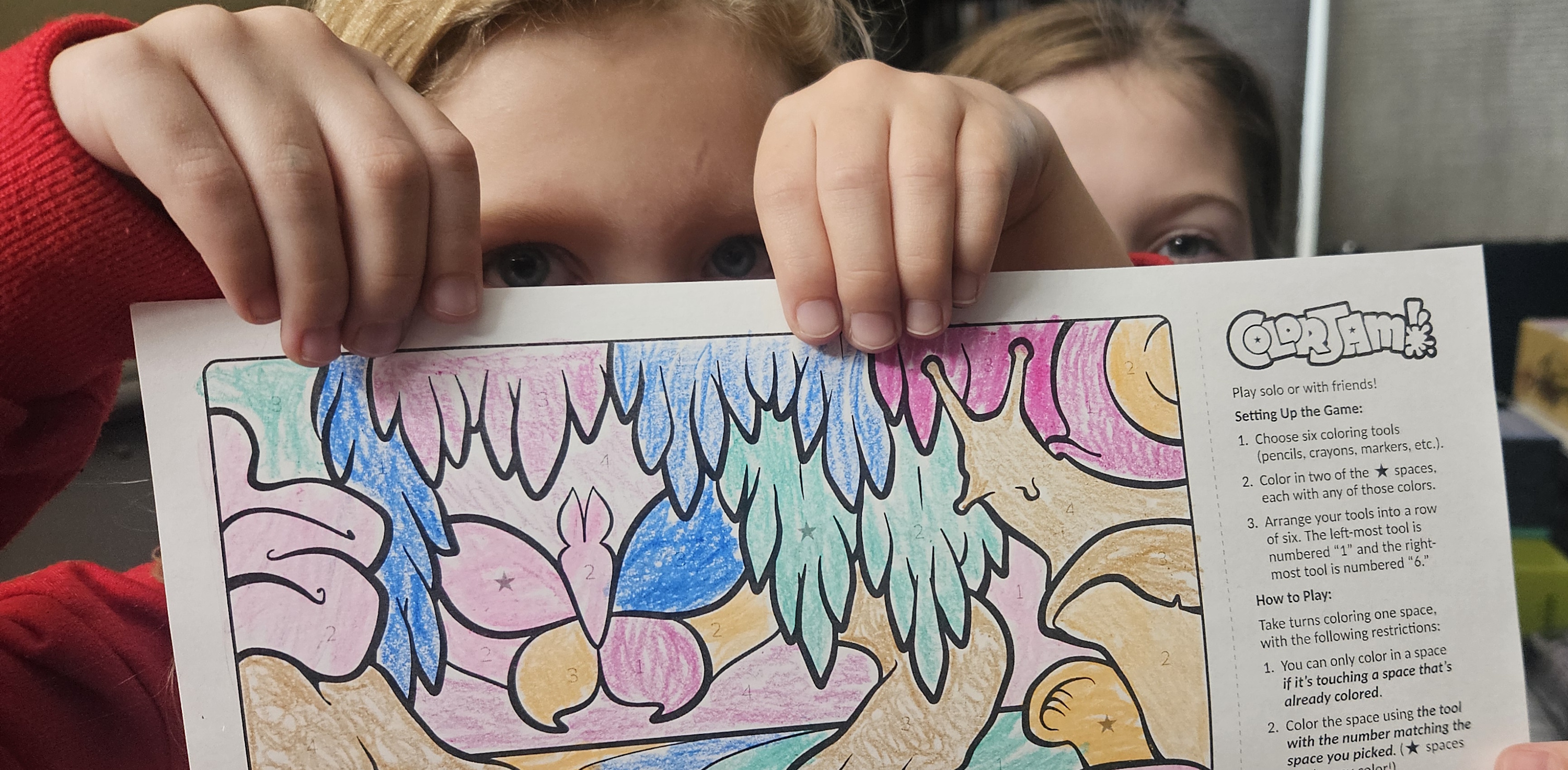
I am inordinately proud of my art.

The basic idea is as simple as it gets. You take a picture and six crayons. Then you color in two of the spaces with stars in them. There are always four options, giving you some range to where you begin on the page.

From that humble beginning, you start to color in the entire thing. But there are limitations. Beautiful, expansive limitations. For one thing, you can only color a cell next to something you’ve already filled in. More importantly, those six crayons? You put them in order, numbered one to six. When you color a space, you use the corresponding crayon. Then — and this is where the game starts to breathe — you take that crayon and shift it to the last place.

Now, this might not sound like much. But it transforms Color Jam from an elementary school project into something unexpected. You might want consistency. The wings of a butterfly to align, perhaps. But the right crayon might not be available. Or, when the right crayon comes up again, maybe you’ll want it for something else.

What do you do? Well, you get creative. Maybe this butterfly is prismatic, like a jeweled brooch, its colors vibrant but mismatched. The colors can become revelatory, streaks of the unexpected in what might have otherwise been an ordinary picture. Or maybe you start to plan ahead, counting the crayons down until the right one is ready for another scribble, transforming the page into a low-stakes logic puzzle. Or perhaps you get artistic. You can do a lot with shading, with the strokes of a crayon, with the application of a smudge or a smear. Two spaces that both use orange don’t need to look the same. This isn’t the paint bucket in an image editor. You can do whatever you like.

One day this picture will be worth no cents, because a robot will have ripped it off to make slop.

The artists.

More than that, Color Jam is flexible. It’s possible to play solitaire, one person making every decision. But it’s also possible to play as a group. I played with both of my daughters, and everybody got a say in the creation of our picture. Over which crayons we pulled from the bucket. Over the turn order. Eventually, over how to account for colors that wouldn’t quite fit where we wanted them.

The most unsurprising thing about Color Jam, but which bears repeating, is that it’s simply delightful. It’s soothing to play, but thinkier than one might expect from a distance. We played together, and then we all played apart. And then Summer came home and wanted to play as well, so we did that, too. In each case, we came away having crafted something wonderful, whether in collaboration or on our own, whether according to strict logic and long-term thinking or creative storytelling, and felt all the richer for it.

Color Jam will be on Kickstarter sometime in the next month or so.


Access to the files and/or complimentary copies of Rock Paper Crane, Master of Coin, and Paper Jam were provided by the designers.

(If what I’m doing at Space-Biff! is valuable to you in some way, please consider dropping by my Patreon campaign or Ko-fi. Right now, supporters can read the next installment in my series Talking About Games, this time tackling the topic of what makes a good list! Naturally, the piece includes a list.)

  •  

My Favorite Wargame Cards – A Look at Individual Cards from My Favorite Games – Card #86: LRRP from Fire in the Lake: Insurgency in Vietnam from GMT Games

With this My Favorite Wargame Cards Series, I hope to take a look at a specific card from the various wargames that I have played and share how it is used in the game. I am not a strategist and frankly I am not that good at games but I do understand how things should work and be used in games. With that being said, here is the next entry in this series.

#86: LRRP from Fire in the Lake: Insurgency in Vietnam from GMT Games

The COIN Series uses cards in a very different way from other CDG’s. These cards are not necessarily the driver of the action but more assistive to the actions of the players by setting eligibility and also providing powerful events. The Event Cards are more often than not, very powerful. They either give you a continuing bonus on future Operations and Special Activities (as in the case of the volumes that include the various Capabilities) or allow you to take Operations and Special Activities more times that round than you would normally have been able to had you not chosen the Event and more often than not, at no cost! Also, because of the power of the cards and their ties to one or more factions, you can take the Event which allows you a huge advantage, only to see that very powerful Event reversed with the next Event or with a regular Operation. This is very frustrating but is one of the major reasons that I love the card-assisted element of the COIN Series. Today we are going to take a look at the LRRP Event Card.

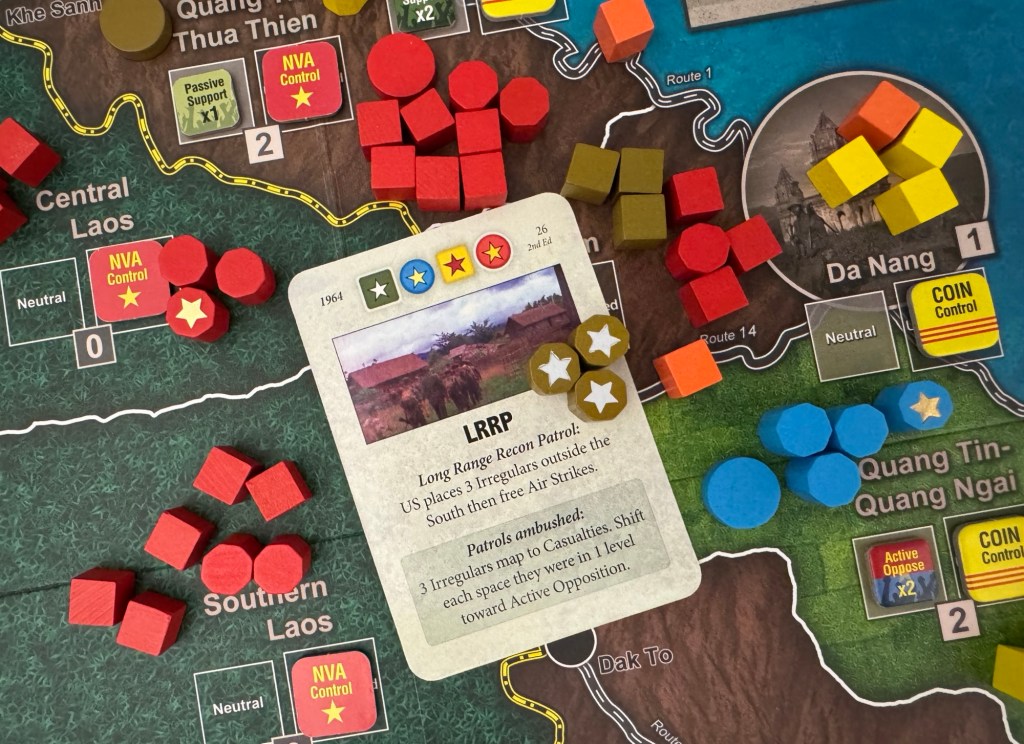
The LRRP Event Card, with LRRP standing for Long-Range Reconnaissance Patrol, allows the US player to place 3 Irregulars outside the South then conduct a free Air Strike, that also allows for the removal of Bases first. Keep in mind that Irregulars are US Special Forces pieces, which are the hexagonal shaped cylinders not ARVN Rangers. “Outside the South” means any Laos or Cambodia Provinces. Seems pretty pedestrian but it is important to note that this card changes the rules when played as normally all other units in a space must be removed before Bases can be removed. A very powerful card that typically will be played by the US player when it comes up. But keep in mind that Air Strikes are a dual edged sword as you get rid of pesky enemy pieces but it will result in shifts of Support/Opposition but can also Degrade the Trail. On the bottom of the card, the text allows the VC or NVA to ambush these LRRP”s and remove 3 Irregulars from the map to Casualties. Then it gives an added benefit of shifting each space these removed Irregulars were in 1 level toward Active Opposition.

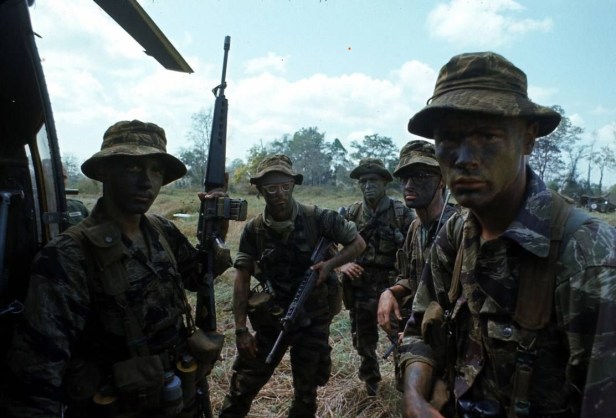
Image courtesy of Boxxer’s Blog.

A Long-Range Reconnaissance Patrol, or LRRP, is a small, well-armed and nimble recon team that is tasked with patrolling deep into enemy territory to identify or destroy key targets and gain recon on the enemy. The concept of scouting forces such as LRRP’s dates back to ancient warfare but also has been used in more modern and contemporary wars such as the French & Indian War where specialized Rangers, such as Rogers’ Rangers, were tasked with raiding Indian settlements, disrupting supply lines and reporting back to command on troop disposition and movement.

In Vietnam, veteran or specially trained forces often augmented with Vietnamese irregulars usually carried out Long Range Reconnaissance Patrols into enemy territory. The Studies and Observation Group (SOG) was the ground element of the US air war against the Ho Chi Minh Trail as illustrated by Project Tiger that spotted for and marked enemy trail activity for elimination by US air assets.

Here is a link to a very interesting summary of an LRRP and its mission on a Vietnam veteran run blog called Boxxer’s Blog: From the seat of a motorcycle: LRRPs: “—doing the impossible for the ungrateful.”

In the next entry in this series, we will take a look at Proletarian Revolution from The Republic’s Struggle: Battle for the Republic, Spain 1931-1939 from NAC Wargames.

-Grant

  •  

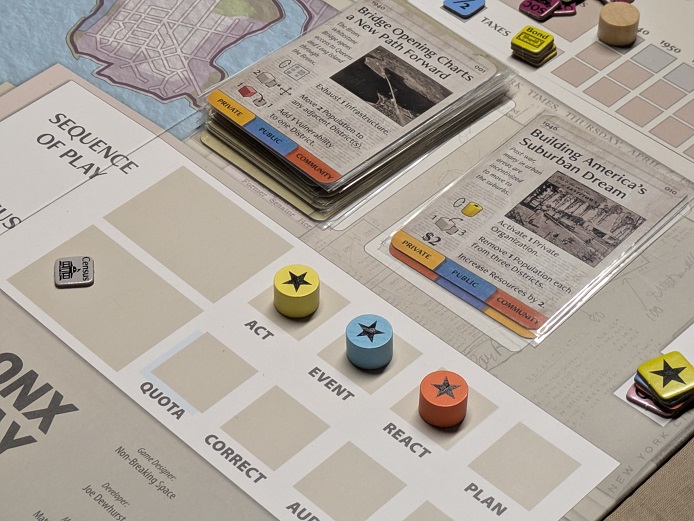
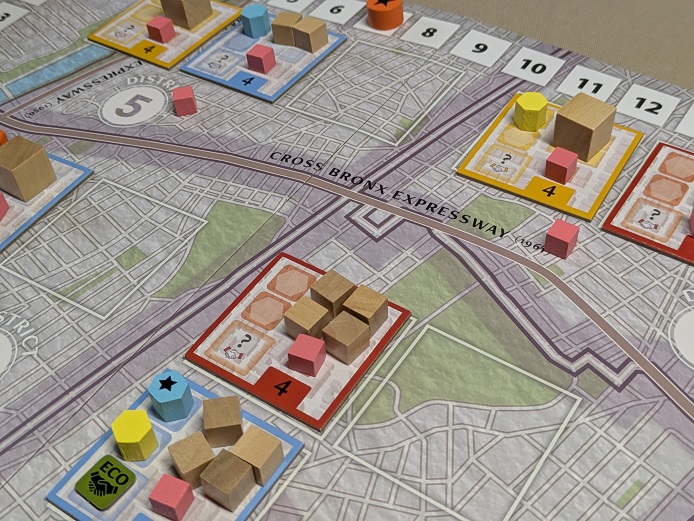
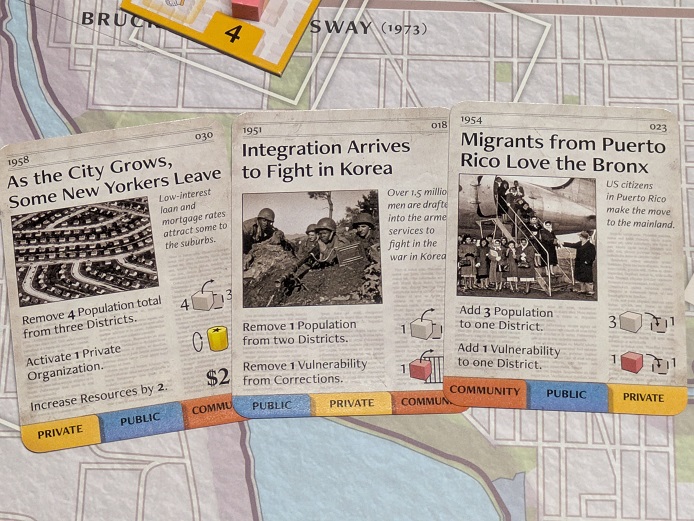
The Legacy of Robert Moses – A Cross Bronx Expressway Review

The opening sequence of Martin Scorsese’s Taxi Driver depicts a New York with enough grit that you can feel it on your teeth. It’s a feral hour of the night. DeNiro’s sedan is cruising down a street awash in the radiant soul of the city. There’s a shot of the vehicle’s quarter panel. Beads of…

Read more →

  •  
❌