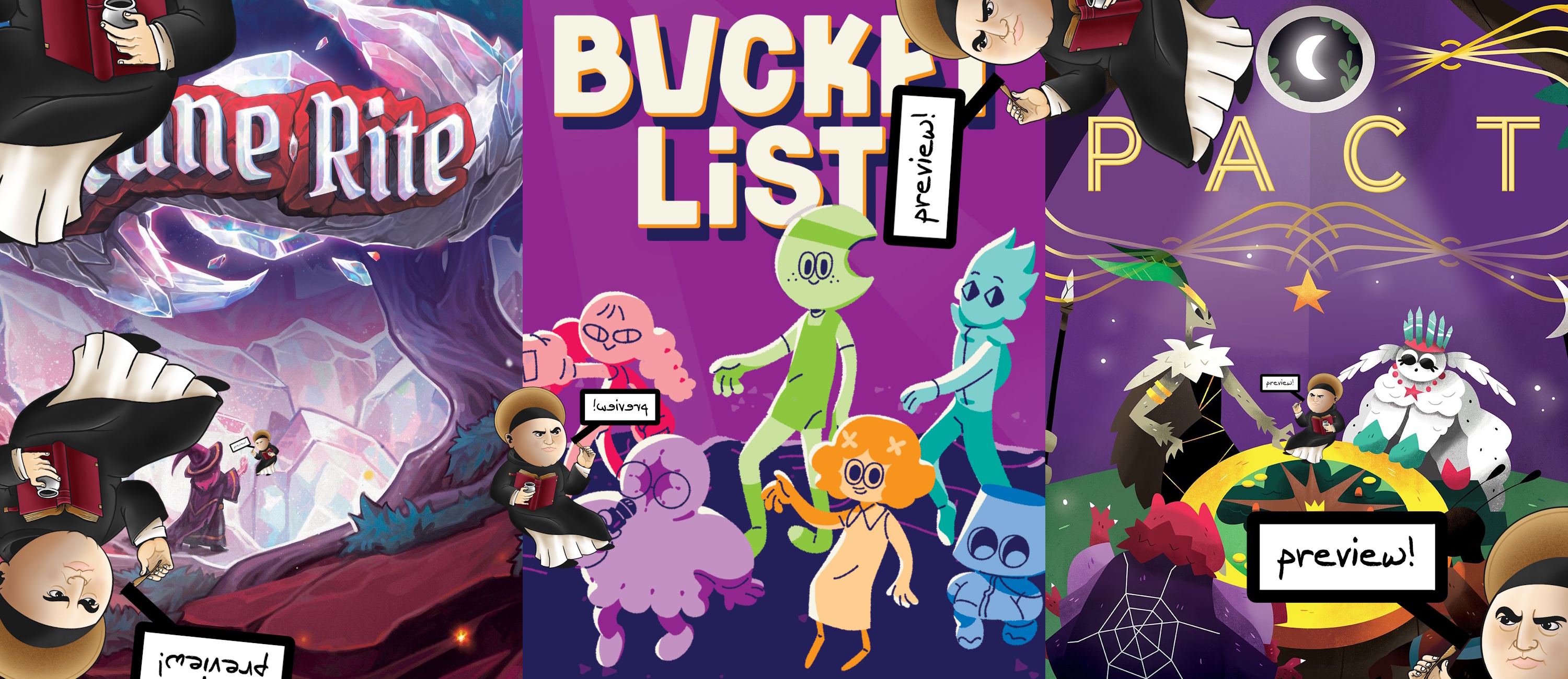
❌

Normale Ansicht

Bewitchments, Buckets, Bugs

23. Oktober 2026 um 02:35

can you spot every Wee Aquinas?

Imagine me in a real pickle sandwich. The middle of preview season (ho ho ho), and suddenly I come down with not one illness, but two. Something chronic, something acute. And me with a whole stack of board games to write about. Some of them time-sensitive, counting down the minutes on crowdfunding platforms as we speak.

What’s an old man to do? Write about all three in a single splash, naturally.

In other words, here are three very different tabletop titles, each worth a wink of your time. Come on in. Let me tell you about them. Briskly, before I’m back to bed.
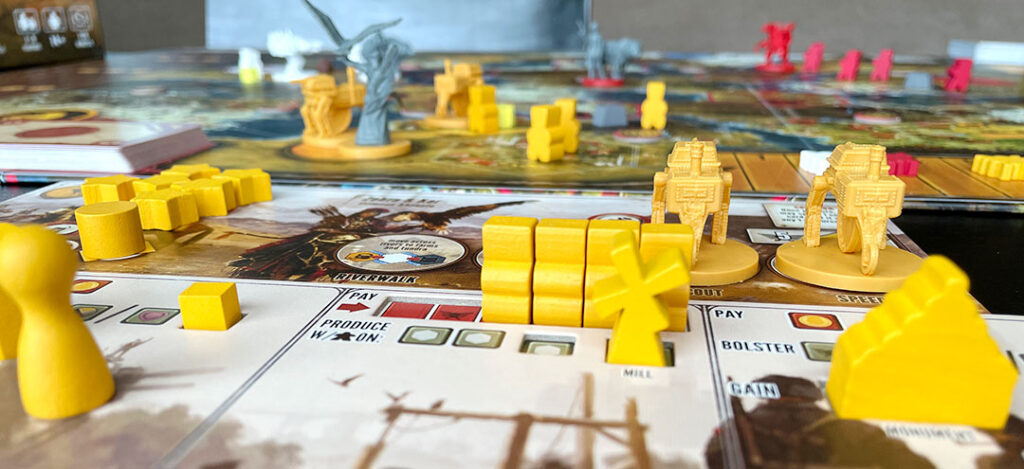
I've been reading too much China Miéville this month.

Runes, crafted, so thus they may be written.

Rune Rite

At a glance, Rune Rite doesn’t look all that dissimilar from any number of other flip-and-writes. Fortunately, designer Jason Katzwinkel makes one alteration that has major implications not only for this game, but for the entire format.

Short version: you craft the card in advance.

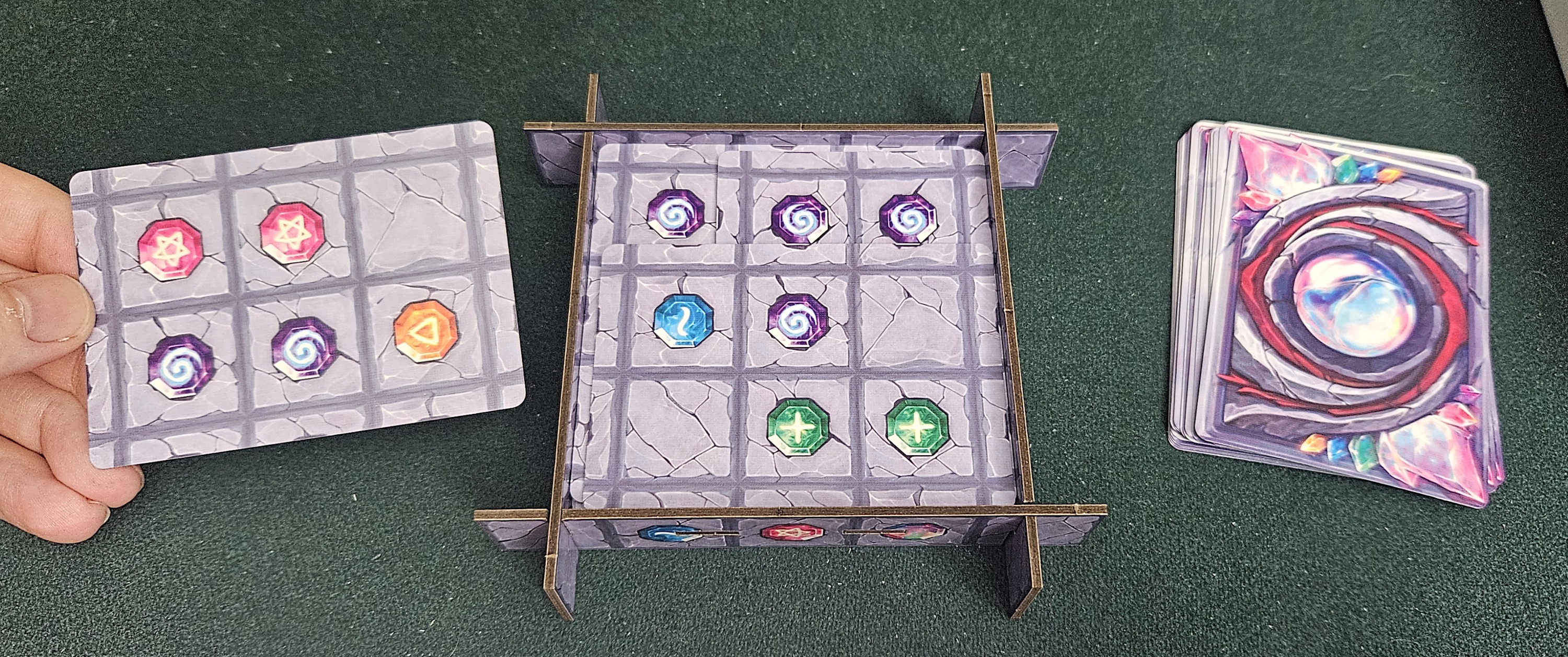
Longer version. Like every other instance of the genre, you begin your turn by flipping over a card. This shows some combination of runes — spirals, stars, tildes, triangles, and plusses, with the occasional wild that counts as anything and everything. Then everybody at the table gets to mark a cluster of those symbols onto a personal paper grid. The larger the cluster — say, a polyomino L of stars — the more you mark, all the way down to a single symbol.

The wrinkle is that drawing a card isn’t as simple as drawing a card. You draw the card, yes, right, you’re following I’m sure, but then you choose how to lay that card over the top of any previous cards, all framed within a cardboard holder to establish the selection’s outer boundaries. In more mathematical terms, every card offers a 2×3 selection, but you’re really drawing from a 3×3 grid. So the current card matters, but so do any previous cards that might still be peeking out from previous turns.

The implications are far-reaching. At the first and most obvious level, you’re given some control over which symbols — and furthermore, which shapes of symbols — you’re allowed to draw on your pad. By rotating your card, it’s possible to arrive at unusual shapes indeed.
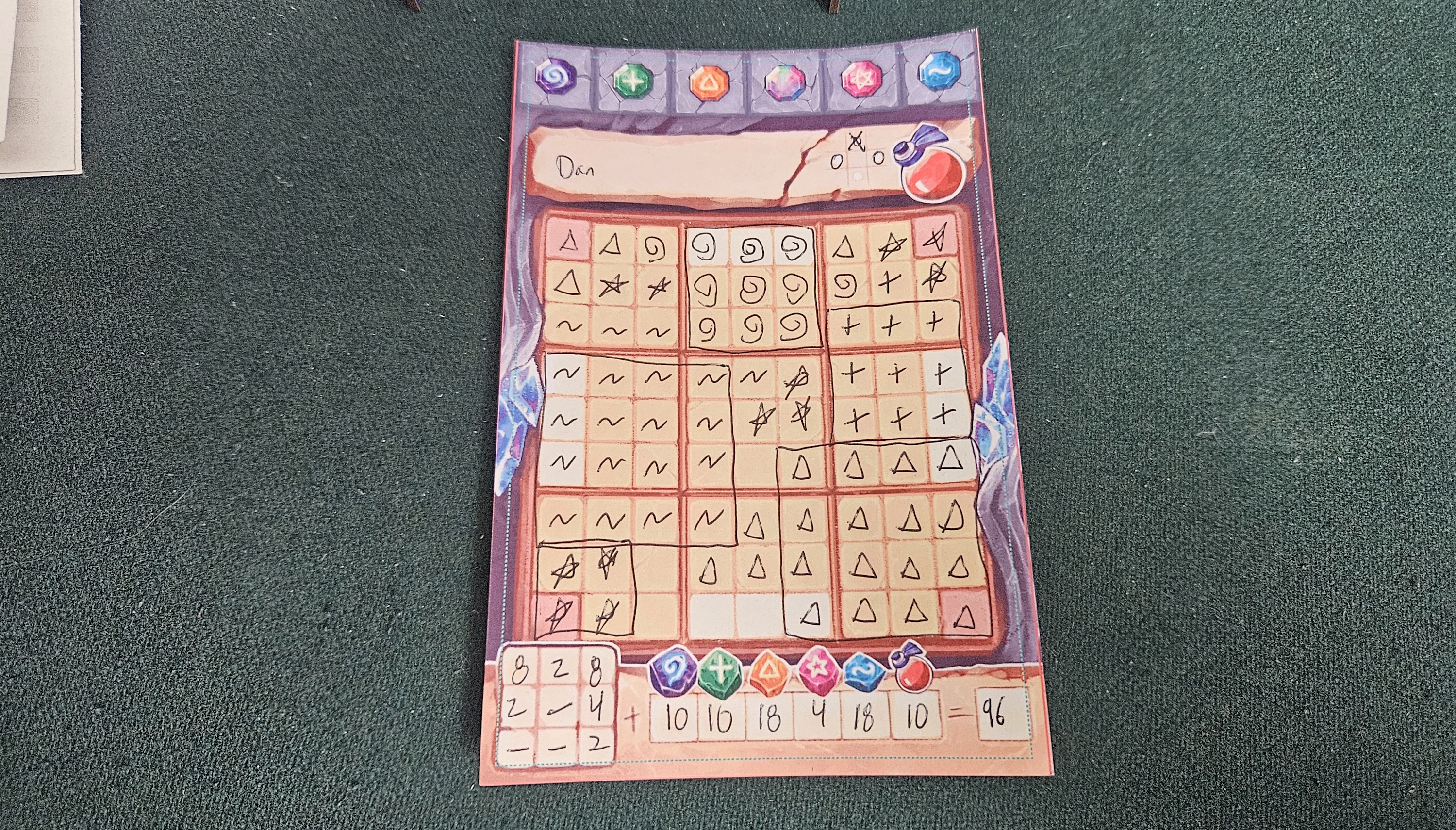
HMMM

Looks suspiciously like a flip-and-write to me.

But more than that, with some attention you can also sabotage everybody else at the table. Whatever shape the card-puller draws, nobody else is allowed to use. Sometimes this only provides access to smaller leftovers, but there’s room for devious plays. Such as noting that a rival wants a size-two combination of spirals, so instead you hand them a huge cluster of spirals instead. Go for it, bud. Overcommit.

In some ways, Rune Rite feels like a proof of concept. It’s a small game, I mean, with very little variance between sessions apart from the actual shape-crafting that occurs on each and every turn. Unlike something like Cartographers, which changes its victory conditions between sessions, the goal is always the same.

But for a proof of concept, there’s a lot to like here. There’s real tension between specialization and diversification. Points principally come from drawing boxes of similar symbols and filling other boxes with as many different symbols as possible, encouraging you to build across the pad’s boundaries. Which is to say, there’s a definite “best approach” here, but it isn’t one easily or flippantly pursued.

I’d like to see more of this. Crafting the “flip” of the flip-and-write is a stroke of brilliance, and here it’s given perhaps its purest possible expression. The result is little more than a snack, but it’s a snack that might prove transformative if everybody catches the vision. Like a Triscuit.

Rune Rite is on Kickstarter for nine more days.
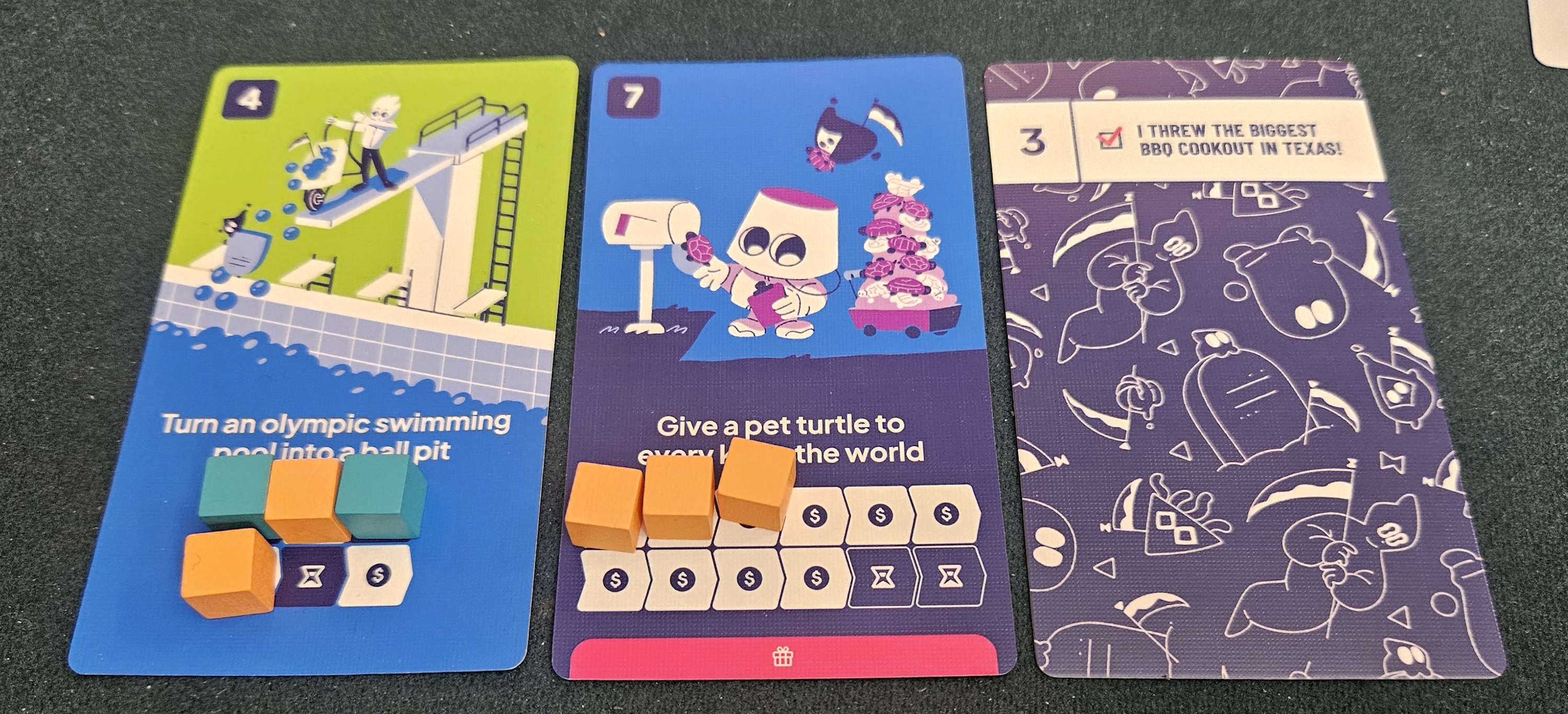
the problem with throwing the biggest BBQ in Texas is that within three minutes someone else will claim to have thrown the biggest BBQ in Texas

Some of the things I wish I’d done.

Bucket List

According to internet lore, the term “bucket list” was coined by the 2007 comedy film The Bucket List. This is a myth. My proof is a journal entry dated 14 March 2006 which reads: “Bucket List. Item #1. Prove that I, Dan Thurot, came up with the term ‘bucket list,’ not that stupid movie coming out next year.”

Many of the action items in Micah Heiselt’s Bucket List represent similar uphill battles. Spend a night in Dracula’s Castle? Sure, but bring the gauze. Buy a farm for orphaned alpacas? Nothing was ever stopping you but the fear of success. Fill the Louvre with only your art? Kid. Come on. You can’t even finish one board game preview on a site without the slightest quality control.

Then again, that’s much of the charm of this one. You and your friends wrote a bucket list in high school. (Presumably you graduated after 2007.) Now, with death swiftly approaching, you must tick off as many boxes as possible.

What would otherwise be a cutesy gimmick game is elevated by two factors. The first is that the gameplay is a combination of long-term planning, thinking on your toes, and careful risk management. There are only two main resources, time and money, which must be invested into a goal before it can be accomplished. That’s simple enough, but resources come from multiple sources, some more reliable than others, such as action cards versus a turn-initiating roll of the dice. You’ll get something, but whether you can put it to good use is another question. Oh, and any leftovers will anger the Grim Reaper.
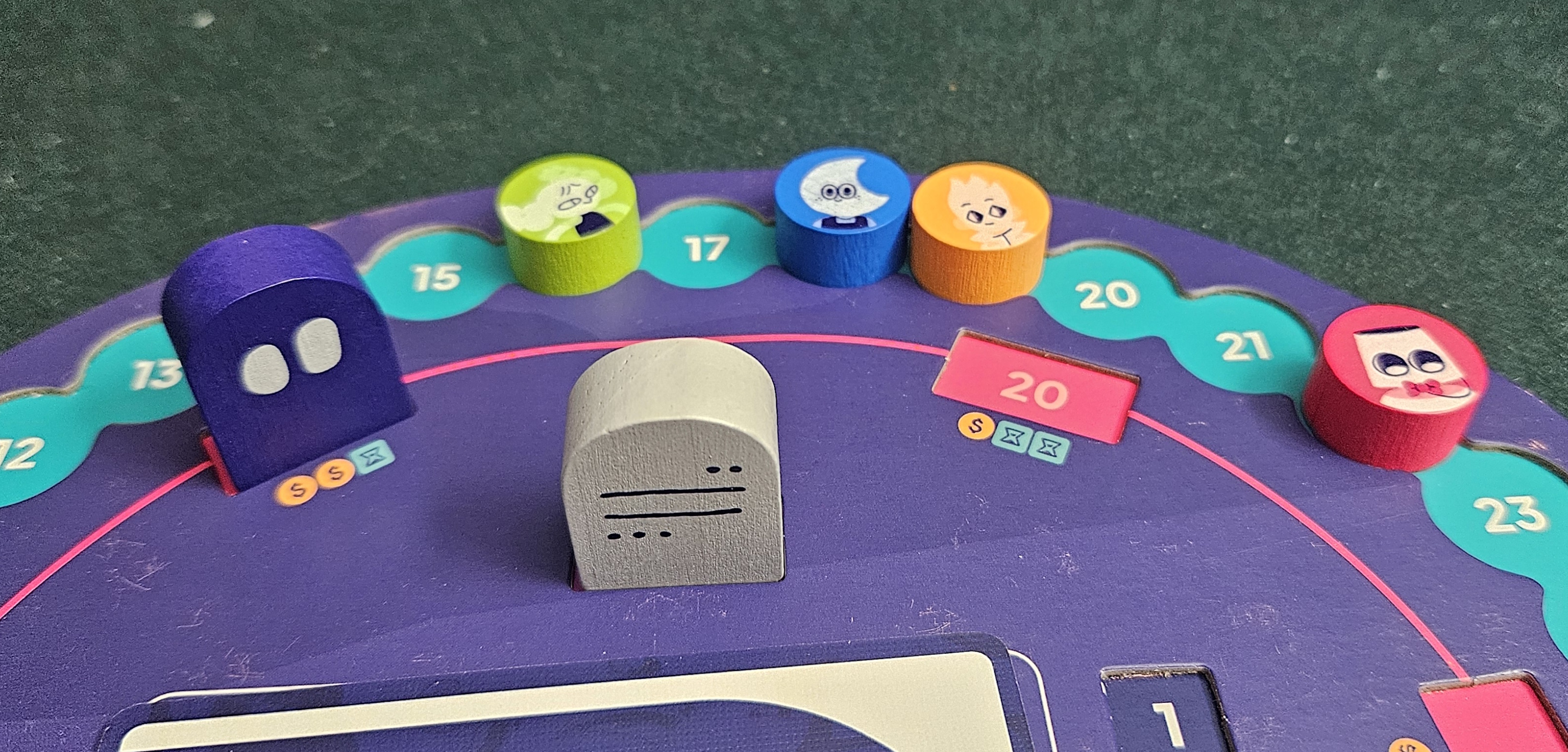
could you come for me a little faster please

Death comes for us all.

The Grim Reaper is the other shakeup to the formula. Various triggers will see old boney chasing everyone around the score track. If he catches up to the trailing player, a headstone will be placed to end the game upon the completion of the round. There are ways to cheat death, nudging the Grim Reaper back on the track and returning the headstone to its resting place… except you might not want to delay the end of the game if you’re sitting pretty at the top of the score track, leading to little tussles to delay or hasten your mortality.

It’s a bit grim. But then, so is anything associated with bucket lists. The good news is that it’s also an amusing little plaything, with more to consider than first meets the eye, and lots of goofball moments where death seems around the corner only to be delayed yet again. It’s ultimately a game about picking your battles. There isn’t time or money enough to do everything, so you’re encouraged to pad out your days with goals that can absorb whatever resources happen to come your way.

In that sense, there’s something comforting about it, almost nihilistic in its dedication to self-determination. Maybe it will even inspire me to fulfill the other entries in my bucket list. “Item #2. Change it back to Berenstein Bears before anyone notices.”

Bucket List is on Kickstarter for fifteen more days.
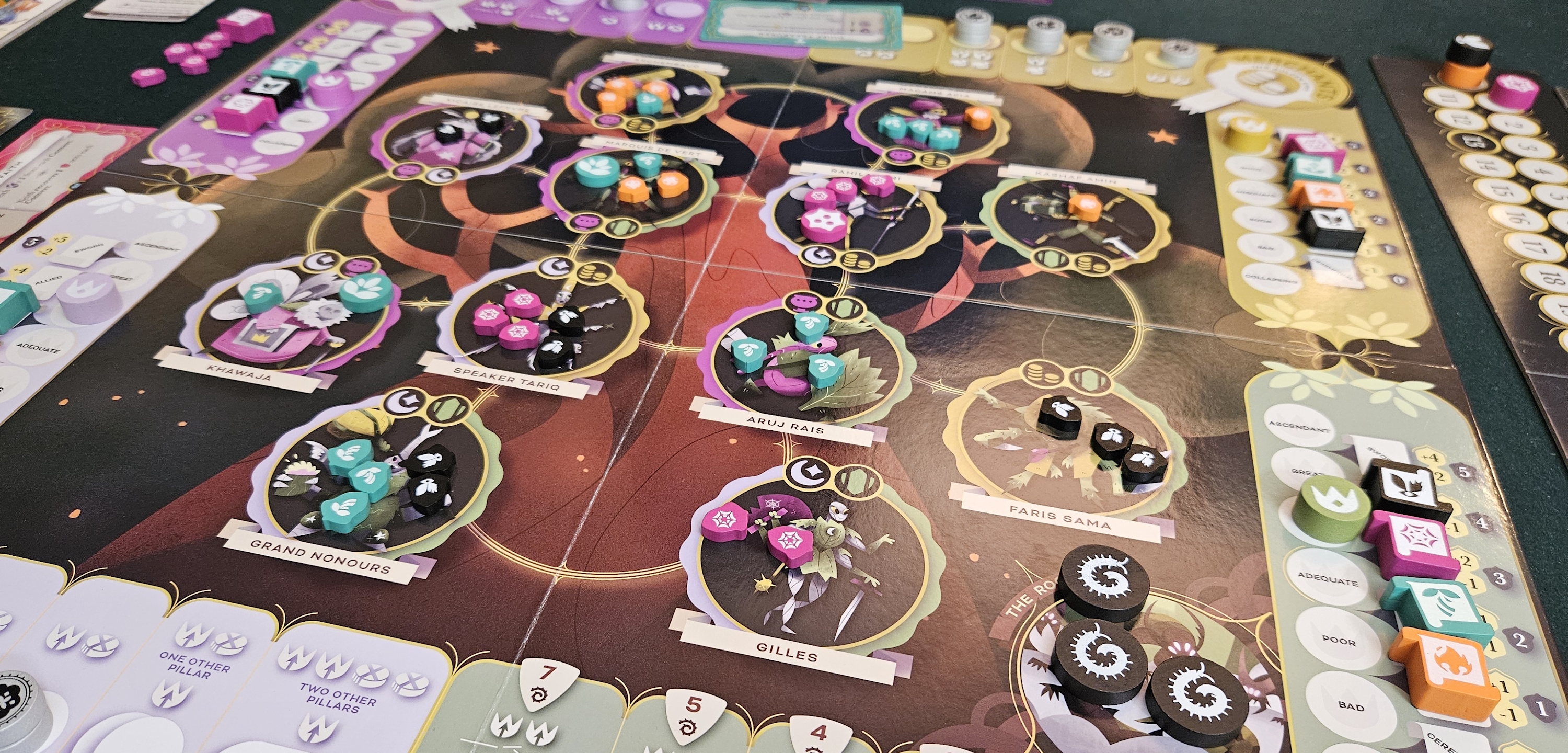
I didn't even notice it was a tree.

This tree is especially bug-infested.

Pact

Pact is what you get when you blend the asymmetry of Root with the hard tradeoffs of a classic card-driven wargame like Twilight Struggle.

First, the Root. Four bug factions occupy the tree kingdom of Branchbourne, each with its own advantages. There’s Jenna Ermine VI, her authority thoroughly entrenched across the branches and boughs of the kingdom, but spread so thin that the slightest tension might crack her carapace. Her closest rival is the Duchesse Orich, incredibly well resourced but also over-leveraged. Somewhat farther underfoot is the revolutionary Matuk Inkclaw, capable of unleashing labor strikes that cripple the kingdom, and the heretic Weaver Neith. Mostly I remember Weaver Neith mind-controlling everybody.

All right, asymmetry is hot right now. But the second half of the game, the card-driven wargame half, controls how things get done. Everything relies on event cards. At any given time, a handful of these are on offer in the market. Taking a turn isn’t as simple as moving pieces. Instead, you select an event. If it’s your own, you either use the card for its action points — adding tokens, moving stuff between locales, that sort of thing — or take its historical outcome, which is always weirder and often more potent, but less directed. On the other hand, if it belongs to someone else, you take the actions while they trigger the event. Pretty normal, as card-driven wargames go, but rather novel when it comes to bug-based fantasy games.
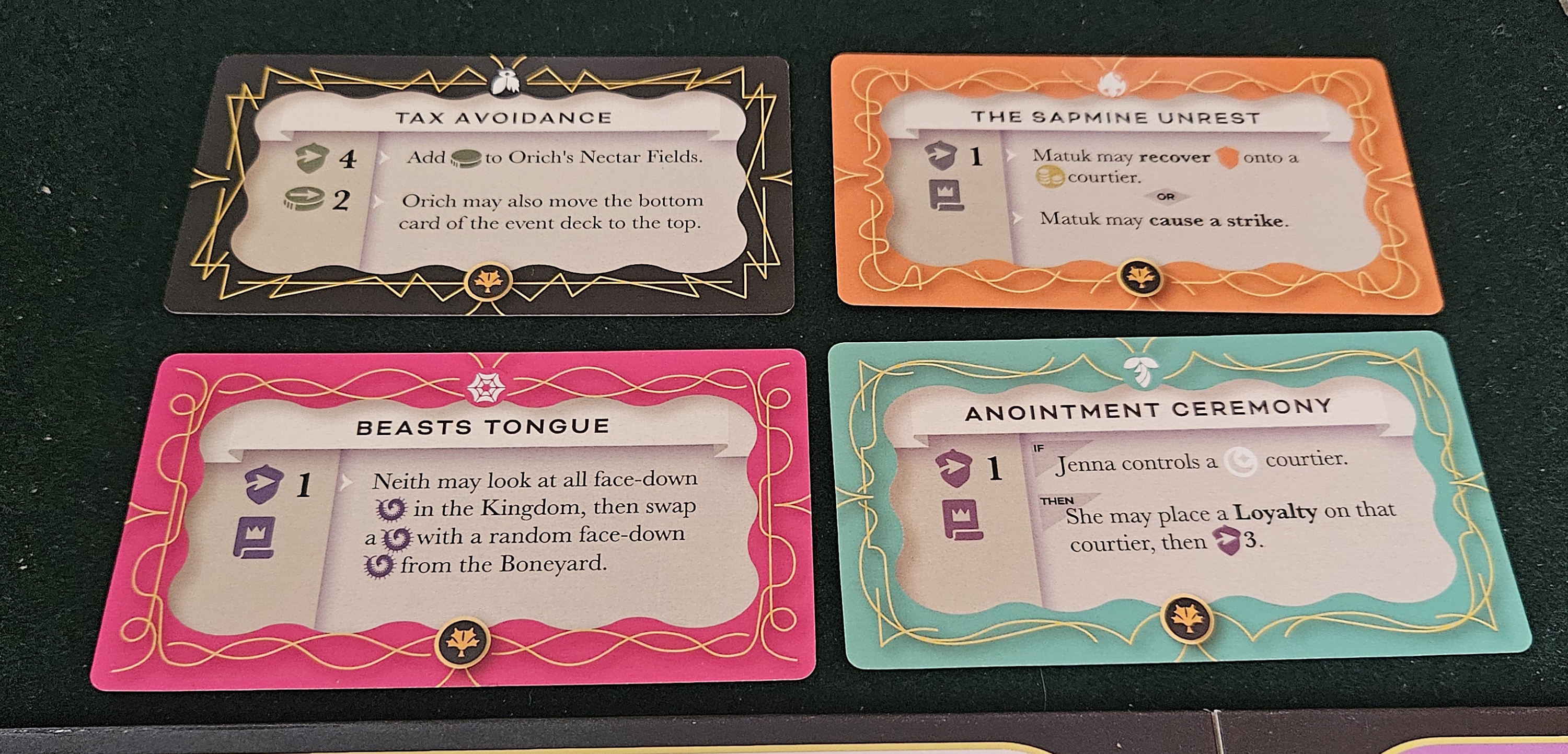
the heartwood? eh? eh?

Events are the heart of Pact.

Making matters more complicated, society in Branchbourne is dominated by four “pillars,” each of which demands some measure of attention lest the kingdom fall into disrepair. These are handled by moving treasures, a nearly zero-sum economy, between their four domains. The Merchants, for instance, are how cash gets infused into the economy. By investing treasures into their domain, additional treasures wink into existence ex nihilo. Invest too much, however, and the Merchants will crash the whole dang thing, reducing the number of treasures in circulation.

Okay, so you want the Merchants to have a lot of treasures, but not so many that they wreck the economy. Except the other pillars also have their own requirements. The Nobility mostly function as parasites, destroying treasures outright, but if not placated they’ll steal treasures from the other pillars. The Church is similar; they like to gather treasures as tithes, but they can manipulate the standings of the other pillars outright. The Military, meanwhile, needs treasure. Lots of treasure. Only their threat is no paper tiger-beetle; if they don’t have enough loot in their vault when the round ends, the centipedes chewing at Branchbourne’s roots will overrun the kingdom and eat everybody.

This prompts a delicate balancing act. Your faction doesn’t only want to survive; they also make pacts (the title! oh ho!) with those pillars to see them succeed in exchange for influence at court. So, depending on how you’ve positioned your faction, you might want the bank to fail this round, since its collapse will humiliate your rival who’s aligned with them, while feeding heaps of glittery to the Church in exchange for their imprimatur on your ascending the throne.
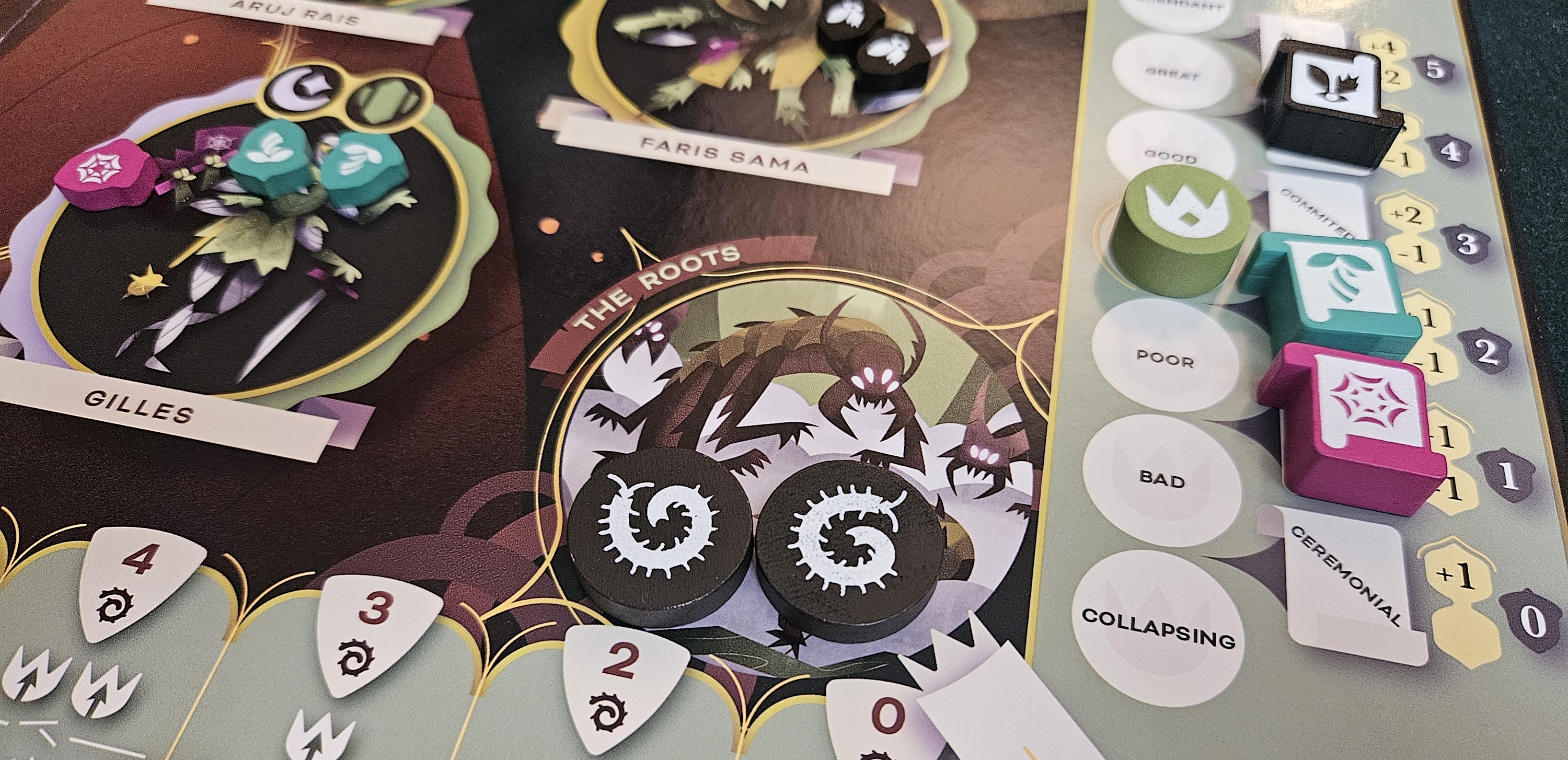
I have a really yucky story about centipedes, but it's basically that one day I was turning over a rock and a centipede walked on my hand, so it's the same as everybody else's childhood-scarring story about centipedes.

Keep forty eye-facets on those centipedes.

Which brings us full circle to that event system, because this is where you can manipulate every little corner of Branchbourne to your advantage. The Duchesse Orich, for example, can use her hives to bestow additional treasures on various pillars of society. But when an event raises the opportunity to do so, will it align with her current goals? The same goes for the firebrand and his labor strikes, the Empress and her loyalty counters, and everything else. Pact is a game of hard tradeoffs. Direct action or powerful but perhaps misaligned events? That’s the question, baby.

All told, the result is a fable about the ever-shifting halls of power that I find mighty intriguing. Like a lot of the best games, designer Zach Hoekstra has keyed into the fact that smart design is often about limitation as much as it is about player agency. Often, turns force a choice between which goals you’ll fail at the least. It’s a lot like tacking into the wind; moving at increments that seem to go nowhere, only that bit by bit move you closer to your objective.

The result is one heady political game indeed. Of the titles on this list, Pact is the heftiest, but it’s also the one I’m most eager to see reach completion. It’s ambitious, it’s weird, it’s full of bugs.

Pact is on Gamefound for nineteen more days.


Prototype copies of Rune Rite, Bucket List, and Pact: The Future of Branchbourne were temporarily provided by their designers and publishers.

(If what I’m doing at Space-Biff! is valuable to you in some way, please consider dropping by my Patreon campaign or Ko-fi. Right now, my third-quarter newsletter is open to all.)

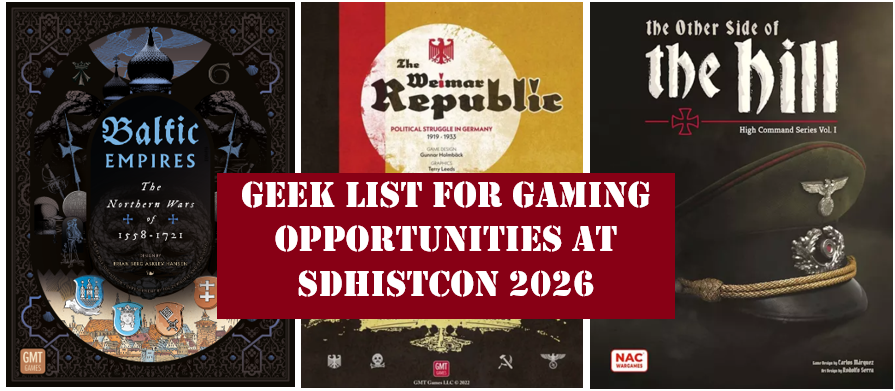
Geek List: Gaming Opportunities at SDHistCon 2026 – November 6-9th

Von: Grant
08. Oktober 2026 um 17:31

4 weeks from today, we will be attending the San Diego Historical Games Convention (SDHistCon 2026) held in sunny San Diego, California. This convention will include 3 days (for us) filled with gaming, designer interviews, looks at new prototypes, visiting with friends, publishers and designers, and having a great time. This will be our 3rd trip to SDHistCon and I am really excited about attending as we had such a great time the last 2 times we have attended! The San Diego Historical Games Convention is set to be held from November 6th through 9th at the S.E.S. Portuguese Hall of San Diego. The convention is about 2 blocks from the San Diego harbor, just a few miles from the San Diego airport, and is surrounded by delicious restaurants and fairly affordable hotels and other accommodations.

We have decided that we would at least like to play the following 4 multi-player wargames while there including Baltic Empires: The Northern Wars of 1558-1721 from GMT Games, The Weimar Republic: Political Struggle in Germany, 1919-1933 from GMT Games, The Other Side of the Hill from NAC Wargames and Thirty Years of Misery from VUCA Simulations. To facilitate the games, we have created a Geek List on Board Game Geek and I would encourage anyone who is attending to check it out and consider adding your name to the list. These lists are first-come-first-served and once full we will keep at least 1-2 alternates who are interested in case something happens that creates a vacancy. I will be looking at playing a few other games while there, including a few prototypes, but wanted to make sure that we got these big games scheduled at a minimum.

If you are interested in participating in one of our gaming opportunities or if you would like to add your own game entries on the list looking for players you can access the Geek List at the following link; https://boardgamegeek.com/geeklist/385692/gaming-opportunities-at-sdhistcon-2026-november-6

Please let me know if you have any questions and I look forward to seeing many of you at the con!

-Grant

Feedspot Top 100 Best Board Game Blogs to Follow 2026 – The Players’ Aid Comes in at #12

Von: Grant
11. September 2026 um 14:00

Every year or so, we find out that our little blog has entered a list or climbed up a few ranks. I am always interested in these lists, as frankly I put a lot of time and effort into the blog, spending hours each week writing and editing content, and feel very proud of its presence on the internet and in our hobby and it is nice to receive some recognition for that work. About a week ago, I received an email from Feedspot that informed me that The Players’ Aid Blog had again appeared on their Top 100 Best Board Game Blogs to Follow list. As I opened the email, I found that we had moved into the #12 spot (moved up on the list since 2025 when we were found in the #20 spot). There are a lot of very well known and well followed blogs on that list and I was very surprised to see us move up to nearly the Top 10.

So what the heck is Feedspot? Feedspot is an online data base that categorizes global media outlets and content creators to make them easy to discover, follow and contact for those that utilize their services. From their site, you can access the creators by following them, emailing them or viewing their sites. Their lists cover things such as media outlets including blogs, podcasts, magazines and news websites as well as creators on platforms such as Instagram, Twitter, YouTube and TikTok.

Here is a look at a picture of the listing for The Players’ Aid:

As I was reviewing the list this year, I noticed a few things. First off, the data that they were using for our social media only included our Facebook, Twitter (X) and Instagram social media platforms. We also are active on Blue Sky and Mastodon. I also noticed that their reported numbers of subscribers was a bit off as we have 3,921 Followers on Facebook (they reported just 3.7K), 8,749 Followers on Twitter (X) (they reported 8.2K) and we have 1,258 Followers on Instagram (they reported a higher rounded off total of 1.3K). Not a big deal but not quite accurate!

Second, they referenced this concept of Domain Authority in their list and I had to do some research to better understand what this metric was measuring. What I found out was that Domain Authority (DA) is a metric that predicts how well a website will rank in search engine results pages (SERP’s) and is measured on a scale of 1 to 100 with higher scores indicating greater ranking potential. This DA is influenced by quality content that is shared and creates backlinks to the content. The Players’ Aid DA is currently at 37 (was at 36 in 2026). Some other relative DA scores on the post were Inside GMT at 36, Space Biff at 37, The Dice Tower at 49, Shut Up & Sit Down at 55 and Board Game Geek at 82.

The other wargame content creators that appeared on the list included Beyond Solitaire at #23 (great work Liz!), Clio’s Board Games at #40 (great work Clio!), The Boardgames Chronicles at #41 (great job Michael!), Big Board Gaming at #55 (I like your stuff Kevin especially the new WARNO feature!), Dude Take Your Turn! at #61 (way to go Dave!) and Board Game Meeple Lady at #62 (awesome BGML!).

I don’t put a lot of stock in these type of lists but was honored that we appeared on it. I know that I care greatly about our corner of the interweb and our little blog and love providing new and fresh content to be consumed by those that follow us. I also see what we do as somewhat of a service as I try to make sure that wargamers know about the products that are incoming and in spreading the news about new publishers, particularly smaller publishers, new games and new crowdfunding campaigns.

If you are interested in reviewing the list and learning more about the content creators that appear on it, you can read the post at the following link: https://bloggers.feedspot.com/board_game_blogs/?feed_id=4778036&_src=f1_newcampaign#h4778036

Thank you for all of the support that you give to us! You reading our blog means the world to us and we appreciate it.

-Grant

Top 10 Board Games I Thought I’d Love But Broke Up With

24. Juli 2026 um 15:06
Scythe ReviewWe’ve all been there. You see a game, love the art, hear the hype, and think: “This is the one. We are going to grow old together.” But then the cardboard hits the table, you play it, and the spark just isn’t there. Not because they’re bad games, but because they just weren’t the right […]

Source

My Favorite Wargame Cards – A Look at Individual Cards from My Favorite Games – Card #87: Proletarian Revolution from The Republic’s Struggle: Battle for the Republic, Spain 1931-1939 from NAC Wargames

Von: Grant
23. Juli 2026 um 14:00

With this My Favorite Wargame Cards Series, I hope to take a look at a specific card from the various wargames that I have played and share how it is used in the game. I am not a strategist and frankly I am not that good at games but I do understand how things should work and be used in games. With that being said, here is the next entry in this series.

#87: Proletarian Revolution from The Republic’s Struggle: Battle for the Republic, Spain 1931-1939 from NAC Wargames

The Republic’s Struggle is a thematic Card Driven Game that tells the story of the historical events that took place in Spain after the resignation to the throne of King Alfonso XIII, and the proclamation of the II Spanish Republic in 1931. With the creation of the new regime, the struggle for power between the different social, political and ideological sectors increased, which gave rise to continuous changes of political power, alterations of public order, armed uprisings and violent acts, carried out by the numerous ideological factions of the moment; which culminated in 1936, in a failed military uprising. The failure of this coup d’état was the origin for the Spanish Civil War.

The Republic’s Struggle is based on Twilight Struggle from GMT Games and uses the same concepts of area control while adding in some actual combat with units represented on the board. During the game, the Republican player and the National player, will be able to recreate events of the period to increase their popularity in the localities by carrying out political propaganda, recruiting troops or militias, generating revolts or assaults, establishing diplomatic relations or carrying out bombardments. All this will be done by playing their hand of cards in an alternative way, either by using the events or by playing the action points or icons to perform any of the other actions available to the players.

One of the interesting parts of the design is that each player has what is referred to as a Special Card that is included in their hand from the start of the game and can be played during their turn. These cards don’t count towards the maximum number of cards that each player can have in their hand at the beginning of each turn. The 2 cards are Military Uprising, which is given to the Nationalist player and Proletarian Revolution, which is given to the Republican player. These cards are single-use event cards and can only be used during the first 4 turns of the game, or in other words during the period referred to as Phase 1 – The Republic. If, after this phase, these cards have not been played, they must be discarded and removed from the game. Both players can choose to use their Special Card in an Action round, instead of using one of the cards from their hand. These cards are played like the rest of the Operation Cards either using their Operations Value or applying the effects of the printed Event. Once played, the card will be removed from the game so it is use it or lose it.

Both cards are very powerful but have some fairly difficult criteria that must be met to fully realize the value of the printed Event. In the case of our featured card Proletarian Revolution, the top part of the card first gives the player the chance to downgrade the European Status Quo Track by 2 levels. The European Status Quo Track allows players to appeal to and in some ways manipulate the stance of the other European Nations regarding their view on the Spanish Civil War. It also is the determining factor in how Victory Points are awarded for the crucial Armed Actions aspect of the game. At the end of each turn, if the number of Armed Actions carried out by a player equals or exceeds the current level of the European Status Quo, that player will score 3 Victory Points. Also, as long as the European Status Quo Track is set on level 2, players cannot carryout any action using the Operations Points of cards played to advance in the Diplomatic Relations Track. So this is another tied result to the card as if the level is 1, no cards can be played to advance the Diplomatic Relations Track.

But, remember I said that to fully realize the effects of the card, the Republican player would need to control Barcelona, Madrid, Valencia and every Naval Base Location or every Air Base Location. If this is the case when the card is played, then the Republican player will earn an automatic victory. Frankly, this is next to impossible, but has a sliver of possibility depending on how diligent and attentive the Nationalist player is as well as the hand of cards that are drawn by the Republican player. If they draw certain other events, as well as have a hand full of higher Operations Point value cards, they can make a run at this but it is not necessarily recommended. The card also has a very useful secondary use as if the condition isn’t met, they will get to place out on the board 1 combatant cube, representing one of their combat units, and also remove all of the influence of the Nationalist player in the Catalonia and Valencia Regions. This literally means all of the Nationalist influence in these regions which each has several locations. In order for the card to be used in this manner though the Republican player will have had to previously play the Defense Committees card.

The proletarian revolution in the Spanish Civil War refers to the widespread social revolution that erupted in the summer of 1936. Triggered by the failed military coup of July 17, workers spontaneously armed themselves, taking control of factories, collectivizing agriculture, and establishing anti-fascist militias primarily in Catalonia, Aragon, and Andalusia. When General Francisco Franco and conservative military officers attempted to overthrow the democratically elected Second Spanish Republic, the working class retaliated by launching a massive wave of grassroots social reorganization. This proletarian movement aimed to permanently dismantle capitalist structures and the influence of the conservative elite and the Catholic Church.

In major industrial hubs like Barcelona, workers’ committees seized factories, transport networks, and public utilities, shifting control directly to the trade unions. In the countryside, particularly in the region of Aragon, peasants seized large agricultural estates. They abolished private property and reorganized land into self-sustaining collectives operating under libertarian socialist or communist principles. Instead of relying on a traditional military hierarchy, fighting forces were formed as democratic workers’ militias led by trade unions and political parties like the CNT (anarcho-syndicalist) and the POUM (Marxist).

The suppression of the revolutionary movement divided the Republican forces. Deprived of its radical grassroots momentum and lacking support from Western democracies, the Republican cause lost ground to Franco’s well-equipped Nationalist army (which was heavily backed by Nazi Germany and Fascist Italy). The Spanish Revolution was ultimately defeated in 1939, leading to the collapse of the Second Republic and the beginning of Franco’s 36-year dictatorship.

Here is a link to our full video review of the game:

In the next entry in this series, we will take a look at National American Woman Suffrage Association from Votes for Women from Fort Circle Games.

-Grant

Interview with John Lapham Designer of A More Perfect Union: The Struggle to Ratify the Constitution from Catastrophe Games Coming to Kickstarter Soon

Von: Grant
13. Juli 2026 um 14:00

While attending Buckeye Game Fest in spring 2024, we met with a new designer named John Lapham. John had with him a new game called A More Perfect Union and we got a chance to play the game and chat about it with him. A More Perfect Union is a 2-player card driven game that simulates the public debate over the ratification of the Constitution that took place across the United States from 1787-1789. The game uses the same system as Twilight Struggle and 1960: The Making of the President but felt very fresh and unique to the situation. Catastrophe Games is planning a Kickstarter campaign in the near future and we reached out to John to see about getting some more insight into the design and he was more than willing to share.

If you are interested in A More Perfect Union: The Struggle to Ratify the Constitution, you can back the project on the Kickstarter page at the following link: https://www.kickstarter.com/projects/campaign-fall-blau/a-more-perfect-union-a-game-about-the-us-constitution?

Grant: John welcome to our blog. First off please tell us a little about yourself. What are your hobbies? What’s your day job?

John: Thanks so much for having me, Grant. My main hobbies will surprise no one – gaming and history. I also enjoy hiking, cooking, and theater. As for my day job, that is in the past. I’m retired now. Before that, I had jobs in both the legal and educational professions.

Grant: What motivated you to break into game design? What have you enjoyed most about the experience thus far?

John: I wanted a game on this topic and no one else seemed willing to oblige me—although Jason Matthews and Christian Leonhard came close with Founding Fathers. I enjoyed the beginning and end of the experience. I love historical research and pondering messy interpretive narratives and historical hypotheticals. So, I was not surprised by how much I enjoyed the front end of the design process. What surprised me was how much I enjoyed the collaboration that occurred near the end of the project, and the practical and artistic challenges of turning an idea into an actual, physical game.  I had no experience with that process and enjoyed learning about it.

Grant: What is your upcoming game A More Perfect Union about?

John: A More Perfect Union is about the political struggle to ratify the U.S. Constitution in the thirteen states from 1787-1789. The game employs the popular card-driven mechanics of such well-known games as Twilight Struggle and 1960: The Making of the President. 

Grant: Why was this a subject that drew your interest?

John: It was the subject of some of my earliest graduate school research in the late 1980’s (yeah, don’t ask, I’ve been around the block more than a few times). As a history educator, I was drawn to less well-known stories, involving people and events that popular and school histories have neglected. This is one such story, and it is an important one that has enduring relevance for understanding much of American history and our current turbulent moment.

Grant: What is your design goal with the game?

John: I had two main goals. I wanted the game to offer a window into the history of that moment and to spark interest in the topic. I also wanted it to be a fun, tense game that could be played in a couple hours but with enough complexity and variability to invite repeated plays.

Grant: What from the Constitutional Convention was most important to model?

John: Ok, that’s a hard one. I cannot give you just one. Several things were important to me.

First, I wanted the game to capture the intense war of words that occurred in the nationwide debate. America was on the leading edge of the first wave of mass media made possible by high literacy rates and the printing press. Americans of the period were highly literate, avid consumers of news, and intensely interested in politics. Ninety different newspapers and hundreds of presses across the country printed thousands of essays, letters, and pamphlets over the course of the debate.

Second, I wanted the game to capture the importance of political strategy in terms of grabbing and holding onto the initiative in the debate through the scheduling of the thirteen state conventions, as well as exploiting the momentum gained from successful outcomes in those conventions.

Third, I wanted to express the tension and uncertainty felt by the delegates during the actual conventions themselves. Delegates often went into these conventions uncertain of their outcomes.

Finally, and perhaps most importantly, I wanted players to come away with an understanding of the immense challenges faced by the new nation to come together and form a strong union that did not threaten the individual liberty that Americans prized at this time. It is in large part the work of the Anti-Federalists that delivered the country its Bill of Rights, a fact that is perhaps too often overlooked or forgotten by modern Americans.

Grant: What sources did you consult about the details of the history? What one must read source would you recommend?

John: Tremendous digital resources are available on the ratification debate thanks to the phenomenal work done by the Center for the Study of the American Constitution at the University of Wisconsin-Madison (https://csac.history.wisc.edu/). I encourage anyone interested in this topic to explore their website and the treasure trove of material available there.

For a more curated collection of primary source material, the Library of America has published an excellent two-volume collection of many of the most important essays, speeches, newspaper articles, pamphlets, and private letters, The Debate on the Constitution, which also includes a detailed chronology and biographical information on the participants in the debates.

For a single, narrative history of the entire series of events, the best choice is Pauline Maier’s Ratification: The People Debate the Constitution, 1787-1788, published in 2010. Reading that book was the last nudge that I needed to start designing the game.

Grant: What is the goal of the game? How do players go about trying to sway States to their way of thinking?

John: Fortunately for me as a designer, the main goal of the game was set out for me in the Constitution itself, which required nine states to ratify it to become binding on those states. Thus, the Federalists win the game immediately if nine states ratify the constitution without recommended amendments, and conversely the Anti-Federalists need five state conventions to reject the Constitution to win immediately. If enough states thread the needle of compromise and ratify the Constitution with recommended amendments, then victory is determined by the weight of the states on each side of the ledger.

The primary tools to convince voters in the states are direct campaign efforts, which involve the use of the campaign points in particular states, and the play of publication events. Publication events address one of three broad sets of issues that animated the debate – commerce, states rights, and individual rights. Each state in turn has a rating that reflects how important each of those sets of issues is to its voters. As a result, the effect of a publication will be more or less, depending on the state in which it appears.

Grant: What is the layout of the board?

John: The board includes several broad features – a map of the thirteen states with a state information and holding box for each state, turn and round tracks, a convention track, a state status track, and a table of information.

Grant: What information is contained in each State Box?

John: Each State Box has a number that reflects the maximum number of combined player cubes that can be present in the state, icons showing if either player starts with cubes in the state, numerical ratings for each of the publication issues, the convention value, and the momentum value of the state, and a spot for the state’s status marker, which shows if the state has scheduled or held its convention. Finally, the state boxes are color coded to show the section of the card deck in which the state’s convention card is seeded.

Grant: What are the 5 different words and corresponding values in these boxes mean? How are these elements connected to the cards?

John: The words “Commerce, States, and Individual” relate to the three publication issues and the numbers (0,1, or 2) next to them reflects the effect that a publication on that issue will have in the state – either adding or removing that number of player cubes in the state. The word “Convention” refers to the convention value of the state and the number next to that is the number of campaign points (CP) a player must expend either to call an early convention in the state or to attempt to take control of the State Status Marker through legislative maneuvering. The word “Momentum” refers to the campaign bonus a player will earn if they win the state’s convention.

The issues ratings connect directly to the publication event cards. The Convention ratings connect to the expenditure of CP gained from card play. The Momentum rating does not connect to the cards but instead relates to the outcome of the convention in the state.

Grant: What is the purpose of the State Factors Table and the State Issues Table?

John: This table summarizes in one place the information contained in the individual State Boxes, and it groups the states by their color codes to show players when they will draw the State Convention Cards over the course of the game.

Grant: What is the Back Room? What role does this play in the game?

John: Each player has a Back Room in which they can place a maximum of two cards. Cards in the Back Room are not part of a player’s hand, cannot be played during a player’s action round, and are not discarded at the end of the turn. Players can access the cards in their Back Room at three times – (1) during the card draw phase of each turn, when they can freely remove or add cards to the Back Room, (2) at the start of any convention, when they can remove, but not add, cards from their Back Room, and (3) during an action phase by playing a card for the sole purpose of adding or removing cards from their Back Room.

The Back Room plays two main roles in the game: (1) it provides a means by which players can hold onto powerful events that are not yet ripe to play – often convention events for conventions that will happen on a future turn, and (2) it provides a way to avoid playing a strong opponent’s event at an inopportune time.

Grant: How does the game use cards? 

John: This a classic Card-Driven-Game. Each player is dealt a hand of cards each turn and plays one card each round either to spend the Campaign Points provided by the card or to implement an event described on the card.

Grant: What different types of cards are there? What is the purpose of these different types?

John: There are five different types of cards: State Convention Cards, Publication Events, Convention Events, Reaction Events, and General Events.

Each state in the game has a State Convention Card, which are mandatory events that must be played in the turn in which they are drawn.  They grant the player cubes in the state and control of the State Legislature, and they schedule the state’s convention by placing the state’s status marker on the Convention Track.

Publication Events publish and distribute a publication addressing a particular issue in a particular state that and a few of its neighbors. Most of these events will specify the state in which they originate and the issue that they address. A few allow the player to pick the state and/or issue for the publication.

Convention Events can be played for their event only during a convention and will have some effect on the outcome of that convention.

Reaction Events are played in response to some other game effect.

General Events are a catch-all for any other type of event.

Grant: Can you share a few examples of cards and explain their use?

John: Sure, here is an example of a State Convention Card:

Each state has one of these cards and they all work the same way.

  • These cards trigger the scheduling of State Conventions. 
  • They must be played on the same turn they are drawn and cannot be discarded or placed in a player’s Back Room.
  • They are seeded in a particular quarter of the draw deck at the start of the game, as indicated by the colored banner in the upper right corner of the card. 
  • When played, you move the indicated state’s Status Marker from the map to Box 1 on the Convention Track and mark it with a cube of your color. This represents that you are in control of the state legislature and can spend CP to call an early convention in this state on a later turn. In addition, you may add or remove 2 cubes in the state.

Here is an example of a Publication Event:

These are the most involved events in the game but like the State Convention Cards they all work the same way. So, once you’ve done it a few times, it becomes straightforward. 

  • The red star identifies this card as an Anti-Federalist Event.
  • The “3” in the star shows that this card is worth 3 CP. 
  • The newspaper icon under the star shows that this card is a publication event, as do the words in the white banner running along the left side of the card.
  • When played for the event, publications are distributed in a number of states equal to the CP value of the card. In this case, that means 3 states. The first state the publication must be distributed in is the state identified by the postal code in the title of the card. In this case, it must be distributed in Virginia. In addition, the publication may be distributed in two additional states that are adjacent to Virginia for a total of 3 states. 
  • The issue addressed by this publication is individual rights, which is indicated in text at the bottom of the card.  The issue controls how many cubes the player will add or remove from each state based on that issue’s value (from 0-2) in each state. The individual rights value in Virginia, Pennsylvania, and North Carolina is 2, but it is only 1 in Maryland. That means that this publication with add or remove 2 cubes in Virginia, Pennsylvania or North Carolina, but will only add or remove only 1 cube in Maryland.

Grant: What happens if you play an opponent’s event? What type of thinking and strategy does this create?

John: Generally, the event triggers, although the player gets to decide whether the event happens before or after they use the card for campaign points. There are two ways to mitigate powerful opponent events. They can be played during the Initiative Phase of the turn to bid for initiative without triggering the event, although doing so often reduces the player’s chance of winning the initiative for the turn, which is costly in its own right. They can also be stored in the player’s Back Room for possible play on a future turn when the event might be less damaging. This too is costly as the Back Room can hold only two cards and those spaces can also be used to save your own events for a future turn when they will be more effective. Thematically, in both instances you are spending time and energy managing a potential problem rather than advancing your own agenda.

Grant: What is the general Sequence of Play?

John: Each turn has the following phases:

Card Draw – Slightly more involved than a standard CDG because each turn you can change the cards in your backroom, which is often a challenging decision.

Initiative Phase – This phase sets the initiative and the first player for the turn.

Action Phase – The heart of the game when players alternate playing cards from their hands.

Convention Phase – State Conventions are resolved or move closer to resolution.

Voter Apathy Phase – Some voters lose interest and players remove some cubes from the map.

Grant: What is a Convention and how does it work? What is the outcome of this process?

John: A Convention is when a state makes its final decision as to whether it will ratify the Constitution. Thematically, this is the moment that elected delegates meet, debate, and vote on the Constitution. To model the drama of these events, players have a final opportunity to play cards that can affect the outcome. After that, the player’s cube totals in the state are compared. If the Federalists have the most cubes, the state ratifies the Constitution. If the Antifederalists have the most, the state does not ratify. If the two factions have an equal number of cubes, the state ratifies with recommended amendments.

Grant: How does Campaigning work?

John: Each state has a set number of voters. This number puts a cap on the number of combined player cubes that may be placed in that state. Players can think of it this way: the voters in each state can have one of three states of mind – undecided, Federalist, or Antifederalist. At the start of the game, most voters are still undecided, which is reflected by the fact that only a few cubes are placed on the board during setup. Campaigning involves the expenditure of Campaign Points (CP) to persuade these votes to change their mind, represented by placing or removing cubes in the states. It costs 1 CP to place a cube in a state. It costs 2 CP to remove a cube from a state. If a state is already at its cube limit, the player will first have to spend points to remove an opponent’s cube before they can place their own cube. Thus, to replace an opponent’s cube with one of your own costs 3 CP. Cards range in CP from 1-4. So many cards will not grant the player enough CP to replace an opponent’s cube with one of their own.

Grant: How is victory achieved?

John: The Federalists gain an immediate victory if nine states ratify the Constitution without amendments. Conversely, the Antifederalists win if five states reject the Constitution. If neither player achieves these conditions before the end of the final turn of the game, at least one state has ratified the Constitution with recommended amendments. Victory at that point is determined by comparing the values of the states in each section of the State Status Track. Each state has a value that represents its political and economic importance – the larger the state the more it is worth.  Each player gets full credit for each of the states in their column and the Antifederalists get partial credit (the Convention value) for each state that ratified with recommended amendments.  Thematically, this represents a compromise situation, where the Constitution is ratified but with amendments. The stronger the opposition to the original Constitution, the more impactful those amendments will be. Strong amendments represent a partial victory for the Antifederalists. Historically, the Antifederalists efforts resulted in the adoption of the first ten amendments to the Constitution, including the Bill of Rights.

Grant: Which side has the tougher challenge to meet their goal?

John: The challenges faced by the two sides are different, but I hope they are roughly equal in difficulty.

Grant: What are some basic strategies the Federalist and the Anti-Federalist players?

John: The Federalists need to strive to win states quickly and build on that early momentum. They may need to consider making aggressive moves early in the game to take states off the board. They also must stay competitive is as many states as possible. They can only afford to lose four states, and the deck is stacked against them in two states – North Carolina and Rhode Island. The Antifederalist player has a wider range of strategic choices. They can focus on winning outright victory in one or two of the early states in an effort to reach the five states they need for an automatic victory, or they can build up their strength in several of the more valuable states that hold their conventions later in the game and improve their chances of winning the game on the basis of points at the end of the game. They cannot afford to compete with the Federalists in every state. They need to pick their battles carefully.

Grant: What type of an experience does the game create?

John: My hope is that it offers players challenging strategic and tactical decisions and creates dramatic moments of high tension where careful planning or bold action can alter the course of the game.

Grant: What are you most pleased about with the design?

John: Overall, I am pleased with the way it models the challenges and choices faced by the historical actors. With respect to the game play, I particularly like the Initiative, Back Room, and Convention mechanisms.

Grant: What other designs are you working on?

John: I’m working on a four-player game about the labor movement in Chicago, during the late 19th-century, and a solitaire game about the Civil War in which the player takes on the role of Lincoln and has to prosecute the war as commander-in-chief, while also navigating the challenges of domestic policy and political campaigning.

While attending Buckeye Game Fest in spring 2024, we met John Lapham and shot a video interview discussing the game and its mechanics:

If you are interested in A More Perfect Union: The Struggle to Ratify the Constitution, you can back the project on the Kickstarter page at the following link: https://www.kickstarter.com/projects/campaign-fall-blau/a-more-perfect-union-a-game-about-the-us-constitution?

-Grant

SWAMS #85: Welche Spiele haben Chancen auf einen Pöppel?

Von: Gnislew
24. Mai 2026 um 18:30
SWAMS #85: Welche Spiele haben Chancen auf einen Pöppel? Blogspiele Gnislew

Die nominierten zum Spiel des Jahres, Kennerspiel des Jahres und Kinderspiel des Jahres sind bekannt gegeben worden. In allen drei Kategorien gibt es eine Longlist und je drei Titel die nun die Chance auf den Pöppel der jeweiligen Kategorie haben. Wir unterhalten uns darüber wer auf den Listen gelandet ist.

The post SWAMS #85: Welche Spiele haben Chancen auf einen Pöppel? first appeared on Blogspiele.

Immersive Imperial Struggle Playlist (Board Game Playlists, #2)

25. Januar 2026 um 16:46

You love board games. You probably also like music. Let’s combine the two into an immersive playlist for Imperial Struggle (Ananda Gupta/Jason Matthews, GMT Games). Have it gently play in the background during your next session of Imperial Struggle for the full period immersion!

First things first: Here’s the playlist!

Before we dive into the content of the playlist, some general observations:

  • Of course, there was no music recording in age of Imperial Struggle, so all the songs in the playlist have been recorded in the 20th or 21st century.
  • The playlist is only 1:45 hours long, so you might need to listen to it several times during your game… unless France stomps over Britain in the first turns.
  • The playlist is thematically sorted. That helps you find similar songs, but makes for somewhat monotonous listening (until you come to the next group of songs). I therefore recommend you turn shuffle on.

Now, what awaits you in the playlist?

#1-3: Religious (classical) music

Imperial Struggle begins after the age of the great confessional wars in Europe, but religion still played an important role in people’s lives, from the lowliest peasants all the way up to kings. Their week culminated in a Sunday service and their year was interspersed with religious events. Composers wrote pieces specifically for a religious holiday (like Bach’s “Christmas Oratorio” from which #2 is taken), or were dedicated to comprehensive religious teaching (like Händel’s “Messiah”, premiering on Easter 1742 in Dublin, from which #3 is taken).

#4-12: Secular (classical) music

The Baroque saw music as universal. Religious and secular followed the same conventions, and thus the same composers wrote pieces for the church and for worldly courts, like Baroque grandmaster Johann Sebastian Bach (Toccata and Fugue in D minor, #4 and Cello Suite No. 1 in G Major, #6) or Georg Friedrich Händel (Sarabande from Suite No. 11, #5). The classical (in the narrower sense) music from the mid-18th century on left this universal view behind. Composers now focused on either one or the other, with most of them following the more fashionable and more lucrative secular path.

Some composed for a court whose lavish entertainments always required music (like the 1773 wedding of the French prince Charles Philippe, the later king Charles X, for which François Francœur arranged the music from which #9 is taken – thus the title Symphonie du Festin Royal (Symphony of the Royal Feast)). Others became freelance musicians (like Mozart, who could (for some years) live of the proceeds of his concerts and operas, #10-12).

#13-16: Folk songs

Not everyone went to a church where the latest compositions were played on Sundays, and of course most people were far removed from attending any court festivities, let alone royal weddings. But people made and listened to music. The easiest, most affordable way to do so was to sing. The 18th century is rich with folk songs, some originally written at the time (like Frère Jacques (“Brother James”), #15 or “Ye Jacobites by Name”, #16), others older, but first put down to paper at the time (Au Claire De La Lune (“By the Light of the Moon”, #13, and Over the Hills, and Far Away (#14)).

#17-23: Patriotic songs

We’ve heard in #16 already how political events seeped into popular songs. Others were written specifically to rouse patriotic feeling, an emotion which came into its own in the 18th century: “Rule, Britannia” (#17) expressed confidence and pride in the Royal Navy to protect British freedoms, “The British Grenadiers” (#18) praised the courage of their counterpart by land.

That these songs could be re-interpreted and turned against their original intent shows “Free America” (#19), written in 1770, which uses the same tune as “The British Grenadiers”, but its lyrics extol America’s freedom (which turned out to be freedom from Britain).

Finally, national anthems also came first into existence in the 18th century: Brits sang “God Save the King/Queen” (#22 – I took the liberty of choosing a not-quite-traditional version). France only got its first anthem (La Marseillaise, #23) with the French Revolution which bookends Imperial Struggle… at least until Ananda Gupta and Jason Matthews get around to do a Revolutionary and Napoleonic Wars expansion!

Thanks to Jason for suggesting songs #5, #14, and #21!

If you like immersive playlists, I’ve done one for Weimar: The Fight for Democracy (Matthias Cramer, Capstone Games/Skellig Games/Spielworxx)!

If you want to dive a bit deeper into the times of Imperial Struggle, here’s a book recommendation.

And if you’re looking for strategic direction in Imperial Struggle, I’ve also got you covered.

What’s your favorite song from this playlist? Let me know in the comments!

Farewell 2025 – Best on the Blog!

31. Dezember 2025 um 11:08

Now the year truly comes to a close. Let’s look back at the eighth full year of this blog.

You can read all of the Farewell 2025 posts here:

The overall blog statistics are pretty meaningless – both last year and this year are skewed by WordPress sending my Farewell 2024 – Historical Fiction! post out to a bajillion people (from Dec 26 to Jan 8), which makes it easily the most popular post of each year (providing more than a fourth of my total views this year). If you factor that out, 2025 has been a good year on the blog, but slightly behind the (organic) record of 2023.

The posts doing particularly well have been the usual suspects, that is, the Most Anticipated Historical Board Games post in January, and the evergreen strategy posts for several games published over the last year. It was nice to see that a few of my research-intensive posts in the American Revolution and the Wallenstein series also did well.

Most of my readers come from the United States (also skewed by the Historical Fiction anomaly, but not entirely), as well as other Anglophone (UK, Canada, Australia) or European (Germany, the Netherlands, Spain, and France) countries. Especially the Dutch have made a leap up… maybe because of my post on the history of Amsterdam? Welkom, anyway.

New arrivals in the top 10 of the countries from which most views stem are Sweden and Poland in a joint Baltic effort.

If you compare views with population numbers, there are possibly no more loyal readers of this blog than the fine people of Ireland, closely followed by Hong Kong, whose views eclipse those of huge countries like Japan, Brazil, or India. The Irish have been devoted to history, board games, and history in board games for some years now, for which I am grateful. The Hongkongers are new in their excitement for the blog – welcome! If you are from Hong Kong, leave a comment below!

I can only speculate what brought people to this blog (but maybe you can enlighten me with a comment, especially if read this blog, but don’t comment often or ever). Here is, however, what I think was the finest which I published this year – as per usual, with six instead of three entries, and without crowning a winner. Let’s go!

“Give Me Liberty, or Give Me Death!” (American Revolution, #2)

Most of the history articles on this blog are about what people in the past did – the politicians, merchants, soldiers of times past. Yet I also like to dwell on what they thought, and thus I’m very happy to have written this post on the political philosophy of the American Revolution, its core value of liberty, and the promise and limitation of that idea. It was also an opportunity to engage with the still-compelling documents of the Revolution – Common Sense and the Declaration of Independence.

Tariffs, Onshoring, and the Board Game Industry

It’s been a wild year politically. Almost forgotten by now is the Great Tariff Rollercoaster of April 2025, in which the American federal government announced tariffs on imports from almost all other countries and then engaged in a flurry of raising, lowering, and holding off on them that made everyone’s head spin. By now, the 145% tariff on Chinese goods imported by US buyers is long gone, but at the time it seemed like an existential threat to US board game companies manufacturing their games in China (so, almost all of them), and given that the current US administration will still be in office for another three years, one worth revisiting.

Wallenstein: Rise

This blog often gives me the opportunity to learn about new subjects. Wallenstein was one of them. I approached the post about his life with not more than a general knowledge about his role in the Thirty Years’ War… and then was sucked into a research rabbit hole in which I read over 2,000 pages about the guy. The result is a four-part series and the longest, most detailed board game assisted biography I have ever written about anyone.

Frederick the Great. A Military Life / Friedrich

…and this blog also allows me to re-visit topics and games with which I have engaged for years (and sometimes decades) now. Frederick II of Prussia is such a person, and Friedrich (Richard Sivél, Histogame) such a game. Reflecting on their insights on Frederick’s campaigns, the command and control exercised, and Frederick’s psychology was a delight.

Amsterdam in History and Board Games

Amsterdam is one of the iconic cities of the world. It is a symbol of art, commerce, and progress, and unique in its canal-structured urban layout. Unsurprisingly, these characteristics have also inspired board game designers. I have told Amsterdam’s 750-year history through the lens of the many board games set in Amsterdam – which gives a glimpse into what the city stands for in the popular imagination. As both this and my earlier Venice post were so much fun to write, I should do more city histories!

Immersive Weimar Playlist

One of my brighter new ideas was to link historical board games to period music. Of course, that works particularly well from the 20th century on – the age of the music record. I started with an immersive playlist for your next game of Weimar (Matthias Cramer, Capstone Games/Skellig Games/Spielworxx), full of everything that was hot at the time – from traditional songs to jazz, from movie tunes to workers’ songs. It will surely not remain the only such playlist.

And thus concludes the year 2025 on this blog. I hope you had as much fun reading it as I had writing.

I wish you all an excellent year 2026, full of joy, health, and success!

Immersive Weimar Playlist (Board Game Playlists, #1)

14. Dezember 2025 um 16:45

You love board games. You probably also like music. Let’s combine the two into an immersive playlist for Weimar: The Fight for Democracy (Matthias Cramer, Capstone Games/Skellig Games/Spielworxx). Have it gently play in the background during your next session of Weimar for the full period immersion!

First things first: Here’s the playlist!

Before we dive into the content of the playlist, some general observations:

  • All of the songs in the playlist were popular during the Weimar Republic (1918—1933). Yet as music recording was still in its infancy at that time, many of the songs in the playlist are later recordings (and some rare ones were recorded even before 1918!).
  • As the playlist is only 2:21 hours long, your Weimar game will probably last longer (if you don’t crash the republic on the first or second round), but there’s no reason not to listen to these songs two or three times – they’re fascinating historical documents.
  • The playlist is thematically sorted. That helps you find similar songs, but makes for somewhat monotonous listening (until you come to the next group of songs). I therefore recommend you turn shuffle on.

Now, what awaits you in the playlist?

#1: The National Anthem

It seems like a no-brainer to include the German national anthem of the time, yet it’s not so simple: The Lied der Deutschen (Song of the Germans) had been written in 1841, but had since then only been a patriotic song among many – until the first president of the republic, Friedrich Ebert, declared it the national anthem in 1922. The song’s three stanzas were variedly popular: Ebert favored the third stanza with its liberal ideals of unity, justice, and freedom, his right-wing opponents preferred the “Deutschland über alles” (Germany Above Everything) first stanza. I have included an instrumental version. If you feel patriotic, you can sing along.

Another controversial national symbol: The Black-Red-Gold flag of the Republic, hearkening back to the 1848 democratic movement, was shunned by the right which preferred the Black-White-Red of the empire. Image ©Capstone Games/Skellig Games/Spielworxx.

#2-9: The Old World

The Weimar Republic did not come into existence in a vacuum. It inherited German cultural traditions like folk songs (“Wem Gott will rechte Gunst erweisen” (Whom God Wants to Favor), song #2).

The folk traditions – including music – remained especially pervasive in rural regions. ©Capstone Games/Skellig Games/Spielworxx.

And, of course, the Weimar Republic succeeded the German Empire with its national feeling (“Die Wacht am Rhein” (The Guard on the Rhine), song #2), dominant Protestantism (Martin Luther’s classic “Ein feste Burg ist unser Gott” (A Mighty Fortress Is Our God), song #5), and monarchy (“Heil dir im Siegerkranz” (Hail to Thee In the Victor’s Crown), song #7 – the quasi-anthem of the German Empire).

The republic’s midwife was the First World War – whose experience shaped its veterans and provided the cultural context even for those who had not been adults during the war yet (“Wildgänse rauschen durch die Nacht” (Wild Geese Rush Through the Night), song #8, written in 1916, was immensely popular among the Weimar Republic youth movement). The war also cast its shadow over Weimar Germany as many had lost their husbands, sons, fathers, brothers, and friends in the war (“Ich hatt’ einen Kameraden” (I Had a Comrade), song #9, the traditional German soldiers’ lament).

Millions of young men trained in armed violence returned from the fronts after the armistice of November 1918. What could go wrong? Image ©Capstone Games/Skellig Games/Spielworxx.

#10-15: Satirical Coping

The liberal republic proved fertile ground for satirical treatments of the new developments: Otto Reutter made fun of the big and small war profiteers with “Seh’n Sie, darum ist es schade, dass der Krieg zu Ende ist” (See, that’s why it’s a pity that the war is over, song #10), and Claire Waldoff called for replacing the men in power with women in “Raus mit den Männern aus dem Reichstag” (Kick the Men Out of Parliament, song #11), playing on masculine anxieties after the introduction of women’s suffrage.

Women’s suffrage upset the traditional gender hierarchy of politically active men and forcibly domestic women. Image ©Capstone Games/Skellig Games/Spielworxx.

#16-25: Pop!

Even in a time and place as politically charged as the Weimar Republic, not everything was politics. The average Hans and Gretel may have cared less about their preferred ideology and more about how to have good time on a Saturday night… and the new cultural scene, especially in the big cities like Berlin, provided ample opportunities.

If you wanted to have fun in a daring, iconoclastic way in the 1920s, there was no better place for you in the world than Berlin. Image ©Capstone Games/Skellig Games/Spielworxx.

The more sophisticated artists like the Comedian Harmonists succeeded with witty wordplay and erudite vocal harmonies. Others played on the classics – alcohol (“Wir versaufen unser Oma ihr klein’ Häuschen“ (We Blow Grandma’s Little House on Booze, song #19) and sexual innuendo („Fräulein, Woll’n Sie nicht ein Kind von mir“ (Miss, Don’t You Want a Child By Me, song #22). There was even the equivalent of a (generalized) diss track: “Du bist als Kind zu heiß gebadet worden” (You Have Been Bathed Too Hot As a Child, song #23) indicates that this neglect of bath safety led to lasting brain damage in the interlocutor.

#26-33: Film, Theater, and Opera Music

The Weimar Republic’s vibrant cultural scene led to cross-pollination between diverse forms of artistic expression. The new medium of film was pioneered in Germany, and once it had left its silent infancy behind, movie songs became hits. Marlene Dietrich, starring in The Blue Angel, enticed with “Ich bin von Kopf bis Fuß auf Liebe eingestellt (I’m Set to Love From Head to Heel, song #26), but warned “Nimm dich in Acht vor blonden Frau’n“ (Beware of Blonde Women, song #27).

Marlene Dietrich, Weimar Germany’s greatest movie star, in the scene of The Blue Angel in which she sings “Ich bin von Kopf bis Fuß auf Liebe eingestellt”. ©Capstone Games/Skellig Games/Spielworxx.

More traditional art forms like the theater also adapted. Die Dreigroschenoper (The Threepenny Opera)’s acerbic critique of capitalism would not have been as successful without its catchy songs, the most famous of which is the “Moritat of Mackie Messer” (Ballad of Mack the Knife, song #31).

The Threepenny Opera was the greatest dramatic success of the Weimar era… and further stagings promptly prohibited when the Nazis took power. ©Capstone Games/Skellig Games/Spielworxx.

Even the most classic and highbrow form of entertainment modernized: “Jonny spielt auf” (Jonny Plays It Big, song #33) introduced jazz into the world of the opera… which brings us to our next category.

#34-41: Jazz and Blues

Traditionally, the United States had received and emulated European fashions, not the other way around. Yet by the early 20th century, America had become the largest economy in the world, its war entry in 1917 tipped the scales of the war further in favor of the Allies, and the increased presence of Americans in Europe meant that the United States turned from an importer to an exporter of culture. Jazz took Europe by storm – both in the form of American (and nascent European) bands and by the new medium of the music record. The Weimar Republic was no exception. Jazz fueled the parties in any larger city of 1920s Germany.

Louis Armstrong was one of the first stars of jazz and had his fans in Weimar Germany as well. ©Capstone Games/Skellig Games/Spielworxx.

Of course, not everyone loved jazz, and the controversy over its unorthodox dissonances, the more expressive, individualistic, and eroticized dancing style accompanying the music, and, of course, the race of its performers entered the contemporary culture wars – exemplified by Weimar’s double use of Louis Armstrong, illustrating both the SPD’s “The New Rhythm” and the DNVP’s “Nicht Deutsch” (“Not German”) event cards.

…and he had his detractors. ©Capstone Games/Skellig Games/Spielworxx.

The “Tiger Rag” (song #41) is also used in The Tin Drum, German writer Günter Grass’s epic about the rise, fall, and persistence of Nazism: The youthful protagonist Oskar Matzerath who always carries his eponymous tin drum plays the Tiger Rag at a NSDAP rally in his hometown Danzig. The mesmerizing rhythm has the audience sway and dance, exposing the Nazis to ridicule.

#42-47: Workers’ Songs

The aggressive ethno-nationalism of Nazism was one of the two most dynamic political movements of the Weimar Republic (at least once the 1929 crash had plunged vast parts of the German population into a crisis of material and identity). The other was the workers’ movement, both in its reformist Social Democratic and its revolutionary Communist form. As the workers had been traditionally excluded from the public in imperial Germany, dominated by aristocracy and bourgeoisie, they created their own political parties (SPD, later USPD and KPD), economic associations (the trade unions), and social and cultural associations – from workers’ sport clubs to workers’ singing societies. Their milieu was bound together not only by their shared economic experience, but also by this cultural connection, of which the workers’ songs formed an important part.

The workers’ social milieu was all-encompassing – from work over leisure to private life. ©Capstone Games/Skellig Games/Spielworxx.

Classics from imperial times like “Die Internationale” (The Internationale, song #42) remained important, but the movement also adopted new songs written by the numerous socialist poets and composers like Bertolt Brecht, Hanns Eisler, or Ernst Busch. Whereas some of these became new classics (like the “Solidaritätslied” (Solidarity Song, song #46), others aged badly: “Der Marsch ins Dritte Reich” (The March to the Third Reich, song #47) poked fun at the alleged inability of the Nazis to take power after their electoral setback at the Reichstag election of November 1932. First recorded in December 1932, the song was horribly overtaken by events just a month later when Hitler was elected chancellor in January 1933.

The solidarity of the working class was splintered in the 1930s – the economic pressures after the 1929 crash weakened the unions, the KPD’s “Social Fascism” theory had it identify the SPD as its main antagonist, and many workers aligned themselves with the Nazis. ©Capstone Games/Skellig Games/Spielworxx.

Thus, we conclude our playlist. It contains the traditional and the modern, entertainment and politics, left and right – except for the very right, but I don’t want to listen to Nazi songs while playing board games, and I’m sure that neither do you.

Do you like to play music in the background while playing board games? What’s your favorite song from this playlist? Let me know in the comments!

❌