❌

Normale Ansicht

“I wouldn’t expect this to become the norm”: backers overwhelmingly choose King’s Gambit most expensive tiers, power crowdfund past $2.3m

19. Oktober 2026 um 17:02

Restoration Games is no stranger to crowdfunding backers pledging hundreds of dollars for premium versions of its games – but its Kickstarter for The Lord of the Rings: The King’s Gambit has taken that to an entirely new level.

The crowdfund had raised $2.33m from more than 7,300 backers in the early hours of its final day, equivalent to almost $319 per supporter – an average spend well above Restoration’s previous major crowdfunding campaigns, including the roughly $260 from last year’s Battle Monsters: Godzilla x Kong.

Almost three-quarters of backers who have committed to one of the game’s various versions opted to spend at least $379 on one of the Mithril tiers, with more than 2,800 people going all-in on the game’s most expensive $449 option.

Those Mithril pledges together account for about 82% of the total raised at the time of writing – a figure well above that expected by Restoration prior to the campaign’s launch, co-owner Justin Jacobson told BoardGameWire.

Restoration Games co-founder Justin Jacobson

He said the company had expected Mithril to be most popular, but had conservatively projected about three Mithril pledges for every two people committing to the base-level Limited tiers of the game

He said, “I’m not entirely surprised. We created the Limited Edition as a sort-of compromise pledge level for folks who wanted some deluxe elements but didn’t want to go all-in for the Mithril Edition.

“Ultimately, though, most Kickstarter backers are there precisely because they do want to go all in, and we try to make that pledge level as appealing as possible and as good a deal as possible.”

Despite the much higher-than-expected proportion of backers opting for Mithril, Jacobson said the campaign’s overall performance was “pretty in-line” with his expectations ahead of the campaign’s final few days – and that “in a vacuum” he would have hoped for slightly higher numbers.

He pointed to the absence of a standard retail edition from the campaign, Free League’s The One Ring RPG crowdfund running at the same time and wider global economic conditions among the factors potentially working against it.

Jacobson said the pattern of backers favouring Restoration’s most expensive option was familiar from what he described as the company’s previous “spectacle” campaigns, with all-in pledges typically outstripping other pledge levels at the close of those crowdfunds.

But King’s Gambit is generating substantially higher spending per backer compared with Restoration’s previous projects offering similarly expensive all-in options.

Last year’s Battle Monsters: Godzilla x Kong offered a $379 Mega Bundle – the same price as the basic Mithril Edition of King’s Gambit – but averaged about $260 across its 2,301 backers.

Return to Dark Tower: Expeditions went even higher with a $499 all-in pledge including the base game, its expansions and upgraded components – although as an expansion-led campaign, existing owners could enter at just $45. Its $1.49m haul from 11,665 backers amounted to an average of $128 per supporter.

King’s Gambit is currently averaging almost $319 across its backers to date – despite almost 1,000 people having committed just $5 for access to the pledge manager.

Jacobson nevertheless cautioned against seeing the campaign as evidence that $379-plus board games were likely to become commonplace.

“This campaign is unusual, and I wouldn’t expect this to become the norm,” he said. “It stems from the unique way in which the original licensing deal and co-publication arrangement came to be in the first place.”

Opening Gambit

Jacobson told BoardGameWire that the publisher decided to pitch licence holder Middle-earth Enterprises in 2023 for a new version of cult 2000 board game Star Wars: The Queen’s Gambit, but instead based on The Lord of the Rings.

Bringing Queen’s Gambit back had been an ambition for Restoration since its inception – it was the first game Jacobson suggested reviving when he approached designer Rob Daviau about founding the company in 2016, although they decided at the time that it was too ambitious for their first project. Daviau had worked on the original during his time at Hasbro.

Jacobson told BoardGameWire, “I put together a big proposal and sent it in. Meanwhile, while that proposal was under consideration, Rob was at the Cannes Game Festival and got approached by Asmodee about doing the exact same thing.

“It seemed like serendipity so we just started that conversation about working on it together. It offered a lot of benefits to both parties.

“We brought our design pedigree and Kickstarter experience, and they brought their massive team for art, sales, distribution, and more. It’s always challenging working outside your own team, but [Asmodee studio] Space Cowboys have been absolutely amazing and have helped make this game the best it can be.”

Space Cowboys plans to release a retail edition of the game next year, which while sharing the same gameplay will use smaller boards, omit the large plastic Minas Tirith and Mordor set pieces and use just two colours of plastic for its miniatures.

Kickstarter image of components planned for the game

Jacobson said, “It was important that our offering was a stark contrast to the retail edition. That edition will be what lives on for as long as the game is sold, long after the Kickstarter campaign is fulfilled. So, first things first, we had to align on what that version of the game was going to be.

“Then, we basically brainstormed all of the ways we could ‘deluxify’ that. The Limited Edition was a slight bump and the 3D plastic set pieces; the Mithril Edition was the whole list.”

When asked if there had been any concern internally over having such a large gap between the price points of the Limited and Mithril editions, Jacobson said, “Not really. There are so many variables and options in setting up any campaign. You’re never going to be 100% certain that you’ve gone the optimal path.

“That said, we were confident in the overall structure of the campaign, i.e., folks who want the cool 3D set pieces and folks who want everything.

“As I’ve always said, the price is always a function of the cost to produce. So once we determine what a pledge level includes, setting the price is relatively straightforward with some minor adjustments. For example, we actually shaved a bit off the Mithril Edition to try and make it a bit more appealing.”

He added, “It does highlight that all of the economic turmoil folks are feeling are not being felt uniformly.

“It also speaks to hobby gamers in general. When you compare it to other hobbies, it’s still a relatively good deal even at the highest end of things.”

Jacobson told BoardGameWire that Restoration deliberately looked beyond established tabletop audiences when marketing the game, in an attempt to leverage the vast fanbase of The Lord of the Rings.

About half of King’s Gambit backers are supporting a Restoration Games crowdfund for the first time, he said – a slightly higher proportion than the company has seen on some of its more recent campaigns.

“We made a concerted effort to try and reach out to influencers whose audience comprises The Lord of the Rings fans and not specifically gamers,” Jacobson said.

He believes the licence was likely part of the explanation for the campaign’s performance, although added that Restoration titles tend to come with followers even without a large IP, given the nature of the company’s strategy of taking memorable, usually long-out-of-print games and redeveloping them for the modern hobby market.

He said, “Fans of The Lord of the Rings are certainly avid and show up in large numbers, but we’ve seen similar excitement from fans of Return to Dark Tower and the like.”

Aragorn Art

Despite the campaign’s strong performance, the release has attracted a backlash from a small minority of online commenters for depicting Aragorn as Black.

That reaction has spilled into the unreleased title’s BoardGameGeek ratings, where some users have awarded it scores of 10 specifically to counter what they believe are 1 ratings motivated by objections to Aragorn’s skin colour.

Jacobson described the reaction as “disappointing but not entirely unexpected”, while stressing that not everyone who preferred a depiction closer to previous versions of Aragorn was motivated by racism.

Aragorn from Lord of the Rings: King’s Gambit || Kickstarter Image

He said, “The art team for both Space Cowboys and Restoration Games spent countless hours working on an extensively researched and thoughtful art brief for the look of the entire game along with each individual character. It’s 59 pages long!

“Our first priority is always to do something true to the source material. Within those pages though there are a number of interpretations. Ultimately, for each depiction, not just Aragorn, we were looking to do something interesting and perhaps novel that still stays true to the source material.

“I can point to details in the lore that support this depiction, but this just isn’t something I have any interest in debating.

“Great works, whether that’s a game or an epic fantasy novel or something else, only arise when the people creating them have a strong vision for what they want to make and put their full effort into realizing that vision.

“In every case, some folks won’t share that vision. But, in every case, if you set out to try and please everyone, you cannot make something extraordinary.”

He added, “There are folks who prefer a depiction more in keeping with prior ones; where other folks enjoy seeing broader depictions. Whenever you are working with an IP, the fans will have strong opinions. I want to be clear: not everyone who would prefer the former do so from a place of racism.

“That said, there are certainly racists, who are using these types of situations to espouse their abhorrent beliefs. It’s unfortunate that they muddy what can be an otherwise interesting conversation.

“As for folks on BGG rating a game a 1 before it comes out, this has been going on for a while for a host of reasons. There’s nothing we can do about it, so we press on and just make the best game we can.

“When people actually receive and start playing the game, we are confident that there will be a lot of great ratings for it that will make the current kerfuffle just so much background noise.”

The King’s Gambit’s crowdfunding campaign ends at 8.30am EDT on October 20.

The post “I wouldn’t expect this to become the norm”: backers overwhelmingly choose King’s Gambit most expensive tiers, power crowdfund past $2.3m first appeared on .
Crowdfunding-Wochenschau KW 41: Herr der Ringe und Conan

05. Oktober 2026 um 12:03
Crowdfunding-Wochenschau KW 41: Herr der Ringe und Conan

Kalenderwoche 41 bringt gleich vier große Starts vom selben Wochenende: Drei Kickstarter-Kampagnen und eine Gamefound-Kampagne sind am 29. September live gegangen. Mit dabei ist auch ein deutscher Verlag in eigener Sache: Queen Games aus Bonn bringt mit Orlando den 13. Teil seiner Stefan-Feld-Städtereihe an den Start. Für die Spieleschmiede hat sich in dieser Woche kein neuer Brettspiel-Kandidat gefunden, der die Aufnahmekriterien dieser Ausgabe erfüllt.

Crowdfunding-Wochenschau KW 41: Herr der Ringe und Conan

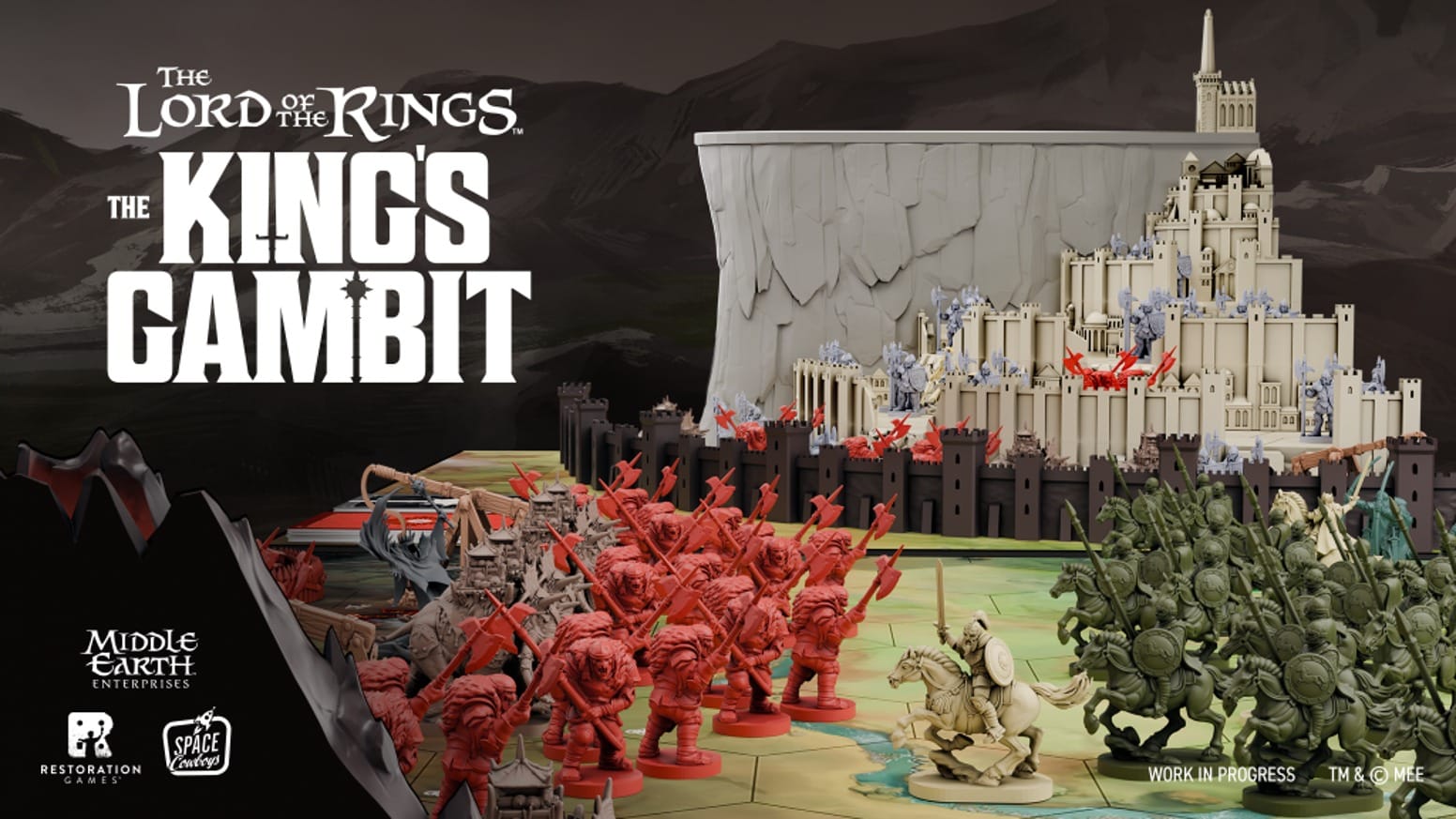
The Lord of the Rings: The King's Gambit

Mit The King's Gambit bringt Restoration Games unter Leitung von Rob Daviau eine Neuauflage von Star Wars: The Queen's Gambit in die Welt von Mittelerde. Auf vier parallel laufenden Schauplätzen, darunter die Pelennor-Felder, Minas Tirith und der Weg durch Mordor, kämpfen die Reiter von Rohan, die Verteidiger Gondors und Frodo mit Sam gegeneinander beziehungsweise gegen die Zeit. Gespielt wird von ein bis vier Personen bei 90 bis 120 Minuten, ein eigener Solo-Modus wird auf der Kampagnenseite nicht erwähnt. Die aufwendige Kickstarter-Edition enthält dreidimensionale Nachbauten von Minas Tirith und Mordor, eine schlankere Handelsausgabe soll 2027 über Asmodee erscheinen.

Die Kickstarter-Kampagne startete am 29. September 2026 und steht, Stand 05.10.2026, bei rund 1.658.000 US-Dollar und 332 Prozent des Ziels von 500.000 US-Dollar, getragen von fast 5000 Unterstützenden. Die günstigste reguläre Spielausgabe kostet 199 US-Dollar, geschätzte Auslieferung ist Oktober 2027. The King's Gambit läuft noch bis zum 20. Oktober 2026.

Crowdfunding-Wochenschau KW 41: Herr der Ringe und Conan

Conan by Monolith: Tales of Tortage and Zamora

Mit Tales of Tortage and Zamora erweitert Monolith sein seit 2016 laufendes Conan-Brettspiel um zwei neue Schauplätze: das Piratennest Tortage und das von Kulten durchsetzte Zamora samt Turm des Elefanten. Die Kampagne bringt sechs neue Szenarien für den Abenteuermodus sowie sechs weitere für Solo- und Koop-Partien mit, dazu erscheint parallel eine neue Box mit Inhalten aus der Rollenspielreihe Conan: The Hyborian Age. Gespielt wird im Grundspiel von zwei bis fünf Personen bei rund 90 Minuten pro Szenario. Eine deutsche Sprachversion nennt die Kampagnenseite nicht.

Die Kickstarter-Kampagne startete am 29. September 2026 und steht, Stand 05.10.2026, bei rund 612.000 Euro und 816 Prozent des Ziels von 75.000 Euro, getragen von mehr als 3300 Unterstützenden. Der günstigste Einstieg in die neuen Inhalte ist der Board Game New Content Pledge für 99 Euro, geschätzte Auslieferung ist September 2027. Die Kampagne läuft noch bis zum 15. Oktober 2026.

Crowdfunding-Wochenschau KW 41: Herr der Ringe und Conan

Orlando

Mit Orlando legt der Bonner Verlag Queen Games den 13. Teil seiner Stefan-Feld-Städtesammlung vor. Ein bis vier Personen bauen einen eigenen Freizeitpark mit Attraktionen, Einschienenbahn und wachsendem Schloss, gesteuert über acht 16-seitige Würfel mit je zwei Aktionen pro Seite. Eine Partie dauert laut BGG 60 bis 90 Minuten.

Wie gut sich das Spiel solo spielt, nennt die Kampagnenseite nicht. Mehrere Pledge-Stufen bringen dreidimensionale Spielkomponenten wie Miniatur-Gebäude statt flacher Pappmarker mit.

Die Kickstarter-Kampagne startete am 29. September 2026 und steht, Stand 05.10.2026, bei rund 102.000 Euro und 1021 Prozent des Ziels von 10.000 Euro, getragen von über 600 Unterstützenden. Die günstigste Spielausgabe kostet 68 Euro, geschätzte Auslieferung ist August 2027. Orlando läuft noch bis zum 12. Oktober 2026.

Crowdfunding-Wochenschau KW 41: Herr der Ringe und Conan

Defenders of the Realm: Definitive Edition

Mit der Definitive Edition legt Greater Than Games das kooperative Fantasyspiel von Designer Richard Launius überarbeitet neu auf. Ein bis sechs Heldinnen und Helden verteidigen gemeinsam Monarch City gegen Monster, Dämonen und uralte Schrecken, deren Truppen sich von Runde zu Runde weiter ausbreiten. Jede Aktion am Tag drängt die Angreifer zurück, macht die nächtliche Vergeltung aber auch gefährlicher.

Gespielt wird von ein bis sechs Personen bei 90 bis 150 Minuten. Ob es einen eigenen Solo-Modus gibt, nennt die Kampagnenseite nicht.

Die Gamefound-Kampagne startete am 29. September 2026 und steht, Stand 05.10.2026, bei rund 89.000 US-Dollar und 89 Prozent des Ziels von 100.000 US-Dollar, das Ziel ist damit noch nicht erreicht. Der günstigste Einstieg kostet 60 US-Dollar, einen Auslieferungstermin nennt die Kampagnenseite nicht. Die Kampagne läuft noch bis zum 29. Oktober 2026.

More Thunder! Thunderer!

27. August 2026 um 02:11

my seven-year-old has one complaint: the missile on the box should have the same smiley face as the one on the first-player jerrycan token

Every so often — although not as often as I’d like — a publisher will release a more affordable version of a beloved game, and it’s always interesting to see where they’re able to shave a buck off the original production. Cardboard becomes cardstock. Plastic miniatures lose detail or transform into standees. In the absolute worst cases, the game is streamlined. “Streamlined.” The doubt-quotes are important. Pared down, more like. Cut short. Decapitated.

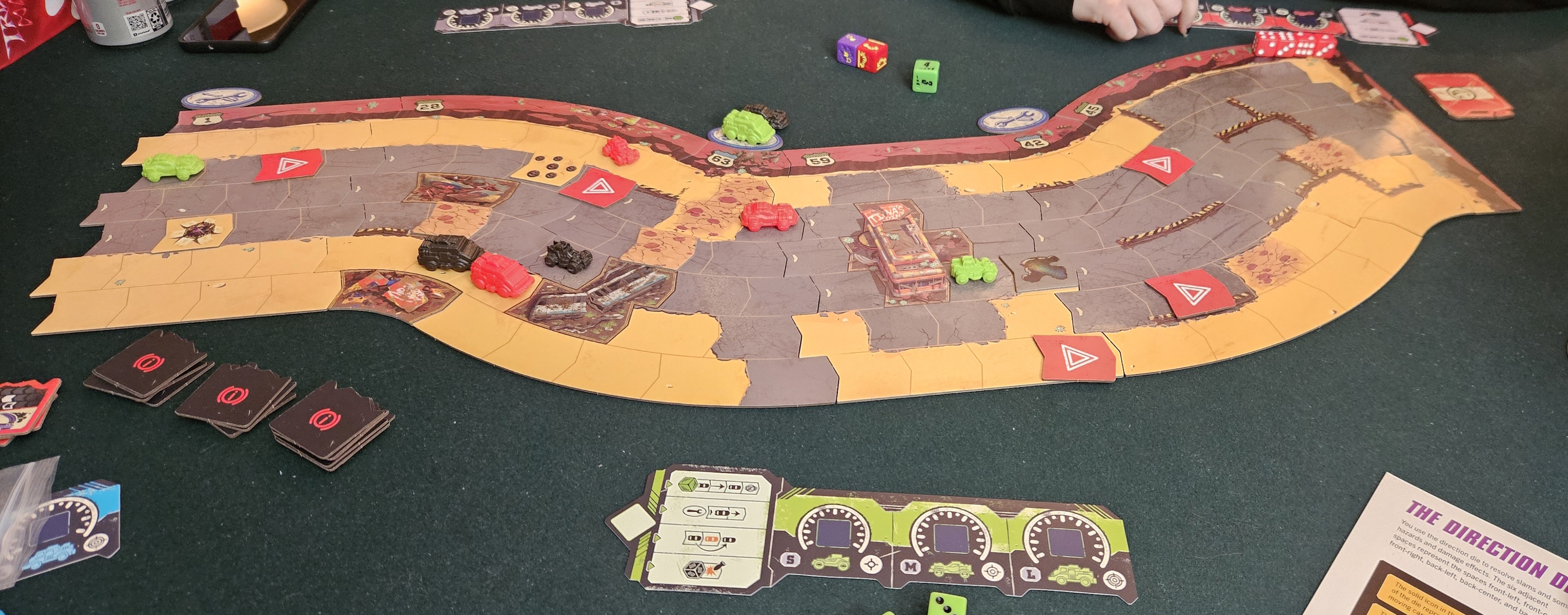
Thunder Road: Ignition trails the lavish Thunder Road: Vendetta. In some ways, this is what you would expect from a product that’s more of the same but costs a third as much as the original box. Cardstock and single-injection molds. The usual.

What’s surprising about Ignition, though, is where it departs from the save-a-buck formula. It isn’t that I expected the folks at Restoration Games to churn out garbage. Far from it. But Ignition isn’t just Thunder Road Done Cheap. After only a handful of plays, my daughters, who had previously declared Vendetta one of their all-time faves, insisted Ignition was superior. To my own surprise, in many ways I agree with them.

After years of neglect, this is how the Salt Lake Valley highway system now appears.

Another day on the road.

Not that you’d know it right away. Thunder Road was a maximalist design. You could see it in every detail, even if you didn’t have access to the multi-tiered Maximum Chrome edition. The cars were assembled from multiple pieces. The helicopters had a spinning rotor. The boards and dice were chunky. And that’s before the expansions added trucks and motorcycles and super-weapons and a deathmatch arena.

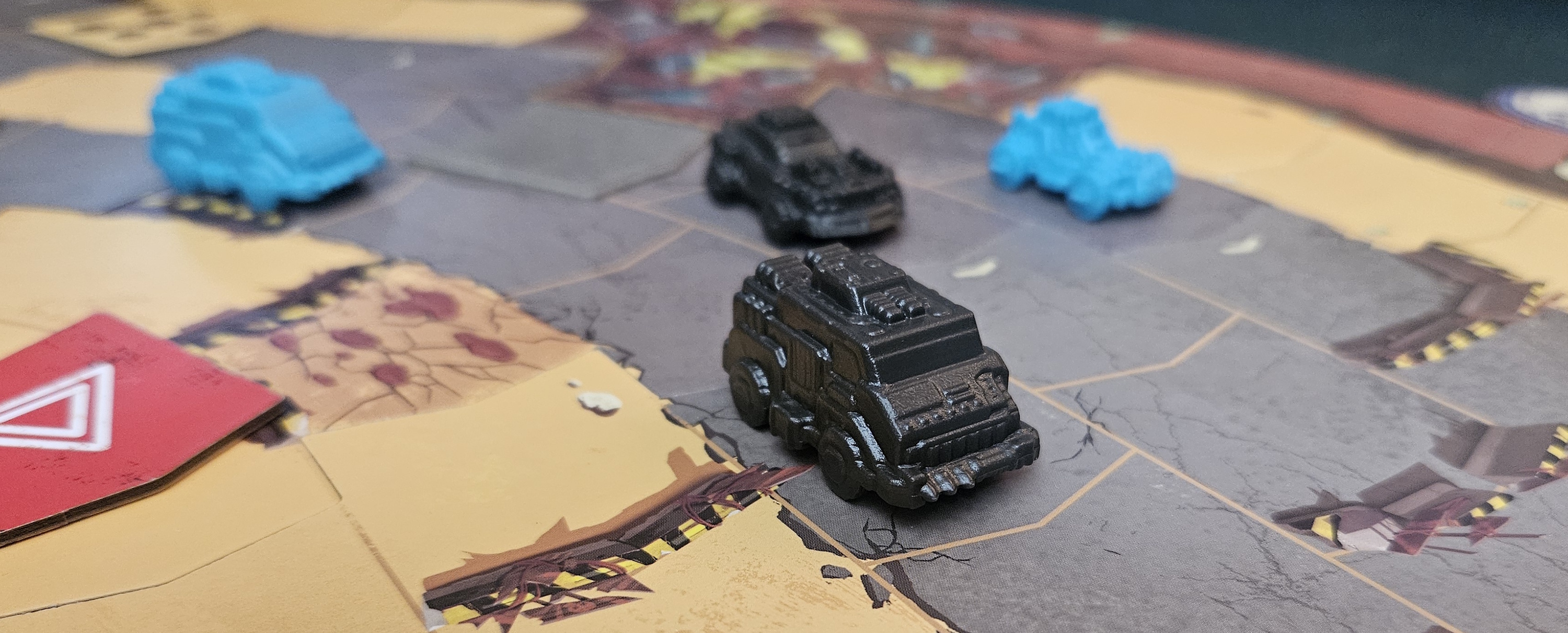
By contrast, Ignition is smaller. Suitably so, but still smaller. As before, players command three vehicles as they race across the wasteland, dodging potholes and taking potshots at one another. The accoutrements are gone, none more fundamental than the original game’s whirlybirds, the toy helicopters that served to pursue anyone who broke away from the pack.

Honestly… I don’t miss all that stuff. At least not as much as I thought I would. Ignition is a return to basics. Which might present a problem if those basics weren’t superheated and accelerated to 2400 feet per second.

I would say the difference is some x-value in millimeters, but I don't know the measurements.

These are paper mats rather than heavy cardboard. There isn’t much difference.

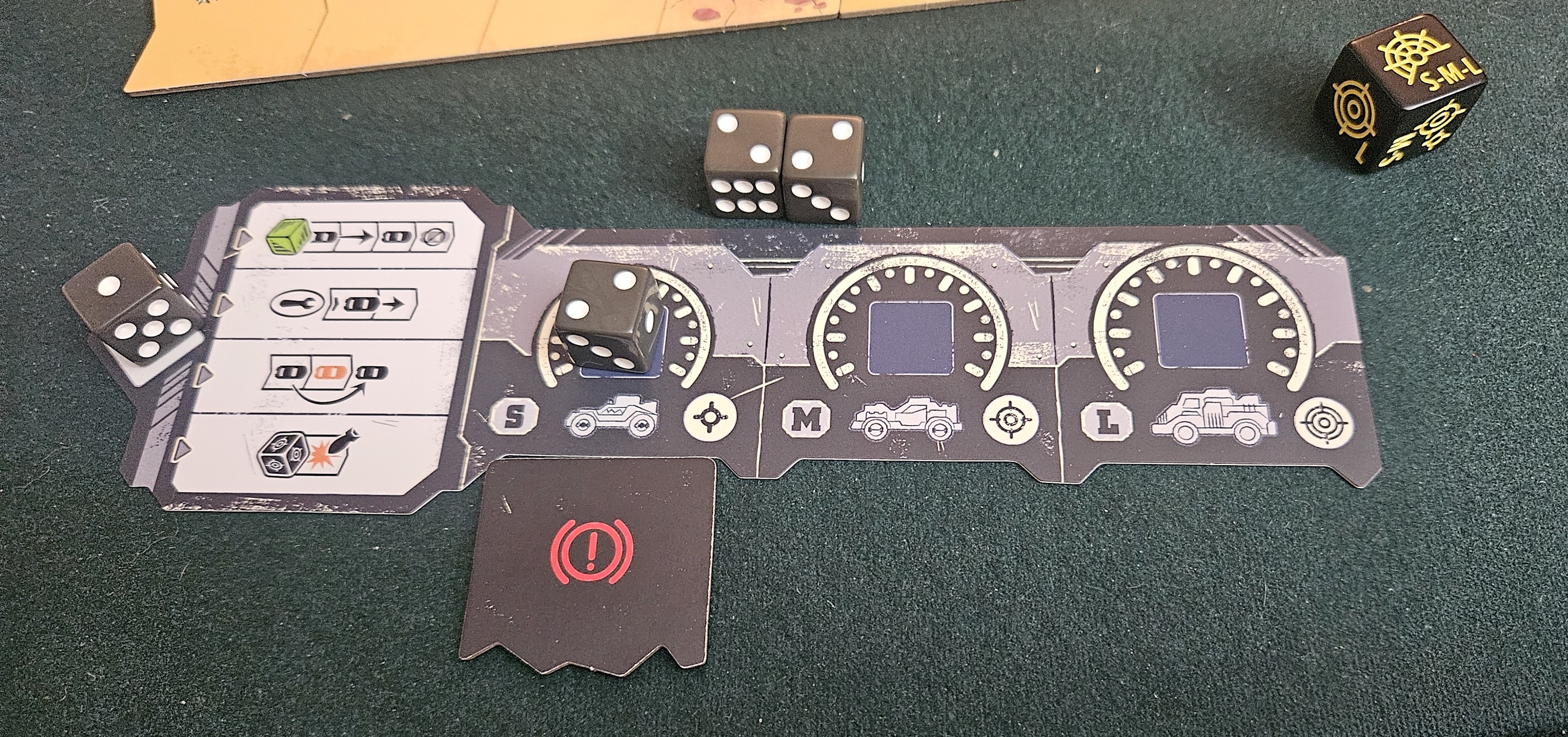
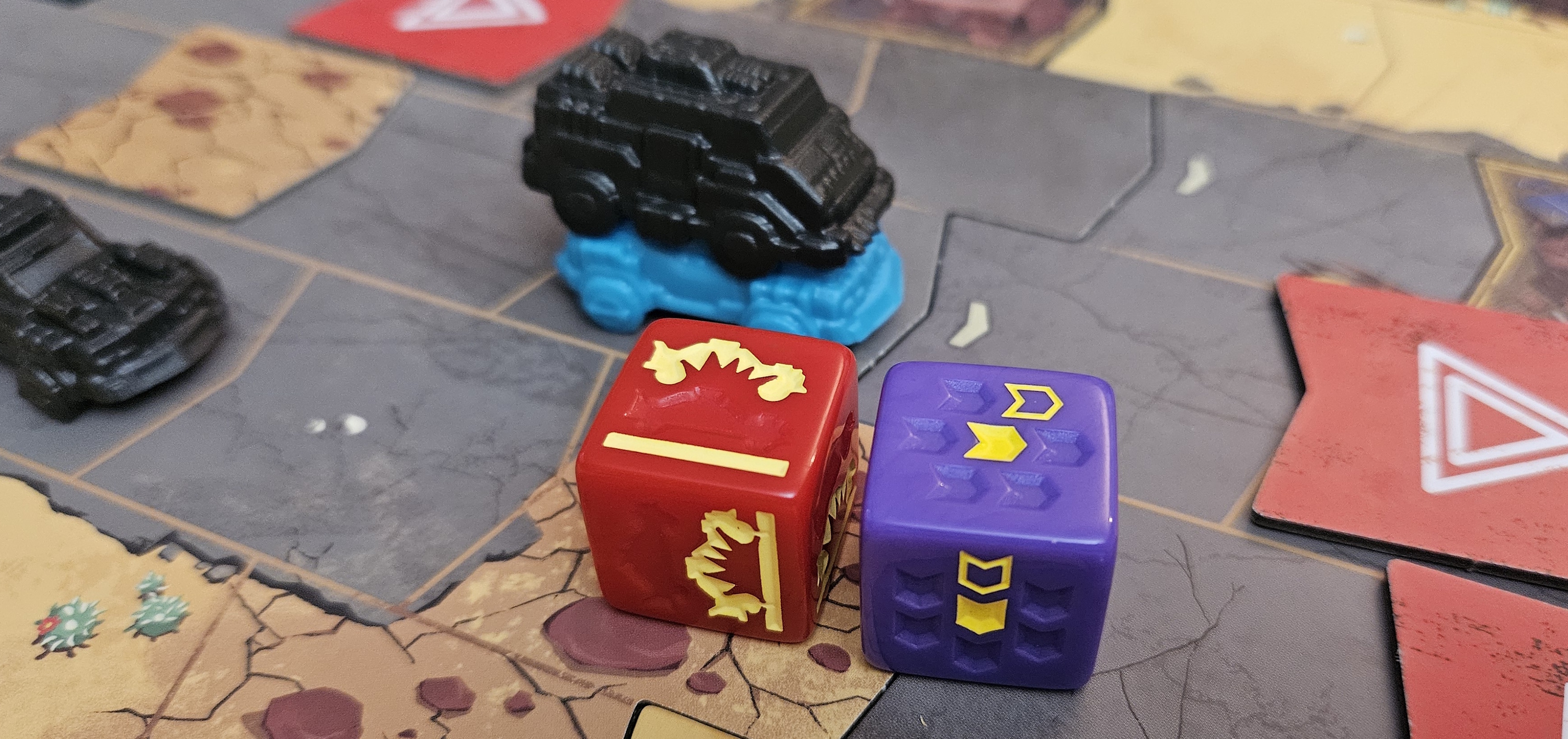
First, the dice. The foundations are the same as before. Each round, everyone rolls four dice, then takes turns placing them one at a time on those various rigs to hurtle them down the highway. That last die could be used once per round to activate a special bonus, like weaving through traffic or sending your helicopter to bomb someone.

Very little has changed. For the most part, the dice-play is identical. Roll four. Spend three on movement. The last one goes toward a bonus action. It’s every bit as smooth and chancy as ever.

The first little differences only rear their heads once you look closer at those bonus actions. The helicopters are gone, replaced by an action that serves more or less the same purpose. This time it’s a missile, presumably launched from one of your cars, and capable of targeting anyone on the road. The only difference is that the missile doesn’t take up space on the road the way Vendetta’s helicopters did.

Or there’s the way nitro no longer moves a car by the value of the die placed on it. Instead, you get to roll the trick die and move that far. It’s a subtle but smart alteration, reducing the effect of a strong opening roll and making breakaway vehicles less likely to speed across a dozen spaces in a turn.

Or there’s the absence of the repair action. Now, if you know Thunder Road, that might sound as cracked as a wasteland warrior’s sense of self after their warlord has imparted some considerable brainwashing. No repairs? How will you keep your cars from being wrecked?

About that…

Do you think these guys shoot the shit while they're off the track, or do they wrestle around?

Checkpoints allow demolished vehicles to return to the race.

In Ignition, cars don’t get wrecked.

Oh, they can still crash. Or get machine-gunned to bits. Or have a missile turn them into a crater. Or speed across too much gravel after their transmission has been shredded by a landmine. Two hits and a car is out of commission.

But only for a while. Only until the next time you activate it with a die.

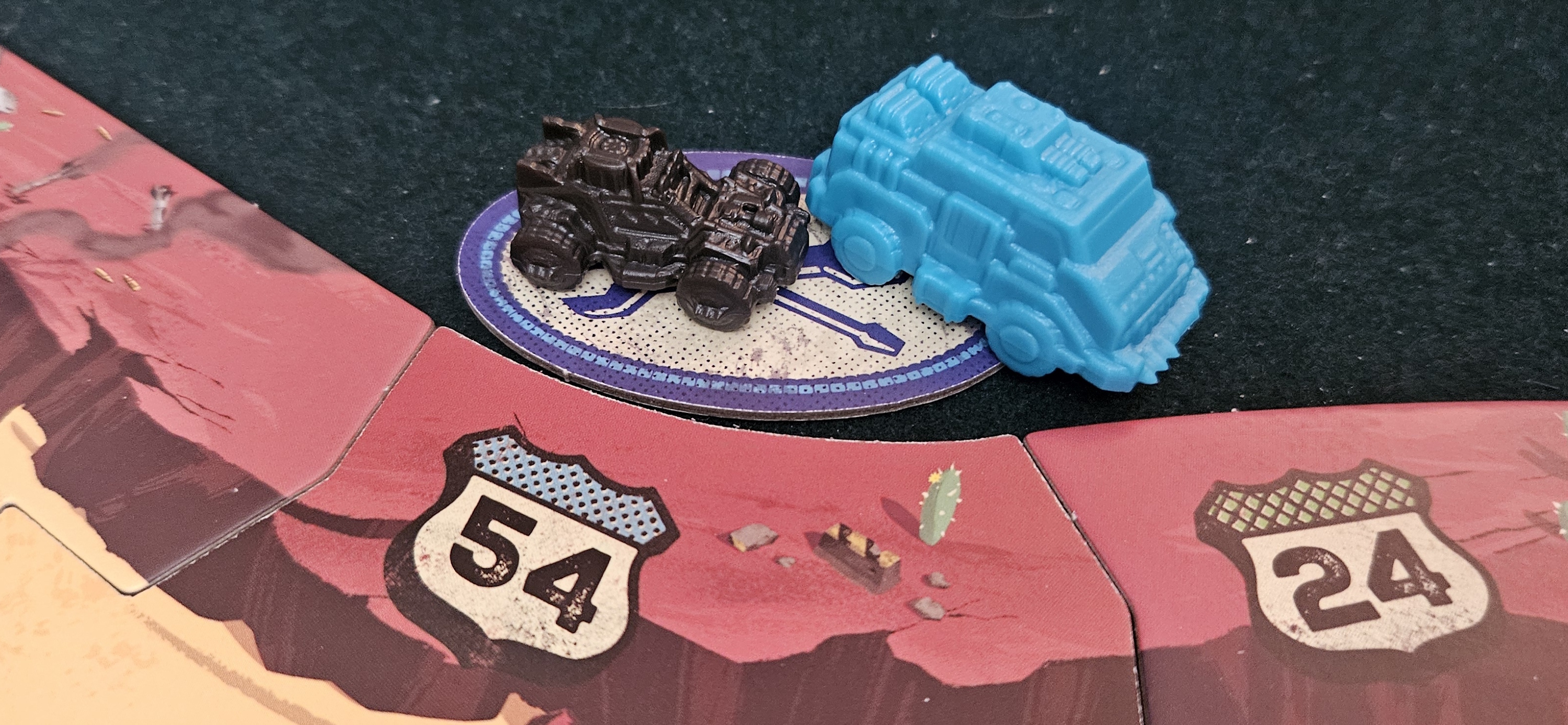
The answer is checkpoints. When a car is destroyed, it goes to the most recent checkpoint. From there, it reenters the race, albeit probably a little farther back then before. Also, it will be slower. It takes the car’s entire turn just to reappear on the road.

That is, unless you spend your bonus action on the option that stands in for the old repair action. Now, when you roll your car back onto the road, the jump-start action will allow it to make its full move. In most cases, this is enough to get back into the thick of things. And if not… well, maybe in those cases it’s smarter to save your bonus dice on heat-seeking missiles.

Such as: do I want my road to look like a length of large intestine?

The curved roads look great and add a few new considerations.

The ramifications of this change from permanent destruction to temporary setback are far-reaching. First, I won’t pretend there aren’t any negatives. There are no more car wrecks. These were one of the original game’s coolest sights, the burnt-out husks of defeated racers turned into serious obstacles for the drivers behind them.

That said, this completely removes one of the system’s larger problems: that the back half of Vendetta’s races were considerably less interesting than their opening moments. As players lost their vehicles, turns grew shorter and more perfunctory. Fewer decisions were present. Usually the last third of the track felt like a foregone conclusion.

Now the victory condition has changed. This is a race, pure and simple, and whomever crosses the finish line with two cars is declared the winner. There’s no longer a situation — and a common situation at that — where you’ve lost so any cars that you no longer have anything to do with those remaining dice. Now you just wheel them back onto the track and keep going.

This eases some of the game’s chancier elements. Thunder Road has never been a serious game, but dulling the consequences helps to emphasize its better portions. Namely, that this is also a rather funny game. Smashing a tank into a dune buggy, only for the tank to get thrown into a wall of trash, is now wholly amusing rather than frustrating. By the same token, getting slapped with a missile right before you reach the next checkpoint offers a shadow of the finish-line blues, but its easier recovery means you haven’t lost the race. If anything, this adds some strategy to the game. Rather than investing every one of your best rolls into your fastest car, it’s often worthwhile to spread them around to ensure a damaged vehicle reaches the next checkpoint rather than getting booted back to the start of the track.

Which is all very clever. Because Ignition is definitely the smaller of these siblings, but it doesn’t feel short so much as lean and muscular. Its matches are focused and mean and hilarious. An improbable emotional blend, but one that works thanks to some ruthless development work.

chikka chikka bow wow

Smoosh!

Everything else survives intact, at least if we’re starting from the baseline rather than the expansion stuff. The special dice, which oversee ramming and damage and shooting, are still a joy to contemplate and handle. The cars still feel distinct without needing any additional rules. The race… well, it’s still Thunder Road. Just better, in most ways.

As my seven-year-old put it, “It was so crazy when my car hit your car into the garbage!” Like the best of the recent resplendence of comedy racing games — Hot Streak, Magical Athlete, and Dino Racer — Thunder Road: Ignition feels like it was custom-built to appeal to everyone in my family, adult and child alike. Vroom vroom, sucka.


A complimentary copy of Thunder Road: Ignition was provided by the publisher.

(If what I’m doing at Space-Biff! is valuable to you in some way, please consider dropping by my Patreon campaign or Ko-fi. Right now, supporters can read the next installment in my series Talking About Games, this time tackling the topic of what makes a good list! Naturally, the piece includes a list.)

❌