
Normale Ansicht

“We’ve been ready for this step!”: Allplay’s Joe Wiggins on its striking push into heavier games, bigger productions and new audiences

12. August 2026 um 12:41

Allplay is making its biggest strategic shift since its predecessor Boardgametables.com entered publishing in 2018 – launching a trio of new product lines aimed at markets well beyond the accessible, smaller-box strategy games that have defined it to date.

The publisher’s newly-announced Masterworks, Epics and Creations lines mark its expansion into heavyweight eurogames, large-scale adventure titles and licensed or fandom-driven games respectively – beginning with a remake of highly-regarded Chad Jensen design Dominant Species.

Allplay’s decision to broaden its portfolio into larger, more expensive productions stands out as one of the more ambitious publisher expansion plans announced this year – especially given many have been shifting towards smaller-box, lower risk releases amid ongoing cost pressures such as tariffs and rising manufacturing expenses.

The move represents a notable evolution for a company that has built its reputation around approachable strategy games with consistent box sizes and accessible price points, alongside carefully-produced new editions of established hobby titles such as Container. Notable titles from the publisher to date have included releases like River Valley Glassworks, Mountain Goats and Things in Rings.

“We’ve always made games with constraints – on principle”, Allplay COO Joe Wiggins said. “We’re proud of what we’ve been able to make with these constraints.

“The consistent box sizes, accessible price points, and simpler rulesets are great for families and gamers who want strategy without rules overhead.

“Those core products aren’t going away. But now that we’re eight years into publishing games, we’re ready to show what else we can do.”

Allplay began life as boardgametables.com in 2014, specialising in high-end, custom-built wooden gaming tables manufactured in the US, before dipping its toes into board game publishing four years later.

The business rebranded as Allplay at the beginning on 2023 to better reflect its expansion, having reached the point where it was also providing bags, playmats and shelves, in addition to having published 17 board games and eight expansions.

When asked what gave Allplay the confidence to expand its remit again given the current challenges in the hobby games environment, Wiggins told BoardGameWire, “In the last four years we have gone from eight titles to 75. We are not known for bad games or shoddy components, but rather timely deliveries and solid productions.

“We have a very strong team and system in place, and while this growth might mean bigger impacts we have been for three years producing over 20 games per year – and this will see us lowering to about 12 – 15. We’re opening bandwidth to allow for these projects.”

He added, “This wasn’t a decision we made lightly. It was very specific and thoughtful in how we wanted to grow”, and went on to point out: “In the last five years we’ve gone from four of us at Allplay to now hiring our 22nd full time person, with an army of freelancers helping as well. We’ve been ready for this step!”

The most eye-catching announcement was the launch of Masterworks, a heavyweight strategy line created in partnership with acclaimed graphic designer and artist Ian O’Toole, whose portfolio of work includes Voidfall, On Mars and Galactic Cruise.

Rather than simply commissioning artwork, Allplay said O’Toole will become a full partner in the Masterworks line, helping select projects as well as contributing to their development, graphic design and visual direction.

Wiggins told BoardGameWire, “We are seeking out the best heavy euros to bring to market and he is key in the selection, development, art, and graphic design. He isn’t a paid artist – he’s a full partner in the line. We fully believe each release will make a massive impact on the heavy euro scene.”

He added that despite kicking off with a high-profile established title in Dominant Species, almost all of the games in the three lines will be new designs.

Wiggins said, “We just had such an amazing opportunity to launch with Dominant Species, which is one of our favorite all time games and will make such an impact when this amazing game gets phenomenal art and graphics for a modern gaming audience. Don’t expect too many classics – though I do have my eye on one for later down the road in the Masterworks line.”

Alongside Masterworks, Allplay’s Epics line will be dedicated to larger-scale hobby games including Sail Legacy and new survival game Crash Landed, while Creations will focus on games built around recognisable fandoms and licensed intellectual property – beginning with John D Clair’s theme park-themed Have a Magical Day.

Box cover for John D Clair design Have a Magical Day, published by Allplay

Allplay has been clear that its existing publishing strategy will continue alongside the new initiatives, including a Kickstarter campaign in October for Through The Mountains – a sequel to Reiner Knizia’s Through the Desert, for which it ran a crowdfund at the end of 2023.

Wiggins told BoardGameWire that the company had been working on some of its expansion ideas since 2024 – adding that the commercial success of its Allplay partner programme had been key in giving the company the resources to expand its operations.

That partner programme has seen Allplay team up with more than 40 other publishers such as Bitewing Games, Kinson Key Games and Cardboard Alchemy, giving them access to its own infrastructure and providing services such as fulfillment for crowdfunding projects.

Wiggins told BoardGameWire, “As a group we are all stronger and can rely on each others success. Our partnership allows them to focus more on making more and better games and that lets them grow which lets us grow. It’s very symbiotic.”

That network will also help shape the company’s crowdfunding strategy for its new publishing lines, Wiggins said, giving it crucial information on how to successfully market different weights and styles of games.

He said, “When we launch Dominant Species we are able to key into audiences that liked Container and Galactic Cruise. When we launch Crash Landed we have access to the audiences of Tidal Blades 2 and Arydia, [and] when we launch Have A Magical Day we can speak to people who have loved Flamecraft and River Valley Glassworks.

“And people that come to us for Dominant Species will find Galactic Cruise… etc. We’re all working as a team and this is a big difference maker. Lifting each other up.”

Dominant Species, Crash Landed and Have a Magical Day are all set to come to Kickstarter in 2027.

The post “We’ve been ready for this step!”: Allplay’s Joe Wiggins on its striking push into heavier games, bigger productions and new audiences first appeared on .

Yawpz

24. Juli 2026 um 01:44

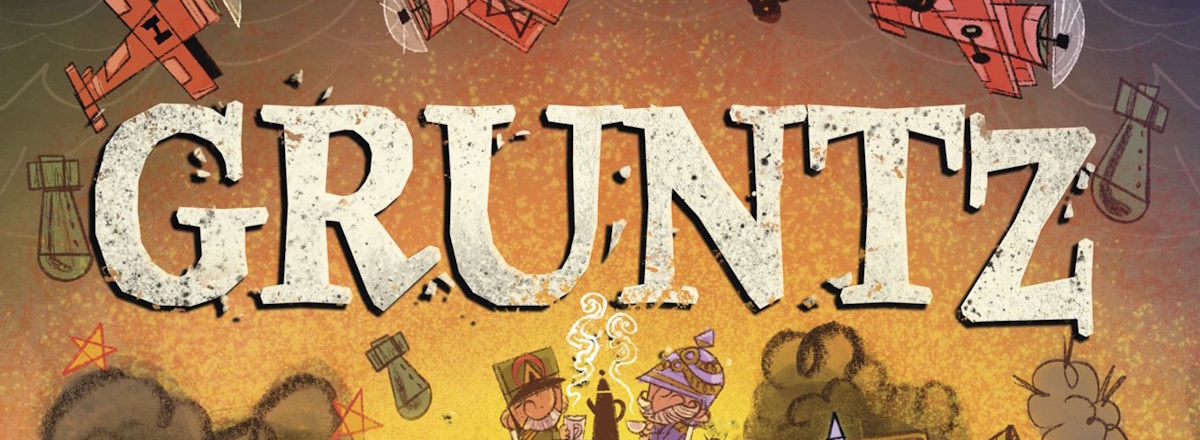
I'm the little kaiser-kisser on the right, sipping tea with my peers across the lines, oblivious to the carnage around me.

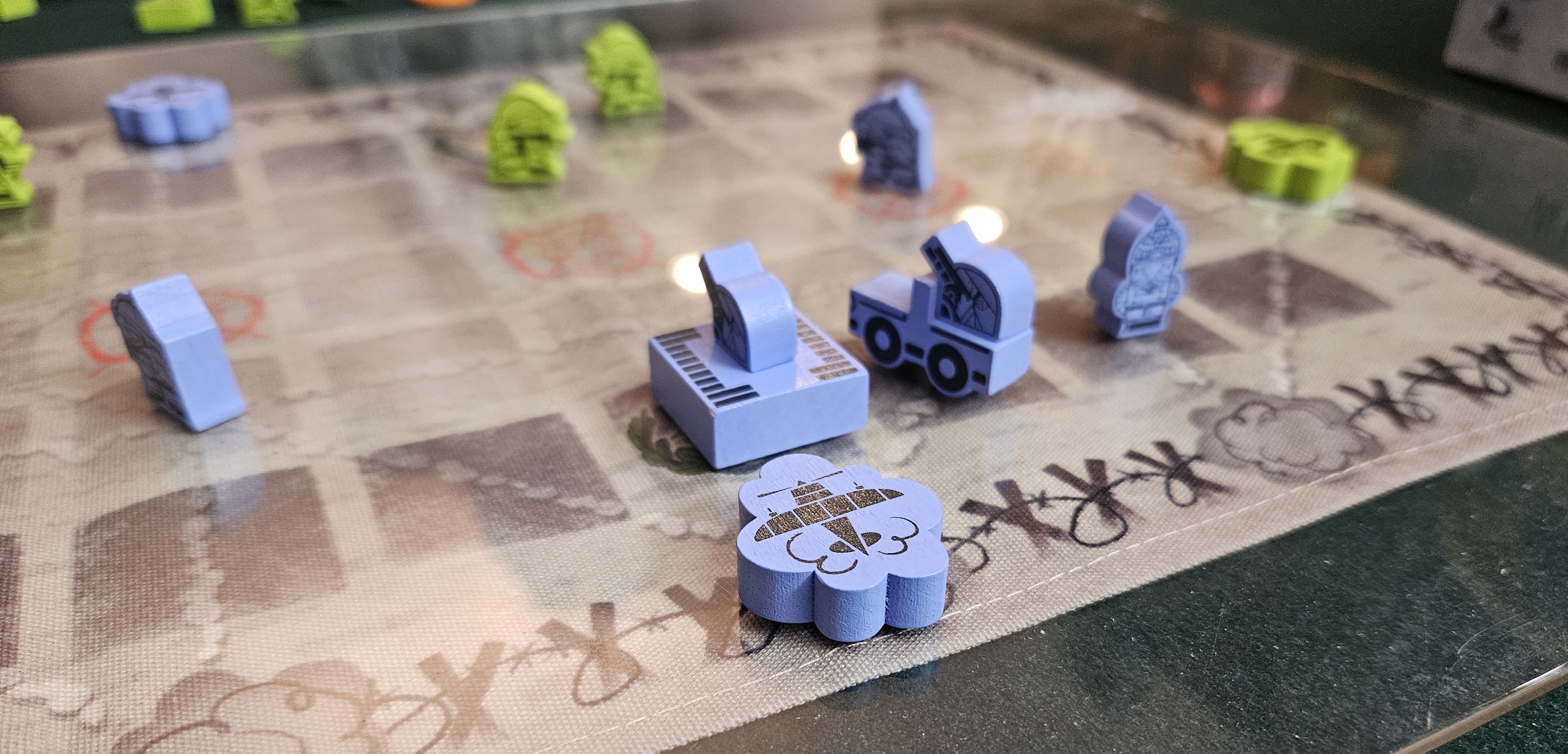
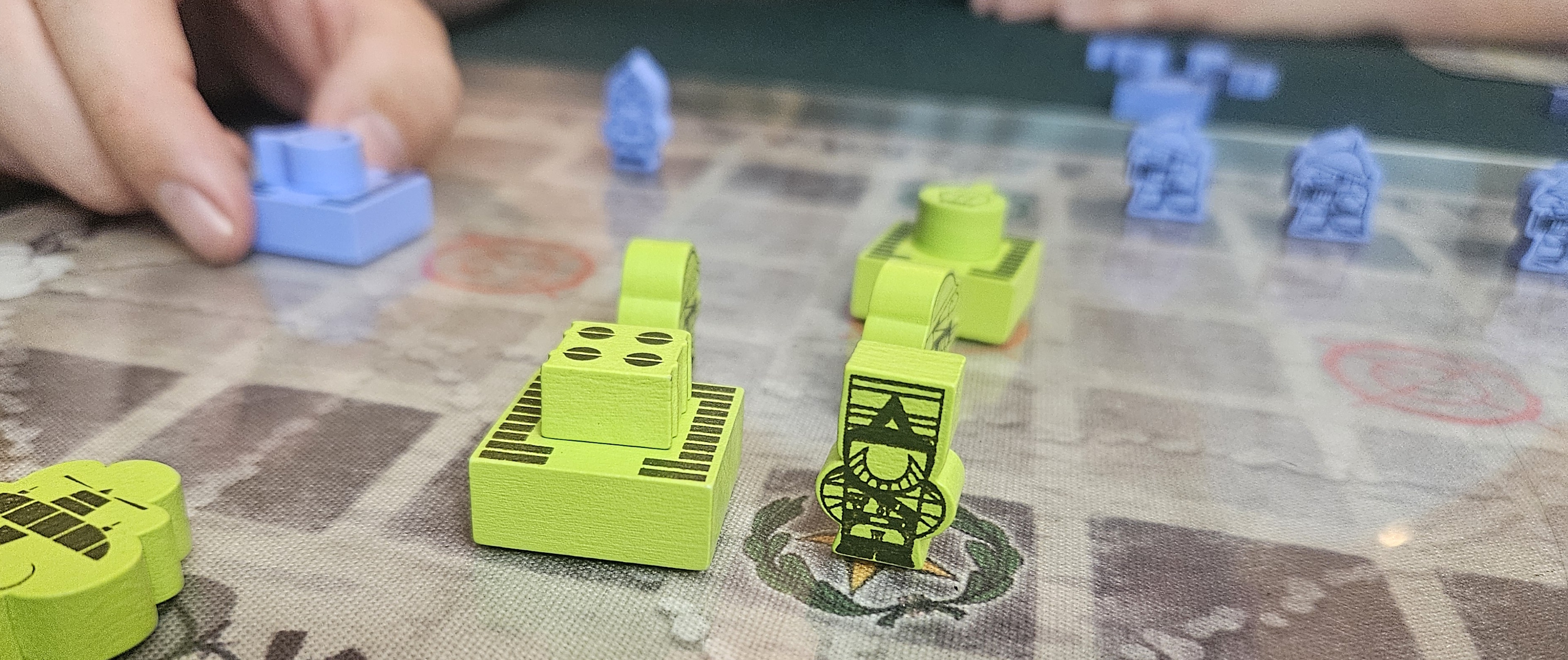
This might sound funny, but the game that kept springing to mind while playing Gruntz, the tiny-as-it-gets wargame by Carter Scott, was none other than Kurt Vonnegut’s GHQ. Like that ancient (but now resuscitated) title, Gruntz is about a pair of World War-era armies bashing it out on the field. They’re both highly attritional, encouraging a tit-for-tat gameplay that’s either enthralling or exhausting depending on your tolerance for swapping one piece for another.

More than that, they’re both games about both movement and reinforcement. It isn’t enough to position your troops smartly. You also need to know when — and what — to call up from the rear. In the case of Gruntz, that sometimes means snapping a range of equipment onto a chassis to create a custom-built war machine.

This is never not cool. Because magnets, baby. I’m always in a mood for magnets.

This game would benefit from a soundboard of growly but cute tank, truck, and biplane noises.

Screening my fighter with plentiful anti-air.

The parallels don’t stop there, although I’m hell-bent on preventing this from becoming a comparison piece between two board games that are similarly under-known and probably wouldn’t appreciate the association anyway. Still, there’s something to be said about the way these titles portray their miniature battlefields. Where GHQ was a pale representation of Vonnegut’s WWII battlefields, dominated by artillery and armor, with infantry more or less serving as a screen for the good stuff, Gruntz is more timeless. Which is a polite way of saying that it isn’t quite as distinctive, history-wise, despite the visuals and hardware looking a little more Great War.

Perhaps the best place to start would be with the units. Infantry — the titular gruntz — represent a never-ending supply of bodies. Really, that’s their main trait: when killed, they bounce back into their general’s reserve rather than disappearing permanently from the table. They’re also useful for capturing control points, and can be moved en masse thanks to a captain who’s the spitting image of a gentleman officer in the midst of a war that’s very quickly eliminating the aristocracy at a pace that leaves every revolution red-faced with envy.

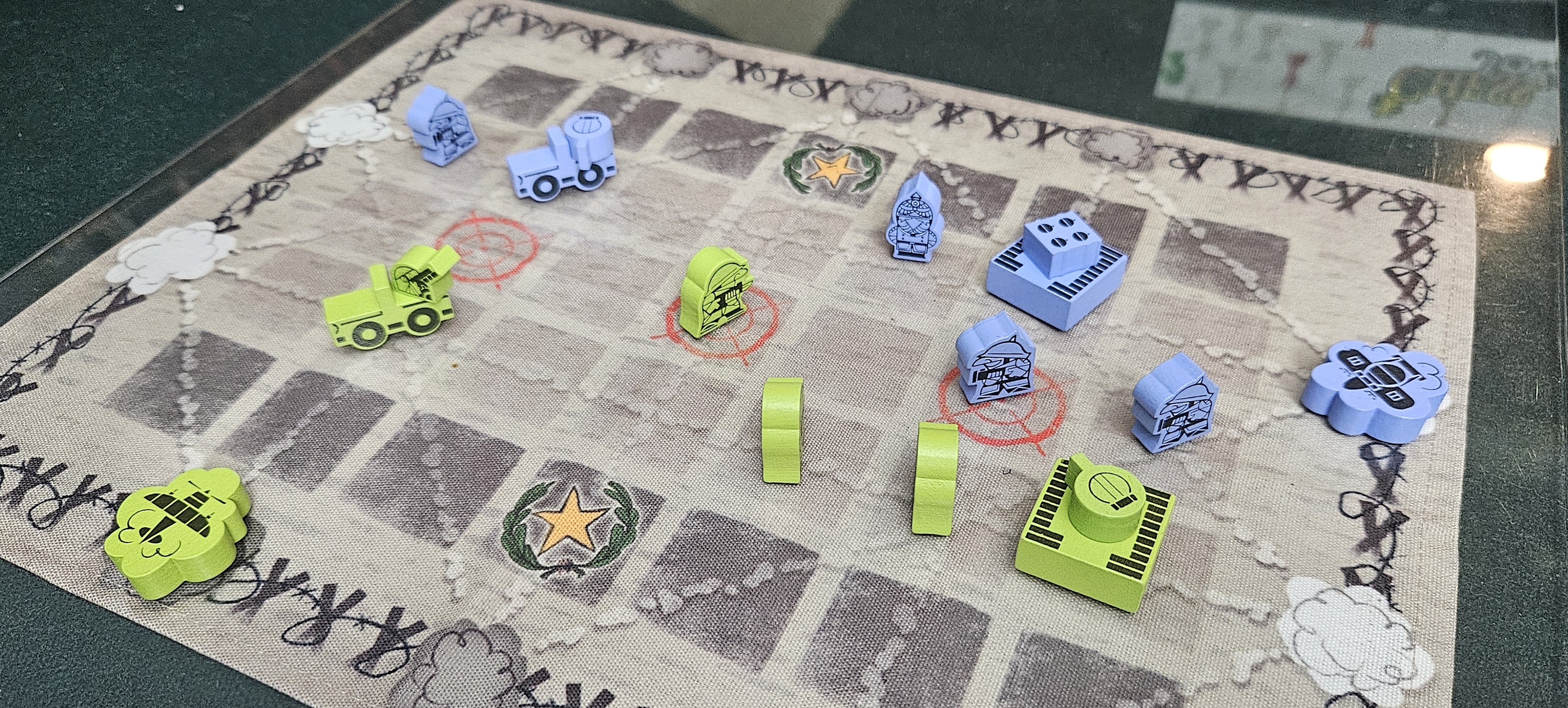
Those control points are the game’s biggest advantage over something like GHQ. Controlling two of the map’s three points at the end of a turn will award a star; controlling all three is worth two stars. Reaching three stars means victory, so there’s a strong incentive to usher your boys forward, even if it means they’ll get chewed up on the following turn.

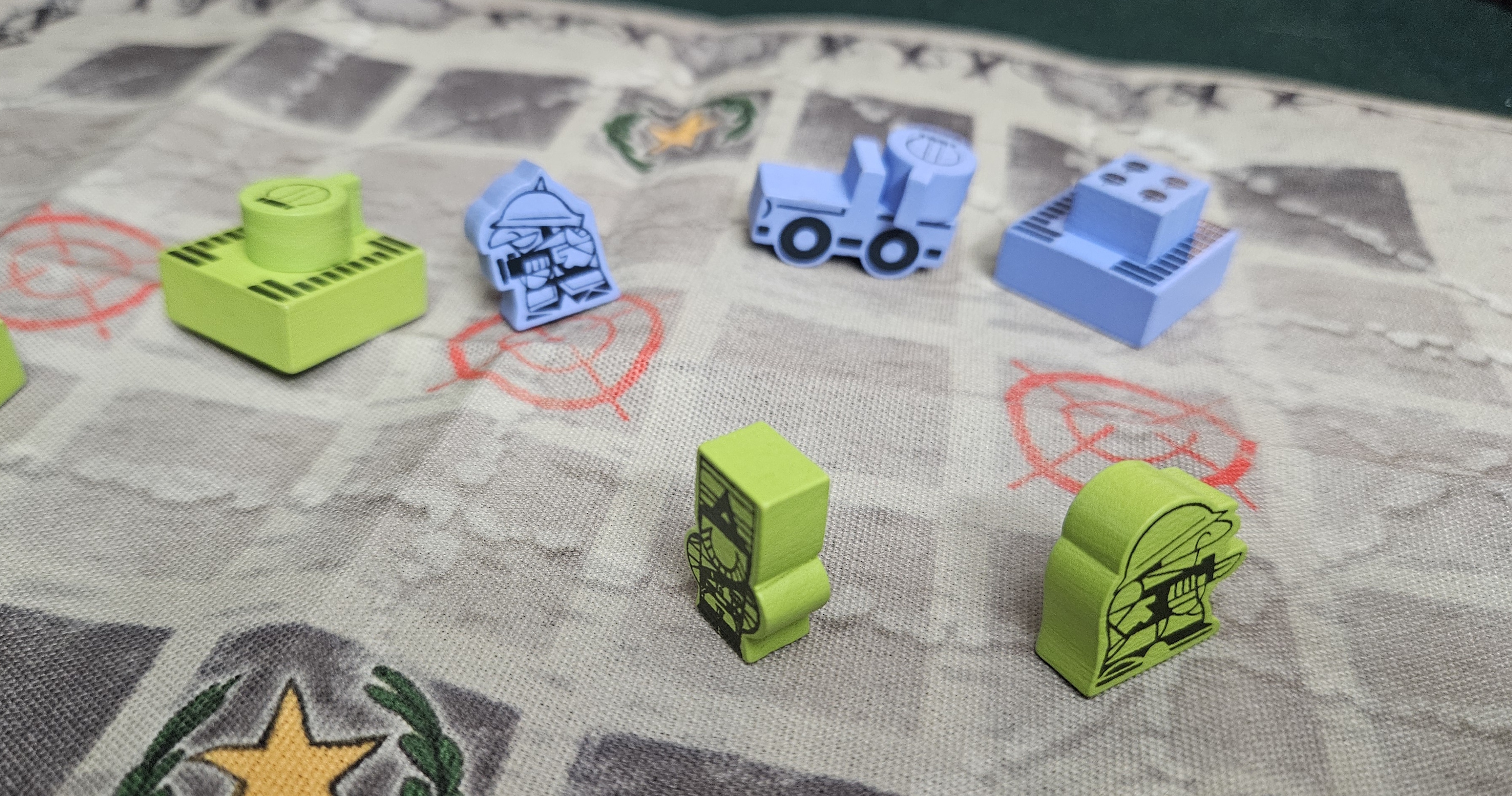
To oblige said chewing, there are ample instruments. Both sides have access to quite the range of hardware. There are planes, both fighters and bombers, which tootle along wisps of contrail over the main battlefield, and are especially keen to obliterate anyone foolish enough to position their manpower in a straight line. These are matched on the ground by vehicles, which are built of two components, chassis and attachment. The chassis, whether armor or truck, either trundles or sprints across the battlefield, while providing more or less protection. The attachments, meanwhile, offer anti-air capabilities — more of an area denial strategy than an actual threat, it should be noted — a cannon for defeating anything in range, or a transport for depositing infantry closer to enemy lines.

By mixing and matching the best attachments, you can assemble the right tools for the current crisis. That’s the idea, anyway. Most of the time, armor gets the cannons and trucks become speedy transports. It’s a case of play mirroring life, a bit like how evolution tends to produce crabs because armor and pincers present obvious competitive benefits.

The ability to move a unit twice in a row is deadly. Maybe broken? Although I also feel that not being able to do it would make the game a little too considerate of relative ranges to be playable.

Tanks checking their ranges.

Very much unlike GHQ, which allowed its generals to divvy up their moves and reinforcements as they saw fit, Gruntz employs a stricter formula. Either you move twice and deploy once or move once and deploy twice. This ensures a steady stream of troops will enter the battlefield, and also that many of those troops will be demolished before the last clouds of smoke have blown clear.

Its most conspicuous absence is artillery. This is its biggest departure from something like GHQ, not to mention easy historical placement. Put simply, this is not simulationist fare. Units capture their peers in the manner of chess, by moving onto them, rather than pelting their targets from a quarter-mile out. The effect, then, is approximate to playing with little green army men, all bayonets and glory rather than ignoble death from afar.

To be clear, this isn’t a complaint so much as an errant thought. For all its symmetry, Vonnegut’s attempt reflected the unfairness of the war he took part in, the absence of rules, the capriciousness of the howitzer and the carpet bomb. Writing about the former war, Hemingway described modern combat as dying like a dog for no good reason.

In Gruntz, your gruntz die for good reason. The stakes are crystal clear. To defeat someone, you move into range of the counter-attack. This imbues the process with a necessary attrition. Of course, you try to avoid losing troops. A well-positioned flak cannon can stave off a bomber; a tank in the right spot can discourage an infantry push. But this isn’t a game about decapitating the serpent so much as trading bites with it, fang for fang and venom for venom, until one side is too exhausted to continue.

Then again, it does a better job of evoking a broken no man's land. Any time your grunt tips over, it's a leg sprain. Back to the hospital.

The fabric mat is a pain to deal with.

There are always back-of-mind benchmarks for combinatorial titles like this, and these exchanges make Gruntz feel more like Checkers than Chess, more about constant trades than graceful maneuvers. The one exception would be the aircraft, which glide over entire lanes and columns. A bomber is one of the few things that can ruin a tank’s day, which makes its appearance rather potent indeed. This can lead to interesting bottlenecks, anti-aircraft guns strangling any viable avenues of approach, only to grow obsolete the moment the threat has subsided.

The entire thing is full of misdemeanors like that. Obsolete units. A playmat that’s too creased to allow the gruntz to stay upright. The ease with which reinforcements appear, all but necessitating a protracted first act to clear out the chaff and force both sides to prioritize a few units. These are shortcomings, not outright game-breakers, but that only makes them more galling.

And then there’s the expansion. Allplay does this thing where they sell premium pieces separately from the main game. In most cases, it’s a positive practice. Those who want the metal bits can pay a few dollars more, while those of us who are fine with cardboard punch-outs can settle for the more affordable core box. It’s a smart middle ground.

Here, though, there’s an entire expansion that’s omitted from the main box despite only requiring a pair of reminder sheets and five cardboard tokens. Supplies, it’s called, and it adds — you guessed it — little supply markers. These can be spent to activate special abilities, like charging all your gruntz forward at once, making a crucial extra move with a vehicle, or swapping a now-obsolete AA gun for a big stonking cannon.

On its own, the Supplies expansion improves my opinion of the game considerably. It’s exactly what Gruntz needs to shine, adding a crucial but rules-light layer of resource management atop the game’s straightforward rules. Using a bomber to drop a bunch of paratroopers is incredibly cool, not to mention game-swinging; the limitation, naturally, is that your opponent also has access to their own cache of supplies. Without the expansion, Gruntz is handsome and interesting, but deeply flawed. With it, the flaws are still present, but dulled sufficiently that it becomes one of the more formidable precious-scale battlefield games out there.

Yes, you caught me, this is not from actual gameplay. But look in the plexiglass: CHESS JOKER looks on, smirking. "I am not the only mixed review this week," it says.

The view from on high.

All told, Gruntz is a strange offering, especially for Allplay’s small box line. Its direct conflict and zero-chance combat make it more confrontational than one might expect. This is no feel-good trick-taker or Peter Hayward deduction game. There will be blood. Or at least scrapings of green and blue crayon across the pavement.

Despite its shortcomings, however, I feel kindly toward Gruntz. It doesn’t have the pedigree of GHQ, and its diminutive scale may preclude it from broader adoption. But there’s something here, a certain sangfroid, some marginal strategy, that makes me want to get better at maneuvering its dweeby little guys and chonky tanks and turbulent aircraft. I want to stroll my captain into the enemy base for a more elegant win. I want to figure out how to keep its gun-trucks alive long enough to swing a battle. Is the depth there? I have my doubts. But it feels like something is lurking there, beneath the fabric.

Also… it has magnets. How do they even work? We may never know. Like I said, put magnets in your game and I’ll give it higher marks than otherwise. That’s a Space-Biff! promise.


A complimentary copy of Gruntz was provided by the publisher.

(If what I’m doing at Space-Biff! is valuable to you in some way, please consider dropping by my Patreon campaign or Ko-fi. Right now, supporters can read the next installment in my series Talking About Games, this time tackling the topic of what makes a good list! Naturally, the piece includes a list.)

Buried

14. Juli 2026 um 23:01

In a sense, this game is the opposite of ruins. We aren't excavating the ruins. We're adding more stuff to the ruins. Which is more like, I dunno, a junkyard or a county dump.

Ruins, the card-building, card-shedding game by John D. Clair, served to answer a question that’s been niggling at the back of my skull since I first played Mystic Vale almost a decade ago. Namely, why don’t I like these things?

Not John D. Clair games, to be clear. I like plenty of his games. Rather, these of his games, the ones about sliding inserts into sleeves to build custom cards. At a notional level, it’s a solid concept. Plenty of digital card games let you modify your cards. By using inserts and sleeves, these titles circle some of that bespoke nature back to its origin point. Yet none of Clair’s experiments with the form, whether Mystic Vale, Dead Reckoning, Unstoppable, or now Ruins — which is based on an earlier title, Custom Heroes — has really landed with me.

I now know why. It isn’t the sleeving that’s the problem. It’s that Clair doesn’t exhibit much trust in his own sleeves.

Tell the truth: did you realize these cards all had the same rank?

Custom cards are cool.

To start at the beginning, Ruins is a shedding game, which means that every round is a race to empty one’s hand of cards. You dump them either one at a time or as matching sets, and then one-up the competition with better offerings, around and around, until players’ hands start depleting. Going out first earns more points than going out later.

It’s such a basic setup that adding modifiers is one of those “oh duh” ideas, perfect in its simplicity. And Clair’s approach to drafting those modifiers is superb. The gist is that everybody begins with three resource tokens — campfires, but don’t worry about that, the setting is nonsense — which they can spend on various inserts. Most nudge the card’s rank upward. What was once a card with a value of nine becomes a fourteen, later the fourteen becomes a nineteen, that sort of thing. There are other abilities as well. Like, say, turning a card into a wild rank, ready-made for pairing with other cards. Or letting a card clone itself. Or rekindling your spent campfires. Or drawing and discarding extra cards in hope of picking up something that matches better with your hand. Or, only a few times per game, marking a card as permanently yours, ready to be plucked from a rival’s hand at the start of a new round.

This transforms Ruins into a highly reactive experience. Normally in a shedding game, somebody will play a tough set — for example, four 5s — and you’ll glance at your hand and go, “Oh, that’s impossible to follow, I’ll pass for now.” Shedding, like trick-taking, is generally more about long-term planning than moment-to-moment play. In Ruins, that tendency is flipped on its head. Up against that tough set, you’ll look at your hand and then at the market and go, “Okay, if I buy that +3 and that +6, and attach them to these other cards, now I can follow my opponent’s play by dropping four 13s.” You’re still playing the long game, since big plays tend to deplete your resources, not to mention burn options out of your hand. But the play is highly responsive, standing in contrast to what is customarily a more measured form of play.

At its best, this is exciting and immediate, and even at this level sometimes Ruins gets away from itself. Stuffed with modifiers, cards eventually become little math problems. It’s one thing to note that a card’s value is 11 plus 4. But how about 11 plus 4 plus 8 plus 7? Now keep those values sorted across all the cards in your hand. Now adjust those values by the modifiers in the market. By the game’s third round, the slowdown is noticeable. So much for “exciting and immediate.”

Even so, this core concept would make for a fine shedding game. It’s punchy. Lean. Feels distinct from other shedders. I’d even call it the best use of Clair’s inserts-in-sleeves gimmick.

Shame how he kept packing it with extra servings.

but no shoe inserts. poor plantar fascists.

The market offers all sorts of inserts.

For whatever reason, Clair determined that Ruins wasn’t done baking. The modifiers weren’t enough, so more stuff kept getting tossed in. Even as the game’s sleeved cards grew heftier with each added insert. Even as the deck’s bulk become noticeable with each shuffle. Even as its mathematical load grew more tedious. Even as the game’s cognitive load bulged outward with its overloaded sleeves.

So, for instance, we get cards that aren’t only moddable, but reversible. At the start of each round, you’re allowed to flip a card over to its opposite side. This tweaks its rank and perhaps adds a special ability. Okay, fine. This can help mitigate a bad draw.

But then there are all the special abilities, some of which slow down play even further. Like the insert that forces somebody to draw an extra card. Or the one that sees you drawing and discarding to fine-tune your hand. Early on, these are fine and dandy. Later on, when people are constantly pausing to evaluate their options, they become downright irritating.

But then there’s the skipping rule. Whenever somebody plays an exact duplicate of what was played before them, the next player in sequence must auto-pass. In a game that often revolves around passing, that can prove fatal. To get technical about it, this problem is compounded for a couple of reasons. First, Ruins sees card ranks ballooning at their upward ranges thanks to all those inserts; but second, thanks to the ability to modify cards on the fly, it’s often possible to craft a response that will force a pass. These combine to give leading players a strong edge. And if there’s anything Ruins did not need, it was a tendency to favor leading players even more.

But then there’s the way everybody but the final player needs to shed their entire hand. What happens when someone accomplishes this goal? The next person in clockwise order becomes the next leading player. In the game’s latter stages, when cards have gone through said ballooning and holding the lead has been thoroughly strengthened, it isn’t uncommon for this order to calcify. Player A goes out, the lead passes to Player B, Player B goes out, the lead passes to Player C, and so forth. There’s potential for disruption there, but the range of modifiers is so wild that it becomes nigh impossible to hit the right targets anymore.

But then — and this is the last one, I promise — there’s that awful conclusion. Ruins doesn’t just keep score. Oh no. Instead, it only ends when somebody reaches enough points and then goes out first in the next round. Barring that, Ruins asks for a final tiebreaker round solely between those who have reached its highest threshold. I hope you like waiting. I don’t. At least not enough to sit through another sluggish round of Ruins that I’m not even involved in.

Just have people earn points. My gawrsh.

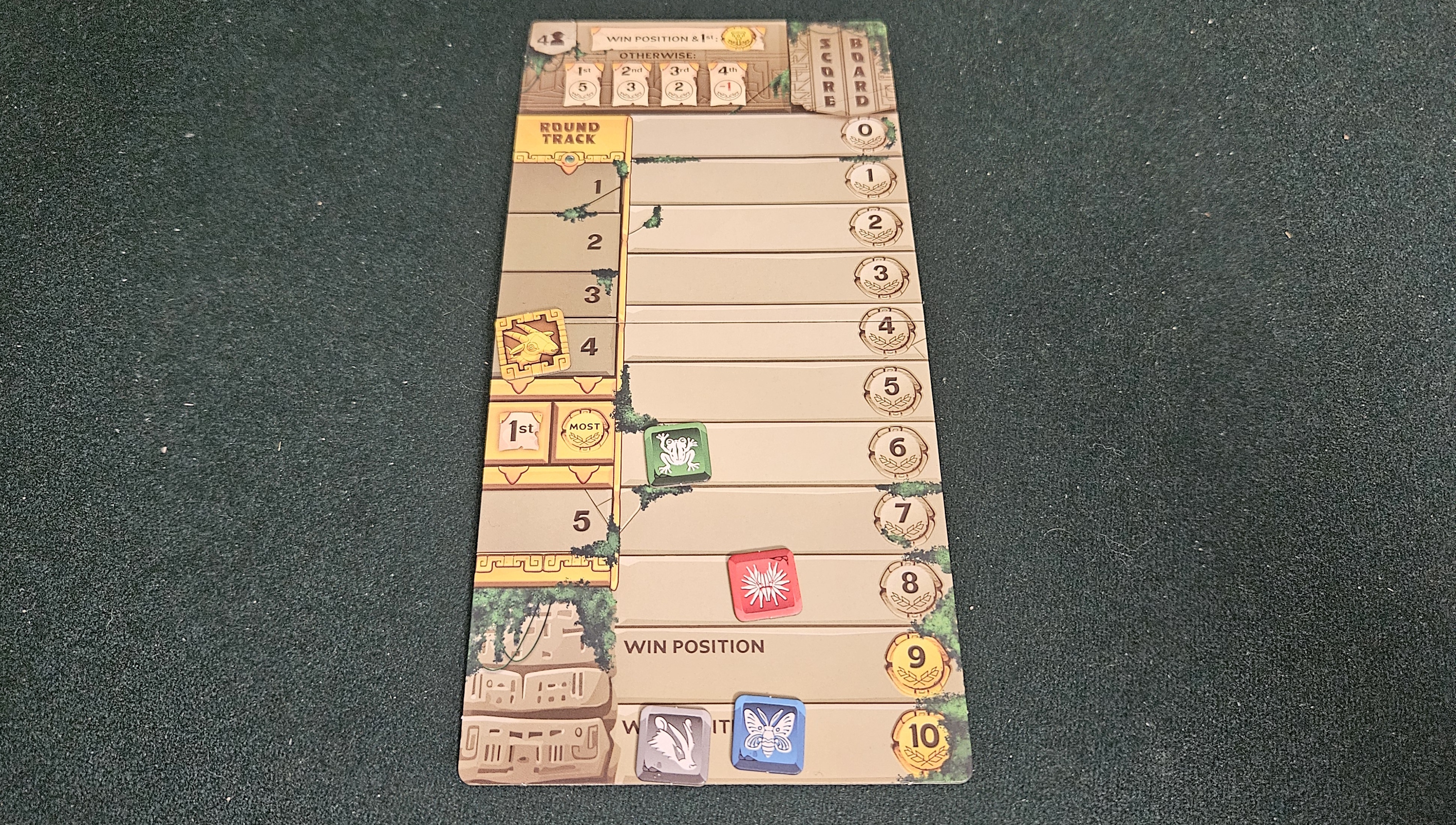
I genuinely don’t know what’s going on with this score track.

I know some of these points are overly technical, and I apologize for that. But I’m trying to illustrate a point. The point being that Ruins began with a crackerjack idea, only Clair kept adding more and more stuff, some of it useful and interesting, but much of it ill-considered and sluggish. Eventually, its basic idea got buried. The effect was not unlike lighting a battery of firecrackers — and then dumping a load of gravel over the top of the whole show.

There’s a good inserts-in-sleeves game in here. There was a good inserts-in-sleeves game in Dead Reckoning and Unstoppable. Someday, I hope Clair trusts those good inserts-in-sleeves games rather than burying them.


A complimentary copy of Ruins was provided by the publisher.

(If what I’m doing at Space-Biff! is valuable to you in some way, please consider dropping by my Patreon campaign or Ko-fi. Right now, supporters can read the next installment in my series Talking About Games, this time tackling the topic of what makes a good list! Naturally, the piece includes a list.)

Media Masters

06. Juli 2026 um 20:08

Sequel suggestions: THEATER KIDS / BOARD GAME NAME REMEMBERER / OPERA SLUT

I’m not the biggest fan of trivia games. Especially those that require players to know a specific answer, and a hundred times those that sporadically stuff me into a locker with an unexpected sports question. “Who soiled his pants while stealing two consecutive homers during the 1914 Cinnamon Bakeaway summer camp?” the question will ask. “Nobody could possibly know that,” I begin, only for my father to scream “Mickey ‘The Dugout Dog’ O’Queefe!” for ten thousand points.

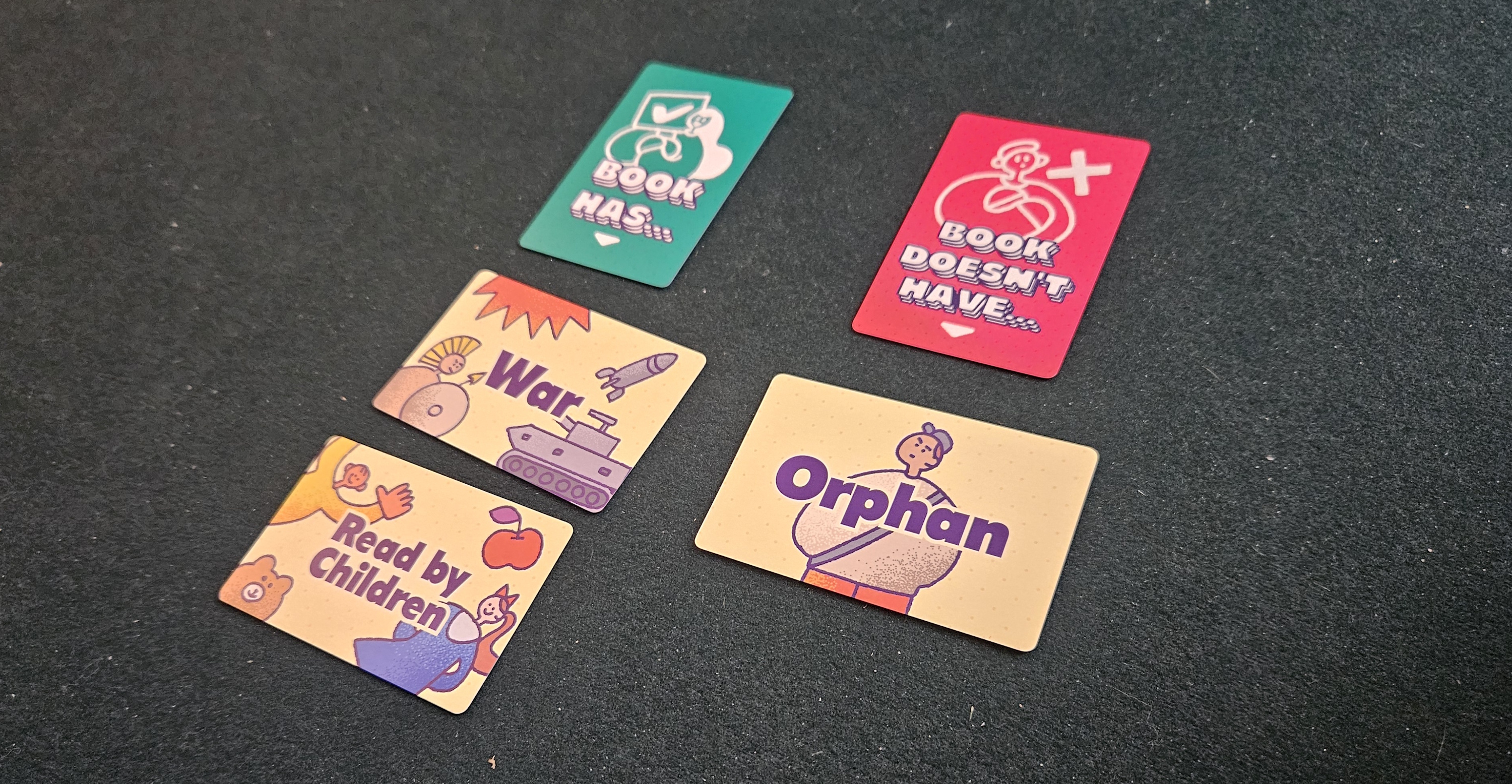
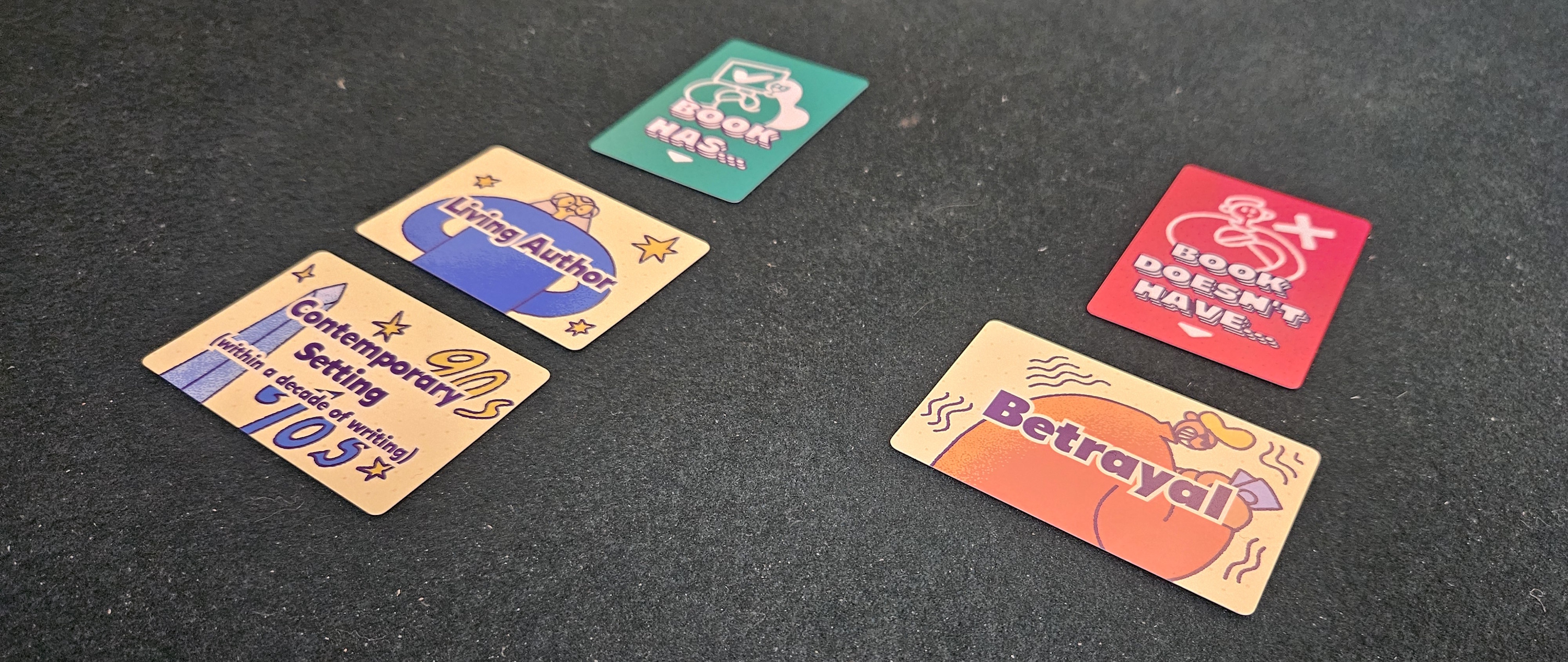
Book Club and Movie Night are teensy-tiny trivia games by Peter Hayward. Each session lasts five minutes, sometimes a run of cards will produce an impossible question, and they’re titles that will prompt the most obnoxious person in your gaming group to insist they’re activities rather than games. For all that, they’re the rarest of beasts: trivia games that put creativity and lateral thinking on the same footing as raw factoid retrieval.

The Sun Also Rises! < me trying to show off but failing completely

Name a book!

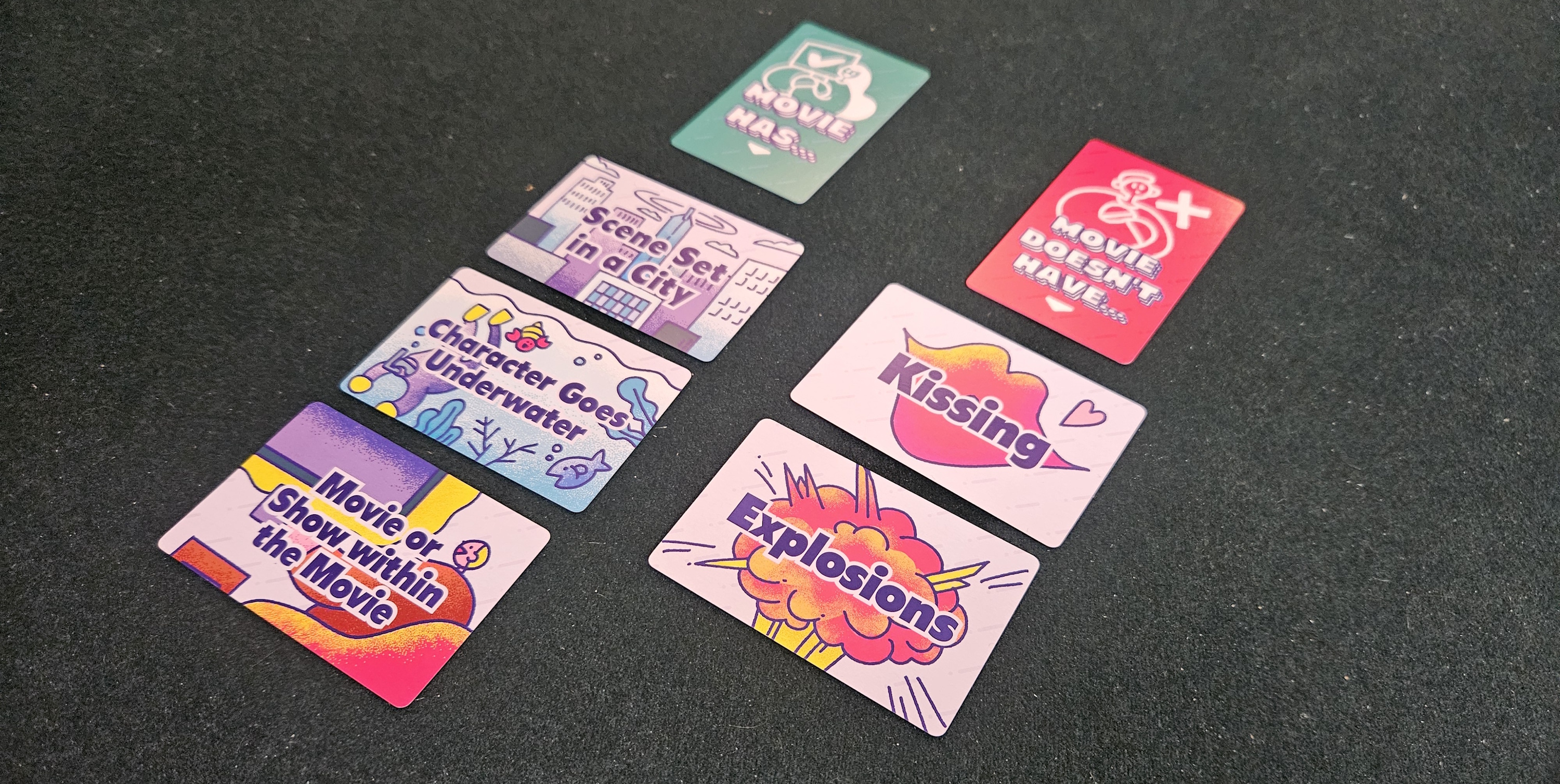
Rather than walk through the rules, let’s open with a demonstration. Movies. We’re guessing movies. So we draw a card. It says “punching.” What’s a movie that includes punching?

Rocky. Sure. Plenty of punching.

Now we draw another card. “Scene set in a city,” it reads.

At this point, we need to take stock. Does Rocky have a scene set in a city? Well, yeah. The whole thing. Philadelphia. There’s a statue. The city even renamed the steps.

So we take that card, “Scene set in a city,” and we move it into the “Movie Doesn’t Have” column. Now we need to come up with a movie that does have punching but doesn’t have any scenes in a city.

Knockaround Guys!” shouts my friend who always remembers weird movies like Knockaround Guys. That sounds about right. We spend a minute debating whether there’s a city scene near the beginning, but none of us can remember because Knockaround Guys came out in 2001 and it wasn’t a good movie to begin with, apart from that one scene where Vin Diesel really works over that redneck. Eventually we decide that, fine, Knockaround Guys works.

Another card. “Character goes underwater.” Uh oh. Pretty sure nobody goes underwater in Knockaround Guys. (Although maybe. We can’t remember. Knockaround Guys came out in 2001 and none of us saw it more than once. Nobody did.)

So what’s a rural punching movie where somebody goes underwater? Sinners. Of course. Props to Geoff with the contemporary cut.

Fourth card. “Celebration or holiday.” Now the group starts to fracture. Because while Sinners isn’t a holiday movie, it can be argued that the juke joint is a celebration of freedom, and that one scene is a celebration of African heritage, and now we’re debating what “celebration” means in the context of “celebration or holiday.” It matters. Because if we decide that Sinners includes a celebration, our next movie can’t have a celebration, which is a lot easier than naming a rural punching underwater holiday movie.

Phantom Menace, somebody offers, making assumptions about how we’ll rule on the celebration thing, only to be roundly denounced by all the other nerds.

Uncut Gems, my pedantic friend says, which is always a treat. He says it counts for “underwater character” because Adam Sandler is underwater to loan sharks, which is pretty funny and we’re considering it, but then we remember that the whole thing is obviously set in a city. We’d kinda forgotten about that card.

Finding Dory, says the person with kids. Apparently the octopus punches something, and while the movie is basically set in Monterey, there’s some wiggle room whether the fictional version of the Monterey Bay Aquarium should be considered a city or a greater unincorporated beachfront region. Also, since we still haven’t settled the “celebration” issue, this would retroactively put that card in the negative column.

The timer goes off. That’s five minutes.

Constantine II!

Name a movie!

Hopefully this demonstration has been helpful. Here are my takeaways.

Perhaps foremost, this is a pedantic sort of game, one where every definition means what it means right until the moment when it behooves someone to argue that it doesn’t. “One-word title.” Hyphenated or not? “Adaptation.” Isn’t almost everything in Hollywood an adaptation? “Break-up.” Does that include friendships? “Snow.” You know somebody’s going to insist that cocaine counts. Personally, I think we all know what “snow” means. But then I propose a movie in Antarctica and now we’re debating whether pack ice really qualifies as snow. Fair enough. The good news is that it’s cooperative, so players don’t often come to loggerheads. You draw a card, squabble over its meaning a bit, and then move onto the next thing.

For all that, the experience it offers is often rather uneven. Sometimes you’ll hit upon a run of cards that’s too easy, and by extension too boring. In the next session you’ll be asked to only name movies with a stand-up comedian in a lead role. Or a book in epistolary form. Or to exclude media with “and” or “the” in the title. My least favorite? Only picking books whose author has an initial in their name. Hope you want to hear a lot of Christian fantasy author suggestions.

Books are harder than movies. Not only because it’s easier to watch a movie than read a book, so most people’s pool of options will be substantially deeper, but also thank the visual nature of the medium. Whether a movie includes a cat is easy enough to answer, even if it strains our gray matter. Recalling whether a book refers to a named character’s death is… well, it’s harder to conjure. At least for me.

For the most part, these textures are compelling, but it would be inaccurate to pretend they don’t sometimes lead to frustration. Riffing on movies is a delight. The same goes for books. But suddenly stretching to recall books-within-books when you’re four cards deep… well, it depends. Everything in Movie Night / Book Club depends.

There’s also a part of me that balks at the games’ size. These are slight things, roughly the size of a deck of playing cards, but at 40 and 34 cards for books and movies respectively, their variety is thinner than I would have preferred. And, look, their real value is in how those cards combine with one another. Even with the same three or four cards, their order can matter, and the appearance of even one other card can make a huge difference. But it’s disappointing all the same to draw a duplicate after only a few sessions.

The Sun Also Rises!

Name a book!

All told, then, Movie Night and Book Club are mixed bags. They’re snack-sized games, good for filling a few minutes, nice as stocking stuffers, but also not especially ambitious or groundbreaking. I hate to say it, but just this once: the absence of a “sports” card from Movie Night might be one of the most telling indications that this party game isn’t quite up to snuff.


Complimentary copies of Book Club and Movie Night were provided by the publisher.

(If what I’m doing at Space-Biff! is valuable to you in some way, please consider dropping by my Patreon campaign or Ko-fi. Right now, supporters can read the next installment in my series Talking About Games, this time tackling the topic of what makes a good list! Naturally, the piece includes a list.)

Board Game Arena: Neue Spiele vom 4. bis 11. Mai 2026

11. Mai 2026 um 21:11
Board Game Arena: Neue Spiele vom 4. bis 11. Mai 2026

Auf Board Game Arena sind in den vergangenen sieben Tagen vier neue Titel hinzugekommen. Das Spektrum reicht vom thematischen Plättchenlegespiel über ein abstraktes Kartenlegespiel um die Mehrheit auf einer Pyramide bis hin zu einem japanischen Kartenablegespiel und einem schnellen Würfelspiel mit Push-Your-Luck-Element.

Habitats – Plättchenlegespiel rund um einen Wildpark

Habitats stammt von Designer Corné van Moorsel und erschien ursprünglich 2016 bei Cwali. Die aktuelle Neuauflage, die auch der digitalen Umsetzung zugrunde liegt, wird von Allplay verlegt. Die Illustrationen verantworten Filip Gavril, Daniel Profiri, Dominique Ramsey und Steven Tu.

Du baust einen Wildpark ohne Käfige und Zäune und musst dabei den Lebensraum von insgesamt 68 verschiedenen Tieren berücksichtigen. Zebras benötigen ausgedehntes Grasland mit angrenzendem Wasser, Krokodile vor allem Wasserflächen, Fledermäuse Felsen, Büsche und Wasser. In jedem Zug bewegst du deine Ranger-Figur entlang eines gemeinsamen Marktes, wählst ein neues Tier- oder Geländeplättchen und legst es an deinen Park an. Wer am Spielende die Anforderungen der meisten Tiere erfüllt und über drei Saison-Wertungen punktet, gewinnt.

Auf Board Game Arena ist Habitats für 1 bis 5 Personen freigegeben, eine Partie dauert dort im Schnitt rund 16 Minuten. Als Mechaniken kommen Plättchenlegen, Mustererzeugung, Rasterbewegung und offenes Drafting zum Einsatz. Auf BoardGameGeek erreicht der Titel eine Bewertung von 7,34 aus 10 Punkten bei über 2.900 abgegebenen Stimmen, das Komplexitätsgewicht liegt bei 2,07 von 5. Für diesen Titel wird ein Premium-Abo benötigt.

Pyramis – Kartenlegespiel um Mehrheiten an einer Pyramide

Pyramis stammt von Designer Joan Dufour und erscheint 2026 bei Subverti. Die Illustrationen verantwortet Léane Loubere. Das Spiel kombiniert Mehrheitenwertung, Mustererzeugung und Set Collection in einem reinen Kartenformat.

Thematisch ist die Heimatwelt der Aliens zerstört, der Aufbruch ihrer Flotte unvermeidlich. Die Spielenden bauen aus Karten eine gemeinsame Pyramide auf und richten dabei eigene Raketen-Schiffe aus, deren Synergien sich entfalten, sobald sie aufrecht stehen. Karten können durch geschicktes Anlegen gedreht und damit Position und Wirkung verändert werden, auch bei den Mitspielenden. Am Ende zählen aufrechte Schiffe in der eigenen Pyramide und die Mehrheit unter den jeweiligen Alien-Fraktionen.

Auf Board Game Arena ist Pyramis für 2 bis 4 Personen ausgelegt, eine Partie dauert dort im Schnitt rund 7 Minuten. Als Mechaniken kommen Mehrheitenwertung, Mustererzeugung, Set Collection und Plättchenlegen zum Einsatz. Auf BoardGameGeek erreicht der Titel eine Bewertung von 5,45 aus 10 Punkten bei 28 abgegebenen Stimmen, ein belastbares Komplexitätsgewicht liegt noch nicht vor. Das Spiel lässt sich ohne Premium-Abo spielen.

DNUP – japanisches Kartenablegespiel mit doppelseitigen Karten

DNUP wurde von Kei Kajino entworfen und erschien 2025 zunächst beim japanischen Verlag One More Game!. Die internationale Ausgabe wird von Asmodee verlegt. Die Illustrationen stammen von Gilles-Romain Fonteny und Shohei Asaoka.

Ziel ist es, die eigene Hand vor allen anderen leerzuspielen. Jede Karte trägt am oberen und unteren Rand eine Zahl von 1 bis 10, etwa eine 1 oben und eine 7 unten. Du darfst deine Karten in der Hand sortieren, aber nicht einzeln drehen. In deinem Zug spielst du Karten gleichen Wertes, legst eine Karte an die Auslage einer Mitspielerin oder eines Mitspielers an, nimmst Karten zurück oder drehst deine gesamte Hand um. Wer überboten wird, muss seine ausliegenden Karten drehen und auf die Hand zurücknehmen. Gespielt wird über mehrere Runden bis zu mindestens vier Punkten.

Auf Board Game Arena ist DNUP für 2 bis 5 Personen freigegeben, eine Partie dauert dort im Schnitt rund 12 Minuten. Als Mechaniken kommen Handmanagement und Ladder Climbing zum Einsatz. Auf BoardGameGeek erreicht der Titel eine Bewertung von 7,16 aus 10 Punkten bei 419 abgegebenen Stimmen, das Komplexitätsgewicht liegt bei 1,42 von 5. Das Spiel lässt sich ohne Premium-Abo spielen.

Spooky Tower – Würfelspiel mit Push-Your-Luck-Element

Spooky Tower stammt von den Designern Jonathan Favre-Godal und Corentin Lebrat und erscheint 2026 bei Repos Production. Für die Illustrationen zeichnet Apolline Etienne verantwortlich.

Geister sind aus einem alten Uhrenturm in die Stadt entkommen, weil das schützende Amulett zerbrochen ist. Mit einer Kamera ausgerüstet ziehst du durch die nächtliche Stadt, fotografierst die unsichtbaren Geister und versuchst zugleich, das Amulett wiederherzustellen. In deinem Zug würfelst du und führst je nach Ergebnis eine von zwei Aktionen aus: eine Karte nehmen oder deine Karten umdrehen. Wer als Erstes fünf Geister fotografiert oder drei Amulettfragmente sammelt, gewinnt.

Auf Board Game Arena ist Spooky Tower für 2 bis 5 Personen ausgelegt, eine Partie dauert dort im Schnitt rund 5 Minuten. Als Mechaniken kommen Würfeln und Push Your Luck zum Einsatz. Auf BoardGameGeek erreicht der Titel eine Bewertung von 6,15 aus 10 Punkten bei 162 abgegebenen Stimmen, das Komplexitätsgewicht liegt bei 1,67 von 5. Das Spiel lässt sich ohne Premium-Abo spielen.

High-IQ society Mensa reveals its top board games after annual four-day judging marathon

22. April 2026 um 14:17

The American arm of high IQ society Mensa has unveiled the latest crop of board games winning its Mensa Select seal, which are voted on by hundreds of organisation members during an annual four-day gaming marathon.

Alex Cutler and Peter C Hayward both saw two of their creations win the seal this year, including their co-design Critter Kitchen, Hayward’s Things in Rings and Cutler’s A Place for All My Books – which he co-created with Michael Mihealsick.

Things in Rings publisher Allplay also saw its title Twinkle Twinkle, designed by Ammon Anderson, pick up a Select seal, while other winners this year included Matthew O’Malley and Ben Rosset’s Fromage, Yoann Levet’s Got Five and Tomáš Holek design Galileo Galilei.

Entries to the annual Mensa Mind Games are judged on aesthetics, instructions, originality, play appeal and play value, Mensa says, with the award aiming to highlight games that are original in concept, challenging and well-designed.

Not all games released during the past year are eligible for the award, however – entries carry a fee of several hundred dollars each, and games up for consideration need to have an average play time of 90 minutes or less.

Barnes & Noble and other major retailers have previously given special consideration to games bearing the Mensa Select seal, while winning games are also featured by American Mensa’s official online retailers and on its website.

Fromage is the most decorated of this year’s seal winners, having previously won the Origins Award for best light strategy game, as well as picking up nominations for medium game of the year, most innovative game and best artwork in the 2024 Golden Geek Awards.

Fromage, designed by Matthew O’Malley and Ben Rosset

Things in Rings was previously nominated in both the Golden Geeks and Origins Awards in the best party game category.

Last year’s Mensa Select seal winners included Agueda: City of Umbrellas, Diatoms, HutanIn the Footsteps of Marie Curie and Farms Race: Deluxe Edition.

This year’s Mensa Select seal winners in full:

  • A Place for All My Books – designed by Alex Cutler and Michael Mihealsick (published by Smirk & Dagger Games)
  • Critter Kitchen – Alex Cutler and Peter C Hayward (Cardboard Alchemy)
  • Fromage – Matthew O’Malley and Ben Rosset (R2i Games)
  • Galileo Galilei – Tomáš Holek (Capstone Games)
  • Got Five – Yoann Levet (Blue Orange Games)
  • Things in Rings – Peter C Hayward (Allplay)
  • Twinkle Twinkle – Ammon Anderson (Allplay)

The post High-IQ society Mensa reveals its top board games after annual four-day judging marathon first appeared on .

❌