I haven’t played too much Mage Knight recently. I played with the TaoLing1 a few times last summer. But at a recent convention one of the Wiz Kid reps asked me if I wanted to try Mage Knight Emergence: The Portal to Power,2 which is apparently a Res Arcana Duo like product. A game that can serve as a 2p introduction to the system, or an expansion you just shuffle in. I’m not a completist (I didn’t buy the ultimate edition, so my set is 4-5 cards short of complete), but I just shook me head “No thanks, I’ll just buy it when it comes out.”
So he gave me a few preview cards from the expansion. Thankfully I have a few extra sleeves of the various correct colors so I could just add them in. (I’m pushing 500 plays with my set3, wear is definitely noticeable on components. I sleeved my game after 100 ish plays4). I use dice to randomize tiles and chits, but the cards would be gone without sleeves.
All of which is to say, I don’t write about Mage Knight often, but after that convention I set up a solitaire game and played it, and I’m looking forward to more content for it.
Who has graduated college, moved out, gotten a job, etc … yet will still be referred to as such for consistencies sake. ︎
Although that does count solo games, which probably represent ~300 or so. I don’t normally track solo games any more, but I was back then so I’ve continued. ︎
I use dice to randomize tiles/chits, because the wear is obvious and its easy to tell which ones are newer. I’m considering using coin chips for the tiles (then I could bag them) but the space increase would be significant, I think. I don’t normally use the Shades of Tezla chits. ︎
I’ll break down this opportunity today, but first a disclaimer: I’ve worked with Panda, a Canadian company with their main facility in Shenzhen, as the sole manufacturer for Stonemaier Games over the last 14 years. I consider them a close partner. However, I have no connection at all to p20–I learned about it yesterday just like anyone else. That said, I probably wouldn’t write this if I couldn’t personally vouch for how great it is to work with Panda.
Here’s the deal: If you have two or fewer tabletop games published, you are eligible to enter exactly one game as your p20 submission. You own the game, not Panda. It’s free to enter, and it’s open to anyone worldwide.
Crucially, you have an entire year to make your submission. I think this is a really smart choice by Panda. Game design, playtesting, and development take time. This is a great chance to actually do something with that game idea you’ve thought about.
However, it’s also important to note that there is a critical gap between game design and manufacturing, and that gap is bridged by a publisher (whether it’s an existing game publisher or you as a self-publisher). The intent of p20 appears to be for the designer to self-publish the game (the submission form reads, “I am, or intend to be, the self-publisher of this game.”), which involves a lot of responsibility beyond design.
Panda confirmed with me that the manufacturing credit could potentially be passed on to a publisher, though the credit stays specifically with the designer and the game they submitted. The FAQ says this about signing with a publisher during the design process, “Tell us. We handle it case by case. We’re not in the business of penalizing good news.”
At the very least, p20 seems like a no-risk chance to hone your pitch. Panda asks for a sell sheet, a short video, and a blind playtested rulebook. These are all things you would need no matter how you seek to publish your game.
I’ve reached out to Panda to get clarity on my one other question: What if you also want to crowdfund your game? It seems reasonable that a new, indie designer looking to self-publish their game would use a crowdfunding platform to market the game, build community, improve the game, optimize freight shipping, and gauge demand. The game needs to be unpublished at the time of submission to qualify for the manufacturing sponsorship, so I’m guessing the crowdfunding campaign would need to happen after the final selections are made (Gen Con 2027).
UPDATE: Panda responded to say, “Yes, someone can submit for p20 and also run crowdfunding, as long as the crowdfunding happens after they apply for the program. As far as timing – it would be preferable if these campaigns ran later in the year/early next year/closer to the end date of the p20 program, but as long as they keep us informed of their plans, it is no problem to run a crowdfunding campaign especially if it is party of their larger marketing plans for their game/start up publishing company – we like to see what their vision is for the future.”
One other highlight of p20 is that there isn’t just one winner. Instead, twenty indie game designers will win! That’s huge. To put these credits in perspective, a typical minimum order quantity (MOQ) is 1,000 units, and a basic card game like Flip7 costs around $2 to manufacture (e.g., a total minimum cost of $2,000). If you’re looking to make a more complex game with custom meeples, trays, dice, etc, you’re probably looking at the $8-$12 range and a potential increase in MOQ to 1500 units (e.g., a total minimum cost of $15,000). This doesn’t account for all the other costs required to make a game (art, graphic design, freight shipping, etc).
Overall, if you’re interested in self-publishing a game you’re passionate about, I think p20 is an excellent opportunity. Even if you’re not one of the twenty winners in the end, it’s still a motivation to do the work and make your game idea a reality over the next year (and learn how to effectively pitch it in the process).
Black Orchestra begins with each player choosing a historic figure involved in the conspiracy against Hitler. In this dark and dangerous pursuit, motivation is perhaps your greatest weapon. If you can stay true to your convictions in the face of overwhelming threat and inspire your comrades, then you will be able to use your special ability, attempt plots, and even become zealous (necessary for some extremely daring plots).
But every move you make may also increase the suspicion of the authorities. The Gestapo will make routine sweeps, and any players with high suspicion will be arrested and interrogated (possibly resulting in other players being arrested). If you are all arrested or if the Gestapo finds your secret papers, you lose. And the suspicion placed on each conspirator will increase the chances their plots are detected.
On a turn, players may take three actions, such as moving, searching for an item, or drawing a card; or, at the cost of one action per die, roll the dice in an attempt to gain even more actions — at the risk of attracting the suspicion of the gestapo. This dice rolling “Conspire” action allows players to make bold moves when most needed.
I am not a hardcore historical board gamer by any means, but when you offer me a way to casually dive into them in under two hours of gameplay, I’m more than happy to give it a whirl. What I’ve found with these types of board games is an emphasis on new mechanics that players […]
Astrolabe, a Persian folklore-inspired game which tasks players with hunting and binding demons using the titular instrument, has won this year’s Cardboard Edison Award celebrating unpublished board game designs.
The debut design from Iranian video game veteran Yasaman Farazan was praised by judges for its “genius” action selection system, which makes use of a physical ‘astrolabe’, calling it “thematic, toyetic, and an absolute joy to engage with”.
2026 Cardboard Edison Award winner Yasaman Farazan
Farazan’s design took first place out of a record 396 entries this year – a total which has almost quadrupled since Cardboard Edison unveiled its debut award winners a decade ago.
Part of that growth has been down to the competition’s pedigree of winners that have gone on to be published by well-known studios.
They include Winter, published by Devir, Castell from Renegade Game Studios and Umbra Via from Pandasaurus Games, as well as 2023 champion Diatoms, which followed a successful Kickstarter campaign with retail publication by 25th Century Games in partnership with Ludoliminal.
Second place in this year’s competition was Limelight, a push-your-luck deckbuilder by Cameron Fleming about staging a Broadway show, while third place went to Luke Wolyncewicz’s Braggin’ Wranglers, which sees players attempting to catch wooden animal meeples using an adjustable lasso.
Hatchlings, a game by Alan Leduc in which players try to get baby sea turtles to the ocean using “unique and clever” movement queue mechanism, placed fourth.
Braggin’ Wranglers, designed by Luke Wolyncewicz
This year’s 20 finalists also included a magnet-based vertical castle-building game and a medium-weight strategy title centred around wedding planning.
The game, designed by former Ravensburger game development intern Sammy Salkind, puts players in the shoes of startup founders battling to build their internet startups during the dot-com bubble of the late 1990s.
Cardboard Edison was launched in 2012 as a board game design studio and hub, which has since expanded from a well-read industry blog into a vast repository of information for board game designers.
Suzanne Zinsli created the Cardboard Edison Award a decade ago with the help of fellow Cardboard Edison founder Chris Zinsli.
All of the finalists from this year, and the pitch videos of their designs, can be viewed below this article.
Winner: Astrolabe by Yasaman Farazan 2-5 players 45-90 minutes Players are exorcists in a Persian folklore world, using astrolabes to read the stars, hunt demons, and bind them into artifacts. Each round, players secretly rotate their astrolabe to choose an action, a number, and a time of day, then reveal and resolve actions in ascending order. Pitch video
2nd Place:Limelight by Cameron Fleming 3-6 players 45 minutes Limelight is a push-your-luck deckbuilder about staging a Broadway show. Over three Acts, you’ll audition talent, hire crew, and rehearse your show, trying to achieve the perfect mix of cards on Opening Night. Pitch video
3rd Place: Braggin’ Wranglers by Luke Wolyncewicz 2-8 players 15 minutes Braggin’ Wranglers sees players catching animals to score points using a unique adjustable lasso—but there’s a twist! Turn order is decided by your lasso size, which you secretly set at the start of each round! Pitch video
4th Place:Hatchlings by Alan Leduc 2-5 players 30 minutes You’re a Nature Spirit with one job. Get your baby sea turtles out of their comfortable nest, across the beach, and into the water where they belong, thus earning praise from Mother Nature. It would be easy if it weren’t for the relentless bully Steven Seagull and the other Spirits competing for glory. Pitch video
Other finalists:
Black Ruth of Dogtown by Keith DeViere Donaldson 1-4 players 30 minutes Black Ruth of Dogtown is a procedural oracle system driven by a circular mancala drafting mechanism, where players construct a three-by-three grid to optimize set collection and speculative scoring in service of a final narrative divination resolution. Pitch video
Catacombes de Paris by Nicholas Henning 2-5 players 70-110 minutes In Catacombes de Paris, players take on the solemn duty of transporting the remains of millions through the bustling streets of 18th-century Paris to build their personal ossuary in the famed Catacombs. This highly thematic experience combines a strategic pick-up-and-deliver system with an engaging polyomino mini-game for building out your ossuary board. Pitch video
Deductive Seasoning by Eric Ledger 2-5 players 20-40 minutes Deductive Seasoning is a family-friendly deduction card game where you are a food scientist who has concocted a dish using a secret ingredient from the Periodic Table of Flavor. You must figure out other players’ secret ingredient through careful play and observation. Pitch video
Goa Kranti by Andy Desa 2-4 players 60-90 minutes A cooperative game about an overlooked chapter in history: Goa’s struggle for independence from Portugal (1932-1961). Players embody historical freedom fighters choosing between violent resistance and peaceful satyagraha. Core mechanisms include push-your-luck resource gathering, deck improvement, and bag-building for a pivotal mid-game check when India gains independence. Pitch video
Hybrid Hijinks by Jena Keesee 3-5 players 60 minutes A competitive game, creating hybrid creatures and utilizing variable, configurable player powers to impress visitors and earn the most approval for shifting prowess. Pitch vide
Ladybugs by Michael Posada 1-4 players 30 minutes Push your luck by rolling dice that represent a colony of ladybugs flying over a field of flowers. Your rolls determine which flowers you add to your garden, which scoring conditions you unlock, and how many points you earn. Pitch video
Match Patch by Jack Rosen 3-5 players 20 minutes Match Patch is a game about the benefits of farming using companion planting methods. Mechanically, it is a card-matching race game where players try to diversify their harvested crops. Pitch video
Midnight Spawn by Jayson Farrell 1-4 players 60 minutes Midnight Spawn is a game about the mysterious and incredible deep sea. In this game you’re a researcher in your deep-submergence vehicle, or DSV. You’ll discover strange creatures and observe them eat or move other creatures, manipulating the shared board. You can also upgrade your DSV with tech cards or boost your score with research cards. Pitch video
Moonforge by Pawel Owsianka 1-4 players 90 minutes In Moonforge, players command large space facilities capable of capturing asteroids, extracting valuable resources (energy, metal and minerals), and upgrading their operations with new modules and functions. Resources can be sold for currency points, while depleted asteroids contribute material toward the creation of a new moon. Pitch video
PiramiDuel by Guillermo Viciano 2 players 20-30 minutes A game for two players where you will explore Ancient Egypt, fighting to claim the most influential pyramids. Pitch video
Possessions by Dan Nichols 2-4 players 60-90 minutes Possessions is a competitive strategy game where you play as ghosts with one hour to finish your unfinished business and fulfill your final wishes. As the clock ticks down, strive to get the most value from your secret ambitions by possessing your family’s last living heirs. Pitch video
StrongHolds by Nelson de Castro 2 players 40-60 minutes StrongHolds is a competitive castle-building game featuring magnetic tiles that allow players to build vertically unlike any other game. Harness your creativity and vision as a Medieval Architect, while sabotaging your opponent by tossing and sliding siege tiles to topple their progress. Pitch video
The Leftovers by Larry Ted McBride 2-4 players 25 minutes The Leftovers is a cooperative trick-taking game of community deck-building, resource management, strategy, and story. With your party of magical foodfolk, you will work together to complete objectives and avoid vicious food fiends as you explore the abandoned halls of the Enchanted Ladle. Pitch video
The Roots of All Evil by Dean Burry 2-4 players 15-20 minutes Be the first animal cultist to summon the tree demon Blackthorn by creating ever-expanding rings of root cards in which to place your sacred offerings. Pitch video
The Wedding Planner by Jose Lema 2-4 players 60-90 minutes You just got engaged! Now you have 12 months to plan the wedding of your dreams. The Wedding Planner is a medium-weight strategy game that captures the authentic pressure of the process: an overwhelming workload, finite resources, and the constant tension between vision and reality. Pitch video
Wunderkammer by Rosco Schock 2-4 players 45 minutes Wunderkammer is a set collection style game with a unique simultaneous silent auction acquisition mechanism. Each curiosity that you collect also has two attributes so the scoring of your collection is scored in each dimension. Pitch video
Ever wanted to play a game that would make you feel strange feelings about your childhood religion? Heyo, Greg Loring-Albright’s Keep the Faith is the title for you! In this conversation, Greg joins us to discuss whether board games or role-playing games are better, our respective religious traumas and hopes, and how a board game might prove illuminating of historical forces. You know, light chit-chat!
Honestly, there are no timestamps for this one. The conversation was rather stream-of-consciousness on my part, and I’d rather not break it into discrete portions. I’m sorry. =(
(If what I’m doing at Space-Biff! is valuable to you in some way, please consider dropping by my Patreon campaign or Ko-fi. Right now, supporters can read my first-quarter update of 2026: the best board games, movies, books, and more!)
Katana Spirits is a light strategy game from Singaporean designer Geoffrey Chia. This game uses several characters also found in other titles from Good Spirit Games. Many of Geoffrey's games have a Japanese theme. Katana Spirits is a game about training yourself as a fighter and then going out kick some gangster butt. This is a game which uses polyomino tiles.
On your turn
▪️ Fort Circle Games has been busy at work creating so many games! There are four games scheduled for release this June, followed by three more games later this year in the Fall. Many have heard of their successful game called Votes for Women, which is also being restocked this summer.
[imageid=8535024 medium rep]▪️ The first game to catch my attention was Shakespeare's First Folio as I quite enjoy the theme. A game for 1-4 players and plays in about 45-60 minutes. The mechanisms listed on BGG are really what have me intrigued, as they list Set Collection, Trick-Taking, and Worker-Placement.
From the BGG Page:
Shakespeare’s First Folio has players taking the role of printers in the early Seventeenth Century, competing to print the first folio of Shakespeare’s plays.
Players will utilize a combination of trick-taking and worker placement to collect as many plays as possible. The plays are suited - Histories, Comedies, and Tragedies. There are also historical patrons and personages who will help the players out.
A game ends immediately when the last Play is taken by a player. The most points wins and will print Shakespeare's First Folio!
The Hunt for Blackbeard is on again. As Blackbeard, you must select your anchorage carefully, as you’ll need all your guile to survive. The hunters are coming — evade them, or prepare defenses and risk luring them in? As the Hunters, how long can you afford to press your stable of informants and arm your expedition? You know Blackbeard: he will not sit idle. His ambitions may expose him, but he is getting stronger day by day. How will you approach — a flushing strategy, or a precision strike? Be careful, as your quarry is apt to bite!
Hunt for Blackbeard is a two-player boardgame that portrays the effort in 1718 by the colony of Virginia and the Royal Navy to track down the notorious pirate Blackbeard (Edward Thatch) as he sought refuge in colonial North Carolina. It features the historical events, places, and personages involved in Blackbeard’s demise 300 years ago, and the real-world challenges of “golden-age” piracy and pirate hunting. One player takes the role of Blackbeard and the other the pirate hunters. Blackbeard seeks to commit acts of piracy or to enjoy a pirate’s life while remaining free. The hunters try to discern Blackbeard’s plans to thwart his piracy. The game may end in a battle in which either the hunters capture Blackbeard or the pirate wins by seizing a hunters’ ship as his prize!
▪️ Next I noticed First Monday in October designed by my friend Talia Rosen, who loves the heavy thematic games. So, it makes sense to me that this would be a heavy thematic game. A game for 1-4 players and plays in 90-120 minutes. To release this June.
From the BGG Page:
On the First Monday in October, the all-powerful Justices of the U.S. Supreme Court gather each year in their "marble palace" to decide the fate of a nation. Over the course of two hours, First Monday in October re-creates the history of the U.S. Supreme Court from 1789 to the present day, through three distinct eras: Era I represents the founding of the Court in 1789 through the Civil War in 1865; Era II represents the time period from 1866 until the seminal decision of Brown v. Board in 1954; and Era III represents the modern era from 1955 until 2010.
Players compete to score renown points in this card-driven strategy game by advocating for the winning side of cases decided by the Supreme Court and by shaping the judicial philosophy of the Court to align with their objectives. During each round, players can choose to place their clerks on what they hope to be the winning side of cases as they progress along the Docket track. In order to help their litigants win, players can take actions to change the composition of the Court by encouraging Justices throughout history to retire and by supporting judicial candidates. At the end of each round, one case will be scored and awarded to the player with the most clerks on the prevailing side. The player with the most points at the end of the game wins.
▪️ The final game Fort Circle Games is releasing this June is The Halls of Montezuma. This is a wargame for 1-2players and plays in 60-90 minutes.
From the BGG Page:
Following the annexation of Texas by the United States in December 1845, war between the United States and Mexico became inevitable. From 1846-1848, the two countries fought a bloody and bruising war culminating in Mexico surrendering significant territory to the United States.
The Halls of Montezuma tasks two players to recreate this pivotal war in American and Mexican history. As the United States, you will be tasked with taking California and invading Mexico while facing mounting political opposition at home. As Mexico, you will be forced to fight a defensive war of attrition against the better-trained and led American troops.
The Halls of Montezuma is a low complexity, card-driven game for two players (with solitaire rules). Players relive the decisions and dilemmas of this crucial period in history. Fast setup and a playtime of 60-75 minutes.
The other games you should keep an eye out later this Fall are Night Witches, Peace 1905, and A More Perfect Union. Seems like a bunch of games to look forward to coming from Fort Circle Games.
Editor’s note: GAMA is one of the sponsors of the BoardGameWire newsletter
Newly-elected GAMA president Meredith Placko says the tabletop trade organisation must stop being reactionary, improve how it communicates with members, and focus on collecting meaningful industry data as it continues to navigate a turbulent couple of years.
GAMA has experienced explosive growth since the pandemic, with surging attendances at its annual GAMA Expo trade show and a broadening of its membership to include designers, manufacturers, media and events organisers, in addition to its long-time core of publishers, retailers and wholesalers.
GAMA has also recently faced budgetary issues, had to contend with the fallout from Donald Trump’s volatile tariff policy, and has fallen foul of a series of gaffes and other incidents which have caused dents to its reputation.
Speaking to BoardGameWire in her first long-form interview since being elected last month, Placko said putting proactive structures in place to keep GAMA from “stepping in the mud all the time” was one of her priorities.
She said, “We need to stop being reactionary. We need to start looking ahead, we need to think before we speak.
“…it’s easy, avoidable issues that if we just put a bit more forethought into it, we can overcome them and they won’t even become an issue. And I think a lot of that has to do with making sure you have the right people in the right places to communicate better.
“I will say this: GAMA’s not done a great job of communicating to its membership. And I really want to appreciate the work that has been done in the last year on the GAMA staff side, where they’ve retooled the newsletter, and they’re trying to get ahead of everything.
“I think that’s great, And I think the conversations that we’re having behind the scenes between board members and with our acting executive director is being on top of that communication.
“And that’s going to be really key because it’ll kind of keep us from stepping in the mud all the time or being late to the game, like with the tariff news last year.”
Part of that looking ahead involves GAMA’s first-ever ten-year plan, which was unveiled to much fanfare last October by former executive director John Stacy and Placko’s predecessor as president, Nicole Brady.
Former GAMA executive director John Stacy
That array of plans included boosting GAMA’s membership within both hobby games and the mass market, expanding itself from being US-centric into a true global organisation, shifting its finances away from the current heavy reliance on the annual GAMA Expo and Origins shows, and leading the conversation on sustainability within the industry.
Advocacy and brand protection were also one of its near-term priorities – underscored by the organisation’s recent intensive lobbying and awareness efforts around the impact on the industry of US tariffs.
But with the figureheads of that plan both gone from their positions, where does the future lie for GAMA’s Vision 2035?
Placko told BoardGameWire, “I think most of it is there, it’s going to stay – I think it’s just going to be the order of which we tackle things.
“…we need to not be reactionary as an organization. We need to stop waiting for something to happen to then react to it. So we need to kind of maybe do a little bit more forward thinking about what are going to be the pressing matters.
“So advocacy, which was on the later half of that ten-year plan, that’s actually should be something that we start building into the core of our organization sooner.”
She added, “I’m going to be starting an advocacy committee for us to start looking at how to educate our members on being advocates for themselves and looking at opportunities that we can maybe work alongside other trade organizations or industry and other impact groups to do more lobbying efforts and have a say.
“Because really, as we saw this last year, tariffs decimated so many of our members. And that is something that we need to be on the forefront of… I know some people are like, ‘Oh, what can GAMA do? You guys are small potatoes’, but it’s having that voice, it’s having the impact.
“It’s at least having the information ready for people, so they know what’s going on and can make informed decisions.”
US tariff policy has had a hefty impact on both GAMA and its membership
Tariffs have impacted GAMA as an institution beyond just the need to lobby on behalf of its membership. Placko told BoardGameWire that the organisation had seen an uptick in turnover of members over the last year, and said she believed tariffs and wider economic instability were to blame.
But she added, “One of the things that I want to see is more hard data on member retention, like: who is staying, who is going, why are they leaving? Unfortunately in the last year, due to tariffs levied in America, companies are having to close down.
“People are going to have to make these harder decisions. You know, can they afford to be part of a trade organization? Are they even around to still be part of that trade organization?
“I will say: membership numbers are up, which is great all around. All membership groups saw a nice bump this year for membership, but we did lose people. And actually one of the big things I want to work with the whole board, the membership, the GAMA staff is: why are those people leaving? Where are they going? What’s happening to them?
“Because one of my core beliefs of a trade organization is that we need to be more involved in sort of this data gathering and sharing.
“I’ve been involved in [other] trade organizations and it’s very key to me that the trade organization is able to provide me with actionable accurate data that can help make informed decisions as businesses move forward.
“And I think a key part of that is just knowing: what is the state of our industry? What is going on with people? What is going on with companies? Where can we as a trade organization also step up and help them, like with advocacy?”
Despite membership numbers continuing to grow, GAMA has also faced headwinds for its finances over the last couple of years – a situation that has delayed its hiring of a new permanent executive director to replace John Stacy.
Tax data provided to BoardGameWire by the organisation showed net revenues of just $17,500 on a total revenue of about $1.4m in 2024 – well down on the almost $409,000 net revenue recorded the prior year, on overall revenues of almost $1.5m.
The documents show salaries rose about $782,000 in 2023 to almost $960,000 the following year, while ‘other expenses’ was up from $302,000 to about $426,000 in the same period.
Placko said, “Our finances have been… not in the best place. And back in the fall, John Stacy hired this amazing operations officer, Melinda Prickett, and she has been taking a look at our finances and how GAMA runs everything, and just laying out a plan, working on stabilizing us and getting us to a point that when we bring in an executive director, they won’t be walking into a messy situation.”
She added, “Some of the things were just, like, tracking spending and where that money was going. And I’ll say this: as an organization, we haven’t raised fees, we haven’t raised booth costs in a while.
“And while everything else is getting more expensive, what we were taking in was not covering everything that we were doing. So there were a lot of hard conversations about where cuts needed to be made.
“We’re currently spinning up conversations. We have a membership dues committee that started, that’s going to be looking at if we need to raise dues and how much.”
She continued, It’s great that we’re able to offer what we can for the limited amount of buy-in from memberships. But, you know, if that money is not covering everything, we have to make hard decisions.
“But it’s improved. I’ll say that… there are just changes we’ve made, and things aren’t bad or scary.”
Speaking of her decision to run for GAMA president, Placko said, “I’ve been vice president. I’ve been on the board for only a year. It was interesting for someone new to the governance side of the organization to even make a play for an officer role like I did when I started.
“But it’s not like I’m lacking experience on non-profits and for-profit boards, and the reason I ran for [the GAMA board] to begin with is that there were just some core governance changes that I wanted to see.
“I quickly learned – and I think a lot of people don’t realize – that our board is governance and not operational. And what I saw was, from the outside, it looked like the board was maybe very involved in the day-to-day operations of GAMA, where it shouldn’t be.”
She added, “Nicole Brady did a fantastic job the last two years, bringing GAMA out of a really messy place and into a more stable place.
“But what I wanted to see, and what I kind of pitched to my fellow board members, was that I really believe that we need to be more of a working board where we’re all working together, that not one single person or a handful of individuals are leading things.
“And sometimes maybe the perception was that way. I want to be very clear: I’m not saying it was that way, just the perception. And communication is key.”
“…I think that the board deserves to know a lot more of what’s going on, and have more of a say in what is being said to the executive director. And I don’t want to be like, ‘oh, I ran on transparency’ – but I really did. I ran on that. I felt that us as a board needed to have more open communication with the executive director… and be able to have a more open working relationship.”
Placko continued, “I think there’s been a misconception that the president of the board leads the vision of GAMA and the board, and that shouldn’t be the case.
“As a board, we are 12 individuals who need to come together and have a shared vision. I kind of see my role as president as maybe the person who helps conduct those conversations, keep them on track, and help silo them to where we’re all on the same page by making compromises and such.
“But that doesn’t mean that I myself don’t have personal things that I think we need to update and change.”
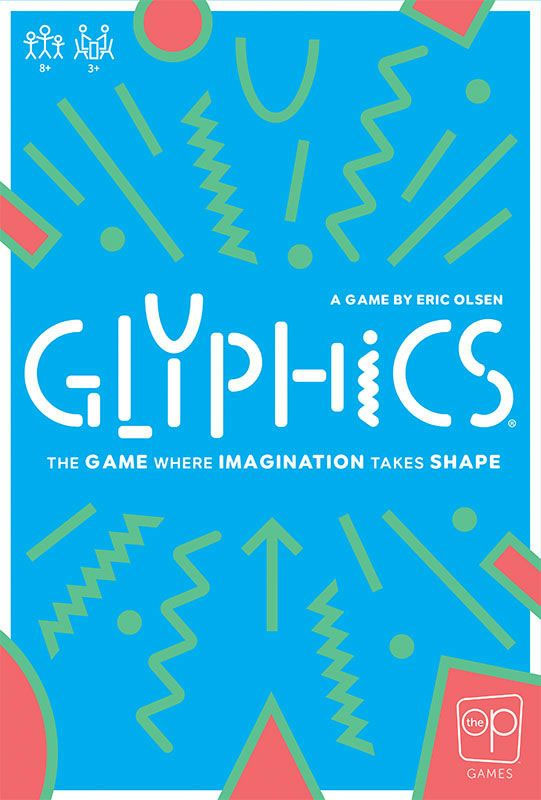
I always thought hieroglyphics were a pretty cool way to communicate, but if it weren’t for the Rosetta Stone, we’d just have to… guess what those awesome Egyptian reliefs were trying to depict. Glyphics takes that conundrum and gamifies it. Are those two squiggles and a triangle a sailboat at sea, or a chip in […]
This is the second part of my three-part series on getting back into board gaming after a long absence. In Part One, I looked at ways to rebuild your gaming muscles. (If you want to skip ahead, you can go to Part Three (Coming Soon!) to read about the games that brought me back into gaming.) As with any hobby, a long time away can result in skill loss. Your ability to strategize and quickly learn rules can atrophy. The good news is, it's pretty easy to get those skills back with a little practice.
What's not as easy to regain is a lost group of board gaming buddies. My five-year layoff from gaming began with Covid and continued through a cascading series of family issues. By the time everything was somewhat back to normal, I'd lost all of my gamer friends. Covid destroyed my gaming groups, and caregiving for my parents left no time for games. When I looked around several years later, all of my gaming friends had moved on, either to new places, new hobbies, or new responsibilities.
Not being an extrovert, it's not easy for me to find new people to play with. However, I know that if I want to keep board gaming as a hobby, I have to gather my courage and get out…
Continuing along in this series devoted to the best looking boards found in the wargaming world where I will highlight the art and layout of a different board in a wargame that we have played to show you the various talents of the artists and graphic designers involved. In my humble opinion, a well designed and attractive board can make all the difference in the world to me enjoying a wargame. Don’t get me wrong, the game has to be good, but if it’s also good looking it always is a better experience. A board can draw me in. Can make me feel that I’m there. Can set the stage for the thematic immersion that we all crave. And I have found many of these type of boards and I want to make sure that I share them with you.
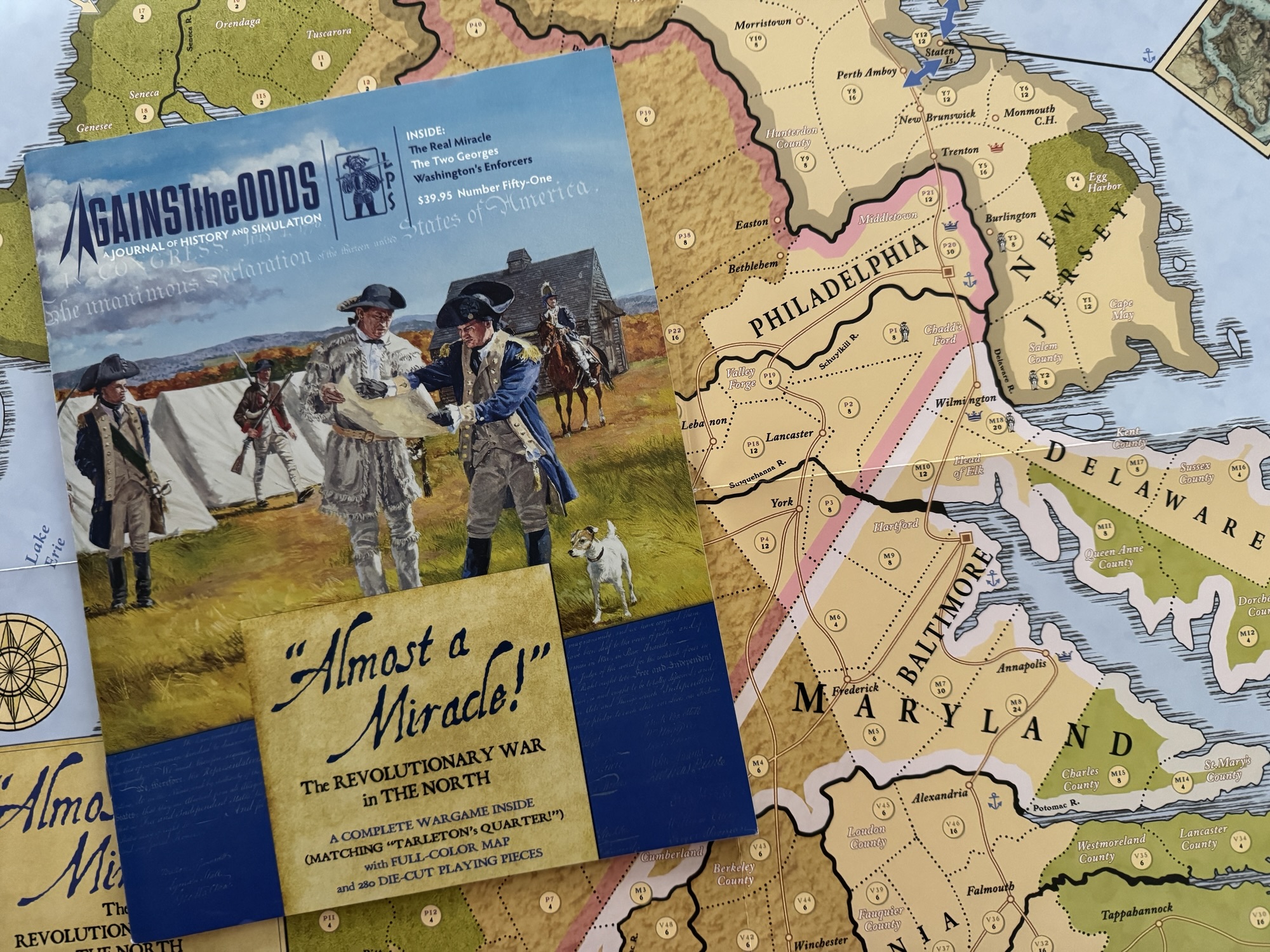
In this entry in the series, we will be taking a look at the fantastic looking board for Almost a Miracle!: The Revolutionary War in the North found in Against the Odds Magazine #51 from LPS, Inc. The board is illustrated by the very talented Mark Mahaffey whose board from Stilicho: Last of the Romans we have already covered in this series. Now typically, Magazine Wargames are nothing special. Both in their game play but also in their component quality and in the area of art and graphic design. But LPS takes great pride in the games found in their flagship magazine Against the Odds. And Almost a Miracle is such a beautiful example of great graphic design and art but also the board is absolutely a piece of art worthy of being framed and hung on a wall.
The board is illustrated by Mark Mahaffey who is a very accomplished full time artist who has done art for nearly 200 games including Celles: The Ardennes, December 23-27, 1944 (2012) from Revolution Games, The Dark Valley (2013) from GMT Games and Stilicho: Last of the Romans (2020) from Hollandspiele to name just a few. I think that Mark has a real talent for making a board coherent, easy to reference upon first glance and pleasing to look at during play, but I would not say that a lot of his boards are over the top beautiful but that is definitely the case with his effort for Almost a Miracle!.
The board represents mostly the Northern Theater of the American Revolutionary War but also includes Virginia and Maryland in addition to Pennsylvania, New Jersey, Delaware, New York and an area identified as New England which encompasses Massachusetts, New Hampshire and Connecticut. Canada is also represented at the top of the board. The map comes in 2 separate parts that join together in New England and that measures 22″ x 51″ total when combined. The interesting thing about these 2 maps is that one is significantly smaller than the other one. I would say about 75% of the playable board is found on the larger of the 2 sections with the northern tier only covering 25%.
My only real issue with the 2 parts of the board is that they join together fine but the way the map was folded created a really defined white seam in the board that really stands out. You can see it located to the right of the words New England and it runs from Penobscot to the top of the board ending in Canada around the top of Acadia. Not a huge issue but more of a distraction from the beauty that the board offers.
But the board is really quite beautiful and really provides a fantastic backdrop for the game itself. As you can see, the color palette chosen focuses on various shades of green and brown and they really give the game a natural and wild feel to it. With these American Revolutionary War games, I always keep in mind that the majority of the area of each colony, outside of a few larger population centers such as New York City, Baltimore and Philadelphia, are farmland and wilderness timber. Not a lot of development and definitely a land rich in natural resources in the form of wild game, furs, fish, lumber and ore. This “natural” color scheme of greens and browns really sets the tone of the period and provides a ready conduit into the theme and setting of the war.
Let’s focus on the southern portion of the board that includes Virginia, Maryland, Delaware, Pennsylvania and New Jersey. First off, I very much love the inclusion of the title box in the bottom left hand corner of the board with the game title and the various contributors including the designer David Jones and Mike Joslyn (who designed Tarleton’s Quarter which covers the Southern Theater) and the graphic design and art teams. These additions are always nice as they feel period to me and almost as if I am looking at a map of the region created at the time.
One thing that I want to point out is the use of lines to mark the various counties in each of the colonies. These lighter dotted lines are not as prominent as the other more important colony boundaries, roads and rivers. You will also notice that each of the colony boundaries are a different color because they touch and are easier to differentiate with the use of colors. Pennsylvania’s boundary is pink as it comes into contact with New York, New Jersey, Maryland and Virginia. Then the boundary of New Jersey is gray and New York is brown as they both touch Pennsylvania. This was a very nice touch and is important to understand the colony boundaries for recruitment and reinforcement purposes. This visually aids in distinguishing the various locations and to assist in grounding you in the geography.
Foraging is also a major part of the game and when troops are out campaigning they rely on baggage trains and supply depots for food and ammunition but also can forage the countryside which is hit or miss. These foraging results are found on a table and are influenced by the terrain type that the troops are located in. So knowing what the terrain in any given area is important and these colors quickly identify the type.
The other very nice feature on the board is the use of lines to mark the shorelines of the various bodies of water including lakes, bays and oceans. In the picture below, we get a look at the shoreline of New Jersey, Delaware, Maryland and Virginia and you can see the deft use of these horizontal dark lines to mark the water as it comes in contact with the shoreline. I also really like the small islands that are sprinkled in the midst of these lines and they add some real depth to the feature. You can also see in this picture the names of each of the counties in each of the colonies. You may also notice the nice use of the silhouettes of soldiers on the boards in some of these counties. These are the starting positions for your forces and I very much like the way they did this.
You may also notice the blue crown icons found on the board near major cities. In this picture you can see the blue crown icon at several places including: Wilmington in Delaware and Annapolis in Maryland. These blue crown icons denote the capitals of each of the colonies and some of the larger ones have multiple capitals. This has to do with victory at the end of the game for the British as if they control the colony capitals and there are no Colonial Regulars or Militia present in the colony they can then place the Colonial Governor and declare “the King’s Peace” in at least 2 colonies to end the campaign game.
As we move to the north of the map, and enter the less populated and definitely more wild areas of the colonies, including northern Massachusetts and the wilderness of Canada, the board changes quite a lot as there are less roads, less markings and frankly more green on the board. It still looks really good and the use of lines for water features is continued particularly in several of the larger lakes in the area.
In the picture above, you can see a good example of the Holding Boxes for troops in the larger metropolitan areas. Here we get a look at the Montreal Holding Box and I very much like the way that they have drawn the outline of the city itself with some of the streets, buildings and homes. This is a very nice touch to the board itself and there are several of these Holding Boxes found on the board including those shown in the picture below such as the Newport Holding Box, New York Holding Box and Staten Island Holding Box. These are very nice additions to the board itself and they look really good and add a layer of depth as well as playability to the game.
The game aids and tracks that are printed directly onto the board are very useful and well done. These use calligraphy like cursive writing that really feels period and adds to the thematic immersion of the player into the American Revolutionary War period. These boxes include the Continental Baggage Train Box and the British Baggage Train Box and shows the game’s focus on Supply. In these boxes, there is an available and an expended section that are used. There also is a Prisoners of War Track that is very period as well as these pitched battles were never fights to the death but represented the fighting style of the period which lead to many different forms of losses including deaths, injuries and prisoners taken.
Finally, there are Captured Boxes for Continental and British Leaders that aid the players in playing the game. These administrative aids are very well done from a graphics standpoint but I love that this game included them on the very large board as it eases play and cuts down on the need to continually refer back to the rules.
Almost a Miracle! was a game chosen for our Shelf of Shame Dust-Off Event in 2024 and we very much enjoyed the game and the history. The game is focused on the American Revolutionary War in the North and is named Almost a Miracle! because when asked about it years after the war ended, George Washington said that the American victory was “little short of a standing miracle.” Almost a Miracle! uses the Tarleton’s Quarter!System as a game engine starting point to bring the Northern “half” of the American Revolution into play.
I think that the best part of this game though is the board. It is just gorgeous and is an odd shape to take into account the entire northern colonies. I think that one of the strengths of this game is that it truly shows the difficulty of maneuvering armies around the colonies and the terrain as well as having to search for forage to feed those armies.
If you are interested, here is a link to our video review:
The next board that we will take a look at in the series is Great Campaigns of the American Civil War: Thunder On the Mississippi: Grant’s Vicksburg Campaign, April-July, 1863 from Multi-Man Publishing.
Here are links to the previous entries in the series:
BoardGameGeek has fired advertising manager Chad Krizan after almost 20 years with the company, after he cited his personal experiences of demonic possession as grounds for rejecting an ad campaign.
In the emails, Krizan says he has been “sitting on this one and praying about what to do in this instance”, adding that “as a follower of Jesus, I routinely help people suffering from demonic oppression, and more occasionally, possession, and it’s absolutely devastating the damage he does to peoples’ lives”.
Krizan wrote, “IMO, the responsible thing to do would be to pull the entire project, as there are *way* more people that suffer this than you could possibly imagine, putting on a good face (usually enabled by dissociation), but suffering terribly behind the scenes.”
When Falling Whale replied to question the decision to ban the game on religious grounds, and asking for confirmation of which BGG advertising policy they were breaking, Krizan responded:
“Keep in mind it’s not over religion, but reality. It’s the same reason I would say a game would be in very poor taste if it featured being a sexual predator, or something that would directly trigger someone that’s been harmed by the subject matter.
“It’s about keeping BGG welcoming to everyone, and since I’m privy to this subject matter, I know firsthand that this is not friendly content, and incredibly triggering, put in front of some of the population that visits BGG.”
A statement from BGG founder Scott Alden posted on the site’s forums said, “Due to a situation in which BGG’s Advertising Manager responded inappropriately in a business email to a designer, I have decided to let him go. His response does not reflect or represent our company or the way we conduct business.”
Falling Whale’s campaign for social deduction game Possess Me, Satan runs for another 30 days, and has currently raised just over $14,000 from about 250 backers.
Diceocracy Ever since you were a kid, your mama told you that you’re destined for grand things! So you’re pretty certain that things can only be better with more “you” in it! Well, it’s finally time for more … Continue reading →
I live in the shadow of the Wasatch Mountains. Have for nearly my whole life. Out-of-towners sometimes voice their apprehension when they first visit our cordillera, when they see the way our cities and suburbs are hemmed in by walls. The mountains, they say, seem precarious, like they could topple onto our heads at any moment, burying us under a thousand tons of limestone and quartz monzonite. Jokingly, I inform them that the real danger of the coming tectonic collapse — not the little shakes we sometimes get, but the Big One, the one we’re a millennium overdue for — is that it will kill us from below. The ground will liquefy and carry us downward, the ancient tidal basin finally sweeping us out to an inland sea that died with the mammoths.
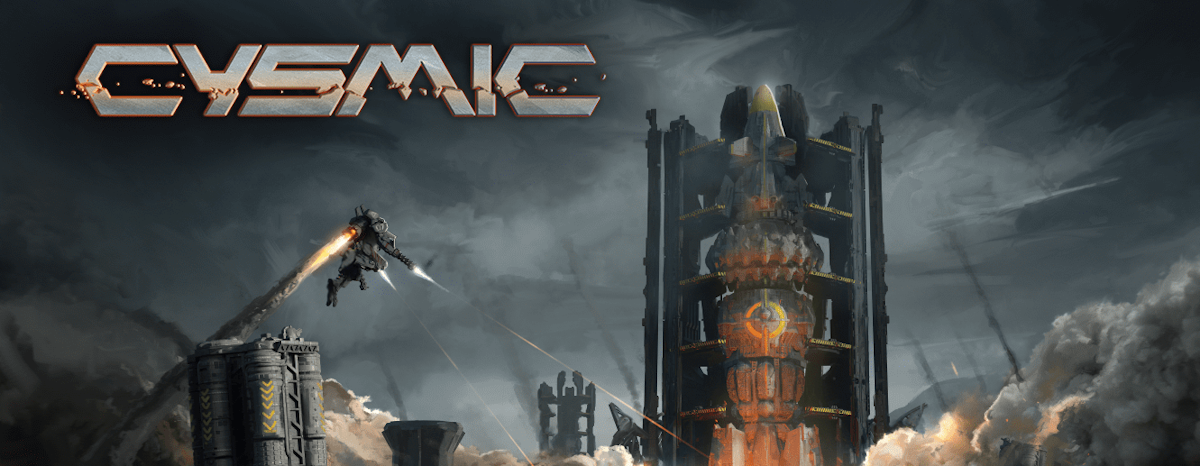
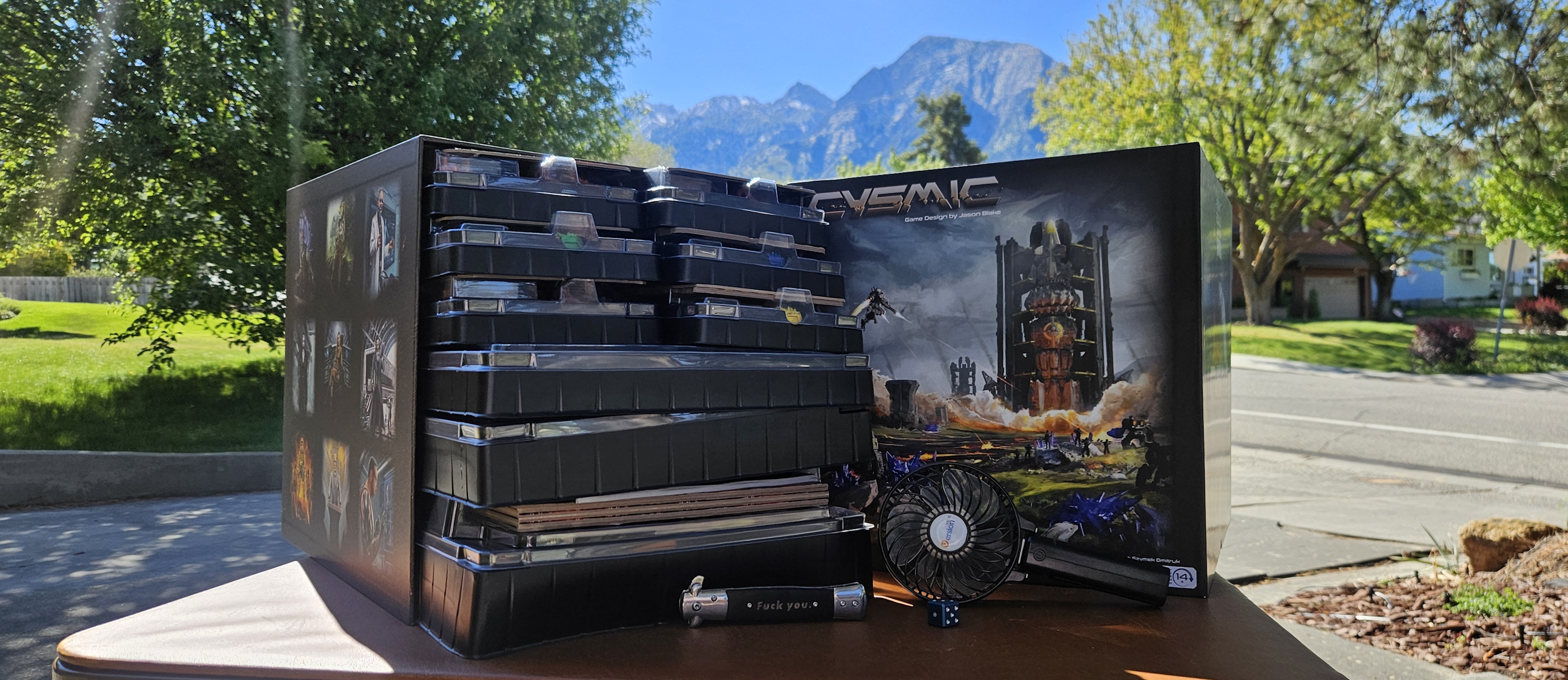
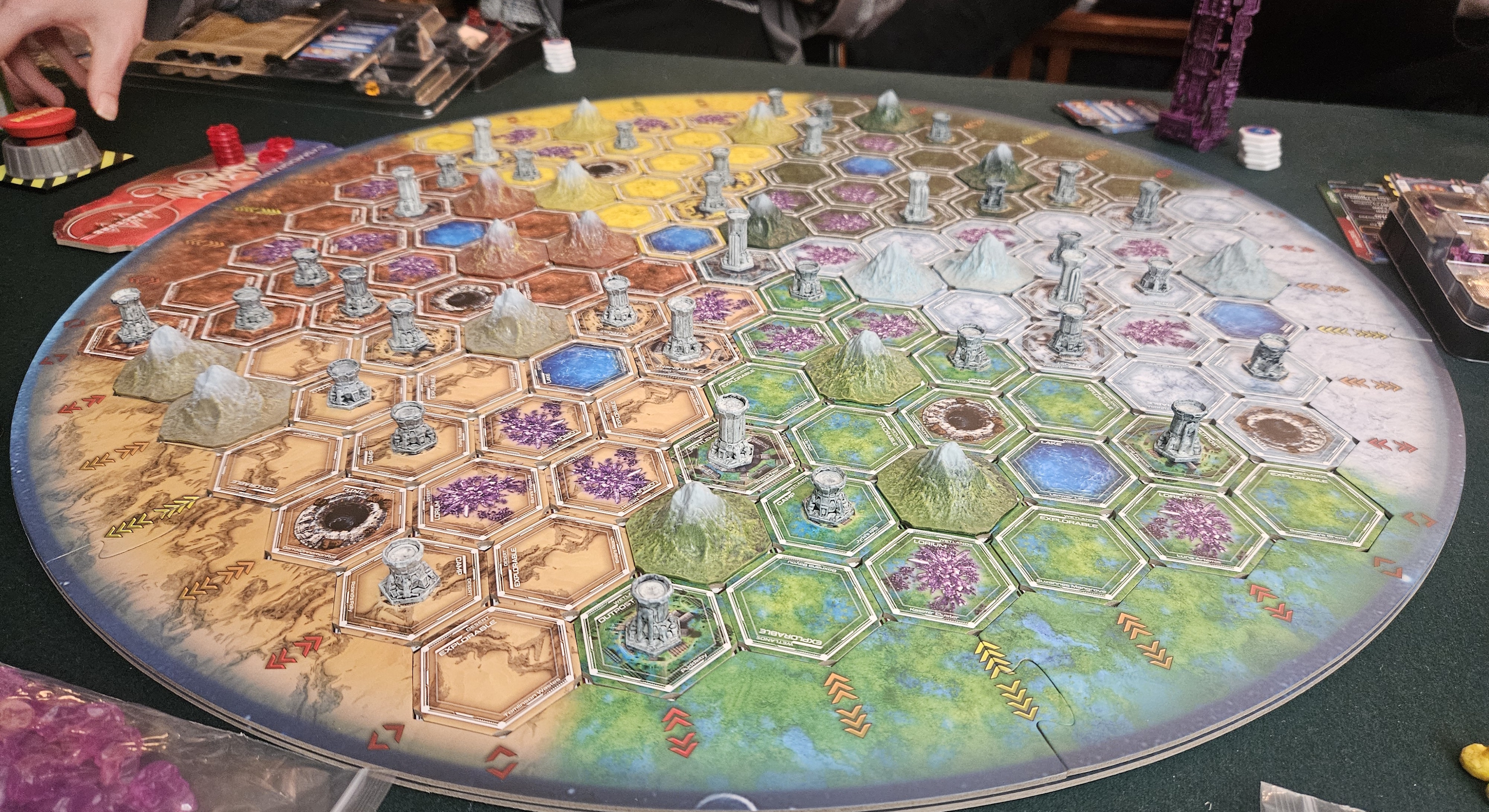
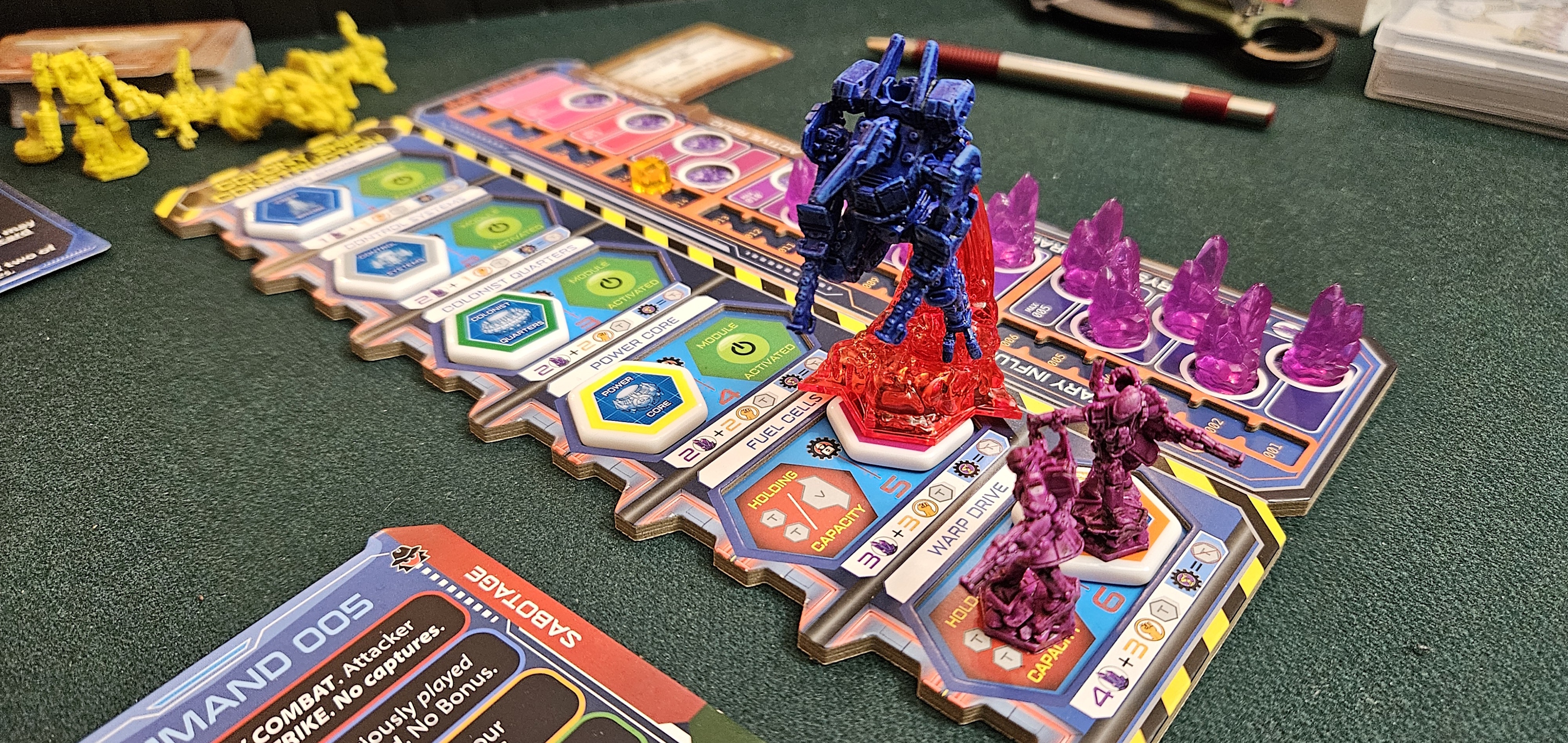
Cysmic, the board game by Jason Blake, gives me that feeling. When I hefted it onto the review stack next to my computer desk, my wife wondered aloud if it would topple and crush me. It isn’t the largest board game I’ve ever owned; that would be the 22-pound Ogre, the one with the team lift warning printed prominently on its side. But it’s the one that feels most like an Ozymandian temple to excess. Its map is sprawling. The frame that holds the hexes comes with hidden magnets to lock everything into place. The plastic constructs are so phallic that they make me uncomfortable. Among its many dice, there’s one for gauging your character’s crisis of conscience. It’s so gargantuan that it’s become a game-night joke. Nothing could justify this sprawl.
I kinda dig it.
Cysmic next to a few everyday items.
I want to set the scene. Both of the scenes.
In the distant future, humanity has settled an exoplanet. Pretty cool. Only it turns out that we repeated our past mistakes, squatting on territory that means us harm. This planet, you see, is tectonically unsound. Seismic. Cysmic. (Ohhhhh.) At some point in the near future, the crust of this world will flake away like the film coating an uncleaned oven. When that happens, the eruption of magma and steam will render anything above unlivable.
Not unlike the Salt Lake Valley, come to think of it. Mostly, I just don’t. Think about it.
Which is precisely the problem. Cysmic is unexpectedly redolent of Sol: Last Days of a Star, Ryan Spangler’s parable about climate collapse hastened by its victims, and Meltwater, Erin Escobedo’s cautionary tale about how nations set themselves aflame for the sake of spiting people whose existence has little bearing on their own. Of course, these titles could not be further apart, production- or intention-wise, but the parallels are there for the taking.
All, for instance, are about a looming crisis that their games’ factions are urgent to hasten. Because that’s the crux of the matter. Our goal on this planet is to escape by reconstructing one of the old colony ships that bore us here. But rather than cooperate to ensure everybody gets a seat on the ark, we now usher in our own destruction. We crack the mantle to get at the minerals that will shape the colony ship’s hull; we shatter the crust with our ordnance; we erect tracked megastructures that unfasten fault lines like zippers. Every action we undertake in service of survival steals a pinch from the hourglass.
Where Sol’s telling of this parable was poetic and Meltwater’s was bitter, Cysmic settles for frickin’ awesome. If those games offer the somber foretellings of the Book of Revelation, Cysmic is the Doof Warrior rendition. Let’s get this party staaaaarted, it hollers, jets of flame washing over the audience.
The map is ridiculous.
That’s the narrative scene. The second scene begins on the physical tabletop.
I worry about waste. Not as often as I ought to, probably. Compared to junk mailers and Happy Meal toys and oil wells set alight by incautious tyrants, board games are a drop in an ocean of muck. At least, I tell myself, they’re preservable. I donate some of them, and sell others, and buy secondhand when I can, and try to ensure that they go to homes where they will be appreciated and not wind up in some landfill after only one or two plays.
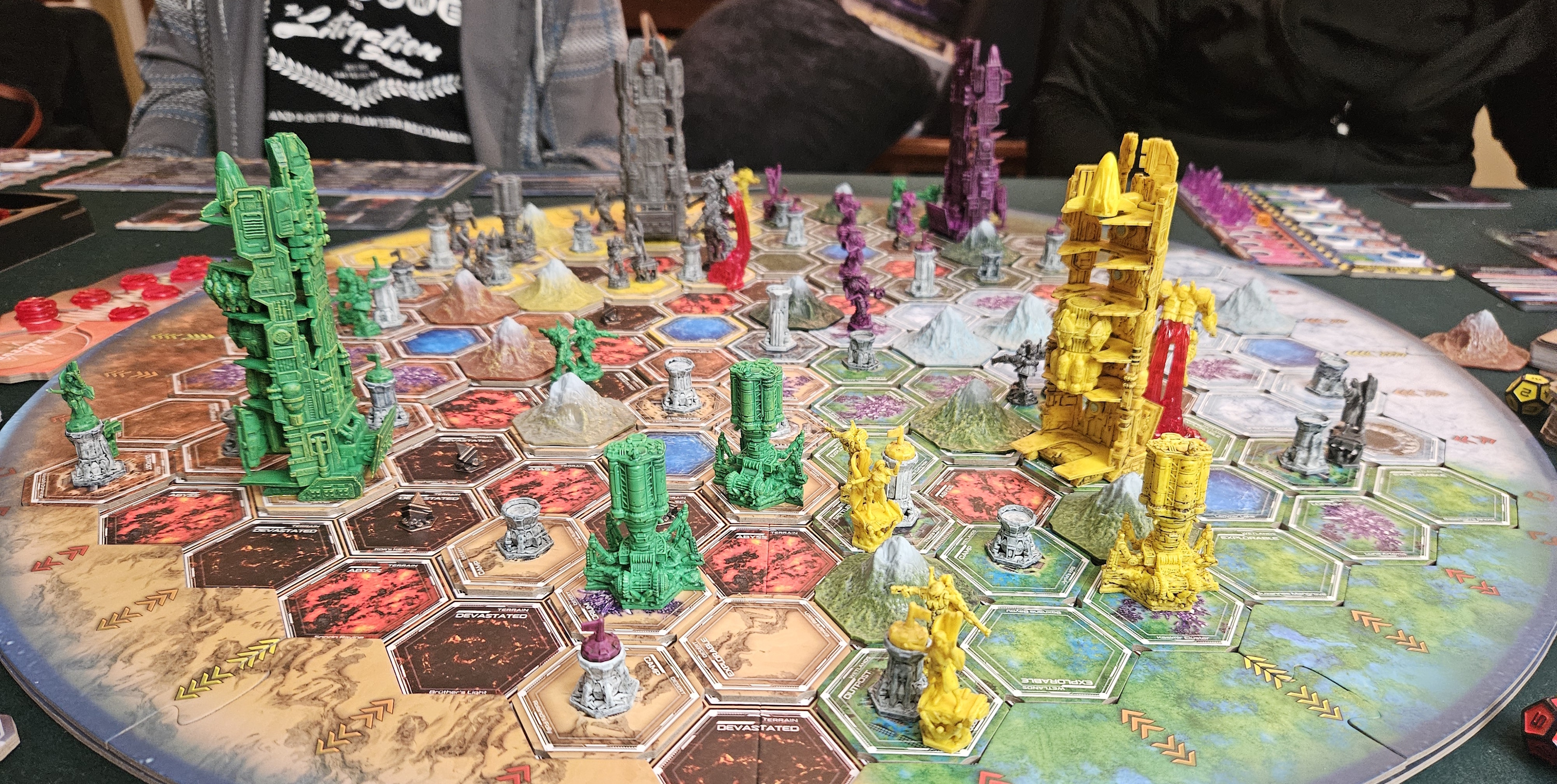
Cysmic defies that self-soothing rubric. The map is so massive that my group laughed uncontrollably the first time we set it up. Again, it isn’t the largest board game to ever take up real estate on my table, but it’s perhaps the most of everything else. Those frames, with their little magnets underneath the cardboard. The tiles, crafted with fingernail-thick nubs at their corners to make them easier to pry up. The plastic mountains, which called to mind the earliest printings of Runewars, back before Fantasy Flight decided to use cardboard overlays in place of three-dimensional topography.
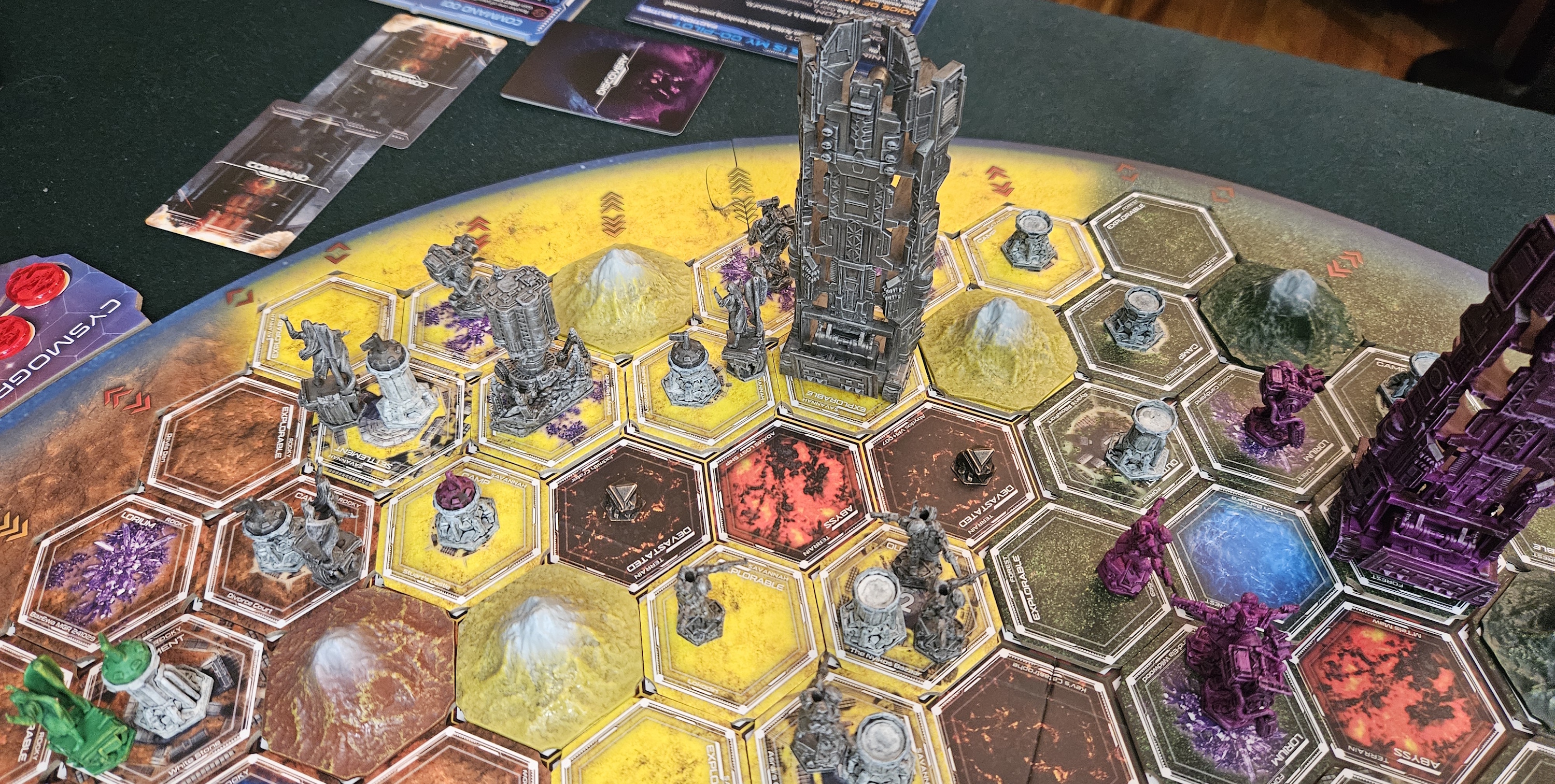
The miniatures. Goodness, the miniatures. Some of them are actually mini. Others, like the spires that hold the components inside your colony ships, an affectation that’s a nice bit of visual design on the one hand but also a physical obstruction of the battlefield on the other, are so large that they veer into self-parody. If you saw this thing on a sketch show, you would swear this wasn’t a real game. Ha ha, we would say, look at the silly nerds, with their jokes about Windows 11 and their board games that defy common sense. Those towers are not merely phallic; they are penises, swollen like Cormac McCarthy’s sunset, like Daniel Plainview’s erupting pumpjack, almost rhapsodic in the baldness of their representation.
To some degree, this clutter is extraneous to the tale Blake wants to tell. It’s so big, for one thing, that many of its rumblings hardly matter. The first time the mantle collapses to reveal the planet’s glowing lifeblood, odds are that the catastrophe won’t come anywhere near you. A settlement falls in, countless lives are lost, but only in theory. There are other settlements to claim, other veins to mine. The scars are mere obstructions, easily bypassed or flown over. Might as well fire up some extra rockets. Charge some lasers. Drill baby drill.
Battle lines begin to form. Soon they’ll fall apart.
Then again, this is also the point. Because Cysmic, in addition to head-banging through the apocalypse, does have something to say about how the proverbial frog gets boiled. One collapse is nothing. Two is nothing. Five is nothing. But a dozen? Now we’re cooking. Like the frog in the pot. Like the settlements that have just fallen into mile-wide sinkholes. Like our troops, those without early warning detection systems, who have gone hurtling into the abyss.
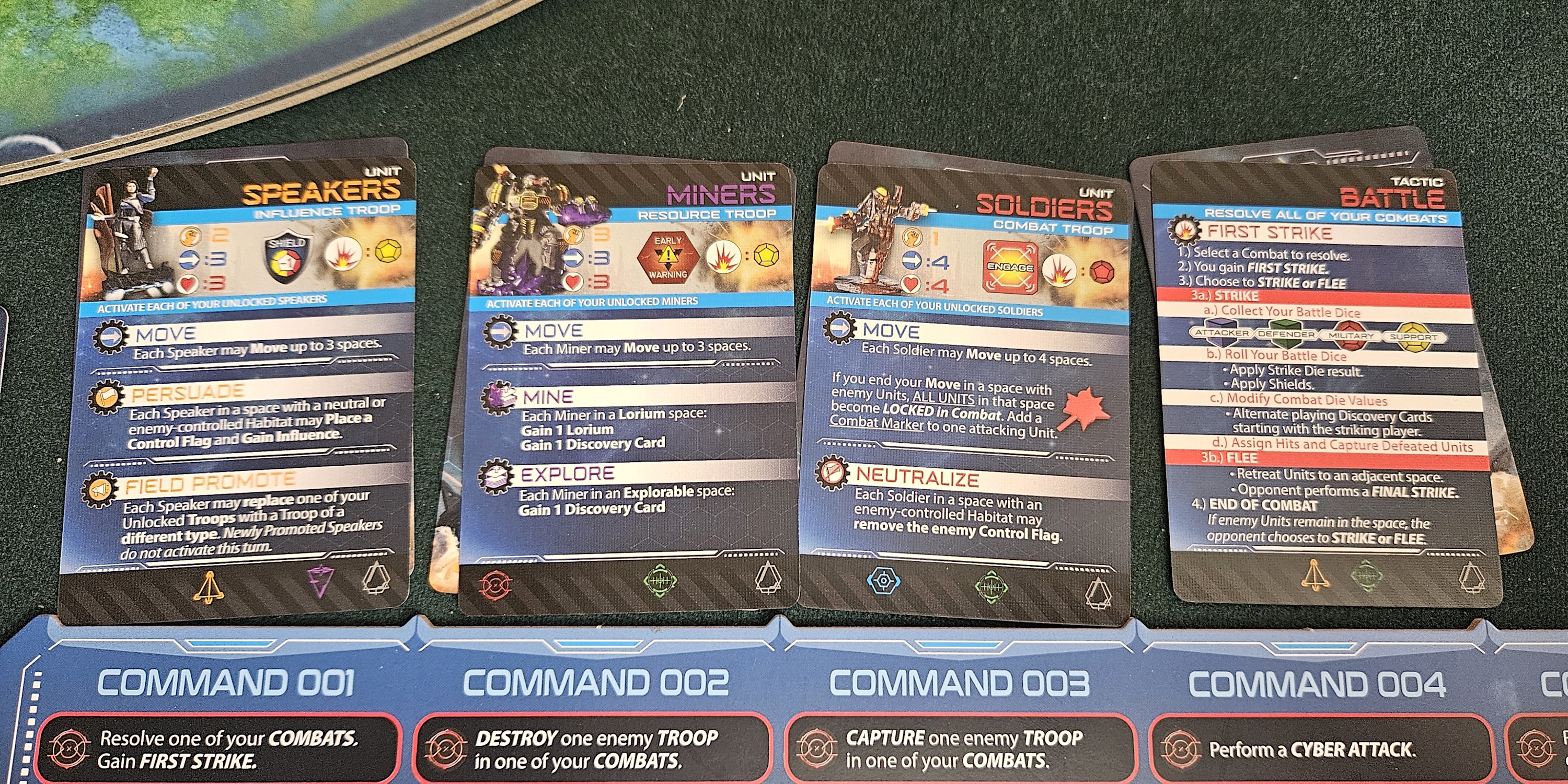
Let’s back up. For a game of such sprawling proportions, Cysmic is surprisingly smooth to play. Each turn sees you selecting a card that activates some segment of your apocalypse-realizing faction. Often, this means triggering a type of unit. There are diplomatic Speakers that are indispensable in the early days and more vestigial once the oven reaches temperature, Soldiers for shooting things, Miners and plus-sized Harvesters for mining minerals, and big jump-jet equipped Powermechs for blasting enemy columns. Other cards resolve all the battles you’ve set up over the previous turns, launch negotiations and cyber warfare, recruit or upgrade troops, the works.
The most transformative card is the one that activates your colony ship. This inevitably collapses at least one hex as your giant launchpad shifts position, squishing troops and cities under its treads and leaving fiery destruction in its wake. This is also an opportunity to attach modules to your ship, provided you have the resources and blueprints to do so.
Despite this clarity, turns aren’t as straightforward as choosing one card among many. In addition to selecting which card to activate, you also choose one that will disappear beneath it. This card is out of the rotation for the time being, depriving you of an entire class of unit or some crucial activity. Sure, there are ways to cycle spent cards back into your hand before the end-of-round refresher, but it speaks well of Cysmic that you’re asked to make tough decisions early and often. These choices aren’t as profound as, say, the hand drafting in Inis or Blood Rage, but they tend to be more significant than the eldritch upgrade paths of Cthulhu Wars.
This positions Cysmic squarely in the middle of the Ameritrash spectrum, somewhere between the poles of “cerebral/political” and “beautifully stupid.” Before long, it touches on both extremes. And while its performance in either arena is accomplished to greater or lesser effect, it always returns to those core tradeoffs between cards. This does wonders for the game. At a glance, you can tell how likely it is that a rival will respond to an incursion with a counter-attack, whether a target can shift a particular unit out of your reach, when the next tectonic collapse will take place. None of this information is foolproof. There are too many special abilities and action cards and faction perks for that. But it’s enough to communicate some sense of possibility, a probability waveform that can be surfed to your advantage.
The command system asks hard questions about your priorities.
So let’s look at those poles.
At heart, Cysmic is a contest of equal-opportunity aggression. Your goal is to complete your colony ship before anybody else, an objective made significantly harder by the absence of blueprints for all six of the necessary modules. Each player has sole ownership of one such module, meaning the only way to complete your ark is by prying the blueprints from their possession.
Fortunately, the blueprints of the far future apaprently come as shareable zip files. There’s no need to be too possessive; your possession of a blueprint does not preclude my ownership. The rub is that nobody is going to hand out their propriety information willingly. There are therefore two ways to gain access to a faction’s data. One, you can steal it via cyber crime, a finicky action that’s one of the game’s many underdeveloped appendages, but a noteworthy one all the same. Or two, engage in battle to kidnap some of their troops for use in a blueprint-for-prisoners exchange.
The implications are far-reaching. The good part is that everybody needs to attack everybody else, at least a little bit, in order to capture enough units to swap for those blueprints. If anything, a few early attacks might render a particular neighbor more or less negligible, which can be a huge relief when you share a border. Once you hold my blueprint, there’s no reason to attack me anymore, barring some late-game stalling for time.
On the other hand, this diminishes some of the game’s other elements. The map, for example, isn’t especially interesting, which is saying a lot when it depicts an entire planet crumbling under the strain of mech battles and mountain-cracking mineral extraction. There’s no reason to hold any territory in particular. One settlement is as good as another, resource veins are interchangeable, troops come and go, and entire flanks might collapse thanks to a random pull from a bag. With no sense of permanence, there’s nothing like a battle line, and the inviolability of your colony ship means there’s nothing to protect.
The closest dudes-on-a-map analogue would probably be Kemet, but one cleared of cities or temples. There’s plenty of territory out there, even a few choke points, but all that landscape provides very little reason to care about one tract over another. As the planet falls apart, it’s possible that some areas will become more valuable, but our sessions tended to conclude before such an eventuality was realized. The result is round-robin aggression, everybody targeting whomever they haven’t yet stolen blueprints from, with very little concern for anyone else.
Prisoners can be exchanged for blueprints.
The good news is that these aggressions are enjoyable enough in their own right that it isn’t as though Cysmic is going through the motions. Battles are punchy, if a little too concerned with different dice types and attack modifiers, and it’s always possible that a gunfight will accidentally split the world at the seams. There’s a little bit of everything in there. Dice, of course, with varying shades for combat and noncombat units; cards, for modifying rolls and maybe springing a nasty surprise; unit and faction abilities, just in case you thought you were getting off easy. Despite this abundance, resolution is reasonable, never reaching Forbidden Stars duration, which is great for the game’s play length if not for any prospective bathroom breaks.
Maybe the biggest highlight is the faction system. Like everything else in Cysmic, there are heaps to choose from, and in place of the expected mealy-mouthed plus-one perks, each team offers something transformative and meaty. One of them adds adjacency to every single space next to a mountain or lake, effectively letting you teleport anywhere at will. Another seizes control of any settlement anywhere on the map at the start of each turn. A third takes their turn at any point in the round — and I mean any point, treating the usual turn order to forced obsolescence.
What’s wild is that these are only the first of those factions’ abilities. Each offering has three or four whoppers. And there are more than twenty-five factions in all, each with their own distinct advantages and playstyles. The only real downside is that they all have dork-ass meme names like Path of the Wrighteous, Moving Mao Tons, or Kriss of Death. Receiving a diplomatic missive from uplifted psychic housecats is one thing; that the kittens have named their faction Cat-Aclysm gives off a real cringe vibe.
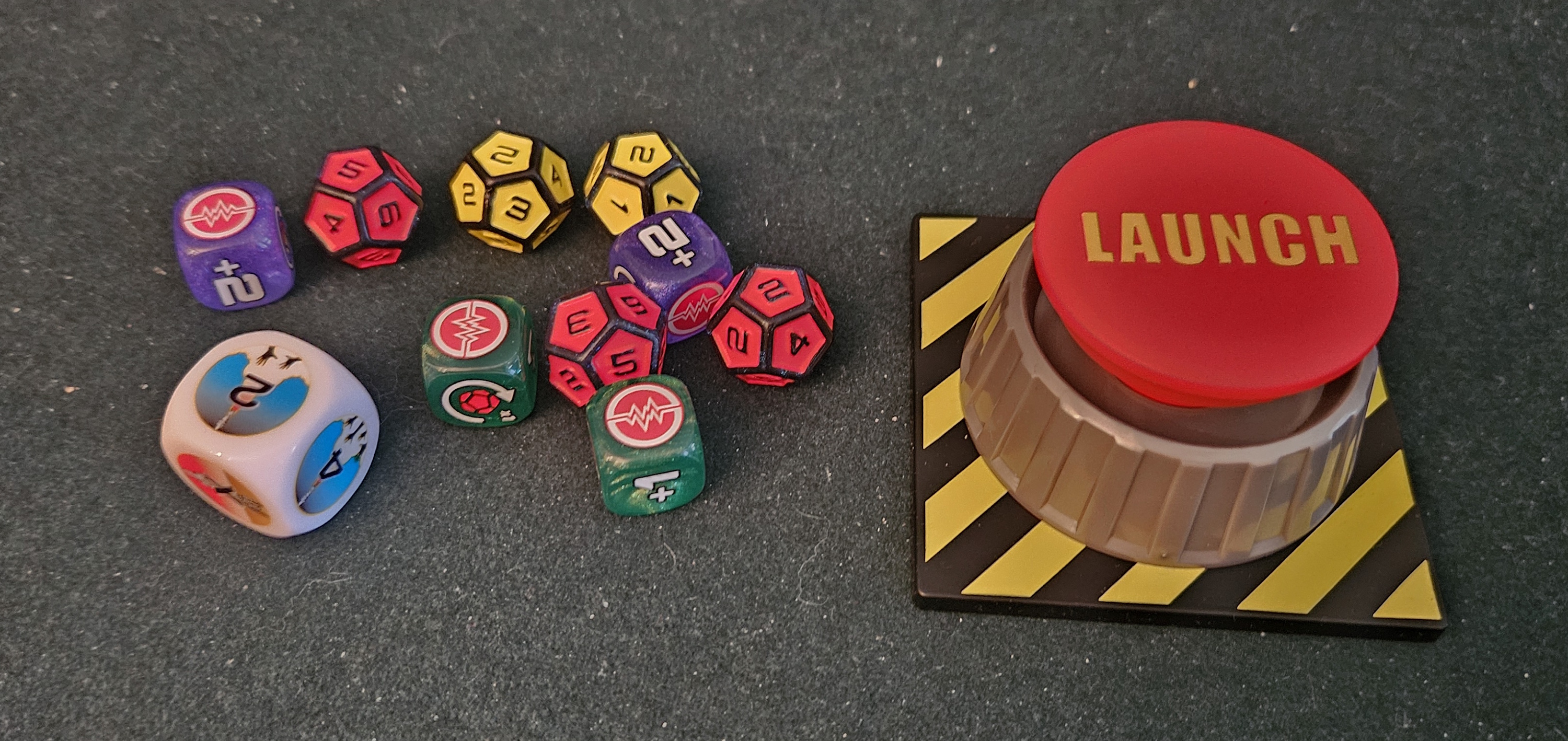
But, look, restraint is not Cysmic’s watchword, so why would Blake rein in the puns? Everything here is the board game equivalent of an extra order of mozzarella sticks. The handfuls of dice. The units you probably won’t field. The sheer variety on display. There’s even a clacky launch button that serves precisely zero in-game function, but which I very much intend to keep when I pass the game along to somebody else.
And, of course, there’s that most emblematic of all components: the conscience die.
Roll the dice. Smash the button. Search your conscience.
To my utter tickling, this final hexahedron serves an indispensable purpose. When at last the planet has been strip-mined, when the blueprints have been assembled, when the modules have been stuffed into your colony tower, the game is still not complete. Now it’s time to blast off for the stars and leave the rest of these suckers behind.
Except you might not be ready to hit the red button. It all depends on the conscience die. When the time comes, you roll and compare its result against the troops you still have on-planet. All the miners and troops stationed in the dust, all the diplomats persuading those neutral settlements that you have their best interests at heart, all the prisoners still waiting for freedom. The conscience die reveals how many you’re willing to leave behind. If there are fewer out there than the roll, you leave. Kaboom.
But if not, you stick around and attempt to evacuate more bodies, more lives. With the right resources, you can try the roll again next turn. Without them, you’ll have to wait for the end of the round when your cards return to your hand.
Either way, Cysmic has done the unexpected. It has grounded the moral cost of its conflict. In incredibly shaky terms, yes. In a way that rewards losing units to cave-ins and enemy assaults. In a way that makes the anthropogenic horrors visited on its planet and peoples seem all the sillier. But in terms that, imperfect as they are, most historical wargames don’t even attempt, and which — and I say this in all seriousness — we would laud in a game with a more solemn setting. Because even here, as the world collapses toward its molten core, sometimes the cost is too high. Sometimes you can’t bring yourself to make the hard choice. Even if you happen to be a battle-hardened jerk named Minnesota Killjoy.
(Yes. That is one of the game’s factions. Save me.)
Ah. Ludicrous.
This, I think, is what sets Cysmic apart. It’s too big. It could have been pruned down. It doesn’t need quite so many alternative modes. The mountains could have been cutouts. The launch towers could have been a little less, ah, engorged. There didn’t need to be magnets all over the place.
But it’s also a huge cry from the crowdfunding trash that gives miniatures-heavy games such a bad name. Unlike some of those titles, maybe even unlike the majority of them, Cysmic is a game one would actually opt to play. And more than that, it’s an earnest experience, one packed with exciting battles, a landscape undergoing disaster, a race to survive at all costs.
It even has shades of meaning in its human-hastened collapse, one that feels all too timely. Here in the desert of Utah, a billionaire has announced a 40,000 acre data center that will triple the state’s power consumption. The stated reason is national security, a digital arms race against China. This despite the professionals at the local universities pointing out that we don’t have the water, don’t have the heat allowance, don’t even have much of a Great Salt Lake anymore. Will our elected officials make a saving throw on the conscience die before they bake us to death? I hope so.
For a board game, that’s the sort of thing that makes us say it’s punching above its weight. When it comes to Cysmic, the aphorism feels wrong. Let’s instead say it’s punching at precisely its weight. Fine: maybe a little under.
A complimentary copy of Cysmic was provided by the publisher/designer.
(If what I’m doing at Space-Biff! is valuable to you in some way, please consider dropping by my Patreon campaign or Ko-fi. Right now, supporters can read my first-quarter update of 2026: the best board games, movies, books, and more!)
Board game designers Reiner Knizia and Markus Slawitscheck both have a shot of completing an unprecedented series of wins at this year’s Spiel des Jahres – widely considered the highest profile awards in board gaming – after the 2026 nominations were unveiled earlier today.
The pair have already won two of the awards’ three categories in prior years – and the nominations of Slawitscheck’s Morty Sorty Magic Shop for the main prize, and Knizia’s Rebirth for the higher complexity Kennerspiel, could see either or both become the first designers in the awards’ 47-year history to complete the set.
Morty Sorty Magic Shop is up against Corey Konieczka’s Cozy Stickerville and Martin Ang’s Dito! – the German version of Jinxo – for this year’s Spiel des Jahres, while Rebirth is contending with Michael Palm and Lukas Zach design Boss Fighters QR and Donald X Vaccarino’s Moon Colony Bloodbath for the Kennerspiel.
Spiel des Jahres Association chairman Harald Schrapers said in a nominations livestream today that the jury looked at a record 571 games for this year’s awards, underscoring the sheer mass of games being released through retail.
The 440 titles reviewed across the Spiel and Kennerspiel categories was up 14% on last year, while the 92 games considered for the Kinderspiel marked a roughly 50% rise compared to the 61 from 2025. Another 39 titles were considered by judges across both the Spiel and Kinderspiel awards.
Number of games reviewed in recent Spiel des Jahres years – red is Spiel and Kennerspiel, blue is Kinderspiel, and purple is games which span both segments
Despite those record numbers, Schrapers pointed out that just 2.3% of the games were from women designers, with male creators making up 94% of the cohort, and the rest being designed by mixed teams.
That figure has barely moved in recent years, having stood at 2% in 2025 and 2.6% in 2024 – an ongoing lack of diversity highlighted in great detail in this excellent feature by Wargamer’s Mollie Russell earlier this week.
Schrapers also emphasised that this year’s judging process had been a particularly frustrating one, with glaring flaws being present in even the standout designs.
He said, “It was a lot of fun, but there were also real shortcoming in many games.
“There are deficiencies in some games every year, of course – there are so many, not all of them are really good. Many are good, but as I said, not all of them.
But this time we noticed, especially with the outstanding games, i.e. the 10% best – I would say there were various games where there were various quite serious flaws. There were so many that I even wrote them down.”
He presented a list which included incomplete, ambiguous, and contradictory rules of the game, a lack of summaries, blatantly incorrect age information on boxes, and components which fail to function well in poor light or after a handful of games.
Schrapers said in a separate blog post about the process, “Despite these shortcomings, some titles made it onto the jury’s shortlist because the flaws were not so significant in relation to the outstanding gameplay.
“However, there were probably more than one work that failed to secure a majority in the jury vote due to such a deficiency.”
Spiel des Jahres deputy chairman Christoph Schlewinski, left, and chairman Harald Schrapers, right, with this year’s Spiel des Jahres nominees
The livestream also drew attention to the nomination of Boss Fighters QR, and the long-listed design Toriki: The Castaway Island, as notable for requiring an app in order to play.
When asked by Spiel des Jahres deputy chairman Christoph Schlewinski whether that signified a growing trend within the hobby, Schrapers said, “No, I don’t think that’s a trend.
“They are two games that work very well with an app… the thing is that the app supports the analogue feeling in such a game. That’s why it’s an addition.”
He added, “I’m really sure that even in ten years, 90% or even more of all board games will work without a digital integration, because that’s exactly what people like.
“But an app also draws new people into this game. We notice it especially with young people that they often find this very , very good, it creates additional tension – and you can see that such a board game can also open up new audience groups.”
Hisashi Hayashi’s co-operative bomb disposal game Bomb Busters won last year’s Spiel des Jahres, beating the much-fancied push-your-luck card game Flip 7 to the high-profile award.
That victory meant the Spiel des Jahres has now been won by a co-operative game design in five out of the past seven years, following successes for Just One in 2019, MicroMacro: Crime City in 2021, Dorfromantik: The Board Game in 2023 and Sky Team last year.
Cozy Stickerville is the only nominee for the main prize this year which is a cooperative title.
Last year’s Kennerspiel des Jahres was won by Endeavor: Deep Sea – which also features a prominent co-op mode as a way to play the game – while the winner of the 2025 Kinderspiel was Wolfgang Warsch’s Topp die Torte.
Winning the Spiel des Jahres can explode sales by hundreds of thousands of copies for the winner – and by thousands of copies for the nominees.
While publishers tend to keep tight-lipped about actual sales figures, Pegasus Spiel co-founder Karsten Esser told BoardGameWire in a 2023 interview that winning the main prize can boost a game’s sales by 10x to 20x in the months following, due to a slew of exposure across mainstream German shopping outlets in the run-up to Christmas.
That kind of boost can be hugely impactful for publishers and designers alike – and is particularly important to smaller publishers in the fight to stand out amid an increasingly competitive industry which sees thousands of releases each year.
The winners of this year’s Spiel des Jahres awards are set to be announced on July 12.
The Spiel des Jahres (SdJ) jury announced the nominated games for the SdJ, Kennerspiel (“connoisseur” games), and Kinderspiel (children’s games) awards earlier today and I think it’s safe to say that nobody had these titles on their Bingo cards. For … Continue reading →

 Anmelden


 ︎
︎


/pic5074944.png)