Poop! Spies! What do they have in common? Both are featured in board games designed by Jon Teixeira Moffat, naturally. On today’s Space-Cast!, we’re joined by Jon to discuss the long development of both Night Soil and Burned, the hidden cost of labor, and cinematic hidden movement games.
Listen here or download here. Timestamps can be found after the jump.
TIMESTAMPS
00:36 — introducing Jon Teixeira Moffat
4:06 — Stone Circle Games
7:00 — Night Soil
21:08 — portraying labor
33:15 — Burned
(If what I’m doing at Space-Biff! is valuable to you in some way, please consider dropping by my Patreon campaign or Ko-fi. Right now, supporters can read my first-quarter update of 2026: the best board games, movies, books, and more!)
This is the time for 2-player games! I have noticed a bunch of 2-player games hitting the scene in the past several years. I know I play a lot of 2-player games and am always on the lookout. Here are just a few more of those releases coming soon.
▪️ Bitewing Games (Zoo Vadis, Cascadero) has three new titles coming out that are for 2-players, which are part of their Mythos series! Bitewing Games has produced a ton of recent games from deisnger Reiner Knizia (Ra, The Quest for El Dorado... the list goes on forever), so I will start with the sharing about the new Collector's Edition of Ichor. [imageid=8195971 medium rep] If you aren't familiar with the game, you are either choosing to battle as the Greek Gods or as the Greek Monsters. All of the figures have unique abilities, and you are trying to get all of your tokens onto the board before the other player.
About the new collector's edition:
Ichor Collector's Edition is a newly released version of Ichor and features 3 key changes from the standard edition:
▪️ It includes a standard folding board instead of a cloth board. ▪️ The characters are flat-laying tiles instead of standees. Flip a character tile face down to show on the board that its ability has been used. ▪️ The Reinforcements & Gates Expansion is included in the box!
▪️ Azure caught my eye because it has the wonderful artwork by Kwanchai Moriya (Food Chain Magnate, Under Falling Skies). Azure is an area control game where you want to advance on your track and reach the end before the other player. It will take about 20 minutes to play and has double-sided boards to keep the variety for replayability. More on Azure:
n Azure, players position their stones to gather qi (cards) and wisdom (points) from the realm. They also compete to bring the Auspicious Beasts to their aid. The first player to reach the end of the path of wisdom wins.
Players take turns placing a stone, gathering boons from the space they cover, and gaining the favor of Auspicious Beasts. In order to place a stone in a space, the player must be able to pay the qi cost. The color of the domain (board) tells you the color of qi needed, and the number of boon symbols in the space tells you the amount of qi needed. Through careful management of the qi cards in your hand, you'll be able to grow in power.
▪️ The third game I wanted to share is Moytura. This game can be played either competitively or cooperatively, which is interesting. I always love the option for cooperative mode. Moytura, is a battle for control of ancient Ireland over two eras. The game will be 45 minutes.
From the BGG game page:
Each round, the two players and the enemy faction each take a turn. On their turn, a player selects a deity tile (possibly spending worship tokens to reach it), then performs that deity's actions. When used, a deity tile resets to the most expensive position in the track. Deity tiles let players expand their influence and battle enemies according to the deity's unique abilities. On the enemy faction's turn, an activation card is revealed from the deck that expands one of the three clans. Some activation cards are stronger than others, and players must carefully track which clans are most likely to attack and where. Only the player who cleverly outmaneuvers their opponent while carefully keeping the enemy faction in check will be able to secure the victory.
▪️ You can also check out Iliad from the same 2-player series and designed by Reiner Knizia. This is also restocked with the other titles on the list. This was the first game of the 2-player Mythos series.
In Iliad, you will either be Hector of the Trojans or Achilles of the Greeks and strive to win the favor of the Gods by placing tiles and taking control of the grid.
More from the BGG page:
On your turn, select one of two tiles from your hand and place it onto the board adjacent to an opponent's tile. Both players have symmetrical pools of tiles, with their strength ranging from 1-5, along with the Dolos tile that mimics your opponent's adjacent tiles. The key to victory lies behind the relentless tension of where and when to commit your tiles. When placing a tile, you may also activate the tile's ability, which can serve to turn the tide of war.
When a row or column is filled, the player with the highest total strength in that line earns the right to select one of the two success tokens at the ends of that row or column; the other token goes to their opponent. Success tokens can earn you the favor of the Gods, and they can earn (or cost you) points. At the end of the game, the winner is the player who has earned the favor of all five Gods.
Almost a year of uncertainty over the future of board game publisher Greater than Games has been partially resolved, with Flat River Group selling the brand name, and the rights for the Sentinels of the Multiverse titles, to Handelabra Games.
Video game developer Handelabra has a long history with the comics-themed cooperative card game, having spent more than a decade creating digital versions of the title and its expansions – as well as for Greater than Games’ best known release, Spirit Island.
Spirit Island is not part of Handelabra’s deal, however, which the company said only covers the Sentinels of the Multiverse games, the Sentinel Tactics range, the Sentinel Comics RPG, Sentinels miniatures and the cooperative deck-builder Galactic Strike Force.
The distribution and e-commerce specialist was bought six years ago by private equity investor Guardian Capital Partners, which provided capital for a string of tabletop industry acquisitions.
They included an expansion into board game publishing in 2021 with the buyout of Greater than Games, which it followed a year later with deals for Canadian publisher Synapses Games and hobby game distributor Luma Imports.
A statement from Handelabra president and CEO Jaye Handel said the company had made the GtG and Sentinels deal to protect its ability to make digital games in that IP, adding that it was “not interested in becoming a tabletop publisher”.
But the statement added, “But lucky for us, we know a lot of good people who are good at exactly that type of business…”
That is believed to refer to Greater than Games trio Christopher Badell, Paul Bender and Adam Rebottaro, who founded the company in 2011 and were the last remaining employees following Flat River’s downsizing of GtG last year.
Handelabra CEO Handel told BoardGameWire he was unable to share further details, but said that his company was “very excited about the future of Sentinel Comics on digital and analog tabletops and beyond”.
He added, “Handelabra Games’ and Flat River Group’s relationship with regards to Spirit Island has not changed.”
The company’s recent statement from Handel indicated it would be able to provide more information about Greater than Games’ future by April 28, which is National Super Hero Day in the US.
It said, “For your ongoing support and excitement, we remain eternally grateful. We just ask for a little more patience over the coming weeks as we have lots to share, and we can’t wait to embark on the next phase of this journey with you!”
Flat River did not respond to BoardGameWire’s request for comment on the future of Spirit Island or other former Greater than Games-published titles.
I played a lot of games in 2023. The best of those games, by a sizable margin, was Hegemony: Lead Your Class to Victory, designed by Vangelis Bagiartakis and Varnavas Timotheou and released by the two men under the Hegemonic Project Games banner. A bold effort in almost every way, Hegemony did an excellent job of simulating a real-world environment and mixing that with a number of different gaming systems. The end result now resides on BoardGameGeek’s top 50 all-time games and has hit my table for nearly a dozen plays; as an event game, it’s tough to beat.
Those accolades put a big target on the back of Hegemonic Project Games’ second design, World Order. Varnavas and Vangelis were kind enough to send a review copy in advance of the game’s full release, and it was pretty easy to get the members of my review crew to line up for plays.
I tempered expectations a bit here. I thought Hegemony was a classic example of “lightning in a bottle”, an asymmetric negotiation game that really did play differently from faction to faction, which landed in a January dead zone after working through a big pile of games from the year before. Could Hegemonic Project Games do it again with World Order? My main hope was that…
With this My Favorite Wargame Cards Series, I hope to take a look at a specific card from the various wargames that I have played and share how it is used in the game. I am not a strategist and frankly I am not that good at games but I do understand how things should work and be used in games. With that being said, here is the next entry in this series.
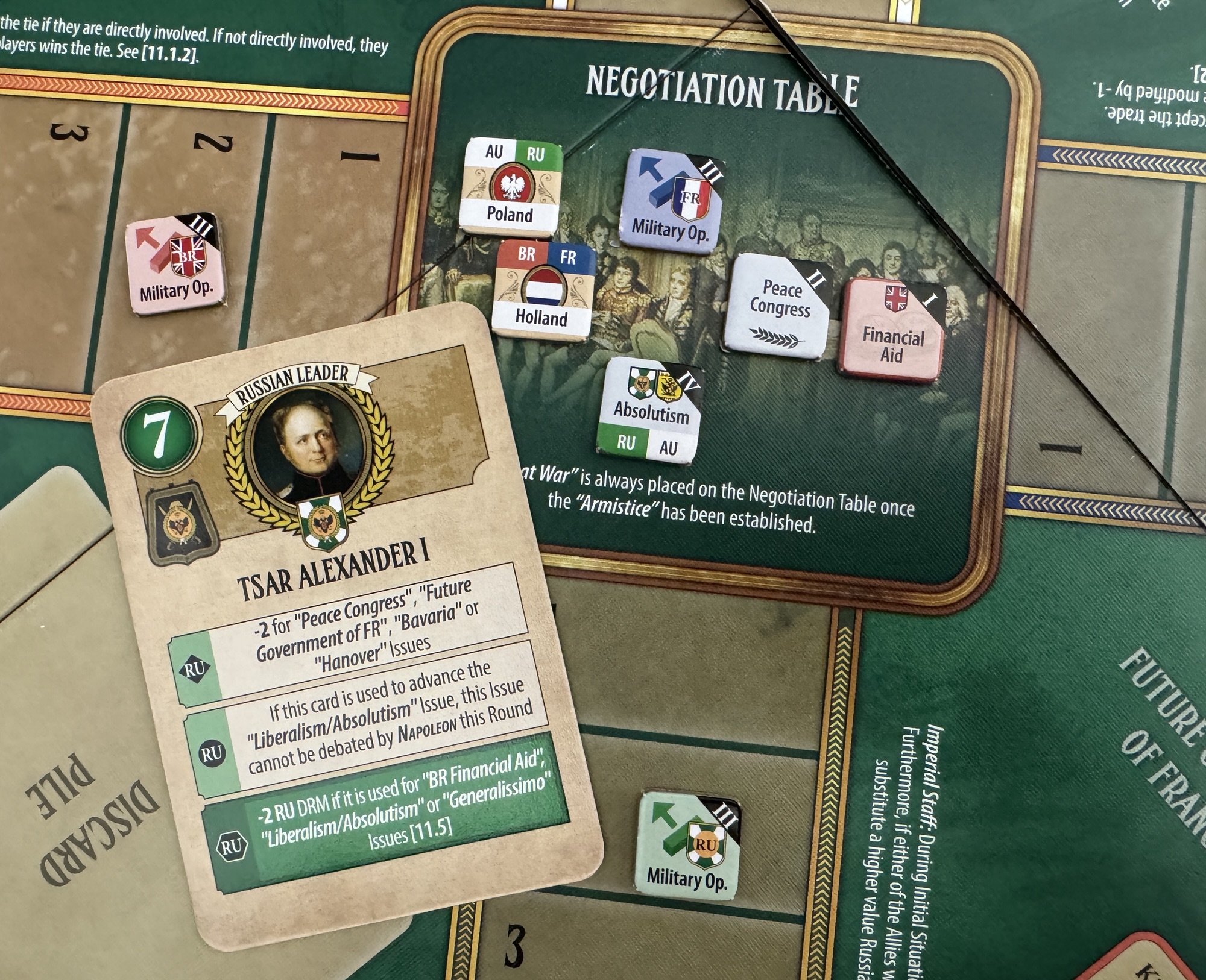
#73: Russian Leader Tsar Alexander I from Congress of Vienna from GMT Games
Congress of Vienna from GMT Games is a diplomatic card driven wargame based on Churchill and is the 4th game in the Great Statesmen Series. The game is set during the years of 1813-1814 and sees players take on the role of the main characters of the struggle between the Napoleonic Empire and the coalition of Russia, Austria, and Great Britain with their Prussian, Spanish, Portuguese, and Swedish allies. Congress of Vienna has two different but related phases including the conference table where players first debate over the control of issues germane to the factions and the period of the war and second these issues are then used on the battlefield to recruit units, attack and take overall command of battles. The players will be playing cards from their hands to “debate” over the various issues that were placed on the table, which include all types of things such as Military Operations, Recruitment, who will lead the combined Coalition forces (Generalissimo), Future of French Government, British Financial Aid, Liberalism vs. Absolutism, Austrian Neutrality and several other issues, and then later the players will use their accumulated Resources gained from the issues to enact action on the Military Map and do things like mobilize troops, place Military Support Markers and the ultimately to conduct warfare.
The game relies on cards and cards can be used to negotiate, i.e. move an issue to your National Track. Cards can provide a particular issue with positive and negative DRM’s depending on which nation plays them and can also be traded with another player during the Diplomacy Phase. Certain cards are better than others for debating an issue moved by another player; and finally, if they are saved for the War Phase, staff cards can be used to modify dice rolling in battles. These are very versatile cards and the players will have to learn them and their benefits in order to be effective at the game.
In this entry, we are going to take a look at the Russian Leader Tsar Alexander I card. The fist thing that you may notice about this Leader Card is that is that it has no benefit for military operations, meaning that Tsar Alexander is watching the war from the sidelines and not directly involved like Napoleon, but does have a potential negative effect if used on certain Issues. But his power lies in the ability to utilize his 7 value to influence issues significantly on the Negotiating table. Particularly, Tsar Alexander I is an ardent believer in the philosophy of Absolutism and wants to retain his crown as the leader of Russia. This concept is played out in the game between the great powers of the time, including Russia and Austria for Absolutism, and the more democratic players including Britain and France for Liberalism. On the board appears this Liberalism/Absolutism Track, which provides the players an opportunity to debate over the Liberalism/Absolutism Issue and gain various advantages and Victory Points from the track. On this Liberalism/Absolutism Track, Europe’s post-war governing philosophy is fought over. This is a double track in green and red with a common At Start area for the use of 2 pawns. Tracks for Liberalism (red: Britain/France) and Absolutism (green: Russia/Austria) each have four boxes and an assigned total Victory Point amount. In order to score the VP from this track though, the player scoring must have their philosophical leaning portion of the track occupying a space at least 1 box ahead of their opponent. Also, if they want to score the maximum Victory Points listed at the top, they have to occupy the top box and their opponent cannot occupy theirs. For the Russia player, this should be a huge part of their strategy as 5VP is nothing to sneeze at in this game. But, in order to do that they will most likely have to try to go first and use Tsar Alexander and his 7 value to try and move that Issue up the track to end under their control. If an Issue every reaches a Track’s Seat, meaning the 7th space, or more after any declared debate is calculated in, then that Issue is considered to be secured and can no longer be moved through negotiation during future rounds. This reminds me a bit of the way that I always plan to use Joseph Stalin in Churchill, to go first and then bring the hammer down on the A-Bomb Research Issue. Getting control of this Absolutism/Liberalism Issue at least 4 times is very important for the Russian player and they will need to utilize this ability as much as possible. But remember that there is a penalty called the “Meddling Tsar” Rule where if Tsar Alexander is used for the negotiation of the British Financial Aid, Liberalism/Absolutism or the Generalissimo Issues, it will inflict a -2 DRM on all battles involving 1 or more Russian units during the upcoming War Phase. This is quite a cost and the player should carefully consider if and when they use the ability throughout the game. If the turn is expected to contain little to no combat for Russian units, then it is safe to use but if France is being aggressive and pushing on Poland and Prussia you might want to consider not going after the Liberalism/Absolutism Issue this turn and instead focus on Recruitment and Military Operation Issues.
The other part of this ability is that if Tsar Alexander I is used to move the Liberalism/Absolutism Issue then Napoleon cannot be used to Debate that movement. I would say that this is not an issue though as typically the France player will be using Napoleon on the battlefield for his DRM abilities.
I also like the historical and personality connection between this card and the game. At the top of the card you will notice that if you use Tsar Alexander I to negotiate the Peace Congress, Future Government of France, Bavaria or Poland Issues, that you will gain a -2 on his value bringing it from a 7 down to a 5. I think that this ability really highlights the philosophy and view of the Tsar regarding the time. He doesn’t believe that France should get to continue to exist as a main player in the power structure of the time and definitely doesn’t want to see France become more democratic. But, he also has a feeling that Bavaria and Poland are Russian vassals and should not be allowed to be turned to any other side’s allegiance. If he has to be used in this manner to defend or negotiate these issues I feel like the -2 Value penalty really shows that leaning in his thinking and probably causes him to be more brunt and less diplomatic thereby losing some of his influence in the court of opinion. Ultimately, Tsar Alexander I thought that monarchy is a noble and viable alternative to the crude and materialistic mob mentality of republicanism and the abilities of his Leader Card definitely cement that view.
After playing now a few times, I am here to say that Congress of Vienna is probably my favorite game in the Great Statesmen Series. I believe that this game has matured the system and made it something that is more than where it started. Congress of Vienna is very much more like a true wargame and was extremely interesting. We are still learning and need to keep playing this one but I did enjoy what it was that we were doing.
Alexander I, nicknamed “the Blessed”, was Emperor of Russia from 1801, the first King of Congress Poland from 1815, and the Grand Duke of Finland from 1809 to his death in 1825. He ruled Russia during the chaotic period of the Napoleonic Wars.
The eldest son of Emperor Paul I and Sophie Dorothea of Württemberg, Alexander succeeded to the throne after his father was murdered. As prince and during the early years of his reign, he often used liberal rhetoric but continued Russia’s absolutist policies in practice. In the first years of his reign, he initiated some minor social reforms and in 1803–04 major liberal educational reforms, such as building more universities. Alexander appointed Mikhail Speransky, the son of a village priest, as one of his closest advisors. The over-centralized Collegium ministries were abolished and replaced by the Committee of Ministers, State Council, and Supreme Court to improve the legal system. Plans were made, but never consummated, to set up a parliament and sign a constitution. In contrast to his westernizing predecessors such as Peter the Great, Alexander was a Russian nationalist and Slavophile who wanted Russia to develop on the basis of Russian rather than European culture.
In foreign policy, he changed Russia’s position towards France four times between 1804 and 1812, shifting among neutrality, opposition, and alliance. In 1805 he joined Britain in the War of the Third Coalition against Napoleon, but after suffering massive defeats at the battles of Austerlitz and Friedland, he switched sides and formed an alliance with Napoleon in the Treaty of Tilsit and joined Napoleon’s Continental System. He fought a small-scale naval war against Britain between 1807 and 1812 and took Finland from Sweden in 1809 after Sweden’s refusal to join the Continental System. Alexander and Napoleon hardly agreed, especially regarding Poland, and the alliance collapsed by 1810. Alexander’s greatest triumph came in 1812 when Napoleon’s invasion of Russia descended into a catastrophe for the French. As part of the winning coalition against Napoleon, he gained territory in Poland. He formed the Holy Alliance to suppress the revolutionary movements in Europe, which he saw as immoral threats to legitimate Christian monarchs.
During the second half of his reign, Alexander became increasingly arbitrary, reactionary, and fearful of plots against him; as a result, he ended many of the reforms he had made earlier on in his reign. He purged schools of foreign teachers, as education became more religiously driven as well as politically conservative. Speransky was replaced as advisor with the strict artillery inspector Aleksey Arakcheyev, who oversaw the creation of military settlements. Alexander died of typhus in December 1825 while on a trip to southern Russia. He left no legitimate children, as his two daughters died in childhood. Neither of his brothers wanted to become emperor. After a period of great confusion (that presaged the failed Decembrist revolt of liberal army officers in the weeks after his death), he was succeeded by his younger brother, Nicholas I.
We have done 2 videos on this game including the following RAW Video after out 1st play at Buckeye Game Fest in May 2025:
We then did the following full Review Video after our 2nd play at WBC last July:
The year is 2044, and the city of San Lazaro has become the epicenter of the world for cybernetic enhancements. In 2050, a mysterious techno-virus has ravaged most of San Lazaro’s population, and a majority have turned into murderous CyMS (Cyber-Memetic Sociopaths) who attack those not yet infected. The uninfected are trapped in this lawless […]
All In: Predictions Designer: Phil Walker-Harding Publisher: Next Move Players: 2-5 Age: 10+ Time: 30 minutes Amazon affiliate link: https://amzn.to/4t6Vu3R Played with review copy provided by publisher In All In: Predictions, players become gifted foretellers vying to shape … Continue reading →
Peter and Will are back with their most famous style of battle report – a War of the Ring one! Beer, laughs and banter ensue.
One day, when the Esoteric Order of Gamers finally comes to its natural end and all about it and concerning it is forgotten, one thing may be remembered – the battle report videos documenting games of War of the Ring between myself and my old gaming buddy, Will. It‘s been quite a while since I’ve had the opportunity to film one, but the day has finally arrived! So grab yourself your beverage of choice, get comfortable someplace where you won’t be interrupted by any non-gamer who just might not understand, relax, and enjoy this hugely fun new session of my favourite board game, War of the Ring!
Making high quality tabletop gaming content at the EOG takes time and money. Please consider becoming a Patreon supporter or making a donation so I can continue this work! Thankyou!
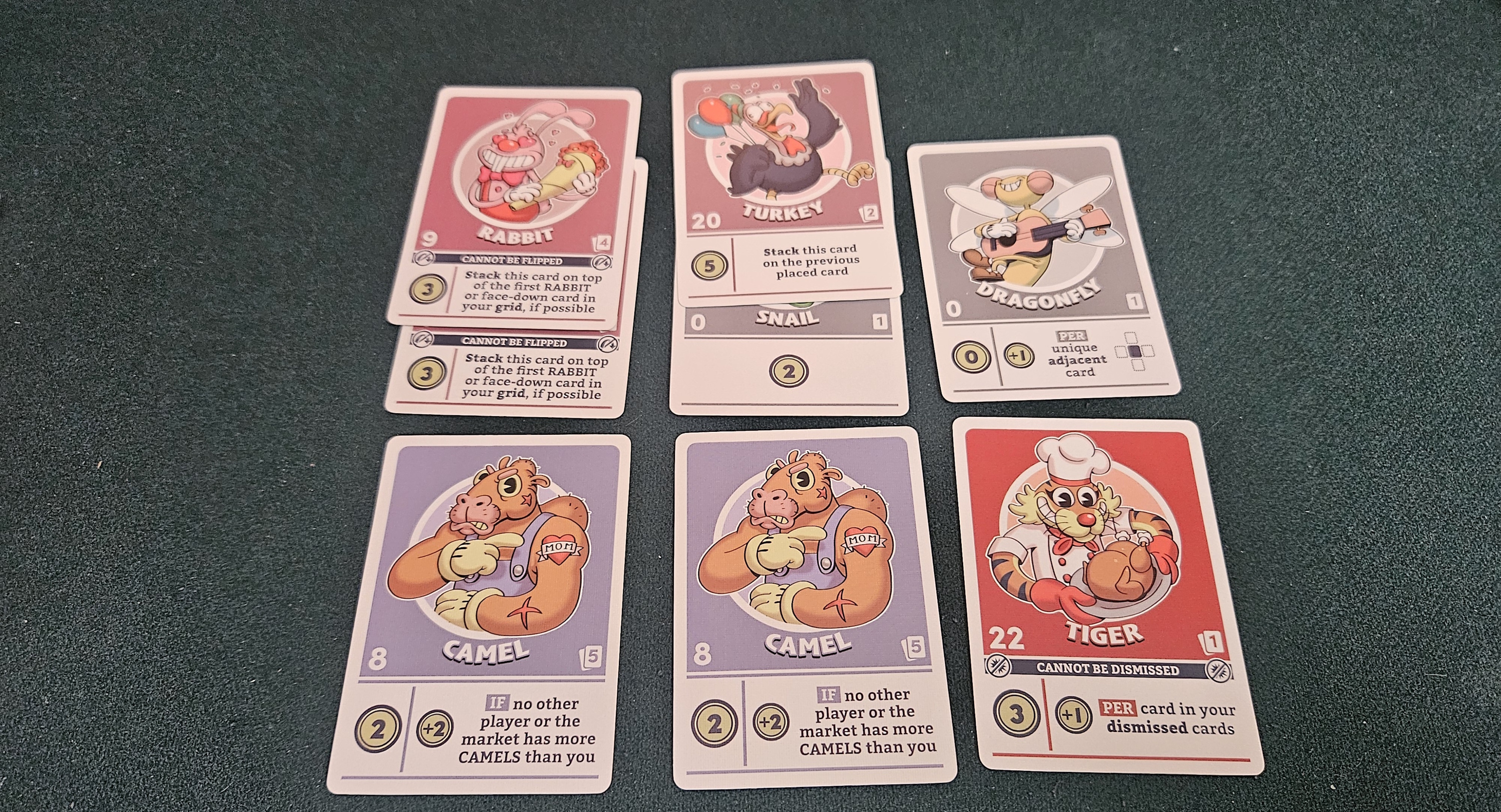
FlipToons was designed by Renato Simões and Jordy Adan, the latter of whom gave us Stonespine Architects and Cartographers, but the real star of the show is Diego Sá, whose animated characters make me want to rate the game significantly higher than I would otherwise. Just look at those little dudes! The camel is two seconds away from winding up a punch. The rabbit wouldn’t feel out of place leaning in for a kiss, only to be rebuffed when the ostrich hides her head in the sand. The sheep is just is out there boppin’ to her tunes.
As a game? Oh, it’s pretty good. Clever at points, nice to play, the usual. My larger reservation is the way it makes me feel during and after a play.
Six cards. In theory.
FlipToons is a game of two halves. Two halves which, when hinged like an aquatic bivalve, form into a united whole that conceals an unexpectedly tasty muscle within. Okay, so I skipped breakfast. Point is, FlipToons is hard to discuss holistically without first establishing how its components function apart from one another.
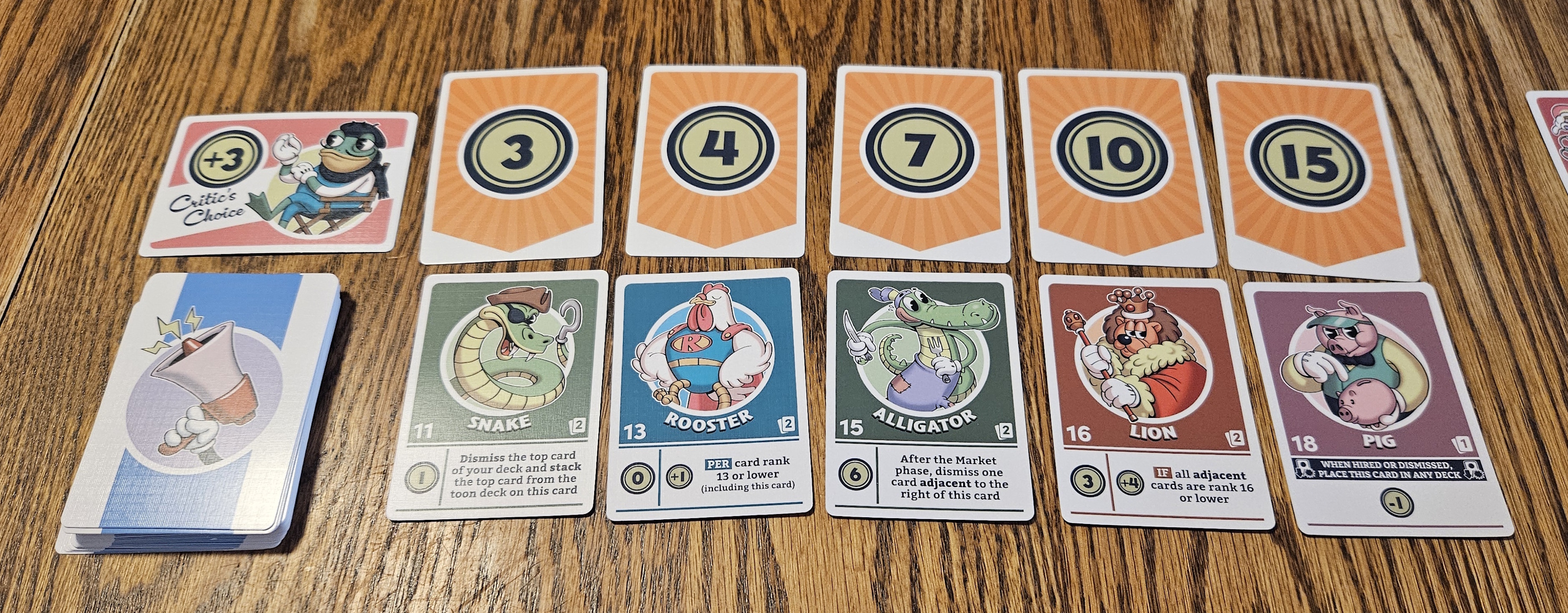
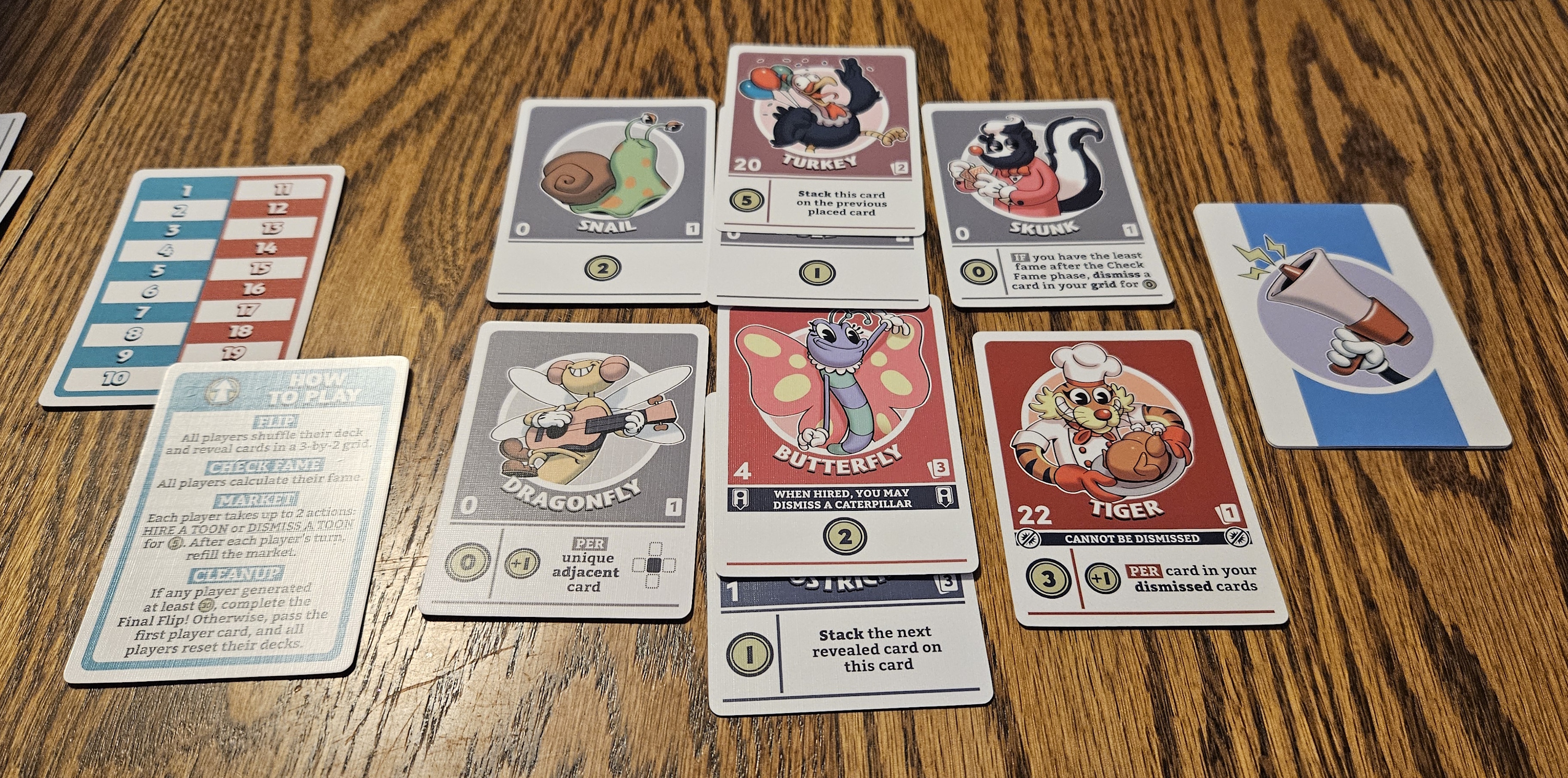
The first part is the deck. When the game begins, you have six cards in total. Two caterpillars, each worth bupkis, but easily dismissed. One skunk, a utility card for winnowing your deck. One bee, worth a single pip of purchasing power. One snail, worth double the bee’s value, making it the single most precious card in your starting lineup. And one dragonfly. Ah, the dragonfly. This guy gives you one point for every unique adjacent card.
What this means requires some explanation. Every round opens with you shuffling your deck and then dealing cards onto the table in front of you to create a three-by-two grid. If you have extra cards, too bad, they remain in your hand. If you have too few cards… well, don’t do that.
Some cards may stack. Rabbits, ostriches, turkeys, these are your chance to get more than six cards into your grid at a time. Others, like sheep or monkeys, trigger benefits if they occupy a particular row or column. Some cards flip, others compare values against other players or the market, and a few, like the pig, are traps that can be gifted to rivals to subtract from their tally.
That tally, then, is taken to the market to shape your deck. Since you’ll only use six-ish cards at a time, keeping your cast trim is a good idea. Fortunately, unlike most deck-builders, the ability to dismiss toons is inbuilt in FlipToons, always available for the low cost of five points.
The toons on display, meanwhile, adjust in cost according to their relative ranking. This ensures that something is always available, and if you’re lucky it’s possible for something unusually precious to slip down in cost. Of course, the opposite often also proves true, with low-value cruft sometimes overwhelming the market.
Regardless, you take your purchases and/or dismissals, shuffle your grid back into your hand, and begin all over again. Bit by bit, your cast improves. That measly starting five to six points becomes twelve, then sixteen, then you break twenty and flip your little tally card to its opposite side. The goal is to score thirty.
Costs are adjusted dynamically, which can result in little surprises.
Okay, not quite. Your actual goal is to score the most on the final round. Hitting a tally of thirty is how you trigger the endgame, and there’s a small plus-three advantage if you’re the one to bring it about, but that’s no guarantee luck will be on your side for the last flip. So, then: hit thirty to lock the game into one final pull of the lever, then hit the jackpot.
The slot-machine analogy is apt here. FlipToons is to deck-building what Balatro was to poker. The titular flip of FlipToons is devoid of decision points. You turn cards in order, left to right and top to bottom, until you’ve produced that three-by-two grid.
There’s more going on in the market portion, but these are minor choices rather than a vast menu. There are five cards available at any given moment, and even when you’re flush with cash in the late-game, you’re limited to two purchases. (And dismissing a card from your deck qualifies, so no double-dipping.) This keeps everyone at the table more or less bungee-corded at the hip, which is probably the right decision for such a light game, but also prevents the table from launching the exponential bottle rockets that were Balatro’s core pleasure.
But about those pleasures…
I have my reservations about these sorts of games. The art and market purchases, while pleasant, aren’t far removed from the lights, illusory choices, and “theming” of a slot machine. I remember as a kid on a trip to Vegas, walking past a slot machine that leaped out of the crowd. I think it was based on Aliens, with those sleek oily monsters I had yet to witness on the screen for myself, but which my friends with the cool parents, the ones who let their kids watch R-rated movies in elementary school, spoke of as the scariest things they’d ever seen. My Dad traced the object of my interest and leaned down to whisper, “That’s how they get you.” It was like somebody had roused me from hypnosis. In that moment, my Dad — who suddenly struck me as cooler than those other dads, or at least cannier — had broken through the social programming of that cigarette-reeking hellhole.
And, look, I don’t think FlipToons is some sort of evil artifact. It isn’t the equivalent of a casino, with its fine-tuned odds to ensure the house always wins and your kid’s college fund becomes another rounding error in a billionaire’s high score. But it produces a similar daze, all submersion and dulled perception. It’s a far cry, too, from some of the sharper auto-battler board games, titles like Tag Team, with its emphasis on attention and preemption, or One-Hit Heroes, which requires constant input from its players. Here, the gameplay comes pre-loaded. All you have to do is pull the lever.
It doesn’t always take much effort to reach those 30 points.
I mean, there’s more to it than that. Just not by as much as I would prefer. Certainly not by enough to make me want to play it more.
Because in the end, FlipToons is a pleasant enough diversion. It’s well-crafted, pretty to look at, and feels good to play. When it hits the table, the fugue it offers is dreamy and warm. But when it’s done, I feel like I binged on steakhouse butter in place of an actual filet. It lacks what brought me to the table in the first place. It doesn’t spark my imagination or help me appreciate my friends. It doesn’t teach me anything. It barely even makes a win feel different from a loss. Most of the time, I hardly remember how I spent the past twenty minutes.
But yeah, the art is lovely. Those lovable goofballs. Those scamps. That’s how they get you.
A complimentary copy of FlipToons was provided by the publisher.
(If what I’m doing at Space-Biff! is valuable to you in some way, please consider dropping by my Patreon campaign or Ko-fi. Right now, supporters can read my first-quarter update of 2026: the best board games, movies, books, and more!)
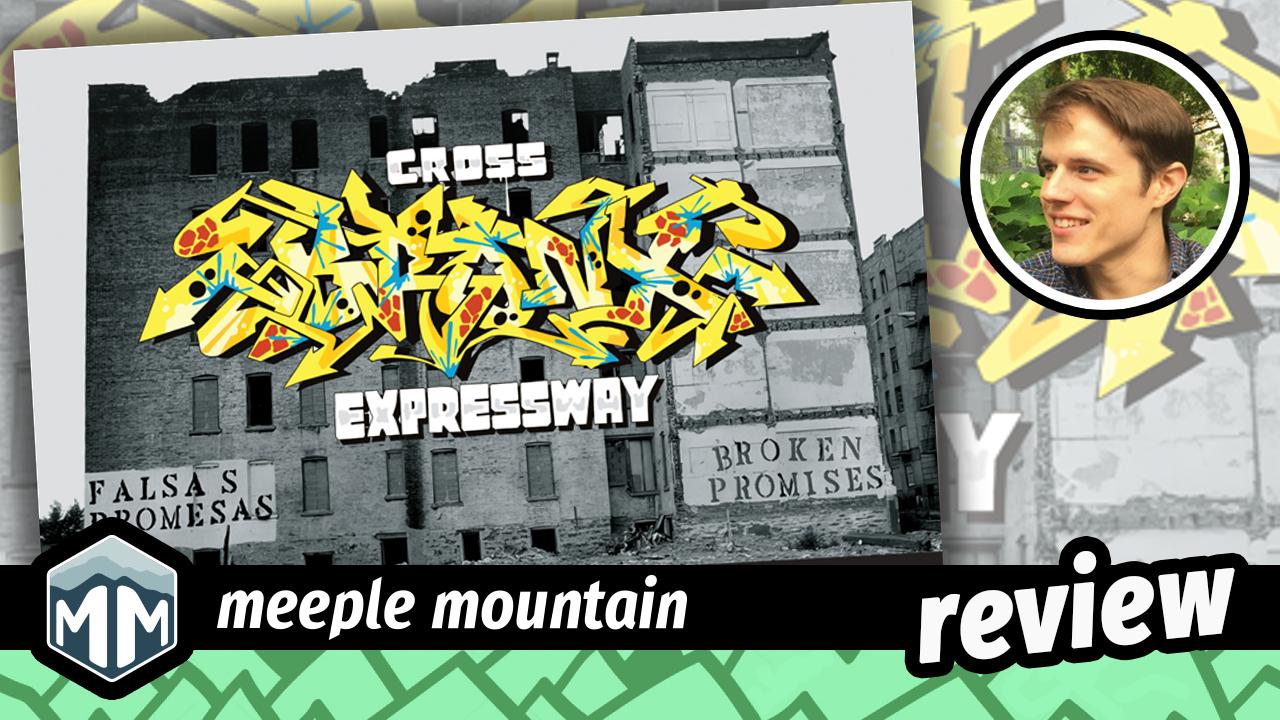
Cross Bronx Expressway, GMT’s third release in the Irregular Conflicts series, is not for the weak. It is exceptionally complicated, even by the elevated standards of a COIN title. A frequent refrain amongst the GMT faithful, and an accurate refrain at that, is that the rules aren’t all that complicated once you get over the hump of learning them. Not so here. For my first game, I gathered three of the finest gaming minds in New York City, all of whom had read the rules in advance, and it still took an hour or two to get things started. This is no doubt in part a function of the theme, the civic management of The Bronx across the latter half of the 20th century. It’s easier to keep rules in your head when they don’t use words like “coalition,” “partner organization,” and “Census Round Audit.” You may find yourself scratching your head and wondering why you didn’t go back to school to get an MB(oard game)A.
Work your way past the daunting exterior and you’ll find a game that is a fascinating mix of the exceptionally confrontational and the utterly inscrutable. Cross Bronx Expressway is a hard game to talk about as a game, in part because the gamic elements are relatively slight in view of the whole. Designer…
Note: This preview uses pre-release components and rules. What you see here may be different from the final, published game. As the new year starts, I thought I’d impart a fact about space. Did you know that current research suggests that the universe may be almost 27 billion years old, almost twice the age we previously […]
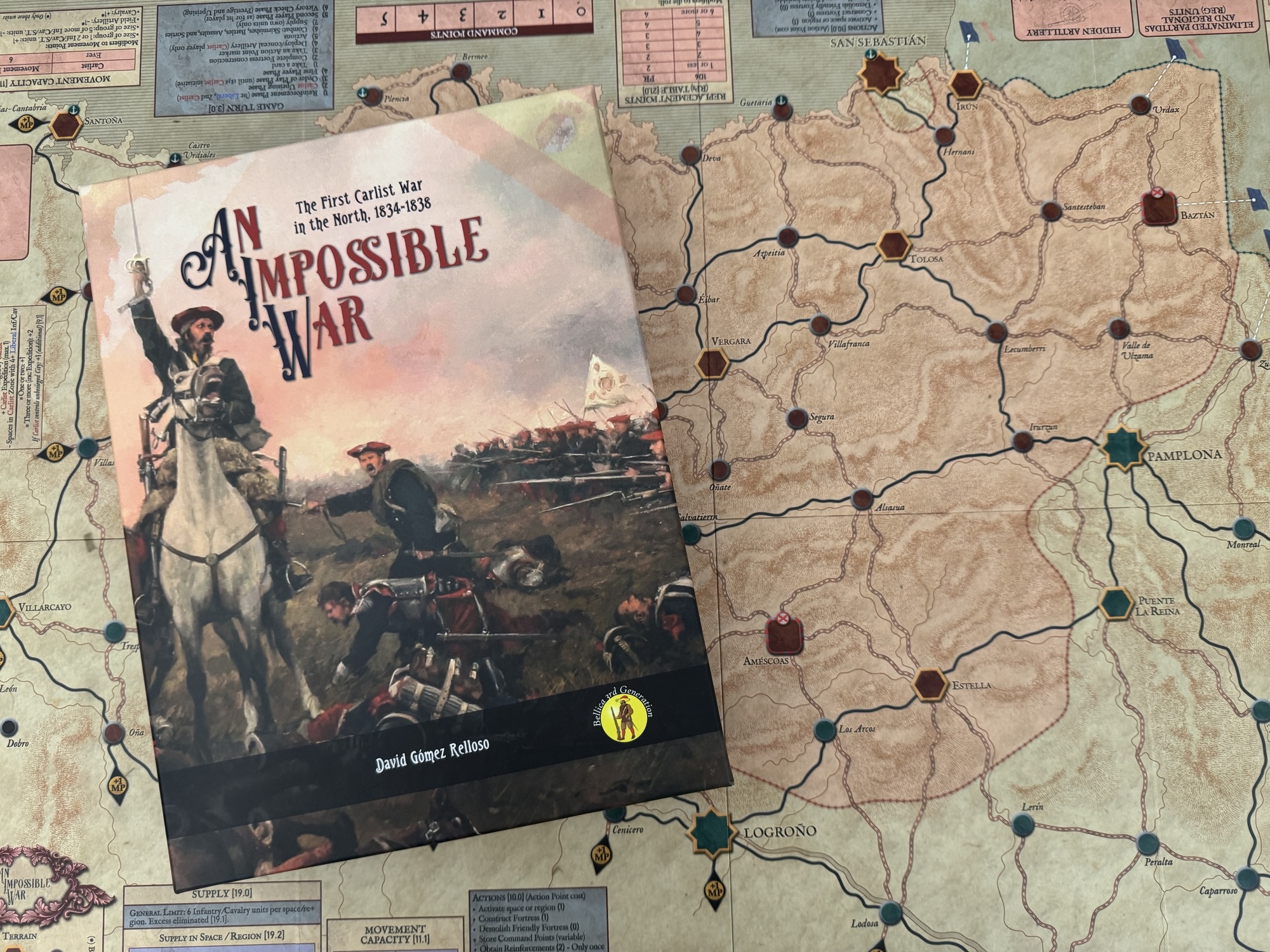
An Impossible War: The First Carlist War in the North, 1834-1838 from Bellica Third Generation is a block wargame that recreates the First Carlist War in the North of Spain which was a civil war between the Carlists who supported the succession of the late king’s brother Carlos de Borbón and the progressive and centralist supporters of the regent Maria Christina acting for Isabella II of Spain who were referred to as the Liberals. The game uses blocks representing units but also includes counters and uses cards. I was able to play the game about a month or so ago with Francisco Ronco who owns the publishing company Bellica Third Generation and very much enjoyed the game and how it represented this interesting struggle.
In this series of Action Points, we will first take a look at the Game Map, discussing the point-to-point movement configuration, the various spaces and the delineation of the Carlist versus the Liberal Zones, as well as explain the use of the Rest of Spain smaller map, examine the units available to both sides and cover the importance of Supply, take a look at the Carlist Uprising Phase and what it means for the game, take a look at the activation system and the use of Action Point Markers, and cover some examples of Battle, focusing on the tactical aspect of combat with the use of the Battlefield Board, as well as an example of a Siege.
Main Game Map
There is a Main Game Map, which is commonly referred to as the Northern Map, shows the northernmost tier of Spain along the coast of the Cantabrian Sea including Navarre, the Basque Provinces and part of Cantabria, Burgos and La Rioja, and a small secondary Game Map that reflects the regions of the rest of the country, where Carlist uprisings break out and the expeditions sent from the North may operate.
The Main Game Map contains various elements including named settlements, such as Towns and Cities, and also identify key Carlist Refuges and has a clear demarcation of Carlist and Liberal territory. There are locations identified by the name of a settlement or area, which can be of greater or lesser importance and size. There are four types of spaces including Cities, Main Towns, Carlist Refuges and Other Spaces.
Cities
Cities are represented on the Game Map by an octagonal shape and the name of the city is capitalized. If the City is Liberal it will be colored turquoise and if it leans Carlist it is colored red. There are five Cities on the Game Map including Bilbao, San Sebastián, Vitoria, Pamplona, and Logroño. All of them have a permanent Fortress as well as an Intrinsic Garrison marker indicating the controlling side. Also, the Bilbao space has a Port, identified by the anchor symbol, because it is connected to the Cantabrian Sea via the River Nervión. If the Carlist player is besieging Bilbao, or controls or is besieging either of the two spaces located next to the river (Portugalete or Guecho), the Port of Bilbao is cancelled for the purposes of naval transport and supply.
Supply is also determined based on 2 things, a Region and then each of the Cities within that Region. A Region can supply up to 6 Liberal Infantry and Cavalry units. But, a Region does not supply any Carlist units, which must obtain supply from a Supply Train or Knapsack in the Region. Without a Supply Train or a Knapsack, in order for Carlist units to get supply they then must attempt to forage. Each space can supply a certain number of units, depending on whether the space is located in the Carlist or Liberal Zone, the type of space, and the side the units belong to. We will cover this a bit more in Action Point 2 when we discuss units.
A player will gain +3 VP’s for capturing a City during the game. These are the most important ways to score in the game and protecting them is vital to either side. It is also important to keep in mind that if the Carlist player ever gains control of 2 Cities at the same time that were initially held by the Liberal player, that player will immediately gain an automatic victory.
Connecting the various Cities and Towns are the Roads. Units can move along these roads and there are 2 types of Roads including Main Roads and Secondary Roads. The Main Roads are indicated by a continuous thick black line while Secondary Roads are indicated by dashed brown lines. The cost of moving along a Main Road is 1 Movement Point and along a Secondary Road is 2 Movement Points. I found it very important to properly plan out your movements to maximize the distance that you can gain with a single action. These roads are somewhat of a spiderweb connecting points and you can reach all points eventually but finding the best and most efficient route is important. Studying the Game Map and the layout of the roads is key to playing the game well as you can block off the use of certain Main Roads and force your opponent ot move much slower on Secondary Roads frustrating their plans and efforts.
Main Towns
Main Towns are generally populated areas that have some political, economic or strategic importance and are identified on the board with a hexagonal shape that is of a similar size and proportion as the Cities. Also, the name of the town will be capitalized the same as the Cities. If the Main Town is Liberal it will be colored turquoise and if it leans Carlist it is colored red.
A player will gain +1 VP for capturing a Main Town that was held by the other side. These are not as valuable as the Cities but there are more of these on the Game Map than the Cities with 13 Main Towns as compared to only 5 Cities. Prioriting their capture and control is important for many purposes such as Supply, movement and being able to avoid interceptions and
Carlist Refuge
There are 2 Carlist Refuges identified on the Game Map including Améscoas and Baztán. These are spaces where the Carlists are particularly favored by geography and local popular support. Neither player may construct fortresses in these spaces. These Refuges are identified with a square with an X at the top and a dashed brown line.
Carlist Zones and Liberal Zones
The Carlist Zones take up a considerable portion of the Game Map which is denoted with a red shaded background and a dotted red line. All locations within it are considered to be in the Carlist Zone, while all locations outside of it are considered to be in the Liberal Zone. Also, spaces adjacent to the Carlist Zone are spaces belonging to the Liberal Zone, but that are connected via a road to any space within the Carlist Zone.
The Carlist units in the game are tied to specific localities—Navarre, the Basque Provinces, or “Castilians”—rather than a standard, monolithic national army and are numerically outnumbered by the Liberals. As such, they have a clear need to be nimble and move around the board causing difficulties. One of the ways the Carlist player scores Victory Points through the increase in Prestige is by is controlling at least 4 spaces with at least 4 units. If there are at least four Liberal infantry or Cavalry units in the same space in the Carlist Zone 1 is subtracted from the sum of besieged Cities and active Expedition.
Essentially, the zone embodies the “Impossible War” by forcing the Carlist player to maximize localized, high-quality forces in their home territory against a numerically superior foe. The Carlist player increases their Prestige by besieging cities and launching expeditions. They also benefit from the growing Carlist uprising in the rest of Spain. The Liberal player will be busy countering Carlist Prestige, putting down uprisings, and hunting down expeditions. They have the advantage that, in the long run, war fatigue will affect the enemy.
The terrain is simple with each space containing rough or open terrain, depending on the relief of its area. Much of the northern geography was rugged, which played an important role in favor of Carlism, as it mitigated three of the advantages of government troops: their superiority in numbers, cavalry, and artillery.
The spaces at the western, southern, and eastern ends of the map have connections to regions on the map of the rest of Spain, which can be used to move from one map to another.
Finally, the Game Map includes various game tables (Year, Turn, Initiative, Victory Points, Carlist Prestige, etc.), as well as a lot of information about commonly used rules, so players don’t need to consult the rulebook that often.
Rest of Spain Smaller Map
The map of the Regions of Spain is smaller and simpler. It consists of nine large regions that cover large territories. This map’s purpose is to record the spread of the Carlist uprisings, to enable Carlist expeditions to operate and for the Liberal player to hunt them down. We will take a closer look at the Carlist Uprising Phase in a later post but I wanted to show you the map so you understand its layout.
I very much enjoyed An Impossible War, even though I played just a few turns of a smaller scenario with Francisco Ronco. He was a master at the game, as obviously as the publisher and a playtester he is intimately familiar with the rules and strategies, and I learned a lot from him about how the game should be played. I am looking forward to future plays as the game is just very good and has some interesting aspects that create a very tense and interesting game of maneuver and strategy. The Game Map is very well done, from an aesthetic perspective as well as functionally, and the board makes playing the game easier.
In Action Point 2, we will examine the units available to both sides and cover the importance of Supply.
Hello everyone! I'm Eugene, founder of Genie Games and creator of Rats to Riches, Peranakan: Tiles and Tactics, and Singapore Showdown. This is my first time ever writing a guest blog, and I'm incredibly honoured to be given this opportunity by Oliver to share my story with you. As the title states, I'm 29 years old as of writing this. Nine months ago, I quit my job as a Singaporean Navy Officer, to start my own company to design and publish board games full-time. How did I end up here? Well, the answer to that goes back 20 years ago.
The American Tabletop Awards, an awards scheme launched seven years ago with the aim of being the US equivalent of Germany’s Spiel des Jahres, has unveiled its 2026 winners.
ATTA’s Early Gamers award is focused on titles suitable for younger gamers and players new to modern board gaming, while the Casual Games awards looks at games suitable for all experience levels that can be played in 30 to 60 minutes.
This year’s Strategy Games prize went to Matt Leacock’s pandemic spinoff The Lord of the Rings: Fate of the Fellowship, while the Complex Games title went to Jo Kelly’s and Cole Wehrle’s design Molly House, which explores the joy and fear experienced by gender-defying Londoners in 18th century society.
CMYK was the standout publisher with two wins out of the four categories. Asmodee studios won one award and picked up three other nominations, while Flatout Games picked up recommendations for both Cascadia Junior and Knitting Circle.
Alex Cutler was the only designer to appear twice among the finalists, scoring a nomination for his co-design Critter Kitchen and a recommendation for co-design A Place For All My Books.
The ATTAs are voted on by members of the US board game media, who each submit up to five games from the previous calendar year, which are then ordered according to ranked-choice vote.
Awards co-founder Eric Yurko, who runs board game review site What’s Eric Playing?, said, “The past few years have been great for games, and 2025 was no exception.
“There were great moments and releases throughout, so we’re very excited to present these awards to the best games we played in 2025.”
Early Gamers Winner: Magical Athlete – designed by Richard Garfield and Takashi Ishida (published by CMYK Games) Nominated: The Sandcastles of Burgundy – Stefan Feld and Susanne Feld (Ravensburger) Nominated: Splendor Kids – Marc André and Catherine André (Space Cowboys / Asmodee) Recommended: Cascadia Junior – Fertessa Allyse and Randy Flynn (Flatout Games) Recommended: Duck and Cover – Oussama Khelifati (Captain Games)
Complex Games Winner: Molly House – Jo Kelly and Cole Wehrle (Wehrlegig Games) Nominated: Tidal Blades 2: Rise of the Unfolders – Tim Eisner and Ben Eisner (Druid City Games) Nominated: Covenant – Germán P Millán (Devir) Recommended: Above and Below: Haunted – Ryan Laukat (Red Raven Games) Recommended: Galactic Cruise – TK King, Dennis Northcott and Koltin Thompson (Kinson Key Games)
Yotei Designer: Huy Pham Publisher: Mighty Boards Players: 2-4 Age: 8+ Time: 30-60 minutes Kickstarter link: https://www.kickstarter.com/projects/mightyboards/yotei Played with review copy provided by publisher Create the most charming town at the foot of Mt Yotei, also known as Ezo … Continue reading →
Watergate is a two player game about the Watergate scandal involving President Nixon. One player is the newspaper editor trying to gather evidence, link them to Nixon and expose the scandal. The other player is the Nixon administration, trying to prevent this and attempting to win by lasting till the end of the presidential term.
The game board is a network of links with

 Anmelden



/pic6102428.png)