In Mercenaries Wanted you take on the role of a mercenary company leader, recruiting mercenaries to complete jobs for you. Assemble your teams carefully and send them out on assignment to earn the most gold. Between rounds, decide who to keep in your roster, who to promote, and who to let go. Race to complete jobs over several rounds before competing with your promoted mercenaries in a series of tournaments to earn the most fame and fortune.
As head of a Mercenary Company, it's your job to find the best recruits the city has to offer. Or at least the most promising ones. Are they breathing? Let's be honest, you'll take what you can get in the city of Gloomhaven.
Recruit, equip, deploy, and out-hire your competitors to become the most infamous Mercenary Company in Casskia. So get to it! The unemployment line is drying up... MERCENARIES WANTED.
▪️ Also, be sure to check for the Frosthaven Digital release on October 15, 2026!
Using enchanted lanterns, you'll reveal only parts of the artwork at a time, searching for creatures, characters, and treasures hidden throughout each magical scene.
Work together (or against each other!) to uncover everything before time runs out, but stay alert: every corner of the kingdom holds new surprises.
Light your enchanted lantern, gather your fellow adventurers, and discover what secrets await in the darkness.
Easy to learn, fast to play, and perfect for families and groups of all ages, Spotlight Fantasy combines cooperative gameplay, stunning illustrations, and a touch of magic to create an experience that... Shines at every table!
▪️ The beautiful Kano was just available at Gen Con and will be available later this year. Kano is from Matagot and designers Pablo Jiménez, Angel Pintero. This game plays 2-4 players and takes about 30-40 minutes to play.
From the BGG page:
In Kano, 2 to 4 players compete to create their own Emakimono—traditional Japanese painted handscrolls—by skillfully arranging vibrant paint pots. The game elegantly blends tactical resource management with spatial optimization as players navigate a shared central mat to collect the pigments needed for their masterpieces.
You've found a mysterious box filled with strange cards. As you try to decipher their meaning, you soon realize that you won't be able to do it without help. Surrounded by your friends, you begin to unravel their secret: played the right way, the cards eventually disappear. But they always come back, safely tucked away in the box, for the next game.
In Omens, you team up to get rid of your cards until you have only one left in your hand.
Each of your cards interacts with the cards played by your partner, as well as those of your opponents, so you need to play them at the right moment! The team that sheds its cards first wins.
▪️ Shape it from Randolph is a new cooperative party game from designer Thomas Dagenais-Lespérance (Decrypto). You have to mind-meld with all players to best guess the correct answer with the creations you make using the available shapes. A game for 2-7 players!
From the newsletter:
Sync minds with teammates to guess the correct words! Shape It is a cooperative game in which players move shapes to try to guess a word. What word is your group trying to illustrate? That’s the game - you don't know for sure! But it has to be on one of the 5 cards on the table. When it comes time to guess - will you all see the same word in the shapes you’ve placed? Good luck!
North America’s biggest tabletop gaming convention, Gen Con, has continued its record-breaking run after more than 74,000 attendees left this year’s sold-out show bursting at the seams.
Gen Con’s latest hefty attendance figure extends its steady post-pandemic growth, following record crowds of 70,000 in 2023, 71,000 in 2024 and almost 72,000 last year – which all broke the 2019 pre-pandemic high.
But the convention, which has sold out before opening for three consecutive years, is operating at a hard capacity ceiling at the Indiana Convention Centre. Gen Con president David Hoppe told the Indianapolis Business Journal last year that the show’s growth had left it “capacity constrained”, saying: “We fill every nook and cranny of this downtown core area.”
Gen Con attendance figures since the show moved to the Indiana Convention Centre in 2003
He added in that interview that he would love to get 80,000 attendees at the show some day – and Gen Con is set to take a step closer to that goal for its 60th anniversary show next year thanks to a significant floor space expansion and opening of a new Signia by Hilton hotel.
That expansion includes an extra 143,500 sq ft of floor space – roughly the size of 2.5 American football fields – and 800 new hotel rooms.
Gen Con’s organisers did not say how many extra exhibitors or attendees the expansion is expected to accommodate, how much of the new space will be devoted to the exhibition hall.
Exhibitor and vendor numbers reached almost 800 at the packed out four-day event, Gen Con said. The show reported a then-record 575 exhibitors showcasing their wares last year, although the inclusion of “vendors” makes it unclear if the 2026 figure is directly comparable.
Gamers playing at Gen Con 2026
BoardGameWire contacted Gen Con’s press office earlier this week for confirmation on how much additional capacity next year’s expansion will create, and for clarity on exhibitor numbers in 2026, but is yet to receive a response.
This year’s convention also faced an unexpected operational test after severe thunderstorms prompted a tornado warning on Saturday evening, and caused water to shower down into parts of the Indiana Convention Center.
The worst affected areas were the convention’s playtest area and part of Exhibit Hall B, with attendees told to relocate to safer parts of the building while the warning was in place.
Exhibitors affected included Tycoon Games, with managing director Ben Rathbone telling the Indy Star, “As we were doing our demos and tournaments, drop of rain started coming through the ceiling up there.
“We immediately started pulling our stuff back, then there was a deluge came down, flooded the whole floor there, and we had to move all our games and store them out of the way.”
He added that the publisher’s games had been damaged “only a little bit”, saying that most of them were out of the way.
Gen Con said staff responded quickly to ensure safety and make repairs, adding that there was “minimal disruption” to the convention due to the leak.
This year’s event was also impacted by heavy amounts of construction work taking place around the convention site, leading to large build-ups of foot and vehicle traffic.
Gaming taking place in the Lucas Oil Stadium at Gen Con 2026
Gen Con president David Hoppe said of this year’s event, “Even through construction and thunderstorms, Gen Con 2026 was bigger and better than ever, with a record-breaking number of attendees gathering in Indianapolis for the best four days in gaming.
“We can’t thank Indy enough for hosting us, and we’re already looking forward to our 60th anniversary convention in an expanded Indiana Convention Center next year.”
Next year’s Gen Con is scheduled for August 5 to 8, with badges set to go on sale in early 2027.
Icaion, the impossible to pronounce sequel to the equally slippery Mysthea, has been reviewed by BGQ before. Spencer covered the multiplayer game and came away less-than-impressed. This time, we’re diving into Icaion solo, with some multiplayer thoughts sprinkled in as well. Icaion, from Martino Chiacchiera and Marta Ciaccasassi, with art by Travis Anderson, and published […]
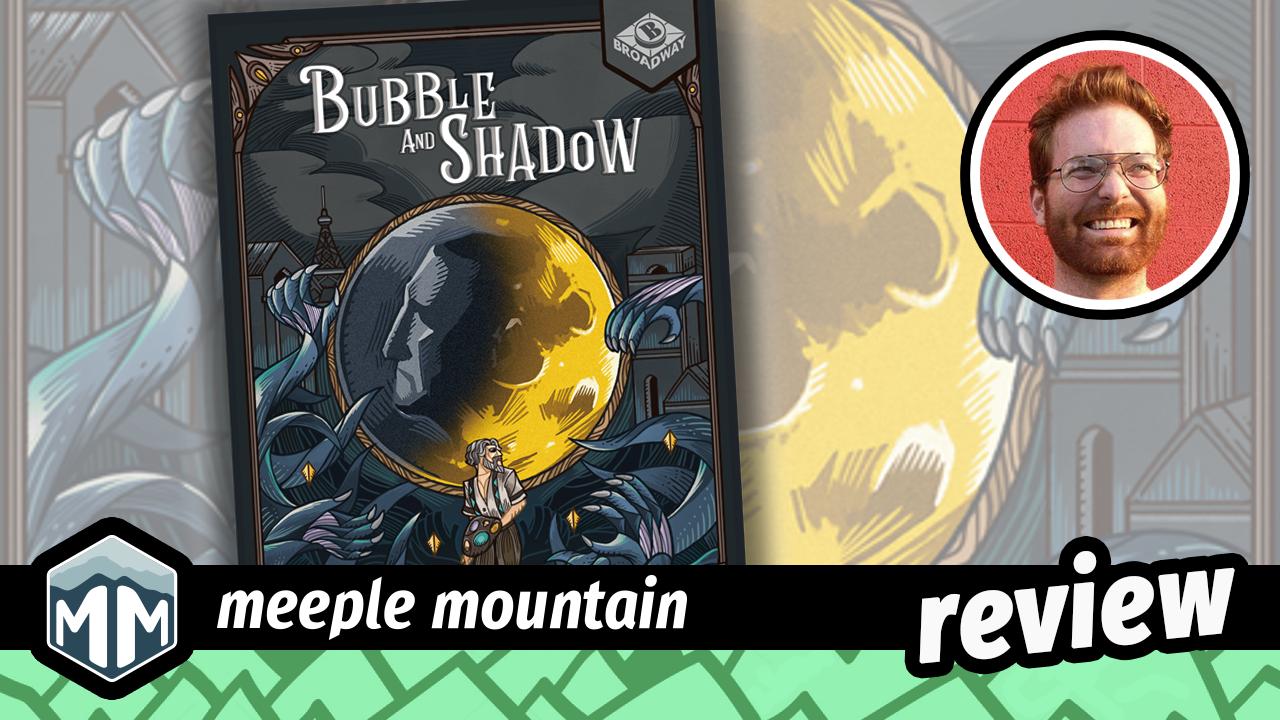
I reviewed Snake Charmers awhile ago, and I found that experience punchy and delightful. Now, I’m feasting my eyes on Bubble and Shadow, a game that is prettier, slightly more complicated, and ultimately, flatter.
The game has lofty ambition, noting as its inspiration W. Somerset Maugham’s The Moon and Sixpence, but I’m not sure if any of that translates. I’ve only read Of Human Bondage, and I ~think~ the aforementioned story is a fictionalized account of Paul Gauguin’s life or something, but I couldn’t for the life of me find how this game was related, other than it having really cool paintings on the cards.
Anyway, the objective of the game is to collect the right distribution of three types of wooden token: If you have the most purple tokens (bubbles), you’ll be eliminated from the scoring consideration at the end of the round. Then, if you have the fewest gray (coins) you score a point and are removed from the scoring. Finally, the player with the most yellow (moons) gets three points, and second most gets two points. You play three rounds, and if someone gets to five-plus points before that at the end of a round, the game ends and the player with the most points wins.
With this My Favorite Wargame Cards Series, I hope to take a look at a specific card from the various wargames that I have played and share how it is used in the game. I am not a strategist and frankly I am not that good at games but I do understand how things should work and be used in games. With that being said, here is the next entry in this series.
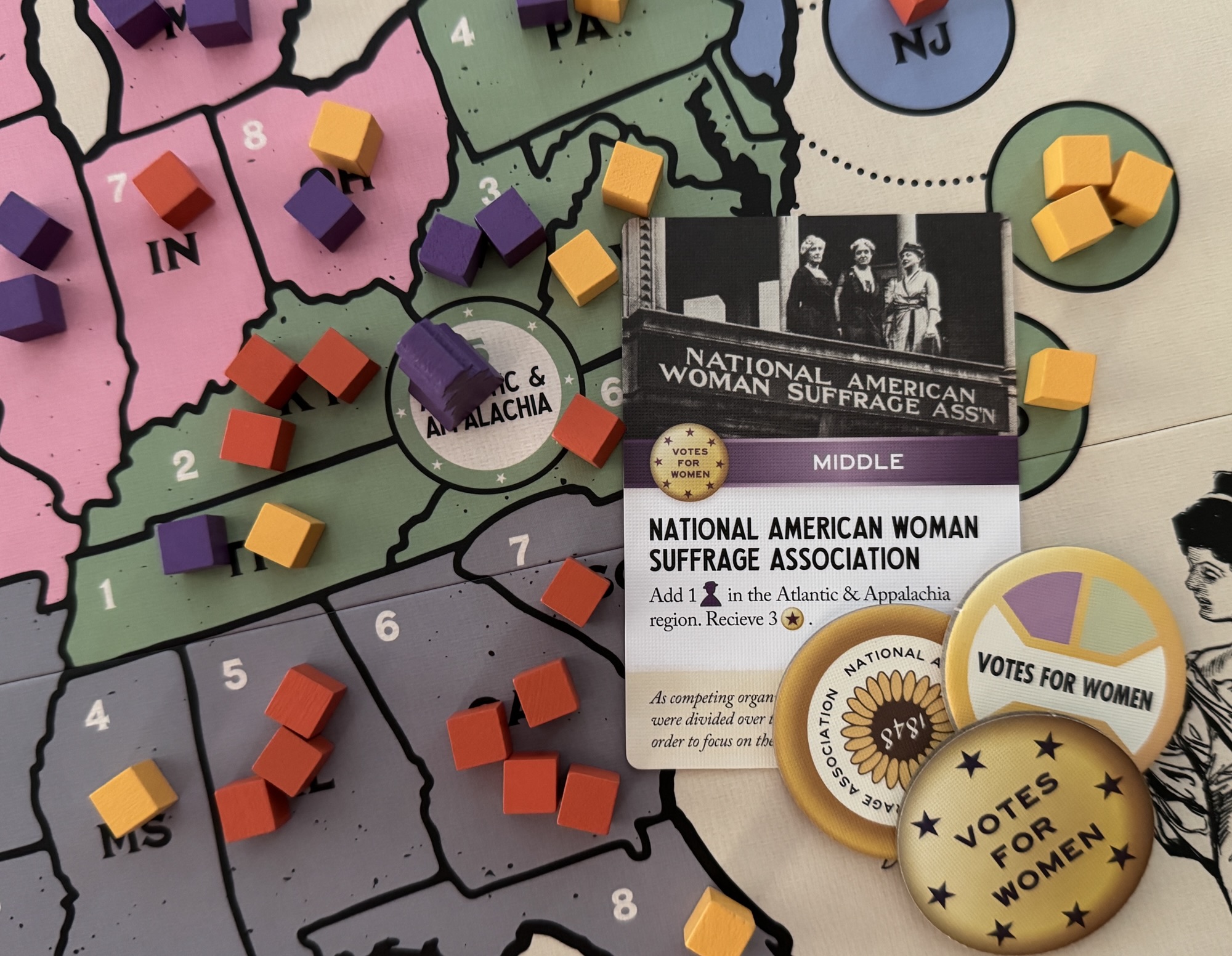
Card #88: National American Woman Suffrage Association from Votes for Women from Fort Circle Games
Votes for Women is a very interesting card-driven game that covers the American Women’s Suffrage Movement from 1848-1920, culminating in the ratification of the Nineteenth Amendment which granted women the right to vote. The game is a 2-player game, that has a fully developed solitaire mode with an “Oppobot” and offers a cooperative mode for those who don’t wish to play as they Opposition. The Suffragist player will have to push Congress to propose the Nineteenth Amendment, and then focus on campaigning to have a minimum of 36 states to ratify the Amendment. The Opposition side will try to prevent Congress from proposing the amendment and failing that to have 13 states reject the amendment.
The game uses cards in a fairly traditional CDG way as there are events that can be be taken or the cards can be played to do things like Campaign, Organize or Lobby Congress. Each card has a specific Card Era that is used to create of the each players’ Draw Decks. Late cards will be on the bottom of the deck, Middle cards will be in the middle of the deck and Early cards will be on the top of the deck. The Suffragist and Opposition decks each have one Start card that will be placed in the player’s hand at the start of the game. Some Event Cards have a prerequisite and some of the cards require a player to roll a 6-sided die and only take the the action on a roll of 3-6. Otherwise, the Event Card is discarded with no effect. The cards in this game are also steeped in historical details, from the name of the events that tie back to specific individuals or happenings, to major moments in the struggle. This game is about the history of the struggle for the right to vote and it is very good!
One of the more interesting aspects about the mechanics of the game is the use of Campaigners to go about trying to influence the attitude of the people and legislators regarding the Nineteenth Amendment through the Campaign Action. When a card is played for a Campaign Action, the player rolls a die, either a 6-sided or 8-sided die depending on what cards have been activated, for each Campaigner they have in play. The player then gets to take the dice and their results, which range from 1-8, and assign a specific die to each of their Campaigners. Each Campaigner may then place the corresponding number of cubes, matching the Campaigner’s color, in the States within the region that the Campaigner is located in. The player may spend a Button to move the Campaigner to a different region, but all of the corresponding cubes must be put into the same region. This is a great way to get a lot of influence out on the board to begin taking control of various States for the final vote in the game. This also is a very efficient way of doing this as you will be rolling 2-3 dice for your Campaigners and then spamming the States. With that in mind, today’s card is the National American Woman Suffrage Association and it provides the Suffragist player with a new Campaigner (purple) to place out specifically into the Atlantic & Appalachia Region that includes the States of Kentucky, Tennessee, West Virginia, Pennsylvania, Virginia, North Carolina, Maryland and Delaware. The card also grants the Suffragist player with 3 Buttons that can be used as described above to relocate a Campaigner from one state to another. This card is very helpful and should be played for the Event 9 times out of 10 and will make a huge difference in the outcome of the game. Once a 2nd or 3rd Campaigner is deployed, I tend to take Campaign Actions rather than some of the less intensive placement options or Events.
The National American Woman Suffrage Association (NAWSA) was an organization formed on February 18, 1890, to advocate in favor of women’s suffrage in the United States. It was created by the merger of two existing organizations, the National Woman Suffrage Association (NWSA) and the American Woman Suffrage Association (AWSA). Its membership, which was about 7,000 at the time it was formed, eventually increased to 2 million, making it the largest voluntary organization in the nation. It played a pivotal role in the passing of the Nineteenth Amendment to the United States Constitution, which in 1920 guaranteed women’s right to vote.
Helen Hamilton Gardener, Maud Wood Park and Carrie Chapman Catt at Suffrage House in Washington, D.C.
Susan B. Anthony, a long-time leader in the suffrage movement, was the dominant figure in the newly formed NAWSA. Carrie Chapman Catt, who became president after Anthony retired in 1900, implemented a strategy of recruiting wealthy members of the rapidly growing women’s club movement, whose time, money and experience could help build the suffrage movement. Anna Howard Shaw’s term in office, which began in 1904, saw strong growth in the organization’s membership and public approval.
After the Senate decisively rejected the proposed women’s suffrage amendment to the U.S. Constitution in 1887, the suffrage movement had concentrated most of its efforts on state suffrage campaigns. In 1910 Alice Paul joined the NAWSA and played a major role in reviving interest in the national amendment. After continuing conflicts with the NAWSA leadership over tactics, Paul created a rival organization, the National Woman’s Party.
Here is a link to our full video review of the game:
Ticket to Ride: London Designer: Alan R. Moon Publisher: Days of Wonder Players: 2-4 Age: 10+ Time: 10-15 minutes Played with review copy provided by Asmodee Ticket to Ride: London features the familiar gameplay from the Ticket to … Continue reading →
So I didn’t attend TGM but I did manage to acquire a few games. TGM designers continue to astound me with clever designs for trick takers and shedders as well as capturing unusual themes. Here are some of the stand … Continue reading →
Let’s play poker but in a different way. There has been several modern hobby
games which make use of poker hands, e.g. The Gang. The good thing
about these games is they use an aspect which most people are already familiar
with. It will be easier for us gamers to convince our non gamer friends to try
modern boardgames with us.
Half of All-In: Predictions is
Nutgoo.Lee’s Blancat made my seven-year-old cry. I know. That’s a movable bar. She was tired from a long day of playing in the sun, but she wanted to try the “kittie quilting game” anyway. It ended in tears. That’s on me, not Blancat, and certainly it isn’t on Nutgoo.Lee.
But here’s the thing: she practices at Blancat. She sits on her own at the table and studies the little templates and does her best to craft the quilts. She’s played plenty of other board games. She even has her favorites. Right now, that means Barbecubes and A Gentle Rain. Tactile stuff, not all that far removed from Blancat, but simpler, with lighter stakes. This is the first game I’ve seen that’s made her studious. The first game that’s meant to be challenging. Her intensity makes me wonder if there’s something here that I didn’t see right away. They say children let you see the world through new eyes. It seems the same goes for board games.
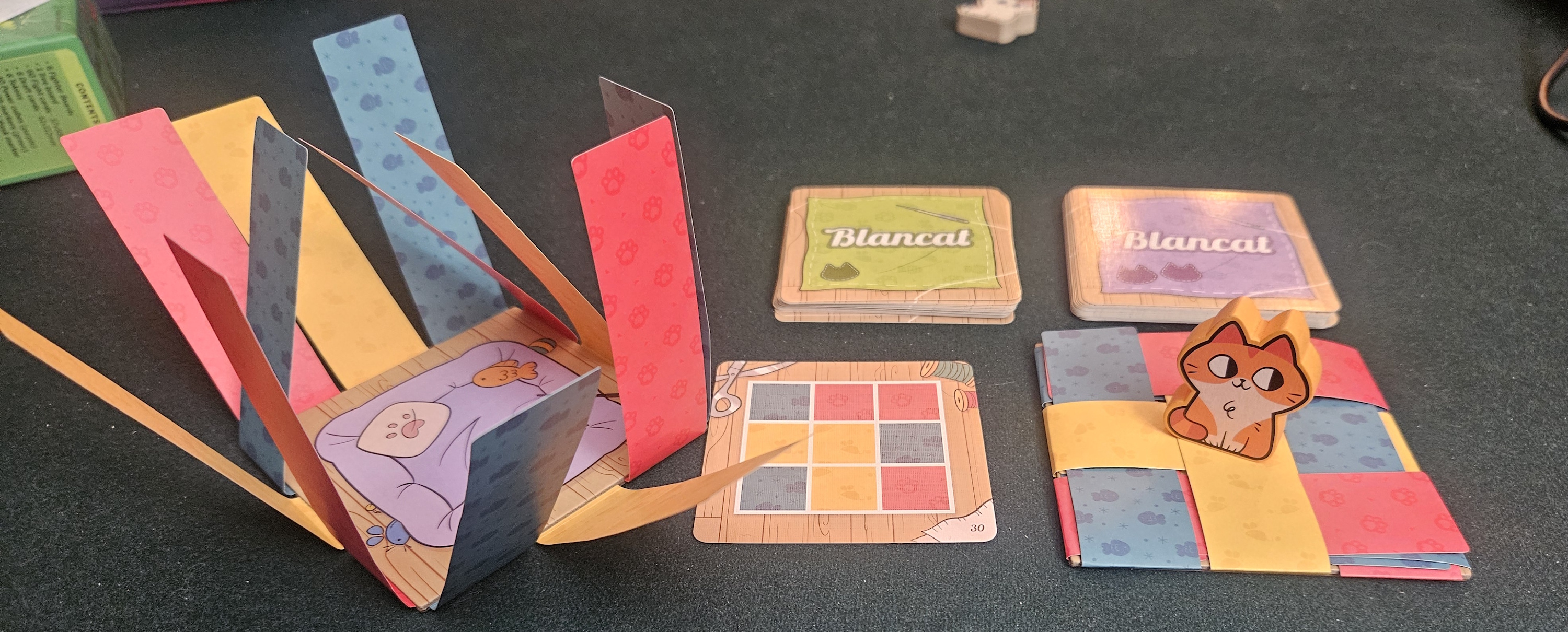
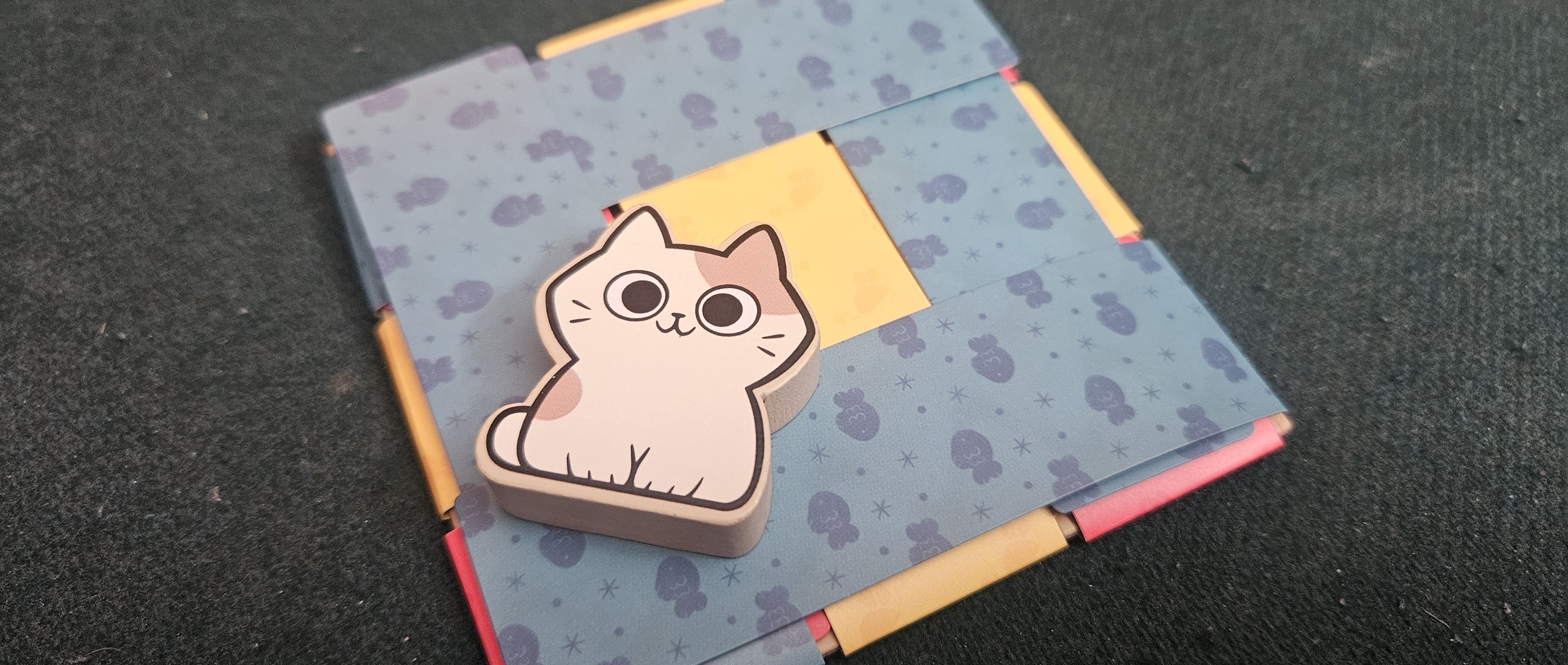
Everything you need to make a blanket.
Blancat is about making blankets for cats. It’s a simple concept. You draw a card that shows a pattern. Everybody races to make the pattern, folding strips of stiff paper over and under one another. Upon completing your blanket, you grab a kitten. Last one out is a rotten egg. Then you play again. Nominally, there’s a scoring system. Honestly, we’ve never bothered. It’s the sort of game you play until the little ones want to do something else.
I’m not opposed to simplicity. Indeed, simplicity is often a synonym for elegance. But there’s a tendency in this hobby to hoist a ceiling over certain games. Too simple and the game is for kids. Too small and we’ll cap its rating at 7/10 on BGG. It doesn’t matter whether this is our most-played game of all time. It’s still not a serious game. Because it’s small. Because it’s simple.
Blancat is both small and simple. But watching my seven-year-old play it, I can tell you it’s the most serious exercise ever devised.
Blancat works for kids, but the advanced templates are surprisingly hard to craft.
There are two types of patterns, separate decks that offer vastly different degrees of challenge. The easy deck fits the description. As long as you have the gross motor skills of a toddler, you’ll get there.
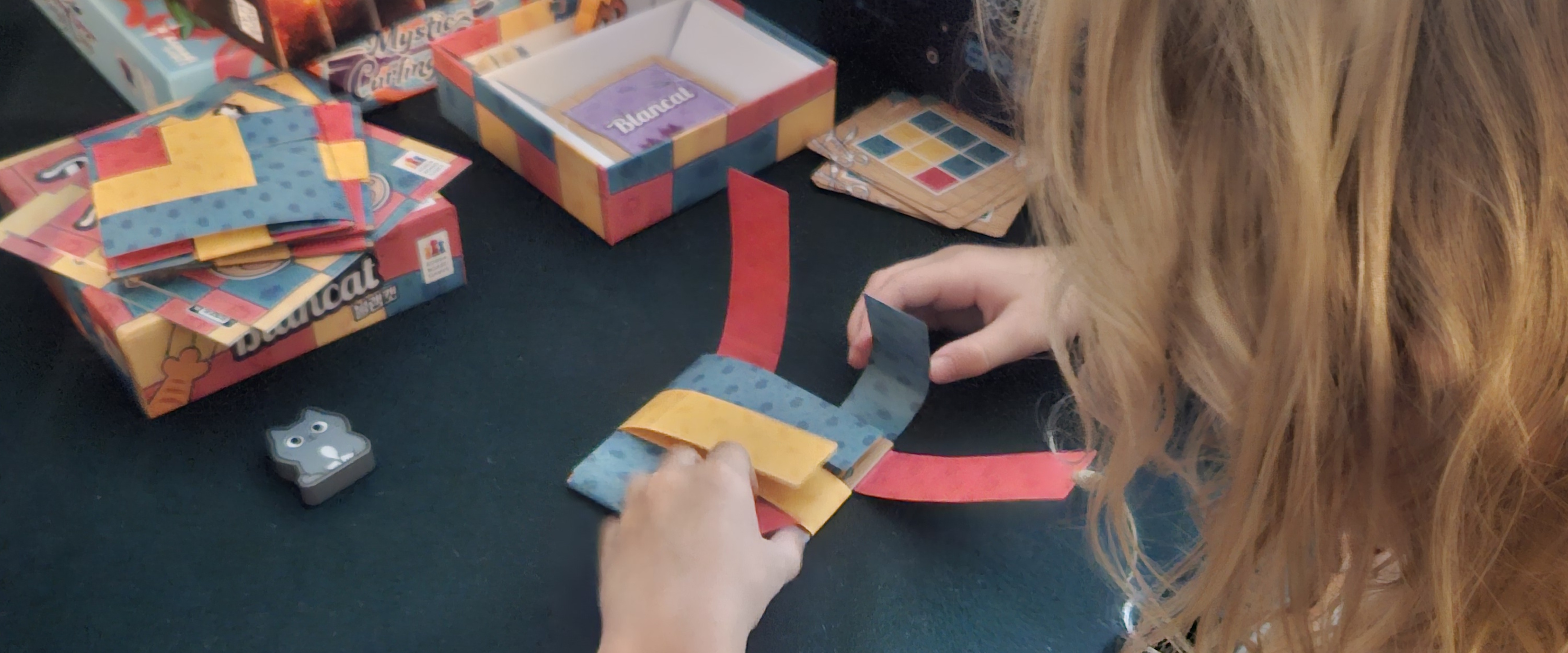
But the hard deck is nasty. It isn’t enough to just fold down those strands willy-nilly. A successful pattern takes forethought. Blue over yellow. Red tucked between two strands, then folded upward. Blue back through the yellow and the red… wait. How exactly is this supposed to work? For twelve cardboard flaps, there’s surprising tactility at play. A strand that seemed like it went here might suddenly need to go there. A ribbon that was previously buried might become crucial, necessitating a last-second excavation. I’ve had easier times sewing actual quilts, and that’s no boast.
There’s an element of muscle memory to these challenges. It’s like playing with a Rubik’s Cube. At first, you’re just fiddling. Only later do you develop the sense for how to move things around. Eventually, it becomes second nature. To such a degree, in fact, that the whole thing stops being impressive and becomes an exercise in rote execution. When’s the last time you were impressed with somebody solving a Rubik’s Cube? I had a friend who could solve one while bouncing on a trampoline. Ten or fewer bounces, I think.
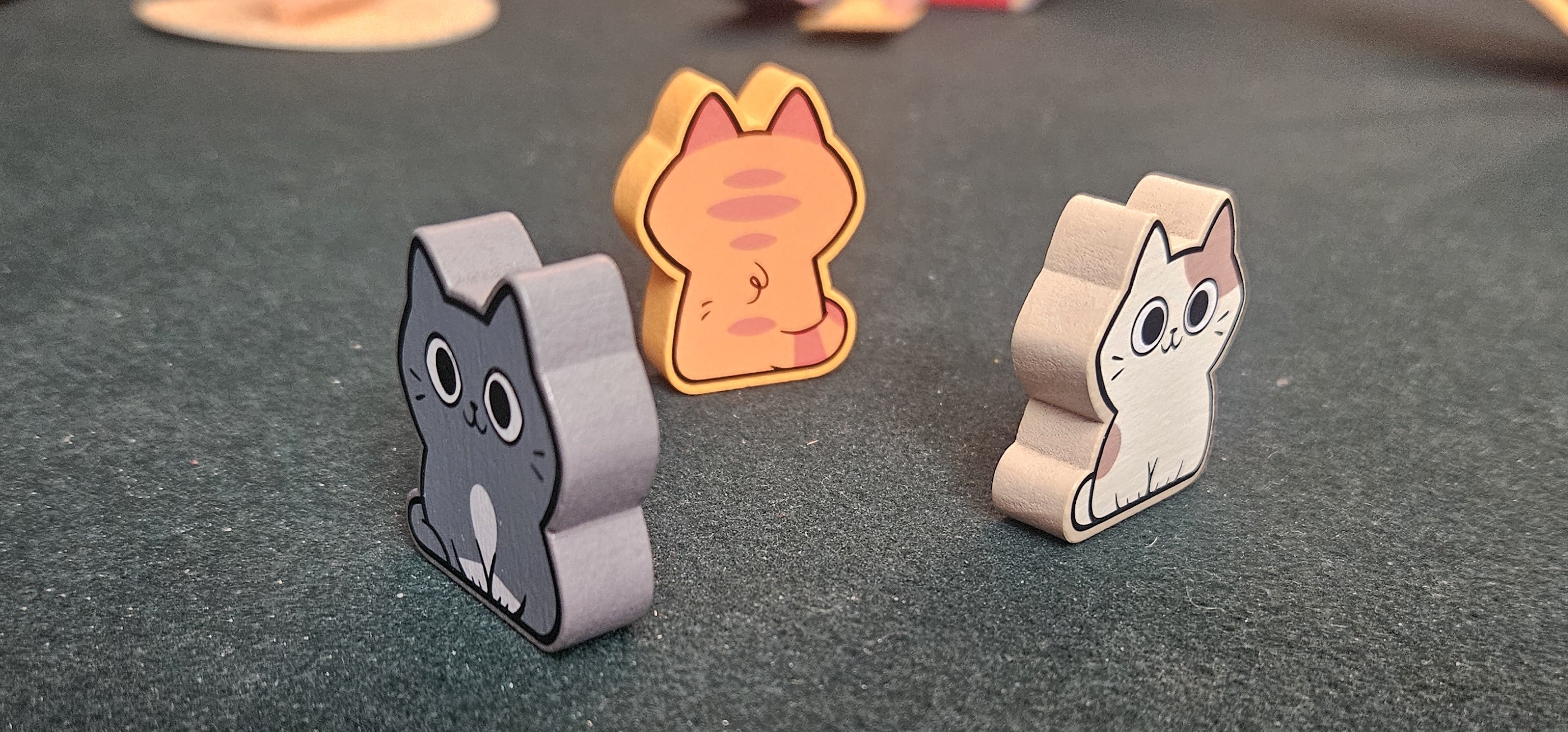
Three little kitties.
Of course, it’s all relative. Put that Rubik’s Cube in the hands of a child. Now we’re cooking. Because Blancat isn’t rote for my seven-year-old. Not yet.
For adults, Blancat is about speed. Such speed that I worry those little paper flaps will tear. Such speed that it’s like watching my high school friend take the highest, laziest bounces on the trampoline, so high and lazy he could spin that Rubik’s Cube a dozen times before his feet returned to the mesh. It was fun trick to watch, the once.
But with her? With my youngest kiddo? For her, it isn’t about speed. It’s about deliberation. It’s about thinking through this new logic. It’s also about kittens, because she loves kittens. But when she’s in that zone, the strands worked in her little fingers, even the kittens become secondary. She stops grabbing them for a hug. Instead, she’s all focus, weaving one flap over the other, pausing in confusion when something doesn’t line up, reversing her decisions, reassessing.
Watching her play Blancat is like watching her grow up in time-lapse. Her brain making new connections in real-time. Her fingers growing more limber. Her sense of self forming a new confidence. It makes my sternum watery. To see her. To feel such awe at her. To wonder at the span of us, our human family, striking flint into tinder, the spark igniting liftoff for a rocket ship. We grow up so fast.
Snug as a bug in a rug.
Blancat. That’s what we’re talking about.
Is it a good game? I have no idea. I think it is. For what it is. For a game that’s simple and small, but also surprisingly large. For a game that’s one thing to adults and another thing entirely to children. For a game about folding strips of paper ribbon over and under one another. For a game with wide-eyed kittens on its cover.
Honestly, I don’t really care about all that. What I care about is the way my child studies its ribbons, folding and folding, and then, when the pattern is done, reaches out and plucks a wooden cat from the table, and places it atop the quilt, and then, in a voice so quiet I can tell it’s reserved for herself alone, whispers in triumph, “Meow.”
A complimentary copy of Blancat was provided by the publisher.
(If what I’m doing at Space-Biff! is valuable to you in some way, please consider dropping by my Patreon campaign or Ko-fi. Right now, supporters can read the next installment in my series Talking About Games, this time tackling the topic of what makes a good list! Naturally, the piece includes a list.)
Asmodee has kicked off its new financial year with another powerful quarter of growth, with the publishing and distribution giant’s net sales soaring 20.9% year-on-year to €422.1m.
But board games also put on a strong showing in the April to June quarter, the report shows, with net sales rising 16% year-on-year amid an ongoing recovery from volatility caused by last year’s US tariffs uncertainty.
Much of that increase came via Asmodee’s distribution of titles from other publishers, with sales of its own published titles only growing 1.8% in the quarter.
That small rise marks a significant improvement for Asmodee’s own board game publishing operation, however, with sales of its published titles having fallen almost 10% in January to March compared to the prior year, and 12.7% in the all-important October to December period in 2025, which includes the run-in to Christmas.
Asmodee CEO Thomas Koegler said growth in US board game sales was driven by “the continued normalization of retailer inventory levels”, as well as “resilient” consumer demand for tabletop games and positive impact of its own commercial and marketing initiatives.
That improvement comes after Asmodee repeatedly highlighted retailer inventory reductions and cautious purchasing behaviour – particularly in the US – through much of the past year, as store owners tried their best to navigate rising prices, unpredictable shipping rates and other fallout from the US tariffs.
Three months later, the company reported US quarterly sales had slumped 23%, attributing much of the decline to retailers reducing purchases and ongoing inventory adjustments despite stable consumer sell-through.
Asmodee’s quarterly sales for April to June 2026, split out by geographical region
Some of those pressures now appear to be easing, although Asmodee’s own US sales were down almost 9.4% year-on-year in April to June – a situation Koegler said was partly caused by the timing of its most recent Star Wars Unlimited release affecting year-on-year comparisons.
Speaking more generally about Asmodee’s board game sales, he said its evergreen franchises such as Catan and Dobble/Spot-It! continued to perform well, and highlighted other new releases including dnup, The Lord of the Rings: Fate of the Fellowship and Cozy Stickerville as having contributed to growth.
I am Joey Voskamp, a Canadian designer of a small box card game called The Big Haul. This diary will shed some light on the process of making this game!
Still on the Beach In early 2025, my wife and I were travelling on the auto train from Sanford, FL to Lorton, VA on the way home from a family vacation. The train ride was set to last 14 hours, so I set a goal for myself that I would design a game while we travelled.
“Hey Jess, give me a theme.”
“The ocean.”
I had just received Air, Land, and Sea for Christmas and loved the idea of a small deck of cards that can all have different abilities. I had also just read the rulebook for Seaside and loved the final scoring. Whoever has the most tiles in their stack wins. So simple. What often happens when I learn new games is I think about how I would make a game using the mechanics I just read about. I often do this before even playing the game! With these two inspirations in mind, it was time to make a game about the ocean.
I decided right from the beginning that this game was going to be about scoring cards, and whoever had the most cards at the end wins. Thank you, Seaside. A lot of feedback I got from players while playtesting were questions along the lines of “wait, everything is worth the same amount?” That is right, each card when scored is worth 1 point.
Ok, the ocean is not really a theme, but a starting point. I don’t know much about the ocean, but I do know there are fish in there. I took out my phone and wrote down the first idea for a card, called the “Medium fish” (can you tell my background is in mathematics?). I also envisioned different play areas. The boat would be a collection of your own cards. The ocean would be the center of the table and affect all players.
This led to the decision to make each card have two effects. The first is an action you can take using that card if it is in your boat. The second being a persistent rule change while that card is in the ocean. This small ruleset already created a very dynamic game. You really did care what other people were doing since they could muck up the ocean.
Over the next 90 minutes, I had 11 unique cards designed in the notes app on my phone, with a rudimentary ruleset attached. The choice for 36 cards was that 36 divided by 2, 3, and 4, ensuring a somewhat equal number of turns for each player.
Just Off the Coast The timing of this design was somewhat of a perfect storm. Up to this point I had toyed around with game design because I thought it was fun. I never really imagined it would go anywhere. My friend Isaac Stell always saw my games differently. After playing one of my very first designs back in 2023, I remember his enthusiasm in saying the game was very fun and that we need to publish. Well, in January 2025, Isaac became a coworker of mine. I scribbled some sharpie onto some playing cards, jotted down the boat abilities and ocean effects on some index cards and brought them to work to play with Isaac at lunch.
The first prototyped card
We were floored. The game was incredibly messy and we spent way too much time trying to reference the index cards whenever anything would happen. However, something strange happened. We had fun! The Big Haul had this tendency to create funny moments. It lets you do the impossible. Every fisherman I’ve met wishes they could catch Sturgeon as easily as you can in The Big Haul.
The boat abilities came in two flavours; when played and when activated. Some cards would trigger as soon as they were placed in your boat and some you would choose to trigger on your turn. There were only a few ways to get cards out of your boat. The game very much depended on building a solid boat, then scoring cards until the game ended.
However, this was not as streamlined as I wanted it to be. The first major change that came to the game was making all boat abilities “when activated”. Coupled with this, cards now entered the ocean after you used them. You may have a strong card, but as soon as you use it, it becomes available for your opponents to grab!
This is when the game really started to sing. Turns consisted of either adding a card to your boat, or using a card in your boat. A delightfully simple loop made interesting by the constantly changing ocean effects.
Into the Depths Our lunch meetings became regular and each time I brought a slightly modified version of the game with me. What was great was that as we continued to playtest, our game time dropped to under 10 minutes. We could play two or three games and analyze them in one lunch break.
After three months of playtesting just the two of us, we began showing the game to our families and friends. Introducing the game to new people showed me that the card effects need to be on the cards themselves. Index reference sheets would not do. This also revealed one of the game’s biggest weaknesses. You need to play it at least twice. There are 11 unique cards. When a player plays for the first time, they have to spend a significant amount of brain power reading each new card as it presents itself. Isaac and I had so much fun with the puzzle of the game since we knew all of the card abilities that existed. This is a conviction I feel about most games. You start playing the game when you move from “what can I do?” to “how should I do this?”.
A flowchart used for teaching version 2 of the game
These playtests pointed to some very obvious corrections we could make (like renaming the small, medium, and large fish to be tuna, salmon, and sturgeon). I was also reminded of the need to “design intuitively”. One of the phases of your turn involved “casting”, which was just a rebranded version of drawing cards. Everyone knows what it means to draw cards, do not make them learn a new word for no reason!
Remember Your Heading All of this playtesting left me with a spreadsheet of card abilities that had been cut or altered. I put some work into two separate mini expansions, hopefully being able to expand the game to six players and add in more cool interactions. Only one of these expansions was playtested, and only three times. Isaac and I enjoyed a two-player game with the new cards. The problem was, the game took us around 45 minutes. Was a game this simple with more tactical than strategic elements worthy of such a long playtime?
I decided that was not the case and scrapped the idea of making the deck larger than 36 cards. We were now trying to lean into the game being a “quick 20 minute game after dinner”. We want it to be snappy. Fast. This is why I love the set up of the game. Shuffle the cards. That is it. There is no hindrance in place to stop you from starting a game of The Big Haul.
Time To Get Pretty We developed a semi professional run of six copies using art from Canva. The goal now was to get more people to play the game and test out the rulebook. I handed the game and the rules to some coworkers. The feedback I received from them was generally helpful (mainly that they managed to play a game from the rulebook alone). The greatest feedback I received was when they told me that they got the game out, on a different occasion, to play it again. This is when I knew I had something special. This was a game that people wanted to come back to after experiencing it.
Version 4 and 5 of the Tuna
In early 2026 we worked with Jenna Noordstra to get final art done for the game, giving it a very professional feel.
Isaac and I decided to self-publish to see the full process of taking an idea all the way to a final product. We have learned a lot and found some things we could improve upon next time. Overall, I am very pleased with how the final game looks and plays. It is very cool to see a random idea you had a year and a half ago turn into a game that people can play. Game design is fun.
A treasure I Did Not Expect To Find I believe that the game begins to reveal its intricacies the more that you play it. I have been blown away by the amount of support my friends and family have given this project. The people in my life really do make me think I can accomplish anything. We ordered 250 copies, so if you are interested, let me know!
Co-op dungeon crawlers are becoming so prevalent that they are pretty much their own genre. Open up Kickstarter or Gamefound, and you’re bound to see a flashy ad for some variant of this, often packed with oversized minis, excessive expansions, and a price tag that makes your wallet start sweating.
Early in my gaming career, I was enamored with these games, enjoying my time with Mansions of Madness, Gloomhaven, Arcadia Quest, Cthulhu: Death May Die, and many others. As time marches on, these games start to blur together, many feeling like different mix-ins of the same ice cream flavor. The theme changes, but innovative mechanics don’t always follow.
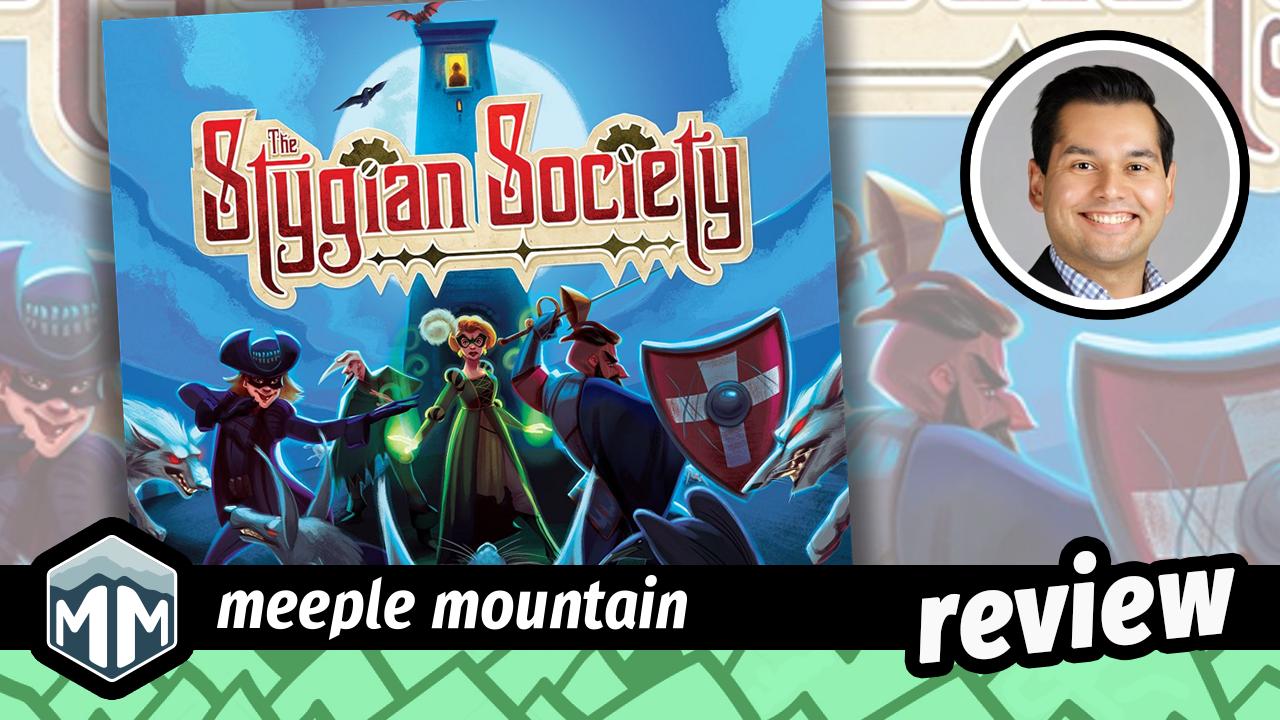
I had a chance to check out The Stygian Society, a game that came out in 2020 during the pandemic, with a cooperative angle perfect for partners stuck inside together.
But unlike other dungeon crawlers I’ve played, this one is a tower crawl, and a physical tower at that. Dexterity games are definitely not my thing, and it took me a good 15 minutes to build this centerpiece. At the very least, the table presence will turn heads.
The Big Climb
The Stygian Society plays out over a series of turns as players try to clear six…
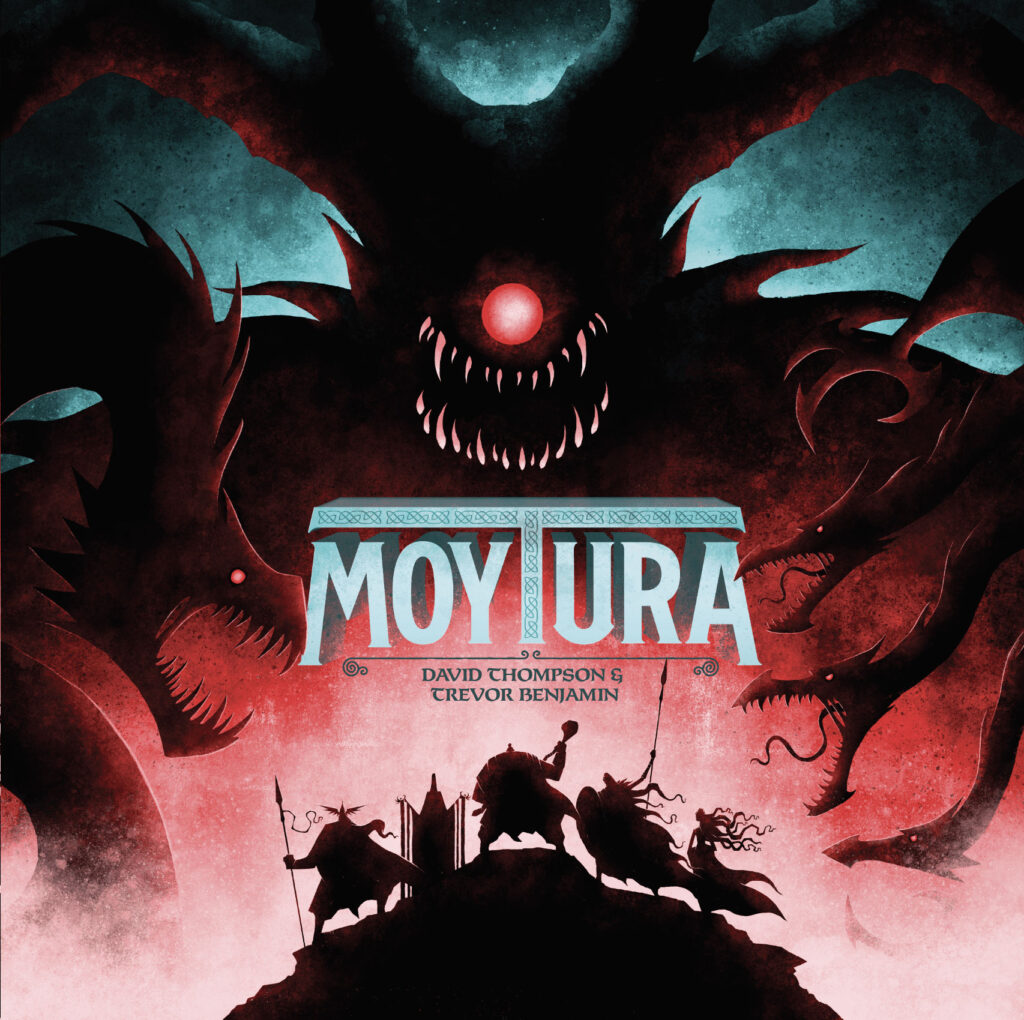
Here are two facts you should know about me: I love area control games, and I often only get to play board games with two players. Sounds like a conundrum, right? Well! Moytura pitches itself as a two-player area control game with the feel of a five-player game, thanks to three bot players. But does […]
About 18 months ago, while attending Buckeye Game Fest in Columbus, Ohio, we met up with David Thompson to get a quick look at a few of his newest upcoming games at the time including Line of Fire: Burnt Moon from Osprey Games and the very interesting American Civil War game with a twist called Rebels Against Rebellion from Flying Pig Games. I got to play Rebels Against Rebellion and very much enjoyed the game and what it was trying to convey about the lack of support for the secession of Tennessee from the Union as most of the residents of Scott County voted against breaking away during the American Civil War. The game pits the local groups against each other as the Free and Independent State of Scott fights against the local secessionist residents as violent confrontations between Loyalist and secessionist-aligned partisans and outlaws engaged in raids on farms, stealing livestock, and destroying property. Since that time, the game has progressed and has launched on Kickstarter. I reached out to one of the game’s designer David Thompson to see if he would be willing to share about the design and as always he was more than happy to oblige us.
Grant: David, welcome back to our blog. What is your new upcoming game Rebels Against Rebellion about?
Davind: Thanks for having me back! Rebels Against Rebellion is a card-driven war game for one or two players, set in Scott County, Tennessee, during the American Civil War. Tennessee’s own path to secession was messy. The state voted against a secession convention in February 1861, then reversed course and voted to join the Confederacy in June, following Fort Sumter. But East Tennessee never went along with it. And of all the counties in East Tennessee, none rejected secession more decisively than Scott County: 521 to 19. Later that year, the county court went so far as to pass a resolution declaring Scott County’s own independence from the state of Tennessee, calling itself the “Free and Independent State of Scott.” That’s the story we’re telling: Southern Loyalists trying to hold their ground against the Confederate army and their allied secessionist guerrillas, for the whole length of the war.
Grant: What should the title convey to the players?
David: I wanted the title to carry that irony right up front. Rebels Against Rebellion. The people of Scott County were, technically, rebelling against a rebellion by resisting the Confederacy in order to maintain their ties with the Union. History likes to flatten “Rebel” down to one side of the Civil War, but in Scott County that word cuts the other way too. I liked that the title does some of the historical educating on its own, before a player has even opened the box.
Grant: Why was this a subject you wanted to focus on?
David: It’s a story that doesn’t get told nearly enough. We hear a lot about the big battles and the big generals, but the internal fractures within the South (communities that stayed loyal to the Union under occupation, that organized home guards, that got raided by their own state’s army) that’s a different and much more personal kind of Civil War story. I’ve made a habit of chasing these under-told corners of history rather than the well-trodden ones, and Scott County is about as under-told as it gets. Once you learn about Julia Marcum defending her father’s house with an axe, or the Home Guard’s oath at the Huntsville courthouse, it’s hard not to want to build a game around it.
Grant: What are the unique features with the system used for the game?
David: The core of it is a deck that represents both your units and your locations. Playing a card from your hand isn’t just “move a piece,” it’s your people and your settlements acting together. Every location you control is physically a card sitting in your deck, hand, or discard pile, so controlling territory and building your deck are the same action. You don’t have a separate “buy phase” and “map phase.” When you improve control of a location or bolster in a new unit, you’re deck-building in exactly the same motion as you’re expanding on the board. I think that tight coupling between deckbuilding and area control is the thing that sets Rebels Against Rebellion apart.
Grant: What did you need to model regarding the American Civil War and the situation in Scott County, Tennessee?
David: Quite a lot, honestly. We needed the asymmetry between the two sides to feel true to what actually happened. The Loyalists start the game already holding six locations and 11 points, reflecting how entrenched they already were in the county by the time real fighting started, while the Confederates start with nothing on the board and have to earn their presence. We needed the food economy to reflect how much this was a war of resources and raiding: burned farms, stolen livestock, the constant question of how you feed yourself when supply lines are contested. We needed supply lines themselves to matter for Confederate regulars in a way they didn’t for local guerrillas, since regular units like the 43rd Alabama or Morgan’s Raiders came in from outside the county and depended on a route back to it, while home-grown units like the Home Guard didn’t need that at all. And we needed the map’s road, water, and path connections to reflect the real terrain. Scott County’s isolation and rugged geography is a huge part of why guerrilla warfare took hold there in the first place.
Grant: What is your design goal with the game?
David: We wanted a game that plays cleanly as a tight, two-player card-driven war game, and we wanted a player who knows absolutely nothing about Scott County going in to come away from a session with real curiosity about what actually happened there. Every named card, every location, every unit in the game is drawn from the historical record. If the mechanics are doing their job, “Capt. William Robbins” isn’t just a card with shield and gun icons on it. It’s a doorway into a real person’s story.
Grant: What other games did you use as inspiration?
David: The DNA is definitely there from our work on Undaunted, that idea of your deck representing your force on the board rather than being an abstract resource. But Rebels Against Rebellion pushes further into area control than Undaunted ever did, so we were also looking hard at how area-control and card-driven wargames handle territory scarcity and endgame tension. The most obvious influence comes from Martin Wallace’s A Few Acres of Snow, which serves as a the origin for the core concept of playing a location card as the source of movement. A lot of our actual influences, though, came out of the playtesting process itself.
Grant: What sources did you consult about the history?
David: We leaned heavily on the Scott County Historical Society throughout, especially David Jeffers, Alan Keeton, and James Cecil, who were enormously generous with their research and their archives. On the written side, Paul Roy’s Scott County in the Civil War was probably our single most important source. His overview chapter and his 148-page account of individual Scott County soldiers did a lot of heavy lifting for us. We also relied on Esther Sharp Sanderson’s County Scott and Its Mountain Folk and Scott County Gem of the Cumberlands, H. Clay Smith’s Dusty Bits of the Forgotten Past, Noel C. Fisher’s War at Every Door for the statistical picture of East Tennessee loyalism, Ben Garrett’s Enclave, decades of back issues of the Scott County Chronicle and the First National Bank Chronicle, and the Official Records of the Union and Confederate Armies for the military correspondence. Dr. Stuart Ellis-Gorman did our proofing and copyediting to help make sure we got the details right.
Grant: What did you learn from your trip to this area as part of your research?
David: Back in the fall of 2025 I went to Scott County to meet with folks from the Historical Society and access primary sources that were otherwise unavailable. This trip was absolutely critical to the design process. The men I met at the Historical Society had deep knowledge on the subject, so I conducted interviews with them. They also provided me some of the primary sources I had read about, but could not access without their help (mostly in the form of photocopied versions of printed documents from local authors). My trip to Scott County also gave me the opportunity to visit the area and experience the topography for myself.
Grant: What are the differences between the playable factions of the Confederates and the rebels?
David: Thematically, the Loyalists are defenders who start the game already dug in. They begin with six locations and a head start on the scoreboard, and their whole arc is about holding what’s theirs and expanding cautiously outward. The Confederates start with nothing on the board and have to fight for every location, but they’ve got the raw power to do it: bigger regular units, the ability to bring in outside firepower, provided they can maintain a supply line back to where those units are actually based.
Grant: How did you differentiate them in their mechanics?
David: A few ways. The Loyalists have much more extensive access to the Improve Control action, which allows them to place a second control marker into a location for an additional victory point and card benefit, while a couple of key Loyalist locations, Brimstone and Trammell’s, double as both a location and a unit card depending how you want to play them that turn. The Confederates, on the other hand, get access to harder-hitting regular army units, but those units can carry a supply line requirement, so playing them isn’t as simple as just having them in hand. You need an unbroken road connection back to their origin. It creates a real asymmetry: the Loyalists play a tighter, more efficient game, while the Confederates have more raw strength but have to work to unlock it.
Grant: How does the game use cards?
David: Cards do double duty as your units and your locations, and every card you play resolves a specific action before it goes to your discard pile. Food is the one shared resource, but everything else, from combat strength to your area-control footprint, lives directly on the cards moving through your deck.
Grant: Can you show us a few examples and explain their use?
David: Sure, take the Home Guard. It’s a Loyalist unit card linked to Huntsville, and if you upgrade it, you get an improved version with better combat value. Or take Chitwood’s, a basic location card: play it for its Take Food action to add to your supply, or play it to Move into an adjacent location, which is how you expand your territory or launch an attack. And then there’s Brimstone, which starts as a plain location card but can be improved into Capt. William Robbins. At that point it’s simultaneously the location and a combat unit, with its own attack value and shield icons, giving you flexibility about how you use it depending on what your turn needs.
Grant: How do the cards upgrade or power up?
David: There are two upgrade paths. Improve Control takes a basic location card, has you pay food, and swaps it for its improved version, which usually comes with better attributes and, for a couple of key locations, unlocks a linked unit. Improve Unit works the same way for unit cards directly. You pay the listed food cost, and the improved version replaces the original in your discard pile while the old card goes out of the game for good. Either way, you’re not adding new cards on top of old ones. You’re replacing weaker cards with stronger ones, so your deck gets more powerful without getting bigger and bloated.
Grant: How important is this to the design?
David: It’s central. Deck quality, not just deck size, is what wins you the game, and the choice of when to spend food on upgrading versus expanding onto the board versus bolstering in new units is the core tension every turn.
Grant: What is the layout of the board?
David: The board depicts Scott County and its surrounding area, with locations connected by roads, water, and paths. Each connection type governs how many cards you can commit to an attack moving along it, from one card on a path up to three on a road. Locations within Scott County proper are marked in brown; locations outside the county, like Somerset, Jacksborough or Jamestown, are marked in grey and generally serve as Confederate staging points and supply origins. Each location shows its star value, which doubles as its point value and its food cost to take control, along with any food production and, for locations that can be improved, their upgraded attributes.
Grant: What is the anatomy of the counters?
David: We use control markers rather than traditional counters. One per location per player, showing who currently holds it, with some locations (mostly limited to the Loyalists) able to carry a second marker once improved. The real “unit anatomy” lives on the cards themselves: name, faction affiliation, attack and defense attributes, a linked location, an improvement cost, and icons indicating whether the unit returns to its supply or is removed from the game entirely after a successful attack.
Grant: How are units activated?
David: You activate units by playing their card from your hand as part of a Move action or in response to an attack. There’s no separate “activation phase.” A unit card played in combat commits its attack or defense value to that fight; the same card, played on its own, might instead trigger a Bolster or Improve Unit action. Context and the icon panel on the card tell you what’s legal in the moment.
Grant: What is the general Sequence of Play?
David: Turns alternate, Confederates first. On your turn you play cards from your hand one at a time to take actions, resolving each fully, including paying food and playing any additional required cards, before moving to the next, and you can stop whenever you like. Once you’re done taking actions, you discard down as much as you want from what’s left in hand, then draw back up to a five-card hand, reshuffling your discard pile into a new deck if you run out.
Grant: What actions are available to players?
David: Take Food, Improve Control, Bolster, Improve Unit, and Move, which is also the action that triggers combat if you’re moving into a location your opponent controls.
Grant: How does combat work?
David: Once you move into a contested location, the attacker plays one required combat-eligible card face down, and the defender either matches with a card of their own (up to a maximum of two, since they can also commit the target location’s own card) or passes. This goes back and forth, both sides adding cards until they hit their limits or choose to stop, with the attacker’s ceiling set by the connection type they’re attacking along. Everyone reveals at once: the attacker totals their attack icons, the defender totals their defense (and any dual-purpose attack icons used defensively), and the defender wins all ties. Win as the attacker, and you strip your opponent’s control marker, shift points in your favor, and get the option to immediately take control as a follow-up action.
Grant: How is victory achieved?
David: You’re racing toward one of a few thresholds: reach 20 points while your opponent sits at 10 or fewer, or simply hold more points than your opponent once the game’s light-colored food tokens run dry and it tips into sudden death. The Confederates have a separate, blunter win condition too: if the Loyalists ever lose every control marker on the board, the Confederates win outright. And if the very last food token, one of the ten darker ones, gets taken, the game ends in a draw, so there’s a real, ticking clock underneath everything you do.
Grant: Who is the artist and how does their style assists in thematic immersion?
David: Kwanchai Moriya handled illustration and Jina Rueter handled graphic design, and I couldn’t be happier with how it came together. Kwanchai has this warm, painterly quality that makes Scott County’s mountains and creeks feel lived-in rather than just decorative. It goes a long way toward making cards like Capt. William Robbins or Julia Marcum feel like real people from a real place rather than generic Civil War stand-ins. Jina’s layout work keeps the cards (action icons, attributes, linked locations, improvement costs) legible at a glance, which matters enormously in a system where you’re constantly reading your hand.
Grant: What type of experience does the game create?
David: Tense and personal. Because the map is so tightly connected, and because food is always ticking down toward sudden death, every attack matters and every food token spent is a decision you feel. It plays fast for a war game, but it doesn’t feel light. The historical grounding and the asymmetry between a scrappy, entrenched Loyalist defense and a Confederate side that has to earn its foothold give it real dramatic shape.
Grant; What are you most pleased about with the design?
David: I’m just happy that we had such an amazing team come together to work on this game. Trevor and me from a design perspective, Kwanchai and Jina bringing the game together through their illustration and graphic design, with Denver at Flying Pig Games leading the way. It was a dream team for this project that I am so passionate about. Of all the games I’ve worked on recently, this is the game closest to my heart. I just want to spread the word about these amazing people who fought for what they believed in.
Grant: What other games are you currently working on?
David: It’s a busy stretch. Alongside Rebels Against Rebellion, I’ve got Night Witches coming, co-designed with Liz Davidson (Fort Circle Games); two expansions for Sniper Elite with Roger Tankersley (Rebellion Unplugged); Flintlock!, a Seven Years’ War and French & Indian War game built on Paolo Mori’s Blitzkrieg! System, also with Roger (Floodgate Games); For the Gods!, co-designed with Trevor and Brett J. Gilbert (Mighty Boards); Zheng He, co-designed with Geoff Engelstein (GMT); and Undaunted 2200: Revolution, co-designed with Trevor (Osprey Games). There are some others on the way, but those are further off…
Thanks as always for having me!
As always, thank you so much David for your time in answering our questions and for showing me the game about a year and a half ago. I very much look forward to playing the final product and wish you well with the Kickstarter campaign.
If you are interested, we did an interview video with David while attending Buckeye Game Fest in the spring of 2025 and you can watch that at the following link for more information on the game:
I never enjoyed history at school. I understood why it mattered as a subject, but learning names, dates and events off by rote simply didn’t work for me, no matter how hard I tried. Events were never taught in their chronological or geopolitical context. Things just didn’t make sense to me. So it seems ironic that historical board games are now one of my favourite genres. Of course, they’ve not made me any better at remembering names and dates, but they replaced my fear of history with a new curiosity that I hadn’t felt before. Horrible History To be clear: I never dreaded having history lessons because of my teachers. No, my fear came from somewhere else. Every new era of history introduced yet another collection of rulers, battles, dates and important events that I was expected to memorise. Learning those facts off by heart was just impossible for me. They always simply felt like a random collection of pieces of information that had nothing to hang them onto. So revising for history tests was always not just a terribly frustrating exercise, but often ended up in tears, because I realised that the further I fell behind, the harder things got. I often felt physically sick and had a tight knot in my chest when another exam was approaching. Somehow, history never felt like one very long connected story thread. Instead, it was just a giant jumble of disconnected facts that were supposed to fit together, but never really formed any sort of pattern for me. Of course, history is a hugely important subject. You don’t need to tell that to a German. Every war, political decision and social movement affected real people, families, communities and often, entire generations. Forgetting historic events means forgetting the people who experienced them, something…
Gruntz Designer: Carter Scott Publisher: Allplay Players: 2 Age: 8+ Time: 20 minutes Amazon affiliate link: https://amzn.to/4hdVNHa Played with review copy provided by publisher In Gruntz, you’ll command units like infantry, tanks, and aircraft with rock-paper-scissors-like relationships. For … Continue reading →
Lifeboats is a 1993 game. That's more than 30 years old! I am pretty sure I have heard about it before. The version I recently played is a 2024 remake. This is a negotiation game for up to 7 players. This is the kind of game which I would cheekily say can destroy friendships, and I wouldn't be lying. Be prepared for hurt feelings.
There is a disaster at sea. The ship is sinking, and
The Dice Tower announced the winners of their Dice Tower Awards during GenCon. Their Game of the Year award goes to Galactic Cruise, the breakout title by designers T.K. King, Dennis Northcott, and Koltin Thompson. It’s the third significant victory … Continue reading →
I won’t pretend to know what’s happening in Duel of Meloch. When we first got a glimpse of this world via Scythe, it was an alt-history Great War mechs-n’-boiled-barley affair. Then Expeditions rolled around and the whole thing took on a determinedly Strugatsky Brothers flair, all strange zones and alien meteors and zombified hussars. Now there’s a foreign entity named Meloch who’s thrown the previous games’ heroes into a time warp, resulting in one last excursion that just so happens to be a grudge match between two of Jamey Stegmaier’s most iconic gameplay systems.
Do these disparate threads make a lick of sense? Not to this philistine. But even as the gameplay mostly gets me shrugging, I can’t help but find the result compelling. It’s a pickle.
Scythe. Expeditions. This mat ain’t big enough for the both of us.
At a sky-high level, Duel of Meloch does precisely as its subtitle proposes. This is Scythe vs. Expeditions, and so snugly fitted that while a few minor alterations are necessary to make its hand-me-down trousers and blouses cohere into a single uniform, for the most part these changes dissolve into the aether after all of two minutes. This isn’t a different, third game that just so happens to use the components from Scythe and Expeditions. It’s Scythe and Expeditions, side by side, and sometimes right in each other’s faces, both humming along as Stegmaier intended.
How does it work? Well, again, it’s Scythe and Expeditions, so they work like Scythe and Expeditions. The former, called the Scythian, is playing an economic game. They escort workers across the landscape, have them harvest wheat and oil and so forth, and then spend those resources to build mills and armories and additional mechs. The latter, the Explorer, is more solitary. Occupying a single mech, they trawl across the map in search of cool artifacts and various helpers, then use those assets to manage a hand of cards and attack corruption tokens. Visually, the Scythian puts themself out there. You see their workers and factories and mechs spread across the land. The Explorer, on the other hand, tends to keep their resources closer to the vest. More tangibly, this means glancing at their board to see how many quests and upgrades they’ve completed.
What’s most impressive is how smoothly these systems merge. Some fun has been poked at Stegmaier for his games’ shared iconography. Even as recently as two months ago, the new edition of Euphoria once again used those objective stars as their centerpiece, giving the game the appearance of a spreadsheet, one at odds with its more vivid original incarnation. But those duplicated icons have never seemed more forward-thinking than here. In fact, the one discernible place where the icons differ — combat strength — is so jarring that it comes across as an intrusion into the game’s visual language.
It’s funny, in other words, to pine for even more generic visual language, but there we have it. Take that, doubters. Myself included. Without those duplicates, Duel of Meloch would have been a true ocular nightmare. Instead, it’s as crisp as can be expected from such an experiment. Especially if it’s true, as Stegmaier asserts, that these systems were never planned to be combined.
Scythe’s double-action system is as interesting as ever.
The gameplay itself is conducted at two levels: the micro, consisting of your own turn — which, for the last time, is either Scythe or Expeditions, depending on which side of the equation you’re commanding today — and the larger macro perspective that sees those sides coming into collision.
This being Duel of Meloch, it’s that latter collision that’s the real draw. And it’s… fine. The Explorer moves faster in terms of kilometers per turn, while the Scythian draws borders and eventually outnumbers their rival in terms of sheer mechpower. This mostly matters for combat. The Explorer punches harder máquina a máquina thank to its dual brands of combat strength; the Scythian brings numerical superiority to bear. To help these tussles along, combat is imported more or less intact from Scythe. Both sides bid via private dials, then modify their strength with combat cards. These cards have received some adjustment in the form of a new deck, but not so much that returning players will require explanation.
The inherent limitation of these bouts is similar to those of Scythe: namely, there really isn’t much reason for the Explorer and the Scythian to jostle. Duel of Meloch isn’t a duel so much as a race. There’s a shared objective board, and both sides are hustling to tick off its various boxes. This also acts as a showcase for the games’ shared iconography, even when those icons translate to slightly different things. For example, the Scythian might be asked to raise their popularity to ten, while the Explorer tries to accomplish three quests. Both of these goals use the heart icon, and both represent an outward-facing perspective, making them a natural leg of this particular relay. The same goes for other criteria: loot some number of coins, defeat corruption tokens or expand across a certain number of hexes, strap upgrades to your mech or roll out all your reinforcements.
Or win in combat.
Depending on which side of the objective bar you’re using, you’re encouraged to win either one or two battles. Like every other objective, however, this locks off access to that objective for your rival. The result is usually at least one big battle. Beyond that, it’s usually a better use of your time to sprint toward the next objective. Sure, there’s some possibility of disruption, since defeating a rival sends them back to their home base. But the Explorer moves so quickly, and the Scythian eventually fields so many units, that these setbacks are fairly minor in the scheme of things. Depending on the current state of the board, they might even delay the victor more than the vanquished.
The shared iconography makes evaluating objectives a snap.
In other words, these aren’t exactly the fine-tuned interactions of Root or Vast. Or, crud, even the more Euro-tinted interactions of something like Crescent Moon. Players are mostly left to noodle in their respective corners, gathering the workers, resources, and cards they need to succeed. Then, either once or twice per session, they’re invited to poke their rival, only to retreat back to their personal workshop for the remainder of the duration.
This isn’t bad so much as uninteresting. In a vacuum, there’s nothing wrong with multiplayer solitaire. The problem, rather, is that everything about Duel of Meloch, from its setting to that promissory tagline, scream out for greater friction. The game itself is a collision. Of systems. Of outlooks. Of occupants trapped in an alien entity’s playpen. But for a collision, there’s very little in the way of combustion or shattered glass. It feels like something is missing, an undelivered invitation to actually look up from your private tableau to see what your opponent is up to. Flashpoints on the map. King of the hill. A reason to drive the Scythian away from the upgrade-bestowing city or prevent the Explorer’s access to those corruption tokens. Anything.
Instead, what Duel of Meloch offers is a buttery smooth merger that doesn’t seem to know what to do with itself. It’s bad practice for a reviewer to theorize about what could have been, but some part of me yearns to see Duel of Meloch as a more ambitious experience. Why limit ourselves to two players? Why not two per side, one Scythian and one Explorer, the first for building and defending our base, while the other roves into contested territory and sabotages rival efforts? Such a game would be different than this one… but not as different as it would have sounded before I actually played Duel of Meloch. Such is the expert craftsmanship behind these systems and their combination.
The explorer is… exploring, one supposes.
As it stands, Duel of Meloch is a fine piece of engineering. But it’s like a windup car without a racetrack to hurtle itself along. The parts are there. The motor winds with such a satisfying tick and whines so beautifully when the knob is released. It hurtles forward with such enthusiasm. But this is one mech that could have been soaring loops instead of walking in circles.
So, for now, it remains a curiosity. Perhaps there’s some value to the game as an expansion, especially for the Scythe/Expeditions devout. For the rest of us, Duel of Meloch stands more as a monument to its designer’s cleverness than as a plaything worth exploring on its own merits.
A complimentary copy of Duel of Meloch was provided by the designer/publisher.
(If what I’m doing at Space-Biff! is valuable to you in some way, please consider dropping by my Patreon campaign or Ko-fi. Right now, supporters can read the next installment in my series Talking About Games, this time tackling the topic of what makes a good list! Naturally, the piece includes a list.)

 Anmelden
/pic9620404.jpg)







/pic9582614.jpg)