I follow Games Unlimited PGH (@gamesunlimitedpgh) on Instagram, and Kylie frequently offers really helpful retailer perspectives for publishers to consider.
One of his recent videos (actually a repost from a few years ago) was both surprising and insightful in a few different ways, as Kylie reveals that he–a very successful retailer–does not like promos.
Even as a publisher that doesn’t make promos (it was something we tried up through Scythe’s release in 2016 and then stopped pursuing), I was really curious to hear his reasons. Especially since a survey I ran of retailers in 2017 indicated that 79% of friendly local game store (FLGS) owners liked promos at the time.
Kylie’s reasons are:
A lot of publishers send promos to his store, but it takes a lot of work to match them with the game (stores juggle a lot of different games, and promos aren’t always labeled well).
Many promos just end up in a general bin, making them hard to find and difficult for store employees to remember to pair with a game.
“A large part of our customers are not actually gamers,” so the idea of a promo is confusing to them. (This revelation was particularly interesting to me. Who are the majority of people who shop at local game stores, if they’re not into games?)
Even a well-meaning, FLGS-focused publisher who tries to encourage customers to go to a game store using promos as an incentive can actually create an awkward situation if the retailer doesn’t have or can’t find the promo for the customers.
Kylie concludes by simply asking publishers to put promos inside the game box. This seems viable in most cases: Even if you make a special promo card for an existing game to offer at a convention, a content creator, or any circumstance, you can include it in future printings of the game.
I really like that Kylie ends with this: “We’ll do the work of selling your game because it’s awesome, not because we have some rare or exclusive promo.” That 100% echoes my beliefs about actively welcoming people into our games instead of using FOMO/exclusivity tactics.
What do you think about this opinion about promos?
Few people in the hobby game industry have seen as many sides of the business as Scott Morris – from leading global strategy at Lucky Duck Games, building publishing partnerships at GTS Distribution and running sales, marketing and social media at Arcane Wonders. Now Morris is applying that experience to his own venture as founder of Steelwing Games, whose debut title Rainbow Blvd. has been nearly a decade in the making. He spoke to BoardGameWire about deciding to launch as a publisher in a challenging market,why he believes a slower, more selective approach is the right fit, and the lessons he is bringing from his career at Lucky Duck Games and beyond.
BoardGameWire:How long has the idea of you launching your own publisher been rolling around your head? I think I remember you saying you registered Steelwing some years ago?
Steelwing originally began to take shape in 2016, after first playtesting Rainbow Blvd. (which was then called Leprechauntractors as a play on words with Leprechauns and Contractors). Like a lot of people who work in games, I’ve always had ideas about the kinds of projects I’d love to help bring to life if the timing, team, and titles were right.
The company itself was set up in 2021, and I’ve been very intentional about not rushing into publishing just for the sake of launching something. For me, it was important that Steelwing start with the right game, the right creative partners, and a clear sense of what we wanted the company to stand for.
What was it that finally got you to make the jump and launch?
It was really a combination of timing, people, and product. Rainbow Blvd. is the perfect first game, it always has been. It has a fun identity, a strong table presence, it is easy to teach, and has the type of meaningful gameplay that Steelwing is focused on.
I also reached a point in my career where my experience across multiple areas (sales, marketing, crowdfunding, distribution, licensing, production, and working with designers) has given me the confidence to give Steelwing a thoughtful and responsible start.
Rainbow Blvd., designer by Adam Wyse, will be Steelwing’s first published game
What does Steelwing represent or offer that perhaps hasn’t been possible for you in your other board game industry roles?
Steelwing gives me the chance to build something from the ground up with a clear creative point of view. The goal is to publish games that are welcoming, polished, distinct, and deliver a satisfying and rewarding experience for players.
The name reflects that mission. The “steel” represents the experience and discipline I’ve built in the industry, while the “wing” represents using that experience to help create opportunities for others and give talented people new pathways into board games when and where we can.
At its heart, Steelwing is about making games we would be thankful to have in our collection while trying to leave the industry a little better than we found it, along the way.
The industry has been facing higher manufacturing costs, tariffs, freight disruption and increasing competition for attention. Many people might see this as a difficult time to launch a publisher. What makes you optimistic?
It is absolutely a challenging time, that can’t be minimized in any way. Costs are high, attention is hard to earn, and publishers need to be more thoughtful than ever about what we make and how we make it.
What makes me optimistic is that players still respond to games that they can connect with, that have that special feel, and are well cared for. This is a time to be disciplined, focused, and clear about why a game deserves to exist. That is the mindset I am bringing to Steelwing.
Of course it will be challenging. There is never a perfect time to start a new business. One of the principles I try to live by is, “Be good today and be better tomorrow.” Staying humble, listening carefully, continuing to learn, and making games that bring people joy, will result in positive outcomes for Steelwing and more importantly, for the community.
Having worked in the industry for more than a decade, which experiences most shaped the way you’ll run Steelwing?
Not to date myself, but it’s closer to two decades, and actually my second stint in the industry. A long time ago, in a galaxy far, far away (known as Poughkeepsie, New York), I had my first opportunity in games as a retailer, managing a local store called Iron Vic’s.
The experiences that have helped shape me are the ones where I’ve been able to see the full path a game takes from idea to table. A great design is essential, but game development, product development, manufacturing, communication, and post-release support all shape the experience players ultimately have with a game.
One night, while developing Rainbow Blvd., we realized the rainbow borders on some cards felt slightly different. Opening the files in InDesign, we found that one border was 13 pixels from the cut line and another was 15. Those two pixels bothered me more than they probably should have, but I knew someone, somewhere, would have that same subtle feeling that something was off. So we spent several hours fixing it. Was it necessary? Maybe not to some, but for me, it was 100% necessary.
I’ve also been fortunate to learn from many generous and experienced people across the industry. Those relationships have shaped how I think about publishing, leadership, and the responsibility that comes with bringing a game to market.
My goal with Steelwing is not to assume we’ll get everything right. We won’t. But experience gives us a better chance to be thoughtful, avoid preventable mistakes, and build trust with the people who help bring our games to life and with the people who enjoy them.
Your recent newsletter makes clear Rainbow Blvd. has been in development for years, with prototypes dating back to 2016. What made you confident about launching a new publisher with this title?
Rainbow Blvd. has had a long and amazing road, and I’m looking forward to sharing more of that story through our updates and crowdfunding campaign. At times, it has felt as though it has a life of its own. The core idea has stayed strong through a slow-and-steady development process, while the game itself has become more focused, more accessible, and more visually distinct over time.
What stood out to me is that Rainbow Blvd. has immediate appeal, while also providing a very satisfying experience underneath the surface. People are drawn to the colorful 3D rainbows and cozy city-building theme, and then after they play a turn or two, they find meaningful decisions, shared incentives, and strategic choices that make the experience engaging for many different types of players.
That is exactly the space for Steelwing to live in; games that feel welcoming regardless of a player’s experience level, while being memorable and rewarding. Great games have “stand up moments” where players feel rewarded for their choices, and even greater games leave players with that “I can’t wait to play again” feeling. Rainbow Blvd delivers on those two things and [designer Adam Wyse] has done a tremendous job developing it into something approachable, clever, and special! I’m excited to help bring it to players around the world.
What kinds of games are you actively looking to sign? What does a Steelwing game look like?
A Steelwing game should be welcoming and engaging while delivering a memorable experience. The experience is everything. Positive, clever, engaging, intriguing, and above all else, fun.
We are actually not actively looking for games, as we have a publishing plan in place until 2029. If and when we open up for submissions, some key elements are games that are teachable, replayable, and have a clear reason to exist on the table. Strong table presence helps, a unique theme helps, and unique components turn simple into satisfying. That is where my strength as a publisher is; taking a good game design and helping turn it into a full product that delivers a positive experience.
Scott demoing Rainbow Blvd. at Origins 2026
Are there any particular themes, mechanisms or types of games you’re especially excited about right now? Or any genres or play experiences you think are currently underserved?
I believe there are still so many themes, mechanisms, and combinations in games that have not been fully explored yet. I’m especially interested in games that create positive interaction without relying only on direct conflict. I like games where players are paying attention to each other and the choices being made, where timing matters, and where the table feels alive, but not necessarily because players are attacking each other or tearing each other down.
Rainbow Blvd. is a good example of that. We’ve worked hard to make sure players stay engaged even when it is not their turn, because what other players choose can also create opportunities for others. That kind of shared excitement and mutual interest keeps the game active from turn to turn and feeling alive.
There is still a lot of room for beautiful, accessible strategy games, games that families, couples, casual players, and hobby gamers can all enjoy together for different reasons. As a wise person once said, “The people around the table are more important than the game on it.” I hope Steelwing games can help create many of those nights.
How many games are you realistically aiming to publish each year?
The plan is to stay steady, planned, and manageable. Realistically, the goal is not to publish a large number of games each year. I would rather do fewer games better than stretch the company too thin. Right now, we have Rainbow Blvd. crowdfunding this year on Kickstarter and delivering in 2027, plus an unannounced game to crowdfund in 2027 and deliver in 2028. Releasing games in a measured and manageable way is the pace to keep at the start and the primary focus.
The box cover for Rainbow Blvd.
Is the goal to remain deliberately boutique, or would you like Steelwing eventually to become more of a mid-sized publisher?
The goal is to grow responsibly. I’m not opposed to Steelwing becoming larger over time, but only if the growth supports the quality of the games and the experience for players. For now, I would describe the goal as focused. We want to be selective, build trust, and make each release feel intentional, delivering the best possible experiences to players.
Will you primarily publish original games, or are licensed titles also part of the long-term strategy?
Original games are the main focus, especially as we establish Steelwing’s identity. That said, I have a lot of respect for what a well-matched license can do when it genuinely supports the gameplay and audience. “Never say never” is the saying, but fit also matters. I am not looking to chase licenses for the sake of it, and our focus is on Rainbow Blvd and the next title, which is also an original, internal game. (Which, I can’t wait to talk more about, as it is also a very unique game like Rainbow Blvd. that gets me excited every time I play it.)
Are you actively accepting pitches? And if so, what kinds of games are you most hoping designers will bring to Steelwing? How should they contact you?
We’re not accepting unsolicited pitches right now. Steelwing already has a publishing plan in place for the coming years and I want to make sure we give those projects and relationships the attention they deserve. If and when we do open submissions, we’ll be looking for games that feel welcoming, replayable, visually engaging, and have a clear reason to exist on the table. However, I don’t want designers sending us projects before we have a proper process in place, especially if those games could be finding the right home elsewhere. We’ll share clear guidelines through SteelwingGames.com and our social channels.
Will every game crowdfund first, or do you plan to vary that from title to title?
Crowdfunding will be an important part of Steelwing’s strategy, especially early on, because it allows us to build community around each game and communicate directly with the players most excited about it. That said, I do not think every game has to follow the exact same path. The right approach depends on the game, the audience, the production needs, and the retail strategy.
Looking back over your career so far, what’s the biggest lesson you’re taking into Steelwing?
The biggest lesson I’m taking into Steelwing is that publishing is a long-term relationship business built on trust. A good game matters, of course, but so does how you communicate, how you treat people, how you handle problems, whether your decisions are sustainable, and how well you stand behind your product after it reaches the table.
I want Steelwing to be known not just for the games being made, but for being thoughtful, reliable, and committed to delivering exceptional experiences. Steelwing is intentionally lean right now, supported by a group of passionate and talented contractors, partners, and collaborators who believe in the goals and the games.
One of the things I love most about the board game industry is how accessible and personal it can still feel. I want to have direct relationships with our players. I want to hear their stories of fun, triumph, defeat, and laughter. And just as importantly, I want to hear where we can improve, because every release should help us get better at serving the people who choose to put our games on their table.
Are there any elements of being a publisher that you’ve experienced in your time in the industry that you’re deliberately trying not to do with Steelwing?
One of the most challenging things in this industry, and in life in general, is the art of saying “no” when it needs to be said. Every company has different pressures and constraints. For me, the goal is to avoid growing too fast, avoid overpromising, and avoid taking on games that cannot be given the attention they deserve. That means being honest about what can be done well, while being disciplined enough to say no when something is not the right fit.
You’re still part of Lucky Duck Games. How do you balance those responsibilities with running Steelwing?
The true answer is, “Very carefully”. My responsibilities with Lucky Duck Games remain my professional priority, and I take them seriously. I’m grateful for the opportunity I have here and for the talented people I continue to work with. Steelwing is a separate project, and I’m careful about keeping those responsibilities distinct. That means being thoughtful with my time, avoiding conflicts, and making sure Steelwing is built in a way that does not interfere with my daily obligations. Maintaining trust and professionalism matters a great deal to me.
If you were to look forward five years into the future of Steelwing, what do you hope you’ll see?
Five years from now, I hope I’ve grown to become a better publisher and I hope Steelwing has a meaningful catalog of games that people are excited to recommend to their friends and family. I would love for players to see the Steelwing name and feel like it stands for games made with intention, love, and care.
I do not think success has to mean being the biggest publisher. For me, success would be building something sustainable, respected, and joyful, both for the people who make the games and the people who play them.
With a title like LUZ, Spanish and Portuguese for “light,” you’d expect this Taiki Shinzawa trick-taking game to have a bit more clarity. Silly you. Silly me! LUZ is a game of shadows and half-knowns, a trick-taker that casts a shadow of uncertainty.
Given that Shinzawa is responsible for the likes ofGhosts of Christmas, a trick-taker in which you play three or four must-follow tricks at the same time while the trump suit shifts with player behavior, I should clarify that LUZ isn’t that opaque. It’s all relative. If Ghosts of Christmas is a few standard deviations outside the mean, LUZ is safely within the bell part of the curve.
This is a must-follow trick-taking game where players bid before the hand begins. You have the choice of making an exact bid, which requires you to hit the nail squarely on the head in order to score, or a more forgiving bid that gives you one trick’s worth of wiggle room in exchange for scoring half the points. Higher risk, higher reward.
This doesn’t sound so different from whist, other than the room for some wiggle in your wager. The opacity comes from the last two rules: the back of each card indicates what suit that card belongs to, and you never know the values of your…
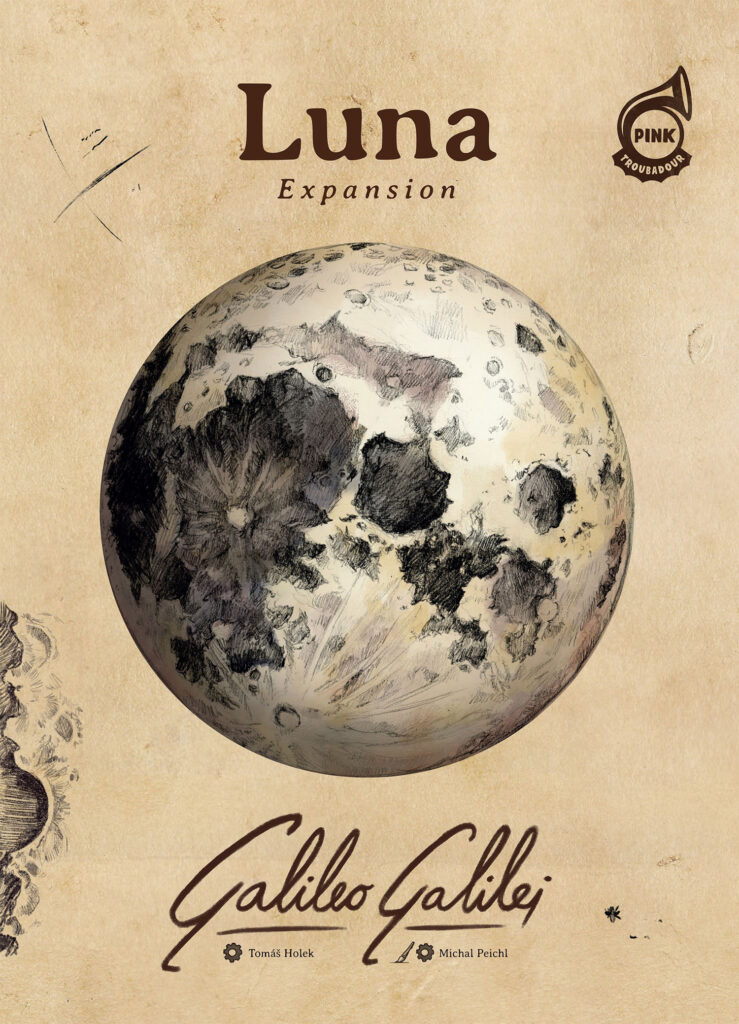
As I approached the BGQ Review Copy Altar (B.R.C.A, for short), a new in-shrink copy of the Galileo Galilei expansion, Luna, materialized in front of me. I looked around. “Hello?” No one responded. Tony is usually there for a snide comment, or Chris is hiding, waiting to snipe the copy right before you pick it […]
I love a different style and focus of wargame. A game that takes a look at an important but somewhat obscure or rarely addressed historical topic, such as espionage or intelligence, and creates a gaming experience tailored around the events to highlight and evoke the difficulties and tension that would have been present. In January 2026, GMT Games announced such a game in Checkpoint Charlie, which is a solo or cooperative game focused on SIS espionage missions in Berlin in the 1960’s designed by Russell Brown. We have posted an interview with Russel and it was very well received and he has now agreed to create a series of History Behind the Cards to highlight the events of the 1960’s Cold War struggle in West Germany but also to share aspects about the game play and how it models the history.
*Note: The cards highlighted in this series and their event text, as well as any pictures used showing any of the various components, are still in the design and development process and as such event effects and text might still change prior to final development and publication.Also the art and layout of the cards are only for playtest purposes at this point and the game will enter the art department as it nears publication.
History Behind the Cards – Checkpoint Charlie from GMT Games – Card #4: Faceoff with the Soviets
On August 13th, 1961, in a dramatic move to stop the flow of millions of East Germans defecting to the West, East German police placed miles of barbed wire overnight, cutting off access between East and West Berlin and catching the western powers by surprise. It wasn’t clear what the response of the west would be, and whether it would ultimately lead to the war with the Soviets that many people felt was inevitable.
For days there seemed to be no reaction. West Berlin and Mayor Willie Brandt looked to U.S. President Kennedy to respond quickly and forcefully to the wall, but U.S. troops in Berlin made no move to intervene. Instead, on August 16th, Kennedy sent Vice President, Lyndon Johnson, and General Lucious Clay (more about him on card #6) to deal with the situation. At the same time, he ordered the U.S. 18th Infantry regiment in West Germany to cross East Germany on the autobahn to Berlin, along the access corridor established by the Potsdam Conference. The troops came equipped for battle and paraded through the streets of West Berlin with Johnson and General Clay. This showed U.S. support for Berlin, but did nothing to remove the wall, which quickly turned from barbed wire to concrete.
Over the next two months, disputes arose over the rights of French, British and U.S. troops to travel in the Soviet sector of Berlin, which were also established by the Potsdam Agreement. Tensions came to a head when a U.S. diplomat was stopped at Checkpoint Charlie while crossing into East Berlin. On October 27th, after heated exchanges, mostly between the Soviet Commandant and General Clay, Clay attempted to send another diplomatic mission through Checkpoint Charlie, this time accompanied by ten jeeps full of American soldiers, with ten U.S. tanks in reserve back in West Berlin. The crossing succeeded, but the Soviets responded by sending ten of their own tanks right up to the Checkpoint Charlie crossing. The U.S. tanks moved up to face them.
The standoff lasted nearly a full day, with the tanks and soldiers facing each other, ready for battle. Kennedy and Khrushchev managed to negotiate a resolution and the Soviet tanks pulled back slightly first (presumably because they had moved up to the border first), then the U.S. tanks pulled back. This gradual retreat alternated until the faceoff was at an end and traffic through the checkpoint resumed.
The Faceoff with the Soviets card in Checkpoint Charlie places a Faceoff marker in the Checkpoint Charlie location, which prevents any assets and KGB agents from entering this location during the Movement step of the turn (though some played card effects still allow this). This marker can only be removed by the General Clay Steps In event (card #6).
In the next article in this series, we will take a look at Berlin Film Festival and how its effect caused some issues with various locations operating as Honey Traps about the city.
In my opinion, this game looks extremely interesting and I am very much excited to learn more about it. I am appreciative to Russell and his efforts to bring us these cards and to write these entries to share with our readers. I am also very glad that this topic is being covered in a game and look forward to playing this one day soon.
Those of you who’ve followed my writing and social media posting over the years know I have a very special place in my heart for the Disney theme parks… and, prior to becoming the guy who turns a certain shade … Continue reading →
Asian Board Games Festival - Malaysia 2026 is happening Fri 7 Aug 2026 to Sun 9 Aug 2026 in Penang. By the time you read this, I'm probably on the way to Penang, or I am already in Penang running my booth. This is my third time exhibiting at ABGF MY. This time I will have two new games, Pilgrim Poker and Malaysian Holidays. If you are in Penang, come play with me!
The first thing one notices about the third scenario in Stephen Rangazas’s The Guerrilla Generation is that the script has been flipped. Unlike both the Uruguay and Peru scenarios, which presented the COIN Series’s customary red insurgents facing off against government blues, here the entire color scheme has been inverted. Now the insurgent cylinders are the blue ones, while the government’s troops and police are red and pink. The effect is jarring. More than once, I found myself staring at the wrong side of the faction aid, trying in vain to make sense of the information before me. What do you mean the red side needs to deploy sweep-and-clear operations? Wait, the pinkos have air superiority? When has that ever been the case?
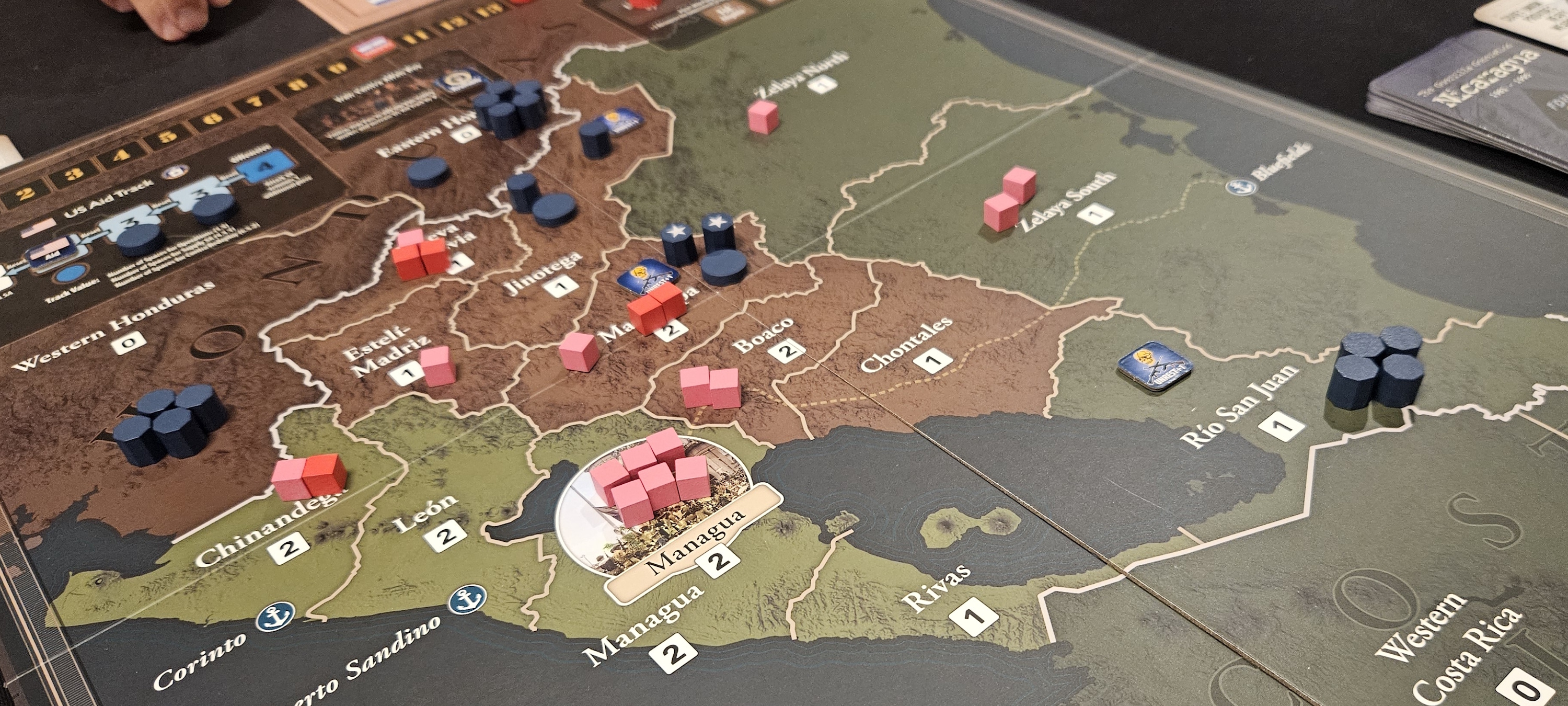
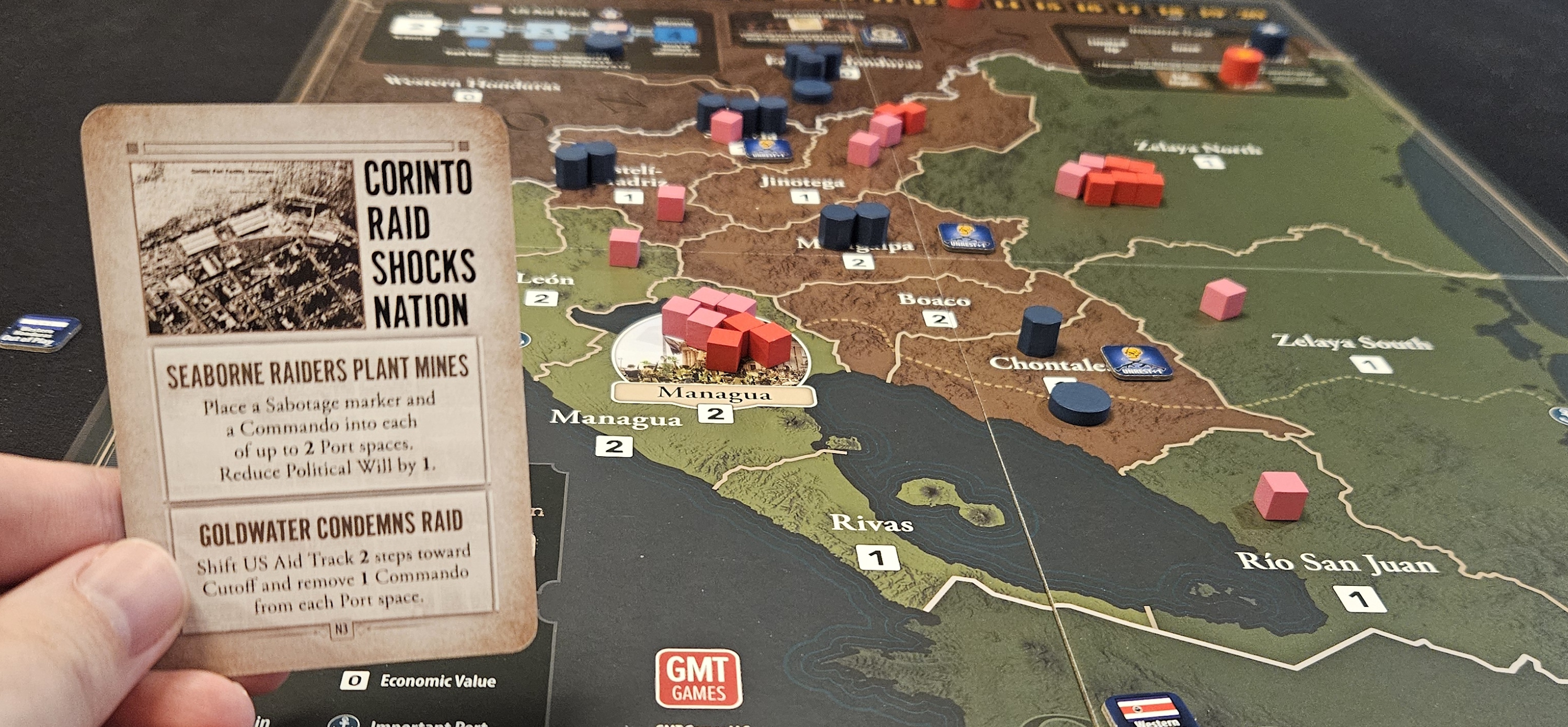
This is Nicaragua, baby. One short year after the socialist Sandinistas ended the Somoza family’s four-decade reign, inheriting an indebted and war-wracked country, the U.S.-backed Contras are pouring over the border from Honduras and Costa Rica. What follows is the most harrowing of the multipack’s scenarios thus far.
Nicaragua under siege.
As always, the first few turns in a new COIN scenario are testy. Both sides take longer turns than usual, acquainting themselves with the operations that will be their guiding star over the next few hours. (Or, in the case of Rangazas’s scenarios, the next hour to ninety minutes.) Everything is new. The contours of the geography, with its many tropical hiding places and mountainous hard points. The location of any urban centers and their lifelines through the countryside. Any neighboring countries to act as hiding places for roving insurgent forces.
And, in this case, the sudden realization that the Sandinistas are going to have to find a way to afford all this stuff, while the Contras are perpetually flush.
This isn’t the first time in the COIN Series a faction has wielded unlimited spending potential. That distinction traces all the way back to the bottomless pockets of the Coalition in Brian Train’s A Distant Plain. Even this multipack has already showcased a scenario that dispensed with funding altogether.
But what makes Nicaragua so dizzying is that here it’s the insurgents who can act with impunity, not the government. In the background, the Sandinistas are hurrying to repair the damage from the last bad decade of Somozan rule, including the earthquake that leveled much of Managua only for relief funds to quietly route into el presidente’s personal bank account. Now they’re making good on their promises: literacy campaigns, schools, hospitals. Also no small measure of native repression, in case you’re thinking everything is rosy. So when it comes to the CIA shenanigans in Honduras, the Contras with their limitless materiel, the commandos laying nautical mines in the harbors, the U.S. embargo squeezing the entire economy, there simply isn’t enough cash to go around.
It wouldn’t matter so much if everything weren’t so damned expensive. When the scenario opens, the Sandinistas are desperately undermanned. This makes sense in context. All those bright-red troops and hot-pink police have been hastily retrained from the previous conflict’s insurgent cylinders. This leaves much of the country unprotected, especially around the fringes. The only solution, especially early on, is to spend, spend, spend. Spend to train more police. Spend to garrison them in the countryside. Spend to sweep into insurgent hotbeds. Spend to send in the soldiers with the big guns. Even with the multipack’s briefer campaigns, hovering around only eight cards per propaganda round, it isn’t uncommon for a government player to find themselves skint with a good few turns before the next infusion of income.
That’s a little too close to home for comfort.
The only reprieve comes from the Contras themselves. Once again, Rangazas uses the limited tools of Volko Ruhnke’s COIN System to carve out some impressive evocations of insurgent warfare. Unlike the other insurgents we’ve seen thus far, the Contras are not locals. Or, well, they’re locals, former members of Somoza’s national guard or disillusioned revolutionaries, but they aren’t locals the way the Tupamaros were locals to Montevideo or the Shining Path were locals to Ayacucho. The Contras are roving death squads. Their targets aren’t only military, but also the schools and hospitals and agricultural collectives currently being set up by the Sandinistas. Their targets are economic. And therefore civilian.
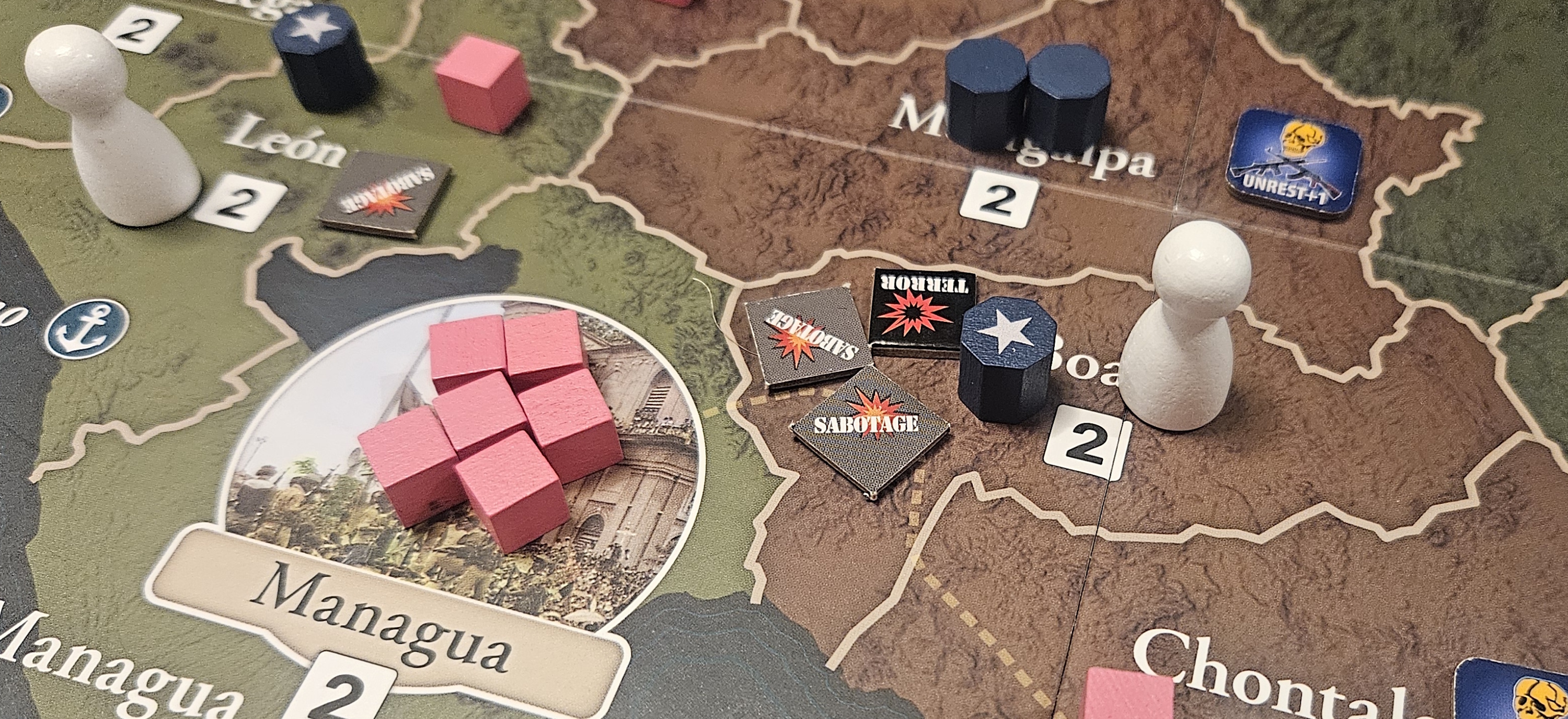
Which means the Contras don’t have roots in local communities. They can establish bases in Nicaragua, but these are closer to waystations than actual recruitment centers. All their actual recruitment occurs in neighboring countries, in the safe harbors of Honduras and Costa Rica. They aren’t wholly untouchable across these borders; the Sandinistas can lob artillery strikes into foreign territory, risking erosions to their legitimacy, and depending on the whims of the event deck might mount small incursions. But their foreign-backed status informs everything about how the Contras behave. They deploy in foreign territory, then infiltrate into Nicaragua via mountain passages and jungle paths. Once there, they mount attacks and sabotage infrastructure — the customary insurgent tactics — only to melt back across the border at regular intervals.
This produces a starkly different type of gameplay from the usual COIN fare. The Contras work according to their own circadian rhythm, there and back again, in offensives and dispersions, rather than claiming territory long-term. When a campaign ends, they can maintain a certain number of toeholds in-country, but not so many that they won’t have to yield something hard-fought.
More importantly, this gives the Sandinistas some breathing room. Border security is a priority, and not an impossible one. Urban centers have always been tough nuts to crack, but Managua’s central position makes it uniquely secure among COIN capitals. It isn’t unthinkable, for example, that the Sandinista player might opt to empty it of protection altogether. A risky proposition, but one that might put its manpower to better use in more vulnerable sectors.
Meanwhile, the geography takes on real significance. Given its operational focus, the COIN Series has always taken a satellite perspective of territory, more about regional tendencies than individual strongpoints. Here, one immediately grasps the various inroads the Contras might take toward destabilizing the socialist regime. Harbors on the coast are vulnerable, but are more readily policed. The mountains are good hiding spots for entrenched death squads, but access can be blocked with some well-placed army divisions. Perhaps the tenderest pressure point is the harbor on the country’s Atlantic coast, far from Managua and surrounded by jungle. But the Contras also struggle to project that far. It’s a pickle all around.
Come get your yankee dollars!
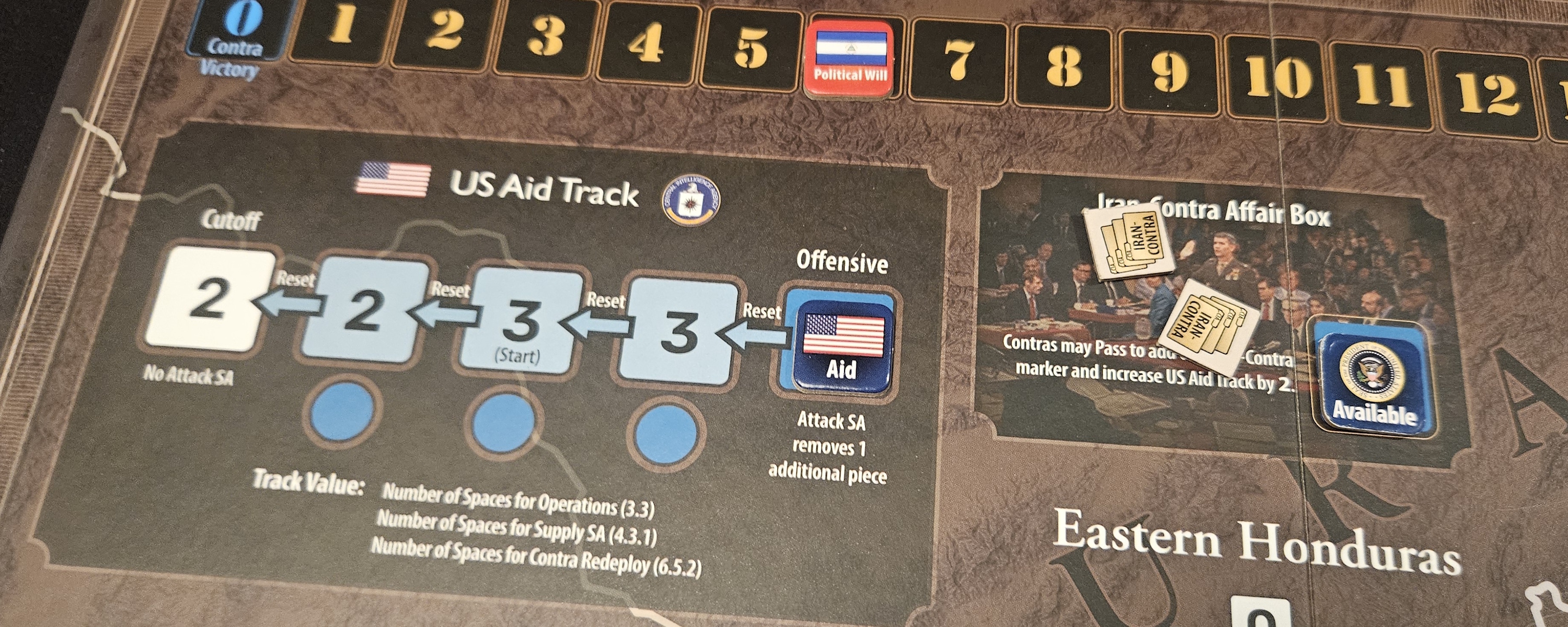
Of all its pickles, however, none are more vinegary than the looming gaze of the continental hegemon. The United States is never absent from either side’s thoughts. While the Contras don’t have to worry about actual resources, they are subject to American pocketbooks. Depending on the current status of U.S. aid, their operations can target between two to four regions at a time. This encourages the Contras to spend at least a portion of their attention attending to their paymasters, whether through the event deck or by occasionally passing to beg for more attention.
The Sandinistas, for their part, must also keep an eye on the Yankees. There’s no avenue for directly tanking funding to the Contras; the inner workings of a corrupt American presidency are far above the Sandinistas’ ability to influence. But there are ample cards in the deck for applying international pressure. This makes the Sandinista player somewhat reliant on the sequencing of the event deck, but it also prevents their operations from becoming rote. More than most of Rangazas’s scenarios across both The Guerrilla Generation and The British Way, and indeed more than most of the main COIN volumes, Government players must consider every possible avenue for undermining their opponent. Where these titles usually present their government factions as clear frontrunners in terms of wealth and manpower, here they feel fragile and outmanned. They’re the region’s big dog, but their hookworms are funded by the most powerful empire in human history.
Which makes the Iran–Contra Affair such a big deal. Whenever the Contras require extra help, they can pass to bump up the aid track. The price is an extra evidence token in the Iran–Contra box. This isn’t guaranteed to trigger; in fact, it’s even less likely than the People’s Prison being uncovered in Uruguay or Abimael Guzmán being captured in Peru. But if Reagan does happen to get caught funding a violent insurgency that wantonly targets civilians, the ramifications are considerable. With no further ability to increase their funding, there’s a very real chance the Contras will wither on the vine.
Where the previous two scenarios existed in isolation, this draws greater attention to the specter of American involvement in Latin American politics. There’s the wider situation to consider. For The British Way, Rangazas connected all four scenarios via a meta-campaign that traced the larger anti-colonial movement against the British Empire. The Guerrilla Generation includes a similar option, one that’s both more focused and more ambitious. This campaign, called Resisting Reagan, allows players to tackle both this scenario and the next one side by side. It’s a massive undertaking, requiring familiarity with both scenarios and an additional set of campaign rules.
Which is why it will have to wait for its own chapter in this series. Hey, I can only do so much at a time. Look at the bright side: bonus fifth part! Yay!
(Right? Yay?)
You’ve gotta be doing something wrong if Barry Goldwater denounces it.
All told, Nicaragua is not only the strongest of the three scenarios we’ve played in this multipack, and not only one of Rangazas’s best uses of this long-running system about counterinsurgencies, but one of the best expressions of the wider COIN Series, period. It draws clear delineations between its besieged (and increasingly problematic) revolutionary government and the foreign-backed commandos raising hell in the countryside, presents a novel gameplay scheme in the constant ebb and flow of its insurgents, and, perhaps most importantly, draws the player’s attention outward to the wider problems of American imperialism besetting the titular guerrilla generation on all sides. As my play partner put it, this might be the first COIN scenario that he would request we play again.
But another session in Nicaragua will have to wait for Resisting Reagan. First, we need to examine the multipack’s fourth and final scenario, and the one most personal to me: El Salvador.
A complimentary copy of The Guerrilla Generation was provided by the publisher.
(If what I’m doing at Space-Biff! is valuable to you in some way, please consider dropping by my Patreon campaign or Ko-fi. Right now, supporters can read the next installment in my series Talking About Games, this time tackling the topic of what makes a good list! Naturally, the piece includes a list.)
In Mercenaries Wanted you take on the role of a mercenary company leader, recruiting mercenaries to complete jobs for you. Assemble your teams carefully and send them out on assignment to earn the most gold. Between rounds, decide who to keep in your roster, who to promote, and who to let go. Race to complete jobs over several rounds before competing with your promoted mercenaries in a series of tournaments to earn the most fame and fortune.
As head of a Mercenary Company, it's your job to find the best recruits the city has to offer. Or at least the most promising ones. Are they breathing? Let's be honest, you'll take what you can get in the city of Gloomhaven.
Recruit, equip, deploy, and out-hire your competitors to become the most infamous Mercenary Company in Casskia. So get to it! The unemployment line is drying up... MERCENARIES WANTED.
▪️ Also, be sure to check for the Frosthaven Digital release on October 15, 2026!
Using enchanted lanterns, you'll reveal only parts of the artwork at a time, searching for creatures, characters, and treasures hidden throughout each magical scene.
Work together (or against each other!) to uncover everything before time runs out, but stay alert: every corner of the kingdom holds new surprises.
Light your enchanted lantern, gather your fellow adventurers, and discover what secrets await in the darkness.
Easy to learn, fast to play, and perfect for families and groups of all ages, Spotlight Fantasy combines cooperative gameplay, stunning illustrations, and a touch of magic to create an experience that... Shines at every table!
▪️ The beautiful Kano was just available at Gen Con and will be available later this year. Kano is from Matagot and designers Pablo Jiménez, Angel Pintero. This game plays 2-4 players and takes about 30-40 minutes to play.
From the BGG page:
In Kano, 2 to 4 players compete to create their own Emakimono—traditional Japanese painted handscrolls—by skillfully arranging vibrant paint pots. The game elegantly blends tactical resource management with spatial optimization as players navigate a shared central mat to collect the pigments needed for their masterpieces.
You've found a mysterious box filled with strange cards. As you try to decipher their meaning, you soon realize that you won't be able to do it without help. Surrounded by your friends, you begin to unravel their secret: played the right way, the cards eventually disappear. But they always come back, safely tucked away in the box, for the next game.
In Omens, you team up to get rid of your cards until you have only one left in your hand.
Each of your cards interacts with the cards played by your partner, as well as those of your opponents, so you need to play them at the right moment! The team that sheds its cards first wins.
▪️ Shape it from Randolph is a new cooperative party game from designer Thomas Dagenais-Lespérance (Decrypto). You have to mind-meld with all players to best guess the correct answer with the creations you make using the available shapes. A game for 2-7 players!
From the newsletter:
Sync minds with teammates to guess the correct words! Shape It is a cooperative game in which players move shapes to try to guess a word. What word is your group trying to illustrate? That’s the game - you don't know for sure! But it has to be on one of the 5 cards on the table. When it comes time to guess - will you all see the same word in the shapes you’ve placed? Good luck!
North America’s biggest tabletop gaming convention, Gen Con, has continued its record-breaking run after more than 74,000 attendees left this year’s sold-out show bursting at the seams.
Gen Con’s latest hefty attendance figure extends its steady post-pandemic growth, following record crowds of 70,000 in 2023, 71,000 in 2024 and almost 72,000 last year – which all broke the 2019 pre-pandemic high.
But the convention, which has sold out before opening for three consecutive years, is operating at a hard capacity ceiling at the Indiana Convention Centre. Gen Con president David Hoppe told the Indianapolis Business Journal last year that the show’s growth had left it “capacity constrained”, saying: “We fill every nook and cranny of this downtown core area.”
Gen Con attendance figures since the show moved to the Indiana Convention Centre in 2003
He added in that interview that he would love to get 80,000 attendees at the show some day – and Gen Con is set to take a step closer to that goal for its 60th anniversary show next year thanks to a significant floor space expansion and opening of a new Signia by Hilton hotel.
That expansion includes an extra 143,500 sq ft of floor space – roughly the size of 2.5 American football fields – and 800 new hotel rooms.
Gen Con’s organisers did not say how many extra exhibitors or attendees the expansion is expected to accommodate, how much of the new space will be devoted to the exhibition hall.
Exhibitor and vendor numbers reached almost 800 at the packed out four-day event, Gen Con said. The show reported a then-record 575 exhibitors showcasing their wares last year, although the inclusion of “vendors” makes it unclear if the 2026 figure is directly comparable.
Gamers playing at Gen Con 2026
BoardGameWire contacted Gen Con’s press office earlier this week for confirmation on how much additional capacity next year’s expansion will create, and for clarity on exhibitor numbers in 2026, but is yet to receive a response.
This year’s convention also faced an unexpected operational test after severe thunderstorms prompted a tornado warning on Saturday evening, and caused water to shower down into parts of the Indiana Convention Center.
The worst affected areas were the convention’s playtest area and part of Exhibit Hall B, with attendees told to relocate to safer parts of the building while the warning was in place.
Exhibitors affected included Tycoon Games, with managing director Ben Rathbone telling the Indy Star, “As we were doing our demos and tournaments, drop of rain started coming through the ceiling up there.
“We immediately started pulling our stuff back, then there was a deluge came down, flooded the whole floor there, and we had to move all our games and store them out of the way.”
He added that the publisher’s games had been damaged “only a little bit”, saying that most of them were out of the way.
Gen Con said staff responded quickly to ensure safety and make repairs, adding that there was “minimal disruption” to the convention due to the leak.
This year’s event was also impacted by heavy amounts of construction work taking place around the convention site, leading to large build-ups of foot and vehicle traffic.
Gaming taking place in the Lucas Oil Stadium at Gen Con 2026
Gen Con president David Hoppe said of this year’s event, “Even through construction and thunderstorms, Gen Con 2026 was bigger and better than ever, with a record-breaking number of attendees gathering in Indianapolis for the best four days in gaming.
“We can’t thank Indy enough for hosting us, and we’re already looking forward to our 60th anniversary convention in an expanded Indiana Convention Center next year.”
Next year’s Gen Con is scheduled for August 5 to 8, with badges set to go on sale in early 2027.
Icaion, the impossible to pronounce sequel to the equally slippery Mysthea, has been reviewed by BGQ before. Spencer covered the multiplayer game and came away less-than-impressed. This time, we’re diving into Icaion solo, with some multiplayer thoughts sprinkled in as well. Icaion, from Martino Chiacchiera and Marta Ciaccasassi, with art by Travis Anderson, and published […]
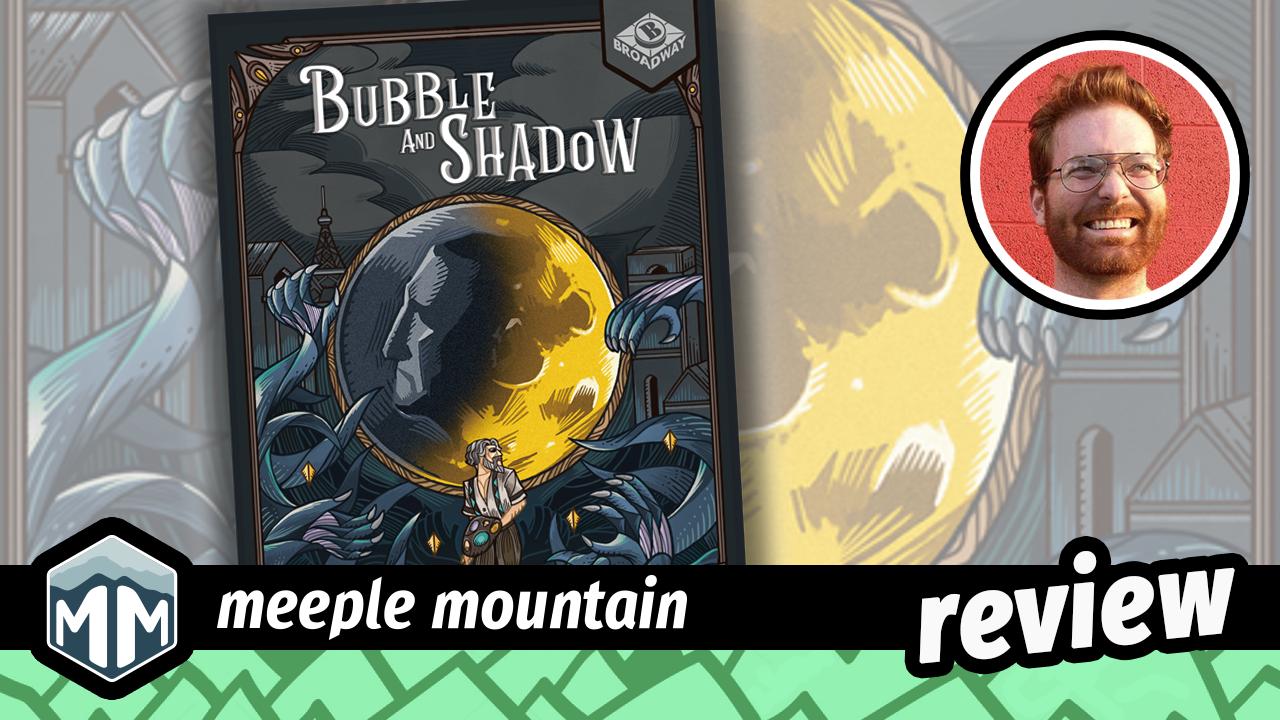
I reviewed Snake Charmers awhile ago, and I found that experience punchy and delightful. Now, I’m feasting my eyes on Bubble and Shadow, a game that is prettier, slightly more complicated, and ultimately, flatter.
The game has lofty ambition, noting as its inspiration W. Somerset Maugham’s The Moon and Sixpence, but I’m not sure if any of that translates. I’ve only read Of Human Bondage, and I ~think~ the aforementioned story is a fictionalized account of Paul Gauguin’s life or something, but I couldn’t for the life of me find how this game was related, other than it having really cool paintings on the cards.
Anyway, the objective of the game is to collect the right distribution of three types of wooden token: If you have the most purple tokens (bubbles), you’ll be eliminated from the scoring consideration at the end of the round. Then, if you have the fewest gray (coins) you score a point and are removed from the scoring. Finally, the player with the most yellow (moons) gets three points, and second most gets two points. You play three rounds, and if someone gets to five-plus points before that at the end of a round, the game ends and the player with the most points wins.
With this My Favorite Wargame Cards Series, I hope to take a look at a specific card from the various wargames that I have played and share how it is used in the game. I am not a strategist and frankly I am not that good at games but I do understand how things should work and be used in games. With that being said, here is the next entry in this series.
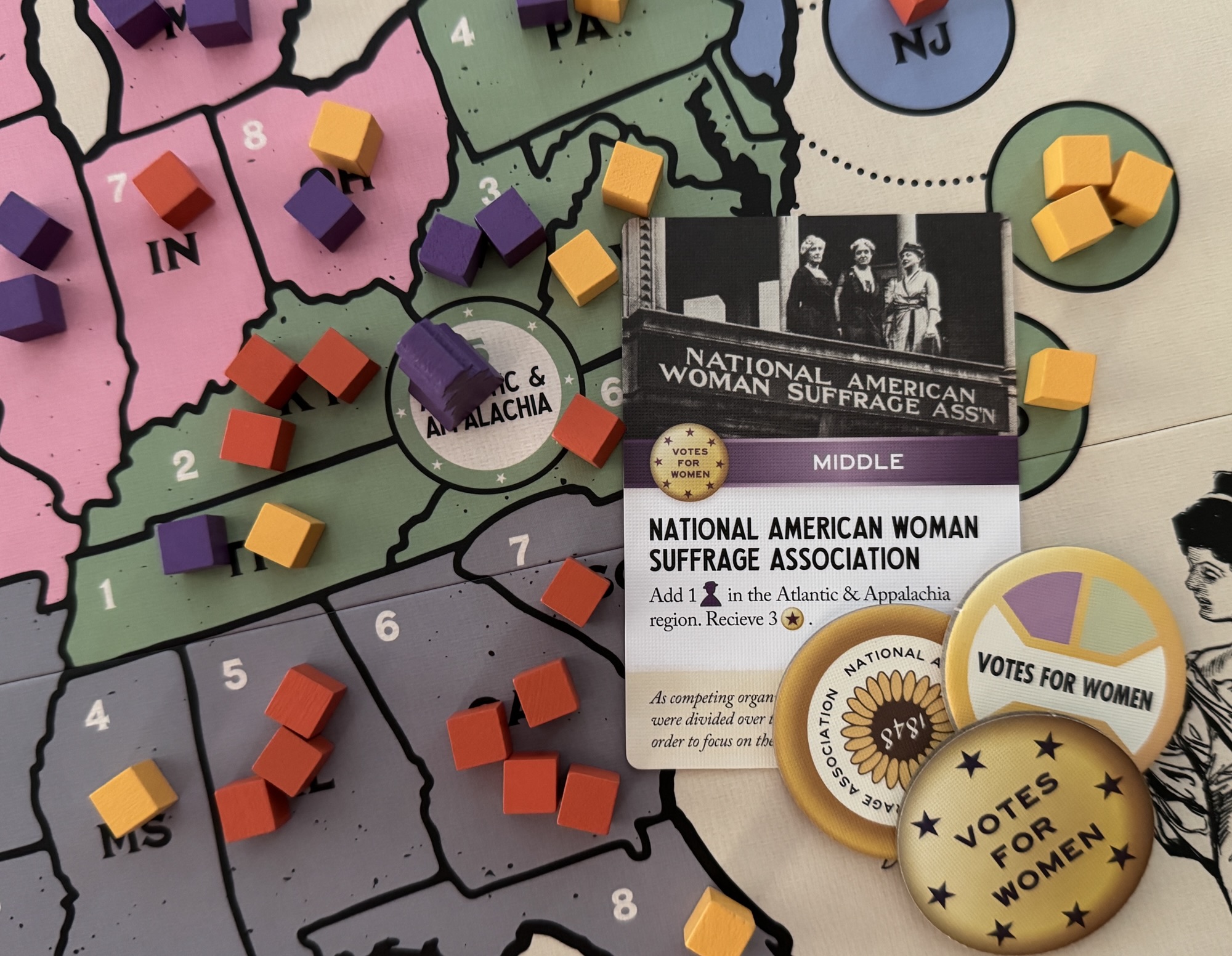
Card #88: National American Woman Suffrage Association from Votes for Women from Fort Circle Games
Votes for Women is a very interesting card-driven game that covers the American Women’s Suffrage Movement from 1848-1920, culminating in the ratification of the Nineteenth Amendment which granted women the right to vote. The game is a 2-player game, that has a fully developed solitaire mode with an “Oppobot” and offers a cooperative mode for those who don’t wish to play as they Opposition. The Suffragist player will have to push Congress to propose the Nineteenth Amendment, and then focus on campaigning to have a minimum of 36 states to ratify the Amendment. The Opposition side will try to prevent Congress from proposing the amendment and failing that to have 13 states reject the amendment.
The game uses cards in a fairly traditional CDG way as there are events that can be be taken or the cards can be played to do things like Campaign, Organize or Lobby Congress. Each card has a specific Card Era that is used to create of the each players’ Draw Decks. Late cards will be on the bottom of the deck, Middle cards will be in the middle of the deck and Early cards will be on the top of the deck. The Suffragist and Opposition decks each have one Start card that will be placed in the player’s hand at the start of the game. Some Event Cards have a prerequisite and some of the cards require a player to roll a 6-sided die and only take the the action on a roll of 3-6. Otherwise, the Event Card is discarded with no effect. The cards in this game are also steeped in historical details, from the name of the events that tie back to specific individuals or happenings, to major moments in the struggle. This game is about the history of the struggle for the right to vote and it is very good!
One of the more interesting aspects about the mechanics of the game is the use of Campaigners to go about trying to influence the attitude of the people and legislators regarding the Nineteenth Amendment through the Campaign Action. When a card is played for a Campaign Action, the player rolls a die, either a 6-sided or 8-sided die depending on what cards have been activated, for each Campaigner they have in play. The player then gets to take the dice and their results, which range from 1-8, and assign a specific die to each of their Campaigners. Each Campaigner may then place the corresponding number of cubes, matching the Campaigner’s color, in the States within the region that the Campaigner is located in. The player may spend a Button to move the Campaigner to a different region, but all of the corresponding cubes must be put into the same region. This is a great way to get a lot of influence out on the board to begin taking control of various States for the final vote in the game. This also is a very efficient way of doing this as you will be rolling 2-3 dice for your Campaigners and then spamming the States. With that in mind, today’s card is the National American Woman Suffrage Association and it provides the Suffragist player with a new Campaigner (purple) to place out specifically into the Atlantic & Appalachia Region that includes the States of Kentucky, Tennessee, West Virginia, Pennsylvania, Virginia, North Carolina, Maryland and Delaware. The card also grants the Suffragist player with 3 Buttons that can be used as described above to relocate a Campaigner from one state to another. This card is very helpful and should be played for the Event 9 times out of 10 and will make a huge difference in the outcome of the game. Once a 2nd or 3rd Campaigner is deployed, I tend to take Campaign Actions rather than some of the less intensive placement options or Events.
The National American Woman Suffrage Association (NAWSA) was an organization formed on February 18, 1890, to advocate in favor of women’s suffrage in the United States. It was created by the merger of two existing organizations, the National Woman Suffrage Association (NWSA) and the American Woman Suffrage Association (AWSA). Its membership, which was about 7,000 at the time it was formed, eventually increased to 2 million, making it the largest voluntary organization in the nation. It played a pivotal role in the passing of the Nineteenth Amendment to the United States Constitution, which in 1920 guaranteed women’s right to vote.
Helen Hamilton Gardener, Maud Wood Park and Carrie Chapman Catt at Suffrage House in Washington, D.C.
Susan B. Anthony, a long-time leader in the suffrage movement, was the dominant figure in the newly formed NAWSA. Carrie Chapman Catt, who became president after Anthony retired in 1900, implemented a strategy of recruiting wealthy members of the rapidly growing women’s club movement, whose time, money and experience could help build the suffrage movement. Anna Howard Shaw’s term in office, which began in 1904, saw strong growth in the organization’s membership and public approval.
After the Senate decisively rejected the proposed women’s suffrage amendment to the U.S. Constitution in 1887, the suffrage movement had concentrated most of its efforts on state suffrage campaigns. In 1910 Alice Paul joined the NAWSA and played a major role in reviving interest in the national amendment. After continuing conflicts with the NAWSA leadership over tactics, Paul created a rival organization, the National Woman’s Party.
Here is a link to our full video review of the game:
Ticket to Ride: London Designer: Alan R. Moon Publisher: Days of Wonder Players: 2-4 Age: 10+ Time: 10-15 minutes Played with review copy provided by Asmodee Ticket to Ride: London features the familiar gameplay from the Ticket to … Continue reading →
So I didn’t attend TGM but I did manage to acquire a few games. TGM designers continue to astound me with clever designs for trick takers and shedders as well as capturing unusual themes. Here are some of the stand … Continue reading →
Let’s play poker but in a different way. There has been several modern hobby
games which make use of poker hands, e.g. The Gang. The good thing
about these games is they use an aspect which most people are already familiar
with. It will be easier for us gamers to convince our non gamer friends to try
modern boardgames with us.
Half of All-In: Predictions is
Nutgoo.Lee’s Blancat made my seven-year-old cry. I know. That’s a movable bar. She was tired from a long day of playing in the sun, but she wanted to try the “kittie quilting game” anyway. It ended in tears. That’s on me, not Blancat, and certainly it isn’t on Nutgoo.Lee.
But here’s the thing: she practices at Blancat. She sits on her own at the table and studies the little templates and does her best to craft the quilts. She’s played plenty of other board games. She even has her favorites. Right now, that means Barbecubes and A Gentle Rain. Tactile stuff, not all that far removed from Blancat, but simpler, with lighter stakes. This is the first game I’ve seen that’s made her studious. The first game that’s meant to be challenging. Her intensity makes me wonder if there’s something here that I didn’t see right away. They say children let you see the world through new eyes. It seems the same goes for board games.
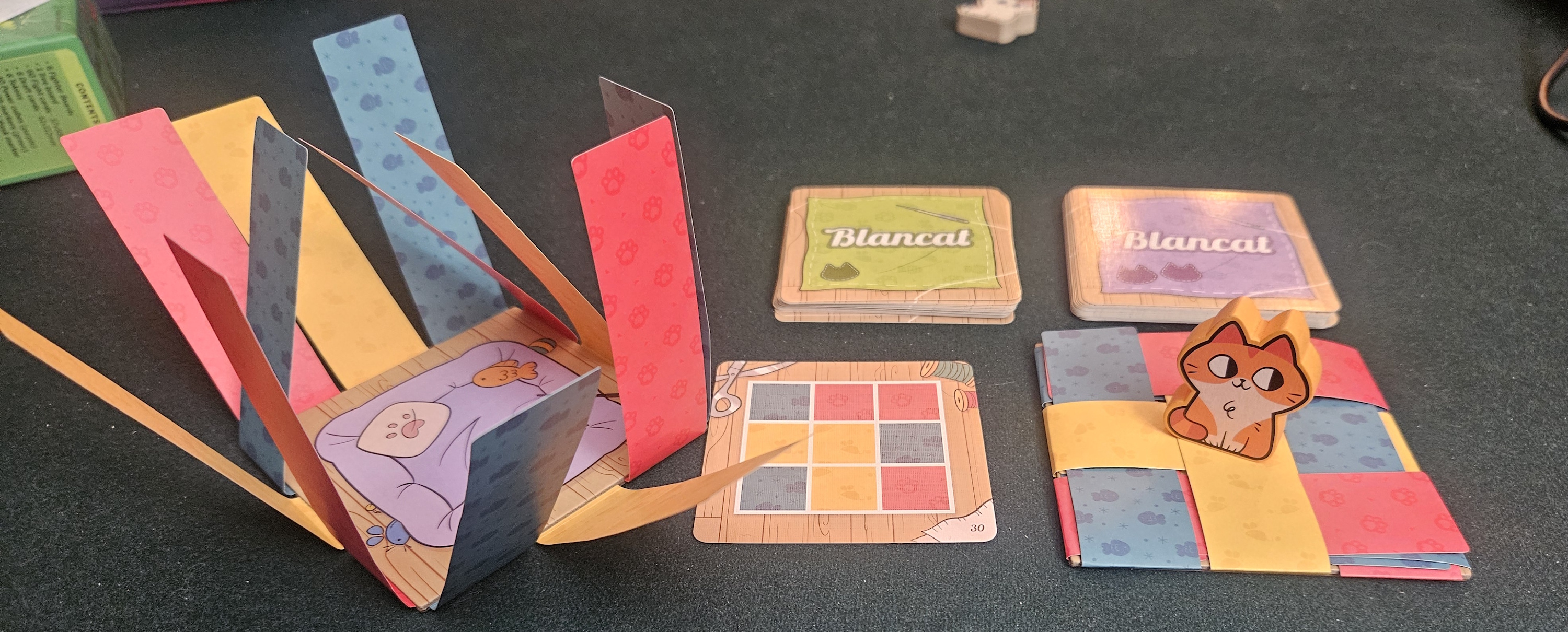
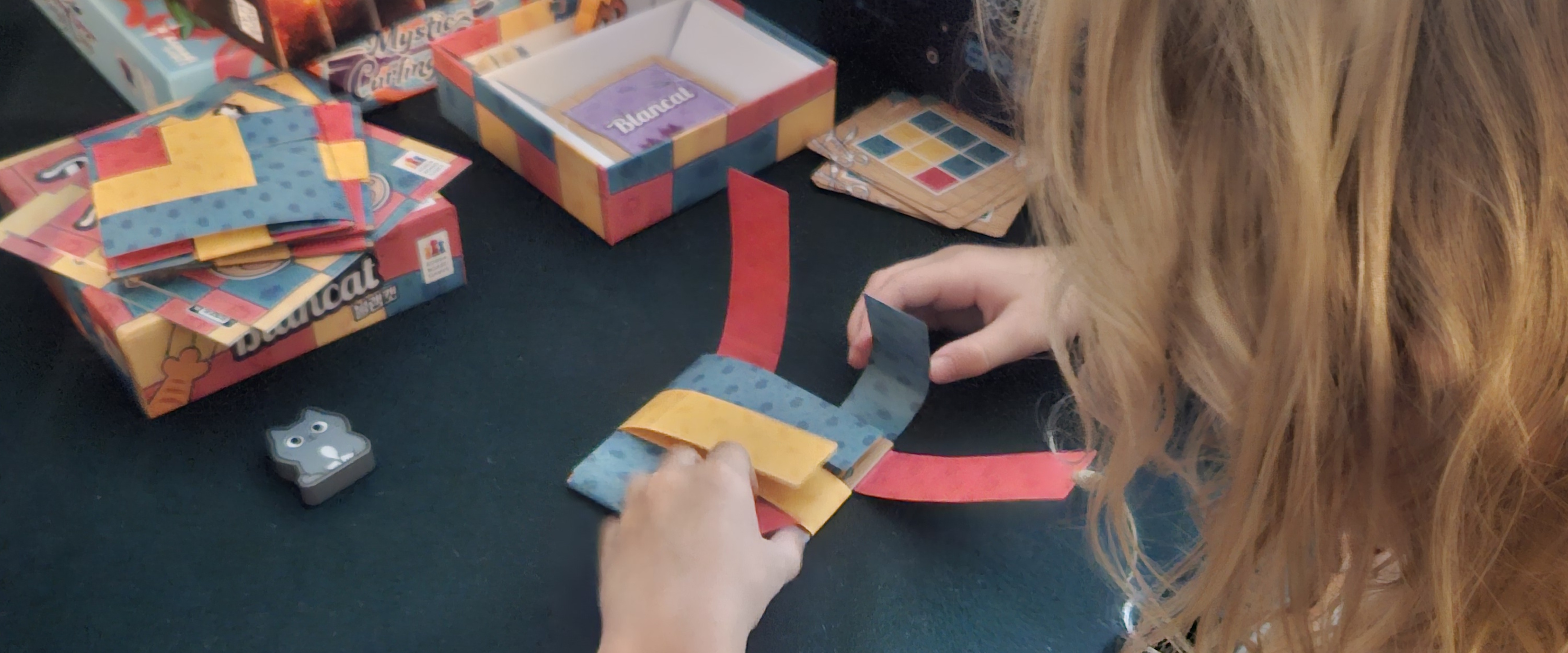
Everything you need to make a blanket.
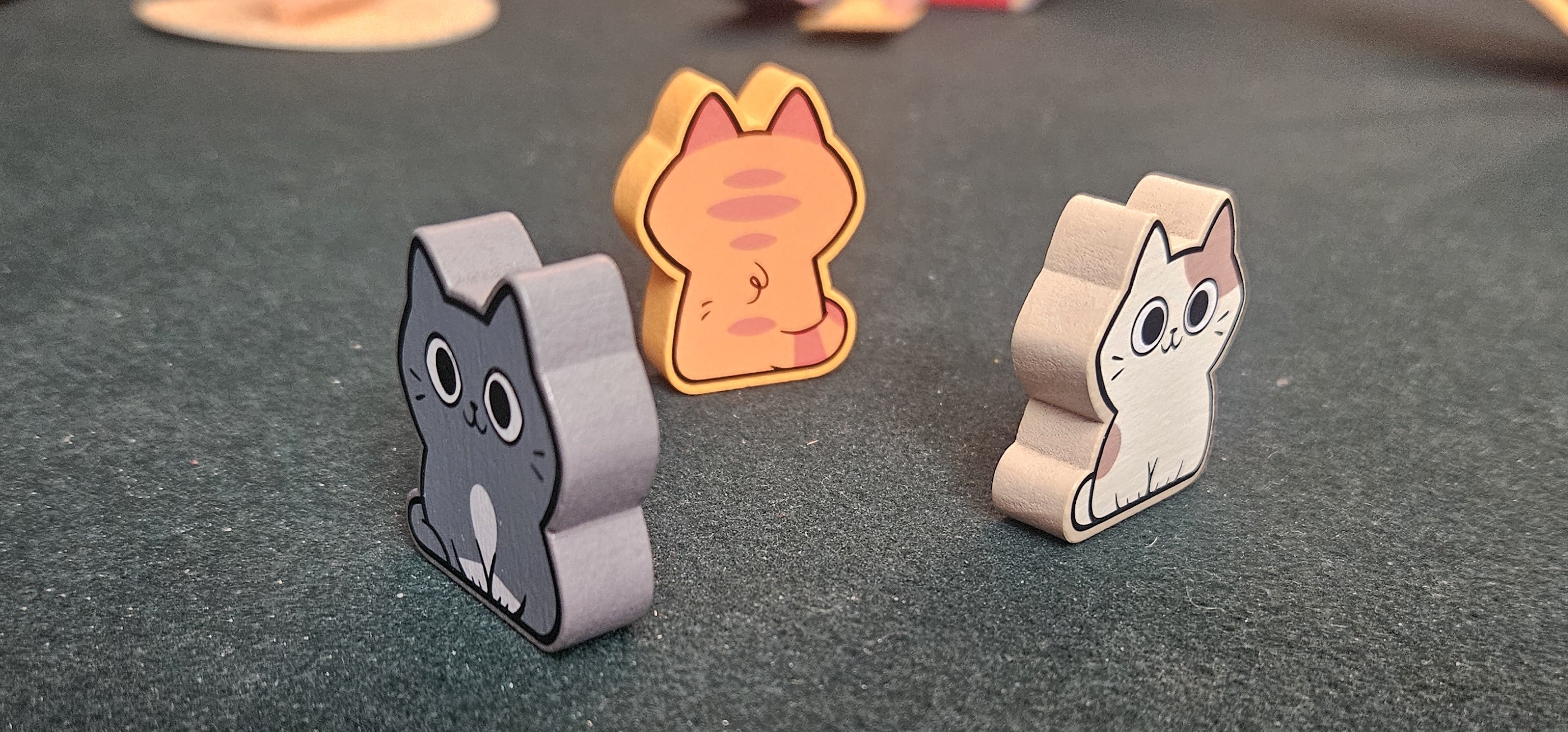
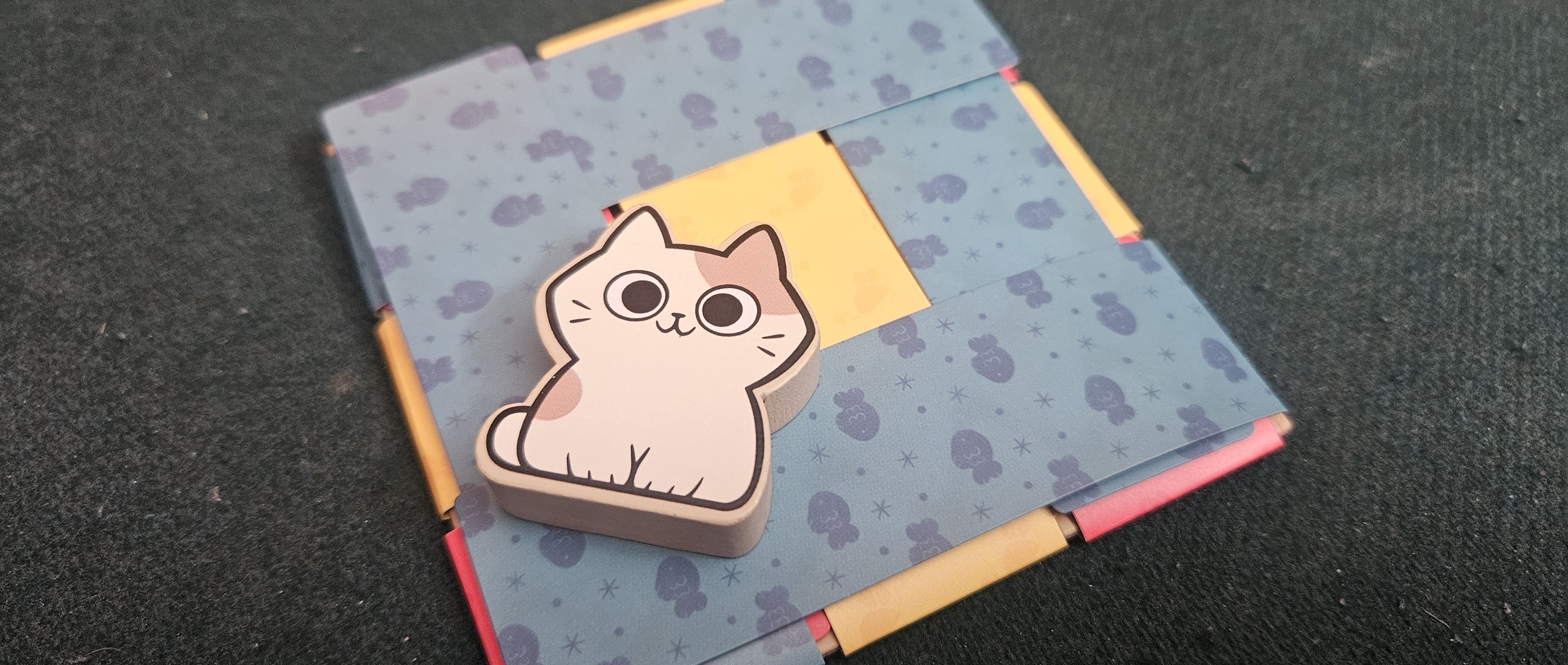
Blancat is about making blankets for cats. It’s a simple concept. You draw a card that shows a pattern. Everybody races to make the pattern, folding strips of stiff paper over and under one another. Upon completing your blanket, you grab a kitten. Last one out is a rotten egg. Then you play again. Nominally, there’s a scoring system. Honestly, we’ve never bothered. It’s the sort of game you play until the little ones want to do something else.
I’m not opposed to simplicity. Indeed, simplicity is often a synonym for elegance. But there’s a tendency in this hobby to hoist a ceiling over certain games. Too simple and the game is for kids. Too small and we’ll cap its rating at 7/10 on BGG. It doesn’t matter whether this is our most-played game of all time. It’s still not a serious game. Because it’s small. Because it’s simple.
Blancat is both small and simple. But watching my seven-year-old play it, I can tell you it’s the most serious exercise ever devised.
Blancat works for kids, but the advanced templates are surprisingly hard to craft.
There are two types of patterns, separate decks that offer vastly different degrees of challenge. The easy deck fits the description. As long as you have the gross motor skills of a toddler, you’ll get there.
But the hard deck is nasty. It isn’t enough to just fold down those strands willy-nilly. A successful pattern takes forethought. Blue over yellow. Red tucked between two strands, then folded upward. Blue back through the yellow and the red… wait. How exactly is this supposed to work? For twelve cardboard flaps, there’s surprising tactility at play. A strand that seemed like it went here might suddenly need to go there. A ribbon that was previously buried might become crucial, necessitating a last-second excavation. I’ve had easier times sewing actual quilts, and that’s no boast.
There’s an element of muscle memory to these challenges. It’s like playing with a Rubik’s Cube. At first, you’re just fiddling. Only later do you develop the sense for how to move things around. Eventually, it becomes second nature. To such a degree, in fact, that the whole thing stops being impressive and becomes an exercise in rote execution. When’s the last time you were impressed with somebody solving a Rubik’s Cube? I had a friend who could solve one while bouncing on a trampoline. Ten or fewer bounces, I think.
Three little kitties.
Of course, it’s all relative. Put that Rubik’s Cube in the hands of a child. Now we’re cooking. Because Blancat isn’t rote for my seven-year-old. Not yet.
For adults, Blancat is about speed. Such speed that I worry those little paper flaps will tear. Such speed that it’s like watching my high school friend take the highest, laziest bounces on the trampoline, so high and lazy he could spin that Rubik’s Cube a dozen times before his feet returned to the mesh. It was fun trick to watch, the once.
But with her? With my youngest kiddo? For her, it isn’t about speed. It’s about deliberation. It’s about thinking through this new logic. It’s also about kittens, because she loves kittens. But when she’s in that zone, the strands worked in her little fingers, even the kittens become secondary. She stops grabbing them for a hug. Instead, she’s all focus, weaving one flap over the other, pausing in confusion when something doesn’t line up, reversing her decisions, reassessing.
Watching her play Blancat is like watching her grow up in time-lapse. Her brain making new connections in real-time. Her fingers growing more limber. Her sense of self forming a new confidence. It makes my sternum watery. To see her. To feel such awe at her. To wonder at the span of us, our human family, striking flint into tinder, the spark igniting liftoff for a rocket ship. We grow up so fast.
Snug as a bug in a rug.
Blancat. That’s what we’re talking about.
Is it a good game? I have no idea. I think it is. For what it is. For a game that’s simple and small, but also surprisingly large. For a game that’s one thing to adults and another thing entirely to children. For a game about folding strips of paper ribbon over and under one another. For a game with wide-eyed kittens on its cover.
Honestly, I don’t really care about all that. What I care about is the way my child studies its ribbons, folding and folding, and then, when the pattern is done, reaches out and plucks a wooden cat from the table, and places it atop the quilt, and then, in a voice so quiet I can tell it’s reserved for herself alone, whispers in triumph, “Meow.”
A complimentary copy of Blancat was provided by the publisher.
(If what I’m doing at Space-Biff! is valuable to you in some way, please consider dropping by my Patreon campaign or Ko-fi. Right now, supporters can read the next installment in my series Talking About Games, this time tackling the topic of what makes a good list! Naturally, the piece includes a list.)

 Anmelden


 A lot of publishers send promos to his store, but it takes a lot of work to match them with the game (stores juggle a lot of different games, and promos aren’t always labeled well).


/pic9620404.jpg)