Back to the history of New York City! We have begun with the city’s origin before the founding of the United States and left off in the 1880s in the last post – when New York was undeniably the economic and cultural center of the United States. Today, we are covering New York in its most iconic form as a moloch of steel, concrete, and millions of people. A chronological narrative will not help us here. Instead, we adopt a thematic approach and look the economy, construction, infrastructure, and culture which made New York from the late 19th to the mid-20th century the model city of high modernity.
If you want to read more posts like this – for example, the next instalment in the New York series – I strongly recommend you subscribe to the blog: All new posts in your inbox right when they go live!
New York had been America’s most dynamic hub for trade and manufacturing for decades. Yet the city’s riches had been shared unequally, just like the risks in producing them. In the late 19th and early 20th century, New York’s working class grew more assertive and found more political support to improve their lives: For example, the three Tenement House Acts of 1867, 1879, and 1901 mandated such luxuries as windows in every apartment and toilets in every building.
The 1909/1910 textile worker strikes led to improved pay and shorter hours. Just one year later, the Triangle Shirtwaist Factory in Lower Manhattan burned down and 146 garment workers died – many of them unable to escape through the staircase because management kept the doors locked during shifts. The fire catastrophe led to a public outcry against such practices and New York state introduced better workplace and fire safety regulations.
The garment workers were in some ways emblematic for the New York working class – most of them were young immigrants (especially Jewish and Italian). In another, they represented a shift – almost all of them were women, and their struggle for better working conditions mirrored the force of the American women’s movement in the political arena.
In one way, however, they represented New York’s present, but not its future: The industrialization of the 19th century had turned New York into the largest manufacturing hub of the world. Yet manufacturing, the physical production of goods, ran out of steam when the improved productivity provided most people in the United States with most of their basic needs. Eager customers were thus not to be taken for granted anymore. Instead, they had to be wooed and their desires – for items of whose existence they had recently been still ignorant – awakened. New York became a hotbed for the growing advertisement industry (with which Madison Avenue is synonymous until today) as well as for shopping (here, Fifth Avenue is the symbolic street). Our age of trends, shopping as a leisure activity, and overconsumption cannot be imagined without New York.
In the 19th century, foreign capital had funded the expansion into the American West, but now the capital flows reversed: American capital was instrumental in financing the Allies’ Great War effort. At the end of the Great War, America was for the first time a net creditor nation. Its role in the international financial system expanded after the war as American loans enabled defeated Germany to pay its reparations to the Allies (who, in turn, paid off their American war loans). At the same time as New York took London’s place as the premier finance hub in the world, America at large withdrew from the world under a renewed isolationism and the xenophobia which came with the Red Scare after the Bolshevik Revolution.
Political upheaval did not stop the investment craze of the 1920s: When a bomb exploded in Wall Street in 1920 and killed 30 people, stock trading resumed normally the next day – much in contrast to 1920 Wall Street (Perepau Llistosella, Looping Games), where the bombing marks the end of the game (and players hope to have made all their profits by then).
The New York-based financial system was robust enough to withstand such external shocks, but it collapsed under its own contradictions: The stock market boom of the 1920 led to ever more capital pouring into the New York Stock Exchange (at the expense of all other forms of investments, for example the American overseas loans on which the global financial system was now based). The spectacular gains fueled a debt-based speculation bubble which burst in October 1929. The inadequate response by central banks which did nothing to combat the contraction of the monetary supply led to an extended, global economic crisis – the Great Depression.
Unemployment and poverty plagued New York much like the rest of the world in the 1930s. The city bounced back through ambitious public works initiated by the energetic new mayor Fiorello LaGuardia (many of them funded by New Deal funds in a cross-party cooperation between the Republican LaGuardia and the Democratic president Franklin D. Roosevelt). Still, New York’s economy only recovered when demand for manufactured goods skyrocketed because of World War II: The industrial giant rose one last time. One example of New York’s awesome productive capacity may suffice: From 1941 to 1945, the New York Navy Yard built more warships than all of Japan combined. The United States won World War II because of their industrial productivity, and New York was the beating heart of it.
Construction: Upwards
New York had always grown. From the 1880s on, the city grew in a heretofore barely used dimension – upwards. The twin innovations of the elevator and steel frame construction allowed for building heights which had been considered impractical, if not impossible, before. While New York was not the pioneer of these technologies – that merit belongs to Chicago – they were accepted in Manhattan on a scale not known before. Ever more “skyscrapers”, as the tall buildings were soon to be known, sprang up between the Hudson and the East River, giving the city a characteristic look from far away. New York’s skyline has been continually changing, but since then, it has always been dominated by skyscrapers – as has been the image of the city in the public imagination.
Board games are no exception. No theme is as prevalent in games about New York as the construction of skyscrapers. Some are specific, like Flatiron (Isra C./Shei S., Ludonova) which has players build the eponymous Flatiron Building together, but many could be set in any city with tall buildings – but as they are about tall buildings, their designers and publishers think they fit best for a New York setting: Manhattan (Karl-Heinz Koch, Fagus) is a variant of Acquire (Sid Sackson, Avalon Hill) to which the third dimension is added. New York City (Stefan Feld, Queen Games) is a remake of Rialto (Stefan Feld, TMG) – just that the struggle for majorities in Venetian districts of the original, fought with councilmembers, has been replaced by a struggle for majorities in New York boroughs, fought with – you guessed it – skyscrapers.
The skyscrapers got ever taller: The first steel frame buildings in the 1880s and 1890s were well below 100 meters. In 1909, the Singer Building (187m) was the first structure in New York to exceed the height of Europe’s church spires – the first time that the world’s tallest building stood in New York. The city would retain that honor until the 1970s with a succession of ever taller skyscrapers.
The most iconic one was the Empire State Building whose construction was begun in October 1929 – just weeks before the stock market crash. It became the most visible sign of the economic crisis: Even five years after its completion in 1931, half of the Empire State Building’s office space remained empty. Like the rest of New York, it recovered by the 1940s. It would remain the world’s tallest building until it was overtaken by another New York icon in 1973 – the twin towers of the World Trade Center.
Infrastructure: Transport and Leisure
New York did not only grow vertically. Originally, the city had been confined to Manhattan Island and gradually expanded into what became the Bronx. In 1898, New York merged with its neighbor Brooklyn (itself America’s third-largest city at the time) as well Queens county and Staten Island to become a massive metropolis of more than three million inhabitants.
This sprawling moloch, however, was initially still centered on Manhattan, as most people worked there and thus couldn’t live too far away: In 1900, more than half of New Yorkers lived in Manhattan. That changed with the construction of the New York subway from 1900 on. New York was late to embark on such a project (London had started in the 1860s), but it was undertaken with the characteristic boldness of the city and soon became the largest in the world.
Thus, the geography of the city changed: New Yorkers could work in Manhattan, but commute every day from one of the other boroughs. As land there was a lot cheaper, a residential construction boom set in, and by the 1920s, Brooklyn had become the most populous borough of New York.
The growth of the city required its transport and leisure infrastructure to keep up. One man would become synonymous with it from the 1920s on: Robert Moses, starting out on the Long Island State Park Commission in 1924, became responsible for all kinds of parks, beaches, roads, bridges, and tunnels for both the state and the city of New York over the next decades.
These projects shaped the face of New York: The parks, both in the center and on the outskirts, provided very real benefits in one of the largest, most densely settled cities in the world. And the transport projects took inspiration from the new trend of motorized individual transport – and reinforced it.
Large-scale engineering projects like these go beyond the mere technical aspects. Moses’s creations were shaped by his ideas about how society should look like. For example, already his very first project – Jones Beach State Park on Long Island – outlined his ideal: It provided New Yorkers with a beautifully designed leisure park on the seashore. They arrived there after a pleasurable drive on the new parkways through lush greenery – by car, as no train or subway station was built in Jones Beach, and the bridges crossing the parkway were too low for buses to pass through. This lack of public transport meant that Jones Beach was exclusively accessible for the middle classes.
An even more striking example is Riverside Park in Manhattan along the Hudson River. Around a third of the park is in the predominantly Black neighborhood of Harlem, two thirds in the predominantly White Morningside Heights and the Upper West Side. These southern two thirds were liberally sprinkled with dozens and dozens of playgrounds, the third in Harlem only received one – and here, the iron lattice at the toilets was “decorated” with little ape sculptures.
As you can see, Robert Moses was not quite a nice guy. We’ll see more of him in the next post in this series!
Culture: Roaring Twenties
America’s new, more assertive role in the world after World War I also increased global interest in the country’s cultural output. American literature developed a new confidence, and American jazz became the hottest new music around the world. New York as America’s cultural center both attracted established artists (like the jazz musicians Duke Ellington and Louis Armstrong who both made the city their home in 1923) and produced its own original creations (like the Harlem Renaissance, which marked the first time that a movement of Black American writers and visual artists left their imprint on the wider American cultural consciousness).
One of the institutions of the 1920s New York cultural scene has gotten its own board game: 1923 Cotton Club (Pau Carles, Looping Games). The historical Cotton Club was founded in Harlem in 1923 and soon became the venue to see many of the finest jazz musicians – an attraction not only for regular New Yorkers, but also for the celebrities of the time. That, in turn, made the club even more attractive… well, not for everyone. While the performers on stage were Black, the club would not admit Black patrons (except for the rare Black celebrity). That is not explicitly addressed by the board game, but attentive players will notice that the almost all of the artists which can perform at the players’ clubs are Black, almost all of the celebrities which may attend the club (and are the chief source of points) are White – as are the gangsters.
“Gangsters?” you may ask. “In a game about running a nightclub?” Yes, as we are in the age of the prohibition of alcohol in the United States. This fleeting episode (1920 to 1933), and the massive expansion of organized crime which came with it, is almost as irresistible to board game designers as the construction of skyscrapers. Sometimes, it is only the corollary to another activity (like in 1923 Cotton Club).
Of course, all these mafia games could be set elsewhere. After all, alcohol was prohibited everywhere in the United States. New York, however, is irresistible as the biggest city, where presumably also the biggest crimes are committed. It is no coincidence that both Superman and Batman, those heroes of the Golden Age of Comics, fight their mastermind criminal enemies in fictionalized versions of New York (Metropolis and Gotham, respectively). Apropos: Age of Comics: The Golden Years (Giacomo Cimini/Sónia Gonçalves, Lirius Games) allows players to run a comic book publisher, develop ideas, print, and sell comic books… and of course, they do so in New York.
For a concise introduction, especially focused on local politics, see Lankevich, George J.: New York City. A Short History, New York University Press, New York City, NY/London 1998.
If you want a treatment which is both more in-depth and more journalistic (and lavishly illustrated) and don’t mind its history practically ending around 1970, see the book version of the 17-hour PBS documentary from 1999: Burns, Ric/Sanders, James/Ades, Lisa: New York. An Illustrated History, Knopf, New York City, NY 2001.
New stats have been added to two new places in the app: the Overview screen and on Insights!
Overview screen
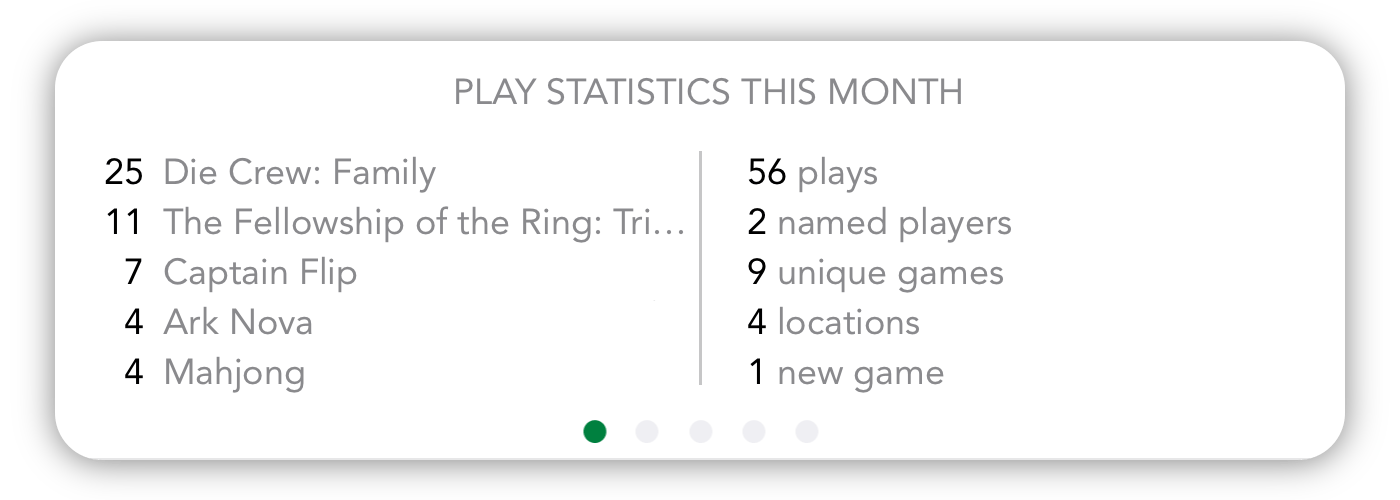
Two new sections have been added to the PLAY STATISTICS segment, This Month and This Year.
These have been added between the current sections, so the sections are now, in order from left to right:
This Month
Last 30 days
This Year
Last 365 days
All Time
Stats segment on Overview
As always, the section you select will be remembered, with this update this will be reset one-time only.
Insights
Charts based on Time played*
The charts on Insights can now be toggled between being based on the number of plays and the time played.
Above the chart section of the page, you will find a the option to switch between the Play count and Total time played. All charts below will be changed:
Plays bar chart
Player bar chart
Player counts pie chart
Days of week pie chart
Locations pie chart
Insights stats section Android
Zoom out button
On the top left of this section you can now also find a magnifying glass.
Tapping on this will zoom out your stats to the next level: from Month to Year, and from Year to All Time.
Insights stats section iOS
As always, you can still tap on a bar in the Plays bar chart to zoom in.
Value labels
Labels have been added (where possible) to the Plays bar chart, so it’s easier to see the absolute values of these.
As the co-designers of Sniper Elite: The Board Game, we wanted to give you a few behind-the-scenes details of how we created the new Operation Krakenexpansion. If you’re a fan of the base game, this expansion gives you two new maps with some interesting movement elements, some new powers and actions for both Karl and the defenders, and adds a little bit more depth to the base experience. Since it is our second expansion we thought players would like to explore “but what if I could do THIS!”
David Thompson and I both knew we didn’t want to just "add more stuff.” We wanted Operation Kraken to push the design in new directions but stay true to what makes Sniper Elite work: tension, stealth, and cat-and-mouse gameplay. We had a basic design question: What can we do differently with the maps that doesn’t break the core movement and shot mechanics?
We also were listening to players who thought the defenders could use some help catching Karl. So we added a couple of actions and….armored cars! More on that later.
What If the Whole Map Was a Ship?
Ships are narrow, multi-level, and very linear. Staying hidden is a huge challenge and so is finding someone who is trying to hide. The map is unique because it depicts all three levels of the ship with only a few connections between levels. As we design we’re constantly asking “what do we want the players to feel on this map?”. We wanted Karl to feel trapped, and we wanted the defenders to feel like they had him trapped!
I’ve always liked the idea of the players affecting movement on the map–on earlier maps the defenders can block routes, but they can never close them off. But on a ship? Defenders would definitely close and secure doors–so we gave them that ability. It leads to some great tactical decisions as the defenders effectively change the shape of the map (at least temporarily).
So how can the sniper player deal with those locked doors? Make your own door! We introduced the ‘Explosive Entrance’ loadout card which allows the sniper player to blow a hole in the wall to serve as a door for the rest of the game. Sometimes though, a stealthy sniper doesn’t want an explosion–so we also introduced ‘Bolt Cutters’ which let them silently open a locked door without the defenders knowing. Both of these loadouts were developed with a lot of testing on the door locking mechanic, as we realized the sniper needed a way to deal with locked doors, but not a way to deal with all the locked doors. Loadout cards gave us a way to do that.
The other interesting thing about the map is moving between levels. Ladders are available to defenders and Karl, and provide connections in just a few places. But that proved a little bit too limiting, allowing the defenders to really shutdown the map. How would someone sneaking through the ship deal with that? Air ducts. We tested those and they work great, giving Karl a way around and forcing the defenders to think “what if he crawled in there…..?”.
The shape of the map also meant we had to change how ‘gather intel’ works–because the squad sectors are spread across multiple levels of the ship. So asking ‘are you in red?’ meant Karl could be on three different levels! To deal with that, we allow the defenders to ask “are you on this level of the ship” regardless of sector color. That decision had a knock on effect: two different squads could ask “are you on this level?” and “are you in this sector?” and that would narrow Karl’s location down to very few spaces–which didn’t work. We had to change the action so that you could ask sector or level, but not both in the same turn. These are the kind of design decisions that can only be made through testing.
The Great Outdoors–But With Armored Cars
After we finished the supercarrier, we wanted the opposite of enclosed, claustrophobic hiding–we wanted an open area where the sniper could really move. All that freedom of movement makes the defender job much harder, so we also wanted to add a way to cover all that ground–and we introduced armored cars to give defenders another way to move around the board. (Also, here’s a plug for ‘Sniper Elite: Escalation’: that expansion allows you to use the cars on the Heavy Water map from Sniper Elite: Eagles Nest expansion).
The Norman Village map is interesting because it started out as…..an assault on a mountain base! As designers, David and I try lots of different things before we get the maps just right–hidden movement games live or die by the maps. So at first the village was a mountain base, and the armored cars were joined by cable cars that connected individual points to enable rapid movement across the map. This image shows a super early version with organic spaces, the cable cars, and even glacier spaces with special movement rules.
In the end it was just too many changes on a single map. We talk a lot about ‘rules grit’: we prefer rules that are generalized and straightforward rather than rules that are very specific, situational, and ‘gritty.’ We knew we wanted a bit more grit in these new maps, since they are designed for players who have played four other maps in the series, so we threw everything on there and then worked backwards! Finding the right balance is tough. So we removed the cable cars and refined the armored cars.
So how did the map change from a mountain assault to a Norman Village? When David and I finished the map we handed it over to our partners, the development team at Rebellion. They tested it extensively and found that the special rules for ice movement also were too gritty. And they had a story idea that revolved around the setting in France. When you compare our prototype map to the final map you can see that the general layout and objectives are there, but the spaces are more regular and the road is extended to replace the glacier. This is a really good example of how design merges with development–the folks at Rebellion are great to work with, and we agree the final design is cleaner and provides extra grit but in just the right amount. (But David and I haven’t forgotten about those cable cars!)
Kraken Unleashed The name Operation Kraken comes from the fictional Nazi superweapon plot that Karl’s trying to stop in this campaign. We wanted the expansion to feel bigger, a little more cinematic, and a bit more complex than the original game—without losing the streamlined rules that enable the players to face off without constantly reading the rulebook. We’re super happy with how it turned out and we hope fans of the basegame appreciate the changes we made! Happy hunting!
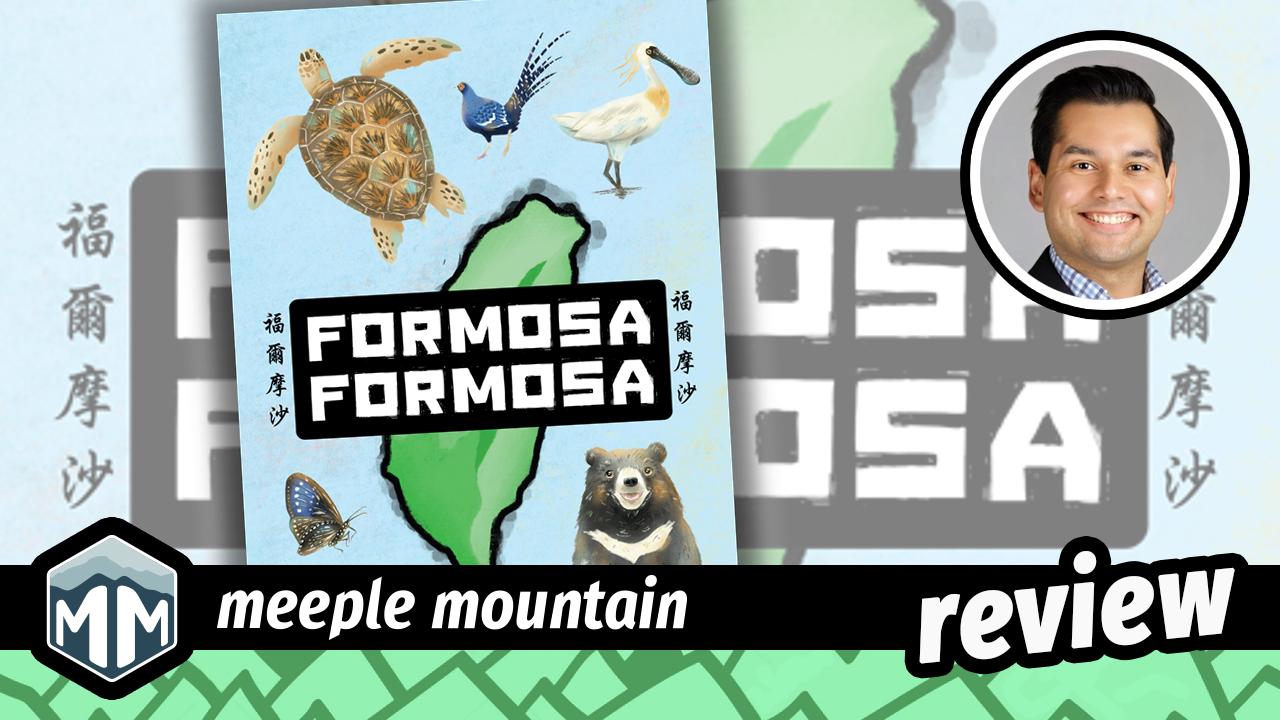
It’s always great to see games from Asia make it stateside. As someone who is half Asian, I’ll always be drawn to games from my home continent. But in a time of crazy tariffs and international uncertainty, there’s a lot of gold that never gets its spotlight over here in the States.
Formosa Formosa, which literally translates to “beautiful Taiwan” in Portuguese, fortunately fell into my hands at the GAMA (Game Manufacturers Association) Expo this year. Designer Kirk Beiser is an expat living in Taiwan who happened to pack a few copies in his suitcase for the long flight to Louisville, Kentucky.
With events like the Tokyo Game Market and Asian Board Games Festival showcasing fantastic titles, we’re often on the outside looking in. Different cultural upbringings shape different ways of thinking and often lead to games that feel unlike much of what we see from Western designers. We can only hope more make their way stateside, whether through new distribution channels or smuggled over in luggage!
Toss and Tour
Formosa Formosa is a “toss-and-write” game in which every component is used, including the box itself. Players take turns until the final round, with the number of rounds scaling based on the player count so everyone receives an equal number of turns.…
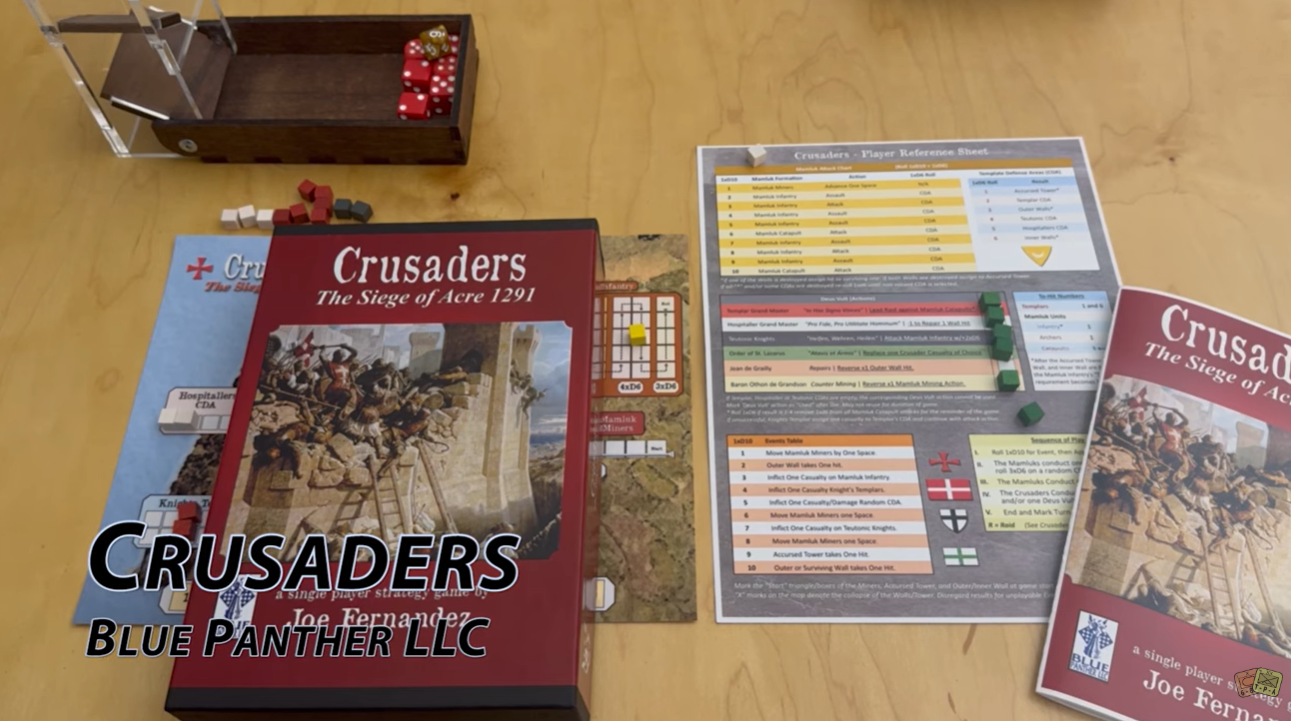
Dive into history and heroism with Crusaders: The Siege of Acre 1291, a solitaire wargame that lets you experience the last stand of the Knights Templar and the Crusaders in the Holy Land.
Relive the courageous stand of some 15,000 Crusader soldiers, Knights Templars, Teutonic Knights, and Hospitallers as they defend Acre, a critical port city in the Holy Land, against a massive Mamluk army of some 80,000 soldiers armed with siege engines and catapults in the century after the Ninth Crusade.
Fighting was brutal. Mamluk archers and catapults rained missiles on the walled city, infantry conducted relentless assaults against its perimeter while miners attempted to breach the defenses of the stronghold from below. From behind its ramparts, the Crusaders repelled attack after attack while leading raiding parties outside of the city as the immense Mamluk army tightened the noose of the defending Crusaders.
When the dust settled, the city of Acre was overun by the Mamluk army. Crusaders and citizens were killed as the remnants of the Crusader army fled back to Europe while the legendary Order of the Knights Templars retreated to the island of Cyprus. The Crusaders lost their last major stronghold of the Crusader Kingdom of Jerusalem, never to return. Can you hold Acre?
Odd Logic Designer: not credited Publisher: Mattel Players: 3-6 Age: 12+ Time: 15 minutes Amazon affiliate link: https://amzn.to/4hteE1l Played with review copy provided by publisher Pair 4 out of 5 picture cards and write down the reasoning as well … Continue reading →
Gen Con 2026 – Thunderworks Games Gen Con 2026 is over (as well as the fall school kick-off) and I’ve come back up for air, just in time to ramp up the annual Gen Con run-down here at OpinionatedGamers. Will … Continue reading →
Instead of the usual lineup of game announcements and post-convention hauls, I wanted to write and photograph about the random tidbits that caught my attention at this year’s Gen Con, including a wonderful interview with Felicia Day (see below).
Full up before we even begin
Hot Weather, Hot Games
Let’s start with the main reason I was present at Gen Con - to help run the Hot Games Room. The BGG team arrived on Tuesday and all day Wednesday was spent collecting games for the Hot Game Room, our event space at the Hyatt Regency which allows attendees to try as many of the newly released games as they please. Typically this prep day is dominated by long hours, lots of heavy lifting, very hot temperatures, and dodging huge piles of carpet and boxes in the chaos of the exhibit hall before it opens. In the calm before the storm, we caught this fun photo over breakfast:
Some of the BGG Gen Con Crew
Once collected, we now had a pile of hundreds of new games that needed to be punched, prepped, and cataloged in our library system. Our Wednesday night is a multi-hour pizza punch party when we eat, chat, and punch out hundreds of games.
LEFT: Games before getting punched. RIGHT: HGR library ready to go, over 800 boxes catalogued in our library system
Over 43 ticketed sessions, we saw over 2,500 attendees check out over 3,300 games! Our top check outs were:
A panorama image of the Hot Games Room on Friday evening
Goodbye Balloons, Hello Statues
A personal highlight for me is seeing the annual balloon sculpture in the main hallway of the convention hall. After two serious latex allergy incidents last year, Gen Con decided to discontinue the balloon sculptures for safety. So I will share this picture of my favorite display from 2023 in remembrance of the hard work and amazing skills of those artists:
2023’s balloon sculpture: a moon lander complete with space backdrop, lunar surface, and astronaut.
Instead I noticed an increase in large statues within the exhibit hall. Gen Con is known for its cosplay events, and I found these stationary versions to be an interesting counterpoint.
LEFT: No shade to Martin Freeman, but this is my favorite Bilbo. CENTER: Dungeon Crawler Carl was everywhere and this statue was impressively huge, RIGHT: Leonardo was life-sized and ready for battle
As always, Cardhalla is a glorious, chaotic whirlwind of construction, and this year did not disappoint. I took a photo of my favorite shape this year, a large shark (whale?) that eventually grew spikes from other builders as the days progressed:
LEFT: An overhead shot of Cardhalla in its final hours on Saturday. RIGHT: The shark / whale in early stages.
And to finish up this roundup of creative endeavors, I am more fascinated with the table setup for the miniature painting than the miniatures themselves.
I forgot to count exactly, but this table seated at least 20 painters
From Tokyo to Philadelphia to Indianapolis
For the first time, Gen Con featured Game Market Indianapolis, a showcase of designers demoing and selling their new, self-made creations on the spot. This event was modeled after the success of the Indie Games Night Market at PAXU, which in turn was modeled after Tokyo Game Market. Held in one of the hallway lobbies at the JW Marriott, this market featured 20ish different designers demoing about 24 new games. I’m partial to trick-tricking games and picked up two titles: Short Stacked and Laundry Day. Unlike the exhibit hall, there are no flashy banners or elaborate displays - just the designers with a table, a single display copy of their game, and a stack of copies for sale. Attendees could wander freely between tables, listening in to demos in progress, or asking the designer to start the explanation. I would estimate about 100 people were there at the start, although we left after 30 minutes or so.
I hope that small sales events like this continue to pick up speed in the US as it was fun to see designers at the beginning of the publishing journey. While many of the games used clipart and homemade cards, a good design will transcend the limits of its components. Hopefully some established publishers found a hidden gem and this event will be the launchpad for some first-time designers.
Two demo tables at the Game Market Indianapolis. For the racing game on the left, the metal cars were included with your purchase
A Few Game Announcements
While taking a water break on Wednesday, one of the reps from Restoration Games was setting up the display cabinet in the main convention hallway, and I was lucky to snap a picture when the cabinet door was open. Inside was the layout for the newly announced King’s Gambit, a reworking of the Star Wars: The Queen's Gambit from 2000 but rethemed to Tolkien’s Lord of the Rings. This display took two shelves in the display cabinet but is designed to stretch in one continuous line on a table - a photo I was unable to capture unfortunately.
Rob Daviau was one of the lead designers of Queen’s Gambit and returns again as one of the lead designers of King’s. Like the original, players will be juggling multiple battlefields at once, with players choosing to allocate their limited stock of cards and resources across those different locations. Unlike the original though, this Middle Earth version will support more than two players. A demo copy was available in the Restoration Games booth, with a projected retail date sometime in 2027.
LEFT: One end of the playing field featuring (presumably) Mt. Doom and Barad-dûr. RIGHT: Minas Tirith with a baby Citadel at the very top.
I haven’t done interviews for BGG since COVID, so it was fun to put those skills to the test again with a sit down with designer Sam Bailey and Kuba Polkowski from Chaosium. Sam is the designer of Forbidden Stars, a reimplementation of Starcraft: the Board Game. Like Queen’s Gambit, both Starcraft and Forbidden Stars will likely be out of print forever due to copyright and licensing issues. Fans of Forbidden Stars have been asking for a new version regularly (you can follow that conversation on this massive 79-page thread) and Sam was excited to give a reboot a try. He created a new implementation with a different publisher and that deal fell through from IP issues. He signed a deal with a second, different publisher…and it fell through a second time. Each time he put in significant time and effort to rework Forbidden Stars into something that was both familiar and yet new, only for that work to languish unused.
Finally, it seems there is success with Chaosium and Forbidden Stars is now reborn as Old Ones Origins, with the setting and theme moved from space-facing sci-fi to a battle of eldritch gods. Unlike many Cthuhlu-flavored games that use a 1920s setting, Old Ones is a battle of ancient powers vying for control at the dawn of time - humans are not part of this picture! Game length can be dialed from two hours to all day, depending on the selected factions and choosing the short game vs. the epic game. I was demoed some of the game play and its evolution from Forbidden Stars, and it was clear that Sam put in massive amounts of work to translate this version’s mechanics into something that clearly supports its new theme.
A Kickstarter campaign for Old Ones will begin in September 2026 with estimated delivery in Q4 2027 / Q1 2028.
Closeup of prototype minis and game board
Speaking of Reboots….
This Gen Con was dominated by events supporting three large fandoms: Dungeon Crawler Carl, Critical Role, and The Guild. Celebrating its 20th anniversary, The Guild is currently being rebooted into a movie after a successful run as an online video series from 2007-2013. Thanks to a BGG volunteer in Felicia Day’s Twitch chat (thanks Walt!), Felicia was put in contact with me and stopped by the Hot Games Room for a tour and an interview.
Aside from funding the movie, Felicia is also launching a TTRPG and a card game: Swords & Sweethearts. This card game is based on the combination of the music video “Do You Want To Date My Avatar?” combined with Felicia’s love of dating sim video games. Players collect items to increase their stats and then try to take a prospective match on a successful date. However, the suitor, location, and actions of the other players can all affect the outcome of your date, so romance is not guaranteed. Many celebrities have donated their likeness for cards in the game, so you could take Misha Collins, Alan Tudyk, Dungeon Crawler Carl, “Weird Al” Yankovic, or a sheep from Catan on a date.
Felicia announced that she and Wil Wheaton are launching a new board game show called Conludo. I also interviewed Wil Wheaton at Gen Con over ten years ago, when his Tabletop YouTube show was at its peak. In that conversation, we discussed that many gamers credit that show as their introduction into modem strategy board games, and I hope the same will be true for Conludo as well.
We also discussed The Guild’s TTPRG, written by castmates Vince Caso and Sandeep Parikh. Just as with Sword & Sweethearts, Felicia noted that humor was a critical piece of the RPG as well. That humor extends to an extensive line of merch, including a medieval popcorn bucket dubbed the “Poopcorn Bucket”.
The Guild’s Kickstarter runs through Aug 21, and you can view the entire interview (slightly edited) below:
These are “super” early, just observations I’ve had that could easily be wrong.
We are in the early stages of discovery (at least I am) where it’s difficult to evaluate some cards because you need to see them interacting with other cards. In particular the Near/Far Frontier worlds have some big swings.
Taking a non-military start world is fine. If you have the lowest military for a few rounds, that’s OK and likely a bonus point or two.
But you’ll have to jump on the train, at least before wave starts.
But don’t forget that there’s an automatic settle on T1, so if you can call trade that might be right.
After a few games, I don’t think the Frontier Worlds are overly powerful, because even if you get something, it may not be something you want or that will synergize.
That being said, they are decently powerful and can provide a path to victory.
They are also more fun to explore, so the meta seems to be “Frontier Early, Frontier Often.”
Because of this, leeching those “Frontier Settle” calls will be important … more important than leeching Develop. This does benefit having at least a few points of military (to drop the 2 defense uplift worlds or a 1-2 defense world that boosts military) or having a small production world or two.
Similarly, temporary military is an OK defense early … but you’ll definitely want some for Fronter Conquest. Half those homeworlds say “Ignore your numbers1, you need X temporary military” (where X is 2/2/3/4/6).
There a several “Spend a rare for +2 military” cards, often on rare worlds. Those are nice, better than “discard this for +3” because you can re-use them.
The Far Frontier Run-Amok Robots damages a world for +6 Military. 2
Don’t under-rate Defense vs Xenos! Particularly by the time you’ve repulsed and are dealing with retribution you’ll want a few points (and more is better). (The first card that caught my attention was Frontier Isolationists, because it gave me +6 Defense vs Xenos!)
Almost half the retaliation cards are “your military + your Xeno military + #” You simply can’t be better, those cards cancel all your “regular” military, but a few points of Xeno Defense will go a long way.
Having a world (or two or three) you can afford to damage for little/no cost is fine. Sometimes you don’t want to spend cards/goods defending … taking the damage is fine and you save the goods for your Frontier Settle / Conquest.
A random consume power sometimes means getting a point (or card) or two and …. losing your temp military for defense or offense next round! That temp military (particularly on offense) can be worth 10+ points!
I’m not sure I’ve seen a winning strategy, but I do think “Big Military/Xeno Military” and “Frontier Settle/Conquest every other turn” without much card draw is a trap. An oh-so-tempting-trap … but even if you catch a world every turn, they tend to not build an economy.
Consume x2 still exists …. with worlds that consume 2 goods for 3 (or 4!) points. Getting up to 8+ points before doubling is much easier, also because there’s no 12 card limit to tableaus.
Because of this (OR conquering all the Xeno’s systems OR surpassing the Conquest Value) I suspect the game often ends with tableaus of ~16-183 cards. (That is likely very meta-dependent).
There is no also a “Produce every turn and ship the extra goods to the war effort” strategy. Particular in the early game when you aim for the 5 point award and also (perhaps) messing up opponent’s timing for when the game transitions4. You’ll want to earn a few cards while doing this and spend a turn here or there developing/frontier settling/consuming, but you get the idea. I don’t think this is dominant, but you can have implicit collusion tilt the balance.
Some Notes on the Frontier Decks
Note — Both decks are exactly half black (worlds you buy) and half red (worlds you conquer).
The Near Frontier Deck is 18 cards
For the black worlds, the costs are 1/1/1/2/3/3/4/4/5
If you have 3 Mil and 2 XenoMil then you can conquer any of the red worlds. If you have 2 Mil and 3 XenoMil, there is one you can’t (Pirate Lair)
If you can only handle half the cards (ie, you have 5 cards in hand but no military) your odds of drawing 3 unplayable worlds are about 10%
New Sparta could call Frontier Settle on T1 and get a playable world 19 times out of 205. Anyone else is about 17 times out of 20. And if anyone calls explore (and you get a card) the odds go up. Just FYI.
The Far Frontier deck is 28 cards
Black Worlds cost 5/5/5/5/6/6/6/6/7/7/7/7/8/9 … so if you can afford a 7 card world you have decent odds
Red Worlds defense are 6/6/6/6/7/7/7/7/8/8/8/9/9/10
Roughly half of each defense number has the Xeno keyword (so military vs Xeno applies)6.
Although you still need a base of 9 military vs Xeno to try a conquest ︎
Much like Malevolent Lifeforms in the base game, I love me some Run-Amok Robots. ︎
Rules Note — You can start conquering the Xeno homeworlds once you have a Far Frontier world (and enough military) well before the 16+ card alternate requirement. ︎
Having a good development in hand for the first turn of the second half is something to keep in eye on. ︎
You can handle 8 of the cards assuming you are willing to dump your hand, and New Sparta can also hit the 3 cards that are “2 defense” ︎
Fellow Meeple Mountaineer Andrew Holmes recently published a review covering Unmatched: The Witcher - Realms Fall and Steel & Silver, and his opening comment mentioned that we at Meeple Mountain differ on our opinions of the Unmatched franchise. But that makes sense as different reviewers covering differently themed sets are going to land differently on their thoughts.
(The correct opinion is that Unmatched is awesome)
However, Andrew is right that Unmatched is a great system because of its simplicity, quick pace, and heavily contrasting roster of fighters. And like him, I’m the ideal demographic, but for different reasons. The original game, Star Wars: Epic Duels, was played dozens upon dozens of times by my friends in middle school and me. We even found custom heroes online and printed them out, and though they were wildly unbalanced, it was a blast nonetheless.
Fans of Unmatched will recognize Bruce Lee as a highly sought-after expansion, being the first single-character pack and, at times, running upwards of $250 on the secondary market. Fortunately for those patient enough, Bruce Lee has returned in both an affordable and memorable set, going toe-to-toe with the famous boxer Muhammad Ali. I wasn’t alive during their height of fame, but their quotes, stories, and larger-than-life personas live on through pop…
Battles in the East (BITE) is a series simulating World War II Eastern Front battles. The system rules are an evolution of the SPI classics Panzergruppe Guderian, Army Group South and Cobra. Unit integrity bonuses include Soviet Corps and vary to show the increasing Soviet cohesion and decreasing German cohesion as the war progresses. HQ units provide higher level combat support and supply advantages to corresponding units in range. BITE also incorporates standardized scales (unit size, distance, time) for easy comparisons. While the series rules allow players to play many games with the same core rules, the scenario rules add unique situational elements of each battle. Each volume includes two battles from one year with two copies of the charts and tables as well as scenario rules and set-up cards for easy reference. Battles in the East Volume 2 offers a strategic simulation of pivotal 1941 Eastern Front conflicts, including the fierce battles at Uman and Tula.
Snow muffled every footstep until the only sounds were distant birds and the steady crunch beneath our boots. The silence stretched in every direction: left to right, ahead and behind, as well as all the way up into the thermosphere. We were far away from anywhere. Yet, we knew we were safe. As the darkness settled all around us, we could finally see it: the Borealis: Arctic Expeditions by Dariusz Mindur from Lucky Duck Games with art by Rodrigo Camilo Alves De Almeida, Kevin Sidharta, Inês Toczyska and Ariadna Żytniewska.
Not Alone: Remastered Edition (2026) Designer: Ghislain Masson Publisher: Geek Attitude Games Players: 2-7 Age: 10+ Time: 30-45 mins Review copy provided by Luma Imports Amazon affiliate link: https://amzn.to/4xfBsG7 Not Alone is a game that was first released in 2016 … Continue reading →
I did a spoiler-free post
about Regicide Legacy in April, giving a quick overview and
showing the basic game components. This post continues from there. The first
part of this post will contain no spoilers. If you have not played the game
and you are thinking about it, it's safe to proceed.
I played the Regicide Legacy campaign with younger
As a natural melancholic, the idea of being drawn to the sea — to drown one’s regrets, whether figuratively or bodily — makes me glad there isn’t a significant body of water within six hundred miles. It isn’t that suicide holds appeal for its own sake. Rather, it’s a fire door in the back, rigged with an alarm but duly located in case of an emergency. Sometimes, when an elderly person goes missing in the mountains, I wonder if they disappeared because of forgetfulness, as the silver alerts would have us believe, or because they could no longer stop remembering.
Deep Regrets, like Judson Cowan’s forthcoming Personal Demons, wears its metaphor on its sleeve only to collar it in gameplay. Perhaps we went to the sea to forget, to scrape our hull free of the barnacles that have accreted there, only to find ourselves fouled with a fresh catch. To mount an escape is to be caught.
Okay, now I’m being melancholic. At least it’s a good fit for Cowan’s intended topic.
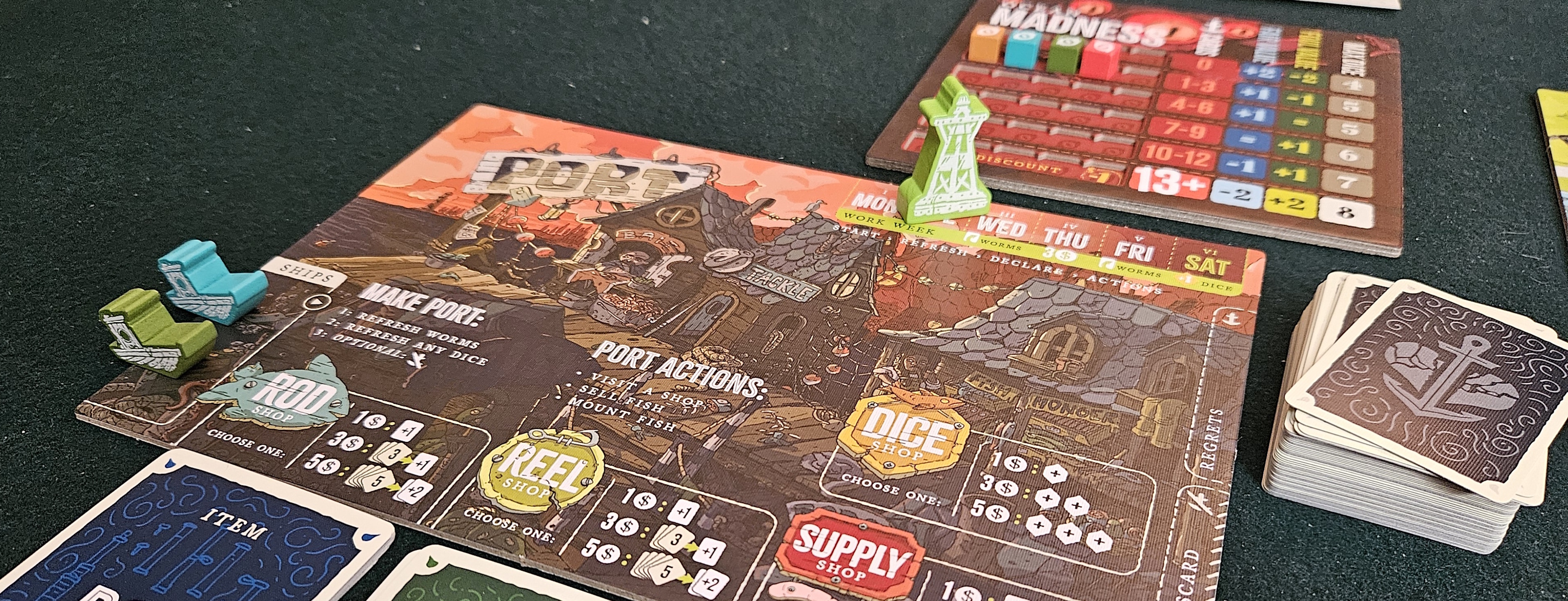
Hanging out in port.
“On the surface” is a loaded term for Deep Regrets. That’s because Deep Regrets is about surfaces and what lies beneath them. In terms of character, the surface reading is that you’re a fisherman. Not the catch-and-release kind, but rather the my-livelihood-is-disappearing-with-the-depleting-abyss kind.
Which is what drives your bayman to trawl ever deeper. As the shoals close to the surface grow thin, you seek more benthic prey. It’s a solitary practice, both thematically and at the table. Turns don’t exist in complete isolation from those of your peers; this isn’t a total multiplayer solitaire experience. But as we will see, there’s a lidless membrane between you and your peers that’s never quite breached.
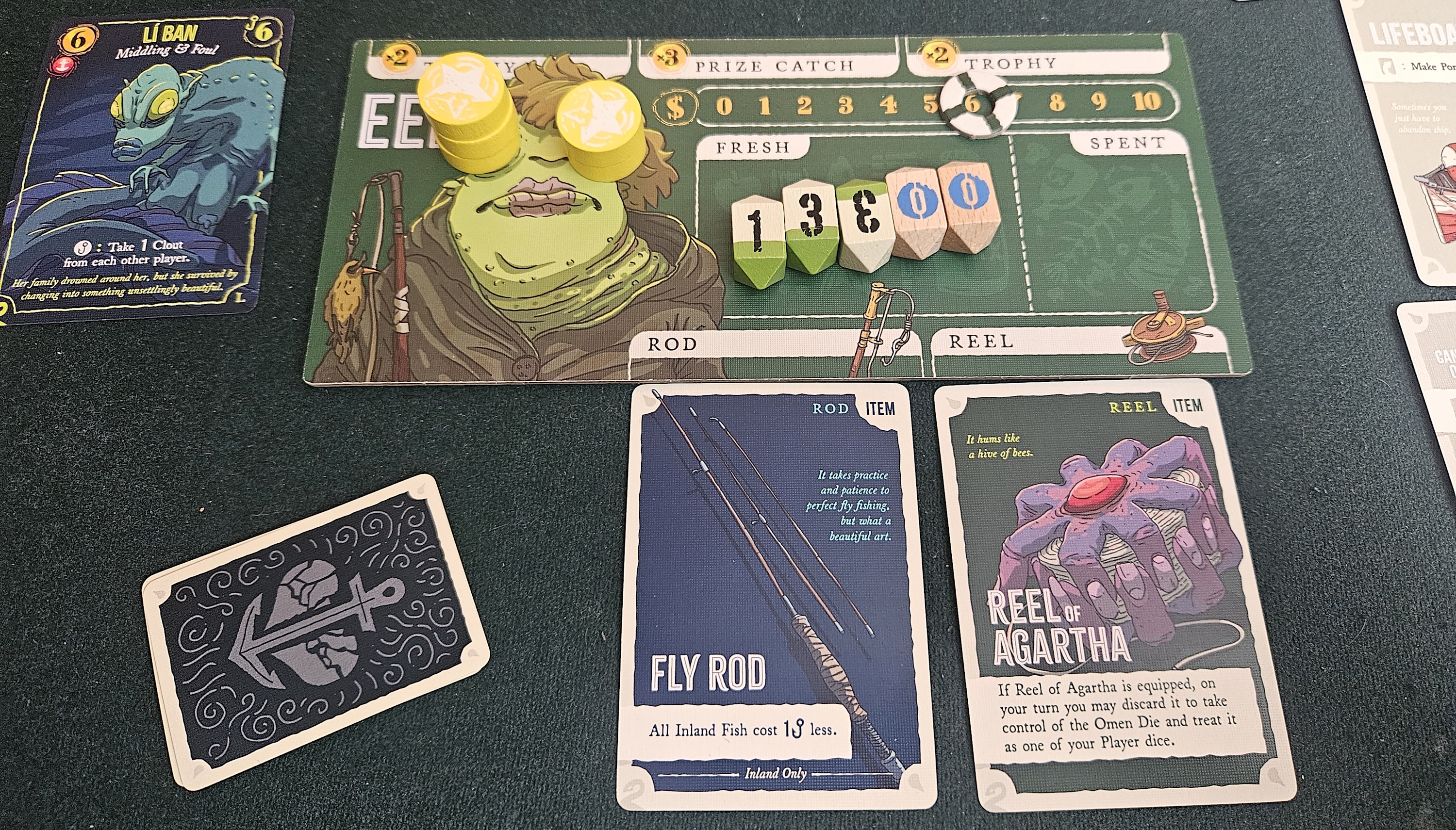
For the most part — on the surface — Cowan plays it straight. The entire game could be described in that hobbyist shorthand that sounds alien to outsiders. Fishing is a press-your-luck minigame that expends dice and other resources to land the best fish. Every turn is framed around either a day at sea or one in harbor, trading your catch for equipment. There are subsystems aplenty: permanent and temporary dice, rods and reels with variable benefits, fish both great and small.
Check out my cool shades. They conceal my squamous nature.
What’s interesting about these systems, though, is what they communicate about both the gameplay and your character.
Starting with gameplay, Deep Regrets is — on the surface — an incredibly chancy plaything. Early on, there are clues one can follow: the shadow beneath the water reveals whether a catch is small, middling, or large, and various depths translate to creatures that are increasingly dangerous to land-based mammals. Your bayman also has access to a few starting tools, such as a can of worms for peeking at a shoal’s face-down card and a lifeboat for beating a hasty retreat to port if your odds at sea turn south.
It isn’t long before it becomes apparent that Deep Regrets isn’t as aleatory as all that. Oh, there’s always a sense of risk. It isn’t uncommon for a cocksure hand to take one risk too many and invite the wrath of something truly monstrous. There are cards in the deck, whether the base deck or one of its multiple expansions, that can very much ruin your day.
Still, there’s so much mitigation at play that it’s hard to regard Deep Regrets as quite as chancy as some have made it out to be. Failing to catch a fish results in grabbing a “dink” — fishing slang, not lifestyle slang — which offers some benefit of its own, whether better fishing or some cash value, to offset the sting of failure. Even a cursory glance at the equipment shop reveals tools that will offset any number of flubs or miscasts. It isn’t enough to strip the game of its uncertainty altogether, but these are hardly uninformed decisions.
This is all good stuff, and would provide plenty to mull over. But, once again, this only brushes the surface.
Not all catches are created equal.
It’s appropriate that where Deep Regrets expands its horizons is via the regret deck, a thick stack piled with all sorts of misgivings and heartbreaks. At regular intervals, your hapless fishers will land something special. A mermaid, perhaps, so shimmering with glory that it breaks your heart to haul her ashore. A leviathan, its mind linking to yours in its lashing final moments. Or maybe you’ll just sell something nasty at the fish market and feel bad about it. Regardless of the cause, these junctures see you drawing a regret.
Regrets matter in two senses. First, the number you hold in your hand determines your character’s current madness. The madder you become, the greater the risks you’ll take at sea and the weirder the creatures you’re willing to sell at market. Second, the sum of those cards determines which player is bitterest upon the game’s completion. This means tossing out your highest-scoring trophy.
What’s curious about regrets, though, is that they aren’t wholly undesirable. True enough, you would rather not have such terrible regrets that you fling your prize charybdis angrily into the sea. But a handful of regrets is… good, in fact. After a few days at sea, it won’t escape your notice that the deadlier deep shoals are packed with strange creatures. It also won’t escape your notice that these can be sold at higher prices and earn greater scores. But only if you’ve gone a little mad. Maybe even very mad. Not so mad that you ruin yourself. But mad enough to take the right risks and mount the right trophies.
Which is to say, Deep Regrets isn’t really about said regrets being bad, at least not always. In much the same way that Personal Demons doesn’t present fears as bad so much as things that need to be confronted, here one is invited to court regret, to dance with it, to dispel its worst excesses through clean living or self-medication or simple caution. Whatever works. But either way, a life without regrets hoists a lower ceiling, victory-wise.
Just some of the game’s many regrets.
Laid out like this, Deep Regrets’ messaging might come across as trite. Adolescent. As a species, we’ve told countless stories about how our regrets and failures are crucial stepping stones on the path to adulthood, from Picard being transformed into a timid science officer because he didn’t get shanked as a cocky ensign to the memory-erasing shenanigans of Eternal Sunshine of the Spotless Mind.
But Deep Regrets doesn’t come across as an adolescent musing. Its passage to success isn’t as straight as “regrets good.” Plenty of its regrets are well worth casting off. There’s a certain temporal wiggliness to the process; if you regret losing your arm or sacrificing your sister, I’m not wholly sure what it means when those regrets are discarded. Did we… forget? Get over it? Prevent its having happened through some demersal bargain? No idea. But the effect is one of curated regret, cautious regret, not wholesale acceptance or dismissal.
This makes Deep Regrets interesting rather than perfect. I wish the game had been pacier, but in some spots Cowan’s eagerness seems to have gotten the better of him. After the first few rounds, turns begin to bloat with extra dice, fish, equipment, and dinks. In the end, it isn’t the chanciness that’s the problem; it’s the replete tools for extending a turn and making outcomes more certain. As the game grows longer, its charms wear thin. Eventually, they rupture like aquatic flesh that’s gone too long without refrigeration.
Mounting my trophies, buoyed by regret.
Still, Deep Regrets is smarter than it looks. It’s a game that rewards peering beneath the surface, both in terms of gameplay and as a ludic examination of a life lived without too many guardrails. I can say this with complete certainty: I don’t regret the time I’ve spent with it. Not in the slightest.
Complimentary copies of Deep Regrets and its expansions were provided by the designer/publisher.
(If what I’m doing at Space-Biff! is valuable to you in some way, please consider dropping by my Patreon campaign or Ko-fi. Right now, supporters can read the next installment in my series Talking About Games, this time tackling the topic of what makes a good list! Naturally, the piece includes a list.)
A trio of veteran board game industry professionals have launched a new tabletop gaming agency, with the aim of helping businesses within the hobby get their games developed and into the market.
Hues and Cues designer Scott Brady, Sagrada co-creator Daryl Andrews and Friendly Skeleton CEO Jacob Way said Best in Play will offer everything from interim executive leadership and designer representation to publisher submission management and crowdfunding strategy.
Brady said, “Best in Play was created to bring together people and opportunities that should already be working with one another.
“Great intellectual properties need the right designers and publishing partners, designers need better access to decision-makers, and companies sometimes need experienced leadership without the time or resources required to build an entire department.”
Best in Play says its five core service areas comprise IP matchmaking, crowdfunding consultation, interim replacement of key personnel, publisher-inventor relations and identifying publishers and licensing opportunities for individual games, multiple projects or designer catalogues.
The company announced at launch that it has already been hired as a consultant for an unspecified US-based “creator-brand merchandising and e-commerce company”, providing senior-level leadership and games-industry expertise while the client continues its search for a permanent head of games.
Best in Play said that project will run the gamut of product development, licensing, publishing, production, crowdfunding and portfolio strategy.
Andrews said of the assignment, “An important initiative should not lose six months of momentum because a key role is temporarily vacant.
“Our model gives clients access to an experienced team that can step in quickly, evaluate the situation and keep products, partnerships and internal teams moving forward.”
The company is also working on a tabletop project based on an unnamed “major video game intellectual property”, with a crowdfunding launch planned for early 2027.
Way said, “A recognizable property may attract attention, but a successful crowdfunding campaign still needs the right product, positioning, audience strategy and operational plan.
“Our goal is to build campaigns that respect the fans, communicate value clearly and create a foundation for success beyond the initial launch.”
As well as the founding trio of managing directors, the Best in Play team also includes strategic contributors David Gordon, the co-creator of Finspan, Eastar Game Manufacturing founder and CEO David Du, Legend of the Five Rings: The Card Game co-designer Erik Dahlman and Daniel Pesante.
Brady previously launched his development studio A Game Studio at the start of 2024, following the 2020 release of the big-selling Hues and Cues and the success of his cat-themed abstract strategy Boop in 2022.
He previously spent two years as head of talent acquisition at Maestro Media, following several months working in investor relations, before leaving the company in early 2025.
Jacob Way, meanwhile, began his board game career as COO and co-founder of Deep Water Games, which for several years operated as a subsidiary of Ox Eye Media.
Deep Water, which is best known for sketching game MonsDRAWsity, spun out from Ox Eye as an independent business in 2022 under Way before rebranding as Friendly Skeleton.
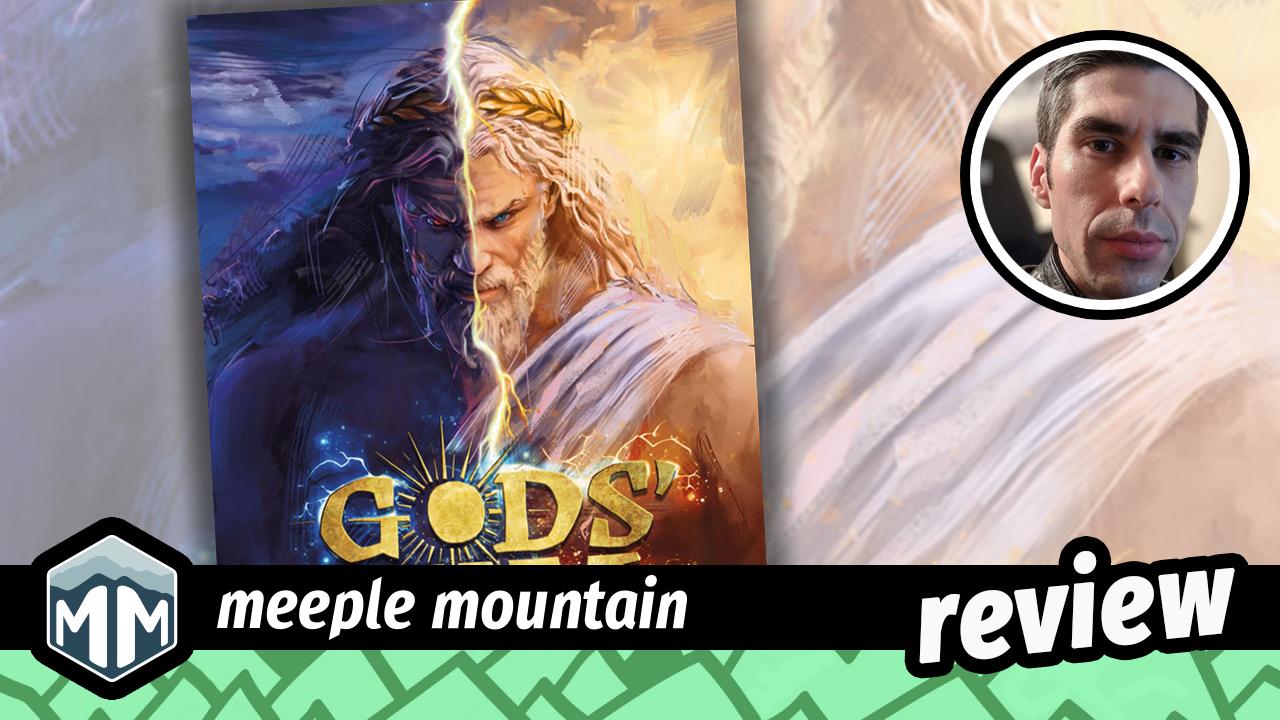
Gods' Will showed up in my social media feed, comparing itself to Resistance: Avalon like a new kid on the first day of school telling everyone he used to be popular somewhere else. I have heard this pitch. I have reviewed this pitch twice, from Witch Hunt andHuman Punishment, two games that made the same promises and delivered the same disappointing results. So when Gods' Will came knocking with the same marketing aura, I had to open the door with at least one eyebrow raised. Maybe I’m just addicted to disappointment, who knows.
After half a dozen plays, I can say with a bit of confidence that Gods' Will is doing more right than wrong here. More importantly, it earns it by fixing the real problems with its predecessors rather than just the ones that look good in a Kickstarter pitch.
A Skeptic Walks Into a Kickstarter
Like 90% of social deduction games that have ever existed, there are two teams: Light and Dark. There is also a loner faction, a third party whose goals shift depending on player count and whose presence ensures that the ride from start to finish won’t ever be a smooth one. Every player is a God with a public special ability…

 Anmelden




/pic9707510.jpg)
/pic9736007.png)