Puh…da ist es ja sehr sehr lange still gewesen. Wie die Zeit vergeht Ja es ist derzeit eine sehr spannende Zeit und die Spielgewohnheiten haben sich (wieder mal) ziemlich umgestellt. Das wird heute eine etwas längere Liste.
1 Mal pro Monat organisiere ich in der Arbeit einen Spieleabend. Fast alles Leute die wenig bis gar nichts spielen. 3 Chapters ist dort sehr gut angekommen und hat mir selbst auch sehr gut gefallen. Hier wird zuerst in 7 Wonders Manier zuerst eine Hand zusammengedraftet. Danach spielt man in Kapitel 2 seine Karten wie in einem Stichspiel aus (Farben gibts nicht. Höhere Zahl gewinnt). Seine Karten behält man sich aber und in Kapitel 3 wertet man alle seine Handkarten. Die wichtigste Information hab ich unterschlagen. Jede Karte hat natürlich auch eine Fähigkeit bzw. gehört zu einer oder mehreren Kategorien. Manche Fähigkeiten wirken nur in einem bestimmten Kapitel, manche in allen Kapiteln. Das alles hört sich in der ersten Partie nach viel Information an aber durch das Märchenthema weiß man schon ganz gut was zusammengehört.
Ein Spiel dass Deckbau mit Gebietskontrolle und „Forschung“ kombiniert. Das haben wir zu zweit angespielt. Grundsätzlich finde ich es gut aber wir haben das zu defensiv gespielt. Da man für jede erbeutete gegnerische Siedlung 1 Punkt und auch ein Verlust einen nicht komplett aus dem Spiel kegelt hätte man da mehr darauf achten müssen. Diese inkludierte Promo braucht es dann zu zweit unbedingt, damit man übers Wasser kommen kann. Ansonsten dauert es am Landweg ziemlich lange bis man sich begegnet. Ich dachte echt, dass es weniger Platz am Tisch brauchen würde aber durch die Kartenauslage + die Behälter für die Ressourcen + der Spielplan + die erforschten Technologien. Es läppert sich zusammen. Ersteindruck. Erfrischende Grafik und ich mag wie der Deckbau umgesetzt wurde. Zu zweit … mal schauen. Wie gesagt ich denke wir sind das zu defensiv angegangen.
Ja was soll ich sagen. Ich mag dieses kleine Duellspiel sehr. Es erinnert mich an Hol’s der Geier bzw dem GOPS nur mit … mehr. Schnell erklärt und gespielt und es bietet für den Preis von unter 20€ eine Menge Spiel.
Hero Story
Hier haben wir ein Stichspiel, dass auch Solo spielbar ist. Das ist die Entstehungsgeschichte unseres Superhelden. Hört sich nicht nach einem Stichspiel an … ich weiß. Man spielt mehrere Runden. Zu Beginn jeder Runde darf man dann Fähigkeiten von einem Stapel ziehen und 1 zu seinen hinzufügen. Mit wachsender Rundenanzahl hat man auch mehr Ausdauer und diese nutzt man um auszuwählen welche Fähigkeiten man aktivieren will. Gefällt mir gut und es funktioniert auch solo gegen die Bots. Die sind eine Mischung zwischen dem sehr planbaren Herr der Ringe Stichspiel und dem Zufall von für Northwood. Der größte Kritikpunkt den ich derzeit habe ist, dass man zu Beginn auch entscheidet ob man diese Runde Superheld oder Bösewicht ist … wobei der Bösewicht keine Stiche machen will. Die Belohnung dafür (ohne andere Spezialfähigkeiten) ist im Vergleich zu den normalen Stichen etwas mau.
Lange war ich auf der Suche nach einem Spiel in Heroes of Might and Magic Manier. Die Serie hab ich am PC immer gerne gespielt. Jetzt gibt es Mage Knight oder auch Heroes of Might and Magic 3 aber beide Brettspielumsetzungen haben etwas das mir zu solitär ist bzw. viel zu lange dauert und viel zu komplex ist, im Vergleich zur PC Reihe. Die konnte ich mit 10 ohne Probleme spielen ohne 30 Seiten Regeln lesen zu müssen. Sie gehen zwar in Richtung der PC Spiele aber die haben die meisten ja auch solitär gespielt und ich hätte gerne eine Spiel gehabt, dass in einer akzeptablen Zeit, das miteinander schafft… gerne in simpel. Karak 2 ist eben so ein Spiel mit dem man mit einem Helden durch die Lande zieht, eine Stadt baut und ausbaut, Einheiten rekrutiert und Monster bekämpft. Dabei ist es von Haus aus interaktiver da alle Spieler auf dem selben Plättchen starten. Man bekämpft sich zwar nicht direkt aber es gibt schon Interaktionen. Ich hab auch gleich beide Erweiterungen dazu gekauft (und ein Insert auf Etsy), denn ein paar Elemente aus den Erweiterungen wie z.b. die einzigartigen darftbaren Einheiten und Gebäude sind schon sehr toll. Das alles hat natürlich seine strategischen Anteile aber es wird in dem Spiel sehr viel gewürfelt. Schönes lockeres und sehr zugängliches Spiel von dem sich an einem Abend auch eine 2. Partie ausgeht.
Ja das ist nicht neu aber ich habe es seit mehreren Jahren wieder einmal gespielt. Ich habe vor einer Weile schon hin und herüberlegt ob ich mich vom Spiel trennen soll, da ich mit meinem Vater nun hauptsächlich Dominion spiele und nicht mehr Kingdom Builder und die Schachtel doch einiges an Platz wegnimmt. Also … alles für das erste Spiel aufgebaut wie laut Anleitung. Hat mir wieder gezeigt warum das so lange so weit oben in meinen Top Listen ist. Zu zweit haben wir keine 20 Minuten gebraucht und dennoch hast du interessante Kombinationen mit den Ortsplättchen, wie du da das Maximum rausholen kannst. In 20 Minuten! Das ganze wird jetzt umgekehrt ablaufen. Einige andere Spiele die einfach sind und hauptsächlich aus irgendwas ziehen und irgendwas ausspielen bestehen werden gehen müssen. Zu zweit hat man nicht viele Interaktionspunkte aber mit mehr Leuten kommt man sich durch den gemeinsamen Spielplan in die Haare.
Hier haben wir ein interessantes Drafting Spiel. Im Grunde hat man 3 Stapel. Man sieht sich die Karten von einem Stapel an und entscheidet ob man diese Karten will oder nicht. Will man sie nicht, legt man eine zusätzliche Karte zu Stapel 1 dazu und schaut sich den nächsten Stapel an. Natürlich teilt man sich mindestens 1 Stapel mit einem der Mitspieler. Ich mag den Mechanismus sehr. Ebenso wie die Illustrationen. Den Aufbau der Schachtel mit Pappboxen für die einzelnen Komponenten ist auch gut gelungen …. aber … ich weiß noch nicht ob ich das Spiel mit 4 Leuten gut finden werde. Zu zweit kommen wir auf ca eine 3/4 Stunde. Zu 4. werden das sicher 90min werden. Ob das Spiel „genug“ dafür hergibt muss ich erst sehen. Ersteindruck ist aber gut.
Einer meiner Neffen ist mittlerweile 7 dh. schön langsam kann man mit ihm ein paar Spiele spielen. Was soll man sagen. Es hat etwas von Kniffel nur ist das was man Würfeln will dynamischer, weil die Auslage wechselt und auch die Position der Karten interessant ist und es mit niedlichen Illustrationen versehen. Gefällt mir.
An Impossible War: The First Carlist War in the North, 1834-1838 from Bellica Third Generation is a block wargame that recreates the First Carlist War in the North of Spain which was a civil war between the Carlists who supported the succession of the late king’s brother Carlos de Borbón and the progressive and centralist supporters of the regent Maria Christina acting for Isabella II of Spain who were referred to as the Liberals. The game uses blocks representing units but also includes counters and uses cards. I was able to play the game about a month or so ago with Francisco Ronco who owns the publishing company Bellica Third Generation and very much enjoyed the game and how it represented this interesting struggle.
In Action Point 1, we took a look at the Game Map, discussing the point-to-point movement configuration, the various spaces and the delineation of the Carlist versus the Liberal Zones, as well as explained the use of the Rest of Spain smaller map. In this Action Point, we will examine the units available to both sides and cover the importance of Supply.
Units
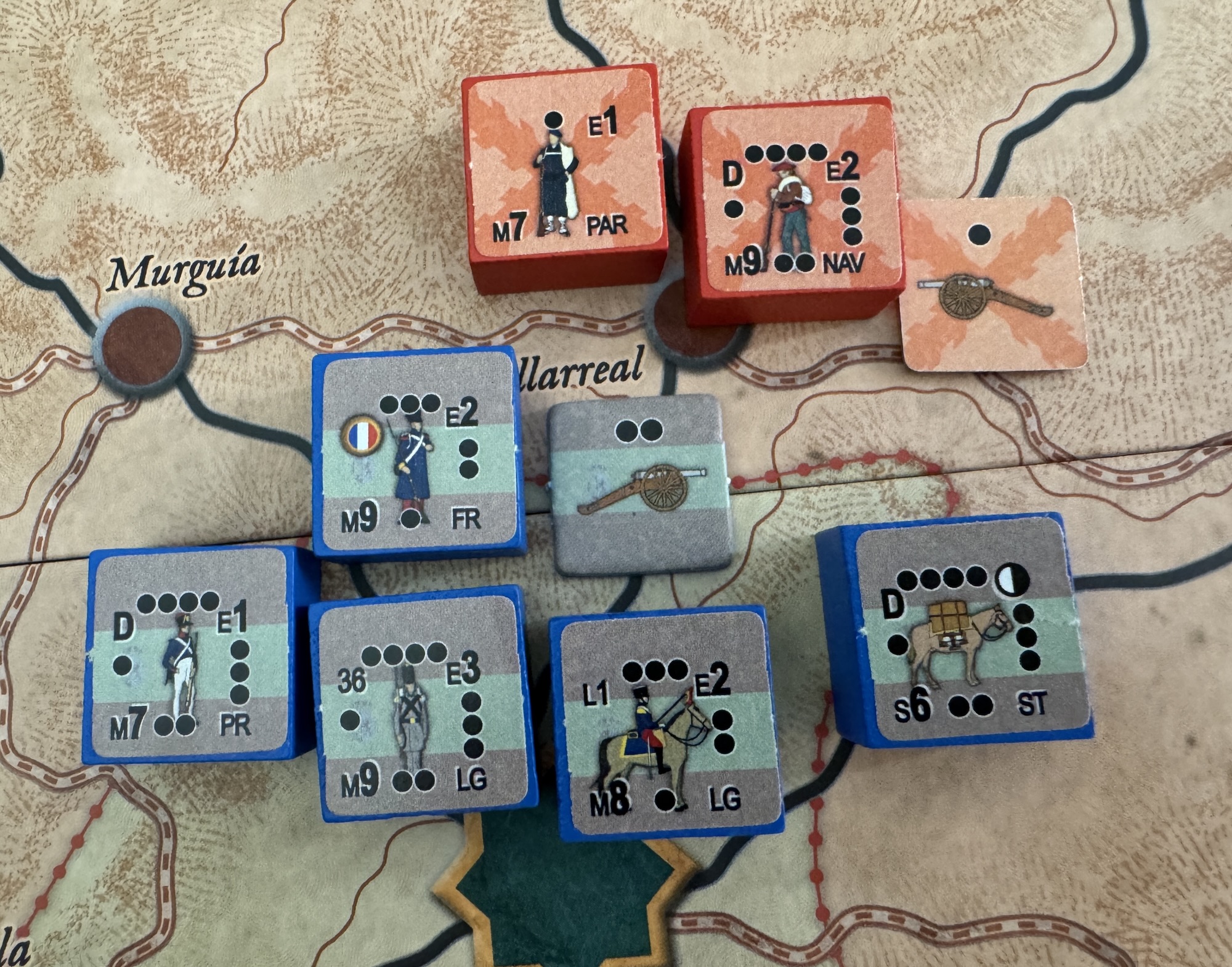
Units in the game represent Carlist (red) and Liberal (blue) armed forces, as well as the logistics needed for these troops to operate in hostile territory. Most of the units are wooden blocks including Infantry, Cavalry, and Supply Trains but there are also cardboard counters representing Artillery, both Field and Mountain, and Knapsack units, which are limited and temporary supplies that are transported by the soldiers themselves.
Let’s first take a look at the scale of the game and the units. With Infantry, a single Strength Point is roughly equivalent to a battalion consisting of between 500 to 800 fighting men. The only difference in the Infantry scale between the sides is a Carlist Partida unit, which represents a variable number of local guerilla fighters who are loosely organized in the amount of about a hundred men. For Cavalry, a Strength Point is equivalent to a squadron consisting of about 100 horsemen. For Artillery, a Strength Point is equivalent to 1 or 2 batteries made up of between 4 to 12 cannons of different calibers. The Supply units for the game are a very interesting and granular approach to supply and I very much enjoyed the juggle of keeping these units in good shape and with large moving armies. A Supply Train, which is represented by a block unit with the picture of a pack horse on it, represents a group of carts and pack animals that transport the needed supplies to keep an army in the field including food, munitions, and baggage. On a smaller scale are the Knapsacks that represents the food and munitions carried by the soldiers themselves.
As a Block Wargame, the Infantry and Cavalry Blocks used have various dots located along the edges of the blocks. Some blocks have 4 steps while others have less but usually no less than 3 steps. The exception to this general rule is the Partida units that only have 1 step. The current combat strength of the units determines how many 6-sided dice will be rolled in combat. During combat, for each hit that a unit receives, its strength is reduced by 1, which is shown by simply rotating the block 90 degrees counterclockwise. If a block is reduced below 1 strength then it will be eliminated.
Supply Train Blocks also have pips located on the block which represent the units ability to provide supply to other units. When the Supply unit provides supply to friendly units located in its space, its strength will be reduced by 1 pip by rotating the block 90 degrees counterclockwise. If the block is reduced below 1 strength then it is eliminated. No dice are rolled for a Supply Train in combat as it is solely a logistics unit rather than a combat unit. Supply Capacity is indicated on the units by the letter “S” and a number, such as S6 or S2. The number is the amount of friendly Infantry and Cavalry units that a Supply Train or Knapsack can supply during the Supply Check. A Supply Train with S6 can supply up to 6 friendly Infantry and Cavalry units in its space. A Knapsack with S2 can only supply a maximum of 2 units
Artillery counters show the current strength with the number of pips on the visible side of the counter. The strength determines how many dice are rolled in a Skirmish and how many points of Artillery it will contribute to a Battle. Artillery units do not receive hits in combat, but they can be eliminated or captured if their side is defeated.
Now that you know the makeup of the units and the various forces represented, let’s take a very quick look at the statistics of each side’s combatants. Before we go any further, I am very hesitant to provide these details as I have gone over them about 10 times and am sure that I miscounted or left out certain units and their abilities. But, this look should give you an overall feel for the differences between the units and their general fighting abilities.
Carlist Units
The Carlist player will have access to a total of 26 units. These include 4 Cavalry, 21 Infantry, amongst this number are a total of 3 Partida units, and 1 Supply unit. The Effectiveness Rating for these units, which as described above equates to their fighting prowess with the higher the number the more likely they are to hit in combat, are shown in the below table with 5 units with an ER1 (20.0%), 16 units with an ER2 (64.0%) and just 4 units with an ER3 (16.0%). Keep in mind that Supply units do not have an ER as they are non-combatants.
Liberal Units
The Liberal player will have access to a total of 48 units. These include 10 Cavalry, 35 Infantry and 3 Supply units. The Effectiveness Rating for these units, which as described above equates to their fighting prowess with the higher the number the more likely they are to hit in combat, are shown in the below table with 12 units with an ER1 (26.6%), 29 units with an ER2 (64.4%) and just 4 units with an ER3 (8.9%). Keep in mind that Supply units do not have an ER as they are non-combatants.
By way of comparison, you can see that the Liberal Units have a slightly better average Effectiveness Rating (1.82 per unit) as compared to the Carlist Units (1.64). This difference is a bit deceiving though as the Carlist player actually has the same amount of ER3 units (4 for the Carlist player vs 4 for the Liberal player) but as a percentage of their total units they have 16.0% of their units as ER3 as compared to just 8.9% ER3 units for the Liberal player. This means that the Carlist units are a bit better and will generally have better units making up their forces than the Liberal player in any given battle.
The real comparison, and where the difference between the 2 sides stands out, is in the area of Morale. Morale is indicated by the letter “M” on the units and is shown as a number, such as M7, M8 or M9. This Morale number is the maximum result of the sum of 2d6 that gives a success in a morale roll. Each time during an activation that a unit receives 1 or more hits, it must then roll a Morale check. Morale checks are only made in Battle and never in a Skirmish, Assault, Pursuit, or Rout. If the Morale check fails, the failing unit will immediately be moved to the Demoralized Units Box. Morale is also key for Infantry that are being charged by Cavalry as they will make a Morale check and if they succeed they can initiate a counter charge. If they succeed the check then the attacking Cavalry will be spent and do no damage but if failed the attacking Cavalry unit fires and adds +1 to its Effectiveness Rating.
The Liberal player has an Average Morale value of their 45 units of 7.97 as compared to the Carlist player Average Morale value of their 25 units of 8.76. While not a huge difference, this slight edge to the Carlist player means that their units will be able to more often counter charge and stay on the battlefield as they will not break and become Demoralized as often.
Also, if you remove the 3 lowest value Carlist units, the 3 Partida units who each have a Morale Value of 7, this average becomes much higher at a 9.0 and really starts to show the significance of the Carlist advantage in Morale. In my play with Franciso Ronco, I felt like he definitely had the advantage on the battlefield, at least value wise in the area of Morale, but all it really took was for 1 of his better units to be demoralized and the odds became much more even.
The other advantage that the Carlist units hold is that they are typically fighting on their home turf and supply is much less stringent on their forces. The Liberal player must make consistent campaigns in the Carlist Zone of the board and this will require them to invest more into Supply units such as Supply Trains and Knapsacks.
I very much enjoyed the asymmetry between the Carlist and Liberal forces. It made for a very interesting tactical challenge for both sides as they have to play to their strengths and not get too overly concerned with the numbers. The Carlists will be much more mobile in their defense and look to exploit every gap in a supply line to move around and stay away from the numerically superior Liberal forces, whereas the Liberal player will have to move more methodically to take outlying towns and settlements to be able to shore up their lines and create less opportunities for end arounds by the Carlists. The disparity in the forces was a very interesting choice by the designer David Gómez Relloso and I am sure is reflective of the historical reality of the First Carlist War.
I also was able to shoot a fairly short video summary of my game play with Francisco Ronco who is the owner of Bellica Third Generation and you can watch that at the following link:
In Action Point 3, we will take a look at the Carlist Uprising Phase and what it means for the game.
Du hast das Schicksal einer ganzen Nation in der Hand. Wirst du im Spiel Rising Cultures dein Kartendeck optimal nutzen, um dein Volk zur kulturellen Blüte führen? Rising Cultures ist…
Lones Wolves von Anthony Perone und Yasuyuki Nakamura ist bei Pegaus erschienen und ist ein reines Zweipersonenspiel ab 10 Jahren. Wir suchen bei dem Spiel mittels Karten den besten Alpha-Wolf,…
Landschaften auslegen und Erträge ernten, das kennen und mögen wir wohl alle sehr. Und wenn Uwe Rosenberg, von dem einige wirklich ganz tolle Spiele stammen, sich der Sache annimmt, wird…
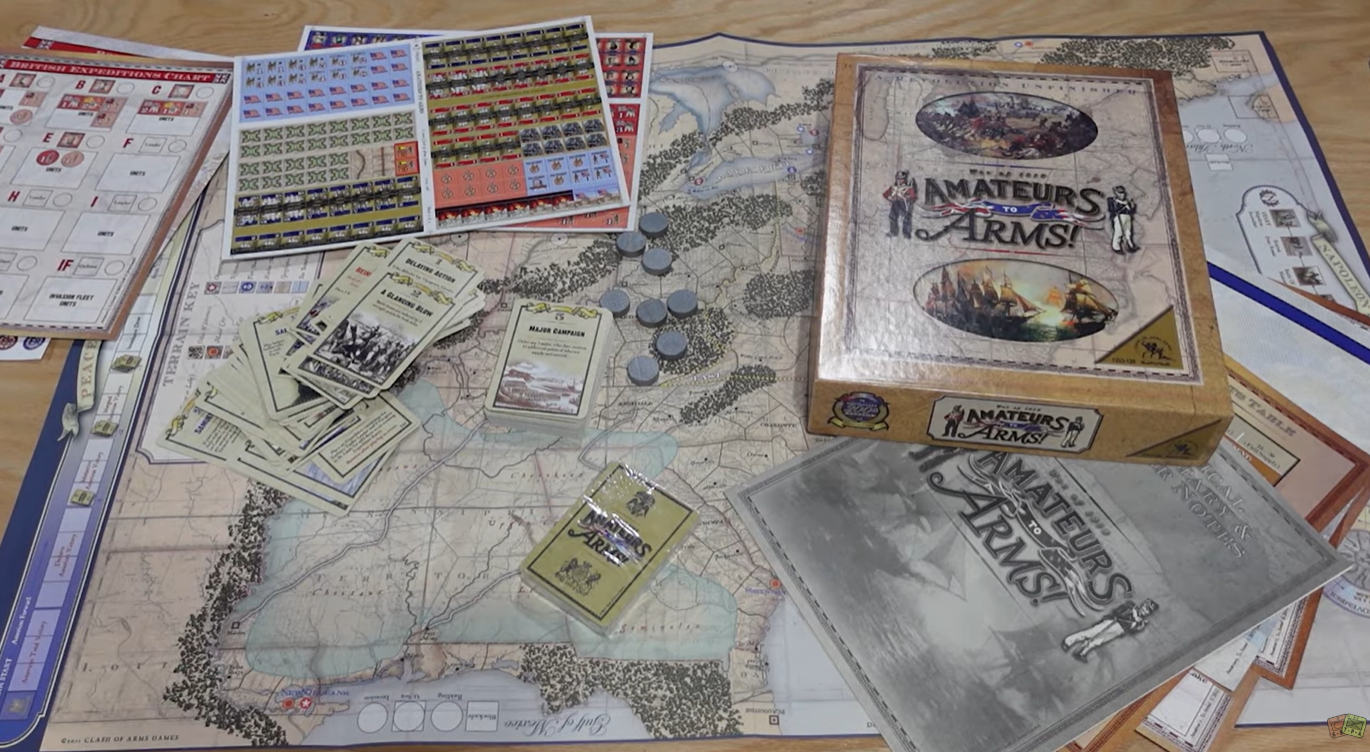
Amateurs to Arms! is a historical simulation game of the War of 1812. One player assumes the role of the British (including Canadian) forces, and the other plays the Americans. This often-overlooked conflict ended in a draw historically, but this was not the only possible outcome. The Americans clearly wished to annex Canada to their young nation, while the British wanted to teach their former colonies a lesson. The game includes all of the theaters of battle from the war: the US/ Canadian border and the Great Lakes (of course) but also the wilderness of the old Northwest, the Atlantic coast of the US, the Civilized Indians of the south, and the site of the final conflict at New Orleans.
Each turn represents a few months of time (depending on the season). A typical turn consists of dealing out to each player the number of cards indicated on the turn track. The winter and spring turns require a few special tasks. The Americans will have more resources to commit to the war- until Napoleon is defeated in Europe, and the English player can focus more resources on their efforts in North America. Each card can be played for the event described on the card, or for the card’s Operations Points, to move Expeditions, build ships and fortifications, or raise troops.
Events on the cards and on the map will cause the markers on the Peace Track to move forward. This represents the war weariness of each side’s people: bad events will cause your people to demand peace. Most events push inexorably towards peace; only a few rally your people for a longer war. When the two markers meet on the Peace Track, the game proceeds to the negotiations at Ghent, and the winner is determined. Oh yes, and then each player plays one more card, while news of the peace travels across the Atlantic!
Fans japanischer Horrorspiele können sich im ersten Quartal des Jahres nicht nur über ein neues Resident Evil freuen: Seit dem 12.03.2026 lädt das Remake von Fatal Frame II: Crimson Butterfly zu einer Gruselerfahrung der besonderen Art ein. Dabei präsentiert sich das Spiel moderner als je zuvor.
Expanding on the Spoiler Free thoughts I had a week ago. Putting the rest in an expandable block, (in case you want to not see).
(For reference, I have cleared Ascension 7 with all characters but the NecroMancer, and have now played a half dozen ish games of co-op, including a brutal floor six loss.
Expand to view StS II Thoughts
When I said “I liked what was missing” I was referring to:
A) Cards that double, like Catalyst or Limit Break. Because often those cards provide such massive scaling (being geometric) that they are often auto-selects in in archetype using it (and are sometimes worth taking “blind” in hopes of getting poison/strength). Sadly there is at least one new doubler (Voltaic) and it does indeed solve the endgame by itself (with one upgrade and any support).
B) Huge swing cards/artifacts (like Corruption or Biased Cognition) that have an outsized value. Those particular two are still there, but are no longer “mere” rare card rewards but boss relics, which seems reasonable. Both are also been reduced in value because some of their complements (Dead Branch and artifact charges, respectively) are missing.
It’s an early access game, so the card balance is off in a few points, but overall I still like it. In particular:
Focus being mostly until end of turn (Defragment is still in, but rare) means the defect’s most solid and boring build is gone. The temporary focus cards are interesting, and with more cards that load up orbs (or evoke) make a nice change.
I agree with the complaints that the elites do not feel notably distinct from the hallway fights. One of the the things that Slay the Spire 1 nailed was that different fights attacked different deck archetypes (mostly with Boss/Elite fights, but not always). For example “Time Eater” destroys card spam. “Reptomancer” requires a bunch of fast All out attack. Big Giant Head took out decks that dish out consistent damage but can’t scale, etc. The game lobbed Bombs in the Jonathon Degann game design sense.
You do see that, for example “Entomancer” punishes a bunch of small attacks. But the “Hunter Killer” hallway fight punishes card spam. Too many of the Act I elites are kind of “samey” … the game is missing (for example) having to deal with Gremlin Nob crushing skill decks and needing to hit it for ~80 before the end of T3. It’s just “bigger numbers.” The Bygone Effigy feels like the worst offender on that. You need to do the same by T3, but if you fail it’s just brutal death.
Part of the problem is that the relic pool is a bit “meh.” It’s good that the card pool is such that you can make a build to kill the Act III boss and then just grab a potion for a weakness, and that you then skip a few elites to lower variance. But that could get boring (and Asc 10 is double final boss, so that’s an issue).
But that’s a balance issue. Also, I do like the events that are “here are two choices that may both be bad, and no you can’t skip.”
Co-op: Have played (2p) and I stand by my earlier comment, its well done, considering. Some fights are much easier, some fights are much harder (the Phantasmal Gardners can absolutely tank a run early if you aren’t prepped for them), but I’ve mostly won (granted my co-op ascension is still quite low). The co-op only cards seem wildlly unbalanced, but that’s ok.
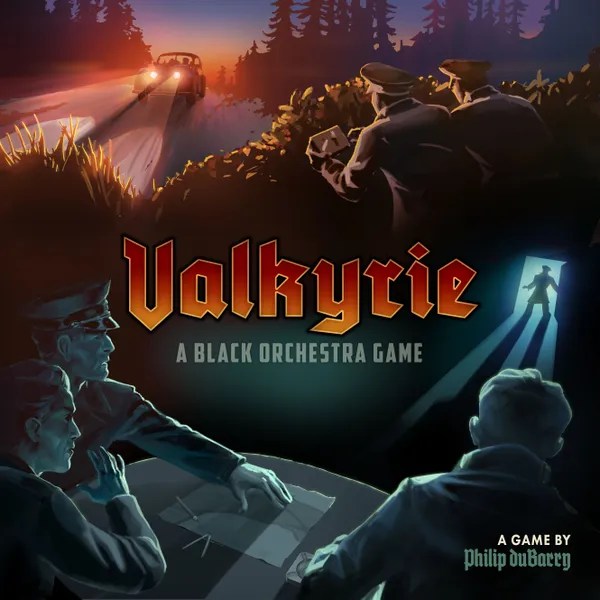
There are few acts of violence more righteous than killing Adolf Hitler. On July 20th, 1944, German Colonel Claus Von Stauffenberg attempted to do just that. Not to spoil the 2008 Bryan Singer film, but von Stauffenberg failed thanks to the leg of an oak table. The 2016 board game Black Orchestra allows players to…
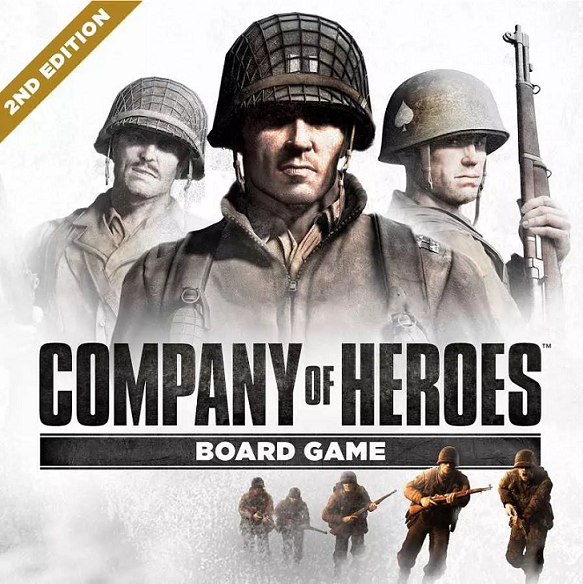
I find it hard to believe the Company of Heroes board game is five years old. This splendid adaptation of the popular real-time strategy PC game was a story in 2021. My review contained a healthy amount of enthusiasm, and it occupied a key position in my top 10 of the year. A lot has…
Two weeks ago, we’ve looked at the first period of Soviet liberalization under Nikita Khrushchev from the 1950s on. While these reforms ended the era of Stalinist totalitarianism, they petered out when Khrushchev lost interest in them and was eventually overthrown and replaced by the more conservative Leonid Brezhnev. It would take another generation until a new Soviet leader, Mikhail Gorbachev, would undertake another broad reform program. These reforms – like last time, in the realms of domestic, foreign, and economic policy – are the subject of this article. Of course, you’ll also find a few board games in it!
Freer Press, Freer Elections
The Soviet Union’s political landscape had ossified under Brezhnev. This stagnation (or, if you want to phrase it more positively, hyperstability) also ruled out any experiments after Brezhnev’s death in 1982, and so the Politburo selected his loyal lieutenant Yuri Andropov. Unfortunately, Andropov was already 68 and severely ill then. He died in 1984, to be succeeded by another Brezhnevite stalwart, Konstantin Chernenko, who was similarly afflicted and even older (72 at his accession). Chernenko died in 1985. The rapid succession of aging Soviet leaders is poignantly captured in the contemporary joke: Margaret Thatcher calls Ronald Reagan: “It’s a pity you didn’t come to the funeral of the Soviet general secretary. Marvelous. A great spectacle. I’m totally going again next year.”
Cover of the English-language edition of Kremlin. Unfortunately, fake Cyrillic was once more irresistible, and so the R in Kremlin has been replaced with a Я (which would make the word Kyaemlin).
Another quasi-contemporary (1986) satirical take on the Soviet gerontocracy is Kremlin (Urs Hostettler, Fata Morgana): Players support the various Politburo members in the hopes of advancing those they have influence with to the top jobs, but many a hopeful candidate will die of stress and old age before realizing their ambitions.
After Chernenko’s death, even the most conservative Politburo members saw the need for a different tack: They elected Mikhail Gorbachev as their new leader in 1985, a real baby at age 54. Gorbachev’s reformist leanings were well-known, but he proceeded cautiously in his first year. As with Khrushchev, the big programmatic changes were first announced at a Party Conference of the Communist Party of the Soviet Union.
Gorbachev’s first slogan for his reforms was glasnost (openness). That included sweeping changes to Soviet citizens’ freedom of expression: Gorbachev encouraged the Soviet press to scrutinize politics instead of simply parroting the party line. Dissidents were released from prison. Even non-state-sponsored demonstrations were allowed – a powerful tool to express malcontent with the government. Of course, these reforms undermined the power base of the Communist Party – but Gorbachev hoped that he could steer the ship of state in the new environment and might even benefit from a freer populace.
Even more radical were Gorbachev’s institutional reforms, usually referred to as perestroika (restructuring): The Communist Party’s monopoly on power was cut off by establishing the Congress of People’s Deputies as an independent parliament, and while the first elections in 1989 were not fully free, it was the first time that Soviet citizens could select from several candidates in a contested election. Gorbachev himself chose to base his power no longer on his role as General Secretary of the Communist Party, and instead was elected President of the Soviet Union by the Congress of People’s Deputies in 1990.
This nascent democratization drive – eventually rather envisioned than enacted – makes for the most powerful card in the last phase (1985—1991) of the Cold-War-in-a-nutshell which is Twilight Squabble (David J. Mortimer, AEG): It’s a bit of speculation on the internal and external legitimacy and attractiveness a more democratic Soviet Union could have enjoyed.
Speaking of external legitimacy and attractiveness: Gorbachev’s policies (and he himself) would prove immensely popular in the West… after he had weathered the initial suspicion. Gorbachev began to advocate for a return to détente soon after he assumed office, but US president Ronald Reagan assumed this to be a Soviet ploy. Only after Gorbachev had met Reagan at the 1986 Reykjavík summit did the president believe Gorbachev’s intentions to be genuine.
In the following years, the two of them agreed on far-reaching mutual disarmament, most notably the Intermediate-Range Nuclear Forces (INF) Treaty. Gorbachev’s immutable advocacy for arms reduction is reflected in Wir sind das Volk! – 2+2 (Richard Sivel/Peer Sylvester, Histogame) as his event card cannot be used for the arms race.
Besides the lofty realms of nuclear arms reduction, Gorbachev also had more grounded problems to deal with: The Soviet Union had invaded Afghanistan in 1979 to prop up the failing pro-Soviet government there and had been embroiled since then in a costly and futile counter-insurgency. As the Soviet military could not present Gorbachev with a convincing roadmap on how to win the war, he decided to pull the Soviet forces out in 1988. By that time, the unsuccessful war had undermined the Soviet government’s legitimacy which had rested on its status as a military superpower, exacerbated by the new avenues of political expression open to disaffected citizens – the mothers of Soviet soldiers who fought (or had died) in Afghanistan were among the first to form associations, to pressure the government, and to protest.
In that sense, it is surprising that the withdrawal from Afghanistan can still net the Communist player points in 1989 (Jason Matthews/Ted Torgerson, GMT Games) – but the general principle holds true: The later the Soviets withdraw, the more their failure in Afghanistan becomes an asset to the opponents of Communist power.
Finally, Soviet power was the rock on which the Communist governments in Eastern Europe rested. Whenever they had been challenged – most importantly in Hungary in 1956 and Czechoslovakia in 1968 – Soviet tanks had quashed the dissent. This limited sovereignty within the Eastern bloc had been the central tenet of Soviet foreign policy, after 1968 named the Brezhnev Doctrine. Gorbachev adopted a new approach: He would not militarily intervene in Eastern Europe anymore. Instead, the countries of the Warsaw Pact were free to “do it their way” – thus humorously called the Sinatra Doctrine.
Finally, Gorbachev’s reform agenda of perestroika also aimed to transform the Soviet economy. All Soviet leaders had engaged in some kind of economic reforms, so Gorbachev’s activity did not seem very surprising… until observers inside and outside of the Soviet Union realized how radically it would change the tenets of the Soviet economy, traditionally based on central planning, large state-owned companies, and very limited contacts with the outside world.
First, Gorbachev gave the state-owned companies much more leeway over what to produce and how to set prices. These market incentives were supposed to improve efficiency, but clashed with the existing structures.
Undeterred, Gorbachev went a step further and loosened the restriction on private enterprises. More Soviet citizens could start their own store or workshop and offer goods and services at their own responsibility.
Then, Gorbachev allowed for joint ventures with Western companies (provided the Soviet part owned a majority share), and even let them set up dependencies in the Soviet Union – the famous first McDonald’s restaurant in the Soviet Union opened in January 1990.
The End of the Cold War and the Collapse of the Soviet Union
Gorbachev’s daring move to end hostilities with the West was an unqualified success. In late 1989, he and US president George H.W. Bush could merrily declare together that the Cold War was over.
The consequences of Gorbachev’s foreign policy reverberated through the Eastern Bloc: The allied Communist regimes of Central and Eastern Europe were swept away in 1989.
Early in a game of 1989: The Democrat (blue) has already taken power in Poland and Hungary. It will be difficult for the Communist (red) to stop the ever-growing blue tide. From the Rally the Troops! implementation.
The Perestroika and Glasnost event in Wir sind das Volk! – 2+2 neatly shows the way in which Gorbachev’s reforms put stress on the system: On the one hand, it increases Soviet dominance and makes socialism more attractive (lower two icons). However, it also increases unrest in East Germany (fist icons).
Within the Soviet Union, the political freedoms granted allowed citizens to demand more freedoms. These centrifugal effects became particularly visible as most of the non-Russian republics soon had nationalist independence movements which began to eat away the Soviet Union from its ethnic fringes. Gorbachev responded by proposing a looser federation between the Soviet Republics.
The political reforms also had negative interaction with the economic reforms: On the one hand, the flurry of changes created new inefficiencies; on the other, the increased freedom of the press highlighted economic problems no matter if they were new or had existed for centuries. As Soviet economic performance thus both objectively worsened and also became more obvious to the average citizen, Gorbachev’s legitimacy eroded.
Hardliners within the Communist Party couped against Gorbachev in August 1991 to prevent the loose federation between the Soviet Republics. A coup might also spell the end for the player in the solo game Gorbachev: The Fall of Communism (R. Ben Madison, White Dog Games). It’s a States of Siege game with a twist: Whenever the marker on any of the five paths (four of which refer to various ethno-national groups in the Soviet Union, the fifth represents the Communist Party) reaches the center, the game is not lost immediately, but a coup is staged: If Gorbachev has enough elite support to weather it, he goes on to fight another day.
In history, that was not the case: While the coup failed, it made Gorbachev a lame duck. The supporters of reforms turned away from him and toward his erstwhile ally Boris Yeltsin (who had cut a much more dashing figure during the coup), and away from the Soviet Union and toward their respective ethno-national identities. Gorbachev resigned as president and the Soviet Union was dissolved in December 1991.
The most influential work on Gorbachev’s time in office and his policies remains Brown, Archie: The Gorbachev Factor, Oxford University Press, Oxford 1996.
A magisterial mosaic of Soviet social, economic, and cultural life is Schlögel, Karl: The Soviet Century. Archaeology of a Lost World, Princeton University Press, Princeton, NJ 2023.
For the age of hyperstability before Gorbachev (and the discussion if it was an age of stability or stagnation), see the essays (in German, but with English abstracts) in: Belge, Boris/Deuerlein, Martin (eds.): Goldenes Zeitalter der Stagnation? Perspektiven auf die sowjetische Ordnung der Brežnev-Ära, Mohr Siebeck, Tübingen 2014.
On the transformative last third of the 20th century in Russian history, see Kotkin, Stephen: Armageddon Averted. The Soviet Collapse, 1970-2000, Oxford University Press, Oxford 2001.
On the end of the Cold War, see Dockrill, Saki Ruth: The End of the Cold War Era. The Transformation of the Global Security Order, Hodder, London 2005.
For the Soviet intervention in Afghanistan, see Braithwaite, Rodric: Afgantsy. The Russians in Afghanistan, 1979—1989, Oxford University Press, Oxford 2011.
So… letztens ging es um die Spiele die ich auch ohne Erweiterung spiele … heute sind die mit Erweiterungen dran und hier blieben nicht viele Steine auf dem anderen. Es ist eher ein Kahlschlag.
War eine ganze Weile DAS Spiel, dass ich mit meinem Vater gespielt habe. Mittlerweile hat mein Vater Dominion gelernt und seitdem spielen wir Kingdom Builder viel seltener, da wir beide mehr in Richtung Kartenspiele tendieren.
Ja … ich spiele es sehr gerne (vor allem Solo) aber so ganz trau ich mich dann doch nicht es auf die Liste zu nehmen. Es ist halt eine riesige Schachtel und falls ich große Platzprobleme bekomme, muss sich das Spiel schon rechtfertigen.
Neuzugänge
Canvas
So ein simples Spiel, dass mit bedruckten Folien funktioniert die man in Hüllen steckt. Jede Karte hat mehrere Symbole. Maximal 3 Karten bilden ein Gemälde und die versucht man so zu sammeln, dass man mit seinen 3 Gemälden möglichst viele Punkte macht. Die Erweiterung Nr.1 ist toll. Sie macht eigentlich nicht viel sondern fügt hauptsächlich doppelseitige Folien ein und die möchte ich nicht mehr missen.
Carcassonne
Ist wieder zurück auf der Liste. Lange war es ja weg, weil ich mich oft nicht entscheiden konnte mit welchen Modulen ich spielen will und dann stattdessen was anderes gespielt habe.Jetzt habe ich ein Set zusammengestellt, dass ich immer verwende (Erweiterung 1 + 2 und die mit den Schafen) und gut is. Als ich es nach Jahren wieder mit meiner Frau gespielt hab, hat sie nur gemeint. „Wieso haben wir das solange nicht gespielt? Gefällt mir richtig gut“
Ja, das Spiel ist wieder mal auf der Erweiterungsliste gelandet. Warum? Die Solitaria Erweiterung! Das ich es Solo bzw zu zweit kooperativ spielen kann ist zur Zeit so ein riesiges Plus. Davon zu reden, dass man ein Kennerspiel in Zweierteams gegeneinander spielt … davon sind wir derzeit sehr weit entfernt.
Vor einer Weile ist ja das eigenständige Spiel Stella erschienen, dass im „Dixit Universum“ angesiedelt ist. Was heißt das konkret? Man kann dieses Spiel mit allen Dixit Karten kombinieren bzw. die Karten von hier auch in Dixit verwenden. Stella ist anders, geht mit weniger Personen und wie ich finde ist es leichter auf den Tisch zu bekommen.
Ein großes Weltraumspiel. Ein Eventspiel, dass den Großteil unseres Spieleabends vereinnahmt. Erkunden, Forschen, an den eigenen Schiffen basteln und sich hin und wieder eins auf die Mütze geben. Hat zwar im Diplomatiebereich gewaltige Abstriche aber … es geht ab 2 Personen gut. Die ziemlich kleine Erweiterung ist für mich unverzichtbar. Risskanonen die evtl die eigenen Schiffe beschädigen, spannende Sektoren mit eigenen Regeln und „kleine Zivilisationen“ mit denen man diplomatische Beziehungen erkaufen kann. Man wird gar nicht merken, dass das nicht im Grundspiel dabei war und „um die paar Regeln is a scho wurscht“.
Bei den Tavernen war ich an einem Punkt wo ich mir gedacht hab, dass ich genau weiß was ich tun muss. Der Ofen war aus aber dann kam die Erweiterung die hier frischen Wind reingebracht hat. Ein schönes Gesamtpaket. Würfeldrafting, ein bisschen Deckbau eine gute Portion Bauchgefühl
Derzeit gibt es einfach nicht die Zeit für große kooperative / Solo Spiele mit Kampagne wo ich stundenlang über dem Deck brüte und überlege welche Karten ich kaufe.
Das größte Opfer von „ich komm nicht so oft mit der ursprünglichen Stammgruppe zusammen“. Ein Spiel, dass ich sehr mag aber obwohl es im Kern eigentlich einfach ist, ist es nicht einsteigerfreundlich mit den langen Kartentexten, Phasen und anderen Begrifflichkeiten. Daran merkt man, dass es aus den 70ern ist.
Der weiße Zyklus ist ja schon seit Jahren abgeschlossen aber der blaue hat mich nicht wirklich überzeugt. Ja, das Zurücksetzen des Szenarios war manchmal nervig (wir haben das aber in den späteren Durchläufen Großteils einfach gelassen und nur die Zeit neu bestimmt). Ja, manchmal konnte das Würfeln bei den Skills einem das Genick brechen. Ich denke da an eine Stelle in der Drachen Prophezeiung wo wir 2 Mal gescheitert sind weil wir Würfelpech hatten. Ich verstehe, dass man das loswerden wollte aber die Würfel und dieser „und täglich grüßt das Murmeltier“ Flair fehlen mir schon sehr. Für mich war es immer ein D&D One Shot in einfach mit unterschiedlichen Settings und ohne Spielleiter. Erkunden, Rätsel lösen, etwas Kampf und etwas, hole X von Y und bringe es nach Z. Trotz ein paar toller Ideen ist mir das jetzt zu viel Ressourcenmanagement. Wie viele Zeitkristalle muss ich ausgeben damit ich da den Check bestehe? Das mag fairer sein aber für mich auch langweiliger. Wenn ich Ressourcen verwalten will greife ich nicht zu T.I.M.E Stories.
Gut, dass ich aufzeichne, wann ich welches Spiel gespielt habe und wie oft es insgesamt gespielt wurde. Irgendwann habe ich meine Sammlung neu organisert und folgendes festgestellt: Wir sind keine großen Worker Placement Spieler. Andere Spiele die z.b. kartengesteuert sind kommen signifikant häufiger auf den Tisch. Das war richtig auffällig. Viticulture hatte ich schon eine Weile nur mehr Solo gespielt, damit ich es wieder mal gespielt hatte. Das ist mir gar nicht so vorgekommen. (Ja das ist der Unterschied zwischen gefühlter Wahrheit und …Wahrheit). Außerdem ist es so, dass ich bei Strategietiteln Automas nicht mehr so mag sondern Solo Modi wie in Ein Fest für Odin oder Concordia: Solitaria bevorzuge, weil es hier noch einmal eine Ebene der Planung gibt, weil man genau weiß, was der fiktive Gegenspieler machen wird, vielleicht nicht zu 100%
Arkham Horror, Kingdom Builder und Korsaren der Karibik hab ich schon erwähnt.
Ein bisschen was zu den Spielen die auf der Liste geblieben sind.
Noch immer eine richtig schöne Sache vor allem mit 1,2 kleinen Erweiterungen wie Hafenmeister, Helfer, Beste Freunde, Fischer und schon gibts ein bisschen mehr zu tun und zu bedenken.
Was soll ich sagen. So stark wie die letzten Jahre war Dominion nicht seit ich vor 10 Jahren ins Hobby eingestiegen. Rising Sun, Plünderer undVerbündete waren richtig gute Erweiterungen und die Updates für Blütezeit, Seaside und Hinterland sind auch durch die Bank gelungen.
Arbeiter einsetzen wie eine Bestellung auf einer großen Speisekarte dazu noch Wikingertetris und haufenweise Karten. Das ist mein Solo Sandkasten Spiel für verregnete Sonntag Nachmittage. Ja im vorigen Abschnitt habe ich gesagt, dass ich kein großer Worker Placement Spieler bin aber hier haben wir die berühmte Ausnahme von der Regel.
So ein schönes Kartenzockerspiel. Die zweite Erweiterung ist noch immer nichts für mich aber 1. und dazu die Promos + den Großhändler und Passagier aus Unterwegs. Jederzeit.
So… letztens ging es um die Spiele die ich auch ohne Erweiterung spiele … heute sind die mit Erweiterungen dran und hier blieben nicht viele Steine auf dem anderen. Es ist eher ein Kahlschlag.
War eine ganze Weile DAS Spiel, dass ich mit meinem Vater gespielt habe. Mittlerweile hat mein Vater Dominion gelernt und seitdem spielen wir Kingdom Builder viel seltener, da wir beide mehr in Richtung Kartenspiele tendieren.
Ja … ich spiele es sehr gerne (vor allem Solo) aber so ganz trau ich mich dann doch nicht es auf die Liste zu nehmen. Es ist halt eine riesige Schachtel und falls ich große Platzprobleme bekomme, muss sich das Spiel schon rechtfertigen.
Neuzugänge
Canvas
So ein simples Spiel, dass mit bedruckten Folien funktioniert die man in Hüllen steckt. Jede Karte hat mehrere Symbole. Maximal 3 Karten bilden ein Gemälde und die versucht man so zu sammeln, dass man mit seinen 3 Gemälden möglichst viele Punkte macht. Die Erweiterung Nr.1 ist toll. Sie macht eigentlich nicht viel sondern fügt hauptsächlich doppelseitige Folien ein und die möchte ich nicht mehr missen.
Carcassonne
Ist wieder zurück auf der Liste. Lange war es ja weg, weil ich mich oft nicht entscheiden konnte mit welchen Modulen ich spielen will und dann stattdessen was anderes gespielt habe.Jetzt habe ich ein Set zusammengestellt, dass ich immer verwende (Erweiterung 1 + 2 und die mit den Schafen) und gut is. Als ich es nach Jahren wieder mit meiner Frau gespielt hab, hat sie nur gemeint. „Wieso haben wir das solange nicht gespielt? Gefällt mir richtig gut“
Ja, das Spiel ist wieder mal auf der Erweiterungsliste gelandet. Warum? Die Solitaria Erweiterung! Das ich es Solo bzw zu zweit kooperativ spielen kann ist zur Zeit so ein riesiges Plus. Davon zu reden, dass man ein Kennerspiel in Zweierteams gegeneinander spielt … davon sind wir derzeit sehr weit entfernt.
Vor einer Weile ist ja das eigenständige Spiel Stella erschienen, dass im „Dixit Universum“ angesiedelt ist. Was heißt das konkret? Man kann dieses Spiel mit allen Dixit Karten kombinieren bzw. die Karten von hier auch in Dixit verwenden. Stella ist anders, geht mit weniger Personen und wie ich finde ist es leichter auf den Tisch zu bekommen.
Ein großes Weltraumspiel. Ein Eventspiel, dass den Großteil unseres Spieleabends vereinnahmt. Erkunden, Forschen, an den eigenen Schiffen basteln und sich hin und wieder eins auf die Mütze geben. Hat zwar im Diplomatiebereich gewaltige Abstriche aber … es geht ab 2 Personen gut. Die ziemlich kleine Erweiterung ist für mich unverzichtbar. Risskanonen die evtl die eigenen Schiffe beschädigen, spannende Sektoren mit eigenen Regeln und „kleine Zivilisationen“ mit denen man diplomatische Beziehungen erkaufen kann. Man wird gar nicht merken, dass das nicht im Grundspiel dabei war und „um die paar Regeln is a scho wurscht“.
Bei den Tavernen war ich an einem Punkt wo ich mir gedacht hab, dass ich genau weiß was ich tun muss. Der Ofen war aus aber dann kam die Erweiterung die hier frischen Wind reingebracht hat. Ein schönes Gesamtpaket. Würfeldrafting, ein bisschen Deckbau eine gute Portion Bauchgefühl
Derzeit gibt es einfach nicht die Zeit für große kooperative / Solo Spiele mit Kampagne wo ich stundenlang über dem Deck brüte und überlege welche Karten ich kaufe.
Das größte Opfer von „ich komm nicht so oft mit der ursprünglichen Stammgruppe zusammen“. Ein Spiel, dass ich sehr mag aber obwohl es im Kern eigentlich einfach ist, ist es nicht einsteigerfreundlich mit den langen Kartentexten, Phasen und anderen Begrifflichkeiten. Daran merkt man, dass es aus den 70ern ist.
Der weiße Zyklus ist ja schon seit Jahren abgeschlossen aber der blaue hat mich nicht wirklich überzeugt. Ja, das Zurücksetzen des Szenarios war manchmal nervig (wir haben das aber in den späteren Durchläufen Großteils einfach gelassen und nur die Zeit neu bestimmt). Ja, manchmal konnte das Würfeln bei den Skills einem das Genick brechen. Ich denke da an eine Stelle in der Drachen Prophezeiung wo wir 2 Mal gescheitert sind weil wir Würfelpech hatten. Ich verstehe, dass man das loswerden wollte aber die Würfel und dieser „und täglich grüßt das Murmeltier“ Flair fehlen mir schon sehr. Für mich war es immer ein D&D One Shot in einfach mit unterschiedlichen Settings und ohne Spielleiter. Erkunden, Rätsel lösen, etwas Kampf und etwas, hole X von Y und bringe es nach Z. Trotz ein paar toller Ideen ist mir das jetzt zu viel Ressourcenmanagement. Wie viele Zeitkristalle muss ich ausgeben damit ich da den Check bestehe? Das mag fairer sein aber für mich auch langweiliger. Wenn ich Ressourcen verwalten will greife ich nicht zu T.I.M.E Stories.
Gut, dass ich aufzeichne, wann ich welches Spiel gespielt habe und wie oft es insgesamt gespielt wurde. Irgendwann habe ich meine Sammlung neu organisert und folgendes festgestellt: Wir sind keine großen Worker Placement Spieler. Andere Spiele die z.b. kartengesteuert sind kommen signifikant häufiger auf den Tisch. Das war richtig auffällig. Viticulture hatte ich schon eine Weile nur mehr Solo gespielt, damit ich es wieder mal gespielt hatte. Das ist mir gar nicht so vorgekommen. (Ja das ist der Unterschied zwischen gefühlter Wahrheit und …Wahrheit). Außerdem ist es so, dass ich bei Strategietiteln Automas nicht mehr so mag sondern Solo Modi wie in Ein Fest für Odin oder Concordia: Solitaria bevorzuge, weil es hier noch einmal eine Ebene der Planung gibt, weil man genau weiß, was der fiktive Gegenspieler machen wird, vielleicht nicht zu 100%
Arkham Horror, Kingdom Builder und Korsaren der Karibik hab ich schon erwähnt.
Ein bisschen was zu den Spielen die auf der Liste geblieben sind.
Noch immer eine richtig schöne Sache vor allem mit 1,2 kleinen Erweiterungen wie Hafenmeister, Helfer, Beste Freunde, Fischer und schon gibts ein bisschen mehr zu tun und zu bedenken.
Was soll ich sagen. So stark wie die letzten Jahre war Dominion nicht seit ich vor 10 Jahren ins Hobby eingestiegen. Rising Sun, Plünderer undVerbündete waren richtig gute Erweiterungen und die Updates für Blütezeit, Seaside und Hinterland sind auch durch die Bank gelungen.
Arbeiter einsetzen wie eine Bestellung auf einer großen Speisekarte dazu noch Wikingertetris und haufenweise Karten. Das ist mein Solo Sandkasten Spiel für verregnete Sonntag Nachmittage. Ja im vorigen Abschnitt habe ich gesagt, dass ich kein großer Worker Placement Spieler bin aber hier haben wir die berühmte Ausnahme von der Regel.
So ein schönes Kartenzockerspiel. Die zweite Erweiterung ist noch immer nichts für mich aber 1. und dazu die Promos + den Großhändler und Passagier aus Unterwegs. Jederzeit.
Dustin has been working with TTS for years, and we cover basically everything you need to know to get your game on the platform and why it’s a good idea to do so.
Dustin has been working with TTS for years, and we cover basically everything you need to know to get your game on the platform and why it’s a good idea to do so.
In this episode, it’s just me and I’m talking about why game design matters. In a world with so many pressing issues, it’s easy to not realize how important games and game design really are.
I tell some personal stories and also get into where the Board Game Design Lab is headed.
And be sure to check out my latest project, the Board Game Design Starter Kit, on Kickstarter HERE.

 Anmelden