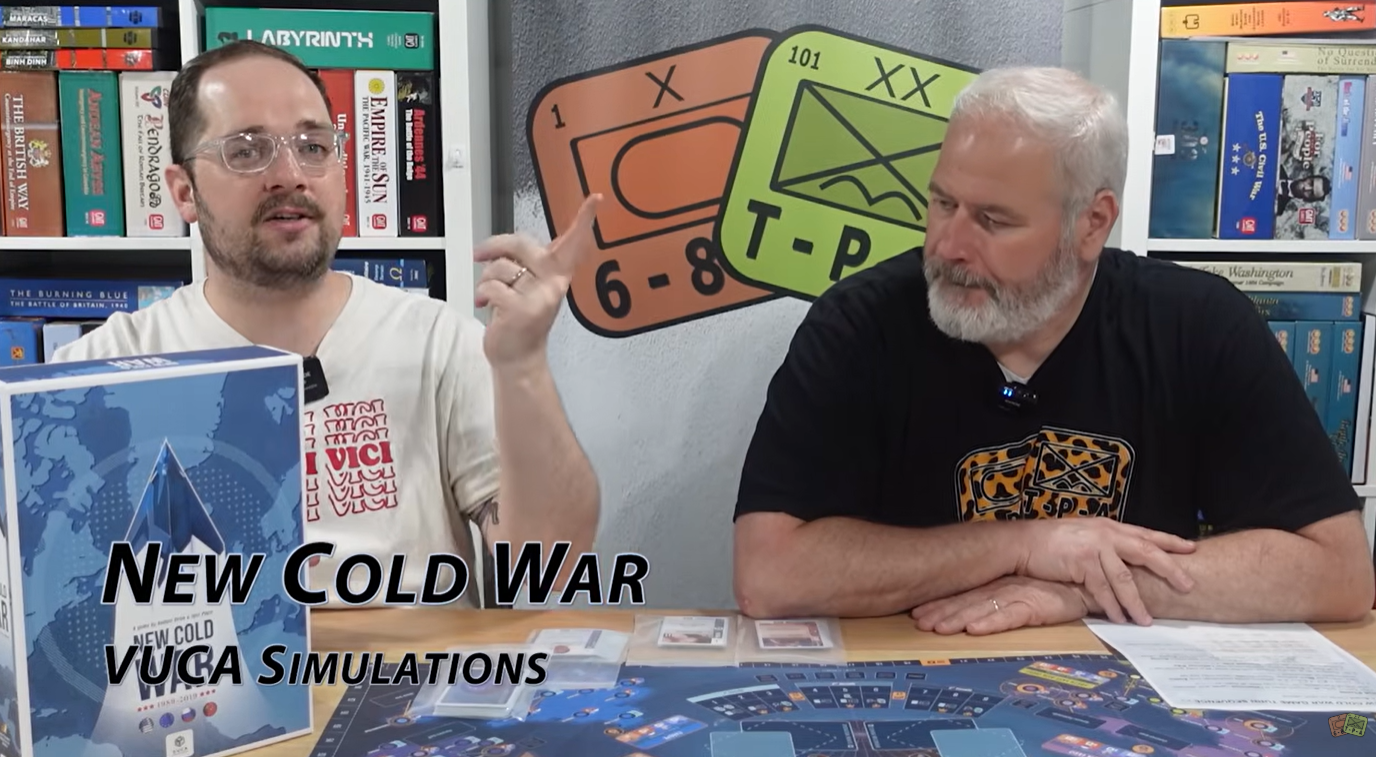
New Cold War: 1989-2019 is a Card-Driven Game based in the most important geopolitical events from 1989 to 2019. Players lead one of the four great powers (Russia, China, US, EU) in their fight for the new world order. Initially, the confrontation is between the red bloc, consisting of Russia and China and the blue bloc, comprising the United States and the European Union. However, each player must also prioritize their own strategy, as only one power can emerge victorious at the end of the game. Therefore, this game starts with cooperation between allied powers in the early stages but becomes entirely competitive as the moment of final victory approaches.
New Cold War utilizes a Card-Driven game mechanic. Players strive to attain victory by gaining international prestige, dominating the media and increasing their control of countries and different regions of the world. Other key factors to manage include military force and United Nations Security Council vetoes. Players’ strategies are determined by a series of hidden objectives they must pursue to achieve victory.
The game accommodates three or two-player versions and includes a solitaire mode through a system of bots.
A DECADE…a DECADE of content…a DECADE of wargaming…unreal! Time just flies by anymore and I am blown away to think that The Players’ Aid has existed for a FULL DAMN DECADE! That is literally 1/5th of my life! Just unbelievable but we are here and there is no going back or undoing the damage we have done over those 10 years. But we have reached our 10th Anniversary and if you told me 10 years ago that we would be around in 2026 I would have laughed at you. I thought that this was simply another experiment or hobby and that one day in a few years we would come to our senses and move on. But, that didn’t happen and frankly it was because of the fantastic support of the hobby, the strong “family” that we have built and the relationships that have been formed that has kept us fueled and going. Make no mistake, this landmark was reached by ALL of us in the hobby and we thank you all so much for the fantastic experience that we have had along with you.
2025 was another fantastic year for The Players’ Aid and we have continued playing and reviewing wargames and have hit several large milestones over the past 12 months including 3,300+ posts on the blog, nearly 6.4 million lifetime views on the blog and recently we surpassed the 21,500 YouTube subscribers threshold. It is cliche to say but what we do doesn’t feel like work, or a commitment or a chore, and we really enjoy what we do! And to have done this for 10 years is mind blowing. We are continually reenergized by our followers and your comments on our content and want to thank you all for that! I am not a person that needs praise and encouragement often, but when it comes organically it really feels good and pumps me up! Overall, the last year was a HUGE success for us as we have once again experienced good and steady growth in our written blog as well as in our YouTube Channel views. Even after all of this time doing what we do, we still have a desire to meet weekly and play new wargames to share with you. It has truly become our passion and we couldn’t envision a future without this.
Happy Birthday To Us!
We started the blog in 2016 with our first post being on April 17, 2016 which was a very short AAR on our first attempt at playing Empire of the Sun from GMT Games (I look at the pictures we used in that AAR and notice that the counters were not clipped! Barbarians!). We still laugh to this day about the fact that this was one of our first games that we tried to cover. I guess we both like diving into the deep end of the pool! From those meager beginnings, we have posted consistently and I think have improved the quality of our content since that first try. Your readership and viewing has helped keep us inspired and motivated to put out consistent content. Its been a lot of work, and does take up quite a bit of our free time, but we do enjoy it and have no plans to slow the train down. We also have been very lucky in the support that we have received from various publishers, websites and designers as they have worked to keep us going as well. From sharing our posts on Twitter and other social media sites, to posting our videos and reviews on the game pages on their websites, a good portion of our views come from these sources and we truly appreciate that. We know that we cannot possibly reach all of the wargamers out there by ourselves and need the community to help in spreading our words.
We also want to thank the host of game designers who have taken time out of their busy schedules to answer our long and sometimes deep questions about their designs in our written interviews. I know that when I reach out initially they are always gung-ho about answering the questions but then they get my email with 20+ questions and all of a sudden I am sure it feels like homework! Our Designer Interviews Series has been a huge success and is a big part of our weekly posts generally starting each week off with a new post on Mondays. II work hard to try and stay up on the newest games and give our readers an inside look at the mechanics, design process and game play on these in-design games. I have very rarely been told no by someone when I contact them on email to discuss their game and have been able to build quite a number of what I would call friendships with several of these designers. I will not name specific individuals, as I don’t want to inadvertently leave someone out, but thanks to you all! You are simply the best!
We have continued with our monthly Wargame Watch Series, Action Points, First Impressions posts and the occasional Best 3 Games with… Series and The Love/Hate Relationship Series. My newest series on the blog is the My Favorite Wargame Cards Series and we are now up to a total of 73 of these posts since May 2024. I really like revisiting some of these Card Driven Games that we have played in the past and finding those cards that are unique, interesting and that incorporate some of the historical flavor into the game through the cards. On our YouTube Channel, the Monthly Debrief Series is alive and well, although we have had a tougher time over the past 6+ months of getting them done on time mainly due to new job responsibilities and tough schedules, our Car Videos continue to do well and Alexander has continued his very interesting From Cover to Cover Series where he reads a historical book and shares his thoughts on it and pairs it with an overview of a few games on the subject. I have continued to work hard on my solo gaming and was able to fully play 17 new solitaire games in 2025 along with shooting playthrough and review videos. We appreciate all of your response to these continuing series and hope to be able to continue them but also create some fresh and new ideas in the future.
The Blog By the Numbers
With the introduction to the post and pleasantries out of the way, onto a look at the blog statistics, which is always my favorite part of writing this post! Statistics are a good indicator of how we are doing and I personally pay a lot of attention to our daily, weekly and monthly numbers. Actually, I might say that I am addicted to looking at them and check several times per day. I am a results driven person after all and have to win at everything!
Since the blog started in April 2016, we have been viewed nearly 6.4 million times (as compared to 5.4 million this time last year). These views have come from an astounding 2,127,173 visitors (as compared to 1,810,122 visitors as of April 2025). This means that each visitor that comes onto the blog averages 3.0 views. This number is down slightly form last year’s 3.04 views per visitor but is still very comparable. In fact, I have noticed that this views per visitor number has slightly gone down 6 out of the last 7 years. I am not sure I know why that is but it is a thing and it is good that when people do find us and come onto the blog they seem to spend some time viewing our current content and sometimes even dive back through our older stuff. That is one thing that I like about how our platform WordPress runs, as they will link comparable articles and posts below the new post so that when the reader is finished they can simply click a link there to take them to another similar article. This type of thing drives the number of views up and I am glad that it has this feature.
We have really been blown away by the response that we have seen in our blog over the past 10 years. While Alexander no longer writes on the blog, I have really enjoyed continuing to cover games in the written format as I know that there are people out there who prefer it to videos and our statistics prove that point. I know that I prefer written blogs over videos when consuming gaming content but everyone is different! I still marvel that we actually started this little venture but more importantly that we are still going 10 years later.
My mind is very analytical and I really like to think about and consider strategies and probabilities of outcomes during game plays. Don’t get me wrong, I am not a card counter or anything like that but I do like to consider the odds of success before taking certain actions. And I like to put those thoughts down on paper (digitally) here on the blog to share my insights with you. One of my most favorite series to write are Action Points. They give me the opportunity to sometimes create tables and graphs to look at the numbers inside of games as I analyze a game and its mechanics. These posts are not always the highest view garnering posts we do but I am not going to give up doing them as they are really for me and my enjoyment. If others read them and gain something from them, then that is great!
I also really do enjoy the process and activity of writing. It is soothing and takes my mind off of life for a while and really speaks to the creative side of my brain. I also love to consider how to introduce a subject to the reader, how to incorporate my brain’s hard drive full of nostalgia and movies into the narrative I am trying to spin. Sometimes I am more successful with this effort than others but I do enjoy doing that. I have no plans to stop writing but do have a bit of an obsession with it and spend a lot of time (really too much time) on the blog. Last year, I had quite the streak going with posting something on the blog every day for nearly 2 full years! That streak came to an end on January 2, 2026 when I didn’t post for 3 full days. The holidays were fun and I was spending lots of time with my family rather than with writing. I have tried to again get back to consistency this year and have done pretty well by posting at least 4-5 times per week and currently have a modest 35 day streak as of the posting of this entry.
You will also notice that we have done 3,325 posts over the 10-year period that our blog has existed. Remember though that 2016 only included 9 months of content while 2026 only takes into account the first three and a half months of the year, which accounts for the lower numbers for those shown years. If you look at the individual years’ numbers though you will see that we posted a lot in 2017 (432), 2018 (335), 2020 (355), 2023 (267), 2024 (410) and 2025 (385) while 2019 (194) and 2021 (200) were both a bit of a slow year as I had started a new job and was very busy with some travel and out of town work that kept me from my regular routine of writing. 2022 picked back up though and I made a concerted effort to get back to regular content. Also, early on, remember that there were three of us writing for the blog (remember Tim?) and over the past few years it has just been Alexander and I, although at this point as mentioned earlier I do 99.9% of the posts on the blog. Our posting consistency has kept our blog fresh in our readers minds and on their timelines. Over the past few years, the number of posts has begun to increase again but has slowed down a bit in 2025 and now in 2026. But never fear, posts will be regular. I promise!
Another interesting statistical compilation that is provided by our WordPress software is a look at not only the number of posts but also the total number of comments, total post likes, total words written as well as some averages across those numbers. Interaction on posts has been much improved over the past few years as compared to previous years with more comments and more likes saw a big drop in comments. I do love to hear your thoughts on my posts and about the games or subjects being covered so please say something if you would like. I consider myself to be pretty wordy in my posts and that is being proven with total word counts in 385 posts in 2025 of 662,977 and average words per post of 1,722, which are a bit lower than in 2024. It appears that through the first 3 1/2 months in 2026 I have become a bit wordier but I know that I have done more lists and have started some more in-depth looks at games.
Over the past 10 years, we have built quite a library of content and we still come up often in internet searches which brings a lot of visitors to our site. In fact, here is a look at some interesting data from the blog where you can see our top Referrers from 2025. These are sites that send visitors to our site as they have hosted or linked to our articles, videos or other content and people find us this way. Notice though that Search Engines sent 152,693 views our way, which is about 17.1% of our total views (Total Views for 2025 were 897,777). Social Media is also a good source for views as Facebook brought in 23,296 views and Twitter 5,450 (down quite a lot over 2024 from 15,401 views). Consimworld, which referred just 1,649 (down a bit 2023 from 7,287 views) used to be a much larger part of our referrers but has dipped and you will notice that GMT Games is not on the Top 10 list as it appears nothing has come from them. Not shown in the graphic are the myriad of smaller referrers that send views our way. That list is really very long and I couldn’t post the whole graphic but there are about another 130+ referrers ranging from 250 views referred all the way down to just a handful of referrals. We appreciate all the views though and will never not be grateful for any help that we can get.
The following graphic shows our Monthly Views since 2016 and tells a really interesting story. As you can see, our monthly views had been steadily increasing over the years, growing from a Monthly Average Views of just 16,153 in 2016 to over 71,856 in 2021. This slowed down quite a bit though in 2022 with a Monthly Average Views number of just 43,891. We refer to this as the “Dark Times”. As you can see, as I started posting on the blog less starting in July 2021, our monthly views dropped off to the lowest point since 2016. But in 2025 we had a banner year with a whopping 897,777 views, which was our largest annual view ever on the blog. Why was this the case? I am not sure but we did see China pop up as a country where views were coming from and that had never really been the case before so maybe the Party was monitoring my posts as a possible secret code to American operations across the globe. Thus far in 2026, we are doing solidly and have actually outpaced the views for the first 3 months of 2026 as compared to the same months in 2025; January with 57,200 views (52,700 in January 2025), February with 68,400 views (45,500 in February 2025) and March with 52,600 views (51,200 in March 2025). This is a good trend for the blog and I am happy to see it. We may not break the record for highest views this year but we are on pace for another very solid 600,000+ view year.
A few years ago when we posted these stats there was a request for a map of viewers and viewership based on location. The WordPress (powered by JetPack) statistics are pretty good so here’s a look at the top country views for 2025. Obviously the US (296,300 or 33%) is where the majority of views come from with the UK (68,100 or 7.5%), Canada (32,700 or 3.6%), Germany (28,600 or 3.2%) and France (27,800 or 3.1% ) bringing up the 3rd-6th spots respectively. But, this year we had a new entry in the views from Countries arena in China with 264,300 views or 29.4%. I am shocked. I do know that I saw where a couple of warganing focus sites had shared some posts that they translated into Chinese (without my permission I might add) but the added views has been nice. I am very pleased to see our growth in the non-English speaking (I realize some are bilingual and do speak English but not as their primary language) views from these great European nations and even from China. I am always surprised when we get a comment or interaction with fans from other countries and when I look at this graphic I realize that we are a global blog with lots of fans in lots of countries and that makes me very happy.
Top Performing Blog Posts for 2025
In the anniversary post last year, I showed you a list of our best performing posts on the blog. So I will continue that trend this year by showing our best performing posts for 2025. The same as last year, it seems that lists of games do the best, such as Alexander’s Top 10 Wargames, Grant’s Most Anticipated Wargames of 2023!, Grant’s Most Anticipated Wargames of 2025! and so on. People really like lists as they are a quick source of lots of good games that people can investigate, purchase and play. Most of our blog posts get 200-700 views in the first week they are on the blog and then over the next month will get an additional 200-400 views, sometimes more depending on the topic and how often I share them on social media. We are not a high view blog, partly because we are a wargaming blog really with only ever a smattering of coverage for traditional board games, but also because we don’t pay to promote our posts on social media nor do I spend a glut of time posting our stuff on other forums. I could do that and we would get more response but I just don’t have that kind of time.
Designer Interviews
In 2025, the blog hosted 51 interviews with designers (down 19 interviews as compared to 2024 with 70 hosted). That means that we posted almost every week (usually on Monday of each week) of that year. Thus far in 2026, we have posted 14 such interviews and seem to have no problem finding interested designers who want to share their games. I regularly scour various sources for news and anytime I find information about an upcoming game I add it to my list and try to reach out to at least 3-4 designers each month. The goal here is to have a continual pipeline of these designer interviews in the works, either having sent questions out to the designers or working to format and schedule interviews I have received back on the blog, I am always a few weeks ahead in order to make sure I have a continual flow of posts. Since our inception in April 2016, we have posted a whopping 587 designer interviews and I am very proud of that accomplishment. I was once told by Ty Bomba that our blog is an indispensable resource for designers and developers to read to understand how other designers have used interesting and new mechanics and overcome design issues and challenges. I like that and it makes me smile to think about the past 10 years of these weekly interviews and that someone has read them and learned something.
Currently, we have interviews already scheduled to post on the blog through May 4th and I have at least 8 others that I need to review, edit, format and then load onto the blog. Here is a look at some of our better performing designer interview posts from 2025:
These were simply a few of our best performing designer interviews on the blog throughout the year. To access our backlog of these interviews, just go to our blog and check out the Categories section located on the right side of the screen and enter Designer Interviews.
Social Media/Other Platforms
One of our most important marketing efforts is our focus on various Social Media platforms with the most used platform being Twitter or “X “as it is now called (although it is becoming a black hole and both interactions and views from are down) followed by Facebook. We share our posts from the blog on Twitter (@playersaidblog), Facebook (@theplayersaid), Mastadon, although this platform just hasn’t taken off yet and I am afraid is already dying (@theplayersaidgrant@wargamers.social) and Blue Sky (@playersaidblog.bsky.social) daily and have expanded into sharing in around 7 Facebook groups including Wargamers, Solitaire Wargames, Official GMT Games Group (when our posts focus on one of GMT’s games), GMT Games Fans, The Solo Board Wargamer, The Board Wargamer, THE BOARDGAME GROUP and finally our own page The Players’ Aid. I always worry about our frequency of posts and upsetting the groups but I do spend time trying to respond to comments and questions on our posts, share my gaming pictures there and read others posts and comment on them as well.
As you can see from the table above, I missed noting our stats for these Social Media platforms in 2019 but we have had a lot of growth in our Social Media reach in 2025 with a 4.3% increase in Twitter followers, 25.9% increase in our Facebook follows and 2.6% increase in Instagram followers (which is a platform that we really have ignored over the past couple of years). Our Blog Follows have dropped and I am not sure why. You can follow the blog one of two ways, either with your own WordPress site or through email. In just over 9 1/2 years, as we didn’t use social media much the first year, we have built a network of followers on these platforms that really helps us to engage and have discussions on various topics. In 2024, we added Blue Sky to our social media repertoire and have built a good little community there with a large number of increased subs of +240 and hope to continue good growth there so we can chat and connect with you.
Now we come to the YouTube Channel. And normally, I get to say that we had a banner year and added lots of subscribers, etc. But, in 2025, we just didn’t have a very good growth year on the channel. We added 1,363 subscribers, which is a good healthy growth number at +6.8%, but is not as good as we had seen over the past 4 or 5 years with double digit growth percentage and well over 2,000 to 3,000 new subscribers every year. I am a worrier by nature and Alexander doesn’t share my concern with the Channel but I look at others and their growth and we are no longer the largest pure wargaming channel out there. That position is now held by ZillaBlitz, and congratulations to Mike, as he has 28,400+ subscribers. I just take pause to ask myself what has changed? Have we somehow turned people off? I know that we are a bit all over the place and unorganized in our thoughts and videos with rambling discussions and over excited takes on games, which are all genuine for us and nothing is faked or staged. But what has happened? I would also say that over the past few months our views have dropped off by about 20% or so. I think that normally within a day or 2 of posting most of our videos, we would see well over 1,000 views but now we are seeing only 600-800. I just don’t know the answer and I wanted to make that statement here so you can help me to figure it out.
As you can see in the graphic below, we had 773,139 total views of our videos on YouTube over the past year (April 2025 through April 2026). That is about 100,000 less views than in 2024-2025. I am a bit disappointed in this number but feel that we are still really strong in our analytics. Sometimes people get disenfranchised with things and stop having interest. Plus there are even more content creators out there now than before and some of them are doing really well (I am looking at ZillaBlitz). If I were guessing, and based on our slower growth over the past year, I would say we will reach 22,500 subscribers in late 2026 so please subscribe to our channel if you haven’t already.
Overall, since starting the channel in 2017, we have had 6.4 million views, 229,400 Likes, 29,600 Comments and 18,200 Shares. That is very pleasing to see and we are so glad that our videos are being consumed and hopefully making a difference in the wargaming community. One other thing, it is interesting to see what videos are getting the most views and as expected these are our lists or our Monthly Debriefs, such as the Top 10 Wargames, Convention Debriefs and my Top 10 Solitaire Games of 2024 video.
Monthly Debrief Videos
In 2021, we started the Monthly Debrief Series of videos where we talk about what games we played the previous month and what we plan to play in the coming month as well as what games are on Kickstarter and a protracted discussion on a chosen monthly topic. These videos have been very well received. We have done one of these videos each month since their inception in January 2021 and to date are in Season 6 Episode 2 and these videos have garnered over 450,00 views. We tend to ramble on in these videos and they are over an hour each with some approaching 2 hours so thank you for watching and sticking with us as we go on and on! This year we have started Season 6 of these videos and I am really amazed that they still garner views and engagement. They are admittedly long, and I always find them fairly boring, but people tend to view them for sure. We still have lots of great topics that we can discuss and always seem to come up with something new to share.
To wrap this up, we just want to express our humble gratitude and say thank you for all of the support that you give us and for your interest in our content. Ultimately blogs and YouTube Channels only really continue with consistent posts if there is a response. The work involved, while it is a hobby and something that we do for the love of the games, does take us away from some of our other responsibilities at least partially and it is good to see that our content is having an impact on someone. We have made a lot of good friends through this little content creation experiment of ours and we look forward to seeing many of you this summer at great conventions like the World Boardgaming Championships (WBC) (July 25th-August 2nd), Gaming the American Revolution – Camden 250 (September 24-27th) and possibly at least one more, if I can spare the time in the fall, SDHistCon (November 6-9th) in San Diego, California. Please come out and say hi and maybe we can play a game together!
Please let us know what you would like to see from our blog and YouTube Channel in the future and also tell us what you enjoy about our content. Thanks and here is to another successful year in 2026!
French board game designer association SAJ has renamed itself to make its title more inclusive to women and non-binary people, as well as to better underscore its status as a union.
The Société des Auteurs de Jeux – which translates as society of game designers – was formed in 2017 through the merger of three separate groups, and currently represents more than 800 individual designers.
The organisation has now been rebranded as the Syndicat des Auteurices de Jeux – the Union of Game Designers – following a vote at its annual general meeting at the Festival International des Jeux in Cannes.
SAJ president Audrey Bondurand told BoardGameWire, “We wanted to change this name for two reasons: first, we have officially been a union for several years now, and we wanted our name to reflect that.
“Second, in French, ‘auteur’ is not a gender-neutral word, but a masculine one. ‘Auteurice’ is a contraction of ‘auteur’ and ‘autrice’ (the feminine form). We chose this neologism to include women and non-binary people.”
Bondurand, who worked in a board game cafe and in distribution before publishing her first game, Draky, said part of SAJ’s remit was advocating for the recognition of board games as cultural works, something which is “unfortunately still not the case today in France or in Europe”.
The organisation also offers contract reviews, mediation, accounting advice sessions and general support for designers in the industry, much like its US-based peer the Tabletop Game Designers Association and Germany’s SAZ.
Bondurand added, “Regarding the use of AI, we openly support the position of the CIL (our illustrator colleagues) in opposing generative AI in our published games.”
SAJ said a new website featuring its rebranded title is currently under construction, with the organisation’s existing email addresses currently operating as normal.
With this My Favorite Wargame Cards Series, I hope to take a look at a specific card from the various wargames that I have played and share how it is used in the game. I am not a strategist and frankly I am not that good at games but I do understand how things should work and be used in games. With that being said, here is the next entry in this series.
#69: Blockade from Twilight Struggle: The Cold War, 1945-1989 from GMT Games
Twilight Struggle is a 2-player game simulating the forty-five year ideological struggle known as the Cold War between the Soviet Union and the United States which can be played in 2-3 hours. The entire world is the stage on which these two countries “fight” to make the world safe for their own ideologies and way of life. The game starts right after the end of World War II in the midst of the ruins of Europe as the two new “superpowers” of the world squabble over what is left and ends in 1989, when only the United States remained standing.
The map is a world map of the period, where players move units and exert influence in attempts to gain allies and control for their superpower. The beauty of the CDG system used here is that each decision of whether to use a card for the event or the operations value is a struggle as if it is the other side’s event, it might go off hurting you very badly. There are mechanics to allow for the ignoring or cancelling of some of the best cards for your opponent in a side game within the game called The Space Race as well as nuclear tensions, with the possibility of game-ending global thermonuclear war (Shall we play a game, anyone?). I have played TS about 30 times and love it more and more with each sitting. The game makes me sweat, cringe, jump with joy and bite my fingernails. To me, a game that can do all of that in one sitting is worth the price.
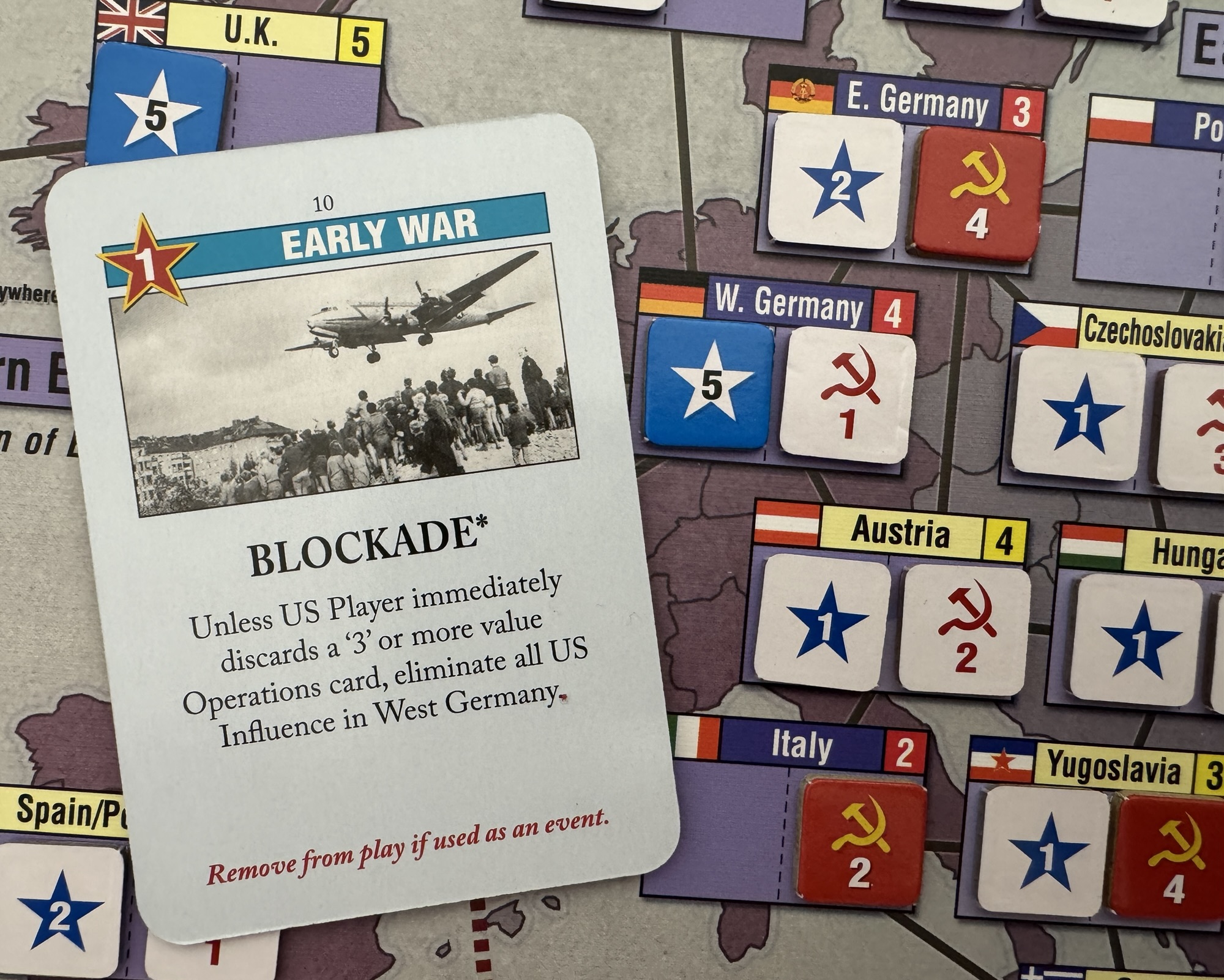
One of my favorite type of cards from the game are those that force an action upon your opponent, such as discarding a card, reducing the Ops from card plays or causing them to have to make other plans than what they were working toward. These type of cards are more reactionary but definitely cause issues and mimic the various non-military focused strategies and tactics used during the Cold War. One of the most famous events from the early history of the Cold War is that of the Berlin Blockade. And there is a specific card that pays homage to the event in the game called Blockade. Blockade is an Early War Soviet Card that has an Ops Value of 1, which makes the card more valuable to be used for the printed event versus for the Ops.
When played, the card requires the US Player to immediately discard a 3 Ops or more value card from their hand or the consequence of not doing so will see all US Influence being removed from West Germany. This is a tough choice. Being early in the game, it is possible for the US to rebuild in West Germany and replace the lost influence over time if they do not wish to discard such as high value card. But, herein lies the real key to the Blockade cards use. The Soviet Player, who should be paying attention to not only their hand but also the card plays of the US Player, should try to use this card later in a turn once the US Player has played a majority of their cards in order to ensure that the event text can be realistically be achieved. If played quickly during a turn, the chances of the US Player being able to discard the required 3 Ops or great value card is higher and the card play will not generate any meaningful difference on the board state. I also would recommend a 2 card strategy here as the Soviet Player should be holding in their hand a high Ops card to be able to follow up this action with the placement of Influence into West Germany on their very next play. But, the real value to a card such as Blockade is that it forces the US Player to consider what cards are out there and to play around their negative effects as much as possible. Due to the nature of the game, and the randomness of card draws, having an expendable high Ops card ready and able to be discarded just in case of the play of Blockade is not really feasible. Also, remember that in Twilight Struggle that opponent events on cards that you play will go off and Blockade being drawn by the US Player can be bad as it will require them to play the event as you cannot discard a 1 Ops card to get rid of its negative effect in the Space Race Track due to the minimum requirement being a 2 Ops card. So the moral of the story here is that both players need to consider and plan for the play of or the mitigation of damage from Blockade.
The Berlin Blockade, which lasted from June 1948–May 1949, was a major Cold War crisis where the Soviet Union blocked all land and water access to West Berlin to attempt to force Western Allies out. The Soviet Union was taking this action as a means of retaliation against the introduction of the new Deutschmark currency. The US and Britain responded with the massive Berlin Airlift, flying over 2.3 million tons of food, fuel and supplies to the city. At the peak of the Airlift, a plane landed in West Berlin every 30 seconds. The blockade failed and the Soviets lifted it on May 12, 1949, after realizing the Allied Airlift could sustain the city for an extended period of time, marking a significant victory for the West in the ideological struggle. This event led to the acceleration of the division of Germany into East and West and the deepening of Cold War tensions.
Two weeks ago, we’ve looked at the first period of Soviet liberalization under Nikita Khrushchev from the 1950s on. While these reforms ended the era of Stalinist totalitarianism, they petered out when Khrushchev lost interest in them and was eventually overthrown and replaced by the more conservative Leonid Brezhnev. It would take another generation until a new Soviet leader, Mikhail Gorbachev, would undertake another broad reform program. These reforms – like last time, in the realms of domestic, foreign, and economic policy – are the subject of this article. Of course, you’ll also find a few board games in it!
Freer Press, Freer Elections
The Soviet Union’s political landscape had ossified under Brezhnev. This stagnation (or, if you want to phrase it more positively, hyperstability) also ruled out any experiments after Brezhnev’s death in 1982, and so the Politburo selected his loyal lieutenant Yuri Andropov. Unfortunately, Andropov was already 68 and severely ill then. He died in 1984, to be succeeded by another Brezhnevite stalwart, Konstantin Chernenko, who was similarly afflicted and even older (72 at his accession). Chernenko died in 1985. The rapid succession of aging Soviet leaders is poignantly captured in the contemporary joke: Margaret Thatcher calls Ronald Reagan: “It’s a pity you didn’t come to the funeral of the Soviet general secretary. Marvelous. A great spectacle. I’m totally going again next year.”
Cover of the English-language edition of Kremlin. Unfortunately, fake Cyrillic was once more irresistible, and so the R in Kremlin has been replaced with a Я (which would make the word Kyaemlin).
Another quasi-contemporary (1986) satirical take on the Soviet gerontocracy is Kremlin (Urs Hostettler, Fata Morgana): Players support the various Politburo members in the hopes of advancing those they have influence with to the top jobs, but many a hopeful candidate will die of stress and old age before realizing their ambitions.
After Chernenko’s death, even the most conservative Politburo members saw the need for a different tack: They elected Mikhail Gorbachev as their new leader in 1985, a real baby at age 54. Gorbachev’s reformist leanings were well-known, but he proceeded cautiously in his first year. As with Khrushchev, the big programmatic changes were first announced at a Party Conference of the Communist Party of the Soviet Union.
Gorbachev’s first slogan for his reforms was glasnost (openness). That included sweeping changes to Soviet citizens’ freedom of expression: Gorbachev encouraged the Soviet press to scrutinize politics instead of simply parroting the party line. Dissidents were released from prison. Even non-state-sponsored demonstrations were allowed – a powerful tool to express malcontent with the government. Of course, these reforms undermined the power base of the Communist Party – but Gorbachev hoped that he could steer the ship of state in the new environment and might even benefit from a freer populace.
Even more radical were Gorbachev’s institutional reforms, usually referred to as perestroika (restructuring): The Communist Party’s monopoly on power was cut off by establishing the Congress of People’s Deputies as an independent parliament, and while the first elections in 1989 were not fully free, it was the first time that Soviet citizens could select from several candidates in a contested election. Gorbachev himself chose to base his power no longer on his role as General Secretary of the Communist Party, and instead was elected President of the Soviet Union by the Congress of People’s Deputies in 1990.
This nascent democratization drive – eventually rather envisioned than enacted – makes for the most powerful card in the last phase (1985—1991) of the Cold-War-in-a-nutshell which is Twilight Squabble (David J. Mortimer, AEG): It’s a bit of speculation on the internal and external legitimacy and attractiveness a more democratic Soviet Union could have enjoyed.
Speaking of external legitimacy and attractiveness: Gorbachev’s policies (and he himself) would prove immensely popular in the West… after he had weathered the initial suspicion. Gorbachev began to advocate for a return to détente soon after he assumed office, but US president Ronald Reagan assumed this to be a Soviet ploy. Only after Gorbachev had met Reagan at the 1986 Reykjavík summit did the president believe Gorbachev’s intentions to be genuine.
In the following years, the two of them agreed on far-reaching mutual disarmament, most notably the Intermediate-Range Nuclear Forces (INF) Treaty. Gorbachev’s immutable advocacy for arms reduction is reflected in Wir sind das Volk! – 2+2 (Richard Sivel/Peer Sylvester, Histogame) as his event card cannot be used for the arms race.
Besides the lofty realms of nuclear arms reduction, Gorbachev also had more grounded problems to deal with: The Soviet Union had invaded Afghanistan in 1979 to prop up the failing pro-Soviet government there and had been embroiled since then in a costly and futile counter-insurgency. As the Soviet military could not present Gorbachev with a convincing roadmap on how to win the war, he decided to pull the Soviet forces out in 1988. By that time, the unsuccessful war had undermined the Soviet government’s legitimacy which had rested on its status as a military superpower, exacerbated by the new avenues of political expression open to disaffected citizens – the mothers of Soviet soldiers who fought (or had died) in Afghanistan were among the first to form associations, to pressure the government, and to protest.
In that sense, it is surprising that the withdrawal from Afghanistan can still net the Communist player points in 1989 (Jason Matthews/Ted Torgerson, GMT Games) – but the general principle holds true: The later the Soviets withdraw, the more their failure in Afghanistan becomes an asset to the opponents of Communist power.
Finally, Soviet power was the rock on which the Communist governments in Eastern Europe rested. Whenever they had been challenged – most importantly in Hungary in 1956 and Czechoslovakia in 1968 – Soviet tanks had quashed the dissent. This limited sovereignty within the Eastern bloc had been the central tenet of Soviet foreign policy, after 1968 named the Brezhnev Doctrine. Gorbachev adopted a new approach: He would not militarily intervene in Eastern Europe anymore. Instead, the countries of the Warsaw Pact were free to “do it their way” – thus humorously called the Sinatra Doctrine.
Finally, Gorbachev’s reform agenda of perestroika also aimed to transform the Soviet economy. All Soviet leaders had engaged in some kind of economic reforms, so Gorbachev’s activity did not seem very surprising… until observers inside and outside of the Soviet Union realized how radically it would change the tenets of the Soviet economy, traditionally based on central planning, large state-owned companies, and very limited contacts with the outside world.
First, Gorbachev gave the state-owned companies much more leeway over what to produce and how to set prices. These market incentives were supposed to improve efficiency, but clashed with the existing structures.
Undeterred, Gorbachev went a step further and loosened the restriction on private enterprises. More Soviet citizens could start their own store or workshop and offer goods and services at their own responsibility.
Then, Gorbachev allowed for joint ventures with Western companies (provided the Soviet part owned a majority share), and even let them set up dependencies in the Soviet Union – the famous first McDonald’s restaurant in the Soviet Union opened in January 1990.
The End of the Cold War and the Collapse of the Soviet Union
Gorbachev’s daring move to end hostilities with the West was an unqualified success. In late 1989, he and US president George H.W. Bush could merrily declare together that the Cold War was over.
The consequences of Gorbachev’s foreign policy reverberated through the Eastern Bloc: The allied Communist regimes of Central and Eastern Europe were swept away in 1989.
Early in a game of 1989: The Democrat (blue) has already taken power in Poland and Hungary. It will be difficult for the Communist (red) to stop the ever-growing blue tide. From the Rally the Troops! implementation.
The Perestroika and Glasnost event in Wir sind das Volk! – 2+2 neatly shows the way in which Gorbachev’s reforms put stress on the system: On the one hand, it increases Soviet dominance and makes socialism more attractive (lower two icons). However, it also increases unrest in East Germany (fist icons).
Within the Soviet Union, the political freedoms granted allowed citizens to demand more freedoms. These centrifugal effects became particularly visible as most of the non-Russian republics soon had nationalist independence movements which began to eat away the Soviet Union from its ethnic fringes. Gorbachev responded by proposing a looser federation between the Soviet Republics.
The political reforms also had negative interaction with the economic reforms: On the one hand, the flurry of changes created new inefficiencies; on the other, the increased freedom of the press highlighted economic problems no matter if they were new or had existed for centuries. As Soviet economic performance thus both objectively worsened and also became more obvious to the average citizen, Gorbachev’s legitimacy eroded.
Hardliners within the Communist Party couped against Gorbachev in August 1991 to prevent the loose federation between the Soviet Republics. A coup might also spell the end for the player in the solo game Gorbachev: The Fall of Communism (R. Ben Madison, White Dog Games). It’s a States of Siege game with a twist: Whenever the marker on any of the five paths (four of which refer to various ethno-national groups in the Soviet Union, the fifth represents the Communist Party) reaches the center, the game is not lost immediately, but a coup is staged: If Gorbachev has enough elite support to weather it, he goes on to fight another day.
In history, that was not the case: While the coup failed, it made Gorbachev a lame duck. The supporters of reforms turned away from him and toward his erstwhile ally Boris Yeltsin (who had cut a much more dashing figure during the coup), and away from the Soviet Union and toward their respective ethno-national identities. Gorbachev resigned as president and the Soviet Union was dissolved in December 1991.
The most influential work on Gorbachev’s time in office and his policies remains Brown, Archie: The Gorbachev Factor, Oxford University Press, Oxford 1996.
A magisterial mosaic of Soviet social, economic, and cultural life is Schlögel, Karl: The Soviet Century. Archaeology of a Lost World, Princeton University Press, Princeton, NJ 2023.
For the age of hyperstability before Gorbachev (and the discussion if it was an age of stability or stagnation), see the essays (in German, but with English abstracts) in: Belge, Boris/Deuerlein, Martin (eds.): Goldenes Zeitalter der Stagnation? Perspektiven auf die sowjetische Ordnung der Brežnev-Ära, Mohr Siebeck, Tübingen 2014.
On the transformative last third of the 20th century in Russian history, see Kotkin, Stephen: Armageddon Averted. The Soviet Collapse, 1970-2000, Oxford University Press, Oxford 2001.
On the end of the Cold War, see Dockrill, Saki Ruth: The End of the Cold War Era. The Transformation of the Global Security Order, Hodder, London 2005.
For the Soviet intervention in Afghanistan, see Braithwaite, Rodric: Afgantsy. The Russians in Afghanistan, 1979—1989, Oxford University Press, Oxford 2011.
The Soviet Union was one of the great dictatorships of the 20th century. It applied an immense amount of coercion on its own citizens as well as many of its neighboring countries. Yet the almost seventy years between the Soviet Union’s founding from the ashes of the Russian Civil War in 1922 and its fragmentation into 15 nation-states in 1991 are no monolith of unfreedom. There were two distinct periods of liberalization around a generation apart from each other – one that began under General Secretary Nikita Khrushchev in the 1950s, and one that began under General Secretary Mikhail Gorbachev in the 1980s. Let’s look at them, beginning with Khrushchev’s thaw, in terms of domestic, foreign, and economic policy. The post on Gorbachev’s reforms will follow in two weeks. As always, there will be board games along the way.
Freedom of Thought, Speech, and Political Expression
Joseph Stalin’s Soviet Union curtailed its citizens’ expression dramatically. Historiography has recounted Stalin’s reign of terror in detail, yet the best-known expression of the totalitarian control to which the Soviet Union aspired from the 1930s on is George Orwell’s dystopian novel 1984: Its one-party state does not only control citizens’ access to information (they are being exposed to constant propaganda and expected to keep up with its frequently changing, often contradictory contents), but demands active participation in the daily reconstruction of the system, ranging from institutionalized “two-minute hate” against political enemies to unlimited devotion to the “Big Brother” at the top of the pyramid.
The Soviet equivalent to the “Big Brother,” of course, was Stalin who was exalted in an official cult of personality as a wise and infallible leader, working tirelessly for the security and well-being of the Soviet Union. Whatever went wrong on the Soviet Union’s inexorable march of progress was the fault of an inept underling or a shadowy enemy.
When Stalin died, his lieutenants fought briefly, but viciously over his succession. Nikita Khrushchev emerged victorious. Khrushchev had been as loyal to Stalin as his chief rivals and immediatly used Stalinist methods to depose Lavrentiy Beria, the powerful Minister of Internal Affairs (and thus chief of the domestic security services). Beria was charged with treason, put through a mock trial, and executed.
Khrushchev’s skillful power politics could also swing the other way, though. He prepared a report on Stalin’s crimes which he delivered to a stunned audience at the 20th Congress of the Communist Party of the Soviet Union on February 25, 1956. For four hours, Khrushchev detailed Stalin’s party purges, his deportation of whole peoples deemed unloyal, and, most of all, how Stalin had established a cult of personality in which he was almost worshipped like a god.
Khrushchev’s de-Stalinization drive did not stop at mere proclamations. The late 1950s and early 1960s saw a lessening of censorship: Alexander Solzhenitsyn was allowed to publish his Gulag novel One Day in the Life of Ivan Denisovitch.
There were limits, however: Criticism of Stalin’s Gulags was one thing, criticism of the October Revolution another. Boris Pasternak’s Doctor Zhivago was not published in the USSR. When Pasternak won the Nobel Prize in literature for it, he and his family were threatened by agents of the state. Cowed, Pasternak did not travel to Stockholm to accept the prize.
Still, Khrushchev’s pivot represented an important turn in the state’s relationship with violence. While Soviet citizens were still routinely surveilled and subjected to coercion, it was neither with the overwhelming force of Stalinism nor with its unpredictability. The age of escalating purges, in which the accusers of today would be the accused of tomorrow was over.
Peaceful Coexistence and Khrushchev’s Many Other Schemes
Khrushchev’s 1956 speech was meant to remain secret, known only to its direct recipients and the allied Communist governments in Eastern Europe, but a member of the Polish Communist party smuggled a copy abroad via the Israeli embassy in Warsaw. From there, it soon gained wide circulation, and while Khrushchev had intended it to be a domestic power play only (it delegitimized his rivals Georgy Malenkov and Vyacheslav Molotov), he now also reaped benefits abroad: The post-Stalinist Soviet Union was naturally a more attractive ally and role model for both the socialist movements in Europe and the decolonizing and freshly independent nations in Africa and Asia.
This unintended benefit is the focus of the foreign-policy heavy Twilight Struggle‘s De-Stalinization card: The Soviet player may move up to four points of influence around on the globe. That may seem like a zero-sum game – after all, the influence is not added, but only moved. But the Soviet Union typically has a lot of spare influence in Eastern Europe after the first one or two turns, and De-Stalinization is the earliest and best way to gain access to faraway continents, chiefly South America (and, to a lesser degree, Africa).
Even before Khrushchev’s speech was leaked, his approach to foreign policy markedly differed from Stalin’s last years. When the relationship with the Soviet Union’s erstwhile allies had deteriorated after the end of World War II, Stalin had adopted a confrontational stance based on the assumption that the world was split in two hostile camps. Khrushchev, on the other hand, approached the western powers under the new motto of peaceful coexistence. Socialism and capitalism could both inhabit the same world. Of course, Khrushchev as a convinced Communist believed that his system would eventually triumph. Until then, peaceful coexistence would not only foster peace, but also make socialism more attractive, and free up resources for economic development and consumer goods (more on that below).
The economic (factory icon) and especially ideological (socialist – man with flat cap icon) bonuses are nice, but what sets the Peaceful Coexistence event in Wir sind das Volk! – 2+2 (Richard Sivél/Peer Sylvester, Histogame) apart is the ability to advance peace (dove icon) – indispensable when the world is sliding toward nuclear war!
Khrushchev was always better at initiating things than at seeing them through. Peaceful coexistence gave way to other projects – be that the support of nationalist movements in the global south or a re-newed competition with the West over Central Europe. And while Khrushchev thought that the Soviet Union and the western powers could live next to one another, that tolerance did not extend to heterodox socialist ideas within his own sphere of influence: When the Hungarian Socialist Workers’ Party announced to withdraw the country from the Warsaw Pact and hold free elections, Khrushchev had the reform movement quashed by Soviet tanks.
The Soviet economy under Stalin had been tuned to increase heavy industrial output to achieve a fast industrialization on the one hand and provide the basis for the country’s military security. This approach was validated by the country’s survival of the Nazi invasion and its eventual military victory in 1945. The proponents of this economic policy which usually went together with ideological mobilization and a confrontational foreign policy were called to adhere to politika. Yet after Stalin’s death, the rival faction of tekhnika gained ground: Its advocates favored a less aggressive foreign policy, less ideological mobilization, and, most of all, more market elements in the economy which would then produce more consumer goods.
Khrushchev positioned himself in the middle: Heavy industry would have priority (the Soviet Union was in a nuclear arms race with the United States whose economy was around three times as large as the Soviet, after all), but more attention would be given to consumer goods than before. Soviet citizens enjoyed a limited amount of prosperity with radios, washing machines, and sometimes even cars. Khrushchev saw this also as an instrument in the systemic competition of the Cold War: Material comfort and personal lifestyles would influence people’s allegiances as much as military strength or ideological treatises.
Khrushchev’s confidence in that regard led him to agree with the United States on mutual national exhibitions which would showcase their respective country to the citizens of the other. The confidence, however, was not quite justified: The Soviet exhibition in New York aroused curiosity, but the American one in Moscow was positively overrun. It also produced one of the iconic pictures of the Cold War with Nikita Khrushchev and US Vice President Richard Nixon debating the merits of their respective systems surrounded by American household appliances – the “Kitchen Debate.”
Some Soviet citizens might have dreamed of living in America, but their personal lifestyles already became more akin to those of Americans under Khrushchev. Even more important than the new consumer goods were their living conditions: Housing in big Soviet cities had been dominated by kommunalkas – large apartments from pre-revolutionary times which had been split to accommodate several families, each living in a single room and sharing the kitchen and bathroom with the others. These crammed living spaces afforded their inhabitants no privacy whatsoever. Only the elites of Stalin’s Soviet Union had apartments to themselves. Khrushchev started an ambitious housing program based on prefabricated, concrete-paneled apartment buildings which allowed millions of Soviet citizens to move into an apartment just for their own family for the first time.
As with foreign policy, Khrushchev started more economic reform projects than he saw through. The ambitious “Virgin Lands” campaign which aimed at alleviating Soviet food shortages by cultivating vast swathes of Siberia and northern Kazakhstan petered out after a few years. His scheme to introduce an Iowa-style corn belt fared even worse, discrediting both corn and Khrushchev in the Soviet Union.
Khrushchev’s Ouster
The economic starts and shifts of Khrushchev’s tenure undermined his position, as did his foreign policy unpredictability ranging from arms control to confronting the United States over Cuba. Most damaging to him, however, were his constant shuffles in the Communist Party. Disaffected cadres who feared they might lose their offices overthrew Khrushchev in October 1964. They installed the less fickle Leonid Brezhnev as new General Secretary of the Communist Party of the Soviet Union. The conservative Brezhnev would tone down some of Khrushchev’s domestic reforms, resulting in a more restricted cultural and literary climate, but stuck with Khrushchev’s economic reforms and conducted foreign policy along the lines of détente with the West.
Not everything about Khrushchev was as cuddly as this bear which he received when visiting an East German electronics factory, but his rule made the Soviet Union a better place to live and furthered its international power and prestige. Image from Wir sind das Volk! – 2+2.
In the end, Khrushchev himself was one of the beneficiaries of the liberalization he had pushed: Unlike the victims of the purges of the 1930s (or even Beria), he was not subjected to a mock trial and executed. Instead, he officially resigned for health reasons and was allowed to live out his days at a comfortable dacha in the countryside.
The authoritative biography remains Taubman, William: Khrushchev. The Man and His Era, Norton, New York City, NY 2004.
A magisterial mosaic of Soviet social, economic, and cultural life is Schlögel, Karl: The Soviet Century. Archaeology of a Lost World, Princeton University Press, Princeton, NJ 2023.
On the suppression of the Hungarian revolution and its impact on Soviet and western foreign policy, see Békés, Csaba: The 1956 Hungarian Revolution and World Politics, (Cold War International History Project Working Paper No. 16), Washington, D.C. 1996.
On the politika/tekhnika split, see Priestland, David: Cold War Mobilization and Domestic Politics: the Soviet Union, in: Leffler, Melvyn P./Westad, Odd Arne (eds.): The Cambridge History of the Cold War. Volume I. Origins, 5th edition, Cambridge University Press, Cambridge 2013, pp. 442-463.
The Soviet Union was one of the great dictatorships of the 20th century. It applied an immense amount of coercion on its own citizens as well as many of its neighboring countries. Yet the almost seventy years between the Soviet Union’s founding from the ashes of the Russian Civil War in 1922 and its fragmentation into 15 nation-states in 1991 are no monolith of unfreedom. There were two distinct periods of liberalization around a generation apart from each other – one that began under First Secretary Nikita Khrushchev in the 1950s, and one that began under General Secretary Mikhail Gorbachev in the 1980s. Let’s look at them, beginning with Khrushchev’s thaw, in terms of domestic, foreign, and economic policy. The post on Gorbachev’s reforms will follow in two weeks. As always, there will be board games along the way.
Freedom of Thought, Speech, and Political Expression
Joseph Stalin’s Soviet Union curtailed its citizens’ expression dramatically. Historiography has recounted Stalin’s reign of terror in detail, yet the best-known expression of the totalitarian control to which the Soviet Union aspired from the 1930s on is George Orwell’s dystopian novel 1984: Its one-party state does not only control citizens’ access to information (they are being exposed to constant propaganda and expected to keep up with its frequently changing, often contradictory contents), but demands active participation in the daily reconstruction of the system, ranging from institutionalized “two-minute hate” against political enemies to unlimited devotion to the “Big Brother” at the top of the pyramid.
The Soviet equivalent to the “Big Brother,” of course, was Stalin who was exalted in an official cult of personality as a wise and infallible leader, working tirelessly for the security and well-being of the Soviet Union. Whatever went wrong on the Soviet Union’s inexorable march of progress was the fault of an inept underling or a shadowy enemy.
When Stalin died, his lieutenants fought briefly, but viciously over his succession. Nikita Khrushchev emerged victorious. Khrushchev had been as loyal to Stalin as his chief rivals and immediatly used Stalinist methods to depose Lavrentiy Beria, the powerful Minister of Internal Affairs (and thus chief of the domestic security services). Beria was charged with treason, put through a mock trial, and executed.
Khrushchev’s skillful power politics could also swing the other way, though. He prepared a report on Stalin’s crimes which he delivered to a stunned audience at the 20th Congress of the Communist Party of the Soviet Union on February 25, 1956. For four hours, Khrushchev detailed Stalin’s party purges, his deportation of whole peoples deemed unloyal, and, most of all, how Stalin had established a cult of personality in which he was almost worshipped like a god.
Khrushchev’s de-Stalinization drive did not stop at mere proclamations. The late 1950s and early 1960s saw a lessening of censorship: Alexander Solzhenitsyn was allowed to publish his Gulag novel One Day in the Life of Ivan Denisovitch.
There were limits, however: Criticism of Stalin’s Gulags was one thing, criticism of the October Revolution another. Boris Pasternak’s Doctor Zhivago was not published in the USSR. When Pasternak won the Nobel Prize in literature for it, he and his family were threatened by agents of the state. Cowed, Pasternak did not travel to Stockholm to accept the prize.
Still, Khrushchev’s pivot represented an important turn in the state’s relationship with violence. While Soviet citizens were still routinely surveilled and subjected to coercion, it was neither with the overwhelming force of Stalinism nor with its unpredictability. The age of escalating purges, in which the accusers of today would be the accused of tomorrow was over.
Peaceful Coexistence and Khrushchev’s Many Other Schemes
Khrushchev’s 1956 speech was meant to remain secret, known only to its direct recipients and the allied Communist governments in Eastern Europe, but a member of the Polish Communist party smuggled a copy abroad via the Israeli embassy in Warsaw. From there, it soon gained wide circulation, and while Khrushchev had intended it to be a domestic power play only (it delegitimized his rivals Georgy Malenkov and Vyacheslav Molotov), he now also reaped benefits abroad: The post-Stalinist Soviet Union was naturally a more attractive ally and role model for both the socialist movements in Europe and the decolonizing and freshly independent nations in Africa and Asia.
This unintended benefit is the focus of the foreign-policy heavy Twilight Struggle‘s De-Stalinization card: The Soviet player may move up to four points of influence around on the globe. That may seem like a zero-sum game – after all, the influence is not added, but only moved. But the Soviet Union typically has a lot of spare influence in Eastern Europe after the first one or two turns, and De-Stalinization is the earliest and best way to gain access to faraway continents, chiefly South America (and, to a lesser degree, Africa).
Even before Khrushchev’s speech was leaked, his approach to foreign policy markedly differed from Stalin’s last years. When the relationship with the Soviet Union’s erstwhile allies had deteriorated after the end of World War II, Stalin had adopted a confrontational stance based on the assumption that the world was split in two hostile camps. Khrushchev, on the other hand, approached the western powers under the new motto of peaceful coexistence. Socialism and capitalism could both inhabit the same world. Of course, Khrushchev as a convinced Communist believed that his system would eventually triumph. Until then, peaceful coexistence would not only foster peace, but also make socialism more attractive, and free up resources for economic development and consumer goods (more on that below).
The economic (factory icon) and especially ideological (socialist – man with flat cap icon) bonuses are nice, but what sets the Peaceful Coexistence event in Wir sind das Volk! – 2+2 (Richard Sivél/Peer Sylvester, Histogame) apart is the ability to advance peace (dove icon) – indispensable when the world is sliding toward nuclear war!
Khrushchev was always better at initiating things than at seeing them through. Peaceful coexistence gave way to other projects – be that the support of nationalist movements in the global south or a re-newed competition with the West over Central Europe. And while Khrushchev thought that the Soviet Union and the western powers could live next to one another, that tolerance did not extend to heterodox socialist ideas within his own sphere of influence: When the Hungarian Socialist Workers’ Party announced to withdraw the country from the Warsaw Pact and hold free elections, Khrushchev had the reform movement quashed by Soviet tanks.
The Soviet economy under Stalin had been tuned to increase heavy industrial output to achieve a fast industrialization on the one hand and provide the basis for the country’s military security. This approach was validated by the country’s survival of the Nazi invasion and its eventual military victory in 1945. The proponents of this economic policy which usually went together with ideological mobilization and a confrontational foreign policy were called to adhere to politika. Yet after Stalin’s death, the rival faction of tekhnika gained ground: Its advocates favored a less aggressive foreign policy, less ideological mobilization, and, most of all, more market elements in the economy which would then produce more consumer goods.
Khrushchev positioned himself in the middle: Heavy industry would have priority (the Soviet Union was in a nuclear arms race with the United States whose economy was around three times as large as the Soviet, after all), but more attention would be given to consumer goods than before. Soviet citizens enjoyed a limited amount of prosperity with radios, washing machines, and sometimes even cars. Khrushchev saw this also as an instrument in the systemic competition of the Cold War: Material comfort and personal lifestyles would influence people’s allegiances as much as military strength or ideological treatises.
Khrushchev’s confidence in that regard led him to agree with the United States on mutual national exhibitions which would showcase their respective country to the citizens of the other. The confidence, however, was not quite justified: The Soviet exhibition in New York aroused curiosity, but the American one in Moscow was positively overrun. It also produced one of the iconic pictures of the Cold War with Nikita Khrushchev and US Vice President Richard Nixon debating the merits of their respective systems surrounded by American household appliances – the “Kitchen Debate.”
Some Soviet citizens might have dreamed of living in America, but their personal lifestyles already became more akin to those of Americans under Khrushchev. Even more important than the new consumer goods were their living conditions: Housing in big Soviet cities had been dominated by kommunalkas – large apartments from pre-revolutionary times which had been split to accommodate several families, each living in a single room and sharing the kitchen and bathroom with the others. These crammed living spaces afforded their inhabitants no privacy whatsoever. Only the elites of Stalin’s Soviet Union had apartments to themselves. Khrushchev started an ambitious housing program based on prefabricated, concrete-paneled apartment buildings which allowed millions of Soviet citizens to move into an apartment just for their own family for the first time.
As with foreign policy, Khrushchev started more economic reform projects than he saw through. The ambitious “Virgin Lands” campaign which aimed at alleviating Soviet food shortages by cultivating vast swathes of Siberia and northern Kazakhstan petered out after a few years. His scheme to introduce an Iowa-style corn belt fared even worse, discrediting both corn and Khrushchev in the Soviet Union.
Khrushchev’s Ouster
The economic starts and shifts of Khrushchev’s tenure undermined his position, as did his foreign policy unpredictability ranging from arms control to confronting the United States over Cuba. Most damaging to him, however, were his constant shuffles in the Communist Party. Disaffected cadres who feared they might lose their offices overthrew Khrushchev in October 1964. They installed the less fickle Leonid Brezhnev as new First Secretary of the Communist Party of the Soviet Union (an office soon to be re-named to General Secretary, like under Stalin). The conservative Brezhnev would tone down some of Khrushchev’s domestic reforms, resulting in a more restricted cultural and literary climate, but stuck with Khrushchev’s economic reforms and conducted foreign policy along the lines of détente with the West.
Not everything about Khrushchev was as cuddly as this bear which he received when visiting an East German electronics factory, but his rule made the Soviet Union a better place to live and furthered its international power and prestige. Image from Wir sind das Volk! – 2+2.
In the end, Khrushchev himself was one of the beneficiaries of the liberalization he had pushed: Unlike the victims of the purges of the 1930s (or even Beria), he was not subjected to a mock trial and executed. Instead, he officially resigned for health reasons and was allowed to live out his days at a comfortable dacha in the countryside.
The authoritative biography remains Taubman, William: Khrushchev. The Man and His Era, Norton, New York City, NY 2004.
A magisterial mosaic of Soviet social, economic, and cultural life is Schlögel, Karl: The Soviet Century. Archaeology of a Lost World, Princeton University Press, Princeton, NJ 2023.
On the suppression of the Hungarian revolution and its impact on Soviet and western foreign policy, see Békés, Csaba: The 1956 Hungarian Revolution and World Politics, (Cold War International History Project Working Paper No. 16), Washington, D.C. 1996.
On the politika/tekhnika split, see Priestland, David: Cold War Mobilization and Domestic Politics: the Soviet Union, in: Leffler, Melvyn P./Westad, Odd Arne (eds.): The Cambridge History of the Cold War. Volume I. Origins, 5th edition, Cambridge University Press, Cambridge 2013, pp. 442-463.
We’ve been assessing the merits of political leaders in (more or less) democratic countries on this blog for a few years now – UK prime ministers, US presidents, German chancellors. Today, we’re returning to German presidents, looking at Friedrich Ebert. And which game could be more appropriate for him than Weimar (Matthias Cramer, Capstone Games/Skellig Games/Spielworxx)?
The Rating System
Some caveats ahead: The presidents will be rated by the knowledge of their time. If they or their contemporaries could not have known about the effects of something, I will not use my hindsight to mark it as a mistake of theirs. The assessment is focused on their conduct as president.
Now, to the system itself: There are three policy field categories (foreign, domestic, and economic policy) and three more general ones (vision, pragmatism, integrity). A president can earn from one to five stars in each category (for a total sum of up to 30). In detail, the president is assessed as follows:
Foreign policy: Did the president increase German influence in the world and the security of Germans at home? Did the president wield German power responsibly and with positive results for the regions affected?
Domestic policy: Did the president increase the liberty of Germans to express themselves and to participate in the political process? Did the president promote domestic security and shape the framework for fair justice dealing with offenses?
Economic policy: Did the president facilitate the prosperity and economic security of Germans (including in the mid- and long-term)? Was the president’s economic policy based on mutual benefit of those involved or did it unduly burden one side?
Vision: Did the president have an idea of what Germany and Europe (the latter counting for more in times of German influence being great) should look like beyond the immediate future? Did the president’s policies steer Germany (and, if applicable, Europe) in this direction?
Pragmatism: Did the president succeed in seeing their policy through from inception to completion? How well did the president manage the support from parliament, society, the administration, the media?
Integrity: Did the president understand the office as a means to benefit themselves, special interest groups, the entire country, or another community? Did the president respect the boundaries of the office?
Note: If you have read my UK prime minister or US president ratings, you will remember that I rated them on the global impacts of their vision as well. As the rating system is only really applicable to democratic leaders and no democratic German leader ever had the chance to conduct a truly global policy, I only assess their vision on national and European grounds.
In all other ratings (UK prime ministers, US presidents, German chancellors) the subject’s life after holding the office is also assessed (for they are still seen as ex-office holders, but as a secondary consideration). This does not apply here, as – spoiler! – both Weimar Republic presidents died in office.
In Ebert’s special case, I will not only assess his conduct as president, but also as chancellor before, as he held the post at a time when Germany did not have a head of state.
Ebert’s Life
From Saddler to Chancellor
Friedrich Ebert was born on February 4, 1871, as the son of a tailor. He learned the trade of a saddler and became involved with the workers’ movement during his journeyman years. In 1891, he settled down in Bremen, where he ran a pub while working for the trade union. Ebert’s political work in the trade union and the Social Democratic Party (Sozialdemokratische Partei Deutschlands, SPD) assumed ever more importance. He was elected to the Bremen city council (1899) and became a full-time trade union secretary. In the following years, Ebert rose to national prominence: He was elected to the SPD national party committee (1905) and to the Reichstag, the national parliament of Germany (1912). One year later, he became one of the leading Social Democrats in Germany when he was elected co-chairman of the SPD.
The Social Democrats faced their crucible at the outbreak of World War I. Ebert successfully advocated supporting the government’s war efforts (instead of attempting to forge an international workers’ coalition against the war). In the later years of the war, more and more Social Democrats took up a strict anti-war stance, forming up as Independent Social Democrats (Unabhängige Sozialdemokratische Partei Deutschlands, USPD). Ebert maintained his previous stance and kept most of his allies within the party (now known as Majority Social Democrats (Mehrheitssozialdemokratische Partei Deutschlands, MSPD), yet tried to mediate between workers protesting and striking against the war and the government (notably during the January Strike of 1918).
When the military situation looked grim for Germany in fall 1918, de facto military dictator Erich von Ludendorff resigned and pushed for a new government to assume responsibility for the impending defeat. Ebert joined a parliamentary government and became its interim chancellor on the day that emperor William II was forced to abdicate. Two days later, Germany and the Allies agreed on the Armistice which ended the fighting on the Western Front.
Many socialists, especially from the USPD, now pressed for a full-scale political and social revolution based on the workers’ and soldiers’ councils sprouting up everywhere. Ebert, who abhorred the Russian Revolution, wanted to bring about gradual change which would transform Germany into a democracy by parliamentary means. The sweep of revolution brought MSPD and USPD together in an uneasy government alliance. The opposition between moderate and radical socialists provides the basis for the SPD and KPD (Kommunistische Partei Deutschlands – Communist Party of Germany) players’ relationship in Weimar (all forms of radical socialism are subsumed under the umbrella of the KPD (which was historically only founded in January 1919) in the game). The USPD is a minor party in the game which can be aligned with either SPD or KPD (starting in the latter’s camp) and which provides more gumption for actions in the street and sizable parliamentary bonuses in the early game.
The USPD gives additional seats in parliament in the first four rounds of the game as well as a bonus point in the reserve each round (on the board to the left of the card). If the SPD can wrest the party away from KPD control early, that usually results in a large democratic majority under SPD leadership.
In the heady first days of the revolution, MSPD co-chairman Philipp Scheidemann proclaimed the German Republic (Ebert had opposed it and wanted Germany to become a parliamentary monarchy). The new government also proclaimed wide-ranging individual liberties and promised sweeping economic and social reforms (ranging from the eight-hour work day over housing programs to social security) as well as democratic elections in which both men and women would have the right to vote – here Ebert and the USPD agreed in substance, yet not in process: The USPD regarded the consent of the workers’ and soldiers’ councils as enough legitimation; Ebert insisted to carry out the reforms through a parliamentary process. Ebert outfoxed the USPD by having the Reich Councils’ Congress agree to hold parliamentary elections at the earliest possible date.
While Ebert outmaneuvered his rivals on the left, he also secured his right flank. Millions of German soldiers streamed back from the frontlines after the armistice. They needed to be demobilized in an orderly fashion, and, most of all, the threat of a military coup against the nascent republic needed to be warded off. Ebert thus struck a bargain with the army’s conservative leadership: The army would not act against the republic. In return, the new government would forgo the democratization of army structures. The deal already paid off for Ebert by December 1918: When the conflict of the government with the left-leaning People’s Naval Division over outstanding pay and the choosing of its commander escalated, Ebert had the Division dissolved by armed force. The same fate awaited the singularly ill-prepared Spartacus Uprising of January 1919.
A revolution makes for strange bedfellows: Social Democrat Ebert is inspecting German troops in the illustration of the “Pact with the Old Powers” event card. The event is extremely powerful under the right circumstances. Note that the SPD player could also use it to suppress a right-wing insurgency!
When the National Assembly had been elected in January 1919, Ebert’s MSPD was by far the strongest party. Its allies, the Catholic Zentrum (Center), and the progressive-liberal DDP (Deutsche Demokratische Partei, German Democratic Party) also fared well at the ballot box. Due to the armed unrest in Berlin, the National Assembly was convened in the quiet provincial town of Weimar, thus providing the common name for the first German republic (and, consequently, also for the alliance of SPD, Zentrum, and DDP – the “Weimar Coalition”). The Assembly elected Ebert the first president on February 11, 1919.
The Parliamentary President
The National Assembly established wide-ranging rights for the president in the constitution. Yet Ebert interpreted these as powers to be used in emergencies. In his view, the president was a steward whose role was to guard the constitution and integrate the nation. Thus, Ebert only rarely got involved in the day-to-day business of the cabinet, now headed by Philipp Scheidemann – for example, when the Allies presented Germany with the Treaty of Versailles, Ebert remained publicly non-committal.
Even when the republic as such was threatened, the president was not always the first to respond: The right-wing power grab by Wolfgang Kapp and Walther von Lüttwitz was stopped by a general strike. While Ebert’s name appeared on the pamphlet calling for the strike, it is likely that he was in fact not involved in the move. Ebert’s main contribution to the failure of the coup was of a different kind: When the coup leaders occupied Berlin, the federal civil service refused to do their bidding. Even though most of the civil servants had been hired under the emperor and felt attached to the monarchy, they had come to respect Ebert and would not enable the coup against his lawful government.
The 1920 parliamentary elections dealt the (M)SPD and its allies a heavy blow. They lost their parliamentary majority. Ebert advocated for a “grand coalition” which would include not only the parties of the Weimar Coalition, but also the pro-business, national liberal DVP (Deutsche Volkspartei, German People’s Party). His counsel was not heeded. Instead, Zentrum and DDP formed a bourgeois minority government.
Ebert was the most imposing political figure of the early Weimar Republic. While his integrative approach did much to wed the more moderate workers to the Republic (they would remain its most steadfast defenders till the very end), his suppression of revolutionary activities also alienated the more radical workers… thus the “Red Emperor” event card (showing Ebert at his presidential desk) can cut both ways, placing either an SPD- or a KPD-aligned worker marker on the society track.
As the government had no parliamentary majority, the president might have assumed a greater role. Ebert, however, maintained his interpretation of the presidency as a stewardship, detached from party politics and the day-to-day decisions of the cabinet. In economic and social matters, Ebert retained his representative role, mediating at times in collective bargaining struggles. In foreign policy, the president’s constitutional role was larger, and while Ebert generally supported the general foreign policy of the bourgeois minority governments, he was left out of the actual decision-making. In the meantime, Ebert tirelessly lobbied for cooperation among all democratic parties. It took a plunge into catastrophe for the young republic to heed his counsel.
When Germany reduced the reparation payments to the Allies in January 1923, France occupied the industrial heartland on the Ruhr. The German government called on the workers of the Ruhr not to collaborate with the occupation force in extracting the reparations in kind (“passive resistance”). That required the government to pay out ersatz wages to millions of people, accelerating inflation to a ludicrous degree. By August 1923, prices compared to January had multiplied by 100 (!), and France was still occupying the Ruhr. With Ebert’s support, all democratic parties from the SPD to the DVP formed a grand coalition under chancellor Gustav Stresemann.
Stresemann ended the ruinous passive resistance. While economically sound, this blow to German national sentiment caused backlash: The Bavarian state government declared a state of emergency, aiming to build a new authoritarian system in Bavaria (equivalent to the establishment of a right-wing regime in Weimar) and then exporting it to the Reich as a whole. In response, SPD-KPD state governments formed in Saxony and Thuringia (both in the path for a “March on Berlin” from Munich).
Once more, Ebert suppressing a leftist challenge to the republic. The Reichsexekution placed Saxony and Thuringia under federal control.
Ebert used the constitutional emergency powers granted to the president to depose the Saxon and Thuringian state governments. Federal troops quelled the unrest there before any uprising had even materialized. Yet while the army would march against leftist challenges to the republic, it was notoriously unwilling to confront right-wing movements (as Ebert knew from the Kapp-Lüttwitz coup). Thus, while Ebert formally put the army’s commander Hans von Seeckt in charge of Bavaria, he did not order any concrete action. In the end, the authoritarian government of Bavaria was overthrown from the fringe of the right-wing movement – Germany’s erstwhile military dictator Ludendorff and an ambitious demagogue named Adolf Hitler took the key government players captive and called for a march on Berlin. It was stopped within its first kilometer by 130 policemen. After that, the authoritarian government collapsed. The republic had been saved.
Lots to deal with: The Weimar Republic was close to collapse in 1923 – in game terms, approaching its seventh threat marker in the Deutsches Reich box.
While the Weimar Republic stabilized, Ebert fought for the dignity of his office. He had been smeared by enemies of the republic from the beginning of his term. When Ebert had visited a beach town in 1919, a local photographer had snapped a picture of him in swimming trunks. The monarchists bought that picture and kept circulating it, often contrasting the half-naked president with one of the emperors of the old Germany in full regalia.
The nationalist DNVP begins the game as the weakest of the four parties. One strategy for them is to erode the democratic majority – for example, by attacking the SPD’s parliamentary standing with the President in Swimming Trunks event.
Ebert’s detractors also attacked his conduct. Most famously, they attacked him for his role in the January Strike in 1918. A court found those calling Ebert a “traitor to his country” for his participation in the strike guilty of defamation, but added that they were factually correct – symptomatic for the monarchist leanings of the Weimar courts, still staffed with jurists from the ancien régime. The court’s ruling was only overturned in 1931. Ebert would not live to see it. He had put off surgery for appendicitis due to the trial and died of the resulting peritonitis on February 28, 1925. He was only 53 years old.
Ebert’s death is a watershed moment in a Weimar game. As long as the Ebert token occupies the Reichspräsident spot, the presidency is neutral, and nobody gains any benefits from it. When Ebert dies, an election is held in which the parties’ popularity with the voters is measured. Each party fields a candidate. The two candidates with the most votes advance to the second round, in which the two parties whose candidates have been eliminated can pledge their votes to any of the remaining candidates. That is a crucial moment to make deals, to forge alliances, to exact promises in return for the votes, and, more often than not, to pivot away from an ally who has become too strong. (I have seen my Social Democratic candidate defeated by a very grand coalition of the other three parties – Nationalists, Conservatives, and Communists.) From then on, the party holding the presidency can play a card both for the event/actions and for a debate once per round, effectively giving the party one more party card (which, as you typically only draw three of them per round, is huge). This less restrained approach to the presidency reflects the presidential activism of Ebert’s successor Paul von Hindenburg.
Even though foreign policy was the area in which the president’s role was constitutionally confirmed, Ebert followed rather than led. While he – much like his head of government Philipp Scheidemann – personally found the terms of the Versailles Treaty unacceptable, he stayed on when Scheidemann resigned, displaying a keen sense of duty and order. Ebert supported the various governments in their unpopular, but necessary fulfilment of the stipulations of the Versailles Treaty and their orientation toward the western powers. At times, he was entirely sidelined, as when chancellor Joseph Wirth and foreign minister Walther Rathenau forged the Treaty of Rapallo with the Soviet Union.
Ebert’s achievements in this realm lie during his tenure as chancellor. His Proclamation (Nov 12, 1918) ushered in an unprecedented era of personal liberty and social equity, exemplified in the commitment to freedom of the press and women’s suffrage. Ebert’s integration of the army into the new republic avoided a civil war. Later, his uneven use of force dealing with the uprisings of 1923 was pragmatically understandable, but failed to conciliate the political right with the republic or make the army more accountable to the political leadership.
The Proclamation of November 12, 1918 laid the foundation for the eight-hour work day, a milestone for the working population of Germany. An overlooked contribution of Ebert’s to economic development is his advocacy for the “grand coalition” – only this broad alliance could bring about the far-reaching currency reform which ended hyperinflation in 1923. That Ebert’s calls to alleviate the social hardships which came as a side effect to the currency reform went unheeded by the bourgeois minority government which followed the grand coalition is symptomatic for the limited power of the presidency in the realm of economic and social policy.
Ebert has often been criticized from the left as too cautious, not able or not willing to dream big. And indeed, in hindsight his thought and practice seems much less imaginative than his critics’ utopias of socialist republics based on grassroots councils. Yet in 1918, the thought of a liberal, parliamentary Germany – the realization of the dream of 1848 – was revolutionary, and, most importantly, it was achievable. Ebert helped to bring about the German democracy and guided it into calmer waters during his tenure.
Rating: 5 out of 5.
If Ebert (pictured in the background of the election poster) played Weimar, he’d select this agenda card every round.
Pragmatism
Ebert made it possible for the bourgeois politicians, the army, and the civil service to get along with a Social Democratic government. While this was an impressive feat in itself, his pleas for cooperation were often not heeded – neither from his own party nor from those he sought as allies. His natural inclination to compromise veils his deft handling of his political opponents: The USPD joined the provisional government on equal footing in November, yet ended up entirely outmaneuvered by January – its moderates falling in with Ebert’s call for elections as soon as possible, its radicals reduced to a singularly ill-advised attempt at armed uprising.
Ebert is the rare politician who, presented with the opportunity to make wide-reaching decisions with a free hand, refused it. His belief that a freely elected parliament must make the important choices guided him during the revolution. Later, Ebert understood himself as a steward of the republic, a president of all Germans, and was unwilling to use his office for the gain of particular individuals or groups. He used the wide-ranging emergency powers assigned to the president in the constitution only when presented with a grave crisis. His thoughtful wielding of power becomes ever more apparent in comparison with his successor’s liberal use of the emergency powers which contributed to the fall of the republic.
Friedrich Ebert took on the highest duty in tumultuous times. He wielded power responsibly, with the best of intentions, and remarkable success. His restraint and willingness to compromise were admirable in themselves, but sometimes emboldened the enemies of the republic he had helped to create.
How would you rate Ebert? Let me know in the comments!
Further Reading
For a short introduction to Ebert (and all other German chancellors in history), see: Sternburg, Wilhelm von (ed.): Die deutschen Kanzler. Von Bismarck bis Merkel [The German Chancellors. From Bismarck to Merkel], Aufbau, Berlin 2007, pp. 187—210 [in German].
The standard scholarly biography remains Mühlhausen, Walter: Friedrich Ebert. 1871—1925. Reichspräsident der Weimarer Republik [Friedrich Ebert. 1871—1925. Reichspräsident of the Weimar Republic], Dietz, Bonn 2007 [in German].
For the broader context, see: Herbert, Ulrich: A History of Twentieth-Century Germany, Oxford University Press, Oxford 2019.
Two years ago, I have inaugurated a new irregular series on my blog assessing the merits of UK prime ministers (illustrated through the lens of a single board game each). The rating system seemed robust enough to apply it to other countries/leaders (at least if they are more or less democratic). Thus, we branched out to Americanpresidents and a German chancellor. Today’s subject is another US president – John F. Kennedy, an almost mythological figure despite – or because? – his short tenure. And which game could be more appropriate for him than 13 Days: The Cuban Missile Crisis (Asger Harding Granerud/Daniel Skjold Pedersen, Jolly Roger Games)?
The Rating System
Some caveats ahead: The presidents will be rated by the knowledge of their time. If they or their contemporaries could not have known about the effects of something, I will not use my hindsight to mark it as a mistake of theirs. The assessment is focused on their conduct as president, but includes their life after holding the office (in which they will still be regarded in the public eye as (ex-)presidents).
Now, to the system itself: There are three policy field categories (foreign, domestic, and economic policy) and three more general ones (vision, pragmatism, integrity). A president can earn from one to five stars in each category (for a total sum of up to 30). In detail, the president is assessed as follows:
Foreign policy: Did the president increase US influence in the world and the security of Americans at home? Did the president wield US power responsibly and with positive results for the regions affected (the latter counting for a greater deal in times of US power being great)?
Domestic policy: Did the president increase the liberty of Americans to express themselves and to participate in the political process? Did the president promote domestic security and shape the framework for fair justice dealing with offenses?
Economic policy: Did the president facilitate the prosperity and economic security of Americans (including in the mid- and long-term)? Was the president’s economic policy based on mutual benefit of those involved or did it unduly burden one side?
Vision: Did the president have an idea of what the United States and the world (the latter counting for more in times of US influence being great) should look like beyond the immediate future? Did the president’s policies steer the United States (and, if applicable, the world) in this direction?
Pragmatism: Did the president succeed in seeing his policy through from inception to completion? How well did the president manage the support from Congress, society, the administration, the media (the latter counting for more in more recent years)?
Integrity: Did the president understand the office as a means to benefit himself, special interest groups, the entire country, or another community? Did the president respect the boundaries of the office?
Kennedy’s Early Life
John Fitzgerald Kennedy was born on May 29, 1917. Both his paternal and maternal ancestors had played important roles in business and politics within the community of Boston’s Catholic Irish Americans – and his grandfather John Fitzgerald and father Joseph Kennedy (Sr.) envisioned that the next generation could break out of this religious/ethnic niche onto the national stage. Their hopes, however, did not rest on “Jack,” as the family called him, but on his older brother Joseph (Jr.). While Joseph (Jr.) seemed to succeed at everything he touched, Jack developed a rebellious streak at school and suffered from frail health (particularly back and intestinal problems) from a young age on.
Jack enjoyed the opportunities his privileged background offered to him: He enrolled at Harvard University and travelled through Europe. His contacts there – his father was Franklin D. Roosevelt’s ambassador to the United Kingdom – provided him with a wealth of information on the brewing crisis in Europe, which coalesced into his senior thesis attacking British appeasement policy (finished in 1940, when World War II had already begun). One year later, Japan attacked the United States at Pearl Harbor.
Britain and France had tried to attempt Nazi Germany with the Munich Agreement. One year later, they were at war with Germany anyway. This failure of appeasement informed John F. Kennedy’s foreign policy stance through his life.
Jack, still unsure about his own path in life, had entered the United States Naval Reserve just weeks before the attack. He now zealously took up his service in the hopes that his military prowess would support Joseph (Jr.)’s later political career. While his physical state would have still prevented him from a frontline role, his father pulled some strings to have him assigned to the command of a patrol torpedo (PT) boat, one of the few parts of the Navy enjoying success against the Japanese early in the war.
From April 1943 on, Jack commanded PT-109 in the South Pacific. In August of that year, his boat collided with a Japanese destroyer and was cut in half. Jack and his crew swam to an island several miles away from the wreckage, with Jack towing one of the injured sailors by the strip of a life vest he held between his teeth. They swam out to find help in the following days, until they encountered a native with a canoe whom they entrusted with a message to bring to the American forces nearby. The stranded were rescued after seven days on the island, and the story immediately garnered lots of press attention. Jack became a war hero.
As Jack had injured his back again during the collision, he spent most of the rest of the war receiving medical treatment and was decommissioned in March 1945 already – half a year after Joseph Jr. had died flying an experimental plane in the European theater of operations. Jack was now the heir to the Kennedy ambitions.
The Congressman
After a brief stint in journalism, Jack Kennedy ran for Congress in 1946 and was elected to the House of Representatives in a working-class, Catholic Boston district. Despite these local advantages, his election made some waves – after all, Kennedy’s Democrats had received a shellacking elsewhere, owing to the unpopularity of sitting president Harry S. Truman. While Kennedy was aware that his influence in the House was limited, he used his position to travel the world and get more foreign policy experience, and – helped by his large staff, paid for with his father’s financial assistance – ingratiate himself with the local voters. The House was only to be the first step for him.
In 1952, Kennedy ran against the incumbent Henry Cabot Lodge to represent Massachusetts in the Senate. While Lodge could rely on his experience and the momentum (the Republicans would win the presidential election of 1952 both nationally and in Massachusetts), Kennedy ran the more dynamic campaign. It was a family affair: His mother and sisters organized events focusing on women voters, his younger brother Robert managed the campaign, and his father bankrolled everything. Kennedy won a close race, and, at age 34, he was a United States Senator.
Many politicians have waved and smiled, but rarely has anyone done it as charmingly as John F. Kennedy.
Once more, the Senate was only supposed to be a stepping-stone. Not least importantly for a man who wanted to become president, Kennedy got married during his time in the Senate – to the glamourous Jacqueline Bouvier (Kennedy). Jack Kennedy did not introduce any remarkable legislation during his time in the Senate (and spent a good deal of time in treatment for his worsening back, taking ever more medication, and even receiving last rites at one point). He did, however, gain some national stature and made sure the voters looked upon him favorably. When the Democrats selected their presidential ticket in 1956, Kennedy ran for Vice President, but was narrowly defeated on the third ballot by Estes Kefauver. This setback might have been to Kennedy’s advantage: Democratic presidential nominee Adlai Stevenson and Kefauver went down in the worst electoral showing for a Democratic ticket in decades. The unscathed Kennedy won his own Senate reelection with the biggest landslide in Massachusetts history two years later.
The stage was set for his presidential campaign. Once more, Robert managed the campaign and Joseph Sr. funded it. Senate Majority Leader Lyndon B. Johnson was Kennedy’s toughest opponent for the Democratic nomination, yet the Texan’s appeal outside of the South was limited. Kennedy clinched the nomination and made Johnson his running mate. They faced off against sitting Vice President Richard Nixon and Kennedy’s old rival Henry Cabot Lodge on the Republican ticket. In one of the closest races of American history (the two tickets were separated by a mere 113,000 votes nationwide), Kennedy’s charm (and funds) prevailed. At age 43, John F. Kennedy was the youngest person ever to be elected President of the United States.
Early Presidential Setbacks
Kennedy dedicated himself chiefly foreign policy – by inclination, but also because the bipartisan coalition of conservative Democrats and Republicans in Congress blocked his legislative initiatives for housing, health, and tax reforms. He had inherited several crises from his presidential predecessor Dwight D. Eisenhower. Closest to home was the Cuban revolution, during which Fidel Castro had not only deposed the US-aligned dictator Fulgencio Batista, but also nationalized the assets of US enterprises. The Eisenhower administration had started planning the overthrow of Castro by an invasion of Cuban exiles, which were to be supported by CIA and US forces if necessary. Kennedy distanced himself from the planning process, but approved the operation anyway. The results of the landing in Cuba’s Bay of Pigs were disastrous. Not only did the invasion fail, it also damaged the goodwill which the nations of Latin America held toward the new president, and made Castro actively seek Soviet support to maintain his rule.
The Bay of Pigs invasion damaged American leadership in the world and narrowed foreign policy options as the United States was now locked into hostility with Cuba.
A few months after the Bay of Pigs fiasco, Kennedy first met with Soviet leader Nikita Khrushchev in Vienna. Kennedy took a rhetorical beating (and Khrushchev threatened action over the divided city of Berlin). Yet while Khrushchev was concerned over the ongoing exodus from East German via Berlin, he did not want to risk war, and so he authorized the building of the Berlin Wall instead (to the relief of Kennedy). Kennedy signaled the willingness of the United States to secure the rights of the West Berliners, and thus strengthened American ties with its European allies. All the while, Kennedy worked on a military build-up to reduce US dependence on its nuclear arsenal – in his words, to give him a “wider choice than humiliation or all-out war,” the beginning of what would be called the “Flexible Response” doctrine.
Soviet plays for Berlin had been common since the immediate post-war era. In Khrushchev’s earthy language: “West Berlin is the testicle of the West. When I want the West to scream, I squeeze West Berlin.”
The military buildup was helped along by economic recovery. Unemployment receded and growth picked up while inflation was low. Then some of the large steel firms hiked their prices right after the unions had agreed to a very modest, non-inflationary pay raise. Kennedy met the challenge head on, having the FTC investigate the price fixing, the IRS launch a tax probe, and the Department of Defense announce that it would only buy from companies which had not raised prices. The firms quickly rescinded the price hike.
Civil Rights and Cuban Missiles
Civil rights were the dominant domestic issue of the day. While Kennedy insisted that Black Americans were given more opportunities and visibility in public service, he was not willing to spend political capital to advance their cause outside of the federal government. On a day-to-day basis, he was mostly concerned with the problems racial discrimination presented to his foreign policy (for example, in reaching out in the new post-colonial nations of Africa) – both the discrimination itself and the protests against it, which in Kennedy’s eyes created disharmony.
Kennedy’s attention was soon to be grabbed by foreign policy anyway: Khrushchev, emboldened by Kennedy’s weak showing in Vienna, had found a willing partner in Castro to establish a strategic balance by stationing nuclear weapons on Cuba (in Khrushchev’s own colorful imagery, “planting a hedgehog in Uncle Sam’s underpants”). That would have left the United States vulnerable to Soviet medium-range missiles. When a U-2 spy plane took pictures of the missile site, the most dangerous two weeks of the Cold War began. Kennedy almost continually met with closest advisers to explore possible responses. Initially, most of them favored an unannounced airstrike on the missile sites (possibly followed by a full-scale invasion) before the missiles were ready. Kennedy thought such a course of action would not only taint the reputation of the United States (as Pearl Harbor had done for Japan), but also entail a high risk of escalating into full-scale nuclear war with the Soviet Union. Instead, he opted for a “quarantine” – ships entering or leaving Cuban waters would be stopped and searched by the US Navy. In the meantime, he and Khrushchev exchanged letters and public announcements. Tensions ran high when US ships forced Soviet nuclear-armed submarines to surface with depth charges and when an American plane was shot down over Cuba on October 27, 1962 (“Black Saturday”). Sobered by these near-brushes with nuclear war, Kennedy and Khrushchev agreed that the missiles would be removed from Cuba (in exchange for the secret removal of the older American missiles in Turkey, which Kennedy had wanted to remove anyway).
The Cuban Missile Crisis was resolved with both superpowers’ reputation intact, yet in practice Kennedy got what he wanted without giving anything away that he would have liked to keep.
After the Cuban Missile Crisis, Kennedy pursued a policy of détente with the Soviet Union. He established a direct communications connection between the White House and the Kremlin, and in summer 1963, concluded the first nuclear test ban treaty with the Soviets.
In the meantime, the Civil Rights situation became ever more urgent. Universities now turned into flashpoints of the struggle for equal rights – federal marshals and troops had to protect James Meredith’s right to enroll at the University of Mississippi as the first black student there ever; Alabama governor George Wallace personally barred the door of the enrolment office to black would-be students at the University of Alabama. The clashed between federal and state forces, Civil Rights protesters, and segregationists escalated – state police used dogs and fire hoses on peaceful Civil Rights protesters, and segregationists bombed black churches and killed protesters. Kennedy could not evade the issue any longer. Strengthened by his successful resolution of the Cuban Missile Crisis, he threw the weight of the presidency behind the Civil Rights movement (while still urging them not to act too radically): He announced a legislative program which would provide equal access to public schools as well as the ballot box.
As his Civil Rights package went into Congress, Kennedy had to deal with another foreign policy issue: The United States had taken an ever greater role in Southeast Asia as the former colonial power France withdrew from the region. By the early 1960s, the United States propped up the deeply unpopular Southern Vietnamese regime of Ngo Dinh Diem against the challenges of Communist North Vietnam to reunify the country on their terms. An ever-growing force of American “military advisers” flowed into the country – during Kennedy’s tenure alone, their number expanded from 1,000 to 17,000. As Diem grew both more authoritarian and less effective, Kennedy authorized American tacit support for a military coup against him.
While Kennedy still explored options for Vietnam (ranging from sending more troops to pulling them out entirely) and his Civil Rights legislation was far from complete, his presidential tenure ended abruptly: On November 22, 1963, John F. Kennedy was assassinated while on a trip to shore up political support in Dallas. The circumstances of the assassination remain contested. He was only 46 years old.
The Rating
Foreign policy:
Kennedy’s tenure began with the Bay of Pigs disaster and ended with the crisis in Vietnam out of which America’s greatest military defeat would develop. There were, however, no US combat forces in Vietnam when Kennedy was in office, and we can only speculate if he might have failed as abjectly in resolving the issue as his successors. In between these bookends, Kennedy’s foreign policy was successful – he made the American toolbox to deal with security crises more flexible, strengthened the relationship with the European allies and reached out to the newly decolonized nations of Africa, resolved the single greatest challenge of the Cold War (the Cuban Missile Crisis) both peacefully and advantageously for the United States, and initiated the détente with the Soviet Union which would permanently lessen the risk of nuclear war.
Rating: 4 out of 5.
Kennedy’s only summit with Khrushchev was a failure, but the young president learned from it and pursued a pretty successful foreign policy afterward.
Domestic policy:
Kennedy was a latecomer to the dominant domestic policy issue of the day. While he supported Civil Rights verbally and in the federal government, he saw it otherwise as a distraction which would drain political capital from more important tasks like foreign policy. Only when the situation in the South had made a massive federal intervention inevitable did Kennedy rise to the occasion. He was unable to pass Civil Rights legislation before his death.
Rating: 2 out of 5.
Only late in his tenure did Kennedy realize that responding to protests was not necessarily a nuisance, but could provide momentum for policymaking.
Economic policy:
As with Civil Rights, Kennedy was no successful legislator in matters of economic policy. The cross-party conservative coalition in Congress defeated his early initiatives. Yet the American economy was fundamentally sound and did not need major legislation. When presented with the biggest economic challenge – the steel price hike – Kennedy met it firmly, and the specter of inflation fueled by corporate greed was defeated.
Rating: 4 out of 5.
Vision:
Kennedy came to the presidency by personal ambition rather than ideological conviction, and his approach to the office was decidedly tentative. He held varying positions on the same topic over time – from Vietnam to Cuba – and shifted his priorities ad hoc (for example with Civil Rights). In his short tenure, he did not develop any policy hallmark – yet it is conceivable that détente with the Soviet Union might have become just that.
Rating: 2 out of 5.
Pragmatism:
Here Kennedy’s performance is ambiguous. On the one hand, Kennedy’s skill as a legislator were minimal. He never got a good grasp on Congress (despite his own fourteen years of experience there) and was unable to secure any major legislation. On the other hand, Kennedy’s winning personality ensured popular support for himself (even when his policies failed, for example the Bay of Pigs invasion). He thrived in the modern politics-media environment to whose establishment he contributed – as the winner of the first televised presidential debate as well as the inaugurator of the free-flowing, question-and-answer presidential press conference.
Rating: 3 out of 5.
Kennedy was a gifted communicator, and beloved by the electorate. He has both the highest average job approval of any US President since polling began in 1945 (70%), and the highest floor (never polling below 56% approval, which is better than most presidents’ average).
Integrity:
During the 1960 presidential election campaign, many of Kennedy’s political opponents alleged that he would be beholden to his Catholic and Irish-American brethren, or even a puppet of the Pope. None of this turned out to be true. Nonetheless, Kennedy regarded politics a little too much as a family business – naming his brother-in-law Sargent Shriver head of the Peace Corps and his brother Robert Attorney General (a practice which has since been made unlawful).
Rating: 2 out of 5.
Overall:
In the words of Kennedy’s biographer Robert Dallek, his life was “unfinished.” So was his presidency. Public opinion, of course, is not bound by the confines of historical scholarship, and in this sphere, Kennedy lives large as the promise of a youthful, vigorous, optimistic America, not yet tainted by the disaster of the Vietnam War, or the Watergate Scandal. Historical scholarship, however, is left to assess Kennedy’s short, and sometimes contradictory time in office. Here Kennedy shows himself to be a president whose flashes of brilliant leadership (most notably during the Cuban Missile Crisis) are not the norm, but the exception in an overall solid presidency.
How would you rate Kennedy? Let me know in the comments!
Further Reading
Dallek, Robert: An Unfinished Life. John F. Kennedy 1917—1963, Little, Brown and Co., Boston, MA 2003.
As always when it comes to American presidents of the 20th century, see the respective chapter in Leuchtenburg, William E.: The American President. From Teddy Roosevelt to Bill Clinton, Oxford University Press, Oxford 2015, pp. 386-424.
For a quick introduction to the Cuban Missile Crisis, see Hershberg, James G.: The Cuban Missile Crisis, in Westad, Odd Arne/Leffler, Melvyn (eds.): The Cambridge History of the Cold War. Volume 2. Crises and Détente, Cambridge 2010, pp. 65—87.
A detailed treatment of the crisis can be found in Fursenko, Aleksandr/Naftali, Timothy: „One Hell of a Gamble“: Khrushchev, Castro, and Kennedy, 1958—1964, John Murray, London 1997.
Last year, I have inaugurated a new irregular series on my blog assessing the merits of UK prime ministers (illustrated through the lens of a single board game each). The rating system seemed robust enough to apply it to other countries/leaders (at least if they are more or less democratic). Thus, we branched out to an American president and a German chancellor. Today’s subject is another US president – Harry S. Truman, the first Cold Warrior in the White House. And which game could be more appropriate for him than Twilight Struggle (Ananda Gupta/Jason Matthews, GMT Games)?
The Rating System
Some caveats ahead: The presidents will be rated by the knowledge of their time. If they or their contemporaries could not have known about the effects of something, I will not use my hindsight to mark it as a mistake of theirs. The assessment is focused on their conduct as president, but includes their life after holding the office (in which they will still be regarded in the public eye as (ex-)presidents).
Now, to the system itself: There are three policy field categories (foreign, domestic, and economic policy) and three more general ones (vision, pragmatism, integrity). A president can earn from one to five stars in each category (for a total sum of up to 30). In detail, the president is assessed as follows:
Foreign policy: Did the president increase US influence in the world and the security of Americans at home? Did the president wield US power responsibly and with positive results for the regions affected (the latter counting for a greater deal in times of US power being great)?
Domestic policy: Did the president increase the liberty of Americans to express themselves and to participate in the political process? Did the president promote domestic security and shape the framework for fair justice dealing with offenses?
Economic policy: Did the president facilitate the prosperity and economic security of Americans (including in the mid- and long-term)? Was the president’s economic policy based on mutual benefit of those involved or did it unduly burden one side?
Vision: Did the president have an idea of what the United States and the world (the latter counting for more in times of US influence being great) should look like beyond the immediate future? Did the president’s policies steer the United States (and, if applicable, the world) in this direction?
Pragmatism: Did the president succeed in seeing his policy through from inception to completion? How well did the president manage the support from Congress, society, the administration, the media (the latter counting for more in more recent years)?
Integrity: Did the president understand the office as a means to benefit himself, special interest groups, the entire country, or another community? Did the president respect the boundaries of the office?
Truman’s Life
Harry S. Truman was born on May 8, 1884 as the son of Missouri farmers. He took a few classes at a local business school, but remains the only US president of the 20th and 21st century to not have attended college. After a few years of odd jobs, he returned to help on his parents’ farm. As he had political ambitions, he joined the National Guard in 1905 and volunteered for service during World War I.
Back from the war, Truman opened a haberdashery (which went bankrupt in 1921) and was elected county judge (in 1922). His political career was tied to Tom Pendergast’s political machine. Over the course of the following years, he struggled both economically and politically. His fortunes only improved when he was named Missouri’s director for the Federal Re-Employment program (which got him in touch with important people from Franklin D. Roosevelt’s New Deal programs) in 1933 and was elected senator in 1934.
Truman’s first term in the Senate was unremarkable and he only barely won re-election in 1940. The following year, his career took off when he headed a special committee to investigate inefficiencies in US war production – a crucial task with war ravaging both Europe and the Pacific, which the United States would enter later that year. Truman’s reputation for honesty and efficiency recommended him to president Roosevelt who was looking for a running mate in the 1944 presidential elections. As the favorites of the two wings of the Democratic party – Henry Wallace for the liberals, James F. Byrnes for the conservatives – were anathema to the respective other wing, Roosevelt chose Truman as a non-offending alternative – the “second Missouri compromise”. Roosevelt barely met with Truman either on the campaign trail or after their successful election and kept him in the dark about his political initiatives, particularly regarding foreign policy. When Roosevelt died barely three months after the start of his term, Truman entered the presidency woefully unprepared.
His first task was the victorious conclusion of World War II. Germany surrendered only weeks after Truman’s inauguration. When soon after the first nuclear bombs were successfully tested, the United States dropped them on Japan in order to “shock” the country into surrender – a policy which Truman endorsed, but did not specifically authorize (the bomb was treated like any other weapon at the disposal of the commanders in the theater).
In the meantime, Truman grew more distant to America’s erstwhile Soviet allies. He had wanted the Soviets to join the United Nations and the war against Japan, but once they had done both, Truman took a hard line against what he perceived as Soviet expansionism. The first test of strength was Soviet refusal to leave Iran – in violation of the agreement among the Allies after their invasion of Iran in 1941, which specified that they would leave the country six months after the cessation of hostilities. Truman’s tough stance won the day by spring 1946 – but in a pattern typical for his presidency, he did not receive the credit for it among the American public.
A common sight in the first turn of Twilight Struggle: Iran is a focal point for both players if they want to contest the Middle East and have access to western Asia. …in this case, the US player used their +2 influence boost (according to competitive play standards) in Iran – a luxury which the historical Truman did not have! From the Playdek digital adaptation of Twilight Struggle.
At home, Truman was faced with the transformation of the economy back to peace time. Increased unemployment and inflation dashed the hopes for a beautiful, carefree post-war life for many Americans. Truman’s heavy-handed handling of a railroad strike – he proposed a law that would draft strikers into the army – intimidated the strikers into submission. Yet while it antagonized labor (and questioned Truman’s commitment to constitutional practices), it did not win him support among business or the middle class. Truman’s Democrats were shellacked the 1946 midterm elections.
The electoral defeat freed Truman from his obsession to walk a middle course and please everybody. Instead, he proposed the policies that he thought were right. Domestically, that encompassed a series of ambitious bills to preserve and expand civil and economic rights which he called the “Fair Deal.” Most of them were squarely defeated by a cross-aisle conservative majority in Congress, but Truman’s activity put Congress on the defensive and no further New Deal legislation was rolled back.
Truman’s greatest achievements belong to the realm of foreign policy. Faced with the challenge of possible Soviet inroads into the Eastern Mediterranean (from where the United Kingdom was about to withdraw), Truman countered with the promise of aid to any free nation which resisted subjugation – the Truman Doctrine. He backed this unprecedented American commitment to internationalism up with the European Recovery Program – or, as it was more popularly called, the Marshall Plan. (Truman was wise enough not to attach his own name to it, as his unpopularity in Congress would likely have resulted in a defeat of the proposal.) The ERP did not only help Europe in its recovery from the destruction of World War II, but also provided a welcome stimulus for the American economy on whose goods the money was spent, and it was a major PR success for the United States in the nascent Cold War with the Soviet Union. When the Soviets played hardball in 1948 and blockaded West Berlin, a western-controlled island within the Soviet occupation zone of Germany, Truman found a measured response in supplying West Berlin from the air – steering clear of both abandoning West Berlin and risking war.
Truman’s relationship with both wings of the Democratic Party had been uneasy through his tenure – the liberals disliked him for his handling of labor disputes and his tough stance on real and perceived Communists. As the Cold War developed, a second “Red Scare” swept the country. Truman, who personally did not believe that a large number of Communist spies had infiltrated federal institutions, nonetheless lent this conspiracy theory credence with the vain attempt to ward off more radical legislation on the matter by examining the loyalty of all federal employees – with “reasonable doubts” sufficient to be fired. Even though the past of five million federal employees was scrutinized, not a single Communist spy was found.
On the other hand, the conservatives, particularly those from the Democrats’ southern bastions, warily regarded his Civil Rights stance. Truman created a committee to make proposals for Civil Rights whose recommendations he endorsed. Yet only when the Southern Democrats abandoned him in the election year 1948 (and supported the segregationist Strom Thurmond instead) did he stick out his head and decreed the desegregation of the armed forces and the federal civil service.
Truman took to the campaign trail and vigorously attacked the Republicans for not supporting his domestic reform agenda. Against the predictions of the pollsters, Truman defeated his Republican opponent Thomas E. Dewey soundly, with Thurmond coming in a distant third (and defeated in most southern states as well). Truman’s inauguration in 1949 was the first to which Black Americans were invited as guests.
Truman’s second term was less eventful than his first – and less successful.
When North Korean forces crossed the 38th parallel to unite Korea by force (with Stalin’s approval), Truman faced another Cold War crisis. Truman attached an importance to it that went far beyond Korea – if such a blatant breach of the peace was not checked, it would spell doom for the rules-based peace order embodied in the United Nations. Thus, he sent in US forces to stop the Northern invasion and attained UN approval for the operation. US troops under General Douglas MacArthur blunted the offensive of the North Koreans and landed in their rear – thus throwing the entire invasion force back in disarray. As the coalition forces approached the 38th parallel, Truman disregarded Chinese warnings and authorized a crossing into North Korea. The ensuing Chinese entry into the war now caught the coalition forces off guard and forced them into an ignominious retreat. MacArthur then pressured Truman to extend the war to China – and the use of nuclear bombs. Truman refused, and as MacArthur kept defying presidential authority, relieved him of his command. For the remainder of Truman’s tenure, the Korean War would be a bloody stalemate.
Domestically, Truman did not fare better. His attempt to prevent a full-on Red Scare by the loyalty check program turned out to have failed entirely – instead Representative Joseph McCarthy levelled (unfounded) charges of Communist sympathies and activities at government officials, academics, left-leaning politicians, labor activists, and entertainers (especially in the film industry). The climate of fear which infringed on free speech also damaged the United States’ standing abroad.
Finally, another strike – this time in the steel industry – aroused the president’s anger. He seized the steel mills from their private owners to deal with the strike. This was deemed unconstitutional by the Supreme Court in April 1952. By the time of the Court’s decision, the deeply unpopular Truman had already announced that he would not seek re-election. The Democratic Party instead chose the governor of Illinois, Adlai Stevenson, as their nominee. Stevenson lost in a landslide against the Republican candidate Dwight D. Eisenhower, the general credited with winning World War II in Europe.
Harry S. Truman lived a relatively modest post-presidential life, devoting much of his time to writing his memoirs. He died on December 26, 1972.
The Rating
Foreign policy: Truman shifted from cooperation to confrontation with the Soviet Union with remarkable skill. He found adequate responses to most foreign policy crises – from the first test of strength in Iran over the Greek/Turkish crisis which prompted the Truman Doctrine to the Berlin Blockade and the North Korean invasion of the South. His rare misstep was the foolhardy decision to push further in Korea which drew the Chinese into the war.
Structurally, Truman’s influence is even more profound: Almost the entire modern US security architecture was founded by him – the US Air Force, the Department of Defense, the National Security Council, the Central Intelligence Agency and NATO.
Rating: 5 out of 5.
Domestic policy: Truman’s domestic record is mixed. While he was the first 20th century president to stick his head out for the equal treatment of Black Americans, he only turned to action after the Southern Democrats had abandoned him already. His anti-Communist loyalty checks infringed on the individual liberties of federal employees and did not achieve their goal of pre-empting more radical measures by the anti-Communist conspiracy theorists like Joseph McCarthy (and rather emboldened them). Finally, Truman’s invasive meddling in the economy – both his law to draft strikers and his seizing of the steel mills – show an instinctive preference for a security-based war presidency over individual economic freedoms.
Rating: 2 out of 5.
Economic policy: Truman faced the challenge to transform the US economy back to peace time – for which conservatives/business and liberals/labor had starkly different ideas. Truman initially attempted a middle course, but turned more liberal after his electoral victory in 1948. His Fair Deal legislation (most notably the near-doubling of the minimum wage, the expansion of Social Security to another 10 million Americans, the rural electrification programs, and the building of homes for low-income Americans) contributed to the broad prosperity of the post-war decades.
In the end, it was Truman’s foreign policy that was most influential for the economic development of the US: The Marshall Plan had shown how a further internationalization of American businesses could be profitable for them. Truman’s turn toward the security state after the outset of the Korean War led to a quadrupling of defense spending which would never again fall to the level of the inter-war years. This perpetual state of war-readiness and the resulting military-industrial complex of the United States play a crucial role for the structure of the US economy until today.
Rating: 4 out of 5.
Vision: Nobody regarded Truman as a visionary when he entered the presidency. Yet his policies captured not only the present but also the future: The Truman Doctrine, a sharp break with the American isolationist tradition, was employed for the remainder of the Cold War. Every other Cold War presidential doctrine rested on it (and usually interpreted it for a particular region). Its basic tenet – to aid free nations against attempts to subjugate them – informs US policy until today (say, in Ukraine). In practice, the Truman Doctrine resulted in the “containment” of the Soviet Union and global Communism – another basic principle of US foreign policy for the next 40 years.
Truman’s predecessor Franklin D. Roosevelt, much more a visionary in the public perception, had relied on his own personality to see through all the great breaks with political tradition. Truman, on the other hand, built the institutionalized security state which is until today the foundation of the US presidency. Despite the pivot to “security” as the new main goal of American government activity, Truman maintained the primacy of politics over the military and defeated the specter of Bonapartism when he fired MacArthur over his insubordination.
Rating: 5 out of 5.
Pragmatism: Truman’s early attempts to chart a middle path often antagonized both sides – and sometimes led to contradictions (as when he publicly endorsed both Henry Wallace’s and James F. Byrnes’s foreign policy statements which differed markedly on the matter if the Soviet Union was an ally or an opponent of the United States).
Truman was at best middling at winning public support for his initiatives. While he won the 1948 election, his Congressional allies fared badly both in 1946 and 1950, and Truman had low approval ratings through most of his tenure (excepting the honeymoon period in 1945 and his time of foreign policy glory in 1947), sometimes as low as 23%.
Despite these troubles with both Congress and the wider public, Truman could see some of his key policy initiatives through Congress despite their impulses towards isolationism and a limited role of government.
Rating: 2 out of 5.
Integrity: Truman honestly strove for the interests of the whole nation. Yet he tested the limits of the Constitution with his reaction to strikes and when he did not seek Congressional approval for the war in Korea. His appointments were often based on loyalty rather than merit (and turned out lackluster in these cases more often than not). While Truman never used the presidency to enrich himself personally, his reputation for being extraordinarily honest is rather an artifact of being compared favorably to his morally flexible successors Lyndon B. Johnson and Richard Nixon in the 1960s and 1970s.
Rating: 3 out of 5.
Overall: Despite Truman’s unassuming personality and his low popularity during his tenure, he laid the foundations for American foreign policy for decades. His many moments of foreign policy brilliance are interspersed with a mixed record at home and many individual mistakes in running the office. He was an above-average, but not great president.
How would you rate Truman? Let me know in the comments!
Further Reading
For a short and accessible biography, see Dallek, Robert: Harry S. Truman, St. Martin’s Press, New York City, NY 2008.
As always when it comes to American presidents of the 20th century, see the respective chapter in Leuchtenburg, William E.: The American President. From Teddy Roosevelt to Bill Clinton, Oxford University Press, Oxford 2015, pp. 243—326.
Some caveats ahead: The chancellors will be rated by the knowledge of their time. If they or their contemporaries could not have known about the effects of something, I will not use my hindsight to mark it as a mistake of theirs. The assessment is focused on their conduct as chancellor, but includes their life after holding the office (in which they will still be regarded in the public eye as (ex-)chancellors).
Now, to the system itself: There are three policy field categories (foreign, domestic, and economic policy) and three more general ones (vision, pragmatism, integrity). A chancellor can earn from one to five stars in each category (for a total sum of up to 30). In detail, the chancellor is assessed as follows:
Foreign policy: Did the chancellor increase German influence in the world and the security of Germans at home? Did the chancellor wield German power responsibly and with positive results for the regions affected (the latter counting for a greater deal in times of German power being great)?
Domestic policy: Did the chancellor increase the liberty of Germans to express themselves and to participate in the political process? Did the chancellor promote domestic security and shape the framework for fair justice dealing with offenses?
Economic policy: Did the chancellor facilitate the prosperity and economic security of Germans (including in the mid- and long-term)? Was the chancellor’s economic policy based on mutual benefit of those involved or did it unduly burden one side?
Vision: Did the chancellor have an idea of what Germany and Europe (the latter counting for more in times of German influence being great) should look like beyond the immediate future? Did the chancellor’s policies steer Germany (and, if applicable, Europe) in this direction?
Pragmatism: Did the chancellor succeed in seeing their policy through from inception to completion? How well did the chancellor manage the support from parliament, society, the administration, the media (the latter counting for more in more recent years)?
Integrity: Did the chancellor understand the office as a means to benefit themselves, special interest groups, the entire country, or another community? Did the chancellor respect the boundaries of the office?
Note: If you have read my UK prime minister or US president ratings, you will remember that I rated them on the global impacts of their vision as well. As the rating system is only really applicable to democratic leaders and no democratic German leader ever had the chance to conduct a truly global policy, I only assess their vision on national and European grounds.
Erhard’s Life
Ludwig Erhard was born on February 4, 1897. His parents owned a clothing store in Fürth, a city in the south of Germany. Erhard was initially destined to follow them in the business, but came back from World War I badly wounded and unable to stand for an extended period of time (as we would have had to as a store owner). He thus turned to academia and studied business. After graduating, he managed his parents’ store for a short time before it went bankrupt in 1928. Erhard then succeeded in following his academic aspirations and worked at various institutes and universities. Erhard was no supporter of the Nazi regime which took power in 1933, but conducted advisory research for them. In 1942, he failed in a bid to head his university’s institute for economics (losing to a member of the Nazi party) and was soon after forced out of the institute. He then set up his own one-man think tank, writing on how to re-build Germany’s economy after the war.
These studies – and Erhard’s relative distance from the Nazi regime – recommended him to the post-war authorities. After quick stints on the local and regional level, he was appointed Head of the Special Office for Money and Credit (and soon after Director of Economics) of the Anglo-American occupation zone in Germany. When he was informed by the Allied authorities of their decision to introduce a new currency (the Deutsche Mark) in the three western occupation zones, Erhard went ahead and also announced the lifting of price-fixing and production controls for most goods.
Economically speaking, the monetary reform and abolition of state control over the economy were not an immediate success. Prices shot up (while wages were still fixed) and unemployed quadrupled to 12%, thus, unrest (leading to a general strike) spread in West Germany. However, the abolition of price-fixing all but abolished the previously ubiquitous black markets. Erhard’s reputation thus was stellar, and the newly formed big-tent center-right party CDU (Christlich-Demokratische Union, Christian Democratic Union) invited Erhard to join forces with them. Erhard, who personally was more of a classical liberal than a conservative, joined with the intent of committing a large party to his ideas of free markets, and successfully ran for parliament on the CDU ticket in West Germany’s first national elections in 1949. Erhard then became Minister for the Economy in the new administration, a post he would hold for the next fourteen years.
Early in Erhard’s tenure, economic success blossomed: The outbreak of the Korean War in 1950 re-committed the American economy to war production – and West Germany seized the opportunity to produce the civilian goods not made in America anymore. The West German economy boomed. Unemployment fell. Wages rose. Exports grew manifold. And Erhard, who steadfastly (but not always successfully) defended his liberal economic principles against any attempts to introduce more state intervention, became the lucky charm of the German “economic miracle”.
Erhard’s corresponding popularity made him a natural contender for the succession of West Germany’s first chancellor Konrad Adenauer. When Adenauer finally resigned in 1963 (aged 87), the CDU and its allies in government elected Erhard as the new chancellor. Erhard, never a politician’s politician, refrained from domestic initiatives. His foreign policy was based on the attempt to align West Germany closer with the United States and Great Britain at the expense of the cordial Franco-German relationship his predecessor had built. Erhard won a resounding electoral victory in 1965, but his relationship with his own party remained frail. When a mild recession hit West Germany and the budget was threatened by Erhard’s earlier commitment to payments to the United States and Britain to make up for the spending of their troops stationed in Germany (the “offset arrangement”), his government broke down (1966). Erhard was forced to resign. The new government which was based on the CDU and the long-time oppositional Social Democrats elected Kurt Georg Kiesinger as his successor. Erhard retired to a quiet life, but remained a member of parliament until his death on May 5, 1977.
The Rating
Foreign policy:
Erhard’s only field of ambition during his chancellorship – and also the area of his most obvious failure. His pivot away from France damaged the Franco-German relationship and European integration (which he, against his general economic principles, did not seek anyway). On the other hand, Erhard could not make good on his aim to improve German-American relationships – his professed dislike for France took any kind of lever out his hand, and his willingness to accede to American demands (like promising full payment in the offset arrangement) did not result in any favors in return from the United States (the key prize would have been if America had continued to seek a Multilateral Force with nuclear weapons – which would have resulted in Germany’s nuclear sharing).
Erhard did not start any domestic policy initiatives and ignored the growing societal pressures beyond his favorite topic of the economy. In the rare cases that such topics were forced onto him, Erhard, to his credit, deviated from the previous course of German policy which had been to largely ignore the Nazi crimes: When he found out that his Minister for Displaced Persons, Refugees, and War Victims had been an active Nazi party functionary, Erhard forced his resignation (in a striking difference to his predecessor Adenauer, who kept his Chief of Staff for ten years despite the man’s well-known involvement in drafting the Nazis’ laws prosecuting German Jews).
As German law knew a statute of limitation preventing criminal prosecution after twenty years, all Nazi crimes would have gone unpunished from 1965 on. Erhard was in the minority of government members who wanted to extend the period of prosecution. Parliament passed an extension with a mixed-party majority – Erhard, however, had nor been able to convince his own government colleagues and was not instrumental in securing this majority.
Rating: 2 out of 5.
Economic policy:
Another policy field of Erhard inaction – this time, however, by design. Erhard’s liberal economic credo kept him from intervening in the economy. That was defensible in the narrow view – economic activity in the short term – but defective otherwise: Erhard knew (more than a year before the budgetary crisis of 1966) that the economic downswing lowered public revenue while his promises concerning the offset arrangement would raise expenses. Erhard thus brought the budgetary crisis, over which he’d fall, onto himself. In the longer term, Erhard’s torpedoing of European integration denied the German economy export markets and delayed the innovation stimulus of increased competition.
Rating: 2 out of 5.
Vision:
Erhard’s overarching vision in life was to allow free individuals to pursue their ambitions in a market economy – but when he entered office, he felt the preconditions for that were already achieved (a debatable claim). Thus, his policy mostly consisted of staying the course. He did pitch a foreign policy plan to refuse the Soviet Union loans and then “buy” German reunification when the Soviet economy collapsed, but was met with (justified) bewilderment by both his domestic and foreign interlocutors. Domestically, his only contribution which went beyond the immediate needs was his idea of a “Formed-Up Society” in which both egoism and pluralism would be overcome – an idea that he brought up during the 1965 election campaign and did not return to afterward.
Rating: 2 out of 5.
Pragmatism:
Likely Erhard’s weakest suit. While he did not attempt much, what he attempted usually fell flat because Erhard was unable to secure support for it (or because he wavered and dropped it in the face of resistance). He had lost his own party’s support for his foreign policy within his first year in office. Their support for his domestic activities (or, rather, the lack thereof) withered soon after. Particularly instructive is the aftermath of Erhard’s 1965 electoral victory: Erhard squandered this testament of his popularity with the voters within weeks. He had intended to downsize the cabinet (and thus to get rid of ministers appointed by his predecessor and unfriendly to him) but waited too long to begin that process. In the end, the parliamentary parties of the coalition partners CDU, its Bavarian sister party CSU, and the pro-business FDP prevailed in securing all the posts for ministers they wanted. Erhard was forced to accept a virtually unchanged cabinet. Only one year after his electoral victory, the remainder of his political capital was spent and he resigned.
Rating: 1 out of 5.
Integrity:
Erhard came into office planning to abolish his predecessor’s “democracy of favors” which was based on securing the support of powerful interest groups like the churches, the farmers’ associations, the employers’ associations, or the trade unions by passing legislation and channeling government funding in their favor. While Erhard was not above combatting European economic integration (against his liberal credo of open markets and the benefits of competition) to protect the German farmers from their French competitors, he doled out distinctly fewer favors than his predecessor. He also confined himself to the limits the constitution spelled out and did not attempt to shape the state offices to his liking (as Adenauer had done when he tried to move from the chancellorship into the presidency – but, of course, turning the presidency into the more important office). Finally, Erhard’s more collegial government style confirmed that Germany had moved beyond authoritarianism.
Rating: 4 out of 5.
Erhard is the rare case of a politician not defined by the highest office he attained: He took the decisive action of his life as Director of Economics for the Bizone. He is best remembered by the public as Minister for the Economy. Looking at his chancellorship, it’s easy to see why: During this short period in office, Erhard did not attempt much, and what he attempted usually failed. His successors were left to respond to pressures resulting from the changing civil society and to repair the damage done to Franco-German relations (only achieved around ten years later). Erhard positions himself on the lower rungs of the leaders rated.
How would you rate Erhard? Let me know in the comments!
Further Reading
For short overview essays on all German chancellors from Bismarck on, see Sternburg, Wilhelm von: Die deutschen Kanzler. Von Bismarck bis Merkel[The German Chancellors. From Bismarck to Merkel], Aufbau-Verlag, Berlin 2006 (in German).
For a recent English-language biography (or, rather, a hagiography), see Mierzejewski, Alfred C.: Ludwig Erhard. A Biography, University of North Carolina press, Chapel Hill, NC 2005.
The standard, primary-source based, scholarly biography (which is a bit vitriolic, but generally sound in its judgment) is Hentschel, Volker: Ludwig Erhard. Ein Politikerleben [Ludwig Erhard. A Politician’s Life], Olzog, Munich 1996 (in German).

 Anmelden