Anmelden
Absolute: Where Everything Adds Up to Nothing
08. April 2026 um 19:57

by Steph Hodge
A bit of Industry news in today's post
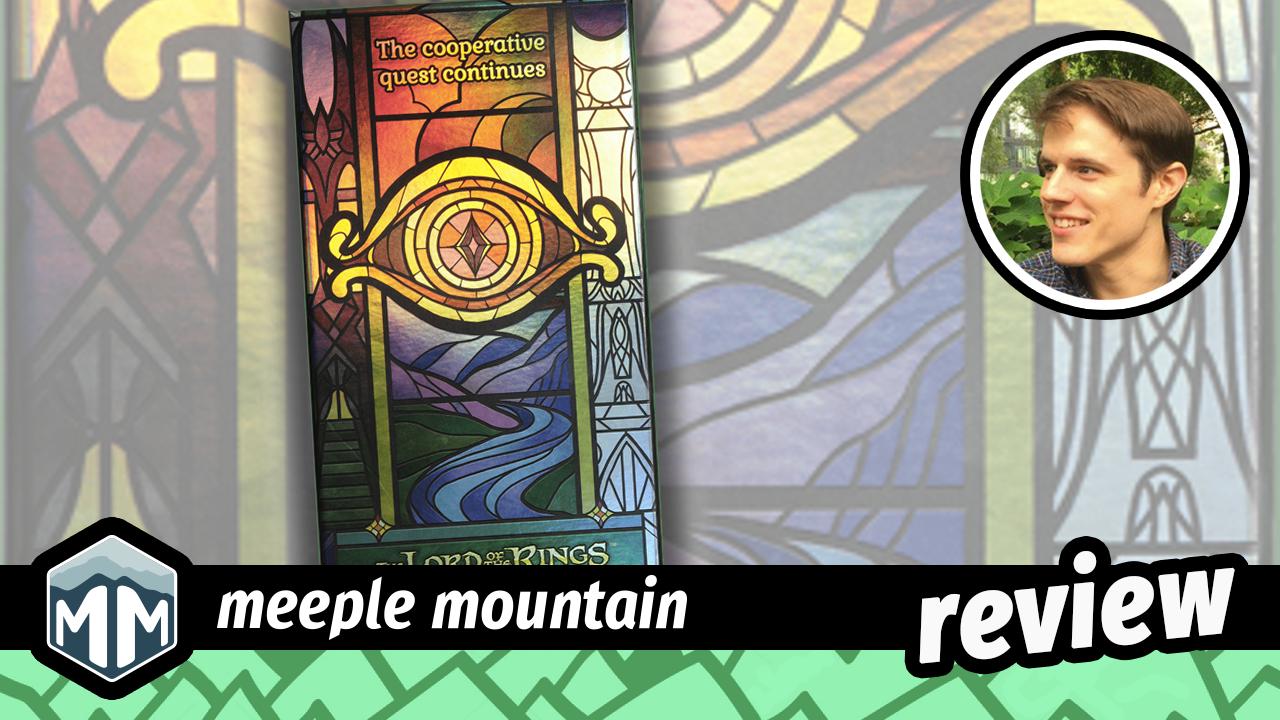


I struggled with The Lord of the Rings: The Fellowship of the Ring - Trick-Taking Game. For all the inventiveness on display, as passionate a love letter to trick-taking as it was, Bryan Bornmueller’s commercial triumph left me cold. Too often, I said, that cooperative card game would leave players in the lurch, handing them combinations of characters and cards that were not winnable. Unlike its close cousin The Crew, something like half the hands in TLotR:TFotR-TTG proved unwinnable from the jump, save for an act of providence. I don’t want cooperative games to be easy, but I do want continuous losing to feel like a skill issue rather than RNG.
That’s the long and the short of it, anyway. And for what it’s worth, my criticisms of The Lord of the Rings: The Two Towers - Trick-Taking Game are almost exactly the same as my criticisms of the first game. Critical decisions are made without crucial information. A lot of hands are dead from the jump and there’s nothing you can do about it. A few of the chapters here even sharpen my criticisms. It would be easy to get bogged down in an even more negative review, to dig into all the ways in which I continue to think Bornmueller’s game doesn’t work.
The Lord of the Rings: Trick-Taking Game – The Two Towers Game Review appeared first on Meeple Mountain.
“I LOVE the style of this artist,” my 12-year-old said while admiring some of the painting cards from the upcoming limited movement and order fulfillment game Concrete Canvas, available on crowdfunding right now.
I had to agree. The art, by real-life street artist Chris RWK, is fantastic, and this style carries into the playable character tokens, the subway tiles used to dictate each player’s movement, and the milk crate player boards used to store paint cans as players move their tokens around New York City in an attempt to tag more locations than their opponents.
Designer David Abelson’s game does a great job of capturing the look and feel of something straight out of Beat Street, or any of the other break-dancing, street jive 80s films I grew up on. Even video games like Jet Grind Radio (or Jet Set Radio, depending on where you grew up) feel like an influence here.
Then the game starts…when Concrete Canvas reveals itself to be the opposite of dynamic.
Concrete Canvas is an order fulfillment, area majority game for 2-4 players. Players will spend most of their turns moving one of their two character tokens through different parts of New York via subway tiles that are adjacent to…
The post Concrete Canvas Game Review appeared first on Meeple Mountain.
When the Queen of Hearts invites you to Wonderland, you’d better know your cards. Off with Their Heads!, designed by JB Howell and Michael Mihealsick with illustration by Manny Trembley, is a trick-and-write card game for 2-4 players published by Druid City Games. The game shares the same theme and trippy aesthetic as Druid City’s, […]
La Der des Ders – The War to End War from Hexasim is a 1-2 player slightly abstracted strategic level look at World War I. The game allows the players to relive the First World War at a strategic level, with each player controlling one of the 2 sides either the Entente, consisting of France, England, Russia, Serbia and other minor nations or the Central Powers including Germany, Austria-Hungary, the Ottoman Empire and a few minors. La Der des Ders can also be played solo, with a dedicated solitaire bot called “Athena” who utilizes special Cornflower Cards to make decisions about what technologies to invest in, where to undertake offensives and how to utilize limited resources and reinforcements. Each turn, players gain an amount of Resource Points dependent on what nations are in the war, which they can allocate to different areas to guide their overall strategy. Victory is achieved by launching offensives that drain the morale of enemy nations, forcing them out of the conflict through collapse.
In Action Point 1, we looked at the Game Board, discussing the Collapse Tracks, Trade Tracks, Russian Revolution Track and Naval Control Table and other various on-board tables and offensive spaces. In Action Point 2, we covered the Technology Phase and the Technology Tree and Technological Improvement Boards. In Action Point 3, we examined the Event Cards and how they inject the historical narrative into the gameplay and also alter the conditions of the game. In Action Point 4, we walked through an example of an Offensive and took a look at the combat procedure. In Action Point 5, we reviewed the Victory Conditions. In this Action Point, which is the final entry in the series, we will give an overview of the “Athena” solitaire bot and how it works.
Athena
La Der des Ders – The War to End War is designed as a 2-player game but it does have a dedicated solitaire bot called Athena that can be used to simulate an opponent to play against. This Athena bot, named after the Greek goddess of strategy, can be used to play as either the Entente or as the Central Powers and is focused on the use of special cards referred to as Cornflower Cards. There are 12 of these Cornflower Cards and these are used to determine the various actions taken by the Athena bot during their turn. A solitaire play uses the usual rules for the 2-player game, with just a few exceptions.
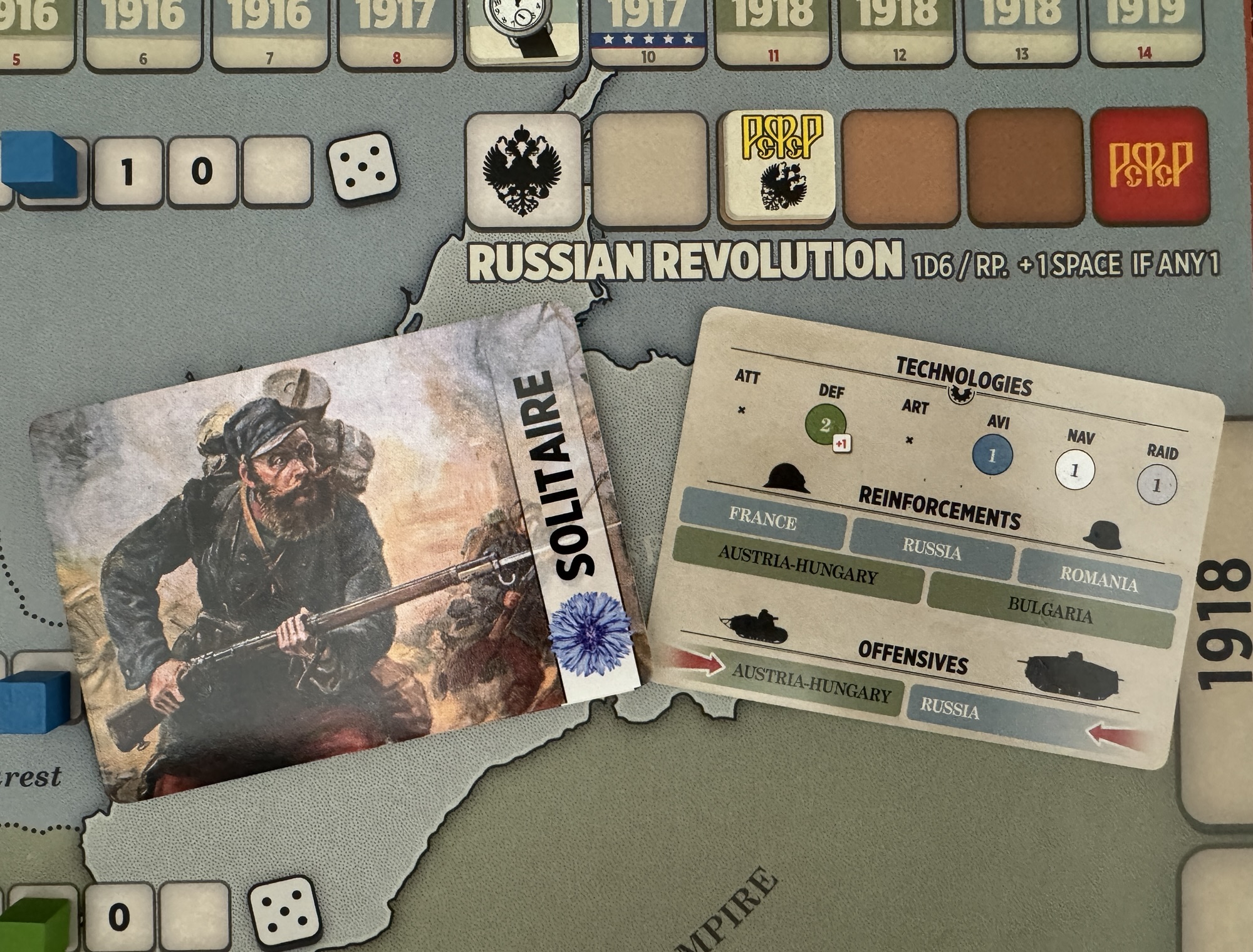
The Cornflower Cards are multi-use cards that are divided into 3 different sections to be used at different points of the Sequence of Play in a solitaire game. They are drawn and referred to during the Technology Development Phase, the Reinforcement Phase and the Offensive Phase. Let’s take a look at the anatomy of these cards. In the above picture, you will notice that there are 3 main categories listed at the top of the card including Technologies at the top, Reinforcements in the middle and Offensives on the bottom of the card. During the appropriate phase, the player will draw 1 Cornflower Card for the Athena AI.
If it is the Technology Development Phase, the player will refer to the top of the card where there are listed the 6 different technologies that can be pursued. Under each of these categories will show the number of Resource Points that will be spent by Athena in order to attempt to unlock a new level in each of the technologies. If there is an X in that space, that means that Athena will not attempt to gain a level of that technology during this phase. If there is a 2 listed, this means that 2 RP will be spent and the roll for the technology will gain a +1 DRM. Keep in mind though, that if the technology shown is not available yet because the year it is available has not yet arrived, then the bot will not spend a resource to attempt that technology. If Athena doesn’t have enough Resource Points to make all the attempts shown on the card, she will spend as much as possible to attempt these technologies. Athena never re-rolls the die for these attempts by discarding a Technological Research Cube for previous failed attempts. One of the differences for Athena during this step is that if a success is earned in unlocking a level of technology, she will get to advance all cylinders of the corresponding technology in all sectors under Athena’s control. This means all of the countries of the alliance as well as the active minors. These technological improvements cost no Resource Points.
If it is the Reinforcement Phase, Athena will attempt to reinforce sectors that have suffered losses in previous turns according to the following priority order:
When you have chosen what sector is to receive reinforcements based upon the priority described, the player will draw as many Cornflower Cards as there are spaces separating the Sector Cube from the space with the red value. After drawing the cards, the player will count the instances of cards that have the name of that sector shown on them. If you look at the 3 cards shown above, if doing reinforcements for Germany they would move their Sector Cube up only 1 space on the Collapse Track as once Germany is listed in the middle of the card under Reinforcements. Very simple. Athena will also have to spend the required Resource Points from their total to actually move the Sector Cube up and if they cannot afford all of the reinforcements shown by the cards, they will move and pay for what they can afford. This phase ends when Athena no longer has enough Resource Points, or when all the sectors have been able to try to obtain reinforcements.
Finally, if it is the Offensive Phase, each side launches an offensive in turn starting with the side that has the initiative. When it is Athena’s turn to attack, the player will draw one Cornflower Card and refer to the bottom portion of the card, which will indicate the sector Athena is attacking. The sector to be attacked will be the one on the left of the card if Athena is playing the Entente, and the one on the right if she is playing as the Central Powers. The sector indicated on the card must always be attacked by the sector that has the best chance of inflicting damage. This usually means the sector with the highest current Operational Value and that has not yet launched an Offensive this turn. In the event of a tie, preference should be given to the sector least likely to be able to attack elsewhere during a later card draw in the turn. The size of the Offensive will be equal to the current Operational Value of the attacking sector only if the number of Resource Points Athena has remaining will allow for it. Otherwise the Offensive is reduced to the number of remaining RP. Once Athena’s Resource Points have been spent, the dice rolled and any losses applied, the player will then take their own turn to launch an Offensive or decide to pass. Then Athena will draw a new Cornflower Card to determine their next
Offensive. If there are ever 3 Cornflower Cards drawn by Athena without having the ability to attack because of sector availability or Offensives by adjacent sectors have already been taken, the Offensive Phase will come to an end.
That is all there is to the Cornflower Cards and the Athena bot. It is a really well designed system that removes most of the work by the player when playing solitaire. There will be times when you have to make a decision, as described above with Offensives, but these decisions are easy and the hard work is done by the simple flipping of a card.
I do want to point out one final thing. The sequence of play differs slightly from the 2-player game as it rearranges when the Athena bot does a few of the steps during the Spend Resource Points Phase as shown below. The human player will start by doing their Reinforcements first followed by their Technology investment. Athena will then go and do their Technology investment first followed by Reinforcements. Both players will then move into the Offensive Phase and the player with initiative as shown on the turn track will take the first Offensive of the turn.
The Athena bot works very well as a playable solitaire experience for La Der Des Ders. The Cornflower Cards are a stroke of genius and really are easy to use, which makes playing the game a much better experience. I found that the bot actually holds its own in the game, even though they are not in total control of their own actions like a human player would be. The changes also made in the Sequence of Play as well as to the way Technology Investments work more than make up for the lack of true intelligence by the system and will definitely give the player a run for their money. I have played the game about 5 times solitaire, both as the Entente and as the Central Powers, and have won just 2 out of 5 tries. But the experience was easy, enjoyable and pretty seamless. The game really is a great example of a slightly abstracted strategic level look at World War I and I would wholeheartedly recommend this game to anyone who has an interest in The Great War.
I shot a playthrough video for the solitaire system and you can watch that at the following link (beware as I did make a few errors but I have found errors make viewers understand the rules of the game better):
I also did a video review and you can watch that at the following link:
Thank you for allowing me to share this game with you through this series of posts over the past several months. I have very much enjoyed doing these and I hope that you find them helpful.
-Grant
BGI 414 The One About A 12,000 Year Old Game
Board Games Insider – Join our Guild on Board Game Geek Guild | Like us on FB
Social media:
Ignacy Trzewiczek / Portal Games: website | FB | Twitter | Youtube
Corey Thompson / Above Board TV: website | Youtube
Stephen Buonocore / “The Podfather Of Gaming”: website | FB | Twitter | Youtube
Intro Music: Happy Rock – Bensound.com
Also, asmodee North America announces its release plans for May 2026
Riot Games is partnering with Incredible Dream for a 10th anniversary edition
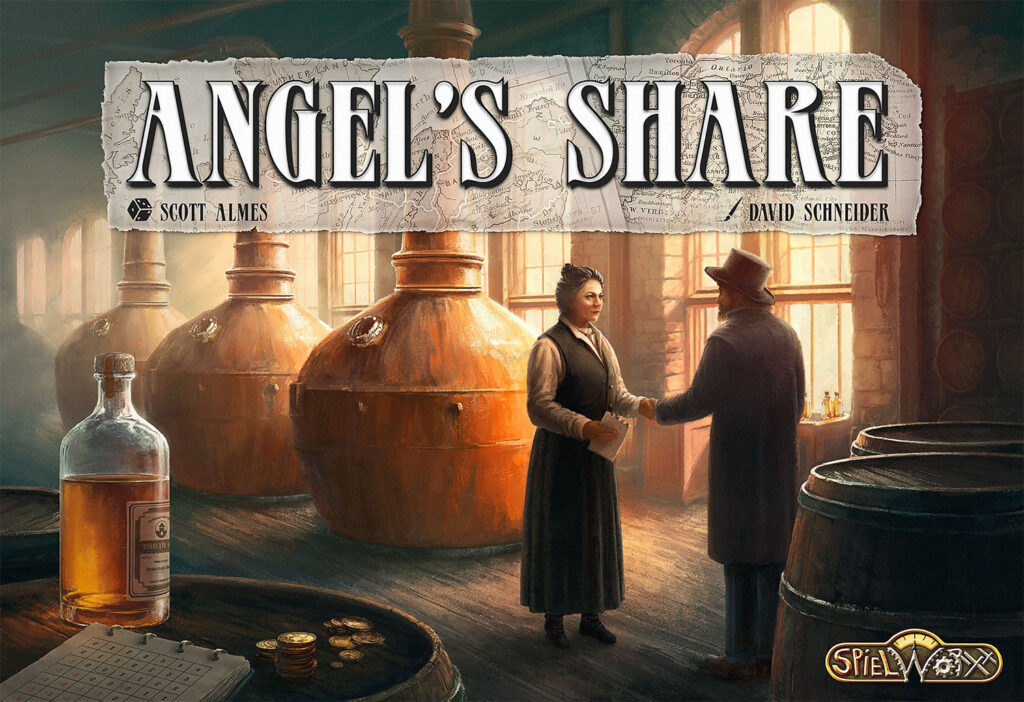
Angel’s Share refers to the portion of a spirit lost to evaporation as it ages. Set in Scotland, players will be purchasing and storing barrels, trying to time the market for maximum profits. But throughout the years, the quality of each distillery will change, the supply will fluctuate, and fees will have to be paid. […]
In Elizabeth Hargrave’s latest game, Sanibel, players take turns walking down the beach and stopping to collect a variety of shells and shark teeth. You’ll score points by dropping these treasures into your bag so they ‘fall’ in alignment with other items already there. Have the most points at the end of the walk, and you win the game.
To start, unfold and line up the three sections of the board. On the left, place the section with the beach chairs; to the right, place the section with the lighthouse. The section without a special area at either end goes in between these two.
Players then take a token of their chosen color and the corresponding board with a bag printed on it. You’ll place everyone’s tokens in random order in the upper left corner of the central board on the right, just above the beach chairs. Place the Wave token to the far left of the player tokens.
Shuffle the zig-zag-shaped pieces and deal two to each player. These are your Lighthouse tiles and will offer additional scoring opportunities once you reach the Lighthouse midway through the game. Read these carefully, as they may help you determine which shells you want to concentrate on.
Above the shoreline…
The post Sanibel Game Review appeared first on Meeple Mountain.
With this My Favorite Wargame Cards Series, I hope to take a look at a specific card from the various wargames that I have played and share how it is used in the game. I am not a strategist and frankly I am not that good at games but I do understand how things should work and be used in games. With that being said, here is the next entry in this series.
The Wars of Marcus Aurelius: Rome 170-180CE is a solitaire only game that uses cards similarly to a CDG to simulate the strategic level struggle of the Romans led by Marcus Aurelius to stave off the invasions of Germanic tribes and Sarmatian raiders as they encroach on Roman territory across the Danube River. That’s the history. And it is really well integrated. The game play is very fun, strategic, with lots of decision points about what to do and what cards to use, and it is really challenging.
In the game, the Roman player has a deck of Roman Cards that can be used for the printed events for various effects or that can be discarded to take any number of actions such as attack a Barbarian army or Off-Map Conflict enemy, advance the marker on the Imperium Track, add two Level 1 Forts to any eligible map spaces, flip one Level 1 Fort to a Level 2 Fort among several other actions. Sometimes the printed events in the game are just more powerful than discarding a card for just 1 action so you have to pay attention to this economy and make sure you get the most out of your cards. Now, keep in mind, sometimes discarding a good card whose ability is not right for the current situation you find yourself in is part of the game but you have to use these cards wisely to do well in the game.
The game uses two separate decks of cards including the Barbarian Deck (Green) and The Roman Deck (Red). Both of the decks are made up of 50 cards each but each have very different purposes. The Barbarian Deck is used to determine the actions of the invading Germanic tribes as well as events that effect the war effort including mutinies, plague and the will of the people. While the Roman Deck provides the resources and events that are used by the Roman player to mount a defense against the invasions and to fight back each of the different barbarian tribes. There are unique cards called Late War Cards in the deck that will be held out until the start of the 175CE turn at which time they will be mixed in with the cards to form a new Late War Deck. There are also special cards that are marked with an asterisk that if played for the event will be discarded from the game to form what is called a History Pile.
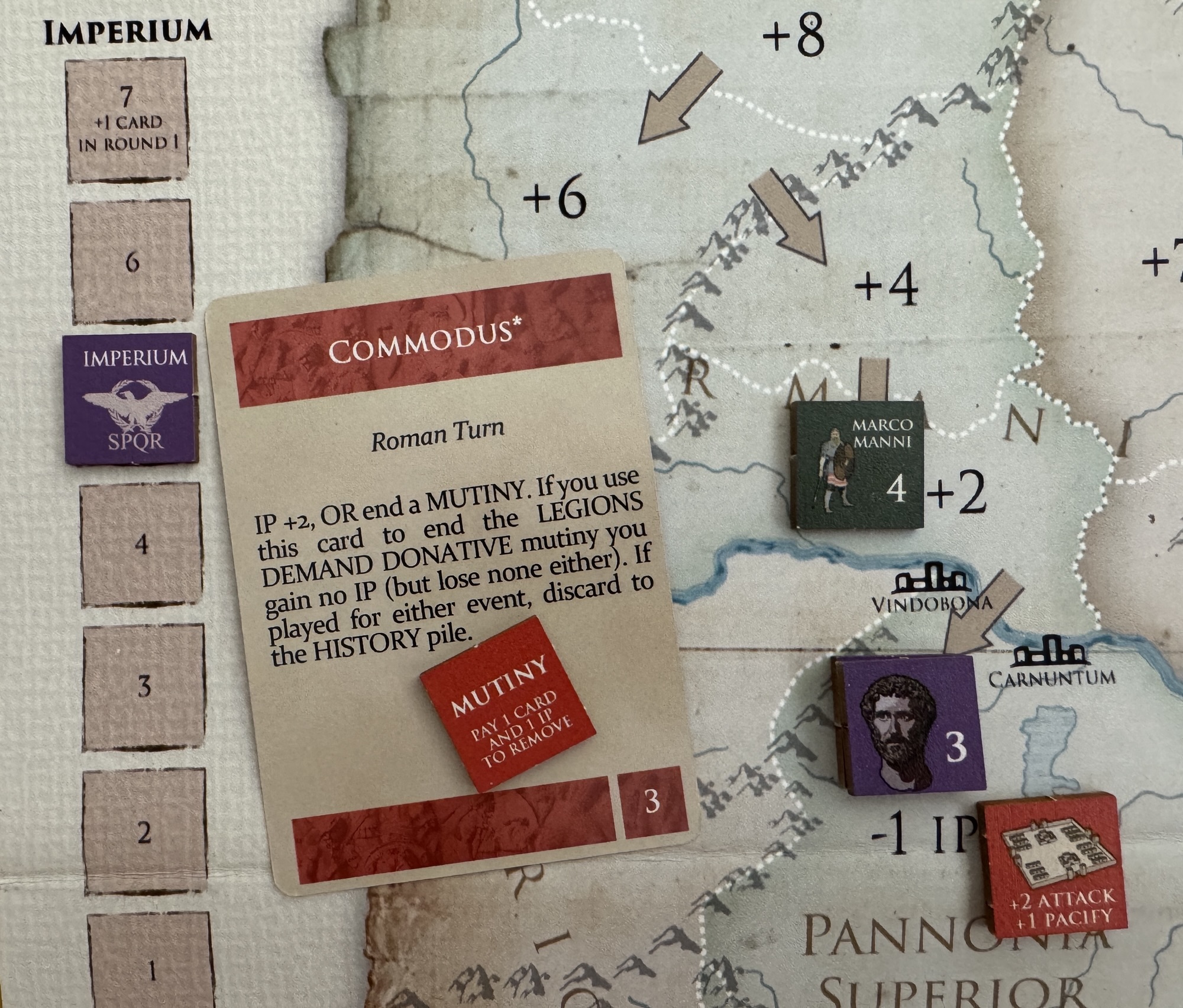
In this entry, we will focus on the Roman Card Commodus, which provides some opportunity to shore up your failing Imperium Points or even cancel an ongoing Mutiny of your troops on the board. In my first 5 or 6 plays of the game, the most common way that I lost was by allowing the Imperium Point Track to reach zero, which results in Marcus Aurelius being usurped and the player immediately losing the game. I was confounded and very frustrated about why I couldn’t prevent this from happening! I could see the end coming but struggled with keeping that Track above water. There are a few cards included in the Roman Deck that provide increases to the Imperium Track and I highly recommend you take these type of events when they come into your hand rather than discarding these cards to take another action, that might seem important at the time, but in the end these events are just too efficient to pass on. Commodus will provide you an option. This option is taking the +2 IP or another type of action such as ending a Mutiny (very important as it usually takes you discarding a card and losing an IP) or drawing two cards to add to your hand (imagine if you can only draw that Local Guides card you have been looking for or the Ambush that you need to take on the Quadi in their Home space). It becomes a choice of “either/or” and I am here to tell you the only reason the “or option” is provided is to lure you away from the real prize in that of gaining the +2 IP. Please listen to my advice and take the +2 IP. You will thank me in the end! Remember, that the concept of Imperium Points (IP) represent the Emperor’s overall political authority and stability in Rome. If the IP track ever reaches zero, the player immediately loses due to usurpation. Points are lost from specific card events, barbarian surges, and certain combat results, requiring players to prioritize special events to gain them back
Commodus was Roman emperor from 177 to 192AD, first serving as nominal co-emperor under his father Marcus Aurelius and then ruling alone from 180AD. Commodus’s sole reign is commonly thought to mark the end of the Pax Romana, a golden age of peace and prosperity in the history of the Roman Empire.
Commodus accompanied his father during the Marcomannic Wars in 172AD and on a tour of the Eastern provinces in 176AD. The following year, he became the youngest emperor and consul up to that point, at the age of 16. His solo reign saw less military conflict than that of Marcus Aurelius, but internal intrigues and conspiracies abounded, goading Commodus to an increasingly dictatorial style of leadership. This culminated in his creating a deific personality cult, including his performances as a gladiator in the Colosseum. Throughout his reign, Commodus entrusted the management of daily routine affairs to his palace chamberlain and praetorian prefects, namely Saoterus, Perennis, and Cleander. Roman soldiers and the general populace generally liked Commodus during his reign, largely because he was popular with the masses and focused on lavish spending rather than costly foreign wars. He was adored for presenting himself as a masculine, gladiatorial Hercules, though the Senate despised him
Commodus was assassinated by the wrestler Narcissus in 192AD, ending the Nerva–Antonine dynasty. He was succeeded by Pertinax, the first claimant in the tumultuous Year of the Five Emperors.
I shot a playthrough video for the game and you can watch that at the following link:
I also followed that up with a full video review sharing my thoughts:
In the next entry in this series, we will take a look at Russian Leader Tsar Alexander I from Congress of Vienna from GMT Games.
-Grant
On the Game overview screen an extra statistics section has now been added to the Stats Segment: Score margins!

The Score Margins sections shows the win and loss margins for plays of a game. Details about Score Margins can be found here: Score Margins.
For all relevant bar charts it is now possible to tap on it to view the related play(s). You can recognise these lines by the > at the end. This option is available with the Power expansion.
Tap the name of the Stats Segment to access the drop-down menu and quickly switch between sections.

More information about all these stats sections can be found here: Game page – Stats segment.

French board game publisher Fentasy Games has launched a new platform aimed at providing publishers with a more affordable way to get their higher complexity titles into the hands of retailers and gamers.
Company founder and CEO Florian Gigot told BoardGameWire Fentasy had scored several successes since launching towards the end of 2024, including localisations of complex titles El Burro and Stephens – but said its major challenge in that time had been “the structural reality of the traditional distribution model”.
He said, “We realised that for a small publisher, a ‘critical success’ doesn’t always translate to a ‘financial success’ once the middlemen take their cut. The same applies to many of my partners around the world.
“…between squeezed margins, production costs, and trade discounts, even a popular game can become a financial failure. For an independent publisher, this means increasing difficulty in funding subsequent projects – and ultimately, a real risk of going out of business.
“In this context, profitability is no longer a secondary objective, but a condition for survival.”
He added, “This might seem counterintuitive, especially at a time when a game like [Brass: Pittsburgh] is thriving on Gamefound. But that is the exception. So many other expert ‘hidden gems’ deserve a chance to exist.”
Gigot hopes newly launched platform BoardGameCommerce will give publishers of higher complexity games with smaller print runs – of between 500 and 1,000 units – a more sustainable financial option than the traditional board game industry distribution model.
He described BGC as an ‘evolution’ of the P500 scheme successfully employed by wargame and strategy game specialist GMT for more than 20 years, which allows gamers to pre-order still-in-development titles, which then begin final art and development once they reach 500 orders.
Gigot said BGC differs, however, in that Fentasy commits to producing the game the moment it goes onto the platform, saying, “We don’t ask the community to carry the industrial risk – we carry it ourselves because we believe in the project.”
He said that model helps Fentasy and other publishers measure real demand for their titles, as well as giving visibility to game makers that might not be possible amid the plethora of new games battling it out through traditional distribution.
Gigot added that BGC also offers retailers “a professional interface to secure limited stock with high margins of up to 55%”, with no payment required until the game is ready to ship.
He told BoardGameWire, “I absolutely see this growing. In fact, BGC is designed to be an agnostic platform. We are already in talks with other small publishers who face the same ‘strangulation’ within traditional distribution.
“We want to offer them the same resilience we built for ourselves – bringing everyone together on a single, global platform. It makes it much easier for gamers and retailers to find exactly what they are looking for in one place.
“The icing on the cake is that all publishers using the BGC platform have access to a shared licensing ecosystem. For example, if Publisher A adds a game to BGC and is looking for a partner to localise it, Publisher B can check the available licenses for their country and initiate a business discussion immediately.
“BGC takes 0% commission on these deals – the goal is simply to be stronger together.”
Gigot said Fentasy aims to release between three and five titles each year, with about half going through BGC and half, such as its localisation of Animal Rescue Team and upcoming strategy title Microlonies, through traditional distribution.
The publisher’s first release through BGC is Iron Games’ Mesopotamia-themed territory builder Papyria, with future titles set to arrive on the platform before the end of next year including Martin Wallace space exploration design Casus Belli and Masaki Suga’s chocolate industry strategy title Bean to Bar.
Other Iron Games releases available through BGC include Discordia and its Magna expansion, Pandoria and Ploc, while Fentasy’s French localisation of Uwe Rosenberg design Kanal – previously Oranienburger Kanal – is also present on the platform.
But Gigot added, “Titles like Animal Rescue Team and Microlonies will still follow the traditional distribution model. We aren’t abandoning big distribution – we are simply choosing the right tool for the right game.
“There is no ‘hostility’ toward the traditional model – it just isn’t built to sustain niche titles effectively.”
Gigot said Fentasy’s biggest successes since its late 2024 launch have included Kikai – Bricolage Heads, which he said moved more than 4,000 copies “in a short window for a game of its complexity”.
He added that 2026 release Microlonies “is following the same successful path. It proved that a hungry audience exists for deep, high-production-value games”.
Fentasy’s success to date has persuaded Gigot – who runs the company as “a small, agile core team of one person” – to expand its scope internationally, with him telling BoardGameWire the business is moving towards a 60% international / 40% France split.
He said, “We are always looking for new partners to localize our games in their countries and to localise their games into French.
“Our goal for 2027 is to achieve a synchronized BGC launch for our expert line across Europe (Germany, Poland, Italy, Spain) and Canada, China, allowing local publishers / retailers to bypass the heavy costs of international imports.”
The post Fentasy Games looks to help complex game publishers avoid ‘strangulation’ of trad distribution with P500-style platform launch first appeared on .
Also, keep your threads organized and your crabs enraged

I like weird games (derogatory) almost as much as I like weird games (complimentary).
Belinda’s Big Bonus is a weird game (weird).
Having your game designed by Amabel Holland sets certain expectations, despite any difficulties in pinning her down to a single genre or register. Similarly, basing a game on an erotic novel series, in this case Belinda Blinked by Rocky Flintstone, also sets certain expectations. Yet Belinda’s Big Bonus isn’t especially erotic. I wouldn’t call it funny, either, although it’s possible I’m just not in on the joke. Neither does it strike me as “so bad it’s good.” Mostly, it’s twice as complicated as one would expect from a licensed game. It reminds me of nothing so much as one of those business guys whose entire life is conducted through Google Calendar invites.
There is travel, but this is not a travel game.
First of all, we should open with a disclaimer. I know very little about Belinda Blinked. I considered reading the first one as research for this review — “research,” I say — but decided against it. Sometimes knowing less is knowing more. That’s our motto here in the United States. It’s written on our dollars and everything. While scant few people are going to play this thing sans foreknowledge, I happen to be one of them, and if there’s any one quality a critic requires, it’s the resolute belief that one’s experiences are valid no matter how uninformed. Here I stand.
Which is to say, perhaps Belinda Blinked is about managing one’s schedule, suffering from jet-lag, and mixing up which actions cost which payment. Maybe. In which case, may I offer my deepest apologies to Holland, Flintstone, and Belinda herself. Forgive this prude, for he knows not what he do.
At the game’s outset, players step into the not-yet-broken-in business shoes of interns at Steele’s Pots and Pans. Their task is to earn some millions of pounds for the company. They do this by…
Look, this is the first problem with Belinda’s Big Bonus, and it’s a doozy. As any gaming evangelical knows, it’s hard enough describing a board game to newcomers, and Belinda’s Big Bonus is no board game for newcomers. There are mechanisms aplenty in this trunk, packed together like someone mixed the first-aid kit with the snack bag. There’s a calendar timekeeping system, the kind popularized by Martin Wallace titles, and cards that may exist either in a market, your hand, or a tableau, with interactions dependent on their current source — except sometimes they can be spent from two of those places, and the rulebook is conversational and, although it’s amusing, this doesn’t lend itself to learning the damn thing.
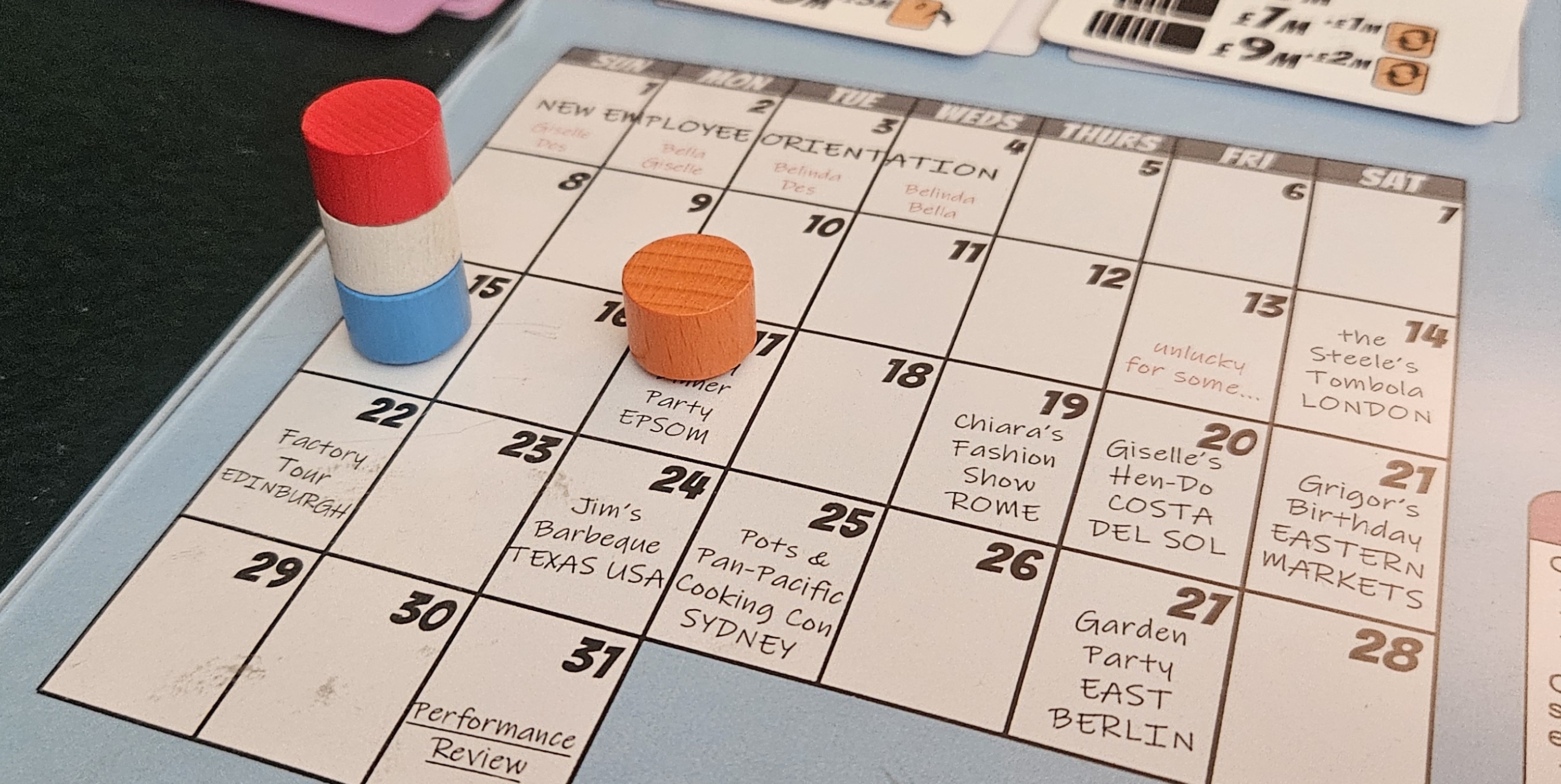
Scheduling, but this is not a scheduling game.
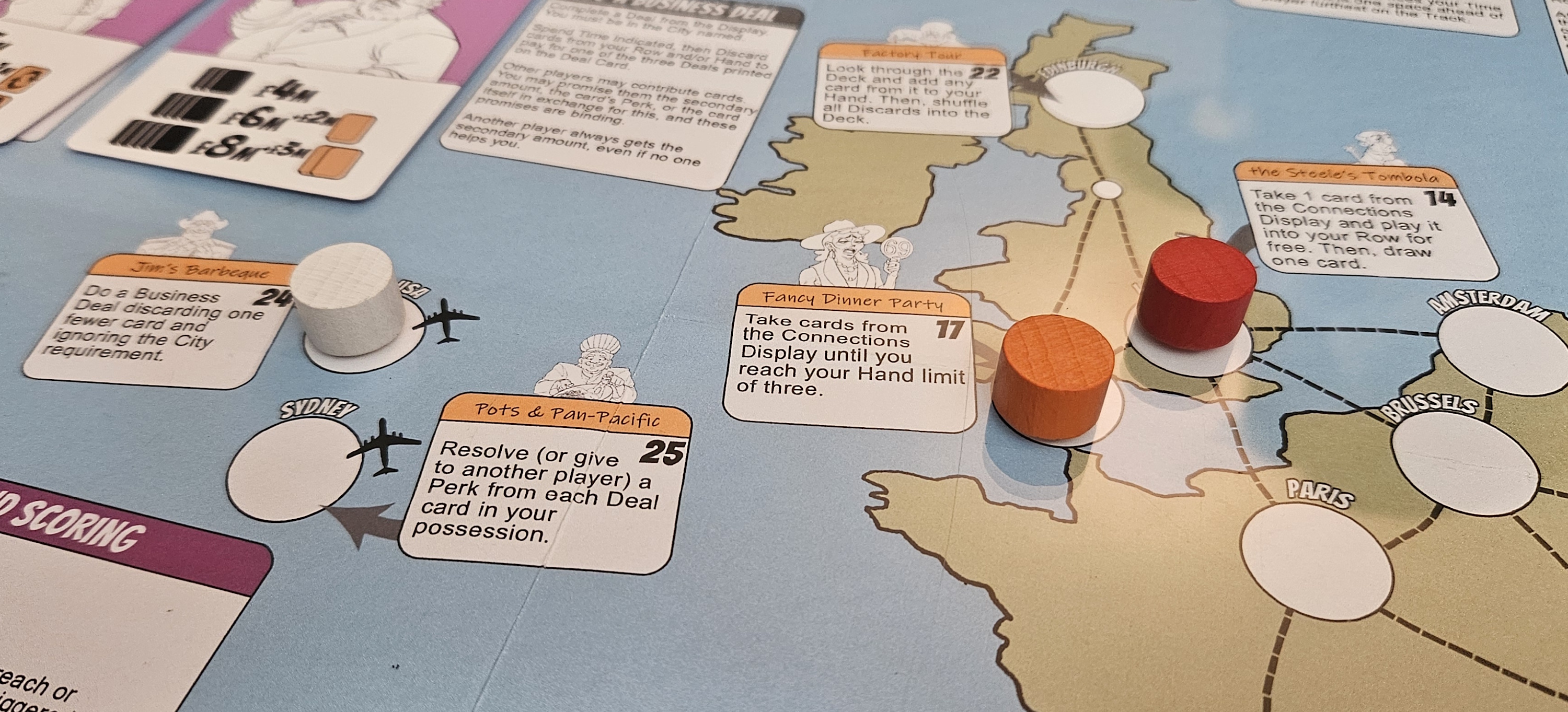
Here’s the short version. Turns are variable, conducted by whomever is farthest back on the calendar. On those turns, you spend some amount of time to make connections — which is to say, put cards into your tableau from either the market or your hand — do spy stuff — gain cards into your hand, from the deck this time — rest to refresh the cards in your tableau, make a business deal by throwing away the cards you painstakingly contacted or spied upon — and, in the process, try to persuade your fellow players to spend some of their cards instead, because these business deals are often collaborative and dole out benefits to multiple players — or perhaps visit a calendar event on the appointed date to gain some advantage.
If that sounds confusing, try teaching it. I’m no stranger to Holland’s more tangled designs, but this one found the most uncomfortable spot on the seesaw between complexity and anticipation: the fulcrum. Belinda’s Big Bonus feels like it should be a light game, looks like a light game, has that licensed light-game air to it, and then, kapow, but a kapow more like a punch to the schnoz than something erotic, it smacks you with a clutter of ideas.
For all that, there is an interesting game in here. The gist is that you need to build out your tableau and hand in order to spend those same cards to make business deals. Along the way, your characters provide something like an engine.
There’s even a narrative to the whole thing. Sir James Godwin makes it easier to attract Bella Ridley to your work group. Meanwhile, James Spooner, the Laird of Gretna Green, brings Cosmo Macaroon into the fold through some act of espionage. Later, your connections to Bella and Cosmo will help you make a deal in Texas, USA for nine million pounds sterling. Unfortunately, that same deal enriches a rival intern by five million pounds, so you try to squeeze some contribution from so-and-so at the table rather than merely handing the commission to whichever competitor is sitting in last place.
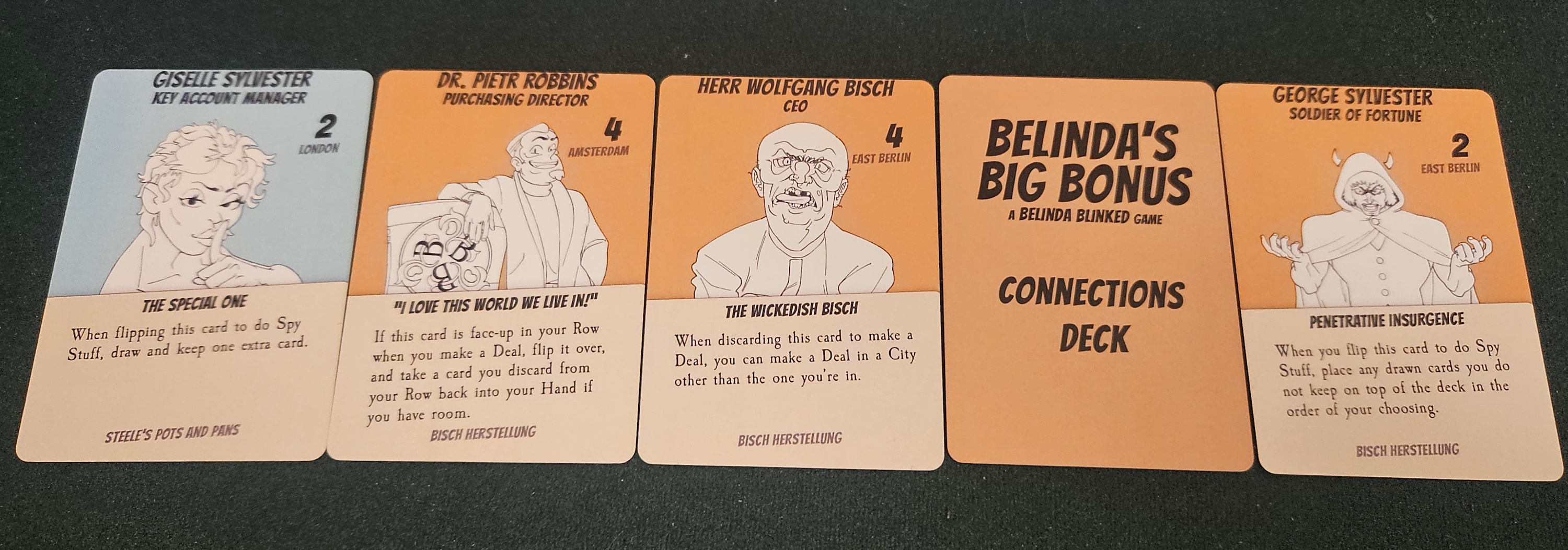
Odd people, but this is not an odd people game… well, scratch that. It’s an odd people game.
Those are genuine dramatic and narrative beats! Along the way, though, Belinda’s Big Bonus is burdened by bloated bits. It’s easy to paint oneself into a corner, for instance, by spending too many cards on an eager deal. This can leave one player sitting around with very little to do but play catch-up. And, hey, that’s their fault, right? If we were playing one of Holland’s cube-rail games, such a possibility would act as evidence of the game’s forthrightness. But here, the possibility comes across less like an honest appraisal of the perils of betting everything on some bad stock tips, and more like an unexpected heel-turn on the game’s part.
Here’s another example. Belinda’s Big Bonus includes the possibility of a traitor moment. When the game concludes, the player in last place might reveal that they now hold the majority of connections to Steele’s rival firm, Bisch Herstellung. This turns them into “the special one” and wins the game in a sudden coup. Cool!
Except, like everything else in Belinda’s Big Bonus, the rules governing the reveal are so text-heavy that it doesn’t feel like an amusing capstone. It’s closer to checking a technical manual to see if you’ve successfully told a joke. It isn’t hard, exactly. Nothing in the game is hard. But it’s less fluid than it ought to be, keeping everybody’s attention on these mismatched processes rather than on the parade of characters and situations strutting across the table.
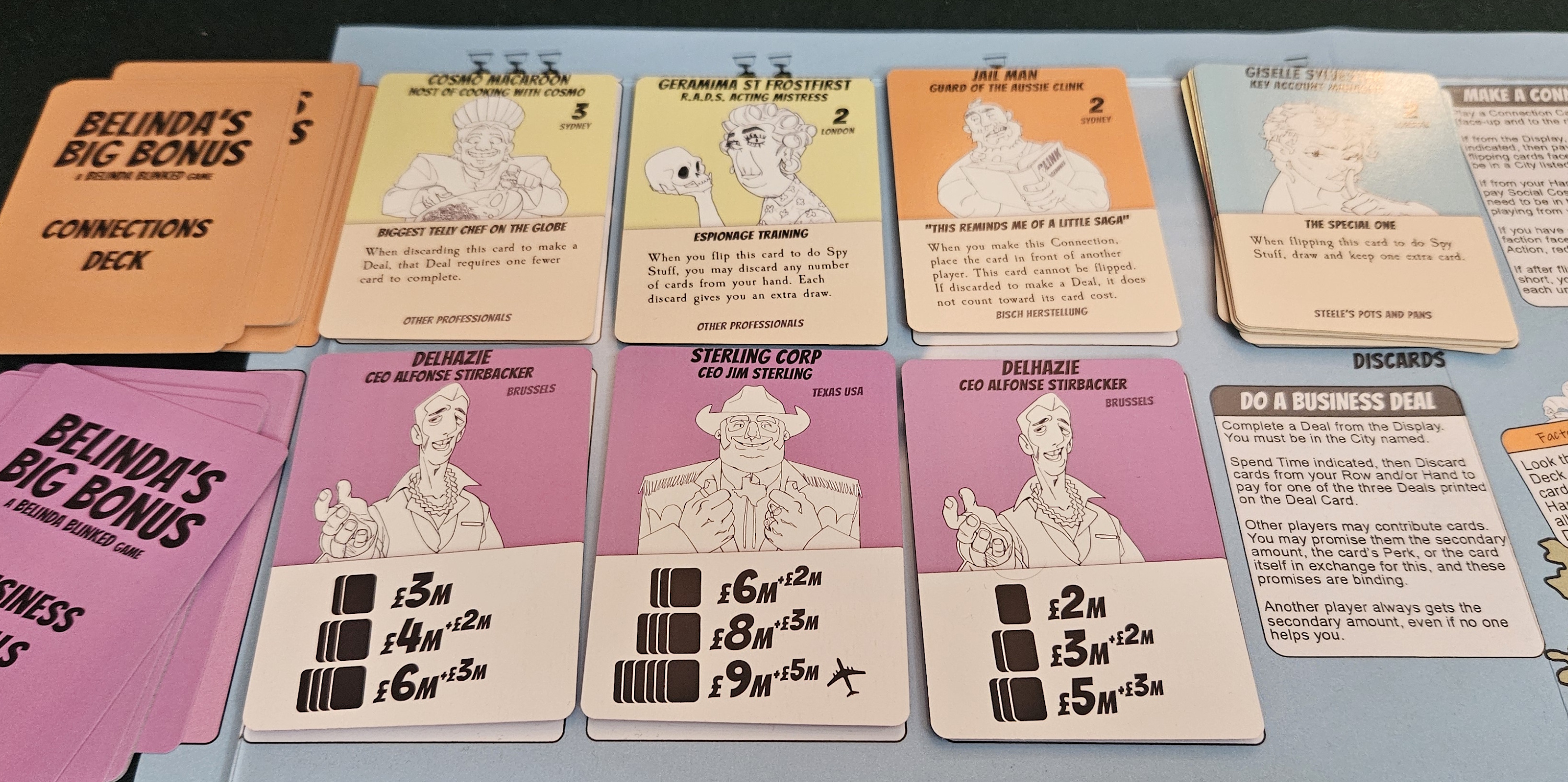
Buncha great hangs.
Then again, maybe I’m not in on the joke. Maybe a Belinda Blinked game should be more complicated than most licensed titles. Maybe it should buck common sense by being an erotic game with no eroticism, a business game with no head for business, a whimsy with lots of rules printed on the board. Maybe it should be a big meta-joke at my expense. Maybe this game doesn’t exist for anyone but me, and it was sent to me solely so that everybody could point and laugh and say, ha ha, you took our prank earnestly, you big stupid fool, you moron, you lame-o.
That would be okay. I don’t mind. In the game’s cast of characters, I feel most like the guy anxiously cleaning a stain from his tie. I don’t need to get everything. Sometimes, I even revel in how little I understand. For example, I’ve had a lovely time not understanding Belinda’s Big Bonus. Maybe you’ll have a lovely time not understanding it as well. Just don’t say I didn’t warn you.
A complimentary copy of Belinda’s Big Bonus was provided by the publisher.
(If what I’m doing at Space-Biff! is valuable to you in some way, please consider dropping by my Patreon campaign or Ko-fi. Right now, supporters can read about which films I watched in 2025, including some brief thoughts on each. That’s 44 movies! That’s a lot, unless you see, like, 45 or more movies in a year!)

/pic9161360.png)

/pic9464361.jpg)