I wouldn’t go as far as to say that G.K. Chesterton’s The Man Who Was Thursday saved my life. Probably it would be more accurate to say it built my life. The novel arrived at a pivotal moment in my adolescence. I was seventeen. Dumb with hormones, dumb with culture, just plain dumb. Still deciding who I was. Who I was going to be. I found it through the unlikeliest of sources, snippets of text in the video game Deus Ex, and felt like an investigative researcher when I obtained a copy from the bookstore I haunted like a ghost that summer.
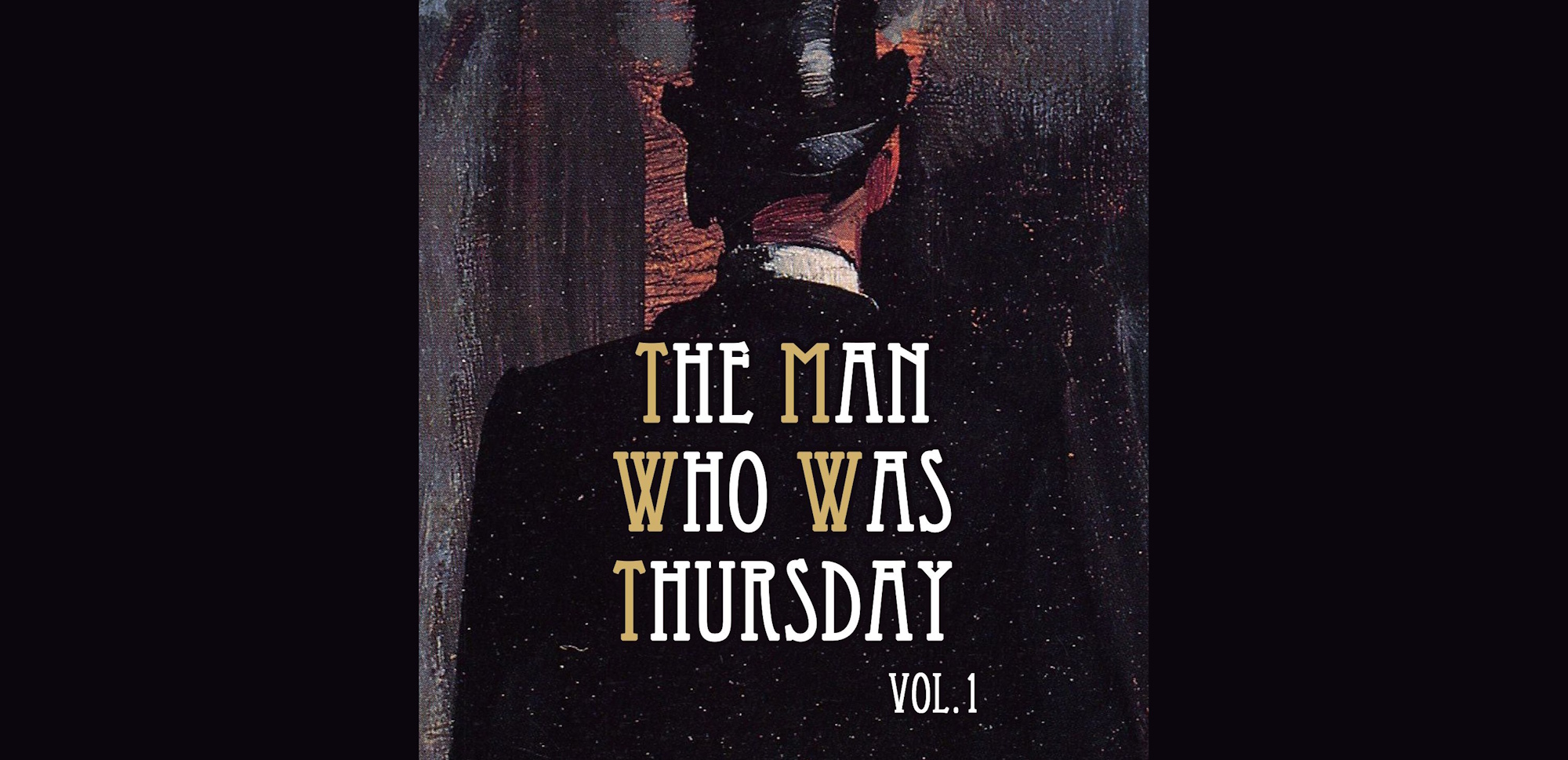
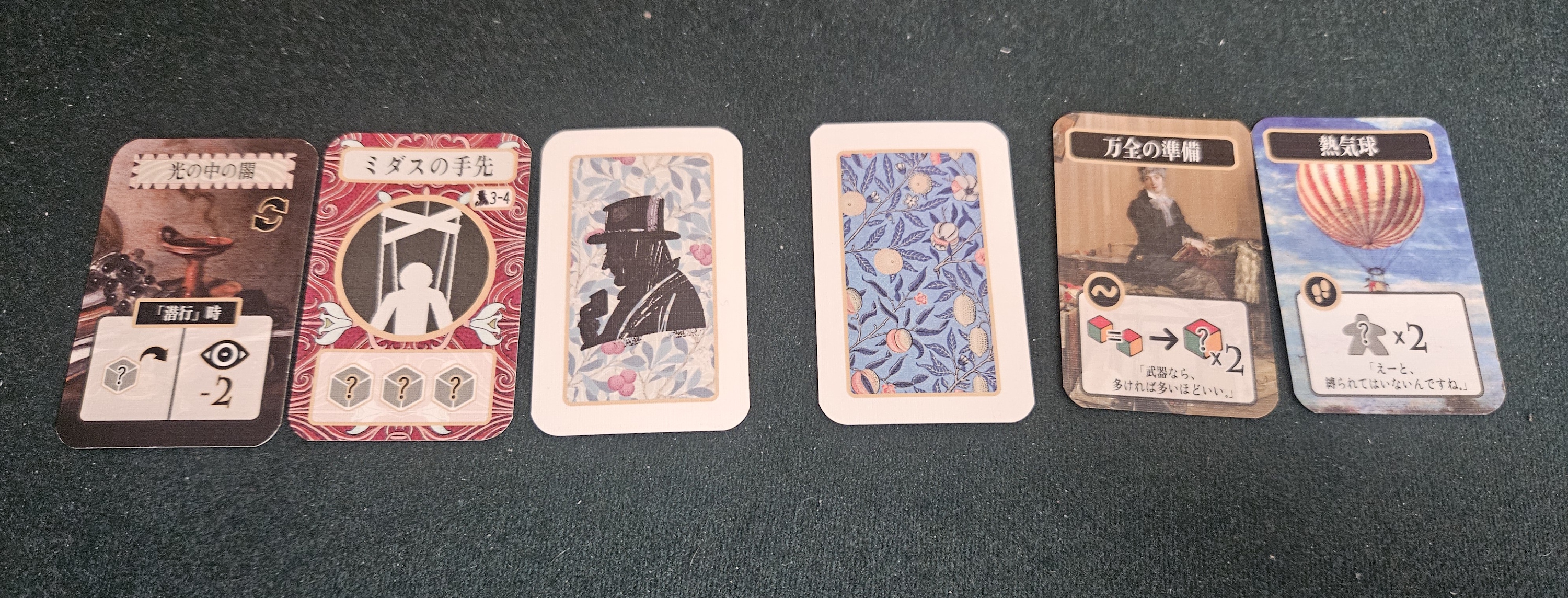
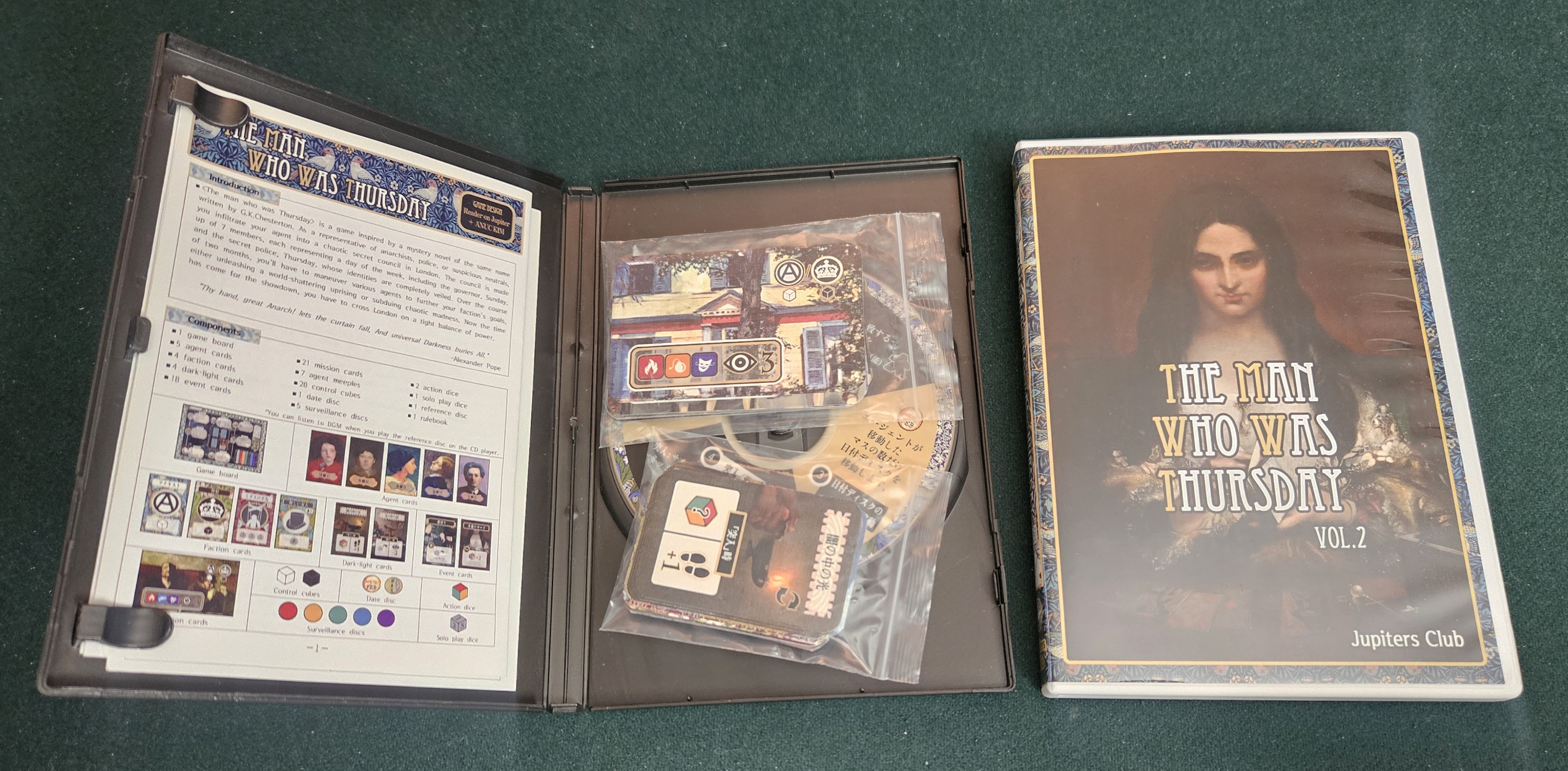
The Man Who Was Thursday is also a board game. A very unlikely board game. Created by a designer from South Korea who goes by the nom de ludens Reader on Jupiter, it arrives folded within twin DVD cases. Arrived. Past tense. It’s profoundly out of print, although its author claims there will be another use for the system sometime in the future.
Honestly, it isn’t the system I’m interested in. It’s the adaptation. This is the board game version of a book that was one of the cornerstones in building who I am today. I cannot see it impartially. Only intimately, like an old friend straining to express something important. Straining to express a revelation.
The perilous streets of Europe.
It begins with the conspiracy.
Written in 1908, when Chesterton was yet a Protestant, and in the period when anarchists and nationalists alike flung bombs at monarchs, a vocation that would soon spark the War to Begin All Wars, The Man Who Was Thursday opens with an undercover policeman, Gabriel Syme, on a quest to stop a council of bomb-throwers from completing their most daring, most damaging undertaking yet.
He is elected to the position of Thursday. That is, one of seven members of the anarchist committee. The committee is headed by Sunday, a monstrous, massive presence who seems unbeatable at every turn. Syme is initially shown as dashing and clever, worming his way into the anarchist committee through poetic debates, mistimed oaths of secrecy, and inflamed speeches. Seated before Sunday, he is transformed into a sweating plaything, certain that the anarchist of anarchists sees straight through him.
It’s a tale of isolation, at least in part. Thursday is one of those stories that reflects the eye of the reader. Some have argued that it’s the antecedent for the coming storm of espionage thrillers. The critic Adam Gopnik argued that it was the turning point between the earlier nonsense fantasies of Lewis Carroll and Edwin Lear and the latter horror fantasies of Franz Kafka and Jorge Luis Borges, the moment when the fever dream grew truly nightmarish. More than one theological treatise has argued that it’s a retelling of the Book of Job, with its senseless morality. It’s easy to see why. The world of Thursday is broken, pessimistic, heavy with suffering.
And at its heart is a man who doesn’t see a path through to the end. Or, in my case, its heart is a teenager on the verge of adulthood, flirtatious with fascism but honestly too sensitive for jackboots, with an ear for the numinous but too questing to be considered faithful, and only barely smart enough to know he doesn’t know a single damn thing worth knowing.
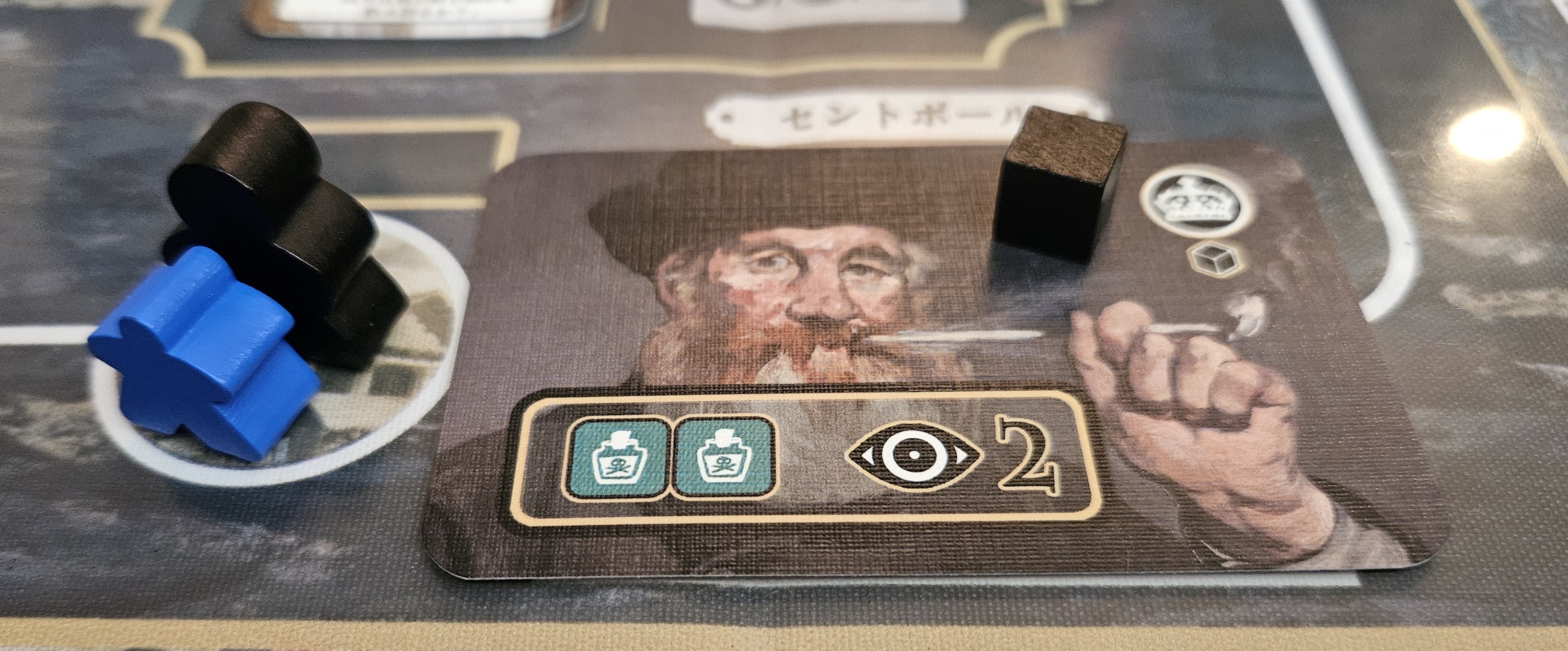
For the good of humankind, we’re gonna poison this guy.
Adaptation is one the most difficult arts of all. Partly because, when done well, it will be invisible.
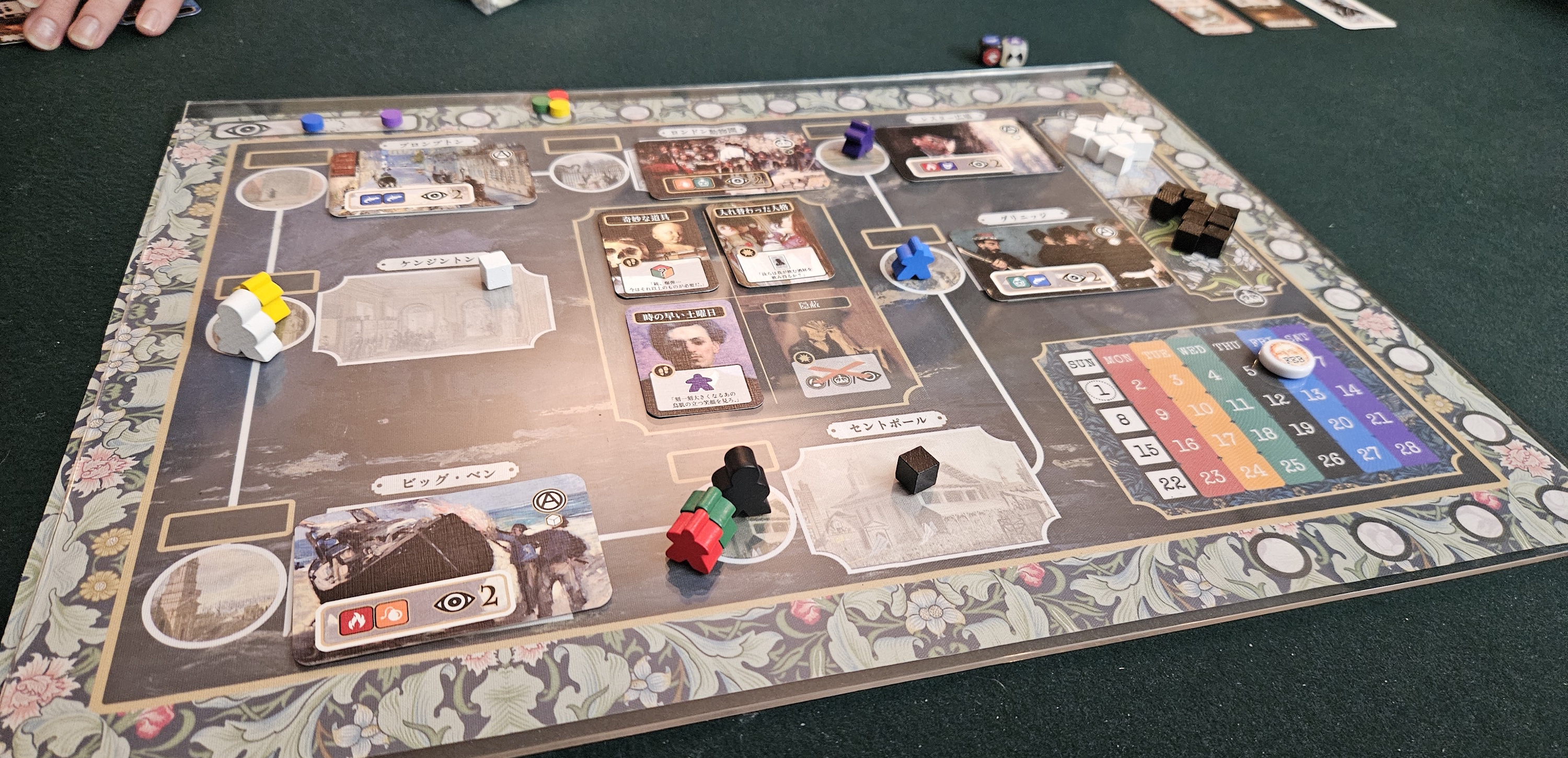
Thursday the board game adapts Thursday the novel by thrusting players into a tangle that they can only vaguely see the outlines of. Everyone is a member of the Council of Days with a double identity. The first of those identities is visible, an objective to fill the spaces of the board with some number or color of cubes. Perhaps you’ll be tasked with placing a bunch of anarchist cubes, or entrusted to make sure there are more police cubes than anarchists in as many spaces as possible, or even instructed to sow chaos by commingling white and black across the entire board.
Your second identity, however, is concealed. This is your position on the Council of Days. Perhaps you’ll be purple, Saturday, or red, Monday. The only options barred to you are Sunday, the avatar of anarchy, and Thursday, representing the police.
These dual identities are never far from mind, tied as they are to the game’s victory conditions. Your first goal is accomplished by undertaking missions that add cubes to the board. But your second, that of your hidden identity, requires you to steer clear of those same missions lest you fall under suspicion. This functions as a tiebreaker, but ties are common enough that your relative standing can never be neglected, causing players to go out of their way to keep their player token clear of any major plots.
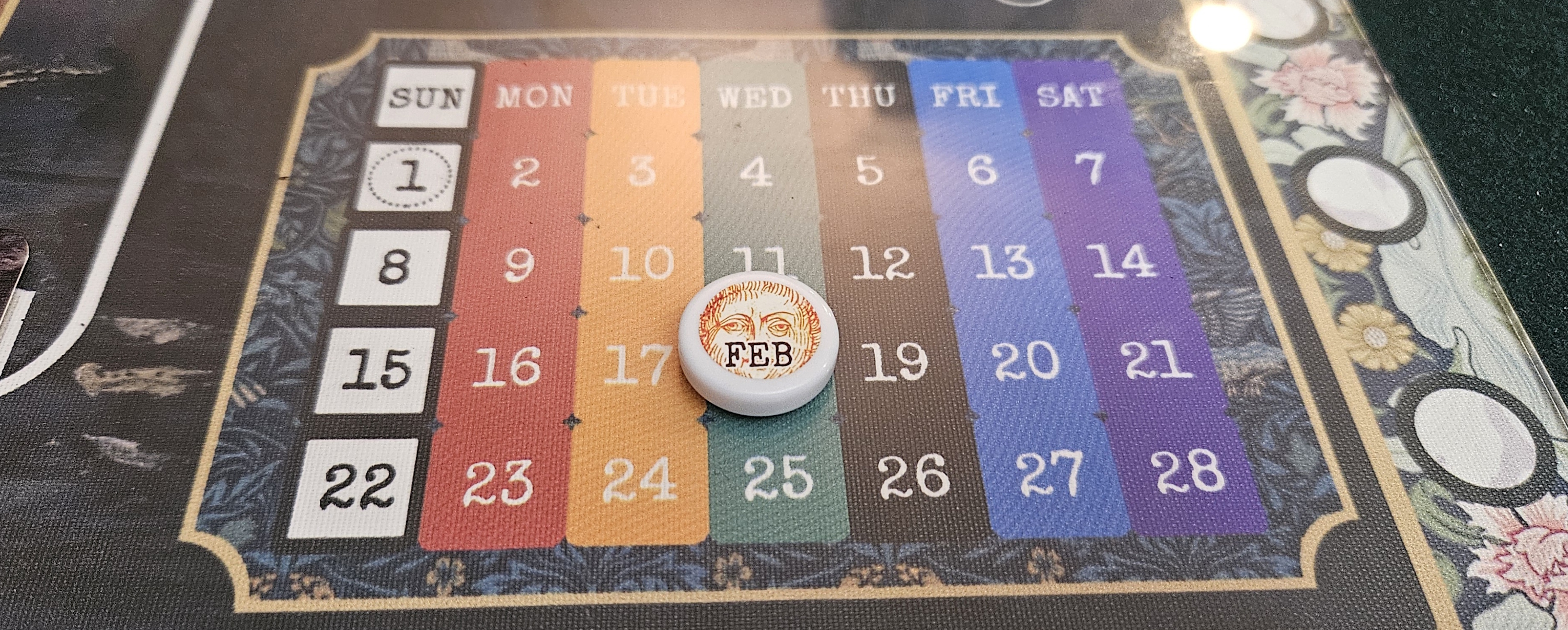
This is made doubly challenging by the fact that you never command your avatar directly. Instead, your current token is determined by a calendar that shifts forward in response to everybody’s moves. You’re Monday, but today is Wednesday, so rather than moving your red piece, you’re given control of green. Along the way, you pick up Friday (blue) to fling a bomb at some minister, causing green and blue to gain suspicion, but also leading everybody at the table to suspect that your real identity is tied to neither of those colors. The calendar ticks forward three days because you moved three spaces. The next player glares at you because it seems like they’re always moving Saturday.
The timekeeping calendar is lovely.
Out of the corner of my eye, I can regard the game with some sliver of critical impartiality. There are flaws here. Missions are accomplished through a combination of dice faces and token colors. Theoretically, this forces players to make do with what they’re given, some combination of whichever color the calendar has assigned them this turn, the colleague they pick up en route to their mission, and any dice results and/or bonuses they have handy. But missions are too easy to complete, rendering entire portions of the design vestigial. There’s an option, for instance, to lay low rather than to complete a mission, cooling off some suspicion or tweaking the position of previously placed cubes. But this is rare, an outside exception, especially the first few times the game hits the table.
Similarly, the objectives struggle to find their balance. Some, like the one that sees you filling spaces with the maximum three cubes, are far easier than those that pit anarchy and the police against one another. With some experience, the gameplay opens up. You learn how to speed up the calendar when you’re ahead, or use the bigger Sunday and Thursday tokens to alter the outcome of a mission, or take advantage of the game’s many special abilities to alter the game from its icon-matching core into more of an area control contest. The Man Who Was Thursday can be played well, can overcome certain of its limitations. But even at its best, it remains a flawed system.
As an adaptation, it fares better. There’s still an incompleteness to the presentation here, as one might expect of a board game, which by its nature presents a snapshot rather than a definite narrative arc. This is, in a sense, the middle act of Thursday, the conspiracy of isolated individuals, after Syme’s infiltration but before the absurdities begin to overwhelm the tale. I’m reluctant to spoil any details, itself something of an absurdity for a novel that’s nearly 120 years old, but… well, that’s on you. Sorry. You’ve had your entire life to read it.
The question of your identity is always under investigation.
The novel gradually transforms, shedding its guise as a political spy thriller. For a time it becomes a meditation on isolation and the power of companionship, with Syme discovering that the various members of the Council of Days are all undercover policemen like himself who have been set against one another. In its final chapters, it shifts into the cosmic realm of Job’s behemoth and whirlwind, Sunday fleeing atop an elephant, then via hot air balloon. When the conspirators at last corner the anarchist of anarchists — a state of affairs that sees him at the height of his power, not laid low as one might presume — they grill him. Why have they suffered so much? Why must everything on earth contend against every other thing? Why does even God hide His face?
This is when Syme, at the moment of theophany, understands. The suffering is also the justification for its own existence. If only the wicked suffered, then their complaint against God would be correct in labeling Him a tyrant. It’s only in the wildness of suffering, in its untamed nature, in the way the lion might gaze lazily at you or consume you, in how every living thing is pressed into service as an anarchist, that true goodness becomes possible.
Do I buy it? Eh. About as much as I buy any explanation for why we suffer. Okay, that isn’t true. I buy it more than any prosperity gospel. But I bought it as a teenager. I bought it, and decided that we were indeed heroes disguised as anarchists, everyone alone, everybody hurting, and that, as Chesterton wrote, the best we could do was to try to find the people who were hidden like us and make allies of them. In his words, “There are no words to express the abyss between isolation and having one ally. It may be conceded to the mathematician that four is twice two. But two is not twice one; two is two thousand times one.”
What a strange, wonderful artifact this is.
This version of Thursday doesn’t arrive at that final confrontation. It remains quagmired in the issue of concealed identity. It’s entirely possible, even likely, that players won’t know one another’s color until they arrive at the game’s conclusion.
But it succeeds in its own confrontation, that moment when everyone’s identity is revealed and any ties are broken. This parting of the curtain is a delight, all the preceding machinations suddenly laid bare. And, by extension, it succeeds in the small moments of relief it provides. When someone at the table eases the suspicion cast on your pawn. When a fellow trailing player collaborates to break someone’s winning state. When at last the game is tallied and packed away and we return again to the table, free of the magic circle, no longer strangers, once again friends.
A complimentary copy of The Man Who Was Thursday was provided by the designer/publisher.
(If what I’m doing at Space-Biff! is valuable to you in some way, please consider dropping by my Patreon campaign or Ko-fi. Right now, supporters can read the next installment in my series Talking About Games, this time tackling the topic of what makes a good list! Naturally, the piece includes a list.)
Every so often, I’ll write something that receives a weird amount of hostility. The most emblematic example is Foucault in the Woodland, my series examining Cole Wehrle’s Root through the lens of Michel Foucault. This is especially weird because Wehrle has been rather open with his design intentions there, including his desire to wrap some philosophical talking points in the garb of fable. In other words, some of the points I’ve written about Root aren’t even subtext; they’re explicit rhetoric spelled out by the game’s author.
But this raises a tangential (and frankly more interesting) question than whether I’m stretching when I insert theories about biopower, state surveillance, and sexual deviancy into the factions of Root. How much should it matter whether Wehrle has left his imprimatur on Root as a game that could be read through a Foucauldian perspective? Thanks the Death of the Author, shouldn’t we be free to talk about any game through any lens that occurs to us, as readers and/or players of that game? Or, as Roland Barthes might put it, as conversants in the same language the designer used to create it in the first place? In playing these things, aren’t we creating their meaning as resolutely as their designers did in the first place?
Today I want to talk about the Death of the Author, Roland Barthes, and the tension that exists between two halves of the way I evaluate games. But in order to do that, first we need to talk about the Bible. That’s right, the Holy one. I’m so sorry.
This one. And no other.
I. Originalism and Reception
As some of my long-time readers may know, I have a background in Bible. My education is primarily in Christian history, which necessarily touches on a pretty wide range of topics, if only because Christianity has been with us for a couple thousand years now. There’s the usual stuff, patristics and theology and orthodoxy and schisms and bad popes and whatnot. But there’s also the stuff that students are surprised to discover. Like the changing Christian treatment of women over the centuries, or the involvement of priests in both colonialism and revolution alike, or how certain brands of literary theory simply wouldn’t exist without bored dudes (they’re almost always dudes) sitting around and thinking about how to critically read a text.
The dominant strain of critical reading is what we call originalism. This is the study of what meaning an author intended to convey when they first (originally) jotted down their words and thoughts and sermons and prayers and personal correspondences. It probably won’t surprise you to discover that this more or less grows out of Bible studies, specifically when it comes to figures like Jesus or Paul.
Especially Paul! Because that dude was all over the map. He’s the one who says that women shouldn’t lead in church, that they should cover their heads, that they’re meant to submit to their husbands, all those zingers. But he’s also the one who praises women as leaders and missionaries and, in one glaring case that was gendered out of the New Testament for a long time, as an apostle.
A few hundred years back, a few of those bored dudes recognized that some of what Paul was laying down didn’t line up with itself. So they began asking questions and coming up with different theories to square the circle that was Paul. This resulted in a range of answers. Some bored dudes decided that maybe Paul was calling on women to thread a particular needle; that they needed to be leaders and submissive and missionaries and that’s a lot of work for women, but tough. Other bored dudes recognized that sometimes Paul’s language changed, so maybe some of his statements on women had been inserted into the original text to alter its meaning (fancy word: interpolated), or maybe even entire epistles were forged by later authors (fancy word: pseudepigrapha). Cluttering this even further, other bored dudes decided to lean into Paul’s most hostile utterances about women, while women scholars rehabilitated Paul as a proto-feminist who was working within the rather strict gender format of Ancient Roman times. Sometimes multiple of these theories coexisted within the same headspace.
In each of these cases, however our bored dudes (and eventually bored women) were deciding to interpret Paul, their intent was generally to arrive at what this ancient Christian originally meant to say. This tendency to assess the Bible as a bundle of original meanings that could be deciphered eventually noodled its way from the religion department to the literature department, where classicists and historians and theater nerds started to subject their own subject matter to the same treatment. The rest is history, right up to our current predicament where Dan McClellan and TikTok theobros spend their every waking moment debunking each other.
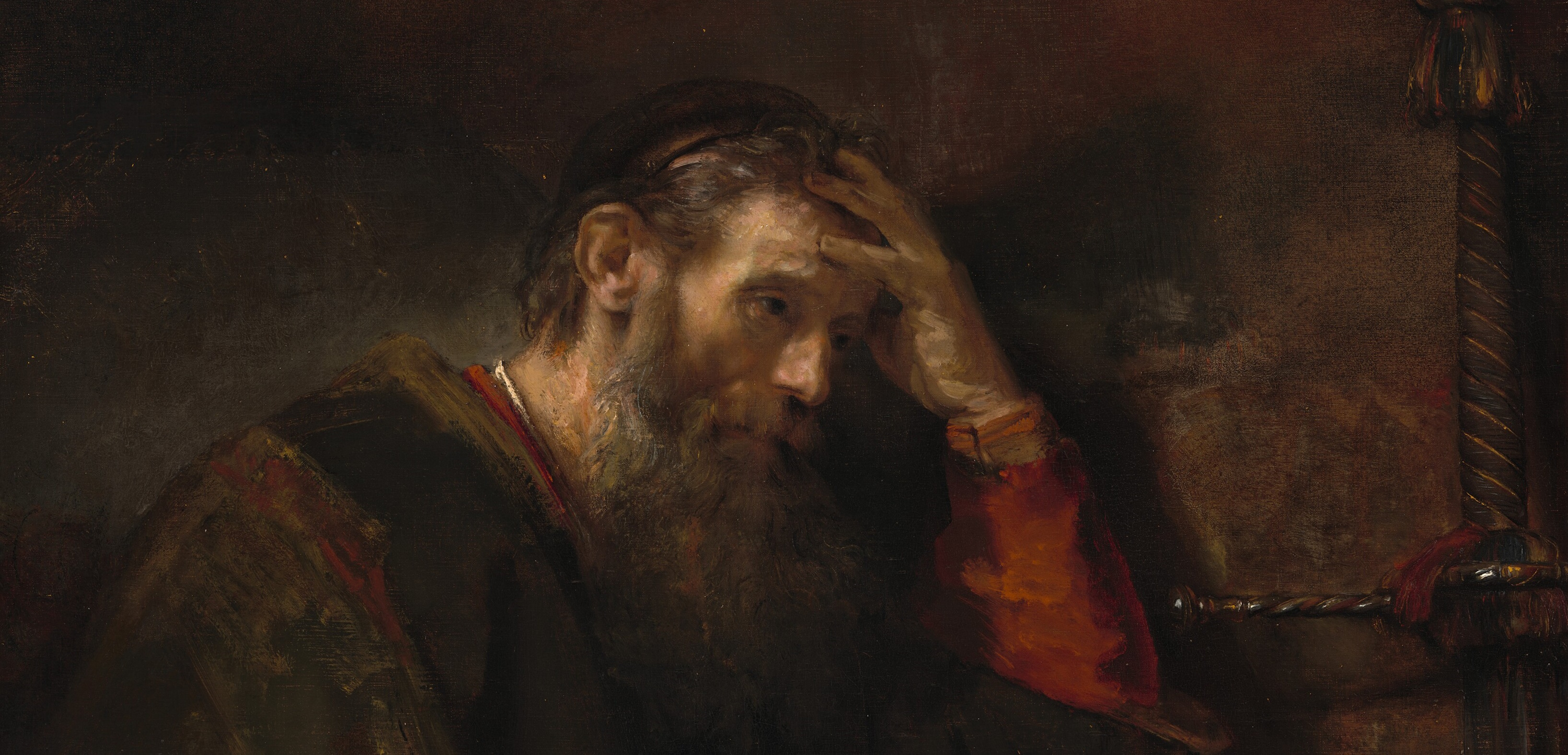
Dan McClellan in an earlier incarnation. Ha ha, it’s actually Paul via Rembrandt.
Only there was a problem. A big one. A lead stinker of a problem. And it went like this:
So what?
Why should we care what Paul said about women? He lived in olden times. They argued about dietary restrictions and whether Jesus was an alien hologram. They also cooked everything over open fires and died young when their teeth wore out. Maybe, these new bored dudes (and bored women) argued, maybe we should care less about what people like Paul originally said and more about what religion can do for us right now.
To be clear, not all of these statements were wholly conscious. Most of the people making these arguments were believers themselves, so they weren’t trying to throw out the entire Bible. It’s just that original meaning isn’t the only meaning. Maybe Jesus and Paul and all these other Bible authors were pointing toward a deeper truth.
Here’s one place where the issue came to a head: slavery. Paul talked about slavery. There’s an entire epistle (his shortest) devoted to the issue. But that text, a letter to the master of an escaped slave, isn’t really about slavery so much as it is about Christian fellowship. Basically, Paul asks Philemon, the master, to accept Onesimus, his escaped slave, back into his household, but to treat him as a brother. It’s a beautiful piece of work, expressing Paul’s hope that Christian identity will override any other.
The problem, though, is that Paul doesn’t exactly liberate Onesimus. He’s still sending the guy back to his master. So we get these bored dudes debating the meaning of this epistle. Is Paul saying that slavery ought to be ended? Or is Paul saying that slavery is good, but that slaves should be treated well? And what exactly does “treated well” mean? Like a brother? Like a pet? Like a child who doesn’t know what’s best for them?
Or is it possible that abolition isn’t something that could occur to a first-century thinker in the first place?
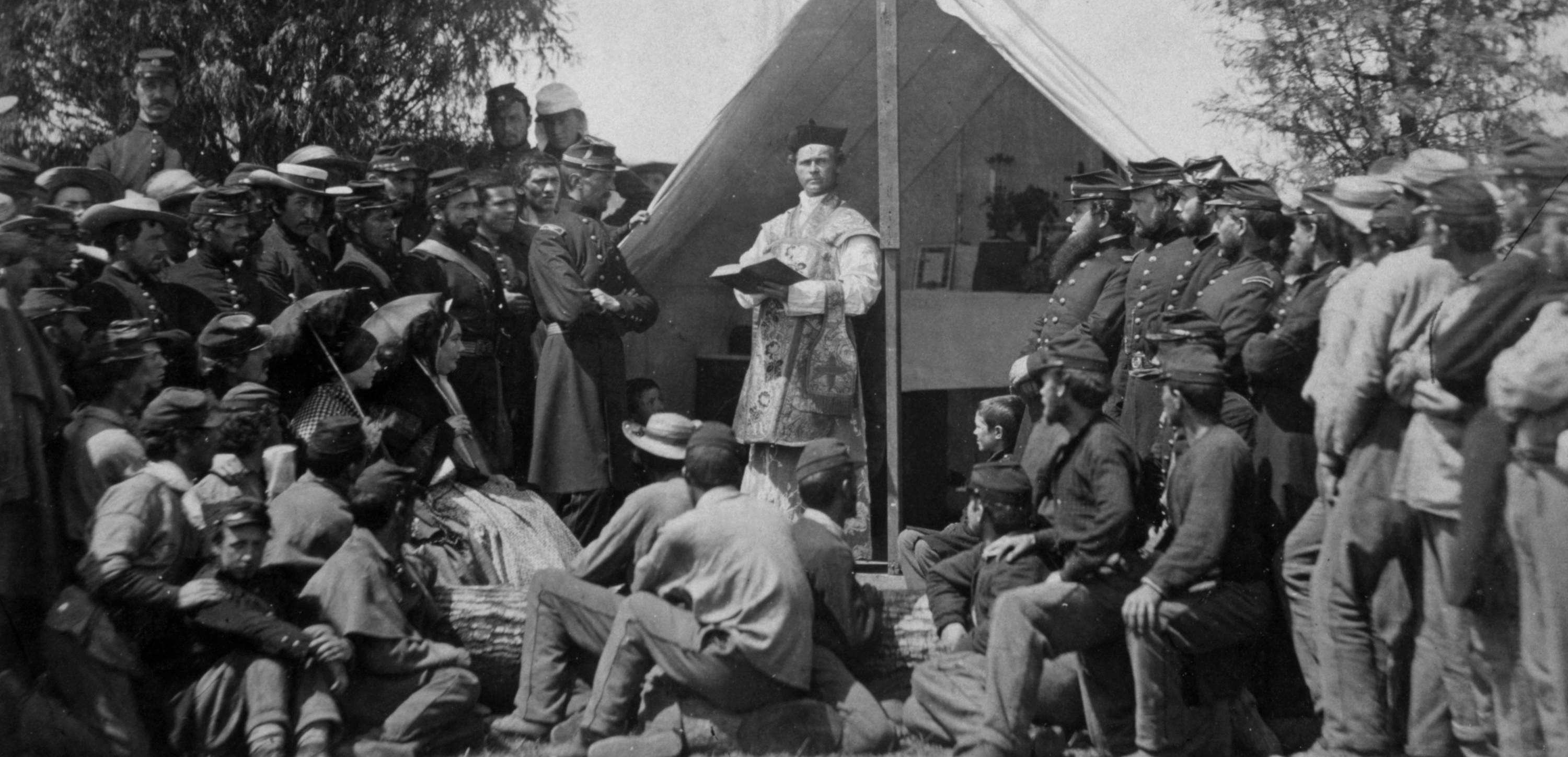
Catholic Mass during the American Civil War.
So our bored dudes started debating what Paul means by this epistle. And their underlying disagreement wasn’t solely over what he originally meant. It was over the meaning behind the meaning. Paul never saw the cotton gin. He never saw industrial slavery. He never saw slave ships packed with human meat. This isn’t to say that Roman slavery was super fun. It sucked. But it was the background noise of Paul’s day. Maybe, if this long-dead authority figure could be whisked into an 18th-century context, he would see the factories and the cane fields and free-market capitalism and agree that slavery had run its course and ought to be done away with. Maybe he’d become a Marxist. Maybe he’d die of future shock. It all depends on who you ask.
(Meanwhile, of course, a few people were beginning to point out that maybe we shouldn’t rely on long-dead authority figures. But that’s a tangent we shan’t explore today.)
This is where we get a very different strand of understanding texts. These people start to realize that some things, including a lot of things that a lot of Christians care a lot about, aren’t a function of those original meanings. They’re new. And these new things are maybe just as important as the original stuff.
Like, for example, abolition. Or the creole blending of Christianity with native faiths. Or how women might participate in a modern church. Or how to handle texts that clash with archaeological discoveries and scientific theories. Or the role of priests in resisting authoritarian governments. Or the role of priests in supporting authoritarian governments — because, look, these innovations weren’t always positive.
The need to adapt to changing circumstances prompts a very different method for reading texts. This is called reception. The idea is that the reader’s context is every bit as important as the original context. Maybe even more so. After all, Paul has been dead for a while. Let the dead bury the dead, someone once said.
Like originalism, this new idea of reception trickled from the religion department over to its neighbors, spurring disagreement even between critical theorists. The question looks like this:
Which matters more: the original meaning or the new meaning?
Roland Barthes, looking very sexable today.
II. The Life-Death of the Author
According to French philosopher, critic, and semiotician Roland Barthes, the thing that matters most is the new meaning. The reception of the work by its readers, not the original meaning intended by the author. Although in his case, he would probably label it the old meaning.
Ask your average lit-kid to sum up Barthes’ seminal essay “The Death of the Author” in one sentence and, first of all, they’ll insist it can’t be done in fewer than a few paragraphs. But stand firm and you’ll probably get something like this: “The author’s intentions and biography aren’t what matters when it comes to interpreting a work of art.” Easy, right?
Not quite. For one thing, it’s useful to actually read the essay in question. I know, it’s super long. 2200 words! That’s a little bit longer than this piece up to this point!
But the Barthes who argues for the death of the author is speaking in stronger terms still. To him, the author is a new concept entirely. “The author is a modern figure,” he writes, “no doubt produced by our society as it emerged from the Middle Ages, inflected by English empiricism, French rationalism, and the personal faith of the Reformation, thereby discovering the prestige of the individual, or, to put it more nobly, of the ‘human person.’ Hence it is logical that in literary matters it should be positivism, that crown and conclusion of capitalist ideology, which has accorded the greatest importance to the author’s ‘person.’”
Now, you might note an irony here. When Barthes attributes the birth of the author in part to the “personal faith of the Reformation,” isn’t he talking about the same bored dudes who developed the idea that reception matters more than originalism? The answer is… kinda-sorta. Remember, our bored dudes were so bored that they spent all their mental energy arguing with other bored dudes. Pinning them down to a single consistent perspective is tough. Even more importantly, we’re entering a dissimilar realm of thought. Barthes is not a historian. He’s a philosopher. And while there’s quite a bit of overlap between our history and philosophy departments, they’re different enough that the rubric that applies to one might not easily fit into the other.
For one thing, Barthes seems blind to at least two possibilities. First, that it isn’t only the Author who has been created by modern society, but Readers as well. And two, that our art has always been subject to some degree of authorial shenaniganry. In Barthes’ quasi-historical telling, art was previously relayed by mediators — shamans, orators, village elders — who were effectively putting on performances rather than functioning as a tale’s sole arbiter of meaning. But it doesn’t take much effort to observe that there have been plenty of shamans, orators, and polemicists throughout history who have gladly declared what any given work of art really means. And this isn’t limited to tradency, in the sense that orators will sometimes leave their own stamp on a story. Biblical authors and editors went of their way to establish their biographies or clarify a text’s original intentions, sometimes overwriting poetry or inserting themselves under someone else’s name. (Remember our fancy words from earlier!) It’s as natural as storytelling to re-imprint oneself on the text. To edit or translate, even to relay, is to author.
Which, it should be noted, draws these two disparate threads closer to fashioning an actual knot. Because if editing, translating, and relaying make authors of readers, then so too does the mere act of reading. When you read a text, you mediate its meaning by reinterpreting it within your own context. This transforms you into an author. A very different type of author from the Author that Barthes intends to throw down from his pillar. But an author all the same.
Oh! This jacket designer thought Barthes meant it literally.
Okay, we’re all authors, lower-case rather than capital-letter god figures. Great. We get it. But what’s so bad about the original Author’s intentions and context anyway?
To understand that, we need to investigate the context that Barthes was operating in. Which is at least ironic, maybe even something of a trap, since we’re now trying to strike at the man’s original meaning as opposed to its received understanding. And, oh, I ought to note that some literary theorists have indeed argued that Barthes was imposing an irony-trap by crafting a theory that would force its adherents to strive to understand his original meaning and thus paradox themselves to death. This strikes me as the sort of prank Jacques Derrida was more prone to, but consider yourself informed. Let’s spring the trap, if only to investigate its hinges and springs.
To begin with, Barthes argues that the Author isn’t quite as much of an author as they would like to think. He writes, “We know now that a text consists not of a line of words, releasing a single ‘theological’ meaning — the message of the Author-God — but rather a multidimensional space in which several meanings are married and contested, none of which is original. The text is a fabric of quotations, resulting from a thousand sources of culture.”
Whoa, cool it, Roland! In simpler terms, language and culture are so potent that the Author is passing along meaning more than they are inventing it. While the Author might want to claim ownership of their ideas, they’re merely handling it. They’re closer to those shamans and orators, tradents of ideas rather than originators of them.
Even Barthes was swimming in his own culture. As plenty of commentators have pointed out, other critics were beginning to argue something similar to what Barthes argued in “The Death of the Author.” Short version, nobody is as original as they would prefer to think.
But there’s another element of culture at play, one that goes a long way toward explaining the strength of Barthes’ language. The dominant strain of literary criticism of his day was downright obsessed with originalism. According to prevailing wisdom, critics were intended to decipher art’s original meaning, usually by studying an author’s biography or, when possible, by simply having the author clarify a work’s intended meaning. It’s time to drop an over-long quote on you, but I’ll put it in a breakout box to add some visual flair:
The author still reigns in manuals of literary history, in biographies of writers, magazine interviews, and in the very consciousness of litterateurs eager to unite, by means of private journals, their person and their work. The image of literature found in contemporary culture is tyrannically centered on the author, his person, his history, his tastes, his passions. Criticism still largely consists in saying that Baudelaire’s oeuvre is the failure of the man Baudelaire, Van Gogh’s his madness, Tchaikovsky’s his vice. Explanation of the work is still sought in the person of its producer, as if, through the more or less transparent allegory of fiction, it was always, ultimately, the voice of one and the same person, the author, which was transmitting his confidences.
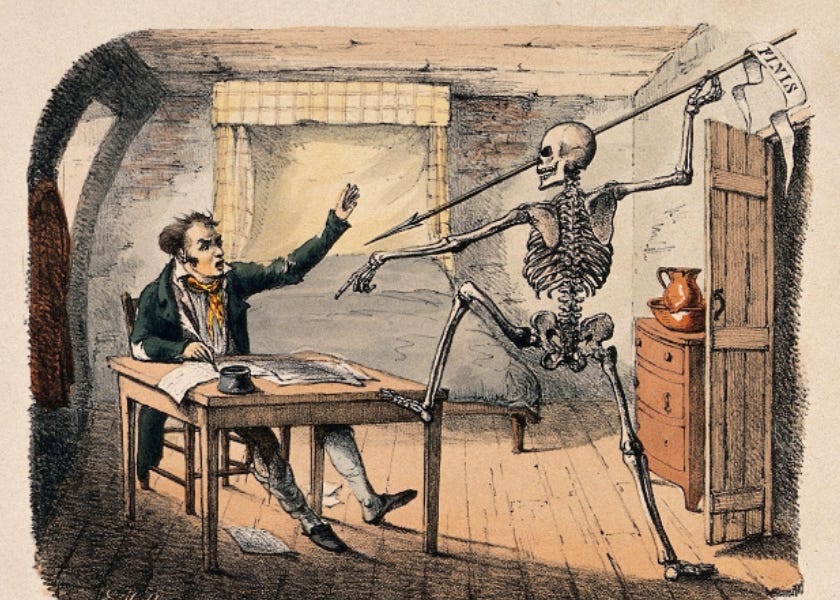
An author being kill’t.
Whoa, cool it, Roland! What’s the problem, anyway? To Barthes, a man who cares very much about art and about the meanings it transmits, the problem is that it makes art perishable. It puts a period on a single examination of the work. The task of criticism becomes that of a codebreaker. You look at art and you say, “What is the one singular meaning that this work of art must have?”
Once that has been done, any other meaning is rendered meaningless. Barthes is offering a critique of his day’s critical apparatus. And in suitable unoriginal fashion (which, remember, Barthes is defending!), his critique stems from the Marxist argument that capital has transformed art into one more product to be extracted and expended. There’s no reason to dwell on a painting for one’s entire life. Once the painting has been understood, it can be fed to the bonfire so you can purchase another. There’s no need to reread a book at different stages of your life to witness how its meaning transforms because you have transformed. The only meaning that matters is the one passed down by the Author. There’s no need for a song to blossom from springtime excitement to nostalgia. There are other albums for that.
By killing the Author, by permitting every reader to be as much an author as those who put pen to paper, Barthes argues that art becomes freer, greater, more open to all. “To assign an Author to a text is to impose a brake on it, to furnish it with a final signification, to close the writing,” he notes. “Once the Author is distanced, the claim to ‘decipher’ a text becomes entirely futile.”
It’s revolutionary. In the literal, rhetorical sense. Barthes isn’t just declaring that the Author is dead. He’s rolling the guillotine over to traditional literary criticism and laying out the head-basket.
Vive la revolution.
Review this soap, if you would.
III. Shrödinger’s Historio-Critic
But there’s a quandary to be had, because in contravention to how the Death of the Author has been received by some adherents, Barthes isn’t arguing for the death of context. The death of the Author as tyrant, yes. The death of art as a perishable grocery, yes. The death of context, research, or external meaning, not so much.
Here’s some context of our own. In the 1950s, Barthes made an early name for himself by writing essays for Les Lettres Nouvelles that assessed objects of popular culture — wine, professional wrestling, soap detergent, Einstein’s brain, Charlie Chaplin — as modern mythmaking. Eventually compiled into a single book, Mythologies, these essays were short, fewer than a thousand words a pop, but they sought to cut to the heart of the ways even seemingly innocuous cultural productions like advertisements were in fact engaged in cultural storytelling. (Usually, it turns out, bourgeoisie storytelling.) This requires a great deal of context on Barthes’ part. When he examines how the Romans are depicted in film, it requires him to stay grounded in contemporary cinema to note how every Roman’s hair is fringed, but also to venture into actual Ancient Roman imagery, where plenty of people were bald. He sidesteps any reliance on authorial authority — yes, those words have the same root, the Latin auctor for “originator” — but spends quite a number of his limited word count on contextualizing the meaning of these new myths.
In one essay, he also derides critics who “proclaim their helplessness” when it comes to understanding meaning. “Critics often use two rather singular arguments,” he writes. “The first consists in deciding that the true subject of criticism is ineffable, and that criticism, as a consequence, is unnecessary. The other, which also appears periodically, consists in confessing that one is too stupid, too unenlightened, to understand a book reputedly philosophical.” He mock-quotes such a perspective with a poisoned barb: “I don’t understand, therefore you are idiots.”
What does this have to do with authorship? First of all, if I had a nickel for every time somebody told me that their perspective is as good as any other because the Author is Dead, I would have at least three dollars. Such a degree of solipsism is very much in line with the “blind and dumb criticism” that Barthes cannot stand. He asks of the critic, “To understand, to enlighten, that is your profession, isn’t it?” Not every meaning is equivalent. There are better and worse interpretations, low-effort and try-hard interpretations, and everything in between. The Death of the Author isn’t raw solipsism. It still demands context. It’s just that it wants that context to be far-ranging, not limited to the author’s interpretation.
Onesimus, a slave, and in some traditions the Bishop of Byzantium.
If that isn’t enough, we can ask the more probing question. This is, incidentally, the same question raised by the bored dudes who questioned their predecessors’ assumptions:
So what?
So what if Barthes prefers that I don’t pay any mind to the author? I’m a critic, sure, but I’m also a historian. While the former role does well to disentangle itself from total authorial control over a text, the latter is still interested in documentation, attribution, and preservation.
One component of that preservation is the utterances of the designer. Most board games throughout the centuries have been anonymously designed. But it’s a very silly perspective indeed to think of this as a positive state of affairs. We may not know who first pushed cowrie shells around in the sand, but it enriches our understanding of mancala to learn that its popularity can be mapped to the bellies of slave ships and displaced populations, that one of its most crucial components is its absence of formal components. We may not be speaking about a singular author, but this is still a question of authorship-as-transmission. Of course, this isn’t to say that every design that uses mancala as an underlying system needs to pay homage to that. But as critics, the more context we glean, the better our understanding and therefore the better our critique. Because, as with those Bible scholars and the many victims of Barthes’ Mythologies, many of these stories are passed along through the cultural subconscious rather than stated outright. When a designer engages with a tradition, they may pass along fragments of that tradition if only by accident or assumption. They are authors, but lower-case authors, an authority on their work, if never its final authority.
Which is to say, there’s a very real tension in my work between Critic and Historian. Navigating that tension isn’t always easy. At any given time, I’m trying to assess board games as artifacts that exist independently of their creators, while also trying to preserve their authorial voices. There isn’t a single easy solution to that tension.
Oh, Roland. I asked you to stop making bedroom eyes at me.
But I do think it’s possible for these errant stands to be drawn into a knot. In his time, Barthes offered the Death of the Author as a corrective to an overly straitjacketed and commercial critical apparatus. In the decades since, the Death of the Author has become an axiom in its own right — a terrible irony, but not one that’s surprising to any student of history. Today’s heterodoxy becomes tomorrow’s orthodoxy. So it goes.
The irony brings along a great opportunity for the ride. This is the great but under-served task of modern criticism. Not merely to say “Here is my interpretation of this game, and it is as good and precious as any other.” That way lies a new incarnation of Barthes’ “blind and dumb” criticism.
Rather, the task is to develop an individual perspective that’s literate in where our tabletop games come from, which wider conversations they engage with, what their authors intended and how they succeed or fail, and where they engage with the wider culture at play. Criticism begins as a buyer’s guide, transforms into personal expression, but may, with practice and a radical engagement in the medium, transform yet again into true cultural critique, one that is simultaneously subjective and universal, that speaks about truth without surrendering to the notion that there can only be One True Thing. Such a process is fraught, but I believe it’s the next essential step in realizing a medium that has only recently stepped out of its infancy.
Vive la revolution, baby. Sorry. Vive la revolution, adolescent.
(If what I’m doing at Space-Biff! is valuable to you in some way, please consider dropping by my Patreon campaign or Ko-fi. Right now, supporters can read the next installment in my series Talking About Games, this time tackling the topic of what makes a good list! Naturally, the piece includes a list.)
It’s safe to say that The Guerrilla Generation is the wargame I’ve been looking forward to the most since its announcement on the heels of The British Way. Like that title, this is a multipack by Stephen Rangazas, once again using Volko Ruhnke’s COIN System to examine four different conflicts over the course of the 20th century. This time, our destination is Latin America.
And it all begins with a comparatively small urban insurgency in Uruguay.
Ah, my favorite bastion of Marxist corruption.
If you’ve played even one COIN game before, the basic arrangement of their maps have probably solidified themselves in your mind. There are typically three types of spaces: rural zones, drawn in green or brown depending on the terrain being represented; urban centers, portrayed as gray bubbles where the country’s population is most concentrated; and lines of communication, the highway or rail networks that string everything together.
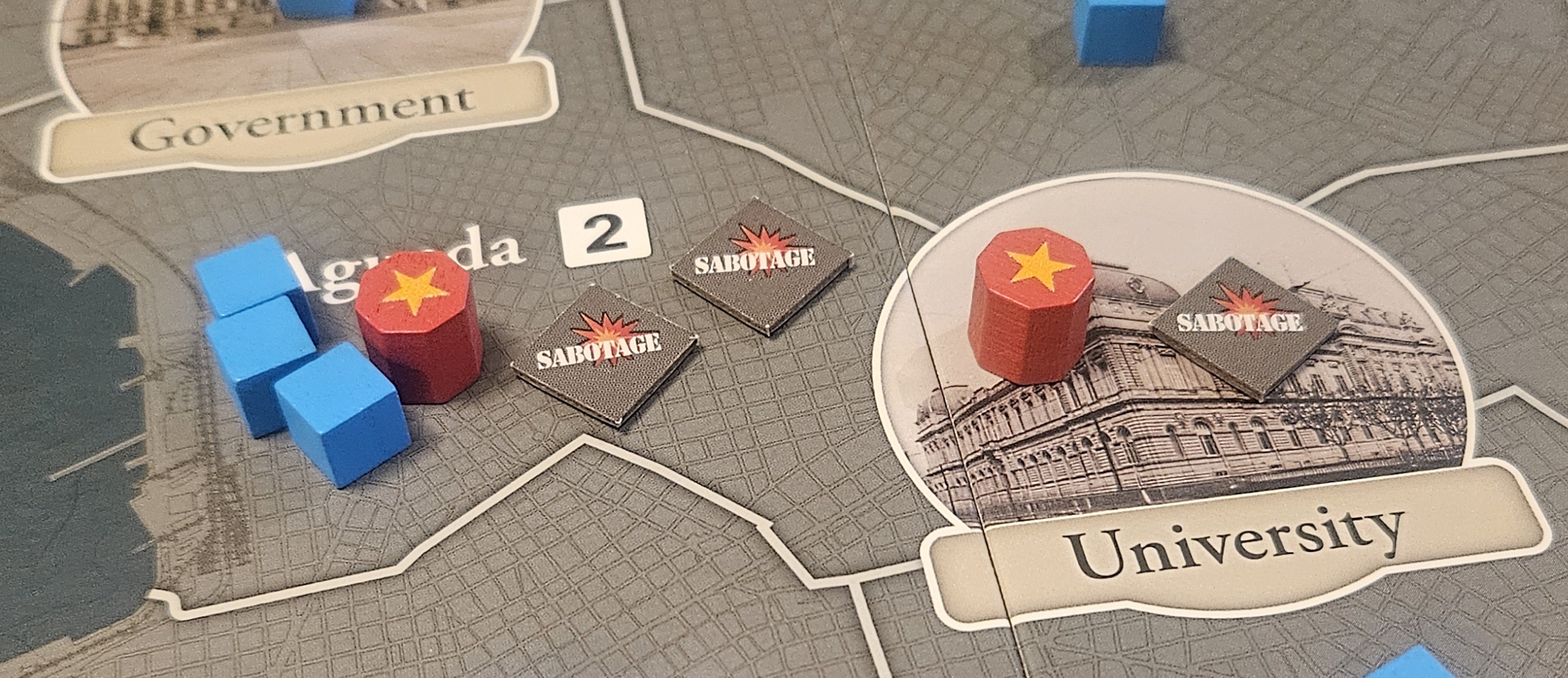
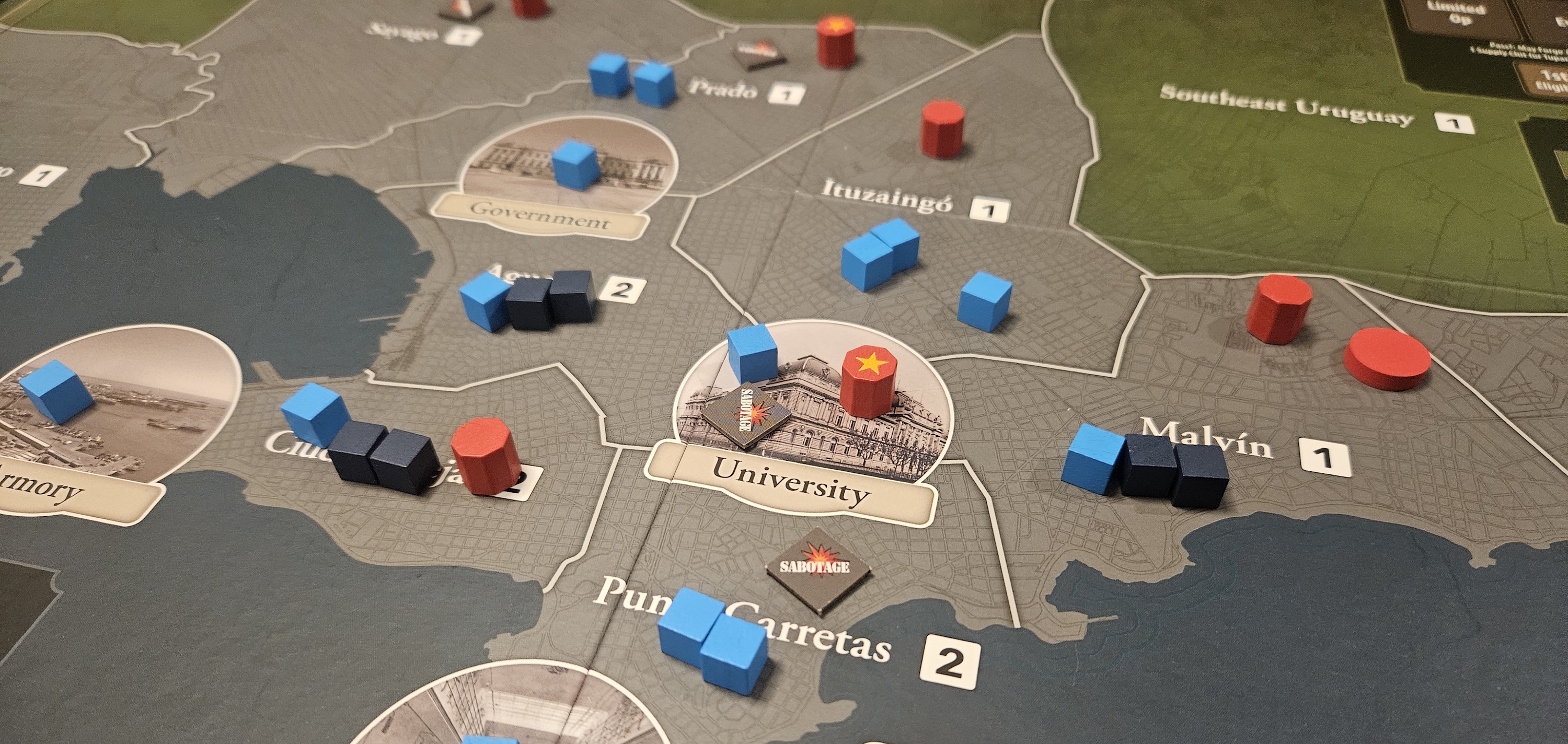
What sets the Uruguay scenario apart from every other map is that it all takes place within one of those concrete-hued bubbles. Unlike most of the insurgencies depicted by the series, this game’s revolutionaries, the Tupamaros, have confined most of their activities to Montevideo. Right away, this presents both advantages and disadvantages. In the former column, there’s no denying that it’s much easier to traverse a single city than an entire country. Acts of sabotage and intimidation take place where their impact will be greatest. The state’s juiciest targets — the armory, the prison, the university — are all right there. It helps, too, that it’s easy to blend in among the million-plus population.
But there are some stark disadvantages as well, and it’s here that Rangazas pulls the system in two contrasting directions. As with The British Way’s anti-colonial movements, The Guerrilla Generation examines how its four insurgencies differed in operation, ideology, and outcome. For their part, the Tupamaros are relatively restrained. This isn’t to say they’re nonviolent, like some Latin American analogue of the Indian National Congress from Gandhi. Installations will still be sabotaged. Key figures will still be kidnapped and held hostage in a roving prison. Soldiers and policemen will still be assassinated. But limiting the insurgency’s activities to Montevideo means there’s less opportunity for the revolutionary fires to fan out of control.
Indeed, that’s one of the core questions asked of the Tupamaros player. Founded in the wake of Fidel Castro’s successful takeover of Cuba — as presented in the second COIN volume, Cuba Libre — the urban nature of the Tupamaros reflected the ideals of their core membership. This was a middle- and upper-class movement, staffed principally with students and tradesmen rather than farmers and day laborers. At the outset, it’s impossible to overlook the lone insurgent cell situated comfortably within the university.
Thus, a tension is presented. Should the Tupamaros confine their activities to their original vision or expand their base? Neither option is perfect. Keeping the message focused restricts the manpower the Tupamaros can bring to bear, a problem that only grows more pressing as increasing numbers of revolutionaries are imprisoned. But the instant the organization expands its recruitment pool, rogue cells might spark violent actions that disgust Montevideo’s populace and sway their sympathies toward the regime. It’s a familiar conundrum for students of revolutionary history, but to my recollection it’s the first time we’ve seen it presented so clearly in the COIN Series.
Events pull triple duty this time around.
This is only the first of the small touches that Rangazas deploys to great effect in the Uruguay scenario. The Tupamaros — who, it must be said, receive the module’s most interesting toys — are also the recipients of two other tweaks that speak to their urban nature.
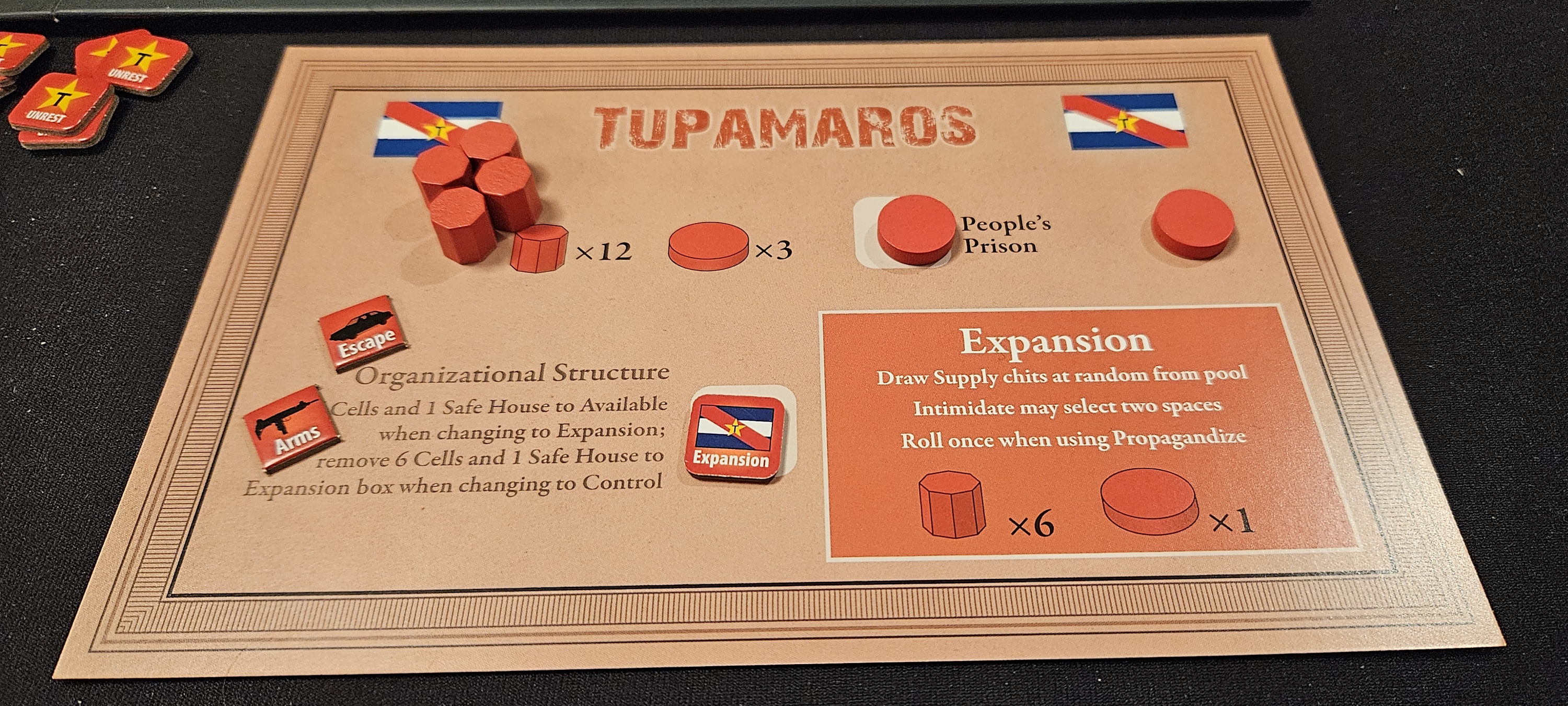
First, supplies. At various points, the Tupamaros draw chits that represent the tools of their trade. Rather than being presented as generic “supplies,” here they’re delineated into distinct types that influence how the Tupamaros operate. Arms, for example, double how many sabotage markers their attacks place on the map, while escape vehicles make it easier to disappear after an operation. These chits are interesting, not to mention a great deal of fun to handle during gameplay, but their real advantage is that they imbue the Tupamaros with a certain materiality that has sometimes gotten lost in the COIN System’s sky-high perspective. Not to go all Marxist on anybody, but the organization’s material conditions inform its practice. (Or “praxis,” if we really want to lean into the forthcoming accusations.) Basically, you’re more likely to jump in guns blazing if you have guns. Or expand your organization if you have a bunch of order chits for bullying around your new recruits. Or lean into hostage-taking if the People’s Prison already has a few high-profile captives under lock and key.
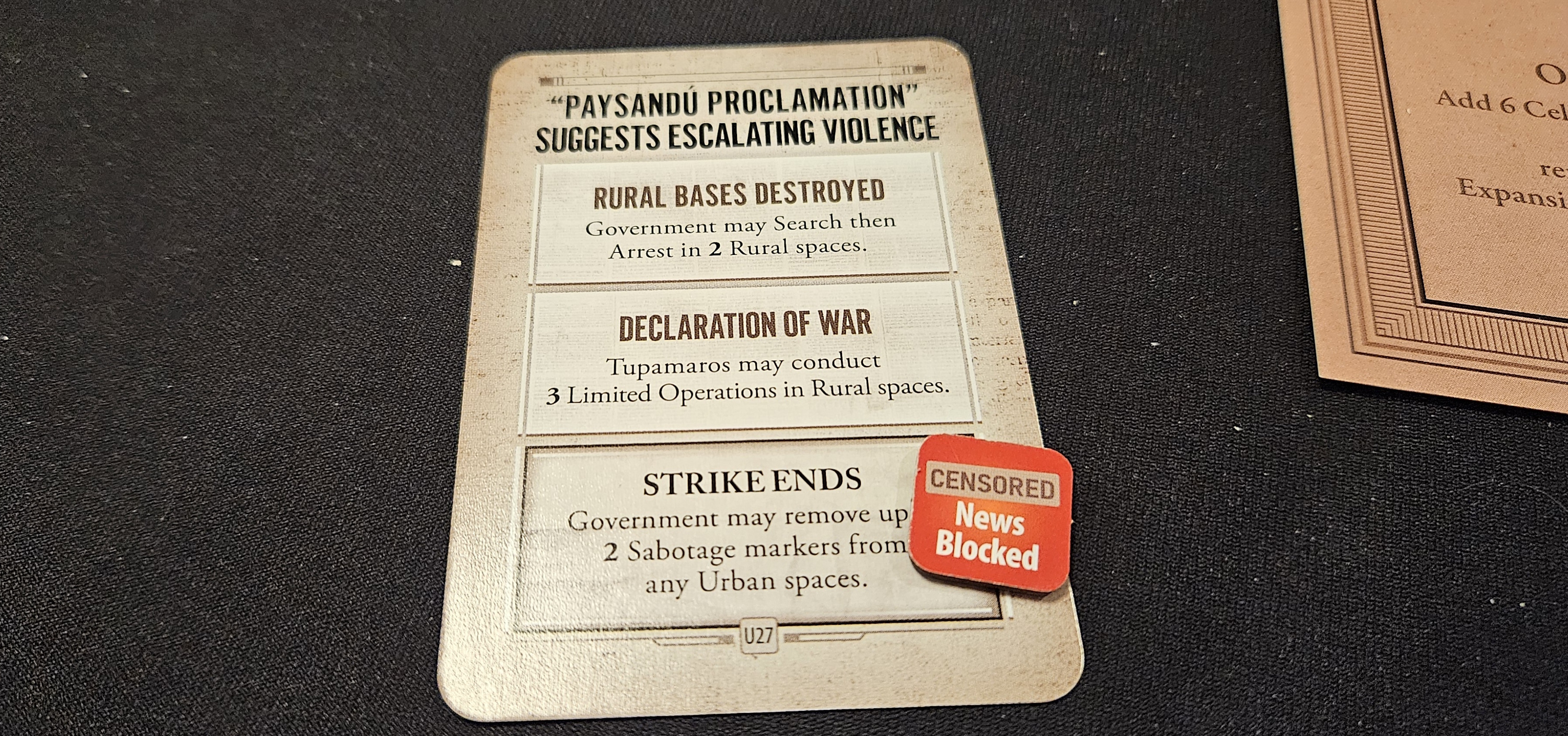
While this gives the Tupamaros an ideological edge that’s missing from many of the more counter-insurgent-focused volumes of the COIN Series, an alteration to the function of the game’s event cards solves a very different issue. At the end of each turn, after both sides have had their chance to act, an event takes place. Not the usual event, the one that might be capitalized upon by either faction, but an unconnected occurrence in the third box at the foot of each card. This represents something happening beyond the reach of either the Tupamaros or the Government. An escape from a women’s prison, perhaps, or a worker’s strike somewhere in the city. (Or, in a subtle piece of humor, the United States Senate might denounce torture in Uruguay after sending advisors to teach proper torture techniques. The outcome of this denunciation: “No effect.”)
This makes the Uruguay scenario the most event-heavy of the COIN titles thus far, but also resolves one of the series’ underlying tensions — namely, the false perception that these particular actors would be all-powerful were it not for their rivals’ meddling. Here, it’s possible for things to occur that are simply beyond your control. Perhaps a new poll will show that the military has high approval ratings. Is that good or bad? Hard to say. It might be rather impactful indeed. Or it might not matter in the slightest. But it’s something that happens without the participation of the game’s factions. They can suppress the news, whether through propaganda or censorship, but either way they are thrust into a world in which they are major actors, but not the only actors.
Guns, cars, hostages… the Tupamaros get all the fun stuff.
For the most part, the Uruguay scenario’s increased resolution suits both the history and the gameplay. The Tupamaros in particular are presented as a lively bunch, if also ill-equipped to effect sweeping change.
But this tighter focus also shows a COIN System straining at its limits. Peculiarities gnaw at the foundations, concessions to balance that are probably necessary to make the game function as intended, but present as artificial constraints on the pieces sitting on the map. Insurgent cells spring across the city at will, while Government police cubes trundle from one district to another. Intel chits pad the Government’s actions, doled out as a result of interrogated prisoners, but the system feels ancillary at worst, and a less enthusiastic version of the Tupamaros’ supply chits at best. I don’t have any strong feelings on the game’s balance, as I’ve seen both factions emerge victorious, but the Government is a drag to play compared to their more freewheeling countrymen.
Fortunately, these quibbles fade alongside the scenario’s grander accomplishments. Historically, the Tupamaros lost the war but won the long-term moral conflict. The Government, pressed to their limit, eventually called in the military to subdue the insurgency. The operation was successful, shattering the organization and holding its ringleaders hostage in squalid conditions for twelve years.
The Guerrilla Generation portrays this turn of events as well. On their own, the Government is unlikely to quell the uprising, especially if the Tupamaros player cleverly manages their supplies and balances their organization’s expansion and control. The Government is therefore presented with the option to call in the military. This bolsters their numbers dramatically, adding darker-hued cubes to the map that are immune to the petty intimidation tactics that have been the insurgents’ stock in trade. Once deployed, it’s almost guaranteed that the military will crush the revolution.
But this sets off a different victory tally. Now the Government is faced with the prospect of a fatal coup d’état. If their legitimacy drops below that of the military, they lose the game outright. In theory, in the moment, this also looks like a Tupamaros failure. Thanks to hindsight, Rangazas presents it as a victory for the underdogs. Yes, the coming years will see civic governance gradually phased out in favor of military rule. Yes, Tupamaros leadership will languish in prison. But eventually military overreach will pave the way for democratic reform and amnesty for the captives. Presumably, such an outcome places the game’s conclusion not in 1973 with the military coup, but in 2010 with the Tupamaro and twelve-year captive José Mujica being sworn in as the country’s 40th constitutional president.
Deploying the military is likely the death knell of the Uruguayan regime.
There’s a certain reading of this outcome that might regard it as rose-tinted, perhaps even accelerationist in nature. Positioning a victory for the Tupamaros as more or less identical to their abject failure is a stark authorial choice. By no means was the civic-military dictatorship of Uruguay guaranteed to conclude in democratic reform.
Then again, I’d be more sympathetic to such a perspective if events had not, in fact, shaken out that way. All wargames are built on hindsight, through necessity if nothing else, and this is probably as close to true success as the Tupamaros were likely to get.
Either way, Uruguay provides a sterling entry point to The Guerrilla Generation. Its insurgency is a far cry from what we’ve seen from the series thus far, an urban uprising that struggled to obtain broad appeal, but made enough of a nuisance of itself to incite the suicide of the regime it opposed. We’ll see if the next three insurgencies are able to ride the tide of historical chance to similar highs. Spoiler: Don’t get your hopes up.
A complimentary copy of The Guerrilla Generation was provided by the publisher.
(If what I’m doing at Space-Biff! is valuable to you in some way, please consider dropping by my Patreon campaign or Ko-fi. Right now, supporters can read my first-quarter update of 2026: the best board games, movies, books, and more!)
For the most part, that’s fine by me. Sometimes, too much of a good thing makes for a real tummy ache, and while it’s a rare week that doesn’t see me tackling at least one of the hobby’s elder statesmen, nothing makes a board game quite like a board. I will admit, though, there’s always the siren call of the latest pure tricker. “Come back to the table,” it sings, except in, I dunno, Greek. Calling me. Haunting me.
Dead Channels, for example. This is the latest title by Daniel Newman, whose designs we’ve tussled with once or twice.
Test signals.
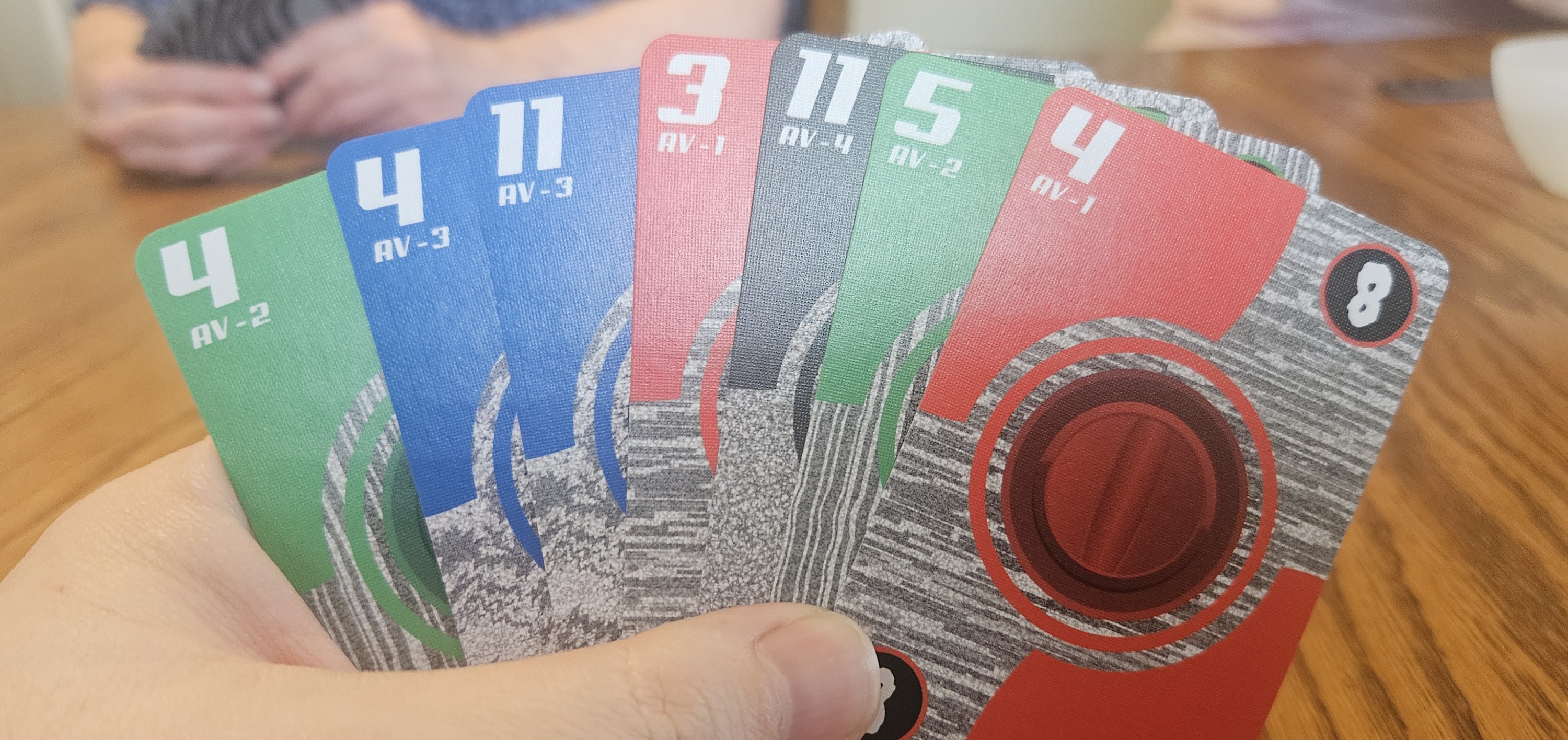
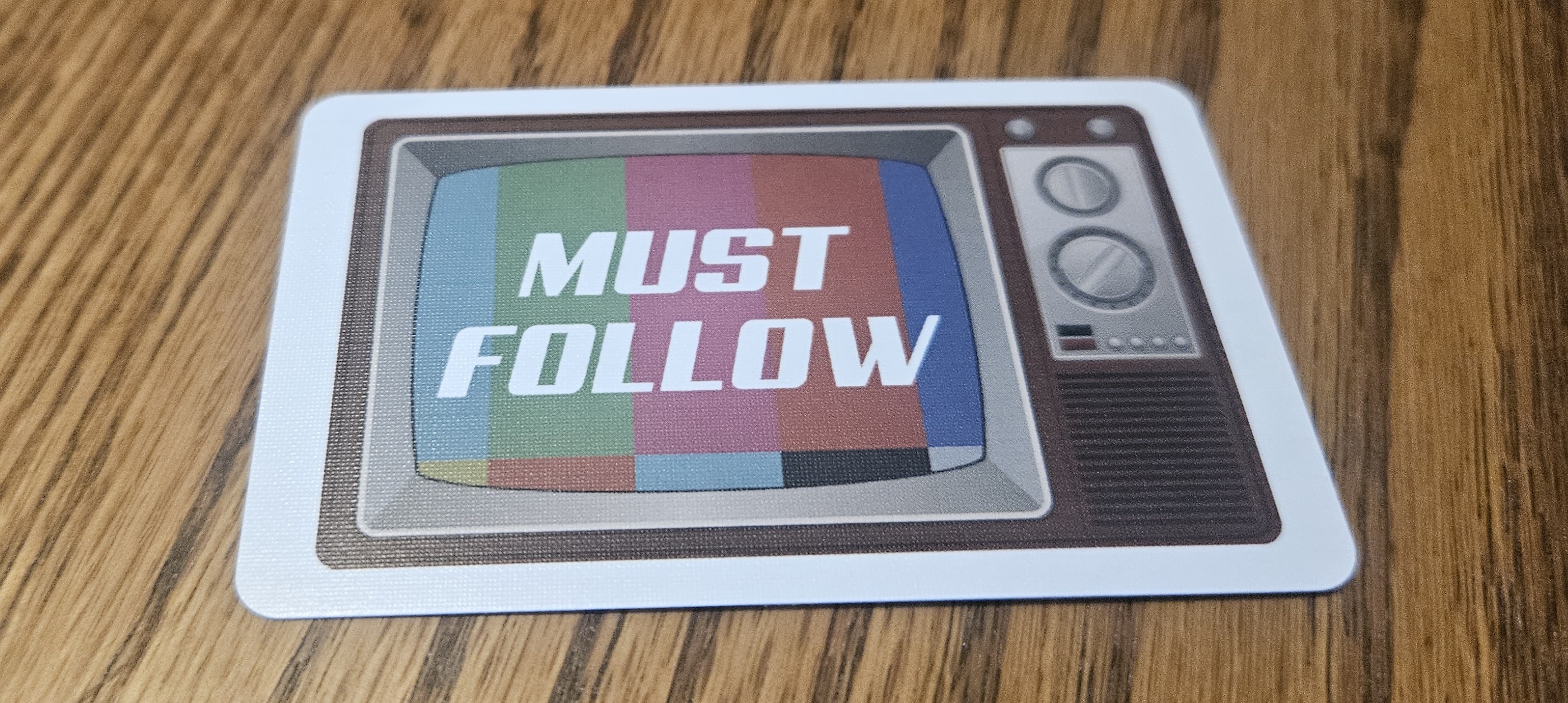
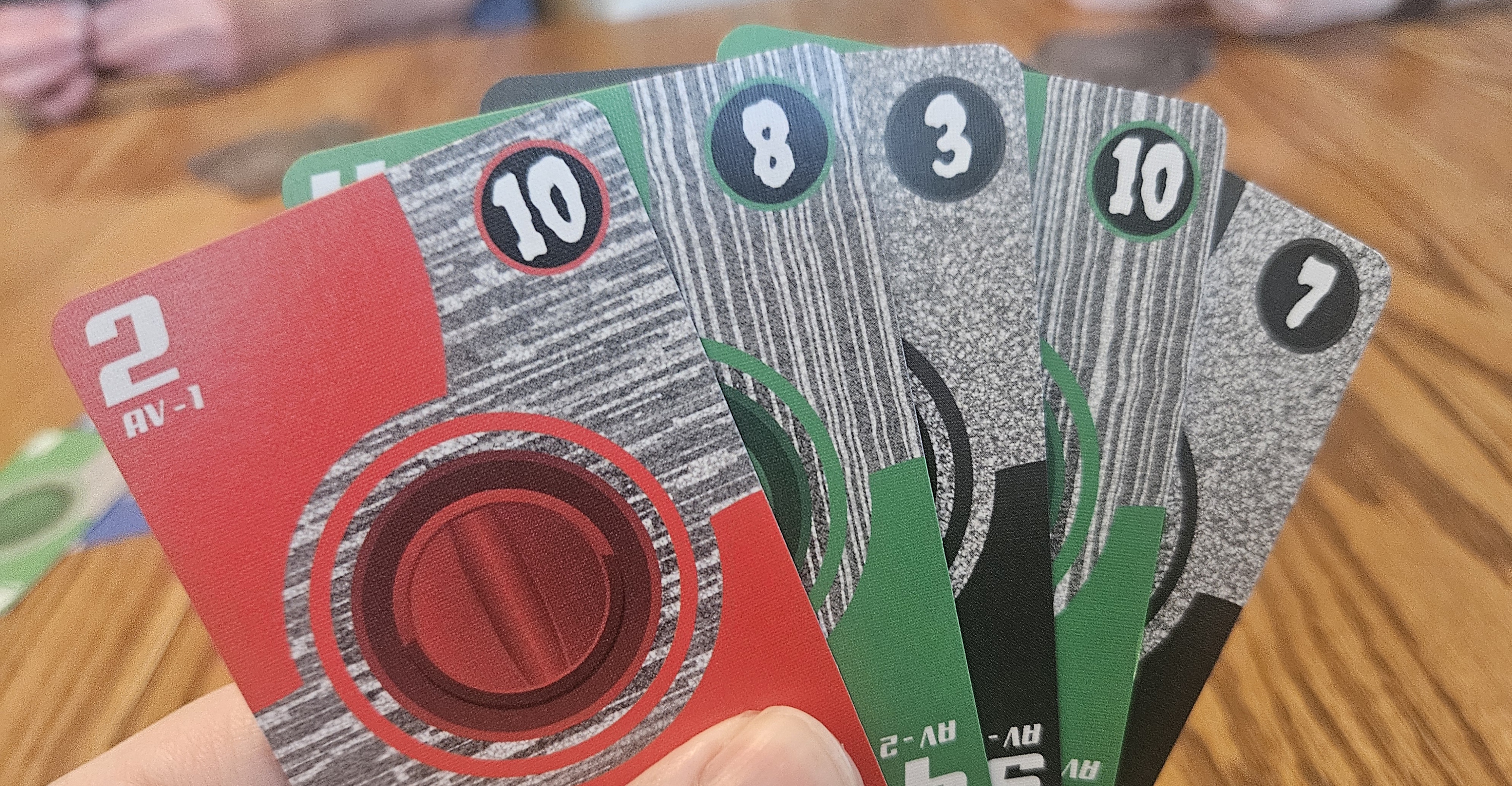
In the fashion of elder trick-takers — modern ones still do this, but older ones too — this is one of those trickers where the designer mines untapped veins from the minutest of changes. The idea is that every card shows two states. One of those states is colorful, like the tuning image you’d get on an old television. The other is fuzzed gray with static. As you play, these states flip back and forth, informing everything about how the hand is played.
This isn’t the first time we’ve seen a trick-taker alternate hand functions. But what sets apart Dead Channels is the way your cards flip from one state to the other. When the channel is tuning, this is an ordinary must-follow trick-taker. If I play red, you have to play red if at all possible. The highest card in the led suit wins. Normal stuff.
But when someone plays off-suit, the game changes. Now everybody splays their cards the other direction and begins playing a must-not-follow game. If I play red, you better not touch the stuff. Only the high card among those that are eligible — as in, non-following — are permitted to win.
Of course, this might also become impossible before too long, forcing us to flip the channel back to tuning, then back to static, and so on until the hand concludes. Flip. Flip. Flip.
Like some of Newman’s games, Dead Channels feels haunted.
That’s simple enough, but what makes Dead Channels fascinating is that you’re always wrestling against your hand. It would have been easy to overclutter this one, but instead Newman sticks to a simple rubric. You want two tricks. That’s it. Two per player. Naturally, more tricks than that will be awarded, making this a razor-edged proposition. But that’s the idea. If you earn two tricks, you net zero points. For every trick you’re off, whether up or down, you earn a point. Points are bad.
What’s noteworthy about Dead Channels is the way this produces such a well-rounded experience with very little in the way of overhead. I’ll be the first to tell you that trick-takers are a fraught proposition. Between the card counting, goofball terminology (sloughing? really?), and the damoclean threat of contract bidding, this has always been a dense genre, one that’s simple enough on the surface but sharp with gravel once you go more than two inches deep. Dead Channels relies on a little bit of foreknowledge. Like plenty of other trickers, you can explain the rules to veterans with a flurry of jargon. But for the most part it’s as accessible as these things get, devoid of the extra bells and whistles that have been normalized in past years.
Is it the next great thing? The next Schadenfreude? I doubt it has such pretensions. But it’s nice to come back now and then, to see how clever designers are still adjusting the format in small ways that only seem obvious in retrospect. By embracing both must-follow and must-not-follow, Dead Channels effectively becomes two trick-takers in one — although, of course, the challenge lies in how you navigate that liminal space between them, flipping between one mode and the other.
Static still corresponds to suits. Don’t you see the fuzz lines?
I don’t play nothing but trick-takers these days. But like I say, it’s nice to circle back for a visit. In that sense, Dead Channels feels like coming home for a reunion only to make a new pal instead. Could have gone worse.
A complimentary copy of Dead Channels was provided by the designer/publisher.
(If what I’m doing at Space-Biff! is valuable to you in some way, please consider dropping by my Patreon campaign or Ko-fi. Right now, supporters can read my first-quarter update of 2026: the best board games, movies, books, and more!)
Hello readers! Mike Didymus-True here, the editor of BoardGameWire.
I wanted to post a quick message to apologise for an upcoming week or two quiet patch for the site – I’m being unexpectedly admitted for surgery tomorrow, and will likely be out of action for at least 7 to 14 days while I recover. And as BoardGameWire remains a one-person operation, which I squeeze into my spare time around my day job and my two kids, unfortunately that means a very brief hiatus for the site!
Please do continue to email me with your news and such in the mean time, and I’ll do my best to get reporting again as soon as possible! I’m on mike@boardgamewire.com
If this hiatus makes you think “Hmm, I wonder where I’ll get my board game industry news from now”, might I recommend the excellent W Eric Martin over at Board Game Beat, who sometimes has crossover with the kind of things I tend to cover here.
And if this hiatus has also made you think “Hmm, I really do find BoardGameWire and its reporting useful, that Mike really does do a pretty good job covering things that don’t get written about elsewhere – I would very much like to support that kind of thing financially” – that would be lovely! You can pledge a variety of amounts through the BoardGameWire Patreon, or by choosing a paid subscription to our regular newsletter.
Despite being the creation of John Rudolph Drexler, Colossi reminds me of an early John Clowdus design. At really every point, come to think of it. There’s the shape of the thing: a lane-battler packed with powerful abilities that constantly reform its contests into new shapes. Or its illustrations, here produced by Sean Thurlow, but not all that distant from the brushstrokes that fill Omen: A Reign of War. The form factor is also approximate; the box isn’t tiny, but it isn’t much larger than Omen’s second edition. Even the game’s willingness to surprise feels redolent of one of our hobby’s under-celebrated innovators.
If I wasn’t sufficiently clear, this should be taken as an enormous compliment. Colossi has a few shortcomings — another parallel with certain Clowdus titles — but it’s such a gust of fresh air that I dearly hope Drexler has a few more in the chamber.
Three lanes.
As mentioned, Colossi is a lane-battler. Through blurred eyes, it might even seem overly familiar. Players are presented with three lanes at any given time, each host to an existential battle. Yawn, am I right?
Except it takes all of five seconds before Colossi drops its own beat. The first riff is that it handles up to four players, and every count is as smooth as the others. The second is that each lane is strikingly different from those to its right or left. This is thanks to the way Drexler builds out each one via a combination of an environment and up to three items.
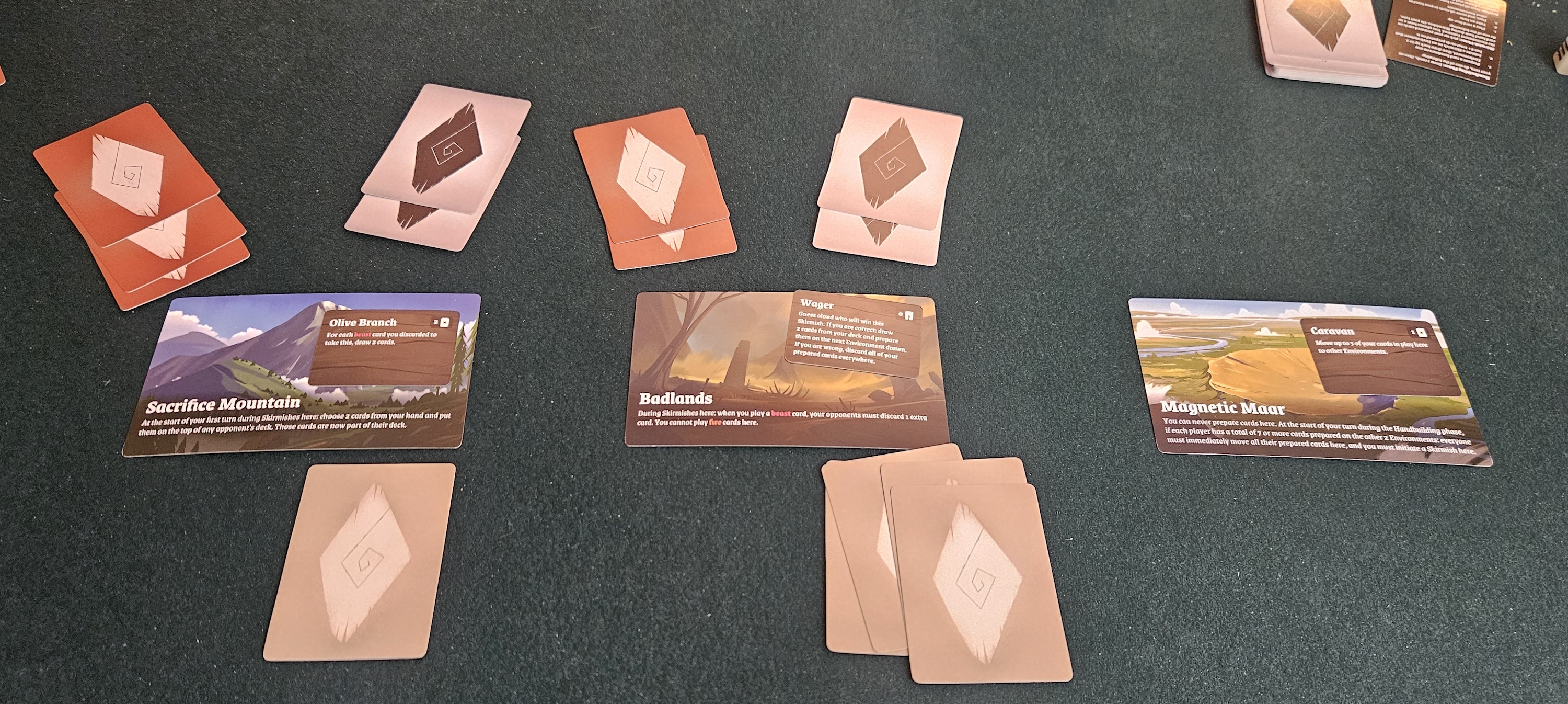
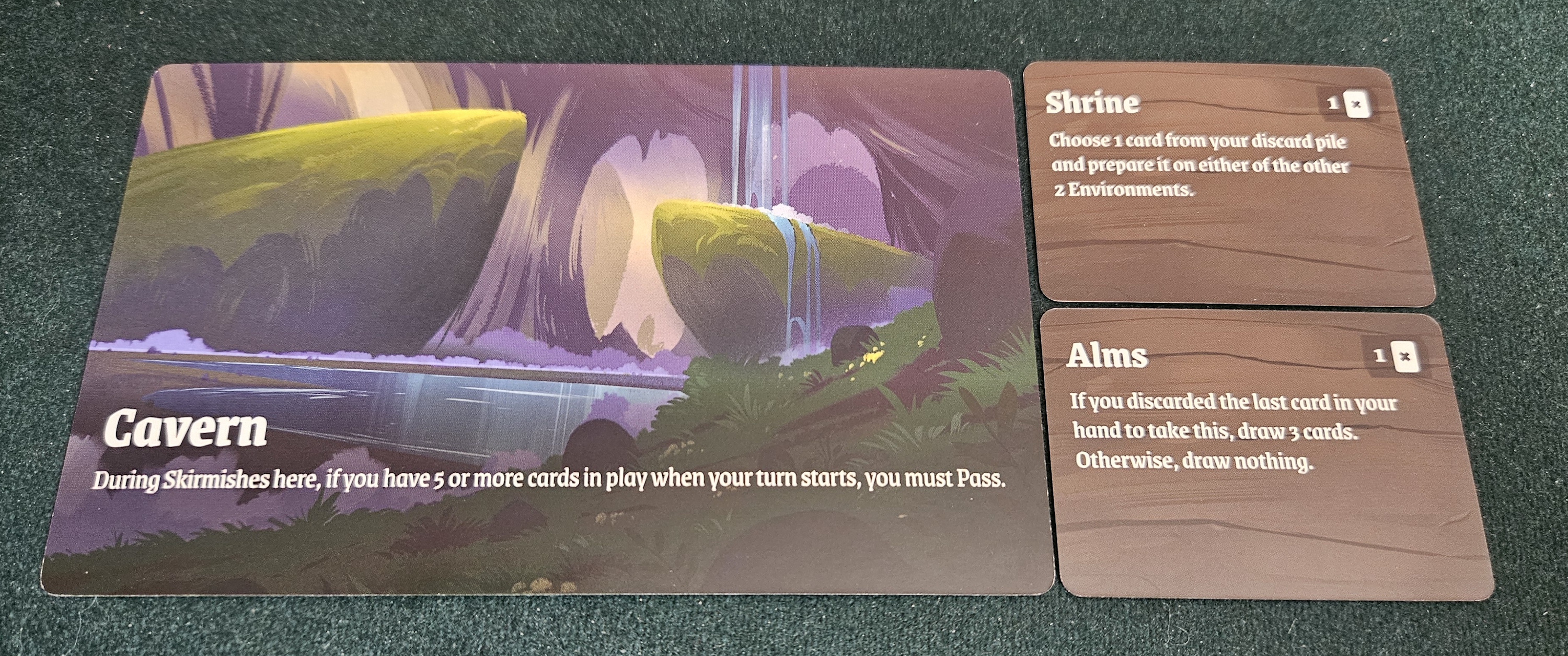
The former, environments, are the game’s main objective. Win three of them and you’re declared the victor. In addition to that, each one is entirely unique. Some are simple enough, like the Desert, which prohibits water cards from being played into its lane. Others are more transformative, like the Impulse Isle, which turns the usual phased play — one card per player at a time, around and around until everybody passes — into massive plays that have each player deploy every card and ability at once before passing to their neighbor. Or the Chaos Fissure, where everybody is required to prepare an equal number of cards, shuffle them together, and then deal them at random to all participants. Or the Magnetic Maar, a zone where preparing cards is strictly forbidden, forcing players to get creative in order to secure it.
Those last two environments won’t make sense without some explanation. Cardplay in Colossi is broken into two separate but interconnected phases. First, players prepare cards by seeding them face-down into those three lanes. Once an environment meets a threshold of cards, somebody is allowed to trigger a battle there. The game then shifts into its second phase. Everybody adds the cards they’ve prepped in that lane to their hand and then duke it out for control of that single environment. Once that battle is dusted, a new environment is added to the gap and the game returns to the preparation phase.
Back and forth it goes. Preparation, preparation, preparation, preparation, HUGE BATTLE, preparation, preparation, HUGE BATTLE, preparation, preparation…
Each lane features both an environment and one to three items.
Along the way, Drexler shows off a number of small touches that elevate Colossi from a good idea to an impressive execution. I mentioned items. Each environment hosts one to three of the things, depending on how far the game has progressed. Rather than deploying a card into a battle, you’re allowed to discard something from your hand to claim these babies. Like the larger environments, they’re transformative in their own right, adding perks or adjusting the parameters of the current fight.
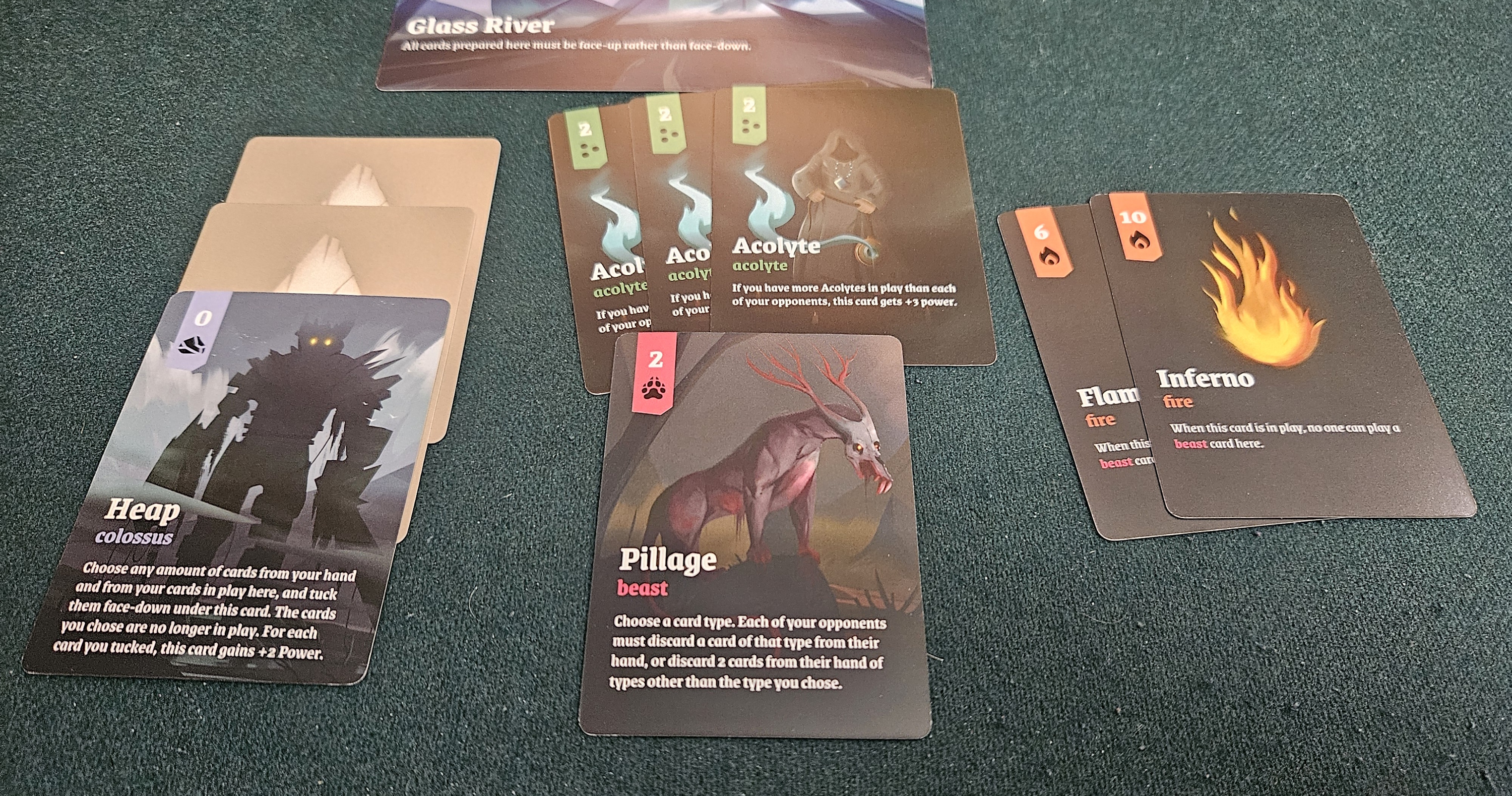
Of course, none of this would spark to life without the right selection of powers. Here Colossi flexes a more familiar muscle to fans of the genre, starting everyone off with an identical deck of twenty-four cards that deforms as the session progresses. First-timers may find the selection intimidating at first, especially since the myriad types cancel or boost one another like a seven-pronged Roshambo. Divine Gifts add more cards to your hand. Electricity makes Divine Gifts more expensive to play and is empowered by Water. Fire is powerful and blocks Beasts, but gets nerfed by Water. Beasts mess with rival hands, while Colossi do… all sorts of things. Acolytes grow stronger in bulk.
Your cards, meanwhile, aren’t necessarily going to stay your cards for very long. One of the Colossi, the Curse, wanders over to the opposing side of battle to decrease their strength. Then, like a kid deciding it prefers its neighbor’s house, it sticks around afterward, filling up their deck with a card they probably don’t want. One of the Beasts abducts a rival card into your deck, potentially stealing their best cards outright.
Over the course of a half-dozen or so battles, this gives each deck its own topography. One player becomes weak with Fire, and therefore vulnerable to Beasts, but finds a way to use their multiple Colossi to swing fights their way. Another gains so many Acolytes that their hand becomes a cultist’s paradise, winning through sheer manpower. A third starts lighting everything on Fire and hoping nobody has the necessary bulk of Water cards to douse the flames.
The result is as subtle as it is brash, especially once the table remembers that the battles are just, well, battles. The bigger picture, the war, is what matters here. It’s easy to lose sight of that, especially in the midst of a drawn-out fight. Often, it’s smarter to bait an opponent into using too many cards, then withdraw to other environments for a jump start on the fight that will soon engulf them as well. But why play it smart when you have a one-in-ten chance to draw exactly the card you need in order to swing this thing?
Battles can turn into real pile-ups.
Sure, I have quibbles. Some battles get too summy for their own good, especially once Water starts fudging the value of Fire and Electricity. Certain environments have obnoxious or burdensome effects. Similarly, some of the powers are touch-and-go, especially those that allow someone to draw extra cards in the middle of a fight. Then again, the little imbalances between suits are also what make the game formidable. When somebody drops their Inferno card, everybody notices.
On the whole, Colossi is a superb debut. It’s hard-hitting, vicious, subtle, and so much cleverer than it seems at first glance. More than that, it produces a heretofore unseen take on the lane-battler, one that goes beyond the usual trappings to prove itself a new creature indeed. No — a new colossus.
A complimentary copy of Colossi was provided by the designer/publisher.
(If what I’m doing at Space-Biff! is valuable to you in some way, please consider dropping by my Patreon campaign or Ko-fi. Right now, supporters can read my first-quarter update of 2026: the best board games, movies, books, and more!)
The company has been one of tabletop crowdfunding’s biggest success stories over the past decade, raising tens of millions of pounds across campaigns based on major video game licences such as Resident Evil, Monster Hunter, Horizon Zero Dawn and Elden Ring.
About a third of the company’s employees are estimated to have been affected by this year’s restructure according to multiple sources who spoke to BoardGameWire on condition of anonymity – mirroring the scale of a previous round of redundancies Steamforged embarked on in 2023.
They said the staff cuts affected a range of departments across the business, including the creative, game design, production, project management, QA, marketing and commercial teams – adding that they feared the cutbacks would lead to problems delivering long-term projects.
Steamforged would not confirm the scale of the latest redundancies to BoardGameWire, but a spokesperson described the staff reduction as “carefully considered”, adding that the company “retain[s] both the internal resource and the external capabilities needed to deliver on our commitments”.
When asked for reassurance that those campaigns would be fulfilled despite the redundancies and strategic shift, a spokesperson for Steamforged told BoardGameWire, “Steamforged has never failed to fulfil a crowdfunding campaign, even during difficult times, or to make tough choices to deliver on commitments.
“Right now, 6: Siege – The Board Game is entering the final stages of production and will start shipping to supporters in July.”
Steamforged confirmed to BoardGameWire that the redundancies were part of a decision to “reduce new board game crowdfunding activity for the moment” amid the surging growth of Warmachine, the miniatures wargame line it bought from Privateer Press two years ago alongside P3 Paints and the Iron Kingdoms roleplaying series.
Warmachine miniatures || Photo credit: Steamforged Games
The spokesperson said Steamforged had tripled Warmachine and P3 Paints revenue in the last 21 months, despite facing significant stock constraints in the first year due to heavy demand.
They told BoardGameWire, “Demand has been high and we’ve scaled production to meet it. Our US production capacity for Warmachine has increased by 70% since last March, with a 25% increase in Europe since August and new production facilities introduced in the UK in February 2026.”
The spokesperson added, “Steamforged has always had two strong sides, both retail and crowdfunding, and was originally founded as a miniatures game company. Warmachine’s growth has shown clear demand over and above expectations and has become a core focus to support that growth.
“Our board game crowdfunding projects are currently in various stages of production with the vast majority of creative work complete.
“Our intention to reduce new board game crowdfunding activity for the moment while we focus on supporting Warmachine’s growth meant we needed to restructure accordingly, which included a confidential redundancy process in Q1 of 2026 that’s now complete.”
When asked how the strategic shift towards Warmachine would affect previously announced future crowdfunds such as Tyrant, the spokesperson said, “Steamforged has always looked several years into the future and our internal roadmaps reflect that.
“As with any company, particularly one that works with other studios the way we have, that means many potential projects have been put on ice over the years as opportunities change and emerge. Some of those came to fruition later, and others didn’t.
“Tyrant was an early announcement and was always intended to be a slow build. Given our strategic focus, it’s not something we intend to move forward with in the foreseeable future.”
Asked what they expected Steamforged Games to look like as a business over the next couple of years, the spokesperson concluded, “Over the next two years, we expect Warmachine will continue its strong growth supported by our dedicated team and launch plans in the miniatures and hobby categories.”
The Diana Jones Award committee has picked a trio of TTRPG creators as the latest winners of its emerging designer program, who will each receive a $6,500 prize package that includes an all-expenses trip to Gen Con.
Glaiza Champion
Glaiza Champion, J Strautman and Kodi Gonzaga will also receive one-year memberships to trade bodies GAMA and the Tabletop Game Designers Association through the award, as well as prizes including prototyping credit at The Game Crafter, an online badge to Protospiel and a game demo spot on Gen Con TV.
The emerging designer program, now in its sixth year, seeks to amplify the voices of up-and-coming tabletop creators, with a particular focus on designers from marginalized communities.
Filipino-American designer Glaiza Champion describes themself as a ‘third-culture’ kid whose experiences span Brunei, Cambodia, the Philippines and Korea.
Champion is a game designer, writer, performer, podcaster and variety streamer, whose work is rooted in tabletop roleplaying games and storytelling – with designs to date including Beef, Missing Month and Meet Your GelCub.
J Strautman
Toronto-based RPG designer J Strautman, who also works under the name Yes No Goodbye, combines game design with a career as a professional musician.
Strautman has released the GM-less zine-sized RPGs Contact and Insatiable Cravings, and in 2025 co-released A Fool’s Errand through Planet Arcana Games.
Alongside their design work, Strautman tours internationally as a professional bass player, and co-hosted, and scored and edited the tarot-infused science fantasy actual play podcast Planet Arcana.
Los Angeles-based designer Kodi Gonzaga began designing games in 2018, and has since created a growing catalogue of tabletop RPGs including Extra Ordinary, Misfits & Mayhem SRD, Down the Road Through the End of the World, Voxinn: A Firebrands Hack and In This Echoing World.
Kodi Gonzaga
Gonzaga is also a creative writer, actual play performer, Big Bad Con POC Scholar and former IGDN convention coordinator.
Other finalists in this year’s competition included Wyrmspan and Apiary designer Connie Vogelmann, Cretaceous Rails designer Ann Journey, and Elijah Djan – the co-creator of FinMaster, a game designed to help teach families about investing and enable positive discussions about money.
Also making the list of finalists this year was board game designer Gene Koo, who works to promote tabletop game designers based in the Washington DC metropolitan area.
Speaking to BoardGameWire after being selected last year, Leiman said the award had enabled her to attend Gen Con at a time when financial pressures and industry uncertainty would otherwise have made the trip impossible.
“Gen Con is an incredibly important convention for freelance designers to get their work noticed and signed,” Leiman said. “This amazing opportunity for underrepresented and underprivileged folks represents a great step in equalizing this dream of a creative field for all.”
The Diana Jones emerging designer award program was launched in 2021, with Jeeyon Shim picking up the inaugural award.
That award is presented to the person, product, company, event, movement, concept or any other thing that has, in the opinion of its committee, best demonstrated the quality of “excellence” in the world of hobby-gaming in the previous year – and is traditionally hugely wide-ranging in its choice of candidates.
Previous winners across the award’s 22-year run have included Blood Rage designer Eric Lang, Nigerian games industry publisher and evangelist NIBCARD, and the entire ‘actual play’ movement of people livestreaming and podcasting roleplaying games.
Last year’s Excellence in Gaming award was deemed a tie between author Rose Estes and the climate action-themed board game Daybreak, designed by Matt Leacock and Matteo Menapace.
Frosted Games, the German-language publisher of titles including Too Many Bones and Endeavor: Deep Sea, has brought in board game industry veteran Michael Kränzle to lead its marketing operations – and hired a board game podcaster as its sales head.
Kränzle has a storied history within the German tabletop market, having previously spent more than a decade working in editorial and marketing for Pegasus Spiele, followed by another five leading marketing efforts at HeidelBÄR Games.
He replaces Jörg Hopfengarten, who has left Frosted to become project director for fair management at Spiel Essen.
Frosted Games CEO Benjamin Schönheiter, who worked with Kränzle at Pegasus Spiele in the early 2010s, told BoardGameWire, “I know Michael from way back in the day at Pegasus Spiele – and I was always impressed with his ability to create a strong brand awareness both offline and online.
“I want him to bring that same drive and success to Frosted Games to help us build on our twice in a row nomination (and our previous win) at the Kennerspiel des Jahres this year.
“We are still only a small publisher, and not known to many players. And there is none better to change that.”
Frosted launched in 2015 with the announcement it would publish a board games advent calendar, with each door revealing a different small expansion for a popular hobby board or card game.
Rebirth, designed by Reiner Knizia || Photo credit: Frosted Games
Alongside Kränzle’s arrival Frosted has also appointed Dennis Oettershagen as sales manager – a figure best known in German board game circles as a host of the Board Game Theory podcast.
He joins Frosted from barefoot shoe manufacturer Wildling, and previously spent more than a decade working for furniture giant IKEA.
Schönheiter said, “While Frosted Games wants to have a much stronger and better retail presence and experience – we are very much focused on a tight relationship with our players.
“…Dennis has exactly that experience from his previous job at Wildling shoes, a barefoot shoes pioneer. His main focus in 2026 will be to solidify our retail presence while overhauling our e-commerce platform and direct to consumer channels.”
Schönheiter added, “In general, I want to keep doing in 2026 what we have always been doing – creating and delivering phenomenal games with partners around the world.
“Our tag line is ‘We love games’. What seems like a foregone conclusion in an industry mainly driven by the hearts and souls of players that create games, it was nevertheless important to me to make that statement.
“And I want Frosted Games to publish games we love, not games that ‘just sell well’. And I want to keep investing in every single game, to give it the attention it needs and deserves always as a first thought – as a dedication, not a business model first.
“And I think that I have a great team that lets me achieve this goal, and I can see that the industry appreciates this as well.”
Titles set for release by Frosted this year include the German language version of Entropy, designed by Tommaso Battista, Simone Luciani and Nestore Mangone.
Last summer BoardGameWire reported that Frosted had signed a deal with industry heavyweight Asmodee to expand its distribution across Germany, Austria and Switzerland.
That deal came just over a year after Frosted ended its years-long distribution deal with Germany’s Pegasus Spiele, saying at the time that as a niche publisher of small print runs, “the wholesale route was no longer financially viable without either drastically increasing the prices of our games or making massive cuts somewhere in the production chain”.
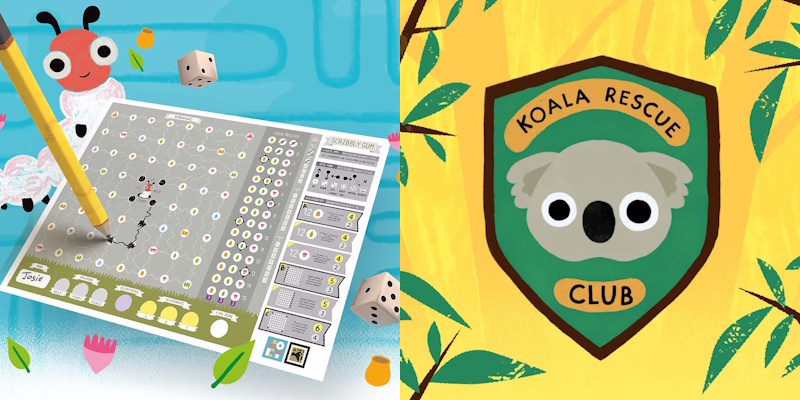
My odyssey through Postmark’s catalog of single-sheet print-and-play games continues. This week’s titles are none other than Scribbly Gum and Koala Rescue Club, both designed and illustrated by Phil and Meredith Walker-Harding.
You can tell we’ve reached the really good games when I’m covering them two at a time. Although this makes for a good twist, because one of them is pretty dang solid. For babies. I mean that in a good way.
Scribbles!
Scribbly Gum
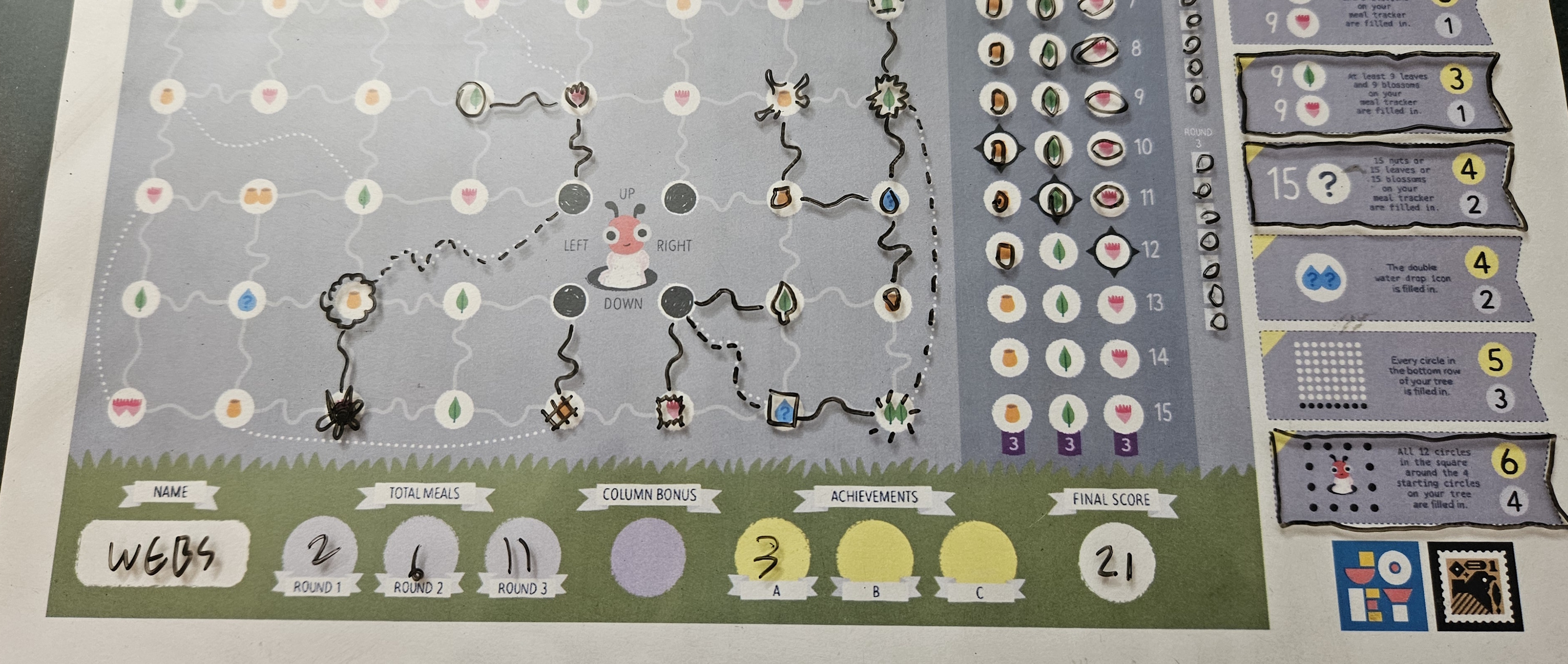
For those of us who slept through botany class — huh? this school offers botany? — Scribbly Gum refers to the Eucalyptus haemastoma tree, whose colloquial name is derived from the lovely “scribbles” left behind by the chewing of the Ogmograptis moth in its larval stage. In this one, you’re chewing this way and that through the tree’s soft bark to secure meals that will permit you to grow from non-lepidopterophobia-triggering larvae into the Ogmograptis‘s hideous adult form.
The concept couldn’t be simpler. You roll two dice, then choose one of the results to permit movement. The rubric is straightforward. A roll of one lets you move up, two moves you down. Three and four correspond to left and right. Five, meanwhile, lets you follow a rare dotted line, usually forging a shortcut. Sixes are dead rolls, but don’t worry about rolling two of the things, because any double is a wild move that lets you go anywhere.
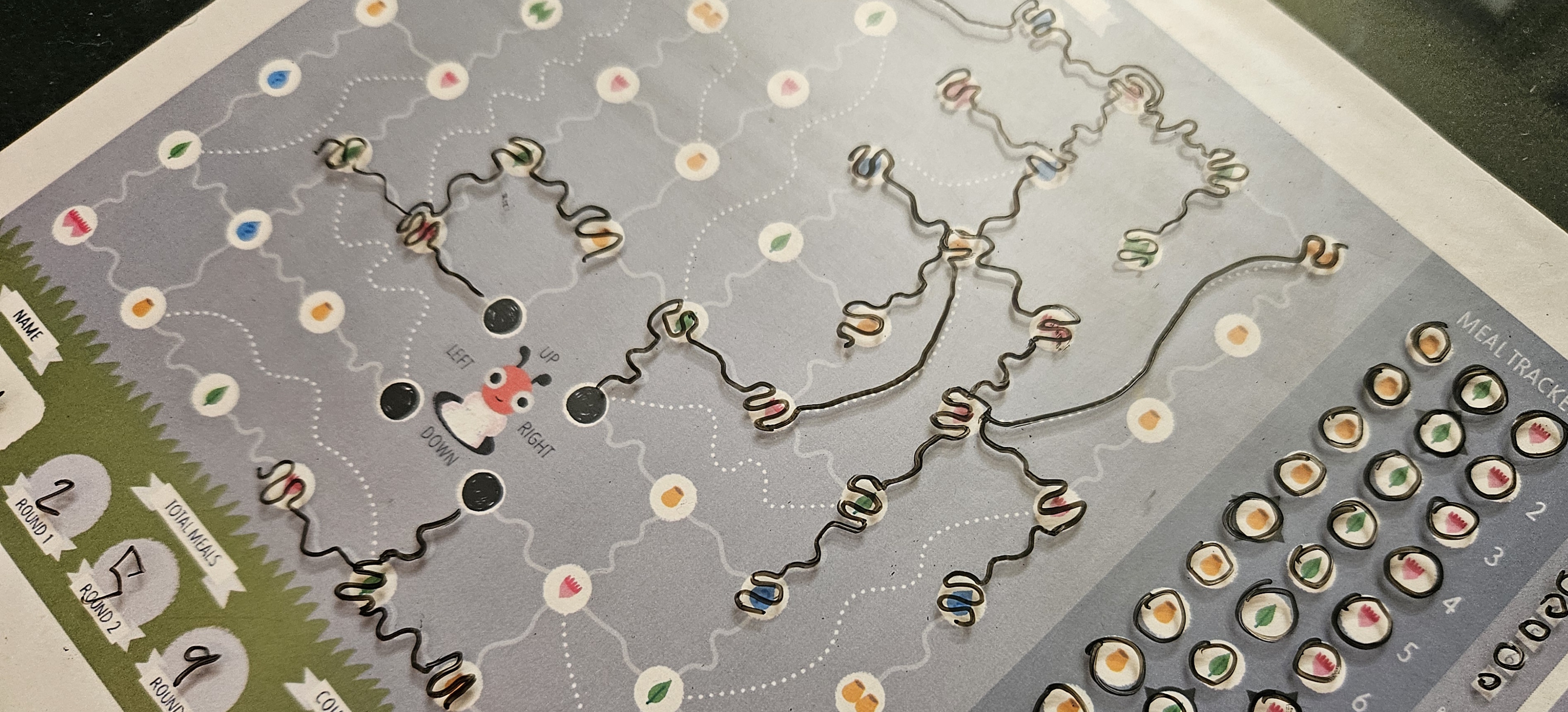
Turns, then, consist of rolling dice, choosing a direction to move, and securing the nut, blossom, leaf, or water in the space you just reached. Little by little, you spread across the page, leaving behind cutesy scribbles.
There’s a little more to it than that, but not by much. Certain spaces on the food track permit extra moves, and there are optional scoring bonuses for meeting little thresholds. These vary by map, but they usually conform to “eat a certain number of blossoms” or “chew up every space on the left side of the sheet.” It’s simple stuff. Baby’s first roll-and-write.
Even more scribbles!
That might sound like faint praise, but when I used Scribbly Gum in its intended fashion by plopping it in front of my twelve-year-old, she was so charmed that we played all four maps in a single sitting.
Now, she isn’t quite a baby, and this isn’t her first time around the block. She’s played a few games of this ilk before. Paper Dungeons is a favorite, and her official review of Flip Pick Towers was “It’s like Paper Dungeons but not as good.” Reasonable marks coming from her.
But Scribbly Gum caught on because its rules are so darn simple that they get out of the way almost immediately. Which in my daughter’s case, meant she could get down to the serious business of triggering free actions with alarming frequency. Oh, and making her scribbles nice and cute.
This is a minor offering from Postmark, especially compared to its opening trio by Rory Muldoon and Matthew Dunstan. But it’s a pleasant minor offering, a gentle experience that doesn’t burn brains or exclude the little ones. While I’d rather tackle the seas, whether above or below, or a scenic hike, it wasn’t as though I begrudged my time in the presence of these squirmy art-bugs.
Those koalas, on the other hand…
Saving some horrible koalas.
Koala Rescue Club
Koalas are horrible creatures, their natural cuteness belying some truly awful biological processes that I shan’t elaborate here. Koala Rescue Club dresses you into the high-visibility vest of a volunteer planting eucalyptus trees and rehoming the little guys, which would be a wonderful objective if the game weren’t so dull.
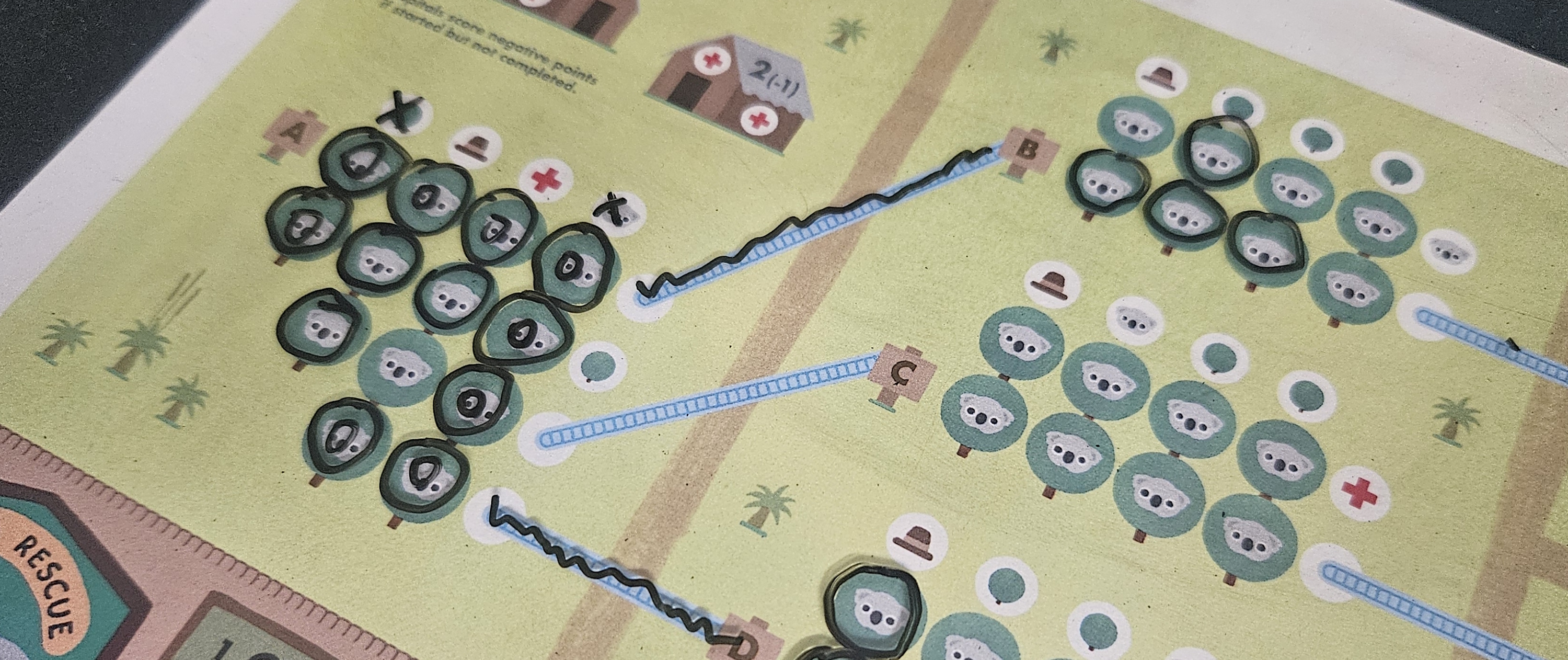
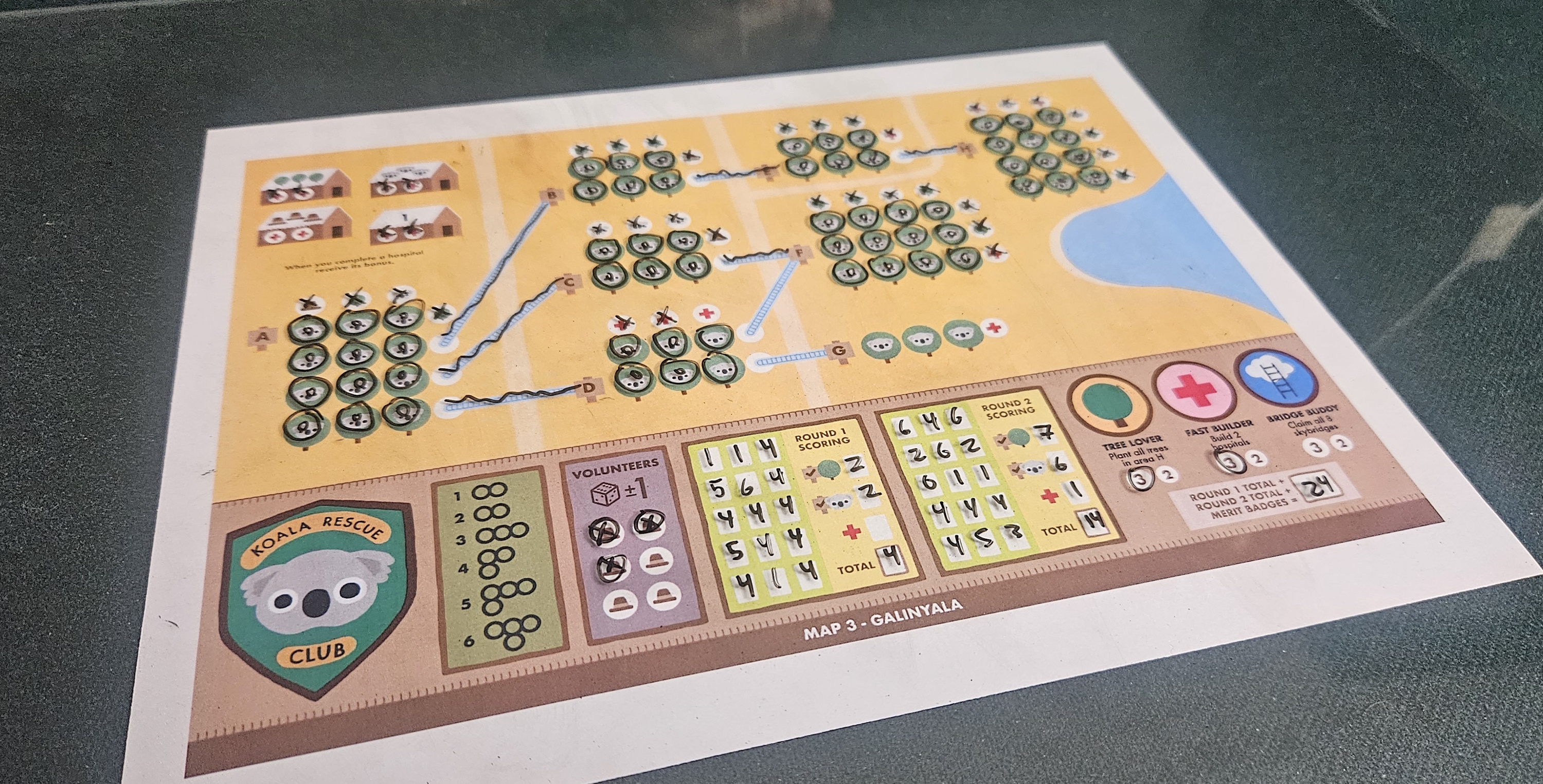
This is, once again, a game that opens each turn with a rolled die, although here that roll signifies which shape you can place on your sheet. It’s polyomino placement, in a sense, with the caveat that you’re really placing each shape twice. Once for the trees, another time for the koalas who will dozily munch their leaves. This results in tidy rows of circles: a big one for the tree itself, a smaller one within the tree for the koala.
As with Scribbly Gum, there are bonuses to be chased. Filling a column or row with koalas awards a perk. Extra trees and koalas are the norm, useful for filling in spaces earlier left blank. Volunteers allow you to adjust the value of the roll. Skybridges travel across the road to neighboring eucalyptus groves. And koala hospitals earn points. Or in the later maps, trigger bonuses of their own. Optional merit badges offer a few extra points for, say, planting all the trees in Grove C or building all the skybridges.
Like all of Postmark’s productions, it does look nice.
Koala Rescue Club is suitably cute, but the problem is that it isn’t very interesting. In the opening turns, before you have volunteers for adjusting rolls or extra groves for placing any larger shapes that won’t fit among your starting trees, you’re more or less beholden to the roll of a single die. This makes the early stages listless, like one of those games where everybody takes a matching move in the opening turn or two.
Affairs improve as more options are unlocked, but not so much that it often feels like you’re being confronted with hard tradeoffs. The shapes are so simple that matching them into a space is generally a trivial task. The merit badges are unexciting and nearly always repeat themselves. Even the possibility that this might be used as an educational game is somewhat let down by the two-layered shape placement. Where Scribbly Gum could pass for baby’s first roll-and-write, I harbor doubts about Koala Rescue Club.
The upside, I suppose, is that in solitaire it’s a nice enough way to kill a few minutes. Unlike most of the Postmark catalog, where the solitaire mode comes across as an afterthought, here it seems like the right way to play. Maybe that’s because my twelve-year-old declared it boring after one play and insisted we tackle Scribbly Gum again. Still, my few solitaire sessions were markedly more enjoyable than watching her put her head down on ink-marked plexiglass.
In other words, Koala Rescue Club needed rescuing. But who rescues the koala rescuers? I dunno. I just needed an outro.
Access to the files to print Scribbly Gum and Koala Rescue Club was provided by the publisher.
(If what I’m doing at Space-Biff! is valuable to you in some way, please consider dropping by my Patreon campaign or Ko-fi. Right now, supporters can read my first-quarter update of 2026: the best board games, movies, books, and more!)
The Isle of Cats designer Frank West has unveiled a new game set in the same universe as his bestselling polyomino-puzzle title, saying the project was shaped by lessons learned from more than a million recorded plays of the original.
Isle of Cats creator Frank West
The Isle of Penguins, which launches on Kickstarter on July 7, sees players rescuing the sea birds from melting ice floes and fitting them onto uniquely shaped rafts, in an experience West says is faster and more accessible than The Isle of Cats while retaining its strategic depth.
West, who runs publisher The City of Games, told BoardGameWire The Isle of Cats had now surpassed 250,000 physical sales since it was released in 2019 – a figure that rises to almost half a million when including spin-offs The Isle of Cats: Explore & Draw, The Isle of Cats Duel and digital versions of the game.
He said the design for The Isle of Penguins emerged after six years of analysing data from digital versions of The Isle of Cats, as well as player feedback from across Kickstarter and YouTube video comments, social media discussions and BoardGameGeek reviews.
That data amounts to more than one million plays across the digital versions the game – information West says he has used to create a game that plays 20% to 30% faster than The Isle of Cats standard mode, while also giving players more to do.
He told BoardGameWire, “I think my main takeaway was that The Isle of Cats is a great game that is loved by a lot of people – It didn’t need fixing. But, there are things that could make the game more accessible to some people. I wanted to design a game to sit alongside The Isle of Cats, rather than replace it.”
The Isle of Cats || Photo Credit: The City of Games
West said major changes include a new selection system which allows for simultaneous play, most scoring happening during the game rather than at the end, and a drastic shift to the complexity of the polyominoes themselves.
He said, “One of the unique parts of The Isle of Cats when it was released was the complexity of the cat tiles themselves. They use less common shapes and can be very tricky to place, which is great.
“However, some players struggle to flip tiles in their head or visualise how something might fit, and the complex shapes in The Isle of Cats made this challenging for them. This was a key part of the game, and I spent many years working out how to flip the experience.
“In The Isle of Penguins, every penguin tile is a square or a rectangle. These are the simplest shapes, and much easier for people to visualise and rotate in their heads.
“But the raft board you are placing them on is far more chaotic, with many restrictive areas, which makes finding the right place to put a tile just as hard.
“Effectively, this flips ‘hard shapes and a simple board’ into ‘easy shapes and a complex board’.”
He added, “I have been thinking about a lot of these things for a long time, but when I managed to flip the polyomino experience with the raft board, and found a way to make simultaneous play work, I realised I had something exciting.”
The Isle of Cats || Photo Credit: The City of Games
West said that streamlining of the game allows players to do more in less time, without reducing decision making – and added that the title would retain Isle of Cats’ inclusion of both a family mode and standard mode, in addition to a new expert mode for the new game.
He said, “This keeps the entry point of the game as friendly as possible, while offering something more to veterans of The Isle of Cats looking for a step up.
“It was important not to assume that just because someone has been playing games for years, they would now want something more complicated. But I also wanted to make sure there was something there for those who did want it.”
West confirmed to BoardGameWire that the new game would be illustrated by The Isle of Cats artist Dragolisco, saying, “I wanted to ensure The Isle of Penguins looked familiar to those who loved The Isle of Cats, and I think he is a great artist. He did a fantastic job!”
Hybrid physical and digital game console maker Board has raised another $20m in venture capital amid plans to launch an AI-powered game design platform.
The new funding round, which was led by Union Square Ventures, means Board has now raised $35m in external funding since the touchscreen device was launched in October last year.
That launch was accompanied by a suite of 12 initial games, including Omakase from veteran board game creator Bruno Cathala, which make use of physical pieces that interact with the digital board.
The company claims thousands of developers are starting to create games for Board using its software development kit, although it is yet to publicly announce any tie-ups with existing board game publishers or other designers.
Alongside the funding announcement Board said it would unveil an AI platform later this year which will allow users to build their own games using natural language prompts, saying taking a game from idea to playable prototype can be done in less than an hour.
Strata, one of the game designs currently playable on Board || Photo Credit: Board
Mignano said, “I grew up playing Nintendo and Super Nintendo, huddled around my living room CRT television with my sister, parents, friends. As I grew older, and the technology changed, so did my habits, and my gaming turned inward. I transitioned to Warcraft on my PC, and eventually to casual games and The Battle of Polytopia on my iPhone.
“But now I’m looking for reasons to put away my phone and be present with others. I’m attending more live sporting events and concerts than I have in my entire life. And instead of playing a console game by myself on a late Saturday night, my family and I are playing board games and card games around the dining room table.
“It’s not just me: both live events and board games are on pace for record years in 2026, with each market continuing a multi-year climb to all-time highs. This is the shift we keep coming back to at USV: even though we’re still addicted to our algorithms and group chats, people want ways to have fun with their friends in person.”
That business shuttered in 2024, however, with CEO and co-founder Shail Mehta saying the company never managed to overcome the lag and inconsistency in its touchscreen tech to allow for a mass consumer release.
Games in that device’s library included Terraforming Mars, Viticulture, Downforce and Steve Jackson’s 1977 debut game Ogre.
Update 22/6/26 – this article originally referred to Bruno Faidutti as a designer of Board’s first suite of games, when it should have read Bruno Cathala. Sorry Bruno(s)!
I wouldn’t wish to inflict board game drama on anybody who wasn’t already saturated in the stuff, so I’ll keep the details sparse, but the past couple of weeks saw a minor authority figure on BoardGameGeek sharing his views on demonic possession with a potential customer. I try to stay away from such dust-ups, but I found myself compelled to weigh in. My resultant post discussed the textual development of an adversarial spirit in Judaism and Christianity and made an impassioned plea to anyone basing their decisions on the existence of otherworldly beings.
Over the coming days, I heard from a number of people. Some had been touched by what I’d written. Others were just glad to have encountered something informative on the internet. One or two were offended.
But what stood out to me the most were those who had, like me, encountered “demonic possession” in the wild. Not the real thing. Not actual demons clawing their way through the cracks in the world. I’m talking about the excuses, usually offered by pastors, who couldn’t explain some phenomenon, but who needed to be the authority figure on everything. The undiagnosed illnesses. The non-mainstream gender orientations. The people who wanted nothing to do with the good news.
Playing Martha McGill’s Witch Hunt 1649, it was impossible to not mull over those thoughts all over again. It was impossible not to think back on the time I met a witch.
Living my worst life.
Statistically, you’ve already assumed that I’m talking about a woman.
Witch Hunt 1649 isn’t about the witch hunts that dominated my schooling. Those were New World witches, the result of mistrustful Puritans living on the edge of a world that seemed immune to their understanding. McGill’s telling predates Salem by half a century and takes place far across the sea. In the same year that Charles I lost his head and Oliver Cromwell prepared the New Model Army to march northward, villages in Scotland reacted to their uncertainty the same way that countless communities had done before: by blaming the women they didn’t like very much.
There were men witches, too. Not many. Just enough to ensure that nobody was above suspicion. Of the 3,800 Scots accused of witchcraft, eighty-nine percent were women.
In the game, the figure is similarly skewed. At the start, everybody receives a character to embody. These cards offer only a few tidbits. A name. A woodcut illustration. A once-per-game special ability. And a small blurb that explains why these people are subject to suspicion. There’s Elspeth, who once nicked some nice linens. Agnes, who knows which herbs might ease a fever. Bessie, whose primary sin is that she’s a bit lazy. Janet, isolated after cutting the sheep-stealing cousins out of her family. William, who loves a ribald joke. Helen, over-eager to share her conversion experience with her neighbors.
Ordinary people, in other words. To most of us, it would be their neighbors who seemed too buttoned-up. Too prying. Too obsessive about the minutiae of everyone’s lives. Too willing to fling an accusation that might get one of their neighbors strangled with a cord and their stake-bound body charred to ashes.
Of the fifteen character cards, eleven are women. Seventy-three percent. If anything, Witch Hunt 1649 short-sells the divide.
Fate cards present ethical conundrums between suffering and suffering a different way.
As a game, Witch Hunt 1649 is a simple thing. That’s to be expected. Published by Central Michigan University Press, this is closer to an educational tool than a hobbyist product. Like Greg Loring-Albright’s Keep the Faith from the same imprint, there’s an element of role-play, with most turns consisting of a single card-flip. This card presents some stroke of ill fortune that has befallen your character. Chronic headaches. Extra tithes. A cousin’s hasty marriage. The rumor that you’re a closet Catholic. You’re allowed to choose how to respond to these misfortunes, but there’s no such thing as coming away richer. Every choice is a Sophie’s choice. Waning physical welfare, waning standing in the community, or waning material goods. After a while, you begin to wonder why anybody bothers trying to be good.
The one respite is that you’re still here, still alive, still capable of improving your situation. You take the card fate has dealt you and acquire something from the market. Like everything else in Witch Hunt 1649, these are meager possessions. Your goal, apart from survival, is to accrue enough to place yourself in high society. Higher society. One sickle and pair of shears at a time, one cow-shed and kiln, you construct a life.
As often as not, those possessions become anchors. That Bible improves your standing in town, but you might have to part with it to support the local poor. The local poorer. That basket helps you carry more fish from the stream, but it hurts all the worse to lose it. Other items, like creepy rams, are liable to trick some farmer into thinking they’re striking a pact with the devil. When the trial begins, everything becomes potential evidence.
The witch-trial is the centerpiece of the game. As soon as you have three black marks, you’re dragged before a council of fifteen propertied men and put to the test. Black marks, it must be noted, have nothing to do with your choices; either you gain them or you don’t, entirely irrespective of your decisions. They’re also drawn face-down. When the trial begins, you have no idea of the substance of the accusations against you. At times, they’re as harmless as a rumor. Other times, they’re as damning as a rumor.
To secure an acquittal, you spend your meager health, your meager reputation, your meager possessions. You try to persuade your friends and family to stand by you. You’re well aware that these are hard requests. If you’re found guilty, your relations will also stand trial. It isn’t until the accusations are revealed, flipped one by one, that your fate becomes clear. Even then, survival is only momentary. There’s nothing preventing you from being dragged before the council at a later date, no matter how much of your property you’ve parted with, no matter how many teeth you’ve lost to the stress.
Accrue three black marks and it’s time for a trial.
For the first few years after I came home, it wasn’t uncommon for someone to ask if I’d seen any demonic possessions out there. Possessions or skinwalkers or witches, anything like that. I’d served a portion of my two years as a Mormon missionary among the Crow Nation, and people were always quick to note how “Those folks are more spiritual than we are.”
In this case, “more spiritual” meant more susceptible to the beings that dwelled on the other side of the crack in the world. Spirits, demons, angels. Beings we never saw as white folk. Beings that only seemed to gather around those with brown skin, on land they’d been planted on by the government, or else in faraway places where people still practiced cannibalism and wife-burning and whatever else.
Whenever anybody asked the question, I thought about the witch.
I first heard about the witch from a guy in Hardin, the half-white, half-native port town on the edge of the reservation. We were set to baptize a man. Crow. Maybe already a member of the church, but records were spotty. On the scheduled day, he didn’t show up. “He was probably called away by that witch,” the guy said. I laughed, but he insisted that, no, he was being serious. “He’s taken up with a witch,” he said. “Those folks are more spiritual than we are. We can’t hear their call because we aren’t as spiritual,” he said. “We,” he said, meaning white folk. I asked if we should go find him. Find him and help him. If he was under thrall to a witch, surely that meant he needed us more than ever. Needed Jesus. Needed baptism. Needed something. “No, there’s nothing for it,” he said.
A mile or so outside Hardin.
I returned to the Crow Nation many months later, after many people had asked me about the spiritual folk out there, about whether I’d seen any possessions or skinwalkers or witches. It took some phone calls, but we found the witch’s address. We hopped in the truck and took off, the missionaries who now lived on the rez seated in front, talking excitedly about how they’d exorcise the witch’s demon or dust off their feet against her house.
When I met the witch, I was surprised. Not because she was a woman. (Eighty-nine percent of witches are women.) It was how ordinary she seemed. Her trailer looked like the other trailers that dotted the rez. Her dogs barked like the other dogs that barked on the rez. Her wind-chimes chimed like every other set that chimed on the rez. I asked if she’d seen our man. The one who’d skipped out on his baptism.
“Sure,” she said. “He comes around when he’s trying to get off the meth. He stays a few days, sweats it off, then he goes home again.”
Oh. Well. It wasn’t true, then, what I’d heard. Someone had told me she was a witch. Ha ha, what a mix-up.
“Sure,” she said, laughing brightly and rubbing at the sunspots on her forearm. “I’m a witch. I’m a witch at helping people get off the meth.” Then she told me about her degree in nursing, how the learning had come naturally. How she’d worked for years in addiction recovery. How she was, indeed, an actual witch, with a power for curing people of their killing habits.
On the drive back, as we talked about our encounter with the witch, two of the other missionaries bubbled first with excitement, then with righteous upset. We hadn’t done anything. No denunciations had been leveled. No demons had been cast out of their hosts. One told a story about how a devil had once held together a person’s broken leg, then the prophet had cast the devil out. This caused the leg to break again, because evil magic sometimes imitates good things. “We should go back,” he said. “No way,” his companion shot back. “What if she uses Satan’s priesthood on us? You know they’re more spiritual than us.”
I didn’t say much. Between this and my previous visit to the reservation, I was starting to harbor some serious doubts about the shape of the world. There was a crack in it, all right. A crack that ran right through it. But the crack wasn’t what I’d been told. It wasn’t us on the one side and evil spirits on the other. It seemed to me there were good people all over, lots of them, some with addictions or problems or sicknesses, and some who wanted to help. And then there was us. The people in the white shirts and ties. Telling stories about everyone else. Trying to square them so they looked the way we wanted. And then, when they wouldn’t be squared, pretending they must have widened the crack to the other side and beckoned something ugly into themselves.
I do want a nice box bed.
I no longer believe in witches any more than I believe in teenage boys being sent by Jesus to proclaim the restoration of an everlasting gospel that keeps changing on itself. But I do believe there are demons out there. There’s nothing supernatural about these demons. They look like us and dress like us. They eat our favorite foods and watch our favorite reality shows on television. They do pretty much whatever they want to do, and then they come up with compelling reasons why they were in the right to do it. Those are normal enough behaviors, but the way to tell a regular person from demon, I suspect, is that a regular person might come up with a reason why they were a good fit for nursing school. A demon, on the other hand, explains why they’re the chosen one who’s been endowed to save the world from itself. Whether anybody wants it or not. Whether they have to bind a person to a stake and flick a torch into the straw.
Witch Hunt 1649 pulls a lot of weight for such a small game. It shows how insular communities can curl in on themselves until they sour and curdle. It examines how people on the margins, women especially, become scapegoats for no greater sin than being marginal. It preserves the memory of the crimes against those people rather than letting us forget the cruelties we can unleash on our neighbors.
But for me, mostly, it gets me hoping that the only witch I’ve ever met has helped a bunch of people with their methamphetamine addictions.
A complimentary copy of Witch Hunt 1649 was provided by the publisher.
(If what I’m doing at Space-Biff! is valuable to you in some way, please consider dropping by my Patreon campaign or Ko-fi. Right now, supporters can read my first-quarter update of 2026: the best board games, movies, books, and more!)
I’ve been hoping for some time now to get my hands on this extra stuff for S.T.A.L.K.E.R. The Board Game, and the wonderful people at Awaken Realms were kind enough to send me the goodies I didn’t get the first time around. So here’s an unboxing of the miniatures packs, terrain pack, stretch goals and expansions for this excellent game of survival in the irradiated Zone!
Making high quality tabletop gaming content at the EOG takes time and money. Please consider becoming a Patreon supporter or making a donation so I can continue this work! Thankyou!
Board game giant Asmodee’s strategic push into crowdfunding has passed its first major test, with its debut campaign in the Zombicide universe raising more than $4.1m on Gamefound.
The buyout came a month after Asmodee had hired ex-CMON COO David Preti – the architect of the latter company’s growth into one of board gaming’s biggest crowdfunding-focused publishers – to head up its own newly-launched crowdfunding and miniatures strategy.
Asmodee had not publicly discussed details of its crowdfunding strategy ahead of completing the Dead Men Tales campaign, but said in a press release celebrating that success that crowdfunding “gives publishers clearer demand visibility, a direct line to engaged communities, and a healthier financial setup – with production sized to actual demand rather than to forecasts”.
It is thought FFG may resurrect Descent through a crowdfunding strategy in the future, although it is yet to confirm or deny this, saying in April, “While we don’t have anything to share at this time, there is always a possibility that we will revisit Descent in the future. It would take a different form and would not be Legends of the Dark, but this game universe is near and dear to FFG’s heart.”
Asmodee CEO Thomas Koegler said of the Dead Men Tales crowdfund, “This first campaign means a lot to me, and I think it sends a clear signal.
“Zombicide is a beloved franchise that joined the group less than a year ago, and Dead Men Tales is already proving the model works: the original Guillotine Games team back at the helm, Fantasy Flight Games executing the campaign with remarkable skill, and a community of more than 11,000 backers who chose to trust us early.
“That trust is something we take seriously. There’s still careful work ahead on delivery, a crowdfunding campaign is only as good as what arrives at your door, but I have full confidence in our teams to see it through.”
Dead Men Tales was the latest Gamefound campaign to make use of the platform’s Endgame feature, which is designed to extend the final moments of campaigns that are still actively receiving pledges even as the original countdown ends.
The Dead Men Tales campaign had collected more than $3m by the end of the official crowdfunding period, but Endgame extended the raise by more than five extra days and about $1m due to new pledges consistently being made.
Prior to Dead Men Tales, the only previous crowdfunding campaign from an Asmodee-owned company was Lookout Games’ Kickstarter for the Grand Austria Hotel: Let’s Waltz! Expansion & Deluxe Upgrade, which raised about €383,000 during the coronavirus pandemic in 2020.
Asmodee’s only other direct exposure to crowdfunding is thought to be via the company Exploding Kittens, in which it made a strategic investment short of a buyout in 2021. That business has since raised more than $977,000 in a Kickstarter campaign for Hand to Hand Wombat.
Asmodee’s own board game publishing operation, meanwhile, saw its net sales fall 5.8% in the last financial year – while net sales for the first quarter of this year were down 9.8% compared to the same period in 2025.
It wouldn’t be an exaggeration to call Steven Aramini one of our hobby’s finest designers of small-format board games. Whether we’re talking about microgames like Sprawlopolis and Ancient Realm, or Fliptown, still perhaps the finest flip-and-write game ever designed, Aramini has a keen talent for compressing big ideas into small packages.
Flip Voyage, then, is his followup to Fliptown by way of Nemo’s War — although in a rare Aramini miss, this one surfaced too quickly and contracted the bends.
We all live on an ordinary blue submarine.
If you’ve played Fliptown, the basic conceit behind Flip Voyage will be familiar, if perhaps also baffling in its pared-down nature. Like that game, Flip Voyage is a combo-heavy flip-and-write that sees everybody at the table — whether one player or fifty, with the box providing enough dry-erase boards for four — turning three cards at a time from an ordinary deck of playing cards. Everyone uses that trio according to their own individual goals and position, and then, after awkwardly signaling to one another that they’re done, moves onto the next set. For our signal, my group has taken to sticking up a thumb. That or asking Geoff whether he’s wrapped up his turn, because eighty percent of the time he’s the last one anyway.
In Fliptown, the template was straightforward enough, while still offering a range of options. You would choose one card for its suit, to indicate which of four activities your cowboy would undertake that turn. Another card offered up its rank, setting the strength and/or destination for that activity. The final card became part of a poker hand, an ongoing bid to earn extra points and cash at the conclusion of five flips. Since everybody knows poker hands, from movies if not from personal experience, the relative value of each splay was given an intuitive value.
Three cards are revealed at a time. How will you use them?
This time around, the value of any given card is more wishy-washy.
For one thing, there are no poker hands. That’s fine. Fliptown was a cowboy game. Per contractual obligation, every cowboy game must feature poker. Flip Voyage, though, is about journeying under the sea in a submarine based on Captain Nemo’s / Jules Verne’s Nautilus, undertaking such anti-colonial activities as sinking imperial vessels and liberating captives from slaver camps.
As such, while two of each round’s three cards are spent undertaking those activities, that final card is instead used to travel across a simple grid map. These journeys are both critical, setting the tone for each trio of cards, and somewhat disappointing in their straightforwardness. Certain spaces award stars — points, basically, here called “notoriety” — while others incur damage to your vessel. Various lines can be crossed to earn resources, and there are ports where weighing anchor earns you a free action in one of the game’s four suits.
The gist is that you take your chosen card’s rank and travel that many spaces, generally steering across stars, avoiding damage, and ensuring you halt in a spot that will permit one of those free actions. Meanwhile, criss-crossing the map is a surefire way to earn extra resources, but you’re also lightly incentivized to keep your journey pacey thanks to a “most efficient” award doled out at the end of the session. Coal is expensive, I suppose.
Charting your course.
Perhaps I would have felt more kindly toward Flip Voyage’s voyaging had I not recently played threedifferenttitles that handled navigation so much more cleverly, but the map is never as interesting as it could have been. Damage is easily avoided, while the ease of pulling U-turns and adjusting your current range with a spent resource both serve to eliminate any hard decisions. For the most part, the toughest part of navigation is remembering to tally how far you moved on the score track.
The activities, meanwhile, are considerably easier than those found in Fliptown. There’s a tonal quality to the distinction. In Aramini’s former game, each activity was pitched as a wager, requiring players to decide how far they wanted to press themselves in an attempt to secure greater rewards. By contrast, the activities in Flip Voyage are considerably blander.
As before, there are four, each corresponding to the deck’s French suits. Using a heart takes you to the science lab, where you must fill beakers in rank order. Next door is the warfare track, where spending cards will punch holes in imperial warships, either earning salvage or damage. Diamonds are for adventure on the ocean floor to retrieve treasure or damage. And clubs are for raiding slaver camps, liberating new crewmates or, again, taking damage.
Sink to the bottom… without me.
If you couldn’t tell, there’s a lot of taking damage in Flip Voyage. Three of four activities will ding your Nautilus Jr. in some way or another, and there’s no skipping a turn to loot graves like in Fliptown. This has a flattening effect on the game. There are fewer peaks and troughs than before. Instead, you’re usually guaranteed some upside to go with your downside, or vice versa. A resource here, a scratch there, bit by bit, until the game concludes and everyone tallies their score.
There are upgrades to consider, little perks that adjust your activities. Some are formidable, like the serrated rakers that encourage you to steer into damaging spaces on the map or the super propeller and ramming prow that earn extra resources from their related activities. But a number of upgrades are surprisingly dull. Oh, the dredge lets me turn crew into salvage? The library turns salvage into research? Sorry, I nodded off. I hate to keep resorting to contrast, but these are a far cry from the shops and hotels of Fliptown’s tumbleweed town.
It’s possible to consider these alterations in a generous light. Fliptown had moments of profound chance, especially when two players attempted to, say, rob a stagecoach on the same turn, an endeavor that required both highwaymen to draw their own card to determine their success. Flip Voyage is less beholden to Lady Luck. Apart from the trio that opens the turn, there are no flipped cards here. I’m sure there are those who prefer their flip-and-writes to limit their luck to inputs rather than outputs, to borrow Geoff Engelstein’s delineation between flavors of chance.
I’m not one of those people. The beauty of Fliptown was its willingness to allow both modes. You could push your cash into the center of the table by sticking up trains, speculating on land, and chasing bounties. Or you could keep to safer trails by mining gold, riding duster, or robbing corpses. Even without the inclusion of random outcomes, there was so much to do that every session felt like a fresh adventure. After about one and a half plays, Flip Voyage has shown all it has to offer.
Ahh, a marked-up board.
Still, the process of filling in the board is enjoyable enough. That’s some faint praise, I know, but it would be a lie to say that this game is devoid of its pleasures. Figuring out how to put those cards to use is still a strong core for such a game.
But twenty thousand leagues is a great distance to cover under such pressure, and this hull has sprung more than a few leaks. There are plenty of better options, including many designed by Aramini. To quote Captain Nemo, “Oh Almighty God! Enough! Enough!”
A complimentary copy of Flip Voyage was provided by the publisher/designer.
(If what I’m doing at Space-Biff! is valuable to you in some way, please consider dropping by my Patreon campaign or Ko-fi. Right now, supporters can read my first-quarter update of 2026: the best board games, movies, books, and more!)
The UK Games Expo has continued its meteoric growth into one of the world’s largest tabletop gaming conventions, after more than 51,000 people descended on Birmingham’s NEC for the show’s 20th anniversary.
That turnout is more than double UKGE‘s pre-pandemic record for unique visitors, and saw overall footfall reach almost 88,000 across the three-day show, which ended yesterday.
The surging visitor numbers – up 64% in just three years – mean UKGE is now pushing steadily towards the 70,000-plus visitors recorded by giant US tabletop convention Gen Con each year since 2023, and is more than two and a half times larger than last year’s Origins Game Fair.
Almost every exhibitor BoardGameWire spoke with at this year’s event reported sales activity ranging from “very good” to “record-breaking”, while one mid-size publisher added that they were delighted at how smooth the organisation was, compared to logistical and set-up issues they had previously experienced at shows including Origins and Spiel Essen.
Tycoon Games CEO Dan Yarrington
Dan Yarrington, the CEO of Everdell publisher Tycoon Games, had a small presence at the show for the first time this year as part of a shared booth, following a fact-finding trip to the event in 2025 – and told BoardGameWire his company would probably return with its own stand in 2027.
He said, “At this level, at 40,000 plus people, and with the buying that we see… my impressions of the show were that, ‘Hey, this is actually a good show’. People are buying stuff, and it’s a different market. This is especially important in the global climate that we’re in, where people are less likely to travel to various other places.”
Yarrington added that in addition to selling its existing titles, UKGE would likely act as a preview show for the publisher, with new releases more likely to appear at Gen Con and Spiel Essen to feed into the company’s fourth quarter.
He said, “At this [UKGE] we had the Everdell Journeys preview copy – it’s not even on Kickstarter yet, so we can be like, ‘hey, come play it, and then tell us what you think’, we can adjust things, and then ‘hey, sign up for the Kickstarter’ – but Journeys won’t release till Gen Con [in 2027], so I think that’s what it’d be, a good process for us.”
Other exhibitors planning to expand their UKGE presence next year after a successful show included small-scale UK publisher Minerva Tabletop Games, which teamed up with three other members of the Playtest UK design group this year to run a combined booth.
Minerva founder Scott Lowe-James told BoardGameWire, “I don’t want to say this is definitely happening, but this was a test, and I think we could easily do like four or five times bigger than this”, citing Allplay‘s large demo area and single shop front as a potential model to replicate.
He added, “We’re all here already, and we’ve all got our own stands, but with that comes volunteers, accommodation costs, logistics. Whereas [by collaborating] we’re able to keep costs down, which is really important for one person, two person teams in being able to support each other where we need. And also we get greater exposure, so the rising tide lifts all boats.”
Scott Lowe-James, centre, with other members of Playtest UK at their UK Games Expo booth
In terms of advising other smaller publishers thinking of attending future UKGEs, Lowe-James said, “I think if you can work with someone, then then do it.
“[UKGE] has the great incentive of the starter stand, so you get a discounted rate, and that is good. But the leap up [from there] is quite a big one, especially if you are a first-time publisher, because not only does the rate increase, but the minimum size increases – and with that comes you need to find people to volunteer, and so other costs increase as well.
“So if you’re able to, find people either with similar games or people that you know. The fact that we’ve been able to support each other, cover each other’s games, I think you also get that tighter bond.”
He added, “Next year we could have, like, 15 different games across different themes and different ways to appeal to people. And I think it’s definitely the way forward.”
James Naylor, the CEO of UK publisher Naylor Games [a BoardGameWire sponsor], said that in addition to a good year for sales, it was notable that more families and attendees relatively new to the board games hobby were filling out the show floor each year.
He told BoardGameWire, “I’m really glad to see that, actually, because there was a little bit of time a couple of years ago where it felt like – maybe it’s just my perception – that perhaps the whole show was becoming more of a kind of ‘turbo nerd’ RPG show.
“…maybe that’s just because that was a peak of RPG popularity or something, and I’m glad to see instead it’s reaching out to a wider audience.
“I want to see board games become more universal as a thing that people use to play face to face, away from screens. So, the more I see that wider audience, rather than just a very narrow hardcore, that’s better from my perspective.”
That rise in awareness of UK Games Expo, and board games in general, has been noticeable too in the run-up to the event, with coverage by national broadcaster the BBC both prior to and during the show this year.
The open gaming and tournaments hall at the 2026 UK Games Expo
Rob Trounce, trade marketing manager at UK board game retailer and distributor Zatu, said a highlight of the show had been BBC Radio showcasing co-op dexterity game Yubibo during its coverage.
He said, “It was kind of a shock to us, and I think it shows UK Games Expo going more mainstream as well.
“If it’s got the BBC and its radio channels talking about it, it shows that this isn’t just a space which is for us dyed-in-the-wool gamers anymore. It is for everyone, it is a mainstream thing.”
UKGE director Richard Denning, who co-founded the show in 2007, joked on social media ahead of this year’s show that the event had grown into something that had “frankly got a bit out of hand”.
UK Games Expo co-founder Richard Denning
The event has ballooned in size since the event first opening its doors in a Birmingham conference centre in 2007, attracting 900 excited gamers – a far cry from the 27,000 who attended Gen Con’s 40th anniversary show later that year.
Denning previously told BoardGameWire that even at that embryonic stage, he hoped the show could go some way to recreating the atmosphere of big name events such as Gen Con and Essen Spiel, albeit in a much-reduced form.
Speaking of plans for future shows, Denning told BoardGameWire there was still room for expansion in its current footprint, but added that the show may change things around next year in order to provide more space for events.
He said, “It is expanding, and we are tight on event space – hence the possible need for more. We have about 500 events. I am amazed how many events US cons get. I think we still want to see that grow.”
Addressing the show’s rapid growth, despite economic turbulence such as Covid-19, the impact of global conflicts and US tariff policy, Denning added, “It’s certainly been a roller-coaster. Even earlier there was the credit crunch of 2008, of course.
“I think whilst visitors may have smaller wallets at present they still want to attend events like UKGE. Folk will save for the weekend and set that a side as a treat to look forward to, I think.”
It’s been thirteen years since the original release of Jamey Stegmaier’s Euphoria: Build a Better Dystopia. I would say it doesn’t feel like thirteen years, but I’d be lying. Between the pandemic and five or six successive generations of board game iteration, it’s been an eternity. Long enough for a retrospective, certainly.
Speak of the devil. Euphoria: Essential Edition is a remake of the original game, plus some of the stuff from the expansions, minus a few love handles and splotchy moles. Let’s see how the old dystopia has held up after all these years.
The new board, not quite the same as the old board.
Short version, there’s rebar showing through the concrete.
As before, Euphoria is about your efforts to thrive in a dystopian society. Relatable. Maybe that’s why the intervening decade hasn’t flown by. But I digress. In Euphoria’s case, that dystopian society is divided into four strata, each offering different spaces for your workers to run errands. There are the Euphorians, folks who generate electricity by marching on hamster wheels, Wastlanders who labor in orange groves, Subterrans who pump water through the cracked bedrock, and Icarans… Icarids? Icaruses? Whatever. These guys cook future-meth for keeping everyone’s workers drowsy and compliant.
The status of those workers is never far from mind. At the time of the original game’s release, rolling dice to determine the relative knowledge of one’s workers was a clever touch. If nothing else, it functioned as one of the hobby’s earliest meta-commentaries on the blank slate that was the worker-placement worker. Roll too high, and one of your workers gets wise to the situation and flees from your grasp. Roll too low, and…
… and there’s no penalty for rolling too low. What you really want is to roll doubles. That way, you can spend some morale to place an extra worker, earning two turns in a single go.
Euphoria: meek in the streets, freak in the spreadsheets.
At the time of the original game’s release — there’s a phrase I’ll probably say more than twice — it was easier to overlook the chanciness of the whole thing. Sure, rolling high means losing a worker, and rolling doubles means earning a twofer. But rolling low, I suppose, means you can send a worker to one of the game’s resource production zones without worrying about them learning the shape of their culture. Except, wait, that’s another benefit for rolling low. Darn it.
Okay, so Euphoria is full of luck. Always was, still is. The problem isn’t so much that luck is the sole determiner of whether you succeed, but rather that it’s just enough to prove frustrating. As a genre, Eurogames included more chance in 2013 than they do today. Personally, I miss a bit of chance. But in general, those earlier forms of chance were about mitigation. Even placing towns in Settlers of Catan was about spreading around the odds so that you’d always earn something. In Euphoria, the system feels out of place, and not only among the determinists of 2020s nu-euros.
But let’s set that aside. How has the rest of the game borne the timelapse?
Again, the short version is that it works perfectly well, but never quite eases its grandfatherly creaks and groans. Most actions are tit-for-tat resource conversions. First you send a worker to a resource generator to earn one or two commodities. Then you send them to a tunnel to spend a commodity for a building block. Maybe you spend a wad of commodities for an extra worker. Then you build special markets, which let you exchange commodities, blocks, and artifacts for stars, the game’s victory condition. Repeat. Repeat. Repeat.
“Runaway workers” sure is a loaded term.
It doesn’t help that the Essential Edition sometimes comes across as more of a Pruned Edition. The board is more legible, but has shed the original map’s sense of place. Just look at that perfect goofball illustration. The new map feels like a spreadsheet setup for a spreadsheet game. Which is fine, as those things go. This is a resource-conversion worker-placement game, after all. You could even make the argument that this new edition has shed the original game’s pretense, including the ethical dilemma cards that, let’s face it, didn’t always add much to the game systems-wise. But, again, they mattered to Euphoria’s sense of place, the notion that players were being forced to compromise their values in order to get ahead. Thanks to the intervening years, a few subtractions, and this updated visual design, it’s easier than ever to see the wires and mirrors behind the illusion.
The remaining good parts are still as good as ever. For example, those markets. As before, building a market means spending a bunch of building blocks, not to mention putting your laborers in a holding pattern until other players join in. This created a certain degree of cooperation, one that could be turned against you at a moment’s notice. Having even a single worker hanging around at a job site is a real sacrifice, fostering opportunities for players to bicker and cajole. That’s great.
Furthermore, the markets themselves are nasty little things. When built, every player who didn’t contribute to its construction is forced to suffer a penalty until they pay a penalty at the new market. Sometimes these are negligible; other times they pose biting impositions that must be rectified as soon as possible. Or even both at once. The Theatre of Endless Monotony reduces how many commodities you earn, but only to a minimum of one. The Institute of Orwellian Optimism treats all your 1s and 2s as 3s when it comes to checking your dice for thoughtcrime. The Courthouse of Hasty Judgment makes it harder to spend artifacts for stars. That sort of thing.
This guy is a cool dude.
There are some real whoppers in there, too. In one case, we revealed the Apothecary of Productive Dreams. This market prevents some players from sending workers to Icarus. At all. Which effectively locks them out of a full quarter of the board’s spaces. Worse, buying into an already-built Apothecary requires bliss, the very same drug peddled by the Icaroopsies. Not only were some players locked out of Icarus territory, this locking-out was effectively permanent. Was this a fair turn of events? Hardly. But it was interesting. Textured, we might call it. Abrasively textured, sure, but it was refreshing to play a game that would offer such overt penalties rather than ensuring everything ran smoothly all the time.
Between these and the heaps of recruit cards, there’s always something happening on the board. Some market being constructed (or ruining your day), some recruit tweaking the rules to your benefit, some haggling over at the construction site. That’s all great.
The downside is that it never quite breaks free of its shackles. Board games have largely moved on from worker placement, at least in such a straightforward cube-pushing sense. And Euphoria always feels like cube-pushing. Every segment of its dystopia is more or less identical to its peers. The same resources exchange rates. The same methods for hampering one another. The same costs at the artifact markets. And now those four segments are placed side by side so you can see just how closely they align.
In a sense, the Essential Edition is a worthwhile experiment because it highlights just how far game design has come over the past decade. But it’s only a worthwhile experiment for me, a total sicko for how board games change and develop over time. For somebody looking to spend their hard-earned cash, there are better options out there. If I’m going to place dice-shaped workers and suffer random consequences, I’d much rather play Connie Vogelmann’s Apiary, and that’s limiting our selection to titles from the same publisher.
E:EE is full of little textures. Some of them are abrasive.
Because Euphoria has been left behind. By board games as an iterative artform. By our hobby’s collective taste in the role of chance. By an Essential Edition that leaves some of its most interesting ideas in the dustbin. By a culture that’s grown weary of dystopias.
Speaking only for myself, I think it’s time to tunnel through to the other side.
A complimentary copy of Euphoria: Essential Edition was provided by the publisher/designer.
(If what I’m doing at Space-Biff! is valuable to you in some way, please consider dropping by my Patreon campaign or Ko-fi. Right now, supporters can read my first-quarter update of 2026: the best board games, movies, books, and more!)
Battle Card is as apt as descriptions get. Designed by David Thompson and Nils Johansson, this is the fourth project in the Postmark Games lineup. Like its earlier peers — Voyages, Aquamarine, and Waypoints — this is a print-and-play title that can be produced with functionally zero budget. Unlike those projects, however, Battle Card is billed as a wargame on a single postcard-sized sheet.
That’s true enough. With a few dice and a smidgen of experience to help interpret the rules, Battle Card covers six engagements from the Second World War. And their format is indeed very small, highlighting some real resourcefulness on their designers’ part in compressing battles and even campaigns into ten-minute experiences.
But unlike those other titles, Battle Card is a mixed bag. I’ll give an example.
Rock on, Canada.
The second of Battle Card’s six scenarios sees Commonwealth forces waging a fighting retreat against Imperial Japanese troops shortly after the attack on Pearl Harbor. Over the course of two months, these forces staggered their positions along the Malay Peninsula, gradually ceding ground in an attempt to withdraw a portion of their forces. Historically, the campaign was catastrophic for the Allies, revealing Japanese air superiority and rapid infantry. (Mounted on bicycles!)
In Battle Card, the situation isn’t much better. Dice represent the armies on both sides, with their pips indicating their current strength. These armies engage in battle — determined by the roll of another die — and shift positions along the twin roads along the peninsula.
Here, the situation is relatively static. As the leader of the Commonwealth forces, your options mostly revolve around when to retreat, whether to defend your position or mount a counterattack, and which units to gradually pull back toward Singapore. No matter the outcome of any individual roll, the game has been fixed, much as it was historically. It isn’t a question of whether the Japanese will overtake your position, but how swiftly.
The Market Garden scenario is ostensibly a demo, but it’s fiddlier than those that come afterward.
What follows is a strong indication of both the system’s strengths and weaknesses. Your choices, such as they are, are as bite-sized as the game’s footprint. Retreat or hold; defend or attack; withdraw a die along a road. The roll-offs are governed by small combat results tables that factor in whether one side has an advantage — meaning one side’s die has more pips than that of their enemy. As advertised, it’s fast. And, to its credit, the minimalist design does lend some sense of the geography and the central conundrums of the conflict.
In this case, your objective is to withdraw three pips to Singapore, and the way to accomplish this goal is closer to a puzzle than anything offering operational flexibility. Either you stick your troops behind the right line in the sand or you don’t. Either you withdraw in time or you don’t. Either you make high enough rolls or you don’t. No matter the scenario, this is more or less how Battle Card functions. There’s a solution here. That solution still requires the bulk of the rolls to go your way, but that’s the solution, and there’s no deviating from it. Perhaps most damningly, once you’ve uncovered that solution, there’s really nothing else to see.
Yes, yes, I’m the guy who wrote that replayability is overrated. But there are slender games and then there are slender games. Battle Card is the latter. Each play lasts between five and ten minutes. Scenarios are also compact, as befits a game called Battle Card, meaning there aren’t many subtleties to any given fight. If you don’t figure out the trick on your first play, you’re bound to have a strong suspicion heading into your second. After that, it’s really a matter of getting the right rolls.
Combat results tables! We got ’em!
This isn’t to say the whole enterprise is doomed. The best scenarios offer some wiggle room between maneuver and chance. As the Canadians make a three-pronged drive up the Italian boot in the Moro River scenario, they must pause to reinforce any divisions that took a beating. As the Germans plunge toward the Caucasus oil fields, they need to decide when to split their forces into smaller but more vulnerable columns. Choosing where to fire your artillery at Mortain is… well, it isn’t the most complicated decision, but it would also be inaccurate to call it straightforward.
Again, though, that’s about as much mileage as anyone will get out of these print-and-plays. I’ve run through the entire series twice now, and the second time I found myself growing weary. This stands in strong contrast to those other Postmark titles. As score-chasers, there was always a reason to return for another attempt. Here, the entire format feels too compressed, like a States of Siege game without the chrome-laden considerations that made that series so interesting. Mostly, it was a nice way to organize my dice by color and size.
Firing the arty.
In a way, Battle Card isn’t that far off from looking at an animated battle map. All those little arrows and company designators. The towns changing hands. The roads, the weather. The relative strength of any given column. Battle Card is that with some marginal interactivity. As a middle-aged white guy, that’s my ken. But the joke’s on Battle Card. I already own a book of WWII battle maps. This is one instance where pushing the pieces across the board — sorry, the card — isn’t enough of an improvement.
Access to the files to print Battle Card was provided by the publisher.
(If what I’m doing at Space-Biff! is valuable to you in some way, please consider dropping by my Patreon campaign or Ko-fi. Right now, supporters can read my first-quarter update of 2026: the best board games, movies, books, and more!)
Asmodee’s escalating power as a global TCG distribution giant was evident again in its newly-released annual results, which showed the company’s net sales surging 23% year-on-year to more than €1.68bn.
That annual revenue has swelled around 50% in just three years on the back of huge recent growth in TCGs, including heavyweights Magic: The Gathering and Pokemon as well as a wave of strong performing newcomers such as Disney Lorcana, the One Piece Card Game and Asmodee’s own Star Wars: Unlimited.
Despite Asmodee’s long-time image as a board game publishing heavyweight, more than 72% of its revenue now comes via its distribution of other companies’ games – up from an already hefty 63% in the previous financial year to March 31, 2025.
TCGs now make up the lion’s share of Asmodee’s annual net sales – about 60% in the 2025/26 financial year, up from just over 50% across the preceding 12 month period.
The company’s own board game publishing operation, meanwhile, saw its net sales fall 5.8% in the last financial year – while net sales for the first quarter of this year were down 9.8% compared to the same period in 2025.
Asmodee’s Jan-Mar 2026 and last financial year revenue figures, showing a hefty jump in the portion of its net sales coming from distributing other companies’ games
Asmodee CEO Thomas Koegler was asked directly during a Q&A session on Asmodee’s latest financial results if the company was still primarily a board game publisher, or whether it was “increasingly becoming an infrastructure company for TCGs”.
He said in response, “We have insisted a lot on the fact that one of the strengths of Asmodee is to be a publisher, but the first strength that we do have is our global reach across all categories, from TCGs and board games.
“That’s the superpower of Asmodee – and then being a very strong publisher is a way of accelerating performance.
“So I would say that there is no change, we continue to capture opportunities across the board wherever they come from… our aim is to be a dominant player, bringing all games to the market, anywhere they can.”
The Japon Brand buyout was accompanied by Asmodee launching a new Japan-based design studio, Nekuma, anchoring its push into what it described as a “currently untapped market” for the company.
There were also hints in the Q&A session that Asmodee might be considering a move into Japanese distribution, adding to its existing operations in the region across China, Taiwan and Australia.
Koegler said of Japan, “The first move we have done with Japon Brand and setting up Nekuma is more of a sourcing move, right?
“The Japanese game designers and authors’ market is very dynamic. If you look for instance in recent very successful games – Bomb Busters, which is the Spiel des Jahres from 2025, was originated from Japan, a game like Dnup that we are releasing later in the year is coming from Japan.
Asmodee CEO Thomas Koegler
“So they are very good also at small card games, and we really wanted to, I would say, bolster our publishing capabilities by creating those sourcing activities.
“Distribution wise, for now we are still working with local partners, we have not set direct foot yet.
He added, “It’s a fragmented market, its a very strong TCG market on the local market side, but yes… as I said, it’s a very vivid scene.”
Koegler also made clear that the company is still pursuing M&A opportunities on the publishing side “across all play types that we have, from social games to lifestyle games and tabletop games”.
He said, “I would say that the discussions we have are still as active as they were – we have demonstrated our ability to do various sizes of deals, which is also a very strong signal to potential people that would like to join the Asmodee adventure.”
Koegler said in his introduction to Asmodee’s 2025/26 report that the impact of geopolitical and economic events on the company’s business in the first few months of the year had been limited, but that the firm remained “mindful” of the potential pressures on transport and energy costs.
Asmodee said the impact on the business of transport and energy cost changes due to global political and economic issues had so far been limited
He said in the financial results Q&A session, “From a consumer standpoint, in moments of tensions when there are rising costs, because games are an affordable leisure we tend to suffer less, if not take some opportunities. That’s what we’ve seen in previous crises over the past 10 or 15 years.
“Consumer sentiment-wise, we will see. Although we are always cautious, there is also I think opportunities for us.
“Secondly, in terms of the cost impact. First of all our mix is currently very favourable because trading card games are manufactured very close to where they are sold, like in Europe for European countries mainly – some are manufactured in Asia but its a limited one – in the US for the US, etc.
“Plus they are cheap to transport, so the impact on those is relatively limited. And then we will see with our partners in terms of raw material increases, but again in the overall cost of goods they do not represent a very significant party.
“For board games we have started to see some increase in transportation costs. They did not impact Q4. If we take an example, road freight did represent roughly 20% of the cost base, and they have increased by 10%.
“But again, all of this is quite manageable for us. We expect to be able to mitigate the impact.”
Koegler added that although the process for receiving tariff refunds in the US had begun, after the Supreme Court struck Donald Trump’s swathe of import fees earlier this month, there was uncertainty about both the timing and final amount Asmodee was owed.
He said, “This is still a little bit foggy, blurred – for us, but [also] for many, many other companies out there. So let’s wait for what’s next on this topic.”

 Anmelden