❌

Lese-Ansicht

Interview with David Thompson Codesigner of Rebels Against Rebellion from Flying Pig Games Currently on Kickstarter

About 18 months ago, while attending Buckeye Game Fest in Columbus, Ohio, we met up with David Thompson to get a quick look at a few of his newest upcoming games at the time including Line of Fire: Burnt Moon from Osprey Games and the very interesting American Civil War game with a twist called Rebels Against Rebellion from Flying Pig Games. I got to play Rebels Against Rebellion and very much enjoyed the game and what it was trying to convey about the lack of support for the secession of Tennessee from the Union as most of the residents of Scott County voted against breaking away during the American Civil War. The game pits the local groups against each other as the Free and Independent State of Scott fights against the local secessionist residents as violent confrontations between Loyalist and secessionist-aligned partisans and outlaws engaged in raids on farms, stealing livestock, and destroying property. Since that time, the game has progressed and has launched on Kickstarter. I reached out to one of the game’s designer David Thompson to see if he would be willing to share about the design and as always he was more than happy to oblige us.

If you are interested in Rebels Against Rebellion, you can learn more about the project on the Kickstarter page at the following link: https://www.kickstarter.com/projects/markhwalker/rebels-against-rebellion

Grant: David, welcome back to our blog. What is your new upcoming game Rebels Against Rebellion about?

Davind: Thanks for having me back! Rebels Against Rebellion is a card-driven war game for one or two players, set in Scott County, Tennessee, during the American Civil War. Tennessee’s own path to secession was messy. The state voted against a secession convention in February 1861, then reversed course and voted to join the Confederacy in June, following Fort Sumter. But East Tennessee never went along with it. And of all the counties in East Tennessee, none rejected secession more decisively than Scott County: 521 to 19. Later that year, the county court went so far as to pass a resolution declaring Scott County’s own independence from the state of Tennessee, calling itself the “Free and Independent State of Scott.” That’s the story we’re telling: Southern Loyalists trying to hold their ground against the Confederate army and their allied secessionist guerrillas, for the whole length of the war.

Grant: What should the title convey to the players?

David: I wanted the title to carry that irony right up front. Rebels Against Rebellion. The people of Scott County were, technically, rebelling against a rebellion by resisting the Confederacy in order to maintain their ties with the Union. History likes to flatten “Rebel” down to one side of the Civil War, but in Scott County that word cuts the other way too. I liked that the title does some of the historical educating on its own, before a player has even opened the box.

Grant: Why was this a subject you wanted to focus on?

David: It’s a story that doesn’t get told nearly enough. We hear a lot about the big battles and the big generals, but the internal fractures within the South (communities that stayed loyal to the Union under occupation, that organized home guards, that got raided by their own state’s army) that’s a different and much more personal kind of Civil War story. I’ve made a habit of chasing these under-told corners of history rather than the well-trodden ones, and Scott County is about as under-told as it gets. Once you learn about Julia Marcum defending her father’s house with an axe, or the Home Guard’s oath at the Huntsville courthouse, it’s hard not to want to build a game around it.

Grant: What are the unique features with the system used for the game?

David: The core of it is a deck that represents both your units and your locations. Playing a card from your hand isn’t just “move a piece,” it’s your people and your settlements acting together. Every location you control is physically a card sitting in your deck, hand, or discard pile, so controlling territory and building your deck are the same action. You don’t have a separate “buy phase” and “map phase.” When you improve control of a location or bolster in a new unit, you’re deck-building in exactly the same motion as you’re expanding on the board. I think that tight coupling between deckbuilding and area control is the thing that sets Rebels Against Rebellion apart.

Grant: What did you need to model regarding the American Civil War and the situation in Scott County, Tennessee?

David: Quite a lot, honestly. We needed the asymmetry between the two sides to feel true to what actually happened. The Loyalists start the game already holding six locations and 11 points, reflecting how entrenched they already were in the county by the time real fighting started, while the Confederates start with nothing on the board and have to earn their presence. We needed the food economy to reflect how much this was a war of resources and raiding: burned farms, stolen livestock, the constant question of how you feed yourself when supply lines are contested. We needed supply lines themselves to matter for Confederate regulars in a way they didn’t for local guerrillas, since regular units like the 43rd Alabama or Morgan’s Raiders came in from outside the county and depended on a route back to it, while home-grown units like the Home Guard didn’t need that at all. And we needed the map’s road, water, and path connections to reflect the real terrain. Scott County’s isolation and rugged geography is a huge part of why guerrilla warfare took hold there in the first place.

Grant: What is your design goal with the game?

David: We wanted a game that plays cleanly as a tight, two-player card-driven war game, and we wanted a player who knows absolutely nothing about Scott County going in to come away from a session with real curiosity about what actually happened there. Every named card, every location, every unit in the game is drawn from the historical record. If the mechanics are doing their job, “Capt. William Robbins” isn’t just a card with shield and gun icons on it. It’s a doorway into a real person’s story.

Grant: What other games did you use as inspiration?

David: The DNA is definitely there from our work on Undaunted, that idea of your deck representing your force on the board rather than being an abstract resource. But Rebels Against Rebellion pushes further into area control than Undaunted ever did, so we were also looking hard at how area-control and card-driven wargames handle territory scarcity and endgame tension. The most obvious influence comes from Martin Wallace’s A Few Acres of Snow, which serves as a the origin for the core concept of playing a location card as the source of movement. A lot of our actual influences, though, came out of the playtesting process itself. 

Grant: What sources did you consult about the history?

David: We leaned heavily on the Scott County Historical Society throughout, especially David Jeffers, Alan Keeton, and James Cecil, who were enormously generous with their research and their archives. On the written side, Paul Roy’s Scott County in the Civil War was probably our single most important source. His overview chapter and his 148-page account of individual Scott County soldiers did a lot of heavy lifting for us. We also relied on Esther Sharp Sanderson’s County Scott and Its Mountain Folk and Scott County Gem of the Cumberlands, H. Clay Smith’s Dusty Bits of the Forgotten Past, Noel C. Fisher’s War at Every Door for the statistical picture of East Tennessee loyalism, Ben Garrett’s Enclave, decades of back issues of the Scott County Chronicle and the First National Bank Chronicle, and the Official Records of the Union and Confederate Armies for the military correspondence. Dr. Stuart Ellis-Gorman did our proofing and copyediting to help make sure we got the details right.

Grant: What did you learn from your trip to this area as part of your research?

David: Back in the fall of 2025 I went to Scott County to meet with folks from the Historical Society and access primary sources that were otherwise unavailable. This trip was absolutely critical to the design process. The men I met at the Historical Society had deep knowledge on the subject, so I conducted interviews with them. They also provided me some of the primary sources I had read about, but could not access without their help (mostly in the form of photocopied versions of printed documents from local authors). My trip to Scott County also gave me the opportunity to visit the area and experience the topography for myself. 

Grant: What are the differences between the playable factions of the Confederates and the rebels?

David: Thematically, the Loyalists are defenders who start the game already dug in. They begin with six locations and a head start on the scoreboard, and their whole arc is about holding what’s theirs and expanding cautiously outward. The Confederates start with nothing on the board and have to fight for every location, but they’ve got the raw power to do it: bigger regular units, the ability to bring in outside firepower, provided they can maintain a supply line back to where those units are actually based.

Grant: How did you differentiate them in their mechanics?

David: A few ways. The Loyalists have much more extensive access to the Improve Control action, which allows them to place a second control marker into a location for an additional victory point and card benefit, while a couple of key Loyalist locations, Brimstone and Trammell’s, double as both a location and a unit card depending how you want to play them that turn. The Confederates, on the other hand, get access to harder-hitting regular army units, but those units can carry a supply line requirement, so playing them isn’t as simple as just having them in hand. You need an unbroken road connection back to their origin. It creates a real asymmetry: the Loyalists play a tighter, more efficient game, while the Confederates have more raw strength but have to work to unlock it.

Grant: How does the game use cards?

David: Cards do double duty as your units and your locations, and every card you play resolves a specific action before it goes to your discard pile. Food is the one shared resource, but everything else, from combat strength to your area-control footprint, lives directly on the cards moving through your deck.

Grant: Can you show us a few examples and explain their use?

David: Sure, take the Home Guard. It’s a Loyalist unit card linked to Huntsville, and if you upgrade it, you get an improved version with better combat value. Or take Chitwood’s, a basic location card: play it for its Take Food action to add to your supply, or play it to Move into an adjacent location, which is how you expand your territory or launch an attack. And then there’s Brimstone, which starts as a plain location card but can be improved into Capt. William Robbins. At that point it’s simultaneously the location and a combat unit, with its own attack value and shield icons, giving you flexibility about how you use it depending on what your turn needs.

Grant: How do the cards upgrade or power up?

David: There are two upgrade paths. Improve Control takes a basic location card, has you pay food, and swaps it for its improved version, which usually comes with better attributes and, for a couple of key locations, unlocks a linked unit. Improve Unit works the same way for unit cards directly. You pay the listed food cost, and the improved version replaces the original in your discard pile while the old card goes out of the game for good. Either way, you’re not adding new cards on top of old ones. You’re replacing weaker cards with stronger ones, so your deck gets more powerful without getting bigger and bloated.

Grant: How important is this to the design?

David: It’s central. Deck quality, not just deck size, is what wins you the game, and the choice of when to spend food on upgrading versus expanding onto the board versus bolstering in new units is the core tension every turn. 

Grant: What is the layout of the board?

David: The board depicts Scott County and its surrounding area, with locations connected by roads, water, and paths. Each connection type governs how many cards you can commit to an attack moving along it, from one card on a path up to three on a road. Locations within Scott County proper are marked in brown; locations outside the county, like Somerset, Jacksborough or Jamestown, are marked in grey and generally serve as Confederate staging points and supply origins. Each location shows its star value, which doubles as its point value and its food cost to take control, along with any food production and, for locations that can be improved, their upgraded attributes.

Grant: What is the anatomy of the counters?

David: We use control markers rather than traditional counters. One per location per player, showing who currently holds it, with some locations (mostly limited to the Loyalists) able to carry a second marker once improved. The real “unit anatomy” lives on the cards themselves: name, faction affiliation, attack and defense attributes, a linked location, an improvement cost, and icons indicating whether the unit returns to its supply or is removed from the game entirely after a successful attack.

Grant: How are units activated?

David: You activate units by playing their card from your hand as part of a Move action or in response to an attack. There’s no separate “activation phase.” A unit card played in combat commits its attack or defense value to that fight; the same card, played on its own, might instead trigger a Bolster or Improve Unit action. Context and the icon panel on the card tell you what’s legal in the moment.

Grant: What is the general Sequence of Play?

David: Turns alternate, Confederates first. On your turn you play cards from your hand one at a time to take actions, resolving each fully, including paying food and playing any additional required cards, before moving to the next, and you can stop whenever you like. Once you’re done taking actions, you discard down as much as you want from what’s left in hand, then draw back up to a five-card hand, reshuffling your discard pile into a new deck if you run out.

Grant: What actions are available to players?

David: Take Food, Improve Control, Bolster, Improve Unit, and Move, which is also the action that triggers combat if you’re moving into a location your opponent controls.

Grant: How does combat work?

David: Once you move into a contested location, the attacker plays one required combat-eligible card face down, and the defender either matches with a card of their own (up to a maximum of two, since they can also commit the target location’s own card) or passes. This goes back and forth, both sides adding cards until they hit their limits or choose to stop, with the attacker’s ceiling set by the connection type they’re attacking along. Everyone reveals at once: the attacker totals their attack icons, the defender totals their defense (and any dual-purpose attack icons used defensively), and the defender wins all ties. Win as the attacker, and you strip your opponent’s control marker, shift points in your favor, and get the option to immediately take control as a follow-up action.

Grant: How is victory achieved?

David: You’re racing toward one of a few thresholds: reach 20 points while your opponent sits at 10 or fewer, or simply hold more points than your opponent once the game’s light-colored food tokens run dry and it tips into sudden death. The Confederates have a separate, blunter win condition too: if the Loyalists ever lose every control marker on the board, the Confederates win outright. And if the very last food token, one of the ten darker ones, gets taken, the game ends in a draw, so there’s a real, ticking clock underneath everything you do.

Grant: Who is the artist and how does their style assists in thematic immersion?

David: Kwanchai Moriya handled illustration and Jina Rueter handled graphic design, and I couldn’t be happier with how it came together. Kwanchai has this warm, painterly quality that makes Scott County’s mountains and creeks feel lived-in rather than just decorative. It goes a long way toward making cards like Capt. William Robbins or Julia Marcum feel like real people from a real place rather than generic Civil War stand-ins. Jina’s layout work keeps the cards (action icons, attributes, linked locations, improvement costs) legible at a glance, which matters enormously in a system where you’re constantly reading your hand.

Grant: What type of experience does the game create?

David: Tense and personal. Because the map is so tightly connected, and because food is always ticking down toward sudden death, every attack matters and every food token spent is a decision you feel. It plays fast for a war game, but it doesn’t feel light. The historical grounding and the asymmetry between a scrappy, entrenched Loyalist defense and a Confederate side that has to earn its foothold give it real dramatic shape.

Grant; What are you most pleased about with the design? 

David: I’m just happy that we had such an amazing team come together to work on this game. Trevor and me from a design perspective, Kwanchai and Jina bringing the game together through their illustration and graphic design, with Denver at Flying Pig Games leading the way. It was a dream team for this project that I am so passionate about. Of all the games I’ve worked on recently, this is the game closest to my heart. I just want to spread the word about these amazing people who fought for what they believed in. 

Grant: What other games are you currently working on?

David: It’s a busy stretch. Alongside Rebels Against Rebellion, I’ve got Night Witches coming, co-designed with Liz Davidson (Fort Circle Games); two expansions for Sniper Elite with Roger Tankersley (Rebellion Unplugged); Flintlock!, a Seven Years’ War and French & Indian War game built on Paolo Mori’s Blitzkrieg! System, also with Roger (Floodgate Games); For the Gods!, co-designed with Trevor and Brett J. Gilbert (Mighty Boards); Zheng He, co-designed with Geoff Engelstein (GMT); and Undaunted 2200: Revolution, co-designed with Trevor (Osprey Games). There are some others on the way, but those are further off…

Thanks as always for having me!

As always, thank you so much David for your time in answering our questions and for showing me the game about a year and a half ago. I very much look forward to playing the final product and wish you well with the Kickstarter campaign.

If you are interested, we did an interview video with David while attending Buckeye Game Fest in the spring of 2025 and you can watch that at the following link for more information on the game:

If you are interested in Rebels Against Rebellion, you can back the project on the Kickstarter page at the following link: https://www.kickstarter.com/projects/markhwalker/rebels-against-rebellion

-Grant

  •  

World Boardgaming Championships 2026 Daily Debrief Series – Day 2

Day 2 dawned early with me getting up at 6:20am due to the sunlight beaming into our window as we had not carefully drawn the blinds together tightly. We got ready and left the room fur breakfast and arrived in the Winterberry Room at 8:30 ready to dive into the Grand Tactical Series.

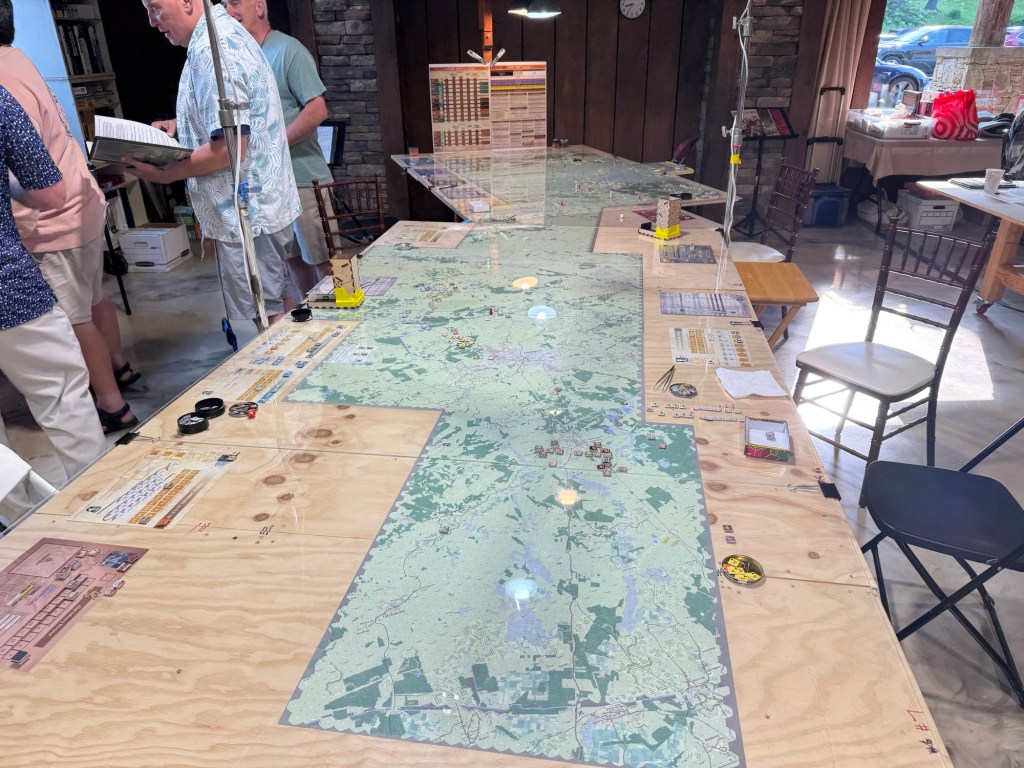
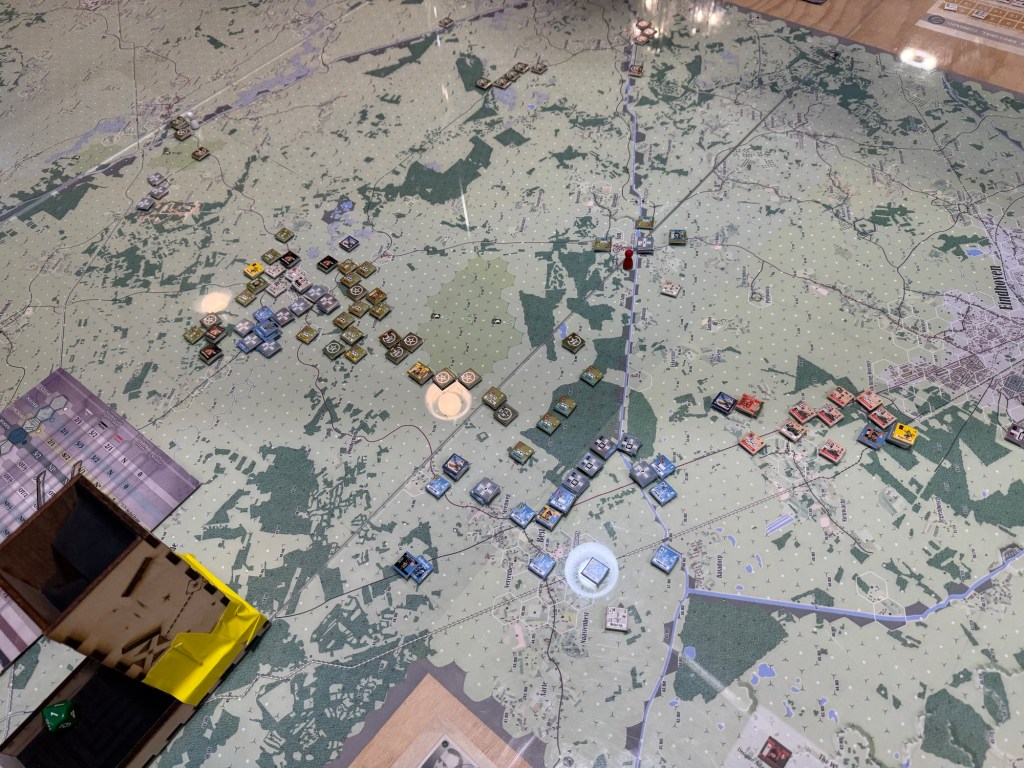
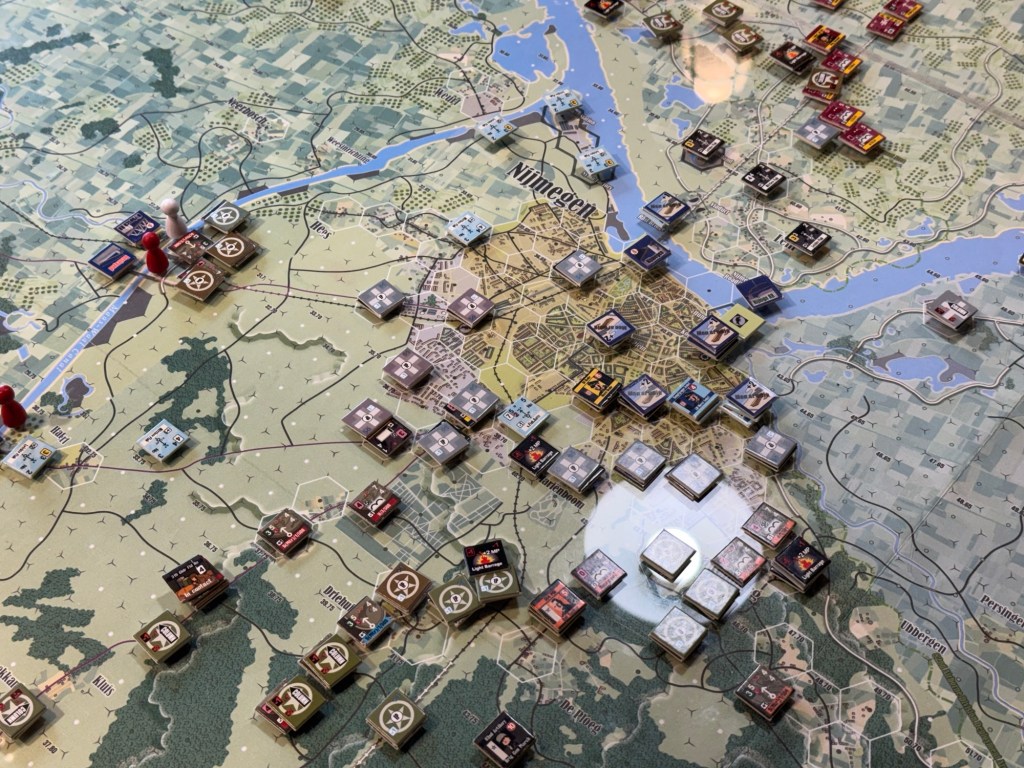
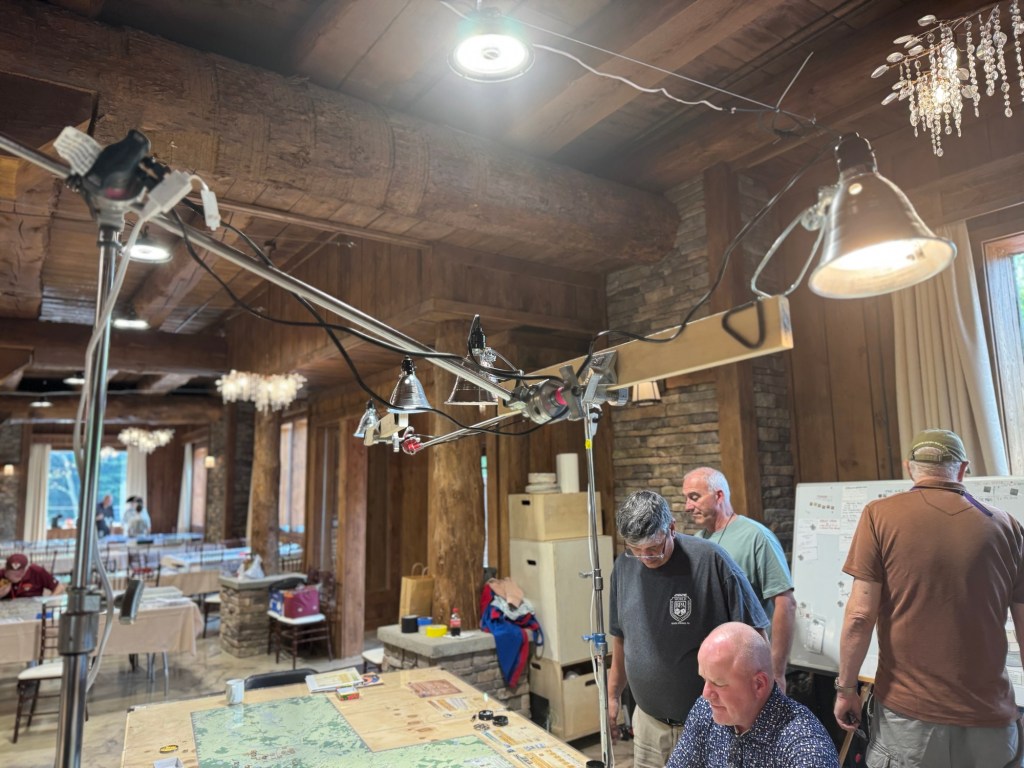
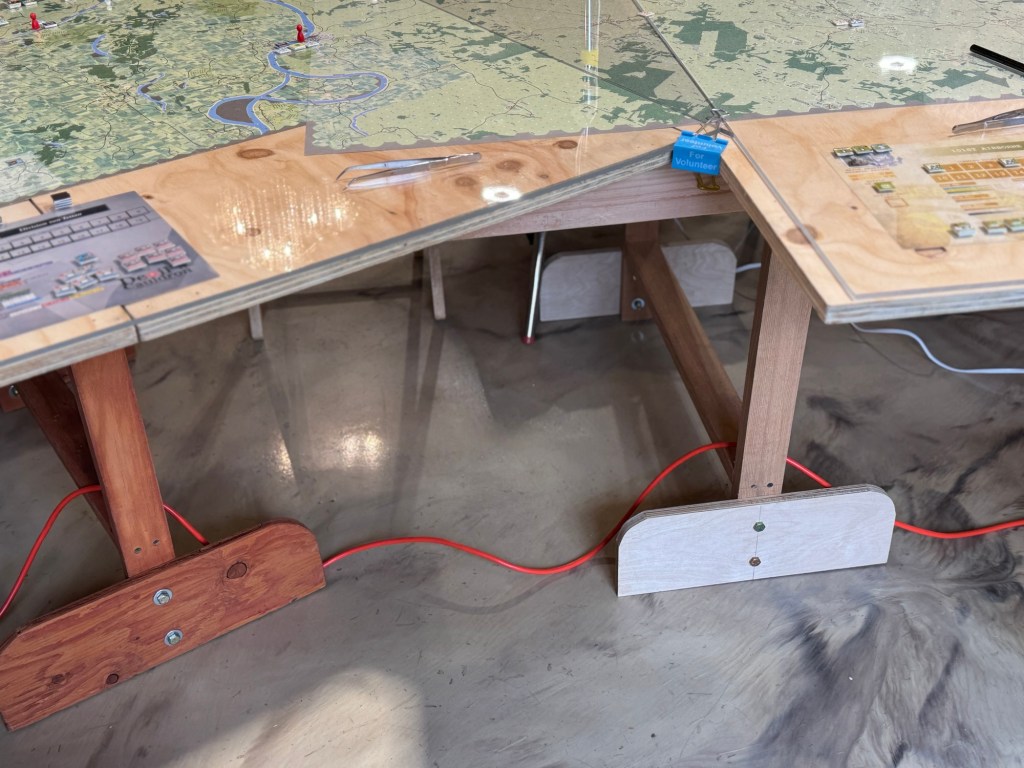
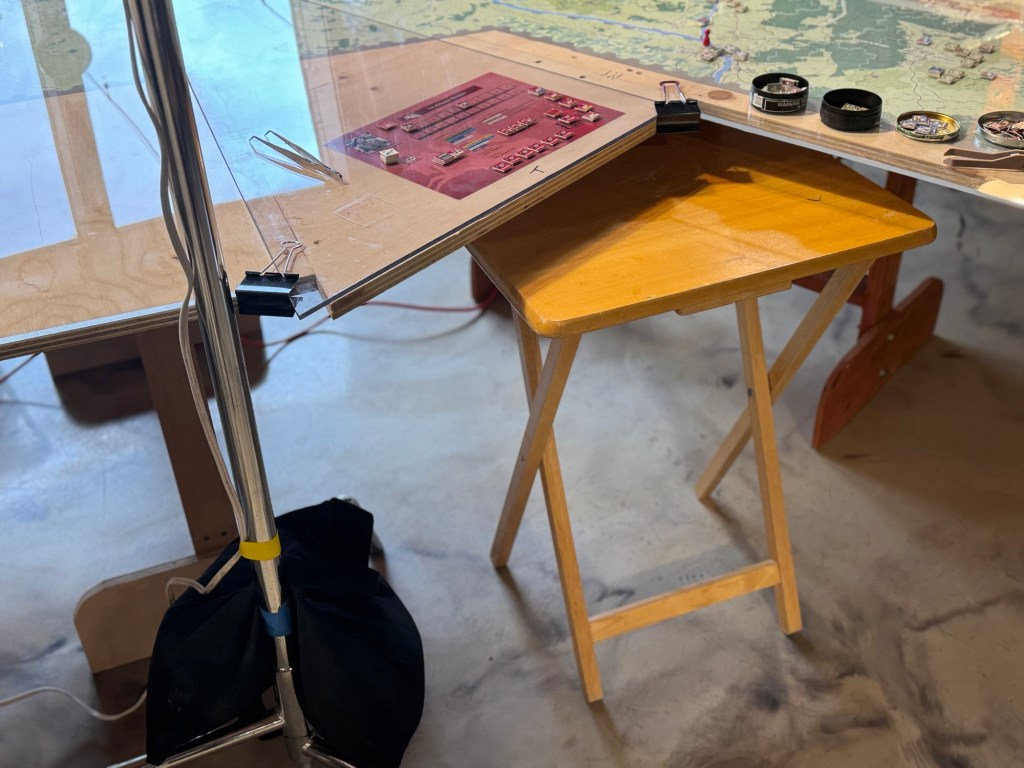
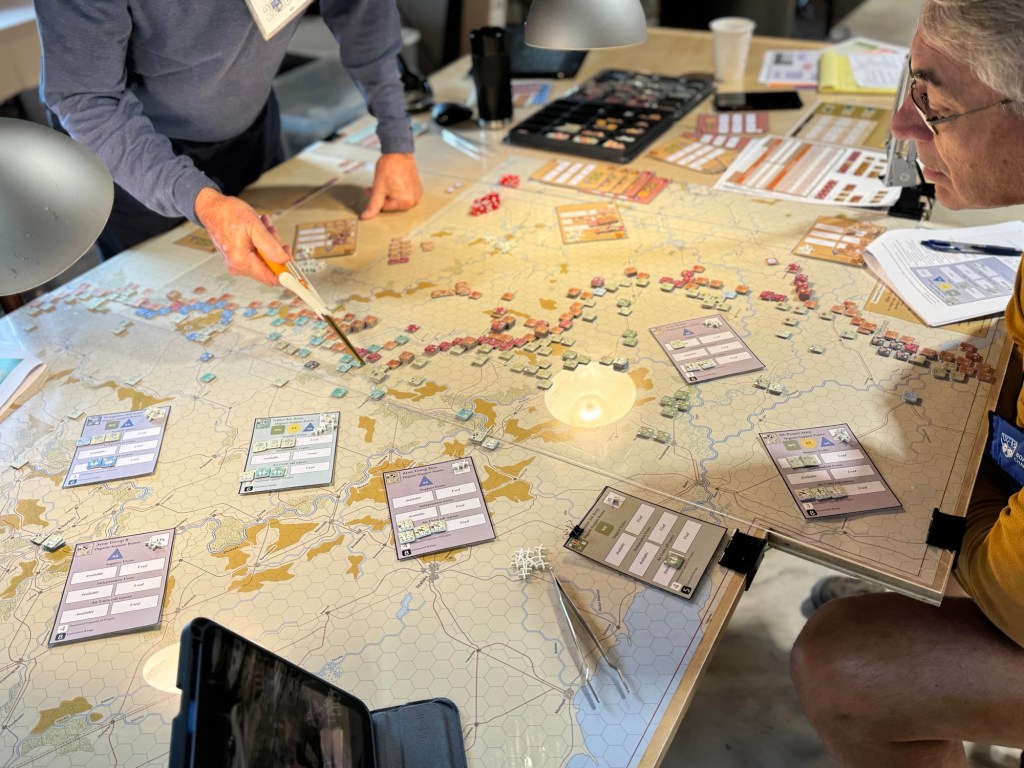
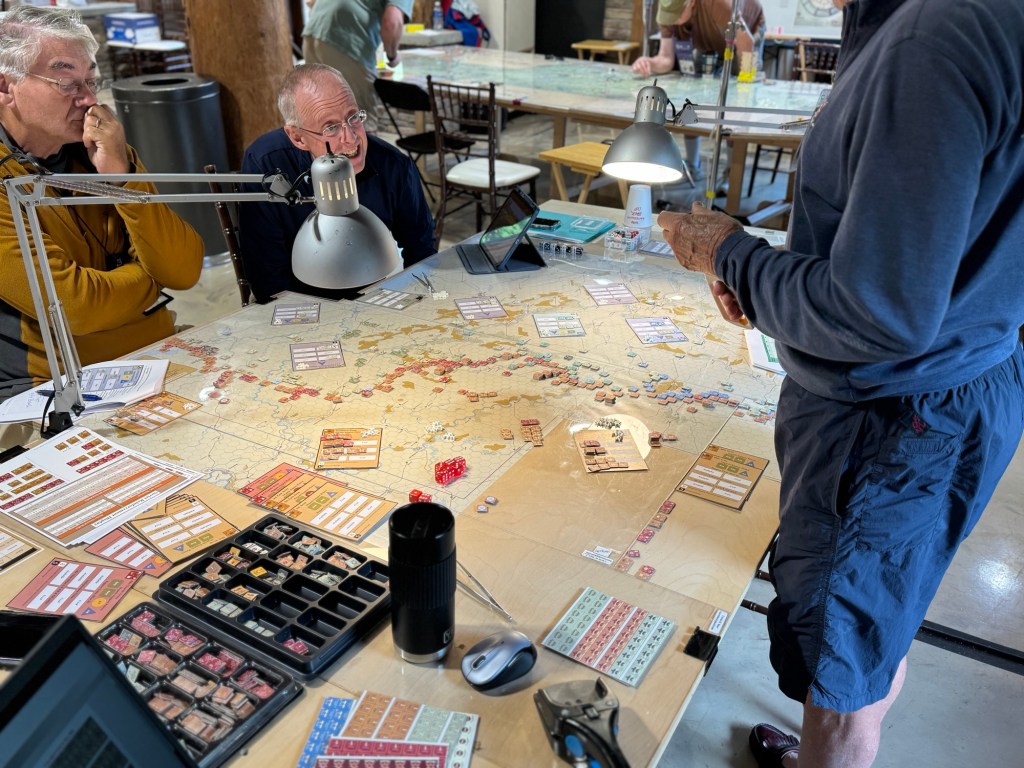
As we approached the table, I was absolutely blown away by the size and scale of it and the multiple boards laid out on it with plexiglass and secured with binder clips and tape. The boards combined measure 17’ of wargaming good and include The Devil’s Cauldron: The Battles for Arnhem and Nijmegen and Where Eagles Dare: The Battle for Hell’s Highway from Multi-Man Publishing.

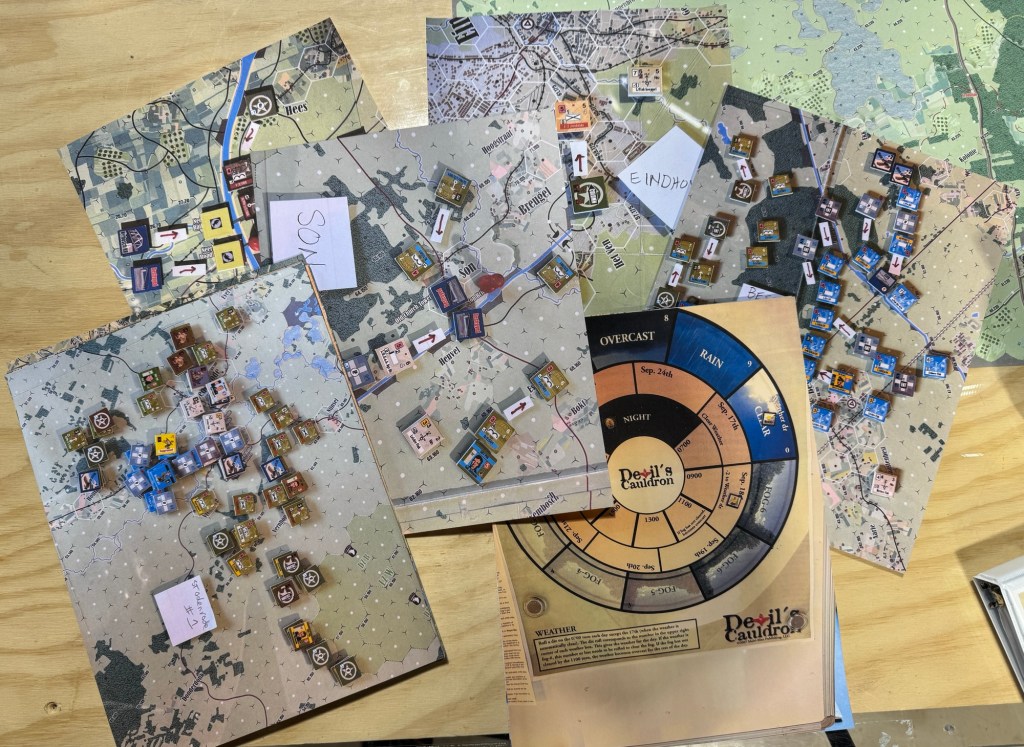
The game state is actually a continuation of a game that started at WBC last year. Joe and Matt took pictures of the game board and also of each of the formations and their position from last year’s game and had set it up in that state to play over the next week.

Here is a look at those carefully taken pictures. Such detail and care given to the game. How am I not going to love this experience?

There were a total of 6 of us playing the game and we were loosely assigned a few formations to be in charge of. Actually we were told we were in command and were to make plans and then discuss those with the CIC’s to get approval and then execute that plan. A lot of autonomy and ability to go about it individually.

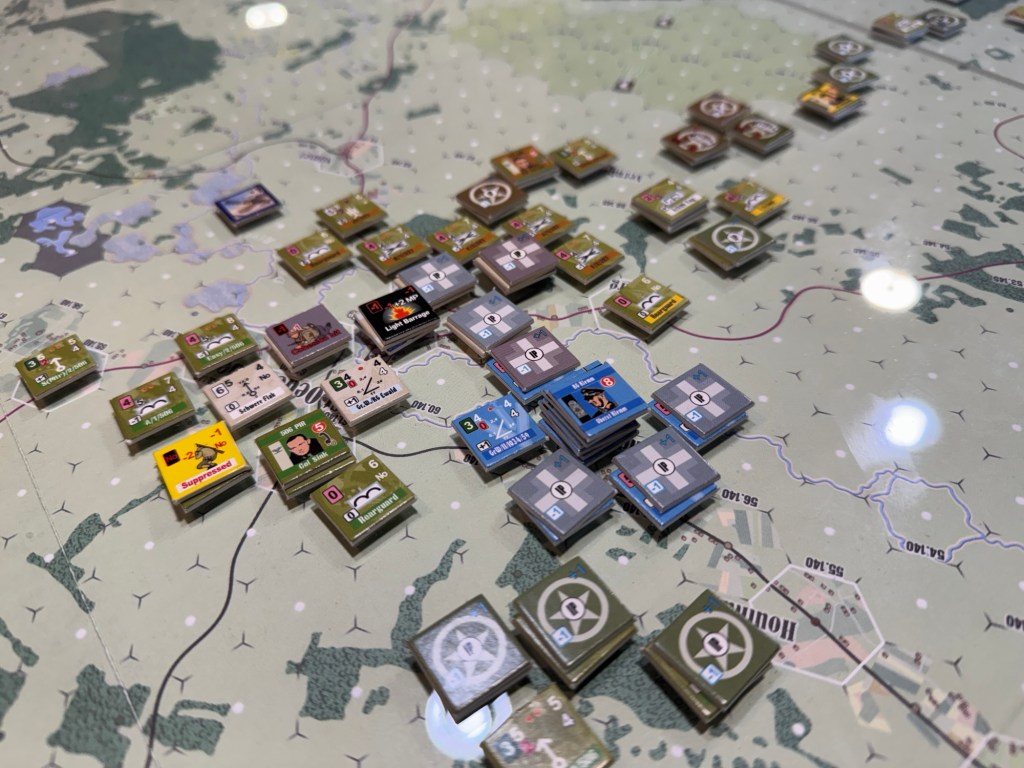
Over the span of 10 hours we played and finished the 0700 and 0800 turns for September 19th. This system is very fun and crunchy but also involved. When attacks are made there is very structured procedure but that isn’t overly complex. Company bonus checks initiate the action and the player will have to roll less than or equal to their troop quality number to gain a +2 to their combat value. Typically this troop quality ranges from a high of 7 to as low as 2 for artillery. Once completed, this bonus is added to their combat factor and then is reduced for the terrain defensive bonus and any defense shown in the enemy counter. Typically you are targeting following under a 7 for good units and a 2 for lesser units. Sometimes these modifiers make it so only a roll of a 0 on a d10 will hit. A 0 is not a 10 in this game. But there is always a chance. Hits are then referred to the CRT which uses the rolled value to refer to the type of Fire to determine results. Types of Fire include indirect, HE or small arms and results include a Cohesion Hit, with multiple Cohesion Hits leading to step losses, step losses of 1, elimination or suppression. There is also limited opportunity fire and assaults that require a bravery/morale checks. At first it seemed over the top but once I picked it up was really fairly simple.

Activation is chit pull and works very well. A formation activating gets to do something with each unit but then can spend Command Points to take additional moves or attacks. Just a very solid system that reminds me a lot of the Company Scale System also designed by Adam Starkweather. The system focuses heavily on how well division and regimental HQ’s can coordinate their sub-units and handle combat stress. I liked it very much and look forward to playing a few more hours tomorrow before moving into some other games.

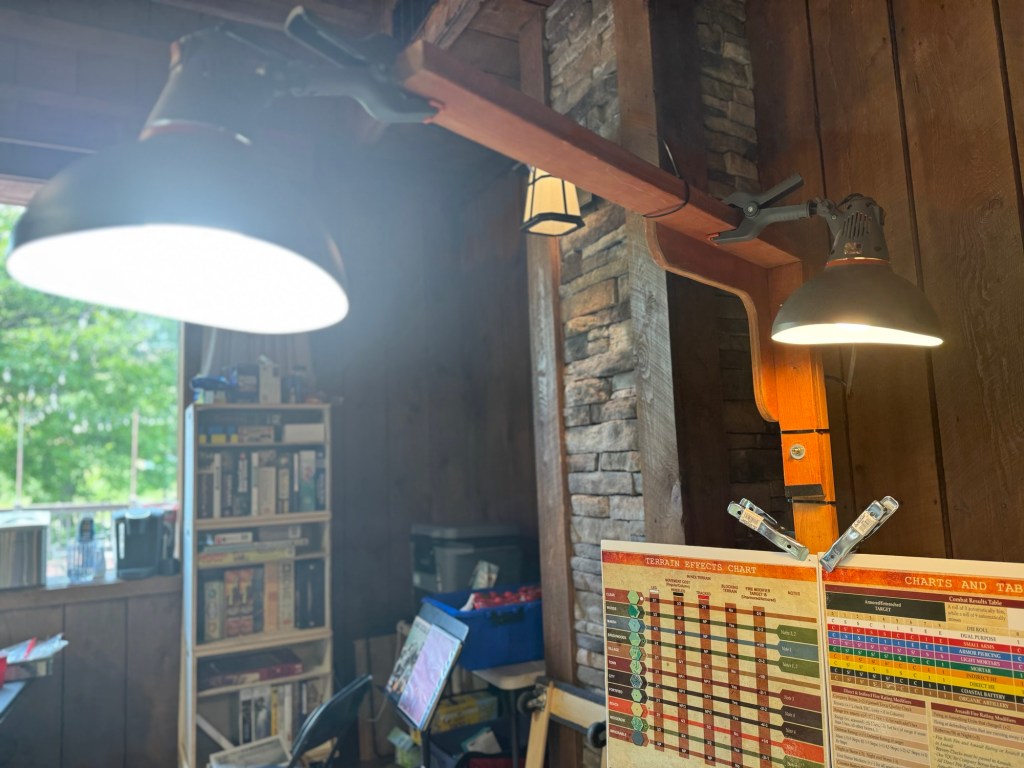
I also wanted to show off the ingenuity and commitment of these Grognards and their setup for GTS.

First off the lighting. They have light poles that provide above the board light which makes a huge difference in visibility of the game and its counters.

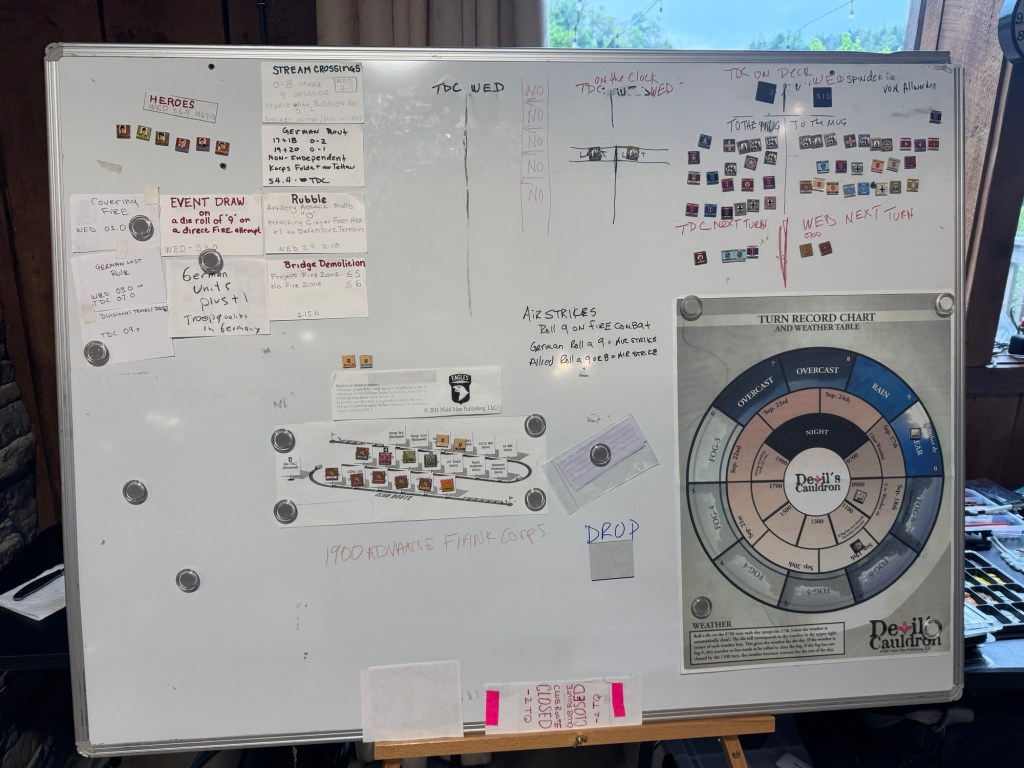
They also have magnetized the chits and when they are drawn are posted on a board for all to see who has activated and who is up. There are chits drawn early but that are hidden on the board to allow for the next player to begins planning to speed game play.

The table they use is also custom made and is modular to fit the various games in the series. The bases are sturdy and they appear to be solid but are assembled quickly.

They use 1/4” thick plexi that is quite thick and has somewhat of a magnifying effect. It is very well done and made playing the game more enjoyable.

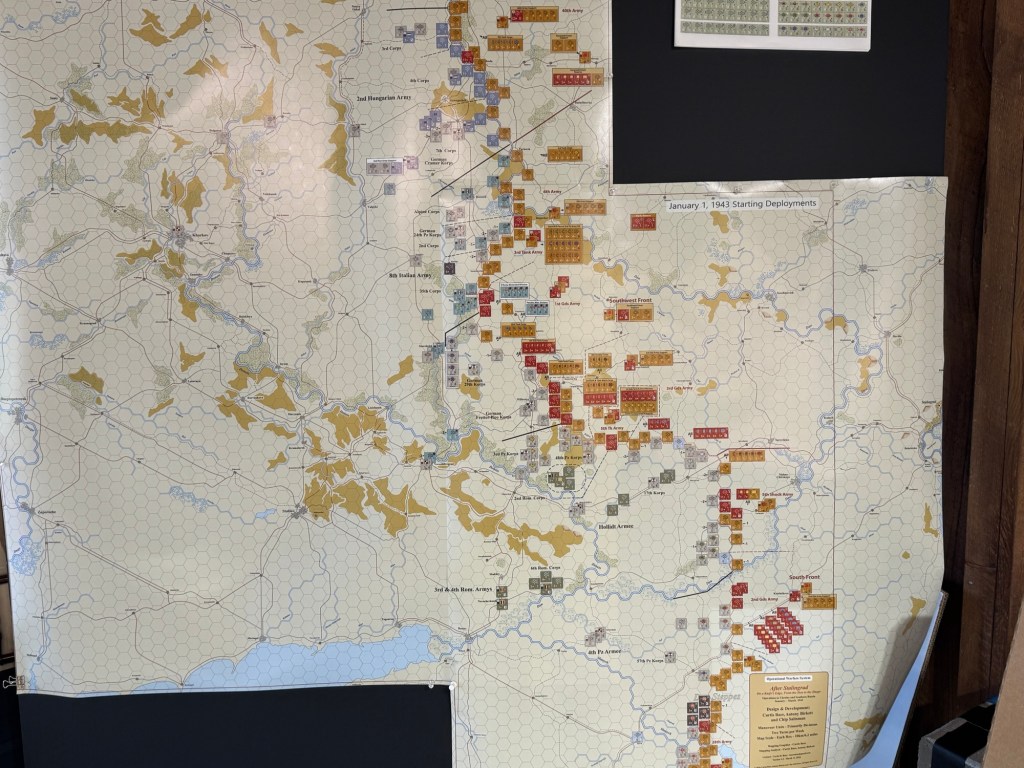
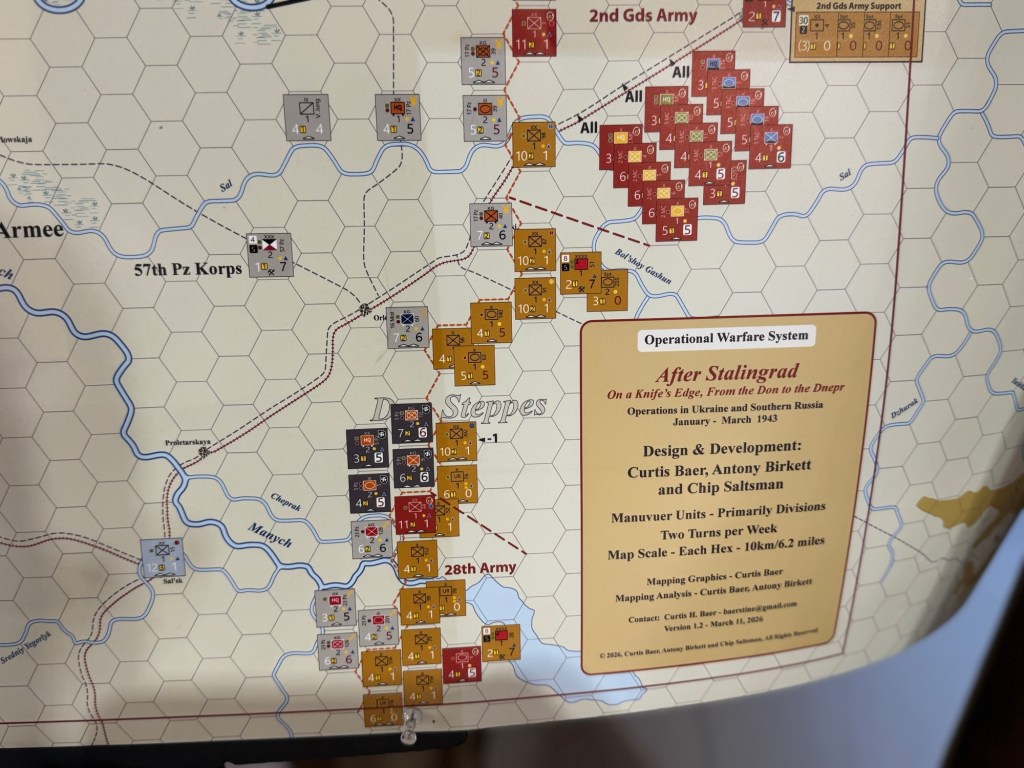
While playing, there was another nearby big in-design East Front wargame being played by Antony Birkett, Chip Saltsman and Curtis Baer. If you didn’t know, all 3 have been involved with, designing and developing several volumes in the Operational Combat Series from MMP. Tony has designed several volumes including The Third Winter, The Forgotten Battles and Crimea.

The system is called the Operational Warfare System and its first game is called After Stalingrad designed by Antony Birkett. Think modern mechanics being brought to the Operational Combat System in Tony’s words.

The system is focused on maneuver and command and control and uses HQ’s with different amounts of Action Points used to activate units. The game play is back and forth and interactive and it was said there is little downtime. They hope to use this system to tell the study of other WWII battles in North Africa, the Mediterranean and Western Fronts, as well as the tried and true East Front.

The fame has been in designer and development over the past 6 months and is being made ready due extensive play testing. They are currently shopping the design to publishers and hope that it is published in 2027.

I was able to shoot a 15 minute interview with these guys and had some really good discussions about their goals with the game and the system highlights.

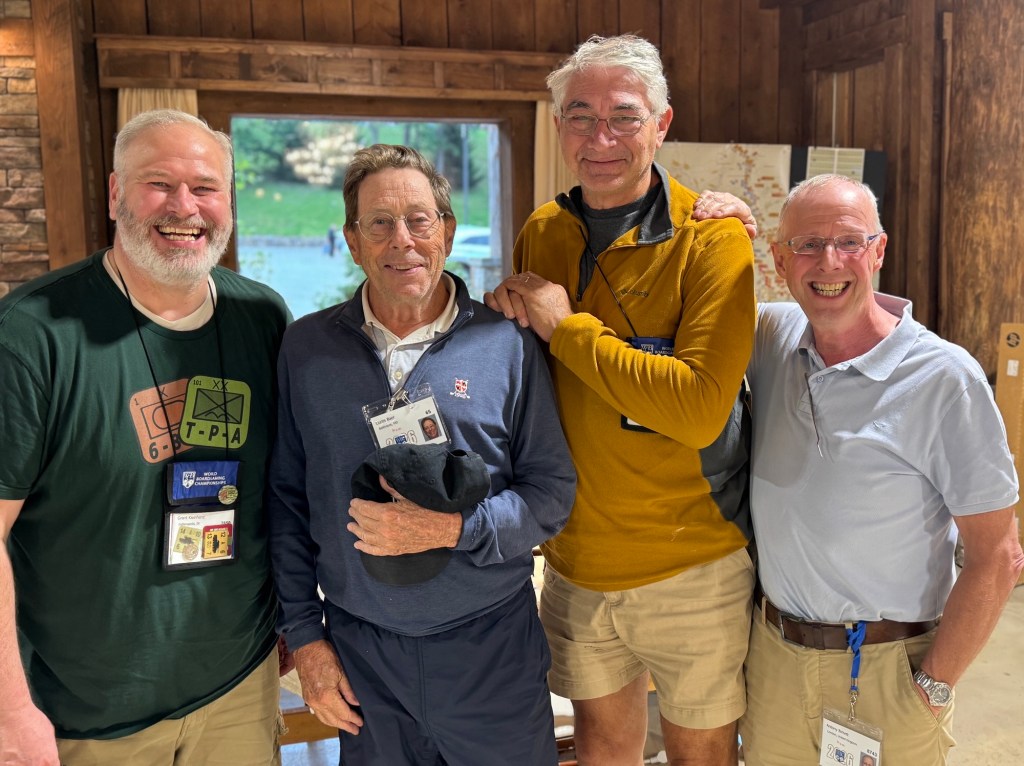
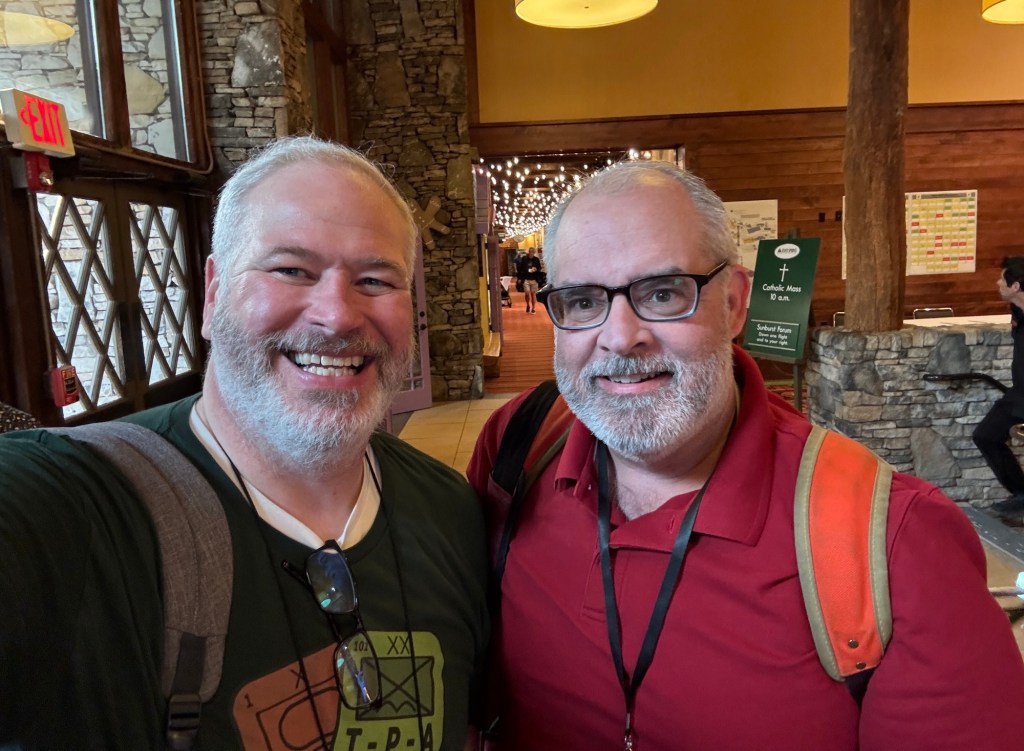
I also met at different times of the day several fans of the channel. I met 2 first time attendees this year who both watch our videos named Jason and Bill who were both class acts.

Jason.
Bill.

This is probably a bit personal but Bill told me that our videos helped during a time when his now deceased wife was sick and he was in a dark place. That was very touching to me and I appreciated that we somehow assisted him through that difficult time.

That was it for Day 2 and I’m actually going to get to bed tonight by 10:30pm. Tomorrow, we have more GTS and I also sit down with my friends Gregory M. Smith and Kevin McPartland to look at their projects and play some games. Both of them are providing us with a “scoop” and I’m excited about what I might get to show you.

See you tomorrow!

-Grant

  •  

Haggefugg – Interviews, Berichte & Konzertfotos

Haggefugg – Mittelalterrock aus Köln

Hier findest du alle unsere Inhalte zu Haggefugg: Interviews, Konzertberichte, Fotos, Videos und weitere Beiträge von DieHausis.

Interviews & Berichte

12.07.2026 Rocken und Zocken? Das Interview mit Haggefugg beim Castle Rock 2026 Video auf YouTube

Konzertfotos

04.07.2026 Haggefugg – Konzertfotos vom Castle Rock Festival 2026
Unsere Bildergalerie mit Impressionen vom Auftritt beim Castle Rock Festival 2026.

Weitere Informationen

Offizielle Webseite von Haggefugg:
https://www.haggefugg.de

Der Beitrag Haggefugg – Interviews, Berichte & Konzertfotos erschien zuerst auf DieHausis.

  •  

A Unique Strategy for Creating and Crowdfunding Games: 6 Questions for Best With 1

Yesterday we announced Wingspan Pocket, a new standalone 1-5 player game that distills the Wingspan experience down to a lighter, shorter, streamlined experience that has each player activate a single row of cards on each of their turns (even on the same turn you play a bird). The cards are all double sided: a food side and a bird side. Bird powers are primarily indicated by icons instead of text, and they include a new type of power, ongoing (green) benefits.

On Monday I will have an article about the in-depth pre-production copy testing process of Wingspan Pocket, but I haven’t posted the corresponding design diary entry yet, so today I have an interview about a completely different game from another publisher!

Gabe Barrett runs Best With 1 Games, and over the last few years I’ve seen him adapt a really interesting strategy for creating and launching games. With their latest game, Stonefall, in its final days on Gamefound, Gabe was kind to take some time to answer questions about his methods.


  1. As far as I can tell, you’ve run solo-coop game campaigns once a month every month for several years now. Is that correct? How many games are we talking, and what are the biggest hits so far in terms of the campaign and retail?

That’s correct. Since January of 2024, I’ve run a solo game campaign every single month on Gamefound. Through those campaigns, I’ve shipped around 60,000 games so far with another 8,000 set to go out in the next few weeks.

The biggest hits have been Rome: Fate of an Empire, Radiance, and Small Time Heroes. 

  1. Do you manufacture and ship each game independently, or do you have any overlapping production runs and fulfillment (i.e., so multi-campaign backers can pay shipping once for multiple products)?

Each game is sent to the factory independently, but there have been a few instances where the queue line got backed up to the point that several games were printed and shipped at the same time. However, I use a fulfillment company based in China that ships worldwide and charges by the gram, so there are no cost-savings in bundling. 

Games ship as soon as they’re completed, and there’s no crossover between campaigns from an admin level – every campaign is a separate spreadsheet.

  1. How have you found the project management puzzle for juggling so many projects? Any key tips or tools that you’ve found work well? Is there something specific about solo games that enables you to have so many projects in the works?

I wish there was some secret or magical piece of software that I could share, but I’ve found that a basic checklist is the best tool overall. I’ve used Trello and other project management apps, but nothing works as well as a good, old fashioned checklist with every aspect of a game’s production broken into line items.

Then, you just work the list and check things off as they’re completed.

The “magic” comes from realizing the checklist needs improvement over and over and over again until you finally get something that works best. And when you run a campaign every single month, you get a lot of opportunities to make revisions.

Nothing about publishing solo games specifically makes things easier, but standardizing as much as possible helps a great deal. I only offer a couple different box sizes which makes designing, publishing, manufacturing, and shipping everything much simpler as I’ve removed all but a few variables. It also allows me to order certain things in bulk and get a better price – shipping boxes and foam, for example.

  1. Are you happy with the current pursuit of 1 game per month, or have you considered spacing out campaigns (e.g., every 2-3 months)? I’m curious about what you view is the advantage of 1 game per month. 12 new games a year seems like a lot for you and for customers–what drives that quantity versus any other quantity of games per month/year? Is that based on what backers have told you they want, sheer momentum, company finances, etc?

“Solo Game of the Month” has a nice ring to it. “Solo game of the quarter” or “solo game of the fortnight” just doesn’t sound quite right.

But once the right systems are in place, and you find great people to work with, twelve games a year is really not that hard to get your arms around. We’ll probably end up doing around 20 new games this year in total. Most of those will be Gamefound campaigns, but others will be direct-to-retail.

However, these aren’t expensive games. Most are $25, and a lot of the “extra” games we’re working on in the background are $15. I don’t think it would be possible to do 12 traditional crowdfunding style games that are $100+ and contain boxes upon boxes of minis and content. The customer base would burn out quickly, most people’s monthly budgets can’t handle it, I would probably be speedrunning my time on this earth, and game shelves wouldn’t be able to support it.

But for the price of a couple meals at McDonald’s, you can get a box the size of a VHS case containing a fun game with great art that offers an excellent solo-gaming experience.

And at that price point, people are more likely to give a game a chance when they might not normally vibe with the theme or core mechanisms. Also, since I don’t print very many extras, a game is easy to sell on the second-hand market, if you don’t enjoy it.

Am I happy with the cadence of one a month? Absolutely. 12+ games a year means I can take some chances on games that might not have wide appeal. It means I get more opportunities to find hits. And it means consistent cashflow to grow a sustainable business.

  1. Are most backers just picking and choosing a few of your games each year, or is there a significant percentage of people who back every Best With 1 campaign? If so, do you offer a subscription option for them? How has it been to work with Gamefound so consistently?

I have a core group of about 500 customers that buy basically everything, and around 40% of my customers have purchased more than one game, so I get a ton of repeat buyers. People often discover the series through a campaign and then purchase a bunch of the previous games.

And that’s by design. I started the company to create a home for solo gamers where everything would be tailored to a one-player experience. The games are all pretty different, but if you like one, you’ll probably like at least ten others.

As far as a subscription, I planned to have one before diving into things in 2024, but I got talked out of it by someone who was doing one. It’s not that they’re bad; they just don’t integrate very well with crowdfunding platforms, and they create a bunch of extra work and overhead. And since simplicity is one of the main pillars of my company, I opted not to go the subscription route.

However, I’m finding other ways to reward repeat customers. For example, a couple months ago, I sent a free game to all 500 of the core customers mentioned above.

And working with Gamefound has been great. I’ve had an awesome account manager named Luke who has been extremely helpful and pretty pivotal to my company’s success.

  1. Last, I was excited to see a game (Stonefall) from Peter and Michael of the One Stop Co-op Shop as the latest Best With 1 campaign. For people who haven’t dived into the world of solo games, are there a few Best With 1 games you recommend they start with?

Yeah, Stonefall is a project I’ve been excited about for a while, and I’m really pleased with how it’s all come together!

As far as recommendations, if you like meaty Euro games, check out Rome: Fate of an Empire. If you like card-crafting and/or rogue-lites, check out Mech Bunny. If you like Slay the Spire and/or deckbuilding games, check out Small Time Heroes. If you like boss battlers, check out Storybook Saga and Witch Hunter.

But in general, if you’re a solo gamer, my catalogue probably has something you’ll enjoy.

And if anyone wants to sign up to be notified when new solo games launch, they can join the newsletter here: https://bestwith1.com/month/


Big thanks to Gabe for answering these questions! I’m curious to hear your thoughts and questions in the comments. If you want to check out other creator interviews and guest posts, here’s a list dating back to 2012!

If you gain value from the 100 articles Jamey publishes on this blog each year, please consider championing this content! You can also listen to posts like this in the audio version of the blog.

  •  

ROBIN DE CLEUR (SPIEL Essen) im Interview - Besucherrekorde, Preise, KI und die Zukunft des Deutschen Spielepreises

Foto: SPIEL EssenRobin de Cleur ist begeisterter Spieler, langjähriger Besucher der SPIEL und PR-Redakteur. Nach Stationen bei Asmodee und der Brost-Stiftung arbeitet er seit 2023 als Director Communications beim Merz Verlag und ist seitdem für die Außenkommunikation der größten Spielemesse der Welt verantwortlich.Das Interview wurde am 10. Juni 2026 per Videocall geführt und anschließend…

Quelle

  •  

Ally Storch (Subway to Sally): Von der Bühne zum Buch | Interview

Bleibt Ally der Musik treu oder wechselt sie komplett unter die Autoren? In diesem Interview der „Musikszene“ bei DieHausis sprechen wir mit Ally Storch von Subway to Sally über ihr brandneues Buchprojekt, ihre Erlebnisse mit der Deutschen Bahn und warum sie nun auch zum Stift (und Skizzenblock) gegriffen hat. Wir werfen einen Blick hinter die Kulissen: Vom Schreibprozess über die Zusammenarbeit mit dem Adakia Verlag bis hin zu Gastbeiträgen von Musikkollegen wie Simon Michael. Außerdem erfahrt ihr alles über ihre kommenden Lesungen und welche kreativen Projekte noch in der Pipeline stecken. Viel Spaß beim Anschauen!

Danke Ally für das tolle Gespräch!

Aufnahmetag: 19.06.2026

Das ausführliche Interview bei Youtube: https://youtu.be/gIgmWzu9Sjw

Das Interview (Cut Version) bei NRWision TV: https://www.nrwision.de/mediathek/diehausis-ally-storch-subway-to-sally-von-der-buehne-zum-buch-interview-260625

Youtube Shorts: https://youtube.com/shorts/JFcr9FLrSkk

Buchtitel: Ally fährt Bahn
Erscheinungstermin (Release) : 26. Juni 2026
Format: Taschenbuch
Herausgeber: adakia Verlag

Der Beitrag Ally Storch (Subway to Sally): Von der Bühne zum Buch | Interview erschien zuerst auf DieHausis.

  •  

Interview: Erik Haffner & Henneke Holst

Als ich mich das erste Mal mit Believe in me! (please) beschäftigte, kam mir sofort das ikonische Video von Jesus He Knows Me in den Sinn. Die Bildsprache des Brettspiels und der erste Blick auf das Thema ließen sofort Phil Collins vor meinem geistigen Auge tanzen, mit Scheinen wedeln und um zahlungskräftige Anhänger buhlen. Meine...


Der Beitrag Interview: Erik Haffner & Henneke Holst erschien zuerst auf Brett und Pad.

  •  

HARALD SCHRAPERS (Vorsitzender SPIEL DES JAHRES e. V.) im Interview - Die Arbeit der Jury des wichtigsten Spielepreises, interne Prozesse und soziale Verantwortung

Foto: Spiel des Jahres e. V.Harald Schrapers, Jahrgang 1964, veröffentlicht seit Anfang der 1990er Brettspielkritiken. Er war freier Mitarbeiter der Fairplay, hat für die Thüringer Allgemeine und Die Zeit geschrieben und ist in aktueller Position freier Mitarbeiter der Spielbox. Seit 1993 betreibt er die Website Games We Play.Seit 2017 ist er Mitglied des Vereins Spiel des Jahres e. V.

Quelle

  •  

Spiel des Jahres: Wie unabhängig arbeitet die Jury?

Ist die Jury „Spiel des Jahres” wirklich so unabhängig, wie sie behauptet? Wir haben beim Vorsitzenden Harald Schrapers nachgefragt. Im Interview spricht er über Lizenzeinnahmen, Werbeveranstaltungen und einen Streit innerhalb der Jury. Das Interview ist eine Ergänzung eines etwa eineinhalbstündigen Interviews mit Harald Schrapers. Das komplette Gespräch könnt ihr im Podcast Boardcast von Frederik Malsy nachhören. Das Interview mit Tom Werneck, auf das wir uns beziehen, findet ihr unter Tom Werneck: „Schaue mit Neugier auf die Arbeit der Jury, nicht mit Groll“. Unabhängigkeit der Jury In seinem Buch „Das moderne Brettspiel“ schreibt Tom Werneck, es sei fragwürdig, ob die Jury

Quelle

  •  

CfM040 Limitierte Brücken

CfM040-Limitierte_Brücken

CfM040-Limitierte_BrückenFolge 40 regt hoffentlich ein wenig zum Nachdenken an. Zumindest uns hat das Interview mit Cosima Werner ebenso die Antennen hochfahren lassen wie die Beschäftigung mit dem Spiel LIMIT von Alexandre Poyé (erschienen bei Ludonaute bzw. bei Spielworxx). Zusätzlich sprechen wir noch intensiver über SKYBRIDGE von Michael Rieneck und Franz Vohwinkel (erschienen bei Deep Print […]

Der Beitrag CfM040 Limitierte Brücken erschien zuerst auf fjelfras.de.

  •  

Im Interview – Nico Finkernagel blickt auf sein erstes Jahr als CTO

Seit 1. April 2025 ist Nico Finkernagel Chief Technology Officer (CTO) bei Pegasus Spiele. Teil der IT-Abteilung ist er aber bereits seit 2018. Als Software Engineer war er seither an der Realisierung zahlreicher Projekte beteiligt. Er setzte seine Fähigkeiten und Kenntnisse in den Bereichen Datenanalysen und Prozessoptimierungen ein, zum Beispiel bei der Einführung eines neuen Shopsystems und dem Aufbau der IT-Infrastruktur für das Pegasus Spiele Tochterunternehmen Pegasus Spiele North America.

Als CTO hat er nicht nur die Leitung des IT-Teams inne, sondern kümmert sich als Teil des Managements unter anderem auch um den Ausbau der IT-Sicherheitsstrategien, die Einführung neuer Technologien und den Aufbau strategischer Partnerschaften im Bereich IT.

Nach seinem ersten Jahr als CTO blickt er auf die ersten Erfolge und zukünftige Projekte:

Auf welchen Themen liegt dein Hauptaugenmerk seit Beginn deiner Tätigkeit als CTO?

„Seit ich CTO bin, bewegt sich mein Alltag im Grunde zwischen zwei Welten: Zum einen leite ich ein für unsere Unternehmensgröße ziemlich großes IT-Team von fünf Personen. Das heißt ganz konkret: Projekte priorisieren, Strukturen weiterentwickeln, aber vor allem dafür sorgen, dass das Team gut arbeiten kann.
Zum anderen ist ein großer Teil meiner Arbeit strategisch geprägt. Ich beschäftige mich viel mit der Frage, welche Technologien für uns wirklich relevant sind und welche eben nicht. Es geht darum, sinnvolle Schwerpunkte zu setzen und die IT so auszurichten, dass sie das Unternehmen langfristig unterstützt. Das betrifft Logistik- und Handelsprozesse, IT-Infrastrukturen, aber auch generelle Tools, die beeinflussen, wie wir im gesamten Pegasus Spiele Team zusammenarbeiten.“

Mit Blick auf über 30 Jahre Firmengeschichte ist ein Jahr als CTO natürlich noch keine lange Zeit, aber gibt es schon Erfolge, auf die du zurückblicken kannst?

„Ein großer Schritt war für mich, dass wir uns als IT-Team neu aufgestellt haben. Zwar arbeiten wir nach wie vor eng zusammen, besprechen uns regelmäßig und sind als Team die Anlaufstelle für alle technischen Probleme, aber wir haben nun auch alle unsere Schwerpunkte: Entweder im Bereich Administration & Tooling mit Fokus auf Identity Management sowie IT- & Netzwerk-Sicherheit oder im Bereich E-Commerce mit besonderem Blick auf SAP als unser Warenwirtschaftssystem, aber auch unser Shopsystem Shopware. Diese Splittung schafft Klarheit bei den Zuständigkeiten, lässt uns aber auch produktiver arbeiten als früher.

Ein weiterer wichtiger Fokus lag im letzten Jahr auf dem Thema IT-Sicherheit. Wir haben begonnen, unsere Architektur stärker in Richtung eines Zero-Trust-Ansatzes weiterzuentwickeln, also weg von klassischen, klar abgegrenzten Netzwerken hin zu einer Umgebung, in der jeder Zugriff grundsätzlich verifiziert wird. Das betrifft unter anderem Identitäten, Geräte und Zugriffsrechte und schafft eine deutlich robustere Grundlage für unsere Systeme.

Darüber hinaus gab es viele kleinere Projekte und Verbesserungen im Alltag, zum Beispiel die flächendeckende Einbindung der SSO-Authentifizierung oder ein vereinfachtes Zeiterfassungsmanagement, die sich jedoch in Summe deutlich bemerkbar machen und unsere Arbeitsweise kontinuierlich voranbringen. Einige dieser Projekte sind in der IT inzwischen State of the Art, für andere mussten wir eigene Soft- bzw. Hardware entwickeln. Ein größeres Projekt im letzten Jahr war außerdem der Relaunch von pegasus.de Mitte 2025, den wir als Teil eines interdisziplinären Website Teams begleitet haben. Insgesamt ging es in meinem ersten Jahr als CTO aber insbesondere darum, Grundlagen zu schaffen, auf denen wir künftig aufbauen können.“

Verrätst du uns, wie dein Arbeitsalltag aussieht?

„Sehr unterschiedlich und ehrlich gesagt mag ich genau das daran. Es gibt Tage, an denen ich gefühlt von Termin zu Termin gehe und viel im Austausch bin: mit meinem Team, mit anderen Abteilungen oder mit externen Partner*innen. An anderen Tagen habe ich mehr Raum für konzeptionelle Arbeit oder tiefere technische Themen.

Was allerdings tatsächlich zu kurz kommt, ist das Programmieren selbst. Das bedaure ich manchmal, weil mir genau dieser Teil nach wie vor großen Spaß macht. Deshalb versuche ich, mir so oft wie möglich kleine Zeitfenster freizuschaufeln, auch wenn das dann nicht selten in einer ‚Nachtschicht‘ endet. Es ist für mich wichtig, den Bezug zum operativen Geschäft nicht zu verlieren und Dinge auch selbst auszuprobieren.
Außerdem achte ich darauf, auch mal einen Schritt zurückzutreten und mich zu fragen: Sind wir noch auf dem richtigen Weg? Was müssen wir anpassen? Wo wollen wir eigentlich hin? Den Überblick über das große Ganze zu behalten ist ein wichtiger Faktor meiner Position.“

Woher kommt deine Faszination für IT und Technologie?

„So genau kann ich das gar nicht auf einen bestimmten Moment zurückführen. Ich glaube, mich hat schon früh gereizt, zu verstehen, wie Dinge funktionieren und wie man sie verbessern kann. IT bietet da unglaublich viele Möglichkeiten.“

Brettspiele sind als analoges Medium nicht gerade, woran man bei technologischer Innovation denkt. Wieso reizt dich gerade diese Herausforderung?

„Der Gedanke ist absolut nachvollziehbar. In unserem Fall geht es weniger darum, das Produkt selbst zu digitalisieren, sondern vielmehr um alles, was drumherum passiert: Entwicklung, Planung, Produktion, Logistik oder Datenmanagement. Wenn man an diesen Stellen die richtigen Hebel ansetzt, kann man enorm viel bewegen. Und genau das finde ich spannend, in einem Umfeld zu arbeiten, das nicht per se als ‚tech driven‘ gilt und trotzdem enormes Potenzial bietet.

Gleichzeitig hat uns das Internet sehr deutlich gezeigt, was Digitalisierung leisten kann: Sie ist ein Werkzeug, um viele Menschen zu erreichen und miteinander zu verbinden. Für uns bedeutet das, unsere Vision weiterzutragen, möglichst vielen Menschen den Zugang zu Brettspielen zu ermöglichen und neue Verbindungen zu schaffen. Technologie ist dabei kein Selbstzweck, sondern ein Mittel, um genau das zu unterstützen.“

Welche Ziele hast du dir für die nächsten sechs Monate und welche für die nächsten sechs Jahre gesteckt?

„Kurzfristig möchte ich vor allem weiter an klaren Strukturen arbeiten: Transparenz schaffen, Prozesse sauber aufsetzen und Prioritäten klar definieren. Mir ist wichtig, dass die IT nicht nur als Dienstleister wahrgenommen wird, sondern als aktiver Teil des Unternehmens.

Langfristig denke ich weniger in einzelnen Projekten, sondern in Fähigkeiten. Ich wünsche mir, dass wir eine IT-Organisation aufbauen, die stabil läuft, aber gleichzeitig flexibel genug ist, um schnell und unkompliziert auf Veränderungen reagieren zu können. Denn insbesondere der digitale Sektor ist extrem schnelllebig und eine Innovation jagt die nächste. Dazu kommen rechtliche Vorgaben, aber auch sich ständig wandelnde logistische sowie bürokratische Herausforderungen. Meine Hoffnung ist es, dass ich als CTO bzw. wir als IT-Team dazu beitragen, dass Pegasus Spiele technologisch stets gut gerüstet ist und ein Arbeitsumfeld bietet, in dem Technologie zu Kreativität, Wachstum und nachhaltigem Erfolg beiträgt.“

Vielen Dank für deine Antworten!

Der Beitrag Im Interview – Nico Finkernagel blickt auf sein erstes Jahr als CTO erschien zuerst auf Blog und News.

  •  

SUBWAY TO SALLY 🤘 Simon Michael im Interview, Eisheilige Nacht 2025 – auch noch 2026?

Es ist Zeit für Musikszene im Interview – DieHausis sprechen mit mal wieder mit Simon Michael Drummer von der Band SUBWAY TO SALLY über privates, die Eisheilge Nacht 2025 Tour im Dezember, über die Band und was ist und kommt 2026, wie z.B. die Nackt3 Tour.
Das Interview könnt ihr auch super als Podcast hören.

Das Interview findest Du auf Youtube: https://youtu.be/Qnz8DrMGwjw

Und in der Mediathek von NRWision TV: https://www.nrwision.de/mediathek/diehausis-simon-michael-schlagzeuger-bei-subway-to-sally-251106

Der Beitrag SUBWAY TO SALLY 🤘 Simon Michael im Interview, Eisheilige Nacht 2025 – auch noch 2026? erschien zuerst auf DieHausis.

  •  

30 Jahre Catan: „Wir warten auf den richtigen Moment“

Seit dreißig Jahren begeistert Catan Menschen auf der ganzen Welt. Zum Jubiläum haben wir Benjamin Teuber dreißig Fragen gestellt – über Raubkopien, den Film zum Spiel und seinen Vater, den Erfinder von Catan. Catan erschien 1995. Klaus Teuber entwickelte es in seiner Freizeit, hauptberuflich arbeitete er damals als Zahntechniker. Sein Sohn Benjamin stieg 2010 ins Familienunternehmen ein. Er leitet seit dem Tod von Klaus Teuber die Catan GmbH mit seinem Bruder Guido. 1. Welche Frage zu Catan kannst Du nicht mehr hören?Warum der Wechsel von Holz auf Kunststoff? Ursprünglich wurde das Spiel mit Holzfiguren ausgeliefert. Ab 2003 erfolgte die Umstellung

Quelle

  •  

Let’s build a medieval Abbey – Interview with Randy Rathert about the Boardgame The King’s Abbey

Im Zuge der Arbeit am Sammelband "Von bierbrauenden Mönchen und kriegerischen Nonnen - Klöster und Klerus in analogen und digitalen Spielen" enstand ein Interview zwischen Lukas Boch und Randy Rathert, dem Autor von The King`s Abbey. Im Mittelpunkt stand die Frage nach der Entwicklung und Umsetzung des Themas Kloster im Brettspiel.
  •  

Why You Should Back: Death By Coconuts

The latest entry in our interview series Why You Should Back: Death By Coconuts on Kickstarter. We spoke with the creator to get information about their latest launch. They look to be bringing something very interesting to market that walks the fine line between humorous and morbid. The Kickstarter launch date is May 31, 2022. Check out the link below to go directly to Death By Coconuts Kickstarter page or continue on to read the interview with the creator.

Death By Coconuts on Kickstarter


1. How would you describe your product in a few sentences?

Death By Coconuts is best described as a race-to-the-finish board game where you move by betting on death statistics. 

First, you draw three causes of death, which can be anything from sharks to falling vending machines and projectile Champagne corks. There are additional time periods and geographical parameters to help you work out the answer. Then, when you’ve made your mind up, you bet up to three chips on which of the three you think is most deadly. 

If you’re right, you move forward the same number of spaces as chips you bet with. If you’re wrong, the same applies – only you move backward instead! So you can see, it’s a game of risk and reward were betting big or small dictates how quickly you move across the board. 

You’ve got to navigate shortcuts and trapdoors, and the treasure chest cards will more often than not expedite your arrival at the finish line. But sometimes they’ll throw a curveball at you. Only the first to the finish wins, unless there’s a tie. In which case we’ve got a pretty dramatic best-of-three tiebreaker to decide the winner. This is our very first attempt at a board game. We’ve created a simpler mechanic than our first Kickstarter game, Plant-Based Riot, but it still delivers bucket loads of quick-fire fun.

Death By Coconuts Game Overview

2. Introduce the team bringing this to market? What is your background that brought you to launching this?

The team is largely the same as the one that brought you Plant-Based Riot via Kickstarter last year. This time, though, we’ve added another designer to the mix… 

Marty Pardoe worked behind the scenes of Plant-Based Riot but is at the core of this team. She’s a hugely gifted designer that’s been involved from the early stages when the game went by the rather sinister name of “May Cause Cancer” (a story for another time…). Marty was named as a rising star in Mojo Nation’s 100 Influential Figures list in 2021 for her work on our game Girl Power. It was Marty’s idea to make Death By Coconuts a race-to-the-finish board game and we’ve run with that ever since. 

Roberto Rotaru is our artist, graphic designer, motion graphic designer, video editor. He continues to add strings to his bow since our campaign last year. Originally from Romania, he’s the biggest gamer of the bunch – our go-to guy when it comes to making key decisions on mechanics. All the motion graphics and videos you see in relation to this project are down to his artistry.

I’m the content writer for Death By Coconuts. It was my job to trawl the deepest depths of the internet to put together 250 death statistics. It was definitely no day at a tropical beach, I can tell you. You know what they say, though… It’s a tough job, but someone’s gotta do it. 

Courtney is the guy that oversees everything. It’s his job to stitch all the individual components together. He started Bubblegum Stuff in Hong Kong back in 2013, so there’s traces of his blood, sweat and tears in this and every other product the company has put out over the years. 

We’ve turned to Kickstarter again because we loved the experience last time out. It brought us closer to our community in more ways than one. Like us, the people that backed Plant-Based Riot believe in the power of collaboration. And because they have tons of experience backing games on the platform, they are an invaluable source of insight and opinion. We’re sure many of those guys will play active roles in making key design and gameplay decisions with Death By Coconuts, too. 

Death By Coconuts Creators Kickstarter

3. What existing games would you compare your game to?

Death By Coconuts is similar to a few games – and in various ways. It’s got elements of Snakes & Ladders, which we all remember as one of the first games we ever played. The shortcut across the lake and the lava flow trapdoor are essentially a ladder and a snake respectively. 

The treasure chest cards also give the sense you’re being given a ladder or a snake, depending on what you’re lucky or unlucky enough to pick up. Saying that, though, they could be likened to the chance or action cards that are fairly ubiquitous in many board games. 

There are also similarities with a game from London-based games producer Big Potato. Their game What Came First? uses the same betting mechanic as the method for moving around the board. The difference being in What Came First? you’re betting on what happened first out of two events in history that are paired together on the same card. In Death By Coconuts you’re betting on three separately drawn death stats. 

That small difference adds endless amounts of replayability to the game. It means there are over 2.5 million possible combinations of death cards! Each round will feel like a fresh challenge regardless of how many times you’ve played the game. That’s amplified even more when you consider the additional caveats like time period and location. 

4. What sets your game apart?

What sets Death By Coconuts apart is the delivery. We’ve produced a game that features 250 causes of death without it feeling overtly morbid. And that was always the mission. It must be said, we’re not making light of death or any of the events featured on the cards in the game. But it is as much a part of life as birth. And we knew if we handled it correctly, it wouldn’t cause offense. Much in the same way that Halloween or the Mayan festival Day of the Dead doesn’t. 

Some of the content comes across lighthearted, such as the deaths by falling coconuts, which causes on average 150 deaths a year! (Incidentally, that’s more than sharks – and it’s that fact that was the inspiration behind the game.) However, most of the leavening is being done by the 1950s Americana/tropicana/tiki-style design, artwork and overall theme. The board depicts our little skeleton character getting into all kinds of comedic scrapes with cannibals, krakens, snakes and more. Many of which are causes of death featured in the game. In addition to those Easter eggs, there are 150 coconuts on the board in reference to the stat that started it all. We’ll be impressed if anyone finds them all. You might even notice the spaces stretching from Coconut Beach to Eternal Paradise look familiar…

5. How can everyone be assured that they are going to get quality components and you are going to deliver on all the promises you are making?

As previously mentioned, we’re a slightly expanded team to the one that delivered Plant-Based Riot through Kickstarter last year. And this slightly expanded team is working within Bubblegum Stuff, which is a small gift and game company based in London. We’ve been plying our trade for nearly 10 years. So getting things designed, made and delivered is our bread and butter. 

Furthermore, we delivered Plant-Based Riot – our first Kickstarter – through all the turmoil and disruption caused by Covid and one of the worst shipping crises in history. We’re really proud to have delivered the game to our backers, as promised, by Christmas. This meant changing from sea freight to air freight right at the eleventh hour. Seriously… the stock was on a ship in port and we took it off and got it onto a flight! 

Not that we wouldn’t go above and beyond for our customers anyway. But the loyalty, support and patience showed to us by our backers last year really moved us. And that’s still ringing in our ears going into this next campaign. We’re committed to delivering on our promises and building on our incredible community through Kickstarter.

Death By Coconuts Gameplay Board

6. Why should someone back your project?

Death By Coconuts combines diabolically gruesome subject matter with super funky artwork, near-addictive fun and endless replayability. 

It feels incredibly unique but still familiar enough that it’s accessible for pretty much everyone. And the learning to fun time ratio is stacked heavily in favor of fun. That makes it a perfect game to pick up and play, whether you’re looking for a casual game for two or something to sustain a great big games night. 

So what are you waiting for? Back our project, grab a few fellow shipwrecked shipmates and get going on the race to Eternal Paradise. Where your knowledge of death might just save your life!


Well we are satisfied!

Great insight and enthusiasm from a passionate and experienced designer. This game has some wonderful funky art and is sure to please a very specific type of gamer. If you are looking for an interesting quick-fire game, give this one a shot. Take a look at their Kickstarter for more info!

Death By Coconuts on Kickstarter


Have you received enough info on why you should back Death By Coconuts on Kickstarter? Are you backing? Let us know in the comments below or on our BGH Facebook page.

  •  
❌