Normale Ansicht

Bite the Big One

19. Mai 2026 um 23:40

That's me, avowed space terrorist, machinegunning a Bezos penis-rocket before he can escape the Amazon Superflex.

I live in the shadow of the Wasatch Mountains. Have for nearly my whole life. Out-of-towners sometimes voice their apprehension when they first visit our cordillera, when they see the way our cities and suburbs are hemmed in by walls. The mountains, they say, seem precarious, like they could topple onto our heads at any moment, burying us under a thousand tons of limestone and quartz monzonite. Jokingly, I inform them that the real danger of the coming tectonic collapse — not the little shakes we sometimes get, but the Big One, the one we’re a millennium overdue for — is that it will kill us from below. The ground will liquefy and carry us downward, the ancient tidal basin finally sweeping us out to an inland sea that died with the mammoths.

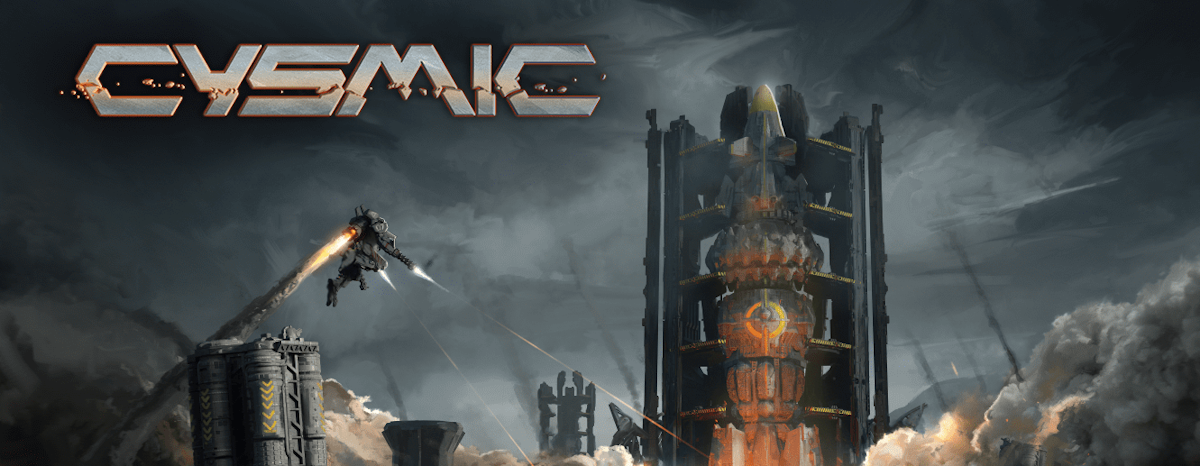
Cysmic, the board game by Jason Blake, gives me that feeling. When I hefted it onto the review stack next to my computer desk, my wife wondered aloud if it would topple and crush me. It isn’t the largest board game I’ve ever owned; that would be the 22-pound Ogre, the one with the team lift warning printed prominently on its side. But it’s the one that feels most like an Ozymandian temple to excess. Its map is sprawling. The frame that holds the hexes comes with hidden magnets to lock everything into place. The plastic constructs are so phallic that they make me uncomfortable. Among its many dice, there’s one for gauging your character’s crisis of conscience. It’s so gargantuan that it’s become a game-night joke. Nothing could justify this sprawl.

I kinda dig it.
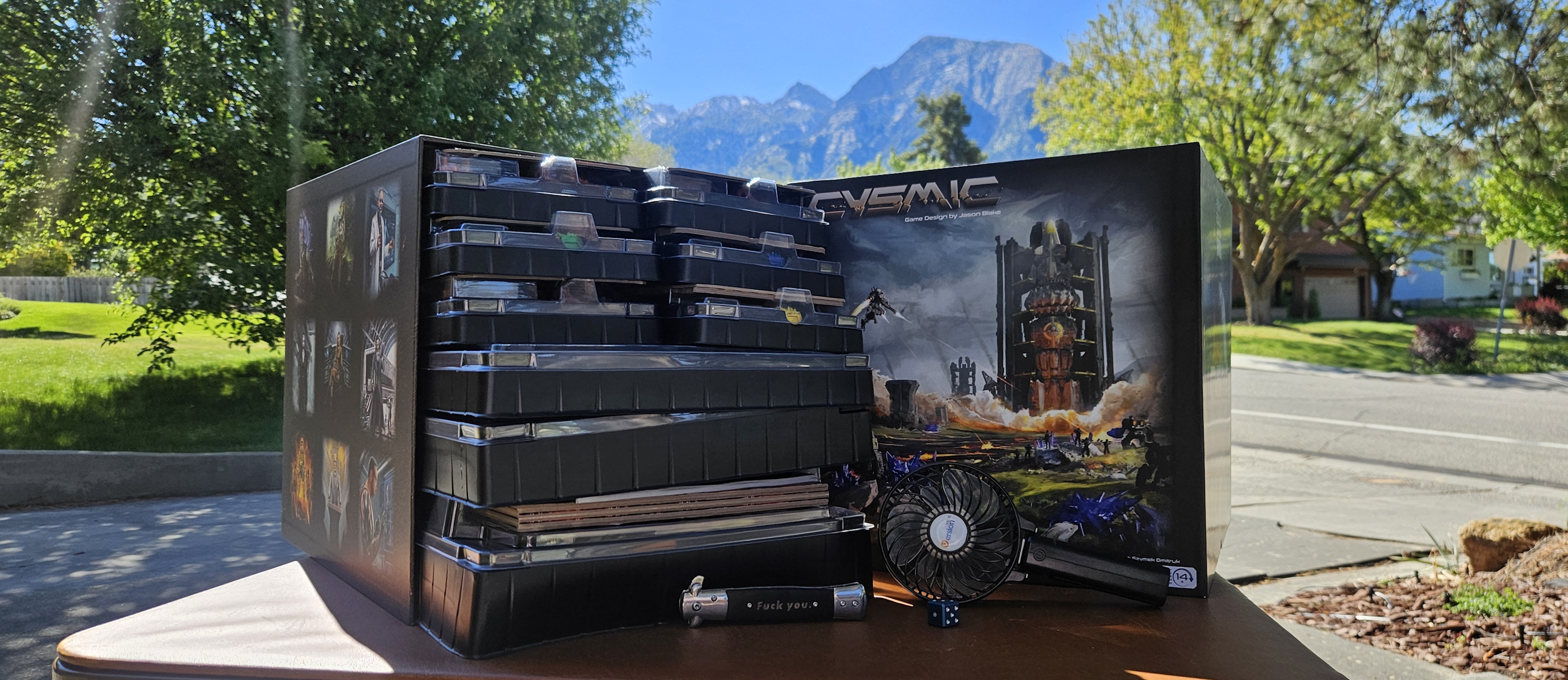
This is the first knife hidden in these images. Because lately I have been Getting Into Knives.

Cysmic next to a few everyday items.

I want to set the scene. Both of the scenes.

In the distant future, humanity has settled an exoplanet. Pretty cool. Only it turns out that we repeated our past mistakes, squatting on territory that means us harm. This planet, you see, is tectonically unsound. Seismic. Cysmic. (Ohhhhh.) At some point in the near future, the crust of this world will flake away like the film coating an uncleaned oven. When that happens, the eruption of magma and steam will render anything above unlivable.

Not unlike the Salt Lake Valley, come to think of it. Mostly, I just don’t. Think about it.

Which is precisely the problem. Cysmic is unexpectedly redolent of Sol: Last Days of a Star, Ryan Spangler’s parable about climate collapse hastened by its victims, and Meltwater, Erin Escobedo’s cautionary tale about how nations set themselves aflame for the sake of spiting people whose existence has little bearing on their own. Of course, these titles could not be further apart, production- or intention-wise, but the parallels are there for the taking.

All, for instance, are about a looming crisis that their games’ factions are urgent to hasten. Because that’s the crux of the matter. Our goal on this planet is to escape by reconstructing one of the old colony ships that bore us here. But rather than cooperate to ensure everybody gets a seat on the ark, we now usher in our own destruction. We crack the mantle to get at the minerals that will shape the colony ship’s hull; we shatter the crust with our ordnance; we erect tracked megastructures that unfasten fault lines like zippers. Every action we undertake in service of survival steals a pinch from the hourglass.

Where Sol’s telling of this parable was poetic and Meltwater’s was bitter, Cysmic settles for frickin’ awesome. If those games offer the somber foretellings of the Book of Revelation, Cysmic is the Doof Warrior rendition. Let’s get this party staaaaarted, it hollers, jets of flame washing over the audience.
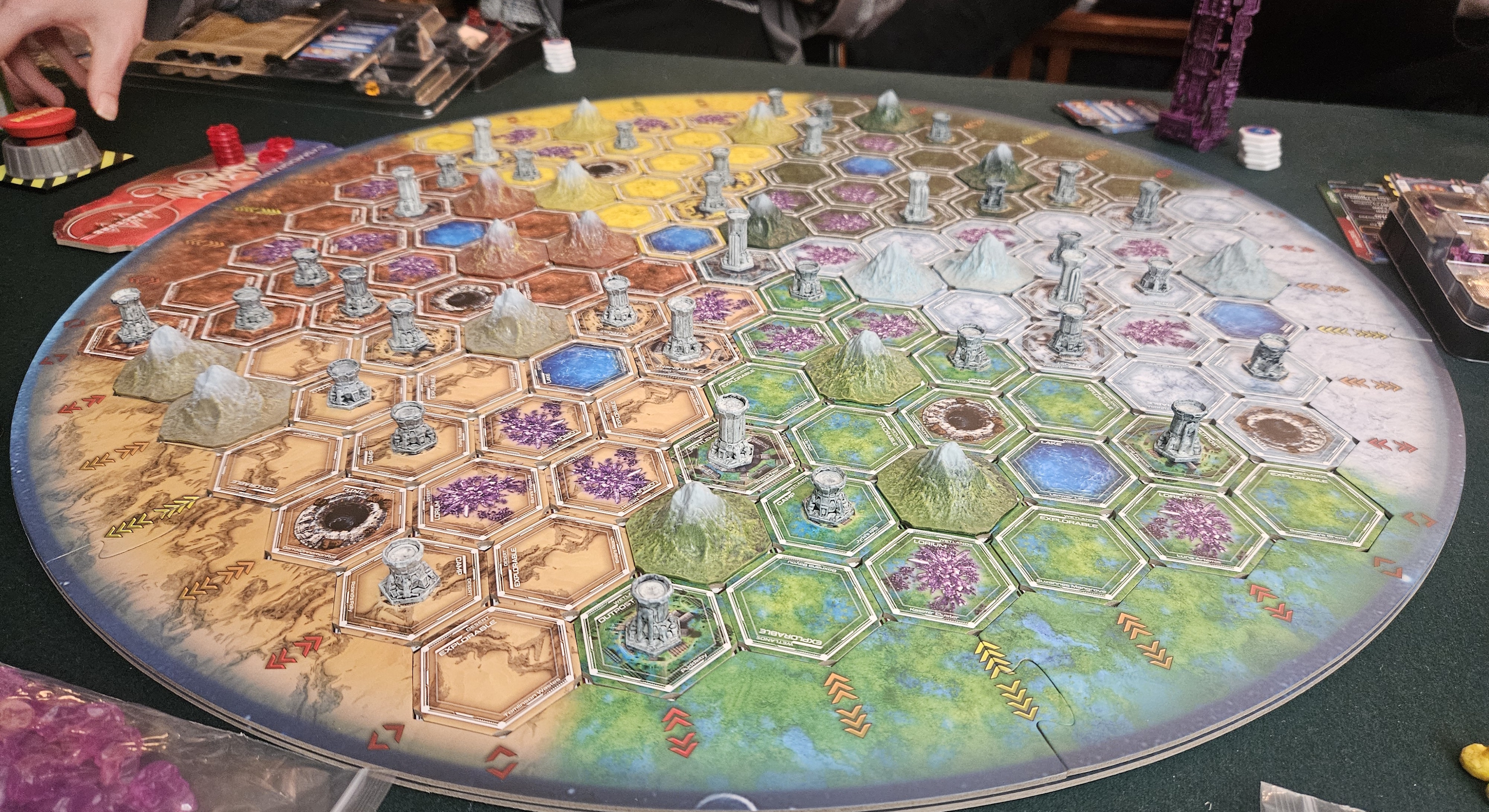
"You're right, that isn't how biomes work!" —a climatologist misreading my caption.

The map is ridiculous.

That’s the narrative scene. The second scene begins on the physical tabletop.

I worry about waste. Not as often as I ought to, probably. Compared to junk mailers and Happy Meal toys and oil wells set alight by incautious tyrants, board games are a drop in an ocean of muck. At least, I tell myself, they’re preservable. I donate some of them, and sell others, and buy secondhand when I can, and try to ensure that they go to homes where they will be appreciated and not wind up in some landfill after only one or two plays.

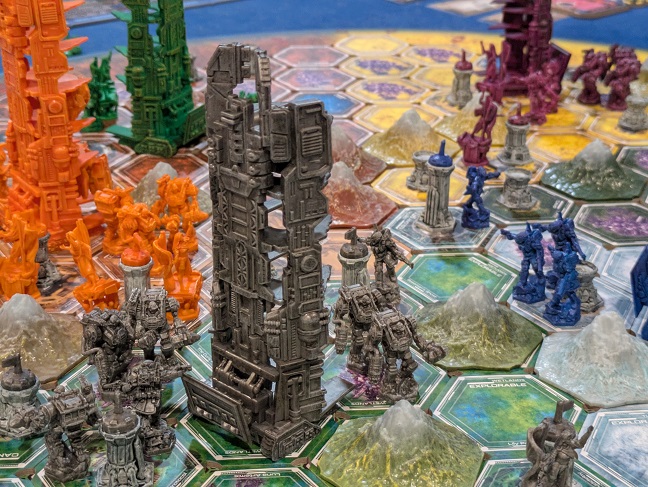
Cysmic defies that self-soothing rubric. The map is so massive that my group laughed uncontrollably the first time we set it up. Again, it isn’t the largest board game to ever take up real estate on my table, but it’s perhaps the most of everything else. Those frames, with their little magnets underneath the cardboard. The tiles, crafted with fingernail-thick nubs at their corners to make them easier to pry up. The plastic mountains, which called to mind the earliest printings of Runewars, back before Fantasy Flight decided to use cardboard overlays in place of three-dimensional topography.

The miniatures. Goodness, the miniatures. Some of them are actually mini. Others, like the spires that hold the components inside your colony ships, an affectation that’s a nice bit of visual design on the one hand but also a physical obstruction of the battlefield on the other, are so large that they veer into self-parody. If you saw this thing on a sketch show, you would swear this wasn’t a real game. Ha ha, we would say, look at the silly nerds, with their jokes about Windows 11 and their board games that defy common sense. Those towers are not merely phallic; they are penises, swollen like Cormac McCarthy’s sunset, like Daniel Plainview’s erupting pumpjack, almost rhapsodic in the baldness of their representation.

To some degree, this clutter is extraneous to the tale Blake wants to tell. It’s so big, for one thing, that many of its rumblings hardly matter. The first time the mantle collapses to reveal the planet’s glowing lifeblood, odds are that the catastrophe won’t come anywhere near you. A settlement falls in, countless lives are lost, but only in theory. There are other settlements to claim, other veins to mine. The scars are mere obstructions, easily bypassed or flown over. Might as well fire up some extra rockets. Charge some lasers. Drill baby drill.
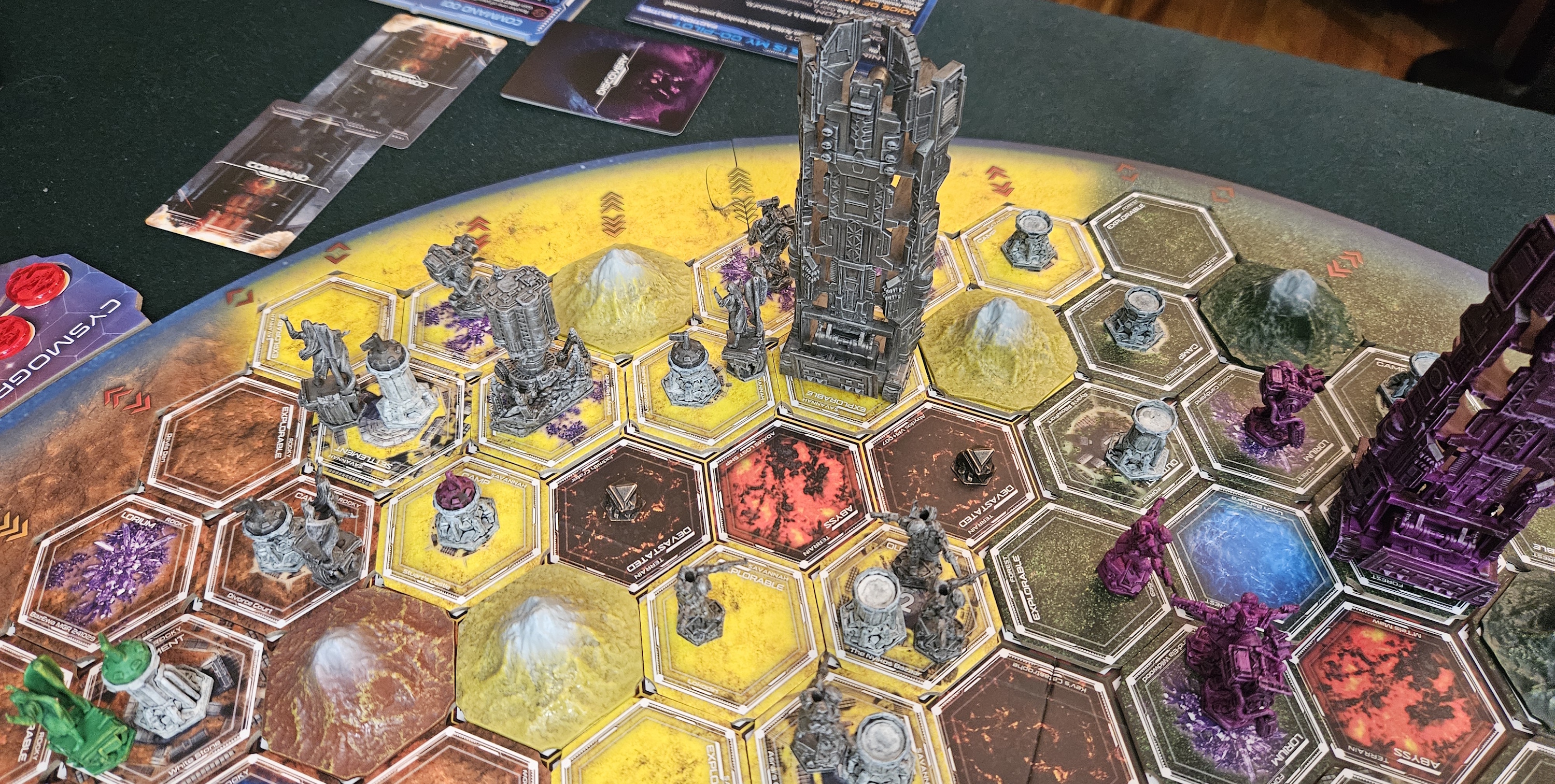
The map also wraps around, so these guys aren't actually hiding up against the edge.

Battle lines begin to form. Soon they’ll fall apart.

Then again, this is also the point. Because Cysmic, in addition to head-banging through the apocalypse, does have something to say about how the proverbial frog gets boiled. One collapse is nothing. Two is nothing. Five is nothing. But a dozen? Now we’re cooking. Like the frog in the pot. Like the settlements that have just fallen into mile-wide sinkholes. Like our troops, those without early warning detection systems, who have gone hurtling into the abyss.

Let’s back up. For a game of such sprawling proportions, Cysmic is surprisingly smooth to play. Each turn sees you selecting a card that activates some segment of your apocalypse-realizing faction. Often, this means triggering a type of unit. There are diplomatic Speakers that are indispensable in the early days and more vestigial once the oven reaches temperature, Soldiers for shooting things, Miners and plus-sized Harvesters for mining minerals, and big jump-jet equipped Powermechs for blasting enemy columns. Other cards resolve all the battles you’ve set up over the previous turns, launch negotiations and cyber warfare, recruit or upgrade troops, the works.

The most transformative card is the one that activates your colony ship. This inevitably collapses at least one hex as your giant launchpad shifts position, squishing troops and cities under its treads and leaving fiery destruction in its wake. This is also an opportunity to attach modules to your ship, provided you have the resources and blueprints to do so.

Despite this clarity, turns aren’t as straightforward as choosing one card among many. In addition to selecting which card to activate, you also choose one that will disappear beneath it. This card is out of the rotation for the time being, depriving you of an entire class of unit or some crucial activity. Sure, there are ways to cycle spent cards back into your hand before the end-of-round refresher, but it speaks well of Cysmic that you’re asked to make tough decisions early and often. These choices aren’t as profound as, say, the hand drafting in Inis or Blood Rage, but they tend to be more significant than the eldritch upgrade paths of Cthulhu Wars.

This positions Cysmic squarely in the middle of the Ameritrash spectrum, somewhere between the poles of “cerebral/political” and “beautifully stupid.” Before long, it touches on both extremes. And while its performance in either arena is accomplished to greater or lesser effect, it always returns to those core tradeoffs between cards. This does wonders for the game. At a glance, you can tell how likely it is that a rival will respond to an incursion with a counter-attack, whether a target can shift a particular unit out of your reach, when the next tectonic collapse will take place. None of this information is foolproof. There are too many special abilities and action cards and faction perks for that. But it’s enough to communicate some sense of possibility, a probability waveform that can be surfed to your advantage.
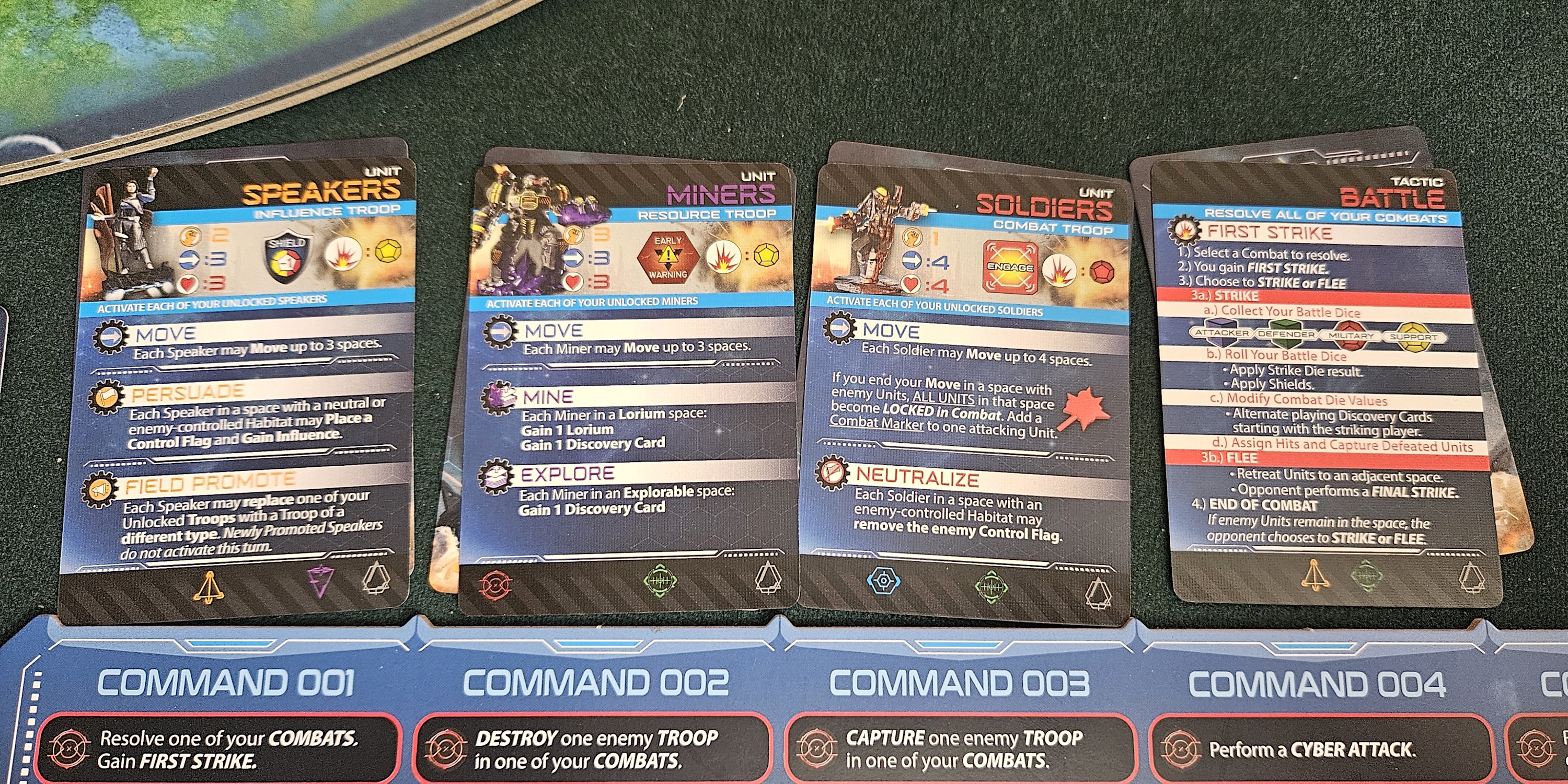
My priority is rock and roll, did you ever consider that? No? Shame on you.

The command system asks hard questions about your priorities.

So let’s look at those poles.

At heart, Cysmic is a contest of equal-opportunity aggression. Your goal is to complete your colony ship before anybody else, an objective made significantly harder by the absence of blueprints for all six of the necessary modules. Each player has sole ownership of one such module, meaning the only way to complete your ark is by prying the blueprints from their possession.

Fortunately, the blueprints of the far future apaprently come as shareable zip files. There’s no need to be too possessive; your possession of a blueprint does not preclude my ownership. The rub is that nobody is going to hand out their propriety information willingly. There are therefore two ways to gain access to a faction’s data. One, you can steal it via cyber crime, a finicky action that’s one of the game’s many underdeveloped appendages, but a noteworthy one all the same. Or two, engage in battle to kidnap some of their troops for use in a blueprint-for-prisoners exchange.

The implications are far-reaching. The good part is that everybody needs to attack everybody else, at least a little bit, in order to capture enough units to swap for those blueprints. If anything, a few early attacks might render a particular neighbor more or less negligible, which can be a huge relief when you share a border. Once you hold my blueprint, there’s no reason to attack me anymore, barring some late-game stalling for time.

On the other hand, this diminishes some of the game’s other elements. The map, for example, isn’t especially interesting, which is saying a lot when it depicts an entire planet crumbling under the strain of mech battles and mountain-cracking mineral extraction. There’s no reason to hold any territory in particular. One settlement is as good as another, resource veins are interchangeable, troops come and go, and entire flanks might collapse thanks to a random pull from a bag. With no sense of permanence, there’s nothing like a battle line, and the inviolability of your colony ship means there’s nothing to protect.

The closest dudes-on-a-map analogue would probably be Kemet, but one cleared of cities or temples. There’s plenty of territory out there, even a few choke points, but all that landscape provides very little reason to care about one tract over another. As the planet falls apart, it’s possible that some areas will become more valuable, but our sessions tended to conclude before such an eventuality was realized. The result is round-robin aggression, everybody targeting whomever they haven’t yet stolen blueprints from, with very little concern for anyone else.
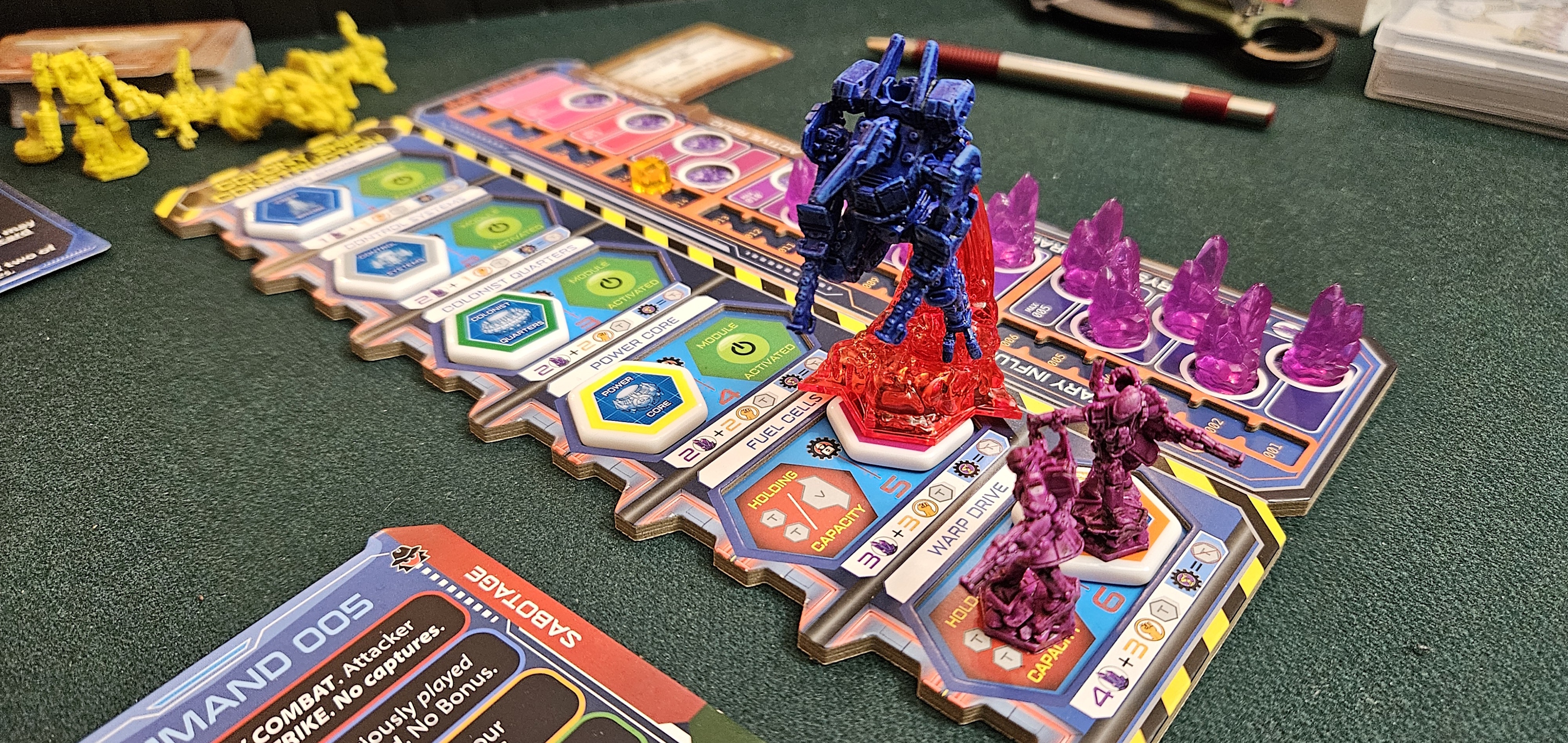
My faction's powermechs scream "Zip zop zooey!" as they launch into battle. Nobody fears them.

Prisoners can be exchanged for blueprints.

The good news is that these aggressions are enjoyable enough in their own right that it isn’t as though Cysmic is going through the motions. Battles are punchy, if a little too concerned with different dice types and attack modifiers, and it’s always possible that a gunfight will accidentally split the world at the seams. There’s a little bit of everything in there. Dice, of course, with varying shades for combat and noncombat units; cards, for modifying rolls and maybe springing a nasty surprise; unit and faction abilities, just in case you thought you were getting off easy. Despite this abundance, resolution is reasonable, never reaching Forbidden Stars duration, which is great for the game’s play length if not for any prospective bathroom breaks.

Maybe the biggest highlight is the faction system. Like everything else in Cysmic, there are heaps to choose from, and in place of the expected mealy-mouthed plus-one perks, each team offers something transformative and meaty. One of them adds adjacency to every single space next to a mountain or lake, effectively letting you teleport anywhere at will. Another seizes control of any settlement anywhere on the map at the start of each turn. A third takes their turn at any point in the round — and I mean any point, treating the usual turn order to forced obsolescence.

What’s wild is that these are only the first of those factions’ abilities. Each offering has three or four whoppers. And there are more than twenty-five factions in all, each with their own distinct advantages and playstyles. The only real downside is that they all have dork-ass meme names like Path of the Wrighteous, Moving Mao Tons, or Kriss of Death. Receiving a diplomatic missive from uplifted psychic housecats is one thing; that the kittens have named their faction Cat-Aclysm gives off a real cringe vibe.

But, look, restraint is not Cysmic’s watchword, so why would Blake rein in the puns? Everything here is the board game equivalent of an extra order of mozzarella sticks. The handfuls of dice. The units you probably won’t field. The sheer variety on display. There’s even a clacky launch button that serves precisely zero in-game function, but which I very much intend to keep when I pass the game along to somebody else.

And, of course, there’s that most emblematic of all components: the conscience die.
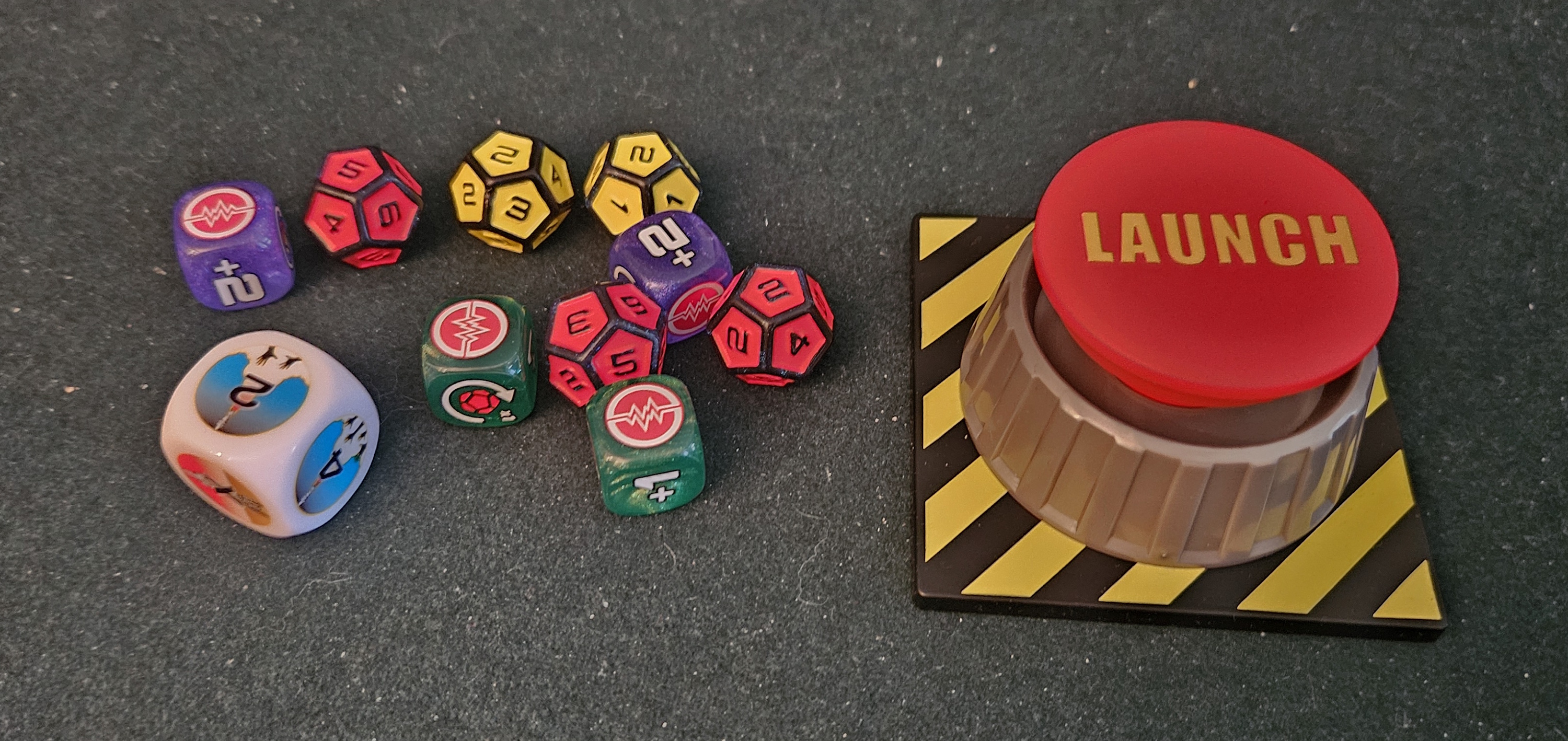
My conscience says it's time for a big scoop of peanut butter.

Roll the dice. Smash the button. Search your conscience.

To my utter tickling, this final hexahedron serves an indispensable purpose. When at last the planet has been strip-mined, when the blueprints have been assembled, when the modules have been stuffed into your colony tower, the game is still not complete. Now it’s time to blast off for the stars and leave the rest of these suckers behind.

Except you might not be ready to hit the red button. It all depends on the conscience die. When the time comes, you roll and compare its result against the troops you still have on-planet. All the miners and troops stationed in the dust, all the diplomats persuading those neutral settlements that you have their best interests at heart, all the prisoners still waiting for freedom. The conscience die reveals how many you’re willing to leave behind. If there are fewer out there than the roll, you leave. Kaboom.

But if not, you stick around and attempt to evacuate more bodies, more lives. With the right resources, you can try the roll again next turn. Without them, you’ll have to wait for the end of the round when your cards return to your hand.

Either way, Cysmic has done the unexpected. It has grounded the moral cost of its conflict. In incredibly shaky terms, yes. In a way that rewards losing units to cave-ins and enemy assaults. In a way that makes the anthropogenic horrors visited on its planet and peoples seem all the sillier. But in terms that, imperfect as they are, most historical wargames don’t even attempt, and which — and I say this in all seriousness — we would laud in a game with a more solemn setting. Because even here, as the world collapses toward its molten core, sometimes the cost is too high. Sometimes you can’t bring yourself to make the hard choice. Even if you happen to be a battle-hardened jerk named Minnesota Killjoy.

(Yes. That is one of the game’s factions. Save me.)
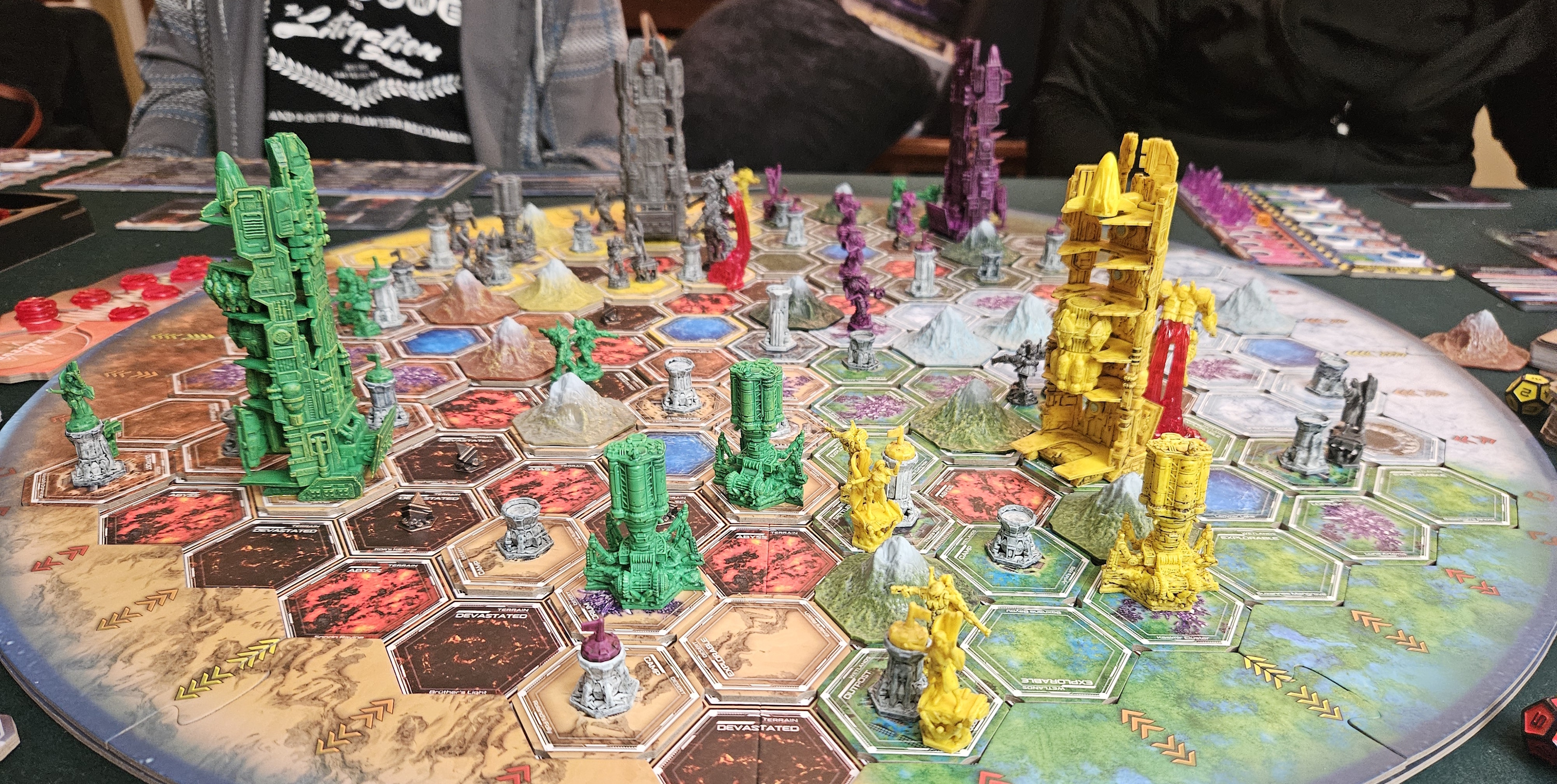
I now want to play Clash of Cultures on this map. While the terrain falls into the core.

Ah. Ludicrous.

This, I think, is what sets Cysmic apart. It’s too big. It could have been pruned down. It doesn’t need quite so many alternative modes. The mountains could have been cutouts. The launch towers could have been a little less, ah, engorged. There didn’t need to be magnets all over the place.

But it’s also a huge cry from the crowdfunding trash that gives miniatures-heavy games such a bad name. Unlike some of those titles, maybe even unlike the majority of them, Cysmic is a game one would actually opt to play. And more than that, it’s an earnest experience, one packed with exciting battles, a landscape undergoing disaster, a race to survive at all costs.

It even has shades of meaning in its human-hastened collapse, one that feels all too timely. Here in the desert of Utah, a billionaire has announced a 40,000 acre data center that will triple the state’s power consumption. The stated reason is national security, a digital arms race against China. This despite the professionals at the local universities pointing out that we don’t have the water, don’t have the heat allowance, don’t even have much of a Great Salt Lake anymore. Will our elected officials make a saving throw on the conscience die before they bake us to death? I hope so.

For a board game, that’s the sort of thing that makes us say it’s punching above its weight. When it comes to Cysmic, the aphorism feels wrong. Let’s instead say it’s punching at precisely its weight. Fine: maybe a little under.


A complimentary copy of Cysmic was provided by the publisher/designer.

(If what I’m doing at Space-Biff! is valuable to you in some way, please consider dropping by my Patreon campaign or Ko-fi. Right now, supporters can read my first-quarter update of 2026: the best board games, movies, books, and more!)


Reiner Knizia, Markus Slawitscheck could both seal historic trio of wins in this year’s Spiel des Jahres

Board game designers Reiner Knizia and Markus Slawitscheck both have a shot of completing an unprecedented series of wins at this year’s Spiel des Jahres – widely considered the highest profile awards in board gaming – after the 2026 nominations were unveiled earlier today.

The pair have already won two of the awards’ three categories in prior years – and the nominations of Slawitscheck’s Morty Sorty Magic Shop for the main prize, and Knizia’s Rebirth for the higher complexity Kennerspiel, could see either or both become the first designers in the awards’ 47-year history to complete the set.

Morty Sorty Magic Shop is up against Corey Konieczka’s Cozy Stickerville and Martin Ang’s Dito! – the German version of Jinxo – for this year’s Spiel des Jahres, while Rebirth is contending with Michael Palm and Lukas Zach design Boss Fighters QR and Donald X Vaccarino’s Moon Colony Bloodbath for the Kennerspiel.

This year’s children-focused Kinderspiel award will go to one of Boo Party, Mooki Island or Verflixt Verzaubert, the latter of which is also known as Mimose & Sam et le Voleur de Fruits.

Spiel des Jahres Association chairman Harald Schrapers said in a nominations livestream today that the jury looked at a record 571 games for this year’s awards, underscoring the sheer mass of games being released through retail.

The 440 titles reviewed across the Spiel and Kennerspiel categories was up 14% on last year, while the 92 games considered for the Kinderspiel marked a roughly 50% rise compared to the 61 from 2025. Another 39 titles were considered by judges across both the Spiel and Kinderspiel awards.

Number of games reviewed in recent Spiel des Jahres years – red is Spiel and Kennerspiel, blue is Kinderspiel, and purple is games which span both segments

Despite those record numbers, Schrapers pointed out that just 2.3% of the games were from women designers, with male creators making up 94% of the cohort, and the rest being designed by mixed teams.

That figure has barely moved in recent years, having stood at 2% in 2025 and 2.6% in 2024 – an ongoing lack of diversity highlighted in great detail in this excellent feature by Wargamer’s Mollie Russell earlier this week.

Schrapers also emphasised that this year’s judging process had been a particularly frustrating one, with glaring flaws being present in even the standout designs.

He said, “It was a lot of fun, but there were also real shortcoming in many games.

“There are deficiencies in some games every year, of course – there are so many, not all of them are really good. Many are good, but as I said, not all of them.

But this time we noticed, especially with the outstanding games, i.e. the 10% best – I would say there were various games where there were various quite serious flaws. There were so many that I even wrote them down.”

He presented a list which included incomplete, ambiguous, and contradictory rules of the game, a lack of summaries, blatantly incorrect age information on boxes, and components which fail to function well in poor light or after a handful of games.

Schrapers said in a separate blog post about the process, “Despite these shortcomings, some titles made it onto the jury’s shortlist because the flaws were not so significant in relation to the outstanding gameplay.

“However, there were probably more than one work that failed to secure a majority in the jury vote due to such a deficiency.”

Spiel des Jahres deputy chairman Christoph Schlewinski, left, and chairman Harald Schrapers, right, with this year’s Spiel des Jahres nominees

The livestream also drew attention to the nomination of Boss Fighters QR, and the long-listed design Toriki: The Castaway Island, as notable for requiring an app in order to play.

When asked by Spiel des Jahres deputy chairman Christoph Schlewinski whether that signified a growing trend within the hobby, Schrapers said, “No, I don’t think that’s a trend.

“They are two games that work very well with an app… the thing is that the app supports the analogue feeling in such a game. That’s why it’s an addition.”

He added, “I’m really sure that even in ten years, 90% or even more of all board games will work without a digital integration, because that’s exactly what people like.

“But an app also draws new people into this game. We notice it especially with young people that they often find this very , very good, it creates additional tension – and you can see that such a board game can also open up new audience groups.”

Hisashi Hayashi’s co-operative bomb disposal game Bomb Busters won last year’s Spiel des Jahres, beating the much-fancied push-your-luck card game Flip 7 to the high-profile award.

That victory meant the Spiel des Jahres has now been won by a co-operative game design in five out of the past seven years, following successes for Just One in 2019, MicroMacro: Crime City in 2021, Dorfromantik: The Board Game in 2023 and Sky Team last year.

Cozy Stickerville is the only nominee for the main prize this year which is a cooperative title.

Last year’s Kennerspiel des Jahres was won by Endeavor: Deep Sea – which also features a prominent co-op mode as a way to play the game – while the winner of the 2025 Kinderspiel was Wolfgang Warsch’s Topp die Torte.

Winning the Spiel des Jahres can explode sales by hundreds of thousands of copies for the winner – and by thousands of copies for the nominees.

While publishers tend to keep tight-lipped about actual sales figures, Pegasus Spiel co-founder Karsten Esser told BoardGameWire in a 2023 interview that winning the main prize can boost a game’s sales by 10x to 20x in the months following, due to a slew of exposure across mainstream German shopping outlets in the run-up to Christmas.

That kind of boost can be hugely impactful for publishers and designers alike – and is particularly important to smaller publishers in the fight to stand out amid an increasingly competitive industry which sees thousands of releases each year.

The winners of this year’s Spiel des Jahres awards are set to be announced on July 12.

The post Reiner Knizia, Markus Slawitscheck could both seal historic trio of wins in this year’s Spiel des Jahres first appeared on .

Oh, and regarding the new version of High Society

19. Mai 2026 um 17:04

‘Twas elegantly done — ignoring the fact that the cards are a downgrade from tiles — but were the graphic designers for the new AllPlay edition were trying to convey colorblindness to the rest of us? The five colors of money cards are “brown,” “beige,” “orangeish brown/beige” “purpleish brown” and “I’m not sure what it is … let’s call it … cocoa?”

Honestly, I’m not sure what the colors were, except all very similar. Seriously. Game looks beautiful, but ugh.

Designer Diary: TEDOKU

Von: 4docich
19. Mai 2026 um 16:00

by Sandro Blasich


It is a rather interesting story of how I came up with the idea for TEDOKU.

So, I finished a game for SPIEL Essen pitch and like every year I watched SPIEL Essen preview list and I saw a game that looked almost 90% as mine. It was so similar that I gave up on it and I didn't pitch it. That was a game with Tetris elements. However, since I like both sudoku and Tetris, suddenly an idea crossed my mind that I could actually combine those two elements in one game. As it usually happens, I had that idea in one of those rare quiet moments that you can have when you have kids: when you lock yourself in the bathroom 😊 So, I designed TEDOKU but I had no plans to pitch it at SPIEL Essen. I designed it for fun, just for myself like I said in my previous designer diary.

Basically, the first prototype was practically a final product. Everything just clicked from the beginning. It was easy to design it and it was even easier to make it.

During one board game night at my house, a friend saw a box with no name on my board games shelf and asked me about that game. I said that it was just a game I designed for myself. He was curious about it so we played it a few times and he really liked it. He told me that he thought the game was complete and ready for SPIEL Essen. I wasn't so sure but in the end I decided to pitch it and I managed to get some meetings at Essen for it.


And just like that I signed my first contract. I was very happy. I couldn't believe it but it seemed that I'm finally going to have a published game. As you know, it takes some time from the signing of the contract to the exact publishing date so it took several years for TEDOKU to be published. TEDOKU was my first signed game but in the meantime my other game got published first (Choconnect).


TEDOKU is a 'roll, flip and write game“ in which you try to fit special shapes called polyominoes into your own Sudoku-style grid. The result of a die tells you what to draw and a card flip limits where you can draw it. When drawing a shape you can rotate or mirror it in any direction. If you don't have enough space to draw it properly you must skip your turn. The game finishes after 20 rounds (after 20 cards have been drawn). Each player scores points based on the number of completed sectors, columns and rows in their grid. Also the replayabillity is huge because there are 27 cards in the deck and at setup you remove 7 cards at random. There are 6 pencils in the box but if you have more pencils you can play it with any number of players. The game is also great for solo play. TEDOKU is a small, cosy game but it's got a lot of substance due to a number of interesting choices that you can make. TEDOKU is also a perfect travel size game as well.


I'm very pleased with how Ares Games developed my game. Thank you Roberto Di Meglio.
And of course I must mention Matteo Ceresa, who made a great job with the illustrations and graphic design reminiscent of Japanese art. Thank you Matteo.

StarDriven: Gateway

19. Mai 2026 um 15:51

Played StarDriven: Gateway last night. First of all, let’s get this out of the way.

The horrific trend in the last two decades of putting a colon (or dash, or em-dash) in a book’s title and then giving it a subtitle is a terrible development and should not be extended into games. It is only allowed if the game is in fact a sequel. We have to be able to tell all the Race for the Galaxy expansions and arcs apart. Adding a “Legacy” to Pandemic (etc) is fine … they are related but different games. Apparently there is a StarDriven: Saga coming out (out?) from the same company, and they want to note they are related … but I’m watching you, Rock Manor Games. Cut it out.

The rough mechanics

(It’s been so long since I reviewed a game that was relatively new, I’m actually going to describe it a bit).

SDG is a knock off Star Trek episode, or perhaps season, and is actually a pretty nice idea. Each player has a ship, and you roll dice (of various colors). You can use red dice for fighting, blue dice to run warp drive1 and sensors. Green dice are impulse and engineering. Some of the stations can also accept any die. Also, each station has an energy cost. (Usually 0-3 energy, but some stations gain you energy equal to the die roll).When you place a die you get one very useful thing (no matter the die value) and then use the die value to get other things.

For example, the “command” station will accept a red die (for one energy), a red die (costing two energy) and any die (three energy). When you place a die there you get an experience marker (which lets you buy/improve your crew) and then the better the die the better the attack.

Crew are a certain species, have specialties (although they can all operate any station) and can be regular or promoted. You can only take an action on a station that has a crew member, but one of your actions is “place a crew member into a station.” Each crew member also has a “Tap to due special thing” as a free action.

At some point you can give up an action to remove and reroll all your dice (and untap some of your crew).

Combat is clever … each die rolled is a hit against a section (you have six sections, after all) but you can roll your shields and if you roll a matching number you block the hit (but your shields are weakened). If you don’t match numbers, you take the hit, the spot is blocked, and your shields are still strong. (You can spend engineering actions bumping up your weapons or shields).

The owner described SDG is “kind of a 2.5X game, not quite a 4x” … at least in the early “episodes” (we played “episode 1”) combat is enough to keep you honest, but minimal. Players are not expected to fight each other, but there are a few nuisance ships out there. Presumably in other episodes there could be harder enemies or PVP. But the board has only the major planets revealed at the beginning and you fly around, encounter “anomalies” and explore the map, and finish missions. When you finish a mission you must tap a promoted crew, or discard a crew from a station back to crew quarters (where you need actions to ready them again) or lose them entirely (from your hand?). Finishing missions gets you reputation (on the nearest major planet).

After a round the last player makes a few decisions for the enemy’s attack (breaking ties only, but usually there are ties). When one player gets 9 reputation the game ends after another round or two (at least for the scenario we played).

Then there is a slightly-too-point-salady scoring for my taste (you get points for reputation, a bonus for having most reputation on each major planet, points for anomalies, negatives for combats, bonus VP that you can acquire during game etc).

The Trouble with (Knock Off) Tribbles

Individually, the ideas work. I like the theme (and can appreciate that the license is too expensive, so I don’t mind it’s had the serial numbers filed off). The game looks nice, (the map tiles are functionally kind of hexes divided into three, but have a different look). Each ship has a slightly different coloration of dice … my ship had only one red (“Command”) die, so fighting and promoting is more difficult. Each ship also has a set of unique abilities (six perhaps) of which you pick two. You manage dice and energy and crew. I mean, the game is overproduced Kick Starter bait with a box too big, but also does give off the “labor of love” with an appreciation of the genre.

BUT ….

  1. The missions are bland. Tap (or discard) the right crew and that’s it. Sure, this is a “diplomatic mission” and that’s a “earthquake rescue” but they are all the same. The anomalies feel right thematically “Oh, you’ve got an energy alien loose on your ship” vs “A metallic virus is eating your ship” but again the ones I saw were all “Take some damage and if you spend a crew you can keep this card for a bonus <something> later.” I don’t know if you can make the theme shine more with the rules, but it would feel nice if you could. Now that I think about it, the anomalies should stick around and require longer to solve … after all, those are entire episodes in the show … not just one turn distractions.
  2. Energy felt too abundant, and there wasn’t any real problem if your ship took damage2. Don’t know if that’s because this was “episode 1” (which sets the first few missions and enemies).
  3. Rolling bad is a poor strategy. I rolled only “1s” on my three blue dice, which meant (effectively) I couldn’t warp to major planets or do anything but the worst sensor sweep. There are ways to re-roll, but they cost time (also a precious resource). Not a major problem in a short game or a game with enough die rolls; more annoying when you only roll the dice 2-3 times in a game.
  4. There’s clearly a design idea of “You have these characters. Can you make them regulars instead of red-shirts?” going on, which is clever. I wish it was explored more.

But those are just peeves, compared to the fundamental flaw.

The turns are too long. This is a fixed fun game; on your turn you get two actions (plus any free actions, which includes finishing a misson! or using some special abilities). It isn’t a problem that each turn takes 2 minutes (annoying, but not a deal breaker). The turns are too long because each player gets too many actions on a turn. Yes you only get two actions, but there are enough free actions that there’s no point in planning … any mission might be gone by the time it gets back to you. Players can warp around the board, after all, so even though each mission is tied to a planet type, none are too far away.

SDG feels like it would have been more engaging if it used a worker placement (or Eclipse’s) structure of “one action around the table until everyone is forced to pass and reset” … on your turn place a die (tap a crew, let’s make that not a free action, except maybe for promoted crew) and take an action. And don’t replenish a mission until the round is over, so they are definitely being fought over. Once everyone is out of actions then the round is done, the enemies move, and you do the next round. Now each player still only takes 25% of the time, but its a race against time, and isn’t that the real pressure in all the of the schlocky TV shows we love?

Can you get to that mission before the other ship shows up? One action at a time makes it tight (particularly if finishing the mission is an action, maybe not taking dice). Now it would feel more interactive …. instead of just “maximize the board state on your turn, then wander away for five minutes.”

I’ve played six (or even eight!) player games of Eclipse where my turn-to-turn engagement was much higher than my four player game of this.

I’d try this again, but would like to try it with one (or two) less players and perhaps a later scenario. But I’m not chomping at the bit.

RatingIndifferent.

Update — I got a note from the designer indicating that my concern in footnote 2 was misunderstanding the rules … if all three die slots in a section are damaged they are automatically repaired, but create a hull breach (which is -VP and enough hull breaches will destroy your ship). But that does mean you will always have at least one die slot in each section.

  1. Since it’s not licensed, SDG doesn’t use terms like “Warp Drive” or “Impulse” that might get them in hot water, but you know what I mean. ↩
  2. In theory your ship can blow up, but we came nowhere close to even “lose some VP if one of your sections is totally blown up.” Also, from my quick glance at the rules, if your entire engineering section is blown up, you lose the ability to do any repairs ever, which seems like it could be a flaw and is definitely anti-theme for the “daring comeback from impossible odds.” See update after post for clarification ↩

The Dusty Euro Series: Thebes

The guys in my Wednesday gaming group started a push to play more of the old, dust-covered games at the bottom and backs of our respective game closet shelves. The premise was simple: let’s try to remember why we keep all these old games when all we ever play now are the newest, shiniest things in shrink.

Right on the spot, the Dusty Euro Series was born, and I’ve enlisted multiple game groups to help me lead the charge on covering older games.

In order to share some of these experiences, I’ll be writing a piece from time to time about a game that is at least 10 years old that we haven’t already reviewed here at Meeple Mountain. In that way, these articles are not reviews. These pieces will not include a detailed rules explanation or a broad introduction to each game. All you get is what you need: my brief thoughts on what I think about each game right now, based on one or two fresh plays.

Thebes: What Is It?

Thebes is a press-your-luck set collection game featuring rondel-style movement mechanics for 2-4 players. In the vein of Raiders of the Lost Ark, or any board game that features “competitive archaeology”, players…

The post The Dusty Euro Series: Thebes appeared first on Meeple Mountain.

A Monument to Excess – A Cysmic Review

19. Mai 2026 um 15:00
The instinct to build massive edifices, monuments, and works of art is primal. For animals like the Bowerbird, their elaborate mating parlors are practical. For humans like Jason Blake, their mind-boggling creations eschew practicality for ambition. The most honest assessment I can give of Cysmic is that it’s a boldly crafted reliquary to youthful mirth…

Read more →

The Lord of the Rings: Fate of the Fellowship Review

19. Mai 2026 um 14:54
The Lord of the Rings: Fate of the FellowshipHow many editions of Pandemic are there now? Ten? Twelve? More?? Do we really need another iteration with a pasted-on theme and modified ruleset? Haven’t we cured all the diseases? Turns out there is one intellectual property (IP) that continues to saturate the market and maintains a rather high level of esteem: The Lord of […]

Source

My Favorite Wargame Cards – A Look at Individual Cards from My Favorite Games – Card #78: Hamburger Hill from Fire in the Lake: Insurgency in Vietnam from GMT Games

Von: Grant
19. Mai 2026 um 14:00

With this My Favorite Wargame Cards Series, I hope to take a look at a specific card from the various wargames that I have played and share how it is used in the game. I am not a strategist and frankly I am not that good at games but I do understand how things should work and be used in games. With that being said, here is the next entry in this series.

#78: Hamburger Hill from Fire in the Lake: Insurgency in Vietnam from GMT Games

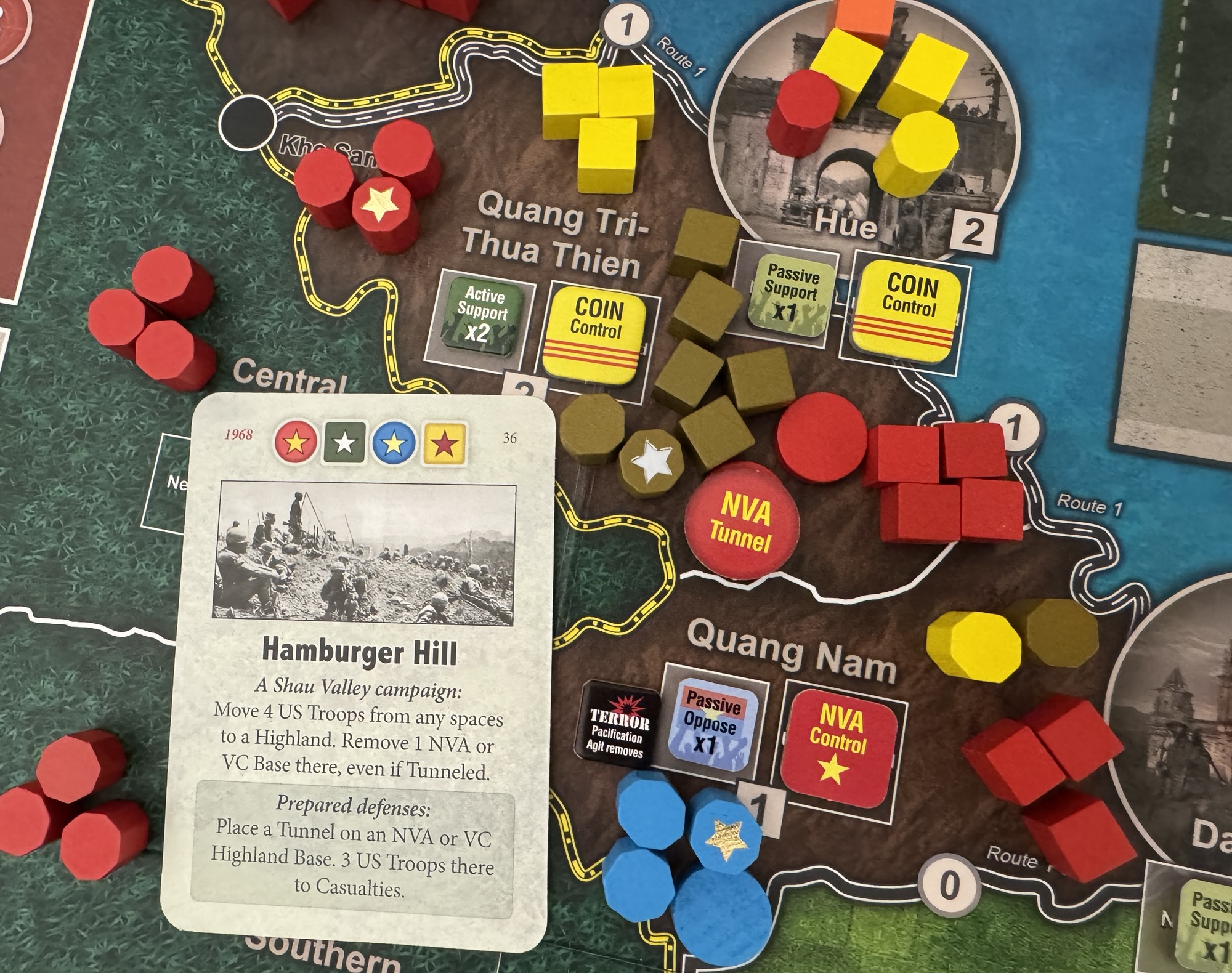
The COIN Series uses cards in a very different way from other CDG’s. These cards are not necessarily the driver of the action but more assistive to the actions of the players by setting eligibility and also providing powerful events. The Event Cards are more often than not, very powerful. They either give you a continuing bonus on future Operations and Special Activities (as in the case of the volumes that include the various Capabilities) or allow you to take Operations and Special Activities more times that round than you would normally have been able to had you not chosen the Event and more often than not, at no cost! Also, because of the power of the cards and their ties to one or more factions, you can take the Event which allows you a huge advantage, only to see that very powerful Event reversed with the next Event or with a regular Operation. This is very frustrating but is one of the major reasons that I love the card-assisted element of the COIN Series. Today we are going to take a look at the Hamburger Hill Event Card.

But first an aside. Along with the movie Platoon, my introduction to the fierce fighting in the Ashau Valley of Vietnam was mainly from the movie Hamburger Hill starring Dylan McDermott as Lt. Frantz and Courtney Vance as Doc. The images from this movie will be forever burned in my mind and with the recent passing of the anniversary of the battle’s start on May 13th I thought it would be a perfect time to cover this card.

The Hamburger Hill Event Card has a top event and a bottom event, which is the case with all cards found in the decks of COIN Series games. The top event benefits the US/ARVN players while the bottom benefits the NVA/VC players. The top event allows the US player to move 4 US Troop Cubes from any spaces on the board to any Highland space, which are the brown colored regions representing less forgiving elevated terrain and mountainous areas. It then goes onto allow the removal of any NVA or VC base there, even if the base is currently Tunneled. This is a very powerful event as normally moving units requires an Air Lift Special Activity or a Train Operation to place new units into a space. Also, removing a Base, and especially a Tunneled Base, requires multiple turns and a focused approach of Patrol, Sweep and Assault to uncover hiding Insurgent pieces and then to destroy them allowing for a Base to be removed.

The Insurgent half of the event allows them to place a new Tunneled Based into a Highland space as well as remove 3 US Troop Cubes to Casualties. The Casualties Box is where these “dead” cubes are stored until the Coup Round where they will have negative effects on the United States player and then be available again for use in the next turn. This event is very powerful and is a major boon for the Insurgent player in taking control of and maintaining their presence in the Highland Provinces.

I also very much like the historical connection to the Battle of Hamburger Hill and think that the designers did a great job of creating this event with real game effects related to the battle and consequences that are felt from the play of the card. This Hamburger Hill Event is one that will be played by both sides often rather than taking their Operations and Special Activities. The effects are just too efficient and powerful to pass on unless the timing of the game dictates differently.

The Battle of Hamburger Hill was a major battle that lasted from May 13–20, 1969 was fought by United States Army and Army of the Republic of Vietnam (ARVN) forces against People’s Army of Vietnam (PAVN) forces during Operation Apache Snow of the Vietnam War. Though the heavily fortified Hill 937, a ridge of the mountain Dong Ap Bia in central Vietnam near its western border with Laos, had little strategic value, US command ordered its capture by a frontal assault, only to abandon it soon thereafter. The action caused a controversy among both the US armed services and the public back home, and marked a turning point in US involvement in Vietnam.

The battle was primarily an infantry engagement, with the US troops moving up the steeply sloped hill against well-entrenched troops. Attacks were repeatedly repelled by the PAVN defenses. Bad weather also hindered operations. Nevertheless, the Airborne troops took the hill through direct assault with heavy use of artillery and airstrikes, causing extensive casualties to the PAVN forces.

Local Degar tribesmen call the mountain Ap Bia, which means “the mountain of the crouching beast.” Official histories of the engagement refer to it as Hill 937 after the elevation displayed on US Army maps, but the US soldiers who fought there dubbed it “Hamburger Hill,” suggesting that those who fought on the hill were “ground up like hamburger meat.”

The quote was attributed to Sgt. James Spears who said, “Have you ever been inside a hamburger machine? We just got cut to pieces by extremely accurate machine gun fire…”.

US Army photographers climb Hill 937 at Dong Ap Bia after the battle, May 1969.

In the next entry in this series, we will take a look at Culper Ring from Liberty or Death: The American Insurrection from GMT Games.

-Grant

Clearly Uncertain – the role of uncertainty in board games (Topic Discussion)

19. Mai 2026 um 12:43

Many of us play board games because they offer us some certainty. There are rules, objectives, specific actions, and so on that define how a game is played. These things provide a clear, well-defined framework. We know what is possible, what is not allowed and what we are trying to achieve. At the same time, board games also contain uncertainty. It is uncertainty that creates tension, excitement and a range of other emotions. In many cases, this uncertainty is exactly why we look forward to playing them. Inspired by Bez from Stuff by Bez, in this article, I want to explore why uncertainty in board games matters.

The post Clearly Uncertain – the role of uncertainty in board games (Topic Discussion) appeared first on Tabletop Games Blog.

Asian Games - quick takes

I came across several games during my trip to the Philippines for the Asian Board Games Festival in Manila. I played some, and I listened to an overview for others. Here are some of these games.&nbsp; This is the Combatron game, based on the Filipino superhero which was created in the 1990's. I forgot to ask the actual game name. It is in the final stages of development. I played a near final

Lands of Evershade: The HUGE Unboxing!

19. Mai 2026 um 01:40

I gave my word. I made a covenant.

Peter unboxes the top pledge of Lands of Evershade, the new hybrid RPG/board game from Awaken Realms!

I’ve been very lucky to be the recipient of the generosity of Awaken Realms lately, who have sent me some amazing stuff to cover on the channel. Recently ten years in the business, the company is going from strength to strength, churning out some really great games with absolutely peak production values.

Case in point – the PRG-meets-board game Lands of Evershade, which not only looks gorgeous, but has been receiving rave reviews. And the design isn’t just about pretty pictures and extravagant bits; they’re some very clever component design here, especially in the character board designs and cases that preserve your character from session to session. Check it all out in this comprehensive unboxing video!

Stayed tuned for more folks – a rules & reference is of course in th works, and they’ll be a video review a bit later down the pipe!

Making high quality tabletop gaming content at the EOG takes time and money. Please consider becoming a Patreon supporter or making a donation so I can continue this work! Thankyou!

Touch Grass (Metaphorical)

19. Mai 2026 um 01:00

at last, a use for this darn orienteering merit badge

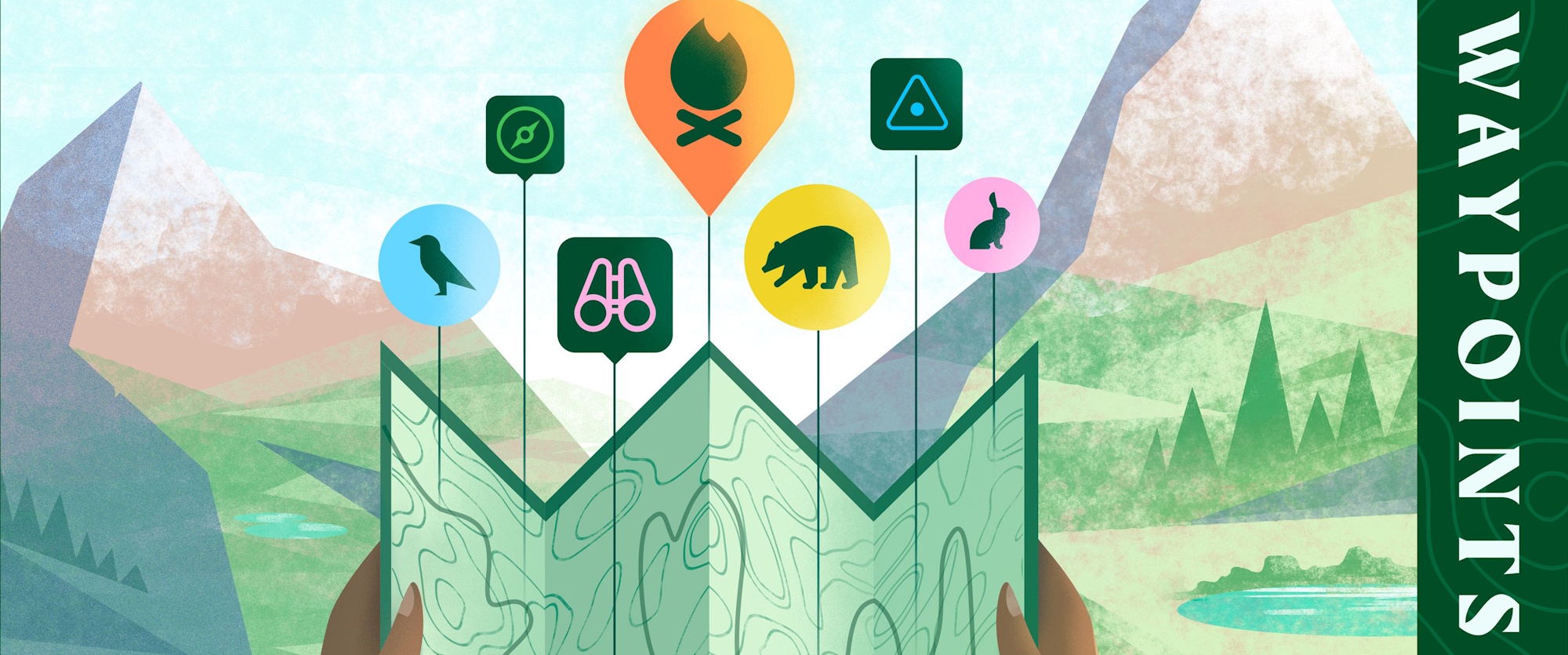
Voyages, the first of Matthew Dunstan and Rory Muldoon’s single-sheet print-and-play roll-and-write games, used three dice. Aquamarine used two. Waypoints continues the trend by using a single die.

That’s cool in its own right. But that isn’t what makes Waypoints special. What makes Waypoints special is the way it handles the movements generated by its rolls. Where those other titles — and let’s face it, most board games — featured straight movements, point to point, A to B, nearly every move in Waypoints is the sort of move you might actually make while traversing an open space.

Here, I’ll show you.

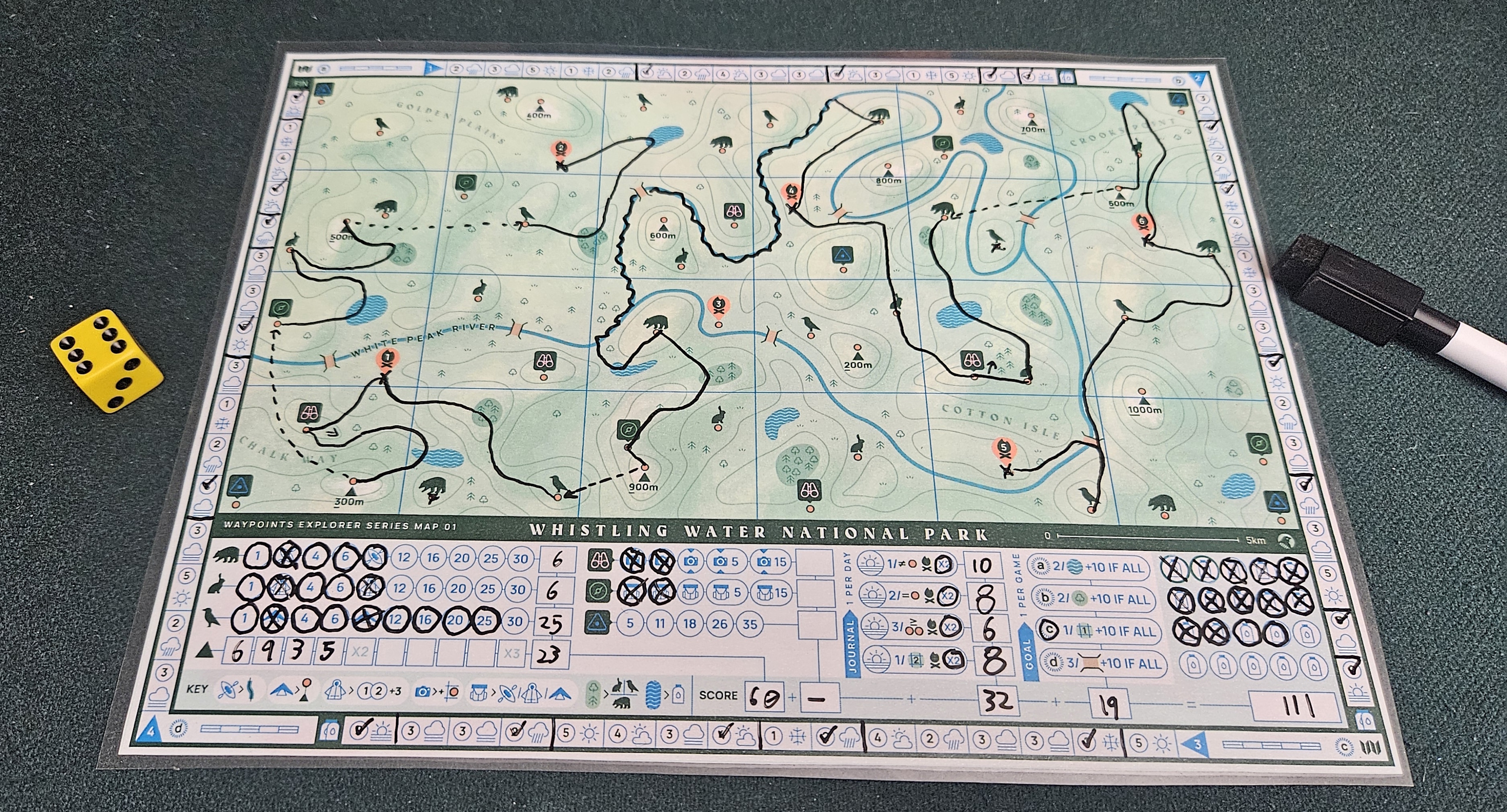
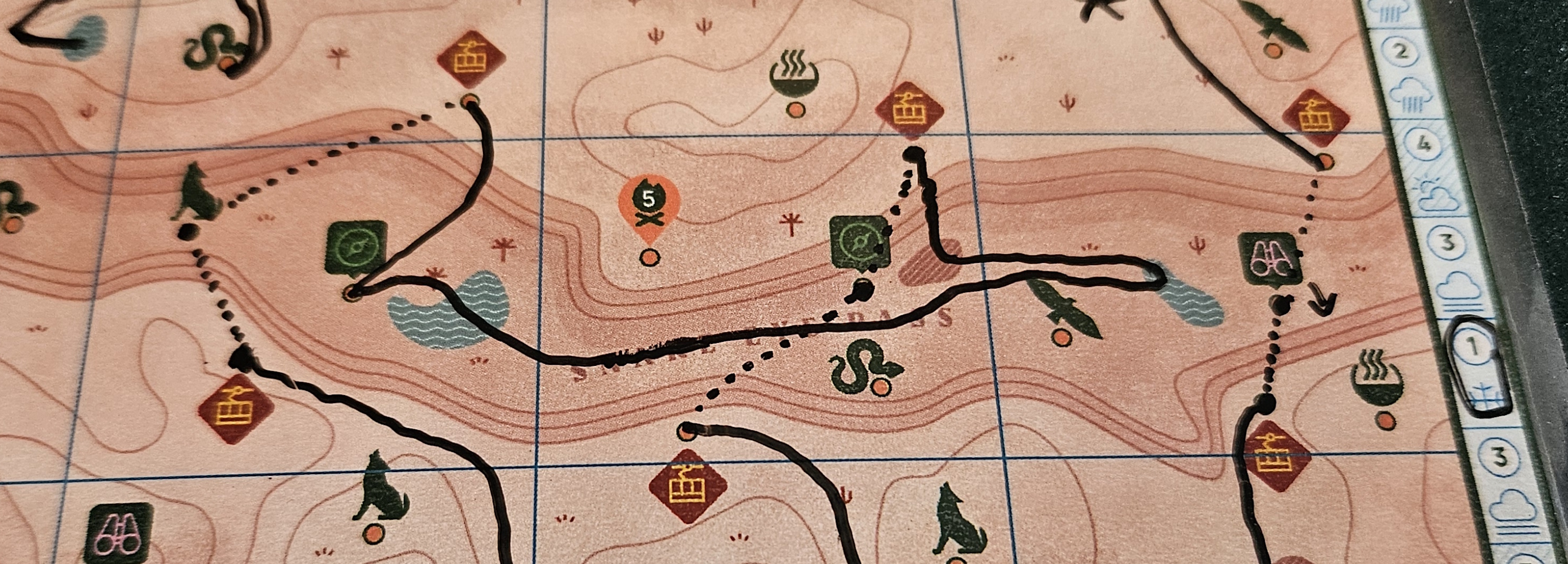
I attempted to draw my route in the spirit of Fabio Bracht on BoardGameGeek. His penmanship (squigglemanship?) in this game is super impressive.

A glimpse of the first map and the many places it might take you.

You’ve taken the Internet’s advice to touch grass. And with gusto, because rather than go to the park or something, you’re opting for a four-day wilderness expedition. Hopefully you aren’t prone to hay fever.

The gist behind Waypoints is that every turn you’re allotted some number of movement points. The number itself depends on the weather, and isn’t as simple as rolling the die and moving as far as it indicates. Instead, your roll shifts you forward along a track and reveals the current turn’s weather for everybody at the table. Inclement showers or storms might confer only a single pip of movement, while sunny afternoons offer a full five points. You also have a limited supply of water, which can be spent to stretch yourself to greater distances.

Every move begins and ends at a waypoint. When the game opens, that’s a campsite. Turn by turn, that might mean a wildlife site, a peak, a hot spring, a scenic overlook, or any number of other destinations. There are plenty to discover, and across the game’s five scenarios there’s a fair bit of variety. Along the way, you might swing by special features, like water sources or forests, but these aren’t waypoints, just side destinations on your way to the main thing. If you can’t reach another waypoint, that’s fine, but it means you’ll be stuck at your starting point pumping some extra water instead of moving anywhere at all.

As for those movement points, they’re spent by crossing lines. Latitude and longitude? That’s a point. Elevation? Another point. A long-distance trek involving multiple map segments and lots of hiking up and down ravines? That’s possible, but you’ll probably need a decent stretch of good weather. That or guzzle tons of water.

The skill here is avoiding goats.

Each map prioritizes a different skill.

Very quickly, these inbuilt limitations give your movements a certain naturalistic beauty. Rather than dealing in straight lines, as the crow flies, Waypoints challenges you to think like a gravity-bound creature. You’ll scurry along ridges, stick to gullies between rises, find open stretches of flat ground for traveling long distances, march up inclines in short spurts.

Of course, saving energy is only half the game. You’re here to see things. And the things most worth seeing outdoors are liable to be hard to reach. There’s a balance to be struck, then, between conserving your strength and pushing yourself to see the best sights.

But the result is a creativity of space, energy, and distance that’s rarely expressed in a medium as literalistic and rules-bound as board games. Often, the best route will be circuitous, the one that loops the long way around a peak. Or one that swings down a hill to collect some water, across a meadow to investigate a forest, and then around and up an incline where you’ll deploy a hang glider to soar to your next destination.

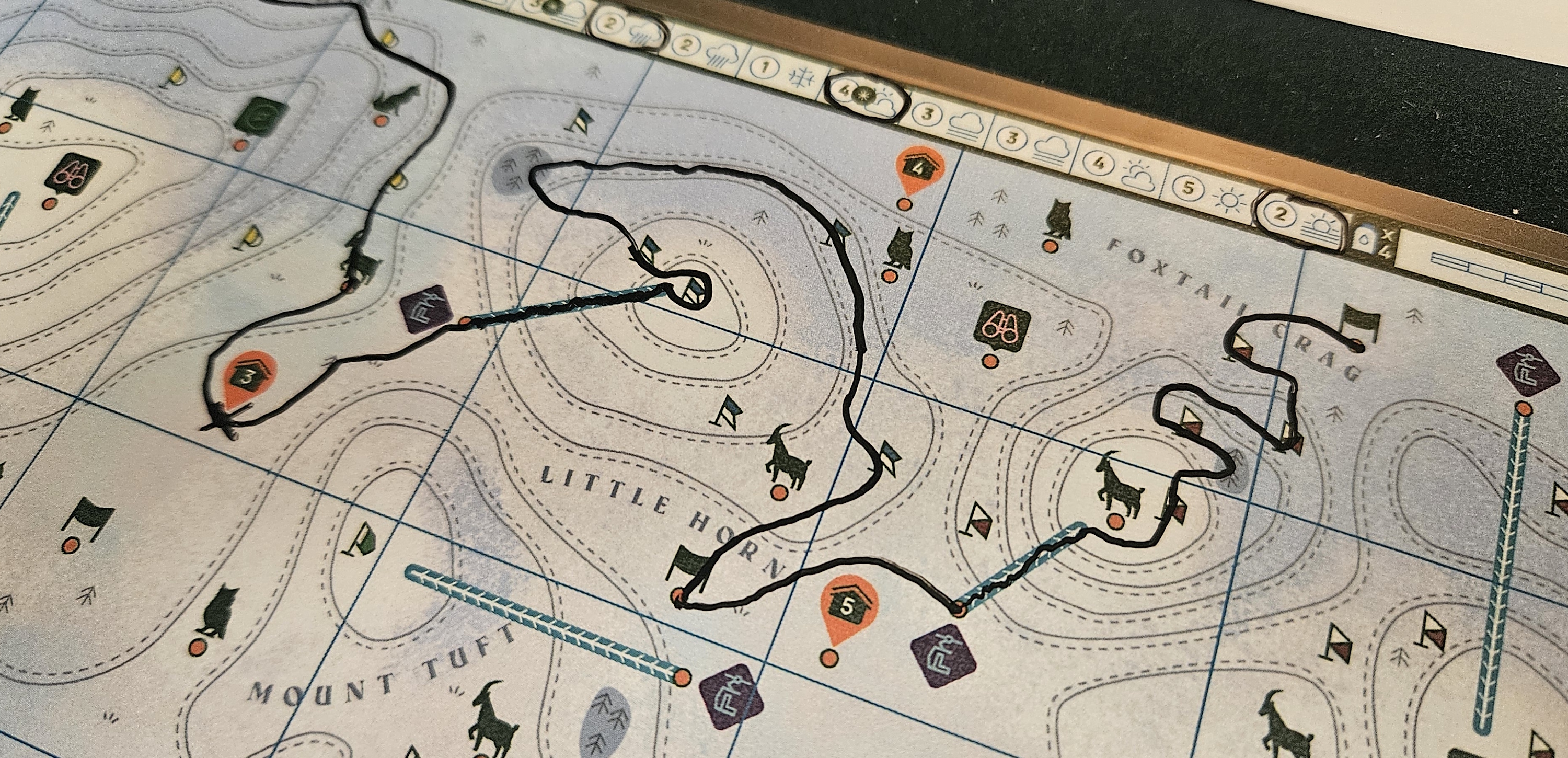
Because of course there are special abilities. In the first map, you quickly avail yourself of hang gliders and kayaks for covering great stretches of the outdoors. On other maps, your tools might include climbing ropes, cable cars, bicycles, snorkel gear, dinghies, ski lifts, or ferries. This produces fresh conundrums for each scenario. More impressively, these differences are also visible in the lines you draw on the map. In the desert, you tend to travel in spurts, sticking to shade or rationing your movement around the great canyon bisecting the map. On the ski slopes, shuffling upward is more difficult than gliding downhill, resulting in sharp rises followed by sweeping, switchbacked movements that visit feature after feature before arriving at the turn-concluding waypoint. In Waypoints, your mode of transportation is written directly onto the page, visible in the sweep of each route.

butterflies become granola... curious.

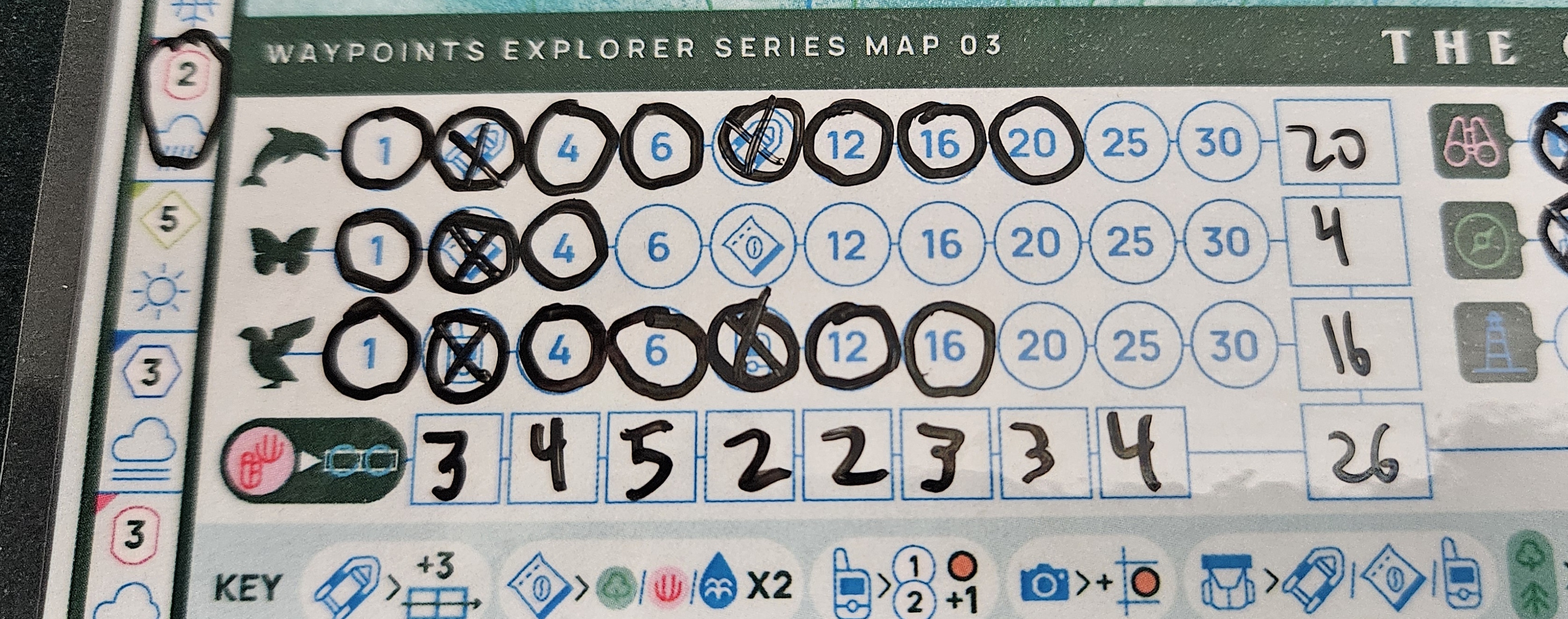
Meeting wild animals confers a wide range of benefits.

Like the previous entries in Dunstan and Muldoon’s movement trilogy, Waypoints is heavy with scoring opportunities. Fortunately, also like Voyages and Aquamarine, the scoring is interesting at all points.

The main commonality between maps is wildlife. There are always three types to see, and apart from occasional oddities — on the coastal map, the majority of my dolphin sightings occur in forests — it’s rewarding to watch your appreciation tick upward, earning not only points but also additional tools to make traversal easier. Beyond that, maps grow more playful. In one, reefs earn additional points later in the day, creating a situation where you’re incentivized to visit them late, but not so late that you get stranded when the day unexpectedly comes to its end. In another, you parcel out slugs of whisky between visiting local breweries or slogging through lochs in search of monsters.

Perhaps the one sour note is yet another repeat: the solitaire mode is a letdown. As with Voyages and Aquamarine, this is one roll-and-write that’s far more interesting to experience with other human minds. The problem is that the solo objective is incredibly easy in a vacuum, asking you to ensure that you conclude each day at a campsite. When that’s your primary objective, it’s a thing easily accomplished.

With fellow trekkers, the real goal is to wring every last point out of an imperfect day. Some hikes will be cut short, the caprice of the dice only offering a small handful of turns before the sunset brings your trek to a close. Others might even go long, your hiker hovering around a natural concluding point, only to find themselves distracted by extra sights. Regardless, there’s something satisfying about facing challenge after challenge, feeling like everything is going wrong, only to look at a rival’s sheet to discover that, you know what, your journey was rather remarkable in the end.

And scored forty-something points for it. Boom, baby. I still lost.

That time I scaled the Grand Canyon eight times in a day.

That’s the last great thing about Waypoints. In the minute between scoring and erasure, you get to look back on this thing, this little journey, and behold what you’ve accomplished. The strange loops, the reversals, that time you got stranded at a lighthouse for the night. The stories this game tells are small and gentle, but that’s also what makes them worth tracing one last time. This is no battle. There are no foes to vanquish. Only you, a fellow player or ten, and the routes you penned onto a map.

It’s a rare game that lets its players be so expressive. That Waypoints does so much with a sheet, a pen, and a die is nothing short of wonderful. I liked both Voyages and Aquamarine; against all odds, this one outdoes both of them at their best.


Access to the files to print Waypoints was provided by the publisher/designer.

(If what I’m doing at Space-Biff! is valuable to you in some way, please consider dropping by my Patreon campaign or Ko-fi. Right now, supporters can read my first-quarter update of 2026: the best board games, movies, books, and more!)

Geekway to the West 2026: My Thoughts from an Amazing Weekend

18. Mai 2026 um 16:58

I spent the last 4 days at Geekway to the West, an absolutely incredible game convention in St. Louis. Today I’ll share some of my highlights and observations through three lenses: Jamey as a publisher, designer, and gamer.

Publisher Jamey

Stonemaier Games participates in a few ways at Geekway: We donate a lot of games to their play-and-win section, which has proven year after year to be a great way to share our games with people who haven’t tried them.

We also have a booth in their vendor hall (Geekway primarily focuses on casual gaming, but they do have vendor space too) run by my coworker Dave and staffed by an amazingly generous demo team. Our main intent at the booth is simply for people to have fun and learn about our games, and it’s a nice bonus if we sell some games too (this year it looks like our booth revenue was around $16k, and people could also place orders on our webstore and pick up their order at Geekway since our warehouse is located in St. Louis).

I like that Geekway provides publishers a lot of different options. You can have a booth if you want, but you could also have a demo table through Double Exposure, you could just put games in play-and-win, or you can just wander around and connect with people (or scout games to potentially publish).

I’ll also add that having several years of t-shirt and hoodie sales provides a really nice way for me to look around any room at Geekway and identify people who know Stonemaier Games. The warm hoodies were particularly helpful, as the main hall at Geekway was quite cold this year.

Dark Heists

Designer Jamey

There are two sides to Designer Jamey at conventions: past and future. For games I’ve already designed, it’s immensely gratifying to see people playing them. I don’t think I’m alone, as I saw other designers checking in on people playing their games (this happened to me while playing the card game Oopsy Poopsy). I taught and played Euphoria Essential and Origin Story, and I had a great time learning the game Dark Heists from the designer, Moe Poplar.

Then there are the games I have yet to to design. I love playing a variety of published games at Geekway to learn from them. This year I played 14 new-to-me games and 6 games I already knew (it’s nice to revisit games to look at them from a fresh perspective).

Geekway provides several opportunities for designers to get feedback about unpublished games, including the clever Playtest to Win area.

Last, I’m so grateful for everyone who either played a game with me or just came up to me to say hi. Those moments and that time means the world to me. As someone who has social anxiety about approaching people, seeing others do it to me gives me the courage to do the same for others. Thank you for the inspiration!

Empires of the Void

Gamer Jamey

While Geekway is part work for me, it’s also part play. I love playing games with delightful people, and Geekway is full of them. In total I played 20 different games at Geekway (plus a round of disc golf) with around 60 people. I spent most of my time in a smaller ballroom in the first floor of the connected hotel–it was a much quieter in there (and warmer) than the main convention hall. Thanks to everyone who took the time to play with me!

I appreciate play-and-win as a gamer too, as it helps me narrow down which games to play out of so many options (though I did also check out both Blood Rage and The King Is Dead from the main library to revisit them). Without play-and-win, I wouldn’t have discovered the delightful game 3 Chapters, experienced the whimsy of the cat game Oopsy Poopsy, or delved into the strategic cleverness of Galileo Galilei.

While Geekway does have a few events people can sign up for, the vast majority of the convention is casual gaming. This, I’ve found, is my preferred structure for a convention, as I like the fluid nature of going from game to game at my own pace, remaining flexible as to what I play and how long I play. I’m grateful to Geekway for embracing this format, and I’m always open to suggestions for other similar conventions!

***

If you were at Geekway to the West this weekend (or you’ve attended a gaming event in 2026), I’d love to hear a few of your highlights!

***

If you gain value from the 100 articles Jamey publishes on this blog each year, please consider championing this content! You can also listen to posts like this in the audio version of the blog.

Tricky Treats Game Review

Here’s something spooky: I don’t own any Halloween-themed board games…not a single one. Now, I’m excited to say that I own one I’ll keep handy for at least the next few pumpkin seasons.

Tricky Treats, a family-weight title published by Cranio Creations last year, hit my table for a couple plays recently. Although I picked this up in Germany right before Halloween, other, buzzier titles hit my table first, so I didn’t play Tricky Treats this past Halloween and let the game sit for a while.

After breaking the game out with my family, then with my review crew, I’m a bit surprised that Tricky Treats is not getting more buzz. The game is a solid family title, with a fun gimmick that reminded both myself and other players of another recent title featuring transparent cards.

Do You Have 20 Minutes?

Tricky Treats is a set collection, card drafting game for 2-4 players that plays in about 30 minutes, longer if you are playing with my nine-year-old, who loves to take his sweet time as he makes his way through each turn of any game, not just this one.

Players manage a small posse of five kids getting ready for Halloween. There’s a grid of nine “treat” houses where…

The post Tricky Treats Game Review appeared first on Meeple Mountain.

❌