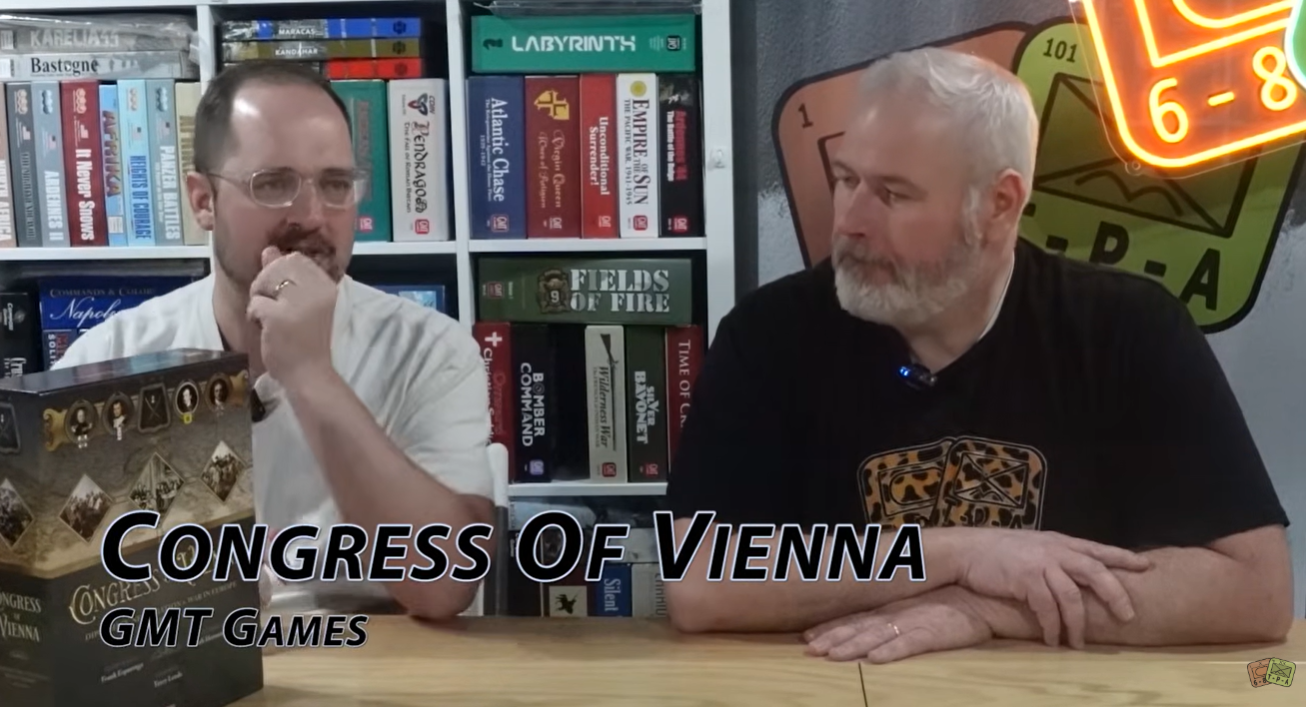
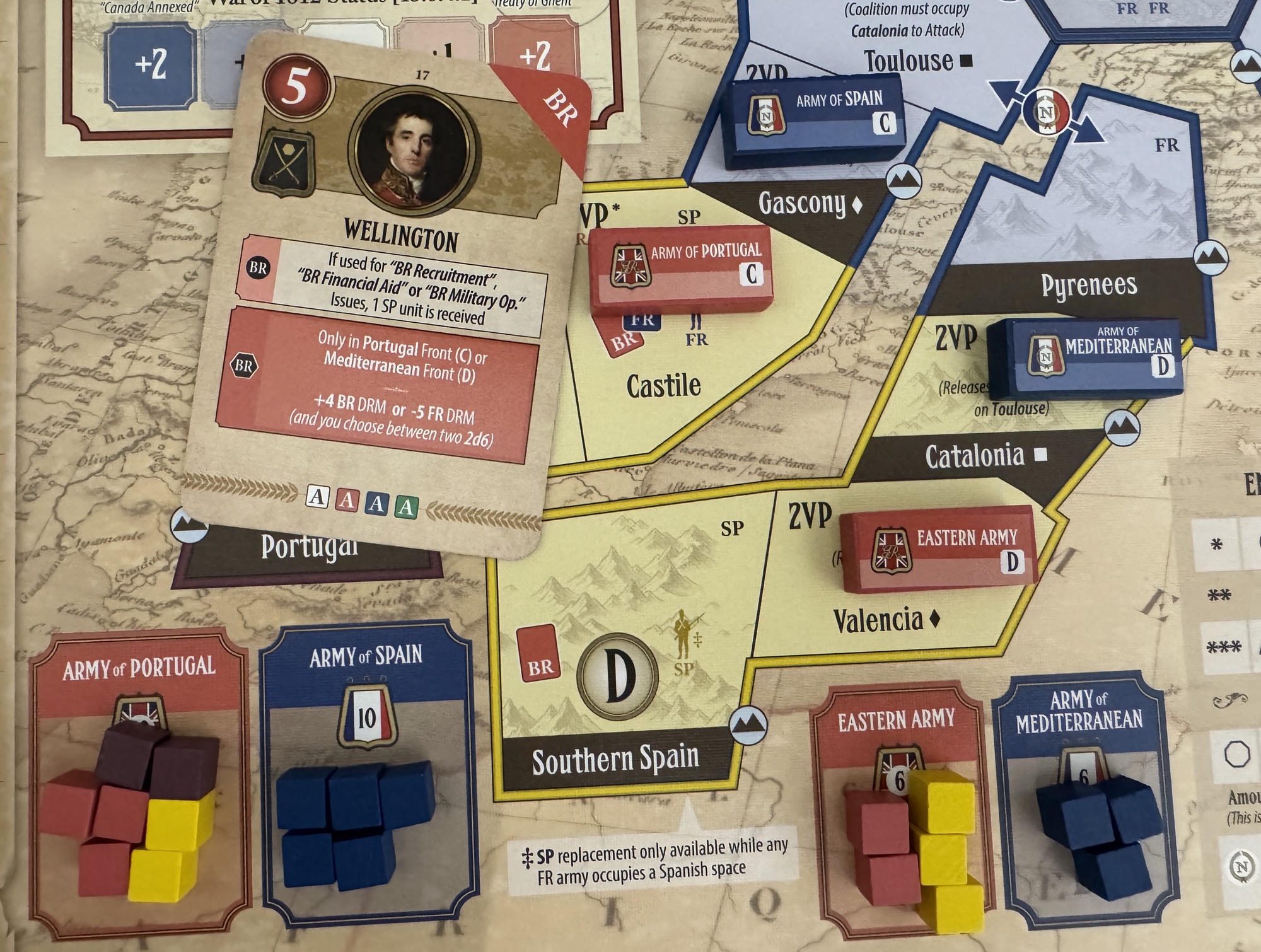
A few years ago, after playing all of the games in the Great Statesmen Series, we heard of a new game in the series from a designer not named Mark Herman and I was immediately interested and intrigued as we have had so much fun with Churchill, Pericles and Versailles 1919. Congress of Vienna from GMT Games is a diplomatic card driven wargame based on Churchill and is the 4th game in the Great Statesmen Series. The game is set during the years of 1813-1814 and sees players take on the role of the main characters of the struggle between the Napoleonic Empire and the coalition of Russia, Austria, and Great Britain with their Prussian, Spanish, Portuguese, and Swedish allies. We played the game twice last year at Buckeye Game Fest and at the World Boardgaming Championships and absolutely were amazed at the changes and innovations to the system introduced by the designer Frank Esparrago.
Recently, I saw a post on X from one of my favorite designers Mark Herman. If you have to ask who then maybe this post is not for you. But he is one of the best and most prolific designers out there with nearly 100 designs to his credit. Hands down one of the best…and an amazing guy too. In fact, some of his designs are among my favorite wargames including titles like Empire of the Sun, Churchill, Pericles, Fire in the Lake, Washington’s War, Fort Sumter, Rebel Fury and more. Mark knows wargames and he knows how to tell the story of the historical event. Just a master really. The post was Mark highlighting a written review found on Board Game Geek about his newest game in the Civil War Heritage Series called Volume II Army of the Potomac: Campaigns of 1862 & 1864.
I read the review he mentioned and it is very comprehensive and well done. But this post somewhat triggered me. Why I am not sure but it did. I am not mad about it. Not hurt. Not overly concerned. And when I say triggered a more appropriate word would be caused my thinking juices to be stirred up. But I wanted to share my thoughts and opinion on what a wargame review is but also what it is not because I believe that a lot of gamers have a very different opinion about these things than I do.
When Alexander and I get together to play a game with the intent of doing some sort of review and sharing our thoughts on the design it does take a bit of preparation and time. We have to read the rules, and believe me, this can take hours, to truly get a feel for the game, its processes and the flow. But also to get an understanding of what the designers thesis is about the conflict modeled. I think that designers create games that they agree with and believe in. Not necessarily that are 100% a true modeling of the event. Their bias is inserted into the design and there really is no way around that. And I am fine with it because I know that each story of history has 2 (or more) viewpoints and perspectives. We also have to prepare the counters, which includes clipping them, sorting them and then storing them in counter trays or baggies. We then have to set up the game, and with wargames, this can take an hour or more to make sure you have the correct units, place them in the proper hexes and then check to see if there are any errata with the setup that we will need to change. Sometimes setting up the game wears me out…but then we have to give it a play.
Also keep in mind that the majority of games that we play are big wargames. These games have multiple maps, hundreds if not thousands of counters and a ton of different scenario options to choose from. Typically, a campaign game might take dozens of hours with shorter scenarios taking 6-10 hours. These are not light games that can be played in 45-60 minutes. And because of that, the reality of playing a game multiple times just isn’t feasible. We have never posited ourselves as full and thorough multiple playthrough guys. We just don’t have the time to sink that much time and effort into 1 game. Keep in mind that we only get to play 30-40 new wargames annually, which is a lot but not necessarily a lot for someone that attempts to give a good review of a game. But we always play a game until we are comfortable with the rules, understand the flow and get into a majority of the aspects of the game so we can confidently and accurately discuss them.
So, first let’s take a look at what I think that a review is not necessarily.
What They Are Not!…
Full Exploration
First off, I don’t see a review, or at least our brand of reviews, as a total and full exploration of a game or the system. As I stated above, we play a game until we are comfortable with the rules, the mechanics, the thesis of the game and the general flow. This can mean that we play through an entire scenario or even sometimes the campaign but that is not necessarily the case. In fact, more often than not, that isn’t the case. We also play these wargames to see if we like the system. Liking the system is a very different thing from totally dissecting and examining the system for its flaws, strengths and proving or challenging its thesis. Our focus in reviews is generally pretty simple…sharing the feeling of the game, its accessibility, meaning the clarity of the rules, and then a focus on how the game plays. We don’t always cover every aspect or mechanic but try to give an overall feel for what the game is. This approach stems from our stated goal with the blog and YouTube Channel, which is to give an overall impression of the game and create an environment that makes the viewer or reader feel that they are at the table with us just discussing the game after playing.
This is a big one that we are asked about a ton with our reviews. Is the game balanced? Does each side have a real chance of winning the game? And other similar questions. The answer to this is that these games, referring to wargames, are generally a look at the history and how it played out. This means that if one side had more and better troops, they are generally going to win the game as they did historically. But a good and skilled designer, will look beyond the numbers and attempt to create some realistic and achievable victory conditions for both sides. Something that if happens, could change the course of future battles and the overall outcome of the war. There is nothing more that I dislike as much as sitting for 4 hours and getting my teeth knocked in because I really have no chance at meeting some objective to say that I won a game.
Skilled designers will attempt to create balanced wargame victory conditions by avoiding certain things, such as simple point-based kill mechanics or even reaching a particular geographically significant spot on a board. Instead, they use scenario-specific objectives and asymmetric victory conditions to ensure that each side has its own unique path to success. These rules force players to focus on historical strategy rather than just duking it out and seeing who can kill more units. But, when we play these wargames, we generally are not necessarily able to devote the time to gain a true understanding of and to uncover whether the victory conditions are balanced. We typically go off a gut feeling and observation of time and distance covered in a historical push to see if the game is reasonable to win by either side. I love Holland ’44 from GMT Games. It is one of my favorite wargames of all time and is a titanic struggle between the Allies trying to run up Hell’s Highway to reach and capture 3 bridges along the way and the German defenders who are trying to do just enough to stop their advance and hold at least 1 of the 3 bridges. I have played this game a few times and found that I have a real tough time as the Allies making the appropriate level of progress over historical results to even get to the final bridge located at Arnhem. But that doesn’t mean that the game is broken or that it is imbalanced, it means that the history is well represented here as historically the Allies failed to reach the “Bridge too Far” and had to turn back.
Expositions on Historicity
Finally, I don’t feel that reviews are about expositions of historicity. I am not a true historian. I know enough to understand the basic events of major wars such as World War I, World War II, etc. but not necessarily the full details of the battles, the maneuvers used and the outcomes. One thing that I know we are asked a lot is about the Orders of Battle (OOB’s) for these wargames. An OOB is simply the makeup of each sides troops, including their historical units, numbers of troops, type of troops and their quality generally represented with movement values, combat factors and defense factors as well as morale values. And my answer typically is that I don’t know. I ask these designers these type of questions in our Designer Interview Series but am not able to verify or check their math because I don’t have the experience or knowledge to do so. And with just a single play will be unable to comment on this aspect of the design. Remember, that wargames somewhat function as interactive experiments intended to bring history to life for key battles. History is interpretive and sometimes facts about the makeup of troops, the terrain involved or even the weather at the time of the battle is sketchy and tough to piece together. But most of these games are attempts at telling the story as accurately as possible. But, keep in mind, that a good historical simulation wargame, will attempt to challenge players with the real limits, rules, and stresses that those commanders faced. Wargames test historical ideas by turning narratives into active problems and allowing users to explore “what if” scenarios. But I cannot necessarily always comment on the plausibility of a design because I usually lack the expertise or intimate knowledge to do so.
Sometimes I know that ours will be the only review on a game. And that worries me.
I do not think that reviews are what other people believe they are. I see them as insight into a game and how it plays, what can be expected and how it feels to experience the game. Not a full and insight filled thesis paper on the historical plausibility and outcome. But I do believe that our brand of reviews is useful…at least in my humble opinion. But it sometimes does worry me that our review may be the only content out there on a particular game and I have a real fear of misrepresenting something and causing others to turn away from that game. That definitely worries me and I do make sure that I understand what it is that I am going to say about a game before I say it. But keep in mind that our reviews are our opinions and you may have a totally different take on the game. And that is fine as well because in the end your opinion is the one that matters and that will be used to make a purchase decision. Your wallet is yours to protect and I respect that.
What They Are!…
Sharings on Perspective
In the end, any review is an opinion and is something that the creator has taken the time to write down (or video) to share with others. It is about attempting to describe the experience of the game and how it plays. This does mean that each reviewer may see things differently. May focus on different aspects that spoke to them. May decide not to share each and every aspect of the game. But will focus on the experience! And then share that with us. I for one love that there are people out there that are willing and able to do these reviews. It is work and takes time. But in the end, the real treat for us as consumers of these reviews is that we get a bit of insight into the game and an understanding of what it is. This perspective is the most valuable element of a review and is worth its weight in gold. A lot of times, people consume reviews because they have already played a game, made their mind up about that game and what it is and are simply looking for someone to corroborate their feeling. They don’t really care what the person has to think and whether their stance is well reasoned and supported by evidence form the game itself. They are simply reading or watching to validate their own opinion. They want to hear their thoughts come out of someone else’s mouth.
Recently, during one of our Monthly Debrief videos, we discussed games that we disagree on. There are not many games that Alexander and I disagree on…but there are some. As a part of that discussion, we dove into our conflicting thoughts about the venerable tactical level wargame series Advanced Squad Leader. We disagree on this game. I like parts of it, and the overall experience, but Alexander does not. And that is fine. But one of our viewers told us to “put the game back on the shelf” and that listening to us was “cringe”. Well, I do agree that we are cringe but this comment proves my point. We didn’t agree with him and so we are not correct. And that is fine.
Windows into Mechanics
I think that one of the most important parts of any review though is a window into the mechanics. Does this mean a full and detailed description of each and every mechanic, how they work, why they were chosen by the designer and how they reflect history? No…absolutely not. But understanding the base mechanics of a game is critical to understanding whether the game is for you or not. If you happen to really like block wargames and are watching a review on a block wargame such as An Impossible War from Bellica 3rd Generation you would like to know how the block wargame mechanic works. If you like Chit-Pull Activation and you are consuming a review about a Chit-Pull Activation game such as with Blind Swords: Gettysburg: The First Day from Revolution Games, you want there to be some discussion about how the Chit-Pull works. A review should have at least a mention about the mechanics and what is good about their implementation.
Gauges on Complexity
Wargames are generally complex affairs. They have a lot of rules, exceptions to those rules, rules variants or optional rules and sometimes have ambiguity in their explanation of these rules. This last part is really a problem with a lot of games, wargames and other types, but a designer sometimes gets “nose blind” to their own game and takes into account a lot of assumptions about how their description and instructions for the game will be received. I like to make sure that those consuming our reviews understand how complex or difficult to learn the game rules are. I also like to focus on player aids and how they affect the learning process and play so that those who may purchase the game and attempt to give it a play can get an idea of what their learning commitment will be with the rules. And remember, complexity and rules depth doesn’t equate to a good game. If you ultimately cannot get the game played because of the learning curve or the poorly written rules, then a review will do you no good.
A Look at the Fun Factor
In the end, while I play games for many reasons, I am mainly playing a game because I want to enjoy myself. I want to have a good time with the game and its efforts to tell the story of the event and enjoy my time with my opponent. I want to be able to focus on the game and get into the strategy and not have to worry about the rules, the mechanics or the production. And a good review will provide an insight into this aspect of the game. It doesn’t take multiple plays to understand whether a game is right for you or whether it matches your tastes. You can typically see that in just a single play and that is the way we approach things. We have played a lot of games and know when a game is not for us. But, that is not always the case for others and their experience with wargames. And that is fine. But that is a key part of what a review should be.
There you have it…my thought’s on what a review is and what it is not. I know that many will not agree with these points and that is fine. These are my opinions and I have developed them over the past 40+ years of playing games and 10+ years of covering games as The Players’ Aid. What are your thoughts on what a review is? How do you think they best serve the wargaming community? What would you change about our reviews? I look forward to hearing your thoughts and opinions on this matter. Thank you.
With this My Favorite Wargame Cards Series, I hope to take a look at a specific card from the various wargames that I have played and share how it is used in the game. I am not a strategist and frankly I am not that good at games but I do understand how things should work and be used in games. With that being said, here is the next entry in this series.
#86: LRRP from Fire in the Lake: Insurgency in Vietnam from GMT Games
The COIN Series uses cards in a very different way from other CDG’s. These cards are not necessarily the driver of the action but more assistive to the actions of the players by setting eligibility and also providing powerful events. The Event Cards are more often than not, very powerful. They either give you a continuing bonus on future Operations and Special Activities (as in the case of the volumes that include the various Capabilities) or allow you to take Operations and Special Activities more times that round than you would normally have been able to had you not chosen the Event and more often than not, at no cost! Also, because of the power of the cards and their ties to one or more factions, you can take the Event which allows you a huge advantage, only to see that very powerful Event reversed with the next Event or with a regular Operation. This is very frustrating but is one of the major reasons that I love the card-assisted element of the COIN Series. Today we are going to take a look at the LRRP Event Card.
The LRRP Event Card, with LRRP standing for Long-Range Reconnaissance Patrol, allows the US player to place 3 Irregulars outside the South then conduct a free Air Strike, that also allows for the removal of Bases first. Keep in mind that Irregulars are US Special Forces pieces, which are the hexagonal shaped cylinders not ARVN Rangers. “Outside the South” means any Laos or Cambodia Provinces. Seems pretty pedestrian but it is important to note that this card changes the rules when played as normally all other units in a space must be removed before Bases can be removed. A very powerful card that typically will be played by the US player when it comes up. But keep in mind that Air Strikes are a dual edged sword as you get rid of pesky enemy pieces but it will result in shifts of Support/Opposition but can also Degrade the Trail. On the bottom of the card, the text allows the VC or NVA to ambush these LRRP”s and remove 3 Irregulars from the map to Casualties. Then it gives an added benefit of shifting each space these removed Irregulars were in 1 level toward Active Opposition.
Image courtesy of Boxxer’s Blog.
A Long-Range Reconnaissance Patrol, or LRRP, is a small, well-armed and nimble recon team that is tasked with patrolling deep into enemy territory to identify or destroy key targets and gain recon on the enemy. The concept of scouting forces such as LRRP’s dates back to ancient warfare but also has been used in more modern and contemporary wars such as the French & Indian War where specialized Rangers, such as Rogers’ Rangers, were tasked with raiding Indian settlements, disrupting supply lines and reporting back to command on troop disposition and movement.
In Vietnam, veteran or specially trained forces often augmented with Vietnamese irregulars usually carried out Long Range Reconnaissance Patrols into enemy territory. The Studies and Observation Group (SOG) was the ground element of the US air war against the Ho Chi Minh Trail as illustrated by Project Tiger that spotted for and marked enemy trail activity for elimination by US air assets.
Here is a link to a very interesting summary of an LRRP and its mission on a Vietnam veteran run blog called Boxxer’s Blog: From the seat of a motorcycle: LRRPs: “—doing the impossible for the ungrateful.”
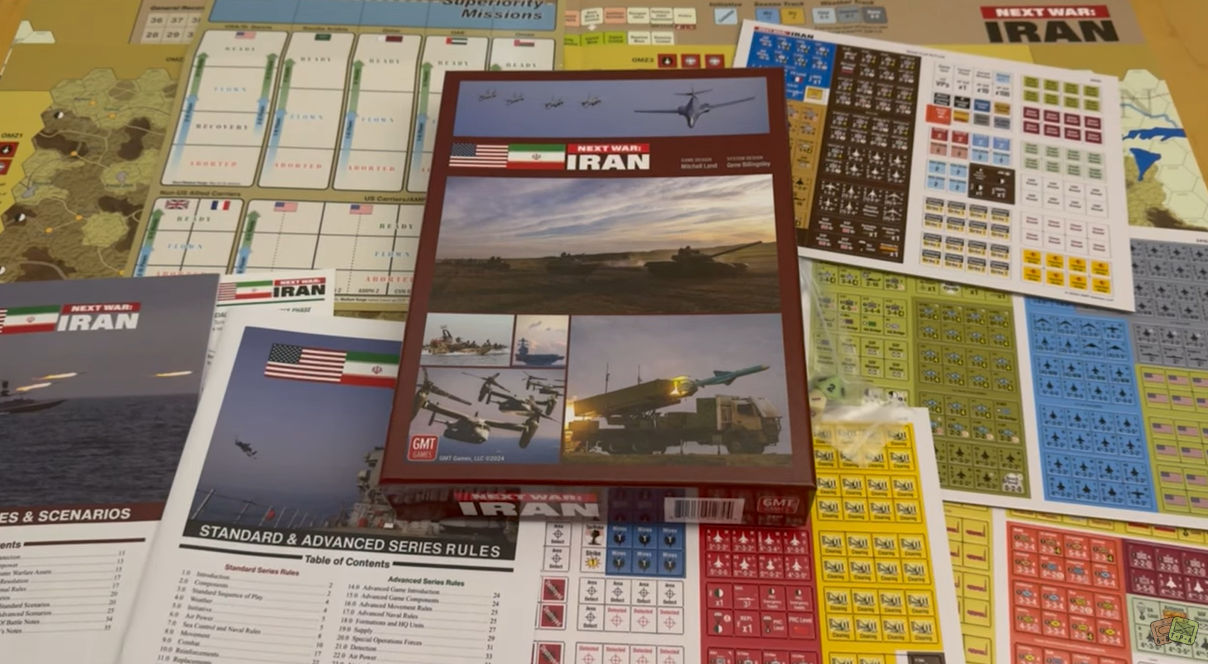
Next War: Iran is the sixth game in the Next War Series from GMT Games. It is unique in the series in that the Allied player has to do the attacking while the non-Allied player attempts to defend its territory against neo-imperial oppression. With a long logistical tail, few true allies in the region, and the menace of Iran’s A2AD capabilities, re-opening the Straits is a tall order.
I love a different style and focus of wargame. A game that takes a look at an important but somewhat obscure or rarely addressed historical topic, such as espionage or intelligence, and creates a gaming experience tailored around the events to highlight and evoke the difficulties and tension that would have been present. In January 2026, GMT Games announced such a game in Checkpoint Charlie, which is a solo or cooperative game focused on SIS espionage missions in Berlin in the 1960’s designed by Russell Brown. We have posted an interview with Russel and it was very well received and he has now agreed to create a series of History Behind the Cards to highlight the events of the 1960’s Cold War struggle in West Germany but also to share aspects about the game play and how it models the history.
*Note: The cards highlighted in this series and their event text, as well as any pictures used showing any of the various components, are still in the design and development process and as such event effects and text might still change prior to final development and publication.Also the art and layout of the cards are only for playtest purposes at this point and the game will enter the art department as it nears publication.
History Behind the Cards – Checkpoint Charlie from GMT Games – Card #2: Cuban Missile Crisis
In response to the US placing nuclear missiles in the UK and Turkey, within range of Moscow, and in an effort to protect Cuba and keep it within the Soviet sphere of influence, Khrushchev made a deal with Castro in July of 1961 to base Soviet nuclear missiles in Cuba, within range of most of the southeastern United States.
The US knew the Soviet Union was training and supplying Castro’s army and inserting specialists, and CIA assets in Cuba had seen Soviet surface-to-air missiles. This led to suspicion that the Soviets were intending to place ballistic missiles in Cuba.
The best US assets for confirming the presence of these missiles were high-altitude U-2 Spy plane flyovers. However, the loss of Francis Gary Powers’s U-2 over the Soviet Union to a SAM missile (Event Card #12 The Powers Abel Exchange) created reluctance, since the US now knew the Soviets had deployed similar SAM’s to Cuba. U-2 flights were finally authorized in October of 1962, and it was these photos that confirmed the presence of Soviet nuclear-capable missiles.
The status of Berlin, halfway around the world, played an important role in the Cuban Missile Crisis. From 1958 until the discovery of the missiles, the relationship between the US and the Soviets was dominated by the “Berlin Crisis,” which consisted of a series of military and diplomatic moves by Khrushchev to outmaneuver the Americans and annex West Berlin into East Germany. The Cuban Missile Crisis not only brought the conflict over Cuba to a head, but also brought new attention on the status of Berlin. The two became linked. A ground invasion of Cuba might result in a military annexation of West Berlin by the Soviets, and it was not out of the question for the Americans to concede to the Soviets in Berlin to get the missiles out of Cuba.
President Kennedy avoided direct military conflict and responded with backchannel diplomacy and a naval blockade of ships coming into Cuba. The crisis continued for two weeks, with US ground forces readied for an invasion, Soviet ships attempting to run the blockade, and the US strategic nuclear forces going to Defcon 2. The tensions eased when Khrushchev agreed to remove the missiles in exchange for an agreement that the US would never invade Cuba. In addition, Kennedy secretly agreed to remove US nuclear missiles from Turkey.
In Checkpoint Charlie, the Cuban Missile Crisis is assumed to have diverted Soviet attention from espionage activities in Berlin. This card not only removes surveillance from any location of the player’s choice; it also reduces the number of available surveillance pawns for the rest of the mission.
In the next article in this series, we will take a look at Demonstrations and what effect these student run organizations had on operations in West Berlin and West Germany.
In my opinion, this game looks extremely interesting and I am very much excited to learn more about it. I am appreciative to Russell and his efforts to bring us these cards and to write these entries to share with our readers. I am also very glad that this topic is being covered in a game and look forward to playing this one day soon.
It has been very hot lately….and the humidity is getting out of control here in our Area of Operations (Indianapolis, IN). It makes everything tougher but I still like it better than the negative temp spikes we experience in January and February and look forward to the rest of summer. In the wargaming world, there is also a lot of “heat” coming upon us in waves as this month for the Wargame Watch, I was able to find 30 games (including the single new game from our sponsor Bring it on Games). I was also able to find 9 games being offered on Crowdfunding through Gamefound and Kickstarter.
This month we have a sponsor for the Wargame Watch feature in a new publisher named Bring it on Games. Bring it on Games is owned by Adam Starkweather of Grand Tactical Series (GTS) and Company Scale System (CSS) fame. He has started this new company with several friends and compatriots as a “company run by gamers – not a company that publishes games”. I think that Adam is a great designer and he is now out on his own and is going to make the games that he wants to make.
On their website, they have said the following about their production schedule and plans for the near future:
We will only make two or three games every two years. Next up is ACSS: Utah: 10 Days in Normandy. But work has also started on Omaha, Market Garden, and Battleaxe for ACSS. But other games on different stuff using new systems has started too. Gettysburg, The War of the Atlantic, and other fun stuff. I just have to live to ninety to make everything I want to make.
While they are new and don’t have a published game to their credit as of yet, they appear to be working hard to build a brand that is solid and will hopefully be one that is a continual force in the wargaming hobby. Their current project that is up for pre-order is called Anzio: A Lost Opportunity and is a big, monster wargame. This game has a ton of maps (10 total) and a ton of counters (20 5/8th” Countersheets) as well as a ton of charts, tables and player aids. This is a MONSTER wargame…big, bad and beautiful…no doubt about it but it looks really good.
We have played several games designed by Adam Starkweather in his Company Scale System (CSS) published by Compass Games including Saipan: The Bloody Rock and The Enemy is at the Gates: The Batlte for Berlin. These games are really good solid chit draw systems that really puts some unknown in what groups of units can activate and even when they will activate. There are also events and if the chit cup runs dry before all of the units can activate due to the end round chit then you are just sore out of luck. You have to prepare for this inevitability and I love the concept of prioritizing your activations and making sure you activate what you absolutely have to before doing those units that would be beneficial to activate. The system is a highly accessible, streamlined approach to simulating tactical military operations while retaining strong decision-making depth. The CSS offers a “design-for-effect” combat system that effectively eliminates micro-management and makes the game a joy to play.
Anzio is the first game in a new series called the Advanced Company Scale System or ACSS. At this point, I am unsure what makes it advanced but will be working with the designer to get a better understanding of that in a designer interview for the blog.
In the mean time, you can download the rules and the scenario booklet from an online OneDrive and you can also get access to a Vassal module to try the game out. Here is the link to the OneDrive: OneDrive Link to Rules and Scenario Booklet
If you are interested in Advanced Company Scale System Game One:Anzio: A Lost Opportunity, you can pre-order a copy for $300.00 from the Bring It On Games website at the following link: https://bringitongames.com/shop/p/anzio-a-lost-opportunity
Pre-Order
1. OCSThe Hero City: The Battle of the Baltics, September 1943-April 1944 from Multi-Man Publishing
In late 2021, we posted an interview with Tony Birkett as designer and Chip Saltsman as developer covering his The Third Winter from Multi-Man Publishing, which covers the third winter on the Eastern Front during World War II and deals with German Army Group South as they retreat to the Dnieper River and then the Carpathian Mountains. This game is an entry in the Operational Combat Series and was followed up by his Crimea: Conquest & Liberation game that was promoted as a low-counter density, small OCS game. Since then, he has been hard at work on the next volume in the series called The Hero City: The Battle of the Baltics, September 1943-April 1944 that dives into the mid war battles in the Baltics between the Germans and the Russians.
From the game page, we read the following:
The Hero City depicts the desperate battles between late September 1943 and April 1944 in the Army Group North sector of the Russian front. Soviet priorities were to establish a rail connection into Leningrad, evict the Axis forces from the Leningrad Oblast, and force their way into the Baltic States. Well aware this hammer was about to fall, Army Group North prepared the Panther Line defensive belt along the borders of Estonia and Latvia. The Hero City covers the major engagements: the autumn attrition battles while the Soviets mass their forces, the fighting retreat as the Wehrmacht desperately tries to escape intact, and the crashing impact as Russian waves pound against the German Panther Line breakwater. In the north are the Finnish lines, which offer a completely different strategic opportunity, including a scenario for the Soviet Summer 1944 offensive into Karelia. The Axis forces managed—barely—to hold at the Panther line, but the situation could have spiraled into disaster. The campaign here laid the foundations for the drama during the summer of 1944, and many of the German units in The Hero City will end the war trapped in Courland.
The game area covers the Soviet Oblasts of Leningrad, Novgorod and Pskov, as well as Estonia, Latvia, and the northern part of Lithuania. The map extends north of Helsinki and Viipuri in Finland, south to Daugavpils and Tilsit, east to Valday and Volkhov and west to the Baltic Sea. The Hero City is fully playable with The Forgotten Battles, to create a combined massive gaming experience using campaign setups that start in September 1943 and January 1944.
The Soviet command and supply structure is modeled through Front HQ markers. Fronts are either in “Offensive” or “Regrouping” status, allowing for shifting axes of attack and the on/off nature of Soviet operational warfare during this time. Each Front has an assigned Air Force. The parallel fighting in Army Group Center is represented by a boundary marker that shifts as the war advances off map, and the Axis player must be careful to watch his off-map flanks.
The Hero City is a large-sized OCS game, with 1,400 combat units (five counter sheets) and a 44×66-inch map layout at a scale of 5-mile hex/3.5 days per turn. The full Campaign game is 63 turns long, and there are three campaign scenarios so players can start at different points in the action. Also included are several partial-map scenarios.
Special rules in this OCS game are carefully researched to model key aspects of this critical campaign:
Forces include German Wehrmacht, Luftwaffe and SS formations, as well as Soviet Guards, regular and Partisan units, plus Finnish, Estonian, Latvian, and Lithuanian units. The Prinz Eugen and German destroyers might put in an appearance.
Soviet Front HQ Markers which reflect their role in command and marshaling supply.
Soviet RVGK for coordinating strategic redeployment and rebuilding shattered mobile Corps.
Axis Army, Army Group and Kessel HQs, along with Kampfgruppe markers which portray Axis operational flexibility.
Random events similar to what are found in The Third Winter and The Forgotten Battles. The 26 possible events add historical flavor with minimal rules overhead, covering things like Guards Promotions, Fuel Shortages, Hitler’s intransigence, Soviet submarines Partisan Offensives, One-Turn Offensives, Battlefield Heroes, options for emergency reinforcements and unexpected Finnish offensives.
If you are interested in OCS The Hero City: The Battle of the Baltics, September 1943-April 1944, you can pre-order a copy for $90.00 from the Multi-Man Publishing website at the following link: https://mmpgamers.com/the-hero-city-p-468
2. Inferno in the Blue Grass: The Battle of Perryville, 8 October 1862 from Multi-Man Publishing
While attending Buckeye Game Fest this past March, we met with a fan of the channel named Leslie Jerome and had him introduce us to the Line of Battle Series with Volume 3 To Take Washington: Jubal Early’s Summer 1864 Campaign from Multi-Man Publishing. Line of Battle is a regimental-level American Civil War wargame system designed for fast-paced, non-stop action by eliminating excessive paperwork and combining fire phases with movement. I feel like this system is a highly playable classic ACW system with lots of very interesting mechanics including activation, order reception and relay, closing rolls, morale checks and close assault. In fact, I love how it creates a great narrative with some of the terminology and naming conventions such as the Blood Lust result for close assaults and the Cowardly Legs from broken units.
Recently, MMP put the next volume in the series up for pre-order called Inferno in the Blue Grass: The Battle of Perryville, 8 October 1862. I am very much anticipating this one and can’t wait to dive back into the series.
From the game page, we read the following:
Inferno in the Bluegrass brings The Gamer’s Line of Battle (LoB) Series into the Western Theater. The Battle of Perryville, the largest battle fought in Kentucky during the American Civil War, was the culminating engagement of the Heartland Campaign of 1862. This was the South’s attempt to invade the border state and garner support for its cause while simultaneously forcing Union armies in the west on the defensive. By October, the Army of the Ohio was on the move, poised to throw back the invaders. Bragg, confident that an initial Federal advance would focus elsewhere, was completely unaware that Don Carlos Buell was converging on his army in the small town of Perryville. As the sun rose on October 8th, 1862, neither army could have known that the coming engagement would ultimately determine the fate of Kentucky in the war.
The sheer scale of violence at Perryville factored heavily into the design, over 7,600 casualties were tallied – resulting in one of the larger casualties per hour rates of the war. Independent Command rule replicates Confederate commanders blurring the lines of command by fragmenting divisions into small, independent commands, creating confusion and limiting effectiveness. The Attack Commencement Chart limits the ability of the Confederate player to organize one massive assault. The Union, conversely, is hamstrung from the outset. The Union Alertness Table represents the phenomenon of an “acoustic shadow”, which caused Buell to be blissfully unaware of the overall tactical situation hours after the initial fighting had started. The map shows the parched land in meticulous detail, corroborated by the designer walking the battlefield to get a great feel of the ground.
This is Nick Roser’s first published design. His commitment and expertise on the battle shines through the design. Nick’s ancestor, Johann Christian Kurtz, fought in the battle, so his personal connection to Inferno in the Bluegrass is in his blood.
If you are interested in Inferno in the Blue Grass: The Battle of Perryville, 8 October 1862, you can pre-order a copy for $48.00 from the Multi-Man Publishing website at the following link: https://mmpgamers.com/inferno-in-the-bluegrass-p-467
3. Great Battles of the American Civil War: Battles for the Ozarks from GMT Games
This is one of those venerable series that we have not had the opportunity to play or experience. Great Battles of the American Civil War or GBACW (not to be confused with Great Campaigns of the American Civil War from Multi-Man Publishing) is a highly detailed, regimental-level wargame series originally created by Richard H. Berg. It is known for its interactive chit-pull mechanics that simulate the chaos, command difficulties and fatigue of 19th-century warfare. The newest volume in the series, which is Volume XI, was announced in late June and is called Battles of the Ozarks.
From the game page, we read the following:
The game presents five key battles that shifted the balance of power west of the Mississippi during the first two years of the war. Battles for the Ozarks concentrates on events on the Ozark Plateau of northern Arkansas and southwest Missouri and included are these battles from the first three campaigns of the war in the West. Each battle is portrayed in great detail allowing players to try alternate strategies.
Dead & Buried, The Battle of Wilson’s Creek, August 10, 1861 The first large battle west of the Mississippi. Federal General Nathaniel Lyon leads the Union forces in an attempt to bloody the nose of General Sterling Price’s Missouri State Guard and Ben McColluch’s Western Army that has arrived from Texas and Arkansas. Command the unusual forces that were arrayed in each army for this battle. As the Union, you’ll have Home Guard units, Regulars (including the famous 2nd Dragoons), and German American Missouri Volunteers from St. Louis. As Price and McCulloch, you’ll have everything from Missouri State Guard units armed with flintlocks and shotguns, to the South Kansas Texas Cavalry regiment and Arkansas State Militia.
Into The Night, The Battle of Dunagin’s Farm, February 17th, 1862 A lesser-known battle that occurred about a month before the much more famous battle of Pea Ridge. In north Arkansas along the Little Sugar Creek, the rear guard of McCulloch’s Army of the West, led by the capable Louis Hebert, tries to cover Sterling Price’s retreat from Springfield, Missouri. Hot on Price’s trail is Samuel Curtis’ Army of the Southwest. The advance cavalry of Curtis’ army collides with Hebert’s forces on farmer Dunagin’s field. What starts as a simple skirmish escalates into a full-blown fight that spills over into the evening, with both sides gradually feeding more troops into the battle.
Rush To Glory, The Battle of Pea Ridge, March 7th & 8th, 1862 Can you, as Earl Van Dorn, fall upon the rear and flank of the Federal army deployed north of the Little Sugar Creek before the more rested and organized enemy responds? Or can you, as General Samuel Curtis, repeat one of the few times in military history when an army reversed course, moved its supply train out of danger, and then engaged and defeated the enemy? A challenging battle for both sides; the Confederate army has been “Rushed to Glory” by Van Dorn in a snowstorm and is worn out, while the Union army is flanked by the CSA foe. The battle has a two-map and a three-map version (the largest presentation of the battle ever done).
Iron Men, The Battle of First Newtonia, September 30th, 1862 Probably the most unusual and desperate of all the battles included in Battles for the Ozarks. First Newtonia was fought before the Battle of Prairie Grove in Blunt’s campaign. The advance units of the two armies meet at the small hamlet of Newtonia in southwest Missouri. A CSA force comprised of the Indian Command, a brigade of Texas cavalry, and part of Jo Shelby’s Iron Brigade attempt to stop the forward movement of BG Fredrick Salomon’s 1st Kansas Division. With warriors of the First Nations on both sides, First Newtonia steps into new territory for GBACW. Also command part of the Western “Iron Brigade” in its first battle. One of the most desperate fought battles in the Trans-Mississippi.
Blunted Again, The Battle of Prairie Grove, December 7th, 1862 Take the role of the headstrong Union General James Blunt and see if you can move the CSA forces led by Thomas Hindman off the Fayetteville Road. As the Union commander, you will have superior artillery that can win the day. Or as the Confederate commander, you’ll hold the strong defensive position between the two Union wings along “The Bench”. You have the Napoleonic central position, and it is held by Joe Shelby’s Iron Brigade! Will it be enough?
Ready for a new experience in your War Between the States gaming? Battles for the Ozarks is the 11th installment in the award-winning Great Battles of the American Civil War Series. The game has rules that satisfy both experienced and new players, with a Simple Version that offers an easier, faster gaming experience. New optional rules are also introduced! New skirmish rules catch the ebb and flow of open order combat between the battle lines, and the Peoples of the First Nations make their first appearance in the GBACW Series. See how well these warriors fought at Prairie Grove or First Newtonia. New terrain types, such as Heavy and Light woods, are introduced, along with Rifle Pits and Entrenchments. With over twelve scenarios, including two on their own half maps, there is something for everyone.
4. Bataan! The Battle for the Philippines 1942 2nd Edition from Consim Games/GMT Games
Classic wargames always do well, either because of nostalgia and a longing for the past or because the game was really good. I don’t know which one this fits into but GMT Games announced a new 2nd Edition of a classic wargame called Bataan!. I say GMT Games but the game is actually published by Consim Games, as they have entered a new partnership with GMT as they have in the past to publish their own line of games.
From the game page, we read the following:
Bataan! 2nd Edition is the much-anticipated, updated grand-tactical-level treatment of WWII battles on the Bataan Peninsula in the Philippines, which took place from January through April 1942. Game designer and Charles S. Roberts Award recipient Vance von Borries has drawn on his game design experience to create a game engine capable of portraying the tense jungle fighting that took place on Bataan. While the system is based on his popular Roads to Leningrad game, the changes needed to simulate the fighting on Bataan make for a unique gaming experience. For history enthusiasts and wargamers, this is a nuanced, in-depth exploration of a specific, underrepresented aspect of WWII history. This all-new 2nd Edition does not simply address all official errata from the original edition, but also delivers new game components and a major game system update, with the rules rewritten to further advance this popular game system.
Gameplay is both tense and interactive, based on an alternating activation sequence in which both sides conduct operations. This second edition features streamlined game mechanics to improve and help speed gameplay, all based on player feedback. The game also captures air and naval operations, though the focus is on ground warfare and specialized unit capabilities.
Special rules model key historical facets of the campaign include: movement classes of units, artillery, air power, air missions, strategic movement, infiltration movement, disruption, contested hexes, unit formations, attack coordination, lead unit losses, efficiency and lead units, HQ units and capabilities, initiative and activation, hasty and deliberate activations, momentum, supply, fortifications, withdrawals, Japanese emergency supply, Campaign supply, general attrition, forage, naval operations, amphibious invasion, special situations and events, special units, Philippine Scouts, and more! Five scenarios are included. The three quick-playing opening scenarios require fewer rules to play. You can complete them in a single sitting, focusing on the core game system, and they include At the Pearly Gates: Layac (intro scenario), Abucay Line, and Mauban Line. These scenarios provide a clear and accessible entry point for players new to the system, allowing them to learn the core mechanics before tackling the full complexity of the campaign game. The two full campaign game scenarios add detail by introducing campaign supply, naval operations, amphibious invasions, special situations, and events. While intended for two players, the game is also suitable for solitaire play.
5. When Titans Clashed: The Eastern Front in WW2 from Consim Games/GMT Games
And the 2nd game offered on pre-order this past month in this new Consim Games/GMT Games partnership is called When Titans Clashed: The Eastern Front in WW2 designed by Michael Resch. This is a new game design but pays homage to the original Jedko Games edition of the classic The Russian Campaign designed by John Edwards. I know that we all very much enjoy a good romp on the Eastern Front of World War II and the tank clashes and and I am sure that this game will be a fantastic representation of the genre and give us hours and hours of hex and counter goodness.
From the game page, we read the following:
When Titans Clashed is a game covering the epic campaign fought in Eastern Europe during World War II. Game designer Michael Resch offers this tribute to the original 1974 Jedko Games edition of The Russian Campaign by John Edwards. This new design seeks to balance the classic game’s attractive aspects while introducing modern design concepts unheard of at that time. The map and counters use a vintage style to honor the 1974 Jedko edition, but beyond this, the designer presents a new, modernized design approach to the classic game.
Gameplay is fast-paced and intense for both sides, as the initiative can shift through significant maneuvers and battle outcomes. For both sides, each turn features a double-impulse sequence that rewards the player who, in a disciplined fashion, plans for the possibilities the double-impulse sequence can create. Such planning may enable battlefield gains to be solidified or, conversely, allow recovery from disaster along an expansive front. Players must also plan for reinforcements, replacements, and upgrades, as well as various strategic considerations and political events that will influence the campaign.
While the game system itself is relatively low in complexity, special rules help capture the campaign’s historical narrative. Political events include the Warsaw Uprising and the Romanian coup d’état. Special rules include Axis Ally Limitations, German Heavy Panzers, Air Power, Stalin, Fortified Areas, Coastal Army, Sea Invasion, Soviet artillery, partisans, workers, oilfields, and more! The game, while designed for two players, plays very well solitaire, and one can finish the full campaign in a single sitting.
6. Combat Commander Battle Pack Nr. 1: Paratroopers 4th Printing from GMT Games
I have played a ton of Combat Commander over the years, including from Combat Commander: Europe, Combat Commander: Mediterranean and Combat Commander: Pacific as well as several of the Battle Packs and absolutely love the narrative that the game creates. I love the cards and how they are used for combat, there are no dice in CC, activations and events. The system is just full of chaos and fun. This month they have announced the 4th Printings of a few of the classic Battle Packs including Battle Pack Nr. 1: Paratroopers, which allows players access to elite American/Russian/German troops with some nifty abilities that can really turn the tide of battle and boost the capabilities of your soldiers.
From the game page, we read the following:
Combat Commander: Battle Pack Nr. 1 – Paratroopers is the first of many themed scenario packs for use with the Combat CommanderSeries of games. The theme of this first Pack is focused on the exploits of American, German and even Russian Airborne forces. CC-Paratroopers features eleven new scenarios printed on cardstock, as well as four new maps.
The scenarios included in CC-Paratroopers are:
“Fields of Fire” and “Fields of Blood” set at Lanzerath, Germany, 16 December 1944 – both morning and afternoon attacks (using a new map #25)
“Turnbull Turns ’em” at Neuville-au-Plain, France, 6 June 1944 (using a new map #26)
“Carentan Causeway” at Carentan, France, 10 June 1944 (using a new map #27)
“No Ingouf Around” at Carentan, France, 11 June 1944 (using a new map #28)
“Operation Repulse” at Bastogne, Belgium, 27 December 1944
“Red Skies at Night” at Veliki Bukrin Bridgehead, Russia, 25 September 1943
“Blizzard Baptism” at Flamierge, Belgium, 4 January 1945
“Look Mom, No Tanks!” near Trois Ponts, Belgium, 24 December 1944
“We Go!” at St. Mere Eglise, France, 6 June 1944″Encircled at Hill 30″ at Caponnet, France, 8 June 1944
CC Battle Packs are NOT stand-alone games and will require ownership of one or more Combat Commander boxed games in order to be played. CC-Paratroopers requires ownership of Combat Commander: Europe or the Combat Commander: Europe/Med 20th Anniversary Edition.
Overall, this is a great expansion for the base game and all true Combat Commander fans should include this in their collection. The only concern or complaint that I had about the Battle Pack was that the American Forces colors on the scenario cards are almost all different. Some appear as Lime Green, others are Olive Drab and more yet are Forest Green! I don’t know if this is simply my copy’s problem or the entire run during the printing. Not a major issue and it definitely doesn’t change my opinion about this expansion. The scenarios are printed on thick card stock and are very durable and as usual the Situation Reports are some of my favorite parts as they set the tone for the scenario by giving historical analysis of the happenings. Great stuff that you simply must own!
7. Combat Commander Battle Pack Nr. 2: Stalingrad 4th Printing from GMT Games
They also have announced the 4th Printing of Battle Pack Nr. 2: Stalingrad and I know that this one has been out of print for a while now. I own a copy but have yet to get any of the scenarios played at this point.
From the game page, w read the following:
Combat Commander: Battle Pack Nr. 2 Stalingrad is the second themed collection of scenarios for use with the Combat CommanderSeries of games. The theme of this second Battle Pack shifts to the East Front in late 1942 as German and Soviet forces clash in and around the vaunted city of Stalingrad. CC–Stalingrad features eleven new scenarios printed on cardstock — one of which is a new style of multi-scenario Campaign Game — as well as eight new maps and dozens of new counters.
Numerous additional rules relevant to the dense urban fighting characteristic of the struggle for Stalingrad are also included:
Factories
Urban Snipers
Ongoing Melee
Rubble, Debris & Craters
Underground Sewer Movement
and the “Ampulomet” Molotov Launcher
The scenarios included in CC–Stalingrad are:
“Spartakovka Salient” set at Spartakovka, 23 August 1942
“Sea Devils” set at the Grain Elevator, 18 September 1942
“Dom 31”, behind the Barrikady, 27 October 1942
“Not One Step Back!” set at Dolgyi Gully, 1 October 1942
“Fortresses of Blood and Iron” set near the Volga River, 1 October 1942
“Into the Breach” set at the Barrikady’s Great Assembly Hall, 17 October 1942
“The Commissar’s House” as fought on 13 November 1942
“Shootout at Obliskaya” seeing the Rumanians fighting for Obliskaya Airfield, 1 December 1942
“Lyudnikov’s Island” near the Fuel Tank Area, 22 December 1942
“Stalingrad of the North” set at Veliki Luki, 14 January 1943
The “Stand and Die” multi-scenario Campaign Game recreating the battle for Mamayev Kurgan, late September 1942
NOTE: CC–Stalingrad is not a complete game and requires ownership of both Combat Commander: Europe and Combat Commander: Mediterranean OR the Combat Commander Europe/Med 20th Anniversary Edition to play.
Designed by John Foley and Chad Jensen with additional scenario designs in this second Pack courtesy of Mark Kalina, Bryan Collars, Kai Jensen, and Will Green.
8. Battle Line: Medieval-Themed Edition 2nd Printing from GMT Games
Following on in this reprint trend this month, Battle Line: Medieval is getting a 2nd Printing. This is one of those famous classic wargames designed by Reiner Knizia that is very well thought of but that is a smaller, card based game that is portable and very approachable.
From the game page, we read the following:
Now in its 12th GMT printing, designer Reiner Knizia’s Battle Line is our #2 all-time best-selling game! This new re-themed version of Battle Line is a two-player strategy card game built around the theme of Medieval warfare. This Medieval-themed version of Battle Line features 60 beautiful new cards by illustrator Roland MacDonald, as well as 10 full-color tactics “wildcards” that give players extra flexibility and choices and help make each new battle wildly different from the last.
Battle Line: Medieval takes about 30 minutes to play. To win, you must create powerful formations along your side of the line of battle that are superior to those of your enemy. Victory goes to the player who wins 5 of the 9 battle flags (an envelopment) or three adjacent flags (a breakthrough). Based on Reiner Knizia’s original design published in Germany as Shotten-Totten,Battle Line: Medieval enhances and expands that game system to give players even more tactical options and gut-wrenching decisions.
Battle Line: Medieval is a beautiful game that will delight competitive strategy game players and also serve as an great introductory game for new or young gamers.
9. Spearhead: Hell on Wheels – Tank Battles in Normandy from Matt White Currently on Kickstarter
Over the past several years, we have done interviews with Matt White, publicized his games and played a few of them as well and he always has something cooking. Recently, I came across his newest offering on Kickstarter called Spearhead: Hell on Wheels – Tank Battles in Normandy. This game is a solitaire or 2-player print and play tactical game that allows players to take command of US tanks in German occupied France.
From the game page, we read the following:
Welcome to Spearhead: Hell on Wheels – Tank Battles in Normandy” a brand new solitaire and co-op World War II print and play tactical wargame. In this game you are in command of a group of 3 US tanks in brutal and intense tank combat in enemy-occupied territory.
You must lead your tanks, through unforgiving terrain, finding and then engaging the enemy in fierce fire fights. You must defeat any encountered enemy tanks and forces, whilst meeting the objectives as you cross the map.
Keeping your tank crews alive and positioning your tanks whilst dealing with unexpected enemy positions is key to survival and success. This game is point-to-point based where you must place your tank orientation and can aim the turret separately. Being able to keep the front of the hull forward towards the enemy tanks whilst hopefully being able to fire on their flank is critical.
This is a standalone game in my series of WW2 print and play games. All of the digital PDF files are included (you simply print it out, provide yourself with a couple of regular six sided dice and a pencil).
The game is quick to setup and play, with a scenario taking around a hour to play and requires very little space.
As of July 1st, the Kickstarter campaign has funded and raised $2,485 toward its modest $171 funding goal with 88 backers. The campaign will conclude on Thursday, July 9th at 3:22pm EDT.
10. ’65: Squad Level Combat in the Jungles of Vietnam Strategy Guide from Flying Pig Games Currently on Kickstarter
Several years ago, Alexander and I played ’65 when it was originally released on Kickstarter. For a look at all the various bits and pieces in the box we made an unboxing video that shows all of the KS stretch goals as well that can be picked up, of which there were many! I’m always impressed by Mark Walker’s games because he packs so much in the box, and your hard earned cash can take you really far. The rules themselves are pretty light for a squad level tactical game, especially a Vietnam game with all of the potential complexities from that war. That made ’65 quite accessible and I’d recommend it for those looking to enter the tactical side of the hobby, as well as those who are looking for a game that is high on the fun side, and low on the dreary sense of impending doom when you lose side.
Recently, Flying Pig Games announced a new Strategy Guide Kickstarter campaign for the game and it looks like this is a very comprehensive booklet on the game and how to play it well.
From the game page, we read the following:
The ’65 Strategy Guide, launching on Kickstarter by Flying Pig Games, is a tactical handbook for the ’65: Squad Battles in the Jungles of Vietnam wargame. It features in-depth analyses of game mechanics, unit profiles, and faction-specific strategies, along with a detailed table of contents.
As of July 1st, the Kickstarter campaign has funded and raised $10,287 toward its $1,500 funding goal with 172 backers. The campaign will conclude on Thursday, July 9th at 12:00pm EDT.
11. Assault Red Horizon ’41 – Revised Edition from Assault Games / Sound of Drums Currently on Gamefound
A few years ago, I came across a new designer named Wolfgang Klein (no relation to Alexander Klein) and his new company Assault Games. They create fantastic tactical level wargames and we have played several of them and also got a chance to meet both Wolfgang and his friend and partner Erich Rankl last fall while attending Spiel Essen in Germany.
They have been working on a new edition of their first game called Assault – Red Horizon ’41: Revised Edition and they are ready now to take it to Gamefound.
From the game page, we read the following:
Assault – Red Horizon 41: Revised Edition marks the relaunch of the acclaimed tactical war game that immerses players in the dramatic early stages of Operation Barbarossa (June–October 1941). A clash of titans – the German Wehrmacht and the Soviet Red Army locked in a desperate struggle with infantry, artillery, and armored forces.
This new edition refines the system and significantly expands the experience, combining historical depth with playability, streamlined rules, and enhanced components.
The Revised Edition has optimised rules v2.5: Comprehensive revisions ensure smoother play, faster resolution, and greater clarity. The core mechanics remain familiar but have been refined for balance and accessibility. Find a draft version and changelog on our website here.
As well as expanded Game Material: New elements such as fortifications, obstacles, and minefields provide fresh tactical challenges. Tactical air support and off-board artillery support are now fully integrated into the ruleset, adding depth and variety to battlefield engagements.
Completely Redesigned Artwork: All visual elements have been thoroughly overhauled, delivering a sharper, more immersive presentation on both counters and maps. Additional we developed and upgraded the map boards with important symbols to aid the players during their actions.
As of July 1st, the Gamefound campaign has funded and raised €46,856 ($53,357 in US Dollars) toward its €15,000 ($17,119 in US Dollars) with 390 backers. The campaign will conclude on Monday, July 6th at 6:00pm EDT.
12. Imperial Elegy: The Imperial World at War 1850-1920Revised First Edition from VUCA Simulations
VUCA Simulations is a new company on the scene the last few years and they are coming out with some really great looking games. We have played several of their games and always have a great time with them. One of their newest offerings is called Imperial Elegy: The Imperial World at War 1850-1920 designed by Mike Lorino and they are doing a reprint of sorts and are calling it a Revised First Edition. This is a fantastic game that we have played twice now and looks at the time period covering 1850-1920 and the start of the Great War.
From the game page, we read the following:
Steam and steel redraw the map as telegrams outpace cavalry and dreadnoughts cast long shadows on distant straits. Imperial Elegy lets you steer a great power through seven decades of brinkmanship—industrial booms, colonial crises, and alliances that never sit still. Each turn spans a decade; the Great War may erupt…or be averted—depending on how you play your hand.
Your engine of statecraft is a hand of Action Cards. Spend them as command points to recruit, industrialize, move fleets and armies, influence minors, set war aims and build reach—or unleash their events to bend history at exactly the right moment. Control the pace by dominating flashpoints—the Low Countries, the Balkans, and global Power Projection—to draw more cards and roll your industry forward. At sea, ports and bases across linked naval boxes determine how far your influence can travel; chokepoints like the Suez Canal and the Dardanelles can open or close entire theaters.
Alliances breathe. Political shifts and crisis checks can flip blocs, sometimes twice in a single step. If the guns do speak, the game changes cadence: fixed wartime budgets, trenches, reserves and naval interceptions make every decision tighter—and every loss sting—until winter closes the campaign.
Victory wears many faces. If peace holds to the end, reveal National Goals and tally your triumphs. If the Great War crowns a side, alliance victory (with room for a canny neutral to slip through) decides the outcome. On rare occasions, sheer territorial conquest ends it early.
13. The Far Seas: German Cruiser Operations at the Onset of WWI from VUCA Simulations
Another new pre-order game from VUCA Simulations this month is The Far Seas: German Cruiser Operations at the Onset of WWI and I am always in for a naval focused wargame. I have not played that many and frankly not that many of the ones that I have played are that good but this one does look intriguing. I have also always been interested in the German efforts to solidify their place around the globe navally and with the founding of colonies in Africa and the South Pacific. So this one looks to fill that niche and looks to be really very interesting.
From the game page, we read the following:
At the outbreak of World War I, eight German cruisers were scattered across the globe—isolated, outnumbered, and cut off from home. What followed was a daring campaign of commerce raiding, evasion, and naval warfare that forced the British Empire to divert vast resources in pursuit.
The Far Seas puts you in command of this asymmetric naval struggle.
Take control of the German raiders or the Allied fleets in a tense operational-level game of hidden movement, search, and decisive engagements.
German player: Plan secretly, strike where the enemy is weak, raid merchant shipping, disrupt supply lines, and attempt the long journey home.
Allied player: Coordinate a superior fleet, protect trade routes, and hunt down elusive cruisers across the world’s oceans.
Every decision matters—overextend, and you risk destruction; hesitate, and the enemy slips away.
The system is built for fast turns, high tension, and meaningful choices:
Hidden movement and intelligence gaps create constant uncertainty
Elegant search and encounter mechanics lead to dynamic engagements
Combat resolves quickly but carries lasting consequences
Modular rules allow you to scale complexity to your preference
The core experience is accessible, yet layered with strategic depth for experienced players.
Beyond the core system, the game integrates historical realities that shaped naval warfare in 1914:
Coaling constraints force long-term planning
Convoy systems create high-risk, high-reward targets
Colonial operations add strategic pressure points
Special events introduce uncertainty and narrative moments
These elements enhance realism while preserving smooth gameplay.
If you are interested in The Far Seas: German Cruiser Operations at the Onset of WWI, you can pre-order a copy for $89.99 from the VUCA Simulations website at the following link: https://vucasimulations.com/products/the-far-seas
14. In Fours to Heaven: The Invasion of Poland 1939 from VUCA Simulations
Last year, while trolling the intervebs, I came upon the In Development section of the VUCA Simulations website and saw a very interesting looking operational level wargame on the German invasion of Poland in 1939 to kickoff World War II called In Fours to Heaven. The subject caught my eye, the title caught my eye and the cover caught my eye and I am very much interested in this one. I know that this campaign is seen as very one sided and that the outcome was predetermined as there was really no way for the Polish army to stand against the might of the German war machine but this one takes a look at the situation and makes it a gameable effort.
From the game page, we read the following:
In Fours to Heaven places you at the operational command level of the German invasion of Poland in 1939—a campaign often considered decided, yet far more complex, chaotic, and uncertain than history suggests.
Will you execute a lightning campaign—or struggle against friction, supply, and coordination breakdowns? Will you delay the inevitable—or collapse under pressure?
This is not a scripted retelling. It is a dynamic operational simulation of the Polish Campaign—driven by uncertainty, command limitations, and morale.
The German player must achieve rapid operational success before time, logistics, and resistance slow the advance.
The Polish player fights a desperate but intelligent campaign of delay, coordination, and survival—where morale becomes a decisive factor.
If you are interested in In Fours to Heaven: The Invasion of Poland 1939, you can pre-order a copy for $214.99 from the VUCA Simulations website at the following link: https://vucasimulations.com/products/in-fours-to-heaven
15. Sovereign: Shōgun from PHALANX Currently on Gamefound
Big, beautifully produced wargames is what PHALANX specializes in and they have a new offering on Gamefound called Sovereign: Shōgun that fits that bill.
From the game page, we read the following:
Sovereign: Shōgun is a competitive strategy game set in feudal Japan, where rival daimyos struggle for political dominance, military strength, and imperial legitimacy. Each player leads an asymmetric clan with unique advantages, competing to shape the future of the realm while a young heir sits at the center of shifting power.
On their turn, players select a single action using a River-style action track. Actions grow stronger the longer they remain unchosen, creating constant tension between acting early at lower strength or waiting for greater impact while risking that another player claims the opportunity first.
Core actions include Harvest to generate income from developed lands, Move to reposition armies, Develop to expand infrastructure and territories, Mastery to recruit and strengthen military forces, and Diplomacy to gain favor with temples and increase influence. Timing, positioning, and reading opponents are just as important as raw military strength.
The game ends when a player reaches the required threshold on either the Points or Glory track, or when a Harvest-related condition triggers the endgame. Victory belongs to the clan that best balances economic growth, military power, and political influence.
As of July 1st, the Gamefound campaign has funded and raised €222,770 ($253,662 in US Dollars) towards its €30,000 ($32,241 in US Dollars) funding goal with 930 backers. The campaign will conclude on Thursday, July 16th at 3:30pm EDT.
16. Russia ’41/Germany ’45 + Battle of the Bulge 1944Reprint from Worthington Publishing Currently on Kickstarter
From the game page, we read the following:
3 Hex and Counter wargames of 3 Classic Campaigns of World War II brought to life by designer Dan Fournie.
The 3 Games:
All 3 games in this series uses the same game play with modifications made on the campaigns. Each game has it’s own dynamic scenarios, and special rules modifications based on the historical situation.
All games may be played by 2 players but are very solitaire friendly by the player playing both sides to the best of their ability (there are varying resource points per turn making knowing what your opponent will receive difficult).
Further, Germany ’45 has 2, 3, and 4 player scenarios including the Western Allies attacking Russia to prevent communist domination of Europe!!!
Each side gets a set number of resource points to move and have combat, each move or combat costing a resource point. But you can do these in any order, so attack with an adjacent unit, create a hole, and then race through with another unit, which can then attack! Then move the initial unit that attacked to create the hole…the decisions are yours!
Breakthroughs will occur, having the right units in position to expoit your opportunities is critical.
Russia ’41
The game of the East Front from 1941 to 1945. As the German player you must push rapidly east trying to capture the key cities of Leningrad, Moscow and Stalingrad, not only fighting the Russian army but the winter as well. And as the Russian player you must withstand the German sledgehammer attacks as you trade ground for time, marshalling your forces for the counterattack that will drive the enemy backwards. 4 Scenarios starting and ending at different times of the conflict, plus a campaign from 1941 to 1945 all playable in 1 to 3 hours. Russia ended up winning but history did not have to end like this, can you do better?
Germany ’45
The game of the drive through Germany by the Western Allies and Russia in 1945. The game has scenarios for single front action (Germans vs Russians / Germans vs Western Allies) East and West Front Action, could the Western Allies have beaten Russia to Berlin? With 4 scenarios including a hypothetical scenario confrontation between the Western Allies against Russia as Churchill persuades Truman to prevent communist domination of Europe!
Designed by Dan Fournie this fast playing Bulge game will give you hours of game play. With fewer than 50 counters per side, and 8 pages of rules, you’ll be up and playing in 15 minutes, and finishing games in 2 hours or less.
As of July 1st, the Gamefound campaign has funded and raised $16,913 towards its $1,945 funding goal with 118 backers. The campaign will conclude on Saturday, July 11th at 4:00pm EDT.
17. Warriors of America from Compass Games Currently on Kickstarter
You had me at American Revolution and Adam Starkweather! I absolutely and supremely am interested in this offering, although I am not a fan of the title. Just doesn’t’ seem to fit with the history but that is a horse of a different color! It is actually named that as it uses a similar system to Warriors of God. Warriors of America is a new low complexity American Revolution hex and counter wargame. Not much information was shared but I do enjoy Adam Starkweather’s designs (favorite is Saipan – The Bloody Rock) and look forward to this one for sure!
From the game page, we read the following:
Warriors of America is a fast-playing game on the American War of Independence, inspired by the well-received game Warriors of God. It features the leaders, soldiers, fleets, and events that were pivotal in this war. The map is focused on the colonized coastal regions while reaching west to Indiana and north into Canada. Major events will shape each season and both sides will call on their allies; the French, Spanish, and Dutch rallying to the Americans, and Hessian mercenaries coming to the aid of the British. The American player must raise money and an army that, while less trained, is highly motivated to prevent the British player – commanding perhaps the greatest army in the world – from putting out a revolutionary fire that is about to change history.
As of July 1st, the Kickstarter campaign has funded and raised $4,457 towards its $2,500 funding goal with 46 backers. The campaign will conclude on Sunday, July 12th at 9:48am EDT.
18. Politik from Black Yeti Games Currently on Gamefound
I love a good geo-political game that focuses on nation building, conquest and economic growth and development. If that game is also a card based game more the better. And this month, I found a new game being offered on Gamefound called Politik from Black Yeti Games. Black Yeti is a new company and this is their first game so just be aware of that but what they are showing on the Gamefound page and on Boardgame Geek looks both interesting and encouraging. I am definitely interested in this one and am going to take the leap and back the game.
From the game page, we read the following:
Politik is a dynamic strategy game of military, political, and corporate control for 2–6 players. Representing any of 12 nations, players develop distinct identities during their struggle for global supremacy. They seize territories, orchestrate propaganda campaigns, and pilot companies to conquer markets. 500+ unique cards provide the landscapes, propaganda, companies, assets, and events for each nation to forge its path to power.
Following the Great Collapse, the world is fragmented but finding its way after decades of Imperial disinformation. Ascending from those ashes, pirate signals entangle the airwaves. Deserted broadcast stations spark back to life, trumpeting new anthems. With right and wrong blurred, a disoriented world yearns for truth. And one nation will decide it.
From the Gamefound page, we can see that the game is a tableau builder that uses multi-use cards that is focused on area control and action selection. If a game has all 4 of these things it definitely has my interest and I believe will appeal to wargamers.
As of July 1st, the Kickstarter campaign has raised $113,402 towards its $100,000 funding goal with 891 backers. The campaign will conclude on Wednesday, July 29th at 9:00pm EDT.
New Release
1. Rommel in Italy, 1943-1944: A Counter Factual Simulation from War Diary Publications
Recently I saw from War Diary Publications that they were printing one of Ty Bomba’s What If? style alternative history games called Rommel in Italy, 1943-1944: A Counter-Factual Simulation, which supposes Field Marshal Erwin Rommel had taken command of German forces in Northern Italy rather than being sent to help with the defense of France against the expected Allied invasion. The game is a bagged game and is very affordable.
From the game page, we read the following:
This new game from Ty Bomba supposes Field Marshal Rommel had taken command of German forces in Northern Italy rather than being sent to help with the defense of France against the expected Allied invasion.
Rommel in Italy is a fast-playing game of low-complexity, capable of being played to completion in an evening. The game includes a 23.5″ x 33″ mapsheet, 104 laser-cut counters, one Player Aid Card, and a 16-page rulebook. The game is presented in ziplock format.
2. Volume VI of the Warrior Kings Campaign Series: Alfred the Great: War of the Five Kings, 892 AD from High Flying Dice Games
Small format wargames on lesser gamed subjects are always welcome at my table. High Flying Dice Games seems to specialize in these type of games and this month have a very interesting looking game on Alfred the Great.
The game is called Volume VI of the Warrior Kings Campaign Series: Alfred the Great: War of the Five Kings, 892 AD.
From the game page, we read the following:
By 892 AD, Vikings had been in the Daneland areas of East Anglia, Mercia, and Northumbria for 27 years. These local warriors comprised a formidable army, and formed alliance with another Viking Army that pillaged Frankia and arrived on the shores of Britain in two divisions led by the legendary Hasten.
Alfred, who showed a mind that thought both strategically and tactically, not only reformed his Fyrd (local militia) but had also created the Burh system of defense in depth. The southern Welsh kingdoms, who for so long were a natural foe of the Saxons and who had battled vigorously with the Saxons of Mercia, had through strategic necessity and Alfred’s diplomatic entrees, become fi rm allies with Alfred in what could only be described as a diplomatic master class for this greatest of Saxon kings.
The Viking strength was in their professional and aggressive soldiery skills. Their weaknesses were often in the re-supply of their fighting men from overseas. However, with the local Viking Army drawn from the Daneland region of Britain this was changing the re-supply dynamic and creating new challenges for the Saxons and Welsh.
If you are interested in Volume VI of the Warrior Kings Campaign Series: Alfred the Great: War of the Five Kings, 892 AD, you can order a copy for $24.95 from the High Flying Dice Games website at the following link: https://www.hfdgames.com/5Kings.html
3. The Alamo: The Battle of the Alamo 1836 from Art of Wargames
Solitaires games are plentiful recently and another one that I found was The Alamo: The Battle of the Alamo 1836 from Art of Wargames. This one looks pretty interesting and has some really interesting mechanics to it. Plus, it is a solitaire game on one of the greatest stories of the growth of America.
From the game page, we read the following:
“Remember the Alamo!”
Dive into history and heroism with The Alamo 1836, a solitaire war game that lets you experience the last stand of the Texian Militia at the Alamo Mission. Relive the courages stand of 250 Texians led by Davy Crocket, James Bowie, and William Travis as they defend The Alamo against a professional Mexican Army numbering around three thousand soldiers.
On the morning of March 6th, 1836, the Mexican Army under General Santa Anna’s command began their final assault. Texian sharpshooters, including the legendary Davy Crockett, took their toll on the attacking force, picking off officers and disrupting formations. Hand-to-hand combat erupted as Mexican soldiers swarmed over the southern wall. The Texians, fighting for their lives and their fledgling republic, used muskets, knives, and even cannons loaded with scrap metal to repel the invaders.
The fighting was fierce and unrelenting. Though outnumbered and outgunned, the Texians fought with courage and doomed desperation. However, as the battle progressed, the tide turned. Mexican soldiers, in wave after wave, breached the Alamo’s defenses, pushing the Texians back into the interior of the compound.
The fighting devolved into a brutal close-quarters struggle, with every doorway and building a desperate battleground. By mid-morning, overwhelmed and surrounded, the last Texian defenders perished. Santa Anna, in a brutal display of power, ordered the execution of any survivors, including those who had surrendered. Can you hold onto The Alamo?
If you are interested in The Alamo: The Battle of the Alamo 1836, you can order a copy for $35.00 from the Blue Panther website at the following link: https://www.bluepantherllc.com/products/the-alamo
4. Rebel Tide: Rebel Tide: The U.S. Civil War, 1861-1865 from Compass Games
There is no secret that we really enjoy Gregory M. Smith designs and we also count him as a close friend so take that for what it is worth. He is a great designer and has put together some of our favorite narrative-driven solitaire wargames, such as Silent Victory, The Hunters and The Hunted, but also has done some great 2-player strategic level wargames on various historical periods such as Imperial Tide, covering WWI, and Pacific Tide, taking on the Pacific Theater of WWII. His new game in the Tide Series deals with the American Civil War and is called Rebel Tide.
From the game page, we read the following:
Rebel Tide: The U.S. Civil War, 1861-1865 is a two-player strategic level game that places you in command of either the USA (Union) or CSA (Confederacy) during the Civil War. Each turn consists of a year, during which multiple card plays occur. These give the players movement, combats, entrenchments, and other actions. At the end of each year, players must make critical decisions on which cards to re-buy in an attempt to win the war outright or to win by placing the other side in a disadvantageous position by 1865. Rebel Tide is based on the popular, action-packed Imperial Tide/Pacific Tidegame system by Gregory M. Smith, with many combat and strategic decisions to challenge players in just a single evening’s game.
The core of the game is the unique card re-buy system, in which players take their annual production (adjusted for blockades and blockade runners) and decide which cards they need for the upcoming year. Cards not only provide for reinforcements, but allow for movement, combat, and entrenchment. Which cards to rebuy is without question one of the key decisions the player must make to prepare for next year’s operations.
The game has infantry units for all of the major participants, cavalry, and artillery units. Naval operations are mainly abstracted, although the Confederate player must worry about Farragut invading a port from the sea. Besides the focus on card play, the game features a small footprint (one standard map) and also is designed to be played in just a single evening – estimated at 3 hours for experienced players to fight the entire war.
But don’t worry because the game is not just a reskin of the same system used in those other two games, although the system is really interesting, but instead attempts to create new mechanics and elements to tell the proper story of the struggle for the soul of the country in the 1860’s.
One new mechanic in Rebel Tide is the Political Track, which is an abstract measure of the support of England and/or France to the Confederacy. If this track reaches the maximum early in the war, it can trigger an early CSA victory.
Another new key mechanic in the game system is the addition of historical Leaders, who range in ability from excellent (5) to poor (2). Bad leaders may be “sacked” and removed from the game and randomly replaced by the expenditure of a movement action. Leaders are vital in advancing after combat and also can add strength to an attack’s total combat power.
While attending WBC a few summers ago, we had a chance to sit down with Gregory M. Smith to cover a few of his upcoming designs and Rebel Tide was included in that discussion. Here is a look at our video interview with Greg:
5. Warfighter War: The WWII Europe Strategic Combat Card Game from Dan Verssen Games
The Warfighter system from Dan Verssen Games is a card based game designed for 1 to 6 players. You can play solo or cooperatively against the AI to complete World War II squad-level combat missions set in the North Africa and Mediterranean Theatre of Operations. One of my favorite parts of the game is at the start of each mission, you will select one or more Player Soldiers, equip them with skills, weapons, and combat gear within the mission’s Resource limit. You then fight your way through hostile territory and engage enemy soldiers, as you attempt to reach and complete your mission objective. Every mission is a stand-alone game. You build your Soldiers, select your Gear, and then run your mission. Within 30 to 60 minutes you will have succeeded or failed. We simply love the system and prefer the WWII focused modules (we really hated Fantasy!) and are very excited to see this offering as I think that it will offer a new and expanded view of the history. Their newest expansion into the system takes it into the Strategic Warfare realm where you are looking at entire campaigns and the war as a whole in Warfighter War.
From the game page, we read the following:
Warfighter War takes the solitaire (also plays great in cooperative mode with one or more other players) Warfighter tactical design to the strategic level. In Warfighter tactical, a unit card is an individual soldier. In Warfighter War, a unit card is a brigade, regiment, battalion, or company. In tactical, each location is roughly 50 to 400 yards. In War, each location is roughly 10 to 50 miles.
In the tactical game, you fought way through streets, buildings, and other tactical locations. In War, you’ll command your forces as they capture cities, forests, and other strategic objectives.
The general rule framework of War is based on the Warfighter Tactical System that has been in print, and refined, over the past decade. If you know how to play Warfighter, you’ll be able to jump right in to War.
So, what makes War different? What does War do that is beyond the scope of tactical?
War adds Supplies to both your friendly units, as well as to the Hostile units. Supplies play a key role in the success of your mission. You must expend supplies from units to gain the special abilities noted on their cards. In some cases you must expend supplies for a unit to perform specified actions. For example, armor units must expend supplies to move, and artillery units must expend supplies to attack.
War also streamlines the rules used for both friendly and hostile forces. Both sides now use the same move and attack combat actions. This means that if a hostile force starts within range of a friendly unit, it will be able to attack twice.
War has two types of friendly units: Player Armies and Support Armies. Player Armies are similar to Player Soldiers in that they hold a hand of Action cards. Support Armies are similar to Squad Soldiers, and they do not hold Action cards.
In War, both friendly and hostile forces have their attack charts built into their cards, there is no need to equip weapons.
Instead of equipping weapons and other gear, your forces will instead attach support forces, such as infantry, artillery, armor, or engineering units to aid them in their mission.
War uses a much more interactive Sequence of Play. In tactical, all friendly soldiers act, and then all hostile soldiers act. In War, one friendly unit acts, then one hostile unit acts, and so on. This gives a better feel of two large forces maneuvering and engaging in combat.
War Missions also offer more flexibility. You can now run Missions with a large force attempting to overcome an Objective that is only a few Location cards deep, as well as a small force going against an Objective deep in enemy territory.
In addition, we streamlined the rules be removing Hand-to-Hand combat, since War takes place on a strategic level.
War also adds the important role of engineers to the game. Some locations and hostile units present engineering challenges. If your engineering units are able to overcome these obstacles, you will gain advantages, or not suffer penalties.
Hostile forces are made up of a wide variety of unit types, including infantry, armor, mechanized, artillery, scout, engineering, and more
While the core aspects of War are same as traditional tactical Warfighter, War adds many new elements that make for an entirely different experience!
The core provides all the materials you need to play the game. The core game includes US friendly forces, German hostile forces, and the Missions, Locations, and Objectives for resolving battles following the D-Day landings in June of 1944.
The campaign also offers 7 total expansion packs that can be purchased that typically include 56 cards including Player Armies, Hostile Armies and an assortment of Location, Attachment, Skill, and other cards.
I think that every single wargamer knows the name Volko Ruhnke. He has designed several great series including the COIN Series, that has now stretched to a full 15 volumes (not all designed by Volko), and then more recently the Levy & Campaign Series. He can make a good game for sure! One of our first experiences in wargaming and the first Volko design we played was Wilderness War. He is now at it again with a new design that uses hide and seek elements to tell the story of the Allied intelligence teams versus the Japanese in the Pacific during WWII. The game is called Coast Watchers: Allied Field Intelligence in the South Pacific, 1942-1943 and looks to be very interesting.
From the game page, we read the following:
Coast Watchers takes you into this struggle between Allied intelligence teams and Japanese hunters. Standup blocks hide coastwatching stations, guerrillas, refugees, and stranded Allied crew. The gameboard recesses hold the blocks snug. Facedown counters hide the buildup of Japanese forces, which the coastwatchers seek to observe and report to headquarters. Other counters show where Japanese patrols are searching for coastwatchers or go into and get drawn from a cup to run Japanese searches and Allied delivery missions.
Hidden information using blocks. I like this. Facedown counters that hide the number of Japanese units amassing. This is even better. Hidden information is a very good mechanic but it is difficult to make it good and I have every confidence that Volko will do just that.
Each side has Mission cards. Allied Missions assign side tasks to the coastwatchers. Japanese Missions lay out secret military objectives for victory points, including air and sea operations against which the coastwatchers are to warn Allied forces. By hunting coastwatchers while building up military readiness and guiding operations, the Japanese player seeks to slip through the enemy intelligence net. Players also draw Asset cards: special abilities to augment actions and perhaps add victory points.
The game will contain 15 standalone “Situations” or scenarios plus 4 campaigns to link all of these situations together. The Situations cover the early-1942 Japanese incursion into the South Pacific to the ultimate neutralization of their base at Rabaul by the end of 1943. This one just sounds very interesting and I look forward to doing some more research.
If you are interested in Coast Watchers, you an order a copy for $102.00 ($65.00 if you get your order in quickly before they start shipping at the beginning of July) from the GMT Games website at the following link: https://www.gmtgames.com/p-1102-coast-watchers.aspx
7. North Africa ’40: The 1940 Expansion to North Africa ’41 from GMT Games
I love a good North Africa wargame! To me, the reasons that I love it are several but the focus on supply and how difficult it was in this theater as well as the various elements of infrastructure used to perform that supply, such as shipping, ports, trucks, etc. are always good fun. I also love the scope and scale of the North African Theater. The front covered an area over 2,000 or so miles stretching from Morocco on the western coast of the Atlantic, through Algeria, Libya and onto Egypt. Names such as Tunis, Kasserine Pass, Tripoli, Benghazi, Tobruk, El Alamein, Malta (I realize not a part of Africa but an important cog in this theater) and Alexandria. There is something about this theater and the games we have played that we have absolutely loved.
Also, when you pair this interesting theater with a great system in the ’40X Series and a great designer in Mark Simonitch, you have a recipe for a really tasty treat!
Now comes an expansion to North Africa ’41 called North Africa ’40.
From the game page, we read the following:
The legend continues with North Africa ’40, the prequel expansion to North Africa ’41. This expansion covers September 1940 to December 1941. Scenarios cover both Operazione E (the Italian invasion of Egypt; 12 turns) and the Allied counter-offensive, Operation Compass (6 turns). Both scenarios can be extended through December 1941 for an Operazione E full campaign (32 turns) or an Operation Compass full campaign (26 turns).
Can you as the Allied commander bag the Italian 10th Army? Will you be ready for theater whiplash, the Middle East Command operational shift to Greece in February 1941? Will you be prepared for the entry of Rommel and the German panzers?
And the game is not just taking advantage of a very good system that has been well received. There is plenty that is new to the system to make the situation come to life. New rules cover all the significant aspects of the 1940 campaign in North Africa including General O’Connor, Italian Camps, Civilian Evacuees/Stragglers, Tank Reliability, Italian Saharan Forces, Libyan Tank Command, Sollum Port and Post-Operation Compass Refit.
We recently played and loved North Africa ’41 and you can check out our video review at the following link:
If you are interested in North Africa ’40: The 1940 Expansion to North Africa ’41, you can order a copy for $49.00 ($29.00 if you get your order in quickly before they start shipping in early July) from the GMT Games website at the following link: https://www.gmtgames.com/p-1106-north-africa-40.aspx
Be aware that North Africa ’40 is not a complete game and ownership of North Africa ’41 is required to play.
8. No Turning Back: The Battle of the Wilderness, 5-6 May, 1864 from Multi-Man Publishing
American Civil War is an up and coming gaming experience with us as Alexander has really been bitten by the bug because he has been reading various books on the subject (Shelby Foote’s The Civil War: A NarrativeSeries). I have always had interest in the conflict but just have not played all that many games in the setting. With this new offering called No Turning Back: The Battle of the Wilderness, 5-6 May, 1864 we are definitely more interested now than ever and very much looking forward to this!
From the game page, we read the following:
No Turning Back is the next game in The Gamers’ Line of Battle (LoB) Series covering the first epic confrontation between Grant and Lee, the Battle of the Wilderness in May 1864. The battle is a very misunderstood battle with the general narrative that both armies were stumbling to find each other in the thick woods. Units get lost and confusion reigns. While the precepts of this confused melee are generally true, there is much more to this battle that No Turning Back will showcase based on extensive design and research. There was maneuver at the operational level as both commanders prodded their forces forward to hit an open flank. Grant was seeking a general offensive to bring to bear the entire weight of his large army. Lee was not looking for a general engagement in the Wilderness, but had no choice when the shooting started and deftly engaged his outnumbered army. What is not often known is that both sides had multiple chances of obtaining victory only to be undone by the tide of fortune at the last minute. Do you have the dogged determination as Grant or Lee to snatch victory in the bloody thickets?
Game specific rules to handle the terrain that dictated how the forces fought include: WIlderness terrain type, command & communication difficulties, different trail types, and guides. Unique command situations are likewise represented in the game with Grant’s chain of command with Meade’s Army of the Potomac and Burnside’s independent corps, Hancock’s pseudo-wing command, Lt. Col. Sorrel’s ad hoc division, Ewell’s stoutness then passiveness on successive days, and A.P. Hill’s inability to get his men dug in which nearly spelt disaster for him. While cavalry action was minimal, the actions of two cavalry regiments, the 1st NC and 5th NY, proved pivotal and their exploits are captured in the rules.
The map is accurately rendered from a survey conducted immediately following the war that laid out the myriad of trails that led the armies astray. The Order of Battle is presented with accurate regimental strengths with contributions from a leading Civil War scholar. No Turning Back will show the Wilderness in incredible detail at the regimental scale.
If you are in interested in No Turning Back: The Battle of the Wilderness, 5-6 May, 1864, you can order a copy for $120.00 from the Multi-Man Publishing website at the following link: https://mmpgamers.com/no-turning-back-p-420
9. Fallschirmjaeger: The Airborne Assault on Fortress Holland May 10 to 14, 1940 from Multi-Man Publishing
I am a fan of any game that deals with airborne operations as these games are always unique and interesting. One of the volumes in the Standard Combat Series that has eluded us until recently is Fallschirmjaeger: The Airborne Assault on Fortress Holland May 10 to 14, 1940 as I got a second hand copy from our friends at Noble Knight Games. But, it appears that MMP knew this and has now released the game in a new edition.
From the game page, we read the following:
Fallschirmjaeger: The Airborne Assault on Fortress Holland May 10 to 14, 1940, simulates the German May, 1940 capture of Rotterdam and The Hague (Den Haag).
In the spring of 1940, the German military machine turned west to convert the Phoney War into a real one. Fresh from his victory in Poland, Hitler planned a blow that would knock France out of the war. Key to this plan was a knife-like attack through the Ardennes to the English Channel which would split the Allied forces moving north to block the expected replay of 1914 and the Maginot Line forces immobile in the south. To add to the trap, the Germans planned the first massive airborne operation of the war. This attack would capture the hinterland of Holland, pave the way for subordinate German Armored thrusts crossing the Maas, and to continue to lure the Allies northward.
Fallschirmjaeger covers this bait. The German player plops down an airborne invasion force with the goal of fighting off all-comers until relieved by advancing ground forces. The Dutch, all but abandoned by their French and British Allies, put up a fight for the record books. The German air bridge held on by its fingernail. While the main German drive was never in doubt, these scattered paratroopers had the fight of their lives against a small nation unwilling to succumb without giving the fight everything.
In the end, the Dutch government had to be evacuated along with the Dutch Gold Reserve, to form a government in exile. They would return after liberation.
The player must do all these things, or smash the German paratroopers before they are rescued by the Panzers, to win. Any German player thinking he’ll have an easy time, must be reminded his is not Nazi Germany’s main effort and that he must make-do on a shoestring.
If you are interested in Fallschirmjaeger: The Airborne Assault on Fortress Holland May 10 to 14, 1940, you can order a copy for $52.00 from the Multi-Man Publishing website at the following link: https://mmpgamers.com/fallschirmjaeger-p-419
As usual, thanks so much for reading along and sticking with me this month as I navigated through the many websites and game pages looking for new and interesting games to share.
Finally, thanks once again to this month’s sponsor Bring it on Games!
I love a different style and focus of wargame. A game that takes a look at an important but somewhat obscure or rarely addressed historical topic, such as espionage or intelligence, and creates a gaming experience tailored around the events to highlight and evoke the difficulties and tension that would have been present. In January 2026, GMT Games announced such a game in Checkpoint Charlie, which is a solo or cooperative game focused on SIS espionage missions in Berlin in the 1960’s designed by Russell Brown. We have posted an interview with Russel and it was very well received and he has now agreed to create a series of History Behind the Cards to highlight the events of the 1960’s Cold War struggle in West Germany but also to share aspects about the game play and how it models the history.
*Note: The cards highlighted in this series and their event text, as well as any pictures used showing any of the various components, are still in the design and development process and as such event effects and text might still change prior to final development and publication.Also the art and layout of the cards are only for playtest purposes at this point and the game will enter the art department as it nears publication.
History Behind the Cards – Checkpoint Charlie from GMT Games – Card #1: Cousins Operation
The British SIS wasn’t the only intelligence agency operating in Berlin in the 1960’s, not by a longshot. The Potsdam Agreement of 1945 had divided Germany into allied occupation zones, with West Berlin itself divided into British, French and American sectors for administration and military presence, but those boundaries in no way restricted the activities of intelligence organizations in the city. The US Central Intelligence Agency had the largest presence.
The remarkably close relationship between US and British intelligence was formalized in 1946 under the British-US Communications Intelligence Agreement (BRUSA). It became the UKUSA agreement in 1955, including Canada, New Zealand and Australia (the “Five Eyes”), and still stands today. The term “cousins” was used within the British and American intelligence communities to refer to their counterparts from the other agencies, in reference to their longstanding Special Relationship. There were notable examples of not just coordination, but cooperation among the agencies, like Operation Gold – a joint operation in the 1950’s to tunnel beneath the city and tap into the landline communication of the Soviet Army headquarters in Berlin.
This relationship was formalized in the rules of a much earlier version of Checkpoint Charlie, with a specific step in the turn sequence when SIS assets could call upon the CIA for assistance, though with increased risk of detection. However, even with liaison officers and daily intelligence briefings between the two agencies, it was impossible to inform the other service of every aspect of day-to-day activities, let alone coordinate at a task level, so I removed that interaction.
This card represents a CIA operation in one of the locations in the city that has come to the attention of the KGB and was unknown to SIS case officers. This card places a marker that makes it more difficult for SIS assets to operate in the location, as indicated by the negative detection save modifier, and also draws a KGB Agent closer to that location.
In the next article in this series, we will take a look at the Cuban Missile Crisis and how the status of Berlin, even though it is located halfway around the world, effected things on the world stage.
In my opinion, this game looks extremely interesting and I am very much excited to learn more about it. I am appreciative to Russell and his efforts to bring us these cards and to write these entries to share with our readers. I am also very glad that this topic is being covered in a game and look forward to playing this one day soon.
Canadian board game publisher Off the Page Games is expanding beyond its comic book roots with the launch of a new imprint focused on original IP.
The company, which has built its reputation adapting indie comics into tabletop games such as Mind MGMT, has unveiled Off the Page Games Unbound, which will publish games not tied to existing comic book licences.
In a reversal of Off the Page’s previous strategy, the company said it had hired award-nominated comic book creator Chris Schweizer and illustrator Rocio Ogñenovich for Unbound to create a series of comics based on The Seekers.
The Seekers, published by Off the Page Games Unbound
Schweizer previously collaborated with the publisher to turn his graphic novel series The Creeps into a family-weight board game, which is due for release this autumn.
The Seekers webcomic will be released weekly leading up to the crowdfunding campaign for the board game, with physical copies included with the final product.
Cormier said, “I’m excited to continue converting my favourite comics into cool board games, but I’m also pumped to bring some other surprises that aren’t tied (…or bound!) to any specific comic.”
Cormier launched Off the Page in 2019 by publishing Mind MGMT, based on the Dark Horse comic book series created by Matt Kindt.
The publishers subsequent titles have included Harrow County and Corps of Discovery, while Cormier’s designs with other publishers include Junk Art, co-created by Sen-Foong Lim, and In the Hall of the Mountain King, which was designed alongside Graeme Jahns.
With this My Favorite Wargame Cards Series, I hope to take a look at a specific card from the various wargames that I have played and share how it is used in the game. I am not a strategist and frankly I am not that good at games but I do understand how things should work and be used in games. With that being said, here is the next entry in this series.
#83: British Leader Wellington from Congress of Vienna from GMT Games
Congress of Vienna from GMT Games is a diplomatic card driven wargame based on Churchill and is the 4th game in the Great Statesmen Series. The game is set during the years of 1813-1814 and sees players take on the role of the main characters of the struggle between the Napoleonic Empire and the coalition of Russia, Austria, and Great Britain with their Prussian, Spanish, Portuguese, and Swedish allies. Congress of Vienna has two different but related phases including the conference table where players first debate over the control of issues germane to the factions and the period of the war and second these issues are then used on the battlefield to recruit units, attack and take overall command of battles. The players will be playing cards from their hands to “debate” over the various issues that were placed on the table, which include all types of things such as Military Operations, Recruitment, who will lead the combined Coalition forces (Generalissimo), Future of French Government, British Financial Aid, Liberalism vs. Absolutism, Austrian Neutrality and several other issues, and then later the players will use their accumulated Resources gained from the issues to enact action on the Military Map and do things like mobilize troops, place Military Support Markers and the ultimately to conduct warfare.
The game relies on cards and cards can be used to negotiate, i.e. move an issue to your National Track. Cards can provide a particular issue with positive and negative DRM’s depending on which nation plays them and can also be traded with another player during the Diplomacy Phase. Certain cards are better than others for debating an issue moved by another player; and finally, if they are saved for the War Phase, staff cards can be used to modify dice rolling in battles. These are very versatile cards and the players will have to learn them and their benefits in order to be effective at the game.
In this entry, we are going to take a look at the British Leader Wellington card. The Wellington card is the most powerful British military asset available and the British player should work hard to make sure that they get the card either by luck of the draw or by attempting to trade cards with other players. The major benefit of the card is during the War Phase, as it provides multiple benefits that can make combat much easier for the British. The bottom part of the card gives a boost during combat by granting an impressive +4 DRM in battles or to make the French have a -5 DRM. This is a very important decision and will mainly come into play to ensure losses are greater for the French or to make sure that a battle can we won. The combat benefit can only be used in the Portugal or Mediterranean Fronts but that is fine as this is where a majority of the British military actions will occur. But even more important than the DRM’s is the re-roll of the combat dice for the British. The other part of the combat benefit shown on the card is that the British player will get to roll 2d6 twice and then select the highest result during battles, greatly mitigating their risks of rolling poorly. Just a very powerful card for battles and I would definitely recommend its use in this fashion.
But, the top part of the card is also very important, particularly in the early part of the game, as when the card is used to move a British Recruitment, Financial Aid or Military Op Issue at the negotiating table they will gain a 1 SP unit that can be placed in the future into Fronts. This extra unit recruitment allows the British to slowly build up their forces without having to solely focus on choosing Recruitment Issues. This gives them the opportunity to focus on other Issues which can be very beneficial and give them a more well rounded approach.
Field Marshal Arthur Wellesley, 1st Duke of Wellington was a British Army officer and statesman who was one of the leading military and political figures in Britain during the early 19th century, twice serving as Prime Minister. He was one of the British commanders who ended the Anglo-Mysore wars by defeating Tipu Sultan in 1799, and was among those generals who ended the Napoleonic Wars in a major Coalition victory when the Seventh Coalition defeated Napoleon at the Battle of Waterloo in 1815.
Wellesley was born into a Protestant Ascendancy family in Dublin, in the Kingdom of Ireland. He was commissioned as an ensign in the British Army in 1787, serving in Ireland as aide-de-camp to 2 successive lords lieutenant of Ireland. He was also elected as a member of Parliament in the Irish House of Commons. Rising to the rank of colonel by 1796, Wellesley served in the Flanders campaign before being sent to India, where he fought in the Fourth Anglo-Mysore War, ending the conflict with a victory at Seringapatam in 1799. He was appointed governor of Seringapatam and Mysore and, as a newly appointed major general, won a decisive victory over the Maratha Confederacy at the Battle of Assaye in 1803.
Rising to prominence as a general officer during the Peninsular War, Wellesley was promoted to field marshal after leading British-led forces to victory against a French army at the Battle of Vitoria in 1813. Following Napoleon’s first exile in 1814, he served as the British ambassador to France and was made Duke of Wellington. During the Hundred Days campaign in 1815, Wellington commanded another British-led army which, together with a Prussian army under Field Marshal Gebhard von Blücher defeated Napoleon at Waterloo.
After the end of his active military career, Wellington returned to politics, becoming a prominent member of the British Tory party. He served as prime minister from 1828 to 1830, as well as on an interim basis for a little less than a month in 1834. Wellington oversaw the passage of the Roman Catholic Relief Act 1829 and opposed the Reform Act 1832. He continued to be one of the leading figures in the House of Lords until his retirement in 1846 and remained Commander-in-Chief of the Forces until his death in 1852.
Portrait of the Duke of Wellington by Sir Thomas Lawrence, c. 1815–1816.
We have done 2 videos on this game including the following RAW Video after out 1st play at Buckeye Game Fest in May 2025:
We then did the following full Review Video after our 2nd play at WBC last July:
Last year, while attending the World Boardgaming Championships in Pennsylvania, we had the chance to sit down separately with 2 wargaming icons in Gregory M. Smith and Mark Herman and shoot interview videos.
The first is with Greg and covers his ongoing list of in-design games:
The second was with Mark and covered his now recently released Army of the Potomac from GMT Games:
Was wäre, wenn Ihr herausfinden würdet, dass Ihr nicht allein seid? Angenommen jemand könnte Euch das beweisen. Hättet Ihr Angst? Das fragt Euch Altmeister Steven Spielberg in seinem Science-Fiction-Thriller und gibt Euch mehr Fragen als Antworten. Mehr als ein Gedankenspiel auf der Kinoleinwand? In meiner spoilerfreien Analyse bin ich auf der Suche nach meiner von Vorfreude überfrachteten Meinung und gebe Euch zudem Brettspiel-Tipps mit, in denen Ihr das Filmerlebnis spielerisch weitererleben könnt.
Kommen wir direkt und ohne Umschweife zum Kern des Themas. Denn genauso unvorbereitet wirft Euch der aktuelle Kinofilm „Disclosure Day – Der Tag der Wahrheit“ mitten rein ins Geschehen. Mit familienfreundlich präsentierter Action geht es los und wir müssen uns erstmal zurechtfinden. Keine Exposition und kein Erkläronkel aus dem Off und einführende Texttafeln gibt es hier auch nicht. Erst nach und nach erschließt sich Euch, um was es hier geht und so fügen sich nach und nach Infobrocken zusammen.
Hier geht es anscheinend um Aliens, so könntet Ihr meinen, wenn Ihr vorab die Trailersequenzen gesehen habt. Die haben bei mir eine enorme Vorfreude aufgebaut, die so übersteigert kaum erfüllt werden konnte. So war es dann auch, denn nach 145 Minuten fand ich mich emotional erschöpft in meinem IMAX-Kinosessel wieder und wusste nicht so recht, was ich hier gesehen hatte. Keine Panik, ich verrate hier nichts, denn der Spannungsaufbau dauert weit über zwei Stunden und was mit dem Tag der Wahrheit wirklich gemeint ist, das solltet Ihr bitte selbst erleben. Muss es zwingend ein IMAX-Saal mit übergroßer Leinwand sein und einer Soundanlage, die Euch wegblasen kann? Ich glaube nein, denn Steven Spielberg brillierte für mich eher als Geschichtenerzähler. Einer, der stellenweise altmodisch bis naiv wirkt, ganz fest an das Gute glaubt und uns mit auf seine Was-wäre-wenn-Reise nimmt.
Die bewegten Bilder wirkten dabei auf mich zwar perfekt inszeniert, aber in Summe eher unspektakulär. In den letzten Kinojahren haben wir eben schon vieles gesehen. Die Freigabe ab 12 Jahren setzt zudem enge Grenzen dafür, was gezeigt und was nur angedeutet werden kann. Das hier ist und kann kein John Wick sein, auch wenn durchaus viel geballert wird. Aber in Szene gesetzte Wirkungstreffer seht Ihr nicht. Und auch sonst hat sich in meinem eigenen Kopfkino viel mehr an Möglichkeiten abgespielt, als ich schließlich auf der Leinwand gesehen habe. Leider hinkt das CGI trotz eines Budgets von 115 Millionen Dollar etwas hinterher und gleitete für mich mehrmals in das berüchtigte Uncanny Valley ab. Oder sollte das etwa ein bewusst eingesetztes Stilmittel gewesen sein?
Die Filmmusik hat John Williams beigesteuert, wobei die mir größtenteils leider nicht im Gedächtnis geblieben ist. Zumindest in den ersten 90 Filmminuten könnte ich jetzt keine ikonischen Melodien nachsummen. Später trumpft dann der durchaus melancholische Score umso mehr auf und unterstreicht die Stimmung, bis durchaus so manche Träne forciert wird. Auf der emotionalen Ebene fand ich den Film wirklich stark und bewegend, wobei es eher die allgemeine Situation war und weniger mein Mitleiden mit den Hauptdarstellern, die mir arg unnahbar blieben. Eventuell auch, weil wir so wenig über die erfahren und sich der Film auch nicht mit deren Hintergrundgeschichten aufhält.
Nach dem Abspann sitzen zu bleiben, das lohnt sich nur, wenn Ihr Euer Filmerlebnis musikalisch mit John Williams ausklingen lassen und eventuell die ein oder andere Träne trocknen wollt. Zusatzszenen oder eine finale Botschaft gibt es hingegen nicht. Da ist Steven Spielberg ganz klassisch unterwegs. Ich für mich, muss mir „Disclosure Day – Der Tag der Wahrheit“ zwingend ein zweites Mal anschauen, gerne in der Originalversion. Nur um zu sehen, wie die so wirkt im Vergleich und ich auf all das achten kann, was mir in meiner Erwartungshaltung, was alles da noch kommen wird, untergegangen ist.
Das waren 145 Minuten, die für mich keine einzige Minute langweilig waren. Allerdings wurden einige Themen nur angerissen und in der Konsequenz offen gelassen. Wer auf handfeste und eindeutige Antworten drängt, der könnte sogar enttäuscht sein. Manche Stimmen meinen sogar, dass der Film zugunsten des Handlungsverlaufs die Logik verliert und auf ein Finale zusteuert, das aus der Zeit gefallen wirkt. Für mich eine klare Empfehlung im Science-Fiction-Genre, auch wenn ich einen ganz anderen Film als von mir erwartet bekommen habe. Vergleiche möchte ich hier ganz bewusst nicht ziehen, weil die könnten Euch schon viel zu viel verraten. Der Märchenerzähler Steven Spielberg hat für mich nichts von seiner Faszination verloren, die ich schon in meinen Kindertagen mit einem seiner ganz großen Werke auf der Kinoleinwand erleben konnte. Der hier ist aber wesentlich erwachsener erzählt und deshalb auch weniger ein Film für die ganze Familie, sondern eher ein Genre-Standpunkt.
Wenn Ihr mir bis hierhin gefolgt seid, dann muss ich nun auch noch den Bogen zu Brettspielen schaffen, der nicht gekünstelt konstruiert ist. Keine Sorge, wird mir gelingen, denn mit 1ers Contacts habe ich einen Geheimtipp in der Hinterhand. Die lokalisierte Version wird im Laufe des Jahres unter dem Titel „1. Kontakt“ bei Strohmann Games veröffentlicht und dann hoffentlich auch redaktionell so überarbeitet, dass weniger Fragen durch FAQ und eigene Auslegung zu klären sind. Genre, Thematik und auch die Stimmung des Kinofilms sind durchaus vergleichbar, wenn auch keineswegs durchweg deckungsgleich.
Das 1vsX-Deduktionsspiel Mind MGMT scheint mal so gar nichts mit „Disclosure Day – Der Tag der Wahrheit“ gemeinsam zu haben. Wenn Ihr den Kinofilm gesehen habt, werdet Ihr wohl anders denken, selbst wenn das Genre nur indirekt passen will. Hier und da ist nicht alles so, wie es zunächst wirkt, und auf einer Ebene tiefer werdet Ihr sicher noch mehr Gemeinsamkeiten entdecken. Spielerisch im Vergleich zu 1ers Contacts komplexere Kost, die zudem fast schon zu viele Erweiterungsmodule mitbringt. Durch die gleichnamigen Mind MGMT Graphic Novels von Matt Kindt, bekommt so manches im Spiel erst einen Sinn, was ansonsten auf den ersten Blick nur kurios wirkt, aber fest in der tiefgründigen Welt logisch verankert ist. Wenn Ihr die Deluxe-Version bekommen könnt, dann schlagt da bitte zu. Lohnt sich.
So oder so, ich wünsche Euch viel Vergnügen im Kino und sowie auch oder bei meinen thematischen Brettspiel-Empfehlungen.
I know it is now June….I am usually done with this post by mid-March but this year we had a bunch of great games that came out in November and December and we just had to get several of them to the table before we shut 2025 down. Our opportunity to do so with full tables as there were several multi-player games in that bunch, was during Buckeye Game Fest in mid-March where we played lots of great games including Werwolf: Insurgency in Occupied Germany, 1945-1948 from Legion Wargames, Cross Bronx Expressway from GMT Games and Imperial Elegy: The Road to the Great War 1850-1920 from VUCA Simulations to name just a few. And now, with those final games getting played, comes the impossible task of distilling an entire year’s worth of gaming down to a list of the 10 games that we most enjoyed. I hate doing this. I love writing about, thinking about and sharing my experiences about the games we have played but hate having to make somewhat objective choices about which is better and which games should even be considered for the list. The first comment I would have is that not all games are the same. Not the same scale, the same play time, the same mechanically or even historically. Each game is unique and in my opinion, all games have something objectively good about them. Secondly, we didn’t get around to playing some of the new releases in 2025. I say some but we actually didn’t play a lot of the new releases and did the best that we could to play as many as possible. So we might leave off a game that you thought was very good and deserving and it probably is but we either didn’t get around to playing it or it just didn’t hit with us. But, in the end, I have to make this list and this is my best effort at doing just that!
In 2025, we played 33 unique titles from 22 different publishers. Some were operational, strategic or tactical scale and in the list this year I didn’t include any solitaire games. Some used counters. Some used cards. Some used wooden bits and some used miniatures. Some were only card games with no other components and some were cooperative. At the end of the day, in 2025 we played a lot of games! And here I present to you my list of the Top 10 Wargames of 2025!
10. China’s War: 1937-1941 from GMT Games
This is a game that I have been awaiting for a long, long time. Really since it was announced nearly 7 years ago in 2019. Yes you read that right…2019! And I am happy to report that the wait was definitely worth it as the game feels fresh and is a very worthy addition to the COIN Series. China’s War: 1937-1941 from GMT Games, which is volume 13 in the well respected and venerable COIN Series, examines the first five years of the 2nd Sino-Japanese conflict, when China stood alone against the whole of the Japanese Empire. Each player takes on the role of 1 of 4 Factions seeking to attack or defend the Republic of China including the aggressive and powerful Japanese, the harried Government represented by the Guomindang party, the rebellious Chinese Communist Party, or the unruly and fractious Warlords who are obedient when convenient but have their eye on gaining state power. Using military, political, and economic actions and exploiting various events, players will build and maneuver forces to influence or control the population, extract resources, or otherwise achieve their Faction’s goals and victory conditions. As with all COIN Series games that are Card Assisted rather than Card Driven Games, the deck of cards will regulate turn order, inject historical events into the game with major benefits or consequences, cause victory checks and other in game processes.
China’s War feels like a classic COIN Series game but in my opinion has 3 insurgent style factions against the powerful Japanese who don’t really act like the large Government factions in previous entries in the series. The focus really centers on the control of the Lines of Communication or LoC’s on the game board, which was a very refreshing approach that created some really interesting interplay and caused me to think differently about how I would go about achieving my Victory Conditions.
We find that Brian Train’s designs are just fantastic. I think that sometimes they can be a bit opaque, meaning that their true genius cannot be seen with just a few plays but will be unlocked over 4 or 5 plays as we have found with A Distant Plain, which has continually moved up on my list of favorite COIN Series games with each play that now numbers around 5. But China’s War was just special. It is totally unique as to its take on insurgency within the COIN Series, is really frenetic and active and gives the feeling of classic COIN while really turning things a bit upside down with the way the powerful faction works in the Japanese as they really only care about maintaining and cleaning off their Lines of Communication. In fact, they are so unique that they are the faction that will place Terror on the board, which is typically reserved for the insurgent factions to sway Support and Opposition.
We very much enjoyed the game and had a good time with it. We had a newer COIN Series player and they seemed to take to the game quickly and understood what it was that they were supposed to be doing. With that being said, with only the 1 play, I am sure that there are lots of things that we didn’t experience and will be able to discover those in future gaming opportunities. Suffice it to say that we can’t wait to play the game again and I am planning to bring this one along with me to the World Boardgaming Championships at the end of July.
We recently shot a First Impression/review video and you can watch that at the following link:
9. Imperial Elegy: The Road to the Great War 1850-1920 from VUCA Simulations
This spring, while attending Buckeye Game Fest in Columbus, Ohio, we were able to coordinate a 6-player game of Imperial Elegy: The Road to the Great War 1850-1920 from VUCA Simulations. Imperial Elegy is a card driven game that blends diplomacy, warfare, and statecraft and feels a bit akin to games like Here I Stand and Virgin Queen from GMT Games. Grand scale sweeping epics that play multiplayers and take a day to play. Players play as 1 of 6 unique major powers in the game including Germany/Prussia, the United Kingdom, France, Austria-Hungary, Russia and the Ottoman Empire.
Imperial Elegy is a fantastically themed game that takes place over 7 turns, with each of the turns representing approximately a decade. If the Great War breaks out due to the World Tension Track reaching a certain level, the game can be extended by an additional 6 shorter turns. A turn in the game consists of player impulses that is driven by the play of action cards for their Command Points or for the printed events. Players will use CP and events to take actions like colonize, conduct diplomacy with minor nations, fight wars, as well as hinder their opponents by playing events that take away their actions or resources. A turn will end once all players have consecutively passed or when all players run out of cards.
The game is somewhat of a sandbox style game as you have so many options and choices about what to do during the course of the game. Obviously, your faction has some direction about what you should be doing but really it is up the player to spend their resources how they will to accomplish their ultimate goals and score Victory Points. I truly love that aspect about this game and as we played we saw that sandbox and the asymmetry between the various factions. Particularly at the start, each country has some specific goals that they have drawn from the National Goals Deck that are a source of Victory Points, in fact a major source of Victory Points, and players will need to prioritize these cards and decide which ones to attempt to go after from the start. With only 7 turns, they will have to make progress on these National Goals if they have any hope of actually achieving them.
Each of the represented nations in the game have their own special player board that contains various tracks that keep various information readily available to the players. Here is a look at the German player board. I very much enjoyed that they have gone to a great deal of effort to make these player boards and also that they gave each of the nation’s Stability, which decides whether various actions like war can be taken or if there are various positive or negative modifiers, the available Manpower that will determine how many armies can be built, Industry that tells how many action pointed you will have to spend during war to maneuver units, attack and replace losses. The focus of the game is about the control of territories both in Europe as well as colonies abroad and there is an automatic victory if a certain target number is met, in the case of Germany 15.
As we played, I started to realize that the key focus of the overall world stability and things like the Domestic Stability Tracks, which are focused of both the internal and external pressures faced by the powers. I really very much liked this thematic inclusion as no one wants to start a major global conflagration and there are steps that players have to take to skirt the inevitable troubles that result in their own actions and how they are seen by the other players in the game. But in our limited play, I never really felt threatened by this concept. Either our group was super skilled at avoiding the inevitable increase in tension or due to our short play we didn’t really experience some of the events that would have tipped this over the edge. I think that we say small increases in our full turn play but nothing that seemed unmanageable and we actually had an event that lowered it so it never became an issue. The game is about spending your resources wisely, in the form of your cards and your aspects like Stability, and to use your cards to do the events that could increase tension didn’t seem to be in our best interest, at least not in the 1st decade of the game. But maybe that will come later.
8. An Impossible War: The First Carlist War in the North, 1834-1838 from Bellica Third Generation
Earlier this year, I was able to host Francisco Ronco at my home to play a few games together. One of the games we played was published by his company Bellica Third Generation and was called An Impossible War. An Impossible War: The First Carlist War in the North, 1834-1838 is a block wargame that recreates the First Carlist War in the North of Spain which was a civil war between the Carlists who supported the succession of the late king’s brother Carlos de Borbón and the progressive and centralist supporters of the regent Maria Christina acting for Isabella II of Spain who were referred to as the Liberals. The game uses blocks representing units but also includes counters and uses cards.
An Impossible War is a fantastic design that attempts to capture the historical aspects of this titanic struggle for the throne of Spain in the mid 19th century. Historically, the Carlist forces who were defenders of traditional monarchy, regional privileges, and the Catholic Church, were a minority faction fighting an overwhelmingly larger, richer liberal government. The uprising phase reflects how the Carlists compensated for this disparity by forcing the Liberal government to fight on multiple fronts and suffer from logistical nightmares across hostile terrain. The Carlist Uprising Phase, and the use of its auxiliary Rest of Spain regional map, forces some really tough dilemmas on the Liberal player. They must attempt to divide their forces between the main Game Map and the Rest of Spain Map to prevent the opposition Carlist forces from overwhelming the home territory in the north. It serves as a vital strategic balancing act for the Liberal player that cannot be ignored and must be dealt with systematically and somewhat evenly. Too much focus on the Rest of Spain Map and the situation on the Game Map will quickly snowball and they will lose control. Focus on the situation on the Game Map and the protection of Cities and Towns and the Carlist Expeditions will gain momentum and turn the countryside red. While the primary war centers on the rugged terrain of northern Spain (Navarre and the Basque Provinces), the uprising mechanic abstractly models scattered insurgencies across the rest of the country. And as you know, insurgencies can be very unpredictable and difficult to contain. You stamp out one area only to see a fire start in another. The Liberal player must divert troops and supply resources to the secondary map to quell these localized rebellions and hunt down Carlist expeditions originating from the north. And, the important thing for the Carlist player and the expansion of the uprisings and the success of their expeditions is the possible generation of generation of Prestige and Victory Points, which is really crucial to their path to victory.
I very much enjoyed the asymmetry between the Carlist and Liberal forces in the game. It made for a very interesting tactical challenge for both sides as they have to play to their strengths and not get too overly concerned with the numbers. The Carlists will be much more mobile in their defense and look to exploit every gap in a supply line to move around and stay away from the numerically superior Liberal forces, whereas the Liberal player will have to move more methodically to take outlying towns and settlements to be able to shore up their lines and create less opportunities for end arounds by the Carlists. The disparity in the forces was a very interesting choice by the designer David Gómez Relloso and I am sure is reflective of the historical reality of the First Carlist War.
I very much enjoyed An Impossible War, even though I played just a few turns of a smaller scenario with Francisco Ronco. He was a master at the game, as obviously as the publisher and a playtester he is intimately familiar with the rules and strategies, and I learned a lot from him about how the game should be played. I am looking forward to future plays as the game is just very good and has some interesting aspects that create a very tense and interesting game of maneuver and strategy. The Game Map is very well done, from an aesthetic perspective as well as functionally, and the board makes playing the game easier.
I also was able to shoot a fairly short video summary of my game play with Francisco Ronco who is the owner of Bellica Third Generation and you can watch that at the following link:
Also I have embarked on a series of written Action Point post highlighting the various aspects of the game. Those published to date are as follows:
If you are interested in An Impossible War: The First Carlist War in the North, 1834-1838, you can purchase a copy for 120,00 € ($139.08 in US Dollars) from the Bellica Third Generation website at the following link: https://bellica3g.com/en/product/una-guerra-imposible/
7. Blue & Gray Deluxe Edition from Decision Games
If you like classic wargames, and by that I mean simple I Go You Go Hex and Counter games from the 70’s and 80’s, then you are going to love Blue & Gray Deluxe Edition, which is a new updated version of 2 classic quadrigames from SPI covering several key battles from the American Civil War. Blue & Gray Deluxe Edition consists of the original eight games from the SPI Blue & Gray I & II Quadrigames but with massively upgraded components and counters and some better written rules. The key battles depicted are among the most important of the American Civil War and include Shiloh, Antietam, Fredericksburg, Chancellorsville, Gettysburg, Chickamauga, Chattanooga and The Battle of the Wilderness.
The Deluxe Edition part of the title is really just a few changes including a mounted board that is really gorgeous and pretty sturdy. The counters have been slightly enlarged and there are a few additional optional rules including things like night turns, fatigue, leader casualties. There also were some optional unit counters that could be used but overall this was an artist and layout reissue of the game with some other nice additions such as period fonts and a very solid choice of colors for the maps and the counters as they really compliment each other well. But the game is really extremely playable meaning that is doesn’t take long to pick up the rules and the system is very standard fair. The game mechanics used are based on the Borodino/Napoleon at Waterloo system and frankly are very easy to grock and to get into. I did very much like the back and forth of the scenarios as the players will tend to clash over control of certain key areas that have defensible terrain and that are only approachable from a few areas. But the game does have a few concerns for me such as generally no fog of war and no difficulty in activating any and all of your stacks. But that is what the system is and it will truly appeal to those that are looking for that nostalgic feeling from their childhoods.
But it plays well, fast and is solid and any good solid wargame is good with me.
6. Fighting Formations: US 29th Infantry Division from GMT Games
One of my favorite tactical systems of all time is Combat Commander designed by the late Chad Jensen. I had yet to play his other tactical combined-arms series called Fighting Formations until the newest release came out in 2025 called Fighting Formations: US 29th Infantry Division. Fighting Formations is intended to be an ongoing series of wargames covering WWII tactical combined-arms combat at the platoon and squad levels. Each game in the series will feature a distinct combat unit, highlighting battles in which that unit participated as well as its particular order of battle and fighting characteristics. In this second volume of Fighting Formations, GMT features the US 29th Infantry Division—“Blue and Gray”—as it fought from just after D-Day in June of 1944 to the end of the year.
The core mechanics from the original Fighting Formations remain unchanged in this volume. The difference from the original game is in the way the units will fight. The different costs on the matrix place an emphasis on certain actions and assets for the 29th ID that were different than the others games way of approaching a battle. This game is far from Combat Commander though as it uses cards but they are not the engine of the game. The game also has a very interesting and unique activation system where each of the orders cost a different amount of Initiative and tuns into and impulse-type back and forth where the various Orders carry with them a certain cost in Initiative. The game has a pool of 40 Initiative that is spent to give these orders and then to activate units for those orders. At the end of every order, the player with the most Initiative is able to give the next order. In response, the opponent can also spend Initiative to conduct both Opportunity Fire or Reactive Fire which keeps the game very dynamic and fluid. Just a really great way to approach this and if you have played Downfall from GMT Games you will notice similarities with the system.
The game also tells a great narrative of the differences between the US and German troops as the 29th had access to more battlefield support than their German counterparts and the card deck is tailored to that experience as well. The US player in the new game has access to more cards and at lower initiative costs, bringing artillery and air support to the forefront in a way that we have not seen before.
We did a RAW video after our 1st play and you can watch that at the following link:
The Rock of Chickamauga is the 2nd entry in the Black Swan Series from Flying Pig Games designed by Hermann Luttmann and follows closely on the heels of A Most Fearful Sacrifice. Using the same game system, which is based on the well received Blind Sword Series, The Rock of Chickamauga covers the entire Battle of Chickamauga, fought from September 18th through the 20th, 1863 in northern Georgia. The Union Army of the Cumberland, under William Rosecrans, is driving south from Chattanooga, hoping to envelop and trap Braxton Bragg’s Confederate Army of Tennessee. But Bragg anticipates the maneuver, pulls back and then counterattacks the overextended Union forces. They meet along Chickamauga Creek, nicknamed the “River of Death”, in an epic struggle.
The Black Swan Series uses a card-draw activation system that functions similarly to a traditional chit-pull system. This system is a core mechanic for introducing uncertainty, friction, and the fog of war into the gameplay. The cards themselves contain specific game information and orders, which streamlines play and reduces the need to look up rules or charts, saving time compared to traditional chit-pull systems.
I also very much liked how the confusion and true fog of war that existed at the battlefield was included in the game play. Not only do to the commanders’ lack precise information about their opponent but also the physical nature of the battlefield. Both sides basically went into battle stumbling and bumbling through the woods, searching out what they thought was the enemy’s flank and actually being way off in their assumptions. The woods themselves were so uniquely characteristic in that they were mostly thickly grouped with little undergrowth (being cleared by the local farmers and millers), but still displaying significant canopies. This canopy functioned like a tropical jungle “roof” and trapped smoke and dust within it. To add to that, there had been little rain in the area and the trails, lanes, and roads were exceedingly dry and produced clouds of dust. My main concern therefore was replicating all that confusion and ignorance of the location of opposing forces and thankfully, that’s what the entire Blind Swords/Black Swan System is modeled to reflect. Therefore, I just doubled-down on the inherent “chaos” elements of the core system and made those factors even more prevalent.
I also love how the system models the units and their fighting prowess referred to as Cohesion. The Cohesion Rating of a unit is essentially a catch-all for its morale, training and experience and includes what the unit’s intangible fighting qualities are, other than just sheer number of men. It is probably the most important aspect of the game engine as it is the key element that will determine how well a unit will fight – and survive – during the battle. It is used throughout the game to measure a unit’s ability to fight and endure on the battlefield. The CR will fluctuate during the entire game, and it will do so often. Units that are Shaken or Battleworn will have their CR suffer. Units can also raise their CR temporarily through the use of various events or by providing them with Unit Support. A low CR makes units more vulnerable and increases their risk during a Break Test, which will cause them to leave the game if they fail. You have to focus on this aspect or you will be unable to consistently move your attacks forward.
Just such a great system and I love Hermann’s attention to the historical details and the way he tells these ACW stories. I love this Black Swan Series and look forward to future volumes.
4. BCS Inflection Point: The Battle for Kalach and the Battle of Chir from Multi-Man Publishing
Over the past couple years, we have played a few venerated and respected series games from Multi-Man Publishing for the first time that frankly I had initially turned my nose up at for various reasons. These reasons were not really anything important or truly about the design or mechanics but included things like price, graphic design, style and somewhat because of the complexity and reputation of complexity of those systems. These series included first the Standard Combat Series (SCS) with our first game being Rostov ’41 and now the Battalion Combat Series (BCS) with our first game being Arracourt and since we have played several other volumes including Brazen Chariots and Baptism by Fire. I must admit here that I am actually embarrassed that I hadn’t played those series and readily admit that I just discounted and dismissed them out of hand. I am so very glad that we repented of our stubbornness and found this system because it really is very, very good at what it is trying to teach and demonstrate about warfare at this scale.
One of the best parts about this new volume in the series is that it is actually 2 games in the same box. One game which is smaller, with fewer counters and formations and that uses a smaller version of the board included in the game and one that is the full campaign with more counters and formations, a larger board and is much more involved. Overall, I would say that the BCS is a fairly straightforward series even for someone who is a beginner and has less experience with the BCS system like me. I think that I thought they were designing Arracourt as the entry to the series, and I still think that is the case, but this volume has some of the same flexibility and approachability that some of the larger titles don’t necessarily have. I feel that players can cut their teeth on this one using the smaller scenario while getting comfortable with the rules and system before you attempt the larger scenarior or even other larger games in the series. I also feel that the game requires somewhat of a paradigm shift before playing. What I mean by that is really two fold.
First, I really feel that usually these big hex and counter wargames are set in their combat methods, namely focused on odds based Combat Results Tables and counting up combat factors to get the perfect odds, and require a bit of calculation. But BCS doesn’t use a traditional CRT but breaks the combat down into more of a collection of DRM’s based on many factors.
Second, the game also has very low counter density, with the scenario we played having about 40 counters per side on the map at any given time, and stacking limits are just 2 combat units with other counters also allowed such as support units or HQ’s. There are not enough counters here to create the long contiguous line or wall of units that are typical in some of the larger systems, which lends this one to a bit more maneuvering of units to get into good position while using terrain to attempt to isolate and cut off units from supply or to prevent the enemy from doing the same to your units. This created somewhat of a back and forth dance for us that kept my focus and attention and was really quite entertaining. Supply is important to the system but not as focused on it as say the Operational Combat Series (OCS). The players must manage their HQ’s and their combat trains to keep their units in full supply and this becomes somewhat of a different type of dance that sees players cautiously keeping their units in a loose perimeter to prevent a freak breakthrough or run around to get to the back of the formations to take out supply sources and cut off units. I really liked the scale and feeling of this BCS system and had a very good time in trying to learn and understand it and also trying to figure out the best strategies to engage.
The counters included in BCS Inflection Point are dual sided but the back side is not to show a reduced unit as is normal with these wargames. The front side is the unit’s move side while the back side is its deployed side. Each of these stances is very important and must be used by each player to get the most out of their units and to take it to their opponent.
We also did a review video and you can watch that at the following link:
If you are interested in BCS Inflection Point: The Battle for Kalach and the Battle of Chir, you can order a copy for $112.00 from the Multi-Man Publishing website at the following link: https://mmpgamers.com/inflection-point-p-418
3. Close Quarter Battles: Waterloo from Lock ‘n Load Publishing
Close Quarter Battles: Waterloo was such a surprise of the year for us. It is a tactical level wargame that is truly intense and chaotic that attempts to, and does a fantastic job of accomplishing, the brutal, up-close engagements of Napoleonic warfare. The game puts players in command of elite British, French, or Prussian forces as they fight for control of key battlefield positions. The designer has chosen to center on the two strongpoints of the battle of Waterloo including the La Haye Sainte farm and the Hougoumont Farm. First off, the game is just gorgeous and the maps are stunning. In fact, they are so good that I am going to highlight them in an upcoming entry on the blog in the Beautiful Boards of Wargaming Series. But, the Waterloo battles here are skirmishes around and for the taking of these two farms. The game uses a grand tactical system that works to attempt to to simulate the interactions between infantry skirmishers of small groups, artillery sections and cavalry in a fortified area. This leads to the game being uber violent and bloody as assaults are common but difficult particularly for the attackers who will have to scale formidable walls and then take on the awaiting crack troops inside. Officers and generals are very important to the battle as they will influence the battlefield with their command range and other attributes to add DRM’s to the troops by issuing orders, rallying troops, and trying their best to maintain discipline.
I really like this one as it is really a game. Meaning that the rules are simple yet impactful and the game provides each of the players with a deck of cards that act as events to provide bonuses, allow for greater movement distance or to perform heroic acts. They also provide the chance to attack and eliminate leaders with sniper fire to cause even further chaos and blood.
We did a review video and you can watch that at the following link:
2. All Are Brothers: Solferino, 1859 from Legion Wargames
We very much enjoy the Blind Swords Series originally designed by Hermann Luttmann. We love it for its chaos, unpredictability and for is crunchy combat system. This past year, a new designer Bryan Armor took up the call and took this Blind Swords System and put it into action in the Second Italian War of Independence. All Are Brothers: Solferino, 1859 simulates the decisive battle of the Second Italian War of Independence at the Brigade-level, with some additional Regimental-size and smaller detachments included.
And the other part that is so good about this system and the game itself is the activation chit pull system. The chit pull mechanic also very much aids in solitaire play, as does variable activation rules and reinforcement tables but it really makes for a lot of uncertainty about how and what units will activate. No battle is in your full control and this system really reinforces that truth about the battlefield.
One of the best parts is the morale system. Each corps has an associated Corps Morale marker on the Morale Track. Each Corps Morale marker will be reduced by one when they activate including movement and fire attacks but also when Leaders take casualties or break tests are failed. This can all lead to the corps becoming demoralized which means they will be unable to offensively move and attack and will be relegated to a defensive posture. So you really have to make good choices about what units and when they will activate. You cannot just wholesale activate each formation every turn but must look at their status to decide how best to manage this aspect that was a very interesting and nice addition to an all ready proven and very good system. This means that units are also prone to attrition and need to be covered or supported by artillery fire. They can be used most effectively if massed at certain points. The chits also effected the corps’ stance switching between aggressive or defensive and this is a choice that must be made with a full understanding of a plan of attack.
Just a very solid and playable game that felt like a big wargame that played fairly quickly and easily and didn’t get bogged down too much.
We did a review video and you can watch that at the following link:
If you are interested in All Are Brothers: Solferino, 1859, you can order a copy for $58.00 from the Legion Wargames website at the following link: https://www.legionwargames.com/legion_AAB.html
1. Congress of Vienna from GMT Games
I am a big fan of the Great Statesman Series from GMT Games and several of its volumes including Churchill and Pericles are among my favorite wargames. But Congress of Vienna is a really great game, probably the best of the bunch, and has matured the system laid out by its found Mark Herman. Congress of Vienna has two different but related phases including the conference table where players first debate over the control of issues germane to the factions and the period of the war and second these issues are then used on the battlefield to recruit units, attack and take overall command of battles. The players will be playing cards from their hands to “debate” over the various issues that were placed on the table, which include all types of things such as Military Operations, Recruitment, who will lead the combined Coalition forces (Generalissimo), Future of French Government, British Financial Aid, Liberalism vs. Absolutism, Austrian Neutrality and several other issues, and then later the players will use their accumulated Resources gained from the issues to enact action on the Military Map and do things like mobilize troops, place Military Support Markers and the ultimately to conduct warfare.
The interesting thing about this mechanic is that sometimes the other players will win your issues by having them rest on their side of the conference table at the conclusion of the phase. In this case, the winning player will gain control of that issue and then will get the opportunity to choose where the issues will be placed on the Military Map, but the owner of the issue will still pay for it and must do where the placement is telling them to do, such as attack on a certain front. There also is a small area on the board where the Russian player must turn their effort to fight in Asia. This action has no real in game effect or benefit other than causing Russia to lose the choice of what they wanted to do in favor of doing something else. This can be a great tactic for the French player, or even for other Coalition players to spoil the plans of the Russian player and possibly box them out of gaining VP for military victories on various tracks.
The game relies on cards and cards can be used to negotiate, i.e. move an issue to your National Track. Cards can provide a particular issue with positive and negative DRM’s depending on which nation plays them and can also be traded with another player during the Diplomacy Phase. Certain cards are better than others for debating an issue moved by another player; and finally, if they are saved for the War Phase, staff cards can be used to modify dice rolling in battles. These are very versatile cards and the players will have to learn them and their benefits in order to be effective at the game.
But even though the game relies on cards and has an important Diplomacy Phase, without a doubt CoV is a wargame with DRM’s for units and military leaders, terrain, military support, a Casualties Table, retreat and advancing after battle, etc. However, both Phases are inversely related and if players use their Character Cards in the form of generals and military leaders for the Diplomacy Phase you will not have them available for the Military Phase. If you do not win enough issues during the Diplomacy Phase, you will not have recruiting or military operations where they are most important to your power.
I would say that the game is very involved and will take a few plays to really get comfortable with. I don’t want anyone to take this to mean that the game is overly complex and difficult to play. That is not the case. It is a very approachable system and game once you get the basics down through the play of a few turns. I would also say that there is a ton of differences and asymmetry with the nations and learning all of them well and understanding their tactics will take some time. But that is a good thing in my opinion and means that there is depth to the game and replayabilty is huge. And in my opinion, this was the best game that I played from 2025. Just fantastic!
Each year I feel compelled to tack on some games to this list just because they were so very interesting or dealt with unique settings that I feel they are worthy of mentioning. While they didn’t make the Top 10 list, they are each good games in their own right.
Alliance: Multi-Player Napoleonic Wargame from Columbia Games
All in all, we had a great time with Alliance. I think that we felt that the game was solid, with some great mechanics such as the card play and the block combat system, but was just missing some things. I would like to see what the community comes up with as far as variants and other changes over the next year. But the game delivers on its promise of a sandbox strategic level Napoleonic wargame with a focus on alliance building and maintenance. There is a lot to like and we plan to play this one again.
We also did a full video review and you can watch that at the following link:
If you are interested in Alliance: Multi-Player Napoleonic Wargame, you can order a copy for $99.98 from the Columbia Games website at the following link: https://secure.columbiagames.com/products/3221
Werwolf: Insurgency in Occupied Germany, 1945-1948 from Legion Wargames
Werwolf: Insurgency in Occupied Germany, 1945-1948 is a COIN Series adjacent game designed by Clint Warren-Davey and Benjamin Feine and is an alternate history game, but the story that is presented is entirely plausible. Werwolf was a real underground guerrilla group, comprised of SS and Hitler Youth members. It was intended to lead an insurgency against the invading Allies and Soviets when it became clear that Germany was losing the war in a conventional sense in the mid-1940’s. They did in fact have a few successes and American intelligence officer Frank Manuel said that the Werwolves were prepared “to strike down the isolated soldier in his jeep, the MP on patrol, the fool who goes a-courting after dark, the Yankee braggart who takes a back road.” The game allows players to take on the role of the occupying Soviets and Western Allies along with this Werwolf insurgency and the Edelweiss insurgency.
This game was very good and frankly was a breath of fresh air in the COIN Series or COIN Series adjacent arena. This game was very kinetic and each faction had a ton of combat and had to engage each other to accomplish their goals. The cards were fantastic and the additions to the system such as Research Tokens, Heavy Weapons in the form of leftover tanks, Wunder-waffen and the Cold War Tension Track, were really fresh and well integrated into the game play. I loved the game and would play it again in a heart beat!
If you are interested in Werwolf: Insurgency in Occupied Germany, 1945-1948, you can order a copy for $106.00 from the Legion Wargames website at the following link: https://www.legionwargames.com/legion_WER.html
Verdun from Dragon Dawn Productions
Verdun is a card game that is focused on the famous siege of Verdun during World War I. As player’s hands dwindle down as they play 2 cards per round but only draw 1, players will also have to play cards that help the other side, timing it strategically to minimize their own casualties. The teams alternate being the Attacker, and each card played leads to more and more deaths. You are fighting over positive victory points from trying to win several positions through over the top attacks that are worth a set amount of VP but that are hidden from view until they are taken so you never know if you are going for the high VP area or the low ones until you blow the whistle to initiate the attack.
A game of Verdun lasts about 16 rounds as players start with 12 cards, which they then play in a series of 12 tricks. When you win the trick, you gain the VP for the position but the winner will lose their lowest valued cards while the loser will lose their highest value cards to the dead pile representing mounting casualties. Low cards have fewer skulls on them representing deaths while higher cards have more. So even in victory you will be accumulating negative VP’s and this is one of the key aspects of the game…managing those deaths! Just like the high command.
In the end, the player with the highest score will win and this number will be very low or can even be negative. In our play of the game, my French defeated Alexander’s Germans by a final score of 3 VP to -14 VP. What a great little trick taking game! The really interesting part about the late game is that your hand has dwindled to being full of your worst cards as you have most likely used the good cards earlier to win tricks or cause losses to your opponent. The last few card plays just seem brutal and you are just hoping to not have to take a lot of skulls. This felt very fruitless and mimics the despair of commanders as they had to issue orders that they knew were not going to result in any positive gains but only the loss of life.
We did a full video review and you can watch that at the following link:
Drop Zone: Southern France from Worthington Publishing
Drop Zone: Southern France is a company-level wargame covering the Allied airborne assault that spearheaded Operation Dragoon, which was the invasion of Southern France or the Second D-Day on August 15, 1944. The history behind this operation is really very interesting as early on the morning of D-Day, the allied First Airborne Task Force (1st ABTF) parachuted a dozen miles behind the Riviera landing beaches to seize key towns and road junctions, to prevent the German occupation forces from counter-attacking the amphibious landing, and to facilitate the advance of Allied forces. The 4:00 AM parachute drop was badly scattered due to an unexpected dense fog bank that blanketed the battlefield. Drop Zone: Southern France covers the first two days of this airborne operation in six game turns, when the American and British paratroopers and glider-men fought surrounded and alone, supported only by French resistance bands. This game is very good and is just a solid wargame.
This game is surprisingly good and we had a great time playing it! There are just so many interesting elements to consider including the various operations, objectives and paths to take for the Allies to attempt to capture their objectives as planned. We found the game to be imminently playable and were very pleased with the strategy and planning required to do well. This one is a winner and I would recommend it highly as an introductory wargame that plays in 90-120 minutes but gives some real meat to chew on.
We did a full video review and you can watch that at the following link:
Chicago ’68 pits revolutionary spectacle against civil order at the Democratic National Convention riots of 1968. Players take the role of either the Establishment, consisting of the Chicago PD and Mayor Daley, or the Demonstrators, including the Yippies and MOBE, and is a fast-paced game of street battles and political maneuvers.
Each side plays from two asymmetric decks of action cards. The Establishment positions tactical forces and police platoons to co-ordinate mass arrests while working the convention floor. The Demonstrators, on the other hand, can pivot from direct clashes to radical street theater; their tactics can be reactive and unpredictable, allowing for wild cat-and-mouse chases and mischief-making across the tear-gassed avenues of downtown Chicago.
This game is an area control/area influence game that uses cards to take a predetermined set of actions that can be upgraded and replayed with better actions as the game progresses. Each player will fight for control of the delegates to the convention as well as exposure to the nation through the media. Just a very well designed game that was a ton of fun to play.
There I am finally done. My list of the Top 10 Wargames published in 2025. I had fun playing them and putting this list together as I got to revisit each of the games and think about why they were included on this list.
Please let me know what your top games of the year were and what you think of my choices and what games you would have placed on such a list.
With this My Favorite Wargame Cards Series, I hope to take a look at a specific card from the various wargames that I have played and share how it is used in the game. I am not a strategist and frankly I am not that good at games but I do understand how things should work and be used in games. With that being said, here is the next entry in this series.
#81: Baron von Steuben Trains the Continental Army from Washington’s War from GMT Games
Washington’s War is a war game, make no mistake about that. But, it is virtually impossible to win the game by focusing only on the field of battle. For that to happen, the Patriots need to completely drive the British forces out of the 13 colonies or the British need to wipe the American forces off the map. Both are extremely difficult and I would be surprised if any more than 1 out of 30 games ended in such a way. Rather, the ultimate goal of the game is to have political control of the colonies. If at the end of the game the Patriots control 7 colonies, while holding the British to control of less than 5, they win. If not, the British win. Simple as that. So, you can see that battle is not the main goal but control is. And more importantly political control.
I really like this about the design and feel that the real core of the American Revolution was the groundswell of patriotism and the desire to live free from the shackles of an overseas monarch who cared little for the American way of life. This desire led great men of the time to sacrifice themselves, their livelihood and their families to further the true cause of liberty and build a truly free and democratic nation where individual liberty and freedom was prioritized over anything else. And yes, I realize that this nation was not perfect, not without contradiction but the concept of liberty helped to form a country that would lead to the ultimate freedom of all people.
Washington’s War is a Card Driven Game, and as such, relies on cards to provide to players the actions needed to play the game. The cards contain OPS Points which can be used to drive various actions, including such things as activating leaders, who in turn will then move with forces to attack, and also contain written text in the form of events. These events can be played only by the side they are intended for and if drawn and played by the opposing side, they can only be thrown away while granting a few possible actions, such as placing or removing Political Control markers.
In today’s entry, I have chosen this card to showcase one of my favorite events from the history of the American Revolution. The card for today is called Baron von Steuben Trains the Continental Army and has a dual focus. It will add Combat Units or CU’s to go along with General Washington but most importantly changes the balance of the game for battles. The card text reads “May be played by the American player in any Strategy Phase. He immediately places two CU’s with George Washington. The British Regulars’ Advantage combat DRM is permanently lost”. Now don’t get me wrong, gaining a free injection of 2 CU’s worth of fighting forces is a nice bonus for the Patriots but the real benefit of the card is that it changes the game. At the start of the game, the British receive a +1 Dice Roll Modifier (DRM) in all battles until what is called the British Regulars’ Advantage is lost. The British Regulars’ Advantage will be lost immediately if the British lose 3 or more CU’s in a single battle and of course, the British may also lose the British Regulars’ Advantage as a result of the play of this card. I very much like this card and it is very important for the hopes of the rebellion. I have found that the +1 DRM is really difficult to overcome for the Patriots and I found that my hopes in combat at the beginning of the game are almost always a 50/50 proposition. But once this card is played, that changes and I feel like the Patriots can better go on the offensive and openly hunt down and attack the British with confidence.
I have always been impressed with the Patriot effort to bring in professional soldiers from Europe to assist them in training and leading the Continental forces. Names like Marquis de Lafayette (France), Baron von Steuben (Prussia), Casimir Pulaski (Poland), Tadeusz Kościuszko (Poland) and Baron de Kalb (Bavaria) to name just a few. These European Generals had experience and knowledge, which were commodities that the Patriots didn’t have a lot of.
Friedrich Wilhelm August Heinrich Ferdinand Fresher von Steuben was a Prussian-born army officer who played a leading role in the American Revolutionary War by reforming the Continental Army into a disciplined and professional fighting force. His contributions marked a significant improvement in the performance of Patriot troops and he is consequently regarded as one of the fathers of the United States Army.
Born into a military family, Steuben was exposed to war from an early age; at 14 years old, he observed his father directing Prussian engineers in the 1742 siege of Prague. At age 16 or 17, he enlisted in the Prussian Army, which was considered the most professional and disciplined in Europe. During his 17 years of military service, Steuben took part in several battles in the Seven Years’ War, rose to the rank of captain, and became aide-de-camp to King Frederick II of Prussia, who was renowned for his military prowess and strategy. Steuben’s career culminated in his attendance at Frederick’s elite school for young military officers, after which he was abruptly discharged from the army in 1763, allegedly by the machinations of a rival.
In 1775, as the American Revolution had begun, Steuben saw a reduction in his salary and sought some form of military work; unable to find employment in peacetime Europe, he joined the Patriot war effort through mutual French contacts with American diplomats, most notably ambassadors to France being Silas Deane and Benjamin Franklin. Due to his military exploits in Europe, and his willingness to serve the Americans without compensation, Steuben made a positive impression on both Congress and General George Washington, who appointed him as temporary Inspector General of the Continental Army.
Appalled by the state of Continental forces, Steuben took the lead in teaching soldiers the essentials of military drills, tactics, and discipline based on Prussian techniques. He wrote Regulations for the Order and Discipline of the Troops of the United States, which remained the army’s drill manual for decades, and continues to influence modern U.S. army manuals. Steuben also addressed widespread administrative waste and graft, helping save desperately needed supplies and funds. As these reforms began bearing fruit on the battlefield, in 1778, on Washington’s recommendation, Congress commissioned Steuben to the position of Inspector General with the rank of major general. He served the remainder of the war as Washington’s chief of staff and one of his most trusted advisors.
Baron von Steuben drilling American recruits at Valley Forge in 1778 by Edwin Austin Abbey.
According to Peter Stephen Du Ponceau, Steuben’s personal secretary and interpreter, “The Baron loved to speak of…his sansculottes (radical partisans, urban laborers, and common people of the lower classes during the French Revolution), as he called us. Thus the denomination was first invented in America…when, it could not be foreseen, that the name which honoured the followers of Washington would afterwards be assumed by the satellites of a Marat and a Robespierre”.
After the war, Steuben was made a U.S. citizen and granted a large estate in New York in reward for his service. In 1780, he was elected a member of the American Philosophical Society, a learned society that included many of the nation’s most prominent Founding Fathers.
Here is a link to our full video review of the game:
So many games, but so little time! That is the way that I feel each and every month when I get to putting this Wargame Watch feature together. I am just always salivating at the possibilities and know that I can only play a few games out of the many that are offered. But, which ones are best? Well, that is not for me to decide for you. I just connect you with the information and you get to choose. This month for the Wargame Watch, I was able to find 28 games (including the 2 games from our sponsor Draco Ideas). I was also able to find 4 games being offered on Crowdfunding through Gamefound and Kickstarter.
They make really good quality and very playable games and really have a lot to offer to wargamers.
They also this month have a new Gamefound campaign kicking off that is sure to be a main stay on my table particularly at conventions where I need a few friends to play large multi-player games. This campaign is actually a 2 for 1 as its headliner game is called Dark Kingdoms but it also offers another game in the same series in a 2nd Edition called Reconquista. You can read more information in the Pre-Order section below.
1. Dark Kingdoms / Reconquista 2nd Edition from Draco Ideas Coming to Gamefound June 2nd
I love Ameritrash games, which includes lots of area control/area influence/dudes on a map style games and some of the classic wargames that we grew up on in the Gamemaster Series such as Axis & Allies. I just love the easy flow of these games and also love the direct player interaction with attacks, negotiation, alliances and some backstabbing as well. Plus these games typically have lots of shiny bits, great looking custom dice and are always well produced so I feel as if I have got value for my dollar. Recently, I heard about a new game coming from Draco Ideas called Dark Kingdoms, which takes a look at the chaos following the Roman withdrawal from Britannia in the early 5th century and the power vacuum being filled by various tribes. And it looks really good!
From the game page, we read the following:
After the Roman withdrawal in the early 5th century, Britannia was plunged into chaos. Saxons, Angles, Jutes, and Britons fought over land, resources, and glory. In this relentless struggle, only one people would emerge victorious and raise their banner over the island.
Dark Kingdoms is a strategy and conquest game for 2 to 4 players, set in 5th-century Britannia, at the height of the clash between the Celtic peoples and the Germanic invasions.
Each player leads a faction with its own king or leader:
The Saxons of Cerdic, in the south.
The Angles of Eomer, in the east.
Hengist’s Jutes in the north.
Vortigern’s Britons, the legitimate rulers in decline.
Build settlements, fortifications, and fleets, recruit troops, and expand your domain. Manage your resources wisely (wood, iron, stone, wheat, and gold) and face your rivals in battles, raids, and sieges.
In Dark Kingdoms, it’s not enough to resist: you must prove your power by accumulating Victory Points through conquest, fame, and construction.
But the campaign also features a new edition of another classic Ameritrash style wargame called Reconquista 2nd Edition from the same designer Marco Antonio del Campo. This game is equally as beautiful as Dark Kingdoms but covers the wars between Muslims and Christians in 11th-century Spain where each player assumes the role of one of the four kingdoms in competition to control the Iberian Peninsula: Castilla y León, Aragón, Sevilla or Zaragoza.
I am reaching out to the designer to get an interview going for the blog and hope to have that up in the next few weeks. These 2 games just look great and are sure to fill that lower complexity, dudes on a map style 90-120 minute gaming experience. I am going to back both of these games and look forward to carrying them to conventions to get them played.
The Gamefound campaign is set to launch on Tuesday, June 2nd.
2. Crown & Courage from Tompet Games Coming to Kickstarter June 2nd
We have played 2 of Tompet Games previously released games with the only one we haven’t playing being their first games called Kill the King from 2016. First was Donning the Purple, which is an asymmetrical king of the hill game with a bit of worker placement that deals with the players managing the glory of wealthy and powerful Roman families, and their second game called Halls of Hegra, which is a solitaire-only wargame in the same vein as Euro-based games such as Robinson Crusoe, This War of Mine and Dead of Winter. The mechanics include worker placement, bag building, and area control/tower defense and the goal of the game is to survive wave after wave of German troops as they assault the secluded mountain fortress at Hegra.
Both of these games are excellent and they are now embarking on their fourth game called Crown & Courage that tells the story of the German invasion of Norway in 1940 and the royal family’s defiance and ultimate escape from the country to avoid capture and funding of the German war machine.
From the game page, we read the following:
The Germans have invaded Norway. The royal family must escape across the rugged countryside, evading capture at every turn. Will the king defy German demands for surrender, or will he find a way to escape, inspiring hope for Norway’s freedom?
Crown & Courage is a solitaire-only game, bringing clever, low-randomness Eurogame-inspired mechanisms together with a fresh, new perspective provided by the best wargamer traditions of illustrating history’s unique challenges through evocative gameplay.
Step into a desperate race against time as Norway collapses under the pressure of the German invasion. Your goal is simple but brutal: guide the King to safety while evacuating as much of the nation’s gold as possible.
Balance bold actions like evacuation, sabotage, and mobilization against the relentless advance of German forces. But every decision comes at a cost: stress rises, morale falters, and the enemy grows stronger. The game constantly forces you into difficult trade offs where survival often means accepting the lesser of two disasters.
German counterattacks and demands push you closer to collapse. Resources and manpower are scarce. Every turn feels like a narrow escape, and only through clever planning, sacrifice, and a bit of courage can you carve a path to freedom.
The game engine is an Order Grid which is a 3 square by 3 square box where the player will choose and place orders that come up randomly to take actions to defend against the invading German troops, move the king away from the advancing Germans, improve their orders by upgrading them and also ambushing the invaders. Such as clever and amazing way to deal with the way the player plays the game. The experience is a very tough one with lots of odds stacked against the player but their is hope as good planning, proper placement of orders on the grid and manipulation of the outcome with sabotage of German infrastructure and forces can allow the king to slip away and stay one step ahead of his pursuers.
We played a prototype copy of the game cooperatively, even though it is designed as a solitaire wargame, and were very impressed with the maturation of the game mechanics and flow of the game. Here is a link to our preview video from that experience:
The Kickstarter campaign is set to launch on Tuesday, June 2nd.
3. Advanced Company Scale System Game One:Anzio: A Lost Opportunity from Bring It On Games
We have played several games designed by Adam Starkweather in his Company Scale System (CSS). These games are really good solid chit draw systems that really puts some unknown in what groups of units can activate and even when they will activate. There are also events and if the chit cup runs dry before all of the units can activate due to the end round chit then you are just sore out of luck. You have to prepare for this inevitability and I love the concept of prioritizing your activations and making sure you activate what you absolutely have to before doing those units that would be beneficial to activate. Now Adam has created his own publishing company called Bring It On Games and they have announced their first pre-order game in a new system called Advanced Company Scale System Game One:Anzio: A Lost Opportunity. This is a huge wargame and includes 10 large maps, 20 counter sheets and tons and tons of charts, tables and player aids. This is a MONSTER wargame…no doubt about it but it looks really good.
From the game page, we read the following:
The Battle of Anzio, commencing in January 1944, was akin to forcefully opening a doorway onto Italy’s western coast. Operation Shingle, as it was designated, sought to outflank the German Gustav Line and swiftly dismantle Axis defenses. The Allies landed on seemingly tranquil beaches, almost eerily unopposed, as if the land itself was holding its breath. Despite this opportunity for a bold thrust inland, the Allies succumbed to caution, forfeiting the chance to capitalize on the situation. The beachhead, broad and flat, became both a refuge and a trap. Open fields offered no shelter from the impending storm unleashed by the Germans.
Welcome to ACSS: Anzio. A Lost Opportunity, the inaugural game in the Advanced Company Scale System (or ACSS)
The game has a ton of content and also has a ton of different scenarios including the following:
Scenarios included with the final project: Introductory Scenarios (all played on one 8 1/2” by 11” map): Operation Mr. Black Operation Mr. Green The Rock The Battle for the Factory
Beginner Scenarios (all played on one 17” by 22” map): Could, Woulda, Shoulda The British are Coming, the British are Coming The US Calvary has Arrived
Intermediate Scenarios (all played on one 22” by 34” map) Keep Moving! Gotta Get Through Faster! Here They Come! Darby’s Gamble
Advanced Scenarios (all played on one 22” by 34” map) The Battle for the Thumb The Ace of Spades Take Campoleone!
Expert Scenarios (all played on two 22” by 34” maps) They are Everywhere! Operation Fischfang Operation Seitensprung Kesselring’s Final Roll of the Dice A Killer Whale
Campaign Games (played on all the maps) Operation Buffalo Operation Shingle The Campaign for Anzio
I did notice that you can download the rules and the scenario booklet from an online OneDrive and you can also get a Vassal mod to try the game out. Here is the link to the OneDrive: OneDrive Link to Rules and Scenario Booklet
If you are interested in Advanced Company Scale System Game One:Anzio: A Lost Opportunity, you can pre-order a copy for $300.00 from the Bring It On Games website at the following link: https://bringitongames.com/shop/p/anzio-a-lost-opportunity
4. Solo Command: Market Garden from Multi-Man Publishing
Ooooh! A solitaire Operation Market Garden game….yes please…and twice on Sundays! This month, Multi-Man Publishing has several new offerings up on pre-order but none as interesting to me as Solo Command: Market Garden designed by Tetsuya Nakamura. This one originally appeared on the Japanese wargame magazine called Game Journal Magazine as Monty’s Melancholy. There is not a lot of information on the game page but more is coming and I am going to attempt to work with the designer on an interview.
From the game page, we read the following:
A new solitaire game covering OPERATION MARKET GARDEN!
Solo Command: Market Garden allows you to take command of XXX Corps and the Allied paratroopers as you try to drive your armor over the bridges and into Arnhem. Will you get there in time, or will the German reinforcements overwhelm the airborne units in the ever increasingly desperate situation?
An innovate card mechanism, which uses the decision column of the previously played card, determines which units can activate with each play of the cards, and controls the actions of the German units as they move relentlessly to try and close down the highway and prevent XXX Corps from reaching its goal.
Originally published in Japan in Game Journal Magazine as Monty’s Melancholy this solitaire game gives you the opportunity to try and capture Arnhem and control all the bridges, in a quick playing game with low complexity rules.
Aside from the box back, they did have this picture of the board on the website as well as some of the counters (not shown).
5. Advanced Squad Leader (ASL) Action Pack #22: A World At War from Multi-Man Publishing
For those of you out there that are hopelessly addicted to Advanced Squad Leader and building your ever growing collections for one of the most highly thought of tactical WWII combat systems out there, here is a new module or Action Pack that offers a ton of newly designed scenarios by Jim “The Bishop Sez” Bishop and Gary “Fort” Fortenberry for release at a tournament. These scenarios appears to be varied and cover many different theaters of World War II to offer players new and interesting experiences within the established system. The Action Pack also comes with 3 new geomorphic and back compatible maps along with 12 totally new scenarios. I also thought it was interesting that they stated that this product was “designed for the [ASL] aficionado” so if you are one you will probably know exactly what this product is.
From the game page, we read the following:
A World at War, the 22nd Action Pack for Advanced Squad Leader, contains an eclectic mix of small unit actions from 1941 to 1945, ranging across many different theaters of World War II. Scenarios span the globe from the forested highlands of Ethiopia to the jungles of Papua, New Guinea, from the steppes of the Soviet Union to the snowy forests of the Ardennes. These 12 scenarios were designed by Jim “The Bishop Sez” Bishop and Gary “Fort” Fortenberry for release at a tournament and are intended to offer movement options and tough choices for both sides. Play times are designed for a typical tournament round, with the largest best used for the last round of the day. Three double-sided 11″ × 16″ maps, each designed by Fort and painted by Charlie Kibler, round out the package. These boards are completely geomorphic and fully compatible with previous ASL mapboards, allowing new and unique terrain configurations.
• AP237 Andiamo – 6½ turns, 4 March 1941, Chakara River, near Dembecha, Ethiopia (Ethiopian vs Italian)
• AP238 Italian Crescendo – 6 turns, 28 September 1941, Petrykivka, Ukraine (Russian vs Italian)
• AP239 Buna Mission – 6½ turns, 31 December 1942, Buna Mission, Papua New Guinea (Allies vs Japanese)
• AP240 The Army It Had – 6½ turns, 1 March 1943, Sevsk, Russia (Russian vs Hungarian/RONA)
• AP241 Moreh Melee – 6½ turns, 22 March 1944, Moreh, India (Commonwealth vs Japanese)
• AP242 Seton Block – 5½ turns, 2 June 1944, Kamaing, Mogaung Valley, Burma (Chinese vs Japanese)
• AP243 Hell’s Comin’ – 6½ turns, 10 July 1944, Hauts-Vents (American vs German)
• AP244 Heavy Metal Noise – 5½ turns, 13 August 1944, Oględów, Poland (Russian vs German)
• AP245 Villains at Ville-sur-Illon – 6½ turns, 13 September 1944, Ville-sur-Illon, France (Free French vs German)
• AP246 Stumbling In Place – 6½ turns, 19 November 1944, Apweiler, Germany (American vs German)
• AP247 General’s Orders – 5½ turns, 22 December 1944, Stoumont, Belgium (American vs German)
• AP248 Black Devils of Bure – 5½ turns, 6 January 1945, Bure, Belgium (Canadian vs German)
Designed for the aficionado, Action Pack #22: A World at War is not a complete product and assumes the buyer owns the core Advanced Squad Leader game system.
If you are interested in Advanced Squad Leader (ASL) Action Pack #22: A World At War, you can pre-order a copy for $36.75 from the Multi-Man Publishing website at the following link: https://mmpgamers.com/asl-action-pack-22-a-world-at-war-p-460
As you know, the Bible of ASL has had several overhauls over the years including small changes, errata fixes and better organization and they even put the voluminous rules into a binder to make for their carrying around easier (although this 2nd Edition offering doesn’t contain the binder, charts nor the handy dividers). They are now getting a 2nd Edition of these rules with the announcement of the Advanced Squad Leader (ASL) Rulebook 2nd Edition that was put up on pre-order in early May.
From the game page, we read the following:
Back in print, now also including Chapters F, G, and W, with all rules updated through January 2026.
410 hole-punched, 8.5” x 11” pages, intended to be supplemented with additional and replacement pages as future changes may require.
Chapter Dividers with charts and a three-ring binder are both available separately or in a combined package with the rules.
World War II Tactical Level Combat ASL. The premier game system of tactical-level World War II combat uniquely combines soundness of design with attention to detail and ease of play. Built on the popular Squad Leader system, ASL has long been the ultimate in tactical wargaming. Now, ASL has just gotten better with the introduction of the ASL RULES 2nd Edition. Not only are the Rules back in full color, but the 2nd Edition also benefits from all the fine-tuning accumulated over the past 15 years. The 2nd Edition also contains material not previously included in the basic Rules, such as: more examples of play throughout, the advanced rules of Chapter E (night, weather, boats, planes, skis, convoys, etc.), the beginner’s Training Manual in Chapter K, an expanded Index, and widely-acclaimed playing aids such as the Offboard Artillery Player’s Aid and the Overrun Flowchart.
Each chapter is in a larger font for ease of reading. And all without changing how this great game is played. The fruits of 15 years of “playtesting” can be seen here in the ASL RULES 2nd Edition which incorporates all previous errata and questions & answers. Great care has been taken to clear up ambiguities in the rules while keeping the game the same.
Although the ASL RULES 2nd Edition is not a complete game by itself, when combined with its add-on modules it allows the armchair warrior to simulate practically any small-unit action from 1935-1945, opening the gateway to hundreds of unique battles spanning the globe. Combined with the Beyond Valor game module, for instance, the Rules allow you to simulate battles between Finns, Germans, Russians, and partisans from 1939 to the capture of Berlin. Furthermore, ASL’s “Design Your Own” system helps you create “what-if” battles with forces and terrain of your own choosing. The Chapter H notes on vehicles and ordnance (German and Russian notes are included) are one of the best single sources of information on the armor, vehicles, and guns actually used in battle in World War II. Other game modules separately available bring you the complete orders of battle for U.S. Army and Marines, British, Italian, Japanese, Chinese, and French forces, as well as the Minor nations that fought with the Allies or the Axis. Hand-painted mounted geomorphic mapboards are available, providing innumerable terrain configurations. Historical modules use the Rules to simulate battles and special Campaign Games on map sheets depicting the actual terrain fought over.
If you are interested in the Advanced Squad Leader (ASL) Rulebook 2nd Edition, you can pre-order a copy $38.00 from the Multi-Man Publishing website at the following link: https://mmpgamers.com/asl-rules-2nd-edition-2026-p-462
7. Advanced Squad Leader (ASL) Chapter Dividers from Multi-Man Publishing
For those who are interested in the whole enchilada with their rulebook, this is how you can add to or even complete it with the purchase of the ASL Chapter Dividers. Remember, if you are purchasing the new Advanced Squad Leader (ASL) Rulebook 2nd Edition you will need to also purchase these Chapter Dividers as they will not be included with that product but are a separate purchase. As I looked at this offering, I would think that you would really want these nicer, thick printed accessories to help organize your ruleset and to aid in game play with the included charts.
From the game page, we read the following:
ASL Chapter Dividers 2026 includes all the chapter dividers and charts for the ASL Rules (updated with all the latest changes through January 2026 and including Chapter W) in an 8.5” x 11” spiral bound booklet.
Along with the ASL rules themselves, these charts are required to play ASL and are available separately or in a combined (discounted) bundle with the 8.5”x11” hole-punched rules and a three-ring binder.
Dividers & charts are included for Chapters A, B, C, D, E, F, G, H (German/Russian), & W (Korea), plus a Quick Reference Data Chart (QRDC), OBA Player Aid, and Overrun Flowchart, as well as the counter examples from the inside of the three-ring binder.
Printed on quality cardstock and carefully spiral bound, the ASL Chapter Dividers 2026 booklet is a comprehensive and handy table-side supplement to the core rules that no devoted ASL player should be without.
If you are interested in the Advanced Squad Leader (ASL) Chapter Dividers, you can pre-order a copy $15.00 from the Multi-Man Publishing website at the following link: https://mmpgamers.com/asl-chapter-dividers-2026-p-464
8. Advanced Squad Leader (ASL) Binder from Multi-Man Publishing
And for the true completionist out there you can also get the Advanced Squad Leader (ASL) Binder on this pre-order.
From the game page, we read the following:
Back in print to accompany the updated, hole-punched, 8.5” x 11” ASL Rules 2026, this rugged three-ring binder includes counter examples on its inside covers.
Available separately or in combination with the Rules and Chapter Dividers.
Need someplace to store all of Chapter H? The rules chapters for Historical modules? Just want a spare? The ASL Rules Binder is for you.
If you are interested in the Advanced Squad Leader (ASL) Binder, you can pre-order a copy $15.00 from the Multi-Man Publishing website at the following link: https://mmpgamers.com/asl-rulebook-binder-2026-p-463
9. Vae Victis Magazine – Last Glories 1813 (Dernières Gloires) from Cérigo Editions
One of the better wargame magazines out there is Vae Victis Magazine from French publisher Cérigo Editions. This month, there are offering a new magazine that includes a game called Last Glories 1813 (Dernières Gloires) designed by Frédéric Bey. I have perused the site and it looks really great! There is an English rules edition so make sure that you choose this option or you may have to learn French quickly to play once you get your copy.
From the game page, we read the following:
Last Glories brings together three battles from the 1813 German campaign, the 48th, 49th, and 50th in the Days of Glory Series. In terms of card size and number of counters, it is the largest volume in the entire series. Note: this game is a special edition and is not included in the subscription packages.
As you know, I am quite fond of Combat Commander. I have played all of the base games including Combat Commander: Europe, Combat Commander: Pacific and Combat Commander: Mediterranean as well as scenarios from several of the Battle Packs and absolutely love the narrative that the game creates. I love the cards and how they are used for combat, there are no dice in CC, activations and events. The system is just full of chaos and fun. But, I have often wanted to play the game alone with a fully dedicated solitaire system and now I am going to get that opportunity as GMT Games has announced their Solitaire System for the game called Combat Commander: Adversary. The solitaire system is designed by Francis K. Lalumière and I cannot wait to get this one to the table in the future.
From the game page, we read the following:
Combat Commander: Adversary is a solo system that allows a human player to fight their way through any of the 24 scenarios provided with the 20th Anniversary Edition of Combat Commander against a completely automated opponent – the adversary. (The adversary works just as well with all previous editions of Combat Commander: Europe and Combat Commander: Mediterranean.)
Through a combination of control logic and guided randomness, the adversary sets up its own forces (on any map you throw at it), activates units, determines targets, advances into melees, rushes towards objectives, and certainly won’t hesitate to interrupt your turn with opportunity fire or the play of an inconvenient wire.
The system was designed with a care towards maintaining the ebb and flow – the feel – of a typical CC engagement: simple action resolutions and quick turnarounds, with surprises galore. The adversary acts logically, implementing tactics that produce results without turning into a predictable automaton. Underestimate that guy at your own peril.
The beating heart of Combat Commander has always been the Fate Deck, and this addition to the game proves no different. The adversary sits at the table (on the table, if we’re getting technical) with one of six nation-specific Fate Decks of 72 tarot-sized cards, making it possible for you to face not only an American or British adversary, but also a French adversaire, a German Widersacher, a Russian противник, or an Italian avversario.
Not only does the adversary adopt a different play style according to its nationality and the Fate Deck on which it runs, it also prioritizes different battlefield elements depending on its posture and the game state. So while you can expect the adversary to display a penchant for forming fire groups while on the attack (and, conversely, prefer to fire individual units in the role of the defender), you can’t take anything for granted.
Flip the top card of the adversary deck: If the Order is applicable – according to a specific set of conditions – place it in the green row of the adversary playmat and resolve that Order (see below). If, on the other hand, the Order is not applicable, then place it in the red row of the playmat and do nothing. Keep revealing cards and resolving Orders until a) the green row holds a number of cards equal to the adversary’s Order limit, or b) you’ve placed on both rows of the playmat a total number of cards equal to the adversary’s hand size – at which point the adversary’s turn is over. Wipe the playmat clean of any cards and other military detritus, and let the human player take a shot. (I mean, you could conceivably watch two adversaries go at each other for a while, but product enjoyment is not currently being tested within those parameters.)
The adversary will never discard per se, but it sometimes spends an entire turn unable to play any Order, hence doing nothing – which, for all intents and purposes, achieves the same effect. And yes, that’s when you whip out a Hidden Unit or Demolitions, and catch the adversary with its mechanical pants down.
Once an Order is in play, unit activation (if required, of course) always follows the same path: Reveal an additional adversary card and look at the stack of gray boxes under the ‘Ordered Unit(s)’ header. The criteria found in the box that corresponds to the Order under consideration (Advance, Fire or Move) are then fed into a simple flowchart that sets one or more units in action, often forming groups under a Leader’s command.
Now take a look at the colored box matching the adversary’s posture – red for Attack, yellow for Recon, blue for Defend – on the played Order card: those criteria are in turn fed into their own flowchart in order to yield a destination or a target. As with most solo systems, flowcharts quickly become second nature over repeated plays and familiarity with the game itself.
Other Orders are handled in a similar manner, with the simpler ones, such as Recover and Rout, requiring no more than an ordered sequence of resolution.
When it comes to Actions, the system affords the adversary several ‘reaction windows.’ Those are specific moments (including when a player unit is moving…) at which the fighting is paused and the top adversary card revealed. If the Action listed on that card applies to the situation, it is implemented and the next adversary card is revealed, and so on, until an Action is revealed that is not applicable – at which time the reaction window closes and regular play resumes.
Itching for more? The adversary system dovetails into the Combat Commander random scenario generator without a snag, promising endless action against a tireless opponent.
I am very keenly interested in this offering and am going to do some more research and plan to reach out to the system designer Francis K. Lalumière to do one of our interviews to share.
The ’40X Series is not a formal series or category of games from GMT Games. However, typically the term is used to refer to a collection of games sharing certain key characteristics such as operational level WWII campaigns that have key concepts and mechanics such as the Zone of Control Bond or ZOC Bond, Desperate Defense and a few other aspects. Typically, these are designed by Mark Simonitch and some of the games included in this category are France ’40, Holland ’44, Ardennes ’44, Normandy ’44, Salerno ’43 and North Africa ’41 to name just a few. The system is really solid and are highly playable hex and counter wargames. We have played most of them, with the few holdouts being France ’40 and Ukraine ’43 as well as theas of yet unreleased titles including North Africa ’40. This past month, GMT announced the newest entry in the series called Dinant ’40, which is designed by Michael Gustavsson (designer of FAB: Golan ’73) and tells the story of the 1940 German invasion of France during WWII.
From the game page, we read the following:
On May 12th, two days after the start of Fall Gelb (Case Yellow), Guderian’s, Reinhardt’s, and Hoth’s Panzer Corps reach the Meuse River. The most northern of the Panzer Corps (Hoth’s) is composed of the 5th Panzer Division and Rommel’s 7th Panzer Divisions. They have reached the Meuse River near the town of Dinant. The French are caught by surprise by the rapid advance of the German Army through the Ardennes and the river is lightly defended.
The situation is set. Can you as the German player cross the Meuse and start the race across France? Or as the Allied player stop the enemy juggernaut?
Dinant ’40 is a simulation game covering the first 4 days of this critical battle. Rommel’s crossing at Houx and his subsequent dash across France was immensely helpful to Guderian’s breakthrough at Sedan further south and the breaking of the French army
Dinant ’40 uses the same game system as Mark Simonitch’s Ardennes ’44 including the use of Traffic markers and DCB’s for terrain effects. Most units are battalions with a sprinkling of regiments and companies. Each turn represents approximately 6 hours with 4 turns per day (Dawn, AM, PM, and Night). Special rules include: Night Turns, Rommel, Bridging Units, Hilltops, and Tank Ratings.
I am very much looking forward to a new entry to the series and am glad to see other designers carrying the torch of these classic systems like the ‘40X Series. I will be reaching out to Michal Gustavsson for an interview after having interviewed him in 2017 for his Fast Action Battle Series #4: Crusader North Africa 1941.
12. Great Battles of History Volume VII: War Galley Deluxe Edition from GMT Games
The Great Battles of HistorySeries is a very playable (especially if you use the Simple GBoH Rules) Ancients series designed by one of the best duos in the business in the late Richard Berg and Mark Herman and I am glad to see one of these classic entries into the series getting a Deluxe Edition. This past month, GMT announced that War Galley would be getting a new Deluxe Edition and it has already made the cut with over 500 P500 orders to date.
From the game page, we read the following:
We are proud to bring War Galley back into print in a new and expanded deluxe edition featuring 37 scenarios covering the entire Trireme era. This Deluxe Edition will include the scenarios from the Salamis module and the War Galley scenarios originally published in C3I magazine with new versions for some. As a bonus, the deluxe version will also include a new thematic module featuring all the major naval battles from the Peloponnesian War!
The War Galley 3rd edition rules have been enhanced with additional examples and an Extended Example of Play and brought to the new standards in the recent Great Battles of History reprints. We plan on two scenario books: one with the original, War Galley, Salamis, and C3I scenarios and one dedicated to the new Peloponnesian War scenarios with new historical commentary.
The original War Galley maps will be reprinted with updated art with the original Salamis map separated into two half-sized maps for ease of play. The new Peloponnesian War module will add three full size back printed maps featuring Syracuse’s Great Harbor, Pylos Harbor, and other key battle locations.
War Galley Deluxe will have 10 counter sheets with roughly 8 sheets of 1” galley counters and 2 sheets of ½” counters for Squadron Commanders and information markers. The generic Red/Green background colors will be replaced with eight different background colors to simplify setup and enhance visual appeal. The galley counters will be redesigned with new art to improve readability and utility.
Rounding out the package are two 11” x 17” Player Aid Cards (one for each player), one Victory Point/Game Turn Track Display, two six-sided dice and one ten-sided dice
The expanded War Galley Deluxe scenario book includes following 23 Ancient Naval battles:
Alalia, 535 BCE (New) – new version of the C3I scenario of the same name
Lade, 494 BCE (WG)
Artemisium, 480 BCE (Salamis)
Salamis, 480 BCE (Salamis)
Cumae, 474 BCE (New) – new version of the C3I scenario of the same name
Catana, 397 BCE (WG)
Cyprian Salamis (Cyprus), 306 BCE (WG)
Mylae, 260 BCE (C3I #11)
Cyprian Salamis (Cyprus), 306 BCE (WG)
Tyndaris, 257 BCE (C3I #11)
Ecnomus, 256 BCE (WG)
Drepanum, 249 BCE (WG)
Aegates Islands, 242 BCE (WG)
Ebro, 217 BCE (C3I #12)
Cape Pachynus, 212 BCE (C3I #17)
Sapriportis, 210 BCE (C3I #13)
Clupea, 208 BCE (C3I #12)
Chios, 201 BCE (WG)
Side, 190 BCE (WG)
Myonessus, 190 BCE (WG)
Tauris, 47 BCE (WG)
Naulochus, 36 BCE (WG)
Actium, 31 BCE (WG)
Ben Hur, circa 30 CE (C3I #11)
The new Peloponnesian War module booklet includes the following 14 battles:
Sybota Island, 433 BCE
Patras, 429 BCE
Naupactus, 429 BCE
Sybota Island (Corcyra), 428 BCE
Pylos, 426 BCE
Syracuse I, 413 BCE
Syracuse Great Harbor (4 battles), 413 BCE
Cynossema, 411 BCE
Abydos, 411 BCE
Cyzicus, 410 BCE
Lesbos, 409 BCE
Notium, 407 BCE
Arginusae, 406 BCE
Aegospotami, 405 BCE
That is a great deal of remastered content, in addition to some new content and the inclusion of other source content such as the scenarios from C3i Magazine, to keep any Ancients fan busy for a while.
Ok. We didn’t have a great experience with MBT when we played it several years ago. But, since that time, I think that we have increased our wargaming knowledge and experience from 100’s of games and also matured in our understanding and familiarity with key concepts. So, I am willing to give this system another look and go in the future. But, in the meantime, they have announced a new Tri-Pack for the series including the 3 released and out of print expansions MBT: BAoR, MBT: FRG and MBT: 4CMBG. This Tri-Pack does not include the base MBT game though so you either have to own it or find a copy on the open market.
From the game page, we read the following:
Because all three of the MBT expansions are sold out and have been for some time, we are offering this Tri-Pack which includes all of the maps, counters, player aids, and rules for the three expansions. It’s everything you need, given that you own the base MBT game, to enjoy LOTS more MBT content.
Details on the three expansions included in this Tri-Pack are below:
Expansion 1: The British Army of the Rhine. The British Army of the Rhine (BAOR) was formed at the conclusion of World War II from various units of the British 21st Army Group. Positioned on the North German Plain, it is the command element of NATO’s Northern Army Group (NORTHAG). BAOR has command authority over the British 1st Corps, as well as the West German 1st Corps, US III Corps, and the French, Belgium and Dutch contingents to NATO.
This MBT expansion focuses on BAOR’s armored and mechanized forces. Battle it out in 10 new scenarios. Combine the 4 new double-sided geomorphic maps with the MBT base game maps and even the MBT FRG Expansion for more exciting battles.
Includes detailed TO&Es for the British Forces.
Expansion 2: FRG. Poised in defense of the Fatherland from the looming Soviet invasion, the West German Army’s panzer and panzergrenadier divisions are not just ghosts of their World War II namesakes. This time it is Leopard tanks, Marder infantry fighting vehicles and Jaguar tank destroyers filling out their ranks. Its 1st Corps makes up part of NATO’s Northern Army Group (NORTHAG) along with BAOR while its 2nd and 3rd Corps stands alongside the US 7th Army in NATO’s Central Army Group (CENTAG).
This MBT expansion focuses on FRG’s armored and mechanized forces. Battle it out in 10 new scenarios. Combine the 4 new double-sided geomorphic maps with the MBT base game maps and even the MBT BAOR Expansion for more exciting battles.
Includes detailed TO&Es for the West German Forces.
Expansion 3: 4CMBG. The 4th Canadian Mechanized Brigade Group (4CMBG) is the forward element of Canadian Forces Europe. Positioned at Lahr in Southern West Germany, the brigade is poised to support VII (US) Corps and II (FRG) Corps against incursions from Soviet GSFG or CGF forces.
This MBT expansion focuses on Canada’s armored and mechanized forces. Battle it out in new scenarios and combine the 2 new double-sided geomorphic maps with the MBT base game maps and the BAOR and FRG Expansions for exciting battles.
Includes detailed TO&E for the Canadian Brigade.
IMPORTANT NOTE: In order to play this expansion, the MBT basic game is required.
14. Ukraine ’43 3rd Edition Mounted Map from GMT Games
One of my complaints about wargames is that sometimes once you put your counters into a nice tray after punching and clipping them, you can never fit the whole thing back in the box. This is especially true when those games come in just a 2″ box and also have thick mounted map boards. One of the offerings this month from GMT Games may not solve this problem for one of the ’40X Series games but a mice sturdy beautiful mounted mapboard is never a bad thing and there is now an option for one for Ukraine ’43 3rd Edition.
From the game page, we read the following:
Based on player requests, we are offering mounted maps for Mark Simonitch’s Ukraine ’43, 3rd Edition. Enjoy!
This ziplock package will include two 18.25 x 34 mounted maps.
15. Napoleon’s Defiance: The Final Campaigns 1814 from Europa Simulazioni
Big Napoleonic Era wargames are always a bit of fun. They have it all, and we get to ride and march along in the footsteps of one of the greatest battlefield generals in history Napoleon Bonaparte. There is a series of games called Napoleon’s Defiance that is published by Europa Simulazioni and they have announced the final entry to the series called Napoleon’s Defiance: The Final Campaigns 1814 and frankly it looks good but also is a bit surprising how cheap it is.
From the game page, we read the following:
It is the Winter of 1813. Defeated at Leipzig in October, the “Corsican Ogre” is on the run. The war is not yet over, however. Only by bearding the Ogre in his lair, the sacred soil of France, can the Allies achieve final victory. This will not be easy. Even though the Allies have overwhelming numerical superiority, they are a Coalition plagued by political machinations and mistrust. Facing them, a reinvigorated Napoleon is still the most brilliant commander of the age and, although a shadow of its former self, La Grande Armée is unwaveringly courageous and loyal.
The Final Campaigns 1814 allows players to explore one of the most fascinating campaigns in History. Like their historical counterparts, the Allied player must hold the Coalition together and maneuver its huge armies to crush the over-stretched French forces; while the French player must make the best use of meagre resources by defending strategic locations and launching stinging counter-attacks to shake the Coalition whenever the opportunity presents itself. This is a game to be studied as well as played.
The Final Campaigns 1814 is the third volume of a projected series of games at the same scale, covering all the major campaign of the Napoleonic Wars at a strategic level.
This installment benefits from all the feedback received during the years by gamers worldwide. Basic rules can retrofit previous games. Furthermore you can link it with the previous games for an exceptional longest campaigns.
If you are interested in Napoleon’s Defiance: The Final Campaigns 1814, you can pre-order a copy for 35 Euros ($41.94 in US Dollars) from the Europa Simulazioni website at the following link: https://italianwars.net/NewSite/1814_napoleons_defiance.html
16. The Great War Volume IV: Monte Grappa 1917, The Sacred Mountain from Europa Simulazioni
One more great looking pre-order game from Europa Simulazioni this month was The Great War Volume IV: Monte Grappa 1917 – The Sacred Mountain, which covers the retreat of the Italian Fourth Army after the fight at Caporetto.
From the game page, we read the following:
November 1917, three weeks have passed since the German and Austrian breakthrough at Caporetto. The Italian Fourth Army was to the left of the Italian front and had to fight its way back to avoid being cut off by the Austro-German troops advancing on its right. Now, the Italian forces still able to fight are forming a line of resistance on the Piave River. It is just the Fourth Army that must connect the Piave line with the Asiago Plateau, and it must do so on the Monte Grappa massif. Behind it lies the Veneto plain, giving in would lead to catastrophe. After two weeks of fierce fighting in the mountains surrounding Monte Grappa, amidst fog and the first snowfalls, the Italians held firm. The best German and Austrian troops failed to prevail. As the German General von Dellmensingen acknowledged at the end of his report, the Italians can rightfully declare Monte Grappa a sacred mountain to the homeland.
Driven by player feedback, this evolving game system focuses on the dynamic interplay of action and reaction between opposing brigades and regiments. It’s a deep, interactive experience that rewards strategic planning; though it may seem daunting at first glance, the depth is well worth the effort. Mastery of artillery and a keen eye on troop morale—which wavers under the strain of battle and exhaustion—are the keys to victory.
Monte Grappa 1917, The Sacred Mountain has three scenarios:
The first scenario is the battle of November 1917. The initial situation has only Italian units on the map, scattered but able to build a defense in depth in the mountains. Austro-German forces enter from the northern edge of the map and must pursue the Italians, preventing them from organizing. It is a battle of movement, in which both sides must ration and make the best use of their scarce resources.
The second scenario concerns the battle that, from December 11th to 18th, saw the Germans and Austrians in a final attempt to break through after advancing and positioning their artillery. But ammunition was still low, the Italians had significantly strengthened their forces, and winter had already arrived with its heavy snowfalls at high altitude.
The third scenario, an introductory one-turn scenario, depicts the reconquest of Mount Tomba by the French Alpine Hunters, during their active participation in the battle of Mount Grappa.
If you are interested in The Great War Volume IV: Monte Grappa 1917 – The Sacred Mountain, you can pre-order a copy for 55 Euros ($64.09 in US Dollars) from the Europa Simulazioni website at the following link: https://italianwars.net/NewSite/1814_napoleons_defiance.html
17. Imjin War: The Japanese Invasion of Korea 1592-1593 from Serious Historical Games Coming to Kickstarter June 6th
In 2022, I became aware of a new French publisher called Serious Historical Games and one of the games in particular caught my eye in Nagashino 1575 & Shizugatake 1583: Battles of the Sengoku Jidai. We purchased a copy and played it and really enjoyed the system, including the combat, the gorgeous cover and the fantastic counter graphics. That same publisher has published a few other games such as Lace Wars Series: Volume I The Wars of the Sun King 1648-1713 and now has a new game called Imjin War: The Japanese Invasion of Korea that is going to Kickstarter soon.
From the game page, we read the following:
Imjin War relates the story of one of the toughest conflicts in the end of the 16th century, depicting the invasion of the Joseon Kingdom of Korea by the Japanese. The Japanese must capture possibly the whole of the peninsula from their Busan foothold in the South. The Korean player must repel the invasion with the help of China…
The Japanese have very numerous land forces at the start of the game, but their navy, although numerous, is weak and poorly led and their goal is to conquer all of Korea in order to reach – and conquer – China. The Korean player must first hold desperately against the initial invasion and superior enemy troops, waiting for Chinese reinforcements, counting on local rebellion, and most of all his powerful navy to alter the course of events.
Seizing the main areas, winning land and naval battles, gaining allies will prove the decisive factor in winning this war.
The game events and tactical chits allow full replay ability thanks to the numerous various situations that their create on the diplomatic, military.
Scale: One combat unit counter represents 500 (samurais) to 2,000 men (soldiers and civilian servants) or cavalry on its front (full side) and half that on its back (reduced side).
One artillery/fire wagon/siege weapon counter represents about ten guns/rocket launcher/towers and half that on its back.
One naval unit counter represents 10 light ships, 5 medium ships or one heavy or super-heavy ship and half that or reduced on its back.
Turn length: One month in fair weather (March–October); two months in inclement periods (November–February).
There isn’t a lot of additional information out there right now, nor have I found a Kickstarter preview page to point you toward, but I will update this entry once I find that.
The Kickstarter campaign is supposed to start on Saturday, June 6th.
New Release
1. Midway Solitaire from Worthington Publishing
Over the past few years, Worthington Publishing has come out with these very cool, compact and interesting solitaire travel wargames. I have played several of them and very much love their strategic depth, interesting choice laden but random and dice relying games. One that just was published and began shipping was Midway Solitaire that covers the American carrier task forces in June 1942 in the lead up to the climactic Battle of Midway.
From the game page, we read the following:
Relive the pivotal carrier battle that turned the tide of the Pacific War. Command fleets, manage aircraft strikes, and anticipate the enemy’s next move. Every die roll could change history. Midway Solitaire places you in command of the American carrier task forces in June 1942. You’ll face an automated Japanese BOT representing the Imperial Navy. Your objective is to achieve your mission goals before Japanese invasion convoys reach their destinations — Midway, the Aleutian Islands, or Hawaii — and establish forward bases threatening the American homeland.
Your decisions—and your risks—determine whether Midway becomes a historic victory…or a disastrous defeat. This is a compact, fast-playing solo wargame designed for meaningful strategic play in just 15 to 30 minutes.
2. Pacific War 1942 Solitaire 2nd Edition from Worthington Publishing
I have very much enjoyed my plays of Pacific War 1942 Solitaire and War of 1812 Solitaire and truly love these games for what they are. Easy to setup, portable, fast playing and difficult to win solitaire games. And I encourage you to get a copy before they sell out…again. The new 2nd Edition has some minor changes including the addition of order cards for the Japanese rather than the chart and seems to be greatly improved from that points.
From the game page, we read the following:
Pacific War 1942 places you in command of the Allied naval and land forces in the Pacific during World War II. The Japanese AI tries to expand its empire early in the game and overwhelm the Allies. As the Allied player you must hold and then push the Japanese back to Japan. Both sides command armies and navies throughout the entire war in the Pacific. Further, control of the sea areas greatly influences land battles and progress in the Pacific.
The first edition of this great game sold out quickly. This is the second edition. It replaces the Japanese Action Chart with Japanese Action Cards and the rules sheet with a rules booklet. The second edition box is slightly different and the game board uses an Australian flag in Australia.
3. Tarawa 1943 Solitaire from Worthington Publishing
The final game that I am highlighting this month from Worthington Publishing is Tarawa 1943 Solitaire. This game is a travel sized version of the original CDG Tarawa 1943 and I very much love that game. This game though is a bit simpler and quicker to play but still retains the same difficult choices and tough Japanese bot.
From the game page, we read the following:
Tarawa 1943 Solitaire is a travel size version of the board game classic Tarawa 1943. Tarawa 1943 Solitaire will come with counters instead of the wooden blocks and a revised map. The game still comes with the same challenging game play and full size cards!
Tarawa 1943 Solitaire is a card driven game on the invasion of Japanese controlled Tarawa by the 2nd Marine Division. Join the 2nd Marine Division as you storm the beaches of Tarawa. Japanese commander Shibazaki and his men have had a year to prepare for this moment in time.
4. Operation Goodtime, The Battle for the Treasury Islands: October-November, 1943 from High Flying Dice Games
Paul Rohrbaugh and his company High Flying Dice Games is a designer I love to follow. He is always doing games on smaller or lesser known conflicts and I just find his work to be superb and really draws me in. Recently I saw where he was releasing a game on the battles for the Treasury Islands during World War II called Operation Goodtime, The Battle for the Treasury Islands: October-November, 1943. This one really looks pretty interesting and is definitely a unique subject for a game.
From the game page, we read the following:
Operation Goodtime is a moderate complexity level solitaire play game on the battle for the Treasury Islands. The player takes on the role of the commander of the New Zealand forces seeking to wrest control of key points of Mono and Stirling Islands. These islands were key to the Allied offensive in the Solomon Islands and isolating the Japanese fortress of Rabaul. Tasked with securing these islands was the 8th New Zealand Infantry Brigade. Their amphibious assault in late October 1943 was the first conducted by that nation’s military since the 1915 Gallipoli landings in WWI. The rules govern the actions and counterattacks taken by the Japanese defenders. As the New Zealand commander, you will be challenged in taking the islands as the Japanese forces fight in terrain well suited for the defense, and as possible reinforcements gather. Can you do as well or better?
If you are interested in Operation Goodtime, The Battle for the Treasury Islands: October-November, 1943, you can order a copy for $18.95 from the High Flying Dice Games website at the following link: https://www.hfdgames.com/good.html
5. YAAH! Magazine Issue #16(including ’83 Urgent Fury – A Squad Battles Starter Kit Game) from Flying Pig Games
YAAH! Magazine (I still have no idea how to say it) is back with a new issue with #16 that is full of great articles, various scenarios for published games as well as an original game called ’83 Urgent Fury – A Squad Battles Starter Kit Game. If you don’t know, the Squad Battles Series includes great games like ’65: Squad Level Combat in the Jungles of Vietnam and ’85: Graveyard of Empires.
From the game page, we read the following:
We’re back baby! Yaah! is back by popular demand and ready to dazzle your senses with some classic topics; wargaming, board games, and of course an included game with purchase, and some new topics never before broached; history, states of the industry, and multi-generational learning. Fear not dear readers, you will not be disappointed by the changes.
The featured piece for this issue is “Pass It On” by the always wonderful Clay Meyer. How do we get kids to look up from their phones for a little bit and maybe play a game or two with folks from different generations? Can history be cool? We’ve always wondered. Find out with Clay in this unique piece from your friends at Flying Pig Games.
Speaking of history; we’ve got that this go-around too! Providing some context for FIVE, count ‘em, FIVE bonus scenarios for everyone’s favorite Gettysburg wargame, A Most Fearful Sacrifice, certified civil war geek, Nick Musgrave has a beautiful piece on the 1st Minnesota. Hopefully these guys packed some hotdish because that’s quite a haul from the Land of 10,000 Lakes to Pennsylvania. Somehow we’ve got callouts to professional wrestling in this one as well, God bless the USA.
Our final cover article is from long-time contributor Norm Lunde. Littoral Commander: The Baltic gets an in-depth review from Mr. Lunde. Historic battles need to be balanced out by futuristic battles, right? Diving into the Baltic, you get a look at the specific Red Dawn scenario where Russia invades Estonia…again.
Other futuristic articles and scenarios include Greg Porter’s review of Rising Dragon, what if China actually invaded Taiwan? Read Greg’s review and just imagine what you would do with this board in front of yourself. You too can play through an almost certain precedent for World War III! Rising Dragon’s forebear, Armageddon War gets a new scenario from Mr. Porter as well.
The featured game for this edition of Yaah! is Urgent Fury: A Squad Battles Starter Kit
Ever wanted to take a Caribbean vacation? Take in the colonial architecture, enjoy the beach, lose yourself in the leisure of island time. Unfortunately, Urgent Fury does not let you do any of that. But, you do get to engage Cuban militants in some pretty sick combat during the height of the Cold War. Brought to you from the minds of Mark H. Walker and Dr. Arrigo Velicogna PhD.
Whew! That’s a lot right? Well guess what, THERE’S MORE.
In addition to the cover items for this issue, Nick O’Neil takes us to the tumultuous first four decades of the twentieth century with Hapsburg Eclipse and V Sabotage. Interestingly enough, neither of these games are your typical wargame. V Sabotage has the player attempting to sneak around and only engage enemies when totally necessary. Think Inglorious Basterds with fewer f-bombs. A few decades earlier, Hapsburg Eclipse puts you in the driver’s seat of the Austro-Hungarian Empire during its last few years of existence. The Hapsburg Dynasty ruled in Europe for almost nine centuries. With a general consensus that the house was established in 1020 CE, its dissolution in 1918 CE might even make you root for the Central Powers! Wouldn’t 900 years have been neat?
During the same decades we have another great review from Roger Leroux. Bell of Treason is a unique game focused on diplomacy, politics, and screaming nationalists. With no focus on direct tactics instead the player must wade into the world of public opinion, international cooperation (or lack there-of), and gasp the media. After a few playthroughs, who knows, maybe you’ll think blowing things up is more effective public policy. Wrapping up our traditional reviews we have Dr. Velicogna and Mr. Lunde reviewing Die Festung Hamburg and Spruance Leader respectively. Lob shots from different sides of the iron curtain on land or at sea.
With her debut piece “Failing Forward,” Flying Pig Games’ own Denver Walker discusses the frustrations and excitement of launching Relic Wars in 2025. We’re trying again in 2026, keep your browsers open and hearts attuned folks. Reflecting on the state of the industry, those familiar will have a ball reading this perspective.
Dear readers, would you believe there is still more? Papa Yaah is coming to town, because THERE IS!
In addition to Armageddon War and A Most Fearful Sacrifice we have three additional scenarios from the Walker Clan. ‘65 Squad Battles, ‘85 Graveyard, and The Long Road all get tasteful reimaginings in Yaah! 16.
A new contributor and standing in for Peter Perla’s constant column, Brant Guillory of Armchair Dragoon’s fame will be releasing his first column under the new Yaah! banner (shoutout to Aaron Wood for this reimagining).
Y’all are in for a treat. Thanks for the continued support. Hitting the shelves in November 2025 and your hearts forever. We are so back, folks.
Also included in the magazine is ’83 Urgent Fury a Squad Battles Starter Kit game that includes:
1 x 17×22′ MOUNTED Game Board Who does mounted game boards in their magazine games? We do!
1 x sheet of thick, 1″ square die-cut counters
1 x Deck of 54 cards to drive the game
1 x Rules and Player Aid in the magazine
Also this issue includes featured scenarios for the following games:
A Most Fearful Sacrifice
Armageddon War
The Long Road
’85 Afghanistan: Graveyard of Empires
’65: Squad Level Combat in the Jungles of Vietnam….and more!
6. Old School Tactical V5: Battle for France 1940 from Flying Pig Games
Old School Tactical from Flying Pig Games is a tactical combat system that focuses on World War II to date. The game focuses on the simulation of small unit combined arms engagements where historical units, weapons, armor and vehicles will duke it out on a beautifully crafted board full of hexes. During a turn, players will go back and forth using an Impulse Point System to activate units to either Move, Assault Move or Fire. The players will play through a predetermined amount of rounds and at the end, victory points and casualty points will determine which side is the victor.
The first volume in the series was Old School Tactical Volume 1 Eastern Front 1941/1942 and focused on battles between the Russians and Germans. Old School Tactical Volume 2 West Front 1944/1945 was a follow-up effort and focused on the titanic struggle in Europe following the D-Day landings in 1944 with battles between the Americans and Germans. Then came Old School Tactical Volume 3 Pacific 1942/1945 which includes battles between the Japanese and their Special Naval Landing Force and the American Marine Corps as well as Volume 4: The Italian Theater and now Volume 5 will cover the German invasion of France during 1940.
From the game page, we read the following:
OST V5 drops you into the early days of World War II when the German blitzkrieg shattered the illusions of the Allied armies.
It isn’t about the sweeping historical maneuvers, it’s about the granular, boots-on-the-ground chaos of small unit combat. Every hex is a decision, and every decision can mean life or death your troops.
The French side commands Regular army as well as Colonial troops. Also some of the best early war tanks, such as the Char B1bis and Somua S35, are under their control.
The German opposition fields highly mobile Motorcycle troops and armored cars, as well as an allotment of early panzers
This is war the ‘Old School’ way – fast turns, tight maps and brutal outcomes.
Each box includes:
3 sheets of unit, weapon, vehicle, and condition counters including Panzer II, II, IVC, French Char B1 bis, Hotchkiss H39, infantry, colonial troops, and much more.
A large (We are talking larger than the local diner’s tables) 30″ x 41″ mounted game map, hexes are 1″ 27 luck cards, such as One More Time, Duck, and Vive la France
36 unit data cards
Full-color Playbook with 14 scenarios, including Bonne Chance – retreating French skirmish with German armor from the 2nd Panzer, Unstoppable – Char B1 bis tanks battle a variety of German panzers, and A Question of Honor – German motorcycle troops versus a shaken French ambush force.
2 x player aid cards
Color rule book
Dice
Massive box drops you into the early days of World War II when the German blitzkrieg shattered the illusions of the Allied armies.
7. Old School Tactical V5: First to Fight Poland 1939Expansion from Flying Pig Games
And if you just want more to play with there is an expansion for the base OST Volume 5 game called First to Fight Poland 1939Expansion. This does look really great though and adds some very interesting looking units and challenges for players.
From the game page, we read the following:
This is an expansion, you must own Old School Tactical V5 to play First to Fight!
First to Fight – Battle for Poland 1939
In September 1939, the uneasy peace in Europe was shattered when Nazi Germany crossed the border into Poland.
First to Fight thrusts OST players into the early days of World War II, where disciplined Wehrmacht units face off against the valiant Polish army. This game captures the struggle for survival in the fields, forests and destroyed towns as the two militaries clash in a baptism of mechanized warfare.
Poland counters the fast, mechanized forces of the Germans with their own light armour as well as their mobile horse cavalry and even armoured trains.
Whether you’re leading the Wehrmacht’s rapid advance or orchestrating Poland’s fierce resistance, every turn in First to Fight captures the urgency and tension on World War II’s first battleground.
Includes:
Full Color Scenario Book(14 Scenarios)
2 sheets for a total 204 Counters(Including the RKM wz28 Light Machine Gun, the Bofors wz37 Troop Transport, the 75mm M1897 Gun, and more!)
8. Volume II Civil War Heritage Series Army of the Potomac: Campaigns of 1862 and 1864 from GMT Games
Several years ago, Mark Herman designed a very unique and simple American Civil War game called Gettysburg that appeared in C3i Magazine #32. That game became the basis for his new Civil War Heritage Series with the first volume being Rebel Fury that focused on five battles from the Chancellorsville and Chickamauga Campaigns. He has mentioned working on a follow-up to that game for years and a few years ago we finally got it with Army of the Potomac.
From the game page, we read the following:
Army of the Potomac: Campaigns of 1862 and 1864 is the second volume in the Civil War HeritageSeries and the follow-up game to the innovative and acclaimed Rebel Fury. Army of the Potomac uses the same core rules as Rebel Fury, so players familiar with Rebel Fury will be able to jump right into the action. Each battle in Army of the Potomac is quick-set-up, quick-playing, and deeply interactive. The density of counters in each scenario is low, allowing you to see and experience the big picture of the battle.
Army of the Potomac covers the battles of Spotsylvania II, North Anna River, Cold Harbor, and the entire Seven Days battle (McClellan vs. Lee), including the prelude Seven Pines (McClellan vs. Johnson) when Johnson’s wounding brought Lee into the command of the Army of Northern Virginia. Each battle places you, the player, in the role of the Army Commander (Grant, McClellan, Lee, Johnson). You maneuver your army to find the enemy’s flanks, concentrate your forces for an attack, and determine where to commit your artillery assets.
I think that one of the most interesting parts is that this new game can be played with Rebel Fury as also included are two bonus scenarios to allow owners of Rebel Fury to fight Spotsylvania II and begin the Campaign scenario from Wilderness to Cold Harbor using their original Rebel Fury map.
9. Baltic Empires: The Northern Wars of 1558-1721 from GMT Games
This one is very much anticipated by me and I feel like I have been waiting in it forever since its announcement in 2022. Baltic Empires is a grand looking game that focuses on the conflicts between the states of the Baltic region during the early modern era. The wait is now over as the game is shipping.
From the game page, we read the following:
Baltic Empires is an approachable 2-5 player strategy game about conflicts between the states of the Baltic region during the early modern era, a transformative period of religious conflict, large scale warfare, and constant struggles for power. Players will have to develop their economy, strengthen their administration, secure trade hubs, and finally build armies to become the dominant power of the Baltics. Denmark-Norway, Sweden, Russia, Poland-Lithuania, and Prussia will fight for hegemony, using variable victory conditions that reflect their respective historical objectives.
During the 16th & 17th centuries, religious conflicts between Protestants and Catholics swept Europe, vast colonies were established by the maritime powers, and a series of wars were fought against Louis XIV’s Kingdom of France to maintain the balance of power, eventually culminating in the War of Spanish Succession. While this history might be familiar to many, the related conflicts around the Baltic Sea that took place during these centuries are less well-known.
Where did the French, English, and Dutch acquire the materials they needed to build and maintain their vast navies that won them their colonial empires? Where did they acquire the food they needed to feed their sailors and growing populations? Where did the Swedish juggernaut that suddenly emerged and changed the course of the Thirty Years War come from, and why didn’t its great power status last? How did the Russian and Prussian Empires that became so powerful in later periods first emerge on the European stage? The Baltic region was crucial to the history of Europe, and the conflict for influence over the Baltic Sea was closely intertwined with the balance of power in Western Europe. The outcome of the wars and societal transformation in the Baltic region, from the collapse of the Teutonic Order in Livonia in 1558 to the end of the Great Northern War in 1721, shaped European and world history up until the present day.
Baltic Empires presents these less well-known conflicts in a fun and accessible format, while also doing justice to the fascinating history of the Baltic Sea region during this period. The game features 5 asymmetric factions with different strengths, forces, and historical objectives, along with the capacity to develop their states by investing in economic infrastructure and recruiting key historical characters that offer unique game effects. The game also includes several scenarios for variable player counts and durations, offering additional flexibility and replayability.
10. Three Days of Gettysburg Deluxe Edition from GMT Games
A very popular series featuring one of the most gamed battles of the American Civil War! Quite the combination. And to add to that, a Deluxe Edition treatment with new counters, some new rules, new and updated maps and lots of scenarios. This is a great value for any gamer who wants to game one of the most iconic battles of the American Civil War.
From the game page, we read the following:
GMT Games and the GBACW design team are proud to announce Three Days of Gettysburg Deluxe Edition, the ultimate edition of the definitive game on the Battle of Gettysburg. First published in 1995, 3DoG has stood the test of time as one of the most popular games of the Great Battles of the American Civil WarSeries.
This series is one of the hobby’s longest-lived design concepts, springing from the legendary regimental level Gettysburg game—Terrible Swift Sword (SPI)—designed by Richard Berg in 1976. Under GMT, the rules system has remained stable but has shown remarkable flexibility to allow each game to smoothly incorporate additional rules to reflect the historical battles. The series relies on interactive chit-pull mechanics to simulate the often-chaotic nature of the 19th Century battlefield at the regimental level.
Three Days of Gettysburg Deluxe Edition will include ten plus scenarios. They range from small Skirmisher contests on half sized maps to the ultimate Gettysburg experience on four full full-sized maps depicting the entire battle, including the East Cavalry Battlefield! Other scenarios will depict both the first and second day of the struggle. Experienced players will be able to play many of the scenarios in one sitting. The 3DoG Deluxe Edition will include many exclusive rules to represent the special situations at Gettysburg, including new Skirmisher rules. However, many of the rules are optional, allowing players to decide for themselves what level of complexity they want.
New components and exclusive rules include new cavalry counters, CSA dismounted cavalry counters, corrected artillery types, two types of skirmisher units, artillery sections for some scenarios (Calef’s battery on the first day!), and artillery overshoot. The new maps continue to use Mark Simonitch’s beautiful artwork but include stonewalls, the Devil’s Den, and sloping hexes to better represent the unique terrain at Gettysburg. The large rock formations are represented differently from earlier editions, and artillery will find moving up the slopes of Little Round Top as difficult in the game as it was in the battle.
And just take a look at this big beautiful map of the game….by the talented Mark Simonitch!
As usual, thanks so much for reading along and sticking with me this month as I navigated through the many websites and game pages looking for new and interesting games to share.
Finally, thanks once again to this month’s sponsor Draco Ideas!
With this My Favorite Wargame Cards Series, I hope to take a look at a specific card from the various wargames that I have played and share how it is used in the game. I am not a strategist and frankly I am not that good at games but I do understand how things should work and be used in games. With that being said, here is the next entry in this series.
#79: Culper Ring from Liberty or Death: The American Insurrection from GMT Games
In case you didn’t know, I love Liberty or Death: The American Insurrection! This is my 2nd favorite volume in the COIN Series and is such a fantastic game filled with the history of my favorite historical period the American Revolutionary War. Liberty or Death was the COIN Series’ first foray into non-modern warfare and takes us to the 18th Century and the days of the Brown Bess musket, the 18 pound siege cannon and nice and tidy formations better suited for a gentleman’s war. The focus of the game is the struggle of the American Patriots against their mother British government as they have made their intentions clear to become independent with the Declaration of Independence. The game is a multi-faction treatment of the American Revolution, which includes the Patriots and their allies the French against the British and their reluctant allies the Indians.
Liberty or Death is a 1 to 4 player game focused on all aspects of the struggle including financing operations with Rabble Rousing, infiltrating British held cities to Skirmish, blockading major cities with the mighty French fleet, Raiding the frontiers with the Indian nations, the spread of propaganda to build support for the revolution, fort building and small scale battles. So, with this short description you can see that this game is not a “traditional” wargame but does contain some armed conflict. So a game about the American Revolution that isn’t focused on battle you say? How can that be? Well, I will tell you that this game is probably a perfect representation of the multifaceted struggle that wasn’t necessarily decided on the field of combat, but by the little actions of many behind the scenes characters. Yes battle will decide the control of major areas of the board and decide the fate of troops as they must be concerned about being in supply through a network of forts but the game is so much more than just rolling some dice and consulting a CRT!
In today’s entry, we are going to take a look at a very interesting card called Culper Spy Ring. I very much enjoy the connection of this card to the history of the American Revolution as it deals with one of the more important aspects of the war being that of reconnaissance and spying to gain intel on the enemy’s plans and the makeup and disposition of their forces. The Culper Spy Ring card allows the British/Indian players to Activate 3 Patriot Militia pieces anywhere on the board. These pieces do not have to be located together in the same space but can be in 3 different spaces if the players chooses. This is a very powerful event as the Patriot Militia are generally only able to perform their actions if they are Underground meaning hidden from the British. Typically their Commands and Special Activities for things such as Rabble Rousing (create Opposition to Crown rule), Persuasion (get Resources) and Partisans (attack Royalist pieces), require at least 1 Underground Militia piece be in the space and typically requires that they be Activated or turned face up with their embossed star icon showing. The process of turning up these Militia pieces normally involves a British March Command into a space with Underground Militia but the process of removing them requires an additional step by taking either a Skirmish Special Activity or a Battle Command. This card allows for these turncoats to be discovered and then removed in a later action. If you also read the card above the action description you will notice that it says “Hercules Mulligan arrested”. Hercules Mulligan was an Irish-American tailor, spy, and founding member of the Sons of Liberty. Operating in British-occupied New York City, he used his high-end tailor shop to befriend British officers, gather critical intelligence, and covertly pass military secrets to General George Washington. Mulligan is credited with twice saving General Washington from capture or ambush. He sent secret messages, often via his trusted assistant Cato, warning Washington of planned British traps. I love the history here and am very glad that the design and development team gave a shout out to this little known American hero who risked his life to perform these spy activities in New York City.
The bottom half of the event is for the Patriot/French player and has an immediate powerful effect that can change the odds of an upcoming Battle or wrest control of a key province from the British at an inopportune time. The event simply allows the removal of 3 British Cubes from the board, consisting of British Regulars or Tories, and then placing them into the Casualties Box. This is a key action because it can cause the shifting of the delicate balance for the British between Combined Rebellion Casualties (CRC) versus Combined British Casualties (CBC). This difference is 1 of the 2 parts of the British Victory Condition and the CRC must be higher than the CBC. I also love the text above this benefit as it states “Spies reduce British effectiveness”. This is an homage to the critical work of these spy rings as they often lead to more beneficial and favorable Patriot outcomes to Battles as they were better prepared or knew the British plans before the battle event took place.
Major Benjamin Tallmadge.
The Culper Spy Ring was an American intelligence network established in 1778 by Major Benjamin Tallmadge and General George Washington. Operating primarily in British-occupied New York City and Setauket, Long Island, the ring provided vital reconnaissance on British troop movements, notably exposing Benedict Arnold’s treasonous plot to surrender West Point. The network utilized a chain of trusted individuals rather than trained military spies from all walks of life. Some of the more famous spies in this vital ring included:
Agent 355: An anonymous female member within the ring whose true identity remains unknown, though she is credited with providing crucial insights
Benjamin Tallmadge (alias “John Bolton”): The spymaster and director of intelligence who managed the flow of information.
Abraham Woodhull (alias “Samuel Culper Sr.”): The primary gatherer of intelligence in Setauket, who oversaw the ring’s daily operations.
Robert Townsend (alias “Samuel Culper Jr.”): A Manhattan merchant and journalist who operated within British circles, collecting firsthand intelligence on the enemy.
Caleb Brewster: A daring whaleboat captain who transported the messages across the treacherous Long Island Sound.
Austin Roe: A Setauket tavern keeper who acted as the primary courier, frequently riding the 55 miles between Setauket and New York City.
The Culper Spy Ring is widely considered one of the most successful intelligence networks of the American Revolution. Its greatest achievements included preventing a surprise British ambush on incoming French forces in Rhode Island and securing the intelligence that led to the capture of British spy master John André. The secrecy maintained by Tallmadge was so effective that the true identities of the spies were not discovered by historians until the 20th century.
This Culper spy network was the feature of a television series on AMC called TURИ: Washington’s Spies that aired from April 2016 through August 2017 and spanned a total of 40 episodes.
The story of the drama covers events from 1776 to 1781 and features a farmer from Setauket, New York and his childhood friends who form an unlikely group of spies called the Culper Ring, which eventually helps to turn the tide during the American Revolutionary War. The series begins in October 1776, shortly after British victories, including the recapturing of Long Island and the Port of New York for the Crown, leaving General George Washington’s army in dire straits. The first episode opens with the following introductory text:
Autumn 1776. Insurgents have declared war against the Crown. Following a successful naval landing, His Majesty’s Army has forced Washington’s rebels into the wilderness. New York City serves as a military base of operations for the British. The Loyalists of nearby Long Island keep vigilant watch out for sympathizers and spies.
I very much enjoyed the tv show and loved watching each episode to see the hidden historical details of the Culper Spy Ring be revealed that have been discovered over the past few hundred years since the events of the American Revolution. Just an amazing example of a grass roots and loosely organized group of Patriots who risked their lives and families to ensure that the cause of Liberty prevailed.
Hermann Luttmann is a great designer and I just love his solitaire takes on historical battles. His newest design is a solitaire game called A Hell So Terrible: Verdun 1916 from GMT Games that focuses on the German assault on the city of Verdun in 1916 during World War I. Keep in mind that Hermann is a very creative designer and uses lots of very interesting and chaotic design elements to create a very interesting and satisfying gaming experience. Also, most of his games are just that, with very engaging gameplay and a lot of the unknown that will hit you in the face from time to time! I just love his games. We reached out to Hermann and as always he was more than willing to share more about the design.
*Keep in mind that the design is still undergoing playtesting and development and that any details or component pictures shared in this interview are for prototype purposes and will definitely change prior to final publication as they enter the art department.
Grant: Hermann welcome back to the blog. What is your upcoming game A Hell So Terrible about?
Hermann: Thanks so much for having me back again! This is getting to be a bad habit. A Hell So Terrible is currently on the GMT P500 list and covers the German assault on Verdun during World War I. The offensive was launched on Feb. 21, 1916, and its ultimate goal was, as Chief of Staff Erich von Falkenhayn infamously stated, to “bleed France white”. This design sets up the solitaire player commanding the German army at Verdun. The player must push the various German Corps forward along nine different tracks across three main sectors, all of which converge on the city of Verdun and its last ring of fortresses. But the player only has a limited amount of time to close the noose around Verdun, as at the start of July, the Allies will be launching their huge offensive along the Somme River and vital German resources will need to be diverted to defend that front. So, this game design combines a little bit of push-your-luck with a little bit of tower-offense (reverse States of Siege, if you will), and a dab of historically-weighted chaos, to give you a nice flavorful stew of military simulation and game play fun.
Grant: What is the meaning of the title? What did you hope to convey about the game to the players?
Hermann: We actually went through a number of different titles, and I had this one neat quote I found:
“Humanity is mad! It must be mad to do what it is doing. What a massacre! What scenes of horror and carnage! I cannot find words to translate my impressions. Hell cannot be so terrible. Men are mad!”— Second Lieutenant Alfred Joubaire in his diary during the Battle of Verdun (May 23, 1916).
The BBC also used a version of this quote for the Verdun chapter of their special Great War TV series – “Hell Cannot Be So Terrible”. Gene Billingsley came up with the final, truncated version for the game’s title. I take great pride in my game’s titles, and this is no exception. I want the titles to be poetic, artistic, and memorable and thus are usually portions of famous quotes, book chapter titles, etc. By doing so, the title has a meaning and conveys to the player a hint of what the game is about. In this case, as you may surmise, it is supposed to be a bit depressing and gloomy, preparing the player for a difficult Great War grind. The player will experience, in abstract and harmless form of course, the tough slog and frustrating pace of a WWI offensive against an entrenched enemy.
Grant: I see that you described it as a “tower offense” game. What does this mean?
Hermann: This clever twist on the “tower defense” label was created by the game’s developer, Marco Poutre, and I just love it. A tower defense game traditionally means that a player is located in the relative center of the game board, and they are required to defend that center from a foe advancing from multiple directions. Lose the center and lose the game. A Hell So Terrible flips that dynamic around 180 degrees. You are the approaching German attacker moving along multiple axes of advance and the French enemy “bot” is the central defender, trying desperately to keep you away from Verdun.
A prototype copy of the board with counters. Not final art.
Grant: Furthermore, the player takes on the role of the attacker. How did this change your design focus?
Hermann: Primarily, the game design must provide the player with strategies of offense and exploitation, rather than that of defense and blocking. The game’s mechanics are structured to offer ways and means for the Germans to conduct actions against the enemy, rather than offer just reactions to enemy moves. You are the instigator and thus drive the action with your play. But that’s not to say that the French “bot” sits idly by…it will counterattack and it will generally do that in the spot which least suits you and your plans.
Grant: Why was this a subject that drew your interest?
Hermann: Well, as you may or may not know, World War I has always been a primary interest of mine. It is just so rich with gaming opportunities because there are so many interesting fighting fronts featuring many different armies. The war is loaded with fairly obscure yet fascinating battles and campaigns and making them each “gameable” is a real challenge. Designing a playable game out of trench warfare was one of my earliest self-inflicted gaming challenges and that all lead directly to the In Magnificent Style push-your-luck style system, which has now come full circle to A Forlorn Hope from Wharf Rat Games (which actually does cover trench warfare). In the A Hell So Terrible game design, that aspect of pushing your troops ”against the wind” of enemy fire (but at an operational scale now) seemed to fit really well with what a game about Verdun should simulate.
Grant: What is your ultimate design goal with the game?
Hermann: Simply, to provide the player with as much angst and anxiety as possible! This operation is perfect for the push-your-luck and tower offense approach. The player is placed under a severe time constraint, so the requirement to not only keep moving forward (even when it seems unwise to do so) but also the need to harbor the few resources you have available in the game (more on that later) is a perfect combination of game play juggling. The player must pick the best spots to attack, when to attack, and with what expenditure of assets. And to keep all these moving parts in a playable, accessible format that doesn’t overstay its welcome is the design goal.
Grant: What from trench warfare during WWI and the numerous attacks on Verdun was most important to model?
Hermann: Well, there are quite a few factors that I really wanted to get into the design to make it feel right. Obviously, the French defensive positions are deep, layered, and unpredictable. There are multiple chains of trenches, forts, and terrain features that must be overcome. How do you, as the attacking Germans, go about penetrating these defenses and inflicting as many casualties as you can on the defending French? Well….planning, logistics, bombardment, flanking, reconnaissance, and determination are the tools to overcome those traditional WWI obstacles. Using a design-for-effect principle, there are simple mechanics built into the game that allow the player access to each of those tools, but at the same time, they are not always available and certainly aren’t limitless.
The player must assess each phase of the game and play it to their best ability, utilizing these historic tools to pry loose the French defenses. So, all these factors are important to model to get the best full experience of attacking in WWI.
One other critical thing I wanted to model is the unknown. What I mean is, the French defenses were mostly hidden and they were deep. Though the player can see the French units on the game board, their strengths are unknown until engaged and even the effect of your artillery bombardments is unknown until you actually have units enter those spaces. This is a huge aspect to WWI trench warfare – you are just never sure what the enemy is doing nor what kind of shape they are in. This fog of war really creates a high level of tension and requires the player to try their luck sometimes, even when it might not seem advisable. And the game will constantly be changing the state and makeup of the French defenses, including allowing them to hit back at unexpected times with counterattacks. All these aspects of WWI warfare are critical to include to give the proper experience, and they are all found in this game.
Grant: What sources did you consult about the details of the history? What one must read source would you recommend?
Hermann: The Price of Glory by Alistair Horne is my “must read” source.
Verdun 1916: They Shall Not Pass from Osprey Publishing.
Verdun: The Longest Battle of the Great War from Oxford University Press by Paul Jankowski.
And in addition to published books, I reviewed various online articles and video documentaries.
Grant: What other games did you draw inspiration from?
Hermann: Honestly, none. I know you guys have covered a number of the other Verdun games and I know that there are some really good ones. But A Hell So Terrible is, I feel, a unique wargame approach to this campaign and as such, I don’t like to be influenced by other games when I begin a design. That goes for most of my other designs as well, by the way. Again, that’s not to say that other game designs aren’t great games – most are. But I don’t want to allow myself to be subconsciously swayed one way or the other by another designer’s approach, unless I’m actually using an operating system as my core engine (like States of Siege, for example). That’s not to say that I won’t read the background and historical information that is contained in other games or read the associated historical articles in a game magazine. But for the most part, I do not consult other games to get design ideas.
Grant: What are the Activation dice and how do they work?
Hermann: One of the driving inspirations for this game’s design approach was the idea of using an activation dice mechanic in a wargame. This is a relatively new game mechanic, at least in my experience, and I first encountered it in the Claustrophobia game series. I’ve come to appreciate the fact that it is an almost perfect blend of randomization and player decision making, all in one simple mechanic. You roll a bunch of dice – the random part – and you must then assign those dice to particular tasks – the decision part. My twist on that concept is that I marry that idea with the ability to change the kind of dice you roll and then apply the entire push-your-luck concept on top of that. There are two types of dice – Movement and Casualty – and after all dice are rolled, one of each is assigned to an activated unit. This will tell you how far a unit can move and how many casualties it will suffer just from moving (i.e., representing the constant enemy “wall of fire”).
Grant: How has the dice activation streamlined the game? Why does this work so well?
Hermann: The dice activation system not only tells you how you can move your units but also resolves the persistent enemy fire without needing the player to resolve a dozen separate combats. There are two categories of activation dice – Movement and Casualty. The Movement dice come in two types – Advance (green dice) and Infiltration (black dice) while the Casualty dice also come in two types – Friction (orange dice) and Suppression (red dice).
The Advance die allows normal movement results and is the default movement die unless the player opts to spend Command Points to upgrade one or more of these dice to Infiltration dice. The Infiltration dice represent the deployment of Stosstruppen, highly skilled and specially equipped assault troops, and as such these dice allow more movement. Because Command Points are a limited resource, the player must make that critical decision whether to spend those points to get the more efficient Infiltration dice.
The Friction die is assigned to a unit to represent the amount of enemy fire it is receiving and it is the default die unless the assigned unit has its Support marker (representing the supply trains and supporting local artillery) nearby. If the marker is with or adjacent to the activated unit, the player may automatically substitute the Suppression die for the Friction die. The Suppression die represents the tactical artillery (present with the Support marker) bombarding the enemy and thus suppressing the enemy troops and their defensive fire. The problem is that Support markers are hard to move and rarely are able to keep pace with their associated German unit.
Thus, the player is left with some interesting command decisions, even though a unit’s movement and vulnerability is randomly determined by a simple die roll.
Grant: What time pressure is felt by the player?
Hermann: Like all game designs that have any kind of push-your-luck aspect to them, time has to be of the essence. If there is no time pressure, there is no reason to push and take chances. In this game, each turn is half-a-month and the player must accomplish the German goals by the end of the 10th Game Turn, which is the end of June, 1916. The Somme offensive starts at the beginning of July and this marks the point where the Germans must have achieved a victory at Verdun in order to compromise that offensive. The player will find that it is a long slog to capture the ring of French fortresses and get to the outskirts of Verdun in time. So, they will be compelled to push hard and take risks to get to the inner sanctum before the end of the game.
Grant: What type of experience does this create? What are the toughest decisions forced on the players?
Hermann: The experience will hopefully be, as I said before, one of anxiety and fun all mixed into one package! And despite the random events and numerous dice rolls, there is a parade of tactical and strategic decision-making the player must navigate each and every turn. Just to list the toughest and most critical…
Which Activation dice do you assign to which unit?
In what order do you activate the units? This matters because you can maneuver your units to create flank attack benefits.
How do you spend your limited Command Points?
Where do you place your Bombardment and Big Bertha markers?
How far do you push your combat units forward before you have to slow them down to allow the Support markers to catch up?
Do I spend precious time to do a Reconnaissance before attacking?
Grant: How does the solitaire bot for the French function? How does the AI prioritize its decisions?
Hermann: The French bot works mostly through the Event Cards, though as stated before the French firepower is also inherent in the Casualty dice effect. The events are almost all based on things that actually happened or could have happened during the Battle of Verdun and though they won’t occur in exactly the same order chronologically, many are weighted to have different effects depending on the month in which the card is drawn. The French are always tenaciously defending, but the cards dictate when reinforcements arrive, the deployment of fighter aces, the bombarding of German units, the appearance of random patrols, and the launching of counterattacks. And the location of many of those counterattacks is often influenced by how much progress German units are making on their tracks… r in other words, how close they are to Verdun itself.
Grant: What is the flow of the game?
Hermann: Each Game Turn begins with the draw of an Event Card and this card can affect any position or area across the game board. The player determines if they receive any additional Command Points and then resolve a dogfight procedure to determine which side has Air Superiority this turn. Then the player conducts any desired Artillery Bombardment, placing such markers face down on French units. The player selects which of three sectors to activate – left, center, or right. Before activating units in each sector, another Event Card is drawn and often, its effects apply just to the chosen sector (but not always). Units of the chosen sector move and fight until all are Spent for the turn. Then another eligible sector is chosen, another Event Card is drawn, and its units move and fight until Spent. Once all units on the map are Spent, the player calculates any Victory Points earned, and resets for the next turn.
Grant: What are the Events that start a turn? What are some examples of these events?
Hermann: The Event Card that is drawn to start the turn (during the Initial Event Phase) is the same as the others – they all come from the same deck. But this first card may affect the game differently. If it does, it will say so right at the top of the card. So, for example, the “Shell Shock & Attrition” card is especially devastating if drawn as the Initial Event. If drawn at the start of a Sector activation, it requires the German units of that Sector (only) to each take an immediate Morale Test (which could result in their becoming Spent before they even get to activate). If this card is drawn during the Initial Event Phase, it affects all the German units on the game map and every unit must take an immediate Morale Test!
Grant: How are Command Points used? How are they earned?
Hermann: Command Points (CP) are the currency with which the player can do some really cool bonus actions or get gameplay benefits. Using CP to the best of your ability is a key to winning the game. The player gets 15 CP to start the game and then earns some more each turn, but fewer and fewer as the game progresses. This is an abstract way to simulate the breakdown of communications between German headquarters and the troops, as well as reflecting the degrading of confidence in the operation, especially by Crown Prince Wilhelm himself. Certain Event Cards also grant additional CP. Command Points are used throughout the game to do a number of special actions, including purchasing Infiltration dice, re-rolling combat dice, replacing losses, using Attack Momentum (see below), redeploying units, etc. All powerful tools when used at the right moment in the game.
Grant: What is the need for the dogfighting step? How does this play out?
Hermann: The Dogfight Step is a part of the Air Campaign Phase, which just generally reflects what is happening in the skies above the Verdun battlefield.
The Dogfight is a simple competitive dice roll, with the side who has Dogfight Advantage at the time (as listed on the Turn Record Track) getting to roll two dice and use the higher roll. The winner gets to bump the Air Superiority marker one box in their direction. Who has Air Superiority at any point in the game can affect some events, but most importantly for the player, if the Germans have Air Superiority, they have more Bombardment and Big Bertha markers available to use in the turn (simulating that the German Drachen – balloons – are free to fly to observe and guide artillery fire). Again, a simple thematic mechanic that reflects a complex issue.
Grant: How does heavy bombardment work?
Hermann: During the Heavy Artillery Bombardment Phase, the player deploys a certain number of Bombardment and/or Big Bertha markers onto the game map. At the very start of the game, there is a special step called the Trommelfeuer Step which allows the player to place 20 Bombardment and 5 Big Bertha markers around the map. This is to simulate the massive preliminary barrage the Germans conducted before the assault. During all the other game turns, the player gains a certain number of Bombardment Points, based on where the Air Superiority marker is located. Bombardment Points are spent to purchase Bombardment and Big Bertha markers to place face down on French units or into the special Voie Sacree (Sacred Way) area, which was the logistical lifeline for the French forces. The markers each have variable effects on their back sides, ranging from no effect to utter destruction. But these markers are randomized and the player does not know what effect applies to the targeted French units until a German unit enters their space for combat or the player takes the time to conduct a Reconnaissance action to reveal and apply the marker immediately. A Big Bertha marker placed in the Voie Sacree area can interdict that area and delay French supplies and reinforcements, which is enacted by nerfing certain Event Cards.
Grant: What is the layout of the board?
Hermann: The boards shows the entire area around the Verdun fortress complex. There are nine movement tracks and each track has a dedicated German unit and Support marker. Each of these tracks are made up of a series of eight spaces. Most spaces have a terrain feature associated with them – clear, forest, hills, fortress, or trench. There are also a number of landmark spaces that have special game effects (ex: Fort Douaumont). The tracks are also divided into three Sectors, each representing a major segment of the German army attack zone. The left Sector has only two tracks, the center Sector is the main attack zone with four tracks, and the right Sector has three tracks and is the left bank of the Meuse River, which was manned by the Bavarian Corps. Every German unit starts in its own trench area and must move up the track toward Verdun, encountering and hoping to defeat French units along the way.
A prototype copy of the board. Not final art.
Grant: What dangers are present for the advancing Germans?
Hermann: My goodness…there’s a myriad of dangers for the German player. The French can not only offer a stubborn defense of their trenches and forts, causing you casualties and loss of time, but they can also bombard your units and whittle them down from afar. Logistical considerations are numerous, as the player needs to carefully use the Command Points in the right spots and must have the Support markers keep a steady pace to support their associated German fighting units. The air war has to be won consistently to maximize artillery bombardment. The player is going to be severely curtailed by Event Cards and coping with those while also taking advantage of the few good Event Cards is essential. Finally, the most dangerous factor of all is the passing of time. The player only has ten turns to accomplish a lot and every minute lost during those ten turns can make all the difference between victory and defeat.
Grant: How does Fog of War work? Why was this important to include?
Hermann: Well, as with most of my games, I love dabbling with the three F’s of War…the Fog of War, the Friction of War, and the Fortunes of War. And this design has all those elements in it. The player of course has to deal with the uncertainty of the Activation dice rolls and the unknown of the combat dice rolls (see below). Along with that, the Event Cards are always throwing a new, unexpected wrench into the works. In fact, the player does not even know definitively how effective their artillery bombardment has been! On top of all that, French units are deployed face down and their exact strengths are not revealed until contact is made or until the player spends time to scout out the units with the Reconnaissance action. These are all important elements to include in the game because these are exactly the same challenges the German army and its commanders had to face at Verdun. And as with all games that lean on the historically-weighted chaos theory of design, having this level of Fog of War in a game design not only makes it more realistic, but it makes it a more fun game as well.
Grant: How does combat and losses work?
Hermann: Combat in this game is pretty straightforward. Each side in a combat totals up their SP and rolls a D10 which is added to their SP to get a Combat Score. The French get an extra die to roll (using the higher result) and/or additions to their Combat Score if located in certain terrain. The German units can get re-rolls and/or an extra die if they are using an Infiltration die for their activation, or spend a Command Point, or have a flanking unit. Some Event Cards can affect combat as well. Each side gets a total Combat Score and inflicts Hits on the opponent based on that score…the higher the score, the more casualties are inflicted. This yields interesting combat results as both units scoring high means huge casualties for both sides, regardless of who wins. Then the side with the higher score wins the combat, and the opponent must retreat. The actual difference in scores can affect units differently. For example, if a German unit wins a combat by only one point, it will hold the position as the winner but it will become Spent, meaning it is done for the turn! Too many of these kinds of wins can spell doom for the German player. A large margin win will allow the German unit to choose pursuing the enemy and continuing forward or consolidating and bringing its Support marker up one space. Tough choices!
Grant: What is the concept of Attack Momentum?
Hermann: Ah, that’s my sly little “gamey” mechanic for this design. I wanted to add another twist to the Activation dice assignment mechanic that also acts as a mitigation against bad luck – or in this case, technically a mitigation for good luck. So, the idea is that if the player assigns two good Activation dice to a unit, instead of having to re-roll those dice the next Game Turn, the player can instead spend a Command Point and keep those dice with that unit but must count down each die by one number. So, for example, if you assign a “6” Movement die and a “5” Casualty die for a unit, you could spend a CP and activate that unit again with a “5” Movement die and a “4” Casualty die (assuming the unit was not Spent during its first activation). So, good dice stay with the unit, but lose their potency over time. Historically, this simulates a commander seeing a unit performing well and then directing assets and leadership to that unit to exploit their superior performance.
Grant: How do you model German Command Efficiency?
Hermann: Well, in games where there is significant dice rolling, I do like to use the “doubles = something special” mechanic, because you know that the odds will produce a certain number of doubles rolls during the course of the game. As such, I like to make something special happen when they are rolled that the player can exploit, and in this game the use of a doubles Activation dice roll is actually more in the control of the player because the doubles can be “created”. What do I mean? For example, if you are rolling Activation dice for the right Sector (three tracks, so three German units), you’ll roll a total of six dice – three Movement dice (Advance and/or Infiltration) and three Casualty dice (Friction and/or Suppression). This creates a pool of dice results from which you will assign two dice per German unit – one Movement and one Casualty die for each. Thus, if you have two matching dice, you can grab those two and create a doubles result for that unit. An assigned doubles result triggers German Command Efficiency and it allows you some options for activating that unit. You have one of three options you can apply – increase the Movement result by one type (ex: change the result from Move 1 to Move 2); reduce the strength point loss from the Casualty die by one; or move the unit’s Support marker up one space. The chosen benefit is applied, along with the normal dice roll results, when the unit is activated. Again, a simple bonus to reflect the superior abilities of the German officer corps.
Grant: What type of an experience does the game create?
Hermann: I’m hoping that the game creates an intense gaming experience. One in which the player can exercise tactical and strategic options in an effort to carry out a particular plan, but coupled with the excitement of the unexpected challenges by – and sometimes, assistance from – the Gods of War. This should be a gaming experience of tough decisions and of taking calculated risks. And ultimately, I think this will inevitably come down to a nail biting ending.
Grant: What are you most pleased about with the design?
Hermann: I’m really proud of the fact that I think I got almost every crucial element of simulating the early stages of the Battle of Verdun down to workable and accessible mechanics. The game’s core mechanics and use of historically-based Event Cards drives a narrative that draws the player directly into this era and into the drama of this particular battle. To be able to do that and still keep the game accessible and easily playable is, for me, the ultimate goal and I think A Hell So Terrible achieves that goal.
Grant: What other designs are you working on?
Hermann: My, my… t’s a busy year for sure! Here we go:
They March Against Us: Leipzig 1813: This is the first game in the Bonaparte’s Sword Series, which will essentially be Napoleonic Blind Swords. Roger and Richard at Revolution Games are playtesting it right now and so far, so good. It should be available this year.
A Forlorn Hope: This game is Wharf Rat Games’ first published design and just finished a very successful crowdfunding campaign. We’re now working on getting it all finished up and designing the stretch goals that were achieved. This one is going to be a real beauty and I can’t wait until people actually get to play it.
Dawn of the Zeds: Designer Edition: Yes, Dawn of the Zeds is back and this is the newly redesigned version of the classic. I’ve updated the mechanics, especially the combat system. It will have the traditional map layout and characters of the previous three editions, but I’ve also added a ton of new stuff as well. This is published by Blue Panther and I think (hope) will be a huge hit.
A Primitive Madness: Antietam 1862: The third Black Swan Series game by Flying Pig Games will indeed cover the Battle of Antietam. This one will be a bit different, as the scale has changed to accommodate the smaller battlefield. This will have the same huge maps and elite production of the other games.
At Any Cost: Metz 1870: This game will be republished by Hexasim sometime this year. I am reviewing the original game and probably updating a chunk of mechanics to allow the game to play more smoothly and quickly. And it will have all new artwork.
Kill All Fermitians!: A republication of an older game (Volters Lead the Way!), this is going to be published by Flying Pig Games as a deluxe push-your-luck science fiction game. The new artwork with this one is amazing!
Nemto: A big, multiplayer, cooperative science fiction wargame that will be published by Nuts Publishing. This is going through all original artwork right now and even some professional background story telling to add to the game. It tells the story of human mercenary companies sent to an alien planet to lay claim to its powerful natural element – pinnaclium.
More Brains!: Have you ever wanted to play as a zombie? Of course you have! Well, here’s your chance. Another new company, Jackl Games (run by Randy Lein from Legion Wargames) is going to publish this multiplayer game that I co-designed with Ryan Heilman. Each player controls a team of Alpha Zeds, zombies who are accumulating brain power and with each new brain, a new skill. Very different and very fun.
Thanks so much to Grant and Alex for allowing me to write about A Hell So Terrible! I hope gamers enjoy it. All the best! Hermann
As always it was a pleasure speaking with you Hermann. I am very excited about this one as it sounds very interesting and is a gaming subject that I have a great interest in as you mentioned. I am looking forward to our next opportunity to meet up and play some games!
With this My Favorite Wargame Cards Series, I hope to take a look at a specific card from the various wargames that I have played and share how it is used in the game. I am not a strategist and frankly I am not that good at games but I do understand how things should work and be used in games. With that being said, here is the next entry in this series.
#78: Hamburger Hill from Fire in the Lake: Insurgency in Vietnam from GMT Games
The COIN Series uses cards in a very different way from other CDG’s. These cards are not necessarily the driver of the action but more assistive to the actions of the players by setting eligibility and also providing powerful events. The Event Cards are more often than not, very powerful. They either give you a continuing bonus on future Operations and Special Activities (as in the case of the volumes that include the various Capabilities) or allow you to take Operations and Special Activities more times that round than you would normally have been able to had you not chosen the Event and more often than not, at no cost! Also, because of the power of the cards and their ties to one or more factions, you can take the Event which allows you a huge advantage, only to see that very powerful Event reversed with the next Event or with a regular Operation. This is very frustrating but is one of the major reasons that I love the card-assisted element of the COIN Series. Today we are going to take a look at the Hamburger Hill Event Card.
But first an aside. Along with the movie Platoon, my introduction to the fierce fighting in the Ashau Valley of Vietnam was mainly from the movie Hamburger Hill starring Dylan McDermott as Lt. Frantz and Courtney Vance as Doc. The images from this movie will be forever burned in my mind and with the recent passing of the anniversary of the battle’s start on May 13th I thought it would be a perfect time to cover this card.
The Hamburger Hill Event Card has a top event and a bottom event, which is the case with all cards found in the decks of COIN Series games. The top event benefits the US/ARVN players while the bottom benefits the NVA/VC players. The top event allows the US player to move 4 US Troop Cubes from any spaces on the board to any Highland space, which are the brown colored regions representing less forgiving elevated terrain and mountainous areas. It then goes onto allow the removal of any NVA or VC base there, even if the base is currently Tunneled. This is a very powerful event as normally moving units requires an Air Lift Special Activity or a Train Operation to place new units into a space. Also, removing a Base, and especially a Tunneled Base, requires multiple turns and a focused approach of Patrol, Sweep and Assault to uncover hiding Insurgent pieces and then to destroy them allowing for a Base to be removed.
The Insurgent half of the event allows them to place a new Tunneled Based into a Highland space as well as remove 3 US Troop Cubes to Casualties. The Casualties Box is where these “dead” cubes are stored until the Coup Round where they will have negative effects on the United States player and then be available again for use in the next turn. This event is very powerful and is a major boon for the Insurgent player in taking control of and maintaining their presence in the Highland Provinces.
I also very much like the historical connection to the Battle of Hamburger Hill and think that the designers did a great job of creating this event with real game effects related to the battle and consequences that are felt from the play of the card. This Hamburger Hill Event is one that will be played by both sides often rather than taking their Operations and Special Activities. The effects are just too efficient and powerful to pass on unless the timing of the game dictates differently.
The Battle of Hamburger Hill was a major battle that lasted from May 13–20, 1969 was fought by United States Army and Army of the Republic of Vietnam (ARVN) forces against People’s Army of Vietnam (PAVN) forces during Operation Apache Snow of the Vietnam War. Though the heavily fortified Hill 937, a ridge of the mountain Dong Ap Bia in central Vietnam near its western border with Laos, had little strategic value, US command ordered its capture by a frontal assault, only to abandon it soon thereafter. The action caused a controversy among both the US armed services and the public back home, and marked a turning point in US involvement in Vietnam.
The battle was primarily an infantry engagement, with the US troops moving up the steeply sloped hill against well-entrenched troops. Attacks were repeatedly repelled by the PAVN defenses. Bad weather also hindered operations. Nevertheless, the Airborne troops took the hill through direct assault with heavy use of artillery and airstrikes, causing extensive casualties to the PAVN forces.
Local Degar tribesmen call the mountain Ap Bia, which means “the mountain of the crouching beast.” Official histories of the engagement refer to it as Hill 937 after the elevation displayed on US Army maps, but the US soldiers who fought there dubbed it “Hamburger Hill,” suggesting that those who fought on the hill were “ground up like hamburger meat.”
The quote was attributed to Sgt. James Spears who said, “Have you ever been inside a hamburger machine? We just got cut to pieces by extremely accurate machine gun fire…”.
US Army photographers climb Hill 937 at Dong Ap Bia after the battle, May 1969.
One of my favorite wars to game is that of the Vietnam War. Part of that is because I was born in the early 1970’s and heard a lot about this war for the rest of that decade and throughout my teenage years. I remember watching the short lived television series Tour of Duty. I also read the graphic novel series The ‘Nam from Marvel Comics. But, my interest really grew after watching movies such as Apocalypse Now and Platoon. I always asked myself, how are you expected to fight a war where you don’t know who the enemy is? But also part of the attraction for me is that the war in anything but conventional. The combatants were diametrically different, the powerful and well funded United States of America and their technology and special forces versus the Viet Cong, a rag tag group of insurgents, and the mighty North Vietnamese Army funded and supported by the Chinese. This war also was set amongst the backdrop of social upheaval and cultural change at home with anti-war protests, freedom for all being sung as a marching song and desegregation and civil rights taking center stage. We have played plenty of games set in this conflict and I want to share my Best 3 Games with…Vietnam!
3. Hearts & Minds: Vietnam 1965-1975 from Worthington Publishing
We really enjoy Card Driven Games and try to play as many of them as we possibly can get our hands on. Also, as I said in the intro, we also enjoy Vietnam wargames. So, when we had a chance to play a CDG on the Vietnam War, it was a no brainer! I got this game for Christmas about 6 years ago and it was a used copy of the 1st Edition published by Worthington Publishing. There is a 2nd Edition out there but I really don’t know what the differences are. Since that time, there also is a new 3rd Edition from Compass Games and it looks really good. But that is neither here nor there.
In Hearts and Minds: Vietnam 1965-1975, players will play as either the US/ARVN forces (with some units from NATO as well as ROK) against the Communist forces which include NVA regulars and VC hidden units. The game has multiple scenarios and covers the entirety of the Vietnam War from 1965 all the way through 1975 as the U.S. forces left and only the ARVN remained to attempt to stem the red tide coming down into South Vietnam.
The ROK unit in Quang Ngai successfully Pacifies the province, placing a blue star marker that will factor in end round calculations for the dreaded Political Will Track.
Players have a hand of 5 cards each round from which they will play 4 that provide Resource Points to perform various actions including activating units to move up to their movement allowance, attacking enemy units, doing bombing missions, pacifying areas or forcing a political change. Each faction has their own deck, the Communist deck is red, the Allies is blue and then there are black cards that are neutral. Players will make their decks from their color and mix in half of the black cards. These cards represent the meat of the game and are the vehicle to make the game progress. The Resource Points are spent to perform the actions mentioned above and also can be used to buy the printed event on the card just played. Sometimes this event will have lasting effects for the entire game, such as the Commando Hunt card that allows Bomber missions to target Laotian border provinces and also allows more than 1 bomber to bomb any given province, or will have a one time effect such as Junction City, that allow you to spend more than one saved Resource Point in a given turn as long as all Battle and Political Control Change actions take place in Zone III. These cards are well done and the game boils down to the efficient use of the hand that you are dealt. Sometimes, you will be given cards with high RP’s of 4 or 5, which will allow you to make a lot of progress with various actions including moving forces, battling the opposition and making political changes. But, there will be times when your draws are not great and you have a hand full of low value RP cards but they might have interesting and very useful events that you must take advantage of. In essence, you have to play the cards you are dealt and make the best go of things. This can be both fun and frustrating but always keeps things interesting and requires that you plan and execute on that plan.
Battle is pretty simple as well as all the counters are pretty much the same for both sides. Each counter has an untried side and a veteran side (with either a 1-6 or 2-6 for ARVN and US troops or a 1-4 or 2-4 for NVA and typically a 1-1 for VC units) and then there are support units such as mortars, artillery, tanks and helicopter gunships. When a players units are located in a province with enemy units, a contested area is created where the players can fight by buying a battle round for the cost of 1 RP. If the battle doesn’t conclude, another battle round can be purchased with an additional RP until the player no longer has RP’s. Units in a province simply total up their battle factors (located in the bottom left corner of the counters), roll a die and consult their specific faction’s Battle Table. The results are the damage that must be applied and fire is considered simultaneous. The results include a specific number of units that must be eliminated but also sometimes has a capital R that means the player must either lose one unit or pay a saved RP. The blue table is slightly better than the red table, but not by much.
The really neat part about the battles is that units can evade before the battle starts with a roll, which becomes more difficult in certain terrain types and also has negative results for even attempting, such as the loss of a unit. This part can be very frustrating for the Allied player as he has finally corned the wily NVA and VC and they then slip right through his fingers with a favorable roll.
How does the game end? Well, players will be fighting each other for control of provinces and for casualties that will affect the will of the fighting powers and adjust the Political Will Track. This track factors in how each side feels about the war and their attitude to continued hostilities. Each scenario has a set level for an immediate victory, which frankly will never happen, and an end scenario number, which is more reachable. The Political Will Track really sums up the game for me and the feelings that many had about the Vietnam War. It seemed that escalation of bombing, more U.S. Troops on the ground and bloodshed didn’t equate to a victory. But simply meant the fighting would linger until one side or the other eventually would give in.
I recommend this game wholeheartedly for anyone that likes CDG’s and for anyone that is interested in a holistic approach and treatment of the Vietnam War. My only negative about this game is that it appears to be very hard for the Communists to win. That is probably an assessment after only one play as we both really didn’t know what we were doing but it is a concern of mine that I would like to see in future plays. It just felt very difficult to do anything that was meaningful with the resources they have and they are also outclassed in combat so that is a concern as battle is a big part of the game. Still a very solid representation of the Vietnam War and frankly a very interesting design by John Poniske.
2. Fire in the Lake: Insurgency in Vietnam from GMT Games
The COIN Series uses cards in a very different way from other CDG’s. These cards are not necessarily the driver of the action but more assistive to the actions of the players by setting eligibility and also providing powerful events. The Event Cards are more often than not, very powerful. They either give you a continuing bonus on future Operations and Special Activities (as in the case of the volumes that include the various Capabilities) or allow you to take Operations and Special Activities more times that round than you would normally have been able to had you not chosen the Event and more often than not, at no cost! Also, because of the power of the cards and their ties to one or more factions, you can take the Event which allows you a huge advantage, only to see that very powerful Event reversed with the next Event or with a regular Operation. This is very frustrating but is one of the major reasons that I love the card-assisted element of the COIN Series.
Fire in the Lake from GMT Games just really sums up the the Vietnam War experience to me and Volko’s magnum opus is Fire in the Lake, without a doubt, as it attempts to answer the question of who the enemy is and does a fantastic job. Fire in the Lake: Insurgency in Vietnam is Volume IV of the COIN Series and teams up two amazing designers in Volko and Mark Herman. The game is an asymmetric treatment of the Vietnam War and pits four players against each other, as even allies want to win the war, but win it in their way. The US Player has control of lots of powerful forces that can utilize Air Lift, Assaults and Sweeps to drive the insurgent guerilla forces of the Viet Cong and NVA back into the jungles but the VC and NVA have tools at their disposal to evade these heavy handed tactics such as tunneled bases, the terrain itself including jungles, rivers and mountains, and the Ho Chi Minh Trail. The US Player must also watch his own back as his ally, the ARVN, is more interested in patronage and lining their pockets with US dollars than necessarily winning the war through brute force. This game design takes into account all of the difficulties with this quagmire of a war and time, and through the cards used to assist the game moving forward, inserts key events such as drug use, protests at home, booby traps and the Tet Offensive.
The US forces are on the move to try to eradicate the VC stronghold in Tay Ninh province, which will not be an easy task as that tunneled VC base is really hard to kill.
If you haven’t played Fire in the Lake, please do yourself a favor, and do so. It is an exquisite experience that will test you on so many levels and leave you exhausted at the end of the effort while yearning for more. But, don’t go into it thinking it will be easy as it will not be and is sure to have you pulling your hair out as you attempt to win this war. Great theme. Great game play. High quality components and a well thought out design. To get a little more insight into why this game is so great, please read my article on Why I find the COIN Series to be Fantastic! I use several examples of the game play from Fire in the Lake to prove my point.
1. Silver Bayonet: The First Team in Vietnam, 1965 from GMT Games
I own and have read the book We Were Soldiers Once..and Young by Lt. Gen. Hal Moore and was fascinated by the story he told of his brave soldiers who fought the first major battle of the Vietnam War. How they went into the Ia Drang Valley and ran into nearly 2,500 NVA regulars who were spoiling for a fight and who outnumbered them 2.5/1 and how that fight lasted 5 days from November 14th through November 18th. I was also amazed at the new tactics used by the 7th Cavalry in using helicopters to jump from landing zone to landing zone to remain maneuverable enough to fight a conventional war that we were comfortable with against a non-conventional enemy in the Viet Cong and the North Vietnamese Army who didn’t want to fight our way. When the new 25th Anniversary Edition of Silver Bayonet was announced I was excited to experience this war and was glad when my friend Alexander P500’ed the game and we got a chance to play it.
So, this isn’t some monster game that covers the whole of the Vietnam conflict, but covers the entirety of the Silver Bayonet campaign. The initial landings of the 1st Cavalry Division are just 1 of 11 or 12 scenarios/campaign games included in the box. It covers 4 days and uses a handful of units in brutal close assaults.
NVA troops try to surround Free World Alliance forces and use numbers to overwhelm them.
Something that I was pleasantly surprised about was that a good number of the scenarios can be played solitaire because most of them don’t involve using the hidden aspects of the game (NVA hidden movement, US secret helicopter basing and staging, etc.). The complexity of the rules, and sub rules, as well as all of the different phases means that the game is very cerebral. There’s a lot to consider, and units/combats might not function in ways that you’re used to in other games. With one stack attacking another you are very unlikely to wipe the other player out. The CRT just isn’t built for that. If you use maneuver combat then the NVA will flee to the hills and then just come back at you. However, NVA assaulting American troops is also deadly, because in assaults the defender inflicts hits first. We found ourselves often in bloody stalemates, with the Americans just barely hanging on for dear life. The US had access to big artillery pieces as well as many points of airstrikes, which learned through hard experience need to be stacked all together in precision strikes in order to do any kind of damage. All of these things lead to just a fascinating, and in my opinion, extremely accurate representation of the type of combat, fought on the jungled hills of South Vietnam. This game felt real and as we played we could really begin to get into the narrative of the situation and even in some small manner, feel the same frustration and disappointment that the US must have felt in fighting an un-fightable enemy! For that alone, I am extremely impressed and cannot wait to play more and just explore the depth that the rest of the scenarios have to offer.
If you can’t tell, I love this game. It’s deep, rich, and flavorful, just like a good curry. There’s volume in the box, so much stuff to play with. The components are unbelievably good value. Something that didn’t feel too great was the importance of the coordination rolls. The NVA would have handed the US their ass early on day 3 if they hadn’t utterly failed this coordination roll. In failing, they were unable to attack with their best stacks that had been meticulously moved into position for the final assault to take LZ X-Ray. And while I understand what it represents, which is is great, but it seemed very ‘swingy’, because it happened on several of my activations during our plays. Coordinating the amount of NVA troops commanded in the jungles whilst being bombarded day and night isn’t an easy thing to do, but that it boiled down to a single d10 roll felt like a little bit of a let down. I might be house ruling a 2d6 method to make that roll less randomly distributed. I also get that over the course of a full campaign those kind of things would have evened themselves out, but in a short scenario like that it kind of felt like bad luck. That being said: It’s still a good model for the command situation, so there is that. Just maybe find a way to be less random?
Well, those are my 3 favorite games focused on the Vietnam War. I have played several others but feel that these 3 best demonstrate what it is like to be in an unwinnable and unmanageable situation that quickly spirals out of your control. What are your favorite Vietnam War games?
As an added bonus, here are links to a few Vietnam related posts that I did during the pandemic on the Music of the Vietnam War:
Post Publishing Edit: I was asked why Purple Haze from PHALANX didn’t make the list and here was my response:
Oh no. It was amazing. We absolutely love the theme and the feel of that game. Fantastic representation of the Vietnam War. Warfighter Vietnam from DVG is also very good.
A few other smaller games I have played and liked on the subject was Fortunate Sons from High Flying Dice Games, Long Cruel Woman from High Flying Dice Games and Dien Ben Phu from Legion Wargames (although not the US war in Vietnam but a great game). Just only wanted to spotlight 3. -Grant
With this My Favorite Wargame Cards Series, I hope to take a look at a specific card from the various wargames that I have played and share how it is used in the game. I am not a strategist and frankly I am not that good at games but I do understand how things should work and be used in games. With that being said, here is the next entry in this series.
#77: Schmalkaldic League from Here I Stand: Wars of the Reformation, 1517-1555 from GMT Games
Here I Stand: Wars of the Reformation 1517-1555 is an experience packaged in a game that attempts to boldly cover the political and religious conflicts of early 16th Century Europe. The game focuses on the struggle of religious reformers such as Martin Luther, John Calvin and Ulrich Zwingli as they battle the Papacy for changes in their views of God and religion. But it is more than just the Holy War as it deals with the other European countries involved in the affairs of the time including France, England, the mighty Hapsburg Empire and the Ottoman Empire in the east. They all played a role in the process of the Reformation and the design brilliantly weaves this all together into an interesting and engaging experience. The game also covers other plot lines and events of the period, including wars, marriages and ascendancies to thrones, using a unique Card Driven Game (CDG) system that models both the political and religious conflicts of the period.
Today, I want to take a look at a very interesting Mandatory Event card that really shakes things up for the Protestant player in the Schmalkaldic League. This Mandatory Event basically transforms the Protestant player and changes their focus slightly as they now become somewhat of a military power. I use the term “military power” here lightly as they really are not that powerful and this event is really more of a wet blanket thrown onto their spiritual bonfire as they now will have to worry about gearing up for attacks from their neighbors to try and take away their victory points through wresting control of their Electorates from them, which grant extra Victory Points. The Schmalkaldic League Mandatory Event is only triggered when the Protestant has religious influence in 12+ spaces from Turn 2 on, or if not, then automatically by the end of Turn 4.
The Protestant player gaining the ability to create and command military units, including both regulars and mercenaries, is somewhat of a boon as you can now move your troops around the board gaining additional dice for Conversion attempts if those units are adjacent and also the electorates under Protestant religious control, specifically those marked as Protestant home spaces, instantly come under Protestant political control and grant 2 VP for each Electorate up to a maximum of 12 VP total if all 6 are under control. Talk about a turning point…albeit a turning point with some difficulties. The leaders granted to the Protestants are also not very good and do not gain extra dice during combat and frankly cannot command large armies. These leaders include John Frederick and Philip of Hesse.
John Frederick I of Saxony by Lucas Cranach the Younger.
Frankly, I try my best to hope and pray that the Schmalkaldic League card doesn’t come out during the first 4 turns and then will be triggered only during the Winter Phase of Turn 4. This gives the Protestant player some time to expand and attempt to get all of those important VP generating Electorates under their control to set themselves up nicely. But once it happens you will find that you are spending your scarce resources in the form of Command Points on things like recruiting units, moving those units and preparing for attacks. This takes away from your ability to focus solely on spreading the faith and can be a real drag on that effort. But, you take the good with the bad in this game and I have learned to deal with it over the years and turn it into something that benefits me.
The Schmalkaldic League was a military alliance of Lutheran principalities and cities within the Holy Roman Empire during the mid-16th century. It received its name from the German town of Schmalkalden, where the group was founded in 1531. Although created for religious motives soon after the start of the Reformation, its members later came to have the intention that the League would replace the Holy Roman Empire as their focus of political allegiance. While it was not the first alliance of its kind, unlike previous formations, such as the League of Torgau, the Schmalkaldic League had a substantial military to defend its political and religious interests.
The League’s members agreed to provide 10,000 infantry and 2,000 cavalry for their mutual protection. They rarely provoked the Holy Roman Emperor Charles V directly but confiscated church land, expelled bishops and Catholic princes and helped spread Lutheranism throughout northern Germany.
Martin Luther planned to present to the League the Smalcald Articles, a stricter Protestant confession, during a meeting in 1537. He attended the critical meeting in 1537 but spent most of his time suffering from kidney stones. The rulers and princes even met in the home at which Luther was staying. Though Luther was asked to prepare the articles of faith that came to be known as the Smalcald Articles, they were not formally adopted at the time of the meeting, but in 1580, they were included in the Book of Concord.
It has been about twelve years since The Battle for Normandy was originally released. Since that time, new research has been made available, and the game has been played countless times by many players around the world who have provided a wealth of feedback. The game system remains basically the same, allowing players to focus on planning and strategy and not an overbearing rules system. Based on that new research and feedback, many units have been adjusted, all of the maps have minor changes, and some whole rules sections have been revamped to better represent the historical reality, while minimizing further complexity. The original expansion is included in this Deluxe Edition (while remaining optional), and there are also new scenarios.
The Battle for Normandy Deluxe Edition Components (basically the original game and expansion combined with a few new components):
11 Countersheets (9 original, 2 from expansion; some of those dropped; the 70 errata counters are now incorporated into originals, plus some breakdowns dropped making room for the new counters) Many updates but the same graphics.
7 Mapsheets 22 x 34” (5 orig, 2 expansion) Many updates but same basic maps.
Rulebook 44 Pages
Scenario Book 68 pages
1 non-perm marker
3 D6 and 1 D10
2 Beach Landing aid cards 8-1/2 x 11
2 Terrain Effects Cards 8-1/2 x 11
2 CRT/Replacement tables 8-1/2 x 11
1 Allied Air Allocation log (laminated) 8-1/2 x 11
1 German Air Allocation log (laminated) 8-1/2 x 11
1 Turn Record Track 8-1/2 x 11
1 Utah Beach area map, cardstock (from original expansion) 8-1/2 x 11
New Components:
1 Random Events Table (8-1/2 x 11”) card stock
12 Interdiction level cards (2×3”, or regular card size)
The Battle for Normandy is a game that represents the climactic campaign in Normandy from D-Day, 6 June 1944 to the first week of August 1944 at primarily battalion level. Numerous scenarios are included to play out various smaller battles in Normandy. It is intended for 2 players or player teams.

 Anmelden