Rinse and repeat with the after gaming sleeping and eating of breakfast. I was very tired this morning when the alarm went off at 7:30am. I knew I had a big day and hoped that I’d have the energy to do all that I had planned.
First up was a learning game of the brand new The Weimar Republic from GMT Games. The Weimar Republic is a Card Driven Game of political struggle in interwar Germanywhere 4 unique factions compete for dominance including the democratic Coalition, the Soviet-backed Communist Party, Hitler’s National Socialists and the far-right Radical Conservatives. The game covers the Interwar Years between 1919-1933 and represents all of the different fighting factions trying to gain control in Germany’s regions and major cities, to maneuver the political landscape of the Republic, and to dominate through a combination of propaganda, parliamentary elections, street violence, economic influence and ideological zeal. This situation sets itself up perfectly for a game to explore the various parties involved. I was able to get into a game with the Hoosier Herd gaming group from Bloomington, Indiana.
The game appears to be a COIN Series like game as each faction has their own unique abilities and powers but also win in their own way. The game also visually looks like a COIN game as it uses multi-colored wooden cubes to represent influence in the various districts of pre-WWII Germany.
A major focus of the game is the concept of Elections. Each Era has a number of Election Cards (based on the historical number of Elections) that are shuffled into the Event Card decks. When an Election Card is played, both a Regional and a General Election is held at the end of that round. Election scoring is based on players’ Dominance over spaces and Regions, with modifiers such as Middle Class Sympathies, Cadres, military Supremacy, etc. Regional Elections gives Parliamentary Control over the game’s Regions while a General Election can potentially end the game – if anyone but the Coalition wins a General Election, that player also immediately wins the game.
Players draw a hand of cards for each Era and use their AP to conduct Actions. You don’t chose between AP and Event as when you play an Event Card the Event always takes place, unless there are some requirements that aren’t met. You don’t need to play a card every turn – in fact you can’t, as there are fewer cards in a hand than turns in an Era and you may only play one Event Card per turn. However, you always have a basic 1 AP that may be used by itself or in combination with any Event Card played, so during some turns you will be using only that basic point. You can also pass which allows you to discard a card and draw a new one.
I very much like what I was doing but need to grok the rules so I know what I should be doing. We had a good time and I look forward to another play in the near future.
Next up I sat down with Greg Smith to play the upcoming Korean Tide from Compass Games. I took Greg to the woodshed with the Chinese and had a great time with the game. This one is a very good addition to the Tide Series and adds in some new tricks.
One of the things that I liked was the addition of new Divisional Displays which hold the strength points and assets of each division. The player will track the strength points as they are lost and gained but also will keep track of their reserves which is a new concept. Reserves can be used to force a reroll of your opponents dice during combat or to reroll your dice. The reserves are created by reducing the division’s strength points by 1. There are also tank counters that are attached to units, particularly the North Korean units at the start of the game which add a single strength point but also cause the defender to retreat after being attacked regardless of outcome. Both of these additions are very nice changes.
Greg and I played for the first 2 years of the war including 1950 and 1951 and I was able to break his units and destroy several American divisions. But the real thorn in Greg’s side was my 6th KPA unit who was dug in and just wouldn’t die. I was able to continually feed them reinforcements and their combat rolls were amazing inflicting 2-3 losses on the UN forces while taking no more than 1 loss. Such an interesting system and I very glad that I was able to play it.
Next up was a game of Baltic Empires from GMT Games. Baltic Empires covers the tumultuous period in the Baltic region from the collapse of the Teutonic Order in 1558 to the end of the Great Northern War in 1721. The game really focuses on representing both the mercantilist economic thinking of the time, the very limited resources at hand on the state/ruler level and the destructive nature of warfare and its effects on the local economy. When war occurs in spaces infrastructure can be destroyed and it is very expensive to keep replacing units that just die on the battlefield.
The game has 5 factions including Denmark-Norway, Sweden, Poland-Lithuania, Prussia-Brandenburg and Russia. Each power has 2 common victory conditions and 1 or 2 that are specific to that power. The shared victory conditions are either control of 2 custom houses or being the hegemon on all 3 tracks at the same time.
One of my favorite parts was that each turn, 5 Dramatis Personae Cards are randomly drawn from the deck and become available for purchase by the players in the Production phase. These cards have a wide variety of effects, but can be broadly divided into 4 types: those that have permanent effects, those that have one-time effects, those that affect victory conditions and those that provide a special leader unit.
These cards are excellent fun and really create somewhat of a race to purchase the best cards before others can acquire them.
I loved the game and was doing quite well with Sweden as I had captured Riga and Kurland in the Baltics and had built up quite the nice economic engine.
The economic system is simple, but manages to capture a lot of key elements of this period. Each province has between 0 and 3 resource icons and between 0 and 2 city icons. If a workshop marker is present on a resource icon the province produces 1 of that type of resource and if a city marker is present on a city icon the province produces 1 thaler (the currency of the game). There is one twist though, as provinces under noble control will contribute a maximum of 1 of the resources and 1 of the thalers produced in it to the central administration while the rest is discarded as it goes into the coffers of the local nobility. Only provinces where royal control has been imposed will contribute their full income to the player. In addition to this there are 3 trade center provinces on the map, and these generate extra income for their controlling player as they are able to tax the trade there. Just a great little game that I hope to explore further later.
My final game of the evening was a look at The Emperor’s Voice and The Emperor’s Choice coming to Kickstarter soon from Worthington Publishing. I was able to sit down with Wes Crawford to play his game The Emperor’s Voice which covers midnight until noon on August 15, 1945 when an attempted Army coup occurred against the Emperor of Japan in order to stop the surrender. The Emperor’s Choice is about the week leading up to the attempted coup, where the Imperial Cabinet debated over the issues concerning the ultimate decision by the Emperor to surrender. The two games may be joined together to create one longer legacy game that may be played in about two hours, although each may be played separately as a complete game, too.
I played The Emperor’s Voice as the Honor player who is trying to convince the Emperor to call off the surrender. The game is played with each player having a set type of action cards with things like move, plot, force commit, attack and persuade. Each of these actions is used to move into position to influence key figures and generals to sway them to your side with the draw of random chits and event cards to overcome your opponents total influence of the figures.
It’s all very tense and planning is key as you only have a few turns of 4-5 card plays to sway the generals, find the recording to destroy it, pressure the emperor and take out resistance against you. It all works well to create a very interesting and thematic game. I was able to win the game by convincing several of the key generals to my side and then successfully moved the emperor. I ended with 11 total cubes or VP’s to 5 for Wes.
I also played 1 round of The Emperors Choice where players are moving 1 of 6 issues up a track to their side to score VP’s and to gain special abilities from the won issues to assist in their next turn.
Both are great fun and will be coming to Kickstarter in the 4th quarter.
I had a great time today and got in a total of 5 games. I’m a bit beat and my mind is mush but I’m really looking forward to tomorrow as we have a full 6-player game of Imperial Elegy from VUCA Simulations planned and a look at an upcoming WWI aerial dogfight game called Above the Trenches from Flying Pig Games.
Another early morning and we met John Sy to have some breakfast before heading to our scheduled game of World Order from Hegemonic Project Games. We met friends Tom and Tim and they had played the game and prepared to teach Mike and I.
World Order is a strategic level 2-4 player Euro-style board game that focuses on geopolitical influence in 7 different regions. Players are the United States, China, Russia, or the European Union in the year 2010 and compete for global hegemony by earning victory points through economic power, diplomacy, and regional control.
Game at setup. You can see the card market where players build up their deck through improved actions.
This game is played over 6 turns and players have a hand of 6 cards with various actions such as trading goods, influencing countries to become your ally, building military bases and placing influence. Each of the regions will score at the end of turn 3 and 6 and players will have to scramble to gain influence to get the most Victory Points in each region with lesser VP awarded for 2nd through 5th place. But each turn you only play 4 cards fur the actions and then use your remaining 2 cards to earn money and gain research points to purchase new upgraded and more efficient actions.
The game features asymmetric factions representing each superpower’s unique strengths and starting resources. Players will have to choose 1 of 3 Focus each round included my domestic, diplomatic or military, which grants specialized bonuses for that turn.
I loved this one. What a game! My Chinese won with 114 points as I was able to control 3 regions but also weasel my way into 3 others to gain lesser points. This one has a lot of moving parts but plays fairly quickly once people know what they are doing. I very much want to play again.
I next got into a 4-player game of Coalitions: Realpolitik from PHALANX designed by Valdemar Gumienny and Andrew Rourke.
Realpolitik is an area-control board game that features action selection cards where players have to play a card for 1 action that turn including taxing controlled areas, mobilizing new forces and battle cards, moving into battles, scoring victory points or then picking up your already played cards. It’s a very smart and slick little game that sees players competing for control of mid-19th-century German and Italian unification wars.
Combat is lite and fun and uses battle cards that add values of 1-5 to your combat totals but each played unit also has unique abilities that can change the battlefield such as destroying a played unit, adding +1 if the Barrie occurs in an area you control. The goal is to get to 25 victory points first and the game is very quick playing 60+ minutes with lots of strategy, creating alliances and working toward your goal of dominating key areas. Just a very fun and interesting game. I was able to guide my Prussians to victory scoring 25 VP first and it came down to the very end as Italy was also close on my heals. I liked it so much that I’m going to get a copy and hope to play the game with our local gaming group. Thanks to Ric Mann fur teaching and for the members of the Hoosier Herd gaming group for playing.
I then met up with Mark Miklos to chat about his newest upcoming volume in the Battles of the American Revolution Series called The Battle of Green Spring. We did a fairly lengthy video interview covering the game and its history as well as discussing his upcoming book called Liberty.
The Battle of Green Spring was the largest field battle fought in Virginia during the American Revolution with over 10,000 combatants. In addition to being noteworthy for its scope, this battle was Lord Cornwallis’s final victory in North America and served as the immediate precursor to the Siege of Yorktown.
I ended Day 3 playing The Adventures of Conan from Gale Force Nine, which is an asymmetric, semi-coop dice game of exploration, sorcery and combat set in the Hyborian age of Conan. We bounced off this one hard. Poor rules, lack of structure and little clarity, which is a shame. The art is fantastic, great components with custom dice but I felt like we had no idea what we were doing or how we were supposed to reliably get things done. We will try to watch a video out there to get an idea about what we are supposed to do and then maybe give it another try.
The morning dawned early and I was up and ready to go by 8:30am. I had a muffin in my room and a trusty diet Mountain Dew for breakfast and we were on our way to the Winterberry Room to get going on our continued game of GTS.
We jumped right back into GTS Where Eagles Dare and The Devil’s Cauldron from MMP. I was assigned to command the area around Eindhoven/Best/Son and to eliminate the few pockets of German resistance remaining there and then move our armor north to cut off possible German reinforcements from the east. We jumped back in at the 1100 turn and played into the 1700 turn although I had to leave shortly after lunch to meet up with Gregory M. Smith. This system is just so solid and is really great fun.
And I also very much enjoy the deep historical immersion into the event and its incorporation of things like heroes and artillery parks as well as the gorgeous production values with amazing counters, a very detailed and beautiful board and the way it portrays company-level combat. I will say that there is a fairly steep learning curve and rules overhead and while I feel the combat system works it is very involved and bits can be forgotten. But it really is a solid operational level portrayal of WWII combat. I very much can’t wait to play it again in the future and we actually have the reprint of The Devil’s Cauldron on pre-order and I have heard it might be out by the end of the year. I need to find me a copy of Where Eagles Dare as well although I most likely will never get the full combined games together on the table at the same time.
After 14 hours of pushing counters, I am now a follower of this system and want to thank Joe and Matt, as well as my friend Mike Heckman, for teaching me.
After lunch I found my friend John Sy from the Philippines and said hello but he had a gift he had brought for me. It was Japanese occupation currency in the form of Philippine pesos from WWII. What a very cool and thoughtful gift and upon my return home I will be placing it in a frame and hanging it in my game room. Thanks John!
I then was able to meet up with my friend and fantastic designer Gregory M. Smith as well as Kevin McPartland to get a look at a few games that they are designing together, including Viking Dawn from Compass Games and Star Spangled Tide: The War of 1812 from Compass Games.
Me, Greg Smith and Kevin McPartland.
We first got a play in of Viking Dawn and had a great time with the game. It is a light, beer and pretzels style game based on the SPI Conquistadors designed by Richard Berg where players control 1 of 4 Viking clans and are trying to build longboats, train war bands, develop explorers and lead them to explore, settle, raid and conquer Europe from Russia in the east, to Iceland and Newfoundland in the west, the Mediterranean and parts of North Africa. When leaders die you must bury them with silver gaining VP’s or if you can’t afford it bury them with nothing and lose VP’s. The main mechanic is a press your luck exploration mechanic where you must roll for the destruction of your fleets based upon how far they have traveled that year. You might lose all of your ships or may get lucky and lose none, you can mitigate this be investing in the journeys with additional supplies and tech to ensure better offs but the dice are cruel and you might just lose not only your fleets but also the booty they have collected from raiding.
It’s a very fun and lite take on this chaotic time in history and I very much enjoyed it. The game is nearly complete and should be printing and ready for shipping in early 2027. I think that this one is a perfect convention game and is sure to see more plays on my table.
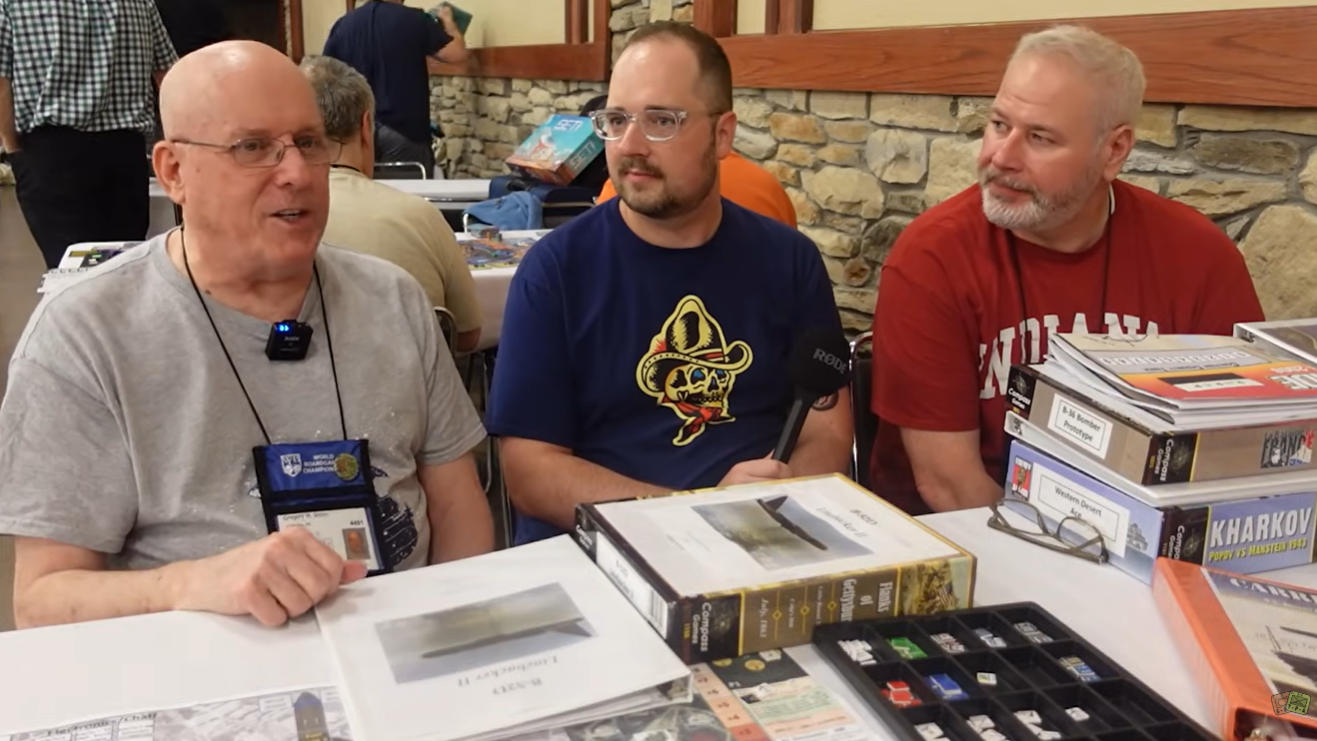
We then shot a video with both designers together and then broke off with just Greg to talk about 6 of his other in-design projects. These included the following Korean Tide (next entry in the Tide Series covering the Korean War 1940-1953),Rifle Platoon (tactical level squad based solitaire game using the American Tank Ace Series), Project Z (what if bombing game where Japan won at Midway and began to run bombing operations against the United States mainland and Australia similar to Amerika Bomber), Western Desert Ace (solitaire Ace Series game focused in North Africa), B-52D Linebacker II (solitaire Vietnam War bombing game in 1972) and then finally a scoop on a joint design from Kevin McPartland and Greg Smith called Star Spangled Tide. It was a great discussion and I’m very much looking forward to all of these games.
To end the video, Greg spoiled his upcoming Lone Banner game which is a 1-4 player dungeon crawler set in the fantasy world of Kalar from Burning Banners from Compass Games. This one is going to be fun and I got a look at the characters, spells and weapons and also saw the dungeon tiles that will be laid out as players move through the dungeon encountering traps, monsters and bosses to fight. This looks great but it is a ways off as Greg said he has only been designing it for a month or so.
I then got to play the new The Great Hunger from Compass Games with designer Kevin McPartland. InThe Great Hunger players represent families of tenant farmers and field hands. At first, when the potatoes are plentiful your clan will grow, using the events on the top half of cards to help your family expand across the map moving into counties, working on estates and in factories. When the potatoes blight arrives, you’ll use the events on the bottom half to save as many as you can, finding them aid or employment in Ireland, or scrambling to ports to secure passage to America.
The game is a very light Euro style game of survival and is well done as it’s rooted in history and teaches about the struggles of the Irish. I am glad to have played the final production copy as I got to play a prototype copy a few years ago at WBC. This one will catch some heat from people for it’s dark topic and will just not be for everyone but it has something to teach about history and I have Irish ancestry and am interested as to what happened to cause my ancestors to leave their home to come to America.
One final thing I want to show you is the lineup of games that GMT has staged in the main gaming area. These are all of their newest arrivals and they are just gorgeous. I’m most interested in Coast Watchers designed by Volko Ruhnke and The Weimar Republic designed by Gunnar Holmbäck.
I was supposed to wake up at 6:50am this morning but due to the fact that I was so excited to get going I actually woke up at 5:15 and was unable to get back to sleep. So I just got up and got ready early and was able to leave my house at 7:15, which was about 45 minutes earlier than I expected. Ultimately this was a good thing as it allowed me to drive a bit more leisurely and stop to go to the restroom and get more soda to keep me going. I drove 5 1/2 hours to the Pittsburgh Airport to pick up my friend Mike Heckman who had flown in from St. Louis. His flight left about 20 minutes later than scheduled but they must have made up some time as they arrived only 10 minutes past his scheduled arrival time.
I’m ready to get going.
It’s a bit lonely driving by myself but I had some good tunes and the time went quickly. It was nice though to have Mike in the car to chat and that made the final 90 miles to Seven Springs fly by. We arrived at the resort at around 3:30 and got checked in and unloaded the car and were in the room getting organized pretty quickly. We then tried to decide what game to start the convention with and I had brought For the People from GMT Games so we made our choice and headed down to the main gaming area.
It took us about 30 minutes to setup and get the rules overview done and we jumped right into it with the campaign game.
I own the 25th Anniversary Edition which is absolutely gorgeous with beautiful cover art done by Donal Hagerty and a double sided mounted map board with the original on one side and a redesigned map by Terry Leeds on the other.
If you don’t know, For the People is a Strategic level Card-Driven board-wargame covering the whole 4+ years of the American Civil War. We played 5 full turns in about 4 hours which included dinner, talking with several people and chatting about our experience with the game.
My initial opinion is that there is a lot to like here but the game is fairly rules-heavy and complex. I didn’t find the players aid all that helpful and we just seemed to bounce off of the rules. I also found that the strategy is very challenging, as would be expected with my first play of the game, and I had a great deal of trouble getting the required 3 Ops cards to activate my generals. In fact, in 5 turns I was only able to activate about 5 times. I just kept drawing a lot of 1 and 2 Ops cards.
This truly felt like the Union generals, especially McClellan, were afraid to be aggressive and this element is demonstrated by this friction and lack of lower activation Generals. Burnsides and Pope were my only early Generals with a 2 and they were able to do a bit more until Pope was killed in battle (of course). Through the game and its mechanics, I can see why Lincoln would get frustrated with their lack of aggression and ultimately would make leadership changes. Is this a prime example of design for effect? I think it actually felt historically well done but from a playability perspective makes it tough. Would reserve points be a good addition to this like in games such as Labyrinth where you can play a 1 Ops card to then later add to a 2 Ops card to get to 3? Just a thought I had that kept rolling through my head. I liked what I was doing but I didn’t like it while I was doing it. Does that make sense?
I will also say that the CSA generals are comparably much, much better and typically activate on 2’s which makes it much easier to do anything with them. I think that I just had bad luck but once the CSA got Lee and the Army of Northern Virginia was created he was literally a demolition crew annihilating my Union armies. In fact outside of 3 victorious battles, I lost about 7-8 times and was really getting rocked. The only real saving grace for me was that I drew the Frederick Douglas card in my first hand that gave me 5 Strength points of troops to place out to protect Washington from attacks. Had that card not been drawn I think that Washington might have fallen.
I very much enjoy the political control markers and the initial battle for control of the Border States of Kentucky, West Virginia and Missouri. This was a nice part of the game and I can see the connection between other games from Mark Herman such as Washington’s War.
Overall I want to explore the game more. I have some issues but I think that a few more plays will change my opinion as I learn the strategy. Overall a good intro to the game and I am intrigued.
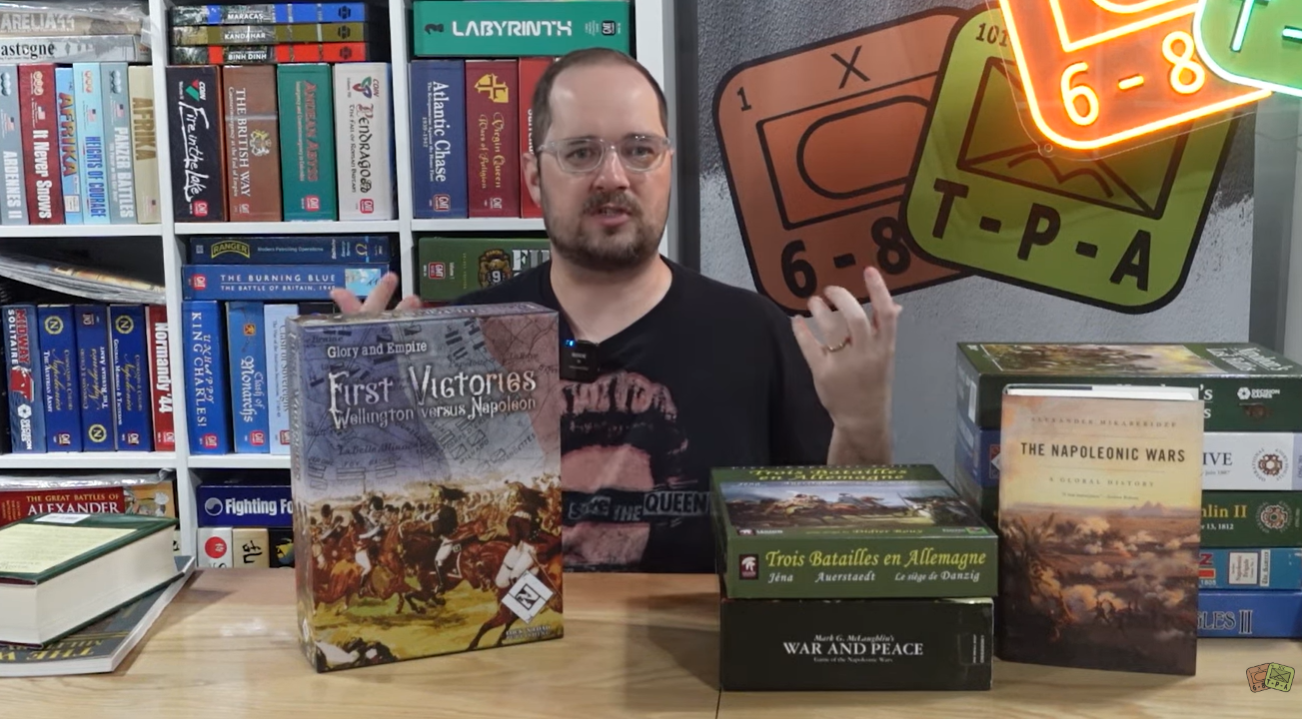
We have an ongoing video series on our YouTube Channel called From Cover to Cover where we read a book on a subject and then pair that with a discussion of the book while covering a few games also on the subject. In this 14th entry in the series, Alexander takes a look at The Napoleonic Wars: A Global History by Alexander Mikaberidze. He then discusses a few games on the subject including Congress of Vienna from GMT Games, Imperial Struggle from GMT Games, Alliance from Columbia Games, Commands & Colors: Napoleonics from GMT Games and The Napoleonic Wars from GMT Games. amongst many others
I love a different style and focus of wargame. A game that takes a look at an important but somewhat obscure or rarely addressed historical topic, such as espionage or intelligence, and creates a gaming experience tailored around the events to highlight and evoke the difficulties and tension that would have been present. In January 2026, GMT Games announced such a game in Checkpoint Charlie, which is a solo or cooperative game focused on SIS espionage missions in Berlin in the 1960’s designed by Russell Brown. We have posted an interview with Russel and it was very well received and he has now agreed to create a series of History Behind the Cards to highlight the events of the 1960’s Cold War struggle in West Germany but also to share aspects about the game play and how it models the history.
*Note: The cards highlighted in this series and their event text, as well as any pictures used showing any of the various components, are still in the design and development process and as such event effects and text might still change prior to final development and publication.Also the art and layout of the cards are only for playtest purposes at this point and the game will enter the art department as it nears publication.
History Behind the Cards – Checkpoint Charlie from GMT Games – Card #3: Demonstrations
West Berlin, and West Germany as a whole, spawned a number of large, very active student demonstration organizations in the late 1960’s. These were generally in response to a perceived return to very traditional German authoritarian government, and specifically as a reaction to former members of the Nazi party, like Chancellor Kiesinger, serving in the Bonn government.
However, during the slightly earlier time period of Checkpoint Charlie (early 1962 to late 1963), demonstrations were not as organized. They were spontaneous and in response to specific events, like the Speigel Affair (Card #16) and President Kennedy’s Visit (Card #7). As with those later, more organized movements, they consisted primarily of young Germans, and the universities acted as catalysts and staging areas. Even during the period of this game, marches and demonstrations were common enough to warrant an event card.
As a side note, Chancellor Keisinger, who’s Nazi affiliation spawned some of those later protests, was replaced as Chancellor of West Germany in 1969 by Willie Brandt, who was mayor of West Berlin during the period of Checkpoint Charlie. Mayor Brandt has his own token in the game and plays a role in a few of the missions.
The Demonstrations Event Card places a special Demonstrations marker in one of the West Berlin locations on the map. Demonstrations could last for hours, or even days, so this marker generally remains on the City Map for the rest of the mission. East Berlin locations are not eligible because the Stasi secret police, along with the confinement imposed by the Berlin Wall, had effectively suppressed any open opposition in the East. In game terms, the Demonstrations marker provides some cover for assets, increasing their chances of passing both detection and compromise saves.
In the next article in this series, we will take a look at Faceoff with the Soviets when East German police placed barbed wire barriers to stop East Germans from defecting.
In my opinion, this game looks extremely interesting and I am very much excited to learn more about it. I am appreciative to Russell and his efforts to bring us these cards and to write these entries to share with our readers. I am also very glad that this topic is being covered in a game and look forward to playing this one day soon.
The June 2026 Monthly Debrief Video, which is the 6th episode in Season 6 of this series, saw us discussing Nostalgia and its effects on the wargaming hobby. I think that nostalgia is generally a good thing but it definitely can be something that holds the hobby back. Too much nostalgia tends to keep us away from new and emerging games and systems and in general can be a suppressor of innovation and progression.
Also, as usual, we covered the games we played in June as well as the games we plan to play in July.
We will remind you here that we are fortunate to be continuing our relationship with Noble Knight Games as the sponsor for our Monthly Debrief Video series. In case you don’t know, Noble Knight Games specializes in hard to find games but also carry all the new releases. But what makes them truly unique is that you can find some of the rarest games, long out of print games, hand made games, imported games from overseas, etc. Thanks to them for their sponsorship and we hope that you will consider them first when looking for the games we cover.
We met Akar Bharadvaj while attending SDHistCon in 2023 and played his award winning design Tyranny of Blood: India’s Caste System Under British Colonialism, 1750-1947 and very much enjoyed the experience and talking with him about game design. Since that time, he has been working on another designer called Chalice of Poison: The Iran-Iraq War, 1980-1988 from GMT Games, which was announced in March on their P500. Chalice of Poison is the first volume in a new series that models complex conflicts not only as clashes between adversaries in the air, land, and sea, but also as political struggles within the regimes and military forces fighting it. We reached out to Akar and he was more than willing to share.
*Keep in mind that the design is still undergoing playtesting and development and that any details or component pictures shared in this interview are for prototype purposes and will definitely change prior to final publication as they enter the art department.
Grant: Akar welcome to our blog. First off please tell us a little about yourself. What are your hobbies? What’s your day job?
Akar: Thanks, Alex and Grant! It’s great to be here. I live in sunny Arlington, Virginia, just across the river from our nation’s capital. Besides board games, I enjoy travel, museums, graphic design, bad movies, comedy shows, and nice meals. As for my day job, I work as professional wargame designer. I work on teams that make analytic games and tabletop exercises to help policymakers think through challenging issues related to international relations. That said, Chalice of Poison is solely a personal project, and does not reflect my day job or the views of my employer.
Grant: What motivated you to break into game design? What have you enjoyed most about the experience thus far?
Akar: I’ve always enjoyed board games since I was a kid, and have gotten into historical games in the last 15 years or so. I flirted with the idea of designing my own for years, but then I actually decided to design one in 2020 when I heard about the Zenobia Award, which is a competition and mentorship program for historical games on underrepresented topics. I was looking for a good project to distract me from the ongoing pandemic, so I entered the contest on a lark, not expecting it to go anywhere. But Zenobia did a great job of helping me walk gradually through the game design process, and before I knew it, I was hooked. When the award project finished, I learned that I had won first place. But more importantly, I had discovered a new passion.
My two favorite things about game design are the creative process and the people. I find the creative process immensely satisfying. I get to analyze systems, experiment, and iteratively solve problems and improve a process, and there’s few consequences to failing! If I find that a design doesn’t work, I can just move on to another one, and hopefully return at some point in the future. It’s a beautiful process, and one that actually feels a lot like playing a game.
I also love the people I’ve met through game design. I’ve made lots of designer friends through various cons, and it’s always a delight playing games with them, talking about game design, and just chatting. I always leave cons full of inspiration and ideas, and it’s largely due to all the great people in this field.
Grant: What was it like winning the 2021 Zenobia Award for Tyranny of Blood? Where does this game stand at the present time?
Akar: Winning the award was one of the greatest moments of my life. As I mentioned earlier, I started designing the game just to see what it was like, and I didn’t expect it to go anywhere. (If I knew there would eventually be interest, I would’ve designed a simpler game as my first one!) So, I was pleasantly surprised when I learned that I won, and was excited at how much interest it received.
For those who do not know, Tyranny of Blood is about changes to the Indian social structure under British colonialism, through the lens of the caste system. I designed a fully playable game during the Zenobia Award process, but like so many first designs, it had a bit of a “kitchen sink” approach, and had far too many layers placed on top of each other.
I realized that the game had lots of great elements, but it had some flaws at its core, and so I needed to redesign lots of it. The topic is a difficult one, both ethically and in terms of complexity, so I needed to get the game right to do justice to the subject matter and avoid creating something offensive. On top of all that, the rapid prototyping during the Zenobia process left me exhausted (in a good way). So, I decided to take a break from it, and work on other games in the meantime to improve my game design skills before I can return to Tyranny. Now that Chalice is in development, I can return to that project. That said, it’s been a while, so I need to read through my notes and remember all the nuances of the topic.
While attending SDHistCon in November 2023, we played Tyranny of Blood with Akar and had a great time. We shot the following video interview at the time and you can watch that at the following link:
Grant: What is your upcoming game Chalice of Poison about?
Akar: Chalice of Poison is about the Iran-Iraq War, which took place in the 1980’s. The game focuses on the interplay between external conflict and internal regime stability. You play as one of the two countries, and you are trying to improve your military effectiveness so that you can win the war, without making your military so effective that it becomes a threat to your own regime. Players can win the game if they capture certain objectives in the war, or they can lose if their regime collapses due to political challenges.
The actual combat resolution and prosecution of the war is only one part of the game; the other part is managing your regime and ensuring it does not fall to internal threats, whether that be generals who instigate a coup d’etat or dissident groups fighting against your government.
Grant: What should the name convey to players about the history of the Iran-Iraq War?
Akar: The phrase “chalice of poison” comes from a quote from Iran’s then-Supreme Leader Ayatollah Ruhollah Khomeini. When he signed the ceasefire agreement in 1988 that ended the war, without any major concessions despite all the bloodshed, he described it as “more deadly than drinking from a chalice of poison.”
Additionally, I found the evocative phrase to be an appropriate name for a game about accepting risk and making sacrifices to achieve objectives. The game is full of hard decisions that seem enticing at first, but end up doing internal damage.
On a lighter note, ever since Tyranny of Blood, I’ve been trying to give each of my designs a name that sounds like a heavy metal album.
“Taking this decision is more deadly than drinking from a chalice of poison.” ~ Ayatollah Khomeini, on accepting the ceasefire that ended the Iran-Iraq War
Grant: What is the new series called? What type of games might be included?
Akar: I haven’t been able to find that perfect name yet, despite coming up with a long list of ideas. So, the series doesn’t yet have a name. If anyone has an idea, I would love to hear them! Please sound off in the comments.
The system best models historical conflicts where major dynamic changes occurred within the halls of state power and the military command structure, rather than with territorial exchanges on the battlefield. So, future games in the series could model other conflicts where weak states fought each other while dealing with significant internal tensions. There are no shortage of those throughout history, from the modern Middle East to 1960’s Vietnam to Ancient Rome.
Grant: What games have you used as inspiration for your design?
Akar: I tend to prefer historical games that include strong political dynamics over straightforward wargames. So, a major point of inspiration has been the Great Statesmen Series, to include Congress of Vienna, Versailles 1919, and Churchill. Those games do an excellent job of demonstrating the interplay between peace negotiations and warfare, and it inspired a lot of the ideas I had about war being played in two phases, and how the two interact with each other. Instead of the connection between fighting war and negotiating peace, I focused on the connection between fighting war and improving military effectiveness. From a purely user experience perspective, I enjoy the tactile feel of placing cubes on cards that was in Versailles 1919, and the mechanic seemed to work well in this game.
Additionally, the war mechanics are loosely based on the States of Siege Series, though with a lot of complexity added. That system offers a simple push-pull model for combat, which I employed for a 2-player tug-of-war. I needed a fairly simple mechanism at the core, so that I could layer many other mechanics on top of it without overwhelming players.
Lastly, one of the solitaire modes is inspired by Mark Herman’s Peloponnesian War, a genius solitaire game where players face off against a bot, but if they begin to defeat the bot by too much, they then switch sides and have to fight against everything they set up in previous turns.
Grant: How have you used and followed the academic research of Dr. Caitlin Talmadge?
Akar: Dr. Talmadge’s 2015 book The Dictator’s Army explores the question of why some authoritarian regimes, especially so-called “strongman regimes,” are ironically so bad at fighting war. Her research delves deeply into 2 case studies: Iran versus Iraq, and North versus South Vietnam.
Her argument is that the factors that reduce the threat of coups also reduce military effectiveness at fighting adversaries. The ideal military promotes based on merit, trains troops robustly, incentivizes open and honest communication, and empowers junior officers to improvise within reason. Conversely, strongman regimes tend to do the opposite: promoting based on sycophancy, avoiding training, incentivizing lies and secrecy, and making all decisions through an inefficient centralized command structure. These traits help dictators feel more secure, but they make militaries less flexible to deal with changing circumstances.
This argument underpins the core argument of Chalice of Poison. The main thrust of the game is reforming your military to improve each of those four factors, but at a cost to your own political power.
Grant: What is important to model or include in a game about the Iran-Iraq War?
Akar; A game on the Iran-Iraq War needs to provide a very specific incentive structure, by which players feel the hubris of thinking a quick victory is possible, but also a deep sense of desperation when things go poorly. It also requires mechanics for dealing with internal stability within each country, and being able to affect stability in the adversary’s country. Lastly, such a game must afford players the latitude to take a wide variety of actions; the story of the Iran-Iraq War is two countries quickly falling into a stalemate, and then experimenting with a large number of strategies and unsavory steps to break the stalemate and achieve victory.
Grant: What challenges did you encounter in the design? How have you overcome them?
Akar: I had to design the game carefully to reflect some misperceptions that the actual historical figures had. We know now that the Iran-Iraq War was an enormous catastrophe for both countries, but the game had to give players some false hope that the game could end at any turn. As such, I had to implement a variable game length, with victory conditions that contract as the game progresses. I had to pace the game well so that players always feel like they’re on the verge of victory (or collapse), and I think the game is nearly there.
The early iterations for the game were very mathy, with a lot of dice roll modifiers and additions to provide bonuses for military reform. It wound up not being fun; either players would have their eyes glaze over due to the excessive math, or they would try to calculate every little decision and descend into analysis paralysis. Instead, I replaced all the bonuses with card play mechanisms, which thematically worked, because it gave players more flexibility to deal with bad situations. I replaced most of the math with a simple card color-matching system.
The game has a unique action costing system that requires players to push their luck, carefully budgeting their political power or else risk losing it all (and the game). I learned that most players instinctually spend their full action allotment, so if I give them 10 points, they want to spend 10 points! So, I had to add in some “brakes” to stop new players from losing the game immediately.
I had 2 additional in-game challenges that I needed to solve. One was how to depict the more unsavory aspects of the conflict, such as chemical weapons and human wave attacks, which were historical atrocities, but necessary to tell the story of this conflict. Typically, a game would have a penalty or cost for doing such things, but in the actual historical case, neither country actually suffered a penalty for these actions until well after the war. Additionally, I needed to balance the game a bit more, to give the losing side a chance. I quickly realized that both of these challenges could actually solve each other. I created a “Desperate Measures” mechanic that allows the losing side to catch up a bit, but at a moral cost.
Grant: What is the scale of the game? Force structure of units?
Akar: The game plays at the political and strategic level, so it is pretty abstract. It models the conflict along up to six fronts: the air, three or four different ground fronts, and the naval front. Each one has an abstracted military strength represented by zero to six wooden chevrons. Each side has one air force, one navy, and three different ground forces: the elite guard, the regular army, and the paramilitary. Each of these five forces has a commander in charge of it. That is as complex as the game’s force structure gets; it does not model more specific units or officer ranks.
Grant: What is each player’s overall goal in the game? What does this mean?
Akar: Each player is trying to win the war while preserving their regime.
Winning the war means capturing a certain amount of territory. Most spaces on the map contain stars representing the relative importance of that space. A player advances on the War Progress Track one space for each star captured. Additionally, the War Progress Track includes an Objective counter that starts at 10, but decreases as the game goes on, representing war-weariness and a reduction in expectations for what players define as “victory.” If a player’s War Progress meets or exceeds the current Objective, that player wins the war (and the game). Of note, a player can potentially win even with zero points, which reflects what happened in real life.
Preserving the regime means holding onto political power cubes within the Regime pool on the board. If the Regime pool has zero cubes in it, the player’s regime falls and that player loses. Cubes move out of the Regime pool when players reform their military, improve their commanders, face problems with dissidents, or fight against a coup d’etat. The fewer cubes in the Regime pool, the higher the risk of internal problems erupting.
Grant: How do players go about developing a professional army that values competence and skill?
Akar: Players start with a “coup-proof” military that is pretty ineffective at fighting, but they can expend political power, and thereby accepting risk to their regimes, to make reforms.
Grant: What actions are available to players to reform their military?
Akar: Players have four major actions they can take. They can coordinate to allow commanders to communicate openly with each other and their underlings, empower their forces in the field to make decisions for themselves, promote commanders based on competence instead of personal loyalty or family ties, and train existing commanders to be better at fighting. Each of these actions has four different levels; players can upgrade the actions to improve their effectiveness, but at a cost of political power.
Grant: What are the costs of this process? How do players manage these threats?
Akar: The costs of each action comes in political power cubes. Each action starts at level zero, which does not cost anything, but is not very useful. Players can make reforms, which essentially upgrades each of these actions one step at a time, up to level four. Upgrading to a higher level requires placing that number of cubes on that card. Actually taking actions usually has an additional cost in power cubes.
Players need to “push their luck” to best achieve reforms gradually. Doing too much too fast is a recipe for disaster. Players can spend a large number of cubes each turn, but they will not necessarily get them all back at the end of the turn. Reforming too quickly can threaten regime stability. To protect against these threats, players will need to go slow, keeping enough political power behind to stabilize their regimes, but inaction can also be risky if it means losing the war.
Grant: What is the Turn Sequence?
Akar: The game has up to 9 turns, each representing a year from 1980 to 1988. Each turn has 4 phases:
In the Planning Phase, players issue hidden orders for six fronts to carry out this turn.
In the Action Phase, players reform their militaries so that they can improve the likelihood that these orders are successful.
In the Battle Phase, players resolve orders, change territorial control, fight dissident groups, and learn lessons for future battles.
Finally, in the Unrest Phase, players face internal threats, to include popular outcry, dissident groups, and coup attempts.
Grant: How are hidden orders issued?
Akar: Each front has a space for an order tile, which players place face-down during the Planning Phase, so that they are secret from the other player. Each order tile has four options, which are chosen by how players rotate their tile:
Attack allows players to start a battle against the adversary, and to advance into their territory if they have a stronger force after the battle.
Defend allows players to fight against an attacker at an advantage, and to bring in a small amount of reinforcements, but does not permit advancement.
Subjugate (Air and Ground only) allows players to fight a battle against dissidents.
Attack Tankers (Navy only) allows players to threaten the adversary’s political power.
Regroup allows players to bring in a large amount of reinforcements, but not to fight in any battle that occurs.
Air and Naval forces have one order tiles each, but Ground forces have three different order tiles, representing the three different ground forces in the game: the Guard, Regular Army, and Paramilitary. The more elite the ground force, the earlier it gets to execute its order and deal damage, which gives it a slight advantage in combat.
Grant: How is combat handled?
Akar: Combat strength is a function of 3 different factors:
The Order tile, which represents orders from on high, determines whether a battle occurs, and if it does, which order the forces use to deal damage.
The Commander card, which represents high-level military leadership, determines the damage the front will do that turn. Each commander has a hit value for each of three battle suits: Fervor, Discipline, and Leadership.
The Battle card, which represents forces in the field, determines which suit on the Commander is used to deal hits on the opposing force. A new Battle card is drawn during each battle.
For each hit defined in the previous step, players remove one military strength, represented by wooden chevrons, from that front. If an attacking front is stronger than the opposing front, it may advance and capture enemy territory, for some bonuses.
In each battle where one side deals more damage than the other, the active Commander learns a lesson about how to fight, which changes his stats. Of note, not every lesson is a good one; some lessons can actually make the Commanders worse at fighting; for instance, if it makes them complacent or arrogant.
Grant: What elements of unrest confront the players? How do they handle these challenges?
Akar: Unrest comes in 3 forms, during the Unrest phase:
Public outcry occurs if a player does not attack in a given turn. This removes a political power cube from the game.
Dissidents represent groups that threaten the regime’s power. The strongest dissident group on the map each turn has a massive negative effect, the second strongest has a moderate penalty, and the other three have a slight penalty. If left unchecked, the dissident groups can cause major chaos, but any troops dedicated to fighting dissidents are necessarily not fighting the adversary, so balance is important.
Coup attempts may break out if a commander has more political support than the regime. Each commander has a number of cubes on the card, which corresponds to his risk to the regime and typically corresponds with his competence. If a commander (or a group of commanders allowed to coordinate) has more cubes than the regime, a coup attempt may break out, and then the player will have to fight battles against the rebellious commander(s).
Grant: How does the design use cards?
Akar: The game has 4 types of cards:
Action cards allow players to choose from among four different military changes each turn, as listed above. Players can “reform” or upgrade these actions to have more of an effect, at the cost of political power.
Personnel cards represent the major figures involved in the conflict. They are dual use cards:
When horizontal, they are Commander cards, meaning that the person on the card now Commands forces. These Commanders each have different strengths across three suits (discipline, fervor, and leadership), which dictate how much damage they do each turn.
When vertical, they are Battle cards, meaning that they are forces in the field who are actually fighting the enemy. Battle cards dictate which suit on the Commander deals damage in a given fight.
Dissident cards represent the negative penalties from the five dissident groups that are in the game. Each turn, during the Unrest phase, players draw one of these cards, which determines what effect they have. The strongest dissident group this turn has a major penalty, the second-strongest has a moderate penalty, and the other three groups have a small penalty.
Grant: What is the layout of the board? What do the point to point tracks represent?
Akar: The War Map is a point-to-point map, which was a necessary design choice because the terrain along the Iran-Iraq border only allows approaches through specific narrow corridors, to avoid marshes, mountains, and other rough terrain. Additionally, the amount of land that each side managed to capture in the war was miniscule, so having a map to scale made little sense.
The map has different squares representing ground territory and sea locations. Black squares are Iraqi-controlled at game start, and red ones are Iranian-controlled. Each space has icons: stars are Victory Points, representing strategically and symbolically important areas; circles are Economy, representing oil infrastructure and sea lanes, and hexagons show the presence of dissident groups.
Beyond the map is a series of tracks representing the current turn, the strength of each country’s economy, and the current war progress (i.e., the winning side’s victory points and current objective).
Additionally, each side of the board has an area to show each regime’s current political power and active military commanders.
Grant: How is victory achieved?
Akar: The most important spaces on the board have stars on them, which represent victory points. Every time a side captures a starred space, the War Progress counter advances that many spaces. (Of note: this value is zero-sum, so only the War Progress of the winning side is marked; if the winning side flips, the counter flips to show that the other side is winning.)
Additionally, an Objective counter, marked with a dove, represents the current victory condition. The game begins with the Iraqi side having maximalist objectives, but as the game progresses, each side is willing to scale down their goals and definition of “victory.” So, the Objective counter moves left each turn, and additionally moves due to player actions.
If the War Progress counter ever meets or exceeds the Objective marker at the end of the Battle Phase, the game ends and that side is the winner! Of note, a side can even win with zero victory points, which probably was the real-world historical outcome.
Additionally, if a side ever runs out of Political Power cubes from their pool at the end of the Unrest Phase, that regime collapses and loses the game. If the other side still has cubes, then they win the game! If both regimes collapse on the same turn, then both players lose and Henry Kissinger wins the game.
Grant: What do you feel the game models well?
Akar: The game does a great job of building tension, fostering an alternating sense of hubris and desperation, and encouraging experimentation through trying different combinations of actions until one comes out ahead. All of these factors were present in the actual history, so I am excited that the game design reflects these traits.
Grant: What are you most pleased about with the design?
Akar: I am pleased about the game’s originality. I don’t know of another game that shows the competing priorities of internal political stability and external military effectiveness quite in this way. I would be most excited if I (and eventually, other designers) could employ this system to explore other conflicts through history, or perhaps even outside of history.
Grant: What other designs are you contemplating or already working on?
Akar: As I mentioned earlier, I’m hoping to return to Tyranny of Blood, my game about the Indian caste system, and finally finish it. This one is the furthest along, but I have other games that I’m in the early stages of designing.
I’m hoping to adapt the Chalice of Poison system for a 3-4 game about the Vietnam War, tentatively called Riding the Tiger. My idea so far is to add some more asymmetry to the system. The South Vietnam player will likely play similarly to the two sides in Chalice, as an unstable strongman regime prone to coup attempts. The United States player will not face coup attempts, but will have to deal with popular support and an election every four turns. The North Vietnam player will have to manage its politburo, attempting to exert influence over the southern revolutionaries and balance between its Chinese and Soviet patrons (and their competing priorities for Vietnam).
I have another game concept, tentatively called Iron and Cardboard, about intra-alliance dynamics and competition among the Warsaw Pact nations as they rebuild from the destruction of WWII under Soviet domination.
Lastly, I have a concept called Pillars of Fire about competition and conflict among Iran, Iraq, and Saudi Arabia from 1979 to 1991. It will be asymmetrical, based on the 3 different systems of government (revolutionary theocracy, strongman dictatorship, and conservative monarchy), which will vie for dominance of the region. Chalice actually began as the military module of Pillars before it took on a life of its own, but I think the grand strategy of this rivalry is worth exploring in its own game.
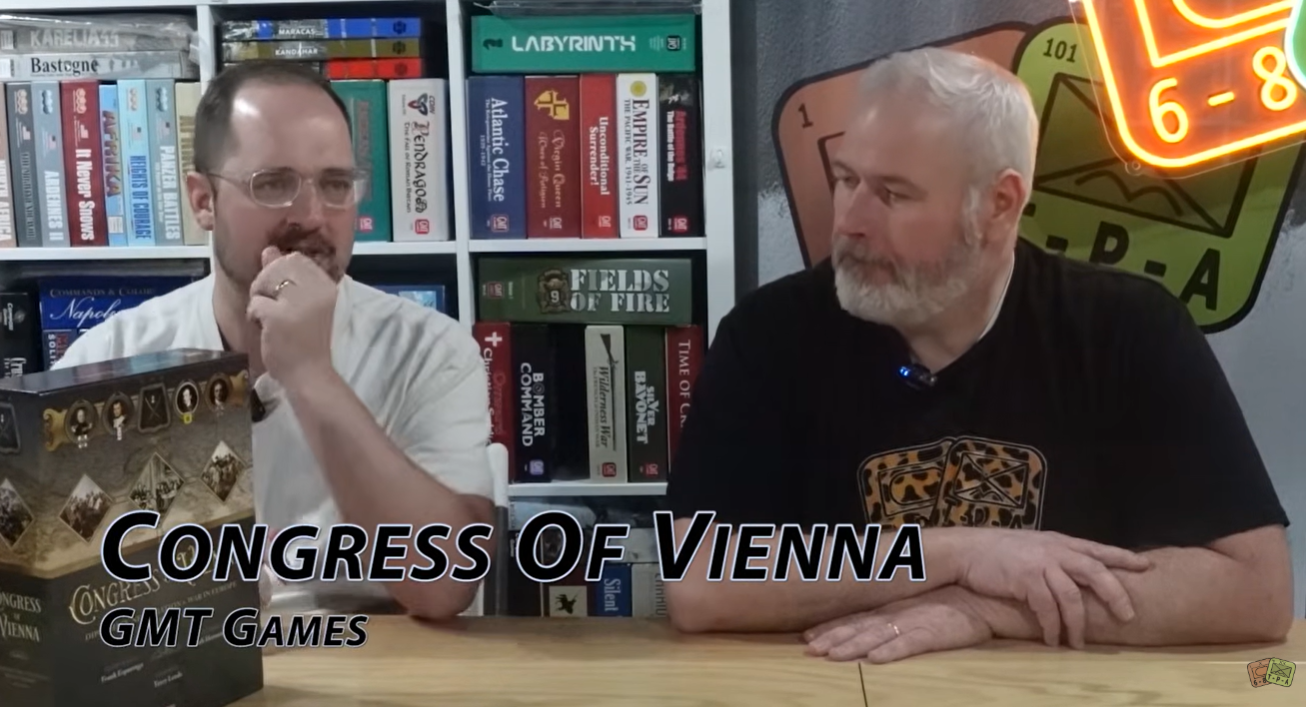
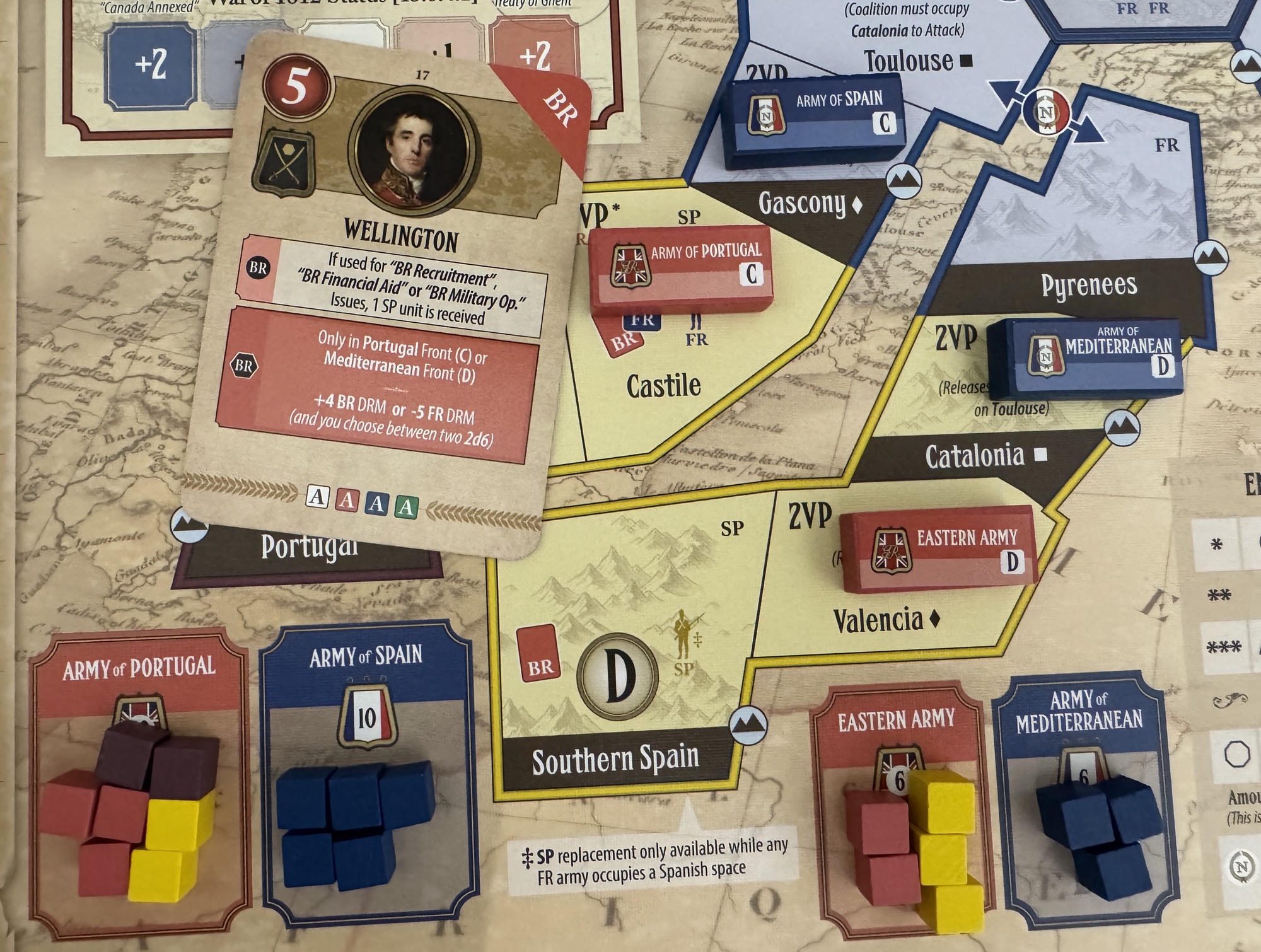
A few years ago, after playing all of the games in the Great Statesmen Series, we heard of a new game in the series from a designer not named Mark Herman and I was immediately interested and intrigued as we have had so much fun with Churchill, Pericles and Versailles 1919. Congress of Vienna from GMT Games is a diplomatic card driven wargame based on Churchill and is the 4th game in the Great Statesmen Series. The game is set during the years of 1813-1814 and sees players take on the role of the main characters of the struggle between the Napoleonic Empire and the coalition of Russia, Austria, and Great Britain with their Prussian, Spanish, Portuguese, and Swedish allies. We played the game twice last year at Buckeye Game Fest and at the World Boardgaming Championships and absolutely were amazed at the changes and innovations to the system introduced by the designer Frank Esparrago.
Recently, I saw a post on X from one of my favorite designers Mark Herman. If you have to ask who then maybe this post is not for you. But he is one of the best and most prolific designers out there with nearly 100 designs to his credit. Hands down one of the best…and an amazing guy too. In fact, some of his designs are among my favorite wargames including titles like Empire of the Sun, Churchill, Pericles, Fire in the Lake, Washington’s War, Fort Sumter, Rebel Fury and more. Mark knows wargames and he knows how to tell the story of the historical event. Just a master really. The post was Mark highlighting a written review found on Board Game Geek about his newest game in the Civil War Heritage Series called Volume II Army of the Potomac: Campaigns of 1862 & 1864.
I read the review he mentioned and it is very comprehensive and well done. But this post somewhat triggered me. Why I am not sure but it did. I am not mad about it. Not hurt. Not overly concerned. And when I say triggered a more appropriate word would be caused my thinking juices to be stirred up. But I wanted to share my thoughts and opinion on what a wargame review is but also what it is not because I believe that a lot of gamers have a very different opinion about these things than I do.
When Alexander and I get together to play a game with the intent of doing some sort of review and sharing our thoughts on the design it does take a bit of preparation and time. We have to read the rules, and believe me, this can take hours, to truly get a feel for the game, its processes and the flow. But also to get an understanding of what the designers thesis is about the conflict modeled. I think that designers create games that they agree with and believe in. Not necessarily that are 100% a true modeling of the event. Their bias is inserted into the design and there really is no way around that. And I am fine with it because I know that each story of history has 2 (or more) viewpoints and perspectives. We also have to prepare the counters, which includes clipping them, sorting them and then storing them in counter trays or baggies. We then have to set up the game, and with wargames, this can take an hour or more to make sure you have the correct units, place them in the proper hexes and then check to see if there are any errata with the setup that we will need to change. Sometimes setting up the game wears me out…but then we have to give it a play.
Also keep in mind that the majority of games that we play are big wargames. These games have multiple maps, hundreds if not thousands of counters and a ton of different scenario options to choose from. Typically, a campaign game might take dozens of hours with shorter scenarios taking 6-10 hours. These are not light games that can be played in 45-60 minutes. And because of that, the reality of playing a game multiple times just isn’t feasible. We have never posited ourselves as full and thorough multiple playthrough guys. We just don’t have the time to sink that much time and effort into 1 game. Keep in mind that we only get to play 30-40 new wargames annually, which is a lot but not necessarily a lot for someone that attempts to give a good review of a game. But we always play a game until we are comfortable with the rules, understand the flow and get into a majority of the aspects of the game so we can confidently and accurately discuss them.
So, first let’s take a look at what I think that a review is not necessarily.
What They Are Not!…
Full Exploration
First off, I don’t see a review, or at least our brand of reviews, as a total and full exploration of a game or the system. As I stated above, we play a game until we are comfortable with the rules, the mechanics, the thesis of the game and the general flow. This can mean that we play through an entire scenario or even sometimes the campaign but that is not necessarily the case. In fact, more often than not, that isn’t the case. We also play these wargames to see if we like the system. Liking the system is a very different thing from totally dissecting and examining the system for its flaws, strengths and proving or challenging its thesis. Our focus in reviews is generally pretty simple…sharing the feeling of the game, its accessibility, meaning the clarity of the rules, and then a focus on how the game plays. We don’t always cover every aspect or mechanic but try to give an overall feel for what the game is. This approach stems from our stated goal with the blog and YouTube Channel, which is to give an overall impression of the game and create an environment that makes the viewer or reader feel that they are at the table with us just discussing the game after playing.
This is a big one that we are asked about a ton with our reviews. Is the game balanced? Does each side have a real chance of winning the game? And other similar questions. The answer to this is that these games, referring to wargames, are generally a look at the history and how it played out. This means that if one side had more and better troops, they are generally going to win the game as they did historically. But a good and skilled designer, will look beyond the numbers and attempt to create some realistic and achievable victory conditions for both sides. Something that if happens, could change the course of future battles and the overall outcome of the war. There is nothing more that I dislike as much as sitting for 4 hours and getting my teeth knocked in because I really have no chance at meeting some objective to say that I won a game.
Skilled designers will attempt to create balanced wargame victory conditions by avoiding certain things, such as simple point-based kill mechanics or even reaching a particular geographically significant spot on a board. Instead, they use scenario-specific objectives and asymmetric victory conditions to ensure that each side has its own unique path to success. These rules force players to focus on historical strategy rather than just duking it out and seeing who can kill more units. But, when we play these wargames, we generally are not necessarily able to devote the time to gain a true understanding of and to uncover whether the victory conditions are balanced. We typically go off a gut feeling and observation of time and distance covered in a historical push to see if the game is reasonable to win by either side. I love Holland ’44 from GMT Games. It is one of my favorite wargames of all time and is a titanic struggle between the Allies trying to run up Hell’s Highway to reach and capture 3 bridges along the way and the German defenders who are trying to do just enough to stop their advance and hold at least 1 of the 3 bridges. I have played this game a few times and found that I have a real tough time as the Allies making the appropriate level of progress over historical results to even get to the final bridge located at Arnhem. But that doesn’t mean that the game is broken or that it is imbalanced, it means that the history is well represented here as historically the Allies failed to reach the “Bridge too Far” and had to turn back.
Expositions on Historicity
Finally, I don’t feel that reviews are about expositions of historicity. I am not a true historian. I know enough to understand the basic events of major wars such as World War I, World War II, etc. but not necessarily the full details of the battles, the maneuvers used and the outcomes. One thing that I know we are asked a lot is about the Orders of Battle (OOB’s) for these wargames. An OOB is simply the makeup of each sides troops, including their historical units, numbers of troops, type of troops and their quality generally represented with movement values, combat factors and defense factors as well as morale values. And my answer typically is that I don’t know. I ask these designers these type of questions in our Designer Interview Series but am not able to verify or check their math because I don’t have the experience or knowledge to do so. And with just a single play will be unable to comment on this aspect of the design. Remember, that wargames somewhat function as interactive experiments intended to bring history to life for key battles. History is interpretive and sometimes facts about the makeup of troops, the terrain involved or even the weather at the time of the battle is sketchy and tough to piece together. But most of these games are attempts at telling the story as accurately as possible. But, keep in mind, that a good historical simulation wargame, will attempt to challenge players with the real limits, rules, and stresses that those commanders faced. Wargames test historical ideas by turning narratives into active problems and allowing users to explore “what if” scenarios. But I cannot necessarily always comment on the plausibility of a design because I usually lack the expertise or intimate knowledge to do so.
Sometimes I know that ours will be the only review on a game. And that worries me.
I do not think that reviews are what other people believe they are. I see them as insight into a game and how it plays, what can be expected and how it feels to experience the game. Not a full and insight filled thesis paper on the historical plausibility and outcome. But I do believe that our brand of reviews is useful…at least in my humble opinion. But it sometimes does worry me that our review may be the only content out there on a particular game and I have a real fear of misrepresenting something and causing others to turn away from that game. That definitely worries me and I do make sure that I understand what it is that I am going to say about a game before I say it. But keep in mind that our reviews are our opinions and you may have a totally different take on the game. And that is fine as well because in the end your opinion is the one that matters and that will be used to make a purchase decision. Your wallet is yours to protect and I respect that.
What They Are!…
Sharings on Perspective
In the end, any review is an opinion and is something that the creator has taken the time to write down (or video) to share with others. It is about attempting to describe the experience of the game and how it plays. This does mean that each reviewer may see things differently. May focus on different aspects that spoke to them. May decide not to share each and every aspect of the game. But will focus on the experience! And then share that with us. I for one love that there are people out there that are willing and able to do these reviews. It is work and takes time. But in the end, the real treat for us as consumers of these reviews is that we get a bit of insight into the game and an understanding of what it is. This perspective is the most valuable element of a review and is worth its weight in gold. A lot of times, people consume reviews because they have already played a game, made their mind up about that game and what it is and are simply looking for someone to corroborate their feeling. They don’t really care what the person has to think and whether their stance is well reasoned and supported by evidence form the game itself. They are simply reading or watching to validate their own opinion. They want to hear their thoughts come out of someone else’s mouth.
Recently, during one of our Monthly Debrief videos, we discussed games that we disagree on. There are not many games that Alexander and I disagree on…but there are some. As a part of that discussion, we dove into our conflicting thoughts about the venerable tactical level wargame series Advanced Squad Leader. We disagree on this game. I like parts of it, and the overall experience, but Alexander does not. And that is fine. But one of our viewers told us to “put the game back on the shelf” and that listening to us was “cringe”. Well, I do agree that we are cringe but this comment proves my point. We didn’t agree with him and so we are not correct. And that is fine.
Windows into Mechanics
I think that one of the most important parts of any review though is a window into the mechanics. Does this mean a full and detailed description of each and every mechanic, how they work, why they were chosen by the designer and how they reflect history? No…absolutely not. But understanding the base mechanics of a game is critical to understanding whether the game is for you or not. If you happen to really like block wargames and are watching a review on a block wargame such as An Impossible War from Bellica 3rd Generation you would like to know how the block wargame mechanic works. If you like Chit-Pull Activation and you are consuming a review about a Chit-Pull Activation game such as with Blind Swords: Gettysburg: The First Day from Revolution Games, you want there to be some discussion about how the Chit-Pull works. A review should have at least a mention about the mechanics and what is good about their implementation.
Gauges on Complexity
Wargames are generally complex affairs. They have a lot of rules, exceptions to those rules, rules variants or optional rules and sometimes have ambiguity in their explanation of these rules. This last part is really a problem with a lot of games, wargames and other types, but a designer sometimes gets “nose blind” to their own game and takes into account a lot of assumptions about how their description and instructions for the game will be received. I like to make sure that those consuming our reviews understand how complex or difficult to learn the game rules are. I also like to focus on player aids and how they affect the learning process and play so that those who may purchase the game and attempt to give it a play can get an idea of what their learning commitment will be with the rules. And remember, complexity and rules depth doesn’t equate to a good game. If you ultimately cannot get the game played because of the learning curve or the poorly written rules, then a review will do you no good.
A Look at the Fun Factor
In the end, while I play games for many reasons, I am mainly playing a game because I want to enjoy myself. I want to have a good time with the game and its efforts to tell the story of the event and enjoy my time with my opponent. I want to be able to focus on the game and get into the strategy and not have to worry about the rules, the mechanics or the production. And a good review will provide an insight into this aspect of the game. It doesn’t take multiple plays to understand whether a game is right for you or whether it matches your tastes. You can typically see that in just a single play and that is the way we approach things. We have played a lot of games and know when a game is not for us. But, that is not always the case for others and their experience with wargames. And that is fine. But that is a key part of what a review should be.
There you have it…my thought’s on what a review is and what it is not. I know that many will not agree with these points and that is fine. These are my opinions and I have developed them over the past 40+ years of playing games and 10+ years of covering games as The Players’ Aid. What are your thoughts on what a review is? How do you think they best serve the wargaming community? What would you change about our reviews? I look forward to hearing your thoughts and opinions on this matter. Thank you.
With this My Favorite Wargame Cards Series, I hope to take a look at a specific card from the various wargames that I have played and share how it is used in the game. I am not a strategist and frankly I am not that good at games but I do understand how things should work and be used in games. With that being said, here is the next entry in this series.
#86: LRRP from Fire in the Lake: Insurgency in Vietnam from GMT Games
The COIN Series uses cards in a very different way from other CDG’s. These cards are not necessarily the driver of the action but more assistive to the actions of the players by setting eligibility and also providing powerful events. The Event Cards are more often than not, very powerful. They either give you a continuing bonus on future Operations and Special Activities (as in the case of the volumes that include the various Capabilities) or allow you to take Operations and Special Activities more times that round than you would normally have been able to had you not chosen the Event and more often than not, at no cost! Also, because of the power of the cards and their ties to one or more factions, you can take the Event which allows you a huge advantage, only to see that very powerful Event reversed with the next Event or with a regular Operation. This is very frustrating but is one of the major reasons that I love the card-assisted element of the COIN Series. Today we are going to take a look at the LRRP Event Card.
The LRRP Event Card, with LRRP standing for Long-Range Reconnaissance Patrol, allows the US player to place 3 Irregulars outside the South then conduct a free Air Strike, that also allows for the removal of Bases first. Keep in mind that Irregulars are US Special Forces pieces, which are the hexagonal shaped cylinders not ARVN Rangers. “Outside the South” means any Laos or Cambodia Provinces. Seems pretty pedestrian but it is important to note that this card changes the rules when played as normally all other units in a space must be removed before Bases can be removed. A very powerful card that typically will be played by the US player when it comes up. But keep in mind that Air Strikes are a dual edged sword as you get rid of pesky enemy pieces but it will result in shifts of Support/Opposition but can also Degrade the Trail. On the bottom of the card, the text allows the VC or NVA to ambush these LRRP”s and remove 3 Irregulars from the map to Casualties. Then it gives an added benefit of shifting each space these removed Irregulars were in 1 level toward Active Opposition.
Image courtesy of Boxxer’s Blog.
A Long-Range Reconnaissance Patrol, or LRRP, is a small, well-armed and nimble recon team that is tasked with patrolling deep into enemy territory to identify or destroy key targets and gain recon on the enemy. The concept of scouting forces such as LRRP’s dates back to ancient warfare but also has been used in more modern and contemporary wars such as the French & Indian War where specialized Rangers, such as Rogers’ Rangers, were tasked with raiding Indian settlements, disrupting supply lines and reporting back to command on troop disposition and movement.
In Vietnam, veteran or specially trained forces often augmented with Vietnamese irregulars usually carried out Long Range Reconnaissance Patrols into enemy territory. The Studies and Observation Group (SOG) was the ground element of the US air war against the Ho Chi Minh Trail as illustrated by Project Tiger that spotted for and marked enemy trail activity for elimination by US air assets.
Here is a link to a very interesting summary of an LRRP and its mission on a Vietnam veteran run blog called Boxxer’s Blog: From the seat of a motorcycle: LRRPs: “—doing the impossible for the ungrateful.”
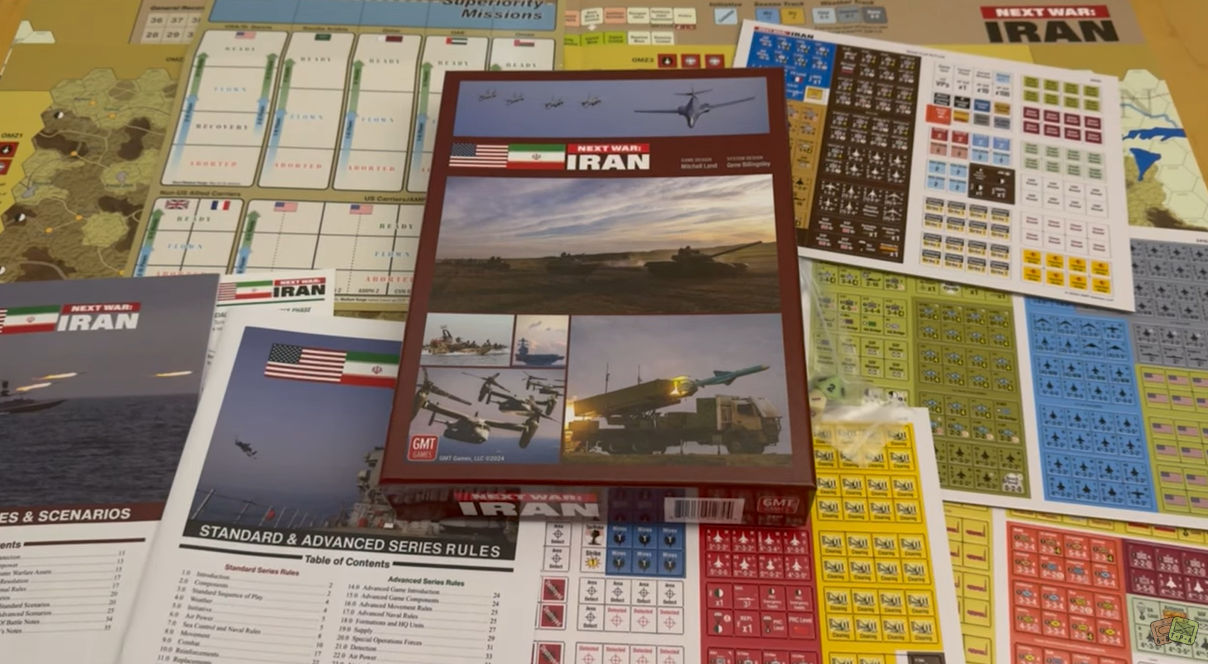
Next War: Iran is the sixth game in the Next War Series from GMT Games. It is unique in the series in that the Allied player has to do the attacking while the non-Allied player attempts to defend its territory against neo-imperial oppression. With a long logistical tail, few true allies in the region, and the menace of Iran’s A2AD capabilities, re-opening the Straits is a tall order.
I love a different style and focus of wargame. A game that takes a look at an important but somewhat obscure or rarely addressed historical topic, such as espionage or intelligence, and creates a gaming experience tailored around the events to highlight and evoke the difficulties and tension that would have been present. In January 2026, GMT Games announced such a game in Checkpoint Charlie, which is a solo or cooperative game focused on SIS espionage missions in Berlin in the 1960’s designed by Russell Brown. We have posted an interview with Russel and it was very well received and he has now agreed to create a series of History Behind the Cards to highlight the events of the 1960’s Cold War struggle in West Germany but also to share aspects about the game play and how it models the history.
*Note: The cards highlighted in this series and their event text, as well as any pictures used showing any of the various components, are still in the design and development process and as such event effects and text might still change prior to final development and publication.Also the art and layout of the cards are only for playtest purposes at this point and the game will enter the art department as it nears publication.
History Behind the Cards – Checkpoint Charlie from GMT Games – Card #2: Cuban Missile Crisis
In response to the US placing nuclear missiles in the UK and Turkey, within range of Moscow, and in an effort to protect Cuba and keep it within the Soviet sphere of influence, Khrushchev made a deal with Castro in July of 1961 to base Soviet nuclear missiles in Cuba, within range of most of the southeastern United States.
The US knew the Soviet Union was training and supplying Castro’s army and inserting specialists, and CIA assets in Cuba had seen Soviet surface-to-air missiles. This led to suspicion that the Soviets were intending to place ballistic missiles in Cuba.
The best US assets for confirming the presence of these missiles were high-altitude U-2 Spy plane flyovers. However, the loss of Francis Gary Powers’s U-2 over the Soviet Union to a SAM missile (Event Card #12 The Powers Abel Exchange) created reluctance, since the US now knew the Soviets had deployed similar SAM’s to Cuba. U-2 flights were finally authorized in October of 1962, and it was these photos that confirmed the presence of Soviet nuclear-capable missiles.
The status of Berlin, halfway around the world, played an important role in the Cuban Missile Crisis. From 1958 until the discovery of the missiles, the relationship between the US and the Soviets was dominated by the “Berlin Crisis,” which consisted of a series of military and diplomatic moves by Khrushchev to outmaneuver the Americans and annex West Berlin into East Germany. The Cuban Missile Crisis not only brought the conflict over Cuba to a head, but also brought new attention on the status of Berlin. The two became linked. A ground invasion of Cuba might result in a military annexation of West Berlin by the Soviets, and it was not out of the question for the Americans to concede to the Soviets in Berlin to get the missiles out of Cuba.
President Kennedy avoided direct military conflict and responded with backchannel diplomacy and a naval blockade of ships coming into Cuba. The crisis continued for two weeks, with US ground forces readied for an invasion, Soviet ships attempting to run the blockade, and the US strategic nuclear forces going to Defcon 2. The tensions eased when Khrushchev agreed to remove the missiles in exchange for an agreement that the US would never invade Cuba. In addition, Kennedy secretly agreed to remove US nuclear missiles from Turkey.
In Checkpoint Charlie, the Cuban Missile Crisis is assumed to have diverted Soviet attention from espionage activities in Berlin. This card not only removes surveillance from any location of the player’s choice; it also reduces the number of available surveillance pawns for the rest of the mission.
In the next article in this series, we will take a look at Demonstrations and what effect these student run organizations had on operations in West Berlin and West Germany.
In my opinion, this game looks extremely interesting and I am very much excited to learn more about it. I am appreciative to Russell and his efforts to bring us these cards and to write these entries to share with our readers. I am also very glad that this topic is being covered in a game and look forward to playing this one day soon.
It has been very hot lately….and the humidity is getting out of control here in our Area of Operations (Indianapolis, IN). It makes everything tougher but I still like it better than the negative temp spikes we experience in January and February and look forward to the rest of summer. In the wargaming world, there is also a lot of “heat” coming upon us in waves as this month for the Wargame Watch, I was able to find 30 games (including the single new game from our sponsor Bring it on Games). I was also able to find 9 games being offered on Crowdfunding through Gamefound and Kickstarter.
This month we have a sponsor for the Wargame Watch feature in a new publisher named Bring it on Games. Bring it on Games is owned by Adam Starkweather of Grand Tactical Series (GTS) and Company Scale System (CSS) fame. He has started this new company with several friends and compatriots as a “company run by gamers – not a company that publishes games”. I think that Adam is a great designer and he is now out on his own and is going to make the games that he wants to make.
On their website, they have said the following about their production schedule and plans for the near future:
We will only make two or three games every two years. Next up is ACSS: Utah: 10 Days in Normandy. But work has also started on Omaha, Market Garden, and Battleaxe for ACSS. But other games on different stuff using new systems has started too. Gettysburg, The War of the Atlantic, and other fun stuff. I just have to live to ninety to make everything I want to make.
While they are new and don’t have a published game to their credit as of yet, they appear to be working hard to build a brand that is solid and will hopefully be one that is a continual force in the wargaming hobby. Their current project that is up for pre-order is called Anzio: A Lost Opportunity and is a big, monster wargame. This game has a ton of maps (10 total) and a ton of counters (20 5/8th” Countersheets) as well as a ton of charts, tables and player aids. This is a MONSTER wargame…big, bad and beautiful…no doubt about it but it looks really good.
We have played several games designed by Adam Starkweather in his Company Scale System (CSS) published by Compass Games including Saipan: The Bloody Rock and The Enemy is at the Gates: The Batlte for Berlin. These games are really good solid chit draw systems that really puts some unknown in what groups of units can activate and even when they will activate. There are also events and if the chit cup runs dry before all of the units can activate due to the end round chit then you are just sore out of luck. You have to prepare for this inevitability and I love the concept of prioritizing your activations and making sure you activate what you absolutely have to before doing those units that would be beneficial to activate. The system is a highly accessible, streamlined approach to simulating tactical military operations while retaining strong decision-making depth. The CSS offers a “design-for-effect” combat system that effectively eliminates micro-management and makes the game a joy to play.
Anzio is the first game in a new series called the Advanced Company Scale System or ACSS. At this point, I am unsure what makes it advanced but will be working with the designer to get a better understanding of that in a designer interview for the blog.
In the mean time, you can download the rules and the scenario booklet from an online OneDrive and you can also get access to a Vassal module to try the game out. Here is the link to the OneDrive: OneDrive Link to Rules and Scenario Booklet
If you are interested in Advanced Company Scale System Game One:Anzio: A Lost Opportunity, you can pre-order a copy for $300.00 from the Bring It On Games website at the following link: https://bringitongames.com/shop/p/anzio-a-lost-opportunity
Pre-Order
1. OCSThe Hero City: The Battle of the Baltics, September 1943-April 1944 from Multi-Man Publishing
In late 2021, we posted an interview with Tony Birkett as designer and Chip Saltsman as developer covering his The Third Winter from Multi-Man Publishing, which covers the third winter on the Eastern Front during World War II and deals with German Army Group South as they retreat to the Dnieper River and then the Carpathian Mountains. This game is an entry in the Operational Combat Series and was followed up by his Crimea: Conquest & Liberation game that was promoted as a low-counter density, small OCS game. Since then, he has been hard at work on the next volume in the series called The Hero City: The Battle of the Baltics, September 1943-April 1944 that dives into the mid war battles in the Baltics between the Germans and the Russians.
From the game page, we read the following:
The Hero City depicts the desperate battles between late September 1943 and April 1944 in the Army Group North sector of the Russian front. Soviet priorities were to establish a rail connection into Leningrad, evict the Axis forces from the Leningrad Oblast, and force their way into the Baltic States. Well aware this hammer was about to fall, Army Group North prepared the Panther Line defensive belt along the borders of Estonia and Latvia. The Hero City covers the major engagements: the autumn attrition battles while the Soviets mass their forces, the fighting retreat as the Wehrmacht desperately tries to escape intact, and the crashing impact as Russian waves pound against the German Panther Line breakwater. In the north are the Finnish lines, which offer a completely different strategic opportunity, including a scenario for the Soviet Summer 1944 offensive into Karelia. The Axis forces managed—barely—to hold at the Panther line, but the situation could have spiraled into disaster. The campaign here laid the foundations for the drama during the summer of 1944, and many of the German units in The Hero City will end the war trapped in Courland.
The game area covers the Soviet Oblasts of Leningrad, Novgorod and Pskov, as well as Estonia, Latvia, and the northern part of Lithuania. The map extends north of Helsinki and Viipuri in Finland, south to Daugavpils and Tilsit, east to Valday and Volkhov and west to the Baltic Sea. The Hero City is fully playable with The Forgotten Battles, to create a combined massive gaming experience using campaign setups that start in September 1943 and January 1944.
The Soviet command and supply structure is modeled through Front HQ markers. Fronts are either in “Offensive” or “Regrouping” status, allowing for shifting axes of attack and the on/off nature of Soviet operational warfare during this time. Each Front has an assigned Air Force. The parallel fighting in Army Group Center is represented by a boundary marker that shifts as the war advances off map, and the Axis player must be careful to watch his off-map flanks.
The Hero City is a large-sized OCS game, with 1,400 combat units (five counter sheets) and a 44×66-inch map layout at a scale of 5-mile hex/3.5 days per turn. The full Campaign game is 63 turns long, and there are three campaign scenarios so players can start at different points in the action. Also included are several partial-map scenarios.
Special rules in this OCS game are carefully researched to model key aspects of this critical campaign:
Forces include German Wehrmacht, Luftwaffe and SS formations, as well as Soviet Guards, regular and Partisan units, plus Finnish, Estonian, Latvian, and Lithuanian units. The Prinz Eugen and German destroyers might put in an appearance.
Soviet Front HQ Markers which reflect their role in command and marshaling supply.
Soviet RVGK for coordinating strategic redeployment and rebuilding shattered mobile Corps.
Axis Army, Army Group and Kessel HQs, along with Kampfgruppe markers which portray Axis operational flexibility.
Random events similar to what are found in The Third Winter and The Forgotten Battles. The 26 possible events add historical flavor with minimal rules overhead, covering things like Guards Promotions, Fuel Shortages, Hitler’s intransigence, Soviet submarines Partisan Offensives, One-Turn Offensives, Battlefield Heroes, options for emergency reinforcements and unexpected Finnish offensives.
If you are interested in OCS The Hero City: The Battle of the Baltics, September 1943-April 1944, you can pre-order a copy for $90.00 from the Multi-Man Publishing website at the following link: https://mmpgamers.com/the-hero-city-p-468
2. Inferno in the Blue Grass: The Battle of Perryville, 8 October 1862 from Multi-Man Publishing
While attending Buckeye Game Fest this past March, we met with a fan of the channel named Leslie Jerome and had him introduce us to the Line of Battle Series with Volume 3 To Take Washington: Jubal Early’s Summer 1864 Campaign from Multi-Man Publishing. Line of Battle is a regimental-level American Civil War wargame system designed for fast-paced, non-stop action by eliminating excessive paperwork and combining fire phases with movement. I feel like this system is a highly playable classic ACW system with lots of very interesting mechanics including activation, order reception and relay, closing rolls, morale checks and close assault. In fact, I love how it creates a great narrative with some of the terminology and naming conventions such as the Blood Lust result for close assaults and the Cowardly Legs from broken units.
Recently, MMP put the next volume in the series up for pre-order called Inferno in the Blue Grass: The Battle of Perryville, 8 October 1862. I am very much anticipating this one and can’t wait to dive back into the series.
From the game page, we read the following:
Inferno in the Bluegrass brings The Gamer’s Line of Battle (LoB) Series into the Western Theater. The Battle of Perryville, the largest battle fought in Kentucky during the American Civil War, was the culminating engagement of the Heartland Campaign of 1862. This was the South’s attempt to invade the border state and garner support for its cause while simultaneously forcing Union armies in the west on the defensive. By October, the Army of the Ohio was on the move, poised to throw back the invaders. Bragg, confident that an initial Federal advance would focus elsewhere, was completely unaware that Don Carlos Buell was converging on his army in the small town of Perryville. As the sun rose on October 8th, 1862, neither army could have known that the coming engagement would ultimately determine the fate of Kentucky in the war.
The sheer scale of violence at Perryville factored heavily into the design, over 7,600 casualties were tallied – resulting in one of the larger casualties per hour rates of the war. Independent Command rule replicates Confederate commanders blurring the lines of command by fragmenting divisions into small, independent commands, creating confusion and limiting effectiveness. The Attack Commencement Chart limits the ability of the Confederate player to organize one massive assault. The Union, conversely, is hamstrung from the outset. The Union Alertness Table represents the phenomenon of an “acoustic shadow”, which caused Buell to be blissfully unaware of the overall tactical situation hours after the initial fighting had started. The map shows the parched land in meticulous detail, corroborated by the designer walking the battlefield to get a great feel of the ground.
This is Nick Roser’s first published design. His commitment and expertise on the battle shines through the design. Nick’s ancestor, Johann Christian Kurtz, fought in the battle, so his personal connection to Inferno in the Bluegrass is in his blood.
If you are interested in Inferno in the Blue Grass: The Battle of Perryville, 8 October 1862, you can pre-order a copy for $48.00 from the Multi-Man Publishing website at the following link: https://mmpgamers.com/inferno-in-the-bluegrass-p-467
3. Great Battles of the American Civil War: Battles for the Ozarks from GMT Games
This is one of those venerable series that we have not had the opportunity to play or experience. Great Battles of the American Civil War or GBACW (not to be confused with Great Campaigns of the American Civil War from Multi-Man Publishing) is a highly detailed, regimental-level wargame series originally created by Richard H. Berg. It is known for its interactive chit-pull mechanics that simulate the chaos, command difficulties and fatigue of 19th-century warfare. The newest volume in the series, which is Volume XI, was announced in late June and is called Battles of the Ozarks.
From the game page, we read the following:
The game presents five key battles that shifted the balance of power west of the Mississippi during the first two years of the war. Battles for the Ozarks concentrates on events on the Ozark Plateau of northern Arkansas and southwest Missouri and included are these battles from the first three campaigns of the war in the West. Each battle is portrayed in great detail allowing players to try alternate strategies.
Dead & Buried, The Battle of Wilson’s Creek, August 10, 1861 The first large battle west of the Mississippi. Federal General Nathaniel Lyon leads the Union forces in an attempt to bloody the nose of General Sterling Price’s Missouri State Guard and Ben McColluch’s Western Army that has arrived from Texas and Arkansas. Command the unusual forces that were arrayed in each army for this battle. As the Union, you’ll have Home Guard units, Regulars (including the famous 2nd Dragoons), and German American Missouri Volunteers from St. Louis. As Price and McCulloch, you’ll have everything from Missouri State Guard units armed with flintlocks and shotguns, to the South Kansas Texas Cavalry regiment and Arkansas State Militia.
Into The Night, The Battle of Dunagin’s Farm, February 17th, 1862 A lesser-known battle that occurred about a month before the much more famous battle of Pea Ridge. In north Arkansas along the Little Sugar Creek, the rear guard of McCulloch’s Army of the West, led by the capable Louis Hebert, tries to cover Sterling Price’s retreat from Springfield, Missouri. Hot on Price’s trail is Samuel Curtis’ Army of the Southwest. The advance cavalry of Curtis’ army collides with Hebert’s forces on farmer Dunagin’s field. What starts as a simple skirmish escalates into a full-blown fight that spills over into the evening, with both sides gradually feeding more troops into the battle.
Rush To Glory, The Battle of Pea Ridge, March 7th & 8th, 1862 Can you, as Earl Van Dorn, fall upon the rear and flank of the Federal army deployed north of the Little Sugar Creek before the more rested and organized enemy responds? Or can you, as General Samuel Curtis, repeat one of the few times in military history when an army reversed course, moved its supply train out of danger, and then engaged and defeated the enemy? A challenging battle for both sides; the Confederate army has been “Rushed to Glory” by Van Dorn in a snowstorm and is worn out, while the Union army is flanked by the CSA foe. The battle has a two-map and a three-map version (the largest presentation of the battle ever done).
Iron Men, The Battle of First Newtonia, September 30th, 1862 Probably the most unusual and desperate of all the battles included in Battles for the Ozarks. First Newtonia was fought before the Battle of Prairie Grove in Blunt’s campaign. The advance units of the two armies meet at the small hamlet of Newtonia in southwest Missouri. A CSA force comprised of the Indian Command, a brigade of Texas cavalry, and part of Jo Shelby’s Iron Brigade attempt to stop the forward movement of BG Fredrick Salomon’s 1st Kansas Division. With warriors of the First Nations on both sides, First Newtonia steps into new territory for GBACW. Also command part of the Western “Iron Brigade” in its first battle. One of the most desperate fought battles in the Trans-Mississippi.
Blunted Again, The Battle of Prairie Grove, December 7th, 1862 Take the role of the headstrong Union General James Blunt and see if you can move the CSA forces led by Thomas Hindman off the Fayetteville Road. As the Union commander, you will have superior artillery that can win the day. Or as the Confederate commander, you’ll hold the strong defensive position between the two Union wings along “The Bench”. You have the Napoleonic central position, and it is held by Joe Shelby’s Iron Brigade! Will it be enough?
Ready for a new experience in your War Between the States gaming? Battles for the Ozarks is the 11th installment in the award-winning Great Battles of the American Civil War Series. The game has rules that satisfy both experienced and new players, with a Simple Version that offers an easier, faster gaming experience. New optional rules are also introduced! New skirmish rules catch the ebb and flow of open order combat between the battle lines, and the Peoples of the First Nations make their first appearance in the GBACW Series. See how well these warriors fought at Prairie Grove or First Newtonia. New terrain types, such as Heavy and Light woods, are introduced, along with Rifle Pits and Entrenchments. With over twelve scenarios, including two on their own half maps, there is something for everyone.
4. Bataan! The Battle for the Philippines 1942 2nd Edition from Consim Games/GMT Games
Classic wargames always do well, either because of nostalgia and a longing for the past or because the game was really good. I don’t know which one this fits into but GMT Games announced a new 2nd Edition of a classic wargame called Bataan!. I say GMT Games but the game is actually published by Consim Games, as they have entered a new partnership with GMT as they have in the past to publish their own line of games.
From the game page, we read the following:
Bataan! 2nd Edition is the much-anticipated, updated grand-tactical-level treatment of WWII battles on the Bataan Peninsula in the Philippines, which took place from January through April 1942. Game designer and Charles S. Roberts Award recipient Vance von Borries has drawn on his game design experience to create a game engine capable of portraying the tense jungle fighting that took place on Bataan. While the system is based on his popular Roads to Leningrad game, the changes needed to simulate the fighting on Bataan make for a unique gaming experience. For history enthusiasts and wargamers, this is a nuanced, in-depth exploration of a specific, underrepresented aspect of WWII history. This all-new 2nd Edition does not simply address all official errata from the original edition, but also delivers new game components and a major game system update, with the rules rewritten to further advance this popular game system.
Gameplay is both tense and interactive, based on an alternating activation sequence in which both sides conduct operations. This second edition features streamlined game mechanics to improve and help speed gameplay, all based on player feedback. The game also captures air and naval operations, though the focus is on ground warfare and specialized unit capabilities.
Special rules model key historical facets of the campaign include: movement classes of units, artillery, air power, air missions, strategic movement, infiltration movement, disruption, contested hexes, unit formations, attack coordination, lead unit losses, efficiency and lead units, HQ units and capabilities, initiative and activation, hasty and deliberate activations, momentum, supply, fortifications, withdrawals, Japanese emergency supply, Campaign supply, general attrition, forage, naval operations, amphibious invasion, special situations and events, special units, Philippine Scouts, and more! Five scenarios are included. The three quick-playing opening scenarios require fewer rules to play. You can complete them in a single sitting, focusing on the core game system, and they include At the Pearly Gates: Layac (intro scenario), Abucay Line, and Mauban Line. These scenarios provide a clear and accessible entry point for players new to the system, allowing them to learn the core mechanics before tackling the full complexity of the campaign game. The two full campaign game scenarios add detail by introducing campaign supply, naval operations, amphibious invasions, special situations, and events. While intended for two players, the game is also suitable for solitaire play.
5. When Titans Clashed: The Eastern Front in WW2 from Consim Games/GMT Games
And the 2nd game offered on pre-order this past month in this new Consim Games/GMT Games partnership is called When Titans Clashed: The Eastern Front in WW2 designed by Michael Resch. This is a new game design but pays homage to the original Jedko Games edition of the classic The Russian Campaign designed by John Edwards. I know that we all very much enjoy a good romp on the Eastern Front of World War II and the tank clashes and and I am sure that this game will be a fantastic representation of the genre and give us hours and hours of hex and counter goodness.
From the game page, we read the following:
When Titans Clashed is a game covering the epic campaign fought in Eastern Europe during World War II. Game designer Michael Resch offers this tribute to the original 1974 Jedko Games edition of The Russian Campaign by John Edwards. This new design seeks to balance the classic game’s attractive aspects while introducing modern design concepts unheard of at that time. The map and counters use a vintage style to honor the 1974 Jedko edition, but beyond this, the designer presents a new, modernized design approach to the classic game.
Gameplay is fast-paced and intense for both sides, as the initiative can shift through significant maneuvers and battle outcomes. For both sides, each turn features a double-impulse sequence that rewards the player who, in a disciplined fashion, plans for the possibilities the double-impulse sequence can create. Such planning may enable battlefield gains to be solidified or, conversely, allow recovery from disaster along an expansive front. Players must also plan for reinforcements, replacements, and upgrades, as well as various strategic considerations and political events that will influence the campaign.
While the game system itself is relatively low in complexity, special rules help capture the campaign’s historical narrative. Political events include the Warsaw Uprising and the Romanian coup d’état. Special rules include Axis Ally Limitations, German Heavy Panzers, Air Power, Stalin, Fortified Areas, Coastal Army, Sea Invasion, Soviet artillery, partisans, workers, oilfields, and more! The game, while designed for two players, plays very well solitaire, and one can finish the full campaign in a single sitting.
6. Combat Commander Battle Pack Nr. 1: Paratroopers 4th Printing from GMT Games
I have played a ton of Combat Commander over the years, including from Combat Commander: Europe, Combat Commander: Mediterranean and Combat Commander: Pacific as well as several of the Battle Packs and absolutely love the narrative that the game creates. I love the cards and how they are used for combat, there are no dice in CC, activations and events. The system is just full of chaos and fun. This month they have announced the 4th Printings of a few of the classic Battle Packs including Battle Pack Nr. 1: Paratroopers, which allows players access to elite American/Russian/German troops with some nifty abilities that can really turn the tide of battle and boost the capabilities of your soldiers.
From the game page, we read the following:
Combat Commander: Battle Pack Nr. 1 – Paratroopers is the first of many themed scenario packs for use with the Combat CommanderSeries of games. The theme of this first Pack is focused on the exploits of American, German and even Russian Airborne forces. CC-Paratroopers features eleven new scenarios printed on cardstock, as well as four new maps.
The scenarios included in CC-Paratroopers are:
“Fields of Fire” and “Fields of Blood” set at Lanzerath, Germany, 16 December 1944 – both morning and afternoon attacks (using a new map #25)
“Turnbull Turns ’em” at Neuville-au-Plain, France, 6 June 1944 (using a new map #26)
“Carentan Causeway” at Carentan, France, 10 June 1944 (using a new map #27)
“No Ingouf Around” at Carentan, France, 11 June 1944 (using a new map #28)
“Operation Repulse” at Bastogne, Belgium, 27 December 1944
“Red Skies at Night” at Veliki Bukrin Bridgehead, Russia, 25 September 1943
“Blizzard Baptism” at Flamierge, Belgium, 4 January 1945
“Look Mom, No Tanks!” near Trois Ponts, Belgium, 24 December 1944
“We Go!” at St. Mere Eglise, France, 6 June 1944″Encircled at Hill 30″ at Caponnet, France, 8 June 1944
CC Battle Packs are NOT stand-alone games and will require ownership of one or more Combat Commander boxed games in order to be played. CC-Paratroopers requires ownership of Combat Commander: Europe or the Combat Commander: Europe/Med 20th Anniversary Edition.
Overall, this is a great expansion for the base game and all true Combat Commander fans should include this in their collection. The only concern or complaint that I had about the Battle Pack was that the American Forces colors on the scenario cards are almost all different. Some appear as Lime Green, others are Olive Drab and more yet are Forest Green! I don’t know if this is simply my copy’s problem or the entire run during the printing. Not a major issue and it definitely doesn’t change my opinion about this expansion. The scenarios are printed on thick card stock and are very durable and as usual the Situation Reports are some of my favorite parts as they set the tone for the scenario by giving historical analysis of the happenings. Great stuff that you simply must own!
7. Combat Commander Battle Pack Nr. 2: Stalingrad 4th Printing from GMT Games
They also have announced the 4th Printing of Battle Pack Nr. 2: Stalingrad and I know that this one has been out of print for a while now. I own a copy but have yet to get any of the scenarios played at this point.
From the game page, w read the following:
Combat Commander: Battle Pack Nr. 2 Stalingrad is the second themed collection of scenarios for use with the Combat CommanderSeries of games. The theme of this second Battle Pack shifts to the East Front in late 1942 as German and Soviet forces clash in and around the vaunted city of Stalingrad. CC–Stalingrad features eleven new scenarios printed on cardstock — one of which is a new style of multi-scenario Campaign Game — as well as eight new maps and dozens of new counters.
Numerous additional rules relevant to the dense urban fighting characteristic of the struggle for Stalingrad are also included:
Factories
Urban Snipers
Ongoing Melee
Rubble, Debris & Craters
Underground Sewer Movement
and the “Ampulomet” Molotov Launcher
The scenarios included in CC–Stalingrad are:
“Spartakovka Salient” set at Spartakovka, 23 August 1942
“Sea Devils” set at the Grain Elevator, 18 September 1942
“Dom 31”, behind the Barrikady, 27 October 1942
“Not One Step Back!” set at Dolgyi Gully, 1 October 1942
“Fortresses of Blood and Iron” set near the Volga River, 1 October 1942
“Into the Breach” set at the Barrikady’s Great Assembly Hall, 17 October 1942
“The Commissar’s House” as fought on 13 November 1942
“Shootout at Obliskaya” seeing the Rumanians fighting for Obliskaya Airfield, 1 December 1942
“Lyudnikov’s Island” near the Fuel Tank Area, 22 December 1942
“Stalingrad of the North” set at Veliki Luki, 14 January 1943
The “Stand and Die” multi-scenario Campaign Game recreating the battle for Mamayev Kurgan, late September 1942
NOTE: CC–Stalingrad is not a complete game and requires ownership of both Combat Commander: Europe and Combat Commander: Mediterranean OR the Combat Commander Europe/Med 20th Anniversary Edition to play.
Designed by John Foley and Chad Jensen with additional scenario designs in this second Pack courtesy of Mark Kalina, Bryan Collars, Kai Jensen, and Will Green.
8. Battle Line: Medieval-Themed Edition 2nd Printing from GMT Games
Following on in this reprint trend this month, Battle Line: Medieval is getting a 2nd Printing. This is one of those famous classic wargames designed by Reiner Knizia that is very well thought of but that is a smaller, card based game that is portable and very approachable.
From the game page, we read the following:
Now in its 12th GMT printing, designer Reiner Knizia’s Battle Line is our #2 all-time best-selling game! This new re-themed version of Battle Line is a two-player strategy card game built around the theme of Medieval warfare. This Medieval-themed version of Battle Line features 60 beautiful new cards by illustrator Roland MacDonald, as well as 10 full-color tactics “wildcards” that give players extra flexibility and choices and help make each new battle wildly different from the last.
Battle Line: Medieval takes about 30 minutes to play. To win, you must create powerful formations along your side of the line of battle that are superior to those of your enemy. Victory goes to the player who wins 5 of the 9 battle flags (an envelopment) or three adjacent flags (a breakthrough). Based on Reiner Knizia’s original design published in Germany as Shotten-Totten,Battle Line: Medieval enhances and expands that game system to give players even more tactical options and gut-wrenching decisions.
Battle Line: Medieval is a beautiful game that will delight competitive strategy game players and also serve as an great introductory game for new or young gamers.
9. Spearhead: Hell on Wheels – Tank Battles in Normandy from Matt White Currently on Kickstarter
Over the past several years, we have done interviews with Matt White, publicized his games and played a few of them as well and he always has something cooking. Recently, I came across his newest offering on Kickstarter called Spearhead: Hell on Wheels – Tank Battles in Normandy. This game is a solitaire or 2-player print and play tactical game that allows players to take command of US tanks in German occupied France.
From the game page, we read the following:
Welcome to Spearhead: Hell on Wheels – Tank Battles in Normandy” a brand new solitaire and co-op World War II print and play tactical wargame. In this game you are in command of a group of 3 US tanks in brutal and intense tank combat in enemy-occupied territory.
You must lead your tanks, through unforgiving terrain, finding and then engaging the enemy in fierce fire fights. You must defeat any encountered enemy tanks and forces, whilst meeting the objectives as you cross the map.
Keeping your tank crews alive and positioning your tanks whilst dealing with unexpected enemy positions is key to survival and success. This game is point-to-point based where you must place your tank orientation and can aim the turret separately. Being able to keep the front of the hull forward towards the enemy tanks whilst hopefully being able to fire on their flank is critical.
This is a standalone game in my series of WW2 print and play games. All of the digital PDF files are included (you simply print it out, provide yourself with a couple of regular six sided dice and a pencil).
The game is quick to setup and play, with a scenario taking around a hour to play and requires very little space.
As of July 1st, the Kickstarter campaign has funded and raised $2,485 toward its modest $171 funding goal with 88 backers. The campaign will conclude on Thursday, July 9th at 3:22pm EDT.
10. ’65: Squad Level Combat in the Jungles of Vietnam Strategy Guide from Flying Pig Games Currently on Kickstarter
Several years ago, Alexander and I played ’65 when it was originally released on Kickstarter. For a look at all the various bits and pieces in the box we made an unboxing video that shows all of the KS stretch goals as well that can be picked up, of which there were many! I’m always impressed by Mark Walker’s games because he packs so much in the box, and your hard earned cash can take you really far. The rules themselves are pretty light for a squad level tactical game, especially a Vietnam game with all of the potential complexities from that war. That made ’65 quite accessible and I’d recommend it for those looking to enter the tactical side of the hobby, as well as those who are looking for a game that is high on the fun side, and low on the dreary sense of impending doom when you lose side.
Recently, Flying Pig Games announced a new Strategy Guide Kickstarter campaign for the game and it looks like this is a very comprehensive booklet on the game and how to play it well.
From the game page, we read the following:
The ’65 Strategy Guide, launching on Kickstarter by Flying Pig Games, is a tactical handbook for the ’65: Squad Battles in the Jungles of Vietnam wargame. It features in-depth analyses of game mechanics, unit profiles, and faction-specific strategies, along with a detailed table of contents.
As of July 1st, the Kickstarter campaign has funded and raised $10,287 toward its $1,500 funding goal with 172 backers. The campaign will conclude on Thursday, July 9th at 12:00pm EDT.
11. Assault Red Horizon ’41 – Revised Edition from Assault Games / Sound of Drums Currently on Gamefound
A few years ago, I came across a new designer named Wolfgang Klein (no relation to Alexander Klein) and his new company Assault Games. They create fantastic tactical level wargames and we have played several of them and also got a chance to meet both Wolfgang and his friend and partner Erich Rankl last fall while attending Spiel Essen in Germany.
They have been working on a new edition of their first game called Assault – Red Horizon ’41: Revised Edition and they are ready now to take it to Gamefound.
From the game page, we read the following:
Assault – Red Horizon 41: Revised Edition marks the relaunch of the acclaimed tactical war game that immerses players in the dramatic early stages of Operation Barbarossa (June–October 1941). A clash of titans – the German Wehrmacht and the Soviet Red Army locked in a desperate struggle with infantry, artillery, and armored forces.
This new edition refines the system and significantly expands the experience, combining historical depth with playability, streamlined rules, and enhanced components.
The Revised Edition has optimised rules v2.5: Comprehensive revisions ensure smoother play, faster resolution, and greater clarity. The core mechanics remain familiar but have been refined for balance and accessibility. Find a draft version and changelog on our website here.
As well as expanded Game Material: New elements such as fortifications, obstacles, and minefields provide fresh tactical challenges. Tactical air support and off-board artillery support are now fully integrated into the ruleset, adding depth and variety to battlefield engagements.
Completely Redesigned Artwork: All visual elements have been thoroughly overhauled, delivering a sharper, more immersive presentation on both counters and maps. Additional we developed and upgraded the map boards with important symbols to aid the players during their actions.
As of July 1st, the Gamefound campaign has funded and raised €46,856 ($53,357 in US Dollars) toward its €15,000 ($17,119 in US Dollars) with 390 backers. The campaign will conclude on Monday, July 6th at 6:00pm EDT.
12. Imperial Elegy: The Imperial World at War 1850-1920Revised First Edition from VUCA Simulations
VUCA Simulations is a new company on the scene the last few years and they are coming out with some really great looking games. We have played several of their games and always have a great time with them. One of their newest offerings is called Imperial Elegy: The Imperial World at War 1850-1920 designed by Mike Lorino and they are doing a reprint of sorts and are calling it a Revised First Edition. This is a fantastic game that we have played twice now and looks at the time period covering 1850-1920 and the start of the Great War.
From the game page, we read the following:
Steam and steel redraw the map as telegrams outpace cavalry and dreadnoughts cast long shadows on distant straits. Imperial Elegy lets you steer a great power through seven decades of brinkmanship—industrial booms, colonial crises, and alliances that never sit still. Each turn spans a decade; the Great War may erupt…or be averted—depending on how you play your hand.
Your engine of statecraft is a hand of Action Cards. Spend them as command points to recruit, industrialize, move fleets and armies, influence minors, set war aims and build reach—or unleash their events to bend history at exactly the right moment. Control the pace by dominating flashpoints—the Low Countries, the Balkans, and global Power Projection—to draw more cards and roll your industry forward. At sea, ports and bases across linked naval boxes determine how far your influence can travel; chokepoints like the Suez Canal and the Dardanelles can open or close entire theaters.
Alliances breathe. Political shifts and crisis checks can flip blocs, sometimes twice in a single step. If the guns do speak, the game changes cadence: fixed wartime budgets, trenches, reserves and naval interceptions make every decision tighter—and every loss sting—until winter closes the campaign.
Victory wears many faces. If peace holds to the end, reveal National Goals and tally your triumphs. If the Great War crowns a side, alliance victory (with room for a canny neutral to slip through) decides the outcome. On rare occasions, sheer territorial conquest ends it early.
13. The Far Seas: German Cruiser Operations at the Onset of WWI from VUCA Simulations
Another new pre-order game from VUCA Simulations this month is The Far Seas: German Cruiser Operations at the Onset of WWI and I am always in for a naval focused wargame. I have not played that many and frankly not that many of the ones that I have played are that good but this one does look intriguing. I have also always been interested in the German efforts to solidify their place around the globe navally and with the founding of colonies in Africa and the South Pacific. So this one looks to fill that niche and looks to be really very interesting.
From the game page, we read the following:
At the outbreak of World War I, eight German cruisers were scattered across the globe—isolated, outnumbered, and cut off from home. What followed was a daring campaign of commerce raiding, evasion, and naval warfare that forced the British Empire to divert vast resources in pursuit.
The Far Seas puts you in command of this asymmetric naval struggle.
Take control of the German raiders or the Allied fleets in a tense operational-level game of hidden movement, search, and decisive engagements.
German player: Plan secretly, strike where the enemy is weak, raid merchant shipping, disrupt supply lines, and attempt the long journey home.
Allied player: Coordinate a superior fleet, protect trade routes, and hunt down elusive cruisers across the world’s oceans.
Every decision matters—overextend, and you risk destruction; hesitate, and the enemy slips away.
The system is built for fast turns, high tension, and meaningful choices:
Hidden movement and intelligence gaps create constant uncertainty
Elegant search and encounter mechanics lead to dynamic engagements
Combat resolves quickly but carries lasting consequences
Modular rules allow you to scale complexity to your preference
The core experience is accessible, yet layered with strategic depth for experienced players.
Beyond the core system, the game integrates historical realities that shaped naval warfare in 1914:
Coaling constraints force long-term planning
Convoy systems create high-risk, high-reward targets
Colonial operations add strategic pressure points
Special events introduce uncertainty and narrative moments
These elements enhance realism while preserving smooth gameplay.
If you are interested in The Far Seas: German Cruiser Operations at the Onset of WWI, you can pre-order a copy for $89.99 from the VUCA Simulations website at the following link: https://vucasimulations.com/products/the-far-seas
14. In Fours to Heaven: The Invasion of Poland 1939 from VUCA Simulations
Last year, while trolling the intervebs, I came upon the In Development section of the VUCA Simulations website and saw a very interesting looking operational level wargame on the German invasion of Poland in 1939 to kickoff World War II called In Fours to Heaven. The subject caught my eye, the title caught my eye and the cover caught my eye and I am very much interested in this one. I know that this campaign is seen as very one sided and that the outcome was predetermined as there was really no way for the Polish army to stand against the might of the German war machine but this one takes a look at the situation and makes it a gameable effort.
From the game page, we read the following:
In Fours to Heaven places you at the operational command level of the German invasion of Poland in 1939—a campaign often considered decided, yet far more complex, chaotic, and uncertain than history suggests.
Will you execute a lightning campaign—or struggle against friction, supply, and coordination breakdowns? Will you delay the inevitable—or collapse under pressure?
This is not a scripted retelling. It is a dynamic operational simulation of the Polish Campaign—driven by uncertainty, command limitations, and morale.
The German player must achieve rapid operational success before time, logistics, and resistance slow the advance.
The Polish player fights a desperate but intelligent campaign of delay, coordination, and survival—where morale becomes a decisive factor.
If you are interested in In Fours to Heaven: The Invasion of Poland 1939, you can pre-order a copy for $214.99 from the VUCA Simulations website at the following link: https://vucasimulations.com/products/in-fours-to-heaven
15. Sovereign: Shōgun from PHALANX Currently on Gamefound
Big, beautifully produced wargames is what PHALANX specializes in and they have a new offering on Gamefound called Sovereign: Shōgun that fits that bill.
From the game page, we read the following:
Sovereign: Shōgun is a competitive strategy game set in feudal Japan, where rival daimyos struggle for political dominance, military strength, and imperial legitimacy. Each player leads an asymmetric clan with unique advantages, competing to shape the future of the realm while a young heir sits at the center of shifting power.
On their turn, players select a single action using a River-style action track. Actions grow stronger the longer they remain unchosen, creating constant tension between acting early at lower strength or waiting for greater impact while risking that another player claims the opportunity first.
Core actions include Harvest to generate income from developed lands, Move to reposition armies, Develop to expand infrastructure and territories, Mastery to recruit and strengthen military forces, and Diplomacy to gain favor with temples and increase influence. Timing, positioning, and reading opponents are just as important as raw military strength.
The game ends when a player reaches the required threshold on either the Points or Glory track, or when a Harvest-related condition triggers the endgame. Victory belongs to the clan that best balances economic growth, military power, and political influence.
As of July 1st, the Gamefound campaign has funded and raised €222,770 ($253,662 in US Dollars) towards its €30,000 ($32,241 in US Dollars) funding goal with 930 backers. The campaign will conclude on Thursday, July 16th at 3:30pm EDT.
16. Russia ’41/Germany ’45 + Battle of the Bulge 1944Reprint from Worthington Publishing Currently on Kickstarter
From the game page, we read the following:
3 Hex and Counter wargames of 3 Classic Campaigns of World War II brought to life by designer Dan Fournie.
The 3 Games:
All 3 games in this series uses the same game play with modifications made on the campaigns. Each game has it’s own dynamic scenarios, and special rules modifications based on the historical situation.
All games may be played by 2 players but are very solitaire friendly by the player playing both sides to the best of their ability (there are varying resource points per turn making knowing what your opponent will receive difficult).
Further, Germany ’45 has 2, 3, and 4 player scenarios including the Western Allies attacking Russia to prevent communist domination of Europe!!!
Each side gets a set number of resource points to move and have combat, each move or combat costing a resource point. But you can do these in any order, so attack with an adjacent unit, create a hole, and then race through with another unit, which can then attack! Then move the initial unit that attacked to create the hole…the decisions are yours!
Breakthroughs will occur, having the right units in position to expoit your opportunities is critical.
Russia ’41
The game of the East Front from 1941 to 1945. As the German player you must push rapidly east trying to capture the key cities of Leningrad, Moscow and Stalingrad, not only fighting the Russian army but the winter as well. And as the Russian player you must withstand the German sledgehammer attacks as you trade ground for time, marshalling your forces for the counterattack that will drive the enemy backwards. 4 Scenarios starting and ending at different times of the conflict, plus a campaign from 1941 to 1945 all playable in 1 to 3 hours. Russia ended up winning but history did not have to end like this, can you do better?
Germany ’45
The game of the drive through Germany by the Western Allies and Russia in 1945. The game has scenarios for single front action (Germans vs Russians / Germans vs Western Allies) East and West Front Action, could the Western Allies have beaten Russia to Berlin? With 4 scenarios including a hypothetical scenario confrontation between the Western Allies against Russia as Churchill persuades Truman to prevent communist domination of Europe!
Designed by Dan Fournie this fast playing Bulge game will give you hours of game play. With fewer than 50 counters per side, and 8 pages of rules, you’ll be up and playing in 15 minutes, and finishing games in 2 hours or less.
As of July 1st, the Gamefound campaign has funded and raised $16,913 towards its $1,945 funding goal with 118 backers. The campaign will conclude on Saturday, July 11th at 4:00pm EDT.
17. Warriors of America from Compass Games Currently on Kickstarter
You had me at American Revolution and Adam Starkweather! I absolutely and supremely am interested in this offering, although I am not a fan of the title. Just doesn’t’ seem to fit with the history but that is a horse of a different color! It is actually named that as it uses a similar system to Warriors of God. Warriors of America is a new low complexity American Revolution hex and counter wargame. Not much information was shared but I do enjoy Adam Starkweather’s designs (favorite is Saipan – The Bloody Rock) and look forward to this one for sure!
From the game page, we read the following:
Warriors of America is a fast-playing game on the American War of Independence, inspired by the well-received game Warriors of God. It features the leaders, soldiers, fleets, and events that were pivotal in this war. The map is focused on the colonized coastal regions while reaching west to Indiana and north into Canada. Major events will shape each season and both sides will call on their allies; the French, Spanish, and Dutch rallying to the Americans, and Hessian mercenaries coming to the aid of the British. The American player must raise money and an army that, while less trained, is highly motivated to prevent the British player – commanding perhaps the greatest army in the world – from putting out a revolutionary fire that is about to change history.
As of July 1st, the Kickstarter campaign has funded and raised $4,457 towards its $2,500 funding goal with 46 backers. The campaign will conclude on Sunday, July 12th at 9:48am EDT.
18. Politik from Black Yeti Games Currently on Gamefound
I love a good geo-political game that focuses on nation building, conquest and economic growth and development. If that game is also a card based game more the better. And this month, I found a new game being offered on Gamefound called Politik from Black Yeti Games. Black Yeti is a new company and this is their first game so just be aware of that but what they are showing on the Gamefound page and on Boardgame Geek looks both interesting and encouraging. I am definitely interested in this one and am going to take the leap and back the game.
From the game page, we read the following:
Politik is a dynamic strategy game of military, political, and corporate control for 2–6 players. Representing any of 12 nations, players develop distinct identities during their struggle for global supremacy. They seize territories, orchestrate propaganda campaigns, and pilot companies to conquer markets. 500+ unique cards provide the landscapes, propaganda, companies, assets, and events for each nation to forge its path to power.
Following the Great Collapse, the world is fragmented but finding its way after decades of Imperial disinformation. Ascending from those ashes, pirate signals entangle the airwaves. Deserted broadcast stations spark back to life, trumpeting new anthems. With right and wrong blurred, a disoriented world yearns for truth. And one nation will decide it.
From the Gamefound page, we can see that the game is a tableau builder that uses multi-use cards that is focused on area control and action selection. If a game has all 4 of these things it definitely has my interest and I believe will appeal to wargamers.
As of July 1st, the Kickstarter campaign has raised $113,402 towards its $100,000 funding goal with 891 backers. The campaign will conclude on Wednesday, July 29th at 9:00pm EDT.
New Release
1. Rommel in Italy, 1943-1944: A Counter Factual Simulation from War Diary Publications
Recently I saw from War Diary Publications that they were printing one of Ty Bomba’s What If? style alternative history games called Rommel in Italy, 1943-1944: A Counter-Factual Simulation, which supposes Field Marshal Erwin Rommel had taken command of German forces in Northern Italy rather than being sent to help with the defense of France against the expected Allied invasion. The game is a bagged game and is very affordable.
From the game page, we read the following:
This new game from Ty Bomba supposes Field Marshal Rommel had taken command of German forces in Northern Italy rather than being sent to help with the defense of France against the expected Allied invasion.
Rommel in Italy is a fast-playing game of low-complexity, capable of being played to completion in an evening. The game includes a 23.5″ x 33″ mapsheet, 104 laser-cut counters, one Player Aid Card, and a 16-page rulebook. The game is presented in ziplock format.
2. Volume VI of the Warrior Kings Campaign Series: Alfred the Great: War of the Five Kings, 892 AD from High Flying Dice Games
Small format wargames on lesser gamed subjects are always welcome at my table. High Flying Dice Games seems to specialize in these type of games and this month have a very interesting looking game on Alfred the Great.
The game is called Volume VI of the Warrior Kings Campaign Series: Alfred the Great: War of the Five Kings, 892 AD.
From the game page, we read the following:
By 892 AD, Vikings had been in the Daneland areas of East Anglia, Mercia, and Northumbria for 27 years. These local warriors comprised a formidable army, and formed alliance with another Viking Army that pillaged Frankia and arrived on the shores of Britain in two divisions led by the legendary Hasten.
Alfred, who showed a mind that thought both strategically and tactically, not only reformed his Fyrd (local militia) but had also created the Burh system of defense in depth. The southern Welsh kingdoms, who for so long were a natural foe of the Saxons and who had battled vigorously with the Saxons of Mercia, had through strategic necessity and Alfred’s diplomatic entrees, become fi rm allies with Alfred in what could only be described as a diplomatic master class for this greatest of Saxon kings.
The Viking strength was in their professional and aggressive soldiery skills. Their weaknesses were often in the re-supply of their fighting men from overseas. However, with the local Viking Army drawn from the Daneland region of Britain this was changing the re-supply dynamic and creating new challenges for the Saxons and Welsh.
If you are interested in Volume VI of the Warrior Kings Campaign Series: Alfred the Great: War of the Five Kings, 892 AD, you can order a copy for $24.95 from the High Flying Dice Games website at the following link: https://www.hfdgames.com/5Kings.html
3. The Alamo: The Battle of the Alamo 1836 from Art of Wargames
Solitaires games are plentiful recently and another one that I found was The Alamo: The Battle of the Alamo 1836 from Art of Wargames. This one looks pretty interesting and has some really interesting mechanics to it. Plus, it is a solitaire game on one of the greatest stories of the growth of America.
From the game page, we read the following:
“Remember the Alamo!”
Dive into history and heroism with The Alamo 1836, a solitaire war game that lets you experience the last stand of the Texian Militia at the Alamo Mission. Relive the courages stand of 250 Texians led by Davy Crocket, James Bowie, and William Travis as they defend The Alamo against a professional Mexican Army numbering around three thousand soldiers.
On the morning of March 6th, 1836, the Mexican Army under General Santa Anna’s command began their final assault. Texian sharpshooters, including the legendary Davy Crockett, took their toll on the attacking force, picking off officers and disrupting formations. Hand-to-hand combat erupted as Mexican soldiers swarmed over the southern wall. The Texians, fighting for their lives and their fledgling republic, used muskets, knives, and even cannons loaded with scrap metal to repel the invaders.
The fighting was fierce and unrelenting. Though outnumbered and outgunned, the Texians fought with courage and doomed desperation. However, as the battle progressed, the tide turned. Mexican soldiers, in wave after wave, breached the Alamo’s defenses, pushing the Texians back into the interior of the compound.
The fighting devolved into a brutal close-quarters struggle, with every doorway and building a desperate battleground. By mid-morning, overwhelmed and surrounded, the last Texian defenders perished. Santa Anna, in a brutal display of power, ordered the execution of any survivors, including those who had surrendered. Can you hold onto The Alamo?
If you are interested in The Alamo: The Battle of the Alamo 1836, you can order a copy for $35.00 from the Blue Panther website at the following link: https://www.bluepantherllc.com/products/the-alamo
4. Rebel Tide: Rebel Tide: The U.S. Civil War, 1861-1865 from Compass Games
There is no secret that we really enjoy Gregory M. Smith designs and we also count him as a close friend so take that for what it is worth. He is a great designer and has put together some of our favorite narrative-driven solitaire wargames, such as Silent Victory, The Hunters and The Hunted, but also has done some great 2-player strategic level wargames on various historical periods such as Imperial Tide, covering WWI, and Pacific Tide, taking on the Pacific Theater of WWII. His new game in the Tide Series deals with the American Civil War and is called Rebel Tide.
From the game page, we read the following:
Rebel Tide: The U.S. Civil War, 1861-1865 is a two-player strategic level game that places you in command of either the USA (Union) or CSA (Confederacy) during the Civil War. Each turn consists of a year, during which multiple card plays occur. These give the players movement, combats, entrenchments, and other actions. At the end of each year, players must make critical decisions on which cards to re-buy in an attempt to win the war outright or to win by placing the other side in a disadvantageous position by 1865. Rebel Tide is based on the popular, action-packed Imperial Tide/Pacific Tidegame system by Gregory M. Smith, with many combat and strategic decisions to challenge players in just a single evening’s game.
The core of the game is the unique card re-buy system, in which players take their annual production (adjusted for blockades and blockade runners) and decide which cards they need for the upcoming year. Cards not only provide for reinforcements, but allow for movement, combat, and entrenchment. Which cards to rebuy is without question one of the key decisions the player must make to prepare for next year’s operations.
The game has infantry units for all of the major participants, cavalry, and artillery units. Naval operations are mainly abstracted, although the Confederate player must worry about Farragut invading a port from the sea. Besides the focus on card play, the game features a small footprint (one standard map) and also is designed to be played in just a single evening – estimated at 3 hours for experienced players to fight the entire war.
But don’t worry because the game is not just a reskin of the same system used in those other two games, although the system is really interesting, but instead attempts to create new mechanics and elements to tell the proper story of the struggle for the soul of the country in the 1860’s.
One new mechanic in Rebel Tide is the Political Track, which is an abstract measure of the support of England and/or France to the Confederacy. If this track reaches the maximum early in the war, it can trigger an early CSA victory.
Another new key mechanic in the game system is the addition of historical Leaders, who range in ability from excellent (5) to poor (2). Bad leaders may be “sacked” and removed from the game and randomly replaced by the expenditure of a movement action. Leaders are vital in advancing after combat and also can add strength to an attack’s total combat power.
While attending WBC a few summers ago, we had a chance to sit down with Gregory M. Smith to cover a few of his upcoming designs and Rebel Tide was included in that discussion. Here is a look at our video interview with Greg:
5. Warfighter War: The WWII Europe Strategic Combat Card Game from Dan Verssen Games
The Warfighter system from Dan Verssen Games is a card based game designed for 1 to 6 players. You can play solo or cooperatively against the AI to complete World War II squad-level combat missions set in the North Africa and Mediterranean Theatre of Operations. One of my favorite parts of the game is at the start of each mission, you will select one or more Player Soldiers, equip them with skills, weapons, and combat gear within the mission’s Resource limit. You then fight your way through hostile territory and engage enemy soldiers, as you attempt to reach and complete your mission objective. Every mission is a stand-alone game. You build your Soldiers, select your Gear, and then run your mission. Within 30 to 60 minutes you will have succeeded or failed. We simply love the system and prefer the WWII focused modules (we really hated Fantasy!) and are very excited to see this offering as I think that it will offer a new and expanded view of the history. Their newest expansion into the system takes it into the Strategic Warfare realm where you are looking at entire campaigns and the war as a whole in Warfighter War.
From the game page, we read the following:
Warfighter War takes the solitaire (also plays great in cooperative mode with one or more other players) Warfighter tactical design to the strategic level. In Warfighter tactical, a unit card is an individual soldier. In Warfighter War, a unit card is a brigade, regiment, battalion, or company. In tactical, each location is roughly 50 to 400 yards. In War, each location is roughly 10 to 50 miles.
In the tactical game, you fought way through streets, buildings, and other tactical locations. In War, you’ll command your forces as they capture cities, forests, and other strategic objectives.
The general rule framework of War is based on the Warfighter Tactical System that has been in print, and refined, over the past decade. If you know how to play Warfighter, you’ll be able to jump right in to War.
So, what makes War different? What does War do that is beyond the scope of tactical?
War adds Supplies to both your friendly units, as well as to the Hostile units. Supplies play a key role in the success of your mission. You must expend supplies from units to gain the special abilities noted on their cards. In some cases you must expend supplies for a unit to perform specified actions. For example, armor units must expend supplies to move, and artillery units must expend supplies to attack.
War also streamlines the rules used for both friendly and hostile forces. Both sides now use the same move and attack combat actions. This means that if a hostile force starts within range of a friendly unit, it will be able to attack twice.
War has two types of friendly units: Player Armies and Support Armies. Player Armies are similar to Player Soldiers in that they hold a hand of Action cards. Support Armies are similar to Squad Soldiers, and they do not hold Action cards.
In War, both friendly and hostile forces have their attack charts built into their cards, there is no need to equip weapons.
Instead of equipping weapons and other gear, your forces will instead attach support forces, such as infantry, artillery, armor, or engineering units to aid them in their mission.
War uses a much more interactive Sequence of Play. In tactical, all friendly soldiers act, and then all hostile soldiers act. In War, one friendly unit acts, then one hostile unit acts, and so on. This gives a better feel of two large forces maneuvering and engaging in combat.
War Missions also offer more flexibility. You can now run Missions with a large force attempting to overcome an Objective that is only a few Location cards deep, as well as a small force going against an Objective deep in enemy territory.
In addition, we streamlined the rules be removing Hand-to-Hand combat, since War takes place on a strategic level.
War also adds the important role of engineers to the game. Some locations and hostile units present engineering challenges. If your engineering units are able to overcome these obstacles, you will gain advantages, or not suffer penalties.
Hostile forces are made up of a wide variety of unit types, including infantry, armor, mechanized, artillery, scout, engineering, and more
While the core aspects of War are same as traditional tactical Warfighter, War adds many new elements that make for an entirely different experience!
The core provides all the materials you need to play the game. The core game includes US friendly forces, German hostile forces, and the Missions, Locations, and Objectives for resolving battles following the D-Day landings in June of 1944.
The campaign also offers 7 total expansion packs that can be purchased that typically include 56 cards including Player Armies, Hostile Armies and an assortment of Location, Attachment, Skill, and other cards.
I think that every single wargamer knows the name Volko Ruhnke. He has designed several great series including the COIN Series, that has now stretched to a full 15 volumes (not all designed by Volko), and then more recently the Levy & Campaign Series. He can make a good game for sure! One of our first experiences in wargaming and the first Volko design we played was Wilderness War. He is now at it again with a new design that uses hide and seek elements to tell the story of the Allied intelligence teams versus the Japanese in the Pacific during WWII. The game is called Coast Watchers: Allied Field Intelligence in the South Pacific, 1942-1943 and looks to be very interesting.
From the game page, we read the following:
Coast Watchers takes you into this struggle between Allied intelligence teams and Japanese hunters. Standup blocks hide coastwatching stations, guerrillas, refugees, and stranded Allied crew. The gameboard recesses hold the blocks snug. Facedown counters hide the buildup of Japanese forces, which the coastwatchers seek to observe and report to headquarters. Other counters show where Japanese patrols are searching for coastwatchers or go into and get drawn from a cup to run Japanese searches and Allied delivery missions.
Hidden information using blocks. I like this. Facedown counters that hide the number of Japanese units amassing. This is even better. Hidden information is a very good mechanic but it is difficult to make it good and I have every confidence that Volko will do just that.
Each side has Mission cards. Allied Missions assign side tasks to the coastwatchers. Japanese Missions lay out secret military objectives for victory points, including air and sea operations against which the coastwatchers are to warn Allied forces. By hunting coastwatchers while building up military readiness and guiding operations, the Japanese player seeks to slip through the enemy intelligence net. Players also draw Asset cards: special abilities to augment actions and perhaps add victory points.
The game will contain 15 standalone “Situations” or scenarios plus 4 campaigns to link all of these situations together. The Situations cover the early-1942 Japanese incursion into the South Pacific to the ultimate neutralization of their base at Rabaul by the end of 1943. This one just sounds very interesting and I look forward to doing some more research.
If you are interested in Coast Watchers, you an order a copy for $102.00 ($65.00 if you get your order in quickly before they start shipping at the beginning of July) from the GMT Games website at the following link: https://www.gmtgames.com/p-1102-coast-watchers.aspx
7. North Africa ’40: The 1940 Expansion to North Africa ’41 from GMT Games
I love a good North Africa wargame! To me, the reasons that I love it are several but the focus on supply and how difficult it was in this theater as well as the various elements of infrastructure used to perform that supply, such as shipping, ports, trucks, etc. are always good fun. I also love the scope and scale of the North African Theater. The front covered an area over 2,000 or so miles stretching from Morocco on the western coast of the Atlantic, through Algeria, Libya and onto Egypt. Names such as Tunis, Kasserine Pass, Tripoli, Benghazi, Tobruk, El Alamein, Malta (I realize not a part of Africa but an important cog in this theater) and Alexandria. There is something about this theater and the games we have played that we have absolutely loved.
Also, when you pair this interesting theater with a great system in the ’40X Series and a great designer in Mark Simonitch, you have a recipe for a really tasty treat!
Now comes an expansion to North Africa ’41 called North Africa ’40.
From the game page, we read the following:
The legend continues with North Africa ’40, the prequel expansion to North Africa ’41. This expansion covers September 1940 to December 1941. Scenarios cover both Operazione E (the Italian invasion of Egypt; 12 turns) and the Allied counter-offensive, Operation Compass (6 turns). Both scenarios can be extended through December 1941 for an Operazione E full campaign (32 turns) or an Operation Compass full campaign (26 turns).
Can you as the Allied commander bag the Italian 10th Army? Will you be ready for theater whiplash, the Middle East Command operational shift to Greece in February 1941? Will you be prepared for the entry of Rommel and the German panzers?
And the game is not just taking advantage of a very good system that has been well received. There is plenty that is new to the system to make the situation come to life. New rules cover all the significant aspects of the 1940 campaign in North Africa including General O’Connor, Italian Camps, Civilian Evacuees/Stragglers, Tank Reliability, Italian Saharan Forces, Libyan Tank Command, Sollum Port and Post-Operation Compass Refit.
We recently played and loved North Africa ’41 and you can check out our video review at the following link:
If you are interested in North Africa ’40: The 1940 Expansion to North Africa ’41, you can order a copy for $49.00 ($29.00 if you get your order in quickly before they start shipping in early July) from the GMT Games website at the following link: https://www.gmtgames.com/p-1106-north-africa-40.aspx
Be aware that North Africa ’40 is not a complete game and ownership of North Africa ’41 is required to play.
8. No Turning Back: The Battle of the Wilderness, 5-6 May, 1864 from Multi-Man Publishing
American Civil War is an up and coming gaming experience with us as Alexander has really been bitten by the bug because he has been reading various books on the subject (Shelby Foote’s The Civil War: A NarrativeSeries). I have always had interest in the conflict but just have not played all that many games in the setting. With this new offering called No Turning Back: The Battle of the Wilderness, 5-6 May, 1864 we are definitely more interested now than ever and very much looking forward to this!
From the game page, we read the following:
No Turning Back is the next game in The Gamers’ Line of Battle (LoB) Series covering the first epic confrontation between Grant and Lee, the Battle of the Wilderness in May 1864. The battle is a very misunderstood battle with the general narrative that both armies were stumbling to find each other in the thick woods. Units get lost and confusion reigns. While the precepts of this confused melee are generally true, there is much more to this battle that No Turning Back will showcase based on extensive design and research. There was maneuver at the operational level as both commanders prodded their forces forward to hit an open flank. Grant was seeking a general offensive to bring to bear the entire weight of his large army. Lee was not looking for a general engagement in the Wilderness, but had no choice when the shooting started and deftly engaged his outnumbered army. What is not often known is that both sides had multiple chances of obtaining victory only to be undone by the tide of fortune at the last minute. Do you have the dogged determination as Grant or Lee to snatch victory in the bloody thickets?
Game specific rules to handle the terrain that dictated how the forces fought include: WIlderness terrain type, command & communication difficulties, different trail types, and guides. Unique command situations are likewise represented in the game with Grant’s chain of command with Meade’s Army of the Potomac and Burnside’s independent corps, Hancock’s pseudo-wing command, Lt. Col. Sorrel’s ad hoc division, Ewell’s stoutness then passiveness on successive days, and A.P. Hill’s inability to get his men dug in which nearly spelt disaster for him. While cavalry action was minimal, the actions of two cavalry regiments, the 1st NC and 5th NY, proved pivotal and their exploits are captured in the rules.
The map is accurately rendered from a survey conducted immediately following the war that laid out the myriad of trails that led the armies astray. The Order of Battle is presented with accurate regimental strengths with contributions from a leading Civil War scholar. No Turning Back will show the Wilderness in incredible detail at the regimental scale.
If you are in interested in No Turning Back: The Battle of the Wilderness, 5-6 May, 1864, you can order a copy for $120.00 from the Multi-Man Publishing website at the following link: https://mmpgamers.com/no-turning-back-p-420
9. Fallschirmjaeger: The Airborne Assault on Fortress Holland May 10 to 14, 1940 from Multi-Man Publishing
I am a fan of any game that deals with airborne operations as these games are always unique and interesting. One of the volumes in the Standard Combat Series that has eluded us until recently is Fallschirmjaeger: The Airborne Assault on Fortress Holland May 10 to 14, 1940 as I got a second hand copy from our friends at Noble Knight Games. But, it appears that MMP knew this and has now released the game in a new edition.
From the game page, we read the following:
Fallschirmjaeger: The Airborne Assault on Fortress Holland May 10 to 14, 1940, simulates the German May, 1940 capture of Rotterdam and The Hague (Den Haag).
In the spring of 1940, the German military machine turned west to convert the Phoney War into a real one. Fresh from his victory in Poland, Hitler planned a blow that would knock France out of the war. Key to this plan was a knife-like attack through the Ardennes to the English Channel which would split the Allied forces moving north to block the expected replay of 1914 and the Maginot Line forces immobile in the south. To add to the trap, the Germans planned the first massive airborne operation of the war. This attack would capture the hinterland of Holland, pave the way for subordinate German Armored thrusts crossing the Maas, and to continue to lure the Allies northward.
Fallschirmjaeger covers this bait. The German player plops down an airborne invasion force with the goal of fighting off all-comers until relieved by advancing ground forces. The Dutch, all but abandoned by their French and British Allies, put up a fight for the record books. The German air bridge held on by its fingernail. While the main German drive was never in doubt, these scattered paratroopers had the fight of their lives against a small nation unwilling to succumb without giving the fight everything.
In the end, the Dutch government had to be evacuated along with the Dutch Gold Reserve, to form a government in exile. They would return after liberation.
The player must do all these things, or smash the German paratroopers before they are rescued by the Panzers, to win. Any German player thinking he’ll have an easy time, must be reminded his is not Nazi Germany’s main effort and that he must make-do on a shoestring.
If you are interested in Fallschirmjaeger: The Airborne Assault on Fortress Holland May 10 to 14, 1940, you can order a copy for $52.00 from the Multi-Man Publishing website at the following link: https://mmpgamers.com/fallschirmjaeger-p-419
As usual, thanks so much for reading along and sticking with me this month as I navigated through the many websites and game pages looking for new and interesting games to share.
Finally, thanks once again to this month’s sponsor Bring it on Games!
I love a different style and focus of wargame. A game that takes a look at an important but somewhat obscure or rarely addressed historical topic, such as espionage or intelligence, and creates a gaming experience tailored around the events to highlight and evoke the difficulties and tension that would have been present. In January 2026, GMT Games announced such a game in Checkpoint Charlie, which is a solo or cooperative game focused on SIS espionage missions in Berlin in the 1960’s designed by Russell Brown. We have posted an interview with Russel and it was very well received and he has now agreed to create a series of History Behind the Cards to highlight the events of the 1960’s Cold War struggle in West Germany but also to share aspects about the game play and how it models the history.
*Note: The cards highlighted in this series and their event text, as well as any pictures used showing any of the various components, are still in the design and development process and as such event effects and text might still change prior to final development and publication.Also the art and layout of the cards are only for playtest purposes at this point and the game will enter the art department as it nears publication.
History Behind the Cards – Checkpoint Charlie from GMT Games – Card #1: Cousins Operation
The British SIS wasn’t the only intelligence agency operating in Berlin in the 1960’s, not by a longshot. The Potsdam Agreement of 1945 had divided Germany into allied occupation zones, with West Berlin itself divided into British, French and American sectors for administration and military presence, but those boundaries in no way restricted the activities of intelligence organizations in the city. The US Central Intelligence Agency had the largest presence.
The remarkably close relationship between US and British intelligence was formalized in 1946 under the British-US Communications Intelligence Agreement (BRUSA). It became the UKUSA agreement in 1955, including Canada, New Zealand and Australia (the “Five Eyes”), and still stands today. The term “cousins” was used within the British and American intelligence communities to refer to their counterparts from the other agencies, in reference to their longstanding Special Relationship. There were notable examples of not just coordination, but cooperation among the agencies, like Operation Gold – a joint operation in the 1950’s to tunnel beneath the city and tap into the landline communication of the Soviet Army headquarters in Berlin.
This relationship was formalized in the rules of a much earlier version of Checkpoint Charlie, with a specific step in the turn sequence when SIS assets could call upon the CIA for assistance, though with increased risk of detection. However, even with liaison officers and daily intelligence briefings between the two agencies, it was impossible to inform the other service of every aspect of day-to-day activities, let alone coordinate at a task level, so I removed that interaction.
This card represents a CIA operation in one of the locations in the city that has come to the attention of the KGB and was unknown to SIS case officers. This card places a marker that makes it more difficult for SIS assets to operate in the location, as indicated by the negative detection save modifier, and also draws a KGB Agent closer to that location.
In the next article in this series, we will take a look at the Cuban Missile Crisis and how the status of Berlin, even though it is located halfway around the world, effected things on the world stage.
In my opinion, this game looks extremely interesting and I am very much excited to learn more about it. I am appreciative to Russell and his efforts to bring us these cards and to write these entries to share with our readers. I am also very glad that this topic is being covered in a game and look forward to playing this one day soon.
Canadian board game publisher Off the Page Games is expanding beyond its comic book roots with the launch of a new imprint focused on original IP.
The company, which has built its reputation adapting indie comics into tabletop games such as Mind MGMT, has unveiled Off the Page Games Unbound, which will publish games not tied to existing comic book licences.
In a reversal of Off the Page’s previous strategy, the company said it had hired award-nominated comic book creator Chris Schweizer and illustrator Rocio Ogñenovich for Unbound to create a series of comics based on The Seekers.
The Seekers, published by Off the Page Games Unbound
Schweizer previously collaborated with the publisher to turn his graphic novel series The Creeps into a family-weight board game, which is due for release this autumn.
The Seekers webcomic will be released weekly leading up to the crowdfunding campaign for the board game, with physical copies included with the final product.
Cormier said, “I’m excited to continue converting my favourite comics into cool board games, but I’m also pumped to bring some other surprises that aren’t tied (…or bound!) to any specific comic.”
Cormier launched Off the Page in 2019 by publishing Mind MGMT, based on the Dark Horse comic book series created by Matt Kindt.
The publishers subsequent titles have included Harrow County and Corps of Discovery, while Cormier’s designs with other publishers include Junk Art, co-created by Sen-Foong Lim, and In the Hall of the Mountain King, which was designed alongside Graeme Jahns.
With this My Favorite Wargame Cards Series, I hope to take a look at a specific card from the various wargames that I have played and share how it is used in the game. I am not a strategist and frankly I am not that good at games but I do understand how things should work and be used in games. With that being said, here is the next entry in this series.
#83: British Leader Wellington from Congress of Vienna from GMT Games
Congress of Vienna from GMT Games is a diplomatic card driven wargame based on Churchill and is the 4th game in the Great Statesmen Series. The game is set during the years of 1813-1814 and sees players take on the role of the main characters of the struggle between the Napoleonic Empire and the coalition of Russia, Austria, and Great Britain with their Prussian, Spanish, Portuguese, and Swedish allies. Congress of Vienna has two different but related phases including the conference table where players first debate over the control of issues germane to the factions and the period of the war and second these issues are then used on the battlefield to recruit units, attack and take overall command of battles. The players will be playing cards from their hands to “debate” over the various issues that were placed on the table, which include all types of things such as Military Operations, Recruitment, who will lead the combined Coalition forces (Generalissimo), Future of French Government, British Financial Aid, Liberalism vs. Absolutism, Austrian Neutrality and several other issues, and then later the players will use their accumulated Resources gained from the issues to enact action on the Military Map and do things like mobilize troops, place Military Support Markers and the ultimately to conduct warfare.
The game relies on cards and cards can be used to negotiate, i.e. move an issue to your National Track. Cards can provide a particular issue with positive and negative DRM’s depending on which nation plays them and can also be traded with another player during the Diplomacy Phase. Certain cards are better than others for debating an issue moved by another player; and finally, if they are saved for the War Phase, staff cards can be used to modify dice rolling in battles. These are very versatile cards and the players will have to learn them and their benefits in order to be effective at the game.
In this entry, we are going to take a look at the British Leader Wellington card. The Wellington card is the most powerful British military asset available and the British player should work hard to make sure that they get the card either by luck of the draw or by attempting to trade cards with other players. The major benefit of the card is during the War Phase, as it provides multiple benefits that can make combat much easier for the British. The bottom part of the card gives a boost during combat by granting an impressive +4 DRM in battles or to make the French have a -5 DRM. This is a very important decision and will mainly come into play to ensure losses are greater for the French or to make sure that a battle can we won. The combat benefit can only be used in the Portugal or Mediterranean Fronts but that is fine as this is where a majority of the British military actions will occur. But even more important than the DRM’s is the re-roll of the combat dice for the British. The other part of the combat benefit shown on the card is that the British player will get to roll 2d6 twice and then select the highest result during battles, greatly mitigating their risks of rolling poorly. Just a very powerful card for battles and I would definitely recommend its use in this fashion.
But, the top part of the card is also very important, particularly in the early part of the game, as when the card is used to move a British Recruitment, Financial Aid or Military Op Issue at the negotiating table they will gain a 1 SP unit that can be placed in the future into Fronts. This extra unit recruitment allows the British to slowly build up their forces without having to solely focus on choosing Recruitment Issues. This gives them the opportunity to focus on other Issues which can be very beneficial and give them a more well rounded approach.
Field Marshal Arthur Wellesley, 1st Duke of Wellington was a British Army officer and statesman who was one of the leading military and political figures in Britain during the early 19th century, twice serving as Prime Minister. He was one of the British commanders who ended the Anglo-Mysore wars by defeating Tipu Sultan in 1799, and was among those generals who ended the Napoleonic Wars in a major Coalition victory when the Seventh Coalition defeated Napoleon at the Battle of Waterloo in 1815.
Wellesley was born into a Protestant Ascendancy family in Dublin, in the Kingdom of Ireland. He was commissioned as an ensign in the British Army in 1787, serving in Ireland as aide-de-camp to 2 successive lords lieutenant of Ireland. He was also elected as a member of Parliament in the Irish House of Commons. Rising to the rank of colonel by 1796, Wellesley served in the Flanders campaign before being sent to India, where he fought in the Fourth Anglo-Mysore War, ending the conflict with a victory at Seringapatam in 1799. He was appointed governor of Seringapatam and Mysore and, as a newly appointed major general, won a decisive victory over the Maratha Confederacy at the Battle of Assaye in 1803.
Rising to prominence as a general officer during the Peninsular War, Wellesley was promoted to field marshal after leading British-led forces to victory against a French army at the Battle of Vitoria in 1813. Following Napoleon’s first exile in 1814, he served as the British ambassador to France and was made Duke of Wellington. During the Hundred Days campaign in 1815, Wellington commanded another British-led army which, together with a Prussian army under Field Marshal Gebhard von Blücher defeated Napoleon at Waterloo.
After the end of his active military career, Wellington returned to politics, becoming a prominent member of the British Tory party. He served as prime minister from 1828 to 1830, as well as on an interim basis for a little less than a month in 1834. Wellington oversaw the passage of the Roman Catholic Relief Act 1829 and opposed the Reform Act 1832. He continued to be one of the leading figures in the House of Lords until his retirement in 1846 and remained Commander-in-Chief of the Forces until his death in 1852.
Portrait of the Duke of Wellington by Sir Thomas Lawrence, c. 1815–1816.
We have done 2 videos on this game including the following RAW Video after out 1st play at Buckeye Game Fest in May 2025:
We then did the following full Review Video after our 2nd play at WBC last July:
Last year, while attending the World Boardgaming Championships in Pennsylvania, we had the chance to sit down separately with 2 wargaming icons in Gregory M. Smith and Mark Herman and shoot interview videos.
The first is with Greg and covers his ongoing list of in-design games:
The second was with Mark and covered his now recently released Army of the Potomac from GMT Games:
Was wäre, wenn Ihr herausfinden würdet, dass Ihr nicht allein seid? Angenommen jemand könnte Euch das beweisen. Hättet Ihr Angst? Das fragt Euch Altmeister Steven Spielberg in seinem Science-Fiction-Thriller und gibt Euch mehr Fragen als Antworten. Mehr als ein Gedankenspiel auf der Kinoleinwand? In meiner spoilerfreien Analyse bin ich auf der Suche nach meiner von Vorfreude überfrachteten Meinung und gebe Euch zudem Brettspiel-Tipps mit, in denen Ihr das Filmerlebnis spielerisch weitererleben könnt.
Kommen wir direkt und ohne Umschweife zum Kern des Themas. Denn genauso unvorbereitet wirft Euch der aktuelle Kinofilm „Disclosure Day – Der Tag der Wahrheit“ mitten rein ins Geschehen. Mit familienfreundlich präsentierter Action geht es los und wir müssen uns erstmal zurechtfinden. Keine Exposition und kein Erkläronkel aus dem Off und einführende Texttafeln gibt es hier auch nicht. Erst nach und nach erschließt sich Euch, um was es hier geht und so fügen sich nach und nach Infobrocken zusammen.
Hier geht es anscheinend um Aliens, so könntet Ihr meinen, wenn Ihr vorab die Trailersequenzen gesehen habt. Die haben bei mir eine enorme Vorfreude aufgebaut, die so übersteigert kaum erfüllt werden konnte. So war es dann auch, denn nach 145 Minuten fand ich mich emotional erschöpft in meinem IMAX-Kinosessel wieder und wusste nicht so recht, was ich hier gesehen hatte. Keine Panik, ich verrate hier nichts, denn der Spannungsaufbau dauert weit über zwei Stunden und was mit dem Tag der Wahrheit wirklich gemeint ist, das solltet Ihr bitte selbst erleben. Muss es zwingend ein IMAX-Saal mit übergroßer Leinwand sein und einer Soundanlage, die Euch wegblasen kann? Ich glaube nein, denn Steven Spielberg brillierte für mich eher als Geschichtenerzähler. Einer, der stellenweise altmodisch bis naiv wirkt, ganz fest an das Gute glaubt und uns mit auf seine Was-wäre-wenn-Reise nimmt.
Die bewegten Bilder wirkten dabei auf mich zwar perfekt inszeniert, aber in Summe eher unspektakulär. In den letzten Kinojahren haben wir eben schon vieles gesehen. Die Freigabe ab 12 Jahren setzt zudem enge Grenzen dafür, was gezeigt und was nur angedeutet werden kann. Das hier ist und kann kein John Wick sein, auch wenn durchaus viel geballert wird. Aber in Szene gesetzte Wirkungstreffer seht Ihr nicht. Und auch sonst hat sich in meinem eigenen Kopfkino viel mehr an Möglichkeiten abgespielt, als ich schließlich auf der Leinwand gesehen habe. Leider hinkt das CGI trotz eines Budgets von 115 Millionen Dollar etwas hinterher und gleitete für mich mehrmals in das berüchtigte Uncanny Valley ab. Oder sollte das etwa ein bewusst eingesetztes Stilmittel gewesen sein?
Die Filmmusik hat John Williams beigesteuert, wobei die mir größtenteils leider nicht im Gedächtnis geblieben ist. Zumindest in den ersten 90 Filmminuten könnte ich jetzt keine ikonischen Melodien nachsummen. Später trumpft dann der durchaus melancholische Score umso mehr auf und unterstreicht die Stimmung, bis durchaus so manche Träne forciert wird. Auf der emotionalen Ebene fand ich den Film wirklich stark und bewegend, wobei es eher die allgemeine Situation war und weniger mein Mitleiden mit den Hauptdarstellern, die mir arg unnahbar blieben. Eventuell auch, weil wir so wenig über die erfahren und sich der Film auch nicht mit deren Hintergrundgeschichten aufhält.
Nach dem Abspann sitzen zu bleiben, das lohnt sich nur, wenn Ihr Euer Filmerlebnis musikalisch mit John Williams ausklingen lassen und eventuell die ein oder andere Träne trocknen wollt. Zusatzszenen oder eine finale Botschaft gibt es hingegen nicht. Da ist Steven Spielberg ganz klassisch unterwegs. Ich für mich, muss mir „Disclosure Day – Der Tag der Wahrheit“ zwingend ein zweites Mal anschauen, gerne in der Originalversion. Nur um zu sehen, wie die so wirkt im Vergleich und ich auf all das achten kann, was mir in meiner Erwartungshaltung, was alles da noch kommen wird, untergegangen ist.
Das waren 145 Minuten, die für mich keine einzige Minute langweilig waren. Allerdings wurden einige Themen nur angerissen und in der Konsequenz offen gelassen. Wer auf handfeste und eindeutige Antworten drängt, der könnte sogar enttäuscht sein. Manche Stimmen meinen sogar, dass der Film zugunsten des Handlungsverlaufs die Logik verliert und auf ein Finale zusteuert, das aus der Zeit gefallen wirkt. Für mich eine klare Empfehlung im Science-Fiction-Genre, auch wenn ich einen ganz anderen Film als von mir erwartet bekommen habe. Vergleiche möchte ich hier ganz bewusst nicht ziehen, weil die könnten Euch schon viel zu viel verraten. Der Märchenerzähler Steven Spielberg hat für mich nichts von seiner Faszination verloren, die ich schon in meinen Kindertagen mit einem seiner ganz großen Werke auf der Kinoleinwand erleben konnte. Der hier ist aber wesentlich erwachsener erzählt und deshalb auch weniger ein Film für die ganze Familie, sondern eher ein Genre-Standpunkt.
Wenn Ihr mir bis hierhin gefolgt seid, dann muss ich nun auch noch den Bogen zu Brettspielen schaffen, der nicht gekünstelt konstruiert ist. Keine Sorge, wird mir gelingen, denn mit 1ers Contacts habe ich einen Geheimtipp in der Hinterhand. Die lokalisierte Version wird im Laufe des Jahres unter dem Titel „1. Kontakt“ bei Strohmann Games veröffentlicht und dann hoffentlich auch redaktionell so überarbeitet, dass weniger Fragen durch FAQ und eigene Auslegung zu klären sind. Genre, Thematik und auch die Stimmung des Kinofilms sind durchaus vergleichbar, wenn auch keineswegs durchweg deckungsgleich.
Das 1vsX-Deduktionsspiel Mind MGMT scheint mal so gar nichts mit „Disclosure Day – Der Tag der Wahrheit“ gemeinsam zu haben. Wenn Ihr den Kinofilm gesehen habt, werdet Ihr wohl anders denken, selbst wenn das Genre nur indirekt passen will. Hier und da ist nicht alles so, wie es zunächst wirkt, und auf einer Ebene tiefer werdet Ihr sicher noch mehr Gemeinsamkeiten entdecken. Spielerisch im Vergleich zu 1ers Contacts komplexere Kost, die zudem fast schon zu viele Erweiterungsmodule mitbringt. Durch die gleichnamigen Mind MGMT Graphic Novels von Matt Kindt, bekommt so manches im Spiel erst einen Sinn, was ansonsten auf den ersten Blick nur kurios wirkt, aber fest in der tiefgründigen Welt logisch verankert ist. Wenn Ihr die Deluxe-Version bekommen könnt, dann schlagt da bitte zu. Lohnt sich.
So oder so, ich wünsche Euch viel Vergnügen im Kino und sowie auch oder bei meinen thematischen Brettspiel-Empfehlungen.
I know it is now June….I am usually done with this post by mid-March but this year we had a bunch of great games that came out in November and December and we just had to get several of them to the table before we shut 2025 down. Our opportunity to do so with full tables as there were several multi-player games in that bunch, was during Buckeye Game Fest in mid-March where we played lots of great games including Werwolf: Insurgency in Occupied Germany, 1945-1948 from Legion Wargames, Cross Bronx Expressway from GMT Games and Imperial Elegy: The Road to the Great War 1850-1920 from VUCA Simulations to name just a few. And now, with those final games getting played, comes the impossible task of distilling an entire year’s worth of gaming down to a list of the 10 games that we most enjoyed. I hate doing this. I love writing about, thinking about and sharing my experiences about the games we have played but hate having to make somewhat objective choices about which is better and which games should even be considered for the list. The first comment I would have is that not all games are the same. Not the same scale, the same play time, the same mechanically or even historically. Each game is unique and in my opinion, all games have something objectively good about them. Secondly, we didn’t get around to playing some of the new releases in 2025. I say some but we actually didn’t play a lot of the new releases and did the best that we could to play as many as possible. So we might leave off a game that you thought was very good and deserving and it probably is but we either didn’t get around to playing it or it just didn’t hit with us. But, in the end, I have to make this list and this is my best effort at doing just that!
In 2025, we played 33 unique titles from 22 different publishers. Some were operational, strategic or tactical scale and in the list this year I didn’t include any solitaire games. Some used counters. Some used cards. Some used wooden bits and some used miniatures. Some were only card games with no other components and some were cooperative. At the end of the day, in 2025 we played a lot of games! And here I present to you my list of the Top 10 Wargames of 2025!
10. China’s War: 1937-1941 from GMT Games
This is a game that I have been awaiting for a long, long time. Really since it was announced nearly 7 years ago in 2019. Yes you read that right…2019! And I am happy to report that the wait was definitely worth it as the game feels fresh and is a very worthy addition to the COIN Series. China’s War: 1937-1941 from GMT Games, which is volume 13 in the well respected and venerable COIN Series, examines the first five years of the 2nd Sino-Japanese conflict, when China stood alone against the whole of the Japanese Empire. Each player takes on the role of 1 of 4 Factions seeking to attack or defend the Republic of China including the aggressive and powerful Japanese, the harried Government represented by the Guomindang party, the rebellious Chinese Communist Party, or the unruly and fractious Warlords who are obedient when convenient but have their eye on gaining state power. Using military, political, and economic actions and exploiting various events, players will build and maneuver forces to influence or control the population, extract resources, or otherwise achieve their Faction’s goals and victory conditions. As with all COIN Series games that are Card Assisted rather than Card Driven Games, the deck of cards will regulate turn order, inject historical events into the game with major benefits or consequences, cause victory checks and other in game processes.
China’s War feels like a classic COIN Series game but in my opinion has 3 insurgent style factions against the powerful Japanese who don’t really act like the large Government factions in previous entries in the series. The focus really centers on the control of the Lines of Communication or LoC’s on the game board, which was a very refreshing approach that created some really interesting interplay and caused me to think differently about how I would go about achieving my Victory Conditions.
We find that Brian Train’s designs are just fantastic. I think that sometimes they can be a bit opaque, meaning that their true genius cannot be seen with just a few plays but will be unlocked over 4 or 5 plays as we have found with A Distant Plain, which has continually moved up on my list of favorite COIN Series games with each play that now numbers around 5. But China’s War was just special. It is totally unique as to its take on insurgency within the COIN Series, is really frenetic and active and gives the feeling of classic COIN while really turning things a bit upside down with the way the powerful faction works in the Japanese as they really only care about maintaining and cleaning off their Lines of Communication. In fact, they are so unique that they are the faction that will place Terror on the board, which is typically reserved for the insurgent factions to sway Support and Opposition.
We very much enjoyed the game and had a good time with it. We had a newer COIN Series player and they seemed to take to the game quickly and understood what it was that they were supposed to be doing. With that being said, with only the 1 play, I am sure that there are lots of things that we didn’t experience and will be able to discover those in future gaming opportunities. Suffice it to say that we can’t wait to play the game again and I am planning to bring this one along with me to the World Boardgaming Championships at the end of July.
We recently shot a First Impression/review video and you can watch that at the following link:
9. Imperial Elegy: The Road to the Great War 1850-1920 from VUCA Simulations
This spring, while attending Buckeye Game Fest in Columbus, Ohio, we were able to coordinate a 6-player game of Imperial Elegy: The Road to the Great War 1850-1920 from VUCA Simulations. Imperial Elegy is a card driven game that blends diplomacy, warfare, and statecraft and feels a bit akin to games like Here I Stand and Virgin Queen from GMT Games. Grand scale sweeping epics that play multiplayers and take a day to play. Players play as 1 of 6 unique major powers in the game including Germany/Prussia, the United Kingdom, France, Austria-Hungary, Russia and the Ottoman Empire.
Imperial Elegy is a fantastically themed game that takes place over 7 turns, with each of the turns representing approximately a decade. If the Great War breaks out due to the World Tension Track reaching a certain level, the game can be extended by an additional 6 shorter turns. A turn in the game consists of player impulses that is driven by the play of action cards for their Command Points or for the printed events. Players will use CP and events to take actions like colonize, conduct diplomacy with minor nations, fight wars, as well as hinder their opponents by playing events that take away their actions or resources. A turn will end once all players have consecutively passed or when all players run out of cards.
The game is somewhat of a sandbox style game as you have so many options and choices about what to do during the course of the game. Obviously, your faction has some direction about what you should be doing but really it is up the player to spend their resources how they will to accomplish their ultimate goals and score Victory Points. I truly love that aspect about this game and as we played we saw that sandbox and the asymmetry between the various factions. Particularly at the start, each country has some specific goals that they have drawn from the National Goals Deck that are a source of Victory Points, in fact a major source of Victory Points, and players will need to prioritize these cards and decide which ones to attempt to go after from the start. With only 7 turns, they will have to make progress on these National Goals if they have any hope of actually achieving them.
Each of the represented nations in the game have their own special player board that contains various tracks that keep various information readily available to the players. Here is a look at the German player board. I very much enjoyed that they have gone to a great deal of effort to make these player boards and also that they gave each of the nation’s Stability, which decides whether various actions like war can be taken or if there are various positive or negative modifiers, the available Manpower that will determine how many armies can be built, Industry that tells how many action pointed you will have to spend during war to maneuver units, attack and replace losses. The focus of the game is about the control of territories both in Europe as well as colonies abroad and there is an automatic victory if a certain target number is met, in the case of Germany 15.
As we played, I started to realize that the key focus of the overall world stability and things like the Domestic Stability Tracks, which are focused of both the internal and external pressures faced by the powers. I really very much liked this thematic inclusion as no one wants to start a major global conflagration and there are steps that players have to take to skirt the inevitable troubles that result in their own actions and how they are seen by the other players in the game. But in our limited play, I never really felt threatened by this concept. Either our group was super skilled at avoiding the inevitable increase in tension or due to our short play we didn’t really experience some of the events that would have tipped this over the edge. I think that we say small increases in our full turn play but nothing that seemed unmanageable and we actually had an event that lowered it so it never became an issue. The game is about spending your resources wisely, in the form of your cards and your aspects like Stability, and to use your cards to do the events that could increase tension didn’t seem to be in our best interest, at least not in the 1st decade of the game. But maybe that will come later.
8. An Impossible War: The First Carlist War in the North, 1834-1838 from Bellica Third Generation
Earlier this year, I was able to host Francisco Ronco at my home to play a few games together. One of the games we played was published by his company Bellica Third Generation and was called An Impossible War. An Impossible War: The First Carlist War in the North, 1834-1838 is a block wargame that recreates the First Carlist War in the North of Spain which was a civil war between the Carlists who supported the succession of the late king’s brother Carlos de Borbón and the progressive and centralist supporters of the regent Maria Christina acting for Isabella II of Spain who were referred to as the Liberals. The game uses blocks representing units but also includes counters and uses cards.
An Impossible War is a fantastic design that attempts to capture the historical aspects of this titanic struggle for the throne of Spain in the mid 19th century. Historically, the Carlist forces who were defenders of traditional monarchy, regional privileges, and the Catholic Church, were a minority faction fighting an overwhelmingly larger, richer liberal government. The uprising phase reflects how the Carlists compensated for this disparity by forcing the Liberal government to fight on multiple fronts and suffer from logistical nightmares across hostile terrain. The Carlist Uprising Phase, and the use of its auxiliary Rest of Spain regional map, forces some really tough dilemmas on the Liberal player. They must attempt to divide their forces between the main Game Map and the Rest of Spain Map to prevent the opposition Carlist forces from overwhelming the home territory in the north. It serves as a vital strategic balancing act for the Liberal player that cannot be ignored and must be dealt with systematically and somewhat evenly. Too much focus on the Rest of Spain Map and the situation on the Game Map will quickly snowball and they will lose control. Focus on the situation on the Game Map and the protection of Cities and Towns and the Carlist Expeditions will gain momentum and turn the countryside red. While the primary war centers on the rugged terrain of northern Spain (Navarre and the Basque Provinces), the uprising mechanic abstractly models scattered insurgencies across the rest of the country. And as you know, insurgencies can be very unpredictable and difficult to contain. You stamp out one area only to see a fire start in another. The Liberal player must divert troops and supply resources to the secondary map to quell these localized rebellions and hunt down Carlist expeditions originating from the north. And, the important thing for the Carlist player and the expansion of the uprisings and the success of their expeditions is the possible generation of generation of Prestige and Victory Points, which is really crucial to their path to victory.
I very much enjoyed the asymmetry between the Carlist and Liberal forces in the game. It made for a very interesting tactical challenge for both sides as they have to play to their strengths and not get too overly concerned with the numbers. The Carlists will be much more mobile in their defense and look to exploit every gap in a supply line to move around and stay away from the numerically superior Liberal forces, whereas the Liberal player will have to move more methodically to take outlying towns and settlements to be able to shore up their lines and create less opportunities for end arounds by the Carlists. The disparity in the forces was a very interesting choice by the designer David Gómez Relloso and I am sure is reflective of the historical reality of the First Carlist War.
I very much enjoyed An Impossible War, even though I played just a few turns of a smaller scenario with Francisco Ronco. He was a master at the game, as obviously as the publisher and a playtester he is intimately familiar with the rules and strategies, and I learned a lot from him about how the game should be played. I am looking forward to future plays as the game is just very good and has some interesting aspects that create a very tense and interesting game of maneuver and strategy. The Game Map is very well done, from an aesthetic perspective as well as functionally, and the board makes playing the game easier.
I also was able to shoot a fairly short video summary of my game play with Francisco Ronco who is the owner of Bellica Third Generation and you can watch that at the following link:
Also I have embarked on a series of written Action Point post highlighting the various aspects of the game. Those published to date are as follows:
If you are interested in An Impossible War: The First Carlist War in the North, 1834-1838, you can purchase a copy for 120,00 € ($139.08 in US Dollars) from the Bellica Third Generation website at the following link: https://bellica3g.com/en/product/una-guerra-imposible/
7. Blue & Gray Deluxe Edition from Decision Games
If you like classic wargames, and by that I mean simple I Go You Go Hex and Counter games from the 70’s and 80’s, then you are going to love Blue & Gray Deluxe Edition, which is a new updated version of 2 classic quadrigames from SPI covering several key battles from the American Civil War. Blue & Gray Deluxe Edition consists of the original eight games from the SPI Blue & Gray I & II Quadrigames but with massively upgraded components and counters and some better written rules. The key battles depicted are among the most important of the American Civil War and include Shiloh, Antietam, Fredericksburg, Chancellorsville, Gettysburg, Chickamauga, Chattanooga and The Battle of the Wilderness.
The Deluxe Edition part of the title is really just a few changes including a mounted board that is really gorgeous and pretty sturdy. The counters have been slightly enlarged and there are a few additional optional rules including things like night turns, fatigue, leader casualties. There also were some optional unit counters that could be used but overall this was an artist and layout reissue of the game with some other nice additions such as period fonts and a very solid choice of colors for the maps and the counters as they really compliment each other well. But the game is really extremely playable meaning that is doesn’t take long to pick up the rules and the system is very standard fair. The game mechanics used are based on the Borodino/Napoleon at Waterloo system and frankly are very easy to grock and to get into. I did very much like the back and forth of the scenarios as the players will tend to clash over control of certain key areas that have defensible terrain and that are only approachable from a few areas. But the game does have a few concerns for me such as generally no fog of war and no difficulty in activating any and all of your stacks. But that is what the system is and it will truly appeal to those that are looking for that nostalgic feeling from their childhoods.
But it plays well, fast and is solid and any good solid wargame is good with me.
6. Fighting Formations: US 29th Infantry Division from GMT Games
One of my favorite tactical systems of all time is Combat Commander designed by the late Chad Jensen. I had yet to play his other tactical combined-arms series called Fighting Formations until the newest release came out in 2025 called Fighting Formations: US 29th Infantry Division. Fighting Formations is intended to be an ongoing series of wargames covering WWII tactical combined-arms combat at the platoon and squad levels. Each game in the series will feature a distinct combat unit, highlighting battles in which that unit participated as well as its particular order of battle and fighting characteristics. In this second volume of Fighting Formations, GMT features the US 29th Infantry Division—“Blue and Gray”—as it fought from just after D-Day in June of 1944 to the end of the year.
The core mechanics from the original Fighting Formations remain unchanged in this volume. The difference from the original game is in the way the units will fight. The different costs on the matrix place an emphasis on certain actions and assets for the 29th ID that were different than the others games way of approaching a battle. This game is far from Combat Commander though as it uses cards but they are not the engine of the game. The game also has a very interesting and unique activation system where each of the orders cost a different amount of Initiative and tuns into and impulse-type back and forth where the various Orders carry with them a certain cost in Initiative. The game has a pool of 40 Initiative that is spent to give these orders and then to activate units for those orders. At the end of every order, the player with the most Initiative is able to give the next order. In response, the opponent can also spend Initiative to conduct both Opportunity Fire or Reactive Fire which keeps the game very dynamic and fluid. Just a really great way to approach this and if you have played Downfall from GMT Games you will notice similarities with the system.
The game also tells a great narrative of the differences between the US and German troops as the 29th had access to more battlefield support than their German counterparts and the card deck is tailored to that experience as well. The US player in the new game has access to more cards and at lower initiative costs, bringing artillery and air support to the forefront in a way that we have not seen before.
We did a RAW video after our 1st play and you can watch that at the following link:
The Rock of Chickamauga is the 2nd entry in the Black Swan Series from Flying Pig Games designed by Hermann Luttmann and follows closely on the heels of A Most Fearful Sacrifice. Using the same game system, which is based on the well received Blind Sword Series, The Rock of Chickamauga covers the entire Battle of Chickamauga, fought from September 18th through the 20th, 1863 in northern Georgia. The Union Army of the Cumberland, under William Rosecrans, is driving south from Chattanooga, hoping to envelop and trap Braxton Bragg’s Confederate Army of Tennessee. But Bragg anticipates the maneuver, pulls back and then counterattacks the overextended Union forces. They meet along Chickamauga Creek, nicknamed the “River of Death”, in an epic struggle.
The Black Swan Series uses a card-draw activation system that functions similarly to a traditional chit-pull system. This system is a core mechanic for introducing uncertainty, friction, and the fog of war into the gameplay. The cards themselves contain specific game information and orders, which streamlines play and reduces the need to look up rules or charts, saving time compared to traditional chit-pull systems.
I also very much liked how the confusion and true fog of war that existed at the battlefield was included in the game play. Not only do to the commanders’ lack precise information about their opponent but also the physical nature of the battlefield. Both sides basically went into battle stumbling and bumbling through the woods, searching out what they thought was the enemy’s flank and actually being way off in their assumptions. The woods themselves were so uniquely characteristic in that they were mostly thickly grouped with little undergrowth (being cleared by the local farmers and millers), but still displaying significant canopies. This canopy functioned like a tropical jungle “roof” and trapped smoke and dust within it. To add to that, there had been little rain in the area and the trails, lanes, and roads were exceedingly dry and produced clouds of dust. My main concern therefore was replicating all that confusion and ignorance of the location of opposing forces and thankfully, that’s what the entire Blind Swords/Black Swan System is modeled to reflect. Therefore, I just doubled-down on the inherent “chaos” elements of the core system and made those factors even more prevalent.
I also love how the system models the units and their fighting prowess referred to as Cohesion. The Cohesion Rating of a unit is essentially a catch-all for its morale, training and experience and includes what the unit’s intangible fighting qualities are, other than just sheer number of men. It is probably the most important aspect of the game engine as it is the key element that will determine how well a unit will fight – and survive – during the battle. It is used throughout the game to measure a unit’s ability to fight and endure on the battlefield. The CR will fluctuate during the entire game, and it will do so often. Units that are Shaken or Battleworn will have their CR suffer. Units can also raise their CR temporarily through the use of various events or by providing them with Unit Support. A low CR makes units more vulnerable and increases their risk during a Break Test, which will cause them to leave the game if they fail. You have to focus on this aspect or you will be unable to consistently move your attacks forward.
Just such a great system and I love Hermann’s attention to the historical details and the way he tells these ACW stories. I love this Black Swan Series and look forward to future volumes.
4. BCS Inflection Point: The Battle for Kalach and the Battle of Chir from Multi-Man Publishing
Over the past couple years, we have played a few venerated and respected series games from Multi-Man Publishing for the first time that frankly I had initially turned my nose up at for various reasons. These reasons were not really anything important or truly about the design or mechanics but included things like price, graphic design, style and somewhat because of the complexity and reputation of complexity of those systems. These series included first the Standard Combat Series (SCS) with our first game being Rostov ’41 and now the Battalion Combat Series (BCS) with our first game being Arracourt and since we have played several other volumes including Brazen Chariots and Baptism by Fire. I must admit here that I am actually embarrassed that I hadn’t played those series and readily admit that I just discounted and dismissed them out of hand. I am so very glad that we repented of our stubbornness and found this system because it really is very, very good at what it is trying to teach and demonstrate about warfare at this scale.
One of the best parts about this new volume in the series is that it is actually 2 games in the same box. One game which is smaller, with fewer counters and formations and that uses a smaller version of the board included in the game and one that is the full campaign with more counters and formations, a larger board and is much more involved. Overall, I would say that the BCS is a fairly straightforward series even for someone who is a beginner and has less experience with the BCS system like me. I think that I thought they were designing Arracourt as the entry to the series, and I still think that is the case, but this volume has some of the same flexibility and approachability that some of the larger titles don’t necessarily have. I feel that players can cut their teeth on this one using the smaller scenario while getting comfortable with the rules and system before you attempt the larger scenarior or even other larger games in the series. I also feel that the game requires somewhat of a paradigm shift before playing. What I mean by that is really two fold.
First, I really feel that usually these big hex and counter wargames are set in their combat methods, namely focused on odds based Combat Results Tables and counting up combat factors to get the perfect odds, and require a bit of calculation. But BCS doesn’t use a traditional CRT but breaks the combat down into more of a collection of DRM’s based on many factors.
Second, the game also has very low counter density, with the scenario we played having about 40 counters per side on the map at any given time, and stacking limits are just 2 combat units with other counters also allowed such as support units or HQ’s. There are not enough counters here to create the long contiguous line or wall of units that are typical in some of the larger systems, which lends this one to a bit more maneuvering of units to get into good position while using terrain to attempt to isolate and cut off units from supply or to prevent the enemy from doing the same to your units. This created somewhat of a back and forth dance for us that kept my focus and attention and was really quite entertaining. Supply is important to the system but not as focused on it as say the Operational Combat Series (OCS). The players must manage their HQ’s and their combat trains to keep their units in full supply and this becomes somewhat of a different type of dance that sees players cautiously keeping their units in a loose perimeter to prevent a freak breakthrough or run around to get to the back of the formations to take out supply sources and cut off units. I really liked the scale and feeling of this BCS system and had a very good time in trying to learn and understand it and also trying to figure out the best strategies to engage.
The counters included in BCS Inflection Point are dual sided but the back side is not to show a reduced unit as is normal with these wargames. The front side is the unit’s move side while the back side is its deployed side. Each of these stances is very important and must be used by each player to get the most out of their units and to take it to their opponent.
We also did a review video and you can watch that at the following link:
If you are interested in BCS Inflection Point: The Battle for Kalach and the Battle of Chir, you can order a copy for $112.00 from the Multi-Man Publishing website at the following link: https://mmpgamers.com/inflection-point-p-418
3. Close Quarter Battles: Waterloo from Lock ‘n Load Publishing
Close Quarter Battles: Waterloo was such a surprise of the year for us. It is a tactical level wargame that is truly intense and chaotic that attempts to, and does a fantastic job of accomplishing, the brutal, up-close engagements of Napoleonic warfare. The game puts players in command of elite British, French, or Prussian forces as they fight for control of key battlefield positions. The designer has chosen to center on the two strongpoints of the battle of Waterloo including the La Haye Sainte farm and the Hougoumont Farm. First off, the game is just gorgeous and the maps are stunning. In fact, they are so good that I am going to highlight them in an upcoming entry on the blog in the Beautiful Boards of Wargaming Series. But, the Waterloo battles here are skirmishes around and for the taking of these two farms. The game uses a grand tactical system that works to attempt to to simulate the interactions between infantry skirmishers of small groups, artillery sections and cavalry in a fortified area. This leads to the game being uber violent and bloody as assaults are common but difficult particularly for the attackers who will have to scale formidable walls and then take on the awaiting crack troops inside. Officers and generals are very important to the battle as they will influence the battlefield with their command range and other attributes to add DRM’s to the troops by issuing orders, rallying troops, and trying their best to maintain discipline.
I really like this one as it is really a game. Meaning that the rules are simple yet impactful and the game provides each of the players with a deck of cards that act as events to provide bonuses, allow for greater movement distance or to perform heroic acts. They also provide the chance to attack and eliminate leaders with sniper fire to cause even further chaos and blood.
We did a review video and you can watch that at the following link:
2. All Are Brothers: Solferino, 1859 from Legion Wargames
We very much enjoy the Blind Swords Series originally designed by Hermann Luttmann. We love it for its chaos, unpredictability and for is crunchy combat system. This past year, a new designer Bryan Armor took up the call and took this Blind Swords System and put it into action in the Second Italian War of Independence. All Are Brothers: Solferino, 1859 simulates the decisive battle of the Second Italian War of Independence at the Brigade-level, with some additional Regimental-size and smaller detachments included.
And the other part that is so good about this system and the game itself is the activation chit pull system. The chit pull mechanic also very much aids in solitaire play, as does variable activation rules and reinforcement tables but it really makes for a lot of uncertainty about how and what units will activate. No battle is in your full control and this system really reinforces that truth about the battlefield.
One of the best parts is the morale system. Each corps has an associated Corps Morale marker on the Morale Track. Each Corps Morale marker will be reduced by one when they activate including movement and fire attacks but also when Leaders take casualties or break tests are failed. This can all lead to the corps becoming demoralized which means they will be unable to offensively move and attack and will be relegated to a defensive posture. So you really have to make good choices about what units and when they will activate. You cannot just wholesale activate each formation every turn but must look at their status to decide how best to manage this aspect that was a very interesting and nice addition to an all ready proven and very good system. This means that units are also prone to attrition and need to be covered or supported by artillery fire. They can be used most effectively if massed at certain points. The chits also effected the corps’ stance switching between aggressive or defensive and this is a choice that must be made with a full understanding of a plan of attack.
Just a very solid and playable game that felt like a big wargame that played fairly quickly and easily and didn’t get bogged down too much.
We did a review video and you can watch that at the following link:
If you are interested in All Are Brothers: Solferino, 1859, you can order a copy for $58.00 from the Legion Wargames website at the following link: https://www.legionwargames.com/legion_AAB.html
1. Congress of Vienna from GMT Games
I am a big fan of the Great Statesman Series from GMT Games and several of its volumes including Churchill and Pericles are among my favorite wargames. But Congress of Vienna is a really great game, probably the best of the bunch, and has matured the system laid out by its found Mark Herman. Congress of Vienna has two different but related phases including the conference table where players first debate over the control of issues germane to the factions and the period of the war and second these issues are then used on the battlefield to recruit units, attack and take overall command of battles. The players will be playing cards from their hands to “debate” over the various issues that were placed on the table, which include all types of things such as Military Operations, Recruitment, who will lead the combined Coalition forces (Generalissimo), Future of French Government, British Financial Aid, Liberalism vs. Absolutism, Austrian Neutrality and several other issues, and then later the players will use their accumulated Resources gained from the issues to enact action on the Military Map and do things like mobilize troops, place Military Support Markers and the ultimately to conduct warfare.
The interesting thing about this mechanic is that sometimes the other players will win your issues by having them rest on their side of the conference table at the conclusion of the phase. In this case, the winning player will gain control of that issue and then will get the opportunity to choose where the issues will be placed on the Military Map, but the owner of the issue will still pay for it and must do where the placement is telling them to do, such as attack on a certain front. There also is a small area on the board where the Russian player must turn their effort to fight in Asia. This action has no real in game effect or benefit other than causing Russia to lose the choice of what they wanted to do in favor of doing something else. This can be a great tactic for the French player, or even for other Coalition players to spoil the plans of the Russian player and possibly box them out of gaining VP for military victories on various tracks.
The game relies on cards and cards can be used to negotiate, i.e. move an issue to your National Track. Cards can provide a particular issue with positive and negative DRM’s depending on which nation plays them and can also be traded with another player during the Diplomacy Phase. Certain cards are better than others for debating an issue moved by another player; and finally, if they are saved for the War Phase, staff cards can be used to modify dice rolling in battles. These are very versatile cards and the players will have to learn them and their benefits in order to be effective at the game.
But even though the game relies on cards and has an important Diplomacy Phase, without a doubt CoV is a wargame with DRM’s for units and military leaders, terrain, military support, a Casualties Table, retreat and advancing after battle, etc. However, both Phases are inversely related and if players use their Character Cards in the form of generals and military leaders for the Diplomacy Phase you will not have them available for the Military Phase. If you do not win enough issues during the Diplomacy Phase, you will not have recruiting or military operations where they are most important to your power.
I would say that the game is very involved and will take a few plays to really get comfortable with. I don’t want anyone to take this to mean that the game is overly complex and difficult to play. That is not the case. It is a very approachable system and game once you get the basics down through the play of a few turns. I would also say that there is a ton of differences and asymmetry with the nations and learning all of them well and understanding their tactics will take some time. But that is a good thing in my opinion and means that there is depth to the game and replayabilty is huge. And in my opinion, this was the best game that I played from 2025. Just fantastic!
Each year I feel compelled to tack on some games to this list just because they were so very interesting or dealt with unique settings that I feel they are worthy of mentioning. While they didn’t make the Top 10 list, they are each good games in their own right.
Alliance: Multi-Player Napoleonic Wargame from Columbia Games
All in all, we had a great time with Alliance. I think that we felt that the game was solid, with some great mechanics such as the card play and the block combat system, but was just missing some things. I would like to see what the community comes up with as far as variants and other changes over the next year. But the game delivers on its promise of a sandbox strategic level Napoleonic wargame with a focus on alliance building and maintenance. There is a lot to like and we plan to play this one again.
We also did a full video review and you can watch that at the following link:
If you are interested in Alliance: Multi-Player Napoleonic Wargame, you can order a copy for $99.98 from the Columbia Games website at the following link: https://secure.columbiagames.com/products/3221
Werwolf: Insurgency in Occupied Germany, 1945-1948 from Legion Wargames
Werwolf: Insurgency in Occupied Germany, 1945-1948 is a COIN Series adjacent game designed by Clint Warren-Davey and Benjamin Feine and is an alternate history game, but the story that is presented is entirely plausible. Werwolf was a real underground guerrilla group, comprised of SS and Hitler Youth members. It was intended to lead an insurgency against the invading Allies and Soviets when it became clear that Germany was losing the war in a conventional sense in the mid-1940’s. They did in fact have a few successes and American intelligence officer Frank Manuel said that the Werwolves were prepared “to strike down the isolated soldier in his jeep, the MP on patrol, the fool who goes a-courting after dark, the Yankee braggart who takes a back road.” The game allows players to take on the role of the occupying Soviets and Western Allies along with this Werwolf insurgency and the Edelweiss insurgency.
This game was very good and frankly was a breath of fresh air in the COIN Series or COIN Series adjacent arena. This game was very kinetic and each faction had a ton of combat and had to engage each other to accomplish their goals. The cards were fantastic and the additions to the system such as Research Tokens, Heavy Weapons in the form of leftover tanks, Wunder-waffen and the Cold War Tension Track, were really fresh and well integrated into the game play. I loved the game and would play it again in a heart beat!
If you are interested in Werwolf: Insurgency in Occupied Germany, 1945-1948, you can order a copy for $106.00 from the Legion Wargames website at the following link: https://www.legionwargames.com/legion_WER.html
Verdun from Dragon Dawn Productions
Verdun is a card game that is focused on the famous siege of Verdun during World War I. As player’s hands dwindle down as they play 2 cards per round but only draw 1, players will also have to play cards that help the other side, timing it strategically to minimize their own casualties. The teams alternate being the Attacker, and each card played leads to more and more deaths. You are fighting over positive victory points from trying to win several positions through over the top attacks that are worth a set amount of VP but that are hidden from view until they are taken so you never know if you are going for the high VP area or the low ones until you blow the whistle to initiate the attack.
A game of Verdun lasts about 16 rounds as players start with 12 cards, which they then play in a series of 12 tricks. When you win the trick, you gain the VP for the position but the winner will lose their lowest valued cards while the loser will lose their highest value cards to the dead pile representing mounting casualties. Low cards have fewer skulls on them representing deaths while higher cards have more. So even in victory you will be accumulating negative VP’s and this is one of the key aspects of the game…managing those deaths! Just like the high command.
In the end, the player with the highest score will win and this number will be very low or can even be negative. In our play of the game, my French defeated Alexander’s Germans by a final score of 3 VP to -14 VP. What a great little trick taking game! The really interesting part about the late game is that your hand has dwindled to being full of your worst cards as you have most likely used the good cards earlier to win tricks or cause losses to your opponent. The last few card plays just seem brutal and you are just hoping to not have to take a lot of skulls. This felt very fruitless and mimics the despair of commanders as they had to issue orders that they knew were not going to result in any positive gains but only the loss of life.
We did a full video review and you can watch that at the following link:
Drop Zone: Southern France from Worthington Publishing
Drop Zone: Southern France is a company-level wargame covering the Allied airborne assault that spearheaded Operation Dragoon, which was the invasion of Southern France or the Second D-Day on August 15, 1944. The history behind this operation is really very interesting as early on the morning of D-Day, the allied First Airborne Task Force (1st ABTF) parachuted a dozen miles behind the Riviera landing beaches to seize key towns and road junctions, to prevent the German occupation forces from counter-attacking the amphibious landing, and to facilitate the advance of Allied forces. The 4:00 AM parachute drop was badly scattered due to an unexpected dense fog bank that blanketed the battlefield. Drop Zone: Southern France covers the first two days of this airborne operation in six game turns, when the American and British paratroopers and glider-men fought surrounded and alone, supported only by French resistance bands. This game is very good and is just a solid wargame.
This game is surprisingly good and we had a great time playing it! There are just so many interesting elements to consider including the various operations, objectives and paths to take for the Allies to attempt to capture their objectives as planned. We found the game to be imminently playable and were very pleased with the strategy and planning required to do well. This one is a winner and I would recommend it highly as an introductory wargame that plays in 90-120 minutes but gives some real meat to chew on.
We did a full video review and you can watch that at the following link:
Chicago ’68 pits revolutionary spectacle against civil order at the Democratic National Convention riots of 1968. Players take the role of either the Establishment, consisting of the Chicago PD and Mayor Daley, or the Demonstrators, including the Yippies and MOBE, and is a fast-paced game of street battles and political maneuvers.
Each side plays from two asymmetric decks of action cards. The Establishment positions tactical forces and police platoons to co-ordinate mass arrests while working the convention floor. The Demonstrators, on the other hand, can pivot from direct clashes to radical street theater; their tactics can be reactive and unpredictable, allowing for wild cat-and-mouse chases and mischief-making across the tear-gassed avenues of downtown Chicago.
This game is an area control/area influence game that uses cards to take a predetermined set of actions that can be upgraded and replayed with better actions as the game progresses. Each player will fight for control of the delegates to the convention as well as exposure to the nation through the media. Just a very well designed game that was a ton of fun to play.
There I am finally done. My list of the Top 10 Wargames published in 2025. I had fun playing them and putting this list together as I got to revisit each of the games and think about why they were included on this list.
Please let me know what your top games of the year were and what you think of my choices and what games you would have placed on such a list.

 Anmelden