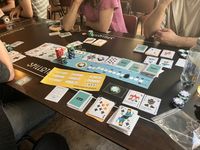
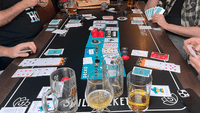
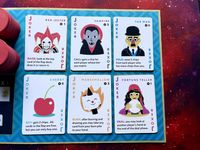
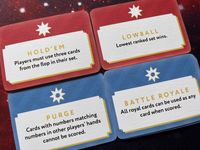
Destruction of your enemies is hardly a new concept in board games. Monopoly can only end if you bankrupt your opponents. Risk doesn't stop until you've wiped everyone else off the face of the Earth. Board gaming and zero-sum game design have been best buddies for decades, but to many, it's become a tired-out trope. This probably explains why so many publishers these days prefer games where player interaction is minimized, helping cement the term "multiplayer solitaire" into the industry lexicon.
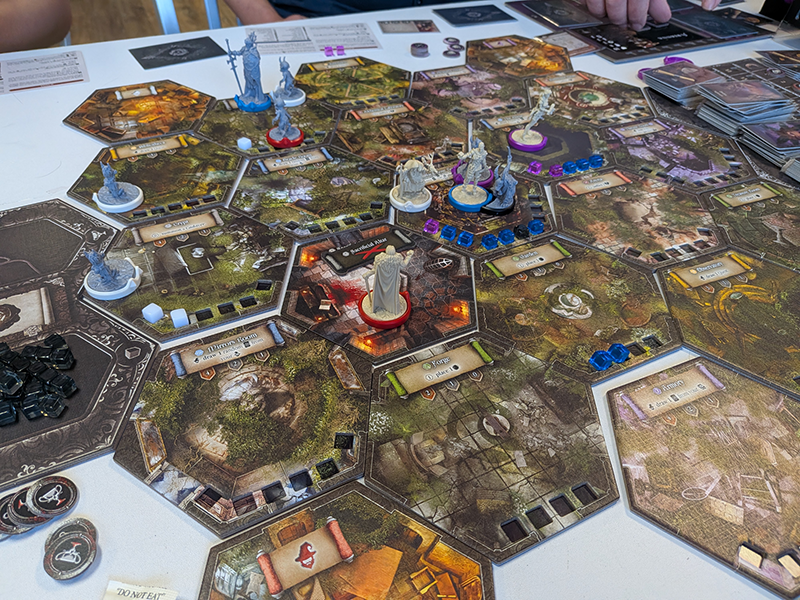
Black Rose Wars: Rebirth does not care for any of this. It's a game that borderline ignores industry wisdom simply because it can. You're encouraged to mess with your opponents from turn one, and every move is designed to either help you at someone else's expense or straight-up hurt them.
Friendship Was Never an Option
Which makes perfect sense, given the whole theme going on here. You play as a powerful mage, and leading the Black Rose Lodge is the prize, much like a crazed motorcyclist yearning for the Isle of Man TT. The Lodge has seen better days, though, and with your magic, you might be able to restore some of its former glory, hence the "Rebirth" in the title. You're not the only one with this…
There are moments in life that are intractably written into my consciousness like images chiseled into bedrock. These are important things like the day I married my wife and the first time I saw my child. Some are less important – but still meaningful – like the first time I watched The Matrix or held…
If you threw the bluffing game Sheriff of Nottingham into a pot with Sushi Go! and stirred them around, you’d get Honeypot—a set collection game with a bit of push-your-luck bluffing. Honeypot was not a game I would have picked up on its own, but because my family is already familiar with those mechanics and […]
Pocket Golf Designer: Tom Brinton Publisher: Goliath Players: 1 Age: 8+ Time: 2 min per hole Played with review copy provided by publisher Paper Apps GOLF is a pocket-sized golf game. Each notebook is randomly generated and completely … Continue reading →
Stop whatever you’re doing. Just stop. I need to tell you about one of the weirdest, wildest, and most interesting board games I’ve played all year. Scratch that. Ever. That’s right. Ever.
This is Grinivil. It was designed, illustrated, and published by Rudy Priecinsky. It’s tempting to lob a jab in there — “I can tell!” hardy har — especially once you get a look at the scattershot rulebook, the potato-headed character portraits, the mishmashed card layouts, the box itself… okay, as soon as you get a look at pretty much anything it has to offer.
But don’t make the easy joke. Set that aside. Because Grinivil is a gift from a parallel universe where Eurogames are never wrung dry through market testing and impersonal development, but instead allowed to blossom into bespoke artifacts that are equally uncanny and compelling and inventive. This is Grinivil. It’s breathtaking.
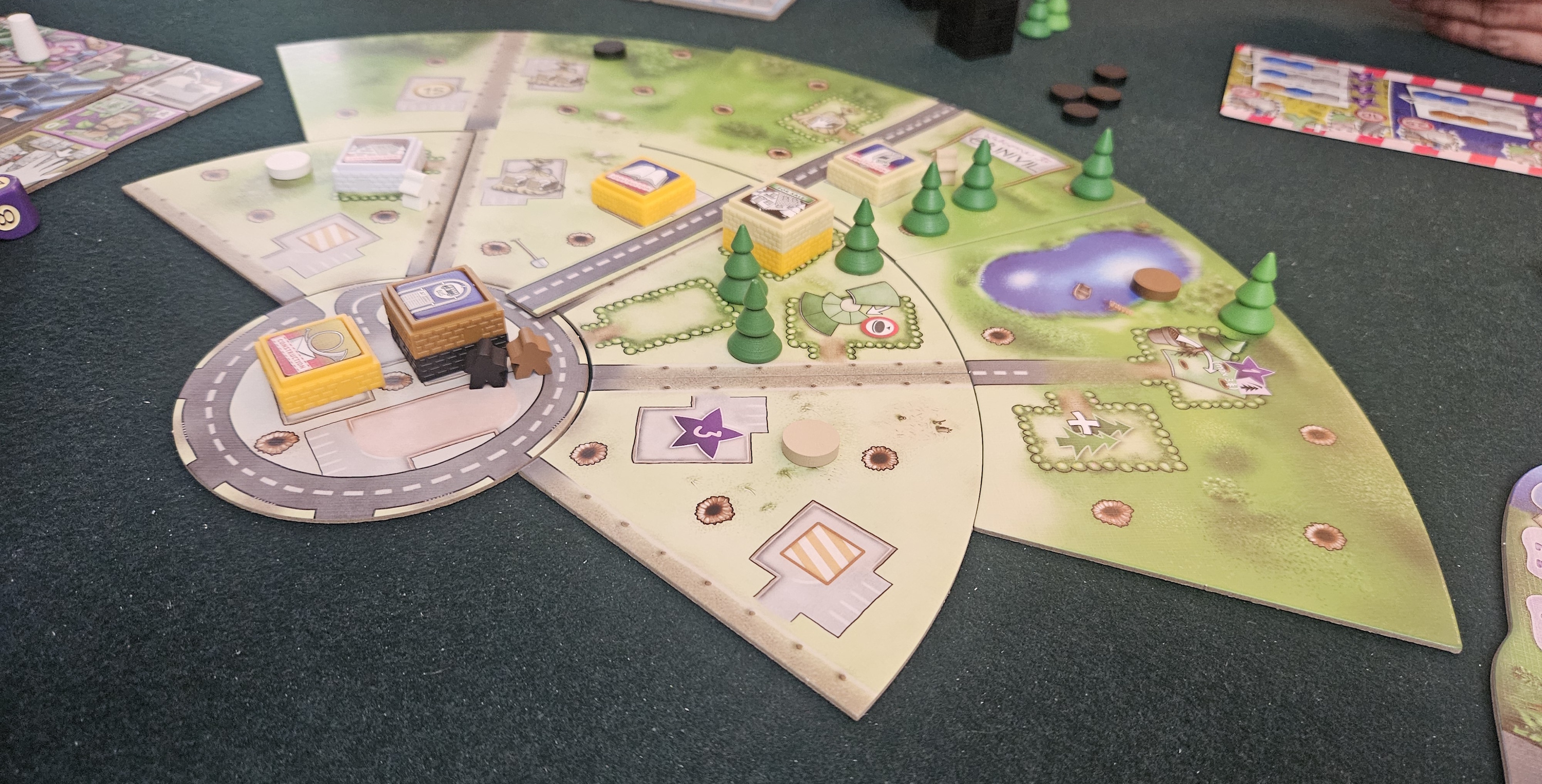
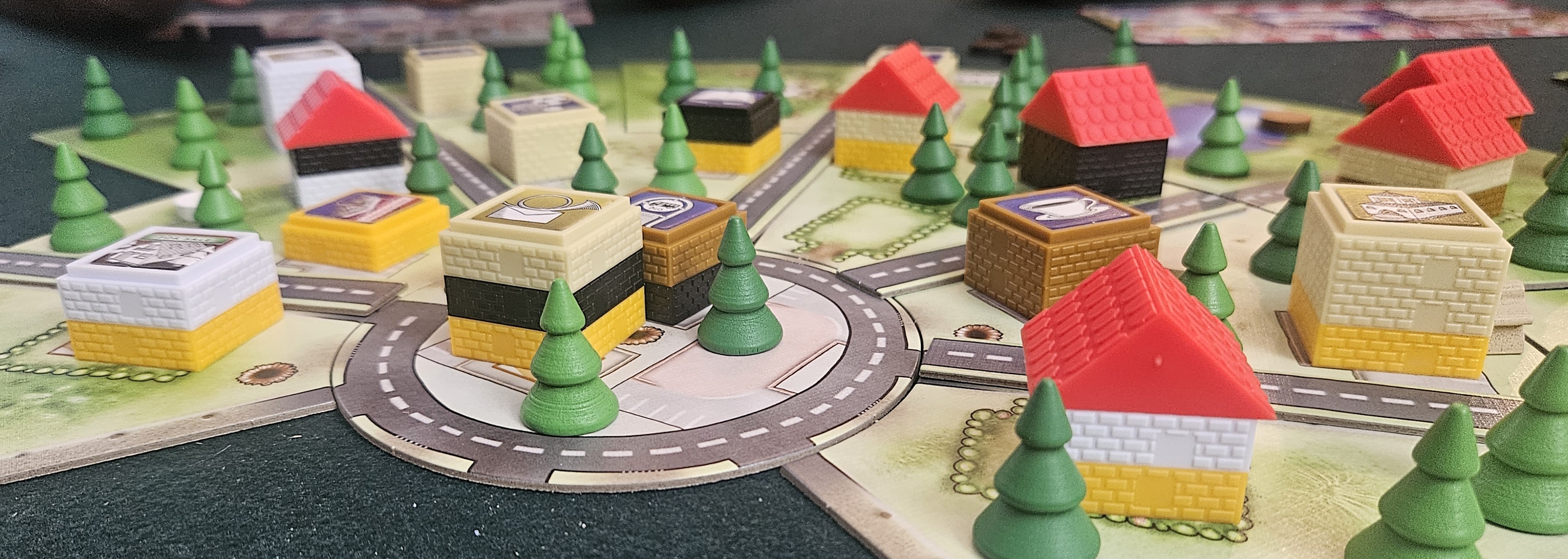
In its early stages, Grinivil is mostly empty lots.
When Grinivil begins, Grinivil — the town the board game is named after — has been thrown open to new development. As towns go, Grinivil is small. Actually, I’m not even sure it qualifies as small. The municipality has started construction on a few things, drawn at random, but they’re as yet unfinished. There are plots for houses and additional commercial spaces, but nobody has filled them. Even the trees have yet to be planted. If Grinivil were deposited in the Old West, they wouldn’t have the livestock to qualify as a one-horse town.
But where there’s a vacuum, there’s opportunity. As a developer, you’re here to buy and sell land, construct amenities, and finagle clients into houses.
It’s a normal enough pitch, in other words. Maybe even an unexciting pitch. There are plenty of board games about real estate, and Grinivil doesn’t sound all that far off from titles like Rebuilding Chicago, The Estates, or Magnate: The First City. Tough competition. Solid games. Good bones.
But it takes Grinivil all of ten seconds to set itself apart as those titles’ spiritual opposite. For one thing, there’s the way the game looks. And I promise I’m not about to ding it. Quite the opposite. Grinivil’s earliest state, when it’s nothing more than a traffic loop and a few partially-constructed buildings atop a single pizza-slice of land, is full of potential. You can see what it might become after some walls have been put up and a few trees have been planted.
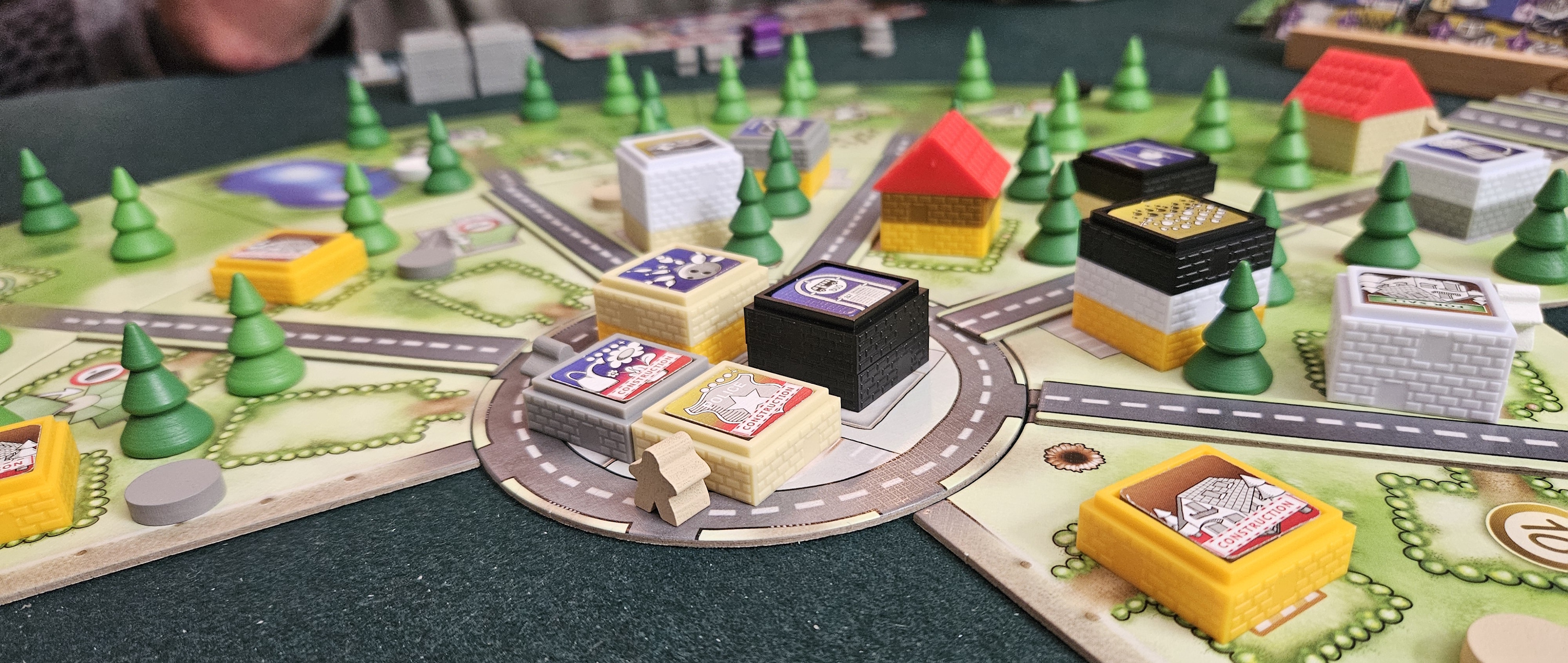
What’s more, those walls and trees mean something. They signify investment. When you add a floor to a building, you mark it with a piece of your color. Now that isn’t just the second story of a bowling alley or the foundation of a house. It’s your share in the bowling alley. It’s your ability to profit off the sale of the home. Those trees are bumps in property value. That road, now paved, is a sign that a new portion of the town is open for business.
And it isn’t only your investments you’re interested in. It’s everybody else’s, too.
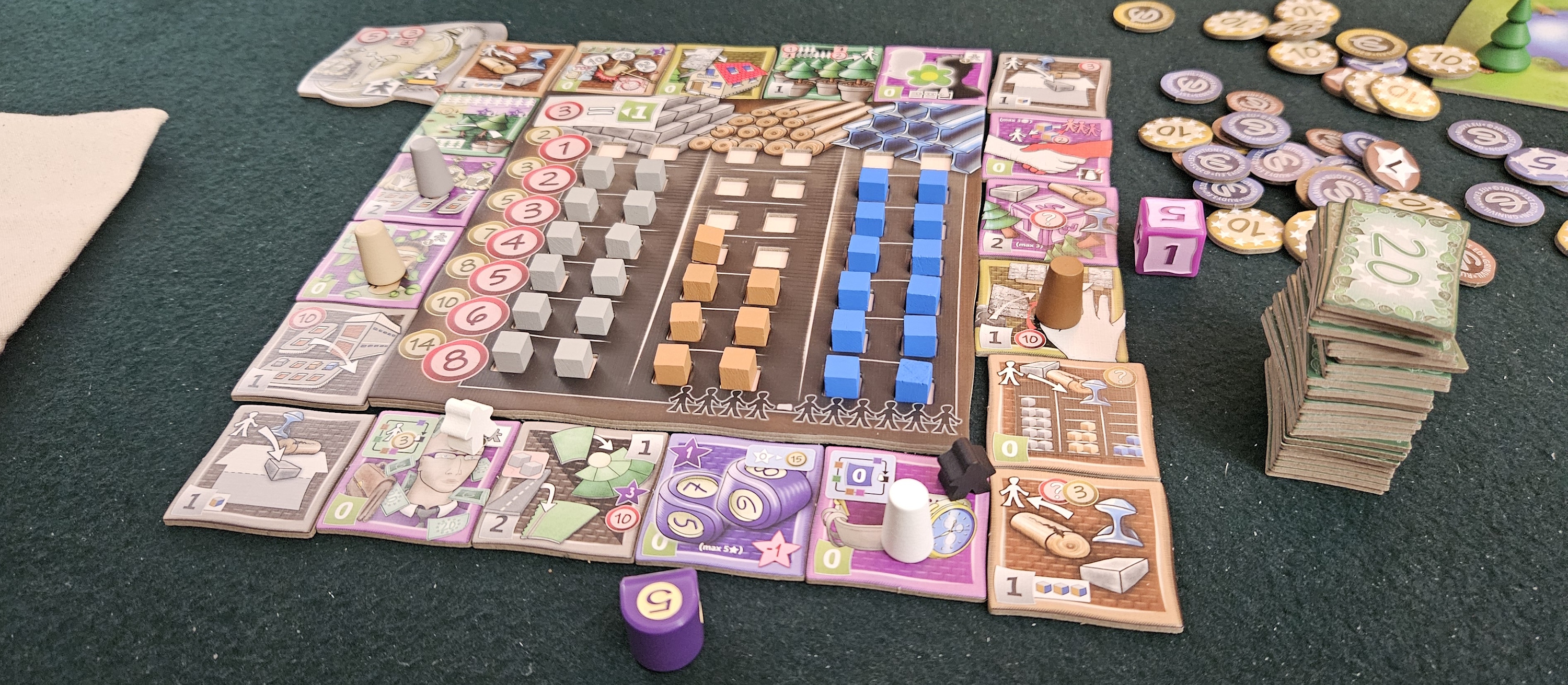
The Time Action Ring is a rondel. An amazing rondel.
Let’s approach it from another angle. Turns.
Turns in Grinivil take place on the Time Action Ring, also called the TAR. The TAR is a rondel. Starting at the top-left, you move your pawn clockwise around the TAR, stopping at any action you want to perform. You know. It’s a rondel. It behaves like most rondels.
There are a few wrinkles to this process. First and foremost, most actions, once completed, will move you forward an extra space or two. (Or three or four.) Sometimes this bypasses another action you were hoping to take. Fortunately, you can pay cold hard cash to move fewer spaces. If pouring that foundation will move you forward three spaces, therefore passing the space you were hoping to use next turn, you can pay some money to move a little less.
That’s not all. Unlike some rondels, which limit movement, here you’re allowed to visit any space. You can even circle the entire TAR in a single move if you so desire. The limitation is that passing Go will not award $200. In fact, the opposite is the case. Whenever you pass the space at the top left, you pay both taxes and your workers. Taxes, now, that’s a flat rate. But workers consume a few bucks apiece. If you don’t have any workers on the table, whether constructing a building or squatting on an ability space on the TAR, that’s not the biggest deal. But if you have three workers out, it suddenly behooves you to stretch your time on the TAR as much as possible.
And then there’s the real highlight: the actions themselves. Put simply, Grinivil offers some of the coolest actions I’ve seen put to a rondel. Some are fairly routine, like buying or selling resources, but others transform the state of the board in ways that are hard to describe without seeing them in action.
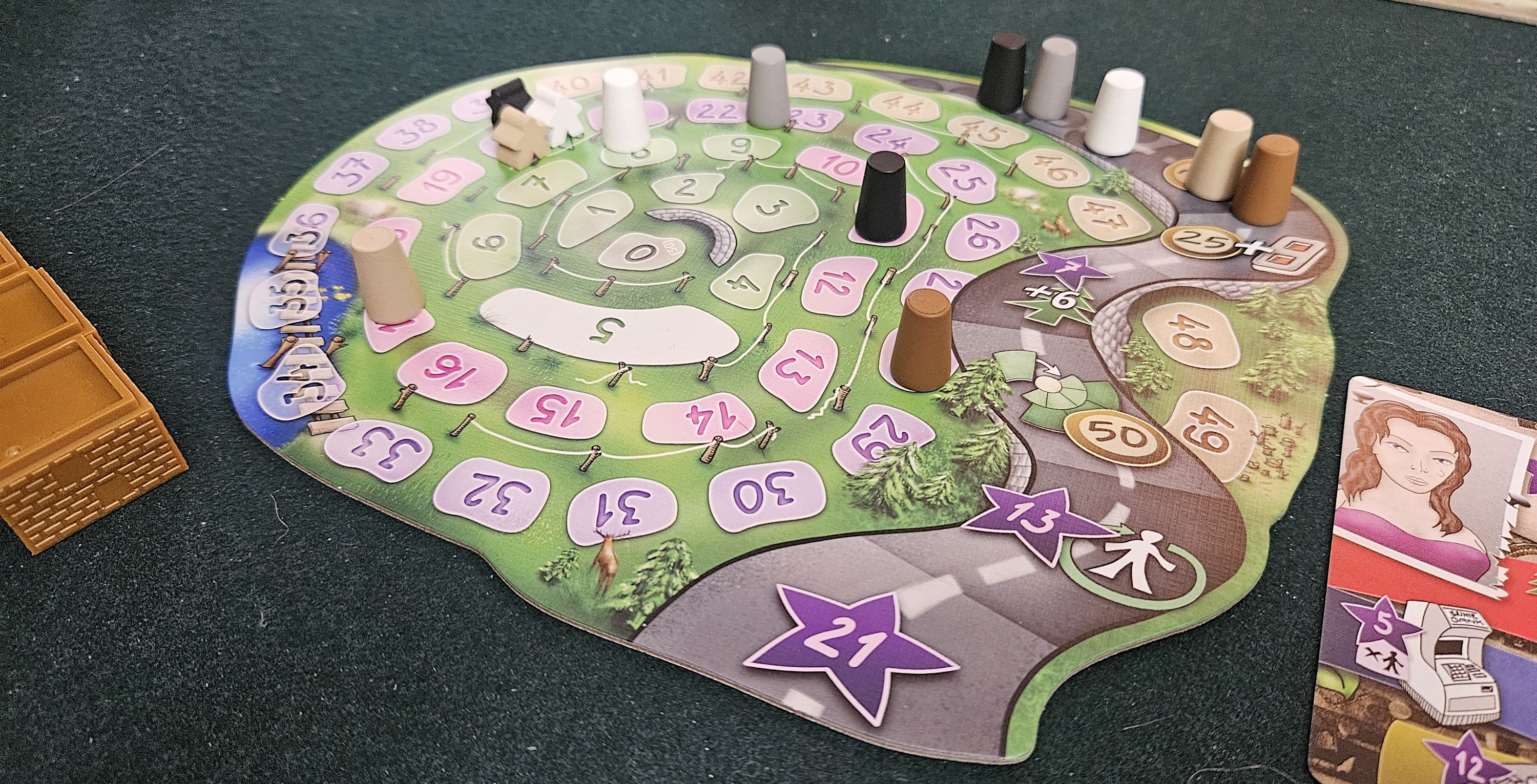
I’m not sure the score and road track had to be this, ah, eccentric.
You might, for example, add a wedge to the map. This costs some money and awards a few points. Far more importantly, it gives you ownership over that wedge. Basically, you’re speculating on land. Now whenever anybody wants to build on that land, they’ll be paying a premium for the opportunity.
Or you might turn victory points into cash. Points are the game’s objective, of course, but they don’t really matter until the end. So why not turn them in for walking-around money? This isn’t the first game to feature such an option, but it’s the only one where I’ve seen players accept that devil’s bargain. Sometimes multiple times. If you’re still short, you could also collect unemployment for all the workers who aren’t currently out there collecting a wage, or host an auction and collect the proceeds, or flip all that timber and concrete for more than you spent on it.
Or you could alter the rules altogether. This is mostly the domain of abilities, spots on the TAR that must be occupied by one of your workers. This uses up the worker — and you’ll have to pay them, of course — but gives you that space’s perk until you loop back around to it. To a one, these are ridiculous. There’s the Manager, who removes the need to spend extra time on the TAR. As in, that entire portion of the game is just deleted. Or there’s the Architect. She lets you use any resources when building rather than using specific materials, letting you pass off concrete monstrosities as homes or build a pet store out of nothing but cheap steel. So much for the game’s inventory management! The Banker gives you three coins per turn. Just gives them to you. The Ecologist — my group calls him Treesus — does something similar, adding periodic trees to your inventory.
Surprisingly, the most foundational action, construction, is anything but perfunctory. As you might expect, construction is where you spend materials to add a floor to the map. But it’s also so much more than that, inserting players into the overgrown thicket of incentives that is Grinivil’s principal draw. More on that in a moment.
It might sound like the efficacy of these actions is game-breaking, but in practice it really means that every decision carries considerable heft. On any given turn, you’re presented with a wide-open decision space between three or four tremendous opportunities. Sometimes a shortfall can be covered by having the right resources on-hand, and it isn’t unheard of for an action to become better thanks to a cash infusion. But the real cost is always paid in the opportunities you passed by on your way to something else.
As Grinivil develops, it becomes a minefield of overlapping interests.
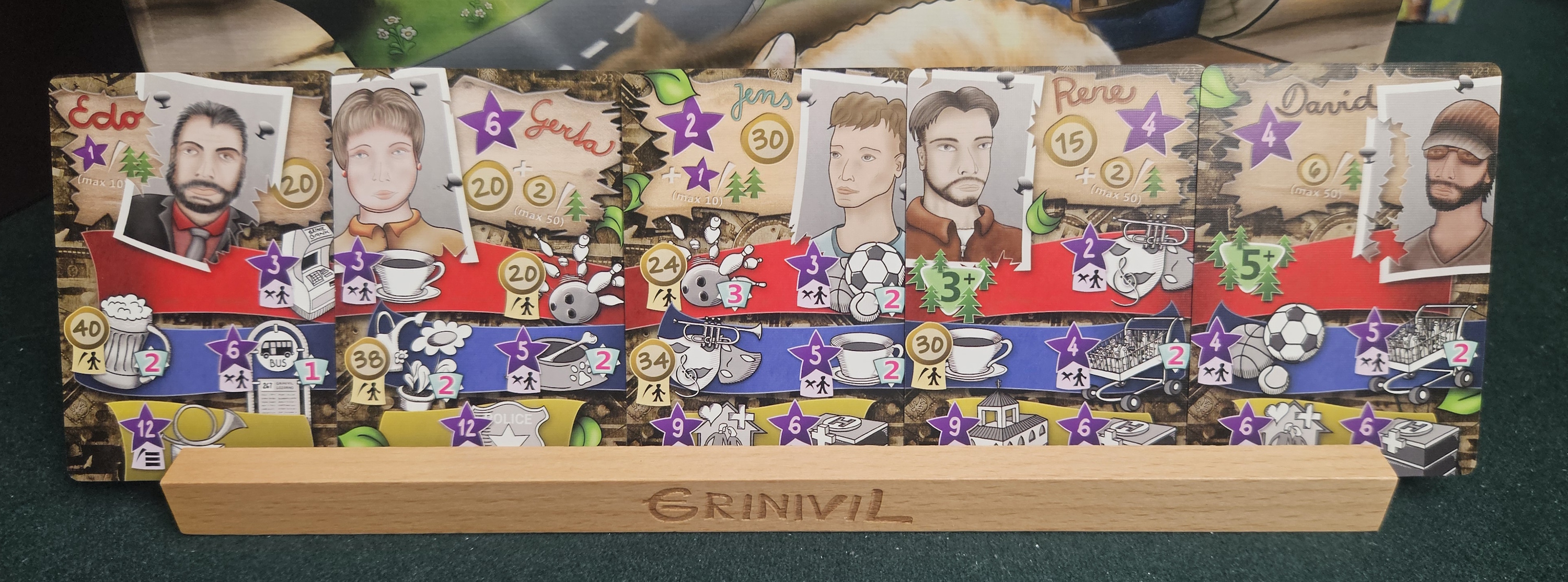
Nowhere is this more evident than in the game’s residents. Grinivil, at its core, is about attracting newcomers to town. Each resident has a number of needs, some underlined in red, others more negotiable. When the game begins, you have two in-hand. There’s also a display of additional cards that can be acquired or swapped out.
Here’s an example. When you first sit down to play, you could be holding Miriam and Nela. Both are worth some points, but Miriam will pay a bunch of cash if her house is on a lot with many trees, whereas Nela is willing to pay a flat rate. Okay, simple enough. So Nela is easier to place on undeveloped land, right?
Sort of! Both also have some hard-coded requirements. Miriam won’t move in unless there’s a grocery store within three spaces of her new home and a bus stop somewhere in town. Nela, meanwhile, isn’t too picky about distance, but wants a pet store and a garden center. When placed, they also provide bonuses. If there’s a playground within two spaces, Miriam will award a few extra points. She’ll also pay a premium for a nearby garden center, giving her some overlap with Nela. For her part, Nela wants a library and a music venue. Deep breath: They also provide end-game bonuses. Miriam wants a hospital in town. Nela insists on a police station.
Here’s the thing. Call it a double-edged sword. Like everything in Grinivil, residents pose a certain hurdle. Their cards are, charitably, a mess of information. Less charitably, they’re just a mess.
But that mess, apart from being somewhat hard to untangle visually, is important, because it’s how everything gets evaluated. When you house a resident, each of those boxes tells you something different. The top box is how many points and coins they give you right away. But everything underneath that, all three boxes of potential rewards, are awarded to whomever owns the thing in question. If I built the garden center for Nela, and then you later welcome Miriam to town, I get the cash for her proximity to the garden center even though you played the card. If I own two of the hospital’s three floors, then two-thirds of Miriam’s fifteen end-game points are mine, even if I never so much as glanced at her until the final tally.
This makes Grinivil a stern plaything indeed, but it’s always fair in its unfairness. There’s hidden information, but not so much that it can’t be overcome with watchfulness and shrewd investments. There are few guardrails, but open-ended actions and a few dashes of chance make it possible to wrestle out of tight spots.
I love everything about this.
Which isn’t to say that these rough edges can’t prove frustrating, especially during the first play or two. Once, a player’s early investment in a water treatment plant — and we’re talking about their third or fourth action, maybe fifteen minutes into a two-hour session — translated into a game-winning swing when a half-dozen residents all insisted that their town have potable water.
The beauty of Grinivil, though, is that this was entirely our fault. The table’s fault, I mean. Mine. My co-players’. Because as soon as that rival invested so much in clean water, we should have shifted our priorities. No more residents who care weirdly a lot about their drinking water being certified amoeba-free! Only cop-loving residents, or residents who insist on accessible hospitals, or residents who hang out at churches and retirement communities.
Or, perhaps, we could have ensured that our game-ending tally was dwarfed by residents whose earlier payouts were sufficient to overcome any final swings. There are many ways to earn points in Grinivil, and just about as many ways to invest one’s attention and money.
In all cases, though, this is a game that benefits from both experience and table-talk. It’s a game where it’s not only not impolite, but necessary to say, “Hey, let’s stop attracting so many residents who love the aroma of water being treated.” In that sense, Grinivil is a game about cutting through the clutter to see what’s really important. (And boy howdy is there clutter, hardy har!) It’s about reading the state of the table, about observing which properties are likely to pay off big and which might only be worth a little bit here and there. It’s about watching your opponents and knowing when to feed the animals and when to hold back. Sometimes, it’s even about snaking somebody’s investment by paying a pittance to slap a roof atop their house and hustle one of your residents inside before they can protest.
As more people move in, costs go up. Sorry. Them’s the rules.
I like a polished game. But we’ve reached the point where too many games are polished. Some are so polished, I’d say, so devoid of rough edges, that there’s nothing left to snag one’s attention.
Grinivil is the other thing. Snaggy and shaggy. Some of its actions don’t have immediate utility; others are so potent that it’s impossible to choose between them. Sometimes a corner feels too painted-in. Its art is, um, undeniably not crafted by a plagiarism engine. Personally, I like how it looks. Not only the town, which is gorgeous, but the wackadoo resident cards. Just look at those nerds. I love them like my own ex-girlfriends.
For all of that — or more likely because of it — Grinivil is captivating. As in, it captures and holds one’s attention the way no number of over-smoothed experiences possibly could. It grabs your elbow, shows you the dance floor, and asks you to move. Then it probably shouts at you a little bit, before apologizing and rumpling your shirt and tucking a buck into your back pocket. No matter. This artifact, this singular vision, this gift from another dimension, is so spellbinding that it reminds me why I started playing board games in the first place.
A complimentary copy of Grinivil was provided by the designer and publisher.
[imageid=354500 medium rep]▪️ The moment everyone has been waiting for... The announcement of a reprinted Battlestar Galactica: The Board Game announced by Ghost Galaxy. In partnership with Universal and Fantasy Flight Games, Ghost Galaxy is set to publish a new version and will hit crowdfunding in early 2027.
From the press release:
The original Battlestar Galactica board game, designed by Corey Konieczka, was originally released in 2008 by Fantasy Flight Games to much acclaim. The game was bolstered by three expansions and taught a whole generation of gamers to ask the question: “Are you a Cylon?”
Ghost Galaxy has been working on an updated design of the classic game, which will be launched via crowdfunding in early 2027.
“I had the pleasure to oversee the publication of this phenomenal board game during its first lease on life”, said Christian T. Petersen CEO of Ghost Galaxy (and former CEO and founder of Fantasy Flight Games). “We’re having a lot of fun returning to the great characters and story of Battlestar Galactica, and we’re working hard to ensure that our new edition will make a great game design even better!”
“We’re thrilled to have Ghost Galaxy take on this classic game”, said Bill Altig, SVP of Narrative Games at Fantasy Flight Games. “We can’t wait to see it back in print.”
Set foot in mythical Prague back in the 19th century, when fantastical creatures walked the streets freely. Meet helpful Golems, amassing ancient knowledge, cunning Horned, controlling the city’s wealth, resourceful Robots, or eccentric Vodniks. Use their unique meeples to calm the river Vltava, rebuild the flooded centre, and control the city’s fate.
This euro-style worker placement game allows players to build their own action spaces, participate in four distinct “mini-games” based on retelling the myth-infused history of Prague, gain unique abilities, and fight over influence in four neighbourhoods.
▪️ Spooky season is upon us, and it calls for a game like Spooky Bar from Edition Spielwiese that is set to release in a few weeks! From designer Benjamin Schwer (The Great Game Of Canada, Djinn). I see a similar mechanic here, where you bottle up ghosts, as I do with bottling up Djinns in his game Djinn. As for the rest of the game, it seems like a light card game that is for 2-4 players and plays in 15-20 minutes.
From BGG:
Rumour has it, ghosts have been stirring up all kinds of mischief in this mysterious little town, and curious thrill-seekers are pouring in to catch a glimpse of the paranormal action. Sensing a golden opportunity, you decide to jump on the trend and open your very own spooky bar! Ghoulish drinks, eerie vibes, and ghostly encounters? Yes, please! Just don’t let things get too spooky... If the haunt level gets out of hand, your terrified guests might run out screaming – without paying their tab!
At each of your bars, 5 guests are hanging out, ready to enjoy some drinks and maybe take home a spooky souvenir—ghosts trapped in bottles! Each round, everyone picks and plays 2 action cards at the same time. What you can do with them depends not just on your own cards, but also on what the others play! The game is over when the last guest leaves one of the bars. Whoever has the most money at the end wins!
Mind Sweeper is a cooperative word-guessing game where one player uses a tiny broom and a pile of tokens to silently guide their team to a secret word.
Sweep tokens together as your team tries to guess one of six suspiciously linked answers.
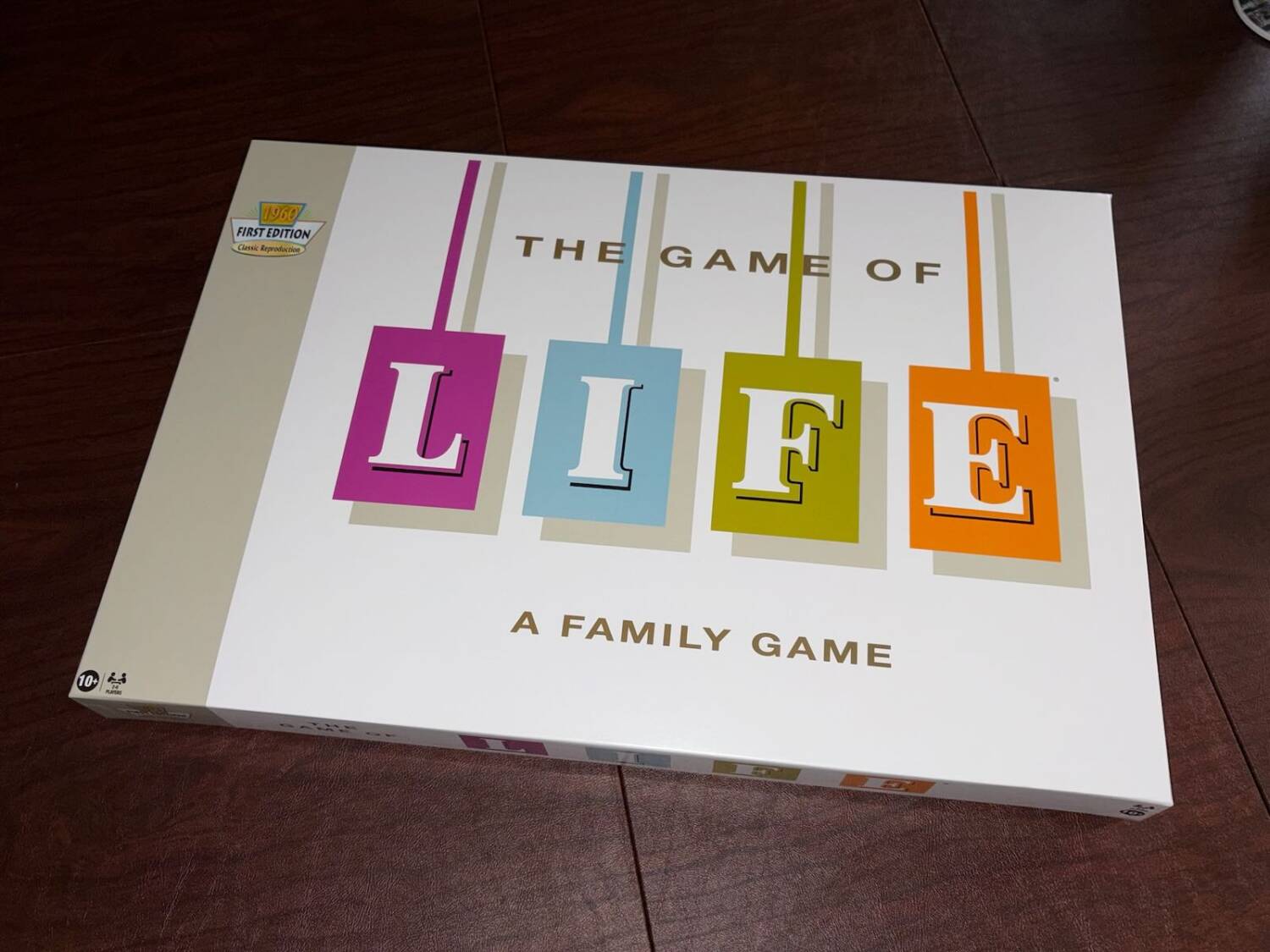
(For reference, everything in this piece refers to the 1960 version of The Game of Life. This version is the version I had as a kid and re-bought when Winning Moves Games remade it. There have been many versions since, but I haven't played all of them. The ones I have played tweaked the formula and have failed to capture "life" laike the original.)
Sigh. I just finished another play-through of the newest life-simulation board game, Coming of Age. As a "gamer's game" it is okay, if a lot heavier than I anticipated. There is a lot to think about, manage, and optimize. Plenty of cubes, tracks and tokens, if that's your jam. It gave my brain a workout.
That's not the reason I bought it, however. I was (and still am) looking for a fun, "gamer's" life-simulation game to replace The Game of Life. I've tried almost all of the life-sim games out there.Pursuit of Happiness. CV.Adulthood. And now Coming of Age. They are good games, for the most part, but they lack the pure fun and whimsy of The Game of Life.
As a kid, The Game of Life was just a blast. We'd put the pegs on the spinner and send…
I despise the word “impossible” in the two-player board game design space. It’s “impossible” to make an 18xx game at two players. It’s “impossible” to make an area control game with two players. It’s “impossible” to make a hidden roles game with two players. When a designer or design team aims to tackle the “impossible,” […]
With this My Favorite Wargame Cards Series, I hope to take a look at a specific card from the various wargames that I have played and share how it is used in the game. I am not a strategist and frankly I am not that good at games but I do understand how things should work and be used in games. With that being said, here is the next entry in this series.
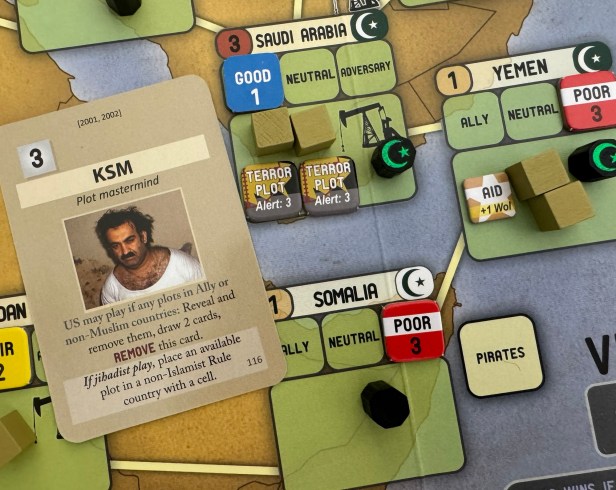
#100: KSM from Labyrinth: The War on Terror, 2001-? from GMT Games
Labyrinth: The War on Terror, 2001-? from GMT Games is a 2-player asymmetrical Card Driven Game that pits the mighty and powerful United States military and all of its various antiterrorist agencies against the Jihadists in the Middle East whose sole goal is to spread terror, sow the seeds of deceit and ultimately destroy Western civilization. The game is a Card Driven Game where the cards contain Operation Points or Events and each turn the player must strategize and use their cards to their best ability in order to effect the state of the board and further their individual and asymmetric victory conditions. But the game is raw and is tied to the actual events of the early 2000’s as the United States was reeling to recover from the terrorist attacks in New York.
In the game, the Jihadist player is working to destabilize the Middle East through a series of clandestine activities such as destroying stability, toppling governments and forcing the US to react to their actions. One of their biggest strategies is to work to place what are called Plots out on the board in order to destabilize but also to generate local support and funding for their activities from the populace. If left alone, these Plots will go off at the end of a round and cause trouble that will then have to be cleaned up by the US player over the next turn. In order to uncover these Plots, the US player will have to play a 3 Ops card to take the Alert Action and different from most other actions there is no die roll required and the the Plot removal is automatic. But, the cost is steep as a 3 Ops card is pretty rare and spending it on this action is very painful. Jihadists use these Plots to force the US player to have to stamp out fire after fire rather than working to reform and stabilize governments to create allies. And when these Plots appear, the player’s long-term strategy will have to be put aside and a focus will have to change from managing regime change and the Global War on Terror (GWOT) posture to dealing with urgent plots. The KSM card is a very powerful tool in this game as it allows for the US player to remove Plots from an Ally or non-Muslim country but also to replace this investment with drawing 2 cards to replace it. This is specifically tied to the intel that was obtained from the capture of Khalid Sheik Mohammad and how it was then used to defuse several ongoing plots. The Jihadist player also gains a pretty large benefit as they will be allowed to place a Plot Marker into a non-Islamist Rule country with a cell. The process of successfully placing a Plot can be very challenging for the Jihadist player as it takes the play of a card for Operations points, uncovering a cell in a country and then rolling a die equal to or less than that country’s Governance Level to then place a face-down Plot Marker. This takes the need for a roll away and makes the placement of a Plot an automatic success.
I think that one of the other important distinctions and differences with the KSM card is that it is a 3 Ops Neutral Card that can be played by either side but when played by the US player for the event, it will be removed from the game while when being played for the Jihadist portion of the event it will remain and be able to be used in a later turn when it is drawn again. This reflects the important role that KSM played in al-Qaeda’s plans and if allowed to stay at large he will continue to plan and execute plots across the globe.
Khalid Sheik Mohammed was a member of Osama bin Laden’s militant organization al-Qaeda, and was specifically in charge of leading al-Qaeda’s propaganda operations from around 1999 until late 2001. Mohammed was captured on March 1, 2003 in the Pakistani city of Rawalpindi by a combined operation of the U.S. Central Intelligence Agency (CIA) and Pakistan’s Inter-Services Intelligence (ISI). Immediately after his capture, Mohammed was taken to secret CIA prison sites in Afghanistan, then Poland, where he was interrogated by U.S. operatives. By December 2006, he had been transferred to military custody at Guantanamo Bay detention camp. Sensationally nabbed in Pakistan, alleged 9/11 mastermind Khalid Sheikh Mohammed was photographed for the world in a disheveled state immediately after his capture—symbolizing an apparent laying low of the once mighty al-Qaeda network. According to his US captors, he later provided information that thwarted other attacks.
Mohammed is widely regarded as the chief planner of the September 11 attacks. The United States government has alleged that he further participated in planning Richard Reid’s shoe bombing attempt to attack an airliner, the 2002 Bali bombings in Indonesia, the 1993 World Trade Center bombing, the murder of Daniel Pearl and various foiled attacks as well as numerous other crimes. These claims have been criticised by others, such as military prosecutor Moe Davis and journalist Andrew Brown, as inadmissible due to being obtained through torture. He was charged in February 2008 with war crimes and murder by a U.S. military commission at the Guantanamo Bay detention camp, which could carry the death penalty if convicted. A 2008 decision by the United States Supreme Court had also drawn into question the legality of the methods used to gain such admissions and the admissibility of such admissions as evidence in a criminal proceeding.
This image shows Khalid Sheikh Mohammed, the self-proclaimed mastermind of the September 11 terrorist attacks, photographed shortly after his capture during a joint raid in Rawalpindi, Pakistan, on March 1, 2003.
In the next entry in this series, we will take a look at Constantinople Sends Aid Core Event from The Shores of Tripoli from Fort Circle Games.
Cartographers Heroes Designer: John Brieger and Jordy Adan Publisher: Thunderworks Games Players: 1-100 Age: 10+ Time: 30-45 minutes Amazon affiliate link: https://link.amazon/B07jaOVRP Played with review copy provided by publisher The expedition to the Western Lands is the kind … Continue reading →
Jon said I’d probably like Fetz, because it’s a lying game. It is true
that many of the games I design have some form of deceit. I like that kind of
psychological play. I like having a bit of gaming the people in games and not
only problem solving. Fetz is a game from Thailand and it is the best party game winner of the 2026 Thailand Board Game Awards.
The game
Ah, Captain’s Chair. I’ve already logged my appreciation of Nigel Buckle and Dávid Turczi’s remapping of Imperium into the Star Trek universe. Like that series, now sadly defunct thanks to the shuttering of the board-gaming side of Osprey Games, this is an information-dense deck-builder that absolutely revels in its moreishness. Quite literally. It features more icons, more decks, and more chrome-laden rules per cubic micron than any other deck-builder I can recall.
Now there’s a second-wave box, To Boldly Go. If you’ve played the original, you know what to expect. Seriously, newcomers can just read my previous review.
Kirk out here Kirking.
I really wasn’t bluffing. I’m not about to spill anything new. OR AM I? Look at me, playing like Q.
For the most part, To Boldly Go repeats the accomplishments of that original set, featuring six new captains who can either be commanded in one of the game’s default duels or faced as an opponent in the (excellent) solitaire mode. As with Imperium, these decks are what make Captain’s Chair Captain’s Chair. Like an unassimilated technological and biological lifeform, they’re distinct.
How distinct? Distinct enough that there’s good news and bad news.
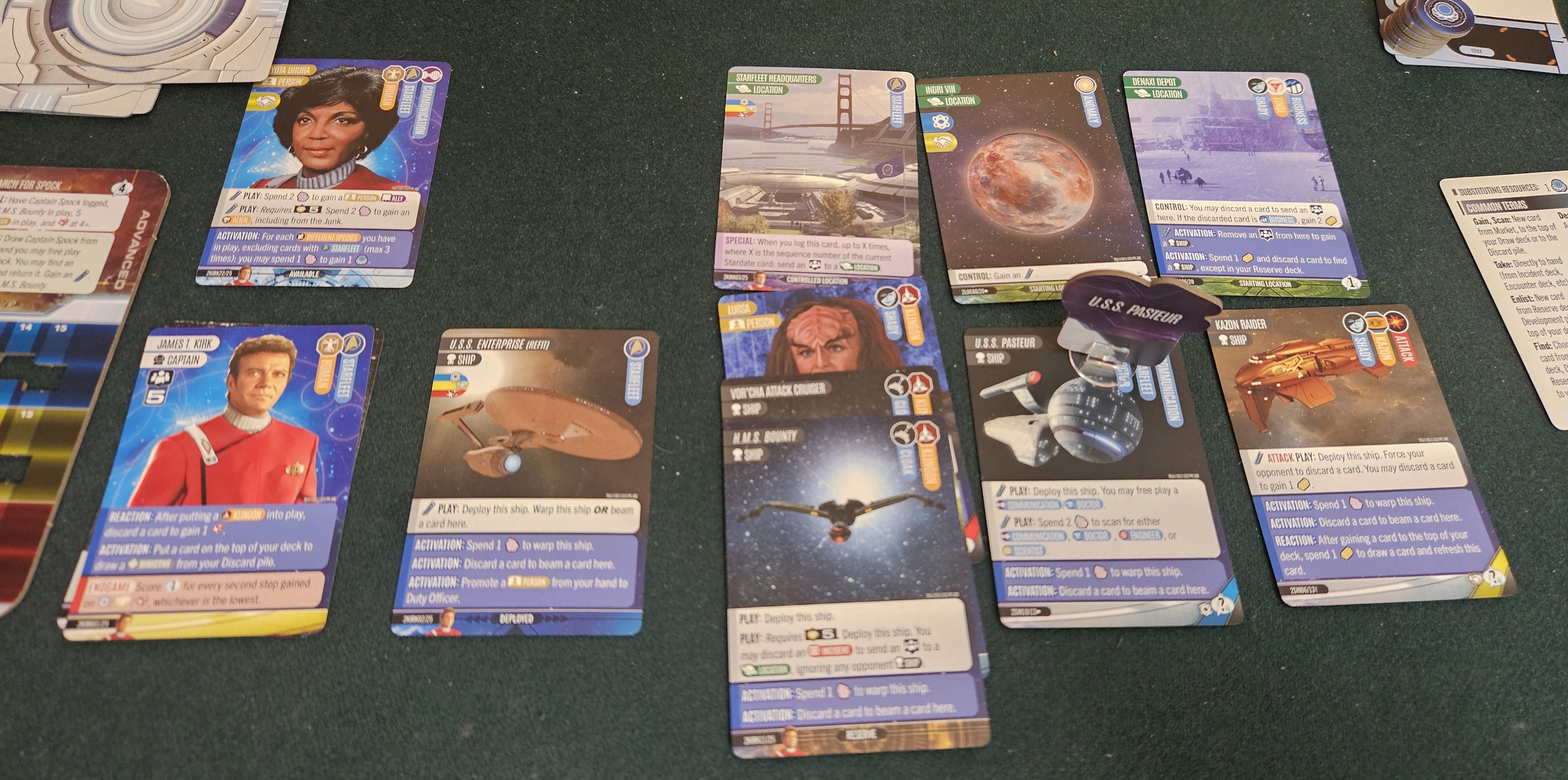
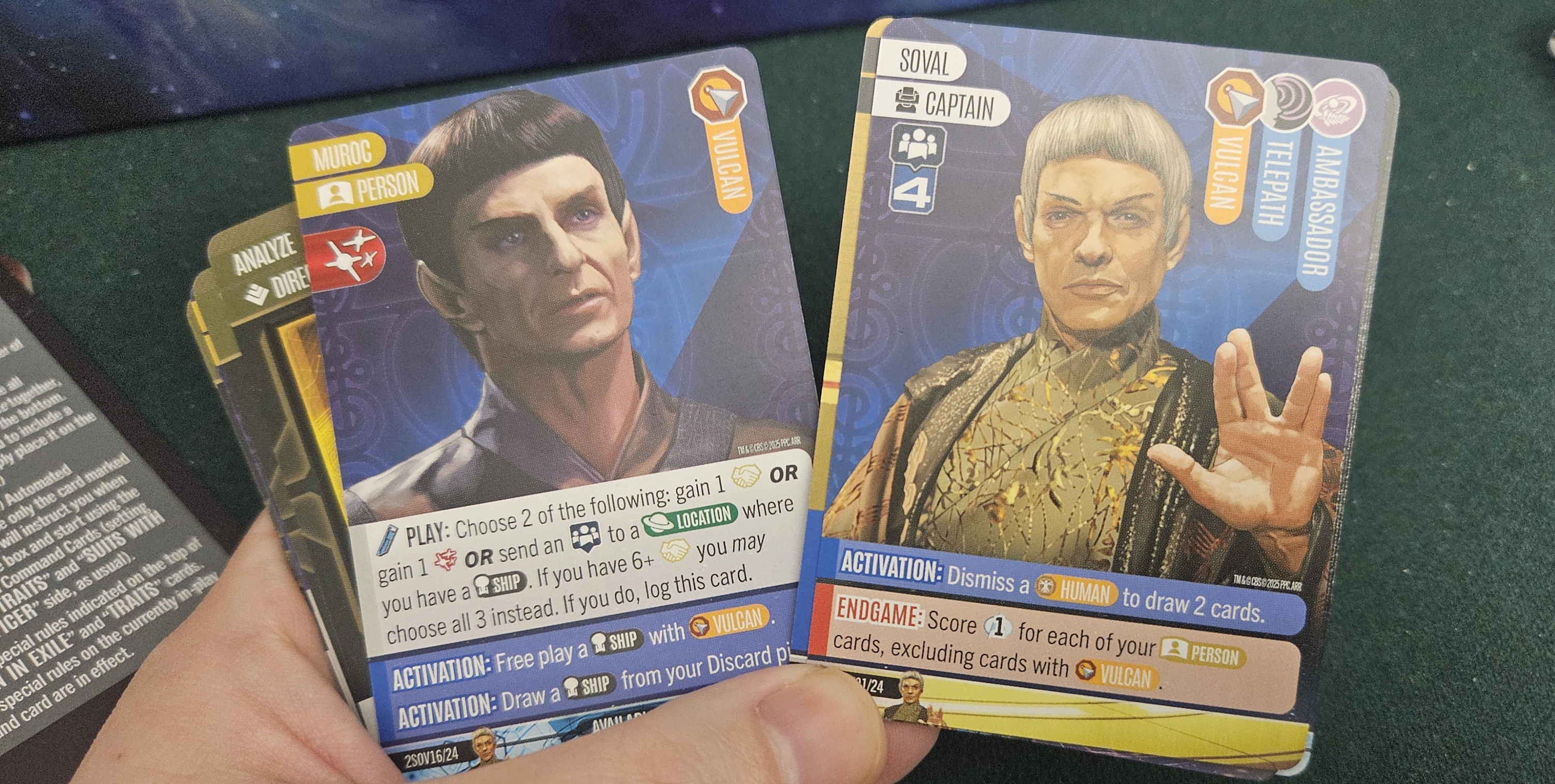
First, the good. The captains in To Boldly Go are even more dissimilar than those in the base box. Even the ones that are relatively “baseline,” like Soval, Philippa Georgiou, and the long-awaited James T. Kirk feel different on the table. Having served as an ambassador to Earth, Soval fuels his abilities by dismissing them as a species — in game terms, by literally chucking them out of his hand. Which is a bit of a double-edged ability, since he wants to fill his deck with enough exemplars of mankind to keep his better abilities churning. Kirk, meanwhile, is an all-rounder, forced to emphasize the game’s various flavors of influence equally. The flipside is that, as the grandfather of this galaxy, he’s more likely to draw encounters, the ultra-powerful scoring cards that most captains only see one or two of throughout an entire session.
The other captains are wackier, and I mean that entirely as a positive. Khan breaks the game’s usual rules, dispensing with the customary science/diplomacy/military track to instead mind-control a diverse crew and start shouting Moby Dick quotes at his enemies. No, really. He has Moby Dick quotes. Archer, being the flashback character, starts with a deck that fits in his starting hand and nearly no away team tokens for conquering planets. Instead, he has to rush to form the Federation from scratch, giving him some incredible early-game momentum but the testiness of having to forge synergies from first principles. And then there’s Rebner. I haven’t seen a single episode of Lower Decks, so I have to trust Buckle and Turczi when they inform me that Rebner’s whole deal is that he’s a total moron. He draws only three cards per turn, can’t utilize science or diplomacy at all, and his cards get stronger as they find and don big hats.
Aha, a card market!
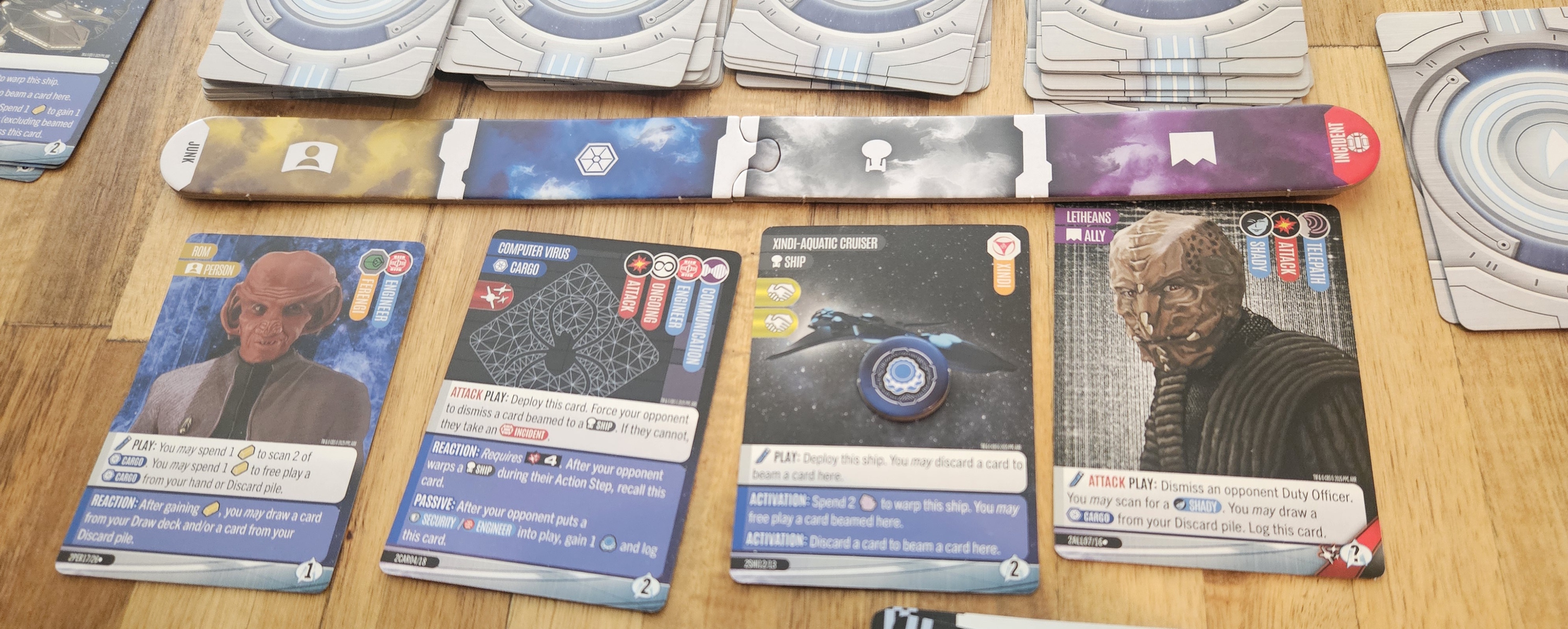
Actually, Rebner has become my object lesson for To Boldly Go at large. He’s a total hoot to play, and moreover he’s forced me to embrace a portion of the game I’ve always tended to overlook. Returnees to Captain’s Chair might already know what I’m talking about. In the market, there are four main decks that players can freely recruit from. Three of those decks — people, ships, and allies — offer immediate utility. The fourth, the one called “cargo,” has always been a little trickier to use. These are special items that… well, they do all sorts of things. Which is both the value and the drawback of cargo. You’re never quite sure what you’re going to get. Most function as attachments, things you can merge with other cards to bestow new abilities. But they aren’t always that, and sometimes their wilder effects can be more trouble than they’re worth.
Rebner, with his crew’s emphasis on securing and wearing fancy hats, makes cargo a necessity. His starting deck has a bunch of hats, both in its starting pool and for later recruitment, a stark contrast with most captains who might have one or two tucked into their reserve. What’s more, a couple of additional hats can be found in the cargo market deck. They get a “helmet” tag and everything.
But that reveals an issue with To Boldly Go. More specifically, an issue with merging To Boldly Go with the original Captain’s Chair and any forthcoming sets.
In short, the original game didn’t contain any helmets. Which means that poor stupid Rebner is going to have a heck of a time finding any hats for his crew when using the original Captain’s Chair market, whether on its own or blended with the offerings from To Boldly Go.
Of course, the issue is broader than a shortage of hats. It’s that each captain has their own objectives to pursue, and these objectives often require them to dive through the market for specific keywords. Some of these tags are standardized across sets. Roughly half the card pool has been duplicated from the original box, and there are always plenty of humans, Vulcans, and Klingons. For captains who need specialized tags, merging or crossing-over sets just became a testy proposition.
As before, the icons are nice and crisp, but also… there are tons of them.
This isn’t to say the issue is a dealbreaker. Nor that it presents an intractable problem. There have always been tools for rifling through the decks of Captain’s Chair, in particular the “scan” ability that allows players to search through a certain number of cards — even multiple market decks — to mine a specific keyword. It’s pretty rare that you’re beholden solely to whichever cards are currently on display.
But it highlights a certain jankiness to the system. Turczi has compared sets to drafting cubes. Captains function best with the cards in their box, not necessarily when merged across sets. Which, to some degree, makes the whole thing a little less appealing, at least to this guy. I’d much rather rest assured that I could have Kirk face down Koloth or Picard take on some theoretical third-wave Borg Queen without worrying about the composition of the market introducing its own subspace turbulence.
Because, yeah, Captain’s Chair is good enough, even with these bumps, that I want to keep exploring what it has to offer. Even at its most maximal — frankly, thanks to that quantity-is-quality — there’s a thrill to seeing how Buckle and Turczi can mine their deck-building system for new ways to express this particular setting. I loved the diversity of cultures in Imperium, that it was possible to have something sprawling like the Roman Empire throw down with the Olmec and the Inuit, each with their own cultural focuses, and still function at all, let alone present such a compelling contest.
Here, decks are even more distinct. Combined with the additional flexibility of a system that stretches further than its predecessor, the result is a game that keeps me coming back. Even when, on occasion, it frustrates me with its avalanche of icons, a lane-battler core that sometimes gets lost amid everything else, and now the persnicketiness of sets that don’t effortlessly merge.
Captain’s Chair is also a lane-battler. Sorta.
Maybe this was always inevitable. As Imperium grew, that system faced similar aches and readjustments. Any growing pains are only compounded by the sheer enormity of what’s contained in each box. So much for balance; then again, it was always a remote possibility with decks as varied as these.
Either way, here’s to another Captain’s Chair. Going forward, I think I’ll boldly shuffle everything together, consequences be damned.
A complimentary copy of Star Trek: Captain’s Chair: To Boldly Go was provided by the publisher.
We had a great time attending SPIEL this year. Luckily, we were able to get all the games from our ‘must have’ list, as well as some additional ones. But we didn’t just acquire games, we also walked a lot (like the whole SPIEL day) and played a lot (inside and outside the halls). While for many, buying games is the main attraction of going to SPIEL, it’s also a great opportunity to learn about upcoming games and even try some of them.
Playing demos at SPIEL is a great way to gauge whether you’re going to like a game or not. It is especially helpful if the game has already been released and you’re still not sure. But we were already confident about which games we’re getting while also being open to the possibility that we’re gonna think more about our choices in life and reflect more on what we’ve done. Please play demos first before purchasing if possible.
We still played demos at SPIEL but of games that aren’t out yet. Some upcoming games we find interesting didn’t have a demo, but we were able to talk to some of their designers and check out their games.
Two demos we played:
Bôken (冒険)
Huge poster at the stand
Game Designer: Miki Tajima
Artists: Miki Tajima, Morgane Maunas
Publisher: Ctrl+R
Languages: English, French (German and Spanish still locked as of this writing)
Bôken is a JRPG-style campaign game for 1-2 players that we’ve been curious about for a while. The demo was very short as we actually got to play only a single random combat encounter. Still, the other elements of the game were described to us by the lovely person at the Bôken booth. The game really manages to capture the feeling of playing a classic JRPG in every aspect, e.g. resting at the inn to heal.
The artstyle also very much matches that of games from the SNES era of JRPGs with a pixelated look and Anime style characters. One innovative feature of the game is the save feature. Just like in a video game, the designer wants players to be able to save the game at any time and continue playing later. This is achieved by making everything on the main and player boards magnetic, so that you can just put it all into the box and take it out whenever you’re ready to continue.
We would like to play this game again, but it seems that it might take quite a while as the estimated delivery for the Kickstarter is in March 2028.
Song of the Wildkin
Muddlefoot
Game Designer: Hermes Pique
Artists: Andrew Bosley, Jacqui Davis, Alexandr Elichev, Matthis Schroeder, Erin Wong
Publisher: Bōken Games
Language: English (German is still under consideration as of this writing)
This boss battler/campaign game is described by its designer as “Everdell meets DnD” and “Everdell meets Gloomhaven”. We like games that allow us to have a TTRPG like experience without one of us having to be the GM, and we enjoyed playing Gloomhaven: Jaws of the Lion. As such we had actually booked slots for both the exploration as well as the boss battle demo.
When we went to the booth, the first thing we noticed is the extra cute Muddlefoot. The minis were really adorable, but we’re also glad that they have standees, which are also super adorable, for those who prefer standees. Unfortunately, we weren’t able to take photos of them as we were very excited to choose which characters to play.
For the explaration demo we chose Shadowfoot the sneaky hedgehog and Tuskler the bonking warthog. For the boss demo, it’s Galenward the healer and Tuskler again.
Some of the prototype cards
We noticed the mechanical similiarities to Gloomhaven in terms of combat, but one difference is instead of using attack modifier deck, players use dice. This doesn’t mean that the dice rolling makes the combat ultra random as you can also modify it by adding buffs, which increases the chance of dealing song “damage” (there might have been a specific terminology for it, but we might have just missed it). Another difference is it doesn’t have any communication limit and players get to discuss harmoniously.
Another thing that we like is that it doesn’t have a fixed turn order; players get to perform any number of actions and may choose to refresh, after which the woodbeasts get to act. It’s a bit different in boss fights as a boss woodbeast gets to act after a specific total amount of energy has been used by players. The boss fights require more strategic use of actions and energy, which we love.
What we find thematically interesting is that there’s sometimes an option to befriend some of the wildbeasts and recruit the bosses after defeating them.
Song of the Wildkin is planned to go to crowdfunding in the 1st or 2nd quarter of 2027. We’re very much looking forward to seeing how this wholesome yet crunchy game is going to look like by then.
Other upcoming games we’re excited about:
Dream Hoppers
Dream Hopper prototype
Artist: Gou Eisuke
Game Designers: Rodrigo Esper, Alex Olteanu
Publisher: Esper Game Studio
Languages: English, Japanese
We’ve always found the games published by Esper Game Studio to have gorgeous artwork, which is unsurprising given their unique approach to game design. In a typical game, the mechanics or the theme/setting would be the starting point, but what they do is they begin with the art and then design around that. Dream Hoppers, their first cooperative game, is inspired by the artist’s drawing of pictures for her child.
Dream Hoppers prototype cards
Dream Hoppers is a card drafting game that has some communication limit. In this game, players work together to ensure that a child has pleasant dreams. To do this, they have to draft the right combination of cards in order to be able to fulfil a set of different requirements. Of course they cannot talk about which specific requirement they are going for. Instead, they have to let their card picks communicate for them.
While the game requires 3-5 players, we are still looking forward to trying it out with our friends. The estimated delivery on their Kickstarter pre-launch page is in May 2027.
1984: Unperson
At the booth
Game Designers: Volodmyr Kusnietsov, Yaroslav Kifor
Artist: DYVNA Agency
Publisher: boardova
Languages: Ukrainian, English
We’ve both read and like the book 1984 by George Orwell. So when we saw this game on the novelties list for SPIEL we knew we were definitely going to check it out. When we arrived at the boardova booth, we met one of the designers of the game, who proceeded to give us a great overview of it. 1984: Unperson is a semi-cooperative game in which players are members of the party trying to work together to fulfil directives from the party leaders. This requires playing personal or public events and getting involved in them. If they fail, they get punished, but if they succeed, nothing happens.
Meeples and an event card
Getting involved in a public event can raise the trauma and suspicion of a character, but it also has some positive effects and rewards reputation. At the end of the game players score their personal events and reputation according to their role. They must be careful not to accumulate too much trauma or suspicion or they will be vaporized and become an unperson. Unpersons aren’t eliminated from the game, they just lose their role and its bonus points. The person with the most points at the end wins and then everyone can learn their fate based on their role and how well they did.
Roles
While we generally prefer fully cooperative games if its just the two of us, we found 1984: Unperson very intriguing as it seems that the result of cooperating is much more rewarding than gaining the highest points. On top of that, it has the approval of the Orwell Foundation.
The game is available for pre-order from boardova as of this writing and expected to be delivered in January 2027.
After SPIEL
In February, we will be at the 40th International Games Festival in Cannes (Festival International des Jeux á Cannes) and publish a report of our experience there. It will also be our first time going there and we will even have media badges (thank you so much, FIJ).
We are considering some Halloween-themed posts in the coming days. Please keep your eyes properly and thoroughly peeled.
We would also like to take this opportunity to say thank you to everyone who sent us suggestions and for all the continued support in all shapes and forms.
German board game designer Mathias Wigge has pulled off an impressive feat at the Deutscher Spiele Preis – Germany’s biggest community-voted board game award – by winning with both of his first two standalone games, Ark Nova and Sanctuary.
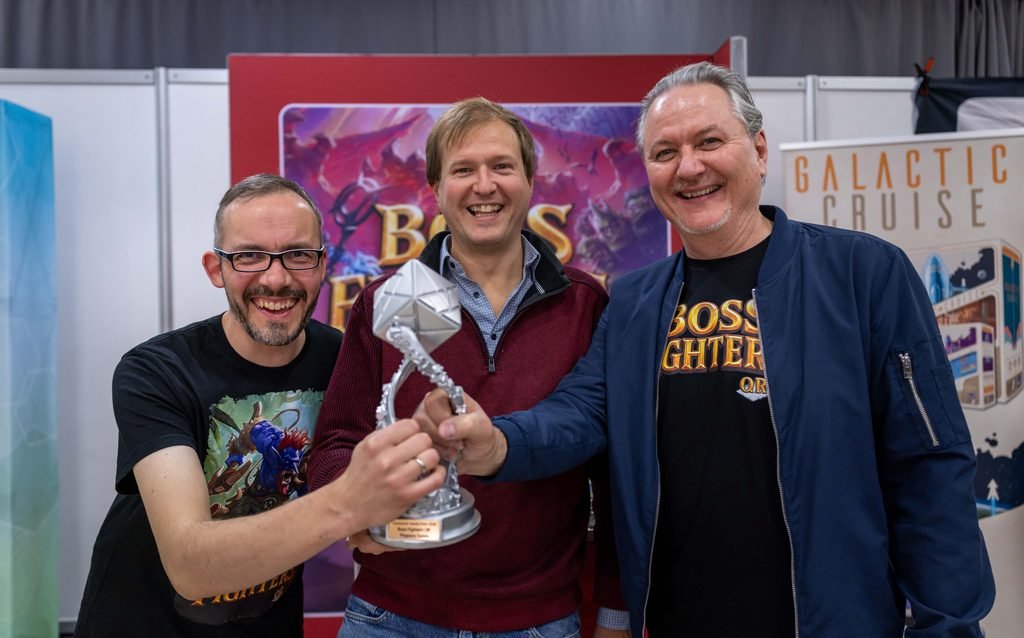
Sanctuary claimed top spot in the annual award ahead of Pegasus Spiele’s commercial hit Boss Fighters QR and space tourism-themed worker placement title Galactic Cruise, which has already scored a string of major award wins.
The win also cements Feuerland Spiele‘s position as the most successful publisher in the Deutscher Spiele Preis since the company was founded in 2012, with four victories – twice as many as any other publisher over that period.
Feuerland scored an early DSP victory with Terra Mystica in 2013, before a flurry of three wins in eight years via Wingspan in 2019, Wigge’s debut design Ark Nova in 2022, and Sanctuary this year.
The game, released in Germany as Artengarten last year, aims to offer a shorter and more accessible take on Ark Nova’s zoo-building and wildlife conservation theme, replacing much of the original’s card-driven gameplay with tile placement.
Feuerland also positioned the game at a lower price point than Ark Nova, with a recommended German retail price of €49.90 against €64.90 for the original.
The win follows huge critical and sales success for Wigge’s predecessor design Ark Nova, which had sold more than 300,000 copies worldwide and racked up over 10 million plays on Board Game Arena according to a report from German newspaper Der Patriot in February this year – as well as being ranked in second place among all the titles on BoardGameGeek.
The app-driven cooperative game spent six years in development, with Palm and Zach revealing that extensive work was needed to ensure its QR code scanning technology operated reliably and to develop the digitally controlled bosses.
Boss Fighters QR was also nominated for this year’s Kennerspiel des Jahres, alongside Moon Colony Bloodbath and eventual winner Rebirth.
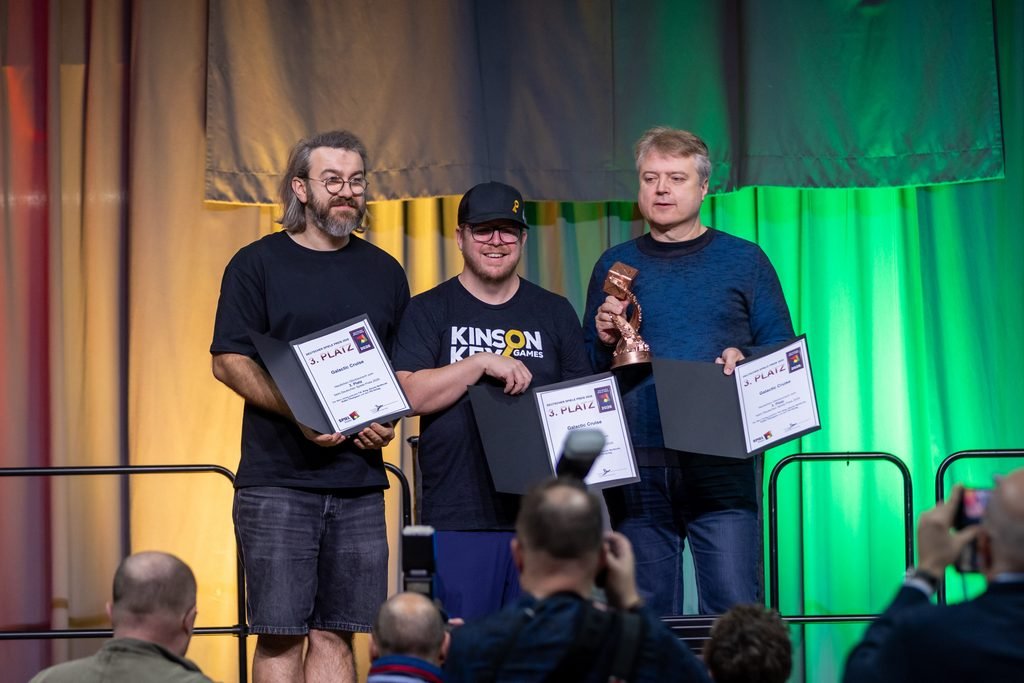
Galactic Cruise’s third place finish follows a striking awards run for the game, which was the first major release from US publisher Kinson Key Games.
The title, designed by TK King, Dennis Northcott and Koltin Thomson, had already been crowned Heavy Game of the Year at BoardGameGeek’s Golden Geek Awards in May, before taking Game of the Year, Best Strategy Game and Best Game from a New Designer at the Dice Tower Awards in August.
Germany’s Frosted Games was represented twice, through Reiner Knizia’s Kennerspiel des Jahres winner Rebirth in sixth place and Star Trek: Captain’s Chair in ninth, while Kosmos took eighth with River of Gold.
This year’s children’s Deutscher Spiele Preis went to Wojciech Grajkowski’s Toriki: The Castaway Island, published by Mirakulus, ahead of Mooki Island and Paleolino.
The Deutscher Spiele Preis, which has been presented since 1990, is decided by public voting among players in Germany, Austria and Switzerland, rather than a specialist jury.
Organisers said “many thousands” of players took part in this year’s voting. Eligible games were released in German between May 1, 2025 and April 30, 2026, with the winners announced at the Spiel Essen game fair.
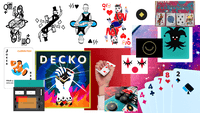
A review copy of Decko was kindly provided by Gem Games. Thoughts & opinions are my own. If you’ve met anyone who’s played Decko and any amount of video games lately, it’s likely you’ve heard it described one way: “It’s like Balatro the board game”. While that’s not strictly true, Decko does manage to capture some of the feel of the absurd poker game, but with its own feel and approach. You’…
The idea for DECKOcame when I played the fantastic computer game Balatro, a great experience of multiplying numbers and manipulating a bizarre poker slot machine with jokers that seem to hack the system. While I loved this, I felt inspired to create something different. Something a lot closer to real poker with all the betting and bluffing, combined with my own take on what the ultimate deckbuilder should feel like. Poker is a game full of moments that beg for some board game fun to be added to them. So I started making DECKO.
The Design Process I started by playing a super simplistic version of the game in Tabletop Simulator. A regular deck of cards was in the middle to buy from, and all players had a small starting deck. Every round would be like playing a hand of poker, followed by buying new cards. Playing a too simple and boring version of a game idea is a great way of getting me inspired to figure out what a game design needs to make it fun. It was currently too random and too linear (no big moments, no spikes of excitement); it took a long time to see the effect of your deckbuilding and it could end before anyone had time to build a good deck. I had my work cut out for me.
The first version of DECKO, the "minimum viable concept"
I knew I would be adding jokers and crazier poker cards (inspired by Balatro), and that alone would add a lot of fun to it, but before adding that, I wanted to challenge myself to improve it in other ways. I made the minimum bets go higher and higher from round to round; this happening in tandem with the decks improving would make the game have a nice dramaturgy of escalating stakes. Furthermore, I also changed the starting decks to be as weak as possible, making the deckbuilding feel much more impactful.
A gripe I have with every deckbuilding game I’ve tried is that they seem to be very restricted when it comes to letting players remove cards from their decks; apparently, this is something that must be done in a very small capacity. Wouldn’t it be cool if you could remove a card every round in a deckbuilder? I added that, and it worked really well; it just sped up the whole deckbuilding process, making it an express deckbuilder. A side effect of letting players trim their decks so fast is that inevitably players will be able to make very consistent decks, and one player will then probably have a deck that’s consistently the best. This is probably why most deckbuilders avoid this; they want to avoid an “early winner” spoiling the game before its end. In DECKO this problem is solved by embracing it as a feature; it’s a race to create the most broken deck and earn 60 chips the fastest, leading to the game ending just around that moment that a player gets unbeatable. I want to revisit this format of an express deckbuilder with frequent card burning in future games that are not about poker.
At this point the game already had some interesting balancing going on, as making something almost unbeatable like a deck that gets four aces or a royal flush consistently was hard and took a long time, while more “medium” decks that focused on getting the lower numbers could be made faster. So you could go for a mid deck that would give you lots of wins in early and midgame, spend longer trying to build something stronger, or first do the mid deck and then pivot to a stronger late game deck. Or make a medium deck while hate drafting high deck cards, at the expense of hurting your own deck. Several approaches were viable, and it all depended on what everyone else was doing. I now had a strong foundation, it was time to spice it up and add juicy twists, opening the game further.
An early prototype of DECKO, now with card powers and jokers. At this point burned cards went to a shared burn pile, and there were victory point goal cards that didn't work well.
Adding the Cool Stuff When adding special effects to all the cards in the market deck (then named flop deck), I used my experience with the simplistic version of the game to figure out which cards should have which powers. Initially the lower numbered cards got the stronger powers, otherwise it would simply be a no brainer to always go for higher cards. The twos got the Crypto mechanism for example, giving you exponentially more chips for collecting them, a hand of four Cryptos would award you 16 chips regardless of winning or losing for example. With more testing it felt like the higher cards were less good than lower cards. These cards are less attractive because you don’t start with any of them. Why would I buy a ten that I couldn’t even make a pair with, instead of an eight that would enable me three of a kind and probably full house soon? It turned out the higher cards needed really strong powers as well to be attractive. Aces were so good by default they didn’t need much help, but you would often be stuck with a single Ace or get very few as all players would buy them. The Assisting Aces were born out of this, now we had aces that would help your other cards by adjusting their number, so they would be useful even if you didn’t get several. The royal cards were in a similar position to the aces, and got all kinds of powers that worked with other cards.
A playtesting session in Oslo, shoutout to Brettspillskaperlauget. This version of the game let you get jokers when folding (bad idea), and could end when someone got to 40 chips (too soon).
Dealing With Luck A game about poker and deckbuilding is inherently lucky. I had no ambitions of making this a game with no luck element, in fact I think a little luck and randomness is essential in games. But I wanted to make the game as low luck and strategic as possible, and also make it possible for players with bad luck to catch up with luckier players. I approached this directly from both ends. First of all the winning player of each poker hand would not be allowed to buy new cards. The players winning lots of chips (which are victory points in this) would stagnate in their deckbuilding, while those who lost lots chips would be buying more cards and getting better decks. Secondly, the players who folds (that’s when you forfeit a bet) would be able to get any one card in the market display for free. This would be a great boon particularly in the earliest rounds where the luck factor is at its peak. A side effect of this system is that losing or folding can feel better than winning in early rounds, particularly if bets are low. Further adjustments were made in the game to make winning early rounds better. A core part of it is that you need to have a good chip economy to do well in the mid and late game. Jokers are bought for chips, you can’t get jokers when folding and the increasing starting and maximum bets mean you need quite a few chips to be in the bets. The wildcard rounds also have antes (mandatory bets) players must pay. Players who win much tend to get smaller decks as they remove (burn) a card every round while not buying any. This is good because your deck becomes smaller so that buying a few cards can have a big impact and instantly power up your deck. In the end winning and loosing felt just about right. In the first round losing is kind of good (though winning isn't bad either), then as the game progresses winning becomes more and more important, and at the same time who wins is increasingly determined by whoever built the best deck and joker engine, to the point where it usually feels very deterministic in the final rounds.
A playtest session where the game was voluntarily played two times back to back, a positive sign! Shoutout to Spilloteket, Oslo's finest board game bar.
The Jokers I knew from the start the jokers would be in tableaus next to the players and have ongoing abilities or special actions instead of being mixed into with the decks. Initially the jokers were in one big deck full of random abilities. I used these to add a lot of complexity and twists to the game, and really take a stab at subverting what goes on in regular poker. Like what if someone has a reason to raise their bet even when they have a bad hand? What if someone earns chips by prolonging the round? What if someone can earn more from folding than raising? Could you win the game without winning bets? I had a ton of ideas and made a deck of jokers. I noticed quite early I needed a better system than having them all in one deck. A player that was behind on the deckbuilding could really use a joker that triggers when folding, or a joker that discounts card buys. But if they were randomly buried in the joker deck, tough luck. Something had to be done.
The joker shop, in the final prototype that was very close to the final product. Cards were ordered from makeplayingcards, the mat was sourced at a shop for mats, poker chips from a fancy poker chip brand.
The joker abilities had trigger points, some were used when folding, others when raising, some when drawing cards and so on. Sorting the jokers into separate decks based on their triggers was the obvious thing to do. Not only did it solve the problem mentioned above by giving players constant access to the joker types they might want, it also made the game easier to learn and parse on the table. Instead of reading all the joker text all the time, a player could learn at the start that the blue jokers work when folding, the red ones work when raising and the teal ones are for buying. A quick glance at the opponent’s joker tableau would tell you if they likely benefited from raising, calling or folding the most. Making the jokers anchored to the trigger points made them a really cool feature of the game, making them a core part of the strategy. Will you be a player who folds half your hands with great rewards, or someone that keeps raising bets to repeatedly trigger an effect and win bets?
Adding a Big Twist The game had really shaped up, but I felt like I could make it more interesting. Something that would make each game different from the last, something that would make you deckbuild differently in every game. Imagine a deckbuilder where you must build your deck not only for one ruleset, but for two rulesets. Or what if you had to build for three rulesets? Originally an expansion idea, I added the wildcard rounds. For two rounds in every game, there would be a random special rule really changing how you win, and a much higher pot. These rules would be visible from the start of the game, so that players could plan for them. As an example there is a wildcard round that only lets you score one card, another one makes you draw your hand from your burn pile. As you can imagine, this will affect how you build your deck. I found one could do really well by focusing on the wildcard rounds at the expense of doing slightly worse in regular rounds. At the same time deliberately ignoring them could work, if you did really well in the rest of the game.
Some of the wildcards in the close to finished version
Artwork and Graphic Design For all my games I make the art and graphic design myself. I really think of how the product is going to work as a whole when I do the visuals. I see it much like being a UX designer, creating an interface for players to interact with the game system. It’s also like being an art director focused on creating a viable commercial product.
Figuring out the look for DECKO involved a lot of sketching and testing out different designs. I usually have to draw things many times before I get to a good result.
DECKO needed to look like a regular deck of cards (to communicate it’s a poker game), but it also needed to look like something more. If it had regular card icons and artwork it would probably look too cheap and not sell well. What I came up with was symbols that represent meta items from the world of poker, the clovers are made of poker chips, the spades are two cards, and the hearts are poker tables. For a while the game was going to be named Meta Poker, but I changed it as I didn’t want it to be mistaken for just being another home made poker variant. Part of the look of regular decks of cards is having a very restrictive color palette. Usually there’s mostly black and red, and small amounts of blue and golden/dark yellow. I decided to make a restricted palette a core part of the design (a limited palette usually makes graphic design better anyway!). I went with red and gold for diamonds, black and teal for clovers, blue and black for spades and red and black for hearts.
In the beginning I was thinking of having a hell theme for the game, it had the tagline “13 clowns gather in hell to play poker”. I pivoted away from this, choosing a more whimsical theme of just having random poker and clown related stuff. In the end the game has more of a style and vibe rather than a theme and story, which felt refreshing and liberating to me as I usually work with a lot of worldbuilding in my head. The presence of flames on the cover and burn board is a remnant of this original theme, which I kept in because burning cards is a major part of the game. The graphics were given a raster dot texture and some white specks imitating chipped off paper as if the game is already well used, adding to the meta theme and suggesting something is slightly off (something strange is going on with this poker deck!).
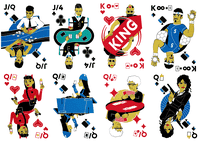
Making the artwork for the royal cards proved the most challenging, as I had to teach myself how to make characters that are like mirrored conjoined twins. It became easier with some practice. I first sketched them out fast to test the concept, then created the final art in vector graphics. I worked within the boundaries of the strict color palette I had established, only allowing myself to use the suit colors and sticking with dark/golden yellow skin and black hair for all the characters (making them look ethnically ambiguous). The queens each have unique abilities that are hinted at in their artwork, and the kings have beards and some sort of fake or proxy crowns.
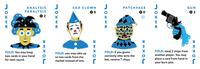
Some of the fold jokers, identified by their blue coloring. Most of them have a catch-up mechanism theme, fitting well with folding.
The jokers were the most fun to draw, as they could be all kinds of things that vaguely represented their abilities. Also here I went with a color scheme limitation. Each joker type would have one color that would be the main color on the artwork, that could be combined with colors from the other joker types in small amounts, as well as black and golden yellow. It was important to have the main color prominent to let the players easily identify their type.
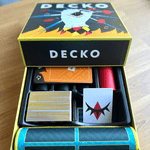
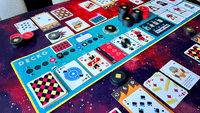
The final production of the game with it's deluxified components
Crowdfunding and Reception The game had a successful crowdfunding campaign offering a deluxe product with a playmat, gilded cards and some very heavy poker chips. The stretch goals were presented as glossy booster packs of jokers that were opened when they were unlocked. Backers have received their games, and from looking at the BGG ratings this is my most well received game this far. I’m very grateful for all the backers who believed in this project and took a chance backing it.
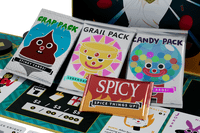
Some of the booster packs the stretch goal components were marketed with.
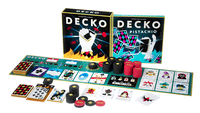
Promotional picture of the base game and upcoming expansion.
What’s Next for DECKO? This autumn a new expansion for DECKO will launch on Gamefound! It will add what backers have wished for the most, lots of new cards! It introduces the Pistachio deck, which can be used separately or together with the vanilla (base game) deck, massively increasing the replay value with 52 new cards. New jokers and wildcards will also be introduced.
I hope you enjoyed reading this designer diary, and that you want to give DECKOa try! Feel free to ask any questions you may have here.
Whenever a game has a double-digit player count, there’s a 99.97% chance it involves social deduction. Now, I love social deduction games. They give you an excuse to break the social contract and lie to your friends and family, all in the name of fun. They’re also one of the few genres that let you discover just how good the people around you are at scheming and lying. Eventually, you start wondering if their name is even real. That said, I’m also kind of sick of every single large group game being dropped in the social deduction box.
Coalition: Council of the Republic sings a different tune here, focusing on negotiation rather than inevitable betrayal. Better yet, it’s team-based, with four teams competing for influence and potentially a few independents thrown in to make things even messier. Instead of simply figuring out who’s lying, you have to convince people to work with you, negotiate deals, cross your fingers while making promises, and figure out how long those lofty alliances will actually last. All of this in one hour.
Draft Laws, Not Friends
The story behind this is a little more complex than most. The country is suffering through political turmoil and demanding reform, so four teams are tasked with drafting new laws. Naturally, each team wants to push laws…

 Anmelden


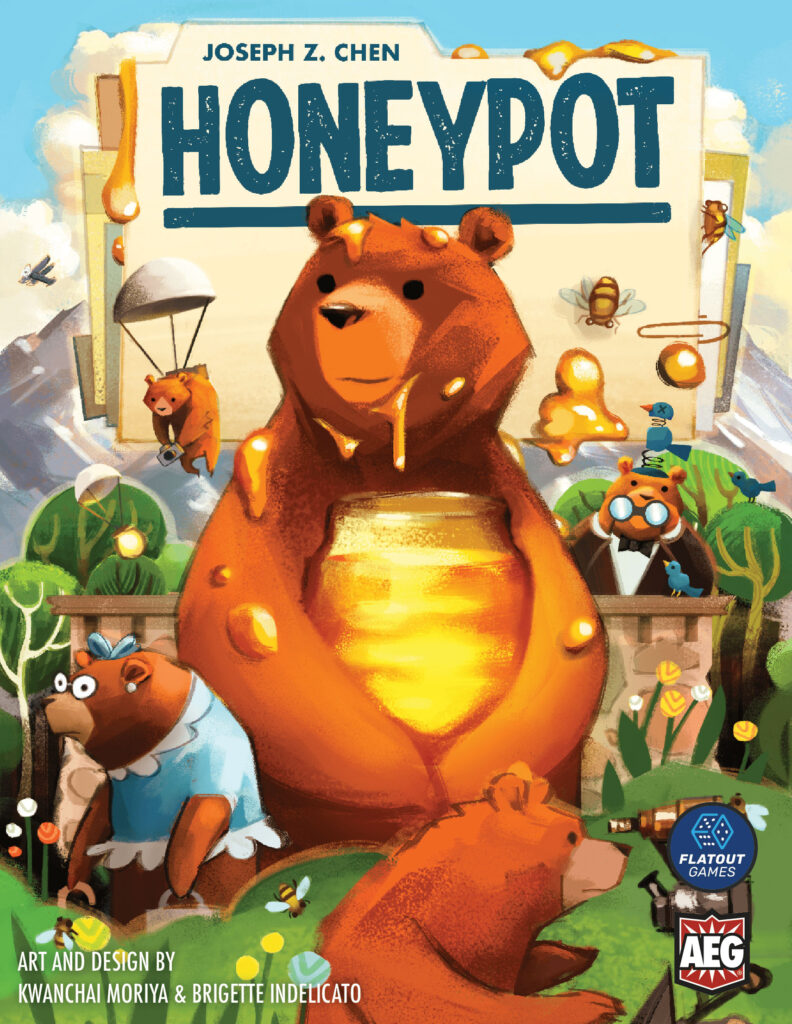 If you threw the bluffing game Sheriff of Nottingham into a pot with Sushi Go! and stirred them around, you’d get Honeypot—a set collection game with a bit of push-your-luck bluffing. Honeypot was not a game I would have picked up on its own, but because my family is already familiar with those mechanics and […]




 I despise the word “impossible” in the two-player board game design space. It’s “impossible” to make an 18xx game at two players. It’s “impossible” to make an area control game with two players. It’s “impossible” to make a hidden roles game with two players. When a designer or design team aims to tackle the “impossible,” […]