„Unangenehme Gäste“ (Awkward Guests: The Walton Case), seit 2016 das Deduktionsspiel von Ron Gonzalo García (Original: Megacorpin Games, deutsche Ausgabe: Taverna Ludica Games), ist jetzt auch auf BoardGameArena spielbar. Im direkt geprüften Gamepanel steht das Spiel bereits seit dem 29. Oktober 2026 in der Bibliothek, die offizielle BoardGameArena-Ankündigung folgte einen Tag später am 30. Oktober. Gespielt wird dort kostenlos, auch die Oberfläche selbst ist laut Sprachauswahl auf Deutsch verfügbar.
In „Unangenehme Gäste“ ermitteln laut BoardGameGeek ein bis acht Spielende den Mord an Mr. Walton: wer, wie, warum, und ob es einen Komplizen gab. Jede Handkarte trägt laut Jung und Alt spielt einen Wert von 1 bis 3 Punkten je nach Informationsgehalt, wer nach Hinweisen fragt, zahlt dafür mit Punkten aus der eigenen Hand statt mit einer Spielfigur übers Brett zu laufen. Anders als beim klassischen Cluedo-Lauf durchs Haus tauschen hier alle gleichzeitig Karteninformationen gegeneinander, das Spielgefühl ist für uns näher am Verhandlungstisch als an der Figurenbewegung. Das BGG-Gewicht von 2,32 ordnet das Spiel zwischen Familienspiel und Kennerrunde ein, auf BoardGameArena dauert eine Partie laut Plattform im Schnitt nur rund 27 Minuten.
Im Solo-Modus bekommt man laut Gamepanel je nach gewähltem Schwierigkeitsgrad eine Startpunktzahl zugewiesen, pro Runde stehen bis zu drei Karten-Punkte-Kombinationen sowie eine zusätzliche Karte für einen Punkt zur Auswahl, gewählte Angebote kosten Punkte statt Tauschkarten. Eine falsche Lösung beendet die Partie nicht, sperrt aber die nächste Rateversuchs-Runde, gewonnen hat, wer die richtige Lösung findet, bevor die Punkte aufgebraucht sind. Wie explizit das Mordmotiv selbst dargestellt wird, verraten die Quellen nicht, die Alterseinstufung ab 12 bleibt hier die einzige Orientierung.
Eckdaten zu Unangenehme Gäste
Spielerzahl: 1 bis 8 (BGG)
Spielzeit: 45 bis 75 Minuten am Tisch, auf BGA im Schnitt rund 27 Minuten
Alter: ab 12 Jahren
Designer: Ron Gonzalo García
Verlag: Megacorpin Games (Original), Taverna Ludica Games (deutsche Ausgabe)
Komplexität: 2,32 von 5 (BoardGameGeek)
Für uns ist das vor allem eine gute Nachricht für alle, die den Krimi-Klassiker bisher nur vom Tisch kennen: Über 10.000 Partien zählt die BoardGameArena-Statistik schon kurz nach dem Start. Wer Lust auf Deduktion ohne Kartenchaos im eigenen Wohnzimmer hat, kann jetzt im Browser ermitteln.
Red Notice is a two player game of cat and mouse. The criminal and the
international police agent race around the globe. The criminal wins by cashing
in a total of 1,000,000 in cheques. The agent wins by catching the criminal a
third time.
The world map is divided into six regions. The location of the agent is public
information. However, that of the criminal is
Der Herr der Ringe – Das Schicksal der Gemeinschaft von Matt Leacock erhält als 28. Spiel den Beeple Award
Der Herr der Ringe – kaum ein literarischer Stoff wurde in Film, Funk und Fernsehen sowie in der Brettspielwelt so oft adaptiert wie dieser. Viele Projekte waren von Erfolg gekrönt, aber selten gelang es, die epische Geschichte so nachzuerzählen, dass dabei mit jeder Partie ganz eigene Abenteuer entstehen.
Mit seiner Interpretation von Der Herr der Ringe zog Matt Leacock die Mitglieder des Beeple-Netzwerkes vollends in seinen Bann. Im Lande Mordor, wo die Schatten drohn: Ein Spiel, sie zu begeistern, sie alle zu fesseln, durchs Abenteuer zu führen und an den Spieltisch zu binden.
Der Herr der Ringe – Das Schicksal der Gemeinschaft erdacht von Matt Leakock mit Illustrationen von Jared Blando und Cory Godbey Verlag: Z-Man Games, Asmodee Personenzahl: 1 bis 5 – Alter: ab 14 Jahren
Begründung
Es gibt Spielsysteme, die man ohne Zögern als moderne Klassiker bezeichnet. Pandemic ist ein solches Meisterwerk. Matt Leacock hat den kooperativen Mechanismus über Jahre hinweg verfeinert und nebenbei das Legacy-Genre komplett neu belebt. Seine Spiele sind dramatische Erzählungen, die bis zur letzten Aktion fesseln.
In Der Herr der Ringe: Das Schicksal der Gemeinschaft wagt er sich an eine Geschichte, die schon oft erzählt wurde – aber selten so gut wie hier.
Die aus dem Original bekannten Kartenmechanismen bilden die Eckpfeiler der Erzählung: voranmarschierende Truppen, scheinbar unbezwingbare Aufgaben und mittendrin der Ring, der zum Schicksalsberg getragen werden muss. Während auf der Karte die fummeligen Truppen und die Gegnerfiguren unter dem Auge des Würfelturmes verschoben werden, wächst die Spannung unaufhaltsam. Wird die Gemeinschaft es schaffen oder obsiegt das Böse?
Was zunächst klingt wie ein weiteres Pandemic, ist so viel mehr: Eine liebevolle Hommage an das Werk von J.R.R. Tolkien, erschaffen von jemandem, der dieses Universum tief im Herzen trägt. Das Thema trieft aus jeder Pore der Spielschachtel. Jede Karte liefert Trivia aus Mittelerde, jede Aufgabe bildet die Geschichte originalgetreu ab. Und doch erzählen sie die Geschichte in jeder Partie auf ihre Art neu, ohne jemals an Reiz zu verlieren.
Der Herr der Ringe: Das Schicksal der Gemeinschaft ist Pandemic in Perfektion. Matt Leacock hat sich selbst übertroffen und Jared Blando sowie Cory Godbey haben das Geschehen herausragend illustriert. Höchste Zeit, dieses Meisterwerk mit dem Beeple-Award auszuzeichnen.
Beeple (Blog + Meeple) ist ein Zusammenschluss von Blogs, deren inhaltlicher Schwerpunkt auf dem Thema Brettspiel liegt. Dabei betont Beeple die Individualität und Vielfalt eines jeden einzelnen Blogs. Über eine intensive Zusammenarbeit und gemeinsame Aktionen möchten wir unsere Inhalte stets verbessern. Zugleich sieht sich Beeple als zentrale Anlaufstelle für interessierte Personen im Bereich der Brettspiele und möchte Neulingen im Onlinejournalismus Hilfestellungen geben. Mit diesem Ansatz soll ein weiterer Beitrag zur Festigung der Bedeutung des Brettspiels in der Gesellschaft geleistet werden.
Was ist der Beeple Award?
Neben dem Spiel des Jahres und dem Deutschen Spiele Preis schließt der Beeple Award nun eine Lücke. Der Netzwerk-Zusammenschluss Beeple orientiert sich dabei an den Bedürfnissen der Community und der Verlage gleichermaßen. Ein Kritiker-Preis für die Szene. Gerade Vielspieler:innen und Pressesprecher der verschiedenen Verlage bemängelten in der Vergangenheit immer wieder, dass es keinen “aussagekräftigen” und breit gestreuten Award von Bloggern für die Brettspielszene gibt. Der Zusammenschluss der Brettspiel-Blogger schließt nachhaltig diese Lücke und sorgt dafür, dass die Auszeichnung Beeple Award für bekennende Brettspieler und solche, die es werden möchten, eins signalisiert: Kauf mich und halte mich in deinem Brettspiel-Regal.
If you want to read more ratings of historical leaders like this, I strongly recommend you subscribe to the blog – all new posts in your inbox right when they go live!
Some caveats ahead: The presidents will be rated by the knowledge of their time. If they or their contemporaries could not have known about the effects of something, I will not use my hindsight to mark it as a mistake of theirs. The assessment is focused on their conduct as president, but includes their life after holding the office (in which they will still be regarded in the public eye as (ex-)presidents).
Now, to the system itself: There are three policy field categories (foreign, domestic, and economic policy) and three more general ones (vision, pragmatism, integrity). A president can earn from one to five stars in each category (for a total sum of up to 30). In detail, the president is assessed as follows:
Foreign policy: Did the president increase US influence in the world and the security of Americans at home? Did the president wield US power responsibly and with positive results for the regions affected (the latter counting for a greater deal in times of US power being great)?
Domestic policy: Did the president increase the liberty of Americans to express themselves and to participate in the political process? Did the president promote domestic security and shape the framework for fair justice dealing with offenses?
Economic policy: Did the president facilitate the prosperity and economic security of Americans (including in the mid- and long-term)? Was the president’s economic policy based on mutual benefit of those involved or did it unduly burden one side?
Vision: Did the president have an idea of what the United States and the world (the latter counting for more in times of US influence being great) should look like beyond the immediate future? Did the president’s policies steer the United States (and, if applicable, the world) in this direction?
Pragmatism: Did the president succeed in seeing his policy through from inception to completion? How well did the president manage the support from Congress, society, the administration, the media (the latter counting for more in more recent years)?
Integrity: Did the president understand the office as a means to benefit himself, special interest groups, the entire country, or another community? Did the president respect the boundaries of the office?
Wilson’s Life
Receiving and Providing Education
Thomas Woodrow Wilson was born on December 28, 1856 as the son of a Presbyterian pastor in Staunton, Virginia. Wilson grew up in several states of the American South before, during, and after the Civil War. He would be the only American president who had been a citizen of the Confederacy.
Wilson became a lawyer, but found it not to his liking. Instead, he pursued graduate studies in political science with a dissertation on Congressional government at Johns Hopkins University. His PhD, awarded in 1886, makes him to this day the only US president with such an academic distinction. Even though Wilson had never bothered to take a trip from Baltimore to Washington, D.C., to see the object of his study in action, his dissertation was well received. Atypically for a southerner, he advocated for a strong federal government. At the end of his graduate studies, Wilson married Ellen Louise Axson, who came from a southern clergy family like himself.
Wilson’s academic career led him to teach at several universities. Eventually, he became president of Princeton University in 1902. He took the university out of the grip of Presbyterian traditionalists, appointed the first Catholic and Jewish professors, but worked vigorously against the enrolment of Black students. Wilson turned Princeton into one of America’s leading teaching and research institutions, fueled by the large contributions of outside donors which he attracted. At the same time, Wilson advocated – in often fiery rhetoric – for the independence of the university; a contradiction he could never resolve. Both his administrative reforms and his powerful oratory aroused interest in him political circles; and Wilson put out feelers to the Democratic Party.
To the Presidency
The Democrats, perennially shut out of national office since the Civil War, were in dire need of fresh candidates. Wilson seemed like an ideal fit to party bosses due to his reputation as a natural conservative with progressive credentials. He ran for governor of New Jersey in 1910 and was the first Democrat to be elected to the office in 18 years.
Woodrow Wilson was consistent in his support for labor reforms.
Anyone who believed Wilson to be a conservative at heart was swiftly disabused of the notion once he took office. He directed his energy to labor, electoral, and education reform. Within his first two years in office, Wilson had gained nationwide fame as a progressive leader.
That made him a contender for the 1912 presidential election. His campaign was ably run by the Texas businessman Edward M. House, and Wilson entered the 1912 Democratic National Convention second only to Speaker of the House James “Champ” Clark. When Clark gained the support of New York’s Tammany Hall political machine, that threw the liberal wing of the party, led by three-time presidential nominee William Jennings Bryan, into Wilson’s arms. Wilson gained his party’s nomination and went on to run against a split Republican Party in the general election: Incumbent president William H. Taft represented the party’s conservative wing, former president Theodore Roosevelt mounted a progressive challenge. As the Republican vote split, Wilson’s 42% of the popular vote were enough to give him a landslide victory in the electoral college.
Edward M. House ran Wilson’s election campaign, would conduct European diplomacy on Wilson’s behalf during and after World War I. He took great liberties in his diplomatic assignments and would be summarily sacked.
Reforms and Interventions
Wilson started the presidency where he had left off the governorship – with an ambitious domestic reform program. To clinch the reforms, he broke with the tradition that separated the executive and legislative branches of the American government: Wilson was the first president to appear before Congress since John Adams, a precedent which has since become standard practice. In another momentous move, Wilson focused his efforts to build legislative majorities on mobilizing his own party (which held both the Senate and the House), ignoring the Republican opposition. With these measures, Wilson enacted far-reaching economic reforms:
He replaced tariffs with a federal income tax as the chief source of federal revenue.
He established the Federal Reserve system to stabilize the heretofore decentralized, fragile American finance world.
His Antitrust Act clarified that unions and collective bargaining did not constitute a breach of freedom of contract.
Other Wilsonian reforms were less progressive: Wilson introduced segregation in several federal institutions including the Navy Department and the Post Office.
The worst imaginable day for Woodrow Wilson: Having to speak not one, but two people of color with opinions!
Wilson’s belief in a racial hierarchy also carried over into his foreign policy. During his presidency, the United States intervened in Mexico (twice), Nicaragua, the Dominican Republic, and Haiti (where a new constitution imposed on the country reintroduced the forced labor of corvée). The most momentous of these interventions took place in Mexico, where a US-backed coup had brought the authoritarian Victoriano Huerta to the presidency shortly before Wilson’s own accession to power. Wilson opposed Huerta and first imposed an arms embargo on Mexico, then landed forces in the Mexican port of Veracruz. The intervention did not shift the political situation in Mexico, and US forces left Veracruz after seven months of occupation in November 1914.
Wilson’s rhetoric accompanying the intervention was based on lofty principles, but he applied them rather flexibly: He argued both for imposing and for lifting the arms embargo with the “standards of neutrality”; and he justified both beginning and ending the intervention on moral grounds – the former with his commitment to constitutional government, the latter with Mexico’s right to national self-determination.
Self-determination – easy to define in the Americas (no intervention in other countries’ domestic affairs), but a thorny issue in the often ethnically diverse European countries at the Versailles peace negotiations.
Neutrality, Honor, and Prosperity
While the United States had been busy in Mexico, a much bigger conflict had erupted in Europe – the Great War. Over the next years, Wilson pursued a course which would allow the United States to maintain three competing objectives – neutrality, honor, and prosperity.
Wilson was driven by an honest desire to keep the United States out of the war. That did not mean that he was indifferent to its outcome. His sympathies lay clearly with the Allies. Every few months, his administration launched a peace initiative which would invariably come to nothing as they demanded very different things from the belligerents: The Allies were given the idea that Wilson wanted them to win victories before a peace should be negotiated, the Central Powers presented with unacceptable demands (like the cession of Alsace-Lorraine from Germany to France as a precondition for a peace conference).
Honor was an even trickier business than neutrality. Wilson demanded that the belligerent parties adhered to the London Declaration concerning the Laws of Naval War (which none of them had ratified), but in practice complied with the British violations of the Declaration – the harassment of neutral (including American) trade and the blockade of the German coast – while he denounced the German violations – submarine warfare. When a German submarine sunk the British ocean liner Lusitania shortly before it arrived in Liverpool with its cargo of ammunition for the Western front as well as over a thousand passengers – 128 of them American citizens – Wilson was outraged. He declared in a note to the German government that he would hold Germany responsible for any damages to American citizens and property. Secretary of State William Jennings Bryan resigned after the incident, believing Wilson endangered American neutrality with his hardline insistence on German (but not British) respect for trade rights.
“Global Trade” is a mildly isolationist strategy card in Versailles 1919: You focus on industrial growth (icon to the left), your own national happiness (third icon from the left), and try to not have the world blow up (bonus for regions with low unrest, icon to the right).
That brings us the third leg on which Wilson’s stool rested: While he never mentioned prosperity (much unlike neutrality and honor), it was a major motive for his wartime policies. In August 1914, Wilson had publicly opposed bonds for the Allies to be raised by American banks, but when the banks started issuing them, he did not contest it. Consequently, the American economy was effectively mobilized for the Allied cause: US goods were bought with money from US bonds. Allied victory thus became a national interest for the United States to see the bonds repaid.
In the short term, Wilsons’s hard line was successful. He forced Germany to comply with his notions of naval law while the American economy boomed from the war trade to the Allies. America reaped all the benefits of the war at none of the costs.
That made Wilson a strong contender for re-election in 1916. The Democratic Party touted his foreign policy success with “He Kept Us Out of the War” (a slogan which had been adopted without consulting Wilson). Still, Wilson’s main advantage of 1912 – the split Republican field – had evaporated. To beat his Republican opponent Charles Evans Hughes, he had to make inroads in states where Democrats had not fared well over the last decades. As Wilson feared that the new women voters in many of the western and midwestern states might take objection to his marriage to Edith Bolling Galt – just a year after his first wife Ellen had died – he tried to balance it out with publicly supporting women’s suffrage. While we do not have electoral statistics by gender for 1916, Wilson’s strong showing (for a Democrat) in the West and Midwest indicates that his strategy worked. In the end, Wilson’s victory in California by the hair’s breadth of 3,773 voters decided the presidential contest in his favor.
Women’s suffrage remained in the waiting room for a long time thanks to Wilson.
Into the War
In Wilson’s second term, his three-way balancing act between neutrality, honor, and prosperity became ever more precarious. One of them had to give – and the most likely candidate seemed neutrality, whose meaning Wilson had stretched beyond recognition anyway. Ironically, that happened just as Wilson made his first attempt to put pressure on the Allies (by withholding bonds if they did not agree to a peace conference).
Germany, unaware of any rifts between the US and the Allies, played the elephant in the diplomatic China shop again in January 1917: The German Foreign Secretary Arthur Zimmermann secretly instructed the German embassy in Mexico to sound out the Mexicans for an alliance in case the United States entered the war. Two weeks later, Germany resumed unrestricted submarine warfare in the British home waters again. Wilson felt he could not honorably back down from his hardline position of American trade and travel rights which he had taken in 1915, and broke off all diplomatic relations to Germany. A few days later, British naval intelligence relayed the contents of the “Zimmermann Telegram” to Wilson. Its release helped inflame American public opinion against Germany, but the essential decision had been made already: America would enter the war as an “associated power” on the Allied side. Congress voted in favor of a declaration of war at Wilson’s request on April 6, 1917.
Militarily, the United States was a dwarf in 1917. Safe itself due to large oceans and weak neighbors, its armed forces had been minuscule since the end of the Civil War. Expanding and training them would take time. And economically, the awesome might of America had been mobilized for the Allied cause anyway. Thus, the American war entry mattered little for the course of the war in the short term.
It did, however, have immediate domestic repercussions: On the one hand, government spending exploded. The expenses which the federal government accrued in the 19 months of war from April 1917 to November 1918 would exceed those of almost 130 years since the founding of the country. And Wilson cracked down on perceived opponents of the war: The Espionage Act made interference with military operations or recruitment illegal, which in practice meant that any kind of anti-war activism could – and often did – send the protester to prison. “Illoyal” publications were banned from postal transport which made them practically unavailable at any distance from their printing.
Preparing for the Post-War World
In the meantime, the war raged on. Wilson’s initial lofty rhetoric of a “war without victory” by which the world would be “made safe for democracy” had been largely superseded by the gritty requirements of military buildup and diplomatic compromises with the Allies. The day-to-day realpolitik of the Allies suffered a heavy blow when the October Revolution took Russia out of the Allied coalition in late 1917; and Wilson was subsequently also replaced as the leading visionary by a certain Vladimir Lenin whose radical rejection of imperialist war (along with capitalism as a whole) proved popular with the European masses after three years of carnage – and they set Russia to seal a deal with Germany and leave the war for good.
The second-worst imaginable day for Woodrow Wilson: Having to speak to a person of color with opinions and being usurped as the leading thinker on peace!
Wilson countered by laying out his vision for the post-war world before Congress on January 8, 1918: The Fourteen Points contained a mix of specific territorial changes and universal principles – the freedom of navigation and trade, disarmament, the rejection of secret diplomacy, and the founding of a “general association of nations”.
Wilson’s views condensed into one strategy card: Bonuses for containing Germany, self-determination to various nations, having Japan and Italy sign the Treaty of Versailles (and presumably joining the League of Nations), and for controlling issues pertaining to the League of Nations.
By summer 1918, American forces had arrived in Europe in substantial numbers. They contributed to turning the tide on the Western Front, and their ever-growing numbers (which matched the British and neared the French) and excellent supply situation convinced the German High Command that the war could not be won anymore. The German generals abandoned the sinking ship. Their civilian successors applied for a peace on the basis of the Fourteen Points.
Wilson, meanwhile, urged the American voters to consider the 1918 midterm elections as a plebiscite on his policies, especially the post-war order he had formulated. The voters soundly rejected him by giving majorities in both houses to the Republicans for the first time in eight years.
Germany and the Allies agreed to an armistice on the Western Front on November 11, 1918. While Germany’s new parliamentarian leaders dealt with the turmoil in their new republic, the Allies met on the outskirts of Paris to negotiate the peace treaty, chief of them the “Big Four” France, Britain, Italy, and the United States. Wilson attended the Versailles negotiations in person, which made him the first US president to leave the country on official business. After he had alienated the Republicans by his adversarial rhetoric before the 1918 midterms, he snubbed them even further by not including a single Republican senator in his delegation.
All of Wilson’s political goals merged at the Versailles peace negotiations. He wanted a new world order which would provide for long-term peace: “I am playing for a hundred years hence”, he told those who asked him why he would forgo short-term American gains. And the US was indeed different as the country did not angle for territorial enlargement – unlike the other major countries, which sought colonial expansion (especially Britain and France in the Middle East and Africa) or direct annexations of regions bordering their mainland (especially France along the Rhine and Italy in the Alps and on the Dalmatian coast). Wilson held mixed views on the territorial changes in Europe, but supported colonial expansion, especially where it benefitted European imperial powers rather than imperial Japan (another expression of his racial views).
Japan, the only non-white major nation at the Versailles peace conference, pushed hard to include a racial equality clause in the League of Nations. Wilson would have none of it.
Make no mistake: The US had direct material interests at stake as well. On the one hand, Wilson’s interest in free trade aligned with American business wanting to sell goods in the European markets, on the other, American finance expected the war bonds to be repaid. In the view of the European debtors, that required large reparations from Germany, so that the vanquished would pay for the costs of the war.
The Iron Bank… er, J.P. Morgan will have its due.
Wilson’s most cherished goal, however, was the establishment of that “association of nations” outlined in the Fourteen Points. In an ironic repudiation of the other principles of the Fourteen Points, Wilson engaged in the secret diplomacy horse-trading of Versailles, making large concessions to the wishes of the other Big Four nations for territorial enlargement, to get them to agree to what would become the League of Nations.
Here the card does not quite grab the nuances of the issue: The “One State, One Vote” camp at least partially had a special notion of it – Britain pushed hard (and eventually was confirmed) in securing a vote not only for its European part, but also for the four settler dominions Canada, Australia, New Zealand, and South Africa, as well as for its colonial possession India. Wilson, a supporter of the British Empire, was sympathetic to this arrangement.
In June 1919, the negotiations were concluded and the Treaty of Versailles presented to Germany. The Germans engaged in some naïve protests and then signed anyway, as the only alternative of resuming hostilities was utterly impossible for the country. Wilson’s task now was to convince his own countrymen that America must join the League of Nations.
The Struggle for Ratification
Initially, popular support for the League was high in America. However, the Senate which needed to ratify the Treaty for America to join the League was not on board with Wilson:
A small part of the senators, the “Irreconcilables”, was adamantly against the Treaty. Some of the Irreconcilables were adherents to America’s traditional isolationist foreign policy, others came from (or were supported by) groups which had been against the United States’s entry into the war (chiefly German-Americans and Irish-Americans), a third subset were Republicans eager to get back at Wilson for the hostility he had shown them at least since 1918.
A larger, but not sufficiently large group were Wilson’s loyal supporters, who wanted ratification of the Treaty without any changes.
Lastly, the largest group were not opposed to the Treaty as such, but wanted changes which would confirm Congress’s sovereignty on foreign policy decisions, ensure that no territorial mandates could be forced on the United States, and that the Monroe Doctrine would be confirmed and its interpretation left to the United States alone.
The fear that America could be forced into militarily intervening on behalf of the League enraged the skeptics of the Treaty of Versailles, but Wilson was adamant on the issue.
Wilson once more relied on public pressure. He embarked on a speaking tour to advocate for the Treaty. When a bipartisan majority of senators, led by Republican Henry Cabot Lodge, put forward a proposal for a Treaty with amendments in November 1919, Wilson rejected it, and the proposal could not find a two-thirds majority in the senate against Wilson’s allies and the Irreconcilables. By then, Wilson had suffered a stroke and was physically unable to partake in competition for hearts and minds in either the Senate or the public arena. The Treaty of Versailles would never be ratified, and America never joined the League of Nations.
The Final Years
Wilson prepared for another presidential run in 1920 (the Twenty-second Amendment limiting presidents to two terms would only be passed under Harry S. Truman). His party, however, had enough of him and chose Ohio governor James M. Cox as their candidate – a mixture of a turn from Wilson’s policies and the simple truth that his poor health made him barely able to discharge the duties of his office in the present, let alone for another four years. Wilson, undeterred by his defeats in 1918 and 1919, framed the 1920 election once more as a plebiscite on his policies, specifically the League of Nations. The American voters had enough of them and gave the Republican party in the person of Warren G. Harding the presidency and enlarged its majorities in both the House and the Senate. The end of Wilson’s presidency also marked the end of the Progressive Era of sweeping in the United States.
Isolationism, or, as Wilson’s successor Warren G. Harding phrased it, “normalcy”, consisted in a retreat to domestic happiness (right), a booming economy (left), and not getting too involved with other countries (bonus VP for self-determination icons and Japan and Italy not signing the Treaty). Notice that Self-Determination appears both on this strategy card and the 14 Points one, which represent diametrically opposed views within American politics.
Four years later, Woodrow Wilson considered another presidential run. Yet just a few days after he had laid out his program, he died on February 3, 1924.
The Rating
Foreign policy:
Woodrow Wilson really pushed America on the global stage with the entry into World War I. From then on, no matter of great importance in the world has been decided without the United States, very much in line with Wilson’s programmatic thinking. His practical policies, however, were disjointed. His interventionism in Latin America infringed on the locals’ freedoms (up to the point of practically reintroducing slave labor in Haiti), but did not come at a high cost for the United States. The entry into World War I, on the other hand, prioritized export opportunities and especially the travel rights of the affluent few over the lives of the American soldiers who then had to defend those rights and opportunities. Despite all these costs, it is hard to find a positive foreign policy outcome for the United States besides its increased global stature.
Rating: 2 out of 5.
John Maynard Keynes is well-known for his scathing criticism of the economic provisions in the Treaty of Versailles, but he also had a few choice words for Wilson’s negotiating skills at Versailles: “[T]he President had thought out nothing; when it came to practice his ideas were nebulous and incomplete. He had no plan, no scheme, no constructive ideas whatever for clothing with the flesh of life the commandments which he had thundered from the White House. He could have preached a sermon on any of them or have addressed a stately prayer to the Almighty for their fulfillment; but he could not frame their concrete application to the actual state of Europe. […] [H]is mind was slow and unadaptable. […] There can seldom have been a statesman of the first rank more incompetent than the President in the agilities of the council chamber.”
Domestic policy:
By 1920, most Americans were less free than they had been eight years before. Wilson’s expansion of segregation shut down opportunities for African Americans, his wartime policies of censorship and oppression limited the traditional American freedom of expression. Women’s suffrage, the great enfranchisement, was brought about during Wilson’s time, but his support for the cause was minimal.
Rating: 1 out of 5.
Economic policy:
Wilson’s early economic reforms (federal income tax replacing tariffs, the Federal Reserve System, and the Antitrust Act) benefitted consumers, workers, and the economy as a whole. Later, Wilson’s interpretation of neutrality meant that the United States enjoyed a long war boom as a supplier of goods to the Allies. This prosperity came with risks, as it relied on the Allies winning the war and eventually being able to repay their loans, which would become a major matter of contentment after the war and endanger both the American and the global economy.
Rating: 4 out of 5.
Vision:
Wilson redefined the presidency. He strengthened the executive and established the president as lawmaker-in-chief, a change which has held up until today.
He looked far beyond the day-to-day issues of politics. While his idea of a liberal internationalist global order was discredited when he left office, and remained so for the next twenty years, it was rehabilitated by Franklin D. Roosevelt and Harry S. Truman. As these later presidents had more political common sense than Wilson, they were able to form them into a bipartisan consensus which only eroded in recent years.
Rating: 4 out of 5.
Pragmatism:
Wilson parlayed his electoral triumph in 1912 into a sweeping reform agenda, which he got through Congress by mobilizing his own party and cowing the opposition with the force of his public oratory. He later found out that there were limits to speaking from the bully pulpit. His electoral success ran out in 1918, and his stubborn intransigence made it impossible for him to reach compromise in Congress. Wilson would rather be right and achieve none of his goals than concede a little and receive a lot – a distinctly unpolitical trait for a politician.
Rating: 2 out of 5.
Integrity:
Wilson was driven by an honest commitment to better his country, and through the means of it, the world. His practical politics were not always this clean. His appointments were often based on loyalty rather than merit, he treated his political opponents as enemies and traitors, and he clung to power even when his health limited his ability to discharge the duties of his office to the point that even his cabinet pondered if to declare him unfit.
Rating: 2 out of 5.
Overall:
Woodrow Wilson was one of the greatest visionaries in the White House. The completion of his visions was left to others due to his own lack of political skills. The great principles for which he strove – prosperity for all, free trade, eternal peace – were mixed with his authoritarian tendencies and his hostility to his political opponents as well as non-whites. His presidency contains the sublime and the ignoble, and calling it middling is charitable.
How would you rate Wilson? Let me know in the comments!
Further Reading
The most recent full-length biography of Wilson is O’Toole, Patricia: The Moralist. Woodrow Wilson and the World He Made, Simon & Schuster, New York City, NY 2018.
For a snappy, but nuanced biography, see Berg, Manfred: Woodrow Wilson. Amerika und die Neuordnung der Welt. Eine Biographie [Woodrow Wilson. America and the Reshaping of the World. A Biography], C.H. Beck, Munich 2017 (in German).
As always when it comes to American presidents of the 20th century, see the respective chapter in Leuchtenburg, William E.: The American President. From Teddy Roosevelt to Bill Clinton, Oxford University Press, Oxford 2015, pp. 70-116.
Die SPIEL Essen 2026 war an allen vier Tagen ausverkauft, belegte erstmals alle acht Hallen und knackte mit 230.000 Besuchenden den nächsten Rekord. Zwischen 2.012 Neuheiten, Lasertag und Spieleabenden in der ganzen Stadt stellt sich die Frage, wie lange das Wachstum noch gutgeht. Das Teilzeithelden-Team berichtet von Eindrücken und Highlights.
In unserem Format „Tipp um Tipp“ laden wir euch ein, mit uns zu quizzen. Wir beschreiben Euch einmal pro Woche in 15 bis 20 Hinweisen ein Brettspiel. Wie schnell bekommt Ihr es heraus? Am Ende gibt es direkt die Auflösung.
Drillers ist ein Eurogame, in dem wir vorausplanen und schwierige Entscheidungen treffen. Mit Schrottplatzteilen und viel Mut bohren wir nach wertvollen Mineralien und das im direkten Wettstreit mit unseren Mitspielern. Auf der Neuheitenschau der SPIEL 2026 in Essen konnte ich mit dem Autor Adam Španěl sprechen und am letzten Messetag die Neuheit selbst anspielen. Seid ebenso bei meiner Erstpartie in entspannter Viererrunde per Audio-Mitschnitt dabei.Das Info-Rundumpaket aus erster Hand.
Drillers ist trickreich, wie selbst erlebt. Nur wer sein Aktionsdeck optimiert, um möglichst tief und mit Gespür fürs Timing zu bohren, und erkennt, wenn es sich lohnt, wieder an die Oberfläche zurückzukommen, wird als siegreicher Spieler die einsturzgefährdete Mine bezwingen. Lauscht der kompetenten Spielerklärung am Messesonntag und meinem begleiteten ersten Spielzug, der zeigt, wie sich Drillers so spielt.
Drillers erinnerte mich im besten Sinne an das Spielgefühl von Die verlorenen Ruinen von Arnak. Wir erforschen zwar keine Tempelanlagen, sondern bohren hier in immer tiefere Schichten nach Mineralien, die wir verkaufen und in noch bessere Ausrüstung investieren. So wird unser Kartendeck immer effektiver, aber auch spezieller. Im Kern ist es ein Wettlauf, um die besten Karten und um die wertvollsten Rohstoffe. Zeitverlust will sich keiner leisten, weshalb der eigene Spielzug gut geplant sein will. Und genau da sehe ich einen Knackpunkt in Vierer-Vollbesetzung.
Wir spielen unsere komplette Kartenhand, sammeln Mineralien, verkaufen und investieren. Erst dann ist der nächste Spieler am Zug. Grübler können dabei zum Problem werden. Unsere Runde hat experimentierfreudig spontan gespielt und während der Mitspielerzüge schon vorausgeplant. Im Zweifel in kleinerer Runde spielen, wie der Autor selbst bestätigt hat, oder ausreichend Geduld für Eure Erstpartie mitbringen. Mitspieler, die zwingend alles optimieren müssen, obwohl sie das Spiel noch gar nicht kennen, würde ich persönlich ausschließen und auf den Solo-Modus verweisen.
Auf der Habenseite präsentiert sich Drillers erstaunlich klar und übersichtlich. Alles ist auf der doppelseitigen Spielhilfe beschrieben und die Icons waren in meiner Anspielpartie in Essen direkt eindeutig. Wer ein schnörkelloses Eurogame auf Kennerniveau sucht, das vielfältige Möglichkeiten bietet, ist hier richtig. Deshalb habe ich es auch direkt am Messestand gekauft. Einzig das Auspöppeln der Spielertableaus ist ein wenig mühsam. Nehmt Euch dafür die notwendige Zeit, damit die vielen Ausstanzungen nicht einreißen. Drillers hat meine Empfehlung als Kauftipp der SPIEL 2026 Neuheiten.
Up until last year, I never really knew what an "auto battler" card game was. Sure, I've played TCGs like Magic: The Gathering and Flesh and Blood, or card battlers like Compile and Radlands, but those games require careful strategy and meticulous timing to come out victorious.
At last year’s Gen Con, I was introduced to Tag Team, my first auto battler, and I was immediately enthralled by how fun and straightforward the concept was. Essentially, you draft cards, arrange them in a specific order, and let the battle play out. There's no strenuous bookkeeping or agonizing over every move. Just compare values, resolve effects, and move on.
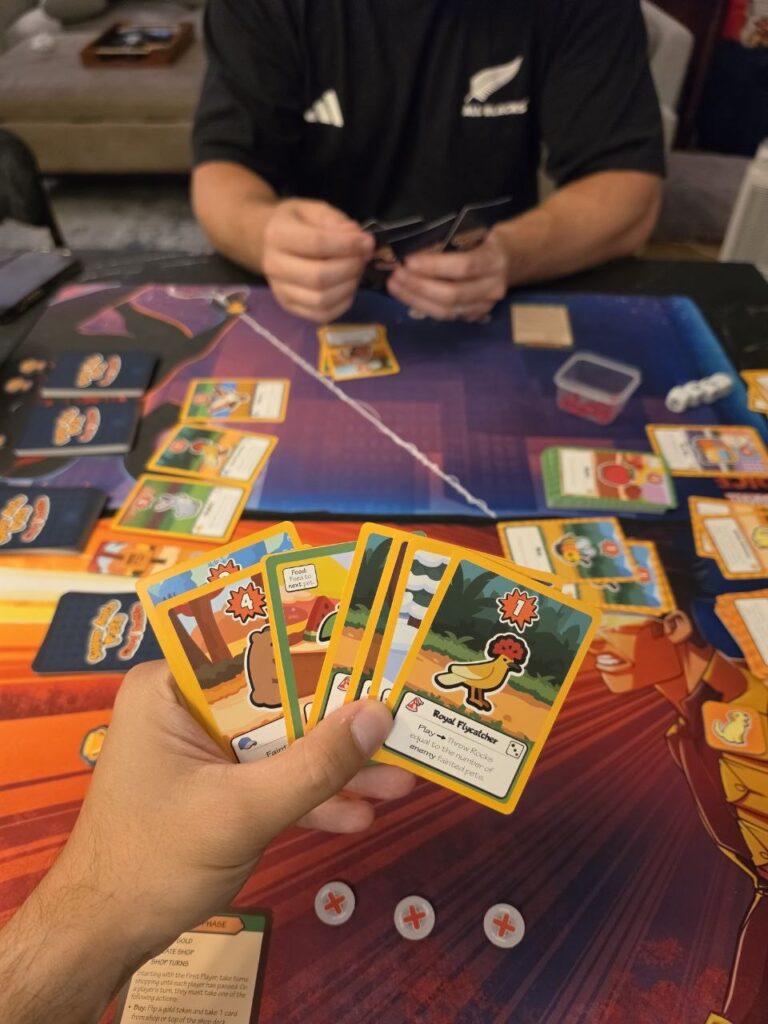
Super Auto Pets Card Battle is the tabletop adaptation of the popular video game that somehow flew under my radar. Though I've never played the digital version (and I definitely will now), I've been told the card game is a faithful adaptation in all the best ways.
My appetite for auto battlers is starting to grow, and this one fell into my lap at just the right time. Besides, who couldn't be wooed by adorable animals duking it out on colorful cards?
Pet Friendly
Super Auto Pets Card Battle plays over six rounds,…
There's something weirdly satisfying about watching a plan fall apart. You carefully chose a card, after considering what has already been played. You convinced yourself that everything will be fine, until everyone reveals their cards and the numbers fall into place. Suddenly you're collecting a whole bunch of negative points. It's simple, but a lot of fun. All you have to remember is that 6 Nimmt! by Wolfgang Kramer from Amigo, with art by Franz Vohwinkel.
BSL Games bringt mit „Prag im Verborgenen“ die deutsche Erstausgabe von „Prague Unseen“ heraus, einem tschechischen Worker-Placement-Eurogame von Jindřich Pavlásek, Michal Peichl und Petr Vojtěch. Die deutsche Ausgabe kam laut Die Spieledinos zur Saison der SPIEL Essen 2026 in den Handel, zum ersten Mal überhaupt ist das Original damit auf Deutsch verfügbar. Dass ein tschechisches Eurogame überhaupt diesen Sprung auf den deutschen Markt schafft, ist für uns schon allein deshalb eine Meldung wert.
Vier Fraktionen gegen das Hochwasser
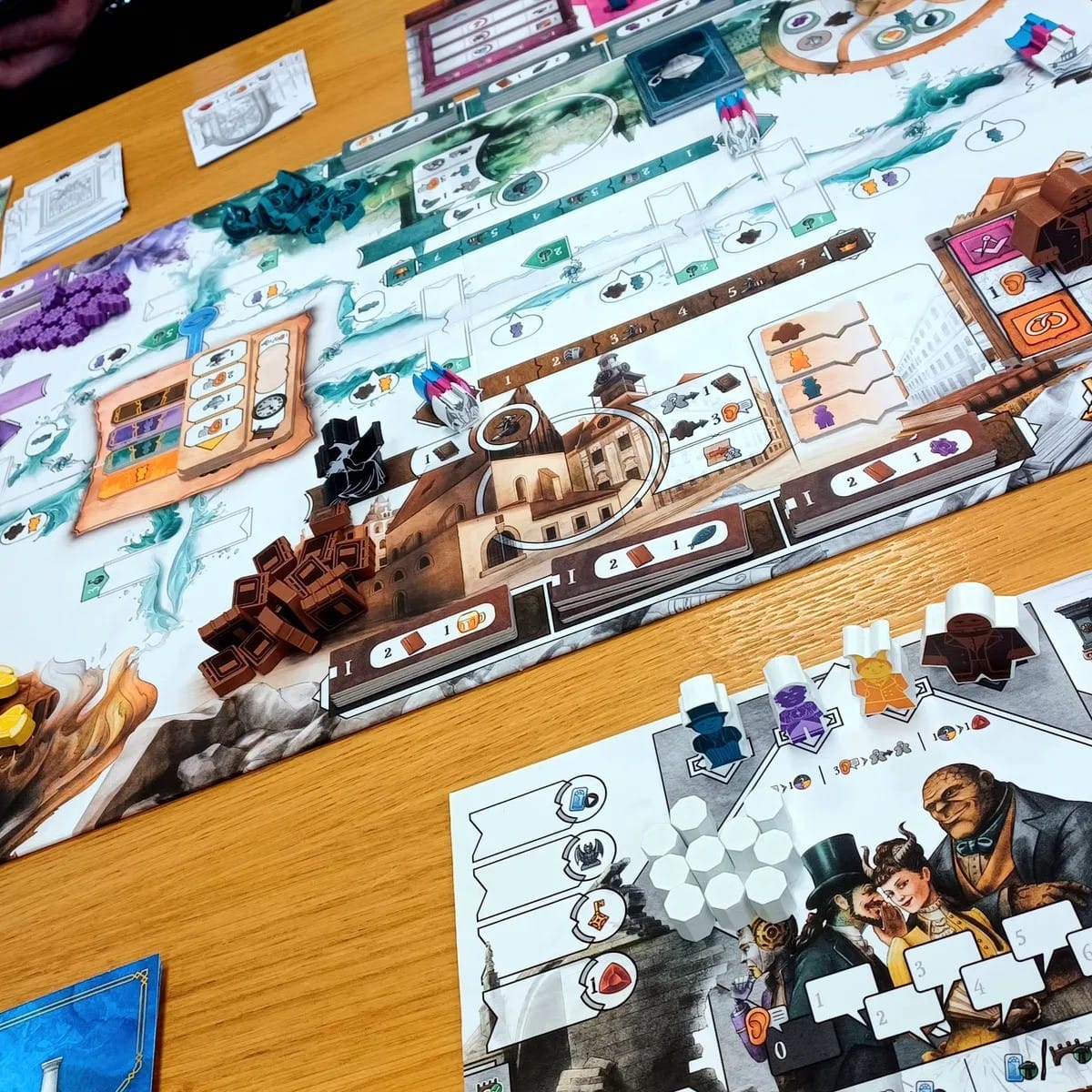
Thematisch steckt „Prag im Verborgenen“ tief in der Stadtmythologie: Laut BoardGameGeek spielt es im mythischen Prag des 19. Jahrhunderts, in dem Fabelwesen frei durch die Straßen ziehen. Gespielt werden vier Fraktionen, hilfreiche Golems, listige Hornträger, die den Reichtum der Stadt kontrollieren, geschickte Roboter und eigenwillige Vodniks (Wassergeister der slawischen Sage), die gemeinsam die Vltava beruhigen und das überflutete Stadtzentrum wiederaufbauen sollen. Jede Fraktion bringt dabei laut BGG eigene, einzigartige Fähigkeiten mit, eine Gleichmacherei zwischen den vier Seiten gibt es hier also nicht. Der Kampf um Einfluss läuft über vier Stadtviertel, Gebietsmehrheiten entscheiden laut BGG-Mechanik-Liste mit darüber, wer am Ende welchen Teil der Stadt kontrolliert. Dazu kommen laut BGG-Beschreibung vier eigenständige „Mini-Spiele“, die jeweils ein Stück Prager Sagengeschichte nacherzählen, statt nur eine einzelne große Regel durchzuziehen.
Ein Spielplan, der mit jeder Partie wächst
Mechanisch handelt es sich um ein Worker-Placement mit vier unterschiedlichen Arbeiter-Typen (BGG nennt die Mechanik explizit „Different Worker Types“), die laut Cliquenabend je eigene Aktionsmöglichkeiten freischalten. Die Besonderheit: Das Spielfeld entsteht erst während der Partie, durch den Wiederaufbau entstehen laut Die Spieledinos „immer neue Einsatzfelder, sodass sich der Spielplan nach und nach entwickelt und keine Partie der anderen gleicht“. Mechaniken, die den Spielplan erst während der Partie aufbauen, sind unter Eurogames kein Novum, die enge Verzahnung mit der Prager Mythologie macht den Dreh hier aber eigenständig. Einen Solo-Modus gibt es laut BGG-Mechanik-Liste und dem BSL-Shop ebenfalls, Details zur Automa-Mechanik nennt aber keine der vorliegenden Quellen. Auch dazu, wie sich die vier Fraktionen zu zweit im Vergleich zu viert spielen, sagt keine Quelle etwas.
BSL Games bringt ein tschechisches Nischenspiel
Für uns ist „Prag im Verborgenen“ auch deshalb bemerkenswert, weil BSL Games bislang in unserer Berichterstattung noch nicht vorkam. Die deutsche Ausgabe kostet laut BSL-Games-Shop 54,95 Euro und ist aktuell nur als Vorbestellung zu haben, ein konkretes Lieferdatum nennt der Shop nicht. Zum Vergleich: In den USA vertreibt Capstone Games den Originaltitel für 69,99 US-Dollar, derzeit ebenfalls ausverkauft.
Eckdaten zu Prag im Verborgenen
Spielerzahl: 1 bis 4
Spielzeit: rund 120 Minuten (BGG nennt exakt 120, Die Spieledinos 90 bis 120)
Alter: ab 14 Jahren
Designer: Jindřich Pavlásek, Michal Peichl, Petr Vojtěch
Verlag: Albi (Original), BSL Games (deutsche Ausgabe)
Preis: 54,95 Euro (deutsche Ausgabe, Stand 31.10.2026)
Komplexität: 3,21 von 5 (BoardGameGeek)
Lohnt sich der Blick nach Prag?
Mit einem BGG-Gewicht von 3,21 und rund zwei Stunden Spielzeit richtet sich „Prag im Verborgenen“ für uns klar an Kennerinnen und Kenner, nicht an den schnellen Spieleabend. Wer wachsende Spielpläne und eigenständige Fraktionsfähigkeiten mag, bekommt hier zudem ein Setting, das wir angenehm abweichend von den üblichen Mittelalter- und Fantasy-Kulissen finden.
Reiner Knizias Legespiel Rebirth (Mighty Boards/Cranio Creations, deutsche Ausgabe bei Frosted Games) hat beim Lucca Comics & Games Festival den Gioco dell'Anno 2026 gewonnen, Italiens seit 1991 vergebenen Hauptpreis für das beste Brettspiel. Die Jury gab die Entscheidung laut Brettspielbox am 30. Oktober 2026 bekannt, Rebirth löst damit den Vorjahressieger Botanicus ab.
Der dritte große Titel für Rebirth
Für uns ist das die nächste Bestätigung für ein Spiel, das wir schon mehrfach begleitet haben: Im Juli 2026 gewann Rebirth bereits das Kennerspiel des Jahres 2026 und machte Knizia damit zum ersten Autor, der alle drei Jury-Preise im Regal hat. Erst Mitte Oktober legte Frosted Games zur SPIEL Essen 2026 noch einen Promo-Pack zu Rebirth auf. Mit dem Gioco dell'Anno kommt nun die internationale Bestätigung hinzu, diesmal von Italiens traditionsreichstem Brettspielpreis statt von einer deutschen Jury.
Frosted Games doppelt im Rennen
Unter den Nominierten für den Gioco dell'Anno stand mit Thunder Road: Vendetta ein weiterer Titel, den Frosted Games auf Deutsch vertreibt, in diesem Fall ein chaotisches Würfelspiel mit Auto-Rennen und Schussduellen von Restoration Games statt Knizias ruhigem Legespiel. Komplettiert wurde die Nominierungsliste laut Brettspielbox durch Art Society (Giochi Uniti/HUCH!), Bomb Busters (Ghenos Games/Pegasus) und Echoes of Time (Cranio Creations/Feuerland), Rebirth setzte sich also gegen ein breites Feld durch. Den separaten Preis Board Game Designer of the Year 2026 holte sich derweil Paolo Mori. Nominiert waren daneben Bruno Cathala, Johannes Goupy, Tomáš Holek und auch Reiner Knizia, gewonnen hat er diesen Titel aber nicht.
Was Rebirth auf dem Tisch tut
Rebirth schickt zwei bis vier Spielende als Clananführer in ein wiederaufgebautes Schottland oder, auf der Spielplanrückseite mit eigenen Mechaniken, nach Irland: zwei Partien in einer Box, ein Wiederspielwert-Argument gerade für Vielspieler. Thematisch spielt das nach einer Reihe von Katastrophen: Frosted Games beschreibt das Setting selbst als hoffnungsvolles, postapokalyptisches Solarpunk-Thema, in dem die Clans ihre Gesellschaft im Einklang mit der Natur wiederaufbauen. Pro Zug legt man ein Plättchen aus dem eigenen Vorrat auf den Hexfeld-Plan, meist mit sofortiger Wertung, eine Partie dauert 45 bis 60 Minuten. Punkte bringen vor allem Gebietsmehrheiten um die Burgen des eigenen Clans, dazu Aufträge und Boni in der Endwertung. Der Reiz entsteht dabei weniger aus stillem Punkteoptimieren als aus dem offenen Wettlauf am Tisch: Wer eine Mehrheit früh sichert, kassiert die Wertung, riskiert aber, dass die Mitspielenden gezielt nachziehen und die Burg wieder streitig machen.
Komplexität und Umfang bleiben bewusst zugänglich: Auf BoardGameGeek liegt das Gewicht bei 1,98 von 5, ein Wert, der eher an Familienspiele erinnert als an die sonst dichtere Kennerspiel-Mitte. Dass die Jury Rebirth trotzdem als Kennerspiel auszeichnete, lesen wir als Zeichen, dass dort inzwischen auch leichtere, aber clever gebaute Titel zählen. Einen Solo-Modus gibt es nicht, gespielt wird ausschließlich gemeinsam zu zweit bis zu viert. Bei der Altersfreigabe weichen die Quellen leicht ab: Frosted Games nennt für die deutsche Ausgabe 8 Jahre, BoardGameGeek führt für das Original 10 Jahre. Bei dieser Kombination aus Spielzeit und Gewicht ist der Preis von 49,95 Euro für uns im oberen, aber angesichts der beidseitigen Karte und der Materialqualität noch vertretbaren Rahmen.
Eckdaten zu Rebirth
Spielerzahl: 2 bis 4
Spielzeit: 45 bis 60 Minuten
Alter: ab 8 Jahren (Frosted Games, deutsche Ausgabe) beziehungsweise ab 10 Jahren (BoardGameGeek, Original)
Designer: Reiner Knizia
Verlag: Mighty Boards/Cranio Creations (Original), Frosted Games (deutsche Ausgabe)
Preis: 49,95 Euro (deutsche Ausgabe laut Frosted-Games-Shop, Stand 31.10.2026)
Auszeichnungen: Kennerspiel des Jahres 2026, Gioco dell'Anno 2026
Wie viel Gewicht hat der Preis?
Für uns zeigt der Gioco dell'Anno vor allem, dass Rebirth über die deutsche Jury-Entscheidung hinaus trägt: Anders als ein nationaler Pöppel ist Italiens Hauptpreis ein Signal für den europäischen Markt insgesamt. Wer nach dem Kennerspiel-Erfolg noch gezögert hat, Rebirth selbst auf den Tisch zu bringen, bekommt mit diesem zweiten großen Preis binnen eines halben Jahres ein weiteres gutes Argument. Wer dagegen schon auf die Fortsetzung schielt: Der Kickstarter zu Rebirth II soll im Februar 2027 starten.
I recently started working on a prototype called Inheritance. What lead
to this idea was a game Buddhima showed me. It was a game from Taiwan in which
players had to close their eyes, and the sense of touch was used. I thought it
would be interesting to try making a game that limited sight, and used touch.
I had another prototype that did both, but it didn't seem interesting. It
Editor’s note: GAMA is one of the sponsors of the BoardGameWire newsletter and an advertiser on the site.
Hobby games trade organisation GAMA is facing another shake-up of its senior leadership, with interim executive director Melinda Prickett and board vice president Ross Thompson both announcing they are leaving their roles.
GAMA said its board of directors scheduled a “rapid response meeting” after being informed of Prickett’s departure on October 26, in an effort to determine its next steps – and would be taking immediate steps to appoint temporary leadership to oversee day-to-day operations.
Her departure leaves GAMA still hunting for a permanent executive director more than a year after its previous leader, John Stacy, announced his resignation.
A statement provided to BoardGameWire from GAMA board president Meredith Placko and secretary Tiffany Reid said, “Recruiting top talent for an executive position is a laborious process, and finding the right fit for our organization has taken longer than anticipated.
“As well, we have been forthright during public board meetings that the biggest reason for the delay was that we needed to get the foundations of the organization in better order, as we had been advised. To that end, Melinda Prickett did amazing work in bringing our financials from a planned deficit for the year, to a resounding success and raised more money than we anticipated for the organization.
“She also worked on creating stability amongst for the organization, the staff, and membership. Her work helped GAMA grow and succeed in the year she was with us.
“That being said, GAMA’s Board of Director’s had interviewed a strong candidate and we were in negotiations with them, but ultimately it did not work out. Because of that we will need to begin the search again.”
The pair said they could not comment on why Prickett’s notice period was so short, or whether she had been a formal candidate for the permanent executive director role.
They added that GAMA was currently working through a short list of people to bring in a new interim executive director “very soon”, adding that the goal was to “make sure GAMA Expo and Origins are a success, and the overall day to day running of the organization is met”.
The statement said, “To that end, the Board of Directors is currently seeking RFPs from firms that specialize in hiring executives in the trade association and member organization sectors. We feel it will be valuable to have the expertise of a company that knows how to recruit top talent in our search for an Executive Director.”
Placko and Reid said there was currently no estimate on when a permanent executive director would be appointed, but said an interim “to handle the most immediate needs of the organization should be decided upon very soon”.
Prickett’s exit comes after GAMA reported a significant improvement in its financial position during her tenure, with the organisation saying it had moved from a deficit budget at the beginning of 2026 to an expected surplus by the end of the year.
In a statement emailed to GAMA members, the board credited Prickett and treasurer Jamie Mathy with stabilising the organisation’s finances, as well as increasing member participation in events outside GAMA Expo and Origins Game Fair and developing new partnerships.
The statement said, “Though it is a bittersweet announcement to make, we are grateful for Melinda’s tireless work with our organization. She has been an incalculable force in leading GAMA during a transition period, setting us up for success in a way that is visibly reverberating through the organization.”
Prickett previously spent more than a decade at Girl Scouts of Ohio Heartland, including almost five years as chief operating officer, before being hired by GAMA last September to oversee its growing day-to-day operations.
But Davis’s contract ended in March, with Prickett subsequently confirming to BoardGameWire that she had taken over as interim executive director on May 21.
The latest leadership departure follows a period of significant change for the organisation’s board.
Ross Thompson, who was elected as vice president following Placko’s elevation to president, has now also resigned from the board after just over six months in the position.
Thompson only joined GAMA’s board in October last year, winning a special election to replace former secretary Monica Rasso, who had stepped down after five years as a director.
His resignation means the organisation will now hold its second special election for the same Media & Events board seat in little more than a year.
The latest departures also follow a turbulent period for GAMA’s board, which publicly apologised in March after some directors were accused of being rude and disrespectful towards members during a heated annual general meeting over proposed changes to the organisation’s bylaws.
GAMA did not give a reason for Thompson’s departure, but praised his work alongside Prickett in streamlining organisational processes and strengthening representation for its Media & Events members.
Thompson wrote on Facebook, “After being part of GAMA for many years, I was happy to lend my time, energy and experience to GAMA serving on the Board during the past year and a half. It was wonderful to be able to work with passionate people, identfying projects that needed support or upkeep, along with bringing new ideas to life.
“By far, GAMA is one of the best organizations to grow your business in the tabletop game industry. The connections made at events like GAMA Expo can revolutionize the way your work and that is truly special.
“There are things that need attention within GAMA, at the Board level and the Organization as a whole. I hope the membership, staff and current Board are able to continue to support GAMA’s mission and identify the obstacles it faces so the tabletop industry can continue to connect.
“I’ll still be around and am not going anywhere, but needed to end my time on the Board.”
The organisation said it would hold a special election to replace Thompson as Media & Events director, with nominations opening today and closing on November 8. Voting will take place between November 10 and 16, with the successful candidate serving until the next annual election in March 2027.
The changes come at a key time for the organisation’s professional trade show GAMA Expo, which has experienced rapid growth in recent years and is preparing to move from Louisville, Kentucky, to Baltimore, Maryland to accommodate rising demand.
The first Baltimore edition is scheduled for April 25 to 29 next year. A statement provided to BoardGameWire from GAMA board president Meredith Placko and secretary Tiffany Reid said, “We are currently working to ensure there is no visible impact on the preparations for GAMA Expo.
“GAMA staff has been diligent in doing an excellent job to bring us to our new home in Baltimore. They continue with the work that needs to be done, including finalizing programming, working with vendors on booth placement, and everything that needs to happen to make GAMA Expo a success!
“Melinda has led an amazing team, and even in her absence, they will continue with the work that needs to be done.”
GAMA’s other major convention, Origins Game Fair, is set to return to Columbus in June. That show has struggled to recover its pre-pandemic attendance, with visitor numbers falling 2.5% this year to 18,700 – the show’s first annual decline since Covid-19, and still below its 2019 record of 20,642.
The event could face further pressure next year from the launch of PAX Unplugged Houston, a new tabletop gaming convention scheduled to take place just 12 days after Origins, which could potentially force publishers and exhibitors to choose between the two shows.
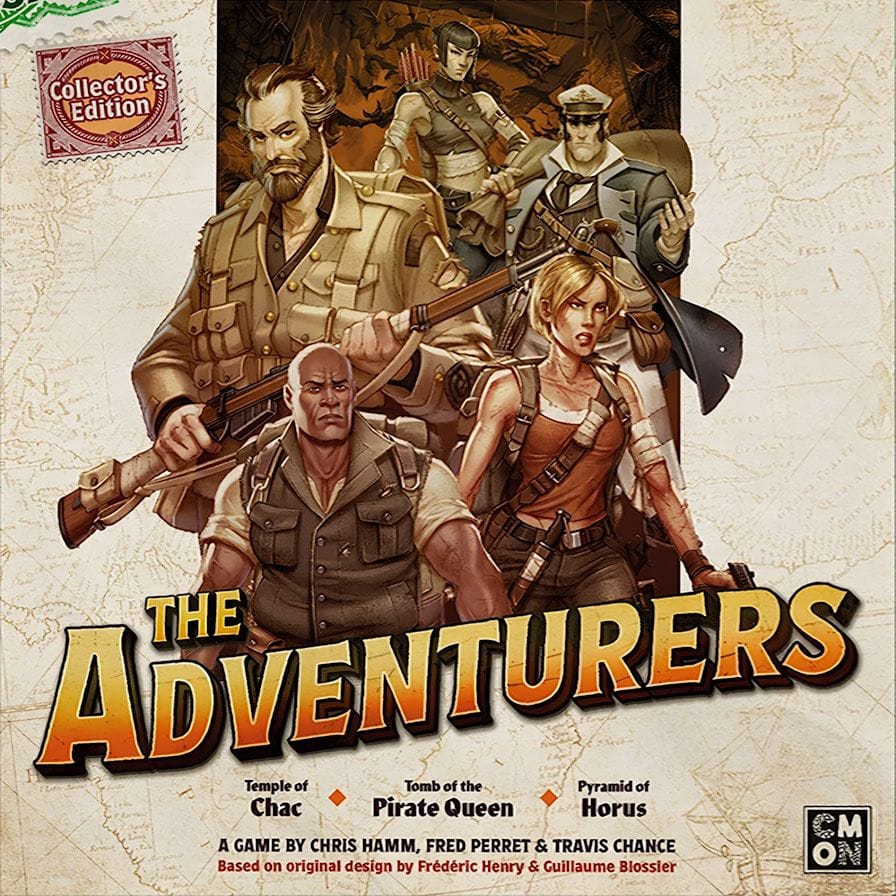
CMON übergibt dem langjährigen Fertigungspartner Top Games das Eigentum an „The Adventurers“, seinem seit Monaten verzögerten Vorbestellprojekt auf Gamefound. Das meldet BoardGameWire. Im Gegenzug übernimmt Top Games die verbleibenden Produktions- und Versandkosten, CMON bleibt laut gemeinsamer Erklärung weiter unterstützend an Bord. Die Spiele sind nach Angaben beider Unternehmen bereits produziert, im Werk verpackt und versandbereit. Für die deutschen Unterstützerinnen und Unterstützer der im März 2025 gestarteten Kampagne ist das der konkreteste Schritt seit Monaten in Richtung Auslieferung, wann die Pakete tatsächlich ankommen, sagen CMON und Top Games nicht.
Was der Deal für die wartenden Unterstützer bedeutet
CMON hatte die Gamefound-Vorbestellung im März 2025 gestartet: neue Auflagen der beiden Reihenklassiker plus den neuen dritten Teil „The Adventurers: Tomb of the Pirate Queen“, ursprünglich für Dezember 2025 angekündigt. Schon einen Monat später kündigte CMON Entlassungen und einen Stopp neuer Kampagnen an, aus Sorge vor den damals unberechenbaren US-Einfuhrzöllen. Die Lieferung von „The Adventurers“ blieb seither offen, zusammen mit acht weiteren Crowdfunding-Kampagnen, die laut CMON mehr als 14 Millionen Dollar an Unterstützerverpflichtungen ausmachen, darunter „DC Super Heroes United“ und „DCeased“, sowie drei weiteren Vorbestellungen, zu deren Wert die Quelle keine Zahl nennt. Einen Liefertermin für die deutschen Unterstützer haben CMON und Top Games nicht genannt, und ob die Übergabe auch Stretch-Goal-Erweiterungen und Add-ons der Kampagne umfasst oder nur das Grundspiel, sagen beide Unternehmen ebenfalls nicht. Dass ausgerechnet „The Adventurers“ jetzt den Weg zu den Kundinnen und Kunden findet, ist für alle übrigen Wartenden immerhin ein Signal, dass CMON Lösungen für den Rückstau findet, wenn auch nicht aus eigener Kraft.
Die Spielereihe hinter The Adventurers
Die Reihe stammt von den Autoren Guillaume Blossier und Frédéric Henry und begann 2009 mit „The Adventurers: The Temple of Chac“ bei AEG und Dust Games, 2011 folgte „The Adventurers: The Pyramid of Horus“ bei Dust Games und Fantasy Flight Games. CMON belebte beide Titel für die Gamefound-Kampagne neu und ergänzte sie um den dritten Teil, die Sammelausgabe führt laut BGG alle drei über ein gemeinsames Kernsystem für Abenteurer und Ausrüstung zusammen. Top Games selbst ist dabei kein Neuling im CMON-Kosmos: Der Fertigungspartner arbeitet seit 2009 in der Tabletop-Fertigung, seit 2018 mit eigener Kunststofffabrik in Dongguan, und war laut BoardGameWire schon an mehr als einem Dutzend CMON-Spielen beteiligt, etwa an „Cthulhu: Death May Die“, „Massive Darkness 2: Hellscape“ und „Zombicide: Undead or Alive“. Seit wann genau die Zusammenarbeit mit CMON selbst läuft, nennt die Quelle nicht.
Ein Jahr der Restrukturierung
Der Tausch ist das jüngste Kapitel einer Sanierung, die wir seit Januar 2026 begleiten. Für 2024 und 2025 weist CMON zusammen fast 23 Millionen Dollar Verlust aus, der Umsatz brach von zuletzt über 37 Millionen auf 9,9 Millionen Dollar ein. Die Belegschaft wurde halbiert, neue Kampagnen blieben gestoppt. Im Sommer warnte CMON vor einem „anhaltenden strukturellen Abschwung“ und suchte frisches Kapital von außenstehenden Investoren, Anfang September wurde das bekannt, Ende des Monats stand die Kapitalerhöhung über rund 19 Millionen Dollar. Etwa 40 Prozent davon sind laut CMON für laufende Kosten wie Personal, Lizenzgebühren und Versand im kommenden Jahr reserviert, also genau für Fälle wie „The Adventurers“. Dass der Verlag trotzdem einen Fertigungspartner mit Eigentum entlohnt, statt die Auslieferung komplett selbst zu stemmen, zeigt, wie knapp der Spielraum auch nach der frischen Kapitalspritze bleibt.
Was wir davon halten
Für die wartenden Vorbestellerinnen und Vorbesteller zählt am Ende nur, dass die Pakete verschickt werden, und ein Schritt in diese Richtung ist das hier erkennbar. Uns fällt trotzdem auf, dass CMON dafür ein Stück Eigentum abgeben musste: Frisches Kapital allein hat offenbar nicht gereicht, um den Rückstau aus eigener Kraft aufzulösen. Und solange kein Lieferfenster genannt wird, bleibt „versandbereit“ bei CMON vor allem eines: eine Momentaufnahme, keine Zusage. Ob sich das Muster bei den übrigen offenen Projekten wiederholt, dürfte sich erst im nächsten Quartalsbericht zeigen.
Final Titan als taktischer Auto-Battler von Richard Garfield zu bezeichnen ist zweifach nur die halbe Wahrheit. Kommt mit auf meiner Entdeckungsreise zu einem Spiel, das ich als einen meiner absoluten Höhepunkte der SPIEL 2026 in Essen bezeichnen möchte. Dabei ist es ganz nüchtern betrachtet, nur ein Würfelduell. Aber eines, das voller Emotionen steckt.
Erstmalig hatte ich von Final Titan im Vorfeld meiner SPIEL 2026 Recherche nach aussergewöhnlichen Neuheiten in einem Dice Tower Vorschau-Video mitbekommen, dass es dort mehrfach erstaunlich hoch bewertet wurde. Der Autorenname Richard Garfield zieht natürlich und weckte auch bei mir Neugier. Aber eventuell ist es auch nur der Nachhall einer erstaunlichen Persönlichkeit, die uns Magic The Gathering gebracht hat. Das habe ich übrigens wie fast alle Trading Card Games nie gespielt, weil mir der Sammelaspekt und der Deckbau fernab des Soieltisches nicht zugesagt haben.
Mit Mindbug konnte ich in seiner verdichteten Art auf wenige Karten in meiner Erstpartie nicht recht warm werden, weil mir die spielentscheidenden Keywords nicht eingängig genug waren. Und auch Keyforge habe ich trotz des neuen Druckkonzepts, das damit in einem Deck alles möglich sein konnte, nach dem Starterset nicht tiefer erforscht. Die Idee fand ich damals besser als das Spielgeschehen an sich.
Umso überraschender, das mir Final Titan so viel Spaß macht. Aber eventuell ist dafür auch der zweite Autor Christian Kudahl verantwortlich, der mit Agent Avenue die Essenz des „Einer teilt, der andere wählt“-Mechanismus in einem herrlich taktisch spannenden Ich-denke-dass-Du-denkst-Mindfuck herausgearbeitet hat. Jetzt also Final Titan, das mir Marvin von Nerd Labs auf der Neuheitschau am Messe-Mittwoch euphorisch überzeugend vorgestellt hat.
Ich war skeptisch, ob ein Auto-Battler mit bewusst seichtem Spielablauf mich überzeugen würde. Angeblich sollte das Spielgefühl mit jeder Partie wachsen und zum regelrechten Sog werden. Ich wollte das selbst erleben und so steuerte ich direkt am Messe-Freitag um kurz vor 10 Uhr den Stand von Nerd Labs in Halle 5 an, um Final Titan zu spielen. Eventuell gab es ja noch Restposten der Ultimate Deluxe Version zu kaufen, aber bei so einem Spiel sollte die normale 40-Euro-Version eigentlich völlig ausreichen. So redete ich mir im Vorfeld zumindest ein.
Lauscht im Audio-Mitschnitt, wie ich die Spielerklärung und ebenso unsere launige Vierertruppe aus Messe-Zufalls-Mitspielern erlebt habe. Wir haben unsere Champions gegenseitig angefeuert und das Mitbieten auf die Mitspielerkämpfe ohne eigene Beteiligung war ebenso spannend. Final Titan spielte sich dabei weitaus taktischer als ich dachte. Um als letzter Champion zu gewinnen, muss man das richtige Timing abschätzen, wann man was wagt und wann eher nicht. Die Kämpfe gehen superflott und machen Spaß, weil dabei so viel und so viel Unerwartetes passieren kann. Hier kam bei uns echte Arena-Stimmung auf, die ich bei King of Tokyo wegen des gemächlichen Spannungsaufbaus vermisst hatte. Bei Final Titan geht es die ganze Zeit zur Sache und das macht es für mich besonders und spielenswert.
Eigentlich reicht die Grundbox für 40 Euro völlig aus. Eigentlich wollte ich die nach meiner Anspiel-Session mit der auf zwei Champions verkürzten Partie auch kaufen und dabei auf Sleeves verzichten. Eigentlich, so hatte ich es mir vorgenommen. Weil dann gab es trotz fortgeschrittener Messezeit unerwartet doch noch die Ultimate Deluxe Version und die passenden Sleeves dazu und ich konnte mit Karte diesen Spontankauf zahlen. Tja, was soll ich sagen? Der Rest ist Geschichte und mein persönliches Messegeschenk, das ich mir gegönnt habe, fernab aller Vernunft. Muss auch mal sein und das ist auch gut so.
Wie die Ultimate Deluxe Version aussieht, mit ihrem besonders schimmernden und kräftigen Druck dank UV-Lack-Veredelung mitsamt den dickeren und größeren und ebenfalls mit UV-Lack-Veredelung versehenen Pappcountern, das könnt Ihr in meiner Unboxing-Bildergalerie sehen. Aber laßt Euch eines sagen: Rein spielerisch reicht das Grundspiel mit seinen 100 statt 135 Champions und doppelseitigen dünneren Pappmarkern locker aus. Für 40 Euro ist Euch dieser Draft-Battler, weil Ihr in einer regulären fernab einer Anfängerpartie Eure Champions passend selbst per Kartendraft zusammenstellt, ans Spielerherz gelegt. Aber ebenso wie das Kennerspiel des Jahres 2023, das viele schon längst verdrängt haben, könnte auch Final Titan die Meinungen spalten und so manchen von Euch kopfschüttelnd zurücklassen.
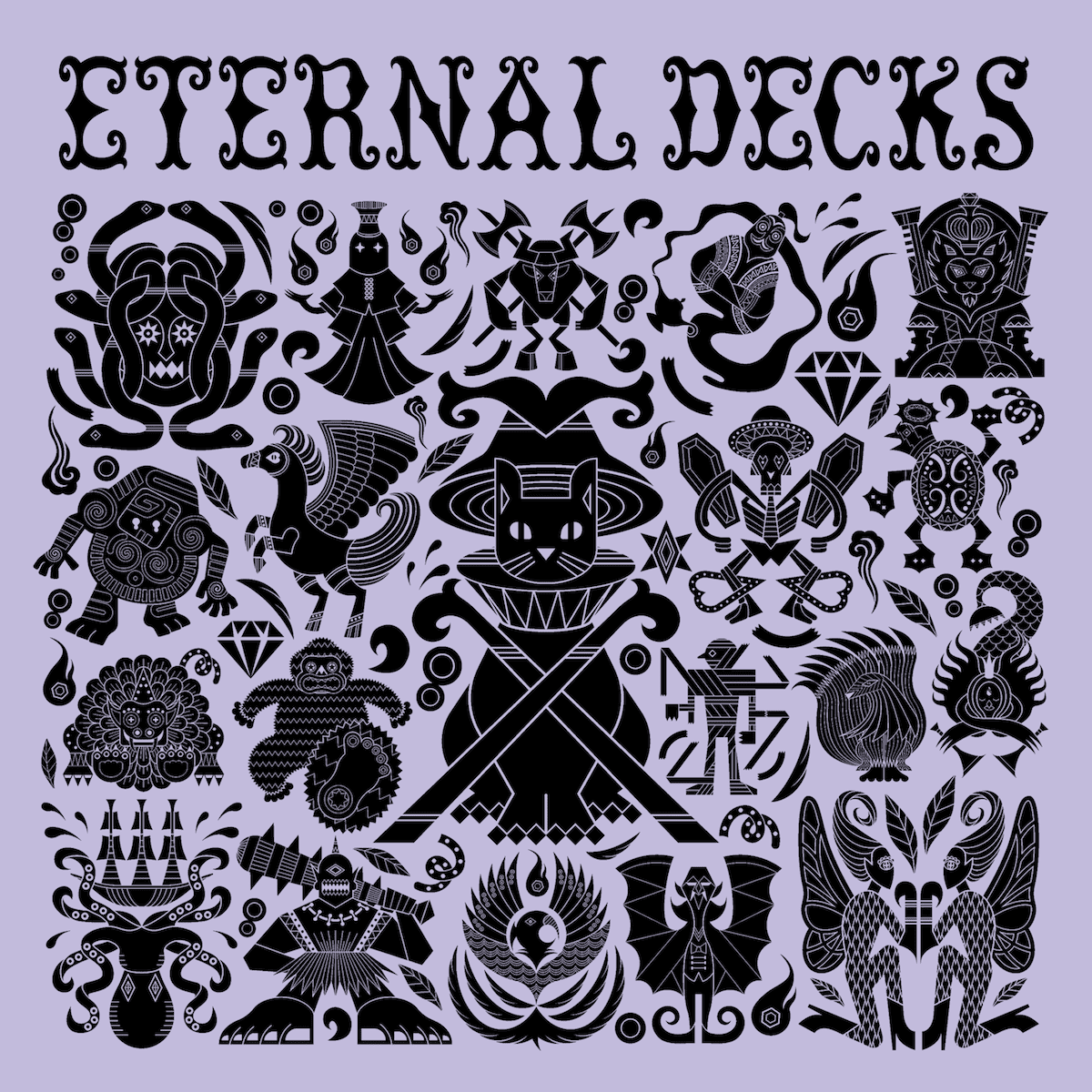
Strohmann Games bringt im Dezember 2026 mit Eternal Decks ein international bereits gut aufgenommenes kooperatives Kartenspiel aus Japan auf Deutsch, und zwar nicht als einfache Übersetzung: Laut Brettspiel-News erhält die deutsche Ausgabe eine komplett neu strukturierte Anleitung, ein überarbeitetes Insert und an Farbsehschwäche angepasste Farben.
Gemeinsam gegen die Uhr, mit eingeschränkter Kommunikation
Eternal Decks ist laut BGG-Beschreibung ein kooperatives Deckbau-Kartenspiel mit Kommunikationseinschränkung: Alle Mitspielenden gewinnen oder verlieren gemeinsam, sobald eine Person keine gültige Aktion mehr ausführen kann. Ihr startet mit nur fünf Karten im eigenen Deck und erweitert es im Spielverlauf durch Karten der „Eternals“, besonderer Charaktere mit je einem eigenen Achter-Kartendeck. Pro Zug bleibt genau eine Aktion: eine Karte ausspielen (aufs Feld, auf den Fluss oder über eine Fähigkeit), einen Juwel erzeugen, oder eine Karte an eine Mitspielerin oder einen Mitspieler abgeben. Beim Ausspielen gilt eine Einschränkung: In keiner der drei Feldreihen dürfen Karten derselben Farbe oder derselben Zahl direkt nebeneinanderliegen, je nach gespielter Stufe kommen weitere Einschränkungen hinzu. Juwelen heben die negativen Effekte der Eternals auf. Wie sich das Spiel zwischen zwei und vier Mitspielenden unterscheidet, insbesondere bei der Absprache über die drei gemeinsamen Feldreihen, sagt keine der vorliegenden Quellen. Laut einer Rezension von Punchboard bietet jede der sechs Stufen mehrere Schwierigkeitsstufen von Beginner bis Pro, nach dem Durchspielen aller sechs schaltet laut derselben Quelle ein „New Game+“-Modus mit zusätzlichen Varianten frei. Ob die sechs Stufen von Anfang an frei wählbar sind oder nacheinander in einer festen Reihenfolge freigeschaltet werden, sagt die Rezension nicht eindeutig. Eternal Decks ist laut BGG auch allein spielbar, wie sich die Solo-Partie von der kooperativen Runde in größerer Besetzung unterscheidet, verraten die vorliegenden Quellen nicht. Designer ist Hiroken, Illustration stammt von MUJUNSHA.
Was sich an der deutschen Ausgabe ändert
Die namensgebende Neuerung der deutschen Fassung ist laut Verlag die Barrierefreiheit: Strohmann Games erklärte gegenüber Brettspiel-News, die Ausgabe erhalte „eine komplett neu strukturierte Anleitung, ein überarbeitetes Insert und angepasste Farben, damit auch Menschen mit Farbsehschwäche gut spielen können.“ Welche konkreten Farben oder Symbole dabei geändert wurden und was genau an der Anleitungsstruktur neu ist, sagt die Quelle nicht näher. Bei einem Spiel, das laut eigener Beschreibung stark auf das Unterscheiden von Kartenfarben in den Feldreihen setzt, ist eine Farbsehschwäche-Anpassung aber kein kosmetisches Detail, sondern berührt einen Kernmechanismus des Spiels. Ob die Fähigkeitstexte der Eternals-Karten über Symbole oder über Fließtext laufen und ob dieser Text für die deutsche Ausgabe übersetzt wird, lässt sich aus den vorliegenden Quellen nicht klären. Zu Schriftgröße oder Kontrast der Zahlen und Farbflächen in den höheren, zusätzlich eingeschränkten Stufen sagt ebenfalls keine Quelle etwas.
Eckdaten zu Eternal Decks
Spielerzahl: 1 bis 4, mit Solo-Modus
Spielzeit: 30 bis 40 Minuten
Alter: ab 10 Jahren
Regelgewicht: 2,8 von 5 (laut BGG, 3.513 Bewertungen, Schnitt 8,18 von 10, Rang 469 gesamt)
Designer: Hiroken, Illustration: MUJUNSHA
Verlag: Tricktakers Games (Original), deutsche Ausgabe: Strohmann Games
Preis: rund 39,90 Euro (laut Brettspiel-News, Stand: 29.10.2026)
Termin: Dezember 2026
Für wen das was ist
International ist Eternal Decks längst kein Geheimtipp mehr: Über 3.500 BGG-Bewertungen bei einem Schnitt von 8,18 und Rang 469 unter allen Brettspielen sind für ein Koop-Deckbauspiel dieser Größenordnung ein deutliches Signal, auch wenn das für uns ein Hinweis bleibt, kein Gütesiegel. Designer Hiroken ist dabei kein Erstling: Er zeichnet laut BGG auch für das Stichspiel TRICKTAKERs (2021, erschienen bei Joyple Games/MTS Games/Portland Game Collective) und das Ablegespiel Eternal Sevens (ebenfalls bei Tricktakers Games erschienen) verantwortlich. Für deutsche Vielspieler, die kooperative Deckbau-Spiele mit Kommunikationslimit mögen, etwa in der Tradition von The Crew oder Hanabi, aber noch nicht zur englischen oder japanischen Originalausgabe gegriffen haben, ist der Dezember-Termin der naheliegende Einstiegspunkt. Ob die angepasste Farbgebung tatsächlich hält, was der Verlag verspricht, lässt sich erst mit dem fertigen Produkt beurteilen, als Ankündigung ist der Schritt aber bereits ein ungewöhnlich konkretes Bekenntnis zur Barrierefreiheit für eine deutsche Lokalisierung.
Stop whatever you’re doing. Just stop. I need to tell you about one of the weirdest, wildest, and most interesting board games I’ve played all year. Scratch that. Ever. That’s right. Ever.
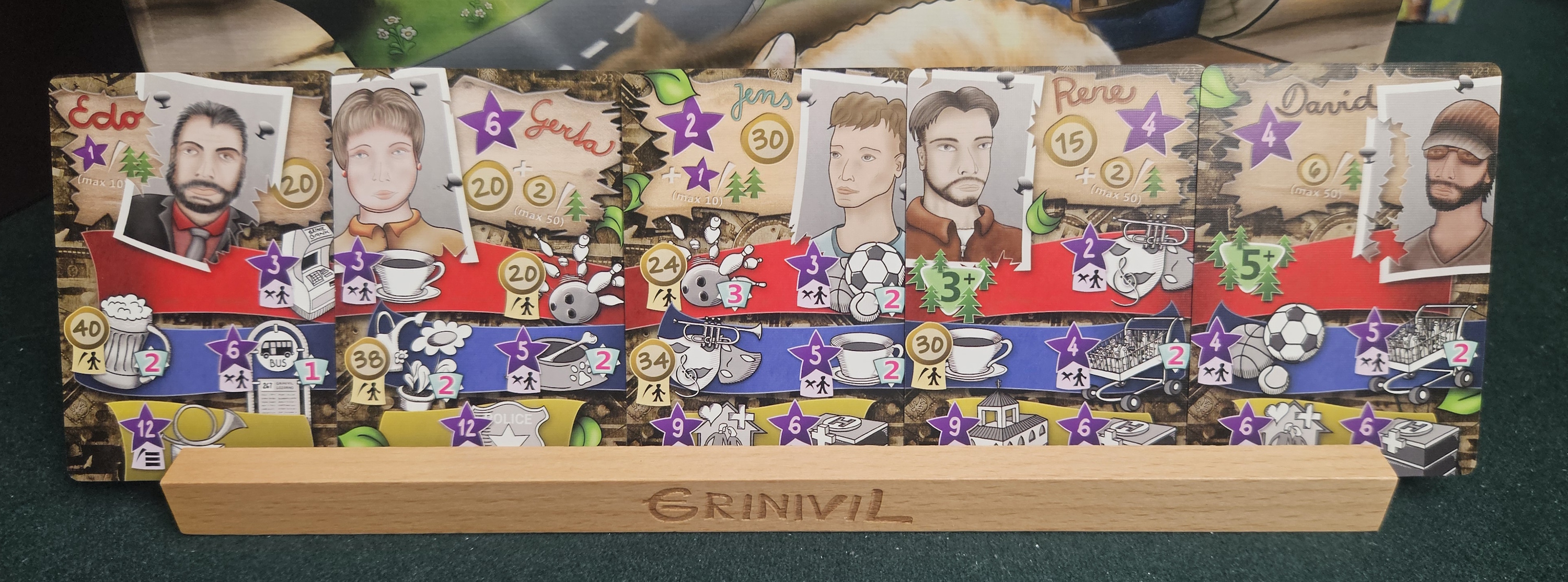
This is Grinivil. It was designed, illustrated, and published by Rudy Priecinsky. It’s tempting to lob a jab in there — “I can tell!” hardy har — especially once you get a look at the scattershot rulebook, the potato-headed character portraits, the mishmashed card layouts, the box itself… okay, as soon as you get a look at pretty much anything it has to offer.
But don’t make the easy joke. Set that aside. Because Grinivil is a gift from a parallel universe where Eurogames are never wrung dry through market testing and impersonal development, but instead allowed to blossom into bespoke artifacts that are equally uncanny and compelling and inventive. This is Grinivil. It’s breathtaking.
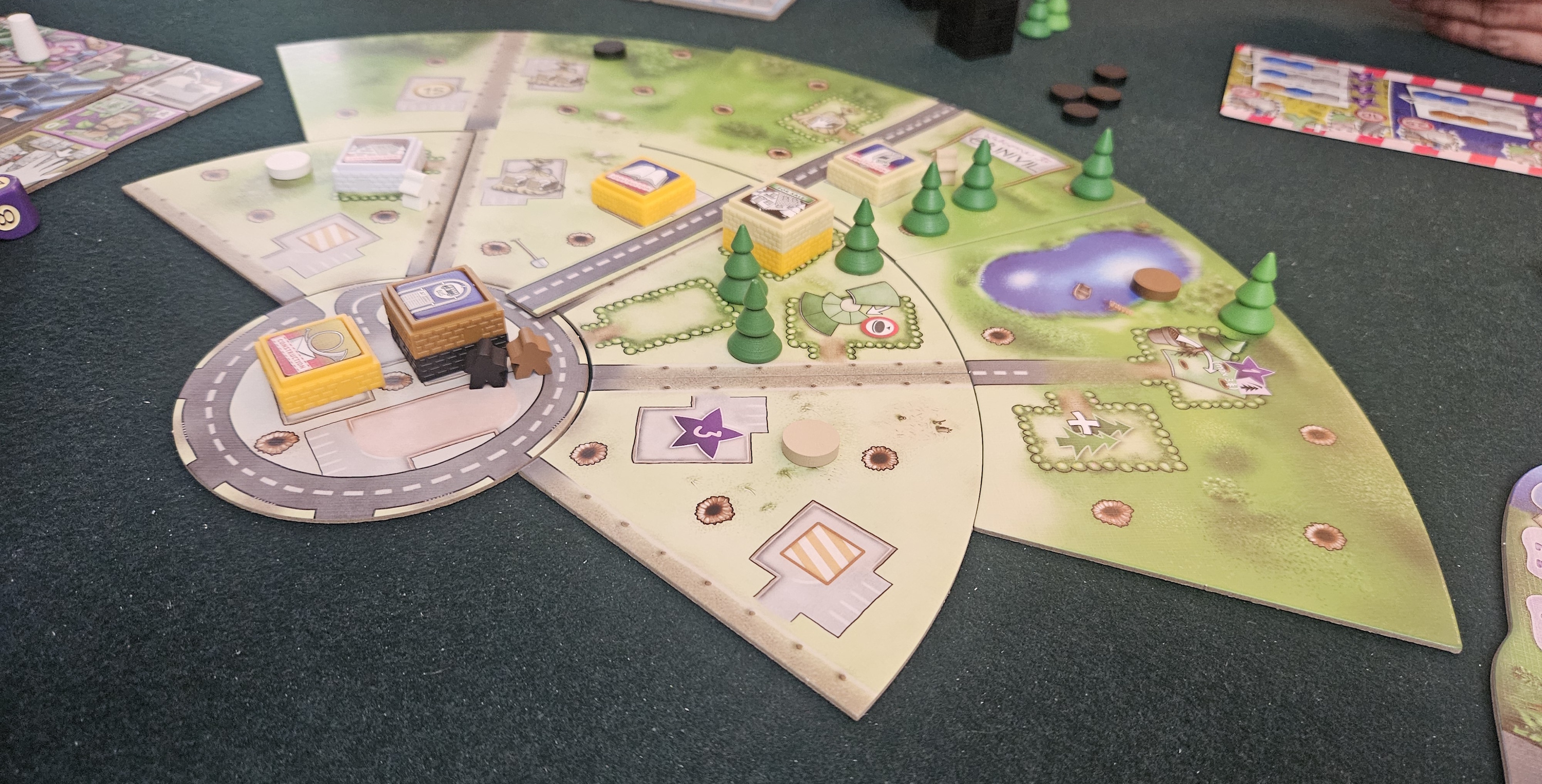
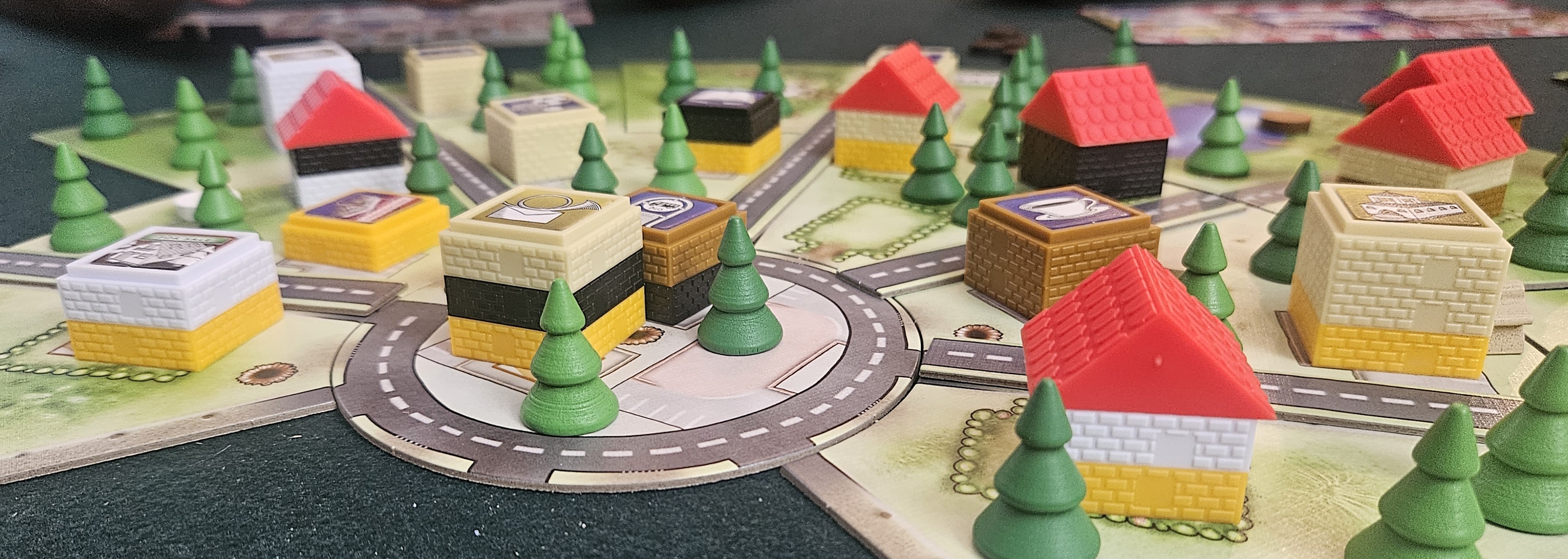
In its early stages, Grinivil is mostly empty lots.
When Grinivil begins, Grinivil — the town the board game is named after — has been thrown open to new development. As towns go, Grinivil is small. Actually, I’m not even sure it qualifies as small. The municipality has started construction on a few things, drawn at random, but they’re as yet unfinished. There are plots for houses and additional commercial spaces, but nobody has filled them. Even the trees have yet to be planted. If Grinivil were deposited in the Old West, they wouldn’t have the livestock to qualify as a one-horse town.
But where there’s a vacuum, there’s opportunity. As a developer, you’re here to buy and sell land, construct amenities, and finagle clients into houses.
It’s a normal enough pitch, in other words. Maybe even an unexciting pitch. There are plenty of board games about real estate, and Grinivil doesn’t sound all that far off from titles like Rebuilding Chicago, The Estates, or Magnate: The First City. Tough competition. Solid games. Good bones.
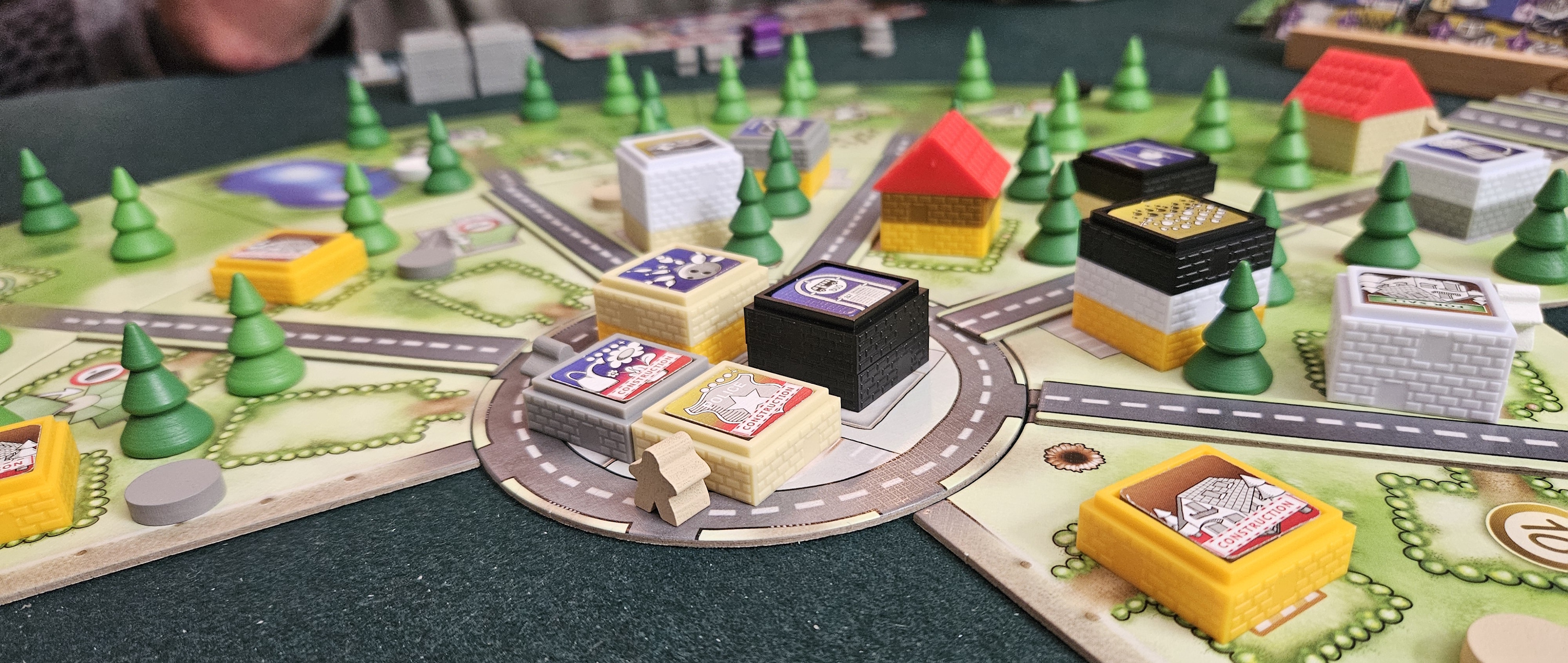
But it takes Grinivil all of ten seconds to set itself apart as those titles’ spiritual opposite. For one thing, there’s the way the game looks. And I promise I’m not about to ding it. Quite the opposite. Grinivil’s earliest state, when it’s nothing more than a traffic loop and a few partially-constructed buildings atop a single pizza-slice of land, is full of potential. You can see what it might become after some walls have been put up and a few trees have been planted.
What’s more, those walls and trees mean something. They signify investment. When you add a floor to a building, you mark it with a piece of your color. Now that isn’t just the second story of a bowling alley or the foundation of a house. It’s your share in the bowling alley. It’s your ability to profit off the sale of the home. Those trees are bumps in property value. That road, now paved, is a sign that a new portion of the town is open for business.
And it isn’t only your investments you’re interested in. It’s everybody else’s, too.
The Time Action Ring is a rondel. An amazing rondel.
Let’s approach it from another angle. Turns.
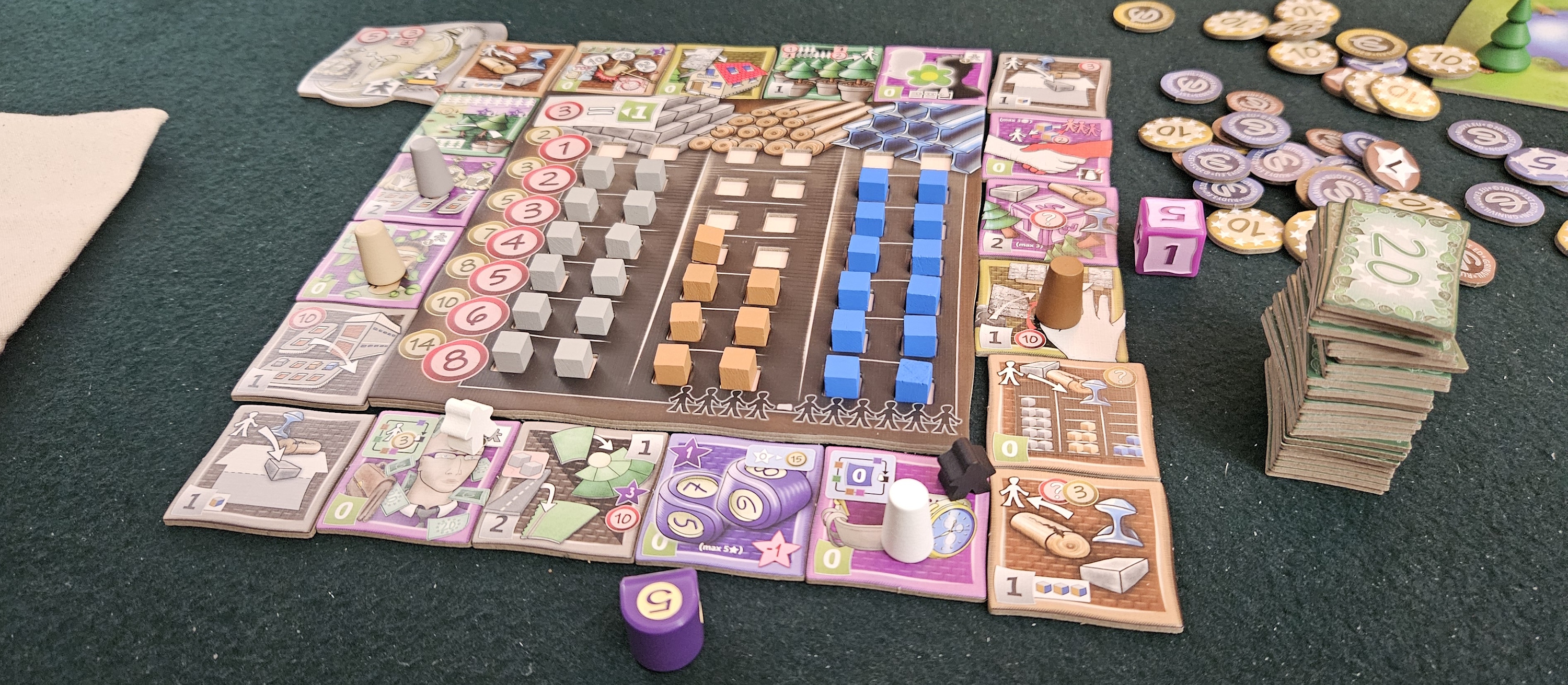
Turns in Grinivil take place on the Time Action Ring, also called the TAR. The TAR is a rondel. Starting at the top-left, you move your pawn clockwise around the TAR, stopping at any action you want to perform. You know. It’s a rondel. It behaves like most rondels.
There are a few wrinkles to this process. First and foremost, most actions, once completed, will move you forward an extra space or two. (Or three or four.) Sometimes this bypasses another action you were hoping to take. Fortunately, you can pay cold hard cash to move fewer spaces. If pouring that foundation will move you forward three spaces, therefore passing the space you were hoping to use next turn, you can pay some money to move a little less.
That’s not all. Unlike some rondels, which limit movement, here you’re allowed to visit any space. You can even circle the entire TAR in a single move if you so desire. The limitation is that passing Go will not award $200. In fact, the opposite is the case. Whenever you pass the space at the top left, you pay both taxes and your workers. Taxes, now, that’s a flat rate. But workers consume a few bucks apiece. If you don’t have any workers on the table, whether constructing a building or squatting on an ability space on the TAR, that’s not the biggest deal. But if you have three workers out, it suddenly behooves you to stretch your time on the TAR as much as possible.
And then there’s the real highlight: the actions themselves. Put simply, Grinivil offers some of the coolest actions I’ve seen put to a rondel. Some are fairly routine, like buying or selling resources, but others transform the state of the board in ways that are hard to describe without seeing them in action.
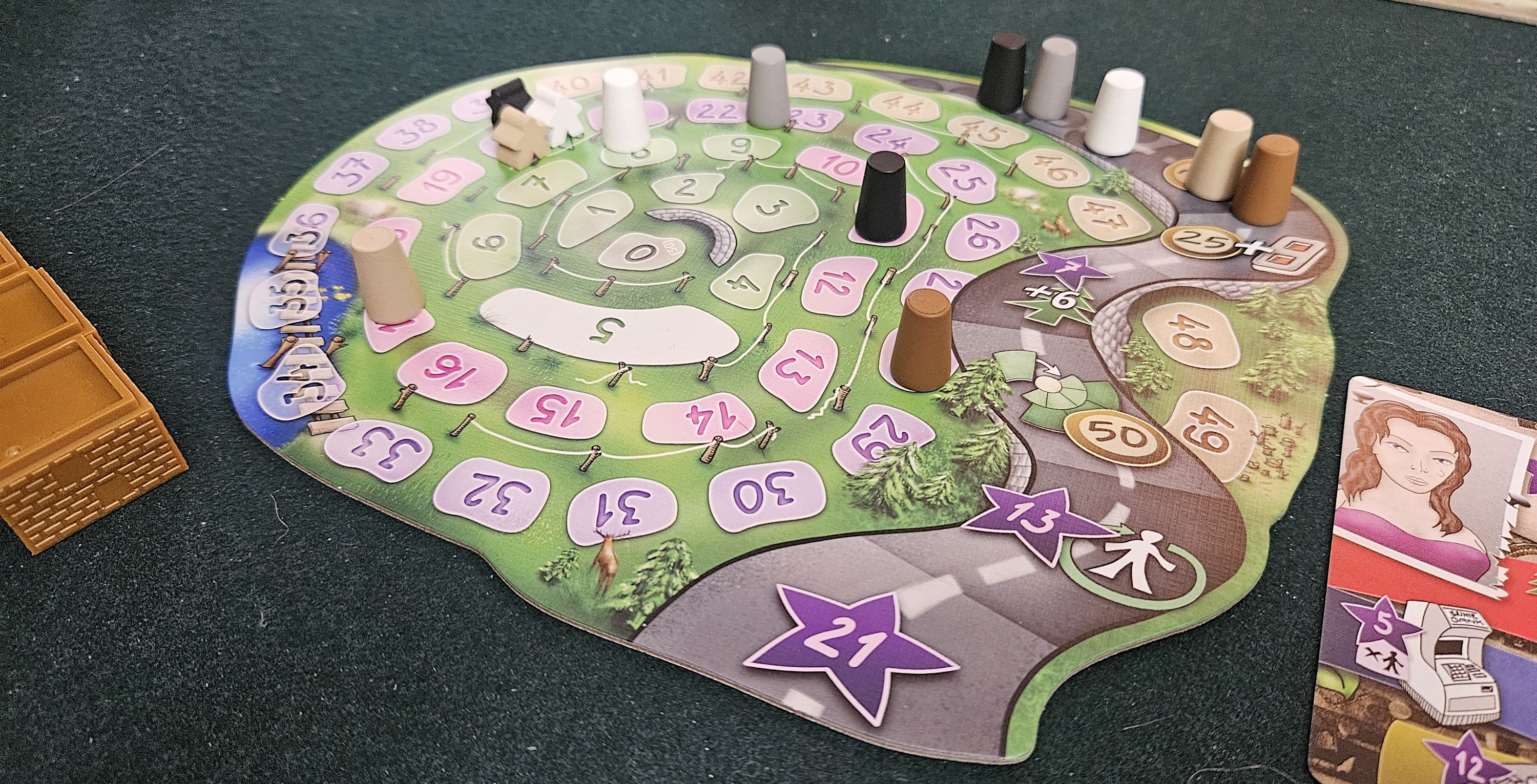
I’m not sure the score and road track had to be this, ah, eccentric.
You might, for example, add a wedge to the map. This costs some money and awards a few points. Far more importantly, it gives you ownership over that wedge. Basically, you’re speculating on land. Now whenever anybody wants to build on that land, they’ll be paying a premium for the opportunity.
Or you might turn victory points into cash. Points are the game’s objective, of course, but they don’t really matter until the end. So why not turn them in for walking-around money? This isn’t the first game to feature such an option, but it’s the only one where I’ve seen players accept that devil’s bargain. Sometimes multiple times. If you’re still short, you could also collect unemployment for all the workers who aren’t currently out there collecting a wage, or host an auction and collect the proceeds, or flip all that timber and concrete for more than you spent on it.
Or you could alter the rules altogether. This is mostly the domain of abilities, spots on the TAR that must be occupied by one of your workers. This uses up the worker — and you’ll have to pay them, of course — but gives you that space’s perk until you loop back around to it. To a one, these are ridiculous. There’s the Manager, who removes the need to spend extra time on the TAR. As in, that entire portion of the game is just deleted. Or there’s the Architect. She lets you use any resources when building rather than using specific materials, letting you pass off concrete monstrosities as homes or build a pet store out of nothing but cheap steel. So much for the game’s inventory management! The Banker gives you three coins per turn. Just gives them to you. The Ecologist — my group calls him Treesus — does something similar, adding periodic trees to your inventory.
Surprisingly, the most foundational action, construction, is anything but perfunctory. As you might expect, construction is where you spend materials to add a floor to the map. But it’s also so much more than that, inserting players into the overgrown thicket of incentives that is Grinivil’s principal draw. More on that in a moment.
It might sound like the efficacy of these actions is game-breaking, but in practice it really means that every decision carries considerable heft. On any given turn, you’re presented with a wide-open decision space between three or four tremendous opportunities. Sometimes a shortfall can be covered by having the right resources on-hand, and it isn’t unheard of for an action to become better thanks to a cash infusion. But the real cost is always paid in the opportunities you passed by on your way to something else.
As Grinivil develops, it becomes a minefield of overlapping interests.
Nowhere is this more evident than in the game’s residents. Grinivil, at its core, is about attracting newcomers to town. Each resident has a number of needs, some underlined in red, others more negotiable. When the game begins, you have two in-hand. There’s also a display of additional cards that can be acquired or swapped out.
Here’s an example. When you first sit down to play, you could be holding Miriam and Nela. Both are worth some points, but Miriam will pay a bunch of cash if her house is on a lot with many trees, whereas Nela is willing to pay a flat rate. Okay, simple enough. So Nela is easier to place on undeveloped land, right?
Sort of! Both also have some hard-coded requirements. Miriam won’t move in unless there’s a grocery store within three spaces of her new home and a bus stop somewhere in town. Nela, meanwhile, isn’t too picky about distance, but wants a pet store and a garden center. When placed, they also provide bonuses. If there’s a playground within two spaces, Miriam will award a few extra points. She’ll also pay a premium for a nearby garden center, giving her some overlap with Nela. For her part, Nela wants a library and a music venue. Deep breath: They also provide end-game bonuses. Miriam wants a hospital in town. Nela insists on a police station.
Here’s the thing. Call it a double-edged sword. Like everything in Grinivil, residents pose a certain hurdle. Their cards are, charitably, a mess of information. Less charitably, they’re just a mess.
But that mess, apart from being somewhat hard to untangle visually, is important, because it’s how everything gets evaluated. When you house a resident, each of those boxes tells you something different. The top box is how many points and coins they give you right away. But everything underneath that, all three boxes of potential rewards, are awarded to whomever owns the thing in question. If I built the garden center for Nela, and then you later welcome Miriam to town, I get the cash for her proximity to the garden center even though you played the card. If I own two of the hospital’s three floors, then two-thirds of Miriam’s fifteen end-game points are mine, even if I never so much as glanced at her until the final tally.
This makes Grinivil a stern plaything indeed, but it’s always fair in its unfairness. There’s hidden information, but not so much that it can’t be overcome with watchfulness and shrewd investments. There are few guardrails, but open-ended actions and a few dashes of chance make it possible to wrestle out of tight spots.
I love everything about this.
Which isn’t to say that these rough edges can’t prove frustrating, especially during the first play or two. Once, a player’s early investment in a water treatment plant — and we’re talking about their third or fourth action, maybe fifteen minutes into a two-hour session — translated into a game-winning swing when a half-dozen residents all insisted that their town have potable water.
The beauty of Grinivil, though, is that this was entirely our fault. The table’s fault, I mean. Mine. My co-players’. Because as soon as that rival invested so much in clean water, we should have shifted our priorities. No more residents who care weirdly a lot about their drinking water being certified amoeba-free! Only cop-loving residents, or residents who insist on accessible hospitals, or residents who hang out at churches and retirement communities.
Or, perhaps, we could have ensured that our game-ending tally was dwarfed by residents whose earlier payouts were sufficient to overcome any final swings. There are many ways to earn points in Grinivil, and just about as many ways to invest one’s attention and money.
In all cases, though, this is a game that benefits from both experience and table-talk. It’s a game where it’s not only not impolite, but necessary to say, “Hey, let’s stop attracting so many residents who love the aroma of water being treated.” In that sense, Grinivil is a game about cutting through the clutter to see what’s really important. (And boy howdy is there clutter, hardy har!) It’s about reading the state of the table, about observing which properties are likely to pay off big and which might only be worth a little bit here and there. It’s about watching your opponents and knowing when to feed the animals and when to hold back. Sometimes, it’s even about snaking somebody’s investment by paying a pittance to slap a roof atop their house and hustle one of your residents inside before they can protest.
As more people move in, costs go up. Sorry. Them’s the rules.
I like a polished game. But we’ve reached the point where too many games are polished. Some are so polished, I’d say, so devoid of rough edges, that there’s nothing left to snag one’s attention.
Grinivil is the other thing. Snaggy and shaggy. Some of its actions don’t have immediate utility; others are so potent that it’s impossible to choose between them. Sometimes a corner feels too painted-in. Its art is, um, undeniably not crafted by a plagiarism engine. Personally, I like how it looks. Not only the town, which is gorgeous, but the wackadoo resident cards. Just look at those nerds. I love them like my own ex-girlfriends.
For all of that — or more likely because of it — Grinivil is captivating. As in, it captures and holds one’s attention the way no number of over-smoothed experiences possibly could. It grabs your elbow, shows you the dance floor, and asks you to move. Then it probably shouts at you a little bit, before apologizing and rumpling your shirt and tucking a buck into your back pocket. No matter. This artifact, this singular vision, this gift from another dimension, is so spellbinding that it reminds me why I started playing board games in the first place.
A complimentary copy of Grinivil was provided by the designer and publisher.

 Anmelden


 Es gibt Spielsysteme, die man ohne Zögern als moderne Klassiker bezeichnet. Pandemic ist ein solches Meisterwerk. Matt Leacock hat den kooperativen Mechanismus über Jahre hinweg verfeinert und nebenbei das Legacy-Genre komplett neu belebt. Seine Spiele sind dramatische Erzählungen, die bis zur letzten Aktion fesseln.


 Die SPIEL Essen 2026 war an allen vier Tagen ausverkauft, belegte erstmals alle acht Hallen und knackte mit 230.000 Besuchenden den nächsten Rekord. Zwischen 2.012 Neuheiten, Lasertag und Spieleabenden in der ganzen Stadt stellt sich die Frage, wie lange das Wachstum noch gutgeht. Das Teilzeithelden-Team berichtet von Eindrücken und Highlights.