 Anmelden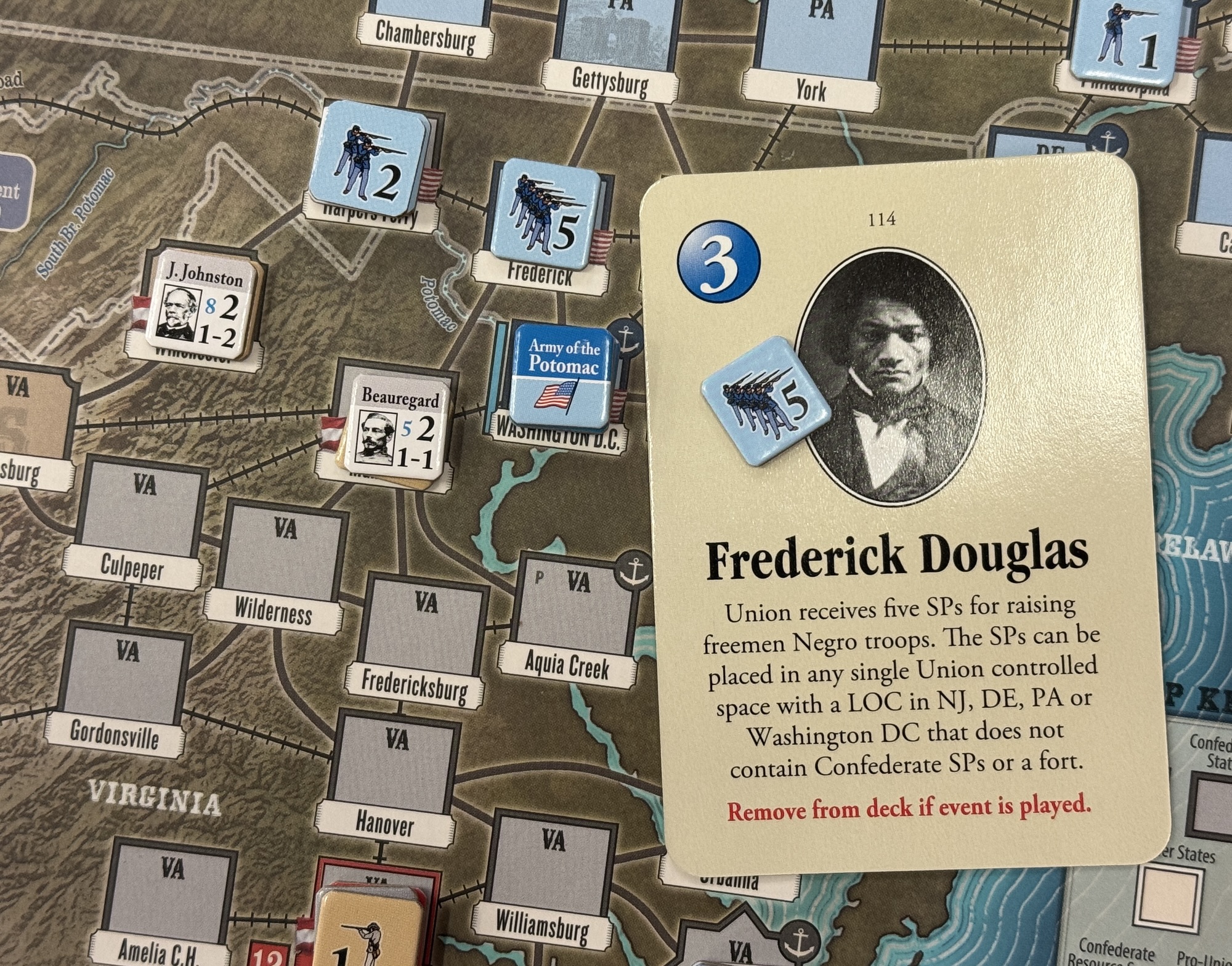


My Favorite Wargame Cards – A Look at Individual Cards from My Favorite Games – Card #89: Frederick Douglas from For the People 25th Anniversary Edition from GMT Games
With this My Favorite Wargame Cards Series, I hope to take a look at a specific card from the various wargames that I have played and share how it is used in the game. I am not a strategist and frankly I am not that good at games but I do understand how things should work and be used in games. With that being said, here is the next entry in this series.
#89: Frederick Douglas from For the People 25th Anniversary Edition from GMT Games

For the People is a strategic level Card-Driven wargame about the whole 4+ years of the American Civil War covering the conflict from Texas to Pennsylvania, from the firing on Fort Sumter to the end of the war at Appomattox Court House. Players take on the role of either President Abraham Lincoln or President Jefferson Davis and command armies, promote and relieve generals, conduct amphibious assaults, dispatch cavalry raids, and even battle incompetency and political intrigue among members of your own cabinet.
As a Card Driven Game, For the People includes a deck of strategy cards that are used for conducting campaigns and incorporating the many events and personalities of the war. The Confederate player can build ironclads, naval mines (torpedoes), submarines, conduct overseas purchases and work towards foreign intervention. The Union player can build up his naval blockade, his ironclad fleet, fight draft riots, secure the Border States and issue the Emancipation Proclamation. The cards are used in the classic sense of a CDG for either the Operations Points to fuel various actions or for the printed event. According to the designer Mark Herman, “The cards are designed to present the player with his political and operational options. The use of Strategy Cards as political instruments will slow the operational tempo of military operations. The converse is also true. Both sides spent the first year of the war, 1861, mobilizing and organizing their war efforts.
The game is extremely interesting and I recently had my first experience with it and very much enjoyed what it was that I was doing even though I really had little idea about my proper strategy for the Union and what it is that I should be focused on in the game.
The Frederick Douglas card from For the People really is a bit misnamed. While Frederick Douglas was a major influence for abolitionist activities as well as progressive thinking amongst the politicians of the North, the card really should have been named for the Negro soldiers who gave so much, their lives, their backs and their families, to volunteer and fight on the side of the Union during the American Civil War. The card’s text reads “Union receives five SP’s for raising freemen Negro troops. The SP’s can be placed in any single Union controlled space with an LOC in NJ, DE, PA or Washington, D.C. that does not contain Confederate SP’s or a fort”. This card gives a huge boost to the Union side especially if it comes up early in the game as Union SP’s on the board are spread out and defense of Washington is not as stout as it needs to be. In my recent play, I got this card in my opening hand and was able to place the 5 SP into Frederick, Maryland to add to the already existing 5 SP there. Along with the Army of the Potomac and its SP stationed in Washington, D.C. this effectively discouraged the CSA from invading the North and attempting to go for a capture of the capital. You will notice that the card is a 3 OP’s card, which is very valuable in and of itself, as most of the Union Generals at the start of the game, with the exception of Burnside, have a 3 Strategy Rating and require a 3 OP’s card to activate.
The issues of emancipation and military service were intertwined from the onset of the Civil War. News from Fort Sumter set off a rush by free black men to enlist in U.S. military units. They were turned away, however, because a Federal law dating from 1792 barred Negroes from bearing arms for the U.S. army (although they had served in the American Revolution and in the War of 1812). In Boston disappointed would-be volunteers met and passed a resolution requesting that the Government modify its laws to permit their enlistment.
The Lincoln administration wrestled with the idea of authorizing the recruitment of black troops, concerned that such a move would prompt the border states to secede. When Gen. John C. Frémont in Missouri and Gen. David Hunter in South Carolina issued proclamations that emancipated slaves in their military regions and permitted them to enlist, their superiors sternly revoked their orders. By mid-1862, however, the escalating number of former slaves, the declining number of white volunteers, and the increasingly pressing personnel needs of the Union Army pushed the Government into reconsidering the ban.
As a result, on July 17, 1862, Congress passed the Second Confiscation and Militia Act, freeing slaves who had masters in the Confederate Army. Two days later, slavery was abolished in the territories of the United States, and on July 22nd President Lincoln presented the preliminary draft of the Emancipation Proclamation to his Cabinet. After the Union Army turned back Lee’s first invasion of the North at Antietam, MD, and the Emancipation Proclamation was subsequently announced, black recruitment was pursued in earnest. Volunteers from South Carolina, Tennessee, and Massachusetts filled the first authorized black regiments. Recruitment was slow until black leaders such as Frederick Douglass encouraged black men to become soldiers to ensure eventual full citizenship. Volunteers began to respond, and in May 1863 the Government established the Bureau of Colored Troops to manage the burgeoning numbers of black soldiers.
By the end of the Civil War, roughly 179,000 black men (10% of the Union Army) served as soldiers in the U.S. Army and another 19,000 served in the Navy. Nearly 40,000 black soldiers died over the course of the war. Black soldiers served in artillery and infantry and performed all noncombat support functions that sustain an army, as well. Black carpenters, chaplains, cooks, guards, laborers, nurses, scouts, spies, steamboat pilots, surgeons, and teamsters also contributed to the war cause. There were nearly 80 black commissioned officers. Black women, who could not formally join the Army, nonetheless served as nurses, spies, and scouts, the most famous being Harriet Tubman, who scouted for the 2nd South Carolina Volunteers.
In the next entry in this series, we will take a look at Mob from Time of Crisis: The Roman Empire in Turmoil, 235-284 AD from GMT Games.
-Grant