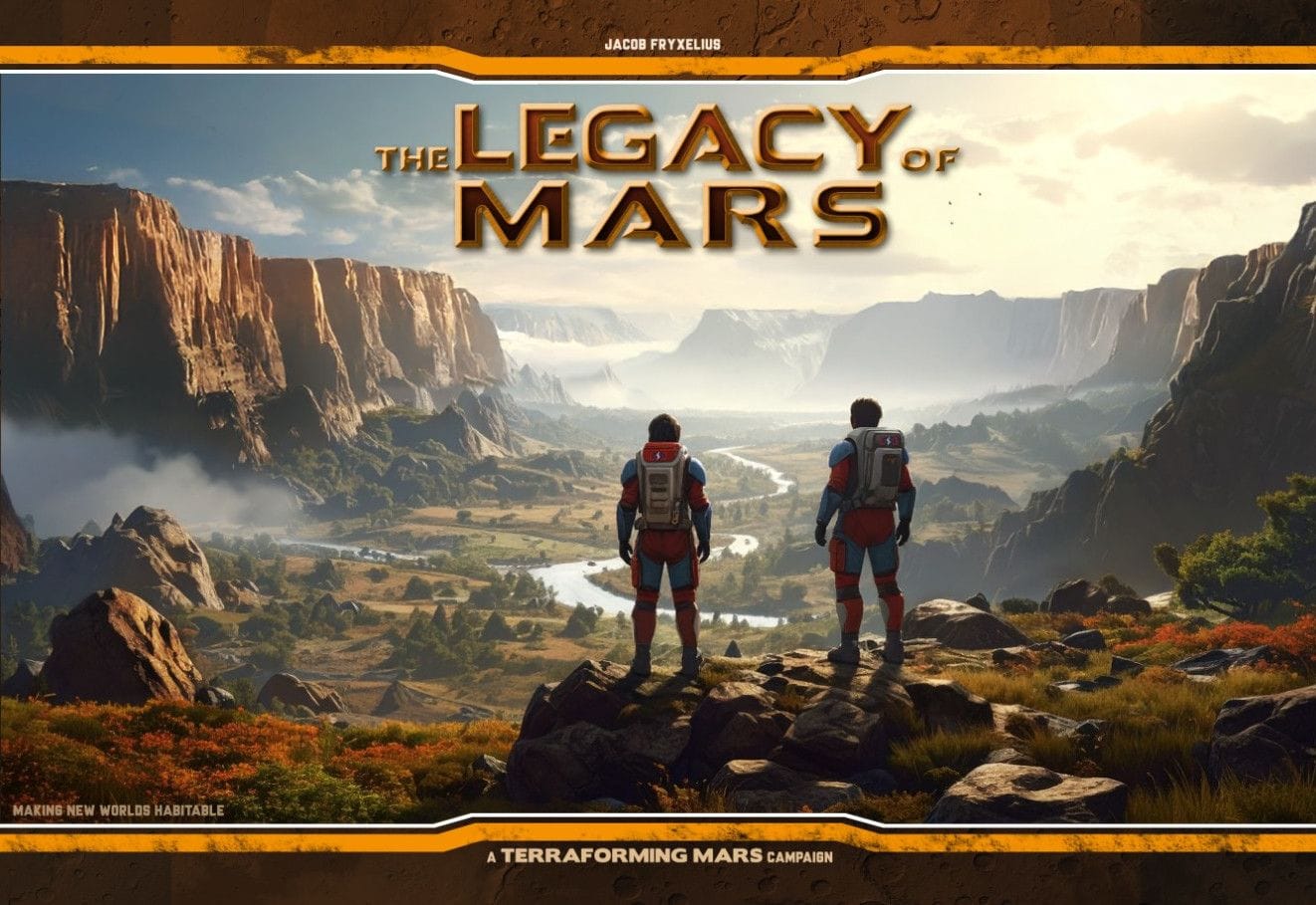
The Legacy of Mars bringt das Terraforming-Mars-Universum als wiederspielbare Kampagne auf Gamefound. Die Ankündigung des Spiels haben wir bereits gemeldet, hier geht es um die jetzt laufende Kampagne. Wir ordnen ein, was das Spiel mechanisch bietet, welche Pledge-Stufen Stronghold Games anbietet und worauf Sie vor einer Unterstützung achten sollten.
Eigenständiges Spiel, aber vorerst die halbe Geschichte
The Legacy of Mars ist ein eigenständiges Spiel, kein Zusatzmodul. Die Box enthält alles zum Spielen, inklusive einer Ausgabe des Terraforming-Mars-Grundspiels. Sie ist aber Teil eines größeren Bogens: Die Kampagne erzählt sieben Missionen. Die jetzt auf Gamefound finanzierte Box deckt die Missionen 1 bis 4 ab. Die Missionen 5 bis 7 sollen laut Stronghold Games als zweiter Teil Ende 2026 in einer eigenen Gamefound-Kampagne folgen. Wer nur Teil 1 kauft, kann die Kampagne nach Mission 4 mit einem Sieger abschließen. Den vollständigen Sieben-Missionen-Bogen gibt es nur mit beiden Boxen.
Als Designer nennen FryxGames und Stronghold Games Jacob Fryxelius, den Autor des Terraforming-Mars-Grundspiels von 2016. In den strukturierten Datenfeldern der Gamefound-Seite ist kein Designer hinterlegt. Die Urheberschaft ist also über den Verlag belegt, nicht über die Kampagnen-Eckdaten.
Was Sie im Spiel tun
The Legacy of Mars baut auf der bekannten Terraforming-Mars-Mechanik auf. Sie übernehmen einen Konzern und entwickeln Mars und Sonnensystem mit Projektkarten weiter. Karten kaufen Sie auf die Hand und spielen sie gegen Ressourcen aus. So steigern Sie Ihre Produktion. Das Spiel läuft über mehrere Runden, sogenannte Generationen, mit je einer Karten-, einer Aktions- und einer Produktionsphase. In der Aktionsphase führen Sie pro Zug ein bis zwei Aktionen aus. Wer eine Begrünung platziert, hebt den Sauerstoffwert und damit einen der drei globalen Parameter. Städte bringen dagegen vor allem Siegpunkte und Einkommen, ohne die globalen Werte direkt zu verschieben.
Neu sind mehrere Schichten obendrauf. Nach den bisher öffentlichen Informationen ergänzt The Legacy of Mars das Grundsystem um Bevölkerung, Arbeitskräfte, schmelzende Gletscher sowie einen wachsenden Stapel an Innovations- und Entwicklungskarten. Hinzu kommen mehrere Hundert neue Karten, neue Spielpläne und eine neue Ressource. Jede Mission spielt sich mit eigenen Parametern und einem eigenen Kartenpool. Wer eine Mission gewinnt, wird Gouverneur des Planeten und nimmt einen Bonus in die Schlusswertung mit. Diese Schichten erhöhen die Regellast spürbar. Wie viel länger das Erklären dauert und wie stark sie das Grübeln am Tisch antreiben, beziffert die Kampagne nicht. Wer schon das Grundspiel als fordernd empfindet, sollte The Legacy of Mars als deutlich schwergewichtiger einplanen.
Wie die neuen Elemente konkret im Zug eingesetzt werden, etwa die Arbeitskräfte, beschreibt die Kampagne im Fließtext nicht. Gamefound vermittelt viele Details über Bilder statt über Text. Offen bleibt auch, ob sich die Interaktion am Tisch verändert: Terraforming Mars ist im Kern ein indirektes Rennen mit begrenzter Konkurrenz um Felder und Boni, und ob die Kampagne daran etwas dreht, sagt sie nicht. An diesen Stellen bleibt die Kampagne unkonkret.
Spielerzahl, Solo-Modus, Spielzeit und Alter
Die Kampagne nennt eine Spanne von 1 bis 5 Spielenden. Ein Solo-Modus ist damit enthalten. Wie er sich über eine mehrteilige Kampagne hinweg spielt, ob also jede Mission solo bestreitbar ist und wie ein Gegner simuliert wird, beschreibt die Gamefound-Seite nicht. Das Grundspiel von 2016 hat einen etablierten Solo-Modus. Für The Legacy of Mars bleibt der Punkt offen.
Eine Spielzeit gibt die Kampagne ebenfalls nicht an, auch keine Altersfreigabe. Zur Orientierung: Das Grundspiel von 2016 dauert laut BoardGameGeek rund 120 Minuten und ist ab 12 Jahren freigegeben. Dieser Wert gilt aber nur für eine einzelne Partie des Grundspiels. The Legacy of Mars stapelt Zusatzsysteme auf dieses Gerüst und erzählt sieben Missionen. Das Zeit-Commitment liegt damit sehr wahrscheinlich deutlich höher, eine belastbare Zahl nennt der Verlag aber nicht. Planen Sie die 120 Minuten daher nicht als Richtwert für eine Legacy-Mission ein.
Legacy ohne Zerstörung
Legacy verbindet man oft mit Aufklebern und zerrissenen Karten. Genau das passiert hier nicht. Stronghold Games und FryxGames betonen, dass nichts dauerhaft verändert wird: keine Sticker, keine zerstörten Komponenten. Sie spielen die Kampagne durch, setzen sie zurück und können sie erneut spielen. Der Verlag bewirbt das Spiel deshalb als „fully replayable campaign", also als vollständig wiederspielbare Kampagne. Das unterscheidet den Titel klar von klassischen Legacy-Spielen. Technisch zurücksetzbar heißt allerdings nicht automatisch spielerisch abwechslungsreich. Die Kampagne verspricht Varianz über missionseigene Kartenpools und Parameter. Wie unterschiedlich sich ein zweiter Durchlauf wirklich anfühlt, ob also andere strategische Linien tragen, zeigt sich erst am Tisch.
Die Deluxe-Stufe legt knapp 300 3D-Plättchen bei, spielerisch ändert sich dadurch nichts. Bild: Stronghold Games / FryxGames via Gamefound
Milestones statt Stretch Goals
The Legacy of Mars nutzt keine klassischen Stretch Goals. Die Kampagne spricht stattdessen von Milestones. Eine einzeln aufgeschlüsselte Liste dieser Milestones liegt in den strukturierten Kampagnendaten nicht vor. Sichtbar ist: Die freigeschalteten Inhalte wandern als sogenannte Milestone-Promos in jede Box, unabhängig von der Pledge-Stufe. Schon die Einstiegsstufe enthält laut Gamefound alle in dieser Kampagne freigeschalteten Milestones.
Soweit erkennbar handelt es sich dabei um zusätzliches Promo-Material, vor allem Karten, also um spielerische Inhalte. Reine Komponenten-Aufwertungen wie 3D-Plättchen oder Metallwürfel laufen dagegen nicht über Milestones, sondern über die höheren Pledge-Stufen. Eine vom Verlag selbst veröffentlichte Trennung in mechanische Inhalte und Komponenten-Boni fehlt im Text.
Die Pledge-Stufen
Es gibt fünf Stufen, die Preise in US-Dollar:
Legacy of Mars (109 USD): das vollständige Spiel mit den Missionen 1 bis 4 und allen Milestones. Diese Stufe enthält die komplette spielerische Substanz.
Deluxe Legacy of Mars (249 USD): dasselbe Spiel in größerer Box mit knapp 300 3D-Plättchen und Markern. Eine reine Komponenten-Aufwertung, spielerisch identisch zur Einstiegsstufe.
Super Deluxe (409 USD): Spiel, 3D-Plättchen, Milestone-Promos, Metallwürfel und Kartenhüllen. Ebenfalls vor allem ein Komponenten-Paket.
Everything New (419 USD) und Almost Everything (549 USD): zwei umfangreiche Bündel mit zusätzlichem Terraforming-Mars-Material aus früheren Projekten. Hier kommt spielerischer Mehrwert hinzu. Allerdings beschreibt die Kampagne beide Stufen sehr ähnlich, was die Abgrenzung erschwert.
Wer The Legacy of Mars spielen will, braucht spielerisch nur die Einstiegsstufe. Die teureren Stufen verkaufen vor allem Material und Sammelobjekte. Ein Vorbehalt bleibt: Diese Box deckt nur die Missionen 1 bis 4 ab. Den vollständigen Sieben-Missionen-Bogen gibt es erst mit der zweiten Box, deren Preis Stronghold Games noch nicht nennt. Das reale Gesamtbudget für die ganze Kampagne steht also noch nicht fest.
Was Sie vor der Unterstützung wissen sollten
Die Finanzierungszahlen sind beeindruckend. Das Ziel von 20.000 USD fiel innerhalb von Minuten. Am 21. Mai 2026, an Kampagnentag 9, standen rund 1,75 Millionen USD und 7.105 Unterstützende zu Buche, also rund 8.766 Prozent des Ziels. Diese Quote ist ein Signal für Nachfrage, mehr nicht. Das niedrige Ziel war symbolisch, das Spiel faktisch vorverkauft. Über die Qualität sagt eine hohe Finanzierungsquote nichts aus.
Ein Kritikpunkt aus der Community betrifft die Aufteilung. Sieben Missionen verteilen sich auf zwei getrennte, kostenpflichtige Kampagnen. Den Preis für Teil 2 nennt Stronghold Games noch nicht. Wer den ganzen Bogen erleben will, zahlt zweimal und kennt die Gesamtkosten bisher nicht.
Für den DACH-Raum ist außerdem wichtig: Kampagne, Pledge-Stufen und Abrechnung laufen auf Englisch und in US-Dollar. Das Terraforming-Mars-Grundspiel erscheint auf Deutsch beim Schwerkraft-Verlag. Zu einer deutschen Ausgabe von The Legacy of Mars gibt es bislang keine öffentlichen Informationen. Die Auslieferung ist nach der bisherigen Berichterstattung für 2027 geplant.
Die Gamefound-Kampagne läuft noch bis zum 30. Mai 2026.
BoardGameGeek has fired advertising manager Chad Krizan after almost 20 years with the company, after he cited his personal experiences of demonic possession as grounds for rejecting an ad campaign.
In the emails, Krizan says he has been “sitting on this one and praying about what to do in this instance”, adding that “as a follower of Jesus, I routinely help people suffering from demonic oppression, and more occasionally, possession, and it’s absolutely devastating the damage he does to peoples’ lives”.
Krizan wrote, “IMO, the responsible thing to do would be to pull the entire project, as there are *way* more people that suffer this than you could possibly imagine, putting on a good face (usually enabled by dissociation), but suffering terribly behind the scenes.”
When Falling Whale replied to question the decision to ban the game on religious grounds, and asking for confirmation of which BGG advertising policy they were breaking, Krizan responded:
“Keep in mind it’s not over religion, but reality. It’s the same reason I would say a game would be in very poor taste if it featured being a sexual predator, or something that would directly trigger someone that’s been harmed by the subject matter.
“It’s about keeping BGG welcoming to everyone, and since I’m privy to this subject matter, I know firsthand that this is not friendly content, and incredibly triggering, put in front of some of the population that visits BGG.”
A statement from BGG founder Scott Alden posted on the site’s forums said, “Due to a situation in which BGG’s Advertising Manager responded inappropriately in a business email to a designer, I have decided to let him go. His response does not reflect or represent our company or the way we conduct business.”
Falling Whale’s campaign for social deduction game Possess Me, Satan runs for another 30 days, and has currently raised just over $14,000 from about 250 backers.
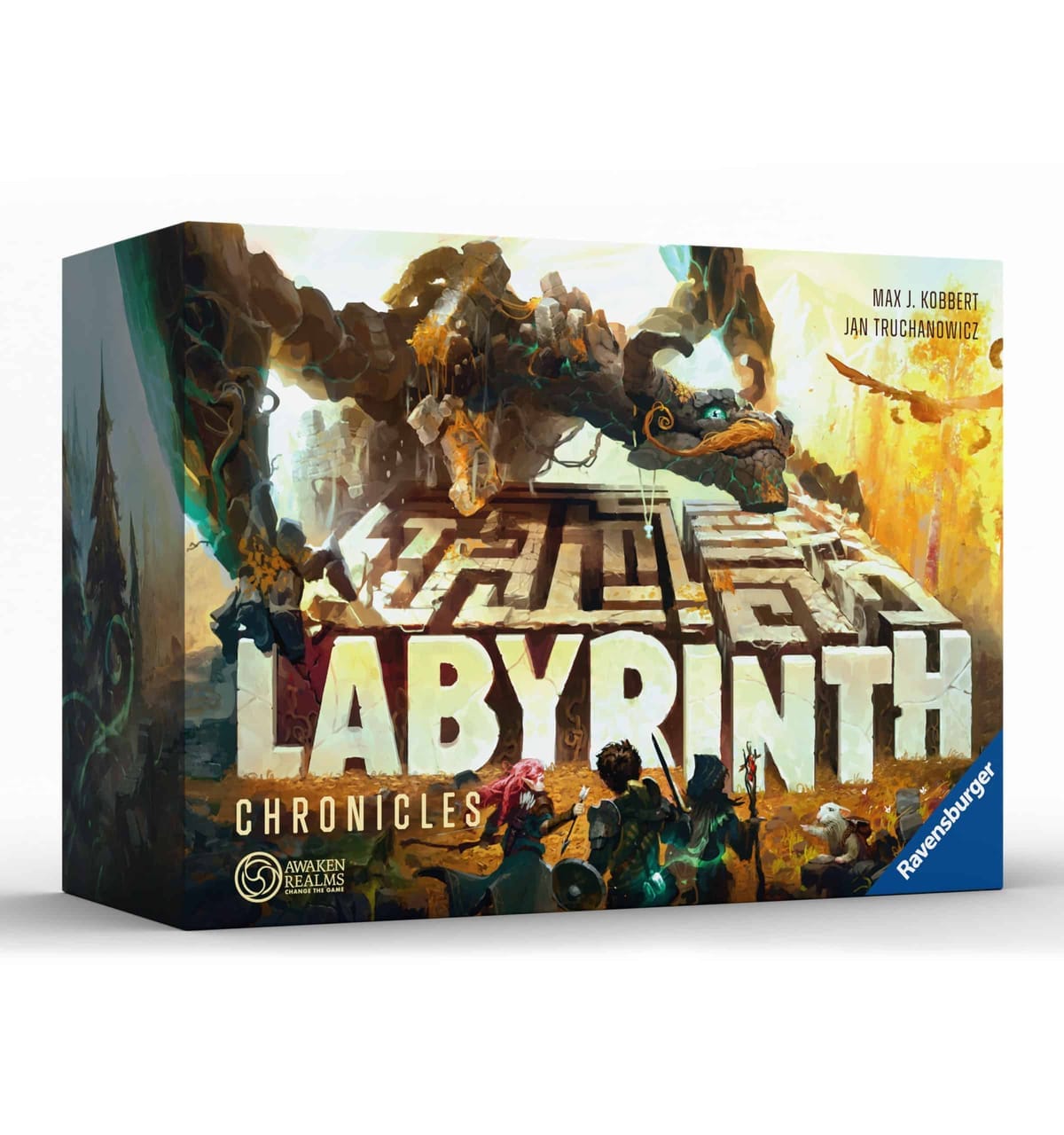
Ravensburger und Awaken Realms haben den Handelsstart für „Labyrinth: Chronicles" auf September 2026 datiert; die unverbindliche Preisempfehlung liegt laut Pressemeldung des Ravensburger-Newsrooms bei 149,00 Euro. Das kooperative Kampagnenspiel ist die Jubiläumsneuinterpretation des 1986 erschienenen Familien-Klassikers „Das verrückte Labyrinth" — über die Erstankündigung der Jubiläumsneuinterpretation hatten wir bereits im Februar 2025 berichtet — und stammt aus einer Gamefound-Kampagne, die Ravensburger zufolge über 12.000 Unterstützer mobilisiert hat. Als Designer nennt der Verlag Max J. Kobbert, den Schöpfer des Originals, sowie Jan Truchanowicz für Awaken Realms.
Vom Schiebepuzzle zum Koop-Kampagnenspiel
Wer das Original kennt, erkennt die Grundzutat sofort: Reihum schiebt eine Person eine überzählige Gangkarte in den Spielplan, wodurch sich Korridore verschieben und neue Wege entstehen — oder versperrt werden. Diesen Schiebemechanismus übernimmt „Chronicles" laut Spielbeschreibung auf BoardGameGeek, koppelt ihn aber an einen kooperativen Spielmodus. Statt um die Wette Schätze einzusammeln, organisieren zwei bis vier Spielende gemeinsam die Versorgung eines Feendorfs und müssen den im Labyrinth lauernden Kobolden zuvorkommen.
Dazu kommt ein fortlaufendes Kampagnenformat. Die Verlagsbeschreibung spricht von Dorfwiederaufbau, neuen Fähigkeiten und neuen Charakteren über mehrere Partien hinweg. Vom Format her bedeutet das mehrere zusammenhängende Spielabende mit Fortschritt — eine „Legacy"-Mechanik mit zerstörbaren oder permanent veränderten Komponenten kommuniziert der Verlag dabei nicht. Eine Auflistung einzelner Kapitelinhalte gibt es in der jetzt veröffentlichten Pressemeldung ebenfalls nicht; Awaken Realms hält die konkreten Kampagnen-Beats bislang zurück.
3D-Spielplan: physische Mauern statt Pappe
Das visuelle Hauptverkaufsargument sitzt auf dem Tisch: Statt eines flachen Pappspielplans liefert „Labyrinth: Chronicles" einen 3D-Aufbau mit physischen Mauerelementen. Die Pressemeldung nennt diesen Aufbau als zentrales Komponentenmerkmal, ohne genauere Materialangaben. Das passt zum Profil von Awaken Realms, deren Titel „Nemesis", „This War of Mine: The Board Game" und „ISS Vanguard" für komponentenintensive Produktionen bekannt sind. Mechanisch bewegt sich „Labyrinth: Chronicles" allerdings deutlich unter diesen Heavy-Koop-Titeln (BGG-Komplexitätswerte um 3,3–3,5) — die Komponenten-DNA des Studios trifft hier auf ein Familienspiel-Plus-Format. Für Käufer:innen, die den Klassiker im 30-Euro-Segment im Regal haben, ist das ein deutlicher Sprung nach oben — in Bauumfang ebenso wie im Preis.
Spielerzahl, Alter, Spieldauer — und die offene Solo-Frage
Die Pressemeldung listet zwei bis vier Spielende und eine Altersempfehlung ab neun Jahren. Der BoardGameGeek-Eintrag setzt das Mindestalter mit acht Jahren ein Jahr niedriger an; wer das Spiel für jüngere Mitspielende plant, sollte sich an Ravensburgers offizieller Freigabe orientieren. Eine Spieldauer kommuniziert der Verlag in der Pressemeldung nicht — laut BoardGameGeek liegt eine Partie zwischen 20 und 60 Minuten. Diese Spannweite stammt aus früher Community-Schätzung; Kampagnen-Sessions mit Dorf-Wiederaufbau und neuen Charakteren dürften eher am oberen Rand liegen.
Auch beim Solo-Modus schweigt Ravensburger. „Labyrinth: Chronicles" wird offiziell als Titel für zwei bis vier Spielende beworben; ein dedizierter Einzelspieler-Modus ist nicht Teil der Verlagskommunikation. Die BoardGameGeek-Community deutet in ihrer Spieleranzahl-Umfrage an, dass sich der Titel solo spielen lässt — die Stichprobe ist allerdings klein und kein Verlagsversprechen. Solist:innen sollten vor dem Kauf prüfen, ob ihnen das Steuern mehrerer Charaktere im kooperativen Modus genügt.
Für die Illustrationen verantwortet Awaken Realms ein vierköpfiges Team um Jakub Dzikowski, Patryk Jędraszek, Ewa Labak und Pamela Łuniewska. BGG schätzt die Komplexität auf 1,80 von 5 ein — das liegt im Familienspiel-Plus-Bereich (zum Vergleich: Carcassonne 1,92, Catan 2,32) und damit unterhalb der klassischen Kennerspiel-Schwelle. Mit Blick auf die Kampagnen-Schichten (Dorfwiederaufbau, neue Fähigkeiten, Charakter-Persistenz) könnte der Wert in der Praxis allerdings eher die Untergrenze als der Median sein, und die BGG-Stichprobe ist für einen September-Titel noch dünn.
Für die Illustrationen verantwortet Awaken Realms ein vierköpfiges Team um Jakub Dzikowski, Patryk Jędraszek, Ewa Labak und Pamela Łuniewska.
Crowdfunding-Erbe: Gamefound-Kampagne und 149 € UVP
Die Gamefound-Kampagne hatten wir im Februar 2026 ausführlich begleitet; sie ist abgeschlossen und laut Pressemeldung mit über 12.000 Unterstützern unterzeichnet. Eine öffentlich nachvollziehbare Auflistung der erreichten Stretch Goals — insbesondere die Trennung zwischen Mechanik-Inhalten wie Zusatzszenarien oder neuen Charakteren auf der einen und Komponenten-Upgrades wie Miniaturen oder Spielmatten auf der anderen Seite — kommuniziert Ravensburger in der jetzt veröffentlichten Pressemeldung nicht; die Gamefound-Kampagnenseite ist zum Redaktionsschluss nicht öffentlich abrufbar. Wer in der Gamefound-Phase nicht dabei war und auf bestimmte Stretch-Goal-Inhalte hofft, sollte die Verpackung im Handel prüfen — bei Awaken-Realms-Titeln unterscheiden sich Crowdfunding- und Retail-Editionen häufig in Komponenten- und Miniaturen-Umfang.
Mit 149 Euro UVP ordnet sich „Labyrinth: Chronicles" deutlich über den rund 30 Euro für den klassischen Familienkracher ein, bleibt aber im üblichen Preissegment für Awaken-Realms-Boxen. Das klassische „Das verrückte Labyrinth" ersetzt die Neuauflage dabei nicht — sie zielt auf einen anderen Abend: längeres Commitment, kooperatives Kampagnenformat statt klassische Sammelpartie. Eine spielerische Einordnung dieses Aufschlags ist ohne Hands-on nicht zu leisten — wir kommen im September darauf zurück.
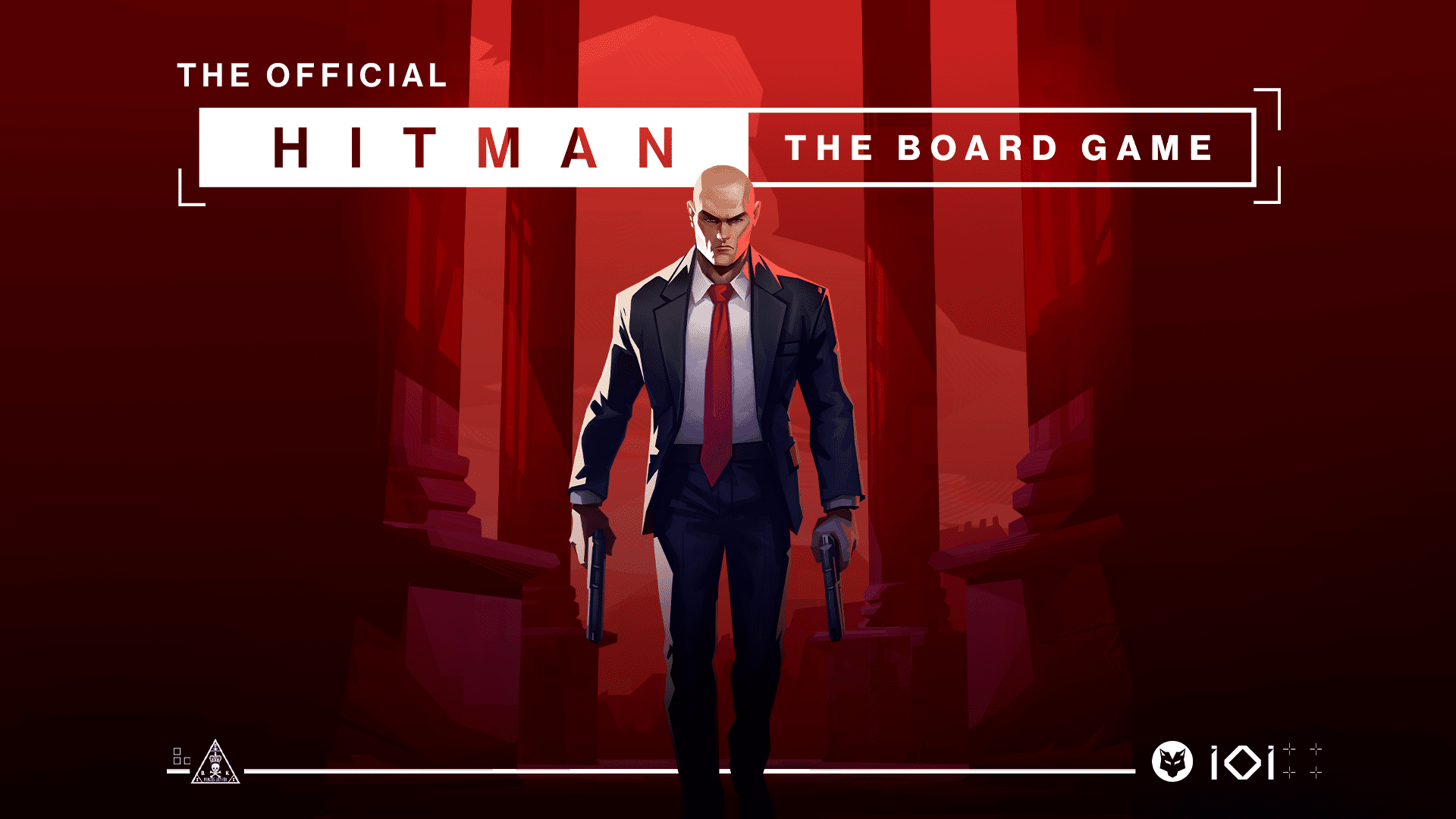
Agent 47 verlässt den Bildschirm. Das dänische Studio MOOD Publishing bringt die Stealth-Action-Reihe von IO Interactive als kompetitives Brettspiel auf den Tisch — und sammelt auf Gamefound deutlich mehr Geld ein als geplant. Stand 19. Mai 2026 stehen 672.894 Euro auf dem Konto, rund 673 Prozent des Finanzierungsziels von 100.000 Euro. 3.093 Unterstützerinnen und Unterstützer haben bislang gepledged. Die Kampagne läuft noch bis zum 28. Mai 2026, 16:00 Uhr MESZ — also gut neun Tage.
Worum geht's bei Hitman: The Board Game?
In Hitman: The Board Game schlüpfen 1 bis 4 Spielende in die Rolle internationaler Auftragskillerinnen und -killer, die um denselben Vertrag konkurrieren. Sie reisen zwischen exotischen Schauplätzen, infiltrieren Anwesen und Veranstaltungen und versuchen, hochkarätige Ziele auszuschalten — bevor die Konkurrenz am Tisch zuschlägt.
Die Kernschleife greift eine Stilfrage auf, die schon das Videospiel prägt: lautes Vorgehen mit der Schusswaffe (vom Hersteller „guns blazing" genannt) oder die leise Variante im Stil eines „Silent Assassin". Mitspielende dürfen sabotieren, Ziele wegschnappen und den finalen Treffer setzen — das Spiel ist also explizit konflikthaltig und nicht kooperativ. Eine Partie dauert laut MOOD Publishing rund 60 Minuten, das Mindestalter liegt bei 12 Jahren.
Wie sich diese Stilfrage am Tisch konkret in Aktionen übersetzt, hält die Kampagne erstaunlich knapp: MOOD Publishing nennt die genaue Aktionsökonomie (also was eine Spielerin pro Zug machen darf), die Zugstruktur und das Auflösungssystem auf der Gamefound-Hauptseite bislang nicht im Detail. Aus der Komponentenliste lässt sich ableiten, dass Hitman: The Board Game karten- und tableau-getrieben ist: Spielende erhalten Agent Cards (vermutlich mit individuellen Profilen, denn die Kampagne schaltet im Verlauf wiederholt neue Special Agent Card Packs frei), Aufträge werden über Target Briefs und Map Event Cards in Schauplätzen mit Raum-Tiles inszeniert, dazu kommen Opportunity Cards, Weapon Cards und zusätzliche Unorthodox Tools. Das deutet auf ein asymmetrisches, karten- und ortsbasiertes Konfliktspiel hin — die konkrete Mechanik bestätigt MOOD aber bisher nicht in Textform. Zum Solo-Modus für eine Person macht der Verlag auf der Hauptseite ebenfalls keine Detailangaben; ob er als Score-Run, Automa oder Solo-Kampagne läuft, bleibt bis zum Pledge-Manager (ein Online-Formular, in dem Sie nach Kampagnenende Ihren Pledge bestätigen, Versand bezahlen und Add-ons anpassen) oder zum ersten Rezensionsexemplar offen.
Was das Spiel auf dem Tisch tatsächlich leistet, lässt sich heute nicht beurteilen. Es liegt kein Rezensionsexemplar vor, ein BoardGameGeek-Eintrag mit Bewertungen existiert mangels Druck nicht. Wir bewerten hier Konzept, Studio und Funding — nicht das Spielgefühl.
Was steckt im Karton?
MOOD Publishing bietet sieben Pledge-Stufen an (Preise in Euro, Versand kommt im Pledge-Manager dazu):
Base Game — 60 € (UVP 70 €). Das Grundspiel inklusive aller freigeschalteten Karten-Stretch-Goals.
All Gameplay — 125 € (UVP 145 €). Sämtliche Gameplay-Erweiterungen, jedoch ohne Komponenten-Upgrades wie Standees oder Miniaturen.
All Gameplay – Acrylic Standees Edition — 200 € (UVP 235 €). Wie All Gameplay plus Acryl-Standees als Spielfiguren.
All Gameplay – Miniatures Edition — 220 € (UVP 260 €). Mit voll plastischen Miniaturen.
All-In Acrylic Standees — 315 € (UVP 400 €). Alle Inhalte plus Acryl-Standees und sämtliche Komponenten-Upgrades.
All-In Miniatures — 335 € (UVP 425 €). Die Vollausstattung mit Miniaturen.
Retailer Pledge — 100 €, nur für verifizierte Händlerinnen und Händler.
Wer das Spiel rein als Spielerlebnis kaufen will, kommt mit dem Base Game oder dem All Gameplay-Pledge aus. Die All-In-Stufen lohnen sich für Sammlerinnen und Sammler, die Wert auf Miniaturen, Acryl oder die enthaltenen Box-Aufwertungen legen. Bei einem Spiel ohne Hands-on-Eindrücke ist jeder Pledge oberhalb der Einstiegsstufe ein Vertrauensvorschuss in das Studio.
Stretch Goals und David Bateson
Stretch Goals sind Bonus-Inhalte, die freigeschaltet werden, sobald die Kampagne bestimmte Geldmarken oder Zeitpunkte erreicht. Die Funding-Stufen bis 600.000 Euro sind durch. Sortiert nach Wirkung am Tisch:
Mechanische Inhalte (verändern, was im Spiel passiert):
Personal Restrictions (zwei Karten-Packs) — laut Gamefound „eine extra Herausforderung pro Spieler", also vermutlich individuelle Sonderauflagen pro Auftrag.
Smuggled Items (zwei Packs) — Start-Perks, mit denen Spielende in die Partie gehen.
Vier Unorthodox Packs — zusätzliche „kreative" Werkzeuge und Waffen, also Karten für die Action-/Inventarseite.
Easter-Egg-Karten in zwei Varianten (Opportunity- und Map-Event-Karten) — Erweiterungen der vorhandenen Karten-Decks.
Extra Agent Cards, Special Agent Card Pack und Special Agent Cards Pack 2 — zusätzliche Spieler-Charaktere mit eigenen Profilen.
Extra Target Event Cards Pack, Map Event Card Pack und Extra ICA Cards — mehr Aufträge, Map-Events und Ausrüstung.
Make-Your-Own Target Kit — Blanko-Karten, Raum-Tiles und Standees für selbstgebaute Aufträge.
Komponenten-Upgrades und Boni (verschönern oder erleichtern das Spiel):
Doppellagige Spielertableaus.
Neue Waffenkarten-Artworks (Re-Skin der Duplikat-Karten).
Brief Holder — Aufsteller, um Location- und Target-Briefs aufrecht auf dem Tisch zu platzieren.
Score Sheet mit Achievement-Stickern für Eliminationen.
Printable Tutorial Map — Druckvorlage für eine geführte Einsteigerpartie.
Offen ist das prominenteste Ziel: Ab 700.000 Euro signiert David Bateson, die englische Originalstimme von Agent 47, jede Gold Baller Collectors Card — allerdings nur in den All-In-Pledges. Zum Stand 19. Mai fehlen dafür rund 27.000 Euro. Hinzu kommen drei Mystery Unlocks an den Kampagnentagen 20, 23 und 25, also zwischen 20. und 25. Mai.
Einordnung: Wer ist MOOD Publishing?
Hinter dem Projekt steht MOOD Publishing Aps mit Sitz in Dänemark. Wer das Spiel konkret designt hat, kommuniziert MOOD auf der Gamefound-Hauptseite öffentlich nicht namentlich — eine Designer- oder Autorenzeile fehlt in den dort sichtbaren Projektdaten. Bei einer Lizenz-Adaption in dieser Größenordnung ist das eine Lücke, keine Nebensache; ob ein In-House-Team, eine externe Autorin oder ein etablierter Designer hinter dem System steht, wird der Pledge-Manager oder das erste Update klären müssen.
Eine belastbare Liefer-Bilanz für eine Produktion in dieser Größenordnung lässt sich aus öffentlich zugänglichen Quellen heute nicht abschließend ableiten. Crowdfunding-typische Verzögerungen sind möglich — Brettspielprojekte mit Lizenzbindung und vollständiger Miniatur-Produktion treffen erfahrungsgemäß auf längere Lieferzeitfenster, als die Kampagne ursprünglich verspricht. Ein verbindliches Auslieferungsdatum nennt die Kampagnen-Hauptseite nicht prominent; Pledge-Manager und spätere Update-Kommunikation des Verlags werden hier ausschlaggebend sein.
Versandkosten erhebt der Verlag nach Kampagnenende im Pledge-Manager. Details zu DACH-Versandstaffeln finden Unterstützerinnen und Unterstützer dort, nicht auf der Hauptseite.
Fazit: Für wen lohnt sich der Pledge?
Hitman: The Board Game spricht zwei Zielgruppen klar an. Erstens: Fans der Videospielreihe, die Agent 47 nun gegen Freundinnen und Freunde am Tisch verkörpern wollen. Zweitens: Spielende, die kompetitive Konflikt-Brettspiele in der 60-Minuten-Klasse mögen, in denen Mitspielende einander aktiv das Wasser abgraben dürfen. Wer Koop-Erlebnisse oder ruhiges Tableau-Building sucht, ist hier falsch.
Vor einer 60-Euro-Entscheidung gilt der übliche Crowdfunding-Hinweis: Ein Pledge ist ein Versprechen, kein Kauf. Solange kein Rezensionsexemplar vorliegt, beurteilen wir Konzept, Studio und Funding — nicht das Spielgefühl. Wer das aushält, findet hier eine der größten Lizenz-Adaptionen des Jahres auf Gamefound.
Jacob Fryxelius dreht das Terraforming-Mars-Universum auf Kampagnenformat: The Legacy of Mars soll 2027 bei FryxGames erscheinen und tauscht die einzelne Partie gegen eine Mission-zu-Mission-Erzählung. Die Crowdfunding-Kampagne läuft auf Gamefound, das Spiel rangiert seit Tagen weit oben in der BGG-Hotness.
Worum geht's?
Statt eines abgeschlossenen Spielabends erwartet die Spielenden eine Kette aus Missionen, in denen unterschiedliche Planeten und neue Seiten des Mars terraformt werden. Wer eine Mission gewinnt, wird zum Gouverneur dieses Planeten – mit Zusatzpunkten für das finale Szenario, das den Gesamtsieger ermittelt. Mechanisch baut Fryxelius auf der bekannten Terraforming-Mars-Engine auf und ergänzt sie um Bevölkerung, Arbeiter, schmelzende Gletscher und einen wachsenden Pool an Innovations- und Entwicklungskarten. Jede Mission spielt mit neuen Parametern und einem eigenen Kartenpool – laut Designer „im Grunde mehrere Spiele in einer Schachtel".
Schnellfakten
Designer: Jacob Fryxelius
Illustration: Isaac Fryxelius
Verlag: FryxGames
Erscheinungsjahr: 2027 (Crowdfunding auf Gamefound)
Spielerzahl: 1–5 (inklusive Solo-Modus)
Spielzeit: 150–300 Minuten pro Mission
Altersempfehlung: ab 12 Jahren
Mechaniken: Kampagnen-/Szenariospiel, Closed Drafting, Handmanagement, Plättchenlegen, variable Spielerfähigkeiten, Solo
DACH-Relevanz
Die deutschsprachigen Ausgaben der Terraforming-Mars-Reihe betreut traditionell der Schwerkraft-Verlag. Eine offizielle deutsche Lokalisierung von The Legacy of Mars ist bislang nicht angekündigt – sollte FryxGames den eingespielten Weg gehen, ist Schwerkraft die naheliegende Adresse. Backerinnen und Backer aus dem DACH-Raum sollten bei der Gamefound-Kampagne genau auf den späteren deutschen Vertrieb achten.
Unsere Einschätzung
Ein Kampagnenformat auf Terraforming-Mars-Basis ist nach Ares Expedition und der jüngst angekündigten Terraforming Mars: The Big Box der nächste logische Schritt – und gleichzeitig der riskanteste. Die durchschnittliche BGG-Wertung von 4,7 spiegelt vor allem Crowdfunding-Skepsis und sehr wenige tatsächliche Stimmen wider; aussagekräftiger ist die Wunschlisten-Zahl. Wir verfolgen die Kampagne weiter und schauen besonders auf die Frage, ob die Missionen narrativ tragen oder am Ende doch nur Setup-Variationen bleiben.
Welcome to this week’s batch of crowdfunding campaigns. We have a variety of offerings here, so we hope you will find something that catches your eye. Also, if you want to chat with the BGQ team, join our Discord Server where we talk about games, movies, sports, and other fun stuff. Check it out and […]
Das kooperative Titan Zero zelebriert mit wenig Aufwand intensivste Momente und erinnert damit an bekannte Größen wie King of Tokio. Ich gehe so weit und behaupte, dass Titan Zero ein King-of-Boss-Battler ist. Mitnichten ist damit gemeint, dass der Boss-Klopper der König des Genres ist, auch wenn sich der Titel sicher nicht verstecken muss, sondern,...
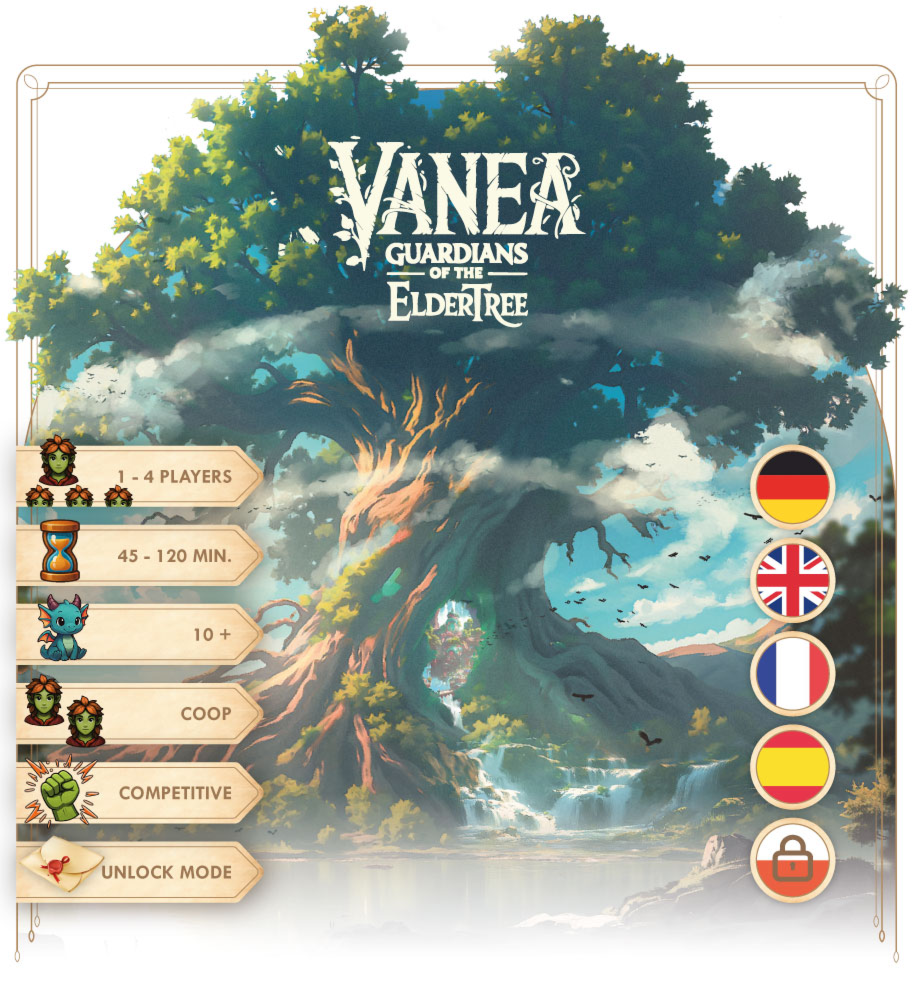
VANEA: Guardians of the Eldertree ist seit dem 12. Mai 2026 als Relaunch-Kampagne auf Gamefound finanzierbar. Der Düsseldorfer Verlag Forgotten Tales um Florian Molzahn sammelt bis zum 1. Juni 2026 für sein kooperatives Fantasy-Brettspiel mit Tower-Defense-, Erkundungs- und Würfelmechaniken. Das Finanzierungsziel liegt bei 59.000 Euro, am Starttag stehen rund 6.000 Euro von 32 Unterstützenden zu Buche. Das Spiel ist für eine bis vier Personen ab zehn Jahren ausgelegt, eine Partie dauert rund 90 Minuten.
Spielprinzip: Wächter, Elementarmagie und ein verseuchter Wald
Schauplatz von VANEA ist der Elderforest, eine märchenhafte Welt rund um einen mystischen Baum. Als Wächter verteidigst du den Elder Tree gegen Monster, Bosse und die sich ausbreitende „Darkmoon Rot". Im Spielverlauf erkundest du den Wald, sammelst sechs verschiedene Elementarorbs, um die zugehörigen Mächte zu meistern, und schmiedest aus Erzen mächtige Ausrüstung. Magische Orbs schalten neue Fähigkeiten frei, dazu kommt ein elementarer Begleiter pro Wächter.
Das Spiel unterstützt drei Modi: kooperativ gegen das Spiel, kompetitiv gegeneinander oder im Team. Forgotten Tales betont eine hohe Wiederspielbarkeit durch unterschiedliche Wächter, prozedural variierende Monsterjagden und freischaltbare Karten.
Die Erweiterung „Earth Phoenix" ist ab dem Gameplay-Pledge enthalten. Bildquelle: Forgotten Tales / Gamefound
VANEA-Pledges, Erweiterung und Stretch Goals im Überblick
Die Gamefound-Kampagne bietet vier Hauptstufen mit unterschiedlichem Materialumfang:
Pledge
Kampagnenpreis
UVP
Umfang
Core Game
69 €
85 €
Grundspiel mit Pappstandees
Gameplay
94 €
115 €
Core Game plus Erweiterung „Earth Phoenix"
Gameplay deluxe
134 €
180 €
Gameplay plus 65 Premium-Acrylstandees, 200 Holztokens und 42 3D-Edelsteine
VANEA All-in
189 €
270 €
Gameplay deluxe plus Miniaturen-Box mit Wächter- und Elementarbegleiter-Figuren sowie vier Twin-Bases
Das All-in-Pledge enthält alle Premium-Komponenten inklusive Miniaturen-Box. Bildquelle: Forgotten Tales / Gamefound
Wer einzelne Bestandteile separat hinzufügen will, findet im Pledge-Manager die üblichen Add-ons, darunter den Elder-Tree-Miniature inklusive vier Portalen für 25 Euro und Sprachpakete für Französisch oder Spanisch.
Bei den Stretch Goals greift Forgotten Tales auf eine Treppe ab 70.000 Euro zurück. Geplant sind unter anderem ein neues Loot-Monster per Community-Voting, zusätzliche Elder-Tree- und Fusionskarten, zwei neue Event-Felder mit x2-Effekt sowie eine neue Region ab 150.000 Euro. Ein Double-Layer-Upgrade für den Gameround- und Rot-Tracker schaltet sich bei 130.000 Euro frei. Die Kampagne auf Gamefound läuft noch knapp drei Wochen.
Welcome to this week’s batch of crowdfunding campaigns. We have a variety of offerings here, so we hope you will find something that catches your eye. Also, if you want to chat with the BGQ team, join our Discord Server where we talk about games, movies, sports, and other fun stuff. Check it out and […]
Die Brettspiel-Adaption der bekannten Stealth-Action-Reihe Hitman: The Board Game läuft seit dem 30. April 2026 auf Gamefound und hat ihr Finanzierungsziel von 100.000 Euro um ein Vielfaches übertroffen. Am achten Kampagnentag stehen über 618.000 Euro von rund 2.856 Unterstützern auf dem Konto, was einer Funding-Quote von gut 618 Prozent entspricht. Hinter dem Projekt steht das dänische Studio MOOD Publishing, das die Marke um Agent 47 vom Bildschirm an den Spieltisch bringt. Bis zum 28. Mai 2026 läuft die Kampagne weiter.
Auftrag, Tarnung, Konkurrenz
Hitman: The Board Game ist als kompetitives Spiel für 1 bis 4 Personen angelegt, eine Partie dauert rund 60 Minuten. Du reist um die Welt, infiltrierst exotische Schauplätze und schaltest hochkarätige Zielpersonen aus. Anders als in der Videospielvorlage bist du dabei nicht allein: Mehrere Auftragskiller wurden auf dasselbe Ziel angesetzt und versuchen alles, um dir den entscheidenden Schuss zu vermasseln. Ob du laut vorgehst oder als „silent assassin" durch die Schatten schleichst, bleibt dir überlassen.
Der Spielablauf setzt auf Improvisation, Kreativität und Präzision. Karten für Spezialagenten, Schmuggelware und unorthodoxe Werkzeuge erweitern den Handlungsspielraum, während persönliche Beschränkungen pro Spieler eine zusätzliche Hürde liefern. Map-Event-Karten sorgen für Abwechslung auf den Schauplätzen, ein druckbares Tutorial erleichtert den Einstieg. Das Mindestalter liegt bei 12 Jahren.
Spezialagenten-Karten gehören zu den bereits freigeschalteten Stretch Goals.
Pledges, Editionen und Stretch Goals
Die Pledges beginnen bei 60 Euro für das Grundspiel. Wer den vollen Spielumfang ohne aufgewertete Komponenten möchte, greift zur Variante „All Gameplay" für 125 Euro. Die Acrylic-Standee-Edition kostet 200 Euro, die Miniaturen-Variante 220 Euro. Die beiden All-In-Pakete liegen bei 315 Euro (Acrylic Standees) beziehungsweise 335 Euro (Miniaturen) und enthalten neben dem vollen Spielinhalt sämtliche Komponenten-Upgrades.
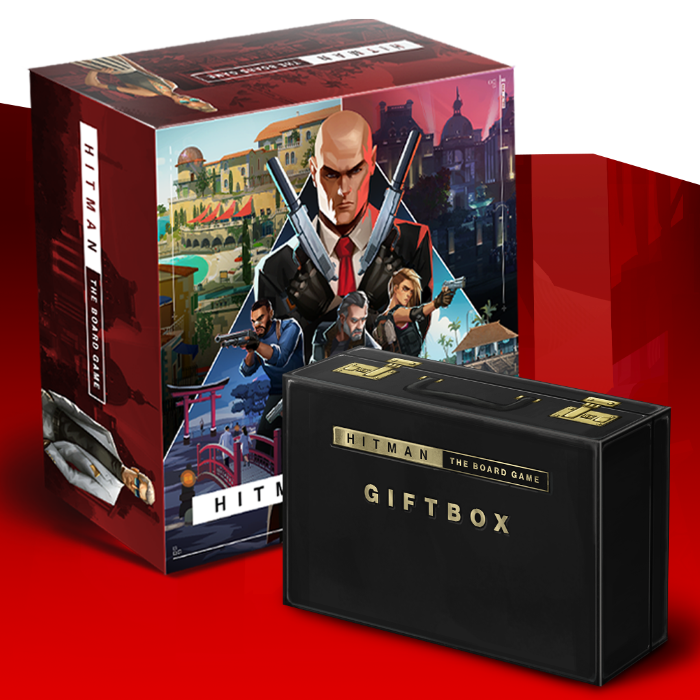
Die All-In-Miniaturen-Edition enthält alle Spielinhalte und sämtliche Komponenten-Upgrades.
Innerhalb der ersten Kampagnenwoche wurden zahlreiche Stretch Goals freigeschaltet. Dazu gehören vier Unorthodox-Tools-Packs, zusätzliche Special-Agent-Karten, ein zweites Smuggled-Items-Deck, doppelseitige Spielertableaus, Personal-Restrictions-Karten in zweiter Auflage sowie Easter-Egg-Karten. Drei „Mystery Unlocks" sind an den Kampagnentagen 11, 14 und 17 angekündigt. Weitere Funding-Schwellen ab 625.000 Euro versprechen ein drittes Special-Agent-Pack und neue Artworks für doppelte Waffenkarten.
Bezug zur digitalen Vorlage
Die Marke Hitman geht auf den dänischen Entwickler IO Interactive zurück, der mit MOOD Publishing aus dem gleichen Land stammt. Der erste Teil „Hitman: Codename 47" erschien im Jahr 2000, danach folgten „Silent Assassin" (2002), „Contracts" (2004), „Blood Money" (2006) und „Absolution" (2012). Mit der Reboot-Trilogie aus den Jahren 2016, 2018 und 2021 etablierte das Studio die Plattform „World of Assassination", die seit 2023 alle drei Episoden unter einem Dach bündelt und kontinuierlich um neue Inhalte ergänzt wird.
Die Videospielreihe ist für PC sowie für PlayStation 4 und 5, Xbox One und Xbox Series X|S verfügbar. Für die Nintendo Switch existiert eine Cloud-Version. Charakteristisch sind offene Sandbox-Levels, die zahlreiche Wege zum Ziel zulassen, vom unauffälligen Verkleidungs-Bluff bis zum offenen Schusswechsel. Genau dieses Spielprinzip überträgt MOOD Publishing nun an den Tisch.
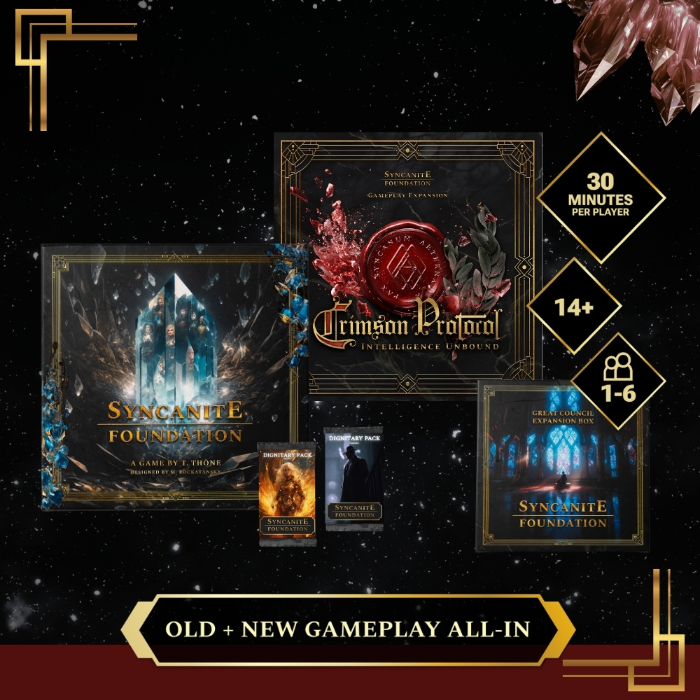
Das Dortmunder Indie-Studio Syncanite Games hat am 5. Mai 2026 die zweite Gamefound-Kampagne für das 4X-Kartenspiel Syncanite Foundation gestartet. Im Mittelpunkt steht die Erweiterung Crimson Protocol, ergänzt um einen Reprint des Grundspiels für alle, die die erste Kampagne verpasst haben. Das Finanzierungsziel liegt bei 20.000 Euro, die Kampagne läuft bis zum 31. Mai 2026.
Crimson Protocol: Inhalte der Erweiterung für Syncanite Foundation
Crimson Protocol ist die erste größere Inhaltserweiterung für Syncanite Foundation, das sich als asymmetrisches 4X-Kartenspiel mit Deduktions- und Area-Control-Elementen positioniert. Das Grundspiel ist für 1 bis 6 Spieler ausgelegt und beansprucht rund 150 Minuten Spielzeit, das empfohlene Mindestalter beträgt 14 Jahre. Die Erweiterung führt neue Mechaniken rund um das namensgebende Crimson Protocol ein und vertieft die selbsternannte „Crystal Punk"-Welt, in der politische, ökonomische und kriegerische Konflikte ausgetragen werden.
Über die rein spielerischen Inhalte hinaus erweitert Syncanite das Universum um zwei Begleitprodukte. Backer der Crimson-Protocol-Kampagne erhalten je nach Pledge Zugang zum ersten von insgesamt drei geplanten Romanen sowie zu einem Musikalbum, das in höheren Stufen auch als Vinyl ausgeliefert wird. Damit positioniert das Studio die Marke Syncanite Foundation als Multimedia-Projekt, das Spielmaterial gezielt mit Fiktion und Soundtrack ergänzt.
Der „Crimson World Builder"-Pledge bündelt Spielinhalte mit Vinyl-Album und Hardcover-Artbook.
Pledge-Stufen der Syncanite-Foundation-Kampagne im Überblick
Die Gamefound-Kampagne umfasst acht Pledge-Stufen, die sowohl Bestandsbacker als auch Neueinsteiger adressieren. Wer Syncanite Foundation bereits besitzt, steigt mit dem „Crimson Malice (Expansion All-In)" für 79 Euro ein, der ausschließlich die Erweiterungsinhalte umfasst. Die Variante „Crimson Whisperer" liefert dasselbe Paket inklusive Roman und digitalem Soundtrack für 99 Euro.
Neueinsteiger finden mit dem „Crimson Accomplice" für 139 Euro ein Einsteigerpaket aus Grundspiel und Erweiterung für 2 bis 4 Spieler. Wer das volle Erlebnis für bis zu 6 Personen sucht, greift zum „Crimson Conspirator" für 199 Euro. Die Premium-Stufen reichen über den „Crimson Puppet Master" mit Deluxe-Komponenten für 324 Euro und den „Syncane Archive Pledge" für 429 Euro bis hin zur „Council Membership" für 749 Euro, die einen lebenslangen All-In-Status sowie Zugang zu einer exklusiven Discord-Rolle und Community-Veranstaltungen umfasst.
Welcome to this week’s batch of crowdfunding campaigns. We have a variety of offerings here, so we hope you will find something that catches your eye. Also, if you want to chat with the BGQ team, join our Discord Server where we talk about games, movies, sports, and other fun stuff. Check it out and […]
May is here and the grass is growing, birds and bees are out busily going about their lives and summer is just around the corner. And with all of this change, there are tons of new games that are appearing on both pre-order and as new releases that I am looking forward to getting on my table. Now, if I could only have more time or discover a time manipulation method! This month for the Wargame Watch, I was able to find 25 games (including the 5 games from our sponsor Sound of Drums). I was also able to find 4 games being offered on Crowdfunding through Kickstarter.
This month we have a sponsor for the Wargame Watch feature in Sound of Drums who has made some really great games over the past few years including their History of the Ancient Seas Trilogy (HOTAS: HELLAS, HOTAS: DIES IRAE and HOTAS: MARE NOSTRUM), 1793: Patriots & Traitors, Eylau 1807 and a few others. Sound of Drums really has a great approach to game design and they also are committed to high quality production with great components, fantastic art and really sharp graphic design. They are definitely a publisher to keep an eye on and you should give their games a try!
Most recently, they released the first volume in their Napoleonic Wars tactical level Battle Commander Series designed by Card Paradis called Battle Commander Volume I – Napoleon’s Italian Campaigns. The Battle Commander Series recreates historical 18th-19th century battles and features a fresh framework focused on providing two key aspects: command decision and maximum playability. In Volume I, the player takes on the role of an Army Commander in a series of six dramatic Battles fought during Napoleon’s two Italian campaigns. Volume II will cover engagements of the Second and Third Coalitions, including the Battle of Austerlitz and the Battle of the Pyramids.
In Carl’s own words, here is what the game is focused on and attempting to model:
The system is at Brigade/Division scale, is very playable, with no downtime or complex computations or mechanics. I am a game component maniac, so the package will be super-deluxe, using a very large box, allowing the 2-sided mounted maps to be folded only once (think of the 70’s Avalon Hill flatboxes maps), game pieces will be painted-on wood blocks of different shapes, so no annoying stickers to apply, you’ll have a couple dozen blocks per side in a game, often less. Also, no dice, almost no markers, the emphasis is on the gameplay!
The crux of the game engine will be ( 1 ) the deck of event cards, that will also take care of all the combat results and other dice functions, and ( 2 ), the cube-pull mechanism, that will manage player unit activations, but also turn end, when combat and rally happens, and other similar game happenstances. It’s all a very granular affair. The whole package has a definite “Kriegspiel” look, with all the graphics done in a contemporary Napoleonic style, with a very different way of maneuvering units on the field of battle compared to other Napoleonic games.
They also recently released the Assault Sicily ’43 – Primosole BridgeExpansion for the Assault Sicily ’43 base game. We got a chance to play a scenario from this one with the designers Wolfgang Klein and Erich Rankl while attending Essen Spiel last fall and we had a great time with the new innovations and mechanics as well as the beautiful new production of the expansion.
The big new game that Sound of Drums is offering on pre-order at this time is the Designer Edition of No Retreat! The Russian Front 1941-1945 from designer Carl Paradis.
I am very much looking froward to this one as we have played the Deluxe Edition from GMT Games several years ago and very much enjoyed the system and its narrative on this titanic confrontation on the Eastern Front of World War II. I am interested to see what they change, both mechanically and graphically, and how the final product turns out. The cover though is simply amazing and shows off the skill of their graphic designer Marc von Martial and new artist Wouter Schoutteten.
From the Sound of Drums website, we read the following:
No Retreat! The Russian Front – Designer’s Edition is the definitive evolution of Carl Paradis’ acclaimed Eastern Front wargame.
Building upon the original 2008 release and its later Deluxe editions, this new version refines gameplay, streamlines core systems, expands the Event Card deck to a full 70 cards, enhances solitaire play, and introduces upgraded visuals by renowned artists Marc von Martial and Wouter Schoutteten.
With dual maps, optional historical-symbol counters, dual layered Army Mats, and deluxe player aids, the Designer’s Edition represents Paradis’ final, authoritative vision for his landmark design.
This isn’t just a reprint. It’s the version the designer always dreamed of — crafted after 45 years of studying the Russian Front.
They also have lots of games in the oven and we got a look at a few of them at Essen Spiel including Operation Valkyrie, which is a solitaire game that simulates the events immediately after the attempt to assassinate Hitler on July 20, 1944 and The Great Escape, which is a cooperative game about the escape attempt from the infamous Stalag Luft III POW Camp during WWII. Both look amazing and there are preview pages already published on Gamefound so I would expect them to kickoff sometime in the near future.
As you can see, Uwe Wallentin and his team at Sound of Drums are busy working on some great projects and I cannot wait to see where they go and what they attempt to tackle in the future.
But now onto the games for May!
Pre-Order
1. Foxes and Lions: Renaissance City-States in the Age of Machiavelli from GMT Games
We have played all of the games in the series designed by Ed Beach, including Here I Stand (multiple times), Virgin Queen (multiple times but not as many as HIS) and Tanto Monta (once) with our most recent play being a full 5-player game in March while attending Buckeye Game Fest, and the series is just special. The card driven mechanic simply makes the series and it really is a bit of a sandbox as you can win in various and sundry ways. Recently, GMT announced the fourth entry in the series called Foxes and Lions:Renaissance City-States in the Age of Machiavelli designed by the duo of Paul Wright and Liz Davidson. This one looks to be epic and is set during the Italian Wars. I am very keen on a new addition to the series and look forward to diving in and learning more about the game over the next year or so.
From the game page, we read the following:
Foxes and Lions: Renaissance City-States in the Age of Machiavelli is the next game in the series that includes Here I Stand, Virgin Queen, and Tanto Monta. Focused on the warring city-states and dominions of Renaissance Italy during the era known as the “Italian Wars” (specifically, the period from 1494 to 1527), this game zooms in on the Italian peninsula. Unlike many other games on the Italian Wars, Foxes and Lions puts the focus on Italian experiences of this era of enormous upheaval, which also saw some of the greatest cultural splendors that we now associate with the period known (not without controversy) as the Renaissance. The game depicts the political, military, economic, religious, and cultural affairs of five key Italian powers brought to life by players (Florence, Milan, Naples, the Papacy, and Venice).
Players will struggle to create political legitimacy for themselves while contending with both Italian rivals and external great powers intent on conquest of their own objectives in Italy (France, Spain, the Holy Roman Empire, and the Ottoman Empire). For those who have played other series games, much will be familiar mechanically, but there are many new concepts and mechanics to enjoy, including experimenting with different government types, managing local sentiment, and gathering precious florins to pay for mercenaries and their fickle condottieri captains.
Furthermore, players will be faced with the possibility of collective defeat to the great powers. Players will individually pursue Virtù Points, drawing on Machiavelli’s famously pliable conception of political ability and military strength, while at the same time striving to avoid collective defeat by loss of Italian Virtù. Dwindling Italian Virtù embodies Machiavelli’s abiding fear of great power domination of Italy. Players will each attempt to win without Italy falling into the subjection that was historically its fate, and should they fail to prevent that, the game ascribes blame to the specific players viewed as the scourge of Italy and the new lapdog of the great powers. Can you thread the needle between your Italian rivals’ ambitions and the threat posed by the great powers of Europe?
In case you thought that maybe they are squishing a square peg into a round hole or just copying the tried and true system then you will be glad to find out there is lots of new to explore in the design.
Concepts and Features New to the Series
Political traditions—These are the governments (current and past) that define the political character of any given space in the game (featuring merchant republics, feudal aristocracies, princedoms, theocracies, tribute states, and vassals). In keeping with Machiavelli’s respect for founders of institutions, lawgiving will be an available action that permits you to attempt to alter governments in your dominion. Each space under your control may have a very different political arrangement, which affects its prosperity, unit construction capability, and many other things. Your central government (that of your capital) may also change over time.
Sentiment—This captures the current attitude of the local population to the government overseeing it. The scale of sentiment reflects Machiavelli’s own terminology, ranging from “Hated” to “Feared,” to “Feared and Loved” (the latter an ideal Machiavelli thought hard to achieve, opting instead for being “Feared” whenever a choice between fear and love was unavoidable).
New unit types—Regulars are split into citizen militia and feudal levies, alongside a more detailed look at mercenaries (with elite variants including the Swiss reisläufer and the Imperial landsknechte).
Condottieri captains—Twenty of the colorful, talented, and sometimes treacherous mercenary captains of the era will be available to players in competitive blind bidding for their services, with each captain reflecting unique battlefield abilities, vulnerabilities, and other surprising game impacts. Captains are essential to success in the game, and if not properly paid and retained, will go up for auction again; they may even be suborned and taken from you by nefarious rival actions. Among the captains are the infamous Cesare Borgia, Fabrizio Colonna, Giovanni delle Bande Nere, and “El Gran Capitán” himself, Gonzalo Fernández de Córdoba.
Money economy—Alongside the high-level political capital of command points (CP) already familiar to CDG players, Foxes and Lions features the cold, hard cash that mercenaries and dominions crave. Florins are collected by a trade action connected to the prosperity of the various governments in one’s dominion. The florin economy will be necessary not only to pay or bribe mercenaries and captains, but also for espionage, government maintenance, and more. Player treasuries are hidden behind a screen, so no one is ever quite sure of a rival’s wealth. Should you run out of florins for a required or desired expenditure, the banks will be available to lend to you at exorbitant interest rates, and failure to repay may cost you dearly.
Espionage available from turn one—Nefarious measures are available to players from the outset of the game, including familiar operations from Virgin Queen like Gain Intel and Assassination, now supplemented with Pacification, Foment Rebellion, Sabotage Fortifications, and Suborning others’ employed condottieri to your cause.
New patronage systems and figures—For those familiar with Virgin Queen, patronage now features three tracks (artists, scientists, and humanists) with 10 figures of each type. Patronage targets may now be selected rather than randomly drawn, and each affords unique game effects. Among the 30 patronage subjects are figures such as Michelangelo, Da Vinci, Botticelli, Copernicus, Pacioli, Paracelsus, Machiavelli, Manutius, and even a prying poet-courtesan, Tullia d’Aragona.
New ruler dynamics—Each player will have an often-volatile lineup of rulers who will transition based on circumstances in the game (26 rulers in total across five player powers). In the case of the Papal States, a conclave procedure involving all five players will determine the next pope whenever the current pope dies (however mysteriously).
Variable impulse order—Players may bid their florins to change the impulse order for a given turn, creating dynamic opportunities for surprising your enemies—or lying in deadly wait for them.
More opportunities to declare war mid-action phase—No game about Machiavelli’s era would be complete without the temptations and risks of back-stabbing rivals, even erstwhile allies, including in the middle of a turn. Great coalitions (like the historical “Holy League”) may form, but no alliance is ever truly safe.
2. Chariots of the Gods: A Module for the Great Battles of History Chariots of Fire Game from GMT Games
My experience with the Great Battles of History Series is not very deep. I own SPQR Deluxe Edition and have played it and enjoyed it and it is a beautiful monster with around 6 full counter sheets and 6 double sided maps with 19 scenarios. There is a lot of game here in each of the volumes in the series! The series is really very deep and there are a lots of rules and exceptions based on the different units that are included in each scenario. The game system really emphasizes the important role of command on the ancients battlefield. Leaders are the most important counters in the game and consequently without leader’s order, the player will find that their very powerful and important phalanx and legions will not be able to take any actions, even moving closer to the enemy. There is a new expansion module that was recently announced that deals with Ancient India covering the period of 1700 to 1800 BCE called Chariots of the Gods.
From the game page, we read the following:
Chariots of the Gods (CG) simulates tactical-level combat in the period of India’s ancient Vedic era. Covering a period extending from roughly 1700 to 800 BCE, the age of Vedic India was one of sweeping battles between great kingdoms for supremacy over northern India. This was the age of the chariot-knight, whose prowess with the compound bow from his speeding war-car inspired legends. Often the bravery of the charioteer, whose skill in commanding the vehicle safely through the chaos and danger of the ancient battlefield was no less legendary.
Given the heroic nature of the age, the Chariots of Fire Heroes rules have been expanded to portray the fighting styles in the Vedic poems. All scenarios feature Heros and Heroic Challenges. Rather than Heroes engaging in personal combat only on foot, the Vedic heroes duel each other from a moving chariot wielding their bows. The Hero counter represents not only the Hero, but his Charioteer, and his Chattra (banner) all of which may be hit by his opponent.
CG introduces three new unit types:
Javelin Infantry: Javelin/light spear armed troops with no armor and no missile capability, fighting in loose formations. These units provide the shock power for most of the tribes.
Dismounted Chariots: Noted on the reverse side of the CH-2 counter, these are the knights on foot rather than in their chariots. This mode is mostly useful for traversing rivers and other non-chariot favorable terrain.
Lance Armed Cavalry: Early light cavalry armed with lances with limited Shock capability.
There are special rules for river crossings, strongholds, and given the coalition type armies in the larger battles, rules for Tribal Flight.
Battles included in the Module
Hariyupiya River (ca. 1660), the Anu vs. the Vrcivans
Invasion of the Purus (ca. 1540), the Puru-Bharata vs. the Turvasha-Yadu
Battle of the Dasyus (ca. 1500), the Puru-Bharata vs. the Dasyus
Khandava Expedition (ca. 1415) the Bharata vs. the Kikatas
Parushni River (ca. 1400), Tritsu and Bharata vs. the Kings of the Puru Confederation
Yamuna River (ca. 1400), Tritsu and Bharata vs. the Kings of the Puru Confederation
The typical tribal army consists of mixture of Chariots, bow armed infantry, and javelin armed infantry with minimal shock capability. The Vrcivans, Dasyu, and Kikatas are infantry armies composed of Shock or Barbarian infantry along with bow armed infantry. The battles against the Daysu and Kikatas play out on rough terrain which tends to neutralize the Chariots mobility. The Vrcivans, on the other hand, need to force their way across a river and then contest the chariots in open terrain. The other three battles are set piece affairs occurring on mostly chariot friendly terrain showcasing the full capabilities of that weapons system and the dueling Heroes of legend.
If you are interested in Chariots of the Gods: A Module for the Great Battles of History Chariots of Fire Game, you can pre-order a copy for $37.00 from the GMT Games website at the following link: https://www.gmtgames.com/p-1230-chariots-of-the-gods.aspx
3. Liberty! A Military History Survey of the American Revolution from GMT Games
In our travels to several gaming conventions over the years we have made some great friends, which include gamers, designers, publishers, other content creators, etc. While attending the World Boardgaming Championships a few years ago, we had the chance to interview Mark Miklos who is the creator of the Battles of the American Revolution (BoAR) Series. We also have interviewed Mark several times for new volumes in the BoAR Series, including for Volume XI: The Battle of Green Spring: Prelude to Yorktown, July 6, 1781, Vol. X Battle of White Plains as well as play several of the games in the series at WBC and SDHistCon including Savannah and Germantown. Mark is a very enthusiastic student of the American Revolution and has now taken all of that knowledge and written a book on the subject that was offered up for pre-order by GMT Games this past month called Liberty! A Military History Survey of the American Revolution.
From the page, we read the following:
War has been defined in many ways; as a continuation of politics by other means, as the locomotive of history, and as Hell. Whatever your definition, war is undeniably a spectacle. And in all the spectacle of war, the conflict variously known as the American Revolution, the Revolutionary War, or the War of American Independence has seldom been equaled for its cosmopolitan nature or for the allure it has on the popular imagination.
Here the Ancient Regime, the New World, and the world of the indigenous First Nations collided across oceans and in forest depths, in urban centers and on the frontier, atop mountains, on fertile plains, and across great rivers. Faith and great doctrines were tested. This was the Age of Reason which saw a reexamination of politics, economics and science and, with the vigor of a fledgling leaving its nest, took umbrage against the constraints of a still-enduring older social order.
What began as an assertion of the rights of Englishmen transformed into a movement for independence that ultimately led to a second world war in as many decades. An erudite debate that included statements such as, “Those who would give up essential liberty, to purchase a little temporary safety, deserve neither liberty nor safety,” or, “If this be treason, make the most of it,” led to a sanguine test of arms and yet fully one third of the people in the American colonies simply asked to be left alone to live a common life as it had commonly been led.
Just in time to help celebrate the 250th anniversary of American Independence, Mark Miklos, in his new book, Liberty! A Military History Survey of the American Revolution presents us with the arc of this epic story, a story of the quest for Liberty. Alternating between a 20,000-foot overview and comprehensive detailed analysis, this book informs what you may not know and refreshes what you may already know about the military perspective of the American Revolution.
Anchored on the original essays that appeared in his Battles of the American Revolution Series by GMT Games, Mark has expanded upon his original work to include new chapters, summaries, and transitions which present a compelling and cogent story. Mark has researched the most comprehensive chronological listing of over 600 battles, sieges, engagements, skirmishes, raids, ambush and sanguine quarrels across the nine-year duration of the war which provide context for the primary chapters.
The book features a foreword by Harold Buchanan, designer of GMT Games’ Liberty or Death and the creative force behind the SDHistCon franchise, as well as appendices, comprehensive endnotes, a bibliography, twenty four maps and dozens of illustrations.
As Mark writes, “The dawn of the American Revolution was a period much like others in human history. There was famine and plenty, avarice and charity, misery and joy. Yet something else unique and profound was manifesting, the spark of Liberty.”
Follow that journey in quest of Liberty. Revisit the great battlefields. Renew your acquaintance with heroes, villains and scoundrels along the way, and enjoy the story as Mark takes you on the journey in Liberty! A Military History Survey of the American Revolution.
4. Cuba Libre: Castro’s Insurgency, 1957-1958 5th Printing from GMT Games
Any time a game is on its 5th Printing that should tell you something right there. The game is interesting. The game is fun to play. The game teaches some really great history. Well, in the case of Cuba Libre, all of the before are true and then some. The 2nd game in the COIN Series, Cuba Libre is the smallest of the series in map spaces although All Bridges Burning comes close. This game is usually put forward as a good starting point for the series for new players and we would wholeheartedly agree with that, although I would say even above that is that you should have a passion and interest in the history first and foremost.
From the game page, we read the following:
Following up on GMT Games’ Andean Abyss, the COIN Series next volume, Cuba Libre, takes 1 to 4 players into the Cuban Revolution. Castro’s Marxist “26 July Movement” must expand from its bases in the Sierra Maestra mountains to fight its way to Havana. Meanwhile, anti-communist student groups, urban guerrillas, and ex-patriots try to de-stabilize the Batista regime from inside and out, while trying not to pave the way for a new dictatorship under Castro. Batista’s Government must maintain steam to counter the twin insurgency, while managing two benefactors: its fragile US Alliance and its corrupting Syndicate skim. And in the midst of the turmoil, Meyer Lansky and his Syndicate bosses will jockey to keep their Cuban gangster paradise alive. Cuba Libre will be easy to learn for Andean Abyss players—both volumes share the same innovative COIN system. Like Volume I, Cuba Libre is equally playable solitaire or by multiple players up to 4—and with a shorter time to completion than Andean Abyss. But Cuba Libre’s situation and strategic challenges will be new.
Here is a link to our most recent COIN Series Ranking Video:
5. Panzer: The Game of Small Unit Actions and Combined Arms on the Eastern Front 4th Printing from GMT Games
Panzer is a well regarded system that I have personally never played even though I like tactical games and combined arms is always fun because you get to use tanks. That is sad but one day I will get to it. GMT recently announced a new 4th Printing of the game and maybe this is my chance.
From the game page, we read the following:
Panzer is a complete game system designed for small unit actions from platoon to battalion-sized formations in World War II. The primary focus is Armored Warfare simulation, but Leg (Infantry) and Towed units are also part of the game. Each 7/8” double-sided counter represents a single vehicle, towed gun or aircraft. The 5/8″ double-sided leg unit counters represent squads, half-squads and sections, including their attached weapons.
It’s a modular rules system with Basic, Advanced and Optional rules, which the players can mix and match according to taste – you can keep it simple or make it as complex as desired. All Unit data is included on the full-color Data Cards. The streamlined chit-based command system moves the action along at a brisk pace.
The base game comes with 10 Scenarios, some of which are aimed at new players and use only the Basic rules.
Note on 4th Printing: This will be a straight reprint of the previous printing, with any known errata corrected.
If you are interested in Panzer: The Game of Small Unit Actions and Combined Arms on the Eastern Front 4th Printing, you can pre-order a copy on the GMT Games P500 game page for $65.00 at the following link: https://www.gmtgames.com/p-1228-panzer-4th-printing.aspx
6. Combat! Blitzkrieg from Compass Games
Compass has been churning out new volumes for the Combat! Series over the past few months with volumes focused on Crete, Arnhem and the Eastern Front. I love that there is such a variety in the topics and settings of these solitaire tactical level wargames and look forward to seeing how the system branches out to involve other historical conflicts but also to see how they innovative and make each volume feel like it belongs to the period with new mechanics and unit types. This month, they announced the newest volume in the series called Combat! Blitzkrieg. This volume focuses on squads of Polish, French, or early-war German soldiers and the fighting ranges from the open fields of Poland to the snowy woods of Norway, to the villages and cities of Belgium and France. The game comes with 11 scenarios, 6 bonus Armor scenarios, a competitive 2-player mode, a comprehensive Random Scenario Generator which is always a good innovation to add variety to any game, a Campaign Game and the ability to combine with other 2nd-generation Combat! Series volumes.
From the game page, we read the following:
Combat! Blitzkrieg is a stand-alone solitaire game of man-to-man combat in World War II. This game depicts the countless squad-level actions that were fought as part of the first campaigns of the war, with the player commanding a squad of Polish, French, or early-war German soldiers in those engagements.
In the 11 scenarios, the fighting rages from the open fields of Poland to the snowy woods of Norway, to the villages and cities of Belgium and France. It is bursting with value, whether enjoyed on its own or combined with other games in the series, such as Combat! Eastern Front, Combat! Tunisia & Sicily, or Combat! Crete. The comprehensive Random Scenario Generator (and Campaign Game) further expands your gaming possibilities. With this tool, players can generate a limitless supply of unique scenarios for Combat! Blitzkrieg.
Combat! Blitzkrieg also includes new easy-to-use Armor rules, along with 6 extra Armor scenarios. Tanks, anti-tank guns, and infantry anti-tank weapons are included for the French, Poles, and Germans, as well as the Italians, British, Soviets, and Americans, for use with previous series games.
One of the things that I do like about this system and the various volumes is that it is not just cookie cutter churning out new games but each game has their own unique elements modeled into the game play as special rules or changes to account for the history of the setting. Here is a look at the changes in this new volume:
Other new features in Combat! Blitzkrieg include:
New Terrain types, including a Steeple, Graveyard, Fence, and Barricades.
Flamethrowers for use against enemy defenses.
Competitive Play rules for head-to-head battles!
Combined rulebook containing the special rules from previous Combat! volumes.
Plus, you get rules for air support, fortifications, city fighting, light mortars, weather, fire, and much more, making this the most comprehensive Combat!volume yet published!
7. Iberian Tide: The Spanish Civil War from Compass Games
Recently, we have been playing a lot games on the Spanish Civil War. It is a fascinating period of history leading up to the start of World War II and we have really played some great games on the subject including most recently Crusade & Revolution from Compass Games and The Republic’s Struggle from NAC Wargames. The Tide Series is the brain child of Gregory M. Smith and he is now working with a newer designer in Michael Vitale to tell the story of the Spanish Civil War in a Card Driven Game with the newest volume in the series called Iberian Tide: The Spanish Civil War.
From the game page, we read the following:
Iberian Tide is a 2-player operational-level game that places you in command of either the Nationalists (Franco and his German/Italian support) or the Republicans (Government troops and their Soviet/International support) during the Spanish Civil War. Many would point to this conflict as a ‘warm-up’ for World War II.
Starting with “Viva La Muerte” in 1936, the Nationalists try to quickly knock out the Government by attempting to capture Madrid, all while each side tries to organize amidst the chaos of the Coup.
Each turn, or ‘Block’ is about 3-6 months long, during which multiple card plays occur. These give the players movement, combats, ‘Dug-In’ positions, units and other actions or items. At the end of each Block, players must make critical decisions on which cards to re-buy in an attempt to win the game. Iberian Tide is based on the popular, action-packed “Tide” system of card-driven games (Pacific Tide, Imperial Tide, Rebel Tide, Desert Tide), with many combat and strategic decisions to challenge players in just a single evening’s game.
While the game is probably best as a 2-player game, there is a dedicated solitaire mode.
While Iberian Tide is designed as a 2-player experience, an additional option for solitaire play is provided by the inclusion of a Solitaire Bot. This “Bot” creates action priorities for the non-human player, and has the advantage of being simple enough to implement without spending an inordinate amount of time as the non-player
8. To Kyiv! The Russian Invasion of Ukraine from Compass Games
I know that many designers and publishers have a strict “no current ongoing war designs allowed” policy. I also understand that not all games are for all gamers and that is fine. With that being said, with the events in Ukraine over the past 4+ years, it is just a matter of time before we get several of these designs (this being the 3rd I am aware of with the other 2 games being 2022: Ukrainefrom Conflict Simulations Limited and Defiance: 2nd Russo-Ukrainian War 2022-? from GMT Games). The situation in Ukraine is a study in modern warfare and I for one am glad that this game is coming to light. The newest game to tackle this ongoing conflict is To Kyiv! The Russian Invasion of Ukraine from Compass Games designed by Ivan Notario.
From the game page, we read the following:
A Card-Driven Wargame of the 2022 Russian Invasion of Ukraine. On February 24, 2022, the Russian Federation launched a full-scale invasion of Ukraine, aiming to rapidly seize Kyiv and replace the country’s government. The campaign soon stalled in the face of determined Ukrainian resistance, exposing deep flaws in Russian planning and logistics.
To Kyiv! simulates this modern conflict at the brigade level, covering the chaotic early months of the invasion and the prolonged struggle that followed. Players alternate playing event and action cards that drive military, political, and logistical developments across the theater of war.
The game features variable turn lengths, reflecting the fluctuating tempo of operations, from rapid breakthroughs to extended periods of stalemate. Success requires balancing offensive ambition with the hard realities of supply, morale, and international support.
Designed as a serious historical simulation, To Kyiv! seeks to model the strategic and operational dynamics of the war as faithfully and respectfully as possible. It does not glorify or justify the conflict, but rather aims to help players better understand its complexity and consequences.
I am very much looking forward to this design and to see how it explores a conflict that has so recently been, and continues to be, in the headlines! I also love a good CDG and this one looks very promising.
I normally don’t highlight non-wargames in this Wargame Watch but this next game is just too juicy looking to not share. Do you love a good pirate game? With broadsides, walking the plank, scurvy, boarding parties and booty? Well, you are not alone and there will soon be another great game on the market to quench that thirst for mayhem and adventure with Pirate Hunter: 1718 designed by Joe Carter. I think that the best part about this game is that it is a solitaire game and Joe Carter is a very good designer who is doing a lot of them great titles.
I do own the first game in this series called Golden Age of Piracy: 1718 but have not had a chance to get it played yet as it sits atop my very high and ever growing pile of “to be played” games. A shame really as it looks amazing!
From the game page, we read the following:
Pirate Hunter: 1718 is a solitaire, tactical-level, open-ended sandbox game—being part wargame, part adventure game, and part RPG. As captain of a Royal Navy ship during the year 1718, you are tasked with hunting down and defeating pirates, with your ultimate goal being to attack and shut down the notorious pirate town of Nassau!
Ship-to-ship combat, boarding parties, and the search for buried treasure are to name but a few of the adventures that await you on your patrols across the high seas. But beware of lurking dangers such as the destructive Kraken or the haunting Ghost Ship, all the while you sail the crystal blue waters in pursuit of marauding pirates, fame, and fortune.
10. Rebel Tide: The U.S. Civil War, 1861-1865 from Compass Game Currently on Kickstarter
There is no secret that we really enjoy Gregory M. Smith designs and we also count him as a close friend so take that for what it is worth. He is a great designer and has put together some of our favorite narrative-driven solitaire wargames, such as Silent Victory, The Hunters and The Hunted, but also has done some great 2-player strategic level games on various historical periods including Imperial Tide, covering WWI, and Pacific Tide, taking on the Pacific Theater of WWII. His new game in the Tide Series deals with the American Civil War and is called Rebel Tide.
From the game page, we read the following:
Rebel Tide: The U.S. Civil War, 1861-1865 is a two-player strategic level game that places you in command of either the USA (Union) or CSA (Confederacy) during the Civil War. Each turn consists of a year, during which multiple card plays occur. These give the players movement, combats, entrenchments, and other actions. At the end of each year, players must make critical decisions on which cards to re-buy in an attempt to win the war outright or to win by placing the other side in a disadvantageous position by 1865. Rebel Tide is based on the popular, action-packed Imperial Tide/Pacific Tidegame system by Gregory M. Smith, with many combat and strategic decisions to challenge players in just a single evening’s game.
The core of the game is the unique card re-buy system, in which players take their annual production (adjusted for blockades and blockade runners) and decide which cards they need for the upcoming year. Cards not only provide for reinforcements, but allow for movement, combat, and entrenchment. Which cards to rebuy is without question one of the key decisions the player must make to prepare for next year’s operations.
The game has infantry units for all of the major participants, cavalry, and artillery units. Naval operations are mainly abstracted, although the Confederate player must worry about Farragut invading a port from the sea. Besides the focus on card play, the game features a small footprint (one standard map) and also is designed to be played in just a single evening – estimated at 3 hours for experienced players to fight the entire war.
But don’t worry because the game is not just a reskin of the same system used in those other two games, although the system is really interesting, but instead attempts to create new mechanics and elements to tell the proper story of the struggle for the soul of the country in the 1860’s.
One new mechanic in Rebel Tide is the Political Track, which is an abstract measure of the support of England and/or France to the Confederacy. If this track reaches the maximum early in the war, it can trigger an early CSA victory.
Another new key mechanic in the game system is the addition of historical Leaders, who range in ability from excellent (5) to poor (2). Bad leaders may be “sacked” and removed from the game and randomly replaced by the expenditure of a movement action. Leaders are vital in advancing after combat and also can add strength to an attack’s total combat power.
While attending WBC a few summers ago, we had a chance to sit down with Gregory M. Smith to cover a few of his upcoming designs and Rebel Tide was included in that discussion. Here is a look at our video interview with Greg:
As of May 1st, the Kickstarter campaign has funded and raised $9,098 toward its $2,500 funding goal with 101 backers. The campaign will conclude on Monday, May 4, 2026 at 10:00am EDT.
11. Battle Box – Age of Sail from Feral Wizard Currently on Kickstarter
Small and unique wargames are a rare commodity in our hobby of large and bloated 1,000 counter and multiple map monster games. Nothing wrong with bloated but sometimes it is nice to have a simple and quick to set-up game that is interesting and fun to play. Well, I found this offering on Kickstarter called Battle Box – Age of Sail and it simply looks amazing. It fits into a mint tin and seems to have a lot of flexibility and interest.
From the game page, we read the following:
Battle Box – Age of Sail is a complete naval wargame within a small tin box that fits in your pocket, perfect for a quick game on the go or even full naval campaigns.
The game in full display.
Battle Box – Age of Sail includes ships, battle mat, dice, scenarios, and cards for in-game effects such as critical hits and special ship rules.
4 ships and tracking tokens in different colors.
3 double-sided sections of a hexagonal grid battle mat; with open sea on one side and terrain features such as coastline, island and shoals on the other side.
4 dice and 1 set of rules to play in under 30 minutes while capturing the tactics and flavour of age of sail warfare.
18 cards with ship status tracking, critical effects, ship upgrades, narrative scenarios based on real events, a wind rose (plus wind token), and advanced rules for frigate duels.
And all of it fits within a small and neat tin box!
The set of 4 ships, each of a different colour, are used to represent generic men-of-war and merchant ships. The status, crew quality, ship upgrades, and critical hits on each ship are tracked by means of cards and a token matching the ship’s colour.
Ship Cards – Track ships status and bonuses/penalties deriving from it, such as an eager crew aboard a frigate, or a merchant ship so damaged that can’t sail effectively.
Upgrade Cards – Special rules that can be assigned to each ship for special scenarios, such as a fighting captain or a weatherly ship.
Critical Effect Cards – Attached to a ship as reminder of the critical conditions she is suffering, such as a raging fire or a mast going down.
As of May 1st, the Kickstarter campaign has funded and raised $10,175 toward its $270 funding goal with 230 backers. The campaign will conclude on Thursday, May 21, 2026 at 9:01am EDT.
12. Old School Tactical Volumes II and III: The Pacific and WestReprint from Flying Pig Games
Old School Tactical from Flying Pig Games is a tactical combat system that focuses on World War II to date. The game focuses on the simulation of small unit combined arms engagements where historical units, weapons, armor and vehicles will duke it out on a beautifully crafted board full of hexes. During a turn, players will go back and forth using an Impulse Point System to activate units to either Move, Assault Move or Fire. The players will play through a predetermined amount of rounds and at the end, victory points and casualty points will determine which side is the victor.
The first volume in the series was Old School Tactical Volume 1 Eastern Front 1941/1942 and focused on battles between the Russians and Germans. Old School Tactical Volume 2 West Front 1944/1945 was a follow-up effort and focused on the titanic struggle in Europe following the D-Day landings in 1944 with battles between the Americans and Germans. Then came Old School Tactical Volume 3 Pacific 1942/1945 which includes battles between the Japanese and their Special Naval Landing Force and the American Marine Corps. Since that time they have done Volume 4: The Italian Theater and Volume 5 German invasion of France during 1940. But, they are now doing a reprint campaign for Volumes II and III and it is currently on Kickstarter.
From the game page, we read the following:
War is often remembered in sweeping movements across maps and history books, but it is decided in far smaller moments—when a single squad holds the line, when a machine gun nest refuses to fall, or when a bold maneuver turns confusion into opportunity. Old School Tactical is built to capture those moments. It is a squad-level system that places you in direct command of infantry, leaders, heavy weapons, and armored support, where every decision carries weight and every action can alter the course of a battle.
This Kickstarter brings together four outstanding entries in the acclaimed Old School TacticalSeries: two core games and two expansions that span the European and Pacific Theaters of World War II. Together, they offer a complete and deeply immersive tactical experience built on a system known for its accessibility, tension, and replayability.
At the heart of Old School Tactical is a design philosophy focused on clarity and engagement. The rules are streamlined without sacrificing meaningful decision-making, allowing players to quickly grasp the system while still exploring its tactical depth. Each turn is driven by an impulse-based structure that keeps both players involved, eliminating downtime and ensuring that every moment at the table feels active and consequential. The system emphasizes maneuver, firepower, leadership, and timing—core elements of battlefield command—while remaining intuitive and fast-playing.
This reprint Kickstarter offers four different games including Vol. III: Pacific War 1942–1945, Hell Bent Expansion, Vol. II: West Front 1944–1945 and Ghost Front Expansion.
Here are links to some of our content on these 2 fine games.
Video: So What is Old School Tactical? – A Look at the Old School Tactical System from Flying Pig Games:
Video Review: Old School Tactical Volume II with Airborne Expansion:
For my part, I think that Old School Tactical is one of the finest tactical systems out there. Its ability to generate the gory details of close quarters squad level combat while keeping the game rules relatively lite and intuitive is quite miraculous. We love it and I would definitely highly recommend the system to anyone that hasnt tried it.
As of May 1st, the Kickstarter campaign has funded and raised $62,668 toward its $12,000 funding goal with 280 backers. The campaign will conclude on Tuesday, May 5, 2026 at 12:00 noon EDT.
13. Blitz Creed – The Card Game from Blitzcreed Currently on Kickstarter
I love a good card based wargame. They are definitely a change of pace and a lot of the times are really great experiences. This past week, I found a new and interesting looking card based wargame called Blitz Creed – The Card Game on Kickstarter and wanted to make sure to share it with you.
From the game page, we read the following:
In the wake of global conflict, powerful countries fight for supremacy. Territories shift hands, alliances crumble and soldiers await their commands. Enter Blitz Creed where players engage in intense battles and use their wits to emerge victorious in this world of relentless warfare.
Blitz Creed is a fast-paced, military-themed card game where players battle for global dominance. Set in a world of strategic warfare, players control countries and deploy soldiers to engage in battles and conquer regions. The game combines elements of military strategy, outsmarting opponents and anticipating the moves of others in a contest of wits and power.
In Blitz Creed, you use a deck of 110 cards that include countries, soldiers, dispute cards and reinforcements. You’ll strategically play your cards to deploy soldiers, attack other countries while protecting your regions. Each country has a strength which determines it’s ability to win or lose a battle. There are also special cards like Regional Strike, which let you unleash powerful attacks on your enemies.
The goal is simple: conquer and secure 3 regions by collecting the required number of countries. The first player to secure 3 regions becomes world leader & wins the game.
As of May 1st, the Kickstarter campaign has funded and raised $4,346 toward its $2,625 funding goal with 75 backers. The campaign will conclude on Thursday, May 21, 2026 at 6:54am EDT.
14. Cry Havoc– Medieval Man to Man Combat from Footsore Miniatures & Games Currently on Kickstarter
Nostalgia is a real thing and we have it for many of the things from our childhood. Sometimes that nostalgia is kind of like fool’s gold, meaning that we see something differently than it really was and have a favorable memory of it because it might have been one of our first tries of something that we love. But, nostalgia doesn’t always mean that those feelings are not real and true. Well, I recently came across one of these “nostalgia grab” wargame Kickstarters for a game that originally published in 1981 called Cry Havoc – Medieval Man to Man Combat from Footsore Miniatures & Games. I have looked into this one, even though I didn’t play it during my formative years, and have jumped on the bandwagon and backed the project. Word of warning though. The Kickstarter page is quite sparse and you really cannot get a good feel for what the game is other than a few beautiful pictures of what appears to be lovingly hand drawn boards and art.
From the game page, we read the following:
The original game of medieval combat returns in a fantastic remastered edition, featuring new art from Gary Chalk. Time to bring dramatic clashes of mail-armored knights to your tabletop.
The original 1981 edition of Cry Havoc
In 1981, Gary Chalk and Standard Games collaborated to create Cry Havoc!, combining simple rules with gorgeous hand-drawn art and compelling narrative scenarios. The game became the introduction to wargaming for many gamers worldwide, and the original version can still be found on many tabletops, a testament to the game’s quality and presentation.
Fast forward to 2026, and Gary has collaborated with his friend Mark Farr at Footsore Miniatures to clean up and remaster the original game with new artwork, maps and tokens. The game remains the same classic wargaming experience, and is completely compatible with the original 1981 version (if you’ve still got one on your shelf or tucked away in an attic).
I love the look of this one and even if the game is lacking having the beautiful boards and art in my possession will be worth the $80 I will pay for the game.
As of May 1st, the Kickstarter campaign has funded and raised $50,162 toward its $20,267 funding goal with 624 backers. The campaign will conclude on Sunday, May 3, 2026 at 1:14pm EDT.
New Release
1. A Mad Endeavor: The Fight for Stoney Point, July 16, 1779 from High Flying Dice Games
With this year being the 250th Anniversary of the Declaration of Independence and the start of the American Revolutionary War here in America, I would expect to see a bunch of Am Rev focused wargames being released and to date this year we have seen 3 new ones (Trying Men’s Souls from Against the Odds Magazine and Battle of Pensecola 1781 from Strategy & Tactics Magazine) with the most recent of the bunch being A Mad Endeavor: The Fight for Stoney Point from High Flying Dice Games. I ordered a copy of this one and it arrived last week and looks to be a pretty good little game. Paul Rohrbaugh specializes in these little known and smaller scale battles throughout history and he uses an interesting card activation system that adds some of the unknown to the game and keeps it lite and interesting.
From the game page, we read the following:
The British outpost at Stony Point along the Hudson River prevented any movement by the Americans along this crucial waterway. It also allowed the British nearly unfettered transit that could cut off the New England colonies from the rest of United States. Such a position had to be taken and reduced. To that end, General Washington ordered General “Mad” Anthony Wayne to assemble a strike force to take Stoney Point by assault. What ensued was one of the most daring assaults in the Revolutionary War.
Can you as the British player hold off the Rebel’s attack at Stony Point? Will you as the Americans take the Loyalist stronghold to help secure New England’s position in the revolution? Learn and enjoy!
If you are interested in A Mad Endeavor: The Fight for Stoney Point, July 16, 1779, you can order a copy for $18.95 from High Flying Dice Games website at the following link: https://www.hfdgames.com/stoney.html
2. Cuius Regio: The Thirty Years War 1618-1648 from GMT Games
We have been collaborating with Francisco Gradaille a bit over the past few years as we have posted interviews for his first published design Plantagenet: Cousins War for England, 1459-1485, Onoda from Salt & Pepper Games as well as some other more generic game design and scenario articles. He now has a new game being fulfilled at the end of May called Cuius Regio: The Thirty Years War 1618-1648.
From the game page, we read the following:
Cuius Regio explores the operational military aspects of the pivotal period in European history called The Thirty Years War and focuses on the maneuvers and battles that shook Europe for three decades.
The Thirty Years War unfolded in four main phases: the Bohemian Revolt from 1618 to 1625, the Danish intervention from 1625 to 1630, the Swedish intervention from 1630 to 1635, and the French intervention from 1635 to 1648. It concluded with the Peace of Westphalia in 1648, which finally established a new status quo in Europe, the concept of the sovereignty of states, and shifted the focus of continental politics from southern Europe to the northern states.
The game is an operational scale game and contains all the grandeur you would expect on such an interesting and compelling conflict.
For two players, Cuius Regio is played on an operational-strategic scale. Each turn covers one year, and each hex is approximately nine miles across. Infantry and Cavalry strength points represent approximately 1000 men each, and an Artillery strength point is approximately five guns. Each leader has a Leadership Rating that affects how many troops he can lead and his effectiveness as a leader. Players maneuver their leaders and their armies around Central Europe, conquering cities, engaging in battles, gathering supplies, and preparing armies for yearly campaigns to gain control of the cities of the Holy Roman Empire.
The game includes scenarios covering the Bohemian Revolt, the Danish intervention, the Swedish intervention, the French intervention, and a Thirty Years War campaign of 31 turns lasting from 1618 to 1648. Each scenario has a unique character, and the game can be played in as little as an hour and a half (for a short scenario) or can be a multi-session game for the full campaign.
The turns are divided into two seasons (summer and winter), and each turn has a variable duration that depends on the number of armies activated. In addition, armies can conduct operations several times but become less effective as they accumulate fatigue during each action.
Combat is an integrated system for field battles and sieges and is resolved by a die roll, modified by each army’s leadership, composition, and condition, on a simple Battle Results Table.
If you are interested in Cuius Regio: The Thirty Years War 1618-1648, you can order a copy for $71.00 ($45.00 if you order quickly before they are shipped near the end of May) from the GMT Games website at the following link: https://www.gmtgames.com/p-971-cuius-regio-the-thirty-years-war.aspx
3. Empire of the Sun, 5th Printing from GMT Games
If you have followed us for long you know that we really love Empire of the Sun and have played it several times. The game is simply fantastic and really implements the CDG mechanic perfectly with the events of the Pacific Campaign of World War II. Furthermore, if a game is on its 5th Printing now especially with the 4th Printing having been announced at the end of 2020, that says something about it.
From the game page we read the following:
Empire of the Sun is Mark Herman’s third card driven design since he introduced the system to the hobby in We The People. EotS is a strategic level look at the entire War in the Pacific from the attack on Pearl Harbor until the surrender of Japan. EotS is the first card driven game (CDG) to move the system closer to a classic hexagon wargame, while retaining all of the tension and uncertainty people have come to expect from a CDG. Players are cast in the role of MacArthur, Yamamoto, Nimitz, and Mountbatten as you direct your forces across the breadth of the globe from India to Hawaii and from Alaska to Australia. This is represented on a single map based on a 1942 equal area projection of the entire theater of conflict.
As in other games using the CDG system, players try to maximize the impact of their cards even as they hide their intentions and traps from their opponent. The player is faced with a wide set of clear strategic choices. The focus of EotS is on directing major offensive axes of advance. The Japanese early in the game are challenged to achieve their historical expansion as Allied forces battle the clock to react with their in-place forces trying to achieve maximum damage to the hard-to-replace Japanese veteran units.
If you don’t have this one, you need to get it now. Not only is the price right but the game is simply amazing. And it will be in a near perfect form with the 5th Printing.
We have lots of content on our blog and channel for you to choose from but here are a few of those pieces.
Empire of the Sun – Basic Training Episode 1 – Card Anatomy Video:
Empire of the Sun – Basic Training Episode 2 – Counter Anatomy Video:
If you are interested in Empire of the Sun: The Pacific War, 1941-1945, 5th Printing, you can order a copy for $88.00 ($56.00 if you order quickly before they are shipped near the end of May) from the GMT Games website at the following link: https://www.gmtgames.com/p-1114-empire-of-the-sun-5th-printing.aspx
4. The British Way: Counterinsurgency at the End of Empire 2nd Printing from GMT Games
I have said it before but Stephen Rangazas is a rockstar! Plain and simple. He has done some yeomen’s work over the past few years with games like Fall of Saigon: A Fire in the Lake Expansion, Sovereign of Discord: A Fire in the Lake Expansion and the recently released The British Way. The British Way is a really clean and quick playing 2-player COIN in a quad pack and we just love it. And it is now getting a 2nd Printing.
The British Way: Counterinsurgency at the End of Empire covers four British counterinsurgency campaigns during the process of decolonization immediately following World War II. These include campaigns against larger insurgencies that sought to contest territory and topple colonial rule through armed conflict, such as in Kenya and Malaya, but also smaller more clandestine armed groups that sought to wear down British prestige to force a withdrawal as in Cyprus and Palestine.
From the game page, we read the following:
The British Way: Counterinsurgency at the End of Empire is the first of several COINSeries Multipacks, containing four separate games exploring a series of thematically related insurgencies. Between 1945 and 1960, the British fought four major “emergencies,” as they referred to their counterinsurgency campaigns, each trying to manage their retreat from empire. The four games in this pack focus on exploring British counterinsurgent responses to a variety of different opponents, including communist insurgents in Malaya, militant nationalists in Kenya, and smaller and more clandestine terrorist organizations in Palestine and Cyprus. The games adjust the core COIN Series mechanics to provide a compelling new way of handling two-player conflicts, while also streamlining several mechanics to quicken gameplay. The British Way offers an approachable introduction to the COIN Series for new players, while presenting experienced players with four mechanically distinct games to explore and compare.
The four games in one box is a tried and true method as in the old SPI Quads and recently has had somewhat of a return with not only this new COIN Series Multipack format but with other publishers such as Compass Games and Brief Border Wars I, Brief Border Wars II and Brothers at War: 1862.
The British Way and the COIN Series Multipack has the following highlights:
Four full games in one box: Explore four different conflicts set during the twilight of the British Empire in the 1940’s and 1950’s. Each game uses a unique ruleset building on the same general mechanical structure, ensuring that they are easy to pick up while still offering a distinctive experience.
A new adaptation of the classic COIN system: Improved two-player sequence of play and a versatile Political Will track for determining victory.
Unique mechanisms reflecting the British approach to each conflict: New Villages in Malaya, the ‘Pipeline’ in Kenya, Curfews in Cyprus, and Mass Detention in Palestine.
Small board footprint with quick-but-deep gameplay: Each game plays in under 90 minutes and takes place on a single 17×22” board.
An “End of Empire” Campaign: A campaign scenario allowing players to play the four games in a linked series with a cumulative scoring system, random ‘external’ events relating to British decolonization, and new mechanics to integrate each game into the campaign.
As you know, I love the COIN Series, and this new multi-pack format is very exciting as it provides us more access to smaller, lesser gamed subjects that are fast playing. It also provides to us as players a comparable view at different types of conflict and how they affect the populace and the overall success of these efforts. I think this type of approach won’t work with every conflict and many conflicts will be better served in the framework of the larger COIN Series as their own standalone games. In speaking with Stephen on this very subject, he has shared that his “…hope is that a series of multipacks might provide new ways for wargamers to think about conflict and help cover some topics that would be difficult to design or sell as standalone products”.
5. The British Way: Enemy of My Enemy from GMT Games
In April 2024, we got the announcement that the first entry in the COIN Series Multi-PackThe British Way got a new expansion called The British Way: Enemy of My Enemy and more than that there were to be variants for the existing conflicts covered in the game.
From the game page, we read the following:
The British Way: Enemy of My Enemy is an expansion for The British Way, including two entirely new games on “prequel” conflicts using the Malaya and Palestine maps and expanding the base game experience with new variants for all four conflicts originally covered. The British Way: Japanese Occupation puts the British and the Malayan Communist Party (MCP) on the same side in their efforts to resist the Japanese occupation of Malaya during World War II. The British Way: Arab Revolt allows players to explore the brutal suppression of the Arab Revolt (1936-1939) that preceded the Jewish insurgency covered by the original Palestine game. The two new games involve entirely new mechanics to capture the unique features of each conflict and can each be linked to the original Palestine and Malaya games, which also allows them to feed into the “End of Empire” Campaign Scenario. The two new games in the expansion allow players to explore how British attempts to combat earlier threats to colonial rule involved collaborating with local armed groups that they would later end up fighting against (Jewish paramilitary groups in Palestine and the MCP in Malaya), ironically strengthening and preparing these groups for two of the conflicts featured in the The British Way.
So 2 new games in The British Way: Japanese Occupation and The British Way: Arab Revolt that use 2 of the existing boards. But there is more. The variants to me seem like the most interesting part as they add new elements to all of the 4 base games. For Palestine, they are adding a free functioning Lehi insurgency that does some neat looking things (I am not sure if these are a type of Bot or if it is controlled by the player). In Malaya, they add additional Jungle bases for the insurgents that make them harder to get to and the British get SAS units that can do that job, plus an additional 4 new Event Cards. In Kenya, we get a new British Detention Deck and the Mau Mau get a few leaders. And finally in Cyprus, are added some new Turkish group cell pieces to hinder the British. These expanded elements look very interesting and I think continue the focus of the game on studying the types and form of insurgency/counterinsurgency at the end of the British Empire across the world. Just fantastic!
If you are interested in The British Way: Enemy of My Enemy Expansion, you can order a copy for $67.00 ($42.00 if you order quickly before they are shipped near the end of May) from the GMT Games website at the following link: https://www.gmtgames.com/p-1107-the-british-way-enemy-of-my-enemy.aspx
6. Air & Armor: V Corps, Tactical Armored Warfare in Europe from Compass Games
Another Cold War Gone Hot game. A look at 1985. This topic always makes for a fantastic wargame as there is lots of armor, aircraft and support technologies that pits the United States and NATO against Russia and the Warsaw Pact powers in the late Cold War period in 1985. It seems there have been lots of these games come out in the last few years or so and I always welcome a new one. Air & Armor: V Corps, Tactical Armored Warfare in Europe is an entry in the Operational Air & Armor Series that specifically focuses in on the the famed U.S. V Corps.
From the game page, we read the following:
Air & Armor is a highly realistic game system designed to simulate modern warfare at a grand tactical level. In the Cold War Series, set in 1986, players simulate a hypothetical Soviet attack on NATO forces in West Germany. V Corps depicts the collision of two Soviet armies, the 28th Army and the 1st Guards Tank Army, with the famed U.S. V Corps in ferocious battles from Fulda to Frankfurt. The U.S. 3rd Armored and 8th Infantry Divisions, covered by the 11th Armored Cavalry Regiment, attempt to halt the advance of four Warsaw Pact motor rifle divisions and five tank divisions in a titanic struggle for the approaches to Frankfurt.
Air & Armor employs a highly interactive game system with asymmetric rules, modeling each alliance’s different command-and-control capabilities. The game simulates all major aspects of modern warfare, including reconnaissance, combined arms operations, air, helicopter, and artillery strikes, chemical and electronic warfare, and combat engineering. Multiple levels of hidden intelligence produce a true “fog of war” experience and provide plenty of opportunities for deception, surprise, and ambush. Play this game to experience what it would have been like to command a Cold War division in battle.
V Corps includes 12 scenarios, each depicting a unique battle situation, most of which are playable in a single sitting. Players can choose to play the game in Open Mode or Hidden Mode. In Open Mode, each player knows his own unit strengths but cannot see his opponent’s. In Hidden Mode, unit strengths remain a mystery to both players until the moment of contact. Hidden Mode makes for highly entertaining solitaire play.
As usual, thanks so much for reading along and sticking with me this month as I navigated through the many websites and game pages looking for new and interesting games to share.
Finally, thanks once again to this month’s sponsor Sound of Drums!
The follow-up to the top ranked game on BoardGameGeek, Brass: Birmingham, was always like to attract significant attention for its crowdfunding campaign. For Roxley Games’ Brass: Pittsburgh, that interest converted into more than $9.1m, securing the biggest board game crowdfund of 2026 so far and one of the top ten tabletop gaming raises of all time. Roxley CEO Gavan Brown, who co-designed Pittsburgh alongside original Brass creator Martin Wallace, spoke to BoardGameWire about soaring past his expectations for the crowdfund, avoiding the ‘arms race’ of deluxe editions, the advantages of Gamefound over Kickstarter and overcoming the campaign’s biggest mis-step.
BoardGameWire:Congratulations on the crowdfund! It’s obviously been a massive success, in terms of raw numbers – are these the kind of levels you were anticipating prior to launch, for backer numbers and total funding, or were they above or below where you’ve ended up?
Roxley Games CEO Gavan Brown: I thought $4m was most likely. If the community and fans felt like we nailed the game, it was POSSIBLE (but highly unlikely) to hit as high as $8m. On the low end, if it funded below $2m I would have felt that we must have dropped the ball in some way, only because of how respected Birmingham is.
Roxley Games CEO and Brass: Pittsburgh co-designer Gavan Brown
I think there are plenty of people out there who would look at this campaign and say ‘well of course it performed well, it’s the sequel to the number one game on BGG’. Can you speak to the advantages you might have had going into making this game, in terms of it being a success – and also the ways in which you had to make sure you didn’t take crowdfunding success for granted?
I’ve said before that starting this project, it felt like we were making The Matrix 4. It’s going to be nearly 10 years between the two titles, so we can’t wait this long and just throw something together. Obviously, there is a cohort of fans who are going to back it regardless, because it’s Brass. On the other hand, Brass players enjoy playing a 3-4 hour economic simulation game about the industrial revolution, so needless to say, they are also some of the most savvy gamers in the hobby who would be absolutely uninterested in a cash grab. So I realized before we started that we would need to create a sequel that fires on all cylinders. Which luckily, that’s the always the objective of myself and Roxley.
How long has the development process been for this one, and what would you say were the major changes that you made as playtesting and development went on?
The research went on for years prior to me even beginning. I also kept a document where I would jot down ideas of new mechanisms and dynamics that I wanted the game to feature when they popped into my head. Heavy development for Pittsburgh started in November of 2024. I began working on it every single day of the week.
I am the type of designer who will gut an entire system if it’s not working how I want to. There is basically no level of redesign that I will refuse to undertake if I believe that the change will make the game better. There were many massive, large-scale redesigns of the system in Pittsburgh, but the largest one was fundamentally redesigning how oil was consumed.
Initially, oil was only consumed by the kerosene industry. But as time went by, we realized that this resource not being consumed by manufactured goods reduced the competition and interdependence between players, which I feel is a core defining principle of Brass. As I researched oil and its relationship with manufactured goods, I discovered that a massive amount of crude oil was also processed into lubricants used in the making of manufactured goods.
What was your professional take on the board game crowdfunding environment prior to launching – both for crowdfunding in general, and for higher-priced, deluxe games. Did you make any specific changes / have any particular strategies for the crowdfund based on your knowledge of the current environment?
The strategy of many publishers is to create deluxe editions of their games to increase average order value. They need to increase average order value because they need the product to cost enough to fuel the advertising needed to fuel the campaign. Roxley was one of the first companies to start leaning into deluxe editions of board games, simply because I (and our team) love the experience of playing games made from high-quality materials.
So to us, the Collector’s Edition represents the most pure vision of the game. While we do put immense care into the retail ‘Essentials’ version of our products, this is always done after we realize the pure vision of our Collectors Editions. To us, the Collectors Edition is the painting, and the retail is a print. Both can be beautiful, but the painting is made from different stuff.
So we win because we get to make our ideal version of the game, and it’s a win for the consumer because if we sold the Collectors Edition through retail distribution, it would need to cost over $200. Deluxe Editions across the hobby have become sort of an arms race, with endlessly scaling scope, physical size, number of boxes, vac trays, and plastic in the boxes.
Our strategy: we do not pay attention to any of this. In fact, we often do the opposite. We focus on making our games as physically small as possible to respect your shelf space. We also choose materials that feel innovative and fit the aesthetics of the game, rather than just adding more plastic miniatures (unless the creative direction or game design calls for them).
My motto regarding innovation in product and game design is: we aren’t trying to make the ‘next thing’, because someone is making that as we speak. Instead we are trying to make the ‘next next thing’. We spend a great deal of time studying manufacturing methods used outside of boardgaming. For example, yesterday I recorded a video of a nice velvet texture on the inside of a friend’s new Volvo, wondering how we could apply same texture on a vac tray.
This was your first campaign on Gamefound, after ten on Kickstarter across more than a decade. Why did you decide to switch for this campaign, and has it persuaded you to stick with Gamefound for your next one?
We do not have any allegiance to any crowdfunding platform. We see them a tool used to realize creative expression, and Roxley will always use the best tool for the job. But in recent years, Kickstarter has mostly remained the same while Gamefound has been silently innovating and refining its service.
So our decision to use Gamefound was based on them currently being the best tool for the job.
What did you find where the biggest advantages to using Gamefound as the campaign went on – and were there any aspects which you’d expected to be more beneficial than they were?
Here’s a few ways we Gamefound is currently leading over Kickstarter:
They have a built in pledgemanager
They invented pre-campaign updates, which was pivotal in precampaign hype
They allow a youtube link for the campaign video
Greater level of comment moderation
They allow mp4 videos embedded in the campaign page, which also support transparency (making them work better for dark mode), which are vastly more function
Responsive design is vastly superior to Kickstarter. When you have a Kickstarter page open on a full screen browser window, the imagery is a little 580px strip in the middle of the page. 2015 called and wants their boilerplate back.
Tools to help charge and remit sales taxes on behalf of the creators. Kickstarter simply washes their hands of this and says “It’s the creator’s problem”
Greater localization support: we can display every part of the campaign in multiple languages
They are highly responsive to the needs of their clients
What do you think was the most important thing you learned from running this campaign generally, in terms of preparing for future crowdfunds – and maybe for providing others with advice on running theirs?
Our biggest misstep was not communicating the total value of the Collector’s Edition on day one of the campaign. Every single component of the Collector’s Edition was intended to be upgraded by the end of the campaign. We wanted to ‘surprise’ everyone with these upgrades as the campaign progressed. But Brass already had a deluxe edition released previously, so while the final form of the Collectors Edition does represent immense value, the way it was initially presented did not adequately communicate this.
We corrected this by discarding the concept of stretch goals (Funding Quests), for this campaign, unveiling all of them in text form on day four, and then doing a spotlight on each one of these upgrades for each day of the campaign. This change immediately got us back on track.
My advice to other creators:
Do not be afraid of changing or redesigning your campaign.
Consider not using stretchgoals on a crowdfunding campaign for a sequel to a previous title, which likely carries preconceived consumer expectations with it.
I think one of the notable aspects of this campaign was the weekly drip-feeding of content updates and reveals from August through December last year, prior to the campaign launch. Is that a strategy you’ve employed before, what was the impact of doing things that way (in terms of e.g. backer numbers, online conversation etc), and would you make any changes to the way you approached it, in hindsight?
This is probably the best thing we did for the campaign. I don’t think any campaign had utilized prelaunch updates to the level that we had during this campaign. Usually, creators do updates talking about all the new cool components, materials, mechanics, and effort put into the game during and after the campaign. But during the campaign, you need to focus on very short concise messaging to try to get a conversion. After the campaign the customer is already getting the game, and it doesn’t help you sell more.
But talking about this before the campaign launches allows the players to form a bond with your game and your team before the campaign even launches. If they like what they hear and what they see, they will follow your campaign, which greatly increases hype, followers, and if your updates are interesting and from the heart, it will also increase sales.
There’s been discussion online from people upset at what they see as a high price level for this campaign – but then more than 37,000 people have backed it to the tune of over $9.1m. Can you speak a little to why you went the direction you did with this campaign – deluxe components, for example, rather than a more basic, more affordable production?
The Essentials Edition is priced at the exact same MSRP as we sell Brass Birmingham for in Target. It was also pointed out on BGG that after adjusting for inflation, Brass Pittsburgh: Essentials Edition is cheaper than the 2007 Treefrog Games Edition.
The Collectors Edition provides immense value, and as discussed would need to be priced at upwards of $200 if sold through retail distribution.
I hear retailers talk about margins all the time, and their need for reaching levels of about 50% for individual titles. Is the pricing of Pittsburgh going to provide any challenges on the retail side, do you think, or are you confident the numbers will work out for both Roxley and retailers of the game?
Target is regarded as having the most price-conscious demographic in the market. Brass Birmingham currently sells well in Target at $80. We don’t forsee this being any different for Pittsburgh.
How concerned are you about the impact of further US tariffs changes on producing and delivering Pittsburgh – and what kind of tariff hike could Roxley reasonably absorb before additional fees would have to be charged to backers?
The tariff situation has been evolving rapidly, and we’re keeping a close eye on it. For US backers, applicable tariffs are effectively a VAT. This is something international customers have always navigated, and now the US is in the same boat.
What were your expectations around endgame, and what impact has it ultimately had on the game and on the crowdfund for Roxley overall?
We have never done end game before, and I had never even heard of it until [Roxley director of operations Kira Peavley] said it was running for our campaign. The Gamefound folks reached out to us a few days prior to the campaign ending and suggested we create a little trinket that backers could add to their pledge in order to keep the timer going.
Because the campaign had done so well, we also decided to come up with an exclusive gift for everyone who backs copy Brass: Pittsburgh collectors edition on Gamefound. Because this gift was to be exclusive to Gamefound, it could not be gameplay related, as Roxley does not offer gameplay-related crowdfunding exclusives (we want people to be able to buy all game content after the campaign). So, we came up with the idea of doing an artfolio that would feature Brass’ artwork from Mr. Cuddington that they’ve created over the years. It will even feature a fabric cover, as you would see in a high-quality hardcover book.
When the campaign shifted to Endgame, the funding amount was $7,869,841, so it has generated over $1m in extra funding. As for how much impact it has had, that is up for debate: Some of our previous campaigns that have generated an additional 75% of additional funding while the pledge manager was open. But honestly, that doesn’t matter to us… we are very happy with the funding level we have reached, and it makes us happy to reward each of our backers with this extra item as a thank you to them.
Onward ist mal wieder eine fette News von mir wert. Ich schreibe ja nicht so oft News und meine Aktivität auf Gamefound & Kickstarter ist eher dürftig, aber Onward ist eine fette News und einen dicken Pledge von mir wert. Onward triggert mich hart. Für mich füllt es meine Lücke zwischen Super Fantasy Brawl und...
Heute gibt es eine Folge in der wir ein wenig von Hölzchen auf Stöckchen kommen und dennoch über viele interessante Dinge reden! Hört rein und lasst Euch diesmal ein wenig überraschen, was so auf Euch zukommt.
Und die gehören allesamt zu meinen liebsten Euro Spielen. Und auch Movers & Shakers hat das Potential dazu in diese Gruppe vorzustoßen. Ich konnte es mittlerweile schon 1-mal auf der Boardgamearena spielen, wo es derzeit noch im Alpha-Status (Nur für Alpha-Tester zugängig) spielen konnte. Aber ich denke, dass es sehr bald in den Beta-Status wechselt, da es sich dort schon vollkommen problemlos spielen läßt.
Aber was machen wir nun in Movers & Shakers? Wir sind mächtigen Eisenbahnmagnate in Bengalen, im Nordosten von Indien, im späten 19. Jahrhundert und konkurrieren um die Erfüllung von Verträgen zum Transport von Gütern zwischen Benares und der Hafenstadt Kalkutta. Dabei müssen wir den Transport der Güter so effizient wie möglich organisieren und können dabei nicht nur unsere eigenen Züge sondern auch die der Mitspielenden nutzen.
Das Spiel verläuft über 2 Runden in der wie jeweils 6 Aktionskarten auf unsere Unternehmenstableau spielen und damit Aktionen wie das Beladen und Bewegen von Güterzügen, das Beeinflussen der Märkte in Benares und Kalkutta, das Aufwerten unserer Anlagemarker, das Einrichten von Agenturen oder das Verschiffen von Handelsgütern ausführen.
Siegpunkte erhalten wir hierbei durch das Erfüllen von Verträgen, den Wert unserer gesammelten Anlagen (Anleihen, Wertgegenstände, Ressourcen und Infrastruktur), Geschäfte mit regionalen Agenturen, Investitionen und unsere Gesamtleistung (Anzahl transportierter Handelsgüter).
Spannend an dem Spiel finde ich zum einen die Aktionsauswahl mit den Karten. Jeder erhält zu Spielbeginn 4 Lade- und 4 Bewegungs-Aktions-Karten. Im Spielverlauf können wir hier weitere Karten dazu bekommen. Von diesen 8 Karten können wir jede Runde 6 ausspielen. Dabei müssen wir uns immer entscheiden ob wir zusätzlich zu der/den Aktion/en der Karte noch eine Entwicklungs- oder eine Logistikaktion als Unternehmensaktion wählen, je nachdem ob wir die Karte in der oberen oder unteren Hälfte des Slots auf unserem Tableau platzieren.
Beim Laden der Güter können wir diese auch auf die Züge der Mitspielenden laden und beim Bewegen der Züger können wir auch deren Züge bewegen. Hier hat es Ähnlichkeiten zu Panamax. Beim Bewegen von Zügen kommt es auch immer wieder vor, dass wir Züge, die sich bereits auf der Streck befinden, vor uns herschieben. Hier sind also jede Menge strategische Entscheidungen zu treffen.
Was ich auch spannend finde ist das Geldmanagement in dem Spiel. Man kann nämlich maximal 9 Rupien besitzen. Kommt man auf 10 Rupien werden diese sofort in 1 Investmentmarker umgewandelt. Diese braucht man am Rundenende, um zu investieren. Auf diesem Weg erhält man am Ende schon einen sehr großen Teil seiner Siegpunkte. Allerdings kann man Investmentmarker nicht mehr zurück in Rupien tauschen. Man muss sich also genau überlegen was man im Rundenverlauf noch an Bargeld benötigt.
Investmenttafel Quelle: BGA (Copyright by Quined Games)
Geld verdient man in erster Linie damit, dass man Handelsgüter an den Märkten von Benares und Kalkutta abliefert. Der Wert jedes Gutes wird über die Position der jeweiligen Marker auf der Markttafel bestimmt. Diese kann man auch über Aktionen nach oben bewegen und erhält dafür auch noch Boni, wenn man die 2., 4., 6. und 8. Zeile erreicht. Jeder hat hier 3 Marker: einen für Benares, einen für Kalkutta und den Finanzberater. Dieser gibt vor, auf welche Zeile die anderen beiden Marker nach Rundenende „zurückgesetzt“ werden. Man sollte somit den Finanzberater nicht außer acht lassen.
Markttafel – Quelle: BGA (Copyright by Quined Games)
Markt-Marker – Quelle Spielanleitung (Copyright by Quined Games)
Vom Komplexitätsgrad würde ich Movers & Shakers auf jeden Fall unter Nippon & Co. einordnen, also im Bereich Kennerspiele. Für mich ist das Spiel auf jeden Fall ein must have und ich freue mich schon sehr auf weitere Partien. Auf BGA und, wenn Quined seinen Zeitplan einhalten kann, in 1 Jahr mit der physischen Version.
Es soll auch in den regulären Handel kommen. Dann aber mit weniger hochwertigem Material. Einen entsprechenden Vergleich findet man unter „Comparative Chart“ auf der Gamefound-Seite.
Es gibt übrigens ein sehr gutes Video von Gaming Rules, indem die Regeln erklärt werden und im Anschluß eine komplette Partie Movers & Shakers zu dritt gespielt wird: Movers & Shakers – Tutorial & Playthrough Wem das Video zu lang ist, der kann sich das Video von Jonathan von Getting Games anschauen: Movers & Shakers – Quick Play
Und die gehören allesamt zu meinen liebsten Euro Spielen. Und auch Movers & Shakers hat das Potential dazu in diese Gruppe vorzustoßen. Ich konnte es mittlerweile schon 1-mal auf der Boardgamearena spielen, wo es derzeit noch im Alpha-Status (Nur für Alpha-Tester zugängig) spielen konnte. Aber ich denke, dass es sehr bald in den Beta-Status wechselt, da es sich dort schon vollkommen problemlos spielen läßt.
Aber was machen wir nun in Movers & Shakers? Wir sind mächtigen Eisenbahnmagnate in Bengalen, im Nordosten von Indien, im späten 19. Jahrhundert und konkurrieren um die Erfüllung von Verträgen zum Transport von Gütern zwischen Benares und der Hafenstadt Kalkutta. Dabei müssen wir den Transport der Güter so effizient wie möglich organisieren und können dabei nicht nur unsere eigenen Züge sondern auch die der Mitspielenden nutzen.
Das Spiel verläuft über 2 Runden in der wie jeweils 6 Aktionskarten auf unsere Unternehmenstableau spielen und damit Aktionen wie das Beladen und Bewegen von Güterzügen, das Beeinflussen der Märkte in Benares und Kalkutta, das Aufwerten unserer Anlagemarker, das Einrichten von Agenturen oder das Verschiffen von Handelsgütern ausführen.
Siegpunkte erhalten wir hierbei durch das Erfüllen von Verträgen, den Wert unserer gesammelten Anlagen (Anleihen, Wertgegenstände, Ressourcen und Infrastruktur), Geschäfte mit regionalen Agenturen, Investitionen und unsere Gesamtleistung (Anzahl transportierter Handelsgüter).
Spannend an dem Spiel finde ich zum einen die Aktionsauswahl mit den Karten. Jeder erhält zu Spielbeginn 4 Lade- und 4 Bewegungs-Aktions-Karten. Im Spielverlauf können wir hier weitere Karten dazu bekommen. Von diesen 8 Karten können wir jede Runde 6 ausspielen. Dabei müssen wir uns immer entscheiden ob wir zusätzlich zu der/den Aktion/en der Karte noch eine Entwicklungs- oder eine Logistikaktion als Unternehmensaktion wählen, je nachdem ob wir die Karte in der oberen oder unteren Hälfte des Slots auf unserem Tableau platzieren.
Beim Laden der Güter können wir diese auch auf die Züge der Mitspielenden laden und beim Bewegen der Züger können wir auch deren Züge bewegen. Hier hat es Ähnlichkeiten zu Panamax. Beim Bewegen von Zügen kommt es auch immer wieder vor, dass wir Züge, die sich bereits auf der Streck befinden, vor uns herschieben. Hier sind also jede Menge strategische Entscheidungen zu treffen.
Was ich auch spannend finde ist das Geldmanagement in dem Spiel. Man kann nämlich maximal 9 Rupien besitzen. Kommt man auf 10 Rupien werden diese sofort in 1 Investmentmarker umgewandelt. Diese braucht man am Rundenende, um zu investieren. Auf diesem Weg erhält man am Ende schon einen sehr großen Teil seiner Siegpunkte. Allerdings kann man Investmentmarker nicht mehr zurück in Rupien tauschen. Man muss sich also genau überlegen was man im Rundenverlauf noch an Bargeld benötigt.
Investmenttafel Quelle: BGA (Copyright by Quined Games)
Geld verdient man in erster Linie damit, dass man Handelsgüter an den Märkten von Benares und Kalkutta abliefert. Der Wert jedes Gutes wird über die Position der jeweiligen Marker auf der Markttafel bestimmt. Diese kann man auch über Aktionen nach oben bewegen und erhält dafür auch noch Boni, wenn man die 2., 4., 6. und 8. Zeile erreicht. Jeder hat hier 3 Marker: einen für Benares, einen für Kalkutta und den Finanzberater. Dieser gibt vor, auf welche Zeile die anderen beiden Marker nach Rundenende „zurückgesetzt“ werden. Man sollte somit den Finanzberater nicht außer acht lassen.
Markttafel – Quelle: BGA (Copyright by Quined Games)
Markt-Marker – Quelle Spielanleitung (Copyright by Quined Games)
Vom Komplexitätsgrad würde ich Movers & Shakers auf jeden Fall unter Nippon & Co. einordnen, also im Bereich Kennerspiele. Für mich ist das Spiel auf jeden Fall ein must have und ich freue mich schon sehr auf weitere Partien. Auf BGA und, wenn Quined seinen Zeitplan einhalten kann, in 1 Jahr mit der physischen Version.
Es soll auch in den regulären Handel kommen. Dann aber mit weniger hochwertigem Material. Einen entsprechenden Vergleich findet man unter „Comparative Chart“ auf der Gamefound-Seite.
Es gibt übrigens ein sehr gutes Video von Gaming Rules, indem die Regeln erklärt werden und im Anschluß eine komplette Partie Movers & Shakers zu dritt gespielt wird: Movers & Shakers – Tutorial & Playthrough Wem das Video zu lang ist, der kann sich das Video von Jonathan von Getting Games anschauen: Movers & Shakers – Quick Play

 Anmelden