Hut, Säbel und ein kleines heruntergekommenes Schiff mit dem Namen Seewurst – das ist dein Erbe von Kapitän Gruselbart. Deinem Großvater und Pirat. Der Rest ist Abenteuergeschichte. Denn in diesem…
The Ukrainian publisher of board games including Catan and Exploding Kittens is fighting for its existence after a Russian missile strike destroyed its warehouse, wiping out its entire stock of about 200,000 games.
Rozum, which started as an educational board game maker in 2018 before expanding to localisations, said there were no casualties at its warehouse amid the attack on a logistics centre in Vyshneve, just outside the capital Kyiv, on August 1.
Factor said the destroyed games included Ukrainian editions of Catan and Exploding Kittens, alongside locally developed games including Who’s on Top? and The Amateurs’ Club, as well as the publisher’s entire stock of releases planned for the autumn.
A statement from Factor Group said, “This blow is not only to cardboard boxes, but also to a cultural product that promotes the Ukrainian language, fosters a culture of shared leisure, brings people together in such difficult times, and educates children through play.
“Rozum Publishing is currently assessing the damage and planning its next steps. The company’s management assure us that they will definitely resume operations and continue to create popular board games for Ukrainians.
“Everyone can support the publisher right now: buy their games and give them as gifts to friends and children. This will be the best gesture of solidarity and gratitude to Rozum for their work.”
Rozum – whose name translates as ‘mind’ or ‘intellect’ – opened its first showroom in Kharkiv in 2018, before expanding to other Ukrainian cities including Kyiv and Odessa.
The company had barely any time to recover from the fallout of the Covid-19 pandemic before Russia invaded Ukraine in 2022, which has also seen its showroom in Kherson bombed and a warehouse in Kharkiv damaged by fire.
Anyone who would like to donate to Rozum’s recovery can do so here.
Bei Begriffen wie „Get over here", „Flawless Victory" oder auch dem ikonischen „Finish Him" wird Fans nun seit mehr als 30 Jahren ein Grinsen ins Gesicht gezaubert. Brutale Prügel-Action, die gar nicht erst versucht, jugendfreundlich zu sein. Und das Beste ist: Mortal Kombat 2 ist gut, richtig gut sogar.
With this My Favorite Wargame Cards Series, I hope to take a look at a specific card from the various wargames that I have played and share how it is used in the game. I am not a strategist and frankly I am not that good at games but I do understand how things should work and be used in games. With that being said, here is the next entry in this series.
#86: LRRP from Fire in the Lake: Insurgency in Vietnam from GMT Games
The COIN Series uses cards in a very different way from other CDG’s. These cards are not necessarily the driver of the action but more assistive to the actions of the players by setting eligibility and also providing powerful events. The Event Cards are more often than not, very powerful. They either give you a continuing bonus on future Operations and Special Activities (as in the case of the volumes that include the various Capabilities) or allow you to take Operations and Special Activities more times that round than you would normally have been able to had you not chosen the Event and more often than not, at no cost! Also, because of the power of the cards and their ties to one or more factions, you can take the Event which allows you a huge advantage, only to see that very powerful Event reversed with the next Event or with a regular Operation. This is very frustrating but is one of the major reasons that I love the card-assisted element of the COIN Series. Today we are going to take a look at the LRRP Event Card.
The LRRP Event Card, with LRRP standing for Long-Range Reconnaissance Patrol, allows the US player to place 3 Irregulars outside the South then conduct a free Air Strike, that also allows for the removal of Bases first. Keep in mind that Irregulars are US Special Forces pieces, which are the hexagonal shaped cylinders not ARVN Rangers. “Outside the South” means any Laos or Cambodia Provinces. Seems pretty pedestrian but it is important to note that this card changes the rules when played as normally all other units in a space must be removed before Bases can be removed. A very powerful card that typically will be played by the US player when it comes up. But keep in mind that Air Strikes are a dual edged sword as you get rid of pesky enemy pieces but it will result in shifts of Support/Opposition but can also Degrade the Trail. On the bottom of the card, the text allows the VC or NVA to ambush these LRRP”s and remove 3 Irregulars from the map to Casualties. Then it gives an added benefit of shifting each space these removed Irregulars were in 1 level toward Active Opposition.
Image courtesy of Boxxer’s Blog.
A Long-Range Reconnaissance Patrol, or LRRP, is a small, well-armed and nimble recon team that is tasked with patrolling deep into enemy territory to identify or destroy key targets and gain recon on the enemy. The concept of scouting forces such as LRRP’s dates back to ancient warfare but also has been used in more modern and contemporary wars such as the French & Indian War where specialized Rangers, such as Rogers’ Rangers, were tasked with raiding Indian settlements, disrupting supply lines and reporting back to command on troop disposition and movement.
In Vietnam, veteran or specially trained forces often augmented with Vietnamese irregulars usually carried out Long Range Reconnaissance Patrols into enemy territory. The Studies and Observation Group (SOG) was the ground element of the US air war against the Ho Chi Minh Trail as illustrated by Project Tiger that spotted for and marked enemy trail activity for elimination by US air assets.
Here is a link to a very interesting summary of an LRRP and its mission on a Vietnam veteran run blog called Boxxer’s Blog: From the seat of a motorcycle: LRRPs: “—doing the impossible for the ungrateful.”
Mit der Legiones Astartes Maximus Battle Group kehrt die MkIV-Rüstung in neuem Plastikgewand auf die Schlachtfelder von Warhammer: The Horus Heresy zurück. Die Box verbindet 30 neue Infanteriemodelle mit bekannten Schwergewichten wie Sicaran und Contemptor. Doch ist sie ein guter Einstieg, eine sinnvolle Verstärkung oder ein reines Dekoelement?
There are two board game mechanisms you just can’t escape, they’re on everyone’s mind, flooding the discourse. That’s combat, and card draw mitigation. Everyone won’t stop talking about them. So we had to weigh in too, not just with what we feel are the best examples of games that have done them best, but some other quirky takes on them too. Before we mitigate our card draws, we talk about Rolling Deep, Eureka!, dnup, and Grinivil.
If you don’t want to miss an episode, please subscribe on Apple Podcasts/Google Podcasts/Stitcher/Spotify, or add our RSS feed to your favourite app. Reviews and subscriptions really help us and would be greatly appreciated! To download the episode directly, click here.
If you’d like to discuss anything in the episode, please do so in the comments below, visit our BoardGameGeek guild, join our Discord, or Facebook Group! Any feedback is also always helpful. If you’d like to show your support for the show, we also have a Patreon with some fun rewards, and a merch store!
Timecodes:
03:59 – Rolling Deep 15:12 – Eureka! 16:48 – dnup 24:48 – Grinivil 40:10 – Combat mechanisms 41:07 – Kemet 45:00 – Dune 48:40 – Shogun 52:42 – Forbidden Stars 53:51 – Dead Reckoning 54:48 – Gloomhaven 55:12 – Card draw mitigation 56:09 – Dark Pact 57:19 – La Granja 58:26 – Glory to Rome 59:58 – Through the Ages: A New Story of Civilization 1:02:07 – Race for the Galaxy 1:02:57 – 7 Wonders Duel 1:06:28 – The Vale of Eternity
Thank you to Heart Society for generously letting us use What’s On Your Mind, Kid? from their album Wake the Queens.
Spirit Island designer R Eric Reuss says he is in talks with a new publisher for the hit cooperative game after opting not to renew its publishing deal with Flat River Group.
Reuss said he expects to be able to license Spirit Island to a new publisher “within the next year or so” according to an update posted to BoardGameGeek and Reddit, adding that dozens of publishers had reached out to express interest in the title and that negotiations with one unnamed company were “going well”.
Flat River laid off almost all Greater than Games’ staff and suspended new projects in April 2025, blaming economic pressures stemming from the US tariff crisis.
Reuss has now confirmed he decided not to renew Spirit Island’s publishing agreement with Flat River in the wake of its decision to lay off staff at Greater than Games.
He said, “I originally signed Spirit Island with Greater Than Games, which was acquired by Flat River Group around 2021-2022.
“In April 2025, FRG laid off nearly all Greater Than Games staff – the folks I’d been working with – and announced the suspension of all new projects. I submitted my non-renewal thereafter.”
Reuss said his agreement specifies that once Flat River’s licence expires, the company can no longer use the Spirit Island trademark or sell new copies beyond existing inventory.
But he added that ownership of the game’s artwork and graphical assets was “less crystal-clear”, and that negotiations with Flat River to reach a deal over the artwork rights had come to nothing.
He said in the update, “I’d be happy to pay Flat River Group to settle this matter and use the existing art, but what they’re asking for is so much higher than what I’m willing to pay that I have to assume a settlement won’t happen.
He added that he would not consider running a crowdfund from fans to raise money for acquiring the art assets from Flat River, saying, “Given that I don’t feel OK paying that much money, I really don’t feel OK asking Spirit Island fans to pay that much money.”
Reuss said new non-Flat River Group versions of the game would retain the same gameplay, spirits, powers, adversaries and expansions, but with entirely new visual interpretations, promising “vibrant, colorful, representational art”.
Despite the extensive visual overhaul, Reuss stressed that no second edition was currently planned, with only minor rules clarifications and potential balance tweaks currently under consideration.
He said his design priority remains the long-awaited Dahan-focused expansion, although recommissioning Spirit Island’s artwork was likely to delay development of that project.
The designer also confirmed that he has no plans to use generative AI artwork in the project, primarily because he wanted to “collaborate with, support, and celebrate human artists”.
He added in the update, “Ssecondarily because (a) all image-creating GenAI I know of was trained unethically, and (b) while queries aren’t so environmentally terrible as is sometimes asserted, training new models is another story entirely (and using GenAI bolsters demand for training new models).”
He continued “I’m not dogmatically anti-GenAI – I’d love to see ethically trained, environmentally conscientious, explainable, non-toxic, reasonably-secure public-option GenAI. Though that doesn’t address the impact on illustrators and other jobs, so maybe also UBI or something? One can dream.”
Reuss said that although dozens of publishers had expressing interest in Spirit Island since April last year, he added that if negotiations ultimately failed he would self-publish the game himself.
He said, “Spirit Island will continue being published, and I’m going to keep working on making new stuff for it. It’s not going away.”
Following the successful deployment of missiles on Cuba in 1962, the Communists gained much ground in Latin America. Western Europe became less convinced of American commitment to defend the continent. This led to the NATO alliance being dissolved and replaced by a neutral bloc.
America was now alone!
Live Free or Die is an alternate history simulation of battles associated with a Communist invasion of continental USA. Live Free or Die is a game set consisting of three independent games:
Asian Invasion captures the Peoples’ Asian Alliance landings in California;
Remember the Alamo covers the Organization of Central American States drive into Texas; and
Southern Discomfort focuses on a Warsaw Pact invasion of Florida, Georgia.
The Basic Game focuses on ground combat, providing a quick, entertaining game. The Advanced Game introduces air and naval units as well as additional specialized units like cruise missiles, laser defenses and political troops. And beware, there are rules for nuclear, biological and chemical warfare!
An Impossible War: The First Carlist War in the North, 1834-1838 from Bellica Third Generation is a block wargame that recreates the First Carlist War in the North of Spain which was a civil war between the Carlists who supported the succession of the late king’s brother Carlos de Borbón and the progressive and centralist supporters of the regent Maria Christina acting for Isabella II of Spain who were referred to as the Liberals. The game uses blocks representing units but also includes counters and uses cards. I was able to play the game about a month or so ago with Francisco Ronco who owns the publishing company Bellica Third Generation and very much enjoyed the game and how it represented this interesting struggle.
In Action Point 1, we took a look at the Game Map, discussing the point-to-point movement configuration, the various spaces and the delineation of the Carlist versus the Liberal Zones, as well as explained the use of the Rest of Spain smaller map. In this Action Point, we will examine the units available to both sides and cover the importance of Supply.
Units
Units in the game represent Carlist (red) and Liberal (blue) armed forces, as well as the logistics needed for these troops to operate in hostile territory. Most of the units are wooden blocks including Infantry, Cavalry, and Supply Trains but there are also cardboard counters representing Artillery, both Field and Mountain, and Knapsack units, which are limited and temporary supplies that are transported by the soldiers themselves.
Let’s first take a look at the scale of the game and the units. With Infantry, a single Strength Point is roughly equivalent to a battalion consisting of between 500 to 800 fighting men. The only difference in the Infantry scale between the sides is a Carlist Partida unit, which represents a variable number of local guerilla fighters who are loosely organized in the amount of about a hundred men. For Cavalry, a Strength Point is equivalent to a squadron consisting of about 100 horsemen. For Artillery, a Strength Point is equivalent to 1 or 2 batteries made up of between 4 to 12 cannons of different calibers. The Supply units for the game are a very interesting and granular approach to supply and I very much enjoyed the juggle of keeping these units in good shape and with large moving armies. A Supply Train, which is represented by a block unit with the picture of a pack horse on it, represents a group of carts and pack animals that transport the needed supplies to keep an army in the field including food, munitions, and baggage. On a smaller scale are the Knapsacks that represents the food and munitions carried by the soldiers themselves.
As a Block Wargame, the Infantry and Cavalry Blocks used have various dots located along the edges of the blocks. Some blocks have 4 steps while others have less but usually no less than 3 steps. The exception to this general rule is the Partida units that only have 1 step. The current combat strength of the units determines how many 6-sided dice will be rolled in combat. During combat, for each hit that a unit receives, its strength is reduced by 1, which is shown by simply rotating the block 90 degrees counterclockwise. If a block is reduced below 1 strength then it will be eliminated.
Supply Train Blocks also have pips located on the block which represent the units ability to provide supply to other units. When the Supply unit provides supply to friendly units located in its space, its strength will be reduced by 1 pip by rotating the block 90 degrees counterclockwise. If the block is reduced below 1 strength then it is eliminated. No dice are rolled for a Supply Train in combat as it is solely a logistics unit rather than a combat unit. Supply Capacity is indicated on the units by the letter “S” and a number, such as S6 or S2. The number is the amount of friendly Infantry and Cavalry units that a Supply Train or Knapsack can supply during the Supply Check. A Supply Train with S6 can supply up to 6 friendly Infantry and Cavalry units in its space. A Knapsack with S2 can only supply a maximum of 2 units
Artillery counters show the current strength with the number of pips on the visible side of the counter. The strength determines how many dice are rolled in a Skirmish and how many points of Artillery it will contribute to a Battle. Artillery units do not receive hits in combat, but they can be eliminated or captured if their side is defeated.
Now that you know the makeup of the units and the various forces represented, let’s take a very quick look at the statistics of each side’s combatants. Before we go any further, I am very hesitant to provide these details as I have gone over them about 10 times and am sure that I miscounted or left out certain units and their abilities. But, this look should give you an overall feel for the differences between the units and their general fighting abilities.
Carlist Units
The Carlist player will have access to a total of 26 units. These include 4 Cavalry, 21 Infantry, amongst this number are a total of 3 Partida units, and 1 Supply unit. The Effectiveness Rating for these units, which as described above equates to their fighting prowess with the higher the number the more likely they are to hit in combat, are shown in the below table with 5 units with an ER1 (20.0%), 16 units with an ER2 (64.0%) and just 4 units with an ER3 (16.0%). Keep in mind that Supply units do not have an ER as they are non-combatants.
Liberal Units
The Liberal player will have access to a total of 48 units. These include 10 Cavalry, 35 Infantry and 3 Supply units. The Effectiveness Rating for these units, which as described above equates to their fighting prowess with the higher the number the more likely they are to hit in combat, are shown in the below table with 12 units with an ER1 (26.6%), 29 units with an ER2 (64.4%) and just 4 units with an ER3 (8.9%). Keep in mind that Supply units do not have an ER as they are non-combatants.
By way of comparison, you can see that the Liberal Units have a slightly better average Effectiveness Rating (1.82 per unit) as compared to the Carlist Units (1.64). This difference is a bit deceiving though as the Carlist player actually has the same amount of ER3 units (4 for the Carlist player vs 4 for the Liberal player) but as a percentage of their total units they have 16.0% of their units as ER3 as compared to just 8.9% ER3 units for the Liberal player. This means that the Carlist units are a bit better and will generally have better units making up their forces than the Liberal player in any given battle.
The real comparison, and where the difference between the 2 sides stands out, is in the area of Morale. Morale is indicated by the letter “M” on the units and is shown as a number, such as M7, M8 or M9. This Morale number is the maximum result of the sum of 2d6 that gives a success in a morale roll. Each time during an activation that a unit receives 1 or more hits, it must then roll a Morale check. Morale checks are only made in Battle and never in a Skirmish, Assault, Pursuit, or Rout. If the Morale check fails, the failing unit will immediately be moved to the Demoralized Units Box. Morale is also key for Infantry that are being charged by Cavalry as they will make a Morale check and if they succeed they can initiate a counter charge. If they succeed the check then the attacking Cavalry will be spent and do no damage but if failed the attacking Cavalry unit fires and adds +1 to its Effectiveness Rating.
The Liberal player has an Average Morale value of their 45 units of 7.97 as compared to the Carlist player Average Morale value of their 25 units of 8.76. While not a huge difference, this slight edge to the Carlist player means that their units will be able to more often counter charge and stay on the battlefield as they will not break and become Demoralized as often.
Also, if you remove the 3 lowest value Carlist units, the 3 Partida units who each have a Morale Value of 7, this average becomes much higher at a 9.0 and really starts to show the significance of the Carlist advantage in Morale. In my play with Franciso Ronco, I felt like he definitely had the advantage on the battlefield, at least value wise in the area of Morale, but all it really took was for 1 of his better units to be demoralized and the odds became much more even.
The other advantage that the Carlist units hold is that they are typically fighting on their home turf and supply is much less stringent on their forces. The Liberal player must make consistent campaigns in the Carlist Zone of the board and this will require them to invest more into Supply units such as Supply Trains and Knapsacks.
I very much enjoyed the asymmetry between the Carlist and Liberal forces. It made for a very interesting tactical challenge for both sides as they have to play to their strengths and not get too overly concerned with the numbers. The Carlists will be much more mobile in their defense and look to exploit every gap in a supply line to move around and stay away from the numerically superior Liberal forces, whereas the Liberal player will have to move more methodically to take outlying towns and settlements to be able to shore up their lines and create less opportunities for end arounds by the Carlists. The disparity in the forces was a very interesting choice by the designer David Gómez Relloso and I am sure is reflective of the historical reality of the First Carlist War.
I also was able to shoot a fairly short video summary of my game play with Francisco Ronco who is the owner of Bellica Third Generation and you can watch that at the following link:
In Action Point 3, we will take a look at the Carlist Uprising Phase and what it means for the game.
We’ve been assessing the merits of political leaders in (more or less) democratic countries on this blog for a few years now. Today, we’re returning to German chancellors… but not the way you know it. After a few chancellors from the Federal Republic of Germany (founded in 1949), we’re assessing for the first time a chancellor from the Weimar Republic, Germany’s first attempt at parliamentary government – Hermann Müller. And which game could be more appropriate for him than Weimar (Matthias Cramer, Capstone Games/Skellig Games/Spielworxx)?
The Rating System
Some caveats ahead: The chancellors will be rated by the knowledge of their time. If they or their contemporaries could not have known about the effects of something, I will not use my hindsight to mark it as a mistake of theirs. The assessment is focused on their conduct as chancellor.
Now, to the system itself: There are three policy field categories (foreign, domestic, and economic policy) and three more general ones (vision, pragmatism, integrity). A chancellor can earn from one to five stars in each category (for a total sum of up to 30). In detail, the chancellor is assessed as follows:
Foreign policy: Did the chancellor increase German influence in the world and the security of Germans at home? Did the chancellor wield German power responsibly and with positive results for the regions affected?
Domestic policy: Did the chancellor increase the liberty of Germans to express themselves and to participate in the political process? Did the chancellor promote domestic security and shape the framework for fair justice dealing with offenses?
Economic policy: Did the chancellor facilitate the prosperity and economic security of Germans (including in the mid- and long-term)? Was the chancellor’s economic policy based on mutual benefit of those involved or did it unduly burden one side?
Vision: Did the chancellor have an idea of what Germany and Europe (the latter counting for more in times of German influence being great) should look like beyond the immediate future? Did the chancellor’s policies steer Germany (and, if applicable, Europe) in this direction?
Pragmatism: Did the chancellor succeed in seeing their policy through from inception to completion? How well did the chancellor manage the support from parliament, society, the administration, the media?
Integrity: Did the chancellor understand the office as a means to benefit themselves, special interest groups, the entire country, or another community? Did the chancellor respect the boundaries of the office?
Note: If you have read my UK prime minister or US president ratings, you will remember that I rated them on the global impacts of their vision as well. As the rating system is only really applicable to democratic leaders and no democratic German leader ever had the chance to conduct a truly global policy, I only assess their vision on national and European grounds.
Müller’s Early Life
Hermann Müller was born in Mannheim (in the southwest of Germany) on May 18, 1876. His father ran a small sparkling wine company, but died when Hermann was still a teenager. Thus, instead of taking over the company or going to university, the young Hermann Müller trained to become a clerk. He soon became involved with the socialist movement and joined the Social Democratic Party of Germany (SPD) in 1893. After some years working for social democratic newspapers, he was elected to the leadership board of the SPD in 1906. Müller was often charged with liaisons to other socialist parties in Europe – including a doomed trip to Paris in July 1914, trying to negotiate a joint refusal of French and German socialists to support their respective countries’ impending war with each other.
Müller was elected to Imperial Germany’s parliament in a by-election in 1916. Soon after, the German Social Democrats split between the Majority Social Democrats (MSPD, including Müller) who supported the war effort, and the Independent Social Democrats (USPD), who did not. When the war was lost in November 1918 and the monarchy swept away by revolutionary soldiers and workers, the MSPD soon took control of the revolution and steered a moderate course towards parliamentary democracy.
The revolution of 1918/1919 transformed the (M)SPD from the pariah party of Imperial Germany to the most important pillar of the new republic. As the Social Democrats were no longer barred from the positions of power, they needed scores of cadres to fill them. The general upswing also brought a promotion for Müller, who was elected co-chairman of the MSPD in 1919. Government came with its own challenges: The lost war, the ongoing Allied naval blockade, and the weak position of the new government made it imperative to conclude a peace treaty with the Allied powers. The provisions of the Treaty of Versailles, with which the Allies presented Germany, seemed unacceptable to most Germans – including many Social Democrats. Chancellor Philipp Scheidemann resigned rather than take responsibility for the treaty. He was succeeded by Gustav Bauer (also SPD) whose new administration Müller joined as foreign minister in June 1919. In this role, it fell to him to sign the treaty. From there, Müller sketched the outlines of a new foreign policy – one in which Germany would cooperate with the Allies, use its economic and cultural rather than its military strength to influence world events, and thus overturn the harsh provisions of the Treaty of Versailles.
The Bauer administration resigned after the Kapp-Lüttwitz coup of March 1920. Müller took over the chancellorship as a caretaker – elections were scheduled for June 1920. He was unable to tackle most of the many challenges which beset Germany (chiefly the agreement with the Allies on the details of the German reparations, the tensions over the German-Polish border, and the threat of right-wing terrorism and insurgency (as in the Kahr coup in Bavaria)). The only crisis which was dispelled during his time in office was the dissolution of the Red Ruhr Army, a left-wing militia which had formed in opposition to the Kapp-Lüttwitz coup and, after its failure, had continued their struggle for a council republic on the Ruhr. Their uprising was put down by army and Freikorps units and over a thousand workers (with more or less connection to the uprising) summarily executed.
The Red Ruhr Army can give the Communists a powerful push in the game… and make the Republican parties more forgiving of the Nationalists taking over army units (black units in Essen).
The first one and a half years of democratic government in Germany had proven a disappointment for many voters, including those who generally were in favor of the new republic. The three government parties (the SPD, the Catholic Center (Zentrum), and the liberal German Democratic Party (DDP)) all suffered heavy losses in the 1920 election. The SPD was particularly hard hit, as its handling of the Kapp-Lüttwitz coup and the Ruhr Uprising disenchanted many left-leaning workers. Both the USPD and the pro-business, conservative-liberal German People’s Party (DVP) gained a lot of votes.
With the majority for the government coalition lost, Müller attempted to broaden the government by including the USPD. Due to his handling of the aftermath of the Kapp-Lüttwitz coup, he was brusquely rebuffed. As he did not see potential to cooperate with the DVP, he led the SPD into opposition.
The Opposition agenda card in Weimar strengthens the SPD in parliament and allows the party to (re-)gain a minor ally (the USPD or DDP).
Opposition and Return to Government
Müller’s own inclination was to return to government responsibility, but he prioritized first the reunification of the SPD with the USPD (concluded in 1922) and then the prevention of another rupture. However, the SPD supported the bourgeois minority government (Zentrum, DDP, and DVP) in matters of foreign policy, which was conducted by the guidelines which Müller had laid out as foreign minister and chancellor in 1919 and 1920.
The reparations issue, however, remained unresolved. As tensions over it with the Allies heated up, France occupied the Ruhr again, to which the government responded with encouraging the population of the Ruhr to cease cooperation with the occupiers. This “passive resistance” relied on the national government funding the livelihood of millions of people and thus fueled inflation. As these interconnected crises escalated, it became clear that the government did not have the parliamentary and public support to deal with them. Government needed to rest on a broad basis. The first “Grand Coalition”, led by DVP chancellor Gustav Stresemann and including SPD, Zentrum, DDP, and DVP was inaugurated in August 1923. Four Social Democrats became ministers. Hermann Müller, however, was none of them as he was deemed indispensable to maintain control of the fractious SPD parliamentary group (whose vote to join the government had been on the narrowest of margins).
Stresemann’s re-roll ability makes him an excellent ally in any kind of crisis – coups, foreign policy, presidential elections.
While the Stresemann government successfully ended both the passive resistance (and French occupation) and the inflation crisis, the way there was rocky. It included challenges from both the left wing in Saxony and Thuringia (which were put down by the armed forces once the Communist Party entered a parliamentary government) and the right wing (a nationalist power grab in Bavaria was left unanswered as the loyalty of the army to the republic seemed suspect; an attempt to radicalize Bavaria even further led by a young demagogue named Adolf Hitler collapsed when it met resistance by the nationalist authorities). This uneven treatment convinced the SPD to leave government after only three months. Stresemann, thus without a majority, soon was toppled as chancellor, but remained foreign minister.
The SPD, despite being the largest party in parliament (and being confirmed in this status in 1924), would spend the next five years in opposition. Attempts to form another Grand Coalition failed in 1924 and 1925 (because the DVP preferred to cooperate with the nationalist DNVP and the new, monarchist, president Paul von Hindenburg), and in 1926, because Müller’s SPD engaged in the fool’s quest of pursuing a plebiscite to expropriate the former princes – the plebiscite failed to meet the quorum as expected, but it set the SPD on a path of confrontation with the bourgeois parties which ruled out any cooperation with them.
That did not mean that cooperation was impossible: The SPD continued to back the cooperative-revisionist foreign policy of the government, and also supported budget compromises. Thus, the party agreed to a budget for the year 1928 which included a first payment for new armored cruisers to modernize the navy. It then campaigned for the March 1928 elections on the slogan “Meals for Children instead of the Armored Cruiser”. The electorate returned the SPD with its best showing since 1919. Müller was able to form a government (once more including Zentrum, DDP, and DVP) and was elected chancellor for the second time.
Müller at work in his preferred arena – that of parliamentary debate, not of street action. His event often allows the SPD player to shift the issues decisively in their favor.
The Second Chancellorship
The contradiction between parliamentary action and campaign promises immediately backfired for Müller. The budget for the new fiscal year was due, and as agreed, included funds for the naval modernization. Müller belatedly realized that the decision had been made already, that the SPD had agreed to it, and that his government partners would expect the SPD to stick to its previous course. While Müller and the SPD ministers voted in favor of the budget in cabinet, the SPD parliamentary group revolted against the budget and forced them to vote against it in parliament. It did the rebels no good, as they could not find another majority for an alternative budget, but the revolt was a catastrophe for Müller’s authority.
The economic situation was similarly unpromising: When the trade unions of the Ruhr heavy industry proposed a pay raise by 15 pennies per hour, the employers responded by pre-emptively handing hundreds of thousands of workers their notice. Unions and employers then agreed on mediation, but when the employers did not like the result, they backtracked and disputed the legality of the process. Thus, 240,000 iron workers were laid off. Müller had a second mediator make a new proposal, which was suitably employer-friendly (with pay raises ranging from one to six pennies per hour). The employers contentedly saw that playing hardball paid off. Their confrontational stance would increase with the growing unemployment after the 1929 stock market crash.
For the time being, Müller enjoyed the greatest success of his tenure: He negotiated a new reparations agreement (without Stresemann, who died in October 1929), the Young Plan (named after Owen D. Young, who represented the American side). The negotiations were a great step forward for Germany (as the reparations were much reduced and payment put on a realistic basis), but a mixed blessing for Müller: On the one hand, the agreement was very unpopular (as it stipulated German payments for the next 58 years) and thus maligned by the right wing (which campaigned against it on the slogan “Enslaved for three generations). On the other, the combination of the undoubted necessity of the negotiations and their unpopularity meant that the moderate right-wing parties held off their assault on Müller for the moment, as they wanted him to take the blame.
The combo of the Young Plan and the petition against it may place up to three new crisis markers on the board. Müller really threaded the needle by successfully negotiating the reparations agreement and then fending off the referendum against it.
It was only a short reprieve. By January 1930, the Young Plan negotiations were concluded. The same month, the DVP, not being held back by the pro-government Stresemann anymore, had secretly decided to break the coalition if the SPD did not agree to radical pro-business reforms. The party had received encouragement from president Hindenburg, who also intimated to Zentrum leader Heinrich Brüning that he would support a Brüning-led bourgeois minority cabinet with presidential executive orders.
The showdown came in March 1930 over the reform of unemployment insurance. Müller had negotiated a compromise with Paul Moldenhauer (DVP), the minister of finance. However, the DVP parliamentary group refused to accept the compromise. Müller then tasked Brüning to work out another proposal which would be acceptable to all parties in government. Brüning’s suggestion – which would have postponed the issue by another year without solving it – found agreement in the DVP, Zentrum, and DDP parliamentary groups, but, despite Müller’s urging, not that of the SPD. The second Müller administration thus ended on March 27, 1930.
Müller had hoped that president Hindenburg would support an SPD-led minority government with executive orders. Instead, Hindenburg turned to Brüning whose chancellorship began the slide into government not backed by parliamentary majorities. The SPD, however, supported Brüning on key issues of economic and foreign policy lest the president find excuses to turn even more authoritarian. It was to no avail: Hindenburg and his camarilla got tired of Brüning in 1932 and replaced him in turn with Franz von Papen and Kurt von Schleicher who enjoyed even less parliamentary support, before it seemed like a smart move to them to ally their nationalist elites to the popular movement of the Nazis in January 1933, ending German democracy altogether. Müller did not live to see his democratic republic destroyed: He had never been of strong health, had campaigned and governed against the advice of his doctors who counselled rest, and died on March 20, 1931.
The Rating
Foreign policy
Müller developed Weimar’s foreign policy in his first term in government (as foreign minister and chancellor), which aimed at proving to the Allies by faithful cooperation that Germany was willing to do its part in reconciliation (but had economic limits in what it could do) and would thus be re-admitted on an equal footing to the international community, which would allow the country to revise key portions of the Treaty of Versailles. While the theory was sound, its application ran into practical problems – for Müller as well as the other chancellors and foreign ministers of the Weimar Republic: French revisionism of the Treaty (France felt short-changed in the matters of annexations and would have liked to incorporate the entire left bank of the Rhine as under Napoleon), and the constant charges from the German right that international cooperation under the Treaty of Versailles was akin to betrayal of the nation.
Müller never gave much attention to the existing inequities during his two terms as chancellor. That he was aware of them is proven by his record as foreign minister, in which he massively overworked the diplomatic service (which had been almost exclusively staffed by nobles heretofore), opening it for applicants from all backgrounds. Similar reforms of the judiciary or the military, two other institutions still personally and mentally clinging to Imperial Germany, did not make it to Müller’s chancellor agenda, even though the atrocities committed on the Ruhr in 1920 while the army could not be used to deal with the Bavarian regime at all showed the necessity of these institutional changes.
Müller’s handling of economic policy was incremental and cooperative – a bad fit to deal with his counterparts in business and the government (DVP) who wanted radical changes through confrontation. Müller’s stance may have been the more reasonable. But Müller lost.
Rating: 2 out of 5.
Vision
Müller’s vision of a Germany based on constructive parliamentary debate and government compromise, cooperating with other countries on an equal footing, is compelling. However, Müller was not always successful in advancing these goals, as he prioritized party unity over compromise with others at times.
Müller failed to see most of his policy initiatives through. He kept neither his coalition nor his own parliamentary group in check. However, Müller prevented another rupture of his party, and as a skilled electoral campaigner, achieved the first place for the SPD in every national election with him at the helm of the party.
Müller was fair and even-handed in his conduct as a chancellor. As a Social Democrat, he considered the workers his natural constituency, but was always willing to include the interests of other groups in the compromises he forged. His only fault was to hope for the a-parliamentary executive order minority government which, in the end, was given not to him, but Brüning.
Rating: 4 out of 5.
Overall
Hermann Müller’s chancellorship is traditionally considered a failure based on the collapse of the Weimar Republic soon after. Yet the Republic did not end with his tenure, and it was destroyed not by his actions, but by those of others. Müller’s most enduring contribution was the invention of the Weimar formula of foreign policy, his biggest weakness his inability to impose authority on his friends, partners, rivals, and foes. He failed because he was a middling chancellor in a hostile world.
How would you rate Müller? Let me know in the comments!
Further Reading
For short overview essays on all German chancellors from Bismarck on, see Sternburg, Wilhelm von: Die deutschen Kanzler. Von Bismarck bis Merkel[The German Chancellors. From Bismarck to Merkel], Aufbau-Verlag, Berlin 2006 (in German).
The only full-length biography of Müller is Reichel, Peter: Der tragische Kanzler [The Tragic Chancellor], dtv, Munich 2018 (in German). Unfortunately, the book suffers from the author’s misguided attempt to assign blame for the end of the republic on the SPD for an alleged lack of willingness to compromise, which runs through the entire book.
A revisionist, but insightful short treatment of Müller is Behring, Rainer: Hermann Müller (1876—1931) und die Chancen der Weimarer Republik [Hermann Müller (1876—1931] and the Chances of the Weimar Republic], in: Brandt, Peter/Lehnert, Detlef: Sozialdemokratische Regierungschefs in Deutschland und Österreich. 1918—1983, Dietz, Bonn 2017 (in German).
For the broader context, see: Herbert, Ulrich: A History of Twentieth-Century Germany, Oxford University Press, Oxford 2019.
Paul Bender and Christopher Badell, who launched the business in 2011 alongside Adam Rebottaro, said they have reacquired the brand and the rights for the Sentinels of the Multiverse titles alongside their other original IP such as the Sentinel Comics RPG.
The deal comes just under a month after Flat River Group sold the Greater than Games brand name and the Sentinels range to digital developer Handelabra Games, which had spent more than a decade creating digital versions of the Sentinels of the Multiverse and its expansions – as well as for Greater than Games’ best known release, Spirit Island.
Two new titles have been announced by the company slated for a summer release, in the form of Badell-designed party game Digital Detox and social deduction title Crime Scene Tamperer, from Homestar Runner creators Mike and Matt Chapman.
Greater than Games co-founder Christopher Badell || Photo credit: Greater than Games
Badell, GtG’s chief creative officer, added on the livestream that the publisher is “in the development process on a high-single-digit number of games right now”, while creative director Matthew Kroll added that the company has two “heavy hobby games in the pipeline” – one co-operative, one competitive.
Bender added on the livestream that Bottom of the Ninth designer Darrell Louder had recovered the rights to the game, which had previously been published by Dice Hate Me and GtG, “and would like us to publish it again, so we’re excited to do that”.
The relaunched company’s five-strong team comprises Greater than Games veterans SaRae Henderson as art director and chief operating officer Katie Nale, in addition to Badell, Bender and Kroll.
GtG’s third co-founder Adam Rebottaro, the original artist and co-creator of Sentinel Comics, has also rejoined as a “creative collaborator”, the publisher added, “helping to shape the next generation of Sentinel Comics releases alongside Badell”.
That will see the pair working together on new content in the Sentinels range, beginning with reprints of all existing definitive edition products for Sentinels of the Multiverse and then moving on to a new expansion, which is expected to come to crowdfunding in 2027.
Badell said in a press release announcing the GtG revival, “A year ago, I wasn’t sure I’d ever get to come back to this. Sentinel Comics has been the defining creative work of my life – fifteen years of stories, characters, and worlds I love – and watching it become uncertain was genuinely painful.
“So when I say this feels like coming home, I mean it. I’m back in the Multiverse. We all are. And we’re just getting started.”
Greater than Games co-founder Paul Bender || Photo credit: Greater than Games
Bender added, “Greater Than Games has always been about more than just publishing games — it’s about building experiences and communities.
“Over the years, the brand has grown and evolved, but its heart has always been with the people who create and play these games. Being able to steward that again is both a responsibility and a privilege.
“We’re excited to reconnect with our community and continue building something special.”
Greater than Games is also set to return to Gen Con this year, the publisher added, underscoring its rejuvenation as a business with a booth in the Entrepreneurs Avenue segment of Hall G – an area dedicated to companies making their debut at the event.
Flat River Group, a distribution and e-commerce specialist, had bought Greater than Games in 2021 after picking up private equity investment from Guardian Capital Partners a year earlier.
It followed that expansion into board game publishing with further deals for Canadian publisher Synapses Games and hobby game distributor Luma Imports in 2022.
Verlagsneuheiten, gebrauchte Schätze, spannende Vorträge, Charakterporträts und gute Gespräche: Das alles gab es auf kleinem Raum und bei gutem Wetter auf der gut besuchten EulenCon 2026. Die Hauscon des Uhrwerk Verlags am ersten Maiwochenende bot eine Menge Unterhaltung für Rollenspielfans in entspannter Atmosphäre.
At this point, it doesn’t seem far-fetched to crown Josh Wood the king of tableau-builders. Yes, yes, like a trampler of horse glue I’m invoking Santa Monica yet again, but the more relevant touchstone today is Let’s Go! To Japan, a lovely, if flawed, game about planning a vacation to Tokyo and Kyoto.
Let’s Go! To France is Wood’s follow-up to that latter title. It tackles every single one of my reservations with that game, and then goes on to produce one of the most delightful, evocative, and grounded tableau-builders I’ve ever played. Maybe it helps that I’ve actually been to France. More likely, it’s that Wood knows precisely what he’s doing with every mechanism, component, and locale.
I can even pronounce some of these words.
It’s going to be hard to not turn this into a comparative review with Let’s Go! To Japan, so let’s open with the basics. Let’s Go! To France is a game about planning and executing a trip. Not just any trip. A two-week trip to Paris and some portion of wider France, undertaken day by day and hour by hour.
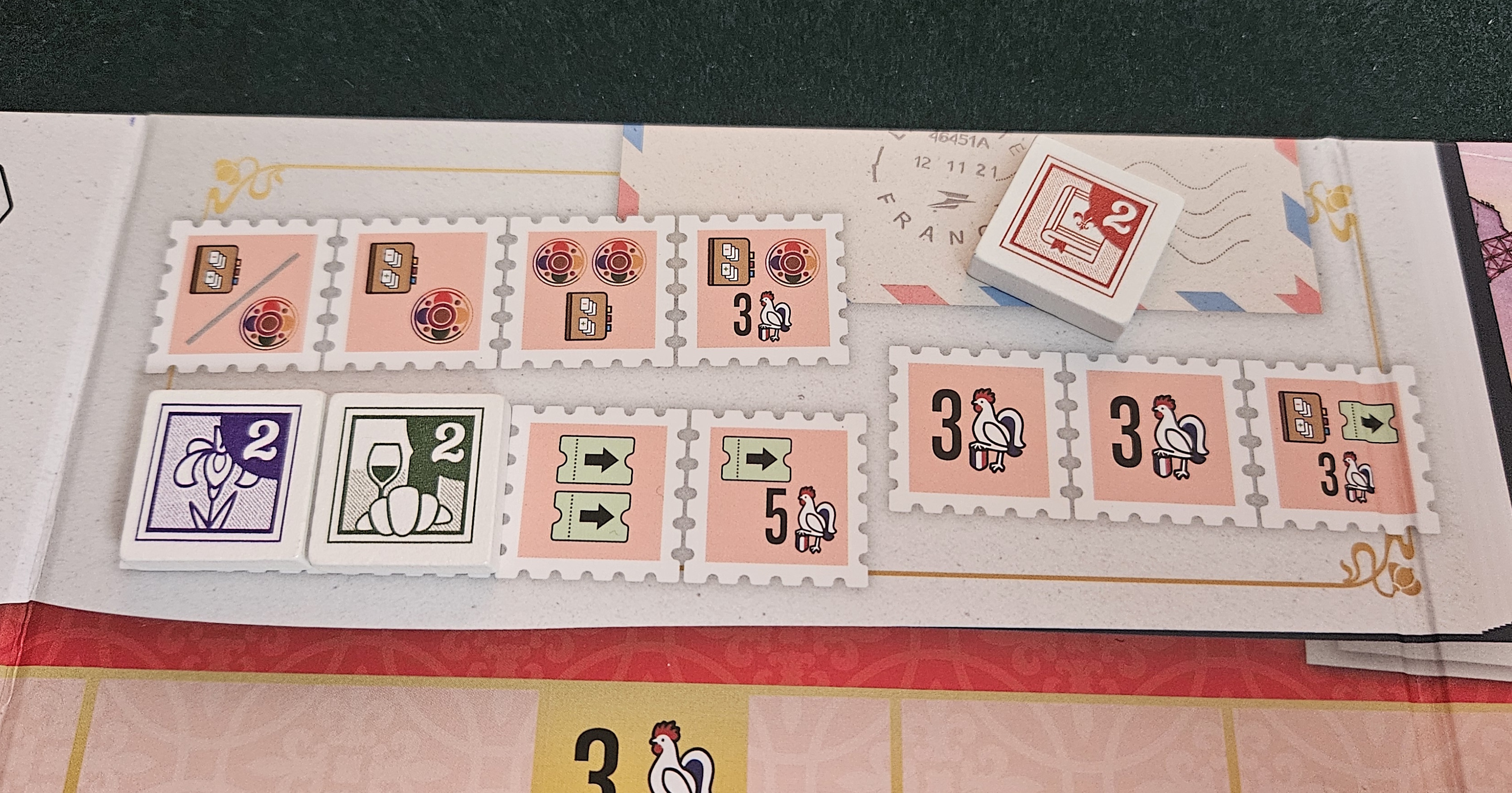
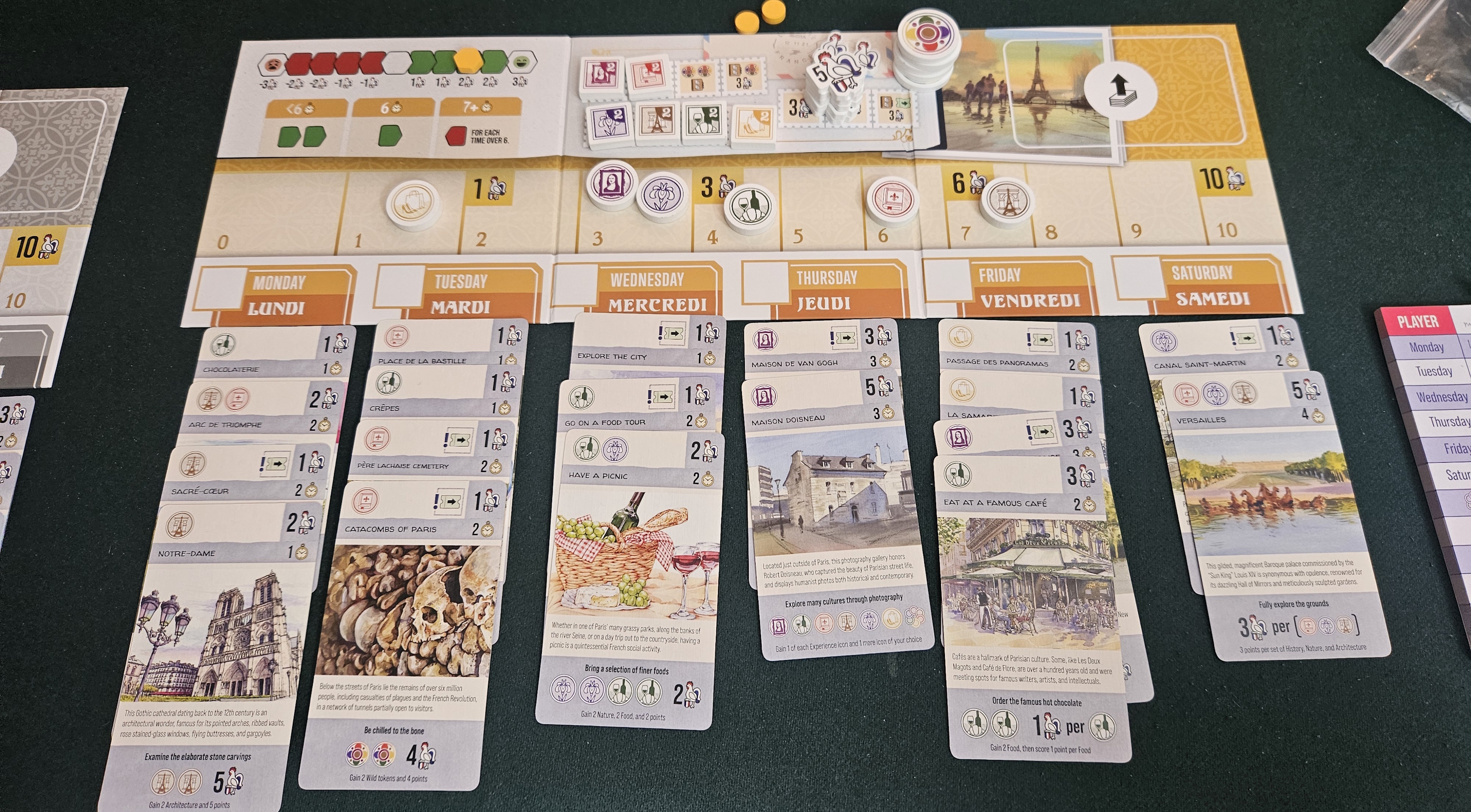
For all that, there’s an elegance to the whole thing. Turns are presented as simple drafts. You receive some cards. One or two of them will get scheduled into your itinerary. The rest are passed around the table. The cards each present a different activity in Paris: visiting a museum, snacking on delicacies, touring a park, shopping at an open-air market, finding an overlooked nook that you’ll boast about to friends for years to come.
Each card has four main components. Victory points — self-explanatory — some icons that increase the appeal of your trip on a numbered track, the amount of time required to fully visit that card, and lastly a scoring opportunity that will only trigger if this is the final event scheduled on any given day. Your objective is largely about optimizing scoring. To offer but one example, visiting the National Archives earns three points for every history icon you placed on that day. That’s a tremendous opportunity if you’ve arranged a day full of tours, but is easily dismissed if you’re planning on shopping or eating instead.
Those other considerations are no slouches, either. It’s possible to absolutely cram a day with activities, but your energy level will suffer, possibly resulting in subtracted points. There are also ideal conditions for each day, earning little bonuses for visiting the park when it’s clear outside or stuffing yourself with pastries on what I imagine is your cheat day. And if nothing appeals, Wood returns with a trick he deployed to great effect previously, letting any card flip to its reverse side to become a generic “Explore the City” activity.
Spending a week in the country before heading to Paris.
If you’ve played Let’s Go! To Japan, this likely sounds familiar. Indeed, nearly everything here resembles Wood’s previous title, but has become the beneficiary of little tweaks that mark this as the far superior outing.
For instance, there’s the way those Explore the City activities are handled. Previously, exploring Tokyo or Kyoto resulted in your tableau receiving a random card during scoring. This could make or break your day, interjecting some randomness into what was otherwise a carefully structured experience. Here, exploring the city is its own pleasure; one doesn’t need to stumble upon a museum or garden to justify their time spent in Paris. This keeps your tableau in check and feels more appreciative of what makes such a trip worthwhile. Just being here is enough.
Similarly, the ideal conditions for each day are now portrayed as guidelines rather than dictates. It’s worth assigning activities to the corresponding days, but this is only mildly beneficial, and only the first two times you do it. Beyond that, you’re free to schedule your days as you see fit, without worrying that you’re missing out on another drizzle of points. It’s a small thing — basically, you’re earning a benefit just a little earlier than in the previous game — but it goes a long way toward letting you shape your own trip rather than ensuring there’s a history day, a food day, an architecture day, and so forth.
The tableaux here are much more flexible than those in Let’s Go! To Japan.
The larger change is more structural. Where the previous game saw your vacationer shifting between Tokyo and Kyoto, a system that demanded its own train-hopping minigame, Let’s Go! To France instead divides its trip into two portions. Your main tableau actually represents the second week of your vacation, resolved during scoring. As you place cards into your tableau, however, you might trigger tickets that move a pawn across the countryside. Depending on your destinations — and which region you’ve chosen for the group to explore — it’s possible to begin your week in Paris having already seen some sights, earned some tokens, or maybe even secured a special scoring condition or two.
At times, there’s a sense of vague translocation. You are, in effect, planning Schrödinger’s Vacation, the cards signifying events in both past and future. But it’s a mild discombobulation at worst, one that lasts maybe five minutes before everything snaps into place. The overall process is much smoother than the previous game’s swapping between cities, and provides ancillary benefits to the game’s usual procession of daily scores.
You might, for example, begin your week in Paris already tuckered out from your time in the Loire Valley, prompting you to take it easy for a couple of days or chow down on some crepes for a sugar rush. Or perhaps you’ll arrive already enculturated by old architecture, letting you take advantage of a daily highlight that requires a certain number of icons before awarding big points. Where previously these objectives would only pay out in the later portion of your trip, it’s now possible to assemble a more robust tableau, one that feels rewarding from start to finish.
I appreciate a bonus.
As before, scoring is an active portion of the game, an event in and of itself where players walk through their trip one day at a time, tallying points and keeping track of their relative energy levels. This helps to digest the game’s point-salad fiber, but it plays an even more important role in contextualizing Paris as a geographic space with its own character and identity.
I’ve often praised Santa Monica as an ideal tableau-builder for the way it asks players to not only create a space, but also to inhabit it, to move around in it, to poke around its nooks and crannies. With Let’s Go! To France, Wood replicates the trick, albeit via an entirely distinct set of mechanisms and representations. This is Paris as a location out of time, the city that is at once a tourist trap and timeless. Around every corner there’s something new to see, some fragment of history that has been improbably preserved across the ages.
And that sense is communicated above the table as well. As one friend put it, you could take the deck to Paris as a reminder sheet of everything there is to see and experience. Playing this game, we found ourselves discussing the spots we’d seen and those we hope to see some day yet to come. The overlooked garden with the hidden entrance, where one friend drank wine and conversed with a farmer. The museum that sparked my imagination more than any other I’d ever walked. The sheer looming size of something. The joy of ducking into a random cafe and having one of the finest meals of your life.
I’d do that.
The effect is magical. In a sense, Wood has created a transposition of his own, a game at once past and future, both reminiscence and future itinerary.
He’s also crafted a game that’s nearly without parallel. That its best comparisons are Wood’s own past creations is a testament to his skill with this particular medium, but also to the city he’s chosen for us to experience all over again. In improving on its predecessor in nearly every way, Let’s Go! To France deserves its peculiar punctuation. Let’s go, indeed.
A prototype copy of Let’s Go! To France was temporarily provided by the publisher.
(If what I’m doing at Space-Biff! is valuable to you in some way, please consider dropping by my Patreon campaign or Ko-fi. Right now, supporters can read my first-quarter update of 2026: the best board games, movies, books, and more!)
This is a board game blog. Board games are a medium which can help us understand – for example, they can provide a uniquely active perspective on history. Yet which other medium can provide a fresh perspective on board games? – This is where novels come in handy. Today, we’re going to look at The Third Reich (Roberto Bolaño), a study in obsession as well as gaming and history.
Spain in the 1980s. Udo Berger, a young German, has just arrived in a small seaside town for a vacation with his girlfriend Ingeborg. Yet Udo’s mind is not on the beach. He has just won the national championship at the wargame The Third Reich (clearly based on Rise and Decline of the Third Reich (Don Greenwood/John Prados, Avalon Hill)) and plans to use his vacation to write an article on his new strategy for the Axis. Ingeborg, however, has more traditional vacation activities in mind, and so they spend some of their swimming, tanning, and partying, through which they befriend another German couple, some locals, and the enigmatic paddleboat renter who is only known as El Quemado (The Burned One) for the burn marks which cover his body. When the vacation comes to an end, Udo remains in Spain, supposedly to help in the case of an acquaintance lost at sea windsurfing… yet the real reason is the game of Third Reich which he plays against El Quemado.
Chilean novelist Roberto Bolaño wrote the novel in 1989. Since he turned his hand-written first draft into a typoscript (and later typed the first 20% into his first computer), it is assumed that he wanted to eventually publish it, but he didn’t do so before his death in 2003. When the novel was found among his papers, it was posthumously published in 2010. In addition to the original Spanish (El Tercer Reich), the book has been widely translated. I read the German translation.
Warning: Spoilers for the plot of The Third Reich ahead – but frankly, this is not a book you read for plot, you read it for the vibes.
Obsession: Conquest, Validation, Control
Udo Berger is wargame-obsessed, but the book is not a study of how an outsider has outsider fixations. On the one hand, Berger’s obsession with conquest and domination sets him by no means apart from his peers – just that they usually direct their respective urges to amorous exploits. On the other, our protagonist does not only want to conquer in the game either. In addition to his girlfriend, he also pursues the hotel manager Frau Else (who has been his crush when he was vacationing in Spain as a teen), and the underage chambermaid Clarita. And maybe most of all, Berger is fixated on being respected by his wargame peers, which he can only imagine obtaining by finding strategies (and publishing articles about them) which will obliterate all conventional wisdoms about the game.
As Berger is acutely aware of his lack of linguistic sophistication, he decides to practice by writing a diary during his vacation (which is what we read in the novel). The development of this diary reflects the changes in the writer: Originally, his daily entries are very structured (one per day, headlined by the date), and mostly concerned with banal reports on what he did, what he ate, and what he has in mind for the game/article). As Berger is drawn more and more into his duel with El Quemado, the diary gets more confused: He jumps from one level of narration to another within the same paragraph, extensive passages are solely dedicated to what’s happening in the game (down to which counters are placed on which individual hex numbers on the board), and the chapters are not only named after the dates, but also entitled “With El Lobo and El Cordero [his Spanish acquaintances]”, “Spring 1942” or “My Favorite Generals”.
Berger’s inability to focus also dooms his conquests (ludic and erotic): He sets out to prove that opening a second front early is not a liability, but an asset, and enthusiastically reports early in the game to a friend at home that it’s “Blitzkrieg on all fronts”. Yet as he conducts an amphibious assault of Britain at the same time as he invades the Soviet Union, his forces are overstretched and his Axis collapses before the historical date. And broadcasting his erotic attention over Ingeborg, Frau Else, and Clarita, does not further his relationship with either of them.
As things slide out of his grip, his attitude to control changes: Initially, Berger is fixated on the superior strategy. He notes down the exact moves – which corps need to occupy which hex in which turn to win. This chess-like approach collapses after the turning point of the game: Once El Quemado begins his counter-attack, Berger mentions for the first times that there are die rolls in the game (and how they favor his opponent) – not unlike many board gamers I have seen.
Gaming and History
Besides the main theme of obsession, the novel also offers many glimpses on gaming, history, and the relation between the two.
Berger arrives in Spain with his life compartmentalized between the gaming and the “normal” part – his girlfriend and the office job. This compartmentalization is already eroding with his plan to write the strategy article (which immediately chafes against the confines of a conventional vacation – the hotel employees are bewildered by his request for a large table to be set up in his room, and Ingeborg demands he come to the beach) and fully collapses over the course of the book, when he even unilaterally extends his vacation to play the game (and gets fired for it).
The shadow of history hangs over Berger. Our protagonist does not only play games about World War II, he also reads “patriotic” literature of the era, knows about the lives and deeds of the German generals (especially those of the SS), and the only of his wargamer friends for whom he has a certain reverence is a veteran of World War II. Despite this clear fascination for the history of Nazi Germany, Berger twice disavows being a Nazi himself (having been asked by El Quemado and Clarita). Once he even calls himself an “opponent of the Nazis”, but does not expound on it. His personal politics do not factor into the novel – Berger, having been born around 1960 in democratic, liberal, prosperous post-war Germany enjoys the luxury of only engaging with history at his leisure. He thus remains at the surface of it…
…unlike his gaming opponent. El Quemado comes from South America, and it is rumored among his Spanish acquaintances that the scars he bears are the result of torture (by one of the many right-wing regimes which took power in the 1970s). History has thus seeped into his body and gives him the strength to withstand the ludic assault of the experienced player Berger.
Bolaño himself was arrested after the 1973 coup in Chile and, to his own wonder, was released after eight days without having been tortured (he ascribed it to two of the detectives having attended school with him). He then emigrated to Spain where he worked odd jobs in the tourism industry like El Quemado.
Another allusion to Chile is made in a much-misunderstood scene: On September 11, everyone is out at the beach to celebrate the Catalan national holiday. Yet when a plane flies overhead, an eerie sense of dread overcomes the spectators. Many reviewers see this as a revision which Bolaño must have made after the September 11, 2001 terrorist attacks (or, as an odd coincidence) – but I think the likeliest reason for the scene is that the coup in Chile began on September 11, 1973 with the rebelling air force bombarding the presidential palace in Santiago.
Verdict
Roberto Bolaño’s The Third Reich starts with the innocent concept of a beach vacation. As it grows darker, the novel develops a hypnotic pull. The author’s own deep knowledge of wargames allows him to paint a vivid picture of the game itself – and of the hold it can have over its players.
When playing games it’s easy to fall into the trap of over-anaylsing turns, or questioning whether the move we made was the right one, or even allowing people to roll back whole turns – so we’re asking if maybe we’ve been wrong this whole time, and we should just … embrace it? Are mistakes interesting? Before we have any regrets, we talk about Apiary, Wizards Cup, and Wroth. Be sure to submit your games for the Listener Top 20!
If you don’t want to miss an episode, please subscribe on Apple Podcasts/Google Podcasts/Stitcher/Spotify, or add our RSS feed to your favourite app. Reviews and subscriptions really help us and would be greatly appreciated! To download the episode directly, click here.
If you’d like to discuss anything in the episode, please do so in the comments below, visit our BoardGameGeek guild, join our Discord, or Facebook Group! Any feedback is also always helpful. If you’d like to show your support for the show, we also have a Patreon with some fun rewards, and a merch store!
Timecodes:
02:43 – Apiary 13:43 – Wizards Cup 20:41 – Wroth 31:37 – Mistakes are fun?
Thank you to Heart Society for generously letting us use What’s On Your Mind, Kid? from their album Wake the Queens.
We’ve been assessing the merits of political leaders in (more or less) democratic countries on this blog for a few years now – UK prime ministers, US presidents, German chancellors. Today, we’re returning to German presidents, looking at Friedrich Ebert. And which game could be more appropriate for him than Weimar (Matthias Cramer, Capstone Games/Skellig Games/Spielworxx)?
The Rating System
Some caveats ahead: The presidents will be rated by the knowledge of their time. If they or their contemporaries could not have known about the effects of something, I will not use my hindsight to mark it as a mistake of theirs. The assessment is focused on their conduct as president.
Now, to the system itself: There are three policy field categories (foreign, domestic, and economic policy) and three more general ones (vision, pragmatism, integrity). A president can earn from one to five stars in each category (for a total sum of up to 30). In detail, the president is assessed as follows:
Foreign policy: Did the president increase German influence in the world and the security of Germans at home? Did the president wield German power responsibly and with positive results for the regions affected?
Domestic policy: Did the president increase the liberty of Germans to express themselves and to participate in the political process? Did the president promote domestic security and shape the framework for fair justice dealing with offenses?
Economic policy: Did the president facilitate the prosperity and economic security of Germans (including in the mid- and long-term)? Was the president’s economic policy based on mutual benefit of those involved or did it unduly burden one side?
Vision: Did the president have an idea of what Germany and Europe (the latter counting for more in times of German influence being great) should look like beyond the immediate future? Did the president’s policies steer Germany (and, if applicable, Europe) in this direction?
Pragmatism: Did the president succeed in seeing their policy through from inception to completion? How well did the president manage the support from parliament, society, the administration, the media?
Integrity: Did the president understand the office as a means to benefit themselves, special interest groups, the entire country, or another community? Did the president respect the boundaries of the office?
Note: If you have read my UK prime minister or US president ratings, you will remember that I rated them on the global impacts of their vision as well. As the rating system is only really applicable to democratic leaders and no democratic German leader ever had the chance to conduct a truly global policy, I only assess their vision on national and European grounds.
In all other ratings (UK prime ministers, US presidents, German chancellors) the subject’s life after holding the office is also assessed (for they are still seen as ex-office holders, but as a secondary consideration). This does not apply here, as – spoiler! – both Weimar Republic presidents died in office.
In Ebert’s special case, I will not only assess his conduct as president, but also as chancellor before, as he held the post at a time when Germany did not have a head of state.
Ebert’s Life
From Saddler to Chancellor
Friedrich Ebert was born on February 4, 1871, as the son of a tailor. He learned the trade of a saddler and became involved with the workers’ movement during his journeyman years. In 1891, he settled down in Bremen, where he ran a pub while working for the trade union. Ebert’s political work in the trade union and the Social Democratic Party (Sozialdemokratische Partei Deutschlands, SPD) assumed ever more importance. He was elected to the Bremen city council (1899) and became a full-time trade union secretary. In the following years, Ebert rose to national prominence: He was elected to the SPD national party committee (1905) and to the Reichstag, the national parliament of Germany (1912). One year later, he became one of the leading Social Democrats in Germany when he was elected co-chairman of the SPD.
The Social Democrats faced their crucible at the outbreak of World War I. Ebert successfully advocated supporting the government’s war efforts (instead of attempting to forge an international workers’ coalition against the war). In the later years of the war, more and more Social Democrats took up a strict anti-war stance, forming up as Independent Social Democrats (Unabhängige Sozialdemokratische Partei Deutschlands, USPD). Ebert maintained his previous stance and kept most of his allies within the party (now known as Majority Social Democrats (Mehrheitssozialdemokratische Partei Deutschlands, MSPD), yet tried to mediate between workers protesting and striking against the war and the government (notably during the January Strike of 1918).
When the military situation looked grim for Germany in fall 1918, de facto military dictator Erich von Ludendorff resigned and pushed for a new government to assume responsibility for the impending defeat. Ebert joined a parliamentary government and became its interim chancellor on the day that emperor William II was forced to abdicate. Two days later, Germany and the Allies agreed on the Armistice which ended the fighting on the Western Front.
Many socialists, especially from the USPD, now pressed for a full-scale political and social revolution based on the workers’ and soldiers’ councils sprouting up everywhere. Ebert, who abhorred the Russian Revolution, wanted to bring about gradual change which would transform Germany into a democracy by parliamentary means. The sweep of revolution brought MSPD and USPD together in an uneasy government alliance. The opposition between moderate and radical socialists provides the basis for the SPD and KPD (Kommunistische Partei Deutschlands – Communist Party of Germany) players’ relationship in Weimar (all forms of radical socialism are subsumed under the umbrella of the KPD (which was historically only founded in January 1919) in the game). The USPD is a minor party in the game which can be aligned with either SPD or KPD (starting in the latter’s camp) and which provides more gumption for actions in the street and sizable parliamentary bonuses in the early game.
The USPD gives additional seats in parliament in the first four rounds of the game as well as a bonus point in the reserve each round (on the board to the left of the card). If the SPD can wrest the party away from KPD control early, that usually results in a large democratic majority under SPD leadership.
In the heady first days of the revolution, MSPD co-chairman Philipp Scheidemann proclaimed the German Republic (Ebert had opposed it and wanted Germany to become a parliamentary monarchy). The new government also proclaimed wide-ranging individual liberties and promised sweeping economic and social reforms (ranging from the eight-hour work day over housing programs to social security) as well as democratic elections in which both men and women would have the right to vote – here Ebert and the USPD agreed in substance, yet not in process: The USPD regarded the consent of the workers’ and soldiers’ councils as enough legitimation; Ebert insisted to carry out the reforms through a parliamentary process. Ebert outfoxed the USPD by having the Reich Councils’ Congress agree to hold parliamentary elections at the earliest possible date.
While Ebert outmaneuvered his rivals on the left, he also secured his right flank. Millions of German soldiers streamed back from the frontlines after the armistice. They needed to be demobilized in an orderly fashion, and, most of all, the threat of a military coup against the nascent republic needed to be warded off. Ebert thus struck a bargain with the army’s conservative leadership: The army would not act against the republic. In return, the new government would forgo the democratization of army structures. The deal already paid off for Ebert by December 1918: When the conflict of the government with the left-leaning People’s Naval Division over outstanding pay and the choosing of its commander escalated, Ebert had the Division dissolved by armed force. The same fate awaited the singularly ill-prepared Spartacus Uprising of January 1919.
A revolution makes for strange bedfellows: Social Democrat Ebert is inspecting German troops in the illustration of the “Pact with the Old Powers” event card. The event is extremely powerful under the right circumstances. Note that the SPD player could also use it to suppress a right-wing insurgency!
When the National Assembly had been elected in January 1919, Ebert’s MSPD was by far the strongest party. Its allies, the Catholic Zentrum (Center), and the progressive-liberal DDP (Deutsche Demokratische Partei, German Democratic Party) also fared well at the ballot box. Due to the armed unrest in Berlin, the National Assembly was convened in the quiet provincial town of Weimar, thus providing the common name for the first German republic (and, consequently, also for the alliance of SPD, Zentrum, and DDP – the “Weimar Coalition”). The Assembly elected Ebert the first president on February 11, 1919.
The Parliamentary President
The National Assembly established wide-ranging rights for the president in the constitution. Yet Ebert interpreted these as powers to be used in emergencies. In his view, the president was a steward whose role was to guard the constitution and integrate the nation. Thus, Ebert only rarely got involved in the day-to-day business of the cabinet, now headed by Philipp Scheidemann – for example, when the Allies presented Germany with the Treaty of Versailles, Ebert remained publicly non-committal.
Even when the republic as such was threatened, the president was not always the first to respond: The right-wing power grab by Wolfgang Kapp and Walther von Lüttwitz was stopped by a general strike. While Ebert’s name appeared on the pamphlet calling for the strike, it is likely that he was in fact not involved in the move. Ebert’s main contribution to the failure of the coup was of a different kind: When the coup leaders occupied Berlin, the federal civil service refused to do their bidding. Even though most of the civil servants had been hired under the emperor and felt attached to the monarchy, they had come to respect Ebert and would not enable the coup against his lawful government.
The 1920 parliamentary elections dealt the (M)SPD and its allies a heavy blow. They lost their parliamentary majority. Ebert advocated for a “grand coalition” which would include not only the parties of the Weimar Coalition, but also the pro-business, national liberal DVP (Deutsche Volkspartei, German People’s Party). His counsel was not heeded. Instead, Zentrum and DDP formed a bourgeois minority government.
Ebert was the most imposing political figure of the early Weimar Republic. While his integrative approach did much to wed the more moderate workers to the Republic (they would remain its most steadfast defenders till the very end), his suppression of revolutionary activities also alienated the more radical workers… thus the “Red Emperor” event card (showing Ebert at his presidential desk) can cut both ways, placing either an SPD- or a KPD-aligned worker marker on the society track.
As the government had no parliamentary majority, the president might have assumed a greater role. Ebert, however, maintained his interpretation of the presidency as a stewardship, detached from party politics and the day-to-day decisions of the cabinet. In economic and social matters, Ebert retained his representative role, mediating at times in collective bargaining struggles. In foreign policy, the president’s constitutional role was larger, and while Ebert generally supported the general foreign policy of the bourgeois minority governments, he was left out of the actual decision-making. In the meantime, Ebert tirelessly lobbied for cooperation among all democratic parties. It took a plunge into catastrophe for the young republic to heed his counsel.
When Germany reduced the reparation payments to the Allies in January 1923, France occupied the industrial heartland on the Ruhr. The German government called on the workers of the Ruhr not to collaborate with the occupation force in extracting the reparations in kind (“passive resistance”). That required the government to pay out ersatz wages to millions of people, accelerating inflation to a ludicrous degree. By August 1923, prices compared to January had multiplied by 100 (!), and France was still occupying the Ruhr. With Ebert’s support, all democratic parties from the SPD to the DVP formed a grand coalition under chancellor Gustav Stresemann.
Stresemann ended the ruinous passive resistance. While economically sound, this blow to German national sentiment caused backlash: The Bavarian state government declared a state of emergency, aiming to build a new authoritarian system in Bavaria (equivalent to the establishment of a right-wing regime in Weimar) and then exporting it to the Reich as a whole. In response, SPD-KPD state governments formed in Saxony and Thuringia (both in the path for a “March on Berlin” from Munich).
Once more, Ebert suppressing a leftist challenge to the republic. The Reichsexekution placed Saxony and Thuringia under federal control.
Ebert used the constitutional emergency powers granted to the president to depose the Saxon and Thuringian state governments. Federal troops quelled the unrest there before any uprising had even materialized. Yet while the army would march against leftist challenges to the republic, it was notoriously unwilling to confront right-wing movements (as Ebert knew from the Kapp-Lüttwitz coup). Thus, while Ebert formally put the army’s commander Hans von Seeckt in charge of Bavaria, he did not order any concrete action. In the end, the authoritarian government of Bavaria was overthrown from the fringe of the right-wing movement – Germany’s erstwhile military dictator Ludendorff and an ambitious demagogue named Adolf Hitler took the key government players captive and called for a march on Berlin. It was stopped within its first kilometer by 130 policemen. After that, the authoritarian government collapsed. The republic had been saved.
Lots to deal with: The Weimar Republic was close to collapse in 1923 – in game terms, approaching its seventh threat marker in the Deutsches Reich box.
While the Weimar Republic stabilized, Ebert fought for the dignity of his office. He had been smeared by enemies of the republic from the beginning of his term. When Ebert had visited a beach town in 1919, a local photographer had snapped a picture of him in swimming trunks. The monarchists bought that picture and kept circulating it, often contrasting the half-naked president with one of the emperors of the old Germany in full regalia.
The nationalist DNVP begins the game as the weakest of the four parties. One strategy for them is to erode the democratic majority – for example, by attacking the SPD’s parliamentary standing with the President in Swimming Trunks event.
Ebert’s detractors also attacked his conduct. Most famously, they attacked him for his role in the January Strike in 1918. A court found those calling Ebert a “traitor to his country” for his participation in the strike guilty of defamation, but added that they were factually correct – symptomatic for the monarchist leanings of the Weimar courts, still staffed with jurists from the ancien régime. The court’s ruling was only overturned in 1931. Ebert would not live to see it. He had put off surgery for appendicitis due to the trial and died of the resulting peritonitis on February 28, 1925. He was only 53 years old.
Ebert’s death is a watershed moment in a Weimar game. As long as the Ebert token occupies the Reichspräsident spot, the presidency is neutral, and nobody gains any benefits from it. When Ebert dies, an election is held in which the parties’ popularity with the voters is measured. Each party fields a candidate. The two candidates with the most votes advance to the second round, in which the two parties whose candidates have been eliminated can pledge their votes to any of the remaining candidates. That is a crucial moment to make deals, to forge alliances, to exact promises in return for the votes, and, more often than not, to pivot away from an ally who has become too strong. (I have seen my Social Democratic candidate defeated by a very grand coalition of the other three parties – Nationalists, Conservatives, and Communists.) From then on, the party holding the presidency can play a card both for the event/actions and for a debate once per round, effectively giving the party one more party card (which, as you typically only draw three of them per round, is huge). This less restrained approach to the presidency reflects the presidential activism of Ebert’s successor Paul von Hindenburg.
Even though foreign policy was the area in which the president’s role was constitutionally confirmed, Ebert followed rather than led. While he – much like his head of government Philipp Scheidemann – personally found the terms of the Versailles Treaty unacceptable, he stayed on when Scheidemann resigned, displaying a keen sense of duty and order. Ebert supported the various governments in their unpopular, but necessary fulfilment of the stipulations of the Versailles Treaty and their orientation toward the western powers. At times, he was entirely sidelined, as when chancellor Joseph Wirth and foreign minister Walther Rathenau forged the Treaty of Rapallo with the Soviet Union.
Ebert’s achievements in this realm lie during his tenure as chancellor. His Proclamation (Nov 12, 1918) ushered in an unprecedented era of personal liberty and social equity, exemplified in the commitment to freedom of the press and women’s suffrage. Ebert’s integration of the army into the new republic avoided a civil war. Later, his uneven use of force dealing with the uprisings of 1923 was pragmatically understandable, but failed to conciliate the political right with the republic or make the army more accountable to the political leadership.
The Proclamation of November 12, 1918 laid the foundation for the eight-hour work day, a milestone for the working population of Germany. An overlooked contribution of Ebert’s to economic development is his advocacy for the “grand coalition” – only this broad alliance could bring about the far-reaching currency reform which ended hyperinflation in 1923. That Ebert’s calls to alleviate the social hardships which came as a side effect to the currency reform went unheeded by the bourgeois minority government which followed the grand coalition is symptomatic for the limited power of the presidency in the realm of economic and social policy.
Ebert has often been criticized from the left as too cautious, not able or not willing to dream big. And indeed, in hindsight his thought and practice seems much less imaginative than his critics’ utopias of socialist republics based on grassroots councils. Yet in 1918, the thought of a liberal, parliamentary Germany – the realization of the dream of 1848 – was revolutionary, and, most importantly, it was achievable. Ebert helped to bring about the German democracy and guided it into calmer waters during his tenure.
Rating: 5 out of 5.
If Ebert (pictured in the background of the election poster) played Weimar, he’d select this agenda card every round.
Pragmatism
Ebert made it possible for the bourgeois politicians, the army, and the civil service to get along with a Social Democratic government. While this was an impressive feat in itself, his pleas for cooperation were often not heeded – neither from his own party nor from those he sought as allies. His natural inclination to compromise veils his deft handling of his political opponents: The USPD joined the provisional government on equal footing in November, yet ended up entirely outmaneuvered by January – its moderates falling in with Ebert’s call for elections as soon as possible, its radicals reduced to a singularly ill-advised attempt at armed uprising.
Ebert is the rare politician who, presented with the opportunity to make wide-reaching decisions with a free hand, refused it. His belief that a freely elected parliament must make the important choices guided him during the revolution. Later, Ebert understood himself as a steward of the republic, a president of all Germans, and was unwilling to use his office for the gain of particular individuals or groups. He used the wide-ranging emergency powers assigned to the president in the constitution only when presented with a grave crisis. His thoughtful wielding of power becomes ever more apparent in comparison with his successor’s liberal use of the emergency powers which contributed to the fall of the republic.
Friedrich Ebert took on the highest duty in tumultuous times. He wielded power responsibly, with the best of intentions, and remarkable success. His restraint and willingness to compromise were admirable in themselves, but sometimes emboldened the enemies of the republic he had helped to create.
How would you rate Ebert? Let me know in the comments!
Further Reading
For a short introduction to Ebert (and all other German chancellors in history), see: Sternburg, Wilhelm von (ed.): Die deutschen Kanzler. Von Bismarck bis Merkel [The German Chancellors. From Bismarck to Merkel], Aufbau, Berlin 2007, pp. 187—210 [in German].
The standard scholarly biography remains Mühlhausen, Walter: Friedrich Ebert. 1871—1925. Reichspräsident der Weimarer Republik [Friedrich Ebert. 1871—1925. Reichspräsident of the Weimar Republic], Dietz, Bonn 2007 [in German].
For the broader context, see: Herbert, Ulrich: A History of Twentieth-Century Germany, Oxford University Press, Oxford 2019.

 Anmelden






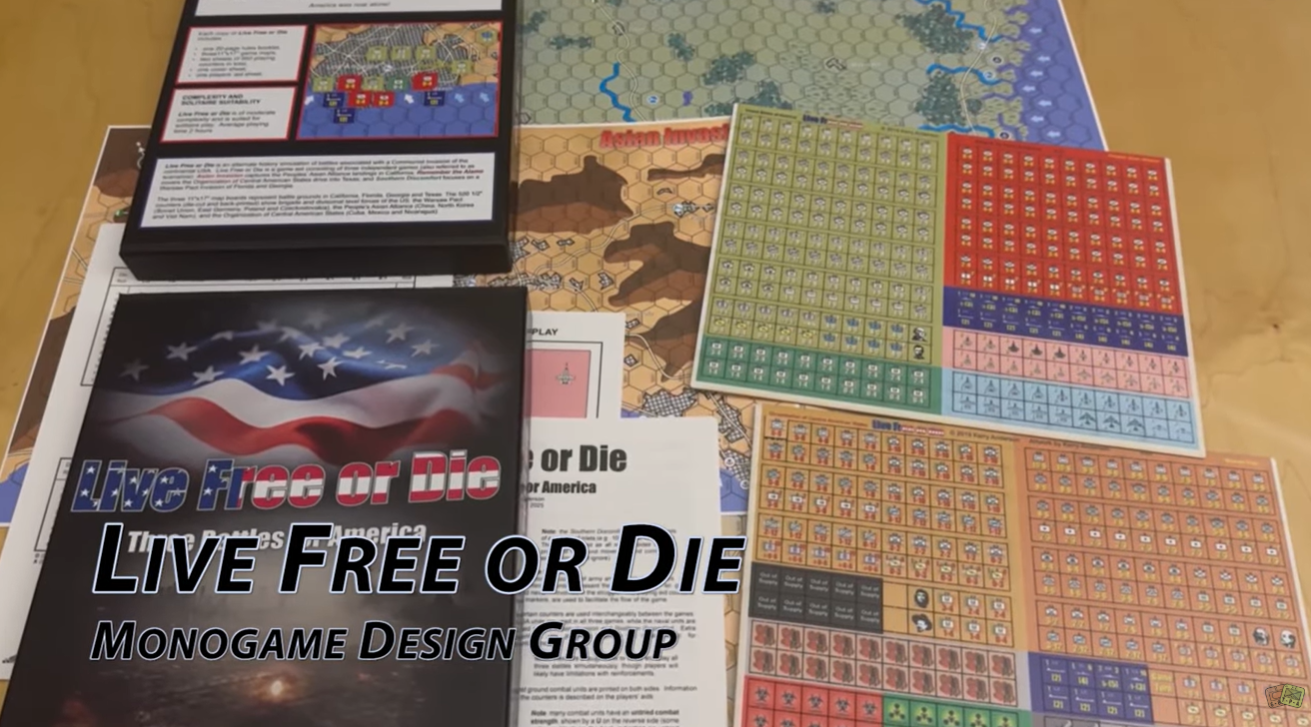
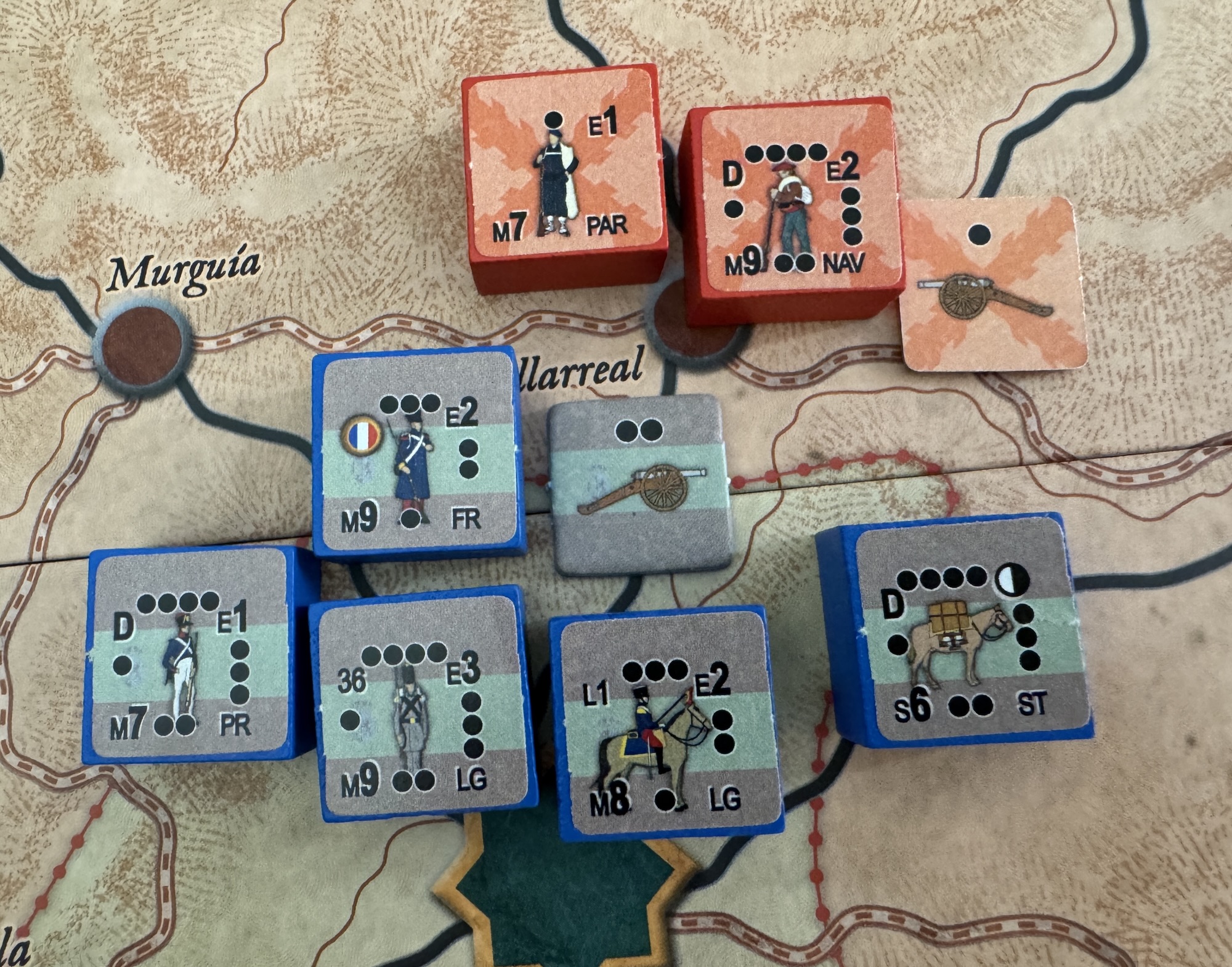





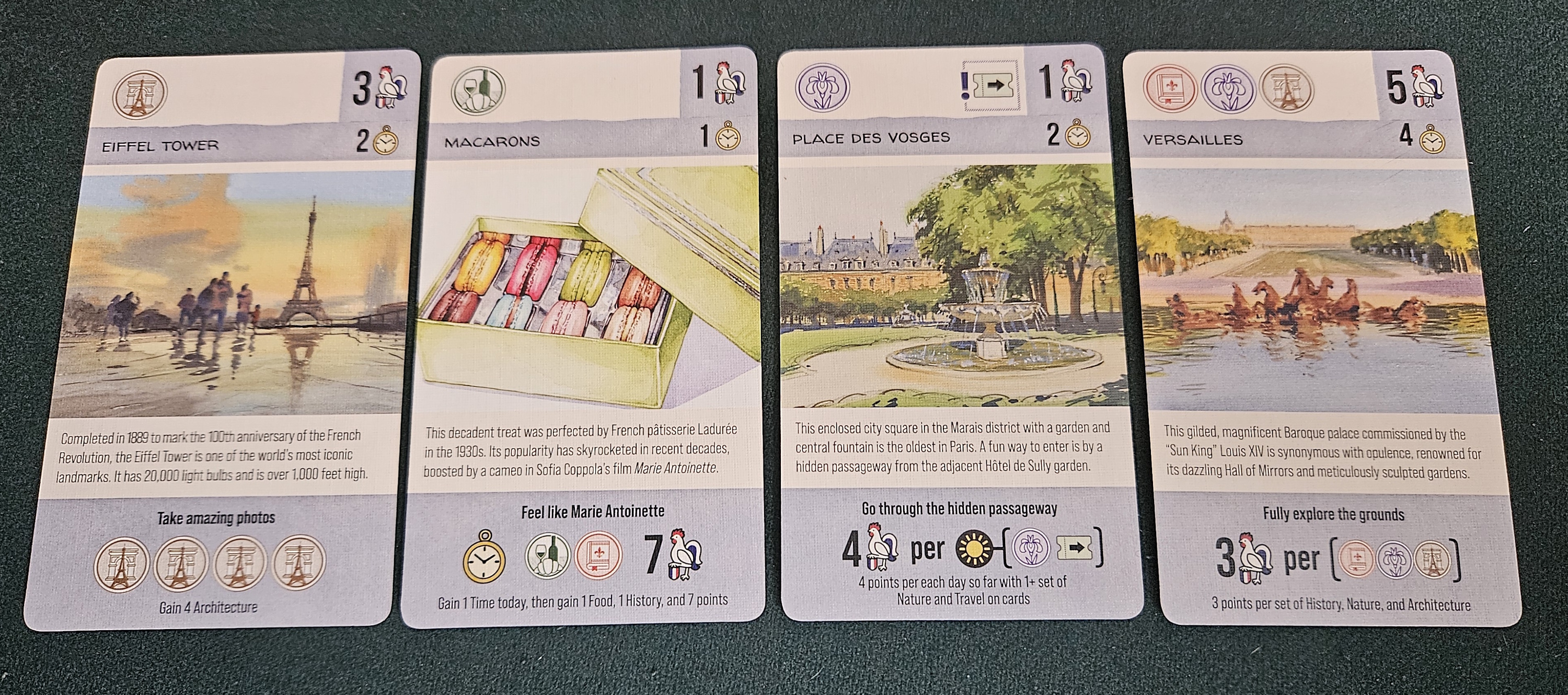
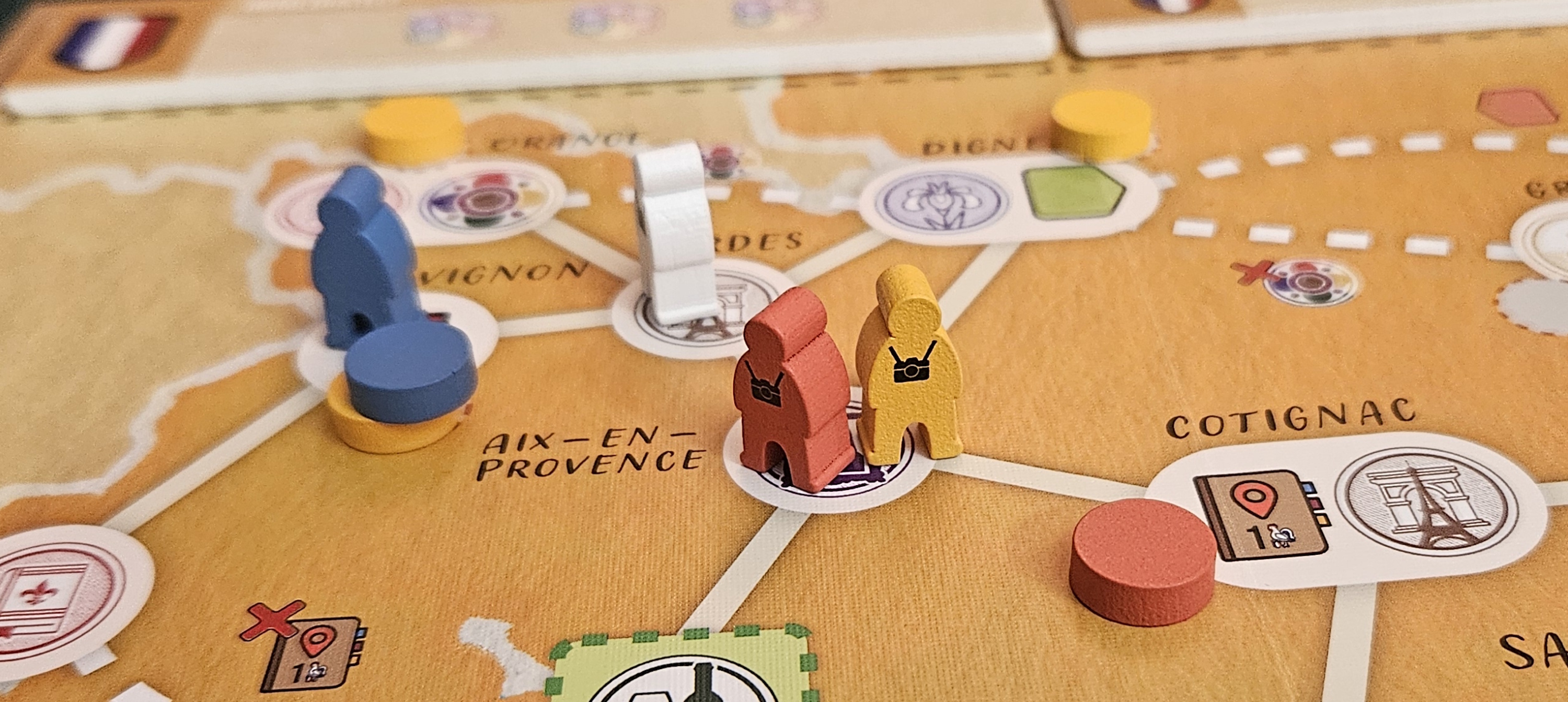
![Wait a minute, how dare you name a place Les Invalides? That should be reserved for hospitals and... [touches earpiece] it's a what? Ahem. Never mind.](https://spacebiff.com/wp-content/uploads/2026/04/4.-flex.jpg "Wait a minute, how dare you name a place Les Invalides? That should be reserved for hospitals and... [touches earpiece] it's a what? Ahem. Never mind.")