Anmelden
Sail South for The Isle of Penguins
03. Juni 2026 um 18:00
Instead of corralling cats, you can prepare to pack penguins

Instead of corralling cats, you can prepare to pack penguins
by Steph Hodge
Are you into the darker themes such as the Cthulhu Mythos and Zombies? Well, here are some upcoming releases that might fit your fancy.



The Isle of Cats designer Frank West has unveiled a new game set in the same universe as his bestselling polyomino-puzzle title, saying the project was shaped by lessons learned from more than a million recorded plays of the original.
The Isle of Penguins, which launches on Kickstarter on July 7, sees players rescuing the sea birds from melting ice floes and fitting them onto uniquely shaped rafts, in an experience West says is faster and more accessible than The Isle of Cats while retaining its strategic depth.
West, who runs publisher The City of Games, told BoardGameWire The Isle of Cats had now surpassed 250,000 physical sales since it was released in 2019 – a figure that rises to almost half a million when including spin-offs The Isle of Cats: Explore & Draw, The Isle of Cats Duel and digital versions of the game.
He said the design for The Isle of Penguins emerged after six years of analysing data from digital versions of The Isle of Cats, as well as player feedback from across Kickstarter and YouTube video comments, social media discussions and BoardGameGeek reviews.
That data amounts to more than one million plays across the digital versions the game – information West says he has used to create a game that plays 20% to 30% faster than The Isle of Cats standard mode, while also giving players more to do.
He told BoardGameWire, “I think my main takeaway was that The Isle of Cats is a great game that is loved by a lot of people – It didn’t need fixing. But, there are things that could make the game more accessible to some people. I wanted to design a game to sit alongside The Isle of Cats, rather than replace it.”
West said major changes include a new selection system which allows for simultaneous play, most scoring happening during the game rather than at the end, and a drastic shift to the complexity of the polyominoes themselves.
He said, “One of the unique parts of The Isle of Cats when it was released was the complexity of the cat tiles themselves. They use less common shapes and can be very tricky to place, which is great.
“However, some players struggle to flip tiles in their head or visualise how something might fit, and the complex shapes in The Isle of Cats made this challenging for them. This was a key part of the game, and I spent many years working out how to flip the experience.
“In The Isle of Penguins, every penguin tile is a square or a rectangle. These are the simplest shapes, and much easier for people to visualise and rotate in their heads.
“But the raft board you are placing them on is far more chaotic, with many restrictive areas, which makes finding the right place to put a tile just as hard.
“Effectively, this flips ‘hard shapes and a simple board’ into ‘easy shapes and a complex board’.”
He added, “I have been thinking about a lot of these things for a long time, but when I managed to flip the polyomino experience with the raft board, and found a way to make simultaneous play work, I realised I had something exciting.”
West said that streamlining of the game allows players to do more in less time, without reducing decision making – and added that the title would retain Isle of Cats’ inclusion of both a family mode and standard mode, in addition to a new expert mode for the new game.
He said, “This keeps the entry point of the game as friendly as possible, while offering something more to veterans of The Isle of Cats looking for a step up.
“It was important not to assume that just because someone has been playing games for years, they would now want something more complicated. But I also wanted to make sure there was something there for those who did want it.”
West confirmed to BoardGameWire that the new game would be illustrated by The Isle of Cats artist Dragolisco, saying, “I wanted to ensure The Isle of Penguins looked familiar to those who loved The Isle of Cats, and I think he is a great artist. He did a fantastic job!”
The original Isle of Cats Kickstarter campaign raised more than £460,000 from over 8,100 backers in 2019, and was followed by a £1m-plus campaign for the base game and several expansions in 2021, which was backed by over 12,000 people.
A co-op spin-off title, Race to the Raft, picked up almost £350,000 a year later.
The Isle of Penguins is set to launch on Kickstarter on July 7.
The post Million-play analysis inspires streamlined Isle of Cats successor, as game’s sales pass 250,000 first appeared on .
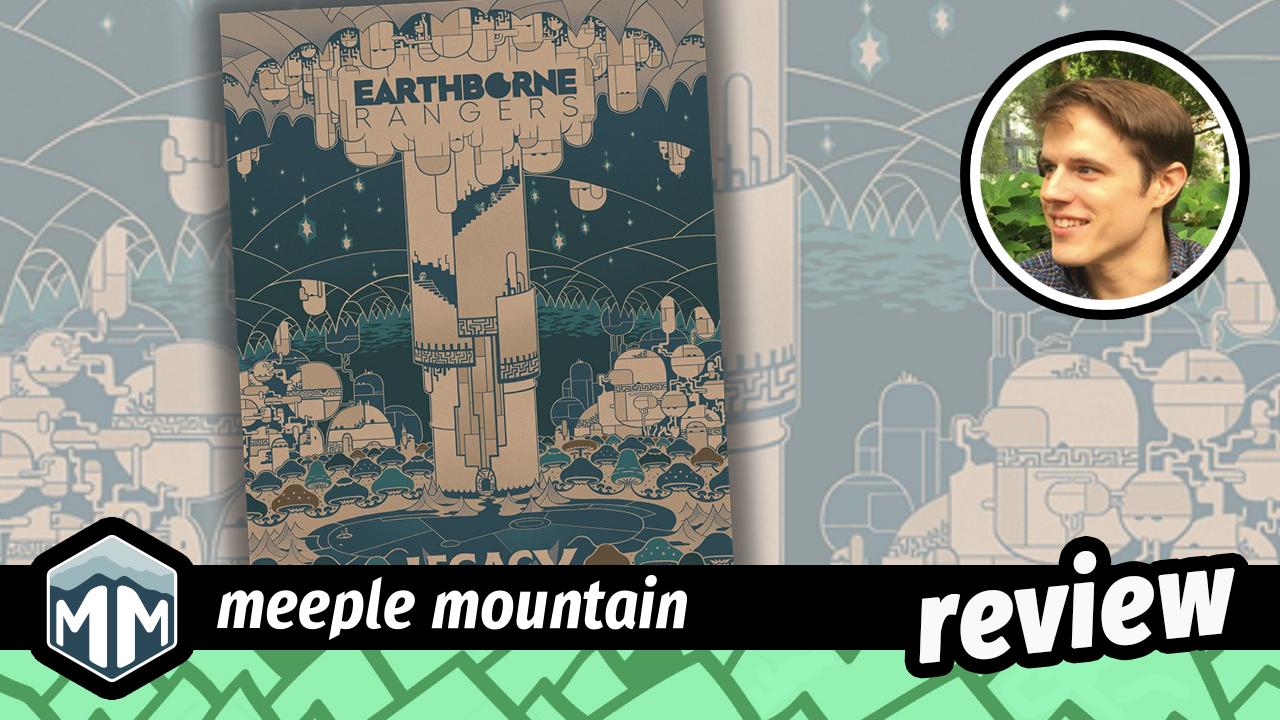
A new Earthborne Rangers campaign? You don’t have to tell me twice. It is hard to get me to play the same game more than a few times, but I will drop any and everything to spend more time in—or, in this case, under—the Valley.
While the base game of Earthborne Rangers—one of the greatest gaming experiences of my life, and an experience with which this review will assume you are familiar—takes place across a wide range of beautiful landscapes, Legacy of the Ancestors sends players into the depths of the Arcology, the ruins of a lost civilization that used to inhabit the Valley. This is the sensible choice, a natural development coming out of the first game. The first campaign leaves the Arcology, a consistent splash of harder sci-fi tech in a sea of solarpunk, barely explained, and the underground tunnels are as strong a contrast in setting as it’s possible to have. No more sweeping vistas for you, no no. Best you can hope for is a spot of bioluminescence.
The cornerstones of what make Earthborne Rangers great are still here. The caverns of the Arcology teem with life and discoveries. There…
The post Earthborne Rangers: Legacy of the Ancestors Game Review appeared first on Meeple Mountain.

Hybrid physical and digital game console maker Board has raised another $20m in venture capital amid plans to launch an AI-powered game design platform.
The new funding round, which was led by Union Square Ventures, means Board has now raised $35m in external funding since the touchscreen device was launched in October last year.
That launch was accompanied by a suite of 12 initial games, including Omakase from veteran board game creator Bruno Cathala, which make use of physical pieces that interact with the digital board.
The company claims thousands of developers are starting to create games for Board using its software development kit, although it is yet to publicly announce any tie-ups with existing board game publishers or other designers.
Alongside the funding announcement Board said it would unveil an AI platform later this year which will allow users to build their own games using natural language prompts, saying taking a game from idea to playable prototype can be done in less than an hour.
Michael Mignano, general partner at Board investor Union Square Ventures, cited Roblox as a successful example of that model – although that platform has faced repeated criticism in recent years for financially exploiting young developers and putting pressure on children to spend money via its virtual currency.
Mignano said, “I grew up playing Nintendo and Super Nintendo, huddled around my living room CRT television with my sister, parents, friends. As I grew older, and the technology changed, so did my habits, and my gaming turned inward. I transitioned to Warcraft on my PC, and eventually to casual games and The Battle of Polytopia on my iPhone.
“But now I’m looking for reasons to put away my phone and be present with others. I’m attending more live sporting events and concerts than I have in my entire life. And instead of playing a console game by myself on a late Saturday night, my family and I are playing board games and card games around the dining room table.
“It’s not just me: both live events and board games are on pace for record years in 2026, with each market continuing a multi-year climb to all-time highs. This is the shift we keep coming back to at USV: even though we’re still addicted to our algorithms and group chats, people want ways to have fun with their friends in person.”
Board was founded last year by Brynn Putnam, who previously built smart fitness device company Mirror before its $500m acquisition by Lululemon in 2020.
Previous attempts to make a hybrid digital and physical board game console include The Last Gameboard, which raised more than $185,000 through a Kickstarter campaign in 2020, and followed that up with $6m in venture capital funding.
That business shuttered in 2024, however, with CEO and co-founder Shail Mehta saying the company never managed to overcome the lag and inconsistency in its touchscreen tech to allow for a mass consumer release.
Games in that device’s library included Terraforming Mars, Viticulture, Downforce and Steve Jackson’s 1977 debut game Ogre.
Update 22/6/26 – this article originally referred to Bruno Faidutti as a designer of Board’s first suite of games, when it should have read Bruno Cathala. Sorry Bruno(s)!
The post Board, the startup making a $400 board game console, leans into AI-powered designs after raising another $20m first appeared on .
With this My Favorite Wargame Cards Series, I hope to take a look at a specific card from the various wargames that I have played and share how it is used in the game. I am not a strategist and frankly I am not that good at games but I do understand how things should work and be used in games. With that being said, here is the next entry in this series.
Barbarians at the Gates, The Decline and Fall of the Western Roman Empire 337 – 476 from Compass Games is a Card Driven Game for two players set during the final hundred plus years of the Western Roman Empire as the Barbarian tribes in the north came down with a vengeance as they clashed with civilization and carved out their place amongst it. The time period covered in the game is from the death of Constantine the Great (337 AD) to the deposition of the last Western Roman Emperor by Odoacer in 476 AD. The Roman player will command the Roman Legions loyal to the failing central authority and those Germanic peoples who have settled peacefully inside the Roman Empire, while the Barbarian player leads Usurper Emperors, and controls the migrations of the Germanic peoples, who are the Barbarians at the Gates. This game is really quite good and feels very much like a wargame even though it is a Card Driven Game. There are lots of opportunities for troop movement, combat and maneuver. And I really liked that. The game is a Card Driven Game and the use of cards is all important and very well done. Each player has their own unique deck of cards that are used and these cards are sometimes removed from those decks when played for an event and also new cards will be added to the deck after each turn. The cards played during a player’s impulse which are not used for the Event are then used for their Operation Points value. These Operation Points can be used for many purposes including Activating a leader, Forced Marches, Raiding, Reinforcement, Migration and Successful Usurpation.
The real trick to the cards is to plan out how you are going to use them to your advantage but also how best to use them. Activating Leaders is very important as you can then move them to attack, defend, change control of areas and other actions. Activating a leader depends on their strategy rating (the lower the strategy rating, the better). When a leader activates from a card, they receive a number of Action Points which can be used for movement (1 over highway, 2 over rough or river connections, 3 over strait or for naval movement), continuation after battle (a kind of advance after combat), changing control over unfortified spaces and sieges of fortified spaces. But the cards also are very mean spirited. What do I mean by this? Well, in our first play, I was carefully using my cards to build up my armies to fend off the initial attacks of the Barbarian hordes. I also had begun to build somewhat of a super stack as well to attempt to foray into England and take on the Barbarians there. As I did this building up, I was unaware of the nasty nature of some of the cards. Some of the cards, both for the Barbarians and Romans, allow a play that will turn a single leader and their entire stack into either a Usurper or a Pacified Barbarian Settlement. Both are equally nasty and you have to keep in mind that you can have your best armies simply taken from you and turned to your enemy.
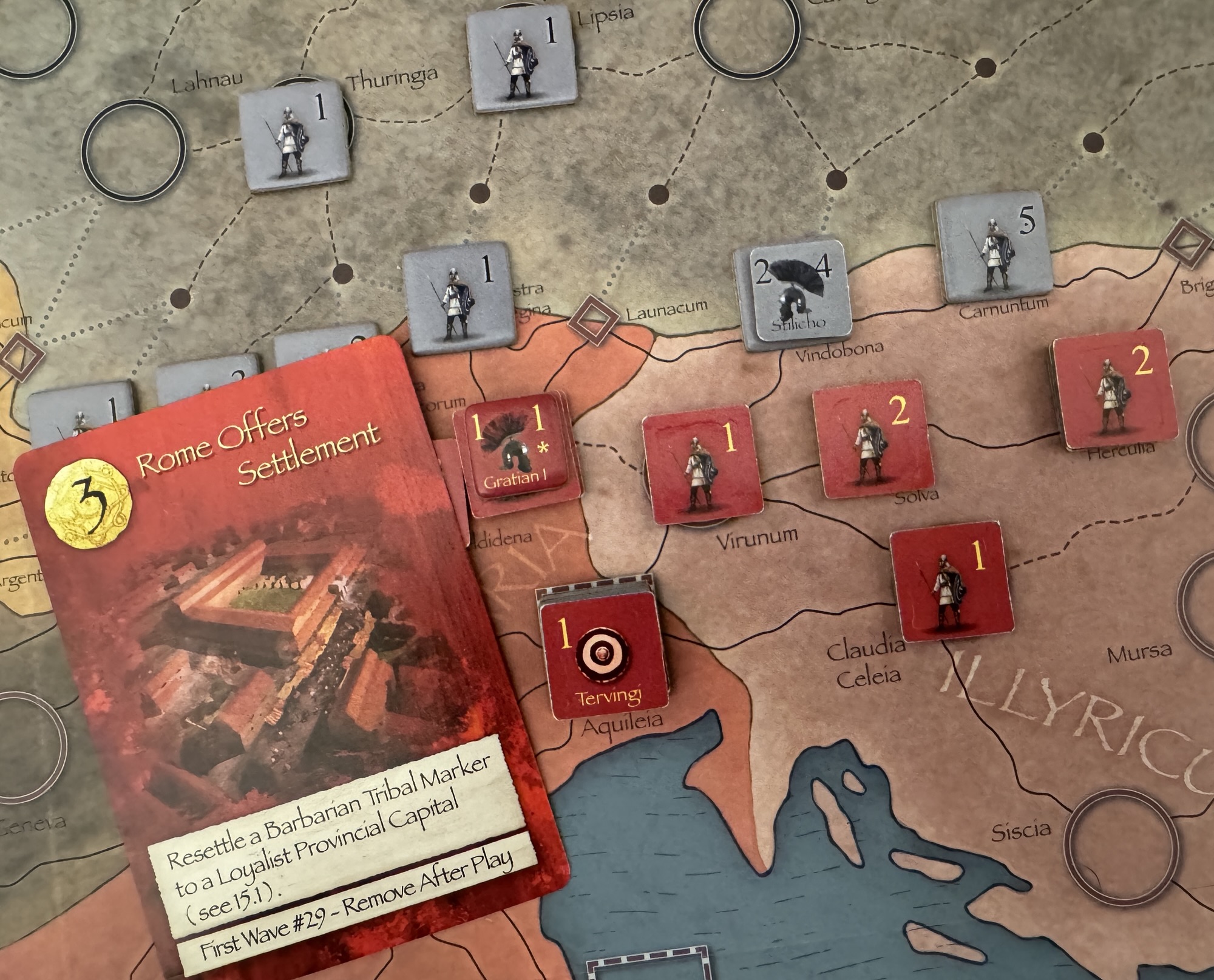
And this concept of taking your best armies away from you, either as the Roman player or the Barbarian player, is well demonstrated with the play of the Rome Offers Settlement card. This card literally allows the Romans to resettle a Barbarian Tribal Marker, along with any combat units with the marker to a Loyalist Provincial Capital. The play of this card at the right (or wrong) time can lead to serious issues on the front lines. Playing the Rome Offers Settlement card simulates foederati diplomacy, allowing the Roman player to integrate migratory tribes into the empire and to gain access to additional manpower to defend the frontier. The mechanical effects include that the selected Tribe will now be aligned with Rome and becomes allied to the Romans. This will lead to the Barbarian Control Marker being removed from the target tribe’s space on the Tribal Alignment Track. The real benefit is that the Roman armies don’t have to risk loss and time in fighting the Barbarians targeted but also provides somewhat of a defensive buffer as the settled tribes will serve as a guard on the frontier, protecting specific Roman provinces and providing a strategic military advantage against other hostile invaders. This card is very important and can be considered essential for the Roman player, as allying with these tribes limits barbarian raiding opportunities and provides crucial resources needed to survive later waves of invasions. Also the preservation of army strength gives an immediate benefit to other ongoing campaigns against other invading tribes. I love this card and the concept from history that it attempts to inject into the gameplay.
Foederati were peoples and cities bound by a treaty, known as foedus, with Ancient Rome. During the Roman Republic, the term identified the socii, but during the Roman Empire, it was used to describe foreign states, client kingdoms or barbarian tribes to which the empire provided benefits in exchange for military assistance. The term was also used, especially under the empire, for groups of barbarian mercenaries of various sizes who were typically allowed to settle within the empire.
The term foederati had its original usage and meaning extended by the Romans’ practice of subsidizing entire barbarian tribes such as the Franks, Vandals, Alans, Huns and the Visigoths, the last being the best known, in exchange for providing warriors to fight in the Roman armies. Alaric I began his career leading a band of Gothic foederati. At first, the Roman subsidy took the form of money or food, but as tax revenues dwindled in the 4th and the 5th centuries, the foederati were billeted on local landowners properties, which became identical to being allowed to settle on Roman territory. Large local landowners living in distant border provinces on extensive villas, which were largely self-sufficient, found their loyalties to the central authority, which were already conflicted by other developments, further compromised in such situations. As loyalties wavered and became more local, the empire then began to devolve into smaller territories and closer personal fealties.
Here is a look at our unboxing video:
We also did a video review and you can watch that at the following link:
I also wrote a First Impressions post on the game and you can read that at the following link: https://theplayersaid.com/2022/11/08/first-impressions-barbarians-at-the-gates-the-decline-and-fall-of-the-western-roman-empire-337-476-from-compass-games/
In the next entry in this series, we will take a look at Baron von Stueben Trains the Continental Army from Washington’s War from GMT Games.
-Grant
The first things that drew me to Tembo Survival on the Savanna were the art by Vincent Dutrait and the table presence. The theme of elephants traveling across the Savanna also intrigued me. Tembo, which means elephant in Swahili, is a cooperative game that plays one to four players in about 30 to 45 minutes. […]
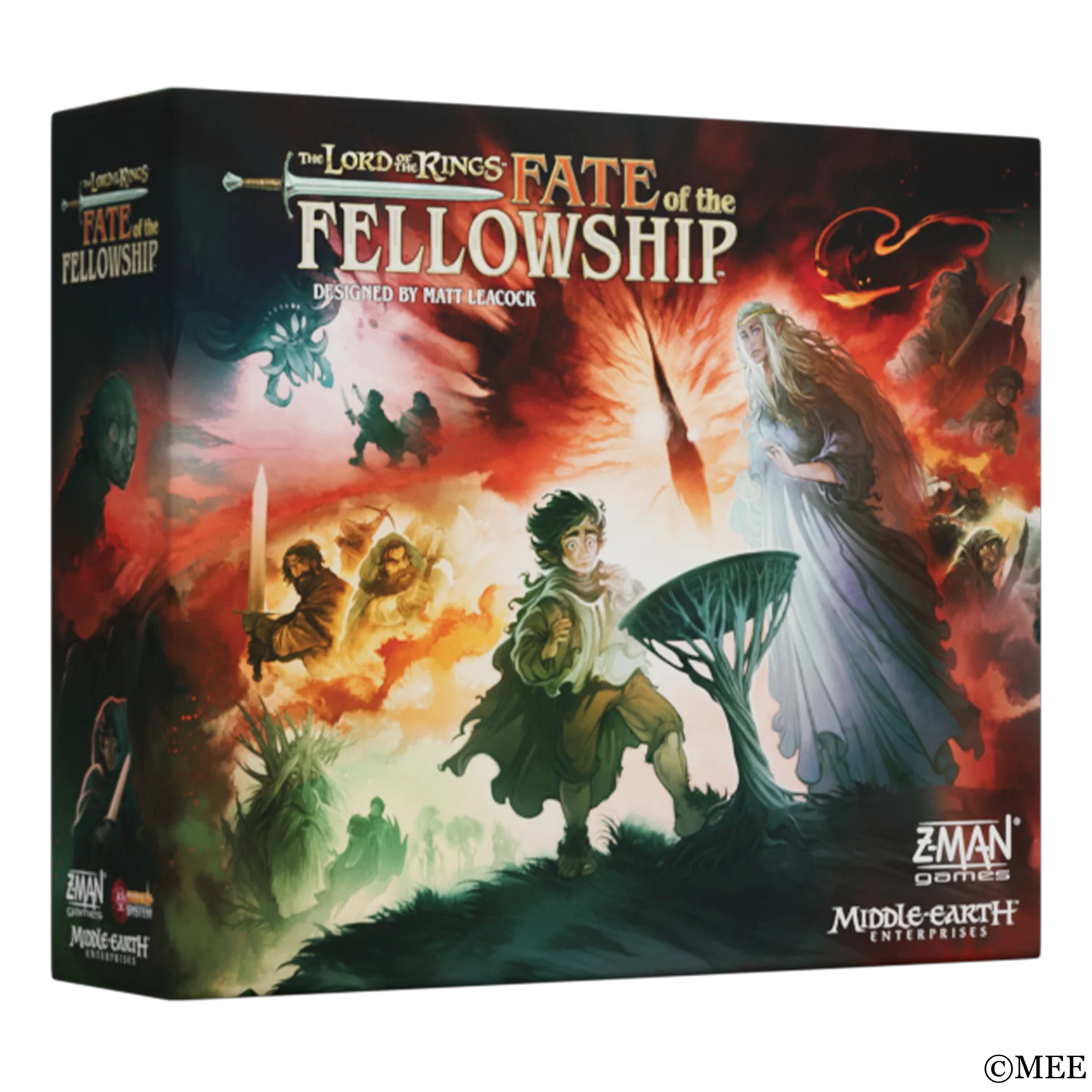
This is a new game from the wonderful people who bought us Pandemic. Once again they bring us a game that while using some of the Pandemic mechanics, feels like a different game. It does feel very much like a Lord of the Rings experience and not just a rebadge of the original game. This is a co-operative game where you can explore , do objectives and then finally destroy the ring.
You each play as a set of 2 characters which include Frodo and Sam, who of course must finally destroy the ring. On your turn you can do 4 actions with one character and 1 action with the other Middle-Earth has been divided up into twelve areas and you start in different positions across the board. Sauron isn’t going to just let you sit back, his forces are controlled by an interesting card mechanic with different troops ready to move along different lines depending on cards drawn at the end of each round and these forces intensify at various points in the game.
While some co-operative games can suffer from an alpha player take over, the nice thing is that with the objectives you can split up and do the objectives near your area without one player telling everyone what to do. Then team up for the final objective which is of course destroy the ring.
This is a chance to be the wonderful characters from the amazing Lord of the Rings and to go out there dodge Sauron’s Eye and mess his day up no end. You can order it at: https://www.bgextras.co.uk/pandemic/pandemic-games/the-lord-of-the-rings-fate-of-the-fellowship
The post The Lord of the Rings Fate of the Fellowship board game first appeared on Board Game Extras.BGI 422 The One About Unobtanium
Board Games Insider – Join our Guild on Board Game Geek Guild | Like us on FB
Social media:
Ignacy Trzewiczek / Portal Games: website | FB | Twitter | Youtube
Corey Thompson / Above Board TV: website | Youtube
Stephen Buonocore / “The Podfather Of Gaming”: website | FB | Twitter | Youtube
Intro Music: Happy Rock – Bensound.com
I wouldn’t wish to inflict board game drama on anybody who wasn’t already saturated in the stuff, so I’ll keep the details sparse, but the past couple of weeks saw a minor authority figure on BoardGameGeek sharing his views on demonic possession with a potential customer. I try to stay away from such dust-ups, but I found myself compelled to weigh in. My resultant post discussed the textual development of an adversarial spirit in Judaism and Christianity and made an impassioned plea to anyone basing their decisions on the existence of otherworldly beings.
Over the coming days, I heard from a number of people. Some had been touched by what I’d written. Others were just glad to have encountered something informative on the internet. One or two were offended.
But what stood out to me the most were those who had, like me, encountered “demonic possession” in the wild. Not the real thing. Not actual demons clawing their way through the cracks in the world. I’m talking about the excuses, usually offered by pastors, who couldn’t explain some phenomenon, but who needed to be the authority figure on everything. The undiagnosed illnesses. The non-mainstream gender orientations. The people who wanted nothing to do with the good news.
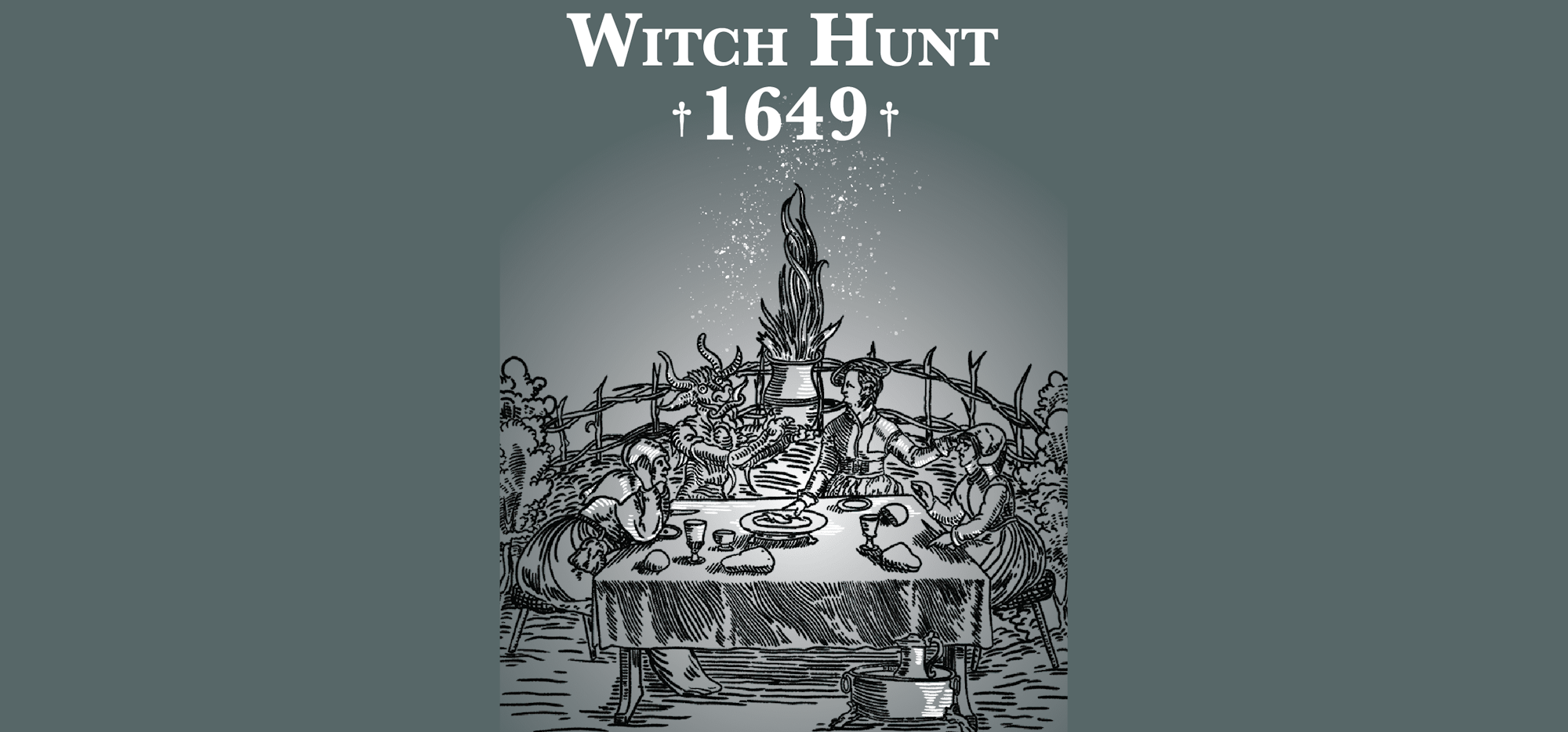
Playing Martha McGill’s Witch Hunt 1649, it was impossible to not mull over those thoughts all over again. It was impossible not to think back on the time I met a witch.
Living my worst life.
Statistically, you’ve already assumed that I’m talking about a woman.
Witch Hunt 1649 isn’t about the witch hunts that dominated my schooling. Those were New World witches, the result of mistrustful Puritans living on the edge of a world that seemed immune to their understanding. McGill’s telling predates Salem by half a century and takes place far across the sea. In the same year that Charles I lost his head and Oliver Cromwell prepared the New Model Army to march northward, villages in Scotland reacted to their uncertainty the same way that countless communities had done before: by blaming the women they didn’t like very much.
There were men witches, too. Not many. Just enough to ensure that nobody was above suspicion. Of the 3,800 Scots accused of witchcraft, eighty-nine percent were women.
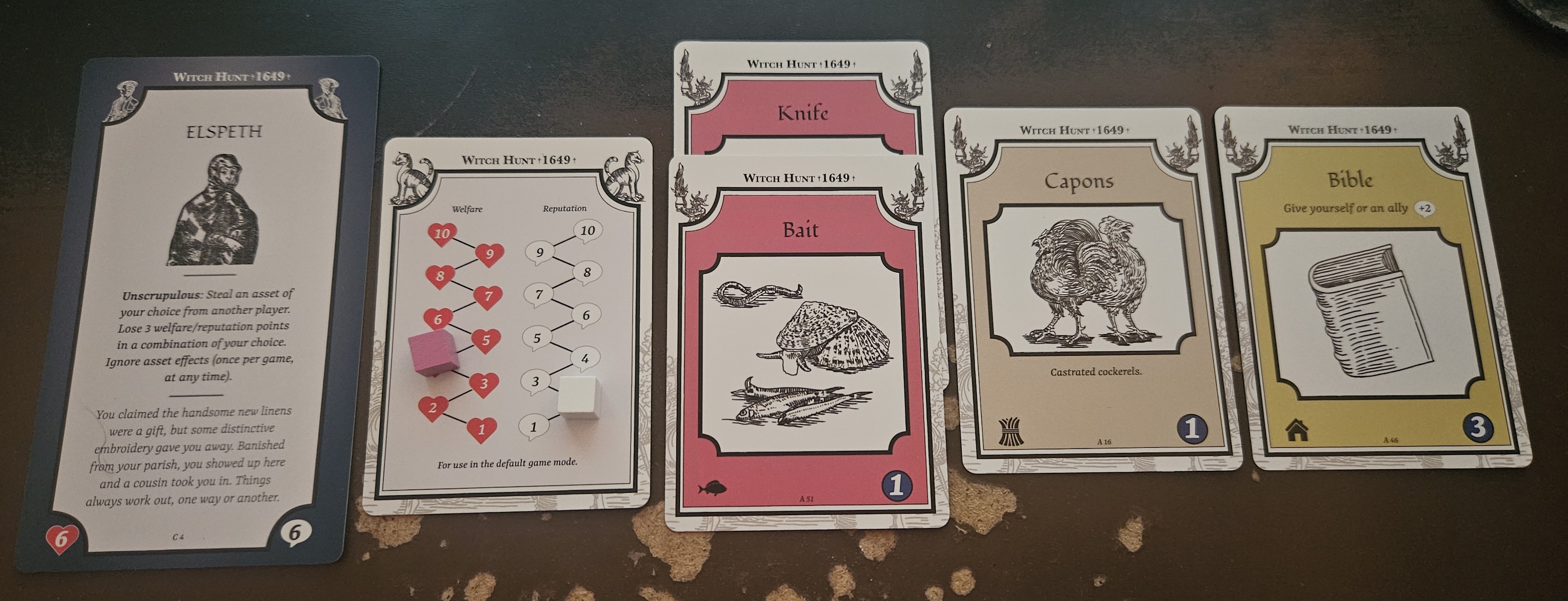
In the game, the figure is similarly skewed. At the start, everybody receives a character to embody. These cards offer only a few tidbits. A name. A woodcut illustration. A once-per-game special ability. And a small blurb that explains why these people are subject to suspicion. There’s Elspeth, who once nicked some nice linens. Agnes, who knows which herbs might ease a fever. Bessie, whose primary sin is that she’s a bit lazy. Janet, isolated after cutting the sheep-stealing cousins out of her family. William, who loves a ribald joke. Helen, over-eager to share her conversion experience with her neighbors.
Ordinary people, in other words. To most of us, it would be their neighbors who seemed too buttoned-up. Too prying. Too obsessive about the minutiae of everyone’s lives. Too willing to fling an accusation that might get one of their neighbors strangled with a cord and their stake-bound body charred to ashes.
Of the fifteen character cards, eleven are women. Seventy-three percent. If anything, Witch Hunt 1649 short-sells the divide.
Fate cards present ethical conundrums between suffering and suffering a different way.
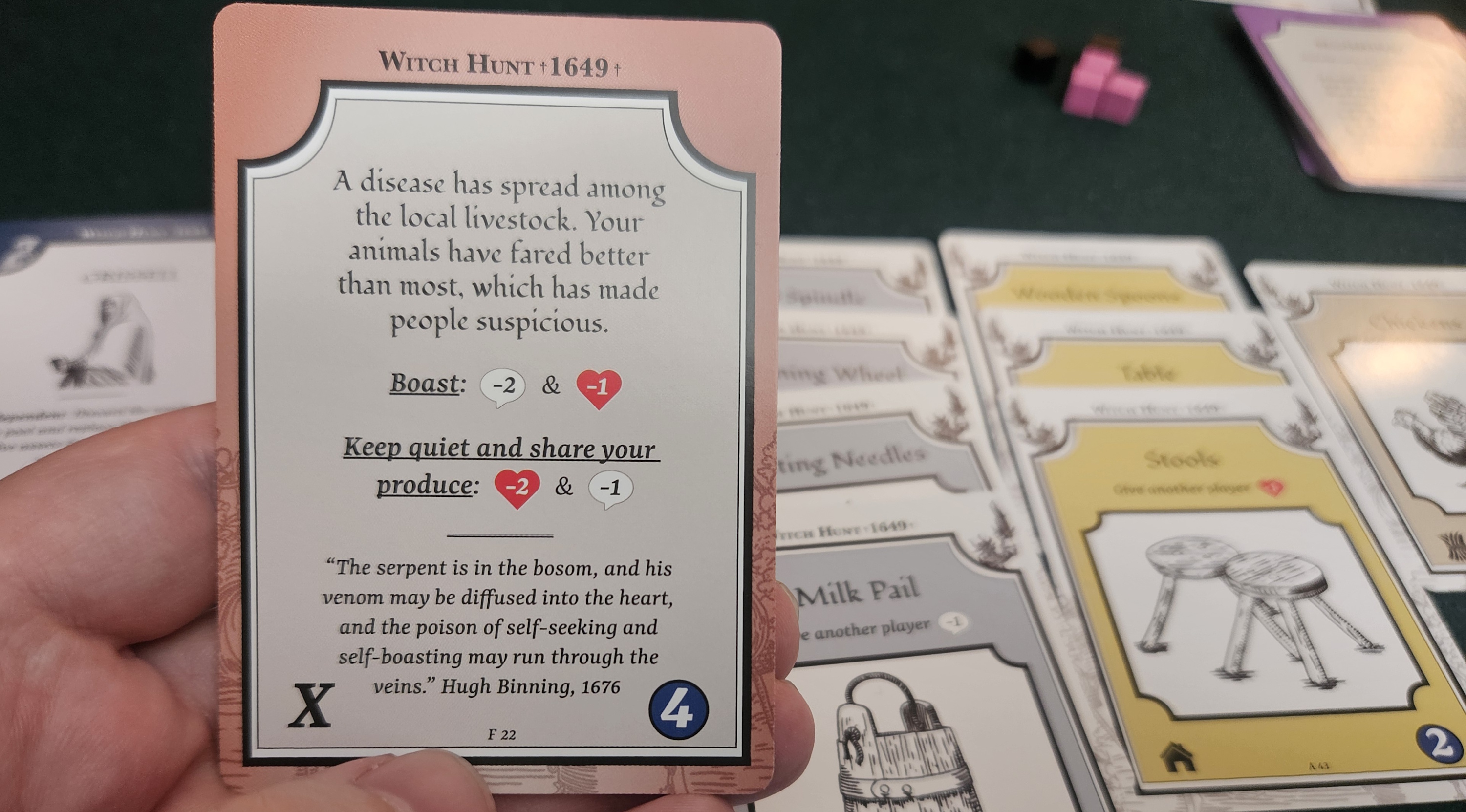
As a game, Witch Hunt 1649 is a simple thing. That’s to be expected. Published by Central Michigan University Press, this is closer to an educational tool than a hobbyist product. Like Greg Loring-Albright’s Keep the Faith from the same imprint, there’s an element of role-play, with most turns consisting of a single card-flip. This card presents some stroke of ill fortune that has befallen your character. Chronic headaches. Extra tithes. A cousin’s hasty marriage. The rumor that you’re a closet Catholic. You’re allowed to choose how to respond to these misfortunes, but there’s no such thing as coming away richer. Every choice is a Sophie’s choice. Waning physical welfare, waning standing in the community, or waning material goods. After a while, you begin to wonder why anybody bothers trying to be good.
The one respite is that you’re still here, still alive, still capable of improving your situation. You take the card fate has dealt you and acquire something from the market. Like everything else in Witch Hunt 1649, these are meager possessions. Your goal, apart from survival, is to accrue enough to place yourself in high society. Higher society. One sickle and pair of shears at a time, one cow-shed and kiln, you construct a life.
As often as not, those possessions become anchors. That Bible improves your standing in town, but you might have to part with it to support the local poor. The local poorer. That basket helps you carry more fish from the stream, but it hurts all the worse to lose it. Other items, like creepy rams, are liable to trick some farmer into thinking they’re striking a pact with the devil. When the trial begins, everything becomes potential evidence.
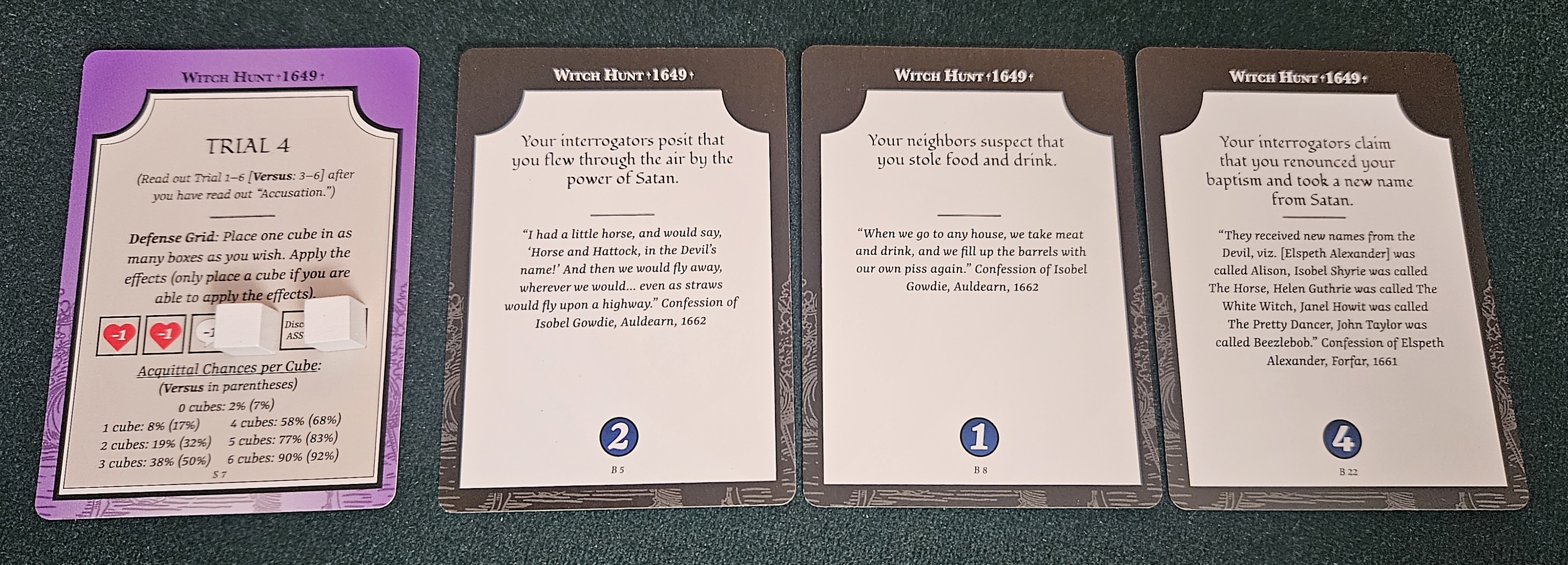
The witch-trial is the centerpiece of the game. As soon as you have three black marks, you’re dragged before a council of fifteen propertied men and put to the test. Black marks, it must be noted, have nothing to do with your choices; either you gain them or you don’t, entirely irrespective of your decisions. They’re also drawn face-down. When the trial begins, you have no idea of the substance of the accusations against you. At times, they’re as harmless as a rumor. Other times, they’re as damning as a rumor.
To secure an acquittal, you spend your meager health, your meager reputation, your meager possessions. You try to persuade your friends and family to stand by you. You’re well aware that these are hard requests. If you’re found guilty, your relations will also stand trial. It isn’t until the accusations are revealed, flipped one by one, that your fate becomes clear. Even then, survival is only momentary. There’s nothing preventing you from being dragged before the council at a later date, no matter how much of your property you’ve parted with, no matter how many teeth you’ve lost to the stress.
Accrue three black marks and it’s time for a trial.
For the first few years after I came home, it wasn’t uncommon for someone to ask if I’d seen any demonic possessions out there. Possessions or skinwalkers or witches, anything like that. I’d served a portion of my two years as a Mormon missionary among the Crow Nation, and people were always quick to note how “Those folks are more spiritual than we are.”
In this case, “more spiritual” meant more susceptible to the beings that dwelled on the other side of the crack in the world. Spirits, demons, angels. Beings we never saw as white folk. Beings that only seemed to gather around those with brown skin, on land they’d been planted on by the government, or else in faraway places where people still practiced cannibalism and wife-burning and whatever else.
Whenever anybody asked the question, I thought about the witch.
I first heard about the witch from a guy in Hardin, the half-white, half-native port town on the edge of the reservation. We were set to baptize a man. Crow. Maybe already a member of the church, but records were spotty. On the scheduled day, he didn’t show up. “He was probably called away by that witch,” the guy said. I laughed, but he insisted that, no, he was being serious. “He’s taken up with a witch,” he said. “Those folks are more spiritual than we are. We can’t hear their call because we aren’t as spiritual,” he said. “We,” he said, meaning white folk. I asked if we should go find him. Find him and help him. If he was under thrall to a witch, surely that meant he needed us more than ever. Needed Jesus. Needed baptism. Needed something. “No, there’s nothing for it,” he said.

A mile or so outside Hardin.
I returned to the Crow Nation many months later, after many people had asked me about the spiritual folk out there, about whether I’d seen any possessions or skinwalkers or witches. It took some phone calls, but we found the witch’s address. We hopped in the truck and took off, the missionaries who now lived on the rez seated in front, talking excitedly about how they’d exorcise the witch’s demon or dust off their feet against her house.
When I met the witch, I was surprised. Not because she was a woman. (Eighty-nine percent of witches are women.) It was how ordinary she seemed. Her trailer looked like the other trailers that dotted the rez. Her dogs barked like the other dogs that barked on the rez. Her wind-chimes chimed like every other set that chimed on the rez. I asked if she’d seen our man. The one who’d skipped out on his baptism.
“Sure,” she said. “He comes around when he’s trying to get off the meth. He stays a few days, sweats it off, then he goes home again.”
Oh. Well. It wasn’t true, then, what I’d heard. Someone had told me she was a witch. Ha ha, what a mix-up.
“Sure,” she said, laughing brightly and rubbing at the sunspots on her forearm. “I’m a witch. I’m a witch at helping people get off the meth.” Then she told me about her degree in nursing, how the learning had come naturally. How she’d worked for years in addiction recovery. How she was, indeed, an actual witch, with a power for curing people of their killing habits.
On the drive back, as we talked about our encounter with the witch, two of the other missionaries bubbled first with excitement, then with righteous upset. We hadn’t done anything. No denunciations had been leveled. No demons had been cast out of their hosts. One told a story about how a devil had once held together a person’s broken leg, then the prophet had cast the devil out. This caused the leg to break again, because evil magic sometimes imitates good things. “We should go back,” he said. “No way,” his companion shot back. “What if she uses Satan’s priesthood on us? You know they’re more spiritual than us.”
I didn’t say much. Between this and my previous visit to the reservation, I was starting to harbor some serious doubts about the shape of the world. There was a crack in it, all right. A crack that ran right through it. But the crack wasn’t what I’d been told. It wasn’t us on the one side and evil spirits on the other. It seemed to me there were good people all over, lots of them, some with addictions or problems or sicknesses, and some who wanted to help. And then there was us. The people in the white shirts and ties. Telling stories about everyone else. Trying to square them so they looked the way we wanted. And then, when they wouldn’t be squared, pretending they must have widened the crack to the other side and beckoned something ugly into themselves.
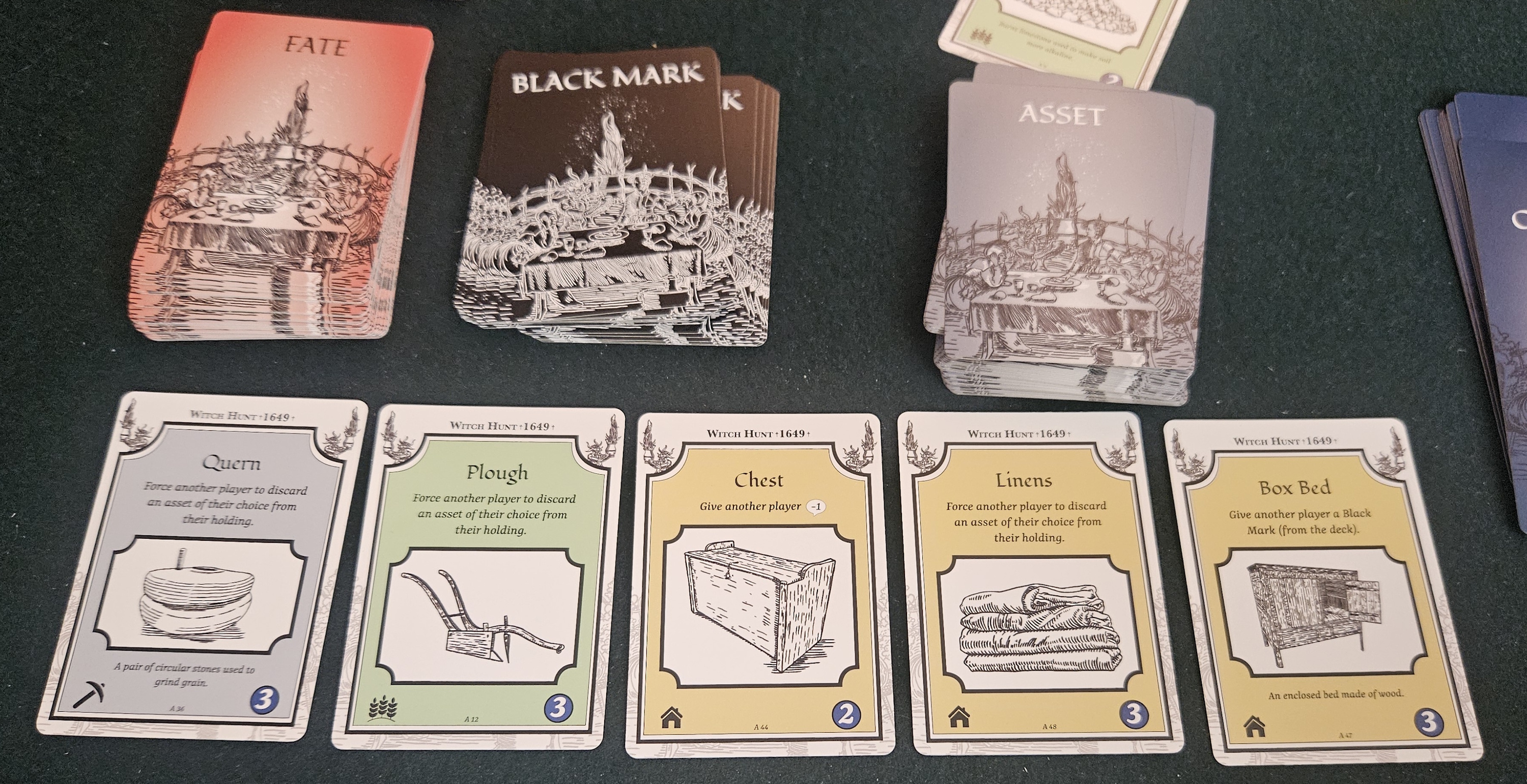
I do want a nice box bed.
I no longer believe in witches any more than I believe in teenage boys being sent by Jesus to proclaim the restoration of an everlasting gospel that keeps changing on itself. But I do believe there are demons out there. There’s nothing supernatural about these demons. They look like us and dress like us. They eat our favorite foods and watch our favorite reality shows on television. They do pretty much whatever they want to do, and then they come up with compelling reasons why they were in the right to do it. Those are normal enough behaviors, but the way to tell a regular person from demon, I suspect, is that a regular person might come up with a reason why they were a good fit for nursing school. A demon, on the other hand, explains why they’re the chosen one who’s been endowed to save the world from itself. Whether anybody wants it or not. Whether they have to bind a person to a stake and flick a torch into the straw.
Witch Hunt 1649 pulls a lot of weight for such a small game. It shows how insular communities can curl in on themselves until they sour and curdle. It examines how people on the margins, women especially, become scapegoats for no greater sin than being marginal. It preserves the memory of the crimes against those people rather than letting us forget the cruelties we can unleash on our neighbors.
But for me, mostly, it gets me hoping that the only witch I’ve ever met has helped a bunch of people with their methamphetamine addictions.
A complimentary copy of Witch Hunt 1649 was provided by the publisher.
(If what I’m doing at Space-Biff! is valuable to you in some way, please consider dropping by my Patreon campaign or Ko-fi. Right now, supporters can read my first-quarter update of 2026: the best board games, movies, books, and more!)
Peter unboxes all the extra stuff you can get to expand your games of S.T.A.L.K.E.R. The Board Game!
I’ve been hoping for some time now to get my hands on this extra stuff for S.T.A.L.K.E.R. The Board Game, and the wonderful people at Awaken Realms were kind enough to send me the goodies I didn’t get the first time around. So here’s an unboxing of the miniatures packs, terrain pack, stretch goals and expansions for this excellent game of survival in the irradiated Zone!
By the way, don’t forget to download my rules & reference (and of course it’s also on Tabletop Codex)!
by Beth Heile
Embark on a chaotic and unusual quest to befriend monsters and find the elusive Shug! Or maybe just kill a king.
Board game giant Asmodee’s strategic push into crowdfunding has passed its first major test, with its debut campaign in the Zombicide universe raising more than $4.1m on Gamefound.
The total for pirate-themed Dead Men Tales cements the campaign as the biggest main line Zombicide crowdfund in almost a decade, with Zombicide: Green Horde having picked up just over $5m in 2017 – although the biggest crowdfunding success in the range remains licensed spin-off Marvel Zombies at just over $9m.
Asmodee’s acquisition of Zombicide from financially troubled CMON last June set the stage for the company’s drive into crowdfunding – an area it had previously barely touched through any of its myriad studios.
The buyout came a month after Asmodee had hired ex-CMON COO David Preti – the architect of the latter company’s growth into one of board gaming’s biggest crowdfunding-focused publishers – to head up its own newly-launched crowdfunding and miniatures strategy.
Asmodee doubled down on its crowdfunding-focused acquisitions in October last year by picking up the Cthulhu: Death May Die IP and games from CMON – a series which has raised almost $10m from backers to date.
Asmodee had not publicly discussed details of its crowdfunding strategy ahead of completing the Dead Men Tales campaign, but said in a press release celebrating that success that crowdfunding “gives publishers clearer demand visibility, a direct line to engaged communities, and a healthier financial setup – with production sized to actual demand rather than to forecasts”.
That statement is notable given Asmodee studio Fantasy Flight Games’ decision last month to discontinue the latest iteration of veteran dungeon crawler Descent, citing rising manufacturing costs, “global economic shifts” and the expense of developing the game’s companion app.
It is thought FFG may resurrect Descent through a crowdfunding strategy in the future, although it is yet to confirm or deny this, saying in April, “While we don’t have anything to share at this time, there is always a possibility that we will revisit Descent in the future. It would take a different form and would not be Legends of the Dark, but this game universe is near and dear to FFG’s heart.”
Asmodee CEO Thomas Koegler said of the Dead Men Tales crowdfund, “This first campaign means a lot to me, and I think it sends a clear signal.
“Zombicide is a beloved franchise that joined the group less than a year ago, and Dead Men Tales is already proving the model works: the original Guillotine Games team back at the helm, Fantasy Flight Games executing the campaign with remarkable skill, and a community of more than 11,000 backers who chose to trust us early.
“That trust is something we take seriously. There’s still careful work ahead on delivery, a crowdfunding campaign is only as good as what arrives at your door, but I have full confidence in our teams to see it through.”
The campaign also helped underscore Gamefound’s rise as a crowdfunding peer to Kickstarter – and reinforced the trend for large, miniatures-heavy releases choosing the platform for their projects.
Dead Men Tales was the latest Gamefound campaign to make use of the platform’s Endgame feature, which is designed to extend the final moments of campaigns that are still actively receiving pledges even as the original countdown ends.
The Dead Men Tales campaign had collected more than $3m by the end of the official crowdfunding period, but Endgame extended the raise by more than five extra days and about $1m due to new pledges consistently being made.
Prior to Dead Men Tales, the only previous crowdfunding campaign from an Asmodee-owned company was Lookout Games’ Kickstarter for the Grand Austria Hotel: Let’s Waltz! Expansion & Deluxe Upgrade, which raised about €383,000 during the coronavirus pandemic in 2020.
Asmodee’s only other direct exposure to crowdfunding is thought to be via the company Exploding Kittens, in which it made a strategic investment short of a buyout in 2021. That business has since raised more than $977,000 in a Kickstarter campaign for Hand to Hand Wombat.
More tenuously, YouTube reviewer The Professor raised about $4m for his Academic 133+ XL deckbox in 2022, which was designed ‘in collaboration’ with Asmodee’s game supplies and accessories unit Gamegenic.
Gamegenic also previously provided accessories in partnership with the Altered TCG during its record-breaking crowdfund three years ago.
Last month BoardGameWire reported that Asmodee’s net sales had surged 23% year-on-year to more than €1.68bn, driven by the company’s escalating power as a global TCG distribution giant.
Asmodee’s own board game publishing operation, meanwhile, saw its net sales fall 5.8% in the last financial year – while net sales for the first quarter of this year were down 9.8% compared to the same period in 2025.
The post Asmodee’s push into crowdfunding scores first success with $4.1m for Zombicide: Dead Men Tales first appeared on .
My win rate is up slightly, probably due more to a balance patch than any mindfulness on my part.
Remember, the four fundamental questions you should be asking yourself are:
This article deals with the last question. “Scaling, or ‘Why Furnace is a desperation pick.'”
(Many of the examples/explanations below are simplified and not dealing with corner cases.)
I won my low ascension Regent runs grabbing Furnace, a power that gives 4 Forge1 a turn. It seemed comparable to Noxious Fumes, a power that adds 2 poison a turn. But that was shallow thinking, and at higher ascensions it failed hard. It took me a while to unpack why, but there are multiple reasons.
The first is that Noxious Fumes is “Play and Forget.” It does 2 damage, then, 3, 4, 5, 6 etc2. With Forge you also have to play the Sovereign Blade to do any damage. Your sword will be worth 14, 18, 22, etc … but attacking with it costs two mana per attack; then you have to wait and get it back, which also means one less other card in your deck. It costs time and card draw.
Noxious Fumes is active from next turn it’s played … doing damage each turn (but starting smaller). Furnace enbiggens your sword, damage requires further costs. I’ll talk more about Forge below, but the point is that Furnace is passive scaling … If you got a second Noxious Fumes, your numbers and damage would go up, but a second Furnace just makes your potential damage go up.
I don’t love this passive/active terminology, perhaps Poison is “complete” and Forge is Incremental? Or “Potential” vs “Kinetic” is best? Kinetic scaling does actual damage. Potential Scaling might do damage down the line.
But that’s not the only issue
Consider Inflame. +2 Strength, once. All attacks do (at least) two more3. It’s a perfectly find card, and may help through early elites and bosses. In theory its potential scaling, but in practice it activates pretty fast. Ironclad is usually playing attacks, so boom. Three attacks a turn (say), means six extra damage a turn. That’s OK. But it doesn’t grow. Noxious Fumes starts off small but gets bigger over time.
But if you double something, it gets bigger much faster. Voltaic channels a lightning Orb for every Lightning Orb already channeled. Play it 5 times (even without any other lightning) and you channel 1,2,4,8,16. A geometric progression. If you have even another orb or two played each time through the deck (like Zap) the number can get ridiculous fast (depending on card order). Voltaic can cause 500 damage on it’s own. Inflame requires 250 attacks. A linear progression. If you added a second inflame your deck would be more reliable. A second voltaic would be a grotesque win.
(Again, I don’t love the terms; perhaps “Additive vs Multiplicative” scaling might be better).
Any card that doubles (or halves) deserves a close look. Colossus blocks, but also halves the damage vulnerable opponents inflict.
There are some other types of geometric scaling built into the game:
Putting it all together, I was treating Furnace like a scaling card, but it’s the worst kind of scaling — linear (+4 to the swords damage …), and potential ( … when you play the sword). Its much closer to Inflame than Noxious Fumes. It has a place, but that place is providing a bit of extra damage when you are low, against not-particularly fast opponents. It absolutely can make the difference in the Act I boss fight … linear scaling is usually enough.
It just won’t win the game, and the opportunity cost of having it take up a valuable card draw (and mana if you play it) may outweigh that in many fights. And often the damage output it does provide is completely inferior to many other options.
Compare Furnace to Wrought in War4. If you play Furnace, next turn you can play your sword for 14. If you play Wrought in War, you can play your sword this turn for 17, plus the 7 you already did. WiW converts 3 mana into 24 damage, a respectable first damage card. That’s its role, with a smidge of linear scaling each further time through the deck. Now granted, if you play Furnace and wait 5 turns, you’ll do more damage, but that’s an eternity in a hallway fight (unless you can consistently block for huge numbers each turn). If you play The Smith (“Forge 30”) and then your sword, you do 40 damage now (for 3 mana and some stars).
The Big Number is much better than scaling in almost all fights. But … you can make The Smith multiplicative by playing it via Decisions Decisions, which plays a skill three times. Now on the turn you play them, your sword hits for a hundred, which would take Furnace 23 turns! (Or you can play it each time it comes through the deck, and if you play your sword each time, it’s a bit multiplicative).
Yes, those cards require a star economy, and are rare, etc. But the point is that the numbers matter, not just the type of growth.
So I’m not particularly happy to take Furnace. It’s a “I need more damage and haven’t seen great cards” pick. But I’m pleased to grab a Prep Time (“4 Vigor at the start of your turn”) as Regent. Why? Because Vigor can be multiplicative; Regent has lots of targets for multiplication. If you sit and block, you can get 8, 12 or more vigor built up; Build up stars, a card like Stardust (which is an X cost attack, but X is stars, not mana) or Heavenly Drill can quickly grow. Furnace is +4 damage a turn, but even a moderate growth in star economy can turn each point of vigor into 10 or 20 hits, and both numbers can grow each turn …. Geometric, not linear.
You can totally win a Regent run by playing only a single attack. Play two powers Prep Time (+4 Vigor a turn) and Genesis (+2 stars a turn), through out block, and wait for a Stardust to do something like 5 (base damage) + 12 (3 turns vigor) times 20 (stars). As a bonus, you can enchant it to do double damage (or +8 vigor first time played). Prep Time gives you a corner stone you can latch onto; and with a few more pieces (and a lot of block) you have your scaling.
Furnace comes nowhere close.
But Forging can. Summon Forth forges 8 (a reasonable number) …. and puts the sword back in your hand. If your deck was only Summon Forths, you could attack in the following pattern. 18, 26, 34, 42. You gain damage faster and play it more often. Not quite geometric, but much faster linear damage. If you play the Parry power (or two), you now suddenly get damage and block each time you play your sovereign blade. You aren’t multiplying damage exactly, but you are doing two important things (damage and block) each time you play your sword.
Bulwark is a perfectly fine “Block 13 for 2 mana” card … that also forges (10!). I grab it as an early block card, but the damage boost is nice.
The point: Don’t grab a Furnace; get a scaling engine via the following path (or something similar):
Each card answers at least one question other than scaling in the first few steps, attack or block. The initial forge on the cards isnt’t the focus of the card, but a “Yes, and …” The forge provides a path for scaling that comes later. (Similar to how an early silent poison may be meant to handle the first boss, but can also provide the entry way for further scaling).
I’m attacking and blocking; a card or two big enough to handle early hallway fights (or mid-game hallway minions) while incidentally building a linear scaling engine via Forge. Then I’ll only need a card or two (hopefully) to make that a geometric engine … or a big enough linear engine to compensate. Furnace doesn’t do any of that.
Now, I’m not saying Furnace is pointless. If I’ve only seen block cards (or am worried about Lagavulin Matriarch, or know I’ll need to scale while paying for Soul Fysh’s beckons), I might pick a Furnace … as a specific use for a fight. Not for scaling. Sometimes you just don’t get great choices and have to make do … but having taken a Furnace I now now that there might be some synergy with more Forge cards … if they appear.
Writing these as I think I have things interesting to say … so part III whenever.
Update — I realized that the above questions are also missing “How can I make my deck set up faster?” (Sometimes also called ‘Velocity’) and I need to ask that question more often to myself.
︎︎︎︎︎
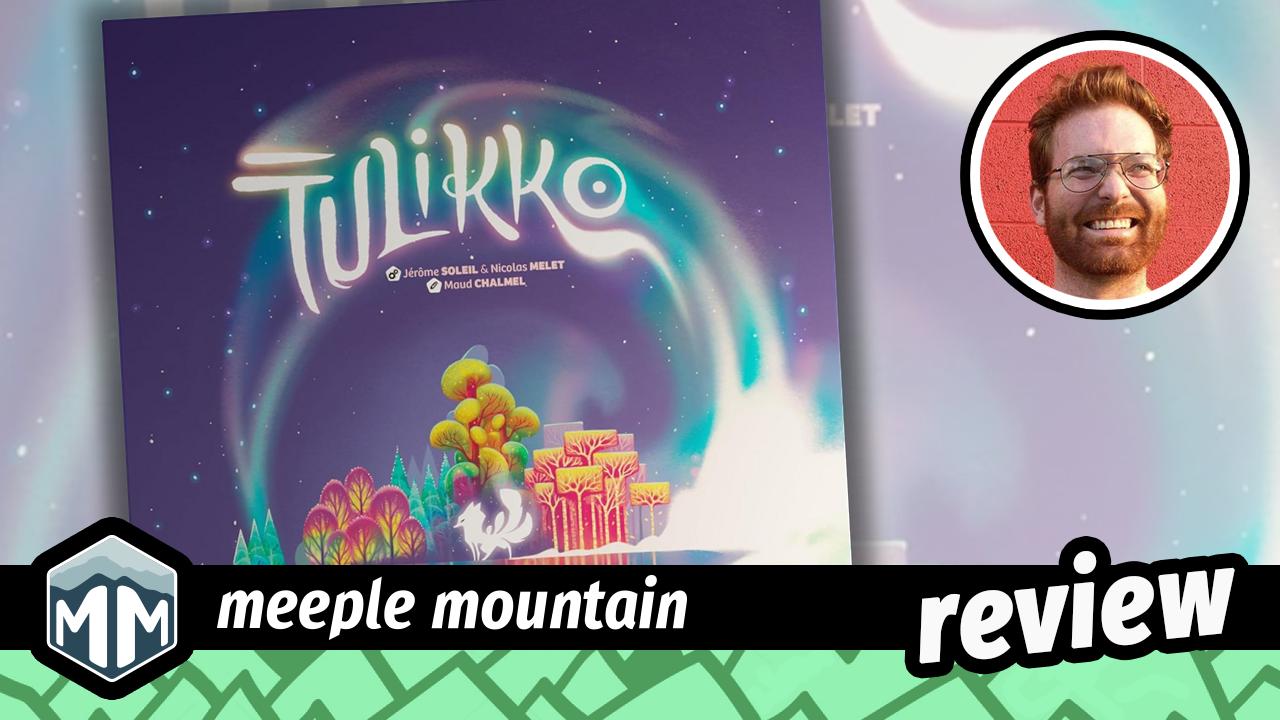
Games like Tulikko are challenging to review because they are generic. Games like this embody much of what a particular genre of game attempts to do; and it’s very similar to a lot of other games of that genre. It’s another personal board tile placement puzzle. I don’t know if that’s bad or good anymore.
Tulikko is a game of acquiring tiles and placing them on a grid on your player board. The tiles come in four colors, and you’re trying to place them on your player grid in specific configurations that are governed by the randomly determined objectives for each game. There are three cards that change each game. One type has you trying to make specific patterns of colors on your board, another has you making specific shapes, and a third has you making patterns using special wooden river pieces—I’ll cover those in a moment. The other scoring options are part of each game and reward you for covering one of four symbol types on your player board and/or placing enough tiles (3, 4 if you’re slow) of one of the four colors.
How do you get the tiles? Well, you put a tile that you draw from your personal pile of…
The post Tulikko Game Review appeared first on Meeple Mountain.
The post Sprout, a Game about Keeping Houseplants Alive appeared first on Graphic Policy.
Sprout is a cozy, yet thrilling push-your-luck strategy game for 2-5 plant parents
We have played 2 of Tompet Games previously released games with the only not having been played called Kill the King from 2016. First was Donning the Purple, which is an asymmetrical king of the hill game with a bit of worker placement that deals with the players managing the glory of wealthy and powerful Roman families, and their second game called Halls of Hegra, which is a solitaire-only wargame in the same vein as Euro-based games such as Robinson Crusoe, This War of Mine and Dead of Winter. The mechanics include worker placement, bag building, and area control/tower defense and the goal of the game is to survive wave after wave of German troops as they assault the secluded mountain fortress at Hegra.
Both of these games are excellent and they are now embarking on their fourth game called Crown & Courage that tells the story of the German invasion of Norway in 1940 and the royal family’s defiance and ultimate escape from the country to avoid capture and funding of the German war machine. We asked the designer Petter Schanke Olsen if he would be up for one of our interviews and he was more than happy to share.
If you are interested in Crown & Courage, you can learn more about the project and back it on the Kickstarter page at the following link: https://www.kickstarter.com/projects/tompet/crown-and-courage
Grant: Petter welcome to the blog. First off please tell us a little about yourself. What are your hobbies? What’s your day job?
Petter: Thank you for having me. It’s an honor to be featured here. I have been a big fan of The Player´s aid for many years.
I’m a 40 year old geek from Norway. I’m very interested in history. Mainly WWII and Ancient Rome. So I try my best to make games from those eras.
During my day job I work for the government, making educational material for kids who are deaf or hard of hearing. My main area is video production.
Grant: What motivated you to break into game design? What have you enjoyed most about the experience thus far?
Petter: I have always liked to make things. One day, many years ago, I was thinking about flanking on medieval battlefields and thought that would make an interesting game mechanic. I made a small prototype for a boardgame based around that called Kill the King. 6 months later I ran a small but successful Kickstarter for it and I have never looked back. The feeling of seeing random people enjoying a game I have made is very rewarding.
Grant: What is your upcoming game Crown & Courage about?
Petter: Crown & Courage is a solo game where you step into a desperate race against time as Norway collapses under the pressure of the German invasion during the early days of WWII. Your goal is to guide the King and the royal family to safety while evacuating as much of the nation’s gold as possible.
Grant: Why was this a subject that drew your interest?
Petter: When I was 18 I spent a year in the royal guard here in Norway and during that period we learned a lot about these events. I have always wanted to make a game about this subject but I have been skeptical about doing games based on Norwegian history because it is a little known story internationally. After seeing the international success of our previous game, Halls of Hegra, I realized that I don’t need to worry about that so here we go!
Grant: What is your design goal with the game?
Petter: My design goal for this game is the same as all my other games. I want the player to feel the same level of stress and weight of making the right decisions with limited resources as the real people in history. In Donning the Purple for example, a game about being the roman emperor, I wanted the players to feel the burden of everyone trying to kill you so they could be the new emperor. In Crown & Courage I want the player to feel the pressure of seeing the Germans advance through Norway, trying to capture you and occupy the towns while you have to make hard decisions about what to do next.
Grant: What from the German invasion of Norway in 1940 was most important to model?
Petter: It was important to model how poorly prepared and equipped the Norwegian army was for an invasion. The Norwegian troops in the game for example, can only defend and not counter attack. But they were good at slowing down the enemy by sabotage, and that is a big part of the game (and also one of my favorite mechanics)!
Grant: What sources did you consult about the details of the history? What one must read source would you recommend?
Petter: I have read several books about the topic and biographies of King Haakon. But I would actually recommend watching a movie about the same topic called The King’s Choice. It’s great!
Grant: What is the goal of the game?
Petter: To reach safety with the royal family at the northern part of the map. And at the same time successfully evacuate Norway’s gold reserves. Historically the evacuated gold was used to fund the government in exile and the Norwegian trade fleet.
Grant: What is the layout of the board?
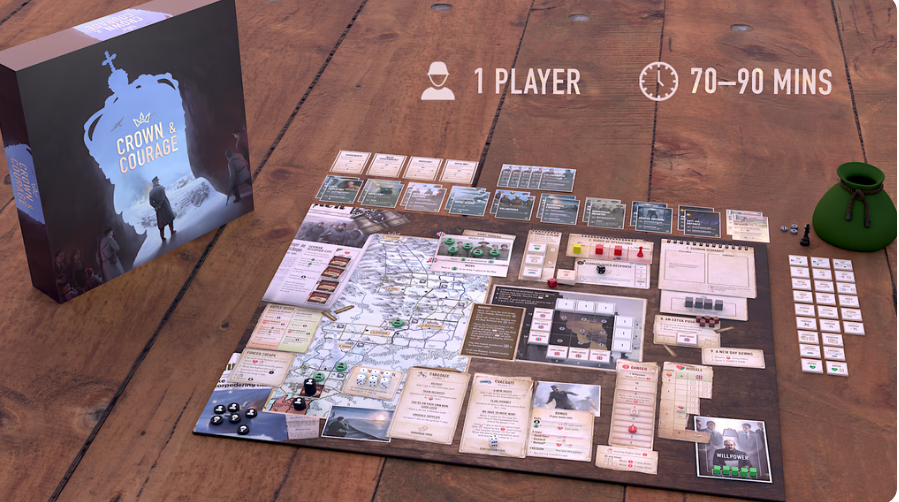
Petter: The two main components of the board are the map over southern Norway and the grid where you place your actions. There are also other minor tracks and systems. I also try to include much of the rules on the board itself so you don’t have to look in the rulebook all the time. This aids the players in playing the game.
Grant: How important are the cities and what happens when they become German occupied?
Petter: The cities are very important. If all of them are occupied you lose the game! Every time a city is occupied you have to resolve everything that is revealed on the Occupation Track, and that becomes increasingly bad as each new city is occupied.
Grant: How do the Norwegian troops defend against the Germans?
Petter: The battle system is kind of like our first game Donning the Purple. The Germans only move forward into battle if they have more strength than you. You can however spend action cards to boost your strength. You can also choose to spend extra morale in each battle to make a valiant defense and take out more German soldiers.
Grant: Can you talk about the grid system in the game called the Order Grid?
Petter: This is the main mechanic of the game. You choose an order tile and place it into a space on the 3×3 grid. This is your primary order this turn. Now you must choose the horizontal or vertical line that intersects with the chosen primary order. If the line you choose has other order tiles you will also resolve them. This makes your turns more powerful over time and can make for some interesting combos. Some of the orders you can choose among are Evacuate, Rest, Inspire, Sabotage, Upgrade and Strategize.
Grant: What are the difficulties the player must deal with in the form of Stress, Morale and Threats?
Petter; Stress is something that the King will gain throughout the game. When the Stress Level is too high you will lose Willpower. Willpower is used to decline demands from the Germans each round. If the Willpower runs out you lose the game. After you lose Willpower the Stress Marker resets but it can never be lower than the current Threat Level, so it might not reset as low as before. Morale reflects the morale of your troops and population. You can also use morale to draw extra cards or be more efficient in your defense
Grant: How does the player manage these?
Petter: Stress is reduced by taking the Rest Order. Morale is increased by the Inspire Order and Threat is lowered by Discarding Cards.
Grant: What are the German Demands?
Petter: At the end of each round the Germans will send demands. They will for example demand that the King resign. You can choose to ignore this at an increasing cost or decline the demands but that costs Willpower and is a diminishing resource. Historically, Germany demanded that Norway cease all resistance and submit to a German military occupation. Specifically, they demanded that the Norwegian government allow German troops to land unopposed to establish naval bases, secure vital Swedish iron ore shipments, and prevent the Allies from using Norway as a battlefield.
Grant: How does the German bot work?
Petter: The Germans are controlled by the grid system. Their actions are placed around the 3×3 grid. When you choose and place your primary order the Germans will resolve their actions (which is framing the grid system) that intersect with the primary actions. Each action will resolve 1 time per revealed German symbol on the grid. It is a pretty cool system and I’m pretty pleased with it.
Grant: What type of challenge does it create?
Petter: Lots of challenges! Basically, when you place your orders you are deciding which actions you AND the Germans will take. It is quite a puzzle.
Grant: How is victory achieved?
Petter: You win by getting the King to freedom in the northern part of the map. This is the main goal. If, as part of the Evacuate action, you move the King into the space marked Freedom, you win the game. You must still complete the entire Evacuate action before you win the game though. Keep in mind that the game is very difficult to win, but if you do manage it and want to gauge your success, your score is equal to the number of Gold Reserve cards you have successfully evacuated.
Grant: What type of an experience does the game create?
Petter: I like to think it creates a stressful but thematic experience where you are making tough decisions while exploring the Norwegian countryside!
Grant: What are you most pleased about with the design?
Petter: I’m most pleased about the Grid Order system! But the Evacuation and Sabotage mechanics are pretty cool as well.
Grant: What other designs are you working on?
Petter: I have several WWII themed designs in various stages but it is too early to say what will happen next.
We were able to play a prototype copy of the game and very much enjoyed it. We played it cooperatively, even though the design is a solitaire game, and had a great time strategizing and considering our options together and were very impressed with the maturation of the game mechanics and flow of the game. Here is a link to our preview video from that experience:
If you are interested in Crown & Courage, you can learn more about the project and back it on the Kickstarter page at the following link: https://www.kickstarter.com/projects/tompet/crown-and-courage
-Grant

/pic9609111.png)


/pic9616361.png)