
Normale Ansicht

Steamforged confirms redundancies, crowdfunding cutback amid refocus on booming Warmachine

04. Juni 2026 um 14:42

Steamforged Games, which made its name adapting video games such as Dark Souls into multi-million-dollar board game Kickstarters, has confirmed its second set of redundancies in three years as it refocuses away from crowdfunding and towards its booming Warmachine miniatures line.

The company has been one of tabletop crowdfunding’s biggest success stories over the past decade, raising tens of millions of pounds across campaigns based on major video game licences such as Resident Evil, Monster Hunter, Horizon Zero Dawn and Elden Ring.

About a third of the company’s employees are estimated to have been affected by this year’s restructure according to multiple sources who spoke to BoardGameWire on condition of anonymity – mirroring the scale of a previous round of redundancies Steamforged embarked on in 2023.

They said the staff cuts affected a range of departments across the business, including the creative, game design, production, project management, QA, marketing and commercial teams – adding that they feared the cutbacks would lead to problems delivering long-term projects.

Steamforged would not confirm the scale of the latest redundancies to BoardGameWire, but a spokesperson described the staff reduction as “carefully considered”, adding that the company “retain[s] both the internal resource and the external capabilities needed to deliver on our commitments”.

Elden Ring: Rot & Sorcery || Gamefound image

Those commitments include seven currently unfulfilled crowdfunding campaigns which raised more than £15m including late pledges, for titles such as Monster Hunter World Iceborne, Elden Ring: Rot & Sorcery, Helldivers 2: The Board Game and the special edition of classic eurogame Terra Mystica.

Steamforged is also currently attempting to fulfil a pre-order campaign for 6: Siege – The Board Game after buying the title from bankrupt board game crowdfunding specialist Mythic Games – and came under fire from backers last week for posting AI-generated images in a production update it says were sent to it by the manufacturer.

The Steamforged spokesperson told BoardGameWire the AI images were not caught by its team before posting due to “simple human error”, adding “We took this extremely seriously, investigated, and swiftly provided authentic images.

Other currently unfulfilled projects from the publisher include the US production and shipping of Horizon Forbidden West: Seeds of Rebellion and Euthia: Cruel Frost, both of which were postponed due to tariffs uncertainty last year, and the second wave of its P3 Paints crowdfund, which has been delayed by up to a year due to a production issue with the metallic colours.

When asked for reassurance that those campaigns would be fulfilled despite the redundancies and strategic shift, a spokesperson for Steamforged told BoardGameWire, “Steamforged has never failed to fulfil a crowdfunding campaign, even during difficult times, or to make tough choices to deliver on commitments.

“Right now, 6: Siege – The Board Game is entering the final stages of production and will start shipping to supporters in July.”

Steamforged confirmed to BoardGameWire that the redundancies were part of a decision to “reduce new board game crowdfunding activity for the moment” amid the surging growth of Warmachine, the miniatures wargame line it bought from Privateer Press two years ago alongside P3 Paints and the Iron Kingdoms roleplaying series.

Warmachine miniatures || Photo credit: Steamforged Games

The spokesperson said Steamforged had tripled Warmachine and P3 Paints revenue in the last 21 months, despite facing significant stock constraints in the first year due to heavy demand.

They told BoardGameWire, “Demand has been high and we’ve scaled production to meet it. Our US production capacity for Warmachine has increased by 70% since last March, with a 25% increase in Europe
since August and new production facilities introduced in the UK in February 2026.”

The spokesperson added, “Steamforged has always had two strong sides, both retail and crowdfunding, and was originally founded as a miniatures game company. Warmachine’s growth has shown clear demand over and above expectations and has become a core focus to support that growth.

“Our board game crowdfunding projects are currently in various stages of production with the vast majority of creative work complete.

“Our intention to reduce new board game crowdfunding activity for the moment while we focus on supporting Warmachine’s growth meant we needed to restructure accordingly, which included a confidential redundancy process in Q1 of 2026 that’s now complete.”

When asked how the strategic shift towards Warmachine would affect previously announced future crowdfunds such as Tyrant, the spokesperson said, “Steamforged has always looked several years into the future and our internal roadmaps reflect that.

“As with any company, particularly one that works with other studios the way we have, that means many potential projects have been put on ice over the years as opportunities change and emerge. Some of those came to fruition later, and others didn’t.

“Tyrant was an early announcement and was always intended to be a slow build. Given our strategic focus, it’s not something we intend to move forward with in the foreseeable future.”

Asked what they expected Steamforged Games to look like as a business over the next couple of years, the spokesperson concluded, “Over the next two years, we expect Warmachine will continue its strong growth supported by our dedicated team and launch plans in the miniatures and hobby categories.”

The post Steamforged confirms redundancies, crowdfunding cutback amid refocus on booming Warmachine first appeared on .


TTRPG trio triumph in latest Diana Jones emerging designer program, win expenses-paid trip to Gen Con

04. Juni 2026 um 11:30

The Diana Jones Award committee has picked a trio of TTRPG creators as the latest winners of its emerging designer program, who will each receive a $6,500 prize package that includes an all-expenses trip to Gen Con.

Glaiza Champion

Glaiza Champion, J Strautman and Kodi Gonzaga will also receive one-year memberships to trade bodies GAMA and the Tabletop Game Designers Association through the award, as well as prizes including prototyping credit at The Game Crafter, an online badge to Protospiel and a game demo spot on Gen Con TV.

The emerging designer program, now in its sixth year, seeks to amplify the voices of up-and-coming tabletop creators, with a particular focus on designers from marginalized communities.

Filipino-American designer Glaiza Champion describes themself as a ‘third-culture’ kid whose experiences span Brunei, Cambodia, the Philippines and Korea.

Champion is a game designer, writer, performer, podcaster and variety streamer, whose work is rooted in tabletop roleplaying games and storytelling – with designs to date including Beef, Missing Month and Meet Your GelCub.

J Strautman

Toronto-based RPG designer J Strautman, who also works under the name Yes No Goodbye, combines game design with a career as a professional musician.

Strautman has released the GM-less zine-sized RPGs Contact and Insatiable Cravings, and in 2025 co-released A Fool’s Errand through Planet Arcana Games.

Alongside their design work, Strautman tours internationally as a professional bass player, and co-hosted, and scored and edited the tarot-infused science fantasy actual play podcast Planet Arcana.

Los Angeles-based designer Kodi Gonzaga began designing games in 2018, and has since created a growing catalogue of tabletop RPGs including Extra Ordinary, Misfits & Mayhem SRD, Down the Road Through the End of the World, Voxinn: A Firebrands Hack and In This Echoing World.

Kodi Gonzaga

Gonzaga is also a creative writer, actual play performer, Big Bad Con POC Scholar and former IGDN convention coordinator.

Other finalists in this year’s competition included Wyrmspan and Apiary designer Connie Vogelmann, Cretaceous Rails designer Ann Journey, and Elijah Djan – the co-creator of FinMaster, a game designed to help teach families about investing and enable positive discussions about money.

Also making the list of finalists this year was board game designer Gene Koo, who works to promote tabletop game designers based in the Washington DC metropolitan area.

Last year’s emerging designer program winners were High Tide designer Marceline Leiman, Ashraf Braden, Elliot Davis and Lyla McBeath Fujiwara.

Speaking to BoardGameWire after being selected last year, Leiman said the award had enabled her to attend Gen Con at a time when financial pressures and industry uncertainty would otherwise have made the trip impossible.

“Gen Con is an incredibly important convention for freelance designers to get their work noticed and signed,” Leiman said. “This amazing opportunity for underrepresented and underprivileged folks represents a great step in equalizing this dream of a creative field for all.”

The Diana Jones emerging designer award program was launched in 2021, with Jeeyon Shim picking up the inaugural award.

The emerging designer program is part of the wider Diana Jones Award for Excellence in Gaming, which was founded and first awarded in 2001.

That award is presented to the person, product, company, event, movement, concept or any other thing that has, in the opinion of its committee, best demonstrated the quality of “excellence” in the world of hobby-gaming in the previous year – and is traditionally hugely wide-ranging in its choice of candidates.

Previous winners across the award’s 22-year run have included Blood Rage designer Eric Lang, Nigerian games industry publisher and evangelist NIBCARD, and the entire ‘actual play’ movement of people livestreaming and podcasting roleplaying games.

Last year’s Excellence in Gaming award was deemed a tie between author Rose Estes and the climate action-themed board game Daybreak, designed by Matt Leacock and Matteo Menapace.

The post TTRPG trio triumph in latest Diana Jones emerging designer program, win expenses-paid trip to Gen Con first appeared on .
Frosted Games brings in ex-Pegasus, HeidelBÄR marketing chief Michael Kränzle, hires podcaster as new sales head

04. Juni 2026 um 10:51

Frosted Games, the German-language publisher of titles including Too Many Bones and Endeavor: Deep Sea, has brought in board game industry veteran Michael Kränzle to lead its marketing operations – and hired a board game podcaster as its sales head.

Kränzle has a storied history within the German tabletop market, having previously spent more than a decade working in editorial and marketing for Pegasus Spiele, followed by another five leading marketing efforts at HeidelBÄR Games.

He replaces Jörg Hopfengarten, who has left Frosted to become project director for fair management at Spiel Essen.

Frosted Games CEO Benjamin Schönheiter, who worked with Kränzle at Pegasus Spiele in the early 2010s, told BoardGameWire, “I know Michael from way back in the day at Pegasus Spiele – and I was always impressed with his ability to create a strong brand awareness both offline and online.

“I want him to bring that same drive and success to Frosted Games to help us build on our twice in a row nomination (and our previous win) at the Kennerspiel des Jahres this year.

“We are still only a small publisher, and not known to many players. And there is none better to change that.”

Frosted launched in 2015 with the announcement it would publish a board games advent calendar, with each door revealing a different small expansion for a popular hobby board or card game.

The company has since grown to become a significant publisher of German language board games, including last year’s Kennerspiel des Jahres winner Endeavor: Deep Sea and big name titles such as Andromeda’s Edge and The Elder Scrolls: Betrayal of the Second Era.

Frosted is in line for a potential second Kennerspiel des Jahres win in a row this year as the publisher of Reiner Knizia’s tile-laying title Rebirth.

Rebirth, designed by Reiner Knizia || Photo credit: Frosted Games

Alongside Kränzle’s arrival Frosted has also appointed Dennis Oettershagen as sales manager – a figure best known in German board game circles as a host of the Board Game Theory podcast.

He joins Frosted from barefoot shoe manufacturer Wildling, and previously spent more than a decade working for furniture giant IKEA.

Schönheiter said, “While Frosted Games wants to have a much stronger and better retail presence and experience – we are very much focused on a tight relationship with our players.

“…Dennis has exactly that experience from his previous job at Wildling shoes, a barefoot shoes pioneer. His main focus in 2026 will be to solidify our retail presence while overhauling our e-commerce platform and direct to consumer channels.”

Schönheiter added, “In general, I want to keep doing in 2026 what we have always been doing – creating and delivering phenomenal games with partners around the world.

“Our tag line is ‘We love games’. What seems like a foregone conclusion in an industry mainly driven by the hearts and souls of players that create games, it was nevertheless important to me to make that statement.

“And I want Frosted Games to publish games we love, not games that ‘just sell well’. And I want to keep investing in every single game, to give it the attention it needs and deserves always as a first thought – as a dedication, not a business model first.

“And I think that I have a great team that lets me achieve this goal, and I can see that the industry appreciates this as well.”

Titles set for release by Frosted this year include the German language version of Entropy, designed by Tommaso Battista, Simone Luciani and Nestore Mangone.

Last summer BoardGameWire reported that Frosted had signed a deal with industry heavyweight Asmodee to expand its distribution across Germany, Austria and Switzerland.

That deal came just over a year after Frosted ended its years-long distribution deal with Germany’s Pegasus Spiele, saying at the time that as a niche publisher of small print runs, “the wholesale route was no longer financially viable without either drastically increasing the prices of our games or making massive cuts somewhere in the production chain”.

The post Frosted Games brings in ex-Pegasus, HeidelBÄR marketing chief Michael Kränzle, hires podcaster as new sales head first appeared on .
Scribbly Koalas

04. Juni 2026 um 03:34

Weird bugs of Australia, the board game. "KOALAS AREN'T BUGS." Nah, pretty sure they are.

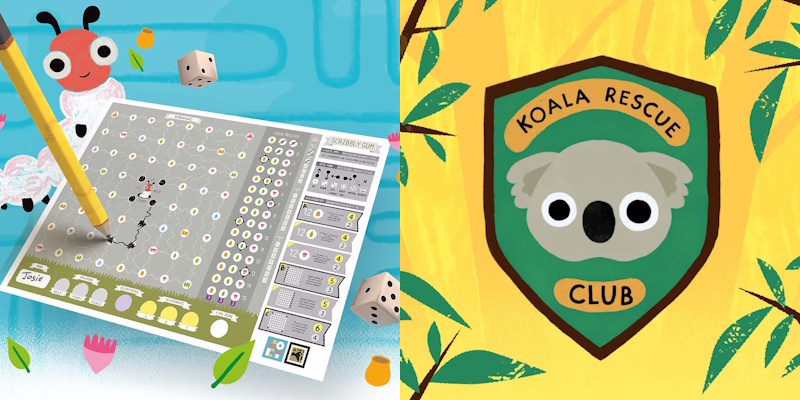
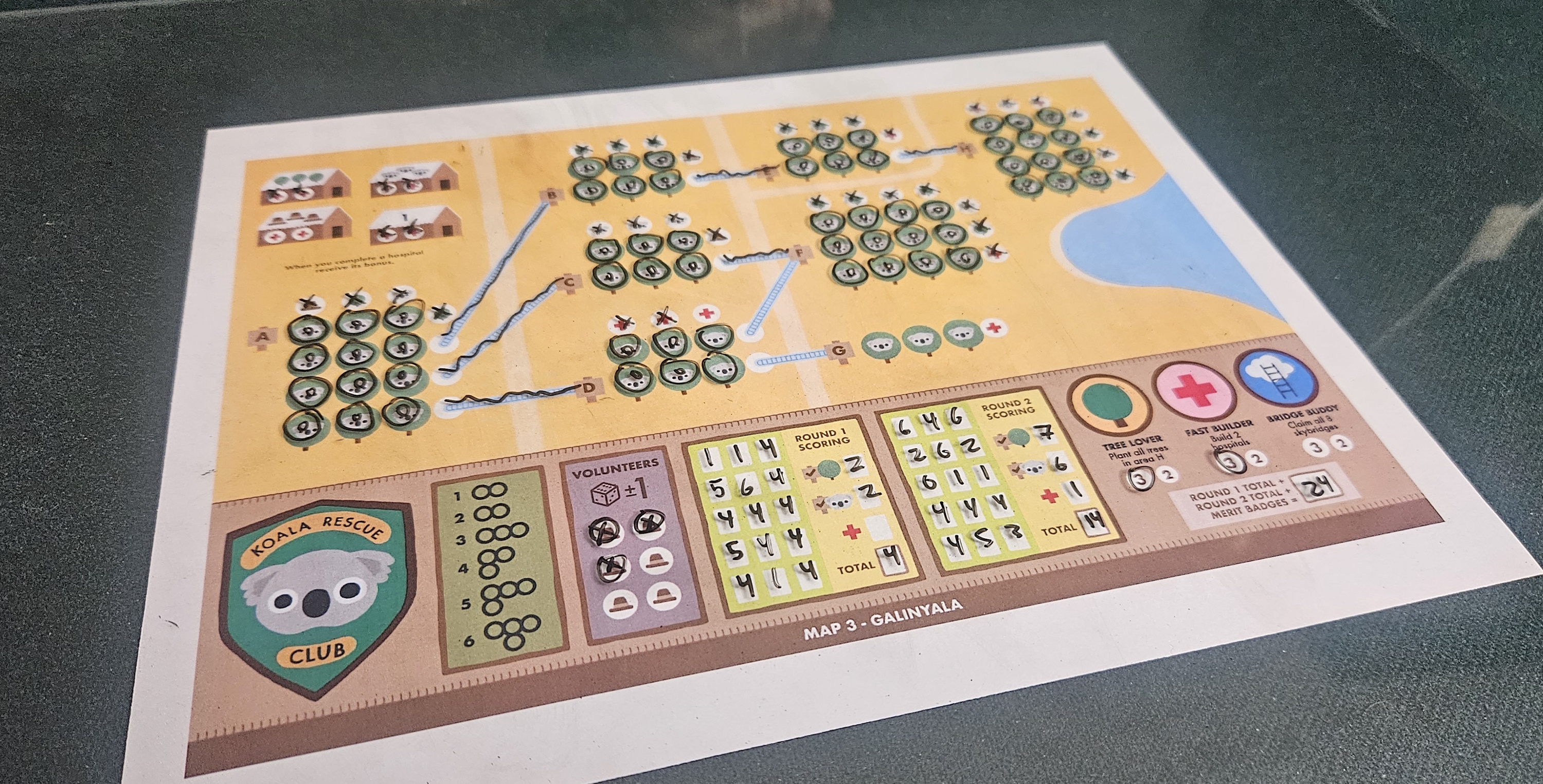
My odyssey through Postmark’s catalog of single-sheet print-and-play games continues. This week’s titles are none other than Scribbly Gum and Koala Rescue Club, both designed and illustrated by Phil and Meredith Walker-Harding.

You can tell we’ve reached the really good games when I’m covering them two at a time. Although this makes for a good twist, because one of them is pretty dang solid. For babies. I mean that in a good way.

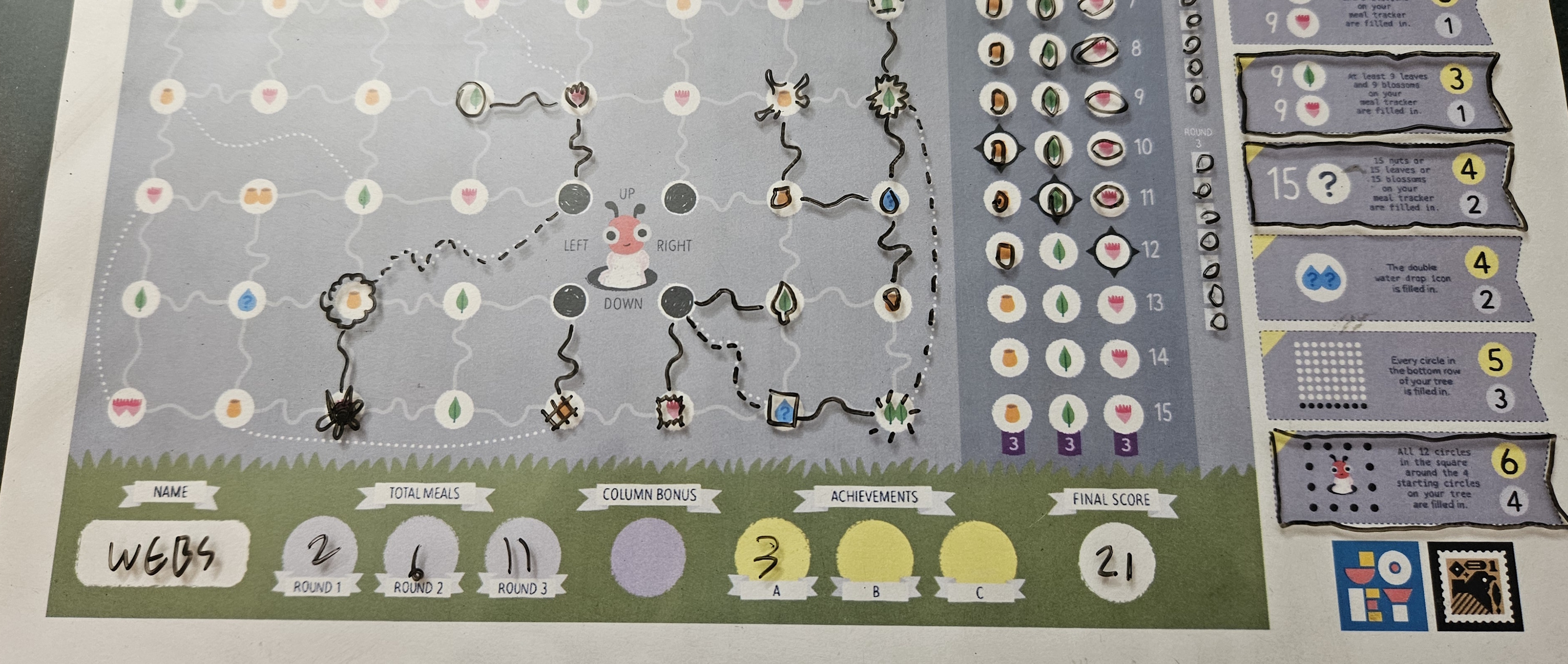
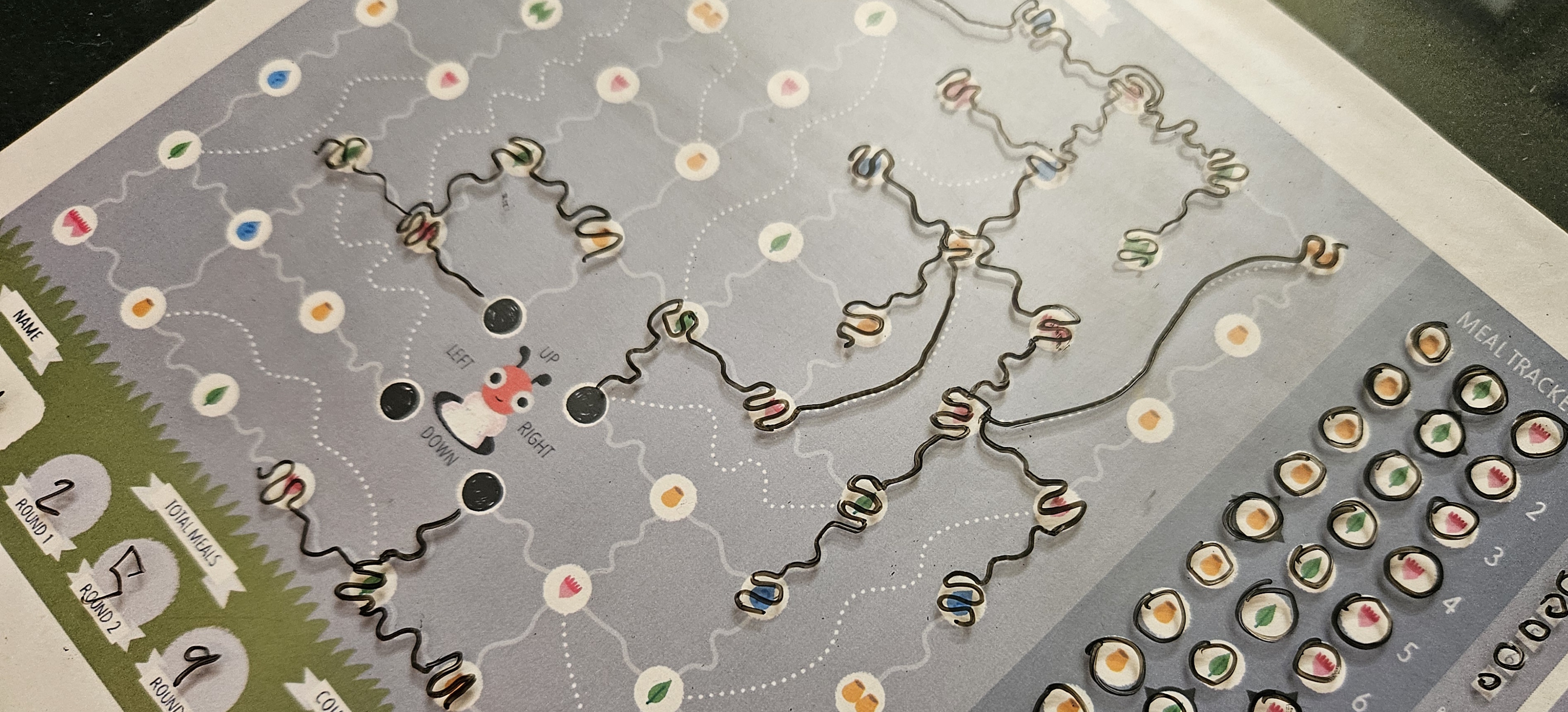
As you can see, my twelve-year-old is better at marking a sheet than her old dad.

Scribbles!

Scribbly Gum

For those of us who slept through botany class — huh? this school offers botany? — Scribbly Gum refers to the Eucalyptus haemastoma tree, whose colloquial name is derived from the lovely “scribbles” left behind by the chewing of the Ogmograptis moth in its larval stage. In this one, you’re chewing this way and that through the tree’s soft bark to secure meals that will permit you to grow from non-lepidopterophobia-triggering larvae into the Ogmograptis‘s hideous adult form.

The concept couldn’t be simpler. You roll two dice, then choose one of the results to permit movement. The rubric is straightforward. A roll of one lets you move up, two moves you down. Three and four correspond to left and right. Five, meanwhile, lets you follow a rare dotted line, usually forging a shortcut. Sixes are dead rolls, but don’t worry about rolling two of the things, because any double is a wild move that lets you go anywhere.

Turns, then, consist of rolling dice, choosing a direction to move, and securing the nut, blossom, leaf, or water in the space you just reached. Little by little, you spread across the page, leaving behind cutesy scribbles.

There’s a little more to it than that, but not by much. Certain spaces on the food track permit extra moves, and there are optional scoring bonuses for meeting little thresholds. These vary by map, but they usually conform to “eat a certain number of blossoms” or “chew up every space on the left side of the sheet.” It’s simple stuff. Baby’s first roll-and-write.

Dang it, kiddo.

Even more scribbles!

That might sound like faint praise, but when I used Scribbly Gum in its intended fashion by plopping it in front of my twelve-year-old, she was so charmed that we played all four maps in a single sitting.

Now, she isn’t quite a baby, and this isn’t her first time around the block. She’s played a few games of this ilk before. Paper Dungeons is a favorite, and her official review of Flip Pick Towers was “It’s like Paper Dungeons but not as good.” Reasonable marks coming from her.

But Scribbly Gum caught on because its rules are so darn simple that they get out of the way almost immediately. Which in my daughter’s case, meant she could get down to the serious business of triggering free actions with alarming frequency. Oh, and making her scribbles nice and cute.

This is a minor offering from Postmark, especially compared to its opening trio by Rory Muldoon and Matthew Dunstan. But it’s a pleasant minor offering, a gentle experience that doesn’t burn brains or exclude the little ones. While I’d rather tackle the seas, whether above or below, or a scenic hike, it wasn’t as though I begrudged my time in the presence of these squirmy art-bugs.

Those koalas, on the other hand…

brrr, they're even worse than moths

Saving some horrible koalas.

Koala Rescue Club

Koalas are horrible creatures, their natural cuteness belying some truly awful biological processes that I shan’t elaborate here. Koala Rescue Club dresses you into the high-visibility vest of a volunteer planting eucalyptus trees and rehoming the little guys, which would be a wonderful objective if the game weren’t so dull.

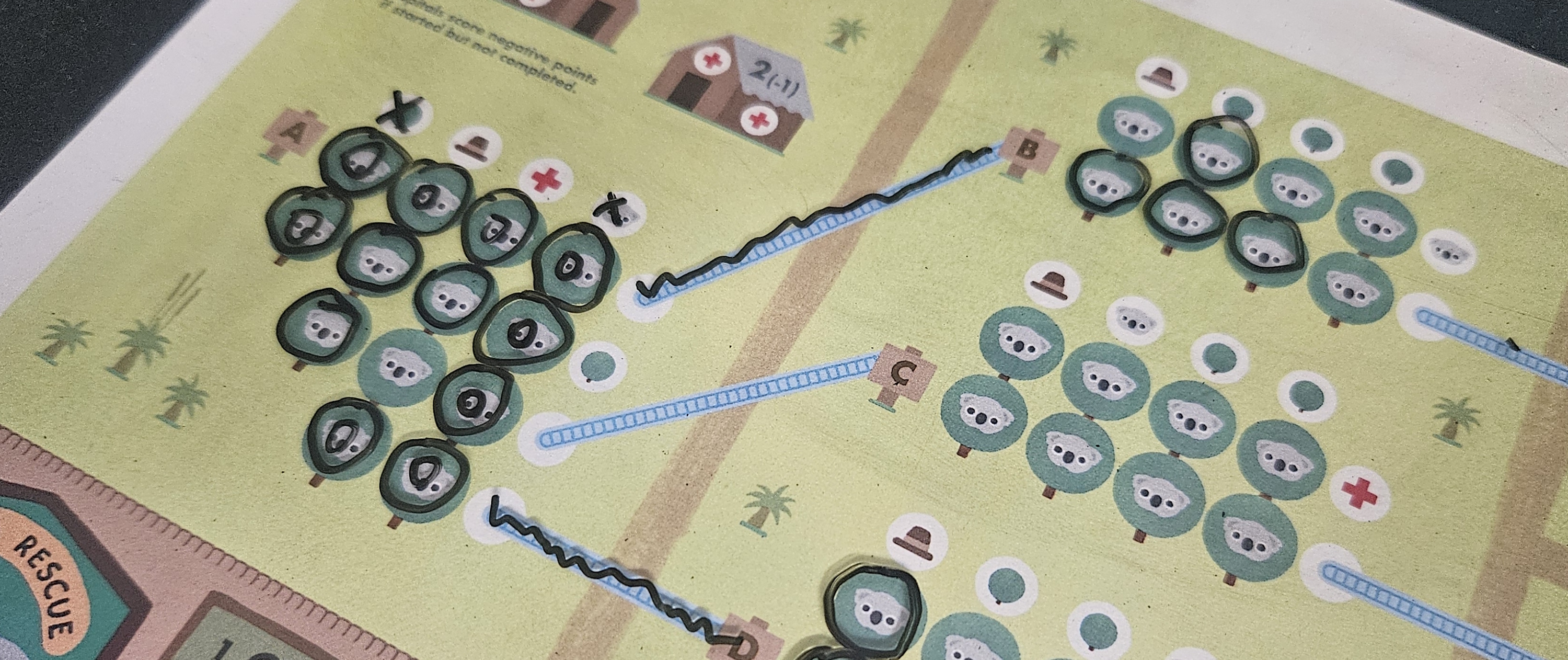
This is, once again, a game that opens each turn with a rolled die, although here that roll signifies which shape you can place on your sheet. It’s polyomino placement, in a sense, with the caveat that you’re really placing each shape twice. Once for the trees, another time for the koalas who will dozily munch their leaves. This results in tidy rows of circles: a big one for the tree itself, a smaller one within the tree for the koala.

As with Scribbly Gum, there are bonuses to be chased. Filling a column or row with koalas awards a perk. Extra trees and koalas are the norm, useful for filling in spaces earlier left blank. Volunteers allow you to adjust the value of the roll. Skybridges travel across the road to neighboring eucalyptus groves. And koala hospitals earn points. Or in the later maps, trigger bonuses of their own. Optional merit badges offer a few extra points for, say, planting all the trees in Grove C or building all the skybridges.

Especially when printed in color. For those of us with crappy printers shackled to the ink cartels, low-ink versions are much appreciated.

Like all of Postmark’s productions, it does look nice.

Koala Rescue Club is suitably cute, but the problem is that it isn’t very interesting. In the opening turns, before you have volunteers for adjusting rolls or extra groves for placing any larger shapes that won’t fit among your starting trees, you’re more or less beholden to the roll of a single die. This makes the early stages listless, like one of those games where everybody takes a matching move in the opening turn or two.

Affairs improve as more options are unlocked, but not so much that it often feels like you’re being confronted with hard tradeoffs. The shapes are so simple that matching them into a space is generally a trivial task. The merit badges are unexciting and nearly always repeat themselves. Even the possibility that this might be used as an educational game is somewhat let down by the two-layered shape placement. Where Scribbly Gum could pass for baby’s first roll-and-write, I harbor doubts about Koala Rescue Club.

The upside, I suppose, is that in solitaire it’s a nice enough way to kill a few minutes. Unlike most of the Postmark catalog, where the solitaire mode comes across as an afterthought, here it seems like the right way to play. Maybe that’s because my twelve-year-old declared it boring after one play and insisted we tackle Scribbly Gum again. Still, my few solitaire sessions were markedly more enjoyable than watching her put her head down on ink-marked plexiglass.

In other words, Koala Rescue Club needed rescuing. But who rescues the koala rescuers? I dunno. I just needed an outro.


Access to the files to print Scribbly Gum and Koala Rescue Club was provided by the publisher.

(If what I’m doing at Space-Biff! is valuable to you in some way, please consider dropping by my Patreon campaign or Ko-fi. Right now, supporters can read my first-quarter update of 2026: the best board games, movies, books, and more!)

Million-play analysis inspires streamlined Isle of Cats successor, as game’s sales pass 250,000

03. Juni 2026 um 18:00

The Isle of Cats designer Frank West has unveiled a new game set in the same universe as his bestselling polyomino-puzzle title, saying the project was shaped by lessons learned from more than a million recorded plays of the original.

Isle of Cats creator Frank West

The Isle of Penguins, which launches on Kickstarter on July 7, sees players rescuing the sea birds from melting ice floes and fitting them onto uniquely shaped rafts, in an experience West says is faster and more accessible than The Isle of Cats while retaining its strategic depth.

West, who runs publisher The City of Games, told BoardGameWire The Isle of Cats had now surpassed 250,000 physical sales since it was released in 2019 – a figure that rises to almost half a million when including spin-offs The Isle of Cats: Explore & Draw, The Isle of Cats Duel and digital versions of the game.

He said the design for The Isle of Penguins emerged after six years of analysing data from digital versions of The Isle of Cats, as well as player feedback from across Kickstarter and YouTube video comments, social media discussions and BoardGameGeek reviews.

That data amounts to more than one million plays across the digital versions the game – information West says he has used to create a game that plays 20% to 30% faster than The Isle of Cats standard mode, while also giving players more to do.

He told BoardGameWire, “I think my main takeaway was that The Isle of Cats is a great game that is loved by a lot of people – It didn’t need fixing. But, there are things that could make the game more accessible to some people. I wanted to design a game to sit alongside The Isle of Cats, rather than replace it.”

The Isle of Cats || Photo Credit: The City of Games

West said major changes include a new selection system which allows for simultaneous play, most scoring happening during the game rather than at the end, and a drastic shift to the complexity of the polyominoes themselves.

He said, “One of the unique parts of The Isle of Cats when it was released was the complexity of the cat tiles themselves. They use less common shapes and can be very tricky to place, which is great.

“However, some players struggle to flip tiles in their head or visualise how something might fit, and the complex shapes in The Isle of Cats made this challenging for them. This was a key part of the game, and I spent many years working out how to flip the experience.

“In The Isle of Penguins, every penguin tile is a square or a rectangle. These are the simplest shapes, and much easier for people to visualise and rotate in their heads.

“But the raft board you are placing them on is far more chaotic, with many restrictive areas, which makes finding the right place to put a tile just as hard.

“Effectively, this flips ‘hard shapes and a simple board’ into ‘easy shapes and a complex board’.”

He added, “I have been thinking about a lot of these things for a long time, but when I managed to flip the polyomino experience with the raft board, and found a way to make simultaneous play work, I realised I had something exciting.”

The Isle of Cats || Photo Credit: The City of Games

West said that streamlining of the game allows players to do more in less time, without reducing decision making – and added that the title would retain Isle of Cats’ inclusion of both a family mode and standard mode, in addition to a new expert mode for the new game.

He said, “This keeps the entry point of the game as friendly as possible, while offering something more to veterans of The Isle of Cats looking for a step up.

“It was important not to assume that just because someone has been playing games for years, they would now want something more complicated. But I also wanted to make sure there was something there for those who did want it.”

West confirmed to BoardGameWire that the new game would be illustrated by The Isle of Cats artist Dragolisco, saying, “I wanted to ensure The Isle of Penguins looked familiar to those who loved The Isle of Cats, and I think he is a great artist. He did a fantastic job!”

The original Isle of Cats Kickstarter campaign raised more than £460,000 from over 8,100 backers in 2019, and was followed by a £1m-plus campaign for the base game and several expansions in 2021, which was backed by over 12,000 people.

A co-op spin-off title, Race to the Raft, picked up almost £350,000 a year later.

The Isle of Penguins is set to launch on Kickstarter on July 7.

The post Million-play analysis inspires streamlined Isle of Cats successor, as game’s sales pass 250,000 first appeared on .
Board, the startup making a $400 board game console, leans into AI-powered designs after raising another $20m

03. Juni 2026 um 14:50

Hybrid physical and digital game console maker Board has raised another $20m in venture capital amid plans to launch an AI-powered game design platform.

The new funding round, which was led by Union Square Ventures, means Board has now raised $35m in external funding since the touchscreen device was launched in October last year.

That launch was accompanied by a suite of 12 initial games, including Omakase from veteran board game creator Bruno Cathala, which make use of physical pieces that interact with the digital board.

The company claims thousands of developers are starting to create games for Board using its software development kit, although it is yet to publicly announce any tie-ups with existing board game publishers or other designers.

Alongside the funding announcement Board said it would unveil an AI platform later this year which will allow users to build their own games using natural language prompts, saying taking a game from idea to playable prototype can be done in less than an hour.

Strata, one of the game designs currently playable on Board || Photo Credit: Board

Michael Mignano, general partner at Board investor Union Square Ventures, cited Roblox as a successful example of that model – although that platform has faced repeated criticism in recent years for financially exploiting young developers and putting pressure on children to spend money via its virtual currency.

Mignano said, “I grew up playing Nintendo and Super Nintendo, huddled around my living room CRT television with my sister, parents, friends. As I grew older, and the technology changed, so did my habits, and my gaming turned inward. I transitioned to Warcraft on my PC, and eventually to casual games and The Battle of Polytopia on my iPhone.

“But now I’m looking for reasons to put away my phone and be present with others. I’m attending more live sporting events and concerts than I have in my entire life. And instead of playing a console game by myself on a late Saturday night, my family and I are playing board games and card games around the dining room table.

“It’s not just me: both live events and board games are on pace for record years in 2026, with each market continuing a multi-year climb to all-time highs. This is the shift we keep coming back to at USV: even though we’re still addicted to our algorithms and group chats, people want ways to have fun with their friends in person.”

Board was founded last year by Brynn Putnam, who previously built smart fitness device company Mirror before its $500m acquisition by Lululemon in 2020.

Previous attempts to make a hybrid digital and physical board game console include The Last Gameboard, which raised more than $185,000 through a Kickstarter campaign in 2020, and followed that up with $6m in venture capital funding.

That business shuttered in 2024, however, with CEO and co-founder Shail Mehta saying the company never managed to overcome the lag and inconsistency in its touchscreen tech to allow for a mass consumer release.

Games in that device’s library included Terraforming Mars, Viticulture, Downforce and Steve Jackson’s 1977 debut game Ogre.

Update 22/6/26 – this article originally referred to Bruno Faidutti as a designer of Board’s first suite of games, when it should have read Bruno Cathala. Sorry Bruno(s)!

The post Board, the startup making a $400 board game console, leans into AI-powered designs after raising another $20m first appeared on .
A Crack in the World

03. Juni 2026 um 03:58

They're minding their own business at a nice dinner party. No cause for alarm.

I wouldn’t wish to inflict board game drama on anybody who wasn’t already saturated in the stuff, so I’ll keep the details sparse, but the past couple of weeks saw a minor authority figure on BoardGameGeek sharing his views on demonic possession with a potential customer. I try to stay away from such dust-ups, but I found myself compelled to weigh in. My resultant post discussed the textual development of an adversarial spirit in Judaism and Christianity and made an impassioned plea to anyone basing their decisions on the existence of otherworldly beings.

Over the coming days, I heard from a number of people. Some had been touched by what I’d written. Others were just glad to have encountered something informative on the internet. One or two were offended.

But what stood out to me the most were those who had, like me, encountered “demonic possession” in the wild. Not the real thing. Not actual demons clawing their way through the cracks in the world. I’m talking about the excuses, usually offered by pastors, who couldn’t explain some phenomenon, but who needed to be the authority figure on everything. The undiagnosed illnesses. The non-mainstream gender orientations. The people who wanted nothing to do with the good news.

Playing Martha McGill’s Witch Hunt 1649, it was impossible to not mull over those thoughts all over again. It was impossible not to think back on the time I met a witch.

Poor health, reputation in the crapper, cutting bait and plucking roosters... at least I have some relaxing reading ahead of me. Until the sun goes down. The past *sucked.*

Living my worst life.

Statistically, you’ve already assumed that I’m talking about a woman.

Witch Hunt 1649 isn’t about the witch hunts that dominated my schooling. Those were New World witches, the result of mistrustful Puritans living on the edge of a world that seemed immune to their understanding. McGill’s telling predates Salem by half a century and takes place far across the sea. In the same year that Charles I lost his head and Oliver Cromwell prepared the New Model Army to march northward, villages in Scotland reacted to their uncertainty the same way that countless communities had done before: by blaming the women they didn’t like very much.

There were men witches, too. Not many. Just enough to ensure that nobody was above suspicion. Of the 3,800 Scots accused of witchcraft, eighty-nine percent were women.

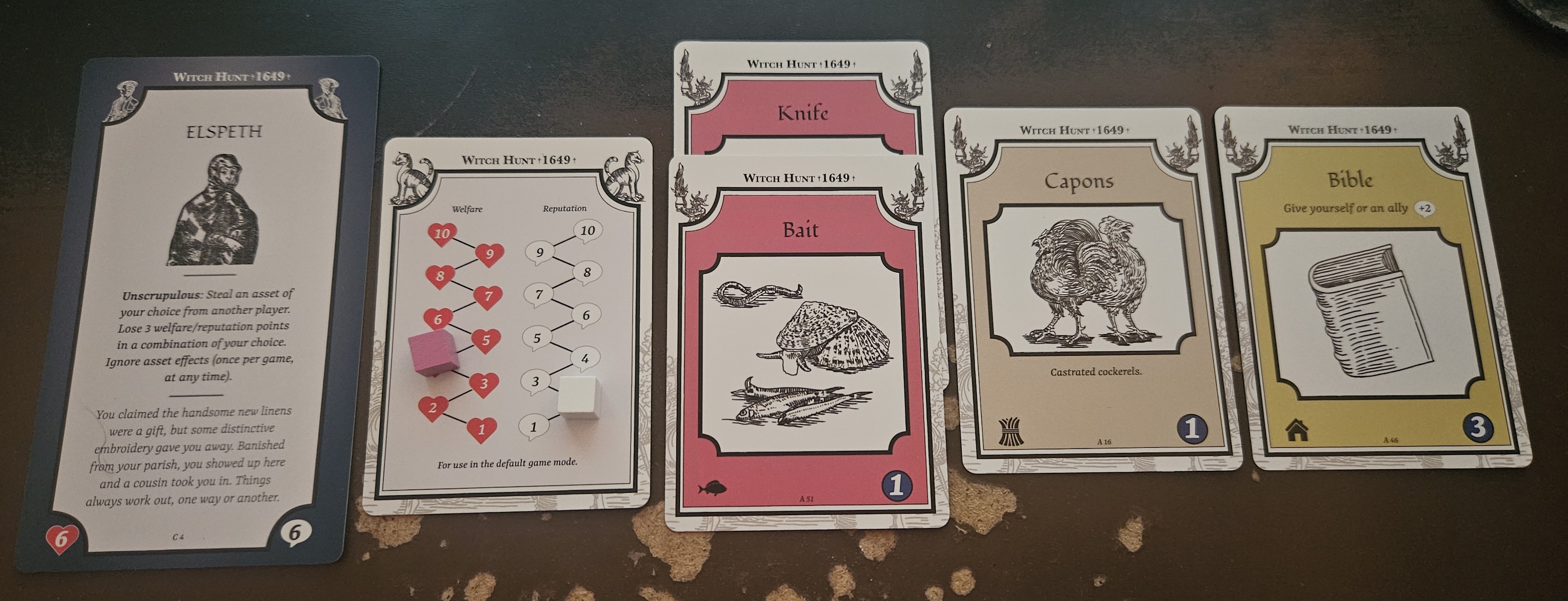
In the game, the figure is similarly skewed. At the start, everybody receives a character to embody. These cards offer only a few tidbits. A name. A woodcut illustration. A once-per-game special ability. And a small blurb that explains why these people are subject to suspicion. There’s Elspeth, who once nicked some nice linens. Agnes, who knows which herbs might ease a fever. Bessie, whose primary sin is that she’s a bit lazy. Janet, isolated after cutting the sheep-stealing cousins out of her family. William, who loves a ribald joke. Helen, over-eager to share her conversion experience with her neighbors.

Ordinary people, in other words. To most of us, it would be their neighbors who seemed too buttoned-up. Too prying. Too obsessive about the minutiae of everyone’s lives. Too willing to fling an accusation that might get one of their neighbors strangled with a cord and their stake-bound body charred to ashes.

Of the fifteen character cards, eleven are women. Seventy-three percent. If anything, Witch Hunt 1649 short-sells the divide.

Nowadays I take a reputation hit for not sharing my special orange soda. Worth it.

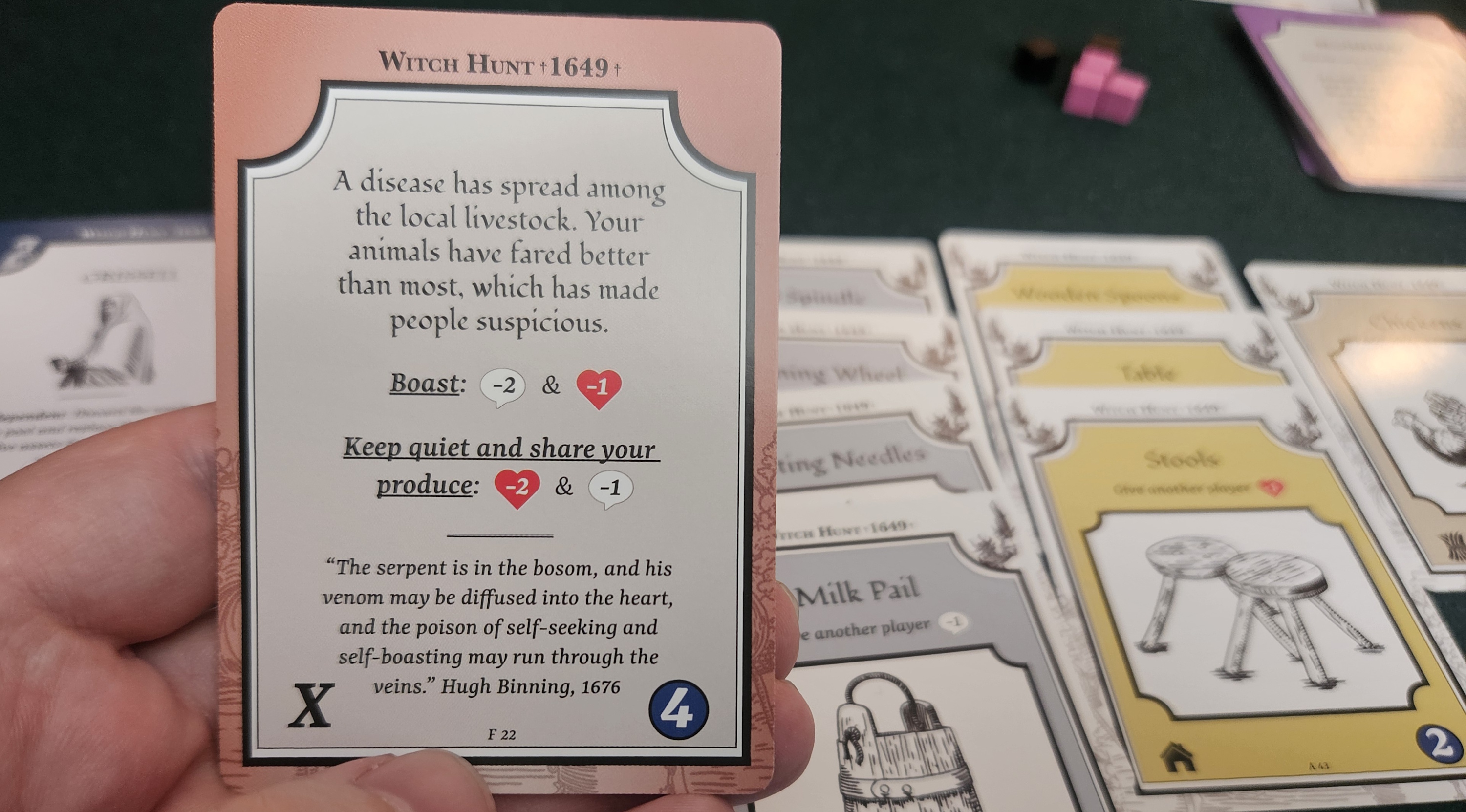
Fate cards present ethical conundrums between suffering and suffering a different way.

As a game, Witch Hunt 1649 is a simple thing. That’s to be expected. Published by Central Michigan University Press, this is closer to an educational tool than a hobbyist product. Like Greg Loring-Albright’s Keep the Faith from the same imprint, there’s an element of role-play, with most turns consisting of a single card-flip. This card presents some stroke of ill fortune that has befallen your character. Chronic headaches. Extra tithes. A cousin’s hasty marriage. The rumor that you’re a closet Catholic. You’re allowed to choose how to respond to these misfortunes, but there’s no such thing as coming away richer. Every choice is a Sophie’s choice. Waning physical welfare, waning standing in the community, or waning material goods. After a while, you begin to wonder why anybody bothers trying to be good.

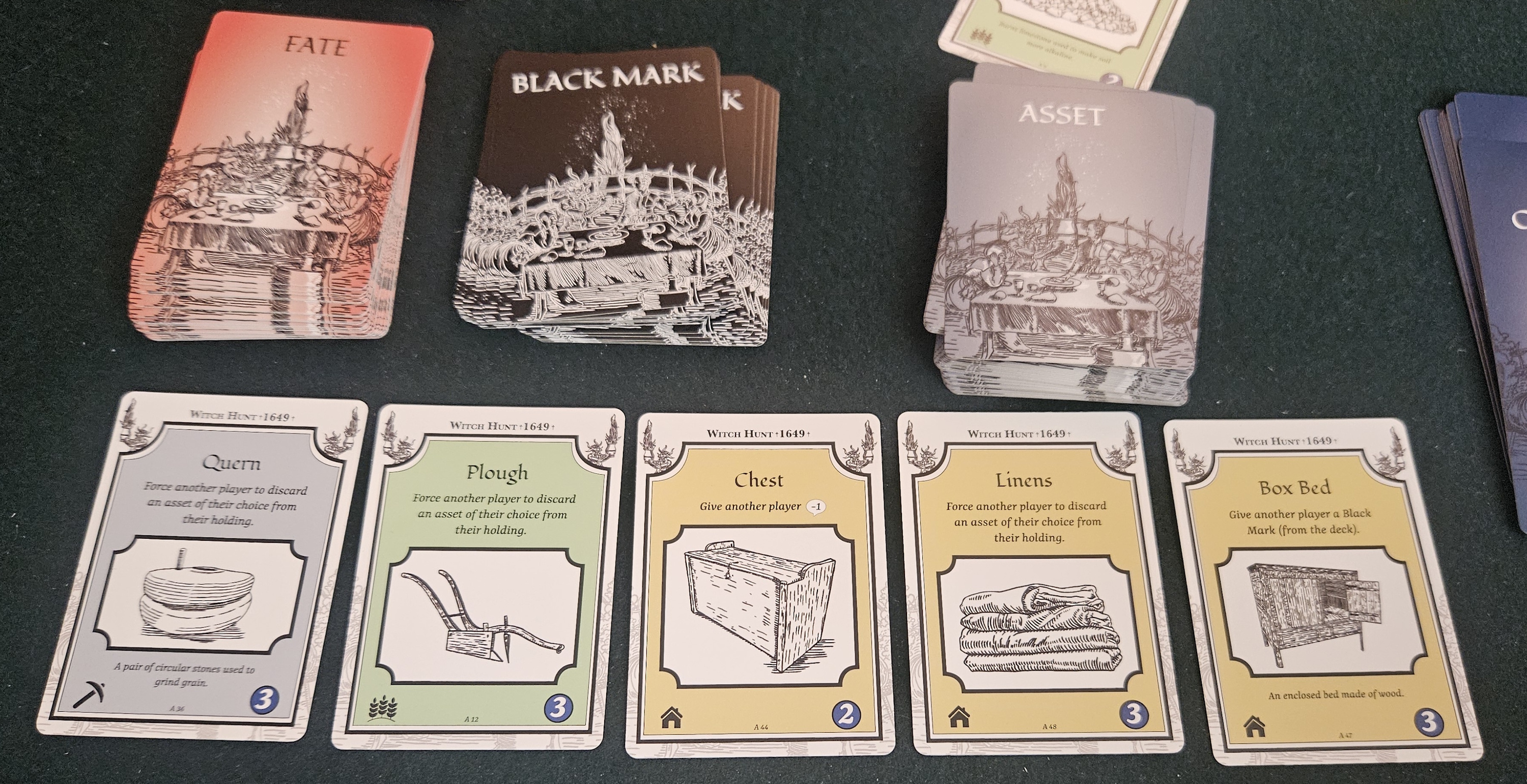
The one respite is that you’re still here, still alive, still capable of improving your situation. You take the card fate has dealt you and acquire something from the market. Like everything else in Witch Hunt 1649, these are meager possessions. Your goal, apart from survival, is to accrue enough to place yourself in high society. Higher society. One sickle and pair of shears at a time, one cow-shed and kiln, you construct a life.

As often as not, those possessions become anchors. That Bible improves your standing in town, but you might have to part with it to support the local poor. The local poorer. That basket helps you carry more fish from the stream, but it hurts all the worse to lose it. Other items, like creepy rams, are liable to trick some farmer into thinking they’re striking a pact with the devil. When the trial begins, everything becomes potential evidence.

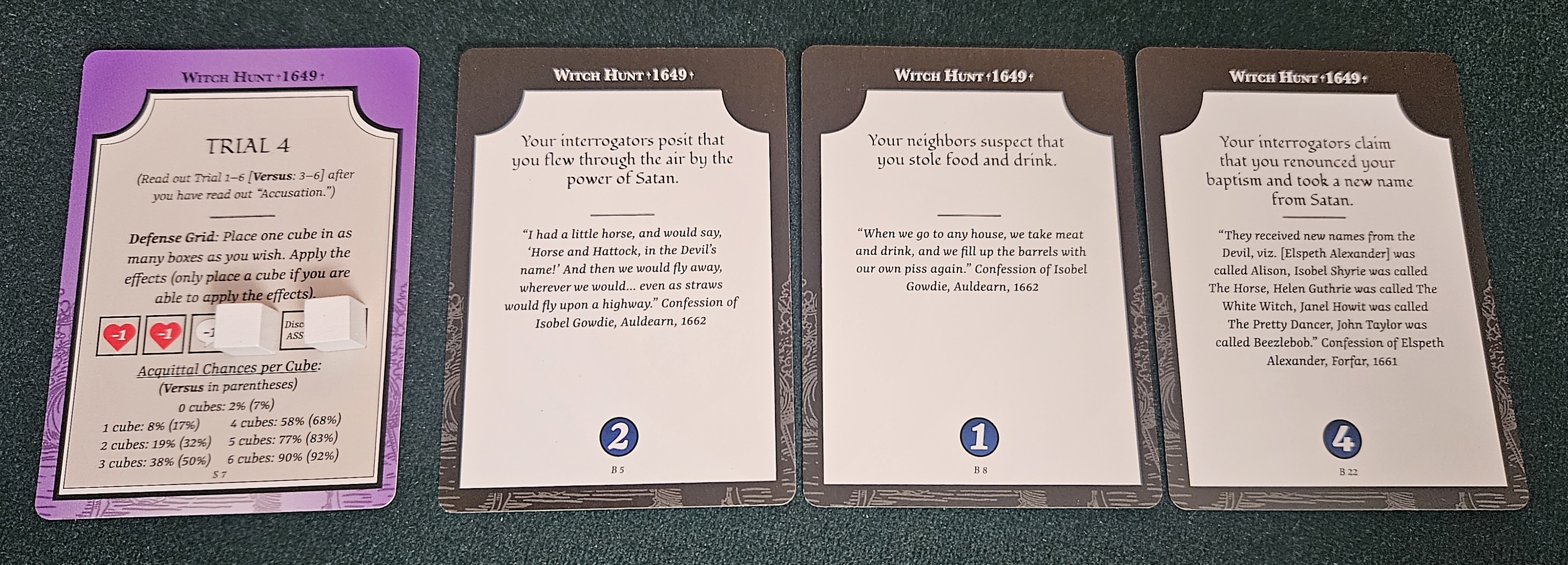
The witch-trial is the centerpiece of the game. As soon as you have three black marks, you’re dragged before a council of fifteen propertied men and put to the test. Black marks, it must be noted, have nothing to do with your choices; either you gain them or you don’t, entirely irrespective of your decisions. They’re also drawn face-down. When the trial begins, you have no idea of the substance of the accusations against you. At times, they’re as harmless as a rumor. Other times, they’re as damning as a rumor.

To secure an acquittal, you spend your meager health, your meager reputation, your meager possessions. You try to persuade your friends and family to stand by you. You’re well aware that these are hard requests. If you’re found guilty, your relations will also stand trial. It isn’t until the accusations are revealed, flipped one by one, that your fate becomes clear. Even then, survival is only momentary. There’s nothing preventing you from being dragged before the council at a later date, no matter how much of your property you’ve parted with, no matter how many teeth you’ve lost to the stress.

The worst black mark, in my book, is telling me that you think A.I. is now feeling emotions. Get thine arse to the trial.

Accrue three black marks and it’s time for a trial.

For the first few years after I came home, it wasn’t uncommon for someone to ask if I’d seen any demonic possessions out there. Possessions or skinwalkers or witches, anything like that. I’d served a portion of my two years as a Mormon missionary among the Crow Nation, and people were always quick to note how “Those folks are more spiritual than we are.”

In this case, “more spiritual” meant more susceptible to the beings that dwelled on the other side of the crack in the world. Spirits, demons, angels. Beings we never saw as white folk. Beings that only seemed to gather around those with brown skin, on land they’d been planted on by the government, or else in faraway places where people still practiced cannibalism and wife-burning and whatever else.

Whenever anybody asked the question, I thought about the witch.

I first heard about the witch from a guy in Hardin, the half-white, half-native port town on the edge of the reservation. We were set to baptize a man. Crow. Maybe already a member of the church, but records were spotty. On the scheduled day, he didn’t show up. “He was probably called away by that witch,” the guy said. I laughed, but he insisted that, no, he was being serious. “He’s taken up with a witch,” he said. “Those folks are more spiritual than we are. We can’t hear their call because we aren’t as spiritual,” he said. “We,” he said, meaning white folk. I asked if we should go find him. Find him and help him. If he was under thrall to a witch, surely that meant he needed us more than ever. Needed Jesus. Needed baptism. Needed something. “No, there’s nothing for it,” he said.

I stole this from street view, because nearly all of my old mission photos were destroyed. Otherwise I might have shown you not-as-fat-Dan standing around on some windswept prairie.

A mile or so outside Hardin.

I returned to the Crow Nation many months later, after many people had asked me about the spiritual folk out there, about whether I’d seen any possessions or skinwalkers or witches. It took some phone calls, but we found the witch’s address. We hopped in the truck and took off, the missionaries who now lived on the rez seated in front, talking excitedly about how they’d exorcise the witch’s demon or dust off their feet against her house.

When I met the witch, I was surprised. Not because she was a woman. (Eighty-nine percent of witches are women.) It was how ordinary she seemed. Her trailer looked like the other trailers that dotted the rez. Her dogs barked like the other dogs that barked on the rez. Her wind-chimes chimed like every other set that chimed on the rez. I asked if she’d seen our man. The one who’d skipped out on his baptism.

“Sure,” she said. “He comes around when he’s trying to get off the meth. He stays a few days, sweats it off, then he goes home again.”

Oh. Well. It wasn’t true, then, what I’d heard. Someone had told me she was a witch. Ha ha, what a mix-up.

“Sure,” she said, laughing brightly and rubbing at the sunspots on her forearm. “I’m a witch. I’m a witch at helping people get off the meth.” Then she told me about her degree in nursing, how the learning had come naturally. How she’d worked for years in addiction recovery. How she was, indeed, an actual witch, with a power for curing people of their killing habits.

On the drive back, as we talked about our encounter with the witch, two of the other missionaries bubbled first with excitement, then with righteous upset. We hadn’t done anything. No denunciations had been leveled. No demons had been cast out of their hosts. One told a story about how a devil had once held together a person’s broken leg, then the prophet had cast the devil out. This caused the leg to break again, because evil magic sometimes imitates good things. “We should go back,” he said. “No way,” his companion shot back. “What if she uses Satan’s priesthood on us? You know they’re more spiritual than us.”

I didn’t say much. Between this and my previous visit to the reservation, I was starting to harbor some serious doubts about the shape of the world. There was a crack in it, all right. A crack that ran right through it. But the crack wasn’t what I’d been told. It wasn’t us on the one side and evil spirits on the other. It seemed to me there were good people all over, lots of them, some with addictions or problems or sicknesses, and some who wanted to help. And then there was us. The people in the white shirts and ties. Telling stories about everyone else. Trying to square them so they looked the way we wanted. And then, when they wouldn’t be squared, pretending they must have widened the crack to the other side and beckoned something ugly into themselves.

All else being equal, I choose whichever item requires the least work.

I do want a nice box bed.

I no longer believe in witches any more than I believe in teenage boys being sent by Jesus to proclaim the restoration of an everlasting gospel that keeps changing on itself. But I do believe there are demons out there. There’s nothing supernatural about these demons. They look like us and dress like us. They eat our favorite foods and watch our favorite reality shows on television. They do pretty much whatever they want to do, and then they come up with compelling reasons why they were in the right to do it. Those are normal enough behaviors, but the way to tell a regular person from demon, I suspect, is that a regular person might come up with a reason why they were a good fit for nursing school. A demon, on the other hand, explains why they’re the chosen one who’s been endowed to save the world from itself. Whether anybody wants it or not. Whether they have to bind a person to a stake and flick a torch into the straw.

Witch Hunt 1649 pulls a lot of weight for such a small game. It shows how insular communities can curl in on themselves until they sour and curdle. It examines how people on the margins, women especially, become scapegoats for no greater sin than being marginal. It preserves the memory of the crimes against those people rather than letting us forget the cruelties we can unleash on our neighbors.

But for me, mostly, it gets me hoping that the only witch I’ve ever met has helped a bunch of people with their methamphetamine addictions.


A complimentary copy of Witch Hunt 1649 was provided by the publisher.

(If what I’m doing at Space-Biff! is valuable to you in some way, please consider dropping by my Patreon campaign or Ko-fi. Right now, supporters can read my first-quarter update of 2026: the best board games, movies, books, and more!)

S.T.A.L.K.E.R. The Board Game – ALL THE EXTRAS Unboxing!

03. Juni 2026 um 01:53

You are a vault dweller, but if you’re going to survive, you need to start acting like a surface dweller.

Peter unboxes all the extra stuff you can get to expand your games of S.T.A.L.K.E.R. The Board Game!

I’ve been hoping for some time now to get my hands on this extra stuff for S.T.A.L.K.E.R. The Board Game, and the wonderful people at Awaken Realms were kind enough to send me the goodies I didn’t get the first time around. So here’s an unboxing of the miniatures packs, terrain pack, stretch goals and expansions for this excellent game of survival in the irradiated Zone!

By the way, don’t forget to download my rules & reference (and of course it’s also on Tabletop Codex)!

Making high quality tabletop gaming content at the EOG takes time and money. Please consider becoming a Patreon supporter or making a donation so I can continue this work! Thankyou!

Asmodee’s push into crowdfunding scores first success with $4.1m for Zombicide: Dead Men Tales

02. Juni 2026 um 15:34

Board game giant Asmodee’s strategic push into crowdfunding has passed its first major test, with its debut campaign in the Zombicide universe raising more than $4.1m on Gamefound.

The total for pirate-themed Dead Men Tales cements the campaign as the biggest main line Zombicide crowdfund in almost a decade, with Zombicide: Green Horde having picked up just over $5m in 2017 – although the biggest crowdfunding success in the range remains licensed spin-off Marvel Zombies at just over $9m.

Asmodee’s acquisition of Zombicide from financially troubled CMON last June set the stage for the company’s drive into crowdfunding – an area it had previously barely touched through any of its myriad studios.

David Preti || Photo Credit: CMON

The buyout came a month after Asmodee had hired ex-CMON COO David Preti – the architect of the latter company’s growth into one of board gaming’s biggest crowdfunding-focused publishers – to head up its own newly-launched crowdfunding and miniatures strategy.

Asmodee doubled down on its crowdfunding-focused acquisitions in October last year by picking up the Cthulhu: Death May Die IP and games from CMON – a series which has raised almost $10m from backers to date.

Asmodee had not publicly discussed details of its crowdfunding strategy ahead of completing the Dead Men Tales campaign, but said in a press release celebrating that success that crowdfunding “gives publishers clearer demand visibility, a direct line to engaged communities, and a healthier financial setup – with production sized to actual demand rather than to forecasts”.

That statement is notable given Asmodee studio Fantasy Flight Games’ decision last month to discontinue the latest iteration of veteran dungeon crawler Descent, citing rising manufacturing costs, “global economic shifts” and the expense of developing the game’s companion app.

It is thought FFG may resurrect Descent through a crowdfunding strategy in the future, although it is yet to confirm or deny this, saying in April, “While we don’t have anything to share at this time, there is always a possibility that we will revisit Descent in the future. It would take a different form and would not be Legends of the Dark, but this game universe is near and dear to FFG’s heart.”

Asmodee CEO Thomas Koegler said of the Dead Men Tales crowdfund, “This first campaign means a lot to me, and I think it sends a clear signal.

“Zombicide is a beloved franchise that joined the group less than a year ago, and Dead Men Tales is already proving the model works: the original Guillotine Games team back at the helm, Fantasy Flight Games executing the campaign with remarkable skill, and a community of more than 11,000 backers who chose to trust us early.

“That trust is something we take seriously. There’s still careful work ahead on delivery, a crowdfunding campaign is only as good as what arrives at your door, but I have full confidence in our teams to see it through.”

Zombicide: Dead Men Tales || Gamefound Image

The campaign also helped underscore Gamefound’s rise as a crowdfunding peer to Kickstarter – and reinforced the trend for large, miniatures-heavy releases choosing the platform for their projects.

Dead Men Tales was the latest Gamefound campaign to make use of the platform’s Endgame feature, which is designed to extend the final moments of campaigns that are still actively receiving pledges even as the original countdown ends.

The Dead Men Tales campaign had collected more than $3m by the end of the official crowdfunding period, but Endgame extended the raise by more than five extra days and about $1m due to new pledges consistently being made.

Prior to Dead Men Tales, the only previous crowdfunding campaign from an Asmodee-owned company was Lookout Games’ Kickstarter for the Grand Austria Hotel: Let’s Waltz! Expansion & Deluxe Upgrade, which raised about €383,000 during the coronavirus pandemic in 2020.

Asmodee’s only other direct exposure to crowdfunding is thought to be via the company Exploding Kittens, in which it made a strategic investment short of a buyout in 2021. That business has since raised more than $977,000 in a Kickstarter campaign for Hand to Hand Wombat.

More tenuously, YouTube reviewer The Professor raised about $4m for his Academic 133+ XL deckbox in 2022, which was designed ‘in collaboration’ with Asmodee’s game supplies and accessories unit Gamegenic.

Gamegenic also previously provided accessories in partnership with the Altered TCG during its record-breaking crowdfund three years ago.

Last month BoardGameWire reported that Asmodee’s net sales had surged 23% year-on-year to more than €1.68bn, driven by the company’s escalating power as a global TCG distribution giant.

Asmodee’s own board game publishing operation, meanwhile, saw its net sales fall 5.8% in the last financial year – while net sales for the first quarter of this year were down 9.8% compared to the same period in 2025.

The post Asmodee’s push into crowdfunding scores first success with $4.1m for Zombicide: Dead Men Tales first appeared on .
Forget the Flippers

01. Juni 2026 um 22:00

I love the art style, at least.

It wouldn’t be an exaggeration to call Steven Aramini one of our hobby’s finest designers of small-format board games. Whether we’re talking about microgames like Sprawlopolis and Ancient Realm, or Fliptown, still perhaps the finest flip-and-write game ever designed, Aramini has a keen talent for compressing big ideas into small packages.

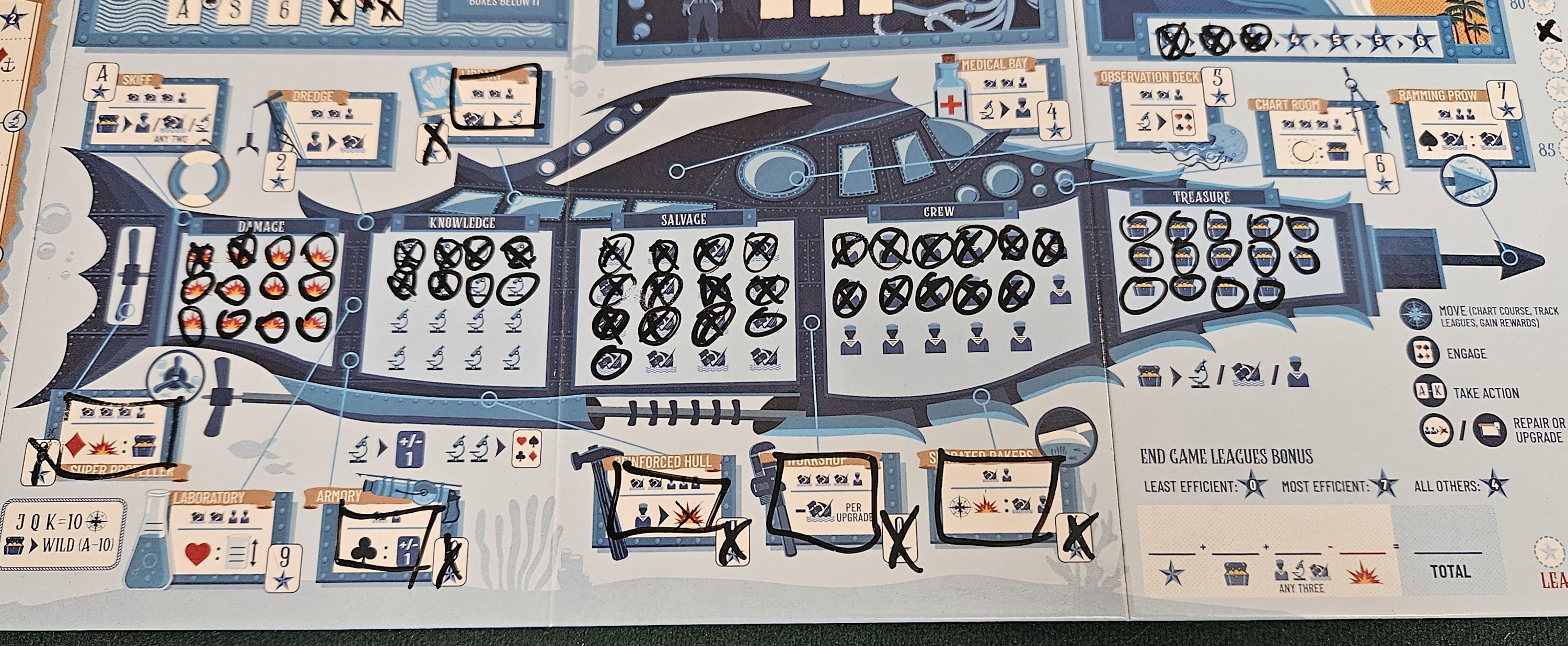
Flip Voyage, then, is his followup to Fliptown by way of Nemo’s War — although in a rare Aramini miss, this one surfaced too quickly and contracted the bends.

I have been led to understand that living on a submarine is a clammy, cramped experience, devoid of the wide-open viewing ports, expansive libraries, and world-class luxuries that such a fantastical vessel should offer. Sounds like a skill issue. Get on it, submarine designers.

We all live on an ordinary blue submarine.

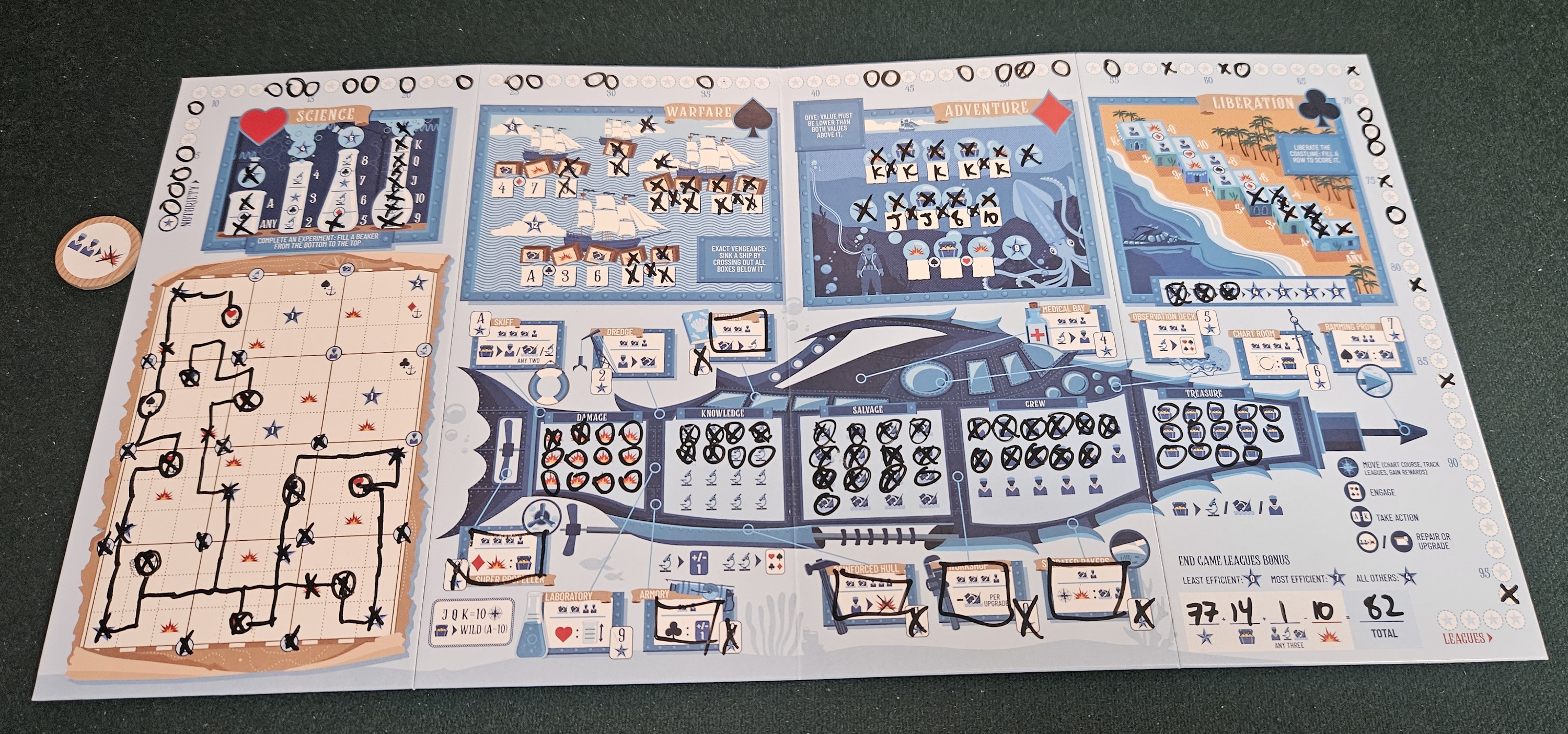
If you’ve played Fliptown, the basic conceit behind Flip Voyage will be familiar, if perhaps also baffling in its pared-down nature. Like that game, Flip Voyage is a combo-heavy flip-and-write that sees everybody at the table — whether one player or fifty, with the box providing enough dry-erase boards for four — turning three cards at a time from an ordinary deck of playing cards. Everyone uses that trio according to their own individual goals and position, and then, after awkwardly signaling to one another that they’re done, moves onto the next set. For our signal, my group has taken to sticking up a thumb. That or asking Geoff whether he’s wrapped up his turn, because eighty percent of the time he’s the last one anyway.

In Fliptown, the template was straightforward enough, while still offering a range of options. You would choose one card for its suit, to indicate which of four activities your cowboy would undertake that turn. Another card offered up its rank, setting the strength and/or destination for that activity. The final card became part of a poker hand, an ongoing bid to earn extra points and cash at the conclusion of five flips. Since everybody knows poker hands, from movies if not from personal experience, the relative value of each splay was given an intuitive value.

There are no giant squids in this game. Pity.

Three cards are revealed at a time. How will you use them?

This time around, the value of any given card is more wishy-washy.

For one thing, there are no poker hands. That’s fine. Fliptown was a cowboy game. Per contractual obligation, every cowboy game must feature poker. Flip Voyage, though, is about journeying under the sea in a submarine based on Captain Nemo’s / Jules Verne’s Nautilus, undertaking such anti-colonial activities as sinking imperial vessels and liberating captives from slaver camps.

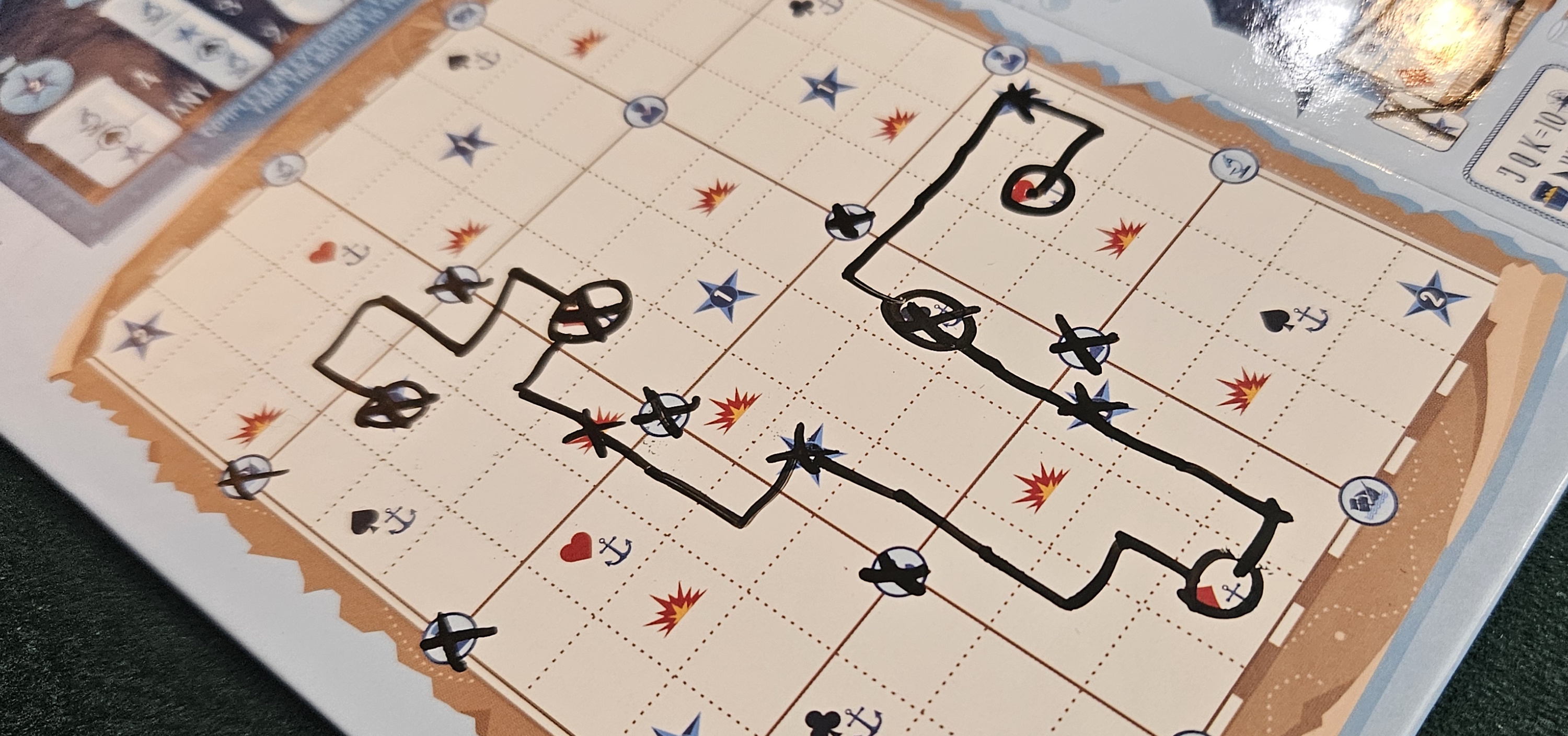
As such, while two of each round’s three cards are spent undertaking those activities, that final card is instead used to travel across a simple grid map. These journeys are both critical, setting the tone for each trio of cards, and somewhat disappointing in their straightforwardness. Certain spaces award stars — points, basically, here called “notoriety” — while others incur damage to your vessel. Various lines can be crossed to earn resources, and there are ports where weighing anchor earns you a free action in one of the game’s four suits.

The gist is that you take your chosen card’s rank and travel that many spaces, generally steering across stars, avoiding damage, and ensuring you halt in a spot that will permit one of those free actions. Meanwhile, criss-crossing the map is a surefire way to earn extra resources, but you’re also lightly incentivized to keep your journey pacey thanks to a “most efficient” award doled out at the end of the session. Coal is expensive, I suppose.

Meanderin' around.

Charting your course.

Perhaps I would have felt more kindly toward Flip Voyage’s voyaging had I not recently played three different titles that handled navigation so much more cleverly, but the map is never as interesting as it could have been. Damage is easily avoided, while the ease of pulling U-turns and adjusting your current range with a spent resource both serve to eliminate any hard decisions. For the most part, the toughest part of navigation is remembering to tally how far you moved on the score track.

The activities, meanwhile, are considerably easier than those found in Fliptown. There’s a tonal quality to the distinction. In Aramini’s former game, each activity was pitched as a wager, requiring players to decide how far they wanted to press themselves in an attempt to secure greater rewards. By contrast, the activities in Flip Voyage are considerably blander.

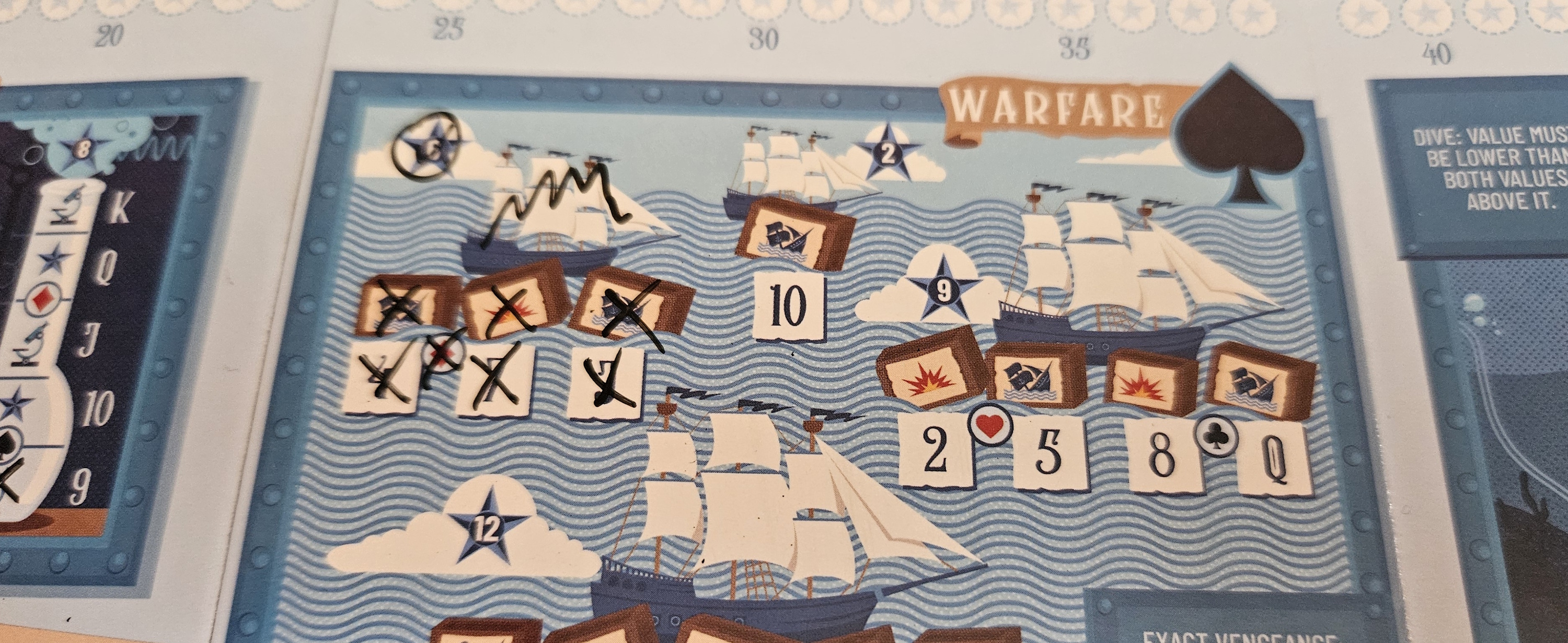
As before, there are four, each corresponding to the deck’s French suits. Using a heart takes you to the science lab, where you must fill beakers in rank order. Next door is the warfare track, where spending cards will punch holes in imperial warships, either earning salvage or damage. Diamonds are for adventure on the ocean floor to retrieve treasure or damage. And clubs are for raiding slaver camps, liberating new crewmates or, again, taking damage.

Against all odds, Flip Voyage makes sinking a wooden warship dull.

Sink to the bottom… without me.

If you couldn’t tell, there’s a lot of taking damage in Flip Voyage. Three of four activities will ding your Nautilus Jr. in some way or another, and there’s no skipping a turn to loot graves like in Fliptown. This has a flattening effect on the game. There are fewer peaks and troughs than before. Instead, you’re usually guaranteed some upside to go with your downside, or vice versa. A resource here, a scratch there, bit by bit, until the game concludes and everyone tallies their score.

There are upgrades to consider, little perks that adjust your activities. Some are formidable, like the serrated rakers that encourage you to steer into damaging spaces on the map or the super propeller and ramming prow that earn extra resources from their related activities. But a number of upgrades are surprisingly dull. Oh, the dredge lets me turn crew into salvage? The library turns salvage into research? Sorry, I nodded off. I hate to keep resorting to contrast, but these are a far cry from the shops and hotels of Fliptown’s tumbleweed town.

It’s possible to consider these alterations in a generous light. Fliptown had moments of profound chance, especially when two players attempted to, say, rob a stagecoach on the same turn, an endeavor that required both highwaymen to draw their own card to determine their success. Flip Voyage is less beholden to Lady Luck. Apart from the trio that opens the turn, there are no flipped cards here. I’m sure there are those who prefer their flip-and-writes to limit their luck to inputs rather than outputs, to borrow Geoff Engelstein’s delineation between flavors of chance.

I’m not one of those people. The beauty of Fliptown was its willingness to allow both modes. You could push your cash into the center of the table by sticking up trains, speculating on land, and chasing bounties. Or you could keep to safer trails by mining gold, riding duster, or robbing corpses. Even without the inclusion of random outcomes, there was so much to do that every session felt like a fresh adventure. After about one and a half plays, Flip Voyage has shown all it has to offer.

I also have the Fliptown expansion ready to go. Hopefully it's better than this one.

Ahh, a marked-up board.

Still, the process of filling in the board is enjoyable enough. That’s some faint praise, I know, but it would be a lie to say that this game is devoid of its pleasures. Figuring out how to put those cards to use is still a strong core for such a game.

But twenty thousand leagues is a great distance to cover under such pressure, and this hull has sprung more than a few leaks. There are plenty of better options, including many designed by Aramini. To quote Captain Nemo, “Oh Almighty God! Enough! Enough!”


A complimentary copy of Flip Voyage was provided by the publisher/designer.

(If what I’m doing at Space-Biff! is valuable to you in some way, please consider dropping by my Patreon campaign or Ko-fi. Right now, supporters can read my first-quarter update of 2026: the best board games, movies, books, and more!)

UK Games Expo soars past 51,000 attendees, show more than doubles pre-pandemic record

01. Juni 2026 um 17:25

The UK Games Expo has continued its meteoric growth into one of the world’s largest tabletop gaming conventions, after more than 51,000 people descended on Birmingham’s NEC for the show’s 20th anniversary.

That turnout is more than double UKGE‘s pre-pandemic record for unique visitors, and saw overall footfall reach almost 88,000 across the three-day show, which ended yesterday.

The surging visitor numbers – up 64% in just three years – mean UKGE is now pushing steadily towards the 70,000-plus visitors recorded by giant US tabletop convention Gen Con each year since 2023, and is more than two and a half times larger than last year’s Origins Game Fair.

UKGE has already well surpassed Gen Con in terms of trade hall size, with the British event now spanning about 44,000 sq m – making it about 40% bigger than Gen Con’s trade hall area at its show last year.

Around 900 exhibitors pitched their booths at this year’s UKGE – including 75 first-time exhibitors – compared to 575 at Gen Con last year.

Almost every exhibitor BoardGameWire spoke with at this year’s event reported sales activity ranging from “very good” to “record-breaking”, while one mid-size publisher added that they were delighted at how smooth the organisation was, compared to logistical and set-up issues they had previously experienced at shows including Origins and Spiel Essen.

Tycoon Games CEO Dan Yarrington

Dan Yarrington, the CEO of Everdell publisher Tycoon Games, had a small presence at the show for the first time this year as part of a shared booth, following a fact-finding trip to the event in 2025 – and told BoardGameWire his company would probably return with its own stand in 2027.

He said, “At this level, at 40,000 plus people, and with the buying that we see… my impressions of the show were that, ‘Hey, this is actually a good show’. People are buying stuff, and it’s a different market. This is especially important in the global climate that we’re in, where people are less likely to travel to various other places.”

Yarrington added that in addition to selling its existing titles, UKGE would likely act as a preview show for the publisher, with new releases more likely to appear at Gen Con and Spiel Essen to feed into the company’s fourth quarter.

He said, “At this [UKGE] we had the Everdell Journeys preview copy – it’s not even on Kickstarter yet, so we can be like, ‘hey, come play it, and then tell us what you think’, we can adjust things, and then ‘hey, sign up for the Kickstarter’ – but Journeys won’t release till Gen Con [in 2027], so I think that’s what it’d be, a good process for us.”

Other exhibitors planning to expand their UKGE presence next year after a successful show included small-scale UK publisher Minerva Tabletop Games, which teamed up with three other members of the Playtest UK design group this year to run a combined booth.

Minerva founder Scott Lowe-James told BoardGameWire, “I don’t want to say this is definitely happening, but this was a test, and I think we could easily do like four or five times bigger than this”, citing Allplay‘s large demo area and single shop front as a potential model to replicate.

He added, “We’re all here already, and we’ve all got our own stands, but with that comes volunteers, accommodation costs, logistics. Whereas [by collaborating] we’re able to keep costs down, which is really important for one person, two person teams in being able to support each other where we need. And also we get greater exposure, so the rising tide lifts all boats.”

Scott Lowe-James, centre, with other members of Playtest UK at their UK Games Expo booth

In terms of advising other smaller publishers thinking of attending future UKGEs, Lowe-James said, “I think if you can work with someone, then then do it.

“[UKGE] has the great incentive of the starter stand, so you get a discounted rate, and that is good. But the leap up [from there] is quite a big one, especially if you are a first-time publisher, because not only does the rate increase, but the minimum size increases – and with that comes you need to find people to volunteer, and so other costs increase as well.

“So if you’re able to, find people either with similar games or people that you know. The fact that we’ve been able to support each other, cover each other’s games, I think you also get that tighter bond.”

He added, “Next year we could have, like, 15 different games across different themes and different ways to appeal to people. And I think it’s definitely the way forward.”

James Naylor, the CEO of UK publisher Naylor Games [a BoardGameWire sponsor], said that in addition to a good year for sales, it was notable that more families and attendees relatively new to the board games hobby were filling out the show floor each year.

He told BoardGameWire, “I’m really glad to see that, actually, because there was a little bit of time a couple of years ago where it felt like – maybe it’s just my perception – that perhaps the whole show was becoming more of a kind of ‘turbo nerd’ RPG show.

“…maybe that’s just because that was a peak of RPG popularity or something, and I’m glad to see instead it’s reaching out to a wider audience.

“I want to see board games become more universal as a thing that people use to play face to face, away from screens. So, the more I see that wider audience, rather than just a very narrow hardcore, that’s better from my perspective.”

That rise in awareness of UK Games Expo, and board games in general, has been noticeable too in the run-up to the event, with coverage by national broadcaster the BBC both prior to and during the show this year.

The open gaming and tournaments hall at the 2026 UK Games Expo

Rob Trounce, trade marketing manager at UK board game retailer and distributor Zatu, said a highlight of the show had been BBC Radio showcasing co-op dexterity game Yubibo during its coverage.

He said, “It was kind of a shock to us, and I think it shows UK Games Expo going more mainstream as well.

“If it’s got the BBC and its radio channels talking about it, it shows that this isn’t just a space which is for us dyed-in-the-wool gamers anymore. It is for everyone, it is a mainstream thing.”

UKGE director Richard Denning, who co-founded the show in 2007, joked on social media ahead of this year’s show that the event had grown into something that had “frankly got a bit out of hand”.

UK Games Expo co-founder Richard Denning

The event has ballooned in size since the event first opening its doors in a Birmingham conference centre in 2007, attracting 900 excited gamers – a far cry from the 27,000 who attended Gen Con’s 40th anniversary show later that year.

Denning previously told BoardGameWire that even at that embryonic stage, he hoped the show could go some way to recreating the atmosphere of big name events such as Gen Con and Essen Spiel, albeit in a much-reduced form.

Speaking of plans for future shows, Denning told BoardGameWire there was still room for expansion in its current footprint, but added that the show may change things around next year in order to provide more space for events.

He said, “It is expanding, and we are tight on event space – hence the possible need for more. We have about 500 events. I am amazed how many events US cons get. I think we still want to see that grow.”

Addressing the show’s rapid growth, despite economic turbulence such as Covid-19, the impact of global conflicts and US tariff policy, Denning added, “It’s certainly been a roller-coaster. Even earlier there was the credit crunch of 2008, of course.

“I think whilst visitors may have smaller wallets at present they still want to attend events like UKGE. Folk will save for the weekend and set that a side as a treat to look forward to, I think.”

The post UK Games Expo soars past 51,000 attendees, show more than doubles pre-pandemic record first appeared on .

Class Reunion: Euphoria

26. Mai 2026 um 22:54

Yes, the title of this review is a reference to Euphoria, a television show I haven't watched a single minute of, but which the internet has led me to understand stars Sydney Sweeney's bosoms.

It’s been thirteen years since the original release of Jamey Stegmaier’s Euphoria: Build a Better Dystopia. I would say it doesn’t feel like thirteen years, but I’d be lying. Between the pandemic and five or six successive generations of board game iteration, it’s been an eternity. Long enough for a retrospective, certainly.

Speak of the devil. Euphoria: Essential Edition is a remake of the original game, plus some of the stuff from the expansions, minus a few love handles and splotchy moles. Let’s see how the old dystopia has held up after all these years.

There's even a drab side. For the drabbers.

The new board, not quite the same as the old board.

Short version, there’s rebar showing through the concrete.

As before, Euphoria is about your efforts to thrive in a dystopian society. Relatable. Maybe that’s why the intervening decade hasn’t flown by. But I digress. In Euphoria’s case, that dystopian society is divided into four strata, each offering different spaces for your workers to run errands. There are the Euphorians, folks who generate electricity by marching on hamster wheels, Wastlanders who labor in orange groves, Subterrans who pump water through the cracked bedrock, and Icarans… Icarids? Icaruses? Whatever. These guys cook future-meth for keeping everyone’s workers drowsy and compliant.

The status of those workers is never far from mind. At the time of the original game’s release, rolling dice to determine the relative knowledge of one’s workers was a clever touch. If nothing else, it functioned as one of the hobby’s earliest meta-commentaries on the blank slate that was the worker-placement worker. Roll too high, and one of your workers gets wise to the situation and flees from your grasp. Roll too low, and…

… and there’s no penalty for rolling too low. What you really want is to roll doubles. That way, you can spend some morale to place an extra worker, earning two turns in a single go.

"Actually, there are no streets in the future world of Euphoria." —that one superfan of Stonemaier Games who writes nasty notes whenever I don't love one of their games

Euphoria: meek in the streets, freak in the spreadsheets.

At the time of the original game’s release — there’s a phrase I’ll probably say more than twice — it was easier to overlook the chanciness of the whole thing. Sure, rolling high means losing a worker, and rolling doubles means earning a twofer. But rolling low, I suppose, means you can send a worker to one of the game’s resource production zones without worrying about them learning the shape of their culture. Except, wait, that’s another benefit for rolling low. Darn it.

Okay, so Euphoria is full of luck. Always was, still is. The problem isn’t so much that luck is the sole determiner of whether you succeed, but rather that it’s just enough to prove frustrating. As a genre, Eurogames included more chance in 2013 than they do today. Personally, I miss a bit of chance. But in general, those earlier forms of chance were about mitigation. Even placing towns in Settlers of Catan was about spreading around the odds so that you’d always earn something. In Euphoria, the system feels out of place, and not only among the determinists of 2020s nu-euros.

But let’s set that aside. How has the rest of the game borne the timelapse?

Again, the short version is that it works perfectly well, but never quite eases its grandfatherly creaks and groans. Most actions are tit-for-tat resource conversions. First you send a worker to a resource generator to earn one or two commodities. Then you send them to a tunnel to spend a commodity for a building block. Maybe you spend a wad of commodities for an extra worker. Then you build special markets, which let you exchange commodities, blocks, and artifacts for stars, the game’s victory condition. Repeat. Repeat. Repeat.

But an appropriate one, I guess. At least you're managing your workers' needs, even if all they happen to need is some vitamin-C or some space-meth.

“Runaway workers” sure is a loaded term.

It doesn’t help that the Essential Edition sometimes comes across as more of a Pruned Edition. The board is more legible, but has shed the original map’s sense of place. Just look at that perfect goofball illustration. The new map feels like a spreadsheet setup for a spreadsheet game. Which is fine, as those things go. This is a resource-conversion worker-placement game, after all. You could even make the argument that this new edition has shed the original game’s pretense, including the ethical dilemma cards that, let’s face it, didn’t always add much to the game systems-wise. But, again, they mattered to Euphoria’s sense of place, the notion that players were being forced to compromise their values in order to get ahead. Thanks to the intervening years, a few subtractions, and this updated visual design, it’s easier than ever to see the wires and mirrors behind the illusion.

The remaining good parts are still as good as ever. For example, those markets. As before, building a market means spending a bunch of building blocks, not to mention putting your laborers in a holding pattern until other players join in. This created a certain degree of cooperation, one that could be turned against you at a moment’s notice. Having even a single worker hanging around at a job site is a real sacrifice, fostering opportunities for players to bicker and cajole. That’s great.

Furthermore, the markets themselves are nasty little things. When built, every player who didn’t contribute to its construction is forced to suffer a penalty until they pay a penalty at the new market. Sometimes these are negligible; other times they pose biting impositions that must be rectified as soon as possible. Or even both at once. The Theatre of Endless Monotony reduces how many commodities you earn, but only to a minimum of one. The Institute of Orwellian Optimism treats all your 1s and 2s as 3s when it comes to checking your dice for thoughtcrime. The Courthouse of Hasty Judgment makes it harder to spend artifacts for stars. That sort of thing.

He likes to live on the edge. The edge of KNOWLEDGE.

This guy is a cool dude.

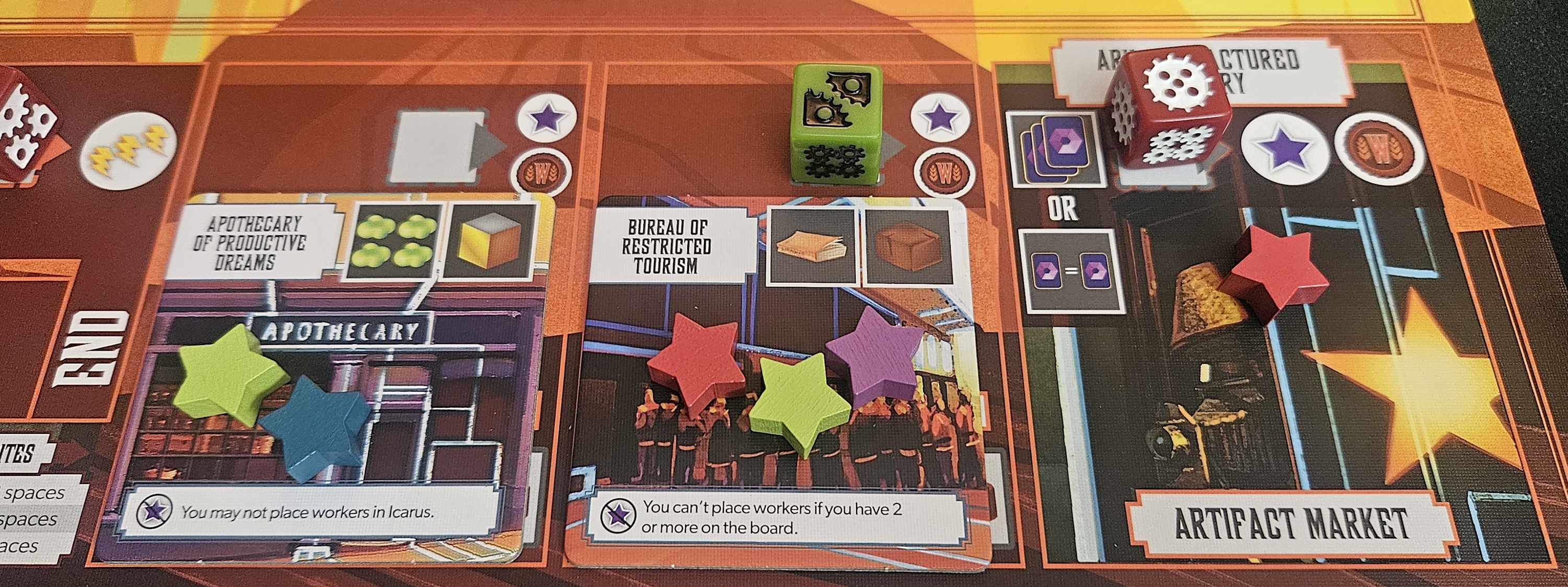
There are some real whoppers in there, too. In one case, we revealed the Apothecary of Productive Dreams. This market prevents some players from sending workers to Icarus. At all. Which effectively locks them out of a full quarter of the board’s spaces. Worse, buying into an already-built Apothecary requires bliss, the very same drug peddled by the Icaroopsies. Not only were some players locked out of Icarus territory, this locking-out was effectively permanent. Was this a fair turn of events? Hardly. But it was interesting. Textured, we might call it. Abrasively textured, sure, but it was refreshing to play a game that would offer such overt penalties rather than ensuring everything ran smoothly all the time.

Between these and the heaps of recruit cards, there’s always something happening on the board. Some market being constructed (or ruining your day), some recruit tweaking the rules to your benefit, some haggling over at the construction site. That’s all great.

The downside is that it never quite breaks free of its shackles. Board games have largely moved on from worker placement, at least in such a straightforward cube-pushing sense. And Euphoria always feels like cube-pushing. Every segment of its dystopia is more or less identical to its peers. The same resources exchange rates. The same methods for hampering one another. The same costs at the artifact markets. And now those four segments are placed side by side so you can see just how closely they align.

In a sense, the Essential Edition is a worthwhile experiment because it highlights just how far game design has come over the past decade. But it’s only a worthwhile experiment for me, a total sicko for how board games change and develop over time. For somebody looking to spend their hard-earned cash, there are better options out there. If I’m going to place dice-shaped workers and suffer random consequences, I’d much rather play Connie Vogelmann’s Apiary, and that’s limiting our selection to titles from the same publisher.

Now make the crossover worker-placement game that's Space Bees vs. Dystopian Labor, Jamey.

E:EE is full of little textures. Some of them are abrasive.

Because Euphoria has been left behind. By board games as an iterative artform. By our hobby’s collective taste in the role of chance. By an Essential Edition that leaves some of its most interesting ideas in the dustbin. By a culture that’s grown weary of dystopias.

Speaking only for myself, I think it’s time to tunnel through to the other side.


A complimentary copy of Euphoria: Essential Edition was provided by the publisher/designer.

(If what I’m doing at Space-Biff! is valuable to you in some way, please consider dropping by my Patreon campaign or Ko-fi. Right now, supporters can read my first-quarter update of 2026: the best board games, movies, books, and more!)

Combat Results Postcard

26. Mai 2026 um 03:52

Battle (underline) Card

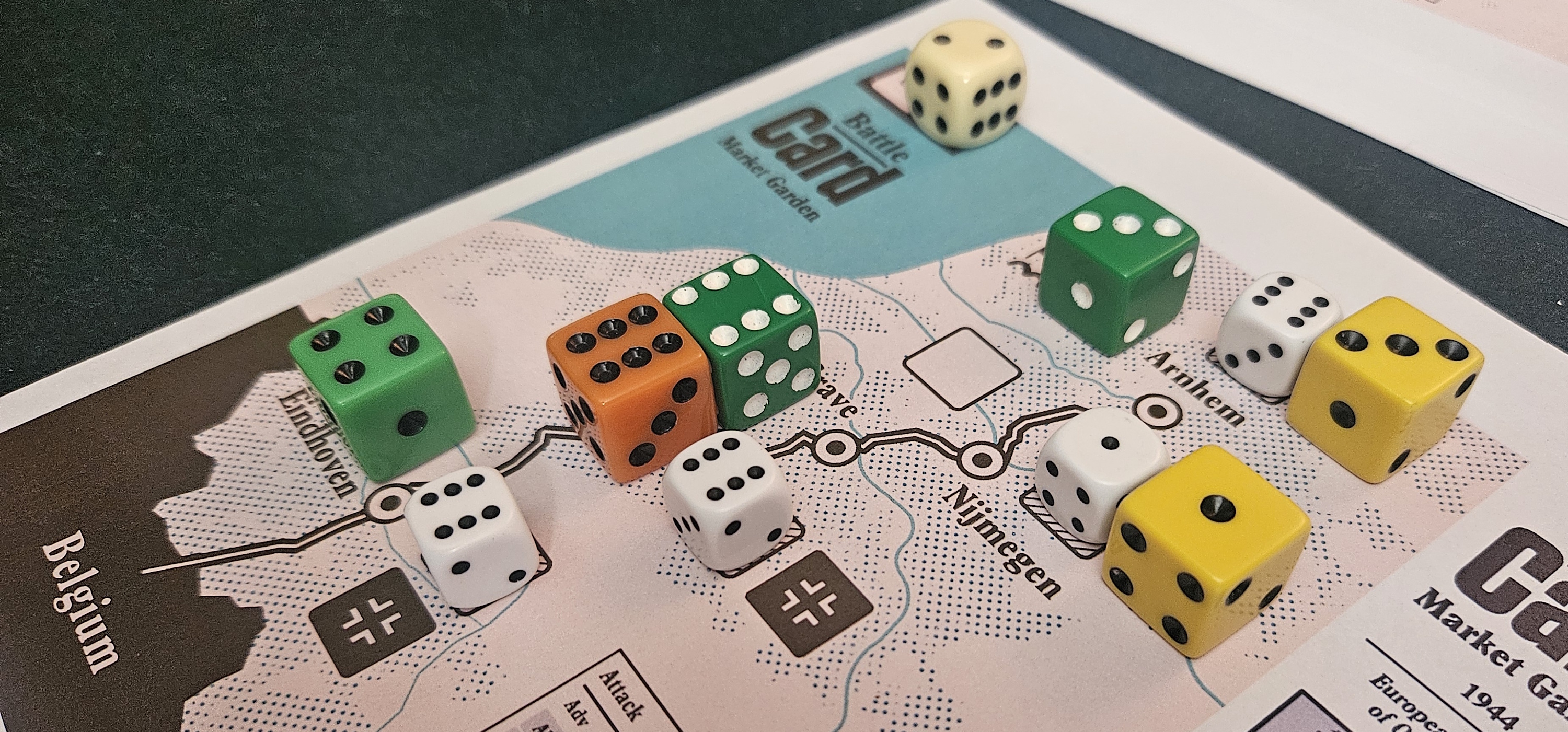
Battle Card is as apt as descriptions get. Designed by David Thompson and Nils Johansson, this is the fourth project in the Postmark Games lineup. Like its earlier peers — Voyages, Aquamarine, and Waypoints — this is a print-and-play title that can be produced with functionally zero budget. Unlike those projects, however, Battle Card is billed as a wargame on a single postcard-sized sheet.

That’s true enough. With a few dice and a smidgen of experience to help interpret the rules, Battle Card covers six engagements from the Second World War. And their format is indeed very small, highlighting some real resourcefulness on their designers’ part in compressing battles and even campaigns into ten-minute experiences.

But unlike those other titles, Battle Card is a mixed bag. I’ll give an example.

Their national anthem, I believe.

Rock on, Canada.

The second of Battle Card’s six scenarios sees Commonwealth forces waging a fighting retreat against Imperial Japanese troops shortly after the attack on Pearl Harbor. Over the course of two months, these forces staggered their positions along the Malay Peninsula, gradually ceding ground in an attempt to withdraw a portion of their forces. Historically, the campaign was catastrophic for the Allies, revealing Japanese air superiority and rapid infantry. (Mounted on bicycles!)

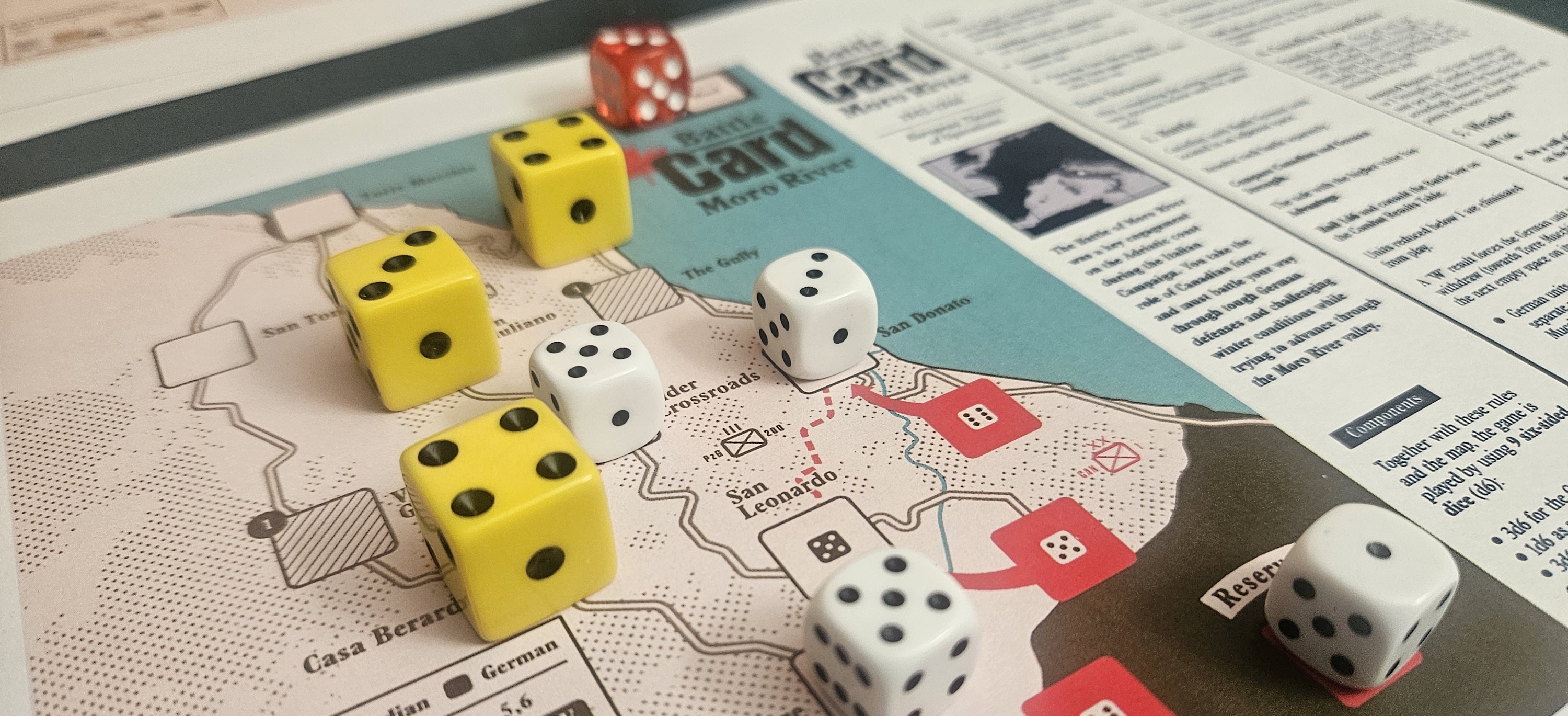
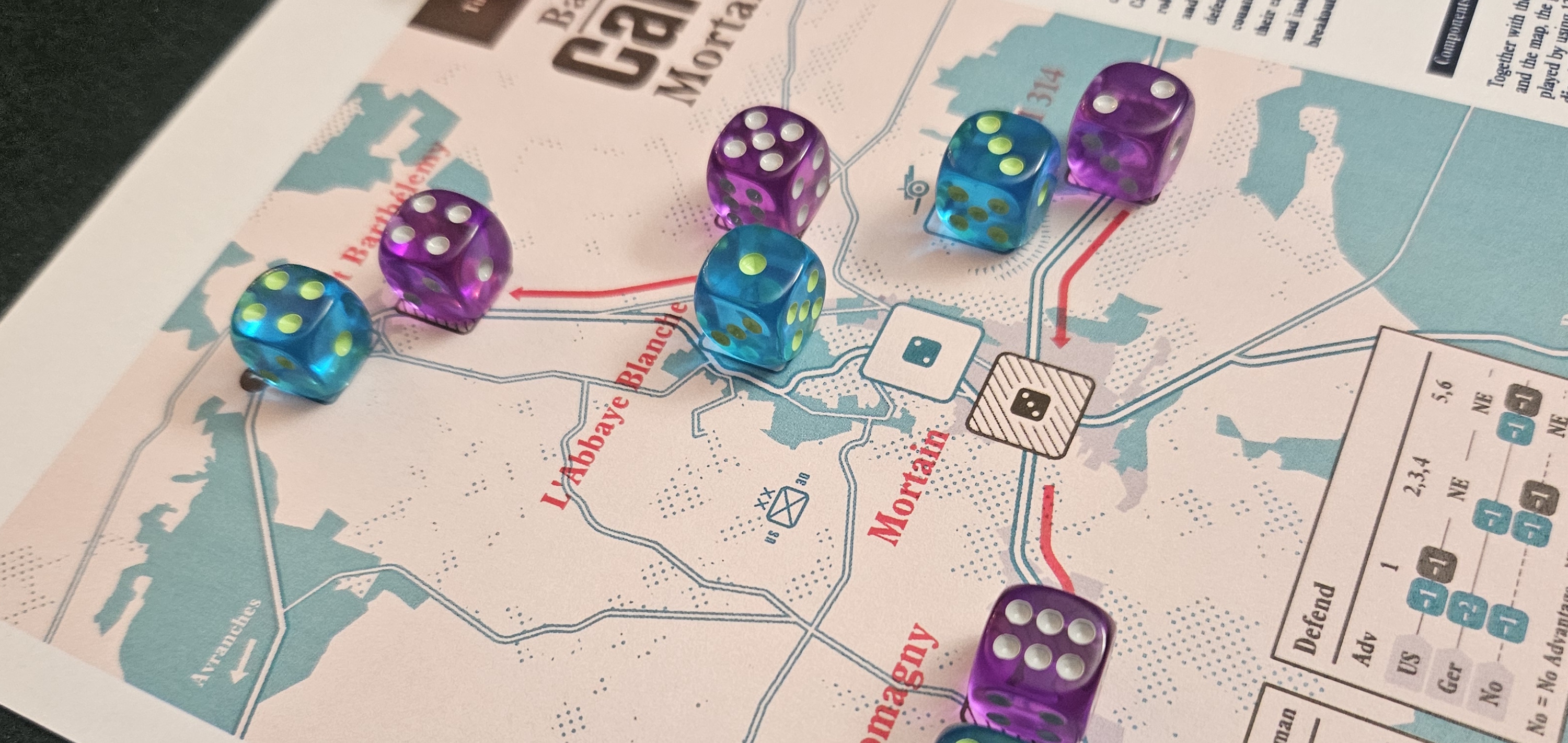
In Battle Card, the situation isn’t much better. Dice represent the armies on both sides, with their pips indicating their current strength. These armies engage in battle — determined by the roll of another die — and shift positions along the twin roads along the peninsula.

Here, the situation is relatively static. As the leader of the Commonwealth forces, your options mostly revolve around when to retreat, whether to defend your position or mount a counterattack, and which units to gradually pull back toward Singapore. No matter the outcome of any individual roll, the game has been fixed, much as it was historically. It isn’t a question of whether the Japanese will overtake your position, but how swiftly.

The smaller dice designate control. None of the other scenarios bother. This was a wise omission.

The Market Garden scenario is ostensibly a demo, but it’s fiddlier than those that come afterward.

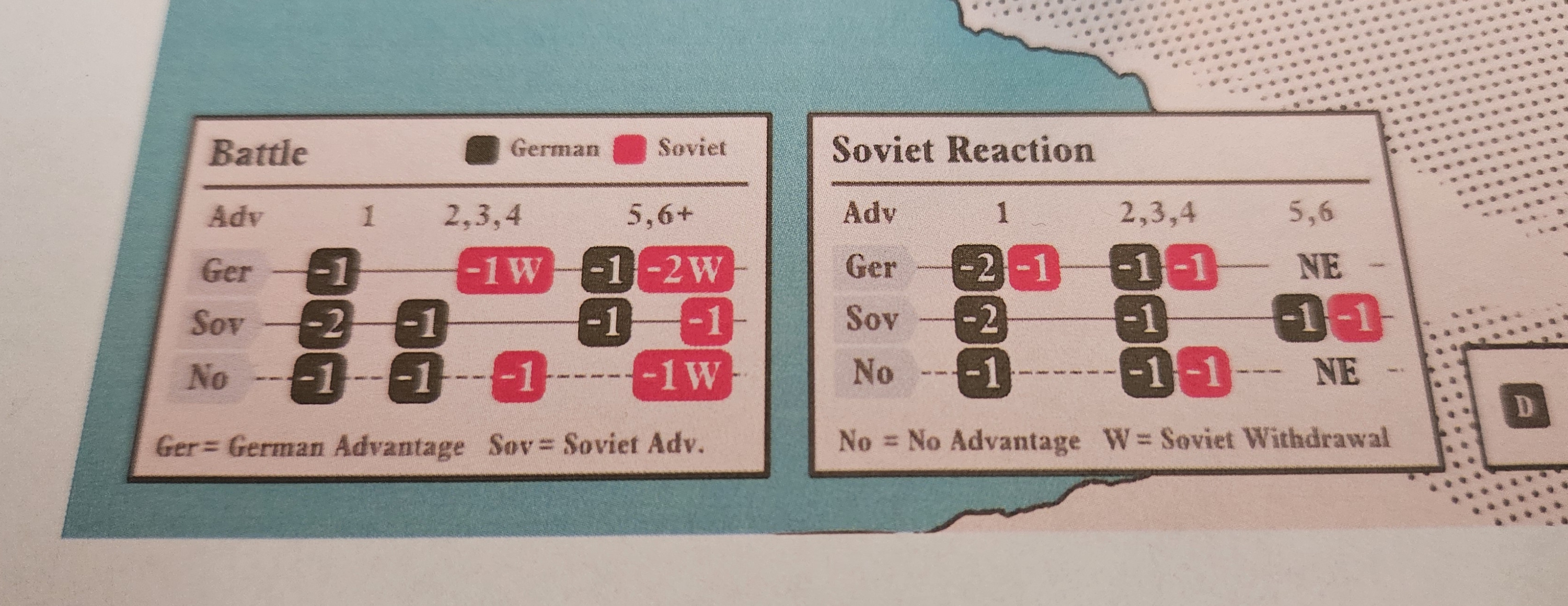
What follows is a strong indication of both the system’s strengths and weaknesses. Your choices, such as they are, are as bite-sized as the game’s footprint. Retreat or hold; defend or attack; withdraw a die along a road. The roll-offs are governed by small combat results tables that factor in whether one side has an advantage — meaning one side’s die has more pips than that of their enemy. As advertised, it’s fast. And, to its credit, the minimalist design does lend some sense of the geography and the central conundrums of the conflict.

In this case, your objective is to withdraw three pips to Singapore, and the way to accomplish this goal is closer to a puzzle than anything offering operational flexibility. Either you stick your troops behind the right line in the sand or you don’t. Either you withdraw in time or you don’t. Either you make high enough rolls or you don’t. No matter the scenario, this is more or less how Battle Card functions. There’s a solution here. That solution still requires the bulk of the rolls to go your way, but that’s the solution, and there’s no deviating from it. Perhaps most damningly, once you’ve uncovered that solution, there’s really nothing else to see.

Yes, yes, I’m the guy who wrote that replayability is overrated. But there are slender games and then there are slender games. Battle Card is the latter. Each play lasts between five and ten minutes. Scenarios are also compact, as befits a game called Battle Card, meaning there aren’t many subtleties to any given fight. If you don’t figure out the trick on your first play, you’re bound to have a strong suspicion heading into your second. After that, it’s really a matter of getting the right rolls.

Magnifying glass not included.

Combat results tables! We got ’em!

This isn’t to say the whole enterprise is doomed. The best scenarios offer some wiggle room between maneuver and chance. As the Canadians make a three-pronged drive up the Italian boot in the Moro River scenario, they must pause to reinforce any divisions that took a beating. As the Germans plunge toward the Caucasus oil fields, they need to decide when to split their forces into smaller but more vulnerable columns. Choosing where to fire your artillery at Mortain is… well, it isn’t the most complicated decision, but it would also be inaccurate to call it straightforward.

Again, though, that’s about as much mileage as anyone will get out of these print-and-plays. I’ve run through the entire series twice now, and the second time I found myself growing weary. This stands in strong contrast to those other Postmark titles. As score-chasers, there was always a reason to return for another attempt. Here, the entire format feels too compressed, like a States of Siege game without the chrome-laden considerations that made that series so interesting. Mostly, it was a nice way to organize my dice by color and size.

Step one: fire arty at bad guys threatening arty. Step two: fire arty at other bad guys.

Firing the arty.

In a way, Battle Card isn’t that far off from looking at an animated battle map. All those little arrows and company designators. The towns changing hands. The roads, the weather. The relative strength of any given column. Battle Card is that with some marginal interactivity. As a middle-aged white guy, that’s my ken. But the joke’s on Battle Card. I already own a book of WWII battle maps. This is one instance where pushing the pieces across the board — sorry, the card — isn’t enough of an improvement.


Access to the files to print Battle Card was provided by the publisher.

(If what I’m doing at Space-Biff! is valuable to you in some way, please consider dropping by my Patreon campaign or Ko-fi. Right now, supporters can read my first-quarter update of 2026: the best board games, movies, books, and more!)

Asmodee’s annual revenue surges to €1.68bn on TCG distribution power, but sales of its own board games fall

Asmodee’s escalating power as a global TCG distribution giant was evident again in its newly-released annual results, which showed the company’s net sales surging 23% year-on-year to more than €1.68bn.

That annual revenue has swelled around 50% in just three years on the back of huge recent growth in TCGs, including heavyweights Magic: The Gathering and Pokemon as well as a wave of strong performing newcomers such as Disney Lorcana, the One Piece Card Game and Asmodee’s own Star Wars: Unlimited.

Despite Asmodee’s long-time image as a board game publishing heavyweight, more than 72% of its revenue now comes via its distribution of other companies’ games – up from an already hefty 63% in the previous financial year to March 31, 2025.

TCGs now make up the lion’s share of Asmodee’s annual net sales – about 60% in the 2025/26 financial year, up from just over 50% across the preceding 12 month period.

The company’s own board game publishing operation, meanwhile, saw its net sales fall 5.8% in the last financial year – while net sales for the first quarter of this year were down 9.8% compared to the same period in 2025.

Asmodee’s Jan-Mar 2026 and last financial year revenue figures, showing a hefty jump in the portion of its net sales coming from distributing other companies’ games

Asmodee CEO Thomas Koegler was asked directly during a Q&A session on Asmodee’s latest financial results if the company was still primarily a board game publisher, or whether it was “increasingly becoming an infrastructure company for TCGs”.

He said in response, “We have insisted a lot on the fact that one of the strengths of Asmodee is to be a publisher, but the first strength that we do have is our global reach across all categories, from TCGs and board games.

“That’s the superpower of Asmodee – and then being a very strong publisher is a way of accelerating performance.

“So I would say that there is no change, we continue to capture opportunities across the board wherever they come from… our aim is to be a dominant player, bringing all games to the market, anywhere they can.”

That assertion has been borne out by Asmodee’s recently reignited acquisitions drive, which has seen it pay a hefty €250m for French social and party game publisher ATM Gaming, as well as buying Japon Brand from CMON and individual IPs including ZombicideCthulhu: Death May Die and Sheriff of Nottingham.

The Japon Brand buyout was accompanied by Asmodee launching a new Japan-based design studio, Nekuma, anchoring its push into what it described as a “currently untapped market” for the company.

There were also hints in the Q&A session that Asmodee might be considering a move into Japanese distribution, adding to its existing operations in the region across China, Taiwan and Australia.

Koegler said of Japan, “The first move we have done with Japon Brand and setting up Nekuma is more of a sourcing move, right?

“The Japanese game designers and authors’ market is very dynamic. If you look for instance in recent very successful games – Bomb Busters, which is the Spiel des Jahres from 2025, was originated from Japan, a game like Dnup that we are releasing later in the year is coming from Japan.

Asmodee CEO Thomas Koegler

“So they are very good also at small card games, and we really wanted to, I would say, bolster our publishing capabilities by creating those sourcing activities.

“Distribution wise, for now we are still working with local partners, we have not set direct foot yet.

He added, “It’s a fragmented market, its a very strong TCG market on the local market side, but yes… as I said, it’s a very vivid scene.”

Koegler also made clear that the company is still pursuing M&A opportunities on the publishing side “across all play types that we have, from social games to lifestyle games and tabletop games”.

He said, “I would say that the discussions we have are still as active as they were – we have demonstrated our ability to do various sizes of deals, which is also a very strong signal to potential people that would like to join the Asmodee adventure.”

Koegler said in his introduction to Asmodee’s 2025/26 report that the impact of geopolitical and economic events on the company’s business in the first few months of the year had been limited, but that the firm remained “mindful” of the potential pressures on transport and energy costs.

Asmodee said the impact on the business of transport and energy cost changes due to global political and economic issues had so far been limited

He said in the financial results Q&A session, “From a consumer standpoint, in moments of tensions when there are rising costs, because games are an affordable leisure we tend to suffer less, if not take some opportunities. That’s what we’ve seen in previous crises over the past 10 or 15 years.

“Consumer sentiment-wise, we will see. Although we are always cautious, there is also I think opportunities for us.

“Secondly, in terms of the cost impact. First of all our mix is currently very favourable because trading card games are manufactured very close to where they are sold, like in Europe for European countries mainly – some are manufactured in Asia but its a limited one – in the US for the US, etc.

“Plus they are cheap to transport, so the impact on those is relatively limited. And then we will see with our partners in terms of raw material increases, but again in the overall cost of goods they do not represent a very significant party.

“For board games we have started to see some increase in transportation costs. They did not impact Q4. If we take an example, road freight did represent roughly 20% of the cost base, and they have increased by 10%.

“But again, all of this is quite manageable for us. We expect to be able to mitigate the impact.”

Koegler added that although the process for receiving tariff refunds in the US had begun, after the Supreme Court struck Donald Trump’s swathe of import fees earlier this month, there was uncertainty about both the timing and final amount Asmodee was owed.

He said, “This is still a little bit foggy, blurred – for us, but [also] for many, many other companies out there. So let’s wait for what’s next on this topic.”

The post Asmodee’s annual revenue surges to €1.68bn on TCG distribution power, but sales of its own board games fall first appeared on .
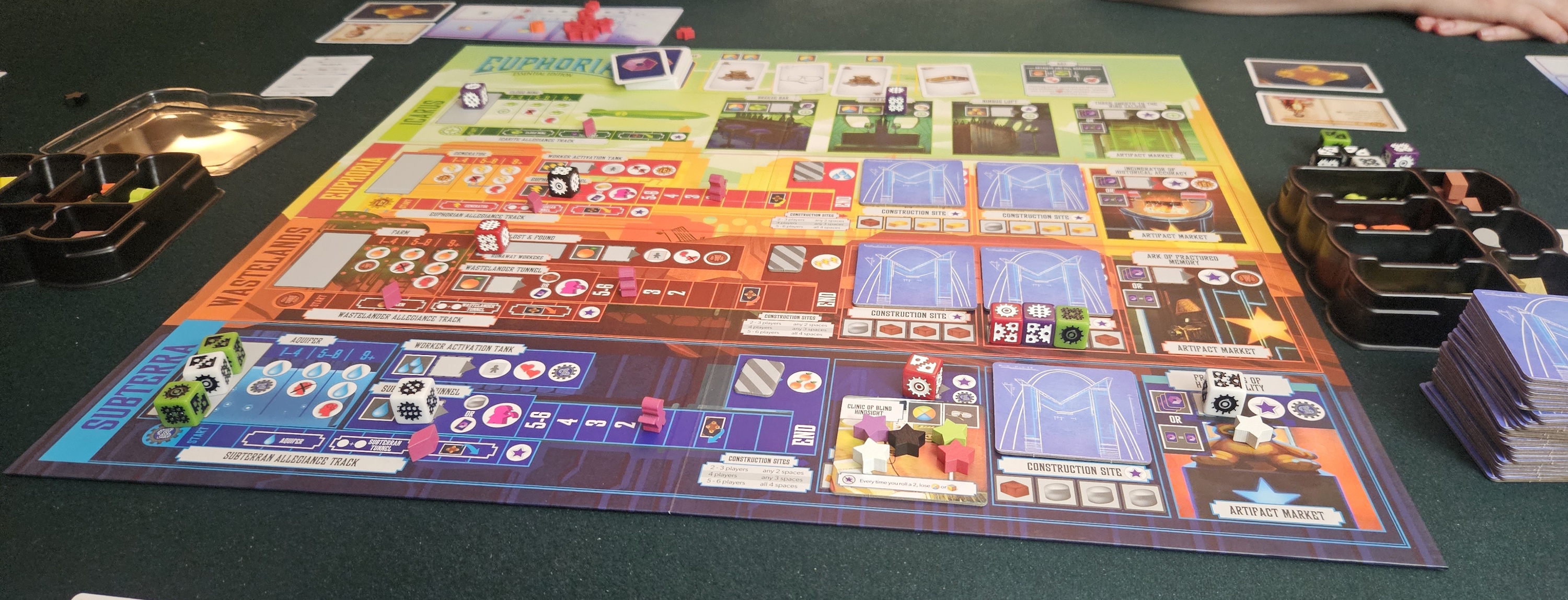
Unboxing Video: The Pursuit of John Wilkes Booth from Blue Panther

Von: Grant
22. Mai 2026 um 14:00

A few years ago, while attending the WBC, I had the chance to meet Wes Crawford who was demoing his upcoming game Engine Thieves. He was a very nice guy and his game was pretty interesting as well. Since that time, he has another game that has been released designed in partnership with Ryan Heilman in The Pursuit of John Wilkes Booth published by Blue Panther. I had a chance to play the game solitaire (with Wes overseeing the game and giving me guidance and pointers) at WBC in 2024 and have since played the game on my own several times and had a really great time with it. Great little solo game with several other modes where the player uses resources like police and detectives to search for clues in the hunt for Lincoln’s assassin after the events at Ford’s Theater on the evening of April 14, 1865. Definitely not a subject that has been gamed before and it is really refreshing to be able to experience this history in an interesting and engaging game. There really is a lot to like with the way that clues are found and chits are blindly drawn to verify clues from a bag. There is also a great little movement mechanic with police and detectives to try to acquire more clues.

We were able to post an interview with Wes Crawford on the blog and you can read that at the following link: https://theplayersaid.com/2024/12/03/interview-with-wes-crawford-designer-of-the-pursuit-of-john-wilkes-booth-from-blue-panther/

Here also is a link to our video interview after playing the game with Wes at WBC:

-Grant

Video Review: Black Orchestra from Starling Games

Von: Grant
21. Mai 2026 um 15:03

Black Orchestra begins with each player choosing a historic figure involved in the conspiracy against Hitler. In this dark and dangerous pursuit, motivation is perhaps your greatest weapon. If you can stay true to your convictions in the face of overwhelming threat and inspire your comrades, then you will be able to use your special ability, attempt plots, and even become zealous (necessary for some extremely daring plots).

But every move you make may also increase the suspicion of the authorities. The Gestapo will make routine sweeps, and any players with high suspicion will be arrested and interrogated (possibly resulting in other players being arrested). If you are all arrested or if the Gestapo finds your secret papers, you lose. And the suspicion placed on each conspirator will increase the chances their plots are detected.

On a turn, players may take three actions, such as moving, searching for an item, or drawing a card; or, at the cost of one action per die, roll the dice in an attempt to gain even more actions — at the risk of attracting the suspicion of the gestapo. This dice rolling “Conspire” action allows players to make bold moves when most needed.

-Grant

Iranian designer’s Persian folklore game about exorcising demons wins 2026 Cardboard Edison Award, which celebrates the best in unpublished designs

Astrolabe, a Persian folklore-inspired game which tasks players with hunting and binding demons using the titular instrument, has won this year’s Cardboard Edison Award celebrating unpublished board game designs.

The debut design from Iranian video game veteran Yasaman Farazan was praised by judges for its “genius” action selection system, which makes use of a physical ‘astrolabe’, calling it “thematic, toyetic, and an absolute joy to engage with”.

2026 Cardboard Edison Award winner Yasaman Farazan

Farazan’s design took first place out of a record 396 entries this year – a total which has almost quadrupled since Cardboard Edison unveiled its debut award winners a decade ago.

Part of that growth has been down to the competition’s pedigree of winners that have gone on to be published by well-known studios.

They include Winter, published by Devir, Castell from Renegade Game Studios and Umbra Via from Pandasaurus Games, as well as 2023 champion Diatoms, which followed a successful Kickstarter campaign with retail publication by 25th Century Games in partnership with Ludoliminal.

Second place in this year’s competition was Limelight, a push-your-luck deckbuilder by Cameron Fleming about staging a Broadway show, while third place went to Luke Wolyncewicz’s Braggin’ Wranglers, which sees players attempting to catch wooden animal meeples using an adjustable lasso.

Hatchlings, a game by Alan Leduc in which players try to get baby sea turtles to the ocean using “unique and clever” movement queue mechanism, placed fourth.

Braggin’ Wranglers, designed by Luke Wolyncewicz

This year’s 20 finalists also included a magnet-based vertical castle-building game and a medium-weight strategy title centred around wedding planning.

More than 80 judges took part in this year’s award process, including The Search for Planet X and Fromage designer Ben Rosset, Elysium and Next Station: London creator Matthew Dunstan and High Tide designer and Diana Jones Emerging Designer award winner Marceline Leiman.

Last year’s Cardboard Edison was won by Dot Com, an economic strategy game which uses an app to run players’ money supplies down in real time.

The game, designed by former Ravensburger game development intern Sammy Salkind, puts players in the shoes of startup founders battling to build their internet startups during the dot-com bubble of the late 1990s.

Cardboard Edison was launched in 2012 as a board game design studio and hub, which has since expanded from a well-read industry blog into a vast repository of information for board game designers.

Suzanne Zinsli created the Cardboard Edison Award a decade ago with the help of fellow Cardboard Edison founder Chris Zinsli.

All of the finalists from this year, and the pitch videos of their designs, can be viewed below this article.

Cardboard Edison finalists 2026:

Winner: Astrolabe by Yasaman Farazan
2-5 players
45-90 minutes
Players are exorcists in a Persian folklore world, using astrolabes to read the stars, hunt
demons, and bind them into artifacts. Each round, players secretly rotate their astrolabe to
choose an action, a number, and a time of day, then reveal and resolve actions in ascending
order.
Pitch video

2nd Place: Limelight by Cameron Fleming
3-6 players
45 minutes
Limelight is a push-your-luck deckbuilder about staging a Broadway show. Over three Acts,
you’ll audition talent, hire crew, and rehearse your show, trying to achieve the perfect mix of
cards on Opening Night.
Pitch video

3rd Place: Braggin’ Wranglers by Luke Wolyncewicz
2-8 players
15 minutes
Braggin’ Wranglers sees players catching animals to score points using a unique adjustable
lasso—but there’s a twist! Turn order is decided by your lasso size, which you secretly set at the
start of each round!
Pitch video

4th Place: Hatchlings by Alan Leduc
2-5 players
30 minutes
You’re a Nature Spirit with one job. Get your baby sea turtles out of their comfortable nest,
across the beach, and into the water where they belong, thus earning praise from Mother
Nature. It would be easy if it weren’t for the relentless bully Steven Seagull and the other Spirits
competing for glory.
Pitch video

Other finalists:

Black Ruth of Dogtown by Keith DeViere Donaldson
1-4 players
30 minutes
Black Ruth of Dogtown is a procedural oracle system driven by a circular mancala drafting
mechanism, where players construct a three-by-three grid to optimize set collection and
speculative scoring in service of a final narrative divination resolution.
Pitch video

Catacombes de Paris by Nicholas Henning
2-5 players
70-110 minutes
In Catacombes de Paris, players take on the solemn duty of transporting the remains of millions
through the bustling streets of 18th-century Paris to build their personal ossuary in the famed
Catacombs. This highly thematic experience combines a strategic pick-up-and-deliver system
with an engaging polyomino mini-game for building out your ossuary board.
Pitch video

Deductive Seasoning by Eric Ledger
2-5 players
20-40 minutes
Deductive Seasoning is a family-friendly deduction card game where you are a food scientist
who has concocted a dish using a secret ingredient from the Periodic Table of Flavor. You must
figure out other players’ secret ingredient through careful play and observation.
Pitch video

Goa Kranti by Andy Desa
2-4 players
60-90 minutes
A cooperative game about an overlooked chapter in history: Goa’s struggle for independence
from Portugal (1932-1961). Players embody historical freedom fighters choosing between
violent resistance and peaceful satyagraha. Core mechanisms include push-your-luck resource
gathering, deck improvement, and bag-building for a pivotal mid-game check when India gains
independence.
Pitch video

Hybrid Hijinks by Jena Keesee
3-5 players
60 minutes
A competitive game, creating hybrid creatures and utilizing variable, configurable player powers
to impress visitors and earn the most approval for shifting prowess.
Pitch vide

Ladybugs by Michael Posada
1-4 players
30 minutes
Push your luck by rolling dice that represent a colony of ladybugs flying over a field of flowers.
Your rolls determine which flowers you add to your garden, which scoring conditions you unlock,
and how many points you earn.
Pitch video

Match Patch by Jack Rosen
3-5 players
20 minutes
Match Patch is a game about the benefits of farming using companion planting methods.
Mechanically, it is a card-matching race game where players try to diversify their harvested
crops.
Pitch video

Midnight Spawn by Jayson Farrell
1-4 players
60 minutes
Midnight Spawn is a game about the mysterious and incredible deep sea. In this game you’re a
researcher in your deep-submergence vehicle, or DSV. You’ll discover strange creatures and
observe them eat or move other creatures, manipulating the shared board. You can also
upgrade your DSV with tech cards or boost your score with research cards.
Pitch video

Moonforge by Pawel Owsianka
1-4 players
90 minutes
In Moonforge, players command large space facilities capable of capturing asteroids, extracting
valuable resources (energy, metal and minerals), and upgrading their operations with new
modules and functions. Resources can be sold for currency points, while depleted asteroids
contribute material toward the creation of a new moon.
Pitch video

PiramiDuel by Guillermo Viciano
2 players
20-30 minutes
A game for two players where you will explore Ancient Egypt, fighting to claim the most
influential pyramids.
Pitch video

Possessions by Dan Nichols
2-4 players
60-90 minutes
Possessions is a competitive strategy game where you play as ghosts with one hour to finish
your unfinished business and fulfill your final wishes. As the clock ticks down, strive to get the
most value from your secret ambitions by possessing your family’s last living heirs.
Pitch video

StrongHolds by Nelson de Castro
2 players
40-60 minutes
StrongHolds is a competitive castle-building game featuring magnetic tiles that allow players to
build vertically unlike any other game. Harness your creativity and vision as a Medieval
Architect, while sabotaging your opponent by tossing and sliding siege tiles to topple their
progress.
Pitch video

The Leftovers by Larry Ted McBride
2-4 players
25 minutes
The Leftovers is a cooperative trick-taking game of community deck-building, resource
management, strategy, and story. With your party of magical foodfolk, you will work together to
complete objectives and avoid vicious food fiends as you explore the abandoned halls of the
Enchanted Ladle.
Pitch video

The Roots of All Evil by Dean Burry
2-4 players
15-20 minutes
Be the first animal cultist to summon the tree demon Blackthorn by creating ever-expanding
rings of root cards in which to place your sacred offerings.
Pitch video

The Wedding Planner by Jose Lema
2-4 players
60-90 minutes
You just got engaged! Now you have 12 months to plan the wedding of your dreams. The
Wedding Planner is a medium-weight strategy game that captures the authentic pressure of the
process: an overwhelming workload, finite resources, and the constant tension between vision
and reality.
Pitch video

Wunderkammer by Rosco Schock
2-4 players
45 minutes
Wunderkammer is a set collection style game with a unique simultaneous silent auction
acquisition mechanism. Each curiosity that you collect also has two attributes so the scoring of
your collection is scored in each dimension.
Pitch video

The post Iranian designer’s Persian folklore game about exorcising demons wins 2026 Cardboard Edison Award, which celebrates the best in unpublished designs first appeared on .
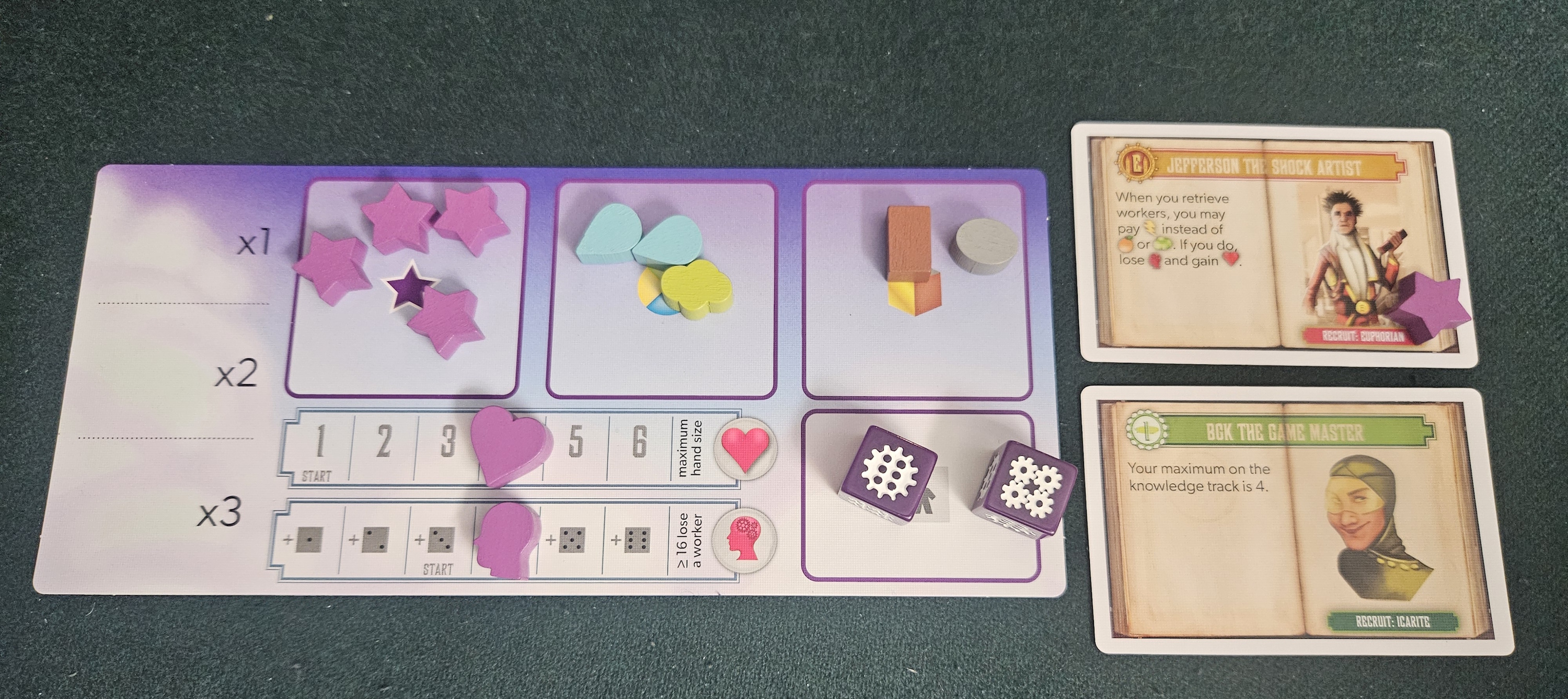
Space-Cast! #56. Keep Your Shirt Tucked In

21. Mai 2026 um 06:18

Wee Aquinas has some deep thoughts on this topic, but unfortunately we had to cut him for time.

Ever wanted to play a game that would make you feel strange feelings about your childhood religion? Heyo, Greg Loring-Albright’s Keep the Faith is the title for you! In this conversation, Greg joins us to discuss whether board games or role-playing games are better, our respective religious traumas and hopes, and how a board game might prove illuminating of historical forces. You know, light chit-chat!

Listen here or download here.

TIMESTAMPS

Honestly, there are no timestamps for this one. The conversation was rather stream-of-consciousness on my part, and I’d rather not break it into discrete portions. I’m sorry. =(


(If what I’m doing at Space-Biff! is valuable to you in some way, please consider dropping by my Patreon campaign or Ko-fi. Right now, supporters can read my first-quarter update of 2026: the best board games, movies, books, and more!)

💾

“We need to stop being reactionary”: New GAMA president Meredith Placko on being data driven, improving communication and turning its ten-year plan into a reality

Editor’s note: GAMA is one of the sponsors of the BoardGameWire newsletter

Newly-elected GAMA president Meredith Placko says the tabletop trade organisation must stop being reactionary, improve how it communicates with members, and focus on collecting meaningful industry data as it continues to navigate a turbulent couple of years.

GAMA has experienced explosive growth since the pandemic, with surging attendances at its annual GAMA Expo trade show and a broadening of its membership to include designers, manufacturers, media and events organisers, in addition to its long-time core of publishers, retailers and wholesalers.

But the organisation has been dealing with challenges too, including losing long-serving executive director John Stacy last October – just three weeks after unveiling ambitious plans to become the “epicenter” of the global tabletop gaming industry.

GAMA has also recently faced budgetary issues, had to contend with the fallout from Donald Trump’s volatile tariff policy, and has fallen foul of a series of gaffes and other incidents which have caused dents to its reputation.

Last month GAMA‘s board of directors had to apologise for some of its elected leaders being “rude and disrespectful” during a “heated” annual general meeting.

That apology came just a few days after GAMA unveiled its latest slate of 120 nominees for its annual Origins Awards prize – and immediately came under fire for failing to mention any of the games’ designers for the third year in a row.

Speaking to BoardGameWire in her first long-form interview since being elected last month, Placko said putting proactive structures in place to keep GAMA from “stepping in the mud all the time” was one of her priorities.

She said, “We need to stop being reactionary. We need to start looking ahead, we need to think before we speak.

“…it’s easy, avoidable issues that if we just put a bit more forethought into it, we can overcome them and they won’t even become an issue. And I think a lot of that has to do with making sure you have the right people in the right places to communicate better.

“I will say this: GAMA’s not done a great job of communicating to its membership. And I really want to appreciate the work that has been done in the last year on the GAMA staff side, where they’ve retooled the newsletter, and they’re trying to get ahead of everything.

“I think that’s great, And I think the conversations that we’re having behind the scenes between board members and with our acting executive director is being on top of that communication.

“And that’s going to be really key because it’ll kind of keep us from stepping in the mud all the time or being late to the game, like with the tariff news last year.”

Part of that looking ahead involves GAMA’s first-ever ten-year plan, which was unveiled to much fanfare last October by former executive director John Stacy and Placko’s predecessor as president, Nicole Brady.

Former GAMA executive director John Stacy

That array of plans included boosting GAMA’s membership within both hobby games and the mass market, expanding itself from being US-centric into a true global organisation, shifting its finances away from the current heavy reliance on the annual GAMA Expo and Origins shows, and leading the conversation on sustainability within the industry.

Advocacy and brand protection were also one of its near-term priorities – underscored by the organisation’s recent intensive lobbying and awareness efforts around the impact on the industry of US tariffs.

But with the figureheads of that plan both gone from their positions, where does the future lie for GAMA’s Vision 2035?

Placko told BoardGameWire, “I think most of it is there, it’s going to stay – I think it’s just going to be the order of which we tackle things.

“…we need to not be reactionary as an organization. We need to stop waiting for something to happen to then react to it. So we need to kind of maybe do a little bit more forward thinking about what are going to be the pressing matters.

“So advocacy, which was on the later half of that ten-year plan, that’s actually should be something that we start building into the core of our organization sooner.”

She added, “I’m going to be starting an advocacy committee for us to start looking at how to educate our members on being advocates for themselves and looking at opportunities that we can maybe work alongside other trade organizations or industry and other impact groups to do more lobbying efforts and have a say.

“Because really, as we saw this last year, tariffs decimated so many of our members. And that is something that we need to be on the forefront of… I know some people are like, ‘Oh, what can GAMA do? You guys are small potatoes’, but it’s having that voice, it’s having the impact.

“It’s at least having the information ready for people, so they know what’s going on and can make informed decisions.”

US tariff policy has had a hefty impact on both GAMA and its membership

Tariffs have impacted GAMA as an institution beyond just the need to lobby on behalf of its membership. Placko told BoardGameWire that the organisation had seen an uptick in turnover of members over the last year, and said she believed tariffs and wider economic instability were to blame.

But she added, “One of the things that I want to see is more hard data on member retention, like: who is staying, who is going, why are they leaving? Unfortunately in the last year, due to tariffs levied in America, companies are having to close down.

“People are going to have to make these harder decisions. You know, can they afford to be part of a trade organization? Are they even around to still be part of that trade organization?

“I will say: membership numbers are up, which is great all around. All membership groups saw a nice bump this year for membership, but we did lose people. And actually one of the big things I want to work with the whole board, the membership, the GAMA staff is: why are those people leaving? Where are they going? What’s happening to them?

“Because one of my core beliefs of a trade organization is that we need to be more involved in sort of this data gathering and sharing.

“I’ve been involved in [other] trade organizations and it’s very key to me that the trade organization is able to provide me with actionable accurate data that can help make informed decisions as businesses move forward.

“And I think a key part of that is just knowing: what is the state of our industry? What is going on with people? What is going on with companies? Where can we as a trade organization also step up and help them, like with advocacy?”

Despite membership numbers continuing to grow, GAMA has also faced headwinds for its finances over the last couple of years – a situation that has delayed its hiring of a new permanent executive director to replace John Stacy.

Tax data provided to BoardGameWire by the organisation showed net revenues of just $17,500 on a total revenue of about $1.4m in 2024 – well down on the almost $409,000 net revenue recorded the prior year, on overall revenues of almost $1.5m.

The documents show salaries rose about $782,000 in 2023 to almost $960,000 the following year, while ‘other expenses’ was up from $302,000 to about $426,000 in the same period.

Placko said, “Our finances have been… not in the best place. And back in the fall, John Stacy hired this amazing operations officer, Melinda Prickett, and she has been taking a look at our finances and how GAMA runs everything, and just laying out a plan, working on stabilizing us and getting us to a point that when we bring in an executive director, they won’t be walking into a messy situation.”

She added, “Some of the things were just, like, tracking spending and where that money was going. And I’ll say this: as an organization, we haven’t raised fees, we haven’t raised booth costs in a while.

“And while everything else is getting more expensive, what we were taking in was not covering everything that we were doing. So there were a lot of hard conversations about where cuts needed to be made.

“We’re currently spinning up conversations. We have a membership dues committee that started, that’s going to be looking at if we need to raise dues and how much.”

She continued, It’s great that we’re able to offer what we can for the limited amount of buy-in from memberships. But, you know, if that money is not covering everything, we have to make hard decisions.

“But it’s improved. I’ll say that… there are just changes we’ve made, and things aren’t bad or scary.”

Speaking of her decision to run for GAMA president, Placko said, “I’ve been vice president. I’ve been on the board for only a year. It was interesting for someone new to the governance side of the organization to even make a play for an officer role like I did when I started.

“But it’s not like I’m lacking experience on non-profits and for-profit boards, and the reason I ran for [the GAMA board] to begin with is that there were just some core governance changes that I wanted to see.

“I quickly learned – and I think a lot of people don’t realize – that our board is governance and not operational. And what I saw was, from the outside, it looked like the board was maybe very involved in the day-to-day operations of GAMA, where it shouldn’t be.”

She added, “Nicole Brady did a fantastic job the last two years, bringing GAMA out of a really messy place and into a more stable place.

“But what I wanted to see, and what I kind of pitched to my fellow board members, was that I really believe that we need to be more of a working board where we’re all working together, that not one single person or a handful of individuals are leading things.

“And sometimes maybe the perception was that way. I want to be very clear: I’m not saying it was that way, just the perception. And communication is key.”

“…I think that the board deserves to know a lot more of what’s going on, and have more of a say in what is being said to the executive director. And I don’t want to be like, ‘oh, I ran on transparency’ – but I really did. I ran on that. I felt that us as a board needed to have more open communication with the executive director… and be able to have a more open working relationship.”

Placko continued, “I think there’s been a misconception that the president of the board leads the vision of GAMA and the board, and that shouldn’t be the case.

“As a board, we are 12 individuals who need to come together and have a shared vision. I kind of see my role as president as maybe the person who helps conduct those conversations, keep them on track, and help silo them to where we’re all on the same page by making compromises and such.

“But that doesn’t mean that I myself don’t have personal things that I think we need to update and change.”

The post “We need to stop being reactionary”: New GAMA president Meredith Placko on being data driven, improving communication and turning its ten-year plan into a reality first appeared on .
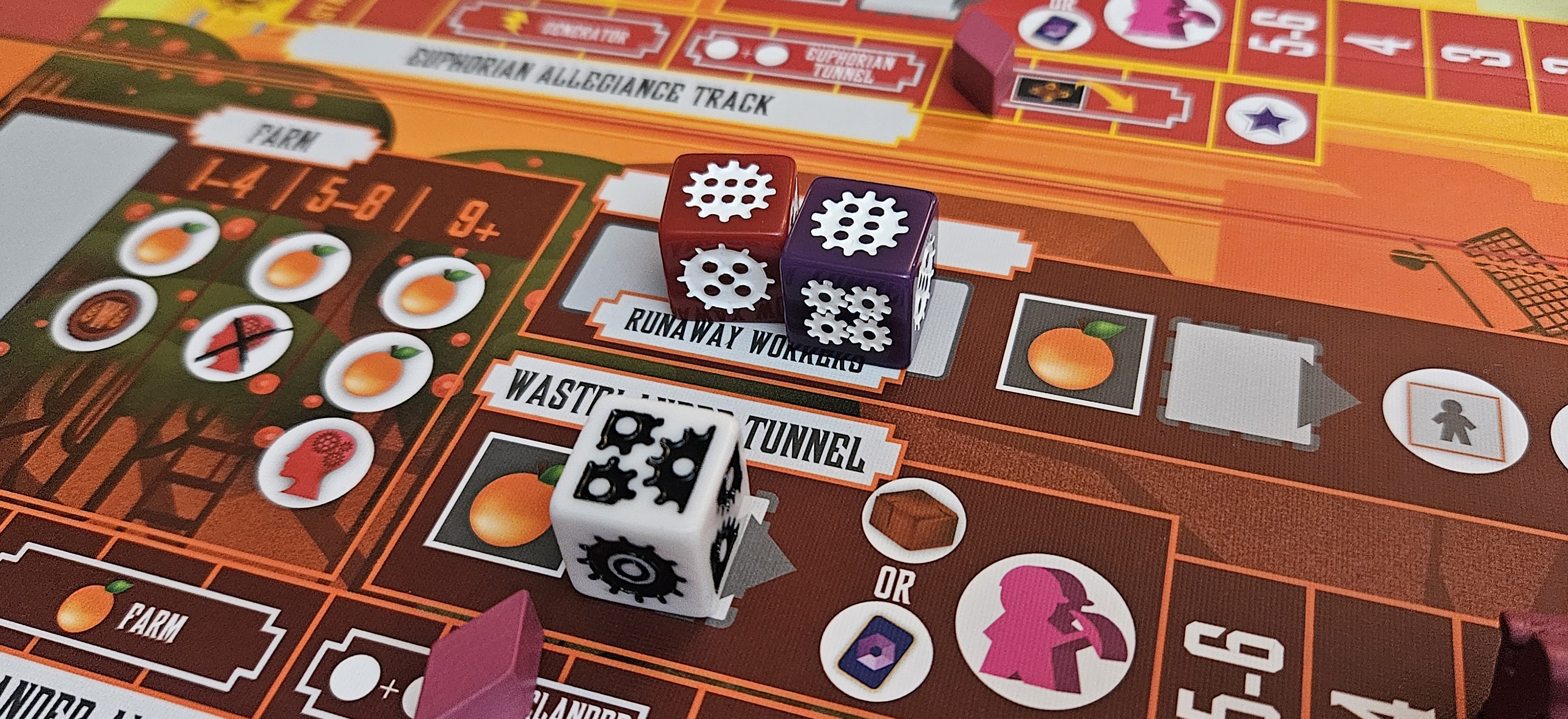
BoardGameGeek fires veteran advertising manager for rejecting campaign due to firsthand experiences of demonic possession

BoardGameGeek has fired advertising manager Chad Krizan after almost 20 years with the company, after he cited his personal experiences of demonic possession as grounds for rejecting an ad campaign.

Krizan told Possess Me, Satan publisher Falling Whale Games that he couldn’t “in good conscience” approve ads for its Gamefound campaign as “the thought of displaying this subject matter makes me sick to my stomach”, according to an email exchange shared online by the publisher.

In the emails, Krizan says he has been “sitting on this one and praying about what to do in this instance”, adding that “as a follower of Jesus, I routinely help people suffering from demonic oppression, and more occasionally, possession, and it’s absolutely devastating the damage he does to peoples’ lives”.

Krizan wrote, “IMO, the responsible thing to do would be to pull the entire project, as there are *way* more people that suffer this than you could possibly imagine, putting on a good face (usually enabled by dissociation), but suffering terribly behind the scenes.”

When Falling Whale replied to question the decision to ban the game on religious grounds, and asking for confirmation of which BGG advertising policy they were breaking, Krizan responded:

“Keep in mind it’s not over religion, but reality. It’s the same reason I would say a game would be in very poor taste if it featured being a sexual predator, or something that would directly trigger someone that’s been harmed by the subject matter.

“It’s about keeping BGG welcoming to everyone, and since I’m privy to this subject matter, I know firsthand that this is not friendly content, and incredibly triggering, put in front of some of the population that visits BGG.”

Board game and video game news and reviews website Gametrodon reached out to Falling Whale for examples of the ads it was hoping to run, and has compiled the images it was sent here.

Falling Whale’s shared email blew up on Reddit, the BoardGameGeek forums and other social media yesterday, and within six hours BGG had fired Krizan.

A statement from BGG founder Scott Alden posted on the site’s forums said, “Due to a situation in which BGG’s Advertising Manager responded inappropriately in a business email to a designer, I have decided to let him go. His response does not reflect or represent our company or the way we conduct business.”

Falling Whale’s campaign for social deduction game Possess Me, Satan runs for another 30 days, and has currently raised just over $14,000 from about 250 backers.


The post BoardGameGeek fires veteran advertising manager for rejecting campaign due to firsthand experiences of demonic possession first appeared on .
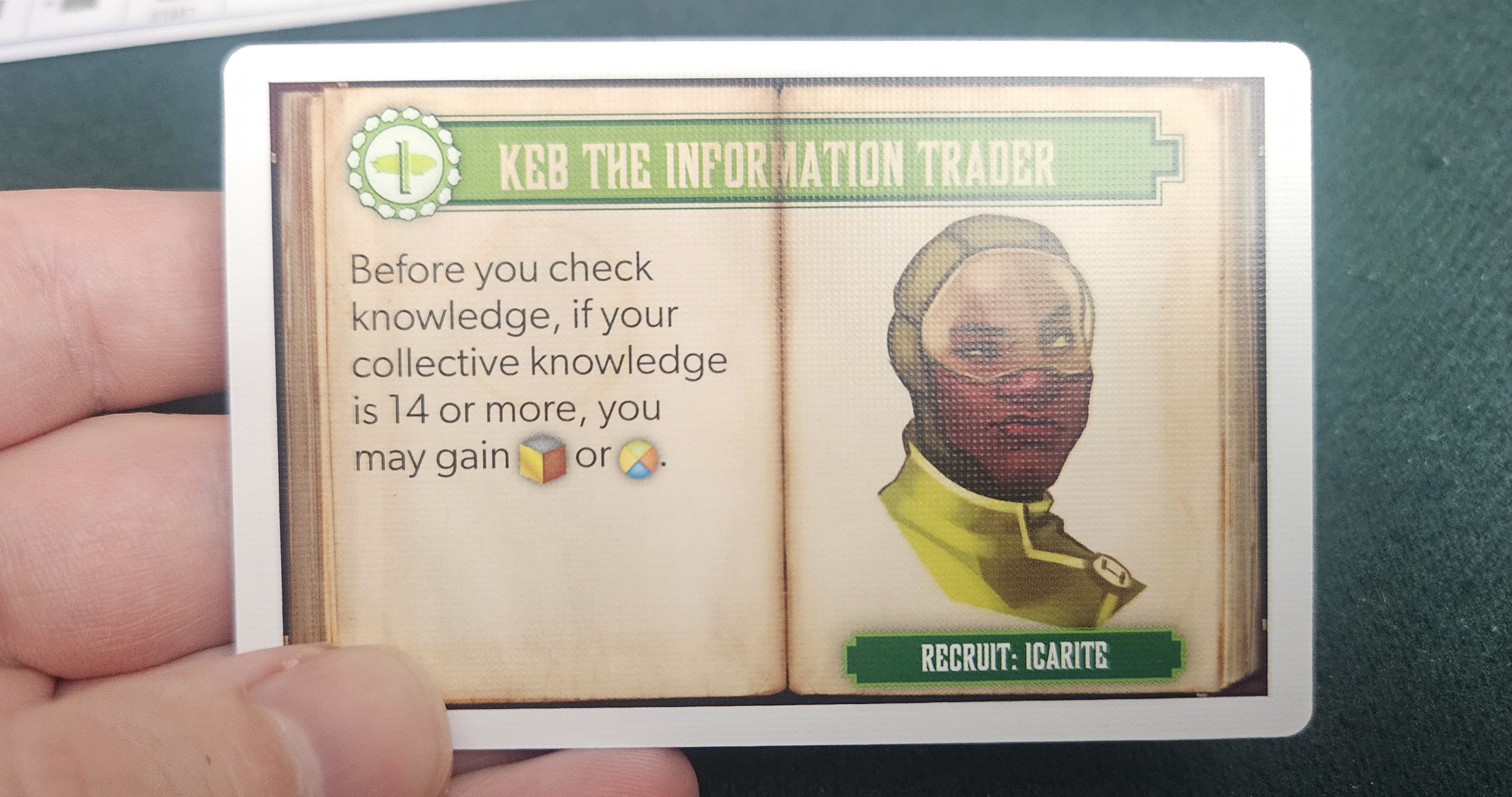
❌