Back to the history of New York City! We have begun with the city’s origin before the founding of the United States and left off in the 1880s in the last post – when New York was undeniably the economic and cultural center of the United States. Today, we are covering New York in its most iconic form as a moloch of steel, concrete, and millions of people. A chronological narrative will not help us here. Instead, we adopt a thematic approach and look the economy, construction, infrastructure, and culture which made New York from the late 19th to the mid-20th century the model city of high modernity.
If you want to read more posts like this – for example, the next instalment in the New York series – I strongly recommend you subscribe to the blog: All new posts in your inbox right when they go live!
New York had been America’s most dynamic hub for trade and manufacturing for decades. Yet the city’s riches had been shared unequally, just like the risks in producing them. In the late 19th and early 20th century, New York’s working class grew more assertive and found more political support to improve their lives: For example, the three Tenement House Acts of 1867, 1879, and 1901 mandated such luxuries as windows in every apartment and toilets in every building.
The 1909/1910 textile worker strikes led to improved pay and shorter hours. Just one year later, the Triangle Shirtwaist Factory in Lower Manhattan burned down and 146 garment workers died – many of them unable to escape through the staircase because management kept the doors locked during shifts. The fire catastrophe led to a public outcry against such practices and New York state introduced better workplace and fire safety regulations.
The garment workers were in some ways emblematic for the New York working class – most of them were young immigrants (especially Jewish and Italian). In another, they represented a shift – almost all of them were women, and their struggle for better working conditions mirrored the force of the American women’s movement in the political arena.
In one way, however, they represented New York’s present, but not its future: The industrialization of the 19th century had turned New York into the largest manufacturing hub of the world. Yet manufacturing, the physical production of goods, ran out of steam when the improved productivity provided most people in the United States with most of their basic needs. Eager customers were thus not to be taken for granted anymore. Instead, they had to be wooed and their desires – for items of whose existence they had recently been still ignorant – awakened. New York became a hotbed for the growing advertisement industry (with which Madison Avenue is synonymous until today) as well as for shopping (here, Fifth Avenue is the symbolic street). Our age of trends, shopping as a leisure activity, and overconsumption cannot be imagined without New York.
In the 19th century, foreign capital had funded the expansion into the American West, but now the capital flows reversed: American capital was instrumental in financing the Allies’ Great War effort. At the end of the Great War, America was for the first time a net creditor nation. Its role in the international financial system expanded after the war as American loans enabled defeated Germany to pay its reparations to the Allies (who, in turn, paid off their American war loans). At the same time as New York took London’s place as the premier finance hub in the world, America at large withdrew from the world under a renewed isolationism and the xenophobia which came with the Red Scare after the Bolshevik Revolution.
Political upheaval did not stop the investment craze of the 1920s: When a bomb exploded in Wall Street in 1920 and killed 30 people, stock trading resumed normally the next day – much in contrast to 1920 Wall Street (Perepau Llistosella, Looping Games), where the bombing marks the end of the game (and players hope to have made all their profits by then).
The New York-based financial system was robust enough to withstand such external shocks, but it collapsed under its own contradictions: The stock market boom of the 1920 led to ever more capital pouring into the New York Stock Exchange (at the expense of all other forms of investments, for example the American overseas loans on which the global financial system was now based). The spectacular gains fueled a debt-based speculation bubble which burst in October 1929. The inadequate response by central banks which did nothing to combat the contraction of the monetary supply led to an extended, global economic crisis – the Great Depression.
Unemployment and poverty plagued New York much like the rest of the world in the 1930s. The city bounced back through ambitious public works initiated by the energetic new mayor Fiorello LaGuardia (many of them funded by New Deal funds in a cross-party cooperation between the Republican LaGuardia and the Democratic president Franklin D. Roosevelt). Still, New York’s economy only recovered when demand for manufactured goods skyrocketed because of World War II: The industrial giant rose one last time. One example of New York’s awesome productive capacity may suffice: From 1941 to 1945, the New York Navy Yard built more warships than all of Japan combined. The United States won World War II because of their industrial productivity, and New York was the beating heart of it.
Construction: Upwards
New York had always grown. From the 1880s on, the city grew in a heretofore barely used dimension – upwards. The twin innovations of the elevator and steel frame construction allowed for building heights which had been considered impractical, if not impossible, before. While New York was not the pioneer of these technologies – that merit belongs to Chicago – they were accepted in Manhattan on a scale not known before. Ever more “skyscrapers”, as the tall buildings were soon to be known, sprang up between the Hudson and the East River, giving the city a characteristic look from far away. New York’s skyline has been continually changing, but since then, it has always been dominated by skyscrapers – as has been the image of the city in the public imagination.
Board games are no exception. No theme is as prevalent in games about New York as the construction of skyscrapers. Some are specific, like Flatiron (Isra C./Shei S., Ludonova) which has players build the eponymous Flatiron Building together, but many could be set in any city with tall buildings – but as they are about tall buildings, their designers and publishers think they fit best for a New York setting: Manhattan (Karl-Heinz Koch, Fagus) is a variant of Acquire (Sid Sackson, Avalon Hill) to which the third dimension is added. New York City (Stefan Feld, Queen Games) is a remake of Rialto (Stefan Feld, TMG) – just that the struggle for majorities in Venetian districts of the original, fought with councilmembers, has been replaced by a struggle for majorities in New York boroughs, fought with – you guessed it – skyscrapers.
The skyscrapers got ever taller: The first steel frame buildings in the 1880s and 1890s were well below 100 meters. In 1909, the Singer Building (187m) was the first structure in New York to exceed the height of Europe’s church spires – the first time that the world’s tallest building stood in New York. The city would retain that honor until the 1970s with a succession of ever taller skyscrapers.
The most iconic one was the Empire State Building whose construction was begun in October 1929 – just weeks before the stock market crash. It became the most visible sign of the economic crisis: Even five years after its completion in 1931, half of the Empire State Building’s office space remained empty. Like the rest of New York, it recovered by the 1940s. It would remain the world’s tallest building until it was overtaken by another New York icon in 1973 – the twin towers of the World Trade Center.
Infrastructure: Transport and Leisure
New York did not only grow vertically. Originally, the city had been confined to Manhattan Island and gradually expanded into what became the Bronx. In 1898, New York merged with its neighbor Brooklyn (itself America’s third-largest city at the time) as well Queens county and Staten Island to become a massive metropolis of more than three million inhabitants.
This sprawling moloch, however, was initially still centered on Manhattan, as most people worked there and thus couldn’t live too far away: In 1900, more than half of New Yorkers lived in Manhattan. That changed with the construction of the New York subway from 1900 on. New York was late to embark on such a project (London had started in the 1860s), but it was undertaken with the characteristic boldness of the city and soon became the largest in the world.
Thus, the geography of the city changed: New Yorkers could work in Manhattan, but commute every day from one of the other boroughs. As land there was a lot cheaper, a residential construction boom set in, and by the 1920s, Brooklyn had become the most populous borough of New York.
The growth of the city required its transport and leisure infrastructure to keep up. One man would become synonymous with it from the 1920s on: Robert Moses, starting out on the Long Island State Park Commission in 1924, became responsible for all kinds of parks, beaches, roads, bridges, and tunnels for both the state and the city of New York over the next decades.
These projects shaped the face of New York: The parks, both in the center and on the outskirts, provided very real benefits in one of the largest, most densely settled cities in the world. And the transport projects took inspiration from the new trend of motorized individual transport – and reinforced it.
Large-scale engineering projects like these go beyond the mere technical aspects. Moses’s creations were shaped by his ideas about how society should look like. For example, already his very first project – Jones Beach State Park on Long Island – outlined his ideal: It provided New Yorkers with a beautifully designed leisure park on the seashore. They arrived there after a pleasurable drive on the new parkways through lush greenery – by car, as no train or subway station was built in Jones Beach, and the bridges crossing the parkway were too low for buses to pass through. This lack of public transport meant that Jones Beach was exclusively accessible for the middle classes.
An even more striking example is Riverside Park in Manhattan along the Hudson River. Around a third of the park is in the predominantly Black neighborhood of Harlem, two thirds in the predominantly White Morningside Heights and the Upper West Side. These southern two thirds were liberally sprinkled with dozens and dozens of playgrounds, the third in Harlem only received one – and here, the iron lattice at the toilets was “decorated” with little ape sculptures.
As you can see, Robert Moses was not quite a nice guy. We’ll see more of him in the next post in this series!
Culture: Roaring Twenties
America’s new, more assertive role in the world after World War I also increased global interest in the country’s cultural output. American literature developed a new confidence, and American jazz became the hottest new music around the world. New York as America’s cultural center both attracted established artists (like the jazz musicians Duke Ellington and Louis Armstrong who both made the city their home in 1923) and produced its own original creations (like the Harlem Renaissance, which marked the first time that a movement of Black American writers and visual artists left their imprint on the wider American cultural consciousness).
One of the institutions of the 1920s New York cultural scene has gotten its own board game: 1923 Cotton Club (Pau Carles, Looping Games). The historical Cotton Club was founded in Harlem in 1923 and soon became the venue to see many of the finest jazz musicians – an attraction not only for regular New Yorkers, but also for the celebrities of the time. That, in turn, made the club even more attractive… well, not for everyone. While the performers on stage were Black, the club would not admit Black patrons (except for the rare Black celebrity). That is not explicitly addressed by the board game, but attentive players will notice that the almost all of the artists which can perform at the players’ clubs are Black, almost all of the celebrities which may attend the club (and are the chief source of points) are White – as are the gangsters.
“Gangsters?” you may ask. “In a game about running a nightclub?” Yes, as we are in the age of the prohibition of alcohol in the United States. This fleeting episode (1920 to 1933), and the massive expansion of organized crime which came with it, is almost as irresistible to board game designers as the construction of skyscrapers. Sometimes, it is only the corollary to another activity (like in 1923 Cotton Club).
Of course, all these mafia games could be set elsewhere. After all, alcohol was prohibited everywhere in the United States. New York, however, is irresistible as the biggest city, where presumably also the biggest crimes are committed. It is no coincidence that both Superman and Batman, those heroes of the Golden Age of Comics, fight their mastermind criminal enemies in fictionalized versions of New York (Metropolis and Gotham, respectively). Apropos: Age of Comics: The Golden Years (Giacomo Cimini/Sónia Gonçalves, Lirius Games) allows players to run a comic book publisher, develop ideas, print, and sell comic books… and of course, they do so in New York.
For a concise introduction, especially focused on local politics, see Lankevich, George J.: New York City. A Short History, New York University Press, New York City, NY/London 1998.
If you want a treatment which is both more in-depth and more journalistic (and lavishly illustrated) and don’t mind its history practically ending around 1970, see the book version of the 17-hour PBS documentary from 1999: Burns, Ric/Sanders, James/Ades, Lisa: New York. An Illustrated History, Knopf, New York City, NY 2001.
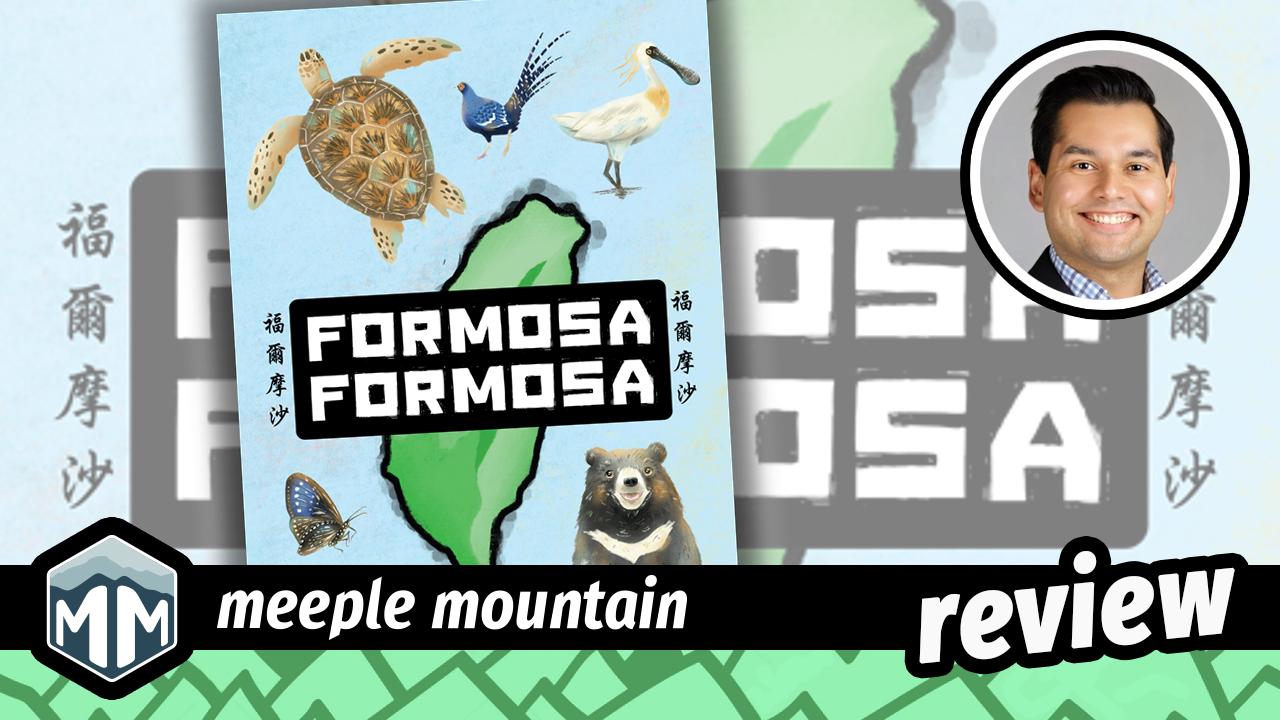
It’s always great to see games from Asia make it stateside. As someone who is half Asian, I’ll always be drawn to games from my home continent. But in a time of crazy tariffs and international uncertainty, there’s a lot of gold that never gets its spotlight over here in the States.
Formosa Formosa, which literally translates to “beautiful Taiwan” in Portuguese, fortunately fell into my hands at the GAMA (Game Manufacturers Association) Expo this year. Designer Kirk Beiser is an expat living in Taiwan who happened to pack a few copies in his suitcase for the long flight to Louisville, Kentucky.
With events like the Tokyo Game Market and Asian Board Games Festival showcasing fantastic titles, we’re often on the outside looking in. Different cultural upbringings shape different ways of thinking and often lead to games that feel unlike much of what we see from Western designers. We can only hope more make their way stateside, whether through new distribution channels or smuggled over in luggage!
Toss and Tour
Formosa Formosa is a “toss-and-write” game in which every component is used, including the box itself. Players take turns until the final round, with the number of rounds scaling based on the player count so everyone receives an equal number of turns.…
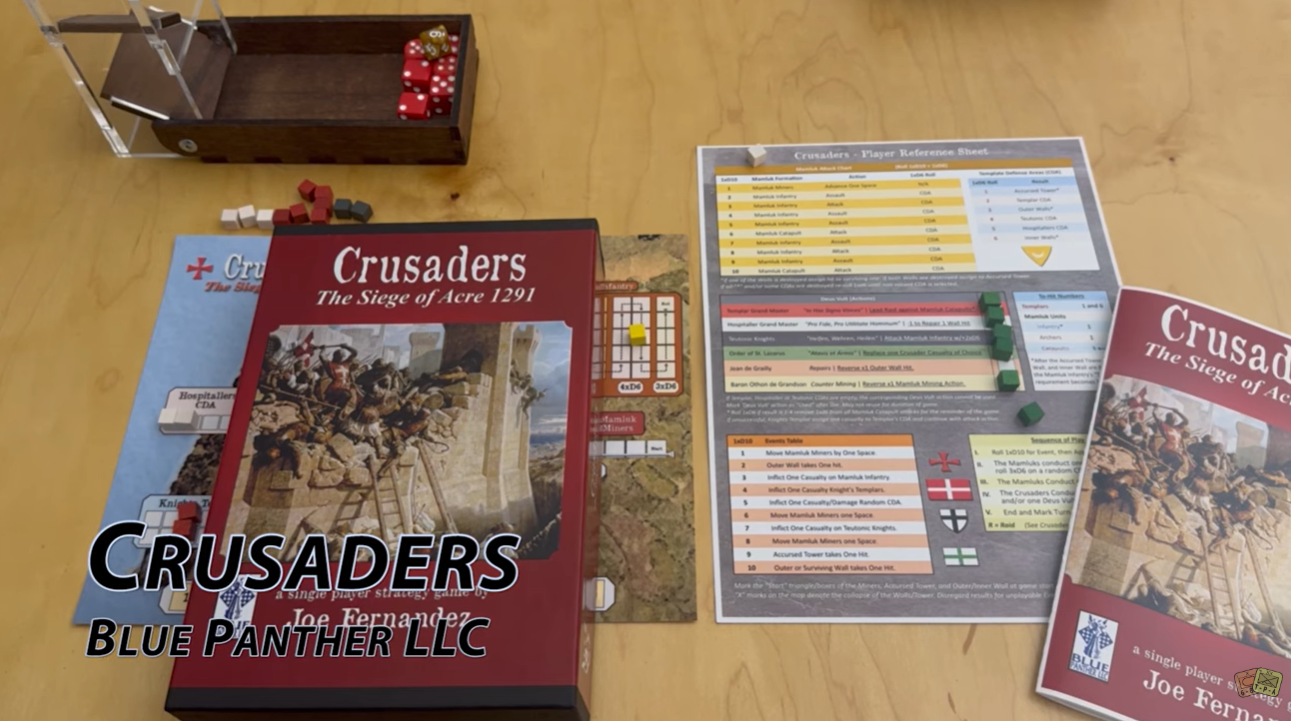
Dive into history and heroism with Crusaders: The Siege of Acre 1291, a solitaire wargame that lets you experience the last stand of the Knights Templar and the Crusaders in the Holy Land.
Relive the courageous stand of some 15,000 Crusader soldiers, Knights Templars, Teutonic Knights, and Hospitallers as they defend Acre, a critical port city in the Holy Land, against a massive Mamluk army of some 80,000 soldiers armed with siege engines and catapults in the century after the Ninth Crusade.
Fighting was brutal. Mamluk archers and catapults rained missiles on the walled city, infantry conducted relentless assaults against its perimeter while miners attempted to breach the defenses of the stronghold from below. From behind its ramparts, the Crusaders repelled attack after attack while leading raiding parties outside of the city as the immense Mamluk army tightened the noose of the defending Crusaders.
When the dust settled, the city of Acre was overun by the Mamluk army. Crusaders and citizens were killed as the remnants of the Crusader army fled back to Europe while the legendary Order of the Knights Templars retreated to the island of Cyprus. The Crusaders lost their last major stronghold of the Crusader Kingdom of Jerusalem, never to return. Can you hold Acre?
Gen Con 2026 – Thunderworks Games Gen Con 2026 is over (as well as the fall school kick-off) and I’ve come back up for air, just in time to ramp up the annual Gen Con run-down here at OpinionatedGamers. Will … Continue reading →
Von den fünf Verrückten von Heldbergs Games kommt ein weiteres schräges Spiel namens Yubitsume. Verrückt sind sie nach eigener Einlassung, und schräg, ja, das passt auch. Denn bei Yubitsume geht…
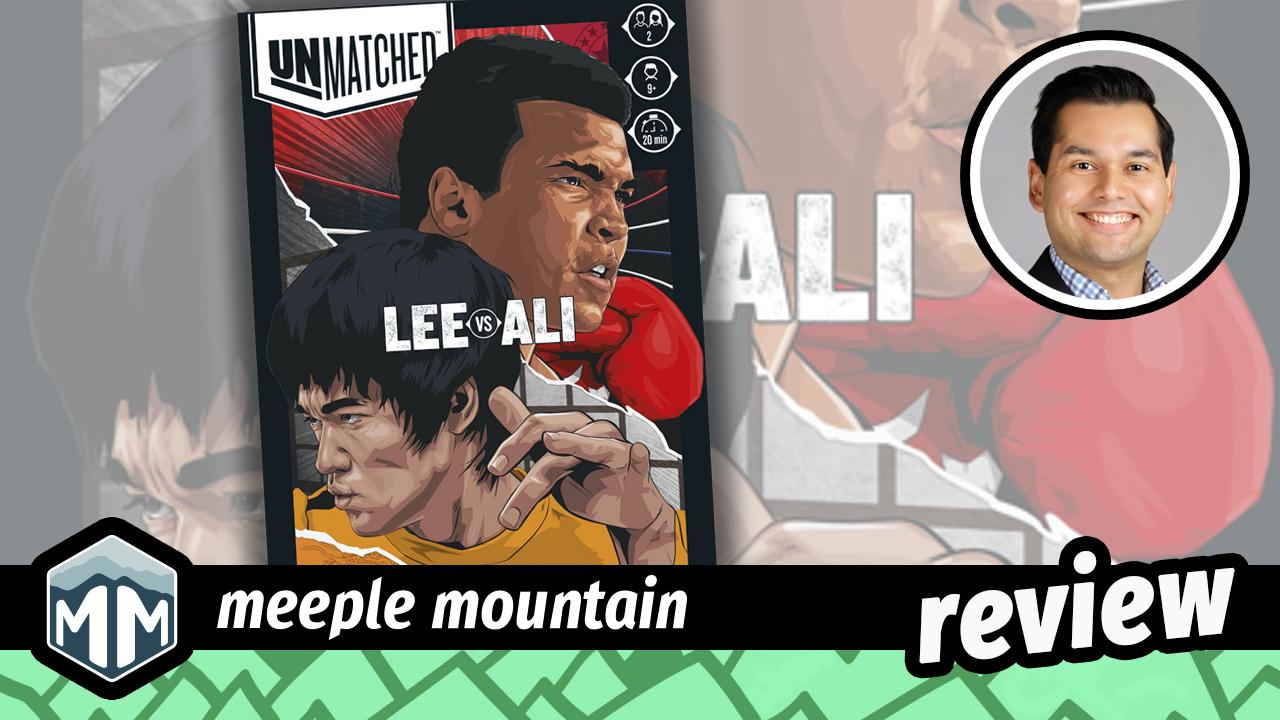
Fellow Meeple Mountaineer Andrew Holmes recently published a review covering Unmatched: The Witcher - Realms Fall and Steel & Silver, and his opening comment mentioned that we at Meeple Mountain differ on our opinions of the Unmatched franchise. But that makes sense as different reviewers covering differently themed sets are going to land differently on their thoughts.
(The correct opinion is that Unmatched is awesome)
However, Andrew is right that Unmatched is a great system because of its simplicity, quick pace, and heavily contrasting roster of fighters. And like him, I’m the ideal demographic, but for different reasons. The original game, Star Wars: Epic Duels, was played dozens upon dozens of times by my friends in middle school and me. We even found custom heroes online and printed them out, and though they were wildly unbalanced, it was a blast nonetheless.
Fans of Unmatched will recognize Bruce Lee as a highly sought-after expansion, being the first single-character pack and, at times, running upwards of $250 on the secondary market. Fortunately for those patient enough, Bruce Lee has returned in both an affordable and memorable set, going toe-to-toe with the famous boxer Muhammad Ali. I wasn’t alive during their height of fame, but their quotes, stories, and larger-than-life personas live on through pop…
Battles in the East (BITE) is a series simulating World War II Eastern Front battles. The system rules are an evolution of the SPI classics Panzergruppe Guderian, Army Group South and Cobra. Unit integrity bonuses include Soviet Corps and vary to show the increasing Soviet cohesion and decreasing German cohesion as the war progresses. HQ units provide higher level combat support and supply advantages to corresponding units in range. BITE also incorporates standardized scales (unit size, distance, time) for easy comparisons. While the series rules allow players to play many games with the same core rules, the scenario rules add unique situational elements of each battle. Each volume includes two battles from one year with two copies of the charts and tables as well as scenario rules and set-up cards for easy reference. Battles in the East Volume 2 offers a strategic simulation of pivotal 1941 Eastern Front conflicts, including the fierce battles at Uman and Tula.
Snow muffled every footstep until the only sounds were distant birds and the steady crunch beneath our boots. The silence stretched in every direction: left to right, ahead and behind, as well as all the way up into the thermosphere. We were far away from anywhere. Yet, we knew we were safe. As the darkness settled all around us, we could finally see it: the Borealis: Arctic Expeditions by Dariusz Mindur from Lucky Duck Games with art by Rodrigo Camilo Alves De Almeida, Kevin Sidharta, Inês Toczyska and Ariadna Żytniewska.
Vier Legespiele in jeweils vier Sätzen vorgestellt: Dieses Mal geht es im Mini-Quartett um Titel aus demselben Genre. Die Titelbild-Collage zeigt Cover-Ausschnitte von Frosted Blooms, Massenweise Monster, Railroad Tiles und Wispwood (von links oben nach rechts unten). Jedes einzelne Spiel entfaltet seinen ganz eigenen Reiz. Mir haben alle hier vorgestellten Neuheiten aus dem Jahrgang 2025/26 gut gefallen.
Frosted Blooms
Statt ausschließlich geschlossene Tulpenfelder mit den Landschaftsplättchen zu legen, lassen wir Lücken. Je größer die Freiflächen sind, desto wertvollere Verbesserungen wie Scheunen oder Windmühlen passen hinein. Dieses innovative Prinzip erfordert beim Planen und Platzieren der Teile eine Denkweise, die sich zunächst fremd und falsch anfühlt. Doch ich lerne schnell, von alten Mustern abzuweichen – ohne die persönlichen Wertungen und das Wettrennen beim Erfüllen zentraler Aufgaben aus den Augen zu verlieren.
Frosted Blooms | Kennerspiel | Elznir Games | Bruno Cathala und Ludovic Maublanc | 1 bis 4 Personen | ab 8 Jahren | 25 Minuten | Spielanleitung | Meine Bewertung: ★★★ (gut)
Massenweise Monster
Wer baut die beste unterirdische Geisterbahn? Neun Plättchen mit Streckenabschnitten lege ich nach und nach in meine Mine, um am Ende Tunnelverbindungen mit gut zueinander passenden Monstern zu haben. Der reizvolle Auswahlmechanismus für Plättchen lädt zum Zocken ein und hält die Frage „Geht mein Plan auf?“ lange offen. Die unterschiedlichen Wertungen für die neun Monsterarten wirken anfangs sperrig, schenken trotz leichter Unwuchten aber auch taktische Vielfalt auf leichtem Niveau.
Massenweise Monster | Spiel für alle | Lookout Spiele, Asmodee | Michael Luu | 2 bis 5 Personen | ab 10 Jahren | 20 Minuten | Spielanleitung | Meine Bewertung: ★★★ (gut)
Railroad Tiles
Der wunderschöne Zeichenstil mit warmen mediterranen Farben überschminkt, dass es bei Railroad Tiles um kühle Netzwerkplanung geht. Über acht Runden schafft jeder von uns seine eigene Plättchen-Landschaft mit Straßen, Bahnstrecken und Städten, die sich am Ende möglichst kompakt und ohne viele offene Wegenden präsentieren sollte. Zudem ist Timing nötig, um Autos, Loks und Fahrgäste dann auch einsetzen zu können, wenn sie zur Verfügung stehen. Optionale Aufgabenplättchen und Solo-Herausforderungen runden dieses klug designte Legespiel ab.
Railroad Tiles | Spiel für alle | Horrible Guild, Heidelbär Games | Hjalmar Hach und Lorenzo Silva | 1 bis 4 Personen | ab 8 Jahren | 45 Minuten | Spielanleitung | Meine Bewertung: ★★★ (gut)
Wispwood – Wald der Lichter
Erst 4×4, dann 5×5 und schließlich 6×6 – in jeder der drei Runden lege ich meine Plättchen in ein größeres Raster. Die Besonderheit dabei ist, dass ich alle Irrlichter aus der vorherigen Runde behalte und sie dabei auch noch genauso liegen lassen muss. Nur die Baumplättchen, die ich in jedem Zug zum Auffüllen in einer durch das gewählte Irrlicht vorgegebenen Anordnung platzieren muss, werden zwischen den Runden abgeräumt. Die Rundenwertungen belohnen in diesem sowohl schönen wie herausfordernden Legespiel vor allem die Personen, die mit gutem Vorstellungsvermögen planen.
Wispwood – Wald der Lichter | Kennerspiel | CGE, Heidelbär Games | Reed Ambrose | 1 bis 4 Personen | ab 10 Jahren | 45 Minuten | Spielanleitung | Meine Bewertung: ★★★ (gut)
I did a spoiler-free post
about Regicide Legacy in April, giving a quick overview and
showing the basic game components. This post continues from there. The first
part of this post will contain no spoilers. If you have not played the game
and you are thinking about it, it's safe to proceed.
I played the Regicide Legacy campaign with younger
As a natural melancholic, the idea of being drawn to the sea — to drown one’s regrets, whether figuratively or bodily — makes me glad there isn’t a significant body of water within six hundred miles. It isn’t that suicide holds appeal for its own sake. Rather, it’s a fire door in the back, rigged with an alarm but duly located in case of an emergency. Sometimes, when an elderly person goes missing in the mountains, I wonder if they disappeared because of forgetfulness, as the silver alerts would have us believe, or because they could no longer stop remembering.
Deep Regrets, like Judson Cowan’s forthcoming Personal Demons, wears its metaphor on its sleeve only to collar it in gameplay. Perhaps we went to the sea to forget, to scrape our hull free of the barnacles that have accreted there, only to find ourselves fouled with a fresh catch. To mount an escape is to be caught.
Okay, now I’m being melancholic. At least it’s a good fit for Cowan’s intended topic.
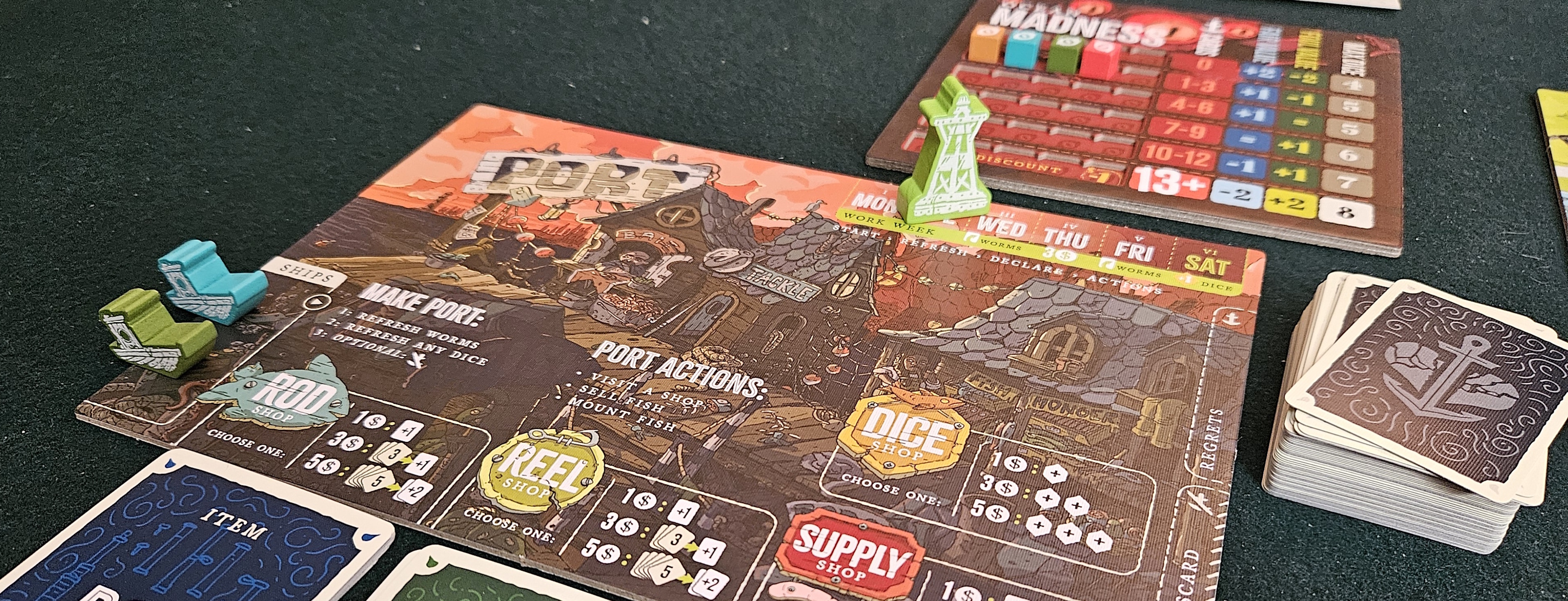
Hanging out in port.
“On the surface” is a loaded term for Deep Regrets. That’s because Deep Regrets is about surfaces and what lies beneath them. In terms of character, the surface reading is that you’re a fisherman. Not the catch-and-release kind, but rather the my-livelihood-is-disappearing-with-the-depleting-abyss kind.
Which is what drives your bayman to trawl ever deeper. As the shoals close to the surface grow thin, you seek more benthic prey. It’s a solitary practice, both thematically and at the table. Turns don’t exist in complete isolation from those of your peers; this isn’t a total multiplayer solitaire experience. But as we will see, there’s a lidless membrane between you and your peers that’s never quite breached.
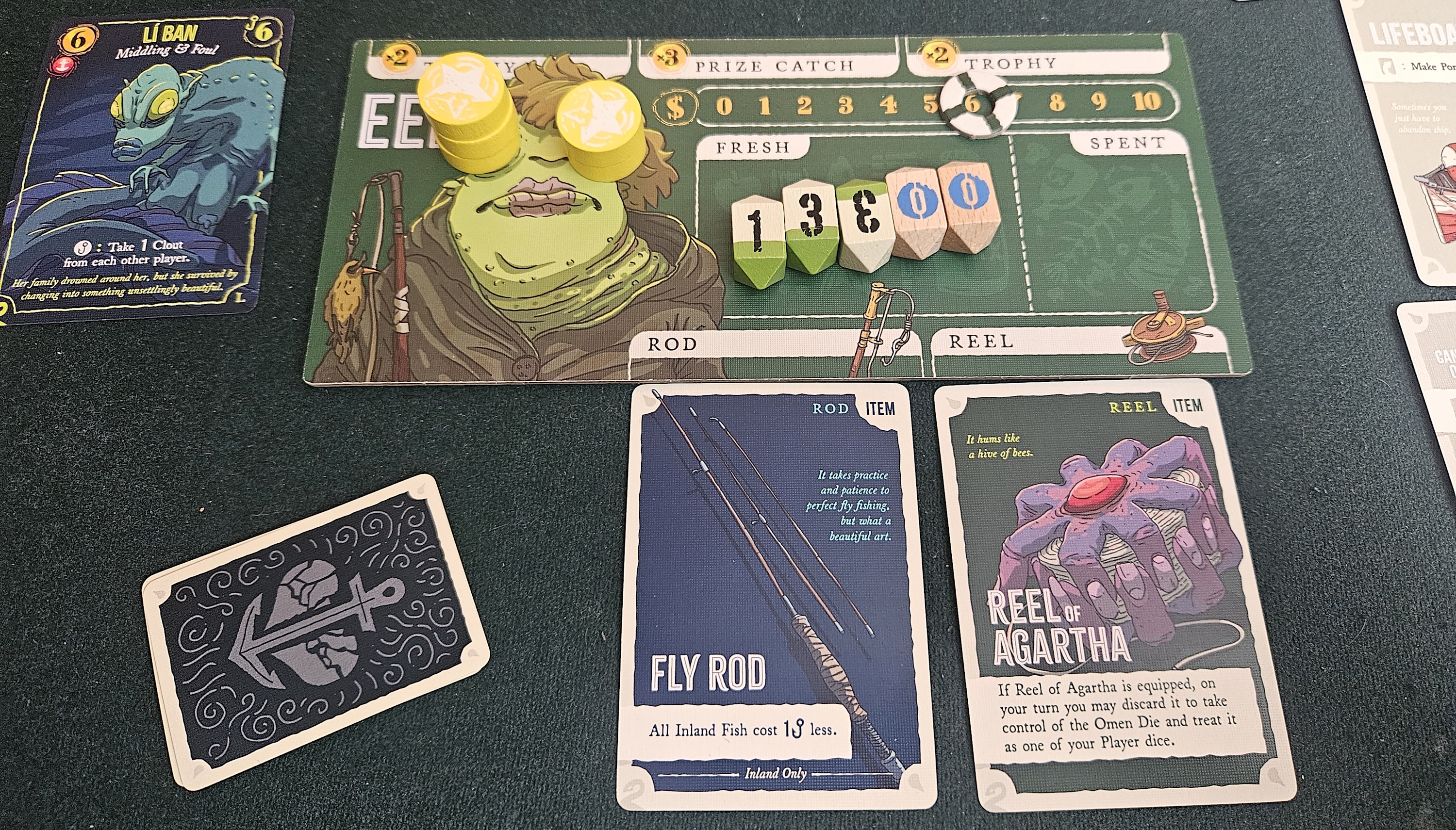
For the most part — on the surface — Cowan plays it straight. The entire game could be described in that hobbyist shorthand that sounds alien to outsiders. Fishing is a press-your-luck minigame that expends dice and other resources to land the best fish. Every turn is framed around either a day at sea or one in harbor, trading your catch for equipment. There are subsystems aplenty: permanent and temporary dice, rods and reels with variable benefits, fish both great and small.
Check out my cool shades. They conceal my squamous nature.
What’s interesting about these systems, though, is what they communicate about both the gameplay and your character.
Starting with gameplay, Deep Regrets is — on the surface — an incredibly chancy plaything. Early on, there are clues one can follow: the shadow beneath the water reveals whether a catch is small, middling, or large, and various depths translate to creatures that are increasingly dangerous to land-based mammals. Your bayman also has access to a few starting tools, such as a can of worms for peeking at a shoal’s face-down card and a lifeboat for beating a hasty retreat to port if your odds at sea turn south.
It isn’t long before it becomes apparent that Deep Regrets isn’t as aleatory as all that. Oh, there’s always a sense of risk. It isn’t uncommon for a cocksure hand to take one risk too many and invite the wrath of something truly monstrous. There are cards in the deck, whether the base deck or one of its multiple expansions, that can very much ruin your day.
Still, there’s so much mitigation at play that it’s hard to regard Deep Regrets as quite as chancy as some have made it out to be. Failing to catch a fish results in grabbing a “dink” — fishing slang, not lifestyle slang — which offers some benefit of its own, whether better fishing or some cash value, to offset the sting of failure. Even a cursory glance at the equipment shop reveals tools that will offset any number of flubs or miscasts. It isn’t enough to strip the game of its uncertainty altogether, but these are hardly uninformed decisions.
This is all good stuff, and would provide plenty to mull over. But, once again, this only brushes the surface.
Not all catches are created equal.
It’s appropriate that where Deep Regrets expands its horizons is via the regret deck, a thick stack piled with all sorts of misgivings and heartbreaks. At regular intervals, your hapless fishers will land something special. A mermaid, perhaps, so shimmering with glory that it breaks your heart to haul her ashore. A leviathan, its mind linking to yours in its lashing final moments. Or maybe you’ll just sell something nasty at the fish market and feel bad about it. Regardless of the cause, these junctures see you drawing a regret.
Regrets matter in two senses. First, the number you hold in your hand determines your character’s current madness. The madder you become, the greater the risks you’ll take at sea and the weirder the creatures you’re willing to sell at market. Second, the sum of those cards determines which player is bitterest upon the game’s completion. This means tossing out your highest-scoring trophy.
What’s curious about regrets, though, is that they aren’t wholly undesirable. True enough, you would rather not have such terrible regrets that you fling your prize charybdis angrily into the sea. But a handful of regrets is… good, in fact. After a few days at sea, it won’t escape your notice that the deadlier deep shoals are packed with strange creatures. It also won’t escape your notice that these can be sold at higher prices and earn greater scores. But only if you’ve gone a little mad. Maybe even very mad. Not so mad that you ruin yourself. But mad enough to take the right risks and mount the right trophies.
Which is to say, Deep Regrets isn’t really about said regrets being bad, at least not always. In much the same way that Personal Demons doesn’t present fears as bad so much as things that need to be confronted, here one is invited to court regret, to dance with it, to dispel its worst excesses through clean living or self-medication or simple caution. Whatever works. But either way, a life without regrets hoists a lower ceiling, victory-wise.
Just some of the game’s many regrets.
Laid out like this, Deep Regrets’ messaging might come across as trite. Adolescent. As a species, we’ve told countless stories about how our regrets and failures are crucial stepping stones on the path to adulthood, from Picard being transformed into a timid science officer because he didn’t get shanked as a cocky ensign to the memory-erasing shenanigans of Eternal Sunshine of the Spotless Mind.
But Deep Regrets doesn’t come across as an adolescent musing. Its passage to success isn’t as straight as “regrets good.” Plenty of its regrets are well worth casting off. There’s a certain temporal wiggliness to the process; if you regret losing your arm or sacrificing your sister, I’m not wholly sure what it means when those regrets are discarded. Did we… forget? Get over it? Prevent its having happened through some demersal bargain? No idea. But the effect is one of curated regret, cautious regret, not wholesale acceptance or dismissal.
This makes Deep Regrets interesting rather than perfect. I wish the game had been pacier, but in some spots Cowan’s eagerness seems to have gotten the better of him. After the first few rounds, turns begin to bloat with extra dice, fish, equipment, and dinks. In the end, it isn’t the chanciness that’s the problem; it’s the replete tools for extending a turn and making outcomes more certain. As the game grows longer, its charms wear thin. Eventually, they rupture like aquatic flesh that’s gone too long without refrigeration.
Mounting my trophies, buoyed by regret.
Still, Deep Regrets is smarter than it looks. It’s a game that rewards peering beneath the surface, both in terms of gameplay and as a ludic examination of a life lived without too many guardrails. I can say this with complete certainty: I don’t regret the time I’ve spent with it. Not in the slightest.
Complimentary copies of Deep Regrets and its expansions were provided by the designer/publisher.
(If what I’m doing at Space-Biff! is valuable to you in some way, please consider dropping by my Patreon campaign or Ko-fi. Right now, supporters can read the next installment in my series Talking About Games, this time tackling the topic of what makes a good list! Naturally, the piece includes a list.)
A trio of veteran board game industry professionals have launched a new tabletop gaming agency, with the aim of helping businesses within the hobby get their games developed and into the market.
Hues and Cues designer Scott Brady, Sagrada co-creator Daryl Andrews and Friendly Skeleton CEO Jacob Way said Best in Play will offer everything from interim executive leadership and designer representation to publisher submission management and crowdfunding strategy.
Brady said, “Best in Play was created to bring together people and opportunities that should already be working with one another.
“Great intellectual properties need the right designers and publishing partners, designers need better access to decision-makers, and companies sometimes need experienced leadership without the time or resources required to build an entire department.”
Best in Play says its five core service areas comprise IP matchmaking, crowdfunding consultation, interim replacement of key personnel, publisher-inventor relations and identifying publishers and licensing opportunities for individual games, multiple projects or designer catalogues.
The company announced at launch that it has already been hired as a consultant for an unspecified US-based “creator-brand merchandising and e-commerce company”, providing senior-level leadership and games-industry expertise while the client continues its search for a permanent head of games.
Best in Play said that project will run the gamut of product development, licensing, publishing, production, crowdfunding and portfolio strategy.
Andrews said of the assignment, “An important initiative should not lose six months of momentum because a key role is temporarily vacant.
“Our model gives clients access to an experienced team that can step in quickly, evaluate the situation and keep products, partnerships and internal teams moving forward.”
The company is also working on a tabletop project based on an unnamed “major video game intellectual property”, with a crowdfunding launch planned for early 2027.
Way said, “A recognizable property may attract attention, but a successful crowdfunding campaign still needs the right product, positioning, audience strategy and operational plan.
“Our goal is to build campaigns that respect the fans, communicate value clearly and create a foundation for success beyond the initial launch.”
As well as the founding trio of managing directors, the Best in Play team also includes strategic contributors David Gordon, the co-creator of Finspan, Eastar Game Manufacturing founder and CEO David Du, Legend of the Five Rings: The Card Game co-designer Erik Dahlman and Daniel Pesante.
Brady previously launched his development studio A Game Studio at the start of 2024, following the 2020 release of the big-selling Hues and Cues and the success of his cat-themed abstract strategy Boop in 2022.
He previously spent two years as head of talent acquisition at Maestro Media, following several months working in investor relations, before leaving the company in early 2025.
Jacob Way, meanwhile, began his board game career as COO and co-founder of Deep Water Games, which for several years operated as a subsidiary of Ox Eye Media.
Deep Water, which is best known for sketching game MonsDRAWsity, spun out from Ox Eye as an independent business in 2022 under Way before rebranding as Friendly Skeleton.
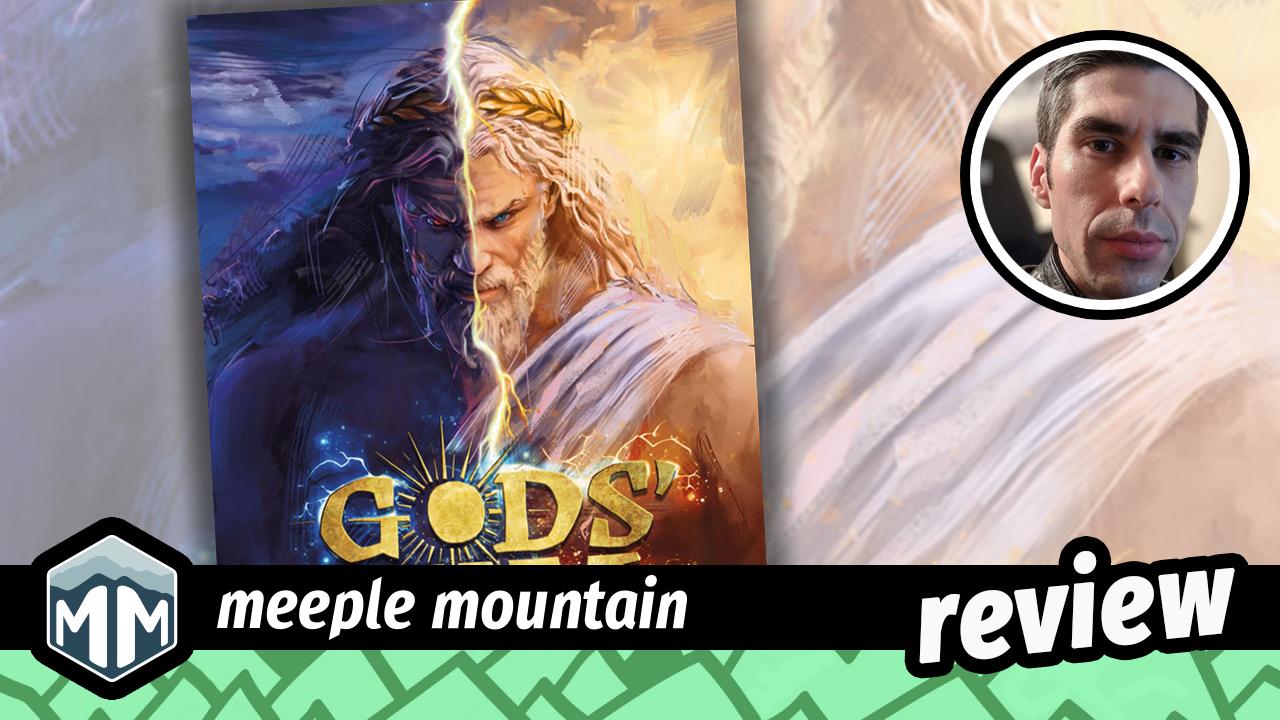
Gods' Will showed up in my social media feed, comparing itself to Resistance: Avalon like a new kid on the first day of school telling everyone he used to be popular somewhere else. I have heard this pitch. I have reviewed this pitch twice, from Witch Hunt andHuman Punishment, two games that made the same promises and delivered the same disappointing results. So when Gods' Will came knocking with the same marketing aura, I had to open the door with at least one eyebrow raised. Maybe I’m just addicted to disappointment, who knows.
After half a dozen plays, I can say with a bit of confidence that Gods' Will is doing more right than wrong here. More importantly, it earns it by fixing the real problems with its predecessors rather than just the ones that look good in a Kickstarter pitch.
A Skeptic Walks Into a Kickstarter
Like 90% of social deduction games that have ever existed, there are two teams: Light and Dark. There is also a loner faction, a third party whose goals shift depending on player count and whose presence ensures that the ride from start to finish won’t ever be a smooth one. Every player is a God with a public special ability…
Mantic Games entwickelt derzeit ein offizielles Rollenspiel auf Grundlage von Masamune Shirows Originalmanga Ghost in the Shell. Die Finanzierung läuft bis zum 13. August 2026 über BackerKit. Unterstützer*innen oberhalb der kostenlosen Follower-Stufe sollen die vollständige PDF-Ausgabe bereits im September erhalten.
Gambler x Gamble!! (two exclamation marks) is a game from Japan
released in 2024. It is a reimplementation of a 2016 game called Gambler x Gamble! (one exclamation mark), which won the Group SNE Contest in 2015. We all
know what it will be named when it gets a third edition, don't we?
When I read the rules, the first thing that comes to mind is this is
Machi
Few people in the hobby game industry have seen as many sides of the business as Scott Morris – from leading global strategy at Lucky Duck Games, building publishing partnerships at GTS Distribution and running sales, marketing and social media at Arcane Wonders. Now Morris is applying that experience to his own venture as founder of Steelwing Games, whose debut title Rainbow Blvd. has been nearly a decade in the making. He spoke to BoardGameWire about deciding to launch as a publisher in a challenging market,why he believes a slower, more selective approach is the right fit, and the lessons he is bringing from his career at Lucky Duck Games and beyond.
BoardGameWire:How long has the idea of you launching your own publisher been rolling around your head? I think I remember you saying you registered Steelwing some years ago?
Steelwing originally began to take shape in 2016, after first playtesting Rainbow Blvd. (which was then called Leprechauntractors as a play on words with Leprechauns and Contractors). Like a lot of people who work in games, I’ve always had ideas about the kinds of projects I’d love to help bring to life if the timing, team, and titles were right.
The company itself was set up in 2021, and I’ve been very intentional about not rushing into publishing just for the sake of launching something. For me, it was important that Steelwing start with the right game, the right creative partners, and a clear sense of what we wanted the company to stand for.
What was it that finally got you to make the jump and launch?
It was really a combination of timing, people, and product. Rainbow Blvd. is the perfect first game, it always has been. It has a fun identity, a strong table presence, it is easy to teach, and has the type of meaningful gameplay that Steelwing is focused on.
I also reached a point in my career where my experience across multiple areas (sales, marketing, crowdfunding, distribution, licensing, production, and working with designers) has given me the confidence to give Steelwing a thoughtful and responsible start.
Rainbow Blvd., designer by Adam Wyse, will be Steelwing’s first published game
What does Steelwing represent or offer that perhaps hasn’t been possible for you in your other board game industry roles?
Steelwing gives me the chance to build something from the ground up with a clear creative point of view. The goal is to publish games that are welcoming, polished, distinct, and deliver a satisfying and rewarding experience for players.
The name reflects that mission. The “steel” represents the experience and discipline I’ve built in the industry, while the “wing” represents using that experience to help create opportunities for others and give talented people new pathways into board games when and where we can.
At its heart, Steelwing is about making games we would be thankful to have in our collection while trying to leave the industry a little better than we found it, along the way.
The industry has been facing higher manufacturing costs, tariffs, freight disruption and increasing competition for attention. Many people might see this as a difficult time to launch a publisher. What makes you optimistic?
It is absolutely a challenging time, that can’t be minimized in any way. Costs are high, attention is hard to earn, and publishers need to be more thoughtful than ever about what we make and how we make it.
What makes me optimistic is that players still respond to games that they can connect with, that have that special feel, and are well cared for. This is a time to be disciplined, focused, and clear about why a game deserves to exist. That is the mindset I am bringing to Steelwing.
Of course it will be challenging. There is never a perfect time to start a new business. One of the principles I try to live by is, “Be good today and be better tomorrow.” Staying humble, listening carefully, continuing to learn, and making games that bring people joy, will result in positive outcomes for Steelwing and more importantly, for the community.
Having worked in the industry for more than a decade, which experiences most shaped the way you’ll run Steelwing?
Not to date myself, but it’s closer to two decades, and actually my second stint in the industry. A long time ago, in a galaxy far, far away (known as Poughkeepsie, New York), I had my first opportunity in games as a retailer, managing a local store called Iron Vic’s.
The experiences that have helped shape me are the ones where I’ve been able to see the full path a game takes from idea to table. A great design is essential, but game development, product development, manufacturing, communication, and post-release support all shape the experience players ultimately have with a game.
One night, while developing Rainbow Blvd., we realized the rainbow borders on some cards felt slightly different. Opening the files in InDesign, we found that one border was 13 pixels from the cut line and another was 15. Those two pixels bothered me more than they probably should have, but I knew someone, somewhere, would have that same subtle feeling that something was off. So we spent several hours fixing it. Was it necessary? Maybe not to some, but for me, it was 100% necessary.
I’ve also been fortunate to learn from many generous and experienced people across the industry. Those relationships have shaped how I think about publishing, leadership, and the responsibility that comes with bringing a game to market.
My goal with Steelwing is not to assume we’ll get everything right. We won’t. But experience gives us a better chance to be thoughtful, avoid preventable mistakes, and build trust with the people who help bring our games to life and with the people who enjoy them.
Your recent newsletter makes clear Rainbow Blvd. has been in development for years, with prototypes dating back to 2016. What made you confident about launching a new publisher with this title?
Rainbow Blvd. has had a long and amazing road, and I’m looking forward to sharing more of that story through our updates and crowdfunding campaign. At times, it has felt as though it has a life of its own. The core idea has stayed strong through a slow-and-steady development process, while the game itself has become more focused, more accessible, and more visually distinct over time.
What stood out to me is that Rainbow Blvd. has immediate appeal, while also providing a very satisfying experience underneath the surface. People are drawn to the colorful 3D rainbows and cozy city-building theme, and then after they play a turn or two, they find meaningful decisions, shared incentives, and strategic choices that make the experience engaging for many different types of players.
That is exactly the space for Steelwing to live in; games that feel welcoming regardless of a player’s experience level, while being memorable and rewarding. Great games have “stand up moments” where players feel rewarded for their choices, and even greater games leave players with that “I can’t wait to play again” feeling. Rainbow Blvd delivers on those two things and [designer Adam Wyse] has done a tremendous job developing it into something approachable, clever, and special! I’m excited to help bring it to players around the world.
What kinds of games are you actively looking to sign? What does a Steelwing game look like?
A Steelwing game should be welcoming and engaging while delivering a memorable experience. The experience is everything. Positive, clever, engaging, intriguing, and above all else, fun.
We are actually not actively looking for games, as we have a publishing plan in place until 2029. If and when we open up for submissions, some key elements are games that are teachable, replayable, and have a clear reason to exist on the table. Strong table presence helps, a unique theme helps, and unique components turn simple into satisfying. That is where my strength as a publisher is; taking a good game design and helping turn it into a full product that delivers a positive experience.
Scott demoing Rainbow Blvd. at Origins 2026
Are there any particular themes, mechanisms or types of games you’re especially excited about right now? Or any genres or play experiences you think are currently underserved?
I believe there are still so many themes, mechanisms, and combinations in games that have not been fully explored yet. I’m especially interested in games that create positive interaction without relying only on direct conflict. I like games where players are paying attention to each other and the choices being made, where timing matters, and where the table feels alive, but not necessarily because players are attacking each other or tearing each other down.
Rainbow Blvd. is a good example of that. We’ve worked hard to make sure players stay engaged even when it is not their turn, because what other players choose can also create opportunities for others. That kind of shared excitement and mutual interest keeps the game active from turn to turn and feeling alive.
There is still a lot of room for beautiful, accessible strategy games, games that families, couples, casual players, and hobby gamers can all enjoy together for different reasons. As a wise person once said, “The people around the table are more important than the game on it.” I hope Steelwing games can help create many of those nights.
How many games are you realistically aiming to publish each year?
The plan is to stay steady, planned, and manageable. Realistically, the goal is not to publish a large number of games each year. I would rather do fewer games better than stretch the company too thin. Right now, we have Rainbow Blvd. crowdfunding this year on Kickstarter and delivering in 2027, plus an unannounced game to crowdfund in 2027 and deliver in 2028. Releasing games in a measured and manageable way is the pace to keep at the start and the primary focus.
The box cover for Rainbow Blvd.
Is the goal to remain deliberately boutique, or would you like Steelwing eventually to become more of a mid-sized publisher?
The goal is to grow responsibly. I’m not opposed to Steelwing becoming larger over time, but only if the growth supports the quality of the games and the experience for players. For now, I would describe the goal as focused. We want to be selective, build trust, and make each release feel intentional, delivering the best possible experiences to players.
Will you primarily publish original games, or are licensed titles also part of the long-term strategy?
Original games are the main focus, especially as we establish Steelwing’s identity. That said, I have a lot of respect for what a well-matched license can do when it genuinely supports the gameplay and audience. “Never say never” is the saying, but fit also matters. I am not looking to chase licenses for the sake of it, and our focus is on Rainbow Blvd and the next title, which is also an original, internal game. (Which, I can’t wait to talk more about, as it is also a very unique game like Rainbow Blvd. that gets me excited every time I play it.)
Are you actively accepting pitches? And if so, what kinds of games are you most hoping designers will bring to Steelwing? How should they contact you?
We’re not accepting unsolicited pitches right now. Steelwing already has a publishing plan in place for the coming years and I want to make sure we give those projects and relationships the attention they deserve. If and when we do open submissions, we’ll be looking for games that feel welcoming, replayable, visually engaging, and have a clear reason to exist on the table. However, I don’t want designers sending us projects before we have a proper process in place, especially if those games could be finding the right home elsewhere. We’ll share clear guidelines through SteelwingGames.com and our social channels.
Will every game crowdfund first, or do you plan to vary that from title to title?
Crowdfunding will be an important part of Steelwing’s strategy, especially early on, because it allows us to build community around each game and communicate directly with the players most excited about it. That said, I do not think every game has to follow the exact same path. The right approach depends on the game, the audience, the production needs, and the retail strategy.
Looking back over your career so far, what’s the biggest lesson you’re taking into Steelwing?
The biggest lesson I’m taking into Steelwing is that publishing is a long-term relationship business built on trust. A good game matters, of course, but so does how you communicate, how you treat people, how you handle problems, whether your decisions are sustainable, and how well you stand behind your product after it reaches the table.
I want Steelwing to be known not just for the games being made, but for being thoughtful, reliable, and committed to delivering exceptional experiences. Steelwing is intentionally lean right now, supported by a group of passionate and talented contractors, partners, and collaborators who believe in the goals and the games.
One of the things I love most about the board game industry is how accessible and personal it can still feel. I want to have direct relationships with our players. I want to hear their stories of fun, triumph, defeat, and laughter. And just as importantly, I want to hear where we can improve, because every release should help us get better at serving the people who choose to put our games on their table.
Are there any elements of being a publisher that you’ve experienced in your time in the industry that you’re deliberately trying not to do with Steelwing?
One of the most challenging things in this industry, and in life in general, is the art of saying “no” when it needs to be said. Every company has different pressures and constraints. For me, the goal is to avoid growing too fast, avoid overpromising, and avoid taking on games that cannot be given the attention they deserve. That means being honest about what can be done well, while being disciplined enough to say no when something is not the right fit.
You’re still part of Lucky Duck Games. How do you balance those responsibilities with running Steelwing?
The true answer is, “Very carefully”. My responsibilities with Lucky Duck Games remain my professional priority, and I take them seriously. I’m grateful for the opportunity I have here and for the talented people I continue to work with. Steelwing is a separate project, and I’m careful about keeping those responsibilities distinct. That means being thoughtful with my time, avoiding conflicts, and making sure Steelwing is built in a way that does not interfere with my daily obligations. Maintaining trust and professionalism matters a great deal to me.
If you were to look forward five years into the future of Steelwing, what do you hope you’ll see?
Five years from now, I hope I’ve grown to become a better publisher and I hope Steelwing has a meaningful catalog of games that people are excited to recommend to their friends and family. I would love for players to see the Steelwing name and feel like it stands for games made with intention, love, and care.
I do not think success has to mean being the biggest publisher. For me, success would be building something sustainable, respected, and joyful, both for the people who make the games and the people who play them.
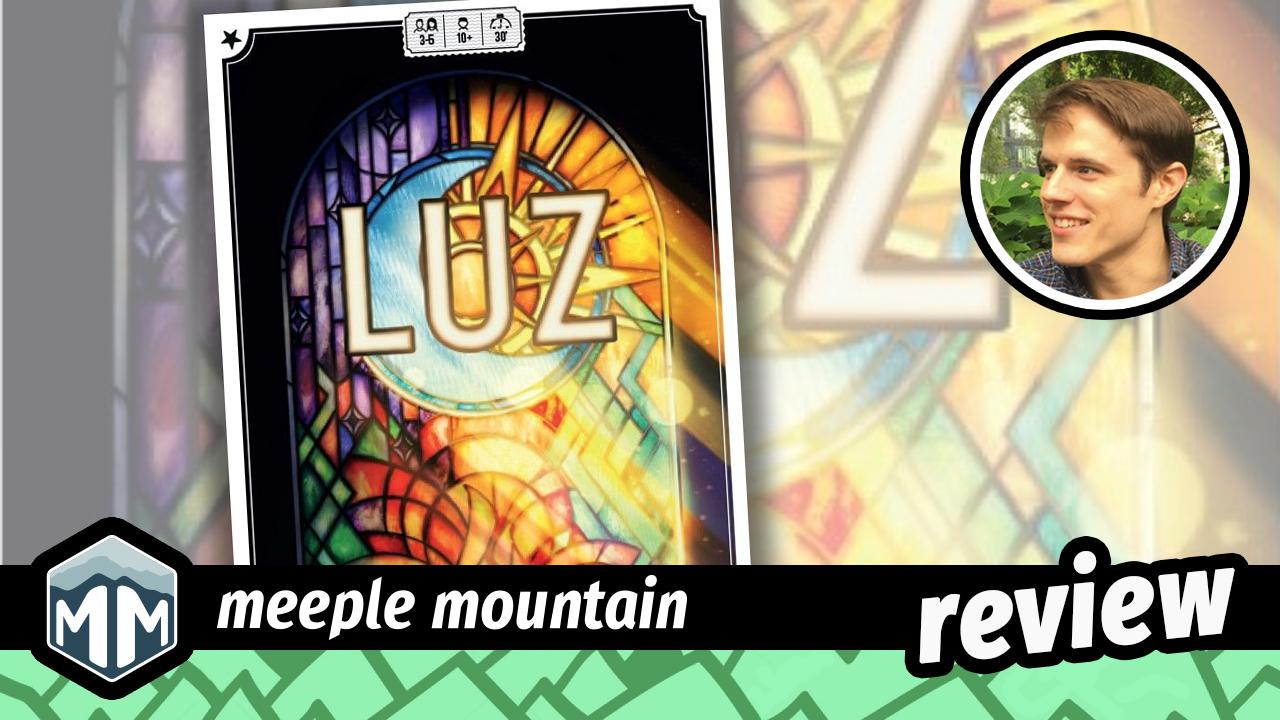
With a title like LUZ, Spanish and Portuguese for “light,” you’d expect this Taiki Shinzawa trick-taking game to have a bit more clarity. Silly you. Silly me! LUZ is a game of shadows and half-knowns, a trick-taker that casts a shadow of uncertainty.
Given that Shinzawa is responsible for the likes ofGhosts of Christmas, a trick-taker in which you play three or four must-follow tricks at the same time while the trump suit shifts with player behavior, I should clarify that LUZ isn’t that opaque. It’s all relative. If Ghosts of Christmas is a few standard deviations outside the mean, LUZ is safely within the bell part of the curve.
This is a must-follow trick-taking game where players bid before the hand begins. You have the choice of making an exact bid, which requires you to hit the nail squarely on the head in order to score, or a more forgiving bid that gives you one trick’s worth of wiggle room in exchange for scoring half the points. Higher risk, higher reward.
This doesn’t sound so different from whist, other than the room for some wiggle in your wager. The opacity comes from the last two rules: the back of each card indicates what suit that card belongs to, and you never know the values of your…
I love a different style and focus of wargame. A game that takes a look at an important but somewhat obscure or rarely addressed historical topic, such as espionage or intelligence, and creates a gaming experience tailored around the events to highlight and evoke the difficulties and tension that would have been present. In January 2026, GMT Games announced such a game in Checkpoint Charlie, which is a solo or cooperative game focused on SIS espionage missions in Berlin in the 1960’s designed by Russell Brown. We have posted an interview with Russel and it was very well received and he has now agreed to create a series of History Behind the Cards to highlight the events of the 1960’s Cold War struggle in West Germany but also to share aspects about the game play and how it models the history.
*Note: The cards highlighted in this series and their event text, as well as any pictures used showing any of the various components, are still in the design and development process and as such event effects and text might still change prior to final development and publication.Also the art and layout of the cards are only for playtest purposes at this point and the game will enter the art department as it nears publication.
History Behind the Cards – Checkpoint Charlie from GMT Games – Card #4: Faceoff with the Soviets
On August 13th, 1961, in a dramatic move to stop the flow of millions of East Germans defecting to the West, East German police placed miles of barbed wire overnight, cutting off access between East and West Berlin and catching the western powers by surprise. It wasn’t clear what the response of the west would be, and whether it would ultimately lead to the war with the Soviets that many people felt was inevitable.
For days there seemed to be no reaction. West Berlin and Mayor Willie Brandt looked to U.S. President Kennedy to respond quickly and forcefully to the wall, but U.S. troops in Berlin made no move to intervene. Instead, on August 16th, Kennedy sent Vice President, Lyndon Johnson, and General Lucious Clay (more about him on card #6) to deal with the situation. At the same time, he ordered the U.S. 18th Infantry regiment in West Germany to cross East Germany on the autobahn to Berlin, along the access corridor established by the Potsdam Conference. The troops came equipped for battle and paraded through the streets of West Berlin with Johnson and General Clay. This showed U.S. support for Berlin, but did nothing to remove the wall, which quickly turned from barbed wire to concrete.
Over the next two months, disputes arose over the rights of French, British and U.S. troops to travel in the Soviet sector of Berlin, which were also established by the Potsdam Agreement. Tensions came to a head when a U.S. diplomat was stopped at Checkpoint Charlie while crossing into East Berlin. On October 27th, after heated exchanges, mostly between the Soviet Commandant and General Clay, Clay attempted to send another diplomatic mission through Checkpoint Charlie, this time accompanied by ten jeeps full of American soldiers, with ten U.S. tanks in reserve back in West Berlin. The crossing succeeded, but the Soviets responded by sending ten of their own tanks right up to the Checkpoint Charlie crossing. The U.S. tanks moved up to face them.
The standoff lasted nearly a full day, with the tanks and soldiers facing each other, ready for battle. Kennedy and Khrushchev managed to negotiate a resolution and the Soviet tanks pulled back slightly first (presumably because they had moved up to the border first), then the U.S. tanks pulled back. This gradual retreat alternated until the faceoff was at an end and traffic through the checkpoint resumed.
The Faceoff with the Soviets card in Checkpoint Charlie places a Faceoff marker in the Checkpoint Charlie location, which prevents any assets and KGB agents from entering this location during the Movement step of the turn (though some played card effects still allow this). This marker can only be removed by the General Clay Steps In event (card #6).
In the next article in this series, we will take a look at Berlin Film Festival and how its effect caused some issues with various locations operating as Honey Traps about the city.
In my opinion, this game looks extremely interesting and I am very much excited to learn more about it. I am appreciative to Russell and his efforts to bring us these cards and to write these entries to share with our readers. I am also very glad that this topic is being covered in a game and look forward to playing this one day soon.

 Anmelden