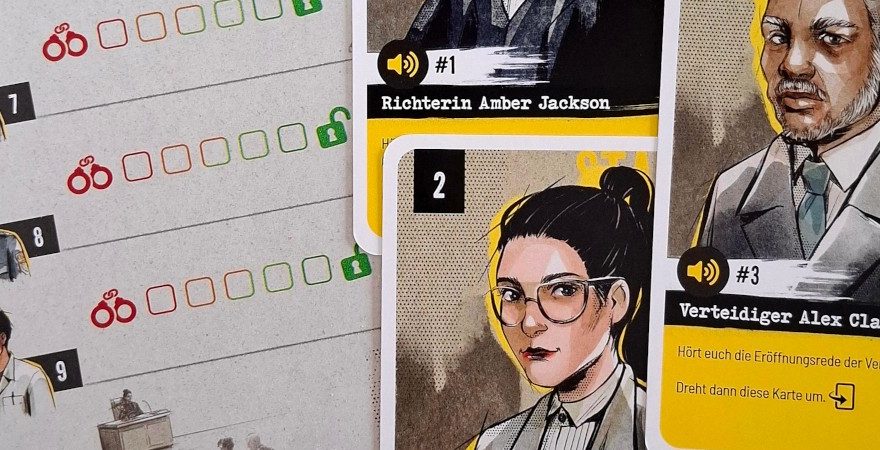
Nach zahlreichen Rätselkrimi-Formaten und zuletzt den Medical Mysteries lanciert Kosmos ein neues Format. Bei Ihr seid die Jury: Zwei Gesichter – ein Schuss nimmt man als Geschworene an einem Gerichtsfall teil. Am Ende muss ein Urteil gefällt werden. Die ganze
Wir Cliquenabendler waren Anfang Mai auf dem Herner Spielewahnsinn 2026 und haben uns dort einige aktuelle und kommende Neuheiten angesehen und gespielt. Natürlich haben wir auch ein paar Videos gedreht und waren dafür auch bei Strohmann Games. Die Spielenden in Temple of Five sind Anführer*innen rivalisierender Clans und erfüllen die wichtigste Aufgabe des Herrschers, der den einstigen Ruhm und Wohlstand der Stadt wieder aufleben lassen möchte. Im Herzen des alten Landes errichten sie majestätische Pyramiden, verziert mit Symbolen göttlicher Macht und Weisheit. Jede Pyramide wird nicht nur ein architektonisches Wunder, sondern auch ein heiliger Ort, an dem die Gebete und Hoffnungen ihres Volkes verkörpert werden. #video:templeoffive#
Asmodee hat die ersten Partnerunternehmen bekanntgegeben, die neue Brettspiele und Zubehör zur Welt von Mittelerde produzieren werden. Sechs Monate nach der Übernahme der Tabletop-Lizenz für „Der Herr der Ringe" sollen mehrere etablierte Verlage und Hersteller eigene Titel beisteuern. Die Auswahl folgt einer Phase, in der Teile der Branche befürchtet hatten, Asmodee werde die attraktivsten Projekte für sich reservieren.
Diese Verlage produzieren neue Mittelerde-Titel
Zur ersten Gruppe gehören Grand Gamers Guild, Mitherausgeber von „Endeavor: Deep Sea", und Stone Blade Entertainment, der Verlag hinter dem Deckbuilder „Ascension". Hinzu kommt Play to Z, das von Z-Man-Games-Gründer Zev Schlasinger ins Leben gerufen wurde. Ergänzt wird das Feld durch den Würfel- und Zubehörhersteller Sirius Dice sowie Game Toppers, das in einer separaten Mitteilung Tische, Spielmatten und weiteres Zubehör im Mittelerde-Stil angekündigt hat.
Die konkreten Projekte der meisten Partner bleiben vorerst unter Verschluss. Eine Ausnahme ist Stone Blade. Der Verlag hatte bereits im April eine Lord-of-the-Rings-Version seines „Ascension"-Deckbuildings auf Gamefound vorgestellt.
Asmodee selbst hat in den vergangenen zwei Jahren mehrere erfolgreiche Mittelerde-Titel veröffentlicht. Dazu zählen „Duel for Middle Earth", eine Variante von „7 Wonders Duel", sowie „The Fellowship of the Ring – Trick-Taking Game" und Matt Leacocks pandemie-inspiriertes „Fate of the Fellowship". Bei den 20. Golden Geek Awards räumten diese Titel mehrere Auszeichnungen ab.
Eigene Projekte und offener Pitch-Prozess
Asmodee war bis zur Ausgliederung Anfang 2025 eine Schwestergesellschaft von Middle-earth Enterprises innerhalb der Embracer Group. Mit der Übertragung der Tabletop-Lizenz im Oktober übernahm das Unternehmen die Verantwortung dafür, welche Verlage künftig Mittelerde-Spiele entwickeln dürfen. Die Frage, ob die besten Projekte intern bleiben würden, beantwortete Luke Peterschmidt, der die Middle-earth-Sparte bei Asmodee leitet, schon kurz nach Amtsantritt gegenüber BoardGameWire: „Unsere Aufgabe ist es, die richtige Anzahl von Mittelerde-Spielen im richtigen Tempo zu produzieren, damit jedes Spiel Raum zum Atmen hat (…) und kein Teil dieser Mission besagt ‚und Asmodee macht alle Spiele'."
In seiner aktuellen Stellungnahme zur Partner-Auswahl ergänzte Peterschmidt: „Es mag den einen Ring geben, der sie alle regiert, aber es braucht viele Verlage, um die Bedürfnisse der Fans von ‚Der Herr der Ringe' zu erfüllen."
Aus dem eigenen Haus plant Asmodee in diesem Jahr „The Lord of the Rings: The King's Gambit", das vom Studio Space Cowboys gemeinsam mit Restoration Games entwickelt wird. Der Titel basiert auf „Star Wars: The Queen's Gambit", einer Avalon-Hill-Veröffentlichung aus den frühen 2000er Jahren, die vier Schlachten aus „Star Wars: Episode I – Die dunkle Bedrohung" nachstellt. Verlage, die eigene Mittelerde-Projekte einreichen möchten, können sich per E-Mail an METTGlicensing@asmodee.com wenden.
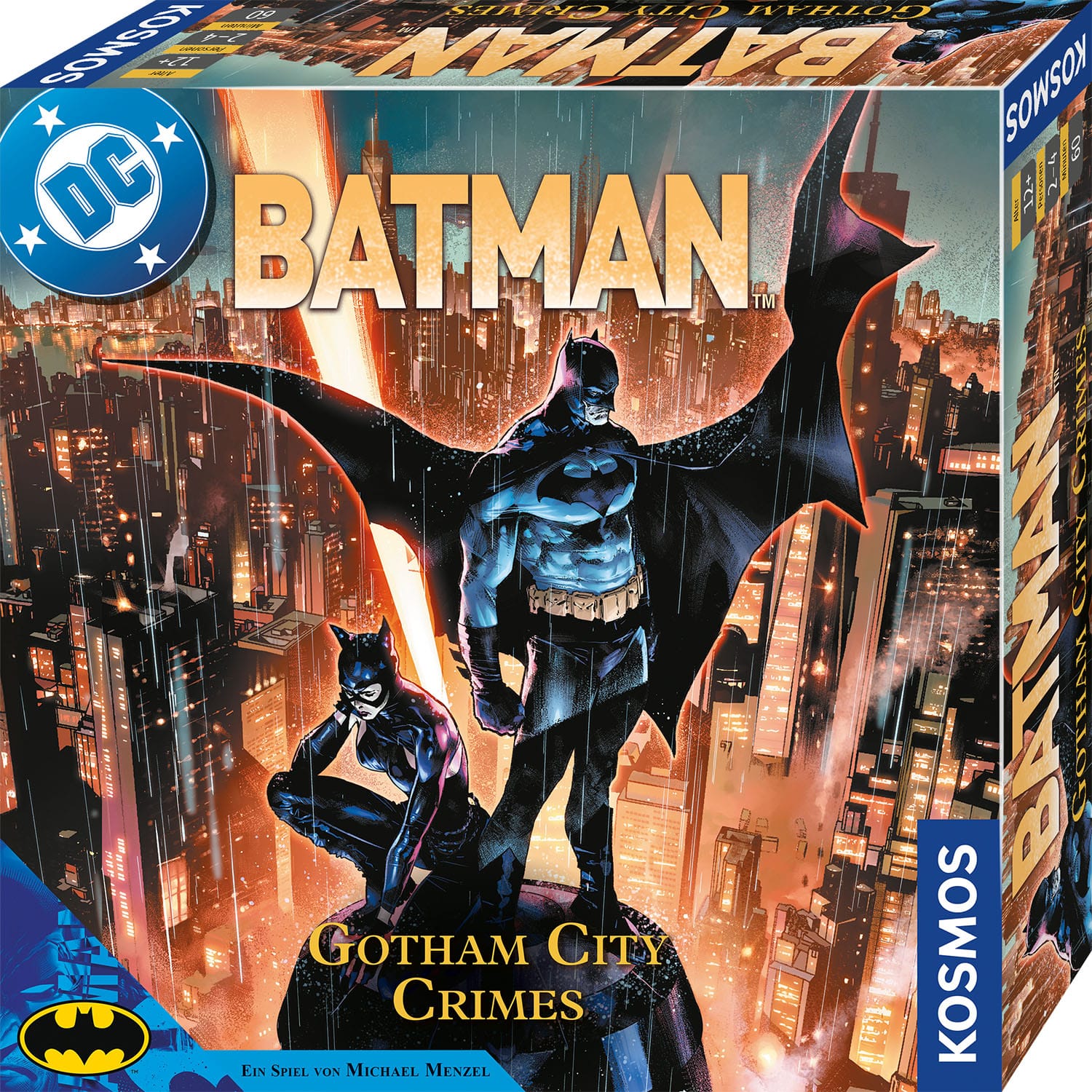
Die KOSMOS Neuheiten Herbst 2026 bringen drei neue Titel in unterschiedlichen Kategorien auf den Markt. Mit Batman – Gotham City Crimes, Moustache und Flip 7 Voll Fies erscheinen ein storygetriebenes Kooperativspiel, ein Stichspiel mit wechselnden Regeln und eine eigenständige Variante eines erfolgreichen Push-Your-Luck-Kartenspiels. Die Bandbreite reicht vom kooperativen Krimi-Abenteuer bis zum schnellen Kartenchaos für große Runden.
Kooperative Detektivarbeit und Stichspiel mit Sondereffekten
In Batman – Gotham City Crimes übernehmen 2 bis 4 Personen ab 12 Jahren die Rollen von Batman, Batgirl, Batwoman und Nightwing. Die Gruppe erkundet Gotham City, sammelt Hinweise, durchsucht Gebäude und spürt Superschurken nach. Die Kapitelstruktur entfaltet sich Stück für Stück und verlangt Absprachen und gutes Timing innerhalb des Teams. Eine Partie dauert rund 60 Minuten, der Erscheinungstermin ist der 19. Oktober 2026 zu einem Preis von 49,99 Euro. Für Entwurf und Spielmechanik zeichnet Michael Menzel verantwortlich, bekannt durch die Reihe Die Legenden von Andor. Ein Einstiegsabenteuer führt direkt in die Erzählung und ersetzt eine klassische Anleitung.
Moustache verspricht ein Stichspiel mit wechselnden Teams und neuen Regeln in jeder Runde. (Bild: BoardGameGeek)
Moustache ist ein Stichspiel von Alexandre Aguilar und Jules Messaud für 3 bis 6 Personen ab 10 Jahren. Eine Partie dauert rund 20 Minuten. Die Teams werden in jeder Runde neu zusammengewürfelt, neue Regeln verändern die Farbhierarchien oder bringen Joker und Karteneffekte ins Spiel. Die Illustrationen von Manu Gorobeï setzen auf tierische Charaktere, metallisch glänzende Schnurrbärte dienen als Auszeichnung. Auf BoardGameGeek liegt der Titel bei einer Durchschnittsbewertung von 7,27 und einer Komplexität von 1,33 von 5. Erschienen ist das Spiel ursprünglich bei Lumberjacks Studio.
Flip 7 Voll Fies und der Blick in den Katalog
Flip 7 Voll Fies basiert auf der englischen Vorlage Flip 7: With A Vengeance. (Bild: BoardGameGeek)
Flip 7 Voll Fies ist die eigenständige Variante zum Kartenspiel-Hit Flip 7 von Eric Olsen und Alyssa Swatek. Die deutsche Ausgabe baut auf dem englischen Original Flip 7: With A Vengeance des Verlags The Op Games auf. Gespielt wird mit 3 bis 18 Personen ab 10 Jahren, eine Partie dauert rund 20 Minuten. Im Vergleich zur Vorlage kommen neue Aktionskarten und Minuspunkte hinzu, die Second-Chance-Karte entfällt. Spezialkarten halbieren Punkte, stehlen Karten oder zwingen Mitspielende, vier zusätzliche Karten zu ziehen. BoardGameGeek listet die englische Vorlage bei einer Durchschnittsbewertung von 7,32 und einer Komplexität von 1,15 von 5.
Weitere Hintergründe zum Herbstprogramm finden sich in der Verlagsvorschau von KOSMOS. Die drei vorgestellten Titel ergänzen das Verlagsprogramm um Spiele für unterschiedliche Gruppengrößen und Stimmungen am Tisch.
Auf Board Game Arena sind in den vergangenen sieben Tagen zwei neue Titel hinzugekommen. Mit First Giants startet ein leichtgewichtiges Kartenspiel rund um prähistorische Museumsausstellungen. Daneben erscheint mit Emberleaf ein umfangreiches Aufbauspiel mit Plättchenlegen und einem beweglichen Karten-Raster.
First Giants – Kartenspiel rund um prähistorische Fossilien
First Giants stammt von Matthew Dunstan und Brett J. Gilbert und erscheint 2026 bei Space Cowboys. Die Illustrationen verantworten Maud Chalmel und Jessica Cognard. Das Spiel kombiniert offenes Drafting mit Set Collection und Tableau Building.
Du übernimmst die Rolle einer Paläontologin oder eines Paläontologen und stellst die prestigeträchtigste Ausstellung prähistorischer Tiere zusammen. In jedem Zug wählst du Karten mit Dinosauriern, Flugreptilien oder Riesensäugern aus einer offenen Auslage und ordnest sie deiner Sammlung zu. Solange Karten in deiner Hand bleiben, nutzt du ihre Effekte für Bernstein, Siegpunkte und weitere Aktionen. Erst beim Verschieben in die Ausstellung verlieren sie ihre Funktion, bringen dir dafür aber direkt Punkte.
Auf Board Game Arena ist First Giants für 2 bis 5 Personen freigegeben, eine Partie dauert dort im Schnitt rund 21 Minuten. Als Mechaniken kommen offenes Drafting, Set Collection und Tableau Building zum Einsatz. Auf BoardGameGeek erreicht der Titel eine Bewertung von 6,57 aus 10 Punkten bei 138 abgegebenen Stimmen, das Komplexitätsgewicht liegt bei 2,25 von 5. Für diesen Titel wird ein Premium-Abo benötigt.
Emberleaf – Aufbauspiel mit Karten-Raster und Plättchenlegen
Emberleaf wurde von James Tomblin und Frank West entworfen und erschien 2025 zunächst bei The City of Games. Die deutschsprachige Ausgabe verantwortet Skellig Games. Auch die Illustrationen stammen von den beiden Designern.
Du leitest ein Volk der Emberlinge und baust deren Heimat im Herzen eines alten Waldes wieder auf. Du erkundest die Umgebung, sammelst Ressourcen, räumst gefährliche Bereiche und errichtest neue Dörfer. Über ein bewegliches Karten-Raster, das sogenannte „Card Dancing", platzierst du Helden und löst dabei Fähigkeiten und Kombinationen aus. Sechseckige Plättchen mit verschiedenen Geländearten werden so ausgelegt, dass sie den Bedürfnissen deiner Bewohnerinnen und Bewohner entsprechen.
Auf Board Game Arena ist Emberleaf für 1 bis 5 Personen ausgelegt, eine Partie dauert dort im Schnitt rund 70 Minuten. Als Mechaniken kommen Plättchenlegen, Set Collection, Engine Building, variable Spielerfähigkeiten und das eigene Card-Dancing-System zum Einsatz. Auf BoardGameGeek erreicht der Titel eine Bewertung von 7,75 aus 10 Punkten bei über 1.600 abgegebenen Stimmen, das Komplexitätsgewicht liegt bei 3,11 von 5. Für diesen Titel wird ein Premium-Abo benötigt.
In den BRETTSPIELBOX News 21/2026 findet ihr die folgenden Nachrichten: Hier sind die Brettspiel News. Guten Start in die Woche. Folgende Neuheiten sind auf dem Weg bzw. angekündigt: In diesem Deck-Building-Spiel von Blue Rocker führen wir einen Konzern im Kampf um Macht und Einfluss. Dabei geht es nicht um Glück, sondern um den gezielten Ausbau […]
Kein klassischer Kampf, keine Traumlande, kein König in Gelb – und trotzdem ein stimmungsvolles Rollenspiel ganz im Sinne des Lovecraftian Horror? Macabre Tales besticht durch sein liebevoll gestaltetes, retro anmutendes Gesamtpaket und ein exotisches Element: Statt zu würfeln, spielen wir Domino!
Tja, was soll ich sagen? Es gibt da zwei Spielegattungen, bei denen ich zuverlässig schwach werde – und in Friedrich Ebert: Der Weg zur Demokratie treffen sie aufeinander wie nirgendwo sonst. Da wäre zum einen die Geschichtsvermittlung im Brettspielgewand. Ich liebe es, wenn ein Spiel mir nebenbei etwas beibringt – ohne erhobenen Zeigefinger, ohne Belehrungston, ohne dass ich es überhaupt merke. Twilight Struggle hat mir auf diese Weise den Kalten Krieg näher gebracht, Das Ende des Triumvirats den Untergang der römischen Republik, A Few Acres of Snow den Konflikt zwischen […]
Foto: Spiel des Jahres e. V.Harald Schrapers, Jahrgang 1964, veröffentlicht seit Anfang der 1990er Brettspielkritiken. Er war freier Mitarbeiter der Fairplay, hat für die Thüringer Allgemeine und Die Zeit geschrieben und ist in aktueller Position freier Mitarbeiter der Spielbox. Seit 1993 betreibt er die Website Games We Play.Seit 2017 ist er Mitglied des Vereins Spiel des Jahres e. V.
Manche Brettspiele überzeugen durch ihre Mechanik, andere durch ihr Setting. Und dann gibt es Spiele wie Die Schlacht um Thors Kliff, die vor allem auch durch eines herausstechen: die Geschichte hinter ihrer Entstehung.
In Thors Kliff verschlägt es euch auf eine raue, nordische Insel, auf der verschiedene Fraktionen um Einfluss und Macht kämpfen. Das Besondere dabei: Das Spielbrett ist nicht einfach nur flach, sondern bildet die namensgebenden Klippen dreidimensional ab. Dadurch entstehen nicht nur visuell spannende Spielsituationen, sondern auch taktische Entscheidungen rund um Positionierung, Höhenunterschiede und Bewegung.
Dazu kommen asymmetrische Einheiten, unterschiedliche Fähigkeiten und ein Fokus auf direkte Konfrontation, der das Spiel schnell intensiv werden lässt. Es geht nicht nur darum, „seinen Zug zu machen“, sondern aktiv auf die Gegner zu reagieren, Chancen zu erkennen und Risiken einzugehen. Das Ganze eingebettet in ein thematisches Setting, das stark von nordischer Mythologie inspiriert ist.
Doch was dieses Spiel wirklich besonders macht, ist der Weg dorthin. Denn hinter Thors Kliff steht kein großes Verlagsteam – sondern Timo Zett, der dieses Projekt als Independent Entwickler nahezu im Alleingang umgesetzt hat. Von der ersten Idee über das Game Design bis hin zu Produktion, Organisation und Veröffentlichung lag alles in seiner Hand. Unterstütz wurde er dabei von einigen seiner Freunde und Bekannten. Finanziell, beim Testen und auch auf Messen und Veranstaltungen.
Und genau darüber spreche ich mit Timo in der aktuellen Folge des Würfelmagier Brettspiel Podcasts.
Besonders hängen geblieben ist mir dabei ein Satz aus unserem Gespräch, der das Ganze ziemlich gut auf den Punkt bringt: Andere kaufen sich einen Bulli und gehen kitesurfen – ich entwickele stattdessen ein Brettspiel. Am Ende, sagt er, ist beides einfach eine Art, sein Geld auszugeben. 😄
Wir sprechen darüber, wie aus einer ersten Idee ein fertiges Produkt wird – und was passiert, wenn man diesen Weg komplett alleine geht. Wie organisiert man sich, wenn man gleichzeitig Designer, Produzent und Marketing ist? Welche Hürden tauchen auf, mit denen man vorher nicht gerechnet hat? Und wie geht man mit Momenten um, in denen ein Projekt plötzlich zu groß wirkt?
Aber es geht nicht nur um Herausforderungen. Denn genauso wichtig sind die besonderen Momente: Der erste funktionierende Prototyp. Die ersten echten Spielrunden mit Feedback. Und vor allem der Moment, in dem man das fertige Spiel zum ersten Mal in den Händen hält – und aus einer Idee plötzlich Realität wird.
Wenn euch also nicht nur interessiert, wie sich ein Spiel spielt, sondern auch, wie es überhaupt entsteht, dann solltet ihr unbedingt reinhören.
Mehr Informationen zu Thors Kliff findet ihr auf der Webseite von Timo unter https://www.thorskliff.de
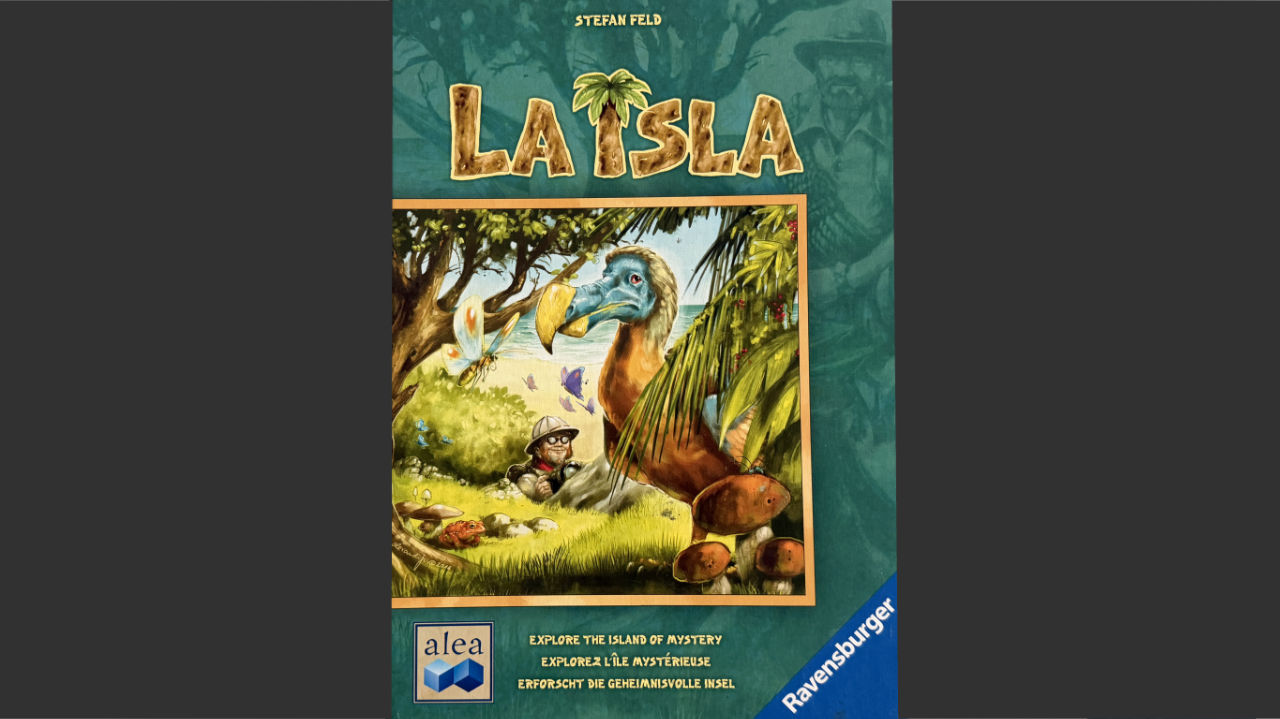
Stefan Feld schafft es immer wieder seine Spielmechaniken in ein passendes Szenario zu verpacken. Und so fragt man sich auch hier, gab es zuerst das Dschungelszenario oder die Multifunktionskarten und Token mit siegpunktegesteuerten Leisten?
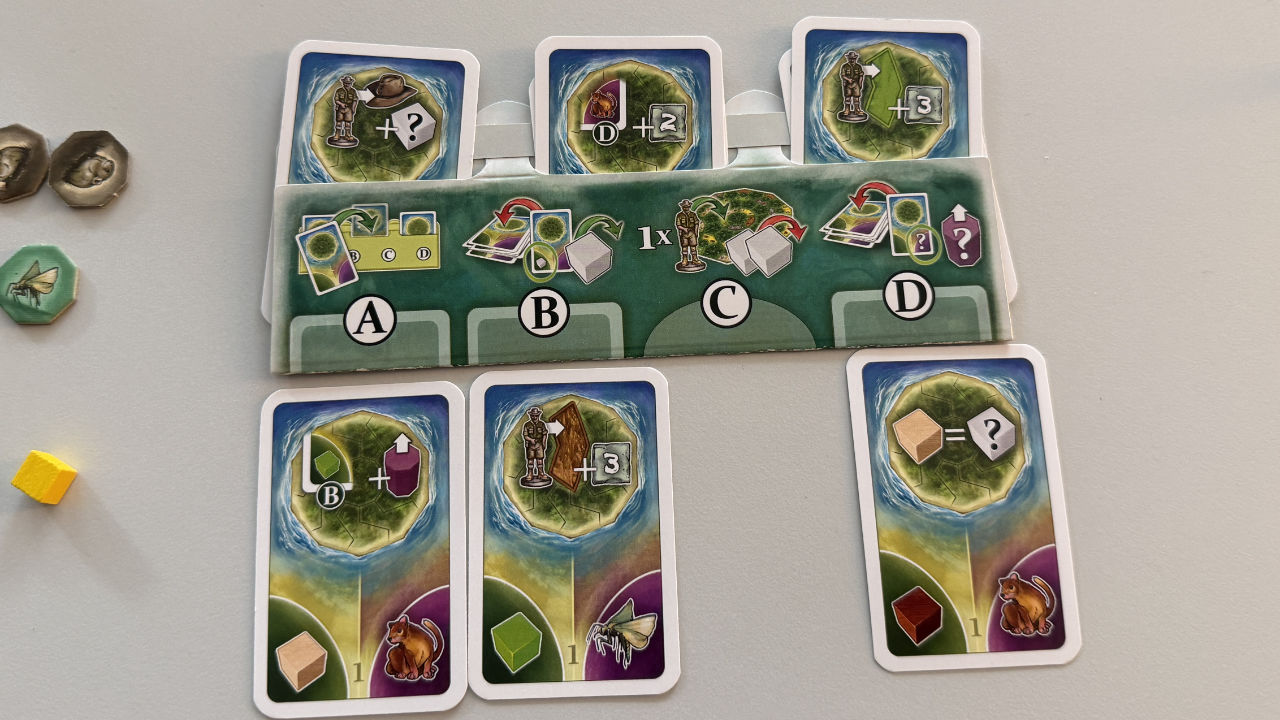
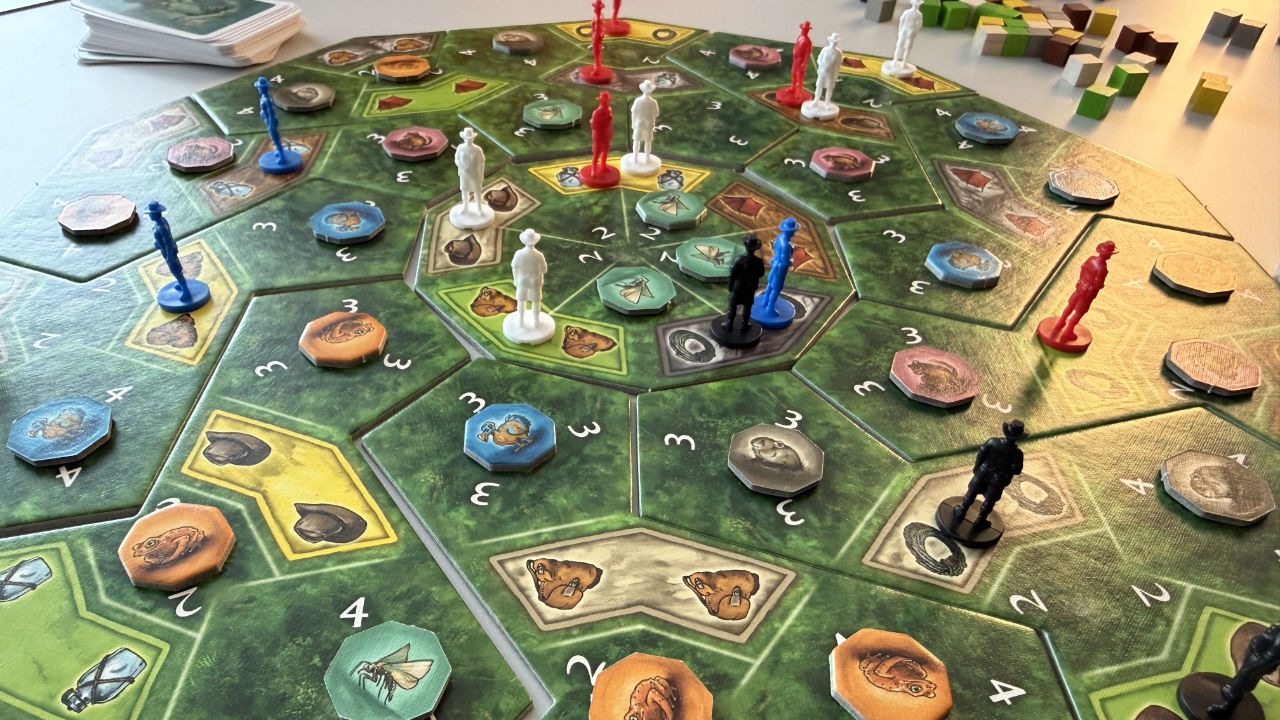
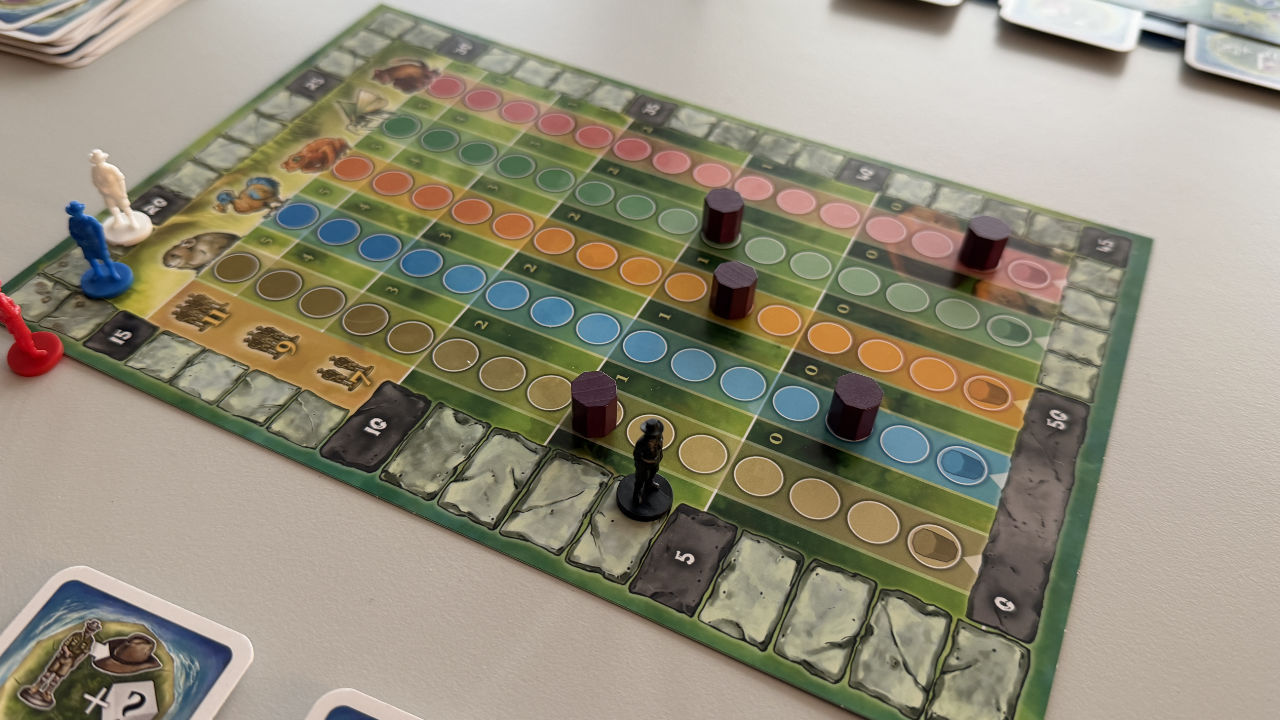
Die Spieler erforschen auf einer Insel fünf verschiedene Tiere, indem sie diese mit ihren Forschern umzingeln und dann einsammeln. Der Ablauf des Spiels ist hierbei leicht verständlich. Wir ziehen jede Runde drei Karten. Die Karten haben drei Funktionen für die drei Phasen A, B, und D. Wir müssen also entscheiden, welche Karte wir in welcher Phase nutzen möchten.
Denn legen wir die Karten unter unser Ablageetui, und arbeiten reihum vier Phasen ab:
A: Die Karte bei A nutzen, um sie für einen permanenten Bonus oberhalb des Etuis einzuschieben. Dort gibt es drei Plätze, ab der vierten Runde überschreiben wir also einen Bonus. Ein Bonus kann sein, dass wir beim Platzieren eines Forschers in Phase C auf ein grünes Landschaftsfeld ein beliebiges Plättchen erhalten.
B: Man erhält die Ressource, die unten links auf der Karte angegeben ist
C: Einen Forscher auf die Insel stellen. Dieses kostet zwei Ressourcen der passenden Farbe. Sollte ein Tierplättchen hierbei umzingelt sein, kann man dieses aufnehmen. Dies kann man z.B. durch Bonuskarten (siehe Aktion A) vergünstigten.
D: Unten rechts auf der Karte lauert die dritte Funktion der Karte. Wir ziehen das entsprechende Tier auf der Leiste des Spielplans ein Feld hoch. Je Tier in der eigenen Sammlung bekommt man einen Siegpunkt. Auch clever gelöst: Die Siegpunkteleiste mit den Tieren leiten das Spielende ein. Ist die Summe der Punktebereiche (bei vier Spielern) 11, ist das Spiel beendet. Und jeder bekommt für seine Tiere in dem Punktebereich die entsprechenden Werte.
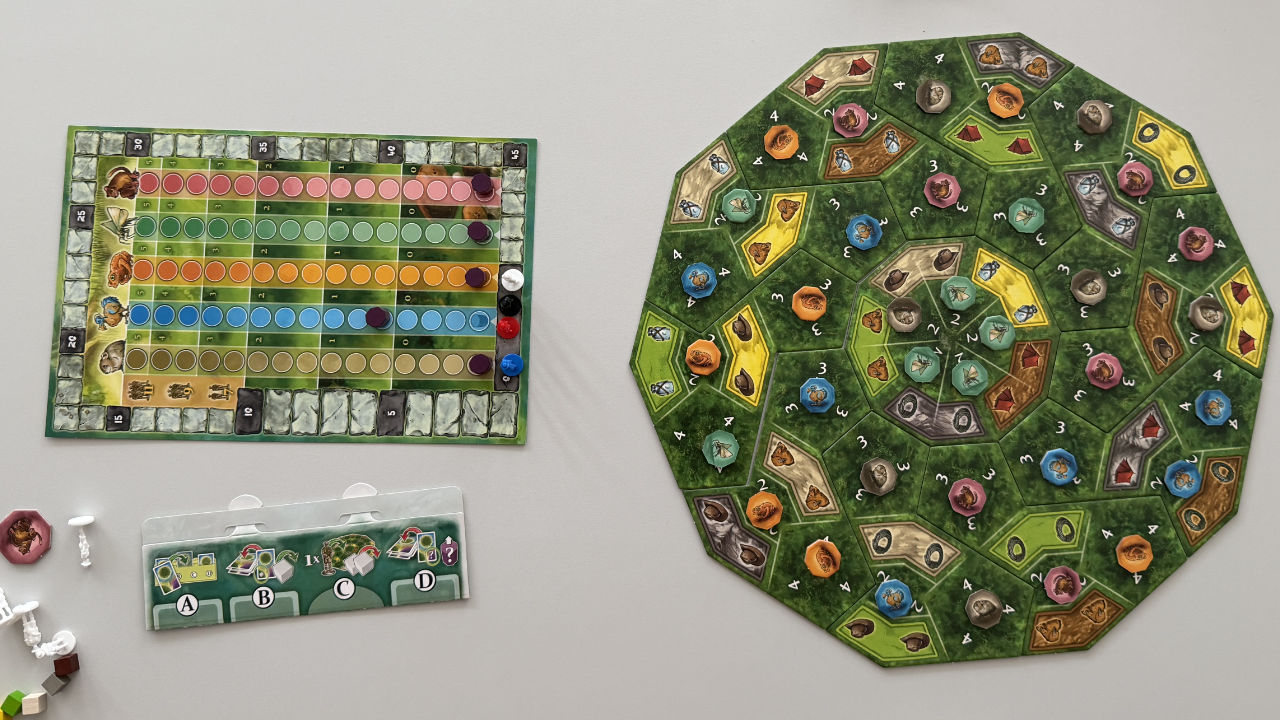
Die Insel, die Tierleiste und unser Etui für die KartenWenn man oben schon drei Bonuskarten eingeschoben hat, „überschreibt“ man in Phase A eine Karte. Als nächstes werden ich also einen Bonus aktivieren, dass ich in Phase B, wenn ich einen grünen Stein bekomme, eine beliebiges Tier auf der Leiste voranrücken kann. In Phase B bekomme ich einen grünen Stein und (wie überraschend) kann auf der Leiste mein Lieblingstier wertvoller machen. In Phase C setze ich einen Forscher und in Phase D rücke ich den Riesenfossa voran und bekomme für jeden in meiner Sammlung einen Punkt.Die Insel. Hübscher geht immer. Umzingel ich ein Tier, bekomme ich das PlättchenDie kleine Leiste bietet kaum Platz für die Spielfiguren auf der Siegpunkteleiste. Auf den fünf Leisten in der Mitte werden die Tiere für die Endwertung wertvoller.
Fazit:
Schon fast ein Familienspiel, das ist man von Stefan Feld nicht gewohnt. Einfache Regeln, die Taktik-Glück-Komponente ist schön ausgewogen und mit einer Spieldauer von einer Stunde lädt es zu einer nächsten Runde ein. Bleibt in der Sammlung. Perfekt für 4 Personen. Das Spielmaterial ist schon günstig produziert. Dünne Pappen, zu wenig Spielerhilfen, die auch nur mit der Lupe lesbar sind. Auch die Anleitung hätte man größer drucken können. Aber wir sind es ja von Stefan Feld gewohnt, dass es auch Luxus-Versionen seiner Spiele gibt. In diesem Fall findet man diese in der City Collection, Teil 5, Vienna.
Flamme Rouge is an excellent board game for crowded tables and thrilling, tactical multiplayer races. But how does it hold up as a solo experience, and how smoothly can bot teams be integrated? While the box includes an official Automa, the community has designed brilliant fan-made variants that add much deeper strategic layers.
I tried one of these custom rulesets myself and quickly ran into a dilemma: the tactical depth was amazing, but managing multiple physical bot decks became tedious. It made me wonder: Could a dedicated web app fully automate the card-drawing process for the bots? And more importantly—was I capable of programming such an app myself?
This hub brings together my three-part journey with the cycling classic. Below, you will find my mechanical analysis of the core game, the finished companion app itself, and a detailed field report from an eleven-stage Grand Tour that served as the ultimate stress test for my custom code.
Have fun reading, testing & racing! Oliver
The Game
In this extensive review of Flamme Rouge (+ Expansions), I analyze the mechanics behind the popular bicycle racing board game. I take a close look at the tactical hand management, the slipstream system, and the crucial balance of exhaustion. Read my full assessment to see how the game performs on the table. Review in German only.
My Flamme Rouge web companion app fully automates the card management for the unofficial ‚Specialist Bots‘ variant. It draws, shuffles, and tracks Exhaustion cards for up to five simulated teams. Skip printing multiple decks, keep your table clear, and focus entirely on your own racing tactics.
I completed an eleven-stage Grand Tour in Flamme Rouge to evaluate the new Specialist Riders across diverse terrains and to run a live trial of my custom-built companion app. I wanted to observe exactly how asymmetric rider abilities alter the peloton’s dynamics and test whether the software effectively streamlines the race management.
Simple, elegant and entertaining: in Flamme Rouge, you hop on your road bike and battle for victory at every stage. This tactical board game by Asger Harding Granerud is rightly regarded as one of the best and most thematically rich sports games. A detailed review.
Every year, the Tour de France captivates millions of spectators worldwide as they follow the thrilling battles between the world’s best cyclists on the most demanding routes. During this prestigious race, many fans find themselves wanting to get on their bikes and experience the atmosphere of a cycling race for themselves. What could be better than a board game that brings the thrill and tactics of a cycle race to the gaming table? That is exactly what “Flamme Rouge” by Asger Harding Granerud offers; published by Lautapelit in 2016, it has long since become a classic.
In this blog post, we’ll start by explaining the base game and then take a look at the ‘Peloton’, ‘Meteo’ and ‘Grand Tour’ expansions, which add even more variety and depth to the game. We’ll finish with a summary, of course – enjoy the read!
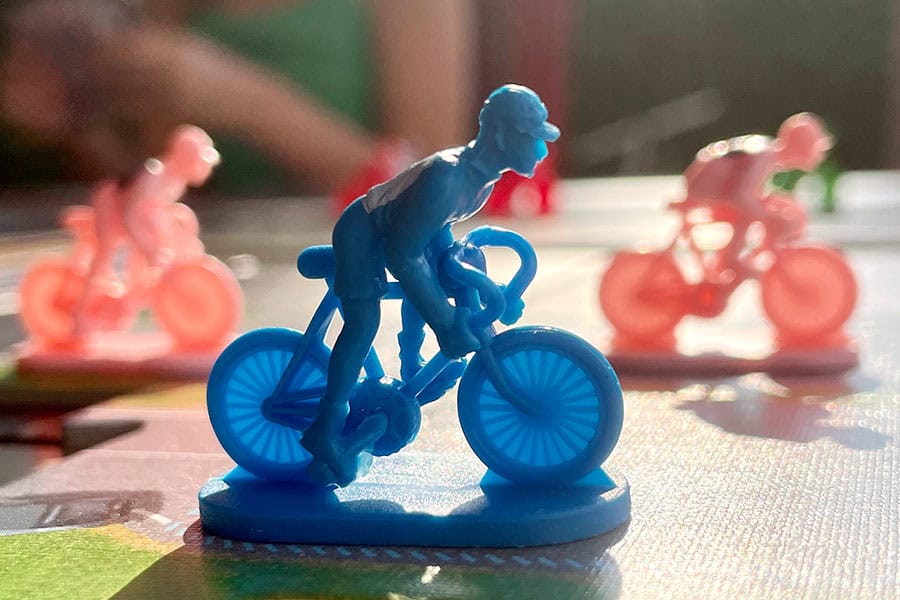
Flamme Rouge is a tactical cycling game; the basic version is suitable for two to four players and takes around 30 to 45 minutes to play. Each player controls a team of two cyclists (a rouleur and a sprinter), directs their movements using cards from their hand, and tries to get one of their cyclists to cross the finish line first.
Set-up: At the start of the game, the race track is assembled in a modular fashion from various track tiles, which include straight and curved sections. A selection of pre-designed track types is available on small cards. Each player receives two decks of cards with numerical values between three and nine: one deck for the Rouleur and one for the Sprinteur. The cyclists are placed in their starting positions.
Energy phase: In this phase, each player simultaneously draws four cards from both decks (Rouleur and Sprinter). One of these cards is selected and played face down; the remaining cards are returned to the bottom of the deck. The card played determines how many spaces the rider moves forward on the track.
Movement phase: Once all players have selected their cards, the riders are moved according to the numerical values on the cards. The rider in the lead is always moved first. The played cards are then removed from the game!
Drafting phase: If a rider comes to a stop two spaces behind another rider, they benefit from the slipstream and can move an extra space. This introduces a strategic element to the game, where the aim is to find the right position on the track.
Exhaustion phase: After the movement phase, exhaustion cards are dealt to all riders who are ‘in the wind’, i.e. who have no other riders directly in front of them. These cards have low numerical values and represent the riders’ exhaustion. They are shuffled into the relevant riders’ decks, which limits their future movement options.
In Flamme Rouge, alongside the flat sections of the course, there are also mountain stages that introduce additional challenges and strategic elements. These sections are marked by special tiles and affect the riders’ movement as follows:
Climbs: On climb tiles, the riders’ movement is restricted. Regardless of the card value played, riders can move a maximum of 5 spaces on climb tiles. This simulates the difficulty of a steep climb and forces players to plan their moves carefully and pace themselves well. Furthermore, it is not permitted to enter such a mountain too quickly (card value >5).
Descents: On descent tiles, riders have the opportunity to move faster. A minimum of 5 spaces applies here, even if the card played has a lower value. This means that riders automatically travel at least 5 spaces on descent sections, which increases the game’s dynamism and creates exciting moments.
Flamme Rouge stands out for its elegant simplicity and the ease with which the rules can be learnt. Despite its simple mechanics, even the basic version of the game offers a deep tactical challenge, requiring players to conserve their energy, make use of slipstreams and find the right moment to sprint for the finish line. This blend of strategy and luck, combined with the atmosphere of a cycle race, makes Flamme Rouge an ideal game for fans of the Tour de France and board game enthusiasts alike. It is never a pure strategy game, as chance influences the values of the cards drawn.
Flamme Rouge – in five pics (German):
„Peloton“ Expansion
Cobblestones, additional players, AI duos (so-called dummy teams) and a solo mode: just listing the core elements included in the first expansion for Flamme Rouge is enough to set cycling fans’ hearts racing. In “Peleton”, you’ll tackle narrow cobbled sections, catch your breath in the wider supply zones and, thanks to the pink and white team, can line up at the start with up to six players. Best of all: these new teams can also be used as dummy teams for solo play or for an enhanced two-player experience.
What are dummy teams? Peloton introduces two types of dummy teams that can be added to fill out the game when there are fewer than the maximum number of players.
The Peloton team consists of two riders of the same colour and uses only the Rouleur card deck, to which two ‘Attack!’ cards are added. It always starts before the human players in the yellow starting zone, with the riders placed as far forward as possible. During the movement phase, after the human players, a card is revealed for the Peloton Team, and both riders are moved according to the card drawn. If an ‘Attack!’ card is drawn, the front rider moves two spaces and the rear rider moves nine spaces. The Peloton Team does not draw Exhaustion cards.
Muscle Team: Multiple Muscle Teams can be added, consisting of two riders of one colour and the two corresponding card decks, to each of which a ‘Muscle!’ card is added. They also start before the human players in the yellow starting zone, with the sprinter placed in front of the rouleur.
During the movement phase, a card is drawn for each rider in a Muscle Team and the riders are moved accordingly. Muscle Teams do not draw Exhaustion cards.
Would you like to play Flamme Rouge on your own? No problem: in the solo version, we recommend adding one Peloton team and one Muscle team. You can add extra Muscle teams if you wish to increase the difficulty. In the two-player variant, a Peloton team is added first. If this works well, further Muscle teams can be added, with each human player managing a dummy team to keep the pace of the game high.
„Meteo“ Expansion
Meteo is the second expansion for Flamme Rouge and adds special weather conditions to the game, including rainstorms and varying wind directions. To determine which sections are affected by the weather, you first place a weather token at random on each of the straight track tiles. You then position the 3D cardboard stands along the track to indicate the wind direction or precipitation.
There is an additional rule for every weather condition: for example, when riding into a headwind, you may only draw three cards from the draw pile instead of four, as long as your cyclist is on that section of the track. Or you must be careful not to crash on a rain-slicked road. This happens whenever your move ends on a space where another cyclist is already standing. “Meteo” is a relatively small expansion, but by introducing the influence of the weather, it adds a game element that was previously missing from Flamme Rouge.
„Grand Tour“ Expansion
The Grand Tour expansion adds a comprehensive campaign mode to Flamme Rouge. Players now have the option not only to compete in individual races, but also to complete entire tours consisting of multiple stages. A tour can consist of just a few stages – such as a short 3-stage tour – or a full Grand Tour with up to 21 stages.
Campaign
In Campaign Mode, riders’ results are aggregated across multiple stages. After each stage, riders are awarded times based on their finishing position and any time bonuses. These times are added together to form an overall general classification. The aim is to achieve the lowest total time by the end of the entire tour. Special rules ensure that fatigue cards carry over from stage to stage, meaning the riders’ condition changes noticeably over the course of the tour. This adds a new strategic dimension to resource management across multiple races. A very clever solution!
New route tiles and special stages
Grand Tour also introduces new double-sided route tiles, including roundabouts and tight bends. There are also special stage variants, such as a time trial. In these, riders start one by one at fixed intervals and race against the clock.
Specialist Riders
Specialist riders are also being introduced. Players can now equip their teams with customised decks. There are various specialisations to choose from, such as climbers or sprinters, which influence how the riders perform on the course. Each specialist receives a slightly modified energy card deck that reflects their strengths and weaknesses. These specialists add more variety and allow strategies to be tailored even more precisely to specific stage profiles.
Conclusion on the Grand Tour expansion
The Grand Tour expansion adds a new depth to Flamme Rouge and offers long-term appeal that unfolds over many games. With the ability to play campaigns, deploy new specialists and tackle varied stages, it authentically captures the feel of a real-life tour. For both experienced Flamme Rouge players and newcomers, Grand Tour offers plenty of new ways to experience the game time and time again.
Flamme Rouge: Conclusion
Flamme Rouge is an outstanding board game that impresses with its thematic depth, ease of learning and strategic variety. It is suitable for both experienced board gamers and newcomers, offering an exciting simulation of cycle racing. The lovingly designed retro graphics and short playing times make it an ideal game for social evenings. The balance between chance and strategy ensures that every game plays out differently and remains captivating time and time again. Flamme Rouge is therefore a must-have for every board game fan and a perfect game for bringing the excitement of cycling to the gaming table.
The basic rules are quickly explained: draw four cards, choose one and place it face down, then repeat with the other pile. It is also easy for beginners and those with little experience of complex board games to get started. The intuitive mechanics, such as using the slipstream or avoiding exhaustion, are easy to grasp yet offer strategic depth. After all, if you use up all your high-value cards too quickly (and have to remove them from the game), you might run out of steam right at the finish line. The clever player coordinates the movements of their two riders so that they frequently provide each other with slipstream, thereby advancing a few extra spaces as a bonus.
Asger Granerud, who years later released another excellent racing game in the form of “Heat – Pedal to the Metal”, captures the dynamics of a cycle race realistically. The scenarios range from breakaway riders who are overtaken by exhaustion just before the finish line, to riders who miss the right moment for the final sprint or get left behind in the mountains. Cobblestones and rain add extra excitement and challenges, much like in real-life cycling. To access all features, you’ll need all the expansions alongside the base game, which is highly recommended.
Energy Cards
It also appeals to people who rarely play
Flamme Rouge has the potential to get even those who normally show little interest in board games excited about the hobby. The game features familiar elements such as moving pieces along a track and a finish line, which makes it more accessible. The rules are simple enough not to overwhelm older relatives or casual players. Flamme Rouge skilfully balances chance and strategy. Whilst chance plays a role through the drawing of movement cards, experienced players can still often win through clever decisions and by reading their opponents. This provides a good mix of predictable and unpredictable elements, keeping the game exciting and entertaining. Even when you lose, it feels fair, as you can see your own decisions as the cause. This feels far more realistic than simply rolling six-sided dice to move forward on the board.
Over the years, Flamme Rouge has built up a growing fanbase, particularly on Board Game Geek, where fans contribute a wealth of content in the form of tactical tips, racing strategies and suggested routes for circuit races. Inexplicably, the board game didn’t even make it onto the shortlist for the 2016/17 Game of the Year award. If there were awards for cult games, Flamme Rouge would have won countless accolades by now.
Flamme Rouge – A quick view
Flamme Rouge is an accessible board game, with elegant mechanics that capture the essence of a real-life cycle race. Thanks to the expansions, solo players and larger groups alike can get in on the action, drafting behind others or making breakaway attempts. Great fun, every time!
Designer: Asger Harding Granerud | Lautapelit, Pegasus | 2016 | 2 – 4 Players in the base game, 1 to 6 Players with expansions | from 10 Years | 30 – 45 Minutes
Hinweis: Wertungen vergeben wir im Bereich 0 bis 4 Sternen. Spiele mit 0-1,5 Sternen sind sind schlecht, mit 2 bis 2,5 Sternen durchschnittlich. Ab 3 Sternen beginnen die empfehlenswerten Spiele. Nur außergewöhnliche Titel erhalten 4 Sterne („Four-Star Game“).
If you enjoy playing Flamme Rouge (solo), especially with the Grand Tour expansion, you have likely come across the Specialist Bots variant published on BoardGameGeek by Fredrik Stahre. Fredrik designed a system to make the automated riders use all the new specialist powers. However, playing this solo variant requires printing and cutting out a large number of cards. It takes up significant table space and adds a layer of administrative overhead that can distract from the actual race.
To solve this, I developed a web-based companion app*. It digitally simulates the drawing and playing of Energy Cards for the Specialist Bots, allowing you to compete against up to five automated teams without the clutter of physical card decks.
My approach to building this app was highly pragmatic: I wanted to eliminate the deck management while keeping the tactile joy of the board game intact. I designed the application strictly as a client-side tool using HTML, CSS, and native JavaScript. The app runs entirely in your browser. It performs no server-side calculations and requires no database. Instead, it saves your ongoing stage or tour directly to your browser’s local storage. This lightweight architecture guarantees fast performance, respects your privacy, and keeps the technical footprint incredibly small.
Screenshots: Specialist Bots App
Screenshot Homepage
Screenshot Energy Card
Screenshot Exhaustion
Over several development iterations, I refined the features to support the nuanced solo rules. I added a dedicated Breakaway Phase logic for the first round of a race, an optional extended stage and integrated manual reshuffling options. Finally, I added three difficulty levels (Easy, Medium, Hard) to properly scale the challenge, carefully tweaking the bots‘ abilities to ensure they push you to your limits throughout the entire stage.
The app takes over the complete card management for all available specialist types. Before you hit the starting line, you set up your race:
Choose between a Single Race or a Grand Tour.
Draft up to five bot teams, assigning exactly one Rouleur and one Sprinteur to each.
Assign team colors to match your plastic cyclists.
Once the race begins, the app handles the heavy lifting. It simulates the draw decks, manages the discard and recycle piles, and automatically shuffles in Exhaustion Cards when necessary. If you ride a Grand Tour, the app calculates the carry-over at the end of a stage and keeps exactly half of each bot’s Exhaustion Cards for the next race.
How to Use the App at the Table
This digital tool does not replace the physical board game. You still build the track, place your riders, and move the plastic figures by hand. The app strictly replaces the paper decks of your automated opponents.
During a round, you simply call up the active bot riders in turn order on your screen and draw their virtual cards. You use the solo rules‘ color logic (green, yellow, red) to determine if the bot moves immediately or draws a second card to weigh its options. Once you resolve the movement on the physical board, you click „Done“ in the app. The system automatically sorts the used and unused cards into the correct virtual piles.
This hybrid approach keeps your focus exactly where it belongs: on the race track and your own tactical decisions, rather than on shuffling tiny stacks of paper.
Enhance the Code: The code for this app is licensed under Creative Commons and is available on GitHub. Feel free to adopt or contribute suggestions to this project.
This is an unofficial, fan-made web app intended strictly for private, non-commercial use. I am not commercially associated with the game’s author or publisher. All credits for the Flamme Rouge board game belong to designer Asger Aleksandrov Granerud and publisher Lautapelit.
Credits & Disclaimer
This web app is based on a fan-made solo version published on BoardGameGeek by Fredrik Stahre. Fredrik’s aim was to make the Flamme Rouge Bots use all the new rules included in the Grand Tour expansion (specialist powers).
* developed with the assistance of AI to help streamline the coding and bring the project to life.
In May 2026, I completed an eleven-stage Grand Tour in Flamme Rouge to evaluate the new Specialist Riders across diverse terrains and to run a live trial of my custom-built companion app. I wanted to observe exactly how asymmetric rider abilities alter the peloton’s dynamics and test whether the software effectively streamlines the race management.
I played as the white Visma-Lease a Bike team (Jonas Vingegaard and Wout van Aert), competing against a full peloton of five bot teams.
Here is my full review, including the match breakdown, the race results, an analysis and my observations.
Tune in to experience the thrilling duel of my Flamme Rouge Grand Tour in a completely new and immersive audio format! Two AI voices conversing and analyzing the action as if they were live commentators right at the race!
Stage Results
Stage 1
Stage 1 Results (Team Time Trial) + General Classification:
Stage 2
Stage 2 Results:
General Classification after stage 2:
Stage 3
Stage 3 Results:
General Classification after stage 3:
Stage 4
Stage 4 Results:
General Classification after stage 4:
Stage 5
Stage 5 Results:
General Classification after stage 5:
Stage 6
Stage 6 Results:
General Classification after stage 6:
Stage 7
Stage 7 Results:
General Classification after stage 7:
Stage 8
Stage 8 Results:
General Classification after stage 8:
Stage 9
Stage 9 Results:
General Classification after stage 9:
Stage 10
Stage 10 Results:
General Classification after stage 10:
Stage 11
Stage 11 Results:
General Classification after stage 11:
Tracking the Specialists: Stage-by-Stage Performance
Analysis: What I learned
What a blast! At the heart of the Grand Tour I played was a phenomenal duel between two giants from my dominant Visma | Lease a Bike team. We witnessed an epic battle between the climbing specialist (Grimpeur) Jonas Vingegaard and the incredibly versatile powerhouse (Polyvalent) Wout van Aert. The Yellow Jersey changed hands multiple times throughout the race. From van Aert’s early dominance to John Degenkolb’s surprise two-stage stint in the overall lead as a classic Flandrien, the tension never dropped.
But it all came down to a nail-biting finale on the final mountain stage! In a spectacular display of endurance, Vingegaard snatched the ultimate victory, securing the Yellow Jersey by a mind-blowing margin of just 2 seconds!
The fierce competition extended to the other classifications as well. Van Aert rewarded his consistent brilliance by taking home the Green Jersey with 10 sprint points, while the explosive Puncheur Julian Alaphilippe conquered the grueling climbs to claim the Polka Dot Jersey with 13 mountain points.
Whether you’re a die-hard cycling fan or a newcomer to the peloton, this Grand Tour was a perfect showcase of strategy, grit, and the incredible dynamic between Sprinteurs and Rouleurs.
Bots tend to dominate the stage beginning
Let’s take a look of how the bot teams performed!
If you have raced against bots over a multi-stage tour, you might have noticed a specific pattern: they tend to absolutely dominate the first half of a stage, only to completely bonk and fall apart in the finale.
After running 11 stages of a Grand Tour with an early version of the app, I dug into the math behind the decks to figure out why this happens. The core issue lies in how the red an yellow movement points—the triggers that let a bot draw a second card—are distributed. In the original design, these colors are often attached to the highest value cards. Early in the race, when the deck is perfectly clean, the bots will constantly hit these triggers. They draw two cards, filter out the weaker ones, and burn through their top speeds immediately. But once the mid-game hits and their draw piles get clogged up with Exhaustion cards, all those valuable suffixes are sitting in the discard pile. The bots have no lifeline left to skip a bad draw, leading to a massive drop in performance just when the sprint to the finish line starts.
To fix this for the new Medium and Hard difficulty levels of my app, I didn’t just blindly inflate the numbers. Instead, I re-engineered the trigger system. I stripped the red and yellow values from the absolute peak cards and strategically moved them to the mid-tier values (like the 5s and 6s).
I think this changes the pacing. In the first half of the race, the bots now play their top speeds straight up without filtering their deck too fast. The start is slightly more controlled. But in the crucial final stretches, when their decks are heavily diluted with Exhaustion, drawing a mid-tier card now triggers a second draw. This gives the bots a much higher chance to bypass an Exhaustion card right when it matters most, keeping them consistently competitive until the very end.
More realistic bot movements
I also realized that simply adding a flat +1 movement to every card to create a „Hard“ mode breaks the game. If a bot gets more than a dozen extra movement points per deck cycle, no human player managing standard cards and slipstreams can catch them over a 70-square stage.
Because of this, the Easy level remains Fredrik Stahre’s balanced original baseline. For Medium and Hard, the base speeds of the bots remain grounded so the peloton doesn’t instantly shatter. The difficulty scales entirely through targeted tactical spikes. The bots get significantly higher peaks on their specific terrain—like a Super Sprinteur hitting a massive 13 on the final straight, or a Grimpeur surviving a steeper Uphill limit—making them incredibly dangerous exactly where their real-world counterparts would attack.
Ist die Jury „Spiel des Jahres” wirklich so unabhängig, wie sie behauptet? Wir haben beim Vorsitzenden Harald Schrapers nachgefragt. Im Interview spricht er über Lizenzeinnahmen, Werbeveranstaltungen und einen Streit innerhalb der Jury. Das Interview ist eine Ergänzung eines etwa eineinhalbstündigen Interviews mit Harald Schrapers. Das komplette Gespräch könnt ihr im Podcast Boardcast von Frederik Malsy nachhören. Das Interview mit Tom Werneck, auf das wir uns beziehen, findet ihr unter Tom Werneck: „Schaue mit Neugier auf die Arbeit der Jury, nicht mit Groll“. Unabhängigkeit der Jury In seinem Buch „Das moderne Brettspiel“ schreibt Tom Werneck, es sei fragwürdig, ob die Jury
Landschaften auslegen und Erträge ernten, das kennen und mögen wir wohl alle sehr. Und wenn Uwe Rosenberg, von dem einige wirklich ganz tolle Spiele stammen, sich der Sache annimmt, wird…
Ein kalter Wind zieht durch die Bäume, während ihr euch in den finsteren Wald wagt. Der schmale Pfad unter euren Füßen ist alles, was euch von der Dunkelheit trennt. Jeder Schritt daneben … könnte euer letzter sein.
Ihr wisst: Verliert ihr den Weg, müsst ihr ihn verzweifelt wiederfinden. Denn je weiter ihr euch entfernt, desto näher kommt das Unaussprechliche … und eure Furcht wächst mit jedem Herzschlag.
Doch stehen zu bleiben ist keine Rettung.
Denn hinter euch … wartet nur die verlassene Ruine. Still. Kalt. Und ganz sicher nicht leer.
Nein, das ist nicht das Setting zu einem weiteren Teil von Terrorscape oder Ähnlichem, sondern zum Stichspiel „Furchtlos“ von Friedemann Friese, erschienen bei 2F und illustriert von Maren Rache. 3 bis 5 Spieler ab 10 Jahren können mitspielen, und es dauert ca. 30 Minuten.
Im Grunde ist „Furchtlos“ ein recht simples Stichspiel mit vier Farben ohne Trumpf. Allerdings befinden sich in der Schachtel auch Karten, die einen Weg bilden, sowie Holzfiguren, die sich auf diesem bewegen. Auch die Werte der Karten sind anders als üblich, denn sie reichen von minus sechs bis plus sechs.
Gespielt wird ein normales Stichspiel; das heißt, die erste Farbe muss bedient werden, und derjenige mit dem höchsten Wert erhält den Stich. Danach muss er allerdings die Werte aller Karten in diesem Stich zusammenrechnen und entsprechend viele Felder in eine Richtung gehen – links für Minus, rechts für Plus.
Nach Ausspielen aller Karten endet die Runde, und jeder Spieler notiert den Wert seines Platzes. Dabei ist es egal, ob Plus oder Minus; es wird nur der Zahlenwert notiert. Beachtet auch, dass es nichts bringt, keinen Stich zu gewinnen, denn wer das Haus nicht verlässt, erhält ebenfalls 15 Punkte. Das Schlimmste, was passieren kann, sind übrigens 30 je Seite.
Das Spiel dauert so lange, bis jeder Spieler einmal die Runde begonnen hat. Wer dann die wenigsten Punkte gesammelt hat und somit am ehesten auf dem Pfad geblieben ist, war der Furchtloseste und gewinnt das Spiel.
„Furchtlos“ ist ein einsteigerfreundliches Stichspiel mit einem Kniff, keine Frage. Aber gerade in Runden zu dritt kann mich das Spiel nicht vollends überzeugen. Zu einfach ist es, jedes Mal jemandem viele Punkte reinzudrücken, wodurch es schnell weniger spannend wird. In Runden zu viert, fünft oder sechst ist das dann schon anders: Da kommt Spannung auf, und die Runden sind abwechslungsreicher im Ausgang. Dann funktioniert das Spiel auch gut, gerade als Absacker.
„Fischen“ im letzten Jahr ist dennoch das bessere Stichspiel von Friedemann Friese. „Furchtlos“ dagegen ist okay, aber mehr eben auch nicht – schade eigentlich, denn thematisch hätte ich es anders herum lieber gesehen.
Das kooperative Titan Zero zelebriert mit wenig Aufwand intensivste Momente und erinnert damit an bekannte Größen wie King of Tokio. Ich gehe so weit und behaupte, dass Titan Zero ein King-of-Boss-Battler ist. Mitnichten ist damit gemeint, dass der Boss-Klopper der König des Genres ist, auch wenn sich der Titel sicher nicht verstecken muss, sondern,...
TEST. Im Nordwesten der USA liegt Kaskadien. Prächtige Natur, die ganz augenscheinlich immer mehr Spieleautoren inspiriert. Bei Piatnik ist eines dieser Spiele erschienen. Mehr über das prächtig ausgestattete Waldland im Spielwiese-Test.

 Anmelden