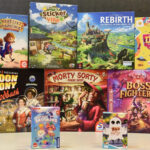
Board game crowdfunding major Awaken Realms has made its first acquisition of another publisher by acquiring Darwin’s Journey maker Thundergryph Games.
Thundergryph will operate under its own brand following the deal, with company founder Gonzalo Aguirre Bisi continuing to lead its creative direction in his new role of game director at Awaken Realms.
The publishers said the tie-up will allow Thundergryph to focus exclusively on game design and development, with Awaken Realms taking on responsibility for operational necessities such as logistics, manufacturing, fulfillment and worldwide distribution.
The move broadens Awaken Realms’ publishing portfolio beyond the large-scale, narrative-driven and miniature-heavy titles for which it is best known, such as the hugely lucrative Nemesis series, Tainted Grail and ISS Vanguard.
Acquiring Thundergryph adds a catalogue which includes eurogames such as the highly regarded Darwin’s Journey, Tang Garden and Etherstone – and indicates an appetite from Awaken Realms to expand out into different styles of game.
Awaken Realms founder and CEO Marcin Świerkot said, “We were really impressed by the Thundergryph portfolio and how they managed to create very interesting and beautiful games over and over again.
Awaken Realms CEO Marcin Świerkot
“Because they are so different from what we usually do at AR (with all our dark and gritty taste), we believe it is a perfect fit to make our portfolio broader.”
Awaken Realms would not confirm to BoardGameWire if the acquisition represented the first of multiple M&A deals in the pipeline, but did say it sees value in “building a broader publishing ecosystem, but only if it respects each brand’s identity”.
A spokesperson for Awaken Realms told BoardGameWire, “Right now, our focus is fully on making this partnership successful and supporting the Thundergryph Team in the best possible way.
“More broadly, we are always open to opportunities that make strategic and creative sense, especially where we can help talented teams focus more on making great games while Awaken Realms supports them with production, logistics, fulfillment, and global infrastructure.
“Thundergryph is a particularly strong fit because its portfolio is different from what Awaken Realms is best known for. Their light and medium-weight games, strong visual identity, and elegant production values complement our existing line-up very well.”
He added, “In general, Awaken Realms is interested in areas that can strengthen our ability to create, produce, and deliver great games to players around the world. That can include publishing, operational infrastructure or other strategic areas.”
Discussions for the Thundergryph acquisition began more than a year ago, company founder Bisi told BoardGameWire, adding that such an arrangement was something he had been thinking about for some time.
Thundergryph founder Gonzalo Aguirre Bisi
He said, “Years ago, I had much more time to focus on game development, art direction, and product creation. As Thundergryph grew from a small publisher into a medium-sized company, the amount of organization and administration required increased significantly.
“I realized that I wanted to return to the aspects of the job I enjoy most: creating games and helping bring them to life.”
Awaken Realms says its infrastructure has delivered more than 700,000 games worldwide to date, and believes that support will allow Thundergryph to scale without adding further management burden to its creative team.
The company also retains close ties with crowdfunding platform Gamefound, which began life as part of Awaken Realms before becoming a separate entity with Ravensburger as its majority shareholder. Marcin Świerkot, the co-founder of both Awaken Realms and Gamefound, remains CEO of both businesses.
Bisi added that Thundergryph’s future if it hadn’t agreed the takeover deal would have been one “with fewer games and less time dedicated to nurturing and developing them to the standard we aspire to achieve”.
He said, “The people designing the games, developing the gameplay, creating the visual identity, and interacting with the community are still here. Our creative vision, our passion, and our commitment to making unique games remain unchanged.
“This agreement gives us the opportunity to dream bigger while staying true to what made Thundergryph special in the first place.
“It allows us to combine Thundergryph’s creative strengths with the resources and infrastructure needed to bring even more ambitious projects to life.”
Those projects will begin with Galileo’s Truth, a game by designers Virginio Gigli and Flaminia Brasini, which is set to launch on Gamefound on July 7.
Canadian board game publisher Off the Page Games is expanding beyond its comic book roots with the launch of a new imprint focused on original IP.
The company, which has built its reputation adapting indie comics into tabletop games such as Mind MGMT, has unveiled Off the Page Games Unbound, which will publish games not tied to existing comic book licences.
In a reversal of Off the Page’s previous strategy, the company said it had hired award-nominated comic book creator Chris Schweizer and illustrator Rocio Ogñenovich for Unbound to create a series of comics based on The Seekers.
The Seekers, published by Off the Page Games Unbound
Schweizer previously collaborated with the publisher to turn his graphic novel series The Creeps into a family-weight board game, which is due for release this autumn.
The Seekers webcomic will be released weekly leading up to the crowdfunding campaign for the board game, with physical copies included with the final product.
Cormier said, “I’m excited to continue converting my favourite comics into cool board games, but I’m also pumped to bring some other surprises that aren’t tied (…or bound!) to any specific comic.”
Cormier launched Off the Page in 2019 by publishing Mind MGMT, based on the Dark Horse comic book series created by Matt Kindt.
The publishers subsequent titles have included Harrow County and Corps of Discovery, while Cormier’s designs with other publishers include Junk Art, co-created by Sen-Foong Lim, and In the Hall of the Mountain King, which was designed alongside Graeme Jahns.
Award-winning board game store owner Matthew Mičetić says independent tabletop retailers can no longer rely on product sales alone, as rising costs, tariff uncertainty and changing consumer behaviour continue to reshape the hobby retail landscape.
Mičetić was named Oregon Small Business Person of the Year last week by the US Small Business Administration, celebrating the 16-year growth of Portland-based Red Castle Games from a small neighbourhood game store into a vibrant space offering organised play, youth camps, community events and an on-site cafe.
He told BoardGameWire the complexity of running a game store had increased dramatically since the store opened in 2010 – but added that widening the venue’s scope had been a key ingredient in Red Castle’s success.
Mičetić said, “Competing solely on product selection and price has become increasingly difficult in a world where customers can order almost anything online and have it delivered to their door.
“What independent game stores can offer that online retailers cannot is community. We can provide places for people to learn, play, compete, socialize, and build friendships. The retail sales often follow from those relationships.”
He continued, “We aren’t just retailers anymore. We’re event organizers, community managers, educators, food service operators, e-commerce businesses, and increasingly technology companies as well.
“The encouraging part is that the core mission hasn’t changed. People still want places to gather, play games, make friends, and feel like they belong.
“The stores that continue to succeed are the ones that adapt to the changing business environment while never losing sight of the community they’re there to serve.”
Mičetić’s drive has seen that community expand from traditional hobby gamers and TCG players to include young people, families and more casual gamers keen to dip their toes into the hobby – something he believes is one of the biggest opportunities for game stores today.
He said, “Some of our most successful recent initiatives have been our youth programs, including Dungeons & Dragons, Magic: The Gathering, and Pokémon camps and after-school programs.
“Parents are looking for opportunities that help kids build friendships, creativity, problem-solving skills, social-emotional skills, and confidence. Tabletop games are uniquely positioned to provide that.
“We’ve also had success reaching beyond the traditional hobby audience. There are a lot of people who can benefit from what tabletop gaming offers who may never have considered walking into a game store.
“That means being willing to experiment, try new things, and sometimes fail. Not every idea works, and that’s okay. The important thing is to learn from it, make adjustments, and keep moving forward.
“I’ve always believed in looking for 1% improvements. Small improvements compound over time. If you can make your store, your programs, your customer experience, and your operations just a little bit better every day, those gains add up to something significant over the course of years.”
He added, “While retail is still the foundation of the business, these complementary activities have become increasingly important both financially and strategically. They reinforce one another.
“Someone might discover us through a D&D camp, become a regular event participant, buy games and accessories, meet friends through the community, and eventually become a long-term customer.
“The café, events, camps, and retail operation all work together to create a stronger overall ecosystem. For independent game stores, I think that’s one of the biggest lessons of the last decade. The future isn’t just about selling products, it’s about creating reasons for people to keep coming back.”
Organised play remains a “core pillar” of the store’s financial prosperity, Mičetić told BoardGameWire, while Magic remains its strongest offering and continues to be a cornerstone of organised play.
Mičetić receiving his Oregon Small Business Person of the Year award
He added, “One Piece has been one of the biggest success stories of the last several years, drawing strong participation. Star Wars Unlimited has also developed a passionate local community and has exceeded our expectations.
“Beyond TCGs, Dungeons & Dragons continues to be a major driver of participation through campaigns, youth programs, and camps. Board game events, painting nights, and miniature gaming also contribute meaningfully to overall attendance, even if they don’t always attract the same numbers as the largest TCG communities.
“What excites me most isn’t any individual game. It’s the diversity of the community. I believe the healthiest stores aren’t dependent on a single title. They’re places where someone can come in for Pokémon, discover D&D, try a board game, join a painting event, and ultimately find multiple ways to engage with the hobby.”
Speaking about current growth areas on the retail side – and areas which could be in decline – Mičetić told BoardGameWire TCGs continue to be the strongest growth category in the hobby, while oversaturation in higher-price point board games was beginning to show strain.
He said, “Magic remains a powerhouse, Pokémon continues to bring in new players, and we’ve seen strong engagement from newer games [such as One Piece and Warlord] as well.
“That said, I do worry that we’re in a boom cycle. I don’t know when it will happen, but historically every collectible market experiences corrections and I think it’s wise for retailers to plan accordingly.
“In board games, I think we’re seeing softness at the higher end of the market. For years, the industry benefited from an explosion of new releases and crowdfunding projects, but I also think the market became oversaturated.
“Self-publishing and crowdfunding lowered barriers to entry, which brought some fantastic games to market, but also a tremendous number of mediocre ones. Consumers have more choices than ever and less time to play them.
“Where I’ve seen the most consistent strength is in smaller board and card games, particularly titles under about $25. At that price point, they’re an easy impulse purchase and a lower-risk way for customers to try something new.
“RPGs are interesting. Product sales have slowed somewhat for us, but organized play and events remain strong. People still want to gather around a table and tell stories together, even if they’re buying fewer books than they once did.
“Miniatures remain a challenging category outside of Games Workshop. Many lines have passionate fan bases, but Games Workshop continues to outperform expectations and demonstrates the power of consistent support, organized play, and strong intellectual property.
“As for crowdfunding, we’ve largely stepped away from it as a retailer. There are certainly successful projects, but we’ve experienced too many delays, failures, and fulfillment issues over the years.
“Tying up cash and shelf space for products that may arrive years late, or not at all, has become increasingly difficult to justify.”
Mičetić said that on the distribution side, relationships had become both more important and more complicated since 2020, with the pandemic having exposed just how dependent the industry is on supply chains and allocation systems.
Mičetić said distribution relationships had become more complicated since the pandemic – and more important
He said, “In many categories, especially TCGs, we spent years dealing with product shortages, allocations, delayed releases, and uncertain restocks. More recently, while still dealing with those allocation issues, we’ve added questions around tariffs, pricing, inventory levels, and market demand.
“The underlying challenge remains the same, uncertainty. At the same time, retailers are being asked to make increasingly complex purchasing decisions with limited capital and shelf space.
“When talking with distributors today, my primary focus is predictability and partnership. I don’t expect every product to be available in unlimited quantities, but I do want transparency around allocations, release schedules, and restock expectations.
“The better information we have, the better decisions we can make. I also spend a lot of time discussing breadth versus depth. Every distributor wants retailers to carry more products, but shelf space, cash flow, and staff attention are finite resources.
“We’re increasingly focused on products that have strong community support, organized play opportunities, or demonstrated demand rather than simply chasing every new release.”
Mičetić’s award recognition follows a turbulent series of challenges in recent years, ranging from navigating the Covid-19 pandemic to enduring ten break-ins over a twenty-month period – a spate of crimes which resulted in more than $250,000 in losses and property damage.
He told BoardGameWire that while the experience was “frustrating and demoralizing”, he was “not willing to let a handful of criminals determine [Red Castle’s] future” – adding that the show of support from customers following the break-ins had helped reinforce why the store exists in the first place.
Mičetić said, “The primary targets were trading card games, particularly sealed Pokémon and Magic products, along with Games Workshop product. Unfortunately, those products are small, portable, and have a well-established secondary market, which makes them attractive targets for theft.
“The financial losses were significant but the larger challenge was the operational and emotional toll. Every break-in meant dealing with police reports, emergency repairs, damaged property, disrupted operations, and the uncertainty of whether it would happen again.
“There were periods when it felt like we were spending almost as much time thinking about security as we were thinking about growing the business.”
He advised other hobby retailers to “invest in security before you need it”, adding that the experience had changed his own understanding of risk.
Mičetić said, “Small businesses often operate on relatively thin margins and repeated criminal activity can have an outsized impact.
“It’s a reminder that when people talk about crime affecting businesses, they’re not just talking about stolen merchandise, they’re talking about the time, money, stress, and opportunity cost that comes with recovering from it over and over again.”
Speaking of his SBA award win, which recognises business owners who demonstrate outstanding business growth, innovation, resilience, and contributions to their communities, Mičetić said, “This recognition is incredibly meaningful because it reflects the community that built Red Castle Games.
“Every customer, staff member, volunteer, and supporter has played a role in our success. This award belongs to all of them.”
Asmodee’s recently-launched party games studio Moodbox Games has unveiled its first four releases, with Guess the Mess, Link Out Loud, Photo Dump and Who Says? Friends set to hit retail shelves in July.
The announcement marks the first product reveal from the women-led studio, which Asmodee launched last October as part of a push to reach players beyond traditional hobby gamers.
Moodbox says its games are designed around a philosophy that “playing games should feel like a dose of serotonin”, with a focus on approachable rules, social interaction and creating memorable shared experiences for families and friend groups.
Moodbox head Kelli Schmitz said, “The goal with Moodbox Games is to create experiences that instantly bring energy, laughter, and connection to the table.
“This first lineup reflects the kind of social play we know people are craving right now — games that are approachable, highly interactive, and memorable whether you’re playing with family, close friends, or a large group.”
The initial range draws on a mix of established and emerging tabletop design talent, including Happy Salmon co-designer Ken Gruhl, his Mantis co-creator Jeremy Posner, Word on the Street designer Jack Degnan and first-time published designer Annika Wierichs.
Guess the Mess is a family party game for ages eight and up from Degnan and development studio Hedyverse, which challenges players to decipher deliberately chaotic clues in a race against their opponents.
Link Out Loud || Photo Credit: Asmodee
Link Out Loud, designed by Posner and Gruhl and also developed by Hedyverse, is a team-based word association and communication game in which players attempt to make connections and relay them to teammates under pressure.
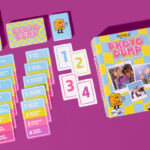
Photo Dump, designed by Wierichs and developed by Hedyverse, takes a co-op approach, using players’ own photos as clues in a storytelling-focused experience.
The fourth title, Who Says? Friends, is a quote-guessing game designed by Lloyd Mintz and developed by Bolt Games, with players aiming to identify memorable lines and pop-culture references either individually or in teams.
Moodbox highlighted that Guess the Mess, Link Out Loud and Photo Dump were developed, edited and published by teams of women, describing the process as a “collaborative and inclusive creative approach from concept to shelf”.
The studio is led by former Catan Studio director of brand development Kelli Schmitz and long-time young adult-focused book editor Shaina Olmanson, who joined Asmodee as an operations and communications manager in May last year.
Prior to leading Moodbox Schmitz spent a year working on inventor relations for Asmodee’s social games in the US market, across its family game studio Zygomatic, quiz and party games-focused Bezzerwizzer Studio, and Dotted Games, which Asmodee launched in 2024 to create new LEGO board games.
Moodbox’s development partner Hedyverse was co-launched in 2024 by Jessica Aceti – who previously helped establish Seattle-based game design collective Prospero Hall, was VP of business development, marketing and licensing at board game design studio Forrest-Pruzan Creative, and helped launch Funko Games after Funko acquired Forrest-Pruzan Creative in 2019.
It followed that a month later by picking up the rights to party game Time’s Up! from R&R Games, continuing an expansion push predicated on social games being the fastest growing category of the board games market.
Asmodee said at the time of the ATM acquisition that it expects a compound annual growth rate (CAGR) for social games of between 4% and 8% between 2025 and 2030, compared to about 4% for the wider board games market, citing mass market sales research for the US and ‘main European countries’ conducted by Arthur D Little.
Tabletop gaming’s most eclectic prize, the Diana Jones Award, has unveiled the latest clutch of finalists for its annual celebration of excellence in the field of gaming.
Price Johnson, the new CEO of Gloomhaven publisher Cephalofair, is among the five finalists for this year’s award, as are miniatures game Trench Crusade and Minnesota-based game retailer Mischief Toy Store.
TTRPG designer and journalist Rob Wieland
They are joined by Jo Kelly and Cole Wehrle’s board game Molly House, which explores the joy and fear experienced by gender-defying Londoners in 18th century society, and Rob Wieland, a much-loved TTRPG designer and journalist who died last October aged 47.
Price Johnson’s nomination comes less than two months after the long-time Cephalofair COO was promoted to CEO at the publisher – with Isaac Childres, the company founder and designer of its runaway successes Gloomhaven and Frosthaven, stepping back to focus exclusively on game design at the company.
Johnson has been a high-profile voice in campaigning against tariffs imposed by US President Donald Trump over the last year, aiming to highlight the heavy financial burden it has placed on tabletop game publishers – many of which rely on Chinese manufacturing for their titles.
The Diana Jones nominations committee praised that work, saying Johnson’s appearance on multiple national news outlets, “consistently and clearly explained how the tariffs posed an existential danger to many companies in the adventure gaming industry”.
Mischief Toy Store in the Twin Cities was also selected for its involvement in a lawsuit against the US tariffs last year, as well as its work battling activity from anti-immigration ICE agents.
The committee said that hours after criticizing ICE in a TV interview the store was targeted with a surprise audit, but resisted turning over their employee records to DHS.
It added, “They have been printing ICE OUT posters to distribute as fast as they can and have organized a network of 3D printing hobbyists to distribute thousands of ICE whistles.
“Amid the chaos in Minnesota, they had to suspend online ordering, and their website directed folks to support local immigrant rights organizations instead. They work hard to make space at the gaming table for everyone.”
Trench Crusade, which focuses on an alternate 1914 in which humans have been battling the forces of hell for 800 years, was picked out by the committee as “a triumph of community and creativity”.
The Factory Fortress-published title was built around initial sketches and lore created by artist Mike Franchina, who later teamed up with sculptor James Sherriff and game designer Tuomas Pirinen to design the game.
Diana Jones’ nominations committee described Rob Wieland as “a relentless advocate and promoter for the entire tabletop gaming community for years”.
It said, “He served as a mentor to countless others, and he brought the industry to wider and greater awareness through his work with Forbes and other publications.
“In addition, he regularly hosted on-stage sessions of The Extraordinary Adventures of Baron Munchausen at conventions to raise money for charity.”
The 2026 Diana Jones Award ceremony will be held in Indianapolis on July 29 at its annual gathering of tabletop games industry professionals, marking the unofficial kick-off of Gen Con.
The original Diana Jones Award trophy, which was lost in the post several years ago
The award aims to celebrates “everything that’s the best about gaming”, with previous winners across the award’s 26-year run having included Blood Rage designer Eric Lang, Nigerian games industry publisher and evangelist NIBCARD, and the entire ‘actual play’ movement of people livestreaming and podcasting roleplaying games.
Last year’s award resulted in a tie between Daybreak, the climate change-themed board game designed by Matt Leacock and Matteo Menapace, and Rose Estes, an early TSR employee who went on to write the Endless Quest series of choose-your-own-adventure game books.
The original Diana Jones award trophy was a clear lucite pyramid containing the burned remains of an Indiana Jones roleplaying game from the 1980s – one element of which spelled ‘Diana Jones’ after the preceding letters were burned away.
That trophy was lost in the post six years ago during the traditional handover from one winner to another, never to be recovered – but a replacement trophy has now been created by the organisation.
The Diana Jones Award also runs a separate emerging designer programme prize, which aims to help up-and-coming creators via a $6,500 prize package that includes an all-expenses trip to Gen Con.
Hello readers! Mike Didymus-True here, the editor of BoardGameWire.
I wanted to post a quick message to apologise for an upcoming week or two quiet patch for the site – I’m being unexpectedly admitted for surgery tomorrow, and will likely be out of action for at least 7 to 14 days while I recover. And as BoardGameWire remains a one-person operation, which I squeeze into my spare time around my day job and my two kids, unfortunately that means a very brief hiatus for the site!
Please do continue to email me with your news and such in the mean time, and I’ll do my best to get reporting again as soon as possible! I’m on mike@boardgamewire.com
If this hiatus makes you think “Hmm, I wonder where I’ll get my board game industry news from now”, might I recommend the excellent W Eric Martin over at Board Game Beat, who sometimes has crossover with the kind of things I tend to cover here.
And if this hiatus has also made you think “Hmm, I really do find BoardGameWire and its reporting useful, that Mike really does do a pretty good job covering things that don’t get written about elsewhere – I would very much like to support that kind of thing financially” – that would be lovely! You can pledge a variety of amounts through the BoardGameWire Patreon, or by choosing a paid subscription to our regular newsletter.
The company has been one of tabletop crowdfunding’s biggest success stories over the past decade, raising tens of millions of pounds across campaigns based on major video game licences such as Resident Evil, Monster Hunter, Horizon Zero Dawn and Elden Ring.
About a third of the company’s employees are estimated to have been affected by this year’s restructure according to multiple sources who spoke to BoardGameWire on condition of anonymity – mirroring the scale of a previous round of redundancies Steamforged embarked on in 2023.
They said the staff cuts affected a range of departments across the business, including the creative, game design, production, project management, QA, marketing and commercial teams – adding that they feared the cutbacks would lead to problems delivering long-term projects.
Steamforged would not confirm the scale of the latest redundancies to BoardGameWire, but a spokesperson described the staff reduction as “carefully considered”, adding that the company “retain[s] both the internal resource and the external capabilities needed to deliver on our commitments”.
When asked for reassurance that those campaigns would be fulfilled despite the redundancies and strategic shift, a spokesperson for Steamforged told BoardGameWire, “Steamforged has never failed to fulfil a crowdfunding campaign, even during difficult times, or to make tough choices to deliver on commitments.
“Right now, 6: Siege – The Board Game is entering the final stages of production and will start shipping to supporters in July.”
Steamforged confirmed to BoardGameWire that the redundancies were part of a decision to “reduce new board game crowdfunding activity for the moment” amid the surging growth of Warmachine, the miniatures wargame line it bought from Privateer Press two years ago alongside P3 Paints and the Iron Kingdoms roleplaying series.
Warmachine miniatures || Photo credit: Steamforged Games
The spokesperson said Steamforged had tripled Warmachine and P3 Paints revenue in the last 21 months, despite facing significant stock constraints in the first year due to heavy demand.
They told BoardGameWire, “Demand has been high and we’ve scaled production to meet it. Our US production capacity for Warmachine has increased by 70% since last March, with a 25% increase in Europe since August and new production facilities introduced in the UK in February 2026.”
The spokesperson added, “Steamforged has always had two strong sides, both retail and crowdfunding, and was originally founded as a miniatures game company. Warmachine’s growth has shown clear demand over and above expectations and has become a core focus to support that growth.
“Our board game crowdfunding projects are currently in various stages of production with the vast majority of creative work complete.
“Our intention to reduce new board game crowdfunding activity for the moment while we focus on supporting Warmachine’s growth meant we needed to restructure accordingly, which included a confidential redundancy process in Q1 of 2026 that’s now complete.”
When asked how the strategic shift towards Warmachine would affect previously announced future crowdfunds such as Tyrant, the spokesperson said, “Steamforged has always looked several years into the future and our internal roadmaps reflect that.
“As with any company, particularly one that works with other studios the way we have, that means many potential projects have been put on ice over the years as opportunities change and emerge. Some of those came to fruition later, and others didn’t.
“Tyrant was an early announcement and was always intended to be a slow build. Given our strategic focus, it’s not something we intend to move forward with in the foreseeable future.”
Asked what they expected Steamforged Games to look like as a business over the next couple of years, the spokesperson concluded, “Over the next two years, we expect Warmachine will continue its strong growth supported by our dedicated team and launch plans in the miniatures and hobby categories.”
The Diana Jones Award committee has picked a trio of TTRPG creators as the latest winners of its emerging designer program, who will each receive a $6,500 prize package that includes an all-expenses trip to Gen Con.
Glaiza Champion
Glaiza Champion, J Strautman and Kodi Gonzaga will also receive one-year memberships to trade bodies GAMA and the Tabletop Game Designers Association through the award, as well as prizes including prototyping credit at The Game Crafter, an online badge to Protospiel and a game demo spot on Gen Con TV.
The emerging designer program, now in its sixth year, seeks to amplify the voices of up-and-coming tabletop creators, with a particular focus on designers from marginalized communities.
Filipino-American designer Glaiza Champion describes themself as a ‘third-culture’ kid whose experiences span Brunei, Cambodia, the Philippines and Korea.
Champion is a game designer, writer, performer, podcaster and variety streamer, whose work is rooted in tabletop roleplaying games and storytelling – with designs to date including Beef, Missing Month and Meet Your GelCub.
J Strautman
Toronto-based RPG designer J Strautman, who also works under the name Yes No Goodbye, combines game design with a career as a professional musician.
Strautman has released the GM-less zine-sized RPGs Contact and Insatiable Cravings, and in 2025 co-released A Fool’s Errand through Planet Arcana Games.
Alongside their design work, Strautman tours internationally as a professional bass player, and co-hosted, and scored and edited the tarot-infused science fantasy actual play podcast Planet Arcana.
Los Angeles-based designer Kodi Gonzaga began designing games in 2018, and has since created a growing catalogue of tabletop RPGs including Extra Ordinary, Misfits & Mayhem SRD, Down the Road Through the End of the World, Voxinn: A Firebrands Hack and In This Echoing World.
Kodi Gonzaga
Gonzaga is also a creative writer, actual play performer, Big Bad Con POC Scholar and former IGDN convention coordinator.
Other finalists in this year’s competition included Wyrmspan and Apiary designer Connie Vogelmann, Cretaceous Rails designer Ann Journey, and Elijah Djan – the co-creator of FinMaster, a game designed to help teach families about investing and enable positive discussions about money.
Also making the list of finalists this year was board game designer Gene Koo, who works to promote tabletop game designers based in the Washington DC metropolitan area.
Speaking to BoardGameWire after being selected last year, Leiman said the award had enabled her to attend Gen Con at a time when financial pressures and industry uncertainty would otherwise have made the trip impossible.
“Gen Con is an incredibly important convention for freelance designers to get their work noticed and signed,” Leiman said. “This amazing opportunity for underrepresented and underprivileged folks represents a great step in equalizing this dream of a creative field for all.”
The Diana Jones emerging designer award program was launched in 2021, with Jeeyon Shim picking up the inaugural award.
That award is presented to the person, product, company, event, movement, concept or any other thing that has, in the opinion of its committee, best demonstrated the quality of “excellence” in the world of hobby-gaming in the previous year – and is traditionally hugely wide-ranging in its choice of candidates.
Previous winners across the award’s 22-year run have included Blood Rage designer Eric Lang, Nigerian games industry publisher and evangelist NIBCARD, and the entire ‘actual play’ movement of people livestreaming and podcasting roleplaying games.
Last year’s Excellence in Gaming award was deemed a tie between author Rose Estes and the climate action-themed board game Daybreak, designed by Matt Leacock and Matteo Menapace.
Frosted Games, the German-language publisher of titles including Too Many Bones and Endeavor: Deep Sea, has brought in board game industry veteran Michael Kränzle to lead its marketing operations – and hired a board game podcaster as its sales head.
Kränzle has a storied history within the German tabletop market, having previously spent more than a decade working in editorial and marketing for Pegasus Spiele, followed by another five leading marketing efforts at HeidelBÄR Games.
He replaces Jörg Hopfengarten, who has left Frosted to become project director for fair management at Spiel Essen.
Frosted Games CEO Benjamin Schönheiter, who worked with Kränzle at Pegasus Spiele in the early 2010s, told BoardGameWire, “I know Michael from way back in the day at Pegasus Spiele – and I was always impressed with his ability to create a strong brand awareness both offline and online.
“I want him to bring that same drive and success to Frosted Games to help us build on our twice in a row nomination (and our previous win) at the Kennerspiel des Jahres this year.
“We are still only a small publisher, and not known to many players. And there is none better to change that.”
Frosted launched in 2015 with the announcement it would publish a board games advent calendar, with each door revealing a different small expansion for a popular hobby board or card game.
Rebirth, designed by Reiner Knizia || Photo credit: Frosted Games
Alongside Kränzle’s arrival Frosted has also appointed Dennis Oettershagen as sales manager – a figure best known in German board game circles as a host of the Board Game Theory podcast.
He joins Frosted from barefoot shoe manufacturer Wildling, and previously spent more than a decade working for furniture giant IKEA.
Schönheiter said, “While Frosted Games wants to have a much stronger and better retail presence and experience – we are very much focused on a tight relationship with our players.
“…Dennis has exactly that experience from his previous job at Wildling shoes, a barefoot shoes pioneer. His main focus in 2026 will be to solidify our retail presence while overhauling our e-commerce platform and direct to consumer channels.”
Schönheiter added, “In general, I want to keep doing in 2026 what we have always been doing – creating and delivering phenomenal games with partners around the world.
“Our tag line is ‘We love games’. What seems like a foregone conclusion in an industry mainly driven by the hearts and souls of players that create games, it was nevertheless important to me to make that statement.
“And I want Frosted Games to publish games we love, not games that ‘just sell well’. And I want to keep investing in every single game, to give it the attention it needs and deserves always as a first thought – as a dedication, not a business model first.
“And I think that I have a great team that lets me achieve this goal, and I can see that the industry appreciates this as well.”
Titles set for release by Frosted this year include the German language version of Entropy, designed by Tommaso Battista, Simone Luciani and Nestore Mangone.
Last summer BoardGameWire reported that Frosted had signed a deal with industry heavyweight Asmodee to expand its distribution across Germany, Austria and Switzerland.
That deal came just over a year after Frosted ended its years-long distribution deal with Germany’s Pegasus Spiele, saying at the time that as a niche publisher of small print runs, “the wholesale route was no longer financially viable without either drastically increasing the prices of our games or making massive cuts somewhere in the production chain”.
The Isle of Cats designer Frank West has unveiled a new game set in the same universe as his bestselling polyomino-puzzle title, saying the project was shaped by lessons learned from more than a million recorded plays of the original.
Isle of Cats creator Frank West
The Isle of Penguins, which launches on Kickstarter on July 7, sees players rescuing the sea birds from melting ice floes and fitting them onto uniquely shaped rafts, in an experience West says is faster and more accessible than The Isle of Cats while retaining its strategic depth.
West, who runs publisher The City of Games, told BoardGameWire The Isle of Cats had now surpassed 250,000 physical sales since it was released in 2019 – a figure that rises to almost half a million when including spin-offs The Isle of Cats: Explore & Draw, The Isle of Cats Duel and digital versions of the game.
He said the design for The Isle of Penguins emerged after six years of analysing data from digital versions of The Isle of Cats, as well as player feedback from across Kickstarter and YouTube video comments, social media discussions and BoardGameGeek reviews.
That data amounts to more than one million plays across the digital versions the game – information West says he has used to create a game that plays 20% to 30% faster than The Isle of Cats standard mode, while also giving players more to do.
He told BoardGameWire, “I think my main takeaway was that The Isle of Cats is a great game that is loved by a lot of people – It didn’t need fixing. But, there are things that could make the game more accessible to some people. I wanted to design a game to sit alongside The Isle of Cats, rather than replace it.”
The Isle of Cats || Photo Credit: The City of Games
West said major changes include a new selection system which allows for simultaneous play, most scoring happening during the game rather than at the end, and a drastic shift to the complexity of the polyominoes themselves.
He said, “One of the unique parts of The Isle of Cats when it was released was the complexity of the cat tiles themselves. They use less common shapes and can be very tricky to place, which is great.
“However, some players struggle to flip tiles in their head or visualise how something might fit, and the complex shapes in The Isle of Cats made this challenging for them. This was a key part of the game, and I spent many years working out how to flip the experience.
“In The Isle of Penguins, every penguin tile is a square or a rectangle. These are the simplest shapes, and much easier for people to visualise and rotate in their heads.
“But the raft board you are placing them on is far more chaotic, with many restrictive areas, which makes finding the right place to put a tile just as hard.
“Effectively, this flips ‘hard shapes and a simple board’ into ‘easy shapes and a complex board’.”
He added, “I have been thinking about a lot of these things for a long time, but when I managed to flip the polyomino experience with the raft board, and found a way to make simultaneous play work, I realised I had something exciting.”
The Isle of Cats || Photo Credit: The City of Games
West said that streamlining of the game allows players to do more in less time, without reducing decision making – and added that the title would retain Isle of Cats’ inclusion of both a family mode and standard mode, in addition to a new expert mode for the new game.
He said, “This keeps the entry point of the game as friendly as possible, while offering something more to veterans of The Isle of Cats looking for a step up.
“It was important not to assume that just because someone has been playing games for years, they would now want something more complicated. But I also wanted to make sure there was something there for those who did want it.”
West confirmed to BoardGameWire that the new game would be illustrated by The Isle of Cats artist Dragolisco, saying, “I wanted to ensure The Isle of Penguins looked familiar to those who loved The Isle of Cats, and I think he is a great artist. He did a fantastic job!”
Hybrid physical and digital game console maker Board has raised another $20m in venture capital amid plans to launch an AI-powered game design platform.
The new funding round, which was led by Union Square Ventures, means Board has now raised $35m in external funding since the touchscreen device was launched in October last year.
That launch was accompanied by a suite of 12 initial games, including Omakase from veteran board game creator Bruno Cathala, which make use of physical pieces that interact with the digital board.
The company claims thousands of developers are starting to create games for Board using its software development kit, although it is yet to publicly announce any tie-ups with existing board game publishers or other designers.
Alongside the funding announcement Board said it would unveil an AI platform later this year which will allow users to build their own games using natural language prompts, saying taking a game from idea to playable prototype can be done in less than an hour.
Strata, one of the game designs currently playable on Board || Photo Credit: Board
Mignano said, “I grew up playing Nintendo and Super Nintendo, huddled around my living room CRT television with my sister, parents, friends. As I grew older, and the technology changed, so did my habits, and my gaming turned inward. I transitioned to Warcraft on my PC, and eventually to casual games and The Battle of Polytopia on my iPhone.
“But now I’m looking for reasons to put away my phone and be present with others. I’m attending more live sporting events and concerts than I have in my entire life. And instead of playing a console game by myself on a late Saturday night, my family and I are playing board games and card games around the dining room table.
“It’s not just me: both live events and board games are on pace for record years in 2026, with each market continuing a multi-year climb to all-time highs. This is the shift we keep coming back to at USV: even though we’re still addicted to our algorithms and group chats, people want ways to have fun with their friends in person.”
That business shuttered in 2024, however, with CEO and co-founder Shail Mehta saying the company never managed to overcome the lag and inconsistency in its touchscreen tech to allow for a mass consumer release.
Games in that device’s library included Terraforming Mars, Viticulture, Downforce and Steve Jackson’s 1977 debut game Ogre.
Update 22/6/26 – this article originally referred to Bruno Faidutti as a designer of Board’s first suite of games, when it should have read Bruno Cathala. Sorry Bruno(s)!
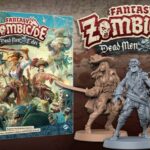
Board game giant Asmodee’s strategic push into crowdfunding has passed its first major test, with its debut campaign in the Zombicide universe raising more than $4.1m on Gamefound.
The buyout came a month after Asmodee had hired ex-CMON COO David Preti – the architect of the latter company’s growth into one of board gaming’s biggest crowdfunding-focused publishers – to head up its own newly-launched crowdfunding and miniatures strategy.
Asmodee had not publicly discussed details of its crowdfunding strategy ahead of completing the Dead Men Tales campaign, but said in a press release celebrating that success that crowdfunding “gives publishers clearer demand visibility, a direct line to engaged communities, and a healthier financial setup – with production sized to actual demand rather than to forecasts”.
It is thought FFG may resurrect Descent through a crowdfunding strategy in the future, although it is yet to confirm or deny this, saying in April, “While we don’t have anything to share at this time, there is always a possibility that we will revisit Descent in the future. It would take a different form and would not be Legends of the Dark, but this game universe is near and dear to FFG’s heart.”
Asmodee CEO Thomas Koegler said of the Dead Men Tales crowdfund, “This first campaign means a lot to me, and I think it sends a clear signal.
“Zombicide is a beloved franchise that joined the group less than a year ago, and Dead Men Tales is already proving the model works: the original Guillotine Games team back at the helm, Fantasy Flight Games executing the campaign with remarkable skill, and a community of more than 11,000 backers who chose to trust us early.
“That trust is something we take seriously. There’s still careful work ahead on delivery, a crowdfunding campaign is only as good as what arrives at your door, but I have full confidence in our teams to see it through.”
Dead Men Tales was the latest Gamefound campaign to make use of the platform’s Endgame feature, which is designed to extend the final moments of campaigns that are still actively receiving pledges even as the original countdown ends.
The Dead Men Tales campaign had collected more than $3m by the end of the official crowdfunding period, but Endgame extended the raise by more than five extra days and about $1m due to new pledges consistently being made.
Prior to Dead Men Tales, the only previous crowdfunding campaign from an Asmodee-owned company was Lookout Games’ Kickstarter for the Grand Austria Hotel: Let’s Waltz! Expansion & Deluxe Upgrade, which raised about €383,000 during the coronavirus pandemic in 2020.
Asmodee’s only other direct exposure to crowdfunding is thought to be via the company Exploding Kittens, in which it made a strategic investment short of a buyout in 2021. That business has since raised more than $977,000 in a Kickstarter campaign for Hand to Hand Wombat.
Asmodee’s own board game publishing operation, meanwhile, saw its net sales fall 5.8% in the last financial year – while net sales for the first quarter of this year were down 9.8% compared to the same period in 2025.
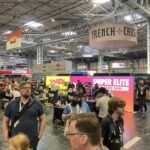
The UK Games Expo has continued its meteoric growth into one of the world’s largest tabletop gaming conventions, after more than 51,000 people descended on Birmingham’s NEC for the show’s 20th anniversary.
That turnout is more than double UKGE‘s pre-pandemic record for unique visitors, and saw overall footfall reach almost 88,000 across the three-day show, which ended yesterday.
The surging visitor numbers – up 64% in just three years – mean UKGE is now pushing steadily towards the 70,000-plus visitors recorded by giant US tabletop convention Gen Con each year since 2023, and is more than two and a half times larger than last year’s Origins Game Fair.
Almost every exhibitor BoardGameWire spoke with at this year’s event reported sales activity ranging from “very good” to “record-breaking”, while one mid-size publisher added that they were delighted at how smooth the organisation was, compared to logistical and set-up issues they had previously experienced at shows including Origins and Spiel Essen.
Tycoon Games CEO Dan Yarrington
Dan Yarrington, the CEO of Everdell publisher Tycoon Games, had a small presence at the show for the first time this year as part of a shared booth, following a fact-finding trip to the event in 2025 – and told BoardGameWire his company would probably return with its own stand in 2027.
He said, “At this level, at 40,000 plus people, and with the buying that we see… my impressions of the show were that, ‘Hey, this is actually a good show’. People are buying stuff, and it’s a different market. This is especially important in the global climate that we’re in, where people are less likely to travel to various other places.”
Yarrington added that in addition to selling its existing titles, UKGE would likely act as a preview show for the publisher, with new releases more likely to appear at Gen Con and Spiel Essen to feed into the company’s fourth quarter.
He said, “At this [UKGE] we had the Everdell Journeys preview copy – it’s not even on Kickstarter yet, so we can be like, ‘hey, come play it, and then tell us what you think’, we can adjust things, and then ‘hey, sign up for the Kickstarter’ – but Journeys won’t release till Gen Con [in 2027], so I think that’s what it’d be, a good process for us.”
Other exhibitors planning to expand their UKGE presence next year after a successful show included small-scale UK publisher Minerva Tabletop Games, which teamed up with three other members of the Playtest UK design group this year to run a combined booth.
Minerva founder Scott Lowe-James told BoardGameWire, “I don’t want to say this is definitely happening, but this was a test, and I think we could easily do like four or five times bigger than this”, citing Allplay‘s large demo area and single shop front as a potential model to replicate.
He added, “We’re all here already, and we’ve all got our own stands, but with that comes volunteers, accommodation costs, logistics. Whereas [by collaborating] we’re able to keep costs down, which is really important for one person, two person teams in being able to support each other where we need. And also we get greater exposure, so the rising tide lifts all boats.”
Scott Lowe-James, centre, with other members of Playtest UK at their UK Games Expo booth
In terms of advising other smaller publishers thinking of attending future UKGEs, Lowe-James said, “I think if you can work with someone, then then do it.
“[UKGE] has the great incentive of the starter stand, so you get a discounted rate, and that is good. But the leap up [from there] is quite a big one, especially if you are a first-time publisher, because not only does the rate increase, but the minimum size increases – and with that comes you need to find people to volunteer, and so other costs increase as well.
“So if you’re able to, find people either with similar games or people that you know. The fact that we’ve been able to support each other, cover each other’s games, I think you also get that tighter bond.”
He added, “Next year we could have, like, 15 different games across different themes and different ways to appeal to people. And I think it’s definitely the way forward.”
James Naylor, the CEO of UK publisher Naylor Games [a BoardGameWire sponsor], said that in addition to a good year for sales, it was notable that more families and attendees relatively new to the board games hobby were filling out the show floor each year.
He told BoardGameWire, “I’m really glad to see that, actually, because there was a little bit of time a couple of years ago where it felt like – maybe it’s just my perception – that perhaps the whole show was becoming more of a kind of ‘turbo nerd’ RPG show.
“…maybe that’s just because that was a peak of RPG popularity or something, and I’m glad to see instead it’s reaching out to a wider audience.
“I want to see board games become more universal as a thing that people use to play face to face, away from screens. So, the more I see that wider audience, rather than just a very narrow hardcore, that’s better from my perspective.”
That rise in awareness of UK Games Expo, and board games in general, has been noticeable too in the run-up to the event, with coverage by national broadcaster the BBC both prior to and during the show this year.
The open gaming and tournaments hall at the 2026 UK Games Expo
Rob Trounce, trade marketing manager at UK board game retailer and distributor Zatu, said a highlight of the show had been BBC Radio showcasing co-op dexterity game Yubibo during its coverage.
He said, “It was kind of a shock to us, and I think it shows UK Games Expo going more mainstream as well.
“If it’s got the BBC and its radio channels talking about it, it shows that this isn’t just a space which is for us dyed-in-the-wool gamers anymore. It is for everyone, it is a mainstream thing.”
UKGE director Richard Denning, who co-founded the show in 2007, joked on social media ahead of this year’s show that the event had grown into something that had “frankly got a bit out of hand”.
UK Games Expo co-founder Richard Denning
The event has ballooned in size since the event first opening its doors in a Birmingham conference centre in 2007, attracting 900 excited gamers – a far cry from the 27,000 who attended Gen Con’s 40th anniversary show later that year.
Denning previously told BoardGameWire that even at that embryonic stage, he hoped the show could go some way to recreating the atmosphere of big name events such as Gen Con and Essen Spiel, albeit in a much-reduced form.
Speaking of plans for future shows, Denning told BoardGameWire there was still room for expansion in its current footprint, but added that the show may change things around next year in order to provide more space for events.
He said, “It is expanding, and we are tight on event space – hence the possible need for more. We have about 500 events. I am amazed how many events US cons get. I think we still want to see that grow.”
Addressing the show’s rapid growth, despite economic turbulence such as Covid-19, the impact of global conflicts and US tariff policy, Denning added, “It’s certainly been a roller-coaster. Even earlier there was the credit crunch of 2008, of course.
“I think whilst visitors may have smaller wallets at present they still want to attend events like UKGE. Folk will save for the weekend and set that a side as a treat to look forward to, I think.”
Asmodee’s escalating power as a global TCG distribution giant was evident again in its newly-released annual results, which showed the company’s net sales surging 23% year-on-year to more than €1.68bn.
That annual revenue has swelled around 50% in just three years on the back of huge recent growth in TCGs, including heavyweights Magic: The Gathering and Pokemon as well as a wave of strong performing newcomers such as Disney Lorcana, the One Piece Card Game and Asmodee’s own Star Wars: Unlimited.
Despite Asmodee’s long-time image as a board game publishing heavyweight, more than 72% of its revenue now comes via its distribution of other companies’ games – up from an already hefty 63% in the previous financial year to March 31, 2025.
TCGs now make up the lion’s share of Asmodee’s annual net sales – about 60% in the 2025/26 financial year, up from just over 50% across the preceding 12 month period.
The company’s own board game publishing operation, meanwhile, saw its net sales fall 5.8% in the last financial year – while net sales for the first quarter of this year were down 9.8% compared to the same period in 2025.
Asmodee’s Jan-Mar 2026 and last financial year revenue figures, showing a hefty jump in the portion of its net sales coming from distributing other companies’ games
Asmodee CEO Thomas Koegler was asked directly during a Q&A session on Asmodee’s latest financial results if the company was still primarily a board game publisher, or whether it was “increasingly becoming an infrastructure company for TCGs”.
He said in response, “We have insisted a lot on the fact that one of the strengths of Asmodee is to be a publisher, but the first strength that we do have is our global reach across all categories, from TCGs and board games.
“That’s the superpower of Asmodee – and then being a very strong publisher is a way of accelerating performance.
“So I would say that there is no change, we continue to capture opportunities across the board wherever they come from… our aim is to be a dominant player, bringing all games to the market, anywhere they can.”
The Japon Brand buyout was accompanied by Asmodee launching a new Japan-based design studio, Nekuma, anchoring its push into what it described as a “currently untapped market” for the company.
There were also hints in the Q&A session that Asmodee might be considering a move into Japanese distribution, adding to its existing operations in the region across China, Taiwan and Australia.
Koegler said of Japan, “The first move we have done with Japon Brand and setting up Nekuma is more of a sourcing move, right?
“The Japanese game designers and authors’ market is very dynamic. If you look for instance in recent very successful games – Bomb Busters, which is the Spiel des Jahres from 2025, was originated from Japan, a game like Dnup that we are releasing later in the year is coming from Japan.
Asmodee CEO Thomas Koegler
“So they are very good also at small card games, and we really wanted to, I would say, bolster our publishing capabilities by creating those sourcing activities.
“Distribution wise, for now we are still working with local partners, we have not set direct foot yet.
He added, “It’s a fragmented market, its a very strong TCG market on the local market side, but yes… as I said, it’s a very vivid scene.”
Koegler also made clear that the company is still pursuing M&A opportunities on the publishing side “across all play types that we have, from social games to lifestyle games and tabletop games”.
He said, “I would say that the discussions we have are still as active as they were – we have demonstrated our ability to do various sizes of deals, which is also a very strong signal to potential people that would like to join the Asmodee adventure.”
Koegler said in his introduction to Asmodee’s 2025/26 report that the impact of geopolitical and economic events on the company’s business in the first few months of the year had been limited, but that the firm remained “mindful” of the potential pressures on transport and energy costs.
Asmodee said the impact on the business of transport and energy cost changes due to global political and economic issues had so far been limited
He said in the financial results Q&A session, “From a consumer standpoint, in moments of tensions when there are rising costs, because games are an affordable leisure we tend to suffer less, if not take some opportunities. That’s what we’ve seen in previous crises over the past 10 or 15 years.
“Consumer sentiment-wise, we will see. Although we are always cautious, there is also I think opportunities for us.
“Secondly, in terms of the cost impact. First of all our mix is currently very favourable because trading card games are manufactured very close to where they are sold, like in Europe for European countries mainly – some are manufactured in Asia but its a limited one – in the US for the US, etc.
“Plus they are cheap to transport, so the impact on those is relatively limited. And then we will see with our partners in terms of raw material increases, but again in the overall cost of goods they do not represent a very significant party.
“For board games we have started to see some increase in transportation costs. They did not impact Q4. If we take an example, road freight did represent roughly 20% of the cost base, and they have increased by 10%.
“But again, all of this is quite manageable for us. We expect to be able to mitigate the impact.”
Koegler added that although the process for receiving tariff refunds in the US had begun, after the Supreme Court struck Donald Trump’s swathe of import fees earlier this month, there was uncertainty about both the timing and final amount Asmodee was owed.
He said, “This is still a little bit foggy, blurred – for us, but [also] for many, many other companies out there. So let’s wait for what’s next on this topic.”
Astrolabe, a Persian folklore-inspired game which tasks players with hunting and binding demons using the titular instrument, has won this year’s Cardboard Edison Award celebrating unpublished board game designs.
The debut design from Iranian video game veteran Yasaman Farazan was praised by judges for its “genius” action selection system, which makes use of a physical ‘astrolabe’, calling it “thematic, toyetic, and an absolute joy to engage with”.
2026 Cardboard Edison Award winner Yasaman Farazan
Farazan’s design took first place out of a record 396 entries this year – a total which has almost quadrupled since Cardboard Edison unveiled its debut award winners a decade ago.
Part of that growth has been down to the competition’s pedigree of winners that have gone on to be published by well-known studios.
They include Winter, published by Devir, Castell from Renegade Game Studios and Umbra Via from Pandasaurus Games, as well as 2023 champion Diatoms, which followed a successful Kickstarter campaign with retail publication by 25th Century Games in partnership with Ludoliminal.
Second place in this year’s competition was Limelight, a push-your-luck deckbuilder by Cameron Fleming about staging a Broadway show, while third place went to Luke Wolyncewicz’s Braggin’ Wranglers, which sees players attempting to catch wooden animal meeples using an adjustable lasso.
Hatchlings, a game by Alan Leduc in which players try to get baby sea turtles to the ocean using “unique and clever” movement queue mechanism, placed fourth.
Braggin’ Wranglers, designed by Luke Wolyncewicz
This year’s 20 finalists also included a magnet-based vertical castle-building game and a medium-weight strategy title centred around wedding planning.
The game, designed by former Ravensburger game development intern Sammy Salkind, puts players in the shoes of startup founders battling to build their internet startups during the dot-com bubble of the late 1990s.
Cardboard Edison was launched in 2012 as a board game design studio and hub, which has since expanded from a well-read industry blog into a vast repository of information for board game designers.
Suzanne Zinsli created the Cardboard Edison Award a decade ago with the help of fellow Cardboard Edison founder Chris Zinsli.
All of the finalists from this year, and the pitch videos of their designs, can be viewed below this article.
Winner: Astrolabe by Yasaman Farazan 2-5 players 45-90 minutes Players are exorcists in a Persian folklore world, using astrolabes to read the stars, hunt demons, and bind them into artifacts. Each round, players secretly rotate their astrolabe to choose an action, a number, and a time of day, then reveal and resolve actions in ascending order. Pitch video
2nd Place:Limelight by Cameron Fleming 3-6 players 45 minutes Limelight is a push-your-luck deckbuilder about staging a Broadway show. Over three Acts, you’ll audition talent, hire crew, and rehearse your show, trying to achieve the perfect mix of cards on Opening Night. Pitch video
3rd Place: Braggin’ Wranglers by Luke Wolyncewicz 2-8 players 15 minutes Braggin’ Wranglers sees players catching animals to score points using a unique adjustable lasso—but there’s a twist! Turn order is decided by your lasso size, which you secretly set at the start of each round! Pitch video
4th Place:Hatchlings by Alan Leduc 2-5 players 30 minutes You’re a Nature Spirit with one job. Get your baby sea turtles out of their comfortable nest, across the beach, and into the water where they belong, thus earning praise from Mother Nature. It would be easy if it weren’t for the relentless bully Steven Seagull and the other Spirits competing for glory. Pitch video
Other finalists:
Black Ruth of Dogtown by Keith DeViere Donaldson 1-4 players 30 minutes Black Ruth of Dogtown is a procedural oracle system driven by a circular mancala drafting mechanism, where players construct a three-by-three grid to optimize set collection and speculative scoring in service of a final narrative divination resolution. Pitch video
Catacombes de Paris by Nicholas Henning 2-5 players 70-110 minutes In Catacombes de Paris, players take on the solemn duty of transporting the remains of millions through the bustling streets of 18th-century Paris to build their personal ossuary in the famed Catacombs. This highly thematic experience combines a strategic pick-up-and-deliver system with an engaging polyomino mini-game for building out your ossuary board. Pitch video
Deductive Seasoning by Eric Ledger 2-5 players 20-40 minutes Deductive Seasoning is a family-friendly deduction card game where you are a food scientist who has concocted a dish using a secret ingredient from the Periodic Table of Flavor. You must figure out other players’ secret ingredient through careful play and observation. Pitch video
Goa Kranti by Andy Desa 2-4 players 60-90 minutes A cooperative game about an overlooked chapter in history: Goa’s struggle for independence from Portugal (1932-1961). Players embody historical freedom fighters choosing between violent resistance and peaceful satyagraha. Core mechanisms include push-your-luck resource gathering, deck improvement, and bag-building for a pivotal mid-game check when India gains independence. Pitch video
Hybrid Hijinks by Jena Keesee 3-5 players 60 minutes A competitive game, creating hybrid creatures and utilizing variable, configurable player powers to impress visitors and earn the most approval for shifting prowess. Pitch vide
Ladybugs by Michael Posada 1-4 players 30 minutes Push your luck by rolling dice that represent a colony of ladybugs flying over a field of flowers. Your rolls determine which flowers you add to your garden, which scoring conditions you unlock, and how many points you earn. Pitch video
Match Patch by Jack Rosen 3-5 players 20 minutes Match Patch is a game about the benefits of farming using companion planting methods. Mechanically, it is a card-matching race game where players try to diversify their harvested crops. Pitch video
Midnight Spawn by Jayson Farrell 1-4 players 60 minutes Midnight Spawn is a game about the mysterious and incredible deep sea. In this game you’re a researcher in your deep-submergence vehicle, or DSV. You’ll discover strange creatures and observe them eat or move other creatures, manipulating the shared board. You can also upgrade your DSV with tech cards or boost your score with research cards. Pitch video
Moonforge by Pawel Owsianka 1-4 players 90 minutes In Moonforge, players command large space facilities capable of capturing asteroids, extracting valuable resources (energy, metal and minerals), and upgrading their operations with new modules and functions. Resources can be sold for currency points, while depleted asteroids contribute material toward the creation of a new moon. Pitch video
PiramiDuel by Guillermo Viciano 2 players 20-30 minutes A game for two players where you will explore Ancient Egypt, fighting to claim the most influential pyramids. Pitch video
Possessions by Dan Nichols 2-4 players 60-90 minutes Possessions is a competitive strategy game where you play as ghosts with one hour to finish your unfinished business and fulfill your final wishes. As the clock ticks down, strive to get the most value from your secret ambitions by possessing your family’s last living heirs. Pitch video
StrongHolds by Nelson de Castro 2 players 40-60 minutes StrongHolds is a competitive castle-building game featuring magnetic tiles that allow players to build vertically unlike any other game. Harness your creativity and vision as a Medieval Architect, while sabotaging your opponent by tossing and sliding siege tiles to topple their progress. Pitch video
The Leftovers by Larry Ted McBride 2-4 players 25 minutes The Leftovers is a cooperative trick-taking game of community deck-building, resource management, strategy, and story. With your party of magical foodfolk, you will work together to complete objectives and avoid vicious food fiends as you explore the abandoned halls of the Enchanted Ladle. Pitch video
The Roots of All Evil by Dean Burry 2-4 players 15-20 minutes Be the first animal cultist to summon the tree demon Blackthorn by creating ever-expanding rings of root cards in which to place your sacred offerings. Pitch video
The Wedding Planner by Jose Lema 2-4 players 60-90 minutes You just got engaged! Now you have 12 months to plan the wedding of your dreams. The Wedding Planner is a medium-weight strategy game that captures the authentic pressure of the process: an overwhelming workload, finite resources, and the constant tension between vision and reality. Pitch video
Wunderkammer by Rosco Schock 2-4 players 45 minutes Wunderkammer is a set collection style game with a unique simultaneous silent auction acquisition mechanism. Each curiosity that you collect also has two attributes so the scoring of your collection is scored in each dimension. Pitch video
Editor’s note: GAMA is one of the sponsors of the BoardGameWire newsletter
Newly-elected GAMA president Meredith Placko says the tabletop trade organisation must stop being reactionary, improve how it communicates with members, and focus on collecting meaningful industry data as it continues to navigate a turbulent couple of years.
GAMA has experienced explosive growth since the pandemic, with surging attendances at its annual GAMA Expo trade show and a broadening of its membership to include designers, manufacturers, media and events organisers, in addition to its long-time core of publishers, retailers and wholesalers.
GAMA has also recently faced budgetary issues, had to contend with the fallout from Donald Trump’s volatile tariff policy, and has fallen foul of a series of gaffes and other incidents which have caused dents to its reputation.
Speaking to BoardGameWire in her first long-form interview since being elected last month, Placko said putting proactive structures in place to keep GAMA from “stepping in the mud all the time” was one of her priorities.
She said, “We need to stop being reactionary. We need to start looking ahead, we need to think before we speak.
“…it’s easy, avoidable issues that if we just put a bit more forethought into it, we can overcome them and they won’t even become an issue. And I think a lot of that has to do with making sure you have the right people in the right places to communicate better.
“I will say this: GAMA’s not done a great job of communicating to its membership. And I really want to appreciate the work that has been done in the last year on the GAMA staff side, where they’ve retooled the newsletter, and they’re trying to get ahead of everything.
“I think that’s great, And I think the conversations that we’re having behind the scenes between board members and with our acting executive director is being on top of that communication.
“And that’s going to be really key because it’ll kind of keep us from stepping in the mud all the time or being late to the game, like with the tariff news last year.”
Part of that looking ahead involves GAMA’s first-ever ten-year plan, which was unveiled to much fanfare last October by former executive director John Stacy and Placko’s predecessor as president, Nicole Brady.
Former GAMA executive director John Stacy
That array of plans included boosting GAMA’s membership within both hobby games and the mass market, expanding itself from being US-centric into a true global organisation, shifting its finances away from the current heavy reliance on the annual GAMA Expo and Origins shows, and leading the conversation on sustainability within the industry.
Advocacy and brand protection were also one of its near-term priorities – underscored by the organisation’s recent intensive lobbying and awareness efforts around the impact on the industry of US tariffs.
But with the figureheads of that plan both gone from their positions, where does the future lie for GAMA’s Vision 2035?
Placko told BoardGameWire, “I think most of it is there, it’s going to stay – I think it’s just going to be the order of which we tackle things.
“…we need to not be reactionary as an organization. We need to stop waiting for something to happen to then react to it. So we need to kind of maybe do a little bit more forward thinking about what are going to be the pressing matters.
“So advocacy, which was on the later half of that ten-year plan, that’s actually should be something that we start building into the core of our organization sooner.”
She added, “I’m going to be starting an advocacy committee for us to start looking at how to educate our members on being advocates for themselves and looking at opportunities that we can maybe work alongside other trade organizations or industry and other impact groups to do more lobbying efforts and have a say.
“Because really, as we saw this last year, tariffs decimated so many of our members. And that is something that we need to be on the forefront of… I know some people are like, ‘Oh, what can GAMA do? You guys are small potatoes’, but it’s having that voice, it’s having the impact.
“It’s at least having the information ready for people, so they know what’s going on and can make informed decisions.”
US tariff policy has had a hefty impact on both GAMA and its membership
Tariffs have impacted GAMA as an institution beyond just the need to lobby on behalf of its membership. Placko told BoardGameWire that the organisation had seen an uptick in turnover of members over the last year, and said she believed tariffs and wider economic instability were to blame.
But she added, “One of the things that I want to see is more hard data on member retention, like: who is staying, who is going, why are they leaving? Unfortunately in the last year, due to tariffs levied in America, companies are having to close down.
“People are going to have to make these harder decisions. You know, can they afford to be part of a trade organization? Are they even around to still be part of that trade organization?
“I will say: membership numbers are up, which is great all around. All membership groups saw a nice bump this year for membership, but we did lose people. And actually one of the big things I want to work with the whole board, the membership, the GAMA staff is: why are those people leaving? Where are they going? What’s happening to them?
“Because one of my core beliefs of a trade organization is that we need to be more involved in sort of this data gathering and sharing.
“I’ve been involved in [other] trade organizations and it’s very key to me that the trade organization is able to provide me with actionable accurate data that can help make informed decisions as businesses move forward.
“And I think a key part of that is just knowing: what is the state of our industry? What is going on with people? What is going on with companies? Where can we as a trade organization also step up and help them, like with advocacy?”
Despite membership numbers continuing to grow, GAMA has also faced headwinds for its finances over the last couple of years – a situation that has delayed its hiring of a new permanent executive director to replace John Stacy.
Tax data provided to BoardGameWire by the organisation showed net revenues of just $17,500 on a total revenue of about $1.4m in 2024 – well down on the almost $409,000 net revenue recorded the prior year, on overall revenues of almost $1.5m.
The documents show salaries rose about $782,000 in 2023 to almost $960,000 the following year, while ‘other expenses’ was up from $302,000 to about $426,000 in the same period.
Placko said, “Our finances have been… not in the best place. And back in the fall, John Stacy hired this amazing operations officer, Melinda Prickett, and she has been taking a look at our finances and how GAMA runs everything, and just laying out a plan, working on stabilizing us and getting us to a point that when we bring in an executive director, they won’t be walking into a messy situation.”
She added, “Some of the things were just, like, tracking spending and where that money was going. And I’ll say this: as an organization, we haven’t raised fees, we haven’t raised booth costs in a while.
“And while everything else is getting more expensive, what we were taking in was not covering everything that we were doing. So there were a lot of hard conversations about where cuts needed to be made.
“We’re currently spinning up conversations. We have a membership dues committee that started, that’s going to be looking at if we need to raise dues and how much.”
She continued, It’s great that we’re able to offer what we can for the limited amount of buy-in from memberships. But, you know, if that money is not covering everything, we have to make hard decisions.
“But it’s improved. I’ll say that… there are just changes we’ve made, and things aren’t bad or scary.”
Speaking of her decision to run for GAMA president, Placko said, “I’ve been vice president. I’ve been on the board for only a year. It was interesting for someone new to the governance side of the organization to even make a play for an officer role like I did when I started.
“But it’s not like I’m lacking experience on non-profits and for-profit boards, and the reason I ran for [the GAMA board] to begin with is that there were just some core governance changes that I wanted to see.
“I quickly learned – and I think a lot of people don’t realize – that our board is governance and not operational. And what I saw was, from the outside, it looked like the board was maybe very involved in the day-to-day operations of GAMA, where it shouldn’t be.”
She added, “Nicole Brady did a fantastic job the last two years, bringing GAMA out of a really messy place and into a more stable place.
“But what I wanted to see, and what I kind of pitched to my fellow board members, was that I really believe that we need to be more of a working board where we’re all working together, that not one single person or a handful of individuals are leading things.
“And sometimes maybe the perception was that way. I want to be very clear: I’m not saying it was that way, just the perception. And communication is key.”
“…I think that the board deserves to know a lot more of what’s going on, and have more of a say in what is being said to the executive director. And I don’t want to be like, ‘oh, I ran on transparency’ – but I really did. I ran on that. I felt that us as a board needed to have more open communication with the executive director… and be able to have a more open working relationship.”
Placko continued, “I think there’s been a misconception that the president of the board leads the vision of GAMA and the board, and that shouldn’t be the case.
“As a board, we are 12 individuals who need to come together and have a shared vision. I kind of see my role as president as maybe the person who helps conduct those conversations, keep them on track, and help silo them to where we’re all on the same page by making compromises and such.
“But that doesn’t mean that I myself don’t have personal things that I think we need to update and change.”
BoardGameGeek has fired advertising manager Chad Krizan after almost 20 years with the company, after he cited his personal experiences of demonic possession as grounds for rejecting an ad campaign.
In the emails, Krizan says he has been “sitting on this one and praying about what to do in this instance”, adding that “as a follower of Jesus, I routinely help people suffering from demonic oppression, and more occasionally, possession, and it’s absolutely devastating the damage he does to peoples’ lives”.
Krizan wrote, “IMO, the responsible thing to do would be to pull the entire project, as there are *way* more people that suffer this than you could possibly imagine, putting on a good face (usually enabled by dissociation), but suffering terribly behind the scenes.”
When Falling Whale replied to question the decision to ban the game on religious grounds, and asking for confirmation of which BGG advertising policy they were breaking, Krizan responded:
“Keep in mind it’s not over religion, but reality. It’s the same reason I would say a game would be in very poor taste if it featured being a sexual predator, or something that would directly trigger someone that’s been harmed by the subject matter.
“It’s about keeping BGG welcoming to everyone, and since I’m privy to this subject matter, I know firsthand that this is not friendly content, and incredibly triggering, put in front of some of the population that visits BGG.”
A statement from BGG founder Scott Alden posted on the site’s forums said, “Due to a situation in which BGG’s Advertising Manager responded inappropriately in a business email to a designer, I have decided to let him go. His response does not reflect or represent our company or the way we conduct business.”
Falling Whale’s campaign for social deduction game Possess Me, Satan runs for another 30 days, and has currently raised just over $14,000 from about 250 backers.
Board game designers Reiner Knizia and Markus Slawitscheck both have a shot of completing an unprecedented series of wins at this year’s Spiel des Jahres – widely considered the highest profile awards in board gaming – after the 2026 nominations were unveiled earlier today.
The pair have already won two of the awards’ three categories in prior years – and the nominations of Slawitscheck’s Morty Sorty Magic Shop for the main prize, and Knizia’s Rebirth for the higher complexity Kennerspiel, could see either or both become the first designers in the awards’ 47-year history to complete the set.
Morty Sorty Magic Shop is up against Corey Konieczka’s Cozy Stickerville and Martin Ang’s Dito! – the German version of Jinxo – for this year’s Spiel des Jahres, while Rebirth is contending with Michael Palm and Lukas Zach design Boss Fighters QR and Donald X Vaccarino’s Moon Colony Bloodbath for the Kennerspiel.
Spiel des Jahres Association chairman Harald Schrapers said in a nominations livestream today that the jury looked at a record 571 games for this year’s awards, underscoring the sheer mass of games being released through retail.
The 440 titles reviewed across the Spiel and Kennerspiel categories was up 14% on last year, while the 92 games considered for the Kinderspiel marked a roughly 50% rise compared to the 61 from 2025. Another 39 titles were considered by judges across both the Spiel and Kinderspiel awards.
Number of games reviewed in recent Spiel des Jahres years – red is Spiel and Kennerspiel, blue is Kinderspiel, and purple is games which span both segments
Despite those record numbers, Schrapers pointed out that just 2.3% of the games were from women designers, with male creators making up 94% of the cohort, and the rest being designed by mixed teams.
That figure has barely moved in recent years, having stood at 2% in 2025 and 2.6% in 2024 – an ongoing lack of diversity highlighted in great detail in this excellent feature by Wargamer’s Mollie Russell earlier this week.
Schrapers also emphasised that this year’s judging process had been a particularly frustrating one, with glaring flaws being present in even the standout designs.
He said, “It was a lot of fun, but there were also real shortcoming in many games.
“There are deficiencies in some games every year, of course – there are so many, not all of them are really good. Many are good, but as I said, not all of them.
But this time we noticed, especially with the outstanding games, i.e. the 10% best – I would say there were various games where there were various quite serious flaws. There were so many that I even wrote them down.”
He presented a list which included incomplete, ambiguous, and contradictory rules of the game, a lack of summaries, blatantly incorrect age information on boxes, and components which fail to function well in poor light or after a handful of games.
Schrapers said in a separate blog post about the process, “Despite these shortcomings, some titles made it onto the jury’s shortlist because the flaws were not so significant in relation to the outstanding gameplay.
“However, there were probably more than one work that failed to secure a majority in the jury vote due to such a deficiency.”
Spiel des Jahres deputy chairman Christoph Schlewinski, left, and chairman Harald Schrapers, right, with this year’s Spiel des Jahres nominees
The livestream also drew attention to the nomination of Boss Fighters QR, and the long-listed design Toriki: The Castaway Island, as notable for requiring an app in order to play.
When asked by Spiel des Jahres deputy chairman Christoph Schlewinski whether that signified a growing trend within the hobby, Schrapers said, “No, I don’t think that’s a trend.
“They are two games that work very well with an app… the thing is that the app supports the analogue feeling in such a game. That’s why it’s an addition.”
He added, “I’m really sure that even in ten years, 90% or even more of all board games will work without a digital integration, because that’s exactly what people like.
“But an app also draws new people into this game. We notice it especially with young people that they often find this very , very good, it creates additional tension – and you can see that such a board game can also open up new audience groups.”
Hisashi Hayashi’s co-operative bomb disposal game Bomb Busters won last year’s Spiel des Jahres, beating the much-fancied push-your-luck card game Flip 7 to the high-profile award.
That victory meant the Spiel des Jahres has now been won by a co-operative game design in five out of the past seven years, following successes for Just One in 2019, MicroMacro: Crime City in 2021, Dorfromantik: The Board Game in 2023 and Sky Team last year.
Cozy Stickerville is the only nominee for the main prize this year which is a cooperative title.
Last year’s Kennerspiel des Jahres was won by Endeavor: Deep Sea – which also features a prominent co-op mode as a way to play the game – while the winner of the 2025 Kinderspiel was Wolfgang Warsch’s Topp die Torte.
Winning the Spiel des Jahres can explode sales by hundreds of thousands of copies for the winner – and by thousands of copies for the nominees.
While publishers tend to keep tight-lipped about actual sales figures, Pegasus Spiel co-founder Karsten Esser told BoardGameWire in a 2023 interview that winning the main prize can boost a game’s sales by 10x to 20x in the months following, due to a slew of exposure across mainstream German shopping outlets in the run-up to Christmas.
That kind of boost can be hugely impactful for publishers and designers alike – and is particularly important to smaller publishers in the fight to stand out amid an increasingly competitive industry which sees thousands of releases each year.
The winners of this year’s Spiel des Jahres awards are set to be announced on July 12.
Asmodee has revealed the first slate of partner companies it has picked to make Lord of the Rings-themed board games and accessories, six months after becoming the steward of the hugely lucrative Middle-earth licence for the tabletop.
They are joined by dice and tabletop accessories maker Sirius Dice, and Game Toppers, which announced separately that it will be creating Lord of the Rings-themed gaming tables, mats and other accessories.
Individual projects from most of those publishers are still under wraps, although last month Stone Blade announced it would be bringing a Lord of the Rings-themed version of its Ascension deckbuilding game to Gamefound.
When Asmodee was given power over the tabletop licence by Middle-earth Enterprises last October, the initial reaction from some publishers was that they would struggle to get a look in, with Asmodee likely to reserve the best opportunities for Lord of the Rings releases for itself.
Luke Peterschmidt, head of active category management at Asmodee
He said at the time, “Our job is to make the right number of Middle-earth games at the right pace, so that every game has space to breathe, and there is a Middle-earth game or gaming accessory for every type of game.
“That’s the mission, and no part of that mission says, ‘and Asmodee makes all the games’.”
He added, “It is absolutely fair to have that thought in your head, and it’s our job to prove that thought wrong. And, I mean, literally nothing I say, I think, could convince anybody other than action. So yeah, it’s got to be the action, we’ve got to follow it up.”
In a statement announcing the first slate of partner companies, Peterschmidt said, “There may be The One Ring to rule them all, but it takes many publishers to satisfy the gaming needs of The Lord of the Rings fans and I’m sure each of our partners are going to do their part in that quest.”
Asmodee’s own Lord of the Rings-themed releases this year are currently set to include The Lord of the Rings: The King’s Gambit, which its studio Space Cowboys is developing in partnership with Restoration Games.
That title is a reimagining of turn-of-the-millennium Avalon Hill release Star Wars: The Queen’s Gambit, which is based around four battles that take place during the events of Star Wars film The Phantom Menace.
Publishers interested in pitching a Middle-earth game to Asmodee can do so by emailing METTGlicensing@asmodee.com.
Osprey Games, the UK publisher of tabletop titles including the critically acclaimed Undaunted series, is shutting down its board and card games operation to refocus on wargames and RPGs.
A statement from the company said Osprey’s owner, the multinational book giant Bloomsbury Publishing, had made the “difficult decision” to sell the board and card game line as part of a “strategic refocusing” on book publishing, adding that the move was “not a decision taken lightly”.
The company said it would not commission any new board or card games, but would continue to release, sell and license upcoming games according to its existing schedules while Bloomsbury hunts for a new owner for its board games.
BoardGameWire understands from two sources that Bloomsbury hopes to find a buyer willing take on the existing board and card game team in addition to its catalogue of titles, but the firm is yet to publicly comment on the sale process.
Osprey Games was launched in 2015 as part of Bloomsbury arm Osprey Publishing, which had a decades-long history of creating military and historical information and reference books before beginning to publish wargaming rulebooks in 2008.
The gaming arm’s early successes included Peer Sylvester’s The King is Dead and The Lost Expedition, as well as popular titles such as Hal Duncan and Ruth Veevers’ design Cryptid and the second edition of Martin Wallace’s London.
Those releases were followed by the high-profile success of the Undaunted series of deckbuilding wargames from David Thompson and Trevor Benjamin and the Imperiumgames from Nigel Buckle and Dávid Turczi.
Osprey also gained a reputation for taking chances on a range of titles with intriguing mechanisms and designs, such as Sylvester’s area control and trick-taking hybrid Brian Boru, highly asymmetric area control title Crescent Moon, card-based strategic wargame Battalion: War of the Ancients and small-box, quick-playing conflict title General Orders: World War II.
Undaunted: Normandy, designed by David Thompson and Trevor Benjamin
Speaking to BoardGameWire, Sylvester said the sale news had come as “a bit of a bombshell”, adding that he wasn’t aware of any problems at Osprey which pointed to a possible sale.
He said, “I dont think the decision has anything to do with how the games have sold. From what I see, there are some strong titles, like The King is Dead (which is still selling well), Undaunted, and apparently also Lost Expedition. So it’s a decision made from the parent-parent-company at Bloomsbury.
“Working with Osprey was perhaps the defining moment of my ‘career’ as a game designer. First: they always had great developers there, which was fun to work with. Brian Boru wouldn’t be as good as it (hopefully) is without the team at Osprey.
“Also, Lost Expedition was turned into a hit partly because of the great idea to hire [comics creator and illustrator] Garen Ewing. So they elevated my games, but they also published them in the first place, which helped me getting a name and contact in the industry.
“I really don’t know if I would continue working on games as much as I did, if I wouldn’t have worked with them. So I owe them a lot.
“The news of the potential sale therefore makes me quite sad. I just hope the team keeps being around in some form, so I can keep working with them.”
David Thompson, the co-designer of the Undaunted series and fellow Osprey titles War Story: Occupied France, Line of Fire: Burnt Moon and the General Orders games, told BoardGameWire, “I’ve worked with Osprey for the last 14 years. Over that time, they’ve grown to be like a family to me.
“It was over a decade ago that Duncan Molloy, then the lead of the Osprey Games board game division, took a chance on a fledgling designer and signed what would eventually go on to be Undaunted: Normandy. Over the next decade I had the opportunity to collaborate with Duncan, Filip Hartelius, Anthony Howgego, Jordan Wheeler, Rhys Ap Gwyn, and Luke Evison on the editorial staff.
“Each and every one of them are incredibly talented people, and it was through their shepherding that games like the Undaunted series, General Orders, and War Stories: Occupied France came to be. And I would be remiss if I did not mention Emily Neat, Pete Ward, Benji Corless, Benjamin Thorne, and George Barker from the marketing staff and Gareth Clarke for his graphic design.
“Amazing people, each and every one. Over the years I’ve partnered with about 15 board game publishers, but the folks at Osprey will always hold a special, unique place in my heart.”
Fellow board game designer Ellie Dix, whose tapestry-themed worker placement design Threaded could prove one of the last published by Osprey Games, said she also did not know what had provoked the decision.
Ellie Dix design Threaded, published by Osprey Games
Dix told BoardGameWire, “I’ve loved working with Osprey. They’ve been absolutely brilliant. Honestly a dream to work with. They’ve taken so much care with Threaded and done such a great job to bring it to life. I’m very sad about the decision to sell.”
The news comes a month after Bloomsbury, which has a stock market valuation of almost £500m, announced it was “streamlining its structure for further growth”, which included a reorganisation of the company’s editorial divisions and the loss of about 55 jobs.
That restructuring follows Bloomsbury’s sales doubling from £185m to £361m over the last five financial years, with profits more than doubling to £48.8m in the same time.
No mention of Osprey was made in the restructuring announcement, or in Bloomsbury’s interim results announced in October last year, which revealed revenues of £160m and profits of £24m in the six months to August 2025.

 Anmelden